
Ancient Indian History · UPSC Notes
Stone Age — UPSC Ancient History Notes
Free, exam-focused notes for UPSC Prelims and Mains, with Prelims tips and Mains points for every topic. 9 topics.
Open in the interactive reader: bookmarks, progress tracking and read-aloud.
Pre-Historic Period: Introduction (Understanding the Time Divisions)
Human history is fundamentally divided into three stages— Prehistory , Protohistory , and History —based purely on the availability of written records and whether they are readable (deciphered). Prehistory is known only through archaeology (no writing); Protohistory has writing but it's undeciphered (unreadable); and History has fully deciphered written sources .
🔑 The Three Historical Stages (UPSC Basis)
History is the scientific study of the past, relying on evidence (called 'sources').
Sources: Literary, archaeological, epigraphic (inscriptions), numismatic (coins), and oral traditions.
1. Prehistory (The Age Without Writing)
Definition: The period before the knowledge of writing and script. This is the longest period in human development.
Sources: Our only source of information is Archaeological remains excavated from the ground, such as stone tools, pottery, bones, and cave paintings .
Examples in India: The entire Stone Age (Paleolithic, Mesolithic, Neolithic) is Prehistory.
2. Protohistory (The Unread Manuscript)
Definition: A transitional stage where people knew how to write but their script has not been fully deciphered (read) by modern historians.
Sources: We rely heavily on Archaeological remains (cities, seals) supplemented by undeciphered inscriptions .
Key Example in India: The Indus Valley Civilization (Harappan culture) —they used scripts on seals, placing them firmly in Protohistory.
3. History (The Readable Record)
Definition: The period beginning when written records are available AND successfully deciphered , providing clear textual details.
Sources: Deciphered Inscriptions, manuscripts, literary texts, coins.
Key Example in India: The Mauryan period provides the earliest extensive, securely dated corpus of deciphered inscriptions in India: Ashoka's edicts . Earlier literary traditions must be used with source criticism because their compositions were transmitted orally before being written down.
| Stage | Written Records | Main Source | Key Example (India) |
|---|---|---|---|
| Prehistory | Absent (None) | Only Archaeology (Tools, Cave Art) | Stone Age cultures |
| Protohistory | Present, but Undeciphered | Archaeology + Unreadable script | Indus Valley Civilization |
| History | Present and Deciphered | Deciphered Texts (Inscriptions, Literature) | Vedic Age, Mauryan period |
Prelims tips
- Remember the three keywords : Prehistory = no script; Protohistory = script undeciphered; History = deciphered records.
- Indus Valley Civilization is the primary example of Protohistory in India.
- Bhimbetka = key prehistoric site (a purely archaeological source).
- Ashokan edicts = earliest extensive, securely dated deciphered inscriptions (a key epigraphic source).
- Key sites: Hathnora (Narmada valley, MP) – the only hominin skull fossil in India ('Narmada Man'); Toba super-eruption ash (about 74,000 years ago) at Jwalapuram (AP); Chopani Mando (Belan valley, UP) – transition from Mesolithic to Neolithic with early pottery; Lahuradewa (UP) – among the earliest evidence of rice in South Asia.
Mains points
- The division of history into these three phases is based purely on the nature of evidence available, not the level of civilization.
- Prehistory is known only through archaeology; Protohistory through archaeology + undeciphered script; and History through reliable written records.
- In India, this distinction highlights the shift from the rural Stone Age to the urban Harappan civilization (Protohistory), and finally to the documented administrative era (History, starting with the Mauryans).
- Understanding this distinction is vital for historians to use the correct sources (archaeological vs. literary) for reconstructing India’s past.
Did you know?
- Archaeology is like being a detective: you reconstruct the entire story of a person or civilization just from the objects they left behind.
- Prehistoric humans left behind cave paintings (like Bhimbetka in India) instead of writing.
- The Harappan script is still the biggest puzzle in Indian history; if it is ever deciphered, the Protohistory period will become a fully Historical period.
- Ashoka’s edicts are the earliest extensive, securely dated corpus of deciphered inscriptions in India and a major foundation for reconstructing early Indian history.
Sources for the Construction of History (Where Does the Information Come From?)
The reconstruction of history depends on various sources such as archaeological findings , epigraphic (inscriptions) , numismatic (coins) , and literary texts . Each source acts as a piece of a puzzle, providing unique information about a society's polity, society, economy, culture, and religion .
1. Archaeological Sources (Digging up the Past)
This is the primary source for Prehistory and Protohistory . It includes material remains like pottery, tools, weapons, ornaments, and structural foundations from Excavations .
Cave paintings (e.g., Bhimbetka ) provide insight into prehistoric life and art.
Important sites: Harappa, Mohenjo-daro, Kalibangan, Dholavira, Rakhigarhi (crucial for Protohistory).
2. Epigraphic Sources (Inscriptions – Reliable Records)
The study of Inscriptions (writings engraved on hard objects like stone or metal) is called Epigraphy .
Significance: Inscriptions preserve contemporary names, titles, donations, orders and dates, but they are not automatically neutral: royal eulogies and grants also reflect the purpose and viewpoint of their issuers.
Key Example: Ashokan edicts = earliest extensive, securely dated corpus of deciphered inscriptions in India.
Scripts and languages: Brahmi is generally written left to right; Kharosthi, used mainly in the northwest, is written right to left and is linked to Aramaic. Ashokan records use Prakrit in most regions, with Greek and Aramaic in parts of present-day Afghanistan. Tamil-Brahmi records are key evidence for early Tamil literacy.
UPSC map: Epigraphy = study of inscriptions; palaeography = study of ancient writing; numismatics = study of coins. Do not confuse script (Brahmi/Kharosthi) with language (Prakrit, Sanskrit, Tamil, Greek or Aramaic).
Dating toolkit: Stratigraphy gives relative sequence (lower undisturbed layers are generally earlier); radiocarbon dating is used for once-living organic material; thermoluminescence can date fired clay and similar materials. Dates and archaeological interpretations always carry a margin of uncertainty.
3. Numismatic Sources (Coins – The Economic Link)
The study of Coins is called Numismatics .
Coins made of copper, silver, gold give info on trade, economic prosperity, rulers’ names/dates, and religious symbols .
Punch-marked coins (6th century BCE) = earliest coins in India.
Foreign coins (Roman, Indo-Greek) confirm overseas trade .
4. Literary Sources (Written Texts)
Religious texts: Vedas, Upanishads, Puranas, Buddhist Tripitakas, Jain Agamas (Provide cultural and social details).
Secular texts: Arthashastra (Kautilya) , Sangam literature, plays of Kalidasa (Provide details on administration and statecraft).
Foreign accounts: Megasthenes (Indica), Fa-Hien, Hiuen Tsang (Provide an external perspective , useful for cross-verification).
| Source Type | Focus Area | UPSC Relevance / Key Fact |
|---|---|---|
| Archaeology | Prehistory & Protohistory; Material Culture | The only source for Prehistory; Helps date cultures. |
| Epigraphy | Polity (rulers, orders); Religion/Dhamma | Contemporary official evidence; may still be selective or eulogistic. |
| Numismatics | Economy (trade, prosperity); Rulers' achievements | Punch-marked coins are the earliest Indian coins (6th c. BCE). |
| Literature | Society, Culture, Philosophy, Administration | Foreign accounts offer an external perspective, but require source criticism. |
Prelims tips
- Earliest extensive, securely dated deciphered inscriptions in India = Ashokan edicts (Epigraphy).
- Punch-marked coins = earliest coins (Numismatics) (6th century BCE).
- Indus Valley Civilization = Protohistoric (undeciphered script).
- Prayaga Prashasti → famous eulogy/inscription composed by Harisena for Samudragupta.
Mains points
- History is reconstructed using multiple sources (archaeology, inscriptions, coins, literature) because no single source is complete or free of bias.
- Archaeology is essential for Prehistory and Protohistory; Epigraphy and Literature are key for the Historical period.
- Coins provide direct insights into the economic health and trade networks that literary texts often miss.
- Combining internal (Indian) sources with foreign accounts allows a more objective and holistic reconstruction of India’s past.
Did you know?
- The man who successfully deciphered the Brahmi and Kharosthi scripts (used in Ashoka's Edicts) was James Prinsep in 1837.
- Punch-marked coins (PMCs) carry symbols, not kings’ names, showing they predate personalized royal currency.
- The Periplus of the Erythraean Sea (1st century CE) is a Greek text describing Indian ports and trade, serving as a primary source for maritime history.
- Ajanta cave paintings are called ‘encyclopedia of contemporary life’ because they depict everything from royalty to common people and fauna, revealing social context.
Stone Age (Prehistory in Detail) - The Evolution of Man
The Stone Age refers to the prehistoric period when humans primarily used stone tools . It is divided into three phases: Paleolithic (Old), Mesolithic (Middle), and Neolithic (New). This age shows the major transformation from nomadic hunting-gathering (food consumers) to agriculture and settled communities (food producers)—a shift known as the Neolithic Revolution .
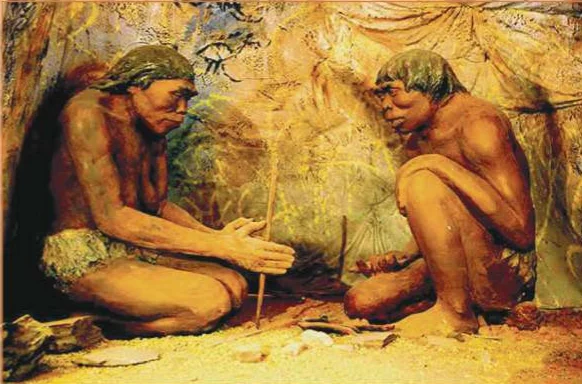
1. Paleolithic Age (Old Stone Age: The Hunter)
Time period: ~2 million BCE – 10,000 BCE (The longest phase).
Lifestyle: Strictly nomadic hunter-gatherers , dependent on nature for food, living in natural caves.
Tools: Crude, large hand axes, choppers, scrapers (made by chipping stone).
Key Discovery: Fire was discovered and used for cooking, protection, and warmth.
Major Indian sites: Soan Valley, Bhimbetka (Madhya Pradesh - famous for cave shelters).
2. Mesolithic Age (Middle Stone Age: The Transition)
Time period: ~10,000 BCE – 8,000 BCE (Transitional Phase).
Tools (Hallmark): Microliths (tiny, sharp stone blades fitted into wood or bone handles), making hunting much more efficient.
New Practices: Began domestication of animals (dogs and cattle) and produced extensive rock art .
Major Indian sites: Bagor (Rajasthan) and Adamgarh (Madhya Pradesh) provide early evidence of animal rearing.
3. Neolithic Age (New Stone Age: The Farmer)
Time period: ~8,000 BCE – 3,000 BCE (The Revolution).
Key Shift: Started Agriculture (wheat, barley, rice) and became food producers (the Neolithic Revolution ).
Settlement: Established permanent settlements with mud-brick houses.
Tools: Polished stone axes , sickles, and grinding stones (more refined and specialized).
Inventions: Pottery (for storing grain surplus and cooking) and weaving.
| Phase | Tool Quality | Key Features (Hallmark) | Economic Status |
|---|---|---|---|
| Paleolithic | Crude Stone Tools | Fire Discovery, Cave Dwelling | Nomadic Hunter-Gatherer |
| Mesolithic | Microliths (Tiny/Sharp) | Early Domestication, Rock Art | Semi-Nomadic; Transition |
| Neolithic | Polished Tools | Agriculture , Pottery, Permanent Settlements | Settled Food Producer |
Prelims tips
- Bhimbetka caves (MP) are a UNESCO World Heritage Site with the oldest rock paintings.
- Microliths are the hallmark tool of the Mesolithic age .
- Mehrgarh (Balochistan) is the earliest site showing the transition to agriculture (Neolithic).
- Burzahom (Kashmir) is unique for pit-dwellings and dog burials with humans .
Mains points
- The Stone Age is the foundation of human civilization, highlighting the transition from nomadic dependence to settled life and food production.
- The Neolithic Revolution (start of agriculture) is the most significant technological and social shift, laying the groundwork for population growth and social complexity.
- Archaeological evidence from sites like Mehrgarh demonstrates the independent origin of agriculture in the Indian subcontinent.
- The technological evolution from crude axes to microliths and polished tools demonstrates progressive human adaptation and ingenuity in response to environmental changes.
Did you know?
- Bhimbetka cave paintings are believed to be over 30,000 years old, showing continuity across Paleolithic and Mesolithic ages.
- Burzahom site in Kashmir shows dog burials along with humans, indicating early ritual practices.
- In many Neolithic communities, pottery was important for cooking and storage; its appearance varies by region and it is not a universal Neolithic invention.
- The Stone Age lasted for millions of years, illustrating the extremely slow pace of early human development.
Stone Age Tools and Settlements (The Material Evolution)
Stone Age humans showed progressive ingenuity. They developed tools made of stone, bone, and wood , which evolved from crude hand-axes (Paleolithic) to tiny, efficient microliths (Mesolithic), and finally to polished tools (Neolithic). Settlements also dramatically evolved from temporary caves and open-air sites to permanent agricultural villages .
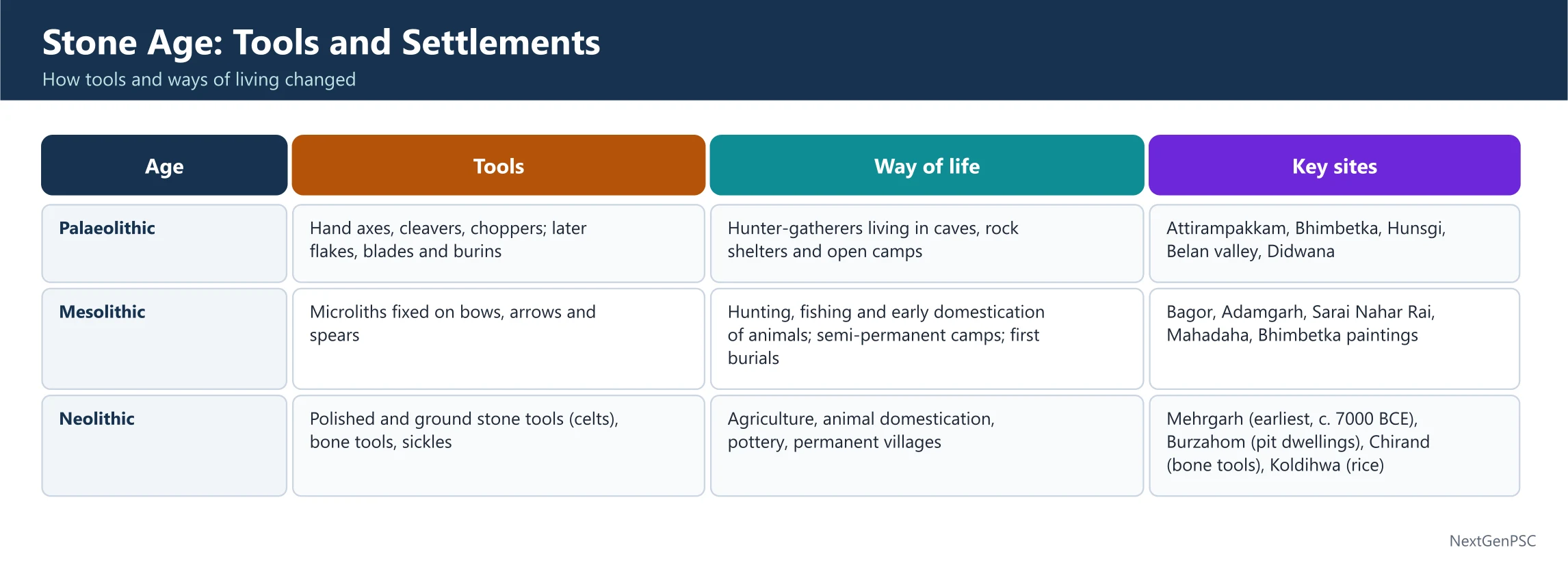
0. Read This First (Beginner’s Map)
Timeline (rough, South Asia): Paleolithic ≈ 2.5 million–10,000 BCE → Mesolithic ≈ 10,000–6,000 BCE → Neolithic ≈ 7,000–2,500 BCE (overlaps by region) → Chalcolithic ≈ 3,000–1,000 BCE .
Easy memory hook: Big & rough (Paleo) → Small & sharp (Meso) → Polished & farming (Neo).
1. Paleolithic Tools and Settlements (The Survival Kit)
Tools: Hand-axes, cleavers, choppers, scrapers made by striking large flakes off cores (Acheulean/Soanian traditions in India).
Key Technology: Fire for protection, cooking, warmth; simple clothing from hides.
Food: Hunting, fishing, gathering wild fruits, tubers; no agriculture yet.
Settlement: Nomadic ; temporary use of caves and open-air camps near water and raw material sources.
Key Sites: Bhimbetka (Madhya Pradesh—rock shelters, art), Kurnool caves (Andhra Pradesh).
2. Mesolithic Tools and Settlements (Specialized Hunting)
Hallmark Tools: Microliths —tiny blades set into wood/bone handles to form composite tools (arrows, spears, sickles, harpoons).
Technology: Evidence of bows and arrows , better fishing gear; early domestication (dog, later cattle/goat).
Food: Hunting-gathering continues with seasonal fishing and limited plant tending.
Settlement: Semi-nomadic ; seasonal camps near rivers/forests; simple huts.
Key Sites: Bagor (Rajasthan—animal remains/domestication), Adamgarh (Madhya Pradesh).
3. Neolithic Tools and Settlements (The Agricultural Revolution)
Tools: Polished stone axes (celts) , grinding stones , pestles, querns; specialized sickles for harvesting.
Material culture: Pottery for cooking/storage and weaving are documented in many regional Neolithic communities; the wheel appears later in some regions and should not be treated as a universal Neolithic marker.
Food: Agriculture (wheat, barley; later rice by region) and animal domestication (cattle, sheep, goats).
Settlement: Permanent villages with mud-brick houses; storage pits; sometimes pit-dwellings in colder regions.
Key Sites: Mehrgarh (Balochistan—early farming/animal herding), Burzahom (Kashmir— pit-dwellings , dog burials ), Chirand (Bihar).
4. From Stone to Metal (Bridge to Chalcolithic)
Chalcolithic = Copper + Stone together; beginning of metals for tools/ornaments; sets stage for Bronze Age urbanism.
Change driver: Surplus food → craft specialization → exchange networks → proto-urban growth.
5. Megalithic–Iron Age Cultures (High-Yield South India)
What 'megalithic' means: A burial tradition marked by large stones. It is not a single ethnic group or one uniform culture, and megaliths occur in several regions and periods.
South Indian context: The Iron Age megalithic cultures of peninsular India are conventionally dated broadly to c. 1200–300 BCE, with regional variation. They followed local Neolithic phases and overlapped with early historic developments.
Material clues: Burials commonly yield iron implements, Black-and-Red Ware, beads and other grave goods. These indicate craft, agro-pastoral and hunting activities; grave goods alone do not prove a detailed belief system.
Sites to map: Brahmagiri and Maski (Karnataka), Adichanallur (Tamil Nadu), and Junapani near Nagpur (Maharashtra).
UPSC distinction: Black-and-Red Ware occurs in more than one archaeological context. Do not identify it only with one culture or use it as a stand-alone date marker.
| Phase | Hallmark Tools | Settlement Type | Key Site Feature |
|---|---|---|---|
| Paleolithic | Crude Hand axes, Choppers | Nomadic (Caves, Open-air Camps) | Fire Use |
| Mesolithic | Microliths (Tiny Blades), Bows & Arrows | Semi-nomadic (Seasonal Huts) | Early Animal Domestication |
| Neolithic | Polished Axes , Pottery, Grinding Stones | Permanent Villages (Mud-brick Houses) | Agriculture and Pit-Dwellings (Burzahom) |
Prelims tips
- Microliths are the hallmark of the Mesolithic Age, although they also occur in some Upper Palaeolithic and later contexts.
- Burzahom (Kashmir) is famous for distinctive pit-dwellings, bone tools and burials. Interpretations of the reported dog–human burial association should be stated cautiously.
- Mehrgarh is among the earliest agricultural settlements in South Asia.
- Polished tools , hallmark of finer craftsmanship, belong to the Neolithic period .
Mains points
- Tool technology moved from heavy core tools to flakes, blades and microliths, reflecting growing skill and specialisation.
- The shift from caves and rock shelters to open-air and settled villages tracks the move from foraging to food production.
- Microliths allowed composite tools such as arrows and sickles, which made hunting and early harvesting far more efficient.
- Polished stone axes and pottery in the Neolithic mark the beginning of settled agricultural life in India.
Significance of the Prehistoric Period (Laying the Foundation)
The prehistoric period is significant because it documents the fundamental evolution of humans: the transition from nomadic food-gatherers to settled agriculturists . This era saw the first appearance of basic technologies, social organization, art, and culture , which together laid the entire foundation for later, more complex civilizations.
1. Human Evolution and Adaptation
Explains the journey from survival-based hunting to food production (the Neolithic Revolution ).
Shows how early humans adapted tools and lifestyle to changing environments and climate .
2. Technological Milestones
Gradual refinement of stone tools (Paleolithic → Mesolithic → Neolithic).
Discovery of fire transformed diet and safety.
Wheel and pottery improved transport, craft, and storage.
First metal ( copper ) in the Chalcolithic enabled further innovation.
3. Social and Cultural Beginnings
Social organization: From small bands to settled villages ; rise of family system and division of labor .
Art & Belief: Cave paintings (Bhimbetka) and megalithic burials offer evidence for symbolic practices and funerary treatment; detailed beliefs about an afterlife are interpretations, not directly observable facts.
4. Economic Foundation
Agriculture and animal domestication created stable food supplies.
Surplus enabled craft specialization (pottery, weaving), storage, and early trade—preconditions for urbanism.
5. UPSC-Friendly Connectors
Link prehistory to later Harappan urbanism : surplus, craft networks, standardization.
Use sites (Bhimbetka, Mehrgarh, Burzahom) as evidence-based anchors in answers.
| Aspect | Significance |
|---|---|
| Human Evolution | Shift from hunters to farmers ; adaptation to environment (Neolithic Revolution) |
| Technology | Stone tools, fire, wheel, pottery , early metals (foundation of material culture) |
| Art & Culture | Cave paintings , megaliths, rituals (first evidence of human mind/belief) |
| Social Organization | From nomadic groups to settled villages ; beginning of division of labor |
| Economy | Agriculture , animal domestication , surplus production (base for trade and cities) |
Prelims tips
- Prehistory = studied via archaeology; no written records .
- Neolithic Revolution = shift to agriculture & settled life .
- Bhimbetka = early rock art in India.
- Megalithic burials → deliberate funerary practices, often with grave goods, in several South Indian Iron Age contexts.
Mains points
- Prehistory reveals roots of adaptation, technology, culture shaping the subcontinent.
- Transition to agriculture created the core social-economic base for later civilizations.
- Advances like fire, wheel, early metals prepared ground for urbanization in protohistory.
- Evidence-based discussion (sites, tools, dwellings) shows continuity in India’s cultural trajectory.
Did you know?
- The Bhimbetka caves in Madhya Pradesh have paintings as old as 30,000 years, showing hunting scenes and early human life.
- The wheel , though perfected later, is considered a transformative prehistoric innovation for pottery and transport.
- Megalithic burials in South India often contain pottery, iron tools and ornaments; they show deliberate funerary practices, while any specific belief in an afterlife remains an inference.
- Domestication of animals like dogs, cattle, and goats improved food security and provided transport/labor.
The Paleolithic Age: Tripartite Division
The Paleolithic Age is the longest phase of human history, marked by crude stone tools and nomadic hunting-gathering. It is divided into three sub-phases—Lower, Middle, and Upper Paleolithic—based on the sophistication and type of stone tools used, showing a gradual refinement in human ingenuity.
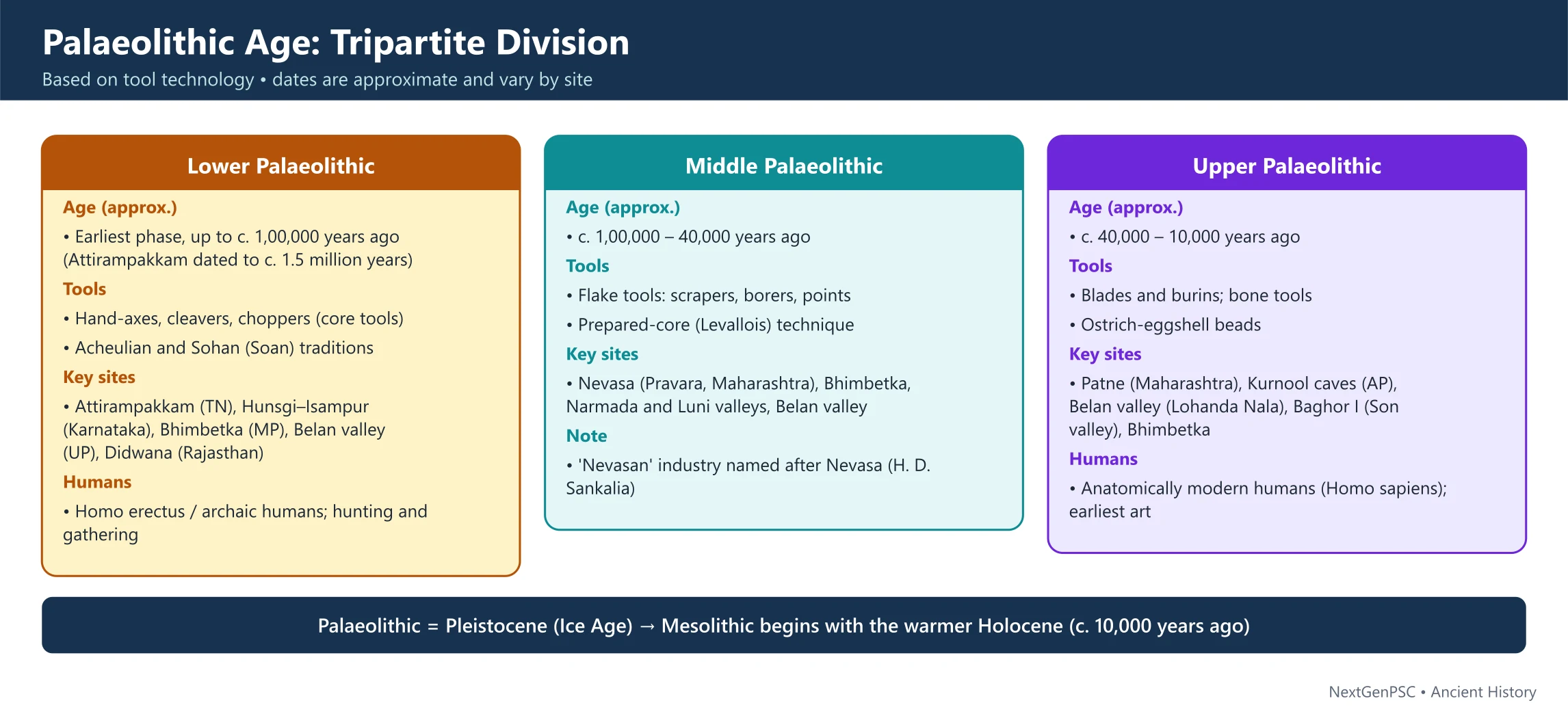
1. Lower Paleolithic (Core Tools)
Time: Extends up to about 100,000 BCE.
Tools: Characterized by core tools , primarily the Hand-axe and Cleaver (known as the Acheulean industry in India).
Culture: Early human species (like Homo erectus in Africa) existed; main Indian sites show evidence of Homo sapiens ancestors.
Key Sites: Soan Valley (Pakistan), Hunsgi (Karnataka), and Attirampakkam (Tamil Nadu).
2. Middle Paleolithic (Flake Tools)
Time: From about 100,000 BCE to 40,000 BCE.
Tools: Dominated by tools made from stone flakes , including various types of Scrapers , points, and borers (Levallois technique).
Culture: Associated with the emergence of Neanderthal man globally, but Homo sapiens appears in India; emphasis shifted from large core tools to smaller, pointed flake tools.
Key Sites: Narmada River sites, Nevasa (Maharashtra), and Luni Valley (Rajasthan).
3. Upper Paleolithic (Blade Tools)
Time: From about 40,000 BCE to 10,000 BCE (End of Ice Age).
Tools: Marked by the use of long, parallel-sided Blades and Burins (Chisel-like tools). Bone tools and needles appear, suggesting tailored clothing.
Culture: Associated globally with the appearance of modern humans (Homo sapiens sapiens). Emergence of widespread rock art and ritual practices.
Key Sites: Bhimbetka (earliest rock paintings), Renigunta (Andhra Pradesh), and Son Valley (Madhya Pradesh).
| Phase | Time Period (BCE) | Hallmark Tools | Key Associated Culture |
|---|---|---|---|
| Lower Paleolithic | ~2 million – 100,000 | Hand-axes and Cleavers (Core Tools) | Acheulean/Soanian |
| Middle Paleolithic | ~100,000 – 40,000 | Scrapers, Borers, Points (Flake Tools) | Levallois technique |
| Upper Paleolithic | ~40,000 – 10,000 | Blades, Burins, Bone Tools | Appearance of Homo sapiens sapiens |
Prelims tips
- Hand-axes and Cleavers belong to the Lower Paleolithic .
- Middle Paleolithic is characterized by Flake Tools like scrapers.
- Blades and Bone tools appear in the Upper Paleolithic .
- Bhimbetka rock shelters show continuous occupation from the Middle Paleolithic to the Mesolithic.
Mains points
- The gradual shift from core tools to flake tools and finally blade tools reflects increasing efficiency and a diminishing wastage of raw material.
- The Upper Paleolithic marks the true entry of modern humans into the Indian subcontinent, accompanied by the flourishing of sophisticated art and ritual life.
- Studying these phases allows us to track the evolution of human technology and cognitive abilities in response to Ice Age climate dynamics.
The Mesolithic Age: Key Sites and Features
The Mesolithic Age, or Middle Stone Age, served as a transitional period between the nomadic Paleolithic lifestyle and the settled agricultural Neolithic life. Its cultural hallmark is the use of Microliths (tiny stone tools) and the earliest evidence of animal domestication and extensive rock art.
Characteristics of the Mesolithic Age
Climate Change: End of the Ice Age and warming climate led to dense forests and new fauna, demanding smaller, specialized tools.
Tools: Microliths —small, sharp, geometric stone pieces (triangles, crescents) that were composite tools (spear points, arrowheads, saw blades).
Economy: Hunting and gathering persisted, but fishing became more important. Introduction of primitive animal husbandry (domestication of dog, goat, sheep, cattle).
Art: Bhimbetka and Adamgarh sites showcase rich rock paintings depicting animals, hunting scenes, and community life.
Burials: Graves were generally extended (laid out flat) or flexed (knees bent), often containing grave goods like ornaments and microliths, suggesting belief in the afterlife.
Key Indian Mesolithic Sites
Bagor (Rajasthan): One of the largest Mesolithic sites in India, providing the earliest evidence of animal domestication in the subcontinent.
Adamgarh (Madhya Pradesh): Provides early evidence of animal domestication (along with Bagor).
Langhnaj (Gujarat): Known for hunting tools, animal bones, and human skeletons.
Sarai Nahar Rai and Mahadaha (Uttar Pradesh): Known for human skeletons and clear evidence of semi-nomadic community organization.
Prelims tips
- Microliths are the exclusive tool of the Mesolithic period.
- Bagor is the most important Mesolithic site for early domestication.
- The shift from big core tools to tiny microliths is crucial.
- Mesolithic culture marked the beginning of animal domestication in India.
Mains points
- The Mesolithic Age adapted human survival techniques to the post-Ice Age environment, facilitating the eventual transition to agriculture.
- The evidence of animal domestication at Bagor and Adamgarh highlights the shift in human-animal relationship from purely hunting to co-existence.
- The extensive rock art provides invaluable insights into the social structure, rituals, and world-view of Mesolithic communities.
The Neolithic Age: Key Sites and Features
The Neolithic Age is broadly marked by food production and polished stone tools. The timing and combination of agriculture, pottery, animal husbandry, and permanent settlement differed considerably across regions.
Characteristics of the Neolithic Age
The Revolution: The beginning of agriculture (cultivation of crops like wheat, barley, rice) and large-scale animal domestication led to a food surplus.
Tools: Hallmark is the use of polished and ground stone tools (celts, grinding stones, sickles) which were more efficient for clearing forests and harvesting crops.
Settlement: Many regional Neolithic communities developed permanent or seasonally permanent villages, with varied house forms and storage practices.
Pottery: Pottery occurs in many Neolithic communities and was useful for cooking and storage. It is regionally variable; Northern Black Polished Ware belongs to a much later early-historic context, not the Neolithic.
Key Indian Neolithic Sites
Mehrgarh (Pakistan - Balochistan): Earliest evidence of agriculture (wheat, barley) and animal rearing (cattle) in the Indian subcontinent, dating back to c. 7000 BCE.
Burzahom (Kashmir): Important for its pit-dwellings, bone tools, and burials of dogs; interpretations of any dog–human burial association should be stated cautiously.
Chirand (Bihar): Known for tools made of bone and antlers (a rare use of bone tools in this period).
Koldihwa and Mahagara (Uttar Pradesh): Important Neolithic sites with reported carbonised rice remains, often dated broadly to the 7th–6th millennium BCE. Their dates and the status of early rice cultivation should be presented cautiously.
Maski and Brahmagiri (South India): Known for Megalithic burials and transition to the Iron Age.
Prelims tips
- Neolithic Revolution : Agriculture, polished tools, and pottery.
- Mehrgarh : Earliest site with evidence of wheat and barley farming.
- Koldihwa–Mahagara : Important early evidence for rice in the Belan Valley; avoid treating one site as an uncontested ‘earliest’ for South Asia.
- Burzahom : Unique for pit-dwellings and dog burial rituals.
Mains points
- The Neolithic Revolution was a global phenomenon, but sites like Mehrgarh suggest an independent and early origin of farming in the Indian subcontinent.
- The establishment of permanent settlements created the structural basis for complex social organization and the development of Protohistoric urbanism (Indus Valley Civilization).
- Regional variations, such as pit-dwellings in Burzahom and bone tools in Chirand, highlight the diverse adaptations of Neolithic communities across India.
The Chalcolithic Age: Copper-Stone Culture
The Chalcolithic (Copper-Stone) label refers to regional cultures that used copper alongside stone tools. Their dates, material culture, and relationship with Harappan communities vary by region; several were rural, while some overlapped with urban Bronze Age traditions.
Characteristics of the Chalcolithic Age
Technology: Use of Copper for tools (axes, chisels, rings) and ornaments, though stone tools remained dominant, especially in rural areas.
Economy: Primarily rural villages based on agriculture (wheat, barley, rice, pulses) and cattle rearing .
Pottery (Hallmark): Characterized by Black-and-Red Ware and other painted pottery (e.g., Malwa Ware, Jorwe Ware).
Settlement: Wattle-and-daub houses (mud-plastered walls on wooden frames); some settlements show early fortification.
Limitations: Lack of knowledge about iron (which comes later) and limited use of bronze (which defines the Harappan urban phase).
Key Indian Chalcolithic Sites
Ahar (Rajasthan): Known for a substantial use of copper and evidence of smelting.
Kayatha and Malwa (Madhya Pradesh): Known for distinct pottery styles (Kayatha and Malwa Wares) and copper objects.
Jorwe (Maharashtra): The type-site for the Jorwe culture, known for its extensive settlements and large number of copper tools.
Daimabad (Maharashtra): The largest Jorwe site, famous for its large collection of bronze goods (though technically later, its origins are Chalcolithic).
| Culture | Region | Key Site | Hallmark Pottery |
|---|---|---|---|
| Ahar/Banas | Southeastern Rajasthan | Ahar, Gilund | Black-and-Red Ware (BRW) |
| Kayatha | Madhya Pradesh | Kayatha | Dark brown/painted wares |
| Malwa | Western Madhya Pradesh | Navdatoli | Red/Orange wares with black paint |
| Jorwe | Maharashtra | Jorwe, Daimabad | Red Ware with matt surface |
Prelims tips
- Chalcolithic = First use of Copper (along with stone).
- Black-and-Red Ware (BRW) is characteristic of Chalcolithic sites like Ahar.
- Many Chalcolithic cultures were rural; their chronologies vary, and several were contemporary with parts of the Harappan sequence.
- Daimabad is a major Chalcolithic/Bronze Age site in Maharashtra.
Mains points
- The Chalcolithic Age shows the continuity and transition from Neolithic farming villages to complex metal-using societies.
- The development of distinct regional pottery styles (Malwa, Jorwe) reflects growing craft specialization and regional identities.
- Chalcolithic cultures show regional experimentation with farming, craft production, and copper; they should not be presented as a single direct precursor to the Indus Valley Civilization or its urban centres.