
Ancient Indian History · UPSC Notes
Post-Mauryan Period — UPSC Ancient History Notes
Free, exam-focused notes for UPSC Prelims and Mains, with Prelims tips and Mains points for every topic. 15 topics.
Open in the interactive reader: bookmarks, progress tracking and read-aloud.
Post-Mauryan Period: Introduction & Sources
The Post-Mauryan period (c. 200 BCE – 300 CE) began after the fall of the Mauryan Empire in 184 BCE. This era witnessed the rise of regional dynasties (Shungas, Kanvas, Satavahanas, Kushanas) and foreign rulers (Indo-Greeks, Shakas, Parthians). It marked an age of political fragmentation, cultural exchange, and flourishing art and religion.
The Post-Mauryan Period (184 BCE – 300 CE): Political Fragmentation and Cultural Flux 🛡️
The period following the collapse of the vast Mauryan Empire ( 184 BCE ) was marked by political decentralization but simultaneous unprecedented cultural, economic, and religious efflorescence , often referred to as the 'Age of Regional Kingdoms.'
Political Landscape: The empire fragmented, giving rise to distinct regional powers across the subcontinent:
- Native Successor Dynasties: The Shungas (Magadha/Central India) and Kanvas (succeeded Shungas) rose in the North, while the powerful Satavahanas (Andhra/Deccan region) established a long-lasting, influential kingdom.
- Foreign Dynasties (Northwest): The political vacuum in North-Western India led to successive waves of invaders establishing their own kingdoms: the Indo-Greeks (Yavanas), Shakas (Scythians), Parthians, and Kushanas .
Cultural and Religious Development: Despite political disunity, this era witnessed significant religious and artistic growth:
- Art and Architecture: Rise of new, elaborate art schools, including the embellishment of Sanchi and Bharhut stupas (with their carved toranas ), and the syncretic Gandhara (Indo-Greek) and Mathura schools of sculpture.
- Religious Evolution: Expansion of Buddhism (Mahayana and Hinayana), Jainism , and the emergence of structured Bhakti cults , with the formal development of Vaishnavism and Shaivism .
Economic Expansion: Trade and commerce reached its peak, connecting India globally with the Roman Empire, Central Asia (Silk Route) , and Southeast Asia .
Sources of the Post-Mauryan Period: A Diverse Evidence Base 📜
The history of this fragmented era is reconstructed using a rich tapestry of literary, archaeological, and foreign accounts, often cross-referencing different languages and regions.
A. Literary Sources (Narrative and Historical Texts):
Mahabhashya (by Patanjali, 2nd century BCE): This grammatical commentary (on Panini's Ashtadhyayi) is historically crucial as it mentions the invasion of the Indo-Greeks (Yavanas) , providing a native reference to foreign rule.
Milindapanho (The Questions of Milinda): An important non-canonical Buddhist text written in Pali, recording the philosophical dialogues between the Indo-Greek King Menander (Milinda) and the Buddhist monk Nagasena . It serves as a key source for Indo-Greek and Buddhist interactions.
Puranas: Provide valuable genealogical lists and chronological accounts, detailing the rulers and succession of Native Dynasties like the Shungas, Kanvas, and Satavahanas .
Jatakas and Buddhist Texts: Record the popular stories of Buddha's previous births and contain essential information on the rise of Stupas, Viharas, and monastic centers in the new kingdoms.
Tamil Sangam Literature: A unique body of literature from South India (c. 300 BCE – 300 CE) that describes the economy, society, and political conditions of the deep South, including the Cholas, Cheras, and Pandyas (the three crowned kings).
B. Archaeological Sources (Inscriptions, Coins, and Monuments):
Coins (The Most Reliable Source):
- Indo-Greek Coins: They were the first to issue bilingual and inscribed coins (Greek on one side, Kharoshthi on the other), providing the names and portraits of the foreign rulers (like Menander), essential for their reconstruction.
- Kushana Coins: Famous for their extensive issue of gold coins (similar to Roman currency in weight) and their portrayal of diverse deities (Indian, Iranian, Greek), reflecting the syncretic nature of the empire.
- Satavahana Coins: Known for using the material lead (due to metal scarcity in the Deccan) and featuring motifs like the ship , confirming their maritime trade activities.
Inscriptions:
- Hathigumpha Inscription: A key source for the history of Kharavela of Kalinga (1st century BCE), detailing his conquests and patronage of Jainism.
- Nanaghat and Nasik Inscriptions: Provide crucial genealogical and historical details about the Satavahana rulers .
- Junagarh Inscription (Rudradaman I): Written in elegant Sanskrit (an early example of the use of Sanskrit in royal inscriptions), it details the repairs of the Sudarshana Lake by the Shaka ruler Rudradaman I .
Monuments: Large-scale development of Stupas (Sanchi, Bharhut, Amaravati) and Cave Architecture (Karle, Ajanta) provides evidence of artistic and religious patronage during this period. The Stupas at Sanchi and Bharhut saw their railings and gateways elaborated during the Shunga period.
Foreign Accounts: Greek, Roman, and Chinese sources on Indo-Roman trade (Periplus of the Erythraean Sea) and Buddhist missions are invaluable for external connections.
| Source Type | Examples | Information Provided |
|---|---|---|
| Literary | Puranas, Sangam Literature, Milindapanho, Patanjali’s Mahabhashya | Dynasties, trade, religion, foreign rulers |
| Inscriptions | Hathigumpha (Kharavela), Nasik, Nanaghat, Junagarh (Rudradaman I) | Political history, administration, economy |
| Archaeology | Sanchi, Bharhut stupas; Karle, Ajanta caves | Art, architecture, Buddhism |
| Coins | Indo-Greek bilingual coins, Kushana gold coins, Satavahana lead coins | Trade, economy, foreign influence |
| Foreign Accounts | Greek, Roman, Chinese texts | Trade, Buddhism, Indo-Roman contacts |
Prelims tips
- Hathigumpha inscription → King Kharavela (Kalinga).
- Indo-Greek coins = bilingual (Greek + Prakrit).
- Milindapanho = King Menander + Nagasena dialogue.
- Sangam literature = source of South Indian history.
- Junagarh inscription = Rudradaman I (Shaka ruler).
Mains points
- Answer opening: The post-Mauryan centuries saw political pluralism rather than a simple decline after the Mauryas, alongside expanding trade, religious patronage and artistic experimentation.
- State and society: Shungas, Satavahanas, Indo-Greeks, Shakas, Parthians, Kushanas and regional dynasties adapted to different local conditions; 'foreign' origin did not prevent their participation in Indian political and cultural life.
- Economic dimension: Inland routes, ports, guild donations, coinage and contacts with the Roman world and Central Asia supported exchange, although coin finds alone cannot measure the whole economy.
- Cultural synthesis: Gandhara, Mathura and Amaravati show different regional artistic traditions and patronage contexts. Avoid presenting any one school as the uncontested first source of Buddha images.
- Conclusion: This was a formative age of regionalisation and connectivity that helped reshape Buddhism, Brahmanical traditions, art, coinage and early Indian political cultures.
Did you know?
- Milindapanho records the famous dialogue between Indo-Greek king Menander (Milinda) and Buddhist monk Nagasena.
- Indo-Greek coins were bilingual — Greek on one side, Prakrit (in Brahmi or Kharoshthi) on the other.
- The Hathigumpha inscription of Kharavela (Kalinga) is one of the earliest personal inscriptions of a king in India.
- Sangam literature gives one of the earliest glimpses into ancient Tamilakam (South India).
Post-Mauryan India: Foreign Dynasties (Indo-Greeks & Shakas with Important Rulers)
Indo-Greeks (Yavanas) and Shakas (Scythians) were major foreign dynasties in post-Mauryan India. Their rulers introduced new administrative practices, coinage systems, art forms, and played key roles in Indian religion and culture.
Indo-Greeks (Yavanas) (c. 200 BCE – 100 BCE): Hellenistic Influence 🇬🇷
The Indo-Greeks, succeeding the Mauryas in the Northwest, were the first to establish lasting foreign rule in India, acting as a crucial bridge between Hellenistic (Greek) and Indian cultures.
Origin and Territory: They originated from the Greek kingdom of Bactria (Central Asia) after breaking away from the Seleucid Empire. They controlled regions spanning Punjab, Gandhara, and sometimes extended their raids up to Pataliputra (as suggested by Patanjali's Mahabhashya) .
Important Indo-Greek Rulers
1. Demetrius (200–190 BCE): Founder of Indo-Greek rule in India; often depicted wearing an elephant scalp (symbolizing his conquest of India).
2. Apollodotus I (180 BCE): Known for extending control towards Western India. He was one of the first to issue bilingual coins (Greek on one side, Prakrit in Kharoshthi/Brahmi script on the other).
3. Menander (Milinda) (165–145 BCE): The Greatest Indo-Greek ruler , famous for his justice, conquests, and patronage of Buddhism. His capital was Sagala (Sialkot) . His philosophical discussions with the monk Nagasena on Buddhist doctrine are recorded in the important Pali text, Milindapanho .
4. Antialcidas (2nd century BCE): Sent Heliodorus as an ambassador to the Shunga court at Vidisha . The Heliodorus pillar inscription (Garuda Pillar) is significant as it shows a Greek professing the Vaishnava faith (dedicated to Vasudeva).
Key Contributions
Coinage Revolution: They revolutionized Indian coinage by introducing portrait coins , featuring the first realistic and individualized depictions of Indian kings (a Greek tradition). They also pioneered the widespread use of bilingual legends , which aided in deciphering ancient scripts.
Cultural Syncretism: Their influence provided the template for the Gandhara school of art , a crucial blend of Hellenistic techniques (realistic human anatomy, drapery) and Indian religious themes (the image of the Buddha).
Political Legacy: The Indo-Greeks were the first foreign rulers to issue coins and inscriptions directly in India , providing vital evidence for the chronology and geography of the period.
Shakas (Scythians) (c. 100 BCE – 400 CE): Satrapal System and Sanskrit Patronage 🏹
The Shakas displaced the Indo-Greeks and established powerful, long-lasting kingdoms, particularly in Western and Central India, becoming partially Indianized over time.
Origin and Territory: A nomadic Central Asian tribe (Scythians) displaced by the Yuezhi, they entered India in successive waves. They ruled across NW and Western India (Punjab, Mathura, Gujarat, Malwa, Maharashtra) through five major branches.
Important Shaka Rulers
1. Maues (Moga) (1st century BCE): Considered the first Shaka king in India; ruled the Gandhara region and issued bilingual coins.
2. Azes I (c. 57 BCE): His victory over the native rulers is historically linked to the supposed establishment of the 'Vikram Samvat' era (though later associated with the Gupta king Chandragupta II).
3. Nahapana (c. 78 CE): Ruler of the Western Satraps branch, ruling key regions in Western India. Known from Nasik inscriptions ; faced major conflicts with the powerful Satavahana ruler Gautamiputra Satakarni , who temporarily defeated him and revived the Deccan power.
4. Rudradaman I (c. 130 CE): The Most famous and powerful Shaka ruler . His detailed Junagarh inscription (Kathiawar, Gujarat) is historically crucial for two reasons: it is the first long inscription in complete classical Sanskrit prose , marking a major linguistic shift, and it details the repairs of the Sudarshana lake (originally built by the Mauryas).
Key Contributions
Administrative System: Introduced and popularized the Satrap system (Kshatrapas) , a Persian-style administrative division where provinces were ruled by semi-autonomous military governors, often using the titles Maha-Kshatrapa (Great Satrap) and Kshatrapa .
Economic Expansion: Expanded Indo-Roman trade significantly by controlling key Western Indian ports like Bhrigukachcha (Broach) and Sopara , integrating Western India into the global trade network.
Cultural Patronage: Rudradaman I strongly patronized Sanskrit literature, promoting it over Prakrit in royal inscriptions. Overall, the Shakas were tolerant patrons of Buddhism, Jainism, and various Indian cults, contributing to cultural syncretism.
Conflict and Legacy: Their rule in Western India was characterized by constant rivalry with the Satavahanas (known as the Deccan vs. Western Satraps conflict). They were eventually decisively defeated by the Gupta emperor Chandragupta II (Vikramaditya) around 400 CE.
| Ruler | Contribution/Event |
|---|---|
| Demetrius | Founder of Indo-Greek rule in India (200 BCE) |
| Apollodotus I | Issued bilingual coins (Greek + Prakrit) |
| Menander (Milinda) | Converted to Buddhism; Milindapanho |
| Antialcidas | Sent Heliodorus ambassador to Vidisha; Heliodorus pillar |
| Ruler | Contribution/Event |
|---|---|
| Maues (Moga) | First Shaka king in India (1st century BCE) |
| Azes I | Started Vikram Samvat era (57 BCE) |
| Nahapana | Ruled Western India; Nasik inscription; conflict with Satavahanas |
| Rudradaman I | Junagarh inscription (first classical Sanskrit prose); repaired Sudarshana lake |
Prelims tips
- Menander → Milindapanho with Nagasena.
- Heliodorus pillar → Antialcidas’ ambassador, Vidisha, dedicated to Vasudeva.
- First Shaka ruler in India = Maues.
- Azes I → Vikram Samvat era (57 BCE).
- Rudradaman I → Junagarh inscription (Sanskrit prose).
- Indo-Greek king Agathocles issued coins showing Krishna and Balarama; Heliodorus, envoy of Antialcidas, set up the Garuda pillar at Besnagar as a Bhagavata.
Mains points
- Indo-Greek rulers like Menander contributed to Greco-Buddhist cultural fusion and issued bilingual coins.
- Heliodorus pillar shows Indo-Greek involvement in early Vaishnavism.
- Shaka rulers introduced Satrap system and promoted Sanskrit literature.
- Rudradaman I is significant for Sanskrit inscription and Sudarshana lake repairs.
- Both dynasties expanded Indo-Roman trade and integrated into Indian society.
Did you know?
- Heliodorus pillar in Vidisha (dedicated to Vasudeva by Greek ambassador) shows early Vaishnavism patronage by Indo-Greeks.
- Menander (Milinda) is remembered as a Dharmaraja in Buddhist tradition.
- Azes I’s Vikram Samvat era (57 BCE) is still used in parts of India.
- Rudradaman I’s Junagarh inscription is the earliest long inscription in classical Sanskrit prose.
Post-Mauryan India: Foreign Dynasties (Parthians & Kushanas)
The Parthians and Kushanas succeeded the Indo-Greeks and Shakas in northwestern India. While the Parthians ruled briefly, the Kushanas under Kanishka became one of the greatest empires of ancient India, leaving lasting contributions in art, trade, and religion.
Parthians (Pahlavas) (c. 20 BCE – 75 CE): The Transitional Force 🇮🇷
The Parthians, originally from Iran, were a short-lived ruling power in the Northwest, serving as a transitional force between the Shakas and the mighty Kushanas.
Origin and Territory: Originally Iranian. They succeeded the Shakas in controlling parts of Punjab and Afghanistan (Gandhara region).
Important Parthian Rulers
1. Gondophernes (20–46 CE): The Most important Parthian ruler . He is known from the Takht-i-Bahi and Taxila inscriptions . He holds unique significance in Christian traditions due to the legend of St. Thomas , who is believed to have visited his court.
2. Abdagases: Successor of Gondophernes, whose rule was characterized by the gradual decline of Parthian power in the face of Kushana expansion.
Contributions
Trade Promotion: They effectively controlled and promoted trade along the northwestern routes (connecting India with Iran and the Mediterranean).
Coinage: Continued the tradition of bilingual coinage (Greek on the front, Prakrit in Kharoshthi on the reverse) established by the Indo-Greeks and Shakas.
Transitional Role: Their reign was brief but played a critical role in the geopolitical landscape, preparing the region for the consolidation under the Kushanas.
Kushanas (c. 78 CE – 300 CE): Imperial Unification and Global Trade 👑
The Kushanas, of Central Asian Yuezhi origin, established the most powerful empire of the Post-Mauryan period, linking the heart of India directly to the Silk Route and facilitating massive Indo-Roman trade.
Origin and Territory: They were a branch of the nomadic Yuezhi tribe from Central Asia. Their empire was vast, stretching from Central Asia (Bactria) , across Afghanistan, to North India (up to Pataliputra and Sanchi ).
Capitals: They maintained a dual capital system: Purushapura (Peshawar) for the Central Asian territories and Mathura as the second capital for Indian territories.
Important Kushana Rulers
1. Kujula Kadphises (c. 78 CE): Founder of Kushana rule in India; successfully united the five Yuezhi tribes and initiated the Indian conquests.
2. Vima Kadphises (c. 90–100 CE): Significant for the economy. He issued gold coins for the first time in India on a large scale (modelled on Roman Denarii weight standard), facilitating the booming trade with the Roman Empire.
3. Kanishka (127–150 CE): Considered the Greatest Kushana ruler . His reign is significant for cultural and religious reasons:
- Buddhist Council: He convened the Fourth Buddhist Council at Kundalavana (Kashmir) , which formalized the split between Mahayana and Hinayana Buddhism.
- Patronage: He was a zealous patron of Mahayana Buddhism , which flourished and spread throughout Central and East Asia under his authority.
- Eras: He is often credited with starting the Shaka Era (starting in 78 CE ), an important epoch in Indian chronology.
4. Huvishka and Vasudeva I: Successors of Kanishka; Vasudeva I was the last great ruler and was known for his increasing emphasis on Shaivism (Hindu cults).
Key Contributions
Political and Economic Unification: Achieved the political unification of North India with Central Asia, controlling the entire length of the Silk Route and becoming the middlemen for trade between the Roman West and the Chinese East.
Religious Syncretism and Art: Their coins depicted a remarkable range of deities—Greek (Zeus, Helios), Iranian (Mithra, Ardoksho), and Indian (Shiva, Buddha)—illustrating exceptional religious tolerance . They fostered the development of the syncretic Gandhara (Greco-Buddhist) and Mathura (indigenous) schools of art.
Gold Coinage and Trade: The large-scale issue of high-purity gold coins facilitated and symbolized the zenith of the Indo-Roman trade , generating immense wealth for the empire.
| Ruler | Contribution/Event |
|---|---|
| Gondophernes | Takht-i-Bahi & Taxila inscriptions; St. Thomas tradition |
| Abdagases | Ruled parts of Punjab; successor of Gondophernes |
| Ruler | Contribution/Event |
|---|---|
| Kujula Kadphises | Founder of Kushana rule in India; united Yuezhi tribes |
| Vima Kadphises | Issued gold coins; expanded Indo-Roman trade |
| Kanishka | Greatest Kushana ruler; Mahayana patron; 4th Buddhist Council; Gandhara & Mathura art |
| Huvishka | Continued prosperity; coins with Indian deities |
| Vasudeva I | Last great Kushana ruler; emphasized Indian traditions |
Prelims tips
- Gondophernes → St. Thomas tradition + Takht-i-Bahi inscription.
- Kujula Kadphises → Founder of Kushana power.
- Vima Kadphises → First gold coins in India.
- Kanishka → 4th Buddhist Council, Mahayana patron.
- Gandhara & Mathura schools → Flourished under Kushanas.
Mains points
- Parthians served as a transitional power between Shakas and Kushanas, promoting trade and continuing bilingual coinage.
- Gondophernes is remembered for inscriptions and Christian traditions linked to St. Thomas.
- Kushanas politically unified north India with Central Asia, boosting Indo-Roman trade.
- Kanishka’s patronage of Mahayana Buddhism spread the religion to Central Asia and China.
- Kushanas fostered Gandhara and Mathura schools of art, showing cultural syncretism.
Did you know?
- The Kushanas were the first to issue large-scale gold coins in India, enabling long-distance trade.
- Kanishka is considered the ‘Second Ashoka’ for his patronage of Buddhism.
- The Gandhara art blended Greek realism with Buddhist spirituality.
- The Parthian king Gondophernes is linked with the Christian legend of St. Thomas coming to India.
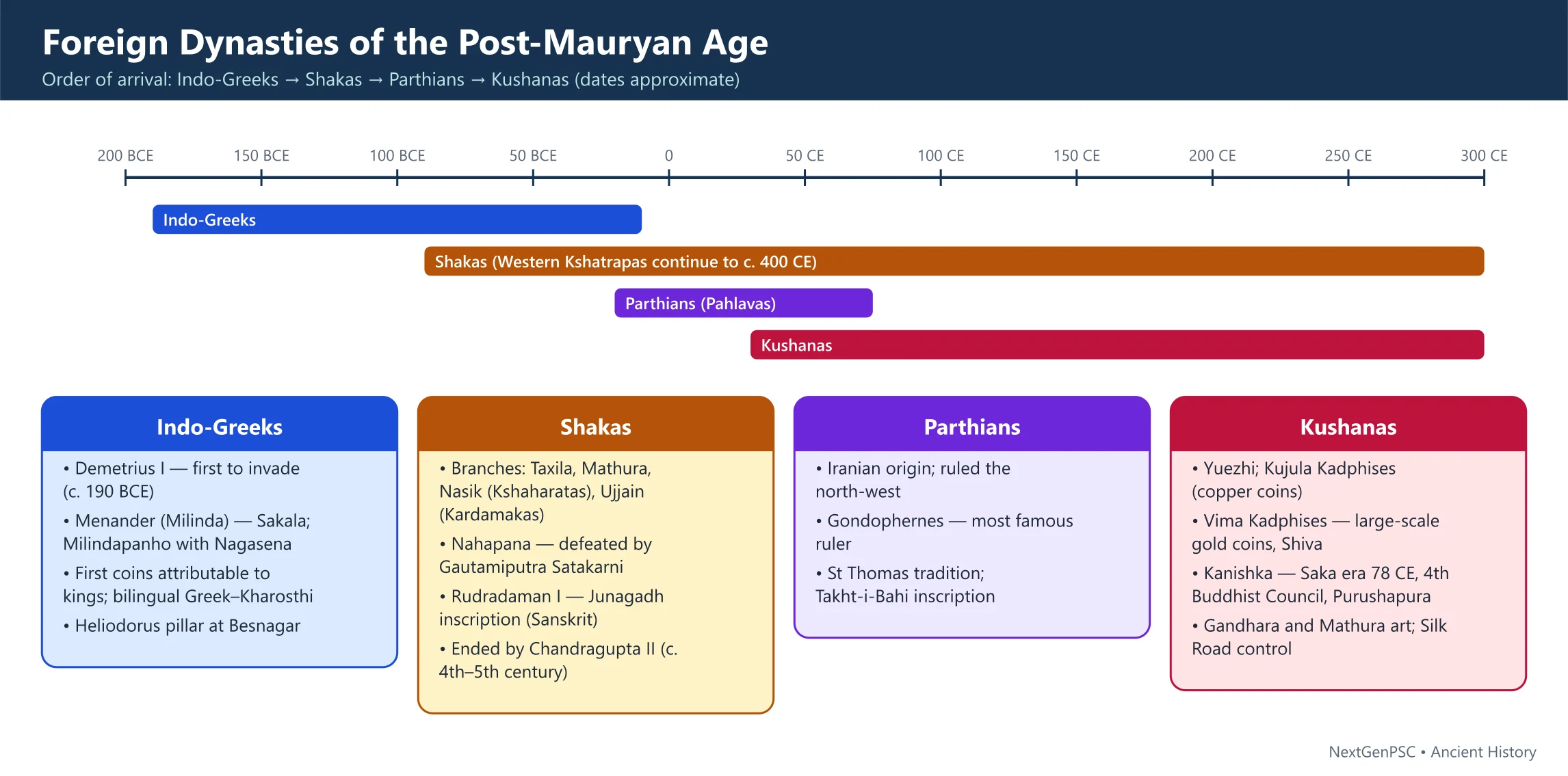
Comparison of Foreign Dynasties in Post-Mauryan India
Indo-Greeks, Shakas, Parthians, and Kushanas entered India after the decline of the Mauryas. Though foreign in origin, they integrated into Indian polity and society, contributing to trade, coinage, art, and religion.
| Dynasty | Period | Important Rulers | Capital(s) | Religion/Contributions |
|---|---|---|---|---|
| Indo-Greeks | 200–100 BCE | Demetrius, Apollodotus I, Menander (Milinda), Antialcidas | Sagala (Sialkot) | Bilingual coins; Greco-Buddhism; Heliodorus pillar; Gandhara art influence |
| Shakas (Scythians) | 100 BCE – 400 CE | Maues, Azes I, Nahapana, Rudradaman I | Taxila, Mathura, Ujjain | Satrap system; Junagarh inscription (Sanskrit prose); Indo-Roman trade; supported Buddhism & Jainism |
| Parthians | 20 BCE – 75 CE | Gondophernes, Abdagases | Taxila, Punjab region | Trade expansion; Takht-i-Bahi & Taxila inscriptions; St. Thomas tradition |
| Kushanas | 78–300 CE | Kujula Kadphises, Vima Kadphises, Kanishka, Huvishka, Vasudeva I | Purushapura (Peshawar), Mathura | Gold coins; Mahayana Buddhism; 4th Buddhist Council; Gandhara & Mathura art; Indo-Roman trade |
Prelims tips
- Indo-Greek → Menander (Milindapanho).
- Shakas → Rudradaman I (Junagarh inscription, Sanskrit prose).
- Parthians → Gondophernes (St. Thomas legend).
- Kushanas → Kanishka (4th Buddhist Council, Mahayana patron).
Mains points
- All four dynasties were of foreign origin but assimilated into Indian society.
- Indo-Greeks contributed to Greco-Buddhist art and coinage system.
- Shakas introduced the Satrap system and promoted Sanskrit literature.
- Parthians acted as transitional rulers, continuing trade links.
- Kushanas, especially Kanishka, created a vast empire, promoted Mahayana Buddhism, and developed Gandhara-Mathura art.
Did you know?
- Indo-Greek Menander is remembered in Buddhist texts as a Dharmaraja.
- Azes I started Vikram Samvat (57 BCE), still in use in parts of India.
- Parthian king Gondophernes is linked with the Christian legend of St. Thomas in India.
- Kanishka of the Kushanas is called the ‘Second Ashoka’ for his role in spreading Buddhism.
Art & Culture Contributions of Foreign Dynasties
Foreign dynasties like the Indo-Greeks, Shakas, Parthians, and Kushanas not only ruled parts of India but also enriched its cultural landscape. Their patronage of art, architecture, religion, and coinage left a deep imprint on Indian history.
| Dynasty | Contributions in Art & Culture |
|---|---|
| Indo-Greeks | Introduced portrait coins (realistic king depictions). Bilingual coins (Greek + Prakrit in Brahmi/Kharoshthi). Fusion of Hellenistic and Indian art → basis for Gandhara art. Heliodorus pillar (dedicated to Vasudeva) → early Vaishnavism evidence. |
| Shakas (Scythians) | Introduced Satrap system of governance. Junagarh inscription of Rudradaman I → first long inscription in classical Sanskrit prose. Patronized Buddhism and Jainism. Promoted trade & urban centers (Mathura, Ujjain). |
| Parthians | Continued bilingual coinage. Takht-i-Bahi and Taxila inscriptions. Gondophernes linked to St. Thomas tradition (Christian contact). Served as cultural bridge between Shakas and Kushanas. |
| Kushanas | Patronized Gandhara (Greco-Buddhist) and Mathura (indigenous) schools of art. Kanishka → Mahayana Buddhism patronage, 4th Buddhist Council. Issued gold coins → depicted Greek, Iranian, Indian gods (syncretism). Kushana sculptures → standing Buddha image (Mathura). Spread Buddhism to Central Asia, China. |
Prelims tips
- Heliodorus pillar → Indo-Greek ambassador → early Vaishnavism.
- Junagarh inscription → Rudradaman I → Sanskrit prose.
- Standing Buddha image (Mathura) → Kushana period.
- Gandhara art = Greco-Buddhist fusion (Kushanas).
- Kushana art: the Mathura school flourished at sites such as Kankali Tila (a Jain site); a headless statue of Kanishka was found at Mat near Mathura; Kushana kings took titles such as Devaputra and Shaonanoshao ('king of kings').
Mains points
- Foreign dynasties enriched Indian coinage, introducing portrait and bilingual coins.
- Indo-Greeks initiated Greco-Buddhist cultural synthesis influencing Gandhara art.
- Shakas promoted Sanskrit inscriptions and Satrap governance.
- Parthians maintained continuity of Indo-Iranian cultural exchange.
- Kushanas under Kanishka fostered Mahayana Buddhism, Gandhara-Mathura art, and Indo-Roman trade.
Did you know?
- Indo-Greek coins were the first in India to bear realistic human portraits.
- Rudradaman I’s Junagarh inscription is a milestone in the history of Sanskrit.
- Kushana coins uniquely combined Greek, Persian, Indian, and Buddhist symbols.
- Mathura and Gandhara produced some of the earliest surviving anthropomorphic images of the Buddha; priority claims remain debated.
Significance of Contacts between Central Asia and North India
Contacts between Central Asia and North India (200 BCE – 300 CE) brought waves of foreign rulers and cultural exchanges. These interactions transformed trade, religion, art, and administration, leaving a lasting imprint on Indian civilization.
Significance of Post-Mauryan Foreign Dynasties (Indo-Greeks, Shakas, Kushanas) 🌐
The rule of foreign dynasties in North-Western India (c. 200 BCE – 300 CE) was politically fragmented but left a lasting legacy of economic boom, cultural syncretism, and intellectual exchange .
1. Political and Administrative Significance
End of Fragmentation: Although initially causing disunity, the Kushanas ultimately established a vast, stable centralized empire spanning from Central Asia to the Ganga Valley, which provided political security to the major trade routes.
Territorial Expansion: These dynasties expanded India's effective political and cultural boundaries deep into Central Asia (Bactria) , fostering continuous interaction for centuries.
Administrative Innovations: They introduced and popularized the Satrap system (Kshatrapas) (Shakas), a Persian-style system of provincial governance by military governors, which featured dual administration (Maha-Kshatrapa and Kshatrapa) and provided a template for later regional administrations.
2. Economic Significance: The Golden Age of Trade
Global Trade Routes: Their control over North-Western India secured the most important land trade networks, including the Silk Route (via Central Asia) and major arteries like the Utarapatha and Dakshinapatha , facilitating global exchange.
Gold Coinage and Roman Trade: The introduction of gold coinage on a large scale by Vima Kadphises and the Kushanas stabilized currency, which was vital for the flourishing Indo-Roman trade (documented in the Periplus of the Erythraean Sea). Ports like Bhrigukachcha (Broach) and Sopara flourished under this boom.
Military and Agricultural Improvement: The influx of high-quality Central Asian horses significantly improved the Indian cavalry, enhancing the military and transportation sectors.
3. Religious and Cultural Significance
Spread of Mahayana: The patronage of Kanishka and the Kushanas was instrumental in the spread of Mahayana Buddhism (The Great Vehicle) to Central Asia, China, Korea, and Japan, transforming Buddhism into a world religion.
Gandhara Art (Greco-Buddhist): This new art school, developed in the NW frontier, was a perfect example of syncretism: it fused Greek realism (anatomy, flowing drapery) with Indian spirituality (Buddhist themes), resulting in the first realistic images of the Buddha.
Mathura Art (Indigenous): The Mathura school of art also flourished under the Kushanas, developing a distinct indigenous Indian style of sculpture that used local red sandstone.
Religious Tolerance: The Kushana coins featured an eclectic mix of Greek, Iranian, and Indian deities (Shiva, Buddha, Mithra), illustrating exceptional cultural and religious syncretism at the imperial level.
4. Social, Intellectual, and Linguistic Impact
Assimilation of Foreigners: Successive waves of foreign groups ( Yavanas, Shakas, Kushanas ) were gradually assimilated into the Indian society and the Varna system , often being categorized as Kshatriyas (warriors), demonstrating the absorptive capacity of the society.
Urbanization: Their control promoted the rapid urbanization of North-Western and Western India, with centers like Mathura, Taxila, and Ujjain becoming major hubs of trade and culture.
Linguistic Shift: Their rule is key to documenting the linguistic evolution: inscriptions and coins featured a mixture of Prakrit, Greek, Aramaic, Kharoshthi, and Brahmi . Most importantly, Rudradaman I’s Junagarh inscription marks the major official shift to long inscriptions in classical Sanskrit prose , signaling the language's resurgence.
Intellectual Exchange: The constant contact with Central Asia and the West facilitated the exchange of knowledge in fields like astrology, medicine, and astronomy .
| Aspect | Impact |
|---|---|
| Political | New dynasties (Indo-Greeks, Shakas, Parthians, Kushanas); Satrap system; territorial expansion |
| Economic | Silk Route trade; gold coins; Indo-Roman trade; horses for cavalry |
| Religious | Mahayana Buddhism spread; Gandhara & Mathura art |
| Social | Assimilation of foreigners; urban growth (Mathura, Taxila, Ujjain) |
| Intellectual | Rise of Sanskrit inscriptions; use of multiple scripts; scientific exchanges |
Prelims tips
- Junagarh inscription → Rudradaman I (Sanskrit prose).
- Kanishka → 4th Buddhist Council + Mahayana patronage.
- Silk Route → major trade link through Central Asia.
- Indo-Roman trade → gold coins, Roman pottery found in India.
Mains points
- Central Asian contacts brought successive foreign dynasties into India, reshaping polity and administration.
- Silk Route and gold coinage boosted Indo-Roman and Central Asian trade.
- Religious impact: Mahayana Buddhism spread globally, Gandhara-Mathura art flourished.
- Social impact: foreigners assimilated into Indian society and contributed to urbanization.
- Intellectual exchanges enriched Indian language, science, and literature.
Did you know?
- Roman coins have been found in large numbers in India, showing Indo-Roman trade boom.
- Central Asian horses were highly prized in Indian armies.
- Kanishka’s empire connected India to the Silk Route, making it a hub of global trade.
- Gandhara art is noted for Greco-Roman stylistic influence and for some of the earliest surviving anthropomorphic Buddha images; it should not be presented as the uncontested ‘first’.
Indigenous Dynasties: Shungas & Kanvas (Detailed Rulers and Contributions)
The Shungas (185–73 BCE) and Kanvas (73–28 BCE) were small but significant dynasties after the Mauryas. They revived Brahmanism, promoted Sanskrit, and contributed to Buddhist art, while interacting with Indo-Greek and regional powers.
Shunga Dynasty (185–73 BCE): The Brahmanical Counter-Movement 🛡️
The Shungas ended the Mauryan rule and inaugurated a phase of Brahmanical revival while simultaneously defending Central India against foreign incursions.
Important Rulers:
1. Pushyamitra Shunga (185–149 BCE): The Founder
- Rise to Power: Founded the Shunga dynasty after assassinating the last Mauryan king, Brihadratha , during a military parade in 185 BCE. This act is seen by many historians as a Brahmanical reaction against the pro-Buddhist policies of the Mauryas.
- Religious Policy: Performed two Ashvamedha sacrifices to publicly assert the revival of Brahmanical influence and Vedic ritualism.
- Defense: Successfully defended Central India against the invasions of the Indo-Greeks (Yavanas), establishing the Shungas as the political stabilizers of the Gangetic valley.
- Sources: Mentioned in Patanjali’s Mahabhashya (who was possibly his contemporary) and the Buddhist text Divyavadana .
- Buddhist Patronage: Despite the Brahmanical focus, the Shungas are credited with patronizing the stone embellishment and expansion of the great Stupas at Sanchi and Bharhut (e.g., stone railings and Toranas ).
2. Agnimitra (149–141 BCE):
- Literary Significance: Son and successor of Pushyamitra; immortalized in Kalidasa’s famous play, Malavikagnimitram , which describes his romance and conflicts.
- Conflict: Continued the military policy against the Indo-Greeks and fought successfully against the Vidarbha kingdom.
Contributions:
Cultural Revival: Led the revival of Brahmanical rituals and saw a flourishing of Sanskrit literature (notably Patanjali's works).
Artistic Legacy: A golden age for Buddhist art; the iconic stone railings and richly carved Toranas (gateways) of Sanchi and Bharhut were built or expanded during their period, continuing the Mauryan architectural tradition but with more narrative detail.
Political Defense: Played a critical role in stabilizing Central India by checking the foreign Indo-Greek advance.
Kanva Dynasty (73–28 BCE): The Magadhan Decline 📉
The Kanva dynasty succeeded the Shungas but ruled for a brief period, marking the final weakening of Magadhan power before the rise of the Deccan powers.
Important Rulers:
1. Vasudeva Kanva (73–45 BCE):
- Founder: Founded the Kanva dynasty after killing the last Shunga ruler, Devabhuti , who was notorious for his luxury and ineffective rule.
- Limited Authority: Although ruling Magadha, their political authority was highly limited compared to the Mauryas or early Shungas, controlling only a small territory around Pataliputra.
2. Bhumimitra, Narayana: Weak rulers whose brief reigns were characterized by further territorial contraction and inability to withstand regional and external pressures.
3. Susharman (Last ruler, 28 BCE):
- The Kanva rule was finally overthrown by the rising power of the Satavahanas (Simuka Satavahana) from the Deccan, permanently ending Magadha's status as the sole imperial centre of India.
Contributions:
Cultural Continuity: Continued the policy of Brahmanical traditions and royal support for Vedic rituals established by the Shungas.
Transitional Role: Their brief reign is historically significant primarily as a transitional power , showing the continuous decline of the central authority in Magadha and providing the vacuum for Deccan powers (Satavahanas) to become dominant in Central and Southern India.
| Dynasty | Ruler | Period | Major Contributions/Events |
|---|---|---|---|
| Shunga | Pushyamitra Shunga | 185–149 BCE | Founder; Ashvamedha sacrifices; resisted Indo-Greeks; expanded Sanchi & Bharhut |
| Shunga | Agnimitra | 149–141 BCE | Known from Kalidasa’s Malavikagnimitram; Vidarbha conflict |
| Shunga | Vasumitra | 2nd century BCE | Defended Ashvamedha from Indo-Greek attack |
| Shunga | Devabhuti | 73 BCE | Last Shunga ruler; killed by minister Vasudeva Kanva |
| Kanva | Vasudeva Kanva | 73–45 BCE | Founder; overthrew Devabhuti |
| Kanva | Bhumimitra | 45–30 BCE | Weak ruler; confined to Magadha |
| Kanva | Narayana | 30–28 BCE | Maintained rule under pressure |
| Kanva | Susharman | 28 BCE | Last ruler; defeated by Satavahanas |
Prelims tips
- Founder of Shunga → Pushyamitra (killed Brihadratha).
- Agnimitra → known from Malavikagnimitram (Kalidasa).
- Vasumitra → resisted Indo-Greek invasion during Ashvamedha.
- Last Shunga ruler → Devabhuti (killed by Vasudeva Kanva).
- Kanva dynasty founder → Vasudeva Kanva (73 BCE).
- Kanvas ended by → Satavahanas (28 BCE).
Mains points
- Shunga rulers revived Brahmanism but also contributed to Buddhist art (Sanchi, Bharhut).
- Pushyamitra and Agnimitra had to defend India from Indo-Greek invasions.
- Later Shunga rulers weakened, paving way for Kanvas.
- Kanvas were politically weak and short-lived, ending with Satavahana conquest.
- Both dynasties represent the political transition between Mauryas and Deccan powers.
Did you know?
- Pushyamitra Shunga is said to have performed two Ashvamedha sacrifices, rare in post-Vedic times.
- The Shunga art at Bharhut contains detailed narrative panels of Jataka tales.
- Kalidasa’s Malavikagnimitram is one of the few literary sources about Shunga rulers.
- The Kanva dynasty lasted only 45 years — one of the shortest in Indian history.
Satavahanas (c. 1st century BCE – 3rd century CE)
The Satavahanas were the first major dynasty of the Deccan after the fall of the Mauryas and Kanvas. They acted as a cultural bridge between North and South India, promoted trade, Buddhism, and Brahmanism, and resisted foreign powers like the Shakas.
Satavahana Dynasty (c. 1st Century BCE – 3rd Century CE): Lords of the Deccan and Cultural Bridge ⚓
The Satavahanas (also referred to as Andhras in the Puranas) were the most successful native successor dynasty in the Post-Mauryan period, establishing stable rule and acting as a crucial link between North and South India.
Origin and Territory: They originally established their power in the Deccan region , primarily covering modern Maharashtra, Andhra Pradesh, and Karnataka . Their initial capital was Pratishthana (Paithan, Maharashtra) , later shifting importance to Amaravati (Andhra Pradesh), which became a major cultural hub.
Strategic Role: They effectively acted as a cultural and trade bridge , facilitating the exchange of traditions, art forms, and goods between the northern dynasties (Shungas/Kanvas) and the powerful southern kingdoms ( Cholas, Cheras, Pandyas ).
Matrilineal Traits: Satavahana rulers were often known by their matronymics (names derived from the mother, e.g., Gautamiputra , Vashishthiputra ), reflecting the high status of women in the family, though the succession to the throne remained patrilineal (male-dominated).
Important Rulers and Contributions
1. Simuka (c. 1st century BCE): Founder of the Satavahana dynasty . He launched the dynasty by overthrowing the Kanva dynasty in Magadha around 28 BCE, although he quickly retreated to the Deccan, establishing Deccan's political independence from the North.
2. Satakarni I (c. 70–60 BCE): Expanded the kingdom into the western Deccan and Malwa. To legitimize his rule and assert imperial status, he performed the Vedic rituals of Ashvamedha and Rajasuya sacrifices (showing Brahmanical affinity).
- His power is noted in the Hathigumpha inscription of the rival Kalinga ruler, Kharavela.
3. Gautamiputra Satakarni (c. 106–130 CE): The Greatest Ruler
- He single-handedly revived Satavahana power after the rule of the Western Shakas. He famously defeated the Shakas, Pahlavas, and Yavanas , earning the title ‘Shaka-Yavana-Pahlava-nisudana’ (Destroyer of Shakas, Greeks, and Pahlavas).
- He is credited with restoring the purity of the Brahmanical order (though he was tolerant of Buddhists), suggesting a policy of Varna Sankara (preventing mixing of Varnas).
- Details of his conquests and virtues are found in the Nasik Cave inscription issued by his mother, Gautami Balashri , highlighting the importance of the Queen Mother.
4. Vashishthiputra Pulumavi (c. 130–160 CE):
- Expanded the rule towards the Andhra region (east coast) and possibly built the new capital at Amaravati . He patronized the development of the beautiful Buddhist art and architecture of the Amaravati Stupa .
5. Yajna Sri Satakarni (c. 165–194 CE): Last Great Ruler
- Successfully recovered the Western coast from the Shakas, revitalizing lucrative overseas trade with the Roman Empire (the key trade partner).
- His strong maritime focus is evidenced by his issuance of coins prominently featuring ship motifs , indicating control over the Arabian Sea and Bay of Bengal trade routes.
Key Contributions and Legacy
Cultural Synthesis: They maintained the Brahmanical tradition (Vedic rituals, land grants to Brahmins) while simultaneously giving generous grants to Buddhist monks and building magnificent stupas and cave complexes (Karle, Nasik, Kanheri). This duality is crucial.
Maritime Trade Power: They were a major maritime power , controlling key Western ports ( Sopara, Bharukachchha/Broach, Kalyan ) and Eastern ports ( Masulipatnam/Ghantasala ), significantly promoting the Indo-Roman trade.
Coinage: They issued a distinctive range of coins, mainly made of lead (a unique feature due to its availability in the Deccan) and potin , often carrying symbols like the ship, elephant, horse, and chaitya (Buddhist/Jain symbol).
Language and Literature: They officially encouraged the use of the Prakrit language (King Hāla famously compiled the Prakrit poetic work, Gathasaptashati ). Their inscriptions were primarily in the Brahmi script .
| Ruler | Period | Major Contributions/Events |
|---|---|---|
| Simuka | c. 1st century BCE | Founder; overthrew Kanvas (~28 BCE) |
| Satakarni I | c. 70–60 BCE | Performed Ashvamedha; expanded to Malwa; mentioned in Hathigumpha inscription |
| Gautamiputra Satakarni | c. 106–130 CE | Greatest ruler; defeated Shakas, Pahlavas, Yavanas; Nasik inscription by his mother |
| Vashishthiputra Pulumavi | c. 130–160 CE | Expanded into Andhra; patron of Amaravati Stupa |
| Yajna Sri Satakarni | c. 165–194 CE | Last great ruler; revived Indo-Roman trade; coins with ship symbols |
Prelims tips
- Satavahana founder → Simuka.
- Gautamiputra Satakarni → defeated Shakas, Pahlavas, Yavanas; Nasik inscription.
- Vashishthiputra Pulumavi → Amaravati Stupa patron.
- Yajna Sri Satakarni → coins with ships (Indo-Roman trade).
- Pratishthana (Paithan) is often identified as a Satavahana capital; Amaravati was an important eastern regional and Buddhist centre, not simply a later proven imperial capital.
Mains points
- Satavahanas filled the political vacuum after Kanvas and connected north-south India.
- They balanced support for both Brahmanism and Buddhism.
- Their maritime trade with Rome boosted Indian economy; coins depict ships.
- Satavahana art at Amaravati and Nasik caves enriched Buddhist architecture.
- They played a key role in spreading Prakrit language and Brahmi script.
Did you know?
- Gautamiputra Satakarni’s mother Gautami Balashri inscribed his achievements at Nasik caves.
- Satavahana coins often had ships, showing their strong maritime trade with Rome.
- They issued coins in lead, copper, silver, and gold, showing economic diversity.
- Satavahanas used Prakrit language in official inscriptions, unlike Mauryas who used multiple languages.
Satavahana Society and Economy
The Satavahanas (1st century BCE – 3rd century CE) played a key role in shaping Deccan society and economy. They maintained a mixed social order (Brahmanism + Buddhism), promoted agriculture and trade, and established strong Indo-Roman commercial links.
Satavahana Society: Hierarchy, Matrimony, and Matronymics 👩👦
Satavahana society presented a fascinating mix of traditional Varna adherence (inherited from North India) and unique regional flexibility, notably concerning women’s status and inter-caste/inter-ethnic relations.
Varna System Adaptation: The Varna system was officially followed, but with significant regional flexibility necessary for governing the Deccan. Kings, like Gautamiputra Satakarni, called themselves ‘Brahmana’ (defender of the Varna system, restoring its purity), yet they maintained matrimonial ties with other powerful, non-native groups (e.g., Satavahana rulers married Shaka princesses), showing pragmatic political alliances.
Status of Women: Women enjoyed a high status in the Satavahana social structure. This is reflected in two ways:
- Property Rights: Queens (like Gautami Balashri ) often possessed and utilized property, evidenced by their issuing of land grant inscriptions in their own name.
- Matronymics: The use of matronymics (e.g., Gautamiputra, Vashishthiputra) underscores the importance and respect given to the mother’s lineage.
Religious Patronage and Grants: The practice of giving land grants (Brahmadeya) was prevalent, directed towards both Brahmanas (for performing Vedic rituals and maintaining the Varna order) and Buddhist monks (for monastic maintenance, building caves/stupas), highlighting state tolerance.
Guilds (Shrenis) as Social Units: The Guilds (Shrenis) of merchants, artisans, and financiers became extremely important socio-economic units, acting as banks , regulating trades, and providing social identity and security to their members.
Satavahana Economy: Global Trade and Monetary Diversity 🪙
The Satavahana economy was robust, founded on agrarian strength and propelled to global prominence by securing coastal trade and maintaining a diverse currency system.
Agrarian Backbone: Agriculture formed the backbone of the economy, with staple crops including rice, cotton (a key export), and pulses grown in the fertile Deccan region.
Indo-Roman Trade Boom: The economy flourished due to extensive Indo-Roman trade , driven by sea and land networks. The large number of Roman gold coins (Denarii) found in the Deccan provides solid evidence of this favorable balance of trade for India.
Key Trade Centers: The Satavahanas controlled crucial ports on both coasts:
- Western Ports: Sopara, Bharukachchha (Broach), and Kalyan (for trade across the Arabian Sea to the Roman West).
- Eastern Ports: Masulipatnam (for trade via the Bay of Bengal to Southeast Asia).
Exports/Imports: India exported high-value goods like spices, textiles, pearls, ivory, and gemstones ; in return, they primarily imported Roman wine, gold, and luxury items .
Coinage Diversity: The Satavahanas utilized a highly diverse monetary system:
- Material: They were known for issuing a large number of coins made of lead (a unique feature) and copper, along with silver and occasionally gold.
- Symbolism: Coins often carried political and religious symbols, including the ship motif (indicating naval/maritime power), elephant, horse, and the Chaitya (Buddhist or Jain prayer symbol).
Trade Documentation: The widespread use of Prakrit language in the Brahmi script in inscriptions, especially those detailing donations to Buddhist monasteries by merchant guilds, provides deep insight into the economic activities and flow of wealth.
| Aspect | Details |
|---|---|
| Varna System | Followed but flexible; rulers married outside varna (e.g., with Shaka princesses) |
| Women | Had property rights; queens like Gautami Balashri issued inscriptions |
| Religion | Supported Brahmanism (yajnas) and Buddhism (donations, stupas, caves) |
| Guilds | Guilds (Shrenis) important in trade, donations, and urban society |
| Aspect | Details |
|---|---|
| Agriculture | Rice, cotton, pulses cultivated |
| Trade | Internal Deccan trade + long-distance trade with north India |
| Indo-Roman Trade | Roman coins in Deccan; exports of spices, textiles, pearls; imports of wine, gold |
| Ports | Sopara, Bharukachchha, Kalyan, Masulipatnam |
| Coinage | Coins in lead, copper, silver, gold with symbols like ship, elephant, chaitya |
| Language | Prakrit inscriptions in Brahmi script |
Prelims tips
- Satavahana inscriptions mostly in Prakrit, Brahmi script.
- Gautami Balashri inscription at Nasik = Gautamiputra’s achievements.
- Indo-Roman trade → Roman coins, ship symbols on Satavahana coins.
- Ports: Sopara, Bharukachchha, Kalyan, Masulipatnam.
Mains points
- Satavahana society balanced Brahmanism and Buddhism; women like queens played active roles.
- Guilds emerged as socio-economic institutions linking trade, donations, and urban life.
- Indo-Roman trade flourished, visible from ship-symbol coins and Roman coin hoards.
- Agriculture remained the base, but maritime trade enriched Deccan economy.
- Satavahana inscriptions highlight regional languages (Prakrit) and local identity.
Did you know?
- Over 20,000 Roman coins have been discovered in Satavahana territories, showing massive Indo-Roman trade.
- Satavahana queens like Naganika and Gautami Balashri were influential in politics and religion.
- Satavahana coins often carried bilingual legends in Prakrit and Tamil-Brahmi.
- Guilds acted like banks — they managed donations, gave loans, and funded religious institutions.
Satavahana Art and Culture
The Satavahanas (1st century BCE – 3rd century CE) were great patrons of art, architecture, and literature. Their cultural contributions created a synthesis of northern and southern traditions, influencing later Indian art and religion.
Satavahana Culture: Art, Architecture, and Religious Syncretism 🗿
The Satavahana period (c. 1st Century BCE – 3rd Century CE) is renowned for its monumental rock-cut architecture , the Amaravati school of art , and its unique policy of supporting both Brahmanism and Buddhism , reflecting cultural synthesis across the Deccan.
I. Rock-Cut Architecture and Cave Complexes (Western Deccan)
Purpose: The Western Ghats saw massive development of rock-cut caves (carved directly into cliff faces) that served essential functions for the Buddhist monastic community ( Sangha ): Chaitya Halls (Buddhist prayer halls) and Viharas (monastic residences).
Karle Chaitya Hall (Maharashtra): This is the largest and most famous Satavahana Chaitya. It is distinguished by its magnificent size, elaborate façade, and interior columns. Its architecture often imitates wooden structures in stone , notably the horseshoe-shaped windows ( Chaitya Arches ), reflecting indigenous skill.
Nasik and Kanheri Caves (Maharashtra): These caves were flourishing Buddhist settlements, receiving generous donations from royal families, queens, and wealthy merchant guilds (indicating economic support for Buddhism). The Nasik caves contain the crucial Gautami Balashri inscription , detailing the military and moral achievements of Gautamiputra Satakarni.
II. Stupa and Sculpture: The Amaravati School (Eastern Deccan)
Amaravati Stupa (Andhra Pradesh): This is the most famous Satavahana monument in the East . Though the site is ancient, its extensive ornamentation (marble railings) occurred under the Satavahanas. It is known for rich narrative carvings detailing the Buddha’s life and Jataka tales (stories of Buddha's previous births).
Amaravati School of Art: This distinct school of sculpture developed under Satavahana patronage in the Andhra region (Krishna-Godavari valley). Key characteristics include:
- Material: Exclusive use of white marble (a unique feature, unlike the red sandstone of Mathura or grey schist of Gandhara).
- Style: Highly narrative, dynamic, and elaborate reliefs, depicting human forms with movement, complex emotional expressions, and realistic depth.
- Iconography: Early art often depicted the Buddha symbolically (e.g., stupas, footprints, thrones) rather than iconically (human form), though later periods show iconic representation.
External Influence: The Satavahanas also contributed to the further decoration of the Sanchi and Bharhut stupas (e.g., adding toranas ), continuing the Mauryan/Shunga art tradition in Central India.
III. Religion, Language, and Economic Evidence
Religious Policy (Syncretism): Satavahana rulers maintained a policy of religious syncretism and tolerance. They championed Brahmanism (performing grand Vedic rituals like Ashvamedha ) but were equally instrumental in funding and supporting the spread of Buddhism (especially Mahayana ) and Jainism. This simultaneous support is a defining feature.
Language and Inscriptions: The court language and the language of official inscriptions were predominantly Prakrit , written in the Brahmi script (accessible to the Deccan populace). Inscriptions were not just royal, but often recorded donations from powerful merchant guilds , providing crucial economic evidence and showing the power of the guilds.
Coinage (Economic Indicators): The diverse coinage served as key economic and political indicators:
- Material: Issued coins made of lead (a unique and abundant material in the Deccan), copper, silver, and gold (for international trade).
- Symbols: Depicted ships (proving maritime trade and naval power), elephants, lions, and Chaityas (religious/state symbols).
- Bilingual Evidence: Some rare coins were found with Prakrit and Tamil-Brahmi legends , indicating trade and cultural interaction with the deep South (Tamil regions).
- Trade Volume: The large volume of gold/silver coins confirms the flourishing Indo-Roman trade that brought significant wealth to the Deccan.
| Aspect | Key Contributions |
|---|---|
| Architecture | Nasik, Karle, Kanheri caves; Karle Chaitya hall |
| Stupa Art | Amaravati Stupa (white marble, Jataka tales); Sanchi, Bharhut decorations |
| Sculpture | Amaravati school; symbolic Buddha; Bodhisattva depictions |
| Inscriptions | Prakrit, Brahmi; Nasik inscription of Gautami Balashri |
| Coins | Lead, copper, silver, gold; ship, elephant, chaitya symbols; bilingual coins |
| Religion | Supported both Brahmanism (yajnas) and Buddhism (stupas, caves) |
Prelims tips
- Amaravati = Satavahana art; white marble, Jataka tales.
- Karle Chaitya = largest rock-cut chaitya hall.
- Inscriptions = Prakrit, Brahmi (Nasik, Kanheri).
- Coins = ship symbols → Indo-Roman trade evidence.
Mains points
- Satavahana art synthesized indigenous (Amaravati) and foreign (Gandhara, Mathura) elements.
- Stupa and cave architecture flourished, funded by kings, queens, merchants, and guilds.
- Satavahana inscriptions in Prakrit reflect local cultural identity.
- Coinage shows maritime trade and cultural symbolism.
- Satavahana culture laid the foundations for later Deccan powers like Ikshvakus and Pallavas.
Did you know?
- The Amaravati Stupa was once called the ‘Mahachaitya’ and was one of the largest Buddhist monuments in India.
- The Karle Chaitya hall is 40 meters long — the largest rock-cut chaitya hall of ancient India.
- Satavahana coins often depict ships, proving their active role in overseas trade.
- Inscriptions from merchants and guilds show that common people too funded Buddhist monuments.
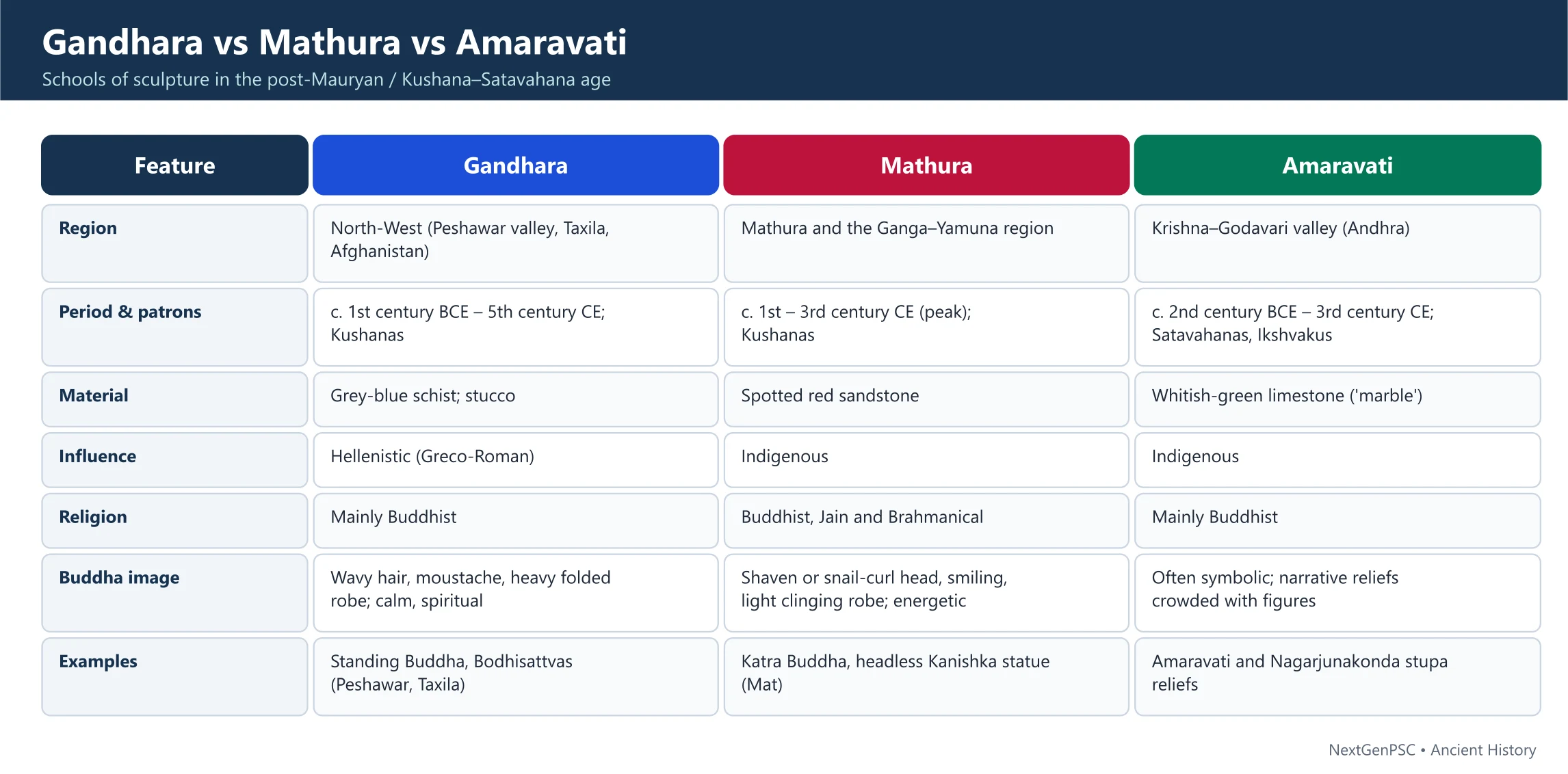
Comparison of Amaravati, Gandhara, and Mathura Schools of Art
The three major schools of art during the post-Mauryan and early historic period were Amaravati (Deccan), Gandhara (northwest), and Mathura (north India). Each had distinct features, materials, and influences, but all contributed to Buddhist art and iconography.
| Aspect | Amaravati School | Gandhara School | Mathura School |
|---|---|---|---|
| Region | Andhra Pradesh (Deccan); Satavahana patronage | Northwest India (Gandhara, Taxila, Peshawar); Kushan patronage | Mathura (Uttar Pradesh); Kushan patronage |
| Material | White marble; detailed carvings | Grey schist/blue stone; durable and fine | Red sandstone from Sikri-Mathura region |
| Influence | Indigenous Indian style; narrative panels | Strong Greco-Roman (Hellenistic) influence | Purely indigenous Indian style |
| Depiction of Buddha | Initially symbolic (stupa, footprints, wheel); later anthropomorphic | Anthropomorphic; Buddha shown in Greek style (curly hair, robe, muscular body) | Anthropomorphic; Buddha with Indian features (broad shoulders, open robe, spiritual expression) |
| Themes | Jataka tales, life of Buddha, scenes of common people | Buddha’s life, Greco-Roman motifs like vine leaves, angels, Hercules figures | Buddha, Bodhisattvas, Jain Tirthankaras, Hindu deities |
| Style | Dynamic, elaborate, decorative, full of movement | Realistic, naturalistic, emphasis on body muscles and drapery | Symbolic, spiritual, iconic, less realism |
| Patrons | Satavahana kings, merchants, guilds | Kushan rulers (esp. Kanishka) | Kushans and local rulers; Mathura school continued under Guptas |
Prelims tips
- Amaravati School → white marble, narrative panels, Andhra region.
- Gandhara School → Greco-Roman influence, grey schist, Buddha in Greek style.
- Mathura School → red sandstone, indigenous Indian style, later influenced Gupta art.
- First anthropomorphic images of Buddha → Gandhara & Mathura (not Amaravati initially).
Mains points
- Amaravati, Gandhara, and Mathura schools developed simultaneously but with different influences.
- Amaravati emphasized narrative reliefs, Gandhara emphasized Greco-Roman realism, and Mathura emphasized spiritual symbolism.
- Together, they shaped Indian Buddhist art and spread it to Southeast Asia.
- Mathura’s indigenous base helped Gupta art evolve into the ‘classical’ Indian style.
Did you know?
- The Amaravati School influenced Southeast Asian Buddhist art (Burma, Sri Lanka, Java).
- Gandhara School gave the first anthropomorphic images of Buddha with Greco-Roman features.
- Mathura School became the base for Gupta art, known for its spiritual expressions.
- Buddha’s curly hair in Gandhara images is directly inspired by Greek Apollo statues.
Chedi (Chedi/Cheti or Mahameghavahana Dynasty of Kalinga)
The Chedis, also called the Mahameghavahanas, rose in Kalinga (Odisha) after the Mauryas (c. 1st century BCE – 2nd century CE). Their greatest ruler was Kharavela, who revived Kalinga’s power, expanded territory, and patronized Jainism.
The Chedi / Mahameghavahana Dynasty of Kalinga (c. 1st Century BCE) 🐘
This dynasty rose to prominence in Kalinga (modern Odisha) during the Post-Mauryan period, representing the resilience of the region after Ashoka’s conquest and subsequent moral shift.
Nomenclature and Origin: The dynasty is variously known as the Chedis or Chetis , or the Mahameghavahanas (the family title used by the rulers).
Capital: Their capital was Kalinganagara (often identified with the archaeological site of Sisupalgarh , near Bhubaneswar, Odisha).
Key Source: Almost all detailed information about the dynasty and its greatest ruler comes from the Hathigumpha inscription (Elephant Cave Inscription), located in the Udayagiri caves near Bhubaneswar.
Territory: They initially ruled Kalinga, expanding their influence later into parts of Andhra, Bengal, and Madhya Pradesh , challenging the Sunga and Satavahana powers.
Important Ruler: Kharavela (c. 1st Century BCE) 👑
Kharavela is the greatest and only well-documented ruler of this dynasty. His detailed Hathigumpha inscription acts as an annual chronological record of his reign, detailing his conquests, public works, and religious patronage.
1. Revival of Kalinga: He is credited with reviving Kalinga’s political and military power soon after the trauma of the Mauryan conquest under Ashoka.
2. Conquests and Imperial Assertion:
- He launched several military campaigns into North India , reaching as far as Magadha .
- He notably retrieved the Kalinga Jina idol (a Jain sacred image) that had been taken away by the Nanda dynasty centuries earlier, asserting Kalinga's sovereignty and Jain identity.
- He fought and repelled the Indo-Greeks (Yavanas) , pushing back their expansion from the North-West.
3. Patronage of Jainism: Kharavela was a devout patron of Jainism . His inscriptions highlight:
- Religious Tolerance: Despite being Jain, he showed respect for all religious orders.
- Construction: He repaired old Jain temples and constructed numerous rock-cut shelters and caves for Jain monks at the Udayagiri and Khandagiri hills (e.g., Manchapuri cave).
4. Welfare and Public Works: He promoted significant irrigation projects (like digging canals), encouraged arts, music, and dance (holding massive festivals), and ensured the continued growth of trade, showcasing strong statecraft.
Contributions and Significance
Jain Patronage: The dynasty's major contribution was the strong political patronage of Jainism in Eastern India, providing land and caves to monks and establishing important centers of Jain monasticism (Udayagiri-Khandagiri).
Historical Source: The Hathigumpha inscription is invaluable. Written in Prakrit and Brahmi script , it provides detailed chronological military, religious, and administrative information about an indigenous dynasty in the Post-Mauryan period.
Kalingan Sovereignty: The dynasty, under Kharavela, played a crucial role in restoring Kalinga’s political independence and pride, allowing it to compete with the Satavahanas and Shungas.
| Ruler | Period | Major Contributions/Events |
|---|---|---|
| Kharavela | c. 1st century BCE | Revived Kalinga’s power; invaded Magadha; retrieved Jina idol; patron of Jainism; Udayagiri-Khandagiri caves |
| Other rulers | Post-1st century BCE | Less known; continued rule in Odisha region |
Prelims tips
- Chedi/Mahameghavahana dynasty → Kalinga (Odisha).
- Capital → Kalinganagara (Sisupalgarh).
- Greatest ruler → Kharavela (Hathigumpha inscription, Udayagiri).
- Kharavela retrieved Jina idol from Magadha.
- Patronized Jainism → Udayagiri-Khandagiri caves.
Mains points
- The Chedis revived Kalinga’s political power after Ashoka’s conquest.
- Kharavela was a remarkable ruler balancing warfare, welfare, and religious patronage.
- The Hathigumpha inscription is a crucial source for post-Mauryan Deccan history.
- Chedi support for Jainism shaped Odisha’s later cultural identity.
- They represent the rise of regional powers in India after Mauryan decline.
Did you know?
- Kharavela’s Hathigumpha inscription is one of the longest early inscriptions in Prakrit.
- The inscription mentions not only wars but also irrigation, music, and festivals.
- Kharavela retrieved the sacred Jina idol taken away by the Nandas centuries earlier.
- Udayagiri and Khandagiri caves still have Jain symbols and carvings from this era.
Ikshvakus of Andhra (c. 3rd–4th Century CE)
The Ikshvakus succeeded the Satavahanas in the Andhra region. They were known for their patronage of Buddhism and Brahmanism, development of Nagarjunakonda as a major cultural center, and contributions to art and architecture.
Ikshvaku Dynasty (c. 3rd – 4th Century CE): Successors in Andhra 🏰
The Ikshvakus were one of the major indigenous dynasties that emerged in the Eastern Deccan, specifically the Krishna-Guntur region, following the decline of the powerful Satavahanas.
Background and Territory: They are also known as the Andhra Ikshvakus . Their rule commenced after the Satavahanas fragmented in the 3rd century CE. Their power was centered at Vijayapuri (often identified with the archaeological site of Nagarjunakonda, Andhra Pradesh ).
Sources: Most of the historical and cultural information comes from their numerous inscriptions found at Nagarjunakonda and Jaggayyapeta , documenting royal deeds and religious donations.
I. Important Rulers and Political Policy
1. Vashishthiputra Chamtamula I (c. 3rd century CE): Founder
- He established the dynasty, emphasizing his adherence to Brahmanism by performing extensive Vedic sacrifices like Ashvamedha, Agnihotra, and Vajapeya .
- Despite his personal Vedic alignment, he patronized Buddhist institutions (a common feature of Deccan rulers).
2. Virapurushadatta (Most Prominent Ruler):
- Continued the dual policy of supporting both Brahmanism and Buddhism . This tolerance ensured social stability in a religiously diverse region.
- His wives and female relatives, such as the queens, played an extremely active and prominent role by building numerous Buddhist monasteries and stupas , showcasing the high status of women and the influence of the Buddhist lay community.
- He encouraged trade and urban growth, transforming Vijayapuri (Nagarjunakonda) into a vibrant urban and religious center.
3. Later Rulers (Chamtamula II and Rudrapurushadatta): The dynasty weakened gradually and was eventually absorbed by the rising powers of the North and West.
II. Key Contributions: Art and Religious Syncretism
Buddhism: The Ikshvaku domain became a flourishing international Buddhist hub, particularly for Mahayana Buddhism . Nagarjunakonda was transformed into a great monastic center, known for its vast stupas, viharas, and chaityas .
- Foreign monks from Sri Lanka and Central Asia frequently visited, indicating the international reputation of Nagarjunakonda as a center of learning and pilgrimage.
Brahmanism: The kings actively performed Vedic rituals and provided generous land grants to Brahmanas, signifying their role as defenders of the orthodox order (Dharma).
Art & Architecture (Nagarjunakonda Style): The sculptures here, largely influenced by the earlier Amaravati School , were known for their elegant narrative reliefs detailing the Buddha’s life, Jataka tales, and scenes from royal life .
- This art is found on the Ayaka pillars of the stupas, often depicting the Buddha aniconically (symbolically).
Language: The primary language of their records was Prakrit , used in the Brahmi script , although some later inscriptions also appeared in Sanskrit , reflecting a gradual linguistic shift.
Economy: They successfully maintained the lucrative Indo-Roman trade and South-East Asian trade via the Andhra ports, ensuring economic prosperity for their kingdom.
| Ruler | Period | Major Contributions/Events |
|---|---|---|
| Vashishthiputra Chamtamula I | c. 3rd century CE | Founder; performed Vedic sacrifices; patron of Brahmanism and Buddhism |
| Virapurushadatta | c. 3rd century CE | Greatest ruler; patronized Buddhism (Nagarjunakonda); queens built monasteries |
| Chamtamula II | Late 3rd century CE | Weaker ruler; continued patronage of religion and art |
| Rudrapurushadatta | 4th century CE | Last known ruler; dynasty weakened |
Prelims tips
- Ikshvaku capital → Vijayapuri (Nagarjunakonda).
- Founder → Vashishthiputra Chamtamula I.
- Greatest ruler → Virapurushadatta (patron of Buddhism).
- Nagarjunakonda → major Buddhist center (stupas, viharas, sculptures).
- Ikshvakus supported both Brahmanism and Buddhism.
Mains points
- Ikshvakus rose in Andhra after Satavahanas and continued Deccan cultural traditions.
- They balanced Brahmanism and Buddhism, showing religious tolerance.
- Nagarjunakonda became a major Buddhist art and learning center under their patronage.
- Trade links with Rome and Southeast Asia flourished through Andhra ports.
- Their inscriptions highlight the role of queens and merchants in patronizing religion.
Did you know?
- The Ikshvakus of Andhra were different from the Ikshvakus of Ayodhya mentioned in the epics.
- Queens of Ikshvaku rulers were active patrons of Buddhism, funding stupas and monasteries.
- Nagarjunakonda inscriptions record donations from foreign monks (Sri Lanka, Central Asia).
- Nagarjunakonda is sometimes called the ‘second Amaravati’ due to its Buddhist sculptures.
Significance of the Post-Mauryan Age (200 BCE – 300 CE)
The Post-Mauryan Age was a period of political fragmentation but remarkable cultural, economic, and religious growth. Regional kingdoms, foreign dynasties, and indigenous powers reshaped Indian society, making it a formative age for art, trade, and new religions.
I. Political Significance: Decentralization and Geopolitical Flux 🛡️
The collapse of the Mauryan centralized authority (184 BCE) led to political fragmentation, which ultimately fostered the development of multiple, vibrant regional polities.
Rise of Regional Powers: The entire subcontinent fractured into powerful regional kingdoms: Native Dynasties ( Shungas, Kanvas in Magadha/Central India; Satavahanas, Ikshvakus, Chedis in the Deccan/East) and successive waves of Foreign Dynasties ( Indo-Greeks, Shakas, Parthians, and Kushanas ) in the Northwest.
Administrative Imports: These foreign dynasties introduced new political ideas, notably the Satrap system (Kshatrapas) of provincial governance (Shakas) and the concept of centralized military monarchy (Kushanas), which influenced later Indian political models.
Geopolitical Expansion: The Kushanas, in particular, expanded India's political and cultural influence deep into Central Asia , linking India to the global power centers of the time.
II. Economic Significance: The Global Trade Boom 💰
This era represents a peak in ancient India's economic life, driven by secure trade routes and a robust mercantile class.
Trade Routes and Network: Essential trade routes—the northern land route ( Utarapatha ), the southern route ( Dakshinapatha ), and the transcontinental Silk Route —were well-maintained, connecting India with Central Asia, China, and the Roman Empire .
Indo-Roman Trade Zenith: The trade with the Roman world flourished dramatically, resulting in an influx of wealth and the discovery of large hoards of Roman coins (Denarii) across the Deccan and South India, indicating a favorable balance of trade for India.
Standardized Economy: Agriculture diversified to include vital cash crops (cotton, spices). The Kushanas' widespread introduction of gold coinage stabilized the monetary economy, supporting this extensive international trade.
Role of Guilds (Shrenis): Guilds (Shrenis) became immensely powerful autonomous socio-economic institutions , often functioning as banks , regulating trades, and providing significant financial patronage to religious establishments (e.g., in Nasik, Karle).
III. Religious and Cultural Significance: Syncretism and Innovation 🗿
The period was a watershed moment for religious development, laying the groundwork for many medieval traditions.
Religious Flowering: Both Buddhism and Jainism expanded significantly as mass, organized religions. The Brahmanism revived under the Shungas, emphasizing Vedic rituals and Sanskrit literature .
Mahayana Buddhism: The Kushana ruler Kanishka was instrumental in promoting Mahayana Buddhism (the ideal of the Bodhisattva), enabling its spread to Central Asia, China, Korea, and Japan.
Artistic Revolution (Syncretism): This era created three distinct schools of art that redefined Indian sculpture:
- Gandhara School: A Greco-Buddhist fusion blending Greek realism (anatomical accuracy, drapery) with Indian spirituality, giving rise to the iconic Buddha image.
- Mathura School: An indigenous Indian style focusing on native symbols and the use of local red sandstone .
- Amaravati School: Developed under the Satavahanas, using white marble to create dynamic, highly narrative reliefs.
Linguistic Development: The resurgence of Sanskrit literature is evident in the works of Patanjali and the first long inscription in classical Sanskrit prose (Rudradaman's Junagarh inscription ). Simultaneously, Prakrit was widely used in Buddhist and Satavahana inscriptions.
Religious Tolerance: Rulers across all dynasties (Indo-Greeks like Menander/Heliodorus, Shakas, Kushanas, Satavahanas) generally practiced religious tolerance , patronizing multiple faiths (Vaishnavism, Shaivism, Buddhism, Jainism) simultaneously.
IV. Social Significance: Assimilation and Urban Growth 🏘️
Assimilation of Foreigners: Waves of foreign rulers ( Yavanas, Shakas, Kushanas ) were not expelled but gradually assimilated into the Indian social fabric , eventually being granted Kshatriya status (warrior class) by Brahmanical texts.
Urbanization: The economic boom and trade networks fueled massive urban growth , transforming cities like Mathura, Taxila, Ujjain, and Nagarjunakonda into major political, commercial, and religious hubs.
Empowerment of Merchants: The high status and wealth of merchants and guilds allowed them to become the primary patrons of religion and art (funding cave architecture and stupas), shifting cultural patronage away from the sole dependence on the king.
Role of Women: Women, particularly queens and royal mothers (like Gautami Balashri of the Satavahanas) and wealthy laywomen , played visible and important social and economic roles, evidenced by their large-scale donations and inscriptions .
| Aspect | Significance |
|---|---|
| Political | Rise of regional kingdoms (Satavahanas, Sungas, Kushanas); foreign influence |
| Economic | Flourishing Indo-Roman trade; guilds; agriculture diversification |
| Religious | Growth of Buddhism, Jainism, Mahayana; revival of Brahmanism |
| Cultural | Amaravati, Gandhara, Mathura art; cave architecture; Sanskrit & Prakrit literature |
| Social | Assimilation of foreigners; urban growth; merchants and queens as patrons |
Prelims tips
- Junagarh inscription → Rudradaman I (Sanskrit prose).
- First anthropomorphic Buddha images → Gandhara & Mathura schools.
- Roman coins found in Deccan → evidence of Indo-Roman trade.
- Patrons of both Brahmanism and Buddhism → Satavahanas, Kushanas, Ikshvakus.
Mains points
- The Post-Mauryan Age marked the rise of regional powers and foreign dynasties.
- Economic prosperity was driven by Indo-Roman trade and guild-based economy.
- Religions like Buddhism and Jainism spread widely; Mahayana Buddhism gained prominence.
- Art and architecture flourished under Amaravati, Gandhara, and Mathura schools.
- Foreigners assimilated into Indian society, contributing to cultural syncretism.
Did you know?
- Over 20,000 Roman coins have been found in India from this period, showing the scale of Indo-Roman trade.
- Kanishka’s reign connected India with Central Asia, making it a hub of the Silk Route.
- The Junagarh inscription of Rudradaman I is the first major inscription in Sanskrit prose.
- Queens like Naganika (Satavahana) and Gautami Balashri issued inscriptions — rare in ancient history.
Ancient Science: Medicine (Charaka and Sushruta)
The Post-Mauryan/Kushan period (c. 200 BCE – 300 CE) was the Golden Age of Indian medicine. This era saw the compilation of the foundational Sanskrit texts of Ayurveda—the Charaka Samhita (on medicine) and the Sushruta Samhita (on surgery)—which systematized knowledge and established sophisticated practices in the field of healing.
Charaka Samhita: The Father of Indian Medicine ⚕️
Author: Charaka was the court physician of the Kushan emperor Kanishka (c. 1st–2nd century CE).
Content: The Charaka Samhita is the fundamental treatise on Indian internal medicine (Kaya Chikitsa). It details the causes, symptoms, and cures for a vast range of diseases.
Core Philosophy: It is based on the Tridosha theory (Vata, Pitta, Kapha) and emphasizes disease prevention through diet, hygiene, and lifestyle, marking the beginning of organized pharmacology.
Sushruta Samhita: The Father of Indian Surgery 🔪
Author: Sushruta is regarded as the world's first surgeon and the pioneer of plastic surgery.
Content: The Sushruta Samhita focuses on surgery (Shalya Chikitsa), describing over 300 types of surgical procedures and surgical tools.
Key Contribution: It includes detailed descriptions of complex procedures like rhinoplasty (plastic surgery for the nose), cataract removal, and various types of amputations, showcasing advanced surgical knowledge.
Other Scientific Progress
Astronomy & Mathematics: Works by early scholars like Aryabhata and Brahmagupta (later Gupta period) built upon the foundations laid during this time.
Metallurgy: The Kushan and Satavahana rulers promoted sophisticated metallurgy (iron, copper, gold, silver), necessary for weapons, coins, and surgical tools. Kushanas' extensive gold coinage shows advanced minting technology.
Impact of the Kushan Period
The Kushan period acted as a crucial intellectual hub , connecting the medical knowledge of India (Ayurveda) with that of Central Asia and the Hellenistic world (Greece), facilitating international exchange in both medicine and astronomy.
| Text | Author | Subject Focus | Period (Approx.) |
|---|---|---|---|
| Charaka Samhita | Charaka (Physician of Kanishka) | Internal Medicine (Kaya Chikitsa), Tridosha Theory | 1st–2nd Century CE (Kushan) |
| Sushruta Samhita | Sushruta | Surgery (Shalya Chikitsa), Plastic Surgery (Rhinoplasty) | Post-Mauryan Period |
| Ashtanga Hridaya | Vagbhata (Later Post-Gupta) | Systematic compilation of earlier medical knowledge | 7th Century CE |
Prelims tips
- Charaka Samhita → Internal Medicine; Charaka was Kanishka’s court physician.
- Sushruta Samhita → Surgery (Shalya Chikitsa); first known plastic surgeon (rhinoplasty).
- The Tridosha theory (Vata, Pitta, Kapha) is central to Ayurveda.
- This scientific flowering occurred primarily during the Post-Mauryan/Kushan period.
Mains points
- The Post-Mauryan era, marked by political decentralization, was paradoxically an age of scientific consolidation in fields like medicine.
- Charaka and Sushruta systematized vast amounts of knowledge, establishing organized medical disciplines (medicine and surgery).
- The Sushruta Samhita demonstrates a high degree of practical surgical skill and technical knowledge in ancient India.
- The patronage of Kushan rulers (Kanishka) and international trade routes facilitated the exchange of medical knowledge between India and the West/Central Asia.