
CSAT (Prelims Paper II) · UPSC Notes
Basic Numeracy — UPSC CSAT Notes
Free, exam-focused notes for UPSC Prelims and Mains, with Prelims tips and Mains points for every topic. 12 topics.
Open in the interactive reader: bookmarks, progress tracking and read-aloud.
Number System
In short
The number system is the grammar of CSAT arithmetic: types of numbers, divisibility, factors, HCF and LCM, remainders, unit digits and counting. The Paper II syllabus itself names 'numbers and their relations' at Class X level, and most years carry a few questions built straight on it (largest or smallest number with given remainders, unit digit of a big power, how many numbers in a range satisfy a condition, trailing zeros). Three ideas unlock nearly all of them: prime factorisation, working with remainders instead of whole numbers, and counting by formula instead of listing.
In simple words
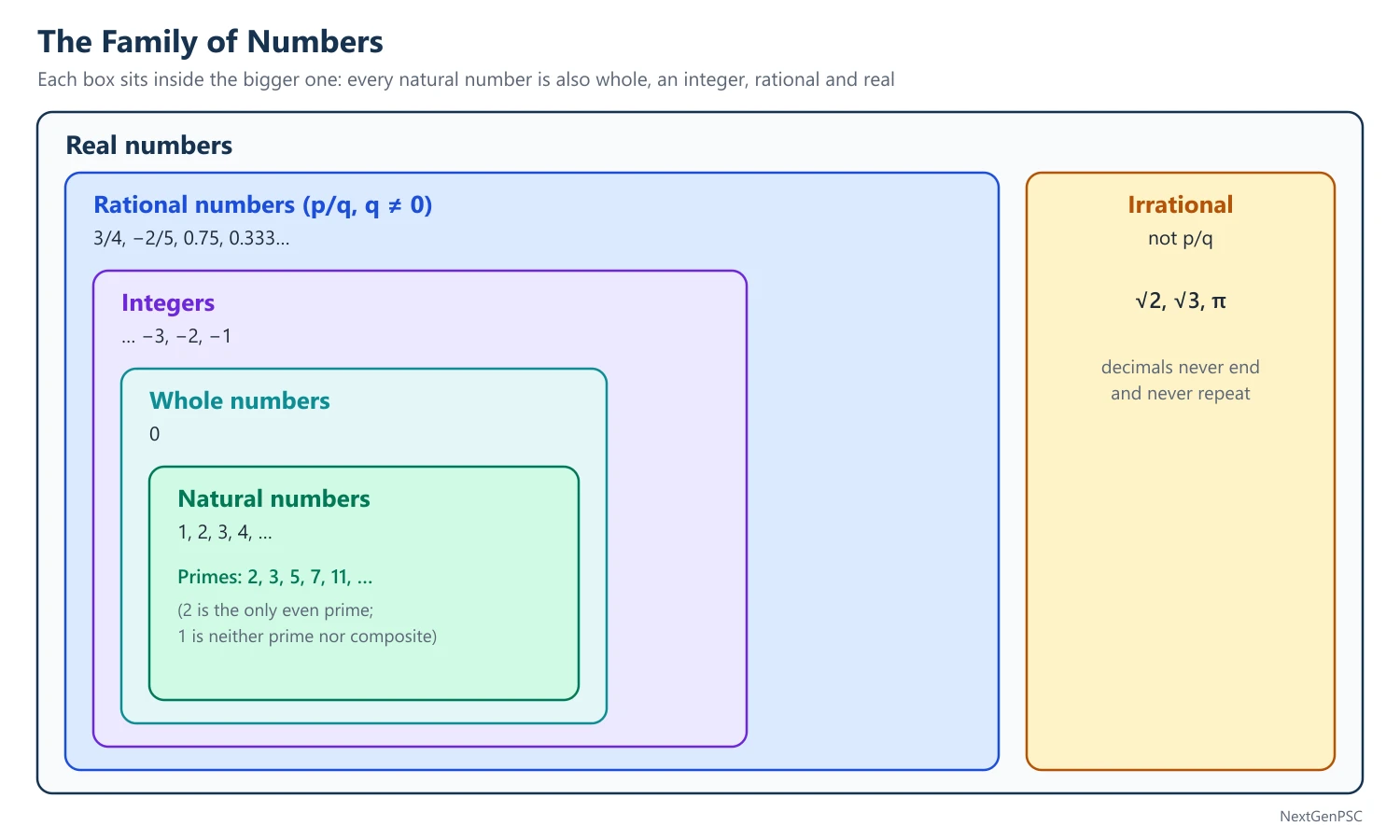
Numbers are like a family. The ones we count with (1, 2, 3, …) are natural numbers. Add 0 and you get whole numbers. Add the negatives and you get integers. Fractions like 3/4 join to make rational numbers.
A prime number is a number that can be divided exactly only by 1 and by itself, like 2, 3, 5, 7, 11. Every other number above 1 is built by multiplying primes, the way words are built from letters: 60 = 2 × 2 × 3 × 5.
Everyday example: you have 24 laddoos and 36 barfis and want to pack equal boxes with no sweet left over, each box holding only one kind. The biggest box size that works is 12 (the HCF). If one bus leaves every 6 minutes and another every 8 minutes, they leave together again after 24 minutes (the LCM).
The one question to always ask is: 'Am I looking for the biggest number that divides, or the smallest number that is divisible?' Biggest that divides means HCF; smallest that is divisible means LCM.
Two habits solve most questions: (1) break every number into primes before doing anything else; (2) when only the last digit or the remainder is asked, never compute the whole number; work with the last digit or the remainder alone.
1. The Family of Numbers
Natural numbers are the counting numbers 1, 2, 3, … Whole numbers add 0. Integers add the negatives: … −2, −1, 0, 1, 2, …
Rational numbers can be written as p/q with q ≠ 0. They include all integers and every terminating or recurring decimal: 0.75 = 3/4 and 0.333… = 1/3. Irrational numbers such as √2 and π cannot be written as p/q; their decimals never end and never repeat. Rational and irrational numbers together form the real numbers.
Even and odd rules: even ± even = even; odd ± odd = even; even ± odd = odd; odd × odd = odd; any product that has one even factor is even. Why: an even number carries a factor 2, and that 2 survives in every product.
Prime numbers have exactly two factors, 1 and the number itself. 1 is neither prime nor composite, and 2 is the only even prime. There are 25 primes below 100 and 15 primes below 50.
Testing for a prime: divide only by the primes up to √N. Is 221 prime? √221 is less than 15, so try 2, 3, 5, 7, 11, 13: 221 = 13 × 17, so it is not. 211 is not divisible by any of 2, 3, 5, 7, 11, 13, so 211 is prime.
Co-prime numbers have HCF 1, like 8 and 15. They need not be primes themselves.
2. Place Value and Orders of Magnitude
The syllabus speaks of 'orders of magnitude', so be fluent with large numbers. 1 lakh = 100,000; 1 crore = 100 lakh = 10 million; 100 crore = 1 billion. So ₹2.5 lakh crore = ₹2.5 trillion.
Place value vs face value: in 47,382 the face value of 7 is 7 but its place value is 7,000.
Two-digit number puzzles: a number with tens digit a and units digit b is 10a + b. Reversing the digits gives 10b + a. The difference is 9(a − b) and the sum is 11(a + b). So 72 − 27 = 45 = 9 × 5. Any 'digits reversed' question therefore has a difference that is a multiple of 9.
3. Divisibility Rules
By 2, 4, 8: look at the last 1, 2 or 3 digits. 7,416 is divisible by 8 because 416 = 8 × 52.
By 3 and 9: the sum of the digits must be divisible by 3 (or 9). 4,617: 4 + 6 + 1 + 7 = 18, so it is divisible by both 3 and 9.
By 5 and 10: last digit 0 or 5; for 10, last digit 0.
By 11: (sum of digits in odd places) − (sum of digits in even places) must be 0 or a multiple of 11. 2,728: (2 + 2) − (7 + 8) = −11, so 2,728 = 11 × 248.
By 7: double the last digit and subtract it from the number formed by the rest; repeat if needed. 357: 35 − 14 = 21, which is divisible by 7, so 357 = 7 × 51.
By a composite number: split it into co-prime factors and test each. 6 = 2 × 3, 12 = 3 × 4, 15 = 3 × 5, 18 = 2 × 9, 24 = 3 × 8.
Why co-prime: 12 = 2 × 6 does not work as a test, because 2 and 6 share the factor 2. The number 18 is divisible by 2 and by 6, yet it is not divisible by 12.
4. Factors and Multiples
Number of factors: if N = aᵖ × bᑫ × cʳ in primes, N has (p + 1)(q + 1)(r + 1) factors. 72 = 2³ × 3², so it has 4 × 3 = 12 factors.
Why: every factor of 72 chooses a power of 2 from 2⁰ to 2³ (4 choices) and a power of 3 from 3⁰ to 3² (3 choices).
Only perfect squares have an odd number of factors. 36 has 9 factors: 1, 2, 3, 4, 6, 9, 12, 18, 36. In the classic puzzle where 100 doors are toggled by persons 1 to 100, the doors left open are the perfect squares: 10 doors.
Sum of factors of 2³ × 3² = (1 + 2 + 4 + 8)(1 + 3 + 9) = 15 × 13 = 195.
Counting multiples: multiples of n from 1 to N = the whole-number part of N/n. From a to b it is [b/n] − [(a − 1)/n]. Multiples of 7 from 100 to 300: 42 − 14 = 28.
5. HCF and LCM
HCF (highest common factor) is the largest number that divides all the given numbers; LCM (least common multiple) is the smallest number that all of them divide. With prime factors, HCF takes the lowest power of each common prime and LCM the highest power of every prime.
24 = 2³ × 3 and 36 = 2² × 3², so HCF = 2² × 3 = 12 and LCM = 2³ × 3² = 72.
Product rule (two numbers only): HCF × LCM = product of the numbers. 12 × 72 = 864 = 24 × 36. The HCF always divides the LCM and also divides the difference of the two numbers.
Fractions: HCF = HCF of numerators ÷ LCM of denominators; LCM = LCM of numerators ÷ HCF of denominators. LCM of 2/3 and 4/9 = LCM(2, 4) ÷ HCF(3, 9) = 4/3.
Word cues: 'largest', 'greatest', 'maximum size of a tile, group or container' ⇒ HCF. 'Smallest', 'least', 'together again', 'bells ring together' ⇒ LCM. Bells ringing every 6, 8 and 12 minutes ring together every 24 minutes.
Remainder pattern 1 (same remainder): a number that leaves the same remainder r when divided by a, b and c has the form LCM × k + r.
Remainder pattern 2 (same gap): if divisor − remainder is the same d each time, the number is LCM × k − d. Divided by 4, 5, 6 it leaves 3, 4, 5 (each 1 short), so the number is 60k − 1; the smallest is 59.
Remainder pattern 3 (largest divisor with the same remainder): the largest number that divides x, y and z leaving the same remainder is the HCF of the differences (y − x) and (z − y).
6. Remainders
Dividend = divisor × quotient + remainder, where the remainder is at least 0 and smaller than the divisor.
Remainder of a sum or product = remainder of the sum or product of the remainders. 17 × 23 ÷ 5: remainders 2 and 3 give 6, which leaves 1. Check: 391 = 5 × 78 + 1.
Negative remainders: 49 = 50 − 1, so 49 behaves like −1 when divided by 50. Remainder of 49¹⁵ ÷ 50 = remainder of (−1)¹⁵ = −1, i.e. 50 − 1 = 49.
Useful facts: aⁿ − bⁿ is always divisible by (a − b); it is divisible by (a + b) when n is even. So 17⁴ − 13⁴ is divisible by both 4 and 30.
7. Unit Digits and Cyclicity
The unit digit of a sum or product depends only on the unit digits of the numbers. 347 × 128 ends in 7 × 8 = 56, i.e. 6.
Powers repeat in cycles: 2 → 2, 4, 8, 6; 3 → 3, 9, 7, 1; 7 → 7, 9, 3, 1; 8 → 8, 4, 2, 6 (cycle of 4). 4 → 4, 6 and 9 → 9, 1 (cycle of 2). Numbers ending in 0, 1, 5 or 6 keep the same unit digit.
Rule: divide the power by 4 and use the remainder (remainder 0 means the 4th term of the cycle). 7⁹⁵: 95 = 4 × 23 + 3, so the unit digit is the 3rd term of 7, 9, 3, 1, i.e. 3.
8. Factorials and Trailing Zeros
n! = 1 × 2 × 3 × … × n. Each trailing zero needs a factor 10 = 2 × 5, and 2s are always more plentiful, so trailing zeros = number of 5s = [n/5] + [n/25] + [n/125] + …
100! has 20 + 4 = 24 trailing zeros. Why the second term: 25, 50, 75 and 100 each carry two 5s.
The same method gives the highest power of any prime in n!: the power of 3 in 30! is 10 + 3 + 1 = 14.
9. Counting with Inclusion–Exclusion
Divisible by a or b = [N/a] + [N/b] − [N/LCM(a, b)]. Exactly one of them = (a or b) − both. Neither = N − (a or b).
Digits used in numbering pages: pages 1–9 use 9 digits, 10–99 use 180 digits and 100–999 use 2,700 digits. Subtract these blocks one by one from the total given.
Example 1: Counting the factors of a number
- Question
How many factors (divisors) does 360 have? (a) 12 (b) 18 (c) 24 (d) 36
- Solution
Normal method. Break 360 into primes: 360 = 8 × 45 = 2³ × 3² × 5.
Number of factors = (3 + 1)(2 + 1)(1 + 1) = 4 × 3 × 2 = 24.
Shortcut. Add 1 to each power and multiply; never list the factors one by one.
Check. Factors come in pairs that multiply to 360 (1 × 360, 2 × 180, …, 18 × 20): 12 pairs = 24 factors.
Trap. Option (a) forgets the prime 5 and counts only the factors of 72.
- Answer
(c) 24
Example 2: Using HCF × LCM
- Question
The HCF of two numbers is 12 and their LCM is 360. If one number is 72, what is the other? (a) 48 (b) 60 (c) 90 (d) 120
- Solution
Normal method. For two numbers, HCF × LCM = product. So 12 × 360 = 72 × other.
Other = 4,320 ÷ 72 = 60.
Shortcut. Other = LCM ÷ (72 ÷ HCF) = 360 ÷ 6 = 60.
Check. 72 = 2³ × 3² and 60 = 2² × 3 × 5: HCF = 2² × 3 = 12 and LCM = 2³ × 3² × 5 = 360.
Trap. Option (d) 120 is a multiple of 12 that divides 360, but its HCF with 72 is 24, not 12. Always test the HCF too.
- Answer
(b) 60
Example 3: Same remainder plus divisibility (UPSC-style)
- Question
What is the smallest number which leaves a remainder 5 when divided by 12, 15 or 20, but is exactly divisible by 7? (a) 65 (b) 125 (c) 245 (d) 305
- Solution
Normal method. LCM of 12, 15 and 20 = 60, so the number has the form 60k + 5.
Try k = 1, 2, 3, …: 65, 125, 185, 245. The first one divisible by 7 is 245 = 7 × 35.
Shortcut. Work with remainders by 7: 60 leaves 4 and 5 leaves 5, so we need 4k + 5 to be a multiple of 7. k = 4 gives 21, so the number is 60 × 4 + 5 = 245.
Check. 245 = 12 × 20 + 5 = 15 × 16 + 5 = 20 × 12 + 5, and 245 ÷ 7 = 35.
Trap. Option (a) 65 satisfies the remainder condition but ignores 'divisible by 7'. Option (d) 305 is 60 × 5 + 5, not divisible by 7.
- Answer
(c) 245
Example 4: Unit digit of a product of powers
- Question
What is the unit digit of 3⁶⁵ × 7⁴³ × 8²²? (a) 2 (b) 4 (c) 6 (d) 8
- Solution
Normal method. 3⁶⁵: 65 = 4 × 16 + 1, so the unit digit is the 1st term of 3, 9, 7, 1, i.e. 3.
7⁴³: 43 = 4 × 10 + 3, so the 3rd term of 7, 9, 3, 1, i.e. 3. 8²²: 22 = 4 × 5 + 2, so the 2nd term of 8, 4, 2, 6, i.e. 4.
Product of the unit digits: 3 × 3 × 4 = 36, so the unit digit is 6.
Shortcut. Reduce each power to its remainder by 4 first: 3¹ × 7³ × 8² ⇒ 3 × 3 × 4 ⇒ 6.
Trap. Multiplying the base unit digits without the powers (3 × 7 × 8 = 168) gives option (d) 8.
- Answer
(c) 6
Example 5: Trailing zeros of a long product (UPSC-style)
- Question
How many zeros are there at the end of the product 1 × 2 × 3 × … × 250? (a) 50 (b) 60 (c) 62 (d) 25
- Solution
Normal method. Each zero needs one 2 and one 5; there are far more 2s than 5s, so count the 5s.
Multiples of 5 up to 250: 50. Multiples of 25 (an extra 5 each): 10. Multiples of 125 (one more 5): 2.
Total 5s = 50 + 10 + 2 = 62, so there are 62 zeros.
Shortcut. Keep dividing by 5 and add the quotients: 250 → 50 → 10 → 2; 50 + 10 + 2 = 62.
Trap. Option (a) counts only the multiples of 5; option (b) stops at 25 and misses 125 and 250.
- Answer
(c) 62
Example 6: Counting with 'or' but 'not both' (UPSC-style)
- Question
How many numbers from 1 to 500 (both inclusive) are divisible by 4 or by 6 but not by both? (a) 167 (b) 126 (c) 208 (d) 84
- Solution
Normal method. Divisible by 4: [500/4] = 125. Divisible by 6: [500/6] = 83.
Divisible by both means divisible by LCM(4, 6) = 12: [500/12] = 41.
Divisible by 4 or 6 = 125 + 83 − 41 = 167. 'Not by both' removes the 41 again: 167 − 41 = 126.
Shortcut. Exactly one = A + B − 2 × both = 125 + 83 − 82 = 126.
Trap. Option (a) 167 still includes the 41 numbers divisible by both; option (c) adds 125 + 83 without removing the overlap; option (d) counts only those divisible by 4 and not 6. Using 24 (= 4 × 6) instead of the LCM 12 is another common slip.
- Answer
(b) 126
Practice Questions
Q1. Which one of the following numbers is divisible by 11? (a) 135,792 (b) 246,813 (c) 918,082 (d) 547,381
Q2. What is the unit digit of 2²⁰²⁶? (a) 2 (b) 4 (c) 6 (d) 8
Q3. A total of 1,890 digits is used to number the pages of a book, starting from page 1. How many pages does the book have? (a) 630 (b) 666 (c) 667 (d) 690
Q4. What is the largest number that divides 1,657 and 2,037 leaving remainders 6 and 5 respectively? (a) 127 (b) 235 (c) 260 (d) 305
Q5. What is the remainder when 17 × 23 × 29 is divided by 6? (a) 1 (b) 3 (c) 5 (d) 0
Q6. How many prime numbers are there between 1 and 50? (a) 13 (b) 14 (c) 15 (d) 16
Answers
Show answers
Q1. (c) 918,082. (9 + 8 + 8) − (1 + 0 + 2) = 22, a multiple of 11; the others give 3, −6 and 12.
Q2. (b) 4. 2026 = 4 × 506 + 2, so the 2nd term of 2, 4, 8, 6.
Q3. (b) 666. Pages 1–99 use 189 digits; 1,890 − 189 = 1,701 digits ÷ 3 = 567 three-digit pages; 99 + 567 = 666.
Q4. (a) 127. HCF of 1,657 − 6 = 1,651 and 2,037 − 5 = 2,032 is 127 (1,651 = 13 × 127, 2,032 = 16 × 127).
Q5. (c) 5. Each number leaves 5 when divided by 6; 5 × 5 × 5 = 125 leaves 5.
Q6. (c) 15. 2, 3, 5, 7, 11, 13, 17, 19, 23, 29, 31, 37, 41, 43, 47.
| Situation | Formula / shortcut | Quick example |
|---|---|---|
| Number of factors of aᵖ × bᑫ | (p + 1)(q + 1) | 72 = 2³ × 3² ⇒ 12 |
| Two numbers, HCF and LCM | HCF × LCM = product | 12 × 72 = 24 × 36 |
| Same remainder r for a, b, c | LCM × k + r | 12, 15, 20 rem 5 ⇒ 60k + 5 |
| Divisor − remainder = d each time | LCM × k − d | 4, 5, 6 rem 3, 4, 5 ⇒ 59 |
| Largest divisor leaving the same remainder | HCF of the differences | 1,651 and 2,032 ⇒ 127 |
| Unit digit of a power | power ÷ 4, use the remainder | 7⁹⁵ ⇒ 3 |
| Trailing zeros of n! | [n/5] + [n/25] + [n/125] + … | 100! ⇒ 24 |
| Multiples of n from a to b | [b/n] − [(a − 1)/n] | 7 in 100–300 ⇒ 28 |
| Divisible by a or b | [N/a] + [N/b] − [N/LCM] | 4 or 6 up to 500 ⇒ 167 |
| Two-digit number and its reverse | difference 9(a − b), sum 11(a + b) | 72 − 27 = 45 |
| Last digit of base | Cycle of unit digits | Cycle length |
|---|---|---|
| 2 | 2, 4, 8, 6 | 4 |
| 3 | 3, 9, 7, 1 | 4 |
| 7 | 7, 9, 3, 1 | 4 |
| 8 | 8, 4, 2, 6 | 4 |
| 4 | 4, 6 | 2 |
| 9 | 9, 1 | 2 |
| 0, 1, 5, 6 | unchanged | 1 |
Prelims tips
- Factorise first. Factor counts, HCF, LCM and trailing zeros all fall out of the prime factorisation. Wrong options are usually built by forgetting one prime (like the 5 in 360) or by taking the wrong power.
- Decide HCF or LCM from the words. 'Largest that divides' and 'maximum size' mean HCF; 'smallest that is divisible' and 'together again' mean LCM. Picking the other one gives a number that is usually among the options.
- Read every condition in a remainder question. UPSC-style questions add a second condition ('but divisible by 7', 'a four-digit number', 'the largest such number'). The option that meets only the first condition is the planted trap.
- Never compute big powers. For unit digits, reduce the power modulo 4; for remainders, replace each number by its remainder (or by a negative remainder like −1). A full calculation wastes minutes and invites errors.
- Count by formula, not by listing. Use [N/n] for multiples, the LCM (not the product) for 'both', and subtract twice for 'exactly one'. Check whether the range is inclusive and whether it starts at 1.
- Use the options as a filter. Divisibility tests (by 3, 9, 11) and last-digit checks often eliminate three options in seconds; back-substitution of the remaining option confirms it.
Percentages
In short
A percentage is a fraction with 100 as its denominator: x% = x/100. In CSAT it is the most-used tool of Basic Numeracy: recent papers usually carry 1 to 3 direct percentage questions (percentage change, successive change, marks and votes, price and consumption), and percentage thinking sits inside many more questions on profit and loss, interest, mixtures and data interpretation. Master the base (100% of what?), multiplying factors and the fraction–percentage table, and most of these questions take under a minute.
In simple words
Percent means out of 100. If you scored 45% in a test, you got 45 marks for every 100 marks of the paper. So 45% is just another way of writing 45/100.
Why use it? Because it makes things easy to compare. Ravi got 18 out of 24 and Sita got 21 out of 30. Who did better? Turn both into 'out of 100': Ravi 18/24 = 75%, Sita 21/30 = 70%. Ravi did better.
Everyday example: a shirt of ₹800 is on '25% off'. 25% is one quarter, so you save ₹800 ÷ 4 = ₹200 and pay ₹600.
The one thing to always ask is: 'percent of what?' That 'what' is the base, the thing that counts as 100%. If milk goes from ₹50 to ₹60, the rise of ₹10 is counted on the old price ₹50, so it is a 20% rise, not 10/60.
If you remember only two tricks, remember these: (1) to increase by 20%, multiply by 1.2; to decrease by 20%, multiply by 0.8; (2) one increase followed by another is found by multiplying the factors, not by adding the percentages.
1. What a Percentage Means
Percent comes from 'per centum', meaning 'per hundred'. x% = x/100. So 25% = 25/100 = 1/4 = 0.25 and 6% = 6/100 = 0.06.
Fraction or decimal to percentage: multiply by 100. 3/8 = 3/8 × 100% = 37.5%; 0.045 = 4.5%.
Percentage to fraction: divide by 100 and simplify. 35% = 35/100 = 7/20; 12.5% = 12.5/100 = 1/8.
x% of y = y% of x, because both equal x × y/100. So 8% of 50 = 50% of 8 = 4, and 24% of 25 = 25% of 24 = 6. Use this whenever one order is easier.
Percentages above 100 are allowed: 250% of 40 = 2.5 × 40 = 100. A value that becomes 3 times as large has increased by 200%, not 300%.
2. The Three Basic Questions
Find the part: 15% of 240 = 15/100 × 240 = 36. Faster: 10% of 240 = 24 and 5% = 12, so 15% = 36.
Find the percentage: 'A is what percent of B?' = A/B × 100. The quantity after 'of' (or after 'than' in comparisons) is the base and goes in the denominator. 18 is what percent of 72? 18/72 × 100 = 25%.
Find the whole: if p% of N is K, then N = K × 100/p. If 35% of a number is 84, then 1% is 84 ÷ 35 = 2.4 and the number is 240.
Build from 1% and 10%: 10% is the number with the decimal point moved one place left; 1% is two places. 17% of 360 = 10% (36) + 5% (18) + 2% (7.2) = 61.2.
3. Percentage Change and the Base Trap
Percentage change = (new − old)/old × 100. The base is always the old (original) value. A rise from 80 to 100 is 20/80 = 25%; the fall from 100 back to 80 is 20/100 = 20%.
Multiplying factor: an increase of r% means multiply by (1 + r/100); a decrease of r% means multiply by (1 − r/100). +15% → × 1.15; −8% → × 0.92. Working with factors avoids most errors.
% more vs % less (the base-change trap): if A is r% more than B, then B is less than A by r/(100 + r) × 100%. If A is r% less than B, then B is more than A by r/(100 − r) × 100%.
Examples: 25% more ⇒ 20% less (25/125); 50% more ⇒ 33 1/3% less (50/150); 20% less ⇒ 25% more (20/80); 50% less ⇒ 100% more (50/50).
Why: the gap is the same number of rupees in both statements, but it is divided by a different base each time.
Percent vs percentage points: if the literacy rate rises from 60% to 66%, it has risen by 6 percentage points, which is a 6/60 = 10% rise. UPSC statements often mix the two.
4. Successive (Chained) Changes
Two changes one after the other multiply: +20% then +10% gives 1.2 × 1.1 = 1.32, a net rise of 32% (not 30%).
Shortcut a + b + ab/100: for successive changes of a% and b% (use a minus sign for a decrease), the net change is a + b + ab/100 %. +20 and +10: 20 + 10 + 200/100 = 32%. +20 and −10: 20 − 10 − 200/100 = 8%.
Up and down by the same percentage is always a loss: +a% then −a% (in either order) gives a net change of −a²/100 %. +20% then −20% ⇒ −4%; +10% then −10% ⇒ −1%. So '0%' is never right in such questions.
Order does not matter: +20% then −10% gives the same result as −10% then +20%, because multiplication can be done in any order.
Three or more changes: apply the shortcut to the first two, then combine the result with the third; or simply multiply all the factors.
Same rate every year: a quantity growing at r% a year for n years becomes P × (1 + r/100)ⁿ (the compound interest formula). This is covered fully in the Interest topic.
5. Product Rule: Price × Consumption = Expenditure
Whenever one quantity is the product of two others (expenditure = price × quantity, area = length × breadth, revenue = rate × sales), a change of a% in one factor and b% in the other changes the product by a + b + ab/100 %.
Keeping expenditure the same: if the price rises by r%, consumption must fall by r/(100 + r) × 100% to keep spending unchanged. Price +25% ⇒ cut consumption by 25/125 = 20%.
If the price falls by r%, the same money buys r/(100 − r) × 100% more. Price −20% ⇒ 20/80 = 25% more quantity.
When spending is allowed to rise by e%: new consumption = (100 + e)/(100 + r) of the old, so the cut is (r − e)/(100 + r) × 100%.
6. Percentages in Marks, Votes and Groups
Pass marks: if one candidate scores p₁% and fails by x marks, and another scores p₂% and gets y marks more than the pass mark, then (p₂ − p₁)% of the maximum marks = x + y.
Elections: work only with valid votes for vote shares and the margin. If the winner gets w% of the valid votes in a two-candidate contest, the margin is (2w − 100)% of the valid votes. Votes on the list = votes cast + those who did not vote; votes cast = valid + invalid.
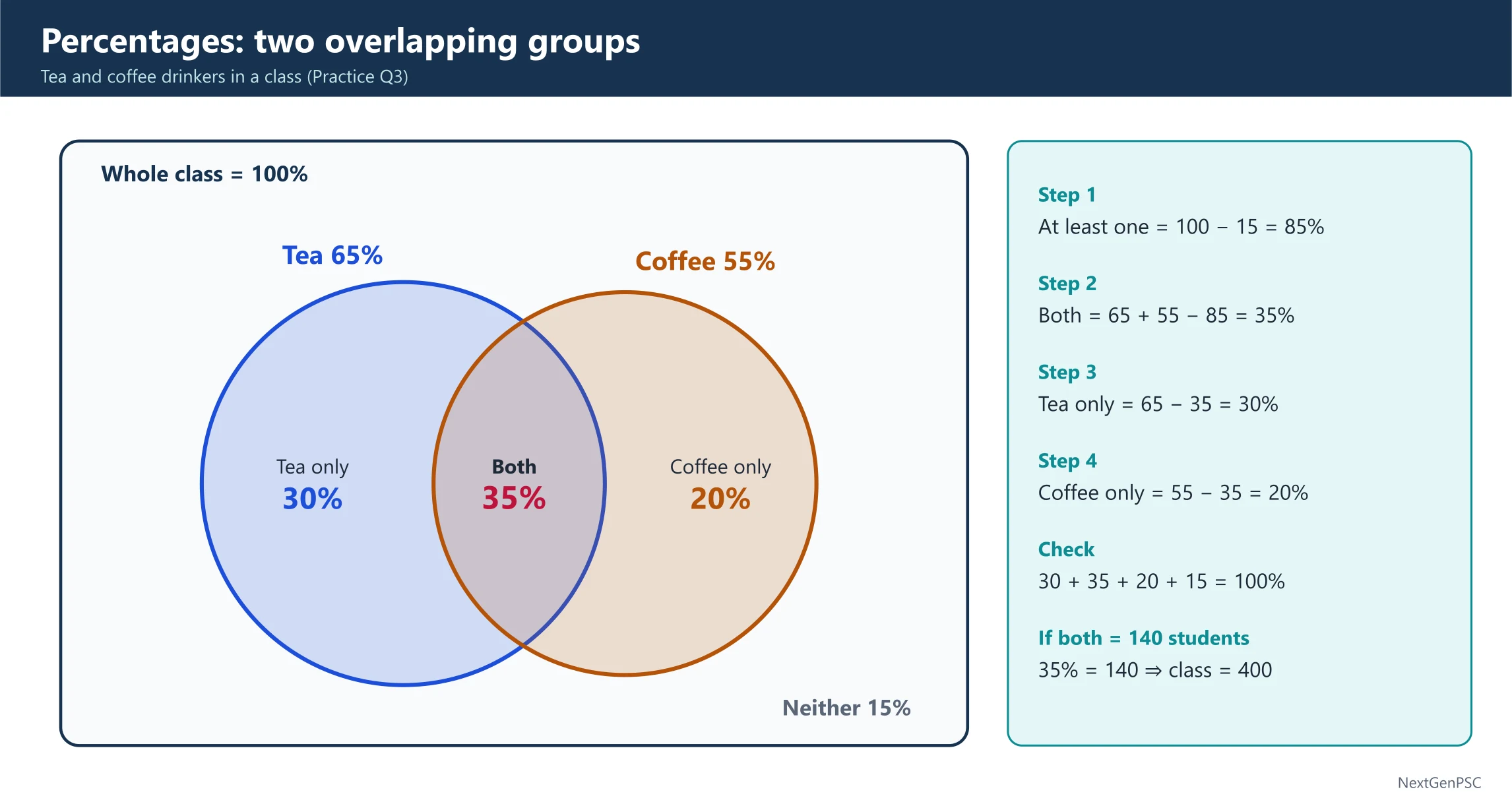
Two overlapping groups (pass/fail, like/dislike): % in at least one group = 100 − % in neither; % in both = %A + %B − % in at least one. Drawing a quick Venn diagram helps.
Assume 100: when no actual value is given, take the starting value as 100 (or 100k). All later values then read directly as percentages.
7. Fraction–Percentage Equivalents
Learn the table below by heart. It turns most CSAT percentage arithmetic into a single division: 16 2/3% of 420 = 420 ÷ 6 = 70; 87.5% of 64 = 7/8 × 64 = 56.
Recognise them in reverse too: if a price rises by 14 2/7% (= 1/7), the new price is 8/7 of the old; to get back, cut by 1/8 = 12.5%.
Example 1: Percentage rise and the reverse fall
- Question
The fare of a bus ticket rose from ₹40 to ₹50. By what percent did the fare rise, and if it later falls back to ₹40, by what percent does it fall? (a) 25% and 25% (b) 25% and 20% (c) 20% and 25% (d) 20% and 20%
- Solution
Normal method. Rise = 50 − 40 = 10 on the old fare 40: 10/40 × 100 = 25%.
Fall = 10 on the old fare, which is now 50: 10/50 × 100 = 20%.
Shortcut. r% more ⇒ r/(100 + r) less: 25/125 = 1/5 = 20%.
Trap. Option (a) assumes the rise and the fall are equal; they are not, because the base changes.
- Answer
(b) 25% and 20%
Example 2: Finding the whole from what is left
- Question
A man spends 65% of his monthly income on household needs and 20% of the remaining amount on travel. He saves the rest, which is ₹8,400. What is his monthly income? (a) ₹24,000 (b) ₹28,000 (c) ₹30,000 (d) ₹32,000
- Solution
Normal method. Let the income be ₹x. After household needs, 35% of x = 0.35x is left.
Travel takes 20% of 0.35x = 0.07x. Savings = 0.35x − 0.07x = 0.28x.
0.28x = 8,400, so x = 8,400 ÷ 0.28 = ₹30,000.
Shortcut. Savings fraction = 0.35 × 0.8 = 0.28 = 28%. Income = 8,400 × 100/28 = ₹30,000.
Check. Household 19,500; left 10,500; travel 2,100; saved 8,400.
Trap. Taking travel as 20% of the income gives savings of 15% and a wrong income of ₹56,000.
- Answer
(c) ₹30,000
Example 3: Pass marks (UPSC-style)
- Question
A candidate who scores 30% of the maximum marks fails by 30 marks. Another candidate who scores 42% of the maximum marks gets 18 marks more than the minimum pass marks. What are the maximum marks and the pass marks? (a) 400 and 150 (b) 400 and 120 (c) 500 and 180 (d) 300 and 120
- Solution
Normal method. Let the maximum marks be M and the pass marks P.
First candidate: 0.30M = P − 30. Second candidate: 0.42M = P + 18.
Subtracting: 0.12M = 48, so M = 400. Then P = 0.30 × 400 + 30 = 120 + 30 = 150.
Shortcut. The gap between the two scores is 42% − 30% = 12% of M, and it equals 30 + 18 = 48 marks (from 30 below the pass mark to 18 above it). So 1% = 4 and M = 400.
Check. 42% of 400 = 168 = 150 + 18.
Trap. Option (b) gives 120, which is only the first candidate's score; the pass mark is 30 more.
- Answer
(a) 400 and 150
Example 4: Price rise and consumption (UPSC-style)
- Question
The price of petrol rises by 20%. A family is willing to increase its spending on petrol by only 8%. By what percent must it reduce its consumption of petrol? (a) 8% (b) 10% (c) 12% (d) 12.5%
- Solution
Normal method. Take the old price ₹100 per litre and old consumption 100 litres, so old spending = ₹10,000.
New price = ₹120 per litre; new spending = ₹10,800. New consumption = 10,800 ÷ 120 = 90 litres.
Fall = 100 − 90 = 10 litres out of 100, i.e. 10%.
Shortcut. Cut = (r − e)/(100 + r) × 100 = (20 − 8)/120 × 100 = 10%. In factors: 1.08 ÷ 1.20 = 0.90.
Trap. Option (c) comes from simply subtracting 20 − 8 = 12; the cut must be measured on the new price.
- Answer
(b) 10%
Example 5: Three successive changes (UPSC-style)
- Question
The population of a town rose by 10% in the first year, fell by 10% in the second year and rose by 20% in the third year. The population is now 47,520. What was it at the start of the first year? (a) 39,600 (b) 40,000 (c) 41,250 (d) Cannot be determined
- Solution
Normal method. Let the starting population be P. After 3 years it is P × 1.10 × 0.90 × 1.20.
1.10 × 0.90 = 0.99, and 0.99 × 1.20 = 1.188. So 1.188P = 47,520 and P = 47,520 ÷ 1.188 = 40,000.
Shortcut. +10 and −10 give −1% (the −a²/100 rule). Then −1 and +20 give −1 + 20 + (−1 × 20)/100 = 18.8%. So the population is 118.8% of the start: P = 47,520 × 100/118.8 = 40,000.
Check. 40,000 → 44,000 → 39,600 → 47,520.
Trap. Adding 10 − 10 + 20 = 20% gives 39,600, which is option (a). Option (d) is wrong because the final value and all three rates are given.
- Answer
(b) 40,000
Example 6: Voters, valid votes and margin (UPSC-style)
- Question
In an election between two candidates, 20% of the voters on the list did not vote and 500 of the votes cast were invalid. The winner got 55% of the valid votes and won by 2,000 votes. How many voters were on the list? (a) 25,000 (b) 25,625 (c) 26,250 (d) 24,375
- Solution
Normal method. Let the valid votes be V. Winner = 0.55V and loser = 0.45V, so the margin = 0.10V = 2,000 and V = 20,000.
Votes cast = valid + invalid = 20,000 + 500 = 20,500.
Those who voted were 80% of the list, so the list = 20,500 ÷ 0.8 = 25,625.
Shortcut. Margin = (2 × 55 − 100)% = 10% of valid votes ⇒ V = 2,000 × 10 = 20,000. Then list = 20,500 × 100/80 = 25,625.
Check. 80% of 25,625 = 20,500 votes cast; 20,500 − 500 = 20,000 valid; 11,000 − 9,000 = 2,000.
Trap. Option (a) forgets the 500 invalid votes (20,000 ÷ 0.8 = 25,000). Always move step by step: list → cast → valid.
- Answer
(b) 25,625
Practice Questions
Q1. Rahul's salary is 60% more than Mohan's. By what percent is Mohan's salary less than Rahul's? (a) 60% (b) 40% (c) 37.5% (d) 62.5%
Q2. A shopkeeper raises the price of an article by 20% and then, during a sale, reduces the new price by 20%. The final price compared with the original is: (a) the same (b) 4% less (c) 4% more (d) 2% less
Q3. In a class, 65% of the students like tea, 55% like coffee and 15% like neither. If 140 students like both, how many students are in the class? (a) 350 (b) 400 (c) 420 (d) 500
Q4. The literacy rate of a district rose from 60% to 66%. Which description is correct? (a) It rose by 6% (b) It rose by 10 percentage points (c) It rose by 6 percentage points, which is a 10% rise (d) It rose by 6 percentage points, which is a 6% rise
Q5. The length of a rectangle is increased by 10% and its breadth by 20%. By what percent does its area increase? (a) 30% (b) 31% (c) 32% (d) 34%
Answers
Show answers
Q1. (c) 37.5%. Take Mohan = 100, Rahul = 160; gap 60 on base 160: 60/160 × 100 = 37.5%.
Q2. (b) 4% less. 1.2 × 0.8 = 0.96; or −a²/100 = −400/100 = −4%.
Q3. (b) 400. At least one = 100 − 15 = 85%; both = 65 + 55 − 85 = 35%; 35% = 140 ⇒ total = 400.
Q4. (c) It rose by 6 percentage points, which is a 10% rise. 6/60 × 100 = 10%.
Q5. (c) 32%. 10 + 20 + (10 × 20)/100 = 32%; or 1.1 × 1.2 = 1.32.
| Fraction | Percentage | Fraction | Percentage |
|---|---|---|---|
| 1/2 | 50% | 1/9 | 11 1/9% |
| 1/3 | 33 1/3% | 1/10 | 10% |
| 2/3 | 66 2/3% | 1/11 | 9 1/11% |
| 1/4 | 25% | 1/12 | 8 1/3% |
| 3/4 | 75% | 1/15 | 6 2/3% |
| 1/5 | 20% | 1/16 | 6.25% |
| 1/6 | 16 2/3% | 1/20 | 5% |
| 5/6 | 83 1/3% | 1/25 | 4% |
| 1/7 | 14 2/7% | 3/8 | 37.5% |
| 1/8 | 12.5% | 5/8 | 62.5% |
| Situation | Formula / shortcut | Quick example |
|---|---|---|
| Percentage change | (new − old)/old × 100 | 80 → 100: 20/80 = 25% |
| Increase / decrease by r% | multiply by (1 + r/100) / (1 − r/100) | +15% → × 1.15; −8% → × 0.92 |
| A is r% more than B; B is less than A by | r/(100 + r) × 100% | 25% more ⇒ 20% less |
| A is r% less than B; B is more than A by | r/(100 − r) × 100% | 20% less ⇒ 25% more |
| Successive changes a% and b% | a + b + ab/100 (minus sign for a fall) | +20, −10 ⇒ 8% |
| Up a% then down a% (either order) | net −a²/100 % | ±20% ⇒ −4% |
| Price up r%, spending unchanged | cut consumption by r/(100 + r) × 100% | +25% ⇒ cut 20% |
| Price up r%, spending up e% | cut consumption by (r − e)/(100 + r) × 100% | +20%, +8% ⇒ cut 10% |
| Pass marks (fails by x, another passes by y) | (p₂ − p₁)% of maximum = x + y | 42% − 30% = 12% = 48 ⇒ max 400 |
| Two-candidate election, winner w% of valid votes | margin = (2w − 100)% of valid votes | 55% ⇒ margin 10% |
| Two overlapping groups | both = A + B − (100 − neither) | 65 + 55 − 85 = 35% |
Prelims tips
- Find the base first. In 'A is what percent of B' and 'A is r% more than B', B is the base. Most wrong options in CSAT come from dividing by the wrong base (25% more is 20% less, not 25% less).
- Never add successive percentages. Multiply the factors or use a + b + ab/100. A rise and a fall by the same percentage always end in a net fall of a²/100 %, so '0%' and 'no change' are traps.
- Assume 100 when no value is given. If a question gives only percentages, start with 100 (or 100k for rupee gaps) and read the answer directly. Reject 'cannot be determined' only after checking that the givens really fix the answer.
- Percent vs percentage points. A change from 60% to 66% is 6 percentage points and a 10% rise. In statement-based questions, check which one the statement claims.
- Use the fraction table and the options. 12.5% = 1/8, 16 2/3% = 1/6, 14 2/7% = 1/7 turn multiplication into one division. When the options are far apart, round (47,520 ÷ 1.188 ≈ 47,500 ÷ 1.19 ≈ 40,000) and pick the nearest.
- Votes and marks: go step by step. List → votes cast → valid votes; and for pass marks the gap between two percentages equals the total of 'failed by' and 'passed by'. Skipping a step (such as invalid votes) is exactly what the wrong options are built on.
Profit and Loss
In short
Profit and Loss is percentages applied to buying and selling: profit or loss is measured on the cost price (CP), and discount on the marked price (MP). CSAT asks it most years as 1 or 2 short questions: finding CP from SP, markup with discount, successive discounts with tax, two articles sold at the same price, and dishonest traders using false weights. Learn the multiplying-factor method (SP = CP × (100 + profit%)/100) and every such question becomes one line.
In simple words
The price at which a shopkeeper buys something is the cost price (CP). The price at which he sells it is the selling price (SP). If SP is more than CP he makes a profit; if SP is less he makes a loss.
Everyday example: a fruit seller buys a box of mangoes for ₹500 and sells it for ₹600. Profit = ₹100. As a percentage of what he spent: 100/500 × 100 = 20%. Profit and loss percentages are always counted on the cost price.
The price printed on the tag is the marked price (MP). A discount is a cut from the marked price. A ₹1,000 bag at '10% off' sells for ₹900. The shopkeeper can still make a profit because he marked it above his cost.
Two simple habits solve most questions: (1) write profit 20% as '× 1.2' and loss 10% as '× 0.9'; (2) if no price is given, assume CP = ₹100.
Watch out for cheating: a shopkeeper who uses a 900 g weight but charges for 1 kg is earning extra even if he 'sells at cost price'.
1. The Basic Words
Cost price (CP): what the seller pays for the article. Money spent on transport, repair or packing before the sale (overheads) is added to the CP.
Selling price (SP): what the buyer pays. Profit = SP − CP when SP > CP; loss = CP − SP when SP < CP.
Marked price (MP) or list price: the price on the tag. Discount = MP − SP, always given as a percentage of MP.
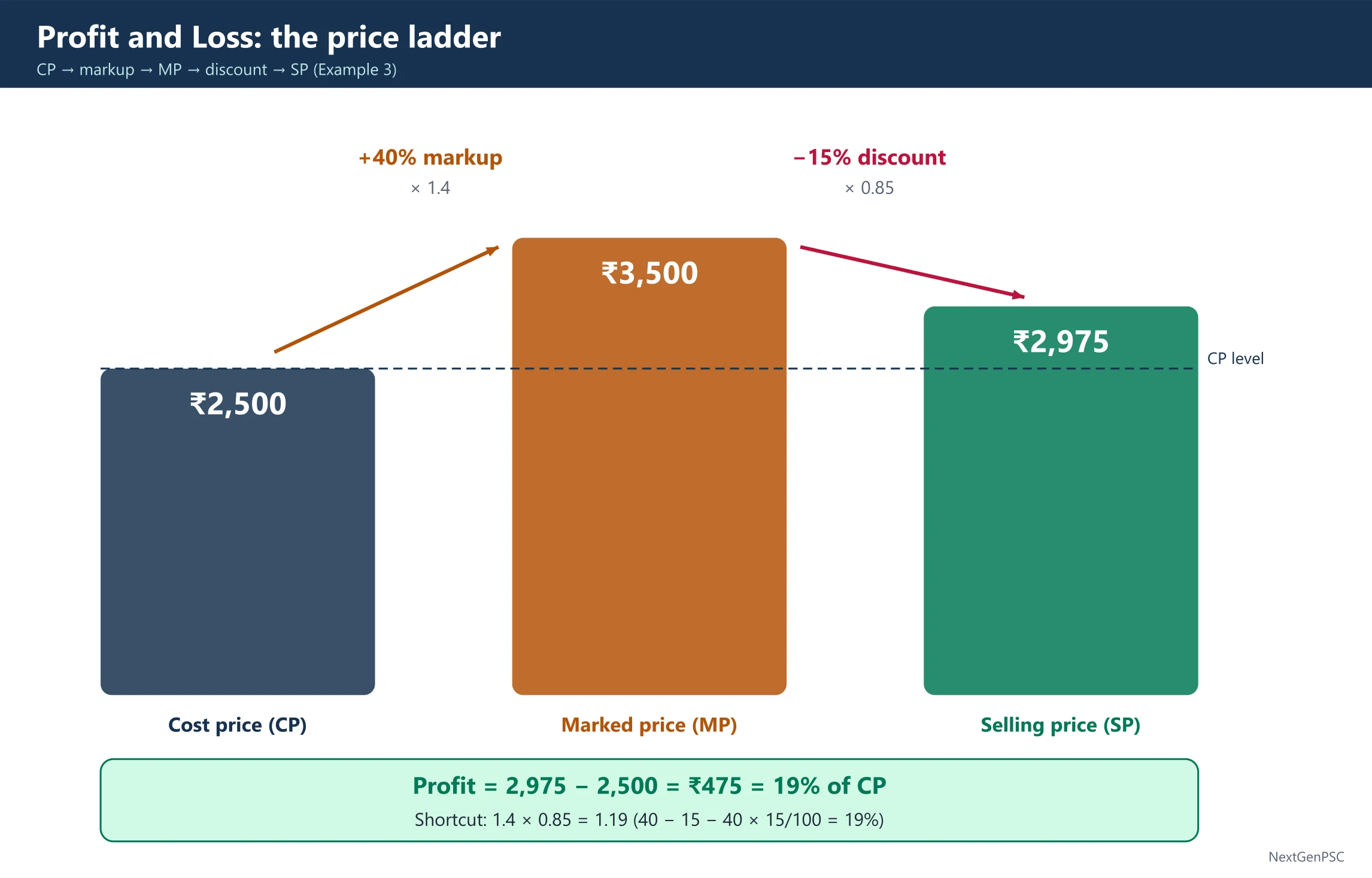
Markup: how much the MP is above the CP, as a percentage of CP. 'Marks his goods 40% above cost' means MP = 1.4 × CP.
2. Profit and Loss Percentages
Profit % = profit/CP × 100; loss % = loss/CP × 100. Unless the question says otherwise, the base is always the CP.
From CP to SP: SP = CP × (100 + profit%)/100, or SP = CP × (100 − loss%)/100. CP ₹800 at 15% profit: SP = 800 × 1.15 = ₹920.
From SP to CP: CP = SP × 100/(100 + profit%), or CP = SP × 100/(100 − loss%). SP ₹920 at 15% profit: CP = 920 ÷ 1.15 = ₹800.
From one SP to another: new SP = old SP × (100 ± new %)/(100 ± old %). Sold at a 5% loss for ₹1,140; to gain 5%, sell at 1,140 × 105/95 = ₹1,260.
Two selling prices, two results: the difference between two SPs equals the difference between the two profit percentages (a loss counts as negative) taken on the CP. If 12% profit instead of 7% profit gives ₹60 more, then 5% of CP = 60 and CP = ₹1,200.
Profit given on SP: if the profit is p% of the SP, it is p/(100 − p) × 100% of the CP. 20% on SP = 20/80 = 25% on CP.
CP of x articles = SP of y articles: profit % = (x − y)/y × 100 (a loss if y > x). CP of 12 = SP of 10 ⇒ profit = 2/10 = 20%.
3. Marked Price and Discount
SP = MP × (100 − discount%)/100. A ₹2,000 tag at 15% discount: SP = 2,000 × 0.85 = ₹1,700.
Linking CP, MP and SP: CP × (100 + profit%) = MP × (100 − discount%). So MP/CP = (100 + profit%)/(100 − discount%).
Markup and discount together: markup m% and discount d% give a net profit of m − d − md/100 % (the successive-change rule with −d). Markup 40%, discount 15% ⇒ 40 − 15 − 6 = 19% profit.
Discount needed for a target profit: discount = 1 − (100 + profit%)/(100 + markup%). Markup 40%, target profit 12%: 1 − 112/140 = 0.2, i.e. 20%.
4. Successive Discounts and Offers
Two discounts d₁% and d₂% one after the other equal a single discount of d₁ + d₂ − d₁d₂/100 %. 20% and 10% = 30 − 2 = 28%, not 30%.
The order of successive discounts does not matter, and neither does the order of a discount and a tax, because each is a multiplication: MP × 0.8 × 0.9 × 1.12 is the same in any order.
Buy x, get y free: the customer gets x + y articles for the price of x, so the discount is y/(x + y) × 100%. Buy 4 get 1 free = 1/5 = 20% discount.
When comparing offers, convert each to one multiplying factor (or one single discount) and compare. A single 30% discount beats successive 20% and 10% (= 28%).
5. Two Articles at the Same Selling Price
If two articles are sold at the same SP, one at r% profit and the other at r% loss, there is always an overall loss of r²/100 % on the total CP. 10% and 10% ⇒ 1% loss.
Why: the article sold at a loss had the higher CP, so the loss is counted on a bigger base than the profit.
If instead the two articles have the same CP and are sold at r% profit and r% loss, there is no profit and no loss. Read whether the question fixes the CP or the SP.
6. False Weights and Dishonest Traders
A trader who charges for the true weight but gives less has a profit % = (true weight − false weight)/false weight × 100. Using 900 g for 1 kg: 100/900 = 11 1/9%.
The base is the false weight, because that is what he actually paid for. 100/1000 = 10% is the classic wrong option.
False weight plus a markup or a discount: multiply the price factor by true/false. Sells at 10% above cost with a 900 g weight: 1.1 × 1000/900 = 1.2222, a profit of 22 2/9%.
Cheating while buying and selling: if he also takes more weight than he pays for while buying, multiply both effects. Taking 1,100 g for 1 kg while buying and giving 900 g while selling: 1100/900 = 1.2222, again 22 2/9%.
Example 1: Overheads go into the cost
- Question
A shopkeeper buys an old fan for ₹1,600, spends ₹400 on transport and repair, and sells it for ₹2,300. What is his profit percentage? (a) 43.75% (b) 15% (c) 13.04% (d) 30%
- Solution
Normal method. CP = 1,600 + 400 = ₹2,000 (overheads are part of the cost).
Profit = 2,300 − 2,000 = ₹300. Profit % = 300/2,000 × 100 = 15%.
Shortcut. SP/CP = 2,300/2,000 = 1.15, so the profit is 15%.
Trap. Option (a) ignores the overheads (700/1,600 = 43.75%); option (c) divides by the SP (300/2,300 ≈ 13.04%).
- Answer
(b) 15%
Example 2: From a loss to a target profit
- Question
By selling a watch for ₹1,140, a man loses 5%. At what price should he sell it to gain 5%? (a) ₹1,197 (b) ₹1,200 (c) ₹1,254 (d) ₹1,260
- Solution
Normal method. SP = 95% of CP, so CP = 1,140 × 100/95 = ₹1,200.
For a 5% gain, SP = 1,200 × 105/100 = ₹1,260.
Shortcut. Go straight from one SP to the other: 1,140 × 105/95 = 12 × 105 = ₹1,260.
Trap. Option (a) adds 5% to ₹1,140 (= ₹1,197); the 5% must be taken on the CP, not on the old SP.
- Answer
(d) ₹1,260
Example 3: Markup and discount
- Question
A trader buys a mixer for ₹2,500, marks it 40% above the cost price and allows a discount of 15% on the marked price. What is his profit percentage? (a) 25% (b) 19% (c) 21% (d) 15%
- Solution
Normal method. MP = 2,500 × 1.4 = ₹3,500. SP = 3,500 × 0.85 = ₹2,975.
Profit = 2,975 − 2,500 = ₹475. Profit % = 475/2,500 × 100 = 19%.
Shortcut. 40 − 15 − (40 × 15)/100 = 40 − 15 − 6 = 19%. Or in factors: 1.4 × 0.85 = 1.19.
Trap. Option (a) subtracts the discount from the markup directly (40 − 15 = 25); the discount is on the larger MP, so it takes away more.
- Answer
(b) 19%
Example 4: Two articles at the same selling price (UPSC-style)
- Question
A farmer sells two cows for ₹19,800 each. On one he gains 10% and on the other he loses 10%. What is the overall result? (a) No profit, no loss (b) Loss of ₹400 (c) Profit of ₹400 (d) Loss of ₹200
- Solution
Normal method. CP of the first cow = 19,800 × 100/110 = ₹18,000. CP of the second cow = 19,800 × 100/90 = ₹22,000.
Total CP = ₹40,000. Total SP = 2 × 19,800 = ₹39,600. Loss = ₹400, which is 400/40,000 × 100 = 1%.
Shortcut. Same SP with r% profit and r% loss ⇒ loss of r²/100 % = 100/100 = 1% of the total CP. Total CP = 39,600 ÷ 0.99 = ₹40,000, so the loss is ₹400.
Trap. Option (a) assumes the profit and loss cancel. They would only if the two cows had the same CP.
- Answer
(b) Loss of ₹400
Example 5: Comparing discount offers with tax (UPSC-style)
- Question
A shop offers three ways to buy an article marked at ₹5,000. Plan 1: discounts of 20% and then 10%, after which 12% GST is added. Plan 2: 12% GST is added first, then discounts of 10% and then 20%. Plan 3: a single discount of 30%, after which 12% GST is added. Which plan costs the customer the least? (a) Plan 1 (b) Plan 2 (c) Plan 3 (d) All three cost the same
- Solution
Normal method. Plan 1: 5,000 × 0.8 = 4,000; × 0.9 = 3,600; × 1.12 = ₹4,032.
Plan 2: 5,000 × 1.12 = 5,600; × 0.9 = 5,040; × 0.8 = ₹4,032.
Plan 3: 5,000 × 0.7 = 3,500; × 1.12 = ₹3,920. Plan 3 is the cheapest.
Shortcut. Every step is a multiplication, so the order (discount first or tax first) does not matter: Plans 1 and 2 are equal. Successive 20% and 10% = 20 + 10 − 2 = 28%, which is less than a single 30%, so Plan 3 wins without any arithmetic on ₹5,000.
Trap. Option (d) treats 20% + 10% as 30%. Option (a) or (b) assumes the order of tax and discount matters.
- Answer
(c) Plan 3
Example 6: Markup, discount and a false weight (UPSC-style)
- Question
A dishonest trader marks his goods 25% above the cost price and allows a discount of 12%. He also uses a weight of 880 g in place of 1 kg. What is his actual profit percentage? (a) 10% (b) 12% (c) 22% (d) 25%
- Solution
Normal method. Let the cost be ₹100 per kg. MP = ₹125 per kg; after a 12% discount the customer pays 125 × 0.88 = ₹110 for what he believes is 1 kg.
He actually receives 880 g, which cost the trader 100 × 880/1000 = ₹88.
Profit = 110 − 88 = ₹22 on a cost of ₹88: 22/88 × 100 = 25%.
Shortcut. Price factor × weight factor = 1.25 × 0.88 × 1000/880 = 1.1 × 1000/880 = 1.25, a profit of 25%. (Here 0.88 and 880/1000 cancel, which makes the trick quick.)
Trap. Option (a) counts only the markup and discount (1.25 × 0.88 = 1.1); option (b) counts only the false weight on the wrong base (120/1000). The two effects must be multiplied.
- Answer
(d) 25%
Practice Questions
Q1. The cost price of 12 pens equals the selling price of 10 pens. What is the profit percentage? (a) 16 2/3% (b) 20% (c) 25% (d) 12%
Q2. A shopkeeper makes a profit equal to 20% of the selling price. What is his profit as a percentage of the cost price? (a) 16 2/3% (b) 20% (c) 24% (d) 25%
Q3. The profit made by selling an article for ₹1,320 is 4 times the loss incurred when it is sold for ₹920. What is the cost price of the article? (a) ₹1,000 (b) ₹1,040 (c) ₹1,080 (d) ₹1,120
Q4. A store offers 'buy 4, get 1 free'. What is the effective discount? (a) 25% (b) 20% (c) 15% (d) 12.5%
Q5. A grocer claims to sell rice at cost price but uses a weight of 900 g for 1 kg. What is his profit percentage? (a) 10% (b) 9 1/11% (c) 11 1/9% (d) 12.5%
Q6. A shopkeeper marks his goods 40% above the cost price. What discount should he give to make a profit of 12%? (a) 28% (b) 25% (c) 22% (d) 20%
Answers
Show answers
Q1. (b) 20%. (12 − 10)/10 × 100 = 20%. Check: if one pen costs ₹10, CP of 12 = ₹120 = SP of 10, so SP of one pen = ₹12.
Q2. (d) 25%. Take SP = 100, profit = 20, CP = 80; 20/80 × 100 = 25%.
Q3. (a) ₹1,000. 1,320 − CP = 4 × (CP − 920) ⇒ 5 CP = 1,320 + 3,680 = 5,000 ⇒ CP = ₹1,000. Check: profit 320 = 4 × loss 80.
Q4. (b) 20%. 1 free out of 5 = 1/5 = 20%.
Q5. (c) 11 1/9%. 100/900 × 100 = 11 1/9%; 10% uses the wrong base.
Q6. (d) 20%. 1 − 112/140 = 28/140 = 0.2 = 20%. Check: 140 × 0.8 = 112.
| Situation | Formula / shortcut | Quick example |
|---|---|---|
| Profit % / loss % | profit (or loss)/CP × 100 | CP 500, SP 600 ⇒ 20% |
| SP from CP | CP × (100 ± %)/100 | 800 at 15% profit ⇒ 920 |
| CP from SP | SP × 100/(100 ± %) | 1,140 at 5% loss ⇒ 1,200 |
| One SP to another | SP₁ × (100 ± new %)/(100 ± old %) | 1,140 × 105/95 = 1,260 |
| SP after discount | MP × (100 − d)/100 | 2,000 at 15% ⇒ 1,700 |
| Markup m%, discount d% | net profit = m − d − md/100 % | 40, 15 ⇒ 19% |
| Discount for target profit p% | 1 − (100 + p)/(100 + m) | m 40, p 12 ⇒ 20% |
| Successive discounts d₁, d₂ | single = d₁ + d₂ − d₁d₂/100 | 20, 10 ⇒ 28% |
| Buy x, get y free | discount = y/(x + y) × 100% | buy 4 get 1 ⇒ 20% |
| Same SP, r% profit and r% loss | overall loss = r²/100 % | 10% each ⇒ 1% loss |
| Same CP, r% profit and r% loss | no profit, no loss | - |
| False weight | profit % = (true − false)/false × 100 | 900 g ⇒ 11 1/9% |
| Profit p% on SP | on CP = p/(100 − p) × 100% | 20% ⇒ 25% |
| CP of x = SP of y | profit % = (x − y)/y × 100 | 12 and 10 ⇒ 20% |
Prelims tips
- Profit and loss are on CP, discount is on MP. Before calculating, label every number as CP, SP or MP. Dividing the profit by the SP is the most common built-in wrong option.
- Add overheads to the CP. Transport, repair and packing spent before the sale are part of the cost. UPSC-style questions slip them into the middle of the sentence.
- Same SP or same CP? Two articles sold at the same SP with r% profit and r% loss always give a loss of r²/100 %; with the same CP there is no profit and no loss. Read which one is fixed before choosing 'no profit, no loss'.
- Discounts and taxes multiply, so order never matters. Successive discounts of 20% and 10% are 28%, not 30%. In offer-comparison questions, turn each offer into one factor and compare; the options often include 'all are equal' to test exactly this.
- False weights: divide by the false weight. 900 g for 1 kg is 100/900 = 11 1/9%, not 10%. When a markup or discount is also given, multiply the price factor by true/false weight.
- Assume CP = 100 and use the options. When only percentages are given, CP = 100 makes every step mental. When rupee values are given, check the options by back-substitution (for example, test CP = ₹1,000 in a 'profit is 4 times the loss' question).
Simple and Compound Interest
In short
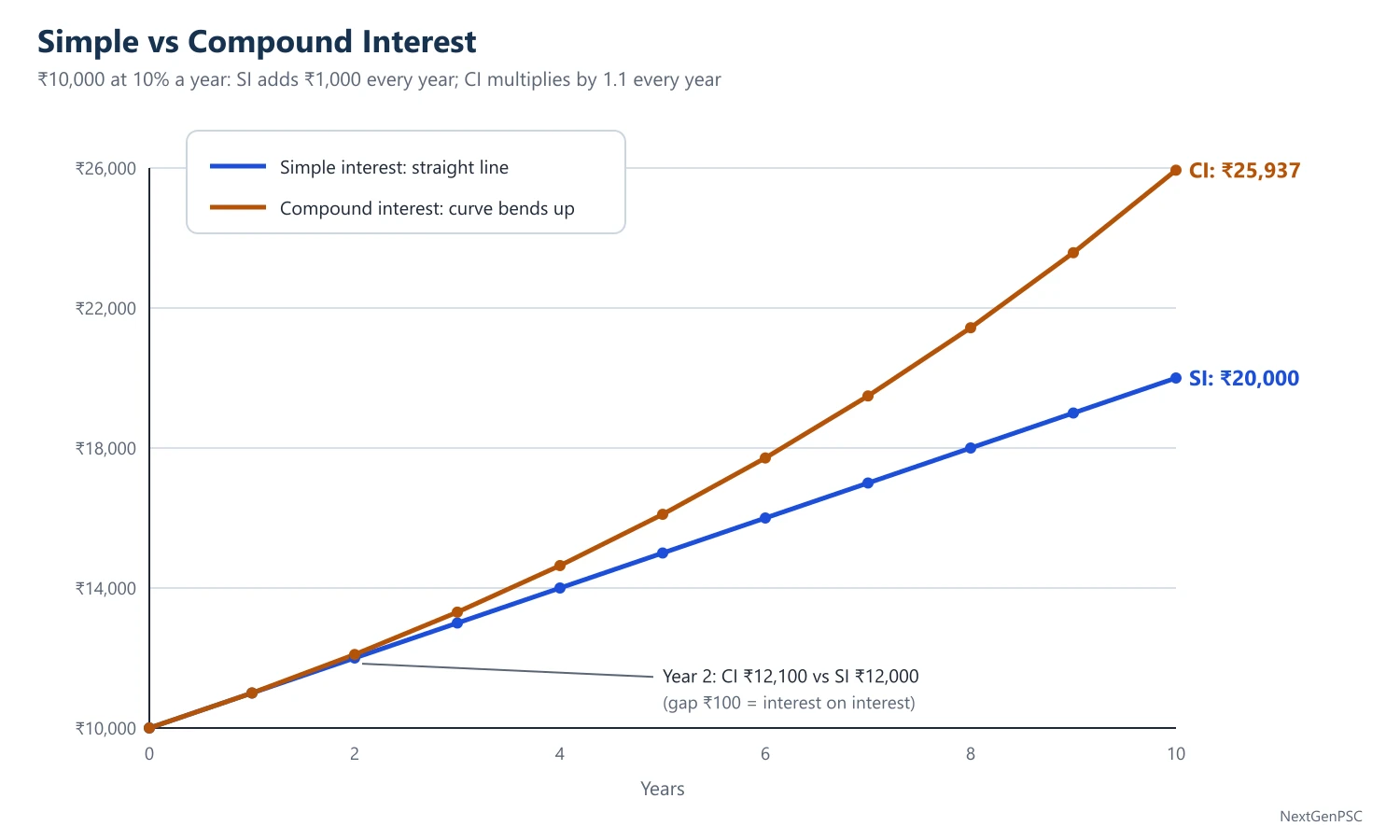
Interest is the price paid for using money. Under simple interest (SI) it is charged only on the original sum, so it grows in a straight line; under compound interest (CI) each period's interest is added to the sum and itself earns interest, so it grows by a constant factor. CSAT usually tests this through short questions on finding the rate or the principal, the CI − SI difference, doubling and tripling, half-yearly compounding, and growth or depreciation (population, machines). Three ideas unlock it: SI is the same every year, CI is percentage change applied again and again (multiply by 1 + R/100), and the CI − SI gap is interest on interest.
In simple words
When you keep money in a bank or take a loan, extra money is paid for the use of that money. This extra money is called interest. The money you start with is the principal, and principal + interest is the amount.
In simple interest the bank pays interest only on what you first put in. Keep ₹1,000 at 10% a year: you get ₹100 every year, so after 3 years you have ₹1,300.
In compound interest the interest is added to your money and next year you earn interest on the bigger sum. ₹1,000 at 10%: after 1 year ₹1,100; after 2 years ₹1,100 + ₹110 = ₹1,210; after 3 years ₹1,331. The extra ₹31 over simple interest is 'interest on interest'.
The one question to always ask is: 'Is the interest added back each year or not?' If not, it is simple interest; if yes, it is compound interest. If a question just says 'interest', take it as simple interest.
Two habits solve most questions: (1) for simple interest, find the interest for one year and multiply; (2) for compound interest, multiply by the yearly factor (1.1 for 10%, 1.2 for 20%) once for every year.
1. Basic Terms
Principal (P) is the sum lent or deposited; rate (R) is the interest per 100 rupees per year (per annum); time (T or n) is in years; amount (A) = principal + interest.
Convert time to years before using any formula: 9 months = 3/4 year; 3 years 4 months = 3 1/3 years; 73 days = 1/5 year (taking a year of 365 days).
If a question says only 'interest' or 'at a rate of', treat it as simple interest. Compound interest is used only when the question says 'compound', 'compounded' or 'interest added to the principal'.
2. Simple Interest
SI = P × R × T/100, and A = P + SI. ₹5,000 at 8% for 3 years: SI = 5,000 × 8 × 3/100 = ₹1,200; amount = ₹6,200.
Rearranged: P = 100 × SI/(R × T); R = 100 × SI/(P × T); T = 100 × SI/(P × R). Every SI question is one of these four.
Interest is the same every year. So if the amount is A₁ after t₁ years and A₂ after t₂ years, interest per year = (A₂ − A₁)/(t₂ − t₁) and P = A₁ − t₁ × (interest per year).
Example: ₹5,600 after 2 years and ₹6,400 after 4 years. Interest per year = 800 ÷ 2 = 400; P = 5,600 − 800 = 4,800; R = 400/4,800 × 100 = 8 1/3%.
A sum becomes n times itself in T years: the interest is (n − 1) times the principal, so R = 100(n − 1)/T. Doubles in 8 years ⇒ R = 12.5%.
Why the rule works: under SI the growth is linear, so a sum that doubles in T years becomes 3 times in 2T years and 4 times in 3T years.
Sum split at two rates: if ₹P is lent partly at r₁% and partly at r₂% and the total yearly interest corresponds to an average rate r%, the two parts are in the ratio (r₂ − r):(r − r₁). This is alligation, covered in Mixtures.
3. Compound Interest
Interest is added to the principal at the end of each period, so the next period's interest is calculated on the larger sum.
A = P(1 + R/100)ⁿ and CI = A − P. ₹10,000 at 10% for 2 years: 10,000 → 11,000 → 12,100, so CI = ₹2,100, while SI would be ₹2,000.
Why the extra ₹100: in the second year the bank also pays 10% on the first year's interest of ₹1,000.
Year by year: CI for the first year equals SI for the first year. Each later year's interest is the previous year's interest × (1 + R/100). At 10% on ₹10,000 the yearly interests are 1,000, 1,100 and 1,210.
Effective rate for 2 years: 2R + R²/100 %, the same as the successive-change rule a + b + ab/100 from Percentages. 10% for 2 years ⇒ 21%; 20% for 2 years ⇒ 44%. For 3 years at 10%: 1.1³ = 1.331, i.e. 33.1%.
Different rates in different years: multiply the factors. 10% then 20% ⇒ 1.1 × 1.2 = 1.32, i.e. 32% in 2 years.
4. The CI − SI Difference
For 2 years: CI − SI = P(R/100)². ₹10,000 at 10%: 10,000 × 0.01 = ₹100.
For 3 years: CI − SI = P(R/100)²(3 + R/100). ₹10,000 at 10%: 100 × 3.1 = ₹310.
Why: in 2 years the only extra is interest on the first year's interest; in 3 years there are three such pieces plus 'interest on interest on interest'.
This is the most common 'find the principal' question: if the 2-year difference at R% is D, then P = D × (100/R)².
5. Compounding More Than Once a Year
Half-yearly: use rate R/2 and 2n periods. Quarterly: rate R/4 and 4n periods.
₹10,000 at 20% per annum compounded half-yearly for 1 year: 10,000 × 1.1² = ₹12,100, against ₹12,000 with yearly compounding. The effective annual rate is therefore 21%.
Fractional years with yearly compounding: compound for the whole years, then add simple interest for the fraction on the new amount. ₹10,000 at 10% for 2½ years: 12,100 × 1.05 = ₹12,705.
6. Growth and Depreciation
Population, prices and production that grow r% a year follow P(1 + r/100)ⁿ. Machines, vehicles and stocks that lose r% of their value each year follow V(1 − r/100)ⁿ.
A machine worth ₹50,000 that depreciates 10% a year is worth 50,000 × 0.9² = ₹40,500 after 2 years (not ₹40,000, which would be simple 'straight-line' depreciation).
Going back in time: divide by the factor. A town of 26,620 that grew 10% a year for 3 years had 26,620 ÷ 1.331 = 20,000 people at the start.
7. Doubling, Tripling and the Rule of 72
Under CI, if a sum doubles in t years, it becomes 4 times in 2t years and 8 times in 3t years, because the factors multiply: 2 × 2 = 4 and 2 × 2 × 2 = 8.
Compare SI: doubles in t years ⇒ 3 times in 2t years ⇒ 4 times in 3t years. Mixing up the two patterns is the trap in most doubling questions.
Rule of 72 (approximate): at R% compound interest, money doubles in about 72/R years. At 8% about 9 years; at 12% about 6 years. Use it only to eliminate far-off options.
Rate from two consecutive amounts: if the CI amount is A₁ after n years and A₂ after n + 1 years, then R = (A₂ − A₁)/A₁ × 100. ₹8,820 after 2 years and ₹9,261 after 3 years ⇒ 441/8,820 = 5%.
8. Equal Instalments (Compound Interest)
A loan repaid in equal yearly instalments x at R% CI satisfies P = x/(1 + R/100) + x/(1 + R/100)² + … (each instalment is brought back to today's value).
Two instalments of ₹4,410 at 5%: P = 4,410 ÷ 1.05 + 4,410 ÷ 1.1025 = 4,200 + 4,000 = ₹8,200.
Example 1: Simple interest with months
- Question
What is the simple interest on ₹8,000 at 7.5% per annum for 3 years 4 months? (a) ₹1,800 (b) ₹2,000 (c) ₹2,400 (d) ₹2,040
- Solution
Normal method. 3 years 4 months = 3 + 4/12 = 10/3 years.
SI = 8,000 × 7.5 × (10/3) ÷ 100 = 600 × 10/3 = ₹2,000.
Shortcut. One year's interest = 7.5% of 8,000 = ₹600; for 10/3 years: 600 × 10/3 = ₹2,000.
Trap. Option (d) takes 3 years 4 months as 3.4 years; option (a) ignores the 4 months.
- Answer
(b) ₹2,000
Example 2: Rate from two amounts
- Question
A sum lent at simple interest amounts to ₹7,800 in 3 years and to ₹9,000 in 5 years. What is the rate of interest? (a) 7 9/13% (b) 8% (c) 10% (d) 12%
- Solution
Normal method. Interest for the 2 extra years = 9,000 − 7,800 = ₹1,200, so interest per year = ₹600.
Principal = 7,800 − 3 × 600 = ₹6,000.
Rate = 600/6,000 × 100 = 10%.
Shortcut. P = (t₂A₁ − t₁A₂)/(t₂ − t₁) = (5 × 7,800 − 3 × 9,000)/2 = 12,000/2 = 6,000; R = 600/6,000 = 10%.
Check. 6,000 + 3 × 600 = 7,800 and 6,000 + 5 × 600 = 9,000.
Trap. Option (a) divides the yearly interest by the amount 7,800 instead of the principal.
- Answer
(c) 10%
Example 3: Compound interest for 3 years
- Question
What is the compound interest on ₹12,000 at 10% per annum for 3 years, compounded annually? (a) ₹3,600 (b) ₹3,960 (c) ₹3,972 (d) ₹15,972
- Solution
Normal method. Year 1: 12,000 → 13,200. Year 2: 13,200 → 14,520. Year 3: 14,520 → 15,972.
CI = 15,972 − 12,000 = ₹3,972.
Shortcut. 1.1³ = 1.331, so CI = 12,000 × 0.331 = ₹3,972.
Check. SI = 3,600; CI − SI = 12,000 × 0.01 × 3.1 = 372, and 3,600 + 372 = 3,972.
Trap. Option (a) is simple interest and option (d) is the amount, not the interest.
- Answer
(c) ₹3,972
Example 4: Principal from the CI − SI gap (UPSC-style)
- Question
The difference between compound interest and simple interest on a certain sum for 2 years at 8% per annum is ₹96. What is the sum? (a) ₹12,000 (b) ₹15,000 (c) ₹1,200 (d) ₹18,000
- Solution
Normal method. SI for 2 years = 0.16P. CI = P(1.08² − 1) = 0.1664P.
Difference = 0.0064P = 96, so P = 96 ÷ 0.0064 = ₹15,000.
Shortcut. P = D × (100/R)² = 96 × (100/8)² = 96 × 156.25 = ₹15,000.
Check. SI = 2,400; CI = 15,000 × 1.1664 − 15,000 = 2,496; gap 96.
Trap. Option (c) divides 96 by 8% only once (96 ÷ 0.08); the gap is interest on interest, so the rate enters twice.
- Answer
(b) ₹15,000
Example 5: Doubling under compound interest (UPSC-style)
- Question
A sum of money placed at compound interest doubles itself in 5 years. In how many years will it become 8 times itself at the same rate? (a) 15 (b) 20 (c) 25 (d) 40
- Solution
Normal method. Let the yearly factor be f. Then f⁵ = 2.
8 = 2³ = (f⁵)³ = f¹⁵, so it takes 15 years.
Shortcut. Under CI the multiples go 2, 4, 8 in 5, 10, 15 years: each doubling takes another 5 years.
Trap. Option (d) treats the growth as linear (8 × 5 = 40); option (a) is right only because CI growth multiplies. Under SI the answer would be 35 years (7 × 5), which is not offered.
- Answer
(a) 15
Example 6: Half-yearly compounding (UPSC-style)
- Question
What is the compound interest on ₹20,000 for 1½ years at 10% per annum, compounded half-yearly? (a) ₹3,000 (b) ₹3,100 (c) ₹3,152.50 (d) ₹6,620
- Solution
Normal method. Half-yearly means a rate of 5% per period and 3 periods in 1½ years.
20,000 → 21,000 → 22,050 → 23,152.50. CI = 23,152.50 − 20,000 = ₹3,152.50.
Shortcut. 1.05³ = 1.157625, so CI = 20,000 × 0.157625 = ₹3,152.50.
Trap. Option (a) is simple interest; option (b) compounds yearly (20,000 × 1.1 × 1.05); option (d) keeps 10% for each half-year instead of halving it.
- Answer
(c) ₹3,152.50
Practice Questions
Q1. At what rate of simple interest per annum will a sum become 7/4 of itself in 6 years? (a) 10% (b) 12.5% (c) 15% (d) 7.5%
Q2. What is the compound interest on ₹5,000 at 20% per annum for 2 years, compounded annually? (a) ₹2,000 (b) ₹2,200 (c) ₹2,400 (d) ₹7,200
Q3. What is the difference between compound interest and simple interest on ₹10,000 for 3 years at 10% per annum? (a) ₹100 (b) ₹300 (c) ₹310 (d) ₹331
Q4. A machine bought for ₹1,25,000 loses 20% of its value every year. What is its value after 3 years? (a) ₹50,000 (b) ₹64,000 (c) ₹75,000 (d) ₹80,000
Q5. A sum of ₹12,000 is lent partly at 8% and the rest at 12% simple interest per annum. The total interest for one year is ₹1,200. How much is lent at 8%? (a) ₹4,000 (b) ₹5,000 (c) ₹6,000 (d) ₹8,000
Q6. A sum becomes 3 times itself in 8 years at simple interest. What is the rate per annum? (a) 25% (b) 37.5% (c) 12.5% (d) 33 1/3%
Answers
Show answers
Q1. (b) 12.5%. Interest = 3/4 of P in 6 years ⇒ R = 75/6 = 12.5%.
Q2. (b) ₹2,200. 1.2² = 1.44 ⇒ CI = 5,000 × 0.44; or 20 + 20 + 400/100 = 44%.
Q3. (c) ₹310. 10,000 × (0.1)² × (3 + 0.1) = 100 × 3.1.
Q4. (b) ₹64,000. 1,25,000 × 0.8³ = 1,25,000 × 0.512.
Q5. (c) ₹6,000. Average rate = 1,200/12,000 = 10%; ratio (12 − 10):(10 − 8) = 1:1.
Q6. (a) 25%. Interest = 2P in 8 years ⇒ R = 200/8 = 25%.
| Situation | Formula / shortcut | Quick example |
|---|---|---|
| Simple interest | SI = P × R × T/100 | 5,000, 8%, 3 years ⇒ 1,200 |
| SI: sum becomes n times in T years | R = 100(n − 1)/T | doubles in 8 years ⇒ 12.5% |
| SI amounts A₁ at t₁, A₂ at t₂ | yearly interest = (A₂ − A₁)/(t₂ − t₁) | 7,800 and 9,000 ⇒ 600 a year |
| Compound amount | A = P(1 + R/100)ⁿ | 10,000, 10%, 2 years ⇒ 12,100 |
| Effective rate, 2 years at R% CI | 2R + R²/100 % | 10% ⇒ 21% |
| CI − SI, 2 years | P(R/100)² | 10,000 at 10% ⇒ 100 |
| CI − SI, 3 years | P(R/100)²(3 + R/100) | 10,000 at 10% ⇒ 310 |
| Half-yearly / quarterly | rate R/2, 2n periods / R/4, 4n periods | 20% half-yearly, 1 year ⇒ × 1.21 |
| CI: doubles in t years | 4 times in 2t, 8 times in 3t | 5 years ⇒ 8 times in 15 |
| Depreciation | V(1 − r/100)ⁿ | 50,000 at 10%, 2 years ⇒ 40,500 |
| Rate from consecutive CI amounts | (A₂ − A₁)/A₁ × 100 | 8,820 → 9,261 ⇒ 5% |
| Rate | 2 years | 3 years |
|---|---|---|
| 4% | 1.0816 | 1.124864 |
| 5% | 1.1025 | 1.157625 |
| 8% | 1.1664 | 1.259712 |
| 10% | 1.21 | 1.331 |
| 12% | 1.2544 | 1.404928 |
| 15% | 1.3225 | 1.520875 |
| 20% | 1.44 | 1.728 |
Prelims tips
- Decide SI or CI before you start. 'Interest' alone means simple interest. Under SI the multiples go 2, 3, 4 in t, 2t, 3t years; under CI they go 2, 4, 8. The wrong pattern is almost always one of the options.
- Convert time correctly. 3 years 4 months is 3 1/3 years, not 3.4; half-yearly compounding halves the rate and doubles the number of periods. Both slips are standard distractors.
- Use the gap formula for 'difference' questions. For 2 years, CI − SI = P(R/100)²; for 3 years multiply by (3 + R/100). Solving with full CI and SI calculations takes three times as long.
- Interest vs amount. Options often list both the interest and the amount (₹3,972 and ₹15,972). Underline whether the question asks for 'interest' or 'amount' before you choose.
- Learn the common factors. 1.1² = 1.21, 1.1³ = 1.331, 1.2² = 1.44, 1.05² = 1.1025 and 0.8³ = 0.512 make most CI questions one multiplication. For 2 years, 2R + R²/100 gives the total percentage directly.
- Depreciation is CI in reverse. Multiply by (1 − r/100) each year; never subtract r% of the original value every year unless the question says the loss is fixed (straight-line).
Ratio and Proportion
In short
A ratio compares two quantities of the same kind by division (a:b = a/b), and a proportion says that two ratios are equal (a:b = c:d). In CSAT, ratio is less a separate chapter than a working language: most years have questions on dividing a sum, combining ratios, incomes and savings, partnership, ages or coins, and ratio thinking also drives mixtures, time and work, speed and data interpretation. Three ideas unlock it: the multiplier k (write 3:5 as 3k and 5k), making the common term equal before combining ratios, and cross-multiplication (ad = bc) for every proportion.
In simple words
A ratio tells you how many of one thing there are for each of another. If a class has 2 boys for every 3 girls, the ratio of boys to girls is 2:3. It does not tell you the actual numbers; there could be 2 and 3, or 20 and 30.
That is why we write 2:3 as 2k and 3k. If the class has 40 students, then 2k + 3k = 5k = 40, so k = 8: there are 16 boys and 24 girls.
Everyday example: two friends share a ₹900 taxi bill in the ratio 4:5 because one travelled a shorter distance. Total parts = 9, so one part = ₹100. They pay ₹400 and ₹500.
The one question to always ask is: 'What is one part worth?' Once you know the value of one part, every share, every difference and every total follows.
Two habits solve most questions: (1) always write ratios with k (3k, 5k) and form one equation; (2) when two ratios share a person or thing (A:B and B:C), first make that common term the same number.
1. What a Ratio Is
A ratio a:b compares two quantities of the same kind and the same unit by division: a:b = a/b. 1 m : 25 cm = 100 cm : 25 cm = 4:1. A ratio itself has no unit.
Multiplying or dividing both terms by the same non-zero number does not change a ratio: 12:18 = 2:3 = 10:15. Always reduce to the simplest form before comparing.
Order matters: boys:girls = 2:3 means girls:boys = 3:2. Many wrong options simply reverse the ratio.
Part-to-whole: if A:B = 2:3, then A is 2/5 of the total and B is 3/5. A is 2/3 of B, and B is 50% more than A.
2. Comparing and Combining Ratios
Comparing: cross-multiply. Is 3:5 bigger than 4:7? 3 × 7 = 21 and 5 × 4 = 20, so 3/5 > 4/7.
Compounded ratio of a:b and c:d is ac:bd. Duplicate ratio of a:b is a²:b², sub-duplicate is √a:√b, triplicate is a³:b³, and the inverse ratio is b:a. The duplicate ratio of 2:3 is 4:9.
Chaining A:B and B:C: make the common term B equal. A:B = 2:3 and B:C = 4:5. LCM of 3 and 4 is 12, so A:B = 8:12 and B:C = 12:15, giving A:B:C = 8:12:15.
Why: B is the same person in both ratios, so it must be the same number of parts in both.
Ratio of fractions: multiply all terms by the LCM of the denominators. 1/2 : 1/3 : 1/4, LCM 12 ⇒ 6:4:3.
Adding the same number to both terms moves the ratio towards 1:1. 3:5 becomes 4:6 = 2:3 after adding 1. This is why age ratios get closer to 1 over the years.
3. Proportion
a:b = c:d (written a:b :: c:d) means a/b = c/d, i.e. ad = bc: product of the extremes = product of the means.
Fourth proportional to a, b, c is d = bc/a: to 3, 5, 12 it is 5 × 12/3 = 20. Third proportional to a and b is b²/a: to 4 and 6 it is 36/4 = 9. Mean proportional of a and b is √(ab): of 4 and 9 it is 6.
Componendo–dividendo: if a/b = c/d then (a + b)/(a − b) = (c + d)/(c − d), and the reverse. If (x + y)/(x − y) = 5/3, then x/y = (5 + 3)/(5 − 3) = 4.
4. Dividing a Quantity in a Given Ratio
Share of a part = total × (its term ÷ sum of terms). ₹4,500 in the ratio 2:3:4: sum 9, one part = 500, shares ₹1,000, ₹1,500 and ₹2,000.
From a difference: if A:B = 5:3 and A gets ₹600 more than B, then 2 parts = 600, one part = 300 and the total = 8 × 300 = ₹2,400.
Divisibility check: the total must be a multiple of the sum of the terms (after k is fixed). If boys:girls = 4:5, the class size must be a multiple of 9, which often eliminates options at once.
5. Income, Expenditure and Savings
Savings = income − expenditure. Write incomes as ax, bx and expenditures as cy, dy; the two savings statements then give two simple equations in x and y.
If the savings are equal, the shortcut is: incomes a:b and expenditures c:d, savings S each ⇒ x = S(d − c)/(ad − bc) (with ad ≠ bc).
6. Partnership
Profit is shared in the ratio of capital × time. ₹20,000 for 12 months and ₹30,000 for 8 months give 2,40,000 : 2,40,000 = 1:1.
If a working partner gets a salary or a share 'for managing', take that out first and divide only the rest in the capital × time ratio.
If capital changes during the year, add capital × months for each period: ₹10,000 for 4 months then ₹15,000 for 8 months = 40,000 + 1,20,000 = 1,60,000.
7. Direct and Inverse Variation
Direct: y ∝ x means y = kx; doubling x doubles y (cost and quantity at a fixed price). Inverse: y ∝ 1/x means xy = k; doubling x halves y (workers and days for a fixed job).
15 workers finish a wall in 12 days; 20 workers need 15 × 12 ÷ 20 = 9 days. The total 'worker-days' (180) stays fixed.
Joint variation: if z ∝ xy, then z₁/z₂ = (x₁y₁)/(x₂y₂). This is the basis of the M₁D₁H₁ = M₂D₂H₂ rule in Time and Work.
8. Ages, Coins and Mixtures
Ages: present ages 5k and 7k; after t years they are 5k + t and 7k + t. The difference between two ages never changes, which is often the quickest way in.
Coins: a ratio of the number of coins is not the ratio of their values. Convert: coins of ₹1, 50 paise and 25 paise in number ratio 1:2:4 have value ratio 1 : 1 : 1.
Mixtures: milk:water = 5:3 in 40 litres means 25 litres of milk and 15 of water. Adding water changes only the water term; removing the mixture removes both in the same ratio.
Example 1: Sharing in a ratio of fractions
- Question
₹6,500 is divided among A, B and C in the ratio 1/2 : 1/3 : 1/4. What is B's share? (a) ₹1,500 (b) ₹2,000 (c) ₹2,500 (d) ₹3,000
- Solution
Normal method. Multiply each fraction by 12 (LCM of 2, 3, 4): 6:4:3.
Sum of parts = 13, so one part = 6,500 ÷ 13 = ₹500.
B's share = 4 × 500 = ₹2,000.
Shortcut. B's share = 6,500 × 4/13 = ₹2,000.
Check. A 3,000 + B 2,000 + C 1,500 = 6,500, and 3,000:2,000:1,500 = 1/2 : 1/3 : 1/4 after dividing by 6,000.
Trap. Option (d) is A's share and option (a) is C's share. Treating 1/2 : 1/3 : 1/4 as 2:3:4 gives B ₹2,166.67, the reverse order of shares.
- Answer
(b) ₹2,000
Example 2: Combining two ratios
- Question
If A:B = 2:3 and B:C = 4:5, then A:C is: (a) 2:5 (b) 8:15 (c) 8:12 (d) 10:15
- Solution
Normal method. Make B equal: LCM of 3 and 4 is 12. A:B = 8:12 and B:C = 12:15.
So A:B:C = 8:12:15 and A:C = 8:15.
Shortcut. A/C = (A/B) × (B/C) = 2/3 × 4/5 = 8/15.
Trap. Option (a) joins the outer terms 2 and 5 directly without making B equal; option (c) is A:B.
- Answer
(b) 8:15
Example 3: Fourth proportional
- Question
What is the fourth proportional to 4, 9 and 12? (a) 24 (b) 27 (c) 36 (d) 18
- Solution
Normal method. 4:9 = 12:x, so 4x = 9 × 12 = 108.
x = 108 ÷ 4 = 27.
Shortcut. 12 is 3 times 4, so x is 3 times 9 = 27.
Check. 4 × 27 = 108 = 9 × 12.
Trap. Option (c) 36 is 4 × 9; option (d) 18 is the mean proportional of 9 and 36, a different idea.
- Answer
(b) 27
Example 4: Incomes, expenditures and equal savings (UPSC-style)
- Question
The incomes of A and B are in the ratio 5:4 and their expenditures are in the ratio 3:2. If each saves ₹2,000 a month, what is A's monthly income? (a) ₹4,000 (b) ₹5,000 (c) ₹6,000 (d) ₹10,000
- Solution
Normal method. Incomes 5x and 4x; expenditures 3y and 2y.
5x − 3y = 2,000 and 4x − 2y = 2,000. From the second, y = 2x − 1,000.
Substituting: 5x − 6x + 3,000 = 2,000, so x = 1,000. A's income = 5x = ₹5,000.
Shortcut. x = S(d − c)/(ad − bc) = 2,000 × (2 − 3)/(5 × 2 − 4 × 3) = 2,000 × (−1)/(−2) = 1,000.
Check. Incomes 5,000 and 4,000; y = 1,000, so expenditures 3,000 and 2,000; savings 2,000 each.
Trap. Option (a) is B's income; option (d) assumes the savings ratio equals the income ratio.
- Answer
(b) ₹5,000
Example 5: Partnership with different times (UPSC-style)
- Question
A starts a business with ₹30,000. After 3 months B joins with ₹40,000, and after another 3 months C joins with ₹50,000. At the end of the year the profit is ₹1,70,000. What is C's share? (a) ₹50,000 (b) ₹56,667 (c) ₹60,000 (d) ₹70,833
- Solution
Normal method. Capital × months: A = 30,000 × 12 = 3,60,000; B = 40,000 × 9 = 3,60,000; C = 50,000 × 6 = 3,00,000.
Ratio = 36:36:30 = 6:6:5; sum 17.
C's share = 1,70,000 × 5/17 = ₹50,000.
Shortcut. Work in thousands and months: 30 × 12 : 40 × 9 : 50 × 6 = 360:360:300 = 6:6:5.
Trap. Option (d) uses capital alone (50/120 of the profit); option (b) splits equally; option (c) is A's or B's share.
- Answer
(a) ₹50,000
Example 6: Coins in a bag (UPSC-style)
- Question
A bag contains coins of ₹1, 50 paise and 25 paise in the ratio 2:3:4 by number. If the total value is ₹216, how many 25-paise coins are there? (a) 96 (b) 144 (c) 192 (d) 216
- Solution
Normal method. Let the numbers be 2k, 3k and 4k. Value = 2k × 1 + 3k × 0.5 + 4k × 0.25 = 2k + 1.5k + k = 4.5k rupees.
4.5k = 216, so k = 48.
25-paise coins = 4k = 192.
Shortcut. Value ratio = 2 : 1.5 : 1 = 4:3:2. The 25-paise coins are worth 216 × 2/9 = ₹48, i.e. 48 × 4 = 192 coins.
Check. 96 coins of ₹1 = ₹96; 144 coins of 50 paise = ₹72; 192 coins of 25 paise = ₹48; total ₹216.
Trap. Option (a) divides the value ₹216 in the number ratio 2:3:4 (216 × 4/9 = 96); option (b) is the number of 50-paise coins.
- Answer
(c) 192
Practice Questions
Q1. If x:y = 3:4, what is (5x + 2y):(3x + 4y)? (a) 23:25 (b) 25:23 (c) 7:9 (d) 19:25
Q2. Two numbers are in the ratio 3:5. If 9 is added to each, the ratio becomes 3:4. What is the larger number? (a) 12 (b) 15 (c) 20 (d) 25
Q3. The salaries of A and B are in the ratio 3:5. If each gets an increase of ₹2,000, the ratio becomes 5:8. What is B's original salary? (a) ₹24,000 (b) ₹30,000 (c) ₹32,000 (d) ₹36,000
Q4. y varies inversely as x, and y = 6 when x = 4. What is y when x = 8? (a) 3 (b) 12 (c) 6 (d) 1.5
Q5. 40 litres of a mixture contain milk and water in the ratio 5:3. How much water must be added to make the ratio 5:4? (a) 3 litres (b) 5 litres (c) 8 litres (d) 10 litres
Q6. The present ages of A and B are in the ratio 5:7. After 8 years the ratio will be 7:9. What is A's present age in years? (a) 20 (b) 28 (c) 16 (d) 24
Answers
Show answers
Q1. (a) 23:25. Put x = 3, y = 4: (15 + 8):(9 + 16).
Q2. (b) 15. (3k + 9)/(5k + 9) = 3/4 ⇒ 12k + 36 = 15k + 27 ⇒ k = 3; numbers 9 and 15.
Q3. (b) ₹30,000. (3x + 2,000)/(5x + 2,000) = 5/8 ⇒ 24x + 16,000 = 25x + 10,000 ⇒ x = 6,000.
Q4. (a) 3. xy = 24 is fixed; 24 ÷ 8 = 3.
Q5. (b) 5 litres. Milk 25, water 15; for 5:4 the water must be 20.
Q6. (a) 20. (5k + 8)/(7k + 8) = 7/9 ⇒ 45k + 72 = 49k + 56 ⇒ k = 4.
| Situation | Formula / shortcut | Quick example |
|---|---|---|
| Divide T in a:b:c | share = T × term/(a + b + c) | 4,500 in 2:3:4 ⇒ 1,000, 1,500, 2,000 |
| Combine A:B and B:C | make B equal (LCM), then join | 2:3 and 4:5 ⇒ 8:12:15 |
| Ratio of fractions | multiply by LCM of denominators | 1/2 : 1/3 : 1/4 ⇒ 6:4:3 |
| Proportion a:b = c:d | ad = bc | 4:9 = 12:27 |
| Fourth / third / mean proportional | bc/a; b²/a; √(ab) | 3, 5, 12 ⇒ 20; 4, 6 ⇒ 9; 4, 9 ⇒ 6 |
| Componendo–dividendo | (x + y)/(x − y) = p/q ⇒ x/y = (p + q)/(p − q) | 5/3 ⇒ 4 |
| Equal savings S, incomes a:b, expenditures c:d | x = S(d − c)/(ad − bc) | 5:4, 3:2, 2,000 ⇒ x = 1,000 |
| Partnership | profit ∝ capital × time | 30 × 12 : 40 × 9 : 50 × 6 = 6:6:5 |
| Inverse variation | x₁y₁ = x₂y₂ | 15 × 12 = 20 × 9 |
| Coins by number | value ratio = number × face value | 2:3:4 of ₹1, 50 p, 25 p ⇒ 4:3:2 |
Prelims tips
- Write every ratio with k. 3:5 means 3k and 5k. One equation in k then gives every number. Trying values of the actual quantities wastes time.
- Equalise the common term before joining ratios. A:B = 2:3 and B:C = 4:5 give 8:12:15, not 2:3:5. Joining the outer terms directly is the standard planted option.
- Check order and reading. 'A to B' vs 'B to A', 'share of the 25-paise coins' vs 'number of 25-paise coins', 'income' vs 'savings'. The reversed or neighbouring quantity is usually also an option.
- Partnership is capital × time. Count months exactly ('after 3 months' means 9 months of a 12-month year) and remove any salary or management share before splitting the profit.
- Use divisibility to eliminate. Totals must be multiples of the sum of the ratio terms; ages must stay positive whole numbers. Two or three options often fail this test in seconds.
- Plug the options into the ratio. In 'after 8 years the ratio becomes 7:9' questions, test each option for the present age: it is often faster than forming the equation.
Averages
In short
An average (arithmetic mean) is the total divided by the count: the single value that, given to everyone, keeps the total unchanged. CSAT usually asks averages in the form of marks and scores, ages, salaries of groups, a person joining or leaving, a wrong entry being corrected, and average speed, and the idea also appears inside data interpretation. Three ideas unlock it: always move to totals (total = average × count), think in deviations from an assumed average, and weighted averages for groups of different sizes (with the special case of average speed).
In simple words
An average is the 'fair share' value. If five friends have ₹10, ₹20, ₹30, ₹40 and ₹50, they have ₹150 together. If they shared it equally, each would get ₹150 ÷ 5 = ₹30. So the average is ₹30.
Average = total ÷ number of things, and so total = average × number of things. This second line is the one that solves almost every question.
Everyday example: your average in 4 tests is 70, so your total is 280. You want an average of 72 after the 5th test, so you need a total of 360. You must score 360 − 280 = 80 in the 5th test.
The one question to always ask is: 'What is the total before, and what is the total after?' The difference between the two totals is the new person's value, the wrong entry, or the missing score.
Two habits solve most questions: (1) turn every average into a total at once; (2) for average speed over equal distances, never add and halve the two speeds; use 2ab/(a + b).
1. What an Average Means
Average = sum of observations ÷ number of observations. The average of 12, 15, 18 and 23 is 68 ÷ 4 = 17.
Total = average × count is the working form. If 30 students average 14 years, their ages add up to 420 years.
The average always lies between the smallest and the largest value. If an option lies outside that range, reject it at once.
If every value is increased by k, the average increases by k; if every value is multiplied by k, the average is multiplied by k. Raising each of 20 salaries by ₹500 raises the average by exactly ₹500.
2. The Deviation (Assumed Average) Method
Pick a convenient value A near the middle, write how far each value is from it, and average the deviations: average = A + (sum of deviations ÷ count).
Average of 47, 52, 55, 49 and 57: take A = 50; deviations −3, +2, +5, −1, +7 add to +10; average = 50 + 10/5 = 52.
Why it works: the large common part (50 in each number) contributes exactly 50 to the average; only the small differences need adding.
The deviations from the true average always add up to zero. This is the quickest check on any average you compute.
3. Consecutive Numbers and Standard Sequences
For numbers in arithmetic progression (equally spaced), average = (first + last)/2 = the middle term. The average of 11, 13, 15, …, 39 is (11 + 39)/2 = 25.
Average of the first n natural numbers = (n + 1)/2; of the first n even numbers = n + 1; of the first n odd numbers = n. The first 20 odd numbers (1 to 39) average 20.
For 5 consecutive numbers with average m, the numbers are m − 2, m − 1, m, m + 1, m + 2. For consecutive odd (or even) numbers the step is 2: average 61 for 5 consecutive odd numbers ⇒ 57, 59, 61, 63, 65.
4. Someone Joins, Leaves or Is Replaced
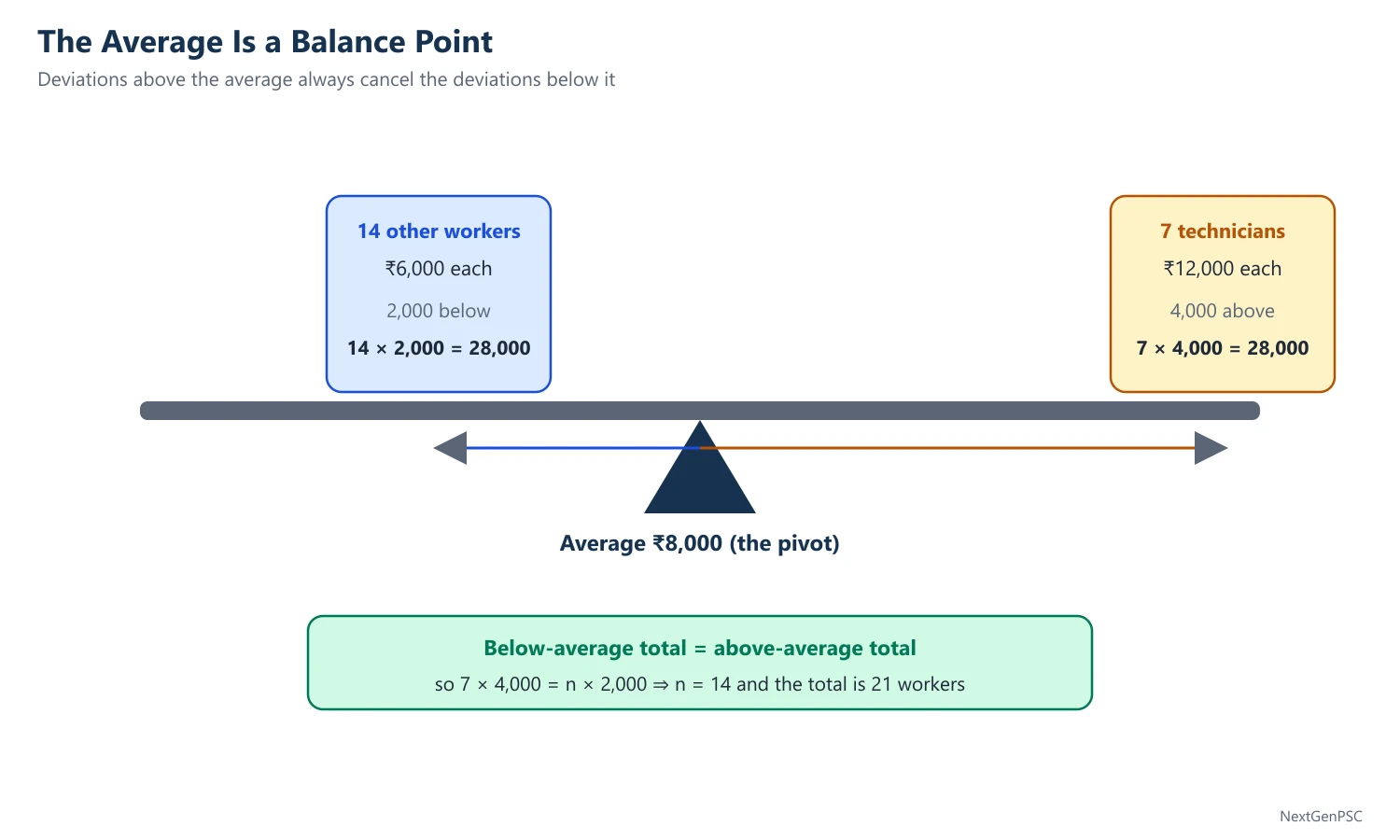
Joining: new person's value = new total − old total. Equivalently, new value = old average + (new count × rise in average).
Example: 20 workers average ₹15,000; a manager joins and the average becomes ₹15,500. Manager = 15,000 + 21 × 500 = ₹25,500.
Leaving: value of the person who left = old total − new total.
Replacement: when one member is replaced and the average of n members rises by d, the newcomer is n × d more than the person replaced. 8 persons, average up by 2.5 kg, replacing a 65 kg person ⇒ newcomer = 65 + 20 = 85 kg.
Why: the count stays n, so the total must rise by n × d, and that whole rise comes from the one exchange.
5. Correcting a Wrong Entry
Correct average = wrong average + (correct value − wrong value) ÷ count.
Example: the average of 25 numbers was found to be 40, but 72 had been read as 27. Correct average = 40 + 45/25 = 41.8.
Missing entries: if the average of 10 numbers is 30 and one number is found to be missing, which makes the 'average of 9' equal to 28, the missing number is 300 − 252 = 48.
6. Weighted Average of Groups
When groups of different sizes are combined, combined average = (n₁a₁ + n₂a₂ + …) ÷ (n₁ + n₂ + …). The bigger group pulls the combined average towards itself.
Section A: 30 students averaging 60; section B: 20 students averaging 75. Combined = (1,800 + 1,500)/50 = 66.
Reverse question (alligation): if a combined average m lies between group averages a and b, the group sizes are in the ratio (b − m):(m − a). Here (75 − 66):(66 − 60) = 9:6 = 3:2, which matches 30:20.
Never average two averages unless the groups are of equal size. (60 + 75)/2 = 67.5 is wrong for unequal sections.
7. Average Speed
Average speed = total distance ÷ total time, not the average of the speeds.
Equal distances at speeds a and b: average speed = 2ab/(a + b) (the harmonic mean). 40 km/h one way and 60 km/h back: 2 × 40 × 60/100 = 48 km/h, not 50.
Why it is less than (a + b)/2: more time is spent at the slower speed, so the slower speed carries more weight.
Equal times at speeds a and b: average = (a + b)/2, because each speed gets the same weight.
Three equal distances: 3abc/(ab + bc + ca). 10, 20 and 60 km/h over three equal parts: 3 × 12,000/(200 + 1,200 + 600) = 18 km/h.
8. Ages Over Time and Running Scores
Ages: after t years every member is t years older, so the average age of a fixed group also rises by t. If a group's average age is 24 now, it was 20 four years ago, unless someone joined or was born in between.
Batting average and running scores: if after n innings the average is a and the next score is x, the new average is (na + x)/(n + 1). If the score x raises the average by d, then x = new average + n × d.
Example 1: Average by deviations
- Question
What is the average of 48, 52, 47, 53, 55 and 45? (a) 49 (b) 50 (c) 51 (d) 60
- Solution
Normal method. Sum = 48 + 52 + 47 + 53 + 55 + 45 = 300; average = 300 ÷ 6 = 50.
Shortcut. Take 50 as the base: deviations −2, +2, −3, +3, +5, −5 add to 0, so the average is exactly 50.
Check. The deviations cancel in pairs, which is the sign that 50 is the true average.
Trap. Option (d) divides 300 by 5 (one number forgotten); options (a) and (c) come from a sign slip in the deviations (reading −3 as +3 gives +6 and 51). Count the observations first.
- Answer
(b) 50
Example 2: A teacher joins the class
- Question
The average age of 30 students is 14 years. When the teacher's age is included, the average rises by 1 year. What is the teacher's age? (a) 44 years (b) 45 years (c) 46 years (d) 31 years
- Solution
Normal method. Old total = 30 × 14 = 420. New total = 31 × 15 = 465.
Teacher's age = 465 − 420 = 45 years.
Shortcut. Teacher = old average + new count × rise = 14 + 31 × 1 = 45.
Trap. Option (a) uses the old count (14 + 30); option (d) is just the new count.
- Answer
(b) 45 years
Example 3: The middle result (UPSC-style)
- Question
The average of 11 results is 50. The average of the first six results is 49 and the average of the last six results is 52. What is the sixth result? (a) 50 (b) 54 (c) 56 (d) 58
- Solution
Normal method. Total of all 11 = 11 × 50 = 550.
First six total = 6 × 49 = 294; last six total = 6 × 52 = 312.
The 6th result is counted in both groups, so 294 + 312 = 550 + 6th result; 6th = 606 − 550 = 56.
Shortcut. Deviations from 50: first six are −6 in total, last six +12; overlap = −6 + 12 − 0 = 6 above 50, i.e. 56.
Trap. Option (a) assumes the middle result equals the overall average. Always use the overlap: the shared term is the excess of the two group totals over the grand total.
- Answer
(c) 56
Example 4: Average speed of a return journey
- Question
A car travels from P to Q at 40 km/h and returns from Q to P at 60 km/h. What is its average speed for the whole journey? (a) 50 km/h (b) 48 km/h (c) 45 km/h (d) 52 km/h
- Solution
Normal method. Take the distance PQ = 120 km (LCM of 40 and 60). Time going = 3 hours; time returning = 2 hours.
Average speed = 240 km ÷ 5 hours = 48 km/h.
Shortcut. Equal distances ⇒ 2ab/(a + b) = 2 × 40 × 60/100 = 48 km/h.
Trap. Option (a) is the simple average of the two speeds, valid only for equal times.
- Answer
(b) 48 km/h
Example 5: Batsman's new average (UPSC-style)
- Question
A batsman scores 87 runs in his 17th innings and thereby increases his average by 3. What is his average after the 17th innings? (a) 36 (b) 39 (c) 42 (d) 45
- Solution
Normal method. Let the average after 16 innings be a. Then 16a + 87 = 17(a + 3).
16a + 87 = 17a + 51, so a = 36. New average = 39.
Shortcut. The 87 runs cover the new average for this innings plus 3 extra for each of the 16 earlier innings: new average = 87 − 16 × 3 = 39.
Check. 16 × 36 = 576; 576 + 87 = 663 = 17 × 39.
Trap. Option (a) is the average before the 17th innings; the question asks for the average after it.
- Answer
(b) 39
Example 6: Two groups of workers (UPSC-style)
- Question
The average salary of all the workers in a workshop is ₹8,000. The average salary of 7 technicians is ₹12,000 and that of the rest is ₹6,000. How many workers are there in all? (a) 21 (b) 14 (c) 28 (d) 24
- Solution
Normal method. Let the rest be n. Then 7 × 12,000 + 6,000n = 8,000(7 + n).
84,000 + 6,000n = 56,000 + 8,000n, so 2,000n = 28,000 and n = 14. Total = 7 + 14 = 21.
Shortcut. Each technician is 4,000 above the average and each other worker 2,000 below it. Balance: 7 × 4,000 = n × 2,000 ⇒ n = 14.
Check. (84,000 + 84,000)/21 = 8,000.
Trap. Option (b) 14 counts only the other workers and forgets to add the 7 technicians. Setting up the balance the wrong way round (7 × 2,000 = n × 4,000) gives n = 3.5, a fraction of a worker, which shows the error.
- Answer
(a) 21
Practice Questions
Q1. What is the average of the first 50 natural numbers? (a) 25 (b) 25.5 (c) 26 (d) 50
Q2. The average of 25 numbers was calculated as 40. Later it was found that 72 had been wrongly read as 27. What is the correct average? (a) 41.8 (b) 38.2 (c) 41.5 (d) 42
Q3. The average weight of 8 persons increases by 2.5 kg when a new person comes in place of one of them who weighs 65 kg. What is the weight of the new person? (a) 75 kg (b) 80 kg (c) 85 kg (d) 90 kg
Q4. The average of 5 consecutive odd numbers is 61. What is the largest of them? (a) 63 (b) 65 (c) 67 (d) 69
Q5. Section A has 40 students with average marks 60 and section B has 60 students with average marks 70. What is the average of all 100 students? (a) 65 (b) 66 (c) 64 (d) 68
Q6. The average age of a family of 5 members is 24 years. If the age of the youngest member is 4 years, what was the average age of the family at the time of the youngest member's birth? (a) 20 years (b) 24 years (c) 25 years (d) 30 years
Answers
Show answers
Q1. (b) 25.5. (n + 1)/2 = 51/2.
Q2. (a) 41.8. 40 + (72 − 27)/25 = 40 + 1.8.
Q3. (c) 85 kg. 65 + 8 × 2.5 = 65 + 20.
Q4. (b) 65. The numbers are 57, 59, 61, 63, 65.
Q5. (b) 66. (40 × 60 + 60 × 70)/100 = (2,400 + 4,200)/100.
Q6. (c) 25 years. Total now 120; others' total now 116; 4 years ago 116 − 16 = 100 for 4 members = 25.
| Situation | Formula / shortcut | Quick example |
|---|---|---|
| Basic | total = average × count | 30 students × 14 = 420 |
| Deviation method | A + (sum of deviations)/count | base 50, deviations +10 over 5 ⇒ 52 |
| Equally spaced numbers | (first + last)/2 | 11 to 39 (odd) ⇒ 25 |
| First n natural numbers | (n + 1)/2 | n = 50 ⇒ 25.5 |
| Person joins, average rises by d | new value = old average + new count × d | 14 + 31 × 1 = 45 |
| Replacement in a group of n | newcomer = old member + n × d | 65 + 8 × 2.5 = 85 |
| Wrong entry corrected | average + (correct − wrong)/count | 40 + 45/25 = 41.8 |
| Two groups combined | (n₁a₁ + n₂a₂)/(n₁ + n₂) | 30 at 60, 20 at 75 ⇒ 66 |
| Group sizes from averages | (b − m):(m − a) | 60, 75, 66 ⇒ 3:2 |
| Average speed, equal distances | 2ab/(a + b) | 40 and 60 ⇒ 48 |
| Score raises average by d over n earlier innings | new average = score − n × d | 87 − 16 × 3 = 39 |
Prelims tips
- Convert averages to totals at once. Every join, leave, replace or correct question becomes 'new total − old total'. Working with averages directly is where most mistakes start.
- Use the right count. When a teacher joins 30 students, the new count is 31; when one of 8 persons is replaced, the count stays 8. The option built on the wrong count is always there.
- Never average averages blindly. Combine groups by weights (sizes). (60 + 75)/2 is right only for equal groups; for unequal groups use the weighted formula or alligation.
- Average speed is total distance ÷ total time. For equal distances it is 2ab/(a + b) and is always below the simple average of the two speeds. Reject (a + b)/2 unless the times are equal.
- Overlap questions: when the first k and the last k of n results are given, the shared middle result = (sum of the two group totals) − grand total.
- Sanity-check with the range. An average must lie between the smallest and largest values, and deviations from it must add to zero. Both checks take seconds and catch arithmetic slips.
Mixtures and Alligation
In short
A mixture question mixes two or more things of different price, strength or rate, and asks for the ratio, the quantity or the resulting value. Behind every such question is a weighted average, and alligation is the quick rule that turns it into a ratio in one line: cheaper : dearer = (dearer − mean) : (mean − cheaper). CSAT usually asks it as grains or tea of two prices, milk and water, solutions of two strengths, repeated replacement, and money lent at two rates. Three ideas unlock it: the mean lies between the two values, the weights are the quantities the rate is 'per', and repeated replacement multiplies the same fraction each time.
In simple words
A mixture is what you get when you put two things together, like two kinds of rice, or milk and water. The price or strength of the mixture always lands somewhere between the two things you mixed.
Everyday example: a shopkeeper mixes rice of ₹40 per kg and rice of ₹55 per kg and sells the mixture as ₹45 per kg rice. ₹45 is closer to ₹40, so he must have used more of the cheaper rice.
How much more? The cheaper rice is ₹5 below ₹45 and the dearer rice is ₹10 above it. To balance, he needs 2 kg of cheap rice for every 1 kg of dear rice: 2 × ₹5 'saved' = 1 × ₹10 'extra'. This balance is called alligation.
The one question to always ask is: 'How far is each ingredient from the mixture's value?' The quantities are in the opposite ratio of these distances: the closer ingredient is used more.
Two habits solve most questions: (1) draw the small cross (cheaper and dearer on top, mean in the middle, differences below) and read the ratio; (2) for 'take out and replace' questions, multiply by the same fraction once for each round.
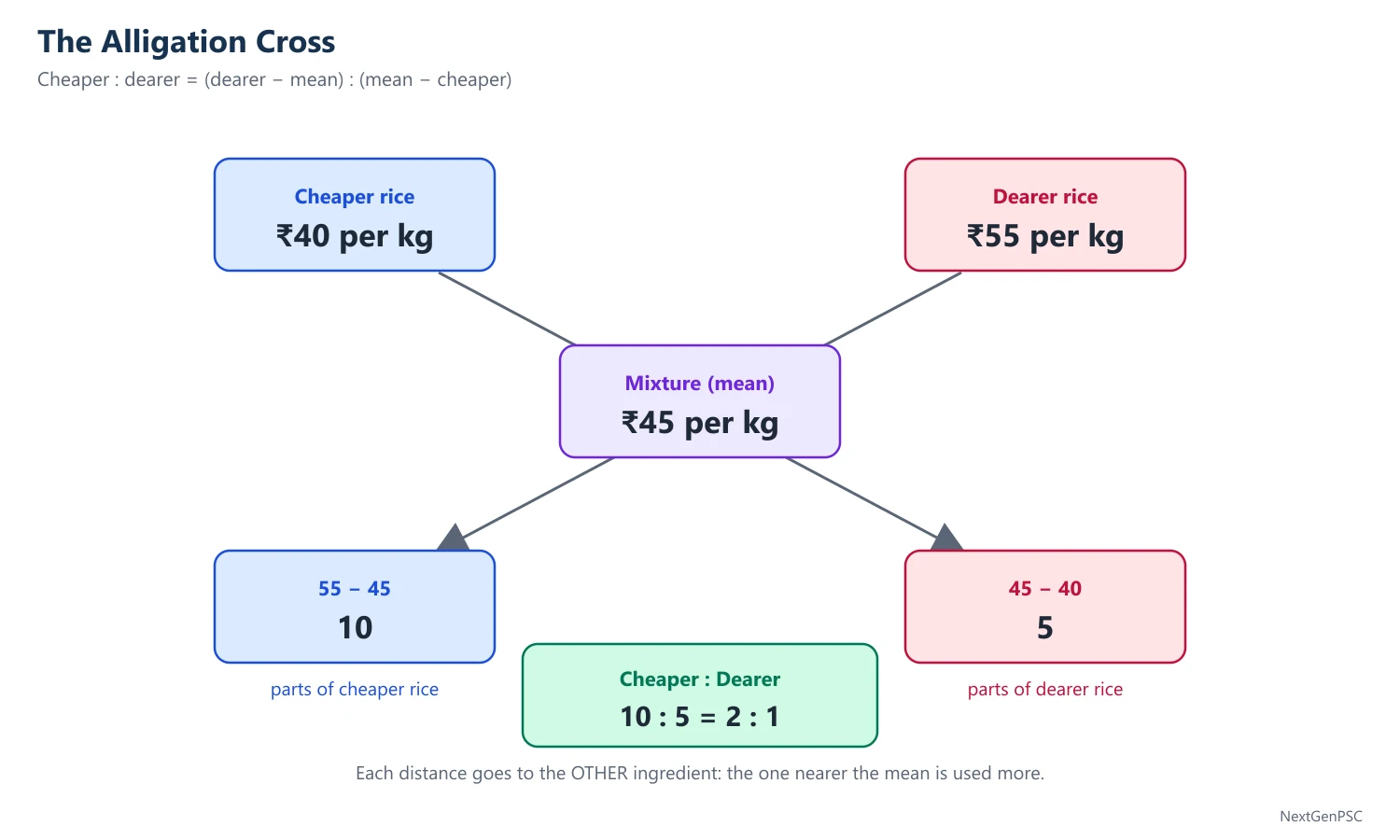
1. What a Mixture Question Is
Two or more ingredients with different values (price per kg, percentage of alcohol, rate of interest, average marks) are combined. The value of the mixture is the weighted average of the ingredients, weighted by their quantities.
Example: 3 kg of rice at ₹40 and 2 kg at ₹55 make 5 kg costing 120 + 110 = ₹230, i.e. ₹46 per kg. ₹46 lies between ₹40 and ₹55, nearer to ₹40 because there is more of it.
Every mixture question is one of three kinds: find the mean (given quantities), find the ratio (given the mean), or find a quantity to add or remove.
2. The Rule of Alligation
Quantity of cheaper : quantity of dearer = (d − m) : (m − c), where c is the cheaper value, d the dearer value and m the mean value of the mixture.
Write it as a cross: c and d on top, m in the middle, and below each one the distance of the other from m. ₹30 and ₹50 tea mixed to sell at ₹36: (50 − 36):(36 − 30) = 14:6 = 7:3.
Why: the cheaper part gains (m − c) per unit and the dearer part loses (d − m) per unit when both are valued at m. For the total to balance, quantity × gain must equal quantity × loss, so the quantities are in the inverse ratio of the distances.
The mean must lie strictly between c and d. If an option or a 'given' mean lies outside, the mixture is impossible.
The weights are the units the rate is 'per'. Price per kg ⇒ the ratio is in kg; percentage of alcohol by volume ⇒ the ratio is in litres; rate of interest per ₹100 ⇒ the ratio is in rupees.
3. Water and Other Free Ingredients
Water has price 0 (and an alcohol solution's water has 0% alcohol). So water : pure = (c − m) : (m − 0), where c is the price of the pure liquid.
Milk at ₹40 per litre diluted so that the mixture is worth ₹32 per litre: water : milk = (40 − 32):32 = 8:32 = 1:4. 60 litres of milk need 15 litres of water.
Adding pure liquid or water to a mixture: only that ingredient changes. 30 litres of 20% alcohol has 6 litres of alcohol. To make it 25%, add pure alcohol x: (6 + x)/(30 + x) = 1/4 ⇒ x = 2 litres.
4. Mixing Two Mixtures
Convert each mixture into the fraction of one ingredient (say milk), then use the fractions as the values in alligation.
Vessel 1 has milk:water = 3:1 (milk 3/4); vessel 2 has 5:3 (milk 5/8). To get milk 2/3: vessel 2 : vessel 1 = (3/4 − 2/3):(2/3 − 5/8) = 1/12 : 1/24 = 2:1.
If equal quantities are mixed, simply average the fractions: milk = (3/4 + 5/8)/2 = 11/16, i.e. milk:water = 11:5.
Make both totals the same before adding ratios: 3:1 (4 parts) and 5:3 (8 parts) cannot be added term by term unless the quantities are 4 and 8 units; write 3:1 as 6:2 for equal 8-unit volumes and then add: 6 + 5 : 2 + 3 = 11:5.
5. Repeated Removal and Replacement
A container holds V litres of pure liquid. x litres are taken out and replaced by water, and this is done n times. Pure liquid left = V × (1 − x/V)ⁿ.
Why: each round removes the same fraction x/V of whatever pure liquid is in the container, so the pure part is multiplied by (1 − x/V) every round.
20 litres of milk, 2 litres replaced by water twice: 20 × (0.9)² = 16.2 litres of milk; water = 3.8 litres.
The concentration after n rounds is (1 − x/V)ⁿ, whatever the starting volume. The formula needs the same x each time and the container to be refilled to V each time.
6. Adulteration and Profit
If a seller mixes water with milk and sells the mixture at the cost price of pure milk, his gain % equals water as a percentage of milk. A gain of 25% means water:milk = 25:100 = 1:4, so water is 1/5 = 20% of the mixture.
If the selling price is different from the cost price of the pure liquid, first find the cost price of the mixture: CP of mixture = SP ÷ (1 + gain/100). Then alligate between the pure liquid's cost and 0 (water).
7. Alligation Beyond Liquids
Sums at two rates: ₹10,000 partly at 6% and partly at 10% earning 7.5% overall ⇒ (10 − 7.5):(7.5 − 6) = 5:3; ₹6,250 at 6%.
Groups with different averages: boys average 60 kg, girls 45 kg, class 54 kg ⇒ boys:girls = (54 − 45):(60 − 54) = 3:2.
Profit on two parts: part of a stock sold at 10% profit and the rest at 4% loss, overall 5% profit ⇒ (5 − (−4)):(10 − 5) = 9:5 for profit-part : loss-part.
Speeds: alligation on speeds gives the ratio of times (since speed is distance per hour), not of distances.
Example 1: Two kinds of rice
- Question
In what ratio must rice at ₹40 per kg be mixed with rice at ₹55 per kg so that the mixture is worth ₹45 per kg? (a) 1:2 (b) 2:1 (c) 3:2 (d) 2:3
- Solution
Normal method. Let x kg at ₹40 and y kg at ₹55. Then 40x + 55y = 45(x + y), so 10y = 5x and x:y = 2:1.
Shortcut. Alligation: (55 − 45):(45 − 40) = 10:5 = 2:1 (cheaper : dearer).
Check. 2 kg at 40 + 1 kg at 55 = 135 for 3 kg = ₹45 per kg.
Trap. Option (a) reverses the ratio, putting the distances against the wrong ingredient. The cheaper rice is nearer to 45, so there must be more of it.
- Answer
(b) 2:1
Example 2: Adding water to milk
- Question
How many litres of water must be added to 60 litres of milk costing ₹40 per litre so that the mixture is worth ₹32 per litre? (a) 12 (b) 15 (c) 20 (d) 18
- Solution
Normal method. Cost of the milk = 60 × 40 = ₹2,400. The mixture must still be worth ₹2,400 at ₹32 a litre, so its volume = 2,400 ÷ 32 = 75 litres.
Water added = 75 − 60 = 15 litres.
Shortcut. Water : milk = (40 − 32):(32 − 0) = 8:32 = 1:4; water = 60/4 = 15 litres.
Trap. Option (a) takes 8/40 = 20% of 60 (water as a share of the price drop on the wrong base); option (c) uses the ratio 1:3.
- Answer
(b) 15
Example 3: Equal quantities of two mixtures (UPSC-style)
- Question
Vessel P contains milk and water in the ratio 3:1 and vessel Q contains them in the ratio 5:3. Equal quantities from the two vessels are mixed. What is the ratio of milk to water in the new mixture? (a) 11:5 (b) 2:1 (c) 8:3 (d) 11:7
- Solution
Normal method. Take 8 litres from each vessel. From P: milk 6, water 2. From Q: milk 5, water 3.
Total milk = 11 and water = 5, so the ratio is 11:5.
Shortcut. Milk fraction = (3/4 + 5/8)/2 = 11/16 ⇒ milk:water = 11:5.
Trap. Option (b) adds the ratios term by term: (3 + 5):(1 + 3) = 8:4 = 2:1. Ratios can be added only after making the totals equal (6:2 and 5:3 for 8 litres each).
- Answer
(a) 11:5
Example 4: Repeated replacement (UPSC-style)
- Question
A container has 40 litres of milk. From it, 4 litres are taken out and replaced with water. This process is repeated twice more. How much milk is now in the container? (a) 28 litres (b) 29.16 litres (c) 30 litres (d) 32.4 litres
- Solution
Normal method. Round 1: milk 40 − 4 = 36. Round 2: 4 litres of a mixture that is 36/40 = 90% milk is removed, i.e. 3.6 litres of milk; milk = 32.4.
Round 3: 4 litres that are 32.4/40 = 81% milk are removed, i.e. 3.24 litres; milk = 29.16 litres.
Shortcut. Milk = 40 × (1 − 4/40)³ = 40 × 0.729 = 29.16 litres.
Trap. Option (a) subtracts 4 litres of milk every time (40 − 12); option (d) stops after two rounds. 'Repeated twice more' means three rounds in all.
- Answer
(b) 29.16 litres
Example 5: Gain from water
- Question
A milkman mixes water with milk and sells the mixture at the cost price of pure milk, making a gain of 25%. What percentage of the mixture is water? (a) 20% (b) 25% (c) 16 2/3% (d) 12.5%
- Solution
Normal method. Let pure milk cost ₹1 per litre and the milkman buy 100 litres for ₹100. A 25% gain means he collects ₹125, i.e. he sells 125 litres at ₹1.
So 25 litres of water are mixed with 100 litres of milk. Water = 25/125 = 20% of the mixture.
Shortcut. Gain % at cost price = water as a % of milk = 25% ⇒ water : milk = 1:4 ⇒ water is 1/5 of the mixture.
Trap. Option (b) is water as a percentage of milk, not of the mixture. Read which base the question names.
- Answer
(a) 20%
Example 6: Money lent at two rates (UPSC-style)
- Question
A man lends ₹10,000 in two parts, one at 6% and the other at 10% simple interest per annum. At the end of the year his total interest is ₹750. How much did he lend at 6%? (a) ₹6,250 (b) ₹3,750 (c) ₹5,000 (d) ₹6,000
- Solution
Normal method. Let ₹x be at 6%. Then 0.06x + 0.10(10,000 − x) = 750, so 1,000 − 0.04x = 750 and x = 6,250.
Shortcut. Average rate = 750/10,000 = 7.5%. Alligation: (10 − 7.5):(7.5 − 6) = 2.5:1.5 = 5:3. At 6%: 10,000 × 5/8 = ₹6,250.
Check. 6% of 6,250 = 375; 10% of 3,750 = 375; total 750.
Trap. Option (b) is the amount at 10%; the lower-rate part is the larger one because 7.5% is nearer to 6%.
- Answer
(a) ₹6,250
Practice Questions
Q1. In what ratio must tea at ₹120 per kg be mixed with tea at ₹180 per kg to get a mixture worth ₹150 per kg? (a) 1:1 (b) 1:2 (c) 2:1 (d) 3:2
Q2. How many litres of a 50% alcohol solution must be added to 20 litres of a 30% alcohol solution to get a 40% solution? (a) 10 (b) 15 (c) 20 (d) 25
Q3. A vessel contains 80 litres of wine. 8 litres are drawn out and replaced with water, and the process is done once more. How much wine is left? (a) 64 litres (b) 64.8 litres (c) 72 litres (d) 65.6 litres
Q4. The average weight of the boys in a class is 60 kg, that of the girls is 45 kg, and that of the whole class is 54 kg. What is the ratio of boys to girls? (a) 3:2 (b) 2:3 (c) 4:3 (d) 5:4
Q5. Two alloys contain gold and copper in the ratios 7:2 and 7:11. Equal weights of the two are melted together. What is the ratio of gold to copper in the new alloy? (a) 7:5 (b) 5:7 (c) 14:13 (d) 7:13
Q6. A dairy owner mixes water with milk and sells the mixture at the cost price of milk, gaining 20%. What is the ratio of water to milk in the mixture? (a) 1:4 (b) 1:5 (c) 1:6 (d) 5:1
Answers
Show answers
Q1. (a) 1:1. (180 − 150):(150 − 120) = 30:30.
Q2. (c) 20. (40 − 30):(50 − 40) = 1:1 for 50% : 30%, so equal to 20 litres.
Q3. (b) 64.8 litres. 80 × (1 − 8/80)² = 80 × 0.81.
Q4. (a) 3:2. (54 − 45):(60 − 54) = 9:6.
Q5. (a) 7:5. Gold = (7/9 + 7/18)/2 = 7/12 ⇒ gold:copper = 7:5.
Q6. (b) 1:5. Gain % = water as a % of milk = 20% ⇒ 20:100.
| Situation | Formula / shortcut | Quick example |
|---|---|---|
| Mean of a mixture | (q₁v₁ + q₂v₂)/(q₁ + q₂) | 3 kg at 40, 2 kg at 55 ⇒ 46 |
| Ratio for a given mean | cheaper : dearer = (d − m):(m − c) | 40, 55, 45 ⇒ 2:1 |
| Water added to a liquid of price c | water : pure = (c − m):m | 40 → 32 ⇒ 1:4 |
| Equal quantities of two mixtures | average the fractions | 3/4 and 5/8 ⇒ 11/16 |
| Repeated replacement | pure left = V(1 − x/V)ⁿ | 40 L, 4 L, 3 times ⇒ 29.16 |
| Sold at cost price of pure, gain g% | water : pure = g:100 | 25% ⇒ 1:4, water 20% |
| Sum at two rates | (r₂ − r):(r − r₁) | 6%, 10%, 7.5% ⇒ 5:3 |
| Two groups' averages | (b − m):(m − a) | 45, 60, 54 ⇒ girls:boys 2:3 |
Prelims tips
- Put the distances crosswise. Cheaper : dearer = (d − m):(m − c). The ingredient nearer to the mean is used in larger quantity; if your answer says the opposite, you have reversed the ratio, which is exactly the planted option.
- Check that the mean lies between the two values. A mean outside the range means a misread question (often a percentage of the wrong base). It also lets you reject options instantly.
- Know what the weights are. Price per kg gives a ratio in kg; percentage by volume gives litres; rate per ₹100 gives rupees; speed per hour gives hours. Using the wrong weight is the main conceptual trap.
- Replacement means multiply, not subtract. Pure left = V(1 − x/V)ⁿ. Subtracting x every round, or counting 'repeated twice more' as two rounds, are the two standard errors.
- Gain by adding water: selling at the pure liquid's cost price, gain % = water as a percentage of the pure liquid, not of the mixture. Check which base the question asks for.
- Equalise totals before adding ratios. 3:1 and 5:3 can be added only after both refer to the same quantity (6:2 and 5:3 for 8 units each). Adding them directly is a common distractor.
Time and Work
In short
Time and Work questions ask how long people, machines or pipes take to finish a job when they work alone, together, in turns or with someone leaving midway. CSAT papers usually carry one or two such questions, often dressed as pipes filling a tank, workers building a road or partners sharing wages. Three ideas unlock almost all of them: work = rate × time (add rates, never days), the LCM (units) method that turns fractions into whole numbers, and man-days (M × D × H is the same for the same job).
In simple words
Think of any job as a pile of bricks to be moved. If Ravi moves the whole pile in 10 days, he moves 1/10 of it every day. That 'part done in one day' is his rate (or efficiency).
Two people working together simply add their daily parts. If Ravi does 1/10 a day and Sita does 1/15 a day, together they do 1/10 + 1/15 = 1/6 a day, so they finish in 6 days. Notice: 6 days, not 10 + 15 = 25 days and not the average 12.5 days.
Fractions are easier as whole numbers. Pretend the pile has 30 bricks (30 is the LCM of 10 and 15). Ravi moves 3 bricks a day, Sita 2 bricks a day, together 5 a day, so 30 ÷ 5 = 6 days. This is the LCM method.
The one question to always ask: how many units does each person do in one day? Once you know that, joining, leaving, taking turns and sharing wages are just adding and subtracting units.
Two habits solve most questions: (1) fix the total work as the LCM of the given times; (2) a pipe that empties the tank, or a leak, does negative work, so subtract its units.
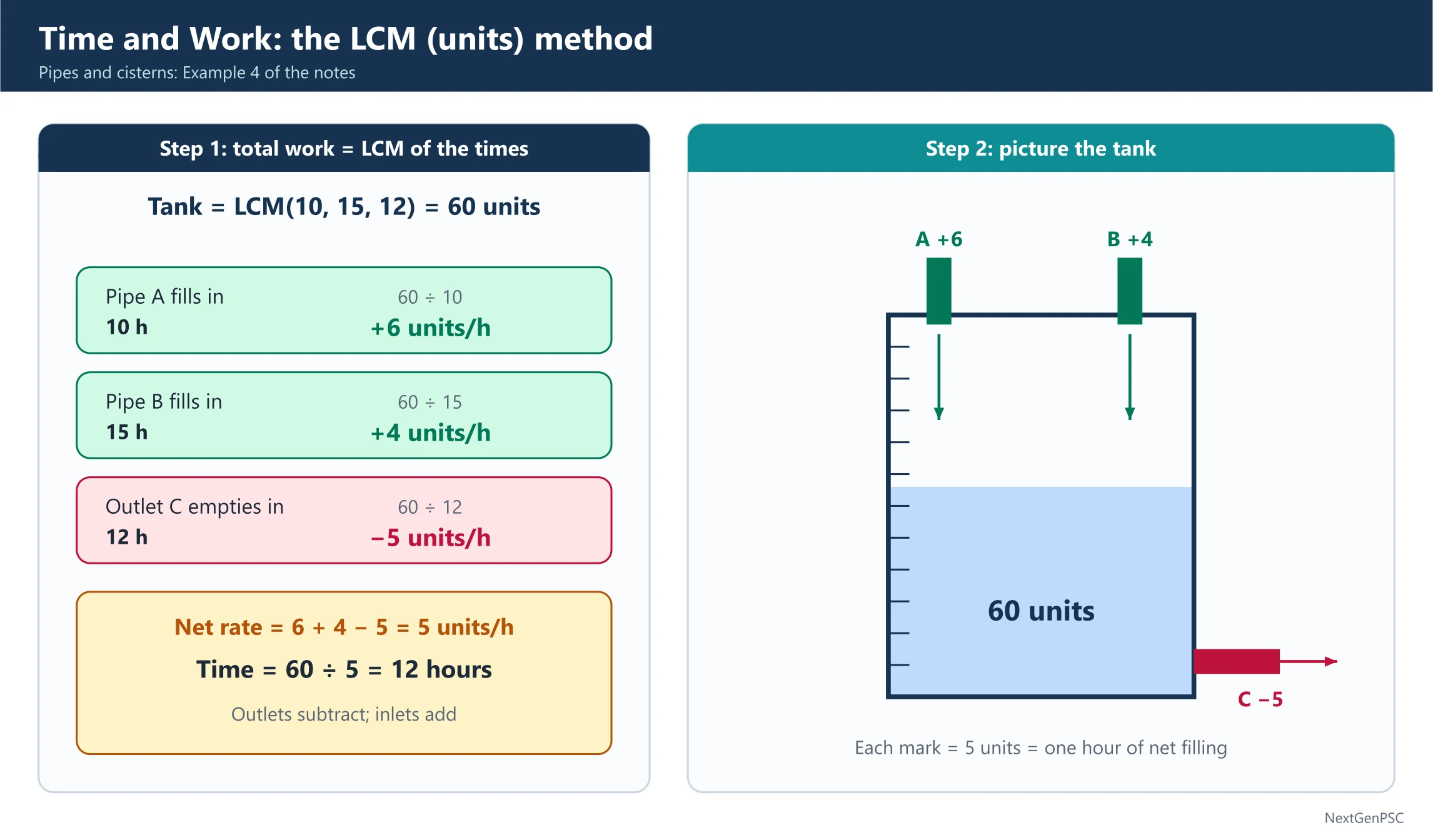
1. Work, Rate and Time
The basic relation is work = rate × time. The whole job is taken as 1 (or as a convenient number of units). If a person finishes a job in n days, his rate is 1/n of the job per day.
Rate and time are inversely proportional for a fixed job: if A is twice as fast as B, A takes half the time. If A takes 6 days and B takes 12 days, A's efficiency is 2 times B's.
Efficiency in percent: if A is 25% more efficient than B, their rates are 125 : 100 = 5 : 4, so their times are 4 : 5. If B takes 20 days, A takes 16 days.
Rates add, times do not. Never add or average the days of two workers; always add their one-day work.
2. The LCM (Units) Method
Take the total work as the LCM of all the given times. Each worker's daily units = LCM ÷ his time. Then every later step is whole-number arithmetic.
A in 12 days, B in 18 days: LCM = 36 units. A does 36 ÷ 12 = 3 units a day, B does 36 ÷ 18 = 2 units a day. Together 5 units a day, so 36 ÷ 5 = 7.2 days.
Two workers shortcut: together time = ab/(a + b). With 12 and 18: 216/30 = 7.2 days.
Why: 1/a + 1/b = (a + b)/ab, and the time is the reciprocal of the combined rate.
Three workers: together time = abc/(ab + bc + ca). With 10, 15 and 30 days: 4,500/(150 + 450 + 300) = 4,500/900 = 5 days. The LCM way: 30 units; 3 + 2 + 1 = 6 a day; 30 ÷ 6 = 5 days.
Pairs given: if A + B take x days, B + C take y days and C + A take z days, add the three rates; that counts each person twice. So 2(A + B + C) = 1/x + 1/y + 1/z.
One worker from the pair: if A and B together take t days and A alone takes a days, B alone takes at/(a − t) days. Together 6 days, A alone 10 days: B = 60/4 = 15 days.
3. Man-Days and Man-Hours
If M men working H hours a day finish W units of work in D days, then M × D × H ÷ W stays the same for the same kind of work. Write it as M₁D₁H₁/W₁ = M₂D₂H₂/W₂.
Example: 10 men finish a job in 12 days, so the job needs 120 man-days. 15 men will take 120 ÷ 15 = 8 days.
Women, boys or machines with different efficiencies: convert everyone to one unit first. If 2 men do as much work as 3 boys, then 3 boys can be replaced by 2 men, so 6 men + 3 boys = 6 men + 2 men = 8 men.
Joining or leaving after some days: subtract the man-days already used from the total, then divide the rest by the new number of men. 20 men can do a job in 15 days (300 man-days). After 5 days (100 man-days done), 5 more men join: the remaining 200 man-days take 200 ÷ 25 = 8 more days.
4. Leaving Midway and Working in Turns
Someone leaves before the end: work backwards. The days the remaining person works alone are known, so subtract that work first; the rest was done together.
Someone joins late or leaves after k days: work forwards: together units × k, then the rest by whoever is left.
Alternate days: make a 2-day cycle. Units in one cycle = sum of the two daily units. Run whole cycles until the remaining work is less than one cycle, then finish day by day, and only the last day may be a fraction.
Why the last day matters: the order (who starts) can change the answer, because the fraction of the last day depends on who works on it.
5. Pipes and Cisterns
A tank is just a job. An inlet pipe does positive work; an outlet pipe or leak does negative work. Net rate = sum of inlets − sum of outlets.
Inlet fills in a hours, outlet empties in b hours (b > a): both open together fill the tank in ab/(b − a) hours. Fill in 6 hours, empty in 8 hours: 48/2 = 24 hours.
Leak problems: a pipe that normally fills in a hours takes t hours because of a leak. The leak alone empties the full tank in at/(t − a) hours. Fill 6 hours, with leak 8 hours: 48/2 = 24 hours.
If the outlet is faster than the inlets, a full tank empties: use the same units and read the sign.
6. Wages and Sharing
Wages are paid in proportion to the work done, not to the days present. Work done = daily units × days worked.
If A, B and C all work for the same number of days, wages are in the ratio of their efficiencies (their daily units).
A third person who helps finish faster gets his share of units: find his daily units from (total units ÷ days taken) − (others' daily units).
7. Efficiency Ratios and Common Traps
If A is k times as efficient as B, take B = 1 unit a day and A = k units a day. A is twice as efficient as B and together they take 14 days: total = 3 × 14 = 42 units, so A alone needs 42 ÷ 2 = 21 days.
Trap 1: adding days. 12 and 18 days do not make 30 days together; working together must be faster than the faster worker alone.
Trap 2: averaging days. The together time is always less than the smaller of the two times.
Trap 3: forgetting the hours or the size of the work in man-days questions. All of M, D, H and W must appear.
Sanity check: the together time of a group must be less than the fastest member's time, and more than the fastest member's time divided by the number of members.
Example 1: Two workers together
- Question
A can finish a piece of work in 12 days and B can finish it in 18 days. In how many days will they finish it working together? (a) 30 days (b) 15 days (c) 7.2 days (d) 6 days
- Solution
Normal method. A's one-day work = 1/12 and B's = 1/18. Together = 1/12 + 1/18 = 3/36 + 2/36 = 5/36.
Time = 36/5 = 7.2 days.
Shortcut. ab/(a + b) = (12 × 18)/(12 + 18) = 216/30 = 7.2 days. Or LCM 36 units: 3 + 2 = 5 units a day.
Check. In 7.2 days A does 7.2 × 3 = 21.6 units and B does 7.2 × 2 = 14.4 units; total 36.
Trap. Option (a) adds the days and option (b) averages them; both are slower than A alone, which is impossible. Option (d) treats B as fast as A (12 ÷ 2 = 6).
- Answer
(c) 7.2 days
Example 2: Men, days, hours and work
- Question
12 men working 8 hours a day lay 960 m of a road in 10 days. In how many days will 16 men working 6 hours a day lay 1,200 m of the same road? (a) 10 days (b) 12 days (c) 12.5 days (d) 15 days
- Solution
Normal method. Use M₁D₁H₁/W₁ = M₂D₂H₂/W₂.
12 × 10 × 8/960 = 16 × D × 6/1,200. The left side = 960/960 = 1.
So 96D = 1,200 and D = 12.5 days.
Shortcut. Start from 10 days and multiply by each ratio in the right direction: more men ⇒ fewer days (× 12/16), fewer hours ⇒ more days (× 8/6), more work ⇒ more days (× 1,200/960). 10 × 3/4 × 4/3 × 5/4 = 12.5 days.
Trap. Option (a) forgets that the work grew from 960 m to 1,200 m (the men and hours ratios cancel to 1).
- Answer
(c) 12.5 days
Example 3: One worker leaves before the end
- Question
A can do a work in 20 days and B in 30 days. They start together, but A leaves 5 days before the work is finished. In how many days is the work finished? (a) 12 days (b) 15 days (c) 16 days (d) 17 days
- Solution
Normal method. Total work = LCM(20, 30) = 60 units. A does 3 units a day and B does 2 units a day.
In the last 5 days only B works: 5 × 2 = 10 units.
The other 60 − 10 = 50 units were done together at 5 units a day: 10 days.
Total time = 10 + 5 = 15 days.
Shortcut. Pretend A also worked the last 5 days: he would have done 15 more units. Then 60 + 15 = 75 units at 5 a day = 15 days.
Check. A works 10 days (30 units) and B works 15 days (30 units); total 60.
Trap. Option (a) is the time if nobody leaves (60 ÷ 5); option (d) wrongly adds 5 to it.
- Answer
(b) 15 days
Example 4: Two inlets and an outlet (UPSC-style)
- Question
Pipe A can fill a tank in 10 hours and pipe B can fill it in 15 hours. Pipe C can empty the full tank in 12 hours. If all three pipes are opened together when the tank is empty, in how many hours will the tank be full? (a) 6 hours (b) 10 hours (c) 12 hours (d) 15 hours
- Solution
Normal method. Net part filled in 1 hour = 1/10 + 1/15 − 1/12 = 6/60 + 4/60 − 5/60 = 5/60 = 1/12.
So the tank is full in 12 hours.
Shortcut. Tank = LCM(10, 15, 12) = 60 units. A +6, B +4, C −5: net 5 units an hour; 60 ÷ 5 = 12 hours.
Trap. Option (a) ignores the outlet (A and B alone take 60 ÷ 10 = 6 hours). An outlet always slows the filling, so the answer must be more than 6 hours.
- Answer
(c) 12 hours
Example 5: Sharing wages (UPSC-style)
- Question
A alone can do a job in 6 days and B alone in 8 days. A and B undertook to do it for ₹7,200. With the help of C they finished it in 3 days. How much should C be paid? (a) ₹600 (b) ₹900 (c) ₹1,200 (d) ₹2,400
- Solution
Normal method. Total work = LCM(6, 8) = 24 units. A does 4 units a day and B does 3 units a day.
All three finish 24 units in 3 days, so they do 8 units a day; C does 8 − 4 − 3 = 1 unit a day.
In 3 days: A does 12 units, B 9 units and C 3 units. C's share = 3/24 × 7,200 = ₹900.
Shortcut. Everyone worked the same 3 days, so wages are in the ratio of daily units 4 : 3 : 1. C gets 1/8 of ₹7,200 = ₹900.
Check. A gets ₹3,600 and B gets ₹2,700; 3,600 + 2,700 + 900 = 7,200.
Trap. Option (d) splits the money equally (7,200 ÷ 3). Wages follow work done, not headcount.
- Answer
(b) ₹900
Example 6: Working on alternate days (UPSC-style)
- Question
A can do a work in 8 days and B in 12 days. They work on alternate days, A working on the first day. In how many days will the work be finished? (a) 4.8 days (b) 9 days (c) 9.5 days (d) 10 days
- Solution
Normal method. Total work = LCM(8, 12) = 24 units. A does 3 units a day and B does 2 units a day.
One 2-day cycle (A then B) = 5 units. 4 cycles = 8 days = 20 units; 4 units are left.
Day 9 is A's: 3 units, so 1 unit is left. Day 10 is B's: he needs 1 of his 2 units, i.e. half a day.
Total = 8 + 1 + 0.5 = 9.5 days.
Shortcut. Count whole cycles up to just below the total (4 cycles = 20 units), then finish with the next workers in order, using a fraction only on the last day.
Trap. Option (a) is the time when both work every day (24 ÷ 5). Option (d) rounds the last half day up to a full day.
- Answer
(c) 9.5 days
Practice Questions
Q1. A can do a work in 15 days and B in 10 days. Working together, they will finish it in: (a) 5 days (b) 6 days (c) 12.5 days (d) 25 days
Q2. A is twice as efficient as B, and together they finish a work in 14 days. In how many days can A alone finish it? (a) 21 days (b) 28 days (c) 42 days (d) 7 days
Q3. 20 men can finish a work in 15 days. They start the work, and after 5 days 5 more men join them. In how many more days will the remaining work be finished? (a) 8 days (b) 10 days (c) 12 days (d) 13 days
Q4. A pipe can fill a tank in 6 hours. Because of a leak at the bottom, it takes 8 hours to fill the tank. In how many hours can the leak alone empty the full tank? (a) 2 hours (b) 14 hours (c) 24 hours (d) 48 hours
Q5. A and B can do a work in 12 days, B and C in 15 days, and C and A in 20 days. In how many days can A, B and C together finish it? (a) 8 days (b) 10 days (c) 12 days (d) 15 days
Q6. With the data of Q5, in how many days can A alone finish the work? (a) 20 days (b) 24 days (c) 30 days (d) 60 days
Answers
Show answers
Q1. (b) 6 days. LCM 30: A 2 units, B 3 units a day; 30 ÷ 5 = 6. Or 150/25 = 6.
Q2. (a) 21 days. A = 2, B = 1 unit a day; total = 3 × 14 = 42 units; A alone 42 ÷ 2 = 21.
Q3. (a) 8 days. Total 20 × 15 = 300 man-days; 100 used; 200 ÷ 25 = 8.
Q4. (c) 24 hours. 1/6 − 1/8 = 1/24; or at/(t − a) = 48/2 = 24.
Q5. (b) 10 days. LCM 60: A + B = 5, B + C = 4, C + A = 3 units; 2(A + B + C) = 12 ⇒ A + B + C = 6 units ⇒ 60 ÷ 6 = 10.
Q6. (c) 30 days. A = (A + B + C) − (B + C) = 6 − 4 = 2 units a day ⇒ 60 ÷ 2 = 30.
| Situation | Formula / shortcut | Quick example |
|---|---|---|
| One-day work of a person who takes n days | 1/n of the job | 10 days ⇒ 1/10 a day |
| A and B together | ab/(a + b) | 12, 18 ⇒ 216/30 = 7.2 days |
| A, B and C together | abc/(ab + bc + ca) | 10, 15, 30 ⇒ 5 days |
| A + B take t, A alone a | B alone = at/(a − t) | t = 6, a = 10 ⇒ 15 days |
| Pairs: A + B = x, B + C = y, C + A = z | 2(A + B + C) = 1/x + 1/y + 1/z | 12, 15, 20 ⇒ all three 10 days |
| Same kind of work | M₁D₁H₁/W₁ = M₂D₂H₂/W₂ | 10 men × 12 days = 15 men × 8 days |
| Inlet a hours, outlet b hours (b > a) | fills in ab/(b − a) | 6, 8 ⇒ 24 hours |
| Pipe a hours, with leak t hours | leak empties in at/(t − a) | 6, 8 ⇒ 24 hours |
| A is k times as efficient as B | A = k units, B = 1 unit a day | k = 2, together 14 days ⇒ A 21 days |
| Wages | in ratio of work done (units × days) | 4 : 3 : 1 of ₹7,200 ⇒ C gets ₹900 |
Prelims tips
- Add rates, never days. The together time must be less than the faster worker's time; any option larger than that (the sum or the average of the days) is a planted trap.
- Fix the work as the LCM. With 2 or 3 workers or pipes, LCM units turn every step into whole numbers; this is faster and safer than adding fractions such as 1/10 + 1/15 − 1/12.
- Outlets and leaks are negative. In pipes questions, mark each pipe + or − before adding. An option equal to the inlets-only time is always wrong when an outlet is open.
- Use all four of M, D, H and W. Man-days questions hide a change in hours or in the amount of work; check that each ratio moves the answer in the right direction (more men ⇒ fewer days).
- Leaving or alternating: work in units, step by step. For 'leaves k days before the end' subtract the last k days first; for alternate days count whole 2-day cycles and allow a fraction only on the last day.
- Wages follow work, not people. Find each person's units of work and split the money in that ratio; 'equal shares' is the standard wrong option.
Speed, Time and Distance
In short
Speed, Time and Distance questions connect how fast something moves, how long it moves and how far it goes: distance = speed × time. CSAT papers usually include one or two of them, as average speed of a journey, two people or trains approaching or chasing each other, a train crossing a platform, a boat in a river or runners on a circular track. Three ideas unlock them: consistent units (km/h × 5/18 = m/s), average speed = total distance ÷ total time (not the average of speeds), and relative speed (add when moving towards each other, subtract when moving the same way).
In simple words
Speed tells how much distance is covered in one unit of time. A bus at 40 km/h covers 40 km every hour, so in 3 hours it covers 40 × 3 = 120 km. That is the whole topic: distance = speed × time.
Everyday example: you go to the market 12 km away at 12 km/h (1 hour) and come back at 6 km/h (2 hours). You travelled 24 km in 3 hours, so your average speed is 24 ÷ 3 = 8 km/h, not (12 + 6)/2 = 9 km/h. You spent more time at the slow speed, so the average leans towards it.
When two people move, think of the gap between them. Walking towards each other, the gap shrinks by both speeds added together. Walking the same way, the gap changes only by the difference of their speeds. This is relative speed.
The one question to always ask: what distance must be covered, and at what speed is that distance shrinking? For a train crossing a platform, the distance is train + platform; for a chase, it is the starting gap.
Two habits solve most questions: (1) change everything into the same units before you calculate (km/h × 5/18 gives m/s); (2) for average speed, always divide total distance by total time.
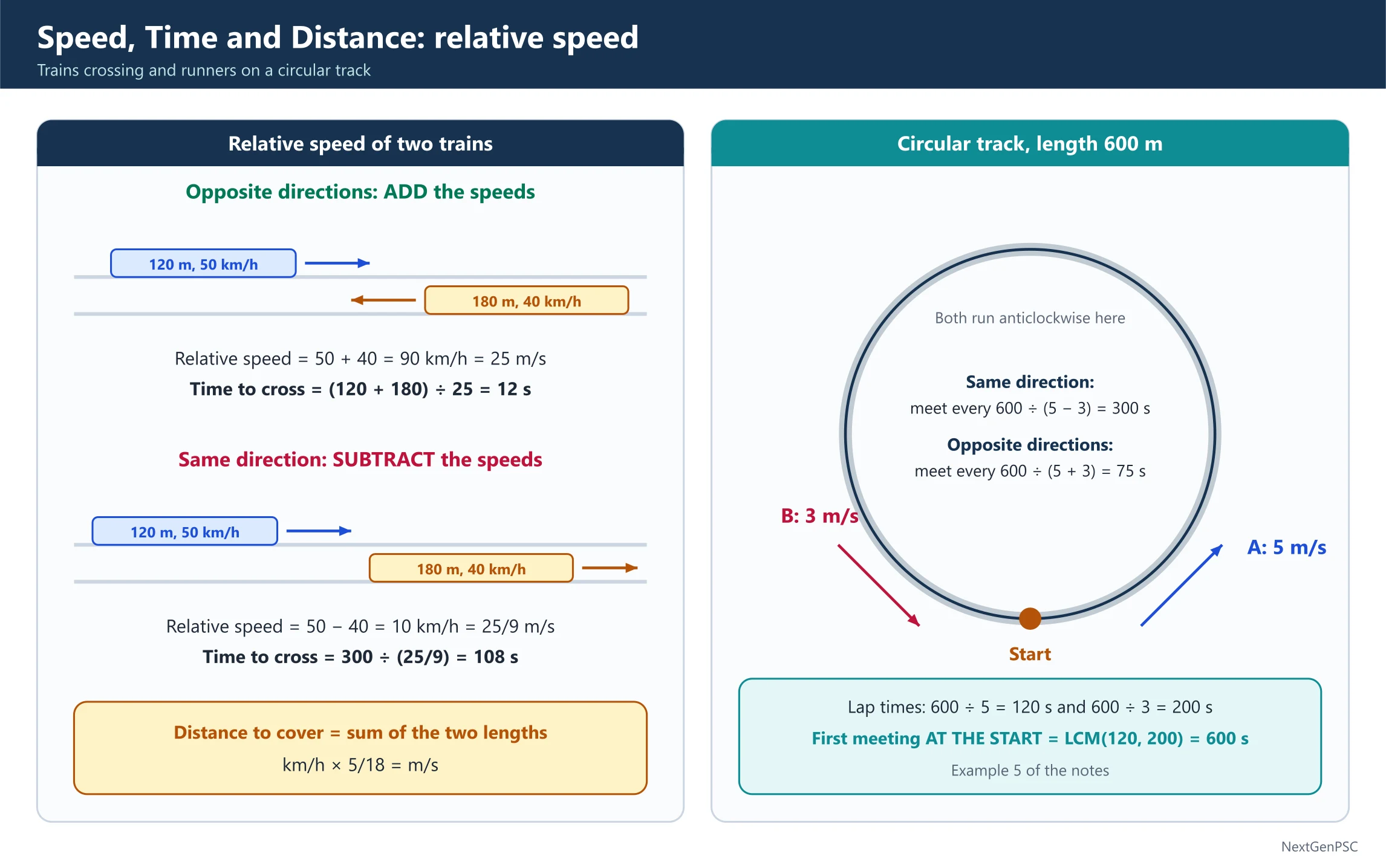
1. The Basic Relation and Units
Distance = speed × time, so speed = distance ÷ time and time = distance ÷ speed. Keep all three in matching units.
km/h to m/s: multiply by 5/18 (because 1 km = 1,000 m and 1 hour = 3,600 s, and 1,000/3,600 = 5/18). m/s to km/h: multiply by 18/5.
Learn the common pairs: 18 km/h = 5 m/s, 36 km/h = 10 m/s, 54 km/h = 15 m/s, 72 km/h = 20 m/s, 90 km/h = 25 m/s.
Minutes to hours: divide by 60. 45 minutes = 0.75 hour, 20 minutes = 1/3 hour. A car at 48 km/h goes 48 × 1/3 = 16 km in 20 minutes.
2. Proportion Ideas
For the same distance, time is inversely proportional to speed. If the speeds are in the ratio 3 : 4, the times are in the ratio 4 : 3.
For the same time, distance is proportional to speed. Two cars running for 2 hours at 50 and 60 km/h cover 100 and 120 km.
Fraction of usual speed: at 3/4 of the usual speed, the time becomes 4/3 of the usual time, so the extra time is 1/3 of the usual time. If that delay is 20 minutes, the usual time is 60 minutes.
Late and early: if a person is late at speed s₁ and early at speed s₂ for the same distance d, then d/s₁ − d/s₂ = (late minutes + early minutes) in hours. So d = s₁s₂/(s₂ − s₁) × total time difference.
3. Average Speed
Average speed = total distance ÷ total time. It is not the average of the speeds unless the times are equal.
Equal distances at x and y: average speed = 2xy/(x + y). Going at 40 km/h and returning at 60 km/h: 4,800/100 = 48 km/h.
Why: for distance d each way, the time is d/x + d/y, and 2d divided by that gives 2xy/(x + y).
Equal times at x and y: average speed = (x + y)/2. One hour at 40 and one hour at 60 gives 50 km/h.
The average speed always lies between the slowest and the fastest speed, and for equal distances it is closer to the slower one.
4. Relative Speed: Meeting and Chasing
Two bodies moving towards each other (opposite directions): relative speed = sum of speeds. Time to meet = starting gap ÷ (a + b).
Two bodies moving in the same direction: relative speed = difference of speeds. Time for the faster to catch up = starting gap ÷ (a − b).
Example: two cities are 300 km apart; trains leave both at 9:00 towards each other at 60 and 40 km/h. They close the gap at 100 km/h and meet after 3 hours, 180 km from the first city.
Distances at meeting are in the ratio of speeds because both have moved for the same time: 60 : 40 = 3 : 2 of 300 km gives 180 km and 120 km.
5. Trains
A train crossing a pole, a man or a signal covers its own length. Crossing a platform, bridge or tunnel it covers its own length + the length of the platform.
Two trains crossing each other cover the sum of their lengths at their relative speed: sum of speeds if opposite, difference if the same direction.
A train crossing a man who is walking: use the relative speed of the train and the man; the distance is just the train's length.
Example: a 240 m train at 54 km/h (15 m/s) crosses a pole in 240 ÷ 15 = 16 s and a 360 m platform in 600 ÷ 15 = 40 s.
6. Boats and Streams
Let the speed of the boat in still water be u and the speed of the stream be v. Downstream speed D = u + v; upstream speed U = u − v.
So u = (D + U)/2 and v = (D − U)/2. Downstream 15 km/h and upstream 10 km/h give a boat speed of 12.5 km/h and a stream speed of 2.5 km/h.
For a round trip of d km each way, time = d/(u + v) + d/(u − v). Ignoring the stream (using d/u twice) gives too small a time.
7. Circular Tracks
Two runners start together from the same point of a track of length L at speeds a and b (a > b).
Same direction: the faster gains one full lap on the slower every L/(a − b); that is when they meet. Opposite directions: together they cover one lap every L/(a + b); they meet that often.
First meeting at the starting point = LCM of the two lap times L/a and L/b.
Number of distinct meeting points: if the speeds are in the lowest ratio p : q, they meet at p − q distinct points in the same direction and at p + q points in opposite directions.
Why: each meeting happens after the same interval, so the meeting points are evenly spaced round the track and repeat once both return to the start together.
Example 1: Units first
- Question
A car covers 270 km in 4.5 hours. What is its speed in metres per second? (a) 15 m/s (b) 16 2/3 m/s (c) 18 m/s (d) 216 m/s
- Solution
Normal method. Speed = 270 ÷ 4.5 = 60 km/h.
In m/s: 60 × 1,000 m ÷ 3,600 s = 60,000/3,600 = 16 2/3 m/s.
Shortcut. km/h × 5/18 = m/s: 60 × 5/18 = 300/18 = 16 2/3.
Trap. Option (d) multiplies by 18/5 instead of 5/18. A speed in m/s is always smaller than the same speed in km/h.
- Answer
(b) 16 2/3 m/s
Example 2: Average speed of a round trip
- Question
A man drives from A to B at 40 km/h and returns from B to A at 60 km/h. What is his average speed for the whole journey? (a) 48 km/h (b) 50 km/h (c) 52 km/h (d) 45 km/h
- Solution
Normal method. Take AB = 120 km (the LCM of 40 and 60). Time going = 120 ÷ 40 = 3 hours; time returning = 120 ÷ 60 = 2 hours.
Total distance 240 km in 5 hours: average speed = 240 ÷ 5 = 48 km/h.
Shortcut. Equal distances: 2xy/(x + y) = 2 × 40 × 60/100 = 48 km/h.
Trap. Option (b) is the simple average (40 + 60)/2, which would be right only if he drove for equal times, not equal distances.
- Answer
(a) 48 km/h
Example 3: A train crossing a platform
- Question
A train 240 m long runs at 54 km/h. How long will it take to cross a platform 360 m long? (a) 16 s (b) 24 s (c) 40 s (d) 44 s
- Solution
Normal method. Speed = 54 × 5/18 = 15 m/s.
The front of the train must travel the platform's length and then the train's own length: 240 + 360 = 600 m.
Time = 600 ÷ 15 = 40 s.
Shortcut. Distance = sum of lengths; speed in m/s from the table (54 km/h = 15 m/s).
Trap. Option (a) uses only the train's length (240 ÷ 15, the time to pass a pole) and option (b) only the platform's (360 ÷ 15).
- Answer
(c) 40 s
Example 4: Two trains, both directions (UPSC-style)
- Question
Two trains 120 m and 180 m long run on parallel tracks at 50 km/h and 40 km/h. How long do they take to cross each other completely when running in opposite directions, and when running in the same direction? (a) 12 s and 108 s (b) 12 s and 30 s (c) 10.8 s and 108 s (d) 15 s and 120 s
- Solution
Normal method. Distance to cover in both cases = 120 + 180 = 300 m.
Opposite directions: relative speed = 50 + 40 = 90 km/h = 25 m/s; time = 300 ÷ 25 = 12 s.
Same direction: relative speed = 50 − 40 = 10 km/h = 10 × 5/18 = 25/9 m/s; time = 300 × 9/25 = 108 s.
Shortcut. The distance is the same, so the times are in the inverse ratio of the relative speeds: 90 : 10 ⇒ the same-direction time is 9 × 12 = 108 s.
Trap. Option (c) converts 90 km/h wrongly; option (b) uses the opposite-direction speed with only one train's length.
- Answer
(a) 12 s and 108 s
Example 5: Runners on a circular track (UPSC-style)
- Question
A and B start together from the same point on a circular track 600 m long and run in the same direction at 5 m/s and 3 m/s. After how many seconds do they first meet, and after how many seconds do they first meet again at the starting point? (a) 300 s and 600 s (b) 75 s and 600 s (c) 300 s and 1,200 s (d) 75 s and 300 s
- Solution
Normal method. In the same direction A gains 5 − 3 = 2 m every second. They meet when A has gained one full lap of 600 m: 600 ÷ 2 = 300 s.
Lap times: A takes 600 ÷ 5 = 120 s and B takes 600 ÷ 3 = 200 s. Both are at the start together after LCM(120, 200) = 600 s.
Shortcut. Speeds 5 : 3 in lowest terms; in the same direction they meet at 5 − 3 = 2 distinct points, so the second meeting (at 600 s) is back at the start.
Check. At 600 s A has run 3,000 m = 5 laps and B 1,800 m = 3 laps; both are at the start.
Trap. Option (b) uses the sum of speeds (600 ÷ 8 = 75 s), which is right only for opposite directions. Option (c) multiplies the lap times instead of taking their LCM.
- Answer
(a) 300 s and 600 s
Example 6: Boat and stream (UPSC-style)
- Question
A boat goes 30 km downstream in 2 hours and comes back the same distance upstream in 3 hours. What are the speed of the boat in still water and the speed of the stream? (a) 12.5 km/h and 2.5 km/h (b) 15 km/h and 10 km/h (c) 12.5 km/h and 5 km/h (d) 10 km/h and 2.5 km/h
- Solution
Normal method. Downstream speed = 30 ÷ 2 = 15 km/h; upstream speed = 30 ÷ 3 = 10 km/h.
u + v = 15 and u − v = 10. Adding: 2u = 25, so u = 12.5 km/h; then v = 2.5 km/h.
Shortcut. Boat = half the sum (15 + 10)/2; stream = half the difference (15 − 10)/2.
Trap. Option (b) gives the downstream and upstream speeds themselves; option (c) forgets to halve the difference.
- Answer
(a) 12.5 km/h and 2.5 km/h
Practice Questions
Q1. Walking at 4 km/h a man reaches his office 10 minutes late; walking at 5 km/h he reaches 5 minutes early. How far is his office? (a) 4 km (b) 5 km (c) 6 km (d) 7.5 km
Q2. A thief running at 8 km/h is 200 m ahead of a policeman, who starts chasing him at 10 km/h. In how much time will the policeman catch the thief? (a) 3 minutes (b) 6 minutes (c) 10 minutes (d) 12 minutes
Q3. A train crosses a pole in 12 seconds and a platform 300 m long in 27 seconds. What is the length of the train? (a) 200 m (b) 240 m (c) 270 m (d) 300 m
Q4. Two towns are 450 km apart. At 8 am, a car leaves each town towards the other, at 70 km/h and 80 km/h. When do they meet? (a) 10 am (b) 10:30 am (c) 11 am (d) 11:30 am
Q5. Walking at 3/4 of his usual speed, a man reaches his destination 20 minutes late. What is his usual time for the journey? (a) 45 minutes (b) 60 minutes (c) 80 minutes (d) 90 minutes
Q6. A boat's speed in still water is 9 km/h and the stream flows at 3 km/h. How long will the boat take to go 24 km downstream and come back? (a) 5 hours (b) 5 1/3 hours (c) 6 hours (d) 8 hours
Answers
Show answers
Q1. (b) 5 km. Difference 15 minutes = 1/4 hour; d/4 − d/5 = d/20 = 1/4 ⇒ d = 5.
Q2. (b) 6 minutes. Relative speed 2 km/h = 2,000 m per 60 minutes; 200 m takes 6 minutes.
Q3. (b) 240 m. The extra 300 m takes 27 − 12 = 15 s ⇒ speed 20 m/s ⇒ length 20 × 12 = 240 m.
Q4. (c) 11 am. Closing speed 150 km/h; 450 ÷ 150 = 3 hours after 8 am.
Q5. (b) 60 minutes. New time = 4/3 of usual; extra 1/3 of usual = 20 minutes ⇒ usual = 60.
Q6. (c) 6 hours. 24 ÷ 12 + 24 ÷ 6 = 2 + 4 = 6; option (b) ignores the stream (48 ÷ 9).
| Situation | Formula / shortcut | Quick example |
|---|---|---|
| Unit change | km/h × 5/18 = m/s; m/s × 18/5 = km/h | 54 km/h = 15 m/s |
| Average speed, equal distances | 2xy/(x + y) | 40 and 60 ⇒ 48 km/h |
| Average speed, equal times | (x + y)/2 | 40 and 60 ⇒ 50 km/h |
| Towards each other | time = gap ÷ (a + b) | 300 km, 60 and 40 ⇒ 3 hours |
| Chase (same direction) | time = gap ÷ (a − b) | 200 m, 2 km/h ⇒ 6 minutes |
| Train passes a pole | distance = train length | 240 m at 15 m/s ⇒ 16 s |
| Train passes a platform | distance = train + platform | 240 + 360 at 15 m/s ⇒ 40 s |
| Two trains cross | sum of lengths ÷ relative speed | 300 m at 25 m/s ⇒ 12 s |
| Boat and stream | u = (D + U)/2, v = (D − U)/2 | 15 and 10 ⇒ 12.5 and 2.5 |
| Circular track, length L | same way L/(a − b); opposite L/(a + b) | 600 m, 5 and 3 ⇒ 300 s, 75 s |
| Late at s₁, early at s₂ | d = s₁s₂/(s₂ − s₁) × total time difference | 4, 5, 15 minutes ⇒ 5 km |
Prelims tips
- Convert units before anything else. Lengths in metres with speeds in km/h is the most common CSAT setting; multiply by 5/18 first. If your m/s answer is bigger than the km/h figure, you used 18/5 by mistake.
- Average speed is never the plain average for equal distances. Use 2xy/(x + y); the option equal to (x + y)/2 is the planted trap, and the true answer is always a little smaller.
- Relative speed: towards = add, same way = subtract. Then divide the gap (or the sum of the two train lengths) by it. Check the direction words in the question twice before choosing.
- Trains and platforms: write the distance first. Pole or man = train length; platform, bridge or another train = add the lengths. Options built from one length only are standard traps.
- Boats: half the sum, half the difference. Downstream and upstream speeds are not the answers themselves; and a round trip in a stream always takes longer than in still water.
- Circular tracks: gap of one lap. Meeting time = L ÷ relative speed; meeting at the start = LCM of the lap times. With speeds in the ratio p : q, expect p − q meeting points (same way) or p + q (opposite).
Basic Algebra
In short
Basic Algebra in CSAT means turning a word problem into an equation and solving it quickly: ages, two-digit numbers, prices of two items, coins and counting the whole-number solutions of an equation. Pure symbol questions (identities, roots of a quadratic, powers) also appear in most years in small numbers. Three ideas unlock them: translate words into one or two equations with a clearly named unknown, use identities such as (a + b)² − (a − b)² = 4ab instead of long expansion, and test the options by putting them back into the question when that is faster.
In simple words
Algebra is just arithmetic with a box for the number you do not know yet. Call that box x. 'A number plus 7 is 20' becomes x + 7 = 20, so x = 13.
Everyday example: 2 notebooks and 1 pen cost ₹50, and the pen costs ₹10. Write 2n + 10 = 50. Take away 10 from both sides: 2n = 40, so one notebook costs ₹20.
The golden rule: whatever you do to one side of the equation, do to the other side too. Add, subtract, multiply or divide both sides by the same number and the equation stays true.
The one question to always ask: what is my unknown, and what two facts connect it? For ages, name today's ages; for a two-digit number, name its two digits; then write one equation per fact.
Two habits solve most questions: (1) write the equation before calculating anything; (2) when four numbers are given as options, putting each back into the question is often the fastest check.
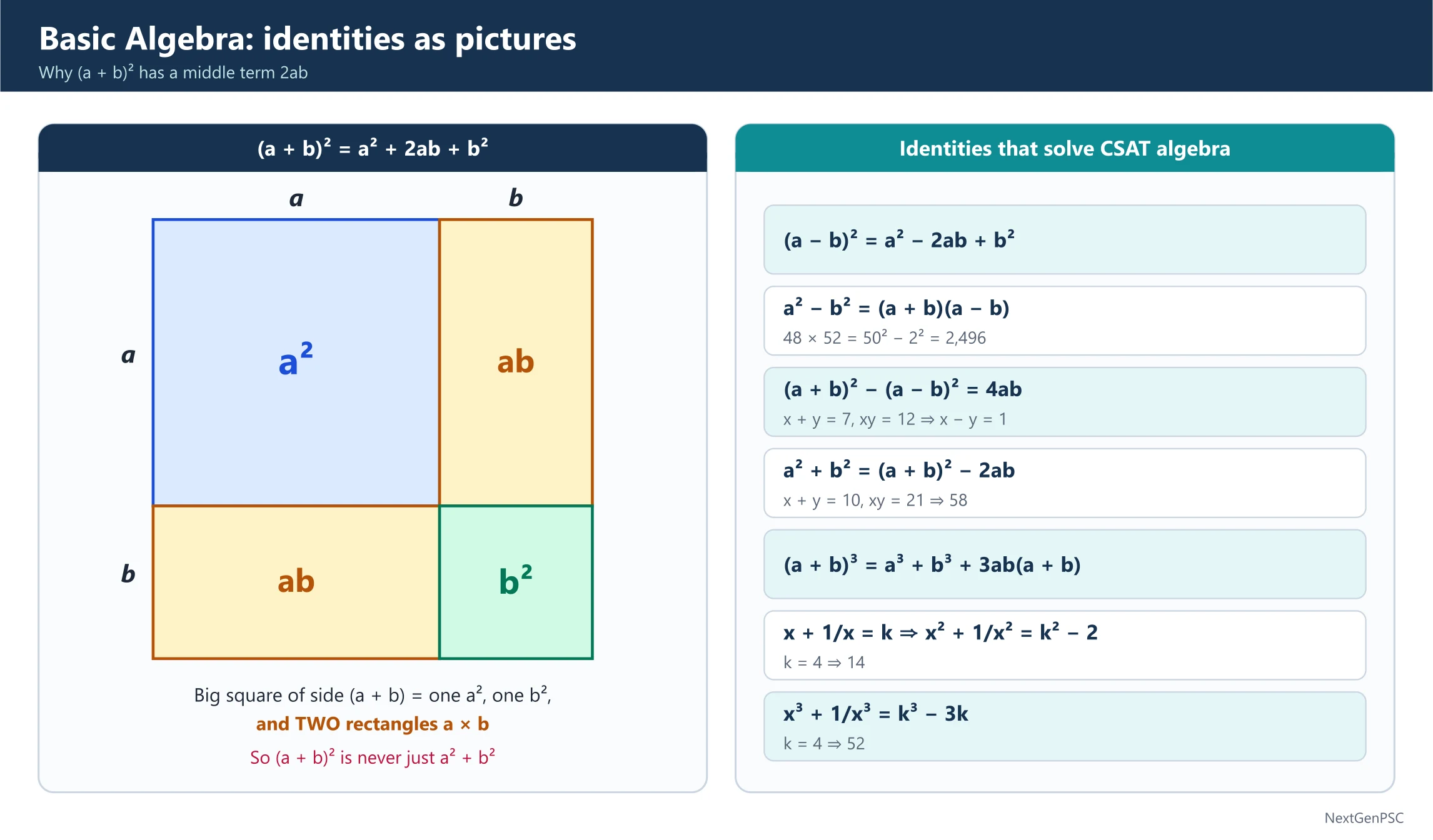
1. From Words to Equations
Name the unknown clearly ('let the son's present age be x years'). Then translate phrase by phrase: '5 more than x' = x + 5; '5 less than x' = x − 5; 'twice x' = 2x; 'x exceeds y by 4' = x − y = 4; 'the sum of x and y is 20' = x + y = 20.
Consecutive numbers: x, x + 1, x + 2. Consecutive even (or odd) numbers: x, x + 2, x + 4. For three consecutive numbers the middle one = sum ÷ 3.
A two-digit number with tens digit a and units digit b is 10a + b, not ab. Reversing its digits gives 10b + a. The difference between a number and its reverse is 9(a − b); their sum is 11(a + b).
Money: n notes of ₹10 are worth 10n rupees, not n rupees. Write the value, not the count, on the money side of the equation.
2. Linear Equations in One Variable
Collect the x terms on one side and the numbers on the other, then divide. 3x − 7 = 2x + 5 ⇒ 3x − 2x = 5 + 7 ⇒ x = 12.
With fractions, multiply both sides by the LCM of the denominators first: x/3 + x/4 = 14 ⇒ 4x + 3x = 168 ⇒ x = 24.
Unknown in the denominator: 12/x + 3 = 7 ⇒ 12/x = 4 ⇒ x = 3. Multiply through by x only after noting that x cannot be 0.
Always check by substituting back: 3 × 12 − 7 = 29 and 2 × 12 + 5 = 29.
3. Two Equations in Two Variables
Elimination: multiply the equations so that one variable has the same coefficient, then add or subtract. Substitution: express one variable from one equation and put it in the other.
Sum and difference given: x + y = 12 and x − y = 4 ⇒ add and halve: x = 8; subtract and halve: y = 4.
Symmetric pair shortcut: for ax + by = p and bx + ay = q, adding gives (a + b)(x + y) = p + q and subtracting gives (a − b)(x − y) = p − q. Often the question asks only for x + y.
Number of solutions: two lines meet once (one solution), are parallel (no solution: 2x + 3y = 5 and 4x + 6y = 7) or are the same line (infinitely many: 2x + 3y = 5 and 4x + 6y = 10).
4. Identities that Save Time
(a + b)² = a² + 2ab + b²; (a − b)² = a² − 2ab + b²; a² − b² = (a + b)(a − b).
a² + b² = (a + b)² − 2ab and (a + b)² − (a − b)² = 4ab. If x + y = 7 and xy = 12, then (x − y)² = 49 − 48 = 1.
(a + b)³ = a³ + b³ + 3ab(a + b), so a³ + b³ = (a + b)³ − 3ab(a + b). If a + b = 5 and ab = 6, a³ + b³ = 125 − 90 = 35.
Reciprocal pairs: if x + 1/x = k, then x² + 1/x² = k² − 2 and x³ + 1/x³ = k³ − 3k. With k = 3: 7 and 18.
Quick multiplication: 48 × 52 = 50² − 2² = 2,500 − 4 = 2,496; 103² = 10,000 + 600 + 9 = 10,609.
5. Quadratic Equations
A quadratic ax² + bx + c = 0 has at most two roots. Factorise by splitting the middle term: x² − 7x + 12 = (x − 3)(x − 4), so x = 3 or 4.
Sum of roots = −b/a and product of roots = c/a. For x² − 7x + 12 = 0 the sum is 7 and the product is 12, which you can read without solving.
The discriminant b² − 4ac tells the type of roots: positive ⇒ two different real roots; zero ⇒ two equal roots; negative ⇒ no real roots.
Roots that differ by d: if the roots are r and r + d, then (sum)² − 4 × product = d². This is the identity (a + b)² − 4ab = (a − b)².
6. Powers (Indices)
aᵐ × aⁿ = aᵐ⁺ⁿ; aᵐ ÷ aⁿ = aᵐ⁻ⁿ; (aᵐ)ⁿ = aᵐⁿ; a⁰ = 1; a⁻ⁿ = 1/aⁿ; (ab)ⁿ = aⁿbⁿ.
To solve equations in powers, write both sides with the same base and compare the exponents: 4ˣ = 64 ⇒ 4ˣ = 4³ ⇒ x = 3.
Comparing sizes: 2³⁰ = (2³)¹⁰ = 8¹⁰ and 3²⁰ = (3²)¹⁰ = 9¹⁰, so 3²⁰ is larger. Bring both to the same exponent.
7. Ages, Digits and Whole-Number Solutions
Ages: the difference between two people's ages never changes. 'n years ago' subtracts n from both; 'after n years' adds n to both.
Age ratios: because the difference is fixed, make the 'difference parts' of both ratios equal. A : B is 3 : 1 now and 2 : 1 after 12 years. 3 : 1 has a difference of 2 parts, so write 2 : 1 as 4 : 2. A goes from 3 to 4 parts in 12 years, so 1 part = 12: A = 36 and B = 12.
Whole-number (integer) solutions: for ax + by = c with positive integers, find one solution, then move in steps: x changes by b/g and y by a/g in opposite directions (g = HCF of a and b). Count the steps that keep both positive.
Example: 3x + 4y = 48 with x, y positive. y = (48 − 3x)/4 needs x to be a multiple of 4: x = 4, 8, 12 give y = 9, 6, 3; x = 16 gives y = 0, which is not positive. So there are 3 solutions.
Total count and total value: 20 coins of ₹2 and ₹5 are worth ₹70. If all were ₹2 coins the value would be ₹40; each ₹2 coin swapped for a ₹5 coin adds ₹3, so (70 − 40) ÷ 3 = 10 coins are of ₹5 and 10 of ₹2.
Use the options: when the question asks for a specific number and the options are simple, substitute each option; the right one satisfies every condition, and a wrong one usually fails at the first check.
Sense check: if the answer is a count of people, coins or days, an option that leads to a fraction or a negative value for any other quantity in the question cannot be right.
Example 1: Consecutive even numbers
- Question
The sum of three consecutive even numbers is 78. What is the largest of them? (a) 24 (b) 26 (c) 28 (d) 30
- Solution
Normal method. Let the numbers be x, x + 2 and x + 4. Then 3x + 6 = 78, so 3x = 72 and x = 24.
The numbers are 24, 26 and 28; the largest is 28.
Shortcut. The middle number = 78 ÷ 3 = 26, so the largest = 26 + 2 = 28.
Trap. Option (b) is the middle number and option (a) the smallest; read which one the question asks for.
- Answer
(c) 28
Example 2: Two items, two prices
- Question
5 pens and 3 notebooks cost ₹110, while 3 pens and 5 notebooks cost ₹130. What is the total cost of one pen and one notebook? (a) ₹25 (b) ₹30 (c) ₹35 (d) ₹40
- Solution
Normal method. Let a pen cost p and a notebook n. 5p + 3n = 110 and 3p + 5n = 130.
Multiply the first by 5 and the second by 3: 25p + 15n = 550 and 9p + 15n = 390. Subtract: 16p = 160, so p = 10; then 3n = 110 − 50 = 60 and n = 20.
So p + n = 10 + 20 = ₹30.
Shortcut. Add the two equations: 8p + 8n = 240, so p + n = 30, without finding p and n.
Check. 3 × 10 + 5 × 20 = 130.
Trap. Option (d) is the price of two notebooks (2 × 20). Options (a) and (c) fail a quick test: 8 × 25 and 8 × 35 are not 240.
- Answer
(b) ₹30
Example 3: A reciprocal identity
- Question
If x + 1/x = 4, what is the value of x³ + 1/x³? (a) 52 (b) 64 (c) 76 (d) 60
- Solution
Normal method. Cube both sides: (x + 1/x)³ = x³ + 1/x³ + 3 × x × 1/x × (x + 1/x).
So 64 = x³ + 1/x³ + 3 × 4 = x³ + 1/x³ + 12, giving x³ + 1/x³ = 52.
Shortcut. x³ + 1/x³ = k³ − 3k = 64 − 12 = 52.
Trap. Option (b) just cubes 4 and forgets the middle term 3k; option (c) adds 12 instead of subtracting it.
- Answer
(a) 52
Example 4: Ages then and later (UPSC-style)
- Question
Six years ago, a father was 5 times as old as his son. Six years from now, the father will be 3 times as old as his son. What are their present ages? (a) 60 and 12 (b) 66 and 18 (c) 72 and 24 (d) 54 and 18
- Solution
Normal method. Let the present ages be F and S. Six years ago: F − 6 = 5(S − 6), so F = 5S − 24.
Six years later: F + 6 = 3(S + 6), so F = 3S + 12.
5S − 24 = 3S + 12 ⇒ 2S = 36 ⇒ S = 18 and F = 66.
Shortcut. The age gap is fixed. Six years ago the gap was 4 times the son's age then; six years later it is 2 times the son's age then. So the son's age doubles over those 12 years: from x to 2x with 2x − x = 12, so x = 12 six years ago, and the son is 18 now.
Check. Six years ago: 60 and 12 (5 times). Six years later: 72 and 24 (3 times).
Trap. Option (a) gives the ages six years ago and option (c) the ages six years later.
- Answer
(b) 66 and 18
Example 5: Counting coin combinations (UPSC-style)
- Question
In how many ways can exactly ₹50 be paid using only ₹2 and ₹5 coins, if at least one coin of each kind must be used? (a) 4 (b) 5 (c) 6 (d) 10
- Solution
Normal method. Let a be the number of ₹2 coins and b the number of ₹5 coins: 2a + 5b = 50 with a ≥ 1 and b ≥ 1.
Since 2a and 50 are even, 5b must be even, so b is even: b = 2, 4, 6, 8 gives a = 20, 15, 10, 5.
b = 10 gives a = 0, which is not allowed (at least one ₹2 coin). So there are 4 ways.
Shortcut. One solution is (a, b) = (20, 2); each next solution moves a by 5 and b by 2. Count the steps that keep both at least 1: (20, 2), (15, 4), (10, 6), (5, 8).
Trap. Option (c) also counts (25, 0) and (0, 10), which break the 'at least one of each' condition; option (b) drops only one of them.
- Answer
(a) 4
Example 6: A two-digit number (UPSC-style)
- Question
The sum of the digits of a two-digit number is 9. If the digits are reversed, the new number is 27 more than the original number. What is the original number? (a) 36 (b) 63 (c) 45 (d) 27
- Solution
Normal method. Let the tens digit be a and the units digit b. Then a + b = 9 and (10b + a) − (10a + b) = 27.
9(b − a) = 27 ⇒ b − a = 3. With a + b = 9: b = 6 and a = 3. The number is 36.
Shortcut. Reversal changes a number by 9 × (difference of digits): 27 ÷ 9 = 3. Digits adding to 9 and differing by 3 are 3 and 6; the reversed number is bigger, so the smaller digit is in the tens place: 36.
Check. 63 − 36 = 27 and 3 + 6 = 9.
Trap. Option (b) is the reversed number; option (c) has digits adding to 9 but a reverse only 9 more.
- Answer
(a) 36
Practice Questions
Q1. If 3x − 7 = 2x + 5, then x equals: (a) 10 (b) 12 (c) 2 (d) 5.2
Q2. If x + y = 10 and xy = 21, what is x² + y²? (a) 58 (b) 79 (c) 100 (d) 142
Q3. The two roots of x² − 7x + k = 0 differ by 1. What is k? (a) 6 (b) 10 (c) 12 (d) 14
Q4. A is three times as old as B. After 12 years, A will be twice as old as B. What is A's present age? (a) 24 years (b) 30 years (c) 36 years (d) 48 years
Q5. How many pairs of positive integers x and y satisfy 3x + 4y = 48? (a) 3 (b) 4 (c) 5 (d) 12
Q6. If 2ˣ × 4ˣ = 512, then x equals: (a) 2 (b) 3 (c) 4 (d) 4.5
Answers
Show answers
Q1. (b) 12. 3x − 2x = 5 + 7.
Q2. (a) 58. (x + y)² − 2xy = 100 − 42; option (d) adds 42.
Q3. (c) 12. Roots r and r + 1 with sum 7 ⇒ 3 and 4 ⇒ product 12. Or 49 − 4k = 1.
Q4. (c) 36 years. 3B + 12 = 2(B + 12) ⇒ B = 12, A = 36.
Q5. (a) 3. x must be a multiple of 4: (4, 9), (8, 6), (12, 3).
Q6. (b) 3. 2ˣ × 2²ˣ = 2³ˣ = 2⁹ ⇒ 3x = 9.
| Situation | Formula / shortcut | Quick example |
|---|---|---|
| Square of a sum or difference | (a ± b)² = a² ± 2ab + b² | 103² = 10,609 |
| Difference of squares | a² − b² = (a + b)(a − b) | 48 × 52 = 2,496 |
| Sum and product known | a² + b² = (a + b)² − 2ab | 10 and 21 ⇒ 58 |
| Difference from sum and product | (a − b)² = (a + b)² − 4ab | 7 and 12 ⇒ 1 |
| Sum of cubes | a³ + b³ = (a + b)³ − 3ab(a + b) | 5 and 6 ⇒ 35 |
| x + 1/x = k | x² + 1/x² = k² − 2; x³ + 1/x³ = k³ − 3k | k = 4 ⇒ 14 and 52 |
| Quadratic ax² + bx + c = 0 | sum = −b/a, product = c/a | x² − 7x + 12 ⇒ 7 and 12 |
| Symmetric pair ax + by = p, bx + ay = q | x + y = (p + q)/(a + b) | 5, 3, 110, 130 ⇒ 30 |
| Two-digit number and its reverse | difference 9(a − b); sum 11(a + b) | 63 − 36 = 27 |
| Same base | aᵐ = aⁿ ⇒ m = n | 4ˣ = 64 ⇒ x = 3 |
Prelims tips
- Name the unknown and write the equation first. Most algebra errors in CSAT come from a wrong translation ('5 less than x' is x − 5, a two-digit number is 10a + b), not from wrong arithmetic.
- Read which quantity is asked. Options usually include the middle number, the smaller root, the age 'n years ago' or the reversed number; these are right answers to a different question.
- Use identities instead of solving. If only x + y and xy are given, x² + y², (x − y)² and x³ + y³ come straight from identities; finding x and y separately wastes time.
- Add or subtract symmetric equations. For 5p + 3n = 110 and 3p + 5n = 130, adding gives p + n in one line.
- Integer-solution counts: check the edges. Conditions like 'positive', 'at least one of each' or 'non-negative' decide whether the end cases (a value of 0) count; that is exactly where the wrong options differ by 1 or 2.
- Back-substitute when the options are clean. With four simple numbers, putting each into the conditions is often faster than algebra and also confirms your answer.
Geometry Basics
In short
Geometry Basics covers angles, triangles, polygons and circles at school level. CSAT does not ask proofs; it asks you to find an angle, a length or a count (diagonals, triangles) quickly, and it often hides geometry inside a real situation: a ladder against a wall, a shadow, the hands of a clock or a field. Three ideas unlock most questions: angle facts (180° on a line and in a triangle, 360° round a point, equal angles at parallel lines), Pythagoras and similar triangles for lengths, and the circle facts (a perpendicular from the centre bisects a chord, the angle in a semicircle is 90°, a tangent is perpendicular to the radius).
In simple words
An angle measures how much something turns. A full turn is 360°, half a turn (a straight line) is 180° and a quarter turn (the corner of a page) is 90°.
The most useful fact: the three angles of any triangle add up to 180°. If a triangle has angles of 50° and 60°, the third must be 180 − 50 − 60 = 70°.
Everyday example: a 5 m ladder leans on a wall with its foot 3 m away. Wall, ground and ladder make a right-angled triangle, so height² = 5² − 3² = 25 − 9 = 16, and the ladder reaches 4 m up the wall. That is Pythagoras.
The one question to always ask: which basic shape is hiding in this picture? A straight line (180°), a triangle (180°), a right triangle (Pythagoras), two parallel lines (equal angles) or a circle (radius everywhere the same).
Two habits solve most questions: (1) draw a quick rough figure and mark every given number on it; (2) learn the few fixed results (triangle sum, polygon formulas, circle facts) so you apply them without deriving.
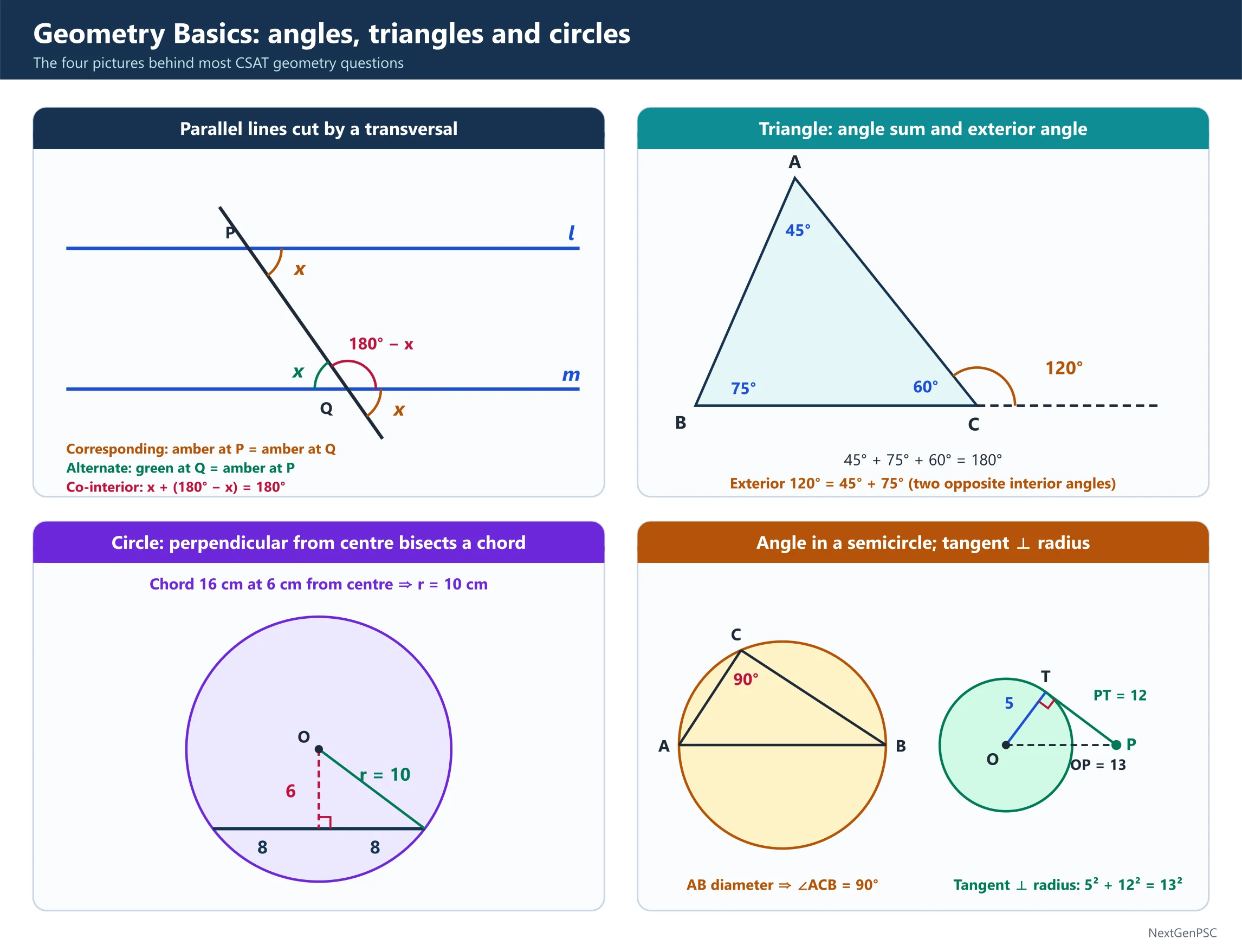
1. Lines and Angles
Angles on a straight line add up to 180° (a linear pair); angles round a point add up to 360°.
Complementary angles add up to 90°; supplementary angles add up to 180°. The complement of 35° is 55°; its supplement is 145°.
When two lines cross, the vertically opposite angles are equal. If one angle at the crossing is 70°, the four angles are 70°, 110°, 70° and 110°.
2. Parallel Lines and a Transversal
When a line (the transversal) cuts two parallel lines: corresponding angles are equal, alternate interior angles are equal, and co-interior angles (on the same side, between the parallels) add up to 180°.
So all the angles at the two crossings take only two values, x and 180° − x. Find one angle and you know all eight.
The converse is used too: if corresponding or alternate angles are equal, the lines are parallel.
3. Triangles
Angle sum: the three angles add up to 180°. Exterior angle: an exterior angle equals the sum of the two interior opposite angles.
Why: the exterior angle and its adjacent interior angle make 180°, and so do all three interior angles; remove the common angle from both.
Side rule: the sum of any two sides is greater than the third side (and their difference is less than the third). 3, 4 and 8 cannot form a triangle because 3 + 4 < 8; 5, 6 and 11 cannot either, because 5 + 6 = 11 only gives a flat line.
So with two sides 7 and 10, the third side lies strictly between 10 − 7 = 3 and 10 + 7 = 17; as a whole number it can be 4 to 16, i.e. 13 values.
The largest side is opposite the largest angle. In an isosceles triangle the two base angles are equal; in an equilateral triangle every angle is 60°.
4. Right Triangles and Pythagoras
In a right-angled triangle, hypotenuse² = base² + height². The hypotenuse is the side opposite the right angle and is the longest side.
Triplets to know: 3-4-5, 5-12-13, 8-15-17, 7-24-25, 20-21-29 and their multiples (6-8-10, 9-12-15, 10-24-26). Spotting one saves the square root.
Special triangles: in a 30°-60°-90° triangle the sides are in the ratio 1 : √3 : 2; in a 45°-45°-90° triangle they are 1 : 1 : √2. So a square of side a has a diagonal a√2.
An isosceles right triangle with hypotenuse 10 has each of the other sides equal to 10/√2 = 5√2 ≈ 7.07.
Converse: if the sides satisfy c² = a² + b², the triangle is right-angled (6, 8, 10: 36 + 64 = 100).
5. Similar Triangles
Two triangles are similar when their angles are equal (two equal pairs are enough). Then their corresponding sides are in the same ratio.
Areas of similar triangles are in the ratio of the squares of their sides. Sides in the ratio 2 : 3 ⇒ areas 4 : 9.
The same holds for any similar figures, such as maps: on a map of scale 1 : 1,000, lengths shrink 1,000 times but areas shrink 1,000² = 10,00,000 times.
Shadows: at the same time of day, the sun's rays make the same angle everywhere, so height/shadow is the same for every object. A 1.5 m person with a 2 m shadow ⇒ a tower with a 48 m shadow is 1.5 × 48/2 = 36 m tall.
6. Polygons and Quadrilaterals
For a polygon with n sides: sum of interior angles = (n − 2) × 180°; sum of exterior angles = 360° (always).
For a regular polygon: each exterior angle = 360°/n and each interior angle = 180° − 360°/n. Interior 150° ⇒ exterior 30° ⇒ n = 12.
Diagonals = n(n − 3)/2. Why: each vertex joins n − 3 others by a diagonal (not itself and not its two neighbours), and each diagonal is counted from both ends. Hexagon: 6 × 3/2 = 9.
Triangles from points: from n points with no three in a line, n(n − 1)(n − 2)/6 triangles can be drawn. The 8 corners of an octagon give 8 × 7 × 6/6 = 56 triangles.
Quadrilaterals: opposite sides of a parallelogram are equal and its diagonals bisect each other; the diagonals of a rhombus bisect each other at 90°; the diagonals of a rectangle are equal; a square has all of these properties.
7. Circles
The perpendicular from the centre to a chord bisects the chord. With radius r, distance d and half-chord h: r² = d² + h². Equal chords are equally far from the centre.
The angle a chord makes at the centre is twice the angle it makes at any point on the circle (on the same side). Angles in the same segment are equal.
Example: a chord that makes 100° at the centre makes 50° at any point on the major arc and 180° − 50° = 130° at any point on the minor arc (the two points form a cyclic quadrilateral).
The angle in a semicircle is 90°: if AB is a diameter and C is on the circle, then angle ACB = 90°.
In a cyclic quadrilateral (all four corners on a circle), opposite angles add up to 180°.
A tangent is perpendicular to the radius at the point of contact; the two tangents from an outside point are equal in length. Tangent length = √(OP² − r²).
8. Clock Angles
The minute hand moves 6° a minute; the hour hand moves 0.5° a minute (30° an hour). At H hours M minutes, the angle between the hands = |30H − 5.5M| (take 360° minus this if it is more than 180°).
The hands coincide 11 times in 12 hours (every 65 5/11 minutes), because the minute hand gains 5.5° every minute on the hour hand.
Example 1: Supplementary angles in a ratio
- Question
Two supplementary angles are in the ratio 4 : 5. What is the smaller angle? (a) 40° (b) 50° (c) 80° (d) 100°
- Solution
Normal method. Let the angles be 4x and 5x. Supplementary means 4x + 5x = 180°, so 9x = 180° and x = 20°.
The smaller angle = 4 × 20° = 80° (the larger is 100°).
Shortcut. 180 × 4/9 = 80°.
Trap. Option (a) treats the angles as complementary (90 × 4/9); option (d) is the larger angle.
- Answer
(c) 80°
Example 2: The exterior angle of a triangle
- Question
An exterior angle of a triangle is 120° and one of the two interior opposite angles is 45°. What are the other interior opposite angle and the interior angle next to the exterior angle? (a) 75° and 60° (b) 60° and 75° (c) 75° and 120° (d) 15° and 165°
- Solution
Normal method. Exterior angle = sum of the two interior opposite angles: 120° = 45° + x, so x = 75°.
The adjacent interior angle and the exterior angle form a straight line: 180° − 120° = 60°.
Shortcut. Check with the angle sum: 45° + 75° + 60° = 180°.
Trap. Option (b) gives the right two numbers in the wrong order; option (c) repeats the exterior angle as if it were interior.
- Answer
(a) 75° and 60°
Example 3: A sliding ladder
- Question
A 25 m ladder leans against a vertical wall with its foot 7 m from the wall. If the top of the ladder slides down by 4 m, by how much does the foot slide outward? (a) 4 m (b) 8 m (c) 15 m (d) 11 m
- Solution
Normal method. First height = √(25² − 7²) = √(625 − 49) = √576 = 24 m.
After sliding, the height is 24 − 4 = 20 m, so the foot is √(625 − 400) = √225 = 15 m from the wall.
The foot moves 15 − 7 = 8 m.
Shortcut. Spot the triplets: 7-24-25 and 15-20-25 (3-4-5 times 5). Then 15 − 7 = 8.
Trap. Option (a) assumes the foot moves as much as the top; option (c) is the new distance of the foot, not the slide.
- Answer
(b) 8 m
Example 4: Diagonals of a regular polygon (UPSC-style)
- Question
Each interior angle of a regular polygon is 140°. How many diagonals does it have? (a) 9 (b) 18 (c) 27 (d) 36
- Solution
Normal method. Each exterior angle = 180° − 140° = 40°, so the number of sides n = 360/40 = 9.
Diagonals = n(n − 3)/2 = 9 × 6/2 = 27.
Shortcut. Always go through the exterior angle: 360 ÷ (180 − interior) gives n at once.
Trap. Option (d) is 9 × 8/2 = 36, the number of all segments joining two vertices (it includes the 9 sides); option (a) is the number of sides.
- Answer
(c) 27
Example 5: Two chords of a circle (UPSC-style)
- Question
A chord 16 cm long is at a distance of 6 cm from the centre of a circle. What is the length of a chord of the same circle at a distance of 8 cm from the centre? (a) 12 cm (b) 10 cm (c) 14 cm (d) 6 cm
- Solution
Normal method. The perpendicular from the centre bisects the chord, so the half-chord is 8 cm. Radius² = 6² + 8² = 100, so the radius is 10 cm.
For the second chord: half-chord = √(10² − 8²) = √36 = 6 cm, so the chord = 12 cm.
Shortcut. 6-8-10 is a triplet; with distance 8 the half-chord is the other leg, 6, so the chord is 12.
Trap. Option (d) is only the half-chord; option (b) is the radius.
- Answer
(a) 12 cm
Example 6: Angle between the hands of a clock (UPSC-style)
- Question
What is the angle between the hour hand and the minute hand of a clock at 4:20? (a) 0° (b) 10° (c) 20° (d) 5°
- Solution
Normal method. At 4:20 the minute hand points at the 4, which is 20 × 6° = 120° from the 12.
The hour hand has moved past the 4 by 20 × 0.5° = 10°, so it is at 120° + 10° = 130°.
Angle = 130° − 120° = 10°.
Shortcut. |30H − 5.5M| = |120 − 110| = 10°.
Trap. Option (a) forgets that the hour hand keeps moving after 4:00; option (c) moves it 1° a minute instead of 0.5°.
- Answer
(b) 10°
Practice Questions
Q1. A person 1.5 m tall casts a shadow 2 m long. At the same time a tower casts a shadow 48 m long. How tall is the tower? (a) 36 m (b) 64 m (c) 72 m (d) 32 m
Q2. AB is a diameter of a circle and C is a point on the circle. If angle CAB = 35°, what is angle ABC? (a) 35° (b) 55° (c) 65° (d) 145°
Q3. Which of the following sets of lengths can form a triangle? (a) 3, 4, 8 (b) 5, 6, 11 (c) 6, 8, 10 (d) 2, 3, 6
Q4. A transversal cuts two parallel lines. Two co-interior angles are (3x + 20)° and (2x + 10)°. What is the larger of the two angles? (a) 30° (b) 70° (c) 110° (d) 150°
Q5. Each exterior angle of a regular polygon is 24°. What is the sum of its interior angles? (a) 2,340° (b) 2,520° (c) 2,160° (d) 2,700°
Q6. P is a point 13 cm from the centre of a circle of radius 5 cm. What is the length of the tangent from P to the circle? (a) 8 cm (b) 12 cm (c) 13.9 cm (d) 18 cm
Answers
Show answers
Q1. (a) 36 m. Height/shadow is the same: 1.5/2 × 48 = 36; option (b) inverts the ratio.
Q2. (b) 55°. Angle ACB = 90° (semicircle), so ABC = 180 − 90 − 35 = 55.
Q3. (c) 6, 8, 10. 6 + 8 > 10 (it is even a right triangle); in the others two sides add up to no more than the third.
Q4. (c) 110°. 5x + 30 = 180 ⇒ x = 30 ⇒ the angles are 110° and 70°.
Q5. (a) 2,340°. n = 360/24 = 15 sides; (15 − 2) × 180 = 2,340.
Q6. (b) 12 cm. √(13² − 5²) = √144 = 12.
| Situation | Fact / formula | Quick example |
|---|---|---|
| Angles on a line / round a point | 180° / 360° | 70° and 110° on a line |
| Parallel lines and a transversal | corresponding = alternate; co-interior add to 180° | x and 180° − x |
| Triangle | angle sum 180°; exterior = sum of two opposite interior | 45° + 75° = 120° |
| Can three lengths form a triangle? | each pair adds to more than the third | 6, 8, 10 yes; 3, 4, 8 no |
| Right triangle | hypotenuse² = base² + height² | 7-24-25, 5-12-13 |
| Similar triangles | sides in ratio k ⇒ areas in ratio k² | 2 : 3 ⇒ 4 : 9 |
| Polygon with n sides | interior sum (n − 2) × 180°; each exterior 360°/n (regular) | n = 9 ⇒ 1,260°, 40° |
| Diagonals of a polygon | n(n − 3)/2 | n = 9 ⇒ 27 |
| Chord at distance d from centre | r² = d² + (half-chord)² | 6, 8 ⇒ r = 10 |
| Tangent from an outside point P | length = √(OP² − r²) | 13, 5 ⇒ 12 |
| Clock at H hours M minutes | angle = |30H − 5.5M| | 4:20 ⇒ 10° |
Prelims tips
- Draw the figure and write every number on it. Most CSAT geometry questions are one fact away from the answer once the right triangle, line or circle is visible; solving in your head causes order and label mistakes.
- Know the Pythagorean triplets. 3-4-5, 5-12-13, 8-15-17, 7-24-25 and their multiples turn a square-root problem into recognition; options are usually built so that the triplet answer is exact.
- Go through the exterior angle for regular polygons. n = 360 ÷ exterior angle. Then use n(n − 3)/2 for diagonals; the option equal to n(n − 1)/2 counts the sides as well and is a trap.
- Circle questions: look for the hidden right angle. Radius ⊥ tangent, centre-to-chord perpendicular, and the angle in a semicircle each create a right triangle with the radius as one side.
- Similar figures scale differently. Lengths scale by k, areas by k² and volumes by k³; shadow and height questions use the plain ratio, not its square.
- Clock angles: the hour hand moves too. Use |30H − 5.5M|; the answer 0° at 4:20 (or any 'the hands are together' guess) ignores the hour hand's 0.5° per minute.
Mensuration
In short
Mensuration is the measurement of shapes: the perimeter and area of flat figures and the surface area and volume of solids. CSAT usually sets it as a practical problem (a path round a garden, painting the walls of a room, a wheel covering a distance, a metal sphere melted into a wire, a tank filled by a pipe) or as a percentage change in area or volume. Three ideas unlock most questions: one consistent unit before any formula, volume is conserved when a solid is melted or water is moved, and scaling (lengths × k ⇒ areas × k² and volumes × k³).
In simple words
Three different questions can be asked about a shape. Perimeter: how long is the boundary (fencing, a wire round it)? Area: how much flat surface does it cover (tiles, paint, carpet)? Volume: how much space is inside (water in a tank)?
Everyday example: a room floor is 5 m by 4 m. Its area is 5 × 4 = 20 m². If tiles cost ₹500 per m², tiling costs 20 × 500 = ₹10,000. The skirting along the walls needs the perimeter, 2 × (5 + 4) = 18 m.
Units grow with the power: length in m, area in m² (square metres), volume in m³ (cubic metres). Since 1 m = 100 cm, 1 m² = 100 × 100 = 10,000 cm², not 100 cm².
The one question to always ask: is the question about the boundary, the surface or the space inside? Painting and wrapping use surface area; filling and melting use volume; fencing and wheels use length.
Two habits solve most questions: (1) change every measurement into the same unit before using a formula; (2) when something is melted or poured, write 'volume before = volume after' and solve that one equation.
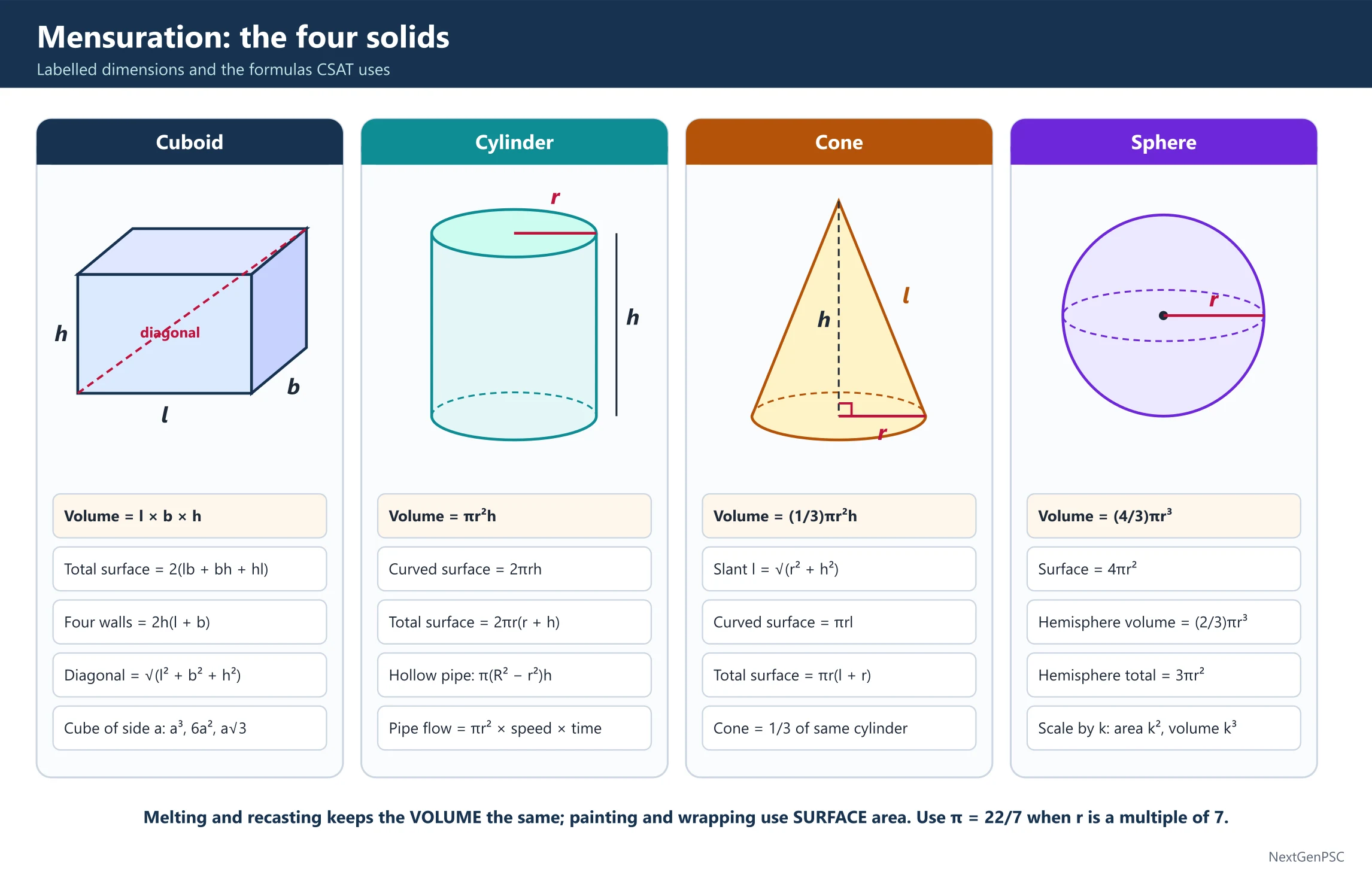
1. Units and Conversions
Length: 1 km = 1,000 m; 1 m = 100 cm. Area: 1 m² = 10,000 cm²; 1 hectare = 10,000 m²; 1 km² = 100 hectares. Volume: 1 m³ = 10,00,000 cm³ = 1,000 litres; 1 litre = 1,000 cm³.
Convert first, calculate second. Mixing a radius in cm with a length in m is the most common mensuration error.
Take π = 22/7 when the radius is a multiple of 7 and 3.14 otherwise, unless the question says which.
2. Plane Figures
Rectangle l × b: area lb, perimeter 2(l + b), diagonal √(l² + b²). Square of side a: area a², perimeter 4a, diagonal a√2; area = diagonal²/2.
Triangle: area = ½ × base × height. With three sides a, b, c: area = √(s(s − a)(s − b)(s − c)) where s = (a + b + c)/2 (Heron's formula). Sides 13, 14, 15: s = 21, area = √(21 × 8 × 7 × 6) = √7,056 = 84.
Equilateral triangle of side a: area = (√3/4)a², height = (√3/2)a. Side 8 ⇒ area 16√3.
Parallelogram: base × height. Rhombus: ½ × d₁ × d₂ (its diagonals cut at 90°, so each side = √((d₁/2)² + (d₂/2)²)). Trapezium: ½ × (sum of parallel sides) × height.
Circle of radius r: area πr², circumference 2πr. Semicircle: area πr²/2, perimeter πr + 2r (the diameter is part of the boundary). Sector of angle θ: area θ/360 × πr², arc θ/360 × 2πr.
Ring between radii R and r: area π(R² − r²). R = 7 and r = 3.5 (π = 22/7): 22/7 × (49 − 12.25) = 115.5.
For the same perimeter a circle encloses more area than a square. A 44 cm wire bent into a circle gives r = 7 and area 154 cm²; bent into a square it gives side 11 and area 121 cm².
3. Paths, Borders, Walls and Floors
Path outside a rectangle l × b, width w: area = (l + 2w)(b + 2w) − lb = 2w(l + b) + 4w².
Path inside along the boundary: area = lb − (l − 2w)(b − 2w) = 2w(l + b) − 4w².
Two crossing roads of width w through the middle, parallel to the sides: area = w(l + b) − w² (the central square is counted once).
Why the corner terms: an outside path has four extra w × w corner squares; an inside path would count its four corners twice if you simply multiplied the perimeter by w.
Four walls of a room l × b × h: area = 2h(l + b). Subtract doors and windows; add the ceiling (l × b) only if the question says so.
4. Solids
Cuboid l × b × h: volume lbh, total surface 2(lb + bh + hl), longest diagonal √(l² + b² + h²). Cube of side a: volume a³, surface 6a², diagonal a√3.
The longest rod that fits in a room 12 m × 4 m × 3 m is its diagonal: √(144 + 16 + 9) = √169 = 13 m.
Cylinder radius r, height h: volume πr²h, curved surface 2πrh, total surface 2πr(r + h). A hollow pipe of outer radius R and inner radius r holds metal π(R² − r²)h.
Cone radius r, height h: slant height l = √(r² + h²), volume (1/3)πr²h, curved surface πrl, total surface πr(l + r). A cone holds exactly 1/3 of a cylinder with the same base and height.
Sphere radius r: volume (4/3)πr³, surface 4πr². Hemisphere: volume (2/3)πr³, curved surface 2πr², total surface 3πr².
5. Melting, Recasting and Flowing Water
When a solid is melted and recast, or water is poured from one vessel to another, the volume stays the same (surface area does not).
Number of small solids from a big one = volume of the big ÷ volume of one small. A cube of side 12 cm gives (12/3)³ = 64 cubes of side 3 cm.
Water through a pipe: volume per second = area of the pipe's cross-section × speed of flow. Time to fill = volume of the tank ÷ volume per second.
A wire is a long thin cylinder: length = volume ÷ (π × wire radius²).
Rise in water level: a solid dropped into a tank raises the water by (volume of the solid ÷ base area of the tank). A sphere of radius 3 cm in a cylinder of radius 6 cm: (4/3)π × 27 ÷ (π × 36) = 36π ÷ 36π = 1 cm.
6. Scaling and Percentage Change
If every length is multiplied by k, areas are multiplied by k² and volumes by k³. Doubling the side of a cube makes its surface 4 times and its volume 8 times (an increase of 700%).
If one length changes by a% and another by b%, an area (product of two lengths) changes by a + b + ab/100 %. Radius +10% ⇒ circle area +21%.
A rectangle whose length rises 20% and breadth falls 20% loses 4% of its area (20 − 20 − 400/100), because each length appears once in l × b.
For a cylinder (r appears twice, h once): new volume factor = (1 + r%)² × (1 + h%). Radius +20% and height −20% ⇒ 1.44 × 0.8 = 1.152, a 15.2% increase.
7. Wheels and Revolutions
In one revolution a wheel covers its circumference, πd. Number of revolutions = distance ÷ circumference.
A wheel of diameter 70 cm covers 22/7 × 70 = 220 cm per revolution; over 1.1 km (1,10,000 cm) it turns 500 times.
If the radius is given, circumference = 2πr; do not use r where d is needed.
Example 1: A path round a garden
- Question
A rectangular garden 30 m long and 20 m wide has a path 2.5 m wide running all round it on the outside. What is the area of the path? (a) 250 m² (b) 275 m² (c) 225 m² (d) 300 m²
- Solution
Normal method. Outer rectangle = (30 + 5) × (20 + 5) = 35 × 25 = 875 m². Garden = 30 × 20 = 600 m².
Path = 875 − 600 = 275 m².
Shortcut. 2w(l + b) + 4w² = 2 × 2.5 × 50 + 4 × 6.25 = 250 + 25 = 275 m².
Trap. Option (a) misses the four corner squares (perimeter × width); option (c) is the area of the same path laid inside (600 − 25 × 15).
- Answer
(b) 275 m²
Example 2: Revolutions of a wheel
- Question
The diameter of a wheel is 70 cm. How many revolutions will it make to cover 1.1 km? (π = 22/7) (a) 250 (b) 500 (c) 1,000 (d) 5,000
- Solution
Normal method. Circumference = πd = 22/7 × 70 = 220 cm.
1.1 km = 1,10,000 cm. Revolutions = 1,10,000 ÷ 220 = 500.
Shortcut. Work in metres: 1,100 m ÷ 2.2 m = 500.
Trap. Option (a) takes 70 cm as the radius (circumference 440 cm); option (d) slips a zero in converting km to cm.
- Answer
(b) 500
Example 3: A sphere drawn into a wire
- Question
A solid metal sphere of radius 6 cm is melted and drawn into a wire of radius 0.2 cm. What is the length of the wire? (a) 72 m (b) 7.2 m (c) 36 m (d) 720 m
- Solution
Normal method. Volume of the sphere = (4/3)π × 6³ = (4/3)π × 216 = 288π cm³.
The wire is a cylinder: π × 0.2² × L = 0.04πL. So 0.04πL = 288π and L = 288 ÷ 0.04 = 7,200 cm = 72 m.
Shortcut. π cancels: L = (4/3) × 216 ÷ 0.04 = 288 × 25 = 7,200 cm.
Trap. Option (c) uses the hemisphere volume (2/3)πr³; options (b) and (d) slip the cm-to-m conversion by a factor of 10.
- Answer
(a) 72 m
Example 4: Changing radius and height (UPSC-style)
- Question
The radius of a cylinder is increased by 20% and its height is decreased by 20%. What happens to its volume? (a) No change (b) 4% decrease (c) 15.2% increase (d) 20% increase
- Solution
Normal method. Take r = 10 and h = 10: volume = π × 100 × 10 = 1,000π.
New r = 12 and h = 8: volume = π × 144 × 8 = 1,152π. Change = 152/1,000 = 15.2% increase.
Shortcut. Volume ∝ r²h: 1.2² × 0.8 = 1.44 × 0.8 = 1.152. Or: r² gives 20 + 20 + 4 = 44%, then 44 − 20 − 44 × 20/100 = 15.2%.
Trap. Option (a) cancels +20% and −20% as if r appeared only once; option (b) is the −a²/100 result, which would be right only if r appeared once (like the length and breadth of a rectangle); here r is squared.
- Answer
(c) 15.2% increase
Example 5: Painting the walls of a room (UPSC-style)
- Question
A room is 6 m long, 5 m wide and 4 m high. It has one door 2 m × 1 m and two windows 1.5 m × 1 m each. What is the cost of painting its four walls at ₹40 per m²? (a) ₹3,320 (b) ₹3,520 (c) ₹4,520 (d) ₹3,440
- Solution
Normal method. Area of four walls = 2h(l + b) = 2 × 4 × (6 + 5) = 88 m².
Openings = door 2 m² + windows 2 × 1.5 = 3 m², total 5 m². Area to paint = 88 − 5 = 83 m².
Cost = 83 × 40 = ₹3,320.
Shortcut. Cost = 40 × (88 − 5) = 3,520 − 200 = ₹3,320.
Trap. Option (b) forgets the door and windows; option (d) subtracts only the door; option (c) also paints the ceiling (88 + 30 − 5 = 113 m²).
- Answer
(a) ₹3,320
Example 6: Filling a tank through a pipe (UPSC-style)
- Question
A cylindrical tank of radius 1.4 m and height 2 m is filled by a pipe of internal radius 3.5 cm through which water flows at 2 m per second. How long will it take to fill the empty tank? (a) 6 minutes 40 seconds (b) 26 minutes 40 seconds (c) 53 minutes 20 seconds (d) 16 minutes
- Solution
Normal method. Tank volume = π × 1.4² × 2 = π × 1.96 × 2 = 3.92π m³.
Pipe radius = 0.035 m; water per second = π × 0.035² × 2 = π × 0.001225 × 2 = 0.00245π m³.
Time = 3.92 ÷ 0.00245 = 1,600 s = 26 minutes 40 seconds.
Shortcut. Time = (R/r)² × H ÷ speed = (140/3.5)² × 2 ÷ 2 = 40² = 1,600 s. (Both radii must be in the same unit.)
Trap. Option (c) forgets the speed of 2 m/s (uses 1 m/s); option (a) takes 7 cm (the diameter) as the pipe's radius.
- Answer
(b) 26 minutes 40 seconds
Practice Questions
Q1. The diagonals of a rhombus are 16 cm and 12 cm. What is its perimeter? (a) 28 cm (b) 40 cm (c) 48 cm (d) 96 cm
Q2. A conical tent has a base radius of 7 m and a height of 24 m. How much canvas is needed for its curved surface? (π = 22/7) (a) 528 m² (b) 550 m² (c) 616 m² (d) 1,232 m²
Q3. What is the area of an equilateral triangle of side 8 cm? (a) 16√3 cm² (b) 32√3 cm² (c) 64√3 cm² (d) 8√3 cm²
Q4. The total surface area of a cube is 150 cm². What is its volume? (a) 25 cm³ (b) 125 cm³ (c) 216 cm³ (d) 150 cm³
Q5. If each edge of a cube is doubled, by what percent does its volume increase? (a) 100% (b) 300% (c) 700% (d) 800%
Q6. What is the area of a sector of a circle of radius 14 cm with a central angle of 90°? (π = 22/7) (a) 77 cm² (b) 154 cm² (c) 308 cm² (d) 616 cm²
Answers
Show answers
Q1. (b) 40 cm. Half-diagonals 8 and 6 ⇒ side 10 ⇒ perimeter 40.
Q2. (b) 550 m². Slant = √(49 + 576) = 25; πrl = 22/7 × 7 × 25 = 550. Option (a) uses the height, option (d) is the volume.
Q3. (a) 16√3 cm². (√3/4) × 64 = 16√3.
Q4. (b) 125 cm³. 6a² = 150 ⇒ a = 5 ⇒ a³ = 125.
Q5. (c) 700%. 2³ = 8 times ⇒ increase 7 times = 700%; option (d) is the new volume as a percent of the old.
Q6. (b) 154 cm². 90/360 × 22/7 × 196 = 154.
| Figure | Area | Perimeter / other |
|---|---|---|
| Rectangle l × b | lb | 2(l + b); diagonal √(l² + b²) |
| Square of side a | a² = diagonal²/2 | 4a; diagonal a√2 |
| Triangle | ½ × base × height; Heron √(s(s − a)(s − b)(s − c)) | a + b + c |
| Equilateral triangle of side a | (√3/4)a² | 3a; height (√3/2)a |
| Rhombus with diagonals d₁, d₂ | ½ d₁d₂ | 4 × √((d₁/2)² + (d₂/2)²) |
| Trapezium | ½ × (sum of parallel sides) × height | sum of four sides |
| Circle of radius r | πr² | 2πr |
| Sector of angle θ | θ/360 × πr² | arc θ/360 × 2πr, plus 2r |
| Path of width w outside / inside l × b | 2w(l + b) + 4w² / 2w(l + b) − 4w² | 30 × 20, w = 2.5 ⇒ 275 / 225 |
| Solid | Volume | Surface area |
|---|---|---|
| Cuboid l × b × h | lbh | 2(lb + bh + hl); four walls 2h(l + b) |
| Cube of side a | a³ | 6a²; diagonal a√3 |
| Cylinder r, h | πr²h | curved 2πrh; total 2πr(r + h) |
| Cone r, h, slant l | (1/3)πr²h | curved πrl; total πr(l + r) |
| Sphere r | (4/3)πr³ | 4πr² |
| Hemisphere r | (2/3)πr³ | curved 2πr²; total 3πr² |
| Any solid scaled by k | × k³ | × k² |
Prelims tips
- Convert units before the formula. CSAT mixes cm and m (pipes, wires, wheels) on purpose; options that differ by a factor of 10 or 100 are built from a missed conversion. Remember 1 m² = 10,000 cm² and 1 m³ = 1,000 litres.
- Decide: boundary, surface or volume. Fencing and wheels use length, painting and wrapping use surface area, filling and melting use volume. Reading this wrongly gives an answer that matches a wrong option exactly.
- Melting and pouring: volume before = volume after. Write that one equation and cancel π and common factors before multiplying anything out.
- Paths: watch the four corners. Outside path = 2w(l + b) + 4w²; inside path = 2w(l + b) − 4w². Perimeter × width is the trap that ignores the corners.
- Scaling: k, k², k³. For percentage changes, convert to factors (1.2² × 0.8 for a cylinder) instead of adding percentages; '+20% and −20% = no change' is always a trap.
- Pick π to suit the numbers. Radii like 7, 14, 21 or 3.5 call for 22/7; leave π as a symbol until the end when it cancels, as in recasting questions.
PYQs from this chapter
70 UPSC Prelims questions (2024–2025) test what this chapter teaches. Open a year to read them with answers: