
CSAT (Prelims Paper II) · UPSC Notes
Logical Reasoning — UPSC CSAT Notes
Free, exam-focused notes for UPSC Prelims and Mains, with Prelims tips and Mains points for every topic. 11 topics.
Open in the interactive reader: bookmarks, progress tracking and read-aloud.
Statement and Assumption
In short
An assumption is something the speaker takes for granted without saying it; the statement would make no sense without it. UPSC CSAT usually tests it inside reading passages ('Which one of the following is the most logical and rational assumption…?' or 'The following assumptions have been made… which is/are valid?'), and sometimes with a short statement or notice. Three tools unlock it: the negation test (deny the assumption and see if the statement collapses), the purpose test (every advice, appeal or decision assumes it will work and is needed), and a quick eye for extreme or out-of-scope words that make an option too strong.
In simple words
An assumption is a hidden belief behind what someone says. If your mother says 'Take an umbrella', she has not said it, but she believes it may rain and that the umbrella will keep you dry. Those unspoken beliefs are the assumptions.
An assumption is never written in the statement. If an idea is already said in the statement, it is not an assumption; it is just the statement.
Everyday example: a shop puts up a board, 'Diwali sale: 30% off on all sweets.' The shop assumes that a discount will bring more customers. It does not assume that other shops have no sale, or that people eat sweets only at Diwali.
The one question to always ask: 'If this were false, would the statement still make sense?' If the statement becomes pointless, the idea is an assumption. If the statement still makes sense, it is not.
Two habits solve most questions: (1) ask what the speaker wants to happen and what he must believe for that to happen; (2) be suspicious of words like only, all, always, never, best: real assumptions are usually modest.
1. What an Assumption Is
An assumption is an unstated idea that the speaker or writer must believe for the statement to be reasonable. It is the hidden step between what is said and why it is said.
It is different from a conclusion (what follows from the statement) and from an inference (what is probably true given the statement). An assumption comes before the statement; a conclusion comes after it.
Example: 'Wear a helmet; it can save your life.' Assumptions: a helmet reduces head injuries in accidents; the listener values his life. Conclusion: a rider without a helmet is at greater risk.
An idea that is already stated cannot be an assumption. If the statement says 'Prices have risen', then 'Prices have risen' is a restatement, not an assumption.
2. How UPSC Asks It
Passage form: a paragraph of 80–200 words, then 'Which one of the following is the most logical and rational assumption that can be made on the basis of the passage?' with four options. Only one is required by the author's argument.
Assumption-list form: 'With reference to the passage, the following assumptions have been made: 1. … 2. … Which of the above assumptions is/are valid?' with options 1 only / 2 only / Both 1 and 2 / Neither 1 nor 2.
Short statement form: a notice, advertisement, advice or decision, followed by assumptions I and II (or I, II, III). This form is common in State PSC and bank papers and builds the same skill.
3. The Negation Test
Turn the assumption into its opposite and put it next to the statement. If the statement now becomes pointless or self-contradictory, the assumption is implicit (valid). If the statement still makes sense, it is not implicit.
Example: 'The government will give free bicycles to girls who join Class 9.' Test 'Bicycles will help girls reach school.' Negation: 'Bicycles will not help girls reach school.' Then the scheme is pointless, so the assumption is implicit.
Test 'Boys do not need bicycles.' Negation: 'Boys also need bicycles.' The scheme for girls still makes sense (the government may target girls first), so this is not implicit.
Why: an assumption is a support the argument rests on. Remove a real support and the argument falls; remove a decoration and nothing happens.
4. Assumptions That Are Usually Valid
Effectiveness: any action, advice or appeal assumes it will (at least partly) achieve its purpose. 'Use this cream for clear skin' assumes the cream helps.
Need or desirability: an action assumes the problem exists or the goal is wanted. A scheme to reduce school dropouts assumes dropout is a real problem.
Response of the audience: notices, appeals and advertisements assume people will read them and that some will act on them. Not all, but enough.
Feasibility: a decision or advice assumes it can be carried out: the money, people, time or means exist. 'Store water for two days' assumes people can store it.
Credibility of the source: advice that quotes an expert, a survey or a report assumes the source is reliable.
5. Assumptions That Are Usually Invalid
Extreme words: only, all, always, never, best, must, definitely. 'X is the only way' is rarely assumed; the speaker needs X to help, not to be the sole answer.
Comparisons not in the statement: 'X is better than Y' is not assumed unless the statement compares them. An advertisement for one toothpaste does not assume other toothpastes are bad.
Results and consequences: what will happen later is a conclusion or a prediction, not an assumption. 'Sales will double' is not assumed by an advertisement.
Out of scope: ideas about people, places or times not covered by the statement. A notice for one city does not assume anything about another city.
Negative motive: options that read bad intention into a neutral statement ('the government wants to hide…') are almost never assumed.
6. Special Patterns
Advice and appeals: 'You should do X to get Y' assumes X helps get Y and that you want Y. It does not assume that Y cannot be got in any other way.
Government decisions: assume the problem exists, the step will help, and it can be implemented. They do not assume it will fully solve the problem or that the earlier policy was wrong.
'Instead of' trade-offs: replacing A by B assumes B is worth the time or money; it does not assume A is useless or less important in general.
Either-or assumptions: two assumptions seldom form an either-or pair; mark 'Either' only if the statement itself presents two exclusive options.
7. A 30-second Method
Step 1. Find the purpose: what does the speaker want to achieve or make you do?
Step 2. For each assumption, ask: is it already stated? (reject) Is it extreme, comparative, about results or out of scope? (likely reject)
Step 3. Apply the negation test to what remains. Keep it only if the statement collapses.
Step 4. In passage questions, the right option links the author's evidence to his conclusion; options true in the world but not needed by the argument are traps.
Example 1: An advertisement
- Question
Statement: 'Use BrightSmile toothpaste for stronger teeth.' – an advertisement. Assumptions: I. People want stronger teeth. II. BrightSmile is the only toothpaste that makes teeth stronger. Which of the assumptions is/are implicit? (a) Only I is implicit (b) Only II is implicit (c) Both I and II are implicit (d) Neither I nor II is implicit
- Solution
Normal method. Purpose: to make people buy BrightSmile by promising stronger teeth.
I: negate it, 'People do not want stronger teeth'. Then the promise attracts nobody, and the advertisement is pointless. I is implicit.
II: negate it, 'Other toothpastes also strengthen teeth'. The advertisement still makes sense; it only claims BrightSmile helps. II is not implicit.
Shortcut. An advertisement assumes the product helps and that buyers want the benefit; it never needs 'only'.
Trap. Option (c) is chosen by readers who accept the word 'only'. Extreme words are the commonest trap.
- Answer
(a) Only I is implicit
Example 2: A notice from a civic body
- Question
Statement: The municipal corporation has asked residents to store drinking water because the supply will be cut for two days for pipeline repair. Assumptions: I. Residents are able to store enough water for two days. II. The repair work will be completed within two days. Which of the assumptions is/are implicit? (a) Only I is implicit (b) Only II is implicit (c) Both I and II are implicit (d) Neither I nor II is implicit
- Solution
Normal method. Purpose: to warn residents and ask them to prepare.
I: if residents could not store water, asking them to store it would be pointless. I is implicit (feasibility).
II: the notice fixes the cut at two days because of the repair; if the repair were expected to take longer, the 'two days' would be wrong. II is implicit.
Shortcut. A notice assumes people can follow it and that its own facts (here the two-day period) are what the authority expects.
Trap. Option (a) treats II as a prediction. It is not a guess about the future; the notice itself rests on that expectation.
- Answer
(c) Both I and II are implicit
Example 3: Most logical assumption from a passage (UPSC-style)
- Question
Passage: To reduce stubble burning, the state government has offered a 50% subsidy on machines that cut crop residue and spread it back into the field. Officials expect the number of farm fires to fall sharply within two seasons. Which one of the following is the most logical and rational assumption that can be made from the passage? (a) Farmers burn stubble mainly because other ways of clearing it are costly or slow (b) All farmers in the state will buy the machines (c) Stubble burning is the only cause of winter air pollution (d) Farmers do not care about air pollution
- Solution
Normal method. The author's logic: subsidy on machines ⇒ fewer fires. For this to work, cost must be part of why farmers burn stubble; the machine must be an alternative they would use if it were cheaper.
(b) uses 'all': the plan needs enough farmers, not every farmer. (c) uses 'only' and brings in a topic (other pollution sources) the passage does not discuss. (d) reads a bad motive into farmers; the passage explains the problem by cost, not by attitude.
Shortcut. Ask what links the remedy (subsidy) to the expected result (fewer fires): the cost barrier.
Trap. (c) feels familiar from news reports, but the passage never needs it; familiarity is not a reason.
- Answer
(a) Farmers burn stubble mainly because other ways of clearing it are costly or slow
Example 4: Assumptions on a passage (UPSC-style)
- Question
Passage: Many cities are building elevated expressways to cut travel time. But studies across the world show that new road space soon fills up with extra traffic, because faster roads encourage people to drive more. Lasting relief from congestion therefore lies in good public transport and in planning neighbourhoods so that daily needs are close to homes. With reference to the passage, the following assumptions have been made: 1. People's travel choices respond to the time and convenience that a mode of transport offers. 2. Building public transport costs less than building expressways. Which of the above assumptions is/are valid? (a) 1 only (b) 2 only (c) Both 1 and 2 (d) Neither 1 nor 2
- Solution
Normal method. The author argues: faster roads attract more driving; so better public transport and nearby services are the lasting answer.
1: the whole argument depends on people changing behaviour when a mode becomes faster or more convenient. Negate it and neither 'roads fill up' nor 'public transport will help' holds. Valid.
2: the passage argues on effectiveness (lasting relief), not on cost. Even if public transport were costlier, the argument would stand. Not valid.
Shortcut. Match the assumption to the type of reason the author uses. Here the reason is behaviour, not money.
Trap. Option (c) adds a plausible fact (cost) that the author never relies on.
- Answer
(a) 1 only
Example 5: A government decision with three assumptions
- Question
Statement: The government has announced a cash prize of ₹1 lakh for every village that becomes open-defecation free within one year. Assumptions: I. A cash incentive can motivate villages to change sanitation habits. II. Many villages are not yet open-defecation free. III. Villages that do not win the prize will stop using toilets. Which of the assumptions is/are implicit? (a) I and II only (b) II and III only (c) I and III only (d) I, II and III
- Solution
Normal method. Purpose: to speed up the change to toilet use.
I: if money could not motivate villages, a cash prize would be pointless. Implicit (effectiveness).
II: if every village were already open-defecation free, the scheme would be pointless. Implicit (need).
III: a prediction about losers, unrelated to why the prize was announced. Negate it and the scheme still makes sense. Not implicit.
Shortcut. For a decision, keep 'it will help' and 'the problem exists'; drop results and side-effects.
Trap. Option (d) accepts a consequence (III) as an assumption.
- Answer
(a) I and II only
Example 6: An 'instead of' decision
- Question
Statement: A school has decided to make yoga compulsory for all students from Class 6 onwards, in place of one extra period of mathematics every week. Assumptions: I. Yoga is beneficial for students of Class 6 and above. II. Mathematics is less important than yoga. III. Students below Class 6 do not need yoga. Which of the assumptions is/are implicit? (a) Only I is implicit (b) I and II only (c) I and III only (d) I, II and III
- Solution
Normal method. Purpose: to give older students the benefits of yoga using one weekly period.
I: if yoga had no benefit for these students, making it compulsory would be pointless. Implicit.
II: the school gives up one extra period, not mathematics. Negate II ('Mathematics is as important as yoga') and the decision still makes sense, because the regular mathematics periods continue. Not implicit.
III: the school may start from Class 6 for timetable or age reasons; it need not believe younger children gain nothing. Not implicit.
Shortcut. An 'instead of' decision assumes the new use of time is worthwhile; it does not rank the subjects in general, and a starting point (Class 6) does not say anything about those left out.
Trap. Options (b) and (d) read a general ranking (II) into a small trade-off.
- Answer
(a) Only I is implicit
Practice Questions
Q1. Statement: 'Please do not use mobile phones inside the hospital ward.' – a notice in a hospital. Assumptions: I. Using mobile phones in the ward may disturb patients or interfere with equipment. II. Most visitors will follow the notice. (a) Only I is implicit (b) Only II is implicit (c) Both I and II are implicit (d) Neither I nor II is implicit
Q2. Statement: 'Buy two shirts and get one free – this week only.' – an advertisement. Assumptions: I. The offer will attract buyers. II. Sales will fall next week. (a) Only I is implicit (b) Only II is implicit (c) Both I and II are implicit (d) Neither I nor II is implicit
Q3. Statement: The government has raised the minimum support price of pulses by 10%. Assumptions: I. A higher support price will encourage farmers to grow more pulses. II. Farmers grow only those crops that have a support price. (a) Only I is implicit (b) Only II is implicit (c) Both I and II are implicit (d) Neither I nor II is implicit
Q4. Statement: The railways have started sending SMS alerts to passengers about train delays. Assumptions: I. Many passengers have mobile phones that can receive SMS. II. Trains are sometimes delayed. (a) Only I is implicit (b) Only II is implicit (c) Both I and II are implicit (d) Neither I nor II is implicit
Q5. Statement: A city has decided to charge a fee from cars entering the old market area during peak hours. Which one of the following is the most logical assumption behind the decision? (a) The fee will discourage some car trips into the area during peak hours (b) All car owners can easily afford any fee (c) The old market will close down unless cars are stopped (d) People will stop visiting the old market
Q6. Statement: Students going on the school trip are advised to carry their own water bottles. Assumptions: I. Drinking water may not be easily available during the trip. II. Students have or can get water bottles. III. The school cannot afford to provide water. (a) I only (b) I and II only (c) II and III only (d) I, II and III
Answers
Show answers
Q1. (c) Both I and II are implicit. A notice assumes a reason for the rule (I) and that people will obey it (II).
Q2. (a) Only I is implicit. The offer assumes it will attract buyers; next week's sales are a prediction, not an assumption.
Q3. (a) Only I is implicit. Raising the price assumes it will encourage pulses; 'only' makes II extreme.
Q4. (c) Both I and II are implicit. The service needs phones that receive SMS (feasibility) and delays to report (need).
Q5. (a) The fee will discourage some car trips into the area during peak hours. (b) and (c) are extreme; (d) is the opposite of what a market area wants.
Q6. (b) I and II only. Advice assumes a need (I) and that it can be followed (II); III reads a hidden motive.
| Type of statement | Usually implicit | Usually not implicit |
|---|---|---|
| Advertisement | The product helps; buyers want the benefit; people notice ads | It is the only or best product; rivals are bad; sales will double |
| Notice or appeal | People will read it and many will follow it; the reason given is real | Everyone will obey; those who ignore it are dishonest |
| Advice | The advised step helps; the listener wants the goal; it can be done | There is no other way; the listener is ignorant |
| Government decision | The problem exists; the step will help; it can be carried out | It will fully solve the problem; the earlier policy was wrong |
| 'X instead of Y' | X is worth the time or money | Y is useless or less important in general |
| Passage argument | The link between the author's evidence and conclusion | Facts true in the world but not used by the author |
Prelims tips
- Negate before you accept. Put 'not' into the assumption and reread the statement. If the statement still stands, reject the assumption. UPSC's attractive wrong options are often true facts that the argument does not need.
- Distrust extreme words. Only, all, always, never, best, completely: an assumption with these words is valid only if the statement itself is equally extreme. This single check removes about half the wrong options quickly.
- Assumption comes before, conclusion after. Results, predictions and side-effects ('sales will rise', 'losers will stop') are not assumptions. If an option describes what will happen next, reject it.
- Stay inside the passage. In passage questions, choose the option that connects the author's evidence to his conclusion, using the author's own type of reason (cost, behaviour, law, ethics). Outside knowledge is the trap.
- Purpose decides. For any advice, appeal or decision, two assumptions are almost always valid: it is needed, and it will help. A third is often valid: it can be carried out. Look for these first.
- Do not read motives. Options that accuse someone ('the government wants to hide', 'farmers do not care') are rarely the answer in CSAT. Prefer the neutral, modest option.
Statement and Conclusion
In short
A conclusion follows from a statement only if it must be true whenever the statement is true, using nothing but the given facts. UPSC CSAT tests this most years, both as short statements with 'Which of the following conclusions can be drawn?' and inside passages ('Which one of the following can be inferred / logically follows?'). Three ideas unlock it: stay inside the given facts, read quantity words (all, some, most, only) exactly, and handle if–then sentences by the two valid moves (if A then B; A, so B; not B, so not A) while rejecting their two look-alikes.
In simple words
A conclusion is a sure result of what you are told. If a friend says 'Every bus to the station is full, and this is a bus to the station,' you can be sure this bus is full. You did not guess; it had to be so.
A guess is not a conclusion. If a friend says 'Many people in the queue are students,' you cannot be sure the person in front of you is a student. Maybe yes, maybe no.
Everyday example: 'If the shop is open, the light is on.' The light is off. You can be sure the shop is closed. But if the light is on, you cannot be sure the shop is open: the owner may be cleaning inside.
The one question to always ask: 'Is there any situation in which the statement is true but this conclusion is false?' If you can think of one, the conclusion does not follow.
Two habits solve most questions: (1) use only what is written, never what you know from the news; (2) underline every all, some, only, if and unless before judging.
1. What a Conclusion Is
A conclusion is a statement that must be true if the given statements are true. It is a necessary consequence, not a likely one.
Compare: an assumption is what the speaker takes for granted before speaking; an inference in everyday use is what is probably true; a conclusion in CSAT is what is certainly true on the given facts. Passage questions that ask what 'can be inferred' or 'logically follows' use the strict meaning.
Take the statements as true even if they differ from known facts. 'All rivers flow west' must be accepted as given; you judge only what follows from it.
2. Rule 1: Only the Given Facts
Do not add knowledge from outside. If the statement is about one district, a conclusion about the whole state does not follow, however true it may be in real life.
Do not add your own reasons. 'Prices of onions have doubled' does not give 'Onion crops failed'; the cause is not stated.
A conclusion that merely repeats the statement in other words does follow (it is certainly true), unless the question asks for something new.
Why: the examiner wants to see whether you can separate what is proved from what is plausible.
3. Rule 2: Read Quantity Words Exactly
All / every / each apply to each member. 'All students of the class passed' gives 'Ravi, a student of the class, passed'.
Some / many / a few mean at least one, possibly all. 'Some doctors work night shifts' does not give 'Some doctors do not work night shifts'.
Most means more than half. 'Most of the 40 members voted' gives 'At least 21 members voted' but not 'Some members did not vote'.
Only restricts: 'Only members can enter' means 'If someone entered, he is a member'. It does not mean every member entered.
Numbers and percentages: a conclusion must be forced by the figures. If 60% own a two-wheeler and 45% own a car and 20% own neither, then 60 + 45 − 80 = 25% own both, exactly.
4. Rule 3: If–Then Sentences
'If A, then B' (A ⇒ B) has two valid moves: A is true, so B is true (affirming the condition); B is false, so A is false (denying the result).
And two invalid moves: B is true, so A is true (affirming the result); A is false, so B is false (denying the condition). Both look natural and both are traps.
Example: 'If it rains, the match is cancelled.' Match not cancelled ⇒ it did not rain (valid). Match cancelled ⇒ it rained? Not certain; it may have been cancelled for another reason.
Only if: 'A only if B' means A ⇒ B. 'You can vote only if you are 18 or older' gives 'A voter is 18 or older', not 'Every 18-year-old votes'.
Unless: 'Unless A, B' means 'If not A, then B'. 'Unless the bridge is repaired, trucks will not be allowed' means 'If not repaired ⇒ trucks not allowed'; so 'trucks allowed ⇒ repaired'.
Either–or: 'Either A or B' means at least one; add 'not both' only if the sentence says so. With 'A or B' and 'not A', B follows.
Why: an if–then sentence promises B whenever A happens. It promises nothing about B when A does not happen, and B can happen for other reasons.
5. The 'Either I or II' Option
Mark 'Either I or II follows' only when neither conclusion is certain alone but the statements guarantee that at least one of them is true. Typical source: a statement that rules out one combination.
Example: 'Every applicant who cleared the test was called for interview. Sunita was not called.' Then Sunita did not clear the test or she was not an applicant (or both). Neither is certain, but one must hold.
Do not choose 'Either' just because two conclusions look like opposites; check that the statements really force one of them.
6. Conclusions from Passages
In passage questions the right option is the one the passage proves, not the one it would agree with. It is usually modest and close to the text.
Reject options that (i) go beyond the scope (other countries, other times), (ii) use stronger words than the passage (always, only, all, must), (iii) state a cause the passage did not give, or (iv) reverse the passage's view.
7. A Four-step Method
Step 1. Mark the logical words: all, some, most, only, if, unless, either, not.
Step 2. Rewrite each statement in its plain form (A ⇒ B; at least one X is Y; and so on).
Step 3. For each conclusion, try to build a situation that obeys every statement but makes the conclusion false. If you succeed, reject it.
Step 4. If both fail individually, check whether the statements force one of them (Either); otherwise Neither.
Example 1: Applying an 'all' statement
- Question
Statements: All the students of Class 10 in this school passed the board examination. Riya is a student of Class 10 of this school. Conclusions: I. Riya passed the board examination. II. The school's results were the best in the district. (a) Only I follows (b) Only II follows (c) Both I and II follow (d) Neither I nor II follows
- Solution
Normal method. 'All' applies to every member; Riya is a member, so she passed. I follows.
II compares with other schools of the district; nothing is said about them. II does not follow.
Shortcut. A conclusion that brings in new people or places (the district) fails at once.
Trap. Option (c) is chosen because a 100% pass result sounds like 'the best'; it may not be the best.
- Answer
(a) Only I follows
Example 2: Denying the result
- Question
Statements: Whenever it rains, the day's match is cancelled. Today's match was not cancelled. Conclusions: I. It did not rain today. II. Whenever a match is cancelled, it is because it rained. (a) Only I follows (b) Only II follows (c) Both I and II follow (d) Neither I nor II follows
- Solution
Normal method. Rain ⇒ cancelled. Today's match was not cancelled, so rain today is impossible (if it had rained, the match would have been cancelled). I follows.
II reverses the rule: cancelled ⇒ rain. The statement allows a cancellation on some other day for other reasons (a waterlogged ground, a strike). II does not follow.
Shortcut. Valid: 'not B, so not A'. Invalid: turning 'A ⇒ B' into 'B ⇒ A'.
Check. Picture two days: today (no rain, not cancelled) and another day (no rain, cancelled because of a strike). Both statements hold, I holds, and II fails on the second day.
Trap. Option (c) treats the rule as if it worked both ways.
- Answer
(a) Only I follows
Example 3: 'Only' and a chain (UPSC-style)
- Question
Consider the following statements: 1. Only members can use the reading hall of the library. 2. No member of the library has unpaid dues. 3. Anil used the reading hall yesterday. Which of the following conclusions can be drawn? I. Anil is a member of the library. II. Anil has no unpaid dues. (a) I only (b) II only (c) Both I and II (d) Neither I nor II
- Solution
Normal method. 'Only members can use the hall' means: used the hall ⇒ member. Anil used it, so Anil is a member. I follows.
Member ⇒ no unpaid dues (statement 2). Anil is a member, so he has no unpaid dues. II follows.
Shortcut. Write the chain: used hall ⇒ member ⇒ no dues. Start from the fact (Anil used the hall) and walk forward.
Trap. Option (b) reads 'only members can use' as 'members can use', which gives no information about who Anil is.
- Answer
(c) Both I and II
Example 4: An 'unless' statement
- Question
Statements: Unless the bridge is repaired, heavy vehicles will not be allowed to cross it. Heavy vehicles were allowed to cross the bridge today. Conclusions: I. The bridge has been repaired. II. Light vehicles were never stopped from crossing the bridge. (a) Only I follows (b) Only II follows (c) Both I and II follow (d) Neither I nor II follows
- Solution
Normal method. 'Unless repaired, not allowed' = 'not repaired ⇒ not allowed'. Heavy vehicles were allowed, so 'not repaired' is impossible: the bridge has been repaired. I follows.
The statements say nothing about light vehicles at any time. II does not follow.
Shortcut. Unless A, B = if not A, then B. Then use 'not B, so A'.
Trap. Option (c) assumes that a rule about heavy vehicles tells us about light ones.
- Answer
(a) Only I follows
Example 5: Conclusions from numbers (UPSC-style)
- Question
In a survey of 500 households of a town, 60% owned a two-wheeler, 45% owned a car and 20% owned neither. Conclusions: I. Exactly 125 households owned both a two-wheeler and a car. II. Every household that owned a car also owned a two-wheeler. Which of the above conclusions is/are valid? (a) I only (b) II only (c) Both I and II (d) Neither I nor II
- Solution
Normal method. Households with at least one vehicle = 100% − 20% = 80% of 500 = 400.
Two-wheeler = 300, car = 225. Both = 300 + 225 − 400 = 125. I follows.
Car but no two-wheeler = 225 − 125 = 100 households, which is more than 0. So II is false. II does not follow.
Shortcut. Both = A + B − (100 − neither) = 60 + 45 − 80 = 25% = 125 households.
Check. 125 (both) + 175 (two-wheeler only) + 100 (car only) + 100 (neither) = 500.
Trap. Option (c) comes from thinking a household rich enough for a car must also have a two-wheeler; the figures say 100 do not.
- Answer
(a) I only
Example 6: Either–or with a condition
- Question
Statements: The committee will meet either on Monday or on Thursday, but not on both days. If the chairperson is travelling on Monday, the committee will not meet on Monday. Conclusions: I. If the chairperson travels on Monday, the committee will meet on Thursday. II. If the committee meets on Thursday, the chairperson was travelling on Monday. (a) Only I follows (b) Only II follows (c) Both I and II follow (d) Neither I nor II follows
- Solution
Normal method. Chairperson travels on Monday ⇒ no Monday meeting. Exactly one of Monday and Thursday is a meeting day, so no Monday meeting ⇒ Thursday meeting. I follows.
For II, try: the chairperson is at home on Monday, and the committee still chooses Thursday. Both statements hold, but II's 'was travelling' is false. II does not follow.
Shortcut. Chain I: travel ⇒ not Monday ⇒ Thursday. II reverses the chain (Thursday ⇒ travel), the 'affirming the result' trap.
Check. Truth table over (travel, Monday, Thursday): 8 rows, 3 obey both statements; I is true in all 3, II fails in the row (no travel, Thursday).
Trap. Option (c) reverses the condition, the commonest error in if–then questions.
- Answer
(a) Only I follows
Practice Questions
Q1. Statements: Some doctors in the city hospital work night shifts. Dr Rao is a doctor in the same city. Conclusions: I. Dr Rao works night shifts. II. Some doctors in the city hospital do not work night shifts. (a) Only I follows (b) Only II follows (c) Both I and II follow (d) Neither I nor II follows
Q2. Statements: If the government raises the fuel tax, bus fares will rise. Bus fares have risen. Conclusions: I. The fuel tax was raised. II. Bus fares will fall if the fuel tax is cut. (a) Only I follows (b) Only II follows (c) Both I and II follow (d) Neither I nor II follows
Q3. Statements: Only graduates are eligible for this post. Meena's application for the post was found eligible. Conclusions: I. Meena is a graduate. II. All graduates have applied for the post. (a) Only I follows (b) Only II follows (c) Both I and II follow (d) Neither I nor II follows
Q4. Statements: The literacy rate of a district rose from 62% to 70% in ten years, while its population also increased. Conclusions: I. The number of literate people in the district increased. II. The number of illiterate people in the district decreased. (a) Only I follows (b) Only II follows (c) Both I and II follow (d) Neither I nor II follows
Q5. Statements: Every applicant who cleared the written test was called for the interview. Sunita was not called for the interview. Conclusions: I. Sunita did not clear the written test. II. Sunita was not an applicant. (a) Only I follows (b) Only II follows (c) Either I or II follows (d) Neither I nor II follows
Q6. Statements: Most of the rivers of peninsular India flow east into the Bay of Bengal. Conclusions: I. Some peninsular rivers flow east. II. All peninsular rivers flow into the Bay of Bengal. (a) Only I follows (b) Only II follows (c) Both I and II follow (d) Neither I nor II follows
Answers
Show answers
Q1. (d) Neither I nor II follows. Dr Rao may not even work in that hospital, so 'some' does not reach him; and 'some do' does not mean 'some do not'.
Q2. (d) Neither I nor II follows. Fares may rise for other reasons (I is the 'affirming the result' trap); the rule says nothing about a tax cut (II).
Q3. (a) Only I follows. Eligible ⇒ graduate. 'Only' does not say that every graduate applied.
Q4. (a) Only I follows. 70% of a bigger population is more than 62% of the old one. Illiterates fall from 38% to 30%, but if the population grew by more than about 26.7% their number would rise, so II is not certain.
Q5. (c) Either I or II follows. Not called ⇒ not (applicant and cleared) ⇒ she did not clear or was not an applicant; neither alone is certain.
Q6. (a) Only I follows. 'Most' is more than half, so some do flow east; 'all' is too strong.
| Given rule and fact | What follows | Valid? |
|---|---|---|
| If A then B; A is true | B is true | Yes (affirming the condition) |
| If A then B; B is false | A is false | Yes (denying the result) |
| If A then B; B is true | A is true | No (affirming the result) |
| If A then B; A is false | B is false | No (denying the condition) |
| A only if B; A is true | B is true | Yes (only if = If A then B) |
| Unless A, B; B is false | A is true | Yes (unless = If not A then B) |
| Either A or B; A is false | B is true | Yes |
| Either A or B; A is true | B is false | Only if 'not both' is stated |
| Word in the statement | Means | Does not mean |
|---|---|---|
| All / every / each | Each member has the property | Only these have it |
| Some / many / a few | At least one has it | Some do not have it |
| Most | More than half have it | Some do not have it |
| Only X are Y | If Y, then X | All X are Y |
| No X is Y | X and Y never overlap | Nothing about X and Z |
Prelims tips
- Must, not may. Accept a conclusion only if no situation can make it false while the statements stay true. CSAT's wrong options are usually reasonable guesses ('probably the best school') that are not forced.
- Never reverse an if–then. 'If A then B' does not give 'If B then A' or 'If not A then not B'. The two valid moves are A ⇒ B and not B ⇒ not A; spot the reversal in five seconds.
- Translate 'only if' and 'unless' first. A only if B = A ⇒ B; unless A, B = not A ⇒ B. Most errors in these questions come from reading 'only if' as 'if'.
- 'Some' is not 'some not'. Some doctors work at night does not mean some do not. Likewise 'most' does not rule out 'all'. Options built on this slip are frequent.
- Numbers must force the result. When figures are given, compute the minimum and maximum; a conclusion follows only if it holds at both ends. Use A + B − (100 − neither) for overlaps.
- Either-or needs a guarantee. Choose 'Either I or II' only when the statements make at least one of them certain (typically 'not both of these together'). Opposite-looking conclusions are not enough.
Statement and Argument
In short
A statement–argument question poses a policy question ('Should X be done?') with arguments for and against, and asks which arguments are strong. The classic I/II format is more common in State PSC and bank papers than in recent UPSC CSAT, but the same skill drives the CSAT passage questions that ask which statement strengthens or weakens an author's claim or which is the most rational view. Three tests unlock it: a strong argument is relevant to the exact question, important (it touches a major consequence for many people), and reasoned (it gives a cause–effect link or a fact, not a feeling, a slogan or a comparison with other countries).
In simple words
An argument is a reason given to say yes or no to a suggestion. 'Should the school start at 9 instead of 8? Yes, because students who sleep more learn better.' The part after 'because' is the argument.
A strong argument is a reason a sensible decision-maker would have to take seriously. A weak argument is a reason he could ignore: it is off the point, too small, only a feeling, or just a slogan.
Everyday example: 'Should our colony install street lights? Yes, dark lanes lead to thefts and falls at night' is strong. 'Yes, the next colony has them' is weak: it copies others but gives no reason.
The one question to always ask: 'Does this reason, if true, really matter for this exact decision?' If yes, it is strong, even if you personally disagree with it.
Two habits solve most questions: (1) both a 'Yes' and a 'No' argument can be strong at the same time, so judge each one alone; (2) reject arguments built on 'only', 'all', 'never', emotions or other countries without a reason.
1. What Makes an Argument Strong
In these questions an argument is a reason offered for or against a proposed course (usually 'Should … ?'). It is strong if it is directly relevant, important and supported by a clear reason or an established fact. It is weak if any of these is missing.
Strength is not the same as agreement. You may personally favour the 'No' side and still have to call a 'Yes' argument strong. Judge each argument alone, as an examiner, not as a voter.
Treat the argument's facts as true unless they are plainly absurd; the test is whether, if true, the reason should carry weight in the decision.
2. Test 1: Relevance
The argument must answer the exact question. For 'Should cigarette advertising be banned?', an argument about the tobacco tax is off the point; an argument about advertising drawing young people to smoking is on it.
An argument that repeats the question ('Yes, advertising of cigarettes must be stopped') gives no reason and is weak (question-begging).
3. Test 2: Importance
The consequence named must be significant: health, life, safety, education, livelihoods, rights, the public purse, the environment. Minor inconvenience, cost to a small group in exchange for a large public good, or 'it will look nice' are usually weak.
Universal truths and established facts make strong arguments: 'Clean drinking water reduces water-borne diseases.'
4. Test 3: Reasoning
A strong argument shows how the action leads to the result. 'Yes, free bicycles will cut travel time and help girls stay in school' gives a mechanism; 'Yes, it is a good idea' does not.
Weak reasoning includes comparison with others without a link ('Other countries do it'), assumptions the argument does not justify, ambiguous words ('it may lead to problems'), and emotional appeals ('It hurts our pride').
5. Typical Weak Arguments
Extreme claims: 'Only the rich clear exams', 'All officers are corrupt'. One counter-example breaks them.
Superficial: 'Students like mobile phones', 'People enjoy festivals'. True but beside the point of the decision.
Personal preference: 'Workers prefer to sleep at night'. Preference is not a reason of policy unless linked to health, safety or rights.
Short-term or trivial cost: 'Shopkeepers will need to buy new boards'. Small costs rarely outweigh a large public benefit.
Supports the other side: a 'No' argument that actually gives a reason for 'Yes' (or the reverse) is weak for its own side.
6. From I/II Questions to CSAT Passages
In passage questions UPSC may ask which statement, if true, strengthens or weakens the author's argument, or which is 'the most rational' view. The same three tests apply.
To weaken a cause–effect claim, look for: another cause that explains the result, the result appearing without the cause, or the cause appearing without the result.
To strengthen it, look for: evidence that removes another explanation, or a fact that shows the mechanism at work.
Options that are merely about the topic, or about costs and popularity when the claim is about effect, neither strengthen nor weaken.
7. A 30-second Method
Step 1. Underline the exact proposal (ban what, for whom, where).
Step 2. For each argument ask: relevant? important? reasoned? Strike out extreme words, slogans, preferences and copies of other countries.
Step 3. Remember that both 'Yes' and 'No' can be strong; do not cancel one against the other.
Step 4. In 'Either I or II' formats, choose 'Either' only if the two arguments are opposite and each is strong only in the absence of the other; in UPSC-style four-option sets, prefer 'Both strong' when both pass the tests.
Example 1: Public health against business loss
- Question
Should advertising of cigarettes be banned completely? Arguments: I. Yes. Advertisements attract young people to start smoking. II. No. Advertising agencies will lose some business. (a) Only argument I is strong (b) Only argument II is strong (c) Both I and II are strong (d) Neither I nor II is strong
- Solution
Normal method. I: relevant (it is about advertising), important (health of young people) and reasoned (ads create new smokers). Strong.
II: relevant, but the loss of some business to agencies is minor compared with public health, and agencies can advertise other products. Weak.
Shortcut. When a small private loss is set against a large public harm, the private-loss argument is weak.
Trap. Option (c) treats every relevant argument as strong; importance is the second test.
- Answer
(a) Only argument I is strong
Example 2: Reason against slogan
- Question
Should the voting age be reduced from 18 to 16 years? Arguments: I. Yes. Young people of 16 are very active on social media. II. No. Persons below 18 are minors in law and cannot even sign a contract; giving them the vote would be inconsistent. (a) Only argument I is strong (b) Only argument II is strong (c) Both I and II are strong (d) Neither I nor II is strong
- Solution
Normal method. I: being active on social media does not show readiness to choose a government; the link is missing. Weak.
II: relevant and reasoned; it points to a basic legal principle (age of majority) that the change would contradict. Strong.
Shortcut. Ask 'so what?' after each argument. 'Active on social media, so what?' has no answer that leads to voting.
Trap. Option (c) is chosen by readers who think any fact about the group is a reason.
- Answer
(b) Only argument II is strong
Example 3: Both sides strong
- Question
Should CCTV cameras be installed in all classrooms of government schools? Arguments: I. Yes. They will help check teacher absence and improve the safety of children. II. No. Constant recording invades the privacy of students and teachers and may make classes fearful. (a) Only argument I is strong (b) Only argument II is strong (c) Both I and II are strong (d) Neither I nor II is strong
- Solution
Normal method. I: relevant, important (teaching time and child safety) and reasoned (cameras deter and record). Strong.
II: relevant, important (privacy and a healthy classroom climate) and reasoned (being watched changes behaviour). Strong.
Shortcut. Policy questions with real trade-offs usually have a strong argument on each side; do not force a single winner.
Trap. Options (a) and (b) come from picking a side instead of judging each argument.
- Answer
(c) Both I and II are strong
Example 4: Weakening a claim (UPSC-style)
- Question
A city plans to ban private cars in its centre on Sundays, arguing that this will significantly reduce the city's air pollution. Which one of the following, if true, most seriously weakens the argument? (a) Many shops in the city centre remain closed on Sundays (b) Most of the city's air pollution comes from industries and construction dust, and car traffic is lowest on Sundays anyway (c) A majority of residents support the plan (d) The transport department will run extra buses on Sundays
- Solution
Normal method. The claim: Sunday car ban ⇒ significant fall in air pollution. To weaken it, show that the cause (cars on Sundays) contributes little to the effect.
(b) does exactly that: the main sources are elsewhere, and Sunday car traffic is already the lowest of the week. (a) is about shops, not pollution. (c) is about popularity, not effect. (d) makes the plan easier to carry out and slightly supports it.
Shortcut. For a cause–effect claim, the weakener is usually 'another cause explains most of the effect'.
Trap. (d) is attractive because it is about the plan, but it strengthens rather than weakens.
- Answer
(b) Most of the city's air pollution comes from industries and construction dust, and car traffic is lowest on Sundays anyway
Example 5: Three arguments
- Question
Should the use of plastic carry bags be banned? Arguments: I. Yes. They choke drains, harm animals and take hundreds of years to break down. II. No. Paper bags cost more than plastic bags. III. No. Thousands of workers in small plastic-bag units would lose their jobs overnight. Which of the arguments is/are strong? (a) I only (b) I and III only (c) II and III only (d) I, II and III
- Solution
Normal method. I: relevant, important (environment, health, animals) and based on established facts. Strong.
II: a small extra cost to buyers is minor compared with the harm in I. Weak.
III: sudden loss of livelihood for thousands is an important social consequence that any ban must address (for example by a phased ban). Strong.
Shortcut. Separate 'minor cost' (weak) from 'livelihoods of many' (strong); both are 'No' arguments but differ in importance.
Trap. Option (a) rejects III because the reader favours the ban; option (d) accepts the trivial cost.
- Answer
(b) I and III only
Example 6: An extreme 'Yes' and a reasoned 'No' (UPSC-style)
- Question
Should private coaching institutes be banned? Arguments: I. Yes. Only students who can afford coaching clear competitive examinations. II. No. A ban will not remove the demand for guidance; it will push coaching underground and make it costlier and unregulated. (a) Only argument I is strong (b) Only argument II is strong (c) Both I and II are strong (d) Neither I nor II is strong
- Solution
Normal method. I: rests on 'only', which is false on its face (many candidates succeed by self-study). An extreme claim cannot support a policy. Weak.
II: relevant, important and reasoned: it predicts the practical result of a ban by a clear mechanism (demand remains, supply goes underground). Strong.
Shortcut. Strike out any argument whose key word is 'only', 'all' or 'never' unless the statement itself proves it.
Trap. Option (c) is chosen by readers who sympathise with the concern behind I (inequality); the concern is fair, but the argument as written is extreme.
- Answer
(b) Only argument II is strong
Practice Questions
Q1. Should mobile phones be banned inside school classrooms? Arguments: I. Yes. They distract students during lessons. II. No. All students like mobile phones. (a) Only argument I is strong (b) Only argument II is strong (c) Both I and II are strong (d) Neither I nor II is strong
Q2. Should there be a single national entrance test for admission to all universities? Arguments: I. Yes. It will spare students from writing many tests and paying many fees. II. No. In many other countries universities hold their own tests. (a) Only argument I is strong (b) Only argument II is strong (c) Both I and II are strong (d) Neither I nor II is strong
Q3. Should the government stop the subsidy on cooking gas? Arguments: I. Yes. The subsidy is a heavy burden on the budget and also benefits rich households. II. No. Poor households may go back to firewood, which harms their health. (a) Only argument I is strong (b) Only argument II is strong (c) Both I and II are strong (d) Neither I nor II is strong
Q4. Should night shifts be banned in factories? Arguments: I. Yes. Workers prefer to sleep at night. II. No. Industries such as steel, power and fertilisers run continuous processes that cannot be stopped at night. (a) Only argument I is strong (b) Only argument II is strong (c) Both I and II are strong (d) Neither I nor II is strong
Q5. Should schools give grades instead of marks? Arguments: I. Yes. Grades reduce unhealthy competition and stress over small differences in marks. II. No. Grades are given in many foreign universities. (a) Only argument I is strong (b) Only argument II is strong (c) Both I and II are strong (d) Neither I nor II is strong
Q6. A report claims that free bus travel for women in a city has raised women's employment, because women's employment rose by 8% in the year after the scheme began. Which one of the following, if true, most weakens the claim? (a) Women's use of city buses rose sharply after the scheme began (b) Women's employment rose by about 8% in the same year in nearby cities that had no such scheme (c) The scheme costs the city ₹200 crore a year (d) The number of men using buses did not change
Answers
Show answers
Q1. (a) Only argument I is strong. Distraction is relevant and important; 'all students like phones' is extreme and beside the point.
Q2. (a) Only argument I is strong. I gives a real benefit; II copies other countries without a reason.
Q3. (c) Both I and II are strong. Each names a major consequence (public finances; health of the poor) with a clear link.
Q4. (b) Only argument II is strong. Preference is not a policy reason; continuous processes are a real constraint.
Q5. (a) Only argument I is strong. II copies others without a reason, and it would actually favour grades.
Q6. (b) Women's employment rose by about 8% in the same year in nearby cities that had no such scheme. The same rise without the scheme suggests another cause; (a) supports the claim, and (c) and (d) do not touch it.
| Feature of the argument | Verdict | Example |
|---|---|---|
| Names a major effect on health, life, rights, livelihoods or public money, with a clear link | Strong | Ads draw young people to smoking |
| States an established fact or universal truth | Strong | Plastic takes centuries to break down |
| Off the exact question | Weak | A tobacco-tax point in an advertising debate |
| Repeats the proposal as its reason | Weak | Yes, it must be banned |
| Extreme word: only, all, never | Weak | Only the rich clear exams |
| Copies other countries without a reason | Weak | Other countries hold separate tests |
| Personal preference or emotion | Weak | Workers prefer to sleep at night |
| Minor cost against a large public good | Weak | Paper bags cost more |
Prelims tips
- Judge each argument alone. A strong 'Yes' does not make the 'No' weak. UPSC-style sets often have 'Both strong' as the answer when the policy involves a real trade-off.
- Ask 'so what?'. After reading an argument, ask what consequence it points to. If the answer is nothing important (a preference, a slogan, 'others do it'), it is weak.
- Strike out extreme words. An argument resting on only, all, always or never is weak unless the statement itself proves it. This removes many attractive options fast.
- Separate trivial cost from real harm. 'Costs a little more' is weak against public health; 'thousands lose livelihoods' is strong even on the side you dislike.
- To weaken a cause–effect claim, find another cause. The best weakener shows the effect happening without the cause (for example in a similar place without the scheme) or a bigger cause at work.
- Ignore popularity and cost in 'effect' questions. If the claim is that X causes Y, options about how popular or expensive X is neither strengthen nor weaken; they are traps of relevance.
Course of Action
In short
A course of action question states a problem or a situation and asks which proposed steps should be followed. A step follows if it is practical, addresses the problem (gives relief now, removes the cause later, or finds the facts first) and is proportionate. The I/II format appears in State PSC and bank papers and occasionally in UPSC CSAT; the same judgement underlies the CSAT decision-making and passage questions on the 'most appropriate' or 'most rational' step. The key ideas: reject extreme steps (ban everything, dismiss everyone), impractical ones (relocate a whole town) and unrelated ones; accept steps that a responsible authority could actually take; and remember that an immediate step and a long-term step can both follow.
In simple words
A course of action is simply 'what should be done now?' after hearing about a problem. If a water pipe bursts in your street, the right actions are to shut the valve and call the plumber, not to sell the house.
A good action helps solve the problem and can really be done. It does not punish people who are not at fault, and it is not bigger than the problem.
Everyday example: 'Many children in our school fell sick after eating at the canteen.' Good actions: send the food for testing; stop serving that dish until the result comes; clean the kitchen. A bad action: close the school for a month.
The one question to always ask: 'Would a sensible officer in charge actually do this, and would it help?' If both answers are yes, the action follows.
Two habits solve most questions: (1) more than one action can be right, for example a quick fix today and a permanent fix later; (2) reject actions with 'all', 'ban', 'close down', 'dismiss everyone' unless the problem is truly that serious.
1. What a Course of Action Is
A course of action is a practical step that an individual, an organisation or the government can take to solve, reduce or prevent a problem, or to build on a good development, described in the statement.
Treat the statement's facts as true. The question is not whether the problem exists, but what a responsible authority should do about it.
A course 'follows' if it is practical (it can be done with ordinary means), relevant (it addresses this problem), effective (it helps) and proportionate (it is not more drastic than the problem).
2. Kinds of Steps That Usually Follow
Immediate relief: steps that limit harm now, such as diverting traffic from a cracked bridge, rationing water in a drought, or setting up medical camps after a flood.
Long-term remedy: steps that remove the cause, such as repairing the bridge, building storage, or improving drainage.
Fact-finding first: when the cause is unclear, an inquiry, a test or a survey is a valid step. Punishment should normally follow an inquiry, not replace it.
Action against the guilty, after evidence: prosecution, suspension of licence or recovery of loss from those found responsible.
Awareness and prevention: campaigns, training and warnings, when people's behaviour is part of the problem.
Building on success: if the statement reports something good (a scheme worked), extending or continuing it follows; stopping it does not.
3. Kinds of Steps That Usually Do Not Follow
Extreme or blanket steps: banning a whole activity because some misuse it, dismissing all staff because some failed, closing all schools because one had a problem.
Impractical steps: shifting an entire population, asking every citizen to do something impossible, or demanding results in an unrealistic time.
Punishing the victim or the wrong people: fining parents of children who drop out because there is no school nearby; blaming passengers for a train delay.
Unrelated steps: good ideas that do not touch this problem.
Doing nothing or merely postponing: 'wait and see' when harm is happening now.
Unlawful steps: anything that breaks the law or violates rights, even if it might work.
4. Reading the Statement Correctly
Identify who is to act (the government, a company, a school) and what kind of problem it is: sudden (an accident), chronic (poor results every year), or a warning (a forecast).
Sudden problems call for immediate relief plus an inquiry; chronic problems call for a remedy of the cause; warnings call for preparation.
Watch for the scale: a problem in one locality needs local steps, not a national ban.
5. More Than One Course Can Follow
Immediate and long-term steps do not compete. 'Ration water now' and 'build rainwater harvesting for the future' both follow from a falling reservoir.
So, in three-course questions, test each course separately; the answer is often 'I and II only' with the extreme third course rejected.
6. Link to UPSC Decision-making Questions
In CSAT's situational questions (see the Decision Making chapter), you choose the single most appropriate step as an officer. The same filter applies: lawful, fair, practical, proportionate, people-centred, and escalate when the matter is beyond your authority.
The difference: here you judge each course as 'follows' or 'does not follow'; there you rank four options and pick the best.
7. A 30-second Method
Step 1. Name the problem in five words and the authority that must act.
Step 2. For each course: does it address this problem? Can it be done? Is it proportionate? Any 'no' rejects it.
Step 3. Keep both an immediate step and a long-term step if both pass.
Step 4. Distrust 'all', 'ban', 'close', 'dismiss', 'never'; accept them only when the danger is grave and immediate.
Example 1: A health problem in one locality
- Question
Statement: Several cases of dengue have been reported from one locality of a city. Courses of action: I. The municipal body should start fogging and remove stagnant water in the locality. II. All residents of the locality should be shifted elsewhere until the cases stop. (a) Only I follows (b) Only II follows (c) Both I and II follow (d) Neither I nor II follows
- Solution
Normal method. Problem: dengue spreading through mosquitoes in one locality. Authority: the municipal body.
I: removes breeding sites and kills mosquitoes; practical and directly related. Follows.
II: moving a whole locality is impractical and far out of proportion; dengue is controlled by mosquito control, not by evacuation. Does not follow.
Shortcut. Attack the cause with ordinary means; reject mass relocation.
Trap. Option (c) accepts II because it would 'stop' cases; any step must be practical and proportionate.
- Answer
(a) Only I follows
Example 2: Poor results
- Question
Statement: A large number of students in a district failed in mathematics in the board examination this year. Courses of action: I. The education department should find out the reasons for the poor results. II. All mathematics teachers of the district should be dismissed. (a) Only I follows (b) Only II follows (c) Both I and II follow (d) Neither I nor II follows
- Solution
Normal method. The cause is not stated: it may be teaching, the paper, vacancies or the syllabus. Finding the reasons is the sensible first step. I follows.
II punishes every teacher without any inquiry and would leave schools without teachers. Extreme and unfair. Does not follow.
Shortcut. When the cause is unknown, 'inquire first' follows and 'punish everyone' does not.
Trap. Option (c) treats a drastic step as decisive.
- Answer
(a) Only I follows
Example 3: A damaged bridge (UPSC-style)
- Question
Statement: A bridge on a busy highway has developed cracks after floods. Courses of action: I. Traffic should be diverted until engineers inspect the bridge and certify it as safe. II. Engineers should inspect the bridge at once. III. The highway should be closed permanently. Which of the courses of action follow? (a) I only (b) I and II only (c) II and III only (d) I, II and III
- Solution
Normal method. I: immediate relief that protects lives while the risk is unknown. Follows.
II: the fact-finding step that decides whether repair is needed. Follows.
III: a permanent closure of a busy highway for cracks in one bridge is out of proportion; repair or rebuilding is the normal remedy. Does not follow.
Shortcut. Immediate safety + inspection both follow; a permanent shutdown does not.
Trap. Option (a) forgets that inspection is itself a course of action, not just a detail of I.
- Answer
(b) I and II only
Example 4: Cyber fraud
- Question
Statement: There has been a sharp rise in frauds in which people are tricked into sharing the one-time passwords of their bank accounts. Courses of action: I. Banks and the police should run campaigns telling people never to share such passwords. II. Online banking should be banned. (a) Only I follows (b) Only II follows (c) Both I and II follow (d) Neither I nor II follows
- Solution
Normal method. The frauds succeed because people are deceived. Awareness attacks this cause directly. I follows.
Banning online banking would stop a service used by crores of people because some are cheated; it is a blanket step. II does not follow.
Shortcut. When misuse by some is the problem, fix the misuse, do not ban the activity.
Trap. Option (c) accepts II because it would end the frauds; it would also end a vital service.
- Answer
(a) Only I follows
Example 5: Dropouts in a tribal district (UPSC-style)
- Question
Statement: A survey finds that many children in a tribal district drop out after Class 5 because the nearest upper-primary school is more than 8 km away. Courses of action: I. The government should open upper-primary schools in the area or provide transport or residential schools. II. Parents of children who drop out should be fined. (a) Only I follows (b) Only II follows (c) Both I and II follow (d) Neither I nor II follows
- Solution
Normal method. The stated cause is distance. I removes that cause by bringing the school closer or the child to the school. Follows.
II punishes parents for a problem they did not create; it does not reduce the distance and would hurt poor families. Does not follow.
Shortcut. Match the action to the stated cause; reject actions that penalise the victims.
Trap. Option (c) treats a penalty as a fix. Penalties work only when people could comply and chose not to.
- Answer
(a) Only I follows
Example 6: A falling reservoir
- Question
Statement: The water level in the reservoir that supplies a city has fallen to 20% of its capacity, two months before the monsoon is due. Courses of action: I. The city should ration supply and stop non-essential uses such as washing cars with hoses. II. The city should plan long-term measures such as rainwater harvesting and reducing pipeline leakage. III. Residents should be asked to leave the city until the monsoon arrives. Which of the courses of action follow? (a) I only (b) I and II only (c) II and III only (d) I, II and III
- Solution
Normal method. I: immediate step that stretches the remaining 20% over two months. Follows.
II: long-term remedy that reduces the risk of a repeat. Follows; it does not conflict with I.
III: asking a whole city to leave is impractical and far beyond what a water shortage requires. Does not follow.
Shortcut. Keep the 'now' step and the 'next year' step; drop the evacuation.
Trap. Option (a) rejects II because it will not help this summer; a course of action need not give instant results.
- Answer
(b) I and II only
Practice Questions
Q1. Statement: Many people are injured every year by firecrackers during festivals. Courses of action: I. Safety rules for the sale and use of firecrackers should be strictly enforced. II. Hospitals should be closed during festivals. (a) Only I follows (b) Only II follows (c) Both I and II follow (d) Neither I nor II follows
Q2. Statement: The number of accidents at a particular road crossing has gone up sharply. Courses of action: I. Traffic signals should be installed and a traffic police officer posted at the crossing. II. The road should be closed to all traffic. (a) Only I follows (b) Only II follows (c) Both I and II follow (d) Neither I nor II follows
Q3. Statement: A survey finds that patients in government hospitals often wait more than 3 hours to see a doctor. Courses of action: I. Online appointment and token systems should be introduced. II. More doctors should be posted to the busiest hospitals. (a) Only I follows (b) Only II follows (c) Both I and II follow (d) Neither I nor II follows
Q4. Statement: Several shopkeepers in a market were found selling adulterated milk. Courses of action: I. After laboratory tests, the licences of the guilty shopkeepers should be suspended and they should be prosecuted. II. The sale of milk in the market should be banned. (a) Only I follows (b) Only II follows (c) Both I and II follow (d) Neither I nor II follows
Q5. Statement: A new metro line has led to a big fall in traffic jams on the road running parallel to it. Courses of action: I. The government should consider metro lines on other busy routes. II. The parallel road should be closed to vehicles. (a) Only I follows (b) Only II follows (c) Both I and II follow (d) Neither I nor II follows
Q6. Statement: Farmers in a district are burning crop stubble, causing heavy smog in nearby cities. Courses of action: I. Farmers should be helped with machines or subsidies to manage stubble without burning. II. Farmers should be made aware of the harm, and those who still burn stubble should be fined. III. Farming should be banned in the district. (a) I only (b) I and II only (c) II and III only (d) I, II and III
Answers
Show answers
Q1. (a) Only I follows. Safety rules reduce injuries; closing hospitals would make injuries worse.
Q2. (a) Only I follows. Signals and policing address the danger; closing a road is out of proportion.
Q3. (c) Both I and II follow. One improves the queue, the other adds capacity; they work together.
Q4. (a) Only I follows. Act against the guilty after tests; banning milk sale punishes honest sellers and buyers.
Q5. (a) Only I follows. A success should be built on; closing the road wastes it and is unrelated to any problem.
Q6. (b) I and II only. Help plus awareness and penalties for persistent offenders; banning farming is absurd.
| Type of step | Usually | Example |
|---|---|---|
| Immediate relief that limits harm | Follows | Divert traffic from a cracked bridge |
| Long-term remedy of the cause | Follows | Rainwater harvesting after a shortage |
| Inquiry or test when the cause is unknown | Follows | Find reasons for poor results |
| Action against those found guilty | Follows | Suspend licences after lab tests |
| Awareness when behaviour is the cause | Follows | Campaign: never share bank passwords |
| Extend a scheme that worked | Follows | More metro lines |
| Blanket ban or mass punishment | Does not follow | Ban online banking; dismiss all teachers |
| Impractical or out of proportion | Does not follow | Shift a whole locality or city |
| Punishes victims or the wrong people | Does not follow | Fine parents when there is no school nearby |
| Unlawful or rights-violating | Does not follow | Detain people without legal grounds |
Prelims tips
- Practical and proportionate. A course follows only if an ordinary authority could carry it out and it is no bigger than the problem. Bans, closures and mass dismissals are the standard wrong options.
- Fix the cause that is stated. If the statement gives a cause (distance, deception, cracks), the right course removes that cause. Options that punish or blame without touching the cause are traps.
- Inquire before you punish. When the cause is unknown, an inquiry follows; punishment of everyone does not. After evidence, action against the guilty does follow.
- Keep both 'now' and 'later'. Immediate relief and a long-term remedy can both follow; UPSC-style three-course sets often have the answer 'I and II only'.
- Build on good news. If the statement reports a success, extending it follows; stopping or reversing it does not.
- Stay lawful and people-centred. Steps that violate rights or hurt the victims never follow, even if they might work. This same filter answers CSAT's decision-making questions.
Cause and Effect
In short
A cause and effect question gives two events and asks how they are linked: one causes the other, both come from a common cause, or they are unrelated effects of separate causes. The two-statement format is common in State PSC and bank papers; UPSC CSAT tests the same reasoning in passages and data questions that ask for the most likely cause, the most valid inference from a pattern, or whether a link is real or only a correlation. Three ideas unlock it: a cause comes before its effect, it must be able to produce the effect directly, and two events that move together may both be driven by a third factor.
In simple words
A cause is what makes something happen; the effect is what happens because of it. Heavy rain (cause) floods the road (effect). The cause always comes first in time.
Sometimes two things happen together because one thing caused both. On a foggy morning trains are late and flights are late. Trains did not delay flights; the fog delayed both.
Everyday example: 'The price of tomatoes went up to ₹80 a kilo' and 'Heavy rain damaged the tomato crop'. The rain came first and can directly reduce supply, so the rain is the cause and the price rise is the effect.
The one question to always ask: 'Could A, on its own, directly produce B?' If yes, and A came first, A is the cause. If neither can produce the other, look for a common cause or treat them as separate events.
Two habits solve most questions: (1) put the two events on a timeline and ask which came first; (2) when two things rise and fall together, think of a third factor (season, weather, income, city size) before calling one the cause of the other.
1. Cause, Effect and Time
A cause is an event or condition that produces another event, the effect. Two tests decide it: the cause comes first, and it can directly bring about the effect without needing a long chain of guesses.
Clue words in statements: 'because of', 'due to', 'as a result', 'following', 'led to', 'hence'. Their absence does not mean there is no link; you must judge from the content.
Treat both statements as true. Your task is only to find the most reasonable link between them.
2. The Five Relationships
I is the cause, II is its effect: 'The central bank raised the repo rate' → 'Banks raised home-loan rates'.
II is the cause, I is its effect: the same link written in reverse order. Always check the order of the statements, not just the link.
Both are effects of a common cause: 'Trains to the north were cancelled' and 'Flights at Delhi airport were delayed' (dense fog). Neither causes the other.
Both are effects of independent causes: 'The stock market fell sharply' and 'The city recorded its hottest day of the season'. Two unrelated events.
Both are independent causes: two separate events that each lead to some (often unstated) result, such as 'Fertiliser prices rose' and 'Monsoon rains were poor' (both can reduce farm income). This option is used least often; choose it only when both statements read as causes and neither as a result.
3. How to Decide in Three Questions
Q1. Can one directly produce the other? If yes, the one that can produce is the cause; then check the order of I and II.
Q2. If not, is there an obvious single event (weather, a strike, a festival, a policy) that would produce both? If yes: effects of a common cause.
Q3. If neither: the statements are unrelated effects of independent causes (or, rarely, independent causes).
Why: the question always has one most reasonable reading; do not hunt for far-fetched chains ('the stock market fell, so people stayed home, so it felt hotter').
4. Correlation Is Not Causation
When two figures rise and fall together, there are four possible explanations: A causes B; B causes A (reverse causation); a third factor causes both; or it is a coincidence.
Example: districts with more mobile towers have higher incomes. Towers may help incomes, richer areas may attract towers, or both may come from urbanisation. The data alone cannot decide.
UPSC often asks for the most valid inference from such a pattern. The right option is usually the cautious one: 'the data show an association but not which causes which'.
5. Traps
Reverse order: the link is right but the options swap I and II. Read the option wording after deciding the link.
Common cause mistaken for a chain: two effects of fog or a strike look like cause and effect because they happen together.
Far-fetched chains: linking unrelated events through several imagined steps.
Partial causes: a cause need not be the only cause. 'Heavy rain damaged the crop' can be the cause of a price rise even if other factors also played a part.
6. Cause and Effect in Passages and Data
In passages, look for the author's causal claim ('X has led to Y') and the evidence. Weaken it with another cause or with Y occurring without X; strengthen it by ruling out other causes.
In data, a sequence of steps (policy → behaviour → outcome) is often asked as an order. Check each arrow: can the left step directly produce the right one?
Example 1: A crop and a price
- Question
Statements: I. The price of onions has risen sharply in city markets. II. Heavy unseasonal rain damaged the onion crop in the main producing states. (a) Statement I is the cause and statement II is its effect (b) Statement II is the cause and statement I is its effect (c) Both the statements are effects of some common cause (d) Both the statements are effects of independent causes
- Solution
Normal method. Can crop damage raise prices? Yes, directly: less supply at the same demand. Can a price rise damage a crop? No.
So the rain (II) is the cause and the price rise (I) the effect; II also comes first in time.
Shortcut. Supply shock → price change is a standard cause–effect pair.
Trap. Option (a) has the right link in the wrong order. Decide the link first, then match the order.
- Answer
(b) Statement II is the cause and statement I is its effect
Example 2: A policy and a market response
- Question
Statements: I. The central bank has raised the repo rate by 0.5 percentage point. II. Several banks have increased the interest rates on home loans. (a) Statement I is the cause and statement II is its effect (b) Statement II is the cause and statement I is its effect (c) Both the statements are effects of some common cause (d) Both the statements are effects of independent causes
- Solution
Normal method. The repo rate is the rate at which banks borrow from the central bank. A higher repo rate raises banks' cost of funds, which they pass on to borrowers.
So I comes first and directly produces II.
Shortcut. A policy announcement followed by a market reaction: the policy is the cause.
Trap. Option (c) looks for a common cause such as inflation. Inflation may explain I, but II follows from I directly.
- Answer
(a) Statement I is the cause and statement II is its effect
Example 3: Two effects of one event
- Question
Statements: I. Many trains to northern India were cancelled this morning. II. Flights at the Delhi airport were delayed by several hours this morning. (a) Statement I is the cause and statement II is its effect (b) Statement II is the cause and statement I is its effect (c) Both the statements are effects of some common cause (d) Both the statements are effects of independent causes
- Solution
Normal method. Train cancellations cannot delay flights, and flight delays cannot cancel trains. So neither causes the other.
Both, on the same morning in the same region, are typical results of one event, such as dense fog. That is a common cause.
Shortcut. Same time, same place, same kind of disruption, no direct link ⇒ common cause.
Trap. Option (d) treats them as unrelated; the shared time and region point to one cause.
- Answer
(c) Both the statements are effects of some common cause
Example 4: Association and inference (UPSC-style)
- Question
A survey across 200 districts found that districts with more mobile phone towers per lakh people also have higher average household incomes. Which one of the following is the most valid inference? (a) Installing more towers in a district will raise its income (b) The survey shows an association; it cannot tell whether towers raise incomes, richer districts attract towers, or a third factor such as urbanisation drives both (c) Removing towers from a district will reduce its income (d) Mobile towers have no effect on income
- Solution
Normal method. The data show that two measures move together. They do not show the direction of cause.
(a) and (c) claim a definite cause; (d) claims a definite absence of cause. None of these follows from an association alone. (b) states exactly what the data support.
Shortcut. From a correlation alone, the valid inference is the cautious one that names the alternatives.
Trap. (a) sounds like a useful policy, which is why it attracts; but it assumes causation the survey never tested.
- Answer
(b) The survey shows an association; it cannot tell whether towers raise incomes, richer districts attract towers, or a third factor such as urbanisation drives both
Example 5: Two unrelated events
- Question
Statements: I. The stock market fell sharply today. II. The city recorded the highest temperature of the season today. (a) Statement I is the cause and statement II is its effect (b) Statement II is the cause and statement I is its effect (c) Both the statements are effects of some common cause (d) Both the statements are effects of independent causes
- Solution
Normal method. Heat does not move share prices, and share prices do not change the weather. There is no single event that would plausibly cause both.
So they are effects of separate causes (perhaps global market news and a heatwave).
Shortcut. Different domains (finance, weather) with no plausible bridge ⇒ independent causes.
Trap. Option (c) invents a common cause; do not build far-fetched chains.
- Answer
(d) Both the statements are effects of independent causes
Example 6: Ordering a causal chain (UPSC-style)
- Question
Consider the following statements about a district: I. The groundwater level has fallen sharply. II. Farmers were given free electricity for irrigation pumps. III. Many shallow hand pumps in villages have run dry. Which one of the following shows the correct cause → effect order? (a) II → I → III (b) I → II → III (c) III → II → I (d) II → III → I
- Solution
Normal method. Free electricity removes the cost of pumping, so farmers pump more: II → I.
A falling water table leaves shallow hand pumps above the water: I → III.
Check the other arrows: a fall in groundwater does not cause free electricity (b fails); dry hand pumps do not lower the water table or cause free power (c and d fail).
Shortcut. Start with the policy (the event people chose), then the physical change, then its visible result.
Trap. Option (d) puts the dry hand pumps before the fall in water level; the effect cannot come before its cause.
- Answer
(a) II → I → III
Practice Questions
Q1. Statements: I. The government cut the excise duty on petrol. II. The retail price of petrol fell by ₹5 a litre. (a) Statement I is the cause and statement II is its effect (b) Statement II is the cause and statement I is its effect (c) Both the statements are effects of some common cause (d) Both the statements are effects of independent causes
Q2. Statements: I. Many patients with breathing trouble were admitted to city hospitals this week. II. The air quality index of the city crossed 400 this week. (a) Statement I is the cause and statement II is its effect (b) Statement II is the cause and statement I is its effect (c) Both the statements are effects of some common cause (d) Both the statements are effects of independent causes
Q3. Statements: I. Sales of umbrellas have risen sharply in the city. II. Many low-lying roads of the city are waterlogged. (a) Statement I is the cause and statement II is its effect (b) Statement II is the cause and statement I is its effect (c) Both the statements are effects of some common cause (d) Both the statements are effects of independent causes
Q4. Statements: I. Sales of air conditioners rose sharply this month. II. India's cricket team won the test series this month. (a) Statement I is the cause and statement II is its effect (b) Statement II is the cause and statement I is its effect (c) Both the statements are effects of some common cause (d) Both the statements are effects of independent causes
Q5. Statements: I. A large number of employees of a company resigned last month. II. The company had cut the salaries of all its employees by 20% two months earlier. (a) Statement I is the cause and statement II is its effect (b) Statement II is the cause and statement I is its effect (c) Both the statements are effects of some common cause (d) Both the statements are effects of independent causes
Q6. In a town, sales of ice cream and the number of drowning cases both rise in the same months every year. Which one of the following is the best explanation? (a) Eating ice cream causes drowning (b) Drowning cases increase the sale of ice cream (c) Both are likely to be effects of hot weather, when more people eat ice cream and more people swim (d) The link must be a printing error
Answers
Show answers
Q1. (a) Statement I is the cause and statement II is its effect. A tax cut lowers the retail price directly.
Q2. (b) Statement II is the cause and statement I is its effect. Very poor air quality causes breathing trouble.
Q3. (c) Both the statements are effects of some common cause. Heavy rain explains both.
Q4. (d) Both the statements are effects of independent causes. Summer heat and a cricket result have separate causes.
Q5. (b) Statement II is the cause and statement I is its effect. The salary cut came first and can directly lead to resignations.
Q6. (c) Both are likely to be effects of hot weather, when more people eat ice cream and more people swim. A third factor drives both.
| Relationship | How to recognise it | Example |
|---|---|---|
| I is the cause, II the effect | I comes first and can directly produce II | Repo rate raised → home-loan rates raised |
| II is the cause, I the effect | Same, but the order of statements is reversed | I: onion prices up; II: rain damaged the crop |
| Effects of a common cause | Neither produces the other; one event explains both | Trains cancelled, flights delayed: fog |
| Effects of independent causes | Unrelated events, no plausible bridge | Stock market fell; hottest day of the season |
| Independent causes | Both read as causes of some result, not as results | Fertiliser prices rose; poor monsoon |
| Possible explanation | What to look for | Example |
|---|---|---|
| A causes B | A came first and has a mechanism | Free power → more pumping |
| B causes A (reverse) | B could produce A just as well | Richer districts attract towers |
| A third factor causes both | Season, weather, income, city size | Hot weather: ice cream and swimming |
| Coincidence | No mechanism either way | Cricket win and AC sales |
Prelims tips
- Decide the link, then the order. Many wrong options have the right link with I and II swapped. Settle which event produces which, then read the option wording slowly.
- Cause comes first and acts directly. If you need three imagined steps to connect two events, they are not cause and effect; look for a common cause or treat them as unrelated.
- Same time, same place, no direct link: common cause. Train cancellations and flight delays on a foggy morning, waterlogged roads and umbrella sales in heavy rain.
- Correlation is not causation. For data that move together, the valid inference names the alternatives (reverse cause, third factor). Options that declare a definite cause or no cause are traps.
- A cause need not be the only cause. 'Rain damaged the crop' is still the cause of a price rise even if hoarding also played a part. Do not reject a clear cause for being partial.
- In chains, check every arrow. For order questions, the first step is usually a decision or policy, then a physical change, then its visible result. An effect can never appear before its cause.
Syllogisms
In short
A syllogism gives two or three statements about groups (All, Some, No) and asks which conclusions must be true if the statements are true. UPSC CSAT usually carries one or two such questions, often worded as 'Consider the following statements… Which of the following conclusions can be drawn?', and the same skill sits inside many passage questions that ask what 'logically follows'. Three ideas unlock it: take the statements as true even if they sound absurd, draw the Venn picture, and accept a conclusion only if no allowed picture can break it; a 'possibility' conclusion needs just one picture where it is true.
In simple words
Think of each word in a syllogism as a bag of things: a bag of pens, a bag of books. 'All pens are books' means the whole pen bag sits inside the book bag. 'Some pens are books' means at least one pen is also in the book bag. 'No pen is a book' means the two bags never touch.
The statements may sound silly ('All cats are chairs'). That does not matter. You are not asked whether they are true in real life; you are asked what would have to be true if they were true. Forget what you know about the world.
Everyday example: 'All students of Class 8 went on the trip. Some trip members got sick.' Can we say 'some Class 8 students got sick'? No. The sick people could all be teachers who also went. It may be true, but it does not have to be true.
The one question to always ask: 'Can I draw a picture where the statements are true but this conclusion is false?' If you can, the conclusion does not follow. If you cannot, it follows.
Two habits solve most questions: (1) draw small circles for every statement before reading the conclusions; (2) remember that 'some' is safe only when the statements force at least one thing into the overlap, and that 'All A are B' always lets you say 'Some B are A'.
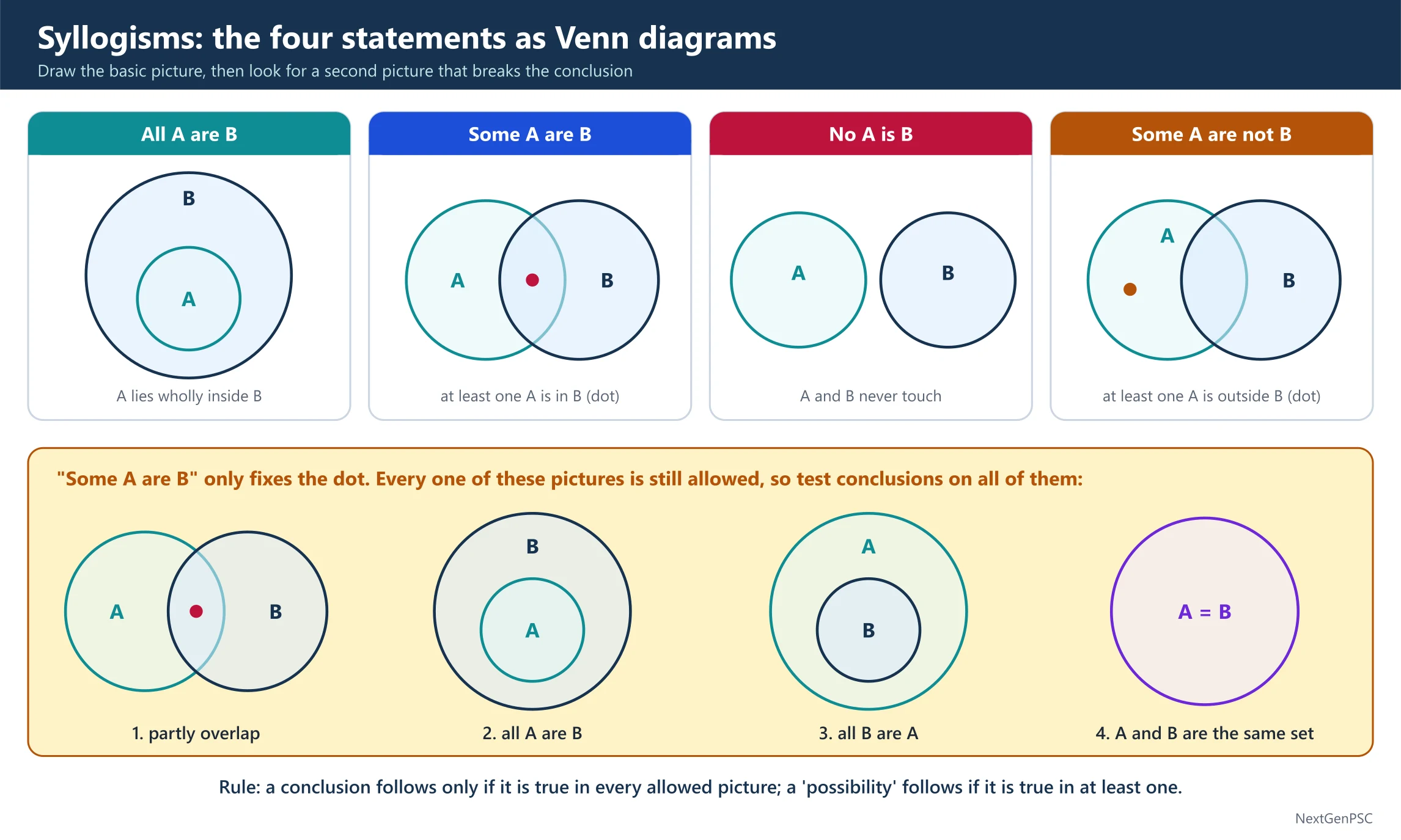
1. What a Syllogism Question Tests
A syllogism question gives statements (premises) about classes of things and asks which conclusions follow. A conclusion follows only if it is true in every situation in which all the statements are true. 'Probably true' or 'true in real life' is not enough.
The instruction usually says: 'Consider the statements to be true even if they seem to be at variance with commonly known facts.' So 'All fish are birds' must be accepted as given.
The answer depends only on the form of the sentences, not on their meaning. Replace the words by letters (pens = A, books = B) and the question becomes a pure picture problem.
2. The Four Standard Statements
All A are B (universal positive): the A circle lies wholly inside the B circle. It allows A and B to be the same set.
No A is B (universal negative): the two circles do not touch at all. It works both ways: No B is A.
Some A are B (particular positive): at least one A is also a B. 'Some' means 'at least one, possibly all'. So 'Some A are B' does not tell you that some A are not B.
Some A are not B (particular negative): at least one A lies outside B. It says nothing about whether any A is inside B.
Other wordings map onto these four: 'Every A is B' and 'Each A is B' = All A are B; 'A few A are B', 'At least some A are B' = Some A are B; 'Not all A are B' = Some A are not B; 'None of the A is B' = No A is B.
Convention used by UPSC-type questions: every term named in a statement has at least one member, so 'All A are B' also gives 'Some A are B'.
3. Conversion: Turning a Statement Around
All A are B ⇒ Some B are A (not 'All B are A'). All mangoes are fruits does not make all fruits mangoes, but at least some fruits are mangoes.
Some A are B ⇒ Some B are A. The overlap is shared, so it can be read from either side.
No A is B ⇒ No B is A. If the circles do not touch, they do not touch from either side.
Some A are not B cannot be turned around. 'Some animals are not dogs' does not give 'Some dogs are not animals'.
Why: conversion is valid only when the overlap (or the gap) that the statement guarantees is still guaranteed after you swap the words. The table below lists the results.
4. The Venn Method in Four Steps
Step 1. Draw the basic picture: put in exactly what each statement demands and nothing more. Keep 'Some' overlaps small and mark the guaranteed member with a dot.
Step 2. Read a conclusion and ask whether it is true in the basic picture. If it is false there, it does not follow; stop.
Step 3. If it is true, try to break it: redraw the circles (move a circle out, shrink an overlap, put one circle inside another) while keeping every statement true. If any such picture makes the conclusion false, it does not follow.
Step 4. A conclusion that survives every redraw follows. In practice the dot is the key: a 'Some' conclusion is safe only if a dot is forced into the region it talks about.
Why: the statements fix only certain regions (empty or occupied); every other region can go either way. A conclusion must hold whichever way the free regions go.
5. Two-Statement Combinations to Know
All + All: All A are B, All B are C ⇒ All A are C (and Some C are A).
All + No: All A are B, No B is C ⇒ No A is C.
Some + All: Some A are B, All B are C ⇒ Some A are C. The dot in A∩B is pushed into C.
Some + No: Some A are B, No B is C ⇒ Some A are not C. The dot in A∩B cannot be in C.
No + All or No + Some (in this order): No A is B with All B are C, or with Some B are C ⇒ Some C are not A (the B's that are C keep away from A). Note the direction: it is C that is 'not A'.
No definite conclusion: All A are B with Some B are C; Some + Some; No + No; All A are B with All C are B. The middle term does not link A and C firmly, so the pair may or may not overlap.
6. Possibility Conclusions
A conclusion worded 'All A being B is a possibility', 'Some A can be B' or 'A may be B' follows if there is at least one picture in which it is true while the statements stay true.
It fails only when the statements forbid it. With No A is B, 'Some A being B is a possibility' fails. With Some A are not B, 'All A being B is a possibility' fails.
Why: a possibility claim is the opposite of a definite claim; you need one example, not all cases.
7. Either-or Pairs
Two conclusions form an either-or pair when neither follows on its own but in every allowed picture exactly one of them is true. The two classic pairs are 'Some A are B' / 'No A is B' and 'All A are B' / 'Some A are not B', with the same two terms.
So when both members of such a pair fail individually, the answer is 'Either I or II follows'. If one of them follows definitely, the pair rule is not used.
Trap: 'Some A are B' and 'Some A are not B' are not an either-or pair; both can be true together.
8. Three Statements and Four Terms
Join the statements along the common terms like a chain: kites → birds → planes → ships. A conclusion between two terms that are not neighbours needs a forced dot that travels along the chain.
Work from the 'Some' statement: the dot it places moves forward through every 'All' and stops at a 'No' (where it creates a 'Some … are not').
Example 1: All + All
- Question
Statements: 1. All pens are books. 2. All books are tables. Conclusions: I. All pens are tables. II. Some tables are pens. (a) Only I follows (b) Only II follows (c) Both I and II follow (d) Neither I nor II follows
- Solution
Normal method. Pens inside books, books inside tables, so pens lie inside tables: I follows in every picture.
Pens exist and are all tables, so at least some tables are pens: II follows (conversion of I).
Shortcut. All + All = All, and every 'All' gives a 'Some' when turned around.
Trap. Option (a) forgets conversion; II is not a new claim, it is I read from the other side.
- Answer
(c) Both I and II follow
Example 2: Some + No
- Question
Statements: 1. Some rivers are lakes. 2. No lake is a pond. Conclusions: I. Some rivers are not ponds. II. No river is a pond. (a) Only I follows (b) Only II follows (c) Both I and II follow (d) Neither I nor II follows
- Solution
Normal method. Put a dot in rivers ∩ lakes. Lakes and ponds do not touch, so the dot is outside ponds: that river is not a pond, so I follows.
For II, redraw: let the ponds circle overlap the part of rivers that is outside lakes. Both statements stay true, but now some river is a pond, so II fails.
Shortcut. Some + No = Some … not (the first term is 'not' the last).
Trap. Option (c) reads 'some are not' as 'none are'. A dot outside ponds does not keep the rest of the rivers away from ponds.
- Answer
(a) Only I follows
Example 3: Middle term not fixed (UPSC-style)
- Question
Consider the following statements and conclusions. Statements: 1. All doctors are graduates. 2. Some graduates are singers. Conclusions: I. Some doctors are singers. II. Some singers are graduates. Which of the above conclusions is/are valid? (a) I only (b) II only (c) Both I and II (d) Neither I nor II
- Solution
Normal method. Draw doctors inside graduates. The singers overlap graduates, but the overlap can lie wholly in the part of graduates that are not doctors.
In that picture no doctor is a singer, so I fails. II is statement 2 turned around (Some + conversion), so it follows.
Shortcut. All A are B + Some B are C gives no A–C conclusion: the 'Some' dot need not land inside A.
Check. A second picture with singers covering the doctors also keeps both statements true; I is true there, which shows I is only possible, not certain.
Trap. Option (c) treats 'possible' as 'certain'. Option (d) forgets that 'Some graduates are singers' can be turned around.
- Answer
(b) II only
Example 4: A possibility conclusion
- Question
Statements: 1. All roses are flowers. 2. Some flowers are red. Conclusions: I. Some roses are red. II. All roses being red is a possibility. (a) Only I follows (b) Only II follows (c) Both I and II follow (d) Neither I nor II follows
- Solution
Normal method. Roses inside flowers; red overlaps flowers. The red part may miss the roses, so I is not certain.
Can the red circle cover all of the roses while the statements stay true? Yes, nothing forbids it. So the possibility in II exists and II follows.
Shortcut. A possibility follows unless a 'No' or a 'Some … not' statement blocks it. Here there is no negative statement at all.
Trap. Option (d) judges II like a definite conclusion. Option (c) accepts I because roses are often red in real life.
- Answer
(b) Only II follows
Example 5: An either-or pair
- Question
Statements: 1. All cups are plates. 2. Some plates are spoons. Conclusions: I. Some cups are spoons. II. No cup is a spoon. (a) Only I follows (b) Only II follows (c) Either I or II follows (d) Neither I nor II follows
- Solution
Normal method. Cups inside plates; spoons overlap plates. The spoons may or may not reach the cups, so I is not certain, and II is not certain either.
But I and II are about the same two terms, cups and spoons, and they cannot both be true or both be false: either at least one cup is a spoon, or none is.
Shortcut. Neither follows + same two terms + one 'Some' and one 'No' ⇒ Either I or II.
Trap. Option (d) is what you get if you stop after testing each conclusion alone.
- Answer
(c) Either I or II follows
Example 6: Three statements, four terms (UPSC-style)
- Question
Statements: 1. Some kites are birds. 2. All birds are planes. 3. No plane is a ship. Conclusions: I. Some kites are not ships. II. No bird is a ship. III. Some ships are kites. Which of the conclusions follow? (a) I and II only (b) II and III only (c) I and III only (d) I, II and III
- Solution
Normal method. Start from the only 'Some': a dot in kites ∩ birds. Birds lie inside planes, so the dot is a plane; planes and ships do not touch, so the dot is not a ship. Hence some kite is not a ship: I follows.
All birds are planes and no plane is a ship, so no bird is a ship (All + No = No): II follows.
For III, draw the ships circle away from the kites. Every statement stays true but no ship is a kite, so III fails. It is only a possibility.
Shortcut. Carry the dot: Some (kites, birds) → All (birds, planes) → No (planes, ships) gives Some kites are not ships.
Trap. Option (d) accepts III because the kites outside the planes 'could' be ships; could is not must.
- Answer
(a) I and II only
Practice Questions
Q1. Statements: 1. All lions are cats. 2. No cat is a dog. Conclusions: I. No lion is a dog. II. Some dogs are lions. (a) Only I follows (b) Only II follows (c) Both I and II follow (d) Neither I nor II follows
Q2. Statements: 1. Some apples are mangoes. 2. Some mangoes are grapes. Conclusions: I. Some apples are grapes. II. No apple is a grape. (a) Only I follows (b) Only II follows (c) Either I or II follows (d) Neither I nor II follows
Q3. Statements: 1. All chairs are sofas. 2. All sofas are beds. Conclusions: I. All beds are chairs. II. Some beds are chairs. (a) Only I follows (b) Only II follows (c) Both I and II follow (d) Neither I nor II follows
Q4. Statements: 1. No pencil is an eraser. 2. Some erasers are sharpeners. Conclusions: I. Some sharpeners are not pencils. II. Some pencils are sharpeners. (a) Only I follows (b) Only II follows (c) Both I and II follow (d) Neither I nor II follows
Q5. Statements: 1. All engineers are graduates. 2. Some graduates are not artists. Conclusions: I. Some engineers are not artists. II. All engineers being artists is a possibility. (a) Only I follows (b) Only II follows (c) Both I and II follow (d) Neither I nor II follows
Q6. Statements: 1. Some coins are notes. 2. All notes are cards. 3. No card is a cheque. Conclusions: I. Some coins are cards. II. Some coins are not cheques. III. All cheques being coins is a possibility. (a) I only (b) I and II only (c) II and III only (d) I, II and III
Answers
Show answers
Q1. (a) Only I follows. All + No = No, so no lion is a dog; II contradicts I.
Q2. (c) Either I or II follows. Some + Some gives nothing definite, but I and II are a Some/No pair on the same two terms.
Q3. (b) Only II follows. Chairs inside beds: some beds are chairs, but beds may be much bigger than chairs.
Q4. (a) Only I follows. The erasers that are sharpeners can never be pencils (No + Some ⇒ Some C are not A); II is only possible.
Q5. (b) Only II follows. The graduates that are not artists may all lie outside the engineers, so I is not certain and the engineers may all be artists.
Q6. (d) I, II and III. The dot in coins ∩ notes is a card and so not a cheque (I, II); cheques may sit in the part of coins outside cards (III).
| Statement 1 | Statement 2 | Definite conclusion |
|---|---|---|
| All A are B | All B are C | All A are C; Some C are A |
| All A are B | No B is C | No A is C |
| Some A are B | All B are C | Some A are C |
| Some A are B | No B is C | Some A are not C |
| No A is B | All B are C | Some C are not A |
| No A is B | Some B are C | Some C are not A |
| All A are B | Some B are C | None between A and C |
| Some A are B | Some B are C | None between A and C |
| No A is B | No B is C | None between A and C |
| Statement | Can be turned into | Possibility that it blocks |
|---|---|---|
| All A are B | Some B are A | Some A being not B |
| Some A are B | Some B are A | No A being B |
| No A is B | No B is A | Some A being B |
| Some A are not B | nothing | All A being B |
Prelims tips
- Ignore the real world. 'All fish are birds' is true for the question. The common trap is an option that is true in real life (roses are red) but not forced by the statements.
- A conclusion must survive every picture. After the basic diagram, spend five seconds trying to break the conclusion by moving one circle. If it breaks, reject it; this one habit removes most wrong options.
- Follow the dot. Only a 'Some' statement creates a guaranteed member. Carry that dot through 'All' links; a 'No' link turns it into 'Some … are not'. With no 'Some' and no conversion, a 'Some' conclusion needs an 'All' to start from.
- Convert before you reject. 'All A are B' gives 'Some B are A'; 'Some A are B' gives 'Some B are A'; 'No A is B' gives 'No B is A'. Many conclusions that look new are only a statement read backwards.
- Possibility is the easy half. A 'can be / is a possibility' conclusion follows unless a negative statement (No, Some … not) or an 'All' blocks it. Check only for a blocker.
- Look for the either-or pair last. When two conclusions on the same two terms both fail and one is 'Some' while the other is 'No' (or 'All' against 'Some … not'), the answer is 'Either I or II'. Never pair 'Some' with 'Some … not'.
Analogy
In short
An analogy question gives a pair that is linked by a rule (Pen : Writer, 3 : 28, ACE : FHJ) and asks you to find the item that completes a second pair by the same rule. In CSAT it usually appears as a number or letter pattern rather than as a vocabulary test, and the same skill runs through coding-decoding, series and odd-one-out questions. Three ideas unlock it: name the relationship in one exact sentence, test the rule on every given pair, and check the options against that rule, not against your first guess.
In simple words
An analogy is a 'same relationship' question. 'Pen is to Writer as Scalpel is to ___' simply asks: what is the link between pen and writer, and who has the same link with a scalpel? A writer uses a pen to work, so the answer is the person who uses a scalpel to work: a surgeon.
Think of it like a family photo. If you know that Ravi is Mohan's son, and someone shows you Sunita and asks 'who is to Sunita what Ravi is to Mohan?', you look for Sunita's son. The link stays the same; only the people change.
Number and letter analogies work the same way. In 3 : 9, the second number may be 3 × 3, or 3 + 6, or 3 × 3 + 0. One pair often allows more than one rule, so the question usually gives you two or three pairs, or the options decide which rule is meant.
The one question to always ask is: 'What exactly does the first item do to become the second?' Say it as a full sentence, such as 'every letter moves 5 places forward' or 'the number is cubed and 1 is added'.
Two habits solve most questions: (1) write the alphabet positions (A = 1, B = 2 … Z = 26) on your rough sheet once at the start of the paper; (2) after you find a rule, test it on every pair given, and only then apply it to the question.
1. What an Analogy Question Tests
The form is A : B :: C : ?, read as 'A is to B as C is to what?'. The single colon joins the items of one pair; the double colon says 'in the same way as'.
The question tests one skill: abstracting a relationship from one pair and carrying it, unchanged, to another. It is not a test of difficult words; CSAT pairs use everyday words, numbers and letters.
Analogies come in four forms: (1) word analogy (Doctor : Hospital :: Teacher : ?); (2) letter analogy (ACE : FHJ :: BDF : ?); (3) number analogy (3 : 28 :: 5 : ?); (4) choose the pair, where you pick the option pair that has the same link as a given pair. A close cousin is odd one out (classification): three items share a link and one does not.
Direction matters. Pen : Writer is tool : user. Writer : Pen is user : tool. If the question pair runs tool → user, the answer pair must also run tool → user. Reversed pairs are a favourite wrong option.
2. Word Analogies: the Relationship Types
Most word pairs fall into a small set of relationship types (see the table). Learn to name the type quickly.
Tool : User (Scalpel : Surgeon) and Worker : Workplace (Teacher : School). Worker : Product (Author : Book, Potter : Pot).
Part : Whole (Petal : Flower, Page : Book) and Member : Group (Soldier : Army, Lion : Pride, Fish : School).
Cause : Effect (Virus : Disease, Drought : Famine) and Raw material : Product (Cotton : Cloth, Clay : Brick).
Degree or intensity (Warm : Hot, Drizzle : Downpour, Like : Love). The second word is the stronger form of the same thing.
Young one : Adult (Caterpillar : Butterfly, Tadpole : Frog, Calf : Cow). Animal : Home (Bee : Hive, Lion : Den).
Instrument : What it measures (Thermometer : Temperature, Seismograph : Earthquakes, Anemometer : Wind speed). Synonym (Brave : Courageous) and antonym (Scarce : Abundant).
Make the bridge sentence. Put the link into a sentence that is as tight as possible: not 'a pen is related to a writer' but 'a writer uses a pen as the main tool of the job'. Then test each option in the same sentence.
Why: a loose sentence fits several options (a scalpel is 'related to' a hospital, a patient and a surgeon); a tight sentence fits only one.
3. Letter Analogies
Write each letter as its position: A = 1 … Z = 26. The reverse position of a letter is 27 − n (A ↔ Z, B ↔ Y … M ↔ N); such letters are called opposite letters.
Memory hook EJOTY: E = 5, J = 10, O = 15, T = 20, Y = 25. Any letter is at most two steps from one of these anchors (R = 20 − 2 = 18).
Common letter rules: every letter shifts by the same number (+5); the shift grows letter by letter (+1, +2, +3 …); the word is reversed; each letter is replaced by its opposite; letters are swapped in pairs.
Wrap around: after Z comes A again. Y + 3 = B, because 25 + 3 = 28 and 28 − 26 = 2.
Test shifts letter by letter. ACE : FHJ — A → F is +5, C → H is +5, E → J is +5. Only after all three agree is the rule '+5 to every letter' safe.
Why: a rule that fits only the first letter is the most common source of wrong options.
4. Number Analogies
Check the usual suspects in this order: square (n²), cube (n³), square or cube ± a small number (n² + 1, n³ − 1), n(n + 1) or n(n − 1), a multiple (k × n), and digit operations (sum or product of digits).
Squares to know: 11² = 121 … 20² = 400, 25² = 625. Cubes to know: 2³ = 8, 3³ = 27, 4³ = 64, 5³ = 125, 6³ = 216, 7³ = 343, 8³ = 512, 9³ = 729, 10³ = 1000.
Look near a power. If the second number is close to a square or a cube of the first, the rule is almost always 'power ± small number'. 7 : 50 → 49 + 1; 4 : 63 → 64 − 1.
One pair is not enough. 7 : 50 fits both 7² + 1 and 7 × 7 + 1 (= 7n + 1). The two rules agree only for n = 7. When one pair allows two rules, let the options or the other pairs decide.
Why: with two or three pairs, only one simple rule usually survives; with one pair, use the options as the test.
5. Choose the Pair and Odd One Out
In 'choose the pair' questions, find the rule in the given pair, then apply it to the first item of each option and see whether you get the second item. Exactly one option should pass.
In odd-one-out questions, find the rule that three items share and the one item that breaks it. If two different rules each exclude a different item, look for the stronger, more specific rule.
Option-first check: UPSC options are often built from near-miss rules (n² − 1 instead of n² + 1; Bee : Hive instead of Bee : Swarm). Testing each option against your exact rule is faster than finding the answer and then hoping it is listed.
Example 1: Tool and user
- Question
Pen : Writer :: Scalpel : ? (a) Hospital (b) Surgeon (c) Patient (d) Knife
- Solution
Normal method. Bridge sentence: 'a writer uses a pen as the main tool of the job'. The relationship is tool : user.
Test each option in the same sentence: 'a ___ uses a scalpel as the main tool of the job'. Only a surgeon fits.
Shortcut. Name the type (tool : user) and scan the options for the only person who uses the tool.
Trap. Hospital is a workplace, a patient is the person worked on, and a knife is the same kind of object as a scalpel; each is 'related' but not by the tool : user link.
- Answer
(b) Surgeon
Example 2: Degree of intensity
- Question
Warm : Hot :: Drizzle : ? (a) Rain (b) Cloud (c) Downpour (d) Umbrella
- Solution
Normal method. Hot is a stronger degree of warm; both describe temperature. The link is 'milder form : stronger form of the same thing'.
Drizzle is a mild form of rain. Its strong form is a downpour.
Shortcut. In degree pairs the answer is the same kind of thing at the other end of the scale.
Trap. Rain is the general category (it would match Warm : Temperature, not Warm : Hot); a cloud is the source; an umbrella is protection.
- Answer
(c) Downpour
Example 3: Letter shift
- Question
ACE : FHJ :: BDF : ? (a) GIK (b) GHK (c) HJL (d) GIL
- Solution
Normal method. Positions: A = 1, C = 3, E = 5 and F = 6, H = 8, J = 10. Each letter moves 5 places forward.
Apply +5 to BDF: B (2) → G (7), D (4) → I (9), F (6) → K (11). The answer is GIK.
Shortcut. Check only the first and last letters against the options: B + 5 = G removes (c); F + 5 = K removes (d). Then D + 5 = I removes (b).
Trap. GHK shifts the middle letter by 4; HJL shifts every letter by 6; GIL shifts the last letter by 6.
- Answer
(a) GIK
Example 4: Number pattern with three pairs (UPSC-style)
- Question
The numbers follow one rule: 2 → 9, 3 → 28, 4 → 65. By the same rule, 6 → ? (a) 216 (b) 217 (c) 215 (d) 218
- Solution
Normal method. The outputs are close to cubes: 2³ = 8, 3³ = 27, 4³ = 64. Each output is one more than the cube.
Rule: n³ + 1. Test it on all three pairs: 8 + 1 = 9, 27 + 1 = 28, 64 + 1 = 65. It fits every pair.
For 6: 6³ + 1 = 216 + 1 = 217.
Shortcut. When the outputs grow very fast, compare them with cubes first.
Check. A brute-force search of every rule of the form an³ + bn² + cn + d with small whole coefficients that fits all three pairs gives only n³ + 1, so 217 is the only defensible answer.
Trap. 216 forgets the +1; 215 uses n³ − 1; 218 adds 2.
- Answer
(b) 217
Example 5: Choose the pair (UPSC-style)
- Question
Which pair has the same relationship as 7 : 50? (a) 5 : 24 (b) 9 : 82 (c) 6 : 35 (d) 8 : 63
- Solution
Normal method. 50 = 49 + 1 = 7² + 1. (It also equals 7 × 7 + 1, i.e. 7n + 1 for n = 7.)
Test n² + 1 on each option: 5² + 1 = 26 (not 24); 9² + 1 = 82 (fits); 6² + 1 = 37 (not 35); 8² + 1 = 65 (not 63).
Test the other reading 7n + 1 as well: 36, 64, 43, 57. None of the options fits it, so the options themselves settle the rule.
Shortcut. The three wrong options all follow n² − 1. When three options share one rule and one option follows the given pair's rule, that one is the answer.
Trap. A student who sees '49 and 50 are near each other' but does not check the sign picks any of the n² − 1 pairs.
- Answer
(b) 9 : 82
Example 6: Reverse and shift (UPSC-style)
- Question
FORM : NSPG :: CART : ? (a) USBD (b) DBSU (c) USBC (d) TSAC
- Solution
Normal method. Compare letter by letter: F → N, O → S, R → P, M → G gives no single shift (+8, +4, −2, −6). So try reversing first.
FORM reversed is MROF. Now M → N, R → S, O → P, F → G: every letter moves +1. Rule: reverse the word, then shift each letter one place forward.
CART reversed is TRAC. T → U, R → S, A → B, C → D gives USBD.
Shortcut. If the code's last letter is next to the word's first letter (F → G), suspect 'reverse + shift'.
Check. A brute-force search over reverse / opposite-letter / constant and growing shifts finds only 'reverse + 1' for FORM : NSPG, and it gives USBD.
Trap. DBSU applies the shift but forgets to reverse; USBC forgets to shift the last letter; TSAC reverses but shifts only one letter.
- Answer
(a) USBD
Practice Questions
Q1. Caterpillar : Butterfly :: Tadpole : ? (a) Fish (b) Frog (c) Pond (d) Egg
Q2. BCD : EFG :: KLM : ? (a) MNO (b) NOP (c) OPQ (d) NPQ
Q3. One rule links 6 → 49 and 9 → 100. By the same rule, 11 → ? (a) 121 (b) 132 (c) 144 (d) 143
Q4. Three pairs share a relationship. Which pair is the odd one out? (a) Lion : Pride (b) Fish : School (c) Cow : Herd (d) Bee : Hive
Q5. STOP : POTS :: WARD : ? (a) DRWA (b) WDRA (c) DARW (d) DRAW
Q6. One rule links 3 → 26, 4 → 63 and 5 → 124. By the same rule, 6 → ? (a) 216 (b) 217 (c) 215 (d) 214
Answers
Show answers
Q1. (b) Frog. Young one : adult form; a tadpole grows into a frog.
Q2. (b) NOP. Each letter moves 3 places forward: K → N, L → O, M → P.
Q3. (c) 144. (n + 1)²: 7² = 49, 10² = 100, so 12² = 144.
Q4. (d) Bee : Hive. The others are animal : its group; a hive is the bee's home (the group is a swarm).
Q5. (d) DRAW. The word is written backwards: WARD reversed is DRAW.
Q6. (c) 215. n³ − 1: 27 − 1 = 26, 64 − 1 = 63, 125 − 1 = 124, so 216 − 1 = 215.
| Relationship | Example pair | Bridge sentence |
|---|---|---|
| Tool : User | Scalpel : Surgeon | A surgeon works with a scalpel |
| Worker : Product | Potter : Pot | A potter makes pots |
| Part : Whole | Petal : Flower | A petal is one part of a flower |
| Member : Group | Fish : School | A group of fish is a school |
| Cause : Effect | Drought : Famine | A drought can cause a famine |
| Raw material : Product | Cotton : Cloth | Cloth is made from cotton |
| Degree | Warm : Hot | Hot is a stronger degree of warm |
| Young : Adult | Tadpole : Frog | A tadpole grows into a frog |
| Animal : Home | Bee : Hive | A bee lives in a hive |
| Instrument : Measures | Anemometer : Wind speed | An anemometer measures wind speed |
| Rule | How to spot it | Quick example |
|---|---|---|
| n² ± k | Output just above or below a square | 7 : 50 (49 + 1) |
| n³ ± k | Output grows very fast, near a cube | 4 : 63 (64 − 1) |
| (n + 1)² | Outputs are squares of the next number | 6 : 49, 9 : 100 |
| Constant letter shift | Same gap for every letter | ACE : FHJ (+5) |
| Reverse, then shift | Code's last letter is near the word's first | FORM : NSPG |
| Opposite letters | Each pair of positions adds to 27 | GOLD : TLOW |
Prelims tips
- Make a tight bridge sentence. 'Is related to' fits every option. 'Works with', 'grows into', 'is a stronger form of' fits only one. The wrong options are built to fit a loose sentence.
- Keep the direction of the pair. If the given pair is tool → user, an option written user → tool is wrong even though the words are right. Check the order before you mark.
- Test the rule on every pair. A letter rule that fits only the first letter, or a number rule that fits only one of three pairs, is the trap. Two extra seconds of checking saves a 0.83-mark penalty.
- Near a power, check the sign. 7 : 50 is n² + 1; options built on n² − 1 (24, 35, 63) look almost right. Write the square or cube on the rough sheet and compare digit by digit.
- Write the alphabet once. A = 1 … Z = 26 with EJOTY (5, 10, 15, 20, 25) and the opposite pairs (A–Z, B–Y … M–N) on the rough sheet saves time in analogy, coding and series questions alike.
- When one pair allows two rules, let the options decide. Apply each candidate rule to the options. If only one option fits any of the rules, mark it; if two do, look for the stronger, simpler rule.
Ranking and Ordering
In short
Ranking and ordering questions place people or things in a line: ranks in a class, positions in a queue or a row, or an order of heights, ages, marks or salaries built from comparisons ('B is taller than D but shorter than A'). CSAT usually asks one or two such questions, sometimes inside a longer puzzle. Three ideas unlock them: total = position from one end + position from the other end − 1, draw the line and mark every given position on it, and for comparisons turn every clue into a chain with '>' signs, then ask what is fixed and what can still move.
In simple words
Imagine 10 children standing in a queue for ice cream. Riya is 4th from the front. How far is she from the back? Count it: there are 3 children ahead of her and 6 behind her, so she is 7th from the back. That is the whole idea: positions from the two ends always add up to the total plus 1 (4 + 7 = 11 = 10 + 1).
Why plus 1? Because Riya is counted twice: once when you count from the front and once when you count from the back.
Order questions are like arranging books by height on a shelf. If you are told 'the blue book is taller than the red one, and the red one is taller than the green one', you can line them up: blue > red > green. Each new clue adds one more book to the line.
The one question to always ask is: 'Is this position fixed, or can it still move?' Many questions are built so that some positions are fixed and one or two can swap. The answer 'cannot be determined' is right only when something can really still move.
Two habits solve most questions: (1) always draw a small line and write the numbers on it instead of doing everything in your head; (2) in comparison questions, write every clue as A > B before you try to answer.
1. Positions in a Line
A rank or position is a count from one end of a line: from the top or bottom of a class list, from the left or right of a row, from the front or back of a queue. Unless the question says otherwise, assume no two people share a rank.
Basic relation: if a person is p-th from one end and q-th from the other end, then the total number in the line is N = p + q − 1. A student 14th from the top and 23rd from the bottom is in a class of 14 + 23 − 1 = 36.
From the other end: q = N − p + 1. In a class of 45, the student 17th from the top is 45 − 17 + 1 = 29th from the bottom.
People ahead and behind: a person p-th from the front has p − 1 people ahead and N − p people behind.
Why: count the person once from each side. The p people up to and including the person, plus the q people up to and including the person, count that person twice, so subtract 1.
Ranks below or above: 'Mohan is 8 ranks below Ravi' means Mohan's rank from the top = Ravi's rank + 8. From the bottom it is Ravi's bottom rank − 8.
2. People Between Two Persons
Both positions counted from the same end: if A is a-th and B is b-th from the left, the number of people between them is |a − b| − 1.
Positions counted from opposite ends: A is a-th from the left and B is b-th from the right in a row of N. First convert B to the left: B = N − b + 1. Then use |a − b'| − 1.
Formula form: if a + b ≤ N (no overlap), the number between = N − (a + b). If a + b > N (the counts overlap, so B is to the left of A), the number between = a + b − N − 2.
Why: when a + b > N, the two counts cross each other; the overlap holds both persons and everyone between them.
Example: 40 in a row, A 12th from the left, B 18th from the right: 12 + 18 = 30 ≤ 40, so 40 − 30 = 10 between. Example with overlap: 25 in a row, P 10th from the left, Q 20th from the right: 30 > 25, so 30 − 25 − 2 = 3 between.
3. Interchange Questions
If A and B swap places, A simply moves into B's old seat. So A's new position from the left = B's old position from the left, and A's new position from the right = B's old position from the right.
Typical question: A is 10th from the left and B is 15th from the right. After they interchange, A is 22nd from the left. A is now in B's old place, so B's old place is 22nd from the left and 15th from the right: N = 22 + 15 − 1 = 36.
Shift idea: if A moves from a-th to a'-th from the left, B moves by the same number of places the other way. A moves 22 − 10 = 12 places right, so B moves 12 places left.
4. Minimum and Maximum Questions
When a question does not say who is ahead, there are two cases: A ahead of B, or B ahead of A. If it asks for the minimum (or maximum) number in the line, work out both cases and choose.
Case 'no overlap': N = a + (people between) + b. Case 'overlap': the two counts share people, so N is smaller. Always check that every position in the overlap case is at least 1.
Why: UPSC usually gives an option for each case. The option from the case you forgot is the trap.
5. Ordering from Comparisons
Clues such as 'B is taller than D but shorter than A' compare two people at a time. Convert each into symbols: A > B > D. Join chains that share a person.
Build from the strongest clue. Start with a clue that names the tallest, the shortest or a fixed rank, then add the others around it.
Fixed and floating persons: a person compared with only one other may 'float' to several places. In A > B and A > C, both B and C are below A, but the order of B and C is not known.
Who can be determined? After the chain is drawn, list every position and the persons who can stand there. A position with exactly one possible person is determined; a position with two or more is not.
Brute-force check: with five or six people there are 5! = 120 or 6! = 720 possible orders, too many to write out, but the idea guides you: an answer is safe only if it holds in every order that satisfies all the clues.
6. Ranking Inside Other Puzzles
Ranking also appears as days of a week (lectures Monday to Saturday), floors of a building (ground floor = 1), or finishing order in a race. The same rules apply: fix what is given, mark the line, and list the open slots.
Floors: in a five-storey building numbered 1 (bottom) to 5 (top), 'X lives two floors above Y' means floor(X) = floor(Y) + 2. Check that it stays between 1 and 5.
Example 1: Total from both ends
- Question
In a class, Meena is 14th from the top and 23rd from the bottom. How many students are there in the class? (a) 37 (b) 36 (c) 35 (d) 38
- Solution
Normal method. 13 students are above Meena and 22 are below her. Total = 13 + 1 + 22 = 36.
Shortcut. N = p + q − 1 = 14 + 23 − 1 = 36.
Check. In a class of 36, the student 14th from the top is 36 − 14 + 1 = 23rd from the bottom.
Trap. 37 adds the two ranks and counts Meena twice; 35 subtracts 2.
- Answer
(b) 36
Example 2: How many between
- Question
In a row of 40 children facing North, Anu is 12th from the left end and Babita is 18th from the right end. How many children sit between Anu and Babita? (a) 11 (b) 9 (c) 10 (d) 12
- Solution
Normal method. Convert Babita's position to the left: 40 − 18 + 1 = 23rd from the left.
Anu is 12th from the left, so the children between them are at positions 13 to 22: that is 22 − 13 + 1 = 10 children.
Shortcut. 12 + 18 = 30 ≤ 40, so the number between = 40 − 30 = 10.
Trap. 11 = 23 − 12 (forgetting to subtract 1); 12 = 30 − 18 confuses the counts; 9 subtracts one extra.
- Answer
(c) 10
Example 3: Interchange
- Question
In a row, Amit is 10th from the left and Bharat is 15th from the right. When they interchange their positions, Amit becomes 22nd from the left. How many persons are there in the row? (a) 37 (b) 35 (c) 36 (d) 32
- Solution
Normal method. After the swap, Amit stands where Bharat stood. So Bharat's old place is 22nd from the left.
That same place is 15th from the right (Bharat's old position from the right). Total = 22 + 15 − 1 = 36.
Shortcut. New position of one person + old position of the other from the opposite end − 1.
Check. In a row of 36, the 22nd from the left is 36 − 22 + 1 = 15th from the right.
Trap. 32 = 22 + 10 adds Amit's new and old places; 37 forgets the − 1; 35 subtracts 2.
- Answer
(c) 36
Example 4: Order from comparisons (UPSC-style)
- Question
Five students P, Q, R, S and T scored different marks in a test. Q scored more than R but less than T. P scored less than S but more than T. Who scored the second highest marks? (a) T (b) S (c) Q (d) P
- Solution
Normal method. Clue 1: T > Q > R. Clue 2: S > P > T.
Join the chains at T: S > P > T > Q > R. Every position is fixed.
Highest S, second P, third T, fourth Q, lowest R.
Shortcut. Write each 'but' clue as one three-person chain, then join the chains at the common name.
Check. Testing all 120 orders of the five students leaves exactly one order, S P T Q R.
Trap. S is the highest, not the second highest; T is the middle of the first clue but only third overall.
- Answer
(d) P
Example 5: Minimum number in a queue (UPSC-style)
- Question
In a queue, Xavier is 15th from the front and Yamini is 20th from the back. There are exactly 6 persons between them. What is the minimum possible number of persons in the queue? (a) 41 (b) 29 (c) 27 (d) 33
- Solution
Normal method. Case 1: Xavier is ahead of Yamini. Yamini is 15 + 6 + 1 = 22nd from the front, and 20th from the back, so N = 22 + 20 − 1 = 41.
Case 2: Yamini is ahead of Xavier. Yamini is 15 − 6 − 1 = 8th from the front, and 20th from the back, so N = 8 + 20 − 1 = 27.
Both cases are possible, so the minimum is 27.
Shortcut. Minimum (overlap case) = (person-from-back rank) + (person-from-front rank) − (gap + 1) − 1 = 20 + 15 − 7 − 1 = 27.
Check. In a queue of 27, Yamini is 27 − 20 + 1 = 8th from the front, and between 8th and 15th there are 6 persons.
Trap. 41 is the answer when you consider only the first case; it is the maximum, not the minimum.
- Answer
(c) 27
Example 6: What cannot be determined (UPSC-style)
- Question
Six buildings A, B, C, D, E and F have different heights. F is the tallest. A is taller than both B and C. C is taller than D, and D is taller than E. B is also taller than D. Which one of the following cannot be determined? (a) The second tallest building (b) The third tallest building (c) The fifth tallest building (d) The shortest building
- Solution
Normal method. F is first. A is above B and C, and both B and C are above D, which is above E. So A is above everyone except F: A is second.
D is below B and C and above E, so D is fifth and E is sixth.
B and C fill the third and fourth places, but no clue compares B with C. So the third tallest may be B or C.
Shortcut. Find the pair that is never compared directly or through a chain; the places they share are the undetermined ones.
Check. Testing all 720 orders leaves exactly two: F A B C D E and F A C B D E. They differ only in the third and fourth places.
Trap. 'The shortest' looks open because E is mentioned last, but D > E fixes E at the bottom.
- Answer
(b) The third tallest building
Practice Questions
Q1. In a class of 45 students, Rohit is 17th from the top. What is his rank from the bottom? (a) 28th (b) 29th (c) 30th (d) 27th
Q2. Sita is 9th from the left end and 14th from the right end of a row of girls. How many girls are in the row? (a) 23 (b) 21 (c) 22 (d) 24
Q3. In a row, Asha is 7th from the left and Deepa is 9th from the right. Asha is to the left of Deepa and there are 4 persons between them. How many persons are in the row? (a) 21 (b) 19 (c) 22 (d) 20
Q4. Among A, B, C, D and E, A is heavier than B; B is heavier than both C and D; E is heavier than A; C is lighter than D. Who is the lightest? (a) D (b) B (c) E (d) C
Q5. In a row of 25 persons, P is 10th from the left and Q is 20th from the right. How many persons are there between P and Q? (a) 3 (b) 4 (c) 5 (d) 2
Q6. In a class of 40 students, Kiran is 11th from the top and Lata is 4 ranks below Kiran. What is Lata's rank from the bottom? (a) 25th (b) 27th (c) 26th (d) 30th
Answers
Show answers
Q1. (b) 29th. 45 − 17 + 1 = 29.
Q2. (c) 22. 9 + 14 − 1 = 22.
Q3. (d) 20. Deepa is 7 + 4 + 1 = 12th from the left; N = 12 + 9 − 1 = 20.
Q4. (d) C. E > A > B > D > C.
Q5. (a) 3. 10 + 20 = 30 > 25, so 30 − 25 − 2 = 3 (Q is 6th from the left; persons 7th, 8th and 9th are between).
Q6. (c) 26th. Lata is 11 + 4 = 15th from the top; 40 − 15 + 1 = 26.
| Situation | Formula / shortcut | Quick example |
|---|---|---|
| p-th from one end, q-th from the other | N = p + q − 1 | 14th and 23rd ⇒ 36 |
| Position from the other end | q = N − p + 1 | N = 45, p = 17 ⇒ 29 |
| Between two persons, same end | |a − b| − 1 | 12th and 23rd ⇒ 10 |
| Opposite ends, a + b ≤ N | N − (a + b) | 40; 12 and 18 ⇒ 10 |
| Opposite ends, a + b > N (overlap) | a + b − N − 2 | 25; 10 and 20 ⇒ 3 |
| After interchange | N = new place of one + old place of the other from the opposite end − 1 | 22 + 15 − 1 = 36 |
| Gap given, side unknown | Work out both cases; minimum is the overlap case | 41 or 27 ⇒ minimum 27 |
Prelims tips
- Subtract 1 for the person counted twice. N = p + q − 1 and q = N − p + 1. The wrong options are almost always the answer ± 1 or ± 2, so a careless count costs a full penalty.
- Convert both positions to the same end. Before counting people between two persons, turn the right-end rank into a left-end rank. If a + b > N, the counts overlap and the formula changes to a + b − N − 2.
- In interchange questions, follow the seat, not the person. After a swap, A sits in B's old seat; that seat's two ranks give the total directly.
- When the side is not given, solve both cases. 'Minimum' or 'maximum' in the question is a signal that two arrangements exist. The option from the other case is always present as a trap.
- Write comparisons as chains. 'B is taller than D but shorter than A' becomes A > B > D. Join chains at the common person; an unchained pair is what makes 'cannot be determined' true.
- Mark 'cannot be determined' only after listing the open places. If every place has exactly one possible person, the answer is determined even if it took several steps to see it.
Direction Sense
In short
Direction sense questions describe a walk or a set of turns and ask where a person ends up, how far they are from the start, which way they are facing, or which way a shadow falls. CSAT usually carries one such question, and the same skill appears inside seating and map-like puzzles. Three ideas unlock it: draw every leg on a rough sketch with North up, a right turn is 90° clockwise and a left turn is 90° anticlockwise from the way you are facing, and the final distance comes from Pythagoras (3-4-5, 5-12-13, 8-15-17 are the usual triples).
In simple words
Hold a map in front of you: North is up, South is down, East is to the right and West is to the left. Every direction question can be drawn on such a map, so never try to solve one in your head.
'Turn right' and 'turn left' depend on the way you are facing, not on the map. If you walk towards North and turn right, you now face East. If you walk towards South and turn right, you now face West. That is why you must remember your facing direction after every turn.
Everyday example: you leave home, walk 3 km East to the bus stop, then 4 km North to school. How far is school from home in a straight line? The path makes a right angle, so the straight distance is √(3² + 4²) = √25 = 5 km, and school is North-East of home.
The one question to always ask is: 'Which way am I facing right now?' Write it next to each leg of your sketch: N, then E, then S, and so on.
Two habits solve most questions: (1) draw the path leg by leg with North up and mark the start with a dot; (2) for the final answer, add up all the East–West movement and all the North–South movement separately, then use Pythagoras.
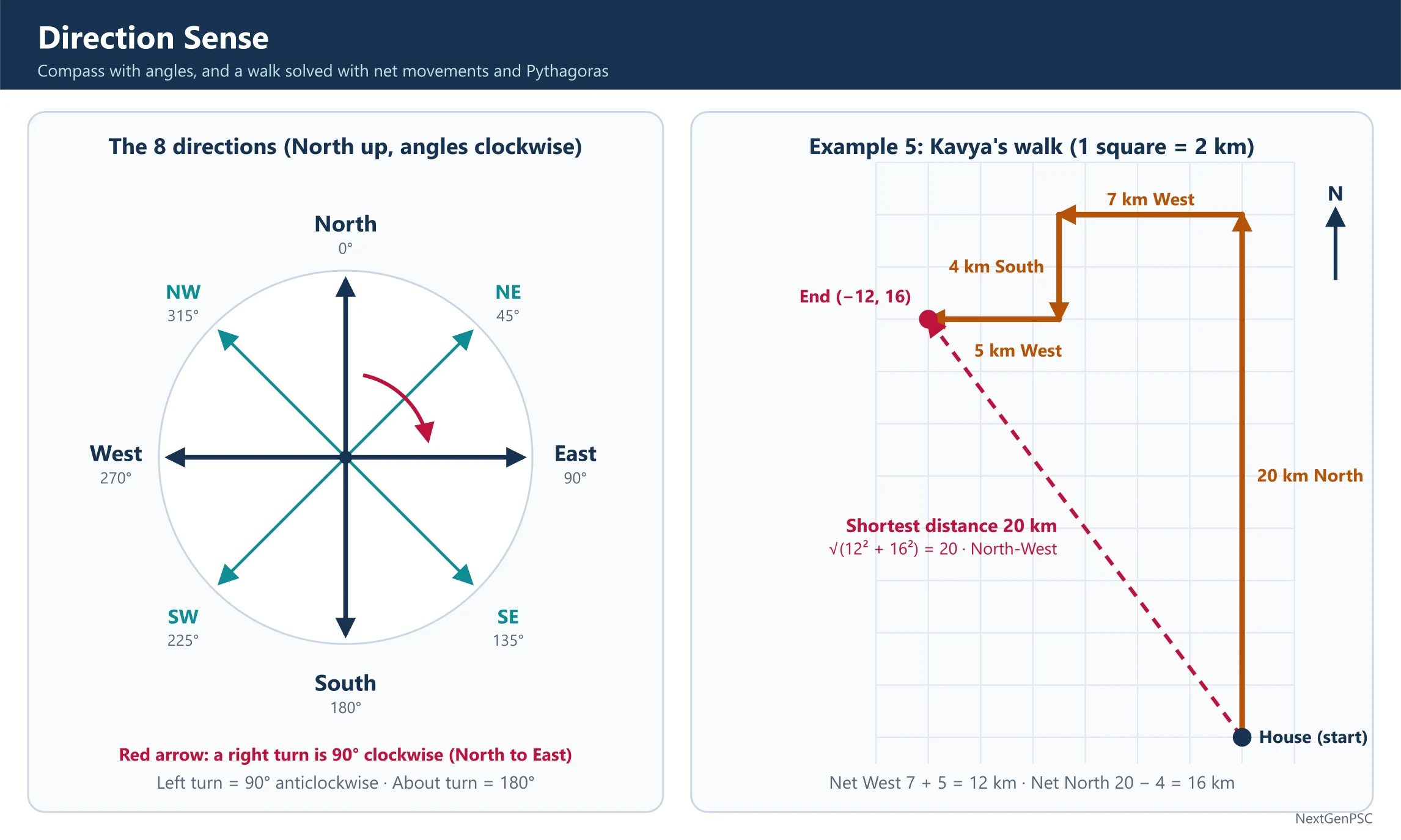
1. The Eight Directions
The four main directions are North (N), East (E), South (S) and West (W). Going clockwise from North they are 90° apart: N 0°, E 90°, S 180°, W 270°.
The four intermediate directions lie halfway between them: North-East (45°), South-East (135°), South-West (225°) and North-West (315°). See the compass in the diagram.
Opposite pairs: N–S, E–W, NE–SW, NW–SE. Any direction and its opposite are 180° apart.
On paper, always keep North at the top. Then East is to the right, West to the left and South at the bottom.
2. Turning Right and Left
A right turn is a 90° turn clockwise from the direction you face; a left turn is 90° anticlockwise. 'About turn' or 'turns back' is 180°.
Facing N: right → E, left → W. Facing E: right → S, left → N. Facing S: right → W, left → E. Facing W: right → N, left → S.
Why: when you face South on a North-up map, your own right hand points to the map's left (West). The turn table works for any facing, so do not read 'right' as 'East'.
Turns in degrees: add the angle for clockwise turns and subtract it for anticlockwise turns, then reduce to 0°–360°. Facing N (0°), turn 90° clockwise (90°), then 135° anticlockwise (−45° = 315°), then 180° (135°): the person faces South-East.
Count turns quickly: two right turns = about turn; three right turns = one left turn; a right turn followed by a left turn brings you back to the first facing.
3. The Coordinate Method
Put the start at (0, 0). East is +x, West is −x, North is +y and South is −y. Each leg adds to x or y.
Walk 10 m N → (0, 10); turn right and walk 6 m → (6, 10); turn right and walk 18 m → (6, −8); the person is 6 m East and 8 m South of the start.
Distance from the start = √(x² + y²). Direction from the start: the signs of x and y. x > 0 and y > 0 is North-East; x > 0 and y < 0 is South-East; x < 0 and y < 0 is South-West; x < 0 and y > 0 is North-West. If x = 0 or y = 0, it is one of the four main directions.
In CSAT, 'North-East' usually means 'in the North-East part', even when x and y are not equal. If the options include both 'North-East' and 'North', the signs decide.
Pythagorean triples to remember: 3-4-5, 6-8-10, 5-12-13, 8-15-17, 7-24-25, 9-12-15, 12-16-20. Most CSAT distances are built on them.
4. 'A from B' or 'B from A'
'Where is the house from the school?' and 'Where is the school from the house?' have opposite answers. If the school is North-East of the house, then the house is South-West of the school.
Why: the direction is measured standing at the second place and looking towards the first. Read the last words of the question twice.
Distances between two walkers: give each person coordinates from the common start, then subtract. If P ends at (6, 1) and Q at (−2, 7), the gap is 8 across and 6 up, so P and Q are √(8² + 6²) = 10 apart.
5. Shadows and the Sun
The sun rises in the East and sets in the West. A shadow always falls away from the sun.
Morning (after sunrise): sun in the East, shadows fall to the West. Evening (before sunset): sun in the West, shadows fall to the East. At noon the sun is high in the sky and shadows are very short, so CSAT questions use the morning or the evening.
To find the facing direction: decide where the shadow falls (West in the morning, East in the evening), then find which facing puts that direction on the stated side (left, right, front or behind).
Example: in the morning a man's shadow falls to his left. Shadow = West, and West is on the left of a person who faces North. So he faces North.
6. Renamed Directions
Some questions rename the directions, for example 'if South-East is called North'. Find how far the compass has been turned: South-East (135°) has become North (0°), so every name moves 135° anticlockwise.
Apply the same turn to every direction. West (270°) − 135° = 135°, which is South-East. Check the rule on any second clue given (North-East 45° − 135° = −90° = 270° = West).
Why: renaming keeps the compass rigid; it only rotates (or, rarely, mirrors) it. Checking the second clue tells you which.
7. Distance Travelled and Shortest Distance
Distance travelled is the sum of all the legs; the shortest distance is the straight line from the start to the end point. In Example 5 below, Kavya walks 20 + 7 + 4 + 5 = 36 km, but she is only 20 km from her house.
Questions say 'how far is she from the start' or 'what is the shortest distance' when they want the straight line, and 'how much did she walk' when they want the total. Read which one is asked; UPSC keeps both numbers among the options.
Back at the start: a person returns to the start only when the net East–West movement and the net North–South movement are both 0. A walk of 5 km North, 5 km East, 5 km South and 5 km West ends at the start after 20 km of walking.
Example 1: Back on a parallel line
- Question
Ravi walks 5 km North, turns right and walks 3 km, then turns right again and walks 5 km. Where is he now with respect to his starting point? (a) 3 km West (b) 13 km North (c) 3 km East (d) 8 km East
- Solution
Normal method. Start (0, 0). North 5 → (0, 5). Facing N, right is E: 3 km → (3, 5).
Facing E, right is S: 5 km → (3, 0). He is 3 km East of the start.
Shortcut. The two 5 km legs (North and then South) cancel; only the 3 km East leg is left.
Trap. 3 km West comes from reading 'right' as a fixed map direction after the second turn; 13 km adds all the legs.
- Answer
(c) 3 km East
Example 2: Facing after several turns
- Question
A man is facing North. He turns 90° clockwise, then 135° anticlockwise, and then turns back (180°). Which direction is he facing now? (a) North-West (b) South-East (c) South-West (d) North-East
- Solution
Normal method. Start at 0° (North). +90° → 90° (East). −135° → −45°, i.e. 315° (North-West). +180° → 495°, i.e. 135° (South-East).
Shortcut. Net turn = 90 − 135 + 180 = 135° clockwise from North, which is South-East.
Trap. North-West is where he faces before the last 180° turn; South-West comes from treating the 135° turn as clockwise and then dropping the about turn (90 + 135 = 225°).
- Answer
(b) South-East
Example 3: A right angle and Pythagoras
- Question
Meera walks 6 km towards South, turns left and walks 8 km. How far and in which direction is she from her starting point? (a) 14 km South-East (b) 10 km North-West (c) 10 km South-East (d) 10 km South-West
- Solution
Normal method. Start (0, 0). South 6 → (0, −6). Facing S, left is E: 8 km → (8, −6).
Distance = √(8² + 6²) = √100 = 10 km. x > 0 and y < 0, so she is South-East of the start.
Shortcut. 6 and 8 are the triple 6-8-10.
Trap. 14 km adds the legs; North-West is the direction of the start as seen from Meera; South-West comes from taking 'left' as West.
- Answer
(c) 10 km South-East
Example 4: Shadow in the morning (UPSC-style)
- Question
One morning after sunrise, Ramesh and Suresh stand facing each other. Suresh's shadow falls exactly to his right. Which direction is Ramesh facing? (a) South (b) East (c) West (d) North
- Solution
Normal method. In the morning the sun is in the East, so shadows fall to the West.
Suresh's right side points West. A person whose right is West faces South. So Suresh faces South.
Ramesh faces Suresh, so he faces the opposite way: North.
Shortcut. Morning: shadow West. 'Shadow on the right' ⇒ face South; 'shadow on the left' ⇒ face North.
Check. Testing all four facings for Suresh, only South puts West on his right; the facing opposite to South is North.
Trap. South is Suresh's facing, not Ramesh's. East and West ignore the 'facing each other' clue.
- Answer
(d) North
Example 5: A four-leg walk (UPSC-style)
- Question
From her house, Kavya walks 20 km North, turns left and walks 7 km, turns left again and walks 4 km, and then turns right and walks 5 km. How far and in which direction is she from her house? (a) 28 km North-West (b) 20 km North-East (c) 20 km North-West (d) 16 km North
- Solution
Normal method. Start (0, 0). North 20 → (0, 20). Facing N, left is W: 7 km → (−7, 20).
Facing W, left is S: 4 km → (−7, 16). Facing S, right is W: 5 km → (−12, 16).
Distance = √(12² + 16²) = √400 = 20 km. x < 0 and y > 0: North-West.
Shortcut. Net West = 7 + 5 = 12; net North = 20 − 4 = 16; 12-16-20 is the 3-4-5 triple × 4.
Check. The path is drawn in the diagram for this topic; the dashed line from the house to the end point is 20 km long.
Trap. 28 km = 12 + 16 adds the two net movements instead of using Pythagoras; North-East comes from reading the last right turn as East.
- Answer
(c) 20 km North-West
Example 6: Renamed directions (UPSC-style)
- Question
If South-East is called North, North-East is called West, and all the other directions are renamed in the same way, what will West be called? (a) North-East (b) South-East (c) South-West (d) South
- Solution
Normal method. South-East (135°) is now called North (0°): every name has moved 135° anticlockwise.
Check with the second clue: North-East (45°) − 135° = −90° = 270°, which is West. The rule holds.
West (270°) − 135° = 135°, which is South-East.
Shortcut. On a compass drawing, rotate the labels three steps of 45° anticlockwise; West lands on the South-East label.
Check. Of all 16 ways to relabel a compass rigidly (8 rotations and 8 mirror images), only this rotation fits both clues.
Trap. North-East comes from turning the other way (270° + 135° = 405° = 45°); South-West and South come from moving by 90° or 45°.
- Answer
(b) South-East
Practice Questions
Q1. Arjun is facing East. He turns left, then turns left again, and then turns right. Which direction is he facing now? (a) South (b) East (c) North (d) West
Q2. A girl walks 3 km East and then 4 km North. How far and in which direction is she from the start? (a) 7 km North-East (b) 5 km North-East (c) 5 km North-West (d) 1 km North
Q3. One evening before sunset, Neha's shadow falls exactly to her left. Which direction is she facing? (a) North (b) East (c) West (d) South
Q4. Raju walks 12 m South, turns right and walks 5 m. How far and in which direction is he from his starting point? (a) 17 m South-West (b) 13 m South-East (c) 13 m South-West (d) 7 m South
Q5. P and Q start from the same point. P walks 6 km East and then 1 km North. Q walks 2 km West and then 7 km North. How far apart are they now? (a) 10 km (b) 14 km (c) 12 km (d) 8 km
Q6. A man facing West turns 225° clockwise. Which direction is he facing now? (a) North-East (b) South-West (c) North-West (d) South-East
Answers
Show answers
Q1. (c) North. E → left N → left W → right N.
Q2. (b) 5 km North-East. √(3² + 4²) = 5; East and North ⇒ North-East.
Q3. (d) South. Evening shadow falls East; East is on the left of a person facing South.
Q4. (c) 13 m South-West. Facing S, right is W: (−5, −12); √(25 + 144) = 13.
Q5. (a) 10 km. P (6, 1), Q (−2, 7): gap 8 and 6, √(64 + 36) = 10.
Q6. (d) South-East. 270° + 225° = 495° = 135°.
| Facing | After a right turn | After a left turn | Behind (180°) |
|---|---|---|---|
| North | East | West | South |
| East | South | North | West |
| South | West | East | North |
| West | North | South | East |
| North-East | South-East | North-West | South-West |
| South-East | South-West | North-East | North-West |
| South-West | North-West | South-East | North-East |
| North-West | North-East | South-West | South-East |
| Situation | Rule / shortcut | Quick example |
|---|---|---|
| Final distance | √(net East–West² + net North–South²) | 12 and 16 ⇒ 20 |
| Final direction | Signs of x and y | x < 0, y > 0 ⇒ North-West |
| Turns in degrees | Clockwise +, anticlockwise −, reduce to 0°–360° | 270° + 225° = 135° (South-East) |
| Morning shadow | Falls West | Shadow on the right ⇒ facing South |
| Evening shadow | Falls East | Shadow on the left ⇒ facing South |
| Renamed directions | Find the rotation from one clue, check it on the second | South-East → North: rotate 135° anticlockwise |
Prelims tips
- Always draw, with North up. A 10-second sketch with the start marked as a dot prevents almost every error. Write the facing direction (N, E, S, W) beside each leg.
- Right and left depend on the facing. Facing South, right is West; facing West, right is North. The wrong options are built on reading 'right' as East.
- Net out the legs, then use Pythagoras. Add all East–West movement and all North–South movement separately. An option equal to the plain sum of the legs (or of the two net movements) is a trap.
- Read 'from where' carefully. 'Direction of A from B' and 'direction of B from A' are opposites. UPSC often lists both; the last words of the question decide.
- Shadows: morning West, evening East. Then ask which facing puts that direction on the given side. Questions about two people 'facing each other' need one more step: the second person faces the opposite way.
- Know the triples. 3-4-5, 6-8-10, 5-12-13, 8-15-17 and 12-16-20 give the distance at a glance; if your net movements do not form a triple, recheck a turn before you calculate a square root.
Coding-Decoding
In short
In coding-decoding a word, number or sentence is written in a secret code, and you must find the rule from the given example and apply it to a new word (or read a coded word back). CSAT usually asks one such question, most often a letter-shift, letter-position or sentence code. Three ideas unlock it: write the alphabet positions (A = 1 … Z = 26) and the opposite pairs (A–Z, B–Y …), compare the word and its code letter by letter to find one rule that fits every letter, and for sentence codes match the words common to two sentences with the codes common to the same two sentences.
In simple words
A code is a secret way of writing. Children often play a game where each letter is replaced by the next one: CAT becomes DBU. If you know the rule ('move one letter forward'), you can write any word in code and also read any coded word back.
A coding question gives you one word with its code and asks you to find the rule. Put the word and its code one above the other and compare each pair of letters: how far did each letter move? Was the order changed?
Everyday example: a shop writes prices in a code where A = 1, B = 2 and so on. 'CAB' on a tag means 3, 1, 2, so the price is ₹312. Once you know A = 1, the whole code is open.
The one question to always ask is: 'Does my rule work for every letter, not just the first one?' Many wrong options follow a rule that fits two or three letters but breaks somewhere in the middle.
Two habits solve most questions: (1) write A to Z with their numbers on your rough sheet at the start of the paper; (2) for sentence codes, find the word that appears in two sentences and the code that appears in the same two sentences; they belong together.
1. What Coding-Decoding Tests
Every coding question hides one rule. The rule is applied to a given word (the coding step) and you must apply the same rule to a new word, or undo it (the decoding step).
The main types are: letter shift (each letter moves forward or back), opposite letters (A ↔ Z), rearrangement (letters reversed or swapped), letter to number (A = 1, or the sum of positions), sentence codes (each word has a code word) and substitution (one object is called by another's name).
Work in this order: (1) compare lengths; (2) look for the same letters in a new order (rearrangement); (3) if the letters are different, write the positions and find the gaps (shift or opposite); (4) test the rule on every letter; (5) apply it to the question word.
2. The Letter-Position Toolkit
Positions: A = 1, B = 2 … Z = 26. Anchors EJOTY: E = 5, J = 10, O = 15, T = 20, Y = 25.
Reverse position = 27 − n: A is 26th from the end, B is 25th, M is 14th.
Opposite letters are pairs whose positions add up to 27: A–Z, B–Y, C–X, D–W, E–V, F–U, G–T, H–S, I–R, J–Q, K–P, L–O, M–N.
Wrap-around: after Z, start again at A. X + 4 = B (24 + 4 = 28; 28 − 26 = 2). Before A comes Z: C − 5 = X (3 − 5 = −2; −2 + 26 = 24).
3. Letter-Shift Codes
Constant shift: every letter moves the same number of places. MANGO → NBOHP is +1 for each letter.
Growing shift: the shift changes from letter to letter in a pattern: +2, +3, +4 … or +1, −1, +1, −1. FRIEND → HUMJTK is +2, +3, +4, +5, +6, +7.
How to find it: write the gap for each letter in a row. If all gaps are equal, it is a constant shift; if they rise or fall by the same amount, it is a growing shift; if they look random, try reversing the word first or try opposite letters.
Why: a random-looking set of gaps (+8, +4, −2, −6) almost always means the order of the letters has been changed as well.
4. Rearrangement Codes
If the code uses exactly the same letters as the word, the letters have only been moved. Common moves: the whole word reversed (WARD → DRAW), each half reversed (GARDEN → GAR + DEN → RAG + NED = RAGNED), letters swapped in pairs (CODE → OCED), or first and last letters exchanged.
Track positions, not letters. Number the letters of the word 1, 2, 3 … and write which position each code letter came from. GARDEN → RAGNED is 3 2 1 6 5 4. Apply the same order to the new word.
Rearrangement can be combined with a shift: reverse first, then move each letter +1 (FORM → MROF → NSPG). Undo the steps in reverse order when decoding.
5. Letter-to-Number Codes
Position codes: each letter becomes its number: CAB → 3-1-2. Reverse-position codes: A = 26 … Z = 1, so CAB → 24-26-25.
Word values: a word is coded as the sum of its letter positions: CAT = 3 + 1 + 20 = 24. Other variants: the sum plus the number of letters, twice the sum, or the sum of reverse positions.
Use two examples to fix the rule. CAT = 24 alone also fits '3 letters × 8'. If DOG = 26 is also given, only 'sum of positions' fits both (4 + 15 + 7 = 26), so COW = 3 + 15 + 23 = 41.
6. Sentence (Word) Codes
Each word of a sentence has its own code word, but the codes may be written in a jumbled order. You cannot use the position of a code in the sentence; you can only use which sentences share it.
Common-word method: take two sentences; the words common to both have the codes common to both. If exactly one word and one code are common, they are a pair.
Elimination: once some codes are fixed, remove them from each sentence; the leftover word and the leftover code in a sentence must match.
When it cannot be decided: two words that always appear together (in the same sentences) cannot be separated. Their codes are known only as a pair, and a question about one of them has no single answer.
7. Substitution Codes
'If sky is called sea, sea is called water, water is called air …, where do fish live?' Fish live in water, and water is called 'air', so the answer is air.
Why: the question asks for the name used in the code, not the real thing. First find the real answer, then look up its new name.
Example 1: Constant shift
- Question
In a certain code, MANGO is written as NBOHP. How is APPLE written in that code? (a) BQQMF (b) BQQME (c) ZOOKD (d) BPQMF
- Solution
Normal method. M → N, A → B, N → O, G → H, O → P: every letter moves 1 place forward.
Apply +1 to APPLE: A → B, P → Q, P → Q, L → M, E → F. The code is BQQMF.
Shortcut. Check only the letters that differ among the options: the last letter E + 1 = F removes (b); the second letter P + 1 = Q removes (d).
Trap. BQQME forgets to shift the last letter; ZOOKD shifts backwards; BPQMF misses one P.
- Answer
(a) BQQMF
Example 2: Opposite letters
- Question
In a certain code, GOLD is written as TLOW. How is SILVER written in that code? (a) HRPEVI (b) HROEVI (c) ROHEIV (d) IROEVH
- Solution
Normal method. Positions: G = 7 → T = 20; O = 15 → L = 12; L = 12 → O = 15; D = 4 → W = 23. Each pair adds up to 27, so every letter is replaced by its opposite letter.
SILVER: S (19) → H (8), I (9) → R (18), L (12) → O (15), V (22) → E (5), E (5) → V (22), R (18) → I (9). The code is HROEVI.
Shortcut. Two letters of GOLD (O and L) swap with each other in the code: a sure sign of opposite letters, because O and L are an opposite pair.
Trap. HRPEVI gives L the wrong opposite (P instead of O); ROHEIV jumbles the order; IROEVH swaps the first and last letters.
- Answer
(b) HROEVI
Example 3: Word values
- Question
If CAT = 24 and DOG = 26, then COW = ? (a) 40 (b) 42 (c) 41 (d) 39
- Solution
Normal method. CAT: 3 + 1 + 20 = 24. DOG: 4 + 15 + 7 = 26. Each word is coded as the sum of its letter positions.
COW: 3 + 15 + 23 = 41.
Shortcut. Use EJOTY: O = 15 and W = T + 3 = 23, so COW = 3 + 15 + 23 = 41.
Check. Other common rules (product of positions, sum of reverse positions, letters × 8, sum + length) fail on one of CAT or DOG; only the sum fits both.
Trap. 40 takes W as 22 (V); 42 takes W as 24 (X); 39 uses W = 21.
- Answer
(c) 41
Example 4: Sentence codes (UPSC-style)
- Question
In a certain code, 'pit na sa' means 'you are good', 'na ta pa' means 'they are bad' and 'sa ka ta' means 'good and bad'. Which is the code for 'they'? (a) ta (b) na (c) pa (d) ka
- Solution
Normal method. Sentences 1 and 2 share 'are' and the code 'na': are = na.
Sentences 1 and 3 share 'good' and 'sa': good = sa. Sentences 2 and 3 share 'bad' and 'ta': bad = ta.
Sentence 2 is 'they are bad' = 'na ta pa'. Remove are = na and bad = ta: they = pa.
Shortcut. 'they' appears only in sentence 2, so its code is the one code of sentence 2 that appears in no other sentence: pa.
Check. Testing all 720 ways of pairing the six words with the six codes leaves exactly one pairing, and in it 'they' = pa.
Trap. ta (bad) and na (are) are the other codes of the same sentence; ka is 'and'.
- Answer
(c) pa
Example 5: Growing shift (UPSC-style)
- Question
In a certain code, FRIEND is written as HUMJTK. How is CANDLE written in that code? (a) EDRIRL (b) EDRIRK (c) EDQIRL (d) ECPFNG
- Solution
Normal method. Gaps: F → H +2, R → U +3, I → M +4, E → J +5, N → T +6, D → K +7. The shift grows by 1 at each letter.
CANDLE: C + 2 = E, A + 3 = D, N + 4 = R, D + 5 = I, L + 6 = R, E + 7 = L. The code is EDRIRL.
Shortcut. Write the gaps 2 3 4 5 6 7 under CANDLE and add column by column.
Check. A brute-force search over constant and growing shifts (with and without reversal or opposite letters) finds only '+2, +3 … +7' for FRIEND → HUMJTK, and it gives EDRIRL.
Trap. EDRIRK shifts the last letter by +6; EDQIRL shifts N by +3; ECPFNG uses +2 for every letter.
- Answer
(a) EDRIRL
Example 6: Four-sentence code (UPSC-style)
- Question
In a certain code, 'ka lo mi ta' means 'sun rises in east', 'ta pe ru zo' means 'east and west meet', 'lo pe ne' means 'sun and moon' and 'ne mi' means 'moon rises'. What is the code for 'in'? (a) mi (b) ka (c) ru (d) lo
- Solution
Normal method. Sentences 1 and 2 share 'east' and 'ta': east = ta. Sentences 2 and 3 share 'and' and 'pe': and = pe.
Sentences 1 and 3 share 'sun' and 'lo': sun = lo. Sentence 3 then leaves moon = ne, and sentence 4 leaves rises = mi.
Sentence 1 is 'sun rises in east' = 'ka lo mi ta'. Remove lo, mi and ta: in = ka.
Shortcut. Fix the words that appear in two sentences first; the word that appears only once is whatever code is left over in its sentence.
Check. Testing all 40,320 pairings of the eight words with the eight codes leaves 2 pairings; both give in = ka. They differ only for 'west' and 'meet' (ru or zo), which can never be separated.
Trap. mi is 'rises' and lo is 'sun'; ru belongs to the pair 'west'/'meet', which cannot be decided.
- Answer
(b) ka
Practice Questions
Q1. In a certain code, DELHI is written as EFMIJ. How is MUMBAI written in that code? (a) NVNCBJ (b) NVNBCJ (c) LTLAZH (d) NUNCBJ
Q2. If PEN = 35 and INK = 34, then BOOK = ? (a) 41 (b) 43 (c) 45 (d) 42
Q3. In a certain code, GARDEN is written as RAGNED. How is FLOWER written in that code? (a) OLFWER (b) REWOLF (c) OLFREW (d) FLOREW
Q4. In a certain code, 'bi la ta' means 'red is rose' and 'ta ko bi' means 'rose is sweet'. Which is the code for 'red'? (a) bi (b) ta (c) ko (d) la
Q5. If 'sky' is called 'sea', 'sea' is called 'water', 'water' is called 'air' and 'air' is called 'cloud', where do fish live? (a) water (b) air (c) sea (d) cloud
Q6. If A = 26, B = 25 … Z = 1, what is the value of CAB? (a) 6 (b) 74 (c) 78 (d) 75
Answers
Show answers
Q1. (a) NVNCBJ. Each letter moves +1: M → N, U → V, M → N, B → C, A → B, I → J.
Q2. (b) 43. Sum of positions: PEN 16 + 5 + 14 = 35, INK 9 + 14 + 11 = 34; BOOK 2 + 15 + 15 + 11 = 43.
Q3. (c) OLFREW. Each half is reversed: FLO → OLF, WER → REW.
Q4. (d) la. 'is' and 'rose' are common to both sentences and take bi and ta; 'red' is left with la.
Q5. (b) air. Fish live in water, and water is called 'air'.
Q6. (d) 75. C = 24, A = 26, B = 25; 24 + 26 + 25 = 75.
| Letter | Position | Opposite letter | Its position |
|---|---|---|---|
| A | 1 | Z | 26 |
| B | 2 | Y | 25 |
| C | 3 | X | 24 |
| D | 4 | W | 23 |
| E | 5 | V | 22 |
| F | 6 | U | 21 |
| G | 7 | T | 20 |
| H | 8 | S | 19 |
| I | 9 | R | 18 |
| J | 10 | Q | 17 |
| K | 11 | P | 16 |
| L | 12 | O | 15 |
| M | 13 | N | 14 |
| Code type | How to spot it | Quick example |
|---|---|---|
| Constant shift | All letter gaps equal | MANGO → NBOHP (+1) |
| Growing shift | Gaps rise by a fixed step | FRIEND → HUMJTK (+2 … +7) |
| Opposite letters | Each pair of positions adds to 27 | GOLD → TLOW |
| Rearrangement | Same letters, new order | GARDEN → RAGNED (halves reversed) |
| Word value | A number for a word; test two examples | CAT = 24, DOG = 26 (sum of positions) |
| Sentence code | Common words ↔ common codes | 'na' = 'are' |
| Substitution | Answer is the new name, not the real thing | water is called 'air' ⇒ fish live in 'air' |
Prelims tips
- Test the rule on every letter. Options are built from rules that fit most letters: one letter not shifted, one letter shifted by one place too many. Check the letters where the options differ first; that is usually enough.
- Same letters in a new order means rearrangement. Number the positions of the word and copy that order to the new word. If the letters are different and the gaps look random, try reversing first, then shifting.
- Pairs that swap inside the code signal opposite letters. In GOLD → TLOW, O becomes L and L becomes O. Use the 27-sum rule and the A–Z, B–Y … M–N table.
- For word values, demand two examples. One example such as CAT = 24 fits several rules. Use the second example to kill all but one, then compute; EJOTY makes the positions instant.
- In sentence codes, never use the order of the codes. Only 'which sentences share this code' matters. A word that always appears with another word cannot be separated from it, so 'cannot be determined' is right only for such a pair.
- In substitution codes, answer in the code's language. Find the real answer (fish live in water), then give its new name ('air'). The real word is always among the options as the trap.
Seating Arrangement
In short
Seating arrangement puzzles place people in a row or around a table from a list of clues ('B sits second to the right of A', 'C is not a neighbour of D') and ask who sits where, who is opposite whom, or which statement must be true. CSAT usually carries one or two such puzzles, often with 5 to 8 people. Three ideas unlock them: fix the meaning of left and right first (in a row facing North your left is the left of the page; around a table facing the centre, right is anticlockwise), start from the most definite clue and draw every possible case, and use the 'not' clues only to strike out cases.
In simple words
Think of a wedding where you must seat guests. You are told 'Aunt sits at the left end', 'Uncle sits next to Aunt', 'Cousin must not sit next to Uncle'. You draw the chairs, put Aunt in the first chair, Uncle next to her, and keep Cousin away. A seating puzzle is just that, done on paper.
The tricky words are 'left' and 'right'. If the people in a row face you, their left is your right. CSAT usually says which way they face. If they face North (away from you, like you), their left is your left. If they face South (towards you), it flips.
At a round table where everyone looks at the centre, your right-hand neighbour is the next seat going anticlockwise and your left-hand neighbour is the next seat going clockwise. Draw a small arrow on your circle to remember it.
The one question to always ask is: 'Which clue fixes a seat for sure?' Start there ('C sits in the middle', 'A sits at an end', 'P is opposite T'), not with a 'not' clue.
Two habits solve most questions: (1) draw the row or circle with numbered seats and fill in pencil, one clue at a time; (2) if a clue allows two places, draw both cases side by side and let the later clues cross one out.
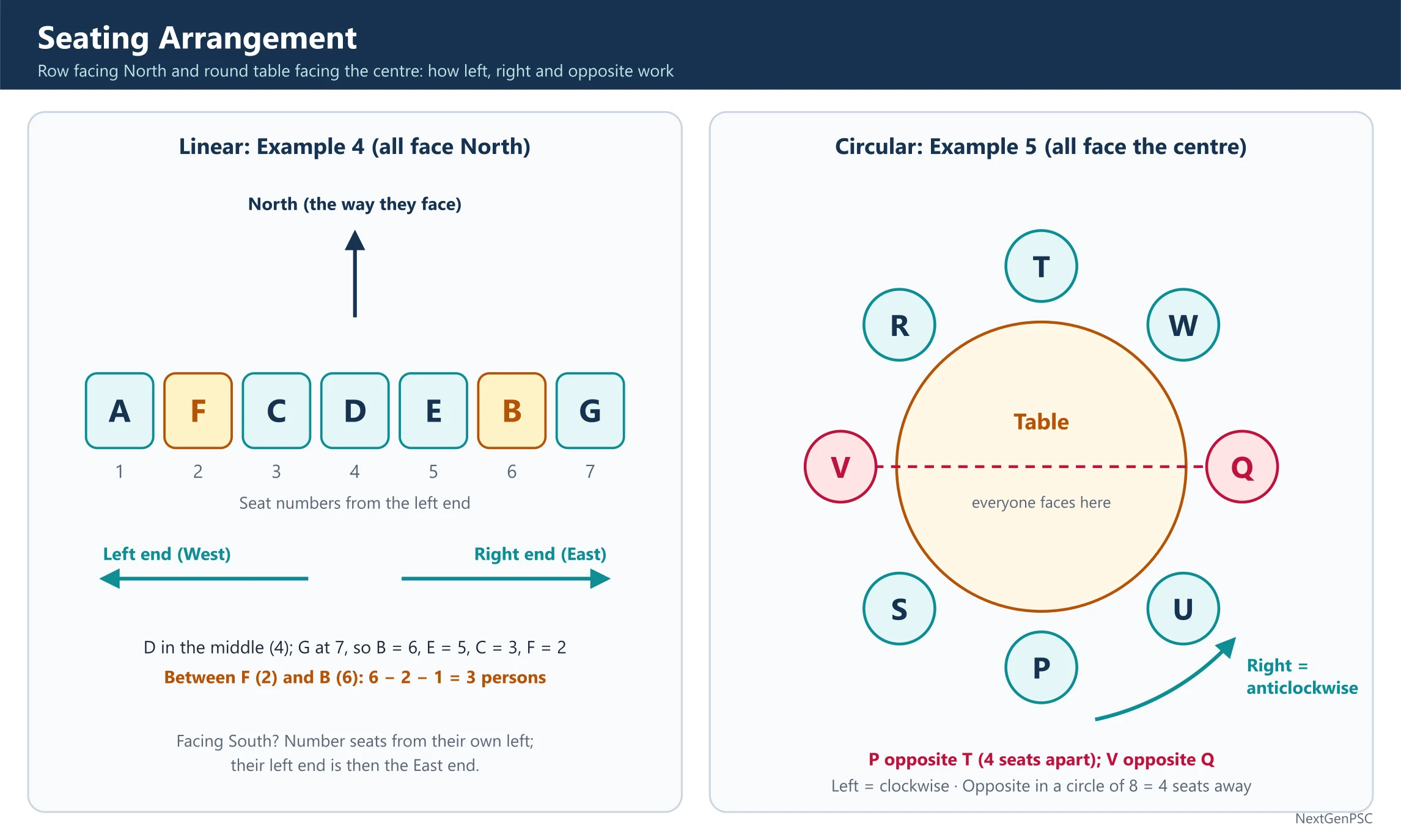
1. Kinds of Seating Puzzles
Linear: people sit in one row, facing North (or South), or some face North and some South. Positions are numbered 1, 2, 3 … from the left end.
Circular: people sit around a round table, usually facing the centre (sometimes facing outward). With an even number of people, each person has one person exactly opposite.
Square or rectangular table: treated like a circle with 4, 6 or 8 seats; 'opposite' means across the table.
Two parallel rows facing each other: each person in one row faces exactly one person in the other row. The left of a person in the North-facing row is the right of the person facing them.
2. Left and Right: the Rules
Row facing North: the people's left is the left of your page. 'Second to the right of A' is position(A) + 2.
Row facing South: the people's left is the right of your page (East). To avoid confusion, number the seats 1, 2, 3 … from their left and solve as usual; only at the end translate 'their left end' into a compass direction (facing South, their left end is the East end).
Circle facing the centre: right = anticlockwise, left = clockwise. 'B is second to the right of A' means two seats from A going anticlockwise.
Circle facing outward: the rule flips: right = clockwise, left = anticlockwise.
Why: imagine sitting at the bottom of the circle looking at the centre (North). Your right hand points East, and moving from the bottom towards the East side of a circle is the anticlockwise direction.
3. Reading the Position Phrases
Immediate right / left or next to: adjacent seats. Neighbour or sits next to without a side: either side, so two cases.
Second / third to the right: count that many seats in the right-hand direction; one or two people sit between them.
Between: 'X sits between A and B' in a row usually means immediately between; in a circle of more than three people, there are two arcs, so the question must say 'immediately between'.
Opposite (circle of n, n even): n/2 seats away in either direction. In a circle of 8, opposite = 4 seats away; of 6, 3 seats away.
At an end / in the middle: in a row of 7, the ends are 1 and 7 and the middle is 4.
4. The Method: Fix, Branch, Strike
Fix: place the most definite clue first. In a circle, place any one person at the bottom seat; rotating the whole circle does not change who sits next to whom, so one person can always be fixed.
Branch: if a clue gives two choices (A is at one of the ends; B is a neighbour of C), draw both cases side by side.
Strike: use 'not' clues and later clues to cross out cases. Stop when one case remains, or when the question can be answered from every remaining case.
Keep a seat grid. For a row, write seat numbers 1 to n with blanks; for a circle, draw n dots with a small arrow showing 'right = anticlockwise'.
5. Counting Arrangements
Without any clue, n people can sit in a row in n! ways (5! = 120). Around a round table they can sit in (n − 1)! ways (6 people: 5! = 120), because rotating everyone by one seat gives the same arrangement.
Why: this is the size of the search. Each definite clue cuts it down sharply; that is why starting from definite clues is fast and starting from 'not' clues is slow.
6. Must Be True, Could Be True
Some puzzles leave more than one arrangement. Then a statement must be true only if it holds in every remaining arrangement; it could be true if it holds in at least one.
Work out all remaining cases (usually two to four), then test each option in each case. The answer to 'which must be true' is the option that never fails.
Why: a statement true in the case you drew first may fail in the other case. Testing every case is exactly what the wrong options punish if skipped.
Example 1: A simple row
- Question
Five friends A, B, C, D and E sit in a row facing North. C sits in the middle. A sits to the immediate left of C. B sits at the right end. D sits somewhere to the left of A. Who sits between C and B? (a) A (b) D (c) E (d) B
- Solution
Normal method. Seats 1 to 5 from the left. C = 3 (middle). A = 2 (immediate left of C). B = 5 (right end).
D is to the left of A, so D = 1. E takes the last seat, 4. Row: D A C E B.
Shortcut. The person between C (3) and B (5) is in seat 4, which is the only seat no clue names: E.
Trap. A is between D and C, not between C and B.
- Answer
(c) E
Example 2: A row facing South
- Question
Five friends J, K, L, M and N sit in a row facing South. K sits at the extreme left end of the row (from the friends' own point of view). M sits third to the right of K. L sits to the immediate right of M. N is not a neighbour of K. Who sits at the western end of the row? (a) K (b) L (c) M (d) J
- Solution
Normal method. Number the seats 1 to 5 from the friends' own left. K = 1, M = 1 + 3 = 4, L = 5.
N is not next to K, so N = 3 and J = 2. Their order from their left: K J N M L.
Facing South, a person's right hand points West. So their right end (seat 5) is the western end: L.
Shortcut. Facing South: left end = East end, right end = West end.
Trap. K is the left end, which is the eastern end for people facing South; reading 'left' as West gives K.
- Answer
(b) L
Example 3: Round table
- Question
Six friends A, B, C, D, E and F sit around a round table facing the centre. A sits opposite D. B sits to the immediate right of A. C sits to the immediate left of D. E is not a neighbour of A. Who sits opposite C? (a) E (b) B (c) A (d) F
- Solution
Normal method. Fix A at seat 0 and number the seats 0 to 5 anticlockwise. Right = anticlockwise, so B = seat 1. D, opposite A, is seat 3.
C is to the immediate left (clockwise) of D: seat 2. Seats 4 and 5 remain for E and F; seat 5 is next to A, so E = 4 and F = 5.
C (seat 2) is opposite seat 5: F.
Shortcut. In a circle of 6, opposite seats differ by 3: 2 + 3 = 5.
Check. Testing all 120 arrangements of the other five friends around A leaves exactly one.
Trap. E comes from placing E next to A; B comes from treating right as clockwise.
- Answer
(d) F
Example 4: Seven in a row (UPSC-style)
- Question
Seven persons A, B, C, D, E, F and G sit in a row facing North. D sits exactly in the middle. A and G sit at the two ends. B sits to the immediate left of G. C and E are both immediate neighbours of D. E sits to the immediate left of B. How many persons sit between F and B? (a) 3 (b) 2 (c) 4 (d) 5
- Solution
Normal method. D = 4. A and G take seats 1 and 7. B is to the immediate left of G; if G were at 1 there would be no seat on its left, so G = 7, A = 1 and B = 6.
E is to the immediate left of B: E = 5. C is the other neighbour of D: C = 3. F takes the remaining seat 2.
Row: A F C D E B G. F is at 2 and B at 6, so 3 persons (C, D, E) sit between them.
Shortcut. Between seats 2 and 6 there are 6 − 2 − 1 = 3 persons.
Check. Testing all 5,040 orders of the seven persons leaves exactly one: A F C D E B G.
Trap. 4 counts B as well; 2 forgets D in the middle.
- Answer
(a) 3
Example 5: Eight around a table (UPSC-style)
- Question
Eight persons P, Q, R, S, T, U, V and W sit around a round table facing the centre. P sits opposite T. Q sits second to the right of P. R sits to the immediate right of T. S sits to the immediate left of P. U sits to the immediate right of P. V is not a neighbour of T. Who sits opposite V? (a) W (b) U (c) Q (d) S
- Solution
Normal method. Fix P at seat 0; seats 0 to 7 go anticlockwise (right). T = seat 4 (opposite). Q = seat 2, U = seat 1, R = seat 5, S = seat 7.
Seats 3 and 6 remain for V and W. Seat 3 is next to T, so V = 6 and W = 3.
V (seat 6) is opposite seat 2: Q.
Shortcut. In a circle of 8, opposite seats differ by 4: 6 − 4 = 2.
Check. Testing all 5,040 arrangements of the other seven around P leaves exactly one: P U Q W T R V S (anticlockwise).
Trap. W comes from placing V at seat 3, next to T; S comes from reading 'immediate left' as anticlockwise.
- Answer
(c) Q
Example 6: Which must be true (UPSC-style)
- Question
Six friends A, B, C, D, E and F sit around a round table facing the centre. A and B are neighbours. C is not a neighbour of D. E sits opposite A. F is not a neighbour of A. Which one of the following must be true? (a) C sits next to A (b) F sits opposite B (c) D sits to the immediate left of A (d) B sits to the immediate right of A
- Solution
Normal method. Fix A at seat 0 (seats 0 to 5 anticlockwise). E = seat 3. A's neighbours are seats 1 and 5; F is not one of them, so F is at seat 2 or 4, which are E's neighbours.
B is at seat 1 or 5. Working through the cases with 'C is not next to D' leaves four arrangements: A B C E F D, A B D E F C, A C F E D B and A D F E C B (each read anticlockwise from A).
Test the options: (a) holds only in the second and third; (c) only in the first; (d) only in the first two. (b) holds in all four: B and F are always 3 seats apart.
Shortcut. If B and F sat on the same side of the A–E line, C and D would be pushed into the two touching seats on the other side, breaking 'C is not next to D'. So F sits on the other side, directly opposite B.
Check. Testing all 120 arrangements around A leaves exactly these four, and only option (b) is true in every one.
Trap. (d) is true in the first arrangement most students draw, but 'must be true' needs every case.
- Answer
(b) F sits opposite B
Practice Questions
Q1. Five persons A, B, C, D and E sit in a row facing North. B sits at the left end. E sits second to the right of B. C sits to the immediate right of E. A is not a neighbour of B. Who sits at the right end? (a) D (b) C (c) A (d) E
Q2. Four friends W, X, Y and Z sit around a square table facing the centre. W sits opposite Y. X sits to the immediate right of W. Who sits to the immediate left of W? (a) X (b) Y (c) Z (d) Cannot be determined
Q3. Six persons A, B, C, D, E and F sit around a round table facing the centre. B sits opposite E. A sits to the immediate left of B. F sits to the immediate right of E. C is a neighbour of B. Who sits opposite A? (a) C (b) D (c) F (d) B
Q4. Five persons P, Q, R, S and T sit in a row facing South. P sits at the extreme left end (from their own point of view). R sits third to the right of P. Q sits to the immediate left of R. T does not sit at an end. Who sits at the western end? (a) P (b) T (c) R (d) S
Q5. Six persons A, B, C, D, E and F sit in a row facing North. C and D sit at the two ends. A sits next to C. B sits next to D. E is not a neighbour of A. Which one of the following must be true? (a) F sits next to A (b) C sits at the left end (c) E sits to the immediate right of F (d) D sits at the right end
Answers
Show answers
Q1. (c) A. B = 1, E = 3, C = 4; A cannot be at 2, so A = 5 and D = 2.
Q2. (c) Z. Anticlockwise from W: X, Y, Z; the seat clockwise from W (its left) is Z.
Q3. (b) D. Anticlockwise from B: C, D, E, F, A; A and D are 3 seats apart.
Q4. (d) S. From their left: P, T, Q, R, S. Facing South, the right end is West: S.
Q5. (a) F sits next to A. Two rows fit: C A F E B D and D B E F A C; only (a) holds in both.
| Setting | Right means | Left means | Note |
|---|---|---|---|
| Row facing North | Towards the right of the page (East) | Towards the left of the page (West) | Seat numbers 1 … n from the left |
| Row facing South | Towards the left of the page (West) | Towards the right of the page (East) | Number seats from their own left |
| Circle facing the centre | Anticlockwise | Clockwise | Fix one person; rotations are the same |
| Circle facing outward | Clockwise | Anticlockwise | Rule flips |
| Opposite in a circle of n | n/2 seats away | n/2 seats away | 8 people ⇒ 4 seats; 6 people ⇒ 3 seats |
| Two rows facing each other | Your right is the left of the person facing you | Your left is the right of the person facing you | Draw both rows with arrows |
Prelims tips
- Settle left and right before the first clue. Facing the centre, right is anticlockwise; facing South in a row, the left end is the East end. Most wrong options are the mirror image of the right answer.
- Start with the definite clue, never with 'not'. Middle, ends, opposite and 'immediate right' fix seats; 'not a neighbour' only removes cases. Fix one person in a circle at once, since rotations do not matter.
- Branch early, strike late. When a clue allows two seats (a neighbour on either side, a person at either end), draw both cases side by side. A case that breaks a later clue is crossed out; do not guess.
- Use seat arithmetic. 'Second to the right' is +2 seats; opposite in a circle of 8 is ±4; between seats 2 and 6 there are 3 people. Arithmetic is faster and safer than counting dots.
- 'Must be true' means every case. List all surviving arrangements and test each option in each one. The trap option is true in the case you drew first.
- Know when to skip. A puzzle with 8 people and only 'not' clues can eat five minutes. If two passes give no definite seat, mark it for later; one question is worth 2.5 marks, the same as an easy one.
PYQs from this chapter
21 UPSC Prelims questions (2024–2025) test what this chapter teaches. Open a year to read them with answers: