
CSAT (Prelims Paper II) · UPSC Notes
General Mental Ability — UPSC CSAT Notes
Free, exam-focused notes for UPSC Prelims and Mains, with Prelims tips and Mains points for every topic. 4 topics.
Open in the interactive reader: bookmarks, progress tracking and read-aloud.
Puzzles
In short
Puzzles give a few people or objects, a set of slots (positions, days, floors, cities) and a list of clues, and ask who goes where, how many arrangements are possible, or which statement must be true. CSAT papers usually carry a few such questions in the reasoning part, often built as ordering, scheduling, grid or selection problems. Three ideas unlock them: draw the frame first (a line, a set of slots or a grid), place the fixed clues before the relative ones, and split into cases instead of guessing; then check every clue against the final arrangement.
In simple words
A puzzle is like filling a timetable from hints. You know who (five officers), where (Monday to Friday) and some hints ('R goes on Wednesday', 'P goes the day before T'). Your job is to fill every slot so that no hint is broken.
Everyday example: three friends sit in a row of three seats. Asha is not at either end, and Babu is to the left of Chitra. Asha must be in the middle, so Babu takes the left seat and Chitra the right. Two hints, one answer.
Always start with the hint that fixes something completely ('R is on Wednesday'), then use the hints that link two people ('P is immediately before T'), and leave the 'not' hints for the end to remove choices.
The one question to always ask is: 'Does the question need the whole arrangement?' Often it does not. If two arrangements are possible but both put X on Wednesday, the answer 'X' is still certain.
Two habits solve most questions: (1) draw the slots on paper and write each placed person in pencil; (2) when a hint gives two possibilities, write both cases side by side and strike out the one that breaks a later hint.
1. Kinds of Puzzles in CSAT
Ordering (ranking) puzzles: people compared by height, age, marks or weight ('A is taller than B but shorter than C'). The frame is a vertical line from highest to lowest.
Scheduling puzzles: events placed on days or time slots ('the lecture on Tuesday', 'immediately before'). The frame is a row of slots.
Floor and position puzzles: people on the floors of a building or in a queue. The frame is a column of numbered slots, with floor 1 at the bottom unless stated otherwise.
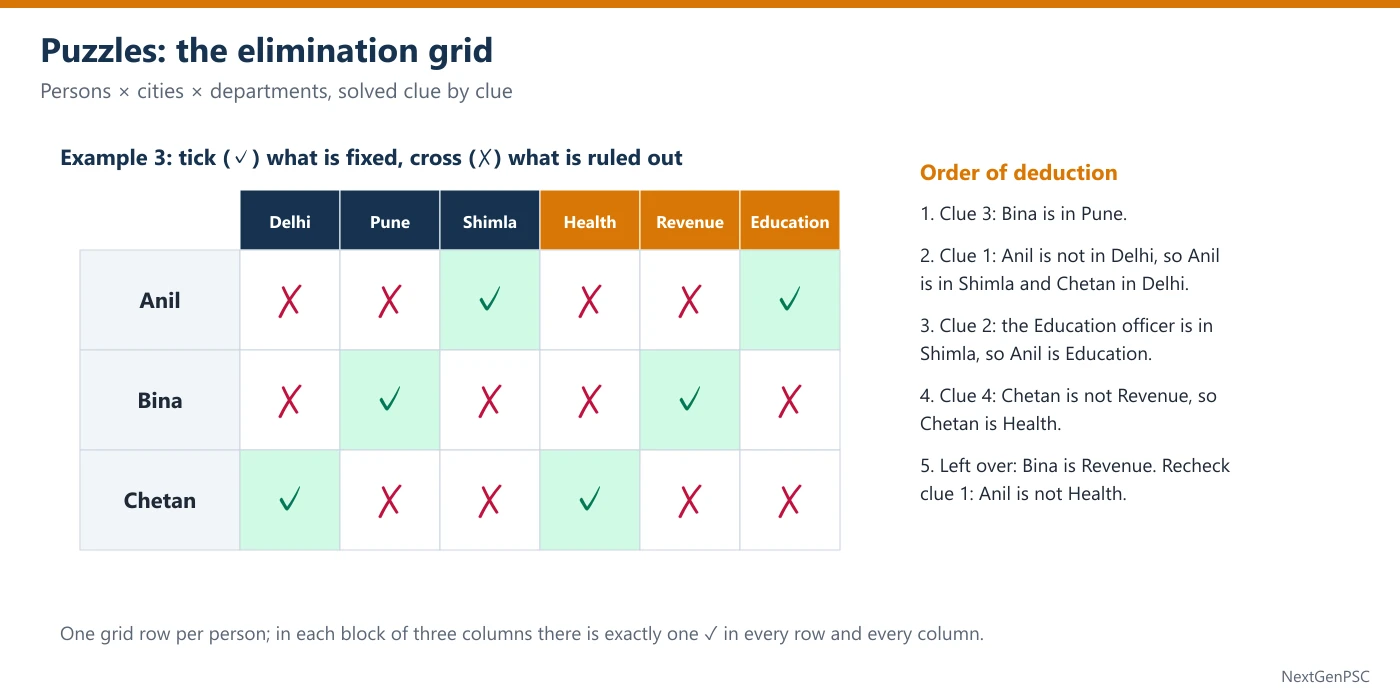
Grid (matching) puzzles: each person has one item from each of two or three lists (city, department, colour). The frame is an elimination grid (see the diagram).
Selection puzzles: a team or committee chosen from a group under conditions ('A and B cannot both be chosen', 'if E is chosen, F must be chosen'). The frame is a list of all possible teams.
2. The Five-Step Method
Step 1: list the people and the slots. Count them. Five people and five days means each day has exactly one person.
Step 2: draw the frame. A line, a row of slots, a column of floors or a grid. Never solve a puzzle only in your head.
Step 3: place the fixed clues. 'R is on Wednesday', 'P is on the top floor', 'Bina is in Pune'. These need no thinking and shrink every later step.
Step 4: apply the linking clues and split into cases. 'P is immediately before T' with Wednesday taken leaves Mon–Tue or Thu–Fri; write both cases and test each against the remaining clues.
Step 5: check every clue against the final arrangement. Most errors come from a clue forgotten in Step 4, usually a 'not' clue.
3. Ordering Puzzles
Write each clue as a chain with '>' meaning 'more than': 'A is taller than B but shorter than C' becomes C > A > B. Join chains through common people: D > C and C > A > B give D > C > A > B.
A clue such as 'E is shorter than B' adds E below B: D > C > A > B > E. The order is complete when every pair is fixed.
Partial orders: if some pairs are not fixed (for example, F is only known to be above D), more than one order is possible. Then the question can still be answered if every possible order agrees on the point asked.
4. Scheduling and Floor Puzzles
'Immediately before / after' and 'adjacent' tie two people into a block of two consecutive slots. Treat the block as one piece and slide it through the free slots.
'Before / after' without 'immediately' only fixes the order, not the gap. 'S is after T' allows any later day.
'Not on Monday or Friday' removes slots; apply it once the blocks are placed.
Floors are numbered from the bottom: floor 1 is the lowest. 'Immediately above' means one floor higher; 'adjacent floors' means one floor apart, in either direction.
5. Grid Puzzles
Draw one row per person and one column per item in each list. A tick (✓) fixes a match; a cross (✗) rules one out. In each block of columns, every row and every column has exactly one tick.
Chain clues across lists: 'The Education officer is in Shimla' links a department with a city. Once you know who is in Shimla, you also know who is the Education officer.
When a row has only one empty cell left in a block, it must be the tick. When a column has only one empty cell, the same. These two rules finish most grids.
6. Selection Puzzles
List every possible team (for 3 out of 6 people there are only 20) and strike out those that break a condition. With few people this is faster and safer than reasoning with formulas.
Read the condition types carefully: 'A and B cannot both be chosen' (not together); 'C and D must be chosen together' (both or neither); 'if E is chosen, F must be chosen' (E needs F, but F may come without E).
Questions then ask how many teams are possible, which person is in every team, or which team is not possible.
7. 'Must Be True' and 'Cannot Be Determined'
A statement must be true only if it holds in every arrangement that satisfies the clues. It could be true if it holds in at least one. It is false if it holds in none.
So for 'which must be true', find one arrangement that breaks each wrong option. One counter-example is enough to reject an option.
Choose 'cannot be determined' only after checking that different valid arrangements really give different answers to the question asked.
Example 1: Ordering by height
- Question
Five friends A, B, C, D and E have different heights. A is taller than B but shorter than C. D is taller than C. E is shorter than B. Who is the third tallest? (a) A (b) B (c) C (d) D
- Solution
Normal method. Clue 1: C > A > B. Clue 2: D > C, so D > C > A > B. Clue 3: B > E, so D > C > A > B > E.
Counting from the top: D (first), C (second), A (third), B (fourth), E (fifth).
Shortcut. Only one person (D) is above C, and C is above A, so A has exactly two people above it: third.
Check. A taller than B ✓, A shorter than C ✓, D taller than C ✓, E shorter than B ✓.
Trap. Option (c) counts from the bottom of the partial chain C > A > B before adding D on top.
- Answer
(a) A
Example 2: Scheduling with a fixed day
- Question
Five officers P, Q, R, S and T each inspect one district on a different day from Monday to Friday. R inspects on Wednesday. P inspects on the day immediately before T. Q does not inspect on Monday or Friday. S inspects on a day after T. Who inspects on Thursday? (a) P (b) Q (c) S (d) T
- Solution
Normal method. Wednesday = R. The block P-T needs two consecutive free days: Monday–Tuesday or Thursday–Friday.
Case 1: P-T on Thursday–Friday. Then S must come after T (after Friday): impossible.
Case 2: P = Monday, T = Tuesday. Q cannot be on Friday, so Q = Thursday and S = Friday (after T ✓).
Order: P, T, R, Q, S. Thursday = Q.
Shortcut. 'S after T' rules out the late P-T block at once, so P-T is Monday–Tuesday; Q avoids Friday, so Q takes Thursday.
Trap. Option (c) comes from placing S on Thursday without checking the clue about Q.
- Answer
(b) Q
Example 3: The elimination grid (UPSC-style)
- Question
Three officers, Anil, Bina and Chetan, are posted in Delhi, Pune and Shimla (one each) and head the Health, Revenue and Education departments (one each). 1. Anil is not in Delhi and is not the Health officer. 2. The Education officer is posted in Shimla. 3. Bina is posted in Pune. 4. Chetan is not the Revenue officer. Who is the Health officer, and where is that officer posted? (a) Anil, Shimla (b) Bina, Pune (c) Chetan, Delhi (d) Chetan, Shimla
- Solution
Normal method. Clue 3: Bina–Pune. Clue 1: Anil is not in Delhi, so Anil–Shimla and Chetan–Delhi.
Clue 2: the Education officer is in Shimla, so Anil–Education.
Clue 4: Chetan is not Revenue, and Education is taken, so Chetan–Health. Bina–Revenue.
Shortcut. Use the cross-list clue (2) as soon as one city is fixed to a person: the person in Shimla is the Education officer.
Check. Clue 1: Anil is in Shimla and is the Education officer ✓ (not Delhi, not Health).
Trap. Option (d) puts Chetan in Shimla, which breaks clue 1 (Anil would then be in Delhi).
- Answer
(c) Chetan, Delhi
Example 4: Floors of a building
- Question
P, Q, R, S and T live on the five floors of a building, one on each floor; floor 1 is the lowest. P lives on the top floor. Q lives on the floor immediately above R. T lives neither on the top floor nor on the bottom floor, and on an even-numbered floor. S and T live on adjacent floors. S lives on a floor above Q. Who lives on floor 3? (a) Q (b) R (c) S (d) T
- Solution
Normal method. P = 5. T is on an even floor that is not the top or bottom: T = 2 or 4.
Case T = 2: the R-Q block needs two adjacent free floors among 1, 3, 4: only 3–4, so R = 3, Q = 4; S must then be on floor 1, which is not above Q. Rejected.
Case T = 4: S is adjacent to T, so S = 3 (floor 5 is P). R-Q take floors 1–2: R = 1, Q = 2. S (3) is above Q (2) ✓.
Floors 1 to 5: R, Q, S, T, P. Floor 3 = S.
Shortcut. Fix P, then test only the two possible floors of T; the block R-Q and 'S above Q' decide the case.
Trap. Without the 'even floor' clue, T = 3 and S = 4 would also fit; option (d) comes from ignoring that clue.
- Answer
(c) S
Example 5: What must be true (UPSC-style)
- Question
Six candidates A, B, C, D, E and F scored different marks. A scored more than B. C scored more than A. D scored less than B. C scored more than E. F scored more than D. E scored more than D. Which one of the following must be true? (a) C ranks first (b) E scored more than A (c) F scored more than B (d) D ranks last
- Solution
Normal method. Chains: C > A > B > D; C > E > D; F > D.
D is below B, E and F, and B is below A and C. So all five others are above D: D is last in every possible order.
Shortcut. Test each option for a counter-example: F can be above C, so (a) need not hold; E can be below A, so (b) need not hold; F can be just above D and below B, so (c) need not hold.
Trap. Option (a) looks safe because C beats A, B and E, but nothing places C above F.
- Answer
(d) D ranks last
Example 6: Selecting a team (UPSC-style)
- Question
A team of three is to be selected from six persons A, B, C, D, E and F. A and B cannot both be selected. C and D must either both be selected or both be left out. If E is selected, F must also be selected. How many different teams are possible? (a) 4 (b) 5 (c) 6 (d) 8
- Solution
Normal method. Case 1, C and D both in: the third member can be A, B or F (not E, because E would need F as a fourth member): ACD, BCD, CDF. That gives 3 teams.
Case 2, C and D both out: choose 3 from A, B, E, F with A and B not together. If E is in, F is in: AEF, BEF. Without E: from A, B, F only ABF, which has A and B together. That gives 2 teams.
Total = 3 + 2 = 5.
Shortcut. The pair C-D either fills two places or none; count the cases separately instead of listing all 20 teams.
Check. Listing all 20 three-person teams and striking out those that break a condition leaves ACD, AEF, BCD, BEF, CDF.
Trap. Option (c) counts CDE as valid, forgetting that E brings F along.
- Answer
(b) 5
Practice Questions
Q1. P is heavier than Q. Q is heavier than both R and T. T is heavier than S, and S is heavier than R. Who is the lightest? (a) R (b) S (c) T (d) Q
Q2. Five plays V, W, X, Y and Z are staged on different days from Monday to Friday. W is staged on Tuesday. V and Y are staged on consecutive days. Z is staged on a day before V. X is staged neither on Monday nor on Friday. Which play is staged on Wednesday? (a) V (b) X (c) Y (d) Z
Q3. A group of three is to be formed from P, Q, R, S and T. P and Q must either both be included or both be left out. R and S cannot both be included. How many different groups are possible? (a) 2 (b) 3 (c) 4 (d) 6
Q4. K is older than L. M is older than K. N is younger than M. O is younger than L. Which one of the following must be true? (a) M is the oldest (b) O is the youngest (c) N is older than L (d) L is older than N
Q5. Ravi, Sunil and Tara each study a different subject (Maths, History, Physics) and like a different colour (Red, Blue, Green). Ravi does not study Maths. The History student likes Blue. Tara likes Green. Sunil does not study History. The Maths student does not like Red. What does Tara study? (a) Maths (b) History (c) Physics (d) Cannot be determined
Answers
Show answers
Q1. (a) R. P > Q > T > S > R; R is the lightest.
Q2. (b) X. Z must be on Monday (Z before V, X not on Monday, W on Tuesday); X then takes Wednesday or Thursday, and V-Y need two consecutive days, so X = Wednesday and V-Y = Thursday–Friday in some order.
Q3. (b) 3. With P and Q: PQR, PQS, PQT. Without them only R, S, T remain, and RST has R and S together.
Q4. (a) M is the oldest. M > K > L > O and M > N; N's place below M is free, so (b), (c) and (d) can each fail.
Q5. (a) Maths. Sunil is not History and Ravi is not Maths: if Tara (Green) studied History she would like Blue, so Ravi studies History (Blue); Sunil (Red) cannot study Maths, so Sunil studies Physics and Tara studies Maths.
| Clue says | Meaning | How to mark it |
|---|---|---|
| A is taller than B | A above B, gap unknown | A > B in the chain |
| P is immediately before T | consecutive slots, P first | block [P T] |
| S and T are adjacent | consecutive slots, either order | block [S T] or [T S] |
| S is after T | later slot, any gap | arrow T → S |
| Q is not on Monday | removes one slot | ✗ under Monday in Q's row |
| C and D both or neither | a pair that moves together | count 'both in' and 'both out' cases |
| If E then F | E needs F; F may come alone | strike teams with E but no F |
Prelims tips
- Fixed clues first, 'not' clues last. Placing 'R on Wednesday' or 'P on the top floor' first shrinks every case; the 'not on Monday' clues then finish the job. Starting with a vague clue multiplies the cases you must track.
- Write the cases side by side. When a block can go in two places, draw both frames. UPSC puzzles are built so that one case breaks a later clue; guessing one case and pushing on is how wrong options are reached.
- 'Immediately' and 'adjacent' are different. 'Immediately before' fixes order and gap; 'adjacent' fixes only the gap. Reading 'adjacent' as 'immediately before' loses a valid case.
- For 'must be true', hunt for counter-examples. One valid arrangement that breaks an option rejects it. The option left standing is the answer; you need not find the full arrangement.
- Small selection puzzles: list them. Three out of six people gives 20 teams; listing and striking out takes less than two minutes and avoids formula errors with 'both or neither' and 'if … then' conditions.
- Recheck every clue at the end. The commonest loss is a forgotten clue. 10 seconds of ticking each clue against the final arrangement protects a question you have already spent two minutes on.
Spatial Reasoning (cubes, dice, figures)
In short
Spatial reasoning questions ask you to picture shapes in your head: a painted cube cut into small cubes, a die seen from two sides, a flat net folded into a cube, or a figure in which you count triangles and squares. CSAT papers usually carry a question or two of this kind. Three ideas unlock them: count by type, not one by one (corners, edges, faces and the hidden core of a cube), for dice, start from the face the views share, and in a net, squares that touch are never opposite.
In simple words
Think of a Rubik's cube: 3 small cubes along each edge, 27 in all. If you paint the outside and break it apart, the corner pieces have 3 painted sides, the edge pieces 2, the centre of each face 1, and the one piece hidden in the middle has none.
A die has 6 faces. In a normal die the opposite faces add up to 7: 1 is opposite 6, 2 opposite 5, 3 opposite 4. When you see a die, you can see at most 3 faces, and they are always next to each other, never opposite.
A net is a cube opened out flat, like a cardboard box cut open. When you fold it back, two squares that share an edge become neighbours, and squares with one square between them in a straight line become opposite faces.
The one question to always ask is: 'Which pieces are alike?' Instead of counting 64 small cubes one by one, count the 8 corners, then the edges, then the faces, then the core.
Two habits solve most questions: (1) draw a quick sketch and label it; (2) after counting by types, check that the types add up to the total (for a 4 × 4 × 4 cube: 8 + 24 + 24 + 8 = 64).
1. What CSAT Asks
Spatial questions in CSAT are usually of five kinds: (1) a painted cube or cuboid cut into small cubes; (2) a die shown in two or three positions; (3) a net to be folded into a cube; (4) counting triangles, squares or rectangles in a figure; (5) occasionally paper folding, mirror images or the number of faces, edges and corners of a solid.
All of them reward one habit: classify the pieces by type and count each type with a rule, instead of counting by eye.
2. Painted Cubes
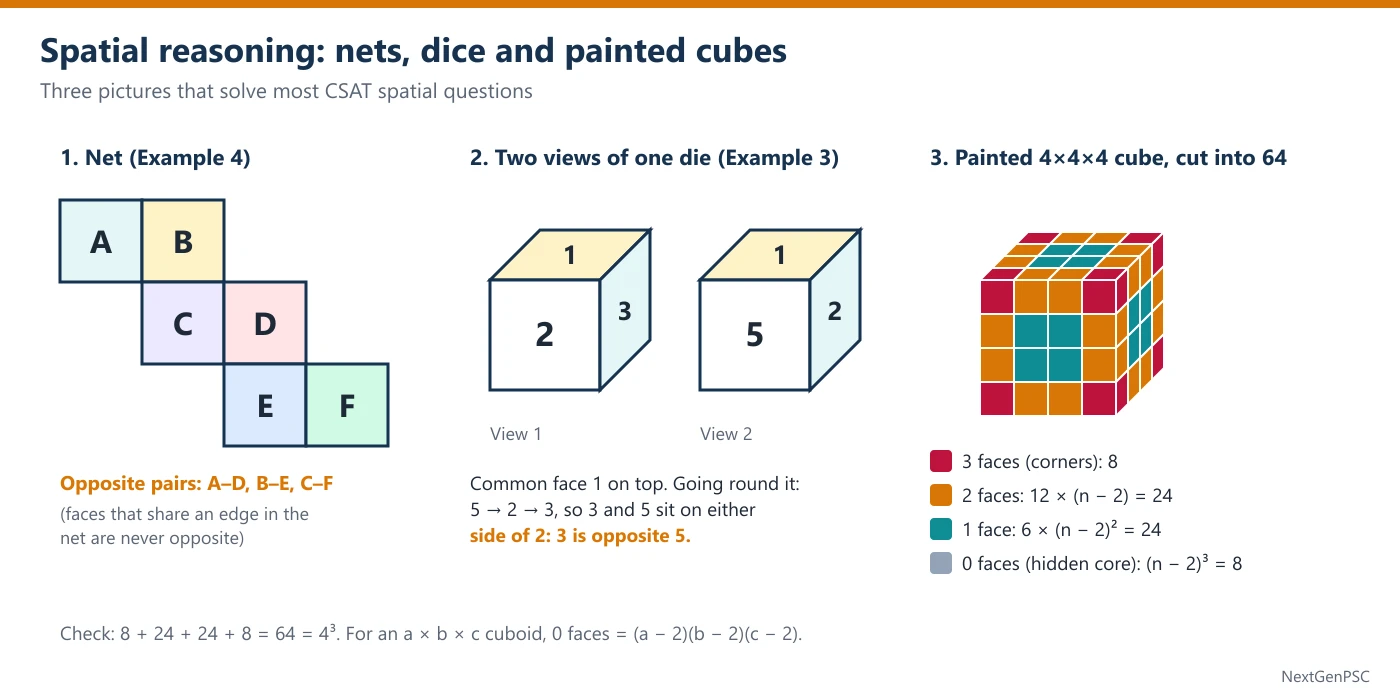
A cube of side n is painted on all six faces and cut into n × n × n = n³ unit cubes. Every small cube falls into one of four types:
3 faces painted: the 8 corners, always 8 (for n ≥ 2).
2 faces painted: the cubes along the 12 edges, excluding the corners: 12 × (n − 2).
1 face painted: the inner squares of the 6 faces: 6 × (n − 2)².
No face painted: the hidden core: (n − 2)³.
For n = 4: 8 + 12 × 2 + 6 × 4 + 8 = 8 + 24 + 24 + 8 = 64 = 4³. For n = 3: 8 + 12 + 6 + 1 = 27. Always check the sum.
Cuboids (a × b × c): 0 faces = (a − 2)(b − 2)(c − 2); 1 face = 2[(a − 2)(b − 2) + (b − 2)(c − 2) + (c − 2)(a − 2)]; 2 faces = 4[(a − 2) + (b − 2) + (c − 2)]; 3 faces = 8. For 5 × 4 × 3: 6 + 22 + 24 + 8 = 60 = 5 × 4 × 3.
Why: an edge of length a holds a − 2 cubes once its two corner cubes are removed, and a face of a × b holds (a − 2)(b − 2) inner cubes. Each formula just counts those pieces.
Variations: if only some faces are painted, or opposite faces have different colours, draw one face and mark which edges are painted; then count the same four types, but only for the painted faces.
3. Dice
Standard die: opposite faces add up to 7 (1–6, 2–5, 3–4). Use this only when the question says the die is a standard one or the views prove it.
Faces seen together are never opposite. In any view the three visible faces meet at a corner, so they are pairwise adjacent.
Two views with a common face: put the common face in the same place in both views and read the faces around it in order. In the diagram, with 1 on top: view 1 shows 2 (front) and 3 (right); view 2 shows 5 (front) and 2 (right). Going round the top face: 5, 2, 3. So 3 and 5 are on either side of 2, and they are opposite each other.
Four faces adjacent to one face: if four different numbers are seen next to a face, the sixth number is opposite it.
Not enough information: two views may fix only one opposite pair. In the diagram 1 is opposite either 4 or 6, and the views cannot decide which.
4. Nets of a Cube
A net is six squares joined edge to edge that fold into a cube. There are 11 different nets.
Rule 1: squares sharing an edge in the net become adjacent faces, so they are never opposite.
Rule 2: in a straight row of three squares, the first and the third are opposite.
Rule 3 (staircase): in a zig-zag net, as in the diagram (A B / C D / E F), opposite pairs are A–D, B–E and C–F: each square is opposite the square two steps along the staircase.
Cross net: for the cross with A above C, B C D in a row, and E and F below C: A–E, B–D and C–F are opposite.
To check any net, imagine laying the square of one face on the table and rolling the cube over the net: each square the cube rolls onto touches the face that is at the bottom at that moment.
5. Counting Figures
Squares in an n × n grid: 1² + 2² + … + n². A 4 × 4 grid has 16 + 9 + 4 + 1 = 30 squares; a 3 × 3 grid has 14.
Rectangles (squares included) in an m × n grid: choose 2 of the m + 1 vertical lines and 2 of the n + 1 horizontal lines: C(m + 1, 2) × C(n + 1, 2). A 3 × 3 grid: 6 × 6 = 36.
Triangles in a triangle cut by lines from the top vertex: if lines from the top vertex divide the base into k parts, there are C(k + 1, 2) triangles on that base. Each line drawn parallel to the base adds the same number again. 4 parts and one parallel line: 10 × 2 = 20.
Why: every triangle in such a figure uses two of the lines from the vertex and one horizontal line (the base or a parallel line); choosing them in all possible ways counts each triangle exactly once.
6. Traps
Counting corners twice: the 2-face formula excludes corners: 12 × (n − 2), not 12 × n.
Assuming a standard die: unless told, a die need not have opposite faces adding to 7.
Forgetting large figures: in counting squares, the 2 × 2, 3 × 3 and whole-figure squares are the ones most often missed.
'Cannot be determined' in dice: it is right when the views leave two choices, as for the face opposite 1 in the diagram.
Example 1: Two painted faces
- Question
A cube of side 4 cm is painted on all its faces and then cut into 64 cubes of side 1 cm. How many small cubes have exactly two faces painted? (a) 8 (b) 24 (c) 36 (d) 48
- Solution
Normal method. Two-face cubes lie along the 12 edges, excluding the corner cubes.
Each edge has 4 cubes, of which 2 are corners, leaving 4 − 2 = 2. So 12 × 2 = 24.
Shortcut. 12 × (n − 2) = 12 × 2 = 24.
Check. 8 (three faces) + 24 (two) + 24 (one) + 8 (none) = 64.
Trap. Option (a) is the corners (three faces); option (d) counts all 4 cubes on each of the 12 edges, corners included (12 × 4).
- Answer
(b) 24
Example 2: Squares in a grid
- Question
A square is divided into a 4 × 4 grid of 16 equal small squares by equally spaced lines. How many squares of all sizes are there in the figure? (a) 16 (b) 20 (c) 25 (d) 30
- Solution
Normal method. Count by size: 1 × 1: 16; 2 × 2: 9; 3 × 3: 4; 4 × 4: 1.
Total = 16 + 9 + 4 + 1 = 30.
Shortcut. 1² + 2² + 3² + 4² = 30.
Trap. Option (a) counts only the smallest squares; option (b) adds only the 2 × 2 squares that do not overlap (16 + 4).
- Answer
(d) 30
Example 3: Two views of a die (UPSC-style)
- Question
Two views of the same die are shown in the diagram. In view 1 the top face is 1, the front face is 2 and the right face is 3. In view 2 the top face is 1, the front face is 5 and the right face is 2. Which number is opposite 3? (a) 2 (b) 4 (c) 5 (d) 6
- Solution
Normal method. The common face 1 is on top in both views. Read the faces around it in order (front, then right, then back).
View 2: front 5, right 2. View 1: front 2, right 3. Turning view 2 by a quarter turn brings 2 to the front, so the order around 1 is 5 → 2 → 3.
3 and 5 are on opposite sides of 2, so 3 is opposite 5.
Shortcut. 2, 3 and 5 are all adjacent to 1, and 2 is adjacent to both 3 and 5. Faces seen together are never opposite, so 2 is not opposite 3; 1 is not opposite 3; of 4, 5 and 6 only 5 fits the order of the views.
Trap. Option (b) assumes a standard die (3 + 4 = 7); the question never says the die is standard. Option (a) ignores that 2 and 3 are seen together.
- Answer
(c) 5
Example 4: Folding a staircase net
- Question
A net has six squares in a staircase: A and B in the top row (A on the left), C directly below B, D to the right of C, E directly below D, and F to the right of E (see the diagram). When the net is folded into a cube, which face is opposite C? (a) A (b) D (c) E (d) F
- Solution
Normal method. Lay C on the table and fold the rest up. B (above C) and D (right of C) become side faces next to C; A, attached to B, folds over the top; E and F follow D.
Rolling the cube along the net gives the opposite pairs A–D, B–E and C–F.
Shortcut. Staircase rule: each square is opposite the one two steps further along: A–D, B–E, C–F.
Trap. Options (b) and (a) are squares sharing an edge with C or B in the net; touching squares can never be opposite.
- Answer
(d) F
Example 5: Counting triangles (UPSC-style)
- Question
In a triangle, three straight lines are drawn from the top vertex to the base, dividing the base into 4 parts, and one straight line is drawn parallel to the base, cutting all the lines from the vertex. How many triangles are there in the figure? (a) 10 (b) 15 (c) 20 (d) 24
- Solution
Normal method. With the original base: the 5 lines from the top vertex (2 sides + 3 inner lines) give C(5, 2) = 10 triangles.
With the parallel line as base: again 10 triangles.
Total = 10 + 10 = 20.
Shortcut. Base parts k = 4: k(k + 1)/2 = 10 triangles per horizontal line; 2 horizontal lines give 20.
Trap. Option (a) counts only the triangles standing on the original base; option (d) adds the 4 four-sided pieces below the parallel line, which are not triangles.
- Answer
(c) 20
Example 6: A painted cuboid (UPSC-style)
- Question
A wooden block of 5 cm × 4 cm × 3 cm is painted on all its faces and cut into cubes of side 1 cm. How many cubes have exactly one face painted? (a) 6 (b) 22 (c) 24 (d) 26
- Solution
Normal method. Inner parts of the faces: the 5 × 4 faces give (5 − 2)(4 − 2) = 6 each; the 4 × 3 faces give (4 − 2)(3 − 2) = 2 each; the 5 × 3 faces give (5 − 2)(3 − 2) = 3 each.
Two faces of each kind: 2 × (6 + 2 + 3) = 22.
Shortcut. 2[(a − 2)(b − 2) + (b − 2)(c − 2) + (c − 2)(a − 2)] = 2[3 × 2 + 2 × 1 + 1 × 3] = 22.
Check. 6 (none) + 22 (one) + 24 (two) + 8 (three) = 60 = 5 × 4 × 3.
Trap. Option (a) is the number of unpainted cubes (3 × 2 × 1); option (c) is the number with two faces painted.
- Answer
(b) 22
Practice Questions
Q1. A cube of side 3 cm is painted on all faces and cut into 27 cubes of side 1 cm. How many small cubes have no face painted? (a) 0 (b) 1 (c) 6 (d) 8
Q2. How many rectangles (squares included) are there in a 3 × 3 grid of equal squares? (a) 14 (b) 27 (c) 36 (d) 40
Q3. Using the two views of the die in Example 3, which number is opposite 1? (a) 3 (b) 4 (c) 6 (d) Cannot be determined
Q4. A cube of side 5 cm is painted on all faces and cut into cubes of side 1 cm. How many small cubes have exactly one face painted? (a) 27 (b) 36 (c) 54 (d) 64
Q5. A cross-shaped net has A on top of C; B, C and D in a row from left to right; E below C; and F below E. When folded into a cube, which face is opposite B? (a) A (b) D (c) E (d) F
Q6. A standard die (opposite faces add up to 7) rests with 3 on top and 2 in front. Which number is on the bottom face? (a) 1 (b) 4 (c) 5 (d) 6
Answers
Show answers
Q1. (b) 1. (n − 2)³ = 1³ = 1, the centre cube.
Q2. (c) 36. C(4, 2) × C(4, 2) = 6 × 6 = 36; option (a) counts squares only.
Q3. (d) Cannot be determined. 2, 3 and 5 are all next to 1; the face opposite 1 is 4 or 6, and the two views fit both.
Q4. (c) 54. 6 × (5 − 2)² = 6 × 9 = 54.
Q5. (b) D. B, C, D form a straight row of three: the end squares are opposite.
Q6. (b) 4. Bottom is opposite top: 7 − 3 = 4.
| Situation | Rule / formula | Quick example |
|---|---|---|
| Painted n-cube: 3 faces | 8 (corners) | n = 4: 8 |
| Painted n-cube: 2 faces | 12 × (n − 2) | n = 4: 24 |
| Painted n-cube: 1 face | 6 × (n − 2)² | n = 5: 54 |
| Painted n-cube: 0 faces | (n − 2)³ | n = 3: 1 |
| Squares in n × n grid | 1² + 2² + … + n² | n = 4: 30 |
| Rectangles in m × n grid | C(m + 1, 2) × C(n + 1, 2) | 3 × 3: 36 |
| Triangles, k base parts, h horizontal lines | h × k(k + 1)/2 | k = 4, h = 2: 20 |
| Standard die | opposite faces add to 7 | top 3 ⇒ bottom 4 |
Prelims tips
- Count cubes by type and check the total. Corners, edges, faces and core must add up to n³ (or a × b × c). If they do not, one formula has been misapplied, usually the edge count including corners.
- Never assume a standard die. Use 'opposite faces add to 7' only when the question says so. The trap option in two-view questions is usually the 'standard die' answer.
- Faces seen together are not opposite. This one rule removes two or three options in most dice questions before any rotation is needed.
- For nets, use 'touching squares are never opposite'. Then apply 'ends of a row of three are opposite' and the staircase rule; together they settle almost every net.
- Count figures with formulas, not by eye. Squares in a grid: Σk²; rectangles: C(m + 1, 2) × C(n + 1, 2). Eye-counting misses the bigger overlapping shapes, which is what the lower options are built on.
- 'Cannot be determined' is real in dice. Two views often fix only one opposite pair. If the views fit two different dice, choose it without hesitation.
Number and Letter Series, Patterns
In short
Series and pattern questions give a sequence of numbers, letters or figures built by a hidden rule and ask for the next term, a missing term or the one term that breaks the rule. In CSAT they also appear as number grids, where a row or column follows a rule. Three ideas unlock them: test the simple rules in a fixed order (differences, then ratios, then squares and cubes, then alternating series), turn letters into their positions (A = 1 … Z = 26), and check the rule on every given term before you choose an option.
In simple words
A series is a list that grows by a rule, like steps on a staircase. Your job is to find the rule and take the next step. In 2, 4, 6, 8, … each step adds 2, so the next number is 10.
Most rules are of a few simple kinds: add the same number, add a growing number (+2, +4, +6), multiply by the same number, use squares (1, 4, 9, 16) or cubes (1, 8, 27), or mix two series together.
Letters work the same way once you turn them into numbers: A = 1, B = 2, … Z = 26. So B, D, F, H is really 2, 4, 6, 8, and the next letter is the 10th letter, J.
The one question to always ask is: 'Does my rule work for every term?' A rule that fits the first three terms but not the fourth is the wrong rule.
Two habits solve most questions: (1) write the differences between neighbouring terms under the series; if they are not simple, write the differences of the differences; (2) for letters, write the position number under each letter.
1. What CSAT Asks
Next term / missing term: 3, 7, 13, 21, 31, ? or 2, 6, ?, 54. Wrong term: one number in the series breaks the rule; find it. Letter series: B, E, I, N, T, ? or AZ, BY, CX, ?. Number grids: a 3 × 3 grid or a figure in which numbers in a row, column or sector follow one rule. Figure series: shapes that rotate, gain dots or change shading step by step.
2. The Order of Tests for Number Series
Test 1, first differences: 3, 7, 13, 21, 31 has differences 4, 6, 8, 10. If the differences are constant or change simply, you have the rule.
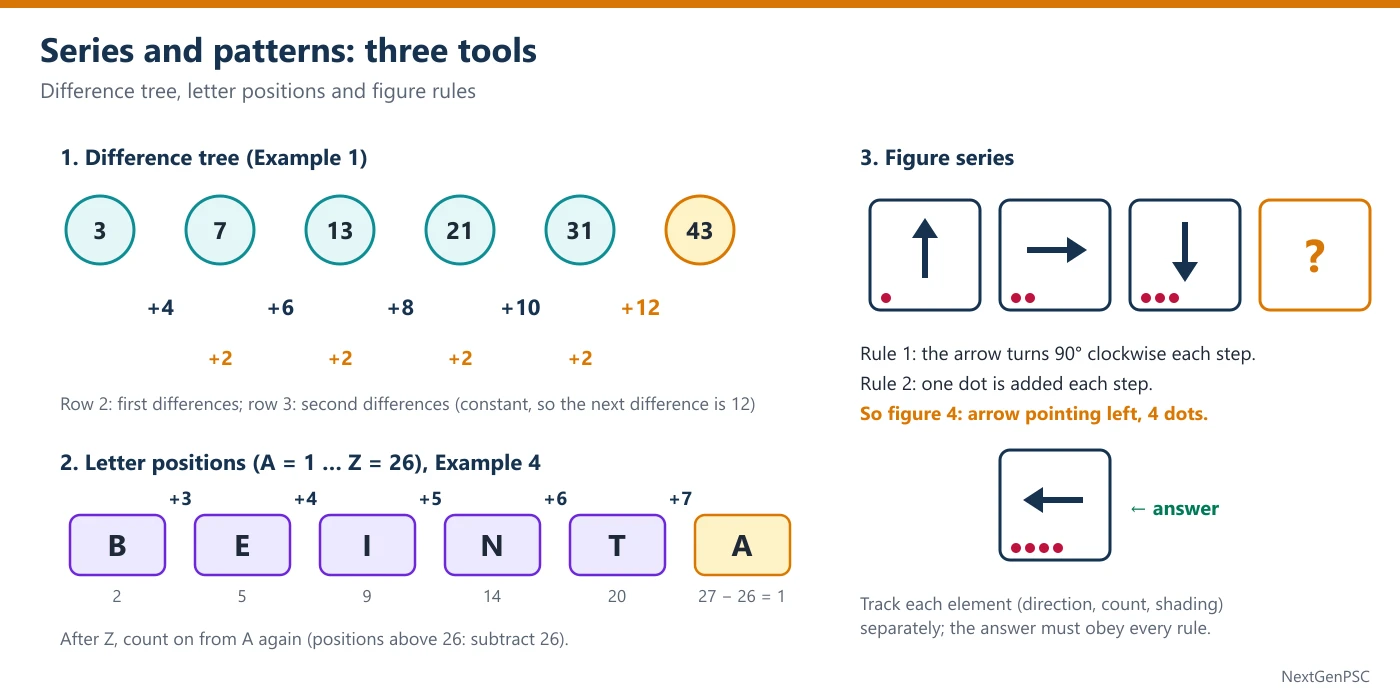
Test 2, second differences: the differences 4, 6, 8, 10 themselves rise by 2 each time, so the next difference is 12 and the next term 31 + 12 = 43 (see the diagram).
Test 3, ratios: if the terms grow fast, divide: 2, 6, 18, 54 has ratio 3. Mixed operations are common: 5, 11, 23, 47 is ×2 + 1 at every step.
Test 4, squares and cubes: compare each term with n², n³ or nearby values: 2, 5, 10, 17, 26 is n² + 1; 3, 8, 15, 24 is n² − 1 (n = 2, 3, 4, 5); 0, 7, 26, 63 is n³ − 1.
Test 5, alternating series: if the series jumps up and down, split it into odd-place and even-place terms: 1, 4, 3, 9, 5, 16, 7, ? gives 1, 3, 5, 7 and 4, 9, 16, ?.
Test 6, special series: primes (11, 13, 17, 19, 23, 29), factorials (1, 2, 6, 24, 120: ×2, ×3, ×4, ×5) and Fibonacci-type series (each term = sum of the two before: 1, 1, 2, 3, 5, 8).
Why this order: differences catch most CSAT series in seconds; ratios are tried when numbers grow fast; squares, cubes and alternation take more thought and are saved for when the first tests fail.
3. Letter Series
Write the position under each letter. Learn the landmarks: E = 5, J = 10, O = 15, T = 20, Y = 25 (the 'EJOTY' rule), and M = 13, N = 14 in the middle.
Reverse position: the position counted from Z is 27 − position. A ↔ Z, B ↔ Y, C ↔ X, D ↔ W: each pair adds to 27. So AZ, BY, CX, ? continues with DW.
Wrap-around: after Z, start again at A. Subtract 26 from any position above 26: B, E, I, N, T (+3, +4, +5, +6) is followed by 20 + 7 = 27 → 27 − 26 = 1 = A.
Falling series: Z, W, S, N, ? is 26, 23, 19, 14 with differences −3, −4, −5; the next difference is −6, giving 8 = H.
4. Finding the Wrong Term
Find the rule that most of the terms follow, then test each term. In 3, 8, 15, 24, 34, 48, the pattern n² − 1 gives 3, 8, 15, 24, 35, 48: only 34 breaks it.
If two different terms could be the wrong one, try the rule both ways; the right rule makes exactly one term wrong. Differences help here: 5, 7, 9, 12, 13 has differences 2, 2, 3, 1; the odd jumps sit on both sides of 12, so 12 (should be 11) is the wrong term.
5. Number Grids and Figure Numbers
In a grid, test the rows first, then the columns: the missing number is usually made from the other numbers of its row by +, ×, or squares. Rows 4, 5, 41 and 6, 3, 45 fit a² + b² (16 + 25 = 41; 36 + 9 = 45), so 7, 2, ? gives 49 + 4 = 53.
Check the rule on every complete row. A rule found from one row only (4 × 5 = 20, 20 × 2 + 1 = 41) fails on the next row (6 × 3 × 2 + 1 = 37, not 45), so it is rejected.
Figures with numbers in sectors or at corners usually use the sum or product of opposite or neighbouring numbers; the centre number is often made from the outer ones.
6. Figure Series
Treat each element of a figure separately: direction (an arrow turning 45° or 90° each step), count (dots or lines added), shading, and position (a shape moving round the corners).
In the diagram, the arrow turns 90° clockwise each step (up, right, down) and one dot is added each step (1, 2, 3). The fourth figure must therefore point left and carry 4 dots. An option that gets one element right and the other wrong is a trap.
7. Numbers Worth Knowing by Heart
Squares: 11² = 121, 12² = 144, 13² = 169, 14² = 196, 15² = 225, 16² = 256, 17² = 289, 18² = 324, 19² = 361, 20² = 400. A term one more or one less than these (such as 168 or 290) is a strong hint.
Cubes: 2³ = 8, 3³ = 27, 4³ = 64, 5³ = 125, 6³ = 216, 7³ = 343, 8³ = 512, 9³ = 729, 10³ = 1,000.
Powers of 2: 2, 4, 8, 16, 32, 64, 128, 256, 512, 1,024. Doubling series and 'differences that double' (3, 6, 12, 24) come from these.
Primes below 50: 2, 3, 5, 7, 11, 13, 17, 19, 23, 29, 31, 37, 41, 43, 47. 51 = 3 × 17 and 49 = 7 × 7 are the usual fake primes in options.
A 60-second routine: write the differences (15 seconds); if they are not simple, try ratios and then n², n³ (20 seconds); if the series zig-zags, split it (10 seconds); check your rule on every term and only then mark the answer.
8. Traps
Stopping at the first rule that fits three terms: always check all terms.
Forgetting wrap-around in letters: position 27 is A, not 'beyond Z'.
Counting positions from the wrong end: reverse series use 27 − position.
Alternating series read as one series: a series that rises and falls usually hides two series.
Example 1: Second differences
- Question
Find the next term: 3, 7, 13, 21, 31, ? (a) 39 (b) 41 (c) 43 (d) 45
- Solution
Normal method. First differences: 4, 6, 8, 10.
Second differences: 2, 2, 2. So the next difference is 12, and the next term is 31 + 12 = 43.
Shortcut. The terms are n² + n + 1 for n = 1, 2, 3, …: n = 6 gives 36 + 6 + 1 = 43.
Trap. Option (b) adds 10 again (repeating the last difference); option (a) adds 8.
- Answer
(c) 43
Example 2: Mixed operation
- Question
Find the next term: 5, 11, 23, 47, ? (a) 71 (b) 94 (c) 95 (d) 96
- Solution
Normal method. Differences: 6, 12, 24, which double each time; the next difference is 48, so 47 + 48 = 95.
Shortcut. Each term = previous × 2 + 1: 5 × 2 + 1 = 11, 11 × 2 + 1 = 23, 23 × 2 + 1 = 47, 47 × 2 + 1 = 95.
Check. The rule fits all four given terms.
Trap. Option (b) doubles without adding 1; option (a) adds the last difference (24) again.
- Answer
(c) 95
Example 3: The wrong term (UPSC-style)
- Question
Which number does not fit in the series 3, 8, 15, 24, 34, 48? (a) 8 (b) 15 (c) 34 (d) 48
- Solution
Normal method. Differences: 5, 7, 9, 10, 14. They should rise by 2 each time (5, 7, 9, 11, 13).
With 35 in place of 34 the differences become 5, 7, 9, 11, 13. So 34 is the wrong term.
Shortcut. 3, 8, 15, 24, ?, 48 are 2² − 1, 3² − 1, 4² − 1, 5² − 1, 6² − 1, 7² − 1. The fifth term should be 35.
Trap. Option (d) is tempting because the last difference (14) looks too big, but 48 fits the rule; the error is the 34 just before it.
- Answer
(c) 34
Example 4: Letter series with wrap-around
- Question
Find the next letter: B, E, I, N, T, ? (a) A (b) Y (c) Z (d) B
- Solution
Normal method. Positions: B = 2, E = 5, I = 9, N = 14, T = 20.
Differences: +3, +4, +5, +6, so the next is +7: 20 + 7 = 27.
27 is past Z; 27 − 26 = 1 = A.
Shortcut. T is 20; adding 7 takes you 6 letters to Z and 1 more round to A.
Trap. Option (c) stops at Z (26) because the solver does not wrap round; option (b) adds 5 instead of 7.
- Answer
(a) A
Example 5: Number grid (UPSC-style)
- Question
In each row, the third number is made from the first two in the same way. Row 1: 4, 5, 41. Row 2: 6, 3, 45. Row 3: 7, 2, ? What is the missing number? (a) 49 (b) 51 (c) 53 (d) 63
- Solution
Normal method. Row 1: 4² + 5² = 16 + 25 = 41. Row 2: 6² + 3² = 36 + 9 = 45.
Row 3: 7² + 2² = 49 + 4 = 53.
Shortcut. Both third numbers are odd and a little above the square of the larger number: try a² + b² first.
Trap. Option (a) uses only 7²; option (d) uses 7 × 2 × 4 + 7, a rule that works for no row. A rule must fit rows 1 and 2 before it is applied to row 3.
- Answer
(c) 53
Example 6: Two series in one (UPSC-style)
- Question
Find the next term: 1, 4, 3, 9, 5, 16, 7, ? (a) 18 (b) 23 (c) 25 (d) 36
- Solution
Normal method. The series rises and falls, so split it by position.
Odd places: 1, 3, 5, 7 (odd numbers). Even places: 4, 9, 16, ? (squares of 2, 3, 4).
The next term is in an even place: 5² = 25.
Shortcut. When a series zig-zags, write the two halves on two lines at once.
Trap. Option (a) adds 11 to 7, copying the earlier jump from 5 to 16; option (d) skips 5² and jumps to 6².
- Answer
(c) 25
Practice Questions
Q1. Find the next term: 1, 2, 6, 24, 120, ? (a) 240 (b) 600 (c) 720 (d) 840
Q2. Find the next term: 2, 5, 10, 17, 26, ? (a) 35 (b) 36 (c) 37 (d) 38
Q3. Find the next term: AZ, BY, CX, ? (a) DV (b) DW (c) EW (d) DX
Q4. Find the next term: 7, 10, 16, 28, 52, ? (a) 76 (b) 94 (c) 100 (d) 104
Q5. Find the next letter: Z, W, S, N, ? (a) G (b) H (c) I (d) J
Q6. Find the next term: 11, 13, 17, 19, 23, ? (a) 25 (b) 27 (c) 29 (d) 31
Answers
Show answers
Q1. (c) 720. Multiply by 2, 3, 4, 5, then 6: 120 × 6 = 720.
Q2. (c) 37. n² + 1 for n = 1 to 6: 36 + 1 = 37 (differences 3, 5, 7, 9, 11).
Q3. (b) DW. First letters A, B, C, D; second letters are their reverse partners (each pair adds to 27): D = 4, so 27 − 4 = 23 = W.
Q4. (c) 100. Differences 3, 6, 12, 24 double; next difference 48: 52 + 48 = 100.
Q5. (b) H. 26, 23, 19, 14 (−3, −4, −5); next −6: 8 = H.
Q6. (c) 29. Consecutive primes after 23: 29 (25 and 27 are not prime).
| Rule | How it looks | Example |
|---|---|---|
| Constant difference | +d every step | 4, 7, 10, 13 (+3) |
| Second differences constant | differences rise evenly | 3, 7, 13, 21, 31 → 43 |
| Constant ratio | ×r every step | 2, 6, 18, 54 (×3) |
| Mixed operation | ×a + b every step | 5, 11, 23, 47 → 95 |
| Squares / cubes ± k | near n² or n³ | 2, 5, 10, 17 (n² + 1) |
| Alternating | two series interleaved | 1, 4, 3, 9, 5, 16 → 7, 25 |
| Special | primes, factorials, Fibonacci | 11, 13, 17, 19, 23 → 29 |
| Letter | Position | Reverse (27 − position) | Letter | Position | Reverse (27 − position) |
|---|---|---|---|---|---|
| A | 1 | 26 (Z) | N | 14 | 13 (M) |
| E | 5 | 22 (V) | O | 15 | 12 (L) |
| H | 8 | 19 (S) | T | 20 | 7 (G) |
| J | 10 | 17 (Q) | W | 23 | 4 (D) |
| M | 13 | 14 (N) | Y | 25 | 2 (B) |
Prelims tips
- Differences first, always. Most CSAT number series yield to first or second differences within 20 seconds. Move to ratios only when the numbers grow fast, and to squares or alternation only after that.
- Check the rule on every term. A rule that fits three terms but fails the fourth is the trap UPSC sets in 'next term' and 'wrong term' questions. One extra check costs five seconds.
- Turn letters into numbers and learn EJOTY. E = 5, J = 10, O = 15, T = 20, Y = 25 let you place any letter in one step. Reverse partners add to 27 (A–Z, D–W).
- Remember wrap-around. Positions above 26 start again at A (27 → A). Options such as 'Z' are placed for solvers who forget this.
- Zig-zag means two series. If the terms go up and down, split them into odd and even places before trying anything else.
- In grids and figures, a rule must fit every complete row. Find the rule from one row and confirm it on another before applying it to the row with the missing number.
Venn Diagrams and Set Counting
In short
Venn diagrams draw groups as overlapping circles so that every person or object sits in exactly one region. CSAT uses them in two ways: counting (how many read none, exactly one or all three newspapers; the least possible overlap) and classification (which diagram shows the relation between, say, countries, states and districts). Three ideas unlock them: fill the regions from the inside out (all three first, then each pair, then the 'only' parts), never count an overlap twice, and for 'least overlap' push the groups apart until the total runs out.
In simple words
Draw a circle for each group. People who belong to two groups stand where the circles overlap; people in no group stand outside all the circles. Each person stands in exactly one place.
Everyday example: in a class of 50, 30 play cricket and 25 play football, and 10 play both. Cricket only = 30 − 10 = 20, football only = 25 − 10 = 15, both = 10. That makes 45 who play at least one game, so 5 play neither.
The mistake to avoid is adding 30 + 25 = 55, which is more than the class. The 10 who play both were counted twice, once in each circle, so subtract them once.
The one question to always ask is: 'Is this number for the whole circle or only one part of it?' '30 play cricket' is the whole cricket circle; 'cricket only' is just its outer part.
Two habits solve most questions: (1) always start filling from the middle (people in all groups) and move outwards; (2) at the end, add all the regions plus 'none' and check that you get the total.
1. What Venn Questions Ask
Counting questions give the sizes of groups and their overlaps and ask for a region: none, only one group, exactly two, all three, or the least/greatest possible overlap.
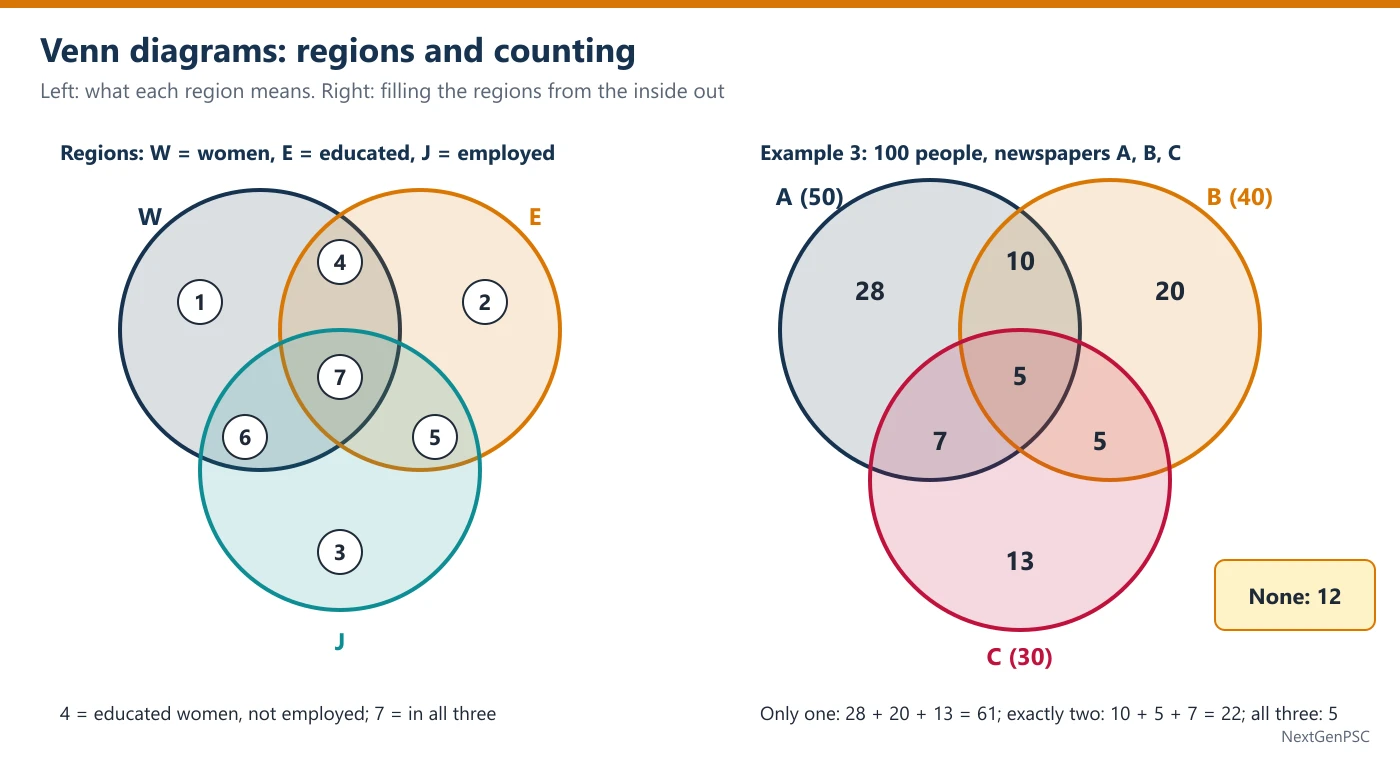
Region questions show a diagram with numbered regions and ask which number represents a description such as 'educated women who are not employed' (see the diagram, left).
Classification questions name three classes (Country, State, District; Doctors, Women, Mothers) and ask which diagram shows their relation correctly.
2. Two Groups
Union: n(A or B) = n(A) + n(B) − n(both). None: total − n(A or B). Only A: n(A) − n(both).
Example: 30 cricket, 25 football, 10 both, class of 50: at least one = 30 + 25 − 10 = 45; none = 5; cricket only = 20; football only = 15. Check: 20 + 10 + 15 + 5 = 50.
Why subtract 'both': the people in the overlap sit inside both circles, so adding the two circle totals counts them twice.
With percentages: the same formula works. If 60% read Hindi papers, 50% English and 20% both, then 90% read at least one and 10% read neither.
3. Three Groups: Fill from the Inside Out
Take the newspaper survey of the diagram (right): 100 people; A 50, B 40, C 30; A and B 15, B and C 10, C and A 12; all three 5.
Step 1, centre: all three = 5.
Step 2, pairs only: A and B only = 15 − 5 = 10; B and C only = 10 − 5 = 5; C and A only = 12 − 5 = 7. (The pair figures include the centre, so subtract it.)
Step 3, single groups only: A only = 50 − 10 − 7 − 5 = 28; B only = 40 − 10 − 5 − 5 = 20; C only = 30 − 5 − 7 − 5 = 13.
Step 4, none: 100 − (28 + 20 + 13 + 10 + 5 + 7 + 5) = 100 − 88 = 12.
Formula check: at least one = A + B + C − (AB + BC + CA) + ABC = 120 − 37 + 5 = 88.
Exactly one = 28 + 20 + 13 = 61; exactly two = 10 + 5 + 7 = 22; all three = 5. Check: 61 + 22 + 5 = 88.
4. When 'Exactly Two' Is Unknown
Adding the three circle totals counts each person once per group joined: a person in exactly one group is counted once, in exactly two twice, in all three three times.
So A + B + C = (exactly one) + 2 × (exactly two) + 3 × (all three), and the number in at least one group = A + B + C − (exactly two) − 2 × (all three).
Example: 60 students, each studies at least one of Hindi (35), English (30) and Sanskrit (20); 8 study all three. Then 60 = 85 − (exactly two) − 16, so exactly two = 9.
5. Greatest and Least Overlap
Two groups in a total N: the overlap is at least A + B − N (if this is positive) and at most the smaller of A and B. Tea 70 and coffee 80 out of 100: both is at least 50 and at most 70.
Why: if fewer than 50 liked both, the people liking at least one would be more than 70 + 80 − 50 = 100, more than the whole group.
Three groups: the number in all three is at least A + B + C − 2N. For 80, 70 and 60 out of 100: at least 210 − 200 = 10. Why: count the 'misses': 20 people do not like the first, 30 not the second and 40 not the third, 90 misses in all. Anyone outside the triple overlap has at least one miss, so at most 90 people are outside it and at least 100 − 90 = 10 are inside.
6. Choosing the Right Diagram
One class inside another (subset): every district is in a state and every state is in a country: three circles, one inside another.
Overlapping classes: some doctors are women and some women are doctors: two overlapping circles.
Separate classes: nothing is both (for example, Tigers and Sparrows): two circles that do not touch.
For three classes, decide the relation of each pair. Doctors, Women, Mothers: every mother is a woman (Mothers inside Women); some doctors are women, some are mothers, some are neither (Doctors overlaps both). The answer is one circle inside another, with a third circle overlapping both.
Test each pair with a real example member: a woman doctor who is a mother, a woman doctor who is not a mother, a male doctor. If such members exist, the regions must exist.
7. Traps
Adding circle totals: 50 + 40 + 30 = 120 is more than 100 people; overlaps must be removed.
Pair figures include the centre: 'A and B: 15' includes the 5 who read all three.
Exactly two versus at least two: at least two = exactly two + all three = 22 + 5 = 27.
Assuming the least overlap is zero: with 70 and 80 out of 100, at least 50 must overlap.
Example 1: Two groups
- Question
In a class of 50 students, 30 play cricket, 25 play football and 10 play both. How many students play neither game? (a) 0 (b) 5 (c) 10 (d) 15
- Solution
Normal method. At least one game = 30 + 25 − 10 = 45.
Neither = 50 − 45 = 5.
Shortcut. Fill regions: cricket only 20, both 10, football only 15; 20 + 10 + 15 = 45; 50 − 45 = 5.
Trap. Option (a) adds 30 + 25 = 55 and concludes that everyone plays; option (c) copies the 'both' figure.
- Answer
(b) 5
Example 2: Reading a region
- Question
In the diagram (left), circle W stands for women, circle E for educated people and circle J for employed people. The seven regions are numbered 1 to 7: 1 is in W only, 2 in E only, 3 in J only, 4 in W and E only, 5 in E and J only, 6 in W and J only, and 7 in all three. Which region represents educated women who are not employed? (a) 1 (b) 4 (c) 6 (d) 7
- Solution
Normal method. The description needs: inside W, inside E, outside J.
Region 4 is in W and E only (not in J).
Shortcut. 'Not employed' removes every region inside J (3, 5, 6, 7); of the rest, only 4 is in both W and E.
Trap. Option (d) is educated women who are also employed; option (a) is women who are neither educated nor employed.
- Answer
(b) 4
Example 3: Three newspapers, none (UPSC-style)
- Question
In a survey of 100 people, 50 read newspaper A, 40 read B and 30 read C; 15 read both A and B, 10 read both B and C, 12 read both C and A, and 5 read all three. How many read none of the three? (a) 8 (b) 12 (c) 17 (d) 22
- Solution
Normal method. At least one = 50 + 40 + 30 − (15 + 10 + 12) + 5 = 120 − 37 + 5 = 88.
None = 100 − 88 = 12.
Shortcut. Fill from the centre: 5; pairs only 10, 5, 7; singles only 28, 20, 13. Sum = 88.
Trap. Option (c) forgets to add back the 5 who read all three (120 − 37 = 83, so 100 − 83 = 17); option (d) is the 'exactly two' count.
- Answer
(b) 12
Example 4: Exactly one
- Question
In the same survey (100 people; A 50, B 40, C 30; A and B 15, B and C 10, C and A 12; all three 5), how many read exactly one newspaper? (a) 56 (b) 61 (c) 66 (d) 88
- Solution
Normal method. A only = 50 − (15 + 12 − 5) = 28. B only = 40 − (15 + 10 − 5) = 20. C only = 30 − (10 + 12 − 5) = 13.
Exactly one = 28 + 20 + 13 = 61.
Shortcut. Exactly one = A + B + C − 2(AB + BC + CA) + 3 × ABC = 120 − 74 + 15 = 61.
Trap. Option (d) is 'at least one'; option (a) subtracts the pair figures without adding back the centre.
- Answer
(b) 61
Example 5: The least overlap (UPSC-style)
- Question
In a group of 100 people, 70 like tea and 80 like coffee. What is the least possible number of people who like both? (a) 20 (b) 30 (c) 50 (d) 70
- Solution
Normal method. Let x like both. Then at least one = 70 + 80 − x = 150 − x, which cannot exceed 100.
So 150 − x ≤ 100, giving x ≥ 50. With x = 50: tea only 20, coffee only 30, both 50, none 0, total 100. So 50 is possible and is the least.
Shortcut. Least overlap = A + B − N = 70 + 80 − 100 = 50.
Trap. Option (d) is the greatest possible overlap (everyone who likes tea also likes coffee); options (a) and (b) are the numbers who dislike coffee or tea.
- Answer
(c) 50
Example 6: Exactly two from totals (UPSC-style)
- Question
In a class of 60 students, every student studies at least one of Hindi, English and Sanskrit. 35 study Hindi, 30 study English and 20 study Sanskrit; 8 study all three. How many students study exactly two of the three languages? (a) 9 (b) 17 (c) 25 (d) 33
- Solution
Normal method. Sum of circle totals = 35 + 30 + 20 = 85. This counts exactly-one students once, exactly-two twice and all-three thrice.
Students = (exactly one) + (exactly two) + (all three) = 60. So 85 − 60 = (exactly two) + 2 × 8, giving exactly two = 25 − 16 = 9.
Shortcut. Exactly two = (A + B + C) − N − 2 × ABC = 85 − 60 − 16 = 9.
Check. One valid filling: Hindi and English only 4, English and Sanskrit only 3, Sanskrit and Hindi only 2; then Hindi only 21, English only 15, Sanskrit only 7; 21 + 15 + 7 + 4 + 3 + 2 + 8 = 60.
Trap. Option (c) forgets that all-three students are counted three times (85 − 60 = 25); option (b) subtracts the 8 only once.
- Answer
(a) 9
Practice Questions
Q1. In a group of 60 people, 40 speak Hindi, 35 speak English and 5 speak neither. How many speak both? (a) 15 (b) 20 (c) 25 (d) 75
Q2. Which diagram best represents Country, State and District? (a) Three separate circles (b) Three circles, one inside another (c) Two overlapping circles and one separate circle (d) Three mutually overlapping circles
Q3. Of 100 people, 80 like music, 70 like films and 60 like sport. What is the least possible number of people who like all three? (a) 0 (b) 10 (c) 30 (d) 60
Q4. In the region diagram of Example 2, which region represents employed women who are not educated? (a) 3 (b) 5 (c) 6 (d) 7
Q5. Which diagram best represents Doctors, Women and Mothers? (a) Three mutually overlapping circles (b) One circle inside another, with a third circle overlapping both (c) Three circles, one inside another (d) Three separate circles
Q6. In a survey, 60% of the people read Hindi papers, 50% read English papers and 20% read both. What percentage read neither? (a) 0% (b) 10% (c) 20% (d) 30%
Answers
Show answers
Q1. (b) 20. At least one = 60 − 5 = 55; both = 40 + 35 − 55 = 20.
Q2. (b) Three circles, one inside another. Every district lies in a state and every state in a country.
Q3. (b) 10. A + B + C − 2N = 210 − 200 = 10; it is reached when everyone likes at least two of the three.
Q4. (c) 6. Inside W and J, outside E: region 6.
Q5. (b) One circle inside another, with a third circle overlapping both. Mothers lie inside Women; Doctors overlap Mothers, other Women and men.
Q6. (b) 10%. At least one = 60 + 50 − 20 = 90%; neither = 10%.
| Asked | Formula | Example (newspaper survey) |
|---|---|---|
| Two groups: at least one | A + B − both | 30 + 25 − 10 = 45 |
| Three groups: at least one | A + B + C − (AB + BC + CA) + ABC | 120 − 37 + 5 = 88 |
| Exactly one | A + B + C − 2(AB + BC + CA) + 3ABC | 120 − 74 + 15 = 61 |
| Exactly two | (AB + BC + CA) − 3ABC | 37 − 15 = 22 |
| Exactly two from totals | A + B + C − N − 2ABC (everyone in at least one) | 85 − 60 − 16 = 9 |
| Least overlap of two | A + B − N | 70 + 80 − 100 = 50 |
| Least in all three | A + B + C − 2N | 210 − 200 = 10 |
| Relation | Diagram | Example |
|---|---|---|
| All X are Y | X inside Y | Mothers inside Women |
| Some X are Y, some not | overlapping circles | Doctors and Women |
| No X is Y | separate circles | Tigers and Sparrows |
| Chain of subsets | circles one inside another | District, State, Country |
| Subset plus an overlapping class | one inside another, third overlapping both | Mothers, Women, Doctors |
Prelims tips
- Fill from the centre outwards. All three first, then pairs only (pair figure − centre), then singles only. Starting from the outside double-counts the centre, and that error produces the trap options.
- Always do the total check. All regions plus 'none' must equal the group size. It takes 15 seconds and catches almost every slip.
- Know the 'exactly two' shortcut. When everyone is in at least one group, exactly two = A + B + C − N − 2 × (all three). UPSC-style questions often give only circle totals and the centre.
- Least overlap = A + B − N. For 'at least how many like both', the answer is never zero when A + B is more than N. For three groups, use A + B + C − 2N.
- Read 'exactly' and 'at least' carefully. At least two = exactly two + all three. The two answers usually both appear in the options.
- For diagram choice, test each pair with a real member. If a woman doctor who is not a mother exists, the diagram needs that region. Subsets go inside; partial overlaps overlap; unrelated classes stay apart.
PYQs from this chapter
13 UPSC Prelims questions (2024–2025) test what this chapter teaches. Open a year to read them with answers: