
CSAT (Prelims Paper II) · UPSC Notes
Decision Making and Interpersonal Skills — UPSC CSAT Notes
Free, exam-focused notes for UPSC Prelims and Mains, with Prelims tips and Mains points for every topic. 8 topics.
Open in the interactive reader: bookmarks, progress tracking and read-aloud.
Situational Judgement
In short
Situational judgement questions put you in a role (a district officer, a manager, a teacher, a citizen) facing a practical problem and ask which of four actions you would take. Such questions formed the decision-making section of the early CSAT papers but have hardly appeared in recent papers, so this topic carries few marks today: treat it as a low-cost safety net, and as training for governance passages and GS Paper IV case studies. There is no single textbook answer; you pick the most defensible option, the one that is lawful, fair, proportionate and people-centred, and that acts within your role while escalating what is beyond it.
In simple words
A situational judgement question is a small story: 'You are the officer in charge. Something has gone wrong. What will you do?' Four actions are given and you choose one.
Think of a school principal who learns that a peon took ₹50 from a parent to let him meet a teacher. She could ignore it, shout at the peon in front of everyone, dismiss him on the spot, or check the facts, return the money to the parent and take action under the rules. The last one is clearly the best: it is fair, it fixes the problem and it follows the rules.
That is the whole skill. The best option is usually the calm, legal one that solves the real problem of the person who is suffering, and informs the senior people who must know.
The one question to always ask: 'Could I defend this action in front of my boss, a court and the affected person?' If the answer is yes for all three, it is probably the right option.
Two habits solve most questions: (1) first cross out every option that breaks a rule or runs away from the problem; (2) among the rest, choose the one that helps the affected person now and also fixes the cause.
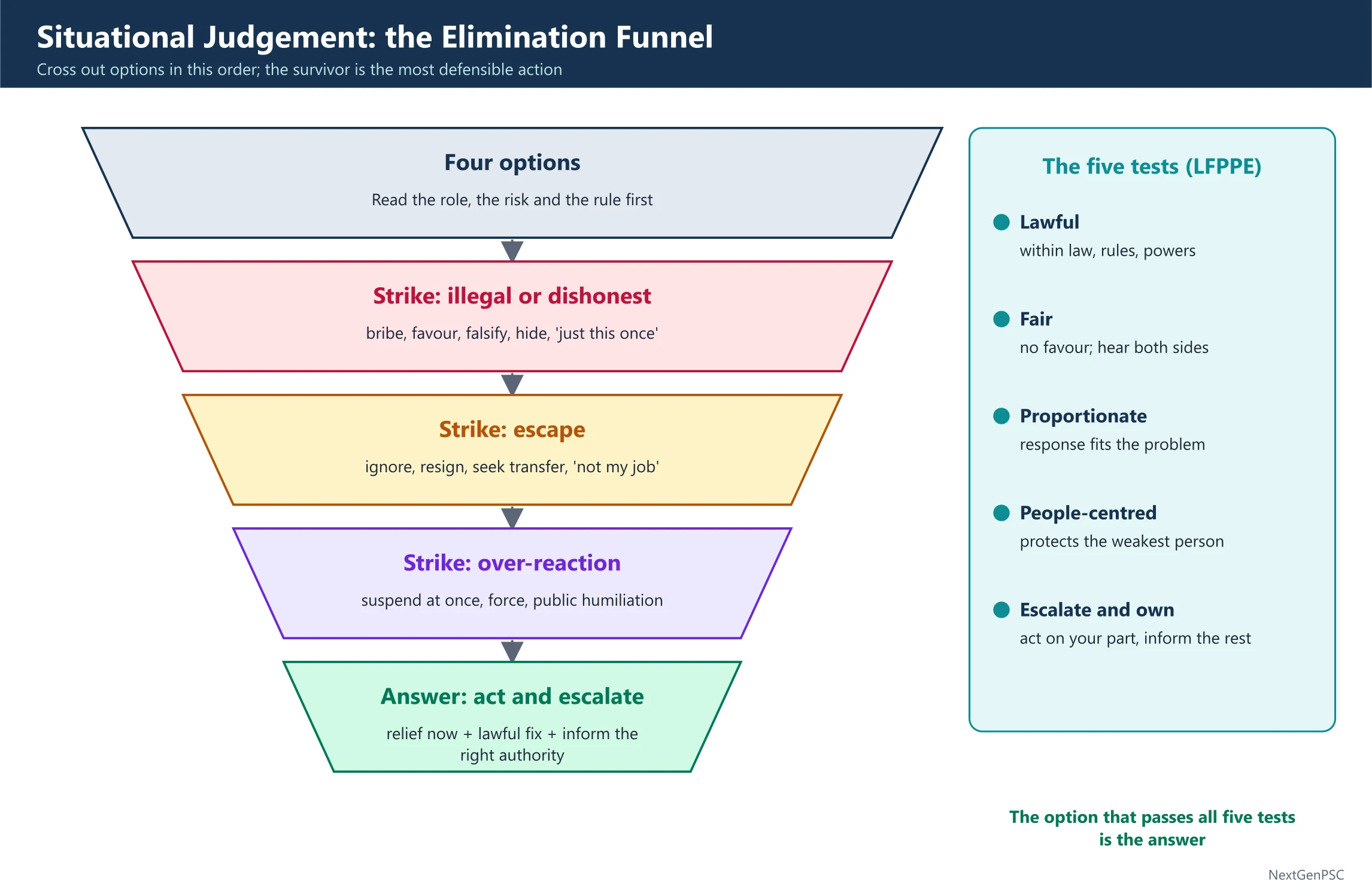
1. What a Situational Judgement Question Looks Like
The question gives you a role ('You are the Block Development Officer…'), a problem with some pressure in it (time, a superior, an angry crowd, a rule that looks unfair) and four possible actions. You must pick the one you would take.
Unlike a maths question, two or three options may look 'not wrong'. The examiner wants the most defensible one: the action you could explain and justify before your superior, a court, the media and the affected people.
Most options fall into five families: avoid (ignore it, pass the file on, wait for orders), over-react (suspend, scold in public, use force), bend the rule (an illegal shortcut, a favour, a bribe 'just this once'), quit (resign, ask for a transfer, refuse the work) and act and escalate (deal with what is in your power now and involve those who must decide the rest). The answer almost always comes from the last family.
2. How Much It Counts Today
The CSAT syllabus still lists 'decision making and problem solving' and 'interpersonal skills including communication skills'. Separate decision-making questions were set in the early CSAT papers, but recent papers have carried few or none; most marks now come from comprehension, numeracy and reasoning.
So give this whole chapter a few hours in total, not weeks. It pays back in three ways: a safe mark if such a question returns, faster elimination in governance and ethics passages, and a ready framework for GS Paper IV case studies.
3. The Five Tests (LFPPE)
Lawful: the action stays inside the law, the rules and your official powers. Any option that breaks a rule to get a good result is out, however kind it looks.
Fair: it treats people equally and without favour, and follows a fair process (hear both sides, check facts, record reasons).
Proportionate: the response fits the size of the problem. A first small lapse calls for counselling or a warning, not suspension; a threat to life calls for action at once, not a committee.
People-centred: the action protects the weakest person in the story (the patient, the child, the poor applicant, the victim) and solves their problem, not only the office's.
Escalate and own: you act at once on what lies within your role and inform or involve the competent authority for what does not. You neither hide the problem nor dump it entirely on someone else.
An option that passes all five tests is the answer. If two seem to pass, prefer the one that gives immediate relief and also a lasting fix.
4. Reading the Situation in 20 Seconds
Ask four questions before you read the options: Who am I here (role and powers)? Who is at risk, and how urgent is it? What does the rule say? What would a calm, fair officer do first?
Mark the pressure words: 'immediately', 'your superior insists', 'a relative', 'the media is present', 'the deadline is tomorrow'. The examiner builds the wrong options around exactly that pressure.
Then predict the answer in your own words and look for the option closest to it. This stops attractive but wrong options from pulling you.
5. The Elimination Order
Step 1: strike out illegal or dishonest options (bribe, falsify, favour, hide).
Step 2: strike out escape options (resign, seek a transfer, ignore, 'not my job').
Step 3: strike out disproportionate options (harsh punishment for a minor lapse, force against a peaceful crowd, public humiliation).
Step 4: among what is left, choose the option that acts now within your role and brings in the right authority, people or process.
Why this order: the first three steps remove options that fail a test outright; the last step compares degrees of goodness, which is where careful reading matters.
6. Words That Signal Strong and Weak Options
Weak-option signals: 'ignore', 'only', 'at once suspend', 'refuse', 'as the senior says', 'quietly', 'leave it to'. Strong-option signals: 'after verifying', 'inform', 'within the rules', 'in consultation with', 'while ensuring', 'explain to'.
Do not choose by words alone: a strong-sounding option is still wrong if it lies outside your powers (a school teacher cannot 'order a police inquiry').
Example 1: Short supply at the ration shop
- Question
You are a newly posted tehsildar. Several villagers complain that the fair price shop dealer gives them less grain than their entitlement. What will you do? (a) Get the stock and distribution registers checked through a surprise inspection, ensure correct supply meanwhile and act on the findings under the rules (b) Cancel the dealer's licence at once on the basis of the complaint (c) Ignore the complaint because no written proof is attached (d) Advise the villagers to file a case in court
- Solution
Weigh each option. (a) passes all five tests: it checks facts quickly, protects the villagers' entitlement now and leads to lawful action.
(b) fails the fair and proportionate tests: cancelling a licence without any inquiry denies the dealer a hearing and may not survive an appeal.
(c) fails the people-centred test: a group complaint about food is serious even without paper proof; collecting proof is the officer's job.
(d) passes the buck: the tehsildar has the power to inspect, so sending poor villagers to court is an escape.
Shortcut. Verify, give relief, act under the rules: the option with all three is the answer.
Trap. (b) looks 'strong and honest', but punishment before inquiry is the classic over-reaction option.
- Answer
(a) Get the stock and distribution registers checked through a surprise inspection, ensure correct supply meanwhile and act on the findings under the rules
Example 2: A hardworking clerk who comes late
- Question
You are a section officer. A sincere and hardworking clerk has been coming late for a week. You hear that his mother is seriously ill. What will you do? (a) Issue him a show-cause notice and put it in his service record (b) Ignore the late coming because he is otherwise hardworking (c) Talk to him privately, understand the problem and allow leave or adjusted timings permissible under the rules (d) Report the matter to the head of office without speaking to him
- Solution
Weigh each option. (a) is disproportionate: a formal notice before even asking the reason is harsh for a first lapse with a likely genuine cause.
(b) is kind but unfair to others who come on time and lets the rule slide; the problem is not solved.
(c) is lawful (only permissible leave or timings), fair (hears him first) and humane, and it restores discipline without damage.
(d) escalates a matter that is within your own role and skips the basic step of talking to the person.
Shortcut. For a first, minor lapse with a human cause: talk first, help within the rules.
Trap. (b) is the 'nice' option; kindness that ignores the rule fails the fairness test.
- Answer
(c) Talk to him privately, understand the problem and allow leave or adjusted timings permissible under the rules
Example 3: Political pressure in a relief camp (UPSC-style)
- Question
You are in charge of a flood relief camp. A local leader insists that relief material should first go to the village where his supporters live, although other villages are worse affected. What will you do? (a) Agree, since his cooperation is needed to run the camp smoothly (b) Distribute relief according to assessed need, explain the criteria openly to the leader and the people, and inform the district administration of the pressure (c) Stop all distribution until the leader leaves the camp (d) Ask for a transfer from relief duty to avoid political trouble
- Solution
Weigh each option. (a) fails the fairness test: relief by political loyalty, not need, is favouritism.
(b) passes all tests: need-based (fair, people-centred), transparent (explaining criteria defuses the pressure) and it escalates the pressure to the right level.
(c) punishes the flood victims for the leader's behaviour; it is disproportionate and harms the people the camp exists for.
(d) is the escape option: the duty and the problem both remain.
Shortcut. When pressure meets public duty: follow objective criteria, be transparent, inform superiors.
Trap. (a) sounds practical ('cooperation'), but any option that gives way to a favour fails at once.
- Answer
(b) Distribute relief according to assessed need, explain the criteria openly to the leader and the people, and inform the district administration of the pressure
Example 4: An accident victim and police formalities
- Question
You are the medical officer in charge of a primary health centre. A seriously injured road accident victim is brought in. The doctor on duty says that, as it is a medico-legal case, treatment should wait until the police arrive. What will you do? (a) Wait for the police, as medico-legal procedure requires (b) Send the victim straight to the district hospital without first aid (c) Treat the victim but do not inform the police, to avoid delay (d) Ensure immediate first aid and stabilisation, inform the police as required, and arrange referral if needed
- Solution
Weigh each option. (a) puts procedure above life; the Supreme Court has held (Parmanand Katara case) that emergency treatment must not wait for police formalities.
(b) moves the problem away and risks the patient's life on the road.
(c) saves life but breaks the legal duty to report a medico-legal case.
(d) saves life first and still completes the legal duty of informing the police: lawful, people-centred and complete.
Shortcut. Life first, paperwork alongside, never paperwork instead.
Trap. (c) is half right; an option that fixes one wrong by creating another is not the best.
- Answer
(d) Ensure immediate first aid and stabilisation, inform the police as required, and arrange referral if needed
Example 5: A senior pushes an unverified bill (UPSC-style)
- Question
Your senior officer asks you to pass a contractor's bill today, although the work has not yet been verified. He says he will 'take responsibility' if anything goes wrong. What will you do? (a) Pass the bill, since the senior has taken responsibility (b) Refuse and complain to the vigilance department at once (c) Pass the bill but make a private note of the senior's oral order in your diary (d) Explain the rule to the senior, get the work verified on priority and pass the bill only after verification, recording the facts on file
- Solution
Weigh each option. (a) fails the lawful test: oral 'responsibility' does not remove your own duty as the passing officer.
(b) is disproportionate as a first step: the senior may simply be worried about a deadline; nothing wrong has happened yet.
(c) still breaks the rule; a private diary is not an official record and protects no one.
(d) keeps the rule, respects the senior's genuine concern about delay (priority verification) and protects everyone through a file record.
Shortcut. Rule kept + genuine need met + written record = best option.
Trap. (b) feels honest, but jumping to a complaint before explaining the rule is over-reaction.
- Answer
(d) Explain the rule to the senior, get the work verified on priority and pass the bill only after verification, recording the facts on file
Example 6: A highway blockade with an ambulance stuck (UPSC-style)
- Question
You are the Sub-Divisional Magistrate. Angry residents have blocked a highway after a child died in an accident caused by a large pothole. An ambulance is stuck in the jam. What will you do? (a) Order the police to clear the road using force (b) Go to the spot, talk to the protesters, get the ambulance through, and announce an inquiry into the pothole and relief to the family as per rules (c) Wait for the crowd to get tired and leave (d) Promise a government job to a family member so that the blockade ends at once
- Solution
Weigh each option. (a) is disproportionate against grieving, unarmed citizens and can turn a protest into violence.
(b) meets the urgent need (the ambulance), addresses the grievance through lawful steps (inquiry, relief under the rules) and calms the crowd by personal presence.
(c) abandons both the patient in the ambulance and the grieving family.
(d) makes a promise outside the rules and your powers; it buys peace with something you cannot lawfully give.
Shortcut. In a crowd situation: be present, talk, meet the urgent need, promise only lawful remedies.
Trap. (d) ends the blockade fastest, but speed bought with an unlawful promise fails the first test.
- Answer
(b) Go to the spot, talk to the protesters, get the ambulance through, and announce an inquiry into the pothole and relief to the family as per rules
Practice Questions
Q1. You are a teacher. A student in your class is often sleepy and hungry, and his marks are falling. What will you do? (a) Punish him for sleeping in class (b) Ignore it, since it is a family matter (c) Talk gently to the student and his parents, check that he gets the midday meal and any welfare support, and inform the head teacher (d) Report the family to the police
Q2. You are a bank branch officer. An elderly pensioner is struggling to use the cash machine while a queue grows behind him. What will you do? (a) Help him, or ask a staff member to help him, complete the transaction, and tell him about simpler options such as doorstep banking where available (b) Ask him to come back on a less busy day (c) Take his card and PIN and withdraw the money for him yourself (d) Tell him to bring a relative next time
Q3. You notice a colleague taking small amounts of cash from applicants to speed up their files. What will you do? (a) Ignore it because the amounts are small (b) Report the matter, with the facts you have, to the competent authority through proper channels (c) Confront him loudly in front of the applicants (d) Post about it on social media
Q4. You are on duty at an examination centre. A candidate arrives 10 minutes after the gate has closed and says he was delayed by an accident. The rules do not allow entry after closing time. What will you do? (a) Follow the rule, explain it politely, record the facts and forward his representation to the competent authority (b) Turn him away rudely so that others learn a lesson (c) Let him in, since his reason is genuine (d) Let him in if the other candidates do not object
Q5. You are the panchayat secretary. Water from the hand pump next to the village school is found to be contaminated. What will you do? (a) Wait for next year's funds to repair it (b) Put up a warning notice and do nothing more (c) Seal the hand pump at once, arrange safe water from a tanker or another source, get the water tested and start repairs under the relevant scheme (d) Ask the school to close until the pump is repaired
Answers
Show answers
Q1. (c) Talk gently to the student and his parents, check that he gets the midday meal and any welfare support, and inform the head teacher. It finds the cause and helps the child; (a) and (d) are harsh, (b) abandons him.
Q2. (a) Help him, or ask a staff member to help him, complete the transaction, and tell him about simpler options such as doorstep banking where available. People-centred and safe; (c) breaks card security rules.
Q3. (b) Report the matter, with the facts you have, to the competent authority through proper channels. Corruption must be reported through lawful channels; (c) and (d) are not proper processes.
Q4. (a) Follow the rule, explain it politely, record the facts and forward his representation to the competent authority. The rule binds you; the representation lets the authority decide fairly.
Q5. (c) Seal the hand pump at once, arrange safe water from a tanker or another source, get the water tested and start repairs under the relevant scheme. Immediate safety + relief + lasting fix.
| Test | Ask yourself | Typical option that fails it |
|---|---|---|
| Lawful | Is it within the law, the rules and my powers? | Pass the bill on an oral order; promise a job to end a protest |
| Fair | Does it treat everyone equally and follow a fair process? | Relief first to a leader's supporters; punishment without a hearing |
| Proportionate | Does the response fit the size of the problem? | Suspension for a first late arrival; force on a peaceful crowd |
| People-centred | Does it protect the weakest person and solve their problem? | Send poor villagers to court; wait for police while a patient bleeds |
| Escalate and own | Do I act on my part now and involve the right authority for the rest? | Ignore it; seek a transfer; report upward without doing my own part |
| Family | Typical wording | Verdict |
|---|---|---|
| Avoid | ignore, wait for orders, not my job, leave it to them | Reject: the problem and the duty remain |
| Over-react | suspend at once, scold publicly, use force, cancel immediately | Reject unless life or safety is at stake right now |
| Bend the rule | just this once, quietly, as the senior says, favour | Reject always, however kind the motive |
| Quit | resign, seek a transfer, refuse the assignment | Reject: escape is never the most defensible action |
| Act and escalate | verify, give relief, act within rules, inform the competent authority | Choose: usually the answer |
Prelims tips
- Know its weight. Separate decision-making questions have been rare in recent papers, so spend only a few hours here; the framework still speeds up governance and ethics passages.
- Strike illegal options first. The examiner often makes the rule-breaking option the most sympathetic one (letting a late candidate in, passing a bill 'to help'). Kindness that breaks a rule is never the answer.
- Escape is never the answer. Resigning, seeking a transfer, ignoring or 'leaving it to the court' are written to look safe; cross them out in the first few seconds.
- Watch for over-reaction. 'Suspend at once', 'cancel immediately' and 'use force' are traps unless a life is in danger this minute. Look for verify-then-act.
- Prefer the complete option. When two options both look lawful and fair, choose the one that gives immediate relief and also fixes the cause or informs the right authority.
- Check that the action is within your role. An option can sound ideal and still be wrong because the person in the question has no power to do it. Read the role line again before you mark.
Ethical Decision Making
In short
Ethical decision making questions place you in a value conflict (honesty against loyalty, rule against compassion, private gain against public duty) and ask what you would do. They belonged to the decision-making questions of the early CSAT papers and have been rare in recent papers, so they carry few marks today; the same thinking, however, is tested in depth in GS Paper IV. Three ideas unlock almost every question: public interest comes before private interest, a good end does not justify a wrong means, and a conflict of interest is declared, not managed in secret.
In simple words
An ethical question is one where doing the right thing costs you something: a friendship, a gift, your boss's goodwill, or an easy shortcut.
Example: you are on an interview panel and your cousin walks in as a candidate. You know you would mark fairly. But others cannot see inside your head. The ethical step is to tell the panel chairperson and step aside for that candidate. Fairness must not only be done, it must be seen to be done.
Another example: a shopkeeper whose licence file is on your table sends you a box of dry fruits worth ₹5,000 at Diwali. It feels rude to refuse. But accepting it creates an obligation. The ethical step is to return it politely and follow the conduct rules.
The one question to always ask: 'Would I be comfortable if this action, and my reason for it, appeared on the front page of tomorrow's newspaper?' If not, it is probably wrong.
Two habits solve most questions: (1) never pick an option that uses a wrong means for a good end; (2) when your own interest is involved, pick the option that discloses it and lets someone neutral decide.
1. What Makes a Question 'Ethical'
A situational question becomes an ethical one when two good things pull in opposite directions, or when the easy path is a wrong one. The common pairs are honesty against loyalty, rule against compassion, speed against due process, and personal interest against public duty.
There is rarely a villain in the options. The wrong options are usually written as reasonable, kind or practical choices; the examiner tests whether you notice the value they quietly give up.
Answer on the basis of the most defensible action for a public servant, not what most people might do in private life.
2. The Values You Are Tested On
Integrity: acting honestly when no one is watching; no personal gain from public office.
Impartiality and non-partisanship: the same treatment for a minister's relative and a daily-wage worker; no favour on the basis of caste, religion, party or friendship.
Objectivity: decisions on facts, merit and evidence, not on pressure or impressions.
Accountability and transparency: recording reasons, owning mistakes, and being able to explain a decision to those it affects.
Empathy and compassion towards the weaker sections: using the discretion the rules allow in favour of those who need it most, without breaking the rules.
Dedication to public service: doing the job fully even when it is inconvenient, unpopular or unrewarded.
3. Common Dilemmas and the Rule That Settles Them
Conflict of interest (relative, friend, own business involved): declare it to the competent authority and withdraw from that decision. Why: a fair decision by an interested person still looks unfair, and public trust depends on appearance as well.
Gifts and hospitality from anyone with business before you: return them politely and report as the conduct rules require. Why: a gift creates a sense of obligation, which is exactly what the giver wants.
Pressure from a superior or a politician to do something improper: explain the rule politely, decline the improper part, and keep a written record; inform the next higher authority if the pressure continues.
Your own mistake: admit it to the right person and correct it at once. Covering it up turns an error into dishonesty.
Wrongdoing by a colleague or senior: report it with facts through proper channels (the competent authority, the vigilance wing, or the Whistle Blowers Protection Act, 2014 route). Leaking to the media or confronting in public are not proper first steps.
Rule against compassion: look for the compassionate path inside the rules: speed up the missing document, use the discretion the rule gives, link the person to another scheme. Breaking the rule is not the answer, and neither is a cold rejection.
4. Three Quick Tests
Front-page test: would I be comfortable if this action and my reason appeared in tomorrow's newspaper? Secret actions usually fail it.
Role-reversal test: if I were the affected person (the applicant, the junior, the patient), would I accept this decision as fair?
Everyone-does-it test: what if every officer in my position did this? A small favour repeated by everyone becomes a corrupt system.
Gandhiji's talisman gives a fourth check: recall the face of the poorest person you have seen and ask whether the step will be of any use to him.
5. Ends and Means
A good result reached by a wrong method is still wrong in these questions: falsifying data to win funds for a poor district, slapping a suspect to recover stolen goods faster, or passing a bill without verification to save a deadline.
Why the examiner insists on this: a public servant who bends rules for good causes will also bend them for bad ones, and citizens can no longer predict how the state will treat them.
So when an option says 'though it is against the rules, it will help the people', treat it as a trap and look for the option that helps the people within the rules.
6. How the Options Are Built
One option gives in to the pressure (accept the gift, obey the improper order). One over-corrects (publicly accuse, punish harshly, punish an innocent person to look neutral). One escapes (stay away, take leave, ask someone else to handle it). One keeps the value and solves the problem through the proper process: that is the answer.
A subtle trap is the 'over-neutral' option: marking your own cousin lower to prove that you are fair is also unfair, because the marks are no longer based on merit.
Example 1: A festival gift from an applicant
- Question
A businessman whose licence application is pending with you sends an expensive gift hamper to your home during a festival. What will you do? (a) Accept it, since exchanging gifts at festivals is a social custom (b) Reject his licence application to teach him a lesson (c) Accept it and donate it to an orphanage (d) Return it politely with a note and report it as required by the conduct rules
- Solution
Weigh each option. (a) treats a gift from someone with business before you as an ordinary social custom; it creates an obligation and fails the integrity test.
(b) punishes him through his application, which must be decided only on merit; it mixes a personal reaction with an official decision.
(c) looks generous, but you have still accepted it, and the giver still believes he has obliged you.
(d) refuses the gift without humiliating the giver and creates an official record: honest, transparent and proportionate.
Shortcut. Gift from someone whose work is pending = return politely + report.
Trap. (c) feels ethical because the gift goes to charity, but the act of accepting is the problem.
- Answer
(d) Return it politely with a note and report it as required by the conduct rules
Example 2: A relative on the selection list (UPSC-style)
- Question
You are a member of a selection committee for a government post. On the day of the interviews you find that your cousin is one of the candidates. What will you do? (a) Inform the chairperson of the relationship and withdraw from the selection for that post (b) Stay on the committee, since you are sure you will judge fairly (c) Stay on the committee but give your cousin slightly lower marks to prove your neutrality (d) Ask your cousin to withdraw his candidature
- Solution
Weigh each option. (a) discloses the conflict of interest and lets a neutral process continue: transparent and fair to all candidates.
(b) relies on your private confidence; others cannot verify it, so the selection loses credibility.
(c) is unfair to the cousin: marks not based on merit are wrong in either direction.
(d) punishes the candidate for your position; he has a right to compete.
Shortcut. Conflict of interest = disclose and recuse.
Trap. (c) is the over-neutral option; proving fairness by being unfair is still unfair.
- Answer
(a) Inform the chairperson of the relationship and withdraw from the selection for that post
Example 3: An error in your own beneficiary list
- Question
You find that a list of beneficiaries you prepared, already approved by your superior, wrongly left out several eligible poor families. What will you do? (a) Keep quiet, since the list is already approved (b) Quietly add the names to the list without informing anyone (c) Report the error to your superior, get the list corrected and make sure the left-out families are included (d) Blame the data-entry operator for the error
- Solution
Weigh each option. (a) protects your image at the cost of poor families: it fails both accountability and compassion.
(b) fixes the list but bypasses the approval and hides the change: the right result by a wrong, untransparent method.
(c) owns the mistake, follows the process (the approving authority must know) and repairs the harm.
(d) adds dishonesty to an error and harms an innocent colleague.
Shortcut. Own mistake = admit + correct through the proper authority.
Trap. (b) gives the right outcome, but secret changes to an approved document are never the best option.
- Answer
(c) Report the error to your superior, get the list corrected and make sure the left-out families are included
Example 4: A widow's pension and a missing document
- Question
A widow applies for a pension under a state scheme. Her application is complete except for her husband's death certificate, which the registrar's office has delayed. What will you do? (a) Reject the application as incomplete (b) Sanction the pension without the certificate (c) Ask her to come back after she gets the certificate (d) Help her obtain the certificate quickly from the registrar, accept the application provisionally if the rules permit, and process it as soon as the certificate arrives
- Solution
Weigh each option. (a) follows the rule mechanically and ignores that the delay is the system's fault, not hers.
(b) is compassionate but breaks the rule; the document is needed to prevent false claims.
(c) is polite but leaves her to struggle with the same office that caused the delay.
(d) is compassion within the rules: it removes the real obstacle and keeps the safeguard.
Shortcut. Rule against compassion: find the compassionate path inside the rule.
Trap. (b) is the 'kind' option that breaks the rule; (a) is the 'correct' option that forgets the person.
- Answer
(d) Help her obtain the certificate quickly from the registrar, accept the application provisionally if the rules permit, and process it as soon as the certificate arrives
Example 5: A politician demands a transfer (UPSC-style)
- Question
You are a district officer. The local legislator asks you to transfer a sincere junior officer who refused to do an improper favour for him. What will you do? (a) Transfer the officer, since the legislator is an elected representative (b) Politely explain that transfers follow the laid-down policy, decline the request, and keep your superior informed (c) Criticise the legislator publicly at a press conference (d) Ask the junior officer to apologise to the legislator
- Solution
Weigh each option. (a) punishes honesty and tells every officer that integrity is risky: it fails impartiality and integrity.
(b) is courteous to an elected representative, firm on the rule, and protects you and the junior through information to the superior.
(c) turns an administrative matter into a public fight; it is not the proper channel and damages the working relationship.
(d) asks the honest officer to apologise for being honest.
Shortcut. Improper pressure = polite refusal + rule + inform superior.
Trap. (a) hides behind 'elected representative'; respect for the office does not extend to improper requests.
- Answer
(b) Politely explain that transfers follow the laid-down policy, decline the request, and keep your superior informed
Example 6: Weak cement in a school building (UPSC-style)
- Question
As an engineer, you find that substandard cement is being used in a government school building. The contractor is known to be close to your senior officer. What will you do? (a) Ignore it, since your senior is involved (b) Record the test results, stop further use of the weak material within your powers and report to the competent authority, using the vigilance or whistle-blower channel if the matter is blocked (c) Give the test report to the media at once (d) Inform the contractor privately so that he can fix it quietly
- Solution
Weigh each option. (a) puts children's lives at risk to avoid discomfort: it fails every test.
(b) acts within your powers to stop the danger, creates evidence, follows proper channels and keeps a lawful route open if the senior blocks it.
(c) bypasses the official process; it may help publicity but does not stop the work and can spoil the inquiry.
(d) hides the wrongdoing; no record exists and nothing stops a repeat.
Shortcut. Danger to the public + powerful people involved = act within powers, record, report through proper or protected channels.
Trap. (c) looks brave, but leaking is not the first proper step when lawful channels are available.
- Answer
(b) Record the test results, stop further use of the weak material within your powers and report to the competent authority, using the vigilance or whistle-blower channel if the matter is blocked
Practice Questions
Q1. You have set a question paper for a recruitment test. A close friend who is appearing in the test asks you for 'just a few hints'. What will you do? (a) Refuse politely and keep the paper fully confidential, informing the authority if he persists (b) Give only general hints, not the questions (c) Share the paper, since he badly needs the job (d) Stop meeting him until the test is over
Q2. A subordinate submits a travel bill that claims a small amount more than he actually spent. What will you do? (a) Ignore it, since the amount is small (b) Name him at the next staff meeting as a warning to others (c) Return the bill, ask for a correct one, warn him, and act under the rules if it is repeated (d) File a criminal complaint against him at once
Q3. Your family wants to use your official car for a relative's wedding. What will you do? (a) Allow it, since no one will notice (b) Use it and quietly pay for the fuel yourself (c) Use it only on a holiday (d) Decline and hire a private vehicle; an official car is for official work unless the rules allow private use on payment
Q4. A survey by your team shows that a flagship scheme is performing poorly. Your senior wants the report to show success. What will you do? (a) Change the figures as directed (b) Delay the report indefinitely (c) Present the true findings with the likely reasons and suggestions to improve the scheme (d) Prepare two reports, one true and one favourable
Q5. You are the superintendent of a hospital. An influential person demands to be seen ahead of a long queue of patients. What will you do? (a) Let him go first, since he is important (b) Ensure patients are seen on medical priority and politely tell him that he will be seen in turn unless his condition is urgent (c) Ask the guards to throw him out (d) Open a separate counter for important persons
Answers
Show answers
Q1. (a) Refuse politely and keep the paper fully confidential, informing the authority if he persists. Even 'hints' break confidentiality and are unfair to all other candidates.
Q2. (c) Return the bill, ask for a correct one, warn him, and act under the rules if it is repeated. Proportionate: neither ignored nor blown up.
Q3. (d) Decline and hire a private vehicle; an official car is for official work unless the rules allow private use on payment. Paying 'quietly' in (b) is still outside the rules.
Q4. (c) Present the true findings with the likely reasons and suggestions to improve the scheme. Honest and constructive; the others falsify or suppress the truth.
Q5. (b) Ensure patients are seen on medical priority and politely tell him that he will be seen in turn unless his condition is urgent. Equal treatment, with medical need as the only criterion.
| Dilemma | Principle | Most defensible action |
|---|---|---|
| Relative or friend in a matter you decide | Conflict of interest | Disclose to the competent authority and withdraw from that decision |
| Gift from someone whose work is pending | Integrity | Return politely; report as the conduct rules require |
| Improper order from a superior or politician | Rule of law, impartiality | Explain the rule, decline the improper part, keep a written record, inform higher authority |
| Your own mistake discovered | Accountability | Admit to the right person and correct it through the proper process |
| Wrongdoing by a colleague or senior | Integrity, public interest | Record facts; report through proper or protected (whistle-blower) channels |
| Rule seems harsh on a needy person | Compassion within the rules | Use the discretion the rule allows, remove the real obstacle, link to other schemes |
| Good end tempts a wrong means | Means matter | Reject the shortcut; reach the goal through lawful steps |
| Test | Question to ask | Catches |
|---|---|---|
| Front-page test | Would I be comfortable seeing this action and my reason in tomorrow's newspaper? | Secret favours, quiet changes to records |
| Role-reversal test | Would I accept this as fair if I were the affected person? | Cold, mechanical rejections; favouritism |
| Everyone-does-it test | What if every officer in my place did this? | 'Small' gifts and 'one-time' exceptions |
| Talisman test | Will this step help the poorest person affected? | Decisions that serve the office, not the people |
Prelims tips
- Know its weight. Pure ethics questions have been rare in recent CSAT papers; a few hours here are enough, and the same ideas carry over to GS Paper IV.
- Disclose and recuse. Whenever a relative, friend or your own interest appears in the question, the answer is the option that reveals it and lets a neutral person decide. 'I will be fair anyway' is a trap.
- Reject good ends by wrong means. Options that falsify, hide, bypass approval or break a rule 'for the people' are written to tempt you; they are never the most defensible choice.
- Beware the over-neutral option. Punishing your own relative, rejecting the gift-giver's application or naming a junior in public look principled but are unfair in the other direction.
- Proper channels before public ones. Report wrongdoing to the competent authority or vigilance first; media leaks and public accusations are wrong first steps while lawful channels are open.
- Compassion inside the rules. When a rule hurts a needy person, the answer neither breaks the rule nor rejects coldly; it removes the real obstacle or uses the discretion the rule already gives.
Choosing the Best Course of Action
In short
Best course of action questions describe a problem (a disease outbreak, a delay at an office, a cyclone warning, a struggling team) and ask which action, or which set of actions, should come first or does the most good. They were part of the decision-making questions of the early CSAT papers and have been rare in recent papers, so they bring few marks today, though the 'which courses of action follow' format also appears under Logical Reasoning. Three ideas solve them: the priority ladder (life and safety, then relief, then facts, then the root cause, then prevention), the feasibility filter (within powers, practical, timely, on target) and rejecting extremes (blanket bans, permanent closures, endless committees).
In simple words
A course of action is simply a step you take to deal with a problem. The 'best' one is the step that should come first and does the most good with the least harm.
Think of a kitchen fire at home. You could call the insurance company, scold whoever left the stove on, buy a new stove, or first get everyone out and put out the fire. Obviously, safety comes first; the rest can follow.
Government problems work the same way. If children fall ill after a school meal, the first step is treatment, then testing the food, then finding the cause, then fixing responsibility and changing the system so it does not happen again.
The one question to always ask: 'What must happen first, and is this step practical and within the power of the person in the question?'
Two habits solve most questions: (1) arrange the options on the ladder (safety → relief → facts → cause → prevention) and pick the one that matches the stage the question asks for; (2) reject extreme steps such as permanent bans or 'wait for a committee report'.
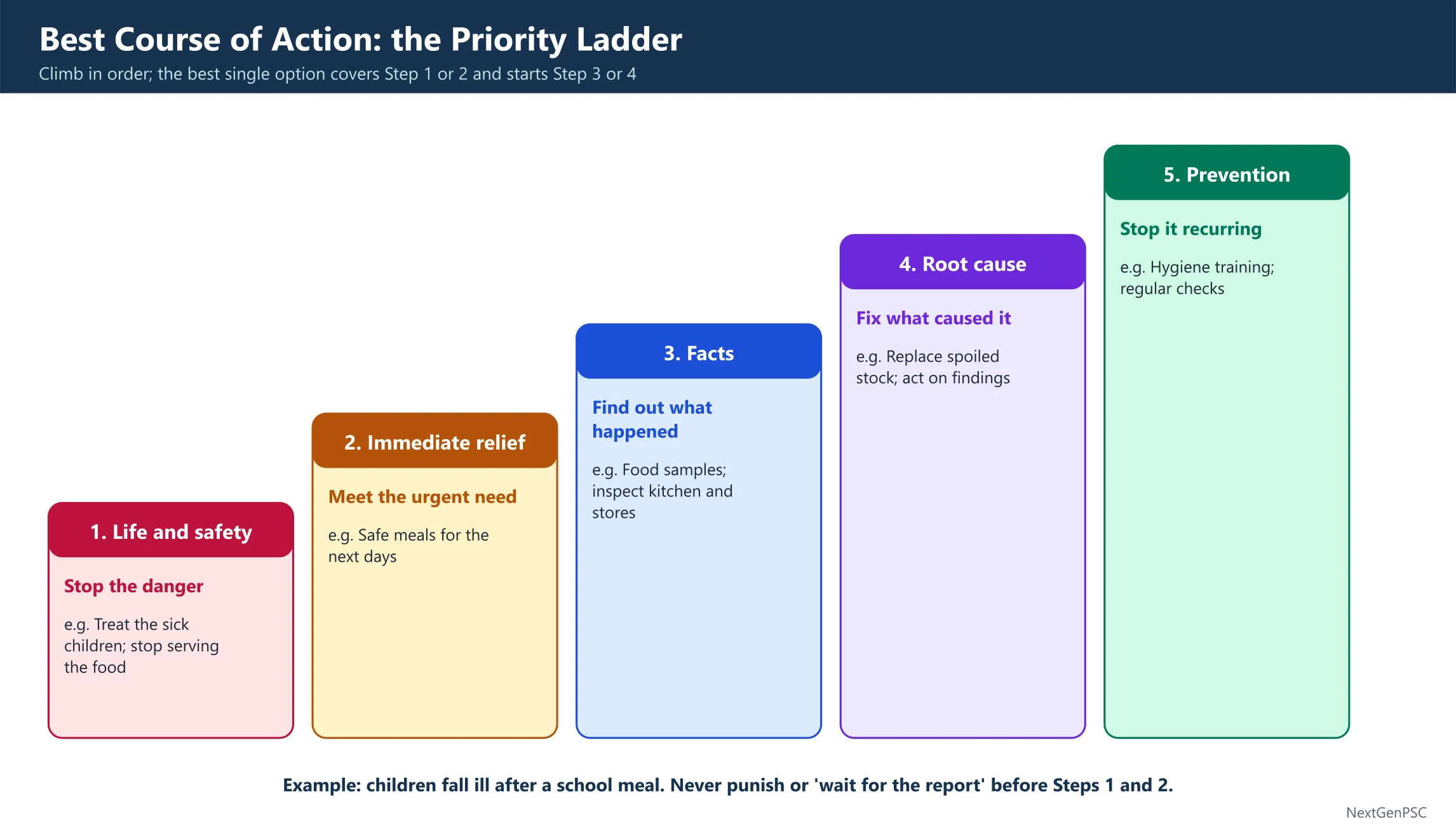
1. What 'Best Course of Action' Means
Several options in these questions are reasonable actions in themselves. The question asks for the best one: the step that should come first in the situation described, or the set of steps that together deal with the problem without causing new harm.
So you are not judging whether an action is good in general, but whether it is the right action now, for this problem, by this person.
Read the question word carefully: 'first', 'immediate', 'most appropriate' and 'long-term' point to different rungs of the ladder below.
2. The Priority Ladder
Step 1, life and safety: stop the danger to people (evacuate, treat, stop the use of unsafe material).
Step 2, immediate relief: meet the urgent need (water, food, shelter, the certificate, the pension).
Step 3, facts: find out what happened (inspection, samples, records, hearing the people involved).
Step 4, root cause: fix what caused the problem (repair, retrain, change the process, act against those responsible after the facts are in).
Step 5, prevention and accountability: change the system so that it does not recur (monitoring, time limits, audits, awareness).
Why this order: a step higher up the ladder is useless if a lower one is skipped; a perfect inquiry does not help a child who was not treated, and punishment before facts may punish the wrong person.
When the question asks for the single best option, the answer is usually the one that covers Step 1 or 2 and starts Step 3 or 4 in the same breath.
3. The Feasibility Filter
Within powers: the person in the question must be able to do it (a school head cannot close a highway).
Practical: it can be done with the available time, money and staff (moving staff away from other urgent duties only shifts the problem).
Timely: it acts while it still matters (forming a committee to report in six months is not a response to a cyclone due in two days).
On target: it deals with the actual problem, not a side issue or the appearance of the problem (a press release saying all is well is not a course of action).
4. Short-term and Long-term Steps
Most real problems need both: tankers today and rainwater harvesting for next year; treatment now and kitchen hygiene training later.
An option with only the short-term step leaves the problem to return; an option with only the long-term step leaves people suffering today. Prefer the option that links both.
If the question explicitly asks for the immediate step, choose the short-term one that protects people; if it asks for the lasting solution, choose the one that removes the cause.
5. The 'Which Courses of Action Follow' Format
Some questions list two or three numbered courses of action and ask which should be followed: '(a) 1 only (b) 1 and 3 only …'. Judge each numbered action on its own, then pick the matching combination.
A course of action follows if it is practical, within reason, and helps solve or reduce the problem. It does not follow if it is extreme (ban, permanent closure, shutting down a whole service), irrelevant, punitive without facts, or creates a bigger problem than it solves.
Watch the extreme words: 'ban all', 'for a year', 'close permanently', 'every', 'immediately dismiss'. They almost always mark the course that does not follow.
6. Common Traps
The delay trap: 'wait for the report', 'form a committee', 'seek guidance from headquarters' when people are at risk.
The blanket trap: bans and closures that punish everyone for a problem caused by a few.
The blame trap: suspension or dismissal as the first step, before treatment and facts.
The cosmetic trap: notices, posters or press statements that change appearances but not the situation.
Example 1: Food poisoning after a school meal
- Question
You are the Block Development Officer. Thirty children fall ill after eating the midday meal at a government school. What is the best course of action? (a) Get the sick children treated at once, send food samples for testing, and inquire into the cause before fixing responsibility (b) Suspend the cook and close the school kitchen permanently (c) Wait for the laboratory report before taking any step (d) Issue a statement to the press that the food served was safe
- Solution
Weigh each option. (a) follows the ladder: safety (treatment), facts (samples, inquiry) and then responsibility.
(b) jumps to blame and a blanket closure: it skips treatment and facts, and the children lose their meals.
(c) is the delay trap: the children need treatment now, not after the report.
(d) is cosmetic and possibly false; it protects the office's image, not the children.
Shortcut. Treat → test → inquire → then fix responsibility.
Trap. (b) sounds decisive, but punishment before facts may target the wrong person and the permanent closure hurts every child.
- Answer
(a) Get the sick children treated at once, send food samples for testing, and inquire into the cause before fixing responsibility
Example 2: Rising dengue cases (UPSC-style)
- Question
Dengue cases are rising sharply in a town. The following courses of action are proposed: 1. Run a drive to remove stagnant water and carry out fogging in breeding areas. 2. Ban all outdoor public events in the town for a year. 3. Set up fever clinics and make testing easily available. Which of these should be followed? (a) 1 only (b) 1 and 3 only (c) 2 and 3 only (d) 1, 2 and 3
- Solution
Weigh each option. Course 1 attacks the cause (mosquito breeding): it follows. Course 3 gives relief and early treatment: it follows. Course 2 is a blanket, year-long ban that does not target mosquitoes: it does not follow.
So (a) misses the clinics, which are needed for people already ill.
(b) contains exactly the two practical, on-target courses.
(c) and (d) include the extreme ban.
Shortcut. Strike out the course with 'ban all … for a year'; keep the cause and relief steps.
Trap. (d) tempts students who think 'more action is better'; an extreme course spoils the set.
- Answer
(b) 1 and 3 only
Example 3: A cyclone warning and unwilling fishermen
- Question
A severe cyclone is expected to hit the coast in two days. Many fishermen in a village refuse to leave because they fear losing their boats and nets. You are the officer in charge. What will you do? (a) Leave them alone, since it is their choice (b) Arrest them and move them by force at once (c) Wait until the cyclone is closer before acting (d) Explain the danger through community leaders, arrange safe shelters and secure places for boats and nets, and evacuate those at risk, using lawful compulsion only as a last resort
- Solution
Weigh each option. (a) ignores the duty to protect life; a cyclone is not a matter of personal choice for the officer.
(b) uses force first; it breaks trust and is disproportionate while time for persuasion remains.
(c) is the delay trap; evacuation becomes harder and riskier as the storm comes closer.
(d) removes the real reason for refusal (the boats), uses trusted voices, protects life and keeps compulsion as the last step.
Shortcut. Find why people resist and remove that reason; persuade first, compel last.
Trap. (b) looks like 'saving lives', but force as the first step is rarely the best course.
- Answer
(d) Explain the danger through community leaders, arrange safe shelters and secure places for boats and nets, and evacuate those at risk, using lawful compulsion only as a last resort
Example 4: Long queues for certificates (UPSC-style)
- Question
As the head of an office, you receive repeated complaints that citizens wait for hours at the counter to get caste and income certificates. What is the best course of action? (a) Study the process, introduce a token system and online applications, fix time limits for each certificate and monitor them (b) Shift staff to the counter from other urgent duties (c) Put up a notice asking citizens to be patient (d) Form a committee to submit a report within six months
- Solution
Weigh each option. (a) finds the cause, gives quick relief (tokens), removes the need to queue (online) and adds accountability (time limits, monitoring).
(b) helps the counter but creates new delays elsewhere; it is not a lasting fix.
(c) is cosmetic; the waiting does not reduce.
(d) is the delay trap for a problem that can be solved within the office.
Shortcut. Process fix + time limit + monitoring beats extra hands and notices.
Trap. (b) gives visible quick relief, but shifting staff from urgent work only moves the queue to another counter.
- Answer
(a) Study the process, introduce a token system and online applications, fix time limits for each certificate and monitor them
Example 5: Accidents on a highway near a school
- Question
Road accidents involving children have increased on a highway stretch next to a school. The following courses of action are proposed: 1. Install rumble strips, speed limit signs and a zebra crossing near the school. 2. Post traffic police near the school during opening and closing hours. 3. Close the highway to all traffic. Which of these should be followed? (a) 1 only (b) 2 only (c) 1 and 2 only (d) 1, 2 and 3
- Solution
Weigh each option. Course 1 is a lasting engineering fix: it follows. Course 2 is immediate protection at the risky hours: it follows. Course 3 closes a whole highway for a local problem: extreme, it does not follow.
So (a) and (b) each leave out one useful course.
(c) has both practical courses.
(d) includes the extreme closure.
Shortcut. Keep the immediate step and the lasting step; drop the blanket closure.
Trap. Choosing (a) or (b) alone: when two courses support each other, the set with both is better.
- Answer
(c) 1 and 2 only
Example 6: A team member slowing the project (UPSC-style)
- Question
You lead a team that must finish a project by an important deadline. One member's part is far behind and is delaying everyone. What is the best course of action? (a) Quietly do his work yourself without telling him (b) Complain about him to top management (c) Remove him from the team at once (d) Talk to him to find the cause, redistribute part of the work to meet the deadline, and agree on support and a plan for him
- Solution
Weigh each option. (a) meets the deadline but hides the problem; you cannot do everyone's work, and he learns nothing.
(b) passes the problem up before you have even spoken to him.
(c) is punishment without facts and may leave the project short of a member.
(d) finds the cause (facts), protects the deadline (relief) and fixes the problem for the future (support, plan).
Shortcut. Talk → protect the goal → plan the fix.
Trap. (a) feels like good leadership, but secret rescue is a short-term patch, not the best course.
- Answer
(d) Talk to him to find the cause, redistribute part of the work to meet the deadline, and agree on support and a plan for him
Practice Questions
Q1. You are the head of a village panchayat. The only well dries up in summer. What is the best course of action? (a) Arrange water tankers now and plan rainwater harvesting and well recharge for the long term (b) Ask people to manage on their own (c) Plan only recharge structures for next year (d) Write to the state government and wait for its response
Q2. False rumours on social media about a vaccine are causing panic in a district. Proposed courses of action: 1. Release clear, verified information through local health workers and official channels. 2. Shut down the internet in the district for a month. 3. Take lawful action against those deliberately spreading false content. Which should be followed? (a) 1 only (b) 1 and 3 only (c) 2 and 3 only (d) 1, 2 and 3
Q3. A factory is polluting a river used by nearby villages, but its workers fear losing their jobs. What is the best course of action? (a) Shut the factory permanently at once (b) Ignore the pollution, since jobs matter more (c) Enforce pollution norms through a time-bound plan for effluent treatment, with closure of the polluting unit if the plan fails, while protecting workers' dues (d) Ask the villagers to stop using the river
Q4. While supervising an examination hall, you find several candidates copying from hidden material. What is the best course of action? (a) Cancel the examination for the whole centre at once (b) Ignore it, since many candidates are involved (c) Let the examination finish and report the matter later from memory (d) Stop the copying, seize the material, record the names as the rules require, and report to the examination authority
Q5. Many elderly people cannot collect their pensions because their fingerprints fail on the biometric machine. What is the best course of action? (a) Stop the pensions until the machines are replaced (b) Ask them to keep trying until the machine accepts them (c) Use an alternative verification allowed by the rules, such as a one-time password or verification by an official, and report the technical problem for a fix (d) Pay them in cash without any verification
Answers
Show answers
Q1. (a) Arrange water tankers now and plan rainwater harvesting and well recharge for the long term. Relief today plus a lasting fix.
Q2. (b) 1 and 3 only. Verified information and lawful action target the problem; a month-long shutdown is extreme.
Q3. (c) Enforce pollution norms through a time-bound plan for effluent treatment, with closure of the polluting unit if the plan fails, while protecting workers' dues. Balances health, law and livelihoods.
Q4. (d) Stop the copying, seize the material, record the names as the rules require, and report to the examination authority. Proportionate and by the rules; (a) punishes honest candidates too.
Q5. (c) Use an alternative verification allowed by the rules, such as a one-time password or verification by an official, and report the technical problem for a fix. Relief now, safeguard kept, cause fixed.
| Step | What it means | Example (food poisoning at school) |
|---|---|---|
| 1. Life and safety | Stop the danger to people | Treat the sick children; stop serving the food |
| 2. Immediate relief | Meet the urgent need | Arrange safe meals for the next days |
| 3. Facts | Find out what happened | Send samples; inspect the kitchen and stores |
| 4. Root cause | Fix what caused it; act against those responsible after the facts | Replace spoiled stock; act on the inquiry findings |
| 5. Prevention | Change the system so it does not recur | Hygiene training, tasting by a teacher, regular checks |
| Filter | Keep the action if… | Reject the action if… |
|---|---|---|
| Within powers | the person in the question can lawfully do it | it needs powers the person does not have |
| Practical | it can be done with the time, money and staff available | it shifts the problem elsewhere or needs impossible resources |
| Timely | it acts while it still matters | it waits for a report, committee or headquarters while people are at risk |
| On target | it tackles the real cause or need | it is cosmetic (notice, press statement) or deals with a side issue |
| Proportionate | its cost is smaller than the harm it removes | it bans, closes or punishes everyone for a problem caused by a few |
Prelims tips
- Know its weight. Stand-alone decision questions have been rare in recent papers, but the 'which courses of action follow' format still appears in reasoning sets, so the filters here are worth an hour.
- Climb the ladder in order. Safety, relief, facts, cause, prevention. The option that punishes or studies before people are safe is almost always a trap.
- Extreme words mark the course that does not follow. 'Ban all', 'close permanently', 'for a year', 'dismiss immediately' fail the proportionality filter; strike them first in combination questions.
- Delay is not a course of action. Committees, reports and 'seek guidance' options are wrong whenever the problem is urgent and within the person's power to address.
- Prefer options that link the short term and the long term. Tankers plus recharge, treatment plus inquiry, police at peak hours plus engineering fixes: complete options beat half options.
- Check feasibility last. Before marking, ask whether the person in the question can actually do it with their powers and resources; an ideal action by the wrong person is the wrong answer.
Evaluating Consequences
In short
Evaluating consequences means predicting what a decision will do, to whom, and for how long, before choosing it. CSAT tests it through 'most likely consequence' questions and through decision questions where the best option is the one that weighs effects on all stakeholders. Stand-alone questions of this kind have been rare in recent papers, so the topic carries few marks today; the habit, though, also sharpens Cause and Effect and critical-reasoning questions. Four ideas do most of the work: map every stakeholder, compare the short term with the long term, look for unintended (second-order) effects, and weigh probability × impact and reversibility.
In simple words
Every decision is like dropping a stone in a pond: the first splash is what you meant to do, but the ripples travel further and touch people you were not thinking about. Evaluating consequences means looking at the ripples before you drop the stone.
Example: a town moves its weekly market to the outskirts to reduce traffic. The intended effect is less traffic. But a vegetable seller who walks to the market, and old buyers without a vehicle, may lose income or access. A good decision-maker sees this first and arranges a cheap bus or keeps a small market in town.
Some risks are small but very costly. If a bridge has a 1 in 5 chance of collapsing this monsoon, and a collapse would cost ₹50 crore, the 'expected' loss is ₹10 crore. Spending ₹6 crore to repair it is then the sensible choice, even though collapse is not certain.
The one question to always ask: 'Who else does this affect, and what happens later, not just today?'
Two habits solve most questions: (1) list the people affected, especially the weakest, and check the option that protects them; (2) distrust options that promise a perfect or total effect ('will end', 'will completely stop'); real consequences are partial and sometimes unintended.
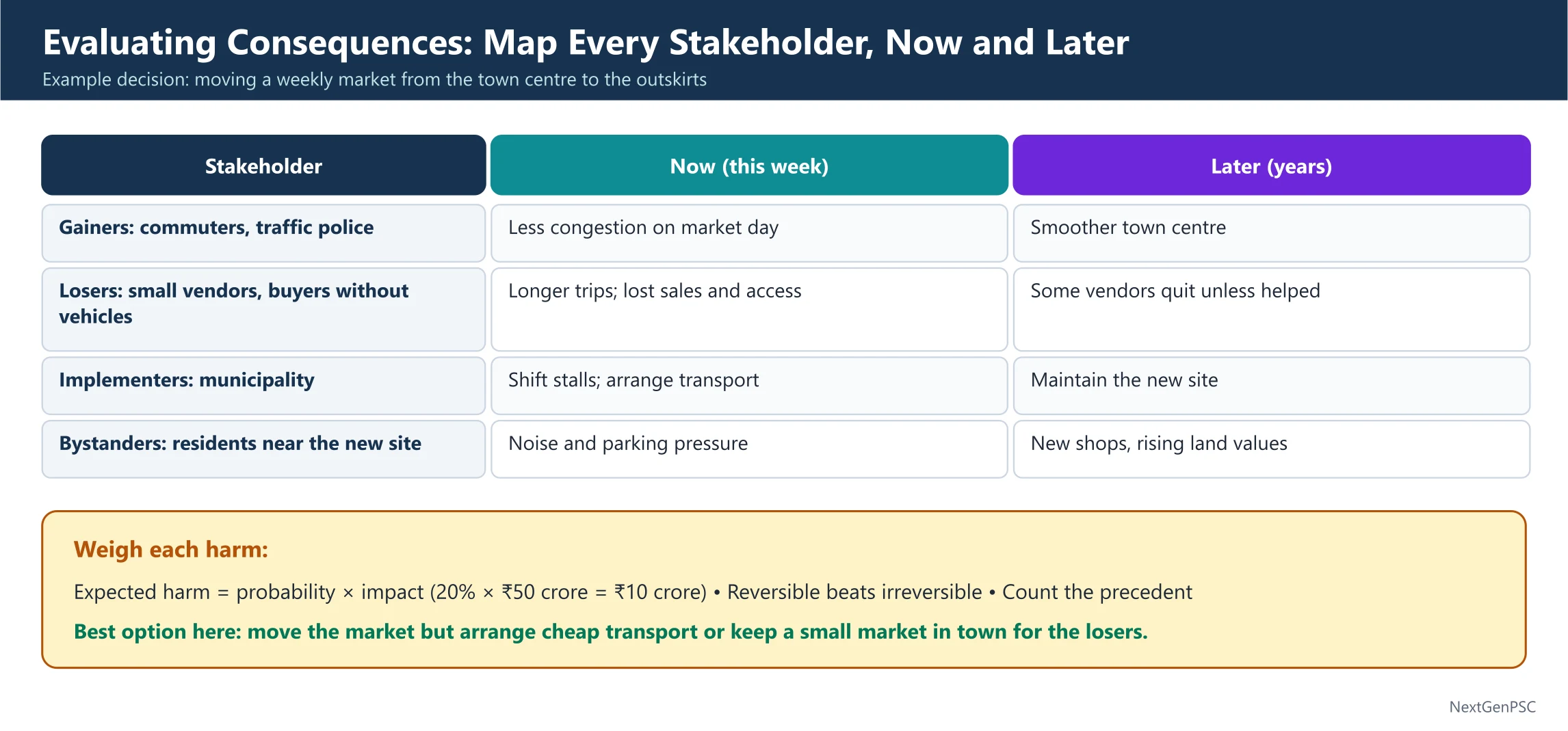
1. What Consequence Evaluation Means
A consequence is any change a decision causes. Evaluating consequences means listing those changes, judging how good or bad each one is, and choosing the option whose overall effect is best, especially for those with the least power to protect themselves.
In CSAT this appears in two forms: (1) 'What is the most likely consequence of this decision?' and (2) 'Which course of action is best?', where the right option is the one that has considered effects the other options ignored.
2. Map the Stakeholders
A stakeholder is anyone the decision affects: the direct beneficiaries, those who bear the cost, those who must implement it, and those who are indirectly touched (families, nearby residents, future users, the environment).
Quick method: write four words in your head, gainers, losers, implementers, bystanders, and place each group in the question under one of them.
The examiner usually hides one vulnerable group (daily-wage vendors, elderly pensioners, children, tribal families). The best option is the one that notices and protects them.
3. Short Term and Long Term
Many decisions look good today and bad later, or the reverse. Free electricity for farm pumps gives instant relief but can drain groundwater over years; a repair that closes a road for a week costs traders now but prevents a collapse later.
Ask both: 'What happens this week?' and 'What happens in five years?' Prefer options that give needed relief now without creating a larger long-term harm, for example time-bound support linked to reform.
4. Unintended (Second-Order) Effects
People react to decisions, and their reactions create new effects. A very high fine with weak enforcement can raise bribery more than it reduces violations; a sudden ban without alternatives can push the activity underground; punishing doctors for every death can make them refuse serious cases.
Why it matters: the option that predicts a 'total' or 'perfect' result ('violations will stop completely') ignores how people respond, so it is rarely the most likely consequence.
Look for options that say 'may', 'is likely to', 'unless' and name a specific behaviour change; they are usually closer to reality.
5. Probability, Impact and Reversibility
Expected harm = probability × impact. A 20% chance of a ₹50 crore loss is an expected loss of 0.2 × 50 = ₹10 crore. Compare it with the cost of prevention.
Why: a rare but huge harm can matter more than a certain but small cost, and a frequent small harm can add up to more than a rare large one.
Reversibility: prefer decisions that can be undone if they go wrong (a pilot project, a time-bound order) over those that cannot (cutting an old forest, demolishing homes). When the effects are uncertain, test small before going large.
Precedent: a decision in one case becomes a reason in the next. Granting one improper exception invites a hundred similar requests, so the consequence includes all the future cases it sets up.
Lives first: expected-value arithmetic compares money and convenience; when lives are at risk, protecting them comes before any saving.
6. A Four-Line Consequence Check
1. Who gains, who loses, who implements, who is a bystander? 2. What happens now and later? 3. How will people react (second-order effects)? 4. How likely, how large and how reversible is the harm?
The best option is usually the one that delivers the intended benefit, protects the likely losers, and stays reversible or conditional where the outcome is uncertain.
Example 1: A much higher traffic fine
- Question
A state raises the fine for traffic violations tenfold but does not add cameras or traffic staff. What is the most likely consequence? (a) Violations may fall somewhat, but petty bribery at checkpoints is likely to rise because enforcement is still weak (b) Traffic violations will stop completely (c) Road accidents will double (d) There will be no change of any kind
- Solution
Weigh each option. (a) predicts a partial intended effect plus a realistic unintended one (a higher fine raises the value of avoiding it through a bribe).
(b) predicts a total effect and ignores that people break rules when the chance of being caught is low.
(c) has no link to the decision; a fine does not make roads more dangerous.
(d) is the opposite extreme; a big fine changes some behaviour.
Shortcut. Most likely consequence = partial intended effect + a realistic side effect; reject 'completely', 'double' and 'no change'.
Trap. (b) is the intended effect stated as certain; decision-makers who expect it are the reason the question exists.
- Answer
(a) Violations may fall somewhat, but petty bribery at checkpoints is likely to rise because enforcement is still weak
Example 2: A factory near a village (UPSC-style)
- Question
You are a district officer. A company wants to set up a bottling plant near a village. It promises jobs but will draw large amounts of groundwater. What is the best way to decide? (a) Approve it, since jobs are the top priority (b) Assess its impact on groundwater, livelihoods and health with public consultation, and approve only with conditions such as water recycling and local hiring if the benefits outweigh the harms (c) Reject it, since every industry harms the environment (d) Leave the decision to the company
- Solution
Weigh each option. (a) sees only the gainers (job-seekers) and ignores farmers whose wells may dry.
(b) maps all stakeholders, hears them, and makes approval conditional so that the harms are controlled.
(c) sees only one harm and ignores the jobs; a blanket view, not an evaluation.
(d) gives a public decision to an interested party.
Shortcut. Assess all effects + consult + conditional approval = best consequence evaluation.
Trap. (c) sounds principled, but rejecting without assessment is as one-sided as approving without it.
- Answer
(b) Assess its impact on groundwater, livelihoods and health with public consultation, and approve only with conditions such as water recycling and local hiring if the benefits outweigh the harms
Example 3: Repair a risky bridge now or later?
- Question
Engineers estimate a 20% chance that an old bridge will fail in the coming monsoon; a failure would cause losses of about ₹50 crore. Repairing it now costs ₹6 crore and removes the risk, and closing it for repair costs traders about ₹1 crore in detours. What does a consequence analysis suggest? (a) Do nothing, since failure is unlikely (b) Repair it now, since the expected loss of ₹10 crore exceeds the ₹7 crore cost of repair and detours (c) Repair it only after the monsoon (d) Close the bridge permanently
- Solution
Weigh each option. Expected loss = 0.2 × 50 = ₹10 crore. Cost of acting now = 6 + 1 = ₹7 crore. So (a) accepts a ₹10 crore expected loss to save ₹7 crore, and it ignores the risk to lives.
(b) compares like with like and chooses the smaller cost; lives are protected as well.
(c) leaves the bridge open through the risky season, so it still carries the ₹10 crore expected loss.
(d) removes the risk but at the permanent cost of the crossing, far more than the ₹6 crore repair.
Shortcut. Probability × impact, then compare with the cost of prevention: 10 > 7.
Trap. (a) reads '20%' as 'unlikely, so ignore'; a small chance of a very large loss can be the biggest consequence in the question.
- Answer
(b) Repair it now, since the expected loss of ₹10 crore exceeds the ₹7 crore cost of repair and detours
Example 4: Moving the weekly market
- Question
To reduce congestion, a town decides to move its weekly market from the centre to the outskirts. Which consequence most needs to be addressed before the move? (a) Shoppers will have to walk a little more (b) Market fee collection will change slightly (c) The traffic police will have less work on market day (d) Small vendors and buyers without vehicles may lose income and access unless cheap transport or a smaller local market is arranged
- Solution
Weigh each option. (a) is a minor inconvenience to people who can adapt.
(b) is a small administrative effect.
(c) is a benefit, not a harm to address.
(d) identifies the vulnerable losers and a serious, avoidable harm (lost livelihood and access), with a practical remedy.
Shortcut. The consequence that most needs action is the serious one falling on the weakest stakeholder.
Trap. (a) is true but trivial; 'true' is not the same as 'most important'.
- Answer
(d) Small vendors and buyers without vehicles may lose income and access unless cheap transport or a smaller local market is arranged
Example 5: Grace marks for an influential family (UPSC-style)
- Question
You are a school principal. A student from an influential family has failed the final examination. The parent asks you to add grace marks beyond what the rules allow. Considering the consequences, what will you do? (a) Add the marks, since one case will not matter (b) Add grace marks to every failed student so that no one is treated unfairly (c) Decline, explain the rules, and offer remedial classes and the supplementary examination allowed by the rules (d) Expel the student because of the parent's improper request
- Solution
Weigh each option. (a) ignores the precedent: every other parent can now ask the same, and honest students are wronged.
(b) spreads the wrong to everyone and lowers the value of the examination for all.
(c) protects fairness and the rule, and still gives the student a real path to pass.
(d) punishes the student for the parent's act; a harsh, unfair consequence.
Shortcut. Count the future cases a decision creates; then choose the option that keeps the rule and helps the person.
Trap. (a) 'one case will not matter' is the classic precedent trap.
- Answer
(c) Decline, explain the rules, and offer remedial classes and the supplementary examination allowed by the rules
Example 6: Drought and a demand for free power (UPSC-style)
- Question
During a severe drought, farmers demand free electricity for their pumps permanently. As the officer advising the government, which recommendation best weighs the consequences? (a) Give time-bound subsidised power for the drought period along with support for water-saving irrigation, noting that permanent free power would deplete groundwater (b) Refuse any help, since free power is costly (c) Grant free power permanently, since farmers need relief (d) Give free power only to large farmers, who use the most water
- Solution
Weigh each option. (a) gives relief now, limits it in time, and tackles the long-term cause (water use).
(b) ignores the urgent short-term hardship.
(c) solves today's problem but creates a long-term one: over-pumping, falling water tables and a large fiscal burden.
(d) helps those who need it least and increases the long-term harm.
Shortcut. Time-bound relief + reform of the cause beats both permanent giveaways and refusal.
Trap. (c) is the popular option; a consequence question rewards looking past this year.
- Answer
(a) Give time-bound subsidised power for the drought period along with support for water-saving irrigation, noting that permanent free power would deplete groundwater
Practice Questions
Q1. A city bans all plastic bags overnight without arranging any alternatives. What is the most likely immediate consequence? (a) Plastic pollution will end at once (b) There will be no effect at all (c) The plastic industry will grow (d) Small shopkeepers and buyers will face difficulty, and illegal use may continue unless alternatives become available
Q2. Two flood-protection plans cost the same. Plan P has a 50% chance of protecting 8,000 homes and otherwise protects none; Plan Q will certainly protect 5,000 homes. On expected outcome alone, which plan protects more homes on average? (a) Plan P, 4,000 homes (b) Plan P, 8,000 homes (c) Both protect the same number (d) Plan Q, 5,000 homes
Q3. A rule makes doctors personally liable to heavy penalties whenever a patient dies in their care. What is the most likely unintended consequence? (a) Doctors may avoid or refer away critically ill patients, harming those who most need care (b) The quality of care will improve everywhere (c) More students will choose to become doctors (d) There will be no effect on doctors' behaviour
Q4. A road is proposed through a forest to connect three remote villages to a hospital and a market. What is the best way to decide? (a) Build it at once, since the villagers need it (b) Reject it, since forests must never be touched (c) Weigh access to health care and markets against the loss of forest and wildlife, consider other alignments, and follow the environmental clearance process (d) Let the contractor choose the route
Q5. The effects of a new welfare policy are uncertain. Which approach best manages the consequences? (a) Implement it across the state at once (b) Run a pilot in a few districts, measure its effects, and then scale it up or change it (c) Drop the policy altogether (d) Implement it quietly without informing the public
Answers
Show answers
Q1. (d) Small shopkeepers and buyers will face difficulty, and illegal use may continue unless alternatives become available. A sudden ban without alternatives creates hardship and pushes the activity underground.
Q2. (d) Plan Q, 5,000 homes. Plan P's expected outcome is 0.5 × 8,000 = 4,000, which is less than 5,000.
Q3. (a) Doctors may avoid or refer away critically ill patients, harming those who most need care. A second-order effect of fear-based penalties.
Q4. (c) Weigh access to health care and markets against the loss of forest and wildlife, consider other alignments, and follow the environmental clearance process. All stakeholders weighed through the lawful process.
Q5. (b) Run a pilot in a few districts, measure its effects, and then scale it up or change it. Reversible, evidence-based steps when outcomes are uncertain.
| Question | Why it matters | Example |
|---|---|---|
| Who gains, who loses? | The best option protects the likely losers, especially the weakest | Moving a market hurts vendors without vehicles |
| What happens now and later? | Relief today can create harm tomorrow | Permanent free power drains groundwater |
| How will people react? | Reactions create second-order effects | A huge fine with weak checks breeds bribery |
| How likely and how large? | Expected harm = probability × impact | 20% of ₹50 crore = ₹10 crore |
| Can it be undone? | Prefer reversible, testable steps when unsure | Pilot in a few districts before a statewide roll-out |
| What precedent does it set? | One exception invites many more | Grace marks beyond the rules for one student |
| Decision | Intended effect | Possible unintended effect |
|---|---|---|
| Very high fines, weak enforcement | Fewer violations | More bribery at checkpoints |
| Sudden ban without alternatives | End of a harmful practice | Hardship and an illegal market |
| Penalties on doctors for every death | Better care | Refusal of serious cases |
| Permanent free inputs | Relief for farmers | Over-use and depletion of the resource |
| Relief by political loyalty | Quick support for some | Loss of trust; the neediest left out |
Prelims tips
- Know its weight. Separate consequence questions have been rare lately; the habit is still useful for Cause and Effect and critical-reasoning questions, so give it a short, focused revision.
- Reject total predictions. 'Will stop completely', 'will end at once', 'no effect at all' ignore how people react; the most likely consequence is usually partial and names a realistic side effect.
- Find the hidden weak stakeholder. Vendors, the elderly, children and tribal families are often mentioned only in passing; the option that protects them is usually the answer.
- Do the expected-value arithmetic. Probability × impact, then compare with the cost of prevention. Do not dismiss a 20% risk of a huge loss as 'unlikely'.
- Prefer reversible and conditional steps. Pilots, time-bound relief and conditional approvals beat permanent giveaways, blanket bans and irreversible actions when outcomes are uncertain.
- Count the precedent. 'Just this one case' options ignore the many future cases they invite; the defensible option keeps the rule and still offers the person a lawful path.
Effective Communication
In short
Effective communication means the listener understands what the speaker meant and can act on it. The CSAT syllabus lists 'interpersonal skills including communication skills', but direct questions on it have hardly appeared in recent papers, so it carries few marks on its own; it is tested mainly through situation-based questions (an angry citizen, feedback to a junior, a public notice) and indirectly through tone and purpose questions in comprehension. Three ideas unlock it: communication is a two-way loop with feedback, the message must suit the listener and the channel, and a good message is clear, concise, complete and courteous.
In simple words
Communication is not finished when you speak. It is finished when the other person has understood you correctly. That is the whole idea of effective communication.
Example: a health worker tells a mother, 'Give the syrup twice a day.' The mother gives two spoons at once in the morning, thinking that is 'twice'. The message was spoken, but not understood. If the worker had asked, 'Tell me, when will you give it?', the mistake would have been caught. That question is called feedback.
Good communicators also choose the right way to send a message. Urgent news goes by phone, and then in writing. Bad news is given face to face. A notice for villagers is written in their language, in simple words, with exact details: which day, what time, where to go.
The one question to always ask: 'Has the other person understood what I meant, and how do I know?'
Two habits solve most questions: (1) prefer the option where the speaker listens, checks understanding and responds to the listener's concern; (2) prefer messages that are specific and respectful over those that are vague, harsh or public when they should be private.
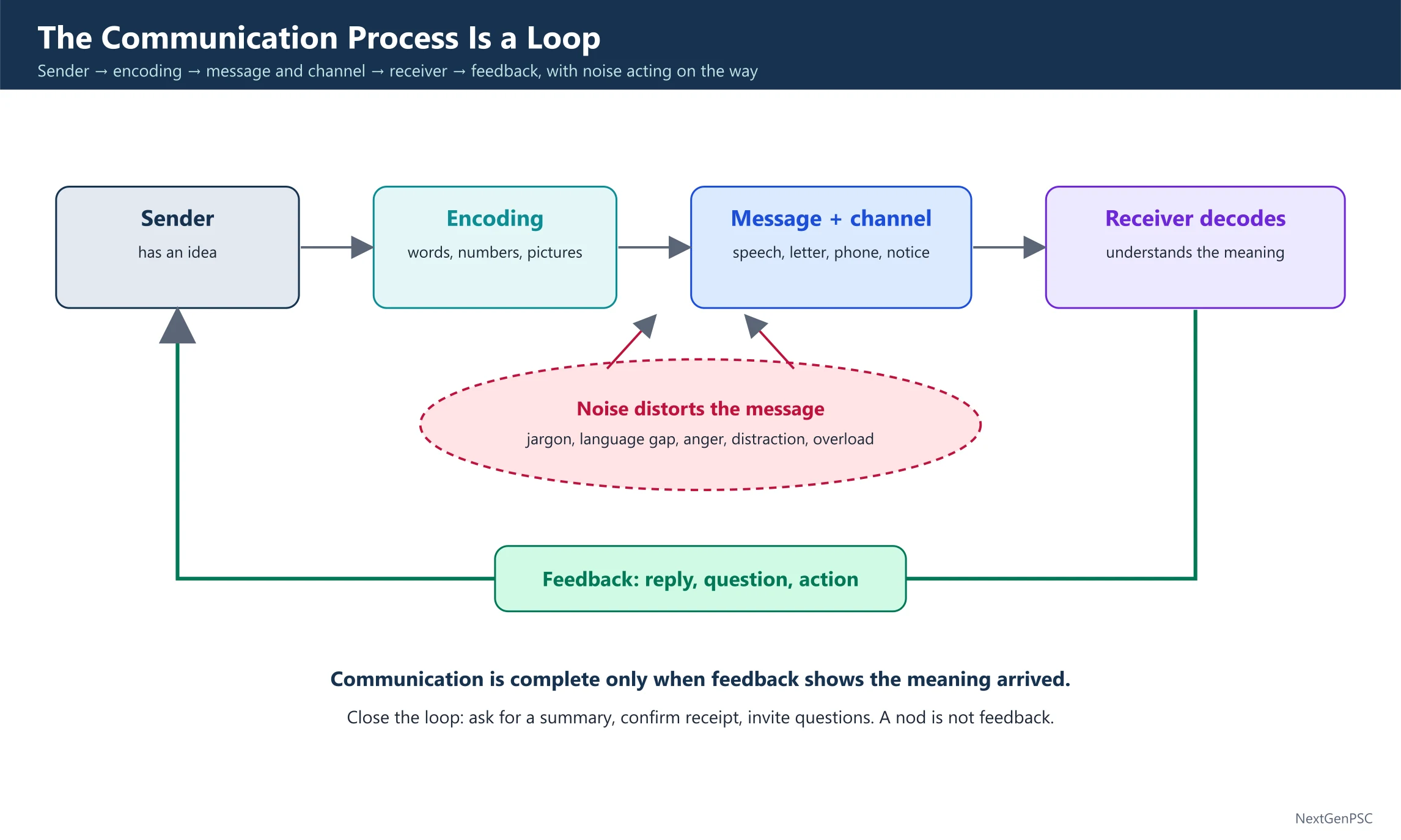
1. What Is Tested and How Much It Counts
The CSAT syllabus names 'interpersonal skills including communication skills', but recent papers have carried few or no direct questions on it. When it appears, it is as a short situation (you must handle an angry citizen, brief your team, write a notice) with four ways of communicating.
The same ideas help elsewhere in the paper: questions on the tone, purpose and intended audience of a passage are communication questions in disguise.
So learn the process, the 7 Cs and the listening rules below, practise the examples once, and move on.
2. The Communication Process (a Loop, Not a Line)
Sender has an idea → encodes it into words, numbers or pictures → sends the message through a channel (speech, letter, phone, notice, email) → the receiver decodes it → and sends feedback (a reply, a question, an action) that tells the sender whether the meaning arrived.
Noise is anything that distorts the message on the way: real noise, jargon, a language gap, anger, distraction, too much information.
Why the loop matters: without feedback, the sender only assumes the message was understood. Most communication failures in CSAT situations are failures to close the loop (a nod taken as understanding, a notice taken as informing).
3. The 7 Cs of a Good Message
Clear: one main idea, plain words. Concise: no padding. Concrete: specific facts (date, time, place, amount), not vague phrases. Correct: accurate facts and language.
Coherent: points in a logical order. Complete: everything the receiver needs to act. Courteous: respectful, considerate of the receiver's position.
Quick test: could the receiver act on the message without coming back to ask a question? If not, it is not complete or concrete enough.
4. Active Listening
Listening is half of communication and the half that is most often skipped. Active listening means: give full attention, do not interrupt, show that you are listening (eye contact, nodding), paraphrase what you heard ('So your pension has not come for three months?'), ask questions to clarify, and only then respond.
Empathetic listening adds one step: name the feeling ('I can see this has been very frustrating'). An upset person calms down when they feel heard, and only then can the facts be discussed.
Why: in an angry exchange, arguing about facts first makes the person louder; acknowledgement first makes them listen.
5. Non-verbal Communication
Tone of voice, facial expression, posture, eye contact and gestures carry a large part of the meaning, especially of feelings. When words and body language disagree, listeners tend to believe the body language.
A manager who says 'my door is always open' but keeps looking at his phone is communicating the opposite of his words.
Respect cultural differences: a gesture or level of eye contact that is polite in one region may be rude in another.
6. Choosing the Channel and the Register
Urgent and important: phone or in person first, then a written record, and confirm receipt. Needs a record: written order, minutes, email. Large public audience: local language, simple words, pictures, several channels (announcement, notice, local leaders).
Bad news or criticism: face to face and in private, with reasons and a way forward. Praise: in public is fine. The rule of thumb is 'praise in public, correct in private'.
Register means the level of formality: formal with officials and in writing, simple and warm with citizens; never talk down to anyone.
7. Giving and Receiving Feedback
Good feedback is specific (what exactly was wrong or right), about behaviour not personality ('the figures in table 2 do not add up', not 'you are careless'), timely, and ends with an agreed next step.
When receiving criticism, listen fully, ask for specifics, and respond to the substance rather than defending yourself at once.
Example 1: Explaining a vaccination drive to villagers
- Question
You must inform the people of a village, many of whom cannot read well, about a vaccination drive for children. Which is the most effective way? (a) Put up a detailed notice in English at the block office (b) Send everyone an SMS that uses the technical names of the vaccines (c) Hold a meeting in the local language with health workers and respected local people, use simple words and pictures, and answer questions (d) Ask the sarpanch to order all parents to attend
- Solution
Weigh each option. (a) uses a language and a place the audience does not use; the message does not reach them.
(b) uses jargon and a text channel for people who cannot read well: noise at both ends.
(c) suits the audience (language, pictures, trusted messengers) and is two-way (questions answered), so fears and rumours are dealt with.
(d) is one-way and coercive; people may come but remain unconvinced, and fear spreads.
Shortcut. Audience's language + trusted messenger + a chance to ask questions.
Trap. (d) gets attendance, but communication is about understanding, not compliance.
- Answer
(c) Hold a meeting in the local language with health workers and respected local people, use simple words and pictures, and answer questions
Example 2: Feedback on a report full of errors
- Question
A subordinate's report to headquarters has many factual errors. How should you give feedback? (a) Point out the errors in front of the whole team so that others also learn (b) Send a one-line email: 'Poor work, redo it' (c) Rewrite the report yourself and say nothing (d) Meet privately, show the specific errors, explain the standard expected and agree on how to fix them
- Solution
Weigh each option. (a) corrects in public and humiliates; the subordinate becomes defensive and others become afraid to share drafts.
(b) is vague (which errors?) and discourteous.
(c) fixes this report but nothing is learnt, and you carry the extra work every time.
(d) is private, specific, about the work, and ends with an agreed next step: all the marks of good feedback.
Shortcut. Correct in private, be specific, agree the next step.
Trap. (a) looks efficient ('everyone learns'), but public criticism damages trust more than it teaches.
- Answer
(d) Meet privately, show the specific errors, explain the standard expected and agree on how to fix them
Example 3: An angry citizen at the counter (UPSC-style)
- Question
A pensioner is shouting at your counter because his pension has not been credited for three months. Other people in the queue are getting uneasy. What will you do? (a) Ask security to remove him from the office (b) Listen calmly without interrupting, acknowledge his difficulty, check his file and tell him clearly what will happen and by when (c) Tell him that shouting will only delay his case further (d) Ask him to submit a written complaint and leave
- Solution
Weigh each option. (a) is disproportionate; his grievance is genuine and removal adds anger.
(b) uses empathetic listening to calm him, then gives concrete information (what and by when), which solves the real problem.
(c) is a threat; it escalates the conflict and is not true to a public servant's duty.
(d) is a brush-off: a one-way channel when he needs an answer now.
Shortcut. Listen → acknowledge → check → give a concrete answer.
Trap. (d) sounds procedural, but sending an angry person away without information feeds the anger.
- Answer
(b) Listen calmly without interrupting, acknowledge his difficulty, check his file and tell him clearly what will happen and by when
Example 4: An urgent instruction to field staff
- Question
You learn that a batch of a medicine supplied to all health sub-centres is contaminated. How should you communicate the instruction to stop using it? (a) Phone or message all field staff at once, follow up with a written order, and confirm that each one has received it (b) Put it up on the office notice board (c) Email only the district heads and ask them to pass it on (d) Mention it at next month's review meeting
- Solution
Weigh each option. (a) uses the fastest channel, adds a written record, and closes the loop by confirming receipt.
(b) depends on staff visiting the office; most field workers never see it.
(c) adds a relay step where the message can be delayed or lost, and there is no confirmation.
(d) is far too late for a safety risk.
Shortcut. Urgent = fastest direct channel + written record + confirmation.
Trap. (c) looks hierarchical and orderly, but every relay is a chance for noise and delay.
- Answer
(a) Phone or message all field staff at once, follow up with a written order, and confirm that each one has received it
Example 5: The junior who nods (UPSC-style)
- Question
You explain a new procedure to a junior. He keeps nodding but looks unsure. What is the best way to make sure the message has got across? (a) Ask him to explain the task back in his own words and clarify any gaps (b) Assume he has understood, since he nodded (c) Repeat the same instructions more loudly (d) Give the task to someone else
- Solution
Weigh each option. (a) closes the loop: his own words reveal what he has understood, and gaps can be fixed at once, without embarrassing him.
(b) treats a nod as feedback; nodding often means politeness or hesitation, not understanding.
(c) repeats the same message; if the words were the problem, volume does not help.
(d) avoids the problem and leaves him untrained.
Shortcut. Check understanding by asking for a summary, not by asking 'Did you understand?'.
Trap. (b) is the classic open-loop error: the sender assumes success without feedback.
- Answer
(a) Ask him to explain the task back in his own words and clarify any gaps
Example 6: Giving bad news to the team (UPSC-style)
- Question
Headquarters has rejected a proposal your team worked hard on. How should you communicate this to the team? (a) Say nothing and let them find out later (b) Blame headquarters strongly so that the team does not feel bad (c) Send a one-line message: 'Proposal rejected' (d) Tell them promptly and honestly in a meeting, explain the reasons, acknowledge their effort and discuss the next steps
- Solution
Weigh each option. (a) leaves the team to hear it through rumour, which damages trust in you.
(b) is dishonest and turns disappointment into resentment against the organisation.
(c) is complete only in the narrowest sense; it gives no reasons and no way forward.
(d) is timely, honest, in person, respectful of their effort and forward-looking.
Shortcut. Bad news: promptly, in person, with reasons and a next step.
Trap. (b) feels supportive, but shifting blame is neither honest nor useful.
- Answer
(d) Tell them promptly and honestly in a meeting, explain the reasons, acknowledge their effort and discuss the next steps
Practice Questions
Q1. Which public notice about a water supply cut is the most effective? (a) 'Due to unavoidable circumstances, water supply may be affected.' (b) 'Supply disruption is expected sometime this week.' (c) 'Water supply will be off in Wards 3 and 4 on Tuesday from 10 am to 4 pm for pipeline repair; tankers will be available at the ward offices.' (d) 'Citizens are requested to cooperate with the administration.'
Q2. Which of the following best describes active listening? (a) Waiting quietly for your turn to speak (b) Giving full attention, paraphrasing what was said and asking questions to check understanding (c) Agreeing with everything the speaker says (d) Taking notes without looking at the speaker
Q3. A manager tells his staff, 'My door is always open,' but keeps looking at his phone whenever someone comes in. What are the staff most likely to conclude? (a) That he is always available, as he said (b) That they should send him written circulars (c) That he is very efficient (d) That he is not really interested, so they stop approaching him
Q4. One member of your team has done excellent work, while another has made a costly mistake. How should you communicate? (a) Praise no one, to avoid jealousy (b) Criticise both members publicly to keep standards high (c) Praise the first member in front of the team and discuss the mistake with the second member privately (d) Discuss the mistake in detail at the team meeting
Q5. An applicant with a hearing impairment comes to your counter. What is the best way to communicate? (a) Ask how they prefer to communicate, use writing or a sign-language interpreter if available, and face them while speaking (b) Speak more loudly (c) Ask them to come back with someone who can hear (d) Serve the next person first to save time
Answers
Show answers
Q1. (c) 'Water supply will be off in Wards 3 and 4 on Tuesday from 10 am to 4 pm for pipeline repair; tankers will be available at the ward offices.' Concrete, complete and actionable; the others are vague.
Q2. (b) Giving full attention, paraphrasing what was said and asking questions to check understanding. The other options are passive or one-sided.
Q3. (d) That he is not really interested, so they stop approaching him. When words and behaviour differ, people believe the behaviour.
Q4. (c) Praise the first member in front of the team and discuss the mistake with the second member privately. Praise in public, correct in private.
Q5. (a) Ask how they prefer to communicate, use writing or a sign-language interpreter if available, and face them while speaking. It adapts the channel to the receiver with respect.
| Quality | Meaning | Weak → strong |
|---|---|---|
| Clear | One main idea in plain words | 'Necessary action may be initiated' → 'Please repair the hand pump' |
| Concise | No padding or repetition | A two-page letter for a one-line request → one paragraph |
| Concrete | Specific facts: date, time, place, amount | 'Soon' → 'by 5 pm on Friday' |
| Correct | Accurate facts and language | Wrong ward numbers → checked ward numbers |
| Coherent | Points in a logical order | Details first, purpose last → purpose first, then details |
| Complete | Everything needed to act | 'Water will be cut' → when, where, why and the alternative |
| Courteous | Respectful of the receiver | 'Do it now' → 'Please complete it by today' |
| Situation | Best channel | Why |
|---|---|---|
| Urgent safety instruction | Phone or message to each person, then a written order, then confirmation | Speed, a record and a closed loop |
| Information for a large, partly non-literate public | Local-language meeting, announcement, pictures, trusted local people | Reaches everyone; allows questions |
| Criticism of one person's work | Face to face, in private | Specific, respectful, two-way |
| Bad news to a team | In person, promptly, with reasons and next steps | Prevents rumours; keeps trust |
| Decision that must be on record | Written order, minutes or email | Accountability and later reference |
Prelims tips
- Know its weight. Direct communication questions have hardly appeared recently; an hour on the loop, the 7 Cs and listening is enough, and it also helps with tone and purpose questions in passages.
- Choose the option that closes the loop. Asking the listener to summarise, confirming receipt, answering questions: these beat options where the sender only speaks, posts or sends.
- Listen before you answer an angry person. Options that threaten, remove or redirect an upset citizen are traps; the best one acknowledges the feeling and then gives concrete information.
- Praise in public, correct in private. Any option that criticises an individual in front of others is wrong, however 'educational' it claims to be.
- Concrete beats vague. In notice or message questions, pick the one with the date, time, place and the alternative; reject 'may be affected', 'soon' and 'cooperate'.
- Match the channel to the urgency and the audience. Urgent safety needs the fastest direct channel plus a record; a mass rural audience needs the local language and trusted messengers, not English notices or jargon.
Barriers to Communication
In short
A barrier to communication is anything that stops a message from being sent, received or understood as intended: jargon, a language gap, noise, anger, prejudice, rank, too many layers, too much information or a missing smartphone. Questions that ask you to name the main barrier in a situation, or the best way to remove it, have been rare in recent CSAT papers, so the topic carries few marks; the classification, though, is quick to learn and also helps with GS Paper IV. Three ideas unlock it: find where the loop broke (sender, channel, receiver or feedback), name the cause, not the symptom, and pick the remedy that removes that cause.
In simple words
Imagine trying to talk to a friend across a busy road. The traffic noise is one kind of barrier. If your friend speaks only Tamil and you speak only Hindi, that is another. If your friend is angry with you and refuses to listen, that is a third. All three stop the message, but each needs a different fix.
That is all this topic is: naming what blocked the message and choosing the fix that matches it. Noise needs a quieter place. A language gap needs an interpreter or simpler words. Anger needs calm listening first.
Example from an office: a clerk is told to send a reply 'immediately'. The officer meant within the hour; the clerk thought within the week. Same word, two meanings. That is a semantic (meaning) barrier, and the fix is to be concrete: 'by 4 pm today'.
The one question to always ask: 'Where exactly did the message break, and what caused it?'
Two habits solve most questions: (1) look for the cause the question stresses (a word, a rank, a feeling, a machine), not just the result (people did not respond); (2) choose the remedy that removes that cause, not one that only repeats the message louder or longer.
1. What a Barrier Is
A barrier is anything that blocks or distorts a message at any point of the communication loop: when the sender puts the idea into words, while it travels through the channel, when the receiver interprets it, or when feedback should come back.
Questions on this topic usually describe a failure (people did not enrol, juniors stay silent, instructions arrive late) and ask for the main barrier or the best remedy.
Such questions have been rare in recent CSAT papers; learn the types and remedies below once, and you can answer them in seconds.
2. The Main Types
Physical or environmental: noise, distance, poor lighting, a bad phone line, an uncomfortable room.
Semantic or language: jargon, technical terms, ambiguous words ('immediately', 'soon'), a different language, poor translation.
Psychological or emotional: anger, fear, anxiety, distrust, defensiveness after harsh criticism, a closed mind.
Perceptual: stereotypes, prejudice, assumptions, hearing only what one expects ('selective perception').
Status and hierarchy: juniors afraid to speak up, seniors not listening; bad news is filtered on its way up so the boss hears only what he wants to hear.
Cultural: different norms of politeness, eye contact, gestures, gender roles or directness.
Organisational: too many layers, rigid channels, unclear responsibility; a message passes through many hands and arrives late and changed.
Information overload: long circulars and too many messages hide the one thing that matters.
Technological: a poor network, an app the user cannot use, no smartphone; the digital divide.
Poor listening: interrupting, judging too early, preparing a reply instead of listening.
3. Find Where the Loop Broke
At the sender: unclear idea, jargon, wrong language, an incomplete message. Fix: plain words, concrete details, the receiver's language.
In the channel: noise, too many relay points, the wrong medium for the audience. Fix: a direct, suitable channel; a written copy.
At the receiver: emotion, prejudice, low attention, no access to the medium. Fix: build trust, listen first, choose a channel they can use.
In feedback: no chance to ask, fear of asking, a nod taken as understanding. Fix: invite questions; ask for a summary; make it safe to disagree.
Why this helps: the same symptom ('people did not act') can come from different breaks, and each break has its own fix.
4. Cause, Not Symptom
The options often include the symptom dressed up as a barrier. 'People did not attend' is a symptom; the cause may be language, distrust or timing.
When two barriers are present, the question usually stresses one with a detail: technical words point to semantic; a rank or a stern boss points to status; harsh criticism last week points to emotional; 'many levels' points to organisational; 'fifteen-page circular' points to overload.
5. Remedies That Work
Use simple words and the listener's language; give concrete details; choose the channel the audience actually uses; reduce relay layers; summarise long documents into one page; create safe ways for juniors to speak (open meetings, anonymous suggestions); listen first when emotions run high; check understanding through feedback.
Remedies that do not work: repeating the same message louder, sending longer circulars, punishing people for not understanding, and assuming silence means agreement.
Example 1: Crop insurance explained in jargon
- Question
An officer explains a crop insurance scheme to farmers using terms such as 'indemnity', 'sum insured' and 'actuarial premium'. Few farmers enrol. What is the main barrier to communication here? (a) Physical barrier (b) Semantic barrier caused by technical jargon (c) Status barrier between the officer and the farmers (d) Cultural barrier
- Solution
Weigh each option. (a) is wrong: nothing in the situation suggests noise or distance.
(b) fits the stressed detail: the words themselves carry no meaning for the listeners.
(c) may exist in the background, but the question highlights the terms used, not rank.
(d) has no support: the issue is vocabulary, not customs or norms.
Shortcut. Technical words in the question → semantic barrier.
Trap. (c) is plausible in any officer–citizen setting; pick the barrier the question's details point to.
- Answer
(b) Semantic barrier caused by technical jargon
Example 2: Juniors who never report problems (UPSC-style)
- Question
In a department, the director does most of the talking in meetings, juniors always agree with him, and problems in the field reach him only when they become crises. What is the main barrier to communication? (a) Semantic barrier (b) Physical barrier (c) Status and hierarchy barrier, with bad news filtered out on its way up (d) Technological barrier
- Solution
Weigh each option. (a) is wrong: everyone understands the language used.
(b) is wrong: they are in the same room.
(c) explains both details: juniors do not speak up to a senior, and what does reach him is filtered.
(d) has no support in the situation.
Shortcut. Juniors silent before a senior + bad news arriving late → status barrier with filtering.
Trap. Reading 'juniors agree' as real agreement; silence before a senior is often fear, not consent.
- Answer
(c) Status and hierarchy barrier, with bad news filtered out on its way up
Example 3: A message through many hands
- Question
An instruction from the state headquarters passes through five levels of officers before reaching field staff. It arrives late and in a changed form. Which option correctly identifies the barrier and its remedy? (a) Organisational barrier of too many layers; send the instruction directly to all levels in writing at the same time (b) Semantic barrier; use simpler words (c) Psychological barrier; counsel the field staff (d) Physical barrier; repair the office telephones
- Solution
Weigh each option. (a) matches the stressed cause (many layers) with a remedy that removes it (a direct, written, simultaneous message).
(b) treats words as the problem; nothing suggests the wording was unclear at the start.
(c) blames the receivers' minds; the problem is the route the message takes.
(d) names a channel fault that the question does not mention.
Shortcut. 'Passes through many levels' → organisational barrier → shorten the chain.
Trap. (b) is the most common barrier in general, but this question's detail is the number of layers.
- Answer
(a) Organisational barrier of too many layers; send the instruction directly to all levels in writing at the same time
Example 4: A doctor and a patient without a common language
- Question
A doctor at a rural hospital explains a treatment plan in English to a tribal patient who speaks only Gondi. The patient nods but does not follow the treatment. What is the best remedy? (a) Repeat the instructions more loudly in English (b) Give the patient a printed leaflet in English (c) Ask the patient to learn some English (d) Use an interpreter or a health worker who speaks Gondi, explain with pictures, and ask the patient to repeat the instructions
- Solution
Weigh each option. (a) changes the volume, not the language; the barrier remains.
(b) adds a written channel in the same unknown language.
(c) puts the burden on the patient and is not practical.
(d) removes the language barrier, adds pictures for clarity and closes the loop by asking the patient to repeat.
Shortcut. Language barrier → interpreter or the listener's language + feedback check.
Trap. Taking the nod as understanding; it was the feedback barrier hiding the language barrier.
- Answer
(d) Use an interpreter or a health worker who speaks Gondi, explain with pictures, and ask the patient to repeat the instructions
Example 5: An employee who has stopped listening (UPSC-style)
- Question
Last week a supervisor criticised an employee harshly in front of colleagues. Since then, the employee ignores all the supervisor's suggestions, even sensible ones. What is the main barrier? (a) Semantic barrier (b) Psychological or emotional barrier of resentment and defensiveness (c) Physical barrier (d) Information overload
- Solution
Weigh each option. (a) is wrong: the suggestions are clear.
(b) explains the change: the words are understood, but hurt and resentment block their acceptance.
(c) has no support.
(d) is wrong: the number of messages has not changed.
Shortcut. A past hurt + refusal to accept clear messages → emotional barrier; remedy: repair the relationship in private.
Trap. Calling it 'poor listening' in general; the question stresses the emotional cause (public humiliation).
- Answer
(b) Psychological or emotional barrier of resentment and defensiveness
Example 6: Long circulars and missed deadlines (UPSC-style)
- Question
A department sends citizens 15-page circulars full of cross-references to earlier orders. Many people miss an important application deadline mentioned in them. What is the best remedy? (a) Send even more detailed circulars so that nothing is left out (b) Issue a one-page summary in plain language with the deadline highlighted, and set up a helpline for questions (c) Stop sending circulars altogether (d) Penalise those who miss the deadline
- Solution
Weigh each option. (a) worsens the cause (information overload).
(b) removes the overload, highlights the key fact and adds a feedback channel for doubts.
(c) removes the communication entirely; the deadline is still unknown.
(d) punishes citizens for the department's communication failure.
Shortcut. Overload → summarise, highlight the action point, open a channel for questions.
Trap. (a) assumes 'more complete' means 'better'; completeness that buries the key point fails the receiver.
- Answer
(b) Issue a one-page summary in plain language with the deadline highlighted, and set up a helpline for questions
Practice Questions
Q1. A state launches a mobile app for public grievances. Many elderly rural residents, who do not have smartphones, cannot use it. What is the main barrier? (a) Semantic barrier (b) Perceptual barrier (c) Status barrier (d) Technological barrier, the digital divide
Q2. A manager assumes that a young officer from a particular region cannot be serious about work, and ignores his ideas in meetings. What is the main barrier? (a) Perceptual barrier of stereotyping (b) Physical barrier (c) Semantic barrier (d) Information overload
Q3. Construction work outside a meeting hall is so loud that participants miss key points of a briefing. What is the best remedy? (a) Speak faster to finish the meeting early (b) Ignore the noise and continue (c) Move to a quieter room or reschedule, and circulate written minutes (d) Ask the speaker to shout
Q4. Which of the following helps to overcome barriers to communication? (a) Using technical jargon to sound authoritative (b) Interrupting the speaker to save time (c) Sending every message through several layers of officers (d) Seeking feedback to check that the message has been understood
Q5. An officer tells a clerk to send a reply 'immediately'. The officer means within the hour; the clerk understands within the week. What is the barrier? (a) Physical barrier (b) Semantic barrier, the same word meaning different things to the two people (c) Cultural barrier (d) Technological barrier
Answers
Show answers
Q1. (d) Technological barrier, the digital divide. The channel is not available to the receivers; add offline counters or phone lines.
Q2. (a) Perceptual barrier of stereotyping. A fixed image of a group blocks fair hearing of an individual.
Q3. (c) Move to a quieter room or reschedule, and circulate written minutes. It removes the physical barrier and adds a written record.
Q4. (d) Seeking feedback to check that the message has been understood. The other three create barriers.
Q5. (b) Semantic barrier, the same word meaning different things to the two people. Fix: give a concrete time instead of 'immediately'.
| Barrier | Typical sign in a question | Remedy |
|---|---|---|
| Physical | Noise, distance, bad line, poor room | Quieter place, better channel, written copy |
| Semantic / language | Jargon, ambiguous words, different language | Plain words, concrete details, interpreter |
| Psychological / emotional | Anger, fear, resentment after criticism | Listen first, acknowledge feelings, repair trust in private |
| Perceptual | Stereotype, prejudice, fixed assumption | Judge the person and the idea on merit; check assumptions |
| Status / hierarchy | Juniors silent; bad news filtered upward | Open meetings, safe channels to speak, senior listens first |
| Cultural | Different norms of politeness or gestures | Learn local norms; adapt style respectfully |
| Organisational | Many layers; message late and changed | Shorter chain; direct written message to all levels |
| Information overload | Long circulars; key point missed | One-page summary; highlight the action point |
| Technological | No smartphone, poor network, hard app | Offline counters, phone lines, assisted service |
| Poor listening | Interrupting, judging early | Active listening; paraphrase before replying |
| Point in the loop | Barriers found here | Fix |
|---|---|---|
| Sender (encoding) | Jargon, wrong language, incomplete or vague message | Plain, concrete, complete message in the receiver's language |
| Channel | Noise, too many relays, a medium the audience does not use | Direct, suitable channel plus a written record |
| Receiver (decoding) | Emotion, prejudice, distraction, no access | Build trust, listen first, accessible channel |
| Feedback | No chance or no courage to ask; a nod taken as 'yes' | Invite questions, ask for a summary, make disagreement safe |
Prelims tips
- Know its weight. Barrier questions have been rare in recent papers; one reading of the types table and the six examples is enough preparation.
- Follow the stressed detail. Technical words → semantic; a stern senior and silent juniors → status; last week's public scolding → emotional; 'many levels' → organisational; a long circular → overload; no smartphone → technological.
- Name the cause, not the symptom. 'People did not respond' is never the barrier itself; ask what stopped them and pick that.
- Match the remedy to the barrier. Volume does not fix language, longer circulars do not fix overload, and punishment fixes nothing; the right remedy removes the specific cause.
- Distrust the nod. When a question mentions someone nodding or staying silent, a feedback barrier is usually hiding another one; the remedy includes checking understanding.
- When two barriers fit, pick the main one. Background barriers (rank in every officer–citizen meeting) lose to the one the question's wording highlights.
Social Intelligence
In short
Social intelligence is the ability to understand people and social situations and to act wisely in them: reading feelings, managing your own reactions, working with others and influencing without force. It overlaps closely with emotional intelligence (self-awareness, self-regulation, motivation, empathy and social skills). CSAT tests it, when it does, through workplace situations (resistant staff, credit for teamwork, a grieving colleague, an insulting citizen); such questions have been rare in recent papers, so it carries few marks, but GS Paper IV asks about the same ideas. Three ideas unlock it: understand before you act, control your own reaction first, and share credit, own blame, include everyone.
In simple words
Some people are clever with books; some are clever with people. Social intelligence is the second kind: knowing how others feel, what they need, and how to work with them so that things get done and relationships stay healthy.
Example: the office staff resist a new computer system. A boss with low social intelligence shouts and threatens. A boss with high social intelligence asks what worries them (fear of mistakes, of looking slow, of losing jobs), trains them patiently, and lets the senior clerks lead the change. The system works, and nobody feels humiliated.
Social intelligence starts inside you. If a citizen insults you, the first job is to stay calm and not take it personally. Only a calm person can solve the problem.
The one question to always ask: 'What is this person feeling and needing, and what response would help both the work and the relationship?'
Two habits solve most questions: (1) choose the option that listens, understands and includes people, over one that orders, mocks or ignores; (2) in teamwork, choose the option that shares credit publicly and handles problems privately.
1. What Social Intelligence Means
Social intelligence is the ability to understand people (their feelings, motives and the unwritten rules of a group) and to use that understanding to act effectively and kindly in social situations.
It is not the same as being talkative or popular. A quiet officer who notices that a colleague is grieving and quietly shares his work is showing high social intelligence.
The CSAT syllabus covers it under 'interpersonal skills'. Questions on it have been rare in recent papers; when set, they are workplace or public-dealing situations with four possible responses.
2. Emotional Intelligence: the Inner Half
Social intelligence rests on emotional intelligence, often described through five components:
Self-awareness: knowing your own feelings, strengths and triggers ('I get irritated when interrupted').
Self-regulation: controlling impulses; pausing before reacting; staying calm under provocation.
Motivation: working for the goal itself, staying positive after setbacks.
Empathy: understanding another person's feelings and point of view as they see it.
Social skills: managing relationships: communicating, persuading, resolving conflict, building teams.
Why the order matters: the first two are about you; you cannot read or calm others while your own anger is in control.
3. Empathy Is Not Sympathy
Sympathy is feeling sorry for someone ('poor man'). Empathy is understanding their situation from their side ('he has waited three months, lost wages travelling here, and nobody has told him why').
Empathy leads to useful action (explaining, fixing, helping within the rules); sympathy alone may lead to nothing, or to breaking rules out of pity.
4. Reading People and Situations
Notice signals: a usually cheerful colleague who is quiet and irritable, a junior who never speaks in meetings, a group that goes silent when a new idea comes up.
Ask before assuming: a private, gentle question ('You seem stressed lately. Is everything all right?') often reveals the real cause.
Read the group, not only the person: who holds informal influence, who is left out, which concerns are unspoken. The socially intelligent option usually involves the informal leaders and includes those left out.
5. Working Through Others: Influence Without Authority
Much public work needs cooperation from people you cannot order (another department, a panchayat, a community). Influence comes from understanding their goals and constraints, showing how the work helps them too, and building trust through reliability.
Order of moves: meet in person → listen to their constraints → find the shared goal → agree a joint plan → give them credit. Escalating to a higher authority comes only if this fails.
6. Teamwork, Credit and Blame
Share credit publicly and name the people who did the work; take responsibility for failures as the leader, and discuss individual mistakes privately.
Make the team inclusive: stop mocking or exclusion at once, give quiet members a turn, credit ideas to the person who first raised them, and respect differences of region, language, gender and background.
Disagree with seniors in private, with facts and alternatives; once a decision is taken, support it loyally unless it is unlawful.
Example 1: Staff resisting a new e-office system
- Question
You join an office as its new head and introduce an e-office system. Senior staff resist it and keep using paper files. What is the most socially intelligent approach? (a) Order them to comply and warn of penalties (b) Drop the system to keep the peace (c) Understand their concerns, involve the senior staff in planning the change, train them patiently and show quick benefits (d) Request new, younger staff to replace them
- Solution
Weigh each option. (a) uses authority before understanding; it may get grudging use but breeds resentment and hidden resistance.
(b) gives up the goal; avoiding conflict is not the same as resolving it.
(c) addresses the feelings behind the resistance (fear of mistakes, loss of status), uses the senior staff's influence and makes the change succeed.
(d) treats people as replaceable and is not a realistic or fair response.
Shortcut. Resistance to change → understand the fear, involve the informal leaders, train, show early wins.
Trap. (a) is quick and lawful, but social intelligence questions reward winning people over, not forcing them.
- Answer
(c) Understand their concerns, involve the senior staff in planning the change, train them patiently and show quick benefits
Example 2: Praise meant for the team (UPSC-style)
- Question
Your team's project wins an award. At a public function, your senior praises you alone for it. What will you do? (a) Thank the senior and publicly name the team members whose work made the project succeed (b) Refuse the award in protest (c) Tell the team privately later that they deserved the credit (d) Accept the praise silently
- Solution
Weigh each option. (a) is gracious to the senior and fair to the team: public credit for public work.
(b) embarrasses the senior and the function for no gain.
(c) is well meant, but private thanks cannot correct a public omission.
(d) takes credit that belongs to others; the team notices, and trust falls.
Shortcut. Share credit publicly; own failures personally.
Trap. (c) feels modest, but the team's credit was taken in public, so it must be given back in public.
- Answer
(a) Thank the senior and publicly name the team members whose work made the project succeed
Example 3: A grieving colleague
- Question
A colleague who recently lost a parent has become quiet and irritable, and his part of a shared assignment is delayed. What will you do? (a) Complain to your superior about the delay (b) Tell him to keep personal matters out of the office (c) Ignore the situation (d) Talk to him privately, express support, offer to share some of his work for a while and tell him about the leave or support available
- Solution
Weigh each option. (a) treats a human crisis as a discipline problem.
(b) lacks empathy and will make him withdraw further.
(c) leaves both the colleague and the assignment to suffer.
(d) shows empathy, protects the work and points to formal support: it helps both the person and the task.
Shortcut. Notice → ask privately → support → protect the shared work.
Trap. (a) is procedurally 'correct', but the question tests whether you read the human cause first.
- Answer
(d) Talk to him privately, express support, offer to share some of his work for a while and tell him about the leave or support available
Example 4: Two seniors arguing in a meeting (UPSC-style)
- Question
You chair a meeting in which two senior colleagues start arguing sharply. A junior officer who has a useful idea is unable to speak. What will you do? (a) Let the seniors continue, since they are senior (b) Calmly bring the discussion back to the agenda, give each speaker a fixed time and invite the junior officer to present the idea (c) Adjourn the meeting at once (d) Support the more senior of the two to end the argument
- Solution
Weigh each option. (a) lets the loudest voices decide and silences useful ideas.
(b) lowers the temperature without humiliating anyone, restores structure and includes the quiet voice.
(c) avoids the conflict and loses the meeting's purpose.
(d) decides by rank, not by merit, and leaves the other senior resentful.
Shortcut. Chairing tension → calm, structure, include the silent.
Trap. (c) looks peaceful, but social intelligence handles the situation instead of escaping it.
- Answer
(b) Calmly bring the discussion back to the agenda, give each speaker a fixed time and invite the junior officer to present the idea
Example 5: Cooperation from another department
- Question
Your project needs land records from another department over which you have no authority. Your letters have gone unanswered for weeks. What is the most effective approach? (a) Complain to the chief secretary at once (b) Keep sending reminder letters every few days (c) Meet your counterpart in person, understand their constraints, show how the project also serves their goals and agree on a joint timeline (d) Try to compile the records yourself without their help
- Solution
Weigh each option. (a) escalates before trying the personal route and sours the relationship for future work.
(b) repeats a channel that has already failed.
(c) is influence without authority: personal contact, understanding the other side's limits, a shared goal and a joint plan.
(d) duplicates their work and may produce unreliable records.
Shortcut. No authority → meet, listen, find the shared goal, agree a plan; escalate only if this fails.
Trap. (a) can work once, but it costs goodwill you will need again.
- Answer
(c) Meet your counterpart in person, understand their constraints, show how the project also serves their goals and agree on a joint timeline
Example 6: Insulted at a public hearing (UPSC-style)
- Question
During a public grievance hearing, a citizen insults you personally because his complaint has been pending for months. What will you do? (a) Stay calm, not take it personally, address his grievance, and if the abuse continues, follow the rules for conducting the hearing (b) Walk out of the hearing (c) File a defamation case against him at once (d) Reply in the same tone so that others do not think you are weak
- Solution
Weigh each option. (a) shows self-regulation and empathy (his anger has a cause), solves the real problem and keeps order through the rules if needed.
(b) abandons all the other citizens waiting to be heard.
(c) is disproportionate and ignores the genuine delay behind his anger.
(d) loses self-control and turns a grievance into a quarrel.
Shortcut. Provocation → regulate yourself first, then address the cause.
Trap. (d) is the instinctive reaction; the question tests whether you can pause before reacting.
- Answer
(a) Stay calm, not take it personally, address his grievance, and if the abuse continues, follow the rules for conducting the hearing
Practice Questions
Q1. Which of the following best describes empathy? (a) Feeling sorry for someone in difficulty (b) Understanding another person's feelings and point of view as they themselves see it (c) Agreeing with whatever others say (d) Hiding one's own feelings at work
Q2. An officer feels angry at a rude remark but pauses, takes a breath and replies politely. Which component of emotional intelligence is this? (a) Self-awareness (b) Social skill (c) Motivation (d) Self-regulation
Q3. A new team member from another state is struggling to fit in, and some colleagues joke about his accent. As team leader, what will you do? (a) Ignore it, since it is only a joke (b) Advise him to change his accent (c) Make it clear that mocking is unacceptable, involve him in team tasks and informal gatherings, and ask him privately what support he needs (d) Request his transfer to another team
Q4. In meetings, a woman officer's suggestions are repeatedly ignored until a male colleague repeats them and gets the credit. As the chairperson, what will you do? (a) Credit each idea to the person who first raised it and make sure everyone gets a fair hearing (b) Ignore it, since the idea gets adopted anyway (c) Advise her to speak more loudly (d) Stop holding meetings and decide alone
Q5. You disagree with a plan your senior has proposed. What is the most socially intelligent way to respond? (a) Share your concerns privately with facts and alternatives, and then support the final decision if it is lawful (b) Agree silently and let it fail (c) Criticise the plan in front of the team (d) Complain to your senior's superior
Answers
Show answers
Q1. (b) Understanding another person's feelings and point of view as they themselves see it. (a) is sympathy, not empathy.
Q2. (d) Self-regulation. Feeling the anger is self-awareness; pausing and replying politely is regulation.
Q3. (c) Make it clear that mocking is unacceptable, involve him in team tasks and informal gatherings, and ask him privately what support he needs. Inclusion and respect for difference.
Q4. (a) Credit each idea to the person who first raised it and make sure everyone gets a fair hearing. Fair credit and an inclusive meeting.
Q5. (a) Share your concerns privately with facts and alternatives, and then support the final decision if it is lawful. Disagree in private, support in public.
| Component | Meaning | In a CSAT situation |
|---|---|---|
| Self-awareness | Knowing your own feelings and triggers | Noticing that you are getting angry at a rude citizen |
| Self-regulation | Controlling impulses; pausing before reacting | Replying calmly instead of insulting back |
| Motivation | Working for the goal; resilience after setbacks | Continuing a reform after early resistance |
| Empathy | Understanding others' feelings from their side | Seeing the fear behind staff resistance to a new system |
| Social skills | Managing relationships, persuasion, teamwork | Winning another department's cooperation without authority |
| Situation | Weak response | Socially intelligent response |
|---|---|---|
| Staff resist a change | Order and threaten | Understand fears, involve informal leaders, train, show early wins |
| Praised alone for team work | Accept silently | Thank and publicly credit the team |
| Colleague grieving, work delayed | Complain or ignore | Ask privately, support, share work for a while |
| Seniors quarrel in a meeting | Let them go on or adjourn | Calm, restore structure, include quiet members |
| No authority over another office | Escalate at once or send reminders | Meet, listen, find the shared goal, agree a plan |
| Personal insult from a citizen | Retaliate or walk out | Stay calm, address the grievance, use rules if abuse continues |
Prelims tips
- Know its weight. Social intelligence questions have been rare in recent CSAT papers; learn the five components and the strong-response table, and you are ready for both CSAT and GS Paper IV.
- Understand before you act. Options that order, threaten or punish before asking why people behave as they do are traps; the answer usually begins with listening or a private conversation.
- Self-regulation comes first. When the question involves provocation, reject retaliation, walking out and instant legal action; pick the calm option that then addresses the real cause.
- Credit in public, problems in private. Name the team when praised; discuss mistakes and disagreements one to one. Options that reverse this are wrong.
- Include the quiet and the different. When a question mentions mocking, a silent junior or ideas being taken over, the best option stops the behaviour and gives a fair hearing.
- Empathy is not giving in. The empathetic option still protects the work and the rules (sharing work for a while, using available leave); pity that drops the task or bends rules is not the answer.
Conflict Resolution
In short
Conflict resolution is the skill of turning a disagreement between people, groups or departments into an agreement both sides can live with, without damaging the work or the relationship. CSAT tests it through situations (clerks quarrelling over a computer, two villages and one water tank, relatives confronting a doctor) and occasionally through the five conflict-handling styles; such questions have been rare in recent papers, so it carries few marks, though the same ideas recur in GS Paper IV case studies. Three ideas unlock it: the five styles (competing, accommodating, avoiding, compromising, collaborating) and when each fits, interests behind positions, and the calm-hear-define-solve-follow up sequence of mediation.
In simple words
Conflict is normal wherever people work together. Two clerks want the same computer; two villages want the same water; a department wants more money than the budget allows. The problem is not that conflict happens, but how it is handled.
There are five ways people usually handle it: fight to win (competing), give in (accommodating), stay away (avoiding), split the difference (compromising), or work together to find a solution that fully meets both sides' needs (collaborating).
A famous story: two sisters fight over one orange. Their mother cuts it in half. Later she finds that one sister wanted only the juice and the other only the peel, for a cake. If someone had asked why each wanted the orange, both could have had all they needed. Asking 'why' is the secret of good conflict resolution.
The one question to always ask: 'What does each side really need, and is there a way to give both of them that?'
Two habits solve most questions: (1) prefer the option where the person in charge stays calm, hears both sides and works out a fair, lasting arrangement; (2) be firm and non-negotiable only when safety, law or ethics are at stake.
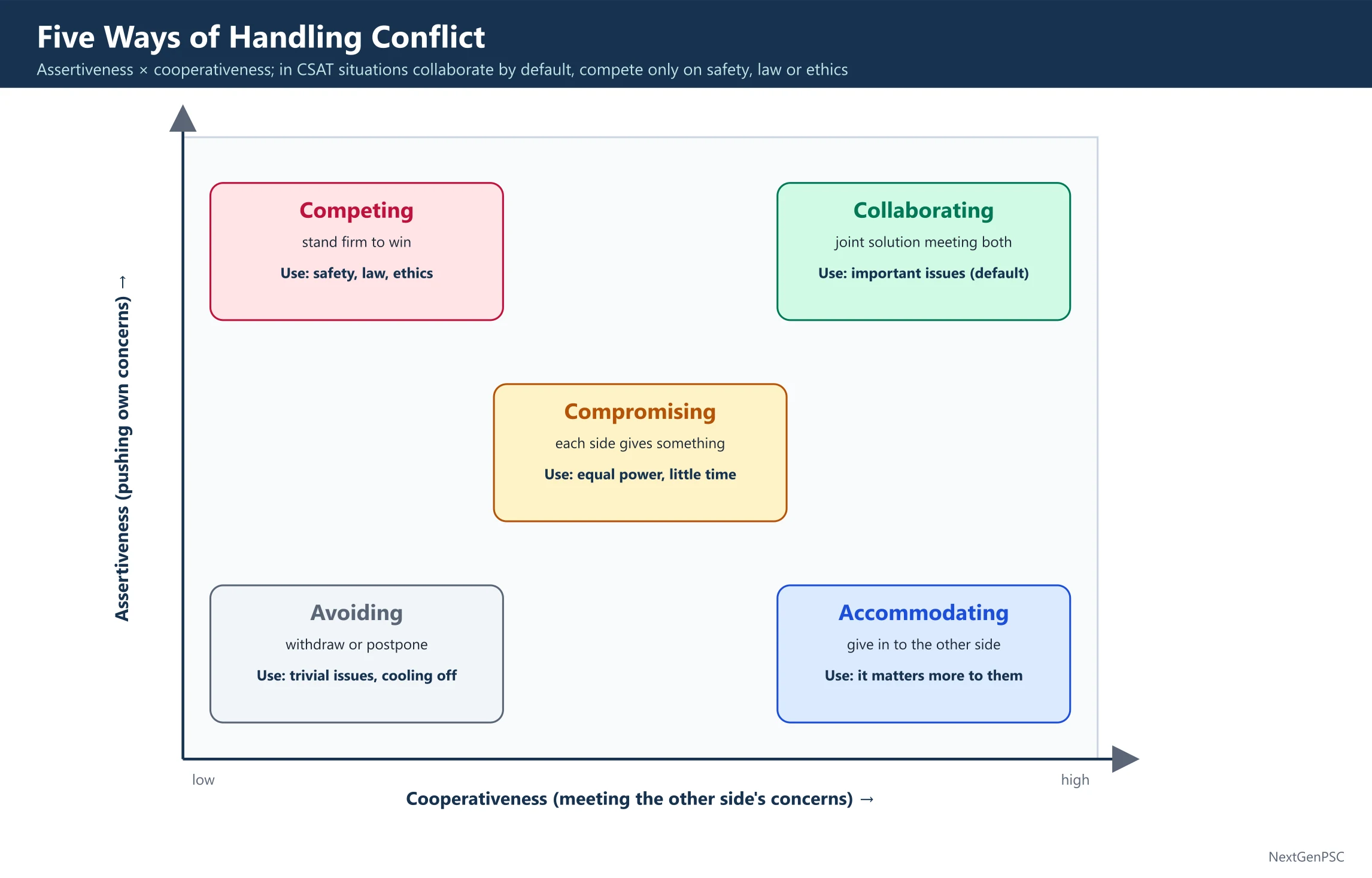
1. What Conflict Is and Why It Is Not Always Bad
A conflict exists when two or more parties believe their needs, goals or values cannot all be met at once. It can be between individuals, within a team, between departments, between citizens and the administration, or between communities.
Conflict can be functional (it brings out problems and better ideas, as when two officers argue over the best survey method) or dysfunctional (it blocks work, damages trust or turns violent). The aim is to keep the first kind and resolve the second.
Questions on this topic have been rare in recent CSAT papers; when they appear, the best option is almost never to suppress the conflict or to let rank decide it.
2. The Five Styles of Handling Conflict
A common model places each style on two scales: assertiveness (how much you push for your own concerns) and cooperativeness (how much you try to meet the other side's concerns).
Competing (high assertiveness, low cooperativeness): standing firm to win. Fits when safety, law or ethics are at stake, or a quick decision is vital. Risk: resentment if overused.
Accommodating (low assertiveness, high cooperativeness): giving in. Fits when the issue matters much more to the other side, or to preserve an important relationship. Risk: your legitimate concerns are lost.
Avoiding (low on both): withdrawing or postponing. Fits only for trivial issues or when people need time to cool down. Risk: real problems grow.
Compromising (middle on both): each side gives up something. Fits when time is short and both sides have equal power. Risk: nobody is fully satisfied, and the underlying problem may remain.
Collaborating (high on both): working together to find a solution that fully meets both sides' interests. Fits important issues where both concerns are too important to give up. Takes more time, but gives the most lasting result.
Why it matters for CSAT: in most situations the best option is collaborative; the firm (competing) option is right only when a rule of safety, law or ethics is non-negotiable.
3. Positions and Interests
A position is what a side says it wants ('we need the hall on Monday'). An interest is why it wants it ('we need space for sixty trainees' or 'we need a quiet room for interviews').
Positions often clash while interests do not. Asking 'why' turns a fight over one hall into a solution: the training gets the hall and the interviews get a smaller quiet room.
Four principles of interest-based negotiation: separate the people from the problem; focus on interests, not positions; create options that give gains to both; judge the outcome by fair, objective standards (rules, data, precedent).
4. Steps of Resolving a Conflict
1. Calm the situation: separate the parties if tempers are high; ensure safety.
2. Hear each side: separately first if needed, then together; listen without taking sides.
3. Define the problem: agree on the facts and on what exactly the disagreement is.
4. Find interests and options: ask why each side wants what it wants; generate solutions that meet both.
5. Agree and follow up: put the agreement in clear terms (who does what, when), set up joint monitoring where useful, and check later that it is working.
5. Third-Party Methods
Negotiation: the parties settle it themselves. Mediation: a neutral person helps them talk and reach their own agreement but does not impose one. Arbitration: a neutral person hears both and gives a decision the parties have agreed to accept. Adjudication: a court decides.
Lok Adalats are a well-known Indian example of settlement by conciliation, where disputes are resolved by mutual agreement instead of a long trial.
6. Common Traps in the Options
Deciding by rank ('give it to the senior'), deciding by size ('give it to the larger village'), avoiding a serious conflict ('let them sort it out'), suppressing it by force ('post police and close the tank'), punishing one side to pacify the other ('suspend the doctor'), and splitting the difference when one side is clearly right on safety or law.
Example 1: Two clerks and one computer
- Question
Two clerks in your section keep quarrelling over the use of a shared computer, and work is getting delayed. What will you do? (a) Ignore it; they will adjust in time (b) Meet both, understand their work schedules, and agree on a timetable for its use or arrange another computer (c) Give the computer to the senior clerk (d) Issue written warnings to both clerks
- Solution
Weigh each option. (a) is avoiding a conflict that is already hurting work.
(b) looks at interests (when each needs the machine), finds a fair arrangement, and removes the cause if possible.
(c) decides by rank, not need; the junior's work still suffers, and resentment grows.
(d) punishes both without solving the shortage behind the quarrel.
Shortcut. Find the interests (schedules), agree a fair rule, remove the cause.
Trap. (d) looks firm, but warnings do not create a second computer.
- Answer
(b) Meet both, understand their work schedules, and agree on a timetable for its use or arrange another computer
Example 2: Two villages, one water tank (UPSC-style)
- Question
During summer, two villages are in a tense dispute over water from a common tank. You are the Sub-Divisional Magistrate. What will you do? (a) Post police at the tank and close it until the rains (b) Give the water to the larger village, since more people live there (c) Let the villages settle it among themselves (d) Bring representatives of both villages together, assess the water available and each village's needs, agree on a fair sharing schedule with a joint monitoring committee, and plan to increase the supply
- Solution
Weigh each option. (a) suppresses the conflict and denies water to both villages.
(b) decides by size; the smaller village's basic needs are ignored and the dispute will flare again.
(c) avoids a conflict that may turn violent; it is the administration's duty to step in.
(d) uses facts (assessment), fairness (needs-based schedule), joint ownership (monitoring committee) and a long-term fix (more supply).
Shortcut. Community conflict over a resource: facts → fair rule → joint monitoring → more of the resource.
Trap. (a) looks like 'maintaining law and order', but it punishes everyone and solves nothing.
- Answer
(d) Bring representatives of both villages together, assess the water available and each village's needs, agree on a fair sharing schedule with a joint monitoring committee, and plan to increase the supply
Example 3: Naming the style
- Question
A manager gives in to a colleague's demand on a minor issue because the colleague's goodwill is important for a much bigger joint project. Which conflict-handling style is this? (a) Competing (b) Avoiding (c) Accommodating (d) Collaborating
- Solution
Weigh each option. (a) is wrong: competing means standing firm to win.
(b) is wrong: the manager did not withdraw; he responded and yielded.
(c) is right: giving in on an issue that matters more to the other side, to protect the relationship, is accommodating.
(d) is wrong: no joint solution meeting both sides' interests was worked out.
Shortcut. Gives in = accommodating; withdraws = avoiding; both give up something = compromising; joint solution = collaborating.
Trap. Confusing accommodating with avoiding; the difference is whether the person engages and yields or simply steps away.
- Answer
(c) Accommodating
Example 4: Two departments, one hall
- Question
Two departments have both booked the only large meeting hall for Monday. One needs it for a training of sixty officers; the other needs a quiet room for confidential interviews. What is the best way to resolve this? (a) Give it to whoever booked first (b) Explore what each actually needs: the training gets the hall and the interviews are moved to a smaller quiet room (c) Cancel both events to avoid the dispute (d) Toss a coin
- Solution
Weigh each option. (a) applies a rule, but may leave sixty officers without a room while a small panel occupies a large hall.
(b) looks behind the positions to the interests and meets both fully: a collaborative solution.
(c) avoids the conflict at the cost of both events.
(d) is arbitrary; one side loses for no reason.
Shortcut. Ask why each side wants it; interests often fit together where positions clash.
Trap. (a) sounds fair and procedural, but a mechanical rule is second best when a solution satisfying both exists.
- Answer
(b) Explore what each actually needs: the training gets the hall and the interviews are moved to a smaller quiet room
Example 5: Relatives confront a doctor (UPSC-style)
- Question
You are a hospital superintendent. After a patient dies, the relatives accuse the doctor of negligence and become aggressive in the ward. What will you do? (a) Call the police to remove them at once (b) Suspend the doctor immediately to pacify the relatives (c) Meet the relatives calmly, listen to them, share the facts available, assure them of an impartial inquiry by a committee, and ensure the safety of the staff (d) Ask the doctor to apologise for negligence
- Solution
Weigh each option. (a) uses force on grieving people as the first step and deepens distrust.
(b) punishes the doctor before any inquiry, to buy peace; unfair and a bad precedent.
(c) calms the situation, listens, offers facts and a fair process, and protects the staff: every step of resolution.
(d) assumes guilt before the facts are known.
Shortcut. Calm → listen → facts → impartial process → safety.
Trap. (b) ends the scene quickly, but sacrificing one side to pacify the other is not resolution.
- Answer
(c) Meet the relatives calmly, listen to them, share the facts available, assure them of an impartial inquiry by a committee, and ensure the safety of the staff
Example 6: When a firm stand is right (UPSC-style)
- Question
A contractor refuses to provide safety harnesses to workers on a high-rise government building, saying it slows the work. You are the engineer in charge. What will you do? (a) Insist firmly on full compliance, explain the reason, and stop the unsafe work until it is corrected (b) Avoid the issue and leave it to the site supervisor (c) Accommodate the contractor to keep the project on schedule (d) Compromise: require harnesses for only half of the workers
- Solution
Weigh each option. (a) uses the competing style where it is right: safety and law are non-negotiable, and explaining the reason keeps the relationship as healthy as possible.
(b) avoids a serious problem that is your responsibility.
(c) puts the schedule above workers' lives.
(d) splits the difference on a safety rule; half the workers remain at risk.
Shortcut. Safety, law or ethics at stake → firm, non-negotiable stand, politely explained.
Trap. (d) sounds balanced, but compromise is wrong when one side's demand breaks a safety rule.
- Answer
(a) Insist firmly on full compliance, explain the reason, and stop the unsafe work until it is corrected
Practice Questions
Q1. Which conflict-handling style is high on both assertiveness and cooperativeness? (a) Compromising (b) Competing (c) Accommodating (d) Collaborating
Q2. In mediation, the role of the mediator is to: (a) help the parties talk, understand each other's interests and reach their own agreement (b) decide who is right and impose a decision (c) represent the stronger party (d) punish the party at fault
Q3. Two team members disagree about the method for a field survey, and both have good points. What is the best approach? (a) Adopt the more senior member's method (b) Drop the survey to avoid friction (c) Discuss the survey's goals with both and combine the strongest parts of their methods (d) Ask the team to vote at once without discussion
Q4. Two colleagues disagree over the colour of the new office curtains. What is the best approach? (a) Hold a formal inquiry into the dispute (b) Settle it quickly and informally, or let it pass; it does not deserve much time (c) Refer it to the head of the department (d) Transfer one of them to another section
Q5. Tension has arisen between a tribal community and forest officials over the collection of minor forest produce. What will you do as the district officer? (a) Ban the community's entry into the forest (b) Ignore the tension until it subsides (c) Allow unregulated collection to avoid conflict (d) Hold a dialogue with the gram sabha and the officials, explain the community's rights under the Forest Rights Act, 2006, and agree on sustainable collection rules
Answers
Show answers
Q1. (d) Collaborating. It seeks a solution that fully meets both sides' concerns.
Q2. (a) help the parties talk, understand each other's interests and reach their own agreement. Imposing a decision is arbitration or adjudication, not mediation.
Q3. (c) Discuss the survey's goals with both and combine the strongest parts of their methods. Functional conflict used to improve the result.
Q4. (b) Settle it quickly and informally, or let it pass; it does not deserve much time. Avoiding or quick compromise suits trivial issues.
Q5. (d) Hold a dialogue with the gram sabha and the officials, explain the community's rights under the Forest Rights Act, 2006, and agree on sustainable collection rules. Lawful, participatory and lasting.
| Style | Assertive / cooperative | When it fits | Risk if misused |
|---|---|---|---|
| Competing | High / low | Safety, law or ethics at stake; urgent decisions | Resentment; damaged relationships |
| Accommodating | Low / high | Issue matters more to the other side; preserving a key relationship | Own legitimate concerns ignored |
| Avoiding | Low / low | Trivial issues; time to cool down | Real problems grow |
| Compromising | Medium / medium | Equal power, little time, moderate stakes | Half-solutions; root cause remains |
| Collaborating | High / high | Important issues where both sides' interests must be met | Takes time and effort |
| Method | Who decides | Example |
|---|---|---|
| Negotiation | The parties themselves | Two departments agree to share a hall |
| Mediation | The parties, helped by a neutral person who does not impose | An officer helps two villages agree a water schedule |
| Conciliation | The parties, with a conciliator who may suggest terms | Settlement of a case at a Lok Adalat |
| Arbitration | A neutral arbitrator whose award the parties agreed to accept | A contract dispute referred to an arbitrator |
| Adjudication | A court | A suit decided by a judge after trial |
Prelims tips
- Know its weight. Conflict questions have been rare in recent CSAT papers; learn the five styles, the positions–interests idea and the five steps, and practise the examples once.
- Collaborate by default, compete only on safety, law or ethics. The firm option is right when a rule protecting life or legality is at stake; elsewhere, the joint, interest-based solution wins.
- Reject rank, size and force as deciders. 'Give it to the senior', 'give it to the larger village' and 'post police and close it' are the standard wrong options.
- Never sacrifice one side to pacify the other. Suspending or blaming someone before an inquiry ends the scene but is unfair; calm, listen, share facts, promise an impartial process.
- Ask 'why' behind each demand. Options that look past positions to interests (the hall for the training, a quiet room for the interviews) usually satisfy both sides and are the best answer.
- Match the method to the issue. Trivial disputes can be settled informally or let go; serious ones need facts, a fair rule and follow-up. Mediation helps parties agree; it never imposes a decision.
CSAT (Prelims Paper II): All chapters
- CSAT Exam Pattern and Strategy
- Basic Numeracy
- Reading Comprehension
- Logical Reasoning
- Data Interpretation
- General Mental Ability
- Decision Making and Interpersonal Skills