
CSAT (Prelims Paper II) · UPSC Notes
Reading Comprehension — UPSC CSAT Notes
Free, exam-focused notes for UPSC Prelims and Mains, with Prelims tips and Mains points for every topic. 7 topics.
Open in the interactive reader: bookmarks, progress tracking and read-aloud.
Passage Structure and Organisation
In short
Passage structure is the plan of a passage: which sentence sets the context, which one makes the author's claim, which ones give evidence, where the author concedes a point and where the argument ends. Comprehension is usually about a third of the 80 questions in CSAT Paper II, and almost every comprehension question, whether it asks for the crux, an inference or the purpose of a sentence, becomes easy once you can see this plan. Three ideas unlock it: every sentence has a job (context, claim, evidence, concession, conclusion), signal words such as 'but', 'however' and 'therefore' show where the author turns, and the author's own view usually sits after the turn.
In simple words
Think of a passage as a short speech by someone who wants to convince you of one thing. Before making the point, the speaker sets the scene; then makes the point; then gives reasons or examples; sometimes admits what the other side says; and finally sums up.
Everyday example: a friend says, 'Everyone says the new metro is too costly at ₹40 a ride. True, buses are cheaper. But the metro saves me an hour every day, and my time is worth more than ₹40. So for me the metro is the better deal.' The first sentence is the popular view, 'True…' is the admission, 'But…' is the real point, and 'So…' is the conclusion.
In a CSAT passage it is the same. You do not need to remember every fact. You need to know which sentence is doing which job.
The one question to always ask is: 'Where does the author turn?' Words like but, however, yet and nevertheless are the hinge. What comes after the hinge is usually what the author really believes.
Two habits solve most structure questions: (1) give each sentence a one-word label as you read (context, claim, example, admits, so); (2) before choosing an option, say in your own words what the passage is doing, then pick the option that says the same thing without adding or exaggerating.
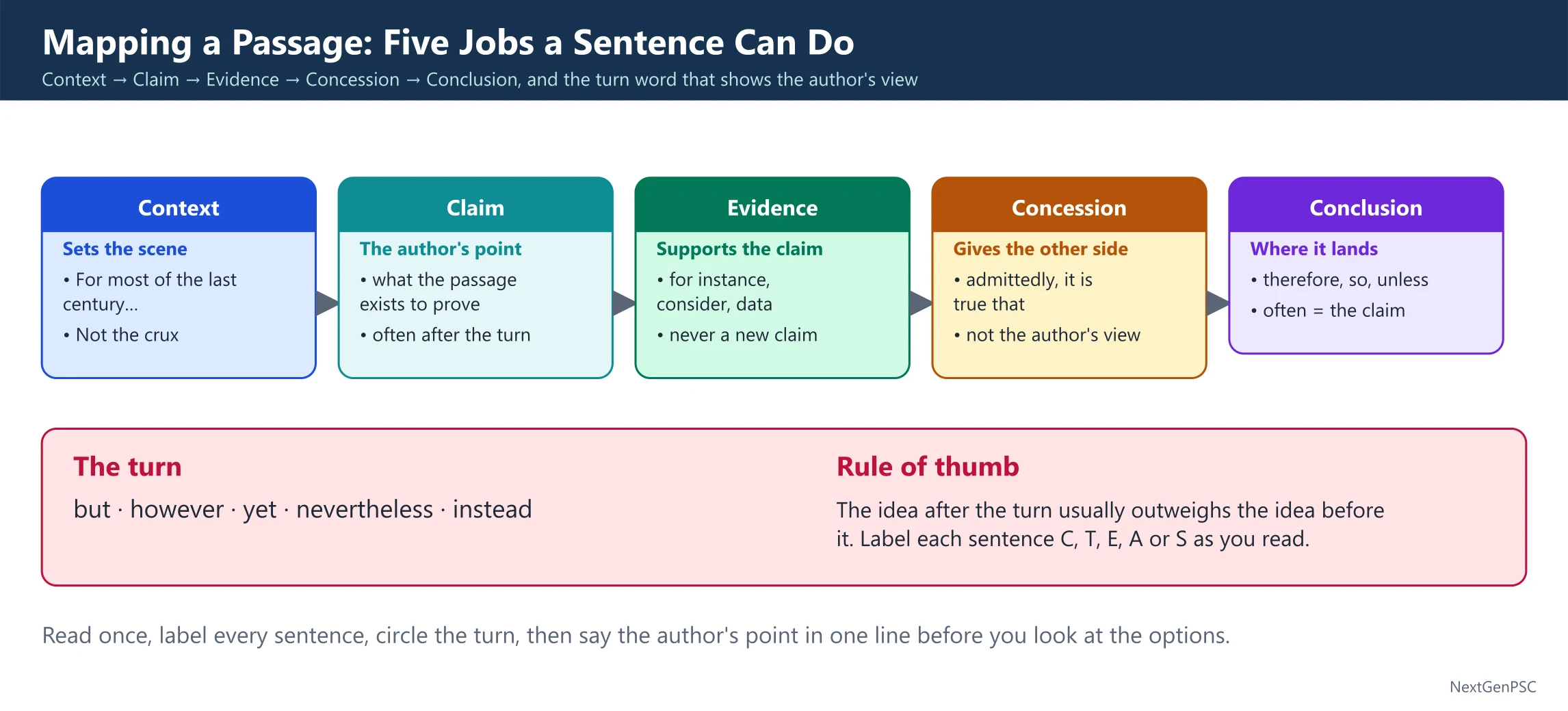
1. Why Structure Comes Before Detail
CSAT passages range from a few lines to several paragraphs, and each is followed by one or more questions. Most of those questions do not test whether you remember a fact; they test whether you understood what the passage is doing: arguing, warning, correcting a popular view, proposing a remedy.
A reader who sees the plan reads once and answers fast. A reader who tries to memorise every line re-reads two or three times and still falls for options that repeat the passage's words with a changed meaning.
So the first skill of comprehension is mapping: as you read, decide the job of each sentence. This topic teaches that map; the later topics (facts, inference, critical reasoning, vocabulary, main idea and tone) all use it.
2. The Five Jobs a Sentence Can Do
Context: background that sets up the subject ('For most of the last century, farm policy rewarded rice and wheat'). It is true in the passage but is rarely the answer to a crux question.
Claim (thesis): the author's main point, the sentence the passage exists to prove ('Reviving millets is less about persuading consumers than about changing incentives').
Evidence or example: facts, data, cases or illustrations that support the claim ('Consider jowar in Maharashtra…'). Questions ask why the author mentions them; the answer is always 'to support or illustrate' some claim, never a new claim of its own.
Concession: a point the author admits from the other side before moving on ('Admittedly…', 'It is true that…', 'Of course…'). It shows fairness; it is not the author's main view.
Conclusion or recommendation: where the argument lands ('therefore', 'so', 'thus', 'unless…', 'what is needed is…'). In many UPSC passages the conclusion and the claim are the same sentence, placed at the end.
3. Signal Words: the Road Signs of a Passage
Contrast or turn: but, however, yet, nevertheless, on the other hand, still, instead. The idea after the turn usually outweighs the idea before it.
Cause and result: because, since, as, therefore, thus, hence, consequently, as a result. 'X, therefore Y' tells you Y is the conclusion and X its reason.
Concession: although, though, admittedly, it is true that, of course, granted. The clause they introduce is the point the author gives away.
Addition and example: moreover, further, also, for instance, for example, consider, such as. These continue in the same direction; they never reverse the argument.
Summing up: in short, in other words, ultimately, in sum, the real question is. These usually introduce the author's main point in its plainest form.
Why: signal words are the author's own labels. Reading them is like reading the captions on a map, so you do not have to guess the job of a sentence from its content alone.
4. Six Common Ways Passages Are Organised
Popular view, then correction: 'It is often said that…' followed by 'This confuses…' or 'But…'. The author's view is the correction.
Problem, then solution: a problem is described, causes may be given, and a remedy is proposed, often with a condition ('only if…').
Claim, then evidence: the main point comes first and the rest supports it.
Gains, then limits (assessment): 'The record is mixed', 'These gains are real… yet…'. The author is balanced but the weight falls on what remains to be done.
Cause and effect chain: A leads to B, B leads to C. Questions ask which link is the root cause or what would break the chain.
Comparison or contrast: two policies, periods or views are set side by side; the author usually prefers one or says both miss something.
5. Mapping a Passage in 20 Seconds
Read once, at normal speed, and pencil a one-word label beside each sentence: C (context), T (claim or thesis), E (evidence or example), A (admits), S (so: conclusion). Circle every turn word.
Then answer three questions in your head: What is the subject? What does the author want me to believe about it? Which sentence says that most plainly? This single line is your 'passage map'.
Where the claim usually sits: at the start in claim-evidence passages; right after the turn word in popular-view and gains-limits passages; at the very end in problem-solution passages that build to 'therefore'.
With practice the labels move from the pencil into your head and mapping costs nothing extra; it simply replaces re-reading.
6. Questions That Test Structure Directly
'The author mentions X in order to…' (function of an example: to illustrate or support a claim). 'What is the role of the sentence beginning with…?' (one of the five jobs). 'Which best describes the organisation of the passage?' (one of the six patterns). 'How is the second paragraph related to the first?' (continues, contrasts, explains, qualifies or applies).
Structure also hides inside other questions: crux and main-idea questions are answered by the claim, inference questions by the sentences around the turn, and tone questions by the words the author uses in the concession and the conclusion.
7. The SAPE Drill for Every Comprehension Question
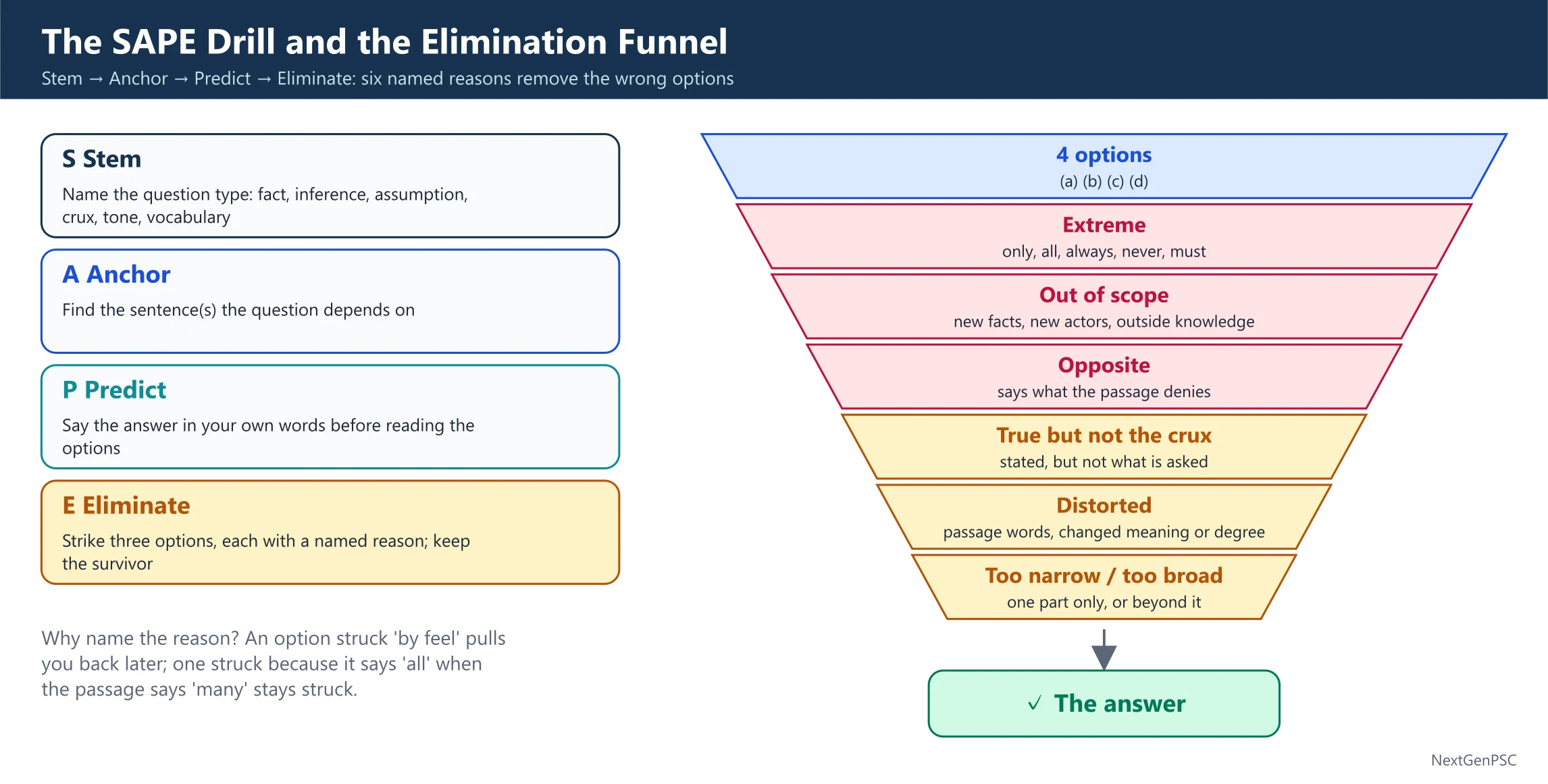
This chapter uses one repeatable method. S — Stem: read the question first and name its type (structure, fact, inference, assumption, crux, tone, vocabulary). A — Anchor: find the sentence or sentences the question depends on. P — Predict: say the answer in your own words before looking at the options. E — Eliminate: strike each wrong option with a named reason.
The six reasons that kill most wrong options: Extreme (only, always, all, never, completely), Out of scope (brings in something the passage does not discuss), Opposite (says what the passage denies), True but not the crux (stated in the passage but not what the question asks), Distorted (passage words with a changed meaning, degree or cause), Too narrow or too broad (covers one part, or goes beyond the passage).
Why naming matters: an option you reject 'by feel' can pull you back later; an option you reject because it says 'all' when the passage says 'many' stays rejected. Naming the reason also shows which trap you fall for most often.
Example 1: Why does the author mention it?
- Question
Passage. For most of the last century, Indian farm policy rewarded two crops above all others: rice and wheat. Assured procurement and subsidised inputs made them the safest choice for farmers, even in dry regions. Millets, which need far less water and tolerate heat, slowly disappeared from fields and plates. Consider jowar in parts of Maharashtra: once a staple eaten daily, it is now bought by many families only as an occasional health food. Reviving millets, therefore, is less a matter of persuading consumers than of changing the incentives that pushed farmers away from them.
The author mentions jowar in Maharashtra primarily in order to (a) argue that jowar is more nutritious than wheat (b) prove that millets have vanished from every Indian farm (c) show that consumers in Maharashtra dislike millets (d) illustrate how a millet moved from everyday food to an occasional item
- Solution
Normal method. Stem: a function question. Anchor: 'Consider jowar…' begins with 'Consider', an example signal, and follows the claim that millets 'disappeared from fields and plates'. Predict: it is an example of that disappearance.
(a) ✗ Out of scope. The passage never compares the nutrition of jowar and wheat.
(b) ✗ Extreme. 'Every Indian farm' goes far beyond 'slowly disappeared'; one example cannot prove a universal claim.
(c) ✗ Opposite. The last sentence says the issue is less about persuading consumers; dislike by consumers is not the cause given.
(d) ✓ Matches the anchor. 'Once a staple eaten daily… now an occasional health food' is exactly the movement from everyday to occasional.
Shortcut. An example introduced by 'consider' or 'for instance' always illustrates the sentence just before it; find that sentence and the answer follows.
Trap. Option (c) uses the word 'consumers' from the passage but reverses its role; word-matching without meaning-matching is the commonest error.
- Answer
(d) illustrate how a millet moved from everyday food to an occasional item
Example 2: Naming the pattern
- Question
Passage. It is often said that cities are the villains of climate change because they consume most of the world's energy. The charge confuses size with efficiency. A city consumes a great deal because it holds a great many people; per person, a city dweller usually travels shorter distances, lives in a smaller home that shares walls with others, and can use public transport. Sprawling suburbs, not compact cities, are where energy use per head tends to be highest. The real question, then, is not whether people should live in cities but how cities should be built.
Which one of the following best describes the way the passage is organised? (a) A popular view is stated and then corrected with reasoning (b) A problem is described and several possible solutions are compared (c) Two named cities are compared and one is shown to be better (d) A historical account leads to a prediction about the future
- Solution
Normal method. Stem: organisation. Anchor: 'It is often said…' then 'The charge confuses size with efficiency.' Predict: common belief, then the author shows why it is wrong.
(a) ✓ Matches the pattern. 'It is often said' is the popular view; 'confuses size with efficiency' and the per-person reasoning are the correction.
(b) ✗ Distorted. No list of solutions is compared; the passage ends with a question about how to build cities, not a menu of remedies.
(c) ✗ Out of scope. No particular cities are named; the contrast is between compact cities and sprawling suburbs as types.
(d) ✗ Out of scope. There is no history and no forecast in the passage.
Shortcut. 'It is often said', 'Many believe', 'The common view' in the first sentence almost always means a popular-view-then-correction passage.
Trap. Option (b) tempts because climate change sounds like a 'problem'; but the passage argues about a belief, not about remedies.
- Answer
(a) A popular view is stated and then corrected with reasoning
Example 3: Which sentence is the conclusion? (UPSC-style)
- Question
Passage. [1] India generates millions of tonnes of plastic packaging waste every year, and much of it is never collected. [2] Municipal bodies, already short of money, cannot be expected to clean up after products they neither design nor sell. [3] Extended producer responsibility shifts part of that burden to the companies that put packaging on the market, requiring them to finance collection and recycling. [4] Its success, however, depends on honest accounting, since a producer can claim credit for recycling that never happened. [5] A rule that makes producers pay is therefore only as strong as the system that checks their claims.
Which sentence states the conclusion towards which the rest of the passage builds? (a) Sentence 1 (b) Sentence 3 (c) Sentence 4 (d) Sentence 5
- Solution
Normal method. Stem: conclusion. Anchor: label the sentences: 1 C (problem), 2 E (why municipalities cannot cope), 3 the remedy, 4 turn ('however') with a condition, 5 S ('therefore'). Predict: the passage builds from problem to remedy to the remedy's weak point, and lands on sentence 5.
(a) ✗ Context only. Sentence 1 states the problem; nothing in it is argued for.
(b) ✗ True but not the crux. Sentence 3 describes the remedy, but the author's point is about what the remedy depends on.
(c) ✗ Support, not conclusion. Sentence 4 gives the reason ('since a producer can claim credit…') that sentence 5 draws its conclusion from.
(d) ✓ The 'therefore' sentence. It states the lesson that sentences 3 and 4 lead to: the rule is only as strong as its checking system.
Shortcut. When a passage has a 'however' followed by a 'therefore', the 'therefore' sentence is the conclusion and the 'however' sentence is its main support.
Trap. Sentence 3 is the most 'positive' and detailed sentence, so students pick it as the main point; the author's interest is in its limit.
- Answer
(d) Sentence 5
Example 4: Reading after the turn
- Question
Passage. Over the past two decades the economy has grown at an impressive pace, and the share of people living in extreme poverty has fallen sharply. These gains are real and should not be dismissed. Yet growth has created far fewer regular, salaried jobs than the number of young people entering the workforce each year. Many of the new entrants end up in low-paid informal work or leave the labour force altogether. Unless growth becomes more labour-intensive, a large part of the population will remain at the margins of prosperity.
Which one of the following best reflects the crux of the passage? (a) The economy has grown rapidly and extreme poverty has fallen sharply (b) Young people prefer informal work to salaried jobs (c) Economic growth has failed to reduce poverty (d) Growth that does not create enough good jobs leaves many people behind
- Solution
Normal method. Stem: crux. Anchor: the turn 'Yet' and the final 'Unless…' sentence. Predict: growth has helped, but without enough good jobs many will be left out.
(a) ✗ True but not the crux. It is stated, but it sits before 'Yet' as the conceded part.
(b) ✗ Distorted. The passage says new entrants 'end up' in informal work, which is not the same as preferring it.
(c) ✗ Opposite. The passage says poverty 'has fallen sharply'.
(d) ✓ Matches the anchor. It joins the turn (too few salaried jobs) with the conclusion (many remain at the margins).
Shortcut. In a gains-then-limits passage the crux is the limit plus its consequence; the gains are the concession.
Trap. Option (a) is the safest-looking option because every word is in the passage; that is exactly why it is placed there.
- Answer
(d) Growth that does not create enough good jobs leaves many people behind
Example 5: The role of a concession (UPSC-style)
- Question
Passage. Pending cases in Indian courts run into crores, and nearly every proposal for reform now begins with technology. Admittedly, e-filing, virtual hearings and digital case records have saved time for litigants and lawyers, especially those who live far from court complexes. But most delay arises elsewhere: in frequent adjournments, vacancies on the bench and the slow service of summons. A court that runs on software but still grants adjournments freely will only reach the same delay faster.
What is the role of the sentence beginning with 'Admittedly'? (a) It grants a benefit of technology before the author limits its importance (b) It states the main argument of the passage (c) It shows that technology has already solved the problem of delay (d) It rejects the use of technology in courts
- Solution
Normal method. Stem: role of a sentence. Anchor: 'Admittedly…' followed immediately by 'But most delay arises elsewhere'. Predict: the author grants that technology helps, then says it does not touch the main causes.
(a) ✓ A concession. 'Admittedly' is a concession signal, and the next sentence limits the benefit.
(b) ✗ Distorted. The main argument comes after 'But': delay arises mainly from adjournments, vacancies and summons.
(c) ✗ Extreme. Saving time for some litigants is not solving delay; the last sentence says delay remains.
(d) ✗ Opposite. The author accepts the benefits of technology; the complaint is that it is treated as the whole answer.
Shortcut. Admittedly / Of course / It is true that + But = concession + main point. The concession is never the crux.
Trap. Option (d) is what a careless reader concludes from the critical tone; the author criticises over-reliance, not technology itself.
- Answer
(a) It grants a benefit of technology before the author limits its importance
Example 6: How two paragraphs relate (UPSC-style)
- Question
Passage. Antibiotics transformed medicine: infections that once killed routinely became curable, and surgery and cancer treatment became far safer. For decades, whenever bacteria grew resistant to one drug, chemists simply found another. — That cycle has slowed. Few new classes of antibiotics have reached the market in recent decades, because a drug that doctors are urged to use sparingly earns little money for the firm that makes it. The very caution that keeps an antibiotic effective makes it unprofitable to develop. Public funding, or rewards that pay for new drugs regardless of how much of them is sold, may be needed to break this deadlock.
How is the second paragraph, beginning 'That cycle has slowed', related to the first? (a) It explains why the pattern described at the end of the first can no longer be relied upon, and suggests a remedy (b) It gives further examples of the benefits described in the first (c) It denies the first paragraph's claim that antibiotics transformed medicine (d) It argues that doctors should prescribe antibiotics more freely
- Solution
Normal method. Stem: relation between paragraphs. Anchor: 'That cycle' points back to 'chemists simply found another'; 'has slowed' is the turn; the last sentence is a remedy. Predict: paragraph 2 says the old fix no longer works, explains why, and proposes a way out.
(a) ✓ Matches the link. 'That cycle has slowed' plus the profit explanation plus 'public funding… may be needed' covers all three parts.
(b) ✗ Distorted. Paragraph 2 gives no new benefits; it describes a problem.
(c) ✗ Opposite. Paragraph 2 never questions the benefits; it worries about keeping them.
(d) ✗ Opposite. The passage treats careful use as wise; it says caution makes drugs unprofitable, not that caution is wrong.
Shortcut. When a paragraph opens with 'That…' or 'This…', it refers to the last idea of the previous paragraph; ask what it does to that idea: extends, reverses, explains or limits it.
Trap. Option (d) misreads 'the very caution… makes it unprofitable' as criticism of caution; the author's remedy is new funding, not careless use.
- Answer
(a) It explains why the pattern described at the end of the first can no longer be relied upon, and suggests a remedy
Practice Questions
Passage A (for Q1–Q3). [1] When India amended its Constitution to create elected panchayats and municipalities, the hope was that decisions would move closer to the people they affect. [2] Three decades later, the record is mixed. [3] Elections are held regularly, and lakhs of women now sit on local councils because of reserved seats. [4] Yet many local bodies remain dependent on grants whose use is decided by state governments, and they have few staff of their own. [5] Power on paper has not always become power in practice; giving local bodies their own funds and staff is the unfinished half of the reform.
Q1. Sentence 3 serves mainly to (a) prove that decentralisation has fully succeeded (b) argue that reserved seats should be abolished (c) give evidence of progress that the author then qualifies (d) state the main conclusion of the passage
Q2. In which sentence does the argument turn? (a) Sentence 1 (b) Sentence 2 (c) Sentence 4 (d) Sentence 5
Q3. The passage is best described as (a) a historical account that offers no judgement (b) a proposal to replace local bodies with state departments (c) an assessment of a reform that notes its gains and names what remains to be done (d) a comparison of Indian and foreign local governments
Passage B (for Q4–Q5). Heatwaves are usually discussed as a health emergency, and rightly so. But they are also an economic event. When temperatures cross certain limits, construction workers, farm labourers and street vendors cannot work through the afternoon without risk, and the hours they lose are wages they never recover. Cities that shift working hours, provide shaded rest areas and issue early warnings protect incomes as well as lives. Heat action plans, in other words, are as much labour policy as public health policy.
Q4. The passage moves from (a) a medical explanation to a legal judgement (b) a statistical survey to a forecast (c) a criticism of cities to praise for villages (d) a common way of seeing heatwaves to a wider way of seeing them
Q5. The phrase 'in other words' in the last sentence signals that the sentence (a) introduces a new and unrelated topic (b) contradicts what came before (c) restates the passage's point as its conclusion (d) gives one more example
Answers
Show answers
Q1. (c) give evidence of progress that the author then qualifies — sentence 3 lists gains; sentence 4 ('Yet') limits them. (a) is extreme, (d) ignores the turn.
Q2. (c) Sentence 4 — 'Yet' marks the turn from gains to limits; sentence 2 only previews it.
Q3. (c) an assessment of a reform that notes its gains and names what remains to be done — gains, then limits, then 'the unfinished half'. (a) ignores the judgement; (b) and (d) are out of scope.
Q4. (d) a common way of seeing heatwaves to a wider way of seeing them — 'usually discussed as a health emergency… But also an economic event'.
Q5. (c) restates the passage's point as its conclusion — 'in other words' is a summing-up signal, not a contrast or an example signal.
| Signal type | Words | What it tells you |
|---|---|---|
| Contrast / turn | but, however, yet, nevertheless, still, instead | The idea after it usually carries the author's view |
| Concession | admittedly, although, it is true that, of course, granted | A point the author gives away; not the crux |
| Cause / result | because, since, therefore, thus, hence, consequently | Reason → conclusion; the 'therefore' clause is the conclusion |
| Addition | moreover, further, also, besides | Same direction; more support for the same claim |
| Example | for instance, for example, consider, such as | Illustrates the sentence just before it |
| Summing up | in short, in other words, ultimately, the real question is | The main point in its plainest form |
| Pattern | How to spot it | Where the author's view is |
|---|---|---|
| Popular view → correction | 'It is often said…', 'Many believe…' | In the correction, after 'but' or 'this confuses' |
| Problem → solution | A problem, its causes, then 'what is needed' | In the remedy and its condition |
| Claim → evidence | A strong first sentence, then data or cases | In the first sentence |
| Gains → limits | 'The record is mixed', 'These gains are real… yet' | In the limits and what remains to be done |
| Cause → effect chain | 'leads to', 'as a result', 'which in turn' | In the root cause or the final effect |
| Comparison | Two policies, periods or views side by side | In the one the author prefers, or in 'both miss…' |
Prelims tips
- Label every sentence as you read. Context, claim, example, admits, so. The trap options are built from the context and concession sentences because they are true in the passage; labels stop you choosing them for a crux or conclusion question.
- Circle the turn. But, however, yet and nevertheless are where UPSC passages hide the author's view. Read the sentence after the turn twice; read the rest once.
- An example never makes a new claim. For 'the author mentions X in order to', the answer is always 'to illustrate / support' the sentence before X. Options that turn the example into a sweeping claim are extreme.
- A concession is never the crux. 'Admittedly', 'It is true that', 'Of course' introduce what the author gives away. Options that repeat this part are 'true but not the crux'.
- 'Therefore' after 'however' is the conclusion. In problem-solution passages, the last 'therefore' or 'unless' sentence is usually the answer to 'what does the passage conclude'. Do not stop at the remedy sentence.
- Map, do not re-read. A 20-second map (subject + author's view + the sentence that says it) replaces a second reading. If you have to re-read, re-read only the anchor sentences the question points to.
Fact-based Questions
In short
Fact-based questions ask what the passage actually says: 'According to the passage…', 'Which of the following is stated…', 'Which of the statements given above is/are correct?'. The answer is in the text, but almost never in the same words, so the skill is matching meaning, not words. They are usually the most scoring comprehension questions, yet many marks are lost to options that copy the passage's words and quietly change a quantifier (some → all), a certainty (may → will), a cause or a time and place. Locate, match, verify the qualifiers: that is the whole method.
In simple words
A fact-based question is like checking a bill against the shop's price list. The answer is printed somewhere in the passage; your job is to find the right line and see whether the option says the same thing.
The difficulty is that the option uses different words. The passage may say 'not uncommon' and the option 'fairly common'; the passage may say 'farmers are paid' and the option 'payments reach farmers'. Same meaning, different words: that is a correct option.
Everyday example: your landlord's message says 'Rent of ₹9,000 is due by the 5th; a late fee may be charged after that.' An option saying 'A late fee will be charged on the 6th' is wrong, because 'may' became 'will'. One small word changed the fact.
The one question to always ask is: 'Where exactly does the passage say this?' If you cannot point to the line, the option is out.
Two habits solve most fact questions: (1) underline the small words in the passage (some, most, may, only, in cities, since 2010) because that is where options cheat; (2) in statement questions, test the easiest statement first and cross out every option that disagrees with it.
1. What Makes a Question 'Fact-based'
The answer is stated in the passage; you do not have to reason beyond it. Typical stems: 'According to the passage…', 'The passage states that…', 'Which of the following is mentioned…', 'With reference to the passage, consider the following statements… Which of the statements given above is/are correct?', and the reverse form 'Which of the following is NOT stated…'.
Fact questions differ from inference questions in one way: a fact option must be said (in other words), while an inference option must follow from what is said. If you need a step of reasoning to get from the line to the option, it is an inference, and a fact question will rarely reward it.
2. The Method: SAPE with Locate, Match, Verify
Stem: confirm it is a fact question and note whether it asks for what is stated or what is NOT stated. Anchor (locate): take the key noun of each option (wetlands, groundwater, women workers) and find the sentence that mentions it.
Predict and match: read that sentence and say in plain words what it claims; then compare the option's meaning, not its words. Eliminate and verify: check the small words: quantity, certainty, cause, time, place. A single changed qualifier makes the option wrong.
Why: examiners build wrong options by copying the passage and changing one small word, because a reader who matches words will pick them. Matching meaning and checking qualifiers defeats this design.
3. Recognising a Correct Paraphrase
Synonym swap: 'scarce' = 'in short supply'; 'curtail' = 'reduce'. Voice change: 'the state funds the scheme' = 'the scheme is funded by the state'. Double negative: 'not uncommon' = 'fairly common'; 'not without cost' = 'has some cost'.
Number restated: 'three-quarters' = '75%'; 'halved' = 'fell by 50%'. Summary of a list: 'shorter trips, smaller homes and public transport' = 'ways in which city life saves energy'. A correct option often sounds plainer than the passage.
4. The Five Fact Traps
Quantifier shift: some → most → all; a few → many; often → always. The passage says 'many villages', the option says 'villages' (meaning all of them).
Certainty shift: may, might, could, is likely to → will, must, always. Also the reverse: a definite statement softened into 'may' is usually fine, because it claims less.
Cause added or reversed: the passage says A and B happened together; the option says A caused B. Or the passage says A causes B; the option says B causes A.
Time or place shift: 'was' → 'is', 'in cities' → 'in the country', 'since the 1990s' → 'always'.
Two facts mixed: the option joins the subject of one sentence to the claim of another ('wetlands store carbon' + 'forests control floods' → 'wetlands control floods' when the passage never said it).
5. Statement Questions and Option Structure
UPSC often gives two or three numbered statements and options such as '1 only', '2 only', 'Both 1 and 2', 'Neither 1 nor 2' or '1 and 2 only', '2 and 3 only', '1, 2 and 3'. Judge each statement separately against the passage.
Start with the easiest statement. If statement 1 is clearly wrong, cross out every option containing 1; often only one or two options survive, and you need to test just one more statement.
Do not use outside knowledge. A statement can be true in the real world and still be 'not correct according to the passage' if the passage does not say it. The question is about the passage, not about the world.
6. 'NOT stated' and 'EXCEPT' Questions
Flip the task: find the three options that are stated, cross them out, and the one left is the answer. Mark the stem with a big NOT before you start; under time pressure many candidates answer the opposite question.
7. Passages with Numbers
Some passages carry data. Fact questions then ask for a figure that needs one or two steps. Read 'of what' carefully: '40% of the installed pumps' is not '40% of the sanctioned pumps'. The wrong options are built from exactly these base errors, so write the chain of numbers before choosing.
Example 1: What does the passage say wetlands do?
- Question
Passage. Wetlands are often treated as wasteland waiting to be filled and built upon. Yet a marsh at the edge of a city does quiet work that no engineer would find cheap to replace. During heavy rain it soaks up water like a sponge and releases it slowly, so that streets downstream flood less. Its plants trap silt and absorb some of the nutrients that would otherwise feed algal blooms in rivers. Fishermen and grass-cutters draw a living from it. When such a marsh is filled for housing, these services do not disappear from the account; they reappear as bills for drains, water treatment and lost livelihoods.
According to the passage, which one of the following is a service performed by an urban wetland? (a) It reduces flooding by holding rainwater and releasing it slowly (b) It absorbs all the pollution produced by the city (c) It provides cheaper land for housing than any other area (d) It replaces the need for drains and water treatment plants
- Solution
Normal method. Stem: fact, 'according to the passage'. Anchor: 'soaks up water like a sponge and releases it slowly, so that streets downstream flood less'. Predict: flood control by storing water.
(a) ✓ Correct paraphrase. 'Soaks up… releases slowly… flood less' = holds rainwater and reduces flooding.
(b) ✗ Extreme. The passage says plants absorb 'some of the nutrients', not all the city's pollution.
(c) ✗ Opposite. Filling the wetland for housing is what the passage warns against; it never calls wetland cheaper land.
(d) ✗ Distorted. The passage says that losing the wetland creates bills for drains; it does not say the wetland makes drains unnecessary everywhere.
Shortcut. Take the key verb of each option (absorbs, reduces, provides, replaces) and look for it, or its synonym, in the passage; only 'reduces flooding' has a matching line.
Trap. Option (b) copies 'absorb' from the passage and inflates 'some nutrients' to 'all the pollution': a quantifier shift.
- Answer
(a) It reduces flooding by holding rainwater and releasing it slowly
Example 2: Which is NOT stated?
- Question
Passage. Close to half of India's net sown area depends mainly on rainfall rather than on irrigation. In such areas a delayed or weak monsoon does more than cut the year's harvest. Farmers who cannot sow on time often borrow to buy seed a second time, and the debt outlasts the season. Fodder becomes scarce, so livestock are sold cheaply. Rural wages fall because there is less work in the fields, and some families send members to cities in search of daily work.
Which one of the following is NOT stated in the passage as an effect of a poor monsoon in rain-fed areas? (a) Farmers may have to buy seed again and borrow to do so (b) Food prices in cities rise sharply (c) Livestock may be sold at low prices because fodder is scarce (d) Some family members migrate in search of work
- Solution
Normal method. Stem: NOT stated, so find the three that are stated. Anchor: the list of effects in sentences 3 to 5. Predict: borrowing for seed, distress sale of livestock, lower wages, migration are stated; anything else is the answer.
(a) ✗ Stated. 'Borrow to buy seed a second time' is in sentence 3.
(b) ✓ Not in the passage. Food prices in cities are never mentioned; it may happen in reality, but the passage does not say it.
(c) ✗ Stated. 'Fodder becomes scarce, so livestock are sold cheaply.'
(d) ✗ Stated. 'Some families send members to cities in search of daily work.'
Shortcut. In NOT questions, tick off the stated options against the passage line by line; the answer is the option you cannot tick.
Trap. Option (b) is true to general knowledge, which is why careless readers treat it as stated; the test is the passage, not the world.
- Answer
(b) Food prices in cities rise sharply
Example 3: Two statements (UPSC-style)
- Question
Passage. A rural employment guarantee is often judged only by the number of days of work it provides. That measure misses much of its value. Because work is available close to home when other jobs dry up, households can avoid distress migration and keep children in school. Where wages are paid on time, the guarantee also sets a floor under private farm wages, since few labourers will accept far less from a landowner than the public works pay. Where payments are delayed for months, however, workers stop turning up, and the floor disappears.
With reference to the passage, consider the following statements: 1. The guarantee can raise private farm wages only when its own wages are paid on time. 2. The number of days of work provided is the best measure of the guarantee's value. Which of the statements given above is/are correct? (a) 1 only (b) 2 only (c) Both 1 and 2 (d) Neither 1 nor 2
- Solution
Normal method. Stem: fact, two statements. Anchor: sentence 1–2 for statement 2; sentences 4–5 for statement 1. Predict: statement 2 contradicts 'that measure misses much of its value'; statement 1 matches 'where wages are paid on time… where payments are delayed… the floor disappears'.
Statement 1 ✓ Stated. Timely payment sets a floor; delayed payment removes it. 'Only when' is supported because the passage gives the delayed case as the opposite.
Statement 2 ✗ Opposite. The passage says the days-of-work measure 'misses much of its value'.
(a) ✓ 1 only. Statement 1 is correct and statement 2 is not.
(b) ✗ Opposite. It keeps the wrong statement and drops the right one.
(c) ✗ Includes statement 2. Statement 2 is contradicted by the passage.
(d) ✗ Rejects statement 1. Statement 1 is supported by sentences 4 and 5.
Shortcut. Statement 2 is the easier one to test (it repeats the first sentence's 'often judged' view, which the author rejects); striking it leaves (a) and (d), and one look at sentence 4 settles it.
Trap. The word 'only' in statement 1 scares students into rejecting it; check whether the passage itself makes the condition necessary before calling it extreme.
- Answer
(a) 1 only
Example 4: May or will?
- Question
Passage. When a large enough share of a community is vaccinated against a contagious disease, the infection struggles to find new hosts, and even people who cannot be vaccinated, such as newborns, are partly protected. This indirect protection is called herd immunity. The share needed differs from disease to disease: for highly contagious infections such as measles it is very high, while for less contagious ones it can be lower. If coverage falls below the required level, outbreaks can return, sometimes after years of absence.
According to the passage, which one of the following is correct? (a) Herd immunity fully protects every newborn in a vaccinated community (b) The coverage needed for herd immunity is the same for all diseases (c) Outbreaks can return when vaccination coverage falls below the required level (d) Measles has been eliminated wherever herd immunity exists
- Solution
Normal method. Stem: fact. Anchor: the last sentence: 'If coverage falls below the required level, outbreaks can return'. Predict: falling coverage can bring outbreaks back.
(a) ✗ Extreme. The passage says 'partly protected', not fully protected.
(b) ✗ Opposite. 'The share needed differs from disease to disease.'
(c) ✓ Stated. It repeats the last sentence with the same degree of certainty: 'can return'.
(d) ✗ Out of scope. Measles is mentioned only as a highly contagious example; elimination is never discussed.
Shortcut. Underline the qualifiers in the passage first (partly, differs, can); then each option either keeps or breaks them, and three break them.
Trap. Option (a) changes 'partly' to 'fully' and 'newborns' to 'every newborn': two qualifier shifts in one line.
- Answer
(c) Outbreaks can return when vaccination coverage falls below the required level
Example 5: A fact that needs a little arithmetic
- Question
Passage. A district sanctioned 1,200 solar irrigation pumps last year, and three-quarters of them had been installed by March. Of the installed pumps, 40% replaced old diesel sets; the rest went to farms that had no pump before. Officials estimate that each diesel set replaced saves about 900 litres of diesel a year. The farms that got a pump for the first time save no diesel, but they can now grow a second crop, which the district counts as the larger gain.
According to the passage, about how much diesel will the installed pumps save in a year? (a) 3,24,000 litres (b) 4,32,000 litres (c) 8,10,000 litres (d) 10,80,000 litres
- Solution
Normal method. Stem: fact with numbers. Anchor: 'three-quarters… installed', '40% replaced diesel sets', '900 litres… a year'. Predict: installed = 1,200 × 3/4 = 900; diesel replacements = 40% of 900 = 360; saving = 360 × 900 = 3,24,000 litres.
(a) ✓ Correct chain. 1,200 → 900 installed → 360 replaced diesel sets → 360 × 900 = 3,24,000 litres.
(b) ✗ Wrong base. 40% of 1,200 sanctioned = 480, and 480 × 900 = 4,32,000; but the 40% is of the installed pumps.
(c) ✗ Step skipped. 900 installed × 900 litres = 8,10,000 counts every installed pump as a diesel replacement.
(d) ✗ Two steps skipped. 1,200 × 900 = 10,80,000 uses all sanctioned pumps.
Shortcut. Write the chain as factors: 1,200 × 3/4 × 0.4 × 900 = 1,200 × 0.3 × 900 = 360 × 900.
Trap. Every wrong option is a real number from the passage multiplied on the wrong base; 'of the installed pumps' is the phrase to underline.
- Answer
(a) 3,24,000 litres
Example 6: Three statements and option structure (UPSC-style)
- Question
Passage. Coral reefs cover a tiny fraction of the ocean floor but shelter a large share of all marine species. Reef-building corals live in partnership with algae that give them food and colour. When sea water stays unusually warm for weeks, the corals expel these algae and turn white, a process called bleaching. Bleached corals are not dead; if temperatures fall soon enough, the algae can return. Repeated bleaching with little time to recover, however, leaves reefs weakened and more likely to die.
With reference to the passage, consider the following statements: 1. Bleaching means that the coral has died. 2. Corals depend on algae for food. 3. Reefs that bleach repeatedly with little recovery time are more likely to die. Which of the statements given above is/are correct? (a) 1 only (b) 1 and 2 only (c) 2 and 3 only (d) 1, 2 and 3
- Solution
Normal method. Stem: fact, three statements. Anchor: 'Bleached corals are not dead'; 'algae that give them food'; 'repeated bleaching… more likely to die'. Predict: 1 is wrong, 2 and 3 are right.
Statement 1 ✗ Opposite. The passage says plainly that bleached corals are not dead.
Statement 2 ✓ Stated. The algae 'give them food'.
Statement 3 ✓ Stated. Repeated bleaching with little time to recover leaves reefs 'more likely to die'.
(a) ✗ Contains statement 1. Statement 1 is contradicted.
(b) ✗ Contains statement 1. Same reason.
(c) ✓ 2 and 3 only. The only option without statement 1 that keeps both true statements.
(d) ✗ Contains statement 1. Same reason.
Shortcut. Statement 1 is the easiest to test; striking it removes (a), (b) and (d) at once, and you do not even need to check 2 and 3.
Trap. 'Turn white' sounds like death, so readers who rely on impressions accept statement 1; the very next sentence denies it.
- Answer
(c) 2 and 3 only
Practice Questions
Passage A (for Q1–Q3). Urban floods are often blamed on unusually heavy rain, but the same rain does far less damage where water has somewhere to go. Many Indian cities have built over lakes, ponds and natural drainage channels, and paved so much ground that rain runs off instead of soaking in. Storm drains, where they exist, are often choked with plastic and silt before the monsoon begins. Some cities have started to map and restore their old lakes and to keep drains clear through the year; where this has been done, waterlogging after heavy rain has usually cleared faster.
Q1. According to the passage, which one of the following worsens urban flooding? (a) The restoration of old lakes (b) Paving that stops rain from soaking into the ground (c) Rainfall that is lower than normal (d) Clearing drains through the year
Q2. Which one of the following is NOT stated in the passage? (a) Many cities have built over natural drainage channels (b) Drains are often choked before the monsoon (c) Heavy rain is the only cause of urban floods (d) Some cities have begun restoring their lakes
Q3. With reference to the passage, consider the following statements: 1. In cities that have restored lakes and kept drains clear, waterlogging has usually cleared faster. 2. All Indian cities lack storm drains. Which of the statements given above is/are correct? (a) 1 only (b) 2 only (c) Both 1 and 2 (d) Neither 1 nor 2
Passage B (for Q4–Q5). A state library network lent 4,80,000 books last year. Children's books made up one-third of the loans, and of the remaining loans, one-quarter were textbooks for competitive examinations. The network now plans to open reading rooms in 60 small towns, because surveys show that many young readers lack a quiet place to study at home.
Q4. According to the passage, how many examination textbooks were lent last year? (a) 80,000 (b) 1,20,000 (c) 1,60,000 (d) 3,20,000
Q5. According to the passage, why does the network plan new reading rooms? (a) Children's books are its most borrowed items (b) Textbook loans have fallen sharply (c) Many young readers lack a quiet place to study at home (d) All small towns lack libraries
Answers
Show answers
Q1. (b) Paving that stops rain from soaking into the ground — 'paved so much ground that rain runs off instead of soaking in'. (a) and (d) are remedies, (c) is the opposite.
Q2. (c) Heavy rain is the only cause of urban floods — the passage says floods are 'often blamed' on rain but that the same rain does less damage elsewhere; 'only' is never stated.
Q3. (a) 1 only — Statement 1 ✓ stated in the last sentence; Statement 2 ✗ extreme: the passage says drains exist in some places ('where they exist') and are often choked.
Q4. (a) 80,000 — children's books 1/3 of 4,80,000 = 1,60,000; remaining 3,20,000; one-quarter = 80,000. (b) takes a quarter of all loans; (c) is the children's books; (d) is the remainder.
Q5. (c) Many young readers lack a quiet place to study at home — stated as the reason with 'because'. (d) is extreme; (a) and (b) are not given as reasons.
| Trap | Passage says | Wrong option says |
|---|---|---|
| Quantifier shift | some / many / often | all / most / always |
| Certainty shift | may / can / is likely to | will / must / certainly |
| Cause added or reversed | A and B happened together | A caused B, or B caused A |
| Time or place shift | was, in cities, since the 1990s | is, in the country, always |
| Two facts mixed | Wetlands store water; forests hold soil | Wetlands hold soil |
| If you find | Cross out | Left with (options 1 only / 1 and 2 only / 2 and 3 only / 1, 2 and 3) |
|---|---|---|
| Statement 1 wrong | every option with 1 | 2 and 3 only |
| Statement 3 wrong | every option with 3 | 1 only; 1 and 2 only |
| Statement 2 right | every option without 2 | 1 and 2 only; 2 and 3 only; 1, 2 and 3 |
| Two statements fixed | options that disagree with either | usually one option |
Prelims tips
- Match meaning, not words. The option that copies the most words from the passage is often the trap. A correct fact option usually sounds plainer than the passage because it is a paraphrase.
- Underline the qualifiers before reading the options. Some, many, may, partly, in cities, since: one changed qualifier is the commonest way UPSC turns a stated fact into a wrong option.
- Test the easiest statement first. In 1/2/3 statement questions, one clearly wrong statement can remove two or three options at once. Do not spend time on a hard statement that the options no longer need.
- Outside knowledge is not evidence. A statement that is true in the real world but absent from the passage is 'not stated'. Equally, do not reject a statement because it contradicts what you know if the passage says it.
- Mark NOT and EXCEPT in the stem. In these questions three options are stated and one is not; tick the three against the passage and pick the one left over.
- With numbers, write the chain. Note 'of what' at each step (sanctioned → installed → replaced). The wrong options are the same numbers multiplied on the wrong base.
Inference and Assumption Questions
In short
Inference questions ask what must follow from the passage although it is not said in so many words; assumption questions ask what the author takes for granted, the unstated link without which the argument falls apart. Together they are the most common comprehension question type in CSAT, usually in the UPSC form 'Which of the following is the most logical and rational inference…?' or 'the following assumptions have been made… which of the above is/are valid?'. Three tools unlock them: the must-be-true test for inferences, the negation test for assumptions, and the habit of preferring the moderate, one-step option over the dramatic one.
In simple words
An inference is what you can safely conclude from what you have been told. If a friend says, 'I have been standing in the rain for an hour without an umbrella', you can infer that he is wet. You cannot infer that he will catch a cold, or that he hates umbrellas. One small, safe step: that is an inference.
An assumption is what someone takes for granted without saying it. If a shopkeeper says, 'Prices are cut by ₹200, so sales will rise', he is assuming that buyers care about price. If that were false, his plan would make no sense.
To test an inference ask: 'If everything in the passage is true, must this also be true?' If it only might be true, it is not a valid inference.
To test an assumption, turn it around (negate it) and ask: 'If this were false, would the author's argument collapse?' If yes, it is an assumption the author needs. If the argument still stands, it is not.
Two habits solve most of these questions: (1) prefer the option that goes one step beyond the passage, not three; (2) distrust options with only, all, always, never, must, unless the passage itself is that strong.
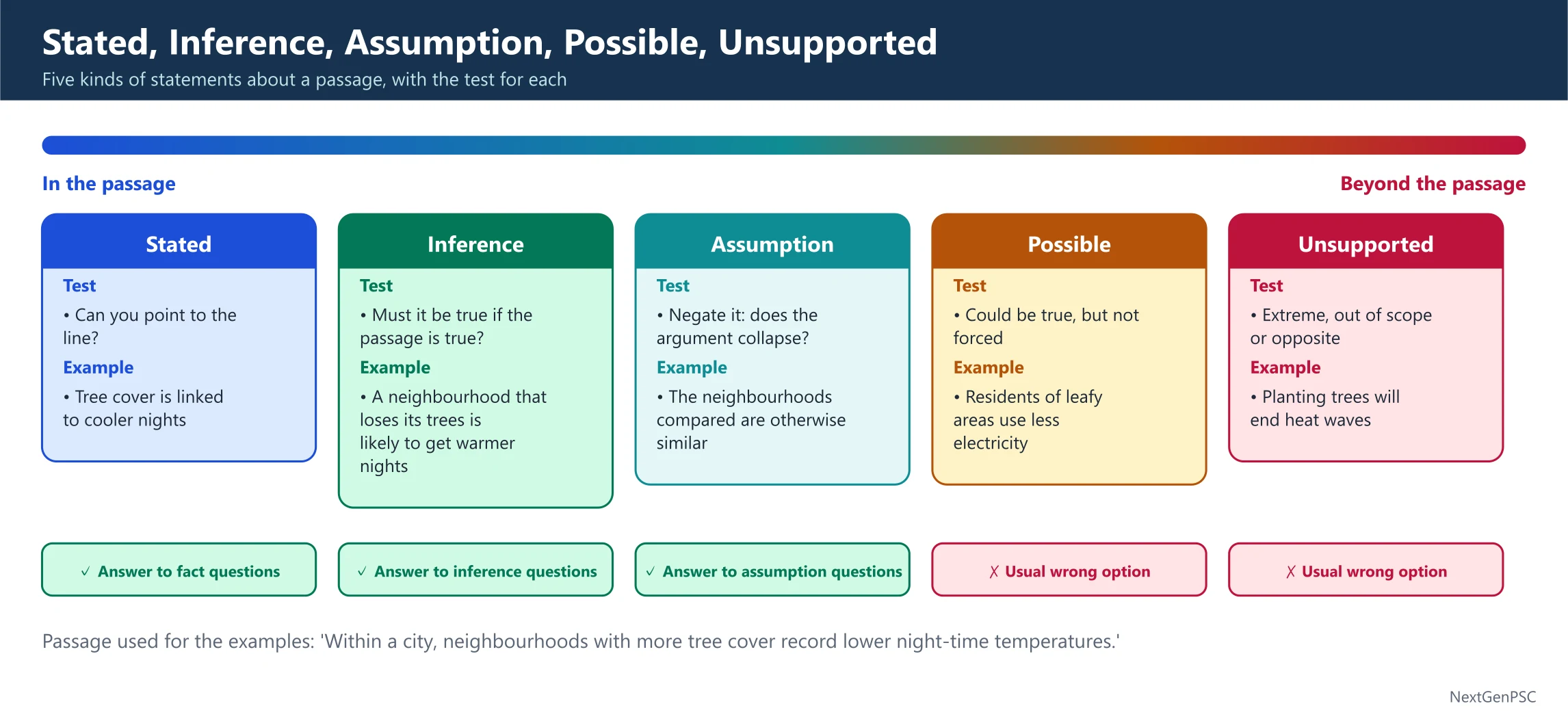
1. Five Kinds of Statements About a Passage
Every option in an inference or assumption question falls into one of five boxes. Stated: said in the passage, in other words. Inference: not said, but must be true if the passage is true. Assumption: not said, but the author's argument needs it to be true. Possible: could be true, but the passage does not force it. Unsupported: out of scope or contradicted.
Inference questions reward the second box, assumption questions the third. Most wrong options come from the fourth box (possible but not forced) and the fifth (out of scope or opposite). A stated fact is rarely the best answer to 'the most logical inference' because it adds nothing; choose it only when no option takes a safe further step.
2. The Must-be-true Test for Inferences
Assume every sentence of the passage is true. Then ask of each option: 'Could this be false while the passage stays true?' If yes, it is not a valid inference. If no, it is.
Valid inferences are usually small: a general rule from the passage applied to a case, a comparison the passage implies, a consequence of a cause the passage describes. Example: the passage says 'tree cover lowers night temperatures in a neighbourhood'; a valid inference is 'a neighbourhood that loses its trees is likely to have warmer nights'. An invalid one is 'planting trees will end heat waves'.
Why: CSAT tests disciplined reading, not imagination. Any option that needs a fact the passage does not give, or that turns 'tends to' into 'always', has left the passage.
3. Assumptions: the Hidden Link
An argument has evidence and a conclusion. An assumption is the unstated idea that connects them. 'Free bus travel for women will raise their participation in jobs' assumes that the cost of travel is one of the barriers to women taking jobs.
Negation test: write the opposite of the option and add it to the passage. If the author's conclusion now looks pointless or false, the option is a necessary assumption. If the conclusion survives, it is not. 'Travel cost is not a barrier at all' makes the free-bus policy pointless, so the assumption is needed.
Necessary, not sufficient: an assumption need not be the only reason the author is right. 'Bus fares are the only reason women do not work' is too strong; its negation ('fares are one of several reasons') does not hurt the argument at all. Strong assumptions with only, all or entirely usually fail the negation test.
4. UPSC Question Forms
'Which of the following is the most logical and rational inference that can be made from the passage?' — find the safest one-step conclusion that rests on the passage's main argument.
'On the basis of the above passage, the following assumptions have been made: 1. … 2. … Which of the above assumptions is/are valid?' — apply the negation test to each statement separately, then read the option.
'Which of the following is implied by the passage?' or 'What is the corollary…?' — the same as an inference: what must follow if the author is right.
5. How Wrong Options Are Built
Extreme: the passage says 'can', 'often', 'some'; the option says 'will', 'always', 'all'. Too far: the option needs two or three extra steps ('…so the government must abolish the scheme'). Out of scope: the option brings in a new actor or reason. Opposite: the option reverses the passage's direction. Restatement: a stated fact offered in place of an inference; true, but not the best inference.
When two options both pass the must-be-true test, prefer the one that rests on the passage's main argument rather than on a side remark, and the one with the more modest wording.
6. A Repeatable Drill (SAPE)
Stem: inference, implication or assumption? Anchor: find the conclusion and its main support. Predict: for an inference, say one small thing that must follow; for an assumption, ask 'what must the author believe for this conclusion to follow from this evidence?'. Eliminate: tag each wrong option (extreme, too far, out of scope, opposite, restatement, not needed).
Example 1: A one-step inference
- Question
Passage. On summer nights, the centres of large cities stay several degrees warmer than the countryside around them. Concrete and asphalt absorb heat through the day and release it after dark, while vehicles and air conditioners add more. Trees work in the opposite direction: they shade surfaces during the day and cool the air as water evaporates from their leaves. Studies of neighbourhoods within the same city have found that those with more tree cover record lower night-time temperatures than those with little.
Which one of the following can be inferred from the passage? (a) Planting trees in cities will end heat waves (b) Within a city, a neighbourhood that loses most of its trees is likely to have warmer nights than before (c) Concrete buildings should be banned in city centres (d) The countryside is warmer than city centres at night
- Solution
Normal method. Stem: inference. Anchor: 'neighbourhoods… with more tree cover record lower night-time temperatures'. Predict: fewer trees → warmer nights, other things being similar.
(a) ✗ Extreme. Trees lower temperatures in a neighbourhood; ending heat waves is a far stronger claim.
(b) ✓ Must be true. It applies the passage's comparison to one neighbourhood over time and keeps the cautious 'likely'.
(c) ✗ Too far. The passage explains a cause; it recommends no ban.
(d) ✗ Opposite. City centres are warmer at night.
Shortcut. The valid inference usually reuses the passage's own relation (more trees → cooler) and keeps its own hedge (likely, tends to).
Trap. Option (a) sounds like the 'message' of the passage, but it promises a result the evidence cannot carry.
- Answer
(b) Within a city, a neighbourhood that loses most of its trees is likely to have warmer nights than before
Example 2: Finding the assumption with the negation test
- Question
Passage. A state government has made travel on its city buses free for women. Officials say the scheme will help more women take up jobs, especially low-paid work in shops, factories and homes far from where they live. Early surveys show that the number of women passengers has risen, and some women report that the money saved on fares makes a long commute worth it. The government now plans to add more buses on routes that serve industrial areas.
The officials' expectation that free travel will help more women take up jobs assumes that (a) women prefer buses to every other form of transport (b) men will stop using buses once travel is free for women (c) the cost of travel is one of the things that keeps some women from taking jobs (d) bus fares are the only reason women do not work
- Solution
Normal method. Stem: assumption. Anchor: evidence = fares removed; conclusion = more women will take jobs. Predict: the link is that fares were a barrier for at least some women.
(a) ✗ Not needed. Negate it: some women prefer autos for some trips. The scheme can still help those who use buses.
(b) ✗ Out of scope. Men's travel is not part of the argument.
(c) ✓ Needed. Negate it: travel cost keeps no woman from a job. Then removing fares cannot help anyone take a job, and the expectation collapses.
(d) ✗ Extreme. Negate it: fares are one of several reasons. The argument survives, so 'only' is not assumed.
Shortcut. The assumption is the sentence that joins the evidence word (fares) to the conclusion word (jobs) in the weakest form that still works: 'one of the things', 'some women'.
Trap. Option (d) also joins fares to work, but its 'only' makes it far stronger than the argument needs.
- Answer
(c) the cost of travel is one of the things that keeps some women from taking jobs
Example 3: The most logical and rational inference (UPSC-style)
- Question
Passage. For years the subsidy on urea has kept its price far below that of phosphate and potash fertilisers. Farmers have responded sensibly to these prices: they apply more of the cheap nitrogen fertiliser and less of the others. Agronomists warn that this imbalance has damaged soil health in many districts, and that each extra bag of urea now adds less to the harvest than it once did. A subsidy meant to raise yields has, through the prices it set, ended up holding them back.
Which one of the following is the most logical and rational inference that can be made from the passage? (a) All fertiliser subsidies should be abolished at once (b) Farmers in India do not understand the needs of their soil (c) The way a subsidy alters relative prices can shape farming practices in ways that defeat the subsidy's own purpose (d) Urea is harmful to every crop
- Solution
Normal method. Stem: most logical inference. Anchor: 'Farmers have responded sensibly to these prices' and the last sentence. Predict: the subsidy changed relative prices, prices changed behaviour, behaviour hurt yields, which the subsidy was meant to raise.
(a) ✗ Too far. The passage criticises the price imbalance, not every subsidy, and says nothing of abolishing them at once.
(b) ✗ Opposite. The passage says farmers responded 'sensibly' to prices; the fault lies in the prices.
(c) ✓ Rests on the main argument. It generalises exactly the chain the passage describes, with the cautious 'can'.
(d) ✗ Extreme. The problem is overuse relative to other nutrients, not urea itself, and 'every crop' is never discussed.
Shortcut. In 'most logical and rational' questions, the right option is usually a one-line generalisation of the passage's last sentence, worded with 'can' or 'may'.
Trap. Option (a) feels like the natural policy conclusion, but CSAT inferences stop at what the passage proves, not at what a minister might do next.
- Answer
(c) The way a subsidy alters relative prices can shape farming practices in ways that defeat the subsidy's own purpose
Example 4: Which assumptions are valid? (UPSC-style)
- Question
Passage. Children who begin school in the language they speak at home grasp new concepts faster and take part more in class than those taught from the first day in a language they barely understand. A child who cannot follow the teacher in the early years often falls behind for good, because later lessons build on earlier ones. Early primary teaching should therefore be in the child's home language, with other languages added step by step as the child grows.
On the basis of the above passage, the following assumptions have been made: 1. What a child understands in the early years of school affects how well the child learns later. 2. Children cannot learn a second language after the age of 10. Which of the above assumptions is/are valid? (a) 1 only (b) 2 only (c) Both 1 and 2 (d) Neither 1 nor 2
- Solution
Normal method. Stem: assumptions, two statements. Anchor: 'falls behind for good, because later lessons build on earlier ones' and the recommendation 'other languages added step by step'. Predict: the author needs early understanding to matter later; the author does not need any age limit on learning languages.
Statement 1 ✓ Valid. Negate it: early understanding has no effect on later learning. Then the case for home-language teaching in the early years collapses. Needed.
Statement 2 ✗ Not needed. Negate it: children can learn a second language after 10. The recommendation still stands; indeed the passage adds other languages as the child grows. It is also extreme.
(a) ✓ 1 only. Only statement 1 passes the negation test.
(b) ✗ Wrong statement. Statement 2 fails the negation test.
(c) ✗ Includes statement 2. Statement 2 is not assumed.
(d) ✗ Rejects statement 1. Statement 1 is the hidden link of the argument.
Shortcut. An assumption with a hard number or an absolute ('cannot… after 10') is almost never needed by a moderate argument; test it first and strike it.
Trap. Statement 2 seems to 'support' teaching in the home language, so students accept it; but supporting is not the same as being required.
- Answer
(a) 1 only
Example 5: Two plausible options
- Question
Passage. Many crops, from mustard to many fruits and vegetables, need insects to carry pollen from flower to flower. Field studies in several countries have found that farms lying close to patches of natural habitat, such as woodland or uncultivated hedges, tend to get more visits from wild bees and to produce higher yields of these crops than farms surrounded only by other fields. Wild pollinators nest and feed in such patches and fly only limited distances to forage. As farms expand and these patches are cleared, the free service they provide is easily lost without anyone noticing until yields fall.
Which one of the following is most strongly supported by the passage? (a) Farmers near woodland work harder than farmers elsewhere (b) Clearing natural habitat near farms will reduce the yield of every crop grown there (c) Pesticides are the main cause of the decline in wild bees (d) Keeping patches of natural habitat near farms can benefit the yields of crops that depend on insect pollination
- Solution
Normal method. Stem: most strongly supported, an inference. Anchor: 'farms lying close to patches… produce higher yields of these crops' and 'pollinators… fly only limited distances'. Predict: habitat patches help pollinator-dependent crops.
(a) ✗ Out of scope. The passage explains the yield gap by pollinators, not by effort.
(b) ✗ Extreme. 'Every crop' ignores that the passage speaks only of crops that need insects; 'will' hardens 'tend to'.
(c) ✗ Out of scope. Pesticides are never mentioned.
(d) ✓ Must be true. It keeps both limits of the passage: 'can' and 'crops that depend on insect pollination'.
Shortcut. When two options say the same thing in different strengths, check both qualifiers (which crops? how certain?) against the passage and keep the one that matches both.
Trap. Options (d) and (b) both look right after one reading; (b) fails only on 'every' and 'will', which is exactly the kind of difference UPSC uses.
- Answer
(d) Keeping patches of natural habitat near farms can benefit the yields of crops that depend on insect pollination
Example 6: What the passage implies (UPSC-style)
- Question
Passage. Low-cost instant digital payments have let street vendors and small shops accept money from customers without card machines or bank visits, and the record of every payment has helped some of them obtain small loans. The same system, however, assumes a smartphone, a bank account and the confidence to use them. Elderly people, many daily-wage workers and those in areas with poor connectivity often lack one or more of these. Where shops begin to refuse cash, the convenience of the many becomes a barrier for the few.
Which one of the following is implied by the passage? (a) Digital payments should replace cash completely (b) Smartphones and bank accounts are now available to everyone (c) Street vendors are reluctant to accept digital payments (d) The benefits of low-cost digital payments are best secured when other means of payment remain available for those who cannot use them
- Solution
Normal method. Stem: implication. Anchor: 'however' and the last sentence: 'Where shops begin to refuse cash, the convenience of the many becomes a barrier for the few.' Predict: keep cash or other options so that the benefit does not exclude anyone.
(a) ✗ Opposite. The passage warns against shops refusing cash.
(b) ✗ Opposite. The passage names groups who lack them.
(c) ✗ Opposite. Vendors are said to have accepted digital payments and benefited.
(d) ✓ Follows from the turn. If refusing cash creates a barrier for some, the benefits are secured without harm only when alternatives remain.
Shortcut. In a 'gains, however limits' passage, the implication combines both halves: keep the gain, fix the limit.
Trap. Three options are opposites here; under time pressure, students pick (a) because the passage praises digital payments in its first half.
- Answer
(d) The benefits of low-cost digital payments are best secured when other means of payment remain available for those who cannot use them
Practice Questions
Passage A (for Q1–Q3). Every autumn, farmers in parts of north-west India burn the straw left after the rice harvest, because the window before sowing wheat is short and removing straw by machine costs money and time. The smoke adds to the winter haze over the region's cities. Machines that sow wheat directly into the stubble exist and are subsidised, but many small farmers cannot get one at the right time, since every farm needs it in the same two or three weeks. Where village cooperatives own such machines and schedule their use, burning has fallen.
Q1. Which one of the following can be inferred from the passage? (a) Stubble burning is the only cause of winter haze in north-west India (b) Farmers burn straw because they do not know about its harm (c) The timing of demand for machines limits their usefulness to small farmers (d) Subsidies on machines have ended stubble burning
Q2. On the basis of the passage, the following assumptions have been made: 1. If straw could be handled cheaply within the short window, fewer farmers would burn it. 2. Cooperatives can never be formed in villages with large farms. Which of the above assumptions is/are valid? (a) 1 only (b) 2 only (c) Both 1 and 2 (d) Neither 1 nor 2
Q3. The passage most strongly implies that (a) wheat should no longer be grown after rice (b) the rice harvest has become longer (c) city residents are responsible for stubble burning (d) arranging shared access to machines can matter as much as subsidising them
Passage B (for Q4–Q5). When a school's success is measured only by examination results, teachers sensibly spend more time on what examinations test. If the tests reward memory, classrooms drift towards memorising. Changing the curriculum alone does little while the examination stays the same. Reforms that change what is examined, and how, tend to change teaching faster than reforms that only change textbooks.
Q4. The author's argument assumes that (a) memorising has no place in learning (b) all teachers dislike examinations (c) textbooks are of no use (d) teachers respond to the way their work is measured
Q5. Which one of the following is the most logical inference from the passage? (a) Examinations should be abolished (b) To change how students are taught, change how they are assessed (c) Teachers prefer memorising to understanding (d) Curriculum reform always fails
Answers
Show answers
Q1. (c) The timing of demand for machines limits their usefulness to small farmers — 'every farm needs it in the same two or three weeks'. (a) and (d) are extreme; (b) is out of scope: the passage gives cost and time as the reasons.
Q2. (a) 1 only — Statement 1 ✓ negate it and the case for machines and cooperatives collapses; Statement 2 ✗ not needed and extreme ('never').
Q3. (d) arranging shared access to machines can matter as much as subsidising them — subsidised machines exist, yet burning fell where cooperatives scheduled their use.
Q4. (d) teachers respond to the way their work is measured — negate it and the link between examinations and teaching breaks. (b), (c) and (a) are extreme.
Q5. (b) To change how students are taught, change how they are assessed — the last sentence generalised. (a) and (d) are extreme; (c) is distorted: teachers act 'sensibly' to measurement.
| Kind | Test | Example (passage: more trees, cooler nights) |
|---|---|---|
| Stated | Can you point to the line? | Tree cover is linked to lower night temperatures |
| Inference | Must it be true if the passage is true? | A neighbourhood that loses its trees is likely to get warmer nights |
| Assumption | Negate it: does the argument collapse? | The neighbourhoods compared are otherwise similar |
| Possible | Could be true, but not forced | Residents of leafy areas use less electricity |
| Unsupported | Out of scope, extreme or opposite | Planting trees will end heat waves |
Prelims tips
- Inference = must be true, one step. Ask whether the option could be false while the passage stays true. If it could, strike it, however sensible it sounds.
- Assumption = negate and see if the argument falls. Write the opposite of the option next to the conclusion. If the conclusion survives, the option was not assumed. This settles most 'which assumptions are valid' questions in under a minute.
- Strong words fail both tests. Only, all, always, never, must, completely: an inference with these goes beyond the passage, and an assumption with these is stronger than the argument needs. Keep them only when the passage itself is that absolute.
- Stop where the passage stops. Options that turn an explanation into a policy ('should be banned', 'must be abolished') are 'too far' unless the passage itself recommends it.
- Between two good options, pick the one on the main argument. A safe inference from a side remark loses to a safe inference from the conclusion; the more modestly worded option usually wins a tie.
- Do not supply missing facts. If an option needs information the passage does not give (a new cause, a new group, a number), it is out of scope even if it is true in real life.
Critical Reasoning in Passages
In short
Critical reasoning questions treat a passage as an argument (evidence leading to a conclusion) and ask you to judge it: find the conclusion, spot the hidden assumption, say which new fact would strengthen or weaken it, name its flaw, or explain an apparent paradox. In CSAT they appear both inside comprehension sets and as short stand-alone arguments, and they overlap with the statement–assumption and statement–argument questions of Logical Reasoning. Three ideas unlock them: find the gap between evidence and conclusion, attack or support that gap (not the evidence), and remember that in 'if true' questions you must accept each option as true.
In simple words
An argument is someone saying 'this is true, because of that'. 'You should take the train, because the road is jammed' is an argument: the conclusion is 'take the train', the reason is 'the road is jammed'.
Every argument has a gap: something the speaker did not say but is relying on. Here the gap is 'the train is not jammed too'. If you learn that the train is delayed by two hours, the argument becomes weak, even though the road is still jammed.
Everyday example: a coaching centre says, 'Our students scored an average of 150 marks, so our classes raise scores.' Gap: maybe they only admitted students who were already strong. A fact like 'the centre takes only students who score above 120 in an entry test' weakens the claim without denying the 150.
The one question to always ask is: 'What must be true for this reason to prove this conclusion?' That is the gap. To weaken, attack the gap; to strengthen, close it.
Two habits solve most of these questions: (1) write the argument in one line, 'Conclusion because Evidence'; (2) in 'if true' questions, believe every option and ask only whether it changes how strongly the evidence supports the conclusion.
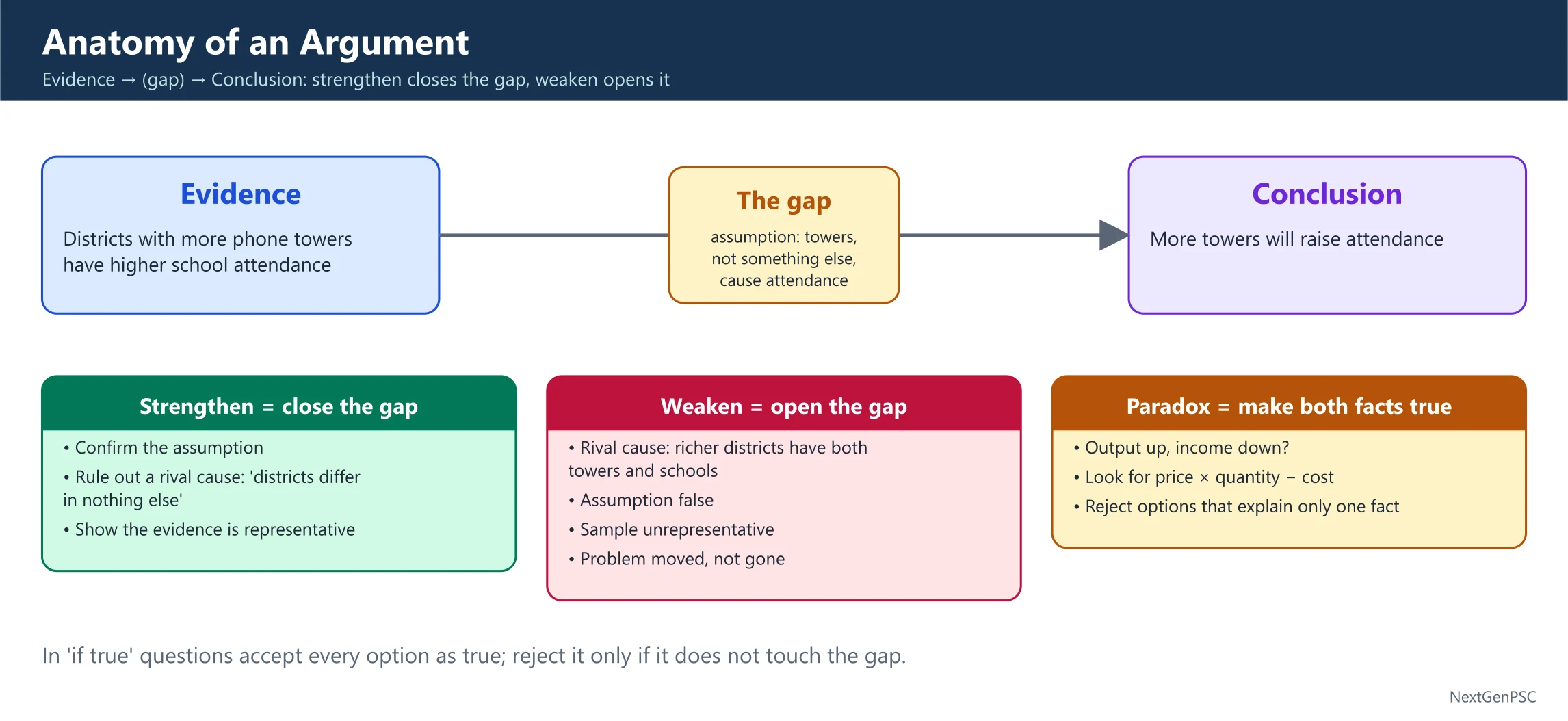
1. The Anatomy of an Argument
Evidence (premises): facts, data or observations offered as reasons. Conclusion: the claim the evidence is meant to prove. Assumption (gap): the unstated link the conclusion needs. Background sentences that do none of these are context.
Write every argument as one line: 'Conclusion BECAUSE Evidence (assuming Gap)'. Example: 'Expanding mobile coverage will raise school attendance BECAUSE districts with more towers have higher attendance (assuming the towers, not something else about those districts, cause the attendance).'
2. Finding the Conclusion
Look for conclusion signals: therefore, so, thus, hence, it follows that, should, must. If there is no signal, use the 'why should I believe that?' test: the conclusion is the sentence that the other sentences answer. It is often the first or the last sentence, and often a recommendation ('the city should…').
Trap: a striking fact or statistic in the passage is usually evidence, not the conclusion; and a critic's view that the author answers ('critics point to the cost, but…') is a counter-point, not the conclusion.
3. Strengthen Questions
'Which of the following, if true, most strengthens the argument?' The right option closes the gap: it confirms the assumption, rules out a rival explanation, or shows the evidence is representative.
Options that merely repeat the evidence, praise the conclusion's goal or add an unrelated benefit do not strengthen the reasoning. A fee that 'raises revenue' does not strengthen a claim that the fee 'reduces congestion'.
4. Weaken Questions
'Which of the following, if true, most seriously weakens the argument?' The right option opens the gap. The four common ways: (1) a rival cause explains the evidence; (2) the assumption is false; (3) the sample is unrepresentative; (4) the problem has moved, not gone (the measured thing improved, the real thing did not).
A weakener need not prove the conclusion false; it only needs to make the evidence a weaker reason for it. Do not look for an option that 'disproves' the conclusion.
5. Common Flaws
Correlation taken as causation: two things go together, so one is said to cause the other. Unrepresentative sample: an online survey used to describe everyone, including those offline. Scope shift: evidence about complaints, conclusion about corruption; evidence about one city, conclusion about the country.
False choice: 'either we ban plastic or the rivers will die', ignoring other options. Hasty generalisation: one case taken as a rule. Circular reasoning: the conclusion is hidden in the premise. Naming the flaw is often enough to pick the weakener.
6. Paradox and Resolve Questions
Two facts seem to clash: 'output rose, but farmers' incomes fell'. The right option makes both facts true at once (prices fell more than output rose). Options that deny one of the facts, or explain only one, are wrong.
7. The Rule That Differs from Inference
In inference questions an option must stay inside the passage. In strengthen, weaken and resolve questions the options usually bring in new facts, and you must accept them as true. Do not reject an option because 'the passage does not say this'; reject it only if it does not touch the gap.
SAPE for critical reasoning: Stem: strengthen, weaken, flaw, conclusion or paradox? Anchor: write 'Conclusion because Evidence'. Predict: name the gap and say what kind of fact would open or close it. Eliminate: irrelevant, wrong direction, too weak, restates the evidence.
Example 1: Finding the main conclusion
- Question
Passage. The city should extend its metro line to the airport. Taxi fares to the airport are among the highest of any Indian city, and the expressway is jammed at peak hours, so travellers cannot predict how long the journey will take. A metro link would offer a cheap and predictable journey, and airports in other large cities that added rail links saw road traffic to their terminals fall. Critics point to the cost of construction, but the cost of daily jams, paid in lost hours and missed flights, is larger.
Which one of the following best states the main conclusion of the argument? (a) Taxi fares to the airport are among the highest of any Indian city (b) Airports in other large cities that added rail links saw road traffic fall (c) The city should extend its metro line to the airport (d) A metro journey costs less than a taxi journey everywhere
- Solution
Normal method. Stem: main conclusion. Anchor: the first sentence carries 'should'; the rest answers 'why should I believe that?'. Predict: extend the metro to the airport.
(a) ✗ Evidence. It is a reason offered for the metro, not the claim being argued for.
(b) ✗ Evidence. Another city's experience is support from comparison.
(c) ✓ The claim the rest supports. Fares, jams, other cities' experience and the reply to critics all answer 'why extend the metro?'.
(d) ✗ Extreme. 'Everywhere' goes beyond the passage, and cost is only one of the reasons given.
Shortcut. Put 'because' after each sentence in turn; the sentence that the others can follow with 'because' is the conclusion.
Trap. The conclusion sits at the start, not after 'therefore'; students who wait for a 'so' choose (b), the last piece of evidence.
- Answer
(c) The city should extend its metro line to the airport
Example 2: Weaken with a rival cause
- Question
Passage. A survey of districts found that those with more mobile phone towers per lakh people also had higher school attendance. A minister concluded that expanding mobile coverage would raise attendance, because families with phones can stay in touch with teachers and children can use learning apps. The ministry now proposes to fund new towers in districts where attendance is lowest. Officials point out that towers are cheaper to build than schools and that the plan could be completed within two years.
Which one of the following, if true, most weakens the minister's conclusion? (a) Districts with more towers are also, on average, richer and have more roads and schools than other districts (b) Mobile coverage in India has expanded rapidly in recent years (c) Some students in well-connected districts use learning apps every day (d) School attendance across the country rose last year
- Solution
Normal method. Stem: weaken. Anchor: 'More towers will raise attendance BECAUSE towers and attendance go together (assuming towers cause attendance)'. Predict: a rival cause that produces both towers and attendance.
(a) ✓ Rival cause. Wealth, roads and schools could explain both more towers and better attendance, so the link may not be causal.
(b) ✗ Irrelevant. How fast coverage grew says nothing about whether it causes attendance.
(c) ✗ Strengthens instead. It supports the mechanism the minister describes.
(d) ✗ Irrelevant. A national rise does not explain the difference between districts.
Shortcut. 'X and Y go together, so X causes Y' is weakened by 'Z causes both' and strengthened by 'nothing else differs'.
Trap. Option (b) mentions coverage and option (d) attendance, the two key words; only (a) touches the link between them.
- Answer
(a) Districts with more towers are also, on average, richer and have more roads and schools than other districts
Example 3: Strengthen by closing the gap (UPSC-style)
- Question
Passage. A city plans to charge cars a fee to enter its central business district during peak hours. The municipal commissioner argues that the fee will reduce congestion, since drivers who would rather not pay will switch to buses or the metro, or travel at other times. He adds that the fee would apply only on weekdays between 8 and 11 in the morning and between 5 and 8 in the evening, and that residents of the district would be exempt. Similar charges have been tried in a few cities abroad with mixed results.
Which one of the following, if true, most strengthens the commissioner's argument? (a) The fee will raise a large amount of revenue for the city (b) Most peak-hour car trips into the district are for purposes for which buses or the metro offer a workable alternative (c) Many car owners have said publicly that they dislike the proposed fee (d) Most drivers who enter the district at peak hours say they would pay almost any fee rather than change their travel
- Solution
Normal method. Stem: strengthen. Anchor: 'The fee will reduce congestion BECAUSE drivers will switch (assuming they have a workable alternative and will use it)'. Predict: a fact showing that drivers can and will switch.
(a) ✗ Irrelevant. Revenue is a different benefit; it does not show that congestion will fall.
(b) ✓ Closes the gap. If workable alternatives exist for most trips, the expected switch is realistic.
(c) ✗ Irrelevant. Disliking a fee does not show whether drivers will change their trips.
(d) ✗ Weakens instead. If drivers will pay almost any fee, they will not switch.
Shortcut. For a plan ('X will achieve Y'), the strengthener shows that the plan's mechanism will actually work for most of the people it targets.
Trap. Option (a) sounds like a good reason for the fee, but the question asks about the argument that it reduces congestion, not about whether the fee is a good idea.
- Answer
(b) Most peak-hour car trips into the district are for purposes for which buses or the metro offer a workable alternative
Example 4: Naming the flaw
- Question
Passage. A bank ran an online survey of its customers and found that 92% of those who responded used internet banking at least once a month. The survey drew more than 40,000 responses, a far larger sample than most market studies use, and customers under 40 were especially enthusiastic. The bank's planning team concluded that nearly all its customers are comfortable with digital banking, and that closing half of its rural branches will cause little hardship.
Which one of the following identifies the most serious flaw in the planning team's reasoning? (a) It confuses a cause with its effect (b) It assumes that the bank wants to save money by closing branches (c) It draws a conclusion about all customers from a survey that could reach only customers already online (d) It relies on the opinion of an outside expert
- Solution
Normal method. Stem: flaw. Anchor: 'online survey… 92% of those who responded… nearly all its customers… rural branches'. Predict: an online survey cannot speak for customers who are not online, who may be exactly the rural branch users.
(a) ✗ Wrong flaw. No cause-and-effect claim is reversed here.
(b) ✗ Irrelevant. The motive for closing branches is not part of the reasoning being judged.
(c) ✓ Unrepresentative sample. The survey reached only online respondents, yet the conclusion covers every customer.
(d) ✗ Not in the argument. No expert is quoted.
Shortcut. When evidence comes from a survey, first ask 'who could answer it?'; if that group differs from the group the conclusion covers, the flaw is the sample.
Trap. The big numbers, 92% and 40,000 responses, make the claim look strong; a large sample does not cure a biased one, and a high percentage of the wrong group proves nothing about the right one.
- Answer
(c) It draws a conclusion about all customers from a survey that could reach only customers already online
Example 5: Resolving a paradox (UPSC-style)
- Question
Passage. In a farming region, better seeds and an expanded canal network raised rice output in each of the last three years. Over the same period, the average income of rice farmers in the region fell, although fertiliser and diesel prices stayed roughly stable and no major pest attack was reported. Most farmers in the region have little storage and sell their rice in nearby markets soon after the harvest. Officials who had expected the higher output to raise farm incomes are puzzled.
Which one of the following, if true, best explains the situation described? (a) Better seeds and canals are the main reasons rice output rose (b) The large rise in supply pushed down the price of rice in local markets by more than output rose (c) Some farmers in the region also grow vegetables (d) Rice farmers in other regions earned more than those in this region
- Solution
Normal method. Stem: resolve a paradox. Anchor: fact 1: output up; fact 2: income down. Predict: something that lets both be true; costs were stable, so look for a fall in price.
(a) ✗ Explains one fact only. It explains the higher output, not the lower income.
(b) ✓ Both facts true. If price fell by a larger proportion than output rose, revenue and income fall even as output rises.
(c) ✗ Irrelevant. Growing vegetables as well does not explain why income from rice fell.
(d) ✗ Irrelevant. A comparison with other regions does not explain the change within this one.
Shortcut. Income = price × quantity − cost; when quantity rises and income falls, look for the option about price or cost.
Trap. Option (a) restates the passage's own explanation of output; resolve questions need the missing piece, not the given one.
- Answer
(b) The large rise in supply pushed down the price of rice in local markets by more than output rose
Example 6: When the problem has moved (UPSC-style)
- Question
Passage. After a state put its land records online, complaints of bribery at the land revenue office fell by half within a year. Officials credited the change to the fact that applicants no longer had to meet a clerk to obtain a copy of their records. The state government concluded that putting public services online removes corruption from them, and announced that all its services would move online by the end of the next year.
Which one of the following, if true, most seriously weakens the government's conclusion? (a) Several other states also plan to put land records online (b) Online land records can be viewed at any time of day (c) Officials now demand bribes for correcting errors in the online records, a step that is still handled offline (d) Complaints fell more in urban districts than in rural ones
- Solution
Normal method. Stem: weaken. Anchor: 'Going online removes corruption BECAUSE bribery complaints at the land office fell (assuming fewer complaints means less corruption, and that bribery did not simply shift)'. Predict: show the bribery moved elsewhere, or that complaints fell for another reason.
(a) ✗ Irrelevant. Other states' plans do not test this state's result.
(b) ✗ Irrelevant. Convenience is a benefit, but says nothing about corruption.
(c) ✓ Problem moved, not gone. If bribes are now taken at the correction stage, corruption has shifted rather than been removed.
(d) ✗ Too weak. A smaller fall in rural areas is still a fall; it does not challenge the claim much.
Shortcut. When the evidence measures a stand-in (complaints, cases filed, forms processed) and the conclusion is about the real thing (corruption), the strongest weakener shows the stand-in and the real thing moving apart.
Trap. Option (d) looks like a weakener because it qualifies the result; but a weakener must break the link, not just add detail to it.
- Answer
(c) Officials now demand bribes for correcting errors in the online records, a step that is still handled offline
Practice Questions
Passage A (for Q1–Q3). A city cut the speed limit on residential streets from 50 km/h to 30 km/h. In the following year, deaths in road accidents on those streets fell sharply. The city council concluded that lower speed limits save lives and proposed applying the 30 km/h limit to all streets with schools or markets. A councillor objected that the fall might be a coincidence.
Q1. Which one of the following is the conclusion of the council's argument? (a) Deaths on residential streets fell sharply in the following year (b) Lower speed limits save lives (c) A councillor objected to the proposal (d) The city has many streets with schools and markets
Q2. Which one of the following, if true, would most support the councillor's objection? (a) Residents of the streets supported the new limit (b) Pedestrians are more likely to survive being hit by a slow vehicle than by a fast one (c) In the same year a new law sharply reduced drunk driving across the whole state, and road deaths fell by a similar share on every kind of road (d) Traffic police issued more fines on residential streets
Q3. Which one of the following, if true, most strengthens the council's conclusion? (a) The council meets once a month (b) Road deaths rose in the same year on nearby streets where the limit was not changed (c) Some drivers complained about the lower limit (d) Speed limit signs cost very little to install
Passage B (for Q4–Q5). A state recruited thousands of new teachers over three years to end a shortage in government schools. Yet tests of children's reading in the state's rural schools showed no improvement. An official argued that since learning did not improve after so many teachers were hired, the number of teachers does not matter for learning.
Q4. Which one of the following, if true, best explains why rural reading results did not improve? (a) Urban schools have larger buildings (b) The new teachers were recruited through a written examination (c) Reading tests are held every year (d) Most of the new teachers were posted to urban schools that already had enough teachers, while rural schools remained short
Q5. The official's argument is flawed mainly because it (a) concludes that a factor does not matter without checking whether that factor actually reached the schools in question (b) relies on test results (c) assumes that reading is important (d) refers to a period of three years
Answers
Show answers
Q1. (b) Lower speed limits save lives — the claim drawn from the fall in deaths, which in turn supports the proposal.
Q2. (c) In the same year a new law sharply reduced drunk driving across the whole state, and road deaths fell by a similar share on every kind of road — a rival cause that explains the fall without the speed limit. (b) supports the council.
Q3. (b) Road deaths rose in the same year on nearby streets where the limit was not changed — a comparison group rules out a general decline. The others are irrelevant or weaken.
Q4. (d) Most of the new teachers were posted to urban schools that already had enough teachers, while rural schools remained short — both facts true: more teachers in the state, no more in rural schools.
Q5. (a) concludes that a factor does not matter without checking whether that factor actually reached the schools in question — a scope shift: hired by the state is not the same as present in rural classrooms.
| Question asks | What the right option does | Common wrong options |
|---|---|---|
| Main conclusion | States the claim the other sentences support | A piece of evidence; a critic's view |
| Strengthen | Closes the gap: confirms the assumption or rules out a rival cause | Repeats the evidence; adds an unrelated benefit |
| Weaken | Opens the gap: rival cause, false assumption, bad sample, problem moved | Irrelevant detail; strengthens instead; too weak |
| Flaw | Names the reasoning error (causation, sample, scope, false choice) | A flaw that is not in the argument |
| Resolve a paradox | Makes both facts true at the same time | Explains only one fact; denies a fact |
Prelims tips
- Write the argument in one line first. 'Conclusion because Evidence'. Ten seconds of this prevents the commonest error: choosing an option that is about the topic but not about the reasoning.
- In 'if true' questions, believe the options. New facts are allowed and expected. Reject an option only because it does not touch the gap between evidence and conclusion, never because the passage does not mention it.
- Correlation is the favourite target. Whenever evidence shows two things moving together, look first for the option that offers a third factor causing both (to weaken) or rules one out (to strengthen).
- Check the direction. In every set of options there is usually one that does the opposite of what is asked (strengthens in a weaken question). Mark the stem with ↑ or ↓ before reading the options.
- A paradox needs both facts. The answer keeps both facts true; options that explain only one side or quietly deny a fact are traps. For money paradoxes think price × quantity − cost.
- Watch for stand-ins. Complaints for corruption, enrolment for learning, survey responders for all customers: when evidence measures a stand-in, the best weakener shows the stand-in and the real thing apart.
Vocabulary in Context
In short
Vocabulary in context questions ask what a word or phrase means as used in the passage, not what it means in a dictionary. CSAT usually tests common words with a second meaning (sanction, check, discount, qualify), figurative phrases (low-hanging fruit, tip of the iceberg) and, more often, whole sentences whose meaning depends on one key word. You rarely need a big vocabulary; you need three habits: read the sentence before and after, look for the context clue (definition, contrast, example, cause), and run the substitution test, putting each option in place of the word and keeping the one that leaves the sentence's logic intact.
In simple words
Many English words have more than one meaning. 'Check' can mean 'look at to verify' or 'stop'. 'Sanction' can mean 'permission' or 'punishment'. The passage, not the dictionary, decides which one is meant.
Think of how you understand a new word in a film. A character says, 'He was so frugal that he reused the same tea bag twice.' Even if you never saw 'frugal' before, the example tells you it means careful with money.
Everyday example: a shop board says 'Prices slashed: shirts now ₹300'. Slashed here does not mean cut with a sword; the next words show it means reduced sharply.
The one question to always ask is: 'If I put this option in place of the word, does the sentence still make the same sense?' That is the substitution test.
Two habits solve most of these questions: (1) never answer from the first dictionary meaning you know; the first meaning is the most common trap; (2) for a phrase like 'tip of the iceberg', ask what it means in plain words in this passage, not what it pictures.
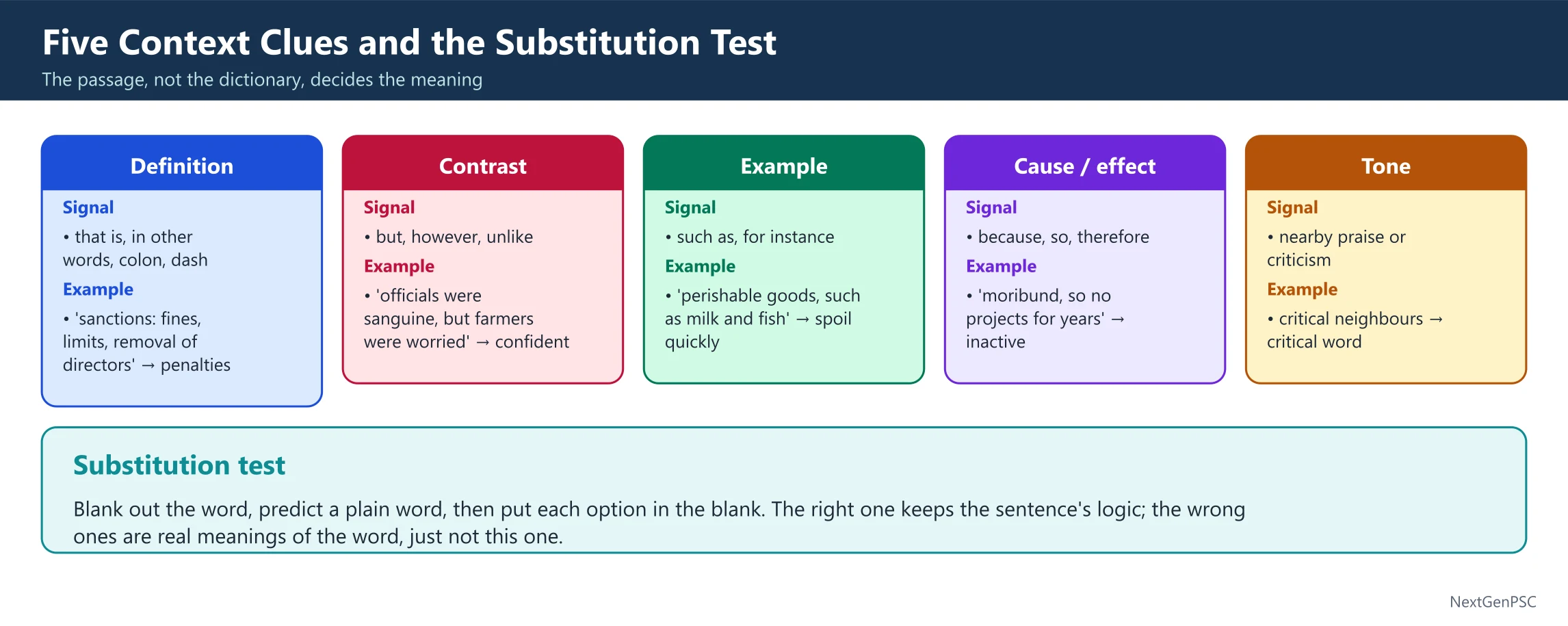
1. What These Questions Test
The stem usually reads: 'The word X, as used in the passage, most nearly means…', 'What does the author mean by the phrase…?' or 'Which one of the following best conveys the meaning of the sentence…?'. The key words are 'as used in the passage': the examiner deliberately picks words whose ordinary meaning is not the one intended.
Even when no question asks about a word directly, one misread word (temper, qualify, arrest) can flip the meaning of a sentence and with it the answer to a crux or inference question. So this skill protects the whole comprehension section.
For Hindi-medium candidates: the question tests the English word, and both language versions are printed in the same booklet, so it is worth looking at the English word itself as well as its Hindi rendering.
2. Five Context Clues
Definition or restatement: the passage explains the word with 'that is', 'in other words', 'or', a dash or a colon. 'The regulator can impose sanctions: fines, limits on new business, removal of directors.' The list after the colon defines sanctions as penalties.
Contrast: but, however, unlike, rather than, while. 'Officials were sanguine, but farmers were far more worried.' Sanguine must be the opposite of worried: confident.
Example: such as, for instance, like. 'Perishable goods, such as milk, fish and fresh vegetables…' Perishable must mean 'that spoil quickly'.
Cause and effect: because, so, therefore. 'The policy was moribund, so no new projects were approved for years.' Moribund means close to dying or inactive.
Tone of the surrounding words: if every nearby word is critical, the unknown word is probably critical too; if the sentence praises, the word probably praises.
3. The Substitution Test
Read the sentence with the word blanked out and predict a plain word that fits. Then put each option in the blank. The right option keeps both the grammar and the logic of the sentence and of the sentences around it.
Why it works: wrong options are usually real meanings of the word, just not this one. They fit the dictionary but break the sentence: 'the courts check the executive' with 'verify' gives 'the courts verify the executive', which does not explain why the passage worries about 'unchecked power'.
4. Common Words with a Second Meaning
These appear again and again in editorials and CSAT passages. Learn the second meaning; the first is the trap. The table at the end lists the most useful ones.
Examples: sanction (approve / penalise), check (verify / restrain), arrest (detain / halt a process), temper (anger / moderate), qualify (become eligible / limit a statement), discount (price cut / disregard), bear out (carry / confirm), wanting (desiring / lacking), appreciate (value / rise in value), moot (debatable), betray (be disloyal / reveal unintentionally).
5. Phrases and Metaphors
For a figurative phrase, translate it into plain words that fit the passage's subject. 'The low-hanging fruit has been picked' in a passage on reform means 'the easy reforms are done'; it is not about farming. 'Tip of the iceberg' means 'a small visible part of a much larger problem'. 'Double-edged sword' means 'something that helps and harms'.
The literal reading is the standard trap: an option about fruit, ice or swords is almost never right in an economics or governance passage.
6. Connotation: Same Meaning, Different Feeling
Frugal and miserly both mean spending little, but frugal praises and miserly criticises. Firm and rigid, confident and arrogant, cautious and timid are similar pairs. When two options mean roughly the same thing, choose the one whose feeling matches the author's tone.
7. Traps to Avoid
First-meaning trap: choosing the meaning you know best. Look-alike trap: eminent / imminent, credible / credulous, complement / compliment, affect / effect, principal / principle. Literal trap: reading a metaphor literally. Opposite trap: missing a contrast signal and choosing the opposite meaning. SAPE still applies: Stem, Anchor (the word's sentence and its neighbours), Predict (a plain word), Eliminate (first meaning, literal, opposite, out of scope).
Example 1: A word with a second meaning
- Question
Passage. Banks are required to report suspicious transactions to the financial intelligence unit, and most large banks have built systems to do so. Smaller lenders often lag behind. The regulator can impose sanctions on any bank that fails to report: fines, limits on opening new branches and, in serious cases, the removal of directors. Officials say that a few well-publicised sanctions do more to improve reporting than many circulars. Bankers reply that the rules change too often for small lenders to keep up.
The word 'sanctions', as used in the passage, most nearly means (a) approvals (b) penalties (c) loans (d) reports
- Solution
Normal method. Stem: word meaning. Anchor: the colon after 'sanctions' lists 'fines, limits on opening new branches… removal of directors'. Predict: punishments.
(a) ✗ First-meaning trap. Sanction can mean approval, but the list that follows is of punishments.
(b) ✓ Fits the definition clue. 'Impose penalties on any bank that fails to report: fines…' reads correctly.
(c) ✗ Out of scope. Nothing in the sentence concerns lending.
(d) ✗ Distorted. Reports are what the banks must file; sanctions are what follow if they do not.
Shortcut. A colon or dash after the word is a definition clue; read the list and name what its items have in common.
Trap. 'Sanction' is most familiar as 'approval of a project', which is why option (a) is placed first.
- Answer
(b) penalties
Example 2: Restrain, not verify
- Question
Passage. In a democracy, power is never meant to rest in one place. Independent courts, a free press and an elected opposition check the power of the government of the day, so that its decisions must be explained and can be challenged. Where these checks weaken, power does not disappear; it simply becomes unaccountable, and mistakes that could have been corrected early grow into crises. That is why constitutions spread power across several bodies instead of trusting the goodwill of any one of them.
The word 'check', as used in the passage, most nearly means (a) verify the accuracy of (b) praise publicly (c) record in writing (d) restrain or limit
- Solution
Normal method. Stem: word meaning. Anchor: 'power is never meant to rest in one place… where these checks weaken… power becomes unaccountable'. Predict: hold back, limit.
(a) ✗ First-meaning trap. 'Verify the accuracy of the power of the government' does not make sense.
(b) ✗ Opposite. The passage describes challenge, not praise.
(c) ✗ Out of scope. Recording has nothing to do with keeping power in more than one place.
(d) ✓ Passes substitution. Courts, press and opposition restrain the government's power; when the restraint weakens, power becomes unaccountable.
Shortcut. The noun form 'checks' and the result 'unaccountable' confirm the meaning: checks are limits, and without limits power escapes control.
Trap. In daily speech 'check' nearly always means 'verify', so option (a) is the reflex answer.
- Answer
(d) restrain or limit
Example 3: A figurative phrase (UPSC-style)
- Question
Passage. In the first decade after a major reform programme, growth came relatively easily: removing licences, cutting tariffs and opening sectors to private investment produced quick results at little political cost. Today the low-hanging fruit has been picked. What remains, such as reforming land and labour markets, improving courts and raising the quality of schooling, is slow, contested and requires cooperation between the centre and the states. None of these can be achieved by a single order from one ministry, and each will take years to show results.
What does the author mean by saying that 'the low-hanging fruit has been picked'? (a) Agriculture has had a series of good harvests (b) The reforms that were easy to carry out have already been done (c) The earlier reforms have failed (d) The poorest people have already received the benefits of growth
- Solution
Normal method. Stem: phrase meaning. Anchor: the sentence before ('growth came relatively easily… quick results at little political cost') and after ('what remains… is slow, contested'). Predict: the easy reforms are finished; the hard ones remain.
(a) ✗ Literal trap. The phrase is a metaphor; the passage is about reform, not crops.
(b) ✓ Plain meaning in context. It matches the contrast between easy past reforms and hard remaining ones.
(c) ✗ Opposite. The earlier reforms 'produced quick results'.
(d) ✗ Out of scope. Distribution of benefits is not discussed.
Shortcut. A metaphor sitting between two literal sentences means whatever links them; here 'easy then' and 'hard now'.
Trap. Option (a) is the picture the phrase paints; UPSC includes the literal reading in almost every metaphor question.
- Answer
(b) The reforms that were easy to carry out have already been done
Example 4: An unfamiliar word and a contrast clue
- Question
Passage. As June began, officials in the state capital were sanguine about the monsoon: the forecast promised normal rain, reservoirs were reasonably full, and seed supplies had been arranged. Farmers in the drier districts, however, who had lived through two weak monsoons in a row, were far more worried, and many delayed buying fertiliser until the first rains actually arrived. Their caution proved wise, because the rains came nearly three weeks late and stayed patchy across the drier districts for most of July.
The word 'sanguine', as used in the passage, most nearly means (a) worried (b) poorly informed (c) confident and hopeful (d) angry
- Solution
Normal method. Stem: word meaning. Anchor: the reasons after the colon (normal forecast, full reservoirs, seed arranged) and the contrast 'Farmers… however… were far more worried'. Predict: the opposite of worried: confident.
(a) ✗ Opposite. 'However… far more worried' sets the farmers against the officials, so the officials were not worried.
(b) ✗ Distorted. The officials had a forecast and data; nothing says they were poorly informed.
(c) ✓ Fits both clues. Good forecast and full reservoirs are reasons for confidence, and confidence is the opposite of worry.
(d) ✗ Out of scope. Nothing in the passage suggests anger.
Shortcut. When a word is followed by 'however' or 'but' and an opposite reaction, the word means the opposite of that reaction.
Trap. Some readers link 'sanguine' to blood and guess 'angry'; context beats guessing from the look of a word.
- Answer
(c) confident and hopeful
Example 5: Discount as disregard (UPSC-style)
- Question
Passage. Planners in many river towns discount the risk of a major flood because the last one happened decades ago and few current residents remember it. New houses are built on low ground, embankments are not maintained, and drainage channels are filled in. When the rare flood does come, the damage is far greater than it would have been if the risk had been taken seriously all along. Insurance companies, which study long records rather than recent memory, often charge such towns higher premiums.
The word 'discount', as used in the passage, most nearly means (a) reduce the price of (b) exaggerate (c) calculate exactly (d) treat as unimportant
- Solution
Normal method. Stem: word meaning. Anchor: 'because the last one happened decades ago' and 'if the risk had been taken seriously all along'. Predict: not take seriously.
(a) ✗ First-meaning trap. Risks have no price to reduce.
(b) ✗ Opposite. Exaggerating the risk would lead to more caution, not less.
(c) ✗ Opposite. Calculating the risk exactly would be taking it seriously.
(d) ✓ Passes substitution. 'Planners treat the risk as unimportant because the last flood was long ago' fits the reason and the final sentence.
Shortcut. The last sentence restates the idea in reverse ('if the risk had been taken seriously'), so 'discount' = 'not take seriously'.
Trap. In shops 'discount' means a price cut; the passage uses its other meaning, to disregard.
- Answer
(d) treat as unimportant
Example 6: The meaning of a whole sentence (UPSC-style)
- Question
Passage. Governments often look abroad for models: an anti-corruption agency from one country, a school inspection system from another. Some such transplants work well; many disappoint. An agency that is independent in its home country may, in a different legal and political setting, become one more office that answers to the powerful. Institutions cannot be imported off the shelf; they grow out of the habits, laws and expectations of the society that uses them.
What does the author mean by saying that 'institutions cannot be imported off the shelf'? (a) Foreign institutions are always worse than local ones (b) An institution that works in one country must be adapted to local conditions if it is to work in another (c) India should import more manufactured goods (d) Institutions are cheap and quick to build
- Solution
Normal method. Stem: meaning of a sentence. Anchor: 'in a different legal and political setting' and 'they grow out of the habits, laws and expectations of the society'. Predict: you cannot copy an institution unchanged; it must fit the new society.
(a) ✗ Extreme. The passage says some transplants 'work well'.
(b) ✓ Plain meaning in context. It joins 'off the shelf' (unchanged) to 'grow out of the society' (must fit local conditions).
(c) ✗ Literal trap. 'Imported' is figurative here; trade in goods is not the subject.
(d) ✗ Opposite. The passage says institutions 'grow' out of habits and laws, which is slow.
Shortcut. 'Off the shelf' means ready-made and unchanged; the sentence after the semicolon explains why ready-made fails.
Trap. Option (a) mistakes a warning about copying for a rejection of all foreign models.
- Answer
(b) An institution that works in one country must be adapted to local conditions if it is to work in another
Practice Questions
Passage A (for Q1–Q3). Early results from the new nutrition programme are encouraging: in the districts where it began, the share of underweight children has stopped rising. The officials who designed it are careful to qualify these findings, noting that a good monsoon also raised household incomes during the same period. If later surveys bear out the early trend, the programme may finally arrest a decline that has continued for a decade.
Q1. The word 'qualify', as used in the passage, most nearly means (a) become eligible (b) deny completely (c) celebrate (d) limit or add reservations to
Q2. The phrase 'bear out', as used in the passage, most nearly means (a) contradict (b) carry away (c) tolerate (d) confirm
Q3. The word 'arrest', as used in the passage, most nearly means (a) detain a person (b) speed up (c) halt (d) record
Passage B (for Q4–Q5). The cases of wage theft that reach labour courts are only the tip of the iceberg; most workers who are underpaid never complain, because they fear losing the job altogether. Reformers who want quick convictions should temper their expectations: until workers feel safe enough to come forward, the courts will see only a small share of the problem.
Q4. 'The tip of the iceberg' means that the cases reaching labour courts are (a) a small visible part of a much larger problem (b) the most serious cases of wage theft (c) cases that have been resolved quickly (d) cases from cold regions
Q5. The word 'temper', as used in the passage, most nearly means (a) moderate (b) lose patience with (c) raise (d) announce
Answers
Show answers
Q1. (d) limit or add reservations to — the officials note that a good monsoon also helped, which limits the claim. (a) is the first-meaning trap.
Q2. (d) confirm — 'if later surveys confirm the early trend' fits; (a) is the opposite.
Q3. (c) halt — the programme may halt a decline; (a) is the first-meaning trap, (b) the opposite.
Q4. (a) a small visible part of a much larger problem — most underpaid workers never complain, so the courts see little of the problem. (d) is the literal trap.
Q5. (a) moderate — reformers should lower their expectations of quick convictions; (c) is the opposite.
| Word | Familiar meaning (trap) | Meaning often intended in passages |
|---|---|---|
| sanction | approval | penalty |
| check | verify | restrain, limit |
| arrest | detain a person | halt a process |
| temper | anger | moderate, soften |
| qualify | become eligible | limit or add reservations to a statement |
| discount | price cut | disregard, treat as unimportant |
| bear out | carry out | confirm |
| wanting | wishing for | lacking, not good enough |
| appreciate | value, thank | rise in value; understand fully |
| moot | — | open to debate |
| Clue | Signal | How to use it |
|---|---|---|
| Definition / restatement | that is, in other words, colon, dash | The words after the signal are the meaning |
| Contrast | but, however, unlike, rather than | The word means the opposite of the other side |
| Example | such as, for instance, like | Name what the examples have in common |
| Cause / effect | because, so, therefore | The word must fit the cause or the result |
| Tone | nearby praise or criticism | The word usually shares the tone of its neighbours |
Prelims tips
- 'As used in the passage' means the second meaning. UPSC picks words whose everyday meaning is wrong in context. If an option gives the meaning you knew instantly, test it twice before choosing it.
- Read one sentence on each side. The clue (a colon list, a 'but', an example) is usually in the same sentence or the next one. Never answer from the word alone.
- Run the substitution test. Put each option in place of the word and read the sentence aloud in your head. The wrong options break either the grammar or the logic of the surrounding sentences.
- Metaphors are never literal in CSAT. In a passage on economics or governance, an option about fruit, ice, shelves or swords is the literal trap. Translate the phrase into the passage's own subject.
- A contrast word gives you an antonym. 'X, but Y were worried' tells you X means not worried. Contrast clues let you solve words you have never seen.
- Build a small list of double-meaning words. Sanction, check, arrest, temper, qualify, discount, bear out, wanting, appreciate: ten minutes with the table above saves marks every year.
Main Idea, Theme and Tone
In short
Main idea questions ask for the one point the whole passage makes; UPSC words them as the crux, the central idea, the most critical message, the essence or the best title. Tone questions ask for the author's attitude: analytical, cautionary, critical, optimistic, sceptical. Most CSAT comprehension sets carry at least one such question, and they are the ones where two options often look right. Three tools separate them: the too narrow / too broad test (the answer covers the whole passage and nothing beyond it), the turn and the conclusion as the home of the main idea, and tone clues in adjectives, modals and hedges, read on two scales: positive or negative, and how strongly.
In simple words
The main idea is what you would say if a friend asked, 'What was that passage about, in one line?' Not the subject alone ('water'), and not one detail ('Punjab's wells'), but the point the author makes about the subject ('India's water problem is a pricing problem').
Think of a film review. The topic is the film. The details are the songs, the acting, the length. The main idea is the reviewer's verdict: 'a good story spoilt by a slow second half'.
Tone is the feeling behind the words. A friend who says 'Great, the train is late again' is not praising the train. The word 'great' sounds positive, but the tone is annoyed.
The one question to always ask is: 'Does this option cover the whole passage, and only the passage?' If it covers only one paragraph, it is too narrow; if it talks about the whole world, it is too broad.
Two habits solve most of these questions: (1) find the sentence after the turn word (but, however, yet) and the last sentence; the main idea lives there; (2) for tone, pick the mildest option that is still true; CSAT authors are usually measured, rarely angry or gushing.
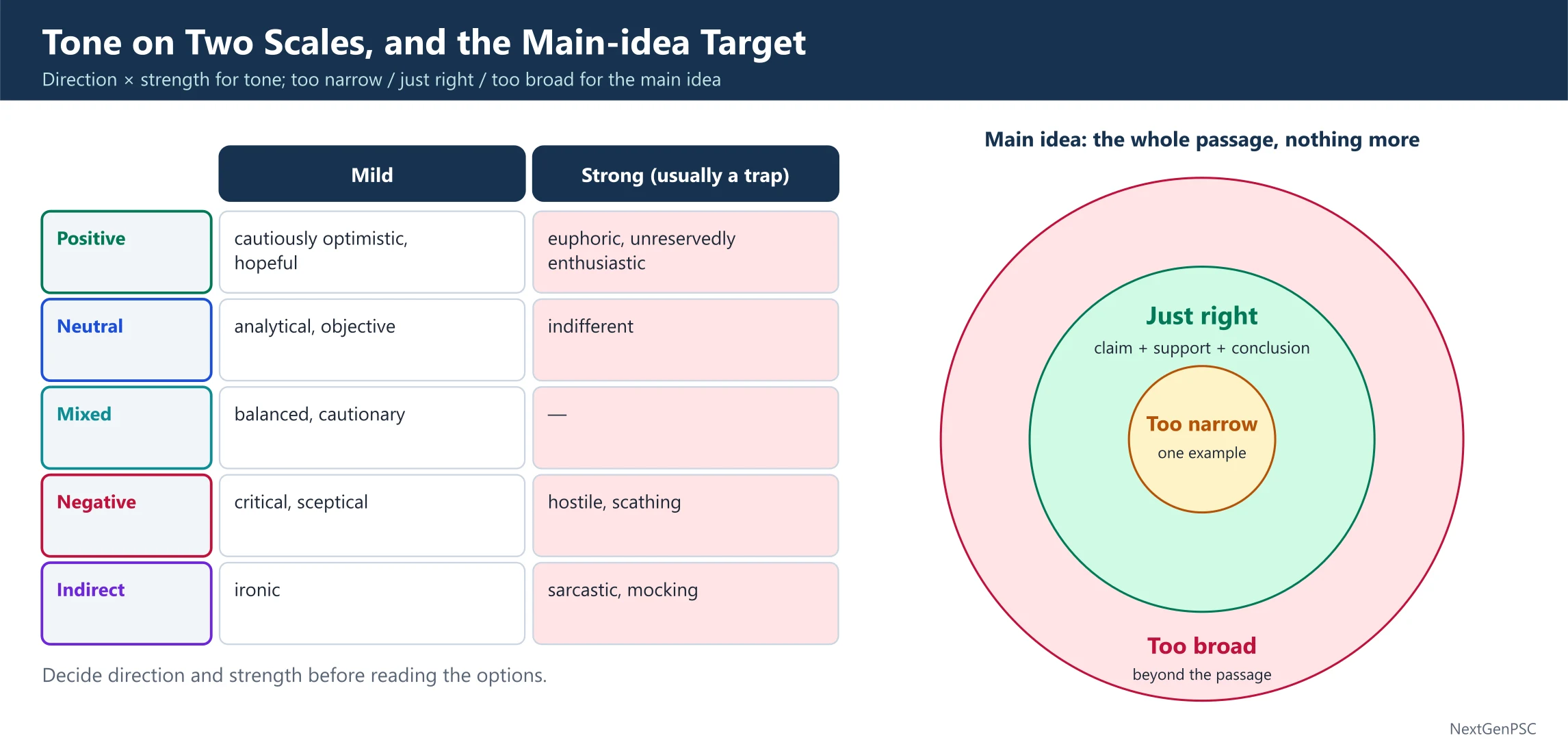
1. Topic, Main Idea and Detail
Topic: the subject in a few words (urban floods, millets, digital payments). Main idea: the author's point about the topic, a full sentence with a claim. Detail: facts, examples and figures that support the main idea.
Wrong options in main-idea questions are usually details (true but too narrow) or the bare topic stretched into a grand statement (too broad). The right option is a claim about the topic that every paragraph helps to support.
2. How UPSC Asks for the Main Idea
'Which one of the following best reflects the crux of the passage?' 'What is the central idea…?' 'What is the most critical message conveyed by the passage?' 'Which one of the following best describes the essence…?' 'The most appropriate title for the passage would be…' and 'The author's main purpose is to…'.
These stems want the same thing: the author's overall point. 'Message' and 'crux' often lean towards what the author wants done or understood; 'title' wants a short label that covers everything; 'purpose' wants a verb (explain, argue, warn, recommend, criticise).
3. The Too Narrow / Too Broad Test
Too narrow: true, but covers only one paragraph, one example or the concession. Too broad: goes beyond the passage ('Technology shapes society', 'Development must be sustainable everywhere'). Just right: covers the claim, the support and the conclusion, and stays within the passage's subject.
Also reject: extreme versions of the right idea ('must be stopped entirely'), opposite versions (what the author argues against), and outside-knowledge options that are true but not drawn from this passage.
Why: a main idea is a summary, and a summary that leaves out half the passage, or adds a new subject, is not a summary of this passage.
4. Where the Main Idea Lives
Most often: right after the turn word, in the last sentence, or in a 'therefore' sentence. In popular-view passages, it is the correction; in gains-then-limits passages, it is the limit with its consequence; in problem-solution passages, it is the remedy with its condition.
If no single sentence states it (an implicit theme), join the turn and the conclusion into one line yourself, then look for the option that says the same thing in other words.
5. Tone: Two Scales
Place the author on two scales. Direction: positive, neutral or negative about the subject. Strength: mild, moderate or strong. 'Cautiously optimistic' is positive and mild; 'scathing' is negative and strong; 'analytical' or 'objective' is neutral.
Clues: evaluative adjectives (welcome, worrying, impressive, misguided), adverbs (rightly, unfortunately, merely), modals (must and should for prescriptive; may and could for cautious), hedges (perhaps, to some extent), and irony markers (so-called, words in quotation marks, praise for something plainly failing).
Useful tone words: analytical, objective, explanatory, cautionary, prescriptive, critical, sceptical, cautiously optimistic, optimistic, pessimistic, ambivalent (mixed), ironic, sarcastic, nostalgic, indignant, laudatory (praising), apologetic.
6. What CSAT Tones Usually Are
CSAT passages are drawn from serious, reasoned writing on policy, economy, environment, society and ethics. Their authors are usually analytical, cautionary, critical in a measured way or cautiously optimistic. Strong options such as hostile, contemptuous, euphoric or unreservedly enthusiastic are usually traps, unless the passage itself uses strong words.
Mixed passages ('gains are real… yet') often have a balanced or cautious tone, not a negative one. Do not let one critical sentence decide the tone of a passage that also gives credit.
7. SAPE for Main Idea and Tone
Stem: crux, message, title, purpose or tone? Anchor: the turn and the last sentence for main idea; the evaluative words for tone. Predict: one line in your own words, or a direction and a strength for tone. Eliminate: too narrow, too broad, extreme, opposite, true but not the crux, and for tone, too strong or wrong direction.
Example 1: The best title
- Question
Passage. A phone that stops working after three years is often thrown away, not because it cannot be fixed but because fixing it is made difficult. Spare parts are hard to find, repair manuals are not shared, and batteries are glued in place. Some governments now require makers to supply parts and manuals for several years after a product is sold. Supporters argue that easier repair would cut electronic waste, save consumers money and create skilled local jobs, while makers worry about safety and lost sales.
Which one of the following is the most appropriate title for the passage? (a) The Rising Price of Mobile Phones (b) Making Repair Easier to Reduce Electronic Waste (c) Technology and Modern Society (d) Why Consumers Dislike New Phones
- Solution
Normal method. Stem: title. Anchor: first sentence (fixing is made difficult) and the last two (rules requiring parts; benefits including less waste). Predict: easier repair, and why it matters.
(a) ✗ Out of scope. Prices of new phones are not discussed.
(b) ✓ Covers the whole passage. The obstacles to repair, the rules that ease it and the main benefit all fit under this title.
(c) ✗ Too broad. It could head almost any passage about technology.
(d) ✗ Distorted. Consumers throw phones away because repair is hard, not because they dislike new ones.
Shortcut. A good title names the topic and the author's angle in a few words; check it against the first and last sentences.
Trap. Option (c) is never 'wrong', which makes it look safe; a title that fits every passage fits none.
- Answer
(b) Making Repair Easier to Reduce Electronic Waste
Example 2: The crux (UPSC-style)
- Question
Passage. Every summer, more visitors drive up to the hill towns of the Himalaya, and every summer the same scenes repeat: traffic jams on narrow roads, hotels built on unstable slopes, and garbage tipped into streams. Tourism brings income that mountain families badly need, and nobody sensible wants it to stop. But a mountain town can hold only so many vehicles, buildings and visitors before its water runs short and its slopes give way. Planning that starts from what the land can carry, rather than from how many tourists can be attracted, is the only way to keep both the income and the mountains.
Which one of the following best reflects the crux of the passage? (a) Tourism in the Himalaya should be banned to protect the environment (b) Hill towns suffer from traffic jams in summer (c) Economic development and environmental protection are always in conflict (d) Tourism in fragile mountain regions must be planned within the limits of what the land can carry
- Solution
Normal method. Stem: crux. Anchor: the turn 'But a mountain town can hold only so many…' and the last sentence. Predict: keep tourism, but plan it within the land's limits.
(a) ✗ Extreme. The passage says 'nobody sensible wants it to stop'.
(b) ✗ Too narrow. Traffic jams are one example in the first sentence.
(c) ✗ Opposite. The passage argues that careful planning can keep 'both the income and the mountains', so they need not conflict.
(d) ✓ Turn + conclusion. It joins the limit ('can hold only so many') with the remedy ('planning that starts from what the land can carry').
Shortcut. In passages that give credit and then a 'but', the crux is the 'but' plus the remedy; the credit is the concession.
Trap. Option (c) sounds like a deep 'theme', but it is too broad and the opposite of the author's balanced view.
- Answer
(d) Tourism in fragile mountain regions must be planned within the limits of what the land can carry
Example 3: Cautious optimism
- Question
Passage. The cost of solar panels and batteries has fallen faster than almost anyone predicted a decade ago, and in many places new solar power is now cheaper than power from new coal plants. This is welcome news for a country that must expand electricity supply and cut emissions at the same time. Yet cheap panels are only part of the story. Grids built for steady coal power must learn to handle supply that rises and falls with the sun, and storage is still costly at the scale needed. The transition is within reach, but it will not complete itself.
The tone of the passage is best described as (a) unreservedly enthusiastic (b) cautiously optimistic (c) deeply pessimistic (d) indifferent
- Solution
Normal method. Stem: tone. Anchor: 'welcome news', 'Yet… only part of the story', 'within reach, but it will not complete itself'. Predict: positive direction, moderate strength, with a warning.
(a) ✗ Too strong. 'Unreservedly' ignores the reservations about grids and storage.
(b) ✓ Direction and strength match. Hopeful ('welcome', 'within reach') and careful ('yet', 'will not complete itself').
(c) ✗ Wrong direction. The author calls the news welcome and the transition within reach.
(d) ✗ Wrong direction. An author who weighs gains against obstacles and gives advice is engaged, not indifferent.
Shortcut. Positive words followed by 'yet' and a 'but' that does not cancel the hope = cautiously optimistic.
Trap. Students who notice only the problems in the second half pick (c); tone must account for the whole passage.
- Answer
(b) cautiously optimistic
Example 4: The author's purpose
- Question
Passage. When prices rise by the same percentage across the economy, all households are not hit equally. A poorer family spends most of its income on food and fuel, whose prices often rise fastest, while a richer family spends a larger share on services and goods whose prices move more slowly. The poorer family also has little savings to fall back on, and its wages are rarely linked to prices. A single inflation figure can therefore hide the fact that the cost of living is rising much faster for some households than for others.
The main purpose of the passage is to (a) argue that inflation should be brought down to zero (b) criticise the way the central bank measures inflation (c) explain why rising prices weigh more heavily on poorer households (d) compare inflation in India with that in other countries
- Solution
Normal method. Stem: purpose, so look for the right verb. Anchor: 'all households are not hit equally', the reasons that follow, and 'A single inflation figure can therefore hide…'. Predict: to explain why inflation hurts the poor more.
(a) ✗ Too far. No target for inflation is proposed; the passage explains rather than prescribes.
(b) ✗ Distorted. The last sentence notes a limitation of a single figure; it does not attack any institution.
(c) ✓ Right verb, right scope. Every sentence gives a reason why the poor are hit harder.
(d) ✗ Out of scope. No other country is mentioned.
Shortcut. Decide the verb first: does the passage explain, argue, warn, recommend or criticise? Here there is no 'should', so 'explain' beats 'argue'.
Trap. Option (b) picks up the critical-sounding last sentence and inflates it into the purpose of the whole passage.
- Answer
(c) explain why rising prices weigh more heavily on poorer households
Example 5: The most critical message (UPSC-style)
- Question
Passage. Almost every app and website now asks users to 'agree' to the collection of their personal data. The forms are long, written in legal language and presented at the moment the user wants to get on with a task, so almost nobody reads them. Consent has become a ritual rather than a choice. If personal data is to be protected, the burden cannot rest on individuals clicking 'I agree'; those who collect data must be held responsible for collecting only what they need, keeping it safe and explaining its use in plain words.
What is the most critical message conveyed by the passage? (a) Protecting personal data cannot depend on individual consent alone; responsibility must also lie with those who collect it (b) Apps collect personal data (c) People should read every privacy form carefully before agreeing (d) Personal data should never be collected by anyone
- Solution
Normal method. Stem: most critical message. Anchor: 'Consent has become a ritual rather than a choice' and the final sentence. Predict: clicking 'agree' does not protect data; put the duty on collectors.
(a) ✓ Covers diagnosis and remedy. It states why consent fails and where responsibility should go.
(b) ✗ Too narrow. A background fact, not a message.
(c) ✗ Opposite. The author says the burden 'cannot rest on individuals'; urging people to read more is the approach the passage finds inadequate.
(d) ✗ Extreme. The passage wants collection limited to 'what they need', not banned.
Shortcut. 'Message' = what the author wants the reader to accept or act on; it usually sits in a sentence with 'must', 'cannot' or 'should'.
Trap. Option (c) is good advice in general life, so it feels right; but it contradicts the author's point that individual effort is not enough.
- Answer
(a) Protecting personal data cannot depend on individual consent alone; responsibility must also lie with those who collect it
Example 6: Reading irony
- Question
Passage. Every year, before the monsoon, the city announces with great ceremony that its drains have been 'fully desilted'. Photographs of officials beside clean drains appear in the newspapers. Every year, within a week of the first heavy rain, the same streets go under water and the same underpasses fill up. Perhaps the drains really are spotless and the rain is simply failing to cooperate. Or perhaps a drain that is cleaned for the camera is not the same as a drainage system that works.
The tone of the passage is best described as (a) ironic and critical (b) admiring (c) neutral and purely factual (d) apologetic
- Solution
Normal method. Stem: tone. Anchor: 'with great ceremony', the quotation marks around 'fully desilted', and 'the rain is simply failing to cooperate'. Predict: mock praise that actually criticises: ironic.
(a) ✓ Irony markers. Quotation marks, 'great ceremony' and the absurd suggestion that the rain is to blame criticise the city by pretending to excuse it.
(b) ✗ Opposite. The 'praise' is mockery; the streets still flood.
(c) ✗ Wrong strength. The facts are chosen and framed to make a point; the last two sentences are plainly not neutral.
(d) ✗ Out of scope. The author apologises for nothing.
Shortcut. Quotation marks around an official claim + an obviously absurd explanation = irony. Ask what the author really means; here, that the cleaning is for show.
Trap. Read literally, sentence 4 defends the drains, which can push a hurried reader towards (b) or (c).
- Answer
(a) ironic and critical
Practice Questions
Passage A (for Q1–Q3). For years, the internet in India spoke mainly English. That is changing fast: most new users now prefer to read, search and shop in their own languages, and many services have added Indian-language versions. The change is welcome, but uneven. Content in the largest languages has grown quickly, while languages with fewer speakers still have little to offer beyond a translated menu. If the next wave of users is to benefit fully, the effort to build useful content must reach the smaller languages too.
Q1. Which one of the following best reflects the central idea of the passage? (a) English is no longer used on the Indian internet (b) Online shopping is the main reason people use the internet (c) All Indian languages now have rich online content (d) Indian-language internet use is growing, but the benefits must reach smaller languages as well
Q2. The tone of the author is best described as (a) hostile (b) indifferent (c) welcoming but concerned (d) nostalgic
Q3. The most appropriate title for the passage is (a) The Decline of English (b) How to Shop Online (c) The History of the Internet (d) Beyond the Largest Languages: Making the Internet Work for All Indian Language Users
Passage B (for Q4–Q5). India's population is ageing. By the middle of this century, the share of people over 60 is expected to be far higher than today. Families have traditionally cared for their elders, but smaller households, migration for work and more women in paid jobs mean that many old people now live alone or with an ageing spouse. Pensions reach only a part of them, and health care for chronic illness is costly. Care for the elderly can no longer be left to families alone; it needs to be planned for as a public responsibility.
Q4. The main purpose of the passage is to (a) criticise families for neglecting their elders (b) argue that care for the elderly must become a planned public responsibility (c) describe the history of pensions in India (d) predict the exact number of old people in the future
Q5. Which one of the following is too narrow to be the crux of the passage? (a) Pensions reach only a part of the elderly (b) Care for the elderly needs public planning because family care is no longer enough (c) Changes in families and an ageing population call for public support for old people (d) Ageing and smaller households make elder care a public concern
Answers
Show answers
Q1. (d) Indian-language internet use is growing, but the benefits must reach smaller languages as well — the turn ('welcome, but uneven') and the conclusion. (a) and (c) are extreme; (b) is out of scope.
Q2. (c) welcoming but concerned — 'The change is welcome, but uneven' gives both direction and reservation.
Q3. (d) Beyond the Largest Languages: Making the Internet Work for All Indian Language Users — covers growth and the gap. (a) distorts, (c) is too broad, (b) is too narrow.
Q4. (b) argue that care for the elderly must become a planned public responsibility — the 'needs to be planned' conclusion. (a) is distorted: the passage explains why families cannot cope, it does not blame them.
Q5. (a) Pensions reach only a part of the elderly — one supporting detail; (b), (c) and (d) cover the whole argument.
| Type of option | How to recognise it | Verdict |
|---|---|---|
| Too narrow | True, but only one example, paragraph or the concession | Reject |
| Too broad | Could head any passage on the subject; adds new ground | Reject |
| Extreme | Right direction, but 'must stop', 'always', 'only' | Reject |
| Opposite | The view the author argues against | Reject |
| Just right | Covers the claim, its support and the conclusion; stays in the passage | Choose |
| Direction | Mild | Strong (usually a trap in CSAT) |
|---|---|---|
| Positive | cautiously optimistic, appreciative, hopeful | euphoric, unreservedly enthusiastic, laudatory |
| Neutral | analytical, objective, explanatory | indifferent (no engagement at all) |
| Mixed | balanced, ambivalent, cautionary | — |
| Negative | critical, sceptical, concerned | hostile, contemptuous, scathing |
| Indirect | ironic (praise that criticises) | sarcastic, mocking |
Prelims tips
- The main idea covers the whole passage, and nothing more. Test every option for 'too narrow' (one example, one paragraph, the concession) and 'too broad' (a statement about the world). The survivor is usually the answer.
- Look after the turn and at the end. The crux usually sits after but, however or yet, and in the last or the 'therefore' sentence. Options built from the first sentence are often only context.
- Extreme versions of the right idea are traps. If the passage says 'plan tourism within limits', the option 'ban tourism' has the right subject and the wrong strength.
- Read tone on two scales. Decide direction (positive, neutral, negative) and strength (mild, strong) before reading the options. CSAT authors are usually measured; strong tones such as hostile or euphoric need strong words in the passage.
- Purpose questions want the right verb. No 'should' in the passage means the author explains or describes rather than argues or recommends. Check the verb of each option before its content.
- Do not let general wisdom win. Options that are good advice in real life ('read every form carefully', 'development and environment always conflict') often contradict the specific author. The passage decides.
Next topic: Passage Types: Economy, Environment, Society, Governance, Science, Philosophy →
Passage Types: Economy, Environment, Society, Governance, Science, Philosophy
In short
CSAT passages are usually drawn from six broad passage types: economy, environment, society, governance, science and technology, and philosophy or ethics. Each type has a typical author (pragmatic economist, balanced environmentalist, reform-minded social writer, institution-focused governance writer, cautious scientist, reflective philosopher) and therefore a typical right answer and a typical trap. Recognising the type in the first two sentences lets you predict the author's stance before you reach the questions. Three rules hold across all types: the passage, not your general knowledge, decides; the balanced, conditional option usually beats the absolute one; and for abstract passages, restate the idea in one plain sentence before looking at the options.
In simple words
Different kinds of passages are written by different kinds of people. An economist writing about subsidies, a scientist writing about a new medicine and a philosopher writing about freedom each think in their own way. If you know who is 'speaking', you can guess what they will probably say.
Everyday example: if a doctor starts by saying 'This new tablet looks promising', you already expect the next sentence to be 'but we need more tests'. Careful experts rarely say 'it cures everything'. In the same way, a CSAT science passage rarely ends with a wild promise.
Most CSAT authors are balanced. They see two sides and then choose a careful middle path: 'growth, but with jobs'; 'tourism, but within limits'; 'technology, but tested where it will be used'. So options that say 'ban it' or 'it solves everything' are usually wrong.
The one question to always ask is: 'What would this kind of author, writing carefully, conclude here?' Then check that the passage really says it.
Two habits help with every type: (1) do not use what you know about the topic from newspapers or GS; answer only from the passage; (2) when a passage is abstract, put its idea into one simple sentence of your own before you look at the options.
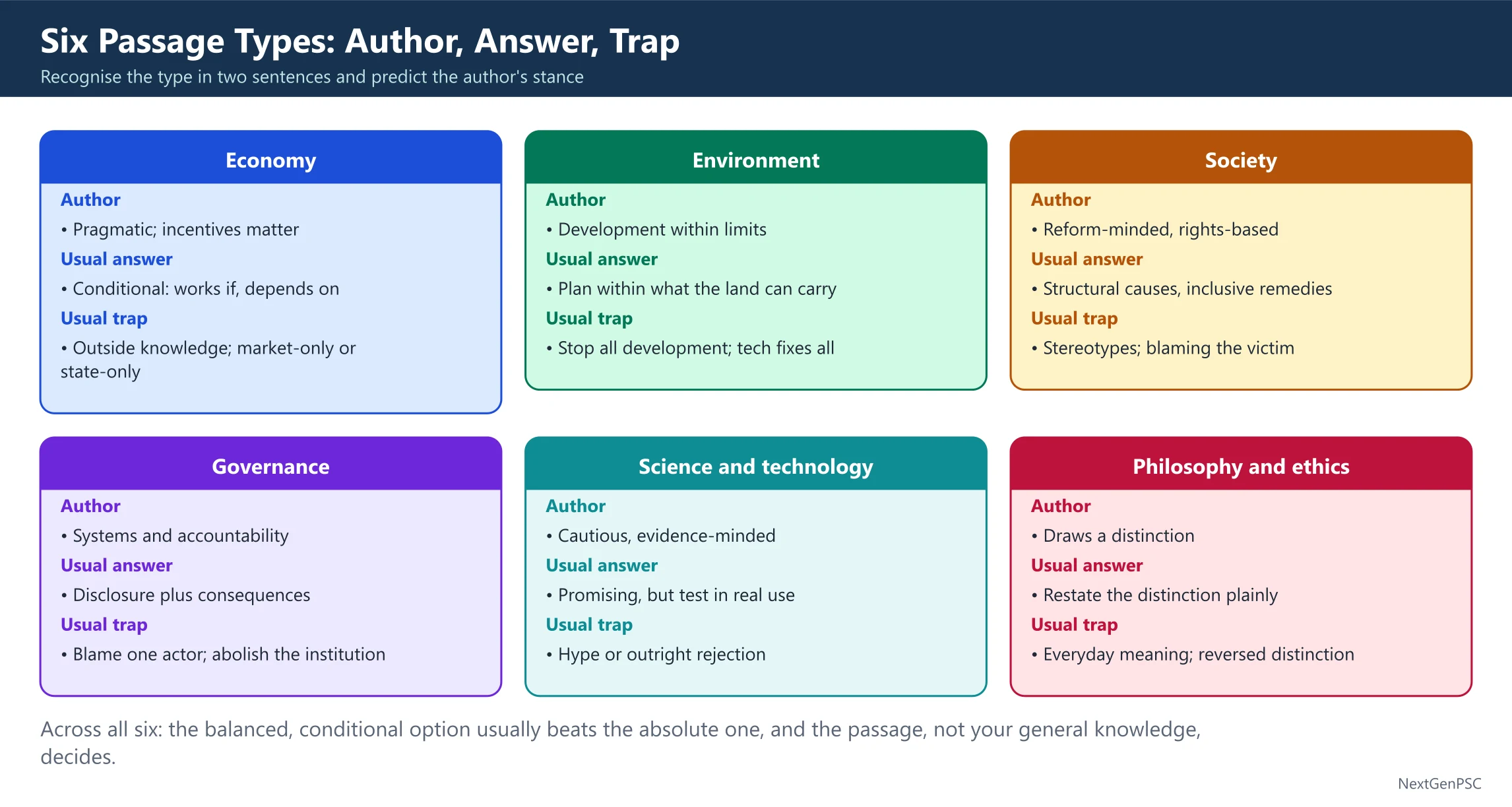
1. Why the Type of Passage Matters
Within two sentences you can usually tell what kind of passage you are reading. That tells you three useful things: the author's likely stance, the kind of option that is usually right, and the trap the examiner is most likely to set. It does not replace reading the passage; it sharpens your prediction (the P of SAPE).
Across all types, the right answer in CSAT is usually moderate and conditional ('can', 'only if', 'must be adapted', 'within limits'), and the wrong answers are usually absolute (ban, abolish, always, only, will solve). The table at the end gathers the six types in one place.
2. Economy Passages
Subjects: growth and jobs, inflation, subsidies, taxes, farm prices, trade, markets and the state. The typical author is pragmatic: markets and the state each do some things well, incentives matter, and a policy is judged by how it changes behaviour.
Usual right answer: a conditional judgement ('cash support works where markets work'; 'a subsidy can defeat its own purpose by changing relative prices'). Usual traps: outside knowledge ('the central bank should cut rates'), and one-sided options ('the market alone', 'the state alone').
Tip: translate jargon into plain words as you read: 'fiscal deficit' = the government spends more than it earns; 'regressive' = hits the poor harder.
3. Environment Passages
Subjects: climate change, forests, water, pollution, biodiversity, disasters, energy. The typical author argues for development within ecological limits, not for stopping development.
Usual right answer: balance and foresight ('plan within what the land can carry'; 'protect natural defences'). Usual traps: anti-development extremes ('stop all construction'), and technology-fixes-all ('new technology will solve the problem without changes in behaviour').
4. Society Passages
Subjects: education, health, gender, caste, migration, ageing, inclusion. The typical author is reform-minded and rights-based, explaining social outcomes by circumstances and institutions rather than blaming individuals.
Usual right answer: structural explanations and inclusive remedies ('distance and safety, not only attitudes, shape girls' schooling'). Usual traps: stereotypes and victim-blaming options ('families do not value education'), and moralising options that the passage never states.
5. Governance Passages
Subjects: institutions, accountability, decentralisation, courts, police, public services, transparency, rule of law. The typical author focuses on systems, incentives and checks, not on good or bad individuals.
Usual right answer: process and accountability ('transparency helps only if findings lead to action'). Usual traps: single-actor blame ('officials are corrupt'), and drastic remedies the passage does not propose ('abolish the institution').
6. Science and Technology Passages
Subjects: medicine, genetics, digital technology and AI, space, energy technology, public health. The typical author is cautious and evidence-minded: results are promising but conditional; risks and benefits are weighed.
Usual right answer: 'promising but must be tested or regulated in real conditions'. Usual traps: overclaiming ('will replace doctors', 'is completely safe') and the opposite, technophobia ('should not be used at all').
7. Philosophy, Ethics and Abstract Passages
Subjects: freedom, duty, tolerance, happiness, truth, the good life, the purpose of education. The language is abstract and the questions often turn on a distinction the author draws (tolerance versus indifference, knowledge versus information, freedom versus licence).
Method: read once for the distinction, then restate it in one plain sentence ('to tolerate is to disagree and still respect the right to differ'). Choose the option that matches your sentence. Usual traps: reading an abstract word in its everyday sense, and options that reverse the distinction.
8. Attempt Order and Time
With 80 questions in 120 minutes, the average is 1.5 minutes per question. Comprehension questions share a passage, so the reading time is spread over the questions that follow it.
A practical order: first the passages on types you find familiar and those with several questions (more marks for one reading); then the others; leave dense abstract passages with one question for the end. Never let one hard passage eat the time of three easy ones.
Example 1: An economy passage
- Question
Passage. Should the state give poor families cash or food? Supporters of cash say it respects people's choices and costs less to deliver. Critics fear it will be wasted. Studies of several cash programmes have found that families mostly spend the money on food, schooling and health, not on alcohol or tobacco. Yet cash works only where markets work. In a remote village with one shop and a bad road, extra cash can simply push up prices, and a family may be better off with a sack of grain delivered to its door.
Which one of the following is the most logical and rational inference that can be made from the passage? (a) Cash transfers should replace all food rations across the country (b) Poor families usually misuse cash transfers (c) Whether cash or food support works better depends on how well local markets function (d) Cash transfers push up prices wherever they are given
- Solution
Normal method. Stem: inference in an economy passage; expect a conditional, pragmatic answer. Anchor: 'Yet cash works only where markets work' and the remote-village example. Predict: the choice depends on local markets.
(a) ✗ Extreme. The passage gives a case where grain is better.
(b) ✗ Opposite. Studies found families mostly spend on food, schooling and health.
(c) ✓ Conditional, on the turn. It turns 'cash works only where markets work' into a general rule.
(d) ✗ Extreme. Price rises are described only for remote places with weak markets.
Shortcut. An economy passage with 'only where' or 'depends on' almost always has a conditional answer; look for 'depends on', 'where', 'if'.
Trap. Options (a) and (d) take one half of the argument each and make it absolute.
- Answer
(c) Whether cash or food support works better depends on how well local markets function
Example 2: An environment passage (UPSC-style)
- Question
Passage. Along many tropical coasts, mangrove forests have been cleared for ports, fish ponds and housing, often because the land looked empty and unproductive. Yet when cyclones strike, villages behind healthy mangroves frequently suffer less damage than those on bare shores, because the dense roots slow the waves and hold the soil. Mangroves also shelter young fish that local fishers depend on. Coastal plans that treat mangroves as wasteland waiting to be developed are therefore discarding a defence they will later have to pay to replace.
Which one of the following best reflects the crux of the passage? (a) Coastal planning should value mangroves as natural defences rather than as empty land (b) Mangroves are the only protection against cyclones (c) All development along coasts should be stopped (d) Ports are more important than mangroves for coastal economies
- Solution
Normal method. Stem: crux in an environment passage; expect development within ecological limits. Anchor: 'Yet when cyclones strike…' and the 'therefore' sentence. Predict: stop treating mangroves as wasteland; count their value in planning.
(a) ✓ Turn + conclusion. It matches the 'therefore' sentence: value the defence instead of discarding it.
(b) ✗ Extreme. Mangroves reduce damage 'frequently'; 'only protection' is never claimed.
(c) ✗ Extreme. The passage criticises one kind of plan, not all development.
(d) ✗ Opposite. The author warns against putting ports ahead of mangroves without counting the cost.
Shortcut. In environment passages, the answer usually changes how development is planned, not whether it happens.
Trap. Option (c) feels 'pro-environment', which is exactly why it is there; CSAT environment authors are balanced, not anti-development.
- Answer
(a) Coastal planning should value mangroves as natural defences rather than as empty land
Example 3: A society passage
- Question
Passage. In many districts, the share of girls who continue to secondary school drops sharply when the nearest such school is several kilometres away. Surveys of families in these areas rarely show that parents think girls' education unimportant; they speak instead of long walks, unsafe roads and the lack of toilets at school. Where states have provided bicycles, safe transport or schools closer to home, enrolment of girls in secondary classes has risen noticeably, often within a few years.
Which one of the following can be inferred from the passage? (a) Families in these districts do not value the education of girls (b) Practical barriers such as distance and safety, not only family attitudes, shape whether girls continue in school (c) All girls in these districts now attend secondary school (d) Boys never face difficulties in reaching school
- Solution
Normal method. Stem: inference in a society passage; expect a structural explanation. Anchor: 'rarely show that parents think girls' education unimportant; they speak instead of long walks, unsafe roads…' and the result of bicycles and transport. Predict: practical barriers explain the drop.
(a) ✗ Opposite. The surveys 'rarely show' this; it is the stereotype the passage corrects.
(b) ✓ Structural explanation. Removing distance and safety barriers raised enrolment, so these barriers matter.
(c) ✗ Extreme. Enrolment 'has risen noticeably', not to everyone.
(d) ✗ Out of scope. Boys are not discussed.
Shortcut. When a society passage reports what families actually say, the answer usually follows their stated reasons, not the popular assumption about them.
Trap. Option (a) is a common belief, and readers who bring it from outside the passage pick it.
- Answer
(b) Practical barriers such as distance and safety, not only family attitudes, shape whether girls continue in school
Example 4: A governance passage (UPSC-style)
- Question
Passage. In a social audit, the records of a public works programme, such as muster rolls, bills and payments, are read aloud in a village meeting. Villagers can then point out names of workers who never worked, roads that exist only on paper, and wages that were never paid. Such audits have exposed large irregularities in several states. But where the findings are filed away and no official is ever asked to explain or repay, villagers soon stop attending, and the audit becomes a formality.
Which one of the following is the most logical and rational inference that can be made from the passage? (a) Officials who run public works are always dishonest (b) Social audits are unnecessary once records are put online (c) Village meetings should replace all audits by state agencies (d) Making records public strengthens accountability only if the findings lead to action
- Solution
Normal method. Stem: inference in a governance passage; expect process and accountability. Anchor: 'But where the findings are filed away and no official is ever asked to explain…, the audit becomes a formality.' Predict: disclosure must be followed by consequences.
(a) ✗ Extreme. Irregularities were exposed in some places; 'always dishonest' blames every official.
(b) ✗ Out of scope. Online records are not discussed, and the passage values the public reading.
(c) ✗ Too far. The passage proposes no replacement of state audits.
(d) ✓ Conditional, on the turn. It joins the success of exposure with the 'but' about follow-up.
Shortcut. Governance passages usually end on a missing link in the chain of accountability; the answer names that link.
Trap. Option (a) blames individuals; governance authors in CSAT almost always blame weak systems instead.
- Answer
(d) Making records public strengthens accountability only if the findings lead to action
Example 5: A science and technology passage
- Question
Passage. A software tool trained on thousands of eye images can now detect signs of diabetic damage to the retina about as accurately as specialists in controlled trials. In a country with too few eye doctors, this is welcome. But when the tool was tried in busy clinics, many images taken with older cameras or in poor light were too unclear to read, and patients had to be called back. The tool worked best when nurses were trained to take good images and doctors reviewed the cases it flagged.
Which one of the following best reflects the message of the passage? (a) Software tools will soon replace eye specialists (b) A promising technology must be tested and supported in the conditions where it will actually be used (c) Such tools are unreliable and should not be used in clinics (d) Older cameras are the main cause of diabetic eye disease
- Solution
Normal method. Stem: message in a science passage; expect 'promising but conditional'. Anchor: 'But when the tool was tried in busy clinics…' and 'worked best when nurses were trained… and doctors reviewed'. Predict: good in trials, needs real-world support to work.
(a) ✗ Extreme. Doctors still reviewed the flagged cases; replacement is never suggested.
(b) ✓ Promising but conditional. It joins trial accuracy with the real-clinic lesson.
(c) ✗ Opposite. The tool 'worked best' with support; the author does not reject it.
(d) ✗ Distorted. Old cameras caused unclear images, not the disease.
Shortcut. Science passages that report a lab or trial success and then a 'but' from the field almost always carry the message 'test and support it where it will be used'.
Trap. Options (a) and (c) are the two extremes, hype and rejection, that CSAT science questions offer side by side.
- Answer
(b) A promising technology must be tested and supported in the conditions where it will actually be used
Example 6: A philosophy passage (UPSC-style)
- Question
Passage. Tolerance is often confused with indifference, but the two are opposites in an important sense. To be indifferent is not to care what others believe or how they live. To tolerate is to care, even to disagree strongly, and still to grant others the right to their beliefs and ways of life. A society that has simply stopped caring about anything has not become tolerant; it has only become quiet. Real tolerance is harder, because it asks us to hold our convictions and our respect for others at the same time.
Which one of the following best reflects the author's view of tolerance? (a) Tolerance means agreeing with the beliefs of everyone (b) Tolerance combines holding one's own convictions with respect for others' right to differ (c) Indifference is the highest form of tolerance (d) People should avoid holding strong beliefs
- Solution
Normal method. Stem: author's view in a philosophy passage; find the distinction. Anchor: 'To tolerate is to care, even to disagree strongly, and still to grant others the right…' and the last sentence. Predict: one plain sentence: tolerance = disagree but respect the right to differ.
(a) ✗ Opposite. Tolerance, as defined, includes disagreement.
(b) ✓ Matches the distinction. 'Hold our convictions and our respect for others at the same time.'
(c) ✗ Opposite. The passage calls tolerance and indifference opposites.
(d) ✗ Distorted. The author keeps strong convictions; a quiet society without them is what the passage criticises.
Shortcut. In abstract passages, write the author's distinction as 'X is…, not…'; the right option repeats it and the traps reverse or blur it.
Trap. In everyday speech 'tolerant' can sound like 'easy-going', which pulls readers towards (c) or (d).
- Answer
(b) Tolerance combines holding one's own convictions with respect for others' right to differ
Practice Questions
Passage A (for Q1–Q2). A tax on carbon raises the price of fuels in proportion to the emissions they cause, so that polluters pay for the damage. Economists favour it because it lets each firm and household decide how to cut emissions at the lowest cost. Its weakness is political: higher fuel prices hit poorer households hardest. Several countries have answered this by returning the tax revenue to households as equal cash payments, which leaves most poorer families better off while keeping the price signal in place.
Q1. Which one of the following is the most logical inference from the passage? (a) Carbon taxes always make poor households worse off (b) Carbon taxes should be abolished (c) Economists oppose carbon taxes (d) The fairness problem of a carbon tax can be reduced by how its revenue is used
Q2. The author's attitude towards a carbon tax is best described as (a) hostile (b) favourable, with attention to its effect on the poor (c) indifferent (d) unreservedly enthusiastic
Passage B (for Q3–Q4). Information is not the same as knowledge. A person can read a thousand facts in an afternoon and understand none of them. Knowledge begins when facts are connected, questioned and tested against experience. An education that only fills the memory with information, however large, leaves the learner unable to judge which facts matter and why.
Q3. Which one of the following best reflects the author's view? (a) Knowledge requires connecting and questioning information, not merely storing it (b) Information is useless (c) People should read fewer facts (d) Memory has no role in learning
Q4. The passage is best classified as (a) an economy passage about the information industry (b) a philosophy or education passage drawing a distinction (c) a science passage reporting an experiment (d) a governance passage on public libraries
Passage C (for Q5–Q6). When a city installs cameras at traffic signals, red-light violations usually fall in the first months. Whether the fall lasts depends on whether fines are actually collected. Where notices go unpaid without consequence, drivers learn quickly that the cameras watch but do not bite, and violations creep back.
Q5. Which one of the following is the most logical inference? (a) Cameras have no effect on driving behaviour (b) The lasting effect of cameras depends on enforcement that follows the recording (c) All drivers ignore traffic rules (d) Cities should remove traffic cameras
Q6. The phrase that cameras 'watch but do not bite' means that (a) cameras record violations but no penalty follows (b) cameras are often out of order (c) cameras are placed where drivers cannot see them (d) drivers are afraid of the cameras
Answers
Show answers
Q1. (d) The fairness problem of a carbon tax can be reduced by how its revenue is used — returning revenue as equal payments leaves most poorer families better off. (a) is extreme, (c) opposite, (b) too far.
Q2. (b) favourable, with attention to its effect on the poor — the author explains why economists favour it and how its weakness is handled.
Q3. (a) Knowledge requires connecting and questioning information, not merely storing it — the distinction restated. (b) and (d) are extreme; (c) is distorted.
Q4. (b) a philosophy or education passage drawing a distinction — information versus knowledge.
Q5. (b) The lasting effect of cameras depends on enforcement that follows the recording — the governance pattern: recording works only if followed by consequences. (a) and (d) are opposite, (c) extreme.
Q6. (a) cameras record violations but no penalty follows — 'watch' = record, 'do not bite' = no fine collected. (d) is the opposite.
| Type | Typical author stance | Usual right answer | Usual trap |
|---|---|---|---|
| Economy | Pragmatic; incentives matter | Conditional: works if / depends on | Outside knowledge; market-only or state-only |
| Environment | Development within ecological limits | Plan within limits; value natural defences | Stop all development; technology fixes all |
| Society | Reform-minded, rights-based | Structural causes; inclusive remedies | Stereotypes; blaming the victim |
| Governance | Systems, incentives, accountability | Disclosure plus consequences; process | Blame one actor; abolish the institution |
| Science and technology | Cautious, evidence-minded | Promising but test and support in real use | Hype ('will replace') or rejection |
| Philosophy and ethics | Draws a distinction | Restates the distinction plainly | Everyday meaning; reversed distinction |
Prelims tips
- Name the type in two sentences. Economy, environment, society, governance, science or philosophy: the type predicts the author's stance and the trap, and makes your 'predict' step faster.
- The balanced, conditional option usually wins. Across all six types, CSAT authors rarely ban, abolish or promise. Options with 'depends on', 'only if', 'within limits' deserve a first look; options with 'all', 'never', 'will solve' a hard second look.
- Leave GS at the door. Economy and governance passages tempt you to use what you know about policies and institutions. If the passage does not say it, it is not the answer, even if it is true.
- Science passages: neither hype nor fear. When one option says a technology will replace people and another says it should not be used, the answer is usually the third: promising but to be tested and supported in real conditions.
- Philosophy passages: find the distinction and restate it. Write 'X is…, not…' in your own words before reading the options; most wrong options reverse or blur that distinction.
- Choose the order of passages. Start with familiar types and passages that carry several questions; leave a dense one-question abstract passage for the end. One hard passage must not eat the time of three easy ones.
PYQs from this chapter
56 UPSC Prelims questions (2024–2025) test what this chapter teaches. Open a year to read them with answers: