
CSAT (Prelims Paper II) · UPSC Notes
CSAT Exam Pattern and Strategy — UPSC CSAT Notes
Free, exam-focused notes for UPSC Prelims and Mains, with Prelims tips and Mains points for every topic. 2 topics.
Open in the interactive reader: bookmarks, progress tracking and read-aloud.
CSAT Paper Pattern and Qualifying Marks
In short
CSAT is the popular name of General Studies Paper II of the UPSC Civil Services (Preliminary) Examination. It is an objective paper of 200 marks and 2 hours, usually of 80 questions of 2.5 marks each, set in both Hindi and English. It is qualifying: you must score at least 33%, i.e. 66 marks, and the marks do not count for ranking. Each wrong answer costs one-third of the question's marks (0.83). Three facts decide your approach: the target is 66 plus a safety margin, accuracy matters as much as attempts, and failing Paper II makes your Paper I score useless for that year.
In simple words
The Civil Services Prelims has two papers on the same day. Paper I tests general studies (history, polity, economy and so on). Paper II, called CSAT, tests thinking skills: reading passages, maths of Class X level, reasoning and data.
CSAT is a pass-or-fail paper. You only need 66 out of 200. Getting 150 in CSAT gives no extra benefit over getting 70; both simply 'pass'.
But if you get 65 in CSAT, your Paper I is not counted for selection that year, however good it is. That is why even strong students must take CSAT seriously.
Everyday example: think of CSAT as a driving licence test. Nobody asks how well you passed; but without passing, you cannot drive at all.
The one rule to remember about marks: a right answer gives 2.5, a wrong answer takes away 0.83, and a blank gives 0. Three wrong answers wipe out one right answer, so careless guessing is costly.
1. Where CSAT Fits in the Civil Services Examination
The Civil Services Examination has three stages: the Preliminary Examination (objective, for screening), the Main Examination (written, descriptive) and the Personality Test (interview).
The Preliminary Examination has two compulsory papers of 200 marks each: General Studies Paper I and General Studies Paper II. Both are objective (multiple-choice) and each is of 2 hours. Paper II is what students call CSAT (Civil Services Aptitude Test).
It is mandatory to appear in both papers. The notice says a candidate who does not appear in both papers is disqualified, so walking out after Paper I wastes the attempt.
Prelims marks are not counted for the final order of merit. They only decide who goes on to the Main Examination.
2. Paper II at a Glance
The paper usually has 80 questions, each carrying 2.5 marks, for a total of 200 marks. Every question has four options, of which you mark one.
Time: 2 hours, i.e. 120 minutes for 80 questions, or 90 seconds per question on average. In practice some questions take 30 seconds and some take 4 minutes, so the average is only a planning number.
The question paper is set in both Hindi and English. If a word in one version is unclear, read the same question in the other version.
Answers are marked on a machine-read answer sheet (OMR sheet) with the pen allowed by the Commission. Filling the sheet is part of the 2 hours, so plan time for it.
3. The Qualifying Rule
Paper II is a qualifying paper with minimum qualifying marks fixed at 33%. 33% of 200 = 66 marks.
The list of candidates for the Main Examination is drawn on two conditions together: at least 33% in Paper II, and the total qualifying marks in Paper I fixed by the Commission (the 'cut-off'). About 12 to 13 times the number of vacancies are admitted to the Mains.
What this means: Paper I decides your rank among candidates; Paper II only decides whether you are counted at all. A candidate with 120 in Paper I but 64 in Paper II does not qualify, while one with 100 in Paper I (above the cut-off) and 67 in Paper II does.
So the goal in CSAT is not a high score but a safe score: 66 plus a margin that absorbs a tough paper, a few careless errors and answer-key surprises. Many aspirants aim for about 90 to 100 in practice tests so that a bad day still clears 66.
4. Negative Marking
The notice states the rule for wrong answers: for each wrong answer, one-third of the marks assigned to that question is deducted. For a 2.5-mark question that is 2.5 ÷ 3 = 0.83 marks.
More than one answer marked for a question is treated as a wrong answer, even if one of the marked answers is correct. So it also costs 0.83.
A question left blank carries no penalty.
Net effect: 3 wrong answers cost 3 × 0.83 ≈ 2.5 marks, i.e. they cancel one right answer. Score = 2.5 × (right) − 0.83 × (wrong), or exactly 2.5R − (2.5/3)W.
Blind guessing does not pay on average: with four options, a random guess is right 1 time in 4. Expected gain = 1/4 × 2.5 − 3/4 × 0.83 = 0.625 − 0.625 = 0. Guessing after eliminating options does pay, as the drills below show.
5. The Syllabus in Plain Words
The official syllabus of Paper II lists: comprehension; interpersonal skills including communication skills; logical reasoning and analytical ability; decision making and problem solving; general mental ability; basic numeracy (numbers and their relations, orders of magnitude, etc., Class X level); and data interpretation (charts, graphs, tables, data sufficiency, etc., Class X level).
In practice this falls into three blocks: (1) reading (passages with 1 to 3 questions each), (2) quantitative (arithmetic, number system, algebra, geometry, data interpretation) and (3) reasoning (statements, syllogisms, arrangements, series, coding, puzzles). The share of each block changes from year to year; recent papers have leaned heavily on quantitative and reasoning questions, so plan for both.
'Class X level' refers to the mathematics used, not to the difficulty of the questions. UPSC builds tricky, multi-step questions from simple school concepts.
6. Time and Accessibility Provisions
Candidates with benchmark disabilities in the categories named by the notice (such as blindness, locomotor disability affecting both arms, and cerebral palsy) get compensatory time of 20 minutes per hour, i.e. 40 extra minutes in a 2-hour paper. Other categories can get it with the medical certificate the notice prescribes. Check the current notice for scribe rules and the exact categories.
7. What the Numbers Mean for You
Minimum perfect-accuracy route: 66 ÷ 2.5 = 26.4, so 27 correct answers with no wrong answer cross the line. Nobody should plan on zero errors, so attempt more than 27.
Score per attempt at accuracy a (fraction correct) = 2.5a − 0.83(1 − a). At 90% accuracy each attempt is worth about 2.17 marks; at 75% about 1.67; at 50% about 0.83; at 25% about 0.
Every mark of the margin comes from accuracy. Raising accuracy from 75% to 90% on 50 attempts lifts the score from about 83 to about 108.
Example 1: Drill: scoring a paper
- Question
In CSAT a candidate answers 52 questions correctly, 18 wrongly and leaves 10 blank. What is the score? (a) 115 (b) 130 (c) 112 (d) 85
- Solution
Normal method. Marks for right answers = 52 × 2.5 = 130.
Penalty = 18 × (2.5 ÷ 3) = 18 × 0.833 = 15. Blank answers cost nothing.
Score = 130 − 15 = 115.
Shortcut. Every 3 wrong answers cancel 1 right answer: 18 wrong cancel 6 right, so the score = (52 − 6) × 2.5 = 46 × 2.5 = 115.
Trap. Option (b) ignores negative marking; option (c) deducts 1 mark per wrong answer; option (d) deducts the full 2.5.
- Answer
(a) 115
Example 2: Drill: the smallest number of correct answers
- Question
If a candidate makes no wrong attempt at all, what is the least number of correct answers needed to qualify in CSAT? (a) 26 (b) 27 (c) 28 (d) 30
- Solution
Normal method. Qualifying marks = 33% of 200 = 66. Each correct answer gives 2.5.
66 ÷ 2.5 = 26.4, so 26 correct give 65 (short) and 27 correct give 67.5.
Shortcut. 2.5 × 26 = 65, which is short of 66, so round 26.4 up: 27.
Trap. Option (a) rounds 26.4 down; 65 marks fail by 1 mark.
- Answer
(b) 27
Example 3: Drill: working back from a score
- Question
A candidate attempted 36 questions and scored 70 marks. How many answers were correct? (a) 28 (b) 30 (c) 32 (d) 34
- Solution
Normal method. Let c be correct; wrong = 36 − c. Then 2.5c − (2.5/3)(36 − c) = 70.
Multiply by 3: 7.5c − 2.5(36 − c) = 210 ⇒ 10c − 90 = 210 ⇒ c = 30.
Shortcut. If all 36 were right the score would be 90. Each wrong answer costs 2.5 + 0.83 = 3.33 (the lost 2.5 plus the penalty). 90 − 70 = 20 lost ⇒ 20 ÷ 3.33 = 6 wrong, so 30 right.
Check. 30 × 2.5 = 75; 6 × 0.83 = 5; 75 − 5 = 70.
Trap. Option (a) divides the 20 lost marks by 2.5 (forgetting the penalty), giving 8 wrong.
- Answer
(b) 30
Example 4: Drill: is a guess worth it?
- Question
A candidate is sure that two of the four options of a question are wrong and picks one of the remaining two at random. What is the expected gain in marks from attempting it? (a) 0 (b) 0.42 (c) 0.83 (d) 1.25
- Solution
Normal method. Chance of being right = 1/2: gain 2.5. Chance of being wrong = 1/2: loss 2.5/3.
Expected gain = 1/2 × 2.5 − 1/2 × 0.833 = 1.25 − 0.417 = 0.83 marks.
Shortcut. With k options left, expected gain = (2.5 − (k − 1) × 0.833)/k. For k = 2: (2.5 − 0.833)/2 = 0.83; for k = 3: 0.28; for k = 4: 0.
Trap. Option (a) is true only for a blind guess among all four options; option (d) forgets the penalty.
- Answer
(c) 0.83
Practice Questions
Q1. What are the minimum qualifying marks in CSAT out of 200? (a) 60 (b) 66 (c) 67 (d) 70
Q2. A candidate marks two options for a 2.5-mark question, one of which is correct. What is the effect on the score? (a) 0 (b) −0.83 (c) +1.25 (d) +2.5
Q3. A candidate gets 45 answers right and 15 wrong. What is the score? (a) 97.5 (b) 100 (c) 105 (d) 112.5
Q4. If all 80 questions are attempted in the full 120 minutes, what is the average time per question? (a) 60 seconds (b) 75 seconds (c) 90 seconds (d) 120 seconds
Answers
Show answers
Q1. (b) 66. 33% of 200.
Q2. (b) −0.83. More than one answer is treated as a wrong answer, even if one of them is correct.
Q3. (b) 100. 45 × 2.5 = 112.5; 15 × 0.83 = 12.5; 112.5 − 12.5 = 100.
Q4. (c) 90 seconds. 120 × 60 ÷ 80 = 90.
| Feature | Rule |
|---|---|
| Total marks | 200 |
| Duration | 2 hours |
| Number of questions | usually 80, each of 2.5 marks |
| Options per question | 4 |
| Nature | qualifying: minimum 33%, i.e. 66 marks |
| Wrong answer | one-third of the question's marks deducted (0.83) |
| More than one option marked | treated as wrong (−0.83) |
| Question left blank | no penalty |
| Language | set in both Hindi and English |
| Counted for Mains cut-off or final rank | no; only the 33% condition applies |
| Compensatory time (eligible PwBD) | 20 minutes per hour |
| Accuracy | Marks per attempt | Attempts needed for 66 | Attempts needed for 90 |
|---|---|---|---|
| 100% | 2.5 | 27 | 36 |
| 90% | 2.17 | 31 | 42 |
| 80% | 1.83 | 36 | 50 |
| 75% | 1.67 | 40 | 54 |
| 60% | 1.17 | 57 | 78 |
Prelims tips
- Treat 66 as the floor, not the target. Plan for a safe score (many aim for 90 to 100 in mocks) so that a tough paper, a few slips and key changes still leave you above 33%.
- Mark one option only. Two marked options count as a wrong answer even if one is right, and cost 0.83. Correcting a bubble on the answer sheet is risky; decide before you mark.
- Never blind-guess among four options. Its expected value is zero, and it adds risk. Guess only after eliminating at least one option, and preferably two.
- Both papers are compulsory. Skipping Paper II, even after a poor Paper I, disqualifies the attempt; and a high Paper I score cannot rescue a CSAT score below 66.
- Keep time for the answer sheet. Transferring answers is part of the 2 hours. Mark answers as you finish each pass instead of leaving all the bubbling to the last five minutes.
- Use both language versions. The paper is in Hindi and English. When a translated word looks odd, the other version often settles the meaning in seconds.
Next topic: Strategy, Time Management and Question Selection →
Strategy, Time Management and Question Selection
In short
CSAT is passed by choosing well as much as by solving well. With 80 questions in 120 minutes, a penalty of 0.83 for each wrong answer and a qualifying line of 66, the winning plan is to attempt the questions you can solve accurately and quickly, skip the time sinks, and protect accuracy. Three tools make this work: a three-pass method (sure → doable → hard), a time plan with checkpoints, and a selection rule based on marks per minute and on how many options you can eliminate.
In simple words
In CSAT you do not have to answer every question. You only need 66 marks, which is about 27 correct answers if you make no mistakes. So the smart way is to pick the easy and medium questions first and leave the very long or very confusing ones.
Everyday example: in a market with ₹500 and many shops, you first buy what you are sure you need, then look at the rest if money is left. In CSAT, your money is time.
Go through the paper three times. First time: do only the questions you can solve quickly and surely. Second time: do the ones that need some work. Third time: if time is left, try the hard ones you can narrow down.
The one question to ask before starting any question is: 'Can I solve this correctly in about 2 minutes?' If not, mark it and move on. You can always come back.
Two habits make the biggest difference: (1) do not guess blindly, because a wrong answer takes away marks; (2) fill the answer sheet as you go, not all in the last few minutes.
1. Start From the Target
The qualifying line is 66 out of 200. A sensible working target in practice tests is about 90 to 100, which leaves room for a hard paper and a few careless errors.
Turn the target into attempts × accuracy. Marks per attempt at accuracy a = 2.5a − 0.83(1 − a). At 85% accuracy each attempt is worth 2.0 marks, so 90 marks need 45 attempts; at 75% accuracy each attempt is worth about 1.67, so the same 90 needs 54 attempts.
Why this matters: the second plan needs 9 more questions solved in the same 120 minutes. Improving accuracy is usually easier than finding time for extra questions.
2. Know Your Profile
Take one full previous-year paper under exam conditions and sort every question into three blocks: reading (passages), quantitative (arithmetic, algebra, geometry, data interpretation) and reasoning (statements, arrangements, series, coding, puzzles).
For each block note two numbers: accuracy (right ÷ attempted) and average time per question. These two numbers decide which block you attack first and how much time it gets.
Typical patterns: students from a humanities background are often faster and more accurate in reading; students from science or engineering backgrounds in quantitative questions. Neither can ignore the other block, because the share of each block varies from year to year.
3. The Three-Pass Method
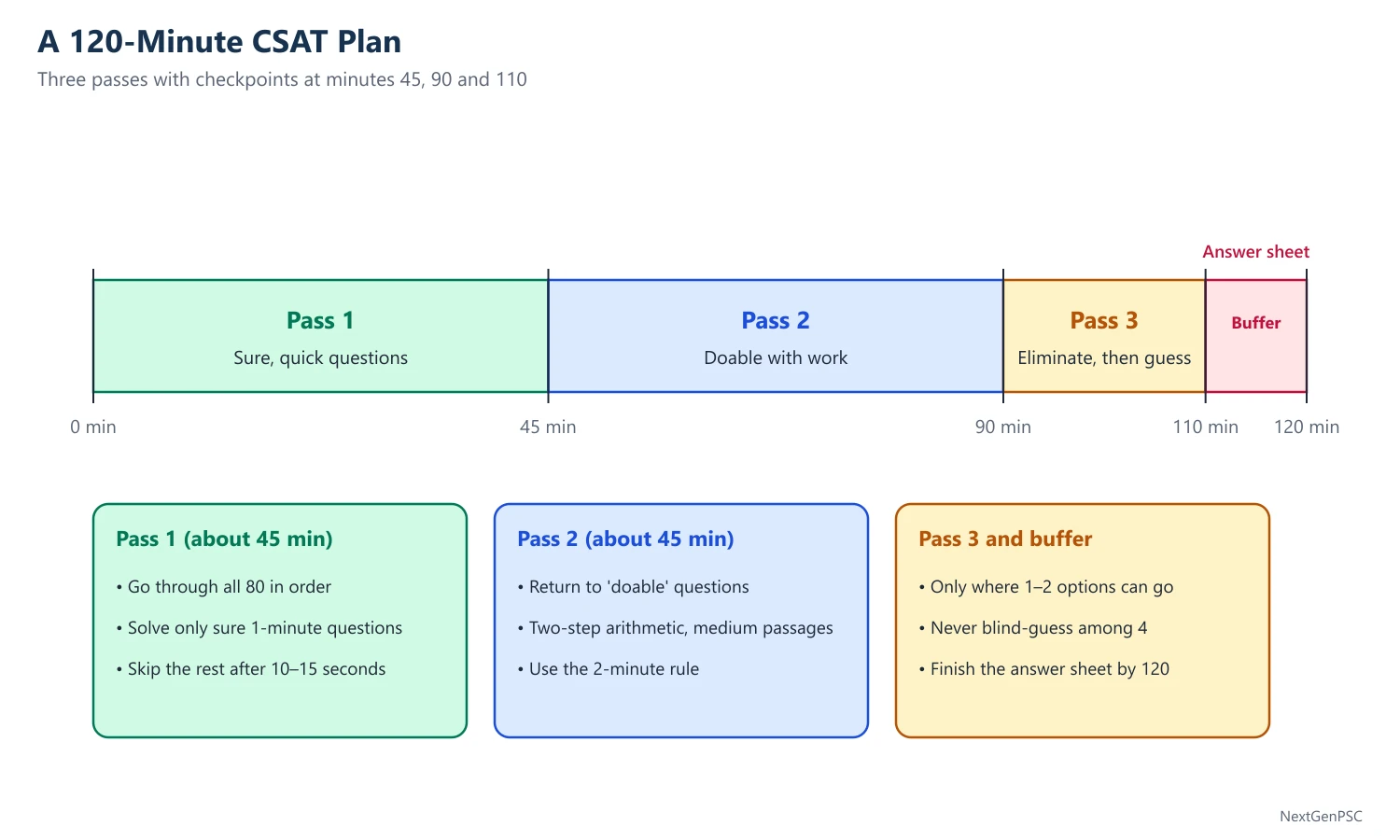
Pass 1 (about 45 minutes): go through all 80 questions in order. Solve only those you can finish surely in about 1 minute (direct formulas, short reasoning, short passages you read well). Skip everything else after a quick look of about 10 to 15 seconds.
Pass 2 (about 45 minutes): return to the skipped questions that you judged 'doable with work': two-step arithmetic, medium passages, arrangements with a clear grid.
Pass 3 (remaining time): attempt hard questions only where you can eliminate at least one or two options; leave the rest blank.
Why passes work: without them, one stubborn question can eat 6 to 8 minutes, which is the time for 4 or 5 easier questions later in the paper.
Marking the answer sheet: fill the bubbles at the end of each pass, or after every page. Keep the last 5 to 10 minutes as a buffer, not as the only time for bubbling.
4. A 120-Minute Time Plan
Use checkpoints: by minute 45 you should have finished Pass 1 and know roughly how many questions are 'sure'; by minute 90 Pass 2 should be over; minutes 90 to 110 are for Pass 3; the last 10 minutes are for completing and checking the answer sheet.
If at minute 45 you have fewer than about 30 sure answers, the paper is hard for you. Do not panic: the line is relative to marks, not to the paper's difficulty, and Pass 2 is where your score will be made. Shift more time to your strongest block.
5. Question Selection: What to Skip
Time sinks: long data-interpretation sets needing many calculations, puzzles with many conditions and no clear starting point, passages with dense technical language, and questions whose options are all very close numbers.
Quick wins: short passages with direct questions, one-formula arithmetic, number-series and coding questions you recognise, and questions where the options can be tested quickly by back-substitution.
The 2-minute rule: if after 2 minutes you cannot see the path to the answer, mark the question and leave it. Coming back later with a fresh mind often shows the path at once.
Marks per minute: expected marks of a question ÷ the time it needs. A sure 1-minute question gives about 2.5 marks a minute; a 4-minute question gives at most 0.625. Do the high-rate questions first.
6. Guessing: When It Pays
With k options left after elimination, the expected gain of a guess = (2.5 − (k − 1) × 0.83) ÷ k.
All 4 options left: 0 (no gain, only risk). 3 options left: about 0.28. 2 options left: about 0.83. So eliminate first, then guess; never guess blindly.
Break-even accuracy: an attempt adds marks on average only if your chance of being right is above 25%, because 2.5 × 0.25 = 0.83 × 0.75. In real exams, guesses are rarely as random as they seem, so keep a margin: guess when you are down to two options.
7. Block-Wise Approach
Reading (comprehension): answer from the passage, not from outside knowledge. Distrust options with extreme words (always, only, never, all) and options that are true in general but not stated or implied in the passage.
Quantitative: look at the options before calculating; they often allow approximation or back-substitution. Write each step; mental arithmetic under pressure causes most slips.
Reasoning: draw it. A small grid, a Venn diagram or a direction sketch prevents misreading. For arrangement puzzles, fix the most definite clue first.
Data interpretation: read the units and the question before the table; calculate only what is asked, and compare by approximation when the options are far apart.
8. Preparation Plan
Phase 1: rebuild the basics of each Basic Numeracy topic and the reasoning types (short daily practice, with notes of formulas and traps).
Phase 2: topic-wise question sets with a time limit; record every mistake in an error log (topic, type of mistake: concept, calculation, misreading, time).
Phase 3: full-length papers in 2 hours, including previous years' papers, at least once a week in the last months; review each paper for longer than you took to write it.
Measure progress by accuracy and score per attempt, not only by the total score of one test.
9. Exam-Day Habits
Read each question's last line first (what is asked), then the data. Underline words like not, except, at least, at most, only, and the base of any percentage.
Do not change an answer unless you find a clear error. Second thoughts based on worry tend to replace right answers with wrong ones.
After Paper I, do not discuss answers. Paper II needs a calm, fresh start; how Paper I went does not change what you must do in Paper II.
Example 1: Drill: attempts needed for a target
- Question
A candidate's accuracy in practice is 85%. How many questions must she attempt to expect a score of 90 in CSAT? (a) 36 (b) 43 (c) 45 (d) 50
- Solution
Normal method. Marks per attempt = 0.85 × 2.5 − 0.15 × (2.5/3) = 2.125 − 0.125 = 2.0.
Attempts needed = 90 ÷ 2.0 = 45.
Shortcut. In 100 attempts at 85%: 85 right = 212.5, 15 wrong = −12.5, net 200, i.e. 2 marks per attempt.
Trap. Option (a) assumes every attempt is right (90 ÷ 2.5); option (b) counts only the marks of the right answers and forgets the penalty on the wrong ones (90 ÷ 2.125 ≈ 42.4, rounded up).
- Answer
(c) 45
Example 2: Drill: what is left for Pass 3?
- Question
In the 120-minute paper a candidate plans 40 'sure' questions at 1 minute each in Pass 1 and 25 'doable' questions at 2 minutes each in Pass 2, and keeps 10 minutes at the end for the answer sheet. How many minutes are left for Pass 3? (a) 10 (b) 20 (c) 25 (d) 30
- Solution
Normal method. Pass 1 = 40 × 1 = 40 minutes. Pass 2 = 25 × 2 = 50 minutes.
Time used = 40 + 50 + 10 = 100 minutes. Left for Pass 3 = 120 − 100 = 20 minutes.
Shortcut. 120 − (40 + 50) − 10 = 20.
Trap. Option (d) forgets the 10 minutes kept for the answer sheet.
- Answer
(b) 20
Example 3: Drill: order of attempting by marks per minute
- Question
Four questions need these times and give these chances of being right: P: 1 minute, 90%; Q: 3 minutes, 95%; R: 2 minutes, 60%; S: 4 minutes, 100%. In which order should they be attempted to earn the most expected marks per minute? (a) P, Q, S, R (b) S, Q, P, R (c) P, S, Q, R (d) Q, S, P, R
- Solution
Normal method. Expected marks = 2.5 × chance − 0.83 × (1 − chance); divide by the time.
P: (2.25 − 0.083)/1 ≈ 2.17 per minute. Q: (2.375 − 0.042)/3 ≈ 0.78. R: (1.5 − 0.333)/2 ≈ 0.58. S: 2.5/4 = 0.625.
Order by rate: P (2.17), Q (0.78), S (0.625), R (0.58).
Shortcut. Quick, sure questions first; a 100% question that takes 4 minutes is worth less per minute than a 95% question that takes 3.
Trap. Option (b) chases certainty (S is 100% sure) and ignores time; option (c) puts S before Q for the same reason.
- Answer
(a) P, Q, S, R
Example 4: Drill: the break-even chance
- Question
Above what chance of being right does attempting a CSAT question add marks on average? (a) 20% (b) 25% (c) 33% (d) 50%
- Solution
Normal method. Let the chance be p. Expected gain = 2.5p − (2.5/3)(1 − p).
Set it to zero: 2.5p = 0.833 − 0.833p ⇒ 3.333p = 0.833 ⇒ p = 0.25, i.e. 25%.
Shortcut. The penalty is one-third of the reward, so the odds must beat 1 : 3, i.e. 1 right in 4.
Trap. Option (c) confuses the one-third penalty with the probability; option (d) is the chance with two options left, not the break-even.
- Answer
(b) 25%
Practice Questions
Q1. A candidate attempts 48 questions with 75% accuracy. What is the expected score? (a) 72 (b) 80 (c) 90 (d) 66
Q2. After eliminating one wrong option, a candidate guesses among the remaining three. What is the expected gain in marks? (a) 0 (b) 0.28 (c) 0.42 (d) 0.83
Q3. A candidate is sure of 30 correct answers. At most how many wrong answers can she afford and still score at least 66? (a) 9 (b) 10 (c) 11 (d) 12
Q4. Keeping 10 minutes for the answer sheet, what is the average time available per question for all 80 questions? (a) 75 seconds (b) 80 seconds (c) 82.5 seconds (d) 90 seconds
Answers
Show answers
Q1. (b) 80. 36 right × 2.5 = 90; 12 wrong × 0.83 = 10; 90 − 10 = 80.
Q2. (b) 0.28. (2.5 − 2 × 0.833)/3 = 0.833/3 ≈ 0.28.
Q3. (b) 10. 75 − 10 × 0.833 = 66.67; with 11 wrong the score is 65.83.
Q4. (c) 82.5 seconds. 110 × 60 ÷ 80 = 82.5.
| Minutes | Pass | What to do |
|---|---|---|
| 0–45 | Pass 1 | Sure, quick questions only; skip after a 10–15 second look |
| 45–90 | Pass 2 | Skipped questions that are doable with work |
| 90–110 | Pass 3 | Hard questions where 1–2 options can be eliminated |
| 110–120 | Buffer | Complete and check the answer sheet |
| Options left after elimination | Chance of being right | Expected gain (marks) | Decision |
|---|---|---|---|
| 4 | 25% | 0 | do not guess |
| 3 | 33% | 0.28 | guess only if short of the target |
| 2 | 50% | 0.83 | guess |
| 1 | 100% | 2.5 | answer |
Prelims tips
- Plan by accuracy, not by attempts. At 85% accuracy every attempt is worth 2 marks; at 60% only about 1.17. Raising accuracy is the cheapest way to a safe margin above 66.
- Use three passes. Sure questions first, doable ones second, hard ones last. One stubborn question in Pass 1 can cost the time of four easy ones later.
- Apply the 2-minute rule. If the path is not visible within about 2 minutes, mark the question and move on; come back only in a later pass.
- Eliminate before you guess. A blind guess has zero expected value; with two options left a guess is worth about 0.83 marks. Never mark more than one option.
- Keep checkpoints. Pass 1 done by about minute 45, Pass 2 by minute 90, answer sheet complete by minute 120. Checkpoints stop one section from eating the whole paper.
- Practise full papers under time and keep an error log. Previous years' papers show UPSC's style; reviewing each mistake by type (concept, calculation, misreading, time) is where scores rise.