
Science & Technology · UPSC Notes
Cell Biology — UPSC Science & Tech Notes
Free, exam-focused notes for UPSC Prelims and Mains, with Prelims tips and Mains points for every topic. 26 topics.
Open in the interactive reader: bookmarks, progress tracking and read-aloud.
Cell Biology: The Fundamental Unit of Life
The Cell is the structural and functional building block of all living organisms. The journey of cell biology began with the simple observations of Robert Hooke and culminated in the Cell Theory, which establishes that all life is cellular and that cells arise from pre-existing ones.
1. Historical Timeline of Discoveries
The understanding of life at the microscopic level evolved through key milestones:
1665 - Robert Hooke: First discovered and coined the term 'Cell' while observing a thin slice of cork under a primitive microscope.
1831 - Robert Brown: Discovered and described the Cell Nucleus, the control center of the cell.
1838/39 - Schleiden & Schwann: Proposed the Cell Theory, stating that all plants and animals are composed of cells.
1860s - Gregor Mendel: Known as the 'Father of Genetics,' he laid the foundations of heredity through his work on pea plants.
1940 - Electron Microscope: The invention of the electron microscope revolutionized biology, allowing scientists to see complex internal organelles for the first time.
2. Defining the Cell
The cell is the smallest unit of life that can perform all necessary biological functions.
Structural Unit: Every part of a living organism is built from cells.
Functional Unit: All metabolic activities (energy production, waste removal, reproduction) happen within the cell.
Living Composition: All known living organisms are made up of one or more cells.
3. Core Tenets of Cell Theory
Modern cell theory is based on three main principles:
1. All living organisms are composed of one or more cells.
2. The cell is the basic unit of structure and organization in organisms.
3. Cells arise from pre-existing cells (proposed by Rudolf Virchow in 1855, 'Omnis cellula e cellula').
| Scientist | Year | Contribution |
|---|---|---|
| Robert Hooke | 1665 | First observed 'Cells' in cork |
| Robert Brown | 1831 | Discovery of the Nucleus |
| Schleiden & Schwann | 1839 | Formulated Cell Theory |
| Gregor Mendel | 1860s | Foundations of Genetics |
| Rudolf Virchow | 1855 | Proposed that cells come from pre-existing cells |
Prelims tips
- Robert Hooke: Observed dead cork cells, not living ones.
- Anton van Leeuwenhoek: First to observe living cells (bacteria/protozoa).
- Cell Theory Exception: Viruses are an exception to cell theory as they are not composed of cells and cannot reproduce independently.
- Basic Unit: The cell is the lowest level of organization that can support life.
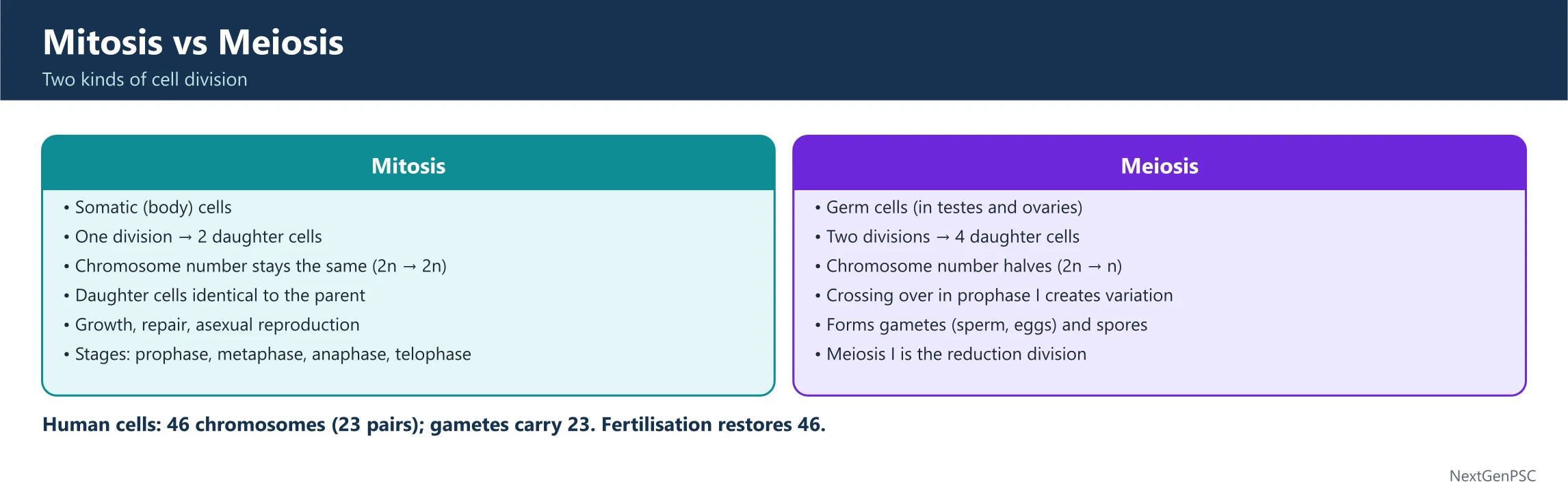
- Cell division: mitosis (in body cells) gives two identical diploid cells for growth and repair – prophase, metaphase, anaphase, telophase; meiosis (in germ cells) gives four haploid gametes and creates variation through crossing over.
Mains points
- Biological Foundation: Cell theory provides the unifying framework for all biological sciences, from genetics to medicine.
- Technological Advancement: The transition from light to electron microscopy represents a paradigm shift in our ability to diagnose diseases at the molecular level.
- Evolutionary Continuity: The fact that all cells arise from pre-existing cells underscores the evolutionary link between all living organisms on Earth.
- Genetics and Heredity: Mendel's work integrated with cell biology explains how information inside the cell (DNA) is passed across generations.
Did you know?
- Robert Hooke thought the cells he saw looked like the small rooms or 'cells' where monks lived, which is how the cell got its name.
- The human body contains approximately 37.2 trillion cells!
- The Electron Microscope is so powerful it can magnify objects up to 2 million times, compared to a light microscope's 1,000 to 2,000 times.
Types of Organisms and the Architecture of Cells
Organisms are classified as Unicellular or Multicellular based on their cellular composition. Within these cells, specialized structures called Organelles act like tiny organs, performing specific tasks like energy production and waste removal, which allow the cell and the organism to survive.
1. Classification of Organisms
Life is organized into two primary categories based on the number of cells present:
Unicellular Organisms: These are self-contained organisms where a single cell performs all necessary life functions (e.g., Amoeba, Bacteria, Paramecium).
Multicellular Organisms: These contain a variety of specialized cells that work together. Different groups of cells perform distinct functions (e.g., Plants, Fungi, and Animals).
2. Cell Shape and Flexibility
The shape of a cell is not accidental; it is highly specialized to match the function it performs.
Fixed vs. Variable: Most cells have a fixed shape (like nerve cells), but some are amoeboid and can change shape freely.
Amoeba: Changes shape to capture food using pseudopodia.
White Blood Cells (WBCs): Change shape to squeeze through blood vessels and engulf pathogens.
3. Cell Organelles: The Internal Machinery
Just as the human body has organs (heart, lungs, kidneys) to stay alive, a cell has Organelles.
Definition: Specific internal components that perform specialized tasks.
Diversity of Function: Organelles are responsible for creating new materials (proteins/lipids), generating energy, and clearing cellular waste.
Survival: A cell can survive and perform its functions because of these organelles working in coordination.
| Feature | Unicellular | Multicellular |
|---|---|---|
| Cell Count | Single Cell | Many Cells |
| Division of Labour | All functions by one cell | Different cells for different tasks |
| Complexity | Simple Organization | Complex (Tissues, Organs) |
| Examples | Amoeba, Bacteria | Humans, Mango Tree, Mushroom |
Prelims tips
- Division of Labour: This is a hallmark of multicellularity where cells specialize for specific efficiency.
- Variable Shape: WBCs and Amoeba are the two primary examples of cells that change shape to perform their roles.
- Organelles: These allow a single cell to function as a complete, independent living unit.
- Cell Specialization: Nerve cells are long to transmit signals, while muscle cells are contractile to help in movement.
Mains points
- Evolutionary Significance: The transition from unicellular to multicellular life allowed for greater complexity and the development of specialized systems (nervous, circulatory, etc.).
- Cellular Efficiency: Cell shape optimization (like the biconcave shape of RBCs for oxygen transport) demonstrates the fundamental biological principle of 'form follows function'.
- Biotechnology: Understanding how organelles function is the basis for modern medical treatments, such as targeting specific organelles like mitochondria for genetic therapies.
- Disease Mechanisms: Many diseases occur at the organelle level; for example, 'Lysosomal Storage Disorders' happen when waste-clearing organelles fail.
Did you know?
- The Ostrich egg is the largest single cell in the world, measuring about 15-18 cm!
- Despite having trillions of cells, every multicellular human starts life as a single unicellular Zygote.
- If you took all the cells in your body and lined them up, they would circle the Earth several times.
Fundamental Structure and Transport Mechanisms of a Cell
Every cell is defined by three core components: the Plasma Membrane, the Nucleus, and the Cytoplasm. The plasma membrane acts as a Selectively Permeable gatekeeper, regulating the flow of life-sustaining materials via Diffusion and Osmosis to maintain internal balance.
1. The Three Essential Features of a Cell
Almost every cell exhibits three basic functional regions regardless of its type.
Plasma Membrane: The outermost covering of the cell that separates its contents from the external environment.
Nucleus: The genetic control center containing DNA (often called the 'brain' of the cell).
Cytoplasm: The jelly-like fluid that fills the cell and houses the organelles.
2. Plasma Membrane: The Gatekeeper
The plasma membrane is not just a container; it is an active biological shield.
Selectively Permeable: It allows the entry and exit of some materials while preventing others. This ensures the cell maintains a specific internal chemical environment.
Composition: It is flexible and made up of organic molecules called lipids and proteins.
3. Movement of Substances: Diffusion & Osmosis
Materials move across the membrane based on concentration gradients.
A. Diffusion (Gaseous Exchange)
Mechanism: Movement of substances (like $O_2$ and $CO_2$) from a region of high concentration to a region of low concentration.
In Cells: When $CO_2$ builds up inside a cell (high concentration), it naturally diffuses out to the external environment (low concentration).
B. Osmosis (Water Movement)
Definition: The spontaneous movement of water molecules through a selectively permeable membrane.
Direction: Water moves from a region of high water concentration (dilute solution) to a region of low water concentration (concentrated solution).
| Feature | Diffusion | Osmosis |
|---|---|---|
| Substances Moved | Solutes (Gases, Liquids, Solids) | Solvent (Water only) |
| Membrane | Not required | Requires a semi-permeable membrane |
| Example | Exchange of $O_2$ and $CO_2$ | Roots absorbing water from soil |
Prelims tips
- Selective Permeability: Crucial keyword for the Plasma Membrane; it's why the cell doesn't just dissolve into its surroundings.
- Direction of Diffusion: Always moves down the concentration gradient (High to Low).
- Osmosis: It is technically a special case of diffusion, specifically for water.
- Endocytosis: The flexibility of the membrane allows cells like Amoeba to engulf food from the environment.
Mains points
- Homeostasis: The Plasma Membrane is fundamental to maintaining a stable internal state, which is a prerequisite for the survival of all complex life forms.
- Medical Application: Understanding osmosis is critical in medicine, such as in Dialysis or when administering IV fluids, to ensure blood cells don't burst or shrivel.
- Cellular Communication: The proteins embedded in the membrane act as receptors, allowing the cell to receive 'instructions' (hormones) from the brain and other organs.
- Environmental Adaptation: Plant cells use osmosis to create 'Turgor Pressure,' which helps non-woody plants stand upright even without a skeleton.
Did you know?
- The Plasma Membrane is so thin that it would take about 10,000 layers of it to equal the thickness of a single piece of paper!
- Your Red Blood Cells can actually shrink or swell depending on the salt concentration of your blood, all thanks to Osmosis.
- Diffusion is the reason why the smell of a perfume sprayed in one corner of a room eventually reaches the other side.
Cell Wall and Nucleus: Protection and Genetic Control
The Cell Wall provides structural rigidity to plant cells, while the Nucleus acts as the command center. Containing DNA and Proteins within its porous membrane, the nucleus stores the blueprints of life and directs all cellular activities.
1. The Cell Wall: Structural Support
Unlike animal cells, plant cells have an extra layer outside the plasma membrane.
Composition: It is primarily made of Cellulose, a complex carbohydrate that provides structural strength.
Function: It maintains the shape of the cell and protects it from mechanical stress and osmotic pressure.
2. The Nucleus: The Brain of the Cell
The nucleus is a prominent organelle that orchestrates all vital functions.
Nuclear Membrane: A double-layered covering that separates the nucleus from the cytoplasm.
Nuclear Pores: Microscopic openings that regulate the exchange of materials (like RNA and proteins) between the nucleus and cytoplasm.
3. Chromosomes and Genetic Material
Inside the nucleus lie the Chromosomes, which are visible as rod-shaped structures only when the cell is about to divide.
DNA (Deoxyribonucleic Acid): Contains the information necessary for constructing and organizing new cells.
Proteins: Specifically Histones, which act as spools for the DNA to wind around, aiding in packaging and condensation.
Genes: Functional segments of DNA are called genes; they are the hereditary units.
| Feature | Cell Wall | Plasma Membrane |
|---|---|---|
| Occurrence | Found in Plants, Fungi, Bacteria | Found in all living cells |
| Permeability | Freely Permeable | Selectively Permeable |
| Function | Protection and Rigidity | Regulates entry/exit of materials |
| Material | Mainly Cellulose (in plants) | Lipids and Proteins |
Prelims tips
- Cellulose: A complex substance that humans cannot digest, but it provides necessary fiber in our diet.
- Nucleoid: In bacteria (prokaryotes), the nucleus is not well-defined and is called a nucleoid.
- Chromatin: When a cell is not dividing, the DNA is present as a tangled mass of thread-like structures called chromatin.
- Functional Segments: Remember that Genes are the functional segments of DNA.
Mains points
- Genetic Engineering: The ability to manipulate DNA within the nucleus is the basis of modern biotechnology, including CRISPR and GMO crops.
- Cellular Governance: The nucleus acts as a molecular library; it doesn't just store information but actively 'reads' it to produce proteins through RNA.
- Plant Resilience: The rigid cell wall allows plants to survive in varying environments, preventing cells from bursting even when they take in excess water via osmosis.
- Aging and DNA: Accumulation of damage to the DNA inside the nucleus is one of the primary theories behind the biological process of aging.
Did you know?
- If you uncoiled all the DNA in just one of your cells, it would be about 2 meters long!
- Human beings have 46 chromosomes (23 pairs) in the nucleus of almost every cell in their body.
- The Cell Wall is why trees can grow so tall without a skeleton; the cellulose provides the 'wood' its strength.
Genetic Material and Cellular Classification
The internal architecture of the nucleus defines the complexity of life. From the thread-like Chromatin to the ribosome-building Nucleolus, these components manage genetic data. The presence or absence of a Nuclear Membrane serves as the primary distinction between primitive Prokaryotes and advanced Eukaryotes.
1. Chromatin and Chromosomes
Genetic material exists in different physical states depending on the cell's life cycle.
Chromatin: A tangled, thread-like mass of DNA and proteins found in a non-dividing cell.
Transformation: When a cell prepares to divide, chromatin fibers coil and condense into thick, rod-like structures called Chromosomes.
2. The Nucleolus: The Ribosome Factory
Often described as the 'Brain of the Nucleus', the nucleolus is a dense region within the nucleus.
Composition: It occupies about 25% of the nuclear volume and is rich in RNA and proteins.
Function: Its primary job is to synthesize Ribosomes, which are the protein-making machinery of the cell.
3. Nucleoid: The Undefined Nucleus
In simpler organisms, the genetic material is not 'housed' in a neat container.
Definition: An irregularly shaped region within the cell that contains all or most of the genetic material but lacks a Nuclear Membrane.
Boundaries: Because there is no membrane, the genetic material is in direct contact with the cytoplasm.
4. Prokaryotes vs. Eukaryotes
This is the most fundamental classification in biology based on nuclear organization.
Prokaryotes: Organisms (like Bacteria) that lack a defined nuclear membrane and membrane-bound organelles. (Greek: Pro = primitive; Karyon = nucleus).
Eukaryotes: Organisms (like Plants, Animals, Fungi) that possess a well-defined nuclear membrane and specialized organelles. (Greek: Eu = true; Karyon = nucleus).
| Feature | Prokaryotes | Eukaryotes |
|---|---|---|
| Size | Generally small (1-10 µm) | Larger (5-100 µm) |
| Nuclear Region | Poorly defined (Nucleoid) | Well defined with membrane |
| Chromosomes | Single and circular | More than one; linear |
| Organelles | Membrane-bound organelles absent | Membrane-bound organelles present |
| Examples | Bacteria, Blue-green algae | Fungi, Plants, Animals |
Prelims tips
- Etymology: 'Karyon' always refers to the nucleus in biological terms.
- Nucleoid vs Nucleolus: Don't confuse them! Nucleoid is a region in bacteria; Nucleolus is a structure inside a eukaryotic nucleus.
- Ribosome Origin: If a question asks where ribosomes are made, the answer is the Nucleolus.
- Blue-green Algae: Despite the name 'algae', these are actually Prokaryotes (Cyanobacteria).
Mains points
- Evolutionary Lineage: The transition from Prokaryotic to Eukaryotic cells (Endosymbiotic Theory) is one of the most significant events in the history of life on Earth.
- Cancer Biology: Large and irregularly shaped nucleoli are often used by pathologists as a diagnostic marker for cancer cells, indicating high protein synthesis for rapid growth.
- Antibiotic Targets: Many antibiotics work by specifically targeting prokaryotic ribosomes while leaving eukaryotic ones alone, allowing us to kill bacteria without harming human cells.
- Genetic Stability: The nuclear membrane in Eukaryotes provides an extra layer of protection for DNA, reducing the rate of mutation compared to Prokaryotes.
Did you know?
- The Nucleolus disappears during cell division and reappears once the new daughter cells are formed!
- Even though Prokaryotes are simple, they are the most resilient life forms, capable of surviving in boiling vents and freezing ice.
- Almost all the DNA in a Eukaryotic cell is packed so tightly that it fits into a nucleus that is only about 6 micrometers in diameter.
Comparison: Prokaryotes vs. Eukaryotes
The distinction between Prokaryotes (primitive) and Eukaryotes (advanced) is the most fundamental divide in biology. While both share some basic features like a plasma membrane and DNA, the complexity of internal organization—specifically the presence of a Nuclear Membrane and Membrane-bound Organelles—separates them into two distinct lineages of life.
1. Defining the Core Difference
The word 'Prokaryote' comes from 'Pro' (primitive) and 'Karyon' (nucleus), whereas 'Eukaryote' comes from 'Eu' (true) and 'Karyon'.
Nuclear Region: In Prokaryotes, the genetic material is naked and concentrated in an undefined region called the Nucleoid. In Eukaryotes, DNA is enclosed within a double-layered Nuclear Membrane.
Size: Prokaryotes are generally microscopic and much smaller (1-10 µm) compared to Eukaryotes (5-100 µm).
2. Organelles and Internal Architecture
Eukaryotic cells are like highly organized factories with specialized departments, while Prokaryotes are more like open-plan studios.
Membrane-bound Organelles: Eukaryotes contain specialized structures like Mitochondria, Golgi Apparatus, and Endoplasmic Reticulum. Prokaryotes lack these complex internal compartments.
Ribosomes: Both have ribosomes (for protein synthesis), but they differ in size and structure (70S in Prokaryotes vs 80S in Eukaryotes).
3. Genetic Structure and Reproduction
Chromosomes: Prokaryotes typically have a single, circular chromosome. Eukaryotes have multiple, linear chromosomes packed with proteins (histones).
Cell Division: Prokaryotes divide primarily through Binary Fission. Eukaryotes undergo more complex processes like Mitosis or Meiosis.
| Feature | Prokaryotic Cell | Eukaryotic Cell |
|---|---|---|
| Size | Small (1-10 µm) | Large (5-100 µm) |
| Nuclear Membrane | Absent | Present |
| Number of Chromosomes | Single (Circular) | More than one (Linear) |
| Nucleolus | Absent | Present |
| Membrane-bound Organelles | Absent | Present (Mitochondria, etc.) |
| Cell Division | Binary Fission | Mitosis / Meiosis |
| Examples | Bacteria, Cyanobacteria | Plants, Animals, Fungi, Protists |
Prelims tips
- Ribosomes: This is the only organelle found in both Prokaryotes and Eukaryotes (though they differ in size).
- Cyanobacteria: Often called 'Blue-green Algae', they are Prokaryotes, not Eukaryotes.
- Circular DNA: If you see 'circular DNA' in a question, think Prokaryote or Mitochondria/Chloroplasts.
- Pili and Flagella: Often present in Prokaryotes for movement and attachment.
Mains points
- Evolutionary Milestone: The transition from prokaryotic simplicity to eukaryotic complexity allowed for the evolution of multicellular organisms and specialized tissues.
- Endosymbiotic Theory: Evidence suggests that mitochondria and chloroplasts originated as free-living prokaryotes, explaining why they have their own DNA.
- Targeted Medicine: Because prokaryotic cells function differently, antibiotics can specifically target bacterial structures (like their cell walls or ribosomes) without harming human eukaryotic cells.
- Ecological Role: Prokaryotes drive essential global cycles (like Nitrogen fixation) that sustain all Eukaryotic life on Earth.
Did you know?
- You actually have more Prokaryotic cells (bacteria) living in and on your body than your own human Eukaryotic cells!
- The Mitochondria inside your Eukaryotic cells are thought to have once been independent Prokaryotes that were 'swallowed' by a larger cell billions of years ago (Endosymbiotic Theory).
- Despite their simplicity, Prokaryotes can live in extreme environments like volcanic vents and arctic ice where no Eukaryote could survive.
Cytoplasm: The Living Fluid of the Cell
The Cytoplasm is the jelly-like fluid that fills the space between the plasma membrane and the nucleus. It acts as the physical medium where most Cellular Processes occur, providing a platform for organelles to function and facilitating the movement of vital substances like hormones and nutrients.
1. Composition and Nature
The cytoplasm is primarily composed of water, salts, and organic molecules, forming a complex fluid environment.
Fluid Medium: It is the internal environment of the cell enclosed by the plasma membrane.
Host for Organelles: It contains highly specialized components called organelles, each performing a specific job for the cell's survival.
2. Key Functions of Cytoplasm
The cytoplasm is not just a filler; it is an active participant in cell life:
Support and Suspension: It provides physical support to organelles and keeps them in their required positions.
Metabolic Arena: Vital chemical reactions, such as the initial stages of glucose breakdown and protein synthesis, take place here.
Internal Transport: It facilitates the movement of molecules like hormones and nutrients from one part of the cell to another through a process called cytoplasmic streaming.
Waste Management: It helps in dissolving and breaking down cellular waste products before they are expelled or recycled.
| Function | Mechanism | Importance |
|---|---|---|
| Structural Support | Suspension of organelles | Prevents organelle damage |
| Metabolic Site | Chemical reactions (Glycolysis) | Energy and protein production |
| Transport | Molecular movement | Distribution of hormones/nutrients |
| Waste Removal | Dissolving waste | Keeps the cell detoxified |
Prelims tips
- Cytosol vs. Cytoplasm: Cytosol refers to the fluid part only, whereas Cytoplasm includes the fluid plus the organelles (except the nucleus).
- Glycolysis: The first step of respiration occurs in the cytoplasm, not the mitochondria.
- Eukaryotes vs. Prokaryotes: In prokaryotes, almost all chemical reactions happen in the cytoplasm since they lack membrane-bound organelles.
- Hormones: These chemical messengers are often transported through the cytoplasm to reach the nucleus or other organelles.
Mains points
- Biochemical Hub: The cytoplasm acts as a buffer, protecting the genetic material in the nucleus from chemical shocks and physical damage.
- Diagnostic Significance: Changes in the viscosity or appearance of the cytoplasm are often early indicators of cellular stress or viral infections in medical pathology.
- Evolutionary Efficiency: The ability of the cytoplasm to facilitate the rapid movement of molecules (cytoplasmic streaming) was essential for the evolution of larger, more complex eukaryotic cells.
- Pharmaceutical Target: Many drugs are designed to be 'activated' only once they cross the cell membrane and interact with specific enzymes in the cytoplasm.
Did you know?
- The cytoplasm is roughly 80% water, which is why hydration is so important for cellular health.
- Cytoplasm can change from a more fluid-like state (sol) to a more jelly-like state (gel) depending on the cell's needs!
- In large plant cells, the cytoplasm actually rotates around the central vacuole to distribute nutrients more efficiently.
Cell Organelles: Specialized Machinery of Eukaryotes
In Eukaryotic cells, specialized Membrane-bound Organelles act as distinct functional compartments. This separation of labor allows the cell to carry out complex chemical activities simultaneously without interference, much like different departments in a high-tech factory.
1. The Importance of Compartmentalization
Eukaryotic cells are much larger and more complex than prokaryotic cells. To manage this complexity, they use internal membranes.
Functional Separation: Each organelle has its own membrane, keeping its specific chemical reactions separate from the rest of the cell.
Efficiency: By concentrating enzymes and molecules in specific areas, the cell can perform life processes (like energy production or waste disposal) much more efficiently.
2. Key Organelles and Their Vital Roles
The cell functions through the coordinated efforts of several specialized units:
Endoplasmic Reticulum (ER): A vast network for manufacturing proteins (Rough ER) and lipids (Smooth ER).
Golgi Apparatus: The 'Post Office' that modifies, sorts, and packages proteins for delivery.
Lysosomes: The 'Suicide Bags' or waste disposal system containing digestive enzymes.
Mitochondria: The 'Powerhouse' of the cell where ATP (energy) is produced.
Plastids: Found only in plants; includes Chloroplasts for photosynthesis.
Vacuoles: Storage sacs for food, water, or waste.
Ribosomes: Small granules responsible for protein synthesis.
Centrioles: Help in cell division (mainly in animal cells).
Peroxisomes: Specialized in metabolic breakdown, specifically of fatty acids and detoxification of alcohol.
| Organelle | Analogy | Main Function |
|---|---|---|
| Nucleus | CEO / Brain | Genetic Control |
| Mitochondria | Power Plant | Energy (ATP) Production |
| Ribosomes | Factory Workers | Protein Synthesis |
| Golgi Apparatus | Post Office | Packaging & Shipping |
| Lysosomes | Garbage Truck | Digestion & Waste Removal |
| Vacuoles | Warehouse | Storage of Materials |
Prelims tips
- Membrane-bound: This is the key difference between Eukaryotes and Prokaryotes. Bacteria do not have these organelles.
- Ribosomes: Found in both prokaryotes and eukaryotes (not membrane-bound).
- Double Membrane: Nucleus, Mitochondria, and Chloroplasts have two layers of membranes.
- Suicide Bags: Clinical term for Lysosomes.
Mains points
- Cellular Governance: The division of labor among organelles allows eukaryotes to grow larger and form complex multicellular tissues.
- Medical Research: Many genetic diseases, like Mitochondrial disorders or Lysosomal Storage Diseases, are caused by a malfunction in a single type of organelle.
- Biochemical Efficiency: Organelles create specialized micro-environments (like the acidic interior of a lysosome) that would otherwise be harmful to the rest of the cytoplasm.
- Drug Targets: Understanding organelle function allows for the creation of targeted drugs that can, for example, block protein synthesis in bacteria without affecting human ribosomes.
Did you know?
- Mitochondria and Chloroplasts are so unique that they have their own DNA and can make some of their own proteins!
- The Lysosome contains enzymes so strong they could digest the cell itself if the lysosome membrane were to burst.
- A single cell can have hundreds or even thousands of Mitochondria, depending on how much energy it needs (muscle cells have the most).
Endoplasmic Reticulum (ER): The Cell's Manufacturing and Transport Network
The Endoplasmic Reticulum (ER) is an extensive network of membrane-bound tubes and sheets that serves as the cell's internal transport system. It plays a dual role: the Rough ER (RER) synthesizes proteins, while the Smooth ER (SER) produces lipids and detoxifies the cell. Together, they perform Membrane Biogenesis to build and repair the cell's boundaries.
1. Types of Endoplasmic Reticulum
The ER is categorized into two types based on the presence or absence of ribosomes on its surface.
Rough ER (RER): It appears rough under a microscope because Ribosomes are attached to its surface. These ribosomes are the sites of protein manufacture. Once synthesized, the RER helps in the folding of these proteins into their functional shapes.
Smooth ER (SER): It lacks ribosomes, giving it a smooth appearance. Its primary role is the synthesis of Fats or Lipids, which are essential for cellular function.
2. Membrane Biogenesis and Molecular Roles
The products of the ER are the building blocks of the cell itself.
Membrane Biogenesis: Some of the proteins and lipids produced by the ER are used to build the cell membrane. This construction process is called Membrane Biogenesis.
Enzymes and Hormones: Other proteins act as biological catalysts (enzymes), while both proteins and lipids function as hormones to send signals across the body.
3. Vital Functions of the ER
Intracellular Transport: The ER acts as a channel for the transport of materials (especially proteins) between different regions of the cytoplasm or between the nucleus and the cytoplasm.
Detoxification: In the liver cells of vertebrates, the Smooth ER plays a crucial role in detoxifying many poisons and drugs, making them harmless to the body.
| Feature | Rough ER (RER) | Smooth ER (SER) |
|---|---|---|
| Ribosomes | Present on the surface | Absent |
| Primary Product | Proteins | Lipids / Fats |
| Main Function | Protein synthesis & folding | Detoxification & Lipid synthesis |
| Appearance | Granular/Rough | Tubular/Smooth |
Prelims tips
- Membrane Biogenesis: Key term for the synthesis of the cell membrane using ER products.
- Liver Cells: Specifically, the SER in liver cells is responsible for detoxification.
- Ribosomes: Always associate RER with protein synthesis because of the ribosomes.
- Transport: The ER is the 'Highway' of the cell.
Mains points
- Metabolic Coordination: The ER serves as a site for various biochemical activities, showing how a single organelle can integrate transport and manufacturing.
- Pharmaceutical Impact: Understanding how SER detoxifies drugs is essential for determining drug dosages and understanding drug tolerance in patients.
- Genetic Disorders: Misfolding of proteins in the RER is a primary cause of several diseases, including Cystic Fibrosis and Alzheimer's.
- Structural Integrity: Through Membrane Biogenesis, the ER ensures the cell can grow, divide, and repair its boundaries, highlighting its role in cellular lifespan.
Did you know?
- The ER is so extensive that it often accounts for more than half of the total membrane in a eukaryotic cell!
- In muscle cells, a specialized form of SER called the Sarcoplasmic Reticulum stores calcium ions needed for muscle contraction.
- The Liver of a person who consumes a lot of medication or alcohol will have a much larger amount of Smooth ER to handle the constant detoxification.
Cell Logistics and Power: Detailed Guide to Golgi, Lysosomes, Mitochondria, and Plastids
Think of the cell as a tiny, high-tech city. The Golgi Apparatus is the shipping warehouse, Lysosomes are the recycling and waste trucks, Mitochondria are the power plants, and Plastids are the solar panels and storage units found only in plant cities. Together, they manage the logistics and energy needed for life.
1. Golgi Apparatus: The Packaging and Dispatch Center
The Golgi apparatus consists of a set of flattened, membrane-bound sacs called cisterns , stacked parallel to each other like a pile of pancakes.
The Packaging Process: Materials made in the Endoplasmic Reticulum (ER) come here first. The Golgi modifies them (like adding a 'label' to a package), stores them, and wraps them in small bubbles called vesicles to be sent wherever needed.
Manufacturing: It doesn't just pack; it also makes complex sugars from simple ones.
Lysosome Maker: It is the 'factory' that assembles lysosomes.
2. Lysosomes: The 'Suicide Bags' and Cleaners
Lysosomes are like the cell's internal digestive system. They are tiny sacs filled with very strong digestive enzymes.
Why are they called Cleaners? They break down 'foreign' invaders like bacteria and viruses, and they also digest old, broken parts of the cell so the materials can be recycled.
The 'Suicide' Action: If a cell becomes very sick or damaged beyond repair, the lysosomes burst on purpose. Their powerful enzymes then eat up the entire cell. This is why they are famously called 'Suicide Bags'.
Origin: Remember, the RER makes the enzymes, but the Golgi 'bags' them into the final lysosome.
3. Mitochondria: The Powerhouse and Energy Currency
Every activity—running, thinking, breathing—requires energy. Mitochondria provide that energy.
Two-Layer Security: They have an outer membrane and a deeply folded inner membrane. These folds (cristae) provide a huge surface area to produce more energy.
ATP - The Energy Currency: They produce ATP (Adenosine Triphosphate). Just as you need 'Rupees' to buy things, the cell needs 'ATP' to do work.
Semi-Autonomous: They are unique because they have their own DNA and ribosomes. They act like a 'cell within a cell' and can even make some of their own proteins!
4. Plastids: The Plant's Special Organelles
Plastids are like the mitochondria but are found only in plant cells. They also have their own DNA.
Chloroplasts (Green): These are the 'Solar Panels.' They contain Chlorophyll and perform photosynthesis to make food for the plant.
Chromoplasts (Colored): These give fruits and flowers their bright colors (red, orange, yellow) to attract birds and bees.
Leucoplasts (White/Colorless): These are the 'Storage Rooms.' They store food in the form of starch, oils, and proteins.
| Organelle | Simple Job | Where found? |
|---|---|---|
| Golgi Apparatus | Packing and shipping materials | Both plants and animals |
| Lysosome | Waste disposal and cleaning | Mainly animals |
| Mitochondria | Making energy (ATP) | Both plants and animals |
| Plastids | Making food and storing starch | Only Plants |
Prelims tips
- ATP: Full form is Adenosine Triphosphate (Energy Currency).
- Semi-Autonomous: Means having their own DNA (Mitochondria and Plastids).
- Enzymes: Lysosome enzymes are made by the Rough ER.
- Double Membrane: Mitochondria and Plastids both have two protective layers.
Mains points
- Industrial Model: The cell illustrates a perfect industrial model where input (from ER), processing (by Golgi), and energy supply (from Mitochondria) are perfectly synced.
- Evolution: The DNA in mitochondria suggests they were once free bacteria that formed a partnership with our cells billions of years ago (Endosymbiosis).
- Health: When lysosomes fail to work, it leads to 'Lysosomal Storage Diseases' where the cell becomes poisoned by its own waste.
- Food Security: Understanding plastids is the key to improving crop yields and photosynthesis efficiency in agriculture.
Did you know?
- Mitochondria are the reason you breathe! The oxygen you inhale is used by the mitochondria to 'burn' food and create energy.
- If you have a 'green thumb' and love plants, you can thank Chloroplasts for keeping them alive and green.
- The Golgi Apparatus was named after Camillo Golgi , who used a special silver staining technique to see it for the first time in 1898.
The Green Factories and Storage Units: Chloroplasts and Vacuoles
Chloroplasts are the solar-powered food factories of the plant world, converting sunlight into energy through Photosynthesis. Meanwhile, Vacuoles act as the cell's storage warehouses, holding onto water, nutrients, and waste to maintain the cell's internal pressure and health.
1. Chloroplasts: The Green Conductors
Derived from the Greek words 'Chloro' (green) and 'Plasts' (living/formed), these are the most important plastids in nature.
The Solar Pigment: They contain Chlorophyll, the green pigment that traps sunlight for energy.
Internal Machinery: Inside, they have a complex structure including Grana (stacks of disk-like Thylakoids) and a fluid called Stroma. They also carry their own DNA and RNA.
Vital Functions:
Photosynthesis: Converting light energy into chemical energy (glucose).
Oxygen Release: They release oxygen into the atmosphere as a byproduct, which we breathe.
Storage: They store food in the form of Starch granules.
Protein Synthesis: Like mitochondria, they can make some of their own proteins.
2. Vacuoles: The Storage Reservoirs
Vacuoles are membrane-bound sacs filled with liquid or solid contents. They act as the 'storage rooms' of the cell.
Plant vs. Animal:
In Plants: Vacuoles are very large and permanent. A single central vacuole can occupy 50% to 90% of the cell volume. It provides turgidity and rigidity to the cell.
In Animals: Vacuoles are small and temporary, used mainly for transporting or storing nutrients and waste.
Content: They store amino acids, sugars, various organic acids, and some proteins. In some unicellular organisms like Amoeba, specialized 'food vacuoles' contain the food items consumed.
| Feature | Chloroplast | Vacuole |
|---|---|---|
| Primary Function | Food production (Photosynthesis) | Storage and structural support |
| Pigment | Contains Chlorophyll | Usually no photosynthetic pigments |
| Found In | Only in Green Plants / Algae | Both Plants and Animals |
| Genetic Material | Has its own DNA/RNA | No genetic material |
Prelims tips
- Turgidity: Plant vacuoles provide the internal pressure (turgor) that keeps plants upright.
- Starch Storage: While leaves make sugar, chloroplasts and leucoplasts store it as starch.
- By-product: Remember that Oxygen is a by-product of the reactions happening inside chloroplasts.
- Tonoplast: The single membrane surrounding a vacuole is specifically called the tonoplast.
Mains points
- Global Ecology: Chloroplasts drive the Carbon Cycle by sequestering $CO_2$ and releasing $O_2$, making them central to discussions on climate change.
- Cellular Pressure: The large central vacuole in plants is a marvel of biological engineering, allowing plants to grow tall and reach for sunlight without a skeletal system.
- Waste Sequestration: Vacuoles serve a protective role by isolating toxic waste products from the rest of the cytoplasm, preventing cellular damage.
- Endosymbiotic Origins: Like mitochondria, chloroplasts are believed to have originated from ancient cyanobacteria, which explains why they possess their own DNA.
Did you know?
- Chloroplasts are the only reason life exists on Earth! They are the primary entry point for energy into the entire global food chain.
- In some plants, the central Vacuole is so large it pushes all other organelles, including the nucleus, against the cell wall.
- If a plant starts to wilt or droop, it's often because its Vacuoles have lost water and can no longer keep the cells stiff.
Plant vs. Animal Cells: Ribosomes and Peroxisomes
While Ribosomes are the universal protein factories found in every living cell, Peroxisomes act as specialized chemical laboratories that detoxify the cell. Understanding the differences between Plant and Animal Cells reveals how life adapts to different needs—like structural support in plants versus mobility in animals.
1. Ribosomes: The Protein Architects
Ribosomes are unique because they are not membrane-bound, which is why they are found in both Prokaryotes and Eukaryotes.
Free Floating: Ribosomes floating in the cytoplasm typically make proteins that stay inside the cell for its own use.
Attached (RER): Ribosomes attached to the Endoplasmic Reticulum make proteins destined to be exported outside the cell or sent to the cell membrane.
Universal Presence: Whether it's a tiny bacterium or a giant whale, every organism needs ribosomes to build the proteins that run life.
2. Peroxisomes: The Detox Centers
Peroxisomes are small, membrane-bound vesicles that carry out oxidative reactions.
Breakdown of Toxins: They use specific enzymes to neutralize toxic materials that could otherwise damage the cell.
Fatty Acid Digestion: They are essential for breaking down long chains of fatty acids so they can be used for energy.
Liver Function: Because the liver is the body's main filter, its cells are packed with peroxisomes to digest alcohol and other drugs.
3. Plant Cell vs. Animal Cell
The fundamental differences between these two types of cells reflect their lifestyles.
Cell Wall: Plants have a rigid cellulose wall for support; animals do not.
Plastids: Plants have chloroplasts for food; animals must eat food to get energy.
Vacuoles: Plants have one massive central vacuole; animals have many tiny ones.
Centrioles: Usually present in animal cells to help in division, but rare in higher plants.
| Feature | Plant Cell | Animal Cell |
|---|---|---|
| Cell Wall | Present (Cellulose) | Absent |
| Plastids | Present (Chloroplasts, etc.) | Absent |
| Vacuoles | One large central vacuole | Many small vacuoles |
| Centrioles | Absent (usually) | Present |
| Shape | Fixed / Rectangular | Irregular / Round |
Prelims tips
- Universal Organelle: Ribosome is the only organelle found in all cell types (Prokaryotic/Eukaryotic).
- Lipid Digestion: Peroxisomes are the key to metabolizing fats.
- Membrane Biogenesis: Proteins for the cell membrane are specifically made by the ribosomes on the Rough ER.
- Centrioles: A key identifying feature for Animal cells in microscope exams.
Mains points
- Metabolic Adaptation: The presence of peroxisomes in high numbers in the liver illustrates how organs adapt at a cellular level to handle environmental toxins like alcohol.
- Protein Targeting: The distinction between free and bound ribosomes shows how cells organize 'local' vs. 'export' logistics to maintain efficiency.
- Structural Evolution: The evolution of the large central vacuole allowed plants to grow vertically and compete for sunlight without needing a metabolic-heavy skeleton.
- Medical Research: Peroxisomal disorders can lead to severe neurological issues, as the brain relies heavily on the fatty acid metabolism performed by these tiny vesicles.
Did you know?
- Your liver cells have roughly 500 to 1,000 peroxisomes each, working overtime to clear out toxins!
- Ribosomes are so small that millions of them exist in a single cell, yet they are responsible for creating the enzymes that digest your food and the collagen in your skin.
- Plant cells have a fixed shape because of the Cell Wall, which acts like a suit of armor.
The Invisible World: Microorganisms and Bacteria Explained
Microorganisms are the invisible masters of our planet. They are so small that millions could fit on the head of a pin. While we often think of them as 'germs' that make us sick, most are actually 'heroes' that help us digest food, make medicines, and keep the environment clean. Bacteria, the most famous microbes, have lived on Earth for billions of years—long before the first dinosaur ever walked.
1. What Exactly are Microorganisms?
A microorganism (or microbe) is any living thing that is too small to be seen without a microscope. The science of studying them is Microbiology.
The Main Groups:
Bacteria: Simple, single-celled organisms (Prokaryotes).
Fungi: Includes the yeast that makes bread rise and the molds on old fruit.
Algae: Tiny plant-like organisms often found in ponds.
Protozoa: Complex single cells like the Amoeba.
The Virus Mystery: Scientists argue if viruses are 'alive.' They are like a computer virus—they do nothing until they enter a host (like a human cell). Outside a host, they are just inactive chemicals.
2. Bacteria: The Earth's Oldest Residents
Bacteria are the ultimate survivors. They were the very first life forms on Earth!
How many are there? If you counted every bacterium on Earth, you would reach 5 nonillion. That is a 5 followed by 30 zeros! Much of the Earth's total biological weight (biomass) comes from these tiny cells.
Shapes and Sizes:
Coccus (Round): Look like tiny balls.
Bacillus (Rod): Look like small sausages or pills.
Spiral: Look like corkscrews.
3. Breathing without Lungs: Aerobic vs. Anaerobic
Since bacteria don't have lungs, they 'breathe' or process energy differently depending on their environment.
Aerobic Bacteria (Oxygen Lovers): These need oxygen just like we do. Because oxygen is a powerful fuel, they produce lots of energy. They usually hang out at the surface of water where there is plenty of air.
Anaerobic Bacteria (Oxygen Haters): These do not need oxygen. Some can even be poisoned by air! They produce less energy and hide in places like deep mud, the bottom of lakes, or inside your intestines.
| Type | Oxygen Needed? | Energy Output | Common Location |
|---|---|---|---|
| Aerobic | Yes | High Energy | Surface of liquids/air |
| Anaerobic | No | Low Energy | Deep soil/bottom of liquids |
| Feature | Aerobic Bacteria | Anaerobic Bacteria |
|---|---|---|
| Oxygen Need | Mandatory for survival | Not required (can be toxic) |
| Energy Level | Produce more energy | Produce less energy |
| Position in Liquid | On the surface (Top) | Settled at the bottom |
| Example | M. tuberculosis | Clostridium |
Prelims tips
- Prokaryotic: Bacteria have no nucleus. This is a very common exam question.
- Mycobacterium tuberculosis: The bacteria that causes TB is Aerobic (needs air), which is why it loves the lungs.
- Biomass: Even though they are small, there are so many bacteria that they weigh more than all the plants and animals combined in some habitats.
- Antibiotics: These kill bacteria by breaking their cell walls, but they don't work on viruses because viruses have a different structure.
Mains points
- Environmental Role: Bacteria are nature’s 'recyclers.' They break down dead plants and animals into nutrients that help new life grow.
- Industrial Use: Beyond food, bacteria are used to create clean energy (biogas) and clean up oil spills (bioremediation).
- Microbiome Revolution: Modern medicine is finding that the bacteria in our gut (the microbiome) control our mood, weight, and immune system.
- Oxygen Production: Long ago, bacteria called Cyanobacteria produced the first oxygen on Earth, allowing humans and animals to eventually evolve.
Did you know?
- You have about 2 to 3 kilograms of bacteria living inside your body right now!
- Bacteria are used to turn milk into curd and cheese. Without them, we wouldn't have pizza or yogurt.
- Some bacteria are 'extremophiles'—they can live inside volcanoes, in freezing ice, or even in radioactive waste!
Kingdom Fungi: Nature's Great Recyclers
The Kingdom Fungi is a diverse group of over 1.5 million species, ranging from microscopic Yeasts to large Mushrooms. Unlike plants, they cannot make their own food; instead, they act as nature’s primary decomposers, breaking down organic matter to recycle essential nutrients back into the ecosystem.
1. What are Fungi?
Fungi are eukaryotic organisms that are distinct from plants, animals, and bacteria. They have a cell wall made of Chitin (unlike plants, which use cellulose).
Common Examples: This kingdom includes yeasts (single-celled), molds, mildews, rusts, smuts, and mushrooms.
No Photosynthesis: Even though some look like plants, they do not have chlorophyll and cannot perform photosynthesis.
2. Diverse Lifestyles of Fungi
Fungi survive in various environments using different strategies for nutrition:
Free-living: Found commonly in soil or water, living independently.
Parasitic: They live on or inside a host (plant or animal) and can cause diseases (e.g., athlete’s foot or wheat rust).
Symbiotic: They form 'partnerships' with other organisms. For example, Lichens (fungi + algae) or Mycorrhizae (fungi + plant roots), where both partners help each other.
3. The Power of Decomposition
Along with bacteria, fungi are the 'waste management' team of the planet.
Nutrient Recycling: They break down dead organic matter (leaves, wood, dead animals).
Release of Elements: This process releases critical elements like Carbon, Oxygen, Nitrogen, and Phosphorus back into the soil and air, making them available for new plants to grow.
4. Household and Industrial Uses
Fungi are indispensable to the human economy and diet:
Fermentation: Yeasts are used to make bread rise and to produce alcohol (wine and beer).
Food Production: Specific molds are used to give flavor and texture to certain cheeses (like Blue Cheese or Camembert).
Medicine: Many antibiotics, like Penicillin, are derived from fungi.
| Type | Relationship | Example |
|---|---|---|
| Saprophytes | Live on dead matter | Mushrooms, Bread mold |
| Parasites | Benefit at expense of host | Rusts, Smuts, Ringworm |
| Symbionts | Mutual benefit | Lichens (with Algae) |
Prelims tips
- Chitin: Remember this as the material of the fungal cell wall (often asked in exams).
- Saprophytes: Most fungi fall in this category (consumers of dead matter).
- Lichens: A classic example of symbiosis between a fungus and an alga/cyanobacterium.
- Antibiotics: Penicillin was the first 'miracle drug' discovered from the fungus Penicillium notatum.
Mains points
- Bio-Remediation: Fungi are being researched for their ability to break down plastics and clean up soil contaminated with heavy metals.
- Food Security: While useful, fungal diseases (like wheat rust) pose a significant threat to global agriculture and food supplies.
- Evolutionary Role: Fungi were likely the first organisms to colonize land, helping early plants survive by creating nutrient-rich soil.
- Medical Importance: Beyond antibiotics, fungi are essential in producing cholesterol-lowering statins and immunosuppressant drugs for organ transplants.
Did you know?
- The largest living organism on Earth is actually a fungus! A Honey Mushroom in Oregon spreads across 2,385 acres underground.
- Without fungi, the forests would be piled high with dead trees and leaves that would never rot away.
- Yeast is a single-celled fungus that 'breathes' out Carbon Dioxide, which is what creates the tiny air bubbles that make bread fluffy.
Viruses and Zoonotic Diseases: The Invisible Invaders
Viruses are unique infectious agents that exist on the edge of life. They are neither plants, animals, nor bacteria; instead, they are simple genetic packages that require a Living Host to multiply. When these infections jump from animals to humans, they are known as Zoonotic Diseases.
1. The Nature of Viruses
Viruses are incredibly small agents with a simple composition: a core of genetic material (DNA or RNA) wrapped in a protein coat.
Taxonomic Status: They occupy a special position in biology. They aren't classified as prokaryotes or eukaryotes and are often placed in their own separate category.
The Host Requirement: Viruses are 'obligate parasites.' They cannot survive or reproduce on their own. They must hijack the machinery of a host cell—be it a plant, animal, or even a bacterium (known as a Bacteriophage).
Research Challenges: Because they only grow in living cells, studying human viruses is difficult because scientists must find susceptible animal hosts for testing.
2. Zoonotic Diseases (Zoonoses)
A zoonotic disease is an infectious disease that has jumped from a non-human animal to humans.
Transmission: These can be spread through direct contact, contaminated food/water, or through vectors like mosquitoes and ticks.
Global Impact: Major outbreaks like COVID-19, Ebola, and Rabies are all zoonotic, highlighting the close link between human and animal health.
3. Common Diseases and Their Agents
Microorganisms cause a wide variety of illnesses. Knowing the specific agent is crucial for treatment (e.g., using antibiotics for bacteria vs. antivirals for viruses).
| Disease | Causative Microorganism | Type |
|---|---|---|
| AIDS | HIV (Human Immunodeficiency Virus) | Virus |
| Tuberculosis | Mycobacterium tuberculosis | Bacteria |
| Typhoid | Salmonella Typhi | Bacteria |
| Smallpox / Chicken Pox | Variola / Varicella Virus | Virus |
| Cholera | Vibrio cholerae | Bacteria |
| Dengue | Flavivirus | Virus |
| Plague | Yersinia pestis | Bacteria |
| Influenza / Cold | Rhino Virus / Myxovirus | Virus |
Prelims tips
- Genetic Material: Viruses can have either DNA or RNA, but never both.
- Vector-borne vs Zoonotic: Dengue is vector-borne (mosquitoes), while Rabies is zoonotic (animal bite).
- Smallpox: It is the only human infectious disease to have been completely eradicated globally.
- Hepatitis & Polio: Both are caused by viruses that share the same name as the disease.
Mains points
- One Health Approach: Modern strategy emphasizes that human health, animal health, and environmental health are interdependent, especially in preventing future pandemics.
- Public Health Infrastructure: The rise of zoonotic diseases like COVID-19 and Nipah requires robust surveillance of wildlife and livestock to detect 'spillover' events early.
- Vaccine Technology: Viral diseases are best managed through vaccination (like mRNA or viral vector vaccines), as curative treatments are often limited compared to bacterial infections.
- Bioterrorism: Agents like Bacillus anthracis (Anthrax) and Yersinia pestis (Plague) are classified as high-priority threats due to their potential use as biological weapons.
Did you know?
- Viruses that infect bacteria are called Bacteriophages, which literally means 'bacteria eaters.'
- Acne is actually caused by a bacteria named Propionibacterium acnes that lives deep inside your pores.
- Antibiotics only kill Bacteria. Taking them for a viral cold or flu is ineffective and can lead to drug resistance.
Antibiotics vs. Antivirals: Different Weapons for Different Enemies
The most critical distinction in modern medicine is understanding that Antibiotics only kill bacteria, while Antivirals are required to inhibit viruses. Using the wrong one is not just ineffective—it contributes to the global crisis of Antimicrobial Resistance.
1. Why Antibiotics Don't Work on Viruses
To understand why, we look at the 'targets' of these drugs.
Targeting Structures: Antibiotics work by attacking features that bacteria have but human cells (and viruses) do not. For example, Penicillin destroys the Bacterial Cell Wall.
Viruses lack these targets: Viruses do not have cell walls, ribosomes, or their own metabolism. They hide inside your own cells and use your machinery. Therefore, an antibiotic has nothing to attack on a virus.
2. How Antivirals Work
Since viruses use our own cells, killing them without harming the host is very difficult.
Blocking Entry: Some antivirals prevent the virus from attaching to or entering your cells.
Stopping Replication: Others interfere with the virus's ability to copy its genetic material (DNA/RNA).
Preventing Release: Some drugs block the newly made viruses from leaving the host cell to infect others.
| Feature | Antibiotics | Antivirals |
|---|---|---|
| Target Enemy | Bacteria (e.g., Strep throat, TB) | Viruses (e.g., Flu, HIV, COVID) |
| Mechanism | Kills the bacteria or stops growth | Inhibits development/replication |
| Natural Source | Often derived from fungi/bacteria | Mostly synthetic (man-made) |
| Key Example | Amoxicillin, Azithromycin | Oseltamivir, Acyclovir |
Prelims tips
- Bacteriostatic vs Bactericidal: Some antibiotics stop bacteria from growing (static), while others kill them outright (cidal).
- Broad-spectrum: Antibiotics that kill many types of bacteria (can also kill 'good' gut bacteria).
- Vaccines: Unlike antivirals, vaccines are used before infection to train the immune system to recognize the virus.
- Antimicrobial Resistance (AMR): Occurs when bacteria evolve to survive the drugs meant to kill them.
Mains points
- The AMR Crisis: The WHO considers Antimicrobial Resistance one of the top 10 global public health threats. Misuse of antibiotics for viral infections is a primary driver of this.
- Drug Toxicity: Antivirals are harder to develop because viruses live inside human cells; a drug that kills a virus can often be toxic to the human host as well.
- Economic Burden: Developing new antibiotics is expensive and slow, while bacteria evolve resistance very quickly, leading to a 'discovery void' in modern medicine.
- Global Surveillance: Monitoring the use of these drugs is essential for preserving the efficacy of existing treatments for future generations.
Did you know?
- The first antibiotic, Penicillin, was discovered by accident when Alexander Fleming noticed a mold (fungus) killing his bacterial samples.
- Viruses are like 'hijackers.' They take over your cell's 'factory' to make more viruses. Antivirals are like 'security guards' that try to stop the hijacking.
- Taking antibiotics for a viral cold is like using a lawnmower to try and fix a computer software bug—it's simply the wrong tool for the job.
Protozoan Diseases and the Double-Edged Sword of Microbes
Protozoa are complex, single-celled organisms that function more like animal cells than bacteria. While they cause significant diseases like Malaria, microorganisms as a whole are vital to human survival, providing us with medicines, fermented foods, and essential environmental services like Nitrogen Fixation.
1. Protozoa: The Complex Microbes
Protozoa are 'one-celled animals.' Unlike bacteria (prokaryotes), protozoa are Eukaryotes, meaning they have a defined nucleus and complex organelles.
Size: They are generally larger and more complex than bacteria.
Parasitic Nature: Many protozoans live as parasites, causing severe diseases in humans.
2. Common Protozoan and Fungal Diseases
Fungal Infections: Include Candidiasis (yeast infection), Aspergillosis (affects lungs), and Ringworm (skin infection).
Protozoan Infections:
Malaria: Caused by Plasmodium (carried by mosquitoes).
Kala Azar: Caused by Leishmania.
Sleeping Sickness: Caused by Trypanosoma.
3. The Benefits of Microbes: Nature's Helpers
Microorganisms are essential for life, industry, and the environment.
Antibiotics: Fungi like Penicillium provide us with life-saving drugs.
Fermentation: Saccharomyces cerevisiae (Yeast) is used for bread and alcohol. Lactobacillus turns milk into curd.
Bioremediation: Microbes are used as 'clean-up crews' to remove pollutants, toxins, and oil spills from soil and water.
Nitrogen Fixation: Microbes convert inert Nitrogen ($N_2$) from the air into reactive forms like Ammonia or Nitrates that plants can actually use to grow.
Bio-fertilizers: These are living microbes that increase the nutrient availability in the soil, reducing the need for chemical fertilizers.
| Disease | Protozoan Agent | Key Characteristic |
|---|---|---|
| Amoebiasis | Entamoeba histolytica | Intestinal infection |
| Kala Azar | Leishmania | Spread by sandflies; affects liver/spleen |
| Malaria | Plasmodium | Transmitted by female Anopheles mosquito |
| Sleeping Sickness | Trypanosoma | Transmitted by the Tsetse fly |
Prelims tips
- Malaria: Always remember it is Protozoan, NOT Bacterial or Viral.
- Lactobacillus: Converts lactose sugar in milk into lactic acid to form curd.
- Rhizobium: A common nitrogen-fixing bacteria found in the root nodules of leguminous plants (pulses).
- Yeast: Scientifically known as Saccharomyces cerevisiae.
Mains points
- Sustainable Agriculture: The shift toward Bio-fertilizers is crucial for reducing soil degradation caused by excessive chemical urea and phosphate usage.
- Climate Change: Microbes play a dual role—they help in carbon sequestration but also release greenhouse gases like methane from melting permafrost.
- Tropical Diseases: Protozoan diseases like Malaria and Leishmaniasis are 'neglected tropical diseases' that primarily affect developing nations, requiring global R&D support.
- Industrial Biotechnology: The use of specialized enzymes (from microbes) in detergents and food processing is a multi-billion dollar industry that reduces energy consumption.
Did you know?
- The Plasmodium parasite that causes Malaria is a master of disguise, constantly changing its surface proteins to hide from your immune system.
- Bioremediation was famously used to clean up the massive Exxon Valdez oil spill using oil-eating bacteria.
- Without Nitrogen-fixing bacteria in the soil, we would run out of food globally because plants cannot 'breathe' in the nitrogen they need from the air.
Plant Anatomy: Roots and Vascular Tissues
The Root System serves as the foundation of a plant, providing stability and absorbing life-sustaining nutrients. To move these materials, plants use specialized Vascular Tissues: Xylem for water transport and Phloem for food distribution. Understanding the difference between Monocots and Dicots helps us classify how different plants organize these systems.
1. The Root System: Functions and Types
Roots are the underground parts of a plant that grow towards gravity and moisture.
Primary Functions:
Absorption: Taking in water and essential minerals from the soil.
Anchorage: Holding the plant firmly in the ground.
Storage: Saving food reserves (like in carrots or radishes).
Regulators: Producing plant growth hormones.
Adventitious Roots: Uniquely, these roots grow from parts of the plant other than the radicle (the first root from a seed). Examples include the hanging roots of a Banyan tree or roots on Maize stalks.
2. Monocots vs. Dicots
Plants are often divided into these two categories based on their seeds and root structures.
Monocots: Usually have Fibrous Roots (a cluster of thin roots). Examples: Grass, Wheat, Maize.
Dicots: Usually have a Tap Root system (one main thick root with smaller branches). Examples: Mustard, Mango, Carrot.
3. Vascular Tissues: The Plant's Transport System
Since plants can't move to get water or food, they have internal 'pipes' called vascular tissues.
Xylem: Transports water and minerals upwards from the roots to the leaves. It is a one-way street.
Phloem: Transports food (sugar) made in the leaves to all parts of the plant (up and down). It is a two-way street.
| Feature | Xylem | Phloem |
|---|---|---|
| Transport Material | Water and Minerals | Food (Sugar/Sucrose) |
| Direction of Flow | Unidirectional (Upwards) | Bidirectional (Up and Down) |
| Tissue Nature | Mostly dead cells | Mostly living cells |
| Primary Force | Transpiration Pull | Osmotic Pressure |
Prelims tips
- Radicle: The part of the seed embryo that develops into the primary root.
- Transpiration Pull: The main force that helps Xylem move water hundreds of feet high in tall trees.
- Sieve Tubes: Specialized cells found in Phloem for transporting food.
- Storage Roots: Sweet potato is an adventitious storage root, while carrot is a tap root storage root.
Mains points
- Agricultural Efficiency: Understanding root systems helps farmers choose the right irrigation and fertilization methods for specific crops.
- Environmental Resilience: Plants with deep tap roots are better at surviving droughts, while fibrous roots are excellent for preventing soil erosion.
- Bio-resource: Modified roots (like ginger and turmeric) are not just food but also major sources of medicinal compounds and plant growth regulators.
- Climate Change: Trees act as carbon sinks partly because the carbon they capture is stored in the structural cellulose of their xylem (wood) and roots.
Did you know?
- Banyan trees use adventitious 'prop roots' that grow down from branches to the ground to support their massive weight.
- A Carrot is actually a modified tap root that the plant uses to store energy for the next year.
- The Xylem in a tree eventually becomes the wood that we use for furniture!
Xylem and Phloem: The Plant's Vascular Network
Plants possess a sophisticated internal transport system composed of two main vascular tissues: Xylem and Phloem. While Xylem acts as a structural pipeline for water and minerals, Phloem functions as a living distribution network for sugars and nutrients produced during photosynthesis.
1. Xylem: The Water Pipeline
Xylem is primarily responsible for the 'ascent of sap'—moving water and minerals from the soil to the leaves.
Composition: It is largely made up of dead cells (like vessels and tracheids) that form hollow tubes.
Direction: It works in a unidirectional manner, meaning water moves only one way—upwards from the roots to the apical (top) parts.
Structure: It has thick cell walls reinforced with lignin, which also provides mechanical support to the plant.
Mechanism: It relies on passive transport, powered by forces like transpiration pull and capillary action (no energy required).
2. Phloem: The Food Distributor
Phloem is the plant's 'logistics' department, moving manufactured food from 'sources' (leaves) to 'sinks' (roots, fruits, and growing buds).
Composition: Unlike xylem, phloem is made up of living cells (like sieve tubes and companion cells).
Direction: It is bidirectional. Food can travel down to the roots for storage or up to the flowers and fruits for growth.
Structure: It has relatively thin cell walls compared to xylem.
Mechanism: It uses active transport (translocation), meaning the plant spends energy (ATP) to pump sugars into the phloem.
| Feature | Xylem | Phloem |
|---|---|---|
| Main Function | Transport of Water & Minerals | Transport of Food (Sucrose) |
| Cell Vitality | Dead Cells | Living Cells |
| Flow Direction | Unidirectional (Upwards) | Bidirectional (Two-way) |
| Cell Wall | Thick (Lignified) | Thin |
| Energy Use | Passive (No ATP used) | Active (Uses ATP) |
Prelims tips
- Tracheary elements: Tracheids and vessels are the main water-conducting cells in xylem.
- Sieve Tubes: These are the main food-conducting cells in phloem, unique because they lack a nucleus at maturity.
- Passive vs Active: Remember that moving sugar (Phloem) requires energy (ATP), while moving water (Xylem) is mostly physical suction.
- Location: In a stem, Xylem is usually located towards the center (pith), and Phloem is towards the outside (bark).
Mains points
- Resource Management: The bidirectional flow in phloem allows plants to survive seasonal changes, storing food in roots during winter and moving it to new buds in spring.
- Agricultural Impact: Understanding vascular transport is key to systemic pesticides, which are absorbed by the plant and carried through xylem and phloem to kill pests.
- Structural Integrity: Lignified xylem provides the necessary strength for trees to reach great heights, competing for sunlight—a key evolutionary advantage.
- Hydrological Cycle: Xylem-driven transpiration accounts for a significant portion of moisture return to the atmosphere, influencing local climates.
Did you know?
- The wood of a tree is actually made of old, inactive xylem tissue.
- Aphids (tiny insects) specifically target the phloem because it is full of energy-rich sugary sap.
- If you 'girdle' a tree (remove a ring of bark), you destroy the phloem. The tree will die because the roots will starve, even though the xylem can still send water up!
The Life of a Plant: Deep Dive into Stems, Leaves, and Flowers
Plants are amazing biological machines. The Stem acts as the plumbing and support beams, the Leaf is the solar-powered kitchen, and the Flower is the reproductive center that creates the next generation through seeds.
1. The Stem: The Plant's Multi-Tasker
If the plant were a building, the stem would be the framework and the elevator system combined.
The Highway: It moves water from the roots to the leaves and food from the leaves to the roots using Xylem and Phloem.
Nodes and Internodes: Think of a Node as a joint where a leaf 'plugs in.' The Internode is the empty stretch of stem between two joints.
Survival Modifications:
The Underground 'Fridge': Some plants hide their stems underground to store food (Potato, Ginger). They look like roots but have 'eyes' or buds, proving they are stems.
Climbers (Tendrils): Thin, thread-like coils that act like hands to grab onto fences or trees (e.g., Peas).
Bodyguards (Thorns): Sharp, woody points that stop animals from eating the plant.
2. The Leaf: Nature's Solar Panel
The leaf is thin and flat to catch as much sunlight as possible for Photosynthesis.
Leaf Base: The 'glue' that attaches the leaf to the stem node.
Petiole: The 'neck' or stalk. It allows the leaf to flutter in the wind, which cools the plant and brings in fresh air.
Lamina: The broad green part. It is filled with Veins (tiny pipes) that bring water in and take food out.
3. The Flower: Where Life Begins
The flower's main job is to produce seeds. To do this, it uses two main reproductive sets.
The Male Team (Androecium): Made of Stamens. Each stamen has a bag called an 'anther' that holds Pollen (the yellow dust).
The Female Team (Gynoecium): Made of Carpels or Pistils. This part contains the Ovary at the bottom, which will eventually turn into a fruit after it is fertilized.
Reproductive Logic:
Bisexual: Most flowers have both sets (like a Hibiscus). They can often pollinate themselves.
Unisexual: Some plants have separate 'Boy' flowers and 'Girl' flowers (like Watermelon or Papaya).
| Plant Part | How to Identify | Main Job |
|---|---|---|
| Stem | Has Nodes (joints) | Support and Transport |
| Leaf | Has veins and green Lamina | Making Food |
| Flower | Has bright petals and reproductive organs | Making Seeds/Fruits |
Prelims tips
- Axillary Bud: Found between the leaf and stem; it’s the potential for a new branch.
- Modification: UPSC often asks about Potato vs. Sweet Potato. Potato = Stem; Sweet Potato = Root.
- Angiosperms: These are the 'advanced' plants that have the monopoly on flowers.
- Stamen: Think 'Stay-Men' (Male part).
Mains points
- Economic Botany: The study of modified stems and leaves is essential for food security, as tubers (potatoes) and leafy greens provide a significant portion of human calories.
- Genetic Diversity: Unisexual plants often require cross-pollination (pollination between two different plants), which increases genetic variation and resilience in nature.
- Bio-mimicry: Engineers study the structure of leaves to create more efficient solar panels and the strength of stems to design earthquake-resistant buildings.
- Agricultural Technology: Understanding axillary buds allows for 'pruning' techniques in gardening and farming to increase fruit yield.
Did you know?
- Ginger and Turmeric are underground stems that help the plant survive harsh weather when the upper parts die off.
- A Bisexual flower is like a 'complete' biological package, carrying everything needed to produce offspring in one place.
- Plants like Cactus have modified their stems to be green and fleshy to store water and do photosynthesis, while their leaves have turned into Spines to save water.
Floral Anatomy: Reproductive Organs and Fruit Development
The Androecium and Gynoecium are the male and female reproductive engines of a flower. Following Fertilization, a remarkable transformation occurs: Ovules become seeds and the Ovary ripens into a fruit, ensuring the next generation of plant life.
1. Androecium: The Male Unit
The Androecium is the collection of Stamens, which are the pollen-producing parts of the flower.
Structure: Each stamen has a slender stalk called a Filament and a knob-like tip called an Anther.
Pollen Production: Inside the anther are Pollen Sacs. These sacs produce Pollen Grains, which carry the male gametes (sperm cells).
2. Gynoecium: The Female Unit
The Gynoecium is the innermost whorl of the flower, consisting of one or more Carpels (or Pistils).
The Three Parts:
Stigma: The sticky landing platform at the top for pollen grains.
Style: The elongated tube through which the pollen tube grows.
Ovary: The enlarged basal part containing Ovules (the potential seeds).
3. From Flower to Fruit
After a successful 'union' (fertilization), the flower begins to change.
Fertilization: The process where pollen meets the ovule.
Ovary $\rightarrow$ Fruit: The ovary wall ripens and swells to become the Fruit.
Ovule $\rightarrow$ Seed: The tiny ovules inside the ovary harden and become Seeds.
Parthenocarpy: This is the development of a fruit without fertilization. These fruits are naturally seedless (e.g., commercial bananas, seedless grapes).
4. Aestivation: Floral Arrangement
Aestivation refers to how sepals or petals are arranged in a flower bud before it opens.
It is a key feature used by scientists to identify and classify plant families.
| Floral Part | Transformation |
|---|---|
| Ovary | Fruit |
| Ovule | Seed |
| Ovary Wall | Pericarp (Fruit Wall) |
| Petals/Sepals | Usually wither and fall off |
Prelims tips
- Parthenocarpy vs. Parthenogenesis: Parthenocarpy refers to seedless fruit; Parthenogenesis is development of an embryo without fertilization.
- Stigma Location: Always at the top of the Gynoecium to receive pollen.
- Ripened Ovary: This is the strict botanical definition of a Fruit. Any edible part of a plant not derived from an ovary is not a 'true fruit'.
- Anther: Usually has two lobes (bilobed) containing four pollen sacs.
Mains points
- Food Technology: Research into Parthenocarpy is significant for enhancing consumer convenience and reducing the energy cost plants spend on producing seeds.
- Agricultural Selection: Humans have selectively bred plants for thousands of years to increase the size of the ovary (fruit) while decreasing the size or number of seeds.
- Ecological Interaction: The structure of the Androecium and Gynoecium often evolves specifically to match the shape of a certain pollinator (like a specific bird's beak or bee's body).
- Economic Importance: The timing of fruit ripening (Ovary maturation) is a major focus of post-harvest technology to prevent food spoilage during transport.
Did you know?
- A Watermelon is technically a giant ripened ovary filled with hundreds of baby plant embryos (seeds)!
- The Stigma is often sticky or hairy to ensure that tiny pollen grains blowing in the wind or carried by bees don't fall off.
- In Parthenocarpy, plants are tricked into thinking they are fertilized, which is how we get those convenient seedless watermelons and oranges.
Life Cycle of a Plant: From Seed to Fruit
The life of a plant is a continuous loop of growth and reproduction. It begins with a Seed germinating into a plant, which then produces Flowers. Through the magic of Pollination and Fertilization, the flower transforms—the ovules become new seeds and the ovary becomes a protective fruit, starting the cycle all over again.
1. Germination: The Beginning
A seed contains a tiny baby plant (embryo) and stored food. When it gets the right amount of water, warmth, and air, it 'wakes up.'
Radicle: The first part to emerge, which grows downward to become the Root.
Plumule: The part that grows upward to become the Shoot (stem and leaves).
2. Pollination: The Meeting
For a plant to make seeds, pollen from the Anther (male) must reach the Stigma (female).
Self-Pollination: Pollen moves within the same flower or the same plant.
Cross-Pollination: Pollen is carried to a different plant of the same kind by wind, water, or animals (like bees and butterflies).
3. Fertilization: The Union
Once a pollen grain lands on the sticky stigma, it grows a long Pollen Tube down the style to reach the ovary.
The Fusion: The male cell from the pollen travels down the tube and joins with the female Ovule inside the ovary. This union is called Fertilization.
4. Seed and Fruit Formation: The Transformation
After fertilization, the 'floral parts' (petals and stamens) usually fall off as they are no longer needed.
The Seed: The fertilized ovule develops a tough coat and becomes a Seed. It contains the instructions for the next plant.
The Fruit: The ovary grows larger and ripens into a Fruit. Its main job is to protect the seeds and help them spread to new places.
| Stage | What Happens? |
|---|---|
| Pollination | Pollen reaches the Stigma |
| Fertilization | Male and Female cells join |
| Seed Formation | Ovules turn into Seeds |
| Fruit Formation | Ovary turns into Fruit |
| Dispersal | Seeds spread to new locations |
Prelims tips
- Pollen Tube: Formed by the pollen grain to deliver sperm to the ovule.
- Zygote: The first cell formed after fertilization.
- Monocot vs Dicot: Monocots have one seed leaf (e.g., Corn), Dicots have two (e.g., Bean).
- Dispersal: Fruits are often bright and tasty so animals eat them and 'plant' the seeds elsewhere through their waste.
Mains points
- Food Security: Most of the world's food comes from seeds (grains like rice, wheat, corn) or fruits, making the study of plant reproduction vital for human survival.
- Biodiversity: Cross-pollination is essential for genetic health, and the decline in pollinators (like bees) is a major threat to global ecosystems.
- Climate Adaptation: Plants have evolved complex seed dispersal mechanisms to ensure their offspring grow far away from the parent plant to avoid competition for resources.
- Evolution: The development of the Seed was a massive evolutionary leap, allowing plants to colonize dry land where water for reproduction was scarce.
Did you know?
- Some seeds can stay 'asleep' (dormant) for hundreds of years and still grow if they finally get water!
- A Coconut is one of the world's largest seeds, and it is designed to float across oceans to find a new beach to grow on.
- Apples and Strawberries are sometimes called 'False Fruits' because they grow from parts of the flower other than just the ovary!
Photosynthesis: The Solar-Powered Food Factory
Photosynthesis is the process by which plants transform solar energy into chemical energy. Using Chlorophyll to capture sunlight, Stomata to breathe in Carbon Dioxide, and Vessels to pump water, plants produce the carbohydrates that fuel nearly all life on Earth.
1. The Raw Materials of Photosynthesis
To cook food, a plant needs three main ingredients: Sunlight, Carbon Dioxide ($CO_2$), and Water ($H_2O$).
Stomata (The Breathing Vents): These are tiny pores on the leaf surface that take in $CO_2$ from the air. Guard cells control their opening and closing.
Vascular Pipes (The Plumbing): Specialized vessels (Xylem) act like pipes, running from the roots through the stem and branches to deliver water and minerals to the leaves.
Mesophyll Cells: These are specialized cells in the middle of the leaf that house large numbers of Chloroplasts.
2. The Process: Solar to Chemical Energy
The 'magic' happens inside the chloroplasts, where the green pigment Chlorophyll captures solar energy.
Energy Conversion: The captured light energy is used to split water molecules and combine them with carbon dioxide.
Product: The result is Carbohydrates (glucose/starch) which serve as food, and Oxygen ($O_2$) which is released into the air.
Beyond Leaves: Any green part of a plant, including green stems (like in a cactus) and green branches, can perform photosynthesis.
3. Plastids and the Palette of Nature
Plastids are responsible for making and storing food. The specific pigments they contain determine the color of the plant tissue.
| Plastid/Pigment | Leaf Color |
|---|---|
| Chlorophyll | Green |
| Carotenoids and Flavonoids | Yellow |
| Carotenoids | Orange |
| Anthocyanins and Carotenoids | Red |
Prelims tips
- Mesophyll: The primary site of photosynthesis in most leaves.
- Stomata: Primarily located on the underside of leaves to reduce water loss.
- Phloem: Once carbohydrates are made in the leaves, they are transported to the rest of the plant via the Phloem.
- Magnesium: It is the central atom in the chlorophyll molecule (a common chemistry/biology question).
Mains points
- Global Carbon Sink: Photosynthesis is the largest natural mechanism for removing Carbon Dioxide from the atmosphere, making forest conservation a pillar of climate policy.
- Energy Security: All fossil fuels (coal, oil, gas) are essentially 'buried sunshine'—the remains of ancient plants that performed photosynthesis millions of years ago.
- Agricultural Yield: Modern vertical farming uses specific LED light spectrums (mostly red and blue) to maximize the efficiency of chlorophyll, bypassing the need for full sunlight.
- Biological Indicators: Changes in leaf pigmentation can indicate environmental stress, such as drought, nutrient deficiency, or disease.
Did you know?
- Plants are green because Chlorophyll absorbs red and blue light but reflects green light back to our eyes.
- During Autumn (Fall), plants stop making chlorophyll. As the green fades, the hidden yellow and orange pigments (Carotenoids) finally become visible!
- The chemical equation for photosynthesis is: $$6CO_2 + 6H_2O \xrightarrow{Sunlight} C_6H_{12}O_6 + 6O_2$$
The Chemistry of Photosynthesis and Plant Growth Regulators
Photosynthesis occurs in two distinct stages: the Light Reaction (solar energy capture) and the Dark Reaction (sugar production). To manage this energy and direct growth, plants use Hormones—natural chemical messengers that tell the plant when to grow, when to flower, and when to drop its leaves.
1. The Two Phases of Photosynthesis
Photosynthesis is a complex chemical process divided into two main stages that happen inside the chloroplast.
Light-Dependent Reaction: Occurs in the Thylakoids (the 'solar panels'). Sunlight hits chlorophyll, splitting water molecules ($H_2O$) to release Oxygen and create energy-carrying molecules (ATP).
Light-Independent (Dark) Reaction: Also known as the Calvin Cycle, it occurs in the Stroma. It doesn't need direct light but uses the energy from the first stage to turn Carbon Dioxide ($CO_2$) into Glucose (Sugar).
2. Plant Hormones (Growth Regulators)
Plants don't have a nervous system, so they use hormones to communicate between cells.
Auxins: Found at the tips of stems and roots. They promote cell elongation and make the plant bend toward the light (Phototropism).
Gibberellins: Help in the growth of the stem, seed germination, and flowering.
Cytokinins: Promote cell division. They are found in areas of rapid growth like fruits and seeds.
Abscisic Acid (ABA): The 'Stress Hormone.' It inhibits growth and tells the stomata to close during a drought to save water.
Ethylene: A unique gaseous hormone that triggers fruit ripening and the dropping of leaves.
| Hormone | Primary Function | Simple Analogy |
|---|---|---|
| Auxin | Stem elongation / Bending | The Vertical Builder |
| Gibberellins | Stem growth / Germination | The Growth Booster |
| Cytokinins | Cell division | The Multiplier |
| Abscisic Acid | Closing stomata / Dormancy | The Brake / Safety Valve |
| Ethylene | Fruit ripening | The Ripener |
Prelims tips
- Phototropism: The movement of a plant toward light, controlled by Auxin.
- ABA vs. Others: Most plant hormones promote growth; Abscisic Acid is the primary one that inhibits it.
- Calvin Cycle: Another name for the Dark Reaction/Light-Independent reaction.
- Magnesium: Required for the light reaction because it's in the heart of Chlorophyll.
Mains points
- Precision Agriculture: Synthetic hormones (Auxins) are used as weedkillers, effectively killing broad-leaved weeds without harming cereal crops.
- Post-Harvest Management: Ethylene control is the multibillion-dollar secret behind how we can have fresh-looking fruits in supermarkets months after they were picked.
- Climate Resilience: Researching how Abscisic Acid triggers drought tolerance is key to developing 'climate-smart' crops that survive with less water.
- Carbon Sequestration: Optimizing the Calvin Cycle efficiency is a major focus for bio-scientists trying to increase the amount of $CO_2$ plants can remove from the air.
Did you know?
- Ethylene is a gas! If you put a ripe banana next to a raw mango, the ethylene from the banana will make the mango ripen faster.
- Plants 'see' light using Auxins. If you put a plant in a window, Auxins move to the 'dark side' of the stem, causing those cells to grow longer and push the plant toward the sun.
- The Dark Reaction doesn't actually need darkness; it just doesn't require light to run.
Factors Regulating Photosynthesis: The Balance of Nature
Photosynthesis is a delicate chemical balancing act. While Light, CO2, and Temperature act as the fuel and environment for the process, there is a 'sweet spot' for each. Too little or even too much of these factors can slow down food production or cause Water Stress, leading the plant to shut down its systems to survive.
1. Light Intensity: The Energy Source
Light provides the initial 'spark' for the chemical reaction.
The Limit: As light intensity increases, the rate of photosynthesis rises. However, after a certain point, the rate levels off because the plant's machinery (chlorophyll and enzymes) is already working at full capacity.
Low Light: In shade or during cloudy days, the rate drops significantly, slowing down plant growth.
2. Carbon Dioxide (CO2): The Raw Material
Plants breathe in CO2 to build sugar molecules.
The Ideal Range: The atmosphere usually has about 400 PPM (parts per million). Increasing CO2 generally speeds up photosynthesis.
Counterproductive Excess: If CO2 levels become extremely high, it can actually harm the plant or cause the stomata to close, stopping the process entirely.
3. Temperature: The Enzyme Controller
Since photosynthesis relies on enzymes (biological catalysts), it is very sensitive to heat.
The 'Sweet Spot': Most plants perform best between 25°C and 35°C.
Extreme Heat: Above 40°C, enzymes begin to lose their shape (denature), and the plant spends more energy trying to stay cool than making food.
4. Water: The Critical Regulator
Water is needed for the chemical reaction, but its indirect effects are even more powerful.
Water Stress: If the soil is too dry, the plant undergoes 'water stress.' It closes its Stomata to prevent water loss, but this also blocks CO2 from entering, stopping photosynthesis.
Wilting: Lack of water makes the leaves limp (wilt), reducing the surface area available to catch sunlight.
Water Logging: Too much water in the soil is also bad! It drowns the roots by cutting off their Air Supply. Without oxygen, the roots die, and the whole plant eventually collapses.
| Factor | Optimal Condition | Impact of Extreme High/Low |
|---|---|---|
| Light | Moderate to High | Low: No energy; Excess: Damage to chlorophyll |
| CO2 | 300-400 PPM | High: Stomata closure; Low: No raw material |
| Temperature | 25°C - 35°C | High: Enzymes stop working; Low: Reaction slows |
| Water | Moist Soil | Low: Wilting/Stress; Excess: Root suffocation |
Prelims tips
- PPM: Parts Per Million - the unit used for measuring atmospheric gases.
- Water Stress: Directly leads to stomatal closure, which is the primary reason photosynthesis stops during drought.
- Oxygen in Roots: Remember that roots require oxygen for respiration, even though the leaves produce oxygen during photosynthesis.
- Saturation Point: The specific light intensity beyond which photosynthesis no longer increases.
Mains points
- Climate Change: Rising global temperatures and shifting rainfall patterns (leading to either drought or flooding) are directly threatening global food security by disrupting photosynthesis.
- Agricultural Drainage: Proper field drainage is as important as irrigation; water-logged soil causes anaerobic conditions that kill crops.
- Precision Farming: Modern farmers use sensors to monitor CO2 and light levels, ensuring that limiting factors are managed to maximize crop yield.
- CO2 Fertilization Effect: Some scientists argue that higher CO2 in the atmosphere might help plants grow faster, but this is often negated by the negative effects of rising temperatures.
Did you know?
- Plants can get a 'sunburn' just like humans! If the light is too intense, it can damage the delicate proteins in the chloroplasts.
- Greenhouses often pump extra CO2 inside to help plants grow much faster than they would outdoors.
- Roots actually 'breathe' oxygen from the tiny air pockets in the soil. This is why overwatering a potted plant often kills it—you are literally drowning the roots.
Comprehensive Summary: The World of Plant Biology
Plant Biology is a study of survival through structural efficiency and solar energy. From the Root that anchors and absorbs, to the Stem that transports, and the Leaf that breathes and cooks food, every part of a plant works in harmony. This cycle of life is powered by Photosynthesis and regulated by Plant Hormones.
1. Plant Anatomy & Transport
Plants are organized into specialized systems to manage water and nutrients.
Roots: Absorb water and minerals. Roots like Carrots (Taproot) or Sweet Potato (Adventitious) also store food.
Stem: Provides support. Modified stems include Potatoes and Ginger.
Vascular Tissues:
Xylem: Moves water upward (Unidirectional) through dead cells.
Phloem: Moves food up and down (Bidirectional) through living cells.
2. Photosynthesis & Energy
The process occurs mainly in the Mesophyll cells of leaves within the Chloroplasts.
Chlorophyll: The green pigment that captures sunlight.
Stomata: Tiny pores that allow CO2 in and O2 out. They close during Water Stress to save moisture.
Factors: Light intensity, CO2 concentration (ideal 300-400 PPM), and temperature (25-35°C) determine the efficiency.
3. Reproduction & Life Cycle
Flowering plants (Angiosperms) use the Flower as their reproductive hub.
Androecium: Male part (Stamens) producing Pollen.
Gynoecium: Female part (Carpel) consisting of Stigma, Style, and Ovary.
Transformation: After fertilization, Ovules become Seeds and the Ovary becomes the Fruit.
4. Growth Regulation (Hormones)
Promoters: Auxins (elongation), Gibberellins (stem growth), and Cytokinins (cell division).
Inhibitors/Stress: Abscisic Acid (ABA) closes stomata and stops growth.
Ripening: Ethylene (gaseous hormone) ripens fruits.
| Component | Function | Key Note |
|---|---|---|
| Xylem | Water transport | Dead cells, Unidirectional |
| Phloem | Food transport | Living cells, Bidirectional |
| Stomata | Gas exchange | Controlled by Guard Cells |
| Chloroplast | Photosynthesis | Contains Chlorophyll & Magnesium |
| Ovary | Reproduction | Matures into Fruit |
Prelims tips
- Monocot vs Dicot: Monocots have fibrous roots and one seed leaf; Dicots have taproots and two seed leaves.
- Parthenocarpy: Seedless fruit production without fertilization.
- PPM: Remember CO2 levels in the atmosphere are measured in Parts Per Million.
- Water Logging: Kills plants by preventing root respiration (lack of oxygen in soil).
Mains points
- Agricultural Resilience: Managing limiting factors of photosynthesis (Light, CO2) is the basis of greenhouse farming and vertical agriculture.
- Economic Botany: Understanding modified roots and stems is vital for the pharmaceutical and food industries (e.g., Turmeric, Ginger, Potato).
- Climate Mitigation: Plants are the primary carbon sequestering units of the planet; their health directly impacts global warming levels.
- Bio-Technology: Manipulating plant hormones allows us to create seedless fruits and extend the shelf life of produce for global trade.
Did you know?
- A Banyan tree can have thousands of adventitious roots that eventually look like additional trunks.
- Plants can 'talk' to each other using chemical signals through the air (Ethylene) or through underground fungal networks.
- Nearly 90% of a plant's dry weight comes from the CO2 it breathes in from the air, not the soil!