
Science & Technology · UPSC Notes
General Physics — UPSC Science & Tech Notes
Free, exam-focused notes for UPSC Prelims and Mains, with Prelims tips and Mains points for every topic. 8 topics.
Open in the interactive reader: bookmarks, progress tracking and read-aloud.
Comprehensive Guide to Physics: Newton’s Laws, Forces, and Gravitation
Physics is the study of the fundamental laws of nature that govern matter and energy. For UPSC, understanding these concepts is crucial as they form the basis of everyday technology, space exploration, and engineering. This guide breaks down complex mechanics into simple, understandable segments for beginners.
1. Classical Mechanics: The Foundation
Classical mechanics deals with the motion of macroscopic objects (objects we can see with the naked eye). It is divided into Statics (objects at rest), Kinematics (motion without considering causes), and Dynamics (motion considering the forces that cause it).
2. Newton’s First Law: The Law of Inertia
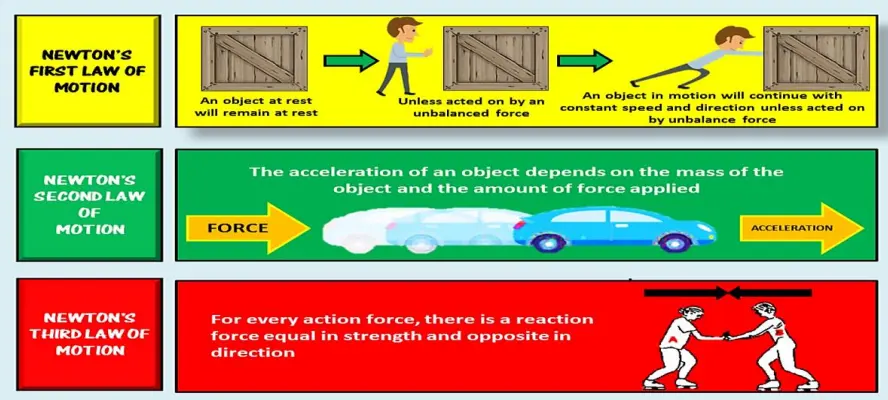
Every object continues in its state of rest or uniform motion in a straight line unless compelled by an external unbalanced force.
Key Concept - Inertia: It is the inherent property of an object to resist any change in its state. Mass is a measure of inertia; a heavier object has more inertia and is harder to move or stop.
Practical Examples for UPSC:
1. The Hammer Head: When you hit the handle of a hammer against a surface, the handle stops, but the head continues moving due to inertia, tightening itself onto the wood.
2. Dusting a Carpet: When you beat a carpet with a stick, the carpet moves, but the dust particles tend to stay at rest due to inertia and fall off.
3. Newton’s Second Law: Force and Acceleration
The rate of change of momentum of an object is proportional to the applied force. In simpler terms, Force equals Mass times Acceleration (F = ma).
Key Concepts:
1. Acceleration (a): The rate at which velocity changes. If you change speed or direction, you are accelerating. It is measured in meters per second squared (m/s2).
2. Momentum: The 'quantity of motion' an object has (p = mv, where m is mass and v is velocity).
Why it matters: It explains why a professional cricketer pulls his hands back while catching a fast ball. By increasing the time, he reduces the rate of change of momentum, thus reducing the force and impact on his hands.
4. Newton’s Third Law: Action and Reaction
For every action, there is an equal and opposite reaction. Forces always exist in pairs (interaction pairs).
Crucial Note: Action and reaction forces act on different bodies. This is why they don't cancel each other out.
Practical Examples:
1. Rocket Propulsion: The rocket pushes exhaust gases downward (Action), and the gases push the rocket upward (Reaction).
2. Recoil of a Gun: When a bullet is fired, the gun pushes the bullet forward, and the bullet pushes the gun backward.
5. Fundamental Forces: Gravity and Friction
A. Universal Law of Gravitation
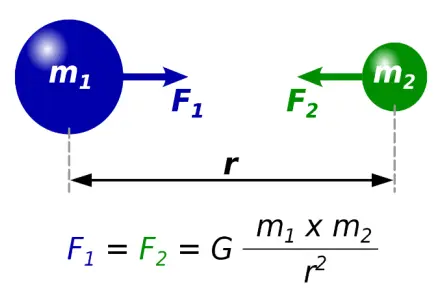
Every object in the universe attracts every other object. The force is directly proportional to the product of their masses and inversely proportional to the square of the distance between them. The formula is: F = G (m1 m2 / r2).
B. Friction: The Necessary Evil
Friction is a contact force that opposes the relative motion between two surfaces. It depends on the nature of the materials (measured by the Coefficient of Friction).
1. Static Friction: Operates when the object is stationary.
2. Kinetic Friction: Operates when the object is sliding.
6. Circular Motion: Centripetal and Centrifugal
1. Centripetal Force: A real force directed towards the center, necessary for circular motion (e.g., Earth orbiting the Sun). The formula is F = mv2 / r.
2. Centrifugal Force: An 'apparent' or pseudo-force felt by an observer in a rotating frame, acting outwards (e.g., the force felt in a spinning merry-go-round).
UPSC Edge: Common Traps and Applications
Do not confuse mass with weight; mass is constant but weight changes with g.
Action-reaction forces never cancel because they act on different bodies.
Centripetal force is real; centrifugal is pseudo (apparent in rotating frames).
Applications: banked roads, satellite orbits, and safe turning in vehicles rely on circular motion concepts.
| Quantity | Definition | SI Unit |
|---|---|---|
| Force (F) | A push or pull that causes acceleration | Newton (N) |
| Acceleration (a) | Rate of change of velocity | meters per second squared (m/s2) |
| Momentum (p) | Mass in motion (p = mv) | kilogram meters per second (kg m/s) |
| Gravity (g) | Acceleration due to Earth's pull | 9.8 m/s2 |
Prelims tips
- Inertia depends only on Mass. Speed or volume does not affect it.
- Weight is a force (W = mg), but Mass is constant everywhere.
- The Universal Gravitational Constant (G) is constant everywhere, but g (gravity) changes with altitude and location.
- Centripetal force is real, while centrifugal force is pseudo.
- On a level road, maximum safe speed depends on friction (no friction, no turning).
- At Earth’s center, weight is zero but mass remains unchanged.
Mains points
- Newton’s laws are the bedrock of structural engineering, ensuring bridges and buildings withstand forces.
- The concept of friction is vital for transport safety (ABS braking systems in cars).
- Gravitational principles are essential for satellite technology and Global Positioning Systems (GPS).
- Understanding Force and Motion helps in disaster management, specifically in analyzing the impact of tsunamis or structural collapses.
- Physics of motion informs road safety (speed limits on curves) and engineering design codes.
Did you know?
- The Newton is the force required to accelerate 1 kg of mass at 1 meter per second squared.
- In space, without friction or air resistance, an object thrown will keep moving forever in a straight line (1st Law).
- Friction generates heat—this is why we rub our hands together in winter to stay warm.
Physics Essentials: Work, Power, Energy, and Conservation Laws
In the study of Physics, Work, Power, and Energy are interconnected concepts that describe how forces interact with matter to cause change. Understanding the Laws of Conservation—which state that energy, mass, and momentum cannot be created or destroyed—is fundamental for UPSC as these principles explain everything from industrial machinery to planetary motion.
1. Work: Force in Action
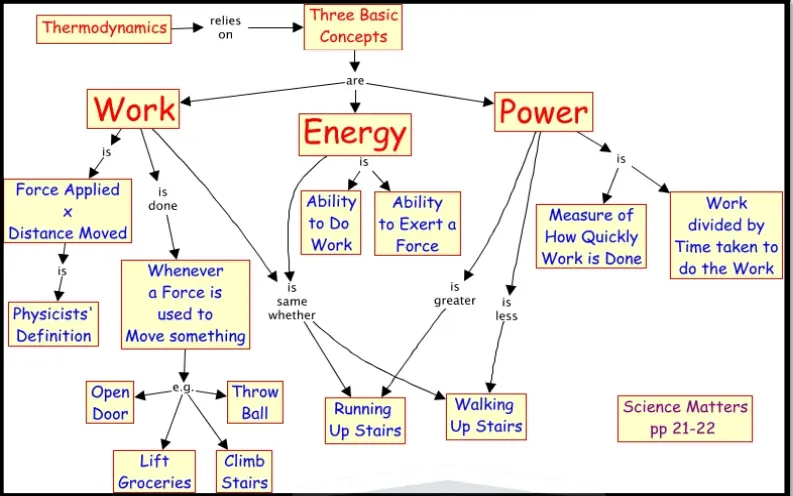
Work is done when a force acting on a body causes a displacement (change in position) of that body. If there is no movement, even if a force is applied, the work done is mathematically zero.
Formula: Work = Force x Displacement (W = F x d).
SI Unit: Joule (J). 1 Joule is the work done when a force of 1 Newton moves an object by 1 meter.
Key Note for UPSC: If you push against a wall for hours, you might get tired, but in physics, the work done is zero because the wall did not move.
2. Power: The Rate of Work
Power measures how fast work is being done. It is the time rate at which energy is transferred or converted.
Formula: Power = Work / Time.
SI Unit: Watt (W). 1 Watt = 1 Joule per second.
Other Units: Horsepower (hp). 1 hp is approximately 746 Watts. It is often used to measure the power of car engines or industrial motors.
3. Energy: The Capacity to Work
Energy is the ability or capacity of an object to do work. Like work, its SI unit is the Joule. Energy exists in many forms:
1. Kinetic Energy (KE): The energy an object possesses due to its motion. Formula: KE = (1/2) mv2.
2. Potential Energy (PE): The energy stored in an object due to its position or shape. For example, a ball held high above the ground has Gravitational Potential Energy. Formula: PE = mgh (mass x gravity x height).
3. Mechanical Energy: The sum of an object's Kinetic and Potential energy.
4. Law of Conservation of Energy
This fundamental law states that energy can neither be created nor destroyed; it can only be transformed from one form to another. The total energy in a closed system remains constant.
Energy Transformations in Daily Life:
Electric Bulb: Electrical energy to Light energy.
Battery/Cell: Chemical energy to Electrical energy.
Electric Motor: Electrical energy to Mechanical energy.
Dynamo: Mechanical energy to Electrical energy.
Microphone: Sound energy to Electrical energy.
5. Other Crucial Conservation Laws
1. Conservation of Mass: Matter cannot be created or destroyed in a chemical reaction; it only changes form.
2. Conservation of Linear Momentum: A system's total momentum (mass x velocity) stays constant unless an external force acts on it. This explains why a gun recoils when fired.
3. Conservation of Angular Momentum: A rotating body will keep rotating at the same rate unless a twisting force (Torque) is applied. This is why ice skaters spin faster when they pull their arms in.
| Device | From (Input) | To (Output) |
|---|---|---|
| Electric Motor | Electrical Energy | Mechanical Energy |
| Dynamo | Mechanical Energy | Electrical Energy |
| Heater | Electrical Energy | Heat Energy |
| Loudspeaker | Electrical Energy | Sound Energy |
Prelims tips
- Work is zero if force and displacement are perpendicular (like a coolie carrying a bag on his head walking horizontally).
- 1 Horsepower = 746 Watts (important for numerical facts).
- Mechanical Energy = Kinetic Energy + Potential Energy.
- In an isolated system, the total momentum is always conserved.
- No external force on a system means linear momentum stays constant.
- Energy is conserved, but usable energy can decrease due to dissipation.
- SI base units: metre, kilogram, second, ampere, kelvin, mole, candela; derived units – newton (force), joule (energy), watt (power), pascal (pressure). Light year and parsec measure distance; 1 nautical mile = 1.852 km; 1 horsepower ≈ 746 W.
Mains points
- The Law of Conservation of Energy is the basis for sustainable technology and analyzing energy efficiency in industries.
- Understanding Power and Work is essential for developing efficient transport systems and electrical grids.
- Dissipation of energy refers to energy converting into 'useless' forms (like heat due to friction), which engineers try to minimize.
- Conservation laws are universal; they apply to the smallest atoms and the largest galaxies.
- Energy efficiency links directly to policy goals like climate mitigation and industrial competitiveness.
Did you know?
- The concept of 'Horsepower' was created by James Watt to compare the output of steam engines with the power of draft horses.
- A person sleeping still does 'internal work' (heart beating, breathing), but 'mechanical work' in physics is zero.
- The Earth spinning for billions of years is a classic example of Conservation of Angular Momentum.
The Physics of Sound: Waves, Properties, and Phenomena
Sound is a mechanical longitudinal wave produced by vibrations that requires a medium (solid, liquid, or gas) to travel. From the pitch of a bird's chirp to the sudden change in a siren's tone (Doppler Effect), sound physics explains how we perceive the world through hearing. Crucially, sound cannot travel through a vacuum, which is why space is silent.
1. Nature of Sound Waves
Sound is a form of energy that moves as a Mechanical Wave. It requires a medium to transmit its energy because it relies on particle interaction.
A. Longitudinal vs. Transverse Waves
1. Longitudinal Waves (Sound): The particles of the medium move parallel to the direction of the wave. They move back and forth, creating regions of Compression (high pressure) and Rarefaction (low pressure).
2. Transverse Waves (Light): The particles move perpendicular (up and down) to the wave direction. Light does not require a medium and is not a mechanical wave.
2. Key Properties of Sound
Understanding these properties helps distinguish between a whisper and a shout, or a bass drum and a flute.
Amplitude: This is the maximum displacement of the particles. It determines the Loudness. Larger amplitude = Louder sound.
Frequency: The number of oscillations per second, measured in Hertz (Hz). It determines the Pitch. High frequency = Shrill/High pitch; Low frequency = Deep/Low pitch.
Wavelength: The distance between two consecutive compressions or rarefactions.
Time Period (T): The time taken for one complete oscillation.
3. The Speed of Sound
Sound speed is not constant; it changes based on the environment:
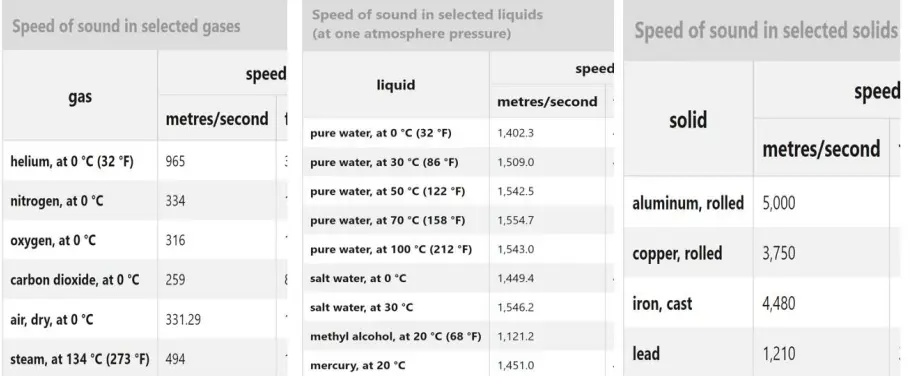
1. Medium: Sound travels fastest in Solids, slower in Liquids, and slowest in Gases because particles are closer together in solids.
2. Temperature: As temperature increases, the speed of sound increases. In air at 0 degrees Celsius, speed is roughly 332 m/s.
3. Density: In gases, speed is inversely proportional to the square root of the density.
4. Reflection and Echoes
Sound bounces off hard surfaces just like light. This is called Reflection.
Echo: A distinct reflected sound heard after the original sound. To hear a clear echo, the reflecting surface must be at least 17.2 meters away. This is because our brain retains sound for about 0.1 seconds (Persistence of Hearing).
5. The Doppler Effect
Have you noticed how an ambulance siren sounds higher as it approaches and lower as it moves away? This is the Doppler Effect.
Approaching Source: Wavefronts 'bunch together,' increasing the frequency (higher pitch).
Receding Source: Wavefronts 'spread out,' decreasing the frequency (lower pitch).
| Medium State | Relative Speed | Example |
|---|---|---|
| Solid | Highest | Steel (approx. 5960 m/s) |
| Liquid | Intermediate | Water (approx. 1480 m/s) |
| Gas | Lowest | Air (approx. 344 m/s at 22°C) |
Prelims tips
- Sound is a Mechanical Longitudinal Wave. Light is an Electromagnetic Transverse Wave.
- Speed of sound: Solids > Liquids > Gases.
- Frequency defines Pitch; Amplitude defines Loudness.
- Minimum distance for Echo: 17.2 meters.
- Speed of sound increases with Temperature and Humidity.
- Ultrasound is > 20 kHz; infrasound is < 20 Hz.
- Sound cannot travel in vacuum; it needs a material medium.
Mains points
- The Doppler Effect is widely used in RADAR, SONAR, and even in medical imaging like Doppler Ultrasound.
- Understanding sound propagation is essential for Acoustics in architecture (designing concert halls or soundproof rooms).
- The Persistence of Hearing (0.1s) is a biological constraint that defines our auditory perception limits.
- Environmental noise pollution is measured in Decibels (dB), a logarithmic unit related to sound intensity and amplitude.
- Noise standards and urban planning rely on acoustics for public health outcomes.
Did you know?
- Sound travels about 4 times faster in water than in air.
- Because there is no air in space to carry sound vibrations, astronauts use radio waves to communicate.
- The Persistence of Hearing is the reason why we hear multiple reflections as 'Reverberation' if the distance is too short for a distinct echo.
Light and Geometrical Optics: Reflection, Refraction, and Dispersion
Light is a fascinating form of energy that behaves both as a wave and a stream of particles (Photons). It is the fastest thing in the universe, capable of traveling through the vacuum of space. Understanding how light bends, bounces, and splits into colors is essential for UPSC Science and Technology, as these principles power everything from the internet (Optical Fibers) to our own vision.
1. The Nature and Speed of Light
Light is electromagnetic radiation that causes the sensation of vision. Unlike sound, which needs a medium like air to travel, light can travel through a vacuum (empty space).
Speed: It travels at a staggering speed of 300,000 kilometers per second (3 x 10^8 m/s). This is why we see lightning before we hear thunder.
Dual Nature: Light is unique because it acts like a wave (it can bend around corners) and like a particle (it can push electrons).
Rectilinear Propagation: In a uniform medium, light always travels in a straight line. This property is why shadows are formed when an opaque object blocks its path.
2. Media of Propagation
How light interacts with an object depends on the material's properties:
1. Transparent: Allows almost all light to pass through. Objects can be seen clearly (e.g., clear water, glass).
2. Translucent: Allows light to pass partially but scatters it. Objects appear blurred (e.g., butter paper, frosted glass).
3. Opaque: Does not allow any light to pass through. It reflects or absorbs the light (e.g., wood, iron).
3. Reflection: The Bouncing of Light
Reflection occurs when light hits a surface and bounces back into the same medium. Surfaces that are highly polished, like mirrors, produce Regular Reflection.
The Two Laws of Reflection:
Law 1: The Incident ray (incoming), the Reflected ray (outgoing), and the Normal (an imaginary line at 90 degrees to the surface) all lie on the same flat plane.
Law 2: The angle at which light hits the surface (Angle of Incidence) is always equal to the angle at which it bounces off (Angle of Reflection).
4. Refraction: The Bending of Light
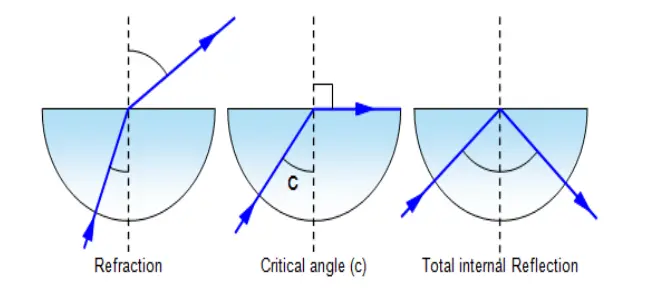
Refraction is the bending of light as it passes from one transparent medium to another (e.g., from Air to Water). This happens because the speed of light changes in different materials.
Important Rules:
Entering a Denser Medium: When light goes from air (rare) to glass (dense), it slows down and bends towards the normal.
Entering a Rarer Medium: When light goes from water (dense) to air (rare), it speeds up and bends away from the normal.
Snell's Law: This law provides a formula to calculate exactly how much the light will bend, based on a value called the Refractive Index.
5. Total Internal Reflection (TIR)
This is a special case of refraction. When light tries to go from a dense medium (like glass) to a rare one (like air) at a very large angle, it doesn't come out at all! Instead, it reflects back inside completely.
The Two Conditions for TIR:
1. Light must travel from a Denser medium to a Rarer medium.
2. The angle of incidence must be greater than the Critical Angle.
Real-world uses: This is how Optical Fibers carry high-speed internet data across oceans—by bouncing light inside the cable repeatedly.
6. Dispersion and VIBGYOR
White light (like sunlight) is actually a mixture of seven colors. When it passes through a prism, each color bends at a different angle because of its wavelength.
VIBGYOR: Violet, Indigo, Blue, Green, Yellow, Orange, Red.
Red Light: Has the longest wavelength. It bends the least. Because it travels the farthest without scattering, it is used for danger signals.
Violet Light: Has the shortest wavelength. It bends the most.
7. Diffraction: Bending around Edges
When light hits a very sharp edge or a tiny hole, it doesn't just go straight; it spreads out slightly. This bending of light around obstacles is called Diffraction. It’s the reason why the edges of shadows are sometimes a bit blurry.
| Phenomenon | Physics Principle Involved |
|---|---|
| Twinkling of Stars | Atmospheric Refraction |
| Rainbow Formation | Dispersion, Refraction, and TIR |
| Mirage in Deserts | Total Internal Reflection (TIR) |
| Blue Sky | Scattering of Light |
| Sparkling Diamond | Total Internal Reflection (TIR) |
Prelims tips
- TIR Condition: 1. Denser to Rarer medium. 2. Angle of Incidence > Critical Angle.
- Scattering: Blue light scatters more than Red (why sky is blue).
- Reflection: Laws apply to both smooth (regular) and rough (diffused) surfaces.
- Refractive Index: It is the ratio of speed of light in vacuum to speed in the medium.
- Mirage is due to total internal reflection in hot air layers.
- Red light is least scattered; hence used in danger signals and fog lights.
Mains points
- Optical Fiber Technology: Critical for India's Digital India mission, enabling high-speed data transmission through Total Internal Reflection.
- Human Eye: Functions as a biological lens system using refraction to focus images on the retina.
- Space Exploration: We see distant stars not as they are now, but as they were years ago, because light takes time to travel across space.
- Atmospheric Optics: Helps in understanding weather patterns and the composition of the atmosphere through light interaction.
- Optics underpins telecom infrastructure and remote sensing for governance.
Did you know?
- Light from the Sun takes roughly 500 seconds to reach your eyes.
- Goldfish can see both infrared and ultraviolet light, which are invisible to humans.
- The reason stop signs and tail-lights are Red is that red light has the longest wavelength and is scattered the least by fog or dust.
Advanced Optics and Liquid Properties: Interference, Scattering, and Surface Tension
Physics explores how light behaves as both waves and particles through phenomena like Interference and Scattering, while also explaining the unique behaviors of liquids through Surface Tension. For UPSC, these concepts explain natural wonders like the blue sky, the shape of raindrops, and how modern technology utilizes light at a subatomic level.
1. Interference of Light: The Mixing of Waves
Interference occurs when two light waves of the same frequency travel in the same direction and overlap (superpose). This overlap redistributes the light energy, creating patterns of brightness and darkness.
Constructive Interference: When the crest of one wave meets the crest of another, they add up to create a brighter light (higher amplitude).
Destructive Interference: When the crest of one wave meets the trough of another, they cancel each other out, resulting in darkness or lower intensity.
Everyday Examples:
1. Soap Bubbles: The shifting rainbow colors on a bubble are due to light waves reflecting off the inner and outer surfaces of the soap film and interfering.
2. Oil on Water: The colorful patterns seen on a wet road with oil are also caused by interference.
2. Scattering of Light: Why the Sky is Blue
Scattering happens when light rays strike molecules of air or water vapor and are redirected in all directions.
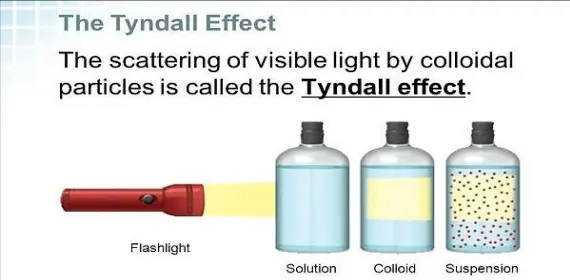
A. Tyndall Effect
When a beam of light passes through a colloid (like dust in a room or milk in water), the path of the light becomes visible because the large particles scatter the light.
Example: Sunlight entering a dusty room through a small window.
B. Rayleigh Scattering
This explains why the sky is blue. Shorter wavelengths (blue/violet) scatter much more easily than longer wavelengths (red). During sunrise or sunset, light travels through more atmosphere, scattering away the blue and leaving the red/orange light to reach our eyes.
3. Compton Scattering: Light as a Particle
While interference proves light is a wave, Compton Scattering proves light acts like a particle (called a Photon).
The Process: A high-energy photon hits a charged particle (like an electron). The photon 'scatters' and loses some energy, increasing its wavelength.
Significance: This discovered by Arthur Compton, confirmed that light carries momentum like a physical object.
4. Surface Tension: The 'Skin' of Liquids
Surface tension is the property of a liquid that makes its surface act like a stretched elastic membrane. It is caused by intermolecular forces (like Van der Waals forces) pulling the surface molecules inward.
Key Effects of Surface Tension:
1. Spherical Raindrops: Liquids naturally want to take the shape with the minimum surface area. For a given volume, a sphere has the smallest surface area.
2. Insects walking on water: Some insects can walk on water because their weight is not enough to break the 'elastic' surface tension of the water.
3. Shaving Brushes: The hairs of a brush spread out in water but cling together when pulled out because the water film on the hairs tries to shrink its surface area.
4. Temperature Effect: Surface tension generally decreases as temperature increases. This is why oil spreads on cold water but forms drops on hot water.
| Phenomenon | Proves Light is a... |
|---|---|
| Interference | Wave |
| Diffraction | Wave |
| Compton Effect | Particle (Photon) |
| Photoelectric Effect | Particle (Photon) |
Prelims tips
- Blue Sky: Short wavelengths (Blue) scatter more. Red Sunset: Long wavelengths (Red) scatter less and reach farther.
- Surface Tension decreases with increasing Temperature.
- Spherical shape of drops is always due to Surface Tension.
- Interference requires Coherent sources (waves of same frequency and constant phase).
- Tyndall effect is seen in colloids, not true solutions.
- Photoelectric effect supports particle nature of light.
Mains points
- Optical Coatings: The principle of interference is used to make 'anti-reflective' coatings on eyeglasses and camera lenses.
- Nanotechnology: Understanding Surface Tension is vital for drug delivery systems and creating water-repellent (hydrophobic) surfaces.
- Quantum Mechanics: The Compton Effect was a turning point in physics that led to the acceptance of the Dual Nature of Light.
- Atmospheric Science: Scattering principles help scientists monitor air pollution and the density of the ozone layer.
- Surface tension concepts aid agriculture and soil-water management practices.
Did you know?
- Water strider insects use surface tension to 'run' on water at speeds up to 1 meter per second!
- The colors on a CD or DVD are another classic example of light interference and diffraction.
- If you add soap/detergent to water, it breaks the surface tension, which is why soapy water can penetrate clothes to clean them better.
Universal Gravitation and Einstein’s Theory of Relativity
Gravity is the invisible force that binds the universe, from holding our feet on the ground to keeping planets in orbit. While Newton described gravity as a pull between masses, Einstein redefined it as the curving of space and time. Understanding these two pillars of physics is essential for UPSC to comprehend satellite technology, space exploration, and the fundamental nature of our universe.
1. Newton’s Universal Law of Gravitation
Isaac Newton proposed that every object in the universe attracts every other object. This force is known as Gravitational Force.
The Law: The force of attraction is:
1. Directly proportional to the product of their masses (Heavier objects pull more).
2. Inversely proportional to the square of the distance between them (Farther objects pull less).
Key Significance: This law explains why the Moon orbits the Earth, why tides occur, and it allows scientists to predict solar and lunar eclipses with high accuracy.
2. Earth’s Gravity and Acceleration (g)
Earth’s gravity pulls everything toward its center. This pull creates Acceleration due to Gravity (g).
The Formula: Weight = mass x g (W = mg).
Standard Value: g is approximately 9.8 m/s2 on Earth's surface.
Variations in 'g' (Crucial for UPSC Prelims):
At Poles: 'g' is Maximum (because the Earth is slightly flattened at the poles, making them closer to the center).
At Equator: 'g' is Minimum.
Altitude & Depth: As you go high above the Earth (mountains/space) or deep inside the Earth (mines), 'g' decreases.
At Earth's Center: 'g' becomes Zero (Weightlessness).
3. Einstein’s Special Theory of Relativity (STR)
Developed in 1905, this theory changed our understanding of Space and Time. It focuses on objects moving at very high speeds, close to the speed of light.
Two Main Postulates:
1. The laws of physics are the same for everyone, regardless of their constant velocity.
2. The speed of light (c) is constant (3 x 10^8 m/s) for all observers, even if they are moving.
The Famous Equation: E = mc2. This shows that Mass and Energy are two sides of the same coin. A small amount of mass can be converted into a huge amount of energy (the principle behind nuclear power).
4. General Theory of Relativity (GTR)
Einstein’s later theory (1915) redefined gravity itself. Instead of a 'force' pulling objects, he described gravity as a curvature in the fabric of Spacetime.
Key Concepts:
Space Warping: A massive object (like the Sun) warps the space around it, like a bowling ball sitting on a trampoline. Smaller objects (like planets) roll along these curves—this is what we perceive as gravity.
Time Dilation: Gravity affects time. Time moves slower near a massive body (like a Black Hole) than it does in empty space.
Expanding Universe: This theory proved the universe is expanding and laid the groundwork for modern cosmology and time travel theories.
| Property | Mass (m) | Weight (W) |
|---|---|---|
| Definition | Amount of matter in an object | Force of gravity on an object |
| Location | Remains constant everywhere | Changes with location (g) |
| SI Unit | Kilogram (kg) | Newton (N) |
| At Center of Earth | Remains the same | Becomes Zero |
Prelims tips
- Value of g: Maximum at Poles, Minimum at Equator, Zero at Center.
- E = mc2: Explains nuclear energy (fission and fusion).
- General Relativity: Explains the bending of light near stars (Gravitational Lensing).
- Gravitational Force: Always attractive, never repulsive.
- Escape velocity depends on planet mass and radius.
- Artificial satellites are in continuous free-fall around Earth.
Mains points
- Space-Time Fabric: Understanding General Relativity is vital for modern astrophysics and studying Black Holes and Gravitational Waves.
- Satellite Orbits: Newton’s laws allow us to calculate precise orbits for telecommunication and weather satellites.
- Energy-Mass Equivalence: STR is the fundamental principle behind nuclear reactors and weapon technology.
- Expanding Universe: The realization that the universe is expanding (from GTR) led to the Big Bang theory, changing our view of human existence.
- Relativity corrections are essential for GPS accuracy and space navigation.
Did you know?
- If you could stand on the Sun, you would weigh about 28 times more than you do on Earth!
- GPS satellites have to account for Relativity; because they are moving fast and are farther from Earth's gravity, their clocks tick slightly differently than clocks on the ground.
- Black holes are areas where gravity is so strong that it warps spacetime so much that not even light can escape.
Thermodynamics, Magnetism, and Electricity: The Energy and Forces of Matter
Physics explains how energy moves and how forces shape our world through three critical pillars: Thermodynamics (heat and energy), Magnetism (magnetic fields and poles), and Electricity (the flow of charge). For UPSC, these concepts are vital for understanding power generation, climate science, and modern electronics.
1. Thermodynamics: The Science of Heat
Thermodynamics is the study of heat, temperature, and their relation to energy and work. A Thermodynamic Process occurs when the state variables (Pressure, Volume, Temperature) of a system change.
Types of Thermodynamic Processes:
1. Isothermal: Occurs at a constant temperature.
2. Isobaric: Occurs at a constant pressure.
3. Isochoric: Occurs at a constant volume.
4. Adiabatic: No heat enters or leaves the system (e.g., rapid compression of air).
5. Cyclic: The system goes through changes but eventually returns to its original state.
2. The Four Laws of Thermodynamics
Zeroth Law: If two systems are in thermal equilibrium with a third system, they are in equilibrium with each other. (This is the basis for Thermometers).
First Law: Energy cannot be created or destroyed; it only changes form (Law of Conservation of Energy).
Second Law: The Entropy (disorder) of the universe always increases. Heat cannot spontaneously flow from a cold body to a hot body.
Third Law: The entropy of a perfect crystal at Absolute Zero (0 Kelvin) is zero.
3. Magnetism and Magnetic Induction
A magnet always has two poles: North (N) and South (S). Magnetic poles always exist in pairs; you cannot have a lone North pole.
Key Properties:
Like poles repel (N-N or S-S), and unlike poles attract (N-S).
Magnetic Induction: The process where a magnetic material (like iron) becomes temporary magnet when placed near a permanent magnet.
Magnetic Field: The invisible area around a magnet where its force can be felt.
4. Electricity: Static and Current
Electricity is the phenomenon caused by the presence and flow of electric charge.
A. Static Electricity
Charge that stays on an object and does not flow. It is created by friction (rubbing objects together).
Example: Rubbing a plastic comb on hair makes the comb negatively charged, allowing it to pick up small pieces of paper.
B. Electric Current
The flow of electrons or charges through a conductor. For current to flow, there must be a Potential Difference (Voltage).
Current: The rate of flow of charge (measured in Amperes).
Voltage: The 'push' or pressure that moves the charge (measured in Volts).
Flow Direction: Current always flows from High Potential to Low Potential.
| Process | What stays Constant? |
|---|---|
| Isothermal | Temperature (T) |
| Isobaric | Pressure (P) |
| Isochoric | Volume (V) |
| Adiabatic | Heat Content (Q) |
Prelims tips
- Entropy always increases over time (2nd Law).
- Absolute Zero (0 Kelvin or -273.15°C) is the lowest possible temperature where all molecular motion stops.
- Magnetic poles cannot be separated; if you cut a magnet in half, you get two smaller magnets, each with N and S poles.
- Electric current flows from high potential to low potential, but electrons flow from low to high potential.
- Induced current direction follows Lenz's law (opposes change).
- A closed circuit is necessary for steady current.
Mains points
- Entropy and the Environment: The Second Law explains why 100% efficiency in engines is impossible, as some energy is always lost as heat.
- Electromagnetic Induction: The principle behind Electric Generators, where moving magnets create electricity—the backbone of our power grid.
- Superconductivity: Materials that have zero electrical resistance at very low temperatures, potentially revolutionizing power transmission and maglev trains.
- Information Technology: Magnetic storage (like hard drives) uses magnetic induction to store vast amounts of digital data.
- Energy policy and grid stability rely on efficient conversion and loss minimization.
Did you know?
- The Zeroth Law was named after the 1st and 2nd laws were already established, but because it was so fundamental, scientists gave it the number 'Zero'.
- Earth is a giant magnet! Its magnetic core protects us from harmful solar radiation.
- Static shock occurs because your body collects extra electrons (charge) and releases them suddenly when you touch a conductor like a metal doorknob.
Clouds, Lightning, and the Fundamentals of Electromagnetism
Lightning is a spectacular natural display of static electricity on a massive scale. Understanding how clouds become charged, how 'Earthing' protects our infrastructure, and the deep link between electricity and magnetism (Electromagnetism) is essential for UPSC. These principles explain both natural disasters and the technology behind every electric motor and generator.
1. The Science of Clouds and Lightning
Clouds are composed of tiny water droplets or ice crystals. Through friction caused by air currents and collisions between these particles, clouds develop immense static charges.
Charge Separation: Typically, the upper layers of a cloud become positively charged, while the lower layers (closer to the ground) become negatively charged.
The Spark (Lightning): Air is normally an insulator (bad conductor), but when the charge difference becomes too high, the air 'breaks down.' Electrons jump between clouds or from the cloud to the ground, creating a massive spark we see as Lightning.
Thunder: The lightning bolt is incredibly hot. This heat causes the surrounding air to expand explosively, creating sound waves that we hear as thunder. We see lightning before we hear thunder because light travels much faster than sound.
2. Earthing and Lightning Protection
To protect structures from the destructive power of lightning, we use Earthing and Lightning Conductors.
A. Lightning Conductor
A tall metal rod is fixed to the top of buildings. It provides a low-resistance path for the lightning to travel safely into the ground, preventing it from passing through the building's structure.
B. Electrical Earthing
This is the process of connecting electrical equipment or lightning rods directly to the Earth (which has zero electrical potential).
Mechanism: Low-resistance wires (usually iron or copper) are used. In the 'earth pit,' alternate layers of Salt and Charcoal are added to keep the soil moist and increase its conductivity.
Safety: It ensures that 'leakage current' or 'short-circuit current' goes safely into the ground rather than giving a shock to a person.
3. Electromagnetism: The Link between Forces
Electromagnetism is the study of how Electricity and Magnetism interact. This discovery revolutionized the modern world.
Oersted's Discovery: When current flows through a wire, it creates a magnetic field around it. The stronger the current, the stronger the magnet.
Faraday’s Law of Induction
Michael Faraday discovered the reverse: a changing magnetic field can 'induce' or create an electric current in a wire.
Faraday's First Law: Whenever a conductor is placed in a varying magnetic field, an electromotive force (EMF) or voltage is induced. This is how power plant generators turn mechanical motion into electricity.
| Component | Purpose |
|---|---|
| Metal Rod/Wire | Provides a low-resistance path for current. |
| Charcoal | Retains moisture in the soil to maintain conductivity. |
| Salt | Increases the ion concentration to lower soil resistance. |
| Earth (Soil) | Acts as a giant reservoir of zero potential. |
Prelims tips
- Lightning: Flows from negative areas to positive areas.
- Speed Difference: Light (300,000 km/s) vs Sound (0.34 km/s) explains the delay in thunder.
- Earthing: Essential for safety; Earth acts as an infinite 'sink' for electrons.
- Magnetic Field: Created by moving charges (current).
- Lightning conductors work by providing a low-resistance path to earth.
- Earthing uses salt and charcoal to improve soil conductivity.
Mains points
- Disaster Management: Installing lightning conductors on high-rise buildings and telecommunication towers is a mandatory safety protocol.
- Electrical Safety: Proper earthing in residential and industrial zones prevents fire hazards caused by short circuits.
- Technological Impact: Faraday's laws are the foundation of Electric Vehicles (EVs), wireless charging, and the global power generation industry.
- Atmospheric Chemistry: Lightning helps in 'Nitrogen Fixation' by breaking nitrogen molecules in the air, which then dissolve in rain and act as natural fertilizer.
- Disaster protocols include lightning safety for schools, farms, and telecom towers.
Did you know?
- A single bolt of lightning contains enough energy to toast 100,000 slices of bread!
- The air around a lightning bolt is heated to about 30,000 degrees Celsius—that is 5 times hotter than the surface of the Sun.
- Without Electromagnetic Induction, we would not have electric fans, washing machines, or power grids.