
Science & Technology · UPSC Notes
Nuclear Technology — UPSC Science & Tech Notes
Free, exam-focused notes for UPSC Prelims and Mains, with Prelims tips and Mains points for every topic. 12 topics.
Open in the interactive reader: bookmarks, progress tracking and read-aloud.
The Drone Revolution: India's Unmanned Strategy (2026 Update)
By February 2026, India has transitioned from 'experimental' drone use to a structured Unmanned Combat Ecosystem. While the MQ-9B Predator deal with the US has been formally signed to provide high-altitude coverage, the indigenous TAPAS (Rustom-II) program has shifted from a 'Mission Mode' project to a specialized surveillance platform. Meanwhile, the stealth Ghatak UCAV has hit a critical milestone with the 2026 certification of its Dry Kaveri Engine.
1. The Global Giants: MQ-9B Predator Deal
In early 2026, the ₹32,000+ crore deal for 31 MQ-9B Sky/Sea Guardian drones is in the implementation phase.
Distribution: 15 drones for the Navy (SeaGuardian) and 8 each for the Army and Air Force (SkyGuardian).
MRO Hub: A significant part of the deal includes General Atomics setting up a Global Maintenance, Repair, and Overhaul (MRO) facility in India, making India a regional drone service hub.
Strategic Edge: These drones provide 35+ hours of endurance at 50,000 feet, allowing 'continuous' monitoring of the Indian Ocean and the LAC.
2. Indigenous MALE UAVs: Tapas (Rustom-II)
The Tactical Airborne Platform for Aerial Surveillance (TAPAS-BH-201) remains India's primary indigenous effort in the Medium Altitude Long Endurance (MALE) category.
Current Status (2026): After being demoted from 'Mission Mode' in 2024 due to altitude shortfalls (reaching 28,000 ft instead of the required 30,000 ft), the project has been revived as a surveillance-first platform.
Capabilities: It features SATCOM-enabled Beyond Line-of-Sight (BLOS) control and is currently undergoing final user trials with the Indian Navy for coastal monitoring.
3. Project Ghatak: The Stealth Assassin
Ghatak is India’s secret program to build a high-speed, autonomous stealth combat drone (UCAV).
Engine Certification (2026): A strict MoD deadline has seen the Dry Kaveri Engine undergo final certification in 2026. This clears the path for the rollout of a full-scale 13-ton prototype.
SWiFT: The 'Stealth Wing Flying Testbed' (a smaller version) has already proven the 'flying wing' design's stability, which is essential for radar-evading stealth.
4. The Private Sector & Swarm Drones
Drishti-10 Starliner: In 2025-26, the Navy and Army began inducting the Drishti-10 (based on the Israeli Hermes 900), manufactured in Hyderabad by Adani Defence.
Swarm Drones: Startups like NewSpace Research and ideaForge are supplying swarm drone systems that can overwhelm enemy air defenses using AI-driven coordinated flight.
| Category | Key Platform | Role / Status |
|---|---|---|
| HALE (Strategic) | MQ-9B Predator | Signed (Delivery from US) |
| MALE (Tactical) | Heron Mk-II / Tapas | Operational / Border ISR |
| UCAV (Stealth) | Ghatak | In Development (Engine Certified 2026) |
| Light/Mini | Switch / Netra | Infantry Support (ideaForge) |
| Target Drone | Lakshya / Abhyas | Training & Missile Practice |
Prelims tips
- HALE vs MALE: High Altitude (MQ-9B) vs Medium Altitude (Tapas).
- SWiFT: The sub-scale technology demonstrator for the Ghatak UCAV.
- Project Cheetah: The project to arm existing Israeli Heron drones with missiles.
- Dry Kaveri: The non-afterburning version of the Kaveri engine used for Ghatak.
- DAP 2020: The policy framework under which indigenous drone manufacturing is promoted.
Mains points
- The Shift in Doctrine: In 2026, drones are no longer 'support' assets; they are central to the Integrated Theatre Commands for real-time battlefield management.
- Manned-Unmanned Teaming (MUM-T): India is working on pairing drones like Ghatak with manned jets like Tejas, where the drone takes the risk in high-threat zones.
- Aatmanirbharta Challenges: While airframes are indigenous, the 2026 certification of the Kaveri engine highlights that 'propulsion' remains the final frontier for 100% self-reliance.
- Counter-Drone Technology: With the rise of drone threats, the DRDO’s D-4 system (Soft kill/Hard kill) is now being deployed at vital installations and borders.
Did you know?
- The MQ-9B is so quiet at 50,000 feet that you would never hear it coming; it's effectively a 'invisible eye' in the sky.
- The Ghatak UCAV is modeled on the 'Flying Wing' concept, making it look more like a bird or a UFO than a traditional airplane to enemy radars.
- India's Namo Drone Didi scheme received a 7-fold budget increase in 2026, showing that drone tech is moving as fast in agriculture as it is in defense.
Radioactivity and Nuclear Decay: The Subatomic Transition
Radioactive Decay is the spontaneous process by which an unstable atomic nucleus loses energy by emitting radiation. Discovered by Henri Becquerel in 1896, this phenomenon is governed by the laws of quantum mechanics. In 2026, the application of radioisotopes has expanded from basic power generation to precision Nuclear Medicine (Targeted Alpha Therapy) and advanced Industrial Radiography.
1. The Mechanics of Decay
An unstable nucleus decomposes spontaneously into a more stable configuration. This process is random for a single atom but follows a predictable exponential rate for a large group.
Decay Constant (lambda): The probability of decay per unit time.
Half-Life (t1/2): The time taken for half the radioactive nuclei in a sample to decay. For Carbon-14, this is approximately 5,730 years.
Activity: Measured in Becquerel (Bq), where 1 Bq = 1 decay per second. Another common unit is the Curie (Ci).
2. Types of Radioactive Decay
There are three primary modes, each with distinct physical properties.
Alpha (alpha) Decay: Emission of a Helium nucleus (composed of 2 protons and 2 neutrons). It reduces the atomic number by 2 and mass number by 4. High ionizing power but low penetration.
Beta (beta) Decay: A neutron turns into a proton (or vice versa), emitting an electron (beta minus) or positron (beta plus). Changes the atomic number by plus or minus 1.
Gamma (gamma) Decay: High-energy electromagnetic radiation (photons). It changes only the energy state of the nucleus, not the element itself.
3. Real-World Applications (2026 Update)
Carbon-14 Dating: Used to date organic remains up to 50,000 years old by measuring the ratio of stable C-12 to radioactive C-14.
Nuclear Medicine: Technetium-99m is the most used medical isotope for imaging. In 2026, Lutetium-177 is the standard for targeted 'Theranostics' (therapy + diagnostics) for prostate cancer.
Industry: Americium-241 is used in smoke detectors, while Cobalt-60 is used to sterilize medical equipment and preserve food (Irradiation).
Space: Plutonium-238 powers RTGs (Radioisotope Thermoelectric Generators) for deep-space probes like Voyager and New Horizons.
| Property | Alpha | Beta | Gamma |
|---|---|---|---|
| Nature | Helium Nucleus | Electron / Positron | EM Waves (Photons) |
| Charge | +2 | -1 / +1 | Neutral (0) |
| Mass | Heavy (4 amu) | Very Light | Zero |
| Penetrating Power | Lowest | Medium | Highest |
| Ionizing Power | Highest | Medium | Lowest |
Prelims tips
- Spontaneous Process: Decay happens without any external influence like temperature or pressure.
- Magic Numbers: Nuclei with specific numbers of protons or neutrons (2, 8, 20, 28, 50, 82, 126) are exceptionally stable.
- Lead (Pb): The ultimate stable 'end-point' for most heavy radioactive decay chains.
- Radon Gas: A natural alpha-emitter found in rocks and soil; a leading cause of lung cancer globally.
- Becquerel vs. Curie: Modern SI unit is Becquerel; 1 Curie is approximately 37 billion Becquerels.
Mains points
- Nuclear Waste Management: The long half-lives of some isotopes (like Plutonium-239 at 24,000 years) present an ethical and technical challenge for Deep Geological Repositories.
- Energy Transition: Radioactivity-driven Nuclear Fission provides a low-carbon energy alternative, but public perception remains shaped by safety concerns.
- Scientific Advancements: The use of 'Radiotracers' has revolutionized our understanding of biological metabolic pathways and deep-sea ocean currents.
- Security Implications: The illegal trafficking of radioactive 'sealed sources' poses a risk for 'Dirty Bombs', requiring strict IAEA oversight.
Did you know?
- Bananas are slightly radioactive! They contain Potassium-40, and eating one exposes you to a tiny, harmless dose of radiation known as the 'Banana Equivalent Dose'.
- Marie Curie, who coined the term 'radioactivity', died from radiation exposure. Her 100-year-old notebooks are still radioactive and must be kept in lead-lined boxes.
- Carbon dating isn't just for fossils; it was used to prove that the Shroud of Turin likely dates to the medieval period rather than the time of Christ.
Understanding Half-Life: The Subatomic Clock
Half-life is a fundamental constant used to measure the stability of a radioactive substance. It represents the fixed time it takes for 50% of the atoms in a sample to transform into a different state. Whether a sample has 1 gram or 1 ton of material, the time required for half of it to decay remains exactly the same.
1. Defining the Half-Life
Radioactive decay is a random process at the level of a single atom, but for a large group of atoms, it follows a very precise mathematical pattern.
Primary Definition: The time interval required for one-half of the atomic nuclei in a radioactive sample to decay.
Alternative Definition: The time required for the 'activity' (disintegrations per second) of a material to drop by exactly 50%.
Predictability: While we cannot predict which specific atom will decay next, we can predict with 100% certainty how much material will be left after several half-lives.
2. The Exponential Nature of Decay
Half-life does not mean that the entire sample will disappear in two half-lives. Instead, the sample gets smaller by half, then half again, in a 'cascading' effect.
1 Half-life: 50% of the original sample remains.
2 Half-lives: 25% remains (half of 50%).
3 Half-lives: 12.5% remains (half of 25%).
Infinite Decay: Theoretically, a radioactive sample never truly reaches zero; it just becomes so small that it is no longer detectable.
3. Real-World Significance
Half-lives vary wildly between different isotopes, ranging from fractions of a second to billions of years.
Short Half-lives: Isotopes like Technetium-99m (6 hours) are ideal for medical imaging because they leave the body quickly.
Long Half-lives: Isotopes like Uranium-238 (4.5 billion years) are used to date the age of the Earth itself.
Nuclear Waste: Plutonium-239 has a half-life of 24,000 years, which is why nuclear waste storage is such a complex long-term challenge.
| Number of Half-Lives | Fraction Remaining | Percentage Remaining |
|---|---|---|
| 0 | 1/1 | 100% |
| 1 | 1/2 | 50% |
| 2 | 1/4 | 25% |
| 3 | 1/8 | 12.5% |
| 4 | 1/16 | 6.25% |
Prelims tips
- Constant Value: Half-life is independent of physical conditions like temperature, pressure, or chemical state.
- Calculation Formula: N(t) = N0 (1/2)^(t / t1/2).
- Medical Use: Short half-life = Less radiation exposure over time.
- Waste Management: Long half-life = Persistent environmental hazard.
- Radioactive Equilibrium: When a parent isotope and daughter isotope have a constant ratio of activity.
Mains points
- Environmental Policy: The long half-lives of isotopes like Caesium-137 (30 years) mean that regions affected by nuclear accidents (like Chernobyl) remain restricted for human habitation for centuries.
- Archaeological Integrity: Half-life provides an unbiased 'absolute dating' method, allowing historians to verify timelines of ancient civilizations without relying on written records alone.
- Nuclear Energy Ethics: The storage of 'high-level waste' (which lasts for thousands of half-lives) raises questions about our responsibility toward future generations who must manage our energy residues.
- Industrial Safety: Understanding half-life is critical for calibrating radiotherapy machines in hospitals and industrial X-ray scanners to ensure dosages remain effective and safe.
Did you know?
- If you have a billion radioactive atoms, exactly half a billion will decay in one half-life, but there is no way to know which specific atoms were the ones that changed!
- The most stable isotope of Bismuth was thought to be stable forever, until 2003 when scientists discovered its half-life is 19 quintillion years—over a billion times longer than the age of the universe.
- Carbon-14 dating works because every living thing has a 'clock' that starts ticking (decaying) the moment it dies and stops eating new carbon.
Radiocarbon Dating: The Biological Time Machine
Radiocarbon Dating (Carbon-14 dating) is a scientific method used to determine the age of organic materials by measuring the amount of radioactive Carbon-14 they contain. Developed by Willard Libby in the late 1940s (winning him a Nobel Prize), it has revolutionized archaeology by providing absolute dates for everything from Egyptian mummies to the Shroud of Turin.
1. The Science of Carbon-14
Carbon exists in the atmosphere in three isotopes: Carbon-12 (stable), Carbon-13 (stable), and Carbon-14 (radioactive).
Formation: Cosmic rays from space collide with nitrogen atoms in the upper atmosphere, turning them into Carbon-14.
Absorption: Plants absorb this C-14 through photosynthesis, and animals absorb it by eating plants. As long as an organism is alive, it constantly replaces its C-14, keeping the ratio with C-12 constant.
The Clock Starts: When an organism dies, it stops taking in carbon. The C-14 already inside starts to decay into Nitrogen-14 at a fixed rate, while the C-12 remains unchanged.
2. Measuring the 'Half-Life'
The age of the sample is calculated by comparing the remaining C-14 to the stable C-12.
Half-Life: The half-life of Carbon-14 is approximately 5,730 years.
The Calculation: If a bone has only 50% of the C-14 found in a living organism, it is roughly 5,730 years old. If it has 25%, it is about 11,460 years old.
Limit: After about 50,000 years (roughly 10 half-lives), the amount of C-14 becomes too small to measure accurately. For older objects (like dinosaur fossils), scientists use other isotopes like Potassium-Argon or Uranium-Lead.
3. Modern Techniques (2026 Update)
AMS (Accelerator Mass Spectrometry): Unlike older methods that waited for atoms to decay, AMS counts the individual C-14 atoms. This allows scientists to date tiny samples, like a single thread or a seed.
Calibration: Scientists use tree-ring data (dendrochronology) to correct C-14 dates, as the amount of carbon in the atmosphere has varied slightly over millennia.
The 'Nuclear Bomb' Spike: Nuclear testing in the 1950s doubled the amount of C-14 in the atmosphere. This 'bomb pulse' is now used by forensic scientists to date modern ivory or even identify the age of fine wines.
| Isotope | Half-Life | Dating Range | Used For |
|---|---|---|---|
| Carbon-14 | 5,730 years | Up to 50,000 years | Organic (Bone, Wood, Shell) |
| Potassium-40 | 1.3 billion years | 100,000 years to Earth's age | Volcanic Rocks |
| Uranium-238 | 4.5 billion years | Millions to Billions of years | Zircon crystals, Earth's crust |
| Lead-210 | 22.3 years | Up to 150 years | Recent lake sediments, glaciers |
Prelims tips
- Organic Only: Only materials that were once part of a living cycle (containing carbon) can be dated.
- Nitrogen-14: This is the 'daughter' element that C-14 turns back into.
- Anthropogenic Impact: Fossil fuel burning and nuclear tests have altered atmospheric C-14 levels, requiring complex calibration.
- Willard Libby: Awarded the Nobel Prize in Chemistry in 1960 for this discovery.
- AMS vs Conventional: AMS is faster and requires much smaller samples.
Mains points
- Archaeological Ethics: Radiocarbon dating allows for 'non-destructive' analysis of priceless artifacts using AMS, preserving cultural heritage while gaining scientific data.
- Climate Change Research: By dating air bubbles trapped in ancient ice cores, C-14 dating helps scientists reconstruct the Earth's atmospheric history and carbon cycle.
- Forensic Applications: In 2026, C-14 dating is frequently used to identify the age of unidentified human remains or to detect forged 'antique' ivory and wood carvings.
- Limitations and Accuracy: The 'Suess Effect' (dilution of C-14 by fossil fuel CO2) and the 'Nuclear Effect' mean that future archaeologists will find it much harder to date objects from our current era.
Did you know?
- Carbon dating cannot be used on diamonds or stones because they were never part of a living organism that breathed air.
- If you were to date a piece of wood from a tree that died yesterday, it would show as 'modern.' But if that wood was used to build a table 1,000 years ago, the date would reflect when the tree died, not when the table was made!
- The Dead Sea Scrolls were dated using this method, confirming they were over 2,000 years old.
Binding Energy: The Glue of the Universe
Binding Energy is the energy required to disassemble a nucleus into its individual protons and neutrons (nucleons). It is the 'missing energy' resulting from the Mass Deficit when a nucleus is formed. This concept is fundamental to understanding why some elements are stable while others are prone to nuclear fission or fusion.
1. The Concept of Mass Deficit
Surprisingly, the mass of a complete nucleus is always less than the sum of the individual masses of its protons and neutrons.
Mass Deficit: The difference between the total mass of individual nucleons and the actual mass of the nucleus.
The Release: When nucleons come together, this 'missing mass' is converted into energy and released as photons or other particles.
Einstein's Equation: The relationship is defined by E = mc^2, where 'm' is the mass defect and 'c' is the speed of light.
2. Binding Energy per Nucleon
To determine how stable an atom is, we look at the Binding Energy per Nucleon (Total Binding Energy divided by the number of nucleons).
Stability Peak: Iron-56 (Fe-56) has the highest binding energy per nucleon, making it the most stable nucleus in the universe.
Fusion Zone: Light elements (like Hydrogen) have low binding energy. They release energy by fusing together to become heavier and more stable (Fusion).
Fission Zone: Very heavy elements (like Uranium) have lower binding energy per nucleon due to proton-proton repulsion. They release energy by splitting into smaller, more stable nuclei (Fission).
3. Case Study: Deuterium
A Deuterium atom (Heavy Hydrogen) consists of 1 proton and 1 neutron.
Mass Deficit: 0.0023884 amu (atomic mass units).
Binding Energy: ~2.23 MeV.
Meaning: You must 'resupply' exactly 2.23 MeV of energy from the environment to break a deuterium nucleus back into a separate proton and neutron.
| Mass Category | Process | Objective | Example |
|---|---|---|---|
| Light Nuclei | Nuclear Fusion | Increase Binding Energy | Sun (Hydrogen to Helium) |
| Medium Nuclei | Stable (Peak) | Maximum Stability | Iron-56 |
| Heavy Nuclei | Nuclear Fission | Increase Binding Energy | Nuclear Reactor (Uranium) |
Prelims tips
- E = mc^2: Energy (E) in Joules, Mass (m) in kg, c = Speed of Light (3 x 10^8 m/s).
- MeV: Mega Electron Volts, the standard unit for nuclear binding energy.
- Trend: Elements with mass numbers near 50-60 are the most stable.
- Resupply Energy: Binding energy is the energy that must be added to split a nucleus.
- Strong Nuclear Force: The fundamental force that binding energy represents.
Mains points
- The Origin of Nuclear Power: Understanding the binding energy curve explains why both splitting atoms (fission) and joining them (fusion) release energy—they both move the resulting nuclei toward the more stable 'Iron peak'.
- Cosmological Significance: Binding energy determines the abundance of elements in the universe. Hydrogen and Helium are common because they are starting points, while Iron is common as a stable end-point.
- Nuclear Safety & Design: For civil nuclear energy, knowing the binding energy of isotopes like Uranium-235 allows engineers to calculate exactly how much heat will be generated in a reactor core.
- Future Energy (Fusion): Current research in 2026 (like ITER) focuses on overcoming the electrostatic repulsion of light nuclei to tap into the massive binding energy released when they fuse into more stable configurations.
Did you know?
- Because Iron-56 is the 'end point' of stability, the core of massive stars eventually turns into iron. Once a star's core is iron, it can no longer produce energy through fusion, leading to a Supernova!
- Mass-energy equivalence means that if you could weigh a hot cup of coffee, it would be slightly heavier than a cold cup of coffee because of the added thermal energy (though the difference is too small to measure).
- Binding energy is so powerful that it accounts for about 99% of the mass of the visible universe; the actual mass of the quarks themselves is tiny!
Nuclear Fission vs. Fusion: The Power of the Atom
In early 2026, the global energy landscape is witnessing a historic pivot. While Nuclear Fission remains the reliable backbone of carbon-free baseload power, Nuclear Fusion research has reached a fever pitch. Following major 'ignition' breakthroughs in late 2024, international projects like ITER are now testing the superconducting magnets required to sustain the same 'star-power' that fuels the Sun.
1. Nuclear Fission: Splitting the Heavy
Fission occurs when a heavy, unstable nucleus (like Uranium-235) is struck by a neutron, causing it to split into two smaller 'daughter' nuclei.
The Process: The split releases more neutrons, which go on to strike other nuclei, creating a Chain Reaction.
Energy Release: The repulsive electrostatic forces between the many protons in a heavy nucleus overcome the nuclear binding energy during the split.
By-products: Fission produces radioactive waste that requires careful storage for thousands of years.
2. Nuclear Fusion: Joining the Light
Fusion is the process where two light nuclei (typically isotopes of Hydrogen: Deuterium and Tritium) combine to form a heavier nucleus (Helium).
Why Energy is Released? The mass of the resulting Helium nucleus is slightly less than the combined mass of the original Hydrogen nuclei. This 'missing mass' is converted into a massive burst of energy ($E = mc^2$).
The Solar Engine: This is the process that powers the Sun. To happen on Earth, it requires extreme temperatures (over 100 million degrees Celsius) to overcome the electrical repulsion between nuclei.
Clean Energy: Fusion produces no long-lived radioactive waste and uses fuel (Hydrogen) that is abundant in seawater.
3. Comparing the Two (2026 Context)
Fuel Source: Fission uses rare Uranium/Thorium; Fusion uses abundant Hydrogen isotopes.
Safety: Fission has a risk of 'meltdown' if not controlled; Fusion is inherently safe—if the reaction is disturbed, the plasma simply cools down and the process stops.
Current Status: Fission is commercial (powering cities today); Fusion is experimental (expected to reach the grid by the 2040s).
| Feature | Nuclear Fission | Nuclear Fusion |
|---|---|---|
| Definition | Splitting a heavy nucleus | Combining light nuclei |
| Typical Fuel | Uranium-235, Plutonium-239 | Deuterium, Tritium |
| Energy Output | High | Extremely High (3-4x Fission) |
| Waste | Long-lived Radioactive Waste | Minimal / Helium (Inert) |
| Conditions | Easily controlled in reactors | Needs extreme heat/pressure |
| Occurrence | Nuclear Power Plants | Stars (The Sun) |
Prelims tips
- E = mc^2: The core principle for both—mass deficit equals energy release.
- Critical Mass: The minimum amount of fissile material needed to maintain a self-sustaining chain reaction (Fission).
- Tokamak: A donut-shaped device that uses magnetic fields to contain fusion plasma.
- Stellarator: An alternative fusion device with a complex 'twisted' shape.
- Moderator: A substance (like heavy water or graphite) used to slow down neutrons in a fission reactor.
Mains points
- Energy Security: Fission offers a carbon-free alternative to fossil fuels, but Nuclear Fusion is the 'Holy Grail' of energy, promising absolute energy independence without carbon emissions or long-term waste.
- Geopolitical Cooperation: Projects like ITER involve 35 nations (including India), showing that the quest for fusion energy is a rare point of global scientific unity.
- The Safety Debate: Post-Fukushima, public resistance to fission remains high; however, the 'inherent safety' of fusion (no meltdown possible) makes it a much easier technology to gain public trust.
- India's Strategy: India is focusing on its Three-Stage Nuclear Program for fission (using Thorium) while simultaneously contributing 1/10th of the components for the ITER fusion project.
Did you know?
- A single gram of fusion fuel could provide as much energy as 11 tons of coal!
- The ITER project in France is currently building the world's largest 'magnetic bottle' (Tokamak) to hold plasma that is 10 times hotter than the center of the Sun.
- China’s 'Artificial Sun' (EAST) set a world record in late 2024 by sustaining a fusion reaction for over 1,000 seconds.
Nuclear Fusion on Earth: Harvesting the Power of Stars
In early 2026, the quest for Net Energy Gain (producing more energy than consumed) has reached a critical phase. While commercial fusion plants are not yet operational, the ITER project in France and China's EAST 'Artificial Sun' have set new records for plasma stability. India, as a key partner in ITER, is providing critical components like the Cryostat to make this futuristic energy source a reality.
1. What is a Tokamak?
A Tokamak is the 'magnetic bottle' designed to hold a sun on Earth. Since no physical material can withstand 150 million degrees Celsius, magnets are used to keep the hot plasma away from the walls.
The Torus: The device is shaped like a giant donut (torus).
Magnetic Confinement: Powerful superconducting magnets create a field that traps the ionized gas (plasma), forcing the nuclei to collide and fuse.
Current Status: It remains the most successful design for achieving controlled fusion compared to other methods like Laser-based Inertial Confinement.
2. ITER: The Global Megaproject
Located in Southern France, the International Thermonuclear Experimental Reactor (ITER) is the most complex engineering feat in human history.
Goal: To produce 500 MW of fusion power from an input of 50 MW (a gain factor of 10).
India's Role: India is a founding member. Indian engineers (through ITER-India and companies like L&T) designed and built the Cryostat—the world's largest stainless-steel vacuum vessel that acts as a giant refrigerator to keep the magnets cool.
2026 Milestone: Following assembly completions in 2025, the team is now moving toward 'First Plasma' trials.
3. The 'Artificial Sun': China's HL-2M (EAST)
China’s Experimental Advanced Superconducting Tokamak (EAST) has consistently pushed the boundaries of fusion duration.
Heat: It can reach 150 million degrees Celsius, which is 10 times hotter than the Sun's core (15 million degrees Celsius).
The Challenge: The main difficulty isn't reaching the temperature, but sustaining it without the plasma touching the reactor walls and cooling down instantly.
2024-25 Record: China recently sustained high-confinement plasma for over 1,000 seconds, a massive leap toward commercial viability.
| Project | Location | Key Milestone |
|---|---|---|
| ITER | France | 500MW target; Cryostat installed |
| EAST (HL-2M) | China | 1,000+ seconds plasma duration |
| SST-1 | India | Indigenous Superconducting Tokamak trials |
| JET (Retired) | UK | Proved DT fusion feasibility (Legacy) |
| KSTAR | South Korea | Maintained 100M degrees for record time |
Prelims tips
- ITER Members: China, EU, India, Japan, Korea, Russia, and the USA (7 partners representing 35 countries).
- Plasma: An ionized gas where electrons are stripped from nuclei.
- Q-Value: The ratio of fusion power produced to the power required to maintain the plasma. Q > 1 means net energy gain.
- Deuterium & Tritium: The isotopes of hydrogen used as fuel in Tokamaks.
- SST-1: India's own Steady State Superconducting Tokamak located at IPR, Gandhinagar.
Mains points
- The Geopolitics of Fusion: Despite global tensions, India and Russia remain integral to ITER, showcasing that 'science diplomacy' can transcend political boundaries for a common human goal.
- Energy Paradigm Shift: Fusion offers Baseload Power (unlike solar/wind) without the long-term radioactive waste of fission, making it the ultimate solution for climate change goals by 2050-2070.
- Technical Hurdles: In 2026, the primary challenge remains Materials Science—finding materials that can withstand the intense neutron bombardment inside a Tokamak for decades.
- Indian Atmanirbharta: India's success with the Cryostat and cooling systems for ITER has positioned Indian heavy-engineering firms as global leaders in high-tech vacuum and cryogenic manufacturing.
Did you know?
- The Cryostat built by India for ITER is as heavy as half a dozen Eiffel Towers!
- In a fusion reactor, the gas is so hot that it is no longer a solid, liquid, or gas—it becomes Plasma, the fourth state of matter.
- If fusion becomes successful, the fuel found in just one glass of seawater could provide as much energy as burning 500 liters of petrol, with zero carbon emissions.
Nuclear Reactors & India’s Strategic Three-Stage Vision
In early 2026, India is at a pivotal junction in its nuclear journey. While the fleet of PHWRs (Stage 1) continues to provide stable power, the Prototype Fast Breeder Reactor (PFBR) at Kalpakkam (Stage 2) is undergoing final commissioning trials. This is the crucial 'bridge' required to unlock India’s massive Thorium reserves (Stage 3), ensuring centuries of energy security.
1. Anatomy of a Nuclear Reactor
A nuclear reactor is essentially a sophisticated furnace that uses atomic splitting instead of burning coal to generate heat.
Fuel: Uranium Oxide (UO2) pellets stacked in zirconium alloy tubes (Fuel Rods).
Moderator: Slows down 'fast' neutrons to 'thermal' speeds to increase the probability of further fission. Common types: Heavy Water (D2O), Light Water, or Graphite.
Control Rods: Made of Boron or Cadmium. These act as the 'brakes' by absorbing neutrons to stop or slow the chain reaction.
Coolant: Carries the intense heat away from the core to produce steam. In India's PHWRs, Heavy Water acts as both moderator and coolant.
Containment: A 1.5 to 3-meter thick concrete/steel shell designed to withstand internal explosions and prevent radiation leaks.
2. Types of Reactors
Pressurized Water Reactor (PWR): Water is kept under high pressure so it stays liquid even at very high temperatures. Most common globally.
PHWR (Pressurized Heavy Water Reactor): The backbone of India's Stage 1. Uses natural Uranium as fuel and Heavy Water as a moderator/coolant.
Fast Breeder Reactor (FBR): Uses fast neutrons and no moderator. It 'breeds' more fuel (Plutonium) than it consumes, making it highly efficient.
Thorium Reactor: Converts non-fissile Thorium-232 into fissile Uranium-233 using a breeder blanket.
| Stage | Reactor Type | Fuel Used | Status (2026) |
|---|---|---|---|
| Stage 1 | PHWR | Natural Uranium | Commercial (Mature) |
| Stage 2 | Fast Breeder (FBR) | Plutonium-239 (from Stg 1) | PFBR Kalpakkam Trials |
| Stage 3 | Thorium Based | Thorium-232 / U-233 | Experimental (KAMINI) |
Prelims tips
- Homi J. Bhabha: Architect of India's nuclear program.
- Moderator vs Coolant: Heavy water can be both; Graphite is only a moderator.
- Fissile vs Fertile: U-235 is fissile (can split); Thorium-232 is fertile (must be converted to U-233 to split).
- NSG Waiver (2008): Allowed India to import Uranium despite not signing the NPT.
- BWR vs PWR: In BWR, water boils in the core; in PWR, it stays liquid under pressure.
Mains points
- Energy Independence: India’s focus on Thorium is a strategic necessity to avoid reliance on the Nuclear Suppliers Group (NSG) for Uranium imports in the long run.
- Closed Fuel Cycle: India follows a 'closed' cycle, where spent fuel from one stage is reprocessed to become fuel for the next, minimizing waste and maximizing energy.
- Safety Standards: Post-Fukushima, Indian reactors are equipped with Passive Heat Removal Systems that can cool the core even without electricity.
- Strategic Autonomy: The success of the PFBR in 2026 is critical; it proves India can master complex 'Breeder' technology which few nations possess.
Did you know?
- One kilogram of Uranium-235 can produce as much energy as 2,700 tons of coal!
- India's Monazite sands in Kerala and Odisha contain nearly 25% of the world's total Thorium reserves.
- The KAMINI reactor in Kalpakkam is the only reactor in the world currently running on Uranium-233 fuel derived from Thorium.
India’s Strategic Three-Stage Nuclear Power Programme
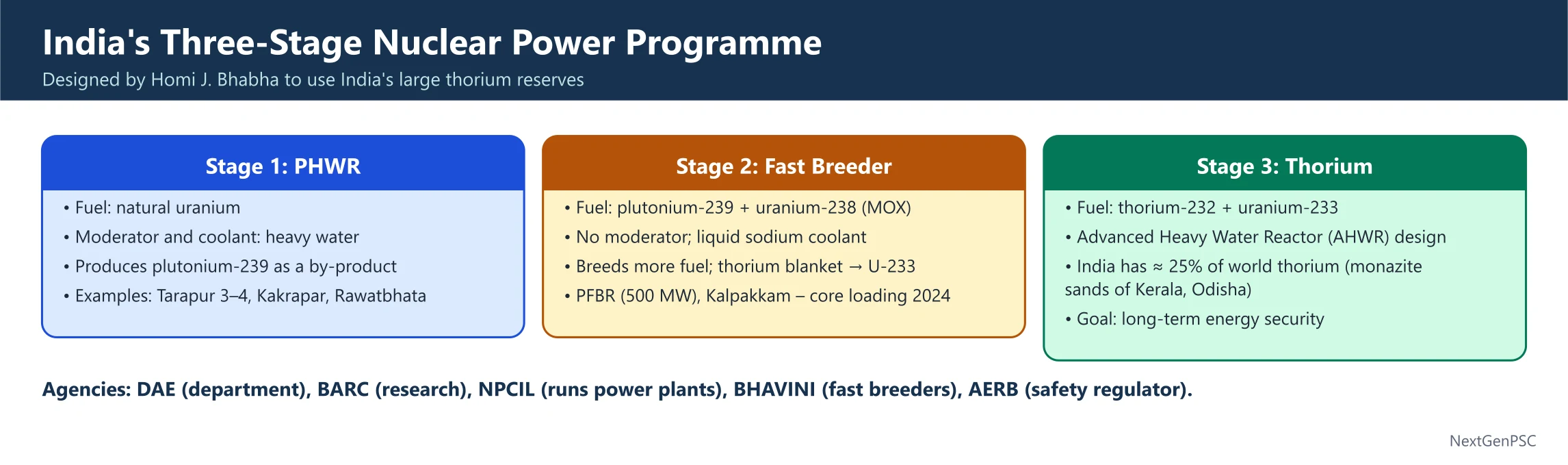
India's nuclear roadmap, designed by Dr. Homi J. Bhabha, is a unique 'closed fuel cycle' strategy. It aims to transition from scarce Uranium to India's vast Thorium reserves found in the monazite sands of South India. By early 2026, the successful commissioning trials of the PFBR (Stage 2) have brought India closer to the final goal of Thorium-based energy independence.
1. The Three-Stage Roadmap
India follows a sequential plan where the 'waste' of one stage serves as the 'fuel' for the next.
Stage 1: PHWRs (Pressurized Heavy Water Reactors): Uses Natural Uranium as fuel. It produces energy and converts some Uranium into Plutonium-239 as a byproduct.
Stage 2: FBRs (Fast Breeder Reactors): Uses Plutonium-239 from Stage 1 as fuel. These reactors 'breed' more fuel than they consume. Crucially, they use a Thorium-232 blanket to transmute it into fissile Uranium-233.
Stage 3: Thorium Based Reactors: The final stage utilizes Thorium-232 and Uranium-233. Since India holds nearly 25% of the world's Thorium, this stage provides infinite energy security.
2. Anatomy of a Nuclear Reactor
Understanding the components that make a controlled chain reaction possible.
Fuel: Uranium Oxide (UO2) pellets inside zirconium tubes.
Moderator: Slows down neutrons. India uses Heavy Water (D2O), which allows the use of natural (non-enriched) uranium.
Control Rods: The 'brakes' of the reactor. Made of Boron or Cadmium to absorb neutrons.
Coolant: Transfers heat to the exchanger to create steam. Usually heavy water, light water, or liquid sodium (in FBRs).
3. Global Integration: The NSG Waiver
Isolation: For decades, India was barred from global nuclear trade after its 1974 tests.
The Shift: The 2008 Indo-US Nuclear Deal and the NSG (Nuclear Suppliers Group) waiver allowed India to import Uranium from countries like Kazakhstan, Canada, and Australia.
Strategic Advantage: While imported Uranium fuels Stage 1, India's domestic R&D remains focused on perfecting Stage 2 and 3 to ensure long-term autonomy.
| Reactor Type | Neutron Speed | Moderator Used | Key Feature |
|---|---|---|---|
| PHWR | Slow (Thermal) | Heavy Water (D2O) | Uses Natural Uranium |
| PWR / BWR | Slow (Thermal) | Light Water | Requires Enriched Uranium |
| FBR (Breeder) | Fast | None | Produces more fuel than consumed |
| Thorium Reactor | Slow/Thermal | D2O or Graphite | Uses U-233 bred from Thorium |
Prelims tips
- Stage 1: PHWR, Natural Uranium, D2O moderator.
- Stage 2: PFBR, Plutonium fuel, Liquid Sodium coolant, No moderator.
- Stage 3: AHWR (Advanced Heavy Water Reactor), Thorium-U233 fuel.
- Monazite: The ore for Thorium, found in Kerala's coastal sands.
- Nuclear Power Corporation of India (NPCIL): Manages Stage 1; BHAVINI: Manages Stage 2 (FBR).
Mains points
- The Closed Fuel Cycle: This approach is environmentally responsible as it minimizes long-term nuclear waste by recycling spent fuel across stages.
- Strategic Autonomy: By mastering the FBR technology in 2026, India avoids being hostage to international Uranium cartels and price fluctuations.
- Safety Paradigm: Indian PHWRs are considered among the safest in the world due to their 'passive' safety features and secondary containment systems.
- Energy Transition: Nuclear power currently provides about 2-3% of India's grid, but the goal is to reach 22,480 MW by 2031-32 as Stage 2 matures.
Did you know?
- Thorium is not fissile itself—it is 'fertile.' You have to 'cook' it inside a reactor with Plutonium to turn it into fuel (U-233).
- India is the only country with a dedicated roadmap for Thorium because our Monazite sands are a global strategic asset.
- The KAMINI reactor in Kalpakkam is the world's only reactor currently operating on Uranium-233 fuel!
India’s Nuclear Energy Status: The Expansion Phase (2026)
As of February 12, 2026, India's installed nuclear capacity has reached 8,780 MW, nearly doubling since 2014. The program has entered a high-growth phase under the Nuclear Energy Mission, targeting 22,380 MW by 2032 and a massive 100 GW by 2047. A historic milestone is near as the PFBR at Kalpakkam is expected to achieve first criticality by March 2026, finally bridging the gap to Stage 2.
1. Current Operational Landscape (Feb 2026)
India currently operates 24 nuclear reactors across 7 sites. The backbone remains the indigenous PHWR technology, but larger imported VVER reactors (Kudankulam) now provide high-capacity baseload power.
Installed Capacity: 8,780 MW (active) with an additional 6,600 MW under various stages of construction.
Recent Additions: The successful full-power operations of Kakrapar Unit 4 (700 MW) in 2024 and Rajasthan Unit 7 in 2025 have significantly boosted the grid.
Kudankulam Status: Units 3 & 4 are on track for completion by 2026–27, while work on Units 5 & 6 is progressing for a 2030 deadline.
2. Transition to Stage 2: The PFBR Milestone
The 500 MW Prototype Fast Breeder Reactor (PFBR) at Kalpakkam is the most anticipated project in India's nuclear history.
2026 Status: Core loading was initiated by PM Modi in 2024. Following the solving of technical issues, the AERB cleared final fuel loading in Oct 2025. First Criticality is targeted for March 2026.
Significance: Once operational (commercial target Sept 2026), it will mark India's formal entry into the Second Stage, utilizing Plutonium and breeding more fuel than it consumes.
3. The Road to 100 GW: Planned Projects & SMRs
Fleet Mode Construction: 10 indigenous 700 MW PHWRs have been approved in 'fleet mode' across Kaiga, Gorakhpur, Chutka, and Mahi Banswara to speed up deployment.
Small Modular Reactors (SMRs): A new ₹20,000 crore mission was launched in 2025-26 to build at least 5 SMRs by 2033, aiming for 40 GW from this tech by 2047.
Mega Projects: Negotiations for Jaitapur (9,900 MW) with France and Kovvada (6,600 MW) with the US are moving into commercial finalization stages in 2026.
| Year | Target Capacity | Key Drivers |
|---|---|---|
| 2026 | 8,780 MW+ | PFBR Criticality, RAPP-8 Completion |
| 2032 | 22,380 MW | Completion of 10 Fleet-mode PHWRs |
| 2037 | 47,000 MW | Mega Projects (Jaitapur/Kovvada) |
| 2047 | 100,000 MW (100 GW) | SMRs, Private Participation, Thorium |
Prelims tips
- NPCIL: Operates Stage 1; BHAVINI: Operates Stage 2 (FBR).
- PFBR Fuel: Mixed Oxide (MOX) - Plutonium & Uranium; Coolant: Liquid Sodium.
- Nuclear Energy Mission (2025-26): New policy focusing on SMRs and private sector role.
- IPHWR-700: The new standard high-capacity indigenous reactor design.
- Thorium Baseline: Large-scale deployment expected only 30-40 years after FBRs go commercial.
Mains points
- Policy Shift (2025-26): The Union Budget 2025-26 marked a paradigm shift by allowing private sector participation in nuclear power, aiming to de-risk the massive capital investment required for 100 GW.
- Energy Security vs. Geopolitics: Despite global volatility, India’s 'Safety First, Production Next' doctrine and diversification (Russian VVER, French EPR, US AP1000, and domestic PHWR) ensures a resilient energy future.
- Decarbonization Goals: Nuclear energy is now recognized by NITI Aayog as a critical 'backstop' fuel to support solar and wind, especially for hard-to-abate sectors like steel and aluminum.
- The Thorium Bridge: The success of PFBR in 2026 is not just about 500 MW; it is the validation of the 'Breeder' technology required to eventually tap into India's 25% share of global thorium.
Did you know?
- In 2025, India granted duty exemptions for nuclear equipment imports until 2035 to accelerate construction!
- The Kakrapar Unit-3 was the first commercial 700 MW PHWR in the world to be designed and built entirely indigenously.
- India's Small Modular Reactors (SMRs) are being designed to replace aging coal plants, using the existing grid and water infrastructure.
Nuclear Weapons: The Physics of Deterrence (2026 Update)
As of February 12, 2026, the global nuclear landscape has entered a volatile new era following the expiration of the New START Treaty on February 5. For the first time in decades, the world's largest arsenals face no legal limits. Meanwhile, India has reached a peak stockpile of approximately 180 warheads, successfully operationalizing its rail-mobile Agni-P to secure its second-strike capability.
1. The Fission Chain Reaction
Nuclear weapons rely on an uncontrolled chain reaction to release devastating energy in microseconds.
The Trigger: A free neutron strikes a fissile nucleus (U-235 or Pu-239), causing it to split.
The Multiplication: Each split releases 2-3 more neutrons and a burst of energy. These neutrons strike other nuclei, doubling the reaction at every step.
Critical Mass: This is the minimum amount of fuel needed to sustain this reaction. For U-235, it is about 52 kg (a sphere roughly 17 cm wide). Weapons use 'Supercritical Mass' to ensure an explosion.
2. Uranium Enrichment & Weapon Grades
Natural uranium is over 99% U-238, which is stable. Weapons require the rare, radioactive U-235 isotope.
LEU (Low Enriched Uranium): < 20% U-235. Used for civilian power plants (Stage 1).
HEU (Highly Enriched Uranium): > 20% U-235. Used in research reactors and naval propulsion.
Weapons Grade: Typically > 85-90% U-235. Highly concentrated to keep the 'critical mass' small enough for a missile warhead.
3. Global Status & India's Triad (2026)
India maintains a policy of Credible Minimum Deterrence and a No First Use (NFU) doctrine.
The Triad: India is one of only four nations (US, Russia, China, India) with a fully functional triad—the ability to launch nuclear strikes from land, air, and sea.
Agni-P (Rail-Mobile): In 2025-26, India successfully integrated the Agni-Prime into its vast railway network. Disguised as commercial freight, these mobile launchers are nearly impossible for enemy satellites to track.
Sea-Leg: With two Arihant-class submarines (SSBNs) operational in 2026, India's 'Second-Strike' capability (the ability to retaliate after being hit) is now fully guaranteed.
| Nation | Warheads | Key Delivery Platform |
|---|---|---|
| Russia | 5,580 | Sarmat ICBM / Poseidon Drone |
| USA | 5,044 | Minuteman III / B-21 Raider |
| China | 550-1,000 | DF-41 / Type 094 Submarine |
| India | 180 | Agni-V / INS Arihant |
| Pakistan | 170 | Shaheen-III / Babur Cruise |
Prelims tips
- No First Use (NFU): India's doctrine—we won't strike first, but will retaliate massively.
- New START: Expired on Feb 5, 2026; previously limited US/Russia to 1,550 warheads.
- Critical Mass: Sphere is the ideal shape for minimal mass.
- U-235 vs U-238: U-235 is fissile; U-238 is fertile (can become Pu-239).
- Nuclear Command Authority (NCA): Comprises Political Council (PM) and Executive Council (NSA).
Mains points
- Post-New START Stability: The expiration of limits between the US and Russia in 2026 forces mid-sized powers like India to modernize faster to maintain a Credible Deterrence in a world without arms control.
- The Second-Strike Necessity: For a nation with NFU, the 'survivability' of its nuclear force is key. India’s shift to Rail-mobile Agni-Prime and Canisterized Agni-V ensures that its arsenal can survive a first strike.
- Technological Sovereignty: India’s development of MIRV (Multiple warheads on one missile) in 2024-25 is a response to advanced missile defense systems being built by regional adversaries.
- Diplomatic Impact: India is the only non-NPT state to receive an NSG waiver, allowing it to maintain nuclear weapons while trading in civilian nuclear fuel—a unique achievement in global diplomacy.
Did you know?
- The Hiroshima bomb (Little Boy) used only 64 kg of uranium, and only about 0.7 grams of that mass was actually converted into energy—less than the weight of a butterfly!
- India's Strategic Forces Command (SFC), created in 2003, is the custodian of all nuclear assets, but the button can only be 'pressed' by the Prime Minister.
- A 'Dirty Bomb' is not a nuclear weapon; it is a conventional explosive used to spread radioactive material to cause panic and contamination.
Uranium Processing and the Dual-Use Nature of Nuclear Technology
The processing of Uranium is the critical gateway between peaceful energy and military weapons. By February 2026, global focus has shifted toward Laser Isotope Separation and High-Assay Low-Enriched Uranium (HALEU) to fuel the next generation of Small Modular Reactors (SMRs). While the benefits of nuclear tech are vast—spanning medicine to space—the risks of proliferation and radiological safety remain paramount.
1. Uranium Enrichment Methods
Enrichment increases the concentration of the fissile isotope U-235. Because isotopes are chemically identical, they must be separated by physical mass differences.
Centrifugation: The most common modern method. Gas (UF6) is spun at high speeds; the heavier U-238 moves to the wall, while the lighter U-235 stays near the center.
Gaseous Diffusion: An older, energy-intensive method where gas is forced through semi-permeable membranes. Lighter U-235 passes through faster.
Laser Isotope Separation (SILEX): The cutting-edge of 2026. Lasers are tuned to precisely excite only U-235 atoms, allowing them to be collected. It is highly efficient and requires a smaller footprint.
Electromagnetic Separation: Uses a mass spectrometer (Calutron) to bend ion beams in a magnetic field; heavier isotopes bend less.
2. Diverse Applications of Nuclear Technology
Beyond power plants, nuclear science touches almost every modern industry.
Medicine: Radiotherapy for cancer (Cobalt-60) and diagnostic imaging (Technetium-99m). 2026 has seen the rise of Alpha-emitters for targeted micro-tumor destruction.
Agriculture: 'Mutation Breeding' uses radiation to create drought-resistant crop varieties. Gamma rays are also used to sterilize pests (SIT technique).
Food Preservation: Irradiation kills bacteria and parasites in spices, fruits, and meat, extending shelf life without using chemicals.
Space Exploration: RTGs (Radioisotope Thermoelectric Generators) provide power for probes where solar energy is unavailable, like the deep-space missions of 2025-26.
3. Dangers & Risks
Radioactive Waste: Long-lived waste (Plutonium/Cesium) stays hazardous for thousands of years. The 2026 challenge is the global consensus on Deep Geological Repositories.
Nuclear Proliferation: The 'Dual-Use' dilemma—the same enrichment technology for 5% (Power) can be used for 90% (Weapons).
Radiological Accidents: Risk of meltdowns (Chernobyl/Fukushima) due to natural disasters or human error.
Nuclear Terrorism: The threat of 'Dirty Bombs'—conventional explosives used to scatter radioactive medical/industrial waste.
| Sector | Positive Application | Associated Danger |
|---|---|---|
| Power | Carbon-free Baseload Energy | Risk of Meltdown / Waste |
| Medicine | Cancer Cure (Targeted Alpha) | Accidental Exposure / Theft |
| Industry | Non-destructive Testing (X-rays) | Radiological Contamination |
| Strategic | National Deterrence (Weapons) | Nuclear Arms Race / Escalation |
Prelims tips
- UF6 (Uranium Hexafluoride): The gas used in enrichment centrifuges.
- Yellowcake: The solid form of mixed uranium oxides (U3O8) produced after milling uranium ore.
- HALEU: High-Assay Low-Enriched Uranium (5-20% enrichment), critical for modern SMRs.
- Irradiation: Does NOT make the food radioactive; it only kills germs.
- IAEA (International Atomic Energy Agency): The global watchdog for nuclear safety and non-proliferation.
Mains points
- The SMR Revolution (2026): Small Modular Reactors are emerging as a way to minimize the risk of large-scale accidents while providing decentralized power to remote industrial hubs.
- Strategic Autonomy & Laser Enrichment: The development of Laser enrichment makes it harder to detect clandestine programs, presenting a new challenge for IAEA Safeguards in the coming decade.
- Circular Economy in Nuclear: 2026 research is focusing on 'Advanced Reprocessing' to turn high-level waste into fuel for Stage 2 Fast Breeder Reactors, solving the waste problem while generating power.
- Global Health Equity: Expanding access to medical radioisotopes in the Global South is a key priority for the IAEA to ensure cancer treatment parity.
Did you know?
- Nuclear power is actually one of the safest forms of energy, causing far fewer deaths per terawatt-hour produced than coal or oil.
- The Voyager 1 spacecraft, launched in 1977, is still talking to Earth in 2026 thanks to its small nuclear 'battery' (RTG) fueled by Plutonium-238.
- A single pellet of enriched uranium (the size of a pencil eraser) contains the same energy as three barrels of oil or one ton of coal.