
Science & Technology · UPSC Notes
Defence Technology — UPSC Science & Tech Notes
Free, exam-focused notes for UPSC Prelims and Mains, with Prelims tips and Mains points for every topic. 20 topics.
Open in the interactive reader: bookmarks, progress tracking and read-aloud.
Indian Defence Structure: The Hierarchy of National Security
The Ministry of Defence (MoD) is the central authority managing India's national security and armed forces. In 2026, the structure is more integrated than ever, operating through five key departments and a unified military leadership under the Chief of Defence Staff (CDS). The primary focus today is 'Aatmanirbharta' (self-reliance) and the transition to Integrated Theatre Commands.
1. Constitutional & Political Leadership
Supreme Commander: The President of India holds the ceremonial title of Commander-in-Chief of the Armed Forces.
Raksha Mantri: The Minister of Defence (currently Shri Rajnath Singh in early 2026) is the political head responsible for policy and strategic direction.
Cabinet Committee on Security (CCS): The highest decision-making body for all defence and security matters, chaired by the Prime Minister.
2. The Five Pillars of the MoD
The Ministry operates through five distinct departments, each headed by a Secretary-level officer.
1. Department of Defence (DoD): Deals with defence policy, budget, and acts as the central planner. It is headed by the Defence Secretary (currently Shri Rajesh Kumar Singh).
2. Department of Military Affairs (DMA): Created in 2019 to integrate the Army, Navy, and Air Force. It is uniquely headed by the Chief of Defence Staff (CDS) as its ex-officio Secretary.
3. Department of Defence Production (DDP): Focuses on self-reliance and indigenization. It manages DPSUs (like HAL and BEL) and private sector involvement. (Headed by Secretary DDP: Shri Sanjeev Kumar).
4. Department of Defence Research & Development (DRDO): The scientific wing. Headed by the Secretary DRDO & Chairman DRDO (currently Dr. Sameer V. Kamat).
5. Department of Ex-Servicemen Welfare (DESW): Dedicated to the health, pension, and resettlement of veterans. (Headed by Secretary DESW: Smt. Sukriti Likhi).
3. High-Level Military Leadership (2026)
The 'Year of Defence Reforms' (2025-26) has emphasized jointness among the services.
Chief of Defence Staff (CDS): General Anil Chauhan acts as the single-point military advisor to the government.
Service Chiefs:
Army: General Upendra Dwivedi.
Navy: Admiral Dinesh K Tripathi.
Air Force: Air Chief Marshal Amar Preet Singh.
| Department | Headed By | Key Responsibility |
|---|---|---|
| Defence (DoD) | Defence Secretary | Policy, Budget, Coast Guard, BRO |
| Military Affairs (DMA) | Chief of Defence Staff (CDS) | Tri-service Jointness, Training, Staffing |
| Defence Production (DDP) | Secretary (DP) | Make in India, Exports, DPSUs |
| Defence R&D | Chairman DRDO | Scientific Research & Tech Innovation |
| Veteran Welfare (DESW) | Secretary (ESW) | Pension (ECHS) and Resettlement |
Prelims tips
- CDS Role: Heads DMA and is Permanent Chairman of Chiefs of Staff Committee (COSC). He does not exercise operational command over the three Service Chiefs.
- Integrated Theatre Commands: The major ongoing reform in 2026 to create unified geographical commands.
- DAP 2026: The new 'Defence Acquisition Procedure' aiming for faster, digitised procurement.
- Agnipath Scheme: Introduced to ensure a youthful profile and reduce the pension burden (managed by DMA).
- Financial Adviser: The Financial Adviser (Defence Services) is responsible for the financial scrutiny of MoD proposals.
- Warfare conventions: Biological Weapons Convention (BWC, 1972, in force 1975) bans development, production and stockpiling of biological and toxin weapons – India is a party, but the BWC has no formal verification body. Chemical Weapons Convention (CWC, 1993, in force 1997) bans chemical weapons and is verified by the OPCW (The Hague) – India is a party and has destroyed its declared stockpile. Geneva Conventions (1949) and Additional Protocols protect the wounded, prisoners of war and civilians. India has not joined the Ottawa Treaty on anti-personnel landmines.
Mains points
- Higher Defence Management Reforms: The creation of DMA and the CDS post marks the biggest shift since independence, moving India from a 'Service-Silo' approach to a Unified Command structure.
- Atmanirbhar Defence: The shift from importing to exporting (Viksit Bharat @ 2047) is driven by DDP’s 'Positive Indigenisation Lists' and the inclusion of the private sector in 23% of total production.
- Space and Cyber Domains: In 2026, the Defence Space Agency (DSA) and Defence Cyber Agency (DCA) under the CDS are critical for tackling hybrid warfare threats.
- Resource Rationalisation: As salaries and pensions account for 50% of the 2025-26 budget, the MoD is focusing on Capital Modernisation through schemes like Agnipath and digitised procurement.
Did you know?
- In 2026, India's defence budget reached approximately ₹6.81 Lakh Crore, accounting for about 13% of the total Union Budget.
- Mission Sudarshan Chakra was launched in late 2025 to enhance India's offensive and defensive drone capabilities.
- India's defence exports have reached an all-time high in 2025-26, crossing ₹21,000 Crore, shipping BrahMos and Akash missiles to various global partners.
Central Armed Police Forces (CAPF): The Internal Shield
The Central Armed Police Forces (CAPF), under the Ministry of Home Affairs (MHA), are responsible for internal security and border guarding. While often called 'Paramilitary' in common parlance, technically, only Assam Rifles is a true paramilitary force due to its dual control. In 2026, these forces are undergoing massive modernization under 'Police Reform 2.0', emphasizing drone surveillance and specialized combat training.
1. Classification & Administration
It is vital to distinguish between the Military (under MoD) and CAPFs (under MHA).
Leadership: CAPFs are typically headed by IPS officers (Director Generals), whereas the military is led by commissioned Army/Navy/Air Force officers.
Dual Control (Assam Rifles): This is India's oldest force (1835). It is unique because its administrative control lies with the MHA, but its operational control lies with the Indian Army (MoD).
2. Border Guarding Forces
Each force is assigned to a specific international border to ensure specialized security.
BSF (1965): Guards the Pakistan and Bangladesh borders. Known as 'India's First Line of Defence'.
ITBP (1962): Guards the Indo-China border (LAC) from Ladakh to Arunachal Pradesh. Specialized in high-altitude mountain warfare.
SSB (1963): Guards the 'open' borders with Nepal and Bhutan. Focuses on preventing cross-border crime and human trafficking.
Assam Rifles: Guards the Indo-Myanmar border and conducts counter-insurgency in the North-East.
3. Internal Security & Specialized Forces
CRPF (1939/1949): The largest CAPF. Its primary role is assisting States in Counter-Insurgency (Naxal areas) and maintaining Law & Order. It includes specialized units like CoBRA (Jungle warfare) and RAF (Riot control).
CISF (1969): Protects critical infrastructure like Airports, Metros, Space Centers (ISRO), and Nuclear Power Plants. Recently, it has started providing security to private sector entities on a payment basis.
NSG (1984): The 'Black Cats'. An elite counter-terrorism unit trained for 'Zero Error' operations, used during events like 26/11.
| Force | Mandate | Primary Region |
|---|---|---|
| BSF | Border Guarding | Pakistan & Bangladesh Borders |
| CRPF | Internal Security | Naxal Areas, J&K, Pan-India |
| CISF | Infrastructure Security | Airports, PSUs, Metros |
| ITBP | High Altitude Guarding | Indo-China Border (Himalayas) |
| SSB | Border Guarding | Nepal & Bhutan Borders |
| Assam Rifles | Counter-Insurgency | Indo-Myanmar & North-East |
| NSG | Counter-Terrorism | National Level / Emergency |
Prelims tips
- MHA vs MoD: All CAPFs are under the Ministry of Home Affairs.
- Oldest Force: Assam Rifles (formed as Cachar Levy).
- First Line of Defence: Specific title for the BSF.
- Dual Control: Only applies to Assam Rifles.
- One Border One Force: The policy recommendation ensuring each border is managed by only one dedicated CAPF to avoid confusion.
Mains points
- Modernization Challenges: In 2026, CAPFs are transitioning to Smart Border Management (CIBMS) involving IR sensors and drones to compensate for the difficult terrain.
- Internal Security vs. Civil Rights: The role of CRPF in LWE (Left Wing Extremism) areas remains a topic of debate regarding the balance between security and the development of tribal regions.
- Women in Combat: The reservation of 33% for women in constabulary roles (started in 2016) is showing results in 2026, with improved community policing and gender-sensitive operations.
- The Need for a Unified Command: Similar to the military's Theatre Commands, experts suggest better Intelligence Sharing between CAPFs and State Police to tackle hybrid security threats.
Did you know?
- The BSF operates the world's largest Camel Wing, used for patrolling the Thar Desert where vehicles cannot go.
- ITBP personnel are often called 'Himveers' (Snow Braves) as they guard posts at altitudes up to 18,000 feet in sub-zero temperatures.
- In 2026, the CRPF has significantly increased the deployment of all-women battalions in conflict zones to handle law and order more effectively.
Ballistic Missiles: Understanding the Science of Arched Flight
A Ballistic Missile is a rocket-propelled vehicle that follows a characteristic arched trajectory. Unlike cruise missiles, which fly like airplanes, a ballistic missile is powered only during the initial phase of flight. In 2026, India's ballistic missile program, led by the Agni and Prithvi series, forms the core of its 'Credible Minimum Deterrence' strategy.
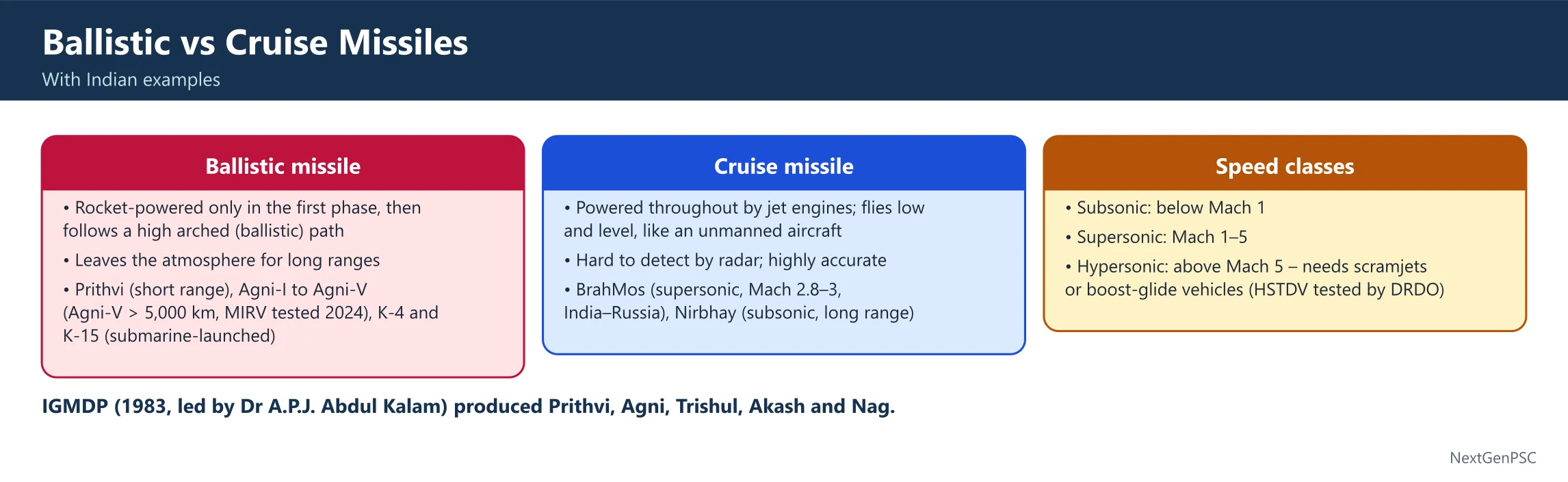
1. What is a Ballistic Trajectory?
A ballistic trajectory is like throwing a ball; after the initial push (thrust), the object is guided solely by gravity and atmospheric drag.
No Active Propulsion: Once the rocket engines burn out, the missile 'coasts' through space or the atmosphere.
Forces at Play: The path is influenced by the Coriolis Force (due to Earth's rotation), gravity, and air resistance.
Atmospheric Exit: Long-range missiles (ICBMs) leave the Earth's atmosphere and re-enter it at hypersonic speeds during the terminal phase.
2. Classification Based on Range
Ballistic missiles are categorized by the maximum distance they can cover. In 2026, the global standard remains:
Short-Range (SRBM): 300 km to 1,000 km (e.g., Prithvi, Pralay). These are tactical and stay within the atmosphere.
Medium-Range (MRBM): 1,000 km to 3,500 km (e.g., Agni-I, Agni-II).
Intermediate-Range (IRBM): 3,500 km to 5,500 km (e.g., Agni-III, Agni-IV).
Intercontinental (ICBM): 5,500 km+ (e.g., Agni-V, Agni-VI). These can hit targets across continents.
3. Key India-Specific Developments (2026)
MIRV Technology: In March 2024, India successfully tested Mission Divyastra (Agni-V with Multiple Independently Targetable Re-entry Vehicles), allowing one missile to hit several targets at once.
Canisterization: Modern Indian missiles are 'canister-based,' meaning they are stored in a sealed container for years and can be launched quickly from road or rail-mobile platforms.
Solid vs Liquid Fuel: India has transitioned almost entirely to solid propulsion for its ballistic missiles, which is safer and faster to launch than liquid-fueled rockets.
| Feature | Ballistic Missile | Cruise Missile |
|---|---|---|
| Trajectory | High Arched (Parabolic) | Horizontal (like a plane) |
| Propulsion | Initially Powered | Continuously Powered |
| Atmosphere | Exits and Re-enters | Stays within atmosphere |
| Detection | Easier to detect (high altitude) | Difficult to detect (low flying) |
| Example | Agni Series, Prithvi | BrahMos, Nirbhay |
Prelims tips
- Agni-V: India's primary ICBM (5,000 - 8,000 km range).
- MIRV: Multiple Independently Targetable Re-entry Vehicle (one rocket, many warheads).
- Thrust-to-Weight Ratio: Critical for the initial launch phase.
- MTCR: India is a member of the Missile Technology Control Regime, allowing it to develop advanced systems.
- K-Series: India’s submarine-launched ballistic missiles (SLBMs), like the K-4 and K-15.
Mains points
- Credible Minimum Deterrence: India’s ballistic missile arsenal is purely for defense, built on a No First Use (NFU) nuclear policy.
- Canister-based Readiness: The shift to canisterized missiles provides India with a Second-Strike Capability, ensuring that even after a surprise attack, India can retaliate immediately.
- The Indo-Pacific Balance: The range of the Agni-V brings almost all of Asia and parts of Europe within reach, acting as a geopolitical deterrent against aggressive regional neighbors.
- Technological Spin-offs: The heat shield technology developed for re-entry vehicles is now being used in the Gaganyaan mission to protect astronauts during return to Earth.
Did you know?
- An Agni-V ICBM travels at more than 24 times the speed of sound (Mach 24) when it re-enters the atmosphere!
- The Coriolis Force means that if you launch a long-range missile from the North Pole toward the Equator, the Earth's rotation will make the missile appear to drift to the right.
- India's Pralay missile, introduced recently, is a 'Quasi-ballistic' missile—it follows a ballistic path but can perform maneuvers in flight to dodge enemy defenses.
Cruise Missiles: The High-Precision Sea-Skimmers
A Cruise Missile is essentially an unmanned, self-propelled aircraft designed to deliver a warhead with pin-point accuracy. Unlike ballistic missiles that follow a high arc, cruise missiles stay within the atmosphere and are capable of performing complex maneuvers at very low altitudes to avoid radar detection.
1. Flight Characteristics & Technology
Cruise missiles function more like a fighter jet than a rocket. They use Jet Engines (Turbojets or Ramjets) rather than rocket motors for the sustained part of their flight.
Atmospheric Flight: They never leave the Earth's atmosphere.
Terrain Masking: Many modern cruise missiles use 'Terrain Hugging' technology, flying just meters above the ground or sea level to hide behind hills or stay below radar coverage.
Guidance: They are constantly guided throughout their flight using GPS, INS (Inertial Navigation), or TERCOM (Terrain Contour Matching).
2. Classification by Speed
The defining feature of a cruise missile is often its velocity, measured in Mach (speed of sound).
Subsonic (~Mach 0.8): Slower than sound. They are fuel-efficient and have longer ranges. Example: India's Nirbhay.
Supersonic (Mach 2–3): 2 to 3 times faster than sound. These are extremely difficult to intercept. Example: BrahMos (the world's fastest cruise missile).
Hypersonic (Mach 5+): Over 5 times the speed of sound. They combine speed with maneuverability, making current missile defense systems obsolete. Example: BrahMos-II (under development).
3. Comparison of Propulsion Systems
As we move from subsonic to hypersonic, the engine technology changes significantly.
Turbojet: Used in subsonic missiles like Nirbhay.
Ramjet: Used in supersonic missiles like BrahMos; it works by compressing incoming air at high speeds.
Scramjet: (Supersonic Combustion Ramjet) Necessary for hypersonic flight, where combustion happens in a supersonic airflow.
| Feature | Ballistic Missile | Cruise Missile |
|---|---|---|
| Engine Type | Rocket Engine | Jet Engine |
| Flight Path | Parabolic (Exits atmosphere) | Horizontal (Stays in atmosphere) |
| Guidance | Guided only at start | Constantly guided |
| Precision | Moderate (High for short range) | High (Pin-point) |
| Payload | Heavy / Nuclear focus | Lighter / Conventional focus |
Prelims tips
- BrahMos: Supersonic, Ramjet engine, 290–450 km range (extended after MTCR).
- Nirbhay: Subsonic, Long-range (~1000 km), uses a Turbojet engine.
- Mach Number: Ratio of the speed of the object to the speed of sound.
- Terrain Following Radar: Allows the missile to 'see' the ground and avoid obstacles.
- Vertical Launch: Most modern Indian cruise missiles can be launched vertically from ships or mobile launchers.
Mains points
- Strategic Flexibility: Cruise missiles provide 'surgical strike' capabilities, allowing the military to destroy high-value targets with minimal collateral damage.
- The Hypersonic Race: India’s development of HSTDV (Hypersonic Technology Demonstrator Vehicle) is a major step toward BrahMos-II, ensuring India stays ahead of missile defense technologies.
- Export Potential: With the sale of BrahMos to the Philippines in 2024-25, India has transitioned from a defence importer to a major Defence Exporter.
- Indigenization (Aatmanirbharta): The transition from using Russian engines to indigenous 'Manik' small turbofan engines for the Nirbhay/ITCM missions highlights India's self-reliance in propulsion tech.
Did you know?
- BrahMos is a joint venture between India (DRDO) and Russia (NPO Mashinostroyeniya). Its name is a combination of the Brahmaputra and Moskva rivers!
- A cruise missile can be programmed to enter through a specific window of a building from hundreds of kilometers away.
- Because they stay low, cruise missiles are often called 'Sea-skimmers' when used against ships.
India's Missile Arsenal: The Pillars of Strategic Strength (2026)
In 2026, India's missile program has reached a historic zenith. With the successful testing of MIRV (Multiple Independently Targetable Re-entry Vehicle) technology in the Agni-V and the induction of the Pralay quasi-ballistic missile, India has solidified its Nuclear Triad. The focus has now shifted toward Hypersonic platforms and the creation of an integrated Rocket Force.
1. Air-to-Air Missiles (AAM): Dominating the Skies
These missiles are launched from fighter jets to destroy enemy aircraft. The crown jewel is the Astra series.
Astra Mk-1: India's first indigenous BVR missile. In 2026, it is the primary weapon for Su-30MKI and LCA Tejas.
Astra Mk-2: Currently undergoing advanced trials, this variant features a dual-pulse motor, extending its range to over 160 km, rivaling the world-renowned Meteor missile.
2. Surface-to-Air Missiles (SAM): The Shield
Designed to intercept aerial threats like drones, missiles, and jets.
Akash-NG (New Generation): Formally inducted into the IAF in 2025-26. It features a much smaller footprint, a better seeker, and uses a canister-based launch for quick reaction.
MRSAM (Barak-8): Jointly developed with Israel, it provides a 70-100 km protective umbrella for Indian Navy ships and ground sites.
3. The Ballistic Backbone: Agni and Prithvi
India's Strategic Forces Command (SFC) manages these nuclear-capable missiles.
Agni-V with MIRV (Mission Divyastra): The 2024 success means India can now launch one Agni-V that carries multiple warheads, each capable of hitting a different city thousands of kilometers apart.
Agni Prime (P): This 'New Generation' missile is replacing the older Agni-I and II. It is canisterized, making it highly mobile and difficult for enemy satellites to track.
4. Submarine-Launched Ballistic Missiles (SLBM): The K-Series
Named after Dr. A.P.J. Abdul Kalam, these ensure a Second-Strike Capability (the ability to retaliate even if land-based missiles are destroyed).
K-15 (Sagarika): 750 km range; currently deployed on INS Arihant.
K-4: With a 3,500 km range, its successful 2025 trials have enabled INS Arighat to strike distant targets while remaining safely hidden in deep waters.
5. Tactical & Cruise Missiles: Precision and Stealth
Pralay: A surface-to-surface quasi-ballistic missile (150-500 km). It follows a low trajectory and can maneuver in flight, making it nearly impossible for enemy air defenses to shoot down.
LR-LACM: The Long Range Land Attack Cruise Missile (1,500 km) is the indigenous successor to Nirbhay, using the Indian-made Manik Engine.
Nag & Helina: The 'Fire and Forget' anti-tank missiles. Helina (Helicopter-launched) is now fully integrated with Prachand and Dhruv helicopters.
| Category | Key Missile | Primary Feature |
|---|---|---|
| Air-to-Air | Astra Mk-2 | Beyond Visual Range (160 km) |
| Surface-to-Air | Akash-NG | Multi-target, Canister-based |
| Anti-Tank | Nag / Helina | Fire-and-Forget, Passive IR Seeker |
| SLBM (Sea) | K-4 | Nuclear Triad (3,500 km range) |
| Tactical | Pralay | Quasi-ballistic, Battlefield use |
| Cruise | BrahMos | World's fastest (Mach 3) |
Prelims tips
- MIRV (Mission Divyastra): Multiple Independent warheads on one missile.
- Canisterization: Allows for quick launch and longer storage life.
- Exo-atmospheric vs Endo-atmospheric: PAD (Prithvi Air Defence) hits targets in space; AAD (Advanced Air Defence) hits them inside the atmosphere.
- HSTDV: India is testing this vehicle to build future Hypersonic Cruise Missiles (Mach 6+).
- IGMDP: The original program (1983) that gave us Prithvi, Agni, Akash, Trishul, and Nag.
Mains points
- The Integrated Rocket Force (IRF): Discussion is underway in 2026 to create a separate command for non-nuclear tactical missiles (like Pralay and BrahMos) to handle border standoff scenarios.
- Second-Strike Capability: With the induction of INS Arighat and the K-4 SLBM, India's nuclear deterrence is now 'invincible' as sea-based assets are almost impossible to detect before launch.
- Aatmanirbharta (Self-Reliance): The transition to the Manik Engine for cruise missiles and indigenous seekers for Akash-NG shows India's move toward 100% indigenous content in strategic systems.
- Space Neutrality & BMD: The Prithvi Defense Vehicle (PDV) Mk-II used in 'Mission Shakti' proved India can also intercept satellites, adding a Counter-Space dimension to its defense.
Did you know?
- The K-series of missiles is named in honor of Dr. A.P.J. Abdul Kalam.
- BrahMos is currently being exported to nations like the Philippines, marking India's shift from a weapon importer to a global exporter.
- The Nag missile is so smart that it can identify a tank from its 'heat signature' even if the tank is hiding behind smoke or camouflage.
IGMDP: The Foundation of India's Missile Prowess
The Integrated Guided Missile Development Program (IGMDP), envisioned by Dr. A.P.J. Abdul Kalam in 1983, was the turning point that made India a global missile power. It successfully developed the five core missile systems—Prithvi, Agni, Trishul, Akash, and Nag—forming the bedrock of India's strategic autonomy.
1. The Five Pillars of IGMDP (P-A-T-N-A)
The program was approved on July 26, 1983, to achieve self-reliance in missile technology. A simple acronym to remember these is PATNA :
Prithvi: Short-range Surface-to-Surface ballistic missile. India's first indigenous ballistic missile.
Agni: Originally a technology demonstrator for re-entry, it evolved into a family of surface-to-surface ballistic missiles (MRBM to ICBM).
Trishul: Short-range, low-level Surface-to-Air missile (later used as a tech-base for other systems).
Akash: Medium-range Surface-to-Air missile with multi-target engagement.
Nag: 3rd generation Anti-Tank 'fire and forget' missile.
2. The Agni Family: From Regional to Global Reach
The Agni series is the backbone of India's nuclear deterrence. By 2026, the series has moved from open-launch to stealthy, canisterized versions.
Agni-I to III: Focused on regional deterrence (700km to 3,000km).
Agni-IV: Introduced modern ring laser gyros and composite rocket motors for high precision.
Agni-V (ICBM): A 3-stage solid-fuel missile with a range over 5,000 km. It features Canister-launch technology, allowing it to be stored for years and launched quickly from anywhere in India.
Mission Divyastra (2024): India integrated MIRV (Multiple Independently Targetable Re-entry Vehicle) technology into Agni-V, allowing a single missile to strike multiple targets simultaneously.
3. Prithvi: The Battlefield Workhorse
It was the first missile to be developed under the program.
Variants: Prithvi-I (Army), Prithvi-II (Air Force), and Dhanush/Prithvi-III (Navy).
It uses liquid propulsion, though newer tactical missiles like Pralay (introduced post-IGMDP) are now shifting toward solid fuel for faster deployment.
| Variant | Range | Type | Stages / Fuel |
|---|---|---|---|
| Agni-I | 700-800 km | SRBM / MRBM | Single Stage / Solid |
| Agni-II | 2000-3000 km | MRBM | Two Stage / Solid |
| Agni-III | 3000-3500 km | IRBM | Two Stage / Solid |
| Agni-IV | 3500-4000 km | IRBM | Two Stage / Solid |
| Agni-V | 5000-8000 km | ICBM | Three Stage / Solid |
| Agni-P (Prime) | 1000-2000 km | New Gen MRBM | Two Stage / Canisterized |
Prelims tips
- IGMDP Completion: The program was officially declared closed in 2008 as the objectives were met.
- Solid vs. Liquid: Agni-I was originally composite, but all modern Agni and Prithvi variants have moved toward solid fuels for better 'shelf-life'.
- Canister Launch: Key for Agni-V and Agni-P; it allows 'launch-on-demand' capability.
- Agni-P (Prime): It is a 2020s addition to replace Agni-I; it is smaller and more accurate.
- MIRV: Multiple Independently Targetable Re-entry Vehicles (Tested under Mission Divyastra).
Mains points
- Strategic Autonomy: IGMDP reduced India's dependence on the MTCR (Missile Technology Control Regime) countries, allowing India to build a credible deterrent despite sanctions in the 1990s.
- No First Use (NFU) Policy: The long-range Agni missiles are the physical tools that make India's NFU policy credible by ensuring a Second-Strike Capability.
- From Import to Export: Systems born from IGMDP (like Akash and BrahMos, which used IGMDP propulsion tech) are now being exported, supporting the 'Viksit Bharat' goal.
- Integrated Defence: The success of these missiles led to the creation of the Strategic Forces Command (SFC), which manages India's nuclear triad.
Did you know?
- Before IGMDP, India was largely dependent on Soviet missiles. Today, India is a leading exporter of systems like the Akash SAM!
- Dr. Kalam often called the Agni missile a 'technological fire' that gave India its strategic backbone.
- The Agni-V is so fast that it can reach a target 5,000 km away in less than 20 minutes.
BrahMos: The World's Deadliest Supersonic Predator
The BrahMos is a masterpiece of Indo-Russian engineering, recognized as the world's fastest supersonic cruise missile in operation. In 2026, it has become India's primary 'offensive' weapon, with extended ranges and successful international exports (e.g., to the Philippines), solidifying India's position as a global defense hub.
1. Technological Architecture
BrahMos operates on a 'Fire and Forget' principle, meaning once it is launched, it navigates itself to the target with pin-point accuracy.
Two-Stage Propulsion: It uses a Solid Propellant booster for the first stage (to gain initial speed) and a Liquid Ramjet for the second stage (to sustain supersonic speeds).
Speed (Mach 2.8): It travels at nearly 3 times the speed of sound. This speed gives it massive kinetic energy, allowing it to penetrate heavy armor on ships or reinforced bunkers.
Stealth & Low Flight: It features 'Sea-skimming' capability, flying as low as 3–4 meters above the water to avoid radar detection.
2. Range Extension & MTCR
Original Constraint: Initially, the range was capped at 290 km due to MTCR (Missile Technology Control Regime) guidelines which restricted the transfer of long-range missile tech to non-member countries.
The Shift: After India became a full member of MTCR in 2016, ISRO and DRDO successfully extended the range. By 2026, variants with ranges of 450 km to 800 km (BrahMos-ER) are already being tested and inducted.
3. Universal Launch Capability
BrahMos is one of the few missiles in the world that can be launched from almost any platform:
Land: Mobile Autonomous Launchers (MAL).
Sea: From surface ships and vertically from submarines.
Air: A specialized version (BrahMos-A) is integrated with the Su-30 MKI. At 2.5 tonnes, it is the heaviest weapon carried by this fighter jet.
| Parameter | Detail |
|---|---|
| Type | Supersonic Cruise Missile |
| Speed | Mach 2.8 to 3.0 |
| Range | 290 km (Standard) | 450 - 800 km (ER) |
| Warhead | 200 to 300 kg (Conventional / Nuclear) |
| Propulsion | First: Solid, Second: Liquid Ramjet |
| Precision | High (Circular Error Probable < 1 meter) |
Prelims tips
- BrahMos Aerospace: Joint venture between DRDO (India) and NPO Mashinostroyeniya (Russia).
- Ramjet Technology: It uses atmospheric oxygen for combustion, reducing the weight of the missile.
- Su-30 MKI Integration: The air-version has a smaller booster and additional fins for stability.
- Circular Error Probable (CEP): A measure of precision; BrahMos has a very low CEP.
- Export Control: After 2016 (MTCR), India can export missiles with ranges >300km to fellow members.
Mains points
- Strategic Deterrence: BrahMos provides India with a 'Surgical Strike' capability, allowing the military to strike terror camps or command centers with zero warning time for the enemy.
- Self-Reliance (Aatmanirbharta): By 2026, the indigenous content in BrahMos has reached over 75%, including the seeker and booster, reducing dependency on Russia.
- Economic Impact: The export of BrahMos is a centerpiece of India's goal to reach $5 billion in defense exports, creating a huge ecosystem for Indian SMEs and defense startups.
- Naval Superiority: In the Indian Ocean Region (IOR), BrahMos-equipped ships act as a massive deterrent against any aggressive naval expansion by foreign powers.
Did you know?
- The BrahMos-II, currently under development, is expected to be a Hypersonic missile with speeds exceeding Mach 7!
- BrahMos is so fast that it creates a 'plasma' layer in front of it, which actually helps absorb radar waves, making it even more stealthy.
- In 2024, the Philippines became the first foreign nation to receive BrahMos missiles, making it a major milestone for Indian Defence Exports.
Indian Artillery: The 'Gods of War' (2026 Update)
In 2026, the Indian Army's Field Artillery Rationalization Plan (FARP) has significantly modernized the 'Gods of War.' By standardizing all artillery to the 155mm calibre, India has streamlined logistics and boosted firepower across the LAC and LoC. The focus has moved from towed guns to Self-Propelled (SP) and Mounted Gun Systems (MGS).
1. Towed Howitzers: The Heavy Hitters
These are the traditional big guns pulled by trucks, essential for high-altitude defense.
Dhanush (155mm/45 cal): Known as the 'Desi Bofors,' it is the first indigenous 155mm gun. In 2026, it features improved Automatic Gun Alignment and an electronic sighting system.
Sharang: A brilliant example of 'circular economy' in defense; older 130mm Soviet-era guns were up-gunned to 155mm, increasing their range from 27 km to 39 km with modern ammunition.
M777 (Ultra-Light Howitzer): Made of titanium, it weighs only 4 tonnes. This makes it heli-liftable by Chinook helicopters, allowing it to be deployed in inaccessible mountain peaks in minutes.
2. Self-Propelled & Rocket Artillery: High Mobility
Modern warfare requires guns that can 'shoot and scoot' to avoid enemy counter-fire.
K9-Vajra-T (155mm/52 cal): A 50-tonne tracked monster. Originally for deserts, ISRO and DRDO modified its engine and winterization kits for Ladakh (High Altitude) deployment. It can turn 360° at its own spot (Zero Radius).
Pinaka (MBRL): Unlike guns, this is a rocket system. In 2026, the Guided Pinaka is the mainstay, providing a range of 75-90 km with pin-point accuracy using the NavIC satellite system.
3. The Future: ATAGS and MGS
ATAGS (Advanced Towed Artillery Gun System): Developed by DRDO, this is one of the world's longest-range guns (48 km). In 2026, it is being mass-produced for the Army.
Mounted Gun Systems: To replace towed guns, the Army is moving toward guns mounted on 8x8 trucks for faster deployment on highways.
| System | Type | Range | Key Strength |
|---|---|---|---|
| Dhanush | Towed Howitzer | 38 km | Indigenous (80%+) |
| M777 | Ultra-Light Towed | 30 km | Heli-liftable (Air mobile) |
| K9-Vajra | Self-Propelled | 50 km | High Mobility (Tracked) |
| Pinaka Mk-II | Rocket (MBRL) | 75-90 km | Area saturation & Guided |
| ATAGS | Towed (Advanced) | 48 km | Longest range in its class |
Prelims tips
- 155mm/52 Calibre: The new standard for the Indian Army's artillery rationalization.
- Chinook Integration: Only the M777 can be slung under a Chinook for rapid high-altitude deployment.
- Guided Pinaka: Uses NavIC for mid-course correction.
- ATAGS: Notable for its high rate of fire (5 rounds in 60 seconds).
- Sharang: An example of 'Up-gunning' (130mm to 155mm).
Mains points
- Artillery Rationalization Plan: By 2026, the Farp has streamlined spare parts and training by moving toward a single calibre (155mm), significantly reducing the logistics tail of the Army.
- Aatmanirbharta in Firepower: The success of Dhanush and ATAGS shows that India no longer needs to rely on foreign imports (like Bofors) for heavy artillery.
- High-Altitude Mobility: The deployment of K9-Vajra and M777 along the LAC (Line of Actual Control) has shifted the tactical balance, allowing India to respond quickly to border provocations in mountainous terrain.
- Digital Battlefield: In 2026, Indian artillery is integrated with Swathi Weapon Locating Radars and drones, creating a 'Sensor-to-Shooter' loop that can hit enemy batteries within seconds of them firing.
Did you know?
- The M777 is so light because it's built using the same titanium alloys used in aerospace engineering.
- A Pinaka battery can neutralize an area of roughly 1,000 meters by 800 meters in a single salvo—essentially wiping out a small enemy camp in under a minute.
- The K9-Vajra was originally a South Korean design (Hanwha Aerospace), but in 2026, more than 80% of its components are made in India by L&T.
The Indian Air Force (IAF): Guardians of the Sky
The Indian Air Force (IAF) is the 4th largest air force globally, maintaining a formidable fleet of over 1,850 aircraft. In 2026, the IAF is in the midst of a massive transformation—transitioning from legacy Soviet-era jets like the MiG-21 to advanced 4.5 and 5th-generation indigenous platforms like Tejas Mk-1A and the upcoming AMCA.
1. The MiG-21: 'The Supersonic Pioneer'
The MiG-21 (Mikoyan-Gurevich) was India's first supersonic fighter, serving as the backbone of the IAF for over six decades.
Legacy: Inducted in 1963, it was the first aircraft India manufactured under license-build rights. It played hero roles in the 1971 and 1999 wars.
Retirement Status (2026): As of early 2026, the IAF has fully retired all MiG-21 'Bison' squadrons. The last ceremonial flight took place in late 2025, marking the end of an era.
The Successor: The LCA Tejas has officially taken over the roles previously held by the MiG-21.
2. Mirage-2000: The 'Vajra' of Balakot
Manufactured by France's Dassault Aviation, the Mirage-2000 is a delta-wing, multi-role fighter known for its exceptional precision.
Combat History: It was the game-changer in the Kargil War (1999) by dropping laser-guided bombs at high altitudes and was the primary platform for the 2019 Balakot Airstrikes.
Upgrade: Under a 2011 contract, the fleet was upgraded to the 2000-5 Mk standard, featuring advanced glass cockpits, sophisticated radars (RDY-2), and modern electronic warfare suites.
Current Status (2026): To maintain the fleet until the 2030s, India recently procured retired airframes from France to use as 'spares' to keep the existing squadrons airworthy.
3. The 2026 Fleet Composition
The IAF today operates a 'High-Medium-Low' mix of aircraft to ensure air superiority.
High-End: Rafale (4.5 Gen) and Su-30 MKI (Air dominance).
Medium/Multi-role: Mirage-2000 and MiG-29 (UPG).
Light/Indigenous: LCA Tejas Mk-1A (Mass production phase in 2026).
| Aircraft | Origin | Type | Status in 2026 |
|---|---|---|---|
| Rafale | France | 4.5 Gen Multi-role | Fully Operational (2 Squadrons) |
| Su-30 MKI | Russia/India | Air Dominance | Backbone of IAF (~260+ jets) |
| LCA Tejas | India | Light Combat (LCA) | Mk-1A Inductions in full swing |
| Mirage-2000 | France | Multi-role | Upgraded; Operational |
| MiG-21 | USSR/India | Interceptor | Completely Decommissioned |
Prelims tips
- MRFA: The Multi-Role Fighter Aircraft deal (114 jets) is a key procurement goal in 2026.
- Bison: The specific name for the upgraded MiG-21 variant in India.
- Astra: The primary Air-to-Air missile now being integrated across Tejas, Su-30, and MiG-29.
- LCA Tejas: Designed by ADA (Aeronautical Development Agency) and built by HAL.
- C-295: The new transport aircraft replacing the aging Avro fleet in 2025-26.
Mains points
- Force Multipliers: The IAF's strength in 2026 isn't just jets; it's the integration of Netra AEW&C and Phalcon AWACS which act as 'eyes in the sky' to direct combat.
- Atmanirbhar Bharat: The order of 83+97 Tejas Mk-1A jets is the single largest boost to the domestic aerospace industry, reducing long-term reliance on foreign OEMs.
- Two-Front Challenge: The IAF is focusing on Integrated Theatre Commands to effectively manage simultaneous threats from the Western and Northern borders.
- Hypersonic & Space: With the creation of the Space Command, the IAF is transitioning into an 'Air and Space Force,' looking at high-altitude pseudo-satellites (HAPS) for surveillance.
Did you know?
- The Su-30 MKI is so advanced that it can 'look' behind itself and fire missiles at chasing enemy jets using its sophisticated radar.
- During the Balakot Airstrikes, the Mirage-2000s used Israeli 'Spice 2000' bombs which use GPS and camera imagery to hit a specific room inside a building.
- In 2026, the IAF is testing 'Loyal Wingman' drones—unmanned jets that fly alongside Tejas and Rafale to distract enemy missiles.
The Jaguar and Su-30MKI: From Ground Attack to Air Dominance
In early 2026, the Indian Air Force (IAF) is managing a strategic transition. The SEPECAT Jaguar is entering its final decade of service, sustained by 'global cannibalization' for parts, while the Su-30MKI is undergoing a massive 'Super Sukhoi' upgrade to transform into a 4.5+ generation powerhouse that will serve until 2050.
1. SEPECAT Jaguar (Shamsher): The Deep Penetrator
Known as the 'Sword of Justice' (Shamsher), the Jaguar remains India's primary dedicated ground-attack aircraft, despite being retired by all other nations.
The Spares Crisis (2026): As of January 2026, India is the only operator left. To keep the fleet flying until 2035, the IAF is acquiring retired airframes from Ecuador, Oman, and France to harvest spare parts (cannibalization).
DARIN III Upgrade: This modernization has given the Jaguar 'new eyes,' including AESA radars and an advanced glass cockpit, allowing it to perform precision-guided bombing in all weather conditions.
The Engine Issue: While avionics are modern, the aircraft remains 'underpowered.' A planned engine replacement with Honeywell F125IN was cancelled due to high costs; instead, the IAF is focusing on lightweight precision munitions.
2. Sukhoi Su-30MKI: The 'Super Sukhoi' Era
The Su-30MKI is the most numerous fighter in the IAF (~260+ jets). In February 2026, the 'Super Sukhoi' modernization program has finally received the green light.
Super Sukhoi Upgrade (2026): 84 jets are being upgraded with the indigenous Virupaksha AESA Radar, a new electronic warfare (EW) suite, and a state-of-the-art mission computer. This effectively turns it into a 4.5+ generation jet.
Maritime Role: Modified Su-30s carry the BrahMos-A missile, making them lethal against aircraft carriers and warships up to 400 km away.
Super-maneuverability: Its unique combination of canards and thrust-vectoring nozzles allows it to perform the 'Pugachev's Cobra' maneuver, giving it an edge in close-range dogfights.
3. Comparison of Roles
Jaguar: Specializes in Low-level penetration. It flies close to the ground to avoid radar and strike strategic targets like airbases and command centers.
Su-30MKI: An Air Superiority fighter. It is designed to clear the skies of enemy jets and provide cover for ground attackers like the Jaguar.
| Feature | SEPECAT Jaguar | Sukhoi Su-30MKI |
|---|---|---|
| Role | Deep Penetration Strike (Ground Attack) | Multi-role Air Superiority |
| Max Speed | Mach 1.6 | Mach 2.0+ |
| Engine Type | Adour Mk 811 (Underpowered) | AL-31FP (Thrust Vectoring) |
| Primary Radar | EL/M-2052 (AESA - Upgraded) | Virupaksha (AESA - Super Sukhoi) |
| Planned Retirement | 2030-2035 | 2045-2050 |
Prelims tips
- Super Sukhoi: The name for the ₹65,000 crore mid-life upgrade of the Su-30MKI fleet.
- DARIN III: The current navigation-attack upgrade for the Jaguar.
- Virupaksha: The indigenous AESA radar being fitted onto the Su-30MKI.
- Canards: The small 'fore-wings' near the Su-30's cockpit that improve its lift and control.
- Overwing Pylons: A unique feature of the Jaguar for mounting air-to-air missiles.
Mains points
- Strategic Longevity: The decision to source spares from Ecuador and Oman in 2026 shows a pragmatic approach to maintaining force levels while awaiting the induction of Tejas Mk2.
- Technological Sovereignty: The 'Super Sukhoi' program is 70% indigenous, reducing reliance on Russia for critical avionics and software during a period of geopolitical uncertainty.
- Nuclear Deterrence: Both aircraft are critical legs of India's air-based nuclear delivery system, with the Jaguar specialized for low-level tactical delivery and the Su-30 for long-range strategic strikes.
- Joint Operations: The Su-30MKI’s ability to act as a data-link hub allows it to guide smaller jets like the Tejas or Jaguars toward their targets, acting as a 'Force Multiplier'.
Did you know?
- The Jaguar is the only aircraft in the IAF that can carry missiles over its wings (overwing pylons), freeing up space under the wings for more bombs!
- The Su-30MKI is often called a 'flying mini-AWACS' because its powerful radar can track 30 targets and guide missiles to hit several of them at once.
- Despite its age, the Jaguar is technically 'stealthier' at low altitudes than many modern jets because it can 'terrain-hug' so close to the ground that it disappears from enemy radar screens.
The Evolution of India's Air Power: Rafale and Tejas (2026 Update)
In early 2026, the Indian Air Force (IAF) is fast-tracking its modernization to address a squadron shortage. While the 36 Rafales are now fully operational, the Tejas Mk-1A has begun its induction phase after engine supply delays. Crucially, as of February 12, 2026, the government has given initial approval for 114 more Rafales (MRFA) and 26 Rafale-M for the Navy, making the French jet the new 'strategic backbone' of India's skies.
1. Rafale: The 'Omnirole' Game Changer
The Rafale is not just a multi-role jet; it is 'omnirole,' meaning it can perform multiple mission types (strike, reconnaissance, combat) simultaneously.
Current Fleet: 36 jets (2 squadrons) are fully operational at Ambala and Hasimara. They were recently utilized in high-altitude drills near the northern borders.
The 114 Jet Deal (MRFA): On February 12, 2026, the Defence Acquisition Council (DAC) accorded 'Acceptance of Necessity' (AoN) for 114 additional Rafales. 18 will be 'off-the-shelf' while 96 will be Made in India by Tata Advanced Systems.
Naval Variant (Rafale-M): 26 units were formally signed for in 2025 to operate from INS Vikrant and INS Vikramaditya, with deliveries starting in 2028.
India-Specific Enhancements (ISE): Includes cold-start capability for Leh, helmet-mounted displays, and integration of the Astra and BrahMos-NG missiles.
2. LCA Tejas: The Indigenous Shield
Tejas has transitioned from a development project to the backbone of the IAF's numerical strength.
Tejas Mk-1A Status (Feb 2026): After delays in GE-F404 engines, HAL has confirmed the first batch of 5 jets is ready for delivery by March 2026. An additional 9 airframes are built and awaiting engines.
Orders: Total orders for Mk-1A now stand at 180 jets (83 from the 2021 deal and 97 approved in late 2025).
Key Upgrades: Features the indigenous UTTAM AESA Radar, a self-protection jammer (Swayam Raksha Kavach), and significantly improved maintainability.
3. Future Roadmap: Tejas Mk-2 and AMCA
Tejas Mk-2: The first prototype is expected to roll out by late 2026. It will be a larger, 17.5-tonne jet with a more powerful GE-F414 engine.
AMCA (5th Gen Stealth): The Cabinet approved the project in 2024. Prototype construction has started, with a rollout target of 2027. It features an internal weapons bay and stealth geometry.
| Feature | Dassault Rafale | LCA Tejas Mk-1A |
|---|---|---|
| Generation | 4.5 Generation | 4+ Generation |
| Engine | Twin-engine (Snecma M88) | Single-engine (GE-F404) |
| Role | Omnirole (Deep Strike/Air Superiority) | Light Combat (Point Defence) |
| Weapon Payload | 9,500 kg | 4,000 kg |
| Key Radar | RBE2 AESA | UTTAM AESA (Indigenous) |
| Max Speed | Mach 1.8 (Supercruise) | Mach 1.8 |
Prelims tips
- MRFA: Multi-Role Fighter Aircraft program for 114 jets.
- STOBAR: The system used by Rafale-M to launch from Indian carriers (Short Take-Off But Arrested Recovery).
- LCA Navy: Tejas has a naval version, but the Navy is now prioritizing the TEDBF (Twin Engine Deck Based Fighter) for the long term.
- AMCA: India's only 5th-generation stealth fighter project.
- Operation Sindoor (2025): Rafales were famously used to hit precision targets in a retaliatory strike last year.
Mains points
- Strategic Autonomy: The induction of Tejas Mk-1A reduces India's dependence on foreign OEMs for light-category fighters, while Rafale ensures a 'qualitative edge' over regional rivals.
- Economic Impact: The local manufacturing of 96 Rafale jets under the MRFA deal (2026) is expected to create over 50,000 high-tech jobs in India's aerospace sector.
- Two-Front Strategy: By basing Rafales in the East (Hasimara) and West (Ambala), India maintains a rapid-response capability against simultaneous threats.
- Technological Spin-offs: Technologies developed for Tejas (like the Digital Fly-by-Wire system) are now being used to upgrade older fleets like the Jaguar and Mirage.
Did you know?
- The Rafale is the only aircraft that can carry 1.5 times its own weight in weapons and fuel!
- The Tejas Mk-1A is so agile that it was the star performer at the 2025-26 international air shows, performing maneuvers that heavier jets find impossible.
- India's Astra Beyond Visual Range missile has been successfully integrated into the Rafale, making it a lethal 'Indo-French' hybrid.
Indian Strategic Airlift & Combat Aviation: The Heavy Lifters
In early 2026, the Indian Air Force (IAF) and Army Aviation have finalized their 'Heavy-Lift' and 'Attack' fleets. The C-17 Globemaster and C-130J Super Hercules now form the backbone of strategic and tactical transport, respectively. Meanwhile, the AH-64E Apache fleet is fully operational across both the IAF and the newly raised Army units, providing a lethal multi-domain combat edge.
1. Strategic Transport: C-17 Globemaster III
The C-17 is the ultimate heavy-lifter, capable of transporting tanks and large troops to forward bases with short runways.
Fleet Size (2026): India operates a fleet of 11 C-17 Globemasters, the largest fleet outside the US. These are maintained through a techno-logistics support deal with Boeing.
Operational Role: Critical for 'Strategic Reach,' these aircraft were instrumental in Operation Sindoor (2025) and humanitarian missions, delivering over 77 tonnes of payload per flight.
Forward Landing: Frequently utilized for landings on Emergency Landing Facilities (ELFs), including the newly inaugurated highway airstrip in Assam near the China border (Feb 12, 2026).
2. Tactical Transport: C-130J Super Hercules
Known for its agility, the C-130J is the 'first responder' for Special Forces insertions and disaster relief.
Current Fleet: The IAF operates 12 C-130J Super Hercules aircraft. As of early 2026, they are being supported by a new MRO (Maintenance, Repair, and Overhaul) facility in Bengaluru.
Indigenous Hub: In Dec 2025, Lockheed Martin announced a co-production hub in India (partnered with Tata) to build C-130Js locally, significantly boosting 'Aatmanirbhar Bharat'.
Special Ops: These are the primary platforms for Garud Special Forces for night-vision, short-runway assault landings.
3. Attack Aviation: AH-64E Apache Guardian
The Apache is a flying tank, designed to hunt and destroy enemy armor in all-weather conditions.
Dual Service Fleet (2026): India now operates a total of 28 Apaches.
IAF: 22 AH-64E units (active in Ladakh and Western sectors).
Indian Army: 6 AH-64E units (newly inducted into the 451 Army Aviation Squadron in Jodhpur as of Dec 2025).
Capabilities: Equipped with Longbow Radar, Hellfire missiles, and the ability to control Unmanned Aerial Systems (UAS) directly from the cockpit.
| Aircraft | Quantity | Primary Mission | Role in Vayu Shakti 2026 |
|---|---|---|---|
| C-17 Globemaster | 11 | Strategic Heavy Lift | Large equipment drop & landing |
| C-130J Hercules | 12 | Special Operations / Tactical | Garud SF Insertion |
| AH-64E Apache | 28 (Total) | Anti-Armor / Attack | Precision Strike Demonstration |
| C-295 | Induction on | Medium Lift (Replacing Avro) | Operational debut in Feb 2026 |
Prelims tips
- C-17: Strategic/Long-haul. C-130J: Tactical/Special Ops.
- Apache (AH-64E): Now operated by both IAF and Army Aviation Corps.
- ELF (Emergency Landing Facility): Highway stretches used as runways (e.g., in Rajasthan, UP, and now Assam).
- C-295: Manufactured in Vadodara by Tata-Airbus, replacing the old Avro-748 fleet.
- NavIC: Integrated into modern Indian transport for precise indigenous navigation.
Mains points
- Strategic Mobility: The C-17 fleet gives India Trans-continental Reach, allowing for rapid deployment from the heart of India to the farthest points of the LAC within hours.
- Tri-Service Integration: The induction of Apaches into the Army Aviation Corps (2025-26) signifies a shift where the Army now has its own dedicated 'Tank Killers' for close air support without depending solely on the IAF.
- Aatmanirbharta in Transport: The establishment of the C-130J MRO in Bengaluru and the C-295 plant in Vadodara is transforming India into a Regional Maintenance Hub for the entire Indo-Pacific.
- Border Infrastructure: The development of 28+ ELFs on highways ensures that India’s air power remains resilient even if main airbases are targeted in a conflict.
Did you know?
- The C-17 can reverse its engines to back up on a runway, much like a car! It can even perform a 3-point turn on narrow landing strips.
- The Apache can track up to 128 targets in a single minute and automatically prioritize which ones to hit first based on the threat level.
- In 2026, the C-295 transport aircraft is making its first operational debut in Exercise Vayu Shakti, marking a new chapter for 'Make in India' in the transport sector.
Strategic Enablers: Helicopters, Air Defence, and Aircraft Carriers (2026 Update)
As of February 12, 2026, India’s strategic posture is marked by a shift toward indigenous solutions. The long-pending Kamov Ka-226T deal has effectively been superseded by the HAL Light Utility Helicopter (LUH), which is entering mass production. Meanwhile, the S-400 delivery is nearing completion, and INS Vikrant has been fully integrated into the Western Fleet as a combat-ready battle group.
1. Light Utility Helicopters (LUH): The Cheetah/Chetak Successor
The effort to replace the aging Cheetah and Chetak fleet (often called 'flying coffins' due to their age) has pivoted away from Russia.
The Kamov Ka-226T Status: The $1 billion deal for 200 helicopters was officially shelved in late 2023/2024 due to disagreements over technology transfer and sanctions. In late 2025, Russia attempted to revive it with a new VK-650V engine, but India is now prioritizing its own design.
HAL LUH (2026 Status): The indigenous 3-tonne LUH has completed all high-altitude trials. As of February 2026, HAL has started deliveries of the Limited Series Production (LSP) units. It features a glass cockpit and is optimized for the 'hot and high' conditions of the Himalayas.
2. S-400 Triumf: Closing the Shield
The S-400 remains the most potent long-range SAM system in the world, capable of tracking 100 targets simultaneously.
Delivery Update (Feb 2026): Out of the 5 squadrons contracted, 3 are fully deployed along the Northern and Western borders. These systems proved decisive during Operation Sindoor (May 2025).
Timeline: The 4th squadron is expected by June 2026 and the 5th (final) by November 2026.
Integration: It is now integrated into the IACCS (Integrated Air Command and Control System), allowing it to talk to indigenous systems like Akash and MRSAM.
3. Aircraft Carriers: Projecting Power
India currently operates a two-carrier fleet, providing dominance in the Indian Ocean Region (IOR).
INS Vikrant (IAC-1): Commissioned in 2022, it achieved Full Operational Capability (FOC) in late 2024. As of early 2026, it is the star of the International Fleet Review (IFR 2026) in Visakhapatnam.
The Air Wing: Currently operates MiG-29K, but a ₹63,000 crore deal for 26 Rafale-M (Marine) was signed in 2025 to replace the MiGs by 2028-2030.
IAC-2 (INS Vishal/Repeat Vikrant): In late 2025, the government cleared the proposal for a second indigenous carrier (a repeat of the Vikrant design with more indigenous tech) rather than a larger 65,000-tonne ship.
| Country | System Name | Range / Capability |
|---|---|---|
| India | S-400 / BMD (Kushmanda) | 400 km / Multi-layered |
| USA | THAAD / Patriot PAC-3 | High Altitude / Terminal Defence |
| Israel | Arrow-3 / Iron Dome | Exo-atmospheric / Short Range |
| Russia | S-500 Prometheus | Space/Hypersonic interception |
| China | HQ-9 / Fan Ji | Long-range SAM / ABM |
Prelims tips
- STOBAR: The method INS Vikrant uses to launch planes (Short Take-Off But Arrested Recovery).
- Exo-atmospheric: Intercepting missiles in space (India's PAD/Prithvi Defence Vehicle).
- Endo-atmospheric: Intercepting inside the atmosphere (India's AAD/Ashwin).
- Point Nemo: The 'spacecraft cemetery' where the ISS will be retired in 2030.
- Operation Sindoor (2025): The first real-world combat test for India's S-400 and Rafale jets.
Mains points
- Shift to Atmanirbharta: The move from Kamov to LUH and the decision for a second indigenous carrier (IAC-2) in 2025-26 signal India's long-term commitment to reducing foreign dependency.
- Strategic Autonomy: Despite the CAATSA threat from the US, India completed the S-400 deal, proving its 'strategic autonomy' and its unique position between Western and Russian partnerships.
- Blue Water Navy: With two operational Carrier Battle Groups (CBGs) in 2026, India is now a true security provider in the Indo-Pacific, capable of protecting trade routes from the Malacca Strait to the Gulf of Aden.
- The Tech-Gap: While S-400 is elite, India is already developing Project Kushmanda—an indigenous long-range air defence system to match the S-400's capability by 2028-2030.
Did you know?
- The S-400 is so advanced it can detect 'stealth' aircraft like the F-35 by using multiple radar bands to find the heat and turbulence they leave behind.
- INS Vikrant has enough cabling to run from Kochi to Delhi—about 2,400 km!
- The Ka-226T has a unique 'coaxial' rotor design (two rotors on top of each other), which means it doesn't need a tail rotor. This makes it much safer to land on small mountain ledges.
Indian Army Tanks: The Iron Shield of the 21st Century (2026)
In February 2026, the Indian Army’s Armoured Corps is undergoing its most significant transformation since the 1980s. While the heavy Arjun Mk-1A and T-90 Bhishma remain the primary MBTs, the focus has shifted toward the high-altitude Zorawar Light Tank, which is currently in its final user trial phase. Simultaneously, Project Ranjit (FRCV) has officially begun to replace the aging T-72 fleet with futuristic technology.
1. T-90 Bhishma: The Desert Predator
The T-90 Bhishma remains the mainstay of India's strike corps. In 2026, it is getting a 'heart transplant' to improve its performance in the mountains.
Engine Upgrade (Jan 2026): The Ministry of Defence (MoD) has cleared funds for a new 1,350 HP engine to replace the current 1,000 HP version. This is specifically designed to solve the 'oxygen thinning' problem in Ladakh and Sikkim.
Modernization: The fleet is being equipped with indigenous Software Defined Radio (SDR) and 3rd-generation thermal sights (TISH) for better night fighting.
2. Arjun Mk-1A: The Indigenous Behemoth
The Arjun Mk-1A is India's most advanced and heaviest indigenous tank, weighing 68.5 tonnes.
Induction Status (2026): After the 2021 order for 118 tanks, the first batch has been fully inducted into the 75th Armoured Regiment. It was a highlight of the January 26, 2026, Republic Day Parade.
Key Upgrades: Features 14 major improvements over the older Mk-1, including Explosive Reactive Armour (ERA), an improved hunter-killer sight, and a laser warning system.
3. Zorawar Light Tank: The Himalayan Guard
Specifically designed for the China border (LAC) after the 2020 standoff, the 25-tonne Zorawar is the 'star' of 2026.
Trials (Feb 2026): The DRDO-L&T developed prototype is currently undergoing High-Altitude User Trials in Ladakh. It is expected to enter production by 2027.
Tech Stack: It features Drone Integration (a built-in launchable drone for scouting), loitering munitions, and AI-powered fire control.
Amphibious: Unlike the heavy T-90s, Zorawar can swim across the high-altitude lakes of Eastern Ladakh.
4. FRCV (Project Ranjit): The Future of 2030
The Goal: To replace the 2,400 aging T-72 Ajeya tanks with a world-class 'Next-Gen' MBT.
Status: The project (worth ₹57,000 crore) received Acceptance of Necessity (AoN) in late 2024. In 2026, the shortlisting of private Indian firms for prototype development is in the final stages.
| Tank Name | Type | Weight | Main Role |
|---|---|---|---|
| Arjun Mk-1A | Heavy MBT | 68.5 Tonnes | Heavy Strike (Plains/Deserts) |
| T-90 Bhishma | Main Battle Tank | 46.5 Tonnes | All-purpose Offensive |
| Zorawar | Light Tank | 25 Tonnes | Mountain Warfare (LAC) |
| T-72 Ajeya | Legacy MBT | 41 Tonnes | Support Role (Being Phased Out) |
| FRCV (Project Ranjit) | Next-Gen MBT | <58 Tonnes | Futuristic Main Force (2030+) |
Prelims tips
- Project Zorawar: Indigenous Light Tank project for high altitude (MHA + MoD cooperation).
- FRCV: Future Ready Combat Vehicle (Project Ranjit) to replace T-72.
- Hunter-Killer Capability: Found in Arjun Mk-1A and T-90; allows the commander to track one target while the gunner destroys another.
- ERA (Explosive Reactive Armour): The box-like plates on tanks that explode outwards to deflect incoming shells.
- Project Kushmanda: (Related context) The upcoming long-range air defense to protect armored columns.
Mains points
- Terrain-Specific Customization: 2026 marks the end of 'one-size-fits-all' tank strategy. India now deploys heavy Arjuns in deserts and light Zorawars in the Himalayas.
- Private Sector Integration: The success of L&T with the Zorawar prototype and Tata/Mahindra in FRCV bidding signals the decline of the monopoly of Ordnance Factories (now DPSUs).
- AI and Drone-Led Warfare: Tanks are no longer just 'guns on tracks.' With Zorawar’s swarm drone integration, they act as command centers for unmanned systems on the ground.
- Strategic Autonomy: The shift toward the 1,350 HP indigenous engine for T-90s shows India’s move to decouple its armored fleet from Russian supply chain disruptions.
Did you know?
- The Zorawar is named after General Zorawar Singh, a 19th-century military genius who conquered Ladakh and Tibet.
- The Arjun Mk-1A is often called a 'rolling fortress' because its Kanchan armor can withstand a direct hit from almost any modern anti-tank missile.
- T-90 tanks have a unique 'Refleks' missile system that allows them to fire anti-tank guided missiles (ATGM) through their main gun barrel, hitting targets 5 km away.
The Drone Revolution: India's Unmanned Strategy (2026 Update)
By February 2026, India has transitioned from 'experimental' drone use to a structured Unmanned Combat Ecosystem. While the MQ-9B Predator deal with the US has been formally signed to provide high-altitude coverage, the indigenous TAPAS (Rustom-II) program has shifted from a 'Mission Mode' project to a specialized surveillance platform. Meanwhile, the stealth Ghatak UCAV has hit a critical milestone with the 2026 certification of its Dry Kaveri Engine.
1. The Global Giants: MQ-9B Predator Deal
In early 2026, the ₹32,000+ crore deal for 31 MQ-9B Sky/Sea Guardian drones is in the implementation phase.
Distribution: 15 drones for the Navy (SeaGuardian) and 8 each for the Army and Air Force (SkyGuardian).
MRO Hub: A significant part of the deal includes General Atomics setting up a Global Maintenance, Repair, and Overhaul (MRO) facility in India, making India a regional drone service hub.
Strategic Edge: These drones provide 35+ hours of endurance at 50,000 feet, allowing 'continuous' monitoring of the Indian Ocean and the LAC.
2. Indigenous MALE UAVs: Tapas (Rustom-II)
The Tactical Airborne Platform for Aerial Surveillance (TAPAS-BH-201) remains India's primary indigenous effort in the Medium Altitude Long Endurance (MALE) category.
Current Status (2026): After being demoted from 'Mission Mode' in 2024 due to altitude shortfalls (reaching 28,000 ft instead of the required 30,000 ft), the project has been revived as a surveillance-first platform.
Capabilities: It features SATCOM-enabled Beyond Line-of-Sight (BLOS) control and is currently undergoing final user trials with the Indian Navy for coastal monitoring.
3. Project Ghatak: The Stealth Assassin
Ghatak is India’s secret program to build a high-speed, autonomous stealth combat drone (UCAV).
Engine Certification (2026): A strict MoD deadline has seen the Dry Kaveri Engine undergo final certification in 2026. This clears the path for the rollout of a full-scale 13-ton prototype.
SWiFT: The 'Stealth Wing Flying Testbed' (a smaller version) has already proven the 'flying wing' design's stability, which is essential for radar-evading stealth.
4. The Private Sector & Swarm Drones
Drishti-10 Starliner: In 2025-26, the Navy and Army began inducting the Drishti-10 (based on the Israeli Hermes 900), manufactured in Hyderabad by Adani Defence.
Swarm Drones: Startups like NewSpace Research and ideaForge are supplying swarm drone systems that can overwhelm enemy air defenses using AI-driven coordinated flight.
| Category | Key Platform | Role / Status |
|---|---|---|
| HALE (Strategic) | MQ-9B Predator | Signed (Delivery from US) |
| MALE (Tactical) | Heron Mk-II / Tapas | Operational / Border ISR |
| UCAV (Stealth) | Ghatak | In Development (Engine Certified 2026) |
| Light/Mini | Switch / Netra | Infantry Support (ideaForge) |
| Target Drone | Lakshya / Abhyas | Training & Missile Practice |
Prelims tips
- HALE vs MALE: High Altitude (MQ-9B) vs Medium Altitude (Tapas).
- SWiFT: The sub-scale technology demonstrator for the Ghatak UCAV.
- Project Cheetah: The project to arm existing Israeli Heron drones with missiles.
- Dry Kaveri: The non-afterburning version of the Kaveri engine used for Ghatak.
- DAP 2020: The policy framework under which indigenous drone manufacturing is promoted.
Mains points
- The Shift in Doctrine: In 2026, drones are no longer 'support' assets; they are central to the Integrated Theatre Commands for real-time battlefield management.
- Manned-Unmanned Teaming (MUM-T): India is working on pairing drones like Ghatak with manned jets like Tejas, where the drone takes the risk in high-threat zones.
- Aatmanirbharta Challenges: While airframes are indigenous, the 2026 certification of the Kaveri engine highlights that 'propulsion' remains the final frontier for 100% self-reliance.
- Counter-Drone Technology: With the rise of drone threats, the DRDO’s D-4 system (Soft kill/Hard kill) is now being deployed at vital installations and borders.
Did you know?
- The MQ-9B is so quiet at 50,000 feet that you would never hear it coming; it's effectively a 'invisible eye' in the sky.
- The Ghatak UCAV is modeled on the 'Flying Wing' concept, making it look more like a bird or a UFO than a traditional airplane to enemy radars.
- India's Namo Drone Didi scheme received a 7-fold budget increase in 2026, showing that drone tech is moving as fast in agriculture as it is in defense.
Indigenisation of Defence Technology (Atmanirbharta in Defence)
India has long been among the world's largest arms importers, which creates strategic vulnerability and drains foreign exchange. Indigenisation policies—Defence Acquisition Procedure 2020, positive indigenisation lists, a reserved share of the capital budget for domestic industry, iDEX, defence corridors and liberalised FDI—aim to build a domestic defence-industrial base and raise exports.
1. Why Indigenise
Strategic autonomy: Imports leave India exposed to sanctions and supply cut-offs during conflict (lessons from Kargil and the Russia–Ukraine war's impact on spares).
Economy: Saves foreign exchange, creates high-skill jobs and spin-off technologies.
Exports and diplomacy: Defence exports build partnerships (e.g. BrahMos missiles to the Philippines, Pinaka rockets to Armenia).
2. Policy Measures
Defence Acquisition Procedure (DAP) 2020: Highest priority to 'Buy (Indian-IDDM)'—Indigenously Designed, Developed and Manufactured.
Positive Indigenisation Lists: Items that can be bought only from Indian sources after set timelines (issued by the Department of Military Affairs and for DPSU components).
Domestic budget share: A large share of the capital acquisition budget (75% in 2023-24) earmarked for domestic industry.
FDI: Up to 74% through the automatic route and beyond with government approval (2020).
iDEX (2018): Innovations for Defence Excellence—grants to start-ups and MSMEs; Technology Development Fund.
Defence Industrial Corridors in Uttar Pradesh and Tamil Nadu (2018).
Corporatisation of the Ordnance Factory Board into seven DPSUs (2021).
SRIJAN portal for indigenisation of imported items.
3. Achievements
Light Combat Aircraft Tejas, INS Vikrant (first indigenous aircraft carrier, commissioned 2022), nuclear submarine INS Arihant, Akash air defence, Pinaka, Advanced Light Helicopter, Arjun tank, artillery guns (ATAGS, Dhanush).
Defence production and exports have risen to record levels in recent years.
4. Challenges
Critical technologies: Jet engines (Kaveri programme), advanced sensors and semiconductors still imported.
R&D: Low spending; DRDO projects face delays and cost overruns.
Procurement: Slow processes, frequent changes in requirements, limited role for the private sector historically.
Import content: Many 'indigenous' platforms depend on imported sub-systems.
5. Way Forward
Long-term orders to give industry confidence, co-development with partners (e.g. jet engine collaboration), private sector participation in design, testing infrastructure, and a stable export-promotion policy.
| Instrument | Year | Purpose |
|---|---|---|
| iDEX | 2018 | Start-up and MSME innovation |
| Defence Industrial Corridors | 2018 | Manufacturing clusters in UP and Tamil Nadu |
| DAP 2020 | 2020 | Priority to Buy (Indian-IDDM) |
| FDI liberalisation | 2020 | 74% automatic route |
| OFB corporatisation | 2021 | Seven new DPSUs |
Prelims tips
- IDDM = Indigenously Designed, Developed and Manufactured.
- Defence FDI: 74% automatic route (2020).
- Defence Industrial Corridors are in Uttar Pradesh and Tamil Nadu.
- INS Vikrant was commissioned in September 2022.
- The Ordnance Factory Board was split into seven DPSUs in October 2021.
Mains points
- Self-reliance in defence is a strategic necessity, not just an economic goal, as wars show the risk of dependence on foreign suppliers.
- Indigenisation must move from assembly to design and critical technologies (engines, sensors, chips).
- Private sector and start-ups bring agility, but need assured orders, fair competition with DPSUs and access to testing facilities.
- Balancing indigenisation with operational readiness is vital—the armed forces cannot wait indefinitely for local products.
- Defence exports strengthen strategic partnerships and help sustain domestic production lines.
Did you know?
- BrahMos is named after the Brahmaputra and Moskva rivers, reflecting India–Russia collaboration.
- INS Vikrant's flight deck is about the size of two football fields.
- The Integrated Guided Missile Development Programme (1983) led by A.P.J. Abdul Kalam produced Prithvi, Agni, Akash, Trishul and Nag.
Left Wing Extremism (Naxalism): Causes and Strategy
Left Wing Extremism (LWE) began with the Naxalbari uprising (1967) in West Bengal and grew into the CPI (Maoist), formed in 2004 and banned under the UAPA. Rooted in land alienation, displacement, forest-rights denial and governance deficits in tribal central India, it has been sharply reduced through a two-pronged approach of security and development; the government set 31 March 2026 as the target to end it.
1. Evolution
1967: Peasant uprising at Naxalbari led by Charu Majumdar, Kanu Sanyal and Jangal Santhal.
1980s–90s: People's War Group (Andhra Pradesh) and Maoist Communist Centre (Bihar).
2004: Merger into the CPI (Maoist); the 'Red Corridor' stretched across Chhattisgarh, Jharkhand, Odisha, Maharashtra, Telangana, Andhra Pradesh, Bihar and West Bengal.
2009: CPI (Maoist) banned under the UAPA; PM Manmohan Singh had called Naxalism the 'single biggest internal security challenge' (2006).
2. Causes
Land and forests: Land alienation, poor implementation of land reforms, denial of forest rights, displacement by mining and dams.
Governance deficit: Absence of the state—schools, health, roads, justice—in remote tribal areas; exploitation by contractors and officials.
Socio-economic: Poverty, unemployment, caste and tribal marginalisation.
Geography: Dense forests and hilly terrain (e.g. Abujhmarh, Dandakaranya) aid guerrilla warfare.
3. Government Strategy
National Policy and Action Plan (2015): Security, development, rights of local communities and public perception management.
SAMADHAN doctrine (2017): Smart leadership, Aggressive strategy, Motivation and training, Actionable intelligence, Dashboard-based KPIs, Harnessing technology, Action plan for each theatre, No access to financing.
Security: CRPF's CoBRA battalions, state forces such as Andhra's Greyhounds, fortified police stations, drones and better intelligence; choking of finances.
Development: Road Requirement Plan, mobile towers, Special Central Assistance, Eklavya Model Residential Schools, Aspirational Districts Programme, skill development.
Rights: PESA Act, 1996 and Forest Rights Act, 2006 implementation; surrender and rehabilitation policies.
Courts: In Nandini Sundar v. State of Chhattisgarh (2011), the Supreme Court declared the state-backed Salwa Judum and the use of untrained 'Special Police Officers' unconstitutional.
4. Trends
Violence and the number of affected districts have fallen sharply since the peak around 2010; the movement is now confined to a few core areas, mainly in Chhattisgarh's Bastar region.
5. Way Forward
Sustain security gains with trust-building, effective land and forest rights, local recruitment, grievance redress, and development that does not displace tribal communities without consent.
| Security | Development and rights |
|---|---|
| CoBRA, CAPF deployment, state special forces | Roads, mobile towers, banking access |
| Intelligence and technology (drones) | Eklavya schools, skill centres |
| Choking finances of insurgents | PESA and Forest Rights Act implementation |
| Fortified police stations | Surrender and rehabilitation policy |
Prelims tips
- Naxalbari is in Darjeeling district, West Bengal (1967).
- CPI (Maoist) was formed in 2004 by merging PWG and MCCI.
- SAMADHAN doctrine was announced in 2017.
- CoBRA = Commando Battalion for Resolute Action (CRPF).
- Salwa Judum was declared unconstitutional in Nandini Sundar (2011).
Mains points
- LWE is as much a development and governance problem as a law-and-order problem; security gains last only if the state delivers services and justice.
- Mining-led development without consent deepens tribal alienation; PESA and FRA must be implemented in letter and spirit.
- Centre–state coordination is crucial since police and public order are state subjects.
- Human-rights violations by any side undermine legitimacy; accountability builds trust.
- Post-conflict areas need sustained investment in livelihoods, education and local governance to prevent resurgence.
Did you know?
- The word 'Naxalite' comes from Naxalbari, the village where the 1967 uprising began.
- Abujhmarh in Chhattisgarh was so remote that it remained largely unsurveyed for decades.
- Andhra Pradesh's Greyhounds force (1989) became a model for anti-Naxal special forces.
Terrorism and India's Counter-Terrorism Framework
India faces cross-border terrorism sponsored from across the western border, along with insurgency in parts of the North-East, radicalisation and terror financing. After 26/11 (2008) India created the NIA and strengthened the UAPA; it pursues a 'zero tolerance' policy, responding militarily to major attacks (Uri 2016, Pulwama 2019, Pahalgam 2025 followed by Operation Sindoor) and pressing for global action through the UN, FATF and a Comprehensive Convention on International Terrorism.
1. Forms of Terrorism in India
Cross-border, state-sponsored terrorism: Groups such as Lashkar-e-Taiba and Jaish-e-Mohammed operating from Pakistan—Parliament attack (2001), Mumbai (26/11, 2008), Pathankot and Uri (2016), Pulwama (2019), Pahalgam (April 2025).
Insurgency: Ethnic and separatist groups in the North-East (declined significantly after peace accords).
Left Wing Extremism (treated separately).
Radicalisation and lone actors: Online propaganda by global groups like ISIS.
Narco-terrorism: Drug money funding militancy, especially across the Punjab border.
2. State and Non-State Actors
State actors use proxies to wage low-cost 'war by a thousand cuts'; non-state actors include terror groups, insurgents, organised crime and transnational networks.
New tools: drones dropping weapons and drugs, encrypted apps, cryptocurrencies, deepfakes.
3. Legal Framework
UAPA, 1967: Main anti-terror law; amended in 2004, 2008, 2012 and 2019 (allows individuals to be designated as terrorists).
Earlier laws: TADA (1985–95) and POTA (2002–04), repealed after misuse.
NIA Act, 2008 (amended 2019 to cover offences against Indians abroad, cyber terrorism, human trafficking).
PMLA, 2002 and FICN laws against terror financing.
4. Institutions
NIA, Intelligence Bureau and Multi-Agency Centre, NATGRID, NSG (1984), RAW for external intelligence, state Anti-Terrorism Squads, and the armed forces for cross-border response.
5. International Efforts
India proposed the Comprehensive Convention on International Terrorism (CCIT) at the UN in 1996—still stalled over the definition of terrorism.
UNSC 1267 sanctions listings; FATF pressure (Pakistan was on the grey list 2018–22); 'No Money for Terror' ministerial conference in New Delhi (2022).
6. Way Forward
Real-time intelligence sharing between Centre and states, police modernisation, counter-radicalisation and de-radicalisation programmes, swift trials, protection of civil liberties to avoid alienation, and sustained diplomatic pressure on state sponsors.
| Institution | Year | Role |
|---|---|---|
| NSG | 1984 | Counter-terror and hostage rescue |
| Multi-Agency Centre (IB) | 2001 | Intelligence sharing |
| NIA | 2009 (Act 2008) | Investigation and prosecution of terror cases |
| NATGRID | Approved 2009 | Linking databases for intelligence agencies |
Prelims tips
- UAPA 2019 amendment allows designation of individuals as terrorists.
- NIA was created under the NIA Act, 2008 after the 26/11 attacks.
- India proposed the CCIT at the UN in 1996.
- TADA lapsed in 1995; POTA was repealed in 2004.
- Operation Sindoor (May 2025) followed the Pahalgam terror attack of April 2025.
Mains points
- Cross-border terrorism is a tool of state policy for some actors; countering it needs military deterrence, diplomacy and financial pressure together.
- Strong anti-terror laws are necessary, but low conviction rates and long pre-trial detention under UAPA raise civil-liberty concerns.
- Police and public order are state subjects, so seamless Centre–state intelligence sharing is critical.
- Technology (drones, encrypted communication, crypto) is changing terrorism; counter-measures must keep pace.
- Global consensus on defining terrorism remains elusive; India pushes for an end to 'good terrorist vs bad terrorist' distinctions.
Did you know?
- NSG commandos are popularly called 'Black Cats' because of their black uniforms.
- The UN General Assembly adopted its Global Counter-Terrorism Strategy in 2006.
- India has been one of the strongest advocates of the CCIT for nearly three decades.
Border Management in India
India's land borders of about 15,100 km touch seven countries, and its long coastline and island territories add maritime challenges. Each border has a different threat—infiltration and terrorism (Pakistan), territorial disputes (China), illegal migration and smuggling (Bangladesh), open borders (Nepal, Bhutan) and ethnic movement and insurgency (Myanmar). Management follows the 'one border, one force' principle under the Department of Border Management (MHA).
1. Land Borders
Bangladesh (about 4,096 km, longest): Riverine and porous; illegal migration, cattle and drug smuggling, fake currency; guarded by BSF. Land Boundary Agreement implemented in 2015 (100th Amendment).
China (about 3,488 km): Undemarcated Line of Actual Control; incursions (Doklam 2017, Galwan 2020); guarded by ITBP with the Army.
Pakistan (about 3,323 km): International Border and Line of Control; infiltration, cross-border firing, drones dropping weapons and narcotics; guarded by BSF (IB) and the Army (LoC).
Nepal (about 1,751 km) and Bhutan (about 699 km): Open borders under friendship treaties; misuse by criminals and insurgents; guarded by SSB.
Myanmar (about 1,643 km): Hilly, forested; ethnic ties across the border, insurgent camps, drug trafficking from the Golden Triangle; guarded by Assam Rifles. India decided in 2024 to fence the border and end the Free Movement Regime.
2. Maritime Borders
Coastline traditionally measured at 7,516 km (about 11,098 km under a revised methodology in 2024); threats include sea-borne terrorism (26/11), smuggling and illegal fishing.
Three-tier security: Navy, Coast Guard (1978) and marine police; coastal radar chain and Information Fusion Centre–Indian Ocean Region (Gurugram).
3. Institutional Framework
Kargil Review Committee (1999) and the Group of Ministers (2001) recommended the 'one border, one force' principle and a separate Department of Border Management (2004).
Comprehensive Integrated Border Management System (CIBMS): Technology-based surveillance (e.g. BOLD-QIT on the riverine Brahmaputra stretch in Dhubri, Assam).
Integrated Check Posts under the Land Ports Authority of India (2012) for trade and travel.
4. Border Area Development
Border Area Development Programme; Vibrant Villages Programme (2023) for villages along the northern border, extended to other borders in 2025; border roads by the BRO.
5. Challenges and Way Forward
Difficult terrain, incomplete fencing in riverine stretches, coordination between multiple agencies, local populations' livelihoods across borders, and new threats like drones.
Way forward: Smart fencing and anti-drone systems, better infrastructure on the China border, cooperation with neighbours on smuggling and insurgency, and involving border communities as the 'eyes and ears' of security.
| Neighbour | Approx. length (km) | Guarding force |
|---|---|---|
| Bangladesh | 4,096 | BSF |
| China | 3,488 | ITBP (with Army) |
| Pakistan | 3,323 | BSF (IB), Army (LoC) |
| Nepal | 1,751 | SSB |
| Myanmar | 1,643 | Assam Rifles |
| Bhutan | 699 | SSB |
| Afghanistan | 106 | — (in PoK area) |
Prelims tips
- India's longest land border is with Bangladesh.
- SSB guards the Nepal and Bhutan borders; Assam Rifles guards the Myanmar border.
- Department of Border Management was created in the MHA in 2004.
- Land Boundary Agreement with Bangladesh was implemented through the 100th Amendment (2015).
- Vibrant Villages Programme (2023) began with villages along the northern border.
Mains points
- Border management must be tailored to each frontier: military deterrence on the LAC and LoC, policing and cooperation on open borders.
- Technology (smart fencing, sensors, satellites, anti-drone systems) is essential where physical fencing is impossible, such as rivers and marshes.
- Development of border villages counters depopulation and strengthens claims and vigilance, as China's border villages show.
- Open borders with Nepal and Bhutan are a diplomatic asset; security must be managed without harming people-to-people ties.
- Coordination among multiple forces and agencies remains the weak link; integrated command and shared intelligence are needed.
Did you know?
- BSF is often called India's 'first line of defence' on the western and eastern borders.
- Assam Rifles, raised in 1835 as the Cachar Levy, is India's oldest paramilitary force.
- The Beating Retreat ceremony at the Attari–Wagah border is held every evening.
Organised Crime and Its Linkages with Terrorism
Organised crime is continuing unlawful activity by a group for profit—drug and arms trafficking, human trafficking, extortion, counterfeit currency, cyber fraud and wildlife smuggling. It increasingly overlaps with terrorism (the crime–terror nexus), as seen in the 1993 Mumbai blasts and narco-terror networks in Punjab and the North-East. The Bharatiya Nyaya Sanhita, 2023 now defines organised crime in a national law.
1. Forms of Organised Crime
Drug trafficking: India lies between the Golden Crescent (Afghanistan–Iran–Pakistan) and the Golden Triangle (Myanmar–Laos–Thailand); synthetic drugs and sea routes are rising.
Human trafficking for forced labour and sexual exploitation; cyber-slavery compounds in South-East Asia.
Arms smuggling and drones dropping weapons across the border.
Fake Indian Currency Notes (FICN), hawala networks, gold smuggling.
Cyber fraud rings, extortion gangs, contract killings, land and sand mafias, wildlife trafficking.
2. Crime–Terror Nexus
1993 Mumbai serial blasts: Organised crime network (D-Company) used for a terror attack.
Narco-terrorism: Drug money funds militancy in Punjab and Jammu and Kashmir; insurgent groups in the North-East run extortion networks.
Terror groups use criminal logistics (smuggling routes, forged documents); criminals use terror groups' protection.
3. Legal Framework
Bharatiya Nyaya Sanhita, 2023: Section 111 (organised crime) and Section 112 (petty organised crime).
State laws: Maharashtra Control of Organised Crime Act (MCOCA, 1999), Karnataka's KCOCA, Gujarat's GCTOC Act (2019).
NDPS Act, 1985, PMLA, 2002, Immoral Traffic (Prevention) Act, 1956, Wildlife (Protection) Act, 1972, UAPA for terror links.
International: UN Convention against Transnational Organized Crime (Palermo Convention, 2000), ratified by India in 2011.
4. Agencies
Narcotics Control Bureau (NCB), Directorate of Revenue Intelligence (DRI), Enforcement Directorate (ED), NIA, CBI, Wildlife Crime Control Bureau, state police and Anti-Human Trafficking Units.
5. Challenges
Political and police nexus with gangs; witness intimidation; low conviction rates; transnational operations beyond Indian jurisdiction; use of technology and cryptocurrency.
6. Way Forward
Specialised investigation and prosecution units, financial intelligence to follow the money, witness protection (Witness Protection Scheme, 2018), international cooperation through MLATs and extradition, and drug demand reduction (Nasha Mukt Bharat Abhiyaan).
| Feature | Organised crime | Terrorism |
|---|---|---|
| Main motive | Profit | Political/ideological goals |
| Publicity | Avoids attention | Seeks attention |
| Relation with state | Seeks to corrupt it | Seeks to challenge or overthrow it |
| Overlap | Provides logistics and money | Provides protection and markets |
Prelims tips
- Golden Crescent: Afghanistan, Iran, Pakistan; Golden Triangle: Myanmar, Laos, Thailand.
- BNS 2023 Section 111 defines organised crime.
- MCOCA (1999) is Maharashtra's organised crime law.
- India ratified the Palermo Convention (UNTOC) in 2011.
- NDPS Act was enacted in 1985.
Mains points
- Organised crime corrodes governance by corrupting police, politics and business, and creates parallel economies.
- The crime–terror nexus means counter-terrorism must target finances, smuggling routes and criminal logistics, not just armed groups.
- A national definition in the BNS helps, but conviction depends on investigation capacity, witness protection and financial forensics.
- Drug abuse in border states like Punjab has social as well as security dimensions; demand reduction is as important as interdiction.
- Transnational crime requires international cooperation, as evidence and offenders often lie abroad.
Did you know?
- The 'Golden Triangle' gets its name from the point where the Ruak and Mekong rivers meet at the borders of Thailand, Laos and Myanmar.
- Nasha Mukt Bharat Abhiyaan was launched in 2020 in districts most affected by drug use.
- The Witness Protection Scheme, 2018 was approved by the Supreme Court in Mahender Chawla v. Union of India.