
Science & Technology · UPSC Notes
Space Technology — UPSC Science & Tech Notes
Free, exam-focused notes for UPSC Prelims and Mains, with Prelims tips and Mains points for every topic. 32 topics.
Open in the interactive reader: bookmarks, progress tracking and read-aloud.
The Solar System: Terrestrial vs. Jovian Worlds
The Solar System is a gravitationally bound system of the Sun and the objects that orbit it. The planets are divided into two distinct families: the small, rocky Inner Planets and the massive, gas-rich Outer Planets, separated by a vast belt of asteroids.
1. Defining a Planet
A planet is a celestial body that orbits a star (the Sun) in an elliptical (oval) path. While planetary orbits are nearly circular, smaller objects like comets often follow highly stretched ellipses.
2. Inner Planets (Terrestrial Planets)
These are the planets of the 'Inner Circle,' located between the Sun and the Asteroid Belt.
Composition: Made up of rock and metals.
Density: High density due to solid surfaces.
Atmosphere: Relatively thin compared to gas giants.
Members: Mercury, Venus, Earth, and Mars.
3. Outer Planets (Jovian/Gas Giants)
These lie beyond the Asteroid Belt and are vastly different in size and composition.
Composition: Mostly hydrogen and helium (Gas Giants) or water, ammonia, and methane (Ice Giants).
Density: Low density; they lack a solid surface you could stand on.
Satellites: They have numerous moons and prominent ring systems.
Members: Jupiter, Saturn, Uranus, and Neptune.
4. The Dividing Line: The Asteroid Belt
Between Mars and Jupiter lies a region filled with millions of rocky fragments. This Asteroid Belt acts as the boundary between the terrestrial and Jovian worlds.
| Feature | Inner (Terrestrial) | Outer (Jovian) |
|---|---|---|
| Distance from Sun | Nearer | Farther |
| Size | Smaller | Much Larger |
| Surface | Solid / Rocky | Gaseous (No solid surface) |
| Rings | Absent | Present |
| Atmosphere | Thin (except Venus/Earth) | Very thick (mostly H and He) |
Prelims tips
- Asteroid Belt Location: Between the orbits of Mars (Inner) and Jupiter (Outer).
- Jovian Meaning: 'Jupiter-like'.
- Densest Planet: Earth is the densest planet in the solar system.
- Orbital Shape: Remember they are 'nearly circular' but scientifically 'elliptical'.
Mains points
- Planetary Formation: The 'Nebular Hypothesis' explains how gravity pulled dust and gas together to form the Sun and planets. Proximity to the Sun prevented gases from condensing on inner planets, making them rocky.
- Habitable Zone (Goldilocks Zone): Earth's unique position allows for liquid water. Exploring Mars is a major focus because it lies on the edge of this zone.
- Space Missions: Understanding the difference between these planets dictates the type of mission—Landers/Rovers for inner planets and Orbiters/Fly-bys for the outer gas giants.
Did you know?
- Venus is the hottest planet in our solar system, even though Mercury is closer to the Sun, due to its thick greenhouse-effect atmosphere.
- Saturn is so low in density that if you had a bathtub big enough, the planet would actually float in water!
- The Kuiper Belt is a region beyond Neptune filled with icy objects, including the dwarf planet Pluto.
Beyond the Planets: Debris and Drifters of the Solar System
Our Solar System is more than just eight planets. It is filled with the 'leftovers' of creation—Asteroids, Comets, and Meteoroids. These objects act as time capsules, helping scientists understand how our cosmic neighborhood was built billions of years ago.
1. The Belt and the Ring
There are two major 'junkyards' in our solar system where remnants of planetary formation gather.
Asteroid Belt: A circular chain of rocky fragments located between Mars and Jupiter. These are rocky remnants that never quite managed to pull together into a planet.
Kuiper Belt: A massive ring of debris beyond Neptune. Unlike the rocky asteroid belt, this region is filled with icy objects. This is the home of Pluto and its large moon, Charon.
2. Comets: The Icy Travelers
Comets are often described as 'dirty snowballs' that travel in long, oval orbits around the Sun.
Composition: Made of ice, dust, and frozen gases.
The Tail: As a comet approaches the Sun, solar radiation causes it to 'outgas.' This creates a glowing atmosphere called a Coma and a tail that always points away from the Sun due to solar winds.
3. Meteoroids, Meteors, and Meteorites
These terms all refer to the same object, but their name changes depending on where they are.
Meteoroid: A solid chunk of debris (from an asteroid or comet) floating in interplanetary space.
Meteor: When a meteoroid enters Earth's atmosphere (usually the Mesosphere) and burns up due to friction, it creates a streak of light known as a 'Shooting Star'.
Meteorite: If the object is large enough to survive the fiery trip and actually hits the Earth's surface, it is called a meteorite.
| Term | Location | Visual Appearance |
|---|---|---|
| Meteoroid | Space | Invisible from Earth |
| Meteor | Atmosphere | Streak of Light (Shooting Star) |
| Meteorite | Earth's Surface | Solid rock/metal chunk |
Prelims tips
- Mesosphere: The specific layer of the atmosphere where meteors usually burn up.
- Kuiper Belt vs. Asteroid Belt: Icy vs. Rocky.
- Shooting Star: Scientifically known as a 'Meteor'.
- Pluto & Charon: Often considered a binary system because they orbit a common point outside Pluto's surface.
Mains points
- Planetary Defense: Space agencies like NASA (DART mission) and ISRO are monitoring 'Near-Earth Objects' (NEOs) to prevent potential asteroid impacts on Earth.
- Origins of Water: Scientists believe that much of Earth's water may have been delivered by Comets crashing into the early Earth billions of years ago.
- Resource Mining: There is growing interest in Asteroid Mining for rare metals like platinum and gold, which could redefine the global economy in the future.
Did you know?
- The Chelyabinsk meteor that exploded over Russia in 2013 was 30 times brighter than the sun and shattered windows for miles!
- Pluto was reclassified as a 'Dwarf Planet' because it is just one of many large objects in the Kuiper Belt, rather than a dominant planet in its own orbit.
- Comets have two tails: one made of Dust and another made of Ionized Gas (blue in color).
Orbits: The Cosmic Tracks
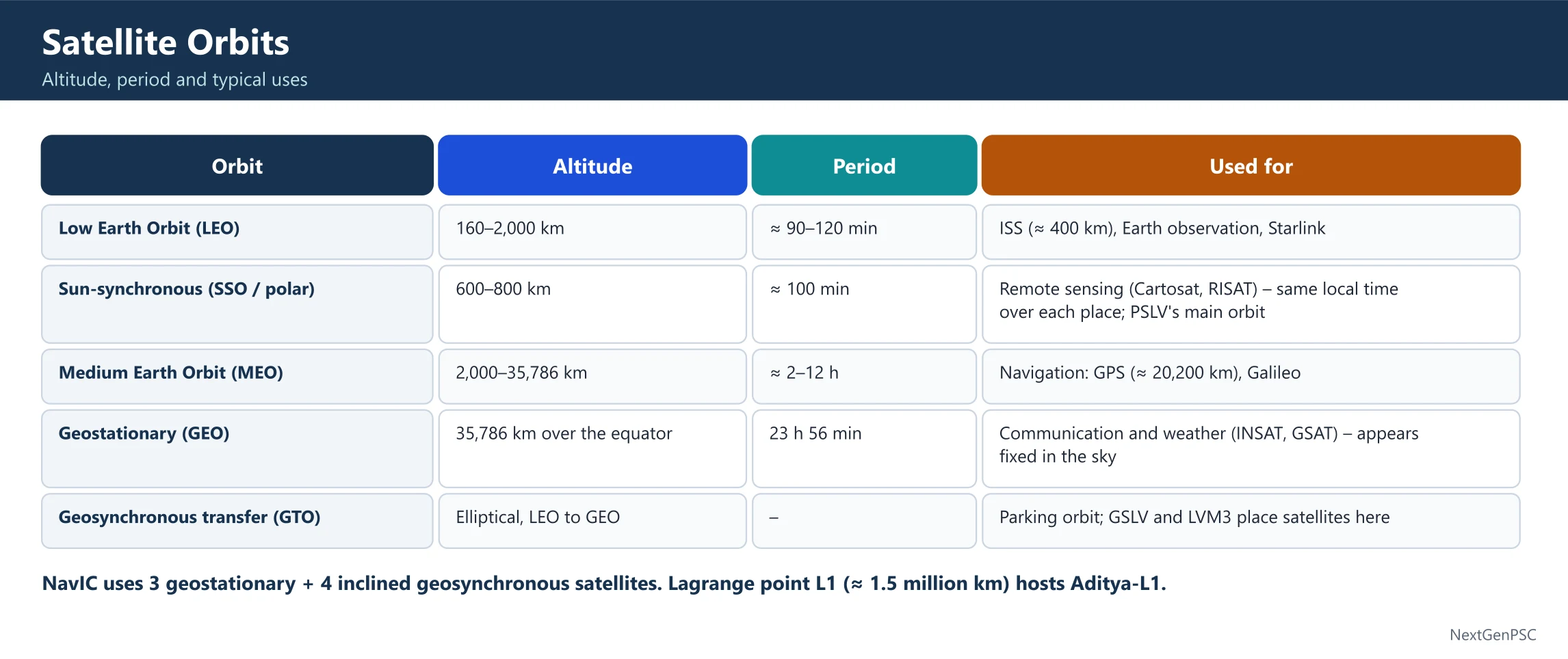
An Orbit is the gravitationally curved path of an object around a celestial body. While most orbits are elliptical, their height and synchronization with Earth determine their utility—ranging from Low Earth Orbits for imaging to Geostationary Orbits for telecommunications.
1. Orbital Mechanics and Shapes
Orbits are rarely perfect circles; they are mostly elliptical. This means the distance between the orbiting body and the parent body changes constantly.
The Ecliptic Plane: Most objects in our solar system orbit the Sun along this flat, imaginary disc.
Earth-Centric Points: The closest point to Earth is the Perigee; the farthest is the Apogee.
Sun-Centric Points: The closest point to the Sun is the Perihelion; the farthest is the Aphelion.
2. Key Celestial Players
Different space objects occupy these orbits based on their origin and size:
Stars: Spheroids of plasma (e.g., the Sun).
Planets: Bodies massive enough to be spherical that revolve around stars.
Satellites: Natural (Moon) or artificial objects orbiting a planet.
Asteroids/Planetoids: Small planets or fragments revolving around the Sun.
3. Classification of Earth Orbits
Engineers choose specific orbits based on what the satellite needs to do.
Low Earth Orbit (LEO): 160km to 2,000km. Used for imaging and the International Space Station (ISS).
Medium Earth Orbit (MEO): 2,000km to 35,786km. Primarily used for Navigation (GPS/NavIC).
Geostationary Orbit (GEO): Exactly 35,786km above the equator. The satellite matches Earth's rotation, appearing 'fixed' in the sky. Ideal for TV and Weather.
Polar & Sun-Synchronous (SSO): Satellites travel from North to South. SSO ensures the satellite passes over a spot at the same local solar time, vital for consistent Earth Observation.
Transfer Orbits (GTO): A temporary 'intermediate' path used to move a satellite from a low altitude to a high geostationary altitude.
| Orbit Type | Altitude (Approx) | Primary Application |
|---|---|---|
| LEO | 160 - 2,000 km | Earth Observation, ISS, Spy Satellites |
| MEO | 2,000 - 35,786 km | GPS (USA), NavIC (India), GLONASS |
| GEO/GSO | 35,786 km | Telecommunication, Satellite TV, Weather |
| Polar/SSO | 600 - 1,000 km | Mapping, Environmental Monitoring |
Prelims tips
- Apogee/Perigee: Related to Earth. Aphelion/Perihelion: Related to the Sun.
- NavIC: India's navigation system uses a mix of GEO and GSO orbits.
- Sun-Synchronous: Crucial for 'Remote Sensing' because it provides consistent lighting for photos.
- Ecliptic Plane: The imaginary disc containing Earth's orbit around the Sun.
Mains points
- Kessler Syndrome: The growing danger of space debris in LEO, where one collision could trigger a chain reaction, making orbits unusable for generations.
- Strategic Importance of GTO: India's heavy-lift rockets (GSLV) are specialized to inject satellites into the Geostationary Transfer Orbit, a high-value capability in the global space market.
- Orbit Crowding: With mega-constellations like Starlink, international laws for 'Space Traffic Management' are becoming a necessity to prevent collisions.
- Remote Sensing in SSO: India's prowess in agriculture and disaster management relies heavily on its fleet of satellites in Sun-Synchronous Orbits.
Did you know?
- Satellites in GEO are so high up that they can see about 42% of the Earth's surface at once. Just three satellites can provide global coverage!
- The International Space Station (ISS) is in LEO and travels so fast (28,000 km/h) that astronauts see 16 sunrises and sunsets every day.
- Graveyard Orbits are located above GEO; they are where dead satellites are pushed at the end of their life to prevent collisions.
High Earth Orbits: Geosynchronous vs. Geostationary
At an altitude of exactly 35,786 km, a satellite's orbital period matches the Earth's rotation (23h 56m 4s). While Geosynchronous (GSO) orbits can be tilted at any angle, the Geostationary (GEO) orbit is a special case that stays perfectly above the Equator, making it appear stationary to an observer on the ground.
1. Geosynchronous Orbit (GSO)
A GSO satellite circles the Earth at the same rate the Earth spins. However, it can have an inclination (tilt) relative to the equator.
The Magic Number: The orbital height is 35,786 km. At this height, one orbit takes 23 hours, 56 minutes, and 4 seconds (a Sidereal Day).
Ground View: Because of the tilt, a GSO satellite might appear to 'oscillate' in a figure-eight pattern (Analemma) in the sky, but it returns to the same spot every day.
2. Geostationary Orbit (GEO): The Special Case
GEO is a 'subset' of GSO. It has zero inclination, meaning it stays directly above the Earth's Equator.
Fixed Position: To an observer on Earth, a GEO satellite looks like a fixed star that never moves. This is why you don't have to keep moving your Tata Play or Dish TV antenna; it is pointed at a fixed GEO satellite.
Primary Uses: Ideal for Satellite TV, Telecommunications, and Weather Monitoring (like India's INSAT series).
3. Comparing the 'High' Orbits
All Geostationary orbits are Geosynchronous, but not all Geosynchronous orbits are Geostationary.
GEO: Circular, 0° inclination, parked over the Equator.
GSO: Can be elliptical or circular, can have any inclination angle.
| Feature | Geostationary (GEO) | Geosynchronous (GSO) |
|---|---|---|
| Inclination | Must be 0° (Above Equator) | Can be tilted (Any angle) |
| Ground Appearance | Fixed / Stationary | Moving (usually in a figure-8) |
| Orbital Path | Circular only | Circular or Elliptical |
| Key Example | INSAT (Weather/TV) | NavIC (India's Navigation) |
Prelims tips
- 35,786 km: The specific altitude for GSO/GEO.
- Equator: The only place where a Geostationary satellite can exist.
- NavIC: Uses a constellation of 7 satellites (3 in GEO and 4 in GSO).
- Sidereal Period: The actual time taken for Earth's rotation (approx. 4 mins less than 24h).
Mains points
- Orbital Slot Competition: Due to the limited space in the GEO ring, it is considered a 'Global Resource' managed by the International Telecommunication Union (ITU). Developing nations often argue for fair access to these slots.
- Signal Latency: Because 35,786 km is very far, there is a slight delay (latency) in communication (about 0.25 seconds). This is why GEO is bad for high-speed gaming but great for TV broadcasting.
- Space Sustainability: At the end of their life, GEO satellites cannot easily fall back to Earth. They are pushed into a 'Graveyard Orbit' a few hundred kilometers higher to make room for new ones.
- Disaster Management: India's INSAT and GSAT series in GEO are the backbone of the country's early warning systems for cyclones and tsunamis.
Did you know?
- There is only ONE Geostationary orbit—a thin ring 35,786 km above the equator. Because space there is limited, international laws are very strict about who gets to 'park' a satellite there!
- The Sidereal Day (23h 56m) is shorter than our 24-hour day because the Earth also moves along its orbit around the Sun while spinning.
- The concept of the Geostationary orbit was popularized by science fiction writer Arthur C. Clarke in 1945, long before the first satellite was launched.
Satellites and Orbital Mechanics
A Satellite is any object that revolves around a larger celestial body. While the Moon is our only natural satellite, thousands of artificial satellites perform vital roles in communication, navigation, and observation. To reach space, an object must conquer Escape Velocity and Orbital Velocity.
1. Classification of Artificial Satellites
India, through ISRO, has developed a diverse fleet of satellites categorized by their specific missions.
Communication Satellites: Placed in high orbits (GEO). Examples: INSAT and GSAT series. They handle TV, telephone, and internet data.
Earth Observation (Remote Sensing): Used for mapping, weather, and resource management. Examples: CARTOSAT (Mapping), RESOURCESAT, and RISAT (Radar Imaging).
Navigation Satellites: Help in positioning. India's NavIC (IRNSS) and GAGAN (for aviation) provide precise location services.
Space Missions: Exploratory missions like Mangalyaan (MOM), Chandrayaan, and the upcoming Gaganyaan (Human Spaceflight).
Small Satellites: Nano and micro-satellites like Jugnoo, often built by universities or for experimental tech.
2. The Physics of Leaving Earth
To put a satellite into space, we must understand two critical speeds.
Escape Velocity: The speed needed to break free from Earth's gravity entirely and head into deep space. On Earth, this is 11.2 km/s (approx. 40,270 km/h).
Orbital Velocity: The speed needed to stay in a stable orbit around the Earth. If it is too slow, it falls back; if it is too fast, it flies off. For Low Earth Orbit, this is roughly 7.8 km/s.
3. Comparing the Speeds
Mean Orbital Speed of Earth: Earth itself orbits the Sun at a massive speed of 30 km/s.
Mathematical Relation: Escape velocity is always approximately 1.41 (square root of 2) times the orbital velocity.
| Category | Indian Series/Examples | Primary Use |
|---|---|---|
| Communication | INSAT, GSAT, EDUSAT | Broadcasting, Education |
| Earth Observation | IRS, OCEANSAT, RISAT | Weather, Agriculture, Defense |
| Navigation | NavIC, GAGAN | GPS alternative, Aviation safety |
| Astronomy | ASTROSAT | Studying stars and black holes |
Prelims tips
- 11.2 km/s: The numerical value of Earth's escape velocity.
- NavIC: Formerly known as IRNSS (Indian Regional Navigation Satellite System).
- RISAT: Uses 'Synthetic Aperture Radar' (SAR) which can see through clouds and at night.
- ASTROSAT: India's first dedicated multi-wavelength space observatory.
Mains points
- Space Debris: As we launch more satellites, 'Space Junk' travels at orbital velocities, meaning even a tiny bolt can hit another satellite with the force of a hand grenade.
- Socio-Economic Impact: Satellites have transformed India's rural economy through EDUSAT (distance learning) and RESOURCESAT (crop yield prediction).
- Self-Reliance (Atmanirbharta): By developing NavIC, India has ensured it is not dependent on US-controlled GPS during strategic conflicts.
- Commercial Space: ISRO’s commercial arm (NSIL) is now launching satellites for other countries, turning India into a global 'Space Taxi' hub.
Did you know?
- EDUSAT (GSAT-3) was the world's first satellite built exclusively for the education sector!
- The Moon is moving away from Earth at a rate of about 3.8 cm per year. Millions of years from now, our 'Natural Satellite' will look much smaller in the sky.
- If you could throw a baseball at 11.2 km/s, it would leave Earth and never come back!
ISRO's Launch Vehicles: The Stairway to Space
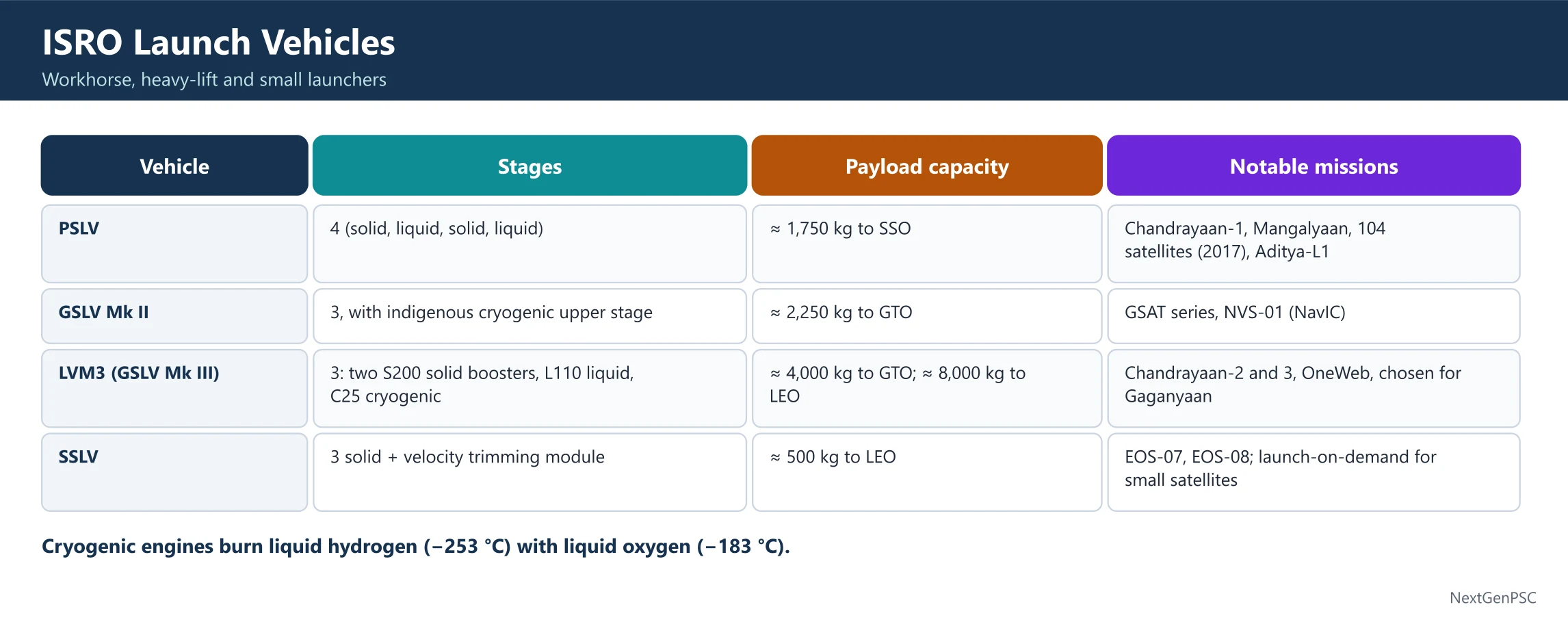
India's journey to space began with small rockets capable of carrying light loads and has evolved into heavy-lift giants like the LVM3. The PSLV remains the reliable 'Workhorse' of ISRO, while the GSLV series provides the power needed to reach higher Geostationary orbits.
1. Early Generations (SLV & ASLV)
These were the experimental phases of Indian rocketry, focusing on mastering solid propulsion.
SLV-3 (Satellite Launch Vehicle): India's first experimental launch vehicle. It put the Rohini satellite into orbit in 1980, making India the 6th nation with space launch capability.
ASLV (Augmented SLV): Designed to carry heavier payloads (150 kg) and test technologies needed for future large rockets like strap-on boosters.
2. PSLV: The Workhorse of ISRO
The Polar Satellite Launch Vehicle (PSLV) is the first Indian launch vehicle to be equipped with liquid stages.
Structure: It is a 4-stage rocket. 1st and 3rd stages are Solid; 2nd and 4th stages are Liquid.
Record: Famously launched 104 satellites in a single mission in 2017.
Versatility: Though designed for Polar orbits (LEO), it was used for the Moon (Chandrayaan-1) and Mars (Mangalyaan) missions.
3. GSLV: The Heavy Lifter
The Geosynchronous Satellite Launch Vehicle (GSLV) was developed to launch heavy communication satellites into high orbits.
Cryogenic Stage: GSLV uses a Cryogenic Upper Stage (CUS), which uses liquid hydrogen and liquid oxygen at extremely low temperatures for massive thrust.
GSLV Mk II: Capable of placing 2.5 tonnes into Geostationary Transfer Orbit (GTO).
LVM3 (GSLV Mk III): The 'Bahubali' of ISRO. It is a 3-stage vehicle capable of carrying 4 tonnes to GTO or 8 tonnes to LEO. It is the vehicle chosen for the Gaganyaan human spaceflight mission.
| Feature | PSLV | GSLV (LVM3) |
|---|---|---|
| Stages | 4 (Solid & Liquid) | 3 (Solid, Liquid & Cryogenic) |
| Payload to GTO | Approx. 1.4 tonnes | Up to 4 tonnes |
| Reliability | Extremely High ('Workhorse') | High ('Bahubali') |
| Famous Missions | Mangalyaan, Chandrayaan-1 | Chandrayaan-2, Chandrayaan-3, Gaganyaan |
| Propulsion | Solid & Earth-Storable Liquid | Solid, Liquid & Cryogenic |
Prelims tips
- Number of Stages: PSLV has 4; GSLV Mk III (LVM3) has 3.
- Cryogenic Stage: Always the 'Upper' or final stage of GSLV.
- Vikas Engine: The famous liquid engine used in both PSLV and GSLV.
- SSLV: A new addition (Small Satellite Launch Vehicle) designed for quick, on-demand launches of small satellites.
Mains points
- Technological Sovereignty: The indigenous development of the Cryogenic Engine marked India's transition from a 'launch consumer' to a 'launch provider'.
- Commercial Competitiveness: Through NSIL and Antrix, ISRO uses the cost-effectiveness of PSLV to capture a large share of the global small-satellite launch market.
- Human Spaceflight Ready: The LVM3 has been 'human-rated' for the Gaganyaan mission, meaning it has undergone extra safety and reliability testing to carry people.
- Space Privatization: The introduction of IN-SPACe is encouraging Indian startups like Skyroot and Agnikul to build their own launch vehicles, ending ISRO's monopoly.
Did you know?
- In the early days of SLV-3, rocket parts were sometimes transported on bicycles and bullock carts to the launch site at Thumba!
- The Cryogenic engine technology was denied to India by developed nations in the 1990s, forcing ISRO to spend 20 years developing it indigenously.
- PSLV is so reliable that it has a success rate of over 95%, making it a favorite for foreign countries to launch their satellites.
How We Launch Satellites: The Mechanics of a Rocket
A Launch Vehicle acts as a high-powered delivery truck. It uses a Multi-Stage System to drop off heavy, empty fuel tanks as it climbs, ensuring the rocket gets lighter and faster as it leaves the atmosphere to reach Orbital Velocity.
1. The Principle of Launching
To send a satellite to space, a rocket must accelerate the payload to approximately 28,000 km/h (for LEO). This is done in stages to maximize efficiency.
The Payload: This is the 'cargo'—the satellite itself, located at the very tip of the rocket inside a protective Heat Shield or fairing.
Staging: Once a rocket stage uses up its fuel, it is jettisoned (dropped). This prevents the rocket from carrying dead weight, allowing the remaining engines to push the satellite higher.
2. India's GSLV: A Three-Stage Powerhouse
The GSLV is India's heavy lifter, specifically designed for high-altitude orbits. It uses three distinct types of propulsion.
First Stage (Solid): Uses solid fuel (like a firework but much larger). It provides the massive Lift-off thrust needed to move the heavy rocket off the launch pad.
Second Stage (Liquid): Uses the Vikas Engine. Liquid engines are more efficient than solid ones because they can be 'throttled' or turned off and on to control the trajectory.
Third Stage (Cryogenic): This is the most advanced stage. It uses Liquid Hydrogen (fuel) and Liquid Oxygen (oxidizer) stored at sub-zero temperatures. It provides the final, high-energy push to place heavy (2+ tonne) satellites into Geostationary orbits.
3. Operational Launchers of India
PSLV (Polar Satellite Launch Vehicle): Known as the 'Workhorse.' It has 4 stages and is primarily used for Earth Observation and smaller space missions.
GSLV (Geosynchronous Satellite Launch Vehicle): The heavy lifter used for communication satellites. It enabled India to stop relying on foreign agencies to launch our 2-tonne class satellites.
| Stage | Propulsion Type | Function |
|---|---|---|
| Stage 1 | Solid (HTPB) | Initial Lift-off from Earth |
| Stage 2 | Liquid (Vikas Engine) | Acceleration through upper atmosphere |
| Stage 3 | Cryogenic (LH2 + LOX) | Precision injection into high orbit |
Prelims tips
- Cryogenic Stage: Uses Liquid Hydrogen as fuel and Liquid Oxygen as an oxidizer.
- HTPB: Hydroxyl-terminated polybutadiene—the common solid fuel used in the first stage.
- Payload Fairing: The 'nose cone' that protects the satellite from heat and friction during the climb through the atmosphere.
- Vikas Engine: The backbone of India's liquid propulsion stages, used in both PSLV and GSLV.
Mains points
- Strategic Autonomy: Mastering the GSLV and Cryogenic technology has made India self-reliant, saving billions in foreign exchange previously paid to Arianespace (Europe) for heavy launches.
- Commercial Gains: With the success of LVM3 (GSLV Mk-III), ISRO's commercial arm, NSIL, is now winning global contracts to launch heavy satellite constellations like OneWeb.
- Semi-Cryogenic Future: ISRO is working on a Semi-Cryogenic engine (using Kerosene and Liquid Oxygen), which is more powerful and eco-friendly than current liquid stages.
- Space Access: The 'cost per kg' of sending a payload to space is the key metric for the future; reusable technology and heavy-lift GSLVs are India's answer to staying competitive.
Did you know?
- A Cryogenic engine is one of the hardest technologies to master because it involves handling fuels at temperatures as low as -253 degrees Celsius!
- The white 'smoke' you see during a launch is mostly water vapor from the sound suppression system used to protect the rocket from its own acoustic vibrations.
- India is now developing Reusable Launch Vehicles (RLV) that can land back on Earth like a plane, significantly reducing the cost of space travel.
Cryogenic Technology: The Power of Extreme Cold
Cryogenic engines are the most sophisticated form of rocket propulsion. By cooling gases like Hydrogen and Oxygen into liquids at temperatures below 120 K (-153°C), engineers can pack massive amounts of energy into small tanks, providing the high thrust needed to launch heavy satellites into deep space.
1. What is Cryogenics?
Cryogenics is the branch of physics dealing with the production and effects of very low temperatures. While standard refrigerators reach about -20°C, cryogenics starts below -153°C (120 K).
2. Why do Rockets need Cryogenics?
A rocket's biggest enemy is its own weight. To lift a heavy satellite, you need a lot of fuel, but gas takes up too much space.
Volume Reduction: Liquid Hydrogen and Oxygen take up much less space than their gaseous forms. This allows for smaller, lighter fuel tanks.
Higher Payload: Because the rocket is lighter and the fuel is more 'dense' in energy, it can carry much heavier satellites into higher orbits (like GEO).
Efficiency: Cryogenic propellants provide more thrust per kilogram of fuel compared to solid or Earth-storable liquid fuels.
3. The Propellant Duo
Liquid Hydrogen (LH2): The fuel. It is stored at -253°C.
Liquid Oxygen (LOX): The oxidizer (needed to burn the fuel in the vacuum of space). It is stored at -183°C.
4. The Complexity Challenge
Cryogenic engines are incredibly difficult to build because the materials used must withstand extreme cold without becoming brittle, and the plumbing must handle high-pressure fluids without leaking.
| Feature | Conventional (Solid/Liquid) | Cryogenic (LH2/LOX) |
|---|---|---|
| Storage Temp | Room Temperature | Below -150°C |
| Energy Density | Medium | Very High |
| Complexity | Simple / Moderate | Extremely High |
| Thrust/Efficiency | Lower | Highest |
| Primary Use | Initial Boosters / Low Orbit | Upper Stages / Heavy Payloads |
Prelims tips
- 120 K (-153°C): The temperature threshold for cryogenics.
- GSLV Mk III (LVM3): Uses the indigenous CE-20 cryogenic engine in its upper stage.
- Oxidizer: Oxygen is needed because there is no air in space to support combustion.
- Specific Impulse: Cryogenic engines have a very high 'Specific Impulse' (efficiency rating).
Mains points
- Technological Denial: In the 1990s, the US blocked Russia from selling cryogenic tech to India (MTCR concerns), which led to ISRO's 20-year struggle to build it locally—a classic example of Strategic Autonomy.
- Deep Space Missions: Without cryogenics, heavy missions like Chandrayaan-3 and Gaganyaan would have been impossible with India's existing rocket sizes.
- Industrial Spillover: Cryogenic tech developed for space is also used in MRI machines, food preservation, and transporting LNG (Liquefied Natural Gas).
- Safety Protocols: Handling liquid hydrogen is dangerous as it is highly flammable and requires specialized 'Double-walled' vacuum-insulated tanks.
Did you know?
- India is only the 6th country in the world to master indigenous cryogenic engine technology, joining the USA, Russia, China, France, and Japan.
- Liquid Hydrogen is so cold that it can freeze any other gas (except helium) into a solid!
- The Vikas Engine used in ISRO rockets is liquid-fueled but not cryogenic; the CE-20 and CE-7.5 are the actual cryogenic stars of ISRO.
The Evolution of ISRO Launch Vehicles: PSLV & GSLV
The PSLV (Polar Satellite Launch Vehicle) is India's reliable 'Workhorse,' known for its incredible success rate in launching Earth observation satellites. The GSLV (Geosynchronous Satellite Launch Vehicle) is India's 'Heavy-Lifter,' utilizing advanced Cryogenic technology to carry massive payloads to higher orbits and deep-space missions.
1. PSLV: The Versatile Workhorse
Developed as India's third-generation rocket, the PSLV revolutionized ISRO's capabilities by introducing liquid fuel stages.
Liquid Breakthrough: It was the first Indian rocket to use liquid stages (Vikas Engine).
Unmatched Reliability: Between 1994 and 2017, it achieved a legendary streak of 39 consecutively successful missions.
Variants: It comes in multiple versions like PSLV-CA (Core Alone) and PSLV-XL (Extended Lift), which can carry over 1,500 kg to a 600 km orbit.
Missions: While designed for Polar orbits, its power was used for Mangalyaan (Mars) and Chandrayaan-1 (Moon).
2. GSLV: The Heavy Lifting Powerhouse
GSLV is a fourth-generation vehicle designed to place heavy communication satellites into Geosynchronous Transfer Orbits (GTO).
Cryogenic Core: The defining feature of GSLV is the Cryogenic Upper Stage (CUS), which allows for maximum thrust with minimal fuel weight.
Evolution: It evolved from Mk I and Mk II to the massive Mk III (now called LVM3).
LVM3 Capabilities: It is a three-stage vehicle that can carry 4,000 kg to GTO or a staggering 10,000 kg to Low Earth Orbit (LEO).
Key Missions: LVM3 was the vehicle of choice for Chandrayaan-2, Chandrayaan-3, and is the foundation for the Gaganyaan (Human Spaceflight) mission.
| Feature | PSLV | GSLV Mk III (LVM3) |
|---|---|---|
| Generation | 3rd Generation | 4th Generation |
| Stages | 4 (Solid - Liquid - Solid - Liquid) | 3 (Solid - Liquid - Cryogenic) |
| Propulsion | Vikas Engine (Liquid) | CE-20 (Cryogenic) |
| GTO Payload | Approx. 1.4 - 1.7 tonnes | Up to 4 tonnes |
| LEO Payload | Approx. 3.8 tonnes | Up to 10 tonnes |
Prelims tips
- Number of Stages: PSLV = 4 stages; GSLV Mk III = 3 stages.
- Propellant: PSLV alternates between solid and liquid fuel. GSLV uses solid boosters, a liquid core, and a cryogenic top.
- NSIL: NewSpace India Limited is the commercial arm that now handles PSLV launches for global customers.
- Payload: If the question mentions '4 tons to GTO,' it is referring to LVM3/GSLV Mk III.
Mains points
- Cost-Effectiveness: India’s PSLV is world-renowned for providing low-cost access to space, helping India capture a significant share of the global small-satellite market.
- Heavy Lift Independence: With the success of LVM3, India no longer relies on European rockets (like Ariane) to launch its heavy communication satellites, saving millions in foreign exchange.
- Cryogenic Mastery: The indigenously developed Cryogenic Upper Stage in GSLV is a testament to India's Strategic Autonomy, as the technology was previously denied to the country.
- Gaganyaan Foundation: The high payload capacity of LVM3 is what makes India's dream of sending humans to space possible.
Did you know?
- The PSLV is often called the 'Space Taxi' because it frequently carries small satellites from many different countries in a single trip.
- GSLV Mk III is nicknamed 'Fat Boy' or 'Bahubali' by ISRO scientists due to its massive size and lifting power.
- The Vikas Engine used in PSLV's second stage is named after the father of the Indian Space Program, Vikram Sarabhai (VIKram A Sarabhai).
Lagrange Points: The Parking Spots of Space
Lagrange Points are unique equilibrium positions in space where a small object (like a satellite) can stay in a fixed position relative to two larger orbiting bodies (like the Earth and Sun). They act as 'gravity pockets' where the pull of the two masses cancels out the centripetal force, significantly saving fuel for long-term missions.
1. The Physics of Equilibrium
At these points, the gravitational pull of the two large masses exactly equals the centripetal force required for a small object to move with them. This creates a stable or semi-stable environment for spacecraft.
L1, L2, and L3: These are Unstable points. They lie on a straight line connecting the two large masses. A satellite here is like a ball balanced on a peak; it needs small 'nudges' (station-keeping) to stay in place.
L4 and L5: These are Stable points. They form the apex of two equilateral triangles. Objects here are naturally trapped and stay put without much effort.
2. Strategic Uses of Lagrange Points
Different points serve different scientific purposes based on their view of the cosmos.
L1 (Sun-View): Provides an uninterrupted view of the Sun. It is the home of the SOHO observatory and India's Aditya-L1 mission.
L2 (Deep Space-View): Positioned behind the Earth (shielded from the Sun's glare). It is perfect for looking into the deep universe. It houses the James Webb Space Telescope (JWST).
L4 and L5 (3D View): Used by the STEREO spacecraft to provide a three-dimensional view of the Sun.
3. Why Use Them?
Fuel Efficiency: Spacecraft don't have to constantly fire engines to stay in position.
Fixed Relative Position: They stay at a constant distance from Earth, making communication easier and consistent.
| Point | Stability | Key Missions |
|---|---|---|
| L1 | Unstable | SOHO, Aditya-L1 (India) |
| L2 | Unstable | James Webb Space Telescope (JWST), Planck |
| L3 | Unstable | Hidden by Sun (Rarely used) |
| L4 & L5 | Stable | STEREO (Solar research), Trojan Asteroids |
Prelims tips
- Equilibrium: Gravity and centripetal force balance each other out at these points.
- Aditya-L1: India's first solar mission, located at the L1 point (approx. 1.5 million km from Earth).
- Halo Orbit: Satellites don't sit exactly on the point but orbit around the point in a 3D shape called a Halo Orbit.
- Five Points: Always remember there are 5 points in any two-body system.
Mains points
- Space Exploration Efficiency: By utilizing Lagrange points, space agencies can keep observatories operational for decades with minimal fuel, maximizing the Return on Investment for taxpayers.
- Strategic Geography of Space: L1 and L2 are becoming 'crowded.' International coordination is needed to manage these precious 'parking spots' to avoid collisions and radio interference.
- India’s Growing Prowess: Successfully placing Aditya-L1 in a halo orbit demonstrates ISRO's advanced capabilities in complex orbital maneuvers and deep-space navigation.
- Future - Deep Space Gateways: These points are being considered as 'way-stations' for future manned missions to Mars or the Moon, acting as refueling or staging hubs.
Did you know?
- Lagrange points were named after the Italian-French mathematician Joseph-Louis Lagrange, who calculated their existence in 1772!
- L4 and L5 are so stable that they naturally collect dust and asteroids, which are known as 'Trojans'.
- If you put a satellite at L2, the Earth acts as a giant umbrella, protecting sensitive infrared telescopes from the Sun's heat.
The Journey of ISRO: From Bicycles to the Stars
India's space journey is a saga of self-reliance, starting with the visionary Dr. Vikram Sarabhai. From the humble beginnings of INCOSPAR in 1962 to the world-record-breaking launch of 104 satellites in 2017, ISRO has transformed India into a global space superpower.
1. The Foundations of Indian Space
Even before independence, scientific giants like C.V. Raman and Meghnad Saha laid the groundwork for research. Post-independence, the pace accelerated under the leadership of Homi Bhabha and Vikram Sarabhai.
1950: Department of Atomic Energy (DAE) established under Homi Bhabha.
1962: INCOSPAR (Indian National Committee for Space Research) formed. This was the predecessor to ISRO.
1963: The first sounding rocket was launched from Thumba, a small fishing village in Kerala chosen for its proximity to the magnetic equator.
1969: ISRO was officially formed on August 15, 1969.
2. Iconic Firsts: Satellites and Rockets
ISRO's early years focused on proving that India could build its own hardware.
Aryabhata (1975): India's first satellite, launched using a Soviet rocket.
SLV-3 (1980): The first successful indigenous launch vehicle, placing the Rohini satellite into orbit.
IRS-1A (1988): The launch of the first operational Remote Sensing satellite, marking India's entry into earth observation.
3. The Era of Modern Marvels
In the 21st century, ISRO shifted from 'experimental' to 'elite' status with high-profile interplanetary missions.
Chandrayaan-1 (2008): India's first mission to the Moon, which discovered water molecules on the lunar surface.
Mars Orbiter Mission (2013): India became the first country to reach Mars on its first attempt, and at the lowest cost in the world.
World Record (2017): PSLV C-37 launched 104 satellites in a single mission, a testament to ISRO's precision and commercial viability.
| Year | Event / Milestone | Significance |
|---|---|---|
| 1962 | Formation of INCOSPAR | Start of formal space research |
| 1975 | Aryabhata Launch | First Indian Satellite |
| 1980 | SLV-3 / Rohini | First successful indigenous launch |
| 2004 | EDUSAT Launch | First satellite for education |
| 2008 | Chandrayaan-1 | Discovery of water on Moon |
| 2013 | MOM (Mangalyaan) | First Asian nation to reach Mars |
Prelims tips
- INCOSPAR (1962): Predecessor to ISRO.
- Aryabhata: Launched using a Soviet U-11 Interkosmos rocket.
- Thumba (TERLS): Dedicated to the United Nations in 1968.
- MOM: Launched via PSLV-C25; India was the first to succeed in the first attempt.
- 104 Satellites: Mission name PSLV C-37 (2017).
Mains points
- Social Application of Space: Unlike other nations that started space programs for military dominance, ISRO’s philosophy (led by Sarabhai) was to use space for the benefit of the common man (weather, education, communication).
- Frugal Innovation: Mangalyaan cost less than the production budget of the movie 'Interstellar', highlighting ISRO’s ability to achieve complex goals with minimal financial resources.
- Global Launch Hub: By launching 104 satellites (mostly foreign), ISRO demonstrated the commercial competitiveness of the PSLV, making India a preferred partner for global space agencies.
- Strategic Autonomy: The growth from borrowing foreign rockets (Aryabhata) to launching our own heavy-lift vehicles (GSLV) represents India's journey toward Atmanirbhar Bharat in high-technology sectors.
Did you know?
- The first rocket parts in 1963 were so light and few that they were carried to the launch pad on a bicycle, and the satellite was later carried on a bullock cart!
- Dr. Vikram Sarabhai is known as the 'Father of the Indian Space Program'.
- The Thumba launch site was chosen because it lies on the Geomagnetic Equator, which is ideal for studying the upper atmosphere.
Mangalyaan: India's Pride at the Red Planet
Launched in 2013, the Mars Orbiter Mission (MOM), popularly known as Mangalyaan, was India's first interplanetary mission. It made India the first nation in the world to reach Mars' orbit in its very first attempt and the first Asian nation to do so, all at a record-breaking low cost.
1. Mission Overview
The mission was primarily a 'Technology Demonstrator' to prove that ISRO could design, launch, and operate a spacecraft on a multi-million kilometer journey to another planet.
Launch Date: November 5, 2013, from Sriharikota.
Launch Vehicle: PSLV-C25 (the XL version of the workhorse rocket).
Insertion into Mars Orbit: September 24, 2014.
2. The 'Hohmann Transfer' Strategy
Because the PSLV was not powerful enough to send the craft directly to Mars, ISRO used a clever fuel-saving maneuver.
Orbit Raising: The craft circled Earth multiple times, firing its engines at the right moment to increase its speed using Earth's gravity.
Trans-Mars Injection: Once it reached a specific velocity, it was 'slung' toward Mars like a stone from a slingshot.
3. Key Scientific Objectives
Mangalyaan carried five instruments to study the Martian surface and atmosphere.
Methane Sensor (MSM): To look for methane in the atmosphere, which could indicate the presence of past or present microbial life.
Mars Color Camera (MCC): To take high-quality images of the Martian surface and its moons, Phobos and Deimos.
Lyman Alpha Photometer: To measure the process of water loss from the planet into space.
| Parameter | India (MOM) | NASA (MAVEN) |
|---|---|---|
| Cost | Approx. $74 Million | Approx. $671 Million |
| First Attempt Success | Yes | No (earlier missions failed) |
| Launch Vehicle | PSLV-XL | Atlas V |
| Mission Life | Designed for 6 months (Lasted 8 years) | Ongoing |
Prelims tips
- PSLV-C25: The rocket used for Mangalyaan.
- September 24: The day India entered Mars orbit.
- Methane: The primary gas the mission was looking for to find signs of life.
- Slingshot Maneuver: The technique of using a planet's gravity to accelerate a spacecraft.
Mains points
- Frugal Engineering: MOM is the global benchmark for low-cost space exploration, proving that high-tech science doesn't always require massive budgets.
- Geopolitical Status: The mission established India as a major player in the 'New Space Race,' boosting its Soft Power and diplomatic standing in Asia and the world.
- Indigenous Mastery: Nearly all components were built in India, showcasing the success of Make in India in the high-technology sector.
- Inspiration: The mission led to a massive surge in interest in STEM (Science, Tech, Engineering, Math) fields among Indian youth and highlighted the contribution of women scientists (the 'Rocket Women of India').
Did you know?
- The cost of Mangalyaan was roughly ₹7 per kilometer—which at the time was cheaper than an auto-rickshaw fare in many Indian cities!
- The total budget of the mission was less than the budget of the Hollywood movie 'Interstellar' or 'The Martian'.
- Mangalyaan was featured on the back of the ₹2000 currency note in India as a symbol of scientific progress.
Gaganyaan: India's Leap into Human Spaceflight
Gaganyaan is India's first mission to send humans into space. By 2027, ISRO aims to launch a crew of three into a 400 km orbit for a 3-day mission. This will make India the fourth nation (after the USA, Russia, and China) to independently achieve human spaceflight, marking a historic shift from robotic exploration to human presence in the stars.
1. Mission Overview & Current Status (2026 Update)
As of early 2026, the Gaganyaan programme has entered its most decisive phase. Following years of rigorous testing, the road to the stars is now clearly mapped.
Uncrewed Milestone (G1 Mission): Scheduled for March 2026, the first uncrewed flight will test the 'Human-Rated' LVM3 rocket. It will carry the humanoid robot Vyommitra to monitor life-support systems.
The Crewed Launch: ISRO Chairman has confirmed that the final human mission is targeted for 2027, prioritizing absolute safety and reliability.
The Orbit: The spacecraft will orbit Earth at an altitude of 400 km for about three days before splashing down in Indian waters.
2. Meet the Gaganyatris
Four highly skilled Indian Air Force pilots have been selected as the first 'Gaganyatris' (Indian astronauts).
Training: They have completed basic training in Russia and are undergoing advanced mission-specific training at ISRO's facility in Bengaluru.
Axiom Collaboration: Astronaut Shubhanshu Shukla is also participating in the Axiom-4 mission to the ISS (2025/26), gaining critical international flight experience.
3. Technology: The Spacecraft & Launch Vehicle
HLVM3 (Human-Rated LVM3): The 'Bahubali' rocket has been modified with 'Human Rating' (redundant systems) to ensure crew safety.
Crew Module (CM): The habitat where astronauts will live. It features life-support systems, thermal protection for re-entry, and an emergency Crew Escape System (CES).
Service Module (SM): Provides propulsion and power to the capsule while in orbit.
| Phase | Timeline | Key Objective |
|---|---|---|
| G1 Mission | March 2026 | Uncrewed test with Vyommitra robot |
| G2 & G3 Missions | Late 2026 | Validation of life-support and recovery systems |
| H1 Mission (Crewed) | 2027 | First Indian humans in space (3-day mission) |
| Lunar Mission | By 2040 | First Indian on the Moon |
Prelims tips
- LVM3: The launch vehicle for Gaganyaan (formerly GSLV Mk III).
- 400 km: The target altitude in Low Earth Orbit (LEO).
- Vyommitra: The humanoid robot for uncrewed tests.
- ECLSS: Environmental Control and Life Support System (vital for keeping astronauts alive).
- Fourth Nation: India will follow the USSR/Russia, USA, and China.
Mains points
- Strategic Sovereignty: Gaganyaan is not just about pride; it is about mastering the complex technologies of Human-Rating and Re-entry, which have significant strategic and defense implications.
- Economic Spinoffs: The mission is catalyzing a new 'Space Ecosystem' in India, encouraging private startups to develop space-grade materials, sensors, and robotics.
- Long-term Vision: Gaganyaan is the stepping stone for the Bharatiya Antariksha Station (Indian Space Station) targeted for 2035 and a manned Moon landing by 2040.
- International Collaboration: While the mission is indigenous, training in Russia and the Axiom mission with NASA highlight India's balanced Space Diplomacy.
Did you know?
- Vyommitra (from Sanskrit 'Vyom' = space, 'Mitra' = friend) is a half-humanoid robot that can speak two languages, monitor systems, and even mimic human functions!
- The crew will experience microgravity, where they will 'float' inside the module, requiring specialized space food developed by India's DFRL.
- The Gaganyaan module is designed to land in the Arabian Sea or Bay of Bengal, where the Indian Navy is already practicing recovery operations.
NavIC: India's Own GPS
NavIC (Navigation with Indian Constellation) is India's independent regional satellite navigation system. While GPS belongs to the USA, NavIC provides accurate positioning over India and a 1,500 km radius around its borders. It ensures India’s strategic autonomy, ensuring we don't have to rely on foreign systems for critical navigation and timing services.
1. Evolution from IRNSS to NavIC
The project was originally called IRNSS (Indian Regional Navigation Satellite System) when it started in 2006.
The Timeline: The first satellite (1A) was launched in 2013, and the constellation was completed with the seventh satellite (1G) in 2016.
The Name: In 2016, PM Modi renamed the operational system NaVIC (Navigation Indian Constellation).
Replacement Satellites: When the atomic clocks on IRNSS-1A failed, ISRO launched IRNSS-1I in 2018 to maintain the system's accuracy.
2. The Constellation Structure
NavIC uses a unique mix of high Earth orbits to ensure constant coverage over the Indian subcontinent.
Geostationary (GEO): 3 satellites stay fixed over the equator.
Geosynchronous (GSO): 5 satellites move in a 'figure-eight' pattern to cover higher and lower latitudes.
Total Satellites: Currently consists of 8 satellites in orbit to ensure redundancy.
3. Applications: Beyond Just Maps
NavIC is a dual-use system providing two types of services: Standard Positioning Service (SPS) for civilians and Restricted Service (RS) for authorized users (military).
Transport & Fleet: Critical for tracking mining trucks, public buses, and commercial ships.
Disaster Management: Sending emergency alerts to fishermen deep at sea who are out of mobile network range.
Precise Timing: Syncing power grids and ATM networks to a fraction of a microsecond.
Mobile Integration: Modern smartphones are now being equipped with NavIC-compatible chips.
| Feature | NavIC (India) | GPS (USA) |
|---|---|---|
| Coverage | Regional (India + 1,500 km) | Global |
| No. of Satellites | 8 (Operational) | 24 to 31 |
| Orbit Type | GEO & GSO (High Orbit) | MEO (Medium Orbit) |
| Accuracy | Approx. 5-10 meters | Approx. 10-20 meters (Civilian) |
| Status | Independent Control | Controlled by US Govt |
Prelims tips
- 1,500 km: The specific range beyond Indian borders.
- 7 vs 8: Originally planned with 7 satellites; the 8th (1I) was a replacement for 1A.
- GEO/GSO: Remember, NavIC does NOT use Low Earth Orbit (LEO).
- Atomic Clocks: Rubidium clocks are the heart of these satellites.
- SPS & RS: Standard (Open) vs Restricted (Encrypted) services.
Mains points
- Strategic Autonomy: During the Kargil War (1999), the US denied India GPS data. This was the 'trigger' for India to build NavIC, ensuring we are never blind during a conflict.
- Economic Impact: NavIC enables local tech industries to build indigenous navigation hardware and software, reducing royalty payments to foreign companies.
- Regional Diplomacy: By extending NavIC services to SAARC nations, India is positioning itself as a net provider of space-based services in the region (Space Diplomacy).
- Interoperability: The challenge lies in making all smartphone manufacturers include NavIC support. The government is pushing for 'NavIC-first' policies in automotive and mobile sectors.
Did you know?
- NavIC is actually more accurate over India than GPS because its satellites are in high orbits and always 'see' the Indian landmass at a high angle.
- NavIC satellites carry Rubidium Atomic Clocks. These clocks are so precise they would only lose one second every 300,000 years!
- India became the 5th entity in the world to have its own navigation system, joining the USA (GPS), Russia (GLONASS), EU (Galileo), and China (BeiDou).
Gaganyaan: India's Historic Human Spaceflight Mission
The Gaganyaan mission is India's first step toward becoming a global power in human space exploration. Initiated as the Human Spaceflight Programme (HSP) in 2007, it aims to send a crew of Indian astronauts into Low Earth Orbit (LEO). Successfully completing this mission will place India in the elite group of nations—after Russia, USA, and China—to achieve independent human spaceflight.
1. Mission History & Evolution
While the concept was born in 2007, the mission gained massive momentum after a formal announcement by the Prime Minister. Originally targeted for 2022 to mark 75 years of independence, the schedule was adjusted to ensure 100% safety.
The Launcher: The mission utilizes the GSLV Mk-III (now known as LVM3), which has been 'human-rated' for absolute reliability.
The Orbit: The crew will be placed in a Low Earth Orbit (approx. 400 km) for a period of up to 7 days.
2. Mastered Technologies
To send humans to space, ISRO had to develop several complex technologies from scratch:
CARE (Crew Module Atmospheric Re-entry Experiment): A 2014 test that proved ISRO could bring a capsule back through the intense heat of the atmosphere.
PAT (Pad Abort Test): A 2018 test to ensure that if something goes wrong on the launchpad, the 'Crew Escape System' can pull the astronauts to safety instantly.
Life Support: Developing systems to provide oxygen, manage CO2, and maintain comfortable temperatures inside the module.
3. Global & Domestic Training
Russian Training: In the early phases, four Indian Air Force pilots (Gaganyatris) underwent rigorous physical and survival training at Russia's Gagarin Cosmonaut Training Center.
Vyommitra: Before humans fly, ISRO will send Vyommitra, a female-looking humanoid robot, to test how the spacecraft environment affects a 'human-like' body.
| Component | Function |
|---|---|
| Crew Module (CM) | Habitat for astronauts with life support systems |
| Service Module (SM) | Provides power and propulsion while in orbit |
| Orbital Module | The combined CM and SM structure |
| Crew Escape System | Emergency system to pull astronauts away from a failing rocket |
| Vyommitra | Humanoid robot for uncrewed test flights |
Prelims tips
- LVM3: The rocket chosen for the mission (GSLV Mk-III).
- CARE & PAT: Critical pre-launch experiments (Re-entry and Abort tests).
- Low Earth Orbit (LEO): The mission's target altitude (300-400 km).
- Vyommitra: The half-humanoid robot developed for uncrewed missions.
- Fourth Nation: India follows USSR, USA, and China.
Mains points
- Technological Sovereignty: Mastering human spaceflight is the ultimate test of a nation's engineering prowess, requiring extreme precision in Life Support and Re-entry technologies.
- Socio-Economic Catalyst: The mission involves hundreds of Indian private industries, boosting the Make in India initiative in high-tech sectors like robotics and thermal materials.
- Future Space Station: Gaganyaan is the essential first step toward India's goal of building the Bharatiya Antariksha Station by 2035.
- Inspiration for Youth: Much like the Apollo missions in the US, Gaganyaan aims to ignite a 'Sarabhai Moment' for millions of Indian students to pursue careers in STEM.
Did you know?
- The Gaganyatris (astronauts) will be eating specially designed 'Indian Space Food' like Moong Dal Halwa and Idlis, developed by the Defence Food Research Laboratory (DFRL)!
- If successful, India will be only the 4th nation to launch humans independently, following in the footsteps of global giants.
- The spacecraft is designed to splash down in the Arabian Sea upon its return, where the Indian Navy will be waiting to recover the crew.
Vyommitra: The Humanoid Guardian of Gaganyaan
Vyommitra (Sanskrit for 'Space Friend') is ISRO's advanced AI-enabled half-humanoid robot. Designed to resemble a woman, she serves as a surrogate for human astronauts in uncrewed test flights. As of early 2026, Vyommitra is the centerpiece of the Gaganyaan G1 mission, tasked with validating life-support systems and flight safety before humans step aboard in 2027.
1. Why a 'Half-Humanoid'?
Vyommitra is called a half-humanoid because she consists of a head, torso, and two arms, but no legs. In the microgravity of space, legs are not required for seating or operating panels within the small confines of the crew module.
Development: Developed primarily by the ISRO Inertial Systems Unit (IISU) in Thiruvananthapuram.
Material: Built using high-strength aluminium alloys and titanium to withstand the intense vibrations and pressure of a rocket launch.
2. Advanced Capabilities & Tasks
She is not just a mannequin; she is a sophisticated AI system designed to interact with the spacecraft and ground control.
System Operations: She can operate switch panels, monitor cabin parameters (O2, CO2, pressure, and humidity), and execute ECLSS (Environment Control and Life Support Systems) tasks.
Human Interaction: Vyommitra is bilingual (Hindi and English). She can recognize astronauts, respond to their queries, and provide warnings if cabin conditions become unsafe.
Mimicking Life: She is programmed to mimic human physiological functions like speech (with synchronized lip movement) and can even perform microgravity experiments.
3. Mission Schedule (2026 Update)
G1 Uncrewed Mission: Scheduled for March 2026. This will be her first flight to space aboard the HLVM3 rocket to test the safe return and re-entry of the capsule.
Surrogate Astronaut: Her primary goal in the uncrewed missions is to act as a placeholder for humans, providing vital data on how the launch and space environment affect a 'human' occupant.
| Feature | Description |
|---|---|
| Type | AI-enabled Half-Humanoid |
| Languages | Bilingual (Hindi & English) |
| Senses | Vision, Speech, Environmental Sensors |
| Key System | ECLSS (Life Support System Monitoring) |
| Main Goal | Validate human safety parameters for Gaganyaan |
Prelims tips
- IISU Thiruvananthapuram: The specific unit that developed Vyommitra.
- ECLSS: Environment Control and Life Support System (the system she monitors).
- Half-Humanoid: No lower limbs (legs).
- March 2026: Target date for the G1 uncrewed mission.
- SOHO/James Webb: Other missions use robots, but Vyommitra is unique for its human-like interaction.
Mains points
- Ethical Space Exploration: Using a humanoid robot instead of animals represents India’s commitment to modern, ethical scientific practices.
- Advancement in AI & Robotics: Vyommitra is a testament to India's growing prowess in AI, sensor integration, and high-precision mechanical engineering (actuators and servos).
- The Human-Machine Interface: By simulating human tasks (operating switches), Vyommitra tests whether the spacecraft design is ergonomically fit for human pilots.
- Versatility: Technology developed for Vyommitra can be spun off into healthcare (robotic surgery) and industrial automation on Earth.
Did you know?
- While other space-faring nations like the USA and USSR used animals (monkeys and dogs) for their first tests, India is using a Humanoid Robot to ensure a more ethical and scientifically precise test.
- Vyommitra is designed to withstand the same G-forces as a human during launch and re-entry to see if the spacecraft's 'ride quality' is comfortable for people.
- She has a Digital Twin—a computer simulation used by ISRO engineers to test her control systems thousands of times before the actual flight.
Chandrayaan-1 & II: Mapping the Lunar Frontier
The Chandrayaan program is India’s ambitious lunar exploration journey. Chandrayaan-1 made history by confirming water on the Moon, while Chandrayaan-2, despite a lander setback, placed a high-tech Orbiter that continues to provide revolutionary data even in 2026, including mapping sodium and studying solar flares.
1. Chandrayaan-1: The Water Discoverer (2008)
India's maiden moon mission was an orbiter-only mission that fundamentally changed how we see the Moon.
Launch: Oct 22, 2008, via PSLV-C11.
Major Discovery: Confirmed Water Molecules ($H_2O$) and Hydroxyl ($OH$) groups on the lunar surface using the Moon Mineralogy Mapper ($M^3$).
Mineral Mapping: Detected elements like Magnesium, Aluminium, Silicon, and Iron.
End of Mission: It operated for 312 days (completing 95% of objectives) before losing contact in August 2009.
2. Chandrayaan-2: The 3-in-1 Mission (2019)
A much heavier mission (3,850 kg) launched by GSLV Mk-III (LVM3) that included an Orbiter, a Lander (Vikram), and a Rover (Pragyan).
The South Pole Target: ISRO chose the Lunar South Pole because it contains 'Cold Traps' (craters in permanent shadow) where ice could be preserved for billions of years.
The Setback: During the landing attempt on Sept 7, 2019, the Vikram Lander crashed due to a software glitch when it was just 2.1 km above the surface.
The Silver Lining: The Orbiter was a massive success. Originally planned for 1 year, its life was extended to 7.5 years due to excellent fuel management.
| Feature | Chandrayaan-1 | Chandrayaan-2 |
|---|---|---|
| Launch Vehicle | PSLV-C11 | GSLV Mk-III M1 |
| Launch Weight | 1,380 kg | 3,850 kg |
| Components | Orbiter & Impact Probe | Orbiter, Lander, Rover |
| Core Finding | H2O & OH traces | Sodium mapping, Ar-40 distribution |
| Target Area | Global mapping | Lunar South Pole |
Prelims tips
- Water Discovery: Credited to Chandrayaan-1 ($M^3$ instrument).
- LVM3 (GSLV Mk-III): Used for Chandrayaan-2; PSLV for Chandrayaan-1.
- Pragyan: Name of the Rover (6-wheeled).
- Vikram: Name of the Lander (after Vikram Sarabhai).
- Orbiter Life: Extended to 7+ years, making it a valuable asset for Chandrayaan-3 and future missions.
Mains points
- The 2.1 km Failure: Analyzing the Vikram lander's failure led to the 'failure-based design' of Chandrayaan-3, which eventually succeeded in 2023.
- Strategic Science: By focusing on the South Pole, India pioneered research in In-Situ Resource Utilization (ISRU)—essential for building future lunar colonies.
- Global Leadership: Chandrayaan-2’s orbiter carries the highest-resolution camera (OHRC) ever sent to the Moon, providing 25cm-resolution images used by the global scientific community.
- Space Weather: The recent (2024-25) studies of Solar Coronal Mass Ejections by the orbiter are helping scientists understand how space weather affects planets without magnetic fields.
Did you know?
- Chandrayaan-2's orbiter is so high-tech that it discovered an abundance of Sodium on the Moon in 2022, proving the Moon has a thin 'tail' of sodium atoms.
- The Lunar South Pole is unique because some craters have not seen sunlight for over 2 billion years!
- In 2024/25, the Chandrayaan-2 orbiter made a landmark observation of how Solar Flares (CMEs) affect the thin lunar atmosphere.
Mangalyaan (MOM): The Pride of India's Interplanetary Journey
Launched in 2013, the Mars Orbiter Mission (MOM) or Mangalyaan was India's first interplanetary mission. It made India the first nation to reach Mars' orbit in its very first attempt and the first Asian nation to do so. Though its mission officially ended in October 2022 after eight years of service, it remains a global benchmark for low-cost, high-efficiency space exploration.
1. Mission Legacy and Current Status (2026 Update)
While the original spacecraft is no longer active, its legacy continues to drive ISRO's future roadmap.
End of Life (2022): In October 2022, ISRO officially declared the mission over after the orbiter lost communication following a long eclipse period. It functioned for 8 years, far exceeding its planned 6-month lifespan.
Mangalyaan-2 (Looking Ahead): As of 2026, ISRO is actively working on Mangalyaan-2 (Mars Orbiter Mission 2). This mission is expected to launch around 2030 and will likely include a Lander and potentially a Rover, aiming for India's first soft landing on the Red Planet.
2. The Five Scientific Payloads
Mangalyaan carried 15 kg of scientific instruments to study the Martian atmosphere and surface.
Mars Color Camera (MCC): Captured thousands of high-resolution images, including the first clear shots of the Martian moon Phobos.
Methane Sensor for Mars (MSM): Designed to detect methane (a sign of life). While a design flaw limited its sensitivity, it was successfully repurposed to map the planet's albedo (surface reflectivity).
Thermal Infrared Imaging Spectrometer (TIS): Mapped the surface composition and mineralogy of Mars during day and night.
Mars Exospheric Neutral Composition Analyser (MENCA): Studied the Martian exosphere; it discovered suprathermal Argon-40, providing clues about how Mars lost its atmosphere.
Lyman Alpha Photometer (LAP): Measured the abundance of hydrogen and deuterium to understand the planet's water loss process.
| Comparison Metric | Mangalyaan (India) | MAVEN (NASA) |
|---|---|---|
| Total Cost | ₹450 Crore ($74M) | Approx. $671 Million |
| Launch Vehicle | PSLV-XL (C25) | Atlas V |
| Design Life | 6 Months | 1 Year |
| Actual Survival | 8 Years | Active (as of 2026) |
| Key Milestone | First Attempt Success | Advanced Atmosphere Study |
Prelims tips
- PSLV-C25: The specific rocket variant (XL) used for the launch.
- Methane Sensor: Key instrument for finding biogenic life (though later used for albedo mapping).
- Argon-40: A significant discovery by MENCA payload regarding the Martian atmosphere.
- Orbiting Agencies: India was the 4th globally, following the Soviet Union, NASA, and ESA.
- Hohmann Transfer Orbit: The fuel-saving trajectory used to reach Mars.
Mains points
- Technological Demonstration: Mangalyaan proved ISRO's capability in Deep Space Communication, autonomous navigation, and high-precision orbital insertion.
- Economic Efficiency: The mission redefined 'Frugal Engineering' globally, showing that significant scientific milestones can be achieved on a tight budget through smart hardware repurposing.
- Strategic Autonomy: Successfully reaching Mars without foreign mission control assistance demonstrated India's independent mastery of interplanetary travel.
- Future - LUPEX & Mangalyaan-2: The success of MOM has paved the way for more complex joint missions like LUPEX (with Japan) and a more advanced lander mission to Mars in the 2030s.
Did you know?
- The Mangalyaan mission cost less than the production budget of the movie Gravity or The Martian!
- It travelled a total distance of 650 million km, which averages out to a cost of only ₹7 per kilometer—cheaper than an auto-rickshaw fare in many Indian cities.
- Mangalyaan was the first Indian spacecraft to feature on a high-denomination currency note (the ₹2000 note).
Mission Shakti: India's Strategic Shield in Space
Conducted on March 27, 2019, Mission Shakti was India's first successful Anti-Satellite (ASAT) missile test. By intercepting a live satellite in Low Earth Orbit (LEO), India became the fourth nation—after the USA, Russia, and China—to demonstrate this elite defense capability. In 2026, this technology forms the backbone of India's Space Deterrence strategy, overseen by the Defence Space Agency (DSA).
1. The Technology: Kinetic Kill
Mission Shakti did not use explosives. Instead, it relied on Kinetic Energy—the sheer force of a high-speed collision.
The Interceptor: A modified Prithvi Defence Vehicle (PDV) Mk-II, a three-stage missile developed by DRDO.
Hit-to-Kill: The 'Kill Vehicle' physically collided with the target satellite at a combined speed of nearly 10 km/s. The accuracy was reportedly within 10 cm.
The Target: Microsat-R, an out-of-service Indian satellite at an altitude of approximately 300 km.
2. Strategic Significance & Deterrence
In modern warfare, satellites are the 'eyes and ears' of the military. Mission Shakti ensures that if an adversary attacks India's space assets, India can retaliate in kind.
Space Deterrence: It signals to potential hostiles (like China's advanced space program) that India's satellites are protected by a 'counter-strike' capability.
Ballistic Missile Defence (BMD): The success of Mission Shakti also validated India's ability to intercept Intercontinental Ballistic Missiles (ICBMs) outside the Earth's atmosphere.
3. Responsible Space Power & Debris
Low Altitude Choice: The test was intentionally conducted at a low altitude (300 km) to ensure that debris would naturally re-enter and burn up in the atmosphere within weeks, rather than floating for decades (as happened in China's 2007 test).
International Law: India remains committed to the Outer Space Treaty (1967) and maintains that it is against the weaponization of space, but in favor of protecting its own assets.
| Country | Year of First Successful Test | Method Used |
|---|---|---|
| USA | 1959 / 1985 / 2008 | Air-launched / Missile |
| Russia (USSR) | 1960s / 2021 | Co-orbital / Direct Ascent |
| China | 2007 | Kinetic Kill (Direct Ascent) |
| India | 2019 | Kinetic Kill (Direct Ascent) |
Prelims tips
- DRDO & ISRO: Jointly executed the mission.
- 300 km (LEO): The altitude of the test to minimize space debris.
- Prithvi PDV Mk-II: The interceptor missile used.
- Direct-Ascent: The category of the ASAT weapon (launched from Earth to hit the target).
- Outer Space Treaty: India is a signatory and remains against weaponization.
Mains points
- The Fourth Dimension of Warfare: Space is now considered a war theatre alongside Land, Air, and Sea. Mission Shakti ensures India is not vulnerable to 'Blackouts' caused by satellite destruction.
- Kessler Syndrome: Critics point out the risk of space debris. India addressed this through 'Responsible Testing,' but the event sparked global debates on Space Sustainability.
- Diplomatic Leverage: This capability gives India a seat at the high table when international treaties on space militarization and laws are being drafted.
- Counter-Space Capability: Beyond physical destruction, India is also focusing on Non-Kinetic ASAT tech like jamming and cyber-defenses to protect its assets without creating debris.
Did you know?
- The entire mission, from launch to the destruction of the satellite, took only three minutes!
- While the USA and China also have ASAT weapons, India is the only country that publicly announced the test as a purely defensive deterrent from day one.
- By 2026, the Defence Space Agency (DSA) has operationalized specialized cells to manage data from such high-tech defensive systems.
Project NETRA: India's Guardian Eye in Space
Project NETRA (Network for space object Tracking and Analysis) is India’s dedicated early warning system to protect its space assets. By tracking Space Debris and other hazards, it provides India with independent Space Situational Awareness (SSA), ensuring that our multi-billion dollar satellites stay safe from high-speed cosmic collisions.
1. What is Project NETRA?
Think of NETRA as a high-tech traffic control system for space. With thousands of pieces of junk orbiting Earth at incredible speeds, India needs its own system to predict and avoid collisions.
Tracking Capability: It can spot and track objects as small as 10 cm.
Range: It currently covers up to 3,400 km (Low Earth Orbit range), with the ultimate goal of reaching Geostationary Orbit (36,000 km).
Infrastructure: It consists of a network of high-power radars, optical telescopes, and a centralized control center at ISTRAC, Bengaluru.
2. The Importance of SSA
Space Situational Awareness (SSA) is the knowledge of where every satellite and piece of debris is at any given moment.
Collision Avoidance: If NETRA predicts a piece of debris is heading toward an INSAT or Cartosat satellite, ISRO can perform a Collision Avoidance Maneuver (CAM) to move the satellite out of harm's way.
Security: It helps monitor 'rogue' satellites or space weapons from other countries that might threaten Indian assets.
International Standing: Until NETRA, India relied largely on data from the North American Aerospace Defense Command (NORAD). Now, India is becoming self-reliant.
3. The Future Goal
While the current focus is on LEO (where most debris exists), the project aims to capture 'GEO scenes' at 36,000 km to protect our most valuable communication and weather satellites.
| Parameter | Detail |
|---|---|
| Full Form | Network for space object Tracking and Analysis |
| Minimum Object Size | 10 cm |
| Current Tracking Range | Up to 3,400 km (LEO) |
| Ultimate Target Range | 36,000 km (GEO) |
| Control Center | ISTRAC, Bengaluru |
Prelims tips
- LEO to GEO: NETRA currently focuses on Low Earth Orbit but aims for Geostationary.
- SSA: Space Situational Awareness is the core concept behind NETRA.
- ISTRAC: The nerve center for tracking and commanding ISRO satellites.
- 10 cm: The minimum threshold for detection by NETRA's radars.
- NORAD: The foreign system India is moving away from for space tracking data.
Mains points
- Kessler Syndrome: As space becomes crowded, the risk of a 'chain reaction' of collisions increases. NETRA is India’s contribution to global Space Sustainability.
- Strategic Sovereignty: Independent SSA capability is vital for national security, as it allows India to detect 'silent' or 'stealth' satellites belonging to adversaries.
- Global Cooperation: By developing NETRA, India can now exchange high-quality space data with other agencies like NASA and ESA, moving from being a data consumer to a data provider.
- Space Traffic Management: With the rise of mega-constellations like Starlink, Project NETRA serves as the foundation for India’s future Space Traffic Management policies.
Did you know?
- A tiny piece of space debris, even the size of a marble, travels so fast (28,000 km/h) that it can hit a satellite with the force of a hand grenade!
- There are over 34,000 pieces of debris larger than 10 cm and millions of smaller pieces currently orbiting the Earth.
- ISRO performed 23 Collision Avoidance Maneuvers in 2023 alone to protect its satellites, many of which were guided by SSA data.
Aditya-L1: India's Voyage to the Sun
Launched on September 2, 2023, Aditya-L1 is India's first dedicated space mission to study the Sun. Positioned at the L1 Lagrange Point, 1.5 million km from Earth, it provides an uninterrupted, 24/7 view of our star. This mission is critical for understanding Space Weather and how solar activities affect life and technology on Earth.
1. Mission Destination: The L1 Point
Aditya-L1 is not landing on the Sun (which is impossible); it is 'parked' at a special gravity-neutral spot.
The L1 Point: Located about 1.5 million km from Earth (only 1% of the total distance to the Sun).
Halo Orbit: The spacecraft orbits this invisible point in space, allowing it to view the Sun without any eclipses or occultations.
Fuel Efficiency: The gravitational balance at L1 allows the spacecraft to remain stable with very little fuel consumption.
2. Scientific Objectives: Studying the Sun's Layers
The Sun is composed of different layers, and Aditya-L1 has seven specialized instruments (payloads) to study them all.
Photosphere & Chromosphere: Studying the surface and the layer above it using X-rays and Ultra Violet rays.
The Corona: The outermost layer of the Sun’s atmosphere. Interestingly, the Corona is much hotter than the Sun's surface, a mystery Aditya-L1 aims to solve.
Solar Wind & CMEs: Monitoring Coronal Mass Ejections (CMEs)—massive bursts of solar plasma—and solar winds that can disrupt satellite communications and power grids on Earth.
3. Seven Payloads of Aditya-L1
The payloads are divided into remote sensing (looking at the Sun) and in-situ (measuring the environment around L1).
VELC (Visible Emission Line Coronagraph): The primary payload to study the Solar Corona.
SUIT (Solar Ultra-violet Imaging Telescope): Images the Photosphere and Chromosphere.
SoLEXS & HEL1OS: High-energy X-ray spectrometers to study solar flares.
ASPEX & PAPA: To analyze solar wind and energetic ions.
MAG: A magnetometer to measure the magnetic field at the L1 point.
| Parameter | Details |
|---|---|
| Launch Vehicle | PSLV-C57 |
| Launch Date | September 2, 2023 |
| Location | Halo Orbit around Lagrange Point 1 (L1) |
| Distance from Earth | 1.5 Million Kilometers |
| Mission Type | Space-based Solar Observatory |
| Predecessor | AstroSat (1st Astronomy Mission) |
Prelims tips
- Lagrange Point 1: The balance point between Earth's and Sun's gravity.
- PSLV-C57: The specific rocket that launched the mission.
- VELC: The most important payload (Visible Emission Line Coronagraph).
- Space Weather: The term for environmental conditions in space driven by the Sun.
- Halo Orbit: The 3D orbit around the L1 point.
Mains points
- Space Situational Awareness: Aditya-L1 is a strategic asset that protects India's satellites from solar radiation damage by providing real-time Space Weather alerts.
- Global Scientific Contribution: India joins an exclusive club of nations (like the USA and European Union) with dedicated solar observatories, enhancing India's Scientific Diplomacy.
- Solving Solar Mysteries: The mission addresses the Coronal Heating Problem—why the atmosphere is hotter than the surface—which is one of the biggest unanswered questions in astrophysics.
- Atmanirbhar Space Tech: All seven payloads were developed indigenously by ISRO in collaboration with Indian academic institutions, showcasing the strength of India's R&D ecosystem.
Did you know?
- If the distance between the Earth and the Sun was a 100 km marathon, Aditya-L1 is standing just 1 km away from the starting line (Earth).
- The Corona is the Sun’s 'crown.' While the Sun’s surface is about 5,500°C, the Corona can reach over 1,000,000°C! Aditya-L1 is helping figure out why.
- Data from Aditya-L1 provides early warnings (about 1 hour in advance) of solar storms that could potentially knock out the internet or GPS on Earth.
Project UNNATI: Building Global Space Capacity
UNNATI (UNispace Nanosatellite Assembly & Training by ISRO) is a flagship capacity-building initiative launched to share India's expertise in Nanosatellite technology with the world. Initiated in 2018 to mark UNISPACE+50, the program provides hands-on training to scientists and engineers from developing nations, fostering international cooperation in the peaceful use of outer space.
1. What is UNNATI?
UNNATI stands for UNispace Nanosatellite Assembly & Training by ISRO. It is a two-month residential training program aimed at teaching the entire lifecycle of a nanosatellite—from design to testing.
The Catalyst: It was announced in Vienna in 2018 during the 50th anniversary of the first UN Conference on the Exploration and Peaceful Uses of Outer Space (UNISPACE+50).
The Venue: Conducted at the U.R. Rao Satellite Centre (URSC) in Bengaluru, ISRO's lead center for satellite building.
The Participants: Aimed at officials, scientists, and engineers from space-aspiring developing nations.
2. Core Objectives & Training
The program is divided into theoretical modules and intensive hands-on practicals.
Theoretical Learning: Basics of satellite technology, mission objectives, and the legal framework governing space debris.
Hands-on Training: Participants gain real-world experience in AIT (Assembly, Integration, and Testing) of a modular nanosatellite.
End-to-End Exposure: Covers everything from payload integration to final environmental testing (vibration and thermal tests).
3. Current Status (2026 Update)
As of early 2026, the UNNATI program has successfully completed multiple batches, benefitting nearly 100 officials from over 45 countries.
Evolution: While the initial phase focused on three batches, its success has led to its integration into ISRO's permanent International Outreach framework.
Global Impact: Countries like Mongolia, Mauritius, and several African nations have utilized this training to kickstart their own domestic small-satellite programs.
| Parameter | Description |
|---|---|
| Initiated By | ISRO (Department of Space) |
| Implementation Agency | U.R. Rao Satellite Centre (URSC), Bengaluru |
| Target Group | Developing Countries (Space-aspiring nations) |
| Key Focus | Nanosatellite Assembly, Integration & Testing (AIT) |
| Commemoration | 50 Years of UNISPACE (UNISPACE+50) |
Prelims tips
- UNISPACE+50: The event that triggered the launch of UNNATI.
- URSC Bengaluru: The specific ISRO center where the training happens.
- Nanosatellites: Satellites usually weighing between 1 kg and 10 kg.
- Capacity Building: The primary keyword for the mission's goal.
- Bilingual: Training is conducted in English.
Mains points
- Space Diplomacy: UNNATI is a powerful tool of India's Soft Power, helping build long-term strategic ties with developing nations in Asia, Africa, and Latin America.
- Democratizing Space: By sharing low-cost nanosatellite technology, India is helping end the monopoly of developed nations over outer space.
- Global Leadership: The program aligns with the UN Sustainable Development Goals (SDGs), specifically in quality education and industry innovation.
- Synergy with Industry: The modular nanosatellite kits used in the training are often sourced from Indian private space startups, boosting the domestic Space Ecosystem.
Did you know?
- Participants in the UNNATI program don't just watch; they actually build and test a functional nanosatellite model during their stay in Bengaluru!
- The program is so popular that ISRO received applications from over 30 countries for the very first batch.
- Through UNNATI, India is often called the 'Guru' of Small Satellite technology for the Global South.
Shukrayaan-1 and Global Space Leadership
The Venus Orbiter Mission (VOM), popularly known as Shukrayaan-1, is India's next frontier in planetary exploration. Formally approved in late 2024, the mission is now targeted for a March 2028 launch. Meanwhile, ISRO continues to solidify its place among the world's Top 5 Space Agencies, competing with global giants in innovation, cost-efficiency, and scientific reach.
1. Shukrayaan-1: Exploring Earth's 'Evil Twin'
Venus is often called Earth's twin due to similar size, but it is a hostile world with surface temperatures hot enough to melt lead. Shukrayaan-1 aims to uncover why Venus evolved so differently.
New Launch Date: Formally set for March 29, 2028. It will take 112 days to reach Venus, arriving in July 2028.
Rocket Upgrade: While initially proposed for GSLV Mk II, the mission is now slated to use the more powerful LVM3 (GSLV Mk III) to carry a larger 2,500 kg spacecraft.
Aerobraking: A major highlight of the mission is the use of 'aerobraking'—using the thick Venusian atmosphere to slow down and lower the satellite's orbit, saving significant fuel.
Scientific Payloads: It will carry 19 payloads (16 Indian, 3 International) including a Synthetic Aperture Radar (VSAR) to see through the thick clouds and map the surface.
2. Global Standings: Where ISRO Ranks in 2026
In the rapidly evolving 2026 space landscape, ISRO is consistently ranked in the Top 5 global agencies, often surpassing others in cost-to-success ratios.
Rank 1: NASA (USA) – Leading with Artemis (Moon) and Mars Sample Return missions.
Rank 2: CNSA (China) – Rapidly expanding with its Tiangong Space Station and lunar far-side missions.
Rank 3: ESA (Europe) – A collaborative powerhouse of 22 nations with advanced deep-space probes.
Rank 4: ISRO (India) – Famous for Mangalyaan, Chandrayaan-3, and the upcoming Gaganyaan and VOM.
Rank 5: JAXA (Japan) / Roscosmos (Russia) – Japan is a leader in asteroid sampling, while Russia remains a key ISS partner despite geopolitical challenges.
| Agency | Country | Key Achievement / Goal |
|---|---|---|
| NASA | USA | Artemis Program (Humans to Moon) |
| CNSA | China | Tiangong Space Station & Lunar Base |
| ESA | Europe | EnVision (Venus) & Jupiter Icy Moons (JUICE) |
| ISRO | India | First to Lunar South Pole; Upcoming Gaganyaan |
| JAXA | Japan | Asteroid Sample Return (Hayabusa) |
Prelims tips
- LVM3: The launch vehicle for the Venus mission.
- Aerobraking: The technique to be demonstrated for the first time by ISRO in VOM.
- 2028: The current official launch year for Shukrayaan-1.
- Phosphine: One of the chemicals Shukrayaan will look for (a potential sign of life).
- Earth's Twin: Venus is called this due to similar size/mass, but it has a 'runaway greenhouse effect'.
Mains points
- Climate Change Lessons: Studying Venus’s 'Runaway Greenhouse Effect' provides critical data for climate modeling on Earth, helping scientists predict our planet’s environmental future.
- Global Cooperation: Shukrayaan-1 is an international effort, carrying payloads from France, Sweden, and Germany, reinforcing India’s role as a collaborative space leader.
- Technological Leap: Mastering thermal protection and aerobraking in Venus’s acidic and high-pressure environment will prepare ISRO for future deep-space missions to Mercury or Outer Planet moons.
- Resource Diplomacy: By becoming the 4th agency to reach Venus, India gains significant leverage in international treaties regarding planetary protection and space resource governance.
Did you know?
- Venus is the only planet in our solar system that rotates clockwise, meaning the Sun rises in the West and sets in the East!
- A single day on Venus is longer than its entire year! It takes 243 Earth days to rotate once but only 225 days to orbit the Sun.
- Shukrayaan-1's radar will be so powerful it can 'see' through 100 km of thick acid clouds to map the mountains and valleys below.
NASA's Juno Mission: Peering Deep into Jupiter
Launched in 2011, Juno is the first solar-powered spacecraft to orbit an outer planet. As of February 2026, it has revolutionized our understanding of Jupiter, revealing a 'fuzzy' core and finding that the planet is actually slightly smaller and flatter than previously believed. Its extended mission (through September 2025/2026) now focuses on the full Jovian system, including the volcanic moon Io and icy Europa.
1. Key Discoveries (Updated Feb 2026)
Juno’s high-precision instruments have overturned decades of textbook facts about the 'King of Planets.'
The 'Slimmer' Jupiter (New 2026 Finding): Recent radio occultation data reveals Jupiter is about 8 km narrower at the equator and 24 km flatter at the poles than Voyager-era estimates. This helps refine gravity and atmospheric models.
The 'Fuzzy' Core: Instead of a small solid rocky core, Juno found a diluted/fuzzy core—a giant region of heavy elements mixed with liquid metallic hydrogen. This suggests a violent formation history, possibly involving a massive collision.
Water Content: Juno found that water makes up about 0.25% of the molecules in Jupiter’s atmosphere at the equator—three times more than in the Sun. This provides clues about how much water was available in the early solar system.
Deep Winds: Jupiter’s famous stripes aren't just surface-deep; they are zonal winds that reach nearly 3,000 km into the planet.
2. The Extended Mission & Moons
Juno's mission was extended to explore the moons and rings of the Jovian system.
Io (2024-2026): Juno recently witnessed the largest volcanic eruption ever seen on Io, with simultaneous eruptions covering 65,000 square km, suggesting an interconnected magma network.
Europa: Juno measured oxygen production on Europa’s surface, helping scientists assess the habitability of its subsurface ocean.
Ganymede: The spacecraft performed the closest flyby in 20 years, mapping its magnetic field and icy crust in high resolution.
| Parameter | Detail |
|---|---|
| Launch Date | August 5, 2011 |
| Jupiter Arrival | July 4, 2016 |
| Power Source | Solar Panels (3 massive arrays) |
| Current Phase | Extended Mission (Full Jovian System) |
| Scheduled End | September 2025 / 2026 (Atmospheric Plunge) |
Prelims tips
- New Frontiers: Juno is part of NASA's New Frontiers program (alongside New Horizons and OSIRIS-REx).
- Sidereal Day: Jupiter has the shortest day in the solar system (9h 55m).
- Great Blue Spot: An intense magnetic patch discovered by Juno near the equator (not to be confused with the Red Spot).
- JIRAM: The infrared instrument used to 'see' heat from volcanoes on Io and deep inside Jupiter's clouds.
Mains points
- Origins of the Solar System: As the first planet to form, Jupiter holds the 'primordial' recipe of the solar nebula. Understanding its water and core helps us understand how Earth got its life-sustaining ingredients.
- Planetary Defense: By studying Jupiter's gravity and mass distribution, scientists can better predict how it acts as a 'gravitational shield' for Earth, deflecting comets and asteroids.
- The Juno-Europa Clipper Synergy: Juno's flybys of Europa are paving the way for the Europa Clipper mission (launching/arriving soon) by characterizing the radiation environment and ice thickness.
- Exoplanet Calibration: Since Jupiter is the 'standard model' for gas giants, Juno’s revised size (2026) forces astronomers to recalibrate their observations of thousands of exoplanets discovered around other stars.
Did you know?
- Juno is the farthest solar-powered spacecraft from Earth. At Jupiter, it receives 25 times less sunlight than on Earth, requiring solar panels the size of a basketball court!
- The spacecraft carries three LEGO figurines—representing Galileo Galilei, the god Jupiter, and the goddess Juno—to inspire children to explore science.
- Juno spins like a giant windmill (2 times per minute) to keep itself stable while orbiting.
New Horizons: Journey to the Edge of the Solar System
Launched in 2006, New Horizons is the first mission to explore the Pluto system and the Kuiper Belt. As of 2026, it is over 60 AU (9 billion km) from Earth, acting as a unique multidisciplinary laboratory. NASA recently extended the mission through 2029, transitioning it to focus on Heliophysics and Astrophysics while searching for a third flyby target in the outer Kuiper Belt.
1. Major Milestones & Current Status (2026)
New Horizons has completed its primary planetary objectives and is now venturing into the 'Third Zone' of our solar system.
The Pluto Flyby (July 2015): Revealed Pluto as a geologically active world with mountains of water ice and a vast heart-shaped nitrogen glacier (Sputnik Planitia).
Arrokoth Flyby (Jan 2019): The first close-up study of a primitive Kuiper Belt Object (KBO), showing a 'snowman-like' contact binary structure.
2026 Operations: The spacecraft is currently in an extended mission phase. It is crossing the outer reaches of the Kuiper Belt and is expected to reach the 'Termination Shock' (the boundary of the Sun's influence) by 2027-2028.
Extended Life: Thanks to its nuclear power source (RTG), the probe has enough power to continue transmitting data until at least 2040.
2. Scientific Shift: Heliophysics & Astrophysics
With no immediate flyby target, New Horizons has been repurposed for broader space science.
Heliophysics: Measuring the solar wind, magnetic fields, and cosmic dust far beyond the distance of other operational spacecraft.
Astrophysics: From its dark vantage point, it measures the Cosmic Optical Background—the total light from all stars and galaxies—without interference from the Sun's reflected light (Zodiacal light).
Astrometry: In 2025-2026, it performed 'Stellar Parallax' experiments, showing how stars like Proxima Centauri look different when viewed from 9 billion km away.
3. The Search for a Third Target
The mission team is using AI and deep-learning algorithms with ground-based telescopes (like Subaru and Vera Rubin) to find a third Kuiper Belt Object for a close flyby before the decade ends.
| Milestone | Year | Scientific Impact |
|---|---|---|
| Jupiter Flyby | 2007 | Gravity assist and study of Io's volcanoes |
| Pluto Flyby | 2015 | Proved Pluto is geologically 'alive' |
| Arrokoth Flyby | 2019 | Clues to how planets formed 4.5 billion years ago |
| Extended Mission | 2025-2029 | Mapping the outer heliosphere and galaxy |
Prelims tips
- New Frontiers Program: New Horizons is a 'medium-class' mission (like Juno and OSIRIS-REx).
- Kuiper Belt: A region beyond Neptune (30–50 AU) filled with icy bodies and dwarf planets.
- RTG: Powered by a Radioisotope Thermoelectric Generator (plutonium), allowing it to work where sunlight is too faint.
- Arrokoth: Formerly known as 'Ultima Thule', it is a contact binary KBO.
- Interstellar Space: It will follow the Voyagers into interstellar space in the 2040s.
Mains points
- Rewriting Solar System Formation: The discovery of the 'contact binary' Arrokoth has shifted planetary science from the 'violent collision' model to the 'gentle pebble accretion' theory of planet formation.
- Sustainability of Deep Space Assets: New Horizons represents the 'highest ROI' in space history; by extending its mission into 2029, NASA utilizes an existing asset to gather data that would otherwise take decades to obtain.
- Heliophysics and the Heliosphere: By measuring the solar wind at 60+ AU, New Horizons helps us understand the Sun's interaction with the interstellar medium, which is vital for long-term astronaut protection in deep space.
- International Scientific Cooperation: The mission relies on global telescope networks to find future targets, showcasing Science Diplomacy at the highest level.
Did you know?
- New Horizons is carrying a small amount of the cremated remains of Clyde Tombaugh, the astronomer who discovered Pluto in 1930!
- It is currently so far away that it takes over 8.5 hours for a radio signal (travelling at the speed of light) to reach Earth.
- The spacecraft carries a US postage stamp from 1991 that said 'Pluto: Not Yet Explored'—a joke the mission successfully made obsolete.
Cassini, MESSENGER, and OSIRIS-REx: Exploring the Extremes
The Cassini, MESSENGER, and OSIRIS-REx missions represent humanity's reach from the Sun's doorstep to the outer gas giants. While Cassini revealed ocean worlds at Saturn and MESSENGER found ice on scorching Mercury, OSIRIS-REx has recently (2024-2026) provided Earth with samples of Asteroid Bennu that are rewriting the history of life's building blocks in our solar system.
1. Cassini-Huygens: The Saturnian Masterpiece
A collaboration between NASA, ESA, and ASI, Cassini spent 13 years orbiting Saturn, ending with a dramatic 'Grand Finale' in 2017.
Titan: The Huygens probe made the farthest landing in history on Titan, revealing a world with methane lakes, nitrogen atmosphere, and organic chemistry similar to early Earth.
Enceladus: Discovered giant geysers of saltwater and organic molecules erupting from its south pole, suggesting a subsurface global ocean that could host life.
Hexagon Storm: Captured high-resolution images of the mysterious six-sided jet stream at Saturn's north pole.
2. MESSENGER: Unlocking the Secrets of Mercury
MESSENGER (MErcury Surface, Space ENvironment, GEochemistry, and Ranging) was the first spacecraft to orbit Mercury.
Ice on a Hot Planet: Despite temperatures of 450°C, it confirmed water ice in permanently shadowed polar craters, likely delivered by comets.
Shrinking Planet: Discovered that Mercury has contracted (shrunk) by about 7 km in radius as its massive iron core cooled over billions of years.
Magnetic Field: Found that Mercury’s magnetic field is offset toward the north, leaving the southern hemisphere more exposed to solar radiation.
3. OSIRIS-REx: Bringing Pieces of History Home
After delivering a sample of Asteroid Bennu to Earth in 2023, the mission has entered a new phase as OSIRIS-APEX.
Bennu Findings (2024-2026): Recent analysis of the 121.6g sample revealed high carbon and water content. In February 2026, scientists confirmed finding glycine (a vital amino acid) that formed in primordial ices, suggesting life's ingredients are widespread in space.
OSIRIS-APEX: The spacecraft is currently on its way to a new target: the infamous asteroid Apophis. It successfully completed an Earth flyby in September 2025 and is on track for a 2029 rendezvous.
Planetary Defense: By studying Bennu, NASA gained vital data on how to deflect asteroids that pose a risk to Earth in the future.
| Mission | Destination | Biggest Discovery |
|---|---|---|
| Cassini | Saturn | Enceladus' hidden ocean & Titan's methane lakes |
| MESSENGER | Mercury | Water ice at poles of the closest planet to Sun |
| OSIRIS-REx | Bennu / Apophis | Prebiotic organic molecules (amino acids) in space dust |
Prelims tips
- Grand Finale: Refers to Cassini's final 22 dives between Saturn and its rings.
- Bennu: A C-type (carbonaceous) asteroid chosen for being 'primitive'.
- Water on Mercury: Only found in 'Permanently Shadowed Regions' (PSRs).
- OSIRIS-APEX: The current name of the extended mission to Apophis.
- Huygens: The European lander that touched down on Titan (2005).
Mains points
- Habitability Paradigm Shift: Cassini's discovery of liquid water on Enceladus changed the definition of the 'Habitable Zone,' proving life could exist far from the Sun if internal heat is present.
- Planetary Protection: The deliberate crash of Cassini into Saturn was to prevent any Earth microbes from contaminating potentially habitable moons—a key principle of Space Ethics.
- Origins of Life: The OSIRIS-REx findings (2026) support the theory of Panspermia or the delivery of life-essential organics to early Earth via asteroid impacts.
- Extreme Engineering: MESSENGER's ceramic sunshade allowed it to operate at 450°C while keeping its instruments at a comfortable room temperature, a feat of Thermal Engineering.
Did you know?
- Cassini was powered by 33 kg of Plutonium because solar panels wouldn't work well so far from the Sun!
- Mercury is the most iron-rich planet in the solar system; its core takes up 85% of its radius, whereas Earth's core is only about 50%.
- The OSIRIS-REx sample return capsule landed so precisely in the Utah desert in 2023 that it was likened to throwing a dart from space and hitting the bullseye.
Parker Solar Probe: Touching the Sun
Launched in 2018, the Parker Solar Probe (PSP) is humanity's first mission to 'touch' the Sun. As of February 2026, it holds the record for being the fastest human-made object and the closest to a star. By flying through the Sun’s outer atmosphere (the Corona), it is solving long-standing mysteries about Solar Wind and why the Corona is hundreds of times hotter than the Sun's surface.
1. Record-Breaking Status (Feb 2026 Update)
The Parker Solar Probe has successfully completed its most dangerous and historic flybys, reaching its final planned orbit.
Closest Approach (Perihelion): On December 24, 2024, PSP reached a record distance of just 6.1 million km (3.8 million miles) from the Sun's surface. It matched this record again during its 26th approach in December 2025.
Speed Record: During these close passes, it reached a staggering speed of 692,000 km/h (430,000 mph)—fast enough to travel from New York to Tokyo in less than a minute.
The Heat Shield: The probe's 4.5-inch thick carbon-composite shield (TPS) withstands temperatures up to 1,370°C (2,500°F) while keeping the instruments behind it at a comfortable 30°C.
2. Major Scientific Discoveries
PSP is rewriting solar science textbooks with first-hand data from inside the Corona.
Switchbacks: Discovered rapid, zig-zag reversals in the Sun's magnetic field. In late 2025, PSP mapped these back to the Sun's surface, showing they are linked to 'magnetic funnels'.
Solar Wind 'U-Turn': In December 2025, images revealed that not all material in a Coronal Mass Ejection (CME) escapes; some 'U-turns' back to the Sun, recycling solar material.
The Alfvén Surface: PSP was the first to cross this boundary where solar material officially becomes 'Solar Wind'. Scientists found this boundary is not smooth but has 'spikes and valleys'.
Dust-Free Zone: Confirmed a long-predicted zone near the Sun where cosmic dust is vaporized by extreme heat.
3. Mission Facts
Living Legend: It is the first NASA mission named after a living person, astrophysicist Eugene Parker, who predicted the existence of solar wind in 1958.
Venus Flybys: The mission used 7 gravity assists from Venus to gradually 'shrink' its orbit and get closer to the Sun.
| Parameter | Record Value |
|---|---|
| Closest Distance to Sun | 6.1 Million km (3.8 Million Miles) |
| Top Speed | 692,000 km/h (430,000 mph) |
| Launch Date | August 12, 2018 |
| Heat Shield Material | Carbon-carbon composite (11.5 cm thick) |
| Next Planned Perihelion | March 2026 |
Prelims tips
- Eugene Parker: The astrophysicist who coined the term 'Solar Wind'.
- Coronal Heating Mystery: The Sun's atmosphere (Corona) is ~1 million °C, while the surface is only ~5,500°C.
- Venus Gravity Assists: Total of 7 used to reach the final solar orbit.
- Solar Minimum/Maximum: The probe is providing crucial data as the Sun reaches its 11-year solar cycle peak in 2025-2026.
- WISPR: The only imaging instrument on PSP, which looks to the side because looking directly at the Sun would melt it.
Mains points
- Space Weather Forecasting: PSP’s data is critical for Artemis astronauts; by understanding CMEs and solar flares up close, we can better predict 'Space Weather' that threatens lives and satellite tech on Earth.
- Technological Frontier: The Thermal Protection System (TPS) is a masterpiece of material science, enabling missions to environments that were considered 'impossible' just 20 years ago.
- International Collaboration: While a NASA mission, data from PSP is combined with ESA's Solar Orbiter to create a 3D understanding of the Sun's influence on the heliosphere.
- Stellar Physics: By studying our Sun up close, we are actually learning about all main-sequence stars in the universe, helping us identify which distant star systems might have habitable planets.
Did you know?
- The spacecraft is so fast that if it were a plane, it could fly from Earth to the Moon in under 45 minutes!
- To keep the instruments cool, the probe uses pressurized water as a coolant—the only liquid that could handle the heat while effectively transferring energy away.
- Eugene Parker was able to witness the launch in 2018 at age 91, seeing his lifelong theory literally take flight toward the star he spent decades studying.
The Eyes of the Universe: Webb and Hubble
In 2026, the James Webb Space Telescope (JWST) and the Hubble Space Telescope act as a powerful duo. While Hubble continues to provide vital UV and visible light data from Earth's orbit, Webb peers deeper into the past from L2, recently discovering MoM-z14—the most distant galaxy ever seen—existing just 280 million years after the Big Bang.
1. James Webb Space Telescope (JWST): The Infrared Giant
Launched on Christmas Day 2021, Webb is the premier observatory of the current decade, designed to see the 'Cosmic Dawn'.
Location (L2): Unlike Hubble, Webb stays 1.5 million km away at the Second Lagrange Point (L2). This keeps it permanently shielded from the heat of the Sun and Earth.
Primary Mirror: Its massive 6.5-meter mirror (gold-coated beryllium) is 6.25 times larger in collecting area than Hubble's.
Recent Discovery (Feb 2026): Astronomers confirmed the discovery of MoM-z14, a luminous galaxy from just 280 million years after the Big Bang, challenging our theories on how fast early stars formed.
Organic Hunt: In early 2026, Webb detected a 'chemical factory' in a distant galaxy (IRAS 07251–0248), finding benzene and methane—prebiotic ingredients for life.
2. Hubble Space Telescope: The Resilient Legend
Launched in 1990, Hubble is still operational in 2026, providing high-resolution images in wavelengths Webb cannot see.
Wavelengths: Primarily Visible and Ultraviolet. This makes it the 'perfect partner' for Webb’s infrared eyes.
Orbit: It orbits the Earth closely (approx. 540 km), which allowed space shuttle missions to repair it in the past.
Legacy: In January 2026, Hubble captured a stunning 'light show' around a dying star in the Egg Nebula, showing that the 35-year-old telescope is still at the top of its game.
3. The Power of Synergy
Scientists now combine data from both. For example, in 2024-25, they used Hubble’s visible light and Webb’s infrared to create the most detailed map of Cassiopeia A (a supernova remnant), revealing the 'Green Monster' structure inside the debris.
| Feature | Hubble Space Telescope | James Webb Space Telescope |
|---|---|---|
| Primary Mirror | 2.4 meters (Single glass) | 6.5 meters (18 hexagonal segments) |
| Wavelengths | Ultraviolet, Visible, Near-IR | Near-IR, Mid-Infrared |
| Orbit | Earth Orbit (540 km) | Lagrange Point 2 (1.5 million km) |
| Temperature | Room Temperature (approx 15°C) | Cryogenic (approx -225°C) |
| Launch Year | 1990 | 2021 |
Prelims tips
- Lagrange Point 2 (L2): The key orbit for Webb to stay cold and stable.
- Infrared: Why Webb is a 'time machine' (it sees light stretched by the expansion of the universe).
- Gold Coating: Used on Webb’s mirrors to maximize infrared reflectivity.
- Sidereal Period: Webb orbits the Sun in lockstep with Earth (1 year).
- GN-z11 vs MoM-z14: Hubble found GN-z11 (400m years after Big Bang); Webb pushed it further with MoM-z14 (280m years).
Mains points
- The Golden Age of Astronomy: Having both Webb and Hubble operational simultaneously (alongside X-ray observatories like Chandra) allows for Multi-Wavelength Astronomy, solving mysteries like 'Dark Energy' and 'Dark Matter'.
- Search for Life: Webb’s 2026 discovery of complex hydrocarbons in distant galaxies suggests that the chemical building blocks of life were present very early in the universe's history.
- Technological Sovereignty & Cooperation: While NASA led, both telescopes are triumphs of International Collaboration (ESA/CSA), serving as a model for future projects like the 'Habitable Worlds Observatory'.
- Operational Longevity: Hubble’s 35+ year run proves that space assets, if well-maintained (and now AI-optimized), can provide scientific returns far beyond their original design life.
Did you know?
- Webb is so sensitive that it could theoretically detect the heat of a bumblebee at the distance of the Moon!
- Hubble has travelled over 6 billion kilometers in its orbit since 1990—that's like travelling to Pluto and back.
- Webb’s sunshield is the size of a tennis court and has an SPF rating of 1 million, keeping the telescope safe from Sun's heat.
Kepler and SOFIA: The Planet Hunter and the Flying Observatory
The Kepler Space Telescope and SOFIA represent two of NASA’s most innovative approaches to astronomy. While Kepler revolutionized our understanding of the galaxy by discovering thousands of exoplanets, SOFIA utilized a modified Boeing 747 to fly above Earth's water vapor, famously discovering molecular water on the sunlit surface of the Moon in 2020.
1. Kepler Space Telescope: The Planet Hunter
Launched in 2009, Kepler's 'unblinking' gaze at a single patch of the sky (Cygnus and Lyra) changed the way we view our place in the universe.
The Transit Method: Kepler looked for tiny dips in a star's brightness caused by a planet passing in front of it. This is similar to watching a flea crawl across a car's headlight from miles away.
Legacy: During its 9-year mission, it monitored over 530,000 stars and confirmed 2,700+ planets, with thousands more candidates awaiting confirmation.
Key Findings: It proved that there are more planets than stars in our galaxy and that 20–50% of stars have small, potentially rocky planets in their Habitable Zones.
K2 Mission: After a mechanical failure in 2013, engineers used the pressure of sunlight to stabilize the telescope, giving it a 'second life' and discovering hundreds more planets.
2. SOFIA: The Airborne Infrared Observatory
SOFIA (Stratospheric Observatory for Infrared Astronomy) was a unique flying laboratory—a Boeing 747SP with a 2.5-meter telescope.
Flying High: It flew at altitudes of 38,000 to 45,000 feet, rising above 99% of the water vapor in Earth's atmosphere that normally blocks infrared light.
The Moon Discovery (2020): SOFIA confirmed molecular water (H2O) on the sunlit surface of the Moon (Clavius Crater). Previous missions found 'hydration' but couldn't distinguish between water and hydroxyl (OH).
Other Discoveries: It detected atomic oxygen in the Martian atmosphere and mapped magnetic fields in distant galaxies.
Retirement (2022): NASA and Germany (DLR) retired SOFIA in September 2022. As of 2026, its data is still being used to guide the Artemis missions and the James Webb Space Telescope.
| Feature | Kepler Space Telescope | SOFIA Airborne Observatory |
|---|---|---|
| Platform | Space-based (Orbiting Sun) | Airborne (Boeing 747SP) |
| Primary Goal | Exoplanet Discovery | Infrared Astronomy |
| Spectrum | Visible (Optical) | Infrared (0.3 to 1600 µm) |
| Status | Retired (Oct 2018) | Retired (Sept 2022) |
| Biggest Fame | Billions of Earth-like planets exist | Molecular water on the Moon |
Prelims tips
- Transit Method: The technique used by Kepler (measuring dip in light).
- L2 vs. Airborne: James Webb is at L2; SOFIA was in the Stratosphere.
- Habitable Zone: Also called the 'Goldilocks Zone' (not too hot, not too cold for water).
- H2O vs OH: SOFIA was the first to definitively find H2O (water) on the sunlit Moon.
- Boeing 747SP: The specific aircraft used for SOFIA.
Mains points
- Exoplanet Demographics: Kepler shifted the focus of astronomy from 'finding any planet' to statistical studies of Earth-like planets, helping NASA prioritize future missions like the Habitable Worlds Observatory.
- Water on the Moon: SOFIA’s discovery of water on the sunlit surface has major implications for the Artemis Program, as it suggests water might be easier to access for future lunar colonies than originally thought.
- International Cooperation: SOFIA was a prime example of US-German cooperation, showing how sharing costs and expertise can enable unique platforms that neither nation could sustain alone.
- Technological Legacy: Even after retirement, the data from these missions (stored in the Mikulski Archive) continues to be processed by AI and Machine Learning, leading to new 'discoveries' years after the hardware stopped working.
Did you know?
- Before Kepler, we didn't know if planets around other stars were common. Now we know every star you see in the night sky likely has at least one planet!
- SOFIA's telescope was so steady that it was like aiming a laser pointer at a penny 15 kilometers away while flying on a bumpy airplane.
- The U.R. Rao Satellite Centre in India often utilizes exoplanet data originally cataloged by Kepler for its own scientific studies.
Artemis & Dawn: Moon Return and Asteroid Secrets
In early 2026, humanity is on the brink of returning to the Moon. While NASA's Artemis II prepares for its historic crewed flyby in March/April 2026, the retired Dawn mission remains our greatest teacher on the formation of the solar system, having revealed that Ceres is a 'briny' ocean world.
1. Artemis Program: The Next Giant Leap (2026 Update)
Named after the twin sister of Apollo, Artemis is not just a 'repeat' of the 1960s; it aims to build a sustainable human presence.
Artemis II Status (Feb 2026): As of this week, NASA is troubleshooting a hydrogen leak found during the 'Wet Dress Rehearsal.' The crew—Reid Wiseman, Victor Glover, Christina Koch, and Jeremy Hansen—are currently targeting a launch in March or April 2026.
Artemis III & Beyond: This mission, intended to land the first woman and first person of color on the Moon, is now officially targeted for 2028 due to delays in Starship HLS and spacesuit development.
Strategic Goal: Establishing the Lunar Gateway (a space station orbiting the Moon) to serve as a staging point for future missions to Mars.
2. Dawn Mission: The Time Capsule Explorer
Launched in 2007 and retired in 2018, Dawn was a masterclass in 'Ion Propulsion' technology.
Vesta (2011-2012): Revealed a dry, rocky 'protoplanet' with a giant mountain twice the height of Everest (Rheasilvia).
Ceres (2015-2018): Discovered that the largest body in the asteroid belt is an Ocean World. It found bright spots of sodium carbonate, proving that briny water still seeps to the surface from an underground reservoir.
Ion Propulsion: Dawn used electrically charged xenon gas to reach record-breaking speeds over its 11-year journey, allowing it to orbit two different celestial bodies—a first in history.
3. Comparison of Objectives
Artemis: Focuses on Human exploration, sustainability, and preparation for Mars.
Dawn: Focused on Planetary science, studying the 'building blocks' of the solar system to understand how Earth formed.
| Mission | Target Date | Key Objective |
|---|---|---|
| Artemis I | Completed (2022) | Uncrewed test of SLS & Orion around the Moon |
| Artemis II | March/April 2026 | First crewed flyby of the Moon in 50+ years |
| Artemis III | 2028 | Human landing at the Lunar South Pole |
| Artemis IV | 2028/2029 | Assembly of the Lunar Gateway station |
Prelims tips
- Artemis Name: Twin sister of Apollo, Goddess of the Moon.
- SLS & Orion: The rocket (Space Launch System) and the spacecraft used for Artemis.
- Ion Propulsion: The highly efficient engine technology that powered Dawn.
- Ceres: Classified as a 'Dwarf Planet' (like Pluto), located in the Main Asteroid Belt.
- Vesta: A rocky protoplanet; its fragments are found on Earth as HED meteorites.
Mains points
- The Artemis Accords: As of 2026, 59 nations (including India) have signed this framework for peaceful space exploration, establishing a rules-based order for the Moon.
- Space Economy: Artemis is driving the privatization of space, with NASA hiring companies like SpaceX and Blue Origin to build lunar landers, creating a sustainable market.
- Search for Life: Dawn’s discovery of organics and salts on Ceres has elevated the dwarf planet to a high-priority target for future 'life-seeking' missions.
- Mars Preparation: The Moon is being used as a 'testbed.' Technologies for oxygen extraction from lunar soil (In-Situ Resource Utilization) will be vital for future human missions to Mars.
Did you know?
- The Artemis II crew will travel further from Earth than any human in history, reaching about 10,300 km beyond the far side of the Moon!
- The Dawn spacecraft is still in orbit around Ceres today. It is a 'ghost ship' that will stay there for decades to prevent contaminating the potentially life-hosting dwarf planet.
- Artemis astronauts will wear the new Axiom Space suits, designed to be flexible enough for them to actually 'walk' and 'kneel' on the lunar surface, unlike the stiff Apollo suits.
Planetary Defense & The Space Debris Crisis
In 2026, planetary defense has moved from theory to reality. NASA's DART mission successfully altered an asteroid's orbit by 33 minutes, far exceeding expectations. Simultaneously, the threat of Kessler Syndrome has reached a critical point, with satellite operators now managing over 1,000 collision warnings daily in an increasingly crowded Low Earth Orbit (LEO).
1. DART: The First Planetary Defense Success
The Double Asteroid Redirection Test (DART) proved we can protect Earth from 'city-killer' asteroids using kinetic force.
The Impact (2022): A 610 kg spacecraft struck the asteroid Dimorphos at 22,500 km/h.
The Result: It shortened the asteroid's 12-hour orbit around its parent (Didymos) by 33 minutes and 15 seconds (initial goal was just 73 seconds).
The Ejecta Effect: Scientists discovered the orbit changed so much because the impact blasted out 1,000 tons of rock. The recoil from this 'spray' acted like a rocket engine, pushing the asteroid even further.
Hera Mission (ESA): Launched in Oct 2024, the Hera spacecraft is currently in its cruise phase and is scheduled to reach Dimorphos in October 2026 to perform a detailed 'crime scene investigation' of the impact crater.
2. Kessler Syndrome: The Orbital Minefield
As of 2026, the 'Kessler Syndrome' is no longer a distant theory but a daily operational challenge.
The Problem: With over 130 million pieces of junk and ~12,000 active satellites, LEO is reaching a tipping point. One collision creates a 'cloud' of debris that triggers more collisions.
2025 Emergency: A space debris strike on China's Shenzhou-20 capsule viewport in late 2025 forced an emergency rescue mission, highlighting that even tiny fragments are lethal.
Daily Alerts: Companies like Kayhan Space now issue 1,000 collision warnings per day to satellite operators.
3. Solutions & Mitigation
Active Debris Removal (ADR): Missions like ClearSpace-1 (ESA) and ADRAS-J (Astroscale) are testing nets, harpoons, and robotic arms to pull 'zombie' satellites out of orbit.
Zero Debris Charter: Signed by over 40 organizations by 2026, committing to making all new satellites 'self-deorbiting' by 2030.
| Concept | Nature | Key 2026 Status |
|---|---|---|
| Planetary Defense | Proactive (Moving asteroids) | DART succeeded; Hera arriving Oct 2026 |
| Kessler Syndrome | Reactive (Managing debris) | Critical; 1,000+ warnings/day; Shenzhou emergency |
| Technique | Kinetic Impactor (Hit-to-Kill) | Active Debris Removal (Nets/Harpoons) |
| Target Orbit | Deep Space / Asteroid Belt | Low Earth Orbit (LEO) |
Prelims tips
- Kinetic Impactor: The method used by DART (simple collision).
- Ejecta: The material thrown out during impact that enhanced the deflection.
- Dimorphos & Didymos: The moonlet and the parent asteroid (binary system).
- LEO: The region most affected by Kessler Syndrome (160–2,000 km).
- ADR: Active Debris Removal—the 'tow-truck' service for space.
Mains points
- The Ethics of Deflection: If we deflect an asteroid to save one country, could it accidentally hit another? DART showed we need Global Coordination through bodies like the UN-endorsed IAWN.
- Space Sustainability: Much like climate change, Kessler Syndrome is a Tragedy of the Commons. No single nation owns LEO, so no one wants to pay for the cleanup, requiring international 'Space Tax' or regulations.
- Dual-Use Technology: An ASAT weapon (Mission Shakti) and an Asteroid Deflector (DART) use similar 'Hit-to-Kill' tech. This blurs the line between Defense and Weaponization.
- Commercial Space Cleaning: By 2026, the 'Cleanup Economy' is booming, with startups being hired by government agencies to insure and protect the orbits of mega-constellations like Starlink.
Did you know?
- Dimorphos, the asteroid DART hit, changed its shape from a 'squashed ball' to an 'oblong watermelon' after the impact!
- A single paint fleck orbiting at 28,000 km/h can hit a space shuttle window with the energy of a bowling ball traveling at 100 km/h.
- If Kessler Syndrome fully triggers, we could be trapped on Earth for centuries, unable to launch satellites for GPS, weather, or internet.
The International Space Station (ISS): A Global Legacy
In early 2026, the International Space Station (ISS) continues its historic tenure as the largest human-made object in space. While it remains a hub for cutting-edge science, the five partner agencies—NASA, Roscosmos, JAXA, ESA, and CSA—are now actively executing the 'Transition Plan' to retire the station by 2030. By then, operations will shift to private commercial stations like Axiom and Starlab.
1. ISS Status & Mission (2026 Update)
As of February 12, 2026, the ISS has been continuously inhabited for over 25 years. It orbits at 400 km (Low Earth Orbit) at a speed of 28,000 km/h.
The Partners: NASA (USA), Roscosmos (Russia), ESA (Europe), JAXA (Japan), and CSA (Canada).
Scientific Output: To date, it has hosted over 3,000 experiments from 100+ countries, focusing on drug development, muscle atrophy, and cool-flame combustion.
Current Operations: NASA and international partners (excluding Russia) have committed to operations through 2030; Roscosmos has committed through 2028.
2. NASA's Lunar Legacy (Location-Based Missions)
NASA’s exploration of the Moon is divided into historic successes and the current Artemis era.
Historic Missions: Apollo (manned landings), Clementine (mapped lunar minerals), and GRAIL (mapped lunar gravity).
LRO (Lunar Reconnaissance Orbiter): Still operational in 2026, the LRO is the 'scout' for Artemis, providing high-resolution maps to identify safe landing sites for humans.
LCROSS & LADEE: Missions that specifically looked for water ice and studied the thin lunar atmosphere (exosphere).
3. The Deorbit Plan: Farewell in 2030
Point Nemo: The station will be guided to a controlled crash into the most remote part of the Pacific Ocean, known as the 'Spacecraft Cemetery.'
US Deorbit Vehicle: In a major 2024-25 development, NASA selected SpaceX to build a specialized vehicle to safely pull the massive 450-ton station out of orbit.
| Agency | Commitment Year | Future Goal |
|---|---|---|
| NASA (USA) | 2030 | Commercial Stations (Axiom, Orbital Reef) |
| Roscosmos (Russia) | 2028 | ROSS (Russian Orbital Service Station) |
| ESA (Europe) | 2030 | Lunar Gateway Participation |
| JAXA (Japan) | 2030 | HTV-X Cargo & Lunar Exploration |
| CSA (Canada) | 2030 | Canadarm3 for Lunar Gateway |
Prelims tips
- L2 vs. LEO: ISS is in LEO (400km); James Webb is at L2 (1.5M km).
- Member Agencies: 5 agencies, 15 countries (ESA represents 11).
- Point Nemo: The designated oceanic 'crash site' for large spacecraft.
- Canadarm2: The iconic robotic arm used for ISS maintenance and docking.
- Artemis I vs II: Artemis I was uncrewed (2022); Artemis II is crewed (expected March 2026).
Mains points
- Shift to Commercial LEO: NASA's decision to retire the ISS signifies a shift in strategy—government agencies will focus on Deep Space (Moon/Mars) while private companies take over Low Earth Orbit.
- Space Diplomacy Challenges: The divergent retirement dates (Russia 2028 vs. others 2030) highlight the increasing geopolitical strain on space cooperation following the events of 2022.
- Technological Heritage: The life-support and water-recycling technologies perfected on the ISS are the 'ancestors' of the systems being built for the Artemis Moon Base.
- Orbital Sustainability: The controlled deorbit of the ISS is a major test of international cooperation in preventing the creation of massive amounts of space debris (Kessler Syndrome avoidance).
Did you know?
- The ISS is about the size of a football field and weighs nearly 450 metric tons!
- Astronauts on the ISS see 16 sunrises and sunsets every single day because the station orbits the Earth every 90 minutes.
- The Lunar Reconnaissance Orbiter (LRO) is so powerful it can see the tracks left behind by the Apollo astronauts over 50 years ago!