
Indian Economy · UPSC Notes
External Sector — UPSC Economy Notes
Free, exam-focused notes for UPSC Prelims and Mains, with Prelims tips and Mains points for every topic. 46 topics.
Open in the interactive reader: bookmarks, progress tracking and read-aloud.
External Sector and Balance of Payments (BOP)
The external sector of an economy deals with a country’s interactions with the rest of the world through exports, imports, capital flows, and dealings with global financial institutions. The Balance of Payments (BOP) records all international transactions of a country, showing whether it is in surplus or deficit. Understanding this helps assess economic health and currency stability.
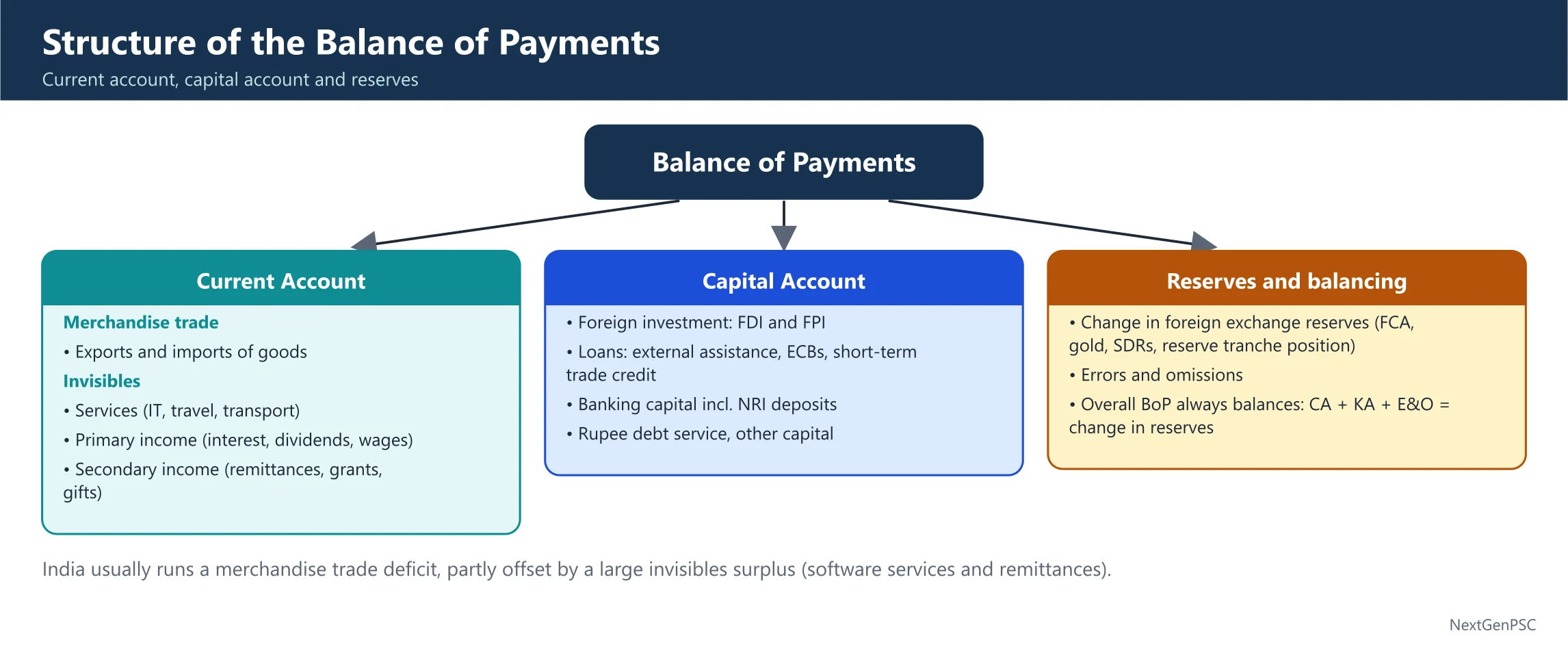
Overview of External Sector
External sector refers to a country’s interaction with other countries via trade (exports and imports) and capital flows (investment, borrowing, lending).
Countries can use these interactions to accelerate economic growth.
Example: Export-led growth in countries like Japan, South Korea, China, Vietnam, and Taiwan boosted industrialization and income levels.
Key features of the external sector include Foreign Trade Policy, Balance of Payments, Currency Convertibility, Foreign Exchange Rate, Export Promotion Policies, and Foreign Investment (FDI and FII).
Balance of Payments (BOP)
BOP is the systematic record of all economic transactions of a country with the rest of the world in a given year.
Transactions include trade in goods, services, and movement of financial assets.
Functions like double-entry bookkeeping, where every inflow has a corresponding outflow entry.
Ideally, BOP balances to zero (inflows = outflows), but in practice, deficits or surpluses occur.
Example: If India exports 100 cars to the US, India records this as a credit (money inflow), while the US records imports as a debit (money outflow).
Formula: Current Account + Capital Account + Financial Account + Balancing Item = 0.
Importance of BOP
Indicates a country’s financial and economic status.
Helps assess currency appreciation or depreciation trends.
Useful for policy makers to frame trade, investment, and foreign exchange strategies.
Provides insights into global competitiveness of the economy.
Components of BOP
Current Account: Records trade in goods, services, investment incomes, and transfers.
Capital Account: Records capital transfers and acquisition/disposal of non-produced, non-financial assets.
Financial Account: Records investments like FDI, FII, loans, and reserves.
Balancing Item: Statistical adjustments to ensure BOP adds up to zero.
Invisibles
Meaning: current-account items other than merchandise trade – services (IT, travel, transport), primary income (interest, dividends, compensation of employees) and secondary income (remittances, grants and gifts). India's large invisibles surplus offsets much of its merchandise trade deficit.
| Aspect | Details |
|---|---|
| Definition | Record of a country’s economic transactions with rest of the world over a year |
| Nature | Double-entry system; inflows = credit, outflows = debit |
| Formula | Current Account + Capital Account + Financial Account + Balancing Item = 0 |
| Status | Indicates surplus (exports > imports) or deficit (imports > exports) |
| Importance | Shows economic health, currency trends, and policy needs |
Prelims tips
- BOP records transactions in goods, services, and capital flows with rest of the world.
- Always balances mathematically due to double-entry system.
- Deficit = imports > exports; Surplus = exports > imports.
- Two main parts: Current Account and Capital Account.
Mains points
- BOP provides a comprehensive picture of a country’s external economic relations.
- Persistent BOP deficit can indicate structural issues in trade and currency value.
- Helps in formulating monetary, fiscal, and trade policies.
- Reflects a country’s integration with global economy.
- Acts as an early warning system for economic imbalances.
Current Account of Balance of Payments (BOP)
The Current Account of BOP records trade in goods, services, income, and unilateral transfers. It shows how much a country earns or spends in its day-to-day transactions with the rest of the world. A surplus means exports and inflows are greater than imports and outflows, while a deficit means the opposite.
What is Current Account?
Current Account is part of Balance of Payments that records trade in goods, services, income, and transfers between a country and the rest of the world.
It reflects day-to-day economic dealings such as buying/selling goods, availing services, earning income from investments abroad, or receiving remittances.
Components: Visible Trade, Invisible Trade, Unilateral Transfers, and Investment Income.
Visible Trade (Merchandise Trade)
Refers to inflow (exports) and outflow (imports) of physical goods.
Goods include: general merchandise, goods used in further processing, and non-monetary gold.
Imports are shown as debit (negative), exports are shown as credit (positive).
Balance of exports and imports of goods = Balance of Trade (BOT).
Invisible Trade (Services Trade)
Refers to inflow and outflow of services instead of goods.
Examples: banking services, shipping, insurance, IT services, consultancy, tourism, medical tourism, etc.
Includes payments like interest on foreign loans or income from foreign investments.
Growing importance in globalized economies where services exports are high (e.g., India’s IT sector).
Unilateral Transfers
One-sided transfers where money flows without any return service or product.
Examples: gifts, donations, foreign aid, personal remittances from relatives abroad, salaries sent by workers (migrant remittances).
These are major inflows for many developing countries, supporting foreign exchange reserves.
Income Receipts and Payments (Investment Income)
Income from assets or investments held abroad.
Examples: profits from subsidiaries in foreign countries, dividends from foreign shares, interest from foreign loans, and reinvested earnings.
Payments include income paid to foreign investors on their assets in the home country.
| Component | Description | Examples |
|---|---|---|
| Visible Trade | Trade in physical goods | Exports of cars, imports of oil, gold |
| Invisible Trade | Trade in services | Banking, shipping, IT, tourism, medical tourism |
| Unilateral Transfers | One-way transfers with no return | Remittances, gifts, foreign aid, donations |
| Investment Income | Earnings from assets and investments abroad | Profits, dividends, interest |
Prelims tips
- Current Account includes goods, services, income, and unilateral transfers.
- Balance of Trade (BOT) is only part of Current Account (goods only).
- India often runs a Current Account Deficit (CAD) due to high oil imports.
- Remittances form a large inflow in India’s current account.
Mains points
- Current Account reflects everyday transactions with the world economy.
- Surplus indicates competitiveness in exports; deficit shows dependence on imports.
- India’s invisible trade (services exports) and remittances are key for reducing CAD.
- Current Account sustainability is crucial for currency stability.
- CAD financed through capital inflows (FDI/FII), but persistent deficit may cause vulnerability.
Foreign Capital Inflows: FDI, FPI & ECBs
Foreign capital inflows are crucial for India's growth. They come in different forms such as Foreign Direct Investment (FDI), Foreign Portfolio Investment (FPI), and External Commercial Borrowings (ECBs). While FDI involves long-term investment with management participation, FPI is short-term and volatile, and ECBs are loans borrowed from foreign lenders.
Foreign Direct Investment (FDI)
Investment by a foreign entity in another country’s company with some degree of control and management participation.
According to Companies Act 2013: More than 10% shareholding in a listed company is considered FDI.
Modes of FDI: Joint ventures (Ford & Mahindra), Mergers & Acquisitions (Walmart & Flipkart), Subsidiary Companies (Hindustan Unilever of Unilever Plc).
Prohibited sectors: Atomic energy, railway operations (except metro & infra), tobacco products, real estate business, farmhouses, chit funds, nidhi companies, betting/gambling/lotteries.
Routes for FDI:
Automatic Route: No government approval required (e.g., 100% FDI in medical devices, thermal power).
Government Route: Approval required from concerned ministry (e.g., 51% in multi-brand retail trading, 49% in broadcasting).
Foreign Portfolio Investment (FPI)
Investment by foreign investors in shares, bonds, and other financial assets of another country.
Investors do not participate in management or production.
Defined as ownership of up to 10% shares in an Indian company.
Earlier categories: Foreign Institutional Investors (FII) and Qualified Foreign Investors (QFI) were merged into FPI in 2013 (based on K.M. Chandrasekhar committee).
Primary objective: Short-term profit through capital markets (buying & selling shares).
FPIs can issue Participatory Notes (P-Notes) to unregistered foreign investors.
FPI investments are considered ‘hot money’ since they can exit quickly, causing rupee depreciation and stock market volatility.
External Commercial Borrowings (ECBs)
Loans taken by Indian entities from foreign lenders, with a minimum average maturity of 3 years.
Provided mainly by foreign commercial banks, multilateral financial institutions, export credit agencies, etc.
Types of ECBs: Commercial bank loans, buyers’ credit, suppliers’ credit, Floating Rate Notes, Fixed Rate Bonds, securitized instruments.
Post-reform period: ECBs have become a major source of foreign capital along with FDI and FPI.
| Aspect | FDI | FPI | ECB |
|---|---|---|---|
| Definition | Long-term investment with management participation | Short-term investment in shares/bonds (no control) | Loan taken by Indian entities from foreign lenders |
| Threshold | More than 10% equity | Up to 10% equity | Loan with minimum 3 years maturity |
| Nature | Stable, long-term capital | Volatile, speculative ‘hot money’ | Debt obligation |
| Control | Involves influence/control in company’s policies | No control, only financial returns | No control, borrower must repay loan |
| Examples | Walmart acquiring Flipkart, Hindustan Unilever | Foreign investors buying Indian stocks | Foreign bank loans, bonds, export credits |
Prelims tips
- FDI = More than 10% equity + management participation.
- FPI = Up to 10% equity, no control (short-term).
- FPI introduced after merging FII and QFI (2013, Chandrasekhar Committee).
- ECBs = Foreign loans with minimum 3 years maturity.
- FDI = stable capital, FPI = hot money, ECB = debt.
Mains points
- FDI brings technology, skills, and stable long-term capital.
- FPI provides liquidity in markets but is highly volatile (‘hot money’).
- Excessive dependence on FPIs may weaken currency in times of capital flight.
- ECBs allow access to foreign capital but increase external debt burden.
- Balanced inflow of FDI, FPI, and ECBs is crucial for sustainable growth.
Official Reserve Assets Account
The Official Reserve Assets Account records changes in a nation’s official reserves held by its central bank. These reserves include gold, foreign currencies, Special Drawing Rights (SDRs), and the country’s position in the IMF. It helps balance deficits and surpluses in the Current and Capital Accounts.
What is Official Reserve Assets Account?
A part of Balance of Payments (BOP) that records adjustments to the quantity of reserve assets held by the central bank.
Official reserve assets include:
Gold stock of the country.
Convertible foreign currencies (like USD, Euro, Yen).
Special Drawing Rights (SDRs) allocated by the IMF.
Net position in the International Monetary Fund (IMF).
It is used by the central bank to settle imbalances (deficits/surpluses) in Current Account and Capital Account.
Function in India’s BOP
Changes in reserves are treated as a financing item.
Withdrawal from reserves (when forex is used to meet deficit) = Credit (positive entry).
Addition to reserves (when surplus is stored) = Debit (negative entry).
Important: Change in reserves is recorded in the BOP account, not in the forex reserves data directly reported by RBI.
Significance
Acts as a balancing mechanism for BOP.
Maintains currency stability by meeting external payment needs.
Provides buffer during external shocks like high import bills or sudden capital outflows.
| Element | Description |
|---|---|
| Gold Stock | Value of gold reserves held by central bank |
| Foreign Currencies | Holdings of major convertible currencies like USD, Euro, Yen |
| Special Drawing Rights (SDRs) | IMF-created international reserve asset |
| IMF Position | Net position of a country in the IMF (quota minus drawings) |
Prelims tips
- Official Reserve Assets include Gold, Forex currencies, SDRs, IMF position.
- Withdrawal from reserves = Credit entry; Addition to reserves = Debit entry in BOP.
- Change in reserves is recorded in BOP, not in RBI’s forex data.
- Acts as balancing item to settle BOP deficits/surpluses.
Mains points
- Official Reserves are critical for stabilizing exchange rate and meeting international obligations.
- Provide confidence to investors and credit rating agencies.
- Large reserves act as insurance against external shocks.
- Over-reliance on reserves for deficit financing may deplete assets.
- Management of reserves must balance liquidity, safety, and returns.
Deficits of Current and Capital Account
A deficit in Current or Capital Account occurs when outflows are greater than inflows. Current Account Deficit (CAD) reflects the imbalance between imports, exports, and factor incomes, while Capital Account deficit shows insufficient inflow of foreign investments or borrowings to finance the CAD. Persistent deficits indicate economic vulnerability.
Balance of Current Account
Current Account is in balance when receipts (inflows) = payments (outflows).
Surplus: Nation earns more from exports, services, transfers, and investments abroad (becomes a lender).
Deficit: Nation spends more on imports, payments, and transfers than it earns (becomes a borrower).
Current Account Deficit (CAD)
CAD measures the gap between money inflows and outflows in goods, services, income, and transfers.
Different from Balance of Trade (BOT): BOT measures only exports-imports of goods & services, CAD includes income from foreign assets and remittances.
Largest component of CAD is trade deficit (imports > exports).
Formula: Current Account = (Exports – Imports) + Net Current Transfers + Net Income from Abroad.
Example: Rental income of an Indian from a UK house = part of CAD but not part of BOT.
Current Account Deficit – Net Income
Sources of income inflows: Interest/dividends from overseas investments, salaries/remittances from workers abroad.
Sources of outflows: Dividend/interest paid to foreign investors, outsourcing payments.
If payments > receipts, net income becomes negative, worsening CAD.
India’s Current Account Scenario
2001–04: India had Current Account Surplus (global boom increased exports).
Post-2004: India moved into persistent deficit; CAD averaged -2.2% of GDP over last decade.
2020–21 (COVID period): CAD turned into surplus after 17 years due to fall in imports.
Economic Survey 2022–23: India’s CAB deficit was US 36.4 billion (4.4% of GDP) in Q2FY23, vs. US 9.7 billion (1.3% of GDP) in Q2FY22.
Significance of CAD
A rising CAD shows weakening competitiveness and higher dependence on imports.
Persistent CAD can weaken investor confidence and currency stability.
If not financed by Capital Account inflows (FDI, FPI, ECB), reserves may be depleted.
| Aspect | Details |
|---|---|
| Definition | Gap between inflows and outflows of goods, services, income & transfers |
| Formula | CAD = (Exports – Imports) + Net Transfers + Net Income from Abroad |
| Difference from BOT | BOT = Goods & services only; CAD = BOT + Income + Transfers |
| Largest Component | Trade Deficit (Imports > Exports) |
| India’s Average | -2.2% of GDP in past decade |
| Recent Data | Q2FY23: CAD = US 36.4 bn (4.4% of GDP) |
Prelims tips
- CAD includes goods, services, income, and transfers (broader than BOT).
- Largest component of CAD = Trade Deficit.
- CAD = Exports – Imports + Net Transfers + Net Income.
- Persistent CAD weakens rupee and investor confidence.
Mains points
- CAD reflects imbalance in external sector, affecting currency and forex reserves.
- Large CAD may be financed by capital inflows; otherwise reserves fall.
- Persistent CAD signals structural issues (import dependence, low competitiveness).
- Short-term surplus (like 2020–21) may arise due to extraordinary events (COVID).
- Policy response: boost exports, attract stable FDI, reduce import dependence.
Issues Related to India’s Current Account Deficit (CAD)
India’s CAD is heavily influenced by imports of crude oil and gold. Both commodities form a major part of India’s import basket, and their price volatility directly impacts trade balance, inflation, forex reserves, and currency stability. The government has taken several measures to reduce dependence on oil and gold imports.
Issue 1: Import of Oil
India is the world’s third-largest oil consumer (~5 million barrels/day). Demand is rising by 3–4% annually; projected ~7 million barrels/day in a decade.
In 2021–22, India imported 212.2 million tonnes of crude oil (vs 196.5 million tonnes previous year). Oil import dependence ~86%.
High import bill worsens macroeconomic indicators, fuels CAD, and pressures forex reserves.
Impacts of Oil Import Dependence
Increases Import Bill: Oil is the largest share of imports; price hikes worsen CAD and increase subsidy burden.
Inflation: Higher oil prices directly push up domestic inflation.
Pressure on Currency & Forex: Rupee depreciation makes imports costly; RBI interventions reduce forex reserves.
Government Efforts
Liberalization of Oil Sector: Post-1991, private players allowed alongside ONGC & PSUs.
Policies for boosting domestic production: Production Sharing Contract (PSC) regime, Discovered Small Field Policy, Hydrocarbon Exploration & Licensing Policy (HELP), New Exploration Licensing Policy (NELP).
Ethanol Blending Programme (EBP): Aim to reduce oil imports, cut emissions, boost farmer incomes. Target of 20% blending (E20) advanced to 2025 from 2030.
Issue 2: Import of Gold
India is the world’s 2nd largest gold consumer (~900 tonnes/year).
In 2012–13, gold imports exceeded 30 bn in 8 months; CAD rose to 4.8% of GDP; rupee depreciated; RBI hiked import duty and mandated re-export of 20% imports as jewellery.
Gold imports worsen trade deficit and CAD, weaken rupee, and reflect inflationary pressures.
Initiatives to Reduce Gold Imports
Gold Monetization Scheme (GMS): Mobilizes idle household/institutional gold for productive use.
Sovereign Gold Bonds (SGBs): Government securities in grams of gold, alternative to physical gold.
Higher Customs Duty: Discourages excessive imports and helps protect CAD.
| Issue | Impact on CAD | Government Measures |
|---|---|---|
| Oil Imports | Largest import item; rising prices increase import bill, CAD, inflation, pressure on forex reserves | Liberalization of oil sector, PSC/HELP/NELP policies, Ethanol Blending (E20 target by 2025) |
| Gold Imports | High demand increases trade deficit; 2012–13 CAD at 4.8% GDP; weakens rupee | Gold Monetization Scheme, Sovereign Gold Bonds, higher customs duty |
Prelims tips
- India is 3rd largest oil consumer (~5 million barrels/day).
- Oil imports = ~86% dependence (2021–22).
- India is 2nd largest gold consumer (~900 tonnes/year).
- 2012–13 CAD rose to 4.8% GDP due to high gold imports.
- Schemes: Ethanol Blending Programme (E20 by 2025), GMS, SGBs.
Mains points
- High dependence on oil imports makes CAD vulnerable to global price shocks.
- Gold imports reflect socio-cultural demand but worsen CAD and currency stability.
- Policy measures like ethanol blending and gold monetization aim to reduce import dependence.
- CAD management requires boosting domestic production, diversifying energy sources, and offering alternatives to physical gold.
- Volatile CAD weakens rupee, fuels inflation, and reduces forex reserves.
Factors Causing Current Account Deficit (CAD) and Its Impacts
CAD arises when imports of goods, services, and payments exceed exports and inflows. It can be caused by exchange rate appreciation, high economic growth, inflation, lack of competitiveness, and low investment levels. A large CAD has both short-term and long-term consequences for growth, currency stability, and investor confidence.
Factors that Cause Current Account Deficit
1. Appreciation of Exchange Rate
Stronger currency = cheaper imports + expensive exports.
Leads to more imports and fewer exports, widening CAD.
Example: If 1 falls from ₹50 to ₹40, imports become cheaper, increasing CAD.
2. Economic Growth
Rising incomes → more demand for goods and services.
If domestic supply is insufficient, imports increase.
Developing nations often import luxury/high-tech goods with growth.
3. Extended Periods of High Inflation
High inflation makes domestic goods/services expensive.
Reduces export competitiveness, increases imports.
Example: If India’s inflation rises faster than trading partners, Indian exports become less competitive.
4. Decline in Competitiveness/Export Sector
Weak manufacturing sector → exports cannot compete globally.
Developing nations may lose market share to others with stronger export sectors.
5. Low Levels of Investment
Countries with low investment produce only raw/low-value exports.
Reliance on unprocessed commodities lowers export value.
Example: Exporting unrefined crude instead of processed petroleum reduces earnings, worsening CAD.
Impacts of Large CAD
Short-Run Effect
Foreign capital inflows finance deficit → higher growth temporarily.
Long-Run Effects
Weakening of Demand: Investors doubt returns, reducing demand for country’s assets.
Currency Depreciation: Rising CAD increases demand for foreign currency, weakening domestic currency.
Costlier Imports: Depreciation makes imports (oil, electronics, semiconductors) more expensive, raising CAD further.
Flight of Capital: Investors withdraw funds due to instability, leading to further depreciation.
Depleted Forex Reserves: Central Bank defends currency by selling forex, reducing reserves and financial stability.
| Factor | Effect on CAD |
|---|---|
| Exchange Rate Appreciation | Cheaper imports, reduced exports, CAD widens |
| Economic Growth | Higher demand → increased imports |
| High Inflation | Exports less competitive, imports cheaper |
| Decline in Competitiveness | Exports lose share in global markets |
| Low Investment | Exports limited to raw goods, low value addition |
| Impact | Description |
|---|---|
| Short-run Growth | Foreign capital inflows temporarily boost growth |
| Weakening of Demand | Investors doubt returns → reduced asset demand |
| Currency Depreciation | CAD increases demand for forex → rupee weakens |
| Costlier Imports | Depreciation makes essential imports costlier |
| Flight of Capital | Instability leads to foreign investor exit |
| Depleted Forex Reserves | Central Bank defends rupee → reserves fall |
Prelims tips
- CAD = Imports + Payments > Exports + Receipts.
- Caused by exchange rate appreciation, growth, inflation, weak exports, low investment.
- Large CAD → currency depreciation + costlier imports + forex depletion.
- BOT vs CAD: CAD includes transfers and incomes, BOT only goods/services.
Mains points
- CAD can be cyclical (due to global price shocks) or structural (low competitiveness, import dependence).
- Sustained CAD weakens investor confidence and currency.
- Managing CAD requires export competitiveness, diversification, and controlling inflation.
- Short-term growth from foreign inflows may lead to long-term vulnerability.
- Policy mix: attract stable FDI, promote value-added exports, reduce oil/gold imports.
Measures to Handle Current Account Deficit (CAD) & Related Trade Concepts
Current Account Deficit can be managed through a mix of boosting exports, reducing non-essential imports, stabilizing currency, and ensuring sufficient capital inflows. Concepts like Balance of Trade (BOT), Trade Surplus, and Trade Deficit help understand CAD in detail. CAD is broader than BOT as it also includes services, transfers, and income from abroad.
Measures to Handle CAD
Boosting Exports: Provide incentives to export-oriented industries, reduce regulatory hurdles, improve infrastructure, and negotiate better trade agreements.
Reducing Non-Essential Imports: Impose higher tariffs on luxury or non-essential items such as gold, mobiles, and electronics. Promote substitutes.
Import Substitution: Encourage domestic production through subsidies, tax benefits, and innovation incentives to replace imports with locally made goods.
Central Bank Interventions: RBI and other central banks should manage exchange rate stability by buying domestic currency and selling foreign currency in forex markets.
Reviewing Debt Investment Limits: Government and RBI can adjust FPI limits to ensure steady capital inflows.
Capital Inflows as Financing Tool: CAD can be funded by attracting stable inflows like FDI, FPI, ECBs, and NRI deposits.
Balance of Trade (BOT)
BOT = Total value of exports – Total value of imports (only goods, not services).
Partial measure, gives a limited view of trade position.
Trade Surplus
Exports > Imports. Indicates strong foreign demand and inflow of foreign currency.
Example: China exports more than it imports, hence consistent trade surplus.
Trade Deficit
Imports > Exports. Indicates dependence on foreign goods and outflow of currency.
Example: If India imports ₹10 lakh crore but exports only ₹1 lakh crore, deficit = ₹9 lakh crore.
Trade Deficit vs Current Account Deficit
Trade Deficit: Includes only goods and services.
CAD: Includes trade deficit + net income + transfer payments (remittances, aid).
CAD is broader, showing a country’s overall external imbalance.
Balance of Trade vs Balance of Payments (BOP)
BOT: Only visible items (goods).
BOP: All international economic transactions (goods, services, income, capital).
BOT is a subset of BOP.
Formula: BOT = Exports – Imports; BOP = Current Account + Capital Account ± Errors & Omissions.
BOP gives a complete picture, BOT gives a partial picture.
| Aspect | BOT | Trade Deficit | CAD | BOP |
|---|---|---|---|---|
| Definition | Exports – Imports of goods | Imports > Exports (goods/services) | Trade deficit + income + transfers | All economic transactions with world |
| Coverage | Only goods | Goods & services | Goods, services, income, transfers | Goods, services, income, capital |
| Nature | Partial trade measure | Negative BOT | Overall external imbalance | Complete picture of external sector |
| Example | India exports ₹100 vs imports ₹120 | Imports ₹200 vs exports ₹150 | BOT deficit + negative remittances | India’s annual BOP statistics |
Prelims tips
- CAD broader than BOT: includes services, transfers, income.
- Measures to reduce CAD: boost exports, reduce non-essential imports, import substitution.
- BOT vs BOP: BOT = goods only, BOP = goods + services + income + capital.
- India often runs a trade deficit but finances CAD via capital inflows (FDI, FPI, ECB).
Mains points
- CAD management requires structural reforms: strengthen exports, diversify imports, control inflation.
- BOT is a narrower measure; CAD is a comprehensive measure of external imbalance.
- Persistent CAD can cause currency depreciation, forex reserve depletion, and lower investor confidence.
- India uses policy tools like RBI forex intervention, import duties, and export promotion schemes.
- Long-term solution lies in improving domestic competitiveness and reducing oil/gold import dependence.
Balance of Capital Account and Capital Account Deficit
The Capital Account is balanced when inflows of foreign investments, loans, and asset sales equal the outflows of repayments, foreign investments, and asset purchases. A surplus means more inflows than outflows, while a deficit means more outflows than inflows. A Capital Account Deficit shows net investment moving abroad but may also mean domestic entities acquire valuable foreign assets.
Balance of Capital Account
Capital Account is balanced when capital inflows = capital outflows.
Capital inflows include: receipt of foreign loans, sale of domestic shares/assets to foreigners, FDI and FPI inflows.
Capital outflows include: repayment of foreign loans, domestic entities buying assets abroad, FDI/FPI made by Indians overseas.
Surplus: inflows > outflows, increasing foreign exchange availability.
Deficit: outflows > inflows, leading to reduction in forex reserves.
Capital Account Deficit
Indicates a net outflow of capital, as domestic firms or individuals invest abroad more than foreigners invest domestically.
Example: An Indian corporate acquires a large European steel producer worth billions of Euros. The huge outflow exceeds inflows, creating a capital account deficit.
Although deficit occurs, the country gains ownership rights of a foreign asset, which may bring long-term benefits.
Significance
Surplus helps finance current account deficit (CAD).
Deficit reflects capital moving abroad, which may reduce forex reserves but can enhance long-term global presence of domestic firms.
Shows patterns of cross-border investments and financial integration.
| Aspect | Details |
|---|---|
| Balance | Inflows = Outflows (neutral situation) |
| Surplus | Inflows > Outflows; helps finance CAD |
| Deficit | Outflows > Inflows; net capital moving abroad |
| Example of Deficit | Indian company acquiring a European steel giant |
| Impact | Deficit reduces forex reserves but increases ownership of foreign assets |
Prelims tips
- Capital Account surplus helps finance CAD.
- Capital Account deficit shows more capital going out than coming in.
- Deficit may occur even when country gains foreign assets (e.g., acquisitions).
- Balance = inflows equal outflows.
Mains points
- Capital Account surplus indicates confidence of foreign investors and availability of capital.
- Deficit indicates capital outflow, but can also mean expansion of domestic firms abroad.
- Important for financing external deficits and maintaining currency stability.
- Persistent deficit may deplete reserves and signal weak domestic investment climate.
- Policy should aim for balanced inflows and outflows to ensure long-term stability.
Basic BOP Accounting Rule and Equilibrium in Balance of Payments
Balance of Payments (BOP) records all international transactions of a country. Credits (surplus) arise when foreign exchange flows into the country (exports, borrowings, FDI inflows), while debits (deficit) occur when foreign exchange flows out (imports, loan repayments, outward investments). Equilibrium in BOP means inflows = outflows, while disequilibrium occurs when there is persistent deficit or surplus.
Basic BOP Accounting Rule
Any transaction leading to net receipt of foreign exchange = Credit (surplus).
Any transaction leading to net payment in foreign exchange = Debit (deficit).
Exports > Imports → Current Account Surplus (foreign exchange inflow).
Borrowings > Lending abroad → Capital Account Surplus (capital inflow).
Loan repayment abroad → Debit entry (capital outflow).
Capital Account Surplus = Net Capital Inflow; Capital Account Deficit = Net Capital Outflow.
A Current Account Deficit (CAD) must always be balanced by a Capital Account Surplus (through capital inflows).
Equilibrium in Balance of Payments
Equilibrium occurs when demand = supply of foreign currency in a given period.
A country is in BoP equilibrium when Current Account + Non-Reserve Capital Account = 0.
In equilibrium, current account deficit is fully financed by capital inflows, without using reserves.
Example: If India’s imports exceed exports, but equal FDI inflows offset the deficit, BOP remains in equilibrium.
Disequilibrium in Balance of Payments
Disequilibrium = Persistent deficit or surplus.
Deficit in BOP:
Occurs when total payments > total receipts (DEBIT > CREDIT).
Indicates imports + capital outflows exceed exports + inflows.
Corrected by using forex reserves (RBI sells foreign exchange).
Surplus in BOP:
Occurs when total exports > imports.
Inflow of foreign currency increases forex reserves.
Surplus funds can boost domestic investment and growth.
Adjustment Mechanisms
If BOP deficit: encourage exports, reduce imports, attract more FDI/FPI.
If BOP surplus: may encourage imports, purchase foreign assets, or extend foreign aid.
Permanent surplus/deficit is unsustainable. In long term, a country’s total assets and liabilities must balance.
| Condition | Explanation | Effect |
|---|---|---|
| Equilibrium | Exports + inflows = Imports + outflows | Foreign exchange demand = supply |
| Deficit (Disequilibrium) | Payments > Receipts (Debit > Credit) | Corrected by using forex reserves or attracting inflows |
| Surplus (Disequilibrium) | Exports > Imports (Receipts > Payments) | Increases forex reserves, may boost domestic growth |
Prelims tips
- Credit = Inflow of forex, Debit = Outflow of forex.
- CAD is always offset by Capital Account surplus (or forex reserves).
- Equilibrium in BOP: Current + Capital (non-reserve) = 0.
- Deficit → RBI uses forex reserves; Surplus → reserves increase.
Mains points
- BOP accounting ensures every transaction is matched with a credit and debit entry.
- Equilibrium ensures stability in external sector without reliance on reserves.
- Persistent disequilibrium (deficit/surplus) signals structural imbalance in trade or capital flows.
- Deficits may weaken currency and deplete reserves; surpluses may cause excess liquidity.
- Policy focus: maintain sustainable balance by encouraging exports, controlling imports, and managing capital flows.
Measures to Correct Balance of Payments (BoP) Disequilibrium
When a country’s Balance of Payments (BoP) is in disequilibrium (persistent deficit or surplus), corrective steps are required. These steps can be automatic adjustments (like price, interest rate, income, and capital flows) or deliberate government measures (like devaluation, exchange controls, monetary policies, trade measures). The aim is to restore stability between inflows and outflows of foreign exchange.
Automatic Measures (Natural Adjustments)
These happen automatically in the economy due to changes in prices, interest rates, or incomes. No active government intervention is required.
1. Price Adjustment
If a country has a BoP deficit, money supply falls → prices decrease in the deficit country.
Lower prices make exports cheaper and imports expensive → exports rise, imports fall.
In a surplus country, higher money supply raises prices → exports become costly, imports become attractive → surplus reduces.
Example: If India faces deficit, rupee supply reduces → Indian goods become cheaper abroad → exports rise automatically.
2. Interest Rate Adjustment
Deficit country raises interest rates → investors withdraw money from abroad and invest in domestic assets.
Surplus country lowers interest rates → capital flows out of surplus country to deficit country.
This stabilises capital flows and restores BoP equilibrium.
3. Income Adjustment
Surplus country earns higher income due to BoP surplus.
Higher income → more demand for foreign goods → more imports.
This reduces surplus and balances BoP.
Similarly, deficit countries with lower income reduce imports automatically.
4. Capital Flows
Disequilibrium affects interest rates globally.
Investors move funds from surplus countries (low returns) to deficit countries (higher returns).
This flow of capital helps restore balance between nations.
Deliberate Measures (Government/Policy Interventions)
These measures are consciously adopted by governments and central banks to correct persistent disequilibrium.
1. Devaluation of Currency
Country deliberately reduces the value of its currency against foreign currencies.
Exports become cheaper for foreigners, imports become costly for domestic consumers.
Example: If ₹1 = 0.02 falls to ₹1 = 0.015, Indian goods become cheaper abroad, encouraging exports.
2. Foreign Exchange Controls
Government/central bank takes control of all foreign exchange transactions.
Exporters must surrender foreign exchange to the central bank; imports are allowed only with permission.
Helps reduce unnecessary imports and ensures forex is used for essential items.
3. Monetary Measures
High imports are often due to inflation (high prices domestically).
Central Bank reduces credit supply → lowers inflation → makes domestic goods cheaper.
Exports rise, imports fall, and BoP improves.
4. Trade Measures
Government introduces policies to encourage exports and discourage imports.
Export promotion: subsidies, tax incentives, simplification of procedures.
Import control: higher tariffs, import duties, quotas on luxury items.
5. Gold Monetization Scheme
Aimed at reducing India’s heavy gold imports.
Households deposit idle gold in banks; banks use it productively.
Reduces dependence on imported gold, stabilises BoP in long term.
| Type | Examples | Effect |
|---|---|---|
| Automatic Measures | Price, Interest Rate, Income, Capital Flows | Work naturally without govt. intervention |
| Deliberate Measures – Devaluation | Currency depreciation | Boosts exports, reduces imports |
| Deliberate Measures – Forex Controls | Govt controls forex transactions | Restricts unnecessary imports |
| Deliberate Measures – Monetary | Credit control, inflation control | Makes domestic goods competitive |
| Deliberate Measures – Trade | Tariffs, subsidies, quotas | Encourages exports, discourages imports |
| Deliberate Measures – Gold Monetization | Mobilise idle gold | Reduces gold imports |
Prelims tips
- BoP disequilibrium corrected via automatic (price, interest, income, capital) and deliberate measures (devaluation, forex control, trade measures).
- Devaluation makes exports cheaper and imports costlier.
- Gold Monetization Scheme is linked to reducing CAD and BoP pressure.
- Monetary measures: credit control lowers inflation, improves exports.
Mains points
- Automatic adjustments like price and capital flows are short-term stabilisers.
- Persistent BoP issues require deliberate policy measures by govt/central bank.
- Devaluation is a powerful tool but can lead to imported inflation.
- Forex and trade measures ensure strategic use of foreign currency.
- Structural reforms (domestic production, reducing oil/gold imports) ensure long-term BoP stability.
Balance of Payments (BoP) and the Central Bank
The Central Bank plays a crucial role in managing the Balance of Payments (BoP). It uses foreign exchange reserves to cover deficits and purchases forex during surpluses. These official reserve transactions help maintain external stability, currency value, and money supply balance. Additionally, the RBI uses sterilisation to prevent inflation caused by excess money supply from forex interventions.
Central Bank and BoP
Central Banks hold foreign currency reserves to handle imbalances in BoP.
Example: If India has Current Account Deficit = Rs 200 and Capital Account Surplus = Rs 180 → Net BoP Deficit = Rs 20. RBI can sell 20 worth forex to meet deficit.
Capital Account Deficit: RBI may sell forex to finance Indian repayments or foreign lending.
Surplus in BoP: Central Bank buys foreign exchange → increases forex reserves → increases money supply.
Deficit in BoP: Central Bank sells foreign exchange → reduces forex reserves → lowers money supply.
Example: If US has Current Account Surplus 60m and Capital Account Deficit 40m → Net BoP Surplus 20m → Federal Reserve buys 20m forex → increases reserves.
Official Reserve Transactions
Purchases and sales of forex reserves by Central Bank are termed official reserve transactions.
They act as a balancing item in BoP accounts.
Help stabilise exchange rates and ensure smooth international payments.
Sterilisation by RBI
Sterilisation = withdrawal of excess money supply created due to RBI forex interventions.
Situation: Large forex inflows (FDI/FPI) → high demand for rupee → rupee appreciates.
RBI buys foreign currency (e.g., dollars) to prevent excessive rupee appreciation.
In return, RBI supplies rupees → raises money supply in the economy.
More rupees in circulation → risk of inflation.
To prevent this, RBI absorbs excess rupee liquidity by selling govt bonds or using instruments like MSS (Market Stabilisation Scheme).
Thus, sterilisation neutralises inflationary impact of forex interventions.
Importance of Sterilisation
Prevents inflation due to excess liquidity.
Maintains export competitiveness (by avoiding sharp rupee appreciation).
Ensures stability in both external sector (forex market) and internal sector (inflation control).
| Scenario | Central Bank Action | Impact |
|---|---|---|
| BoP Deficit | Sells forex reserves | Reduces reserves, lowers money supply |
| BoP Surplus | Buys forex reserves | Increases reserves, raises money supply |
| Capital Inflows (FDI/FPI) | Buys dollars, releases rupees | Prevents rupee appreciation, raises liquidity |
| Sterilisation | Absorbs excess rupee liquidity via bonds/MSS | Controls inflation, stabilises economy |
Prelims tips
- Official Reserve Transactions = forex buy/sell by Central Bank.
- BoP Deficit → Central Bank sells forex; BoP Surplus → Central Bank buys forex.
- Sterilisation = RBI absorbs extra rupee liquidity to prevent inflation.
- Large capital inflows cause rupee appreciation → RBI intervenes to maintain competitiveness.
Mains points
- Central Bank is the ultimate balancer of BoP through forex interventions.
- Official reserve transactions act as financing items in BoP accounts.
- Sterilisation is essential to balance external sector stability with internal price stability.
- Too much reliance on forex reserves may weaken reserve buffers.
- Policy challenge: managing inflows to avoid currency appreciation while preventing inflation domestically.
Balance of Payments (BoP) Crisis of 1991 in India
India’s BoP crisis of 1991 was triggered by rising oil prices due to the Gulf War, collapse of the USSR (reducing exports), and unsustainable external borrowing. Foreign reserves fell to levels covering just 2–3 weeks of imports. To avoid default, India pledged 67 tons of gold and borrowed from the IMF. This crisis led to the historic 1991 economic reforms.
What is a BoP Crisis?
A Balance of Payments (BoP) crisis happens when a country does not have enough foreign exchange reserves and capital inflows to finance its current account deficit.
It often leads to depletion of forex reserves, currency depreciation, and risk of default on international obligations.
India’s BoP Crisis of 1991
Severe shortage of foreign exchange → reserves could cover only about 2–3 weeks of essential imports.
RBI was forced to sell forex reserves to maintain payments balance.
To raise funds, India pledged 67 tons of gold and borrowed USD 2.2 billion from IMF.
This crisis forced India to introduce major economic reforms (Liberalisation, Privatisation, Globalisation – LPG).
Macroeconomic Indicators (1990–91)
Trade deficit: Rose from ₹12,400 crore (1989-90) to ₹16,900 crore (1990-91).
Current Account Deficit (CAD): Rose from ₹11,350 crore to ₹17,350 crore.
CAD/GDP ratio: Rose from 2.3% to 3.1%.
Forex reserves: Declined from ₹5,277 crore (Dec 1989) to ₹2,152 crore (Dec 1990).
Between May–July 1991, reserves stood at only ₹2,500–3,300 crore, enough for 2–3 weeks of imports.
Causes of the Crisis
1. Break-up of Soviet Bloc
USSR was India’s major trading partner with rupee-payment trade agreements.
After USSR’s disintegration, these agreements ended and exports to Eastern Europe fell sharply.
2. Gulf War (1990–91)
Iraq’s invasion of Kuwait → crude oil prices rose from 15/barrel (July 1990) to 35/barrel (Oct 1990).
India’s oil import bill rose 60% in 1990–91, and 40% higher in 1991–92 compared to 1989–90.
3. Slow Global Growth
Export demand weakened as global growth declined from 4.5% (1988) to 2.25% (1991).
4. Rising Non-Oil Imports
In 1980s, imports rose by 2.3% of GDP, while exports rose only 0.3% of GDP.
Trade deficit worsened from 1.2% of GDP (1970s) to 3.2% (1980s).
5. Rising External Debt
CAD was financed mainly through costly borrowings (External Commercial Borrowings, NRI deposits, short-term loans).
By Jan 1991, reserves fell to just 1.2 billion, enough for 3 weeks of imports.
India was close to default on external obligations.
Immediate Response
Government pledged 67 tons of gold with Bank of England & Union Bank of Switzerland to raise emergency funds.
Secured an IMF loan of 2.2 billion.
Triggered wide-ranging structural reforms in 1991: Liberalisation, Privatisation, Globalisation (LPG).
| Indicator | 1989–90 | 1990–91 |
|---|---|---|
| Trade Deficit | ₹12,400 crore | ₹16,900 crore |
| Current Account Deficit | ₹11,350 crore | ₹17,350 crore |
| CAD/GDP Ratio | 2.3% | 3.1% |
| Forex Reserves (Dec) | ₹5,277 crore | ₹2,152 crore |
| Import Cover | 2 years (1989) | 2.5 months (1991) |
Prelims tips
- BoP Crisis 1991 → Forex reserves fell to 1.2 bn (3 weeks import cover).
- India pledged 67 tons of gold, borrowed 2.2 bn from IMF.
- Main causes: Gulf War (oil prices), Soviet collapse, rising imports, external debt.
- Crisis led to 1991 LPG reforms.
Mains points
- 1991 BoP crisis highlighted structural weaknesses of Indian economy: over-dependence on oil imports, high fiscal deficit, inefficient public sector.
- Crisis was worsened by global shocks (Gulf War, USSR collapse).
- India’s near-default situation forced it to borrow from IMF and pledge gold.
- This crisis acted as the turning point leading to liberalisation reforms.
- Lesson: Sustainable CAD requires stable export growth, controlled imports, and prudent debt management.
Steps Taken by India to Overcome BoP Crisis (Post-1991)
After the 1991 Balance of Payments crisis, India adopted a comprehensive reform strategy covering fiscal discipline, exchange rate liberalisation, trade reforms, industrial policy changes, public sector restructuring, and support from IMF and World Bank. These steps led to stabilisation of the external sector and paved the way for Liberalisation, Privatisation, and Globalisation (LPG) reforms.
1. Fiscal and Monetary Discipline
To control excessive demand, government implemented fiscal discipline by reducing fiscal deficit and controlling expenditure.
Monetary policy was tightened to curb inflation and manage money supply effectively.
2. Exchange Rate Policy Reforms
Before 1993, the rupee’s exchange rate was fixed by the government.
On March 1, 1993, India introduced the Unified Exchange Rate System (UERS) – moving towards a market-determined exchange rate.
This allowed rupee value to be adjusted based on demand and supply of forex, increasing competitiveness.
3. Trade Policy Reforms
Rupee devalued by about 20% in 1991 to boost exports.
Licensing controls and regulations on exports were eased.
Tariff rates were reduced gradually, making trade more open and globally competitive.
4. Public Sector Reforms
Foreign Direct Investment (FDI) liberalised – foreign companies allowed to invest in Indian industries.
Public Sector Enterprises (PSEs) given more autonomy and operational freedom.
Focus shifted from centralised control to efficiency and competitiveness.
5. Industrial Policy Reforms
Industrial licensing was abolished for most industries, except a few strategic ones.
Measures were taken to ease domestic supply constraints and promote competition.
Private sector participation encouraged in areas earlier reserved for public sector.
6. Immediate Response: IMF Bailout
India accepted an emergency IMF loan of 220 million in 1991 to stay afloat during the acute financial crisis.
This signalled India’s willingness to open its economy and adopt structural reforms.
IMF loans provided breathing space for India to implement reforms.
7. Structural Adjustment Loan (World Bank)
India also negotiated a Structural Adjustment Loan of 500 million from the World Bank.
IMF and World Bank reforms focused on:
Investment and trade regime liberalisation.
Financial sector reforms (banking, capital markets).
Taxation reforms (wider tax base, simplification).
Public enterprise reforms (disinvestment, efficiency).
These reforms ended four decades of central planning and increased role of private sector and market forces.
India began integrating with the global economy, starting the LPG (Liberalisation, Privatisation, Globalisation) era.
| Measure | Explanation |
|---|---|
| Fiscal & Monetary Discipline | Controlled demand, reduced fiscal deficit, inflation control |
| Exchange Rate Reform | Unified Exchange Rate System (1993), market-determined rupee |
| Trade Reform | 20% rupee devaluation, reduced tariffs, export promotion |
| Public Sector Reform | FDI liberalisation, more autonomy for PSEs |
| Industrial Policy Reform | End of licensing, eased supply constraints, private participation |
| IMF Bailout | 220 million emergency loan to prevent default |
| World Bank Structural Loan | 500 million loan linked with reforms in trade, finance, taxation, public enterprises |
Prelims tips
- India devalued rupee by 20% in 1991 to boost exports.
- Unified Exchange Rate System (UERS) introduced in 1993.
- India pledged 67 tons of gold and borrowed from IMF/World Bank.
- 1991 reforms marked start of LPG era.
Mains points
- Post-1991 strategy combined crisis management (IMF/World Bank loans) with structural reforms.
- Shift from fixed exchange rate to market-determined rupee improved competitiveness.
- Trade liberalisation and devaluation boosted exports, reduced dependency on costly imports.
- Public sector and industrial reforms reduced central planning, expanded private role.
- Crisis led to transformation of Indian economy into a liberalised, globalised market system.
Foreign Exchange Market and Exchange Rate
The Foreign Exchange Market (FEM or Forex Market) is a global marketplace where currencies of different countries are bought and sold. The exchange rate is the price of one currency in terms of another, determined by demand and supply of foreign currencies. This system allows international trade, travel, and financial transactions to function smoothly.
What is Foreign Exchange Market?
The Foreign Exchange Market (Forex Market / FEM) is a market where currencies are traded.
It exists because countries have different monetary systems and require different currencies to buy goods, services, and assets.
Demand for foreign currency arises when individuals or firms want to buy foreign goods, services, or assets.
Supply of foreign currency arises when foreigners buy goods and services from India or invest in India.
Main participants: Commercial Banks, Forex Brokers, Authorised Dealers, and Central Banks.
Example: An Indian travelling to the USA needs US dollars. He exchanges Indian Rupees for Dollars in the forex market at the prevailing exchange rate.
What is Foreign Exchange Rate?
The Foreign Exchange Rate (Forex Rate) is the price of one currency in terms of another.
Example: If 1 = ₹70, then the exchange rate is ₹70 per dollar.
It helps in comparing international costs and prices.
If forex rate rises (say 1 = ₹75), imports become costlier for Indians but Indian exports become cheaper for foreigners.
Demand for Foreign Exchange
Indians demand foreign exchange for:
Importing goods and services from abroad.
Sending gifts or remittances abroad.
Buying financial assets in foreign countries (shares, bonds, etc).
When the price of foreign exchange rises:
Cost of imports increases → Demand for foreign exchange decreases.
Supply of Foreign Exchange
Foreigners supply foreign exchange when:
They buy Indian goods and services (exports).
They invest in India (FDI, FPI, etc).
When the price of foreign exchange rises:
Indian goods become cheaper in terms of foreign currency → exports increase → supply of forex rises.
| Aspect | Details |
|---|---|
| Demand for Forex | Imports, foreign gifts/remittances, buying foreign assets |
| Effect of High Forex Price on Demand | Imports costly → demand decreases |
| Supply of Forex | Exports, foreign investments in India (FDI, FPI) |
| Effect of High Forex Price on Supply | Exports rise → supply increases |
Prelims tips
- Forex Market = market for buying/selling currencies.
- Exchange Rate = price of one currency in terms of another (e.g., 1 = ₹70).
- Demand for forex arises from imports, remittances, foreign investments.
- Supply of forex arises from exports and FDI/FPI inflows.
Mains points
- Foreign Exchange Market is the backbone of international trade and capital flows.
- Exchange rate fluctuations directly impact imports, exports, inflation, and growth.
- Excessive depreciation of domestic currency can worsen CAD but boost exports.
- Excessive appreciation can hurt exports but reduce import costs.
- Central Banks intervene in forex market to maintain stability and competitiveness.
Exchange Rate Systems
Exchange rate systems are the rules by which a country manages the value of its currency in relation to foreign currencies. Broadly, they can be fixed (government sets the value), floating (market decides the value), or managed floating (a mix of both, with occasional government intervention). Each system has its own advantages, disadvantages, and real-world applications.
Fixed Exchange Rate Regime
Also called stable or pegged exchange rate.
In this system, the government decides the value of its currency in terms of another currency, gold, or a basket of currencies.
Central Bank commits to buy and sell its currency at that fixed price.
Example: China kept its currency yuan fixed for many years to encourage export growth. Even when demand for yuan rose, the Chinese central bank sold yuan and bought dollars to keep the yuan from appreciating.
Advantages
Provides stability in currency value, which helps in trade and investment planning.
Reduces uncertainty for importers and exporters.
Disadvantages
Heavy burden on government to maintain reserves for defending the currency.
If reserves are insufficient, speculation may arise leading to devaluation.
History shows fixed systems are vulnerable to speculative attacks (e.g., collapse of Bretton Woods system).
Flexible or Floating Exchange Rate
Here, the currency value is decided purely by market demand and supply.
No regular government or central bank intervention.
If demand for Indian exports increases, rupee appreciates; if imports rise heavily, rupee depreciates.
Advantages
Automatically balances BoP – if there is deficit, currency depreciates making exports cheaper and imports costlier, which corrects the imbalance.
Provides flexibility to government – no need to maintain large reserves.
Increases investor confidence as it reflects true market conditions.
Disadvantages
High volatility – currency may fluctuate too much, hurting trade stability.
Developing countries may face inflation if currency depreciates heavily.
Managed Floating Exchange Rate (Hybrid)
Also known as 'dirty float'.
Currency value is largely determined by market forces, but central bank intervenes occasionally to smooth excessive fluctuations.
Example: RBI intervenes in forex market when rupee depreciates too sharply by selling dollars or when rupee appreciates too much by buying dollars.
Types of Managed Floating
1. Adjusted Peg System: Central bank keeps the exchange rate fixed until reserves are exhausted, then devalues currency.
2. Crawling Peg System: Central bank makes small, regular adjustments in exchange rate depending on market conditions.
3. Clean Floating: Exchange rate purely based on demand and supply, no intervention (similar to pure floating).
4. Dirty Floating: Exchange rate mostly market-based but central bank intervenes occasionally to reduce instability.
| System | Key Feature | Example |
|---|---|---|
| Fixed Exchange Rate | Currency value set by government, pegged to gold or another currency | China (Yuan peg) |
| Floating Exchange Rate | Currency value decided by demand & supply in market | US Dollar, Euro |
| Managed Floating | Market decides, but central bank intervenes occasionally | India’s Rupee (RBI interventions) |
Prelims tips
- Fixed system = pegged currency (govt sets value).
- Floating system = demand & supply decide currency value.
- Managed float = mix of both; occasional central bank intervention.
- India follows a managed floating system since 1993 (UERS).
Mains points
- Exchange rate systems influence trade, investment, inflation, and stability.
- Fixed rates ensure stability but are costly to maintain.
- Floating rates reflect true market value but may cause volatility.
- Managed float combines flexibility with stability, widely used in modern economies.
- India’s shift to managed float in 1993 allowed better integration with global markets.
Types of Exchange Rates
Exchange rates can be understood in different forms depending on whether they are nominal, real, or based on market/government changes. Key types include NEER, REER, devaluation, depreciation, revaluation, and appreciation. These concepts help us understand how strong or weak a currency is and how it impacts trade, imports, exports, and competitiveness.
Nominal Effective Exchange Rate (NEER)
NEER is the weighted average exchange rate of one country’s currency against a basket of foreign currencies.
It is not adjusted for inflation, hence called 'nominal'.
Weight is given depending on the amount of trade the country has with its partners.
Example: For India, it is not enough to only see Rupee vs Dollar. India also trades in Yen (Japan), Renminbi (China), Euro etc. So NEER shows how Rupee is moving overall against a group of currencies.
NEER values are often the ones displayed at airports or on TV screens for quick currency conversion.
Real Effective Exchange Rate (REER)
REER = NEER adjusted for inflation differences between India and its major trading partners.
This gives a more realistic picture of India’s competitiveness.
Example: If India’s inflation is high compared to USA, then even if NEER shows stable value, Indian products become costlier abroad. REER captures this effect.
RBI publishes REER based on basket of 6 and 36 currencies to check India’s external competitiveness.
Devaluation of Currency
Happens under a Fixed Exchange Rate system.
It is an official reduction in currency value by the government or monetary authority.
Effects: Exports become cheaper for foreigners, imports become costlier, aggregate demand rises, and current account may improve.
Example: If earlier 10 units = 1, after devaluation 20 units = 1. So, foreigners can now buy twice as many goods from devaluing country.
Depreciation of Currency
Happens in a Floating Exchange Rate system due to market forces of demand and supply.
Means fall in value of a currency compared to others (without govt decision).
Example: If 1 = ₹70 earlier, and now 1 = ₹80, then the Rupee has depreciated.
Impact: Imports become costlier, exports become cheaper.
Revaluation of Currency
Opposite of Devaluation, it means official increase in currency value under a Fixed Exchange Rate system.
Government takes such decisions to strengthen its currency.
Example: If earlier 20 units = 1, and after revaluation 10 units = 1, then currency has doubled in value.
Appreciation of Currency
Happens in a Floating Exchange Rate system when currency value rises naturally due to demand-supply forces.
Example: If 1 = ₹80 earlier, and now 1 = ₹70, the Rupee has appreciated.
Impact: Imports become cheaper, exports become costlier for foreigners.
| Aspect | Devaluation | Depreciation |
|---|---|---|
| Meaning | Official lowering of currency value | Market-driven fall in value |
| Circumstances | By government or central bank | By demand-supply forces |
| Exchange Rate System | Fixed exchange rate system | Floating exchange rate system |
| Frequency | Occasional, government decision | Daily, market changes |
| Example | Govt reduces 10 units = 1 to 20 units = 1 | ₹70 per 1 falls to ₹80 per 1 |
Prelims tips
- NEER is nominal, not adjusted for inflation; REER is real, adjusted for inflation.
- Devaluation happens under fixed system (govt decision); depreciation happens under floating system (market-driven).
- Revaluation = increase in currency value by govt (fixed system).
- Appreciation = increase in currency value due to market (floating system).
Mains points
- NEER shows average currency performance, REER shows competitiveness after adjusting inflation.
- Devaluation improves exports but may increase inflation; depreciation shows weak fundamentals.
- Revaluation and appreciation strengthen a currency but may hurt exports.
- India uses REER trends to monitor external competitiveness and adjust policies.
Purchasing Power Parity (PPP) & Foreign Exchange Reserves
Purchasing Power Parity (PPP) is the idea that in the long run, currencies adjust so that the same basket of goods costs the same in every country when priced in a common currency. Forex reserves are foreign assets (like dollars, gold, SDRs) held by the RBI to stabilize the Rupee, meet external obligations, and build confidence in the economy.
Purchasing Power Parity (PPP)
In short run, exchange rates fluctuate due to financial market forces. But in the long run, goods market conditions anchor the exchange rate – this long-run concept is called PPP.
PPP is based on the 'Law of One Price' – a good should cost the same in different countries when expressed in the same currency, after adjusting for transportation costs.
Traders exploit price differences by buying cheaper goods in one country and selling them in another until prices equalize.
Example: If ₹100 buys an apple in India and 2 buys the same apple in USA, then PPP exchange rate is 1 = ₹50.
Example 2: A hamburger costs £2 in London and 4 in New York → PPP exchange rate = £1 = 2.
PPP exchange rates are constructed by comparing the prices of a basket of goods across countries.
PPP is important for comparing living standards, measuring poverty internationally, and setting the World Bank’s Global Poverty Line.
Foreign Exchange Reserves – India
Forex reserves are foreign assets held by RBI (India’s central bank).
They include foreign currencies, gold, IMF’s Special Drawing Rights (SDRs), and India’s reserve position in IMF.
Categories of India’s Forex Reserves:
1. Foreign Currency Assets (USD, Euro, Yen, Pound, etc.)
2. Gold holdings
3. SDRs (IMF-created international reserve asset, not a currency)
4. Reserve Tranche Position (quota contribution with IMF that can be used by India)
India’s forex reserves (December 2022): US 562.72 billion.
As of November 2021, India was 4th largest forex reserve holder after China, Japan, and Switzerland.
Legal framework: RBI Act and FEMA (Foreign Exchange Management Act, 1999).
Purpose of Forex Reserves
To act as backup funds in case of rapid Rupee depreciation.
RBI sells dollars from reserves to stabilize Rupee when demand for foreign currency rises.
Good stock of reserves boosts international confidence and assures trading partners of timely payments.
Reserves improve India’s global image, attract foreign trade and investment, and protect against external shocks.
| Aspect | PPP Exchange Rate | Nominal Exchange Rate |
|---|---|---|
| Definition | Rate at which same basket of goods costs the same across countries | Actual market rate quoted by banks, airports, TV |
| Adjustment | Adjusted for price differences and inflation | Not adjusted for inflation |
| Use | Compare living standards, poverty line, competitiveness | Used for real-time currency trading, travel, remittances |
| Example | If apple costs ₹100 in India and 2 in USA → 1 = ₹50 | 1 = ₹82 (market rate in 2023) |
Prelims tips
- PPP is based on 'Law of One Price'.
- PPP exchange rates help measure global poverty line.
- Forex reserves in India = FCA + Gold + SDR + RTP.
- India was 4th largest forex reserve holder in 2021.
Mains points
- PPP provides a theoretical exchange rate that equalizes purchasing power across countries.
- NEER/REER are short-term measures, PPP is a long-run anchor.
- Forex reserves stabilize currency, maintain confidence, and allow RBI to intervene in forex market.
- High reserves improve India’s credit rating and resilience against crises.
Global Exchange Rate Management System
The global exchange rate management system has evolved over time – from the Gold Standard (1880–1914), to competitive devaluations and trade wars between World War I and II, and finally to the Bretton Woods System after 1944. These systems tried to stabilize currencies, promote trade, and avoid crises, but each had strengths and weaknesses.
The Gold Standard (1880–1914)
A monetary system where the value of a country’s currency was directly linked to a fixed amount of gold.
Example: If 1 unit of currency = 1 gram of gold, then anyone holding that currency could exchange it for gold at that fixed rate.
Gold acted as the foundation of international trade and settlement of debts.
Surplus country: If a country exported more, gold flowed into its central bank. With more gold, it could increase money supply → prices rose → exports became costlier → surplus reduced (self-correction).
Deficit country: If a country imported more, gold flowed out. With less gold, money supply contracted → prices fell → exports became cheaper → imports reduced → deficit corrected automatically.
Advantage: Provided automatic adjustment of balance of payments through gold flows.
Limitation: Countries could not expand money supply freely; growth was tied to gold availability.
1914–1939: Breakdown of Gold Standard
Gold standard collapsed during World War I, as countries needed flexibility for war financing.
Replaced by uncoordinated national policies: competitive devaluations, high tariffs, and protectionism.
Countries began devaluing their currencies deliberately to boost exports and discourage imports.
This resulted in 'currency wars' or 'trade wars'.
The Great Depression of the 1930s worsened the crisis – global output and employment fell sharply.
Bretton Woods System (1944 onwards)
In 1944, world leaders met at Bretton Woods, USA, to design a stable monetary system after World War II.
Two institutions were created: International Monetary Fund (IMF) and World Bank.
System design:
– All countries pegged (fixed) their currencies to the US Dollar.
– The US Dollar itself was pegged to gold (35 = 1 ounce of gold).
– Thus, the US Dollar became the anchor currency for the world.
Countries agreed to maintain fixed exchange rates against the dollar by using their central banks to buy/sell currency in forex markets.
Adjustment allowed: Countries could change exchange rates in case of serious economic problems (e.g., post-war rebuilding).
Benefit: Prevented competitive devaluations and trade wars, brought stability to world trade.
Limitation: US dominance grew very strong, as the system relied heavily on dollar and US gold reserves.
| System | Period | Key Features | Limitations |
|---|---|---|---|
| Gold Standard | 1880–1914 | Currency linked to gold; automatic BoP correction | Growth limited by gold supply |
| Interwar Period | 1914–1939 | Independent policies; competitive devaluations | Trade wars, Great Depression |
| Bretton Woods | 1944 onwards | Currencies pegged to USD, USD pegged to gold | US dominance, reliance on dollar and gold |
Prelims tips
- Gold Standard: Currency = fixed gold weight.
- Interwar: Competitive devaluations → Great Depression.
- Bretton Woods (1944): IMF + World Bank, USD pegged to gold.
- Under Bretton Woods, countries pegged currency to USD (not directly to gold).
Mains points
- Gold standard ensured stability but restricted monetary flexibility.
- Interwar collapse of cooperation led to protectionism, trade wars, and depression.
- Bretton Woods created post-war stability and institutions (IMF, World Bank).
- Dependence on US Dollar made the system fragile, leading to later crises (collapse in 1971).
Triffin Dilemma and Special Drawing Rights (SDRs)
The Triffin Dilemma explains the conflict faced when a national currency (like the US Dollar) also serves as the world's reserve currency. To provide global liquidity, the US needed to run deficits, but those same deficits reduced confidence in the dollar. To address this, the IMF created Special Drawing Rights (SDRs) as an artificial reserve asset. The dilemma eventually led to the collapse of the Bretton Woods system in 1971.
Background – Bretton Woods Flaw
Under Bretton Woods (1944), US Dollar was the main reserve currency, pegged to gold (35 = 1 ounce of gold).
Other countries kept their reserves in dollars, redeemable for US gold.
In the 1950s–60s, the US ran balance of payment deficits to provide dollars to the world.
Problem: As central banks redeemed dollars for gold, US gold reserves fell sharply.
The Triffin Dilemma (1960)
Identified by economist Robert Triffin in 1960.
Paradox: For the world economy to grow, the US had to run deficits and supply more dollars (liquidity).
But continuous US deficits reduced confidence in the dollar’s value against gold.
If US stopped deficits → global liquidity shortage → recession risk.
If US continued deficits → dollar glut → loss of confidence → collapse of fixed system.
Understanding the Dilemma
US Dollar as global reserve = advantage + burden.
Advantage: Other countries got an international medium of exchange and interest-free loans by holding US bonds.
Burden: The US faced inflation at home, trade deficits, and loss of competitiveness.
US was caught between serving domestic needs (stable economy, low inflation) and global needs (more liquidity).
This conflict is the core of the Triffin Dilemma.
Collapse of Bretton Woods (1971–1973)
By 1971, US gold stock was insufficient to cover the growing supply of dollars held abroad.
President Nixon devalued the dollar and suspended convertibility into gold (Nixon Shock).
By 1973, Bretton Woods collapsed → countries moved to flexible/floating exchange rate systems.
Special Drawing Rights (SDRs)
Introduced by IMF in 1967 to supplement international reserves (nicknamed 'Paper Gold').
Purpose: Reduce dependency on US Dollar and Gold.
SDR is not a currency, but an artificial unit of account based on a basket of major currencies.
Current basket (post-2015): US Dollar, Euro, Chinese Yuan, Japanese Yen, Pound Sterling.
Value of 1 SDR is calculated using weighted average of these currencies’ exchange rates.
Uses: IMF allots SDRs to members, who can exchange them for actual currencies during BoP crises.
Countries pay interest on borrowed SDRs and keep some as Reserve Tranche Position (RTP).
Current Scenario
After collapse of Bretton Woods, no global currency is pegged to gold.
Exchange rates are mostly floating, with governments intervening occasionally.
Gold’s role is reduced to being a commodity and a store of value in free markets.
SDR continues as a supplementary reserve, but the US Dollar still dominates world reserves.
| Concept | Explanation |
|---|---|
| Triffin Dilemma | Conflict between US domestic stability and global liquidity needs under Bretton Woods. |
| Impact | Too few dollars → global shortage; too many dollars → loss of trust in dollar. |
| Collapse | 1971 Nixon Shock → suspension of dollar-gold convertibility → collapse of Bretton Woods. |
| SDRs | Introduced in 1967 by IMF as artificial reserve asset ('Paper Gold'). |
| Current Role | SDRs supplement reserves, but US Dollar remains dominant. |
Prelims tips
- Triffin Dilemma (1960): Identified the flaw of dollar as reserve currency.
- Bretton Woods collapsed in 1971 (Nixon Shock).
- SDRs introduced in 1967, called 'Paper Gold'.
- Current SDR basket: USD, Euro, Yuan, Yen, Pound.
Mains points
- Triffin Dilemma showed structural weakness of Bretton Woods: need for US deficits undermined system.
- Led to creation of SDRs as an alternative reserve asset.
- Collapse of Bretton Woods shifted the world to floating exchange rates.
- Dollar remains dominant, but SDR is a small step towards diversification.
Exchange Rate Management in India
India’s exchange rate policy has evolved significantly since independence. From a fixed par value under the Bretton Woods system, India shifted to pegged regimes, then adopted a Liberalised Exchange Rate Management System (LERMS) in 1992, followed by a Unified Exchange Rate System (UERS) in 1993. Today, India follows a managed float system under FEMA, where market forces determine the exchange rate but RBI intervenes to control volatility.
Early Legal Framework
After independence, exchange control was governed by the Foreign Exchange Regulation Act (FERA) of 1947, later replaced by FERA 1973.
These Acts empowered the RBI and Government to regulate foreign payments, currency exports/imports, transfer of securities, and acquisition of foreign assets.
Evolution of Exchange Rate Policy in India
Bretton Woods System (1947–1971): Known as the Par Value System. Indian Rupee’s external value was fixed at 4.15 grains of fine gold.
Pegged Regime (1971–1992): After collapse of Bretton Woods, India pegged its currency to a basket of currencies. Initially pegged to the US Dollar, then to Pound Sterling (1971–1975).
Liberalised Exchange Rate Management System (LERMS, 1992): Introduced dual exchange rate system. Rupee became partly convertible. 40% of foreign exchange earnings were surrendered to RBI at official rate, while 60% was converted at market-determined rates.
Unified Exchange Rate System (UERS, 1993): Dual system ended. Rupee became market-determined but RBI intervened when necessary. Indian Rupee was devalued by ~35% in nominal terms. FERA was amended accordingly.
Current Regime (Post-2000, FEMA era)
Exchange rates are largely market-determined (floating system).
US Dollar is the primary reference currency for RBI interventions.
RBI intervenes in forex markets to prevent sharp volatility or steep depreciation/appreciation.
Banking system accepts foreign currency receipts as deposits, meeting forex demand for trade, travel, and investment.
RBI licenses banks and institutions as Authorised Dealers in forex transactions. Licensing and restrictions have been liberalised to ease trade.
Individuals and businesses can freely access forex for travel, education, medical treatment, business, technical tours, or joint ventures abroad.
FEMA, 1999
FEMA (Foreign Exchange Management Act) replaced FERA from June 1, 2000.
Objective: To facilitate external trade and payments and promote orderly development of forex markets.
Marked a shift from control-oriented FERA to liberal, facilitative FEMA.
RBI’s 'Exchange Control Department' was renamed as 'Foreign Exchange Department' in 2004 to reflect this shift.
| Period/System | Key Features |
|---|---|
| 1947–1971 (Par Value) | Rupee fixed to gold (4.15 grains). Bretton Woods system. |
| 1971–1992 (Pegged) | Rupee pegged to basket of currencies (Dollar/Pound). |
| 1992 (LERMS) | Partial convertibility. 40% forex surrendered at official rate, 60% at market rate. |
| 1993 (UERS) | Unified market-determined rate. Rupee devalued ~35%. |
| 2000 onwards (FEMA) | Managed float system. Market-determined with RBI intervention. |
Prelims tips
- FERA 1947 → FERA 1973 → FEMA 1999 (effective June 2000).
- LERMS 1992 introduced dual exchange rate.
- UERS 1993 unified rate system; Rupee devalued ~35%.
- Current regime: Managed float with RBI interventions.
Mains points
- India’s exchange rate system evolved from fixed (par value) to pegged, then to managed float.
- LERMS (1992) and UERS (1993) were turning points in liberalisation of forex markets.
- FEMA (1999) marked a shift from control (FERA) to facilitation, aligning with economic reforms.
- Current regime balances market freedom with RBI intervention to maintain stability.
- India’s exchange rate policy is closely tied with trade liberalisation and global integration.
Factors Determining Exchange Rates
Exchange rates (the value of one currency compared to another) are influenced by many factors such as inflation, interest rates, trade balance, debt, recession, speculation, and income levels. In the long run, the Purchasing Power Parity (PPP) theory explains adjustments in exchange rates based on the law of one price.
Key Factors Affecting Exchange Rates
Inflation: Countries with lower inflation rates see appreciation of their currency. Low inflation means purchasing power of the currency remains strong compared to others.
Interest Rates: Higher interest rates attract foreign investment because investors get better returns. This raises demand for the domestic currency and makes it appreciate. Example: If India’s interest rates are higher than the US, foreign investors bring in dollars to invest in India, increasing demand for Rupees.
Current Account Deficits: When a country imports more than it exports, it has a current account deficit. This creates excess demand for foreign currency, depreciating the domestic currency.
Public Debt: High government borrowing (from markets or abroad) increases money supply, often causing inflation. Inflation reduces the value of the domestic currency, leading to depreciation.
Recession: In a recession, interest rates are usually cut to boost demand. Lower interest rates reduce foreign investment inflows, weakening the domestic currency.
Speculation: If investors expect a currency’s value to rise, they buy more of it today. This increases demand and pushes up its exchange rate. Similarly, negative expectations can cause depreciation.
Income Levels: Rising domestic income often increases imports (more foreign goods demanded), creating demand for foreign exchange → domestic currency depreciates. Conversely, if income rises abroad, exports from the domestic country increase → supply of foreign exchange rises, which can strengthen domestic currency.
Long-Run Determinant – PPP Theory
The Purchasing Power Parity (PPP) theory explains long-term exchange rate trends.
According to PPP, in absence of trade barriers, the same product should cost the same across countries when converted into a common currency.
Example: If an apple costs ₹100 in India and 2 in the US, PPP exchange rate = 1 = ₹50.
Over time, exchange rates adjust towards this parity, ensuring currencies reflect real purchasing power.
| Factor | Impact on Exchange Rate |
|---|---|
| Inflation | Low inflation → stronger currency; High inflation → weaker currency. |
| Interest Rates | Higher rates attract investment → currency appreciates. |
| Current Account Deficit | Higher deficit → demand for forex → currency depreciates. |
| Public Debt | High debt → inflation → depreciation. |
| Recession | Lower interest rates reduce foreign inflows → depreciation. |
| Speculation | Positive expectations → appreciation; Negative expectations → depreciation. |
| Income Levels | Higher domestic income → more imports → depreciation. Higher foreign income → more exports → appreciation. |
Prelims tips
- Low inflation → currency appreciates; high inflation → depreciation.
- High interest rates attract capital inflows, strengthening currency.
- Current account deficit leads to currency depreciation.
- PPP is used for long-run exchange rate predictions.
Mains points
- Exchange rate is influenced by both domestic economic indicators (inflation, interest rates, income) and external factors (trade deficits, speculation).
- In the short run, asset market conditions dominate exchange rates; in the long run, PPP theory explains trends.
- Currency depreciation may help exports but worsens import bills, especially for oil-importing nations like India.
- Managing exchange rates requires balance between inflation control, interest rate policy, and external sector stability.
Currency Convertibility
Currency convertibility refers to the ease with which one country’s currency can be exchanged for another nation’s currency or gold. It may apply to current account transactions (like trade, travel, remittances) or capital account transactions (like investments, property purchases). India has full current account convertibility but only partial capital account convertibility.
What is Currency Convertibility?
It means the freedom to exchange one country’s currency for another without heavy restrictions.
It allows individuals, firms, and governments to freely conduct trade, investments, and payments across borders.
An economy may permit full convertibility (free exchange allowed) or partial convertibility (restrictions apply).
Convertibility of the Rupee in India
India’s rupee convertibility is divided into two segments:
1. Current Account Convertibility
Current account deals with day-to-day international transactions like buying/selling goods, travel, education, medical expenses, and remittances.
India has full current account convertibility (since August 1994).
Meaning: Anyone can freely convert rupees into foreign currency (like dollars, euros, yen) for trade and services, and vice versa.
Example: An exporter earns 10,000 US dollars. He can sell it at market exchange rate in India and instantly receive rupees (say 1 = ₹70 → he gets ₹7,00,000).
Similarly, an importer can freely buy foreign currency using rupees to pay for goods.
2. Capital Account Convertibility
Refers to the ability to convert currency for acquiring financial assets (stocks, bonds, property) abroad, or for foreign investors to buy domestic assets.
India has partial capital account convertibility. Some transactions are allowed, but with restrictions.
Example: If an Indian wants to buy property in the USA, he must first convert rupees into US dollars to pay the seller. This comes under capital account convertibility.
India follows a cautious approach because full convertibility can make the economy vulnerable to sudden inflows and outflows of foreign capital.
Risks: Excessive currency volatility, speculation, and crises (e.g., East Asian Financial Crisis of 1997).
Why Only Partial Convertibility in India?
Sudden outflow of capital can destabilize the economy.
Developing nations prefer gradual opening up of capital accounts.
Full convertibility may cause exchange rate volatility, impacting inflation and monetary stability.
RBI’s Reforms in Currency Convertibility
Liberalised Remittance Scheme (2004): Every Indian resident can remit up to USD 2,50,000 per financial year abroad for both current and capital account purposes (education, medical, shares, property, foreign deposits).
FEMA Regulations (1999): Restrictions remain on investing abroad in certain businesses (like gambling, real estate). Wilful defaulters need government approval before making financial commitments abroad.
| Type | Meaning | Status in India |
|---|---|---|
| Current Account Convertibility | Freedom to exchange currency for trade, services, remittances, travel, etc. | Fully Convertible (since 1994) |
| Capital Account Convertibility | Freedom to exchange currency for investments, property, and financial assets abroad. | Partially Convertible (with restrictions) |
Prelims tips
- India has full current account convertibility (since 1994).
- India has only partial capital account convertibility (recommendation by S.S. Tarapore Committee, 1997).
- Liberalised Remittance Scheme allows up to 2,50,000 per resident per year.
- FEMA (1999) regulates foreign exchange in India.
Mains points
- Full convertibility increases ease of trade and investment but may increase risk of capital flight.
- India’s cautious approach (partial capital account convertibility) helps maintain financial stability.
- RBI uses schemes like Liberalised Remittance Scheme (LRS) to balance freedom with regulation.
- Excessive capital account liberalisation can create crises, as seen in East Asian countries in 1997.
Foreign Trade
Foreign trade means buying and selling of goods and services between different countries. It helps economic growth by bringing capital goods, creating competition, improving resource allocation, and reducing poverty through more openness. India’s foreign trade policy (2015–20 and onwards) has introduced schemes to promote exports of goods, services, agriculture, and digital trade facilitation.
Role of Foreign Trade in Economic Development
Provides imports of capital goods (like machinery, technology) that are essential for industrial growth.
Creates pressure for dynamic change: (a) competition from imports makes domestic producers efficient, (b) competing in global export markets improves quality, (c) resources get allocated more productively.
Greater openness to trade is linked with poverty reduction, especially in developing countries, as people get access to more opportunities and cheaper goods.
India’s Foreign Trade Policy
Foreign Trade Policy (FTP) is a set of rules and guidelines framed by DGFT (Directorate General of Foreign Trade) regarding imports and exports.
India’s FTP 2015–20 (launched 1st April 2015) introduced several reforms and schemes to boost exports.
Key Initiatives since 2014:
1. Merchandise Exports from India Scheme (MEIS): Incentives for exporters of goods through duty credit scrips.
2. Services Exports from India Scheme (SEIS): Benefits for promoting services exports like IT, tourism, healthcare.
3. New Logistics Division: Created for better logistics and faster movement of goods.
4. Interest Equalization Scheme: Provides cheaper loans to exporters on preand post-shipment credit.
5. Niryat Bandhu Scheme: Training and support for new and MSME exporters.
6. Trade Infrastructure for Export Scheme (TIES): Improves export infrastructure (ports, testing centers, cold storage).
7. Market Access Initiative (MAI): Helps exporters explore new markets abroad.
8. Agriculture Export Policy (2018): Promotes exports of farm products.
9. Transport & Marketing Assistance (TMA): Helps cover high freight costs in agricultural exports.
10. RoDTEP & RoSCTL Schemes (2021): Refund duties/taxes paid in export process, making exports competitive.
11. Common Digital Platform for Certificate of Origin: Simplifies Free Trade Agreement (FTA) benefits for exporters.
12. 12 Champion Services Sectors: Identified and promoted (like IT, healthcare, tourism, logistics).
13. Districts as Export Hubs: Each district identifies unique export potential (e.g., handicrafts, agro-products) to boost local exports.
| Feature | Details |
|---|---|
| Policy Framework | Guidelines set by DGFT for imports and exports. |
| FTP 2015–20 | Introduced MEIS and SEIS schemes for goods and services exports. |
| Infrastructure Support | TIES scheme for export infrastructure; Logistics Division created. |
| Agri-Export Support | Agriculture Export Policy 2018, TMA scheme for freight assistance. |
| Digitalisation | Common Digital Platform for Certificate of Origin to utilise FTAs. |
| Localisation | Districts as Export Hubs for localised product-based exports. |
Prelims tips
- India’s FTP 2015–20 introduced MEIS (goods) and SEIS (services).
- Full current account convertibility of rupee was introduced in 1994 (important for trade).
- Agriculture Export Policy launched in 2018 to boost farm exports.
- RoDTEP and RoSCTL schemes refund duties/taxes on exported goods (since 2021).
Mains points
- Foreign trade helps India by bringing capital goods, creating competition, and reducing poverty.
- FTP provides targeted support to boost exports of goods, services, and agriculture.
- Schemes like MEIS, SEIS, TIES, and RoDTEP improve competitiveness of Indian exports.
- Districts as Export Hubs can decentralise growth and support local MSMEs.
- Digital platforms (Certificate of Origin) improve ease of doing business in exports.
Foreign Trade Policy, 2023
India’s Foreign Trade Policy (FTP) 2023 marks a shift from an incentive-based framework to a remission and facilitation-based system. It focuses on duty refunds, collaboration among states and exporters, ease of doing business, and promoting India in emerging areas like manufacturing, pharma, and e-commerce.
Key Pillars of FTP 2023
Incentive to Remission: Benefits include duty refunds, capital equipment support, pre-clearance schemes, and Free Trade Agreement (FTA) utilisation.
Export Promotion through Collaboration: Encourages exporters, districts, states, and Indian missions abroad to work together to resolve challenges and boost exports.
Ease of Doing Business: Simplifies paperwork and documentation to reduce costs and make exporting smoother, especially for MSMEs.
Emerging Areas: Positions India as a global hub in manufacturing, pharmaceuticals, and e-commerce.
Key Features of FTP 2023
Process Re-engineering and Automation: Moves away from incentive-based model to a facilitation model. IT-enabled schemes and reduced fees improve accessibility for MSMEs.
Towns of Export Excellence (TEE): Four new towns added – Faridabad, Mirzapur, Moradabad, and Varanasi (total now 43). These towns receive focused support for infrastructure and export promotion.
Recognition of Exporters: Exporters achieving 2-star status or above will mentor and train new exporters (‘each one teach one’ model).
Promoting Exports from Districts: Strengthens the Districts as Export Hubs (DEH) initiative. Local products/services with export potential will be identified, bottlenecks resolved, and exporters connected with global buyers.
SCOMET Policy (Export Controls): Aligns India with global export control systems for sensitive goods like chemicals, organisms, materials, equipment, and technologies. Supports compliance with international treaties.
District Export Promotion Committees (DEPC): Each district will have a DEPC (chaired by the District Collector/DM) to prepare and implement district-specific Export Action Plans.
| Feature | Details |
|---|---|
| Shift in Approach | From incentive-based to remission/facilitation-based system. |
| Process Automation | Digital, IT-enabled schemes and reduced fees for MSMEs. |
| Towns of Export Excellence | 43 towns including 4 new (Faridabad, Mirzapur, Moradabad, Varanasi). |
| Recognition of Exporters | 2-star exporters to train newcomers under mentorship model. |
| District Export Hubs | District Export Promotion Committees to create Export Action Plans. |
| SCOMET Policy | Aligning India with global export controls and treaties. |
Prelims tips
- FTP 2023 replaces incentive-based system with remission/facilitation-based approach.
- 4 new Towns of Export Excellence: Faridabad, Mirzapur, Moradabad, Varanasi.
- District Export Promotion Committees (DEPCs) created for Export Action Plans.
- SCOMET policy strengthened to align with global export control regimes.
Mains points
- FTP 2023 represents a policy shift towards facilitation rather than incentives.
- Emphasis on district-level exports creates grassroots trade ecosystems.
- Automation and IT-driven processes improve ease of doing business, especially for MSMEs.
- Mentorship model (‘each one teach one’) ensures capacity building among exporters.
- Integration with global export control regimes strengthens India’s credibility in trade.
Export Credit Guarantee Corporation (ECGC) and Export Promotion Schemes
ECGC, SEZs, and schemes like MEIS, RoDTEP, AAS, DFIA, and PLI are key government initiatives to promote exports. They provide risk insurance, tax relief, duty-free imports, and production incentives to boost India’s foreign trade and competitiveness.
Export Credit Guarantee Corporation (ECGC)
A Government of India enterprise under Ministry of Commerce and Industry.
Provides credit risk insurance to Indian exporters against risks like non-payment due to commercial or political reasons.
Helps banks and financial institutions extend credit to exporters through insurance cover.
Administers the National Export Insurance Account (NEIA) for strategic project exports.
Offers Export Factoring facility for MSME exporters to improve liquidity.
Special Economic Zones (SEZs)
Demarcated areas in India treated as foreign territory for tax and trade laws.
Governed by SEZ Policy (2000) and SEZ Act (2005).
Benefits: Tax exemptions (tax holidays), more exports, employment, and economic growth.
Draft DESH Bill, 2022 proposes replacing SEZ Act, 2005, turning SEZs into hubs for both domestic and export markets with single window clearance, easier exit norms, R&D promotion, and GST/customs input tax credit.
Merchandise Exports from India Scheme (MEIS)
Introduced under Foreign Trade Policy (2015–20).
Gave duty credit scrips (tax credits) as rewards to exporters for boosting merchandise exports.
Exporters could use these credits to pay customs duties.
Scheme discontinued after introduction of RoDTEP.
Remission of Duties and Taxes on Exported Products (RoDTEP)
Launched in 2021 to replace MEIS.
Refunds embedded taxes and duties (previously non-recoverable) to exporters.
Ensures no taxes are exported, following global best practices.
Helps improve India’s export competitiveness by reducing hidden costs.
Advance Authorization Scheme (AAS)
Allows duty-free import of raw materials used for manufacturing export products.
Example: A garment exporter can import fabric at 0% duty if it is used to produce clothes for export.
Duty-Free Import Authorization (DFIA)
Similar to AAS, but benefits are given only after the exporter has completed exports.
Post-export duty-free imports of raw materials are allowed.
Production Linked Incentive (PLI) Scheme
Provides financial incentives to companies based on incremental sales from domestic manufacturing.
Covers sectors like electronics, pharmaceuticals, textiles, automobiles, etc.
Expected to generate US 500 billion in production over 5 years and create large-scale jobs.
| Scheme | Objective |
|---|---|
| ECGC | Credit risk insurance for exporters and banks. |
| SEZ | Tax-free zones to promote exports and jobs. |
| MEIS | Duty credit rewards for merchandise exports (now discontinued). |
| RoDTEP | Refund of hidden taxes to exporters. |
| AAS | Duty-free imports of raw materials (pre-export). |
| DFIA | Duty-free imports of raw materials (post-export). |
| PLI | Incentives on incremental domestic production and sales. |
Prelims tips
- ECGC provides insurance cover for exporters and banks against commercial/political risks.
- SEZ Act, 2005 to be replaced by DESH Bill, 2022.
- MEIS discontinued; replaced by RoDTEP (Jan 2021).
- AAS allows duty-free imports pre-export, DFIA post-export.
- PLI scheme aims to boost domestic manufacturing with incentives.
Mains points
- ECGC reduces exporter risk and encourages trade financing.
- SEZs and upcoming DESH Bill aim to create competitive export hubs.
- Shift from MEIS to RoDTEP shows alignment with WTO norms (no tax exportation).
- AAS and DFIA support exporters by reducing input costs via duty-free imports.
- PLI scheme strengthens India’s manufacturing base and global value chain integration.
NIRYAT Portal, TIES Scheme and Trade Settlement in Rupee
India has introduced initiatives like the NIRYAT portal, TIES scheme, and rupee-based trade settlement to promote transparency, build export infrastructure, and reduce dependency on foreign currencies like the US dollar. These steps aim to strengthen India’s foreign trade system and make INR more globally acceptable.
NIRYAT Portal (National Import-Export Record for Yearly Analysis of Trade)
Launched as a one-stop portal to provide all key information about India’s foreign trade.
Provides real-time data to break silos between stakeholders like exporters, importers, policymakers, and analysts.
Covers important trade details for over 30 commodity groups exported to more than 200 countries.
In future, it will also provide district-wise export data to promote local export hubs.
Trade Infrastructure for Export Scheme (TIES)
Launched in 2017-18 by the Ministry of Commerce and Industry.
Came after ASIDE scheme was delinked in 2015, as states demanded central support for export infrastructure.
Objectives:
Help central and state agencies build infrastructure for exports.
Improve competitiveness by bridging infrastructure gaps and providing last-mile connectivity.
Support projects like Border Haats, Land Customs Stations, testing labs, cold chains, trade promotion centres, dry ports, export warehousing, SEZs, and cargo terminals at ports/airports.
Overall aim: Strengthen India’s ability to export more by reducing logistical and quality challenges.
Trade Settlement in Rupee
Announced by RBI in 2022 to allow imports and exports to be settled in INR instead of foreign currencies.
Earlier: Indian importers paid in dollars/euros, and exporters received foreign currency which was later converted to INR.
Mechanism: Indian banks can open Special Rupee Vostro Accounts of foreign banks.
Indian importers pay in INR, credited to the Vostro account of the partner country’s bank.
Indian exporters receive INR for exports from balances in the Vostro account.
Exporters can also get advance payments in INR via this mechanism.
Benefits:
Promotes trade with sanctioned countries (like Russia, Iran) where dollar payments are restricted.
Reduces demand for foreign currencies, helping check rupee depreciation.
Protects traders from forex fluctuations.
Strengthens INR’s role in global trade.
| Initiative | Objective/Benefit |
|---|---|
| NIRYAT Portal | Provides real-time data on exports/imports and commodity groups. |
| TIES Scheme | Builds export-related infrastructure (labs, ports, warehouses, SEZs). |
| Rupee Trade Settlement | Enables INR-based trade, reduces forex risk, and supports sanctioned-country trade. |
Prelims tips
- NIRYAT Portal = One-stop foreign trade data platform (launched 2022).
- TIES Scheme = Started in 2017-18 to replace ASIDE, supports export infrastructure.
- Rupee Settlement Mechanism = RBI 2022 step to allow INR-based trade; reduces forex demand.
Mains points
- NIRYAT portal increases transparency and district-level export planning.
- TIES strengthens logistics and quality testing infrastructure to support exporters.
- Rupee trade settlement reduces dollar dependency and supports India’s push for INR internationalization.
- These initiatives align with the vision of ‘Atmanirbhar Bharat’ by promoting self-reliance in trade and finance.
India’s Trends in Import and Export (2024-25)
In FY 2024-25, India’s total exports (merchandise + services) are estimated at USD 820.93 billion, while total imports are estimated at USD 915.19 billion, leading to an overall trade deficit of about USD 94.26 billion. Merchandise exports were USD 437.42 billion and merchandise imports USD 720.24 billion. Services exports rose strongly to USD 387.54 billion. Non-petroleum exports also recorded growth. Exports in July 2025 crossed USD 68 billion, imports touched nearly USD 80 billion, widening the monthly deficit to about USD 11.72 billion. (Sources: PIB, Ministry of Commerce, Wikipedia)
Overall Trade Figures (FY 2024-25)
Merchandise Exports: USD 437.42 billion (+0.08% over previous year)
Merchandise Imports: USD 720.24 billion
Services Exports: USD 387.54 billion
Services Imports: USD 198.72 billion
Total Trade (Exports + Imports): USD 820.93 billion exports, USD 915.19 billion imports
Overall Trade Deficit: –USD 94.26 billion
Non-Petroleum & Export Drivers
Non-Petroleum exports: USD 374.08 billion, up ~6.0% from previous year
Leading export segments: Engineering Goods (USD 116.67 billion), Drugs & Pharmaceuticals, Plastic & Linoleum, Rice, Minerals & Ores etc.
Monthly / Recent Trade Snapshot (July 2025)
Total exports (Merchandise + Services): USD 68.27 billion (growth ~4.52% YoY)
Total imports (Merchandise + Services): USD 79.99 billion (growth ~6.07% YoY)
Trade deficit in July 2025: USD 11.72 billion
Merchandise exports in July 2025: USD 37.24 billion
Merchandise imports in July 2025: USD 64.59 billion
| Indicator | Value (USD Billion) |
|---|---|
| Merchandise Exports | 437.42 |
| Merchandise Imports | 720.24 |
| Services Exports | 387.54 |
| Services Imports | 198.72 |
| Total Exports (Merch + Service) | 820.93 |
| Total Imports (Merch + Service) | 915.19 |
| Trade Deficit | -94.26 |
Prelims tips
- In FY 2024-25, India’s non-petroleum exports rose by ~6.0%.
- Monthly snapshot July 2025: Exports = USD 68.27 b, Imports = USD 79.99 b, Deficit = USD 11.72 b.
- Major growth in exports seen in engineering goods, pharma, electronics in 2024-25.
Mains points
- Trade deficit widened in 2024-25 despite growth in exports because imports grew faster, especially crude oil, gold, and intermediate goods.
- Services exports showed strong performance, helping absorb export volatility in goods.
- Non-petroleum exports performing well indicates diversification beyond oil & gold dependence.
- Monthly data (July 2025) shows trade deficit pressures persist at micro-level, reflecting global headwinds and demand patterns.
Top Commodities & Partners in India’s Trade (2024-25)
In 2024-25, India’s exports were still dominated by petroleum products, gems & jewellery, pharmaceuticals, electronics and engineering goods. On the import side, mineral fuels, electrical machinery, and precious metals were leading. The USA, UAE, China and Netherlands remained among top trade partners.
Top 10 Export Commodities (2024-25)
1. Petroleum Products – India’s largest export, especially refined fuels.
2. Gems & Jewellery – Diamonds, precious stones and gold jewellery.
3. Pharmaceuticals – Drug formulations, biologicals and generic medicines.
4. Electronic Goods – Mobile phones, components and equipment.
5. Engineering Goods – Heavy machinery, industrial equipment.
6. Textiles & Garments – Readymade garments, fabrics, yarn.
7. Organic and Inorganic Chemicals – Various industrial chemicals.
8. Iron & Steel Products – Semi-finished and finished steel exports.
9. Rice and Agro Products – Basmati rice and other agricultural items.
10. Plastic & Misc. Manufactured Goods – Plastics, linoleum, packaging items.
Top 10 Import Commodities (2024-25)
1. Mineral Fuels & Oils – Crude oil and petroleum products (largest import share).
2. Electrical Machinery & Equipment – Electronics, semiconductors, components.
3. Gems & Precious Metals – Gold, silver and precious stones.
4. Machinery & Mechanical Devices – Industrial machinery, computers.
5. Organic Chemicals – Bulk imports for industries and pharmaceuticals.
6. Plastics and Plastic Articles – Raw materials for manufacturing.
7. Iron & Steel – Inputs for construction and industries.
8. Animal & Vegetable Oils – Edible oils and fats.
9. Other Manufactured Items – Various industrial inputs.
10. Specialty Chemicals & Intermediates – Used in pharma and industries.
Top Export Destinations & Import Sources (2024-25)
Major Export Destinations: USA, UAE, Netherlands, China, UK.
Major Import Sources: China, UAE, USA, Russia, Saudi Arabia.
| Category | Exports / Imports |
|---|---|
| Petroleum Products | Top export |
| Gems & Jewellery | Among top exports |
| Pharmaceuticals | Strong export performer |
| Electronic Goods | Important export item |
| Engineering Goods | Export category |
| Mineral Fuels & Oils | Leading import item |
| Precious Metals | High-value import item |
| Machinery & Computers | Major import category |
| Organic Chemicals | Import & export flow |
| Textiles / Garments | Important export goods |
| Direction | Top Partner(s) |
|---|---|
| Exports | USA, UAE, Netherlands, China, UK |
| Imports | China, UAE, USA, Russia, Saudi Arabia |
Trade Agreements
Trade agreements are formal arrangements between countries that reduce trade barriers like tariffs and quotas, and sometimes include investment protections. They can be bilateral (two countries) or multilateral (many countries), and can range from simple preferential access to full economic unions with shared policies.
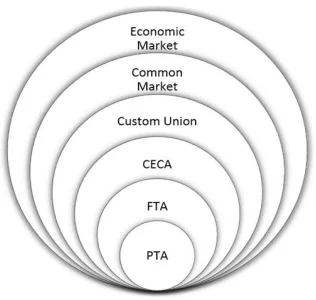
Overview
Trade agreements promote trade between nations by reducing or removing restrictions.
They encourage investment, create better market access, and integrate economies globally.
Agreements can be classified based on country participation (bilateral or multilateral) and level of economic integration (from PTA to full monetary union).
Types of Trade Agreements (Based on Participation)
Bilateral: Between two countries. Example: India–Bhutan Trade Agreement.
Multilateral: Between more than two countries. Example: RCEP (Regional Comprehensive Economic Partnership).
Types of Trade Agreements (Based on Degree of Integration)
Preferential Trade Agreement (PTA): Countries give each other preferential access by reducing tariffs on a limited list of goods. Example: Asia-Pacific Trade Agreement (APTA).
Free Trade Agreement (FTA): Countries remove most tariffs and trade restrictions. Usually has a negative list (few excluded items). Example: India–ASEAN FTA.
Customs Union (CU): Countries allow free trade among themselves and apply a common external tariff on imports from non-members. Example: Gulf Cooperation Council (GCC).
Common Market: Beyond customs union, it allows free movement of goods, services, capital, and labour. Example: MERCOSUR (South America).
Economic Union: Countries integrate markets and also harmonize trade, investment, and economic policies. Example: European Union (EU).
Economic and Monetary Union: Along with economic integration, countries also share a common currency and monetary policies. Example: Eurozone in EU.
| Type | Explanation | Example |
|---|---|---|
| PTA | Tariffs reduced on some goods only | APTA |
| FTA | Most tariffs and restrictions removed | India–ASEAN FTA |
| Customs Union | Free trade + common external tariff | GCC |
| Common Market | Free trade + movement of goods, services, labour | MERCOSUR |
| Economic Union | Common market + harmonized economic policies | EU |
| Economic & Monetary Union | Economic union + single currency | Eurozone |
Prelims tips
- PTA is the first step of economic integration, FTA is deeper integration.
- India is part of APTA, SAFTA, and has FTAs with ASEAN, Japan, South Korea etc.
- EU is the best example of an Economic Union.
- Eurozone is an example of Economic & Monetary Union.
Mains points
- Trade agreements reduce barriers and improve competitiveness of exports.
- They promote foreign investment and technology transfer.
- India’s strategy involves both bilateral (Japan, UAE) and multilateral (APTA, SAFTA, RCEP) agreements.
- Critics argue that FTAs may increase imports more than exports, hurting domestic industry.
- Need for India to carefully negotiate sensitive sectors like agriculture, dairy and electronics.
Trade Facilitation Agreement (TFA), UNCTAD, and GSTP
These are important international agreements and organizations that aim to simplify global trade processes, integrate developing countries into the world economy, and promote trade among developing nations.
Trade Facilitation Agreement (TFA)
Agreement under the World Trade Organization (WTO).
Objective: To simplify border trade procedures, reduce red tape, and make cross-border trade faster and cheaper.
Promotes cooperation between customs authorities and other agencies for better trade facilitation and compliance.
India ratified TFA in April 2016.
Came into force on 22 February 2017 after ratification by two-thirds of WTO members.
Importance for India: Helps improve ease of doing business, reduces logistics cost, and strengthens trade competitiveness.
United Nations Conference on Trade and Development (UNCTAD)
UN body established in 1964 to support developing nations in global trade.
Works as a focal point within the UN system for trade, development, finance, technology, investment, and sustainable development.
Main aim: Integration of developing countries into the world economy in a fair and inclusive way.
It conducts research, policy analysis, and technical cooperation.
UNCTAD also publishes important reports such as World Investment Report and Trade and Development Report.
Global System of Trade Preferences (GSTP)
Established in 1989 as a framework for preferential trade among developing countries (South-South cooperation).
Provides tariff concessions (reduced import duties) to promote trade among members.
Initially also included cooperation in non-tariff measures, long-term contracts, and sectoral agreements, but now mainly focuses on preferential tariffs.
In 2004, the São Paulo Round of negotiations was launched to expand tariff concessions and strengthen trade integration among developing nations.
The São Paulo Protocol was concluded in December 2010.
India has signed and ratified the São Paulo Protocol, committing itself to promote intra-developing country trade.
| Agreement/Organisation | Year | Objective | India’s Role |
|---|---|---|---|
| TFA | 2017 (WTO) | Simplify trade and customs procedures | Ratified in 2016 |
| UNCTAD | 1964 (UN) | Integrate developing countries into world economy | Active member, uses UNCTAD reports |
| GSTP | 1989 | Promote preferential trade among developing countries | Signed and ratified São Paulo Protocol |
Prelims tips
- TFA is WTO’s first multilateral trade deal since its creation in 1995.
- India ratified TFA in April 2016.
- UNCTAD publishes the World Investment Report annually.
- GSTP is focused on South-South trade cooperation.
Mains points
- TFA simplifies trade processes and reduces costs, boosting global competitiveness.
- UNCTAD helps in research and policy-making for inclusive trade and sustainable development.
- GSTP encourages intra-developing country trade, helping countries reduce dependence on developed nations.
- India uses these agreements to improve ease of doing business and strengthen its position in global trade.
Trade Barriers
Trade barriers are government-imposed restrictions on international trade. They can be tariffs (taxes on imports/exports) or non-tariff measures like quotas, licences, sanctions, or standards. While they aim to protect domestic industries, economists believe they often harm productivity, innovation, and global integration.
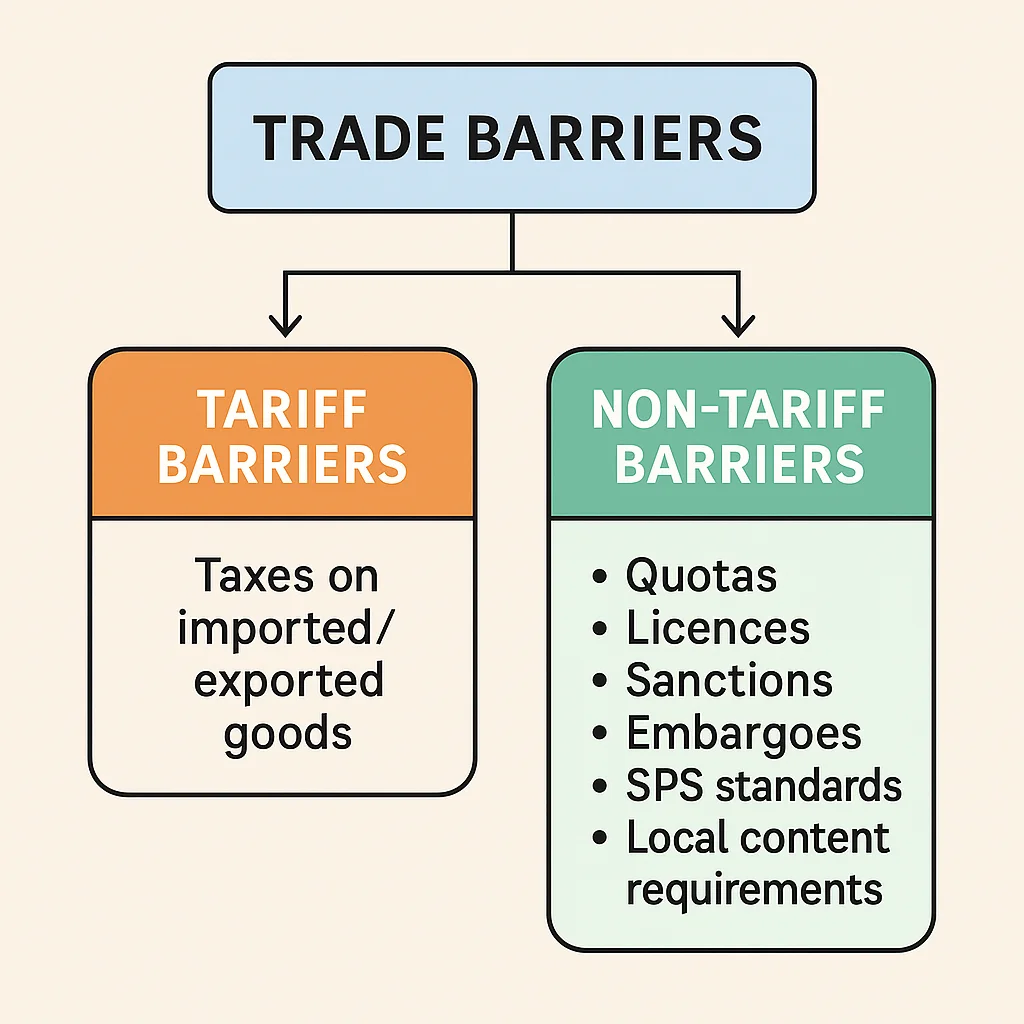
Overview
Trade barriers are rules, policies, or taxes that restrict or control international trade.
They can protect domestic producers temporarily, but in the long run they reduce competition, innovation, and efficiency.
Too many trade barriers can cause 'de-globalization' where countries trade less and economies become less connected.
Tariff Barriers
A tariff barrier means imposing very high taxes on imports (sometimes exports).
Purpose: To protect domestic industries, control balance of payments, or generate government revenue.
Example: In 2018, the US under President Donald Trump imposed a 25% tariff on steel, aluminium, and other commodities imported from China, India, and others.
China retaliated by increasing tariffs on American soybeans, food products, chemicals, and vehicles.
India retaliated by hiking tariffs on American agricultural goods like apples and almonds.
Non-Tariff Barriers
Non-tariff barriers restrict trade without using taxes. They use rules, limits, or conditions instead.
Types of Non-Tariff Barriers:
1. Licences: Only licensed companies can import/export certain products. Example: Import licence for sensitive items.
2. Quotas: Limit on quantity of goods traded. Example: Country X may only export 10% of its coal to India.
3. Embargoes: Complete ban on trade with a country. Example: Trade ban for political reasons.
4. Sanctions: Restrictions to punish or pressure countries, such as freezing assets or limiting imports.
5. Sanitary and Phytosanitary (SPS) Measures: WTO agreement ensures food safety and plant/animal health standards. While useful, countries can misuse SPS to block imports by calling them unsafe.
6. Local Content Requirement: Rule that certain portion of product must be produced domestically. Example: Jawaharlal Nehru National Solar Mission required solar cells/modules to be locally produced, which was challenged at WTO.
| Type | Description | Example |
|---|---|---|
| Tariff Barrier | High taxes on imports/exports | US steel tariff 2018 |
| Licences | Only licensed importers allowed | Restricted items imports |
| Quotas | Limits on quantity traded | 10% coal import limit |
| Embargoes | Complete ban on trade | Trade ban with certain nations |
| Sanctions | Restrictions to punish/control | Freezing trade operations |
| SPS Standards | Health and safety rules | Food safety import rules |
| Local Content Requirement | Part of product must be domestic | JNNSM Solar Mission |
Prelims tips
- Trade barriers can be tariff-based (taxes) or non-tariff (rules, standards, restrictions).
- SPS measures are part of WTO agreements.
- Local content requirements have been challenged at WTO (e.g., India’s solar mission).
Mains points
- Tariff and non-tariff barriers are used to protect domestic industries but reduce global competitiveness.
- They can trigger trade wars (e.g., US-China tariff war).
- Non-tariff barriers like SPS and local content rules are often misused for protectionism.
- India has faced WTO disputes regarding its trade barriers (e.g., solar mission case).
India and Trade Agreements
India has entered into multiple trade agreements such as Free Trade Agreements (FTAs), Comprehensive Economic Cooperation Agreements (CECPA), and regional trade pacts like SAFTA and APTA. These agreements aim to reduce tariffs, simplify trade, and promote economic cooperation with partner nations.
Overview
Trade agreements are pacts between two or more countries to encourage trade by reducing barriers like tariffs, quotas, and complex regulations.
India has signed 13 Free Trade Agreements (FTAs) including recent ones with Mauritius, UAE, and Australia.
Regional agreements like SAFTA and APTA encourage cooperation among developing countries.
Free Trade Agreements (FTAs)
India-Mauritius CECPA (2021): First agreement with an African nation, covering goods, services, and cooperation.
India-UAE CEPA: Strengthens trade in oil, gems, textiles, and services.
India-Australia ECTA: Boosts cooperation in minerals, agriculture, education, and IT.
Regional Comprehensive Economic Partnership (RCEP)
Mega trade pact involving ASEAN nations and partners like China, Japan, South Korea, Australia, and New Zealand.
India opted out in 2019 due to concerns of Chinese imports harming domestic industries.
Comprehensive Economic Cooperation and Partnership Agreement (CECPA)
India-Mauritius CECPA is a limited but strategic agreement.
Covers goods, services, investment rules, and cooperation.
Benefits: Expands market for Indian food products, textiles, electronics, and services like IT, education, yoga, and tourism.
South Asian Free Trade Area (SAFTA)
SAFTA is a trade arrangement under SAARC, effective since 2006.
Members: Afghanistan, Bangladesh, Bhutan, India, Maldives, Nepal, Pakistan, and Sri Lanka.
Provides special benefits for Least Developed Countries (LDCs).
Asia-Pacific Trade Agreement (APTA)
Oldest preferential trade agreement in Asia-Pacific, started in 1975 (earlier known as Bangkok Agreement).
Members: Bangladesh, China, India, Korea, Lao PDR, Sri Lanka, and Mongolia (joined in 2020).
Aims to increase trade by reducing tariffs and promoting regional integration.
| Agreement | Members/Partners | Focus |
|---|---|---|
| India-Mauritius CECPA | India & Mauritius | Goods, Services, Investment |
| India-UAE CEPA | India & UAE | Oil, Gems, Textiles, Services |
| India-Australia ECTA | India & Australia | Agriculture, IT, Minerals |
| SAFTA | SAARC nations | Free Trade in South Asia |
| APTA | Bangladesh, China, India, Korea, Lao PDR, Sri Lanka, Mongolia | Preferential Tariff Reductions |
| RCEP | ASEAN + China, Japan, SK, Aus, NZ | Mega trade pact (India opted out) |
Prelims tips
- India has 13 FTAs with various countries.
- India signed CECPA with Mauritius in 2021, the first FTA with an African country.
- India opted out of RCEP in 2019 due to concerns about Chinese imports.
- SAFTA provides special treatment to Least Developed Countries (LDCs).
Mains points
- Trade agreements help India access new markets and increase exports.
- They also bring foreign investment and promote technology and service sectors.
- Challenges include competition from Chinese goods and pressure on domestic industries.
- India balances regional cooperation with protecting its economic interests.
Foreign Investment in India: Regulations (विदेशी निवेश नियमावली)
Foreign investment simply means money that comes from outside India and is invested in Indian businesses, industries, or assets. It can come from foreign companies, foreign individuals, or Indians living abroad (NRIs). India has made its foreign investment policy more flexible over time to attract more global capital, create jobs, improve infrastructure, and boost economic growth while ensuring national security.
Overview
Foreign investment helps India get access to money, modern technology, advanced skills, and global business networks.
It can be in two forms: Foreign Direct Investment (FDI) where foreigners directly invest in Indian companies/factories, and Foreign Portfolio Investment (FPI) where foreigners invest in Indian shares, bonds, or financial instruments.
FDI is long-term and more stable, while FPI is short-term and can move in and out quickly.
Foreign Investment Promotion Board (FIPB)
Earlier, India had a special board called the Foreign Investment Promotion Board (FIPB).
FIPB was an inter-ministerial body, meaning it had members from different ministries such as Finance, Commerce, External Affairs, etc.
It checked and approved proposals of foreign companies that wanted to invest in India in sectors where government approval was necessary.
Permanent members included secretaries from Finance Ministry, DPIIT, Commerce Ministry, MEA, Revenue, and MSME.
Abolished in 2017 because the government wanted to simplify the process and remove unnecessary hurdles.
After that, respective ministries started handling foreign investment approvals directly.
Foreign Investment Facilitation Portal (FIFP)
After FIPB was abolished, the government launched an online single-window system called the Foreign Investment Facilitation Portal (FIFP).
It is managed by the Department for Promotion of Industry and Internal Trade (DPIIT).
Now, foreign companies submit their investment proposals through this portal.
The proposals are sent to the concerned ministry (for example, telecom proposals go to Telecom Ministry) and also shared with RBI, MEA, and MHA for their comments and security clearance.
This system ensures faster, transparent, and more efficient approvals.
Liberalised FDI Policies
To attract more foreign money, India has made FDI rules easier:
100% FDI is allowed in construction and real estate brokerage under the automatic route (no prior government approval required).
49% FDI is allowed in the aviation sector under the automatic route, including Air India.
100% FDI in Single Brand Retail Trading (SBRT) under automatic route (for example, companies like Apple or IKEA can fully own their Indian outlets).
Foreign Institutional Investors (FIIs)/Foreign Portfolio Investors (FPIs) are allowed to invest in power distribution beyond the 49% FDI limit.
100% FDI is allowed in the marketplace-based e-commerce model (like Amazon, Flipkart), but with conditions. For example, sales of one vendor cannot exceed 25% of its total sales through that platform.
New FDI Policy (2020)
Non-resident entities (foreign companies or people) can invest in India except in prohibited sectors such as atomic energy, gambling, and lottery.
Extra care is taken for countries sharing land borders with India (like China, Pakistan, Bangladesh, Nepal, Bhutan, Myanmar, Afghanistan).
Citizens or companies from these countries can invest in India only with prior Government approval.
Pakistani citizens or companies can invest only in certain safe sectors, excluding defence, atomic energy, and space.
If an FDI deal involves a transfer of ownership that indirectly benefits a company from a bordering country, government approval is also mandatory.
Importance of Regulations
These rules balance two important goals: attracting more foreign investment to boost growth, and protecting India’s national security from risky or unwanted investments.
Liberalisation helps in creating jobs, infrastructure, and technology advancement, while restrictions prevent misuse or excessive control by foreign powers.
| Aspect | Details |
|---|---|
| FIPB | Old approval body for FDI (abolished in 2017 to simplify process) |
| FIFP | Single-window online portal for FDI applications |
| Liberalised Sectors | Construction, Real Estate, Aviation, Retail, Power, E-commerce |
| 2020 Policy | Border countries need Govt. approval; Pakistan has extra restrictions |
Prelims tips
- FIPB abolished in 2017; FIFP portal is the new system.
- 100% FDI allowed in e-commerce marketplaces with conditions.
- 49% FDI in aviation under automatic route.
- Bordering countries (like China, Pakistan) need Govt. approval under 2020 policy.
Mains points
- Foreign investment is a key driver for India’s growth by bringing capital, jobs, and technology.
- Abolition of FIPB simplified the FDI approval system, making it more transparent and efficient.
- India has steadily liberalised FDI to attract investors, while restricting sensitive sectors for security.
- Bordering countries face stricter investment rules to safeguard national interests.
Protectionism and Currency Manipulation in World Trade
Protectionism means government policies that restrict imports and promote domestic industries, while currency manipulation refers to deliberate government actions to influence the exchange value of their currency. Both distort global trade, reduce efficiency, and create instability. For India, they lead to inflation, rising import costs, pressure on exports, widening current account deficit, and slower growth.
Overview
Protectionism: When governments raise tariffs, impose quotas, or restrict foreign goods/services to protect domestic industries.
Currency Manipulation: When a country keeps its currency artificially weak (or strong) to make exports cheaper and imports costlier, affecting global trade balance.
Both are trade-distorting behaviours that reduce the benefits of free and fair trade.
They became more prominent during 2018–19 due to trade wars (e.g., US-China).
Implications for India's Macroeconomic Stability
1. Inflation
Currency manipulation makes imports costlier → consumers pay more for fewer goods and services.
Protectionism has a similar effect → less competition means higher prices for goods and services.
Rising import costs (like machinery, oil, intermediate goods) reduce consumer choice and raise inflation.
This leads to lower real GDP, as people’s purchasing power weakens.
2. Impact on Industries
Protectionism discourages innovation: Young or 'infant industries' may remain inefficient because they are shielded from competition.
According to RBI (2018–19), protectionist measures globally reduced demand for Indian exports such as textiles, pharmaceuticals, gems & jewellery, and IT services.
Job creation also suffered, as export-oriented industries struggled to grow.
3. Deficit in Current Account
Protectionism raises prices of intermediate goods (used in manufacturing), disrupting global supply chains.
Without a strong export base, India faces higher import costs and a wider Current Account Deficit (CAD).
Higher CAD weakens the rupee further and increases India’s borrowing cost abroad, raising external vulnerability.
| Factor | Impact on India |
|---|---|
| Inflation | Higher import costs → consumers pay more, real GDP falls |
| Industries | Reduced exports (textiles, pharma, jewellery, IT); job losses |
| Current Account Deficit | Intermediate goods costly → CAD widens, rupee weakens |
Prelims tips
- Protectionism = Tariffs, quotas, trade restrictions.
- Currency manipulation = Deliberate undervaluation/overvaluation of currency.
- For India: leads to inflation, weaker exports, wider CAD, and weaker rupee.
Mains points
- Protectionism and currency manipulation distort free trade and create global uncertainty.
- India faces higher inflation, weaker exports, and widening current account deficits due to these practices.
- Export-oriented sectors like textiles, pharma, and IT services are highly vulnerable.
- Policymakers need to diversify markets, strengthen domestic industries, and maintain forex reserves to reduce vulnerability.
Quantitative Easing (QE) and External Commercial Borrowings (ECBs)
Quantitative Easing is when a central bank buys financial assets to inject money into the economy, making loans cheaper and stimulating growth. External Commercial Borrowings (ECBs) are loans that Indian companies take from foreign sources to fund business activities, usually at cheaper rates than domestic loans.
Quantitative Easing (QE) Overview
QE is a monetary policy tool where a central bank buys assets like government bonds or securities to increase money supply.
The US Federal Reserve has used QE to give banks easy access to money. Banks then lend to businesses at lower interest rates, boosting expansion and job creation.
The main goal is to stimulate growth in the home country. However, because global financial markets are interconnected, QE also affects other economies, including India.
In India, QE can lead to volatility in stock markets and currency markets, as foreign investors move money between the US and India.
External Commercial Borrowings (ECB) Overview
ECBs are loans Indian companies take from foreign lenders to fund commercial activities, expansion, or new projects.
Examples: Commercial bank loans, supplier’s credit, floating rate notes, fixed-rate bonds, and credit from multilateral institutions like World Bank, ADB.
ECB is different from Foreign Direct Investment (FDI). ECB is a loan that must be repaid, while FDI is equity where investors bear the risk and gain ownership.
In FY23, India recorded net outflows of 3 billion from ECBs, compared to net inflows of 5 billion a year earlier.
Eligibility for ECBs
Currency: ECBs can be raised in any freely convertible foreign currency or Indian Rupees.
Borrowers: All entities eligible for FDI, SEZ units, EXIM Bank, SIDBI, Port Trusts, registered NGOs, start-ups, etc.
Lenders: Residents of FATF/IOSCO-compliant countries, multilateral institutions, foreign equity holders, foreign individuals, and subsidiaries/branches of Indian banks (under conditions).
Advantages of ECBs
Provides cheaper finance compared to domestic loans.
Supports infrastructure sectors like power, telecom, transport, and SMEs.
Allows companies to borrow without giving up control or ownership.
Diversifies funding sources and connects borrowers to global markets.
Disadvantages of ECBs
Increases India’s external debt burden.
Risk of foreign exchange fluctuations — repayment cost rises if the rupee weakens.
Can make economy vulnerable to global financial shocks.
RBI places limits (caps) on ECB amounts to reduce risks.
| Aspect | Quantitative Easing (QE) | External Commercial Borrowings (ECB) |
|---|---|---|
| Meaning | Central bank buys assets to increase money supply | Indian companies borrow from foreign lenders |
| Purpose | Stimulate domestic growth and jobs | Finance expansion and new projects |
| Nature | Monetary policy tool | Loan (must be repaid with interest) |
| Impact | Affects domestic and global markets | Adds to external debt; cheaper funding |
| Difference from FDI | Not applicable | FDI gives ownership, ECB is only a loan |
Prelims tips
- QE is mainly used by developed countries like USA during economic slowdowns.
- ECB is not equity – it is a loan and must be repaid with interest.
- In India, ECBs are regulated by RBI under FEMA rules.
- ECBs are encouraged in infrastructure and SME sectors.
Mains points
- QE shows how central banks manage liquidity globally and indirectly impact India’s economy.
- ECB helps Indian companies access cheaper funds but increases foreign debt burden.
- ECB vs FDI: ECB is safer for company ownership but riskier for external debt stability.
- India needs balanced ECB policy to prevent excessive forex risks.
Duties Related to Trade – Countervailing and Anti-Dumping Duties
When imports harm domestic industries due to subsidies or artificially low prices, governments impose special duties. Countervailing Duties are applied to neutralize foreign subsidies, while Anti-Dumping Duties counter unfairly low-priced imports.
Countervailing Duty (CVD)
Meaning: A tariff imposed on imported goods when the exporting country has given subsidies to its producers.
Purpose: To protect domestic industries from unfair competition and restore fair pricing in the market.
Working: By adding an extra duty on subsidized imports, the imported goods become costlier, making domestic goods competitive again.
Example: If China subsidizes its electronics and exports them cheaply to India, the Indian government may impose CVD to balance the price difference.
Impact: Supports domestic producers but may slightly increase prices for consumers.
Anti-Dumping Duty (ADD)
Meaning: A tariff imposed when a foreign company sells goods at a lower price abroad than it does in its home country (dumping).
Purpose: To prevent local industries from being destroyed by artificially cheap imports.
Working: The importing country charges extra duty on such goods so that dumped products don’t undercut domestic industries.
Example: In 2021, India imposed anti-dumping duty on 5 Chinese products (like aluminium and chemicals) for 5 years to protect Indian manufacturers.
Impact: Protects jobs and domestic industries but can increase costs for consumers and industries dependent on cheap raw materials.
| Aspect | Countervailing Duty (CVD) | Anti-Dumping Duty (ADD) |
|---|---|---|
| Reason | Imposed to counter subsidies given by exporting country | Imposed to stop dumping (selling below normal value) |
| Purpose | Level the playing field for domestic producers | Protect domestic industries from artificially cheap imports |
| Impact | Neutralizes unfair subsidy advantage | Stops destruction of local industries |
| Example | China’s subsidized electronics in India | Chinese aluminium & chemicals in India (2021) |
Prelims tips
- Countervailing Duty (CVD) = Neutralizes subsidies.
- Anti-Dumping Duty (ADD) = Neutralizes dumping (selling below home market price).
- India imposes most anti-dumping duties against Chinese goods.
- WTO allows both duties under trade remedy measures.
Mains points
- CVD and ADD are essential trade remedies to protect domestic industries from unfair competition.
- Though protective, these duties can raise costs for consumers and industries using imported raw materials.
- India uses ADD frequently, especially against Chinese imports, to safeguard its manufacturing base.
- Balancing protection with free trade obligations under WTO is crucial.
Public Debt: Internal vs. External Debt
Public Debt is the total money borrowed by the government. It is divided into Internal Debt (borrowed from its own citizens and institutions in local currency) and External Debt (borrowed from foreign sources in foreign currency). A high internal debt is generally considered safer than a high external debt due to the absence of currency risk.
What is Public Debt?
It is the total amount of money that a country's government owes to lenders. Governments borrow money to finance their budget deficits (when spending is more than income).
1. Internal Debt (आंतरिक ऋण)
Definition: Money borrowed by the government within its own country and in its own currency (e.g., Rupees for India).
Sources:
Citizens: Through Small Savings Schemes (like PPF, Sukanya Samriddhi, National Savings Certificates).
Banks & Institutions: By selling Government Securities (G-Secs) and Treasury Bills (T-Bills).
Central Bank (RBI): Borrowing from the central bank (though this is restricted by the FRBM Act).
Risk Level: Low. Why? The government can always repay its domestic debt by printing more of its own currency (though this causes inflation). There is no risk of running out of Rupees.
2. External Debt (बाह्य ऋण)
Definition: Money borrowed by the government from foreign sources (other countries, global institutions, or foreign investors).
Sources:
Multilateral Institutions: World Bank, IMF, Asian Development Bank (ADB).
Bilateral Sources: Loans from another country (e.g., Japan, USA).
External Commercial Borrowings (ECBs): Indian companies borrowing from foreign markets.
Foreign Investors: Foreigners buying Indian government bonds.
Currency: Repayment must be made in foreign currency (e.g., US Dollars, Euros, Yen).
Risk Level: High. Why? Exchange Rate Risk.
Analogy: Imagine you borrow 1 when 1 = ₹70. You owe ₹70. But if the Rupee weakens and 1 = ₹80, you now owe ₹80. The loan becomes more expensive just because the currency value changed. A country can run out of Dollars, leading to a default (like Sri Lanka in 2022).
India's Debt Situation
India's total public debt is high, but it is considered relatively safe because the vast majority (around 95%) is Internal Debt owed in Rupees. India's External Debt is a small and manageable portion of its total debt.
| Feature | Internal Debt | External Debt |
|---|---|---|
| Lender | Domestic (Citizens, Banks, RBI) | Foreign (IMF, World Bank, Other Countries) |
| Currency | Domestic (Rupees) | Foreign (Dollars, Euros) |
| Primary Risk | Inflation (if monetized) | Exchange Rate Risk & Default Risk |
Prelims tips
- Internal Debt: Borrowed domestically, paid in local currency. Low risk.
- External Debt: Borrowed from foreigners, paid in foreign currency. High risk (Exchange Rate Risk).
- India's public debt is mostly Internal Debt.
Mains points
- A high internal debt is preferable to a high external debt as it avoids currency and sovereignty risks associated with foreign borrowing.
- However, very high internal debt can still be problematic as it leads to 'crowding out' of private investment and high interest payments for the government.
- Effective debt management involves balancing funding needs with risks, keeping the Debt-to-GDP ratio sustainable.
Financial Stability and Development Council (FSDC)
The FSDC is a high-level apex body set up by the Government of India in 2010. It is chaired by the Union Finance Minister and includes the heads of all financial regulators (RBI, SEBI, IRDAI, PFRDA). Its main job is to coordinate among regulators, maintain financial stability, and promote financial sector development.
Background
The idea for FSDC was first proposed by the Raghuram Rajan Committee (2008).
It was established by an executive order of the government in 2010.
Note: FSDC is an apex council, not a statutory body (it was not created by an Act of Parliament).
Why was FSDC Needed?
Before FSDC, regulators like RBI (for banks), SEBI (for markets), and IRDAI (for insurance) often worked in silos.
Analogy: Imagine different traffic police for bikes (RBI), cars (SEBI), and trucks (IRDAI) managing the same intersection without talking to each other. This could lead to chaos.
FSDC acts as the 'Commissioner' who brings all regulators together to ensure the entire financial system (the 'intersection') is stable and efficient, especially in dealing with complex, inter-connected issues (systemic risks).
Composition of the Council
Chairperson: Union Finance Minister.
Members:
Governor, Reserve Bank of India (RBI)
Chairperson, Securities and Exchange Board of India (SEBI)
Chairperson, Insurance Regulatory and Development Authority of India (IRDAI)
Chairperson, Pension Fund Regulatory and Development Authority (PFRDA)
Finance Secretary
Secretary, Department of Economic Affairs
Secretary, Department of Financial Services
Chief Economic Adviser
A Sub-Committee, chaired by the RBI Governor, regularly discusses and takes action on the council's behalf.
Key Functions of FSDC
1. Financial Stability: To monitor the health of the entire financial system and identify potential risks (systemic risks) that could cause a crisis.
2. Inter-Regulatory Coordination: To settle disputes or fill regulatory gaps between different regulators.
3. Financial Sector Development: To promote innovation and growth in the financial sector.
4. Financial Literacy & Inclusion: To promote financial education and ensure more people are connected to the formal financial system.
Prelims tips
- FSDC: Apex body for financial stability and regulatory coordination.
- Established in 2010 (based on Raghuram Rajan Committee).
- Not a statutory body; set up by executive order.
- Chaired by the Union Finance Minister.
- Members include heads of RBI, SEBI, IRDAI, PFRDA, and top Finance Ministry officials.
Mains points
- FSDC provides a high-level institutional mechanism to address systemic risks that cut across different financial sectors.
- It resolves inter-regulatory disputes, ensuring smooth operation of the financial system.
- By focusing on financial literacy and inclusion, it contributes to building a more resilient and inclusive economy.
- Its non-statutory nature is sometimes debated, with arguments for giving it more formal power.
Financial Stability
Financial stability refers to a state where the financial system (including banks, markets, and payment systems) is resilient to economic shocks and can function smoothly. It means people trust their banks, transactions happen reliably, and businesses can get loans, which is essential for sustainable economic growth.
What is Financial Stability?
It is the absence of crises. A financially stable system can effectively manage risks and absorb shocks (like a pandemic, war, or major bank failure) without collapsing.
Key Pillars of a Stable System:
Stable Institutions: Banks and financial institutions are well-capitalized (have enough of their own money), liquid (can meet cash demands), and profitable.
Stable Markets: Stock and bond markets function smoothly without extreme, irrational volatility or crashes.
Robust Infrastructure: Payment systems (like UPI, NEFT, RTGS) work reliably without failing.
Public Confidence: People trust that their money is safe in banks and that the system will work.
Why is it Important?
Protects Savings: Ensures that people's savings in banks and pension funds are safe.
Enables Credit: A stable system allows banks to lend confidently to businesses and individuals, fueling growth and job creation.
Prevents Panic: Stops 'bank runs' (where everyone tries to withdraw money at once) or market crashes.
Monetary Policy Transmission: Allows the central bank's interest rate changes to effectively reach the public.
Who is Responsible for Financial Stability in India?
It's a shared responsibility, but key players are:
Reserve Bank of India (RBI): The primary regulator responsible for the stability of the banking system, payment systems, and overall monetary stability.
Government (Ministry of Finance): Responsible for fiscal stability (managing debt and deficits) and the legal framework.
Financial Stability and Development Council (FSDC): The apex body that coordinates all regulators (RBI, SEBI, IRDAI, PFRDA) to manage systemic risks.
Other Regulators: SEBI (markets), IRDAI (insurance), PFRDA (pensions) ensure stability in their respective sectors.
How is Stability Monitored?
The RBI's Financial Stability Report (FSR) is the most important document.
Published twice a year.
It assesses the health of India's financial system.
It identifies key risks (e.g., high NPAs, global slowdown, cyber attacks) and outlines measures to mitigate them.
Prelims tips
- Financial Stability: System's ability to absorb shocks and prevent crises.
- Pillars: Stable institutions (banks), stable markets, robust infrastructure (payments).
- In India, it's a shared responsibility: RBI, Govt, FSDC, SEBI, IRDAI, PFRDA.
- RBI publishes the Financial Stability Report (FSR) twice a year.
Mains points
- Financial stability is a prerequisite for sustainable economic growth and development.
- The 2008 global financial crisis highlighted the dangers of systemic risk and the need for macro-prudential regulation (overseen by FSDC).
- RBI's role involves not just controlling inflation (price stability) but also ensuring financial stability.
- Threats to India's stability include high bank NPAs, cyber-attacks, and volatility from global capital flows.
International Financial Services Centre (IFSC) & GIFT City
An International Financial Services Centre (IFSC) is a special jurisdiction within a country (like a financial SEZ) that provides world-class financial services to non-residents in foreign currencies. India's first and only IFSC is 'GIFT City' in Gujarat, regulated by a unified authority, IFSCA, to bring offshore financial business back to India.
What is an IFSC?
An IFSC is like a financial hub (similar to Singapore, Dubai, or London) but located inside India.
It is treated as a 'foreign territory' for financial regulation purposes.
Goal: To allow Indian and foreign companies to conduct financial transactions (like raising funds, insurance, asset management) in foreign currencies from India, rather than going to other global hubs.
India's IFSC: The first and only IFSC in India is GIFT City (Gujarat International Finance Tec-City) located in Gandhinagar, Gujarat.
The Regulator: IFSCA
Problem: Normally, finance in India is regulated by multiple bodies (RBI for banking, SEBI for markets, IRDAI for insurance). This is complex for global business.
Solution: In 2020, the government established the International Financial Services Centres Authority (IFSCA) through an Act of Parliament.
IFSCA is a unified regulator. It has the combined powers of RBI, SEBI, IRDAI, and PFRDA within the IFSC.
This provides a single-window clearance and simplified, globally-competitive regulations.
What Activities Happen in an IFSC (GIFT City)?
Banking: Foreign currency accounts, corporate lending, trade finance for non-residents.
Capital Markets: Listing and trading of bonds and securities in foreign currencies. India INX (BSE's) and NSE-IFSC are the international exchanges there.
Insurance: Global insurance and re-insurance business.
Asset Management: Managing funds for foreign investors (e.g., Alternative Investment Funds - AIFs).
Bullion Exchange: India International Bullion Exchange (IIBX) allows for physical trading of gold.
Incentives Offered
To attract business, GIFT City offers significant benefits:
Tax Holidays: 10-year tax holiday on profits for many units.
No/Low Taxes: Exemption from GST (on services), no Securities Transaction Tax (STT), no Capital Gains Tax (on certain instruments).
Relaxed Regulations: Rules are simpler and more aligned with global standards than domestic Indian rules.
Significance for India
Onshoring the Offshore: Brings back financial services business and jobs that had moved from India to hubs like Singapore and Dubai.
Attracts Foreign Capital: Provides a trusted, well-regulated gateway for foreign investment into India.
Promotes Rupee Internationalisation: While it deals in foreign currency, it strengthens India's financial ecosystem, indirectly supporting the Rupee.
Economic Growth: Acts as a new engine of growth for the financial services sector.
Prelims tips
- IFSC: A special financial zone (like an SEZ) for international financial services.
- India's first and only IFSC is GIFT City, Gujarat.
- Unified Regulator: IFSCA (International Financial Services Centres Authority), set up in 2020.
- IFSCA has combined powers of RBI, SEBI, IRDAI, PFRDA within the IFSC.
- Transactions are done in foreign currency.
Mains points
- GIFT City aims to make India a hub for global finance, competing with Singapore and Dubai.
- The unified regulator (IFSCA) is its biggest strength, offering single-window clearance and agile regulation.
- By offering tax incentives and relaxed rules, it 'onshores' India-related financial business that was previously conducted offshore.
- It's a crucial part of India's strategy to integrate its economy globally and attract foreign capital.
Financial Sector Reforms (Overview)
Financial sector reforms refer to the systematic changes in policies and institutions governing the financial system (banks, markets, insurance). In India, major reforms began in 1991, driven by the Narasimham Committee, shifting from a state-controlled system to a liberalized, competitive, and regulated market-based system.
Pre-1991 Era (Era of Control)
Dominated by Government: Banking, insurance, and markets were heavily controlled by the government.
Bank Nationalization (1969 & 1980): Most banks were state-owned.
Administered Interest Rates: RBI decided all interest rates.
High Statutory Reserves: High CRR and SLR (up to 38.5%) meant banks had little money to lend.
Limited Competition: Few private or foreign players.
Result: Low efficiency, poor profitability, high NPAs, lack of innovation.
Post-1991 Reforms (Era of Liberalization)
The 1991 BoP crisis forced India to reform its financial sector. The reforms were guided by the Narasimham Committee I (1991) and II (1998).
Key Reforms:
1. Regulatory Framework:
Statutory Bodies: SEBI was given statutory powers (1992) to regulate capital markets. IRDAI (1999) was set up for insurance. PFRDA (2013) for pensions.
RBI's Role: Shifted from 'controller' to 'regulator' and facilitator.
2. Banking Sector Reforms:
Reduced Reserves: CRR and SLR were progressively lowered, giving banks more money to lend.
Interest Rate De-regulation: Interest rates are now mostly determined by banks, based on market conditions (like MCLR, EBLR).
Competition: New private banks (HDFC, ICICI) and foreign banks were allowed entry.
Prudential Norms: Introduced international standards like Capital Adequacy Ratio (CAR) and NPA classification (Basel Norms) to make banks stronger.
NPA Resolution: New laws like the Insolvency and Bankruptcy Code (IBC) 2016 were introduced.
3. Capital Market Reforms:
Automation: Physical share trading was replaced by electronic trading (DEMAT accounts) via depositories (NSDL, CDSL).
Investor Protection: SEBI introduced strict rules against fraud and insider trading.
New Instruments: Allowed derivatives (futures, options), mutual funds, etc.
4. External Sector Reforms:
FERA to FEMA: The restrictive FERA (1973) was replaced by the liberal FEMA (1999).
Convertibility: Rupee was made fully convertible on the Current Account (1994).
FDI/FPI: Foreign investment was progressively liberalized.
Recent Reforms (Post-2014)
Financial Inclusion: Jan Dhan Yojana, UPI, Payment Banks, Small Finance Banks.
Consolidation: Merging public sector banks to create larger, stronger banks.
Governance: FSDC (2010) for coordination, IFSCA (2020) for IFSC.
Digitalization: Focus on FinTech, digital payments, and digital banking units.
Prelims tips
- Major financial reforms began in 1991, guided by the Narasimham Committee.
- Shifted from state-controlled to market-based system.
- Key regulators SEBI (1992), IRDAI (1999), PFRDA (2013) were established/empowered.
- FERA (control) was replaced by FEMA (management).
- NPA norms (Basel) and IBC (2016) were introduced.
- Recent focus: Financial Inclusion (JAM) and Digitalization.
Mains points
- The 1991 reforms were crucial in moving India from a repressed financial system to a modern, liberalized one.
- Reforms led to increased competition, efficiency, and innovation in the banking and capital markets.
- Establishment of independent regulators like SEBI and IRDAI strengthened investor protection and market integrity.
- While successful, challenges remain in areas like PSU bank governance, NPA resolution, and deepening the corporate bond market.
- The ongoing reforms (FinTech, Digitalization) focus on making the financial sector more inclusive and resilient.
World Trade Organization (WTO)
The World Trade Organization (WTO) is the only global international organization that sets the rules of trade between nations. Established in 1995, it replaced the General Agreement on Tariffs and Trade (GATT). Its main goal is to ensure that trade flows as smoothly, predictably, and freely as possible by lowering barriers and setting common ground rules.
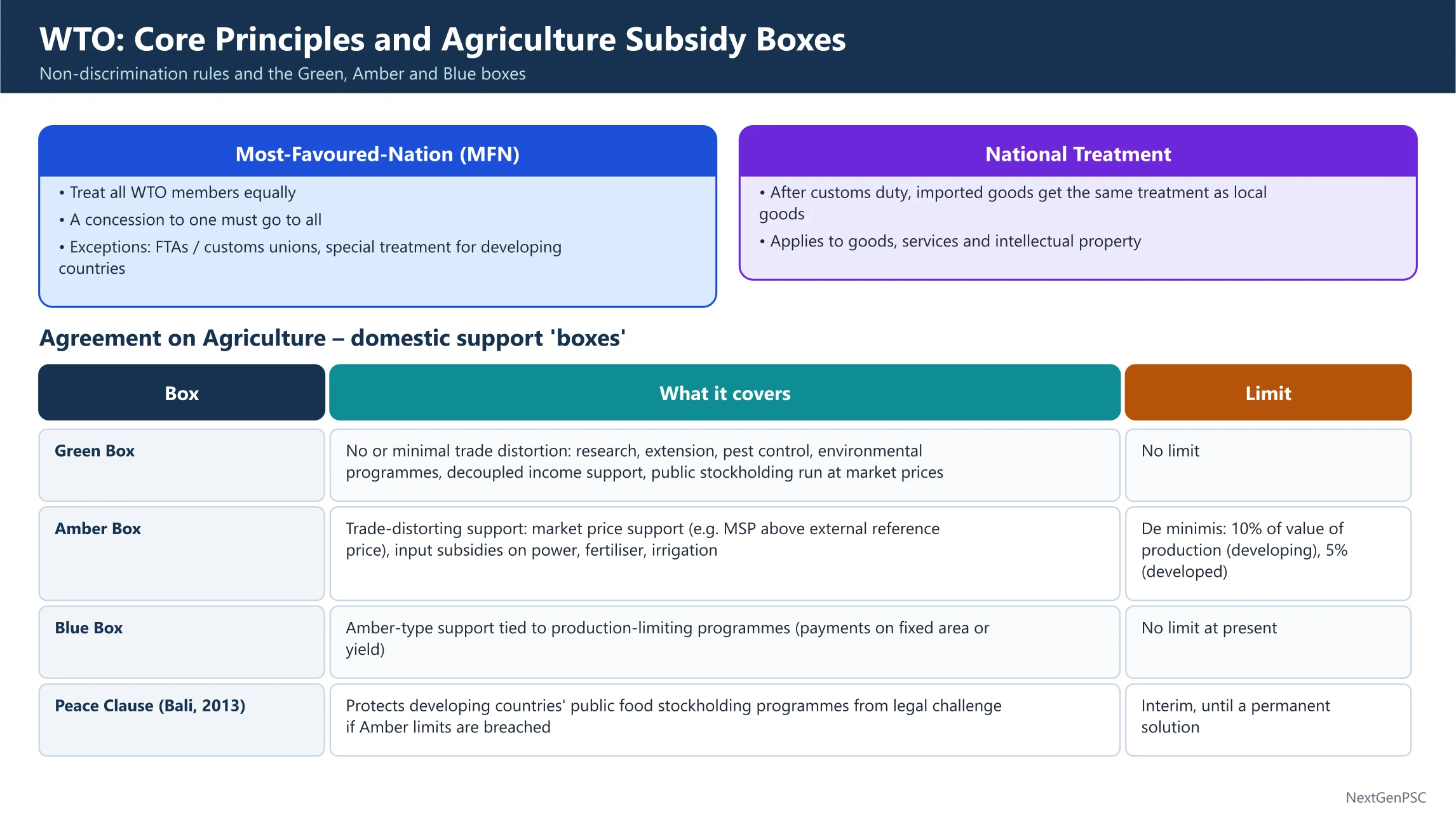
From GATT to WTO
GATT (General Agreement on Tariffs and Trade): Signed in 1947, it was just an agreement or set of rules, not a formal organization. It focused only on trade in goods.
Uruguay Round (1986-1994): A long series of trade negotiations under GATT, which concluded with the Marrakesh Agreement.
WTO Establishment: The Marrakesh Agreement created the WTO, a formal, permanent organization, which came into being on January 1, 1995. India is a founding member.
Broader Scope: Unlike GATT, the WTO covers trade in goods, services (GATS), and intellectual property (TRIPS).
Key Functions of the WTO
1. Administering Trade Agreements: Oversees the implementation of agreements negotiated by its members.
2. Forum for Negotiations: Provides a platform for countries to negotiate new trade barriers and rules (e.g., the Doha Development Round).
3. Dispute Settlement: Operates a binding dispute settlement mechanism (Dispute Settlement Body - DSB) to resolve trade conflicts between member nations.
4. Monitoring National Policies: Conducts periodic Trade Policy Reviews of member countries to ensure transparency.
5. Technical Assistance: Provides training and technical assistance to developing countries to help them build trade capacity.
Organizational Structure
Ministerial Conference: The highest decision-making body, meets at least once every two years. All members are represented.
General Council: Meets regularly in Geneva to manage day-to-day work. It also acts as the Dispute Settlement Body (DSB) and the Trade Policy Review Body (TPRB).
Councils: Specific councils handle different agreements (e.g., Council for Trade in Goods, Council for TRIPS).
Secretariat: Headed by a Director-General, provides administrative and technical support.
WTO vs. IMF/World Bank
WTO: Focuses purely on the rules of trade between countries. It doesn't lend money.
IMF & World Bank: Are financial institutions. The IMF deals with monetary stability and BoP crises (lends money for stability), while the World Bank provides loans for development projects (e.g., infrastructure).
Prelims tips
- WTO was established on Jan 1, 1995, replacing GATT.
- Created by the Marrakesh Agreement after the Uruguay Round.
- Covers Goods, Services (GATS), and Intellectual Property (TRIPS).
- Highest body: Ministerial Conference.
- Operates a binding Dispute Settlement Body (DSB).
- WTO sets trade rules; IMF/World Bank are lending institutions.
- Most-Favoured-Nation (MFN): a member must treat all WTO members equally – a concession given to one must be given to all (exceptions: FTAs/customs unions, special treatment for developing countries).
- National Treatment: once imported goods have entered the market (after customs duty), they must be treated no less favourably than locally produced goods.
- Green Box (Agreement on Agriculture): subsidies with no or minimal trade distortion – research, extension, environmental programmes, decoupled income support – allowed without limit.
- Amber Box: trade-distorting support such as market price support (e.g. MSP) and input subsidies – capped by the de minimis limit (10% of value of production for developing countries, 5% for developed).
- Blue Box: Amber-type support tied to production-limiting programmes – currently no limit. The 2013 Bali 'Peace Clause' shields developing countries' public food stockholding from challenge.
Mains points
- The WTO provides a rule-based, predictable, and non-discriminatory global trading system.
- Its dispute settlement mechanism is crucial for resolving conflicts peacefully and enforcing rules.
- The inclusion of services and IP rights significantly expanded the scope of global trade regulation compared to GATT.
- However, the WTO faces challenges, including the stalled Doha Round, criticisms of its dispute settlement appellate body, and accommodating the rise of economies like China.
Bretton Woods Institutions: IMF and World Bank
The International Monetary Fund (IMF) and the World Bank were created at the Bretton Woods Conference (1944) to rebuild the post-war economy. The IMF safeguards global monetary and financial stability (surveillance, crisis lending, SDRs), while the World Bank finances long-term development. Both face criticism over conditionalities and a governance structure weighted towards rich countries.
1. Origin
Bretton Woods, New Hampshire (USA), July 1944; both headquartered in Washington, D.C.
Convention: An American heads the World Bank and a European heads the IMF.
2. IMF – Functions
Surveillance: Annual Article IV consultations with member countries; flagship reports—World Economic Outlook, Global Financial Stability Report, Fiscal Monitor.
Lending: To countries with balance-of-payments problems (Stand-By Arrangements, Extended Fund Facility, Rapid Financing Instrument), usually with policy conditions.
Capacity development: Technical assistance and training.
Special Drawing Rights (SDR, 1969): International reserve asset valued on a basket of five currencies—US dollar, euro, Chinese renminbi (added 2016), Japanese yen and British pound.
Quotas determine contributions, borrowing access and votes; major decisions need an 85% majority, giving the US (about 16.5% of votes) an effective veto.
3. World Bank Group
IBRD (1944): Loans to middle-income countries.
IDA (1960): Concessional loans and grants to the poorest countries (India graduated from IDA lending in 2014).
IFC (1956): Private-sector investment.
MIGA (1988): Political risk insurance.
ICSID (1966): Settlement of investment disputes (India is not a member).
Reports: World Development Report, Global Economic Prospects; the 'Doing Business' report was discontinued in 2021.
4. India and the Institutions
1991 crisis: IMF support with conditions paved the way for liberalisation.
India is a founder member; it seeks greater voice through quota reform.
5. Criticism and Reform
Conditionalities (austerity, privatisation) under the 'Washington Consensus' hurt social spending.
Governance deficit: Quotas do not reflect the rise of emerging economies; quota reviews are slow.
Alternatives: New Development Bank (BRICS, 2015, Shanghai), Asian Infrastructure Investment Bank (2016, Beijing, India is the second-largest shareholder), regional swap arrangements.
Climate finance: Calls for multilateral development bank reform to mobilise more funds for developing countries (pushed during India's G20 presidency).
| Feature | IMF | World Bank |
|---|---|---|
| Main aim | Monetary and financial stability | Long-term development, poverty reduction |
| Lending | Short/medium-term BoP support | Long-term project and policy loans |
| Flagship report | World Economic Outlook | World Development Report |
| Head by convention | European | American |
Prelims tips
- SDR basket: USD, EUR, CNY, JPY, GBP.
- India is not a member of ICSID.
- World Economic Outlook and Global Financial Stability Report are IMF publications.
- AIIB is headquartered in Beijing; NDB in Shanghai.
- India graduated from IDA assistance in 2014.
Mains points
- Bretton Woods institutions remain central to crisis management, but their legitimacy depends on reflecting today's economic weights.
- Conditionality-based lending has often worsened social outcomes; a focus on country ownership and social safety nets is needed.
- Emerging-economy institutions (NDB, AIIB) complement rather than replace the old order, increasing options for borrowers.
- Multilateral development bank reform is crucial to finance climate action and the SDGs in developing countries.
- India's interest lies in reformed multilateralism—greater voice, fair quotas and development-friendly policies.
Did you know?
- John Maynard Keynes led the British delegation at Bretton Woods and had proposed a world currency called 'bancor'.
- India pledged part of its gold reserves in 1991 to raise foreign exchange during the balance-of-payments crisis.
- The Bretton Woods fixed exchange-rate system ended in 1971 when the US suspended dollar convertibility to gold.
Indian Diaspora and Remittances
India has the world's largest diaspora, made up of Non-Resident Indians (NRIs) and Persons of Indian Origin (PIOs), and is the largest recipient of remittances in the world (over $125 billion a year, World Bank estimates for 2023–24). The diaspora is an economic, cultural and strategic asset, but migrant workers—especially in the Gulf—face exploitation that needs stronger protection.
1. Who Is the Diaspora
NRI: Indian citizen living abroad.
PIO / OCI: Foreign citizens of Indian origin; the Overseas Citizen of India (OCI) card (2005) gives lifelong visa and many rights, but not voting or government jobs; the PIO card was merged with OCI in 2015.
Waves: Indentured labour to Fiji, Mauritius, Caribbean (19th century); professionals to the UK, US, Canada; workers to the Gulf after the 1970s oil boom.
2. Economic Contribution
Remittances: A stable source of foreign exchange that helps finance the trade deficit; important for Kerala, Uttar Pradesh, Bihar and other states.
Investment and trade: NRI deposits, start-ups, knowledge networks (e.g. role in India's IT industry).
Brain gain: Return migration and diaspora networks transfer skills and technology.
3. Strategic and Soft Power
Diaspora communities influence host-country politics (e.g. support for the India–US civil nuclear deal), spread Indian culture (yoga, cinema, cuisine), and serve as bridges for diplomacy.
4. Government Initiatives
Pravasi Bharatiya Divas on 9 January (Gandhi's return from South Africa in 1915), held since 2003.
L.M. Singhvi High-Level Committee on the Indian Diaspora (2001).
e-Migrate portal, Pravasi Bharatiya Bima Yojana, Indian Community Welfare Fund, Know India Programme.
Evacuations: Vande Bharat Mission (2020), Operation Ganga (Ukraine, 2022), Operation Kaveri (Sudan, 2023), Operation Ajay (Israel, 2023).
Voting: NRIs can register and vote in person in their constituency (since 2010); proposals for postal or proxy voting are pending.
5. Challenges
Gulf workers: Kafala sponsorship system, wage theft, passport confiscation; the Emigration Act, 1983 needs updating.
Brain drain of doctors and engineers.
Political issues: Extremist elements abroad (e.g. pro-Khalistan groups) strain bilateral ties.
Dual citizenship is not allowed under Indian law.
6. Way Forward
Modern emigration law, skill certification aligned with destination countries, migration and mobility partnerships, and lower remittance costs through digital channels (UPI links with other countries).
| Feature | NRI | OCI cardholder |
|---|---|---|
| Citizenship | Indian | Foreign |
| Voting in India | Yes (in person) | No |
| Visa needed for India | No | No (lifelong visa) |
| Government jobs | Eligible | Not eligible |
Prelims tips
- Pravasi Bharatiya Divas is held on 9 January.
- PIO card merged with OCI in 2015.
- OCI cardholders cannot vote or hold constitutional posts.
- India is the world's largest recipient of remittances (World Bank).
- L.M. Singhvi Committee recommended Pravasi Bharatiya Divas.
Mains points
- Remittances are a counter-cyclical, stable inflow that supports India's balance of payments and household welfare in migrant-sending states.
- The diaspora is a soft-power and strategic asset, but extremist elements abroad can complicate bilateral relations.
- Protection of low-skilled migrant workers requires a modern emigration law, bilateral labour agreements and grievance mechanisms in missions.
- Policy should convert brain drain into 'brain circulation' through research collaboration, investment and return incentives.
- Evacuation operations show the state's capacity and duty to protect citizens abroad.
Did you know?
- Indian-origin leaders have headed governments in countries such as Mauritius, Guyana, Trinidad and Tobago, Portugal, Ireland and the UK.
- Gandhi spent 21 years in South Africa, where he developed satyagraha.
- Kerala's Gulf migration is so significant that the state conducts a regular Kerala Migration Survey.
Regional and Multilateral Groupings and India (G20, BRICS, SCO, ASEAN, BIMSTEC, Quad)
India pursues multi-alignment: it is a member of Western-led and non-Western groupings at the same time—G20, BRICS, SCO, Quad—and builds regional ties through ASEAN (Act East) and BIMSTEC while SAARC remains stalled. These forums serve India's interests in trade, connectivity, security and a reformed multilateral order.
1. G20
Formed in 1999 after the Asian financial crisis; leaders' summits since 2008.
India's presidency (2023): Theme 'Vasudhaiva Kutumbakam – One Earth, One Family, One Future'; the African Union became a permanent member at the New Delhi summit; consensus New Delhi Leaders' Declaration; Global Biofuels Alliance launched.
2. BRICS
BRIC (2009) + South Africa (2010); expanded from 2024 with Egypt, Ethiopia, Iran and the UAE, and Indonesia in 2025.
New Development Bank (2015, Shanghai) and Contingent Reserve Arrangement.
India's concern: avoid an anti-Western or China-dominated bloc; supports trade in local currencies but not a common currency.
3. Shanghai Cooperation Organisation (SCO)
Founded 2001; India and Pakistan became full members in 2017, Iran in 2023, Belarus in 2024.
Regional Anti-Terrorist Structure (RATS) in Tashkent; India uses SCO for Central Asia links but declined to endorse China's BRI.
4. ASEAN and Act East
ASEAN founded 1967; India's Look East (1991) became Act East (2014); ASEAN–India FTA in goods (2009, under review); Comprehensive Strategic Partnership (2022).
5. BIMSTEC and SAARC
BIMSTEC (1997): Seven Bay of Bengal states—Bangladesh, Bhutan, India, Myanmar, Nepal, Sri Lanka, Thailand; secretariat in Dhaka; Charter came into force in 2024.
SAARC (1985): Secretariat in Kathmandu; summits stalled since 2016 after the Uri attack.
6. Quad and Indo-Pacific Formats
Quad (India, US, Japan, Australia): Began after the 2004 tsunami, revived in 2017, leaders' summits since 2021; works on vaccines, critical technologies, maritime domain awareness (IPMDA), not a military alliance.
IPEF (2022): India joined three pillars but not trade; I2U2 (India, Israel, UAE, US).
RCEP: India withdrew in 2019 over trade deficit concerns with China.
7. India's Approach
Strategic autonomy and multi-alignment; voice of the Global South (Voice of the Global South Summits, 2023); push for UN Security Council and MDB reform; connectivity projects (INSTC, IMEC announced at G20 2023).
| Grouping | Founded | Secretariat/notes | India's interest |
|---|---|---|---|
| G20 | 1999 | No permanent secretariat | Global economic governance |
| BRICS | 2009 | NDB in Shanghai | Multipolar order, development finance |
| SCO | 2001 | Beijing; RATS in Tashkent | Central Asia, counter-terrorism |
| ASEAN | 1967 | Jakarta | Act East, trade, connectivity |
| BIMSTEC | 1997 | Dhaka | Bay of Bengal, Neighbourhood First |
| Quad | 2007 (revived 2017) | No secretariat | Free and open Indo-Pacific |
Prelims tips
- African Union became a permanent G20 member at the New Delhi summit (2023).
- SCO's RATS is located in Tashkent.
- BIMSTEC secretariat is in Dhaka; SAARC secretariat in Kathmandu.
- India withdrew from RCEP negotiations in 2019.
- India joined IPEF pillars except the trade pillar.
Mains points
- Multi-alignment lets India pursue interests with rival powers simultaneously, but requires careful balancing, e.g. Quad and SCO.
- BRICS expansion increases the bloc's weight but also China's influence; India seeks to keep it development-focused.
- With SAARC stalled, BIMSTEC is India's preferred platform for regional integration, though progress on FTAs and connectivity is slow.
- India's G20 presidency positioned it as a bridge between the Global North and South.
- Staying out of RCEP protected domestic industry but may limit integration into Asian value chains.
Did you know?
- The term 'BRIC' was coined by Goldman Sachs economist Jim O'Neill in 2001.
- The Quad's origin lies in the 'Tsunami Core Group' formed for relief after the 2004 Indian Ocean tsunami.
- The SAARC Disaster Management Centre and South Asian University (New Delhi) are among SAARC's few working institutions.