
Indian Economy · UPSC Notes
Monetary Policy — UPSC Economy Notes
Free, exam-focused notes for UPSC Prelims and Mains, with Prelims tips and Mains points for every topic. 22 topics.
Open in the interactive reader: bookmarks, progress tracking and read-aloud.
Monetary Policy
Monetary policy is the use of tools by a country’s central bank (in India, the RBI) to regulate money supply, control inflation, promote growth, and ensure economic stability. It works alongside fiscal policy, but is independent in nature.
Introduction
Monetary policy = actions by RBI to manage money supply, inflation, credit, and growth.
Fiscal policy = actions by Government through taxation, spending, and borrowing.
Both affect the money supply but in different ways.
Goals of Monetary Policy
1. Controlling Inflation
Inflation = rise in general price level.
RBI uses contractionary monetary policy to control high inflation by reducing money supply.
Example: RBI increases repo rate (rate at which RBI lends to banks) → borrowing becomes costlier → less demand → inflation falls.
2. Promoting Economic Growth
RBI ensures stable conditions for investment, productivity, and employment.
Example: During slowdown, RBI reduces interest rates → loans cheaper → businesses invest more → jobs increase → demand rises.
3. Reducing Unemployment
Expansionary monetary policy increases money supply.
Lower interest rates encourage borrowing → more business activity → more jobs → unemployment decreases.
4. Managing Exchange Rates
RBI intervenes in forex market to stabilize rupee value.
Example: RBI sells dollars → dollar supply in market rises → rupee strengthens (as demand for rupee increases).
| Goal | Explanation | Example |
|---|---|---|
| Control Inflation | Reduce money supply when prices rise | Raise repo rate to reduce borrowing |
| Economic Growth | Stimulate demand and investment | Lower repo rate during slowdown |
| Reduce Unemployment | More jobs via expansionary credit policies | Cheaper loans encourage hiring |
| Exchange Rate Stability | RBI intervenes in forex market | Selling dollars to strengthen rupee |
Prelims tips
- Repo rate = RBI lending rate to commercial banks.
- Contractionary monetary policy → controls inflation.
- Expansionary monetary policy → reduces unemployment and boosts growth.
- RBI intervenes in forex market to stabilize rupee.
Mains points
- Monetary policy balances inflation control with growth promotion.
- RBI uses repo, reverse repo, CRR, SLR, OMOs as tools.
- Acts as stabilizer against unemployment and external shocks.
- Helps in maintaining currency stability in forex markets.
- Needs coordination with fiscal policy for maximum impact.
Types of Monetary Policy
There are two main types of monetary policy: Expansionary and Contractionary. Expansionary policy increases money supply to boost growth during slowdowns, while Contractionary policy reduces money supply to control inflation during overheating of the economy.
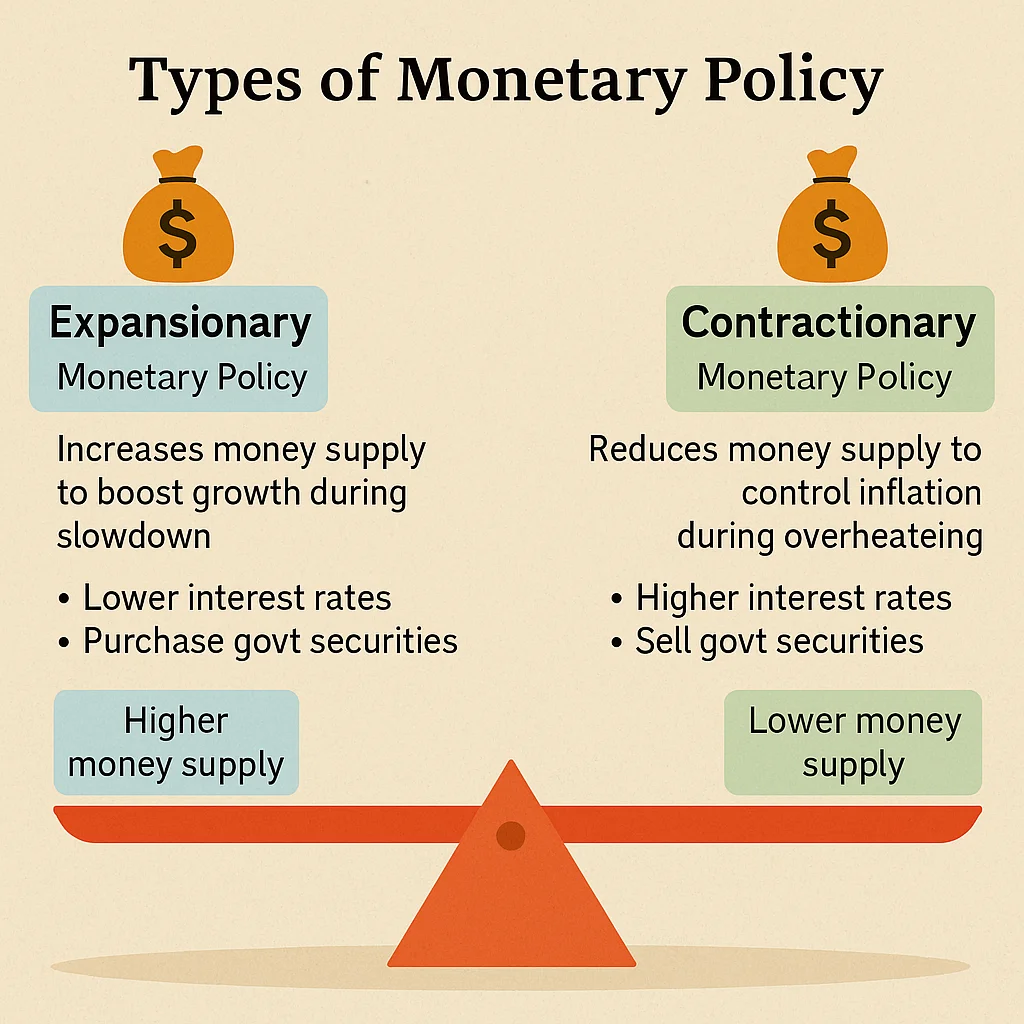
Expansionary Monetary Policy
Meaning: Injecting more money into the economy to encourage growth.
Objective: To fight recession, depression, or periods of low economic growth.
Tools used: Lowering interest rates, reducing reserve requirements, and purchasing government securities.
How it Works
1. Lowering Interest Rates: Makes loans cheaper → more borrowing and spending → boosts investment and demand.
2. Purchasing Govt Securities (Quantitative Easing): RBI buys securities in open market → injects money into the system → increases liquidity → stimulates growth.
3. Lowering Reserve Requirements: Banks hold less in reserve (lower CRR/SLR) → more money available to lend → higher spending and demand.
Contractionary Monetary Policy
Meaning: Reducing money supply in the economy to curb spending and inflation.
Objective: To fight high inflation or hyperinflation.
Tools used: Raising interest rates, increasing reserve requirements, and selling government securities.
How it Works
1. Raising Interest Rates: Loans become costlier → borrowing reduces → less spending and investment → controls inflation.
2. Selling Govt Securities: RBI sells securities → money absorbed from market → reduces liquidity → slows demand.
3. Increasing Reserve Requirements: Higher CRR/SLR → banks must hold more reserves → less lending to public → reduced money supply.
Monetary Policy Stance (RBI terms)
Accommodative (dovish): readiness to cut rates or add liquidity to support growth; a rate hike is off the table.
Neutral: rates can move either way depending on incoming data on inflation and growth.
Hawkish (tight / contractionary): priority on controlling inflation – rate hikes and liquidity absorption. 'Withdrawal of accommodation' (2022–24) signalled a move in this direction.
| Aspect | Expansionary Policy | Contractionary Policy |
|---|---|---|
| Purpose | Boost growth during slowdown | Control inflation during overheating |
| Money Supply | Increases | Decreases |
| Interest Rates | Lowered | Raised |
| Reserve Requirements | Reduced (Lower CRR/SLR) | Increased (Higher CRR/SLR) |
| Govt Securities | Purchased (injects money) | Sold (absorbs money) |
Prelims tips
- Expansionary = more money supply, lower interest rates.
- Contractionary = less money supply, higher interest rates.
- Quantitative Easing = RBI buying govt securities.
- OMOs (Open Market Operations) = buying/selling govt securities.
Mains points
- Expansionary policy helps fight unemployment and low growth but may risk higher inflation.
- Contractionary policy controls inflation but may slow growth and increase unemployment.
- RBI balances both policies depending on economic conditions.
- Both use tools like repo, reverse repo, CRR, SLR, and OMOs.
- Choice depends on macroeconomic goals – stability vs. growth.
Monetary Policy Framework in India
The Monetary Policy Framework is the system through which the Reserve Bank of India (RBI) manages money supply, credit, and inflation in the economy. Its main goal is to keep inflation under control while also ensuring enough money is available for economic growth. Since 2016, India follows a Flexible Inflation Targeting (FIT) framework where the inflation target is set for 5 years.
Broad Objectives of Monetary Policy (as explained by former RBI Governor C. Rangarajan)
To regulate the amount of money in the economy so that prices do not rise too quickly (price stability).
To make sure there is enough credit (loans from banks) available for businesses and people to support growth in jobs and income.
Evolution of Framework
Earlier system: RBI tried to balance inflation (rise in prices) and growth, but there was no fixed or legal target for inflation.
Problem: Without a clear target, inflation sometimes went too high or too low, creating uncertainty.
Solution in 2016: The RBI Act was amended to introduce a new system called the Flexible Inflation Targeting (FIT) framework.
Under this, the Government of India, in consultation with RBI, sets an official inflation target once every 5 years.
Present Monetary Policy Framework
Inflation in India is measured using the Consumer Price Index (CPI), which shows the average price change of goods and services consumed by households.
In August 2016, the Govt fixed the inflation target at 4% CPI with an upper tolerance of 6% and a lower tolerance of 2%.
This means inflation should ideally stay close to 4%. But if it stays between 2% and 6%, it is still acceptable.
First 5-year period: Aug 2016 – March 2021.
Second 5-year period: April 2021 – March 2026 (target retained at 4% ± 2%).
RBI uses this target to decide monetary tools like repo rate, reverse repo, Cash Reserve Ratio (CRR), Statutory Liquidity Ratio (SLR), and Open Market Operations (OMO).
Importance: This framework makes RBI more accountable and helps people and businesses trust that inflation will stay under control.
| Period | Target Inflation | Tolerance Band | Remarks |
|---|---|---|---|
| 2016–2021 | 4% CPI | ±2% (2-6%) | First official inflation target under FIT framework |
| 2021–2026 | 4% CPI | ±2% (2-6%) | Target retained for next 5 years |
Prelims tips
- 2016 amendment to RBI Act introduced Flexible Inflation Targeting (FIT).
- Inflation target = 4% CPI with 2–6% tolerance band.
- Target is set once every 5 years by Govt in consultation with RBI.
- Current validity: April 2021 – March 2026.
Mains points
- Monetary Policy Framework creates balance between price stability and growth.
- Flexible Inflation Targeting makes RBI more accountable and transparent.
- Helps in anchoring inflation expectations among people and businesses.
- Ensures inflation measured through CPI remains central to policy decisions.
- Challenges remain: supply-side factors like fuel and food prices are beyond RBI’s control.
Monetary Policy Committee (MPC)
The Monetary Policy Committee (MPC) is a six-member body formed under Section 45ZB of the amended RBI Act, 1934. It was first set up in September 2016. The MPC decides the policy repo rate needed to achieve the inflation target (currently 4% CPI within 2-6% band). It meets at least 4 times a year, usually once every two months.
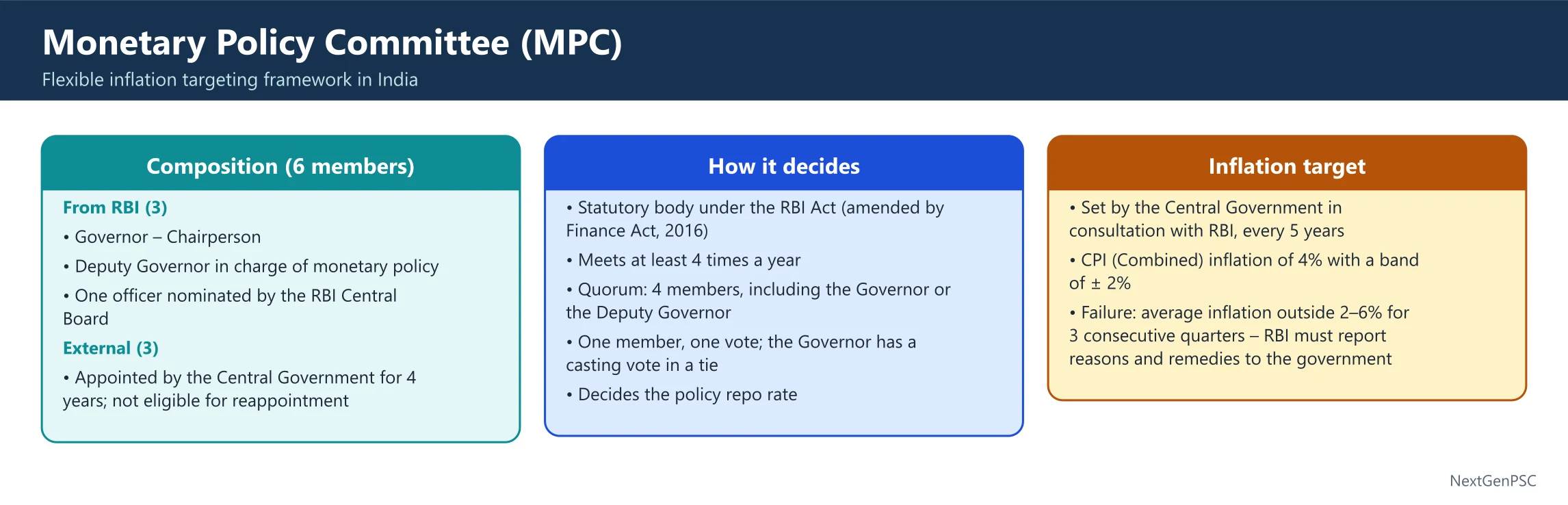
About MPC
Established under RBI Act amendment, 2016 to give collective decision-making power in monetary policy.
Ensures transparency, accountability, and reduces sole dependency on RBI Governor.
Decides the repo rate to achieve inflation target under Flexible Inflation Targeting framework.
Composition of MPC
Total Members: 6.
3 from RBI:
RBI Governor (Chairperson, ex-officio).
RBI Deputy Governor (ex-officio).
One member nominated by RBI Central Board.
3 nominated by Central Government:
Selected by a Search-cum-Selection Committee headed by Cabinet Secretary (RBI Governor is also part of this committee).
Hold office for 4 years.
Not eligible for reappointment.
Working of MPC
Quorum: Minimum 4 members required for a meeting.
Voting: Each member has one vote. In case of tie, RBI Governor has casting vote.
Frequency: Meets at least 4 times a year, usually every 2 months.
RBI publishes a Monetary Policy Report (every 6 months) covering:
Past 6 months’ inflation trends.
Inflation and growth projections.
Economic assessment and risks.
Failure to Maintain Inflation Target
Section 45ZN of RBI Act: If inflation stays outside 2-6% band for 3 consecutive quarters (9 months), RBI must:
Call a special MPC meeting.
Submit report to Central Govt explaining reasons for failure.
Suggest corrective actions.
Provide timeline for bringing inflation back within target.
Example: In November 2022, RBI had to submit such a report as inflation stayed above 6% for 3 consecutive quarters.
| Member | Nominated By | Details |
|---|---|---|
| RBI Governor | RBI | Chairperson, ex-officio |
| RBI Deputy Governor | RBI | Ex-officio member |
| One member from RBI Central Board | RBI | Nominated by RBI Board |
| Three external members | Central Govt | Selected for 4 years, no reappointment |
Prelims tips
- MPC established under Section 45ZB of RBI Act, 1934 (amended in 2016).
- Total 6 members: 3 RBI + 3 Govt nominated.
- Repo rate is decided by MPC to achieve inflation target (4% ± 2%).
- Governor has casting vote in case of tie.
- Special report required if inflation outside 2–6% for 3 consecutive quarters (Sec 45ZN).
Mains points
- MPC institutionalizes monetary policy decisions, ensuring collective wisdom instead of one-person discretion.
- Brings transparency, accountability, and predictability in RBI’s decisions.
- Supports the inflation targeting regime (FIT) by setting repo rate accordingly.
- Failure clause ensures RBI explains its actions, increasing credibility.
- November 2022 was first instance RBI submitted a report after failing inflation target.
Instruments of Monetary Policy – Quantitative Tools
Quantitative tools of monetary policy are used by the RBI to control the overall supply of money and credit in the economy. The most important among them are Repo Rate, Reverse Repo Rate, Bank Rate, Cash Reserve Ratio (CRR), Statutory Liquidity Ratio (SLR), and Open Market Operations (OMO).
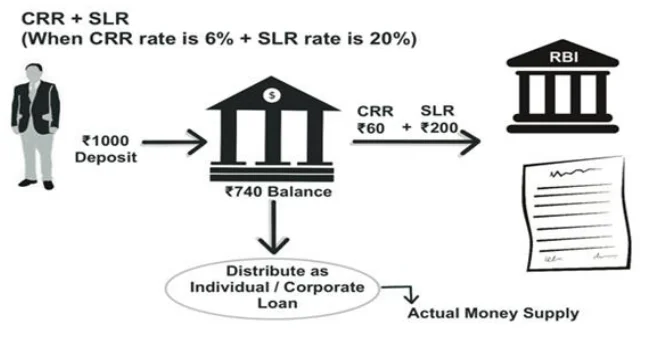
Quantitative Tools
These tools regulate the total volume of money and credit in the economy, without focusing on any specific sector.
Examples: Repo rate, Reverse repo rate, Bank rate, CRR, SLR, OMO.
Cash Reserve Ratio (CRR)
CRR is the percentage of a commercial bank’s Net Demand and Time Liabilities (NDTL) that must be kept in cash with RBI.
This money cannot be used by banks for lending or investment and RBI does not pay any interest on it.
Applies only to scheduled commercial banks (not RRBs or NBFCs).
Example: If CRR = 4% and a bank has deposits worth ₹100 crore, it must keep ₹4 crore with RBI.
Recent Changes: During COVID (2020) it was reduced to 3%. In 2022, increased to 4.5%.
Statutory Liquidity Ratio (SLR)
SLR is the percentage of a commercial bank’s NDTL that must be kept in the form of liquid assets like cash, gold, or approved government securities.
Unlike CRR, SLR is not kept with RBI but maintained by the banks themselves.
It acts as a safety net against excessive withdrawals and maintains public confidence in banks.
Example: If SLR = 18% and a bank has ₹100 crore in deposits, it must keep ₹18 crore in liquid assets.
As per Banking Regulation Act, 1949, maximum SLR can be up to 40% (presently 18%).
CRR vs. SLR
Both are statutory reserve ratios that reduce lending capacity of banks, but differ in form and purpose.
| Aspect | CRR | SLR |
|---|---|---|
| Definition | Minimum cash % of deposits kept with RBI | Minimum % of deposits in cash, gold, or approved securities kept by banks themselves |
| Legal Basis | RBI Act, 1934 | Banking Regulation Act, 1949 |
| Where Held | With RBI | With Banks themselves |
| Interest | No interest paid by RBI | Banks can earn some interest on securities |
| Current Rate | 4.5% of NDTL | 18% of NDTL |
| Limit | No fixed maximum, but not 100% | Cannot exceed 40% |
Prelims tips
- CRR is maintained with RBI in cash form; SLR is maintained with banks themselves in cash/gold/securities.
- CRR = 4.5% (2022), SLR = 18%.
- CRR governed by RBI Act, 1934; SLR governed by Banking Regulation Act, 1949.
- Both CRR and SLR reduce lending capacity of banks.
Mains points
- CRR and SLR are key tools to control inflation and liquidity in the economy.
- Higher CRR/SLR = less money for lending = contractionary effect.
- Lower CRR/SLR = more money for lending = expansionary effect.
- They ensure financial discipline and protect depositors’ money.
- CRR directly affects bank liquidity; SLR provides a buffer for financial stability.
CRR, SLR, SDF and LAF in Monetary Policy
CRR and SLR are statutory reserve requirements that directly affect money supply, interest rates, and economic activity. RBI also uses new tools like the Standing Deposit Facility (SDF) and Liquidity Adjustment Facility (LAF) to manage liquidity, inflation, and stability in the financial system.
Impact of Increasing or Decreasing CRR/SLR
When CRR/SLR increases:
Banks must keep more money with RBI (CRR) or in liquid assets (SLR).
Less loanable money remains with banks → they raise interest rates.
Borrowing decreases → investments and consumption reduce.
This reduces demand → lowers inflation (but may slow down growth).
When CRR/SLR decreases:
Banks have more loanable funds available.
They reduce lending rates → more borrowing.
Investments and consumption rise → boosts production and growth.
But excessive credit can cause inflation.
Recent CRR Changes
2019: CRR was 4%.
2020: Reduced to 3% after lockdown to support economy during GDP contraction.
2021: Raised back to 4% due to inflation from supply chain disruptions (COVID).
May 2022: Increased from 4% to 4.5% (absorbed ₹87,000 crore liquidity) due to inflation from post-pandemic effects and Russia-Ukraine war.
Standing Deposit Facility (SDF)
Introduced by RBI in April 2022.
Replaced fixed Reverse Repo Rate as floor of Liquidity Adjustment Facility (LAF) corridor.
Proposed by Urjit Patel Committee (2014), enabled by RBI Act amendment (2018).
Difference from Reverse Repo: Banks park excess funds with RBI without RBI giving collateral (no need for RBI to provide G-Secs).
Reverse Repo Rate remains in toolkit, used as per RBI discretion.
Currently: SDF is 25 basis points (0.25%) below Repo Rate.
Significance:
Helps RBI absorb large liquidity during extraordinary times (e.g., post-2008 financial crisis, 2016 demonetisation).
Banks can voluntarily park excess liquidity with RBI under SDF.
Liquidity Adjustment Facility (LAF)
Introduced in 2000 (Narasimham Committee, 1998).
Facility for scheduled commercial banks (except RRBs) and Primary Dealers.
Purpose: Manage day-to-day liquidity.
Mechanism:
Repo Rate → Banks borrow from RBI against G-Secs (adds liquidity).
Reverse Repo Rate → Banks lend to RBI by parking funds (absorbs liquidity).
Benefits:
Helps control inflation by adjusting liquidity.
Provides short-term liquidity support to banks during shocks or instability.
| Condition | Impact on Banks | Impact on Economy |
|---|---|---|
| CRR/SLR Increases | Less money to lend, higher interest rates | Reduced borrowing, demand falls, inflation decreases |
| CRR/SLR Decreases | More money to lend, lower interest rates | More borrowing, demand rises, growth increases (but risk of inflation) |
| Aspect | SDF | Reverse Repo | LAF |
|---|---|---|---|
| Introduced | 2022 | 2000 (LAF toolkit) | 2000 |
| Collateral | No collateral required | RBI provides collateral (G-Secs) | G-Secs required |
| Position | Floor of LAF corridor | Part of LAF toolkit | Umbrella facility |
| Purpose | Absorb large liquidity quickly | Absorb day-to-day liquidity | Daily liquidity adjustment |
Prelims tips
- CRR ↑ = contractionary, inflation ↓. CRR ↓ = expansionary, growth ↑.
- SLR maintained in cash/gold/securities with banks, CRR in cash with RBI.
- SDF introduced in April 2022, no collateral required.
- LAF = Repo + Reverse Repo, introduced in 2000 (Narasimham Committee).
Mains points
- Changes in CRR/SLR directly impact liquidity, inflation, and growth trade-offs.
- SDF strengthens RBI’s ability to absorb liquidity without collateral.
- LAF provides a flexible mechanism to handle daily liquidity needs of banks.
- These tools together enhance RBI’s effectiveness in monetary management.
- Global events (like COVID, Ukraine war) show why CRR, SLR, SDF, and LAF must be dynamic.
Liquidity Adjustment Facility (LAF) and Inflation Control
LAF is a mechanism used by RBI to manage short-term liquidity in the economy through Repo and Reverse Repo rates. By adjusting these rates, RBI influences the cost of borrowing for banks, which directly affects lending rates, demand for credit, and ultimately inflation or growth.
How LAF Controls Inflation
When inflation is high:
RBI increases Repo Rate → borrowing for banks becomes costlier.
Banks raise loan interest rates for people and businesses.
Borrowing decreases → demand for goods/services falls → inflation reduces.
When economy slows down:
RBI reduces Repo Rate → borrowing becomes cheaper.
Banks lower lending rates → people and businesses borrow more.
Higher demand boosts investment, consumption, and growth.
Reverse Repo Rate and Inflation
During high inflation:
RBI increases Reverse Repo Rate → banks prefer to park money with RBI for safe returns.
Loanable funds reduce → lending becomes expensive → demand falls → inflation cools down.
During slowdown:
RBI reduces Reverse Repo Rate → banks earn less by parking funds with RBI.
Banks lend more to public → demand rises → economy revives.
Repo Rate – Mechanism
Repo Rate = rate at which commercial banks borrow short-term funds from RBI against government securities.
When repo increases: borrowing for banks costly → banks raise interest rates → less borrowing by public → inflation reduces.
When repo decreases: borrowing for banks cheap → banks lower interest rates → more borrowing → boosts demand and growth.
Reverse Repo Rate – Mechanism
Reverse Repo Rate = interest paid by RBI to banks when they park surplus funds with RBI.
Higher reverse repo: attractive for banks → they keep funds with RBI instead of lending → liquidity reduces → inflation falls.
Lower reverse repo: unattractive for banks → they lend more → increases liquidity → supports growth.
Examples of RBI Actions
Feb 2019–May 2020: Repo reduced by 225 bps (6.25% → 4%) due to slowdown after GST and Demonetisation.
May 2020–Apr 2022: Repo kept at 4% during COVID lockdown to support economy.
May 2022–Feb 2023: Repo increased by 250 bps (4% → 6.5%) due to inflation above 6% from supply disruptions & Russia-Ukraine war.
COVID Example: Demand for loans was low, so banks parked money in RBI via reverse repo. RBI reduced reverse repo drastically to 3.35% to discourage parking and push banks to lend.
| Tool | When Increased | When Decreased |
|---|---|---|
| Repo Rate | Borrowing costly → demand falls → inflation reduces | Borrowing cheap → demand rises → growth increases |
| Reverse Repo Rate | Banks park more funds with RBI → less lending → inflation reduces | Banks park less with RBI → more lending → growth increases |
| Period | Change in Repo Rate | Reason |
|---|---|---|
| Feb 2019 – May 2020 | Reduced from 6.25% → 4% (225 bps cut) | Economic slowdown after GST & Demonetisation |
| May 2020 – Apr 2022 | Maintained at 4% | COVID lockdown and negative GDP growth |
| May 2022 – Feb 2023 | Increased from 4% → 6.5% (250 bps hike) | High inflation due to supply chain issues & Ukraine-Russia war |
Prelims tips
- Repo Rate = banks borrow from RBI; Reverse Repo Rate = banks lend to RBI.
- Repo ↑ → contractionary → inflation ↓; Repo ↓ → expansionary → growth ↑.
- Reverse Repo ↑ → banks park funds with RBI → inflation ↓.
- Reverse Repo ↓ → banks lend more → growth ↑.
- LAF introduced in 2000 on Narasimham Committee recommendation.
Mains points
- LAF provides a flexible framework to manage daily liquidity and inflation control.
- Repo rate is RBI’s primary tool to influence borrowing costs and demand.
- Reverse Repo complements repo by absorbing excess liquidity when needed.
- RBI adjusts repo/reverse repo based on economic cycles – slowdown vs inflationary pressure.
- Real examples (COVID, Ukraine war) show how repo/reverse repo changes directly impact inflation and growth.
Reverse Repo Rate, MSF and Open Market Operations (OMO)
Reverse Repo, MSF, and OMO are important instruments of RBI’s monetary policy to control liquidity and inflation. They influence how much money is available in the market, thereby affecting inflation, growth, and stability of the financial system.
Mechanism of Reverse Repo Rate
When RBI increases Reverse Repo Rate:
Banks get higher interest from RBI.
Banks prefer lending to RBI instead of public/businesses.
Market money supply reduces → controls inflation.
When RBI decreases Reverse Repo Rate:
Parking money with RBI becomes unattractive.
Banks lend more to public and businesses.
Increases liquidity → boosts growth.
COVID-19 Example (Reverse Repo)
During COVID slowdown, loan demand decreased.
By March 2020: Banks parked ~₹3 lakh crore with RBI via Reverse Repo.
RBI reduced Reverse Repo to 3.35% to discourage parking and force banks to lend.
Example: If SBI gives 5.9% FD interest to depositors but earns only 3.35% from RBI, it makes losses. Hence, SBI would prefer lending to customers.
Marginal Standing Facility (MSF)
Introduced in 2011.
Penal interest rate at which banks borrow overnight from RBI by pledging G-Secs (up to 2% of SLR quota).
Acts as safety valve when interbank liquidity dries up.
Last resort borrowing option after LAF and other sources are exhausted.
MSF = Upper bound of LAF corridor (25 bps above Repo Rate).
Purpose: Provides emergency liquidity support to banking system.
Open Market Operations (OMO)
OMO = RBI buys and sells Government Securities (G-Secs) in the open market.
RBI buys G-Secs → injects money → increases liquidity → boosts growth (used in slowdown).
RBI sells G-Secs → absorbs money → reduces liquidity → controls inflation (used in high inflation periods).
OMO is a flexible tool used frequently along with Repo/Reverse Repo.
| Instrument | Meaning | Purpose | Position in LAF Corridor |
|---|---|---|---|
| Reverse Repo | Rate RBI pays to banks when they park funds | Absorb excess liquidity, control inflation | Floor (lower bound) |
| MSF | Penal overnight borrowing from RBI against G-Secs (up to 2%) | Emergency liquidity support | Ceiling (upper bound) |
| OMO | Buying & selling of Govt. Securities in open market | Inject or absorb liquidity as per need | Not part of corridor but used flexibly |
Prelims tips
- Reverse Repo = floor of LAF corridor, MSF = ceiling of LAF corridor.
- MSF introduced in 2011, last resort borrowing option.
- OMO = RBI buys (injects liquidity) / sells (absorbs liquidity) G-Secs.
- During COVID (2020), RBI reduced reverse repo to 3.35% to discourage banks from parking funds.
Mains points
- Reverse Repo influences banks’ preference between lending to RBI vs public, thus controlling liquidity.
- MSF acts as an emergency support tool to prevent liquidity shocks in the banking system.
- OMO provides RBI with flexibility to adjust liquidity depending on inflation or slowdown.
- Together, these instruments ensure stability of financial markets and effective inflation control.
- Examples: COVID slowdown (reverse repo reduction), inflationary periods (OMO selling).
Other Monetary Policy Measures by RBI
Apart from Repo, Reverse Repo, CRR, and SLR, RBI uses additional instruments like Variable Rate Reverse Repo (VRRR), Bank Rate, and Operation Twist to manage liquidity, inflation, and interest rates in the economy. These tools help in fine-tuning monetary policy and ensuring better transmission to markets and banks.
Variable Rate Reverse Repo (VRRR)
Introduced in 2021 due to inflationary pressures after global supply chain disruptions.
Unlike fixed reverse repo (at RBI-decided rate), VRRR is conducted through auctions on RBI’s e-KUBER platform.
Banks bid interest rates at which they want to park funds with RBI.
Key Features:
Minimum bid: ₹1 crore (multiples only).
Bids at or above Repo Rate are rejected.
Accepted bids are those below Repo Rate and below the cut-off rate.
Purpose: To absorb excess liquidity from the banking system more efficiently.
Bank Rate
Published under Section 49 of RBI Act, 1934.
Earlier: Rate at which RBI lent long-term funds to commercial banks (influenced lending rates).
Now: Functions mainly as a penal rate charged on banks for shortfalls in CRR/SLR requirements.
Aligned with MSF: Changes automatically when MSF changes.
Less important today as Repo/Reverse Repo are the main policy tools.
Operation Twist
Unconventional monetary policy used first by US Federal Reserve in 1961.
Adopted by RBI in 2019–2020 to manage bond yields and stimulate growth.
Mechanism: Simultaneous buying & selling of government securities (short-term vs long-term) via OMOs.
RBI buys long-term G-Secs → demand ↑ → price ↑ → yield ↓.
RBI sells short-term G-Secs → supply ↑ → price ↓ → yield ↑.
Why RBI introduced it in India:
Indian economy slowdown in 2019; banks reluctant to lend due to high NPAs & low demand.
Aim: Reduce yields on long-term G-Secs to make corporate bonds more attractive.
This helped companies raise money through bonds and pushed banks to lower lending rates.
Important: Operation Twist was not aimed at inflation control but at reducing borrowing costs for companies and government.
Outcome:
Improved monetary policy transmission.
Deepened corporate bond market as an alternative to bank loans.
Lowered interest rates indirectly in the economy.
| Instrument | Year Introduced | Purpose | Key Feature |
|---|---|---|---|
| VRRR | 2021 | Absorb excess liquidity via auctions | Banks bid rates below repo rate on e-KUBER |
| Bank Rate | 1934 (RBI Act) | Earlier – long-term lending rate; Now – penal rate | Aligned with MSF, automatic change |
| Operation Twist | 1961 (US), 2019 (India) | Reduce long-term G-Sec yields, deepen bond market | Simultaneous buying (long-term) & selling (short-term) of G-Secs |
Prelims tips
- VRRR introduced in 2021; conducted via e-KUBER auction; bids must be below Repo Rate.
- Bank Rate under Sec 49 of RBI Act, 1934; now acts as penal rate; aligned with MSF.
- Operation Twist first by US Fed (1961), RBI adopted in 2019–2020.
- Operation Twist aimed at reducing long-term bond yields, not inflation control.
Mains points
- VRRR is a market-based tool ensuring efficient liquidity absorption compared to fixed reverse repo.
- Bank Rate has lost prominence but continues as penal mechanism linked with MSF.
- Operation Twist shows RBI’s shift towards unconventional monetary policies to improve monetary transmission.
- Helps corporate sector raise funds via bonds, easing stress on banks.
- These measures complement traditional tools like Repo/CRR/SLR for better monetary management.
Retail Direct Scheme, G-SAP, Special Repo Windows & LAF Corridor
RBI has recently introduced innovative measures like Retail Direct Scheme (direct G-Sec access for retail investors), Government Securities Acquisition Programme (G-SAP), Long Term Repo Operations (LTRO variants), and special On-Tap liquidity windows during COVID. Alongside, the LAF Corridor framework ensures stability in liquidity management by defining the relationship between Repo, MSF, and SDF.
Retail Direct Scheme (2021)
Allows retail investors to directly buy government securities (G-Sec, T-Bills, State bonds, and Sovereign Gold Bonds) from RBI’s e-KUBER platform.
Investors must open a Retail Direct Gilt (RDG) account.
No application fee to open the account.
Both resident Indians and NRIs can participate.
Investors can buy in primary issues and trade in secondary market via RBI’s NDS-OM system.
Earlier: Retail investors could only access G-Secs indirectly through mutual funds.
Government Securities Acquisition Programme (G-SAP) – 2021
RBI buys G-Secs from the secondary market to infuse liquidity (special type of OMO).
Unique: RBI announces the entire schedule (amount + dates) in advance, making it transparent.
Benefits:
Increases money supply and supports post-COVID economic revival.
Investors selling G-Secs to RBI get cash to invest elsewhere (shares, bonds).
Helps reduce gap between Repo Rate and 10-year G-Sec yield.
Difference from Operation Twist:
Operation Twist: simultaneous buy/sell (short-term vs long-term G-Secs).
G-SAP: only buying G-Secs with pre-declared schedule.
Special Repo Windows during COVID
Long Term Repo Operations (LTRO)
Introduced to provide 1–3 year loans at Repo Rate instead of overnight loans.
Goal: Inject liquidity and support productive sectors.
Targeted LTRO (TLTRO)
RBI gave 3-year loans at Repo Rate, but banks had to invest part of the money in corporate bonds, debentures, and commercial papers.
Aim: Push credit into stressed sectors.
Special LTRO (SLTRO)
RBI gave 3-year repo loans to Small Finance Banks (SFBs).
Goal: Support micro and small industries and unorganised sector entities.
On-Tap Liquidity Windows
Healthcare: 3-year loans at Repo Rate for hospitals, vaccine makers, oxygen suppliers, etc.
Contact-Intensive Sectors: Hotels, restaurants, transport, salons, etc. – severely hit by COVID.
LAF Corridor
Framework with three key rates:
Standing Deposit Facility (SDF): Lower bound/floor.
Repo Rate: Middle (benchmark rate).
Marginal Standing Facility (MSF): Upper bound/ceiling.
Example (Feb 2023):
Repo Rate = 6.5%.
SDF = 6.25% (Repo – 0.25%).
MSF = 6.75% (Repo + 0.25%).
Width of corridor = Difference between MSF & SDF = 0.5% (50 basis points).
Significance: Provides structure to monetary policy operations, guiding liquidity absorption and injection.
| Instrument | Mechanism | Purpose | Schedule |
|---|---|---|---|
| OMO | RBI buys/sells G-Secs | Control inflation/deflation | Not pre-announced |
| Operation Twist | Buy long-term, Sell short-term G-Secs | Reduce long-term yields, make borrowing cheaper | Not fixed, tactical |
| G-SAP | RBI buys G-Secs only | Infuse liquidity post-COVID revival | Pre-announced schedule |
Prelims tips
- Retail Direct Scheme launched in 2021; RDG account required.
- G-SAP = special OMO with pre-announced schedule; started in 2021.
- LTRO/TLTRO/SLTRO introduced during COVID for long-term liquidity support.
- LAF Corridor = MSF (ceiling), Repo (middle), SDF (floor). Width = MSF – SDF.
Mains points
- Retail Direct democratizes access to government securities for small investors.
- G-SAP shows RBI’s use of forward guidance and transparency in liquidity injection.
- LTRO/TLTRO/SLTRO highlight RBI’s targeted approach during crisis (COVID).
- On-Tap windows show flexibility in addressing sector-specific shocks.
- LAF Corridor provides structure, stability, and predictability to monetary policy operations.
Marginal Standing Facility (MSF) and Open Market Operations (OMO)
MSF is an emergency borrowing facility for banks at a penal interest rate, introduced in 2011 as the ceiling of the LAF corridor. OMO is RBI’s regular tool to inject or absorb liquidity by buying/selling government securities in the market.
Marginal Standing Facility (MSF)
Introduced in 2011 as part of RBI’s monetary policy toolkit.
It is the rate at which banks can borrow short-term (overnight) funds from RBI when they face acute liquidity shortages.
Banks pledge Government Securities (G-Secs) from their Statutory Liquidity Ratio (SLR) quota as collateral (up to 2% of NDTL).
MSF is always set 25 basis points (bps) above Repo Rate (penal rate).
Example: If Repo Rate = 6.50%, MSF = 6.75%.
Purpose:
Provides a ‘safety valve’ when interbank lending dries up.
Prevents panic during sudden liquidity shocks.
Last resort: Used only after exhausting other options like borrowing from market or using LAF.
Open Market Operations (OMO)
RBI buys or sells G-Secs in the open market to control liquidity.
Mechanism:
RBI Buys G-Secs → Gives money to banks/investors → Injects liquidity → Stimulates economy (done in slowdown/recession).
RBI Sells G-Secs → Takes money from banks/investors → Reduces liquidity → Controls inflation (done during high inflation).
Importance:
Helps RBI manage inflation, money supply, and interest rates.
Used flexibly depending on economic conditions.
Example:
2020 COVID slowdown → RBI bought G-Secs to inject liquidity.
2022 high inflation → RBI sold G-Secs to absorb excess liquidity.
| Feature | MSF | OMO |
|---|---|---|
| Introduction | 2011 | Long-standing RBI tool |
| Purpose | Emergency borrowing for banks | Liquidity management in economy |
| Rate | 25 bps above Repo (penal) | Market-driven (depends on buy/sell G-Secs) |
| Collateral | Banks pledge G-Secs (up to 2% of SLR) | RBI directly buys/sells G-Secs |
| Usage | Last resort in crisis | Regularly used depending on inflation/growth needs |
Prelims tips
- MSF introduced in 2011; last resort borrowing option for banks.
- MSF = Repo + 25 bps.
- OMO = RBI buying/selling G-Secs to manage liquidity.
- OMO injects liquidity in slowdown (buy) and absorbs liquidity in inflation (sell).
Mains points
- MSF strengthens financial stability by acting as emergency cushion.
- OMO is flexible and widely used to balance inflation and growth.
- Together, MSF (emergency) + OMO (regular tool) provide RBI with control over liquidity shocks and long-term policy goals.
- MSF penal rate discourages over-reliance, while OMO ensures market stability.
Qualitative Tools of Monetary Policy
Unlike quantitative tools (CRR, SLR, Repo, OMO), which change the overall money supply in the economy, qualitative tools are selective. They guide or control the flow of credit towards or away from certain sectors or activities. These are also called Direct or Selective Instruments of RBI’s monetary policy.
1. Margin Requirements / Loan-to-Value (LTV)
'Margin' = part of collateral not financed by the bank.
If margin requirement is high → loan amount is lower → discourages borrowing.
If margin requirement is low → loan amount is higher → encourages borrowing.
Example: Auto Loan
Margin requirement 20% → For ₹10 lakh collateral, loan = ₹8 lakh.
Margin requirement reduced to 10% → Loan = ₹9 lakh.
Used to encourage/discourage loans in housing, auto, business sectors.
2. Regulation of Consumer Credit
RBI can set loan terms like minimum down payment, EMI size, or maximum loan tenure.
During inflation → RBI increases down payment or EMI → reduces borrowing and consumption.
Example: Home Loan
RBI sets minimum down payment at 15%.
For ₹1 crore house → Borrower must pay ₹15 lakh upfront, loan = ₹85 lakh.
Affects credit flow in automobiles, real estate, consumer durables (TVs, fridges, etc.).
3. Credit Rationing
RBI directly limits loan amount for certain sectors regardless of eligibility.
Aim: Prevent speculative hoarding or misuse of credit.
Example: RBI may instruct banks not to lend beyond a set amount to onion/potato traders (to prevent hoarding of essentials).
4. Moral Suasion
'Persuasion without strict legal action'.
RBI uses meetings, circulars, statements, or Governor’s appeals to influence banks’ behavior.
Example:
Asking banks to pass repo rate cuts to customers.
Encouraging banks to open rural branches or lend more to farmers.
Advising financial literacy campaigns.
Works on cooperation and trust rather than compulsion.
5. Direct Action
RBI can punish or take strict action if banks/NBFCs violate rules or instructions.
Actions may be:
Monetary penalty (fines).
Non-monetary: restrictions, cancellation of license, changes in management, etc.
Example:
In 2019, RBI ordered 'Clawback Clause' in CEOs’ salaries: If a top executive was later found guilty of fraud/scam, earlier bonuses/salaries could be taken back, even if he had left the job.
| Aspect | Quantitative Tools | Qualitative Tools |
|---|---|---|
| Definition | Control overall money supply | Control direction of credit |
| Examples | CRR, SLR, Repo, OMO | Margin Requirements, Moral Suasion |
| Focus | Entire economy | Specific sectors/activities |
| Nature | Indirect, volume-based | Direct, selective |
| Impact | Affects inflation, growth | Affects allocation of credit |
Prelims tips
- Qualitative tools = Selective credit control measures.
- Margin requirement (Loan-to-Value ratio) is a key tool.
- Credit rationing limits lending to specific sectors.
- Moral suasion is persuasion, not compulsion.
- Direct Action involves penalties/sanctions on banks & NBFCs.
Mains points
- Qualitative tools ensure credit reaches priority sectors while preventing misuse in speculative activities.
- They complement quantitative tools for balanced monetary policy.
- Help RBI align banking sector lending with developmental priorities (like agriculture, rural credit).
- Limitations: Less effective in modern digital/market-driven economy where credit can move globally.
- Still important for targeted interventions in inflation-sensitive commodities or vulnerable sectors.
Priority Sector Lending (PSL)
Priority Sector Lending (PSL) is a policy of the Reserve Bank of India (RBI) under which banks are mandated to provide a certain portion of their loans to specific sectors of the economy that are considered essential for the country’s growth, welfare, and inclusive development. These sectors include agriculture, micro-enterprises, weaker sections, housing, education, and renewable energy.
Overview
The term 'Priority Sector' was first used by RBI in 1968.
By 1985, banks were mandated to give 40% of their total loans to agriculture, small industries, and exporters.
Over time, more categories have been added like housing, education, renewable energy, and weaker sections.
PSL ensures that credit reaches those parts of society and economy which may otherwise be neglected by profit-driven lending.
Who is Covered under PSL?
Domestic Commercial Banks – Must give at least 40% of Adjusted Net Bank Credit (ANBC) as PSL.
Foreign Banks (≥20 branches) – 40% of ANBC.
Foreign Banks (<20 branches) – 40% of ANBC.
Regional Rural Banks (RRBs) – 75% of ANBC.
Small Finance Banks – 75% of ANBC.
Urban Cooperative Banks – 75% of ANBC (to be achieved by March 31, 2024).
Targets for Commercial Banks
Agriculture – 18% of ANBC (out of which 10% must go to small and marginal farmers).
Micro Enterprises – 7.5%.
Weaker Sections (SC, ST, Women, Physically Handicapped, Manual Scavengers, Artisans, NRLM/ NULM beneficiaries) – 12%.
Other Sectors (Education, Housing, Social Infrastructure, Export Credit, Renewable Energy) – 2.5%.
Overall PSL requirement – Minimum 40% of ANBC.
Important Notes
These are minimum targets – banks can lend more if they wish.
Loans given by banks to NBFCs that further lend to PSL categories are also counted towards PSL quota.
PSL rules are binding only on banks, not on NBFCs.
| Bank Type | Target |
|---|---|
| Domestic Commercial Banks | 40% of ANBC |
| Foreign Banks (≥20 branches) | 40% of ANBC |
| Foreign Banks (<20 branches) | 40% of ANBC |
| Regional Rural Banks (RRBs) | 75% of ANBC |
| Small Finance Banks | 75% of ANBC |
| Urban Cooperative Banks | 75% of ANBC (by March 31, 2024) |
| Sector | Target |
|---|---|
| Agriculture | 18% (10% for small & marginal farmers) |
| Micro Enterprises | 7.5% |
| Weaker Sections | 12% |
| Other Sectors (Education, Housing, Social Infra, Export Credit, Renewable Energy) | 2.5% |
| Total | 40% of ANBC |
Prelims tips
- PSL term first used in 1968 by RBI.
- By 1985, PSL target was fixed at 40%.
- Agriculture PSL = 18% (10% small & marginal farmers).
- RRBs, SFBs, and UCBs have 75% PSL target.
- PSL rules apply only to banks, not NBFCs.
Mains points
- PSL ensures inclusive growth by channeling credit to agriculture, MSMEs, weaker sections, and social sectors.
- Helps balance profit motive of banks with developmental goals of the government.
- Important tool for financial inclusion and rural credit delivery.
- Criticism: Banks sometimes treat PSL as compulsion and may prefer indirect lending through NBFCs.
- PSL has been key in supporting small farmers, artisans, and vulnerable groups.
PSL Certificates and Assessment of RBI’s Monetary Policy
PSL Certificates were introduced in 2016 to allow banks that exceed their Priority Sector Lending (PSL) targets to sell surplus lending as 'certificates' to banks that fall short. RBI’s monetary policy framework has achieved progress in growth support, inflation targeting, and transmission reforms, but faces challenges in effective implementation due to structural and external constraints.
PSL Certificates
Introduced in 2016 as a market-based mechanism.
If a bank lends more to PSL sectors than its target, it can sell the excess as PSL Certificates.
Banks that are short of their PSL target can buy these certificates to meet compliance.
Important: Only the certificate is transferred, not the loan itself or its risk.
Example: If Bank A’s PSL target is 40% but it achieves 45%, it can sell 5% worth of PSL Certificates to Bank B that achieved only 35%.
Assessment of RBI’s Monetary Policy
Economic Growth: RBI supported growth by keeping an accommodative stance, especially during COVID-19 when it reduced repo rate and infused liquidity.
Inflation Control: With the inflation-targeting framework (2016), RBI has kept CPI inflation within 2–6% band most of the time, ensuring price stability.
Transmission Mechanism: RBI introduced Marginal Cost of Funds based Lending Rate (MCLR) and later External Benchmark Lending Rate (EBLR) to improve rate transmission from repo to lending rates.
Challenges in Transmission of Monetary Policy
1. CPI vs WPI Debate
CPI (Consumer Price Index) is RBI’s official target, but WPI (Wholesale Price Index) is broader and available earlier.
WPI covers more commodities, tradeable items, and is pan-India, whereas CPIs are city/region-based.
2. Low Utility of Repo Rate
Indian banks rely more on deposits (people’s savings) rather than RBI borrowing, making repo rate changes less impactful.
3. Dependency on Uncontrollable Events
Agriculture heavily depends on monsoon → poor rains = food inflation.
Global crude oil dependence (80% imported) makes inflation sensitive to geopolitical events (Ukraine-Russia war, Gulf crisis, etc.).
4. Structural Issues
Weak infrastructure, high logistics costs, and poor ease of doing business raise domestic production costs compared to imports.
5. Challenges Faced by Banks
High NPAs, scams, and inefficiency in PSBs affect monetary policy transmission.
Rural areas: low financial literacy and weak banking habits reduce reach of RBI policy.
Small savings schemes like PPF and NSC compete with bank deposits, reducing banks’ control over savings.
6. Informal Credit in Rural India
Many farmers still rely on local moneylenders outside RBI’s regulation, weakening policy effectiveness.
| Aspect | CPI | WPI |
|---|---|---|
| Coverage | Household consumption basket | Wider coverage, incl. tradeables |
| Timeliness | Available with longer lag | Available faster |
| Geography | Constructed for centres/regions | Pan-India |
| Focus | Retail prices (consumers) | Wholesale prices (traders, producers) |
Prelims tips
- PSL Certificates introduced in 2016.
- Certificates transfer compliance, not loans or risks.
- RBI adopted Flexible Inflation Targeting in 2016: 4% CPI ± 2%.
- MCLR (2016) and EBLR (2019) improved transmission of repo rate.
- WPI is broader, CPI is official target for RBI.
Mains points
- PSL Certificates make PSL compliance flexible and market-driven.
- RBI’s monetary policy has improved credibility after inflation targeting (2016).
- Transmission challenges highlight structural weaknesses in India’s economy and banking sector.
- Dependence on monsoon and oil imports weakens RBI’s control over inflation.
- Strengthening rural banking penetration and reducing NPAs are key to improving monetary policy effectiveness.
How RBI Influences Bank’s Interest Rates
RBI influences lending rates of banks through different regulatory frameworks. Over time, India has moved from the Base Rate (2010) → MCLR (2016) → External Benchmark Linked Lending Rate (2019). This ensures better and faster transmission of RBI’s policy rate changes (like repo rate) to the borrowers.
1. Base Rate / Benchmark Prime Lending Rate (BPLR) – 2010
Introduced by RBI in July 2010.
Minimum interest rate set by RBI below which no bank (public or private) could lend.
Purpose: To bring transparency and stop banks from arbitrarily giving loans at very low rates to select customers.
Limitation: Transmission of repo rate changes was still slow and incomplete.
2. Marginal Cost of Funds based Lending Rate (MCLR) – 2016
Introduced in April 2016, replacing Base Rate.
Aim: To improve transmission of monetary policy rates to borrowers.
Components of MCLR:
Repo rate (base policy rate by RBI).
Operating costs of banks.
Cost of maintaining CRR (Cash Reserve Ratio).
Loan Tenor Premium (extra charge for long-term loans).
Limitation: Even with MCLR, banks did not always pass repo rate cuts immediately to borrowers. Delays reduced its effectiveness.
3. External Benchmark Linked Lending Rate (EBLR) – 2019
Implemented from October 1, 2019 by RBI.
Banks now must link lending rates to any external benchmark:
Repo rate.
Yield of 91-day Treasury Bill.
Yield of 182-day Treasury Bill.
Any benchmark market interest rate set by Financial Benchmark India Pvt Ltd (FBIL).
Features:
Lending rates automatically adjust with changes in external benchmark.
Interest rates must be reviewed at least every 3 months.
Ensures faster and transparent transmission of RBI’s policy rate cuts or hikes.
Eligible Borrowers under EBLR:
Retail Loans (Home, Vehicle, Consumer loans).
Personal Loans (emergency expenditures).
Loans to Micro & Small Enterprises.
Loans to Medium Enterprises.
| System | Year Introduced | Features | Limitations |
|---|---|---|---|
| Base Rate / BPLR | 2010 | Minimum rate below which no loan can be given | Slow transmission, not transparent enough |
| MCLR | 2016 | Based on repo rate, costs, CRR, tenor premium | Delay in passing repo changes to customers |
| External Benchmark Rate | 2019 | Linked to repo, T-bills or FBIL benchmark; review every 3 months | More transparent and faster, but banks can add spread |
Prelims tips
- Base Rate introduced in 2010, replaced by MCLR in 2016.
- MCLR = repo rate + CRR cost + operating cost + tenor premium.
- External Benchmark Rate started Oct 1, 2019.
- External benchmarks include Repo, 91-day/182-day T-bill yield, FBIL benchmark.
- Interest rates must be reset every 3 months under EBLR.
Mains points
- Base Rate, MCLR, and EBLR show RBI’s progressive steps to improve monetary policy transmission.
- EBLR ensures quick alignment of bank lending rates with RBI policy rates.
- Helps borrowers (retail, MSME) to benefit directly from repo rate cuts.
- Still, banks maintain some flexibility by adding 'spread' above benchmark.
- Overall, shift to external benchmarks improves transparency and accountability.
Limitations of Monetary Policy
While monetary policy is a powerful tool, it has limitations. Factors like time lags, unpredictable economic behavior, supply-side shocks (like oil price hikes), structural issues in the economy, and the 'Liquidity Trap' situation can reduce its effectiveness in controlling inflation or boosting growth.
Why Monetary Policy Doesn't Always Work Perfectly
Monetary policy aims to steer the economy, but it's not always a smooth ride. Here are some key challenges:
1. Time Lags:
Recognition Lag: It takes time for RBI to recognize that there's a problem (like rising inflation or a slowdown).
Implementation Lag: Deciding on and implementing the policy (e.g., changing repo rate) takes time.
Impact Lag: It takes several months (often 6-18 months) for the policy change to fully affect the economy (borrowing, spending, prices). By then, the economic situation might have changed again!
2. Difficulty in Prediction: Economic forecasting is complex. Unexpected events (like a war, pandemic, or bad monsoon) can disrupt RBI's plans.
3. Supply-Side Shocks: RBI's tools mainly affect demand. They can't easily control inflation caused by supply problems (e.g., crop failure raising food prices, or global oil price hikes). Trying to control supply-driven inflation with demand tools can hurt growth unnecessarily.
4. Structural Issues in the Economy: Problems like poor infrastructure, inefficient markets, or lack of skilled labor can hinder growth, regardless of how cheap loans are.
5. Banking Sector Health: If banks have high NPAs or are reluctant to lend ('risk-averse'), RBI's rate cuts might not translate into cheaper loans for the public (poor monetary transmission).
6. Informal Economy: A large part of India's economy operates outside the formal banking system (using cash, moneylenders). Monetary policy has limited reach here.
7. Global Factors: In a globalized world, factors like international capital flows, global interest rates, and exchange rate movements can affect India's economy, sometimes counteracting RBI's efforts.
8. The Liquidity Trap:
What it is: A rare but serious situation (usually during deep recessions) where interest rates are already near zero.
The Problem: Even if RBI pumps more money into the system (e.g., via OMOs), people and banks just hoard it because they expect things to get worse or see no good investment opportunities. Holding cash feels safer.
The Result: Monetary policy becomes ineffective – like 'pushing on a string'. Lowering rates further or printing more money doesn't stimulate borrowing or spending.
Solution: In such cases, the government often needs to step in with fiscal policy (increased spending, tax cuts) to boost demand directly.
Prelims tips
- Monetary policy effectiveness is limited by time lags (recognition, implementation, impact).
- It struggles against supply-side shocks (e.g., oil prices, food shortages).
- Poor monetary transmission (banks not passing rate cuts) is a major limitation.
- Liquidity Trap: Situation where near-zero interest rates make monetary policy ineffective.
Mains points
- Understanding the limitations is crucial for setting realistic expectations for monetary policy.
- Time lags mean RBI needs to be forward-looking in its decisions.
- Supply-side inflation requires coordinated action from the government (fiscal policy, structural reforms), not just RBI.
- Improving banking sector health and financial inclusion can enhance monetary policy transmission.
- The possibility of a liquidity trap highlights the need for fiscal policy as a complementary tool, especially in deep recessions.
Market Stabilisation Scheme (MSS)
The Market Stabilisation Scheme (MSS) is a monetary policy tool used by the RBI, primarily for 'sterilisation'. It involves issuing special government securities (MSS Bonds/T-Bills) not to fund government spending, but specifically to absorb excess liquidity from the banking system caused by large capital inflows.
What is MSS?
Introduced in April 2004.
Purpose: To manage excess liquidity arising from large inflows of foreign capital (like FDI or FPI) without disrupting the government's normal borrowing program.
Mechanism:
1. Large foreign currency flows into India (e.g., foreign investors buying Indian stocks).
2. To prevent the Rupee from appreciating too quickly, RBI buys the foreign currency (e.g., dollars) and injects Rupees into the banking system.
3. This injection increases Rupee liquidity significantly, which can fuel inflation.
4. To counteract this (i.e., to 'sterilise' the impact), RBI, on behalf of the government, issues special short-term securities called MSS Bonds or Treasury Bills.
5. Banks buy these MSS securities, and the money they pay goes into a separate MSS Account held with the RBI.
6. This money is not used by the government for spending. It is effectively 'locked away', thus absorbing the excess liquidity.
Analogy: Imagine your house is flooding with water (excess liquidity from foreign inflows). You use a special sponge (MSS bonds) to soak up the extra water and put it in a separate bucket (MSS account) that you don't use for anything else. This prevents the house from getting damaged (inflation).
Key Features of MSS
Securities issued under MSS are identical to normal government securities but the funds raised are kept separate.
The amount raised under MSS does not count towards the government's fiscal deficit.
Interest paid on MSS securities is budgeted for by the government.
RBI decides the timing and amount of MSS issuance based on liquidity conditions.
It complements other liquidity management tools like OMOs and LAF.
MSS vs OMOs
OMO Sales: RBI sells securities from its existing stock to absorb liquidity. The money goes to RBI.
MSS Issuance: New securities are issued specifically to absorb liquidity. The money goes to a separate government account at RBI, immobilised.
Purpose: OMOs are for regular liquidity management. MSS is specifically for sterilising large, persistent liquidity surges from capital inflows.
| Feature | MSS | OMO Sales |
|---|---|---|
| Securities Used | Newly issued MSS Bonds/T-Bills | Existing stock of G-Secs with RBI |
| Funds Go To | Separate MSS Account (Govt), immobilised | RBI |
| Impact on Fiscal Deficit | None | None (part of monetary ops) |
| Primary Purpose | Sterilising capital inflows | General liquidity management |
Prelims tips
- MSS introduced in 2004.
- Purpose: Sterilise excess liquidity from capital inflows.
- Mechanism: Issuing new, special G-Secs (MSS Bonds/T-bills).
- Funds raised are kept in a separate MSS account with RBI, not used for govt spending.
- Does not impact fiscal deficit.
Mains points
- MSS provides RBI with a dedicated tool to manage liquidity surges caused by volatile capital flows, without affecting the regular government borrowing calendar.
- It helps RBI maintain control over domestic money supply and inflation even when faced with large external inflows.
- However, the government bears the interest cost on MSS bonds, which adds to its interest payment burden.
- Its effective use depends on RBI's accurate assessment of liquidity conditions and capital flow trends.
Monetization of Deficit
Monetization of the deficit occurs when the central bank (RBI) directly finances the government's budget deficit, essentially by printing new money to buy government bonds. While it provides easy funding for the government, it can lead to high inflation if not managed carefully.
What is Monetization of Deficit?
Imagine the government spends more than it earns (budget deficit). It needs to borrow money to cover the gap.
Normally, it borrows from the market (banks, public, institutions) by selling bonds.
Monetization happens when, instead of borrowing from the market, the government borrows directly from the central bank (RBI).
Mechanism: RBI buys government bonds directly from the government (in the primary market), not through market operations. To pay for these bonds, RBI essentially creates new money ('prints' money electronically).
This increases the government's deposits with RBI, which it can then spend.
It also directly increases the high-powered money (reserve money) in the economy.
Why is it Done?
Emergency Funding: During severe crises (like wars or deep recessions), when market borrowing is difficult or very expensive, monetization can provide quick funds to the government.
Lowering Borrowing Costs: Direct purchase by RBI can keep interest rates on government debt lower than market rates.
Risks of Monetization
Inflationary Pressure: The primary risk. Directly printing money to fund spending increases the money supply rapidly, without a corresponding increase in goods and services. This leads to 'too much money chasing too few goods', causing high inflation (the 'Inflation Tax' discussed under Seigniorage).
Loss of Central Bank Independence: If the government frequently forces the central bank to monetize its deficit, the central bank loses its ability to control inflation independently.
Currency Depreciation: High inflation can erode confidence in the currency, leading to depreciation against other currencies.
Fiscal Irresponsibility: Easy access to printed money might encourage governments to spend irresponsibly, leading to larger deficits in the long run.
Monetization in India
Before 1997: India used a system of 'ad-hoc Treasury Bills', which effectively meant automatic monetization of the deficit whenever the government needed funds.
1997 Agreement: An agreement between the Government and RBI phased out ad-hoc T-Bills, stopping automatic monetization.
FRBM Act (2003): The Fiscal Responsibility and Budget Management Act explicitly prohibited RBI from participating in the primary issuance of government securities (i.e., direct monetization), except under exceptional circumstances like national security threats or calamities.
COVID-19 Context: While direct monetization wasn't done, RBI undertook large-scale Open Market Operations (OMOs) and G-SAP, buying government bonds in the secondary market to keep borrowing costs low and inject liquidity. This is indirect support, not direct monetization.
Direct vs Indirect Monetization
Direct Monetization: RBI buys bonds directly from the government in the primary market (prohibited by FRBM Act, with exceptions).
Indirect Monetization (or OMOs): RBI buys bonds from the secondary market (from banks/investors who initially bought them from the government). This influences interest rates and liquidity but is considered a standard monetary policy tool.
Prelims tips
- Monetization of Deficit: RBI directly financing govt deficit by buying bonds in the primary market (essentially printing money).
- Main risk: High Inflation.
- Automatic monetization was stopped in India in 1997.
- FRBM Act (2003) prohibits direct monetization by RBI (with exceptions).
- Buying bonds in the secondary market (OMOs/G-SAP) is indirect support, not direct monetization.
Mains points
- Monetization provides governments with easy finance but undermines fiscal discipline and central bank independence.
- The biggest danger is runaway inflation, which disproportionately hurts the poor.
- India's move away from automatic monetization (1997) and the FRBM Act (2003) were crucial reforms for macroeconomic stability.
- While OMOs and G-SAP provide indirect support, maintaining the bar against direct monetization is vital for RBI's credibility and inflation control.
Standing Deposit Facility (SDF)
The Standing Deposit Facility (SDF) is a monetary policy tool introduced by RBI in April 2022, allowing banks to deposit their excess liquidity with the RBI without needing any collateral (like government securities). It replaced the fixed-rate Reverse Repo as the floor of the LAF corridor.
What is SDF?
A facility where scheduled commercial banks can park their surplus funds with the RBI on an overnight basis.
Key Feature: Unlike the Reverse Repo mechanism, RBI does not need to provide government securities (G-Secs) as collateral to banks when absorbing liquidity through SDF.
Introduction: Recommended by the Urjit Patel Committee (2014) to strengthen liquidity management. Enabled by amending the RBI Act in 2018 (Section 17). Implemented in April 2022.
Why was SDF Introduced?
Collateral Constraint on RBI: During times of massive excess liquidity (like post-demonetisation or large capital inflows), RBI sometimes ran short of G-Secs to offer as collateral under the Reverse Repo window. This limited its ability to absorb liquidity.
Strengthening the LAF Corridor: SDF provides a stable floor for overnight interest rates, making the monetary policy corridor more effective.
Financial Stability: Gives RBI an additional tool to manage extraordinary liquidity situations without constraints.
How SDF Works
Banks voluntarily deposit excess funds with RBI overnight.
RBI pays interest on these deposits at the SDF rate.
The SDF rate is set by RBI (currently 25 basis points below the Repo Rate).
Example (Feb 2023): Repo = 6.50%, SDF = 6.25%.
It acts as the new floor for the Liquidity Adjustment Facility (LAF) corridor.
SDF vs Reverse Repo
Collateral: SDF requires no collateral from RBI; Reverse Repo requires RBI to provide G-Secs.
Rate: SDF rate forms the floor of the LAF corridor; Reverse Repo rate (now variable rate, VRRR) is used at RBI's discretion within the corridor.
Purpose: SDF is primarily for absorbing excess liquidity without collateral constraints; Reverse Repo (fixed or variable) is a more general liquidity absorption tool.
Significance of SDF
Enhances RBI's capacity to manage surplus liquidity, especially during large shocks.
Strengthens the operating framework of monetary policy.
Helps in maintaining stability in the overnight money market rates.
| Feature | SDF | Reverse Repo (Fixed/VRRR) |
|---|---|---|
| Collateral from RBI | No | Yes (G-Secs) |
| Role in LAF | Floor Rate | Within the Corridor (RBI discretion) |
| Constraint | No collateral limit for RBI | RBI needs available G-Secs |
Prelims tips
- SDF introduced in April 2022.
- Allows banks to park excess funds with RBI without collateral.
- It is the new floor of the LAF corridor.
- SDF rate is currently 25 bps below Repo Rate.
- Enabled by Section 17 of the amended RBI Act (2018).
Mains points
- SDF significantly enhances RBI's ability to absorb surplus liquidity, overcoming the limitations faced during demonetisation.
- It strengthens the monetary policy operating framework by establishing a stable floor rate without collateral constraints.
- It improves the transmission of monetary policy by ensuring overnight rates stay within the LAF corridor.
- SDF is a crucial tool for managing liquidity in an economy increasingly prone to large capital flows and external shocks.
Taylor Rule
The Taylor Rule is a guideline proposed by economist John Taylor suggesting how central banks should set their benchmark interest rate (like the repo rate) based on the current inflation rate and the state of the economy (output gap). It provides a simple formula to help central banks make consistent and predictable policy decisions.
What is the Taylor Rule?
Developed by John B. Taylor in 1993.
It's a recommendation or a guideline , not a strict law that central banks must follow.
Purpose: To suggest what the target short-term interest rate (like Fed funds rate in the US or Repo rate in India) should be to balance two goals:
1. Keeping inflation close to its target.
2. Keeping the economy operating close to its full potential (minimizing the output gap).
The Basic Formula
A simplified version looks like this:
Target Rate = Neutral Rate + [ A (Actual Inflation - Target Inflation) ] + [ B (Output Gap) ]
Where:
Target Rate: The recommended policy interest rate.
Neutral Rate: The real interest rate that would exist when the economy is at full potential and inflation is stable (often estimated around 2% for developed economies).
Actual Inflation: The current measured inflation rate.
Target Inflation: The central bank's desired inflation rate (e.g., 2% for the US Fed, 4% for RBI).
Output Gap: The percentage difference between the economy's actual output (GDP) and its potential output (what it could produce at full capacity).
Positive Output Gap = Economy is overheating (Actual GDP > Potential GDP).
Negative Output Gap = Economy is in recession (Actual GDP < Potential GDP).
A and B: Coefficients representing how strongly the central bank reacts to inflation deviations and output gaps (Taylor originally suggested A=0.5 and B=0.5).
How it Works (Intuition)
If Inflation is above target: The term `(Actual Inflation - Target Inflation)` becomes positive. The rule suggests increasing the Target Rate to cool down the economy.
If the Economy is overheating (Positive Output Gap): The rule suggests increasing the Target Rate to slow down activity.
If Inflation is below target: The first term becomes negative, suggesting a lower Target Rate.
If the Economy is in recession (Negative Output Gap): The rule suggests lowering the Target Rate to stimulate activity.
Relevance for India
While RBI doesn't explicitly follow the Taylor Rule, its principles align with India's Flexible Inflation Targeting framework.
RBI's MPC considers both inflation deviations from the 4% target and the state of economic growth (implicitly, the output gap) when setting the repo rate.
Studies suggest that RBI's policy actions have often been broadly consistent with what a Taylor Rule calibrated for India might recommend.
Limitations
Measuring the 'Neutral Rate' and 'Potential Output' accurately is very difficult.
The rule doesn't account for other factors central banks consider, like financial stability, exchange rates, or forward-looking expectations.
The optimal weights (A and B) might change over time or differ across economies.
It's best seen as a useful benchmark or starting point for policy discussions, not a rigid prescription.
Prelims tips
- Taylor Rule is a guideline for setting central bank policy interest rates.
- It links the target rate to inflation gap (Actual - Target Inflation) and output gap (Actual GDP - Potential GDP).
- If inflation is high OR economy is overheating, rule suggests raising rates.
- If inflation is low OR economy is in recession, rule suggests lowering rates.
- It's a benchmark, not strictly followed by RBI, but principles align with FIT.
Mains points
- The Taylor Rule provides a simple, systematic framework for thinking about monetary policy decisions.
- It emphasizes the dual mandate often faced by central banks: controlling inflation and stabilizing output.
- While useful as a guide, its practical application is limited by measurement difficulties (neutral rate, potential output) and the need for central banks to consider a wider range of factors.
- Its relevance lies in providing a benchmark against which actual policy decisions can be evaluated for consistency and predictability.
Helicopter Money
Helicopter money refers to a highly unconventional monetary policy tool where the central bank distributes cash directly to the public ('dropping money from a helicopter') to stimulate spending during a severe economic crisis when traditional tools fail. It's essentially free money given to citizens with no repayment required.
What is Helicopter Money?
The term was coined by economist Milton Friedman.
It represents a direct, non-repayable transfer of newly created money from the central bank to the general public.
Goal: To rapidly boost consumer demand and combat deflation or deep recession when interest rates are already near zero (like in a Liquidity Trap).
Analogy: Imagine the central bank literally printing cash and dropping it from helicopters for people to pick up and spend immediately.
How is it Different from Quantitative Easing (QE)?
QE: Central bank buys financial assets (like bonds) from banks. This injects liquidity into the banking system, hoping banks will lend more and lower long-term interest rates. The money doesn't go directly to the public.
Helicopter Money: Money goes directly into the hands of citizens, bypassing the banking system, with the explicit intention that they spend it.
How is it Different from Universal Basic Income (UBI) or Government Stimulus Checks?
UBI/Stimulus Checks: These are fiscal policy tools funded by government borrowing or taxes. The government decides who gets the money and how much.
Helicopter Money: This is monetary policy . The central bank creates the money, and the distribution might be broader (e.g., to all citizens equally).
Practically, the line can blur if the central bank funds government stimulus checks through monetization of deficit.
Potential Benefits
Direct Demand Boost: Directly increases spending power, potentially lifting the economy out of a slump quickly.
Effective in Liquidity Trap: Works even when interest rates are zero and QE is ineffective.
Risks and Criticisms
High Inflation Risk: Injecting free money directly can lead to runaway inflation if not carefully managed or if the economy isn't actually in a deep slump.
Currency Devaluation: Can severely undermine confidence in the currency, leading to sharp depreciation.
Moral Hazard & Fairness: Raises questions about fairness (who gets how much?) and might create expectations of future handouts.
Central Bank Independence: Blurs the line between monetary and fiscal policy, potentially compromising central bank independence if seen as funding government spending.
Difficult to Implement & Reverse: Practically distributing money to everyone is complex, and reversing the effects is hard.
Has it Been Used?
Pure, textbook helicopter money is extremely rare. Some argue that actions like the Hong Kong government distributing cash in 2020, or aspects of US COVID-19 stimulus checks (partially funded by Fed's bond buying), came close. However, most central banks remain very hesitant due to the significant risks involved.
Prelims tips
- Helicopter Money: Direct, non-repayable cash transfer from central bank to public.
- Named by Milton Friedman.
- Goal: Boost demand in severe crisis/deflation when traditional tools fail (like Liquidity Trap).
- Different from QE (targets banks) and UBI/stimulus checks (fiscal policy).
- Major risk: Runaway Inflation and currency devaluation.
Mains points
- Helicopter money is an extreme, last-resort monetary policy tool considered only in dire economic circumstances like deep deflation or zero-bound interest rates.
- Its direct impact on demand could be powerful but the risks of inflation, currency collapse, and loss of central bank credibility are immense.
- The debate often surfaces during major crises, but practical implementation remains rare due to the associated dangers and complexities.
- It represents the blurred line between monetary and fiscal policy, raising governance concerns.
Sterilisation by RBI
Sterilisation is a monetary policy action by the RBI to counteract or 'neutralise' the impact of foreign exchange interventions on the domestic money supply. When RBI buys foreign currency (like dollars) to prevent Rupee appreciation, it injects Rupees, increasing liquidity. Sterilisation involves absorbing this excess liquidity using tools like OMOs or MSS.
What is Sterilisation?
It's an action taken by the central bank to offset the impact of its foreign exchange (forex) market operations on the domestic money supply.
Goal: To maintain stability in both the exchange rate AND the domestic money supply/inflation.
Why is Sterilisation Needed?
Consider a scenario with large inflows of foreign capital (e.g., FDI, FPI) into India.
1. Inflow: Foreign investors bring dollars and sell them to buy Rupees for investment.
2. Rupee Appreciates: High demand for Rupees makes the Rupee stronger (appreciate) against the dollar.
3. Problem with Appreciation: A very strong Rupee makes Indian exports expensive and imports cheaper, hurting domestic producers and the trade balance.
4. RBI Intervention (Buys Dollars): To prevent excessive appreciation, RBI steps into the forex market and buys the incoming dollars, supplying Rupees in exchange.
5. Liquidity Increases: This RBI action injects a large amount of Rupees into the banking system, increasing domestic money supply.
6. New Problem (Inflation): This excess liquidity can fuel inflation.
7. Sterilisation Action: To counteract this inflationary pressure, RBI needs to 'soak up' or absorb the excess Rupees it just injected. This soaking up action is called Sterilisation.
How RBI Sterilises (Absorbs Excess Rupees)
RBI uses its standard liquidity absorption tools:
Open Market Operations (OMOs): RBI sells government securities (G-Secs) from its stock to banks. Banks pay Rupees to RBI, thus reducing liquidity.
Market Stabilisation Scheme (MSS): If liquidity surges are very large and persistent due to capital inflows, RBI issues special MSS bonds/T-Bills. Banks buy these, and the money is locked away in a separate account, effectively removing it from circulation.
Increasing CRR/SLR: Less common for sterilisation, but raising reserve ratios can also reduce banks' lending capacity.
Using LAF: Increasing the Reverse Repo rate or using SDF encourages banks to park funds with RBI.
Challenges of Sterilisation
Cost: When RBI sells G-Secs (OMO/MSS), it has to pay interest on them. This is a cost to RBI/Government. Buying foreign assets (like US Treasury bonds) might yield lower interest, leading to a net cost.
Limits to OMO/MSS: RBI might run out of G-Secs to sell (for OMOs), or the market might not absorb large MSS issuances easily.
Impact on Interest Rates: Selling large amounts of G-Secs can push up domestic interest rates, which might attract even more foreign capital, creating a vicious cycle.
Conclusion
Sterilisation is a crucial but complex balancing act for RBI. It allows managing the exchange rate without letting foreign flows destabilize domestic inflation and money supply. However, it comes with costs and limitations.
Prelims tips
- Sterilisation: Offsetting the impact of forex interventions on domestic money supply.
- Needed when RBI buys forex (to prevent Rupee appreciation), which injects Rupees.
- Sterilisation action absorbs the excess Rupees.
- Tools used: OMO sales or MSS issuance.
- MSS funds are immobilised, OMO funds go to RBI.
Mains points
- Sterilisation is essential for central banks managing large capital flows in open economies like India ('Impossible Trinity' challenge).
- It allows RBI to pursue exchange rate stability without losing control over domestic monetary policy (inflation).
- The choice between OMOs and MSS depends on the scale and persistence of liquidity impact.
- However, sterilisation has costs (interest payments) and limits, highlighting the trade-offs in managing capital flows.