
Indian Economy · UPSC Notes
Food Processing Industries — UPSC Economy Notes
Free, exam-focused notes for UPSC Prelims and Mains, with Prelims tips and Mains points for every topic. 15 topics.
Open in the interactive reader: bookmarks, progress tracking and read-aloud.
Food Processing Industries
The Food Processing Industry converts raw farm products (like grains, fruits, vegetables, milk, meat) into consumable, packaged or ready-to-eat food using physical, chemical, and mechanical methods. It connects agriculture with industry, creates jobs, reduces food wastage, and contributes to exports.
Overview
Food Processing means turning raw crops or livestock into usable food. It can be as simple as grinding wheat into flour, or as advanced as making instant noodles in factories.
The Ministry of Food Processing Industries governs this sector in India.
It plays a crucial role in India’s growth by reducing wastage of perishable goods, adding value to crops, generating jobs, and boosting farmers’ income.
Growth Rate: The sector grew by an average of 8.3% annually in the five years ending FY21, faster than agriculture alone.
Exports: In 2021-22, processed food made up about 10.9% of India’s total exports.
Role and Status in India
GDP Contribution: In 2020-21, food processing contributed 10.54% of India’s manufacturing GVA and 11.57% of agriculture GVA.
Employment: About 20.32 lakh people were employed in registered units, and 51.11 lakh in unregistered small units (2019-20). Together, 70+ lakh people depend on this sector.
Linkages: Provides a bridge between farmers (producers) and industries (processors, exporters).
Types of Food Processing Techniques
Primary Processing: First step – making raw items usable (e.g., drying grain, milling wheat into flour, shelling nuts, cutting meat).
Secondary Processing: Turning those items into familiar food products (e.g., baking bread, making cheese or curd, preparing wine/beer).
Tertiary Processing: Large-scale industrial making of packaged or ready-to-eat food (e.g., instant noodles, biscuits, frozen pizzas, airplane meals).
Importance
Reduces food wastage by preserving perishable crops.
Adds value: A raw mango (₹20) when processed into pickle can sell at ₹200.
Increases farmers’ income by linking agriculture with markets.
Generates employment in both rural and urban areas.
Supports exports and foreign exchange earnings.
Provides convenience and nutrition for consumers through fortified and ready-to-eat foods.
| Aspect | Details |
|---|---|
| Growth Rate (FY15–21) | 8.3% annually |
| Contribution to Manufacturing GVA | 10.54% (2020-21) |
| Contribution to Agriculture GVA | 11.57% (2020-21) |
| Employment (Registered Sector) | 20.32 lakh people |
| Employment (Unregistered Sector) | 51.11 lakh people |
| Share in Exports | 10.9% of India’s exports (2021-22) |
Prelims tips
- Food Processing Industry governed by Ministry of Food Processing Industries (MoFPI).
- Sector grew faster than agriculture – 8.3% vs 4.87% (2015-21).
- Three levels of processing: Primary, Secondary, Tertiary.
- India’s processed food exports = 10.9% of total exports (2021-22).
Mains points
- Food Processing is a critical link between agriculture and industry, reducing wastage and adding value.
- It contributes significantly to GDP and employment (70+ lakh jobs).
- Primary, Secondary, and Tertiary processing form the backbone of this sector.
- It improves nutrition, provides convenience, boosts exports, and supports farmers.
- Challenges include poor storage, infrastructure gaps, and high wastage of perishable goods.
Supply Chain of Food Processing Sector
The supply chain of the food processing industry is the journey of food from farms to consumers. It includes farmers (suppliers), food processing companies (manufacturers), and distribution networks (retailers, wholesalers, exporters). Each stage adds value and ensures food reaches people safely and efficiently.
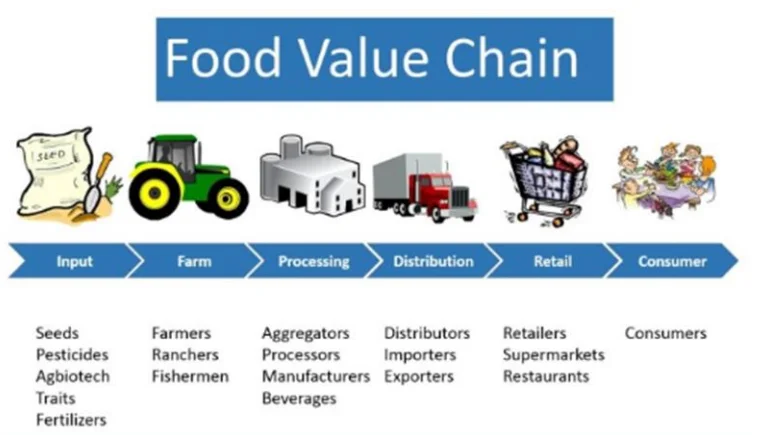
What is a Supply Chain?
A supply chain is a network that connects the origin of food to the final consumer.
It covers every step from raw material (farms) → processing (factories) → storage and transport → retail and export → consumers.
Stages of Food Processing Supply Chain
Suppliers (Farmers): Provide raw materials like grains, fruits, vegetables, milk, meat, etc.
Companies (Food Processors): Factories/industries that process raw food into packaged and value-added products (e.g., flour, biscuits, juice, pickles).
Distribution Network: Retail shops, supermarkets, wholesalers, e-commerce platforms, and exporters deliver products to customers.
Importance of Food Processing for India
Reducing Food Wastage: Processes surplus and imperfect crops to avoid wastage. Example: NITI Aayog estimated post-harvest losses of ₹90,000 crore annually.
Developing Infrastructure: Cold storages, warehouses, and transport facilities reduce spoilage at each level.
Food Preservation: Methods like freezing, canning, dehydration help increase shelf life of perishable goods.
Tackling Malnutrition: Processed foods can be fortified with vitamins and minerals to improve nutrition levels in India.
Boosting Exports: Processed food exports add to foreign exchange earnings and strengthen India's global trade.
Employment Generation: Creates jobs for farmers, factory workers, transporters, retailers, and exporters (both direct & indirect employment).
Encouraging Crop Diversification: Demand from food processing encourages farmers to grow different crops (fruits, vegetables, pulses, oilseeds).
| Stage | Role |
|---|---|
| Farmers (Suppliers) | Provide raw crops, milk, meat, fruits, vegetables. |
| Food Processing Companies | Convert raw materials into usable packaged products. |
| Distribution Network | Retailers, supermarkets, exporters deliver products to consumers. |
| Aspect | Benefit |
|---|---|
| Food Wastage Reduction | Cuts annual losses (₹90,000 crore in India). |
| Infrastructure | Better storage, transport, processing reduces spoilage. |
| Nutrition | Fortification helps reduce malnutrition. |
| Exports | Boosts India’s share in global food trade. |
| Employment | Direct and indirect jobs for millions. |
| Crop Diversification | Encourages farmers to grow diverse crops. |
Prelims tips
- India loses about ₹90,000 crore annually in post-harvest losses (NITI Aayog).
- Supply chain has 3 stages: Farmers → Processors → Distribution network.
- Food processing helps reduce wastage and adds value (mango → pickle).
- Important for exports, job creation, and tackling malnutrition.
Mains points
- Food supply chain links agriculture with consumers through processing and distribution.
- It reduces wastage, adds value, and supports both farmers and industries.
- Employment generation is a key outcome of this sector.
- Fortified foods help tackle malnutrition in India.
- Challenges: Poor infrastructure, cold storage shortages, and high food wastage remain bottlenecks.
Key Factors Driving Growth of Food Processing Industry
India’s food processing industry is growing rapidly due to demographic dividend, rising incomes, government support, digital transformation, innovation, and agri-tech integration. These factors are reshaping demand, improving efficiency, and boosting exports.
1. Demographic Dividend Driving Demand
India has a young population – 65% are under the age of 35.
Rising incomes and urbanisation are changing food habits from home-cooked meals to processed and ready-to-eat options.
Example: The processed food market in India was worth USD 263 billion in 2019-20 and is expected to grow to USD 470 billion by 2025.
2. Digital Revolution – From Farm to Plate
Digitalisation is making the food supply chain more efficient by connecting farmers directly to processors and retailers.
Example: Ninjacart, a B2B platform, directly connects farmers with businesses, reducing middlemen and wastage.
Initiatives like Digital India are enabling real-time tracking, e-commerce, and transparent pricing.
3. Government Policies Driving Growth
Strong policy support has made food processing a priority sector.
Example: Production Linked Incentive Scheme for Food Processing Industry (PLISFPI) launched in 2021 with ₹10,900 crore allocation to boost manufacturing and exports.
100% FDI (Foreign Direct Investment) through automatic route has attracted global companies to invest in India.
4. Innovation Fuels Success
Companies are launching new, healthier, and convenience-driven products to meet changing consumer demands.
Example: ITC’s ‘Farmland’ frozen foods offer preservative-free, minimally processed products, which gained popularity in FY 2023-24.
5. Agri-Tech Boosting Food Processing
Agri-tech startups are modernising agriculture through AI, IoT, and satellite monitoring.
Example: CropIn uses AI and satellite data to improve crop yield and quality, ensuring processors get consistent raw materials.
In 2023 alone, agri-tech startups raised over USD 706 million, reflecting huge growth potential.
| Factor | Explanation |
|---|---|
| Demographic Dividend | Young population, urbanisation, and rising incomes increase demand for processed foods. |
| Digital Revolution | Tech platforms connect farmers with businesses, reducing middlemen and wastage. |
| Government Policies | Schemes like PLISFPI and 100% FDI boost investments and exports. |
| Innovation | New healthy and convenient products reshape consumer choices. |
| Agri-Tech | AI and digital tools improve crop quality and supply chain efficiency. |
Prelims tips
- Processed food market in India projected to grow to USD 470 billion by 2025.
- Ninjacart is a major digital supply chain platform connecting farmers to businesses.
- PLISFPI launched in 2021 with ₹10,900 crore allocation.
- Agri-tech startups raised USD 706 million in 2023.
Mains points
- Demographic dividend and rising incomes are reshaping food demand patterns in India.
- Digital platforms are improving efficiency and reducing wastage in food supply chains.
- Government incentives like PLISFPI and 100% FDI are attracting global investments.
- Innovation in product lines is meeting new consumer preferences (health, convenience).
- Agri-tech is a game changer, ensuring quality supply and boosting the processing sector.
Export Potential and Global Competitiveness of Indian Processed Foods
India exports over 10,000 products globally, with food and agricultural products contributing about 11% of total exports. India’s agri-exports were 52.5 billion in 2022-23 and are expected to reach 100 billion by 2030, with major items like rice, sugar, spices, and marine products leading the basket.
Export Potential of Indian Processed Foods
India is the 18th largest exporter in the world with around 1.8% share in global merchandise exports.
Food and agricultural products contribute nearly 11% to India’s total exports, showcasing their critical role in foreign trade.
Agricultural exports were valued at 52.5 billion in 2022-23, up from 50.21 billion in 2021-22.
The government has set a target to almost double these exports to 100 billion by 2030.
Major export products: basmati & non-basmati rice, sugar, spices, oil meals (together 51.5% of total agri-exports).
Other exports: coffee, tea, tobacco, fruits, juices, vegetables, dairy, live animals, buffalo meat, marine products.
Challenges in Global Competitiveness
1. Fragmented Supply Chain
86% of Indian farmers are small and marginal, making aggregation difficult.
Farmers get only 30-35% of final value compared to 65-70% in developed economies.
2. Regulatory Labyrinth
Multiple regulators like FSSAI, APEDA, BIS, and state agencies cause overlaps and delays.
This complex regulatory system creates hurdles for exporters and small processors.
3. Infrastructure Deficit
Despite being 2nd largest fruit & vegetable producer, 25-30% produce is wasted annually.
Reason: inadequate cold chain, storage, and transportation facilities.
4. Skills Gap
Only 3% of the food processing workforce has formal training.
Lack of industry-academia collaboration causes shortage of skilled workers.
5. Quality Standards Issue
Inconsistent quality and weak enforcement of FSSAI standards hurt exports.
Small processors often cannot meet strict global quality benchmarks.
Way Forward
Leverage smart technologies (IoT, AI, robotics, automation) to boost efficiency and cut waste.
Focus on horticulture and animal products—India should aim to lead in at least 5 value chains (fruits & vegetables, fish & seafood, meat, dairy, poultry & eggs) by 2047.
Develop skilled manpower in food technology, safety, and processing methods.
Strengthen food packaging and labeling with clear health markers and enforce stronger safety standards.
Promote nutrient-rich grains like millets (declared International Year of Millets 2023) to tap into global health food demand.
| Category | Share/Details |
|---|---|
| Global Rank | 18th largest exporter (1.8% share in world exports) |
| Agri-export value 2022-23 | 52.5 billion |
| Target by 2030 | 100 billion |
| Top Products | Rice, sugar, spices, oil meals (51.5% share) |
| Other Exports | Coffee, tea, tobacco, fruits, vegetables, dairy, meat, seafood |
Prelims tips
- India’s agri-exports in 2022-23: 52.5 billion.
- Food products contribute ~11% of India’s exports.
- Top export items: rice, sugar, spices, oil meals.
- Target: 100 billion agri-exports by 2030.
- India loses 25-30% fruits & vegetables due to poor cold chain.
Mains points
- India has strong export potential with 52.5 billion agri-exports and a 100 billion target by 2030.
- Fragmented supply chain, poor cold chain, and regulatory complexity reduce competitiveness.
- Only 3% workforce in food processing has formal training—major skill gap exists.
- Smart technologies, skilled manpower, and better regulations can boost global competitiveness.
- Millets and other climate-resilient crops present future export opportunities.
Government Policy Initiatives and Measures for Food Processing Industry
The Government of India has launched several missions, schemes, and reforms to strengthen the food processing industry. These initiatives focus on decentralisation, investment promotion (FDI), infrastructure development, safety regulations, and formalisation of micro-enterprises.
National Mission on Food Processing (NMFP)
Launched in 2012 as a Centrally Sponsored Scheme (CSS) by Ministry of Food Processing Industries (MoFPI).
Aim: To decentralise implementation of food processing-related schemes by creating national, state, and district-level missions.
States and Union Territories were given larger roles in planning, monitoring, and executing policies.
Enhanced Ministry’s outreach for effective policy-making and oversight in food processing.
Foreign Direct Investment (FDI) Initiatives
100% FDI allowed in food marketing and processing through automatic route to attract foreign capital.
Focus: Strengthen supply chain infrastructure, logistics, and e-commerce in food sector.
FSSAI: Announced ₹482 crore investment to upgrade 59 existing food labs and establish 62 mobile testing labs to ensure safety and quality.
International Standards: Indian Council for Fertilizer and Nutrient Research (ICFNR) to adopt global best practices for ensuring quality fertilisers and food security.
Prime Minister’s Formalisation of Micro Food Processing Enterprises (PMFME) Scheme
Launched in 2020 under Atmanirbhar Bharat Abhiyan.
Objective: To formalise and strengthen the unorganised micro food processing enterprises.
Target: Upgrade/establish 2 lakh micro units by providing financial, technical, and business support.
ODOP (One District One Product) Approach: Promotes district-specific products, helping scale-up branding, marketing, and shared infrastructure.
Progress: By Dec 2022, 15,095 loans worth ₹1402.6 crore sanctioned; 713 districts and 137 products identified under ODOP.
| Initiative | Year | Objective |
|---|---|---|
| National Mission on Food Processing (NMFP) | 2012 | Decentralisation of schemes; state & district role |
| FDI in Food Sector | Liberalised in 2016+ | 100% FDI via automatic route; supply chain strengthening |
| PMFME Scheme | 2020 | Formalise micro-units; ODOP approach; 2 lakh enterprises support |
Prelims tips
- NMFP launched in 2012 to decentralise food processing schemes.
- 100% FDI allowed in food processing and retail via automatic route.
- FSSAI invested ₹482 crore in labs and mobile testing units.
- PMFME launched in 2020 under Atmanirbhar Bharat with ODOP approach.
Mains points
- Government initiatives decentralise food processing through NMFP, enhancing state-level accountability.
- 100% FDI policy boosts global investment and improves supply chain infrastructure.
- PMFME formalises unorganised micro-units, enhances competitiveness, and promotes ODOP branding.
- Food safety measures like FSSAI lab upgradation improve export potential and consumer confidence.
- Together, these policies aim to modernise the sector, reduce waste, and increase employment.
Pradhan Mantri Kisan SAMPADA Yojana (PMKSY)
PMKSY (Scheme for Agro-Marine Processing and Development of Agro-Processing Clusters) was approved in 2017 to modernize infrastructure, reduce food wastage, and strengthen supply chains from farm to retail. By Dec 2022, 677 projects had been completed.
Objectives of PMKSY
Create modern infrastructure for food processing and supply chain management.
Support farmers, cooperatives, entrepreneurs, and investors through facilities like cold storage, warehouses, and packaging units.
Encourage food processing plants near agricultural areas to reduce transport cost and post-harvest losses.
Provide government grants: 35% of approved project cost (50% in North-Eastern and Himalayan states).
Schemes under PMKSY
1. Mega Food Parks
Financial assistance up to ₹50 crore per project.
Provide plug-and-play infrastructure for food processors, entrepreneurs, and businesses.
Benefits: job creation, service improvement, and reduced processing costs.
2. Cold Chain and Value Addition Infrastructure
Aim: Create integrated cold chain from farm gate to consumer without any break.
Helps preserve perishable commodities like fruits, vegetables, dairy, fish, and meat.
3. Creation/Expansion of Food Processing/Preservation Capacities (Unit Scheme)
Supports new processing units and expansion of existing ones.
Encourages value addition, improves shelf life, and reduces wastage.
4. Infrastructure for Agro-Processing Clusters
Cluster-based approach near production areas.
Provides modern infrastructure and shared facilities to encourage group entrepreneurship.
5. Creation of Backward and Forward Linkages
Plug gaps in supply chain by integrating raw material availability with markets.
Strengthens connections between farmers and processors.
6. Food Safety and Quality Assurance Infrastructure
Establish quality surveillance and testing systems.
Ensures consumer safety and boosts export competitiveness.
7. Human Resources and Institutions
Supports R&D in food processing industry.
Focus on product and process development, efficient technologies, and better packaging.
| Scheme | Objective/Benefit |
|---|---|
| Mega Food Parks | ₹50 crore support; job creation; shared facilities |
| Cold Chain Infrastructure | Integrated cold chain from farm to consumer |
| Unit Scheme | Expansion of processing capacity; reduce wastage |
| Agro-Processing Clusters | Cluster approach near production areas |
| Backward & Forward Linkages | Stronger farm-to-market integration |
| Food Safety Infra | Quality testing & assurance |
| Human Resources & R&D | Efficient tech and packaging innovations |
Prelims tips
- PMKSY approved in 2017; full form: Scheme for Agro-Marine Processing and Development of Agro-Processing Clusters.
- Provides 35% project grant (50% in NE and Himalayan states).
- Includes Mega Food Parks, Cold Chains, Agro-Processing Clusters, and R&D.
- By Dec 2022: 677 projects completed.
Mains points
- PMKSY integrates multiple schemes under one umbrella to reduce food wastage and strengthen value chains.
- Mega Food Parks and Cold Chains improve infrastructure and logistics efficiency.
- Cluster-based approach encourages entrepreneurship near production areas.
- Food Safety infra and R&D ensure higher quality standards and innovation.
- Critical for doubling farmers’ income and boosting India’s agri-exports.
Schemes Supporting Food Processing Industry
India has introduced multiple schemes like the Production Linked Incentive (PLI), Operation Greens, Gram Samriddhi Yojana, TRIFOOD Project, and the NABARD Food Processing Fund to strengthen the food processing industry, reduce wastage, increase exports, and improve farmer incomes.
Production Linked Incentive Scheme (PLISFPI)
Launched in March 2022 to incentivize investments and create global food champions.
Focus areas: Marine products, processed fruits & vegetables, Ready-to-Eat (RTE) / Ready-to-Cook (RTC) products.
Phase-I: 149 applications approved; Phase-II: 33 applications (organic and millet-based).
Special Millet PLI Scheme with ₹800 crore outlay was also introduced.
Objectives:
Create global food manufacturing champions.
Promote Indian brands internationally.
Generate employment in off-farm jobs.
Provide remunerative prices for farmers’ produce.
Operation Greens
Announced in Union Budget 2018-19; initially focused on Tomato, Onion, Potato (TOP).
Expanded in 2021-22 to 22 perishable products.
Two Components:
Long-term: Value Chain Development Projects (investment in logistics, storage, processing).
Short-term: Price Stabilisation Measures (50% subsidy on transport & storage of surplus produce).
Gram Samriddhi Yojana
A ₹3000 crore World Bank-supported scheme.
Aims to strengthen unorganised rural food processing sector.
Focus areas: Upgrading technology, capacity-building, skill development, entrepreneurship, and farm-to-market linkages.
Targets cottage industries, farmer producer organisations (FPOs), and rural food processors.
TRIFOOD Project
Joint initiative by TRIFED, Ministry of Food Processing Industries (MoFPI), and Ministry of Tribal Affairs.
Focuses on tribal communities to increase incomes of forest gatherers.
Helps value addition in Minor Forest Produce (MFP) through processing and better market access.
Food Processing Fund (by NABARD)
Set up with corpus of ₹2000 crore.
Provides affordable loans to units in Mega Food Parks & Designated Food Parks.
Supports setting up new units, expansion, modernization, and working capital needs.
Offers both term loans and working capital at concessional rates.
| Scheme | Year/Outlay | Focus Area |
|---|---|---|
| PLI for Food Processing | 2022; ₹10,900 crore + ₹800 crore (millets) | Marine, fruits, vegetables, RTE/RTC, millet-based products |
| Operation Greens | 2018-19; expanded 2021-22 | TOP crops → 22 perishables; storage & transport subsidy |
| Gram Samriddhi Yojana | 2020s; ₹3000 crore (World Bank) | Rural, unorganised food processors |
| TRIFOOD Project | Ongoing | Tribal forest gatherers; MFP processing |
| Food Processing Fund | By NABARD; ₹2000 crore corpus | Affordable loans for units in Mega Food Parks |
Prelims tips
- PLI for Food Processing launched in 2022; millet-based PLI added later.
- Operation Greens initially for TOP crops; expanded to 22 perishables.
- Gram Samriddhi Yojana is World Bank funded.
- TRIFOOD focuses on Minor Forest Produce (MFP) and tribal incomes.
- NABARD Food Processing Fund corpus: ₹2000 crore.
Mains points
- PLI Scheme builds global champions in food manufacturing and boosts farmer incomes.
- Operation Greens reduces volatility in perishable crops market.
- Gram Samriddhi Yojana supports rural unorganised food processors.
- TRIFOOD adds value to forest produce, benefitting tribal communities.
- NABARD Food Processing Fund ensures affordable financing in Mega Food Parks.
Draft New Food Processing Policy, Krishi UDAN 2.0 and NABARD’s Role
The Draft National Food Processing Policy (2021) aims to transform India's food processing sector with higher investments, sustainability, and competitiveness. Complementary schemes like Krishi UDAN 2.0 and NABARD’s financing initiatives further strengthen food logistics, storage, and processing infrastructure.
Draft National Food Processing Policy (2021)
Announced on 10th December 2021 by Ministry of Food Processing Industries.
Goal: Increase investments in food processing sector six-fold by 2035.
Key Objectives:
1. Attain higher growth through investment in supply chain infrastructure & perishables’ processing capacity.
2. Improve competitiveness via technology upgrades, R&D, branding, and leveraging India’s unique strengths.
3. Ensure sustainability through efficient use of water & energy, adoption of eco-friendly technologies, better storage & packaging, and waste utilisation.
Krishi UDAN 2.0 (October 2021)
Aimed at transporting perishable food products (horticulture, fisheries, livestock, processed food) from hilly, north-eastern, and tribal regions.
Pilot project launched for six months.
Airports Authority of India (AAI) provides full waiver on landing, parking, and navigational charges for Indian cargo aircrafts.
Helps farmers increase value realisation by improving connectivity to markets.
Role of NABARD in Food Processing & Storage
Food Processing Fund (FPF):
Launched in 2014–15.
Provides affordable credit to public & private investors for Designated Food Parks (DFPs).
Supports infrastructure development inside food parks like processing units, storage, cold chain, packaging, etc.
Warehouse Infrastructure Fund (WIF):
Provides financial support to state governments, agencies, and corporations to build scientific warehouses.
Later expanded to include storage infrastructure in APMCs as eligible projects.
Objective: reduce post-harvest losses, improve food security, and strengthen supply chain.
| Scheme/Policy | Year | Focus Area |
|---|---|---|
| Draft Food Processing Policy | 2021 | Investment growth, sustainability, competitiveness |
| Krishi UDAN 2.0 | 2021 | Transport of perishables from remote regions |
| NABARD – Food Processing Fund | 2014-15 | Affordable loans for Designated Food Parks |
| NABARD – Warehouse Infrastructure Fund | 2010s | Scientific warehouses & APMC storage support |
Prelims tips
- Draft Food Processing Policy announced Dec 2021; aims to increase investment 6-fold by 2035.
- Krishi UDAN 2.0: Waives charges for cargo aircraft transporting perishables.
- NABARD runs two key funds – Food Processing Fund (FPF) and Warehouse Infrastructure Fund (WIF).
- APMC storage projects also eligible under WIF.
Mains points
- Draft Policy provides a roadmap for long-term sustainable growth in food processing.
- Krishi UDAN 2.0 integrates remote farmers into national supply chains, reducing wastage.
- NABARD’s financing role is crucial for developing infrastructure in both food parks and warehousing.
- Together, these measures address bottlenecks in logistics, storage, technology adoption, and market access.
Food Fortification in India
Food fortification is the deliberate addition of micronutrients (like iron, iodine, vitamins, folic acid, zinc) to commonly consumed foods to improve public health and fight malnutrition. It is a complementary measure, not a replacement for a balanced diet.
What is Food Fortification?
It means adding one or more essential nutrients to food, either naturally absent or lost during processing, to correct deficiencies.
Example: Adding iodine to salt to prevent goitre, or iron and folic acid to rice/wheat to reduce anaemia.
It is seen as a cost-effective and mass-scale intervention against 'hidden hunger' (micronutrient deficiency).
Advantages of Food Fortification
1. Improves Health: Reaches large population at once as it is added to staple foods (like salt, rice, wheat flour, edible oil, milk).
2. Safe & Regulated: Nutrient amounts are very small and strictly regulated by FSSAI standards.
3. Culturally Acceptable: Does not change taste, look, or eating habits; people consume fortified food without resistance.
4. Cost-Effective & Quick Results: According to the Copenhagen Consensus, every ₹1 spent on fortification gives ₹9 in economic benefits.
Need for Food Fortification in India
Nearly 70% of Indians consume less than half of their Recommended Dietary Allowance (RDA) of essential micronutrients.
Known as 'hidden hunger', this deficiency causes night blindness (Vitamin A), goitre (iodine deficiency), anaemia (iron deficiency), and birth defects (lack of folic acid).
NFHS-4 Data (2015-16):
58.4% of children (6–59 months) are anaemic.
53.1% of women (15–49 years) are anaemic.
35.7% of children under 5 are underweight.
50–70% of certain birth defects (like neural tube defects) are preventable through folic acid fortification.
Challenges to Food Fortification
1. Voluntary in Nature: Fortification is not mandatory; limited adoption by states and companies.
2. Weak State-Level Implementation: Lack of policy guidelines, budget, technology, and logistics has slowed large-scale adoption in ICDS, MDMS, and PDS.
3. Institutional Weakness: FSSAI lacks sufficient manpower and resources to enforce standards nationwide.
4. Public Awareness Gap: Misconceptions and low awareness among people about benefits of fortified food.
Way Forward
Make fortification mainstream in government schemes (ICDS, PDS, MDMS) to reach vulnerable groups.
Strengthen FSSAI’s institutional and monitoring capacity.
Increase awareness campaigns to build trust among consumers.
Encourage industry partnerships to scale up food fortification.
Over the long run, fortification will combat malnutrition, boost food processing industry, and improve consumer confidence.
| Aspect | Details |
|---|---|
| Definition | Adding micronutrients (iron, iodine, vitamins, zinc) to staple foods |
| Objective | Correct deficiencies, prevent malnutrition diseases like anaemia & goitre |
| NFHS-4 Data | 58.4% children & 53.1% women anaemic |
| Nature | Currently voluntary, not mandatory |
| Economic Return | ₹1 spent = ₹9 benefit (Copenhagen Consensus) |
Prelims tips
- Food Fortification is currently voluntary under FSSAI standards.
- NFHS-4 data highlights high anaemia rates in women & children.
- Micronutrient deficiency = 'Hidden Hunger'.
- Examples: Iodised salt, fortified rice/wheat, fortified edible oil, fortified milk.
Mains points
- Food fortification is a low-cost, high-impact strategy to tackle malnutrition in India.
- Acts as a complementary measure to ICDS, PDS, and Mid-Day Meal Scheme.
- Challenges: voluntary adoption, weak FSSAI enforcement, low awareness.
- Way forward: make fortification mandatory in public food schemes, enhance awareness campaigns, strengthen FSSAI capacity.
- Long-term impact: reduced hidden hunger, better human capital, improved productivity.
Agricultural Price Support
Agricultural Price Support refers to government interventions aimed at preventing farm produce prices from falling below a certain level. The most common method in India is the Minimum Support Price (MSP), where the government guarantees to buy certain crops at a pre-announced price if market prices fall too low, thus ensuring income stability for farmers.
What is Agricultural Price Support?
Imagine farmers grow a lot of wheat one year (bumper crop). With so much supply, the market price might crash, hurting the farmers even though they worked hard.
Agricultural Price Support is like a safety net provided by the government.
The government steps in to ensure that prices don't fall too low, protecting farmers from severe losses.
Goal: To ensure farmers get a minimum income, encourage production of essential crops, and maintain food security.
Common Methods
1. Minimum Support Price (MSP):
This is India's main price support mechanism.
Before the sowing season, the government announces a minimum price (MSP) for certain crops (currently 23 crops like wheat, rice, pulses, oilseeds).
If the market price for these crops falls below the MSP after harvest, government agencies (like FCI - Food Corporation of India) will buy the produce directly from farmers at the MSP.
This guarantees farmers a minimum return for their efforts.
MSP is recommended by the Commission for Agricultural Costs and Prices (CACP) and approved by the Cabinet Committee on Economic Affairs (CCEA).
2. Buffer Stocks:
The government buys and stores excess food grains (procured usually at MSP) during good harvest years.
These stocks are used during lean years or emergencies to stabilize prices and ensure food availability (e.g., through PDS - Public Distribution System).
3. Deficiency Payments:
Less common in India for major crops.
Here, farmers sell their produce in the open market at whatever price they get.
If the market price is below a pre-set support price, the government pays the farmer the difference (the 'deficiency'). Example: Price Support Scheme (PSS) for oilseeds & pulses uses this sometimes.
Benefits of Price Support (especially MSP)
Income Security: Protects farmers from price crashes due to overproduction or market fluctuations.
Production Incentive: Encourages farmers to grow essential crops needed for food security.
Food Security: Ensures adequate procurement for PDS and buffer stocks.
Investment Signal: Assured prices encourage farmers to invest in better seeds, fertilizers, and technology.
Challenges and Criticisms
Limited Coverage: MSP benefits are largely concentrated in certain regions (Punjab, Haryana, Western UP) and crops (mainly wheat and rice). Many small farmers and crops are left out.
Market Distortion: Guaranteed MSP can lead to overproduction of supported crops (like rice and wheat) while discouraging diversification into other needed crops (like pulses and oilseeds). It can also lead to artificial price levels not reflecting actual demand/supply.
Fiscal Burden: Government procurement, storage, and handling involve huge costs.
Inefficient Procurement & Storage: Issues like inadequate storage facilities (leading to wastage) and delays in payment to farmers.
WTO Concerns: Other countries argue that India's MSP constitutes trade-distorting subsidies.
Conclusion
Agricultural price support, primarily through MSP, is a vital tool for farmer income security and national food security in India. However, it faces challenges related to coverage, market distortion, and fiscal costs, requiring continuous reforms to make it more effective and sustainable.
Prelims tips
- Agricultural Price Support: Govt intervention to prevent farm prices from crashing.
- MSP (Minimum Support Price): India's main tool; guaranteed price for 23 crops.
- MSP recommended by CACP, approved by CCEA.
- Govt buys at MSP if market price falls below it.
- Challenges: Limited crop/region coverage, market distortion, fiscal cost.
Mains points
- MSP acts as a safety net for farmers, ensuring income stability against price volatility.
- It plays a crucial role in India's food security strategy by incentivizing production of key staples.
- However, its implementation challenges (limited reach, procurement issues) and negative consequences (crop imbalance, fiscal burden, WTO disputes) necessitate reforms.
- Reforms could include better targeting, linking MSP to market prices (like deficiency payments), promoting crop diversification, and strengthening procurement infrastructure.
MSP and Procurement: Issues and the Legal Guarantee Debate
The Minimum Support Price (MSP) is announced for 22 mandated crops on the recommendation of the CACP, and since 2018-19 is set at at least 1.5 times the A2+FL cost. But effective procurement is concentrated in rice and wheat and a few states, so most farmers never sell at MSP. Farmers' demand for a legal guarantee raises questions of fiscal cost, market distortion and crop diversification.
1. How MSP Is Fixed
CACP (Commission for Agricultural Costs and Prices, 1965) recommends; the Cabinet Committee on Economic Affairs approves.
Crops: 14 kharif, 6 rabi and 2 commercial crops (jute, copra); sugarcane has a separate Fair and Remunerative Price (FRP).
Factors: Cost of production, demand-supply, domestic and international prices, inter-crop parity, terms of trade.
2. Cost Concepts
A2: Paid-out costs (seeds, fertiliser, hired labour, machinery, irrigation).
A2+FL: A2 plus imputed value of family labour—current MSP is at least 1.5 times this.
C2: Comprehensive cost including rent on owned land and interest on owned capital; the Swaminathan Commission (National Commission on Farmers, 2004–06) recommended MSP at C2 + 50%.
3. Procurement System
FCI and state agencies procure mainly wheat and paddy for the central pool, which feeds the PDS and buffer stocks.
Decentralised Procurement (since 1997-98): States procure and distribute themselves.
PM-AASHA (2018): Price Support Scheme for pulses and oilseeds, Price Deficiency Payment Scheme (pay the gap between MSP and market price), and private procurement pilot.
Reach: The Shanta Kumar Committee (2015), using NSSO data, noted that only about 6% of farmers sold to procurement agencies at MSP.
4. Problems
Regional skew: Procurement concentrated in Punjab, Haryana, Madhya Pradesh and a few others.
Crop bias: Paddy-wheat favoured over pulses, oilseeds and millets; drives groundwater depletion in the north-west.
Stocks: Central pool often far above buffer norms, raising storage costs and wastage.
Fiscal cost of the food subsidy; WTO limits on trade-distorting support.
5. The Legal Guarantee Debate
For: Income security, protection from distress sales, bargaining power for small farmers.
Against: Huge fiscal burden if the government must buy all produce; private traders may exit if forced to pay MSP; could lock in the cereal bias.
Middle path: Price deficiency payments, wider procurement of pulses and millets, better markets, and a committee (constituted in 2022) on MSP, crop diversification and natural farming.
| Concept | Includes | Policy use |
|---|---|---|
| A2 | Paid-out costs | Base cost |
| A2+FL | A2 + family labour | MSP ≥ 1.5 × A2+FL (since 2018-19) |
| C2 | A2+FL + rent on owned land + interest on capital | Swaminathan: MSP = 1.5 × C2 |
Prelims tips
- CACP is an attached office of the Ministry of Agriculture; it is not a statutory body.
- MSP is announced for 22 crops; sugarcane gets FRP.
- MSP has no statutory backing; FRP for sugarcane is fixed under the Essential Commodities Act.
- PM-AASHA (2018) includes PSS, PDPS and PPSS.
- Swaminathan Commission recommended MSP at C2 + 50%.
Mains points
- MSP is effective only where procurement exists; for most farmers it is a signal, not a guarantee.
- Open-ended procurement of rice and wheat has created ecological costs (groundwater, stubble burning) and nutritional imbalance.
- A legal guarantee for all crops is fiscally risky; targeted price-deficiency payments and stronger procurement of pulses, oilseeds and millets are more feasible.
- Better market infrastructure (storage, FPOs, e-NAM) can raise market prices so that MSP matters less.
- MSP reform must be linked to crop diversification and regional water realities.
Did you know?
- MSP was first announced for wheat in 1966-67, at the start of the Green Revolution.
- CACP was originally called the Agricultural Prices Commission (1965) and renamed in 1985.
- Madhya Pradesh's Bhavantar Bhugtan Yojana (2017) was an early state experiment with price deficiency payments.
Agricultural Marketing Reforms: APMC, e-NAM and FPOs
Farmers often receive a small share of the consumer's rupee because of fragmented markets, many intermediaries and weak bargaining power. Agricultural marketing is a state subject, regulated through state APMC Acts. Reforms include the Model APLM Act (2017), the online e-NAM platform (2016), Farmer Producer Organisations (FPOs) and warehouse-based trading; the three central farm laws of 2020 were repealed in 2021.
1. The APMC System
Regulated markets (mandis) set up under state Agricultural Produce Market Committee Acts to protect farmers from exploitation by traders and moneylenders.
Problems: Licensing barriers that create trader cartels, high market fees and commissions, delayed payments, few mandis in many states, and political capture of committees.
Market density: The National Commission on Farmers suggested a regulated market within about 5 km of every farmer; actual coverage is far lower in most states.
2. Reform Attempts
Model APMC Act (2003): Private markets, direct marketing, contract farming.
Model Agricultural Produce and Livestock Marketing (APLM) Act (2017): Whole state as a single market, single trading licence, cap on fees.
Model Contract Farming Act (2018).
Farm laws (2020): Trade outside APMC yards, contract farming framework, amendment to the Essential Commodities Act—repealed in November 2021 after farmers' protests.
Bihar abolished its APMC Act in 2006; outcomes are debated.
3. e-NAM (2016)
Online trading portal linking APMC mandis, run by the Small Farmers' Agribusiness Consortium (SFAC); aims at transparent price discovery and inter-mandi trade.
Limits: Little inter-state trade, lack of assaying and grading facilities, poor internet in mandis.
4. Farmer Producer Organisations
Collectives of farmers registered as companies or cooperatives; aggregate produce, buy inputs in bulk, and negotiate better prices.
Scheme for formation of 10,000 FPOs (2020), implemented through SFAC, NABARD and NCDC.
5. Supporting Infrastructure
Agriculture Infrastructure Fund (2020): Financing for cold storage, warehouses and processing.
Warehouse receipts: Warehousing (Development and Regulation) Act, 2007 and WDRA enable loans against stored produce.
Gramin Agricultural Markets (GrAMs) upgrading rural haats.
6. Way Forward
Cooperative federalism to persuade states, more mandis and grading facilities, strong FPOs with working capital, and price information through digital tools.
| Instrument | Year | Purpose |
|---|---|---|
| Model APMC Act | 2003 | Private markets, direct marketing |
| e-NAM | 2016 | Online national trading platform |
| Model APLM Act | 2017 | Single state market, unified licence |
| 10,000 FPO scheme | 2020 | Collective bargaining by farmers |
| Agriculture Infrastructure Fund | 2020 | Post-harvest infrastructure finance |
Prelims tips
- Agriculture and markets are State List subjects.
- e-NAM was launched in April 2016 and is implemented by SFAC.
- WDRA regulates warehouses under the Warehousing (Development and Regulation) Act, 2007.
- Bihar repealed its APMC Act in 2006.
- The three farm laws of 2020 were repealed in November 2021.
Mains points
- Market reform is as much about infrastructure (roads, storage, grading) as about laws; deregulation without infrastructure helps few farmers.
- FPOs are the most promising route to bargaining power for small farmers, but need professional management and working capital.
- Reforms must be negotiated with states and farmers; the farm-laws episode shows the cost of limited consultation.
- Digital platforms can improve price discovery only when quality assaying and logistics enable trade across mandis.
- Price risk tools—warehouse receipts, futures, and insurance—complement market access.
Did you know?
- Amul, born from a 1946 farmers' cooperative movement in Kheda (Gujarat), is a classic example of farmers capturing more of the consumer price.
- Sahyadri Farms in Nashik is one of India's best-known FPO success stories in fruit exports.
- Kerala's vegetable and fruit price floor scheme (2020) fixed base prices for several vegetables.
Farm Subsidies in India and WTO Boxes
Indian agriculture is supported through input subsidies (fertiliser, power, irrigation, credit, insurance), price support (MSP procurement) and direct income support (PM-KISAN, ₹6,000 a year). Subsidies protect poor farmers but also cause imbalanced fertiliser use, groundwater depletion and fiscal strain, and are disciplined internationally by the WTO's Amber, Blue and Green Boxes.
1. Types of Subsidies
Fertiliser: Urea is sold at a statutorily fixed low price, with the government paying the rest; phosphatic and potassic (P&K) fertilisers get a fixed subsidy per nutrient under the Nutrient Based Subsidy (NBS) scheme (2010).
Power: Free or cheap electricity for farm pumps in many states.
Irrigation: Canal water charges far below cost.
Credit: Interest subvention on short-term crop loans through Kisan Credit Cards.
Insurance: PMFBY (2016)—farmers pay 2% of sum insured for kharif, 1.5% for rabi, 5% for commercial/horticulture crops; the rest is shared by governments.
Direct income support: PM-KISAN (2019)—₹6,000 a year in three instalments to landholding farmer families.
2. Problems
Fertiliser imbalance: Cheap urea leads to overuse of nitrogen; the recommended NPK ratio is about 4:2:1 but actual use is heavily skewed, damaging soil health.
Groundwater: Free power encourages over-pumping and water-intensive crops like paddy in Punjab.
Regressive benefits: Larger farmers and those with irrigation gain more; tenants often miss PM-KISAN.
Diversion: Subsidised urea diverted to industry or across borders.
Fiscal burden and pending dues to fertiliser companies and DISCOMs.
3. Reforms
Neem-coated urea (100% from 2015) to curb diversion and improve efficiency; Nano urea (liquid) introduced by IFFCO in 2021.
DBT in fertiliser (payment to companies after sale through PoS devices); One Nation One Fertiliser ('Bharat' brand, 2022).
Soil Health Cards (2015) for balanced nutrient use; PM-PRANAM to reward states that reduce chemical fertiliser use.
Solar pumps (PM-KUSUM) and metered power to reduce power subsidy.
4. WTO Agreement on Agriculture
Amber Box: Trade-distorting support (price support, input subsidies); limited by de minimis—10% of the value of production for developing countries.
Blue Box: Support linked to production-limiting programmes.
Green Box: Minimally distorting support (research, extension, income support not linked to production)—no limits.
Public stockholding: India's food security procurement is protected by the 'peace clause' agreed at the Bali Ministerial (2013) until a permanent solution is found.
| Box | Nature | Limit | Indian example |
|---|---|---|---|
| Amber | Trade-distorting | De minimis 10% (developing) | MSP price support, fertiliser subsidy |
| Blue | Production-limiting payments | No limit (conditions apply) | Rarely used by India |
| Green | Minimal distortion | No limit | Research, extension, PM-KISAN |
Prelims tips
- NBS scheme (2010) covers P&K fertilisers, not urea.
- PM-KISAN: ₹6,000 a year in three equal instalments.
- PMFBY farmer premium: 2% kharif, 1.5% rabi, 5% commercial/horticultural.
- De minimis limit for developing countries under the AoA is 10%.
- The 'peace clause' for public stockholding was agreed at Bali (2013).
Mains points
- Subsidies are justified for small farmers facing risk and imperfect markets, but their design determines whether they help or harm.
- Moving from price and input subsidies to direct income support is less distorting and fits the WTO Green Box.
- Urea's fixed price is the root of nutrient imbalance; bringing urea under NBS is a long-pending reform.
- Power subsidies have hidden costs in groundwater depletion; metering with direct transfers can protect farmers while saving water.
- India must defend food-security procurement at the WTO while modernising its support towards research, irrigation efficiency and resilience.
Did you know?
- Telangana's Rythu Bandhu (2018) was a per-acre investment support scheme that inspired the national debate on income support.
- Neem coating slows the release of nitrogen, so plants absorb more of it.
- Odisha's KALIA scheme (2018-19) tried to include landless households and tenants in income support.
Digital Agriculture and E-Technology for Farmers
Digital technology can help farmers get better information, credit, insurance and prices. India is building an Agri Stack under the Digital Agriculture Mission (2024)—farmer registries, digital crop surveys and geo-referenced village maps—alongside tools such as e-NAM, Soil Health Cards, Kisan drones and remote sensing for crop insurance.
1. Why Digital Agriculture
Information gaps on weather, prices and inputs; high cost of credit and insurance because of poor data; fragmented landholdings make personalised advice hard.
2. Digital Agriculture Mission (2024)
Agri Stack: (i) Farmers' Registry with a unique Farmer ID linked to land records; (ii) Crop Sown Registry through Digital Crop Survey; (iii) geo-referenced village maps.
Krishi Decision Support System: Combines remote sensing, weather, soil and crop data.
Soil profile mapping and digital crop yield estimation.
3. Key Tools and Schemes
e-NAM (2016): Online mandi trading.
Soil Health Card (2015): Nutrient status and fertiliser recommendations for each holding.
Kisan Call Centres (2004) and mKisan SMS advisories; AI chatbots in local languages.
Kisan drones: Spraying pesticides and nutrients, crop assessment; Namo Drone Didi (2023) gives drones to women's SHGs.
Remote sensing for PMFBY: Satellite and technology-based yield estimation (YES-TECH) to speed up claims.
Kisan Credit Card digitisation and the Kisan Rin portal; Digital Public Infrastructure enabling credit based on land and crop data.
Agri-tech start-ups: Input marketplaces, farm-gate procurement, precision irrigation, IoT sensors.
4. Benefits
Timely advisories reduce losses; transparent trade; faster insurance claims; targeted subsidies; lower transaction costs for lenders.
5. Challenges
Digital divide: Low smartphone ownership and digital literacy among women and older farmers; poor rural connectivity.
Land records: Outdated records exclude tenants and women cultivators from farmer IDs.
Data governance: Consent, ownership and privacy of farmer data; risk of exploitation by private platforms.
Affordability of drones and precision tools for small farmers.
6. Way Forward
Assisted access via FPOs, CSCs and Krishi Vigyan Kendras; voice-based tools in local languages; inclusion of tenants; strong data-protection rules aligned with the DPDP Act, 2023.
| Stage | Tool |
|---|---|
| Planning | Soil Health Card, weather advisories |
| Inputs and credit | Kisan Credit Card, DBT in fertiliser |
| Crop care | Kisan drones, pest alerts |
| Risk | PMFBY with remote sensing |
| Marketing | e-NAM, FPO platforms |
Prelims tips
- Agri Stack components: Farmers' Registry, Crop Sown Registry, geo-referenced village maps.
- Digital Agriculture Mission was approved in 2024.
- Namo Drone Didi provides drones to women's self-help groups.
- Soil Health Card scheme was launched in 2015.
- Kisan Call Centres started in 2004.
Mains points
- Digital public infrastructure for agriculture can lower the cost of credit, insurance and extension for millions of small farmers.
- Technology complements but cannot replace physical infrastructure, extension workers and market reforms.
- Inclusion of tenants, women and landless cultivators in digital registries is essential to avoid reinforcing existing inequalities.
- Clear rules on farmer data ownership and consent will determine whether Agri Stack empowers farmers or platforms.
- Collective models (FPOs, SHG-owned drones) make costly technology affordable for small holders.
Did you know?
- ITC's e-Choupal (2000) placed internet kiosks in villages so farmers could check prices before selling.
- India's Krishi Vigyan Kendras (first set up in 1974 at Puducherry) are front-line extension centres in districts.
- Drones can spray an acre of crop in minutes, reducing farmers' exposure to pesticides.
Small and Marginal Farmers: Challenges and Policy Support
Most Indian farmers are small (1–2 ha) or marginal (less than 1 ha). According to the Agriculture Census 2015-16, they hold about 86% of all holdings but operate less than half of the area, and the average holding is about 1.08 ha. Their problems—tiny plots, informal credit, weak market access and high risk—make them the central concern of agricultural policy.
1. Classification of Holdings
Marginal: below 1 ha; Small: 1–2 ha; Semi-medium: 2–4 ha; Medium: 4–10 ha; Large: 10 ha and above.
Holdings keep shrinking through inheritance and population growth.
2. Challenges
Low income: The NSO Situation Assessment Survey (2019) found farming households depend heavily on wages and livestock, not just crops.
Credit: Many rely on moneylenders at high interest; tenants without land records cannot access KCC loans.
Mechanisation: Machines are uneconomical on tiny plots.
Market access: Small surplus, distant mandis, distress sale to local traders.
Risk: Rain-fed farming, climate shocks, low insurance awareness.
Tenancy: Informal leasing gives tenants no security or access to schemes.
3. Policy Support
Income support: PM-KISAN; state schemes like Rythu Bandhu (Telangana) and KALIA (Odisha).
Collectivisation: 10,000 FPO scheme; cooperatives; Ministry of Cooperation (2021).
Credit: KCC with interest subvention, priority-sector lending targets for small and marginal farmers, Joint Liability Groups for tenants.
Mechanisation: Custom Hiring Centres and farm machinery banks.
Risk: PMFBY, weather-based insurance.
Land leasing: NITI Aayog's Model Agricultural Land Leasing Act (2016) to legalise and protect tenancy.
Diversification: Horticulture, dairy, poultry, fisheries for higher value per acre.
4. Way Forward
Strong FPOs with market linkages; secure tenancy; non-farm jobs in rural areas to absorb surplus labour; climate-resilient practices and natural farming; better extension through KVKs and digital tools.
| Category | Size |
|---|---|
| Marginal | Below 1 ha |
| Small | 1–2 ha |
| Semi-medium | 2–4 ha |
| Medium | 4–10 ha |
| Large | 10 ha and above |
Prelims tips
- Agriculture Census is conducted every five years by the Ministry of Agriculture.
- Agriculture Census 2015-16: small and marginal holdings about 86%; average holding 1.08 ha.
- Marginal holding: less than 1 hectare.
- Model Agricultural Land Leasing Act (2016) was drafted by NITI Aayog.
- Ministry of Cooperation was created in 2021.
Mains points
- Small farms are often more productive per hectare but cannot generate enough income; the problem is scale of income, not efficiency alone.
- Collective action (FPOs, cooperatives) is the main way to give small farmers economies of scale without land consolidation.
- Secure tenancy laws would unlock credit and scheme benefits for actual cultivators.
- Long-term solutions lie in rural non-farm employment and skill development to reduce dependence on tiny plots.
- Policy must recognise women farmers, who do much of the farm work but rarely own land.
Did you know?
- Kerala's Kudumbashree groups lease land collectively for 'group farming' by women.
- The average landholding in India has roughly halved since 1970-71.
- Custom hiring lets a farmer rent a tractor or harvester by the hour instead of buying one.