
Indian Economy · UPSC Notes
Money — UPSC Economy Notes
Free, exam-focused notes for UPSC Prelims and Mains, with Prelims tips and Mains points for every topic. 17 topics.
Open in the interactive reader: bookmarks, progress tracking and read-aloud.
Money – Meaning and Functions
Money is anything that is generally accepted as a medium of exchange, a measure of value, a store of wealth, and a standard for deferred payments. It makes trade and economic activity easier by eliminating the limitations of barter system.
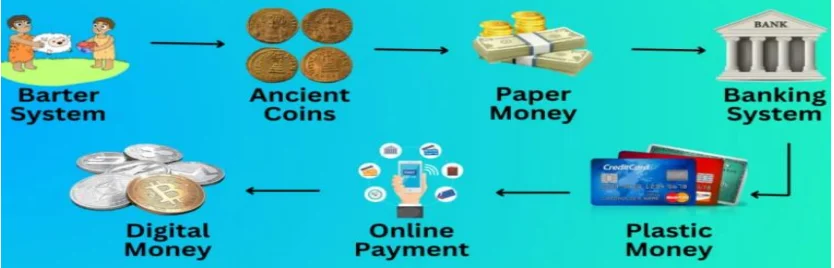
Introduction
Money is generally accepted as payment for goods and services, as well as repayment of debts.
It acts as a medium of exchange, replacing the barter system where goods were exchanged directly.
Without money, transactions would be complex as people would have to find someone who wanted exactly what they had to offer (double coincidence of wants).
Primary Functions of Money
1. Medium of Exchange
Money facilitates exchange of goods and services in an economy.
It is the most liquid asset (can be quickly and easily used without loss of value).
Example: You can buy food with currency notes rather than exchanging goods like rice for clothes.
2. Measure of Value (Unit of Account)
Money provides a common measure for valuing goods and services.
All goods and services can be expressed in terms of money units (like Rupees, Dollars, etc.).
Example: A book costs ₹200 and a shirt costs ₹400. Money makes it possible to compare values easily.
Secondary Functions of Money
1. Store of Value
Money can be saved and used in the future to purchase goods and services.
Unlike perishable goods (milk, fruits), money can be stored with very low cost.
However, it is not a perfect store of value because inflation reduces purchasing power over time.
Example: ₹100 today buys less goods after 10 years if prices keep rising.
2. Standard of Deferred Payments
Deferred payments mean payments promised for the future (like loans, EMIs).
Money is used for such payments because it retains value and is accepted widely.
Example: A loan of ₹10,000 today will be repaid in the future in money terms.
3. Transfer of Value
Money allows transfer of purchasing power from one person to another or from one place to another.
Example: Sending ₹5,000 online to a friend in another city transfers value instantly.
Other Functions of Money
1. Distribution of National Income
National income is measured and distributed in monetary terms using the income method.
Wages, rent, interest, and profits are all paid in money, making accounting and distribution easy.
2. Liquidity
Money is highly liquid (easily usable).
It can be divided into smaller units (₹1, ₹2 coins or ₹10, ₹100, ₹500 notes) to suit convenience.
3. Uniformity of Value
Money gives a uniform value measure for goods and services that cannot be compared physically.
Example: Comparing value of 1 kg of rice and 1 litre of petrol is possible only in money terms.
| Type | Function | Example |
|---|---|---|
| Primary | Medium of Exchange | Buying groceries with ₹500 note |
| Primary | Measure of Value | A pen costs ₹20, a shirt costs ₹500 |
| Secondary | Store of Value | Saving ₹1000 in wallet for future use |
| Secondary | Deferred Payments | Paying back a loan in instalments |
| Secondary | Transfer of Value | Sending money online to another city |
| Other | Distribution of National Income | Wages, rent, interest paid in money |
| Other | Liquidity | Breaking ₹500 note into smaller denominations |
| Other | Uniformity of Value | Comparing value of rice and petrol using ₹ |
Prelims tips
- Money overcomes the problem of double coincidence of wants in barter system.
- Primary functions: Medium of exchange & Measure of value.
- Secondary functions: Store of value, Deferred payments, Transfer of value.
- Other functions: Liquidity, uniformity, national income distribution.
Commodity Money and Barter System
Before the invention of modern currency, trade was carried out using commodity money and barter system. Commodity money had intrinsic value, while barter involved direct exchange of goods and services.
Commodity Money
Commodity money is a physical item that is interchangeable with another item of the same type.
It has intrinsic value, meaning it is valuable in itself (unlike paper notes that have only assigned value).
Examples: Iron nails, bear pelts, cocoa beans, whale teeth, gold nuggets, silver coins.
Challenges of Commodity Money
Perishability: Many items (like food grains, animal skins) spoil over time and lose value.
Bulky to transport: Carrying heavy or large commodities is difficult compared to paper currency.
Hyperinflation Risk: Sudden increase in commodity supply can collapse its value (e.g., gold rush).
Does not promote division of labour: Everyone must directly exchange, limiting specialization.
Limited in international trade: Hard to agree on a universal commodity standard globally.
Barter System
Direct exchange of goods and services without using money.
Oldest trade mechanism, used before the invention of coins or paper money.
Commonly exchanged goods: furs, skins, salt, rice, wheat, utensils, weapons, etc.
Types of Barter
1. Barter among Individuals – Example: Farmer exchanges wheat with carpenter for tools.
2. Barter among Companies – Example: Company offers products in exchange for advertisement services (B2B).
3. Barter among Countries – Example: Oil exchanged for food between nations.
Types of Money (by nature)
Full-bodied money: face value equals intrinsic (metal) value – e.g. old gold coins.
Token money: face value is higher than intrinsic value – e.g. present-day coins.
Fiat money: money by government order (legal tender), e.g. currency notes and coins; its value does not depend on the material.
Fiduciary money: accepted because of trust between payer and payee, not legal tender – e.g. cheques and demand drafts.
Near money: highly liquid assets that are not a medium of exchange themselves but are easily converted into money – e.g. time deposits, treasury bills, bonds.
| Aspect | Commodity Money | Barter System |
|---|---|---|
| Definition | Physical item with intrinsic value used as money | Direct exchange of goods/services without money |
| Value | Has intrinsic value (e.g., gold, cocoa beans) | Depends on mutual agreement |
| Challenges | Perishable, bulky, limited trade | Double coincidence of wants problem |
| Use in History | Used in early civilizations | Dominant before invention of money |
| Modern Relevance | Rare, replaced by currency | Still used in B2B & international trade |
Prelims tips
- Commodity money has intrinsic value (gold, silver).
- Barter suffers from 'Double Coincidence of Wants'.
- Barter still used in modern B2B and between nations.
Mains points
- Commodity money was a natural stage in evolution of money but limited due to perishability, bulkiness, and lack of uniformity.
- Barter system enabled trade but suffered from 'double coincidence of wants' – both parties must want what the other offers.
- Neither commodity money nor barter could support large-scale economies, industrialization, or globalization.
- The limitations of barter and commodity money created need for standardized, universally accepted money (coins, paper currency, and later digital money).
- Understanding these systems shows why monetary institutions like RBI and global currency systems are crucial today.
Demerits of Barter System & Evolution to Metallic Money
Barter system, though historically important, faced multiple limitations such as lack of common measurement, double coincidence of wants, and storage issues. To overcome these, societies gradually shifted to metallic standards (gold/silver) and coinage systems.
Demerits of Barter System
Search Cost: Finding a trading partner with desired goods/services was time-consuming.
Lack of Double Coincidence of Wants: Exchange possible only if both parties wanted what the other offered. Very unrealistic in large economies.
Lack of Divisibility: Some goods (like buffalo, house) cannot be divided into smaller parts to match value of smaller goods.
Lack of Common Unit of Measurement: No standard to compare value of wheat vs tools vs cattle.
Loss of Value: Many goods (food, skins, grains) lost value/quality over time when stored.
Metallic Standard
Shift from barter to use of metals as money.
Gold Standard: Value of currency linked directly to fixed weight of gold.
Silver Standard: Value of currency linked to fixed weight of silver. Example: Silver Tanka, Sher Shah Suri’s Rupiya (silver coin).
Ensured wider acceptability, durability, and standardization.
Full Bodied Coins
Intrinsic value of coin = or > face value (market price).
Example: 1 Rupee silver coin (worth its weight in silver).
Token Coins
Intrinsic value < face value.
Example: ₹1 stainless steel coin.
Metals like cupronickel used to discourage melting.
Coinage Act 2011 prohibits melting of coins.
Challenges of Metallic Coins
Hoarding: If metal value > coin value, people hoard coins instead of using them.
Melting: High intrinsic value coins are melted into bullion for profit.
Debasement: Reducing metal content in coins when treasury weakens → inflation.
Demonetization: Both full-bodied and token coins can be demonetized (withdrawn from circulation).
| Aspect | Barter System | Metallic Money |
|---|---|---|
| Unit of Value | No common unit | Gold/Silver weight as standard |
| Divisibility | Difficult to divide goods | Coins easily divisible |
| Storage | Perishable goods lose value | Metals durable and storable |
| Trade | Limited to small/local trades | Facilitates large-scale trade |
| International Trade | Not feasible | Universally acceptable metals |
Prelims tips
- Barter failed due to 'double coincidence of wants'.
- Sher Shah Suri introduced the silver Rupiya under silver standard.
- Full-bodied coins = intrinsic value ≥ face value; Token coins = intrinsic value < face value.
Mains points
- Barter system’s inefficiencies like lack of measurement and coincidence of wants highlighted the need for money.
- Metallic standards brought durability, acceptability, and universal trade feasibility.
- Full-bodied coins ensured trust but created risks of hoarding and melting when metal value rose.
- Token coins allowed expansion of money supply but required state regulation (like Coinage Act 2011).
- Shift from barter → metallic money → token coins reflects evolution towards efficiency, stability, and state-backed monetary systems.
Paper Currency Standard & Legal Tender
Under the Paper Currency Standard, the central bank issues currency notes and coins as legal tender. Modern money is mostly Fiat Money – it has no intrinsic value and is valid because the government declares it so.
Paper Currency Standard
Under this system, a country’s central bank issues paper notes and coins as the official legal tender.
Paper money is also called Fiat Money, meaning it has value only because the government declares it so.
In India, the Reserve Bank of India (RBI) issues currency notes on behalf of the Central Government.
Conditions of Fiat Money:
Must exist in physical form (notes/coins) or digital form (virtual coin, CBDC, crypto coin).
Must be issued by the order of the Government or the Central Bank.
Must not be backed by tangible assets like gold or silver (no intrinsic value).
Since the end of the Gold Standard in 1971, almost all currencies worldwide are fiat currencies.
Legal Tender
Legal Tender refers to currency (coins or notes) that must be accepted for repayment of debt or settlement of transactions.
Called legal tender because no citizen can refuse it for settling payments.
Cheques, drafts, promissory notes are not legal tender – they can be refused by the payee.
Conditions of Legal Tender:
It must be Fiat Money.
It must be legally valid for all debts and transactions within the country.
Types of Legal Tender
1. Limited Legal Tender
Coins are considered limited legal tender.
Recipients can refuse payment beyond a certain limit.
It can settle only a limited amount of debt.
Issued by the Government under the Coinage Act.
2. Unlimited Legal Tender
Currency Notes are unlimited legal tender.
They can settle any amount of debt (with some government restrictions).
Example: Finance Act, 2017 imposed restriction on cash transactions above ₹2 lakh.
Notes are issued by the RBI, except the one-rupee note which is issued by the Government of India and signed by the Finance Secretary.
| Aspect | Limited Legal Tender | Unlimited Legal Tender |
|---|---|---|
| Form | Coins | Currency Notes |
| Acceptance | Can be refused beyond a limit | Cannot be refused for any debt |
| Debt Settlement | Only for limited amount | Any amount of debt |
| Issuer | Government (under Coinage Act) | RBI (except ₹1 note by Govt.) |
| Restriction Example | Not beyond certain value | Finance Act 2017 – Cash > ₹2 lakh restricted |
Prelims tips
- All modern currencies are Fiat Money (not backed by gold/silver).
- In India, RBI issues currency notes, except ₹1 note which is issued by Govt. of India.
- Coins = Limited Legal Tender; Notes = Unlimited Legal Tender.
Mains points
- Paper Currency Standard shows the transition from commodity-backed money to state-backed fiat money.
- Fiat money provides flexibility to governments in monetary policy but also creates risks of inflation if misused.
- Legal tender ensures standardization of transactions and prevents disputes in debt settlement.
- Restrictions (like Finance Act 2017) reflect attempts to curb black money and regulate cash economy.
- Evolution from gold/silver backing to fiat currency highlights growing trust in state institutions and central banks.
Issuance of Bank Notes: Process and Procedure
In India, the Reserve Bank of India (RBI) has the sole authority to issue banknotes under the RBI Act, 1934, while the Central Government has the power to mint coins under the Coinage Act, 2011. Both institutions work together to decide on design, form, and circulation of currency.
Role of RBI in Issuing Banknotes
Section 22 of RBI Act, 1934 gives RBI the exclusive right to issue banknotes in India.
RBI designs banknotes internally through its Department of Currency Management (headed by a Deputy Governor).
The design is presented to RBI’s Central Board for approval.
Section 25 mandates that the final design, form, and material of notes must be approved by the Central Government on RBI’s recommendation.
RBI is responsible for maintaining adequate supply of clean and secure banknotes across the country.
If design changes are needed (new color, watermark, size, or security features), RBI prepares the draft and sends it for government approval.
Role of Central Government in Coins
Under the Coinage Act, 2011, the Central Government alone has the authority to design and mint coins in different denominations.
RBI only distributes coins supplied by the Government.
Each year, the Government decides the number of coins to mint based on indents (requests) received from RBI.
Coins are minted at 4 government facilities: Mumbai, Hyderabad, Kolkata, and Noida.
Legal Entity Identifier (LEI)
LEI is a 20-character alpha-numeric code used globally to identify parties to financial transactions.
Improves accuracy and transparency of financial reporting systems.
Helps in better risk management and prevents fraud.
Clean Note Policy
RBI’s Clean Note Policy ensures circulation of high-quality, secure notes.
Soiled, torn, or mutilated notes are withdrawn from circulation and replaced.
RBI withdrew all notes issued before 2005 due to fewer security features.
Even though withdrawn, those notes remained legal tender until replaced.
Aim: Avoid multiple old series in circulation and align with international standards.
Recent Development
In May 2023, RBI decided to withdraw ₹2000 notes from circulation under Clean Note Policy.
However, ₹2000 notes continue to remain legal tender—meaning they can still be used for transactions until further notification.
Minimum Reserve System (since 1957)
Rule: RBI issues notes under the Minimum Reserve System – it must hold gold and foreign exchange worth at least ₹200 crore, of which gold must be at least ₹115 crore (RBI Act, 1934). It replaced the Proportional Reserve System.
| Aspect | Banknotes | Coins |
|---|---|---|
| Authority | RBI (Section 22, RBI Act 1934) | Central Government (Coinage Act 2011) |
| Approval | Design approved by RBI Board + Central Govt. | Design approved by Govt. alone |
| Distribution | RBI manages supply via banks | RBI distributes, Govt. mints |
| Facilities | Printed at RBI-managed presses | Minted at Mumbai, Hyderabad, Kolkata, Noida |
| Recent Development | Withdrawal of ₹2000 notes in 2023 (still legal tender) | ₹1, ₹2, ₹5, ₹10 coins continue |
Prelims tips
- Section 22 of RBI Act, 1934 gives RBI exclusive right to issue notes.
- Coins are minted by Govt. under Coinage Act, 2011, but distributed by RBI.
- ₹1 note is issued by Govt. of India, signed by Finance Secretary.
- Clean Note Policy: old notes withdrawn, but remain legal tender.
Mains points
- The dual role of RBI and Central Govt. ensures checks and balances in currency issuance.
- Fiat money system requires trust in institutions, hence security features in notes are critical.
- Clean Note Policy reflects RBI’s role in maintaining currency quality and preventing counterfeiting.
- Withdrawal of ₹2000 notes shows how monetary tools are used for financial discipline and transparency.
- Coinage by Govt. and note issuance by RBI highlight the cooperative federal structure in monetary management.
Bank Money / Deposit Money and Digital Payments
Bank money refers to balances held in savings or current accounts in commercial banks, which can be used for transactions via cheques, drafts, or overdrafts. With technological progress, electronic and digital payments (NEFT, IMPS, RTGS) have become the backbone of India’s modern payment system.
What is Bank Money?
Bank Money (Deposit Money) refers to balances in savings and current accounts in commercial banks that the public can use for transactions.
Example: Savings account in SBI, Current account in ICICI. Even if you don’t withdraw cash, you can use a cheque or online transfer to settle payments.
Types of Bank Money
Cheque: A bill of exchange drawn on a specified bank, payable on demand. Defined under the Negotiable Instruments Act, 1881.
Demand Draft (DD): An order by one branch of a bank on another branch to pay a specified sum on demand. Safer than cheques as they cannot bounce.
Overdraft (OD): Facility where banks allow customers to withdraw more than their account balance, usually short-term. Example: PM Jan Dhan Yojana offers OD up to ₹10,000.
Difference: Loan is for long-term larger value, while overdraft is for short-term expenses.
Electronic / Digital Payments
Digital payment means paying through online or electronic methods without exchanging cash.
Governed under Payment and Settlement Systems Act, 2007.
Benefits: Faster, safer, no need for physical cash, helps in financial inclusion.
Types of Digital Payments in India
NEFT (National Electronic Funds Transfer)
Operated by RBI.
Works 24x7, 365 days.
Settles in half-hourly batches on a net basis.
IMPS (Immediate Payment Service)
Managed by NPCI, built on National Financial Switch.
Real-time, 24x7x365 money transfer.
Transaction limit: up to ₹5 lakhs.
Uses: Fund transfer, merchant payments, Aadhaar-linked transactions, mobile banking.
RTGS (Real Time Gross Settlement)
Maintained by RBI.
Used for large-value transactions.
Minimum: ₹2 lakhs; No maximum limit.
Final and irrevocable settlements in RBI’s books.
Since 2021, non-bank entities (e.g., AmazonPay, PhonePe) can participate.
| Aspect | NEFT | IMPS | RTGS |
|---|---|---|---|
| Settlement | Net basis in half-hourly batches | Real-time | Real-time |
| Availability | 24x7x365 | 24x7x365 | 24x7x365 |
| Operator | RBI | NPCI (approved by RBI) | RBI |
| Limit | No fixed limit (varies by bank) | Max ₹5 lakhs | Min ₹2 lakhs, no upper limit |
| Use Case | General retail transfers | Quick fund transfer, merchant payments | Large-value corporate/government payments |
Prelims tips
- Cheque and DD are defined under Negotiable Instruments Act, 1881.
- NEFT works in batches; IMPS and RTGS are real-time.
- PM Jan Dhan Yojana provides overdraft facility up to ₹10,000.
- RTGS: Minimum limit ₹2 lakh, no maximum limit.
Mains points
- Bank money forms the largest part of modern money supply as deposits can be used for payments without cash.
- Digital payment systems like NEFT, IMPS, RTGS reflect India’s transition to a cash-lite economy.
- They increase efficiency, reduce transaction costs, and support financial inclusion.
- Challenges: Cybersecurity, rural internet access, digital literacy remain bottlenecks.
National Payments Corporation of India (NPCI)
NPCI is an umbrella organisation created by RBI and Indian Banks’ Association (IBA) under the Payment and Settlement Systems Act, 2007. It provides a secure, affordable and unified digital payments infrastructure in India. NPCI powers UPI, RuPay, IMPS, BHIM, NACH and other innovations that have made India a global leader in fintech.
About NPCI
Incorporated in 2008 as a 'Not-for-Profit' company under Section 25 of Companies Act, 1956 (now Section 8 of Companies Act, 2013).
Umbrella organisation to operate retail payments and settlement systems in India.
Objective: Provide low-cost, safe, real-time, and interoperable payment systems across India.
NPCI integrates multiple systems into a standard, nationwide platform.
Key Products of NPCI
UPI (Unified Payments Interface)
Launched in 2016 as an instant inter-bank payment system.
Allows mobile-to-mobile, bank-to-bank transfer without using a wallet.
Features: QR Scan & Pay, linking savings/current accounts, peer-to-peer and peer-to-merchant transfers.
BHIM App
Launched in 2016; based on UPI.
Simple mobile app for sending and receiving payments.
Features: Linked with mobile number & device ID, requires UPI PIN, works with any bank account.
RuPay Card
NPCI’s indigenous card payment network (launched in 2012).
Accepted at ATMs, PoS machines, and e-commerce websites.
More affordable than Visa/Mastercard; secure and anti-phishing enabled.
IMPS (Immediate Payment Service)
Instant 24x7 interbank fund transfer system launched in 2010.
Can be accessed via Mobile, Internet Banking, ATMs, and SMS.
Bharat Bill Payment System (BBPS)
One-stop solution for recurring payments: electricity, gas, telecom, DTH, insurance, FASTag, etc.
Provides standardised bill payment with 200+ billers.
National Common Mobility Card (NCMC)
Contactless card usable for metro, buses, tolls, parking, retail shopping.
Designed as 'One Nation, One Card'.
Aadhaar Payment Bridge (APB)
Enables Direct Benefit Transfer (DBT) of government subsidies into Aadhaar-linked bank accounts.
Migrated to NACH platform in 2013.
Bharat QR
QR-based payment solution for merchants without card-swiping machines.
National Financial Switch (NFS)
Network enabling interconnectivity of ATMs across India.
Makes ATM deployment economical by resource pooling.
NACH (National Automated Clearing House)
Electronic mandate platform for paperless recurring payments (like EMIs, SIPs, insurance premiums).
Supports Aadhaar-based and account-based transactions.
| Product | Year | Purpose |
|---|---|---|
| UPI | 2016 | Instant mobile-based fund transfer |
| BHIM | 2016 | UPI-based mobile app for P2P and P2M transfers |
| RuPay | 2012 | Indigenous card payment network |
| IMPS | 2010 | 24x7 real-time fund transfer |
| BBPS | 2017 | One-stop recurring bill payment solution |
| NCMC | 2019 | One Nation, One Card for transport & retail |
| APB | 2013 | Direct Benefit Transfer via Aadhaar |
| NFS | 2004 (migrated to NPCI later) | ATM interconnectivity network |
| NACH | 2012 | Electronic clearing for recurring payments |
Prelims tips
- NPCI is registered as a Section 8 Company (not-for-profit).
- UPI and BHIM launched in 2016; RuPay in 2012.
- IMPS was introduced in 2010 by NPCI (24x7 instant transfers).
- NACH replaced ECS for recurring transactions like EMIs and SIPs.
- NCMC: 'One Nation, One Card' for metro and transport.
Mains points
- NPCI has revolutionised India’s retail payments by developing indigenous systems like UPI and RuPay.
- Supports financial inclusion through affordable and interoperable platforms.
- Strengthens India’s digital sovereignty by reducing reliance on foreign payment networks (Visa/Mastercard).
- Challenges: Cybersecurity, interoperability with international systems, rural digital infrastructure.
National Payments Corporation of India (NPCI)
NPCI is the umbrella organisation for retail payments and settlement systems in India. It was created by RBI and Indian Banks’ Association under the Payment and Settlement Systems Act, 2007. It operates on a not-for-profit basis to make India's payment ecosystem affordable, interoperable, and robust.
About NPCI
Incorporated as a 'Not-for-Profit' company in 2008 under Section 25 of Companies Act, 1956 (now Section 8 of Companies Act, 2013).
Founded jointly by the Reserve Bank of India (RBI) and Indian Banks’ Association (IBA).
Objective: Create a safe, affordable, and standardised retail payment system in India.
NPCI integrates multiple fragmented payment systems into a uniform nationwide framework.
Key Products of NPCI
Unified Payments Interface (UPI)
Launched in 2016.
Mobile-based instant real-time inter-bank fund transfer system.
Features: QR scan & pay, linking CA/SA directly, no wallet required.
Example apps: Yono SBI, AxisPay, Google Pay, PhonePe.
Bharat Interface for Money (BHIM)
Launched in 2016, UPI-based mobile app.
Easy transfer between any two bank accounts using UPI.
Features: Mobile number + device ID authentication, UPI PIN for security, single app for multiple accounts.
RuPay Card
Launched in 2012 as India’s first indigenous card payment gateway.
Accepted at ATMs, POS, and online platforms.
Affordable alternative to Visa and Mastercard with strong anti-phishing security.
Immediate Payment Service (IMPS)
Provides instant 24x7 fund transfer across banks.
Accessible via mobile, internet banking, ATM, SMS.
Bharat Bill Payment System (BBPS)
One-stop solution for recurring payments: electricity, gas, telecom, insurance, FASTag, etc.
Provides standardised and interoperable bill payment experience.
National Common Mobility Card (NCMC)
Contactless card – 'One Nation, One Card'.
Usable in metros, buses, tolls, parking, retail shopping.
Aadhaar Payment Bridge (APB)
Platform for Direct Benefit Transfers (DBT) to Aadhaar-linked accounts.
Ensures transparent subsidy delivery.
Bharat QR
QR-based digital payment solution for merchants.
Allows payments without POS machine.
National Financial Switch (NFS)
Interconnects ATMs across India.
Aims to make ATM deployment cost-effective via resource pooling.
National Automated Clearing House (NACH)
Electronic mandate platform for recurring payments (EMIs, SIPs, insurance).
Provides both Aadhaar-based and account-based transactions.
In 2013, Aadhaar Payment Bridge (APB) migrated to NACH.
| Product | Launch Year | Key Purpose |
|---|---|---|
| UPI | 2016 | Instant mobile-based fund transfer |
| BHIM | 2016 | UPI-based app for easy transactions |
| RuPay | 2012 | Indigenous card network |
| IMPS | 2010 | 24x7 real-time fund transfer |
| BBPS | 2017 | Unified recurring bill payments |
| NCMC | 2019 | One Nation, One Card |
| APB | 2013 | DBT platform for Aadhaar-linked accounts |
| Bharat QR | 2016 | QR-based merchant payments |
| NFS | 2004 (migrated to NPCI later) | ATM interconnectivity |
| NACH | 2012 | Electronic clearing for recurring payments |
Prelims tips
- NPCI = Section 8 Company (not-for-profit).
- UPI and BHIM launched in 2016, RuPay in 2012.
- IMPS introduced in 2010, available 24x7.
- BBPS provides recurring bill payment solution.
- NACH replaced ECS for electronic recurring payments.
Mains points
- NPCI has transformed India’s digital payments landscape through innovations like UPI and RuPay.
- It has reduced dependence on foreign payment networks, boosting India’s financial sovereignty.
- Helps in financial inclusion by providing low-cost interoperable solutions.
- Challenges: Cybersecurity, rural digital infrastructure, international acceptance of RuPay/UPI.
Plastic Money & Card Tokenization
Plastic Money refers to cards (credit, debit, prepaid) that act as substitutes for currency notes. Card Tokenization is an RBI-mandated security process that replaces sensitive card details with a unique token for safer digital transactions.
Plastic Money
Plastic Money is a general term for hard plastic cards that replace physical cash in daily transactions.
They allow cashless payments and are widely used in modern economies.
Types of Plastic Money
1. Credit Card: A credit facility by banks allowing customers to borrow funds up to a pre-approved limit. Interest is charged if not repaid on time.
2. Debit Card: Linked directly to a bank account. Purchases are funded directly from the customer’s account balance.
3. Prepaid Card: Subtype of debit card, not linked to a bank account. Value is loaded in advance. Example: IRCTC UBI Prepaid Card for train tickets and meals.
Card Tokenization (as per RBI guidelines)
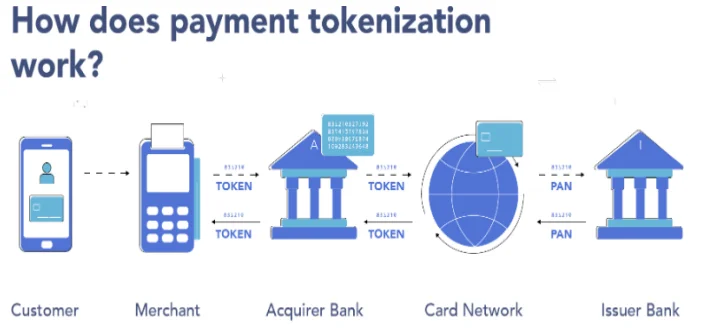
Tokenization = Replacing sensitive card details (like card number, CVV, expiry date) with a unique alternate code called a 'Token'.
Token is unique for the combination of: Card + Token Requestor + Device.
Applicable Devices: Mobile phones, tablets, laptops, desktops, wearables (smartwatches, bands), IoT devices.
Since 1st October 2022, Payment Aggregators (like PhonePe, Paytm) and Merchants (like Amazon, Flipkart) cannot store customer card details.
Working of Tokenization
1. Customer initiates request via a token requester app (like a payment app).
2. Card Network (Visa, Mastercard, RuPay, Amex) creates the token, with approval of card-issuing bank.
3. Token is mapped with the card details and stored only by the card network, not merchants.
Current Status
35 crore+ tokens created in India so far.
By September 2022, around 40% of digital transactions (worth Rs 63 crore) were tokenized.
In FY 2021-22: Credit card transactions rose 27% in volume and 54.3% in value.
Advantages of Card Tokenization
Safer Transactions: Card details (PAN, CVV) are never shared with merchants.
Zero Cost to Users: Customers don’t pay fees for tokenization/de-tokenization.
Data Security: Even if a merchant’s database is hacked, card data stays safe.
Regulatory Trust: Only authorized card networks can process token requests.
Builds Consumer Confidence in Digital Payments.
| Type | Definition | Example |
|---|---|---|
| Credit Card | Allows borrowing within pre-approved credit limit | HDFC Credit Card |
| Debit Card | Linked to bank account; purchases deducted directly | SBI Debit Card |
| Prepaid Card | Not linked to bank account; preloaded with money | IRCTC UBI Prepaid Card |
Prelims tips
- Plastic Money = Credit, Debit, Prepaid cards.
- Card Tokenization made mandatory by RBI from 1 Oct 2022.
- Tokens are issued by card networks (Visa, Mastercard, RuPay, Amex).
- Merchants cannot store card details; improves security.
Mains points
- Plastic money promotes cashless economy and reduces dependency on physical cash.
- Tokenization enhances data protection and reduces chances of fraud.
- Important for Digital India mission and financial inclusion.
- Challenges: Rural awareness, internet penetration, cyber threats.
Cryptocurrency
Cryptocurrency is a form of digital or virtual currency that uses encryption (cryptography) to secure transactions and regulate creation of new units. It operates on blockchain technology and functions in a decentralized manner, independent of governments or central banks.
What is Cryptocurrency?
Cryptocurrency is a digital currency where records of transactions are maintained on a blockchain (a distributed digital ledger).
Units of cryptocurrency are generated through a process called 'mining' (using computational power to solve mathematical problems).
Unlike fiat money, it is not backed by any government or physical commodity.
Advantages of Cryptocurrency
Faster and cheaper money transfers compared to traditional banking systems.
Secure online payments without the need for banks or third-party intermediaries.
Blockchain ensures anonymity of users while keeping transaction records transparent.
Decentralized structure prevents collapse due to single point of failure.
Acts as a hedge against inflation, considered an alternative investment.
Disadvantages of Cryptocurrency
High price volatility: Value of cryptocurrencies like Bitcoin or Ethereum fluctuates sharply.
Mining requires high energy consumption, raising environmental concerns.
Can disrupt industries like finance, banking, and law by bypassing intermediaries.
Transactions are traceable, but user identity often remains hidden, enabling misuse for money laundering, terrorism financing, or illegal activities.
| Year | Event |
|---|---|
| 2018 | RBI prohibited regulated entities from dealing in cryptocurrencies. |
| 2020 | Supreme Court struck down RBI’s ban, allowing crypto trading. |
| Present | No specific law governing cryptocurrencies in India, but owning is not illegal. |
Prelims tips
- Blockchain = distributed ledger ensuring transparency and immutability.
- Bitcoin (2009) was the first cryptocurrency.
- RBI banned crypto-related services in 2018; Supreme Court overturned ban in 2020.
- Cryptocurrency not legal tender in India but ownership is not illegal.
Mains points
- Cryptocurrency challenges the existing monetary system as it operates outside the purview of central banks.
- It promotes financial innovation but raises regulatory, taxation, and security challenges.
- India needs a balanced policy framework that addresses risks (illegal activities, volatility) while encouraging blockchain innovation.
- Debate continues: Should India ban, regulate, or adopt crypto as digital assets?
Central Bank Digital Currency (CBDC / e-Rupee)
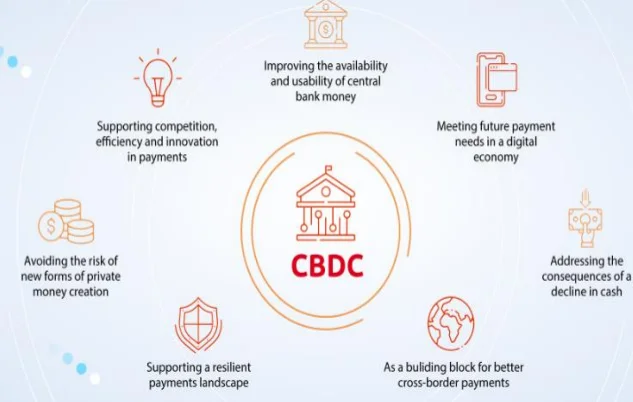
The Central Bank Digital Currency (CBDC), or e-Rupee, is the RBI-issued digital form of fiat money. It is legal tender, exchangeable 1:1 with cash, and acts as a safe store of value. Unlike cryptocurrencies, CBDC is fully regulated by the Reserve Bank of India.
What is CBDC?
Issued by RBI, first concept note released in October 2022.
Digital version of the rupee, accepted as legal tender.
Appears as a liability on the balance sheet of the central bank (not commercial banks).
Categories of CBDC
CBDC-Retail (CBDC-R): Digital cash for everyday retail use, suitable for consumers and businesses.
CBDC-Wholesale (CBDC-W): Restricted to financial institutions for large-value transactions and interbank settlements.
Forms of CBDC
Token-based: Functions like physical cash. Whoever holds the token owns it. Suited for CBDC-R (retail).
Account-based: Requires records of balances and transactions. Identity verification by intermediaries. Suited for CBDC-W (wholesale).
Models of Issuance
Direct Model (Single-tier): Central bank manages everything – issuance, accounts, verification.
Indirect Model (Two-tier): RBI issues CBDC to banks/intermediaries, who distribute to consumers. Claims are managed by intermediaries.
Advantages of e-Rupee
Risk-free alternative to private cryptocurrencies.
Reduces cost of managing physical cash.
Builds resilience and efficiency in payment systems.
Helps curb illicit money use through traceable digital transactions.
Promotes financial inclusion by providing digital access and credit to unbanked people.
| Aspect | CBDC (e-Rupee) | Cryptocurrency |
|---|---|---|
| Issuer | Central Bank (RBI) | Private/Decentralized network |
| Legal Status | Legal tender in India | Not legal tender |
| Stability | Stable, backed by RBI | Highly volatile |
| Regulation | Fully regulated by RBI | Unregulated/partially regulated |
| Use | Payments, settlements, inclusion | Investment, speculation, transfers |
Prelims tips
- CBDC is RBI-issued digital rupee (legal tender).
- Two categories: Retail (CBDC-R) & Wholesale (CBDC-W).
- Two forms: Token-based (like cash) & Account-based.
- Two models: Direct (RBI only) & Indirect (RBI + intermediaries).
Mains points
- CBDC can modernize India’s payment infrastructure and promote financial inclusion.
- It will reduce reliance on private cryptocurrencies and ensure monetary stability.
- Challenges: Cybersecurity risks, technology readiness, privacy concerns.
- RBI needs to balance innovation with stability and public trust.
Money Supply in India
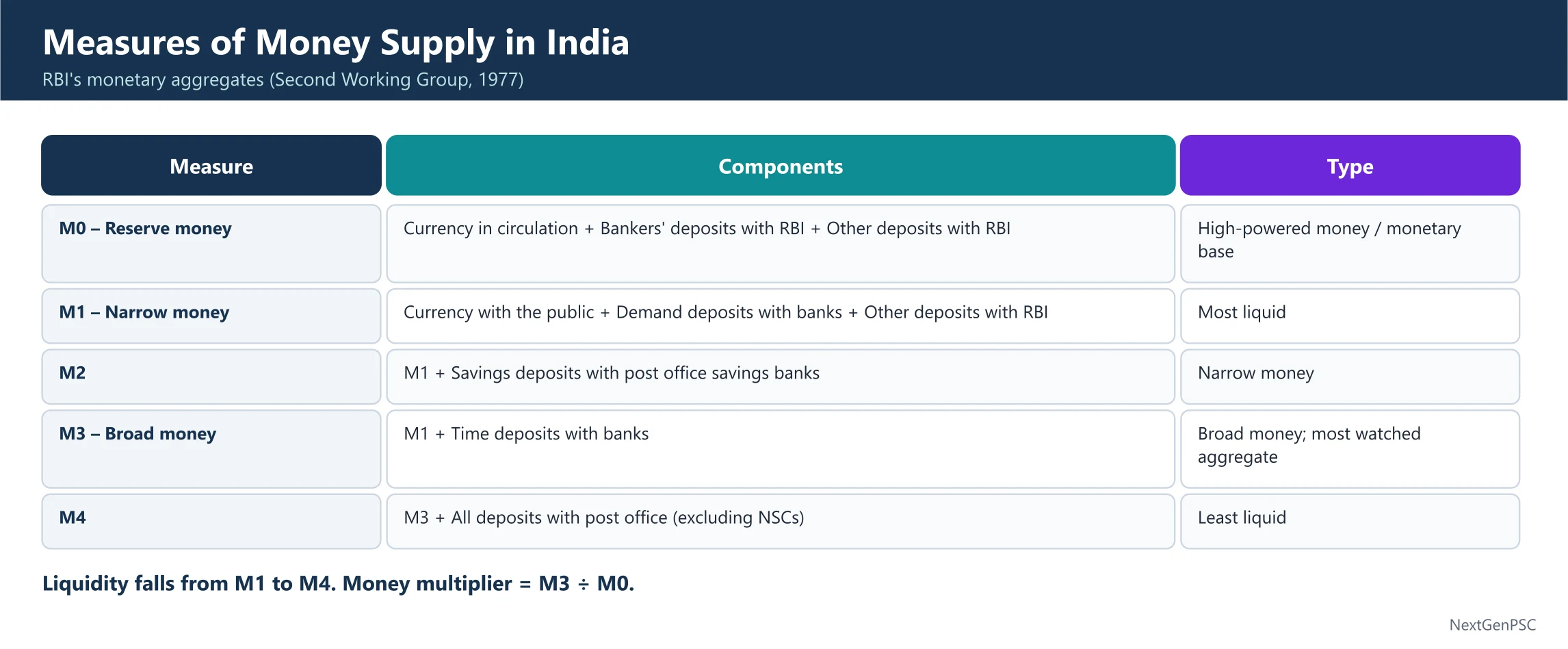
Money supply refers to the total amount of money circulating in an economy at a given time. It plays a crucial role in determining inflation, price levels, and interest rates. In India, the Reserve Bank of India (RBI) publishes four measures of money supply: M1, M2, M3, and M4.
What is Money Supply?
Total stock of money circulating in the economy.
At a specific point of time → Stock concept. Over a period of time → Flow concept.
Determines price level and interest rates.
Measured in four types: M1, M2, M3, and M4.
M1 (Narrow Money)
Currency with the public (notes + coins, excluding cash with banks).
Demand deposits with the banking system (current deposits + demand liabilities portion of savings deposits).
Other deposits with RBI.
Known as 'Transaction Money' because it is the most liquid form of money used directly for payments.
M2
M1 + Savings deposits with Post Office savings banks.
Adds postal savings to money supply to cover wider public deposits.
M3 (Broad Money)
M1 + Time deposits with the banking system.
Includes fixed deposits, recurring deposits, and other time deposits.
Called 'Broad Money' as it covers both liquid (M1) and less liquid components.
Most commonly used measure of money supply in India.
M4
M3 + All deposits with post office savings banks (excluding National Savings Certificates).
Broadest measure of money supply but least liquid.
Key Points
M1 and M2 are called Narrow Money.
M3 and M4 are called Broad Money.
Liquidity: M1 > M2 > M3 > M4.
RBI publishes data on M1 and M3 fortnightly.
M3 is considered the most important for monetary policy and economic analysis.
| Measure | Definition | Liquidity |
|---|---|---|
| M1 | Currency with public + Demand deposits with banks + Other deposits with RBI | Most liquid (Transaction money) |
| M2 | M1 + Savings deposits with Post Office savings banks | Less liquid than M1 |
| M3 | M1 + Time deposits with banks | Broad money, widely used |
| M4 | M3 + All deposits with Post Office savings banks (except NSC) | Least liquid |
Prelims tips
- M1 = Transaction money (most liquid).
- M3 = Broad money, most used in India.
- M1 & M2 → Narrow money; M3 & M4 → Broad money.
- RBI publishes M1 & M3 fortnightly.
Mains points
- Discuss the role of M3 in monetary policy and its importance in inflation targeting.
- Explain the difference between narrow money (M1, M2) and broad money (M3, M4).
- Evaluate how money supply impacts interest rates and inflation in India.
Reserve Money (M0), Demand for Money and Determinants of Money Supply
Reserve Money (M0), also known as High-Powered Money or Monetary Base, is the foundation of money supply in the economy. It represents total liabilities of RBI and forms the base for credit creation. Demand for money arises due to transaction, precautionary, and speculative motives, while determinants like CDR and RDR affect the expansion of money supply.
Reserve Money (M0)
Formula: M0 = Currency in circulation + Bankers’ deposits with RBI + Other deposits with RBI.
Represents total liability of RBI, since it issues currency and accepts deposits from banks and government.
Also called High-Powered Money or Monetary Base because it is the foundation for commercial banks to create credit through lending.
Currency issued by RBI can be held either by the public or by commercial banks.
Why is there a Demand for Money?
Money is the most liquid asset, useful for transactions.
However, it has an opportunity cost: holding cash means losing out on interest that could be earned if deposited.
Keynes described this preference for liquidity as 'Liquidity Preference'.
Motives to hold money:
1. Transaction Motive: Holding cash for day-to-day expenses like food, transport, bills. Increases with higher income and GDP.
2. Precautionary Motive: Holding cash to meet unexpected needs like accidents, illness, or emergencies.
3. Speculative Motive: Holding cash to take advantage of future investment opportunities. Inversely related to interest rates (when interest rates are low, people prefer to hold cash).
Determinants of Money Supply
Money supply depends on changes in currency with public (CU), demand deposits, and time deposits.
It is influenced by actions of RBI (monetary policy) and commercial banks (credit creation).
Key Ratios:
1. Currency Deposit Ratio (CDR):
Formula: CDR = Currency with public (C) / Deposits with banks (D).
Shows people’s preference for holding cash instead of deposits.
Seasonal in nature: e.g., CDR rises during festive season when people withdraw money for spending.
2. Reserve Deposit Ratio (RDR):
Formula: RDR = Reserves of banks / Total deposits.
Banks keep a fraction of deposits as reserves (vault cash + deposits with RBI) and lend the rest.
RBI regulates RDR through:
CRR (Cash Reserve Ratio): Percentage of deposits that banks must keep with RBI.
SLR (Statutory Liquidity Ratio): Percentage of deposits that banks must keep in liquid assets like gold, government securities, etc.
Higher CRR/SLR reduces banks’ capacity to lend → reduces money supply. Lower CRR/SLR increases credit creation → increases money supply.
| Ratio | Definition | Formula | Impact on Money Supply |
|---|---|---|---|
| CDR (Currency Deposit Ratio) | Preference of public for cash vs deposits | C/D | Higher CDR reduces deposits in banks → less lending capacity |
| RDR (Reserve Deposit Ratio) | Fraction of deposits banks keep as reserves | Reserves / Deposits | Higher RDR means more reserves → less lending → reduced money supply |
| CRR | Mandatory reserves kept with RBI | Fixed % of deposits | Higher CRR → reduced money supply; Lower CRR → increased money supply |
| SLR | Mandatory reserves in liquid assets like gold, govt securities | Fixed % of deposits | Higher SLR → reduced money supply; Lower SLR → increased money supply |
Prelims tips
- M0 = High Powered Money = Reserve Money = Monetary Base.
- CDR rises during festivals due to more cash withdrawals.
- CRR and SLR are RBI’s key tools to regulate money supply.
Mains points
- Discuss how Reserve Money (M0) acts as the foundation of credit creation in India.
- Explain Keynes’ liquidity preference theory and its three motives.
- Analyse the role of CDR and RDR in influencing money supply and inflation in the economy.
Money Multiplier, Multiplier Effect and Cashless Economy
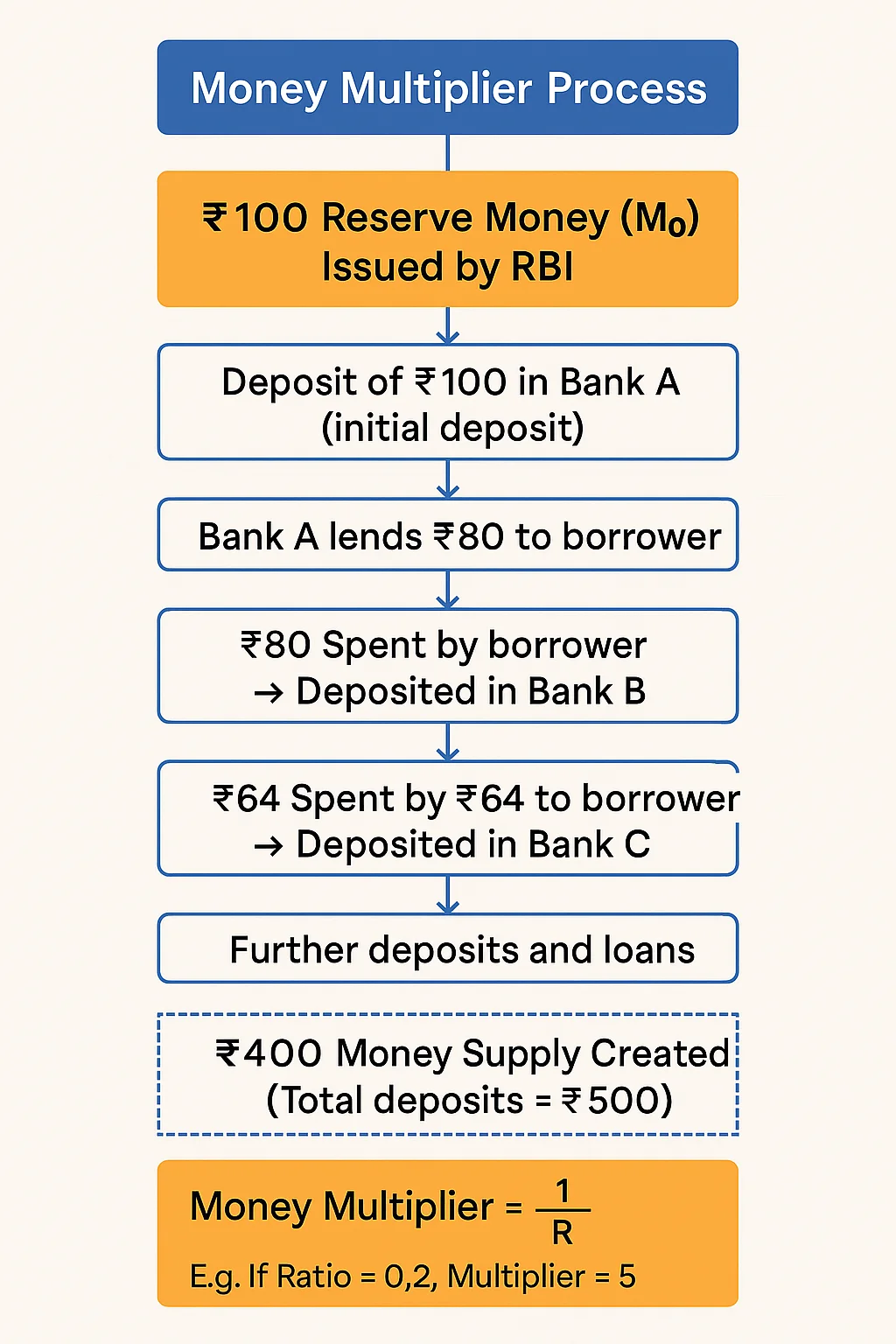
Money Multiplier shows how Reserve Money (M0) issued by RBI expands into Broad Money (M3) through bank lending. Multiplier Effect measures how a change in spending leads to larger change in income. Cashless Economy aims at reducing physical cash transactions and promoting digital payments.
Money Multiplier
Measures maximum amount of commercial bank money that can be created from a given unit of Reserve Money (M0).
Formula: Money Multiplier = M3 / M0 or 1 / Reserve Ratio.
If banks keep high reserves (high CRR/SLR), less money is available for lending → multiplier effect is smaller.
If reserve ratio is low, banks can lend more → higher multiplier → higher liquidity in the market.
Example: If reserve ratio = 20% (0.2), then multiplier = 1/0.2 = 5. That means ₹100 of Reserve Money can generate ₹500 of money supply in economy.
Multiplier Effect
Multiplier shows how much income changes due to a change in spending/investment.
Formula: Multiplier = Change in Income / Change in Spending.
Example: If government spends ₹100 crore and total income increases by ₹300 crore, then multiplier = 3.
Larger multiplier effect occurs when banks lend more of deposits (low reserves).
Economists use this concept to understand how fiscal stimulus, investments, or monetary changes influence overall GDP.
Cashless Economy
An economy where most transactions are done digitally without physical cash.
Tools: Credit Cards, Debit Cards, UPI, Mobile Wallets, RuPay Cards, IMPS, RTGS, NEFT.
Positive Economic Effects
Reduces cost of printing physical currency (approx 0.25% of India’s GDP).
Promotes transparency and accountability → reduces corruption, black money, money laundering.
Safer than carrying physical cash.
Helps government track spending → better planning for welfare schemes.
Encourages financial inclusion since all citizens need bank accounts.
Saves cost for banks: Manual transactions cost ₹40–45, digital transactions cost ₹7–8.
Challenges
High cash dependency in India; majority still prefer cash.
Lack of infrastructure in rural areas: weak internet, poor banking penetration, few PoS machines.
Financial inclusion gaps: As per World Bank, ~190 million Indians still without bank accounts.
Low financial literacy: Only 27% of population financially literate (SEBI report).
Urban-rural divide: Of 1.57 lakh bank branches (2021), only 53k in rural areas.
Cybersecurity risks: online frauds, hacking, phishing, malware attacks.
Measures Taken in India
Digital India Programme: Promotes 'Faceless, Paperless, Cashless' transactions.
UPI: Seamless real-time interbank transfers via mobile apps.
Direct Benefit Transfer (DBT): Using Jan Dhan–Aadhaar–Mobile (JAM Trinity) for subsidies.
PM Jan Dhan Yojana: Massive financial inclusion drive (2014).
India Post Payments Bank: Banking at the last mile.
RuPay Card: Indigenous, cheaper than Visa/Mastercard.
Financial Literacy Centres (FLCs): Run by RBI/Finance Ministry to educate public.
Incentives: DigiDhan Yojana, Lucky Grahak Yojana to reward digital payments.
DigiDhan Mission by MeitY: Collaborative platform for promoting cashless economy.
| Aspect | Money Multiplier | Multiplier Effect |
|---|---|---|
| Definition | Shows expansion of money supply through bank lending | Shows change in income due to change in spending |
| Formula | M3/M0 or 1/Reserve Ratio | ΔIncome / ΔSpending |
| Focus | Banking & credit creation | Overall economy’s output and income |
| Key Factor | Reserve Ratio (CRR, SLR) | Marginal Propensity to Consume (MPC) |
| Impact | Determines liquidity in market | Determines income/output growth |
Prelims tips
- Money Multiplier = M3/M0, inversely related to Reserve Ratio.
- Multiplier Effect depends on Marginal Propensity to Consume (MPC).
- India spends ~0.25% of GDP on printing currency → shift towards cashless economy saves cost.
Mains points
- Discuss how money multiplier influences liquidity and inflation in an economy.
- Analyse the role of multiplier effect in fiscal policy and investment-led growth.
- Evaluate India’s journey towards cashless economy, its benefits and challenges, and role of UPI/DBT.
Demonetisation in India (2016)
Demonetisation refers to the process where a government withdraws the legal tender status of a currency note. In India, on 8th November 2016, the government demonetised ₹500 and ₹1000 notes (86% of cash in circulation) to tackle black money, corruption, fake currency, and terror financing. New ₹500 and ₹2000 notes were introduced.
What is Demonetisation?
Demonetisation means withdrawal of legal tender status of specific currency notes, i.e., those notes can no longer be used for transactions.
In 2016, the Indian Government demonetised ₹500 and ₹1000 notes.
New ₹500 and ₹2000 notes were introduced in their place.
It was one of the biggest monetary reforms in India’s history.
Objectives of Demonetisation
To fight against black money (unaccounted money not reported to tax authorities).
To curb corruption by reducing cash-based illegal transactions.
To stop terror financing which often used fake currency.
To eliminate fake notes in circulation.
To push India towards a digital and cashless economy.
Short-Term Impacts
Sharp decline in cash: People struggled due to sudden cash shortage, leading to long queues outside banks and ATMs.
Interest rates fell: With huge deposits in banks, interest rates on deposits, loans, and government securities declined.
Rise in implicit value of cash: Cash became scarce, so its immediate value increased.
Private wealth reduced: Some high-denomination notes were not returned, and real estate prices fell.
Boost in digital payments: Platforms like UPI, RuPay, AEPS saw massive new users.
Slower economic growth: Due to decline in demand, disruption of supply chains, reduced liquidity, and overall uncertainty.
Long-Term Impacts
Cash usage normalised but at a lower level: Cash recovered but remained less dominant compared to pre-2016.
Lower loan rates: If higher deposits stay in banks, loan interest rates may stay low.
Greater formalisation of economy: More workers and businesses entered formal financial systems.
Curb on corruption and fake currency (partially): Fake notes circulation reduced temporarily, though corruption issues remained complex.
Promotion of digital economy: More people adopted online and electronic payments.
| Aspect | Short-Term Impact | Long-Term Impact |
|---|---|---|
| Cash Availability | Sharp decline, queues at banks | Recovered but lower than earlier |
| Interest Rates | Declined due to liquidity surge | Likely to remain lower |
| Wealth/Assets | Real estate & private wealth declined | Stabilisation, formalisation of assets |
| Digital Transactions | Increased rapidly among new users | Sustained growth in digital economy |
| Economic Growth | Slowed due to disruption in demand and supply | Expected benefits if formalisation continues |
Prelims tips
- Demonetisation in 2016 demonetised ₹500 and ₹1000 notes (86% of cash).
- Objectives: curb black money, corruption, fake currency, and terror financing.
- Boosted digital payments (UPI, RuPay, AEPS).
- Short-term growth slowdown but possible long-term benefits via formalisation.
Mains points
- Demonetisation was a major policy move aimed at curbing black money and promoting digital payments.
- It created short-term disruptions in demand, supply, and liquidity, slowing GDP growth.
- In the long-term, it pushed formalisation of the economy and boosted digital transactions.
- Impact on corruption and black money is debated, but fake note circulation reduced temporarily.
- It highlights trade-offs between short-term pain and potential long-term structural reforms.
Monetary Theory
Monetary theory examines how the supply and demand for money influence big-picture economic factors (macroeconomic variables) like inflation, interest rates, and overall economic growth. Key theories include the Quantity Theory of Money and Keynesian Liquidity Preference.
Introduction to Monetary Theory
Monetary theory seeks to understand the role of money in an economy. It's not just about currency; it's about how money behaves .
It provides the theoretical 'rulebook' that central banks (like RBI) use to create practical monetary policy (like setting the Repo Rate).
1. Classical Quantity Theory of Money (Fisher)
Formulated by Irving Fisher, this is the oldest and simplest theory.
Equation: MV = PT
M = Money Supply (total money in the economy)
V = Velocity of Money (how many times a single rupee changes hands in a year)
P = Price Level (the average price of all goods)
T = Transactions (or Y=Real GDP, the total 'stuff'—goods and services—produced)
Core Idea: The theory assumes V (how fast people spend) and T (how much 'stuff' is available to buy) are stable in the short run.
Conclusion: If V and T are stable, then any change in Money Supply (M) must lead to a proportional change in the Price Level (P).
Beginner's Analogy: Imagine a small island economy that produces 100 fish (T) a year. The spending habit (V) is stable. The total money supply (M) is ₹1,000. The price (P) per fish would be ₹10. If the island's leader suddenly prints another ₹1,000 (doubling M to ₹2,000) but the number of fish is still 100, the only thing that can change is the price. Now, there is ₹2,000 chasing the same 100 fish, so the price (P) will double to ₹20. This is inflation.
2. Cambridge Equation (Cash Balance Approach)
Equation: M_d = kPY
M_d = Demand for money (how much money people want to hold)
k = The fraction of their income (PY) that people choose to hold as cash (e.g., in their wallets) instead of investing or spending.
Core Idea: This theory, similar to Fisher's, focuses on why people hold money (demand), not just how they spend it. It emphasizes money's role as a 'store of value'.
3. Keynesian Monetary Theory (Liquidity Preference)
John Maynard Keynes asked: Why do people prefer to hold liquid cash (Liquidity Preference)?
Three Motives:
1. Transaction Motive: Holding cash for daily expenses (e.g., coffee, bus fare, groceries).
2. Precautionary Motive: Holding cash for emergencies or a 'rainy day' (e.g., unexpected medical bill, car repair).
3. Speculative Motive: Holding cash to 'speculate' or wait for a better investment opportunity. When interest rates on bonds are very low, people expect them to rise soon. A rise in interest rates makes existing bonds lose value. So, people prefer to hold cash (high liquidity) and wait to buy bonds after the rates go up. This means: Low Interest Rates = High Demand for Cash.
The 'Liquidity Trap': Keynes's most famous warning. This is a situation (like a deep recession) where interest rates are already near zero. At this point, no matter how much money the central bank prints (increases M), people and banks just hoard it (due to the speculative motive) and don't spend or lend. In this 'trap', monetary policy becomes powerless, like 'pushing on a string'.
4. Monetarism (Milton Friedman)
A modern and more robust version of Fisher's Quantity Theory.
Core Idea: Friedman argued that V (Velocity) isn't perfectly stable, but it is predictable. Therefore, the primary driver of inflation in the long run is always an excessive increase in the money supply.
His famous quote: 'Inflation is always and everywhere a monetary phenomenon.'
Policy: He advocated for a stable, predictable growth rate of the money supply (e.g., 3-5% per year) and argued that the 'fine-tuning' of interest rates by Keynesians often does more harm than good.
Gresham's Law
Statement: 'Bad money drives out good money.' When two kinds of money with the same face value but different intrinsic value circulate together, people hoard the one with higher intrinsic value (good money) and spend the other (bad money).
| Theory | Key Equation | Main Idea for Beginners |
|---|---|---|
| Classical (Fisher) | MV = PT | Printing more money makes prices go up. |
| Cambridge | M_d = kPY | People choose to hold a fraction of their income as cash. |
| Keynesian | Liquidity Preference | Interest rates are key. People hold cash for 3 reasons. Policy can fail at zero interest (Liquidity Trap). |
| Monetarism (Friedman) | MV = PY | Inflation is always caused by too much money printing. Controlling money supply is the only job. |
Prelims tips
- Fisher's Equation: MV = PT. (Direct link between Money Supply & Price Level).
- Keynes' 3 Motives: Transaction, Precautionary, and Speculative (this one is key).
- Liquidity Trap: A Keynesian idea where monetary policy becomes useless because interest rates are near zero.
- Monetarism (Friedman): 'Inflation is always and everywhere a monetary phenomenon.'
Mains points
- Monetary theories provide the practical rulebook for a central bank. The debate (Keynes vs. Friedman) is the core of monetary policy: Should the RBI target interest rates (Keynesian view) or the money supply itself (Monetarist view)?
- Modern central banks (including RBI) use a hybrid, but lean towards the Keynesian model of setting a target interest rate (like the Repo Rate) to manage inflation and growth, an approach known as 'inflation targeting'.
Seigniorage
Seigniorage is the profit earned by a government or central bank from issuing currency. It is the difference between the face value of money (e.g., a ₹500 note) and the actual cost of producing and distributing it (e.g., paper, ink, printing, which might only be ₹3).
What is Seigniorage?
It is essentially the 'profit from printing money'. 💰
Example: If a ₹100 note costs the RBI ₹2 to print, ink, and transport, the seigniorage (profit) for the RBI is ₹98. This profit is later transferred to the Government of India.
Historical Origin: The term comes from the 'Seigneur' (French for Lord). A medieval lord would take 100 grams of silver (worth ₹100) from the people, melt it down, mix it with 50g of cheap copper, and mint 150 coins, each declared to be worth ₹1. He gives 100 coins back and keeps 50. This profit of 50 coins was his 'Seigniorage'.
How Seigniorage Works (In the Modern Day)
This is the main way the RBI earns its income. Here's the simple process:
1. RBI Prints New Money: (e.g., ₹1,000 Cr). This new money is technically a liability for RBI (a 'promise to pay' backed by nothing but faith).
2. RBI Uses This Money to Buy Assets: It doesn't just give the money away. It uses it to buy assets, primarily Government Bonds (G-Secs) from the government (i.e., lending to the govt) or Foreign Currency (like US dollars).
3. These Assets Pay Interest: The G-Secs pay interest to the RBI, and the US dollars are invested (e.g., in US Treasury bonds) to earn interest.
4. Profit = Interest Earned - Printing Cost. This huge net profit (seigniorage) is the RBI's income. After covering its operational costs, RBI transfers the remaining surplus/dividend to the Central Government. This is a major source of non-tax revenue for the government.
Seigniorage as an 'Inflation Tax' (The Dark Side 😈)
This is the most crucial (and negative) concept associated with seigniorage.
1. The Problem: Imagine the government needs money for schemes but can't (or won't) raise taxes or borrow from the market. It forces the RBI to print excessive amounts of new money to buy its bonds. This is called 'Monetizing the Deficit' (literally printing money to pay bills).
2. The Result: This floods the economy with new money (M increases). As per monetary theory (MV=PT), more money is now chasing the same amount of goods.
3. The Consequence: This causes high inflation (e.g., 10%).
4. The 'Tax': If you had ₹100 saved in your drawer, after 10% inflation, it can now only buy what ₹90 could buy last year. You lost ₹10 in purchasing power, even though the note in your hand still says ₹100.
5. The 'Theft': Who got that ₹10 of purchasing power you lost? The government did. It 'stole' your purchasing power by printing new money for itself. This invisible loss of value for all citizens holding cash is the 'Inflation Tax'. The government's profit (seigniorage) comes directly at the expense of the public's savings.
| Item | Value |
|---|---|
| Face Value of Note (अंकित मूल्य) | ₹500 |
| Cost of Printing & Distribution (लागत) | ~ ₹3.00 (approx) |
| Seigniorage (Profit for RBI) (लाभ) | ₹497.00 |
Prelims tips
- Seigniorage = Face Value of Currency - Cost of Production.
- It is a non-tax revenue for the government, transferred as a surplus/dividend from the RBI.
- 'Inflation Tax' is the negative consequence of excessive seigniorage (monetizing the deficit), where the government gains purchasing power by eroding the value of public savings through inflation.
Mains points
- While seigniorage is a legitimate source of revenue, its overuse to finance fiscal deficits is dangerous. It can lead to hyperinflation and macroeconomic instability (e.g., Zimbabwe, Venezuela).
- The FRBM Act (Fiscal Responsibility and Budget Management Act) in India was created specifically to limit the government's power to force the RBI to monetize its deficit (i.e., print money to pay its bills), thereby keeping the 'inflation tax' in check and ensuring RBI's independence.