
Indian Economy · UPSC Notes
Taxation — UPSC Economy Notes
Free, exam-focused notes for UPSC Prelims and Mains, with Prelims tips and Mains points for every topic. 26 topics.
Open in the interactive reader: bookmarks, progress tracking and read-aloud.
Taxation
Taxation is the system by which governments collect money from individuals, businesses, and organizations in the form of taxes to fund public services and development. Taxes are compulsory payments used not only for revenue but also as tools of fiscal policy to control inflation, promote growth, and ensure social welfare.
Introduction
Taxes are levies imposed by governments to collect resources for spending on public services.
Governments use these resources for defence, education, healthcare, infrastructure, and welfare programs.
Beyond raising revenue, taxes can be used as tools of fiscal policy – for example, to control inflation or promote industrial growth.
What is Tax?
Taxes are compulsory payments imposed by law on individuals and organizations.
They are the government’s main source of income.
The money collected through taxes funds services such as defence, roads, schools, hospitals, and subsidies.
Classification of Taxes (Based on Fairness)
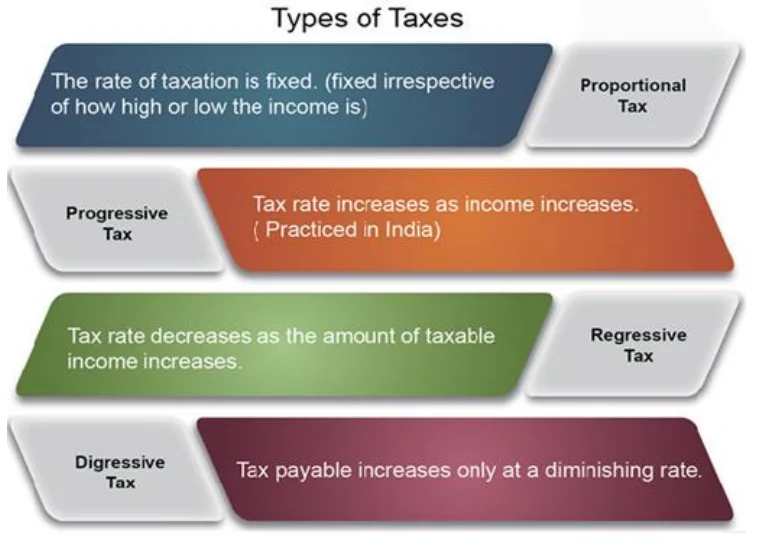
Progressive Taxation
Tax rate increases as income increases.
Considered fair because wealthier individuals contribute more.
Example: Income Tax where higher income groups pay at higher rates (ranging from 0% to ~45%).
Regressive Taxation
Taxes where poor people end up paying more in relative terms than the rich.
Example: Indirect taxes on essential items can hurt the poor more since they spend a larger share of their income on consumption.
Economists debate this: some argue it motivates productivity, while modern economists highlight social justice concerns.
Proportional Taxation (Flat Tax)
Same tax rate for all income groups, regardless of income level.
Example: GST – both rich and poor pay the same rate on a product.
Classification of Taxes (Based on Who Pays)
Direct Taxes
Paid directly by the person/entity on whom they are imposed.
Non-transferable: the burden cannot be shifted.
Examples: Income Tax, Corporate Tax, Wealth Tax.
Indirect Taxes
Taxes applied on goods/services, collected by businesses but paid by consumers.
Transferable: seller collects and passes to government.
Examples: GST, Excise Duty, Customs Duty.
Other Tax Terms
Ad valorem tax: levied as a percentage of value (e.g. GST at 18%).
Specific tax: a fixed amount per unit of quantity (e.g. ₹ per litre or per tonne).
Tobin tax: a small tax on currency/financial transactions to curb short-term speculation (proposed by James Tobin).
| Parameter | Direct Tax | Indirect Tax |
|---|---|---|
| Meaning | Tax on income/wealth paid directly to govt. | Tax on goods/services, collected indirectly |
| Incidence & Impact | Falls on same person | Falls on different persons (consumer pays, seller deposits) |
| Tax Base | Income, profits, wealth | Consumption, sales, production |
| Evasion | Possible | Hardly possible |
| Effect on Inflation | Helps in controlling inflation | Can push prices up (inflationary) |
| Burden | Cannot be shifted | Can be shifted |
Prelims tips
- Progressive tax = higher income, higher tax rate.
- GST is an example of proportional tax.
- Direct tax burden cannot be shifted; indirect tax burden is shifted to consumers.
- Direct taxes help control inflation, indirect taxes can increase inflation.
Mains points
- Taxation is not only a revenue tool but also an instrument of fiscal policy.
- Progressive taxation ensures equity, while regressive taxes may worsen inequality.
- Direct taxes are better for redistributive justice, while indirect taxes ensure easier collection.
- India relies on a mix of both to balance efficiency and equity.
- Challenges: tax evasion, compliance burden, balancing fairness with growth.
Taxation in India
In India, taxes are levied at three levels – by the Central Government, the State Governments, and local authorities (like Panchayats and Municipalities). The Constitution of India provides the framework for taxation through specific Articles and Schedules.
Overview
Taxes are compulsory payments to fund government expenditure at central, state, and local levels.
Constitution ensures taxes can only be imposed by law, not arbitrarily.
Constitutional Provisions
Article 265
No tax can be levied or collected except by authority of law.
This means every tax must be backed by a law passed by Parliament or State Legislature.
Article 246 (Schedule VII)
Defines division of legislative powers, including taxation powers.
Schedule VII provides three lists:
List I (Union List): Only Parliament can make laws (e.g., Income Tax, Customs).
List II (State List): Only States can legislate (e.g., Land Revenue, Stamp Duty).
List III (Concurrent List): Both Parliament and States can legislate (e.g., Education, Environment).
73rd & 74th Constitutional Amendments
Empower Panchayats and Municipalities to levy certain local taxes (like property tax, market fees, tolls).
Direct Taxes in India
Direct taxes are paid directly by individuals or organizations to the government.
Union Government Direct Taxes
On Income: Corporation Tax, Personal Income Tax, Minimum Alternate Tax (MAT), Capital Gains Tax.
On Expenditure: (earlier) Fringe Benefit Tax (abolished), Gift Tax (abolished).
On Assets: Securities Transaction Tax, Wealth Tax (abolished), Banking Cash Transaction Tax (abolished).
State Government Direct Taxes
On Income: Agriculture Tax, Professional Tax.
On Expenditure: Road Tax (collected in some cases by seller on vehicles).
On Assets: Land Revenue, Stamp Duty, Property Tax in urban areas.
Cess and Surcharge
Cess
A tax on tax, imposed for a specific purpose.
Example: Education Cess (for schools), Health & Education Cess, Road & Infrastructure Cess.
Collected in Consolidated Fund of India (CFI), then used for schemes.
Not shared with States by Finance Commission; usage depends on Union discretion.
Surcharge
An additional tax on existing tax rates (e.g., 10% surcharge on 30% tax = 33% effective tax).
Not earmarked for a specific purpose – can be used for general expenditure.
Not shared with States via Finance Commission formula.
| Category | Union Government | State Government |
|---|---|---|
| On Income | Corporate Tax, Personal Income Tax, MAT, Capital Gains Tax | Agriculture Tax, Professional Tax |
| On Expenditure | Fringe Benefit Tax (abolished), Gift Tax (abolished) | Road Tax |
| On Assets | Securities Transaction Tax, Wealth Tax (abolished) | Land Revenue, Stamp Duty, Property Tax |
Prelims tips
- Article 265: No tax without authority of law.
- Article 246 + Schedule VII: Division of taxation powers.
- 73rd & 74th Amendments: Panchayats and Municipalities can levy taxes.
- Cess = tax on tax for specific purpose, not shared with States.
- Surcharge = extra tax, not earmarked, also not shared with States.
Mains points
- Indian taxation system operates at three levels: Centre, States, and Local bodies.
- The Constitution ensures taxes must have legal backing (Article 265).
- Division of taxation powers is clearly defined under Schedule VII.
- Direct taxes are imposed differently by Centre and States, ensuring balanced revenue.
- Cess and surcharge are tools for additional revenue but create fiscal imbalance as they are not shared with States.
Personal Income Tax in India
Personal Income Tax is a tax imposed by the government on the income earned by individuals. It is governed by the Income Tax Act, 1961, and is a major source of government revenue. In India, there are two regimes: the Old Tax Regime (with exemptions and deductions) and the New Tax Regime (simplified slabs, fewer exemptions).
Overview
Personal Income Tax is paid by individuals, Hindu Undivided Families (HUF), firms, etc.
Taxpayers must file Income Tax Returns (ITR) every year to report income and pay taxes.
Categories of individual taxpayers: Individuals (<60 years), Senior Citizens (60–80 years), and Super Senior Citizens (>80 years).
Taxes collected are used for government services like defense, healthcare, education, and infrastructure.
Old Tax Regime (before 2025 changes)
Basic Exemption Limit depends on age:
Up to ₹2.5 lakh: for individuals below 60 years
Up to ₹3 lakh: for senior citizens (60–80 years)
Up to ₹5 lakh: for super senior citizens (>80 years)
Tax Slabs:
₹0 – ₹2.5 lakh: Nil
₹2.5 lakh – ₹5 lakh: 5%
₹5 lakh – ₹10 lakh: 20%
Above ₹10 lakh: 30%
Many exemptions/deductions available (like 80C for investments, HRA for house rent, 80D for medical insurance).
New Tax Regime (from FY 2025-26)
New regime made 'default' for individuals/HUF.
Basic Exemption Limit: ₹4 lakh (for all, no age distinction).
Tax Slabs:
₹0 – ₹4,00,000 → Nil
₹4,00,001 – ₹8,00,000 → 5%
₹8,00,001 – ₹12,00,000 → 10%
₹12,00,001 – ₹16,00,000 → 15%
₹16,00,001 – ₹20,00,000 → 20%
₹20,00,001 – ₹24,00,000 → 25%
Above ₹24,00,000 → 30%
Rebate (Section 87A): Income up to ₹12 lakh is effectively tax-free.
Very few exemptions/deductions allowed.
Additional Points
4% Health & Education Cess applies on total tax.
Surcharge applies on very high incomes (e.g., 7%, 12% based on slabs).
New regime focuses on simplicity but reduces tax-saving options.
| Aspect | Old Regime | New Regime (2025 onwards) |
|---|---|---|
| Basic Exemption Limit | ₹2.5–5 lakh (depending on age) | ₹4 lakh (all categories) |
| Slab rates | 5%, 20%, 30% (depending on income brackets) | 5%, 10%, 15%, 20%, 25%, 30% (more granular) |
| Rebate (87A) | Up to ₹5 lakh income → Nil tax | Up to ₹12 lakh income → Nil tax |
| Exemptions/Deductions | Available (80C, 80D, HRA, etc.) | Mostly not available |
| Default Status | Opt-in | Default regime for individuals/HUFs |
Prelims tips
- New tax regime is default from FY 2025-26.
- Rebate under 87A increased: income up to ₹12 lakh is tax-free.
- Old regime still available, useful for those with high deductions under 80C, 80D, etc.
Mains points
- Personal Income Tax is a key revenue source for India, balancing fairness and simplicity.
- Old regime favors tax savings via exemptions; new regime emphasizes lower rates with simplicity.
- 2025 reforms expanded tax-free income to ₹12 lakh under rebate, benefitting middle class.
- Policy direction: encourage voluntary compliance, reduce complexity, increase disposable income.
Corporate Tax in India
Corporate Tax is the tax levied on the net profits of companies. It applies to both Indian (domestic) companies and foreign companies earning income in India. It is one of the major direct taxes in India, governed by the Income Tax Act, 1961. Over time, reforms have been introduced to reduce rates, simplify compliance, and make India an attractive destination for business and foreign investment.
Overview
Corporate Tax is imposed on company profits after deducting business expenses such as salaries, depreciation, and cost of goods sold.
It is different from personal income tax, as it applies to companies instead of individuals.
Both domestic and foreign companies are liable to pay corporate tax if they earn income from India.
Corporate tax revenue forms a major chunk of government income, used for infrastructure, welfare, and development projects.
Domestic Corporate Tax Rates
Corporations NOT seeking exemptions/incentives: Taxed at 22% + cess & surcharge. Effective rate ~25.17%. Such companies are free from paying Minimum Alternate Tax (MAT).
Corporations seeking exemptions/incentives: Tax remains 30%. However, MAT applies at 15% (earlier 18.5%).
New Domestic Manufacturing Companies: Special rate of 15% (instead of 25%) if incorporated on or after 1 October 2019, provided they make fresh investments in manufacturing. Aim: Attract investment and boost 'Make in India'.
Foreign Corporate Tax Rates
Foreign companies are taxed only on the income they earn from India.
Key rates: Income from operations in India – 40%. Royalty or technical service fees under agreements approved before April 1, 1976 – 50%.
Example: A US-based IT company earning service fees from India pays corporate tax in India on that income.
Minimum Alternate Tax (MAT)
Introduced in 1997–98 to prevent large companies from avoiding taxes through exemptions, deductions, and rebates.
MAT ensures companies pay at least a minimum percentage of their book profits (not taxable income).
Current MAT Rate: 15% (reduced from 18.5% in 2019).
Exemption: New domestic manufacturing companies (post October 2019) are exempt from MAT.
Formula: Pay either regular corporate tax or MAT (whichever is higher).
Example: If taxable profit (after deductions) is low but book profit is high, company pays MAT on book profit.
Dividend Distribution Tax (DDT)
Earlier: Companies had to pay tax before distributing dividends to shareholders.
Rate: Around 15–20% + surcharge & cess. This led to 'double taxation' (company paid DDT, shareholder also paid tax on income).
Abolished in Union Budget 2020. Now dividends are taxable directly in the hands of shareholders.
Benefit: Encourages foreign investors and reduces tax burden on companies.
Wealth Tax
Governed by Wealth Tax Act, 1957. Levied on the net wealth of individuals, Hindu Undivided Families (HUFs), and companies.
Example: Assets like land, buildings, jewelry were taxable, but productive assets like shares were exempt.
Problem: Low revenue collection compared to high compliance cost.
Abolished w.e.f. 1 April 2016. Now wealth is indirectly taxed through property tax, stamp duty, etc.
Cess and Surcharge on Corporate Tax
Cess: Tax imposed on top of corporate tax for specific purposes (e.g., education cess, health & education cess, infrastructure cess).
Surcharge: Additional tax on corporate tax for high-income companies. Unlike cess, surcharge has no specific end-use.
International Context
India's corporate tax rate (22–25%) is competitive compared to many developed countries (e.g., USA ~27%, Japan ~30%).
Reduction in rates in 2019 brought India closer to ASEAN economies like Vietnam and Thailand, improving global competitiveness.
Importance of Corporate Tax
Source of revenue for government.
Tool for economic growth: reduced rates encourage business investment.
Helps in redistribution of resources: higher surcharges on large corporations contribute more to social spending.
Simplification of DDT and MAT improved India’s ranking in ‘Ease of Doing Business’.
| Type of Company | Tax Rate | Special Notes |
|---|---|---|
| Domestic (No Exemptions) | 22% + cess/surcharge | Effective 25.17%, No MAT |
| Domestic (With Exemptions) | 30% | MAT at 15% applies |
| New Manufacturing Companies (post 1 Oct 2019) | 15% | Fresh investment needed |
| Foreign Company (Any Income) | 40% | Income from India operations |
| Foreign Company (Royalty/Tech fees pre-1976) | 50% | If approved by Govt. |
Prelims tips
- Corporate Tax governed by Income Tax Act, 1961.
- 2019 Reforms: 22% for domestic, 15% for new manufacturing companies.
- MAT introduced in 1997–98, currently 15%.
- DDT abolished in 2020; now dividends taxable in hands of shareholders.
- Wealth Tax abolished in 2016.
- Cess earmarked for specific purposes (e.g., education, health).
Mains points
- Corporate Tax is a backbone of India's revenue system.
- Reforms aim at balancing revenue needs with growth promotion.
- MAT prevents tax avoidance by zero-tax companies.
- Abolition of DDT and Wealth Tax simplified corporate taxation.
- Comparison with global tax rates shows India is competitive post-2019 reforms.
- Surcharge and cess ensure additional revenue but states don’t share it equally.
Capital Gains Tax
Capital Gains Tax is the tax imposed on profits earned from the sale of capital assets such as land, property, jewellery, shares, bonds, and other securities. It is categorized into Short-Term Capital Gains (STCG) and Long-Term Capital Gains (LTCG) depending on how long the asset was held.
Overview
Any profit or gain from selling a capital asset is treated as income under the Income Tax Act, 1961, and taxed as Capital Gains Tax (CGT).
Examples of capital assets: Land, buildings, vehicles, jewellery, machinery, patents, trademarks, shares, bonds, mutual funds, etc.
Exemptions: Agricultural land in rural areas is not considered a capital asset, hence no CGT applies.
Short-Term Capital Gains (STCG)
If an asset is held for 36 months or less before being sold, it is considered a short-term capital asset.
For immovable property (land/building), the period is reduced to 24 months.
For equity shares, preference shares, listed securities, zero-coupon bonds, the period is only 12 months.
Example: If you bought shares in January 2024 and sold them in November 2024 at a profit, it will be STCG.
Taxation: Usually added to normal income and taxed as per applicable income tax slab. But if STCG arises from listed shares/equity mutual funds (where STT is paid), a flat 15% tax applies.
Long-Term Capital Gains (LTCG)
If an asset is held for more than 36 months before sale, it is considered a long-term capital asset.
For immovable property, the period is more than 24 months.
For listed shares, securities, and zero-coupon bonds, it is more than 12 months.
Example: If you bought a plot of land in 2020 and sold it in 2024, the profit is LTCG.
Taxation: LTCG on listed equity shares/mutual funds above ₹1 lakh is taxed at 10% (without indexation). For other assets, LTCG is usually taxed at 20% with indexation (adjusting for inflation).
Securities Transaction Tax (STT)
Introduced in 2004 to prevent tax evasion.
Levied on purchase/sale of shares, ETFs, derivatives, and other securities on stock exchanges.
Investor pays a small tax on the transaction value itself (like a turnover tax).
Example: If you buy shares worth ₹1,00,000, an STT of 0.1% = ₹100 is charged at source.
Digital Tax / Equalisation Levy
Aimed at taxing non-resident digital companies earning from the Indian digital market.
2016: Introduced as a 6% levy on online advertisements (Google, Facebook, etc.).
2020 (Equalisation Levy 2.0): Expanded to 2% Digital Services Tax (DST) on e-commerce operators like Amazon, Flipkart, etc., if their turnover in India exceeds ₹2 crore.
Purpose: Ensure that foreign tech giants pay a fair share of taxes in India.
Part of OECD’s global two-pillar plan (2021), agreed upon by 137 countries to address tax challenges of the digital economy.
| Type | Holding Period | Tax Rate |
|---|---|---|
| Short-Term Capital Gain (STCG) | ≤ 36 months (≤24 for immovable property, ≤12 for shares/securities) | As per income tax slab; 15% flat for listed shares with STT |
| Long-Term Capital Gain (LTCG) | > 36 months (>24 immovable property, >12 shares/securities) | 10% (equity above ₹1 lakh, no indexation); 20% with indexation for other assets |
| Securities Transaction Tax (STT) | Applied on purchase/sale at stock exchange | Small % on transaction value |
| Digital Tax (Equalisation Levy) | Applicable on foreign e-commerce & digital services | 6% (ads, 2016); 2% (e-commerce, 2020 onwards) |
Prelims tips
- Capital Gains Tax governed by Income Tax Act, 1961.
- STCG holding period: 36 months (24 for property, 12 for shares).
- LTCG on equities above ₹1 lakh taxed at 10%.
- Indexation benefit only for LTCG on assets other than equities.
- STT introduced in 2004 to curb tax evasion.
- Equalisation Levy: 6% (2016) + 2% (2020 expansion).
Mains points
- Capital Gains Tax ensures taxation of wealth generated from asset sales.
- Encourages long-term holding (lower rates for LTCG compared to STCG).
- Indexation protects investors against inflation impact on long-term assets.
- STT simplified securities taxation and reduced evasion.
- Digital tax ensures fairness by taxing foreign companies benefiting from Indian users.
- Important part of global tax reforms (OECD two-pillar plan).
Professional Tax, Fringe Benefit Tax, BCTT and Virtual Digital Asset Taxation
These taxes represent different forms of taxation in India—Professional Tax (by states), Fringe Benefit Tax and Banking Cash Transaction Tax (withdrawn), and the newly introduced Virtual Digital Asset (VDA) taxation at 30%.
Professional Tax
Levied and collected by state governments, unlike income tax which is central.
Applicable on salaried employees, professionals, and practitioners such as CAs, doctors, lawyers, etc.
Collected on a monthly basis, deducted by employers from salary and remitted to state government.
Maximum limit: ₹2,500 per year (as per Constitution, Article 276).
Example: In Maharashtra, professional tax varies from ₹175 to ₹2,500 annually depending on income slab.
Fringe Benefit Tax (FBT)
Introduced in 2005 to tax non-cash benefits given by employers to employees.
Examples of fringe benefits: Free travel tickets, telephone reimbursements, ESOPs, entertainment expenses.
Tax was paid by employer, not employee.
Withdrawn in 2009 due to industry criticism that it increased compliance burden and was double taxation.
Banking Cash Transaction Tax (BCTT)
Introduced in 2005 as a measure to track high cash transactions and curb black money.
Levied at 0.1% on cash withdrawals exceeding ₹25,000 in a day (for individuals/HUFs) from non-savings accounts.
Aimed at increasing transparency in financial transactions.
Withdrawn in 2009 as it was considered regressive and discouraging legitimate transactions.
Taxation on Virtual Digital Assets (VDA)
Introduced in Budget 2022–23 due to rising popularity of cryptocurrencies and NFTs.
Virtual Digital Asset definition (Income Tax Act, Sec 2(47A)): Digital code, token, or number (not currency) that represents value, can be stored, traded, or used in financial transactions.
Includes Non-Fungible Tokens (NFTs).
Tax regime (since 1 April 2022, Section 115BBH):
Flat 30% tax on income from transfer of VDAs.
No deduction allowed (except cost of acquisition).
Loss from VDA cannot be set off against other income.
Gifts of VDA taxable in hands of recipient.
1% TDS on transfer payments above threshold.
Objective: To regulate and bring transparency in fast-growing crypto and digital asset markets.
| Tax | Introduced | Applicability | Current Status |
|---|---|---|---|
| Professional Tax | Constitutional provision (Art. 276) | Employees & Professionals (by States) | Active, max ₹2,500/year |
| Fringe Benefit Tax (FBT) | 2005 | Non-cash benefits given by employers | Withdrawn in 2009 |
| Banking Cash Transaction Tax (BCTT) | 2005 | Cash withdrawals > ₹25,000/day | Withdrawn in 2009 |
| Virtual Digital Asset Tax (VDA) | 2022 | Cryptocurrencies, NFTs, digital tokens | Active, 30% tax + 1% TDS |
Prelims tips
- Professional tax is a state subject, max ₹2,500/year (Article 276).
- FBT introduced in 2005, withdrawn in 2009.
- BCTT introduced in 2005, withdrawn in 2009.
- VDA Taxation (Budget 2022–23): 30% tax + 1% TDS.
- NFTs are explicitly included in VDA definition (Sec 2(47A)).
Mains points
- Professional tax provides small but steady revenue for states.
- FBT and BCTT were attempts to widen tax base but faced criticism and were abolished.
- VDA taxation reflects India’s regulatory approach to emerging digital markets.
- Flat 30% VDA tax with no set-offs shows government’s cautious stance towards crypto-assets.
- Important for balancing innovation in fintech with financial regulation and transparency.
Agricultural Income Tax
Agricultural income, as defined under Section 2(1A) of the Income Tax Act, refers to rent, revenue, or income derived from land used for agricultural purposes in India. As per Section 10(1), agricultural income is exempt from central income tax, though debates exist on whether it should be taxed.
Definition of Agricultural Income
Section 2(1A) of Income Tax Act defines agricultural income as:
Rent or revenue from land situated in India used for agriculture.
Income from agricultural operations, including processing produce for market.
Income from farmhouses (subject to conditions).
Income from saplings or seedlings grown in nurseries.
Section 10(1): Agricultural income earned in India is exempt from central income tax.
Arguments Against Taxing Agricultural Income
Small Tax Base: About 95% of agricultural assets are owned by small/marginal farmers who lack capacity to pay tax.
Credit Issues: Imposing tax reduces farmers’ chances of accessing loans, as rich farmers with high income would get preference.
Agrarian Distress: With farmer suicides due to debts, low productivity, and small income, tax would worsen their condition.
Informal Sector: Most transactions are in cash, making it hard to track income and impose tax fairly.
Arguments in Favour of Taxing Agricultural Income
Equity Issues: Exemption distorts fairness. Horizontal equity: non-farmers pay tax while rich farmers don’t. Vertical equity: no distinction between small and rich farmers.
Laundering of Income: Many hide non-agricultural income by misreporting it as agricultural to avoid tax.
Narrow Tax Base: Exemption reduces taxpayers, forcing higher tax rates on salaried/middle-class citizens.
Kelkar Committee & Tax Administration Reform Commission (2014): Recommended taxing large agricultural incomes to expand the tax base.
| Aspect | Details |
|---|---|
| Definition (Sec 2(1A)) | Rent, revenue, or income from agricultural land and related activities. |
| Exemption (Sec 10(1)) | Agricultural income is fully exempt from central income tax. |
| Against Tax | Small farmers’ burden, informal sector, rural distress, low credit. |
| In Favour of Tax | Equity, prevent laundering, widen tax base, target rich farmers. |
Prelims tips
- Agricultural income defined under Section 2(1A) of Income Tax Act.
- Exempt under Section 10(1).
- Kelkar Committee suggested taxing large agricultural income.
- Small & marginal farmers form 95% of farm households in India.
Mains points
- Agricultural income is exempt to protect small farmers from tax burden.
- However, exemption causes inequity and encourages misuse.
- Taxing rich farmers could broaden the tax base and promote fairness.
- Challenge lies in differentiating between poor and rich farmers in implementation.
- Possible solution: keep small/marginal farmers exempt, but tax large farm incomes.
Tax Deducted at Source (TDS) & Tax Collected at Source (TCS)
TDS and TCS are mechanisms of advance tax collection under the Income Tax Act. TDS is deducted at the time of payment (e.g., salary, rent, contractor payments), while TCS is collected at the time of sale of specified goods (e.g., motor vehicles, tendu leaves, scrap). Both help reduce tax evasion but also bring compliance challenges.
Tax Deducted at Source (TDS)
TDS is a percentage of income deducted at the time of making payments such as salary, rent, contractor bills, interest, or lottery winnings.
It acts as advance tax payment to the government.
The deducted amount is later adjusted at the time of filing Income Tax Returns (ITR).
Benefit: Helps curb tax evasion by ensuring taxes are collected at source itself.
Limitation: Causes cash flow hardship for lower-middle-class taxpayers since income is reduced in advance.
Tax Collected at Source (TCS)
TCS is tax collected by a seller from the buyer at the time of selling certain specified goods.
Example: Sale of motor vehicles, tendu leaves, scrap, or minerals.
The seller deposits this collected tax with the government.
Comparison: TDS vs TCS
TDS: Deducted by payer (employer, tenant, bank, contractor) while making payment.
TCS: Collected by seller during sale of specified goods.
Stamp Duty
Stamp Duty is a state-level tax imposed on property transactions (sale, transfer, ownership).
Payable under Section 3 of the Indian Stamp Act, 1899.
Different states may levy different rates on sale/transfer of property.
Reforms in Direct Tax in India
Administrative Reforms
Unique Identification Number (PAN/TAN) introduced for taxpayers.
Tax Information Network (TIN) by NSDL modernised collection and monitoring of taxes.
Technological Reforms
Computerisation of Income Tax Department (since 1981).
Online PAN, TAN allotment, e-filing, payroll processing introduced.
Restructuring of IT Department (2000 onwards)
Objective: Improve efficiency, increase revenue, reduce costs, and enhance taxpayer services.
Recent Initiatives
Project Insight (2017): Tracks high-value financial transactions to detect tax evasion.
Faceless Assessment Scheme (2019): Removes physical interaction between taxpayer and officer to ensure transparency and reduce corruption.
Transparent Taxation (2020): Platform with faceless appeals, taxpayer charter, and simplified compliance.
New e-filing portal (2021): For faster, user-friendly tax return filing.
Taxpayer-Centric Reforms
Taxpayers’ Charter: Promises fairness, courtesy, and respect in tax administration.
Grievance Redressal: Aaykar Sewa Kendras (ASK), e-Nivaran portal, and CPGRAMS for complaint resolution.
| Aspect | TDS | TCS |
|---|---|---|
| Timing | Deducted at time of payment | Collected at time of sale |
| Who deducts/collects? | Payer (e.g., employer, tenant, bank) | Seller of goods/services |
| Applicable on | Salary, rent, contractor fees, interest, property purchase | Motor vehicles, tendu leaves, scrap, minerals |
| Purpose | Advance tax to reduce evasion | Ensure collection on high-value goods sales |
Prelims tips
- TDS = Tax deducted at payment stage; TCS = Tax collected at sale stage.
- Stamp duty governed by Indian Stamp Act, 1899.
- Project Insight (2017) tracks high-value transactions.
- Faceless Assessment introduced in 2019.
- Transparent Taxation platform launched in 2020.
Mains points
- TDS and TCS reduce tax evasion by collecting tax at the source.
- They ensure steady cash flow to the government throughout the year.
- However, TDS can burden lower-income taxpayers by reducing in-hand income.
- Stamp duty is a major revenue source for state governments.
- Direct tax reforms (faceless assessment, Project Insight, e-filing) aim to enhance transparency and taxpayer services.
Budget 2023–24: Reforms Proposed in Direct Taxes
The Union Budget 2023–24 introduced several reforms in Direct Taxes aimed at simplifying compliance, giving relief to co-operatives, startups, and individuals, rationalising exemptions, and making the new tax regime more attractive. Key areas include personal income tax, co-operatives, startups, capital gains, online gaming, gold transactions, IT return reforms, and targeted tax exemptions.
Cooperation
New manufacturing co-operatives established before 31 March 2024 will enjoy a concessional tax rate of 15%.
Sugar co-operatives allowed to claim payments made to sugarcane farmers (before AY 2016–17) as expenditure; relief expected around ₹10,000 crore.
Higher cash deposit/loan limit for Primary Agricultural Credit Societies (PACS) and Co-operative Agriculture & Rural Development Banks: ₹2 lakh per member.
TDS cash withdrawal threshold for co-operative societies raised to ₹3 crore.
Start-Ups
Income tax benefit window extended to start-ups incorporated up to 31 March 2024.
Carry forward of losses allowed up to 10 years (earlier 7 years) in case of change in shareholding.
Capital Gains (on residential house)
Deduction under Sections 54 & 54F capped at ₹10 crore for investment in residential houses, to better target tax benefits.
Online Gaming
₹10,000 minimum threshold for TDS removed.
Taxation clarified: Net winnings taxable at withdrawal or end of financial year.
Gold
Conversion of physical gold into Electronic Gold Receipts (and vice versa) will not attract capital gains tax.
Tax Exemptions
Income of statutory authorities, boards, and commissions (set up for housing, urban/rural development, regulation) exempted from income tax.
Agniveer Fund given EEE (Exempt-Exempt-Exempt) status. Contributions by Agniveers and Government to Agniveer Seva Nidhi account are tax-exempt; withdrawals also tax-free.
Common IT Return Form & Grievance Redressal
Next-generation common IT return form to be introduced.
100 Joint Commissioners to handle small appeals for faster disposal.
Grievance redressal mechanism to be strengthened.
Better Targeting of Tax Concessions
Exemption limits introduced for very high-value insurance policy proceeds.
Tax benefits for funds relocating to IFSC (GIFT City) extended till March 2025.
Decriminalisation under Section 276A of Income Tax Act.
Carry forward of losses allowed in case of strategic disinvestment (including IDBI Bank).
Personal Income Tax
Rebate limit in the new tax regime raised from ₹5 lakh to ₹7 lakh. Persons earning up to ₹7 lakh pay no tax.
New tax regime revised: Exemption limit increased to ₹3 lakh; slabs reduced to 5.
New tax regime made default, but taxpayers may opt for old regime.
Highest surcharge rate reduced from 37% to 25%, bringing down maximum effective tax rate to 39%.
| Area | Reform |
|---|---|
| Co-operatives | 15% tax rate; cash limits enhanced; sugar co-ops relief. |
| Start-Ups | Benefits extended till 31-03-2024; loss carry forward up to 10 years. |
| Capital Gains | Exemption on house purchase capped at ₹10 crore. |
| Online Gaming | No minimum threshold; winnings taxed at withdrawal or FY end. |
| Gold | Conversion to/from EGR not taxable. |
| Exemptions | Agniveer Fund EEE; statutory authorities exempt. |
| IT Return | Common form; grievance redressal improved. |
| Personal Income Tax | Rebate up to ₹7 lakh; new regime default; surcharge reduced. |
Prelims tips
- Budget 2023–24 made new income tax regime the default system.
- Rebate raised to ₹7 lakh; slabs reduced to 5.
- Gold ↔ Electronic Gold Receipt conversions exempt from CGT.
- Agniveer Fund granted EEE status.
- Relief of ₹10,000 crore given to sugar co-operatives.
Mains points
- Budget 2023–24 simplified and rationalised direct tax structure.
- Encourages formalisation of start-ups and co-operatives with extended benefits.
- Personal income tax reforms shift focus to new regime with reduced rates and simplified slabs.
- Capping capital gains deductions prevents misuse by high-net-worth individuals.
- Clarity on taxation of online gaming addresses a growing digital economy challenge.
- EEE status to Agniveer Fund reflects welfare approach to new military recruitment scheme.
Indirect Taxes
Indirect taxes are taxes levied on goods and services rather than on income or profits. The burden of tax is shifted from producers/sellers to consumers. Examples include customs duty, excise duty, service tax, and sales tax (most of which are now subsumed under GST in India).
Types of Indirect Tax
Ad-Valorem Tax: Levied as a percentage of the value of the product. Example: 20% customs duty on solar panel cells costing ₹10,000. Commonly seen in property tax on real estate.
Specific Tax: Levied based on quantity, not value. Example: ₹200 excise duty on every 1,000 cigarettes of 65–70 mm length, regardless of price.
Major Indirect Taxes in India
Excise Duty
Introduced in 1944, it was an indirect tax levied by the Central Government on the manufacture, sale, or licensing of certain goods.
Alcoholic drinks and narcotics were excluded from central excise; states levied taxes on them.
Excise duty is now replaced by GST (except on petroleum and liquor).
Central Sales Tax (CST)
Introduced in 1956, applied on inter-state trade and commerce.
Origin-based tax: levied only on inter-state transactions, not on intra-state or import/export.
Replaced by GST.
Customs Duty
Introduced in 1962, levied when goods are imported/exported across international boundaries.
Aim: Protect domestic industries and economy from foreign competition.
Legal Basis: Section 12 of the Customs Act, 1962; tax rates listed in First Schedule of Customs Tariff Act, 1975.
Countervailing Duty (CVD)
Imposed to neutralise the effect of subsidies given by foreign governments to their exporters.
Protects domestic producers from unfairly cheap imports.
Example: If Chinese products enter India at very low prices due to export subsidies, India can impose CVD to balance competition.
Anti-Dumping Duty
Levied on imports sold at prices much lower than their normal value (dumping).
Protects domestic producers from being undercut by foreign goods.
India has imposed maximum anti-dumping duties against Chinese goods (chemicals, aluminium, etc.).
Example: In 2021, India imposed anti-dumping duty for five years on certain Chinese aluminium and chemical products.
Service Tax
Levied on services provided in India; introduced with a 'negative list' of exempt services.
Example: consulting, hospitality, telecom, etc.
Subsumed under GST in 2017.
| Tax Type | Year Introduced | Key Features | Status |
|---|---|---|---|
| Excise Duty | 1944 | Levied on manufacture/sale of goods (excl. alcohol/narcotics) | Subsumed under GST |
| Central Sales Tax (CST) | 1956 | Levied on inter-state trade | Subsumed under GST |
| Customs Duty | 1962 | Levied on imports/exports, protects domestic economy | Still in force |
| Countervailing Duty (CVD) | - | Neutralises subsidies given by foreign governments | Still in force (WTO compliant) |
| Anti-Dumping Duty | - | Protects against underpriced imports | Still in force |
| Service Tax | 1994 | Levied on services, negative list for exemptions | Subsumed under GST |
Prelims tips
- Excise Duty, Service Tax, CST were subsumed under GST in 2017.
- Customs Duty, Countervailing Duty, and Anti-Dumping Duty continue outside GST.
- Countervailing Duty prevents foreign subsidy-driven cheap imports.
- India has filed maximum anti-dumping cases against China.
Mains points
- Indirect taxes are regressive as they burden rich and poor alike.
- They are easier to collect as they are included in price of goods/services.
- Customs duty helps protect domestic industries but may increase consumer prices.
- Anti-dumping and countervailing duties safeguard local economy but must align with WTO rules.
- GST has simplified India's indirect tax structure by subsuming excise, service tax, and CST.
Reforms in Indirect Tax & GST
India's indirect tax system went through three major stages: MODVAT (1986), VAT (2005), and GST (2017). Each reform was aimed at reducing the problem of 'tax on tax' (cascading effect) and making the tax system simpler, fairer, and more transparent. GST is the most comprehensive reform, creating a single national market by merging multiple taxes into one.
MODVAT (Modified Value Added Tax) – 1986 to 2004
MODVAT was introduced to stop the problem of double taxation. Earlier, when a manufacturer bought raw materials, they had to pay excise duty on it, and then again excise duty was charged on the final product. This meant tax was paid twice.
Under MODVAT, manufacturers could claim credit for the excise duty already paid on inputs (raw materials). This credit was then adjusted against the tax on final goods.
Example: If a cloth manufacturer buys yarn from another company, they don’t need to pay excise duty again on that yarn when making clothes. They can subtract that credit from the tax they owe on finished clothes.
Importance: MODVAT was the first step towards a modern value-added taxation system in India.
VAT (Value Added Tax) – 2005 to 2017
VAT replaced the old sales tax system at the state level. It was a tax collected at each stage of production and distribution, but businesses could claim 'Input Tax Credit' (ITC) for the tax they had already paid earlier in the supply chain.
For example, a biscuit factory buying flour had to pay tax on flour, but while selling biscuits, it could deduct that earlier tax. This reduced multiple taxation and lowered prices for consumers.
However, every state had its own VAT rules and rates, which created confusion for businesses operating in multiple states.
So while VAT was better than MODVAT, it was still complicated and not uniform across India.
GST (Goods and Services Tax) – from 2017 onwards
GST is the most significant indirect tax reform in India. It replaced many central and state taxes (like Excise Duty, Service Tax, VAT, Octroi, etc.) with one single tax applied uniformly across India.
GST is called a 'destination-based tax'. This means the tax is collected where goods or services are finally consumed, not where they are produced.
GST applies to almost all goods and services, making tax collection easier and more transparent.
It creates 'One Nation, One Tax, One Market'. For example, before GST, transporting goods from one state to another required multiple state entry taxes. With GST, only one tax is applied, making trade smoother.
How GST Reduces Cascading Effect?
Cascading effect means 'tax on tax'. Example: If a factory pays tax on raw materials, and then again on finished goods without adjustment, prices increase unnecessarily.
With GST, businesses get Input Tax Credit (ITC) – they can subtract the tax already paid on inputs from the tax payable on final goods. This avoids double taxation and reduces the final cost to consumers.
GST also merged many taxes into one single system (Excise, VAT, Service Tax), removing the confusion of multiple levies.
Uniform tax rates across India mean that the same product has the same price everywhere, removing unfair advantages.
Key Features of GST
Implemented from 1st July 2017 after passing in Parliament on 29th March 2017.
Introduced through the 101st Constitutional Amendment Act, 2017.
Applies to both goods and services, unlike earlier taxes which applied separately.
Works on the principle of cooperative federalism, where both Centre and States have powers to levy tax.
Constitutional Provisions related to GST
Article 246A: Both Centre and States can levy GST on goods and services. However, only the Centre can levy tax on inter-state transactions (IGST).
Article 269A: IGST (tax on inter-state supply) is collected by the Centre and shared between Centre and States as per formula decided by GST Council.
Article 270: CGST revenue is distributed between Centre and States as per Finance Commission recommendations.
Article 279A: GST Council is created as a constitutional body to decide GST rates, exemptions, rules, and settlement of disputes.
Components of GST
1. CGST (Central GST): Collected by Central Government for intra-state transactions (supply within the same state).
2. SGST (State GST): Collected by State Government for intra-state transactions.
3. IGST (Integrated GST): Collected by Central Government for inter-state transactions (between two states). Revenue is then shared between Centre and States.
| Stage | Period | Key Features |
|---|---|---|
| MODVAT | 1986–2004 | Excise duty credit on raw materials; avoided double taxation |
| VAT | 2005–2017 | Tax at every stage; Input Tax Credit (ITC); state-level differences |
| GST | 2017–Present | One Nation One Tax; destination-based; merged multiple taxes |
Prelims tips
- MODVAT introduced in 1986; first step against double taxation.
- VAT introduced in 2005 with Input Tax Credit system.
- GST implemented on 1st July 2017 after 101st Amendment Act.
- Articles: 246A, 269A, 270, 279A are key for GST.
- GST has three parts: CGST, SGST, IGST.
Mains points
- India’s indirect tax reforms evolved gradually from MODVAT to VAT to GST.
- GST is destination-based and avoids cascading effect through ITC.
- It promotes cooperative federalism with Centre and States sharing power.
- It simplified taxation by replacing multiple taxes.
- Challenges: compliance, revenue-sharing disputes, and need for rate rationalisation.
Goods and Services Tax (GST) in India
GST is a comprehensive, destination-based indirect tax introduced in 2017 by the 101st Constitutional Amendment. It subsumed multiple central and state taxes into one uniform system, creating 'One Nation, One Tax, One Market'. The GST Council, a constitutional body under Article 279A, decides GST rates and policies. However, the Supreme Court has clarified that its recommendations are not legally binding.
Taxes Subsumed under GST
Central Taxes Subsumed
Central Excise Duty (except on petroleum and liquor).
Additional Excise Duty.
Service Tax.
Countervailing Duty (CVD) – Additional Customs Duty.
Special Additional Duty of Customs (SAD).
State Taxes Subsumed
State VAT/Sales Tax.
Entertainment Tax (except local body tax).
Central Sales Tax (collected by States).
Octroi and Entry Tax.
Purchase Tax.
Luxury Tax.
Taxes on lottery, betting, and gambling.
Items outside GST Purview
Petroleum products: petrol, diesel, aviation turbine fuel, crude oil.
Alcohol for human consumption (remains under states’ control).
Electricity.
Natural gas (currently outside GST, taxed separately).
GST Slab Rates
0%, 5%, 12%, 18%, and 28%.
Exempt/0% items: fresh fruits, vegetables, milk, eggs, bread, salt, jute, prasad, etc.
28% slab: demerit goods like luxury cars, tobacco products, aerated drinks.
Revenue Neutral Rate (RNR)
RNR is the rate of GST that keeps government revenue unchanged compared to pre-GST taxes.
Arvind Subramanian Committee (2015) suggested:
RNR around 15-15.5%, leaning towards the lower end.
Interim 3-rate structure: 12% (lower), 18% (standard), 40% (demerit goods).
Keep exemptions minimal to simplify compliance.
GST Council
Established under Article 279A by the 101st Constitutional Amendment.
Constitutional body to recommend GST rates, exemptions, and rules.
Quorum: At least 50% members must be present.
Decision-making: Requires at least 75% weighted votes of members present and voting.
Union Government vote weight: 1/3rd.
All States together: 2/3rd.
Composition of GST Council
Chairperson: Union Finance Minister.
Union Minister of State for Finance/Revenue.
Finance/Taxation Ministers of all States (one from each).
States elect one Vice-Chairperson among themselves.
Functions of GST Council
Decide principles of levy, exemptions, surcharges.
List of items under or outside GST purview.
Fix annual revenue thresholds for GST exemption.
Provide special treatment to North-Eastern and hilly states.
Recommend temporary extra tax rates for emergencies like natural disasters.
Any other matter relating to GST as required.
Supreme Court Judgment (2022) on GST Council
Held that GST Council recommendations are not binding.
They are persuasive in nature – Centre and States can accept or reject.
Article 246A gives both Centre and States simultaneous power to legislate on GST.
Strengthens 'cooperative federalism': both Union and States must collaborate, but no one is supreme.
| Aspect | Details |
|---|---|
| Year of Implementation | 2017 (101st Amendment Act) |
| Taxes Subsumed | Excise Duty, Service Tax, VAT, Octroi, Luxury Tax, etc. |
| Rates | 0%, 5%, 12%, 18%, 28% |
| Outside GST | Petrol, Diesel, ATF, Alcohol, Electricity, Natural Gas |
| Decision Making Body | GST Council (Article 279A) |
| Supreme Court Stand | Council's recommendations are persuasive, not binding |
Prelims tips
- GST implemented through 101st Amendment Act, 2017.
- GST Council: Article 279A; Composition includes FM + State Finance Ministers.
- Rates: 0%, 5%, 12%, 18%, 28%.
- Items outside GST: petrol, diesel, ATF, crude oil, alcohol, electricity, natural gas.
- SC 2022: GST Council recommendations not binding.
Mains points
- GST subsumed multiple central and state taxes, simplifying India's indirect tax structure.
- Uniform tax system removed interstate trade barriers and promoted ease of doing business.
- Revenue Neutral Rate aimed at balancing government revenue while keeping rates affordable.
- GST Council promotes cooperative federalism but SC clarified its recommendations are not binding.
- Challenges remain: compliance, rate rationalisation, items outside GST (like petroleum).
E-Way Bill and GST (Compensation to States) Act, 2017
The E-Way Bill is a digital document required for the transportation of goods worth over ₹50,000, aimed at ensuring smooth, transparent, and traceable movement of goods across India. The GST Compensation to States Act, 2017 was introduced to assure states that any revenue losses due to GST implementation would be compensated for five years through a special compensation cess.
E-Way Bill Overview
Introduced under GST to make goods transport easier and transparent.
Mandatory when the value of goods transported exceeds ₹50,000.
It must be generated online before goods start moving and includes details like product, supplier, buyer, and vehicle number.
Comes with a QR Code, which officers can quickly scan to check authenticity.
Exemption: Not required for non-motor transport like bicycles or handcarts, easing compliance for small traders.
Benefits of E-Way Bill
Reduces frequent vehicle checks and delays, saving transport time and costs.
Allows authorities to trace goods movement easily using vehicle numbers.
Helps curb tax evasion by ensuring goods movement is pre-registered and tracked.
Makes interstate movement smoother by avoiding unnecessary stoppages.
GST (Compensation to States) Act, 2017 – Overview
Passed in 2017 to protect states’ revenues after GST replaced earlier state taxes like VAT, luxury tax, entry tax, etc.
GST being a destination-based tax meant producing states feared losing revenue.
The Act assures compensation for five years (2017–2022) for any revenue loss caused by GST implementation.
How Compensation Works
A GST Compensation Cess is levied on luxury and harmful goods (e.g., tobacco, aerated drinks, luxury cars).
This cess is collected in a Compensation Fund.
States receive money from this fund to cover revenue shortfalls, but only for SGST (not for Union Territories without legislatures).
Challenges in Implementation
Delayed Payments: States often received compensation late, especially during 2020 (COVID-19), when collections dropped heavily.
Revenue Shortfall: GST revenues were less than expected, creating large gaps. Example: In 2020, states’ shortfall was around ₹3 lakh crore, but cess collection was only ₹65,000 crore, leaving a gap of ₹2.35 lakh crore.
Disputes: States argued that the Centre underestimated their losses and underpaid compensation.
Political Tensions: Some states accused the Centre of breaking its promise, leading to friction in GST Council meetings.
Funding Mechanism
Compensation is funded through GST Compensation Cess.
The cess amount is credited to the Compensation Fund.
From this fund, compensation payments are made to states facing revenue loss.
| Aspect | Details |
|---|---|
| E-Way Bill Requirement | Mandatory for goods worth > ₹50,000, with QR code for quick inspection |
| E-Way Bill Exemption | Not needed for non-motor transport (rickshaw, bicycle, etc.) |
| GST Compensation Period | 5 years (2017–2022) from GST introduction |
| Funding Mechanism | Compensation Cess on luxury & harmful goods (tobacco, aerated drinks, cars) |
| Challenge | Revenue shortfalls, delayed payments, Centre-State disputes |
Prelims tips
- E-Way Bill mandatory above ₹50,000 value goods.
- Compensation Act covers 5 years (2017–2022).
- Funded via Compensation Cess on luxury/demerit goods.
- Industrial states were unhappy as GST is destination-based tax.
Mains points
- E-Way Bill reduces corruption, delays, and ensures transparency in goods transport.
- GST Compensation Act was essential to reassure states during GST transition.
- Main challenge: Lower GST revenues and shortfall in compensation funds.
- Political disputes reflect Centre-State tensions in fiscal federalism.
- Supreme Court later clarified GST Council’s recommendations are not binding.
IT Infrastructure for GST Implementation
For smooth GST implementation in India, several digital and institutional mechanisms were created such as Goods and Services Tax Network (GSTN), Project Saksham, Input Tax Credit system, National Anti-Profiteering Authority (NAA), and Authority for Advance Ruling (AAR). These ensure transparency, efficiency, and fairness in tax administration.
Goods and Services Tax Network (GSTN)
GSTN is the IT backbone of the GST system in India, providing services to central and state governments, taxpayers, and other stakeholders.
It is a government-owned company with equal shares held by the Centre and the states.
GSTN developed a common GST portal for registration, payment, filing of returns, and invoice uploading.
In 2019, GSTN decided to make Aadhaar authentication mandatory for new dealers from January 2020 to prevent fake registrations and fraud.
Project Saksham
An IT modernization project launched by CBEC (now CBIC) to integrate its IT system with GSTN.
Helps in GST implementation and also strengthens Indian Customs' Single Window Interface for Trade Facilitation (SWIFT).
Objective: Faster, transparent, and digital customs and tax processing system.
Input Tax Credit (ITC)
ITC allows businesses to claim credit for GST paid on purchases of goods and services used for business purposes.
Mechanism: GST paid on inputs is adjusted against GST payable on outputs, ensuring 'tax on value addition' only.
Example: If raw materials incur ₹100 GST and final product incurs ₹150 GST, only ₹50 (net) needs to be paid.
Conditions to claim ITC: Must have tax invoice/debit note from registered dealer and actual receipt of goods/services.
National Anti-Profiteering Authority (NAA)
Created under Section 171 of CGST Act, 2017.
Mandate: To ensure that benefits of reduced GST rates or additional input tax credit are passed on to consumers through reduced prices.
Initially set up for 2 years in 2017, extended later by GST Council.
Example: If GST on a product is reduced from 18% to 12%, companies must reduce prices accordingly, else action by NAA.
Authority for Advance Ruling (AAR)
AAR gives binding decisions on questions of law under GST to reduce uncertainty for taxpayers.
Helps businesses plan their tax liabilities in advance and avoid future disputes.
Questions for AAR: classification of goods/services, applicability of notifications, valuation, ITC admissibility, liability to pay GST, registration requirement.
Objectives: Provide certainty, attract FDI, reduce litigation, and give rulings quickly at low cost.
Composition: One member nominated by Central Government (CGST) and one by State Government (SGST/UTGST).
| Mechanism | Purpose |
|---|---|
| GSTN | IT backbone for registration, payment, returns, and invoice tracking |
| Project Saksham | CBIC’s IT modernization and integration with GSTN + SWIFT |
| Input Tax Credit | Avoids double taxation by adjusting input tax against output tax |
| NAA | Ensures benefits of tax reduction/ITC are passed to consumers |
| AAR | Provides clarity and advance certainty on GST liability |
Prelims tips
- GSTN is the IT backbone of GST, Aadhaar authentication made mandatory for dealers from 2020.
- Project Saksham integrates GSTN with Customs’ SWIFT.
- Input Tax Credit prevents cascading of taxes.
- NAA ensures anti-profiteering provisions are enforced.
- AAR rulings are binding and reduce litigation.
Mains points
- GST implementation required strong IT backbone (GSTN + Project Saksham).
- Input Tax Credit simplified tax compliance and reduced cascading effect.
- NAA ensured consumer protection against unfair profiteering.
- AAR brought legal certainty, boosted investor confidence, and reduced disputes.
- Together, these mechanisms made GST more transparent, efficient, and reliable.
Benefits and Challenges of GST
The Goods and Services Tax (GST), implemented in 2017, is a landmark reform that replaced multiple indirect taxes with a unified system. It has created a common national market, removed cascading of taxes, and increased transparency. However, issues like revenue concerns of states, multiple tax slabs, and the need for stronger grievance mechanisms remain.
Benefits of GST
Economic Growth: By merging multiple taxes and lowering the tax burden, GST encourages business growth, creates a unified national market, and helps in reducing inflation.
Removal of Cascading Effect: Earlier, taxes were charged on top of other taxes (tax-on-tax). GST allows businesses to claim Input Tax Credit (ITC), eliminating this cascading effect.
Cooperative Federalism: GST Council ensures that states and the Centre share decision-making power, reducing fears of unilateral taxation by the Centre.
Ease of Use: GST replaces many indirect taxes with one simple system. Technology-driven filing reduces human interaction and minimizes corruption.
Automated Tax Ecosystem: Online filing, e-invoices, and e-way bills make compliance easier and transparent.
Logistical Efficiency: Removal of multiple checkpoints and permits reduced transportation delays, lowering production and distribution costs.
Challenges of GST
Concerns of States: Exclusion of items like alcohol, petroleum, and natural gas reduces state revenue sources and undermines the 'One Nation, One Tax' principle.
Parliamentary Authority: CGST Act allows the government to change tax rates (up to 20%) without Parliament’s approval, raising concerns about bypassing legislative powers.
Grievance Redressal: Lack of a GST Appellate Tribunal makes it difficult for small taxpayers to resolve disputes (they must approach High Courts).
Anti-Profiteering Issues: Measures to ensure businesses pass GST benefits to consumers are complex and often ineffective.
Multiplicity of Slabs: Having 0%, 5%, 12%, 18%, and 28% slabs creates disputes, confusion, and scope for corruption.
Exemptions: Items like alcohol and petroleum outside GST create market distortions and prevent complete uniformity.
| Aspect | Benefits | Challenges |
|---|---|---|
| Economic Impact | Unified market, reduced inflation | Revenue loss for states, high compliance cost |
| Taxation System | Simplified one-tax system | Multiplicity of slabs, exemptions weaken uniformity |
| Governance | Cooperative federalism via GST Council | Centre's power to alter rates reduces Parliament’s role |
| Consumer Protection | Anti-profiteering laws to reduce prices | Complex and weak enforcement |
| Logistics | Smooth transport, reduced costs | Some sectors excluded, creating distortions |
Prelims tips
- GST implemented in 2017 via 101st Constitutional Amendment Act.
- GST slabs: 0%, 5%, 12%, 18%, 28%.
- Input Tax Credit eliminates cascading effect.
- GST Council ensures cooperative federalism.
- Petroleum, alcohol, and electricity kept outside GST.
Mains points
- GST unified the Indian market but created challenges due to multiple slabs and exclusions.
- Increased tax compliance through IT-driven filing and e-invoicing.
- Cooperative federalism strengthened through GST Council decisions.
- Revenue concerns of states and weak grievance mechanisms hinder smooth functioning.
- Reforms suggested: Simplify slabs, include petroleum/alcohol, strengthen appellate tribunals.
Concepts Related to Taxation – Tax to GDP Ratio
The Tax-to-GDP ratio measures the total tax collected by the government as a percentage of the country’s Gross Domestic Product (GDP). It shows the government’s ability to raise resources for spending on development, infrastructure, and welfare without over-reliance on borrowing.
Overview
Formula: Tax-to-GDP ratio = (Total tax revenue ÷ GDP) × 100.
A higher ratio indicates better capacity of government to finance expenditure without excessive borrowing.
A low ratio means reduced fiscal capacity, forcing government to borrow or cut down on welfare spending.
Developed nations usually have higher ratios (above 20-30%), while developing nations like India have lower ratios.
World Bank suggests that tax revenues above 15% of GDP are crucial for sustainable growth and poverty reduction.
India’s Tax-to-GDP Ratio
India’s ratio has remained low, around 10–12% for the past 20 years.
In 2019, it dropped to a decade-low of 10%, same as in 2014.
Budget 2023-24: Tax-to-GDP ratio estimated at 11.7%, projected at 11.8% in 2024-25.
Direct taxes have usually contributed more than indirect taxes in the last decade, except in FY 2016-17 and FY 2020-21 (demonetisation + COVID pandemic years).
Factors Behind Low Tax-to-GDP Ratio in India
Agricultural Exemption: Agriculture is a major sector, but agricultural income is exempt from income tax.
Constitutional Assignment: Taxing powers divided between Union and States makes comprehensive income taxation difficult.
Informal Sector: Nearly 50% of India’s economy and labour force is in the informal/unregistered sector, outside tax net.
Low Per Capita Income: High poverty reduces taxable base.
Exemptions to SMEs: Many small businesses get exemptions, leading to under-reporting.
Black Money: IMF estimates underground economy at ~50% of GDP, making it untaxed.
Disputes & Litigation: Large number of tax disputes clogging courts — e.g., 1.37 lakh direct tax cases pending as of March 2017.
| Country | Tax-to-GDP Ratio |
|---|---|
| India | 10–12% |
| China | 17–20% |
| Brazil | 33%+ |
| OECD Countries (average) | 34%+ |
| World Bank Threshold | 15% (minimum for growth) |
Prelims tips
- Tax-to-GDP ratio shows government’s ability to mobilize resources.
- World Bank: 15% tax-to-GDP is key for growth & poverty reduction.
- India’s ratio ~11.7% in FY 2023-24, lower than peers.
- Direct taxes usually contribute more than indirect taxes, except in 2016-17 & 2020-21.
- Black money and informal sector are major reasons for low ratio.
Mains points
- India’s low tax-to-GDP ratio limits fiscal space for infrastructure, welfare, and human development spending.
- Structural reasons include agriculture exemption, large informal economy, and constitutional division of tax powers.
- Need for reforms: Widening tax base, digitisation, GST compliance, rationalisation of exemptions.
- International comparison shows India under-collects compared to peers like China or Brazil.
- Improving the ratio will strengthen fiscal stability and reduce dependence on borrowing.
Measures to Increase Tax-to-GDP Ratio
Improving India’s Tax-to-GDP ratio requires reforms in both the tax structure and the tax administration. Simplifying tax rates, cutting unnecessary exemptions, and using technology for better compliance can help expand the tax base, curb evasion, and increase government revenue.
Two Broad Approaches
1. Refining the tax structure (simplifying, rationalising rates, removing excess exemptions).
2. Improving tax administration (better monitoring, digitalisation, widening base).
Refining Tax Structure
Corporate Tax Cuts (2019): Finance Minister cut corporate tax rates for domestic companies by nearly 10 percentage points. This was one of the biggest corporate tax cuts globally.
Expected to attract investment, boost growth and create jobs.
Higher jobs and income → increased tax collection in the medium to long term.
Implemented via ‘Taxation Laws (Amendment) Act, 2019’.
Goods and Services Tax (GST):
Introduced four tax slabs, replacing multiple complex indirect taxes.
Reduced corruption and leakage via invoice-matching mechanism.
Unified tax system across India (‘One Nation, One Tax’).
Reduced consumer burden by removing cascading of taxes.
Boosted formalisation of economy by bringing businesses into tax net.
Improving Tax Administration
Aadhaar–PAN Linkage: Helps track income and prevents multiple PAN misuse.
Digital Initiatives: Projects like Insight, E-way bills, and Project Saksham improve compliance and monitoring of tax evasion.
Customs Single Window (SWIFT): Simplifies trade by creating a one-stop digital clearance system for imports/exports.
Transfer Pricing Regulations: Stricter rules ensure multinational corporations don’t shift profits abroad to avoid Indian taxes.
Presumptive Taxation: Simplifies taxation for small taxpayers like shopkeepers or freelancers. They can declare income at a fixed rate instead of maintaining detailed books, reducing compliance burden while still contributing tax.
| Measure | Explanation |
|---|---|
| Corporate Tax Cut | Lower rates encourage investment → higher long-term revenue |
| GST Implementation | Simplified structure, reduced leakage, widened base |
| Aadhaar-PAN Linkage | Better tracking and reduced tax evasion |
| Digital Tools (E-way bills, Project Insight) | Improved compliance and reduced manual corruption |
| Presumptive Taxation | Brings small taxpayers into tax net without heavy compliance burden |
Prelims tips
- Corporate Tax cut (2019) reduced domestic corporate tax rate by ~10%.
- GST unifies indirect taxation and reduces leakage through ITC mechanism.
- Aadhaar-PAN linkage crucial for monitoring income.
- Project Insight & E-way bills: key digital compliance initiatives.
- Presumptive taxation helps small taxpayers and widens base.
Mains points
- India’s low tax-to-GDP ratio requires both structural reforms (rationalisation of taxes) and administrative reforms (better compliance systems).
- Corporate tax cuts aim to boost investments, but they must translate into wider base to avoid revenue loss.
- GST is a landmark reform, but further simplification of slabs and bringing petroleum/alcohol under GST is needed.
- Technology-driven initiatives like Aadhaar-PAN linkage, E-way bills, and Insight help reduce evasion.
- Presumptive taxation ensures small taxpayers are included without overburdening them.
Laffer Curve, Tax Buoyancy and Tax Avoidance
The Laffer Curve shows the relationship between tax rates and revenue, highlighting an optimal rate that maximizes revenue. Tax buoyancy measures how tax revenue grows with GDP growth. Tax avoidance refers to legally minimizing tax liability using exemptions allowed by law.
Laffer Curve
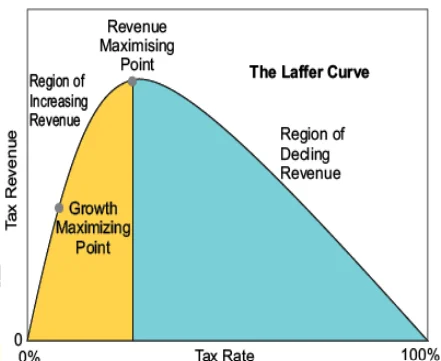
Developed by economist Arthur Laffer in the 1970s.
Illustrates how changes in tax rates affect total tax revenue collected by the government.
Inverted U-shape: revenue is zero at 0% tax and also falls if tax rates are extremely high.
Key points:
At 0% tax: No revenue (nobody pays).
At very high tax (say 100%): No incentive to work/invest → little or no revenue.
Optimal point (‘sweet spot’): A moderate tax rate maximizes total revenue.
Significance: Helps policymakers understand that increasing tax rates beyond a point may reduce revenue due to tax evasion, avoidance, or reduced economic activity.
Tax Buoyancy
Measures responsiveness of tax revenue growth to changes in GDP.
Formula: Tax Buoyancy = % Change in Tax Revenue ÷ % Change in GDP.
Example: If GDP grows by 10% and tax revenue grows by 12%, buoyancy = 1.2.
High buoyancy means government can collect more revenue without raising tax rates.
Importance: Indicates efficiency of tax system and its ability to generate funds for development as the economy grows.
Tax Avoidance
Definition: Legally reducing tax liability by taking advantage of provisions, deductions, and exemptions available under tax laws.
Examples:
Claiming deductions under Section 80C (e.g., investing in LIC, PPF).
Adjusting business expenses to reduce taxable income.
Difference from Tax Evasion:
Tax Avoidance is legal (using loopholes and exemptions).
Tax Evasion is illegal (hiding income, falsifying accounts).
Impact: While legal, it reduces government’s tax base; hence governments try to simplify tax codes to reduce excessive avoidance.
| Concept | Meaning | Impact |
|---|---|---|
| Laffer Curve | Shows link between tax rate and revenue (inverted U). | Helps decide optimal tax rate to maximize revenue. |
| Tax Buoyancy | Measures how tax revenue grows with GDP growth. | Shows efficiency of tax system without changing rates. |
| Tax Avoidance | Legal reduction of tax liability using exemptions. | Reduces effective tax revenue but is not illegal. |
Prelims tips
- Laffer Curve: Optimal tax rate maximizes revenue (inverted U).
- Tax Buoyancy > 1 means tax revenues grow faster than GDP.
- Tax Avoidance is legal; Tax Evasion is illegal.
- Arthur Laffer developed the Laffer Curve.
Mains points
- Laffer Curve shows limits of increasing tax rates and emphasizes balancing growth with revenue.
- Tax buoyancy reflects tax system efficiency in mobilizing resources during economic growth.
- Tax avoidance highlights the need for simplifying tax laws and reducing loopholes.
- Policy challenge: Balance between maximizing revenue and ensuring fairness in taxation.
Tax Evasion
Tax evasion is an illegal practice where individuals or businesses deliberately avoid paying their taxes using fraudulent methods like hiding income, inflating expenses, or submitting false returns. It is a punishable crime that harms the economy by reducing government revenue and increasing black money.
Overview
Tax evasion is the unlawful attempt to reduce one’s tax burden by using fraudulent methods.
Unlike tax avoidance (which is legal), tax evasion involves deliberate dishonesty.
It includes acts such as under-reporting income, overstating expenses, and concealing records.
Under the Income Tax Act, tax evasion is a crime and punishable with penalties, fines, and even imprisonment.
Common Ways of Tax Evasion in India
Late filing or non-filing of income tax returns.
Concealing actual income to reduce tax liability.
Not getting accounts audited (mandatory for businesses beyond a limit).
Providing false or incorrect PAN details.
Hiding imports/exports to evade customs duty.
Submitting fake documents or certificates to claim deductions.
Inflating business expenses by including personal expenses.
Impact of Tax Evasion on the Economy
Loss of Government Revenue: When expected tax is not collected, the government struggles to fund development projects like healthcare, infrastructure, and education.
Increase in Corruption: Tax evasion fuels black money and expands the underground economy.
Inflation: Black money increases the money supply in the market beyond expected levels, raising prices unnaturally.
Misallocation of Wealth: Evaders often invest black money in gold, property, or benami assets, which distorts genuine investment opportunities.
Capital Flight: Black money is transferred to foreign tax havens (like Switzerland, Cayman Islands), draining wealth from India.
Legal Consequences
Heavy penalties for underreporting or misreporting income.
Prosecution and imprisonment in severe cases of evasion.
Seizure of property and freezing of bank accounts under anti-money laundering laws.
| Aspect | Tax Avoidance | Tax Evasion |
|---|---|---|
| Legality | Legal (uses loopholes in law) | Illegal (against the law) |
| Method | Planned use of exemptions/deductions | Fraudulent hiding of income/false returns |
| Consequence | No punishment (but govt may plug loopholes) | Punishable with fines and imprisonment |
| Impact | Reduces tax liability legally | Causes loss to government revenue |
Prelims tips
- Tax Evasion is illegal; punishable under the Income Tax Act.
- Different from Tax Avoidance (legal).
- Common methods: hiding income, inflating expenses, false PAN, not filing returns.
- Impact: Revenue loss, black money, corruption, inflation, capital flight.
Mains points
- Tax evasion weakens government finances and limits investment in infrastructure and welfare.
- It fuels corruption and black money, distorting the economy.
- Encourages capital flight to tax havens, reducing trust in domestic economy.
- Policy response: Strengthening digital monitoring (e.g., Aadhaar-PAN linkage, Project Insight), stricter penalties, and simplification of tax laws to reduce scope for evasion.
Black Money
Black money refers to income that is not reported to tax authorities. It can come from both legal activities (like under-reporting shop income) and illegal activities (like smuggling, bribery, or hawala). It causes revenue loss, fuels corruption, and weakens the economy.
Overview
Black money = hidden, unaccounted, or illegally earned money not reported to tax authorities.
Sources can be legal (like under-reporting income from business) or illegal (like smuggling, drug trade, bribery, corruption).
Major problem in India as it reduces government revenue, increases inequality, and strengthens the black economy.
Ways of Generating Black Money
Hawala System: Informal money transfer without banks, based on trust. Helps move funds within or outside India while avoiding taxes and legal charges.
Round Tripping: Money is sent abroad and brought back into India as 'foreign investment'. Example: using shell companies in tax havens.
Participatory Notes (P-Notes): Anonymous instruments once used by foreign investors in Indian stock markets, often misused to hide identities and avoid taxes.
Double Taxation Avoidance Agreement (DTAA): Agreements meant to prevent double taxation, but sometimes misused to route investments through tax havens like Mauritius, Singapore, and Cayman Islands. Leads to revenue loss for India.
Tax Havens: Countries with low or no taxes (e.g., Panama, Cayman Islands, Switzerland) allow people to hide money anonymously.
Investment in Assets: People invest in gold, real estate, or benami properties without declaring them to tax authorities.
NGOs and Fake Documentation: Some NGOs are used to convert black money into white money by faking donation receipts and accounts.
Double Taxation Avoidance Agreements (DTAA)
DTAA is a treaty between two countries to avoid taxing the same income twice.
Example: An NRI working abroad should not pay taxes both in India and in the foreign country on the same income.
Benefits: Promotes international trade and investment, avoids double burden on genuine taxpayers.
Challenges: Some MNCs misuse DTAAs to reduce tax liability by routing investments through low-tax countries (treaty shopping).
India has signed around 94 comprehensive DTAAs and 8 limited ones.
Impact of Black Money
Government Revenue Loss: Funds that could be used for development are lost.
Rise in Corruption: Black money fuels bribery and parallel economy.
Inflation: Excess black money increases demand artificially, raising prices.
Inequality: Rich people with black money get richer, while honest taxpayers bear the burden.
Capital Flight: Large amounts of Indian wealth move to tax havens abroad, weakening domestic economy.
| Method | Explanation |
|---|---|
| Hawala System | Informal money transfer outside banks, avoiding tax. |
| Round Tripping | Money routed abroad and brought back as foreign investment. |
| P-Notes | Anonymous financial instruments used by foreign investors. |
| DTAA Misuse | Using tax treaties with countries like Mauritius to reduce tax liability. |
| Tax Havens | Countries with very low or zero taxes used to hide money. |
| Gold/Property Investment | Buying assets without reporting them to authorities. |
Prelims tips
- Black money = unaccounted/hidden income not reported to tax authorities.
- Hawala and round-tripping are common illegal routes.
- India has signed 94 comprehensive DTAAs.
- Tax havens like Mauritius and Singapore often misused for investments.
- Impact: revenue loss, inflation, corruption, capital flight.
Mains points
- Black money reduces trust in the taxation system and increases inequality.
- It drains resources by reducing government’s ability to fund welfare and development.
- Encourages corruption, bribery, and weakens rule of law.
- Solutions: strict monitoring (Aadhaar-PAN linkage), crackdown on shell companies, strengthening DTAA provisions, global cooperation to curb tax havens.
Benami Transactions (Prohibition) Act, 2016 & Prevention of Money Laundering Act, 2002
The Benami Transactions (Prohibition) Act, 2016 aims to prevent people from hiding wealth in the name of others (benami transactions) to avoid taxes, while the Prevention of Money Laundering Act (PMLA), 2002 prevents and punishes money laundering activities, where illegally earned money is shown as legal.
Benami Transactions (Prohibition) Act, 2016
Purpose: Stop black money, reduce corruption, and increase transparency in the economy.
It amended the 1988 Act and renamed it as 'Prohibition of Benami Property Transaction Act, 1988'.
Definition: A transaction is benami if:
Property is held by one person but paid for by another.
Transaction is done in a false/fake name.
The real owner is unknown or denies ownership.
The person funding the purchase cannot be traced.
Appellate Tribunal: Hears appeals against Adjudicating Authority’s decisions; appeals then go to High Court.
Special Courts: Trials must finish within 6 months.
Authorities: Four levels of authorities (Initiating Officer, Approving Authority, Administrator, Adjudicating Authority) can investigate, attach, and confiscate benami property.
Penalty: If guilty, punishment is rigorous imprisonment (1–7 years) and fine up to 25% of fair market value.
Key Terms:
Benami Property: Property involved in benami transaction.
Benamidar: Person in whose name property is held.
Beneficial Owner: Person for whom property is really held.
Prevention of Money Laundering Act (PMLA), 2002
Purpose: Prevent laundering of money, stop its use in illegal activities, and allow confiscation of such property.
Burden of proof: Lies on the accused, who must prove that property was not obtained from crime proceeds.
Offences covered: Includes crimes under IPC, Prevention of Corruption Act, Narcotics Act, Wildlife Act, IT Act, Copyright Act etc.
Penalty:
Imprisonment: Minimum 3 years, maximum 7 years (can extend to 10 years if drug-related).
Fine: Additional monetary penalty.
Investigating Agencies:
Enforcement Directorate (ED) – investigates offences.
Financial Intelligence Unit – India (FIU-IND) – tracks suspicious financial transactions.
Recent Amendments:
Money Laundering treated as an independent crime (not just linked to another crime).
Section 3: Any act of concealment, possession, acquisition, use, or claiming proceeds of crime as 'clean money' counts as money laundering.
Continuing Nature: As long as benefits are enjoyed from laundered money, offence continues.
| Aspect | Benami Act (2016) | PMLA (2002) |
|---|---|---|
| Purpose | Stop black money via fake ownership | Stop laundering (converting black money into white) |
| Key Authorities | Initiating Officer, Adjudicating Authority, Tribunal | ED, FIU-IND |
| Penalty | 1–7 years imprisonment + fine up to 25% of property value | 3–7 years (10 years for drugs) + fine |
| Key Concept | Benamidar holds property for real owner | Money laundering = showing illegal money as legal |
| Appeal | Appellate Tribunal → High Court | Special Court under PMLA |
Prelims tips
- Benami = property held in someone else’s name, paid by another.
- Benami Act amended in 2016, stricter punishments introduced.
- PMLA enacted in 2002, ED is main enforcement agency.
- Burden of proof under PMLA is on the accused, not government.
- Money laundering now treated as a stand-alone offence.
Mains points
- Benami Act focuses on stopping fake ownership and bringing hidden assets into the tax net.
- PMLA focuses on punishing those who try to clean black money and integrate it into the economy.
- Both laws are critical in India’s fight against corruption, black money, and parallel economy.
- Challenges remain in speedy trials, inter-agency coordination, and international cooperation.
Black Money and Imposition of Tax (Undisclosed Foreign Income and Assets) Act, 2015
This Act was introduced to penalize Indian residents who hide foreign income or assets and do not report them to tax authorities. It imposes strict taxes, heavy penalties, and even imprisonment for evading taxes on foreign income and property.
Purpose
To stop concealment of foreign income and assets by Indian residents.
To bring transparency and accountability in foreign holdings of Indians.
To penalize those attempting to evade tax on such foreign income.
Taxation
Flat 30% tax on undisclosed foreign income and assets of the previous year.
This applies regardless of the income slab or exemptions available under normal income tax laws.
Scope of Taxable Income
Income earned abroad but not reported in Indian tax returns.
Foreign income where no tax return has been filed at all.
Value of any foreign asset (like property, bank account, shares, jewellery) not disclosed to authorities.
One-time Compliance Window
The Act gave a one-time chance to residents to declare hidden foreign income/assets voluntarily.
Declared income had to be taxed at 30% + penalty of 100% (effectively 60%).
This was to encourage people to come clean and avoid prosecution.
Tax Authorities
Same authorities as under Income Tax Act (Assessing Officer, Commissioner, Tribunal).
Have powers to inspect, summon, demand evidence, and hold judicial proceedings.
Penalties
Non-disclosure of foreign income/assets: Penalty = 3 times the tax payable + 30% tax.
Failure to file returns: Fine of ₹10 lakh.
Repeat offences: Liable to pay amount equal to tax arrears.
Other defaults (not answering questions, not producing documents, etc.): Fine between ₹50,000 and ₹2 lakh.
Prosecution
Wilful attempt to evade tax: Rigorous imprisonment of 3–10 years + fine.
Wilful attempt to evade payment: 3 months–3 years imprisonment + fine.
Failure to furnish returns / conceal foreign assets: 6 months–7 years imprisonment + fine.
Abetment (helping someone evade): 6 months–7 years imprisonment + fine.
Company liability: All responsible officers are liable unless they prove lack of knowledge.
| Aspect | Details |
|---|---|
| Tax Rate | Flat 30% on undisclosed foreign income/assets |
| Compliance Window | One-time chance with 30% tax + 100% penalty |
| Penalty | 3x tax + fines up to ₹10 lakh or more |
| Prosecution | 3–10 years rigorous imprisonment + fine |
| Scope | Foreign income/assets not disclosed in tax returns |
Prelims tips
- Black Money Act came in 2015, separate from Income Tax Act.
- Flat 30% tax + heavy penalties on undisclosed foreign assets.
- One-time compliance window allowed voluntary disclosure.
- Failure to disclose can lead to 3–10 years imprisonment.
- Applicable only for foreign assets, not domestic black money.
Mains points
- The Act is an important step in India's fight against black money held abroad.
- Helps increase tax compliance and transparency in foreign asset ownership.
- Acts as a deterrent against tax evasion and illegal offshore holdings.
- Challenges include detection of hidden assets abroad and international cooperation with tax havens.
- Criticism: Harsh penalties may discourage voluntary disclosures after the compliance window closed.
Tax Havens, Tax Terrorism, and Indirect Transfers
A tax haven is a country or territory that offers very low or zero taxes to foreign individuals or corporations, often allowing them to avoid paying taxes in their home country. India has also faced issues such as tax terrorism (retrospective taxation) and indirect transfers of assets, leading to landmark disputes like the Vodafone case.
Tax Haven
A country/territory that imposes very low or zero taxes on foreigners or corporations.
Known as Offshore Financial Centres.
Allows companies and individuals to park profits abroad without doing real business there.
Examples: Cayman Islands, British Virgin Islands, Mauritius.
Features of Tax Havens
Very low or no income/corporate tax.
High financial secrecy (keeps owners’ identity hidden).
No requirement to actually conduct business operations locally.
Attracts companies to shift profits and avoid taxes in their home country.
Countermeasures Against Tax Havens
Global Minimum Tax (GMT): OECD framework introduced a 15% minimum corporate tax on large MNCs’ foreign income, expected to generate 150 billion worldwide.
Transparency Laws: Stronger global disclosure requirements prevent hiding money in tax havens.
Bilateral/Multilateral Treaties: Information exchange treaties signed with tax havens (India has DTAA with Mauritius, Singapore etc.).
OECD BEPS Plan: Base Erosion and Profit Shifting plan discourages shifting profits artificially to low-tax jurisdictions.
Tax Terrorism
Using retrospective amendments and unreasonable interpretations to demand heavy taxes from businesses.
Famous Case: Retrospective amendment to Finance Act, 2012 forcing Vodafone to pay tax on an offshore share transfer deal.
Seen as harassment of honest taxpayers, reduces investor confidence.
Indirect Transfers
Indirect transfer occurs when shares of a foreign entity (which holds Indian assets) are transferred abroad.
Indian law: If 50% or more value of foreign shares comes from Indian assets, then the transfer is taxable in India.
Vodafone Case: Vodafone bought shares of a Cayman Islands company which indirectly owned Indian telecom assets. Govt demanded 2.1 billion tax.
2012 Amendment: Law amended retrospectively to tax such deals.
2020 Change: Law amended again to apply only to ongoing disputes; old cases like Vodafone and Cairn were resolved.
| Concept | Meaning | Example |
|---|---|---|
| Tax Haven | Low/zero tax country for foreigners to hide profits | Cayman Islands, Mauritius |
| Countermeasure | Global laws and treaties to stop profit shifting | OECD Global Minimum Tax |
| Tax Terrorism | Unreasonable retrospective taxation by govt | Vodafone retrospective tax case |
| Indirect Transfer | Foreign share transfer indirectly linked to Indian assets | Vodafone-Cairn disputes |
Prelims tips
- Tax havens offer low/no taxes and high secrecy (examples: Cayman Islands, Mauritius).
- OECD’s Global Minimum Tax: 15% on large MNCs’ foreign profits.
- Tax Terrorism in India linked to retrospective taxation (2012 Finance Act).
- Indirect Transfer: If >50% value comes from Indian assets, taxable in India.
- Vodafone case is landmark for retrospective tax and indirect transfer.
Mains points
- Tax havens erode domestic tax base by allowing profit shifting.
- OECD’s Global Minimum Tax is a step towards fairer taxation.
- Tax terrorism harms investor confidence and economic growth.
- Indirect transfer rules ensure India’s right to tax value derived from its assets.
- Vodafone and Cairn disputes highlight challenges of retrospective taxation.
Buyback Tax and Pigouvian Tax
Buyback Tax is imposed when a company repurchases its own shares, often to improve earnings per share or avoid dividend distribution tax. Pigouvian Tax is a corrective tax imposed on activities that cause negative externalities (harm to society), such as carbon emissions.
Buyback Tax
Buyback = when a company repurchases its own outstanding shares from the market.
Once repurchased, these shares are extinguished (cancelled), reducing total share count.
Purpose:
Improve Earnings Per Share (EPS) for remaining shareholders.
Allow promoters to increase their stake, reducing takeover risks.
Avoid Dividend Distribution Tax (earlier companies preferred buybacks over dividends).
Tax on buyback ensures government collects revenue and prevents tax avoidance.
Pigouvian Tax
Named after economist Arthur Pigou.
A tax on 'negative externalities' — harms caused by an activity to society but not paid for by the producer.
Example: A factory polluting air imposes health costs on society, but the factory doesn’t pay for it directly. Government imposes Pigouvian Tax to make polluter pay.
Carbon Tax is a classic example: companies using coal, oil, or gas pay extra tax because they release greenhouse gases.
Aim: To discourage harmful activities and encourage sustainable alternatives.
| Aspect | Buyback Tax | Pigouvian Tax |
|---|---|---|
| Definition | Tax on company repurchasing its own shares | Tax on activities causing harm to society (externalities) |
| Purpose | Prevent tax avoidance, improve EPS, control takeovers | Discourage harmful activities, make polluters pay |
| Example | Share buyback by Infosys or TCS | Carbon tax on coal/oil/gas companies |
Prelims tips
- Buyback Tax prevents misuse of buyback to escape dividend tax.
- Pigouvian Tax = corrective tax on negative externalities (e.g., carbon tax).
- Pigouvian Tax named after economist Arthur Pigou.
- Both taxes ensure fairness: one in corporate finance, other in environmental protection.
Mains points
- Buyback Tax discourages companies from avoiding dividend taxes and ensures revenue collection.
- Helps regulate corporate behavior, reduces takeover threats, and stabilizes financial markets.
- Pigouvian Tax is a policy tool to address market failures where external costs are ignored.
- Carbon taxes under Pigouvian framework encourage renewable energy adoption.
- Both are examples of how taxation influences corporate and social responsibility.
Trends in Tax Revenue Collection, APA and GAAR
India has seen strong growth in tax revenue, especially direct taxes. Mechanisms like Advance Pricing Agreements (APA) and General Anti-Avoidance Rules (GAAR) are tools to ensure fairness, reduce disputes, and prevent tax avoidance or evasion.
Positive Trends in Tax Revenue Collection
Direct tax collection in India has been rising steadily, exceeding expectations with nearly 81% of the target achieved before the financial year ended.
Personal Income Tax is growing faster than Corporate Tax (27.3% vs 12.4%). This shows rising compliance by individuals.
The number of people filing Income Tax Returns is at record highs, indicating a broadening tax base.
Such growth reduces government’s dependency on borrowing and strengthens financial stability.
Advance Pricing Agreement (APA)
An APA is an agreement between a taxpayer and the tax authority to decide the method of calculating tax (Transfer Pricing Methodology) in advance for cross-border transactions.
Purpose: To bring certainty in taxation of international transactions and reduce litigation.
Benefits: Provides certainty to taxpayers, enhances tax revenues, and makes India attractive for foreign investors.
Types of APA:
Unilateral APA: Between taxpayer and Indian tax authority only.
Bilateral APA: Between Indian and foreign tax authority plus taxpayer.
Multilateral APA: Between multiple foreign tax authorities and India.
Example: By 2019, CBDT had signed 271 APAs, reducing disputes related to multinational companies.
General Anti-Avoidance Rules (GAAR)
GAAR is an anti-tax avoidance law introduced in India on 1st April 2017 under the Income Tax Act, 1961.
It targets aggressive tax planning or artificial arrangements made only to avoid taxes.
Background: GAAR was first proposed in the 2009 Direct Tax Code. Its introduction was delayed due to investor concerns until 2017.
Why GAAR? The Vodafone case is a major example. Vodafone bought Hutch India for ₹55,000 crores, but the parent company avoided paying capital gains tax to India.
Procedure: Before applying GAAR, tax officers must escalate cases to senior authorities and a panel must approve action.
Conditions for GAAR applicability:
Main purpose of transaction = tax benefit.
Creates artificial rights/obligations.
Misuses provisions of law.
Lacks commercial substance.
Not carried out for genuine business purposes.
| Aspect | Advance Pricing Agreement (APA) | General Anti-Avoidance Rules (GAAR) |
|---|---|---|
| Definition | Agreement fixing tax method in advance for cross-border deals | Law to prevent artificial tax avoidance arrangements |
| Objective | Reduce disputes, bring tax certainty | Stop aggressive tax planning & safeguard revenue |
| Scope | International transactions (Transfer Pricing) | Any domestic or international transaction aimed at tax avoidance |
| Example | 271 APAs signed by India (2019) | Vodafone case led to GAAR framework |
Prelims tips
- APA = certainty in transfer pricing, reduces litigation.
- Types of APA: Unilateral, Bilateral, Multilateral.
- GAAR effective from 1 April 2017 under Income Tax Act.
- Vodafone case triggered GAAR framework in India.
Mains points
- India’s tax revenue shows a positive trend due to higher compliance and widening tax base.
- APA helps in avoiding long transfer pricing disputes and builds investor confidence.
- GAAR acts as a shield against misuse of tax loopholes.
- Together, APA and GAAR balance investor-friendly policies with safeguarding government revenue.
- Key challenge: Implementing GAAR without discouraging genuine investments.
Taxation Concepts (Tax Expenditure)
Tax Expenditure refers to the revenue foregone by the government due to tax exemptions, deductions, rebates, credits, or preferential tax rates provided under the tax laws. It represents an indirect subsidy given through the tax system, aiming to incentivize certain activities or support specific groups.
What is Tax Expenditure?
Imagine the standard tax rate is 30%. If the government gives a special 10% tax rate to a new factory in a backward area, the 20% difference is the revenue the government chose not to collect . This 'foregone revenue' is called Tax Expenditure.
It's like the government is spending money indirectly by not collecting taxes it otherwise would have.
Purpose: To promote specific economic activities (like investment in certain sectors, R&D, exports) or achieve social goals (like encouraging savings via 80C, supporting charitable donations).
Examples in India:
Deductions under Section 80C (for investments in PPF, LIC, ELSS).
Accelerated depreciation for businesses (allowing faster write-off of asset value).
Exemptions for Special Economic Zones (SEZs).
Lower corporate tax rates for new manufacturing units.
Tax holidays for certain industries or regions.
How is it Calculated?
Governments estimate tax expenditure by calculating the difference between tax revenue collected under the current law (with exemptions) and the revenue that would have been collected if a 'benchmark' or standard tax structure (without those exemptions) were applied.
Significance
Policy Tool: Acts as an alternative to direct government spending (subsidies) to achieve policy objectives.
Transparency: Publishing tax expenditure data (usually in budget documents) makes these 'hidden subsidies' visible and allows for public scrutiny.
Impact Assessment: Helps evaluate whether the benefits of the tax breaks justify the revenue loss.
Criticisms and Challenges
Revenue Loss: Can significantly reduce government revenue, increasing the fiscal deficit.
Complexity: Numerous exemptions make the tax system complex and difficult to comply with.
Inequity: Often benefits wealthier individuals or large corporations more than the poor, as they are better positioned to utilize deductions and exemptions.
Distortionary Effects: Can distort investment decisions, encouraging activities solely for tax benefits rather than economic merit.
Potential for Misuse: Loopholes can be exploited for tax avoidance.
Reforms in India
India has been gradually phasing out or rationalizing various tax exemptions and deductions to:
Simplify the tax system.
Widen the tax base.
Reduce revenue loss.
Move towards lower tax rates with fewer exemptions (e.g., the new personal income tax regime, lower corporate tax rates without exemptions).
Prelims tips
- Tax Expenditure: Revenue foregone by govt due to exemptions, deductions, etc.
- It's an indirect subsidy via the tax system.
- Examples: 80C deductions, SEZ exemptions, lower tax rates.
- Aims to incentivize specific activities but can cause revenue loss and complexity.
Mains points
- Tax expenditures are significant components of fiscal policy, often hidden compared to direct subsidies.
- While useful for targeted incentives, they need regular review to ensure effectiveness and prevent revenue leakage.
- The trend in India and globally is towards reducing tax expenditures and favouring lower, simpler tax rates.
- Transparency through reporting tax expenditures in budget documents is crucial for accountability.