
Mathematics Optional · UPSC Notes
Abstract Algebra — UPSC Maths Optional Notes
Free, exam-focused notes for UPSC Prelims and Mains, with Prelims tips and Mains points for every topic. 10 topics.
Open in the interactive reader: bookmarks, progress tracking and read-aloud.
Groups, Subgroups, Cyclic Groups, Cosets and Lagrange's Theorem
A group is a set with an associative operation, an identity and inverses. Subgroups are tested by the one-step test ab−1 ∈ H, and cyclic groups are completely described by ℤ and ℤn. Cosets of a subgroup partition the group, which gives Lagrange's theorem: the order of a subgroup divides the order of a finite group.
1. Understanding Groups and the Group Axioms
Why we need it: integers under addition, non-zero reals under multiplication, the rotations of a square and the shuffles of a deck of cards all obey the same few rules.
Instead of proving a fact such as 'inverses are unique' separately for each of them, we prove it once for every structure that obeys these rules. A group is exactly this list of rules.
In words: 'a non-empty set G' means G has at least one element (it will contain the identity). 'A binary operation *' is a rule that takes an ordered pair (a, b) of elements of G and returns one element a*b.
Closure says the answer a*b lies in G again. Associativity says that when three elements are combined, the bracketing does not matter; the order of the elements may still matter.
The identity e is one fixed element that changes nothing, on either side. An inverse of a is an element that undoes a, on either side.
Notice the order of the quantifiers. There is one e that works for every a (∃e ∀a), but the inverse depends on a (∀a ∃a−1).
First example, slowly: let G = {1, −1, i, −i} with ordinary multiplication of complex numbers. We check the four axioms one at a time.
Step 1 (closure): i·i = −1, i·(−i) = 1, (−i)·(−i) = −1, (−1)·i = −i, (−1)·(−1) = 1, and every other product is ±1 or ±i. So every product lies in G.
Step 2 (associativity): multiplication is associative in all of ℂ, and G ⊆ ℂ, so it is associative on G. Nothing needs to be checked by hand.
Step 3 (identity): 1·z = z·1 = z for each z ∈ G, so e = 1.
Step 4 (inverses): 1·1 = 1, (−1)(−1) = 1 and i·(−i) = 1. So 1−1 = 1, (−1)−1 = −1, i−1 = −i and (−i)−1 = i, all in G.
Step 5 (conclusion): G is a group, and it is abelian because complex multiplication commutes. Its order is 4, and o(i) = 4 because i, i2 = −1, i3 = −i, i4 = 1.
Non-example: {0, 1, 2, 3} under multiplication mod 4 is closed and has the identity 1, but 2 has no inverse: 2·0 = 0, 2·1 = 2, 2·2 = 0, 2·3 = 2 (mod 4), never 1. So axiom (iv) fails.
Removing 0 does not help, because then 2·2 = 0 breaks closure. Only the units {1, 3} = U(4) form a group under multiplication mod 4.
Building up: the basic facts follow from the axioms alone, one axiom per step. (1) The identity is unique: if e and e′ are both identities, then e = ee′ = e′.
(2) Inverses are unique: if b and c both invert a, then b = be = b(ac) = (ba)c = ec = c. Here associativity is used in the middle step.
(3) Cancellation: if ab = ac, multiply on the left by a−1 and use associativity to get b = c. (4) (ab)−1 = b−1a−1, because (ab)(b−1a−1) = a(bb−1)a−1 = aa−1 = e.
In an exam answer, name the axiom used in each such step; that is what the examiner looks for.
Where it is used: every later topic (subgroups, homomorphisms, rings, vector spaces) begins by checking these axioms, and uniqueness and cancellation are used silently in nearly every proof of this chapter.
2. Understanding Subgroups and the One-Step Test
Why we need it: a big group often contains smaller groups: the even integers inside ℤ, the rotations inside all the symmetries of a square. We want a quick test for when a subset is itself a group, without re-checking all four axioms.
In words: H ≤ G means H ⊆ G and H is a group under the same operation as G. The one-step test asks two things: H is not empty, and for every a, b ∈ H the element ab−1 is again in H.
Here b−1 is the inverse in G. In additive notation the condition reads a − b ∈ H: 'the difference of two members is a member'.
First example, slowly: let H = 3ℤ = {..., −6, −3, 0, 3, 6, ...} in (ℤ, +).
Step 1: H is not empty, since 0 = 3·0 ∈ H.
Step 2: take arbitrary a, b ∈ H. Membership means a = 3m and b = 3n for some integers m, n.
Step 3: in additive notation ab−1 is a − b = 3m − 3n = 3(m − n).
Step 4: m − n is an integer, so a − b ∈ H, and by the one-step test 3ℤ ≤ ℤ. Notice that we never checked associativity (it is inherited from ℤ) or the identity (the test produces it).
Non-example: the odd integers in (ℤ, +) form a non-empty set, but 3 − 1 = 2 is even, so the test fails; indeed 0 is not odd. Also ℕ = {1, 2, 3, ...} is closed under +, yet 1 − 2 = −1 ∉ ℕ: for an infinite subset, closure alone is not enough.
Building up: why one condition is enough. (i) Put b = a: aa−1 = e ∈ H. (ii) Put a = e: eb−1 = b−1 ∈ H, so H contains inverses.
(iii) For a, b ∈ H we now know b−1 ∈ H, so a(b−1)−1 = ab ∈ H: H is closed. (iv) Associativity holds in G, hence in H.
For a finite H, closure alone gives the inverses as well, because a−1 = an−1 with n = o(a); this is the finite subgroup test stated below.
Where it is used: to prove that kernels, centres, centralisers, intersections and images are subgroups; the same idea is the subspace test of Linear Algebra and the subring and ideal tests of the Rings topic.
3. Understanding Cyclic Groups and Orders of Elements
Why we need it: the simplest groups are those built from a single element and its powers. They are completely understood, so they supply ready examples, and the rule o(ak) = n/gcd(n, k) answers most counting questions.
In words: ⟨a⟩ = {an : n ∈ ℤ} is the set of all powers of a, including a0 = e and the negative powers a−n = (a−1)n. G is cyclic if G = ⟨a⟩ for some a, called a generator.
The order o(a) is the least positive n with an = e. When it is finite, it equals the number of elements of ⟨a⟩. In additive notation 'an' means na = a + a + ... + a (n terms).
First example, slowly: work in ℤ12 under addition. The 'powers' of 8 are its multiples: 1·8 = 8, 2·8 = 16 ≡ 4, 3·8 = 24 ≡ 0.
So o(8) = 3 and ⟨8⟩ = {0, 4, 8}. The formula agrees: 12/gcd(12, 8) = 12/4 = 3.
Now take 5: its multiples are 5, 10, 3, 8, 1, 6, 11, 4, 9, 2, 7, 0, all twelve residues. So 5 generates ℤ12, matching gcd(5, 12) = 1.
What to notice: the size of ⟨a⟩ depends only on how many steps a takes to return to the identity.
Non-example: U(8) = {1, 3, 5, 7} under multiplication mod 8 is abelian of order 4, but it is not cyclic: 32 ≡ 52 ≡ 72 ≡ 1, so each ⟨a⟩ has at most 2 elements. Abelian does not imply cyclic.
Building up: (1) If o(a) = n, the elements e, a, ..., an−1 are distinct, and am depends only on the remainder of m mod n; so |⟨a⟩| = n.
(2) am = e iff n divides m, by the division algorithm (the 'Why it works' line below). (3) Hence o(ak) = n/gcd(n, k).
(4) ak generates exactly when this order is n, i.e. gcd(n, k) = 1, giving φ(n) generators (Standard Proofs, Theorem 16). (5) Every subgroup of ⟨a⟩ is cyclic (Theorem 2), and there is exactly one for each divisor of n.
Where it is used: listing all subgroups of ℤn and U(n), counting elements of a given order, the cyclic multiplicative group of a finite field, and the structure of groups of prime order.
4. Understanding Cosets and Lagrange's Theorem
Why we need it: we want to know which sizes a subgroup of a finite group can have, without listing subgroups. Cosets cut the group into equal pieces, and counting the pieces answers the question.
In words: for H ≤ G and a ∈ G, the left coset aH = {ah : h ∈ H} is obtained by multiplying every element of H on the left by a. The element a is a representative of the coset.
Different representatives can give the same coset: aH = bH exactly when a−1b ∈ H. The index [G : H] is the number of distinct left cosets.
First example, slowly: take G = ℤ6 under addition and H = {0, 3}. In additive notation the coset of a is a + H.
Step 1: 0 + H = {0, 3}, 1 + H = {1, 4}, 2 + H = {2, 5}.
Step 2: 3 + H = {3, 0} = H again, 4 + H = {4, 1} = 1 + H and 5 + H = 2 + H. So there are exactly three distinct cosets, and [G : H] = 3.
Step 3: the three cosets have 2 elements each, do not overlap, and together contain all six elements. Hence 6 = 3 × 2, i.e. |G| = [G : H]·|H|.
Non-example: translate the subset S = {0, 1}, which is not a subgroup: 0 + S = {0, 1} and 1 + S = {1, 2} overlap in 1 without being equal. Cosets of a genuine subgroup are always equal or disjoint, and that is what the counting needs.
Building up: (1) The relation a ~ b iff a−1b ∈ H is an equivalence relation, and its classes are the left cosets, so the cosets partition G.
(2) h ↦ ah is a bijection H → aH, so each coset has |H| elements. (3) Counting gives |G| = [G : H]·|H|, which is Lagrange's theorem; the full proof is Standard Proofs, Theorem 1.
(4) Apply it to H = ⟨a⟩: o(a) divides o(G), so ao(G) = e. (5) If o(G) = p is prime, any a ≠ e has o(a) = p, so G = ⟨a⟩ is cyclic.
Where it is used: Fermat's and Euler's theorems, groups of prime order, the count of homomorphisms, index-2 subgroups being normal, and all Sylow-type counting in later topics.
5. Group and Basic Properties
Group: a non-empty set G with a binary operation * such that (i) closure: a*b ∈ G, (ii) associativity: (a*b)*c = a*(b*c), (iii) an identity e with a*e = e*a = a, (iv) every a has an inverse a−1 with a*a−1 = a−1*a = e.
Idea: a group is the algebra of reversible actions, such as the symmetries of a figure or the shuffles of a deck. Closure keeps us inside the set, associativity lets us drop brackets, the identity is the action 'do nothing' and the inverse is 'undo'.
Why each axiom is needed: (ℤ, ·) has closure, associativity and identity 1 but 2 has no inverse; (ℤ, −) is closed but not associative, since (1 − 2) − 3 = −4 while 1 − (2 − 3) = 2; (ℕ, +) has no identity and no inverses.
Abelian group: a group in which a*b = b*a for all a, b ∈ G.
Basic facts: the identity and each inverse are unique; (ab)−1 = b−1a−1; left and right cancellation laws hold.
Order: o(G) = |G| is the number of elements; o(a) is the least n ≥ 1 with an = e, and o(a) = ∞ if no such n exists.
Idea: o(a) is the length of the cycle e, a, a2, ... before it returns to e. In a finite group the powers must repeat, so ai = aj with i > j gives ai−j = e; hence every element of a finite group has finite order. In (ℤ, +) every non-zero element has infinite order, while in ℂ* the element i has order 4.
Why it works (am = e ⇒ o(a) | m): write m = qn + r with n = o(a) and 0 ≤ r < n. Then e = am = (an)qar = ar, and minimality of n forces r = 0.
Results on order: if am = e then o(a) divides m; o(a) = o(a−1) = o(gag−1); o(ab) = o(ba).
Abelian criteria: G is abelian if (ab)2 = a2b2 for all a, b, or if a2 = e for every a ∈ G.
6. Subgroups
Subgroup: a non-empty subset H ⊆ G that is itself a group under the operation of G; written H ≤ G.
One-step test: a non-empty subset H is a subgroup iff a, b ∈ H ⇒ ab−1 ∈ H.
Idea: the single condition ab−1 ∈ H packs together all the subgroup axioms. Taking b = a gives e ∈ H; then a = e gives b−1 ∈ H; then a(b−1)−1 = ab ∈ H. Associativity is inherited from G. Non-emptiness is essential, because the empty set satisfies the implication vacuously.
Finite subgroup test: a non-empty finite subset H is a subgroup iff it is closed under the operation.
Why it works: for a ∈ H, closure puts a, a2, a3, ... in H; since H is finite, o(a) = n is finite, so e = an ∈ H and a−1 = an−1 ∈ H. Finiteness is essential: ℕ is closed under + in (ℤ, +) but is not a subgroup.
Union and product: the intersection of subgroups is a subgroup; H ∪ K is a subgroup iff H ⊆ K or K ⊆ H; HK is a subgroup iff HK = KH.
Idea: a union of two subgroups is a subgroup only in the trivial case. If h ∈ H∖K and k ∈ K∖H, then hk ∈ H would give k = h−1(hk) ∈ H, and hk ∈ K would give h ∈ K; so hk lies outside H ∪ K. For example 2ℤ ∪ 3ℤ contains 2 and 3 but not 5.
Product formula: for finite subgroups H and K, |HK| = |H|·|K|/|H ∩ K|.
Why it works: consider the map H × K → HK, (h, k) ↦ hk. Now hk = h′k′ iff h−1h′ = k(k′)−1, and this common element lies in H ∩ K. So each element of HK is hit exactly |H ∩ K| times, and |H||K| = |HK|·|H ∩ K|.
Warning example: in S3, H = {e, (1 2)} and K = {e, (1 3)} give |HK| = 2·2/1 = 4, which does not divide 6; so HK is a subset of S3 but not a subgroup.
Centre and centraliser: Z(G) = {z ∈ G : zg = gz for all g ∈ G} and C(a) = {g ∈ G : ga = ag} are subgroups of G.
7. Cyclic Groups
Cyclic group: G = ⟨a⟩ = {an : n ∈ ℤ} for some element a, called a generator.
Idea: a cyclic group is one generator and all its powers: a clock face (ℤn) or the integer line (ℤ). Everything about it, its subgroups, generators and quotients, is decided by the order of the generator.
Structure theorem: an infinite cyclic group is isomorphic to (ℤ, +); a cyclic group of order n is isomorphic to (ℤn, +n).
Theorem: every cyclic group is abelian, and every subgroup of a cyclic group is cyclic.
Order of a power: if o(a) = n then o(ak) = n/gcd(n, k).
Why it works: let d = gcd(n, k). Then (ak)m = e ⇔ n | km ⇔ (n/d) | (k/d)m ⇔ (n/d) | m, the last step because gcd(n/d, k/d) = 1. So the least such m is n/d. Check in ℤ12: 8 has order 12/gcd(12, 8) = 3, and indeed 8, 16 ≡ 4, 24 ≡ 0.
Generators: if o(a) = n, then ak generates ⟨a⟩ iff gcd(k, n) = 1, so there are φ(n) generators. An infinite cyclic group has exactly two generators, a and a−1.
Groups of units: U(n) = {k : 1 ≤ k ≤ n, gcd(k, n) = 1} under multiplication mod n has order φ(n). U(p) is cyclic for every prime p (a generator is called a primitive root mod p); more generally U(n) is cyclic iff n = 1, 2, 4, pk or 2pk with p an odd prime.
Infinite groups: (ℤ, +) has the distinct subgroups nℤ (n = 0, 1, 2, ...). (ℚ, +) is not cyclic, and its cyclic subgroups ⟨1/n⟩ = {k/n : k ∈ ℤ} are distinct for different n ≥ 1.
Subgroups of a finite cyclic group: for each divisor d of n there is exactly one subgroup of order d, namely ⟨an/d⟩.
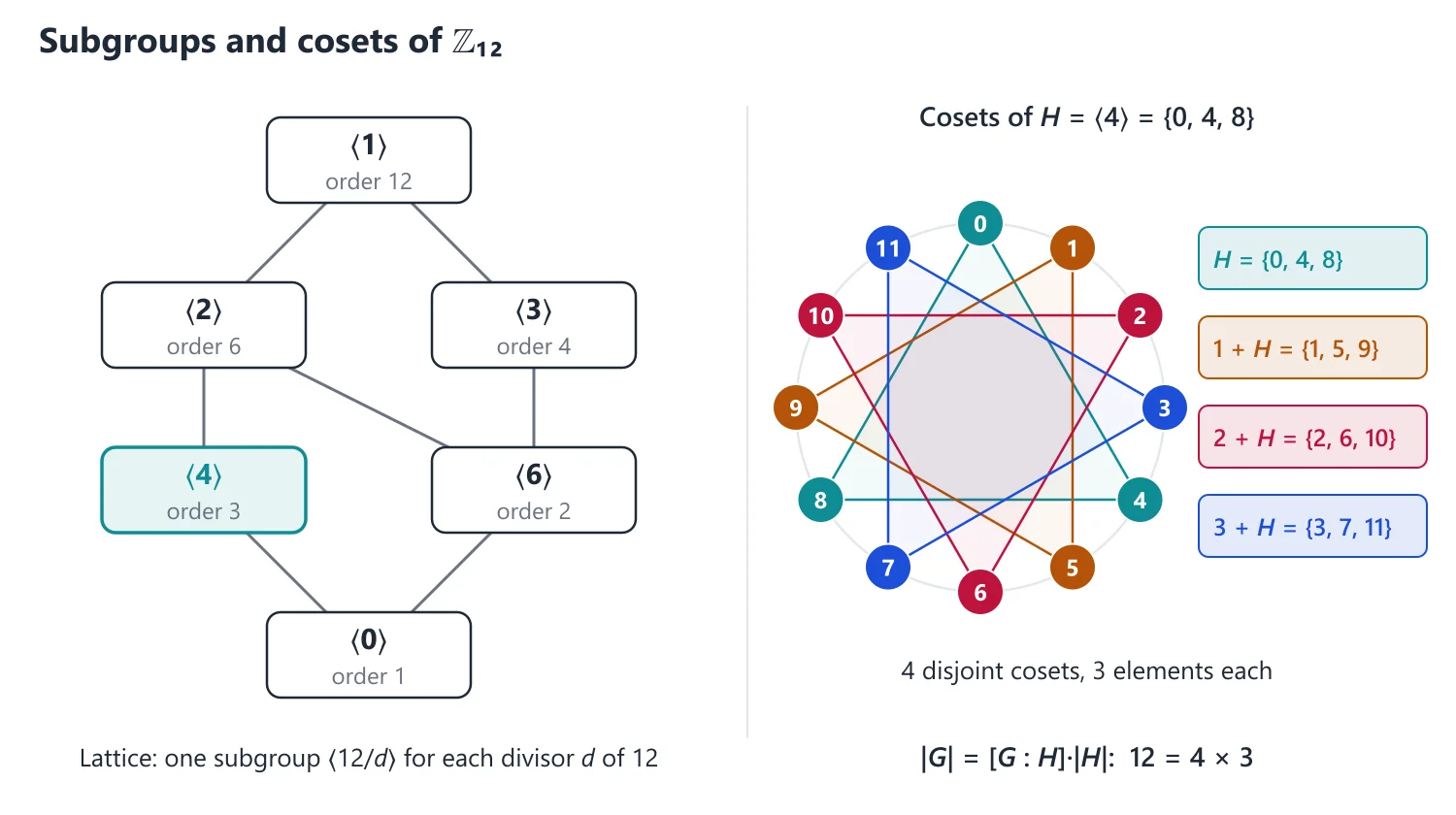
Idea: see the figure above: the subgroup lattice of ℤ12 is a copy of the divisor lattice of 12. In general ⟨an/d⟩ ⊆ ⟨an/e⟩ iff d | e, so containment of subgroups mirrors divisibility of their orders.
Example 1: Find all generators and all subgroups of ℤ12.
Generators are k with gcd(k, 12) = 1: 1, 5, 7, 11, so φ(12) = 4. There is one subgroup for each divisor 1, 2, 3, 4, 6, 12: ⟨0⟩, ⟨6⟩ = {0, 6}, ⟨4⟩ = {0, 4, 8}, ⟨3⟩ = {0, 3, 6, 9}, ⟨2⟩ of order 6, and ℤ12.
8. Cosets and Lagrange's Theorem
Coset: for H ≤ G and a ∈ G, the left coset is aH = {ah : h ∈ H} and the right coset is Ha = {ha : h ∈ H}.
Idea: a coset is a translate of H. In (ℝ2, +) with H a line through the origin, the cosets are the lines parallel to H. In ℤ12 with H = ⟨4⟩ = {0, 4, 8}, the cosets are {0, 4, 8}, {1, 5, 9}, {2, 6, 10}, {3, 7, 11} (see the figure above): four blocks of equal size.
Properties: aH = bH iff a−1b ∈ H; two left cosets are either equal or disjoint; |aH| = |H|; the left cosets partition G.
Index: [G : H] is the number of distinct left cosets, which equals the number of distinct right cosets.
Tower law for index: if K ≤ H ≤ G and G is finite, then [G : K] = [G : H][H : K], because o(G)/o(K) = (o(G)/o(H))·(o(H)/o(K)). It holds in any group whenever the indices are finite.
Lagrange's theorem: if G is a finite group and H ≤ G, then o(H) divides o(G), and [G : H] = o(G)/o(H).
Idea: the left cosets cut G into [G : H] disjoint blocks, each of size |H|, so |G| = [G : H]·|H|; the full proof is in Standard Proofs, Theorem 1. Finiteness is needed only for the divisibility statement; in an infinite group the index can still be finite, for example [ℤ : nℤ] = n.
Corollaries: in a finite group, o(a) divides o(G) and ao(G) = e; every group of prime order p is cyclic and is generated by each of its non-identity elements.
Number theory: applying Lagrange to the group U(n) of units mod n gives Euler's theorem aφ(n) ≡ 1 (mod n) for gcd(a, n) = 1, and Fermat's little theorem ap−1 ≡ 1 (mod p) for a prime p not dividing a.
Converse fails: A4 has order 12 but no subgroup of order 6.
Idea: Lagrange gives only a necessary condition on subgroup orders. Partial converses do hold: a cyclic group (more generally a finite abelian group) has a subgroup of every order dividing |G|, Cauchy's theorem gives subgroups of every prime order dividing |G|, and Sylow's theorem gives every prime-power order dividing |G|.
Counting with HK: for finite subgroups H, K of G, HK ⊆ G gives o(H)o(K)/o(H ∩ K) ≤ o(G). So if o(H)o(K) > o(G), then H ∩ K ≠ {e}.
Groups of order 4: up to isomorphism there are exactly two, the cyclic group ℤ4 (some element has order 4) and the Klein four-group V4 (every non-identity element has order 2).
Example 2: Show that every group of order 4 is abelian.
By Lagrange, each non-identity element has order 2 or 4. If some element has order 4, G is cyclic and hence abelian. Otherwise a2 = e for all a, so a = a−1 and ab = (ab)−1 = b−1a−1 = ba.
Example 3: Find the remainder when 3100 is divided by 7.
By Fermat, 36 ≡ 1 (mod 7). Since 100 = 6·16 + 4, 3100 ≡ 34 = 81 ≡ 4 (mod 7).
9. Derivation: Cosets as Equivalence Classes
Step 1: for H ≤ G define a ~ b iff a−1b ∈ H. It is reflexive (a−1a = e ∈ H), symmetric (b−1a = (a−1b)−1 ∈ H) and transitive (a−1c = (a−1b)(b−1c) ∈ H).
Step 2: the class of a is {b : a−1b ∈ H} = {ah : h ∈ H} = aH. Equivalence classes are equal or disjoint and cover G, which proves the 'equal or disjoint' and 'partition' properties at one stroke.
Step 3: h ↦ ah is a bijection H → aH (cancel a), so |aH| = |H|.
Step 4 (left and right cosets are equal in number): aH ↦ Ha−1 is well defined and one-one, because aH = bH ⇔ a−1b ∈ H ⇔ Ha−1 = Hb−1. It is onto, so the index [G : H] does not depend on the side, even though aH ≠ Ha in general.
10. Derivation: Counting Elements of Each Order in a Cyclic Group
Claim: in a cyclic group G of order n, for each divisor d of n there are exactly φ(d) elements of order d, and hence ∑d|n φ(d) = n.
Proof: if o(x) = d, then ⟨x⟩ is a subgroup of order d, and G has only one such subgroup, Hd = ⟨an/d⟩. So the elements of order d are exactly the generators of the cyclic group Hd, and there are φ(d) of them (Standard Proofs, Theorem 16).
Every element has some order d dividing n, so summing over d counts G once: ∑d|n φ(d) = n. Check for n = 12: φ(1) + φ(2) + φ(3) + φ(4) + φ(6) + φ(12) = 1 + 1 + 2 + 2 + 2 + 4 = 12.
Use: this count answers 'how many elements of order 4 in ℤ20?' at once: φ(4) = 2, namely 5 and 15.
11. Choosing the Method
If you must show H ≤ G for an infinite G → check H ≠ ∅ (usually e ∈ H) and use the one-step test ab−1 ∈ H.
If H is finite → closure alone suffices (finite subgroup test).
If asked whether G is cyclic → for 'yes' exhibit an element of order |G|; for 'no' show every element has order less than |G|, or that G is non-abelian, or that G has two different subgroups of the same order.
If the question is about possible orders of elements or subgroups of a finite group → Lagrange first, then o(ak) = n/gcd(n, k) and the φ(d) count.
If a remainder of a large power is asked → Fermat or Euler, i.e. Lagrange in U(n).
If you must prove G abelian → try a2 = e for all a, (ab)2 = a2b2, o(G) = p or p2, or G/Z(G) cyclic.
If you must show H ∩ K ≠ {e} → count: |H||K|/|H ∩ K| = |HK| ≤ |G|.
12. Common Mistakes
Using the finite subgroup test on an infinite set: ℕ ⊆ ℤ is closed under + but is not a subgroup. Use the one-step test unless H is known to be finite.
Assuming the converse of Lagrange: '6 divides 12, so A4 has a subgroup of order 6' is false. Existence of subgroups needs Cauchy, Sylow or cyclicity.
Writing (ab)−1 = a−1b−1: the correct rule is (ab)−1 = b−1a−1; the two agree only when a and b commute.
Assuming o(ab) = lcm(o(a), o(b)): this needs ab = ba (and o(ab) = o(a)o(b) needs, in addition, gcd(o(a), o(b)) = 1). In S3, (1 2) and (1 3) have order 2 but their product (1 3 2) has order 3.
Treating HK as a subgroup: HK is a subgroup only when HK = KH (for example when one of them is normal); the product formula counts HK as a set either way.
Listing too many generators of ℤ: an infinite cyclic group has exactly two generators, ±1 in ℤ; the φ(n) rule is only for finite cyclic groups.
13. Connections
Link: cosets are the group version of the solution set of a linear system: the solutions of Ax = b form x0 + N(A), a coset of the null space in Linear Algebra.
Link: the vector space axioms of Linear Algebra begin with '(V, +) is an abelian group', and the multiplicative group of a finite field (Field Extensions topic) is cyclic, which is why primitive roots mod p exist.
14. Worked Examples
Example 4: Show that every group of even order contains an element of order 2.
Pair each element a with its inverse a−1. The elements with a ≠ a−1 fall into disjoint pairs {a, a−1}, so their number is even.
Hence the number of elements with a = a−1, i.e. a2 = e, is o(G) minus an even number, which is even.
This set contains e, so it contains at least one more element a ≠ e, and that element has order 2.
Example 5: Prove or disprove: U(8) is cyclic.
U(8) = {1, 3, 5, 7} under multiplication mod 8 is a group of order 4.
32 = 9 ≡ 1, 52 = 25 ≡ 1 and 72 = 49 ≡ 1 (mod 8), so every non-identity element has order 2.
A cyclic group of order 4 needs an element of order 4, so U(8) is not cyclic; it is isomorphic to the Klein four-group V4.
Example 6: Let G be a group such that (ab)n = anbn for all a, b ∈ G and for three consecutive integers n = k, k + 1, k + 2. Show that G is abelian.
Writing (ab)k+1 = (ab)k(ab) gives ak+1bk+1 = akbkab. Cancel ak on the left and b on the right: abk = bka.
In the same way, n = k + 1 and n = k + 2 give abk+1 = bk+1a.
Now abk+1 = (abk)b = bkab, while bk+1a = bk(ba). Cancelling bk on the left gives ab = ba, so G is abelian.
15. Solved Past UPSC Questions
Example 7 (UPSC 2015, 10 marks): (i) How many generators are there of the cyclic group G of order 8? Explain.
(ii) Taking a group {e, a, b, c} of order 4, where e is the identity, construct composition tables showing that one is cyclic while the other is not. (5 + 5 = 10)
(i) If G = ⟨a⟩ has order 8, then o(ak) = 8/gcd(8, k), so ak generates G iff gcd(k, 8) = 1. The generators are a, a3, a5, a7: there are φ(8) = 4 of them.
(ii) Cyclic table: take o(a) = 4, b = a2, c = a3. Rows (row element × column element, columns e, a, b, c): e: e, a, b, c; a: a, b, c, e; b: b, c, e, a; c: c, e, a, b.
This group is generated by a (and by c), so it is cyclic and isomorphic to ℤ4.
Non-cyclic table: take a2 = b2 = c2 = e, ab = ba = c, bc = cb = a, ca = ac = b. Rows: e: e, a, b, c; a: a, e, c, b; b: b, c, e, a; c: c, b, a, e.
This is the group ℤ2 × ℤ2 (a = (1, 0), b = (0, 1), c = (1, 1)), so associativity holds; each row and column is a permutation of {e, a, b, c}. Every non-identity element has order 2, so no element generates the group: it is not cyclic.
Answer: (i) 4 generators, a, a3, a5, a7; (ii) the first table is the cyclic group ℤ4, the second the non-cyclic Klein group V4.
Example 8 (UPSC 2018, 20 marks): Find all the proper subgroups of the multiplicative group of the field (ℤ13, +13, ×13), where +13 and ×13 represent addition modulo 13 and multiplication modulo 13 respectively.
The multiplicative group is U(13) = {1, 2, ..., 12}, of order 12. Powers of 2 mod 13 are 2, 4, 8, 3, 6, 12, 11, 9, 5, 10, 7, 1, so o(2) = 12 and U(13) = ⟨2⟩ is cyclic.
A cyclic group of order 12 has exactly one subgroup of each order d dividing 12, namely ⟨212/d⟩.
d = 1: {1}; d = 2: ⟨26⟩ = ⟨12⟩ = {1, 12}; d = 3: ⟨24⟩ = ⟨3⟩ = {1, 3, 9}.
d = 4: ⟨23⟩ = ⟨8⟩ = {1, 8, 12, 5}; d = 6: ⟨22⟩ = ⟨4⟩ = {1, 4, 3, 12, 9, 10}; d = 12 gives U(13) itself.
Answer: the proper subgroups are {1}, {1, 12}, {1, 3, 9}, {1, 5, 8, 12} and {1, 3, 4, 9, 10, 12} (the last four are the non-trivial ones).
Example 9 (UPSC 2019, 10 marks): Let G be a finite group, H and K subgroups of G such that K ⊂ H. Show that (G : K) = (G : H)(H : K).
G is finite, so by Lagrange's theorem (G : K) = o(G)/o(K), (G : H) = o(G)/o(H) and (H : K) = o(H)/o(K).
Hence (G : H)(H : K) = (o(G)/o(H))·(o(H)/o(K)) = o(G)/o(K) = (G : K).
(A coset proof works for finite indices in any group: if G is the disjoint union of aiH (1 ≤ i ≤ m) and H the disjoint union of bjK (1 ≤ j ≤ n), then G is the disjoint union of the mn cosets aibjK.)
Answer: (G : K) = (G : H)(H : K).
Example 10 (UPSC 2021, 15 marks): Show that there are infinitely many subgroups of the additive group ℚ of rational numbers.
For each n ∈ ℕ, Hn = nℤ = {nk : k ∈ ℤ} is a subgroup of (ℚ, +): it is non-empty and nk − nl = n(k − l) ∈ Hn.
If m < n, then m ∈ Hm but m ∉ Hn, because every positive element of Hn is at least n. So the subgroups H1, H2, H3, ... are pairwise distinct.
Similarly ⟨1/n⟩ = {k/n : k ∈ ℤ}, n ≥ 1, are infinitely many distinct subgroups not contained in ℤ. Note that ℚ itself is not cyclic: if ℚ = ⟨r⟩ with r ≠ 0, then r/2 would be an integer multiple of r, which is false.
Answer: the subgroups nℤ (n = 1, 2, 3, ...) are infinitely many distinct subgroups of (ℚ, +).
Example 11 (UPSC 2025, 10 marks): Let H and K be two subgroups of a group G such that o(H) > √o(G) and o(K) > √o(G). Show that H ∩ K ≠ {e}, where e is the identity element. Here o(H), o(K) and o(G) denote the order of H, K and G respectively.
HK = {hk : h ∈ H, k ∈ K} is a subset of G (not necessarily a subgroup), and |HK| = o(H)o(K)/o(H ∩ K) for finite subgroups H, K.
Suppose H ∩ K = {e}. Then |HK| = o(H)o(K) > √o(G)·√o(G) = o(G).
But HK ⊆ G, so |HK| ≤ o(G), a contradiction.
Answer: H ∩ K ≠ {e}; H and K have a common non-identity element.
16. Practice Exercises
Exercise 1 (basic): On ℤ define a ∗ b = a + b − 1. Show that (ℤ, ∗) is a group and find the identity and the inverse of a.
Answer: closure is clear; (a ∗ b) ∗ c = a + b + c − 2 = a ∗ (b ∗ c); the identity is 1 (a ∗ 1 = a); the inverse of a is 2 − a. The group is abelian.
Exercise 2 (basic): Find the order of every element of U(10) = {1, 3, 7, 9} and decide whether U(10) is cyclic.
Answer: o(1) = 1, o(9) = 2, o(3) = o(7) = 4 (3, 9, 7, 1 are the powers of 3). So U(10) = ⟨3⟩ = ⟨7⟩ is cyclic.
Exercise 3 (basic): List the cosets of H = {0, 5, 10, 15} in ℤ20 and state the index [ℤ20 : H].
Answer: {0, 5, 10, 15}, {1, 6, 11, 16}, {2, 7, 12, 17}, {3, 8, 13, 18}, {4, 9, 14, 19}; the index is 20/4 = 5.
Exercise 4 (standard): How many elements of order 6 does ℤ36 have? List them.
Answer: φ(6) = 2 elements, namely 6 and 30 (36/gcd(36, k) = 6 forces gcd(36, k) = 6).
Exercise 5 (standard): Find all subgroups of ℤ18, with their orders, and say which contain which.
Answer: one for each divisor: ⟨0⟩ (1), ⟨9⟩ = {0, 9} (2), ⟨6⟩ = {0, 6, 12} (3), ⟨3⟩ (6), ⟨2⟩ (9), ℤ18 (18). The subgroup of order d lies in that of order e iff d | e.
Exercise 6 (standard): Find the remainder when 7222 is divided by 15.
Answer: 4. Here φ(15) = 8 and 222 = 8·27 + 6; in fact 74 ≡ 1, so 7222 ≡ 72 = 49 ≡ 4 (mod 15).
Exercise 7 (standard): Let G be an abelian group. Show that H = {a ∈ G : a2 = e} is a subgroup, and show by an instance in S3 that this can fail when G is not abelian.
Answer: e ∈ H, and for a, b ∈ H, (ab−1)2 = a2(b2)−1 = e because G is abelian. In S3, (1 2) and (1 3) square to e but (1 2)(1 3) = (1 3 2) has order 3.
Exercise 8 (UPSC level): H and K are subgroups of a group G of order 72 with o(H) = 12 and o(K) = 18. Find the possible values of o(H ∩ K).
Answer: 3 or 6. o(H ∩ K) divides gcd(12, 18) = 6 by Lagrange, and |HK| = 216/o(H ∩ K) ≤ 72 forces o(H ∩ K) ≥ 3.
Exercise 9 (UPSC level): Let G be a finite abelian group of order n and m an integer with gcd(m, n) = 1. Prove that x ↦ xm is a one-one map of G onto G, so every element of G has a unique m-th root.
Answer: since G is abelian, xmy−m = (xy−1)m; if xm = ym, then o(xy−1) divides both m and n (Lagrange), so it is 1 and x = y. A one-one map of a finite set to itself is onto.
Exercise 10 (UPSC level): Prove that (ℚ, +) is not cyclic, but every finitely generated subgroup of (ℚ, +) is cyclic.
Answer: if ℚ = ⟨r⟩ with r ≠ 0, then r/2 = kr for an integer k, which is impossible. For ⟨a1/b, ..., ak/b⟩ (common denominator b) every generator lies in the cyclic group ⟨1/b⟩, and a subgroup of a cyclic group is cyclic.
| Group | Order | Abelian? | Cyclic? |
|---|---|---|---|
| (ℤ, +) | ∞ | Yes | Yes (generators ±1) |
| (ℤn, +n) | n | Yes | Yes |
| U(n), units mod n | φ(n) | Yes | Only for n = 1, 2, 4, pk, 2pk (p odd prime) |
| Klein group V4 | 4 | Yes | No |
| (ℚ, +) | ∞ | Yes | No |
| S3 ≅ D3 | 6 | No | No |
| Quaternion group Q8 | 8 | No | No |
| Dihedral group Dn (n ≥ 3) | 2n | No | No |
Mains points
- Standard short questions: prove a group of prime order is cyclic, a group with a2 = e for all a is abelian, or list all subgroups and generators of ℤn or U(n).
- When proving a subset is a subgroup, show it is non-empty first (usually e ∈ H), then apply the one-step test; skipping non-emptiness costs marks.
- State Lagrange's theorem with the hypothesis that G is finite, and point out that its converse is false (A4 has no subgroup of order 6).
- Questions often combine Lagrange with element orders, for example showing that a group of order 6 that is not cyclic must be isomorphic to S3.
- Use the formula o(ak) = n/gcd(n, k) to count elements of a given order in a cyclic group: there are φ(d) elements of order d for each divisor d of n.
Did you know?
- Lagrange (1771) proved his result for permutations of polynomial roots, decades before the abstract notion of a group existed; the modern statement came later with Galois and Cauchy.
- Memory trick: summing φ(d) over all divisors d of n gives n, because every element of ℤn has exactly one order.
Normal Subgroups, Quotient Groups, Homomorphisms and Isomorphism Theorems
A normal subgroup N is one with gN = Ng for every g, and only then do the cosets form the quotient group G/N. A homomorphism preserves the operation, its kernel is always normal, and the first isomorphism theorem G/ker f ≅ f(G) is the main tool for identifying quotient groups.
1. Understanding Normal Subgroups
Why we need it: we want to 'divide' a group G by a subgroup H and make the cosets of H into a new group. For that, the product of two cosets must not depend on which representatives we pick. This works only for special subgroups, the normal ones.
In words: gHg−1 = {ghg−1 : h ∈ H} is H 'seen through g': take each h and conjugate it by g. H is normal (H ⊴ G) if gHg−1 ⊆ H for every g ∈ G.
'For every g' is the demanding part: a single g with one ghg−1 outside H destroys normality. The equivalent form gH = Hg is an equality of sets, not gh = hg for each h.
First example, slowly: let A3 = {e, (1 2 3), (1 3 2)} in S3 and take g = (1 2). Conjugating a cycle by g renames its symbols by g (the relabelling rule of the Permutation Groups topic).
Step 1: (1 2)(1 2 3)(1 2)−1 = (2 1 3) = (1 3 2) ∈ A3. Step 2: (1 2)(1 3 2)(1 2)−1 = (2 3 1) = (1 2 3) ∈ A3. Step 3: geg−1 = e.
Step 4: the same happens for g = (1 3) and g = (2 3), and conjugation by an element of the abelian group A3 fixes each element of A3. So gA3g−1 ⊆ A3 for all six g, and A3 ⊴ S3.
What to notice: a quicker route is that [S3 : A3] = 2, and every subgroup of index 2 is normal.
Non-example: H = {e, (1 2)} in S3 with g = (1 3): g(1 2)g−1 = (3 2) ∉ H, so H is not normal. Correspondingly (1 3)H = {(1 3), (1 2 3)} differs from H(1 3) = {(1 3), (1 3 2)}.
Building up: the standard tests, in the order to try them: every subgroup of an abelian group is normal (ghg−1 = h); a subgroup of index 2 is normal (Standard Proofs, Theorem 4); a kernel is normal (Theorem 5).
Also: the only subgroup of a given order is normal (Example 3 below), and the centre Z(G) is normal. Only if none of these applies, check gng−1 ∈ N directly; the 'Why ⊆ suffices' line shows that one inclusion is enough.
Where it is used: quotient groups, simple groups, Sylow theory (np = 1 exactly when the Sylow p-subgroup is normal) and internal direct products.
2. Understanding Quotient Groups
Why we need it: arithmetic mod n is the integers with multiples of n ignored. A quotient group does the same for any group: it collapses a normal subgroup N to the identity and keeps the rest of the structure.
In words: the elements of G/N are cosets gN, which are sets. To multiply two cosets, pick a representative of each, multiply them in G and take the coset of the product: (aN)(bN) = abN.
The identity of G/N is eN = N itself, the inverse of aN is a−1N, and for finite G the order is |G/N| = |G|/|N|.
First example, slowly: take G = ℤ12 and N = ⟨4⟩ = {0, 4, 8}. N is normal because G is abelian.
Step 1 (the elements): N, 1 + N = {1, 5, 9}, 2 + N = {2, 6, 10}, 3 + N = {3, 7, 11}. So G/N has 12/3 = 4 elements.
Step 2 (a sum): (2 + N) + (3 + N) = 5 + N, and 5 ∈ 1 + N, so the sum is 1 + N.
Step 3 (independence of representatives): use 6 ∈ 2 + N and 11 ∈ 3 + N instead. Then 6 + 11 = 17 ≡ 5, again in 1 + N. The answer did not change.
Step 4 (identify the group): the multiples of 1 + N are 1 + N, 2 + N, 3 + N, N, so 1 + N has order 4 and G/N ≅ ℤ4, in line with ℤn/⟨d⟩ ≅ ℤd.
Non-example: for H = {e, (1 2)} in S3, the 'product' of cosets depends on the representatives (see the derivation 'Coset Multiplication is Well Defined iff N is Normal' below), so S3/H is not a group.
Building up: (1) Normality of N makes the product well defined (that derivation). (2) The axioms are then inherited from G: (aN·bN)·cN = (ab)cN = a(bc)N = aN·(bN·cN).
(3) |G/N| = [G : N] = |G|/|N| by Lagrange. (4) Properties pass down: if G is abelian so is G/N, and if G = ⟨g⟩ then G/N = ⟨gN⟩.
Where it is used: the first isomorphism theorem, the G/Z(G) argument for abelian groups, the construction ℤn = ℤ/nℤ, and quotient rings R/I in the Rings topic.
3. Understanding Homomorphisms and Kernels
Why we need it: to compare two groups we need maps that respect the operations. Such a map carries information from one group to the other; when it is also a bijection the two groups are 'the same group with different names'.
In words: f : G → G′ is a homomorphism if f(ab) = f(a)f(b) for all a, b. On the left the product ab is computed in G; on the right f(a)f(b) is computed in G′.
The kernel ker f is the set of elements sent to the identity e′ of G′; it measures how much f collapses. The image f(G) is the set of values actually taken.
First example, slowly: let f : ℤ → ℤ5, f(n) = n mod 5.
Step 1: f(m + n) = (m + n) mod 5 = (m mod 5 + n mod 5) mod 5 = f(m) + f(n), so f is a homomorphism of additive groups.
Step 2: ker f = {n : 5 | n} = 5ℤ. Step 3: f(k) = k for k = 0, 1, 2, 3, 4, so f is onto.
Step 4: f(a) = f(b) exactly when a − b ∈ 5ℤ, i.e. when a and b lie in the same coset of the kernel. So f is not one-one: f(2) = f(7).
What to notice: the points with the same image form a coset of the kernel. This is the whole idea behind the first isomorphism theorem.
Non-example: g : ℤ → ℤ, g(n) = n + 1, is not a homomorphism: g(0 + 0) = 1 but g(0) + g(0) = 2. A quick test is that a homomorphism must send the identity to the identity, and g(0) = 1 ≠ 0.
Building up: (1) f(e) = e′: f(e) = f(ee) = f(e)f(e), then cancel. (2) f(a−1) = f(a)−1, since f(a)f(a−1) = f(e) = e′.
(3) If an = e then f(a)n = f(an) = e′, so o(f(a)) divides o(a). (4) ker f is a normal subgroup, and f is one-one iff ker f = {e} (Standard Proofs, Theorem 5).
Where it is used: proving normality by exhibiting a kernel, counting homomorphisms ℤm → ℤn through f(1), proving two groups are not isomorphic, and every quotient identification.
4. Understanding the First Isomorphism Theorem
Why we need it: a quotient G/N is a group of cosets, which is hard to picture. The theorem lets us recognise it as a familiar group: find an onto homomorphism whose kernel is exactly N.
In words: G/ker f ≅ f(G), and the isomorphism sends the coset a·ker f to f(a). Collapse exactly what f collapses, and what remains is a copy of the image.
First example, slowly: let ℂ* be the non-zero complex numbers under multiplication and T = {z : |z| = 1} the unit circle. We show ℂ*/T ≅ ℝ+.
Step 1 (the map): f(z) = |z|, from ℂ* to ℝ+ (positive reals under multiplication). Step 2 (homomorphism): |zw| = |z||w|.
Step 3 (onto): for r > 0, f(r) = r. Step 4 (kernel): f(z) = 1 iff |z| = 1, so ker f = T.
Step 5 (conclusion): by the theorem, ℂ*/T ≅ ℝ+. Picture: the coset zT is the circle of radius |z| about 0, and multiplying two such circles multiplies their radii.
Non-example: to identify ℤ/4ℤ one might try n ↦ n mod 2 onto ℤ2. Its kernel is 2ℤ, not 4ℤ, so the theorem gives ℤ/2ℤ ≅ ℤ2 and says nothing about ℤ/4ℤ. The kernel must equal N exactly.
Building up: put K = ker f and define φ(aK) = f(a). (1) aK = bK ⇔ a−1b ∈ K ⇔ f(a) = f(b): read '⇒' as 'φ is well defined' and '⇐' as 'φ is one-one'.
(2) φ(aK·bK) = f(ab) = f(a)f(b), so φ is a homomorphism. (3) φ is onto f(G) by definition. Full proof: Standard Proofs, Theorem 6; in practice use the five-step method below.
Where it is used: every 'show G/N ≅ G′' question, the counting of homomorphisms, the ring version R/ker f ≅ f(R), and rank–nullity in Linear Algebra.
5. Normal Subgroups
Definition: H ≤ G is normal, written H ⊴ G, if gHg−1 ⊆ H for all g ∈ G; equivalently gH = Hg for all g ∈ G.
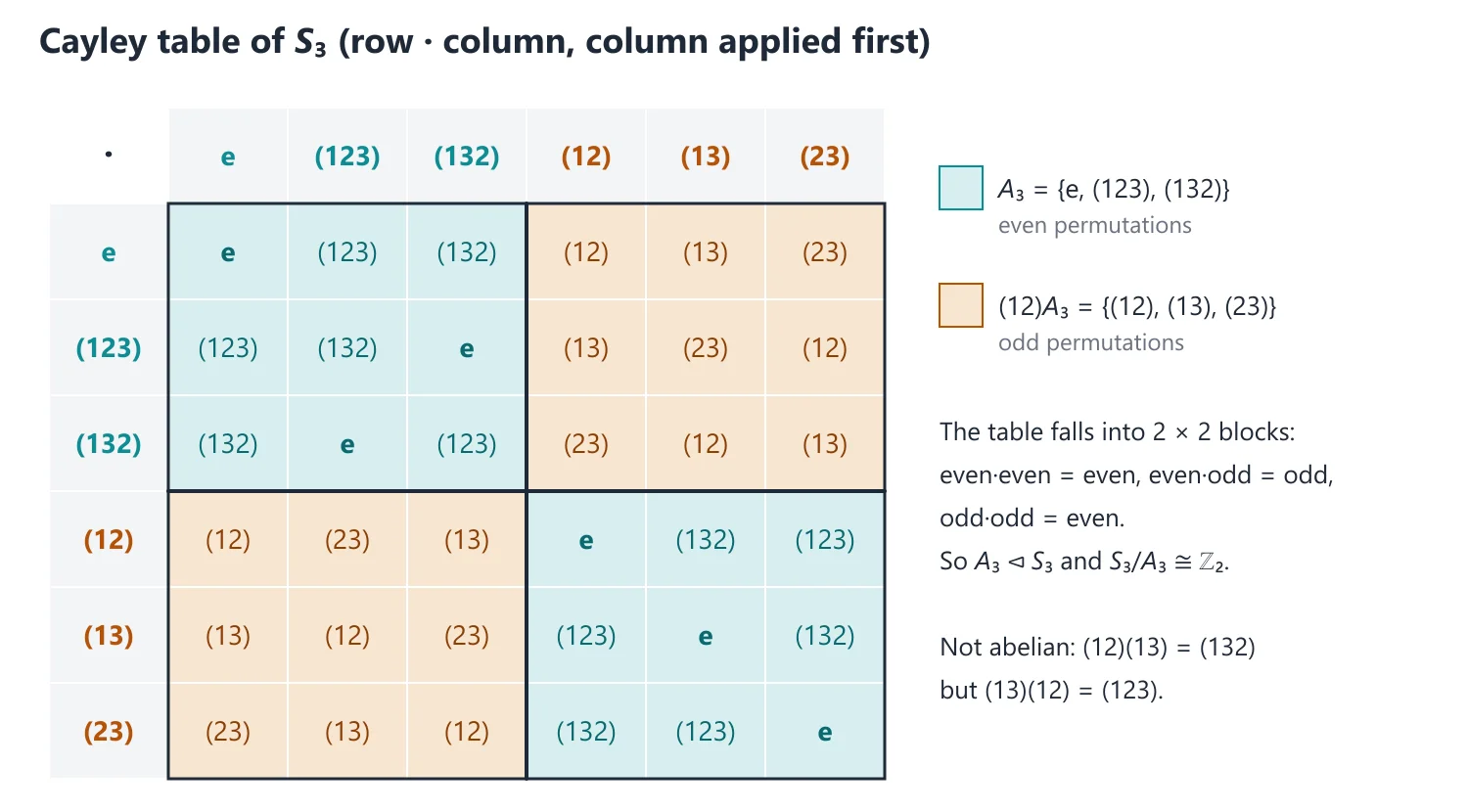
Idea: conjugation x ↦ gxg−1 is a relabelling of G by g, and a normal subgroup is one that no relabelling can move. Note that gH = Hg is an equality of sets, not gh = hg for each h: in S3, (1 2)(1 2 3) = (2 3) but (1 2 3)(1 2) = (1 3), yet (1 2)A3 = A3(1 2), both being the set of odd permutations.
Why ⊆ suffices: if gHg−1 ⊆ H for every g, apply it to g−1 to get g−1Hg ⊆ H, i.e. H ⊆ gHg−1. So the inclusion for all g already gives gHg−1 = H.
Quick tests: every subgroup of an abelian group is normal; every subgroup of index 2 is normal; the centre Z(G) is normal.
Results: an intersection of normal subgroups is normal; if N ⊴ G and H ≤ G then HN is a subgroup; if H, N are both normal then HN is normal.
Not transitive: in D4 = ⟨r, s⟩, {e, s} ⊴ {e, s, r2, sr2} ⊴ D4, but {e, s} is not normal in D4.
Idea: normality is relative to the big group. K ⊴ H only controls conjugation by elements of H; an element of G outside H can move K, as the rotation r conjugates {e, s} to {e, sr2} in D4.
Simple group: a group whose only normal subgroups are {e} and G; ℤp (p prime) and An (n ≥ 5) are simple.
Idea: simple groups are the 'primes' of group theory: a group with a proper non-trivial normal subgroup N can be broken into the smaller pieces N and G/N, and a simple group cannot.
6. Quotient Groups
Definition: if N ⊴ G, the set G/N = {gN : g ∈ G} is a group under (aN)(bN) = abN, with identity N and inverse (aN)−1 = a−1N.
Idea: G/N is G seen with blurred vision: the elements of N become invisible (they all act as the identity), and two elements are identified when they differ by an element of N. ℤ/nℤ is 'the integers when only the remainder mod n is visible'.
Why normality is needed: the rule aN·bN = abN is well-defined (independent of the representatives a, b) exactly when N is normal.
Order: if G is finite, o(G/N) = o(G)/o(N).
Results: a quotient of an abelian group is abelian and a quotient of a cyclic group is cyclic; if G/Z(G) is cyclic then G is abelian.
Quotients of cyclic groups: the subgroups of ℤn are ⟨d⟩ for d | n, with o(⟨d⟩) = n/d, and ℤn/⟨d⟩ ≅ ℤd. Also ℤ/nℤ ≅ ℤn, and ℝ/ℤ ≅ T = {z ∈ ℂ : |z| = 1} via t ↦ e2πit.
Commutator subgroup: G′ is generated by all aba−1b−1; G′ ⊴ G, and G/N is abelian iff G′ ⊆ N.
7. Homomorphisms
Homomorphism: a map f : G → G′ with f(ab) = f(a)f(b) for all a, b ∈ G.
Idea: a homomorphism respects the multiplication table: it may collapse many elements to one (the kernel measures how much), but it never scrambles products. Standard examples: det : GL(n, ℝ) → ℝ*, sgn : Sn → {±1}, exp : (ℝ, +) → (ℝ+, ·), and reduction mod n : ℤ → ℤn.
Properties: f(e) = e′; f(a−1) = f(a)−1; if o(a) is finite then o(f(a)) divides o(a); images and inverse images of subgroups are subgroups.
Order restrictions for finite groups: if f : G → G′ is a homomorphism of finite groups, o(f(G)) divides o(G) (since f(G) ≅ G/ker f) and o(G′) (Lagrange), hence divides gcd(o(G), o(G′)). If this gcd is 1, f is trivial; an onto homomorphism needs o(G′) | o(G).
Images inherit properties: a homomorphic image of an abelian group is abelian, and of a cyclic group is cyclic (f(⟨a⟩) = ⟨f(a)⟩); the converses fail.
Normality via kernels: to show N ⊴ G it is often quickest to exhibit a homomorphism from G whose kernel is N (for example det, sign, or 'read off the diagonal entries').
Kernel: ker f = {a ∈ G : f(a) = e′} is a normal subgroup of G, and f is one-one iff ker f = {e}.
Why it works: f(a) = f(b) ⇔ f(a−1b) = e′ ⇔ a−1b ∈ ker f ⇔ a ker f = b ker f. So the set of points with the same image as a is exactly the coset a·ker f, and f is one-one iff these cosets are single points, i.e. ker f = {e}.
Isomorphism: a bijective homomorphism, written G ≅ G′. An automorphism is an isomorphism of G onto itself; the inner automorphisms are x ↦ gxg−1, and Inn(G) ≅ G/Z(G).
Natural map: π : G → G/N, π(g) = gN, is an onto homomorphism with kernel N, so every normal subgroup is the kernel of some homomorphism.
8. Isomorphism Theorems
First (fundamental) theorem: if f : G → G′ is a homomorphism, then G/ker f ≅ f(G). In particular, if f is onto then G/ker f ≅ G′.
Idea: every homomorphic image is a quotient. f squashes each coset of ker f to one point, and these points are exactly f(G); so up to isomorphism the images of G are the groups G/N, N ⊴ G. The proof is in Standard Proofs, Theorem 6.
Second theorem: if H ≤ G and N ⊴ G, then H ∩ N ⊴ H and HN/N ≅ H/(H ∩ N).
Third theorem: if N ⊴ G, K ⊴ G and N ⊆ K, then K/N ⊴ G/N and (G/N)/(K/N) ≅ G/K.
Correspondence theorem: subgroups of G/N correspond one-to-one with subgroups of G containing N, and normal subgroups correspond to normal subgroups.
Idea: the subgroup lattice of G/N is the part of the lattice of G lying above N. For example the subgroups of ℤ/12ℤ correspond to the subgroups dℤ of ℤ that contain 12ℤ, i.e. to the divisors d of 12.
Method for proving G/N ≅ G′:
1. Define a map f from G to G′ suggested by the problem.
2. Prove that f(ab) = f(a)f(b).
3. Prove that f is onto.
4. Compute ker f and show that it equals N.
5. Conclude G/N ≅ G′ by the first isomorphism theorem.
Example 1: Show that ℝ*/{1, −1} ≅ ℝ+, both under multiplication.
Define f(x) = |x|. Then f(xy) = |xy| = |x||y| = f(x)f(y), f is onto ℝ+ since f(r) = r for r > 0, and ker f = {x : |x| = 1} = {1, −1}. Hence ℝ*/{1, −1} ≅ ℝ+.
Example 2: Show that SL(n, ℝ) ⊴ GL(n, ℝ) and GL(n, ℝ)/SL(n, ℝ) ≅ ℝ*.
Take f(A) = det A. Then det(AB) = det A·det B, f is onto because diag(a, 1, ..., 1) has determinant a, and ker f = {A : det A = 1} = SL(n, ℝ). So SL(n, ℝ) is normal and the quotient is ≅ ℝ*.
9. Derivation: Coset Multiplication is Well Defined iff N is Normal
(⇐) Let N ⊴ G, aN = a′N and bN = b′N. Then a′ = an1 and b′ = bn2 with n1, n2 ∈ N, and a′b′ = an1bn2 = ab(b−1n1b)n2. Since b−1n1b ∈ N, a′b′ ∈ abN, so a′b′N = abN.
(⇒) Suppose the rule is well defined, and let n ∈ N, g ∈ G. Since nN = eN, the products (nN)(g−1N) and (eN)(g−1N) agree: ng−1N = g−1N. Hence (g−1)−1ng−1 = gng−1 ∈ N, so N is normal.
Moral: normal subgroups are exactly the subgroups that can be 'divided out'. With H = {e, (1 2)} in S3, H = (1 2)H, yet multiplying each on the right by (1 3)H would give (1 3)H = {(1 3), (1 2 3)} and (1 2)(1 3)H = (1 3 2)H = {(1 3 2), (2 3)}, which are different cosets.
10. Derivation: Second and Third Isomorphism Theorems
Second theorem: let H ≤ G and N ⊴ G. Then HN is a subgroup (HN = NH because N is normal) and N ⊴ HN. Define φ : H → HN/N by φ(h) = hN; it is the natural map restricted to H, so it is a homomorphism.
φ is onto, because a coset hnN of HN/N equals hN = φ(h). Its kernel is {h ∈ H : hN = N} = H ∩ N. By the first theorem H ∩ N ⊴ H and H/(H ∩ N) ≅ HN/N; for finite groups this re-derives |HN| = |H||N|/|H ∩ N|.
Third theorem: let N ⊆ K with N, K ⊴ G. Define ψ : G/N → G/K by ψ(gN) = gK. It is well defined, since gN = g′N ⇒ g−1g′ ∈ N ⊆ K ⇒ gK = g′K; it is clearly an onto homomorphism.
ker ψ = {gN : gK = K} = {gN : g ∈ K} = K/N. So K/N ⊴ G/N and (G/N)/(K/N) ≅ G/K: 'the N cancels'. Example: (ℤ/12ℤ)/(4ℤ/12ℤ) ≅ ℤ/4ℤ.
11. Derivation: Number of Homomorphisms ℤm → ℤn
A homomorphism f is fixed by a = f(1), since f(k) = ka. The rule k ↦ ka (mod n) is well defined on ℤm iff ma ≡ 0 (mod n), i.e. iff o(a) divides m.
With d = gcd(m, n): n | ma ⇔ (n/d) | (m/d)a ⇔ (n/d) | a. The multiples of n/d in ℤn are d in number, so there are exactly gcd(m, n) homomorphisms, f(k) = j(n/d)k for j = 0, 1, ..., d − 1.
Check: ℤ12 → ℤ30 has gcd(12, 30) = 6 homomorphisms (Example 5 below), and ℤm → ℤn has only the trivial one when gcd(m, n) = 1.
12. Choosing the Method
If you must show N ⊴ G → in this order try: G abelian; [G : N] = 2; N is the kernel of a natural homomorphism (det, sgn, a projection, 'read off the diagonal'); N is the only subgroup of its order; finally the direct check gng−1 ∈ N.
If you must show N is not normal → one explicit pair g ∈ G, n ∈ N with gng−1 ∉ N is enough.
If you must identify G/N → find an onto homomorphism with kernel N and use the first theorem (the five-step method above); for a small finite quotient, its order and element orders often decide it.
If you must count or find homomorphisms G → G′ → send generators to elements whose orders divide theirs (and divide |G′|), and check the defining relations.
If asked whether an onto homomorphism G → G′ exists → |G′| must divide |G|, and G must have a normal subgroup N with G/N ≅ G′.
If you must decide G ≅ G′ → for 'no', compare invariants: order, abelian or not, cyclic or not, number of elements of each order, the centre, solvability of equations such as x2 = a (the method of Example 6).
13. Common Mistakes
Checking gn = ng instead of gNg−1 = N: elementwise commuting is much stronger and usually false; only the set equality gN = Ng is required.
Forming G/H for a non-normal H: S3/{e, (1 2)} is not a group (see the derivation above). Always state 'N is normal, so G/N is a group'.
Defining a map on cosets without checking it is well defined: k ↦ k mod 5 from ℤ12 to ℤ5 is not a function, since 0 = 12 in ℤ12 but 0 ≠ 2 in ℤ5.
Skipping 'onto': without it the first theorem gives only G/ker f ≅ f(G), not ≅ G′.
Lifting properties from a quotient: G/N abelian (or cyclic) does not make G abelian; S3/A3 ≅ ℤ2. The one exception to remember is N = Z(G) with G/Z(G) cyclic.
14. Connections
Link: the rank–nullity theorem of Linear Algebra is the first isomorphism theorem for vector spaces: V/ker T ≅ T(V), so dim V − nullity T = rank T.
Link: the same three theorems hold for rings, with ideals in place of normal subgroups (Rings topic); and ℝ/ℤ ≅ unit circle via t ↦ e2πit is the algebra behind periodic functions and Fourier series (PDE chapter).
15. Worked Examples
Example 3: If H is the only subgroup of order m in a group G, show that H ⊴ G.
For g ∈ G, the map x ↦ gxg−1 is an automorphism of G, so gHg−1 is a subgroup of G.
This map is one-one, so o(gHg−1) = o(H) = m. By uniqueness gHg−1 = H for every g ∈ G, hence H ⊴ G.
Application: A3 = ⟨(1 2 3)⟩ is the only subgroup of order 3 in S3, so it is normal in S3.
Example 4: Prove that if G/Z(G) is cyclic, then G is abelian.
Write Z = Z(G) and let G/Z = ⟨gZ⟩. Every coset is gmZ for some integer m, so every a ∈ G has the form a = gmz with z ∈ Z.
Take a = gmz1 and b = gnz2. Since z1, z2 commute with every element, ab = gm+nz1z2 = gn+mz2z1 = ba.
Hence G is abelian; then Z(G) = G, so in fact G/Z(G) is trivial. Thus G/Z(G) can never be a non-trivial cyclic group.
Example 5: Find all group homomorphisms from ℤ12 to ℤ30.
A homomorphism f is fixed by a = f(1), since f(x) = xa (mod 30). This rule is well defined iff 12a ≡ 0 (mod 30).
30 | 12a ⇔ 5 | 2a ⇔ 5 | a, so a ∈ {0, 5, 10, 15, 20, 25}.
Hence there are exactly gcd(12, 30) = 6 homomorphisms, f(x) = 5kx (mod 30) for k = 0, 1, 2, 3, 4, 5; none is onto, since the image has at most 12 elements and ℤ30 has 30.
Example 6: Prove or disprove: (ℚ, +) ≅ (ℚ+, ·).
Suppose f : ℚ → ℚ+ is an isomorphism. Since f is onto, f(a) = 2 for some a ∈ ℚ.
Then 2 = f(a) = f(a/2 + a/2) = f(a/2)2, so r = f(a/2) is a positive rational number with r2 = 2.
This is impossible because √2 is irrational. Hence (ℚ, +) and (ℚ+, ·) are not isomorphic.
16. Solved Past UPSC Questions
Example 7 (UPSC 2014, 10 marks): Let G be the set of all real 2 × 2 matrices [[x, y], [0, z]], where xz ≠ 0. Show that G is a group under matrix multiplication. Let N denote the subset {[[1, a], [0, 1]] : a ∈ ℝ}. Is N a normal subgroup of G? Justify your answer.
Closure: [[x, y], [0, z]]·[[x′, y′], [0, z′]] = [[xx′, xy′ + yz′], [0, zz′]], and (xx′)(zz′) = (xz)(x′z′) ≠ 0.
Matrix multiplication is associative; I = [[1, 0], [0, 1]] ∈ G; and [[1/x, −y/(xz)], [0, 1/z]] ∈ G is the inverse of [[x, y], [0, z]]. So G is a (non-abelian) group.
Define φ : G → ℝ* × ℝ* by φ([[x, y], [0, z]]) = (x, z). By the product formula φ(AB) = (xx′, zz′) = φ(A)φ(B), so φ is a homomorphism.
ker φ = {A ∈ G : x = z = 1} = {[[1, a], [0, 1]] : a ∈ ℝ} = N. The kernel of a homomorphism is a normal subgroup, so N ⊴ G.
Direct check: for A = [[x, y], [0, z]], A[[1, a], [0, 1]]A−1 = [[1, xa/z], [0, 1]] ∈ N.
Answer: G is a group and N is a normal subgroup of G (the kernel of A ↦ (x, z)); moreover G/N ≅ ℝ* × ℝ*, since φ is onto.
Example 8 (UPSC 2018, 15 marks): Show that the quotient group of (ℝ, +) modulo ℤ is isomorphic to the multiplicative group of complex numbers on the unit circle in the complex plane. Here ℝ is the set of real numbers and ℤ is the set of integers.
Let T = {z ∈ ℂ : |z| = 1} under multiplication, and define φ : ℝ → T by φ(t) = e2πit = cos 2πt + i sin 2πt.
φ(s + t) = e2πi(s+t) = e2πise2πit = φ(s)φ(t), so φ is a homomorphism from (ℝ, +) to (T, ·).
Onto: every z ∈ T equals eiθ for some θ ∈ [0, 2π), and then z = φ(θ/(2π)).
Kernel: e2πit = 1 ⇔ cos 2πt = 1 and sin 2πt = 0 ⇔ t ∈ ℤ, so ker φ = ℤ.
By the first isomorphism theorem ℝ/ℤ ≅ T.
Answer: ℝ/ℤ ≅ T, the isomorphism being t + ℤ ↦ e2πit.
Example 9 (UPSC 2019, 10 marks): If G and H are finite groups whose orders are relatively prime, then prove that there is only one homomorphism from G to H, the trivial one.
Let f : G → H be a homomorphism with kernel K. By the first isomorphism theorem G/K ≅ f(G), so o(f(G)) = o(G)/o(K) divides o(G).
f(G) is a subgroup of H, so by Lagrange o(f(G)) divides o(H).
Hence o(f(G)) divides gcd(o(G), o(H)) = 1, so f(G) = {eH}: f(g) = eH for every g ∈ G.
The trivial map g ↦ eH is always a homomorphism, so it is the only one.
Answer: the only homomorphism G → H is the trivial one.
Example 10 (UPSC 2019, 10 marks): Write down all quotient groups of the group Z12.
ℤ12 is cyclic, hence abelian, so every subgroup is normal. Its subgroups are ⟨d⟩ for d = 1, 2, 3, 4, 6, 12 (⟨12⟩ = ⟨0⟩), of orders 12, 6, 4, 3, 2, 1.
ℤ12/⟨0⟩ ≅ ℤ12, and ℤ12/⟨1⟩ = {ℤ12} is the trivial group.
ℤ12/⟨2⟩ = {⟨2⟩, 1 + ⟨2⟩} ≅ ℤ2, where ⟨2⟩ = {0, 2, 4, 6, 8, 10}.
ℤ12/⟨3⟩ = {⟨3⟩, 1 + ⟨3⟩, 2 + ⟨3⟩} ≅ ℤ3, where ⟨3⟩ = {0, 3, 6, 9}.
ℤ12/⟨4⟩ = {⟨4⟩, 1 + ⟨4⟩, 2 + ⟨4⟩, 3 + ⟨4⟩} ≅ ℤ4, where ⟨4⟩ = {0, 4, 8}.
ℤ12/⟨6⟩ = {k + ⟨6⟩ : k = 0, 1, ..., 5} ≅ ℤ6, where ⟨6⟩ = {0, 6}.
Answer: up to isomorphism the quotient groups of ℤ12 are ℤ12, ℤ6, ℤ4, ℤ3, ℤ2 and the trivial group, all cyclic.
Example 11 (UPSC 2020, 10 marks): Let S3 and Z3 be permutation group on 3 symbols and group of residue classes module 3 respectively. Show that there is no homomorphism of S3 in Z3 except the trivial homomorphism.
Let f : S3 → ℤ3 be a homomorphism. A transposition τ has order 2, so o(f(τ)) divides 2; it also divides o(ℤ3) = 3. Hence o(f(τ)) = 1, i.e. f(τ) = 0.
S3 is generated by its transpositions (for example (1 2 3) = (1 3)(1 2)), so f(σ) = 0 for every σ ∈ S3.
Alternatively: a non-trivial f would have image of order 3, so ker f would be a normal subgroup of order 6/3 = 2. But no subgroup of order 2 is normal; e.g. (1 3)(1 2)(1 3) = (2 3) ∉ {e, (1 2)}.
Answer: the only homomorphism S3 → ℤ3 is the trivial one.
Example 12 (UPSC 2023, 10 marks): Let G be a group of order 10 and G′ be a group of order 6. Examine whether there exists a homomorphism of G onto G′.
Suppose f : G → G′ is an onto homomorphism. By the first isomorphism theorem G/ker f ≅ G′, so o(G′) = o(G)/o(ker f).
Then 6 · o(ker f) = 10, which is impossible since 6 does not divide 10.
(Homomorphisms into G′ do exist, e.g. the trivial one; every image has order dividing gcd(10, 6) = 2.)
Answer: no homomorphism of G onto G′ exists.
Example 13 (UPSC 2024, 15 marks): Show that every homomorphic image of an abelian group is abelian, but the converse is not necessarily true.
Let G be abelian and f : G → G′ a homomorphism. For x, y ∈ f(G) write x = f(a), y = f(b). Then xy = f(a)f(b) = f(ab) = f(ba) = f(b)f(a) = yx.
So f(G) is abelian; equivalently, every quotient of an abelian group is abelian.
The converse fails: sgn : S3 → {1, −1} is an onto homomorphism with abelian image, but S3 is not abelian, since (1 2)(1 3) = (1 3 2) while (1 3)(1 2) = (1 2 3).
Answer: homomorphic images of abelian groups are abelian; S3 → {±1} shows that a non-abelian group can have an abelian image.
17. Practice Exercises
Exercise 1 (basic): Is V = {e, (1 2)(3 4), (1 3)(2 4), (1 4)(2 3)} a normal subgroup of S4?
Answer: yes. V is closed (the product of two of the non-identity elements is the third), and it is the union of the classes {e} and 'all products of two disjoint transpositions', so every conjugate stays in V.
Exercise 2 (basic): Is the subgroup D of diagonal matrices normal in GL(2, ℝ)?
Answer: no. With g = [[1, 1], [0, 1]] and d = diag(1, 2), gdg−1 = [[1, 1], [0, 2]], which is not diagonal.
Exercise 3 (basic): Find the order of the element 3 + ⟨6⟩ in ℤ18/⟨6⟩, and identify the quotient group.
Answer: ⟨6⟩ = {0, 6, 12}, so the quotient has order 6 and is ≅ ℤ6. Since 3 ∉ ⟨6⟩ and 2·3 = 6 ∈ ⟨6⟩, the order is 2.
Exercise 4 (standard): Find all homomorphisms from ℤ8 to ℤ12. Is any of them onto?
Answer: f(x) = ax with 8a ≡ 0 (mod 12), i.e. a ∈ {0, 3, 6, 9}: gcd(8, 12) = 4 homomorphisms. None is onto, since an image has at most 8 elements.
Exercise 5 (standard): In G = ℤ × ℤ let N = {(a, b) : a + b is even}. Show that N ⊴ G and G/N ≅ ℤ2.
Answer: f(a, b) = (a + b) mod 2 is an onto homomorphism G → ℤ2 with kernel N; apply the first isomorphism theorem (N is normal as a kernel, or because G is abelian).
Exercise 6 (standard): Show that ℂ*/ℝ+ ≅ T, where ℝ+ is the group of positive reals and T the unit circle, all under multiplication.
Answer: f(z) = z/|z| satisfies f(zw) = f(z)f(w), is onto (f(u) = u for u ∈ T), and f(z) = 1 iff z is a positive real. So ker f = ℝ+.
Exercise 7 (standard): Let N ⊴ G with [G : N] = m finite. Prove that gm ∈ N for every g ∈ G.
Answer: G/N is a group of order m, so by Lagrange (gN)m = N, i.e. gmN = N, i.e. gm ∈ N.
Exercise 8 (UPSC level): Prove that a group G is abelian if and only if the map x ↦ x−1 is an automorphism of G.
Answer: the map is always a bijection (it is its own inverse). It is a homomorphism iff (ab)−1 = a−1b−1, i.e. b−1a−1 = a−1b−1, for all a, b; taking inverses, this says ab = ba.
Exercise 9 (UPSC level): H ≤ G and N ⊴ G are finite with o(H) = 10, o(N) = 15 and o(H ∩ N) = 5. Find o(HN) and [HN : N], and check the second isomorphism theorem.
Answer: o(HN) = 10·15/5 = 30 and [HN : N] = 30/15 = 2, which equals [H : H ∩ N] = 10/5 = 2, as HN/N ≅ H/(H ∩ N) requires.
Exercise 10 (UPSC level): Find all normal subgroups of S3 and, up to isomorphism, all quotient groups of S3.
Answer: {e}, A3 and S3 (the three subgroups of order 2 are not normal). The quotients are S3/{e} ≅ S3, S3/A3 ≅ ℤ2 and the trivial group.
Exercise 11 (UPSC level): Show that ℚ/ℤ is an infinite group in which every element has finite order.
Answer: q·(p/q + ℤ) = p + ℤ = ℤ, so p/q + ℤ has order dividing q. The cosets 1/n + ℤ (n ≥ 2) are distinct, since 1/m − 1/n ∉ ℤ for 2 ≤ m < n, so ℚ/ℤ is infinite.
| Theorem | Hypothesis | Conclusion |
|---|---|---|
| First | f : G → G′ a homomorphism | ker f ⊴ G and G/ker f ≅ f(G) |
| Second | H ≤ G, N ⊴ G | HN/N ≅ H/(H ∩ N) |
| Third | N, K ⊴ G with N ⊆ K | (G/N)/(K/N) ≅ G/K |
| Correspondence | N ⊴ G | Subgroups of G/N ↔ subgroups of G containing N |
Mains points
- A frequently asked question: prove that a subgroup of index 2 is normal, or that the kernel of a homomorphism is a normal subgroup; write the coset argument fully.
- Typical 10 to 15 mark questions ask you to show G/N ≅ G′ for a specific group; follow the five-step method and verify well-definedness, homomorphism, onto and kernel in separate lines.
- Remember that a homomorphic image of G is isomorphic to a quotient of G; and a homomorphism ℤm → ℤn is fixed by a = f(1), which must satisfy ma = 0 in ℤn, so there are exactly gcd(m, n) of them.
- Common mistake: assuming HK is a subgroup for any two subgroups; it needs HK = KH, which holds when one of them is normal.
- Questions on G/Z(G) cyclic ⇒ G abelian appear often; give the proof by writing every element as aiz with z ∈ Z(G).
Did you know?
- Galois introduced normal subgroups around 1830 to decide which polynomial equations are solvable by radicals; the simplicity of A5 is why the general quintic has no formula in radicals.
Permutation Groups and Cayley's Theorem
The symmetric group Sn of all permutations of n symbols has order n!, and every permutation is a product of disjoint cycles, whose cycle lengths give its order and parity. The even permutations form the alternating group An. Cayley's theorem says every group is isomorphic to a group of permutations.
1. Understanding Permutations and Cycle Notation
Why we need it: rearrangements of objects appear everywhere: shuffling cards, relabelling the vertices of a polygon, permuting the roots of a polynomial. By Cayley's theorem every group lives among them.
To compute with them we need a short notation and a fixed rule for composing two rearrangements.
In words: a permutation σ of {1, 2, ..., n} is a bijection: every symbol goes to exactly one symbol, and no two symbols go to the same place. Sn is the set of all of them; it has n! elements.
The cycle (a1 a2 ... ak) sends each ai to the next one and ak back to a1; symbols not written are fixed. The product στ means 'first τ, then σ' (right to left), like composition of functions.
First example, slowly: in S5 let σ(1) = 3, σ(2) = 5, σ(3) = 1, σ(4) = 4, σ(5) = 2.
Step 1: start at 1 and follow the arrows: 1 → 3 → 1. The cycle closes, giving (1 3).
Step 2: the smallest unused symbol is 2: 2 → 5 → 2, giving (2 5). Step 3: 4 → 4 is fixed and is not written. So σ = (1 3)(2 5).
Step 4: compose with τ = (1 2 3), applying τ first. 1: τ(1) = 2, σ(2) = 5, so 1 → 5. 5: τ(5) = 5, σ(5) = 2, so 5 → 2. 2: τ(2) = 3, σ(3) = 1, so 2 → 1. 3 and 4 are fixed. Hence στ = (1 5 2).
Step 5: in the other order, τσ = (2 5 3). So στ ≠ τσ: notice that the order of composition matters in Sn.
Non-example: the rule 1 → 2, 2 → 2, 3 → 1 on {1, 2, 3} is not a permutation, because 1 and 2 both go to 2 (it is not one-one). Also (1 2)(2 3) is a product of cycles but not of disjoint cycles; its disjoint form is (1 2 3).
Building up: (1) Following arrows always closes a cycle, because σ is one-one and there are finitely many symbols. (2) Disjoint cycles commute, since they move different symbols.
(3) So the order of σ is the lcm of its disjoint cycle lengths: (1 3)(2 5) has order 2. (4) The inverse reverses each cycle: (1 5 2)−1 = (2 5 1) = (1 2 5).
Where it is used: every computation in Sn (orders, powers, parity, conjugates) starts by writing disjoint cycles, and Cayley's theorem turns any finite group into such permutations.
2. Understanding Even and Odd Permutations
Why we need it: every rearrangement can be done by swapping two objects at a time. We want to know whether 'an even number of swaps' is a property of the permutation itself, not of the way we chose to do it.
The answer gives the alternating group An and the sign that appears in every determinant.
In words: a transposition (a b) swaps two symbols and fixes the rest. Every permutation is a product of transpositions in many ways, but by the parity theorem the number of factors is always even or always odd.
σ is even or odd accordingly, and sgn σ = +1 or −1. A k-cycle is a product of k − 1 transpositions, so its sign is (−1)k−1.
First example, slowly: take the 5-cycle σ = (1 4 2 5 3). The rule (a1 ... ak) = (a1 ak)(a1 ak−1)···(a1 a2) gives σ = (1 3)(1 5)(1 2)(1 4).
Step 1 (check one symbol): applying the factors right to left, 1 → 4 under (1 4), and the other three factors fix 4; so 1 → 4, as in σ.
Step 2: σ is a product of 4 transpositions, so σ is even. Inserting (1 2)(1 2) = e gives a product of 6 transpositions: still even, as the parity theorem predicts.
Step 3 (a product of cycles): for τ = (1 2)(3 4 5 6), add (k − 1) over the disjoint cycles: 1 + 3 = 4, so τ is even.
Non-example: parity cannot be read off from the order. (1 2) and (1 2)(3 4) both have order 2, but the first is odd and the second is even.
Building up: (1) The parity theorem is proved with the product Δ (Derivation 'Why Parity is Well Defined' below). (2) Hence sgn : Sn → {1, −1} is a homomorphism, onto for n ≥ 2.
(3) An = ker sgn is normal of index 2 and order n!/2 (Standard Proofs, Theorem 8). (4) The odd permutations form the coset (1 2)An; they are not a subgroup, because they do not contain e.
Where it is used: deciding membership in An, the sign in the determinant expansion, showing that a subgroup of odd order lies in An, and the classic 15-puzzle impossibility.
3. Understanding Conjugacy and Cycle Type in Sn
Why we need it: two permutations may do 'the same thing' to differently named symbols. Recognising this answers three common questions: are σ and ρ conjugate, how many elements of a given order are there, and which subgroups are normal?
In words: τστ−1 is σ with every symbol renamed by τ: replace each symbol i in the cycle form of σ by τ(i). The cycle type of σ is the list of its disjoint cycle lengths, for example (3)(2) for (1 2 3)(4 5).
First example, slowly: let σ = (1 2 3)(4 5) and τ = (1 5 3) in S5, so τ(1) = 5, τ(2) = 2, τ(3) = 1, τ(4) = 4, τ(5) = 3.
Step 1: rename inside each cycle: (1 2 3) becomes (τ(1) τ(2) τ(3)) = (5 2 1), and (4 5) becomes (τ(4) τ(5)) = (4 3).
Step 2: so τστ−1 = (5 2 1)(4 3) = (1 5 2)(3 4). Step 3 (check one symbol directly): τ−1(5) = 1, σ(1) = 2, τ(2) = 2, so 5 → 2, as the cycle (1 5 2) says.
What to notice: the cycle lengths 3 and 2 did not change; only the names inside the cycles did.
Non-example: (1 2 3) and (1 2)(3 4) in S4 are not conjugate, because their cycle types (3)(1) and (2)(2) differ; no renaming can turn a 3-cycle into two 2-cycles. Their orders, 3 and 2, differ as well.
Building up: (1) The relabelling rule is proved in the derivation 'Relabelling Rule and Class Sizes' below. (2) Conversely, if σ and ρ have the same cycle type, write one above the other with cycles of equal length aligned; reading down the columns gives τ with τστ−1 = ρ.
(3) So the conjugacy classes of Sn are exactly the cycle types, with sizes n!/∏(kmk·mk!). (4) A normal subgroup is a union of whole classes, which is why V4 ⊴ S4.
Where it is used: counting elements of a given order, writing class equations, finding τ with τστ−1 = ρ, and proving that A4 has no subgroup of order 6.
4. Understanding Cayley's Theorem
Why we need it: is the study of permutation groups a special case, or does every group appear there? Cayley's theorem says every group is isomorphic to a group of permutations, so nothing is lost by thinking of group elements as rearrangements.
In words: for each a ∈ G, the map Ta(x) = ax rearranges the set G (it is a permutation of G). The rule a ↦ Ta is a one-one homomorphism from G into Sym(G).
'Isomorphic to a subgroup of Sym(G)' means: the image {Ta : a ∈ G} is a subgroup of Sym(G), and G is isomorphic to that image.
First example, slowly: take G = ℤ3 = {0, 1, 2} under addition, and regard 0, 1, 2 as the symbols being moved.
Step 1: T0(x) = x is the identity permutation. Step 2: T1 sends 0 → 1, 1 → 2, 2 → 0, which is the cycle (0 1 2).
Step 3: T2 sends 0 → 2, 2 → 1, 1 → 0, which is (0 2 1). Step 4 (homomorphism check): T1T1 = (0 1 2)2 = (0 2 1) = T2 = T1+1.
Step 5: the image {e, (0 1 2), (0 2 1)} is the alternating group on the three symbols, a copy of ℤ3 inside S3. Notice that each Ta is just the row of a in the Cayley table.
Non-example: right multiplication Ra(x) = xa also gives permutations, but a ↦ Ra reverses products: RaRb(x) = xba = Rba(x). In a non-abelian group this is not a homomorphism; the repair is a ↦ Ra−1.
Building up: (1) Ta is one-one by cancellation and onto because Ta(a−1y) = y. (2) TaTb = Tab by associativity. (3) Ta = identity forces a = ae = e. (4) Conclude by the first isomorphism theorem (Standard Proofs, Theorem 7).
Acting on the cosets of a subgroup H instead of on G gives the generalised Cayley theorem stated below, which embeds G/K in a much smaller Sn.
Where it is used: the standard proof question itself, embedding a group of order n in Sn, and index arguments such as 'A5 has no subgroup of index 2, 3 or 4'.
5. Permutations and Cycles
Permutation: a bijection of a set onto itself. Sn is the group of all permutations of {1, 2, ..., n} under composition, and o(Sn) = n!.
Idea: think of a permutation as a rearrangement of labelled seats; composing two permutations means doing one rearrangement after the other. The order of doing them matters, which is why the Cayley table of S3 in the figure above is not symmetric about its main diagonal.
Non-abelian: Sn is non-abelian for n ≥ 3; for example (1 2)(1 3) ≠ (1 3)(1 2).
Cycle: (a1 a2 ... ak) sends a1 → a2 → ... → ak → a1 and fixes all other symbols; a 2-cycle is called a transposition.
Disjoint cycle decomposition: every permutation is a product of disjoint cycles, unique apart from the order of the factors; disjoint cycles commute.
Why it works: start at the smallest symbol a and follow a → σ(a) → σ2(a) → ...; since there are finitely many symbols and σ is one-one, the first repeated value is a itself, which closes a cycle. Repeat with the smallest symbol not yet used. Disjoint cycles commute because they move different symbols.
Order: the order of a permutation is the lcm of the lengths of its disjoint cycles.
Why it works: if σ = c1c2···cr with disjoint cycles of lengths ki, then σm = c1m···crm (they commute), and this is the identity iff each cim = e, i.e. iff every ki divides m. The rule needs disjointness: (1 2)(2 3) = (1 2 3) has order 3, not lcm(2, 2) = 2.
Inverse: (a1 a2 ... ak)−1 = (ak ... a2 a1).
Convention: in these notes στ means apply τ first, then σ (right to left); state your convention in the answer.
6. Even and Odd Permutations
Transpositions: (a1 a2 ... ak) = (a1 ak)(a1 ak−1)...(a1 a2), so a k-cycle is a product of k − 1 transpositions.
Parity theorem: no permutation can be written both as a product of an even number and of an odd number of transpositions.
Sign rule: if the disjoint cycles have lengths k1, ..., kr, the permutation is even iff ∑(ki − 1) is even; a cycle of even length is odd.
Alternating group: An, the set of even permutations, is a normal subgroup of Sn of index 2, so o(An) = n!/2 for n ≥ 2.
Idea: An is the kernel of the sign homomorphism sgn : Sn → {1, −1}, which is onto for n ≥ 2; so An is normal of index 2 automatically (proved in Standard Proofs, Theorem 8). The odd permutations form the other coset (1 2)An and do not form a subgroup.
Generators: Sn is generated by the transpositions, and also by the two elements (1 2) and (1 2 ... n); An (n ≥ 3) is generated by the 3-cycles.
Why it works: every cycle is a product of transpositions, so the transpositions generate Sn. An even permutation is a product of pairs of transpositions, and each pair is a product of 3-cycles: (a b)(a c) = (a c b), and for distinct a, b, c, d, (a b)(c d) = (a c b)(a c d). So the 3-cycles generate An.
7. Conjugacy in Sn
Relabelling rule: σ(a1 a2 ... ak)σ−1 = (σ(a1) σ(a2) ... σ(ak)).
Conjugacy classes: two permutations are conjugate in Sn iff they have the same cycle type.
Idea: conjugating by σ only renames the symbols, so it cannot change the lengths of the cycles; conversely two permutations with the same cycle type can be matched cycle by cycle, and the matching is the renaming σ (Example 6 below).
Counting: the number of k-cycles in Sn is n!/((n − k)!·k).
Check in S4: identity 1, transpositions 6, 3-cycles 8, 4-cycles 6, products of two disjoint transpositions 3; total 24.
8. Cayley's Theorem
Statement: every group G is isomorphic to a subgroup of Sym(G), the group of all permutations of the set G. In particular, a group of order n is isomorphic to a subgroup of Sn.
Idea: every group is a group of symmetries, namely of its own underlying set: the element a 'shuffles' G by x ↦ ax. In the Cayley table (figure above) the row of a is exactly this shuffle, and each row is a permutation of the elements because of the cancellation law. The proof below is also given in Standard Proofs, Theorem 7.
Proof:
1. For a ∈ G define Ta : G → G by Ta(x) = ax.
2. Ta is one-one, since ax = ay ⇒ x = y, and onto, since Ta(a−1y) = y; so Ta ∈ Sym(G).
3. (TaTb)(x) = a(bx) = (ab)x = Tab(x), so φ(a) = Ta is a homomorphism from G to Sym(G).
4. If Ta is the identity map then ae = e, so a = e; hence φ is one-one.
5. Therefore G ≅ φ(G) = {Ta : a ∈ G}, a subgroup of Sym(G).
Generalised Cayley theorem: if H ≤ G with [G : H] = n, then G acting on the left cosets of H gives a homomorphism G → Sn whose kernel is contained in H.
Use: the kernel K is a normal subgroup of G inside H, and G/K embeds in Sn, so [G : K] divides n!. For n = 2 this forces K = H, which re-proves 'index 2 ⇒ normal'. For a simple group K = {e}, so |G| divides n!; hence A5 (order 60) has no subgroup of index 2, 3 or 4, i.e. none of order 30, 20 or 15.
Example 1: Find the order and parity of σ = (1 2 3)(4 5) in S5.
The cycles are disjoint with lengths 3 and 2, so o(σ) = lcm(3, 2) = 6. σ is a product of 2 + 1 = 3 transpositions, so σ is odd.
Example 2: Compute (1 2 3)(2 3 4) in S4 (right to left).
1 → 1 → 2; 2 → 3 → 1; 3 → 4 → 4; 4 → 2 → 3. Hence (1 2 3)(2 3 4) = (1 2)(3 4), an even permutation, as expected for a product of two 3-cycles.
9. Derivation: Why Parity is Well Defined
Step 1: let Δ = ∏i < j (xj − xi), the product over all pairs 1 ≤ i < j ≤ n. For σ ∈ Sn let σΔ = ∏i < j (xσ(j) − xσ(i)). Each pair {i, j} still appears exactly once, possibly reversed, so σΔ = ±Δ; write σΔ = sgn(σ)Δ.
Step 2: applying τ and then σ to the variables gives (στ)Δ = σ(τΔ) = sgn(τ)·σΔ = sgn(σ)sgn(τ)Δ, so sgn is a homomorphism Sn → {1, −1}.
Step 3: for a transposition (a b) with a < b, the factor xb − xa changes sign. For each other symbol c, the two factors involving c and a or b are exchanged with each other, and their sign changes cancel in pairs. So sgn(a b) = −1.
Conclusion: a product of r transpositions has sign (−1)r. If σ were a product of both an even and an odd number of transpositions, sgn σ would equal both 1 and −1. Hence parity is well defined, and sgn of a k-cycle is (−1)k−1.
10. Derivation: Relabelling Rule and Class Sizes
Relabelling rule: let c = (a1 ... ak). Then σcσ−1(σ(ai)) = σ(c(ai)) = σ(ai+1) (indices mod k). If x is not one of the σ(ai), then σ−1(x) is fixed by c, so σcσ−1(x) = x. Hence σcσ−1 = (σ(a1) ... σ(ak)); apply this to each disjoint cycle.
Counting k-cycles: an ordered list of k distinct symbols can be chosen in n!/(n − k)! ways, and each k-cycle is written in exactly k ways (start at any of its symbols). So there are n!/((n − k)!·k) k-cycles; for 3-cycles in S4, 24/(1·3) = 8.
General class size: if the cycle type has mk cycles of length k (fixed points counted as 1-cycles, ∑k·mk = n), the number of such permutations is n!/∏k(kmk·mk!). The extra mk! is there because cycles of equal length can be listed in any order. Check: type (2)(2) in S4 gives 24/(22·2!) = 3.
Normal subgroups of Sn: a normal subgroup is closed under conjugation, so it is a union of whole conjugacy classes. In S4, V4 = {e, (1 2)(3 4), (1 3)(2 4), (1 4)(2 3)} is the union of the classes of sizes 1 and 3, hence V4 ⊴ S4.
11. Choosing the Method
If the order of a permutation is asked → first write it as disjoint cycles, then take the lcm of the lengths.
If parity is asked → compute ∑(ki − 1) over the disjoint cycles; do not try to guess it from the order.
If a high power σN is asked → reduce N modulo each cycle length separately.
If you must find τ with τστ−1 = ρ → write σ and ρ in cycle form with matching cycle lengths one under the other and read τ symbol by symbol.
If you must count elements of a given order in Sn → list the cycle types whose lcm is that order and add their class sizes.
If you must decide whether H ≤ Sn is normal → check whether H is a union of conjugacy classes (same cycle types throughout).
If you must embed a group in a permutation group → use left multiplication on G (Cayley), or on the cosets of a subgroup for a smaller Sn.
12. Common Mistakes
Mixing conventions: computing στ left to right in one line and right to left in the next. State the convention once and keep it.
Taking the lcm of overlapping cycles: the lcm rule is for disjoint cycles only; (1 2)(2 3) = (1 2 3) has order 3.
Getting the parity of a cycle backwards: a cycle of even length is odd, and a cycle of odd length is even, because a k-cycle is k − 1 transpositions.
Over-counting cycles: forgetting to divide by k for the k ways of writing a k-cycle, or by mk! for cycles of equal length.
Using Sn-classes inside An: a class of Sn may split in An; the eight 3-cycles of A4 form two classes of size 4, so the class equation of A4 is 12 = 1 + 3 + 4 + 4.
13. Connections
Link: the sign of a permutation is the sign in the expansion det A = ∑σ sgn(σ) a1σ(1)a2σ(2)···anσ(n) of Linear Algebra; this is why interchanging two rows changes the sign of a determinant.
Link: sending σ to its permutation matrix embeds Sn in GL(n, ℝ) with det = sgn σ; combined with Cayley's theorem, every finite group is a group of matrices.
14. Worked Examples
Example 3: Find the number of elements of order 6 in S6.
The order is the lcm of the disjoint cycle lengths, and the lengths add up to at most 6. lcm = 6 is possible only for a 6-cycle, or for a 3-cycle times a disjoint 2-cycle (one point fixed).
Number of 6-cycles = 6!/6 = 120.
Type (3)(2): choose and arrange the 3-cycle in C(6, 3)·2 = 40 ways and the 2-cycle from the remaining 3 points in 3 ways, giving 120.
Total = 120 + 120 = 240.
Example 4: Show that A4 has no subgroup of order 6.
Suppose H ≤ A4 with o(H) = 6. Then [A4 : H] = 2, so H ⊴ A4 and A4/H has order 2; hence g2 ∈ H for every g ∈ A4.
If σ is a 3-cycle, then σ3 = e, so σ = σ4 = (σ2)2 ∈ H. Thus all eight 3-cycles of A4 lie in H.
Together with e, H has at least 9 elements, contradicting o(H) = 6. So A4 has no subgroup of order 6, and the converse of Lagrange's theorem is false.
Example 5: Let σ ∈ S6 be given by σ(1) = 2, σ(2) = 4, σ(3) = 5, σ(4) = 1, σ(5) = 3, σ(6) = 6. Write σ as a product of disjoint cycles, find its order and parity, and compute σ100.
Following 1 → 2 → 4 → 1 and 3 → 5 → 3 gives σ = (1 2 4)(3 5), with 6 fixed.
o(σ) = lcm(3, 2) = 6. σ is a product of 2 + 1 = 3 transpositions, so σ is odd.
Disjoint cycles commute, so σ100 = (1 2 4)100(3 5)100. As 100 ≡ 1 (mod 3) and 100 ≡ 0 (mod 2), σ100 = (1 2 4).
Example 6: Find τ ∈ S5 such that τ(1 2 3)(4 5)τ−1 = (2 4 5)(1 3).
By the relabelling rule, τ(1 2 3)(4 5)τ−1 = (τ(1) τ(2) τ(3))(τ(4) τ(5)). Match this with (2 4 5)(1 3).
Take τ(1) = 2, τ(2) = 4, τ(3) = 5, τ(4) = 1, τ(5) = 3, i.e. τ = (1 2 4)(3 5).
The answer is not unique: writing the target as (4 5 2)(3 1), for example, gives another valid τ. Such τ exists because both permutations have cycle type (3)(2).
15. Practice Exercises
Exercise 1 (basic): In S6 let σ(1) = 4, σ(2) = 6, σ(3) = 1, σ(4) = 3, σ(5) = 2, σ(6) = 5. Write σ in disjoint cycles and find its order and parity.
Answer: σ = (1 4 3)(2 6 5); order lcm(3, 3) = 3; even, since 2 + 2 = 4 transpositions.
Exercise 2 (basic): Compute (1 3 5)(1 2) and (1 2)(1 3 5) in S5, composing right to left.
Answer: (1 3 5)(1 2) = (1 2 3 5) and (1 2)(1 3 5) = (1 3 5 2); they differ.
Exercise 3 (basic): Write the inverse of (1 2 4 3)(5 6).
Answer: (3 4 2 1)(6 5) = (1 3 4 2)(5 6).
Exercise 4 (standard): How many elements of order 2 are there in S5?
Answer: 25: transpositions C(5, 2) = 10, and products of two disjoint transpositions 5·3 = 15.
Exercise 5 (standard): For σ = (1 2 3 4 5)(6 7 8) in S8, find σ99.
Answer: 99 ≡ 4 (mod 5) and 99 ≡ 0 (mod 3), so σ99 = (1 2 3 4 5)4 = (1 2 3 4 5)−1 = (1 5 4 3 2).
Exercise 6 (standard): Does (1 2 3 4)(5 6 7) belong to A7? Find its order.
Answer: no: it is a product of 3 + 2 = 5 transpositions, hence odd. Its order is lcm(4, 3) = 12.
Exercise 7 (standard): Find τ ∈ S5 with τ(1 2)(3 4 5)τ−1 = (2 5)(1 3 4).
Answer: match symbol by symbol: τ(1) = 2, τ(2) = 5, τ(3) = 1, τ(4) = 3, τ(5) = 4, i.e. τ = (1 2 5 4 3) (other choices also work).
Exercise 8 (UPSC level): Find the largest order of an element of S7 and give an element of that order.
Answer: 12, from cycle type (4)(3), e.g. (1 2 3)(4 5 6 7). The other types give at most lcm(5, 2) = 10, 7, 6 or less.
Exercise 9 (UPSC level): Prove that Sn (n ≥ 2) is generated by the transpositions (1 2), (1 3), ..., (1 n).
Answer: every permutation is a product of transpositions, and for a, b ≠ 1, (a b) = (1 a)(1 b)(1 a).
Exercise 10 (UPSC level): Show that V4 = {e, (1 2)(3 4), (1 3)(2 4), (1 4)(2 3)} is a normal subgroup of A4, and identify A4/V4.
Answer: V4 is a union of conjugacy classes of S4, so it is normal in S4 and hence in A4. A4/V4 has order 12/4 = 3, so it is ≅ ℤ3.
Exercise 11 (UPSC level): How many conjugacy classes does S5 have? Give the size of each and check that they add up to 120.
Answer: 7, one per partition of 5: e (1), (2) (10), (3) (20), (4) (30), (5) (24), (2)(2) (15), (3)(2) (20); 1 + 10 + 20 + 30 + 24 + 15 + 20 = 120.
| Cycle type | Number | Order | Parity |
|---|---|---|---|
| Identity | 1 | 1 | Even |
| (a b) | 6 | 2 | Odd |
| (a b c) | 8 | 3 | Even |
| (a b c d) | 6 | 4 | Odd |
| (a b)(c d) | 3 | 2 | Even |
Mains points
- Standard computations: write a permutation in two-line form as disjoint cycles, find its order, inverse and parity, or find στ and τσ; show every step of the composition.
- State Cayley's theorem precisely and reproduce the proof with the left-regular map Ta(x) = ax; examiners check that you prove Ta is a bijection and φ is one-one.
- Questions on An ask you to prove it is a normal subgroup of index 2; use the sign homomorphism Sn → {1, −1} and the first isomorphism theorem.
- Common mistake: mixing up left-to-right and right-to-left composition; fix a convention at the start of the answer.
- Counting questions, such as the number of elements of order 2 or 3 in S4 or S5, use the cycle-type count n!/((n − k)!·k) and lcm of cycle lengths.
Did you know?
- Cayley's theorem (1854) means abstract group theory loses nothing by studying permutation groups, but the embedding is wasteful: a group of order 8 sits inside S8, which has 40320 elements.
Direct Products, Dihedral Groups, Class Equation and Sylow Theorems
A direct product builds larger groups from smaller ones, and ℤm × ℤn ≅ ℤmn exactly when gcd(m, n) = 1. Dihedral groups Dn are the symmetry groups of regular polygons. The class equation, Cauchy's theorem and the Sylow theorems control the subgroups of a finite group and settle questions on groups of order p2, pq and 2p.
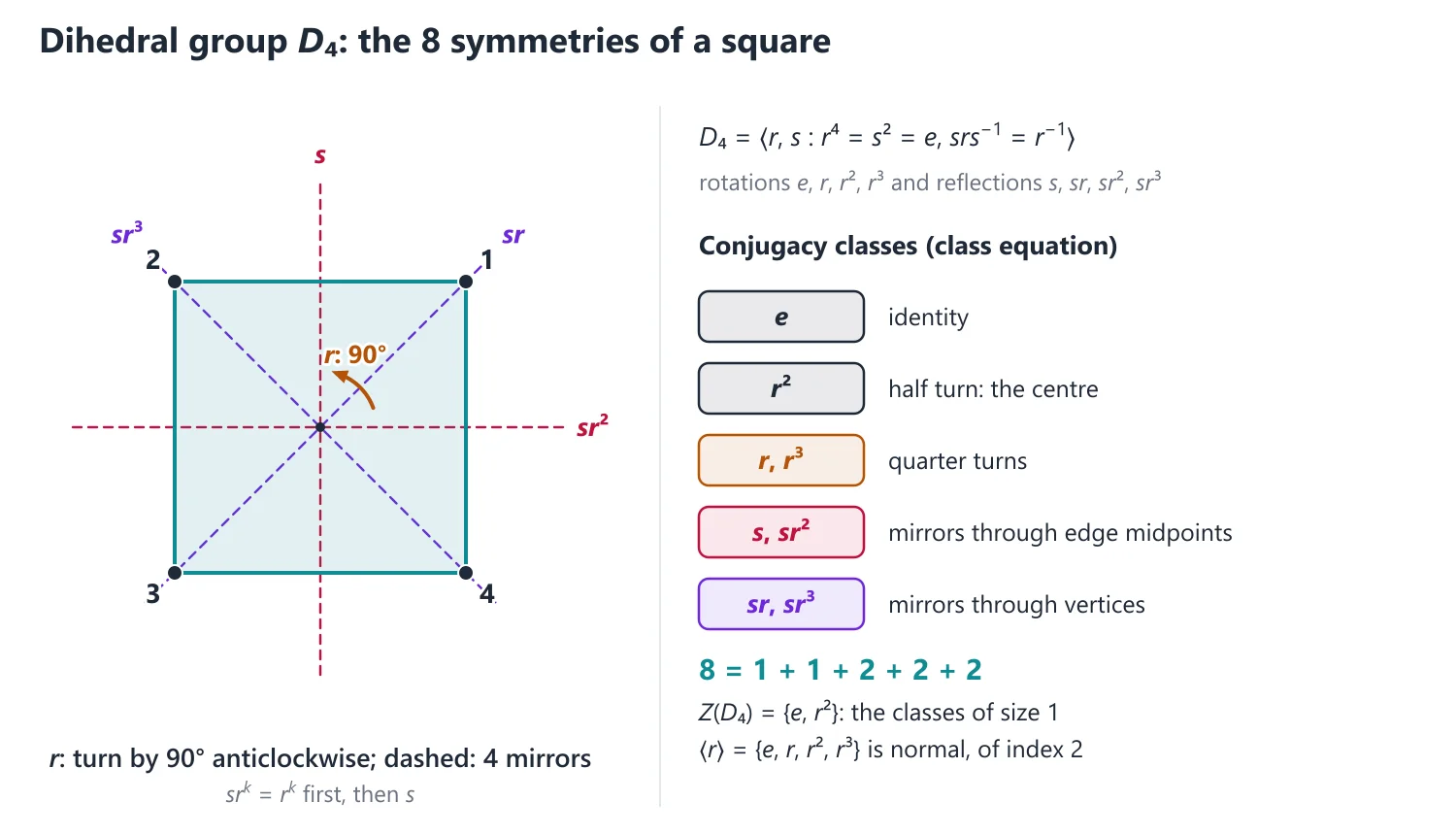
1. Understanding Direct Products
Why we need it: we want to build larger groups from smaller ones, and, in the other direction, to recognise a given group as made of simpler pieces, for instance ℤ6 as ℤ2 and ℤ3 working side by side.
In words: G1 × G2 is the set of ordered pairs (g1, g2). Pairs are combined coordinate by coordinate, each coordinate using the operation of its own group, so its order is o(G1)·o(G2).
A power of a pair is the pair of powers, so a pair returns to the identity only when both coordinates have returned. That is why o((g1, g2)) is the lcm of the two orders.
First example, slowly: in ℤ2 × ℤ3 list the multiples of (1, 1): (1, 1), (0, 2), (1, 0), (0, 1), (1, 2), (0, 0).
Step 1: the first coordinate cycles with period 2 and the second with period 3. Step 2: both are 0 for the first time at the 6th step, and 6 = lcm(2, 3).
Step 3: all six elements appeared, so (1, 1) generates the group, and ℤ2 × ℤ3 ≅ ℤ6.
Non-example: in ℤ2 × ℤ2, every element added to itself gives (0, 0), so every element has order 1 or 2. No element has order 4, so ℤ2 × ℤ2 is not ≅ ℤ4; here gcd(2, 2) ≠ 1.
Building up: (1) o((g1, g2)) = lcm(o(g1), o(g2)). (2) Hence ℤm × ℤn is cyclic iff gcd(m, n) = 1 (the 'Why it works' line below).
(3) Inside one group, G ≅ H × K when H, K are normal, H ∩ K = {e} and G = HK. (4) Every finite abelian group is a product of cyclic groups of prime-power order, so its structure reduces to partitions of exponents.
Where it is used: listing abelian groups of order n, the Chinese remainder theorem ℤmn ≅ ℤm × ℤn, U(mn) ≅ U(m) × U(n), and groups of order pq.
2. Understanding Dihedral Groups
Why we need it: the symmetries of a regular polygon form the most important family of non-abelian groups. They are small enough to compute by hand, and they supply the standard counter-examples of this chapter.
In words: r is the rotation through 2π/n and s is one reflection. The relations rn = e, s2 = e and srs−1 = r−1 say: n turns bring you back, two flips bring you back, and a turn seen in a mirror is a turn the other way.
Every element is then a rotation rk or a reflection srk (0 ≤ k ≤ n − 1), so o(Dn) = 2n.
First example, slowly: label the vertices of a square 1, 2, 3, 4 anticlockwise. Then r = (1 2 3 4), and the reflection in the diagonal through vertices 1 and 3 is s = (2 4).
Step 1: by the relabelling rule, srs−1 = (s(1) s(2) s(3) s(4)) = (1 4 3 2) = r−1. The relation holds.
Step 2: sr = (2 4)(1 2 3 4): 1 → 2 → 4, 4 → 1 → 1, 2 → 3 → 3, 3 → 4 → 2. So sr = (1 4)(2 3), the reflection in the line through the mid-points of sides 14 and 23. It has order 2, like every reflection.
Step 3: rs = (1 2 3 4)(2 4) = (1 2)(3 4) ≠ sr, so D4 is not abelian.
Non-example: Q8 is also a non-abelian group of order 8, but it is not ≅ D4. D4 has five elements of order 2 (four reflections and r2), while −1 is the only element of order 2 in Q8.
Building up: (1) From srs−1 = r−1 we get sr = r−1s, and by induction srk = r−ks: a reflection can be moved past a rotation by inverting the rotation.
(2) Every reflection has order 2: (srk)2 = s(rks)rk = s(sr−k)rk = e. (3) The centre is {e} for odd n and {e, rn/2} for even n (the 'Why it works' line below). (4) ⟨r⟩ has index 2, hence is normal.
Where it is used: groups of order 2p, groups generated by two elements of order 2, the non-transitivity of normality, and class-equation computations.
3. Understanding Conjugacy Classes and the Class Equation
Why we need it: sorting the elements of G into conjugacy classes shows at once which elements are central, and the sizes of the classes obey strong divisibility rules. These rules prove, for example, that a group of order pn has a non-trivial centre.
In words: cl(a) = {gag−1 : g ∈ G} collects every element that 'looks like a' from some viewpoint. C(a) = {g : ga = ag} is the set of elements that do not move a under conjugation.
The more elements commute with a, the smaller its class: |cl(a)| = [G : C(a)]. The class equation adds the class sizes, listing the one-element classes (the centre) separately.
First example, slowly: find the classes of D4 = {e, r, r2, r3, s, sr, sr2, sr3}, using srk = r−ks.
Step 1: Z(D4) = {e, r2}, giving two classes of size 1. Step 2: srs−1 = r−1 = r3, so cl(r) = {r, r3}.
Step 3: rsr−1 = r(sr−1) = r(rs) = r2s = sr−2 = sr2, so cl(s) = {s, sr2}. Step 4: r(sr)r−1 = rs = sr−1 = sr3, so cl(sr) = {sr, sr3}.
Step 5: the class equation is 8 = 2 + 2 + 2 + 2, where the first 2 is o(Z(D4)). Every class size divides 8, as it must.
Non-example: 8 = 1 + 1 + 3 + 3 cannot be the class equation of any group of order 8, because a class of size 3 would need 3 to divide 8.
Building up: (1) Conjugacy is an equivalence relation, so the classes partition G. (2) gC(a) ↦ gag−1 is a bijection from the cosets of C(a) onto cl(a), which gives |cl(a)| = [G : C(a)].
(3) If o(G) = pn, every non-central class size is a power of p bigger than 1, so p divides o(Z(G)) and Z(G) ≠ {e}. (4) With the G/Z(G) theorem this makes every group of order p2 abelian (the derivation below).
Where it is used: centres of p-groups, groups of order p2, class equations of Sn, A4 and Dn, and proofs of Cauchy's and Sylow's theorems.
4. Understanding the Sylow Theorems
Why we need it: the converse of Lagrange's theorem is false, so a divisor of o(G) need not be the order of a subgroup. The Sylow theorems guarantee subgroups of the largest prime-power orders and count them, which often forces a normal subgroup.
In words: write o(G) = pkm with p prime and p not dividing m. A Sylow p-subgroup is a subgroup of order exactly pk, the full power of p in o(G).
The theorems say: such subgroups exist; any two are conjugate; and their number np satisfies np ≡ 1 (mod p) and np | m. If np = 1, the Sylow p-subgroup equals all its conjugates, i.e. it is normal.
First example, slowly: let o(G) = 45 = 32·5.
Step 1 (p = 3): n3 divides 5, so n3 ∈ {1, 5}; n3 ≡ 1 (mod 3) rules out 5 (5 ≡ 2). So n3 = 1, and the Sylow 3-subgroup P (order 9) is normal.
Step 2 (p = 5): n5 divides 9, so n5 ∈ {1, 3, 9}; modulo 5 these are 1, 3, 4, so n5 = 1 and the Sylow 5-subgroup Q (order 5) is normal.
Step 3: P ∩ Q = {e}, since its order divides both 9 and 5, and |PQ| = 9·5 = 45. So G = PQ ≅ P × Q.
Step 4: P has order 32, hence is abelian, and Q ≅ ℤ5. So every group of order 45 is abelian: it is ℤ9 × ℤ5 ≅ ℤ45 or ℤ3 × ℤ3 × ℤ5.
Non-example: for o(G) = 12 = 22·3 the conditions allow n3 ∈ {1, 4}, and A4 really has n3 = 4 (its eight 3-cycles lie in four subgroups of order 3). So the Sylow conditions alone do not always produce a normal subgroup; then element counting is needed.
Building up: (1) The conjugates of a Sylow subgroup P are all the Sylow p-subgroups, so np = [G : N(P)], which divides [G : P] = m. (2) np = 1 ⇔ P ⊴ G.
(3) Subgroups of prime order p meet only in e, so np of them contain np(p − 1) elements of order p; this is the counting used for order 12 below. (4) The full proofs of Sylow's theorems are beyond the syllabus; Cauchy's theorem is proved in the derivation below.
Where it is used: proving that groups of order 15, 33, 35, 45 or pq are cyclic or abelian, showing that groups of order 20, 30 or 63 are not simple, and counting elements of prime order.
5. Direct Products
External direct product: for groups G1, ..., Gn, the set G1 × ... × Gn = {(g1, ..., gn)} with componentwise operation is a group of order o(G1)···o(Gn); it is abelian iff every Gi is abelian.
Idea: picture independent clocks running side by side: an element (g1, g2) records the position of each, and the operation moves each clock by its own rule. Nothing in one coordinate affects the other.
Order of an element: o((g1, ..., gn)) = lcm(o(g1), ..., o(gn)).
Why it works: (g1, ..., gn)m = (g1m, ..., gnm) is the identity iff gim = e for every i, i.e. iff every o(gi) divides m; the least such m is the lcm.
Cyclic products: ℤm × ℤn is cyclic, and then ≅ ℤmn, iff gcd(m, n) = 1. So ℤ2 × ℤ3 ≅ ℤ6 but ℤ2 × ℤ2 ≇ ℤ4; for rings, ℤmn ≅ ℤm × ℤn when gcd(m, n) = 1 (Chinese remainder theorem).
Why it works: if gcd(m, n) = 1, then o((1, 1)) = lcm(m, n) = mn, so (1, 1) generates. If d = gcd(m, n) > 1, every element has order dividing lcm(m, n) = mn/d < mn, so no element generates.
Internal direct product: if H, K ⊴ G, H ∩ K = {e} and G = HK, then G ≅ H × K via (h, k) ↦ hk; in that case hk = kh for all h ∈ H, k ∈ K.
Why it works: for h ∈ H and k ∈ K, the commutator hkh−1k−1 = (hkh−1)k−1 lies in K and = h(kh−1k−1) lies in H, since both are normal; so it is in H ∩ K = {e} and hk = kh. Then (h, k) ↦ hk is a homomorphism, one-one because hk = e ⇒ h = k−1 ∈ H ∩ K, and onto because G = HK.
Both must be normal: S3 = A3·{e, (1 2)} with trivial intersection, but {e, (1 2)} is not normal, and S3 is not ≅ ℤ3 × ℤ2 (which is abelian).
Fundamental theorem of finite abelian groups: every finite abelian group is a direct product of cyclic groups of prime-power order, uniquely up to order. For example, the abelian groups of order 8 are ℤ8, ℤ4 × ℤ2 and ℤ2 × ℤ2 × ℤ2.
How to list them: for n = p1a1···prar, choose for each prime a partition of its exponent ai. So the number of abelian groups of order n is the product of the partition numbers; for 72 = 23·32 it is 3·2 = 6.
Example 1: Is ℤ2 × ℤ4 cyclic?
The order of (a, b) is lcm(o(a), o(b)) with o(a) | 2 and o(b) | 4, so it is at most 4 < 8. No element has order 8, so ℤ2 × ℤ4 is not cyclic (consistent with gcd(2, 4) = 2 ≠ 1).
6. Dihedral Groups
Definition: Dn (n ≥ 3) is the group of symmetries of a regular n-gon: n rotations e, r, ..., rn−1 (r = rotation by 2π/n) and n reflections s, sr, ..., srn−1; o(Dn) = 2n.
Idea: r turns the polygon and s flips it over. Flipping reverses the sense of turning, which is exactly the relation srs−1 = r−1: flip, turn anticlockwise, flip back is the same as turning clockwise.
Presentation: Dn = ⟨r, s : rn = s2 = e, srs−1 = r−1⟩. Useful rules: srk = r−ks, every reflection srk has order 2, and ⟨r⟩ is a normal subgroup of index 2.
Centre: Z(Dn) = {e} for odd n and {e, rn/2} for even n. D3 ≅ S3, and Dn is non-abelian for n ≥ 3.
Why it works: rk commutes with s iff r−ks = rks iff r2k = e iff n | 2k, so k = 0, or k = n/2 when n is even. A reflection srk never commutes with r for n ≥ 3, since r(srk) = srk−1 while (srk)r = srk+1.
Generated by two involutions: if u ≠ v have order 2 and uv has order n, then for n ≥ 3, ⟨u, v⟩ ≅ Dn (take r = uv, s = u; for n = 2 the group is the Klein four-group); conversely Dn is generated by the two reflections s and sr.
Groups of order 2p: for an odd prime p, a group of order 2p is either cyclic (ℤ2p) or dihedral (Dp).
Example 2: List the elements of D4 = ⟨r, s⟩ and find its centre.
D4 = {e, r, r2, r3, s, sr, sr2, sr3}. r2 commutes with s, because sr2 = r−2s = r2s, and with every power of r.
r and r3 do not commute with s (sr = r3s ≠ rs), and no reflection srk commutes with r, since r(srk) = srk−1 ≠ srk+1. Hence Z(D4) = {e, r2}.
7. Conjugacy, Class Equation and Cauchy's Theorem
Conjugacy: b is conjugate to a if b = gag−1 for some g ∈ G; this is an equivalence relation whose classes cl(a) partition G, and cl(a) = {a} iff a ∈ Z(G).
Idea: conjugate elements do the same thing seen from a different viewpoint. In Dn, two reflections are conjugate when a symmetry carries one axis to the other: for odd n all n reflections form one class, and for even n they split into two classes of n/2 (axes through vertices and axes through mid-points of sides).
Class size: |cl(a)| = [G : C(a)], where C(a) is the centraliser of a; so the size of each class divides o(G).
Why it works: the map gC(a) ↦ gag−1 from the left cosets of C(a) onto cl(a) is well defined and one-one, because gag−1 = hah−1 ⇔ h−1g ∈ C(a) ⇔ gC(a) = hC(a). So |cl(a)| = [G : C(a)].
Class equation: o(G) = o(Z(G)) + ∑[G : C(a)], the sum running over one representative a of each class with more than one element.
Why it works: the conjugacy classes partition G, and the classes with one element are exactly {z} for z ∈ Z(G). Adding the class sizes gives the equation; every term divides o(G).
p-groups: if o(G) = pn (p prime, n ≥ 1), then Z(G) ≠ {e}, since every term [G : C(a)] > 1 is a multiple of p. Every group of order p2 is abelian (≅ ℤp2 or ℤp × ℤp).
G/Z(G) theorem: if G/Z(G) is cyclic, then G is abelian. So o(G/Z(G)) can never be a prime.
Cauchy's theorem: if a prime p divides o(G), then G has an element of order p (and hence a subgroup of order p).
Normaliser: N(H) = {g ∈ G : gHg−1 = H} is the largest subgroup of G in which H is normal; the number of conjugates of H is [G : N(H)].
Example 3: Write the class equation of S3.
In Sn conjugacy classes are the cycle types, so the classes are {e}, the three transpositions and the two 3-cycles. Z(S3) = {e}, so the class equation is 6 = 1 + 3 + 2; each class size divides 6.
8. Sylow Theorems and Groups of Small Order
Sylow theorems: let o(G) = pkm with p prime and p ∤ m. (1) G has a subgroup of order pk (a Sylow p-subgroup). (2) Any two Sylow p-subgroups are conjugate. (3) The number np of Sylow p-subgroups satisfies np ≡ 1 (mod p) and np | m.
Idea: a Sylow p-subgroup is the largest possible p-piece of G. All of them are copies of one another (conjugate), and np = [G : N(P)], which is why np divides m. Counting np is the standard way to prove that a group of a given order has a normal subgroup.
Normality test: a Sylow p-subgroup is normal iff np = 1; more generally, a subgroup that is the only one of its order is normal.
Groups of order pq: let p < q be primes. The subgroup of order q is unique, hence normal; if moreover p ∤ (q − 1), the group is cyclic (so every group of order 15, 33 or 35 is cyclic).
Why it works: nq ≡ 1 (mod q) and nq | p < q force nq = 1. Also np ∈ {1, q}, and np = q would need q ≡ 1 (mod p); if p ∤ (q − 1), then np = 1 too, both subgroups are normal with trivial intersection, and G ≅ ℤp × ℤq ≅ ℤpq.
Elementary method without Sylow: two distinct subgroups H, K of prime order m meet only in {e}, so |HK| = m2; if m2 > o(G), there is at most one subgroup of order m.
Example 4: Show that every group of order 15 is cyclic.
n5 ≡ 1 (mod 5) and n5 | 3 give n5 = 1; n3 ≡ 1 (mod 3) and n3 | 5 give n3 = 1.
So G has unique, hence normal, subgroups H and K of orders 3 and 5. H ∩ K = {e} and |HK| = 15, so G = HK ≅ H × K ≅ ℤ3 × ℤ5 ≅ ℤ15.
9. Derivation: Cauchy's Theorem (McKay's Counting Proof)
Setting: let p be a prime dividing o(G) and X = {(a1, ..., ap) ∈ Gp : a1a2···ap = e}. The first p − 1 entries are arbitrary and then ap is forced, so |X| = o(G)p−1, a multiple of p.
Cyclic shift: if a1a2···ap = e then a2···apa1 = a1−1(a1···ap)a1 = e, so shifting the entries maps X to X. Repeating the shift p times returns the tuple, so each orbit has size 1 or p (a divisor of the prime p).
Counting: orbits of size 1 are the constant tuples (a, ..., a) with ap = e. Since |X| and the sizes of the other orbits are multiples of p, the number of such a is a multiple of p. It is at least 1 (a = e), hence at least p, so some a ≠ e has ap = e, i.e. o(a) = p.
10. Derivation: Using the Class Equation and Sylow Counting
Groups of order p2 are abelian: Z(G) ≠ {e} (p-group), so o(G/Z(G)) is 1 or p. In both cases G/Z(G) is cyclic, so G is abelian (and then Z(G) = G).
Counting elements (order 12): n3 ∈ {1, 4}. If n3 = 4, the four subgroups of order 3 meet only in e and give 4·2 = 8 elements of order 3. Only 4 elements remain, and a Sylow 2-subgroup (order 4) contains no element of order 3, so it consists of exactly these 4 elements; it is unique, hence normal. So a group of order 12 has a normal Sylow 3-subgroup or a normal Sylow 2-subgroup.
Not simple: for o(G) = 20, n5 ≡ 1 (mod 5) and n5 | 4 give n5 = 1, so the Sylow 5-subgroup is a proper non-trivial normal subgroup and G is not simple.
11. Choosing the Method
If asked whether G1 × G2 is cyclic → both factors must be cyclic of coprime orders; otherwise bound every element order by an lcm.
If asked to list abelian groups of order n → factor n and take partitions of each prime exponent.
If asked to show G = H × K internally → verify H ⊴ G, K ⊴ G, H ∩ K = {e} and |H||K| = |G|.
If you need an element of prime order p → Cauchy; a subgroup of order pk → Sylow.
If you must show a group of order n is not simple → find p with np = 1; if every np could exceed 1, count the elements of prime order as above.
If the centre or abelianness of a p-group is asked → class equation, then the G/Z(G) theorem.
If conjugacy classes of Dn are asked → use srk = r−ks: rotations pair up as {rk, r−k}, and reflections form one class (n odd) or two classes (n even).
12. Common Mistakes
Writing ℤm × ℤn ≅ ℤmn without gcd(m, n) = 1: ℤ2 × ℤ2 is the Klein group, not ℤ4.
Taking o((a, b)) = o(a)·o(b): the order is the lcm; (1, 3) in ℤ4 × ℤ6 has order lcm(4, 2) = 4, not 4·2 = 8.
Misusing np: np divides m, the part of o(G) prime to p, not just o(G); and np = 1 means normal, not 'G is a p-group'.
Assuming distinct Sylow subgroups meet trivially: this is guaranteed only when they have prime order p; two Sylow 2-subgroups of order 4 can share an element of order 2.
Class-equation slips: putting central elements into the sum, or writing a class size that does not divide o(G).
13. Connections
Link: ℤmn ≅ ℤm × ℤn (gcd(m, n) = 1) is also a ring isomorphism (Rings topic); restricting it to units gives U(mn) ≅ U(m) × U(n), which is why φ(mn) = φ(m)φ(n).
Link: in Linear Algebra terms the rotations of Dn are orthogonal matrices with determinant 1 and the reflections have determinant −1, so ⟨r⟩ = Dn ∩ SO(2) is the kernel of det, again a normal subgroup of index 2.
14. Solved Past UPSC Questions
Example 5 (UPSC 2017, 15 marks): Show that the groups ℤ5 × ℤ7 and ℤ35 are isomorphic.
ℤ5 × ℤ7 has order 35, and o((1, 1)) = lcm(5, 7) = 35.
So ℤ5 × ℤ7 = ⟨(1, 1)⟩ is cyclic of order 35, and every cyclic group of order 35 is isomorphic to ℤ35.
Explicitly, φ(k) = (k mod 5, k mod 7) is a well-defined homomorphism ℤ35 → ℤ5 × ℤ7 (5 and 7 divide 35). φ(k) = (0, 0) ⇔ 5 | k and 7 | k ⇔ 35 | k, so φ is one-one, hence onto, as both groups have 35 elements.
Answer: ℤ5 × ℤ7 ≅ ℤ35, because gcd(5, 7) = 1.
Example 6 (UPSC 2023, 15 marks): Prove that a non-commutative group of order 2p, where p is an odd prime, must have a subgroup of order p.
Let o(G) = 2p. By Lagrange every element has order 1, 2, p or 2p.
No element has order 2p, otherwise G would be cyclic and hence commutative.
If every non-identity element had order 2, then ab = (ab)−1 = b−1a−1 = ba for all a, b, and G would be abelian. This is excluded.
Hence some a ∈ G has order p, and H = ⟨a⟩ is a subgroup of order p (normal, since its index is 2).
Answer: G has a (normal) subgroup ⟨a⟩ of order p; in fact G ≅ Dp.
Example 7 (UPSC 2024, 10 marks): Let G be a finite group of order mn, where m and n are prime numbers with m > n. Show that G has at most one subgroup of order m.
Suppose H ≠ K are subgroups of order m. H ∩ K is a subgroup of H, so its order divides the prime m, and it is not m (else H = H ∩ K = K). So H ∩ K = {e}.
Then |HK| = o(H)o(K)/o(H ∩ K) = m2.
But HK ⊆ G, so m2 ≤ mn, i.e. m ≤ n, contradicting m > n.
Answer: G has at most one subgroup of order m (exactly one, by Cauchy's theorem), and it is therefore normal.
Example 8 (UPSC 2025, 10 marks): Let G = {e, x, x2, y, yx, yx2} be a non-Abelian group with o(x) = 3 and o(y) = 2. Show that xy = yx2 (where e is the identity element of G and o(x), o(y) denote the order of the elements x, y respectively).
xy ∈ G. If xy ∈ {e, x, x2} = ⟨x⟩, then y = x−1(xy) ∈ ⟨x⟩, which is false; so xy ∈ {y, yx, yx2}.
xy = y gives x = e, impossible since o(x) = 3.
xy = yx would make x and y commute; since every element of G is a product of powers of x and y, G would be abelian, contrary to hypothesis.
Hence xy = yx2 = yx−1, the defining relation of D3 ≅ S3 (one model: x = (1 2 3), y = (1 2), where both sides equal (1 3)).
Answer: xy = yx2.
Example 9 (UPSC 2026, 10 marks): Let G be a group of order pq, where p and q are primes. Show that either G is an abelian group or no non-identity element commutes with every element of G.
Z(G) is a subgroup, so by Lagrange o(Z(G)) ∈ {1, p, q, pq}.
If o(Z(G)) = pq, then G = Z(G) is abelian.
If o(Z(G)) = p or q, then o(G/Z(G)) is q or p, a prime, so G/Z(G) is cyclic. Then G is abelian, so Z(G) = G, a contradiction.
Hence either G is abelian, or Z(G) = {e}, which says exactly that no non-identity element commutes with every element of G.
Answer: G is abelian or has trivial centre.
Example 10 (UPSC 2026, 15 marks): Let G be a finite group generated by two elements u and v of order 2 each. Show that G is isomorphic to the dihedral group of order 2n, where O(uv) = n.
Put r = uv and s = u. Then o(r) = n and s2 = e; since u−1 = u and v−1 = v, srs−1 = u(uv)u = vu = (uv)−1 = r−1.
v = u(uv) = sr, so G = ⟨u, v⟩ = ⟨r, s⟩. Using sr = r−1s, every word in r, s reduces to ri or ris with 0 ≤ i ≤ n − 1, so G = ⟨r⟩ ∪ ⟨r⟩s and o(G) ≤ 2n.
s ∉ ⟨r⟩: otherwise u and v = sr both lie in the cyclic group ⟨r⟩, which has at most one element of order 2; then u = v, r = e, n = 1, and ⟨r⟩ = {e} cannot contain u. So ⟨r⟩ and ⟨r⟩s are disjoint and o(G) = 2n.
Dn = ⟨ρ, σ⟩ has the same description: 2n elements ρiσj with o(ρ) = n, σ2 = e, σρσ−1 = ρ−1. So ψ(risj) = ρiσj (0 ≤ i ≤ n − 1, j = 0, 1) is a bijection, and it preserves products because in both groups products are computed by the same rules rn = s2 = e, sri = r−is.
Answer: G ≅ Dn, the dihedral group of order 2n, with uv as the rotation and u as a reflection.
15. Practice Exercises
Exercise 1 (basic): Find the order of (2, 3) in ℤ4 × ℤ9.
Answer: o(2) = 2 in ℤ4 and o(3) = 3 in ℤ9, so the order is lcm(2, 3) = 6.
Exercise 2 (basic): Is ℤ3 × ℤ10 ≅ ℤ30? Is ℤ6 × ℤ10 ≅ ℤ60?
Answer: yes, since gcd(3, 10) = 1; no, since gcd(6, 10) = 2 and every element of ℤ6 × ℤ10 has order dividing lcm(6, 10) = 30.
Exercise 3 (basic): Write the class equation of D5.
Answer: the classes are {e}, {r, r4}, {r2, r3} and the five reflections, so 10 = 1 + 2 + 2 + 5.
Exercise 4 (standard): List, up to isomorphism, all abelian groups of order 36.
Answer: 36 = 22·32 gives 2·2 = 4 groups: ℤ4 × ℤ9, ℤ2 × ℤ2 × ℤ9, ℤ4 × ℤ3 × ℤ3, ℤ2 × ℤ2 × ℤ3 × ℤ3.
Exercise 5 (standard): Find the centre of D6, the symmetry group of a regular hexagon.
Answer: n = 6 is even, so Z(D6) = {e, r3}, where r3 is the half-turn.
Exercise 6 (standard): Prove that every group of order 33 is cyclic.
Answer: n11 | 3 and n11 ≡ 1 (mod 11) give n11 = 1; n3 | 11 and n3 ≡ 1 (mod 3) give n3 = 1 (11 ≡ 2). The two normal subgroups meet trivially, so G ≅ ℤ3 × ℤ11 ≅ ℤ33.
Exercise 7 (standard): A simple group G has order 168 = 23·3·7. How many elements of order 7 does it have?
Answer: n7 | 24 and n7 ≡ 1 (mod 7) give n7 ∈ {1, 8}; simplicity rules out 1. The 8 subgroups of order 7 meet only in e, giving 8·6 = 48 elements of order 7.
Exercise 8 (UPSC level): Prove that no group of order 30 is simple.
Answer: n5 ∈ {1, 6} and n3 ∈ {1, 10}. If both were greater than 1 there would be 6·4 = 24 elements of order 5 and 10·2 = 20 of order 3, i.e. 44 > 30 elements. So n5 = 1 or n3 = 1, giving a proper non-trivial normal subgroup.
Exercise 9 (UPSC level): Let o(G) = pn with p prime and n ≥ 1. Prove that G has a normal subgroup of order p.
Answer: by the class equation Z(G) ≠ {e}, and p divides o(Z(G)). By Cauchy's theorem Z(G) contains an element z of order p. ⟨z⟩ consists of central elements, so g⟨z⟩g−1 = ⟨z⟩ for all g: it is normal.
Exercise 10 (UPSC level): Show that D4 and Q8 are non-isomorphic non-abelian groups of order 8, and that neither is isomorphic to ℤ2 × ℤ4.
Answer: count elements of order 2: D4 has 5, Q8 has 1, so they are not isomorphic. ℤ2 × ℤ4 is abelian (it has 3 elements of order 2), while D4 and Q8 are not.
Exercise 11 (UPSC level): Show that a group of order 63 has a normal subgroup of order 7.
Answer: 63 = 32·7, so n7 divides 9 and n7 ≡ 1 (mod 7). Of 1, 3, 9 (≡ 1, 3, 2 mod 7) only 1 works, so the Sylow 7-subgroup is unique and normal.
| Order | Number of groups | The groups (up to isomorphism) |
|---|---|---|
| 1 | 1 | {e} |
| p = 2, 3, 5, 7 (prime) | 1 | ℤp |
| 4 | 2 | ℤ4, ℤ2 × ℤ2 |
| 6 | 2 | ℤ6, S3 ≅ D3 |
| 8 | 5 | ℤ8, ℤ4 × ℤ2, ℤ2 × ℤ2 × ℤ2, D4, Q8 |
| 9 | 2 | ℤ9, ℤ3 × ℤ3 |
| 10 | 2 | ℤ10, D5 |
| 12 | 5 | ℤ12, ℤ6 × ℤ2, A4, D6, the dicyclic group of order 12 |
| 15 | 1 | ℤ15 |
Mains points
- To show ℤm × ℤn ≅ ℤmn, exhibit an element of order mn (or the map k ↦ (k mod m, k mod n)) and state gcd(m, n) = 1 explicitly.
- Questions on groups of order pq, 2p or p2 are best answered with Lagrange, the G/Z(G) theorem and the counting formula |HK| = |H||K|/|H ∩ K|; quote Cauchy or Sylow only as named theorems with their exact statements.
- For dihedral-group questions, write the relations rn = s2 = e and srs−1 = r−1 first, then reduce every word to the normal form risj.
- In a class-equation argument, say clearly why each non-central class size is a multiple of p (it divides pn and exceeds 1).
- Common mistake: assuming HK is a subgroup; the counting argument needs only that HK is a subset of G.
Did you know?
- The smallest non-abelian group is S3 ≅ D3 of order 6, and 8 is the smallest order with five non-isomorphic groups.
Rings, Subrings, Ideals and Ring Homomorphisms
A ring has an abelian group under addition and an associative, distributive multiplication. Ideals are the subrings that absorb multiplication, and they give quotient rings R/I. In a commutative ring with unity, R/P is an integral domain iff P is a prime ideal, and R/M is a field iff M is a maximal ideal.
1. Understanding Rings
Why we need it: integers, polynomials, square matrices and real functions can all be added, subtracted and multiplied, and the two operations are linked by the distributive law. A ring captures exactly this, so facts about factorisation, division and quotients can be proved once for all of them.
In words: '(R, +) is an abelian group' gives a zero 0, negatives −a and the freedom to add in any order. 'Multiplication is associative' lets us write abc without brackets.
The two distributive laws connect the operations, on the left and on the right. Nothing is said about ab = ba, about a unity 1, or about multiplicative inverses; each of these is an extra property.
A unit is an element with a multiplicative inverse. A zero divisor is a non-zero a with ab = 0 or ba = 0 for some non-zero b.
First example, slowly: check that ℤ6 is a ring and sort its elements.
Step 1: addition mod 6 makes ℤ6 an abelian group. Step 2: multiplication mod 6 is associative and distributive, because these laws hold in ℤ and reduction mod 6 respects + and ×.
Step 3: 1 is a unity and multiplication commutes. Step 4 (units): 1·1 = 1 and 5·5 = 25 ≡ 1, so the units are 1 and 5.
Step 5 (zero divisors): 2·3 = 6 ≡ 0 and 4·3 = 12 ≡ 0, so 2, 3 and 4 are zero divisors. Notice that each non-zero element is either a unit or a zero divisor.
Non-example: the invertible 2 × 2 real matrices, with matrix addition and multiplication, do not form a ring: I + (−I) = 0 is not invertible, so the set is not closed under addition and has no zero element.
Building up: (1) a·0 = 0 and (−a)(−b) = ab follow from the axioms (Derivation 'Rules of Signs' below). (2) A unit is never a zero divisor: if ab = 0 with a a unit, then b = a−1ab = 0.
(3) In ℤn a non-zero k is a unit iff gcd(k, n) = 1 and a zero divisor otherwise. (4) In a ring with unity the characteristic is the additive order of 1.
Where it is used: integral domains and fields are rings with extra properties; polynomial rings, matrix rings and function rings are the main examples of the next topics.
2. Understanding Ideals and Quotient Rings
Why we need it: ℤn is built from ℤ by declaring the multiples of n to be zero. To do the same in any ring R we must know which subsets I can be 'set to zero' so that R/I is again a ring. The answer is: the ideals.
In words: an ideal I is an additive subgroup of R that absorbs multiplication by every element of R, not only by elements of I: r·a ∈ I and a·r ∈ I for all r ∈ R and a ∈ I.
The elements of R/I are cosets a + I, added and multiplied through representatives: (a + I)(b + I) = ab + I.
First example, slowly: in R = ℤ × ℤ let I = {(a, 0) : a ∈ ℤ}.
Step 1 (subgroup): (a, 0) − (b, 0) = (a − b, 0) ∈ I, and (0, 0) ∈ I. Step 2 (absorption): for any (r, s) ∈ R, (r, s)(a, 0) = (ra, 0) ∈ I, and the product on the other side is the same since R is commutative.
Step 3: so I is an ideal. The coset (a, b) + I depends only on b, since changing a moves the element inside the same coset.
Step 4: hence (a, b) + I ↦ b is a ring isomorphism R/I ≅ ℤ. What to notice: setting the first coordinate to zero leaves a copy of the second factor.
Non-example: the diagonal D = {(a, a)} is a subring of ℤ × ℤ (it is closed under − and × and contains (1, 1)), but (1, 0)(2, 2) = (2, 0) ∉ D. It does not absorb, so it is not an ideal and (ℤ × ℤ)/D is not a ring.
Building up: (1) The ideal test: I ≠ ∅, a − b ∈ I, and ra, ar ∈ I. (2) Coset multiplication is well defined exactly when I is an ideal (Derivation 'R/I is a Ring Exactly When I is an Ideal' below).
(3) Kernels of ring homomorphisms are ideals. (4) An ideal containing a unit is all of R. (5) Every ideal of ℤ is nℤ, and every ideal of ℤn is ⟨d⟩ for a divisor d of n.
Where it is used: quotient rings, prime and maximal ideals, the construction of fields F[x]/⟨p(x)⟩, and the proof that a commutative ring with unity is a field iff it has no proper non-trivial ideals.
3. Understanding Prime and Maximal Ideals
Why we need it: we often want to know whether R/I is an integral domain or a field without computing R/I in detail. Prime and maximal ideals are exactly the ideals for which the answer is yes.
In words: P is prime if P ≠ R and ab ∈ P forces a ∈ P or b ∈ P; this copies 'p | ab ⇒ p | a or p | b'. M is maximal if M ≠ R and no ideal fits strictly between M and R.
The main theorems need R commutative with unity: then R/P is an integral domain iff P is prime, and R/M is a field iff M is maximal.
First example, slowly: take I = 5ℤ in ℤ.
Step 1 (prime): if ab ∈ 5ℤ then 5 | ab, and since 5 is a prime number, 5 | a or 5 | b (Euclid's lemma). So 5ℤ is prime.
Step 2 (maximal): let 5ℤ ⊊ J and pick a ∈ J with 5 ∤ a. Then gcd(a, 5) = 1, so 1 = ax + 5y for some integers x, y (Bézout).
Step 3: ax ∈ J and 5y ∈ 5ℤ ⊆ J, so 1 ∈ J and J = ℤ. So 5ℤ is maximal. Step 4: consistently, ℤ/5ℤ = ℤ5 is a field.
Non-example: 6ℤ is not prime, since 2·3 ∈ 6ℤ but 2, 3 ∉ 6ℤ, and ℤ6 has zero divisors. Also {0} ⊂ ℤ is prime but not maximal, because {0} ⊊ 2ℤ ⊊ ℤ; so prime does not imply maximal.
Building up: (1) In R/P, (a + P)(b + P) = P means ab ∈ P, so 'no zero divisors' is word for word 'P is prime' (Standard Proofs, Theorem 11).
(2) If M is maximal and a ∉ M, the ideal M + Ra is bigger than M, so it is R; this gives an inverse of a + M (Theorem 10). (3) A field is an integral domain, so every maximal ideal is prime.
Where it is used: deciding whether R/I is an integral domain or a field, building fields such as ℤp and F[x]/⟨p(x)⟩, and the frequently asked 'is R[x]/S an integral domain?' questions.
4. Understanding Ring Homomorphisms
Why we need it: as for groups, the easiest way to identify a quotient ring R/I is to find an onto map from R that respects both operations and has kernel I.
In words: f : R → R′ is a ring homomorphism if f(a + b) = f(a) + f(b) and f(ab) = f(a)f(b) for all a, b. Its kernel {a : f(a) = 0} is an ideal, and R/ker f ≅ f(R).
First example, slowly: let φ : ℤ[x] → ℤ, φ(f) = f(0), the constant term.
Step 1: (f + g)(0) = f(0) + g(0) and (fg)(0) = f(0)g(0), so φ is a ring homomorphism. Step 2: φ(c) = c for every constant c, so φ is onto.
Step 3: f(0) = 0 means every term of f contains x, so f = x·g for some g ∈ ℤ[x]; hence ker φ = ⟨x⟩.
Step 4: by the first isomorphism theorem ℤ[x]/⟨x⟩ ≅ ℤ. Step 5: ℤ is an integral domain but not a field, so ⟨x⟩ is a prime ideal of ℤ[x] that is not maximal.
Non-example: f : ℤ → ℤ, f(n) = 2n, preserves addition, but f(1·1) = 2 while f(1)f(1) = 4. So it is a group homomorphism of (ℤ, +) but not a ring homomorphism.
Building up: (1) A ring homomorphism is in particular an additive group homomorphism, so ker f is a subgroup and f is one-one iff ker f = {0}. (2) If a ∈ ker f and r ∈ R, then f(ra) = f(r)·0 = 0, so the kernel absorbs: it is an ideal.
(3) The group proof of the first isomorphism theorem, with ideals in place of normal subgroups, gives R/ker f ≅ f(R). (4) The kernel of a homomorphism from a field is {0} or the whole field, so such a map is zero or one-one.
Where it is used: ℝ[x]/⟨x2 + 1⟩ ≅ ℂ, C[0, 1]/M ≅ ℝ, ℤmn ≅ ℤm × ℤn, the Frobenius map, and imbeddings in Kronecker's theorem.
5. Rings
Ring: a set R with operations + and · such that (R, +) is an abelian group, · is associative, and the distributive laws a(b + c) = ab + ac and (a + b)c = ac + bc hold.
Idea: a ring is arithmetic without division: you can add, subtract and multiply, as in ℤ, polynomials, n × n matrices or real functions. Two familiar habits may fail: multiplication need not commute (matrices), and a product of non-zero elements may be 0 (2·3 = 0 in ℤ6).
Types: R is commutative if ab = ba for all a, b; R has unity if there is 1 with 1·a = a·1 = a; a unit is an element with a multiplicative inverse.
Basic rules: a·0 = 0·a = 0; a(−b) = (−a)b = −(ab); (−a)(−b) = ab.
Zero divisor: a ≠ 0 such that ab = 0 or ba = 0 for some b ≠ 0. In ℤn, a non-zero k is a zero divisor iff gcd(k, n) > 1, and a unit iff gcd(k, n) = 1.
Idea: zero divisors are exactly what breaks cancellation: in ℤ6, 2·3 = 2·0 but 3 ≠ 0. A ring without them lets you cancel non-zero factors, which is the defining property of an integral domain.
Boolean ring: a ring with a2 = a for all a; every Boolean ring is commutative and satisfies a + a = 0.
Characteristic: the least n ≥ 1 with na = 0 for all a ∈ R, and 0 if no such n exists; for a ring with unity it is the additive order of 1.
Why it works: if 1 has additive order n, then n·a = (n·1)a = 0·a = 0 for every a, and no smaller positive multiple kills 1. For ℤm × ℤn the characteristic is lcm(m, n), the additive order of (1, 1).
6. Subrings and Ideals
Subring test: a non-empty S ⊆ R is a subring iff a − b ∈ S and ab ∈ S for all a, b ∈ S.
Unity of a subring: a subring need not contain the unity of R and may have a unity of its own: in ℤ6 the subring {0, 2, 4} has unity 4, and in ℤ × ℤ the subring ℤ × {0} has unity (1, 0) ≠ (1, 1). The subring 2ℤ of ℤ has no unity at all.
Ideal: a subring I such that ra ∈ I and ar ∈ I for all r ∈ R and a ∈ I.
Idea: an ideal is a subring that absorbs multiplication from outside, like the even integers: any integer times an even integer is even. This absorption is what makes R/I a ring, exactly as normality makes G/N a group. A subring need not absorb: ℤ is a subring of ℚ, but (1/2)·1 ∉ ℤ.
Ideal test: a non-empty I ⊆ R is an ideal iff a − b ∈ I and ra, ar ∈ I for all a, b ∈ I and r ∈ R.
Principal ideal: in a commutative ring with unity, ⟨a⟩ = aR = {ar : r ∈ R}. Every ideal of ℤ has the form nℤ.
Results: if an ideal contains a unit then I = R; a commutative ring with unity is a field iff its only ideals are {0} and R.
Why it works: if a unit u ∈ I, then 1 = u−1u ∈ I, and then r = r·1 ∈ I for every r ∈ R. So proper ideals contain no units, and a field, where every non-zero element is a unit, has only the ideals {0} and itself (Standard Proofs, Theorem 9, gives the converse).
Operations: I + J and I ∩ J are ideals; I ∪ J is an ideal iff I ⊆ J or J ⊆ I.
Quotient ring: R/I = {a + I : a ∈ R} with (a + I) + (b + I) = (a + b) + I and (a + I)(b + I) = ab + I; these are well-defined because I is an ideal.
7. Prime and Maximal Ideals
Prime ideal: an ideal P ≠ R such that ab ∈ P ⇒ a ∈ P or b ∈ P (R commutative).
Idea: think of an ideal as 'the set of multiples of something'. Then P is prime when divisibility by P behaves like divisibility by a prime number: p | ab ⇒ p | a or p | b. In ℤ, 6ℤ is not prime since 2·3 ∈ 6ℤ but 2, 3 ∉ 6ℤ.
Maximal ideal: an ideal M ≠ R such that if M ⊆ J ⊆ R for an ideal J, then J = M or J = R.
Idea: M is maximal when there is no room between M and R. In ℤ, 6ℤ ⊊ 3ℤ ⊊ ℤ, so 6ℤ is not maximal, while nothing fits between 3ℤ and ℤ.
Key theorem: let R be a commutative ring with unity. Then R/P is an integral domain iff P is prime, and R/M is a field iff M is maximal. Hence every maximal ideal is prime.
Idea: the quotient translates properties of the ideal into properties of a ring: 'P prime' becomes 'R/P has no zero divisors', and 'M maximal' becomes 'R/M has no non-trivial ideals', i.e. R/M is a field. The proofs are in Standard Proofs, Theorems 10 and 11; 'maximal ⇒ prime' then follows because every field is an integral domain.
Why unity is needed: in the ring 2ℤ (no unity), 4ℤ is maximal, because [2ℤ : 4ℤ] = 2 leaves no room between them, but it is not prime, since 2·2 = 4 ∈ 4ℤ while 2 ∉ 4ℤ.
In ℤ: nℤ is prime iff n = 0 or n is prime; nℤ is maximal iff n is prime.
Prime but not maximal: ⟨x⟩ in ℤ[x] is prime since ℤ[x]/⟨x⟩ ≅ ℤ is an integral domain, but it is not maximal since ⟨x⟩ ⊊ ⟨2, x⟩ ⊊ ℤ[x].
8. Ring Homomorphisms
Definition: f : R → R′ with f(a + b) = f(a) + f(b) and f(ab) = f(a)f(b) for all a, b ∈ R.
Idea: a ring homomorphism respects both operations, so it is in particular a homomorphism of the additive groups; everything about kernels and cosets carries over, with ideals playing the role of normal subgroups. It need not send 1 to 1: x ↦ (x, 0) from ℤ to ℤ × ℤ sends 1 to (1, 0).
Kernel: ker f = {a : f(a) = 0} is an ideal of R, and f is one-one iff ker f = {0}.
Isomorphism theorems: (1) R/ker f ≅ f(R); (2) for a subring S and an ideal I, (S + I)/I ≅ S/(S ∩ I); (3) for ideals I ⊆ J, (R/I)/(J/I) ≅ R/J.
Fact: a ring homomorphism from a field is either zero or one-one, because its kernel is an ideal of a field.
Unity under homomorphisms: if φ : R → R′ is onto and R has unity 1, then φ(1) is the unity of R′. If φ maps into an integral domain and φ ≠ 0, then φ(1) = 1′, because φ(1)2 = φ(1) ≠ 0 gives φ(1)(φ(1) − 1′) = 0.
Evaluation homomorphisms: for a commutative ring R with unity and c ∈ R, f(x) ↦ f(c) is an onto ring homomorphism R[x] → R with kernel ⟨x − c⟩; so ℤ[x]/⟨x⟩ ≅ ℤ and F[x]/⟨x − c⟩ ≅ F. For c1 ≠ c2 in a field F, {f : f(c1) = f(c2) = 0} = ⟨(x − c1)(x − c2)⟩, and the quotient is ≅ F × F, not an integral domain.
Ring homomorphisms of ℝ and ℤ: the only ring homomorphisms ℝ → ℝ are 0 and the identity, and the same holds for ℤ → ℤ.
Example 1: Show that ℝ[x]/⟨x2 + 1⟩ ≅ ℂ.
Define f : ℝ[x] → ℂ by f(p(x)) = p(i). It is a ring homomorphism and onto, since f(a + bx) = a + bi. If p(i) = 0 for a real polynomial p, then p(−i) = 0 too, so x2 + 1 divides p; hence ker f = ⟨x2 + 1⟩. By the first theorem ℝ[x]/⟨x2 + 1⟩ ≅ ℂ, and since ℂ is a field the ideal is maximal.
Example 2: Find all ideals and the maximal ideals of ℤ12.
The ideals are ⟨d⟩ for d dividing 12: ⟨1⟩ = ℤ12, ⟨2⟩, ⟨3⟩, ⟨4⟩, ⟨6⟩, ⟨0⟩. The maximal ideals are ⟨2⟩ and ⟨3⟩, since ℤ12/⟨2⟩ ≅ ℤ2 and ℤ12/⟨3⟩ ≅ ℤ3 are fields.
9. Derivation: Rules of Signs from the Axioms
a·0 = 0: a·0 = a(0 + 0) = a·0 + a·0; adding −(a·0) to both sides in the group (R, +) gives a·0 = 0. Similarly 0·a = 0.
a(−b) = −(ab): ab + a(−b) = a(b + (−b)) = a·0 = 0, so a(−b) is the additive inverse of ab. Applying this twice, (−a)(−b) = −(a(−b)) = −(−(ab)) = ab.
Moral: 'minus times minus is plus' is not an extra rule; the distributive law forces it.
10. Derivation: R/I is a Ring Exactly When I is an Ideal
Let I be an additive subgroup, a′ = a + i and b′ = b + j with i, j ∈ I. Then a′b′ = ab + (aj + ib + ij). If I is an ideal, the bracket lies in I, so a′b′ + I = ab + I and the product of cosets is well defined.
Conversely, if the product is well defined, compare (a + I)(0 + I) = I with (a + I)(j + I) = aj + I for j ∈ I: they must agree, so aj ∈ I. In the same way ja ∈ I, so I absorbs multiplication on both sides.
11. Derivation: Ideals of ℤ and ℤn, Units and Zero Divisors
Every ideal of ℤ is nℤ: if I ≠ {0}, let n be the least positive element of I. For a ∈ I write a = qn + r with 0 ≤ r < n; then r = a − qn ∈ I, so r = 0 by minimality, and I = nℤ. The same argument with degrees shows every ideal of F[x] is principal.
Ideals of ℤn: by the correspondence theorem they are dℤ/nℤ for dℤ ⊇ nℤ, i.e. ⟨d⟩ for the divisors d of n; and ⟨k⟩ = ⟨gcd(k, n)⟩, so ⟨8⟩ = ⟨4⟩ in ℤ12.
Units and zero divisors of ℤn: if gcd(k, n) = 1, Bézout gives kx + ny = 1, so kx ≡ 1 and k is a unit. If d = gcd(k, n) > 1 and k ≢ 0, then k·(n/d) = (k/d)·n ≡ 0 with n/d ≢ 0, so k is a zero divisor. Thus every non-zero element of ℤn is either a unit or a zero divisor.
12. Choosing the Method
If you must show I is an ideal → use the ideal test (a − b ∈ I, ra and ar ∈ I), or exhibit I as the kernel of a ring homomorphism.
If you must decide whether I is prime or maximal → identify R/I and ask whether it is an integral domain or a field; in ℤ or F[x] look at the generator (prime number, irreducible polynomial).
If all ideals of ℤn (or of ℤm × ℤn) are asked → list ⟨d⟩ for d | n; in a product of rings with unity every ideal is I × J.
If you must identify R/I → define an evaluation or reduction map with kernel I and apply the first isomorphism theorem.
If you must show a ring is not an integral domain or not a field → exhibit a zero divisor, a non-zero non-unit, or a proper non-trivial ideal.
13. Common Mistakes
Calling a subring an ideal: ℤ ⊂ ℚ and the diagonal {(a, a)} ⊂ ℤ × ℤ are subrings but not ideals; always test absorption.
Using 'R/M field ⇔ M maximal' without its hypotheses: R must be commutative with unity; 4ℤ in 2ℤ is maximal but not prime.
Assuming f(1) = 1: a ring homomorphism need not preserve unity unless it is onto or maps into an integral domain and is non-zero.
Saying {0} is never prime: {0} is a prime ideal exactly when R is an integral domain (so {0} is prime in ℤ but not in ℤ6).
Listing ⟨k⟩ for every k in ℤn as different ideals: ⟨k⟩ = ⟨gcd(k, n)⟩, so ℤn has exactly as many ideals as n has divisors.
14. Connections
Link: ideals are to rings what normal subgroups are to groups: kernels, quotients and the three isomorphism theorems have the same proofs as in the Normal Subgroups topic.
Link: Mn(ℝ) of Linear Algebra is the standard non-commutative ring, and its zero divisors are the non-zero singular matrices; ℝ[x]/⟨x2 + 1⟩ ≅ ℂ (Example 1) is the algebraic construction of the complex numbers used in Complex Analysis.
15. Worked Examples
Example 3: Prove that every Boolean ring R is commutative, and that 2a = 0 for every a ∈ R.
For a ∈ R: a + a = (a + a)2 = a2 + a2 + a2 + a2 = a + a + a + a, so a + a = 0, i.e. −a = a.
For a, b ∈ R: a + b = (a + b)2 = a2 + ab + ba + b2 = a + ab + ba + b, so ab + ba = 0.
Hence ab = −ba = ba, so R is commutative; if R ≠ {0} its characteristic is 2.
Example 4: Show that the set N of nilpotent elements of a commutative ring R is an ideal of R.
0 ∈ N. Let am = 0 and bn = 0. As R is commutative the binomial theorem holds: (a − b)m+n = ∑i C(m + n, i)ai(−b)m+n−i.
In each term either i ≥ m, so ai = 0, or i ≤ m − 1, so m + n − i ≥ n + 1 and bm+n−i = 0. Hence (a − b)m+n = 0 and a − b ∈ N.
For r ∈ R, (ra)m = rmam = 0, so ra ∈ N. Hence N is an ideal (the nilradical of R).
Example 5: Find the characteristic of the ring ℤ3 × ℤ4 and decide whether it is an integral domain.
The unity is (1, 1), and k(1, 1) = (k mod 3, k mod 4) = (0, 0) iff 3 | k and 4 | k, i.e. iff 12 | k. So the characteristic is lcm(3, 4) = 12.
It is not an integral domain: (1, 0)·(0, 1) = (0, 0) with both factors non-zero.
This is consistent with the theorem that an integral domain has characteristic 0 or a prime; in fact ℤ3 × ℤ4 ≅ ℤ12 as rings.
Example 6: Show that ⟨x2 + 1⟩ is not a prime ideal of ℤ2[x], although it is a maximal ideal of ℤ3[x].
In ℤ2[x], (x + 1)2 = x2 + 2x + 1 = x2 + 1, so (x + 1)(x + 1) ∈ I = ⟨x2 + 1⟩.
But x + 1 ∉ I, since every non-zero element of I has degree at least 2. So I is not prime, and (x + 1) + I is a zero divisor of ℤ2[x]/I.
Over ℤ3, x2 + 1 takes the values 1, 2, 2 at 0, 1, 2, so it has no root and is irreducible; ℤ3[x] is a PID, so the ideal is maximal there.
16. Solved Past UPSC Questions
Example 7 (UPSC 2015, 10 marks): Give an example of a ring having identity but a subring of this having a different identity.
Take R = ℤ6, whose identity is 1, and S = {0, 2, 4}. For a, b ∈ S, a − b and ab are even residues mod 6, so S is a subring.
In S, 4·0 = 0, 4·2 = 8 = 2 and 4·4 = 16 = 4 (mod 6), so 4 is the identity of S, different from the identity 1 of R.
Another example: R = ℤ × ℤ with identity (1, 1) and the subring S = ℤ × {0}, whose identity is (1, 0).
Answer: ℤ6 (identity 1) has the subring {0, 2, 4} with identity 4.
Example 8 (UPSC 2015, 15 marks): If R is a ring with unit element 1 and φ is a homomorphism of R onto R′, prove that φ(1) is the unit element of R′.
Let r′ ∈ R′. Since φ is onto, r′ = φ(r) for some r ∈ R.
Then φ(1)r′ = φ(1)φ(r) = φ(1·r) = φ(r) = r′, and similarly r′φ(1) = φ(r·1) = r′.
So φ(1) is a two-sided multiplicative identity of R′, and by uniqueness it is the unit element of R′.
Ontoness is needed: n ↦ (n, 0) is a homomorphism ℤ → ℤ × ℤ with φ(1) = (1, 0), which is not the identity (1, 1).
Answer: φ(1) is the unit element of R′.
Example 9 (UPSC 2018, 20 marks): Suppose ℝ be the set of all real numbers and f : ℝ → ℝ is a function such that the following equations hold for all x, y ∈ ℝ :
(i) f(x + y) = f(x) + f(y)
(ii) f(xy) = f(x) f(y)
Show that ∀ x ∈ ℝ either f(x) = 0, or, f(x) = x.
Put x = y = 1 in (ii): f(1) = f(1)2, so f(1) = 0 or f(1) = 1.
If f(1) = 0, then f(x) = f(x·1) = f(x)f(1) = 0 for all x.
Let f(1) = 1. From (i), f(0) = 0, f(−x) = −f(x) and f(nx) = nf(x) for n ∈ ℕ; so f(n) = n for n ∈ ℤ, and nf(m/n) = f(m) = m gives f(q) = q for every q ∈ ℚ.
f preserves order: if t ≥ 0 then t = s2 with s = √t, so f(t) = f(s)2 ≥ 0. Hence x ≤ y ⇒ f(y) − f(x) = f(y − x) ≥ 0.
Fix x ∈ ℝ. For rationals r < x < s, r = f(r) ≤ f(x) ≤ f(s) = s. Letting r and s tend to x (ℚ is dense) gives f(x) = x.
Answer: either f(x) = 0 for all x, or f(x) = x for all x ∈ ℝ.
Example 10 (UPSC 2022, 15 marks): Let R be a field of real numbers and S, the field of all those polynomials f(x) ∈ R[x] such that f(0) = 0 = f(1). Prove that S is an ideal of R[x]. Is the residue class ring R[x]/S an integral domain? Give justification for your answer.
(The paper says 'the field of all those polynomials'; S is only a subset of ℝ[x], so read 'the set'. Here R = ℝ.)
0 ∈ S. If f, g ∈ S, then (f − g)(0) = 0 and (f − g)(1) = 0, so f − g ∈ S.
If f ∈ S and h ∈ ℝ[x], then (hf)(0) = h(0)f(0) = 0 and (hf)(1) = h(1)f(1) = 0, so hf ∈ S. Hence S is an ideal; in fact S = ⟨x(x − 1)⟩, since x and x − 1 both divide f.
x ∉ S (it is 1 at x = 1) and x − 1 ∉ S (it is −1 at x = 0), but x(x − 1) ∈ S.
So (x + S)(x − 1 + S) = S, the zero of ℝ[x]/S, with both factors non-zero: ℝ[x]/S has zero divisors, and S is not a prime ideal.
Answer: S is an ideal of ℝ[x], but ℝ[x]/S is not an integral domain (indeed ℝ[x]/S ≅ ℝ × ℝ via f + S ↦ (f(0), f(1))).
17. Practice Exercises
Exercise 1 (basic): Find all units and all zero divisors of ℤ10.
Answer: units 1, 3, 7, 9 (gcd with 10 equal to 1); zero divisors 2, 4, 5, 6, 8 (for example 2·5 = 0, 4·5 = 0, 6·5 = 0, 8·5 = 0).
Exercise 2 (basic): Is {0, 3, 6, 9} an ideal of ℤ12? Is it a maximal ideal?
Answer: yes, it is ⟨3⟩. It is maximal, since ℤ12/⟨3⟩ ≅ ℤ3 is a field.
Exercise 3 (basic): Is the set of real upper triangular 2 × 2 matrices an ideal of M2(ℝ)?
Answer: no. It is a subring, but [[0, 0], [1, 0]]·[[1, 0], [0, 0]] = [[0, 0], [1, 0]] is not upper triangular, so it does not absorb multiplication from the left.
Exercise 4 (standard): Find all maximal ideals and all prime ideals of ℤ36.
Answer: the ideals are ⟨d⟩ for d | 36, with ℤ36/⟨d⟩ ≅ ℤd. This is a field (equivalently, for a finite ring, an integral domain) iff d is prime, so the maximal and the prime ideals are ⟨2⟩ and ⟨3⟩.
Exercise 5 (standard): Show that I = {f ∈ ℤ[x] : f(0) is even} is a maximal ideal of ℤ[x] and that I = ⟨2, x⟩.
Answer: f ↦ f(0) mod 2 is an onto ring homomorphism ℤ[x] → ℤ2 with kernel I, so ℤ[x]/I ≅ ℤ2, a field. Writing f = f(0) + x·g shows I = ⟨2, x⟩.
Exercise 6 (standard): Find the characteristic of ℤ4 × ℤ6 and of ℤ3[x].
Answer: lcm(4, 6) = 12 (the additive order of (1, 1)) and 3 (the additive order of the constant 1).
Exercise 7 (standard): In a ring R with unity, prove that (−1)a = −a for every a, and deduce that (−1)(−1) = 1.
Answer: a + (−1)a = (1 + (−1))a = 0·a = 0, so (−1)a is the additive inverse of a. Put a = −1: (−1)(−1) = −(−1) = 1.
Exercise 8 (UPSC level): Prove that ⟨x2 + 1⟩ is a maximal ideal of ℝ[x], while ⟨x2 − 1⟩ is not even a prime ideal.
Answer: x2 + 1 has no real root, so it is irreducible over ℝ and ⟨x2 + 1⟩ is maximal in the PID ℝ[x] (indeed ℝ[x]/⟨x2 + 1⟩ ≅ ℂ). But (x − 1)(x + 1) ∈ ⟨x2 − 1⟩ while neither factor is, having degree 1.
Exercise 9 (UPSC level): Find all ring homomorphisms from ℤ6 to ℤ6.
Answer: f(x) = ex with e = f(1); additivity holds for every e, and f(1·1) = f(1)2 forces e2 = e. The idempotents of ℤ6 are 0, 1, 3, 4, giving four homomorphisms x ↦ 0, x, 3x, 4x.
Exercise 10 (UPSC level): Show that ℤ[x]/⟨x2 + 1⟩ ≅ ℤ[i], and decide whether ⟨x2 + 1⟩ is prime or maximal in ℤ[x].
Answer: f ↦ f(i) is onto ℤ[i], and its kernel is ⟨x2 + 1⟩ (divide by the monic x2 + 1; a remainder a + bx vanishes at i only if a = b = 0). ℤ[i] is an integral domain but not a field, so the ideal is prime but not maximal.
| Ideal I | R/I is | Example |
|---|---|---|
| Prime | an integral domain | ⟨x⟩ in ℤ[x]: ℤ[x]/⟨x⟩ ≅ ℤ |
| Maximal | a field | ⟨p⟩ in ℤ: ℤ/⟨p⟩ ≅ ℤp |
| ⟨p(x)⟩ in F[x], p irreducible | a field | ℝ[x]/⟨x2 + 1⟩ ≅ ℂ |
| Neither prime nor maximal | has zero divisors | ⟨6⟩ in ℤ: ℤ6 |
Mains points
- The theorem 'R/M is a field iff M is maximal' (and its prime-ideal analogue) is among the most asked proofs; state that R is commutative with unity before proving it.
- Typical questions: show a given subset is an ideal (use the ideal test), find all ideals or maximal ideals of ℤn, or prove a ring with no non-trivial ideals is a field.
- For quotient-ring identification, define an evaluation map such as p(x) ↦ p(a) and apply the first isomorphism theorem, exactly as for groups.
- Common mistake: forgetting that the quotient ring R/I needs I to be an ideal, not merely a subring; mention this when proving well-definedness.
- Give a counter-example when asked whether prime implies maximal: ⟨x⟩ in ℤ[x], or {0} in ℤ.
Did you know?
- The word 'ideal' comes from Kummer's 'ideal numbers', invented to restore unique factorization in rings of cyclotomic integers ℤ[ζp] (the same failure occurs in ℤ[√−5]); Dedekind turned them into the ideals used today.
Integral Domains, PID, Euclidean Domains, UFD, Fields and Quotient Fields
An integral domain is a commutative ring with unity and no zero divisors, and a field is one where every non-zero element is invertible. The chain Field ⊂ Euclidean domain ⊂ PID ⊂ UFD ⊂ Integral domain is strict, and in a PID irreducible and prime elements coincide. Every integral domain embeds in its quotient field, the way ℤ embeds in ℚ.
1. Understanding Integral Domains and Fields
Why we need it: when we solve equations we cancel common factors and divide. These steps are legal in ℚ and partly legal in ℤ, but not in ℤ6, where 2·3 = 2·0 although 3 ≠ 0. We need names for the rings in which they are safe.
In words: an integral domain is a commutative ring with 1 ≠ 0 in which ab = 0 forces a = 0 or b = 0. That is exactly the condition that lets us cancel a non-zero factor.
A field is a commutative ring with 1 ≠ 0 in which every non-zero element has a multiplicative inverse, so that we may also divide.
First example, slowly: show that ℤ7 is a field. Step 1: ℤ7 is a commutative ring with unity 1 ≠ 0.
Step 2 (inverses): 1·1 = 1, 2·4 = 8 ≡ 1, 3·5 = 15 ≡ 1 and 6·6 = 36 ≡ 1. So 1−1 = 1, 2−1 = 4, 3−1 = 5, 4−1 = 2, 5−1 = 3 and 6−1 = 6.
Step 3: every non-zero element is a unit, so ℤ7 is a field. Step 4: it is then automatically an integral domain: if ab = 0 and a ≠ 0, multiply by a−1 to get b = 0.
Non-example: ℤ8 is not an integral domain, since 2·4 = 8 ≡ 0 with 2, 4 ≠ 0. And ℤ is an integral domain but not a field: 2x = 1 has no integer solution.
Building up: (1) Every field is an integral domain (Step 4 above). (2) Every finite integral domain is a field: x ↦ ax is one-one by cancellation, hence onto, so ax = 1 is solvable (Standard Proofs, Theorem 12).
(3) Hence ℤn is a field iff n is prime. (4) The characteristic of an integral domain is 0 or a prime (Theorem 13).
Where it is used: a polynomial of degree n over an integral domain has at most n roots; degrees add in D[x]; quotient fields exist only for integral domains; and finite fields are built from ℤp.
2. Understanding Irreducible and Prime Elements
Why we need it: to talk about factorisation in rings other than ℤ we need an analogue of 'prime number'. In ℤ two different properties of primes coincide; in general rings they can separate, and that separation is what breaks unique factorisation.
In words: a unit divides 1, and associates differ by a unit factor (like 3 and −3), so they behave the same for divisibility. 'Irreducible' says p cannot be split: p = ab forces a or b to be a unit.
'Prime' says p behaves well in products: p | ab forces p | a or p | b. Both definitions exclude 0 and the units.
First example, slowly: work in ℤ[i] with the norm N(a + bi) = a2 + b2, which is multiplicative; the units are the elements of norm 1, namely ±1 and ±i.
Step 1: N(1 + i) = 2. If 1 + i = αβ, then N(α)N(β) = 2, so one of the norms is 1 and that factor is a unit. Hence 1 + i is irreducible.
Step 2: 2 = (1 + i)(1 − i), and N(1 ± i) = 2 ≠ 1, so neither factor is a unit. Hence 2, a prime number in ℤ, is not irreducible in ℤ[i]. Notice that being prime depends on the ring.
Non-example: in ℤ[√−5], 2 is irreducible (no element has norm 2) but not prime: 2 divides (1 + √−5)(1 − √−5) = 6, yet (1 ± √−5)/2 ∉ ℤ[√−5], so 2 divides neither factor.
Building up: (1) In any integral domain a prime is irreducible (the 'Why prime ⇒ irreducible' line below). (2) In a PID an irreducible element is prime (Standard Proofs, Theorem 15).
(3) The norm turns factorisation questions into questions about integers: an element of prime norm is irreducible, and a factor of α has norm dividing N(α).
Where it is used: proving that ℤ[√−5] is not a UFD, factorising Gaussian integers, and showing that F[x]/⟨p(x)⟩ is a field when p is irreducible.
3. Understanding Euclidean Domains, PIDs and UFDs
Why we need it: unique factorisation in ℤ rests on a chain of facts: division with remainder gives gcds, gcds give Euclid's lemma, and Euclid's lemma gives uniqueness. The three classes of rings name the links of this chain, so we can see which link fails in a given ring.
In words: a Euclidean domain has a size function d and a division with smaller remainder: a = bq + r with r = 0 or d(r) < d(b). A PID is one in which every ideal consists of the multiples of a single element.
A UFD is one in which every non-zero non-unit is a product of irreducibles, and any two such products agree after reordering and replacing factors by associates.
First example, slowly: divide 7 + 3i by 2 + i in ℤ[i], with d = N.
Step 1 (exact quotient in ℂ): (7 + 3i)/(2 + i) = (7 + 3i)(2 − i)/5 = (17 − i)/5 = 3.4 − 0.2i.
Step 2 (round to the nearest lattice point): q = 3. Step 3 (remainder): r = (7 + 3i) − 3(2 + i) = 1, with N(r) = 1 < N(2 + i) = 5.
Step 4: so 7 + 3i = 3(2 + i) + 1. The next division, of 2 + i by 1, leaves remainder 0, so the last non-zero remainder 1 is a gcd: 7 + 3i and 2 + i are coprime.
What to notice: rounding each coordinate makes N(α/β − q) at most 1/4 + 1/4 = 1/2, which is why the remainder is always smaller.
Non-example: ℤ[x] is a UFD but not a PID, because ⟨2, x⟩ is not principal (the line 'Why ℤ[x] is not a PID' below). And ℤ[√−5] is not even a UFD: 6 = 2·3 = (1 + √−5)(1 − √−5).
Building up: (1) ED ⇒ PID: in a non-zero ideal, an element of least size generates it (Standard Proofs, Theorem 14). (2) PID ⇒ UFD: chains of principal ideals stop, which gives existence, and irreducible = prime gives uniqueness (the outline 'Every PID is a UFD' below).
(3) Gauss: if D is a UFD so is D[x]; this is why ℤ[x] and F[x, y] are UFDs. (4) Each inclusion of the chain Field ⊂ ED ⊂ PID ⊂ UFD ⊂ integral domain is strict.
Where it is used: gcds and Bézout identities in ℤ[i] and F[x], the minimal polynomial of a matrix or of an algebraic element, and the questions 'prove ℤ[i] is Euclidean' and 'show ℤ[√−5] is not a UFD'.
4. Understanding the Quotient Field
Why we need it: in ℤ the equation 2x = 1 has no solution, and we repair this by passing to fractions. The same repair works for every integral domain: it sits inside a smallest field, its quotient field.
In words: a fraction a/b is a pair (a, b) with b ≠ 0. Two pairs name the same fraction when ad = bc; this test uses only multiplication, which D already has.
Fractions are added and multiplied by the school rules a/b + c/d = (ad + bc)/bd and (a/b)(c/d) = ac/bd.
First example, slowly: take D = ℤ[i] and the fraction 1/(1 + i).
Step 1: (1, 1 + i) ~ (1 − i, 2), because 1·2 = 2 = (1 + i)(1 − i). So 1/(1 + i) = (1 − i)/2 = 1/2 − i/2.
Step 2: in the same way (a + bi)/(c + di) = (a + bi)(c − di)/(c2 + d2), which has rational real and imaginary parts. So every fraction lies in ℚ(i) = {p + qi : p, q ∈ ℚ}.
Step 3: conversely p/q + (r/s)i = (ps + qri)/(qs) is a fraction of Gaussian integers. Hence the quotient field of ℤ[i] is ℚ(i).
Non-example: try fractions over ℤ6, which has zero divisors. (2, 1) ~ (0, 3) since 2·3 = 0 = 1·0, and (0, 3) ~ (0, 1), but (2, 1) ~ (0, 1) fails since 2·1 ≠ 1·0. Transitivity breaks, so zero divisors make the construction impossible.
Building up: (1) ~ is an equivalence relation; transitivity uses cancellation (the line 'Why D must be an integral domain' below). (2) The operations are well defined, and bd ≠ 0 because D has no zero divisors.
(3) The field axioms are checked as for ℚ, with (b, a) the inverse of (a, b) when a ≠ 0. (4) a ↦ a/1 embeds D, and any field containing D contains a copy of these fractions.
Where it is used: ℚ from ℤ, rational functions F(x) from F[x], Gauss's lemma on factorisation over ℚ versus ℤ, and the prime subfield ℚ of a field of characteristic 0.
5. Integral Domains and Fields
Integral domain: a commutative ring with unity 1 ≠ 0 and no zero divisors; equivalently, the cancellation law ab = ac, a ≠ 0 ⇒ b = c holds.
Idea: an integral domain is a ring in which you may cancel, like ℤ; a field is one in which you may also divide. The condition 1 ≠ 0 only excludes the zero ring {0}.
Field: a commutative ring with unity 1 ≠ 0 in which every non-zero element is a unit.
Results: every field is an integral domain; every finite integral domain is a field; ℤn is a field iff n is prime.
Idea: in a finite integral domain, x ↦ ax (a ≠ 0) is one-one by cancellation, hence onto by counting, so ax = 1 is solvable (Standard Proofs, Theorem 12). Finiteness is essential: in ℤ the map x ↦ 2x is one-one but not onto.
Characteristic: the characteristic of an integral domain is either 0 or a prime p.
Examples: ℤ[i] = {a + bi : a, b ∈ ℤ} is an integral domain but not a field, since 2 has no inverse; ℤ6 is not an integral domain, since 2·3 = 0.
6. Divisibility in an Integral Domain
Divides and associates: in an integral domain D, a | b if b = ac for some c ∈ D; a and b are associates if a = ub for a unit u.
Idea: divisibility cannot see units: a and ua divide exactly the same elements and generate the same ideal. In ℤ the associates of 3 are ±3; in ℤ[i] the associates of 1 + 2i are ±(1 + 2i) and ±i(1 + 2i) = ±(−2 + i).
Irreducible element: a non-zero non-unit p such that p = ab implies a or b is a unit.
Prime element: a non-zero non-unit p such that p | ab implies p | a or p | b.
Relation: every prime is irreducible; in a UFD (in particular in a PID) every irreducible is prime.
Why prime ⇒ irreducible: let p be prime and p = ab. Then p | ab, say p | a, so a = pc and p = pcb. Cancelling p (integral domain) gives cb = 1, so b is a unit. For the converse in a PID see Standard Proofs, Theorem 15.
Idea: 'irreducible' says the element cannot be factored; 'prime' says it behaves well inside products. In ℤ they coincide, and the gap between them in rings such as ℤ[√−5] is exactly the failure of unique factorization.
Counter-example: in ℤ[√−5], 6 = 2·3 = (1 + √−5)(1 − √−5). Here 2 is irreducible (no element has norm a2 + 5b2 = 2) but not prime, since 2 divides the product (1 + √−5)(1 − √−5) but neither factor.
7. Euclidean Domains, PIDs and UFDs
Euclidean domain (ED): an integral domain D with a function d : D∖{0} → {0, 1, 2, ...} such that (i) d(a) ≤ d(ab) for all non-zero a, b, and (ii) for any a and b ≠ 0 there exist q, r ∈ D with a = bq + r, where r = 0 or d(r) < d(b).
Idea: a Euclidean domain is a ring with a division algorithm: d measures size, and each division leaves a smaller remainder. So Euclid's algorithm stops, and gcds exist and can be computed.
Standard EDs: ℤ with d(n) = |n|; F[x] for a field F with d = degree; ℤ[i] with d(a + bi) = a2 + b2.
Principal ideal domain (PID): an integral domain in which every ideal is principal.
Idea: in a PID every ideal is 'the multiples of one element'. Applied to ⟨a, b⟩ this says gcd(a, b) exists and is a combination ax + by (Bézout). The proof that an ED is a PID (Standard Proofs, Theorem 14) takes an element of least size in the ideal, exactly as for ℤ.
Unique factorization domain (UFD): an integral domain in which every non-zero non-unit is a product of irreducibles, uniquely up to order and associates.
Theorems: every ED is a PID; every PID is a UFD; if D is a UFD then D[x] is a UFD (Gauss).
Strict chain: Field ⊂ ED ⊂ PID ⊂ UFD ⊂ Integral domain. ℤ is an ED but not a field; ℤ[(1 + √−19)/2] is a PID but not an ED; ℤ[x] and F[x, y] are UFDs but not PIDs; ℤ[√−5] is an integral domain but not a UFD.
Maximal ideals in a PID: a non-zero ideal ⟨p⟩ is maximal iff p is irreducible. Hence F[x]/⟨p(x)⟩ is a field iff p(x) is irreducible over F.
Why ℤ[x] is not a PID: if ⟨2, x⟩ = ⟨f⟩, then f divides 2 and x, so f = ±1; but 1 ∉ ⟨2, x⟩, since every element of ⟨2, x⟩ has even constant term.
Example 1: Prove that ℤ[i] is a Euclidean domain.
Let d(α) = N(α) = a2 + b2 for α = a + bi; N is multiplicative, so N(αβ) = N(α)N(β) ≥ N(α) for β ≠ 0. For α, β ≠ 0 write α/β = x + iy with x, y ∈ ℚ and choose integers m, n with |x − m| ≤ 1/2 and |y − n| ≤ 1/2. Put q = m + in and r = α − βq ∈ ℤ[i]. Then N(r) = N(β)·N(α/β − q) ≤ N(β)(1/4 + 1/4) < N(β).
Example 2: Is ℤ3[x]/⟨x2 + 1⟩ a field?
x2 + 1 has no root in ℤ3 (values at 0, 1, 2 are 1, 2, 2), and a quadratic with no root is irreducible. So the quotient is a field with 32 = 9 elements.
8. Quotient Field
Construction: for an integral domain D, take pairs (a, b) with b ≠ 0 and define (a, b) ~ (c, d) iff ad = bc; this is an equivalence relation, and the class of (a, b) is written a/b.
Idea: this is how ℚ is built from ℤ: a fraction is a pair, and 1/2 = 2/4 because 1·4 = 2·2. The test ad = bc avoids division, which is not yet available in D.
Why D must be an integral domain: for transitivity, let ad = bc and cf = de with b, d, f ≠ 0. Then adf = bcf = bde, so d(af − be) = 0, and since d ≠ 0 and D has no zero divisors, af = be.
Operations: a/b + c/d = (ad + bc)/bd and (a/b)·(c/d) = ac/bd; both are well-defined, and bd ≠ 0 because D has no zero divisors.
Theorem: the classes form a field F, and a ↦ a/1 is a one-one ring homomorphism of D into F.
Minimality: F is the smallest field containing D: any field K containing D contains a subfield isomorphic to F.
Examples: the quotient field of ℤ is ℚ; of ℤ[i] is ℚ(i) = {p + qi : p, q ∈ ℚ}; of F[x] is F(x), the field of rational functions; the quotient field of a field is the field itself.
9. Derivation: Every PID is a UFD (Outline)
Step 1 (chains stop): if ⟨a1⟩ ⊆ ⟨a2⟩ ⊆ ... in a PID, the union is an ideal, so it equals ⟨a⟩ for some a; a lies in some ⟨an⟩, and then the chain is constant from n on.
Step 2 (existence): if a non-zero non-unit a had no factorization into irreducibles, then a = a1b1 with a1 also having none and ⟨a⟩ ⊊ ⟨a1⟩; repeating gives a strictly increasing chain, contradicting Step 1.
Step 3 (uniqueness): in a PID every irreducible is prime (Standard Proofs, Theorem 15). If p1···pr = q1···qs, then p1 divides some qj, so p1 and qj are associates; cancel and use induction on r.
10. Derivation: The Norm Technique in Quadratic Rings
Multiplicativity: in ℤ[√−n] put N(a + b√−n) = a2 + nb2 = |a + b√−n|2. Since |zw|2 = |z|2|w|2, N(αβ) = N(α)N(β), and N takes non-negative integer values.
Units: if αβ = 1 then N(α)N(β) = 1, so N(α) = 1; conversely N(α) = 1 means αᾱ = 1. Hence the units of ℤ[√−5] are ±1, and those of ℤ[i] are ±1, ±i.
Irreducibility: if α = βγ with neither a unit, then N(β) is a proper divisor of N(α) greater than 1. So an element of prime norm is irreducible, and 2 ∈ ℤ[√−5] is irreducible because no element has norm 2 (a2 + 5b2 = 2 has no integer solution).
Primeness through quotients: p is prime iff D/⟨p⟩ is an integral domain. For 3 in ℤ[i], ℤ[i]/⟨3⟩ ≅ ℤ3[x]/⟨x2 + 1⟩, a field with 9 elements, so 3 is prime in ℤ[i]; for 5 = (2 + i)(2 − i) the quotient has zero divisors.
11. Choosing the Method
If the ring is ℤn or F[x]/⟨p(x)⟩ → it is a field iff n is prime, or p(x) is irreducible over F.
If you must prove a ring is an ED → give d explicitly and prove the division step by rounding the exact quotient to the nearest lattice point (as for ℤ[i]).
If you must prove a ring is not a PID → exhibit a non-principal ideal such as ⟨2, x⟩ ⊂ ℤ[x] or ⟨x, y⟩ ⊂ F[x, y].
If you must prove a ring is not a UFD → give two factorizations into irreducibles whose factors are not associates, checking irreducibility with the norm.
If a polynomial over ℚ must be shown irreducible → Eisenstein (possibly after x ↦ x + 1), the rational root test for degree ≤ 3, or reduction mod a prime; over a finite field, for degree ≤ 3 check for roots, and for degree 4 also rule out a product of two irreducible quadratics.
If a gcd in ℤ[i] or F[x] is asked → run Euclid's algorithm, rounding quotients in ℤ[i].
12. Common Mistakes
Equating irreducible and prime in every integral domain: they agree in a UFD, but 2 ∈ ℤ[√−5] is irreducible and not prime.
'No root, so irreducible' for degree 4 or more: over ℤ2, x4 + x2 + 1 has no root but equals (x2 + x + 1)2; over ℚ, x4 + 4 = (x2 + 2x + 2)(x2 − 2x + 2).
Thinking ℤ[x] is a PID because ℤ is: R[x] is a PID only when R is a field.
Ignoring units in uniqueness: 6 = 2·3 = (−2)(−3) is one factorization, not two; uniqueness is only up to order and associates.
Misapplying Eisenstein: all three conditions are needed: p divides every coefficient except the leading one, p does not divide the leading coefficient, and p2 does not divide the constant term.
13. Connections
Link: the Gaussian integers are the lattice points of the complex plane and N(z) = |z|2 (Complex Analysis); Euclid's algorithm works in ℤ[i] because every point of the plane is within distance √2/2 of a lattice point.
Link: F[x] being a PID is what defines the minimal polynomial of a matrix in Linear Algebra: {p ∈ F[x] : p(A) = 0} is an ideal, generated by the minimal polynomial, which therefore divides the characteristic polynomial (Cayley–Hamilton).
14. Worked Examples
Example 3: Show that 3 is irreducible but not prime in ℤ[√−5].
Use the norm N(a + b√−5) = a2 + 5b2, which is multiplicative; the units are exactly the elements of norm 1, namely ±1.
If 3 = αβ with neither factor a unit, then N(α)N(β) = 9 forces N(α) = 3; but a2 + 5b2 = 3 has no integer solution. So 3 is irreducible.
3 divides 6 = (1 + √−5)(1 − √−5), but (1 ± √−5)/3 ∉ ℤ[√−5], so 3 divides neither factor. Hence 3 is not prime, and ℤ[√−5] is not a UFD.
Example 4: Find a gcd of 3 + 4i and 1 + 3i in ℤ[i].
Divide: (3 + 4i)/(1 + 3i) = (3 + 4i)(1 − 3i)/10 = (15 − 5i)/10 = 1.5 − 0.5i. Take q = 1: r = (3 + 4i) − (1 + 3i) = 2 + i, with N(r) = 5 < N(1 + 3i) = 10.
Next, (1 + 3i)/(2 + i) = (1 + 3i)(2 − i)/5 = (5 + 5i)/5 = 1 + i exactly, so the remainder is 0.
The last non-zero remainder 2 + i is a gcd, unique up to the units ±1, ±i. Check: 1 + 3i = (2 + i)(1 + i) and 3 + 4i = (2 + i)2.
Example 5: Construct a field with 8 elements.
p(x) = x3 + x + 1 over ℤ2 has p(0) = 1 and p(1) = 1, so it has no root; a cubic with no root has no linear factor and is therefore irreducible.
ℤ2[x] is a PID, so ⟨p(x)⟩ is a maximal ideal and F = ℤ2[x]/⟨p(x)⟩ is a field.
Its elements are a + bα + cα2 with a, b, c ∈ ℤ2, where α = x + ⟨p(x)⟩ satisfies α3 = α + 1. Hence o(F) = 23 = 8.
Example 6: In an integral domain D, show that ⟨a⟩ = ⟨b⟩ iff a and b are associates.
If a = ub with u a unit, then a ∈ ⟨b⟩ and b = u−1a ∈ ⟨a⟩, so ⟨a⟩ = ⟨b⟩.
Conversely, if ⟨a⟩ = ⟨b⟩, then a = bs and b = at for some s, t ∈ D, so a = a(ts). If a = 0 then b = 0, and a, b are trivially associates.
If a ≠ 0, cancellation (valid in an integral domain) gives ts = 1, so s is a unit and a = sb. Hence a and b are associates.
15. Polynomial Rings, Gcds and Gaussian Integers
Polynomial ring: for a commutative ring R with unity, R[x] = {a0 + a1x + ... + anxn : ai ∈ R} with the usual addition and multiplication is a commutative ring with unity 1.
Degree: if R is an integral domain, deg(fg) = deg f + deg g for non-zero f, g, since the product of the leading coefficients is non-zero. Hence R[x] is an integral domain, and its units are exactly the units of R.
With zero divisors this fails: in ℤ4[x], (1 + 2x)2 = 1 + 4x + 4x2 = 1, so 1 + 2x is a unit of degree 1.
Division algorithm: if F is a field, f, g ∈ F[x] and g ≠ 0, there are unique q, r ∈ F[x] with f = qg + r and r = 0 or deg r < deg g. Over any commutative ring with unity the same holds when the leading coefficient of g is a unit (for example, g monic).
Remainder and factor theorems: f(x) = (x − c)q(x) + f(c), so c is a root iff (x − c) | f. A non-zero polynomial of degree n over a field (or an integral domain) has at most n roots.
Irreducibility tests: over a field, a polynomial of degree 2 or 3 is irreducible iff it has no root in the field. Over ℚ use Gauss's lemma (a primitive integer polynomial that factors over ℚ factors over ℤ with the same degrees), Eisenstein's criterion, the rational root test (a root p/q in lowest terms has p | a0 and q | an), and reduction mod a prime not dividing the leading coefficient.
Structure of F[x]: F[x] is a Euclidean domain, hence a PID and a UFD; its maximal ideals are ⟨p(x)⟩ with p irreducible, and F[x]/⟨p(x)⟩ is a field with qn elements when F has q elements and deg p = n. ℤ[x] is a UFD but not a PID.
Gcd and Bézout in a PID: in a PID D, ⟨a, b⟩ = ⟨d⟩ with d = gcd(a, b), so d = ax + by for some x, y ∈ D. In ℤ, m1ℤ + ... + mkℤ = dℤ with d = gcd(m1, ..., mk); for example 4ℤ + 6ℤ = 2ℤ.
Prime ideals and quotients of a PID: in a PID every non-zero prime ideal is maximal, and every ideal of a quotient D/I is principal (it is J/I for an ideal J = ⟨a⟩ ⊇ I, so it equals ⟨a + I⟩).
Gaussian integers: in ℤ[i] the norm N(a + bi) = a2 + b2 is multiplicative, the units are ±1, ±i (norm 1), and an element of prime norm is irreducible. An odd prime p is irreducible in ℤ[i] iff p ≡ 3 (mod 4); 2 = −i(1 + i)2 and 5 = (2 + i)(2 − i) are not irreducible.
16. Solved Past UPSC Questions
Example 7 (UPSC 2014, 15 marks): Show that the set {a + bω : ω3 = 1}, where a and b are real numbers, is a field with respect to usual addition and multiplication.
(Here ω is a non-real cube root of unity, ω = (−1 + i√3)/2; with ω = 1 the set would just be ℝ.)
Let F = {a + bω : a, b ∈ ℝ} ⊆ ℂ. Since ω2 + ω + 1 = 0, ω2 = −1 − ω. F is closed under subtraction: (a + bω) − (c + dω) = (a − c) + (b − d)ω.
(a + bω)(c + dω) = ac + (ad + bc)ω + bdω2 = (ac − bd) + (ad + bc − bd)ω ∈ F. The operations are those of ℂ, so they are associative, commutative and distributive, and 0, 1 ∈ F.
Inverses: (a + bω)((a − b) − bω) = a2 − ab − b2(ω + ω2) = a2 − ab + b2, using ω + ω2 = −1.
a2 − ab + b2 = (a − b/2)2 + 3b2/4 > 0 unless a = b = 0. So for a + bω ≠ 0, (a + bω)−1 = ((a − b) − bω)/(a2 − ab + b2) ∈ F.
Answer: F is a field; in fact F = ℂ, since a + bω = (a − b/2) + i(√3b/2) takes every complex value.
Example 8 (UPSC 2015, 15 marks): Do the following sets form integral domains with respect to ordinary addition and multiplication? If so, state if they are fields:
(i) The set of numbers of the form b√2 with b rational
(ii) The set of even integers
(iii) The set of positive integers (5 + 6 + 4 = 15)
(i) S = {b√2 : b ∈ ℚ} is closed under + and −, but √2·√2 = 2, and 2 = b√2 would need b = √2 ∉ ℚ. So S is not closed under multiplication: it is not a ring, hence not an integral domain.
(ii) 2ℤ is a commutative ring without zero divisors (ab = 0 in ℤ forces a = 0 or b = 0), but it has no unity: 2e = 2 forces e = 1 ∉ 2ℤ.
So under the usual definition (commutative ring with unity and no zero divisors) 2ℤ is not an integral domain; under Herstein's definition, which does not require unity, it is one. Either way it is not a field, as 2 has no inverse in 2ℤ.
(iii) ℤ+ contains no additive identity 0 and no additive inverses, so (ℤ+, +) is not a group and ℤ+ is not a ring.
Answer: (i) no (not closed under multiplication); (ii) not an integral domain in the sense requiring unity (it is one in Herstein's sense), and not a field; (iii) no.
Example 9 (UPSC 2018, 10 marks): Let R be an integral domain with unit element. Show that any unit in R[x] is a unit in R.
Let f ∈ R[x] be a unit: fg = 1 for some g ∈ R[x], so f, g ≠ 0.
R has no zero divisors, so the product of the leading coefficients of f and g is non-zero and deg(fg) = deg f + deg g.
Hence deg f + deg g = deg 1 = 0, so f = a and g = b are constants of R with ab = 1. Thus f = a is a unit of R.
(The hypothesis is needed: in ℤ4[x], (1 + 2x)2 = 1, so 1 + 2x is a unit that is not in ℤ4.)
Answer: every unit of R[x] is a constant polynomial that is a unit of R.
Example 10 (UPSC 2020, 10 marks): Let R be a principal ideal domain. Show that every ideal of a quotient ring of R is principal ideal and R/P is a principal ideal domain for a prime ideal P of R.
Let I ≠ R be an ideal of R, π : R → R/I the natural map, and A an ideal of R/I. Then J = π−1(A) = {a ∈ R : a + I ∈ A} is an ideal of R containing I, and π(J) = A because π is onto.
R is a PID, so J = ⟨a⟩. Then every element of A is ra + I = (r + I)(a + I), so A = ⟨a + I⟩ is principal.
Now let P be a prime ideal. R/P is commutative with unity 1 + P ≠ P (as P ≠ R), and (a + P)(b + P) = P ⇒ ab ∈ P ⇒ a ∈ P or b ∈ P, so R/P has no zero divisors.
So R/P is an integral domain in which, by the first part, every ideal is principal. (If P ≠ {0}, P is even maximal and R/P is a field.)
Answer: every ideal of R/I is principal, and R/P is a principal ideal domain for every prime ideal P.
Example 11 (UPSC 2021, 10 marks): Let m1, m2, ⋯, mk be positive integers and d > 0 the greatest common divisor of m1, m2, ⋯, mk. Show that there exist integers x1, x2, ⋯, xk such that d = x1m1 + x2m2 + ⋯ + xkmk
Let I = {a1m1 + ... + akmk : ai ∈ ℤ}. I is closed under subtraction and under multiplication by integers, so it is an ideal of ℤ, and it contains the positive integer m1.
Let d′ = x1m1 + ... + xkmk be the least positive element of I. For a ∈ I write a = qd′ + r with 0 ≤ r < d′; then r = a − qd′ ∈ I, so r = 0 by minimality, and I = d′ℤ.
Each mi ∈ I, so d′ | mi for every i: d′ is a common divisor, so d′ ≤ d.
Conversely d divides each mi, hence divides d′ = ∑ximi, so d ≤ d′. Therefore d = d′.
Answer: d = x1m1 + x2m2 + ... + xkmk for suitable integers xi; equivalently m1ℤ + ... + mkℤ = dℤ.
Example 12 (UPSC 2023, 10 marks): Express the ideal 4Z + 6Z as a principal ideal in the integral domain Z.
4ℤ + 6ℤ = {4a + 6b : a, b ∈ ℤ} is an ideal of ℤ, and ℤ is a PID, so it equals nℤ for its least positive element n.
Every 4a + 6b = 2(2a + 3b) is even, so 4ℤ + 6ℤ ⊆ 2ℤ.
2 = 4(−1) + 6(1) ∈ 4ℤ + 6ℤ, so 2ℤ ⊆ 4ℤ + 6ℤ.
Answer: 4ℤ + 6ℤ = 2ℤ = ⟨2⟩, generated by gcd(4, 6) = 2.
Example 13 (UPSC 2025, 15 marks): Show that 3 is an irreducible element in the integral domain Z[i].
Use the norm N(a + bi) = a2 + b2. N(αβ) = N(α)N(β), and α is a unit iff N(α) = 1, i.e. α ∈ {±1, ±i}.
3 ≠ 0 and N(3) = 9 ≠ 1, so 3 is a non-zero non-unit.
If 3 = αβ, then N(α)N(β) = 9, so N(α) ∈ {1, 3, 9}.
N(α) = 3 would need a2 + b2 = 3 in integers, impossible since squares are 0, 1, 4, 9, .... So N(α) = 1 or N(β) = 1: α or β is a unit.
Answer: 3 is irreducible in ℤ[i]; since ℤ[i] is a PID, it is also prime, and ℤ[i]/⟨3⟩ is a field with 9 elements.
Example 14 (UPSC 2026, 10 marks): Show that every non-zero prime ideal in a Euclidean Domain is maximal.
Let D be a Euclidean domain; it is a PID, so a non-zero prime ideal is P = ⟨p⟩ with p ≠ 0, and p is not a unit because P ≠ D.
Let J be an ideal with P ⊆ J ⊆ D. Then J = ⟨a⟩ and p ∈ ⟨a⟩, so p = ab for some b ∈ D.
ab ∈ P and P is prime, so a ∈ P or b ∈ P.
If a ∈ P, then J = ⟨a⟩ ⊆ P, so J = P. If b ∈ P, write b = pc; then p = apc, and cancelling p ≠ 0 gives ac = 1, so a is a unit and J = D.
Answer: P is maximal. ('Non-zero' is needed: ⟨0⟩ is prime in any integral domain but maximal only in a field.)
17. Practice Exercises
Exercise 1 (basic): Is ℤ2 × ℤ2 an integral domain?
Answer: no: (1, 0)(0, 1) = (0, 0) with both factors non-zero.
Exercise 2 (basic): List the units of ℤ[i] and the associates of 3 + 2i.
Answer: units ±1, ±i; associates ±(3 + 2i) and ±i(3 + 2i) = ±(−2 + 3i).
Exercise 3 (basic): Find the inverse of 5 in the field ℤ13.
Answer: 8, since 5·8 = 40 = 3·13 + 1.
Exercise 4 (standard): Show that 7 is irreducible in ℤ[i].
Answer: if 7 = αβ with non-units, then N(α) = 7 = a2 + b2; but the squares 0, 1, 4 give no sum 7. (In general an odd prime p ≡ 3 (mod 4) stays irreducible.)
Exercise 5 (standard): Factorise 5 and 13 into irreducibles in ℤ[i].
Answer: 5 = (2 + i)(2 − i) and 13 = (3 + 2i)(3 − 2i); each factor has prime norm (5 or 13), so it is irreducible.
Exercise 6 (standard): Find a gcd of 11 + 3i and 1 + 8i in ℤ[i] by Euclid's algorithm.
Answer: 11 + 3i = (1 − i)(1 + 8i) + (2 − 4i); 1 + 8i = (−1 + i)(2 − 4i) + (−1 + 2i); 2 − 4i = (−2)(−1 + 2i). So a gcd is −1 + 2i, an associate of 2 + i (norm 5).
Exercise 7 (standard): Show that x2 + x + 2 is irreducible over ℤ3, and find the number of elements of ℤ3[x]/⟨x2 + x + 2⟩.
Answer: the values at 0, 1, 2 are 2, 1, 2, so there is no root and the quadratic is irreducible. The quotient is a field with 32 = 9 elements.
Exercise 8 (UPSC level): In ℤ[√−5] show that 9 = 3·3 = (2 + √−5)(2 − √−5) are two factorisations into irreducibles that are not related by units.
Answer: N(3) = N(2 ± √−5) = 9, and a proper factor would have norm 3 = a2 + 5b2, impossible; so all four factors are irreducible. The units are ±1 and 2 ± √−5 ≠ ±3, so the factorisations differ: ℤ[√−5] is not a UFD.
Exercise 9 (UPSC level): Prove that ℤ[√2] = {a + b√2 : a, b ∈ ℤ} is a Euclidean domain with d(a + b√2) = |a2 − 2b2|.
Answer: d is multiplicative and is ≥ 1 for non-zero elements (√2 is irrational). Write α/β = x + y√2 with x, y ∈ ℚ, round to integers m, n; then d(α/β − q) = |(x − m)2 − 2(y − n)2| ≤ max(1/4, 1/2) = 1/2 < 1, so d(r) < d(β).
Exercise 10 (UPSC level): Show that the quotient field of ℤ[√2] is ℚ(√2) = {a + b√2 : a, b ∈ ℚ}.
Answer: 1/(a + b√2) = (a − b√2)/(a2 − 2b2), so every fraction of elements of ℤ[√2] lies in ℚ(√2); conversely p/q + (r/s)√2 = (ps + qr√2)/(qs). ℚ(√2) is a field, so it is the quotient field.
| Ring | Integral domain | UFD | PID | Euclidean | Field |
|---|---|---|---|---|---|
| ℚ, ℝ, ℂ, ℤp | Yes | Yes | Yes | Yes | Yes |
| ℤ, ℤ[i], F[x] | Yes | Yes | Yes | Yes | No |
| ℤ[(1 + √−19)/2] | Yes | Yes | Yes | No | No |
| ℤ[x], F[x, y] | Yes | Yes | No | No | No |
| ℤ[√−5] | Yes | No | No | No | No |
| ℤ6, ℤ × ℤ | No | No | No | No | No |
Mains points
- Very frequently asked: prove ℤ[i] is a Euclidean domain, prove every ED is a PID, or show ℤ[√−5] is not a UFD using 6 = 2·3 = (1 + √−5)(1 − √−5).
- To show a ring is not a PID, exhibit a specific non-principal ideal such as ⟨2, x⟩ in ℤ[x] or ⟨x, y⟩ in F[x, y], and justify why no single generator works.
- Prove 'a finite integral domain is a field' by showing the map x ↦ ax is one-one, hence onto, so ax = 1 has a solution; this is a standard short proof.
- Use the norm N(a + b√−n) = a2 + nb2 to test units and irreducibility in quadratic integer rings; units are the elements of norm 1.
- For the quotient field, check well-definedness of addition and multiplication explicitly; examiners give marks for this step.
Did you know?
- Memory trick for the chain: 'Every Professor Understands Integrals' gives ED ⇒ PID ⇒ UFD ⇒ Integral domain, with fields sitting inside all of them.
Field Extensions, Algebraic Elements and Finite Fields
A field extension K/F is a vector space over F, and its dimension [K : F] obeys the tower law. An element is algebraic if it satisfies a non-zero polynomial over F, and its minimal polynomial p gives F(α) ≅ F[x]/⟨p⟩. Kronecker's theorem supplies roots of polynomials, and every finite field has pn elements and a cyclic multiplicative group.
1. Understanding Field Extensions and Degree
Why we need it: the equation x2 = 2 has no solution in ℚ, so we must work in a bigger field. We want to measure how much bigger the new field is, and the right measure turns field questions into Linear Algebra.
In words: K is an extension of F when F is a subfield of K. Elements of K can be added and multiplied by elements of F ('scalars'), so K is a vector space over F.
The degree [K : F] is the dimension of this vector space: the number of elements in a basis, possibly infinite.
First example, slowly: K = ℚ(√2) = {a + b√2 : a, b ∈ ℚ} over F = ℚ.
Step 1 (a ring): (a + b√2) + (c + d√2) = (a + c) + (b + d)√2 and (a + b√2)(c + d√2) = (ac + 2bd) + (ad + bc)√2 are again of the same form.
Step 2 (a field): 1/(a + b√2) = (a − b√2)/(a2 − 2b2), and the denominator is non-zero because √2 is irrational.
Step 3 (spanning): every element is a·1 + b·√2, so {1, √2} spans K over ℚ. Step 4 (independence): if a + b√2 = 0 with b ≠ 0, then √2 = −a/b would be rational; so b = 0 and then a = 0.
Step 5: {1, √2} is a basis, so [ℚ(√2) : ℚ] = 2.
Non-example: ℤ[√2] = {a + b√2 : a, b ∈ ℤ} contains ℤ but is not a field: 1/2 = a + b√2 would need a = 1/2. So it is not an extension field of ℚ (it does not even contain ℚ).
Building up: (1) The tower law [L : F] = [L : K][K : F] holds because products of basis elements form a basis (Derivation 'The Tower Law' below).
(2) Consequently the degree of any intermediate field divides [L : F]. (3) This divisibility is the tool for 'α ∉ F(β)' questions, such as ∛2 ∉ ℚ(√2).
Where it is used: computing [ℚ(√2, √3) : ℚ], proving that the algebraic elements form a field, subfields of finite fields, and the classical impossibility of ruler-and-compass constructions such as doubling the cube.
2. Understanding Algebraic Elements and Minimal Polynomials
Why we need it: to understand F(α) we want the simplest equation that α satisfies over F. That equation, the minimal polynomial, tells us the degree [F(α) : F], a basis, and how to compute inverses in F(α).
In words: α is algebraic over F if some non-zero polynomial with coefficients in F has α as a root. Its minimal polynomial is the monic one (leading coefficient 1) of least degree.
It is irreducible over F and divides every polynomial in F[x] that vanishes at α. A practical test: a monic irreducible polynomial with root α is the minimal polynomial.
First example, slowly: let α = ∛2 over ℚ. Step 1: α3 − 2 = 0, so α is algebraic.
Step 2: x3 − 2 is irreducible over ℚ by Eisenstein with p = 2: 2 divides the coefficients 0, 0, −2 below the top, 2 does not divide the leading 1, and 4 does not divide −2.
Step 3: it is monic and irreducible with root α, so it is the minimal polynomial, and [ℚ(α) : ℚ] = 3 with basis 1, α, α2.
Step 4 (computing in the basis): α4 = α·α3 = 2α, and α·α2 = 2 gives 1/α = α2/2. What to notice: the relation α3 = 2 reduces every expression to a combination of 1, α, α2.
Non-example: √2 is a root of x4 − 4, but x4 − 4 = (x2 − 2)(x2 + 2) is reducible, so it is not the minimal polynomial; using it would give the wrong degree 4 instead of 2.
Building up: (1) {f : f(α) = 0} is an ideal of the PID F[x], generated by the minimal polynomial p, which is irreducible (Derivation 'The Minimal Polynomial' below).
(2) Evaluation at α gives F[x]/⟨p⟩ ≅ F(α), so [F(α) : F] = deg p. (3) Every element of a finite extension is algebraic, because 1, α, ..., αn are n + 1 vectors in an n-dimensional space.
Where it is used: finding degrees, writing inverses in F(α), the tower-law arguments of UPSC questions, and the construction of finite fields.
3. Understanding Kronecker's Theorem and Splitting Fields
Why we need it: sometimes no known field contains a root of a polynomial, for example x2 + x + 1 over ℤ2. Kronecker's theorem builds a field in which the root exists, using only F[x] and an irreducible factor.
In words: take an irreducible factor p of f and form K = F[x]/⟨p⟩, which is a field because ⟨p⟩ is maximal. The class α = x + ⟨p⟩ satisfies p(α) = 0, because p itself lies in ⟨p⟩.
F sits inside K as the constant classes a + ⟨p⟩. A splitting field is obtained by repeating this until f factors completely into linear factors.
First example, slowly: F = ℤ2 and p = x2 + x + 1. Step 1: p(0) = 1 and p(1) = 1, so p has no root, and a quadratic without roots is irreducible.
Step 2: K = ℤ2[x]/⟨p⟩ = {0, 1, α, α + 1}, where α2 + α + 1 = 0, i.e. α2 = α + 1 (since −1 = 1 in characteristic 2).
Step 3 (products): α·α = α + 1, α(α + 1) = α2 + α = 1, and (α + 1)2 = α2 + 1 = α. So α−1 = α + 1, and every non-zero element is invertible.
Step 4: K is a field with 4 elements, GF(4), and α is a root of p in K. In fact p = (x − α)(x − (α + 1)) there, so K is already the splitting field of p.
Non-example: over ℤ2, x2 + 1 = (x + 1)2 is reducible. In ℤ2[x]/⟨x2 + 1⟩ the class β = x + 1 + ⟨x2 + 1⟩ is non-zero but β2 = 0, so this quotient is not a field. The construction needs an irreducible factor.
Building up: (1) F[x] is a PID, so an irreducible p generates a maximal ideal, and F[x]/⟨p⟩ is a field. (2) a ↦ a + ⟨p⟩ is one-one, since its kernel is an ideal of the field F that misses 1.
(3) Each step adjoins one root and has degree at most the current degree, so the splitting field of a degree-n polynomial has degree at most n! over F (the 'Why at most n!' line below).
Where it is used: the construction of ℂ as ℝ[x]/⟨x2 + 1⟩, the existence of GF(pn), and the frequently set Kronecker-type proof question.
4. Understanding Finite Fields
Why we need it: finite fields are the arithmetic of digital codes and of 'clock arithmetic' with a prime modulus. Unlike most algebraic objects, they are completely classified, and their structure answers whole questions at once.
In words: a finite field has prime characteristic p and is a vector space over ℤp of some dimension n, hence has pn elements. For each such q = pn there is exactly one field GF(q) up to isomorphism.
Its non-zero elements form a cyclic group of order q − 1, and its subfields are the GF(pm) with m dividing n.
First example, slowly: GF(9) = ℤ3[x]/⟨x2 + 1⟩ with α2 = −1 = 2. Its 9 elements are a + bα with a, b ∈ ℤ3. We look for a generator of the multiplicative group, which has order 8.
Step 1: α2 = 2 and α4 = 4 = 1, so o(α) = 4 and α is not a generator.
Step 2: try 1 + α: (1 + α)2 = 1 + 2α + α2 = 1 + 2α + 2 = 2α, since 3 = 0.
Step 3: (1 + α)4 = (2α)2 = 4α2 = 4·2 = 8 = 2 ≠ 1, so (1 + α)8 = 22 = 1.
Step 4: the order divides 8 but not 4, so it is 8, and 1 + α generates GF(9)*. Notice the shortcut: since 2 is the only prime dividing 8, it was enough to check that the 4th power is not 1.
Non-example: ℤ9 also has 9 elements but is not a field, since 3·3 = 0. 'The field with 9 elements' is GF(9), not ℤ9.
Building up: (1) The prime subfield of a finite field is ℤp, and a basis of n elements gives pn elements. (2) By Lagrange in K*, every element satisfies aq = a, so K is the set of roots of xq − x.
(3) K* is cyclic by the φ-counting argument (Derivation 'The Multiplicative Group of a Finite Field is Cyclic' below). (4) The tower law forces subfield degrees to divide n.
Where it is used: generators of GF(q)* and primitive roots mod p, the Frobenius automorphism, the proof that no finite field is algebraically closed, and error-correcting codes.
5. Prime Subfield and Characteristic
Prime subfield: the smallest subfield of a field K. It is ≅ ℚ if char K = 0 and ≅ ℤp if char K = p, a prime.
Why it works: the ring homomorphism ℤ → K, n ↦ n·1, has kernel 0 or pℤ (its image is an integral domain, so the kernel is a prime ideal). In the first case K contains a copy of ℤ and hence of its fraction field ℚ; in the second, a copy of ℤ/pℤ = ℤp. Every subfield contains 1, so it contains this copy.
Freshman's dream: in a commutative ring of prime characteristic p, (a + b)p = ap + bp, because p divides the binomial coefficient C(p, k) for 0 < k < p.
Why p | C(p, k): C(p, k) = p!/(k!(p − k)!) is an integer whose numerator contains the prime p, while for 0 < k < p no factor of the denominator does. The rule needs a prime: in ℤ4 (characteristic 4), (1 + 1)4 = 16 = 0 but 14 + 14 = 2.
Frobenius map: in a field K of characteristic p, a ↦ ap is a one-one ring homomorphism K → K, and an automorphism when K is finite. By Fermat, ap = a for every a ∈ ℤp.
Why it works: it preserves products trivially and sums by the freshman's dream; it is one-one because ap = 0 ⇒ a = 0 in a field; for finite K one-one implies onto. For infinite K it can fail to be onto: in ℤp(t), the element t is not a p-th power.
6. Extensions and Degree
Extension: if F is a subfield of K, then K is an extension of F (written K/F), and K is a vector space over F. Its dimension [K : F] is the degree, and K/F is finite if [K : F] is finite.
Idea: regard K as a vector space over F, so all of Linear Algebra applies and the degree is a dimension. ℂ over ℝ has basis {1, i} and degree 2; ℝ over ℚ has infinite degree, since ℚ is countable while ℝ is not.
Tower law: if F ⊆ K ⊆ L are fields, then [L : F] = [L : K][K : F]; if {αi} is a basis of K/F and {βj} a basis of L/K, then {αiβj} is a basis of L/F.
Adjunction: F(α) is the smallest subfield of K containing F and α, and F(α, β) = F(α)(β).
Idea: ℚ(√2) = {a + b√2 : a, b ∈ ℚ}. It is already a field, because 1/(a + b√2) = (a − b√2)/(a2 − 2b2) and a2 − 2b2 ≠ 0 for (a, b) ≠ (0, 0), as √2 is irrational.
Example 1: Find [ℚ(√2, √3) : ℚ] and a basis.
x2 − 2 is irreducible over ℚ (Eisenstein, p = 2), so [ℚ(√2) : ℚ] = 2 with basis {1, √2}.
If √3 = a + b√2 with a, b ∈ ℚ, squaring gives 3 = a2 + 2b2 + 2ab√2, so ab = 0. b = 0 makes √3 rational, and a = 0 makes √(3/2) rational; both are impossible.
So x2 − 3 has no root in ℚ(√2) and is irreducible there: [ℚ(√2, √3) : ℚ(√2)] = 2. By the tower law [ℚ(√2, √3) : ℚ] = 4, with basis {1, √2, √3, √6}.
Example 2: Show that ∛2 ∉ ℚ(√2).
x3 − 2 is irreducible over ℚ (Eisenstein, p = 2), so [ℚ(∛2) : ℚ] = 3. If ∛2 ∈ ℚ(√2), then ℚ ⊆ ℚ(∛2) ⊆ ℚ(√2), and by the tower law 3 would divide [ℚ(√2) : ℚ] = 2, which is false.
7. Algebraic Elements
Algebraic and transcendental: α ∈ K is algebraic over F if f(α) = 0 for some non-zero f ∈ F[x]; otherwise α is transcendental (e.g. π and e over ℚ).
Idea: α is algebraic over F when it satisfies a polynomial equation with coefficients in F, like √2, i, ∛2 or e2πi/n over ℚ. The notion depends on F: π is transcendental over ℚ but algebraic over ℝ, as a root of x − π.
Minimal polynomial: if α is algebraic, the monic polynomial p ∈ F[x] of least degree with p(α) = 0 is unique and irreducible, and it divides every polynomial in F[x] that vanishes at α.
Simple algebraic extension: F(α) ≅ F[x]/⟨p(x)⟩ via x ↦ α, and [F(α) : F] = deg p, with basis 1, α, ..., αn−1; in particular F[α] = F(α).
Why it works: evaluation f ↦ f(α) maps F[x] onto F[α] with kernel ⟨p⟩, and p is irreducible, so ⟨p⟩ is maximal and F[α] ≅ F[x]/⟨p⟩ is a field; hence F[α] = F(α). Every f(α) equals r(α), where r is the remainder of f on division by p and deg r < n, which gives the basis 1, α, ..., αn−1.
Finite ⇒ algebraic: if [K : F] = n, the n + 1 elements 1, α, ..., αn are linearly dependent over F, so every α ∈ K is algebraic, of degree dividing n. Also α is algebraic iff [F(α) : F] is finite.
Closure properties: the elements of K algebraic over F form a subfield of K; and if L/K and K/F are algebraic, then L/F is algebraic.
Example 3: Find the minimal polynomial of α = √2 + √3 over ℚ.
α2 = 5 + 2√6, so (α2 − 5)2 = 24, i.e. α4 − 10α2 + 1 = 0.
α3 = 11√2 + 9√3, so √2 = (α3 − 9α)/2 ∈ ℚ(α) and √3 = α − √2 ∈ ℚ(α). Hence ℚ(α) = ℚ(√2, √3) has degree 4 over ℚ.
The minimal polynomial has degree 4 and divides x4 − 10x2 + 1, so it is x4 − 10x2 + 1.
8. Kronecker's Theorem, Splitting Fields and Algebraic Closure
Kronecker's theorem: every non-constant f ∈ F[x] has a root in some extension of F: take an irreducible factor p of f and K = F[x]/⟨p⟩, in which α = x + ⟨p⟩ is a root.
Idea: if a polynomial has no root, build a field in which it has one: in F[x]/⟨p⟩ the class of x satisfies p by construction. ℂ = ℝ[x]/⟨x2 + 1⟩ is the model case, with i = x + ⟨x2 + 1⟩.
Splitting field: repeating Kronecker's construction gives an extension of degree at most n! in which f (of degree n) splits into linear factors; the smallest such extension is the splitting field of f, unique up to isomorphism.
Why at most n!: adjoining one root α1 gives degree ≤ n; over F(α1), f/(x − α1) has degree n − 1, so the next step has degree ≤ n − 1, and so on. Example: x3 − 2 over ℚ splits in ℚ(∛2, ω), ω = e2πi/3, of degree 3·2 = 6 = 3!.
Algebraically closed field: a field in which every non-constant polynomial has a root (equivalently, splits into linear factors). ℂ is algebraically closed (fundamental theorem of algebra); ℝ and ℚ are not, and no finite field is.
Algebraic closure: every field F has an algebraic extension that is algebraically closed; the complex numbers algebraic over ℚ form the algebraic closure of ℚ.
9. Finite Fields
Order: a finite field K has prime characteristic p, is a vector space over ℤp of some dimension n, and so has pn elements.
Multiplicative group: the non-zero elements of a finite field form a cyclic group of order pn − 1. In particular U(p) = ℤp* is cyclic.
Existence and uniqueness: for every prime power q = pn there is exactly one field with q elements up to isomorphism, GF(q), the splitting field of xq − x over ℤp; its elements are exactly the roots of xq − x.
Why the elements are the roots of xq − x: K* is a group of order q − 1, so by Lagrange aq−1 = 1 for a ≠ 0, and aq = a for every a ∈ K. That gives q distinct roots of a polynomial of degree q, so xq − x = ∏a∈K (x − a).
Construction: GF(pn) ≅ ℤp[x]/⟨f(x)⟩ for any irreducible f of degree n over ℤp; e.g. GF(4) = ℤ2[x]/⟨x2 + x + 1⟩ and GF(9) = ℤ3[x]/⟨x2 + 1⟩.
Subfields: GF(pn) contains a subfield of order pm iff m divides n, and that subfield is unique.
Why m must divide n: if L is a subfield with pm elements, the tower law gives n = [GF(pn) : ℤp] = [GF(pn) : L]·m. So GF(4) is not a subfield of GF(8), although 4 < 8.
Example 4: Show that every element of GF(8) other than 0 and 1 generates the multiplicative group GF(8)*.
GF(8)* has order 8 − 1 = 7, a prime. By Lagrange every element other than 1 has order 7, so it generates the whole group.
10. Derivation: The Tower Law
Spanning: let {αi} be a basis of K over F and {βj} a basis of L over K. Any x ∈ L is x = ∑j cjβj with cj ∈ K, and each cj = ∑i aijαi with aij ∈ F. So x = ∑i,j aijαiβj.
Independence: if ∑i,j aijαiβj = 0, group it as ∑j(∑i aijαi)βj = 0. The inner sums lie in K and the βj are independent over K, so each inner sum is 0; then the αi are independent over F, so every aij = 0.
Consequence: [L : F] = [L : K][K : F]. In particular the degree of any element of K divides [K : F], and if deg α and deg β over F are coprime, [F(α, β) : F] = deg α · deg β.
11. Derivation: The Minimal Polynomial
It exists and divides: I = {f ∈ F[x] : f(α) = 0} is the kernel of evaluation at α, an ideal of F[x], non-zero when α is algebraic. F[x] is a PID, so I = ⟨p⟩; making p monic fixes it uniquely, and every f vanishing at α is a multiple of p.
It is irreducible: if p = gh with deg g, deg h < deg p, then g(α)h(α) = 0 in the field K, so g(α) = 0 or h(α) = 0, contradicting the minimality of deg p.
Practical test: a monic irreducible polynomial with α as a root is the minimal polynomial; so to find deg α, find such a polynomial and prove it irreducible.
12. Derivation: The Multiplicative Group of a Finite Field is Cyclic
Let |K| = q and let ψ(d) be the number of elements of order d in K*, for d | q − 1. If some a has order d, the d elements of ⟨a⟩ are all roots of xd − 1, which has at most d roots in a field; so every element of order d lies in ⟨a⟩, and ψ(d) = φ(d). Hence ψ(d) is 0 or φ(d).
Now ∑d|q−1 ψ(d) = q − 1 = ∑d|q−1 φ(d) (the count from the Groups topic) and ψ(d) ≤ φ(d) for each d, so ψ(d) = φ(d) for every d. In particular ψ(q − 1) = φ(q − 1) ≥ 1: some element has order q − 1 and generates K*.
Check: in ℤ7*, 3 has powers 3, 2, 6, 4, 5, 1, so 3 is a generator, and there are φ(6) = 2 generators (3 and 5).
13. Choosing the Method
If [F(α) : F] is asked → find a monic polynomial with root α and prove it irreducible (Eisenstein, rational roots, no root for degree ≤ 3).
If [F(α, β) : F] is asked → tower law; show the minimal polynomial of β stays irreducible over F(α), or use coprime degrees.
If you must show α ∉ F(β) → compare degrees: deg α must divide [F(β) : F].
If you must show an element is algebraic → produce a polynomial it satisfies, or show it lies in a finite extension.
If you must construct GF(pn) → find an irreducible polynomial of degree n over ℤp (for n = 2, 3 one with no root) and take ℤp[x]/⟨f⟩.
If a generator of GF(q)* is asked → check that a(q−1)/r ≠ 1 for each prime r dividing q − 1.
14. Common Mistakes
Taking the degree of any polynomial satisfied by α: √2 satisfies x4 − 4, but its degree over ℚ is 2; only the irreducible one counts.
Multiplying degrees blindly: [ℚ(√2, √8) : ℚ] = 2, not 4, because √8 = 2√2 ∈ ℚ(√2).
Confusing ℤpn with GF(pn): ℤ4 is not a field (2·2 = 0); GF(4) = ℤ2[x]/⟨x2 + x + 1⟩.
Using (a + b)n = an + bn outside its range: it holds for n = p (and its powers) in characteristic p only.
Claiming a minimal polynomial without proving irreducibility: examiners deduct marks; give the reason (Eisenstein, no rational root, degree argument).
15. Connections
Link: degree is dimension (Linear Algebra): the tower law is a statement about bases, and the minimal polynomial of α over F is the minimal polynomial of the linear map x ↦ αx of K.
Link: the fundamental theorem of algebra (ℂ is algebraically closed) is proved in Complex Analysis with Liouville's theorem; finite fields are behind the error-correcting codes and the binary arithmetic of the Computer Programming chapter (GF(2) = {0, 1} with XOR as addition).
16. Solved Past UPSC Questions
Example 5 (UPSC 2016, 20 marks): Let K be an extension of a field F. Prove that the elements of K, which are algebraic over F, form a subfield of K. Further, if F ⊂ K ⊂ L are fields, L is algebraic over K and K is algebraic over F, then prove that L is algebraic over F.
Let α, β ∈ K be algebraic over F. [F(α) : F] is finite; β is algebraic over F, hence over F(α) (the same polynomial works), so [F(α, β) : F(α)] is finite.
By the tower law [F(α, β) : F] = [F(α, β) : F(α)][F(α) : F] is finite.
α ± β, αβ and α/β (β ≠ 0) lie in F(α, β), and every element of a finite extension is algebraic. So these are algebraic over F, and with 0, 1 the algebraic elements form a subfield of K.
Now let L/K and K/F be algebraic and γ ∈ L. Then γn + an−1γn−1 + ... + a0 = 0 for some ai ∈ K.
Put E = F(a0, ..., an−1). Each ai is algebraic over F, so adjoining them one at a time and using the tower law shows [E : F] is finite; and γ is algebraic over E by the same equation, so [E(γ) : E] ≤ n.
Hence [E(γ) : F] = [E(γ) : E][E : F] is finite, so γ is algebraic over F.
Answer: the algebraic elements of K form a subfield, and an algebraic extension of an algebraic extension is algebraic (L/F is algebraic).
Example 6 (UPSC 2016, 15 marks): Show that every algebraically closed field is infinite.
Let F be algebraically closed and suppose F is finite, F = {a1, a2, ..., an}.
Consider f(x) = (x − a1)(x − a2)···(x − an) + 1 ∈ F[x], of degree n ≥ 2 (a field has 0 ≠ 1).
For every i, f(ai) = 0 + 1 = 1 ≠ 0, so f has no root in F, contradicting algebraic closure.
Answer: every algebraically closed field is infinite.
Example 7 (UPSC 2020, 15 marks): Let R be a finite field of characteristic p (> 0). Show that the mapping f : R → R defined by f(a) = ap, ∀a ∈ R is an isomorphism.
f(ab) = (ab)p = apbp = f(a)f(b), since R is commutative.
(a + b)p = ∑k=0p C(p, k)akbp−k. For 0 < k < p, C(p, k) = p!/(k!(p − k)!) is divisible by p (p divides the numerator but not k!(p − k)!), so these terms vanish in characteristic p, and f(a + b) = ap + bp = f(a) + f(b).
One-one: f(a) = 0 ⇒ ap = 0 ⇒ a = 0, because a field has no zero divisors; so ker f = {0}. Also f(1) = 1.
Onto: R is finite and f : R → R is one-one, so f is onto.
Answer: f(a) = ap is a ring isomorphism of R onto itself (the Frobenius automorphism).
Example 8 (UPSC 2021, 15 marks): Let F be a field and f(x) ∈ F[x] a polynomial of degree > 0 over F. Show that there is a field F′ and an imbedding q : F → F′ s.t. the polynomial fq ∈ F′[x] has a root in F′, where fq is obtained by replacing each coefficient a of f by q(a).
F[x] is a UFD and deg f > 0, so f = p·g with p ∈ F[x] irreducible.
F[x] is a PID and p is irreducible, so ⟨p⟩ is a maximal ideal and F′ = F[x]/⟨p⟩ is a field.
Define q : F → F′ by q(a) = a + ⟨p⟩. It is a ring homomorphism with q(1) = 1 + ⟨p⟩ ≠ 0 (deg p ≥ 1), so its kernel is an ideal of the field F other than F, i.e. {0}: q is an imbedding.
Let α = x + ⟨p⟩ ∈ F′. If p = ∑cixi, then pq(α) = ∑(ci + ⟨p⟩)(x + ⟨p⟩)i = p(x) + ⟨p⟩ = 0 in F′.
h ↦ hq is a ring homomorphism F[x] → F′[x], so fq = pqgq and fq(α) = pq(α)gq(α) = 0.
Answer: F′ = F[x]/⟨p(x)⟩ with the imbedding a ↦ a + ⟨p⟩ works, and α = x + ⟨p(x)⟩ is a root of fq (Kronecker's theorem).
17. Practice Exercises
Exercise 1 (basic): Find [ℚ(i) : ℚ], a basis, and the minimal polynomial of i over ℚ.
Answer: x2 + 1 is monic, irreducible over ℚ (no rational, indeed no real, root) and has root i; so the degree is 2 with basis {1, i}.
Exercise 2 (basic): Is ℚ(√2) = ℚ(√8)? Is ℚ(√2) = ℚ(√3)?
Answer: yes, since √8 = 2√2; no, since √3 ∉ ℚ(√2) (squaring √3 = a + b√2 forces ab = 0, and both cases are impossible).
Exercise 3 (basic): State the characteristic and the prime subfield of ℤ5(t), the field of rational functions over ℤ5.
Answer: characteristic 5, prime subfield ℤ5; the field is infinite although its characteristic is not 0.
Exercise 4 (standard): Find the minimal polynomial of 1 + √3 over ℚ.
Answer: (x − 1)2 = 3 gives x2 − 2x − 2, irreducible by Eisenstein with p = 2; so it is the minimal polynomial and the degree is 2.
Exercise 5 (standard): Find [ℚ(√2, ∛2) : ℚ].
Answer: 6. The degrees 2 and 3 of √2 and ∛2 both divide the total degree, which is at most 2·3; since gcd(2, 3) = 1 it equals 6.
Exercise 6 (standard): Let α be a real root of x3 − x − 1. Show that this polynomial is irreducible over ℚ and express α−1 in the basis 1, α, α2.
Answer: the only possible rational roots ±1 give −1 and −1, so the cubic has no root and is irreducible. From α3 − α = 1, α(α2 − 1) = 1, so α−1 = α2 − 1.
Exercise 7 (standard): In GF(8) = ℤ2[x]/⟨x3 + x + 1⟩ with α = x + ⟨x3 + x + 1⟩, list the powers α, α2, ..., α7.
Answer: α, α2, α3 = α + 1, α4 = α2 + α, α5 = α2 + α + 1, α6 = α2 + 1, α7 = 1: all seven non-zero elements appear, so α generates GF(8)*.
Exercise 8 (UPSC level): Prove that GF(16) has exactly one subfield with 4 elements and no subfield with 8 elements.
Answer: a subfield of order 2m needs m | 4 by the tower law, so 8 = 23 is impossible. For m = 2, the subfield is {a : a4 = a}, the roots of x4 − x, so there is exactly one; it exists because GF(16)* is cyclic of order 15 and has a unique subgroup of order 3.
Exercise 9 (UPSC level): Find the degree over ℚ of the splitting field of x4 − 2.
Answer: 8. The roots are ±⁴√2 and ±i⁴√2, so the splitting field is ℚ(⁴√2, i). x4 − 2 is Eisenstein at 2, giving degree 4 for ℚ(⁴√2) ⊂ ℝ, and i ∉ ℝ adds a factor 2.
Exercise 10 (UPSC level): Let α be algebraic over F with [F(α) : F] odd. Prove that F(α2) = F(α).
Answer: α is a root of x2 − α2 over F(α2), so [F(α) : F(α2)] ≤ 2. By the tower law it divides the odd number [F(α) : F], so it is 1.
Exercise 11 (UPSC level): Let F be a field of characteristic p and a ∈ F. Prove that xp − a has at most one root in any extension of F.
Answer: if b is a root, then by the freshman's dream (x − b)p = xp − bp = xp − a, so every root c satisfies (c − b)p = 0, i.e. c = b.
| Extension | Degree | Basis | Minimal polynomial of the generator |
|---|---|---|---|
| ℂ/ℝ | 2 | 1, i | x2 + 1 |
| ℚ(√2)/ℚ | 2 | 1, √2 | x2 − 2 |
| ℚ(ω)/ℚ, ω = e2πi/3 | 2 | 1, ω | x2 + x + 1 |
| ℚ(∛2)/ℚ | 3 | 1, ∛2, ∛4 | x3 − 2 |
| ℚ(√2, √3)/ℚ | 4 | 1, √2, √3, √6 | x4 − 10x2 + 1 (for √2 + √3) |
| GF(8)/ℤ2 | 3 | 1, α, α2 | x3 + x + 1 |
| GF(9)/ℤ3 | 2 | 1, α | x2 + 1 |
Mains points
- Proofs about algebraic elements almost always run through the tower law and 'finite extension ⇒ algebraic'; state both before using them.
- For Kronecker-type questions, name the irreducible factor p, the field F[x]/⟨p⟩, the imbedding a ↦ a + ⟨p⟩ and the root x + ⟨p⟩ explicitly.
- Frobenius questions: prove additivity using p | C(p, k) for 0 < k < p, then one-one from 'no zero divisors', then onto from finiteness; all three steps carry marks.
- To find a degree [ℚ(α) : ℚ], produce the minimal polynomial and prove its irreducibility (Eisenstein, the rational root test, or no root for degree ≤ 3).
- Common mistake: thinking a finite field can be algebraically closed; the polynomial ∏(x − a) + 1 over all a in the field has no root.
Did you know?
- Lindemann proved in 1882 that π is transcendental over ℚ, which showed that the ancient problem of squaring the circle with ruler and compass has no solution.
Standard Proofs: Abstract Algebra
Seventeen theorems that UPSC repeatedly asks candidates to prove, from Lagrange's theorem and the first isomorphism theorem to the ideal-theoretic characterisation of fields and Euclidean domain ⇒ PID. Each proof is written in the order an examiner expects: hypotheses, construction, verification, conclusion.
1. Lagrange's Theorem
Statement: Let G be a finite group and H a subgroup of G. Then o(H) divides o(G), and [G : H] = o(G)/o(H).
Proof: Define a ~ b on G by a−1b ∈ H. It is reflexive (a−1a = e ∈ H), symmetric (b−1a = (a−1b)−1 ∈ H) and transitive (a−1c = (a−1b)(b−1c) ∈ H), so it is an equivalence relation.
The class of a is {b : a−1b ∈ H} = {ah : h ∈ H} = aH. Hence the distinct left cosets are pairwise disjoint and their union is G.
For each a, the map h ↦ ah from H to aH is onto by definition and one-one by left cancellation (ah1 = ah2 ⇒ h1 = h2). So |aH| = |H|.
Since G is finite there are finitely many distinct cosets, say a1H, ..., akH with k = [G : H], and G = a1H ∪ ... ∪ akH is a disjoint union.
Counting elements, o(G) = k·o(H). Therefore o(H) divides o(G) and [G : H] = o(G)/o(H).
Hence proved.
2. Every Subgroup of a Cyclic Group is Cyclic
Statement: Let G = ⟨a⟩ be a cyclic group and H a subgroup of G. Then H is cyclic.
Proof: If H = {e}, then H = ⟨e⟩ is cyclic. Otherwise H contains some ak with k ≠ 0, and then also a−k, so H contains a positive power of a.
By the well-ordering principle, let m be the least positive integer with am ∈ H. Since H is closed, ⟨am⟩ ⊆ H.
Let an ∈ H. By the division algorithm, n = qm + r with 0 ≤ r ≤ m − 1.
Then ar = an(am)−q ∈ H. Since r is less than m, the minimality of m forces r = 0.
So an = (am)q ∈ ⟨am⟩, which gives H ⊆ ⟨am⟩. Hence H = ⟨am⟩ is cyclic.
Hence proved.
3. A Group of Prime Order is Cyclic
Statement: Let G be a group of order p, where p is a prime. Then G is cyclic, every non-identity element generates G, and G ≅ ℤp.
Proof: Since p ≥ 2, G has an element a ≠ e. Let H = ⟨a⟩, a subgroup of G.
By Lagrange's theorem o(H) divides p, so o(H) = 1 or p.
H contains the two distinct elements e and a, so o(H) ≠ 1. Hence o(H) = p = o(G), and since H ⊆ G, H = G.
Thus G = ⟨a⟩ for every a ≠ e, and a cyclic group of order p is isomorphic to ℤp (map ak ↦ k mod p). In particular G is abelian.
Hence proved.
4. A Subgroup of Index 2 is Normal
Statement: Let H be a subgroup of a group G (finite or infinite) with [G : H] = 2. Then H ⊴ G.
Proof: Let g ∈ G. If g ∈ H, then gH = H = Hg.
If g ∉ H, then gH ≠ H. There are only two left cosets and they partition G, so gH = G ∖ H.
Likewise there are only two right cosets, H and Hg ≠ H (as g ∈ Hg but g ∉ H), so Hg = G ∖ H.
Thus gH = Hg for every g ∈ G, which is the definition of a normal subgroup.
Hence proved.
5. The Kernel of a Homomorphism
Statement: Let f : G → G′ be a group homomorphism and K = ker f = {a ∈ G : f(a) = e′}. Then K ⊴ G, and f is one-one iff K = {e}.
Proof: f(e) = f(ee) = f(e)f(e), and cancelling gives f(e) = e′. Then f(a)f(a−1) = f(e) = e′, so f(a−1) = f(a)−1.
So e ∈ K and K is non-empty. For a, b ∈ K, f(ab−1) = f(a)f(b)−1 = e′, so ab−1 ∈ K and K ≤ G by the one-step test.
For g ∈ G and k ∈ K, f(gkg−1) = f(g)e′f(g)−1 = e′, so gKg−1 ⊆ K and K ⊴ G.
If f is one-one and a ∈ K, then f(a) = e′ = f(e) gives a = e; so K = {e}.
Conversely, if K = {e} and f(a) = f(b), then f(ab−1) = e′, so ab−1 = e and a = b; so f is one-one.
Hence proved.
6. Fundamental Theorem of Homomorphism (First Isomorphism Theorem)
Statement: Let f : G → G′ be a group homomorphism with kernel K. Then G/K ≅ f(G). In particular, if f is onto, G/K ≅ G′.
Proof: By the previous theorem K ⊴ G, so G/K is a group under (aK)(bK) = abK.
Define φ : G/K → f(G) by φ(aK) = f(a).
Well-defined and one-one: aK = bK ⇔ a−1b ∈ K ⇔ f(a)−1f(b) = e′ ⇔ f(a) = f(b). The implication ⇒ shows φ is well defined, and ⇐ shows φ is one-one.
Homomorphism: φ(aK·bK) = φ(abK) = f(ab) = f(a)f(b) = φ(aK)φ(bK).
Onto: every element of f(G) is f(a) = φ(aK) for some a ∈ G.
So φ is an isomorphism and G/K ≅ f(G); if f is onto, f(G) = G′.
Hence proved.
7. Cayley's Theorem
Statement: Every group G is isomorphic to a subgroup of Sym(G), the group of all permutations of the set G. In particular, every group of order n is isomorphic to a subgroup of Sn.
Proof: For a ∈ G define Ta : G → G by Ta(x) = ax.
Ta is one-one, since ax = ay ⇒ x = y, and onto, since Ta(a−1y) = y. So Ta ∈ Sym(G).
Define φ : G → Sym(G) by φ(a) = Ta. For all x, (Ta ∘ Tb)(x) = a(bx) = (ab)x = Tab(x), so φ(ab) = φ(a)φ(b) and φ is a homomorphism.
If φ(a) = Ta is the identity map, then a = ae = Ta(e) = e. So ker φ = {e} and φ is one-one.
By the first isomorphism theorem, G ≅ φ(G) = {Ta : a ∈ G}, which is a subgroup of Sym(G). If o(G) = n, labelling the elements 1, ..., n identifies Sym(G) with Sn.
Hence proved.
8. An is a Normal Subgroup of Sn of Index 2
Statement: For n ≥ 2, the set An of even permutations is a normal subgroup of Sn, and o(An) = n!/2. (Assume the parity theorem: no permutation is both even and odd.)
Proof: Define sgn : Sn → {1, −1} (a group under multiplication) by sgn σ = 1 if σ is even and −1 if σ is odd. By the parity theorem this is well defined.
If σ is a product of r transpositions and τ of s transpositions, then στ is a product of r + s transpositions, so sgn(στ) = (−1)r+s = sgn σ · sgn τ. Thus sgn is a homomorphism.
sgn is onto, since sgn(e) = 1 and sgn((1 2)) = −1 (this needs n ≥ 2).
ker sgn = {σ : σ even} = An, so An ⊴ Sn by the kernel theorem.
By the first isomorphism theorem Sn/An ≅ {1, −1}, so [Sn : An] = 2 and o(An) = n!/2.
Hence proved.
9. A Commutative Ring with Unity is a Field iff it has no Proper Non-trivial Ideals
Statement: Let R be a commutative ring with unity 1 ≠ 0. Then R is a field iff the only ideals of R are {0} and R.
Proof: (⇒) Let R be a field and I a non-zero ideal. Pick a ∈ I with a ≠ 0. Then 1 = a−1a ∈ I, so r = r·1 ∈ I for every r ∈ R, and I = R.
(⇐) Suppose the only ideals are {0} and R, and let a ∈ R, a ≠ 0. Consider aR = {ar : r ∈ R}.
aR is an ideal: ar − as = a(r − s) ∈ aR, and t(ar) = a(rt) ∈ aR for t ∈ R, using commutativity.
aR contains a = a·1 ≠ 0, so aR ≠ {0} and hence aR = R.
In particular 1 ∈ aR, so 1 = ab for some b ∈ R. Thus every non-zero element is a unit, and R is a field.
Hence proved.
10. R/M is a Field iff M is a Maximal Ideal
Statement: Let R be a commutative ring with unity and M an ideal of R. Then R/M is a field iff M is a maximal ideal.
Proof: R/M is a commutative ring with unity 1 + M, and 1 + M ≠ 0 + M iff 1 ∉ M iff M ≠ R.
(⇒) Let R/M be a field; then M ≠ R. Let J be an ideal with M ⊊ J, and pick a ∈ J ∖ M. Then a + M ≠ M, so there is b with (a + M)(b + M) = 1 + M, i.e. 1 − ab ∈ M ⊆ J.
Since ab ∈ J, 1 = (1 − ab) + ab ∈ J, so J = R. Hence M is maximal.
(⇐) Let M be maximal, so M ≠ R and 1 + M ≠ 0 + M. Take a + M ≠ M, i.e. a ∉ M, and put J = M + Ra = {m + ra : m ∈ M, r ∈ R}.
J is an ideal ((m + ra) − (m′ + r′a) = (m − m′) + (r − r′)a and s(m + ra) = sm + (sr)a), it contains M, and it contains a = 0 + 1·a ∉ M. By maximality J = R.
So 1 = m + ba for some m ∈ M, b ∈ R, and (b + M)(a + M) = ba + M = (1 − m) + M = 1 + M. Every non-zero element of R/M is a unit, so R/M is a field.
Hence proved.
11. R/P is an Integral Domain iff P is a Prime Ideal
Statement: Let R be a commutative ring with unity and P an ideal of R. Then R/P is an integral domain iff P is a prime ideal. Consequently every maximal ideal is prime.
Proof: R/P is a commutative ring with unity 1 + P, and 1 + P ≠ 0 + P iff P ≠ R.
The zero of R/P is P, and (a + P)(b + P) = ab + P, so (a + P)(b + P) = P ⇔ ab ∈ P, while a + P = P ⇔ a ∈ P.
Hence 'R/P has no zero divisors' reads: ab ∈ P ⇒ a ∈ P or b ∈ P.
So R/P is an integral domain ⇔ P ≠ R and [ab ∈ P ⇒ a ∈ P or b ∈ P] ⇔ P is a prime ideal.
If M is maximal, R/M is a field by the previous theorem; a field is an integral domain, so M is prime.
Hence proved.
12. Every Finite Integral Domain is a Field
Statement: Let D be a finite integral domain. Then D is a field. In particular ℤp is a field for every prime p.
Proof: D is commutative with unity 1 ≠ 0, so it suffices to show every a ≠ 0 is a unit.
Fix a ≠ 0 and define λa : D → D by λa(x) = ax.
λa is one-one: ax = ay ⇒ a(x − y) = 0 ⇒ x − y = 0, because a ≠ 0 and D has no zero divisors.
A one-one map of a finite set into itself is onto, so ab = 1 for some b ∈ D. Hence a is a unit and D is a field.
For a prime p, ℤp has no zero divisors (p | ab ⇒ p | a or p | b), so it is a finite integral domain and therefore a field.
Hence proved.
13. The Characteristic of an Integral Domain is 0 or a Prime
Statement: Let D be an integral domain. Then the characteristic of D is either 0 or a prime number p.
Proof: For any a ∈ D and n ∈ ℕ, n·a = (n·1)a. So if n·1 = 0 then n·a = 0 for all a, and the characteristic equals the additive order of 1 (or 0 if that order is infinite).
Suppose the characteristic is n > 0, so n is the least positive integer with n·1 = 0. Since 1 ≠ 0, n ≠ 1.
If n were composite, n = rs with 1 < r, s < n. By the distributive law 0 = n·1 = (r·1)(s·1).
As D has no zero divisors, r·1 = 0 or s·1 = 0, contradicting the minimality of n.
Hence n is prime; otherwise the characteristic is 0.
Hence proved.
14. Every Euclidean Domain is a PID
Statement: Let D be a Euclidean domain with Euclidean function d. Then every ideal of D is principal, so D is a PID. In particular ℤ, F[x] (F a field) and ℤ[i] are PIDs.
Proof: Let I be an ideal of D. If I = {0}, then I = ⟨0⟩ is principal.
Otherwise the set {d(x) : x ∈ I, x ≠ 0} is a non-empty set of non-negative integers; by well-ordering choose b ∈ I, b ≠ 0, with d(b) least. Since I is an ideal, ⟨b⟩ ⊆ I.
Let a ∈ I. By the division property, a = bq + r with r = 0 or d(r) < d(b).
r = a − bq ∈ I because a, bq ∈ I. If r ≠ 0, then d(r) < d(b) contradicts the choice of b; so r = 0.
Hence a = bq ∈ ⟨b⟩, so I ⊆ ⟨b⟩ and I = ⟨b⟩. Every ideal is principal, and D is a PID.
Hence proved.
15. In a PID, Irreducible Elements Generate Maximal Ideals and are Prime
Statement: Let D be a PID and p ∈ D a non-zero non-unit. Then ⟨p⟩ is a maximal ideal iff p is irreducible. Consequently every irreducible element of D is prime.
Proof: ⟨p⟩ ≠ D, because p is not a unit (1 ∉ ⟨p⟩).
(⇐) Let p be irreducible and ⟨p⟩ ⊆ J for an ideal J. As D is a PID, J = ⟨a⟩, so p = ab for some b ∈ D.
By irreducibility, either a is a unit, giving J = D, or b is a unit, giving a = pb−1 ∈ ⟨p⟩ and J = ⟨p⟩. So ⟨p⟩ is maximal.
(⇒) Let ⟨p⟩ be maximal and p = ab with a not a unit. Then ⟨p⟩ ⊆ ⟨a⟩ ≠ D, so ⟨a⟩ = ⟨p⟩ and a = pc for some c.
Then p = pcb, and cancelling p ≠ 0 gives cb = 1, so b is a unit. Hence p is irreducible.
Finally, if p is irreducible, ⟨p⟩ is maximal, hence prime. So p | ab ⇒ ab ∈ ⟨p⟩ ⇒ a ∈ ⟨p⟩ or b ∈ ⟨p⟩ ⇒ p | a or p | b, i.e. p is a prime element.
Hence proved.
16. A Finite Cyclic Group of Order n has φ(n) Generators
Statement: Let G = ⟨a⟩ be a cyclic group of order n. Then ak generates G iff gcd(k, n) = 1, so G has exactly φ(n) generators.
Proof: The elements a1, a2, ..., an = e are distinct, since ai = aj with 1 ≤ i < j ≤ n would give aj−i = e with 0 < j − i < n; so G = {ak : 1 ≤ k ≤ n}.
Let 1 ≤ k ≤ n and d = gcd(k, n). Then (ak)n/d = (an)k/d = e.
If (ak)m = e, then n | km, so (n/d) | (k/d)m; since gcd(n/d, k/d) = 1, (n/d) | m. Hence o(ak) = n/d.
⟨ak⟩ has o(ak) = n/d elements, so ak generates G iff n/d = n, i.e. iff gcd(k, n) = 1.
By definition, the number of k with 1 ≤ k ≤ n and gcd(k, n) = 1 is φ(n), so G has exactly φ(n) generators.
Hence proved.
17. Division Algorithm in F[x]
Statement: Let F be a field and f, g ∈ F[x] with g ≠ 0. Then there exist unique q, r ∈ F[x] with f = qg + r, where r = 0 or deg r < deg g.
Proof: Existence. Let m = deg g. If f = 0 or deg f < m, take q = 0, r = f. Otherwise use induction on n = deg f ≥ m.
Write f = anxn + ... and g = bmxm + ... with bm ≠ 0. As F is a field, bm−1 exists; put f1 = f − anbm−1xn−mg.
The xn terms cancel, so f1 = 0 or deg f1 < n. By the induction hypothesis (or trivially) f1 = q1g + r with r = 0 or deg r < m.
Then f = (anbm−1xn−m + q1)g + r, which has the required form.
Uniqueness. If f = qg + r = q′g + r′, then (q − q′)g = r′ − r. If q ≠ q′, the left side has degree ≥ deg g (degrees add in the integral domain F[x]), while r′ − r is 0 or of degree < deg g; this is impossible.
So q = q′, and then r = r′.
Hence proved.
Mains points
- Most frequently asked: Lagrange's theorem, the first isomorphism theorem, 'R/M is a field iff M is maximal', 'every finite integral domain is a field' and 'every Euclidean domain is a PID'. Learn these five word-perfect.
- Always begin with a full statement including hypotheses (finite group, commutative ring with unity, 1 ≠ 0); a proof attached to a wrong or incomplete statement loses most of its marks.
- Under time pressure, write the proof as numbered steps: define the map or relation, check well-definedness, check the operation is preserved, compute the kernel, conclude by the named theorem.
- In 'iff' results write the two directions under separate headings (⇒) and (⇐); examiners award marks direction by direction.
- Quote earlier results by name ('by Lagrange's theorem', 'by the first isomorphism theorem') rather than re-proving them, unless the question asks for a self-contained proof.
- End with the converse or a counter-example when it is short (A4 has no subgroup of order 6; ⟨x⟩ in ℤ[x] is prime but not maximal); it shows understanding and often earns the last mark.
Did you know?
- Cayley stated his theorem in 1854 in one of the first papers to define an abstract group; for over a century it was the standard justification that studying permutation groups loses nothing.
Solved Problems: Abstract Algebra
Thirteen UPSC-style problems spanning groups and cosets, homomorphisms and permutation groups, and rings, ideals and fields, each solved step by step with the final answer stated. Attempt each one before reading the solution.
1. Groups, Subgroups and Cosets
Problem 1 (10 marks): Show that G = {[[a, a], [a, a]] : a ∈ ℝ, a ≠ 0} is a group under matrix multiplication, although none of its elements is an invertible matrix.
Closure: [[a, a], [a, a]]·[[b, b], [b, b]] = [[2ab, 2ab], [2ab, 2ab]] ∈ G, since 2ab ≠ 0.
Associativity is inherited from matrix multiplication.
Identity: we need 2ae = a for every a ≠ 0, so e = 1/2. E = [[1/2, 1/2], [1/2, 1/2]] ∈ G and AE = EA = A.
Inverse: for A = [[a, a], [a, a]] we need 2ab = 1/2, so b = 1/(4a) ≠ 0, and [[b, b], [b, b]] ∈ G.
The product is symmetric in a and b, so G is abelian. Each element has determinant a2 − a2 = 0, so the group inverse is not a matrix inverse.
Answer: G is an abelian group with identity [[1/2, 1/2], [1/2, 1/2]]; the inverse of [[a, a], [a, a]] is [[1/(4a), 1/(4a)], [1/(4a), 1/(4a)]].
Problem 2 (15 marks): Find the order of every element of U(15), list all its subgroups, and decide whether U(15) is cyclic.
U(15) = {1, 2, 4, 7, 8, 11, 13, 14} under multiplication mod 15, of order φ(15) = 8.
42 = 16 ≡ 1, 112 = 121 ≡ 1 and 142 = 196 ≡ 1, so 4, 11, 14 have order 2.
22 = 4 and 24 = 16 ≡ 1, so o(2) = 4; similarly 72 ≡ 82 ≡ 132 ≡ 4, so 2, 7, 8, 13 all have order 4.
No element has order 8, so U(15) is not cyclic.
Subgroups of order 2 are generated by elements of order 2: {1, 4}, {1, 11}, {1, 14}. Cyclic subgroups of order 4: ⟨2⟩ = ⟨8⟩ = {1, 2, 4, 8} and ⟨7⟩ = ⟨13⟩ = {1, 4, 7, 13}.
A non-cyclic subgroup of order 4 must consist of e and three elements of order 2: {1, 4, 11, 14}, which is closed (4·11 ≡ 14, 4·14 ≡ 11, 11·14 ≡ 4).
Adding {1} and U(15) itself gives all subgroups (orders must divide 8).
Answer: Orders: 1 → 1; 4, 11, 14 → 2; 2, 7, 8, 13 → 4. There are 8 subgroups: {1}, {1, 4}, {1, 11}, {1, 14}, {1, 2, 4, 8}, {1, 4, 7, 13}, {1, 4, 11, 14}, U(15). U(15) ≅ ℤ2 × ℤ4 is not cyclic.
Problem 3 (10 marks): Let a, b be elements of a group G with ab = ba, o(a) = m, o(b) = n and gcd(m, n) = 1. Prove that o(ab) = mn.
Since ab = ba, (ab)mn = (am)n(bn)m = e, so o(ab) divides mn.
Let (ab)k = e. Then akbk = e, so ak = b−k ∈ ⟨a⟩ ∩ ⟨b⟩.
⟨a⟩ ∩ ⟨b⟩ is a subgroup of both ⟨a⟩ and ⟨b⟩, so by Lagrange its order divides both m and n, hence divides gcd(m, n) = 1. So ⟨a⟩ ∩ ⟨b⟩ = {e}.
Therefore ak = e and bk = e, giving m | k and n | k. As gcd(m, n) = 1, mn | k.
So the least such k is mn.
Answer: o(ab) = mn.
Problem 4 (15 marks): Let H = {e, (1 2)} in S3. Find all left cosets and all right cosets of H, and decide whether H is normal in S3. (Compose permutations right to left.)
[S3 : H] = 6/2 = 3, so there are three left and three right cosets.
(1 3)(1 2) = (1 2 3) and (2 3)(1 2) = (1 3 2). So the left cosets are H, (1 3)H = {(1 3), (1 2 3)} and (2 3)H = {(2 3), (1 3 2)}.
(1 2)(1 3) = (1 3 2) and (1 2)(2 3) = (1 2 3). So the right cosets are H, H(1 3) = {(1 3), (1 3 2)} and H(2 3) = {(2 3), (1 2 3)}.
Since (1 3)H ≠ H(1 3), H is not normal. Equivalently, (1 3)(1 2)(1 3)−1 = (3 2) ∉ H.
Answer: Left cosets: H, {(1 3), (1 2 3)}, {(2 3), (1 3 2)}. Right cosets: H, {(1 3), (1 3 2)}, {(2 3), (1 2 3)}. H is not normal in S3.
2. Normal Subgroups, Homomorphisms and Permutation Groups
Problem 5 (10 marks): Prove that (ℤ × ℤ)/⟨(1, 1)⟩ ≅ ℤ.
Define f : ℤ × ℤ → ℤ by f(a, b) = a − b.
f((a, b) + (c, d)) = (a + c) − (b + d) = f(a, b) + f(c, d), so f is a homomorphism.
f is onto, since f(n, 0) = n for every n ∈ ℤ.
ker f = {(a, b) : a = b} = {a(1, 1) : a ∈ ℤ} = ⟨(1, 1)⟩.
By the first isomorphism theorem, (ℤ × ℤ)/⟨(1, 1)⟩ ≅ ℤ.
Answer: The map (a, b) + ⟨(1, 1)⟩ ↦ a − b is an isomorphism of (ℤ × ℤ)/⟨(1, 1)⟩ onto ℤ.
Problem 6 (15 marks): Prove that the centre of Sn is trivial for n ≥ 3. What is Z(S2)?
Let σ ∈ Sn with σ ≠ e. Then σ(i) = j for some i ≠ j.
Since n ≥ 3, choose k ∉ {i, j} and let τ = (j k). Then τ−1 = τ and τ(i) = i.
(τστ−1)(i) = τ(σ(τ(i))) = τ(σ(i)) = τ(j) = k, whereas σ(i) = j ≠ k.
So τστ−1 ≠ σ, i.e. τσ ≠ στ, and σ ∉ Z(Sn). Hence Z(Sn) = {e}.
For n = 2, S2 = {e, (1 2)} is abelian, so Z(S2) = S2; the proof fails there because no third symbol k exists.
Answer: Z(Sn) = {e} for n ≥ 3, and Z(S2) = S2.
Problem 7 (10 marks): How many group homomorphisms are there from ℤ20 to ℤ10? How many of them are onto?
A homomorphism f is determined by a = f(1), with f(x) = xa (mod 10).
The rule is well defined iff 20a ≡ 0 (mod 10), which holds for every a ∈ ℤ10. So there are 10 homomorphisms; in general the number from ℤm to ℤn is gcd(m, n) = gcd(20, 10) = 10.
f is onto iff its image ⟨a⟩ is all of ℤ10, i.e. iff a is a generator: gcd(a, 10) = 1, so a ∈ {1, 3, 7, 9}.
Answer: 10 homomorphisms, of which 4 (f(1) = 1, 3, 7, 9) are onto.
Problem 8 (15 marks): Q8 = {±1, ±i, ±j, ±k} with i2 = j2 = k2 = −1, ij = k = −ji, jk = i = −kj, ki = j = −ik. Show that Q8 is non-abelian but every subgroup of Q8 is normal.
ij = k but ji = −k ≠ k, so Q8 is non-abelian.
Orders: 1 has order 1, −1 has order 2, and ±i, ±j, ±k have order 4 (for example i2 = −1, i4 = 1). So −1 is the only element of order 2.
Possible subgroup orders are 1, 2, 4, 8. Order 2: only {±1}. Order 4: a Klein group would need three elements of order 2, so each is cyclic: ⟨i⟩ = {±1, ±i}, ⟨j⟩ = {±1, ±j}, ⟨k⟩ = {±1, ±k}.
{1} and Q8 are normal. {±1} is normal because ±1 commute with everything (it is the centre).
Each subgroup of order 4 has index 2, hence is normal.
Answer: Q8 is non-abelian, and all six of its subgroups {1}, {±1}, ⟨i⟩, ⟨j⟩, ⟨k⟩, Q8 are normal (Q8 is a Hamiltonian group).
3. Rings, Ideals and Fields
Problem 9 (10 marks): In ℤ12, find all units, zero divisors, idempotents (x2 = x) and nilpotent elements.
Units are the k with gcd(k, 12) = 1: 1, 5, 7, 11. Each is its own inverse, since 25, 49 and 121 are all ≡ 1 (mod 12).
In a finite commutative ring every non-zero element is a unit or a zero divisor, so the zero divisors are 2, 3, 4, 6, 8, 9, 10 (for example 4·3 = 0, 9·4 = 0, 10·6 = 0).
Idempotents: x2 ≡ x means 12 | x(x − 1). Checking, x = 0, 1, 4 (16 ≡ 4) and 9 (81 ≡ 9).
Nilpotents: xn ≡ 0 requires 2 | x and 3 | x, so x = 0 or 6, and indeed 62 = 36 ≡ 0.
Answer: Units 1, 5, 7, 11; zero divisors 2, 3, 4, 6, 8, 9, 10; idempotents 0, 1, 4, 9; nilpotents 0, 6.
Problem 10 (10 marks): Show that ℤ[√2] = {a + b√2 : a, b ∈ ℤ} is an integral domain with infinitely many units.
ℤ[√2] contains 1, is closed under subtraction, and (a + b√2)(c + d√2) = (ac + 2bd) + (ad + bc)√2, so it is a subring of ℝ.
As a subring of the field ℝ containing 1, it is commutative with unity and has no zero divisors, so it is an integral domain.
(1 + √2)(−1 + √2) = 2 − 1 = 1, so u = 1 + √2 is a unit with inverse −1 + √2; hence every power un (n ∈ ℤ) is a unit.
Since u > 1, the numbers 1 < u < u2 < u3 < ... are distinct, so there are infinitely many units.
Answer: ℤ[√2] is an integral domain, and ±(1 + √2)n, n ∈ ℤ, are infinitely many distinct units.
Problem 11 (15 marks): Let R = C[0, 1] be the ring of continuous real functions on [0, 1] under pointwise addition and multiplication. Show that M = {f ∈ R : f(1/2) = 0} is a maximal ideal of R. Is R an integral domain?
Define φ : R → ℝ by φ(f) = f(1/2). Then φ(f + g) = φ(f) + φ(g) and φ(fg) = φ(f)φ(g), so φ is a ring homomorphism.
φ is onto: for c ∈ ℝ the constant function c is continuous and φ(c) = c.
ker φ = {f : f(1/2) = 0} = M, so M is an ideal and, by the first isomorphism theorem, R/M ≅ ℝ.
ℝ is a field, so M is a maximal ideal.
R is not an integral domain: f(x) = max(0, x − 1/2) and g(x) = max(0, 1/2 − x) are continuous and non-zero, but f(x)g(x) = 0 for every x.
Answer: M is a maximal ideal since R/M ≅ ℝ; R is not an integral domain.
Problem 12 (15 marks): Show that F = ℚ[x]/⟨x3 − 2⟩ is a field, and find the inverse of 1 + α in F, where α = x + ⟨x3 − 2⟩.
p(x) = x3 − 2 has no rational root: by the rational root test the candidates are ±1, ±2, giving p = −1, −3, 6, −10.
A cubic with no root in ℚ has no linear factor, so p(x) is irreducible over ℚ.
ℚ[x] is a PID, so ⟨p(x)⟩ is a maximal ideal and F is a field. Its elements are a + bα + cα2 (a, b, c ∈ ℚ) with α3 = 2.
Using a3 + b3 = (a + b)(a2 − ab + b2): (1 + α)(1 − α + α2) = 1 + α3 = 1 + 2 = 3.
Hence (1 + α)−1 = (1 − α + α2)/3.
Answer: F is a field (isomorphic to ℚ(∛2)), and (1 + α)−1 = (1 − α + α2)/3.
Problem 13 (10 marks): Show that x4 + 1 is irreducible over ℚ.
Eisenstein's criterion: if f = anxn + ... + a0 ∈ ℤ[x] and a prime p divides a0, ..., an−1, p does not divide an, and p2 does not divide a0, then f is irreducible over ℚ.
No prime works directly for x4 + 1, so substitute x = y + 1: f(y + 1) = y4 + 4y3 + 6y2 + 4y + 2.
With p = 2: 2 divides 4, 6, 4, 2; 2 does not divide the leading coefficient 1; 4 does not divide 2. So f(y + 1) is irreducible over ℚ.
If f(x) = g(x)h(x) with deg g, deg h ≥ 1, then f(y + 1) = g(y + 1)h(y + 1) with the same degrees, a contradiction. So f is irreducible.
Answer: x4 + 1 is irreducible over ℚ (Eisenstein with p = 2 after the shift x = y + 1).
Mains points
- Group questions usually combine two ideas, such as element orders with Lagrange, or a homomorphism with the first isomorphism theorem; name both tools explicitly in the answer.
- For 'find all subgroups' or 'find all homomorphisms' questions, justify why the list is complete (orders divide o(G), homomorphisms are fixed by the image of a generator).
- In ring questions, decide first whether the ring is commutative with unity; maximal ⇒ prime and the quotient tests need this hypothesis.
- Irreducibility of a polynomial of degree 2 or 3 is settled by checking for roots; for degree 4 or more a missing root is not enough, so use Eisenstein (possibly after a shift) or reduction mod p.
Did you know?
- x4 + 1 is irreducible over ℚ yet factors modulo every prime p, a classic warning that reduction mod p can prove irreducibility but never disprove it.
UPSC Previous Year Questions: Abstract Algebra
All 48 question parts (635 marks) on Abstract Algebra asked in UPSC CSE Mathematics Optional papers from 2014–2026, transcribed from the official papers on upsc.gov.in and grouped by the topic in these notes that teaches them. The most heavily examined areas are Integral Domains, PID, Euclidean Domains, UFD, Fields and Quotient Fields and Normal Subgroups, Quotient Groups, Homomorphisms and Isomorphism Theorems.
1. Groups, Subgroups, Cyclic Groups, Cosets and Lagrange's Theorem
2025 Paper II, Q1(a), 10 marks: Let H and K be two subgroups of a group G such that o(H) > √o(G) and o(K) > √o(G). Show that H ∩ K ≠ {e}, where e is the identity element. Here o(H), o(K) and o(G) denote the order of H, K and G respectively.
2021 Paper II, Q4(a), 15 marks: Show that there are infinitely many subgroups of the additive group ℚ of rational numbers.
2020 Paper II, Q2(a), 15 marks: Let G be a finite cyclic group of order n. Then prove that G has φ(n) generators (where φ is Euler’s φ-function).
2019 Paper II, Q1(a), 10 marks: Let G be a finite group, H and K subgroups of G such that K ⊂ H. Show that (G : K) = (G : H)(H : K).
2018 Paper II, Q3(a), 20 marks: Find all the proper subgroups of the multiplicative group of the field (ℤ13, +13, ×13), where +13 and ×13 represent addition modulo 13 and multiplication modulo 13 respectively.
2016 Paper II, Q2(b), 15 marks: Let p be a prime number and ℤp denote the additive group of integers modulo p. Show that every non-zero element of ℤp generates ℤp.
2015 Paper II, Q1(a), 10 marks: (i) How many generators are there of the cyclic group G of order 8? Explain.
(ii) Taking a group {e, a, b, c} of order 4, where e is the identity, construct composition tables showing that one is cyclic while the other is not. (5 + 5 = 10)
2. Normal Subgroups, Quotient Groups, Homomorphisms and Isomorphism Theorems
2024 Paper II, Q2(b), 15 marks: Show that every homomorphic image of an abelian group is abelian, but the converse is not necessarily true.
2023 Paper II, Q1(a), 10 marks: Let G be a group of order 10 and G′ be a group of order 6. Examine whether there exists a homomorphism of G onto G′.
2022 Paper II, Q1(a), 10 marks: Show that the multiplicative group G = {1, −1, i, −i}, where i = √(−1), is isomorphic to the group G′ = ({0, 1, 2, 3}, +4).
2022 Paper II, Q2(b), 15 marks: Prove that every homomorphic image of a group G is isomorphic to some quotient group of G.
2020 Paper II, Q1(a), 10 marks: Let S3 and Z3 be permutation group on 3 symbols and group of residue classes module 3 respectively. Show that there is no homomorphism of S3 in Z3 except the trivial homomorphism.
2019 Paper II, Q2(a), 10 marks: If G and H are finite groups whose orders are relatively prime, then prove that there is only one homomorphism from G to H, the trivial one.
2019 Paper II, Q2(b), 10 marks: Write down all quotient groups of the group Z12.
2018 Paper II, Q2(a), 15 marks: Show that the quotient group of (ℝ, +) modulo ℤ is isomorphic to the multiplicative group of complex numbers on the unit circle in the complex plane. Here ℝ is the set of real numbers and ℤ is the set of integers.
2014 Paper II, Q1(a), 10 marks: Let G be the set of all real 2 × 2 matrices [[x, y], [0, z]], where xz ≠ 0. Show that G is a group under matrix multiplication. Let N denote the subset {[[1, a], [0, 1]] : a ∈ ℝ}. Is N a normal subgroup of G? Justify your answer.
3. Permutation Groups and Cayley's Theorem
2017 Paper II, Q1(b), 10 marks: Let G be a group of order n. Show that G is isomorphic to a subgroup of the permutation group Sn.
4. Direct Products, Dihedral Groups, Class Equation and Sylow Theorems
2026 Paper II, Q1(a), 10 marks: Let G be a group of order pq, where p and q are primes. Show that either G is an abelian group or no non-identity element commutes with every element of G.
2026 Paper II, Q2(a), 15 marks: Let G be a finite group generated by two elements u and v of order 2 each. Show that G is isomorphic to the dihedral group of order 2n, where O(uv) = n.
2025 Paper II, Q1(b), 10 marks: Let G = {e, x, x2, y, yx, yx2} be a non-Abelian group with o(x) = 3 and o(y) = 2. Show that xy = yx2 (where e is the identity element of G and o(x), o(y) denote the order of the elements x, y respectively).
2024 Paper II, Q1(a), 10 marks: Let G be a finite group of order mn, where m and n are prime numbers with m > n. Show that G has at most one subgroup of order m.
2023 Paper II, Q2(a), 15 marks: Prove that a non-commutative group of order 2p, where p is an odd prime, must have a subgroup of order p.
2017 Paper II, Q3(a), 15 marks: Show that the groups ℤ5 × ℤ7 and ℤ35 are isomorphic.
5. Rings, Subrings, Ideals and Ring Homomorphisms
2025 Paper II, Q4(a), 15 marks: Examine whether the mapping φ : Z[x] → Z defined by φ(f(x)) = f(0), for f(x) ∈ Z[x], is a homomorphism. Deduce that the ideal ⟨x⟩ is a prime ideal in Z[x], but not a maximal ideal in Z[x].
2024 Paper II, Q4(a), 15 marks: Consider the polynomial ring Z[x] over the ring Z of integers. Let S be an ideal of Z[x] generated by x. Show that S is prime but not a maximal ideal of Z[x].
2022 Paper II, Q4(a), 15 marks: Let R be a field of real numbers and S, the field of all those polynomials f(x) ∈ R[x] such that f(0) = 0 = f(1). Prove that S is an ideal of R[x]. Is the residue class ring R[x]/S an integral domain? Give justification for your answer.
2018 Paper II, Q4(a), 20 marks: Suppose ℝ be the set of all real numbers and f : ℝ → ℝ is a function such that the following equations hold for all x, y ∈ ℝ :
(i) f(x + y) = f(x) + f(y)
(ii) f(xy) = f(x) f(y)
Show that ∀ x ∈ ℝ either f(x) = 0, or, f(x) = x.
2015 Paper II, Q1(b), 10 marks: Give an example of a ring having identity but a subring of this having a different identity.
2015 Paper II, Q2(a), 15 marks: If R is a ring with unit element 1 and φ is a homomorphism of R onto R′, prove that φ(1) is the unit element of R′.
2014 Paper II, Q4(a), 15 marks: Prove that the set ℚ(√5) = {a + b√5 : a, b ∈ ℚ} is a commutative ring with identity.
6. Integral Domains, PID, Euclidean Domains, UFD, Fields and Quotient Fields
2026 Paper II, Q1(b), 10 marks: Show that every non-zero prime ideal in a Euclidean Domain is maximal.
2026 Paper II, Q4(a), 15 marks: Let n be a positive integer. Show that the following statements are equivalent:
(i) ℤ/nℤ is an integral domain.
(ii) ℤ/nℤ is a field.
(iii) n is prime.
2025 Paper II, Q2(b), 15 marks: Show that 3 is an irreducible element in the integral domain Z[i].
2023 Paper II, Q1(b), 10 marks: Express the ideal 4Z + 6Z as a principal ideal in the integral domain Z.
2023 Paper II, Q3(a), 15 marks: Prove that x2 + 1 is an irreducible polynomial in Z3[x]. Further show that the quotient ring Z3[x]/⟨x2 + 1⟩ is a field of 9 elements.
2021 Paper II, Q1(a), 10 marks: Let m1, m2, ⋯, mk be positive integers and d > 0 the greatest common divisor of m1, m2, ⋯, mk. Show that there exist integers x1, x2, ⋯, xk such that d = x1m1 + x2m2 + ⋯ + xkmk
2020 Paper II, Q1(b), 10 marks: Let R be a principal ideal domain. Show that every ideal of a quotient ring of R is principal ideal and R/P is a principal ideal domain for a prime ideal P of R.
2019 Paper II, Q3(d), 10 marks: Let a be an irreducible element of the Euclidean ring R, then prove that R/(a) is a field.
2018 Paper II, Q1(a), 10 marks: Let R be an integral domain with unit element. Show that any unit in R[x] is a unit in R.
2017 Paper II, Q2(c), 20 marks: Let F be a field and F[X] denote the ring of polynomials over F in a single variable X. For f(X), g(X) ∈ F[X] with g(X) ≠ 0, show that there exist q(X), r(X) ∈ F[X] such that degree (r(X)) < degree (g(X)) and
f(X) = q(X) . g(X) + r(X).
2016 Paper II, Q1(a), 10 marks: Let 𝕂 be a field and 𝕂[X] be the ring of polynomials over 𝕂 in a single variable X. For a polynomial f ∈ 𝕂[X], let (f) denote the ideal in 𝕂[X] generated by f. Show that (f) is a maximal ideal in 𝕂[X] if and only if f is an irreducible polynomial over 𝕂.
2015 Paper II, Q4(a), 15 marks: Do the following sets form integral domains with respect to ordinary addition and multiplication? If so, state if they are fields:
(i) The set of numbers of the form b√2 with b rational
(ii) The set of even integers
(iii) The set of positive integers (5 + 6 + 4 = 15)
2014 Paper II, Q2(a), 15 marks: Show that ℤ7 is a field. Then find ([5] + [6])−1 and (−[4])−1 in ℤ7.
2014 Paper II, Q3(a), 15 marks: Show that the set {a + bω : ω3 = 1}, where a and b are real numbers, is a field with respect to usual addition and multiplication.
7. Field Extensions, Algebraic Elements and Finite Fields
2021 Paper II, Q2(b), 15 marks: Let F be a field and f(x) ∈ F[x] a polynomial of degree > 0 over F. Show that there is a field F′ and an imbedding q : F → F′ s.t. the polynomial fq ∈ F′[x] has a root in F′, where fq is obtained by replacing each coefficient a of f by q(a).
2020 Paper II, Q3(a), 15 marks: Let R be a finite field of characteristic p (> 0). Show that the mapping f : R → R defined by f(a) = ap, ∀a ∈ R is an isomorphism.
2016 Paper II, Q3(a), 20 marks: Let K be an extension of a field F. Prove that the elements of K, which are algebraic over F, form a subfield of K. Further, if F ⊂ K ⊂ L are fields, L is algebraic over K and K is algebraic over F, then prove that L is algebraic over F.
2016 Paper II, Q4(a), 15 marks: Show that every algebraically closed field is infinite.
| Topic | Parts asked | Total marks | Years |
|---|---|---|---|
| Groups, Subgroups, Cyclic Groups, Cosets and Lagrange's Theorem | 7 | 95 | 2015, 2016, 2018, 2019, 2020, 2021, 2025 |
| Normal Subgroups, Quotient Groups, Homomorphisms and Isomorphism Theorems | 9 | 105 | 2014, 2018, 2019, 2020, 2022, 2023, 2024 |
| Permutation Groups and Cayley's Theorem | 1 | 10 | 2017 |
| Direct Products, Dihedral Groups, Class Equation and Sylow Theorems | 6 | 75 | 2017, 2023, 2024, 2025, 2026 |
| Rings, Subrings, Ideals and Ring Homomorphisms | 7 | 105 | 2014, 2015, 2018, 2022, 2024, 2025 |
| Integral Domains, PID, Euclidean Domains, UFD, Fields and Quotient Fields | 14 | 180 | 2014, 2015, 2016, 2017, 2018, 2019, 2020, 2021, 2023, 2025, 2026 |
| Field Extensions, Algebraic Elements and Finite Fields | 4 | 65 | 2016, 2020, 2021 |
Mains points
- Attempt each question here only after finishing the matching topic; time yourself at about 7 minutes per 10 marks.
- Questions repeat in idea, not wording: if a method appears in three or more years, practise it until it is routine.
- After solving, compare your method with the topic's worked examples and note any step you missed in your error log.
- Use the frequency table to prioritise revision in the last two months before the exam.
Mathematics Optional: All chapters
- Exam Pattern, Syllabus and Strategy
- Linear Algebra
- Calculus
- Analytic Geometry
- Ordinary Differential Equations
- Dynamics and Statics
- Vector Analysis
- Abstract Algebra
- Real Analysis
- Complex Analysis
- Linear Programming
- Partial Differential Equations
- Numerical Analysis and Computer Programming
- Mechanics and Fluid Dynamics