
Mathematics Optional · UPSC Notes
Dynamics and Statics — UPSC Maths Optional Notes
Free, exam-focused notes for UPSC Prelims and Mains, with Prelims tips and Mains points for every topic. 8 topics.
Open in the interactive reader: bookmarks, progress tracking and read-aloud.
Rectilinear Motion and Simple Harmonic Motion
Motion along a straight line is described by v = dx/dt and acceleration v dv/dx when the force depends on position. Simple harmonic motion d2x/dt2 = −μx has period 2π/√μ, independent of amplitude, and appears in springs, elastic strings and the small-oscillation pendulum.
1. Understanding Acceleration as v dv/dx
Why we need it: in most straight-line problems the force is known as a function of the position x, not of the time t: the pull of a planet, the tension of a string, the attraction of a centre.
Newton's law m d2x/dt2 = F(x) then cannot be integrated with respect to t directly, because we do not yet know x as a function of t.
We need a way to find the speed as a function of position first, and the time afterwards.
In words: v dv/dx is the same acceleration, written with x instead of t as the independent variable.
By the chain rule dv/dt = (dv/dx)(dx/dt), and dx/dt is the velocity v; so acceleration = v dv/dx is not a new law but a change of variable.
Since v dv/dx = d(v2/2)/dx, the equation v dv/dx = f(x) integrates at once: v2/2 = ∫f(x) dx + C.
The constant C is fixed by one known pair (x, v), usually the starting point; the result is a relation between speed and position only, with no t in it.
The time then comes from t = ∫dx/v, where the sign of v is chosen from the direction of motion: negative when x is decreasing.
First example, slowly: a particle moves on a line with acceleration −4x (always towards O) and starts from rest at x = 3; find its speed at x = 1 and the time taken to get there.
Step 1: the acceleration depends on x only, so write v dv/dx = −4x.
Step 2: integrate both sides with respect to x: v2/2 = −2x2 + C.
Step 3: at the start x = 3 and v = 0, so 0 = −18 + C, that is C = 18.
Step 4: hence v2 = 36 − 4x2 = 4(9 − x2), and at x = 1 the speed is √32 = 4√2.
Step 5: notice that we found the speed without ever knowing the time; this is the whole point of v dv/dx.
Step 6: for the time, the particle moves towards O, so v = dx/dt = −2√(9 − x2) and dt = −dx/(2√(9 − x2)).
Step 7: t = ∫13 dx/(2√(9 − x2)) = (1/2)[π/2 − sin−1(1/3)] = (1/2)cos−1(1/3) ≈ 0.615.
Non-example: for the acceleration g cos t, writing v dv/dx = g cos t leaves t on the right while we integrate in x, which is impossible; the condition that fails is that the right side must be a function of x alone, so here dv/dt = g cos t is the correct form.
A force that depends on v alone (resistance kv) is a borderline case: both forms work, but v dv/dx = −kv gives v as a function of x and dv/dt = −kv gives v as a function of t, so pick the one that matches what is asked.
Building up: multiply m v dv/dx = F(x) by dx and integrate from x0 to x: (1/2)mv2 − (1/2)mv02 = ∫F dx, that is change of kinetic energy = work done.
With F = −mμ/x2 and rest at x = a this gives v2 = 2μ(1/x − 1/a); then t = ∫dx/v with x = a sin2φ gives the time to the centre (see "Derivation: Time to the Centre, Damped and Forced Solutions").
The same two-stage pattern, energy first and then time by a substitution that removes the square root, solves Examples 2, 11 and 12.
Where it is used: every question on attraction towards a centre (inverse square, inverse distance, power laws), escape velocity and resisted motion; in Constrained Motion and Central Orbits the same idea reappears as the energy integral.
2. Rectilinear Motion
Position x(t) on a straight line; velocity v = dx/dt; acceleration = dv/dt = d2x/dt2 = v dv/dx.
Use v dv/dx when the force depends on position, and dv/dt when it depends on time or velocity.
Idea: v dv/dx = d(v2/2)/dx, so m v dv/dx = F says that the force equals the rate of change of kinetic energy with distance; this is the work-energy principle in differential form, and it is why the position-dependent case integrates at once to an energy equation.
If the force depends on time, v dv/dx would leave t inside the integrand, so dv/dt is the natural form; if it depends on velocity alone, both forms separate, dv/dt giving v(t) and v dv/dx giving v(x).
Constant acceleration f: v = u + ft, s = ut + (1/2)ft2, v2 = u2 + 2fs.
Inverse square attraction: d2x/dt2 = −μ/x2; starting from rest at x = a, v2 = 2μ(1/x − 1/a).
Idea: the speed grows without bound as x → 0, yet the time to reach the centre is finite, because the particle covers the last stretch very fast; the substitution x = a sin2φ is chosen because it turns a − x into a cos2φ and removes the square root √(x/(a − x)) = tan φ.
Putting x = a sin2φ in t = ∫dx/v, the time taken to reach the centre is (π/2)√(a3/(2μ)).
Escape velocity from the earth's surface (radius R, g = μ/R2) is √(2gR), about 11.2 km/s.
Why it works: per unit mass the energy integral is v2/2 − μ/x = constant; the particle escapes to infinity if it still has v2 ≥ 0 there, that is if v2/2 − μ/R ≥ 0 at the surface, so v2 ≥ 2μ/R = 2gR; with g = 9.8 m/s2 and R = 6.4 × 10⁶ m this gives about 11.2 km/s.
Resisted motion: for resistance kv or kv2 per unit mass, write dv/dt or v dv/dx, separate the variables and integrate; a body falling against resistance kv2 per unit mass approaches the terminal velocity √(g/k).
Idea: the terminal velocity is the speed at which resistance exactly balances the weight (g = kv2 or g = kv), so the acceleration is zero there; for a body starting slower than this speed (for example from rest) it is approached from below as t → ∞ but never reached, because the acceleration falls to zero together with the gap between v and the terminal speed; a body projected downwards faster than the terminal speed slows down towards it.
Resistance always opposes the velocity, so for vertical motion the equations going up and coming down are different (for kv2: d2x/dt2 = −g − kv2 upward, g − kv2 downward); solve the two phases separately.
Example 1: A particle falls from rest under gravity in a medium whose resistance is kv per unit mass; find its velocity and the distance fallen at time t.
dv/dt = g − kv, so ∫dv/(g − kv) = t gives (1/k) log[g/(g − kv)] = t, that is v = (g/k)(1 − e−kt).
Integrating once more with x = 0 at t = 0: x = (g/k)t − (g/k2)(1 − e−kt).
As t → ∞, v → g/k, the terminal velocity, which is approached but never reached.
Example 2: A particle starts from rest at distance a from a centre of force that attracts it with acceleration μ/x2; show that it reaches the point x = a/2 in time (π + 2)/4 × √(a3/(2μ)).
v dv/dx = −μ/x2 gives v2 = 2μ(a − x)/(ax), and since the particle moves inwards, dt = −√(a/(2μ)) √(x/(a − x)) dx.
Put x = a sin2φ: √(x/(a − x)) dx = 2a sin2φ dφ = a(1 − cos 2φ) dφ, and φ runs from π/2 down to π/4.
t = √(a/(2μ)) a[φ − (1/2) sin 2φ] from π/4 to π/2 = √(a3/(2μ)) (π/4 + 1/2) = (π + 2)/4 × √(a3/(2μ)).
3. Understanding Simple Harmonic Motion
Why we need it: a mass on a spring, a pendulum, a floating body pushed down and a particle in a smooth bowl all oscillate about a position of rest.
For small oscillations they all obey one equation, so one solution gives the period, the speed at every point and the time between any two positions for all of them.
In words: d2x/dt2 = −μx with μ > 0. Here x is the displacement from a fixed centre O, positive on one side and negative on the other.
The minus sign says that the acceleration always points back towards O; the size of the acceleration is proportional to the distance from O.
μ measures how strongly the particle is pulled back; it has the units of 1/time2, so n = √μ is an angular frequency in radians per unit time.
The amplitude a is the greatest distance from O; the period T is the time of one complete to-and-fro; the epoch ε fixes where the particle is at t = 0.
First example, slowly: a particle moves with d2x/dt2 = −9x and starts from rest at x = 2.
Step 1: compare with −μx: μ = 9, so n = √μ = 3 and the period is T = 2π/3.
Step 2: the particle is at rest at x = 2, so x = 2 is an extreme point and the amplitude is a = 2.
Step 3: so x = 2 cos 3t; check: at t = 0, x = 2 and dx/dt = −6 sin 0 = 0, as required.
Step 4: speed at x = 1: v2 = μ(a2 − x2) = 9(4 − 1) = 27, so v = 3√3.
Step 5: the greatest speed is at the centre, a√μ = 6, and the greatest acceleration is at the extremes, μa = 18.
Step 6: time from x = 2 to x = 1: cos 3t = 1/2 gives 3t = π/3, so t = π/9, which is T/6, exactly as Example 4 predicts.
Non-example: d2x/dt2 = −9x3 is not SHM: the acceleration is not proportional to the displacement, and its period changes with the amplitude; d2x/dt2 = +9x fails the sign condition, and the particle runs away from O like e3t.
By contrast d2x/dt2 = −9x + 3 is SHM, not about O but about x = 1/3: put y = x − 1/3 to get d2y/dt2 = −9y; a constant force only moves the centre.
Building up: (1) multiply the equation by 2 dx/dt and integrate to get v2 = μ(a2 − x2); (2) separate the variables to get x = a cos(√μ t + ε); (3) the cosine repeats when its argument grows by 2π, so T = 2π/√μ, whatever a is.
Each step is written out in "Derivation: Solving the SHM Equation"; the auxiliary circle then turns every time question into an angle question: time = (angle turned on the circle)/√μ.
Where it is used: elastic strings and springs, the simple pendulum, Examples 7 to 10 on times and amplitudes, the energy test for stable equilibrium (Virtual Work topic), damped and forced oscillations (Chapter 5) and small oscillations in Lagrangian mechanics (Chapter 14).
4. Simple Harmonic Motion (SHM)
Definition: d2x/dt2 = −μx (μ > 0): acceleration directed towards a fixed point O and proportional to the distance from O.
Idea: SHM is the motion under a restoring force proportional to the displacement, like a mass on a spring; the hypothesis μ > 0 matters, because for d2x/dt2 = +μx the solutions are e±√μ t and the particle runs away from O instead of oscillating.
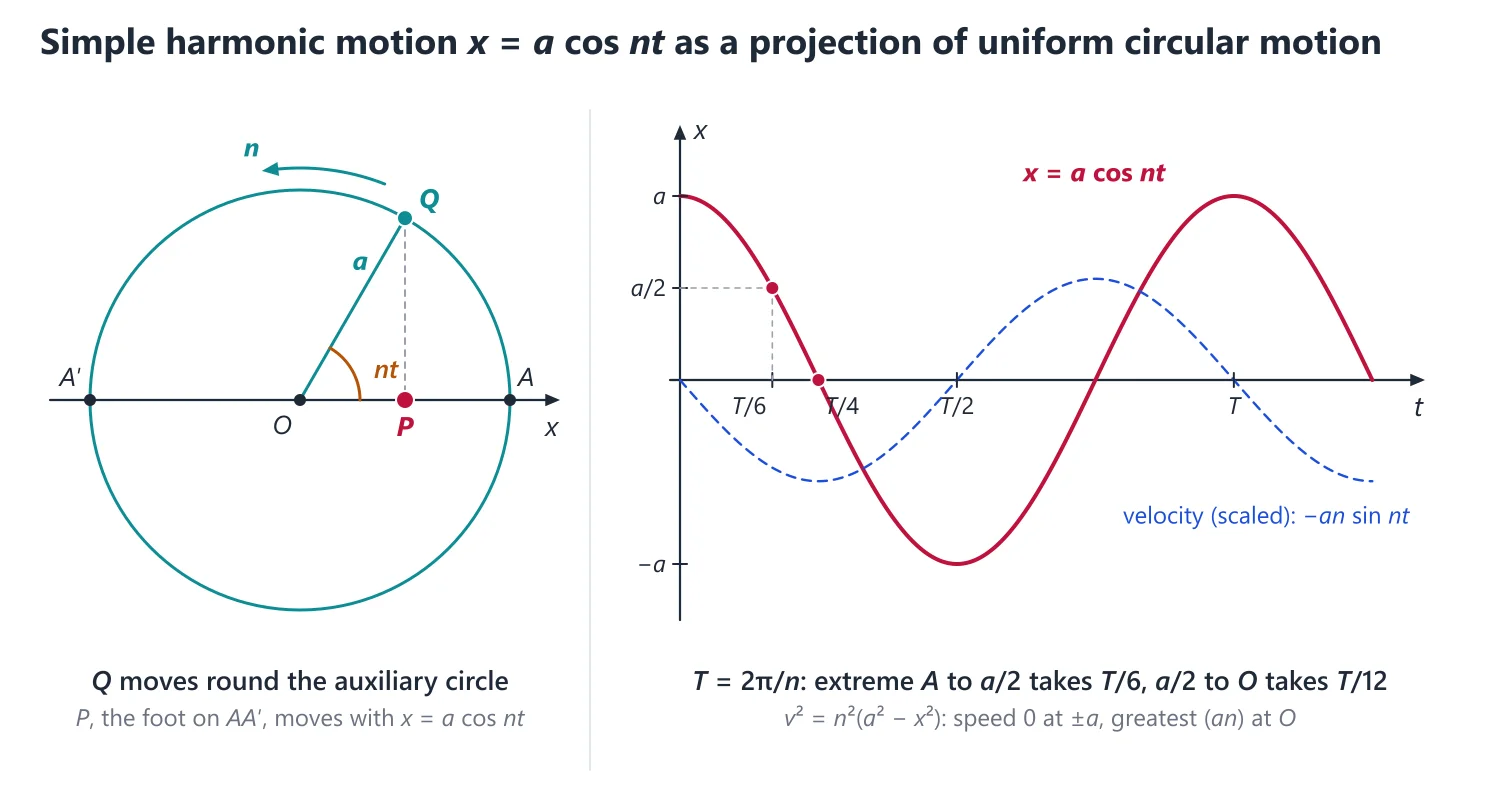
Picture: x = a cos(√μ t + ε) is the projection on a diameter of a point moving round a circle of radius a (the auxiliary circle) with uniform angular speed √μ; the phase √μ t + ε is the angle of that point.
Solution: x = a cos(√μ t + ε), where a is the amplitude and ε the epoch.
v2 = μ(a2 − x2); maximum speed a√μ at the centre, zero speed at the extreme points x = ±a; maximum acceleration μa at the extreme points.
Period T = 2π/√μ and frequency √μ/(2π); the period does not depend on the amplitude.
Idea: the period is independent of the amplitude because the equation is linear: doubling a doubles every distance and every speed, so each swing takes the same time; this fails for non-linear forces, for example a pendulum at large swings, whose period grows with the amplitude.
Any particle moving under a conservative force near a point of stable equilibrium performs approximately SHM for small displacements: if the potential energy per unit mass is V(x) with V′(0) = 0 and V″(0) > 0, then d2x/dt2 = −V′(x) ≈ −V″(0)x, so μ = V″(0).
Example 3: A particle in SHM has speeds v1, v2 at distances x1, x2 from the centre; find the period and amplitude.
v12 = μ(a2 − x12) and v22 = μ(a2 − x22) give μ = (v12 − v22)/(x22 − x12).
Hence T = 2π√((x22 − x12)/(v12 − v22)) and a2 = (v12x22 − v22x12)/(v12 − v22).
Example 4: Show that a particle in SHM takes one-sixth of the period to move from an extreme position to the point midway between that extreme position and the centre.
Measuring t from the extreme position, x = a cos √μ t; x = a/2 when cos √μ t = 1/2, that is √μ t = π/3.
Hence t = π/(3√μ) = (1/6)(2π/√μ) = T/6, while the remaining half of the amplitude, from a/2 to the centre, takes T/4 − T/6 = T/12.
5. Understanding Elastic Strings and Hooke's Law
Why we need it: many questions attach a particle to an elastic string or spring; the tension changes as the string stretches, so we need its exact law, the position where the particle can rest, and the energy the string stores.
In words: T = λx/l. T is the tension, the force with which the string pulls the particle towards its fixed end.
l is the natural (unstretched) length; x is the extension, the present length minus l; λ is the modulus of elasticity and has the units of a force.
A string is taut only while x > 0; if the particle comes closer to the fixed end than l, the string is slack and T = 0. A spring obeys the same law for x < 0 as well, where it pushes.
The work done in stretching the string from extension 0 to x, and so the elastic energy stored, is λx2/(2l).
First example, slowly: a mass of 1 kg hangs from a string of natural length 1 m and modulus 20 N (take g = 10 m/s2).
Step 1: at rest the tension balances the weight: 20e/1 = 1 × 10, so the equilibrium extension is e = 0.5 m.
Step 2: pull it a further 0.2 m down and release; let y be the displacement below the equilibrium position, so the extension is 0.5 + y.
Step 3: equation of motion: 1 × d2y/dt2 = 10 − 20(0.5 + y) = −20y; the weight has cancelled against the equilibrium tension.
Step 4: this is SHM with μ = 20, which equals g/e = 10/0.5, as the general rule says; the period is 2π/√20 ≈ 1.40 s.
Step 5: the amplitude 0.2 m is less than e = 0.5 m, so at the highest point the extension is still 0.3 m and the string never goes slack.
Step 6: the greatest speed, at the equilibrium position, is 0.2 × √20 ≈ 0.89 m/s.
Step 7: had we pulled it 0.8 m down, the amplitude would exceed e; the string would go slack at y = −0.5 and from there the motion is free motion under gravity, not SHM.
Non-example: using T = λx/l with a negative extension x for a string would give a negative tension, that is a push, which a string cannot exert; the condition x ≥ 0 fails, so in the slack phase the only force is gravity.
An inextensible string is not covered by Hooke's law at all: its tension is unknown and is found from the motion (as in the vertical circle), not from a formula.
Building up: measuring y from the equilibrium point, the weight mg cancels the tension λe/l and leaves d2y/dt2 = −(g/e)y, so the period is 2π√(e/g); the integral of λs/l gives the elastic energy λx2/(2l) (see "Derivation: SHM on an Elastic String and the Elastic Energy").
For a particle dropped from the fixed end, use energy for the greatest extension (Example 6) and split the time into a free-fall phase and an SHM phase (Examples 15 and 16).
Where it is used: the frequent UPSC questions on particles dropped or pulled on strings, on springs inside tubes and on strings on smooth inclined planes; the elastic energy also enters the energy test for stability in the Virtual Work topic.
6. Elastic Strings and Springs
Hooke's law: tension T = λx/l, where l is the natural length, x the extension and λ the modulus of elasticity.
Idea: λ is the tension that would double the natural length (x = l gives T = λ), and dividing by l makes λ a property of the material rather than of the length of string used; a string can pull but cannot push, so it exerts a force only while it is stretched, whereas a spring also pushes when compressed.
A mass m hanging from an elastic string has equilibrium extension e = mgl/λ; displaced vertically, it performs SHM about the equilibrium position with μ = g/e and period 2π√(e/g) = 2π√(ml/λ), as long as the string stays taut.
If the string becomes slack, the particle moves freely under gravity; split the motion into the SHM phase and the free phase and add the times.
Example 5: A particle of mass m hangs from an elastic string of natural length l and modulus 2mg; it is pulled l/4 below the equilibrium position and released.
Equilibrium extension e = mgl/(2mg) = l/2 and μ = g/e = 2g/l; the amplitude l/4 is less than e, so the string stays taut throughout.
Period = 2π√(l/(2g)) = π√(2l/g); greatest speed = (l/4)√(2g/l) = √(2gl)/4, at the equilibrium position.
Example 6: A particle of mass m is attached to one end of a light elastic string of natural length a and modulus 2mg, whose other end is fixed at O; the particle is dropped from rest at O. Find the greatest extension of the string.
The particle falls freely through a, then stretches the string; at the lowest point the speed is zero, with extension x.
Energy: loss of potential energy mg(a + x) = elastic energy λx2/(2a) = mgx2/a, so x2 − ax − a2 = 0.
Taking the positive root, the greatest extension is x = a(1 + √5)/2 ≈ 1.618a.
7. Related Results
Two SHMs of the same period along perpendicular lines combine to give an ellipse in general, which reduces to a straight line when the phase difference is 0 or π.
Why it works: with x = a cos nt and y = b cos(nt + ε), eliminating t gives x2/a2 − (2xy/(ab)) cos ε + y2/b2 = sin2ε, a conic whose discriminant (cos2ε − 1)/(a2b2) is negative unless sin ε = 0, so it is an ellipse, which degenerates into a straight line when ε = 0 or π.
A simple pendulum of length l performs approximately SHM for small swings, with period 2π√(l/g); a seconds pendulum has period 2 s.
8. Understanding Damped and Forced Oscillations
Why we need it: real oscillations die away because of air resistance and friction, and many systems are driven by a periodic force, such as an engine shaking its mounting.
We need to know how fast the oscillation decays, whether it oscillates at all, and how large the forced response is, especially near resonance.
In words: d2x/dt2 + 2k dx/dt + n2x = F cos pt, all per unit mass.
n2x is the restoring term, exactly as μx in SHM, so n is the natural angular frequency; 2k dx/dt is a resistance proportional to the velocity, with k ≥ 0, written with a factor 2 so that the roots come out as −k ± √(k2 − n2).
F cos pt is the driving force of angular frequency p. With F = 0 the motion is free; comparing k with n decides whether it oscillates: k < n light, k = n critical, k > n heavy damping.
First example, slowly: solve d2x/dt2 + 2 dx/dt + 5x = 0 with x = 1 and dx/dt = 0 at t = 0.
Step 1: 2k = 2 gives k = 1 and n2 = 5 gives n = √5; since k < n the damping is light and we expect a decaying oscillation.
Step 2: the auxiliary equation m2 + 2m + 5 = 0 has roots m = −1 ± 2i, so ω = √(n2 − k2) = 2.
Step 3: hence x = e−t(A cos 2t + B sin 2t); at t = 0, x = 1 gives A = 1.
Step 4: dx/dt = e−t[(2B − A) cos 2t − (B + 2A) sin 2t], which is 2B − A at t = 0; setting it to zero gives B = 1/2.
Step 5: so x = e−t(cos 2t + (1/2) sin 2t).
Step 6: the period of the oscillation is 2π/ω = π, longer than the undamped period 2π/√5 ≈ 2.81; damping slows the swing.
Step 7: successive swings to opposite sides are in the ratio e−kπ/ω = e−π/2 ≈ 0.21, so each swing is about a fifth of the one before.
Non-example: d2x/dt2 + 6 dx/dt + 5x = 0 has k = 3 > n = √5; the roots −1 and −5 are real, x = Ae−t + Be−5t crosses O at most once, and the formula 2π/√(n2 − k2) is meaningless because the condition k < n fails.
Building up: the trial x = emt gives m = −k ± √(k2 − n2); for the forced equation add the particular integral F cos pt/(n2 − p2), or (Ft/(2n)) sin nt when p = n (see "Derivation: Time to the Centre, Damped and Forced Solutions").
The complete motion is the free part (which dies out whenever k > 0) plus the forced part (which persists); after a long time only the forced response remains.
Where it is used: questions on the period and logarithmic decrement of a resisted oscillation, on resonance and on a particle on a spring with a moving support; the method is the constant-coefficient ODE method of Chapter 5.
9. Time Between Positions, Non-linear, Damped and Forced Oscillations
Time between two positions in SHM: with x = a cos nt (n = √μ), the time from the extreme point x = a to the point x is (1/n) cos−1(x/a); so the time from x1 to x2 on the same side, in one sweep, is (1/n)|cos−1(x2/a) − cos−1(x1/a)|.
Change of amplitude: if the speed at distance x is suddenly changed from v to v′ (centre and μ unchanged), the new amplitude a′ is given by v′2 = μ(a′2 − x2); the period does not change.
Speed and acceleration data: in SHM the acceleration at x has magnitude f = μ|x|, so two (speed, acceleration) pairs fix both μ and a (Example 10).
Non-linear oscillations: for d2x/dt2 = −F(x)x with F even and positive, the energy integral v2 = 2∫xa F(s)s ds and comparison with SHM bound the period between 2π/√Fmax and 2π/√Fmin (Example 14).
Motion under μ/x (inverse distance): v2 = 2μ log(a/x), and the substitution x = ae−y turns the time integral into a Gamma function (Example 11); for a power law μx−k the substitution x = asm gives a Beta function (Example 12).
Damped oscillations: d2x/dt2 + 2k dx/dt + n2x = 0 (resistance 2k × velocity per unit mass); if k < n, x = Ae−kt cos(√(n2 − k2) t + ε), an oscillation of period 2π/√(n2 − k2) whose successive swings to opposite sides decrease in the ratio e−kπ/√(n2 − k2).
Idea: damping does two things: it multiplies the amplitude by the decaying factor e−kt and it slows the oscillation, the frequency falling from n to √(n2 − k2); the logarithm of the ratio of successive swings, kπ/√(n2 − k2), is called the logarithmic decrement and is used to measure k from observed swings.
If k = n (critical damping) x = (A + Bt)e−nt, and if k > n (heavy damping) x is a sum of two decaying exponentials; in neither case does the particle oscillate.
Forced oscillations: d2x/dt2 + n2x = F cos pt has the particular solution x = F cos pt/(n2 − p2) for p ≠ n; for p = n it is (Ft/(2n)) sin nt, which grows without bound (resonance).
Idea: the complete motion is free oscillation (complementary function A cos(nt + ε)) plus the forced response; when p is close to n the response F/(n2 − p2) is large, and when p = n each push arrives in step with the motion and adds energy, so the amplitude grows linearly in t (resonance); with damping present the amplitude stays bounded.
10. Derivation: Solving the SHM Equation
By the energy integral: multiply d2x/dt2 = −μx by 2 dx/dt and integrate: (dx/dt)2 = C − μx2; the speed is zero at the extreme point x = a, so C = μa2 and v2 = μ(a2 − x2).
Separating, −dx/√(a2 − x2) = √μ dt (taking the particle to move towards O from x = a), so cos−1(x/a) = √μ t + ε, that is x = a cos(√μ t + ε).
As a linear equation: the auxiliary equation m2 + μ = 0 has roots ±i√μ, so x = A cos √μ t + B sin √μ t, which is the same as a cos(√μ t + ε) with a = √(A2 + B2) and tan ε = −B/A.
The function returns to the same state when √μ t increases by 2π, which gives the period 2π/√μ; the speed a√μ |sin(√μ t + ε)| is greatest when x = 0.
11. Derivation: SHM on an Elastic String and the Elastic Energy
Let the string hang with equilibrium extension e, so that mg = λe/l; let y be the further downward displacement from the equilibrium position.
The tension is λ(e + y)/l, so m d2y/dt2 = mg − λ(e + y)/l = −λy/l, that is d2y/dt2 = −(λ/(ml))y = −(g/e)y, since λ/(ml) = g/e.
So gravity only shifts the centre of the oscillation from the natural-length point to the equilibrium point; the motion is SHM with period 2π√(e/g) as long as e + y ≥ 0, that is the string stays taut.
Elastic energy: the work done in stretching from extension 0 to x is ∫0x (λs/l) ds = λx2/(2l); between extensions x1 and x2 it is (λ/(2l))(x22 − x12) = (x2 − x1) × (T1 + T2)/2.
12. Derivation: Time to the Centre, Damped and Forced Solutions
Inverse square, time to the centre: v2 = 2μ(a − x)/(ax), so t = √(a/(2μ)) ∫0a √(x/(a − x)) dx; with x = a sin2φ the integrand becomes 2a sin2φ dφ, and ∫0π/2 2a sin2φ dφ = πa/2, so t = (π/2)√(a3/(2μ)).
Damped motion: trying x = emt in d2x/dt2 + 2k dx/dt + n2x = 0 gives m2 + 2km + n2 = 0, so m = −k ± √(k2 − n2); for k < n the roots are −k ± iω with ω = √(n2 − k2), giving x = Ae−kt cos(ωt + ε).
The velocity vanishes where tan(ωt + ε) = −k/ω, and these instants are π/ω apart; so successive extreme displacements, on opposite sides, are in the ratio e−kπ/ω, which is the stated ratio.
Forced motion: x = C cos pt satisfies d2x/dt2 + n2x = F cos pt if (n2 − p2)C = F; when p = n this fails, and trying x = t(A cos nt + B sin nt) gives 2nB cos nt − 2nA sin nt = F cos nt, so A = 0, B = F/(2n) and x = (Ft/(2n)) sin nt.
13. Choosing the Method
If the force depends on position only → write v dv/dx = f(x) and integrate to get v2 as a function of x (energy equation); then t = ∫dx/v if time is asked.
If the force depends on time only → integrate dv/dt = f(t) twice, fixing the constants from the initial position and velocity.
If the force depends on velocity (resistance) → dv/dt = f(v) for the time and v dv/dx = f(v) for the distance; write separate equations for upward and downward motion.
If the equation is linear, d2x/dt2 + 2k dx/dt + n2x = F(t) → use the auxiliary equation and a particular integral, as for any constant-coefficient ODE.
If a time between two positions in SHM is asked → use x = a cos(nt + ε) or the angle turned on the auxiliary circle, not a fresh integration.
If the motion changes character (string goes slack, particle hits a stop, resistance changes) → split it into phases and carry the position and velocity from the end of one phase into the start of the next.
14. Common Mistakes
Measuring the SHM displacement of a hanging mass from the natural-length point instead of the equilibrium position; the centre of the SHM is where the tension balances the weight.
Using SHM formulas after the string has gone slack; check whether the amplitude exceeds the equilibrium extension e, and if so add a free-fall phase.
Taking the positive square root for v when the particle moves towards the origin, which makes the computed time negative; choose the sign of dx/dt from the direction of motion.
Writing the period as 2π/μ instead of 2π/√μ, or using 2π/n for the damped period instead of 2π/√(n2 − k2).
Using the same resistance equation for upward and downward motion; resistance changes sign with the velocity.
Forgetting that the resistance coefficient in the damped equation is 2k: if the resistance per unit mass is r × velocity, then k = r/2.
15. Connections
Link: the damped and forced equations are second-order linear ODEs with constant coefficients (Chapter 5); resonance is exactly the case where the forcing term solves the homogeneous equation and the particular integral must be multiplied by t.
Link: SHM about a point where the potential energy is a minimum is the one-dimensional case of small oscillations in Lagrangian mechanics (Chapter 14) and of the energy test for stability (Virtual Work topic of this chapter).
16. Solved UPSC Questions
Example 7 (UPSC 2014, 10 marks): A particle is performing a simple harmonic motion (S.H.M.) of period T about a centre O with amplitude a and it passes through a point P, where OP = b in the direction OP. Prove that the time which elapses before it returns to P is (T/π) cos−1(b/a).
Take n = 2π/T and measure t from the extreme position A on the side of P, so that x = a cos nt.
The particle passes P moving away from O, so it goes on to A, stops, and comes back to P; by symmetry the two halves of this journey take equal times.
Time from A to P: a cos nt1 = b, so t1 = (1/n) cos−1(b/a).
Required time = 2t1 = (2/n) cos−1(b/a) = (T/π) cos−1(b/a).
Answer: the particle returns to P after time (T/π) cos−1(b/a).
Example 8 (UPSC 2023, 10 marks): A particle is moving under Simple Harmonic Motion of period T about a centre O. It passes through the point P with velocity v along the direction OP and OP = p. Find the time that elapses before the particle returns to the point P. What will be the value of p when the elapsed time is T/2?
With n = 2π/T, v2 = n2(a2 − p2) gives the amplitude a = √(p2 + v2T2/(4π2)).
As in Example 7, the particle goes out to the extreme point and back, taking time t = (2/n) cos−1(p/a) = (T/π) cos−1(p/a).
The angle cos−1(p/a) has cosine p/a and sine vT/(2πa), so t = (T/π) tan−1(vT/(2πp)).
t = T/2 requires cos−1(p/a) = π/2, that is p = 0.
Answer: the time is (T/π) tan−1(vT/(2πp)); it equals T/2 only when p = 0, that is when P is the centre O itself.
Example 9 (UPSC 2015, 10 marks): A body moving under SHM has an amplitude 'a' and time period 'T'. If the velocity is trebled, when the distance from mean position is (2/3)a, the period being unaltered, find the new amplitude.
With n = 2π/T, the speed v at x = 2a/3 satisfies v2 = n2(a2 − 4a2/9) = 5n2a2/9.
The new speed 3v at the same point, with the same n, gives 9v2 = n2(A2 − 4a2/9), A being the new amplitude.
So 5n2a2 = n2(A2 − 4a2/9), that is A2 = 49a2/9.
Answer: the new amplitude is 7a/3.
Example 10 (UPSC 2024, 15 marks): A particle executes simple harmonic motion such that in two of its positions, velocities are u and v, and the two corresponding accelerations are f1 and f2. For what value(s) of k, the distance between the two positions is k(v2 − u2)? Show also that the amplitude of the motion is
[1/(f22 − f12)] [(u2 − v2)(u2f22 − v2f12)]1/2
Let the positions be x1, x2 (from the centre, with sign) with speeds u, v: u2 = μ(a2 − x12), v2 = μ(a2 − x22), and the accelerations have magnitudes f1 = μ|x1|, f2 = μ|x2|.
Subtracting, v2 − u2 = μ(x12 − x22) = (f12 − f22)/μ, so μ = (f12 − f22)/(v2 − u2).
Same side of the centre: distance = |x1| − |x2| = (f1 − f2)/μ = (v2 − u2)/(f1 + f2), so k = 1/(f1 + f2).
Opposite sides: distance = |x1| + |x2| = (f1 + f2)/μ = (v2 − u2)/(f1 − f2), so k = 1/(f1 − f2).
Amplitude: a2 = x12 + u2/μ = (f12 + μu2)/μ2, and with μ = (f22 − f12)/(u2 − v2), f12 + μu2 = (u2f22 − v2f12)/(u2 − v2).
Hence a2 = (u2 − v2)(u2f22 − v2f12)/(f22 − f12)2, which is the stated result.
Answer: k = 1/(f1 + f2) if the positions are on the same side of the centre and k = 1/(f1 − f2) if they are on opposite sides; a = [(u2 − v2)(u2f22 − v2f12)]1/2/(f22 − f12).
Example 11 (UPSC 2015, 13 marks): A mass starts from rest at a distance 'a' from the centre of force which attracts inversely as the distance. Find the time of arriving at the centre.
The acceleration towards the centre is μ/x: v dv/dx = −μ/x, and v = 0 at x = a gives v2 = 2μ log(a/x).
Moving inwards, dt = −dx/√(2μ log(a/x)), so t = ∫0a dx/√(2μ log(a/x)).
Put log(a/x) = y, that is x = ae−y, dx = −ae−y dy; y runs from 0 to ∞.
t = (a/√(2μ)) ∫0∞ e−y y−1/2 dy = (a/√(2μ)) Γ(1/2) = a√(π/(2μ)).
Answer: the time to reach the centre is a√(π/(2μ)).
Example 12 (UPSC 2016, 15 marks): A particle moves in a straight line. Its acceleration is directed towards a fixed point O in the line and is always equal to μ(a5/x2)1/3 when it is at a distance x from O. If it starts from rest at a distance a from O, then find the time, the particle will arrive at O.
v dv/dx = −μa5/3x−2/3; integrating with v = 0 at x = a gives v2 = 6μa5/3(a1/3 − x1/3).
The particle moves inwards, so t = ∫0a dx/√(6μa5/3(a1/3 − x1/3)).
Put x = as3: dx = 3as2 ds and a1/3 − x1/3 = a1/3(1 − s), so the quantity under the root becomes 6μa2(1 − s).
t = (3/√(6μ)) ∫01 s2(1 − s)−1/2 ds = (3/√(6μ)) B(3, 1/2).
B(3, 1/2) = Γ(3)Γ(1/2)/Γ(7/2) = 2√π/((15/8)√π) = 16/15.
Answer: t = 16/(5√(6μ)) = (8/15)√(6/μ), independent of a.
Example 13 (UPSC 2021, 10 marks): If a planet, which revolves around the Sun in a circular orbit, is suddenly stopped in its orbit, then find the time in which it would fall into the Sun. Also, find the ratio of its falling time to the period of revolution of the planet.
Let the orbit have radius a and the attraction be μ/r2; in the circle v2 = μ/a, so the period is T = 2πa/v = 2πa3/2/√μ.
When stopped, the planet falls from rest at distance a, with v2 = 2μ(1/x − 1/a).
As in §1, with x = a sin2φ, t = √(a/(2μ)) ∫0a √(x/(a − x)) dx = √(a/(2μ)) × πa/2 = (π/2)√(a3/(2μ)).
Ratio: t/T = (π/2)(a3/2/√(2μ)) × √μ/(2πa3/2) = 1/(4√2) = √2/8 ≈ 0.177.
Answer: the fall takes (π/2)√(a3/(2μ)), which is √2/8 of the period of revolution (about 65 days for the earth).
Example 14 (UPSC 2019, 20 marks): A particle moving along the y-axis has an acceleration Fy towards the origin, where F is a positive and even function of y. The periodic time, when the particle vibrates between y = −a and y = a, is T. Show that
2π/√F1 < T < 2π/√F2
where F1 and F2 are the greatest and the least values of F within the range [−a, a]. Further, show that when a simple pendulum of length l oscillates through 30° on either side of the vertical line, T lies between 2π√(l/g) and 2π√(l/g) √(π/3).
Here d2y/dt2 = −F(y)y with F even and positive, so the motion is symmetric about O and T = 4 × (time from y = 0 to y = a).
Energy: v2 = 2∫ya F(s)s ds for 0 ≤ y ≤ a.
Since F2 ≤ F(s) ≤ F1 and s ≥ 0, F2(a2 − y2) ≤ v2 ≤ F1(a2 − y2), with strict inequality on a set of positive length when F is not constant.
Hence T = 4∫0a dy/v lies between 4∫0a dy/(√F1 √(a2 − y2)) = 2π/√F1 and 4∫0a dy/(√F2 √(a2 − y2)) = 2π/√F2.
Pendulum: d2θ/dt2 = −(g/l) sin θ = −F(θ)θ with F(θ) = (g/l)(sin θ)/θ, which is even and positive on [−π/6, π/6].
(sin θ)/θ decreases as |θ| increases, so F1 = F(0) = g/l and F2 = F(π/6) = (g/l)(1/2)/(π/6) = 3g/(πl).
Hence 2π√(l/g) < T < 2π√(πl/(3g)) = 2π√(l/g) √(π/3).
Answer: 2π/√F1 < T < 2π/√F2; for a 30° swing 2π√(l/g) < T < 2π√(l/g)√(π/3) (the true period is about 1.017 × 2π√(l/g)).
Example 15 (UPSC 2025, 15 marks): One end of an elastic string, having natural length a, is fixed at some point O and a heavy particle is attached to the other end of the string. The string is drawn vertically downward till it is four times its natural length at the point C and then released. If the modulus of elasticity of the string is equal to the weight of the particle, then show that the particle will return to the same point C in the time √(a/g) (2√3 + 4π/3).
λ = mg, so the equilibrium extension is e = mga/λ = a: the equilibrium position E is 2a below O, and while the string is taut the motion is SHM about E with n2 = g/e = g/a.
C is 4a below O, that is 2a below E, so the amplitude is 2a.
Measuring x upwards from E, x = −2a cos nt; the string becomes slack at its natural length, x = a, when cos nt = −1/2, that is after t1 = (2π/3)√(a/g).
There v2 = n2(4a2 − a2) = 3ga; the particle then moves freely under gravity and returns to the same point with the same speed after t2 = 2v/g = 2√(3a/g).
Below that point the string is taut again, and by symmetry the SHM brings the particle back to C in a further time t1.
Total time = 2t1 + t2 = √(a/g)(4π/3 + 2√3).
Answer: the particle returns to C after √(a/g)(2√3 + 4π/3).
Example 16 (UPSC 2026, 15 marks): A light elastic string of natural length l has one extremity fixed at a point A and the other attached to a stone (mass m) the weight of which in equilibrium would extend the string to a length b. Show that if the stone be dropped from rest at A, it will come to instantaneous rest at a depth √(b2 − l2) below the equilibrium position and this depth is attained in time √(2l/g) + √((b − l)/g) {π − cos−1 √((b − l)/(b + l))}. Prove also that if the greatest depth below A be l cot2(θ/2), then the modulus of elasticity is (1/2) mg tan2 θ.
The equilibrium extension is b − l, so λ = mgl/(b − l); while the string is taut the motion is SHM about the equilibrium point E (depth b below A) with n2 = g/(b − l).
Free fall from A through l takes √(2l/g) and gives speed √(2gl) at depth l, which is b − l above E.
Amplitude: 2gl = n2(A2 − (b − l)2) gives A2 = 2l(b − l) + (b − l)2 = b2 − l2, so the stone comes to rest √(b2 − l2) below E.
With x measured downwards from E, write x = −A cos ψ, where ψ = nt + constant increases; the start x = −(b − l) with x increasing gives ψ0 = cos−1((b − l)/A) = cos−1√((b − l)/(b + l)), and the lowest point is ψ = π.
Time in the SHM = (π − ψ0)/n = √((b − l)/g){π − cos−1√((b − l)/(b + l))}; adding √(2l/g) gives the stated time.
Second part: the greatest depth below A is D = b + √(b2 − l2), so (D − b)2 = b2 − l2 and b = (D2 + l2)/(2D).
With D = lk2, k = cot(θ/2): b − l = (D − l)2/(2D) = l(k2 − 1)2/(2k2), so λ = mgl/(b − l) = 2mgk2/(k2 − 1)2.
Since tan θ = 2 tan(θ/2)/(1 − tan2(θ/2)) = 2k/(k2 − 1), this is λ = (1/2)mg tan2θ.
Answer: the stone is at rest √(b2 − l2) below E after √(2l/g) + √((b − l)/g){π − cos−1√((b − l)/(b + l))}, and the modulus is λ = (1/2)mg tan2θ.
17. Practice Exercises
Exercise 1 (basic): A particle performs SHM with period 4 s and amplitude 3 m. Find its greatest speed and greatest acceleration.
Answer: n = 2π/4 = π/2; greatest speed an = 3π/2 ≈ 4.71 m/s, greatest acceleration an2 = 3π2/4 ≈ 7.40 m/s2.
Exercise 2 (basic): Is d2x/dt2 = −4x + 8 a simple harmonic motion? If so, find its centre and period.
Answer: yes: with y = x − 2 it becomes d2y/dt2 = −4y, SHM about x = 2 with period 2π/2 = π.
Exercise 3 (basic): A mass of 2 kg hangs from an elastic string of natural length 0.5 m and modulus 49 N (g = 9.8 m/s2). Find the equilibrium extension and the period of small vertical oscillations.
Answer: e = mgl/λ = 0.2 m; period 2π√(e/g) = 2π/7 ≈ 0.90 s.
Exercise 4 (standard): A particle starts from rest at distance a from O and moves under an acceleration μ/x3 towards O. Show that it reaches O in time a2/√μ.
Answer: v2 = μ(a2 − x2)/(a2x2), so t = (a/√μ)∫0a x dx/√(a2 − x2) = (a/√μ) × a = a2/√μ.
Exercise 5 (standard): A body falls from rest against a resistance kv2 per unit mass; V is its terminal velocity. Find the distance fallen when its speed is V/2.
Answer: v dv/dx = g − kv2 gives x = (1/(2k)) log[g/(g − kv2)]; with kv2 = g/4 and 1/k = V2/g, x = (V2/(2g)) log(4/3).
Exercise 6 (standard): In an SHM the speeds at distances 4 and 3 from the centre are 3 and 4 respectively. Find the amplitude and the period.
Answer: 9 = μ(a2 − 16) and 16 = μ(a2 − 9) give μ = 1 and a = 5; the period is 2π.
Exercise 7 (standard): A particle moves under d2x/dt2 = −10x − 2 dx/dt. Find the period of its oscillation, the logarithmic decrement and the ratio of successive swings to opposite sides.
Answer: k = 1, n2 = 10, ω = 3; period 2π/3, logarithmic decrement kπ/ω = π/3, ratio e−π/3 ≈ 0.35.
Exercise 8 (UPSC level): A particle of mass m is tied to one end of a light elastic string of natural length a and modulus 3mg, whose other end is fixed at O, and is dropped from rest at O. Find the greatest extension of the string and the time taken to reach the lowest point.
Answer: greatest extension a(1 + √7)/3 (from 3x2 − 2ax − 2a2 = 0); time √(2a/g) + √(a/(3g)){π − cos−1(1/√7)}, the SHM having centre a/3 below the natural-length point and amplitude a√7/3.
Exercise 9 (UPSC level): A particle is attracted towards O with acceleration μ/x2 and is projected from x = a directly away from O with speed √(μ/a). Show that it comes to rest at x = 2a and that it takes time (π/2 + 1)√(a3/μ) to get there.
Answer: v2 = μ(2a − x)/(ax) vanishes at x = 2a; with x = 2a sin2φ (φ from π/4 to π/2) the time integral becomes √(a/μ) ∫ 4a sin2φ dφ = (π/2 + 1)√(a3/μ).
Exercise 10 (UPSC level): Solve d2x/dt2 + 4x = 3 cos t and d2x/dt2 + 4x = 3 cos 2t, each with x = 0 and dx/dt = 0 at t = 0, and explain the difference in the long-time behaviour.
Answer: x = cos t − cos 2t, which stays bounded (|x| ≤ 2); x = (3t/4) sin 2t, whose amplitude grows linearly because the forcing frequency equals the natural frequency 2 (resonance).
| Quantity | Formula |
|---|---|
| Equation of motion | d2x/dt2 = −μx |
| Displacement | x = a cos(√μ t + ε) |
| Speed at distance x | v = √μ √(a2 − x2) |
| Maximum speed | a√μ (at the centre) |
| Maximum acceleration | μa (at the extreme points) |
| Period | 2π/√μ |
| Mass on elastic string | Period 2π√(ml/λ), extension e = mgl/λ |
| Simple pendulum (small swings) | Period 2π√(l/g) |
Mains points
- Elastic-string problems are common: find the equilibrium extension first, then check whether the string becomes slack before treating the whole motion as SHM.
- Choose the right form of acceleration (v dv/dx or dv/dt) and state the initial conditions used to fix the constants of integration.
- For motion towards a centre under inverse-square attraction, show the substitution used to evaluate the time integral.
- Write the period with units of time and check the special case (for example, amplitude zero or μ → 0) to catch errors.
- A clear diagram showing the natural length, equilibrium position, extreme positions and the positive direction earns presentation marks.
Did you know?
- Robert Hooke first hid his law in a Latin anagram (1676) and revealed its solution in 1678: 'ut tensio, sic vis', as the extension, so the force.
Motion in a Plane and Projectiles
Plane motion is analysed with radial-transverse components (ar = d2r/dt2 − r(dθ/dt)2 and aθ = (1/r) d/dt(r2 dθ/dt)) or tangential-normal components (dv/dt and v2/ρ). A projectile under uniform gravity moves on a parabola; standard formulas give its time of flight, greatest height and range on horizontal and inclined planes.
1. Understanding Radial and Transverse Components
Why we need it: when the force always points to a fixed centre (the sun, a nucleus, a peg) or the path is given in polar form r = f(θ), Cartesian components mix both coordinates in every equation.
Polar components separate the part of the motion towards or away from the centre from the part that goes round it, so each equation contains one physical effect.
In words: er is the unit vector from O towards the particle and eθ is the unit vector at right angles to it, pointing in the direction of increasing θ; a dot means d/dt.
vr = ṙ is the rate at which the distance from O changes; vθ = rθ̇ is the speed due to turning, since turning through δθ at distance r moves the particle an arc r δθ.
ar = r̈ − rθ̇2: the first term is the change of the radial speed, the second is the centripetal part, which is there even when r is constant.
aθ = 2ṙθ̇ + rθ̈ = (1/r) d/dt(r2θ̇): it vanishes exactly when r2θ̇ is constant.
First example, slowly: a particle moves on the spiral r = 2θ with constant angular velocity θ̇ = 1, so θ = t; find its velocity and acceleration at θ = π.
Step 1: r = 2t, so ṙ = 2 and r̈ = 0; also θ̇ = 1 and θ̈ = 0.
Step 2: at θ = π, r = 2π; vr = 2 and vθ = rθ̇ = 2π, so the speed is √(4 + 4π2) = 2√(1 + π2).
Step 3: ar = r̈ − rθ̇2 = 0 − 2π = −2π, that is 2π directed towards O.
Step 4: aθ = 2ṙθ̇ + rθ̈ = 4 + 0 = 4.
Step 5: the magnitude of the acceleration is √(4π2 + 16) = 2√(π2 + 4).
Step 6: notice that r̈ = 0 and θ̈ = 0, yet both components are non-zero; they come entirely from the turning of er and eθ.
Step 7: check in Cartesian form: x = 2t cos t, y = 2t sin t give (ẍ, ÿ) = (2π, −4) at t = π, and with er = (−1, 0), eθ = (0, −1) there, ar = −2π and aθ = 4, as found.
Non-example: treating r and θ like Cartesian coordinates, ar = r̈ and aθ = rθ̈, would give zero acceleration in the example above, which the Cartesian check refutes; the condition that fails is that the unit vectors be fixed, and er, eθ turn with the particle.
Building up: write the position as r er and use der/dt = θ̇ eθ, deθ/dt = −θ̇ er; two differentiations give both components (see "Derivation: Components of Acceleration").
If the force is central, aθ = 0, so r2θ̇ = h is constant and the areal velocity h/2 is constant: this is Kepler's second law, the starting point of the Central Orbits topic.
Where it is used: curves described with constant angular velocity (Examples 1 and 2), central orbits, a bead on a rotating wire and any question that gives the path as r = f(θ).
2. Understanding Tangential and Normal Components
Why we need it: when a particle runs along a known curve (a bead on a wire, a car on a curved road, a bob on a string), the natural directions are along the path and across it.
Only forces along the path change the speed, and the reaction of a smooth curve acts across it, so these components separate the unknown reaction from the speed.
In words: s is the arc length along the path, v = ds/dt the speed, T the unit tangent in the direction of motion, and N the unit normal pointing to the concave side of the curve, towards the centre of curvature.
ψ is the angle the tangent makes with a fixed line and ρ = ds/dψ is the radius of curvature: large ρ means a gentle bend, small ρ a sharp one.
at = dv/dt = v dv/ds changes only the speed; an = v2/ρ, along N, changes only the direction.
First example, slowly: a car goes round a circular track of radius 50 m, its speed rising uniformly from 10 m/s to 20 m/s in 5 s; find its acceleration when the speed is 15 m/s.
Step 1: the speed rises uniformly, so at = dv/dt = (20 − 10)/5 = 2 m/s2, along the direction of motion.
Step 2: for a circle the radius of curvature is the radius, ρ = 50 m.
Step 3: an = v2/ρ = 225/50 = 4.5 m/s2, towards the centre.
Step 4: the two parts are perpendicular, so the magnitude is √(22 + 4.52) = √24.25 ≈ 4.92 m/s2.
Step 5: it makes an angle tan−1(4.5/2) ≈ 66° with the direction of motion, on the side of the centre.
Step 6: notice that an grows with the square of the speed: at 20 m/s it is already 8 m/s2, which is why sharp bends are taken slowly.
Non-example: 'constant speed, so zero acceleration' is false on a curve: in uniform circular motion at = 0 but an = v2/ρ ≠ 0; only on a straight line (ρ = ∞) does an vanish, so the condition that fails is constancy of direction, not of speed.
Building up: write v = vT and differentiate: dT/dt = (dT/dψ)(dψ/ds)(ds/dt) = (v/ρ)N, so a = (dv/dt)T + (v2/ρ)N (see "Derivation: Components of Acceleration").
For a particle on a smooth curve the two equations are m v dv/ds = tangential force (which integrates to the energy equation) and m v2/ρ = normal force including the reaction (which gives the reaction); this is the method of the Constrained Motion topic.
Where it is used: the vertical circle, the cycloid and rough curves (Constrained Motion topic), banking of roads, and in Chapter 7 as the plane case of the Serret-Frenet formula dT/ds = κN.
3. Components of Velocity and Acceleration
Cartesian: velocity (dx/dt, dy/dt), acceleration (d2x/dt2, d2y/dt2).
Radial and transverse: vr = dr/dt, vθ = r dθ/dt; ar = d2r/dt2 − r(dθ/dt)2, aθ = (1/r) d/dt(r2 dθ/dt).
Idea: the term −r(dθ/dt)2 is the centripetal acceleration: for motion on the circle r = a it is all that remains of ar, and it points inwards; it appears because the direction of the radius vector itself turns.
Writing aθ as (1/r) d/dt(r2 dθ/dt) shows at once that when the transverse force is zero, r2 dθ/dt is constant; this single fact drives the whole theory of central orbits.
Tangential and normal: v = ds/dt along the tangent; at = dv/dt = v dv/ds and an = v2/ρ towards the centre of curvature, ρ being the radius of curvature.
Idea: the tangential part dv/dt changes only the speed and the normal part v2/ρ changes only the direction; in uniform circular motion the first is zero and the whole acceleration v2/a points to the centre, while on a straight line (ρ = ∞) the second is zero.
Angular velocity about O is dθ/dt; areal velocity is (1/2)r2 dθ/dt.
Why it works: in a short time δt the radius vector sweeps a thin triangle of base r and height r δθ (to first order), of area (1/2)r2 δθ; dividing by δt gives the areal velocity.
Example 1: A particle describes the equiangular spiral r = aeθ with constant angular velocity ω; find its acceleration.
dr/dt = rω and d2r/dt2 = rω2, so ar = rω2 − rω2 = 0 and aθ = (1/r) d/dt(r2ω) = 2ω dr/dt = 2rω2: the acceleration is 2rω2, perpendicular to the radius vector.
Example 2: A particle describes the cardioid r = a(1 + cos θ) with constant angular velocity ω; find the radial and transverse accelerations and the magnitude of the acceleration.
dr/dt = −aω sin θ and d2r/dt2 = −aω2 cos θ.
ar = −aω2 cos θ − a(1 + cos θ)ω2 = −aω2(1 + 2 cos θ); aθ = 2(dr/dt)ω = −2aω2 sin θ.
Magnitude = aω2√[(1 + 2 cos θ)2 + 4 sin2θ] = aω2√(5 + 4 cos θ).
4. Understanding the Projectile as Two Independent Motions
Why we need it: a thrown ball, a shell or a jet of water raises the same questions: how long it stays up, how high it goes and where it lands.
Uniform gravity is the simplest two-dimensional force, and the projectile is the model on which every later plane-motion method is tested.
In words: u is the speed of projection and α the angle of elevation above the horizontal; g is constant and vertical, and there is no air resistance.
Horizontally there is no force, so the horizontal velocity u cos α never changes and x = ut cos α.
Vertically the acceleration is −g, so y = ut sin α − gt2/2, the ordinary motion of a ball thrown straight up with speed u sin α.
The time of flight is the time until y = 0 again, the greatest height is y at the instant the vertical velocity is zero, and the range is x at the end of the flight.
First example, slowly: a stone is projected with u = 20 m/s at α = 30° (take g = 10 m/s2).
Step 1: split the velocity: horizontal 20 cos 30° = 10√3 ≈ 17.32 m/s, vertical 20 sin 30° = 10 m/s.
Step 2: vertical motion alone: the vertical velocity 10 − 10t is zero at t = 1 s, the top of the path.
Step 3: the height there is 10 × 1 − 5 × 1 = 5 m, which agrees with u2 sin2α/(2g) = 400 × (1/4)/20 = 5.
Step 4: it lands when 10t − 5t2 = 0, that is at t = 2 s, twice the time to the top, as 2u sin α/g says.
Step 5: only now combine with the horizontal motion: range = 10√3 × 2 = 20√3 ≈ 34.6 m, which is u2 sin 2α/g.
Step 6: eliminating t gives the path y = x/√3 − x2/60, a parabola; projection at 60° gives the same range but rises to 15 m and stays up 2√3 ≈ 3.46 s.
Non-example: with air resistance proportional to the velocity, the horizontal velocity decays, the path is not a parabola and the formulas above fail; the condition that fails is 'no force except uniform gravity'. A long-range missile also fails it, because g changes in size and direction along the path.
Building up: solving y = 0, setting the vertical velocity to zero and multiplying the time by u cos α give T, H and R (see "Derivation: Projectile Formulas").
Writing the path as a quadratic in tan α answers 'which angles hit a given point' (two, one or none), and its equal-root condition gives the parabola of safety.
Where it is used: horizontal-plane questions, the locus of the vertex (Example 9), projection from a height (Example 11) and from a moving ship (Example 12); the same splitting into independent directions works for any force of fixed direction (Example 7).
5. Projectile on a Horizontal Plane
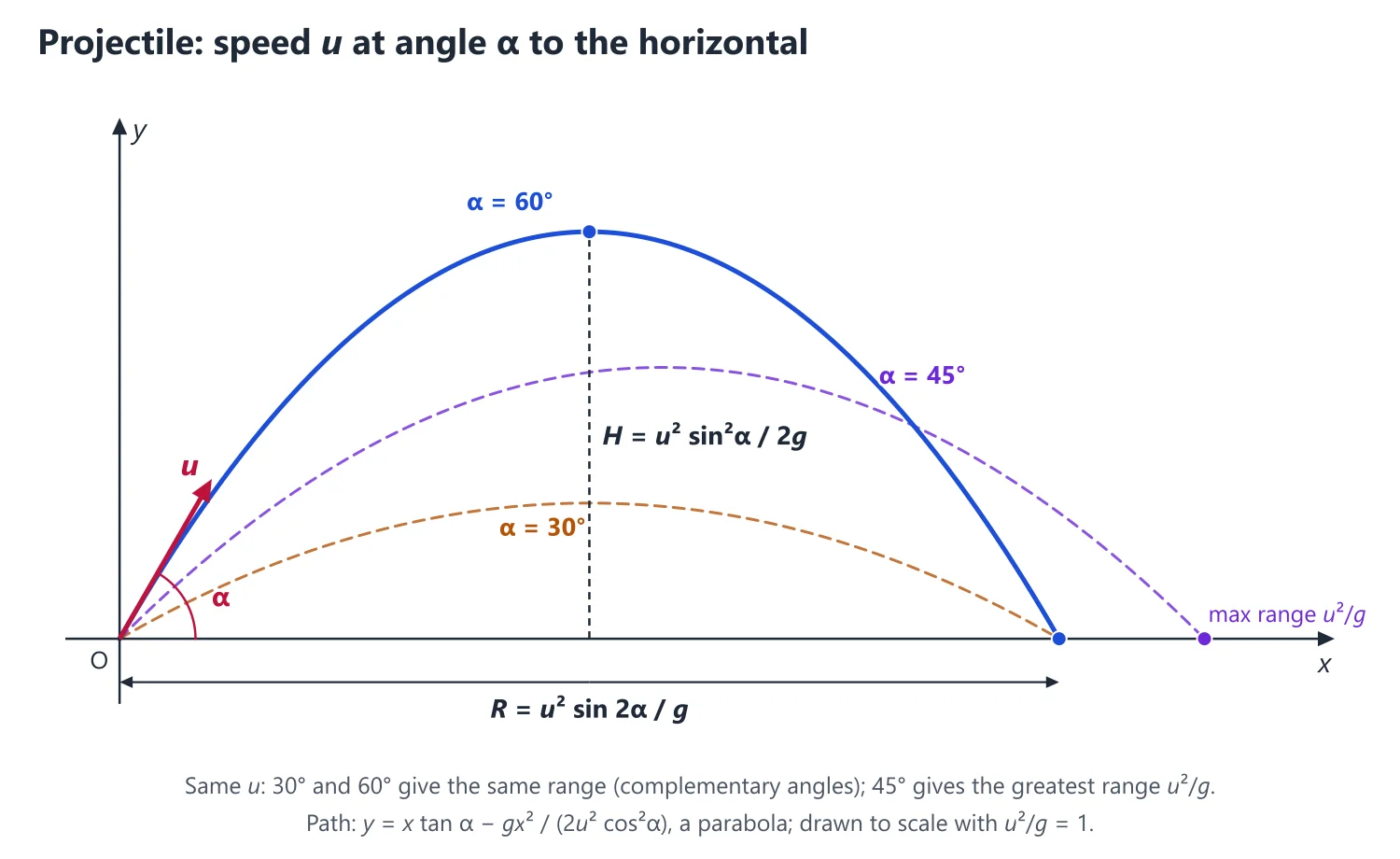
Assumptions: uniform gravity g, no air resistance; projection speed u at angle α above the horizontal.
x = ut cos α, y = ut sin α − (1/2)gt2; path y = x tan α − gx2/(2u2 cos2α), a parabola.
Idea: gravity acts only vertically, so the horizontal velocity u cos α never changes while the vertical motion is ordinary uniformly retarded motion; the two motions are independent and are combined only at the end (see the figure above).
Time of flight T = 2u sin α/g; greatest height H = u2 sin2α/(2g); horizontal range R = u2 sin 2α/g.
Maximum range u2/g at α = 45°; the angles α and 90° − α give the same range.
Why it works: R = u2 sin 2α/g and sin 2α = sin(180° − 2α), so α and 90° − α give equal ranges; the steeper path goes higher and stays up longer but moves forward more slowly.
Latus rectum of the path = 2u2 cos2α/g; the directrix is at height u2/(2g) above the point of projection, and the speed at any point is √(2g × depth below the directrix).
Envelope (parabola of safety): for fixed u and all α, the paths touch y = u2/(2g) − gx2/(2u2); points outside it cannot be reached.
Idea: every point strictly inside this parabola is reached by two trajectories, every point on it by exactly one (the two directions coincide), and points outside by none; it is the boundary of the region a gun of muzzle speed u can hit.
Example 3: Find α if the range equals three times the greatest height.
R/H = (2 sin α cos α)/(sin2α/2) = 4 cot α = 3, so tan α = 4/3 and α = tan−1(4/3) ≈ 53.1°.
Example 4: A gun fires a shell with speed 20 m/s (take g = 10 m/s2) at a target 20 m away horizontally and 10 m higher; find the possible angles of projection.
The path is y = x tan α − gx2(1 + tan2α)/(2u2); with x = 20, y = 10, gx2/(2u2) = 4000/800 = 5.
So 10 = 20 tan α − 5(1 + tan2α), that is tan2α − 4 tan α + 3 = 0, giving tan α = 1 or 3.
The angles are 45° and tan−13 ≈ 71.6°; in general the target is reachable if and only if this quadratic in tan α has real roots, that is the point lies inside the parabola of safety.
6. Understanding Projection on an Inclined Plane
Why we need it: a projectile often lands on a slope, a hillside or a ramp; the landing point is no longer at y = 0, so the horizontal-plane formulas give the wrong time and range.
We want the range along the plane, the best angle, and the conditions for striking the plane at right angles or horizontally.
In words: β is the inclination of the plane to the horizontal; α is the angle of projection measured from the horizontal, so α − β is the angle with the plane.
Take one axis up the line of greatest slope and one perpendicular to the plane; gravity then has components g sin β down the slope and g cos β into the plane.
The time of flight is the time for the perpendicular displacement to return to zero; the range R is the distance along the plane to the landing point.
First example, slowly: a particle is projected up a plane of inclination 30° with u = 20 m/s at 60° to the horizontal (g = 10 m/s2).
Step 1: the angle with the plane is α − β = 30°, so the velocity components are 20 cos 30° = 10√3 along the plane and 20 sin 30° = 10 perpendicular to it.
Step 2: the accelerations are −g sin 30° = −5 along the plane and −g cos 30° = −5√3 perpendicular to it.
Step 3: perpendicular motion: 10t − (5√3/2)t2 = 0 gives T = 4/√3 ≈ 2.31 s, the value of 2u sin(α − β)/(g cos β).
Step 4: motion along the plane in that time: R = 10√3 × (4/√3) − (5/2)(16/3) = 40 − 40/3 = 80/3 ≈ 26.7 m.
Step 5: check with the formula 2u2 cos α sin(α − β)/(g cos2β) = 800 × (1/2)(1/2)/(10 × 3/4) = 80/3.
Step 6: here α = 45° + β/2, so this is the maximum range up the plane, and indeed u2/(g(1 + sin β)) = 400/15 = 80/3.
Step 7: at landing the velocity along the plane is 10√3 − 5 × 4/√3 = 10/√3 > 0, so the particle is still moving up the slope and does not strike it at right angles.
Non-example: using R = u2 sin 2α/g = 34.6 m here is wrong: that is the range on level ground, and the rising slope meets the path earlier; the condition that fails is that the landing surface is the horizontal through the point of projection.
Building up: the perpendicular equation gives T, the horizontal distance (u cos α)T equals R cos β, and the identity 2 cos α sin(α − β) = sin(2α − β) − sin β gives the best angle and the maximum range; replacing β by −β gives the results down the plane (see "Derivation: Projectile Formulas").
Striking conditions come from the velocity at time T: at right angles means the component along the plane is zero (Example 5), horizontally means the vertical component is zero (Example 6).
Where it is used: the standard UPSC question on range, best angle and striking conditions on an inclined plane, the ratio of the maximum ranges up and down, and hills of given slope (Example 8).
7. Projectile on an Inclined Plane
A plane is inclined at β to the horizontal; a particle is projected up the plane with speed u at angle α to the horizontal (α > β), in the vertical plane through the line of greatest slope.
Time of flight T = 2u sin(α − β)/(g cos β); range on the plane R = 2u2 cos α sin(α − β)/(g cos2β).
Idea: relative to the plane, gravity has a component g cos β pulling the particle back to the plane and g sin β pulling it down the slope; so an inclined plane is a horizontal plane with a tilted, weaker gravity, and the time of flight uses only the motion perpendicular to the plane.
Writing R = u2[sin(2α − β) − sin β]/(g cos2β), R is greatest when 2α − β = π/2, that is α = π/4 + β/2: the direction of projection bisects the angle between the plane and the vertical.
Maximum range up the plane = u2/(g(1 + sin β)); maximum range down the plane = u2/(g(1 − sin β)).
Hence the two maximum ranges are in the ratio (1 − sin β) : (1 + sin β).
Example 5: Find the condition for the particle to strike the plane at right angles.
The velocity component along the plane must vanish at impact: u cos(α − β) = g sin β × 2u sin(α − β)/(g cos β), so cot(α − β) = 2 tan β.
Example 6: The particle strikes the plane horizontally if it lands at the vertex of its path: u sin α = gT gives tan α = 2 tan β.
8. Further Projectile Results
Two directions through a point: the path through (x, y) gives a quadratic in tan α: (gx2/(2u2)) tan2α − x tan α + (y + gx2/(2u2)) = 0; its roots are the two possible directions, and their sum and product are read off directly.
Vertex: the highest point is (u2 sin α cos α/g, u2 sin2α/(2g)); eliminating α for a fixed u gives the locus of vertices, the ellipse x2 + 4y2 = 2u2y/g.
Projection from a height h: solve −h = ut sin α − gt2/2 for the positive root t = [u sin α + √(u2sin2α + 2gh)]/g; the horizontal range is ut cos α.
Projection from a moving platform: add the platform's velocity to the velocity of projection relative to it, then apply the ordinary formulas to the resultant velocity.
Force in a fixed direction: if the force is always parallel to a fixed line (say the y-axis), the velocity component perpendicular to it is constant and the motion along it is a rectilinear problem; combine the two (Example 7).
9. Derivation: Components of Acceleration
Radial and transverse: write r = r er with er = (cos θ, sin θ) and eθ = (−sin θ, cos θ); then der/dt = θ̇ eθ and deθ/dt = −θ̇ er, a dot denoting d/dt.
Differentiating, v = ṙ er + rθ̇ eθ, and again, a = (r̈ − rθ̇2) er + (2ṙθ̇ + rθ̈) eθ.
Finally 2ṙθ̇ + rθ̈ = (1/r)(2rṙθ̇ + r2θ̈) = (1/r) d/dt(r2θ̇), which is the stated form of aθ.
Tangential and normal: v = vT with T the unit tangent; dT/dt = (dT/dψ)(dψ/ds)(ds/dt) = N × (1/ρ) × v, since dT/dψ is the unit normal N and dψ/ds = 1/ρ; so a = (dv/dt)T + (v2/ρ)N.
10. Derivation: Projectile Formulas
Horizontal plane: y = 0 again when t(u sin α − gt/2) = 0, so T = 2u sin α/g; the vertical velocity u sin α − gt vanishes at the top, and v2 = u2 − 2gs vertically gives H = u2 sin2α/(2g); R = (u cos α)T = u2 sin 2α/g.
Envelope: with t = tan α the path is (gx2/(2u2))t2 − xt + (y + gx2/(2u2)) = 0; the envelope of this family is where the quadratic has equal roots, x2 = 4(gx2/(2u2))(y + gx2/(2u2)), that is y = u2/(2g) − gx2/(2u2).
Inclined plane: take axes along and perpendicular to the plane; the initial velocity components are u cos(α − β) and u sin(α − β), and the accelerations −g sin β and −g cos β.
The perpendicular displacement u sin(α − β)t − (1/2)g cos β t2 is zero again at T = 2u sin(α − β)/(g cos β); the horizontal distance travelled is (u cos α)T = R cos β, which gives R = 2u2 cos α sin(α − β)/(g cos2β).
Since 2 cos α sin(α − β) = sin(2α − β) − sin β ≤ 1 − sin β, Rmax = u2(1 − sin β)/(g cos2β) = u2/(g(1 + sin β)); replacing β by −β gives the maximum range down the plane.
11. Choosing the Method
If the path is given in polar form or the force is directed towards a fixed point → use radial and transverse components.
If the particle is forced along a given curve, or the curve is given intrinsically (s = f(ψ)) → use tangential and normal components; the normal equation gives the reaction.
If the force has a fixed direction (gravity, or a force parallel to an axis) → use Cartesian components: the perpendicular velocity is constant and the other motion is rectilinear.
If an inclined plane is involved → resolve along and perpendicular to the plane for the time of flight and for striking conditions; use horizontal distance = R cos β for the range.
If the trajectory must pass through a given point → write the path as a quadratic in tan α; real, equal or no roots mean two, one or no directions.
12. Common Mistakes
Writing ar = d2r/dt2 (dropping −r(dθ/dt)2) or aθ = r d2θ/dt2 (dropping 2(dr/dt)(dθ/dt)); both terms come from the turning of er and eθ.
Using the horizontal-plane formulas T = 2u sin α/g and R = u2 sin 2α/g on an inclined plane.
Mixing up the angle of projection measured from the horizontal (α in these formulas) with the angle measured from the plane (which is α − β).
Reading strikes the plane at right angles as vertical velocity zero; the correct condition is that the velocity component along the plane is zero at impact (striking horizontally is the one with vertical velocity zero).
For projection from a height, keeping the negative root of the quadratic in t; time must be positive.
13. Connections
Link: the derivatives of the moving unit vectors er, eθ are the plane case of differentiating vector functions (Chapter 7), and dT/ds = N/ρ is the plane case of the Serret-Frenet formula dT/ds = κN.
Link: the parabola of safety is the envelope of a one-parameter family of curves, found by the discriminant method used for singular solutions in Chapter 5.
14. Solved UPSC Questions
Example 7 (UPSC 2014, 15 marks): A particle is acted on by a force parallel to the axis of y whose acceleration (always towards the axis of x) is μy−2 and when y = a, it is projected parallel to the axis of x with velocity √(2μ/a). Find the parametric equation of the path of the particle. Here μ is a constant.
The force has no x-component, so dx/dt = √(2μ/a) throughout.
Along y: d2y/dt2 = −μ/y2 with dy/dt = 0 at y = a, so (dy/dt)2 = 2μ(1/y − 1/a) = 2μ(a − y)/(ay).
Put y = a cos2φ (φ = 0 at the start): (dy/dt)2 = 2μ tan2φ/a and dy/dt = −2a sin φ cos φ dφ/dt, so dφ/dt = √(2μ/a)/(2a cos2φ).
Hence dx/dφ = (dx/dt)/(dφ/dt) = 2a cos2φ = a(1 + cos 2φ), and x = a(φ + (1/2) sin 2φ), taking x = 0 at the start.
Writing ψ = 2φ: x = (a/2)(ψ + sin ψ), y = (a/2)(1 + cos ψ).
Answer: x = (a/2)(ψ + sin ψ), y = (a/2)(1 + cos ψ): a cycloid with its vertex at the point of projection and its cusps on the x-axis.
Example 8 (UPSC 2015, 13 marks): A particle is projected from the base of a hill whose slope is that of a right circular cone, whose axis is vertical. The projectile grazes the vertex and strikes the hill again at a point on the base. If the semivertical angle of the cone is 30°, h is height, determine the initial velocity u of the projection and its angle of projection.
The base radius of the hill is h tan 30° = h/√3; the path passes through the vertex V (horizontal distance h/√3, height h) and returns to base level at distance 2h/√3.
A parabola through two points at the same level has its highest point midway between them, so V is the highest point of the path: H = u2 sin2α/(2g) = h and R = u2 sin 2α/g = 2h/√3.
Dividing, R/H = 4 cot α = 2/√3, so tan α = 2√3 and sin2α = 12/13.
Then u2 = 2gh/sin2α = 13gh/6.
Check that the path clears the slope: with c = h/√3 the path is y = h(2x/c − x2/c2), and y − hx/c = (hx/c)(1 − x/c) ≥ 0 for 0 ≤ x ≤ c, so it touches the hill only at the vertex.
Answer: u = √(13gh/6), and the angle of projection is tan−1(2√3) ≈ 73.9° with the horizontal.
Example 9 (UPSC 2021, 15 marks): Describe the motion and path of a particle of mass m which is projected in a vertical plane through a point of projection with velocity u in a direction making an angle θ with the horizontal direction. Further, if particles are projected from that point in the same vertical plane with velocity 4√g, then determine the locus of vertices of their paths.
Motion: the horizontal velocity u cos θ is constant and the vertical motion has constant retardation g: x = ut cos θ, y = ut sin θ − gt2/2.
Path: y = x tan θ − gx2/(2u2cos2θ), a parabola with vertical axis, latus rectum 2u2cos2θ/g and directrix at height u2/(2g); time of flight 2u sin θ/g, range u2 sin 2θ/g (the mass m does not enter).
Vertex: X = u2 sin θ cos θ/g = (u2/(2g)) sin 2θ and Y = u2 sin2θ/(2g) = (u2/(4g))(1 − cos 2θ).
With u = 4√g, u2/g = 16: X = 8 sin 2θ, Y = 4 − 4 cos 2θ.
Eliminating θ: X2/64 + (Y − 4)2/16 = 1, that is X2 + 4Y2 = 32Y.
Answer: the vertices lie on the ellipse x2 + 4y2 = 32y, with centre (0, 4) and semi-axes 8 (horizontal) and 4 (vertical).
Example 10 (UPSC 2022, 10 marks): A projectile is fired from a point O with velocity √(2gh) and hits a tangent at the point P(x, y) in the plane, the axes OX and OY being horizontal and vertically downward lines through the point O, respectively. Show that if the two possible directions of projection be at right angles, then x2 = 2hy and then one of the possible directions of projection bisects the angle POX.
[The phrase 'hits a tangent at the point P' is evidently a misprint for 'passes through the point P'; that version is solved.]
With OY downward, u2 = 2gh and elevation α, the path is y = −x tan α + gx2/(2u2cos2α) = −x tan α + x2(1 + tan2α)/(4h).
So t = tan α satisfies (x2/(4h))t2 − xt + (x2/(4h) − y) = 0.
Perpendicular directions mean t1t2 = −1: (x2/(4h) − y)/(x2/(4h)) = −1, that is x2 = 2hy.
The equation is then t2 − (4h/x)t − 1 = 0; with β the angle POX (P below OX), tan β = y/x = x/(2h), so 4h/x = 2 cot β.
Roots: t = cot β ± cosec β, that is t = cot(β/2) or t = (cos β − 1)/sin β = −tan(β/2).
The root −tan(β/2) is the direction at β/2 below OX, which bisects the angle POX; the other root, elevation 90° − β/2, is perpendicular to it.
Answer: x2 = 2hy, and one direction of projection bisects the angle POX.
Example 11 (UPSC 2023, 15 marks): When a particle is projected from a point O1 on the sea level with a velocity v and angle of projection θ with the horizon in a vertical plane, its horizontal range is R1. If it is further projected from a point O2, which is vertically above O1 at a height h in the same vertical plane, with the same velocity v and same angle θ with the horizon, its horizontal range is R2. Prove that R2 > R1 and (R2 − R1) : R1 is equal to (1/2){√(1 + 2gh/(v2 sin2 θ)) − 1} : 1
From O1: R1 = v2 sin 2θ/g = 2v2 sin θ cos θ/g.
From O2 the particle lands when its height is −h: −h = vt sin θ − gt2/2, whose positive root is t = [v sin θ + √(v2sin2θ + 2gh)]/g.
R2 = vt cos θ = (v2 sin θ cos θ/g)[1 + √(1 + 2gh/(v2sin2θ))].
So R2/R1 = (1/2)[1 + √(1 + 2gh/(v2sin2θ))] > 1 since h > 0, that is R2 > R1.
Subtracting 1: (R2 − R1)/R1 = (1/2)[√(1 + 2gh/(v2sin2θ)) − 1].
Answer: R2 > R1 and (R2 − R1) : R1 = (1/2){√(1 + 2gh/(v2sin2θ)) − 1} : 1.
Example 12 (UPSC 2026, 10 marks): (i) A battleship is steaming ahead with velocity u. A gun is mounted on the ship so as to point straight backwards and is set at an angle of elevation α. If v be the velocity of projection relative to the gun, show that the range is (2v/g) sin α (v cos α − u) and the angle for maximum range is cos−1((u + √(u2 + 8v2))/(4v)), where g stands for acceleration due to gravity.
Relative to the gun the shell leaves with v cos α backwards and v sin α upwards; adding the ship's velocity u forwards, its actual velocity is (v cos α − u) backwards and v sin α upwards.
The time of flight is 2v sin α/g, so the range (measured on the sea from the point of firing) is R = (2v/g) sin α (v cos α − u).
R(α) = (v/g)(v sin 2α − 2u sin α), and dR/dα = (2v/g)(v cos 2α − u cos α) = 0.
With c = cos α: v(2c2 − 1) − uc = 0, that is 2vc2 − uc − v = 0, whose positive root is c = (u + √(u2 + 8v2))/(4v).
d2R/dα2 = (2v/g)(−2v sin 2α + u sin α) = (2v/g) sin α (u − 4vc) = −(2v/g) sin α √(u2 + 8v2) < 0 there, so this is a maximum.
Answer: R = (2v/g) sin α (v cos α − u), greatest when α = cos−1((u + √(u2 + 8v2))/(4v)).
15. Practice Exercises
Exercise 1 (basic): A particle moves on the circle r = a with constant angular velocity ω. Find its radial and transverse accelerations.
Answer: ar = −aω2 (towards the centre), aθ = 0.
Exercise 2 (basic): A ball is projected with speed 30 m/s at 45° to the horizontal (g = 10 m/s2). Find the time of flight, the greatest height and the range.
Answer: T = 3√2 ≈ 4.24 s, H = 22.5 m, R = 90 m.
Exercise 3 (basic): A car moves at a constant 12 m/s round a curve of radius 36 m. Find the magnitude and direction of its acceleration.
Answer: at = 0 and an = 144/36 = 4 m/s2, directed towards the centre of curvature.
Exercise 4 (standard): A particle moves along the line x = a so that its radius vector from O turns with constant angular velocity ω. Find its radial and transverse accelerations and show that the resultant is 2aω2 sec2θ tan θ, parallel to the line.
Answer: r = a sec θ gives ar = 2aω2 sec θ tan2θ and aθ = 2aω2 sec θ tan θ; the resultant is 2aω2 sec θ tan θ √(tan2θ + 1) = 2aω2 sec2θ tan θ, which is d2(a tan ωt)/dt2 along the line.
Exercise 5 (standard): With u = 25 m/s and g = 10 m/s2, find the angles of projection that hit a point 40 m away horizontally and 10 m higher than the point of projection.
Answer: 12.8 tan2α − 40 tan α + 22.8 = 0 gives tan α = 0.75 or 2.375, that is α ≈ 36.9° or 67.2°.
Exercise 6 (standard): For a plane inclined at 30°, find the maximum ranges up and down the plane for speed of projection u, and their ratio.
Answer: up: u2/(g(1 + 1/2)) = 2u2/(3g); down: u2/(g(1 − 1/2)) = 2u2/g; ratio 1 : 3.
Exercise 7 (standard): A particle is projected with speed u from a point on a plane of inclination β, in the direction perpendicular to the plane. Find the time of flight and the distance down the plane at which it lands.
Answer: T = 2u/(g cos β); along the plane it starts at rest with acceleration g sin β downwards, so the distance is (1/2)g sin β T2 = 2u2 sin β/(g cos2β).
Exercise 8 (standard): A particle moves with constant speed v along the parabola y2 = 4ax. Find its acceleration at the vertex and at the point (a, 2a).
Answer: the speed is constant, so a = v2/ρ along the normal; at the point (at2, 2at), ρ = 2a(1 + t2)3/2, so a = v2/(2a) at the vertex and v2/(4√2 a) at (a, 2a).
Exercise 9 (UPSC level): A stone is thrown with speed u from the top of a cliff of height h. Show that its greatest horizontal range on the level ground below is (u/g)√(u2 + 2gh), obtained at the elevation α with tan α = u/√(u2 + 2gh).
Answer: hint: the landing point (R, −h) lies on the path iff (gR2/(2u2)) tan2α − R tan α + (gR2/(2u2) − h) = 0 has a real root; the discriminant condition gives R2 ≤ u2(u2 + 2gh)/g2, with equality at the double root tan α = u2/(gR) = u/√(u2 + 2gh).
Exercise 10 (UPSC level): A particle projected with speed u up a plane inclined at 30° strikes the plane at right angles. Find the angle of projection with the plane and show that the range on the plane is 4u2/(7g).
Answer: cot(α − β) = 2 tan β = 2/√3, so tan(α − β) = √3/2, sin(α − β) = √(3/7), cos α = √3/(2√7); then R = 2u2 cos α sin(α − β)/(g cos2β) = 4u2/(7g).
Exercise 11 (UPSC level): A particle moves with constant velocity U parallel to the x-axis and has an acceleration ky towards the x-axis (k > 0). It starts at the origin with velocity component V along the y-axis. Find its path.
Answer: x = Ut and d2y/dt2 = −ky give y = (V/√k) sin(√k t), so the path is the sine curve y = (V/√k) sin(√k x/U).
| Quantity | Horizontal plane | Up an inclined plane (inclination β) |
|---|---|---|
| Time of flight | 2u sin α/g | 2u sin(α − β)/(g cos β) |
| Range | u2 sin 2α/g | 2u2 cos α sin(α − β)/(g cos2β) |
| Best angle | α = 45° | α = π/4 + β/2 |
| Maximum range | u2/g | u2/(g(1 + sin β)) |
| Greatest height | u2 sin2α/(2g) | Perpendicular height above plane: u2 sin2(α − β)/(2g cos β) |
Mains points
- Inclined-plane projectile questions are standard: resolve along and perpendicular to the plane, where the accelerations are −g sin β and −g cos β.
- Derive the range formula rather than quoting it when the question says 'show that'; then maximise using the sin(2α − β) form.
- For radial-transverse problems, state the formulas for ar and aθ before substituting; using ar = d2r/dt2 alone is a common error.
- State the assumptions (uniform g, no air resistance, flat earth) at the start of every projectile answer.
- Check answers with special cases: β = 0 must reduce the inclined-plane results to the horizontal-plane ones.
Did you know?
- Galileo showed in his Two New Sciences (1638) that a projectile's path is a parabola and that angles equally above and below 45° give equal ranges.
Constrained Motion, Work and Energy
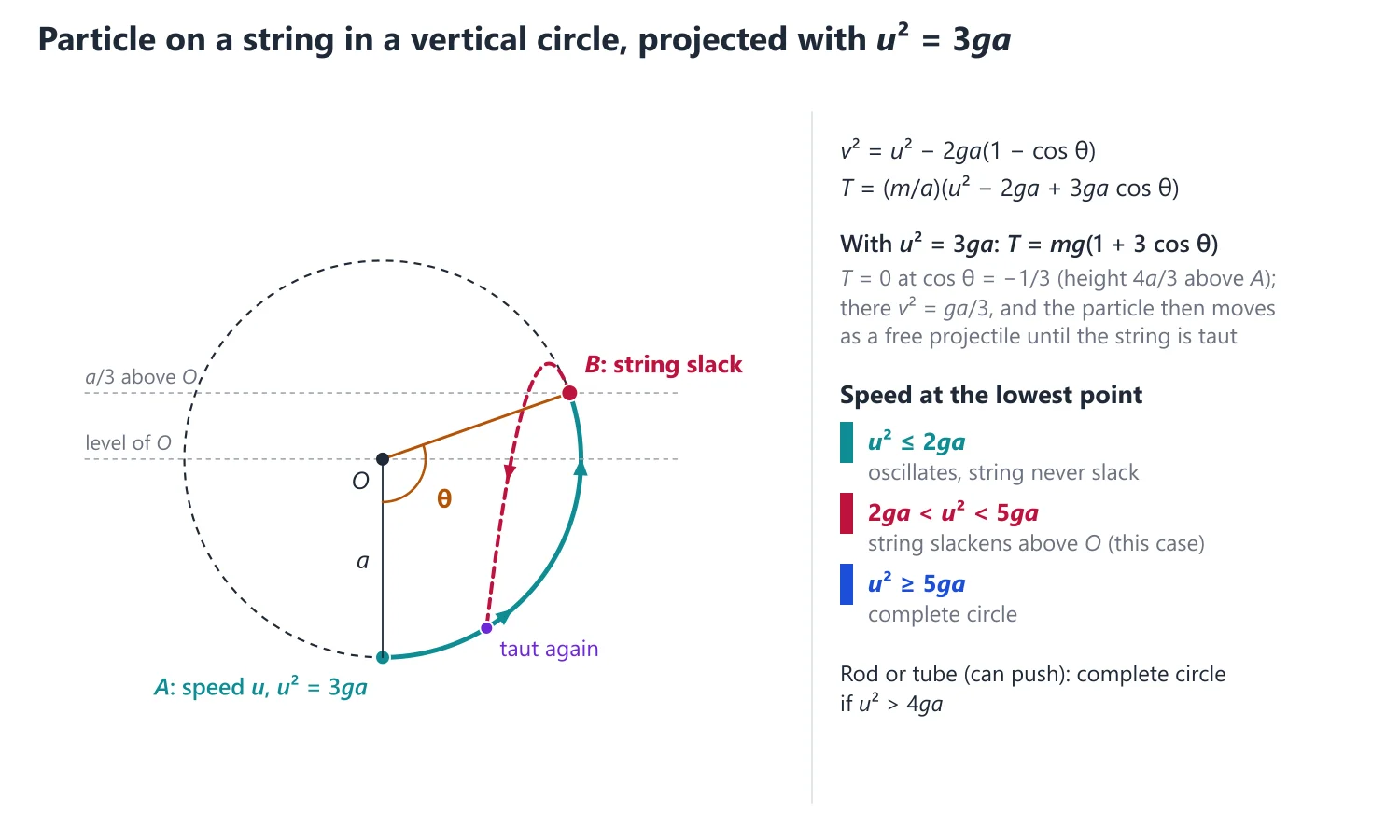
For motion on a smooth curve the reaction does no work, so energy conservation gives the speed and the normal equation mv2/ρ gives the reaction. The classic cases are the smooth vertical circle (complete circle if u2 ≥ 5ga), a particle leaving a sphere (cos θ = 2/3) and the isochronous cycloid.
1. Understanding Work and Conservative Forces
Why we need it: Newton's second law gives the acceleration, but very often a question asks only for the speed at a later position, not for the whole motion in time.
Integrating m dv/dt = F directly would need the position as a function of time, which we usually do not know.
Work turns the force along the path into a change of speed with no reference to time at all.
A conservative force goes one step further: its work depends only on the start and the end, so one scalar function, the potential energy, carries all the information about the force.
In words: W = ∫C F·dr means: cut the path C into tiny displacements dr, and for each one take F·dr = |F||dr| cos(angle between F and dr).
So F·dr is the component of F along the motion times the small distance moved; adding all of them gives W.
A positive W means the force helped the motion; a negative W means it resisted it; W = 0 for a force that is always perpendicular to the motion.
Conservative means: for any two points A and B, every path from A to B gives the same W.
F = −∇V means there is a scalar function V whose decrease from A to B equals the work: W = V(A) − V(B); the minus sign says the force points downhill in V.
First example, slowly: take uniform gravity F = −mg k (k pointing upward) and move a particle from height 0 to height h along any path.
Step 1: write dr = dx i + dy j + dz k, so F·dr = −mg dz; horizontal displacements contribute nothing because F has no horizontal component.
Step 2: integrate: W = ∫ −mg dz from z = 0 to z = h, which is −mgh, whatever the shape of the path.
Step 3: so gravity is conservative with V = mgz; check: −∇(mgz) = −mg k = F.
Step 4: apply the work-energy principle to a particle sent up a smooth curve with speed u: (1/2)mv2 − (1/2)mu2 = −mgh, so v2 = u2 − 2gh at height h.
Step 5: notice that the shape of the curve never entered; this is why a smooth slide, a smooth bowl and a pendulum all give the same speed at the same height.
Non-example: F = y i in the plane looks harmless, but from (0, 0) to (1, 1) along y = x its work is ∫01 x dx = 1/2, while along the x-axis to (1, 0) and then straight up to (1, 1) it is 0 + 0 = 0.
Two paths with the same end points give different work, so F is not conservative; the condition that fails is curl F = 0, since here curl F = (∂N/∂x − ∂M/∂y)k = −k.
Building up: (1) dot m dv/dt = F with v to get d/dt((1/2)mv2) = F·v; (2) integrate in time to get the work-energy principle (the Why it works line below).
(3) If F = −∇V then F·dr = −dV, so the work from A to B is V(A) − V(B); (4) combining, (1/2)mv2 + V stays constant, which is the derivation in Derivation: Energy Conservation and the Vertical Circle.
The curl test tells you when step (3) is possible: in a simply connected region a smooth F with curl F = 0 always has such a V.
Where it is used: every speed in this topic (vertical circle, sphere, cycloid, cardioid wire) comes from this energy equation, and testing whether a field is conservative and finding V is a 5 to 10 mark question in its own right, tied to Chapter 7.
2. Work, Energy and Power
Work done by a force F along a path C: W = ∫C F·dr; power = F·v.
Idea: only the component of the force along the direction of motion does work; a force perpendicular to the path (a smooth reaction, the tension of a string whose end moves on a circle about its fixed end) does none, and power F·v is the rate at which work is done.
Work-energy principle: the work done by all forces equals the change in kinetic energy (1/2)mv2.
Why it works: dot the equation of motion m dv/dt = F with v: m v·dv/dt = d/dt((1/2)mv2) = F·v; integrating from t1 to t2 gives change in kinetic energy = ∫F·v dt = ∫F·dr.
A force field is conservative if its work is independent of the path; equivalently F = −∇V for a potential V, and for a continuously differentiable F in a simply connected region this holds if and only if curl F = 0.
Idea: a conservative force stores the work it receives and gives it back, so the work depends only on the end points; the hypothesis simply connected matters: F = (−yi + xj)/(x2 + y2) has curl F = 0 off the z-axis, yet its work once round the axis is 2π, so it is not conservative there.
Friction and air resistance are never conservative: they always oppose the motion, so they do negative work on every closed path.
Conservation of energy: under conservative forces, kinetic energy + potential energy = constant.
Standard potential energies: uniform gravity mgh; inverse-square attraction −mμ/r; elastic string stretched by x, λx2/(2l).
Idea: a potential energy is fixed only up to an added constant, so choose a convenient zero (the lowest point, the natural length, infinity); the inverse-square potential −mμ/r is negative and rises to 0 at infinity, which is why a bound orbit has negative total energy.
Work done in stretching an elastic string from extension x1 to x2 = (λ/(2l))(x22 − x12) = (increase in extension) × (mean of initial and final tensions).
Example 1: Find the work done by F = (2x − y)i + (x + y)j in moving a particle once anticlockwise round the circle x2 + y2 = a2; is F conservative?
With x = a cos t, y = a sin t: F·dr = [(2a cos t − a sin t)(−a sin t) + (a cos t + a sin t)(a cos t)] dt = a2[1 − sin t cos t] dt.
Integrating from 0 to 2π, W = 2πa2, which also equals ∬(∂N/∂x − ∂M/∂y) dx dy = ∬2 dx dy by Green's theorem.
The work round a closed path is not zero (curl F = 2k ≠ 0), so F is not conservative.
3. Understanding Constrained Motion: Energy First, Normal Equation Second
Why we need it: a bead on a wire, a particle on a sphere and a bob on a string are all forced to follow a known curve.
The constraint pushes (or pulls) with a reaction R that we do not know in advance.
We need a way to find the speed without knowing R, and then to find R itself, because R tells us whether the particle stays on the curve.
In words: resolve the equation of motion at each point in two directions: along the tangent and along the normal towards the centre of curvature.
The tangential equation is m dv/dt = (sum of force components along the tangent); a smooth reaction is perpendicular to the curve, so R does not appear in it.
The normal equation is mv2/ρ = (sum of force components towards the centre of curvature), where ρ is the radius of curvature; v2/ρ is the acceleration needed just to bend the path, and R does appear here.
Multiplying the tangential equation by v and writing v = ds/dt turns it into the energy equation, so in practice we use energy instead of the tangential equation.
First example, slowly: a bead slides from rest at a point A of a smooth circular wire of radius a in a vertical plane, A being at the level of the centre; find the reaction at the lowest point.
Step 1: from A to the lowest point the bead falls through a height a.
Step 2: the reaction does no work, so energy gives v2 = 2ga at the lowest point.
Step 3: at the lowest point the centre of curvature is vertically above; the forces towards it are R (upward) and the weight mg (downward, so it counts as −mg).
Step 4: the normal equation reads R − mg = mv2/a = m(2ga)/a = 2mg.
Step 5: so R = 3mg: the wire pushes up with three times the weight, whatever the radius.
Step 6: notice the order: v2 first from energy, then R from the normal equation; trying to find R first would leave v2 unknown.
Non-example: on a rough wire the method breaks at Step 2: friction μR does negative work, and that work depends on R, which depends on v2; energy is not conserved, so the two equations must be solved together (Example 2 shows the resulting equation).
Building up: (1) along a curve the velocity is (ds/dt)T and the acceleration is (d2s/dt2)T + (v2/ρ)N, T the unit tangent and N the unit normal towards the centre of curvature (previous topic, Motion in a Plane).
(2) Resolve F + R = m × acceleration along T and along N; (3) a smooth constraint has R·T = 0, which gives the tangential equation without R; (4) multiply by v to get energy.
(5) For a rough curve add −μ|R|T, eliminate R and obtain the linear equation in v2 of Derivation: Equations on a Rough Curve and on the Cycloid.
Where it is used: vertical circles, particles leaving a sphere or a catenary, and beads on cardioids and cycloids are all solved by energy first, normal equation second; the same split reappears in Chapter 14 for motion on rotating curves.
4. Constrained Motion: Equations
On a smooth curve the normal reaction does no work; use the tangential equation m dv/dt = tangential component of the applied force (or the energy equation) and the normal equation mv2/ρ = net force towards the centre of curvature.
Idea: the energy equation gives the speed without knowing the reaction, because the reaction does no work; only after v2 is known does the normal equation give the reaction, so always do energy first, normal equation second.
On a rough curve add a friction force μR along the tangent, opposing the motion; energy is then not conserved.
Idea: on a rough curve the friction μR depends on R, and R depends on v2 through the normal equation, so the two equations are coupled; eliminating R gives a first-order linear equation in v2 as a function of s or ψ.
Example 2: A particle moves on a smooth horizontal table, pressed against the inside of a fixed rough circular rim of radius a (the weight is balanced by the smooth table, so the only friction comes from the rim), coefficient of friction μ; it is projected along the rim with speed u. Find its speed after it has gone once round.
Normal equation: R = mv2/a; tangential equation: m v dv/ds = −μR = −μmv2/a.
So dv/v = −(μ/a) ds and v = ue−μs/a; after one revolution s = 2πa and v = ue−2πμ.
5. Understanding the Vertical Circle: When Does a String Go Slack?
Why we need it: a stone whirled on a string in a vertical plane may go round completely, may swing to and fro like a pendulum, or may rise above the centre, go slack and fall inside the circle.
Exam questions ask which of these happens for a given speed u at the lowest point, and where.
In words: two quantities decide everything: v2, from energy, and the tension T (or reaction R), from the normal equation; θ is the angle turned from the lowest point.
A string can pull but cannot push, so the particle stays on the circle only while T ≥ 0; it stops momentarily where v2 = 0.
If v2 reaches 0 while T is still positive, the particle oscillates; if T reaches 0 while v2 is still positive, it leaves the circle; if neither reaches 0, it goes round completely.
First example, slowly: a bob on a string of length a is projected from the lowest point with u2 = 4ga.
Step 1: energy: v2 = 4ga − 2ga(1 − cos θ) = 2ga(1 + cos θ).
Step 2: tension: T = (m/a)(u2 − 2ga + 3ga cos θ) = mg(2 + 3 cos θ).
Step 3: T = 0 when cos θ = −2/3, that is θ ≈ 131.8°, a point above the level of the centre.
Step 4: there v2 = 2ga(1 − 2/3) = 2ga/3, which is positive, so the bob is still moving when the string goes slack.
Step 5: so the bob leaves the circle at θ ≈ 131.8° and from then on moves as a free projectile.
Step 6: compare with the table of this topic: 2ga < 4ga < 5ga is the middle case, as found.
Step 7: had the bob been on a light rod, T could become negative (a push) and the bob would just creep up to the top, as in Example 8.
Non-example: with u2 = 4ga on a string, energy alone says v = 0 exactly at the top, which tempts students to say the bob just reaches the top; it does not, because T has already become zero at cos θ = −2/3.
The condition that fails is T ≥ 0: energy alone can never decide whether the particle stays on the circle.
Building up: (1) energy gives v2(θ); (2) the normal equation gives T(θ) = (m/a)(u2 − 2ga + 3ga cos θ), which decreases as θ goes from 0 to π.
(3) Its least value is at the top, so T ≥ 0 all the way round exactly when u2 ≥ 5ga; (4) v2 = 0 at cos θ = 1 − u2/(2ga), which lies in the lower half exactly when u2 ≤ 2ga, and there T = mg cos θ ≥ 0.
(5) In between, T vanishes first, at cos θ = −(u2 − 2ga)/(3ga); the full algebra is in Derivation: Energy Conservation and the Vertical Circle.
Where it is used: string, rod, tube and sphere questions (Examples 3, 4, 8, 11, 13 and 14); after the string slackens, the projectile formulas of the previous topic give the greatest height reached.
6. Motion in a Smooth Vertical Circle
A particle moves inside a smooth circle (or on a light string) of radius a with speed u at the lowest point; θ is the angle turned from the lowest point.
Energy: v2 = u2 − 2ga(1 − cos θ).
Normal equation: R − mg cos θ = mv2/a, so R = (m/a)(u2 − 2ga + 3ga cos θ).
Complete circle if R ≥ 0 at the top (θ = π): u2 ≥ 5ga.
Idea: at the top the weight acts towards the centre, so a string can stay taut only if mv2/a ≥ mg there, that is v2 ≥ ga at the top, and energy then gives u2 ≥ ga + 4ga = 5ga.
A light rod or a smooth tube can also push, so there the particle only needs to reach the top with positive speed: the condition becomes u2 > 4ga.
Oscillation without leaving the circle if v becomes zero at or below the level of the centre: u2 ≤ 2ga.
Why it works: below the level of the centre (cos θ ≥ 0) the reaction R = m(v2/a + g cos θ) is positive, so the string cannot slacken there; in the upper half the weight itself pulls towards the centre, and once v2/a falls below g|cos θ| the reaction would have to be negative, so the string slackens.
If 2ga < u2 < 5ga, the particle leaves the circle where R = 0, that is cos θ = −(u2 − 2ga)/(3ga), and then moves as a projectile.
Example 3: A particle slides from rest at the top of a smooth fixed sphere of radius a; where does it leave the surface?
With θ measured from the top: v2 = 2ga(1 − cos θ) and mg cos θ − R = mv2/a, so R = mg(3 cos θ − 2).
R = 0 when cos θ = 2/3: the particle leaves at height 2a/3 above the centre with v2 = 2ga/3.
Example 4: A particle tied to a string of length a is projected from the lowest point with u2 = 3ga; find where the string becomes slack and the speed there.
Here 2ga < u2 < 5ga, so the string slackens where T = 0: cos θ = −(u2 − 2ga)/(3ga) = −1/3.
This point is a/3 above the centre (height 4a/3 above the lowest point); v2 = 3ga − 2ga(1 + 1/3) = ga/3.
After this the particle moves freely as a projectile until the string becomes taut again.
7. Understanding Isochronous Motion on the Cycloid
Why we need it: the period of a simple pendulum depends slightly on its amplitude, because sin θ ≈ θ only for small swings.
Is there a curve on which a bead oscillates with exactly the same period whatever the amplitude? This is the tautochrone question, and the answer is the cycloid.
In words: on a smooth curve in a vertical plane let s be the arc length from the lowest point and ψ the angle the tangent makes with the horizontal.
The weight has component g sin ψ per unit mass down the tangent, so the tangential equation is d2s/dt2 = −g sin ψ.
This is exact SHM, d2s/dt2 = −n2s, if and only if sin ψ is proportional to s; the intrinsic equation s = 4a sin ψ says exactly that, with n2 = g/(4a).
First example, slowly: a bead is released from rest at arc distance s0 = 2a from the vertex of the smooth cycloid s = 4a sin ψ (vertex down, axis vertical).
Step 1: the tangential equation is d2s/dt2 = −g sin ψ = −(g/(4a))s.
Step 2: this is SHM with n = √(g/(4a)), so the period is 2π/n = 4π√(a/g).
Step 3: starting from rest at s0, the solution is s = 2a cos nt.
Step 4: the vertex (s = 0) is reached when nt = π/2, that is t = π√(a/g), the same time as from the cusp (s0 = 4a).
Step 5: the speed at the vertex is n s0 = 2a√(g/(4a)) = √(ga).
Step 6: check by energy: the height above the vertex is y = s2/(8a), so the bead falls 4a2/(8a) = a/2 and v2 = 2g(a/2) = ga.
Step 7: notice: doubling the starting arc doubles the speed at the vertex but leaves the time unchanged.
Non-example: on a circle of radius a (a simple pendulum) s = aψ, so sin ψ = sin(s/a) is not proportional to s.
The equation d2s/dt2 = −g sin(s/a) is SHM only approximately for small s/a, and the period grows with the amplitude: released from the horizontal (90°), the pendulum's period is about 18% longer than 2π√(a/g).
Building up: (1) write the cycloid as x = a(θ + sin θ), y = a(1 − cos θ) with the vertex at the origin; (2) find tan ψ = dy/dx = tan(θ/2), so ψ = θ/2.
(3) Compute ds = 2a cos(θ/2) dθ and integrate to get s = 4a sin ψ; (4) substitute in the tangential equation; all four steps are in Derivation: Equations on a Rough Curve and on the Cycloid.
(5) The height formula y = s2/(8a) follows from dy/ds = sin ψ = s/(4a).
Where it is used: time-of-descent, speed and period questions on cycloids; Huygens' cycloidal pendulum; and in the geometry of curves the evolute of a cycloid is an equal cycloid, which is why cycloidal cheeks make a string pendulum move on a cycloid.
8. Motion on a Smooth Cycloid
For the cycloid with vertex downward and axis vertical, the intrinsic equation is s = 4a sin ψ, s measured from the vertex.
Along the curve, d2s/dt2 = −g sin ψ = −(g/(4a))s: SHM with period 4π√(a/g), independent of the amplitude.
This isochronous (tautochrone) property is exact for the cycloid, while the simple pendulum is isochronous only for small swings.
Idea: on any smooth curve the tangential acceleration is −g sin ψ; it is exactly proportional to the arc length s only if sin ψ ∝ s, and the curve with s = 4a sin ψ is the cycloid, so the cycloid turns the pendulum's approximate SHM into exact SHM.
Example 5: A bead starts from rest anywhere on a smooth cycloid s = 4a sin ψ (vertex down); the time to reach the vertex is a quarter period, π√(a/g), whatever the starting point.
Example 6: A particle starts from rest at a cusp of a smooth cycloid s = 4a sin ψ (vertex down, axis vertical); find its speed at the vertex.
The motion is SHM s = 4a cos(√(g/(4a)) t) with amplitude 4a, so the greatest speed (at the vertex) is 4a√(g/(4a)) = 2√(ga).
Check by energy: dy/ds = sin ψ = s/(4a) gives y = s2/(8a), so the cusp is 2a above the vertex and v2 = 2g(2a) = 4ga.
9. Motion on Any Smooth Curve; Work Against Friction and Variable Forces
Smooth curve in a vertical plane: with ψ the inclination of the tangent and ρ the radius of curvature, energy gives v2 = u2 − 2g × (rise in height), and the normal equation is mv2/ρ = (component of the weight along the inward normal) ± R.
A particle moving on the outside (convex side) of a curve leaves it where R = 0, that is where v2 = gρ cos ψ; for a curve given intrinsically as s = f(ψ), ρ = ds/dψ.
Polar curves: for a ring on a wire r = f(θ) the kinetic energy is (1/2)m(ṙ2 + r2θ̇2), and an elastic string from the pole stores λ(r − l)2/(2l) only while r > l.
Work against friction: dragging a weight w slowly a distance b on a rough plane of inclination θ costs wb(sin θ + μ cos θ) up the plane and wb(μ cos θ − sin θ) down it (when μ > tan θ); friction always does negative work, so a round trip costs 2μwb cos θ.
Variable force: the work done by the earth's attraction mgR2/r2 as a particle moves in from r1 to r2 is mgR2(1/r2 − 1/r1).
Systems with liquids: when a body is raised through a liquid, the liquid's potential energy changes too; compute it as (weight of liquid) × (height of its centre of gravity) before and after, treating the liquid as filling the space the body vacates.
10. Derivation: Energy Conservation and the Vertical Circle
Energy conservation: if F = −∇V then F·dr = −dV along any path, so the work-energy principle gives (1/2)mv2 − (1/2)mu2 = −(V − V0), that is kinetic energy + potential energy is constant.
Vertical circle: after turning through θ from the lowest point the particle has risen a(1 − cos θ), so v2 = u2 − 2ga(1 − cos θ).
Along the inward normal the forces are R (towards the centre) and the component mg cos θ of the weight (away from the centre), so R − mg cos θ = mv2/a.
Substituting, R = (m/a)(u2 − 2ga + 3ga cos θ); at the top θ = π this is (m/a)(u2 − 5ga), giving the complete-circle condition, and R = 0 gives the point of leaving.
v2 = 0 occurs at cos θ = 1 − u2/(2ga); this is at or below the centre level (cos θ ≥ 0) exactly when u2 ≤ 2ga, which is the oscillation condition.
11. Derivation: Equations on a Rough Curve and on the Cycloid
Rough curve: tangentially m v dv/ds = (applied force along the tangent) − μR, and normally mv2/ρ = (applied force along the inward normal) + R for a particle pressed against the concave side.
Eliminating R gives d(v2)/ds + 2μv2/ρ = (known terms), a linear equation in v2 solved by an integrating factor; on a horizontal circle with no other force this is Example 2.
Cycloid: for x = a(θ + sin θ), y = a(1 − cos θ) (vertex at the origin, downward), dy/dx = tan(θ/2), so ψ = θ/2 and ds = 2a cos(θ/2) dθ; integrating from the vertex, s = 4a sin(θ/2) = 4a sin ψ.
The tangential equation d2s/dt2 = −g sin ψ = −(g/(4a))s is SHM with n2 = g/(4a), so the period is 2π√(4a/g) = 4π√(a/g) whatever the amplitude, provided the particle stays on the curve.
12. Choosing the Method
If only the speed at a point is asked and the constraint is smooth → use the energy equation; with friction, use work-energy and include the (negative) work of friction.
If a reaction or tension is asked → find v2 first, then use the normal equation mv2/ρ = net inward force.
If the question asks where the particle leaves the curve or the string slackens → set R = 0 (or T = 0) in the normal equation and check that the point is actually reached (v2 > 0 there).
If a time is asked → use the tangential equation (SHM on a cycloid) or t = ∫ds/v.
If asked whether a force field is conservative → compute curl F in a simply connected region; if it is zero, find V by integrating the components, otherwise exhibit a closed path with non-zero work.
13. Common Mistakes
Applying conservation of energy on a rough curve or in a resisting medium.
Getting the sign of the weight component wrong in the normal equation: on the inside of a circle it is R − mg cos θ = mv2/a (θ from the lowest point), on the outside of a sphere it is mg cos θ − R = mv2/a (θ from the top).
Using u2 ≥ 5ga for a rod or a tube, where u2 > 4ga is enough, or the reverse for a string.
Continuing with the circle equations after the string has slackened; the particle then moves as a free projectile.
Taking friction as μ × weight on a curve; it is μR, and R includes the mv2/ρ term.
14. Connections
Link: work is a line integral, and the test curl F = 0 together with the closed-path counterexample is the vector-analysis theorem that an irrotational field in a simply connected region is a gradient (Chapter 7, Standard Proofs, Theorem 11); Example 1 here is Green's theorem in action.
Link: constrained motion is handled more generally in Chapter 14 by generalized coordinates and Lagrange's equations, where workless constraints drop out exactly as the smooth reaction does here.
15. Solved UPSC Questions
Example 7 (UPSC 2017, 10 marks): A fixed wire is in the shape of the cardioid r = a(1 + cos θ), the initial line being the downward vertical. A small ring of mass m can slide on the wire and is attached to the point r = 0 of the cardioid by an elastic string of natural length a and modulus of elasticity 4mg. The string is released from rest when the string is horizontal. Show by using the laws of conservation of energy that
aθ̇2(1 + cos θ) − g cos θ (1 − cos θ) = 0, g being the acceleration due to gravity.
Take the pole O as origin with θ measured from the downward vertical; at the start θ = π/2 and r = a, so the string has its natural length and the ring is at rest.
Speed: ṙ = −a sin θ θ̇, so v2 = ṙ2 + r2θ̇2 = a2θ̇2[sin2θ + (1 + cos θ)2] = 2a2θ̇2(1 + cos θ).
The ring is at depth r cos θ = a(1 + cos θ) cos θ below O, so its gravitational potential energy is −mga(1 + cos θ) cos θ.
For θ < π/2 the extension is r − a = a cos θ, so the elastic energy is λx2/(2a) = 4mga2cos2θ/(2a) = 2mga cos2θ.
All three energies vanish at the start, so ma2θ̇2(1 + cos θ) − mga(1 + cos θ) cos θ + 2mga cos2θ = 0.
Dividing by ma: aθ̇2(1 + cos θ) − g cos θ − g cos2θ + 2g cos2θ = 0, that is aθ̇2(1 + cos θ) − g cos θ (1 − cos θ) = 0.
Answer: conservation of energy gives aθ̇2(1 + cos θ) − g cos θ (1 − cos θ) = 0, as required.
Example 8 (UPSC 2017, 17 marks): A particle is free to move on a smooth vertical circular wire of radius a. At time t = 0 it is projected along the circle from its lowest point A with velocity just sufficient to carry it to the highest point B. Find the time T at which the reaction between the particle and the wire is zero.
The particle is on a wire, so the reaction can act either way; 'just sufficient to reach B' means v = 0 at B, so u2 = 4ga.
With θ measured from A: v2 = 4ga − 2ga(1 − cos θ) = 2ga(1 + cos θ) = 4ga cos2(θ/2).
Normal equation (R towards the centre): R − mg cos θ = mv2/a, so R = mg(2 + 3 cos θ), which vanishes when cos θ = −2/3.
Time: a dθ/dt = 2√(ga) cos(θ/2), so dt = (1/2)√(a/g) sec(θ/2) dθ and t = √(a/g) log[sec(θ/2) + tan(θ/2)].
At cos θ = −2/3, cos2(θ/2) = (1 + cos θ)/2 = 1/6, so sec(θ/2) = √6 and tan(θ/2) = √5.
Answer: T = √(a/g) log(√6 + √5) ≈ 1.54√(a/g) (the particle itself only approaches B as t → ∞).
Example 9 (UPSC 2017, 16 marks): A spherical shot of W gm weight and radius r cm, lies at the bottom of cylindrical bucket of radius R cm. The bucket is filled with water up to a depth of h cm (h > 2r). Show that the minimum amount of work done in lifting the shot just clear of the water must be [W(h − 4r3/(3R2)) + W′(r − h + 2r3/(3R2))] cm gm. W′ gm is the weight of water displaced by the shot.
Let ρ be the weight of water per unit volume, so W′ = (4/3)πr3ρ; heights are measured from the bottom of the bucket.
When the shot leaves the water the level falls by (4/3)πr3/(πR2) = 4r3/(3R2), to h′ = h − 4r3/(3R2).
Shot: its centre rises from height r to h′ + r (just clear of the new surface), so the work against its weight is Wh′ = W(h − 4r3/(3R2)).
Water at the start fills the cylinder of depth h except the sphere, so its potential energy is ρπR2h2/2 − W′r; at the end it is ρπR2h′2/2.
Change = (ρπR2/2)(h′ − h)(h′ + h) + W′r = −(W′/2)(2h − 4r3/(3R2)) + W′r, using ρπR2 × 4r3/(3R2) = W′.
So the water's potential energy changes by W′(r − h + 2r3/(3R2)), a decrease since h > 2r; the least work, done slowly so that no kinetic energy is given, is the total increase in potential energy.
Answer: least work = W(h − 4r3/(3R2)) + W′(r − h + 2r3/(3R2)) cm gm.
Example 10 (UPSC 2019, 10 marks): The force of attraction of a particle by the earth is inversely proportional to the square of its distance from the earth's centre. A particle, whose weight on the surface of the earth is W, falls to the surface of the earth from a height 3h above it. Show that the magnitude of work done by the earth's attraction force is (3/4)hW, where h is the radius of the earth.
At distance x from the centre the attraction is Wh2/x2, since it equals W at the surface x = h.
The particle falls from x = h + 3h = 4h to x = h, and the force acts along the motion.
Work = ∫h4h Wh2/x2 dx = Wh2(1/h − 1/(4h)) = (3/4)Wh.
Answer: the work done by the earth's attraction is (3/4)hW (it would be 3hW if gravity were uniform).
Example 11 (UPSC 2021, 15 marks): A heavy particle hangs by an inextensible string of length a from a fixed point and is then projected horizontally with a velocity √(2gh). If 5a/2 > h > a, then prove that the circular motion ceases when the particle has reached the height (1/3)(a + 2h) from the point of projection. Also, prove that the greatest height ever reached by the particle above the point of projection is (4a − h)(a + 2h)2/(27a2).
With θ measured from the lowest point, v2 = 2gh − 2ga(1 − cos θ), and the normal equation T − mg cos θ = mv2/a shows that T = 0 when v2 = −ga cos θ.
So 2gh − 2ga + 2ga cos θ = −ga cos θ, cos θ = −2(h − a)/(3a); since a < h < 5a/2, −1 < cos θ < 0 and the string slackens above the level of the centre.
Height above the point of projection: a(1 − cos θ) = a + 2(h − a)/3 = (a + 2h)/3.
There v2 = −ga cos θ = 2g(h − a)/3, and the velocity is along the tangent, inclined to the horizontal at α = π − θ with cos α = 2(h − a)/(3a).
As a projectile it rises a further v2sin2α/(2g) = ((h − a)/3)(1 − 4(h − a)2/(9a2)) = (h − a)(5a − 2h)(a + 2h)/(27a2).
Greatest height = (a + 2h)/3 + (h − a)(5a − 2h)(a + 2h)/(27a2) = (a + 2h)(4a2 + 7ah − 2h2)/(27a2), and 4a2 + 7ah − 2h2 = (4a − h)(a + 2h).
Answer: the circular motion stops at height (a + 2h)/3, and the greatest height reached is (4a − h)(a + 2h)2/(27a2).
Example 12 (UPSC 2022, 10 marks): A body of weight w rests on a rough inclined plane of inclination θ, the coefficient of friction, μ, being greater than tan θ. Find the work done in slowly dragging the body a distance 'b' up the plane and then dragging it back to the starting point, the applied force being in each case parallel to the plane.
Since μ > tan θ the body does not slide by itself, and 'slowly' means the applied force just balances the other forces, so no kinetic energy is produced.
Up the plane: force = w sin θ + μw cos θ, work = wb(sin θ + μ cos θ).
Down the plane: friction μw cos θ now acts up the plane and exceeds w sin θ, so a force μw cos θ − w sin θ down the plane is needed; work = wb(μ cos θ − sin θ).
Total = 2μwb cos θ: the work against gravity cancels over the round trip, and only the work against friction remains.
Answer: the total work done is 2μwb cos θ.
Example 13 (UPSC 2024, 15 marks): A heavy particle hanging vertically from a fixed point by a light inextensible string of length l starts to move with initial velocity u in a circle so as to make a complete revolution in a vertical plane. Show that the sum of tensions at the ends of any diameter is constant.
With θ measured from the lowest point, v2 = u2 − 2gl(1 − cos θ), and T − mg cos θ = mv2/l gives T(θ) = (m/l)(u2 − 2gl + 3gl cos θ).
A complete revolution needs u2 ≥ 5gl, so the string stays taut and this formula holds for every θ.
The ends of a diameter are at θ and θ + π, and T(θ + π) = (m/l)(u2 − 2gl − 3gl cos θ).
T(θ) + T(θ + π) = 2m(u2 − 2gl)/l, independent of θ.
Answer: the sum of the tensions at the ends of any diameter is the constant 2m(u2 − 2gl)/l.
Example 14 (UPSC 2025, 20 marks): A particle is projected inside a fixed smooth cylinder with circular cross-section in a vertical plane from the lowest point with initial horizontal velocity u. Show that for
(i) (u2 ≤ 2ag); the particle oscillates about the mean position in the lower half,
(ii) (u2 ≥ 5ag); the particle executes complete circular motion, and
(iii) (2ag < u2 < 5ag); the particle will leave the curve in a tangential direction, making an angle α with the horizontal such that cos α = (u2 − 2ag)/3ag.
With θ measured from the lowest point: v2 = u2 − 2ga(1 − cos θ) and R = (m/a)(u2 − 2ga + 3ga cos θ).
(i) If u2 ≤ 2ga, v = 0 where cos θ = 1 − u2/(2ga) ≥ 0, at or below the level of the centre, and there R = mg cos θ ≥ 0; so the particle never leaves the surface and oscillates in the lower half.
(ii) R is least at the top (θ = π), where R = (m/a)(u2 − 5ga) ≥ 0 if u2 ≥ 5ga; then v2 ≥ ga > 0 at the top and the full circle is described.
(iii) If 2ga < u2 < 5ga, R vanishes at cos θ = −(u2 − 2ga)/(3ga), above the centre, where v2 = −ga cos θ > 0; beyond this R would be negative, so the particle leaves the surface there.
It leaves along the tangent, which is inclined to the horizontal at α = π − θ, so cos α = −cos θ = (u2 − 2ga)/(3ga).
Answer: the three cases follow from the signs of v2 and R; in case (iii) the particle leaves tangentially at α to the horizontal with cos α = (u2 − 2ag)/(3ag).
Example 15 (UPSC 2026, 10 marks): A particle falls from rest at the vertex of an inverted catenary. Prove that the particle will leave the curve when the path described is √3 times the vertical distance through which the particle has fallen.
For the inverted catenary s = c tan ψ (vertex up), the radius of curvature is ρ = ds/dψ = c sec2ψ and the height above the directrix is y = c sec ψ.
Starting from rest at the vertex (y = c), after a vertical fall z = c sec ψ − c the speed is given by v2 = 2gc(sec ψ − 1).
On the convex side, mg cos ψ − R = mv2/ρ, so R = mg cos ψ (2 cos ψ − 1), which vanishes when cos ψ = 1/2, ψ = 60°.
There s = c tan 60° = √3c and z = c(sec 60° − 1) = c.
Answer: the particle leaves the curve at ψ = 60°, where the arc described, √3c, is √3 times the vertical fall c.
16. Practice Exercises
Exercise 1 (basic): Find the work done by the constant force F = 3i + 4j newtons when its point of application moves from (0, 0) to (2, 1) metres along any path.
Answer: W = F·(2i + j) = 6 + 4 = 10 J; a constant force is conservative, so the path does not matter.
Exercise 2 (basic): Show that F = (y2 + 2x)i + 2xy j is conservative and find a potential V with F = −∇V.
Answer: ∂(2xy)/∂x = 2y = ∂(y2 + 2x)/∂y, so curl F = 0 in the whole plane; V = −(x2 + xy2) + constant.
Exercise 3 (basic): A particle moves inside a smooth vertical circle of radius 1 m with speed 6 m/s at the lowest point (g = 9.8 m/s2). Does it describe the complete circle? If not, where does it leave the circle?
Answer: u2 = 36 lies between 2ga = 19.6 and 5ga = 49, so it leaves the circle where cos θ = −(36 − 19.6)/29.4 ≈ −0.558, θ ≈ 123.9°, about 1.56 m above the lowest point.
Exercise 4 (standard): A particle is projected horizontally with speed √(ga/2) from the top of a smooth fixed sphere of radius a. Find where it leaves the surface.
Answer: v2 = ga/2 + 2ga(1 − cos θ) and R = 0 when g cos θ = v2/a, giving cos θ = 5/6: it leaves at height 5a/6 above the centre.
Exercise 5 (standard): A particle hanging by a string of length a is projected horizontally from the lowest point with u2 = 7ga/2. Find where the string slackens and the greatest height above the lowest point reached afterwards.
Answer: T = 0 at cos θ = −1/2 (θ = 120°), height 3a/2, with v2 = ga/2 at 60° to the horizontal; it rises a further 3a/16, so the greatest height is 27a/16.
Exercise 6 (standard): A particle describes complete vertical circles on a string of length a. Show that the tension at the lowest point exceeds the tension at the highest point by 6mg, whatever the speed.
Answer: T(θ) = (m/a)(u2 − 2ga + 3ga cos θ), so T(0) − T(π) = (m/a)(6ga) = 6mg.
Exercise 7 (standard): A bead oscillates on a smooth cycloid s = 4a sin ψ with a = 0.5 m, vertex down (g = 9.8 m/s2). Find the period, and the time from a cusp to the vertex.
Answer: period 4π√(a/g) ≈ 2.84 s for every amplitude; cusp to vertex is a quarter period, π√(a/g) ≈ 0.71 s.
Exercise 8 (UPSC level): A particle on a smooth horizontal table is projected with speed u along the inside of a fixed rough circular rim of radius a, coefficient of friction μ. Find the time and the distance in which its speed is halved.
Answer: dv/dt = −μv2/a gives 1/v = 1/u + μt/a, so the time is a/(μu); v = ue−μs/a gives the distance (a/μ) log 2.
Exercise 9 (UPSC level): A particle starts from rest at a cusp of a smooth cycloid s = 4a sin ψ whose axis is vertical and vertex down. Prove that it has fallen half the vertical height to the vertex after time (π/2)√(a/g), half the time to the vertex.
Answer: s = 4a cos nt with n2 = g/(4a) and height y = s2/(8a); y = a gives s = 2√2a, cos nt = 1/√2, nt = π/4, t = (π/2)√(a/g).
Exercise 10 (UPSC level): A smooth sphere of radius a rests fixed on a horizontal plane. A particle slips from rest at its highest point. Show that it strikes the plane at distance (5√5 + 20√2)a/27 ≈ 1.46a from the point of contact of the sphere with the plane.
Answer: it leaves at cos θ = 2/3 with v2 = 2ga/3, at horizontal distance √5a/3 and height 5a/3; the projectile then takes time (10 − √10)√(a/(27g)) and moves a further (2√2/27)(10 − √10)a horizontally.
| Condition | Motion |
|---|---|
| u2 ≥ 5ga | Describes the complete circle |
| 2ga < u2 < 5ga | Leaves the circle above the centre where cos θ = −(u2 − 2ga)/(3ga) |
| u2 ≤ 2ga | Oscillates in the lower semicircle |
| Small u | Approximately SHM with period 2π√(a/g) |
Mains points
- Vertical-circle and leaving-the-sphere questions recur; always write both the energy equation and the normal equation, then set R = 0.
- Measure θ consistently (from the lowest or the highest point) and state it on the diagram; mixing conventions flips the sign of cos θ.
- For a particle on a string, replace R by the tension T; a string goes slack where T = 0, whereas a rod can push and the condition becomes v ≥ 0 at the top.
- When proving a force is conservative, show curl F = 0 and find the potential V explicitly.
- Cycloid problems need the intrinsic equation s = 4a sin ψ; derive or quote it before using SHM.
Did you know?
- Huygens proved the isochronism of the cycloid in 1673 and designed pendulum clocks with cycloidal cheeks so that the bob would swing on a cycloid.
Central Orbits and Kepler's Laws
Under a central force the angular momentum h = r2 dθ/dt is constant and the orbit satisfies d2u/dθ2 + u = P/(h2u2), u = 1/r. The inverse square law gives conic orbits, and Kepler's three laws follow: elliptic orbits, equal areas in equal times, and T2 ∝ a3.
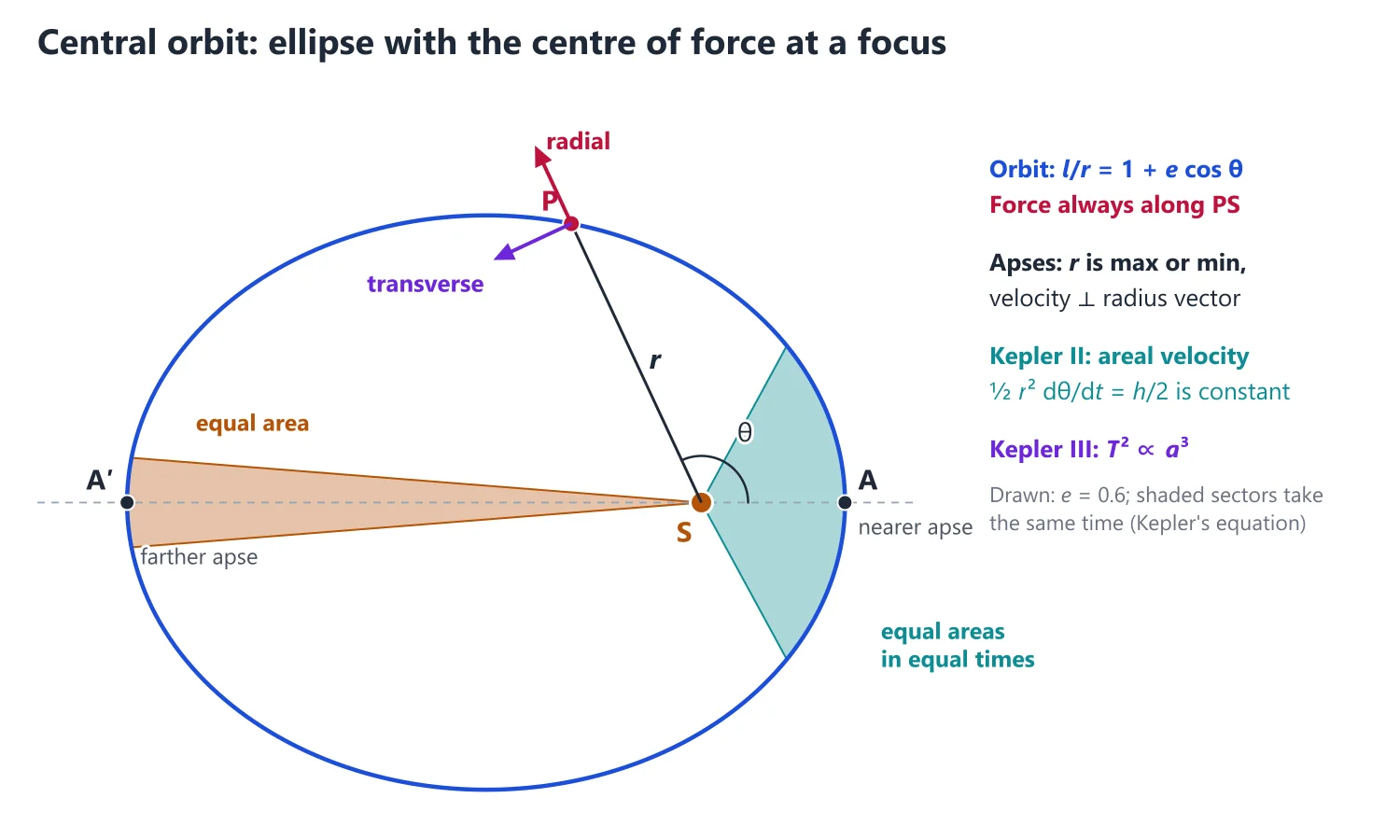
1. Understanding Central Forces and Constant Angular Momentum
Why we need it: planets, comets and satellites move under a single pull towards one point, the sun or the earth's centre.
We want to predict the path without solving the full motion in time, and the key is a quantity that never changes along the path: the angular momentum.
In words: central force means that at every instant the force on the particle P acts along the line OP joining it to a fixed point O (towards O for an attraction).
P(r) per unit mass means the acceleration towards O has magnitude P, which depends only on the distance r = OP.
In polar coordinates (r, θ) about O, the acceleration has a radial part r̈ − rθ̇2 and a transverse part (1/r) d(r2θ̇)/dt.
A central force has no transverse part, so d(r2θ̇)/dt = 0: the number h = r2θ̇ stays constant; h is the angular momentum per unit mass and h/2 is the area swept by OP per unit time.
First example, slowly: under a central force a particle is at r = 2 m with velocity 5 m/s at 30° to the radius vector. Find h and θ̇ there, and θ̇ and the transverse speed when r = 4 m.
Step 1: the transverse component of velocity is rθ̇ = v sin 30° = 2.5 m/s.
Step 2: so θ̇ = 2.5/2 = 1.25 rad/s and h = r2θ̇ = 4 × 1.25 = 5 m2/s.
Step 3: the same number comes from h = rv sin β = 2 × 5 × 1/2 = 5, β being the angle between the velocity and the radius vector.
Step 4: when r = 4 m, θ̇ = h/r2 = 5/16 = 0.3125 rad/s.
Step 5: the transverse speed is then rθ̇ = h/r = 1.25 m/s: doubling r halves the transverse speed.
Step 6: at every point of the path the area swept per second is h/2 = 2.5 m2.
Non-example: a projectile under uniform gravity, with O taken at the point of projection, is not a central motion: the force mg is vertical, not along OP, so it has a transverse part.
Indeed for x = ut, y = −gt2/2 we get r2θ̇ = xẏ − yẋ = −ugt2/2, which changes with time; the condition that fails is that the force must lie along OP.
Building up: (1) write the acceleration in polar components (previous topic, Components of Velocity and Acceleration); (2) set the transverse component to zero and integrate to get h.
(3) Use θ̇ = hu2, u = 1/r, to remove time from the radial equation: this gives the u-equation d2u/dθ2 + u = P/(h2u2) (Derivation: The Orbit Equation, Speed and Pedal Form).
(4) In vector form r × v is constant, so the whole motion lies in the fixed plane through O perpendicular to it.
Where it is used: every central-orbit question starts with h = RV sin β from the initial data; h also gives Kepler's second law, the speed v = h/p and the time spent on any arc.
2. Central Force and Basic Equations
A central force is always directed towards (or away from) a fixed point O, with magnitude P(r) per unit mass depending only on the distance r.
Idea: a central force has no transverse component, so it can change the particle's distance from O but cannot speed up or slow down its turning about O; gravity towards the sun and the pull of a spring fixed at O are the standard examples.
Equations of motion: d2r/dt2 − r(dθ/dt)2 = −P and (1/r) d/dt(r2 dθ/dt) = 0.
Hence r2 dθ/dt = h (constant): angular momentum per unit mass is conserved, the orbit lies in a plane through O, and the areal velocity is h/2.
Idea: in vector form d(r × v)/dt = v × v + r × F/m = 0 because F is parallel to r, so r × v is a constant vector; r always lies in the plane through O perpendicular to it, and its magnitude h is twice the rate at which area is swept (see the figure above).
Differential equation of the orbit (u = 1/r): d2u/dθ2 + u = P/(h2u2).
Idea: eliminating t by h and using u = 1/r instead of r turns the radial equation into a second-order equation for u as a function of θ; for the inverse square law it becomes the linear equation u″ + u = constant, whose solution is a conic, which is why u is always the right variable.
Pedal form: (h2/p3) dp/dr = P, where p is the perpendicular from O to the tangent.
Idea: since h = pv, the speed is inversely proportional to the perpendicular from O on the tangent: the particle moves fastest where the tangent passes closest to O; the pedal form is quickest when the orbit's p-r equation is easy to obtain.
Speed: v2 = h2[u2 + (du/dθ)2] and v = h/p.
Apse: a point where the radius vector is perpendicular to the tangent (du/dθ = 0); the apsidal distances are the extreme values of r.
Idea: at an apse the velocity is perpendicular to the radius, so h = rv there; the apsidal distances are the roots of v2 = h2u2 (the energy equation with du/dθ = 0), and the orbit oscillates between the two consecutive roots that enclose the starting distance (with only two positive roots, the nearest and farthest distances).
Example 1: Find the law of force towards the pole for the orbit rn = an cos nθ.
Logarithmic differentiation: (n/r) dr/dθ = −n tan nθ, so cot φ = (1/r) dr/dθ = −tan nθ and φ = π/2 + nθ.
p = r sin φ = r cos nθ = rn+1/an, the pedal equation.
P = (h2/p3) dp/dr = h2(a3n/r3n+3)(n + 1)rn/an = (n + 1)h2a2n/r2n+3.
Special cases: n = 1 (circle through the pole) gives 1/r5; n = 2 (lemniscate) gives 1/r7; n = −1 (straight line) gives P = 0.
3. Understanding Why the Inverse Square Law Gives Conics
Why we need it: Kepler observed ellipses; Newton had to show that an attraction μ/r2 produces exactly the conic sections, and to decide from the speed of projection which conic occurs.
In words: put P = μu2 into d2u/dθ2 + u = P/(h2u2); the right side becomes the constant μ/h2.
This is the equation of an oscillator with a constant forcing term: its general solution is the particular solution μ/h2 plus the complementary function A cos(θ − α).
In the form l/r = 1 + e cos(θ − α): l = h2/μ is the semi-latus rectum, e = Ah2/μ is the eccentricity, and θ = α is the direction of the nearer apse.
The energy per unit mass E = v2/2 − μ/r decides the type: E negative gives an ellipse, E zero a parabola, E positive a hyperbola.
First example, slowly: under μ/r2, a particle at distance R is projected with speed V = √(μ/R) at right angles to the radius vector. Find its orbit.
Step 1: compare V2 = μ/R with 2μ/R: it is smaller, so the orbit is an ellipse.
Step 2: v2 = μ(2/r − 1/a) at r = R gives μ/R = μ(2/R − 1/a), so 1/a = 1/R and a = R.
Step 3: projection at right angles makes R an apsidal distance; apsidal distances are a(1 − e) and a(1 + e), and R = a, so e = 0.
Step 4: so the orbit is the circle r = R; √(μ/R) is the speed for circular motion.
Step 5: check with the u-equation: h = RV = √(μR), so l = h2/μ = R, and l = a(1 − e2) again gives e = 0.
Step 6: raising V to √(2μ/R) at the same point gives a parabola: the escape speed is √2 times the circular speed.
Non-example: for P = μ/r3 the same substitution gives u″ + (1 − μ/h2)u = 0, which has no constant term.
Its solutions are cosines with frequency different from 1, exponentials, or linear functions of θ, and they give spirals, not conics: the conic shape needs a constant right side and frequency exactly 1, which only the inverse square law gives.
Building up: (1) with P = μu2 the u-equation is u″ + u = μ/h2; (2) its solution is u = μ/h2 + A cos(θ − α); (3) read off l and e.
(4) Compute v2 = h2(u2 + u′2) to get e2 = 1 + (h2/μ2)(V2 − 2μ/R); (5) the sign of V2 − 2μ/R decides whether e is less than, equal to or greater than 1.
Steps 4 and 5 are written out in Energy Integral, Conic Conditions, Apsidal Angle and Time in an Orbit and in Derivation: The Speed Formula and the Apsidal Angle.
Where it is used: classifying an orbit from R, V and β without integration; satellite and comet questions; and the escape speed √(2μ/R) = √(2gR), about 11.2 km/s for the earth.
4. Inverse Square Law and Conic Orbits
For P = μ/r2 = μu2: d2u/dθ2 + u = μ/h2, so l/r = 1 + e cos(θ − α) with semi-latus rectum l = h2/μ.
The orbit is a conic with a focus at O: an ellipse if e < 1, a parabola if e = 1, a hyperbola if e > 1.
Speed: v2 = μ(2/r − 1/a) for an ellipse of semi-major axis a, v2 = 2μ/r for a parabola, v2 = μ(2/r + 1/a) for a hyperbola.
So a particle at distance r moving with speed v describes an ellipse, a parabola or a hyperbola according as v2 is less than, equal to or greater than 2μ/r; √(2μ/r) is the escape speed.
Idea: the deciding quantity is the energy per unit mass E = v2/2 − μ/r: E negative means the particle cannot reach infinity and the orbit is closed (ellipse), E = 0 is the borderline parabola and E positive an open hyperbola; the direction of projection affects only the shape (e), not the type.
Periodic time in an ellipse: T = 2πa3/2/√μ.
Example 2: A particle moving under μ/r2 is projected from distance R, at right angles to the radius vector, with speed √(3μ/(2R)); find the orbit and its period.
v2 = 3μ/(2R) < 2μ/R, so the orbit is an ellipse; v2 = μ(2/R − 1/a) gives 1/a = 2/R − 3/(2R) = 1/(2R), so a = 2R.
Projection perpendicular to the radius means R is an apsidal distance; R < a, so it is the nearer apse: R = a(1 − e) gives e = 1/2.
Check: l = h2/μ = R2(3μ/(2R))/μ = 3R/2 = a(1 − e2) = 2R(3/4). Period T = 2π(2R)3/2/√μ = 4π√2 R3/2/√μ.
5. Understanding Kepler's Laws
Why we need it: Kepler's three laws were found from observation before Newton, and exam questions go both ways: derive the laws from the inverse square attraction, or deduce the law of force from the laws.
Knowing which law gives which fact makes both directions short.
In words: first law: the orbit is an ellipse and the sun is at a focus, not at the centre.
Second law: the area swept by the line from the sun to the planet in time t is (h/2)t; equal areas in equal times is the same statement as h constant.
Third law: T2 = (4π2/μ)a3, where a is the semi-major axis (half the longest diameter) and μ = GM depends only on the sun, so T2/a3 is the same for every planet.
First example, slowly: a planet's least and greatest distances from the sun are 1 AU and 3 AU. Find a, e and its period, given that the earth has a = 1 AU and T = 1 year.
Step 1: the major axis is the sum of the two apsidal distances: 2a = 1 + 3, so a = 2 AU.
Step 2: a(1 − e) = 1 gives e = 1/2; check: a(1 + e) = 3.
Step 3: by the third law T2/a3 is the same as for the earth, namely 1 in these units.
Step 4: T2 = 23 = 8, so T = 2√2 ≈ 2.83 years.
Step 5: by the second law it moves fastest at perihelion; vp/va = (1 + e)/(1 − e) = 3.
Step 6: notice that e did not enter the period: only the semi-major axis does.
Non-example: under P = μr (a spring pulling towards O) the orbits are also ellipses, but with O at the centre, not at a focus, and the period 2π/√μ is the same for all sizes.
So an elliptic orbit alone does not imply the inverse square law: the focus condition of the first law is essential, and here the third law fails, since T does not grow with a.
Building up: (1) second law ⇔ h constant ⇔ zero transverse acceleration (1/r) d(r2θ̇)/dt, that is, the force is central.
(2) First law: put the ellipse u = (1 + e cos θ)/l into P = h2u2(u″ + u); since u″ + u = 1/l, P = (h2/l)/r2, an inverse square attraction.
(3) Third law: T = πab/(h/2) with h2 = μl and l = b2/a, as shown in this section; (4) since T2/a3 = 4π2/μ is the same for all planets, one constant μ governs the whole solar system.
Where it is used: deriving Newton's law of gravitation; times in an orbit from swept areas (Example 11); satellite periods with μ = gR2.
6. Kepler's Laws
First law: each planet moves in an ellipse with the sun at one focus.
Second law: the radius vector from the sun sweeps out equal areas in equal times (dA/dt = h/2).
Third law: the squares of the periodic times are proportional to the cubes of the semi-major axes: T2 = (4π2/μ)a3.
Deductions: the second law shows the force is central; the first law (sun at a focus) shows it varies as 1/r2; the third law shows μ is the same for all planets.
Proof of the third law: T = (area πab)/(h/2), with h2 = μl and l = b2/a, gives T = 2πa3/2/√μ.
Taking the planet's mass m into account, μ = G(M + m), so T2/a3 is only approximately the same for all planets.
Example 3: Show that the speeds of a planet at perihelion and aphelion are in the ratio (1 + e) : (1 − e), and find this ratio when e = 1/3.
At an apse the velocity is perpendicular to the radius vector, so h = r v there.
Hence vpa(1 − e) = vaa(1 + e), so vp/va = (1 + e)/(1 − e).
For e = 1/3 the ratio is (4/3)/(2/3) = 2: the planet moves twice as fast at perihelion as at aphelion.
7. Understanding How to Read the Force Law from an Orbit
Why we need it: half of all central-orbit questions give a curve and ask: under what central force towards O can this curve be described?
The u-equation read backwards answers this by differentiation alone; no integration is needed.
In words: P = h2u2(d2u/dθ2 + u) says: write the orbit as u = 1/r in terms of θ, differentiate twice, add u, multiply by h2u2.
The result must then be expressed in r (or u) alone, using the orbit's equation to remove θ; only then is it a law of force.
Alternatively, if the perpendicular p from O to the tangent is easy, use P = (h2/p3) dp/dr, which needs the pedal equation, a relation between p and r.
First example, slowly: find the law of force towards the focus O for the parabola l/r = 1 + cos θ.
Step 1: u = (1 + cos θ)/l.
Step 2: du/dθ = −sin θ/l and d2u/dθ2 = −cos θ/l.
Step 3: d2u/dθ2 + u = (−cos θ + 1 + cos θ)/l = 1/l; θ has already disappeared.
Step 4: P = h2u2(1/l) = (h2/l)/r2.
Step 5: so the force is an attraction varying inversely as the square of the distance, with μ = h2/l.
Step 6: by the pedal route: writing l = 2c, the parabola with focus O has p2 = cr, so 2p dp/dr = c and P = h2c/(2p4) = h2/(2cr2) = (h2/l)/r2, the same answer.
Non-example: for the spiral r = aθ one finds u″ + u = 2/(aθ3) + 1/(aθ); writing P = h2u2(2/(aθ3) + 1/(aθ)) is not yet a law of force, because θ is still present.
A central force law must depend on r only; substituting θ = 1/(au) is the step that turns it into one, giving P = h2(u3 + 2a2u5).
Building up: (1) the u-equation of Derivation: The Orbit Equation, Speed and Pedal Form, read as a formula for P; (2) the pedal formula, from v = h/p and the energy equation (same derivation).
(3) To find p, use p = r sin φ with tan φ = r dθ/dr, or 1/p2 = u2 + (du/dθ)2; (4) Examples 1, 4, 5 and 6 apply each route in turn.
Where it is used: find-the-law-of-force questions (5 to 15 marks), and in reverse, checking that a claimed curve is the orbit by comparing pedal equations (Example 9).
8. Finding the Law of Force from the Orbit
Example 4: Find the law of force for the orbit r = a cos θ (a circle through the centre of force).
u = sec θ/a and d2u/dθ2 = (2 sec3θ − sec θ)/a, so d2u/dθ2 + u = 2 sec3θ/a = 2a2u3.
Hence P = h2u2 × 2a2u3 = 2h2a2/r5: the force varies inversely as the fifth power of the distance.
Example 5: For the equiangular spiral r = aeθ cot α, d2u/dθ2 = u cot2α, so P = h2u3 cosec2α, which varies as 1/r3.
Converse: if P = μ/r3, the orbit equation is d2u/dθ2 + (1 − μ/h2)u = 0; when h2 = μ, u = Aθ + B, a reciprocal spiral (or a circle when A = 0).
Method for a given P and initial data: integrate the orbit equation once using the speed at the start to fix constants, then integrate again with the initial direction.
Example 6: Find the law of force towards the pole under which a particle describes the cardioid r = a(1 + cos θ).
tan φ = r dθ/dr = −(1 + cos θ)/sin θ = −cot(θ/2), so φ = π/2 + θ/2 and p = r cos(θ/2).
Since cos2(θ/2) = r/(2a), the pedal equation is p2 = r3/(2a).
Differentiating, 2p dp/dr = 3r2/(2a), so P = (h2/p3) dp/dr = 3h2r2/(4ap4) = 3h2r2(4a2)/(4ar6) = 3ah2/r4.
The force varies inversely as the fourth power of the distance.
9. Energy Integral, Conic Conditions, Apsidal Angle and Time in an Orbit
Energy integral: multiplying the orbit equation by 2 du/dθ and integrating, v2 = h2[u2 + (du/dθ)2] = C − 2∫P dr; the constant C comes from the speed of projection.
Initial data: if the particle is projected from distance R with speed V at angle β to the radius vector, then h = RV sin β; at an apse β = 90° and h = RV.
Proof that the orbit is a conic, with the conditions: for P = μu2 the orbit equation gives u = μ/h2 + A cos(θ − α), that is l/r = 1 + e cos(θ − α) with l = h2/μ and e = Ah2/μ, a conic with focus at the centre.
Then v2 = h2[u2 + (du/dθ)2] = μ2/h2 + 2μA cos(θ − α) + A2h2 = 2μ/r + (μ2/h2)(e2 − 1), so e2 = 1 + (h2/μ2)(V2 − 2μ/R) at any point.
Hence the path is an ellipse, a parabola or a hyperbola according as V2 is less than, equal to or greater than 2μ/R.
Force proportional to distance (P = μr): the orbit is an ellipse with its centre (not a focus) at the centre of force, and the period is 2π/√μ for every orbit (Example 7).
Apsidal angle: for a nearly circular orbit of radius a under P(r), the angle between consecutive apsides is π/√(3 + aP′(a)/P(a)); for P ∝ rn it is π/√(n + 3), which is π for n = −2 and π/2 for n = 1.
Idea: an apsidal angle of π means that the nearest and farthest points are opposite each other and the orbit closes after one revolution; for other force laws the apses advance and the orbit is a rosette, which is why a closed elliptic orbit points to the inverse square law.
Time in an orbit: dt = r2 dθ/h = dθ/(hu2), or by Kepler's second law, time = 2 × (area swept)/h; in an ellipse the area swept from the focus is found from half-ellipses, sectors and triangles.
Coming from infinity: a particle starting at a great distance with speed V along a line at perpendicular distance p from the centre has h = pV and, under μ/r2, v2 = V2 + 2μ/r.
10. Derivation: The Orbit Equation, Speed and Pedal Form
With r = 1/u and dθ/dt = hu2: dr/dt = −(1/u2)(du/dθ)(dθ/dt) = −h du/dθ, and d2r/dt2 = −h (d2u/dθ2)(dθ/dt) = −h2u2 d2u/dθ2.
Also r(dθ/dt)2 = (1/u)h2u4 = h2u3, so the radial equation becomes −h2u2(d2u/dθ2 + u) = −P, that is d2u/dθ2 + u = P/(h2u2).
Speed: v2 = (dr/dt)2 + r2(dθ/dt)2 = h2(du/dθ)2 + h2u2.
Pedal form: h = |r × v| = rv sin φ = pv, so v = h/p; the energy equation v2 = C − 2∫P dr gives d(v2)/dr = −2P, and d(h2/p2)/dr = −(2h2/p3) dp/dr, so P = (h2/p3) dp/dr.
11. Derivation: The Speed Formula and the Apsidal Angle
v2 = μ(2/r − 1/a): The proof that the orbit is a conic (Section 5) shows v2 − 2μ/r = (μ2/h2)(e2 − 1); for an ellipse h2 = μl = μa(1 − e2), so the right side is −μ/a, a constant along the orbit.
For a hyperbola l = a(e2 − 1) and the same step gives +μ/a; for a parabola e = 1 and the constant is 0.
Apsidal angle: write the orbit equation as u″ = f(u) − u with f(u) = P(1/u)/(h2u2); a circular orbit u = c = 1/a needs f(c) = c, that is h2 = a3P(a).
Put u = c + ξ with ξ small: ξ″ + (1 − f′(c))ξ = 0, and differentiating f with h2 = a3P(a) gives f′(c) = −2 − aP′(a)/P(a).
So ξ ∝ cos(√(3 + aP′/P) θ + ε); from a maximum of u to the next minimum, θ increases by π/√(3 + aP′(a)/P(a)), the apsidal angle; real oscillation (a stable circular orbit) needs 3 + aP′/P > 0, which for P ∝ rn means n > −3.
12. Choosing the Method
If the orbit is given as r = f(θ) and the law of force is asked → put u = 1/r and use P = h2u2(d2u/dθ2 + u).
If the angle φ between the radius and the tangent is easy (rn = an cos nθ, cardioid, spiral) → find the pedal equation p = r sin φ and use P = (h2/p3) dp/dr.
If the law of force and the initial data are given and the orbit is asked → multiply the orbit equation by 2 du/dθ, integrate once (energy), fix the constant from the initial speed, then integrate dθ = du/√(...) using the initial direction.
If the law is inverse square with given R, V, β → use v2 = μ(2/r − 1/a) for a, h = RV sin β and l = h2/μ = a(1 − e2) for e; no integration is needed.
If a time in the orbit is asked → use time = 2 × (area swept)/h, or t = ∫dθ/(hu2) when the area is awkward.
13. Common Mistakes
Dropping the factor h2: the law is P = h2u2(u″ + u), not u2(u″ + u); the answer must carry h2 or an equivalent constant.
Taking h = RV when the projection is not at right angles to the radius vector; in general h = RV sin β.
Confusing the semi-major axis a with an apsidal distance; the apsidal distances are a(1 − e) and a(1 + e).
Placing the centre of force at a focus for the law P = μr; there the ellipse has its centre at the centre of force and the period 2π/√μ does not depend on the size of the orbit.
Using the attractive sign for a repulsive force: for repulsion P is negative in u″ + u = P/(h2u2).
14. Connections
Link: the orbit equation for the inverse square law is the constant-coefficient ODE u″ + u = μ/h2 (Chapter 5), and the pedal relations p = r sin φ and ρ = r dr/dp come from the geometry of plane curves (Chapter 7, Curves in Space).
Link: conservation of h is the statement that θ is a cyclic coordinate of the Lagrangian (1/2)(ṙ2 + r2θ̇2) − V(r), so its momentum r2θ̇ is constant (Chapter 14, Hamilton's Equations).
15. Solved UPSC Questions
Example 7 (UPSC 2015, 13 marks): A particle moves in a plane under a force, towards a fixed centre, proportional to the distance. If the path of the particle has two apsidal distances a, b (a > b), then find the equation of the path.
Here P = μr, and the pedal equation (h2/p3) dp/dr = μr integrates to h2/p2 = C − μr2.
At an apse p = r, so h2/r2 = C − μr2, that is μr4 − Cr2 + h2 = 0, whose roots are r2 = a2 and b2.
So a2 + b2 = C/μ and a2b2 = h2/μ, and the path is a2b2/p2 = a2 + b2 − r2.
This is the pedal equation of the ellipse x2/a2 + y2/b2 = 1 referred to its centre.
Check in Cartesian form: ẍ = −μx and ÿ = −μy give x = a cos √μ t, y = b sin √μ t when t = 0 is taken at the far apse.
Answer: the path is the ellipse x2/a2 + y2/b2 = 1 with its centre at the centre of force and its axes along the apsidal lines (and h = ab√μ).
Example 8 (UPSC 2020, 20 marks): (ii) A particle starts at a great distance with velocity V. Let p be the length of the perpendicular from the centre of a star on the tangent to the initial path of the particle. Show that the least distance of the particle from the centre of the star is λ, where V2λ = √(μ2 + p2V4) − μ. Here μ is a constant.
Initially the particle moves along a line at perpendicular distance p from the centre with speed V, so h = pV.
Under the attraction μ/r2, energy gives v2 = V2 + 2μ/r (the potential energy −μ/r vanishes at a great distance).
At the least distance λ the particle is at an apse, so v = h/λ = pV/λ.
Hence p2V2/λ2 = V2 + 2μ/λ, that is V2λ2 + 2μλ − p2V2 = 0.
Its positive root is λ = [−μ + √(μ2 + p2V4)]/V2.
Answer: V2λ = √(μ2 + p2V4) − μ.
Example 9 (UPSC 2023, 20 marks): A particle is projected from an apse at a distance √c from the centre of force with a velocity √((2λ/3)c3) and is moving with central acceleration λ(r5 − c2r). Find the path of motion of this particle. Will that be the curve x4 + y4 = c2?
At the apse r = √c, h = √c × √(2λc3/3) = c2√(2λ/3), so h2 = 2λc4/3.
Energy integral: v2 = C − 2∫λ(r5 − c2r) dr = C − λr6/3 + λc2r2; at r2 = c, v2 = 2λc3/3 gives C = 0.
With v = h/p: 2λc4/(3p2) = λr2(3c2 − r4)/3, so the pedal equation of the path is 1/p2 = r2(3c2 − r4)/(2c4).
For the curve x4 + y4 = c2: in polar form c2u4 = f(θ) = cos4θ + sin4θ = (3 + cos 4θ)/4, so u = f1/4/√c and du/dθ = −f−3/4 sin 4θ/(4√c).
Then 1/p2 = u2 + (du/dθ)2 = f−3/2[f2 + sin24θ/16]/c = f−3/2(3f − 1)/(2c), since f2 + sin24θ/16 = (5 + 3 cos 4θ)/8 = (3f − 1)/2.
Putting f = c2/r4 gives 1/p2 = r2(3c2 − r4)/(2c4), the same pedal equation, and the curve has an apse at θ = 0 with r = √c, like the path.
A curve satisfying the energy integral satisfies the orbit equation wherever du/dθ ≠ 0 (differentiate the integral), hence everywhere by continuity; by uniqueness of the solution with the same initial apse, the path is this curve.
Answer: yes; with the initial line through the point of projection the path is x4 + y4 = c2, whose pedal equation is 2c4 = p2r2(3c2 − r4).
Example 10 (UPSC 2024, 20 marks): A particle moves with a central acceleration μ(3/r3 + d2/r5) being projected from a distance d at an angle 45° with a velocity equal to that in a circle at the same distance. Prove that the time it takes to reach the centre of force is (d2/√(2μ))(2 − π/2).
Speed in a circle of radius d: v2 = dP(d) = μ(3/d2 + 1/d2) = 4μ/d2; projected at 45° to the radius vector, h = dv sin 45° = √(2μ), so h2 = 2μ.
Energy integral: v2 = C − 2∫P dr = C + μ(3/r2 + d2/(2r4)); at r = d, 4μ/d2 = C + 7μ/(2d2), so C = μ/(2d2).
With v2 = 2μ[u2 + (du/dθ)2]: (du/dθ)2 = 1/(4d2) + u2/2 + d2u4/4 = (1 + d2u2)2/(4d2).
The particle is projected inwards, so u increases: dθ = 2d du/(1 + d2u2), and u → ∞ (the centre) after θ has increased by 2(π/2 − π/4) = π/2.
Time: dt = dθ/(hu2) = (2d/h) du/(u2(1 + d2u2)) = (2d/h)[1/u2 − d2/(1 + d2u2)] du.
t = (2d/h)[−1/u − d tan−1(du)] from u = 1/d to ∞ = (2d/h)(−dπ/2 + d + dπ/4) = (2d2/h)(1 − π/4).
Answer: with h = √(2μ), t = (2d2/√(2μ))(1 − π/4) = (d2/√(2μ))(2 − π/2).
Example 11 (UPSC 2025, 10 marks): Prove that the time taken by the Earth to travel over half of its orbit, which is separated by the minor axis and is remote from the Sun, when the Sun is at the focus of the elliptic orbit, is two days more than half of the year. The eccentricity of the orbit is taken as 1/60.
Let the ellipse have semi-axes a, b and eccentricity e, with the sun at the focus S, at distance ae from the centre; BB′ is the minor axis.
The half of the orbit remote from the sun is the arc from B through the aphelion to B′; while the earth describes it, the radius vector from S sweeps the half-ellipse beyond BB′ together with the triangle SBB′.
Area swept = πab/2 + (1/2)(2b)(ae) = πab/2 + abe.
By Kepler's second law time is proportional to area, so the time is T(πab/2 + abe)/(πab) = T/2 + Te/π, T being the year.
With e = 1/60 and T = 365.25 days, Te/π = 365.25/(60π) ≈ 1.94 days.
Answer: the time exceeds half a year by Te/π ≈ 2 days.
16. Practice Exercises
Exercise 1 (basic): A particle moves under a central force. When r = 2 its angular velocity is θ̇ = 3. Find θ̇ when r = 3.
Answer: h = r2θ̇ = 12, so θ̇ = 12/9 = 4/3.
Exercise 2 (basic): Under the attraction μ/r2 a particle at distance R has speed √(3μ/R). Name its orbit and find the semi-axis a.
Answer: V2 = 3μ/R > 2μ/R, a hyperbola; μ(2/R + 1/a) = 3μ/R gives a = R, whatever the direction of projection.
Exercise 3 (basic): A planet's orbit has semi-major axis 4 AU. Find its period in years.
Answer: T2 = 43 = 64, T = 8 years.
Exercise 4 (standard): Find the law of force towards the pole under which the curve r = aθ2 can be described.
Answer: u = 1/(aθ2), u″ + u = 6/(aθ4) + 1/(aθ2) = 6au2 + u, so P = h2(u3 + 6au4) = h2(1/r3 + 6a/r4).
Exercise 5 (standard): Under μ/r2 a particle is projected from distance R with speed √(μ/R) in a direction making 30° with the radius vector. Find a, e and l of the orbit.
Answer: a = R; h = R√(μ/R) sin 30°, so l = h2/μ = R/4 = a(1 − e2) and e = √3/2; the apsidal distances are R(1 ± √3/2).
Exercise 6 (standard): For the attraction P = μ/r2 + ν/r3 (ν > 0, h2 > ν), show that the apsidal angle is exactly π/√(1 − ν/h2), and that for a nearly circular orbit of radius a it is π√(1 + ν/(μa)).
Answer: the u-equation is u″ + (1 − ν/h2)u = μ/h2, so u oscillates in θ with frequency √(1 − ν/h2); for a circle h2 = a3P(a) = μa + ν, giving π√((μa + ν)/(μa)).
Exercise 7 (standard): In an elliptic orbit under μ/r2, show that the speed at an end of the minor axis is √(μ/a) and is the geometric mean of the speeds at perihelion and aphelion.
Answer: the end of the minor axis is at distance a from the focus, so v2 = μ(2/a − 1/a) = μ/a; vp2va2 = [μ(1 + e)/(a(1 − e))][μ(1 − e)/(a(1 + e))] = μ2/a2.
Exercise 8 (UPSC level): A particle moving under the attraction μ/r3 is projected from an apse at distance a with speed V, where a2V2 < μ. Show that the path is r cosh kθ = a with k2 = μ/(a2V2) − 1, and that it reaches the centre after time a2/√(μ − a2V2).
Answer: h = aV and u″ − k2u = 0 with u′ = 0, u = 1/a at θ = 0 give u = cosh(kθ)/a; energy gives ṙ2 = (μ − a2V2)(a2 − r2)/(a2r2), and the substitution r = a sin φ makes ∫0a dr/|ṙ| = a2/√(μ − a2V2).
Exercise 9 (UPSC level): A comet moves in a parabola about the sun (attraction μ/r2) with perihelion distance q. Show that it takes time (4√2/3)q3/2/√μ to go from perihelion to an end of the latus rectum.
Answer: l = 2q, h = √(2μq); the area swept is ∫0π/2 (1/2)r2 dθ with r = 2q/(1 + cos θ), which equals 4q2/3 (put t = tan(θ/2)), and time = 2 × area/h.
Exercise 10 (UPSC level): A particle moves under the attraction μ/r5 and is projected from an apse at distance a with the speed it would have acquired falling from rest at infinity. Prove that it describes the circle r = a cos θ through the centre of force and reaches the centre after time π√2 a3/(4√μ).
Answer: v2 = μ/(2r4), so h = √(μ/2)/a and h2(u2 + u′2) = μu4/2 gives u′2 = u2(a2u2 − 1), solved by u = sec θ/a; time = ∫0π/2 dθ/(hu2) = πa2/(4h).
| Orbit | Eccentricity | Speed at distance r | Total energy per unit mass |
|---|---|---|---|
| Ellipse | e < 1 | v2 = μ(2/r − 1/a) | −μ/(2a), negative |
| Parabola | e = 1 | v2 = 2μ/r | Zero |
| Hyperbola | e > 1 | v2 = μ(2/r + 1/a) | μ/(2a), positive |
| Circle | e = 0 | v2 = μ/r | −μ/(2r) |
Mains points
- Two standard types: find the law of force for a given orbit (use the u-equation or the pedal form), and find the orbit for a given law and initial conditions.
- Derive d2u/dθ2 + u = P/(h2u2) briefly if the question is worth 15 marks or more; otherwise quote it.
- Deducing Kepler's laws from the inverse square law (or the reverse) is a frequent theory question; set out each law and its consequence separately.
- Use the energy criterion v2 compared with 2μ/r to decide the type of conic quickly.
- Check apsidal distances by setting du/dθ = 0; for an ellipse they are a(1 − e) and a(1 + e).
Did you know?
- Kepler published his first two laws in 1609 (Astronomia Nova) and the third in 1619 (Harmonices Mundi); Newton derived all three from the inverse square law in the Principia (1687).
Equilibrium, Friction and the Common Catenary
A body is in equilibrium when the resultant force and the resultant moment vanish. Limiting friction F = μR and the angle of friction λ = tan−1μ settle ladder and inclined-plane problems. A heavy uniform chain hangs in the common catenary y = c cosh(x/c), with tension T = wy.
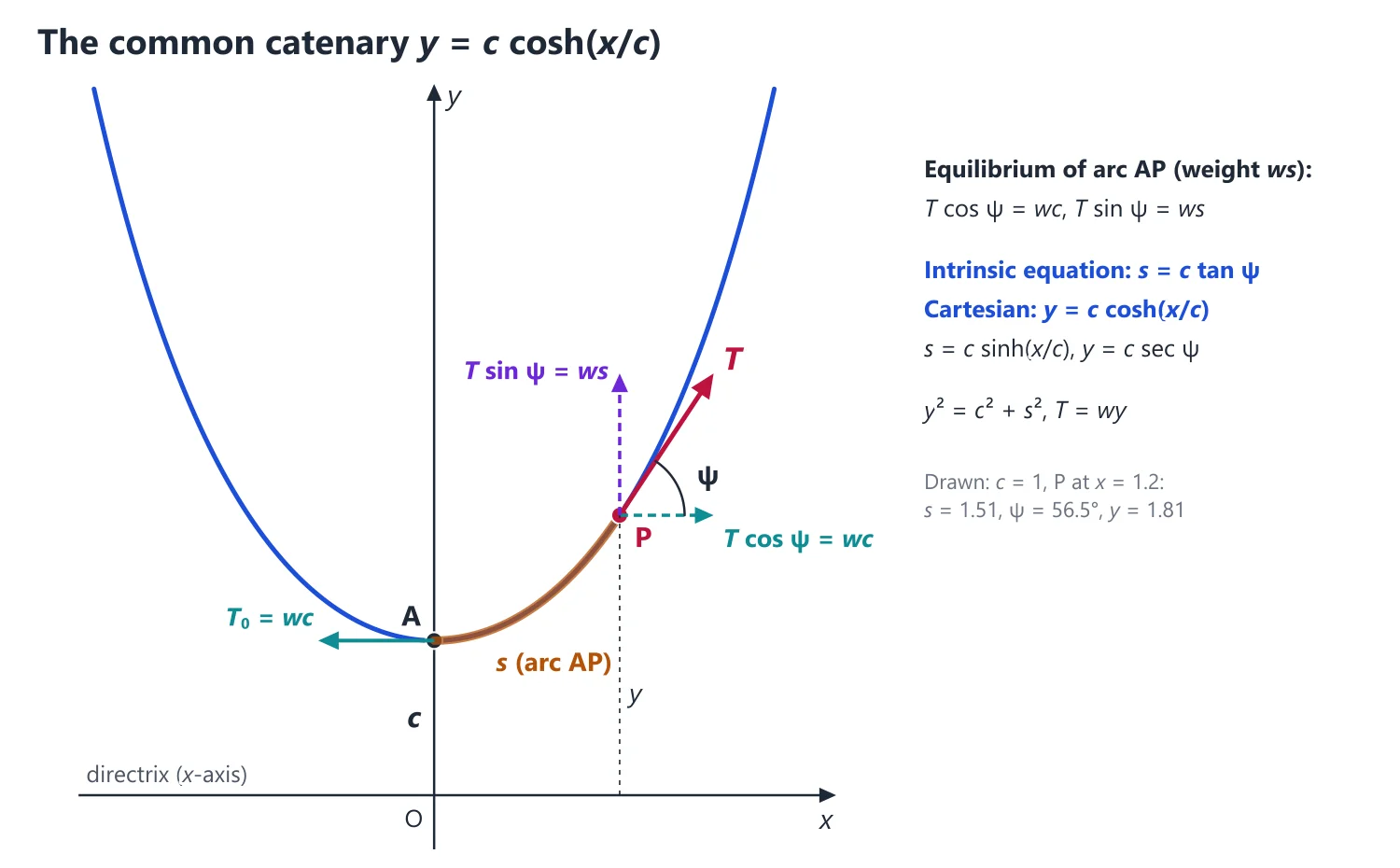
1. Understanding the Conditions of Equilibrium
Why we need it: a lamp hanging from two wires, a ladder against a wall and a beam on two supports are all at rest, and we want the unknown forces on them (tensions, reactions, friction).
A body at rest has zero acceleration, so by Newton's second law the forces on it must balance.
For a rigid body this is not enough: forces that balance can still turn the body, so we also need a condition that stops rotation.
In words: ΣX = 0 means: take the component of every force along a chosen horizontal direction, with a sign (+ to the right, − to the left), and add; the total must be zero.
ΣY = 0 says the same for the vertical components; together the two say that the resultant force is zero, so the body does not start to slide in any direction.
The moment of a force about a point O is its magnitude times the perpendicular distance from O to its line of action, counted + if it turns the body anticlockwise and − if clockwise.
ΣMO = 0 says the turning effects cancel; the phrase "about any one point" means you may choose O freely, and the best choice is a point through which unknown forces pass, because their moments are zero there.
Lami's theorem is a shortcut for one special case only: exactly three forces through one point; each force is divided by the sine of the angle between the OTHER two.
First example, slowly: a uniform beam AB of length 4 m and weight 100 N rests horizontally on a support at A and a support at C, where AC = 3 m; find the two reactions.
Step 1 (list the forces): RA upwards at A, RC upwards at C, and the weight 100 N downwards at the mid-point G, with AG = 2 m (the beam is uniform).
Step 2: no force has a horizontal component, so ΣX = 0 holds automatically.
Step 3 (resolve vertically): RA + RC = 100; this one equation has two unknowns, so we need the moment equation.
Step 4 (moments about A, so that RA drops out): RC × 3 − 100 × 2 = 0, so RC = 200/3 ≈ 66.7 N.
Step 5: from Step 3, RA = 100 − 200/3 = 100/3 ≈ 33.3 N.
Step 6 (check about C): RA × 3 = 100 N m and the weight's moment about C is 100 × 1 = 100 N m in the opposite sense, so they cancel.
Non-example: two forces of 10 N act at the ends of a rod 2 m long, perpendicular to it and in opposite directions; then ΣX = ΣY = 0, but the moment about the centre is 10 × 1 + 10 × 1 = 20 N m, so the rod spins: the moment condition fails, and zero resultant force alone is not equilibrium.
Similarly, Lami's theorem cannot be used for a beam with four forces, or for three parallel forces, because its hypothesis (three concurrent forces) fails.
Building up: (1) if the resultant force is zero, the moment about a new point O′ equals the moment about O minus the moment of the resultant placed at O, which is zero, so one moment point is enough.
(2) Taking moments where two of three forces meet shows that the third passes through that point, so three non-parallel forces in equilibrium are concurrent.
(3) Three concurrent forces in equilibrium close into a triangle, and the sine rule for that triangle is Lami's theorem.
(4) Each rigid body in a plane gives three independent equations, so a problem can be solved by statics alone only when the number of unknown forces is at most three per body; for jointed bodies, write the equations for the whole system (internal forces cancel) and then for one part.
Where it is used: every statics question in this chapter (hinged rods, ladders, beams, Examples 7 to 16) starts from these three equations, and they also check answers found by virtual work in the next topic.
2. Equilibrium of Particles and Rigid Bodies
A particle is in equilibrium under forces F1, ..., Fn if and only if ΣFi = 0, that is ΣX = 0, ΣY = 0, ΣZ = 0.
Lami's theorem: if three concurrent forces P, Q, R keep a particle in equilibrium, then P/sin α = Q/sin β = R/sin γ, where α, β, γ are the angles between the other two forces in each case.
Why it works: the three forces form a closed triangle (triangle of forces); each angle of that triangle is the supplement of the angle between two of the forces, and sin(π − A) = sin A, so the sine rule for the triangle becomes Lami's theorem; it applies only to exactly three concurrent forces.
Triangle of forces: three forces in equilibrium can be represented in magnitude and direction by the sides of a triangle taken in order.
A rigid body is in equilibrium under coplanar forces if and only if ΣX = 0, ΣY = 0 and the sum of moments about any one point is zero.
Idea: the two resolution equations stop the body from moving off, and the moment equation stops it from turning; one point is enough because, once the resultant force is zero, the total moment is the same about every point.
Equivalent sets of conditions are: moments zero about three non-collinear points, or moments zero about two points A, B together with resolution in a direction not perpendicular to AB; choose points where unknown forces meet, so that they drop out.
Three non-parallel coplanar forces in equilibrium must be concurrent; this often fixes an unknown direction.
Why it works: take moments about the point where two of the lines of action meet; those two forces have zero moment, so the third must also have zero moment about that point, which means its line passes through it; three parallel forces are the exception.
For a system of particles the internal forces cancel in pairs (Newton's third law), so the external forces alone satisfy the equilibrium conditions for the whole system, and each particle is separately in equilibrium.
Example 1: A weight W hangs from two strings that make angles 30° and 60° with the vertical; find the tensions.
The angle between the strings is 90°; the angle between T1 (at 30°) and the weight is 150°, and between T2 (at 60°) and the weight is 120°.
Lami: T1/sin 120° = T2/sin 150° = W/sin 90°, so T1 = (√3/2)W and T2 = W/2.
Check: horizontal components T1 sin 30° = T2 sin 60° = √3W/4, and vertical components (3/4)W + (1/4)W = W.
3. Understanding Friction
Why we need it: on a perfectly smooth floor a ladder cannot lean against a wall, because nothing stops its foot sliding outwards; real surfaces grip, and we need a rule for how much grip a surface can supply.
In words: at a contact the surface pushes on the body with a normal reaction R, perpendicular to the common tangent, and a friction force F along the common tangent.
F ≤ μR says friction can be anything from zero up to a ceiling μR; μ, the coefficient of friction, is a pure number fixed by the two materials (for example 0.4 for wood on wood, roughly).
"Limiting equilibrium" means the body is just on the point of slipping; only then F = μR.
The angle of friction λ is defined by tan λ = μ: it is the largest angle the total reaction S = √(R2 + F2) can make with the normal.
First example, slowly: a block of weight 50 N lies on a rough horizontal floor with μ = 0.4, and a horizontal pull P is applied to it.
Step 1 (vertical balance): nothing else acts vertically, so R = 50 N.
Step 2 (the ceiling): the most friction available is μR = 0.4 × 50 = 20 N.
Step 3 (P = 12 N): equilibrium needs F = 12 N, and 12 ≤ 20, so the block stays at rest and the friction is 12 N, not 20 N.
Step 4 (P = 20 N): now the friction needed equals the ceiling, F = μR, so the block is in limiting equilibrium.
Step 5 (P = 25 N): friction cannot exceed 20 N, so there is an unbalanced force of at least 5 N and the block moves; this is a dynamics question, not statics.
Step 6 (the angle): in Step 4 the total reaction makes angle tan−1(20/50) = tan−10.4 ≈ 21.8° with the vertical normal, which is exactly λ.
Non-example: writing F = μR = 20 N in Step 3 would leave a net force 20 − 12 = 8 N pushing the block backwards with nobody pulling it that way, which is absurd; friction equals μR only when slipping is about to happen.
Building up: (1) on a plane of inclination α with only the weight acting, R = W cos α and the friction needed is W sin α; it is available if W sin α ≤ μW cos α, that is tan α ≤ μ, or α ≤ λ.
(2) Replacing R and F by the single reaction S at angle λ to the normal turns a friction question into a three-force question, which is how the least-force result W sin(α + λ) and the range W tan(α − λ) ≤ P ≤ W tan(α + λ) of Example 3 are found.
(3) A ladder has four unknown contact forces but only three equations, so statics alone cannot fix them in a general position; in limiting equilibrium both ends slip together, so F = μR and F′ = μ′S both hold and the problem closes (Example 2).
Where it is used: ladders, rods on rough rails and rings on rough wires, chains partly on rough tables (§5 and Example 21), the rolling (no-slip) assumption in the stability tests of the next topic, and motion on rough curves in the dynamics topics.
4. Friction
Laws of friction: friction opposes the tendency to slide and is only as large as needed for equilibrium, up to the limiting value F = μR, where R is the normal reaction and μ the coefficient of friction, which depends on the materials and not on the area of contact.
Idea: friction is a self-adjusting force: it takes whatever value 0 ≤ F ≤ μR keeps the body at rest, and only in limiting equilibrium (on the point of slipping) does F = μR; so in a non-limiting position friction is an unknown to be found, not μR.
Angle of friction λ = tan−1μ: in limiting equilibrium the resultant reaction makes angle λ with the normal; the cone of friction has semi-vertical angle λ.
Idea: combine the normal reaction R and the friction F into one resultant reaction S, making angle tan−1(F/R) with the normal; since F ≤ μR, S lies inside the cone of friction, so a body is in equilibrium only if the resultant of the other forces is directed into this cone.
A body on a rough plane of inclination α stays at rest under its weight alone if and only if α ≤ λ, that is tan α ≤ μ.
The least force needed to drag a weight W up a rough plane of inclination α is W sin(α + λ), applied at angle λ to the plane; on a horizontal plane it is W sin λ, at angle λ to the horizontal.
Why it works: in limiting equilibrium W, P and S (at angle λ to the normal) form a triangle; the side W and the direction of S are fixed, so P is least when it is perpendicular to S, giving P = W sin(α + λ) in a direction making angle λ with the plane.
Example 2 (ladder): A uniform ladder rests with its foot on a rough floor (coefficient μ) and its top against a rough vertical wall (coefficient μ′); find its inclination θ to the vertical when about to slip.
Resolving: R + μ′S = W and S = μR; moments about the foot (ladder length 2a): Wa sin θ = 2aS cos θ + 2aμ′S sin θ.
Eliminating R and S gives tan θ = 2μ/(1 − μμ′); with a smooth wall (μ′ = 0), tan θ = 2μ.
Example 3: A body of weight W rests on a rough plane of inclination α > λ (λ the angle of friction) under a horizontal force P; show that W tan(α − λ) ≤ P ≤ W tan(α + λ).
The body is acted on by W, P and the resultant reaction S, which can make any angle up to λ with the normal on either side.
About to slide down, S makes angle α − λ with the vertical, so P = W tan(α − λ); about to slide up, S makes angle α + λ with the vertical, so P = W tan(α + λ).
Equilibrium is possible for every P between these limiting values.
5. Understanding the Common Catenary
Why we need it: power lines, chains between posts and the cables of a ropeway hang in a curve; an engineer needs its shape (how much it sags) and the tension at the supports (how strong the fixings must be).
In words: "uniform" means the weight w per unit length is the same everywhere; "perfectly flexible" means the chain cannot resist bending, so the tension at each point acts along the tangent; "inextensible" means the length does not change.
s is the arc length measured from the lowest point A, ψ is the angle the tangent makes with the horizontal, and c is defined by the tension at A: T0 = wc, so c is the length of chain whose weight equals the horizontal pull.
The directrix is the horizontal line a distance c below A; in y = c cosh(x/c), y is the height above the directrix, not above the lowest point.
First example, slowly: a chain with w = 20 N/m hangs with parameter c = 10 m; find the height, arc length, slope and tension at the point with x = 10 m.
Step 1: the lowest point is at x = 0, y = c = 10 m.
Step 2 (height): y = 10 cosh 1 = 15.431 m, so the point is 5.431 m above the lowest point.
Step 3 (arc): s = 10 sinh 1 = 11.752 m of chain lies between A and this point.
Step 4 (check): y2 = 238.11 and c2 + s2 = 100 + 138.11 = 238.11, as y2 = c2 + s2 requires.
Step 5 (slope): tan ψ = s/c = 1.1752, so ψ ≈ 49.6°.
Step 6 (tension): T = wy = 20 × 15.431 ≈ 308.6 N; its horizontal part is wc = 200 N (the same as at A) and its vertical part is ws ≈ 235.0 N, the weight of the arc below; indeed √(2002 + 235.02) ≈ 308.6.
Non-example: the cable of a suspension bridge carries a deck whose weight is uniform per unit horizontal length, not per unit arc length, so it hangs in a parabola, not a catenary (§5); an elastic string that stretches has a weight per unit length that changes along it, so it is not a common catenary either.
Building up: (1) cut out the piece from A to a point P: it is held by the horizontal tension wc at A, the tangential tension T at P and its own weight ws.
(2) Resolving gives T cos ψ = wc and T sin ψ = ws, so tan ψ = s/c, the intrinsic equation.
(3) Since tan ψ = dy/dx, one integration gives s = c sinh(x/c) and a second gives y = c cosh(x/c), once the directrix is placed c below A (Derivation: Cartesian Equation of the Catenary).
(4) Then T = wc sec ψ = wy, and every row of the formula table follows from these four steps.
Where it is used: sag, span and tension questions, chains over pegs and pulleys, chains partly on rough tables and the tight-chain approximation; it also uses the arc-length formula and hyperbolic functions of Calculus.
6. The Common Catenary
A uniform, perfectly flexible, inextensible chain of weight w per unit length, hanging freely between two points, takes the shape of the common catenary.
Idea: perfectly flexible means the chain cannot resist bending, so the tension at every point acts along the tangent; the shape is then fixed by balancing the tension at the two ends of any piece against the weight of that piece (see the figure above).
With s measured from the lowest point A and tension T0 = wc at A: T cos ψ = wc and T sin ψ = ws, so the intrinsic equation is s = c tan ψ.
Why it works: the arc from A to a point P is in equilibrium under the horizontal tension wc at A, the tension T along the tangent at P and its weight ws; resolving horizontally and vertically gives the two equations, and dividing gives tan ψ = s/c.
The parameter c is a length: the horizontal tension equals the weight of a length c of the chain, and a tight chain (large tension) has a large c and a flat curve.
Cartesian equation (directrix as x-axis, y-axis through A): y = c cosh(x/c); also s = c sinh(x/c), y2 = c2 + s2 and x = c log[(s + √(s2 + c2))/c].
Tension: T = wy (proportional to the height above the directrix), with horizontal component wc and vertical component ws.
Idea: the tension is least (wc) at the lowest point and greatest at the higher support; the directrix is the level at which the tension would be zero, so a free end of a chain hanging over a smooth peg reaches exactly down to the directrix.
Example 4: A chain of length 2l hangs from two points at the same level, with sag h at the middle; find c, the span and the end tension.
At an end y = c + h and s = l, so (c + h)2 = c2 + l2, giving c = (l2 − h2)/(2h).
Span = 2c log[(l + c + h)/c], since √(l2 + c2) = c + h.
Tension at each end = w(c + h) = w(l2 + h2)/(2h).
Example 5: A uniform chain hangs from two points at the same level, and the tangents at the ends make 60° with the horizontal; in terms of the parameter c, find the length, the span, the sag and the end tension.
At an end ψ = 60°: s = c tan 60° = √3c, so the length is 2√3c.
x = c log(sec ψ + tan ψ) = c log(2 + √3), so the span is 2c log(2 + √3) ≈ 2.634c.
y = c sec ψ = 2c, so the sag is y − c = c, and the end tension is wy = 2wc, twice the tension at the lowest point.
Example 6: A uniform chain of length l hangs between two points at the same level, and the tension at each support equals the weight of the whole chain; find the span.
At a support s = l/2 and T = wy = wl, so y = l; then c2 = y2 − s2 = 3l2/4 and c = √3l/2.
x = c log[(s + y)/c] = (√3l/2) log[(3l/2)/(√3l/2)] = (√3l/2) log √3.
Span = 2x = √3 l log √3 = (√3/2) l log 3 ≈ 0.951l.
7. Understanding the Centre of Gravity and Three-Force Problems
Why we need it: gravity pulls on every particle of a body, but to take moments we want to replace all these small pulls by one force, the total weight, acting at one point.
In words: x̄ = Σwixi/Σwi is a weighted average of the positions, each position counted in proportion to the weight sitting there; for a continuous body the sums become integrals.
The centre of gravity G is the point where the total weight can be taken to act for moments about any point.
A body hanging from one point feels only two forces, its weight at G and the pull at the point of suspension; two forces balance only if they are equal, opposite and along one line, so G is vertically below the point of suspension.
First example, slowly: two uniform rods of the same material are joined at right angles at O: OA along the x-axis with length 2, and OB along the y-axis with length 4; the body hangs freely from O.
Step 1: take weight 1 per unit length; OA has weight 2 acting at its mid-point (1, 0).
Step 2: OB has weight 4 at its mid-point (0, 2).
Step 3: x̄ = (2 × 1 + 4 × 0)/6 = 1/3 and ȳ = (2 × 0 + 4 × 2)/6 = 4/3.
Step 4: hanging from O, the line OG is vertical, so the angle between OB and the vertical has tangent x̄/ȳ = 1/4, about 14.0°.
Non-example: the centre of gravity need not lie in the material, and it is not simply the middle of the end points: for a thin semicircular wire of radius a, G is at distance 2a/π ≈ 0.64a from the centre on the axis of symmetry (the arc formula a sin α/α with α = π/2), not at the centre of the chord joining its ends.
Building up: (1) when a body rests under three forces, two of whose directions are known, draw those two lines; they meet at a point K, and the third force (often the weight, through G) must pass through K.
(2) The m-n theorem turns this geometry into an equation: if G divides the rod AB in the ratio m : n and the lines from A and B meet at K above G, then (m + n) cot θ = n cot α − m cot β gives the angle θ of the rod with the vertical (Derivation: The m-n Theorem and Chains on Smooth Curves).
(3) For a beam on two supports, "about to tilt" about one support means the other support's reaction has just become zero, which removes an unknown (Example 11).
Where it is used: suspended and hinged bodies (Examples 9 to 14), beams about to tilt, and the stability tests of the next topic, where the height of G is the potential energy.
8. Centre of Gravity, Suspended Bodies and the m-n Theorem
Centre of gravity: for weights wi at points (xi, yi), x̄ = Σwixi/Σwi and ȳ = Σwiyi/Σwi; standard positions are in the second table.
Suspended body: a body hanging freely from a point rests with its centre of gravity vertically below the point of suspension.
Hinge reaction: take moments about the hinge to find the other forces, then resolve horizontally and vertically for the two components of the hinge reaction.
m-n theorem: if D lies on the side AB of triangle OAB with AD : DB = m : n, ∠OAB = α, ∠OBA = β and θ = ∠ODB, then (m + n) cot θ = n cot α − m cot β.
Three-force problems: when a body is in equilibrium under three non-parallel forces, draw the lines of action of the two forces whose directions are known; the third force must pass through their point of intersection (Examples 13 and 14).
Beams on supports: on the point of tilting about one support, the reaction at the other support is zero.
9. Further Results on Strings and Chains
Any heavy string (not necessarily uniform): the horizontal component of tension T cos ψ is the same at every point, and the weight of the portion between two points equals the difference of the vertical components T sin ψ there.
Chord identity: for any arc of the common catenary y = c cosh(x/c) with horizontal span a, length l and difference of levels d, l2 − d2 = 2c2[cosh(a/c) − 1] = 4c2sinh2(a/(2c)).
Tight chain: when the sag h is small compared with the half-length l, c ≈ l2/(2h) is large and the span is approximately 2l(1 − 2h2/(3l2)), from sinh−1z ≈ z − z3/6.
Chain over a smooth peg or pulley: for a heavy chain on a smooth curve T − wy is constant along the chain, so the tension equals w × (height above the directrix) on and off the curve; a free end of a chain hanging over a smooth peg lies on the directrix.
Chain partly on a rough table: the hanging part leaves the table tangentially at the lowest point of its catenary, where the tension wc is balanced by friction on the part lying on the table; in limiting equilibrium wc = μw × (length on the table).
Suspension bridge: if the load is uniform per unit horizontal length (the chain's own weight negligible), the chain hangs in a parabola; T cos ψ is again constant.
10. Derivation: Cartesian Equation of the Catenary
From tan ψ = s/c: dy/dx = s/c and ds/dx = √(1 + (dy/dx)2) = √(c2 + s2)/c.
So dx = c ds/√(c2 + s2) and, with x = 0 at s = 0, x = c sinh−1(s/c), that is s = c sinh(x/c).
Then dy/dx = sinh(x/c), and choosing the x-axis (directrix) so that y = c at the lowest point, y = c cosh(x/c); cosh2 − sinh2 = 1 gives y2 = c2 + s2.
Tension: T = wc sec ψ and sec ψ = √(1 + sinh2(x/c)) = cosh(x/c) = y/c, so T = wy; also y = c sec ψ and the radius of curvature is ρ = ds/dψ = c sec2ψ.
11. Derivation: The m-n Theorem and Chains on Smooth Curves
m-n theorem: in triangle OAD, ∠ODA = π − θ, so ∠AOD = θ − α; in triangle OBD, ∠BOD = π − β − θ.
The sine rule gives AD = OD sin(θ − α)/sin α and BD = OD sin(θ + β)/sin β, so m sin α sin(θ + β) = n sin β sin(θ − α).
Expanding and dividing by sin α sin β sin θ: m(cot β + cot θ) = n(cot α − cot θ), that is (m + n) cot θ = n cot α − m cot β.
Chain on a smooth curve: for an element ds the smooth reaction is normal, so resolving along the tangent gives dT = w ds sin ψ = w dy; hence T − wy is constant along the chain, on and off the curve.
Suspension bridge: with load w′ per unit horizontal length, T cos ψ = T0 and T sin ψ = w′x for the piece from the lowest point, so dy/dx = w′x/T0 and y = w′x2/(2T0), a parabola.
12. Choosing the Method
If exactly three forces act → use Lami's theorem, the triangle of forces, or concurrency to fix an unknown direction.
If more forces act on a rigid body → resolve in two directions and take moments about the point where most unknown forces meet.
If friction is present → decide the direction in which motion is about to occur, put F = μR at every contact that is about to slip, and use F ≤ μR elsewhere; when the question asks for a range of a force, find both limiting cases.
If a catenary problem gives the length and the sag → use y2 = c2 + s2; if it gives the end angles → use s = c tan ψ and y = c sec ψ; if it gives the span → use s = c sinh(x/c), which usually leaves a transcendental equation for c.
If the supports are at different levels → place both ends on one catenary at x = −x1 and x = x2, and use the chord identity l2 − d2 = 4c2sinh2(a/(2c)).
If a system of jointed bodies has one degree of freedom and an internal force is asked → virtual work (next topic) is usually shorter than resolving each body.
13. Common Mistakes
Writing F = μR in a position that is not limiting; friction equals μR only when slipping is about to occur.
Drawing friction in the wrong direction: it opposes the motion that would occur without it, so for a ladder about to slip the friction at the foot points towards the wall and at the wall points upwards.
In Lami's theorem, dividing each force by the sine of its own angle with another force instead of the angle between the other two forces.
Measuring y in the catenary from the lowest point; y is measured from the directrix, a depth c below the lowest point, so the sag is y − c.
Assuming the lowest point is midway between supports at different levels.
14. Connections
Link: the catenary uses the arc-length formula ds = √(1 + y′2) dx and the hyperbolic identities of Calculus (Chapter 3), and its radius of curvature c sec2ψ is the plane case of the curvature formulas of Chapter 7.
Link: the coplanar conditions ΣX = ΣY = 0, ΣM = 0 are the plane case of R = 0, G = 0 for forces in three dimensions (next topic), and the energy view of equilibrium leads to virtual work and stability.
15. Solved UPSC Questions
Example 7 (UPSC 2015, 10 marks): A rod of 8 kg is movable in a vertical plane about a hinge at one end, another end is fastened a weight equal to half of the rod, this end is fastened by a string of length l to a point at a height b above the hinge vertically. Obtain the tension in the string.
Let the hinge be A, the free end B (carrying the 4 kg weight), C the point to which the string is tied, at height b vertically above A, and x the horizontal distance of B from AC.
Moments about A eliminate the hinge reaction: the rod's 8 kg acts at horizontal distance x/2 and the 4 kg at x, a total moment 8x.
The tension T acts along BC, and its moment about A is T × (perpendicular from A to BC) = T × 2(area of triangle ABC)/BC = T × bx/l.
Equating moments, Tbx/l = 8x.
Answer: T = 8l/b kg wt, whatever the length of the rod.
Example 8 (UPSC 2016, 15 marks): A uniform rod AB of length 2a movable about a hinge at A rests with other end against a smooth vertical wall. If α is the inclination of the rod to the vertical, prove that the magnitude of reaction of the hinge is
(1/2) W √(4 + tan2α)
where W is the weight of the rod.
The wall is smooth, so its reaction S at B is horizontal; the hinge reaction at A has components X (horizontal) and Y (vertical).
Moments about A: S × 2a cos α = W × a sin α, so S = (W/2) tan α.
Resolving: X = S = (W/2) tan α and Y = W.
Reaction = √(X2 + Y2) = W√(1 + tan2α/4) = (1/2)W√(4 + tan2α).
Answer: the hinge reaction is (1/2)W√(4 + tan2α), inclined to the vertical at tan−1((1/2) tan α).
Example 9 (UPSC 2016, 15 marks): Two weights P and Q are suspended from a fixed point O by strings OA, OB and are kept apart by a light rod AB. If the strings OA and OB make angles α and β with the rod AB, show that the angle θ which the rod makes with the vertical is given by
tan θ = (P + Q)/(P cot α − Q cot β)
Treat the rod AB with the two weights as one body; the external forces are P at A, Q at B and the two tensions, which act along AO and BO and so meet at O.
P and Q have a vertical resultant P + Q through the point G of AB with AG : GB = Q : P; for equilibrium it must pass through O, so OG is vertical and θ is the angle between GO and GB.
Let N be the foot of the perpendicular from O to AB and ON = d; then AN = d cot α, BN = d cot β and GN = d cot θ, with N between G and B (say).
AG = AN − GN = d(cot α − cot θ) and GB = BN + GN = d(cot β + cot θ).
AG : GB = Q : P gives P(cot α − cot θ) = Q(cot β + cot θ), that is (P + Q) cot θ = P cot α − Q cot β.
Answer: tan θ = (P + Q)/(P cot α − Q cot β); this is the m-n theorem of §4 applied to triangle OAB.
Example 10 (UPSC 2020, 10 marks): A uniform rod, in vertical position, can turn freely about one of its ends and is pulled aside from the vertical by a horizontal force acting at the other end of the rod and equal to half its weight. At what inclination to the vertical will the rod rest?
Let the rod have length 2a and weight W, hinged at O, with the horizontal force W/2 at the free end, and let θ be its inclination to the vertical.
Moments about O: (W/2) × 2a cos θ = W × a sin θ.
So tan θ = 1.
Answer: the rod rests at 45° to the vertical.
Example 11 (UPSC 2020, 15 marks): A beam AD rests on two supports B and C, where AB = BC = CD. It is found that the beam will tilt when a weight of p kg is hung from A or when a weight of q kg is hung from D. Find the weight of the beam.
Let AB = BC = CD = d, the beam weigh w, and its centre of gravity G lie between B and C at distance x from B (the beam need not be uniform; if it were, p = q would be forced).
With p hung at A the beam is about to tilt about B, so the reaction at C is zero; moments about B: pd = wx.
With q hung at D it is about to tilt about C: qd = w(d − x).
Adding, (p + q)d = wd.
Answer: the beam weighs p + q kg, and its centre of gravity divides BC in the ratio p : q.
Example 12 (UPSC 2021, 10 marks): Two rods LM and MN are joined rigidly at the point M such that (LM)2 + (MN)2 = (LN)2 and they are hanged freely in equilibrium from a fixed point L. Let ω be the weight per unit length of both the rods which are uniform. Determine the angle, which the rod LM makes with the vertical direction, in terms of lengths of the rods.
Let LM = a and MN = b, with ∠LMN = 90° (since LM2 + MN2 = LN2); the weights ωa and ωb act at the mid-points of LM and MN.
Take axes at L along LM (unit vector e1) and perpendicular to it towards N (e2); the mid-points are (a/2)e1 and ae1 + (b/2)e2.
The centre of gravity is G = [(a2/2 + ab)e1 + (b2/2)e2]/(a + b).
Hanging freely from L, LG is vertical, so the angle θ between LM and the vertical satisfies tan θ = (b2/2)/(a2/2 + ab).
Answer: tan θ = MN2/(LM2 + 2 LM·MN), with LM on the side of the vertical away from N.
Example 13 (UPSC 2023, 10 marks): A cylinder of radius 'a' touches a vertical wall along a generating line. Axis of the cylinder is fixed horizontally. A uniform flat beam of length 'l' and weight 'W' rests with its extremities in contact with the wall and the cylinder, making an angle of 45° with the vertical. If frictional forces are neglected, then show that a/l = (√5 + 5)/(4√2). Also, find the reactions of the cylinder and wall.
Take the wall as x = 0 and the cylinder's axis at C(a, 0); the smooth wall's reaction S at the upper end A is horizontal, and the cylinder's reaction R at the lower end B is along the normal CB.
Write L = l/√2 for the horizontal and vertical projections of the beam; B = (a − a cos φ, a sin φ) lies at horizontal distance L from the wall, so a(1 − cos φ) = L.
The three forces are concurrent: S (the line y = yB + L) and W (the line x = L/2) meet at K(L/2, yB + L), which must lie on CB, the line y = (a − x) tan φ.
So (a − L/2) tan φ = a sin φ + L; with k = L/a and cos φ = 1 − k this gives (k/2)/(1 − k) = k/sin φ, so sin φ = 2(1 − k) = 2 cos φ.
Then cos2φ = 1/5, k = 1 − 1/√5 and a/L = √5/(√5 − 1) = (5 + √5)/4, so a/l = (5 + √5)/(4√2).
Resolving: R sin φ = W and S = R cos φ, with sin φ = 2/√5 and cos φ = 1/√5.
Answer: a/l = (√5 + 5)/(4√2); the cylinder's reaction is (√5/2)W along the normal and the wall's reaction is W/2.
Example 14 (UPSC 2023, 15 marks): A solid hemisphere is supported by a string fixed to a point on its rim and to a point on a smooth vertical wall with which the curved surface is in contact. If θ is the angle of inclination of the string with vertical and φ is the angle of inclination of the plane base of the hemisphere to the vertical, then find the value of (tan φ − tan θ).
Let O be the centre of the plane face, a the radius and G the centre of gravity, on the axis with OG = 3a/8.
The wall is smooth and its reaction is along the normal to the sphere at the contact, so it is the horizontal line through O.
The three forces are concurrent, so the line of the string passes through K, the point at the level of O vertically above G; OG makes angle φ with the horizontal (the base is at φ to the vertical), so K is (3a/8) cos φ from O towards the wall.
The string is tied at the upper rim point R, which is a sin φ nearer the wall than O and a cos φ above it.
Along the string from K to R the rise is a cos φ and the horizontal shift is a sin φ − (3a/8) cos φ, so tan θ = tan φ − 3/8.
Answer: tan φ − tan θ = 3/8.
Example 15 (UPSC 2015, 13 marks): Two equal ladders of weight 4 kg each are placed so as to lean at A against each other with their ends resting on a rough floor, given the coefficient of friction is μ. The ladders at A make an angle 60° with each other. Find what weight on the top would cause them to slip.
Let each ladder have length 2a and weight W = 4 kg, with the extra weight W′ at the joint A; each ladder makes 30° with the vertical.
By symmetry each foot has normal reaction R = W + W′/2 and friction F directed inwards.
Moments about A for one ladder (the joint force and W′ act at A): the foot is a horizontally and √3a vertically from A and the centre a/2 horizontally, so Ra = W(a/2) + F√3a.
So F = (R − W/2)/√3; slipping begins when F = μR, that is R(1 − √3μ) = W/2.
Then W′ = 2R − 2W = W/(1 − √3μ) − 2W = W(2√3μ − 1)/(1 − √3μ).
Answer: W′ = 4(2√3μ − 1)/(1 − √3μ) kg wt; this needs 1/(2√3) < μ < 1/√3 (for smaller μ the ladders slip unloaded, and for μ ≥ 1/√3 no weight makes them slip).
Example 16 (UPSC 2019, 10 marks): One end of a heavy uniform rod AB can slide along a rough horizontal rod AC, to which it is attached by a ring. B and C are joined by a string. When the rod is on the point of sliding, then AC2 − AB2 = BC2. If θ is the angle between AB and the horizontal line, then prove that the coefficient of friction is cot θ/(2 + cot2θ).
AC2 = AB2 + BC2 means ∠ABC = 90°, so the string BC is perpendicular to the rod.
Let AB = 2a and its weight be W; at A act the normal reaction R (vertical) and friction F (along AC), and T acts at B along BC.
Moments about A: T × 2a = W × a cos θ, so T = (W/2) cos θ.
T is perpendicular to AB, so it makes angle θ with the vertical: resolving, F = T sin θ = (W/2) sin θ cos θ and R = W − T cos θ = W(1 − (1/2)cos2θ).
μ = F/R = sin θ cos θ/(2 − cos2θ); dividing above and below by sin2θ, μ = cot θ/(2 cosec2θ − cot2θ) = cot θ/(2 + cot2θ).
Answer: μ = cot θ/(2 + cot2θ).
Example 17 (UPSC 2015, 12 marks): Find the length of an endless chain which will hang over a circular pulley of radius 'a' so as to be in contact with the two-thirds of the circumference of the pulley.
The chain touches the upper two-thirds of the pulley (arc 4πa/3) and leaves it at two points P, P′ whose radii make 60° with the downward vertical, so the tangents there make 60° with the horizontal.
The free part hangs as a common catenary with ends P, P′, so ψ = 60° at P.
Horizontal distance from the lowest point to P: x = c log(sec ψ + tan ψ) = c log(2 + √3); it also equals a sin 60° = √3a/2, so c = √3a/(2 log(2 + √3)).
Length of the catenary = 2c tan 60° = 2√3c = 3a/log(2 + √3).
On the smooth pulley T − wy is constant, so the tension remains w × (height above the directrix) and the part on the pulley is consistent with this catenary.
Answer: length = 4πa/3 + 3a/log(2 + √3) ≈ 6.47a.
Example 18 (UPSC 2021, 20 marks): A heavy string, which is not of uniform density, is hung up from two points. Let T1, T2, T3 be the tensions at the intermediate points A, B, C of the catenary respectively where its inclinations to the horizontal are in arithmetic progression with common difference β. Let ω1 and ω2 be the weights of the parts AB and BC of the string respectively. Prove that
(i) Harmonic mean of T1, T2 and T3 = 3T2/(1 + 2 cos β)
(ii) T1/T3 = ω1/ω2
For any heavy string the horizontal tension T0 = T cos ψ is constant; let the inclinations at A, B, C be ψ − β, ψ, ψ + β.
(i) 1/T1 + 1/T2 + 1/T3 = [cos(ψ − β) + cos ψ + cos(ψ + β)]/T0 = cos ψ(1 + 2 cos β)/T0 = (1 + 2 cos β)/T2.
So the harmonic mean 3/(1/T1 + 1/T2 + 1/T3) = 3T2/(1 + 2 cos β).
(ii) Resolving vertically for the portion AB, ω1 = T0[tan ψ − tan(ψ − β)] = T0 sin β/(cos(ψ − β) cos ψ).
Similarly ω2 = T0 sin β/(cos ψ cos(ψ + β)).
So ω1/ω2 = cos(ψ + β)/cos(ψ − β) = (T0/T3)/(T0/T1) = T1/T3.
Answer: both results follow from the constancy of the horizontal tension; uniform density is never used.
Example 19 (UPSC 2022, 20 marks): A cable of weight w per unit length and length 2l hangs from two points P and Q in the same horizontal line. Show that the span of the cable is 2l(1 − 2h2/(3l2)), where h is the sag in the middle of the tightly stretched position.
With half-length l and sag h, Example 4 gives c = (l2 − h2)/(2h); for a tight cable h is small compared with l, so c ≈ l2/(2h) and l/c ≈ 2h/l is small.
At an end s = l = c sinh(x/c), so the half-span is x = c sinh−1(l/c).
Using sinh−1z = z − z3/6 + ..., x = l − l3/(6c2) to this order.
With c2 ≈ l4/(4h2), l3/(6c2) ≈ 2h2/(3l), the neglected terms being of order h4/l3.
So the span is 2x ≈ 2l − 4h2/(3l).
Answer: span ≈ 2l(1 − 2h2/(3l2)); for example l = 10, h = 0.5 gives 19.96665 exactly and 19.96667 from the formula.
Example 20 (UPSC 2025, 10 marks): Given that A and B are two points in the same horizontal line distant 2a apart. AO and BO are two equal heavy strings tied together at O and carrying their weight at O. If l is length of each string and d is depth of O below AB, then show that the parameter c of this catenary, in which the strings hang, is given by
l2 − d2 = 2c2[cosh(a/c) − 1].
[Whether or not a weight hangs at O, each string is an arc of a catenary with the same parameter c, by symmetry, and the identity below uses only that.]
For OA let O and A have abscissae x1, x2 on y = c cosh(x/c), with x2 − x1 = a by symmetry.
Length l = c[sinh(x2/c) − sinh(x1/c)] and depth d = c[cosh(x2/c) − cosh(x1/c)].
l2 − d2 = c2[(sinh2 − cosh2)(x1/c) + (sinh2 − cosh2)(x2/c) + 2 cosh(x1/c)cosh(x2/c) − 2 sinh(x1/c)sinh(x2/c)].
This equals c2[−2 + 2 cosh((x2 − x1)/c)] = 2c2[cosh(a/c) − 1].
Answer: l2 − d2 = 2c2[cosh(a/c) − 1].
Example 21 (UPSC 2026, 10 marks): (ii) A uniform chain of length l has one end fixed at a height h above a rough table and rests in a vertical plane so that a portion of it lies in a straight line on the table. Prove that if the chain is on the point of slipping, the length on the table is (l + μh) − √((μ2 + 1)h2 + 2μlh), where μ is the coefficient of friction.
Let x be the length on the table; the rest, l − x, hangs as a catenary which touches the table at its lowest point, where the tension is horizontal and equal to wc.
The part on the table is in limiting equilibrium under this pull and the friction μwx, so c = μx.
For the hanging part, measured from its lowest point, s = l − x and the fixed end is h higher: (c + h)2 = c2 + s2, that is (l − x)2 = h2 + 2μhx.
So x2 − 2(l + μh)x + (l2 − h2) = 0, giving x = (l + μh) ± √((l + μh)2 − l2 + h2).
Since x < l the minus sign is taken, and (l + μh)2 − l2 + h2 = (μ2 + 1)h2 + 2μlh.
Answer: the length on the table is (l + μh) − √((μ2 + 1)h2 + 2μlh).
16. Practice Exercises
Exercise 1 (basic): Three forces of 3 N, 4 N and 5 N keep a particle in equilibrium; find the angle between the 3 N and 4 N forces.
Answer: 90°: the resultant of the 3 N and 4 N forces must be 5 N, and 32 + 42 = 52 forces them to be perpendicular.
Exercise 2 (basic): A box rests on a rough plank with μ = 0.5; the plank is slowly tilted. At what inclination does the box begin to slide?
Answer: when tan α = μ, that is α = tan−10.5 ≈ 26.6°, the angle of friction.
Exercise 3 (basic): A uniform chain of weight 2 N per metre hangs between two posts; the tension at its lowest point is 30 N. Find c and the tension at a point 5 m above the lowest point.
Answer: c = 30/2 = 15 m; the point is at y = 20 m above the directrix, so T = wy = 40 N.
Exercise 4 (standard): A uniform beam AB, 6 m long and of weight 300 N, rests on supports at A and at C, where AC = 4 m, and a load of 100 N hangs at B. Find the reactions, and the greatest load at B for which the beam does not tilt.
Answer: moments about A give RC = (900 + 600)/4 = 375 N and RA = 25 N; tilting about C begins when RA = 0, at a load of 300 × 1/2 = 150 N.
Exercise 5 (standard): A body of weight 100 N rests on a rough plane inclined at 30°, with μ = 0.2, under a force P acting up the plane along a line of greatest slope. Find the range of P for equilibrium.
Answer: W(sin α − μ cos α) ≤ P ≤ W(sin α + μ cos α), that is 32.68 N ≤ P ≤ 67.32 N.
Exercise 6 (standard): A uniform chain of length l hangs between two supports at different levels, the tangents at the ends making angles α and β with the horizontal, the lowest point lying between the supports. Find c and the difference in the levels of the supports.
Answer: the two arcs are c tan α and c tan β, so c = l/(tan α + tan β); the heights are c sec α and c sec β, so the difference is c(sec α − sec β), and the span is c[log(sec α + tan α) + log(sec β + tan β)].
Exercise 7 (standard): A uniform chain 30 m long hangs between two points 20 m apart at the same level. Find c (to three decimals) and the sag.
Answer: c sinh(10/c) = 15; Newton's method gives c ≈ 6.165 m; the sag is √(c2 + 225) − c ≈ 10.05 m, and the end tension is about 16.22w.
Exercise 8 (UPSC level): A uniform rod of length 2a rests with its lower end against a smooth vertical wall and passes over a smooth peg at horizontal distance b from the wall (b < a). Show that in equilibrium the inclination θ of the rod to the vertical satisfies sin3θ = b/a.
Answer: hint: the wall reaction (horizontal through the end A) and the weight (vertical through G) meet at K with AK = a sin θ; the peg reaction is perpendicular to the rod and passes through K, so the peg is the foot of the perpendicular from K: a sin2θ = b/sin θ.
Exercise 9 (UPSC level): A uniform rod of length 2a rests with its lower end on a rough horizontal floor and touches a smooth horizontal rail at height h (h < 2a sin θ), θ being its inclination to the horizontal. Show that if it is about to slip, μ = a sin2θ cos θ/(h − a sin θ cos2θ).
Answer: hint: the rail reaction S is perpendicular to the rod at distance h/sin θ from the foot; moments about the foot give S = Wa sin θ cos θ/h; resolving, F = S sin θ and R = W − S cos θ, and μ = F/R.
Exercise 10 (UPSC level): A uniform chain hangs over two smooth pegs at the same level, a distance 2a apart, its two ends hanging freely. Show that equilibrium is possible only if the total length of the chain is at least 2ae.
Answer: hint: the free ends end on the directrix, so each hangs a length c cosh(a/c); the middle arc has length 2c sinh(a/c); the total is 2c ea/c, whose least value over c > 0 is 2ae, at c = a.
| Relation | Formula |
|---|---|
| Intrinsic equation | s = c tan ψ |
| Cartesian equation | y = c cosh(x/c) |
| Arc length | s = c sinh(x/c) |
| Height and arc | y2 = c2 + s2, y = c sec ψ |
| Tension | T = wy = wc sec ψ |
| Components of tension | Horizontal wc, vertical ws |
| Body | Position of the centre of gravity |
|---|---|
| Uniform rod | Mid-point |
| Triangular lamina | Centroid, 2/3 of each median from its vertex |
| Circular arc subtending 2α at the centre | a sin α/α from the centre, on the axis of symmetry |
| Circular sector of angle 2α | 2a sin α/(3α) from the centre |
| Semicircular lamina | 4a/(3π) from the centre |
| Solid hemisphere | 3a/8 from the centre of the plane face |
| Hemispherical shell | a/2 from the centre |
| Solid right circular cone of height h | h/4 above the base, on the axis |
| Hollow cone (curved surface) of height h | h/3 above the base, on the axis |
Mains points
- Ladder and friction problems: draw all forces (weight, two normal reactions, two friction forces in the direction opposing the likely slip) and state which contacts are in limiting friction.
- Take moments about a point where two unknown forces act; this shortens the algebra considerably.
- Catenary questions usually give span, length or sag and ask for c or the tension; use y2 = c2 + s2 and T = wy rather than solving transcendental equations where possible.
- When the two supports are at different levels, write the catenary relations at each end separately with x1, x2 measured from the lowest point.
- State Lami's theorem with the angles clearly identified; a wrong angle pairing is a frequent error.
Did you know?
- Galileo thought a hanging chain forms a parabola; in 1691 Leibniz, Huygens and Johann Bernoulli independently showed it is the catenary y = c cosh(x/c).
Virtual Work, Stability and Forces in Three Dimensions
The principle of virtual work finds equilibrium positions and internal forces without computing workless reactions. Equilibrium is stable where the potential energy is a minimum. In three dimensions any force system reduces to a force and a couple, or to a wrench along Poinsot's central axis.
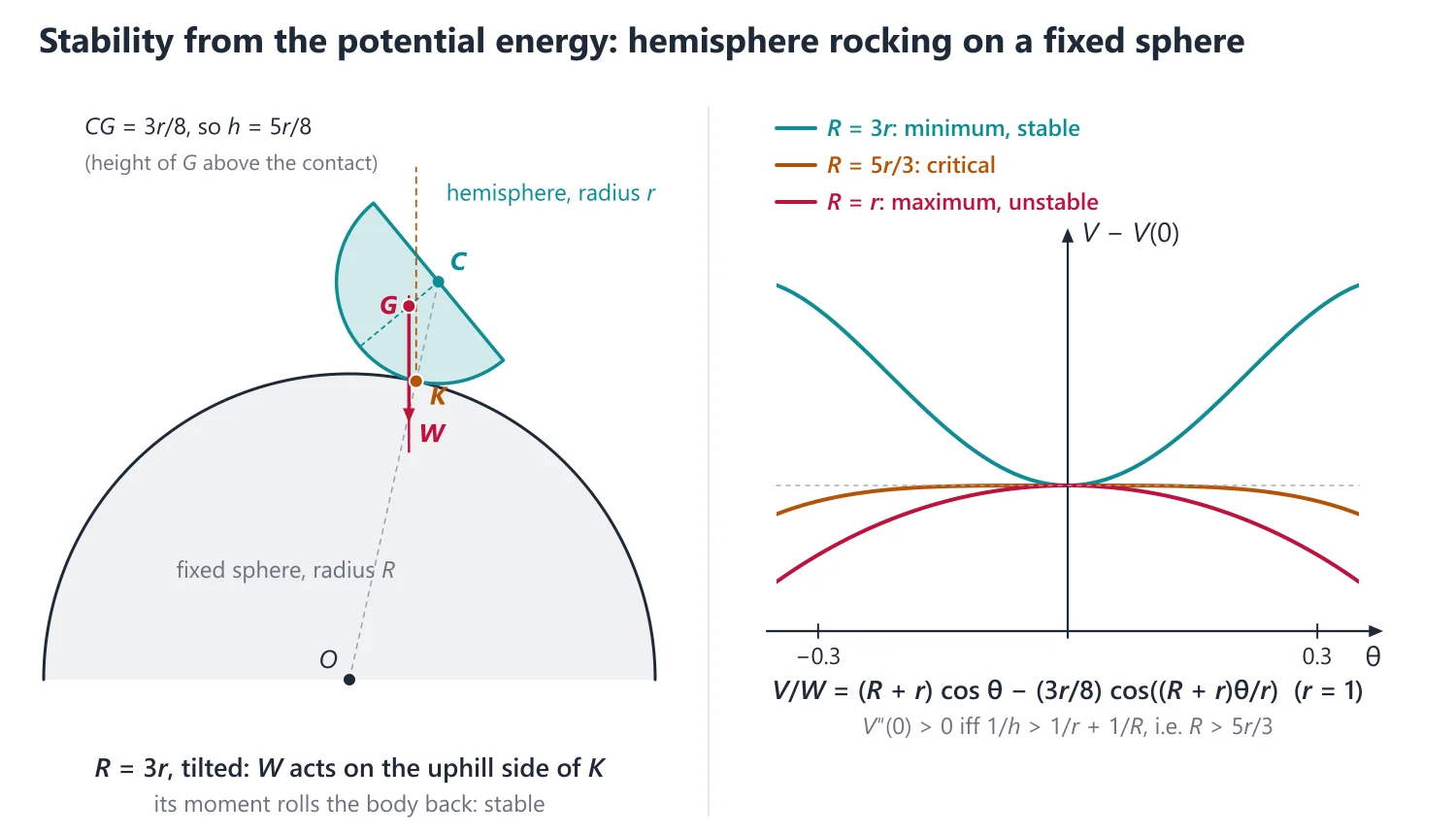
1. Understanding Virtual Work
Why we need it: in a rhombus of four jointed rods, resolving forces needs the reaction at every joint, which means many unknowns and many equations, even when we want only one tension or one angle.
Virtual work gives one equation per degree of freedom in which all the workless reactions are absent from the start.
In words: a virtual displacement is a small change of configuration that we imagine, with time frozen, which the constraints allow: rods keep their lengths, joints stay joined, bodies in contact stay in contact.
The virtual work is Σ F·δr, the sum over the forces of force times the small displacement of its point along the force, keeping only first-order terms.
"Workless" constraint forces are those whose total virtual work is zero for every allowed displacement, such as smooth reactions and inextensible strings.
If the configuration is fixed by one coordinate θ, every δr is a multiple of δθ, so the virtual work is Q δθ for some expression Q, and "zero for every δθ" means Q = 0: one equation.
First example, slowly: a uniform rod AB of length 2a and weight W is hinged smoothly at A to a vertical wall and is held at angle θ above the horizontal by a horizontal force P at B pushing towards the wall; find P.
Step 1 (coordinate): the angle θ fixes the position, so the system has one degree of freedom.
Step 2 (which forces work): W at the centre G and P at B; the hinge reaction acts at A, which does not move, so it does no work and is left out.
Step 3 (positions in θ): G is at height a sin θ, and B is at horizontal distance xB = 2a cos θ from the wall.
Step 4 (vary θ): the weight does work −W δ(a sin θ) = −Wa cos θ δθ; P points towards the wall, so its work is −P δxB = 2aP sin θ δθ.
Step 5 (set the total to zero): (2aP sin θ − Wa cos θ) δθ = 0 for every δθ, so P = (W/2) cot θ.
Step 6 (check): moments about A give P × 2a sin θ = W × a cos θ, the same answer; notice that the hinge reaction never had to be found.
Non-example: a ladder whose foot is about to slide on a rough floor: in a displacement in which the foot slides, friction does work −F δx and cannot be omitted, because that contact is not workless.
Likewise an elastic string does work −T δl as it stretches, so its tension must stay in the equation, and a displacement that breaks a constraint (stretching a rigid rod) is not virtual unless we deliberately replace the rod by its tension.
Building up: (1) for a particle, ΣF·δr = 0 for all δr forces ΣF = 0, by taking δr along i, j, k in turn.
(2) A small rigid-body displacement is δr = δa + δθ × r, so the virtual work is R·δa + G·δθ, which vanishes for all δa, δθ exactly when R = 0 and G = 0 (Derivation: Why Virtual Work Gives Equilibrium).
(3) For a system of bodies, add these equations: workless reactions cancel, and what remains is the virtual work of the applied forces alone.
(4) To find an internal force, let the rod or string change length, include its tension or thrust as a working force, and read it off from the one equation.
Where it is used: rhombus, square and polygon frameworks, strings with rings and pegs, tetrahedra and elastic strings on surfaces (Examples 1 to 3 and 8 to 14); adding the reversed effective forces turns it into D'Alembert's principle and Lagrange's equations (Chapter 14).
2. Principle of Virtual Work
A virtual displacement is an imagined small displacement of the system consistent with the constraints at a fixed instant.
Idea: virtual means imagined with time frozen: the system is not actually moved, we only ask how much work the forces would do if it were moved slightly in a way the constraints allow; only first-order terms in the displacement are kept.
Principle: a system with workless constraints is in equilibrium if and only if the total virtual work of the applied forces is zero, to the first order, for every virtual displacement: Σ(X δx + Y δy + Z δz) = 0.
Idea: the power of the method is that workless reactions drop out, so one equation per degree of freedom gives the answer without finding any reaction; the hypothesis workless matters, because friction at a contact that would slide does work and must be included.
Forces that can be omitted: reactions of smooth surfaces, tensions of inextensible strings, reactions at smooth joints, mutual internal forces of a rigid body, and reactions at a point of rolling contact.
Why it works: a smooth reaction is perpendicular to every allowed displacement of its point; an inextensible string's tensions at its two ends do equal and opposite work; and at a point of rolling contact the point of the body touching the surface is instantaneously at rest, so the reaction and friction there do no work.
To find an internal force (a tension or thrust), replace the string or rod by two equal and opposite forces and allow a displacement that changes its length; the force then appears in the equation.
Method: (1) describe the configuration by one coordinate θ; (2) express the heights and lengths at the points of application in terms of θ; (3) vary θ by δθ and write Σ(force × change of distance in its own direction) = 0; (4) cancel δθ.
A weight W does virtual work −W δz, where z is the height of its point of application; a tension T in a string of length l does −T δl.
Example 1: Two equal uniform rods AB, AC, each of length 2a and weight W, are smoothly jointed at A and stand in a vertical plane with B, C on a smooth table, held by a light string BC; find the tension.
With θ the angle each rod makes with the vertical, the centres of the rods are at height a cos θ and BC = 4a sin θ.
Virtual work: −2W δ(a cos θ) − T δ(4a sin θ) = 0, that is 2Wa sin θ δθ − 4aT cos θ δθ = 0, so T = (W/2) tan θ.
Example 2: A uniform rod of length 2a and weight W rests with its lower end on a smooth floor and its upper end against a smooth vertical wall, at angle θ to the vertical, held by a horizontal string joining the lower end to the foot of the wall; find the tension.
The centre of the rod is at height a cos θ and the string has length 2a sin θ; the reactions of the smooth floor and wall do no work.
Virtual work: −W δ(a cos θ) − T δ(2a sin θ) = 0, that is Wa sin θ − 2aT cos θ = 0, so T = (W/2) tan θ.
Example 3: Four equal uniform rods, each of length 2a and weight W, are freely jointed to form a rhombus ABCD, which hangs from A and is kept in shape by a light rod BD, with angle BAD = 2θ; find the thrust in BD.
Depths below A: centres of AB, AD at a cos θ and of BC, CD at 3a cos θ, total 8a cos θ; BD = 4a sin θ.
A thrust T tends to increase BD, so its virtual work is +T δ(BD); the weights do work +W δ(depth).
W δ(8a cos θ) + T δ(4a sin θ) = 0 gives −8Wa sin θ + 4aT cos θ = 0, so T = 2W tan θ.
3. Understanding Potential Energy and Stability
Why we need it: a pencil can in theory balance on its point, yet in practice it never stays there, while a pendulum always returns to hanging straight down; both are equilibrium positions, and we need a test that tells them apart.
In words: the potential energy V(θ) of a system under weights is ΣWz, each weight times the height of its point; for conservative forces the virtual work equals −δV.
So equilibrium positions are exactly the points where V′(θ) = 0.
Stable means: after a small disturbance the system stays near the position (it oscillates about it); unstable means it moves away; this happens when V has a strict local minimum or a maximum respectively.
First example, slowly: a uniform rod of length 2a and weight W turns freely about a smooth hinge at one end A in a vertical plane; θ is its angle with the downward vertical.
Step 1: the centre G is at height z = −a cos θ relative to A, so V = −Wa cos θ.
Step 2: V′ = Wa sin θ = 0 gives θ = 0 (hanging down) and θ = π (standing up).
Step 3: V″ = Wa cos θ.
Step 4: at θ = 0, V″ = Wa > 0, a minimum: stable.
Step 5: at θ = π, V″ = −Wa < 0, a maximum: unstable.
Step 6: about the stable position the rod performs SHM of period 2π√(I/V″), with moment of inertia I = (4/3)(W/g)a2 about A, which gives 2π√(4a/(3g)), the period of a rod-pendulum of length 2a.
Non-example: V″ = 0 does not mean neutral equilibrium: V = θ4 has V″(0) = 0 but a minimum at 0 (stable), while V = θ3 has V′(0) = V″(0) = 0 and neither a minimum nor a maximum (unstable); only V constant near the position is neutral.
Building up: (1) near θ0, V ≈ V(θ0) + (1/2)V″(θ0)(θ − θ0)2, because V′(θ0) = 0.
(2) Energy conservation with kinetic energy (1/2)Iθ̇2 gives Iθ̈ = −V″(θ0)(θ − θ0): SHM if V″ > 0, exponential growth if V″ < 0 (Derivation: The Energy Test and the Pitch).
(3) When gravity is the only working force, V = W zG, so the test reads: stable where the centre of gravity is at a local lowest point.
Where it is used: rods with strings and weights over pegs, elastic strings, Example 19, and the rocking-body test below; with several coordinates it becomes the positive-definite Hessian test of Chapter 3 and the small-oscillation theory of Chapter 14.
4. Understanding the Test for a Body Rocking on a Curved Surface
Why we need it: many questions place a hemisphere, cube or cylinder on top of (or inside) another curved body and ask whether it stays balanced; writing V for a rolling body each time is slow, and the test 1/h > 1/ρ1 + 1/ρ2 answers it in one line, provided you know exactly what each symbol means.
In words: ρ1 is the radius of curvature of the upper (rocking) body at the point of contact, ρ2 that of the fixed lower body there, and h the height of the upper body's centre of gravity above the point of contact in the equilibrium position.
The contact is rough, so the upper body rolls without slipping; a flat face has ρ = ∞, so its term 1/ρ is 0; if the lower surface is concave (the body rests inside a bowl), its term is −1/ρ2.
First example, slowly: a uniform solid hemisphere of radius 4 cm rests with its curved surface down in three different places; test each.
Step 1 (h): G is 3r/8 = 1.5 cm from the centre of the flat face, and the contact is r = 4 cm below that centre, so h = 4 − 1.5 = 2.5 cm and 1/h = 0.4.
Step 2 (on a horizontal plane): ρ1 = 4 and ρ2 = ∞, so the right side is 0.25; since 0.4 > 0.25, it is stable.
Step 3 (on top of a fixed sphere of radius 6 cm): the right side is 1/4 + 1/6 ≈ 0.417 > 0.4, so it is unstable; it would need a sphere of radius greater than 5r/3 ≈ 6.67 cm (Example 4).
Step 4 (inside a fixed spherical bowl of radius 12 cm): the right side is 1/4 − 1/12 ≈ 0.167 < 0.4, so it is stable.
Notice: the same body becomes harder to balance as the surface under it becomes more sharply convex, and easier inside a bowl.
Non-example: taking h as the distance 1.5 cm of G from the centre of the hemisphere, instead of its height above the point of contact, gives 1/h ≈ 0.667 and wrongly predicts stability in Step 3; and on a smooth surface the body can slide as well as roll, so the rolling test does not apply as stated.
Building up: (1) let the line of the two centres of curvature turn through a small angle φ; rolling means equal arcs, ρ2φ = ρ1ψ, so the upper body turns through χ = φ(ρ1 + ρ2)/ρ1.
(2) The height of G above the lower centre is z = (ρ1 + ρ2) cos φ − (ρ1 − h) cos χ; expanding to order φ2 and asking for a minimum at φ = 0 gives h < ρ1ρ2/(ρ1 + ρ2), which is the test (proof in §4, "Proof of the rolling condition").
(3) So the test is simply the energy test of the previous lesson with V = W zG.
Where it is used: Examples 4, 5 and 15 to 18 and the cube on a sphere in Solved Problems; composite bodies (cone or cylinder on a hemisphere) reduce to finding G and comparing h with ρ1.
5. Work, Potential Energy and Stability
For conservative forces the virtual work is −δV, so the equilibrium positions are the stationary points dV/dθ = 0 of the potential energy V(θ).
Stability: equilibrium is stable if V is a minimum (d2V/dθ2 > 0) and unstable if V is a maximum (d2V/dθ2 < 0); if d2V/dθ2 = 0, examine higher derivatives.
Idea: picture a ball in a bowl (V minimum: a small push raises V, the ball slows and returns) and a ball on top of a dome (V maximum: a small push lowers V, the ball speeds up and runs away); a cone on its vertex and a sphere on a plane show unstable and neutral equilibrium.
When gravity is the only working force, V = Wz, so stable equilibrium corresponds to the centre of gravity being at a lowest position.
Body resting on a rough fixed surface: a body whose surface has radius of curvature ρ1 at the point of contact rests on a fixed surface of radius ρ2, with its centre of gravity at height h above the point of contact on the common normal.
Both surfaces convex: equilibrium is stable if 1/h > 1/ρ1 + 1/ρ2 and unstable if 1/h < 1/ρ1 + 1/ρ2; on a fixed plane (ρ2 = ∞) the condition is h < ρ1.
Idea: the test compares h with the combined radius ρ1ρ2/(ρ1 + ρ2): a low centre of gravity is stable, and a more sharply curved lower surface (small ρ2) makes balancing harder; on a plane it reduces to G below the centre of curvature of the rocking surface.
If the upper body rests inside a fixed concave surface, replace 1/ρ2 by −1/ρ2.
Example 4: A uniform solid hemisphere of radius r rests with its curved surface on top of a fixed rough sphere of radius R; when is the equilibrium stable?
The centre of gravity is 3r/8 from the centre of the plane face, so h = r − 3r/8 = 5r/8; stability requires 8/(5r) > 1/r + 1/R, that is R > 5r/3.
Example 5: A solid consists of a right circular cone of height H and a hemisphere of the same radius r, joined at their common base; it rests with the hemisphere on a horizontal plane. Find the condition for stable equilibrium in the upright position.
On a plane, stability needs the centre of gravity G below the centre of curvature of the hemisphere, which is the centre O of the common base (h < ρ1 = r).
Taking moments about O: the hemisphere (mass ∝ (2/3)r3) has its centre 3r/8 below O, and the cone (mass ∝ (1/3)r2H) has its centre H/4 above O.
G is below O if (2/3)r3(3r/8) > (1/3)r2H(H/4), that is r2/4 > H2/12, so the equilibrium is stable if H < √3 r.
6. Understanding the Reduction of Forces in Space
Why we need it: forces on a body in space usually neither meet at a point nor lie in a plane; to test equilibrium, and to describe their total effect, we replace them by the simplest equivalent system.
In words: choose a base point O; R = ΣFi is the vector sum of the forces and G = Σri × Fi = (L, M, N) the sum of their moments about O, ri being the position of the point where Fi acts.
Moving a force to O without changing its effect needs an extra couple equal to its moment about O; that is why the system becomes "R at O plus the couple G".
R·R and R·G are invariants: they come out the same whichever base point is chosen; the pitch p = R·G/R·R measures twist per unit push, and the central axis is the line on which the couple is parallel to R.
First example, slowly: a force (0, 0, 2) acts at the point (1, 0, 0) and a force (0, 3, 0) acts at the origin; reduce the system to a wrench.
Step 1: R = (0, 0, 2) + (0, 3, 0) = (0, 3, 2), so R·R = 13.
Step 2: the second force acts at O and has no moment; the first gives (1, 0, 0) × (0, 0, 2) = (0, −2, 0), so G = (0, −2, 0).
Step 3: R·G = −6 ≠ 0, so the system is a genuine wrench (not a single force), with pitch p = −6/13.
Step 4: the central axis solves G − r × R = pR with r = (x, y, z); here r × R = (2y − 3z, −2x, 3x), so the equations are 3z − 2y = 0, 2x − 2 = −18/13 and −3x = −12/13.
Step 5: both of the last two give x = 4/13 (they must agree, which is a check), and the first gives y/3 = z/2; the axis is the line x = 4/13, y/3 = z/2, parallel to R as it should be.
Step 6: the two skew forces are equivalent to a force √13 along this line together with a couple of moment |p|√13 = 6/√13 about it, in the left-handed sense because p < 0.
Non-example: forces (1, 0, 0) at (0, 1, 0) and (0, 1, 0) at (2, 0, 0) lie in the plane z = 0; then G = (0, 0, 1) is perpendicular to R = (1, 1, 0), so R·G = 0 and the system is a single force, not a wrench: coplanar forces never produce a genuine wrench.
Building up: (1) changing the base point by a gives G′ = G − a × R, and a × R is perpendicular to R, so R·G′ = R·G: the invariants.
(2) Asking for a base point where G′ = pR and dotting with R gives p = R·G/R·R; the components of G − r × R = pR are the equations of the central axis (Derivation: The Energy Test and the Pitch).
(3) Equilibrium is the case R = 0 and G = 0, which is what the virtual work derivation also gives.
Where it is used: questions that ask to reduce given forces to a wrench, find the pitch and the equation of the central axis, or the condition for forces to have a single resultant; it uses the vector product of Chapter 7 and the symmetric form of a line from Chapter 4.
7. Equilibrium of Forces in Three Dimensions
Any system of forces on a rigid body reduces to a single force R = (X, Y, Z) at a chosen base point O together with a couple G = (L, M, N).
Conditions of equilibrium: X = Y = Z = 0 and L = M = N = 0.
Invariants: X2 + Y2 + Z2 and LX + MY + NZ do not depend on the base point.
Why it works: moving the base point from O to O′ with OO′ = a leaves R unchanged and changes the couple to G′ = G − a × R; since (a × R)·R = 0, G′·R = G·R, so both |R|2 and G·R are the same for every base point.
Wrench: the system is equivalent to a force R along a line together with a couple about that line, of pitch p = (LX + MY + NZ)/(X2 + Y2 + Z2).
Idea: every system of forces acts like a screwdriver: a push along an axis together with a twist about the same axis; the pitch p is the ratio twist/push, and p = 0 means a single force, while R = 0 leaves a pure couple.
The line, Poinsot's central axis, is (L − yZ + zY)/X = (M − zX + xZ)/Y = (N − xY + yX)/Z, the common value being p.
The system reduces to a single force if and only if LX + MY + NZ = 0 with R ≠ 0, and to a single couple if R = 0.
Example 6: R = (1, 2, 2) and G = (3, 0, 0) at O give p = 3/9 = 1/3, and the central axis is the line x/1 = (y − 2/3)/2 = (z + 2/3)/2.
Example 7: A force P acts along the x-axis and an equal force P acts along the line x = 0, z = c parallel to the y-axis; reduce the system to a wrench.
At O: R = (P, P, 0); the second force at (0, 0, c) has moment (0, 0, c) × (0, P, 0) = (−cP, 0, 0), so G = (−cP, 0, 0).
Pitch p = (LX + MY + NZ)/(X2 + Y2 + Z2) = −cP2/(2P2) = −c/2.
Central axis: G − r × R = pR with r = (x, y, z) gives (zP − cP, −zP, (y − x)P) = (−c/2)(P, P, 0), so x = y, z = c/2.
The wrench is a force P√2 along the line x = y, z = c/2 with a couple of moment (c/2)P√2 about it, in the left-handed sense since p is negative.
8. Frameworks, Strings and the Proof of the Rolling Condition
Frameworks: for a symmetric framework hung from a joint, take as coordinate the angle θ of a rod with the vertical, express the depths of all the centres of gravity and the length of the light rod in terms of θ, and use δ(Σ W × depth) ± T δ(length) = 0 (+ for a thrust, − for a tension).
If a polygon of jointed rods has more than one degree of freedom, write the closure condition (for example a horizontal side of fixed length) and use it to relate the variations of the angles (Example 9).
Strings over pegs and rings: the tension is the same throughout a string passing over smooth pegs or through a smooth ring; for a ring of weight W hanging on such a string, W δ(depth of ring) = T δ(length of string).
Elastic strings: the tension T = λ(L − L0)/L0 does virtual work −T δL; equivalently add the elastic energy λ(L − L0)2/(2L0) to the potential energy.
Proof of the rolling condition: let the upper body (radius of curvature ρ at the contact) roll without slipping on the fixed lower body (radius ρ′); if the line of the centres of curvature turns through φ, equal arcs ρ′φ = ρψ give the upper body a total rotation χ = φ + ψ = φ(ρ + ρ′)/ρ.
The height of G above the lower centre of curvature is z = (ρ + ρ′) cos φ − (ρ − h) cos χ ≈ (ρ′ + h) − (ρ + ρ′)φ2/2 + (ρ − h)(ρ + ρ′)2φ2/(2ρ2).
z has a minimum at φ = 0 if (ρ − h)(ρ + ρ′) > ρ2, that is h < ρρ′/(ρ + ρ′), equivalently 1/h > 1/ρ + 1/ρ′ (Example 16).
Body on a rough inclined plane: a body with a spherical surface of radius a in contact rests only if its centre of gravity is vertically above the point of contact (and friction can hold it, μ ≥ tan of the inclination); with G at distance d from the centre of that surface, this needs sin(inclination) ≤ d/a.
9. Derivation: Why Virtual Work Gives Equilibrium
Particle: if ΣF = 0 then ΣF·δr = 0 for every δr; conversely, taking δr along i, j, k in turn gives ΣX = ΣY = ΣZ = 0.
Rigid body: a small displacement of a rigid body is a translation δa plus a small rotation δθ, so a point at r moves by δr = δa + δθ × r.
Then ΣF·δr = (ΣF)·δa + Σ F·(δθ × r) = R·δa + δθ·Σ(r × F) = R·δa + G·δθ.
This is zero for all δa and δθ if and only if R = 0 and G = 0, which are exactly the conditions of equilibrium; internal forces cancel in pairs because the distance between two points of a rigid body does not change.
10. Derivation: The Energy Test and the Pitch
Energy test: near an equilibrium θ0, V(θ) ≈ V(θ0) + (1/2)V″(θ0)(θ − θ0)2, and with kinetic energy (1/2)Iθ̇2 the equation of motion is Iθ̈ = −V″(θ0)(θ − θ0).
If V″(θ0) > 0 this is SHM about θ0 (stable), with period 2π√(I/V″(θ0)); if V″(θ0) < 0 the solutions grow exponentially (unstable).
Pitch and central axis: look for a base point r where the couple G − r × R is parallel to R, say equal to pR; dotting with R removes r × R and gives p = G·R/|R|2.
Writing G − r × R = pR in components, L − (yZ − zY) = pX and so on, which is the equation of the central axis; it is a straight line parallel to R, and about it the couple has its least magnitude |G·R|/|R|.
11. Choosing the Method
If a system of smoothly jointed rods, strings or frameworks has one degree of freedom and a tension, thrust or equilibrium position is asked → virtual work with one coordinate θ.
If a reaction at a smooth contact or joint is asked → resolving and moments are more direct, since the principle of virtual work hides exactly these forces (or break the constraint so the reaction does work).
If the nature of an equilibrium is asked → write V(θ), solve V′ = 0, and test the sign of V″; for a body rocking on a curved surface use the 1/h test directly.
If forces act along given lines in space → reduce them to R and G at the origin, then find p = G·R/|R|2 and the central axis; the system is a single force exactly when G·R = 0 with R ≠ 0.
12. Common Mistakes
Getting the sign of a weight's virtual work wrong: it is −W δz with z measured upwards, or +W δ(depth) with depth measured downwards; mixing the two conventions in one equation is the commonest error.
Using the wrong sign for an internal force: a tension T in a string of length l contributes −T δl, a thrust in a rod contributes +T δl.
Varying a quantity before expressing it in terms of θ, or treating a length that the displacement changes as constant.
Concluding neutral equilibrium from V″ = 0; examine higher derivatives (the first non-zero one must be of even order and positive for stability).
In the rocking-body test, measuring h from the centre of the curved surface instead of from the point of contact, or using a diameter for ρ.
13. Connections
Link: adding the reversed effective forces −m d2r/dt2 to virtual work gives D'Alembert's principle, from which Lagrange's equations are derived (Chapter 14).
Link: the energy test is the second-derivative test for a minimum (Chapter 3); with several coordinates it becomes the condition that the Hessian of V is positive definite, a quadratic-form question from Linear Algebra (Chapter 2).
Link: the central axis is a straight line in space written in symmetric form, as in Chapter 4.
14. Solved UPSC Questions
Example 8 (UPSC 2014, 10 marks): Two equal uniform rods AB and AC, each of length l, are freely jointed at A and rest on a smooth fixed vertical circle of radius r. If 2θ is the angle between the rods, then find the relation between l, r and θ, by using the principle of virtual work.
Let O be the centre of the circle; by symmetry A is vertically above O and each rod touches the circle, making angle θ with the vertical.
The distance from O to each rod is r, so OA = r cosec θ, and the centre of each rod is (l/2) cos θ below A.
Height of the centres of gravity above O: z = r cosec θ − (l/2) cos θ.
The reactions of the smooth circle and at the joint do no work, so the virtual work −2W δz = 0 gives dz/dθ = −r cos θ/sin2θ + (l/2) sin θ = 0.
Answer: l sin3θ = 2r cos θ.
Example 9 (UPSC 2014, 20 marks): A regular pentagon ABCDE, formed of equal heavy uniform bars jointed together, is suspended from the joint A, and is maintained in form by a light rod joining the middle points of BC and DE. Find the stress in this rod.
Let each bar have length 2a and weight W; by symmetry AB, AE make angle θ with the vertical, BC, ED make angle φ, and CD is horizontal; for the regular pentagon θ = 54° and φ = 18°.
Closure: the half-width at C is a, so 2a sin θ − 2a sin φ = a, which gives cos θ δθ = cos φ δφ.
Depths below A: AB, AE at a cos θ; BC, ED at 2a cos θ + a cos φ; CD at 2a cos θ + 2a cos φ; in total z = 8a cos θ + 4a cos φ.
The light rod joins the mid-points of BC and DE, so its length is L = 2(2a sin θ − a sin φ), and δL = 4a cos θ δθ − 2a cos φ δφ = 2a cos θ δθ.
With a thrust T in the rod, W δz + T δL = 0: −W(8a sin θ + 4a sin φ cos θ/cos φ)δθ + 2aT cos θ δθ = 0.
So T = W(4 tan θ + 2 tan φ) = 2W(2 tan 54° + tan 18°) = 2W cot 18°, using cot x − tan x = 2 cot 2x.
Answer: the rod is in compression, with thrust 2W cot 18° ≈ 6.16W, W being the weight of one bar.
Example 10 (UPSC 2016, 20 marks): A square ABCD, the length of whose sides is a, is fixed in a vertical plane with two of its sides horizontal. An endless string of length l (> 4a) passes over four pegs at the angles of the board and through a ring of weight W which is hanging vertically. Show that the tension of the string is W(l − 3a)/(2√(l2 − 6la + 8a2)).
The string passes over the pegs A, B at the top, down the vertical sides to D, C, and from the lower pegs to the ring; so the length below DC is l − 3a, and each slant part has length s = (l − 3a)/2.
Let the ring be at depth x below DC; then s2 = x2 + a2/4.
Virtual work, allowing the string to stretch: W δx − T δ(2s) = 0, and δs = (x/s) δx, so T = Ws/(2x).
Here x = √(s2 − a2/4) = (1/2)√((l − 3a)2 − a2) = (1/2)√(l2 − 6la + 8a2).
Answer: T = W(l − 3a)/(2√(l2 − 6la + 8a2)); resolving vertically at the ring, 2T(x/s) = W, confirms it.
Example 11 (UPSC 2020, 20 marks): (i) A square framework formed of uniform heavy rods of equal weight W jointed together, is hung up by one corner. A weight W is suspended from each of the three lower corners, and the shape of the square is preserved by a light rod along the horizontal diagonal. Find the thrust of the light rod.
Let each rod have length 2a and weight W, the square hang from A with ∠BAD = 2θ and BD horizontal, and weights W hang at B, C and D.
Depths below A: centres of AB, AD at a cos θ and of BC, CD at 3a cos θ; B and D at 2a cos θ; C at 4a cos θ.
Sum of (weight × depth) = W(2a + 6a) cos θ + W(4a + 4a) cos θ = 16Wa cos θ, and BD = 4a sin θ.
With a thrust T in BD: δ(16Wa cos θ) + T δ(4a sin θ) = 0, that is −16Wa sin θ + 4aT cos θ = 0, so T = 4W tan θ.
Answer: for the square θ = 45°, so the thrust in the light rod is 4W.
Example 12 (UPSC 2022, 15 marks): A chain of n equal uniform rods is smoothly jointed together and suspended from its one end A1. A horizontal force P is applied to the other end An+1 of the chain. Find the inclinations of the rods to the downward vertical line in the equilibrium configuration.
Let each rod have length 2a and weight W, and let the r-th rod ArAr+1 make angle θr with the downward vertical.
Depth of the centre of rod r below A1: 2a(cos θ1 + ... + cos θr−1) + a cos θr; horizontal distance of An+1 from A1: x = 2a Σ sin θr.
Virtual work: W δ(sum of depths) + P δx = 0, and the angles θr can be varied independently.
cos θr occurs in the depth of rod r (coefficient a) and of the n − r rods below it (2a each), so the coefficient of δθr gives −Wa(2n − 2r + 1) sin θr + 2aP cos θr = 0.
Answer: tan θr = 2P/((2n − 2r + 1)W) for r = 1, 2, ..., n, so tan θ1 : tan θ2 : ... : tan θn = 1/(2n − 1) : 1/(2n − 3) : ... : 1/1.
Example 13 (UPSC 2024, 15 marks): A regular tetrahedron, formed of six light rods, each of length l, rests on a smooth horizontal plane. A ring of weight W and radius r is supported by the slant sides. Using the principle of virtual work, find the stress in any of the horizontal sides.
Let the horizontal sides have length x (they may stretch in the virtual displacement, so each is replaced by its tension T), the slant sides keep length l, and R = x/√3 be the distance of the base vertices from the vertical axis.
The apex is at height H = √(l2 − R2), and a point of a slant side at depth D below the apex is at distance RD/H from the axis.
The ring rests round the three slant sides at the level where this distance equals r, that is D = rH/R, so its height is z = H(1 − r/R).
Virtual work: −W δz − 3T δx = 0, so T = −(W/3) dz/dx = −(W/(3√3)) dz/dR.
dz/dR = −(R − r)/H + rH/R2; for the regular tetrahedron R = l/√3 and H = l√(2/3), so dz/dR = −(l − √3r)/(√2l) + √6r/l = −(l − 3√3r)/(√2l).
Hence T = W(l − 3√3r)/(3√6 l).
Answer: each horizontal side has tension W(l − 3√3r)/(3√6 l); it is a thrust if r > l/(3√3).
Example 14 (UPSC 2026, 10 marks): A smooth paraboloid of revolution is fixed with its axis vertical and vertex upwards; on it is placed a heavy elastic string of unstretched length 2πb. When the string is in equilibrium, apply the principle of virtual work to show that it rests in the form of a circle of radius 4πabλ/(4πaλ − Wb), where W is the weight of the string, λ is the modulus of elasticity and 4a is the latus rectum of the generating parabola.
Let the string rest as a horizontal circle of radius x; the generating parabola (vertex up, latus rectum 4a) is x2 = 4ad, d being the depth below the vertex, so the string is at height −x2/(4a).
Its stretched length is 2πx, so its tension is T = λ(2πx − 2πb)/(2πb) = λ(x − b)/b.
Virtual work for a change δx (the smooth surface does no work): −W δ(−x2/(4a)) − T δ(2πx) = 0, that is Wx/(2a) = 2πλ(x − b)/b.
So 4πaλ(x − b) = Wbx, that is x(4πaλ − Wb) = 4πabλ.
Answer: the radius is x = 4πabλ/(4πaλ − Wb), which requires 4πaλ > Wb.
Example 15 (UPSC 2017, 17 marks): A uniform solid hemisphere rests on a rough plane inclined to the horizon at an angle φ with its curved surface touching the plane. Find the greatest admissible value of the inclination φ for equilibrium. If φ be less than this value, is the equilibrium stable?
Let O be the centre and a the radius; G is on the axis with OG = 3a/8, and the contact point P is the foot of the normal from O to the plane, so OP makes angle φ with the vertical.
Only the weight and the reaction at P act, so G must be vertically above P: the horizontal offset a sin φ of O from P must be cancelled by OG, so (3a/8) sin β = a sin φ, β being the angle of OG with the vertical.
This needs sin φ ≤ 3/8, so the greatest inclination is sin−1(3/8) ≈ 22°, provided friction can hold the body (μ ≥ tan φ, which at the limit is μ ≥ 3/√55).
Stability: if the body rolls down the plane through a small angle χ, O moves parallel to the plane through aχ, and the height of G is z(χ) = constant − aχ sin φ − (3a/8) cos(β + χ).
dz/dχ = 0 at χ = 0 gives back sin β = (8/3) sin φ, and d2z/dχ2 = (3a/8) cos β > 0 because G is below O (β acute).
Answer: the greatest inclination is sin−1(3/8); for smaller φ the equilibrium is stable.
Example 16 (UPSC 2022, 15 marks): Suppose a cylinder of any cross-section is balanced on another fixed cylinder, the contact of curved surfaces being rough and the common tangent line horizontal. Let ρ and ρ′ be the radii of curvature of the two cylinders at the point of contact and h be the height of centre of gravity of the upper cylinder above the point of contact. Show that the upper cylinder is balanced in stable equilibrium if h < ρρ′/(ρ + ρ′).
Let O′ be the fixed centre of curvature of the lower cylinder (radius ρ′) and O that of the upper (radius ρ); initially O, G, the point of contact and O′ lie on a vertical line, with G at height h above the contact.
Let the upper cylinder roll (rough contact, no slipping) until O′O makes a small angle φ with the vertical; equal arcs ρ′φ = ρψ mean the upper body has turned through χ = φ + ψ = φ(ρ + ρ′)/ρ.
G lies on the body's line through O at distance ρ − h from O, and that line has turned through χ, so the height of G above O′ is z = (ρ + ρ′) cos φ − (ρ − h) cos χ.
For small φ: z ≈ (ρ′ + h) − [(ρ + ρ′) − (ρ − h)(ρ + ρ′)2/ρ2]φ2/2.
The equilibrium is stable if z is a minimum at φ = 0, that is (ρ − h)(ρ + ρ′) > ρ2, which simplifies to ρρ′ > h(ρ + ρ′).
Answer: the upper cylinder is in stable equilibrium if h < ρρ′/(ρ + ρ′), and unstable if h > ρρ′/(ρ + ρ′).
Example 17 (UPSC 2024, 10 marks): A solid hemisphere rests in equilibrium on a solid sphere of equal radius. Determine the stability of the equilibrium in the two situations — (i) when the curved surface and (ii) when the flat surface of the hemisphere rests on the sphere.
Let the common radius be r and use the rule of §2: stable if 1/h > 1/ρ1 + 1/ρ2, h being the height of G above the point of contact (rough contact assumed).
(i) Curved surface down: ρ1 = ρ2 = r and h = r − 3r/8 = 5r/8, so 1/h = 8/(5r) = 1.6/r, which is less than 2/r: unstable.
(ii) Flat face down: ρ1 = ∞, ρ2 = r and h = 3r/8, so 1/h = 8/(3r) > 1/r: stable.
Answer: (i) unstable; (ii) stable.
Example 18 (UPSC 2025, 15 marks): A solid sphere rests inside a fixed rough and hemispherical bowl of twice its radius. If a large amount of weight, whatsoever, is attached to the highest point of the sphere, then show that the equilibrium is stable.
Let the sphere have radius a and weight W, the bowl radius 2a and centre O, and a weight W′ be fixed at the top point P of the sphere.
As the sphere rolls, its centre C moves on the circle of radius a about O; let OC make angle φ with the downward vertical, so C = O + a(sin φ, −cos φ) in the vertical plane.
Rolling without slipping inside the bowl turns the sphere through (2a − a)φ/a = φ in the opposite sense, so the radius CP, initially vertical, becomes a(sin φ, cos φ) and P = O + (2a sin φ, 0).
Hence P stays at the level of O for every φ (it moves along a horizontal diameter of the bowl), and the potential energy is V = −Wa cos φ + W′ × 0.
V has a minimum at φ = 0 whatever W′ is, so the equilibrium is stable however large W′ is.
Check by the rule for a body inside a concave surface: 1/h > 1/ρ1 − 1/ρ2 = 1/(2a) needs h < 2a, and h = (Wa + 2aW′)/(W + W′) is always less than 2a.
Answer: the equilibrium is stable for every attached weight.
Example 19 (UPSC 2026, 15 marks): AB is a uniform rod of length l and weight W, which can turn freely about a fixed point in its length distant l/3 from A. AC and BC are light strings each of length (5/6)l, attached to a particle C of weight w. Prove that if W is less than 2w, there will be stable equilibrium with AB inclined to the horizontal at an angle tan−1((W + w)/(4w)).
Let O be the fixed point (OA = l/3, OB = 2l/3) and let AB make angle θ with the horizontal, B being higher when θ > 0; the centre G of the rod is l/6 from O towards B.
Triangle ACB has AC = BC = 5l/6 and AB = l, so C is at distance √(25l2/36 − l2/4) = 2l/3 from G, below AB on its perpendicular.
While both strings are taut the system is rigid; heights above O: zG = (l/6) sin θ and zC = (l/6) sin θ − (2l/3) cos θ.
V = (W + w)(l/6) sin θ − (2l/3)w cos θ, and dV/dθ = (W + w)(l/6) cos θ + (2l/3)w sin θ = 0 gives tan θ = −(W + w)/(4w): AB is inclined at α = tan−1((W + w)/(4w)), with B lower.
At θ = −α, d2V/dθ2 = (W + w)(l/6) sin α + (2l/3)w cos α > 0, so this equilibrium is stable.
Both strings stay taut only if the vertical through C meets AB between A and B; C is at horizontal distance (l/6) cos α − (2l/3) sin α from O, and this is not beyond A, at −(l/3) cos α, only if tan α ≤ 3/4.
tan α = (W + w)/(4w) < 3/4 is exactly W < 2w.
Answer: if W < 2w the stable position has AB inclined to the horizontal at tan−1((W + w)/(4w)); if W > 2w one string would slacken.
15. Practice Exercises
Exercise 1 (basic): A system has potential energy V(θ) = θ3 − 3θ. Find its positions of equilibrium and their nature.
Answer: V′ = 3θ2 − 3 = 0 gives θ = ±1; V″ = 6θ, so θ = 1 is stable and θ = −1 is unstable.
Exercise 2 (basic): A force system reduces at the origin to R = (2, 1, 2) and G = (1, 0, 1). Find the pitch and say whether the system has a single resultant.
Answer: p = R·G/R·R = 4/9 ≠ 0, so it is a genuine wrench and has no single resultant.
Exercise 3 (basic): A body with a flat base rests on top of a fixed rough sphere of radius 20 cm, its centre of gravity being 15 cm above the point of contact. Is the equilibrium stable?
Answer: yes: ρ1 = ∞, so the test is 1/15 > 1/20, which holds (equivalently h < ρ2).
Exercise 4 (standard): Four equal uniform rods, each of weight W and length 2a, are smoothly jointed into a rhombus ABCD, which hangs from A and is kept in shape by a light string AC. Find the tension in the string.
Answer: with ∠BAC = θ, the total depth of the centres is 8a cos θ and AC = 4a cos θ; W δ(8a cos θ) − T δ(4a cos θ) = 0 gives T = 2W, whatever the angle.
Exercise 5 (standard): A smooth ring of weight W slides on a light inextensible string of length 2l whose ends are fixed at two points at the same level, 2a apart. Using virtual work, find the tension.
Answer: let each half have length s, so the ring's depth is z = √(s2 − a2); W δz − T δ(2s) = 0 gives T = Ws/(2z) = Wl/(2√(l2 − a2)).
Exercise 6 (standard): A uniform rod AB of length 2a and weight W turns about a smooth hinge at A; a light string tied to B passes over a smooth peg C vertically above A, with AC = 2a, and carries a hanging weight P < W. With θ = ∠BAC, find the positions of equilibrium and their stability.
Answer: BC = 4a sin(θ/2), so V = Wa cos θ + 4Pa sin(θ/2); V′ = 0 gives θ = π, which is stable (V″ = (W − P)a > 0), and sin(θ/2) = P/W, which is unstable (V″ = −a(W2 − P2)/W < 0).
Exercise 7 (standard): A force F acts along the x-axis and an equal force F acts along the line through (0, a, 0) parallel to the z-axis. Find the pitch and the central axis of the system.
Answer: R = (F, 0, F) and G = (aF, 0, 0), so p = aF2/(2F2) = a/2; the central axis is x = z, y = a/2, and the wrench is a force F√2 along it with a couple (a/2)F√2.
Exercise 8 (UPSC level): Three equal uniform rods AB, BC, CD, each of weight W and length 2a, are smoothly jointed at B and C and stand in a vertical plane with A and D on a smooth horizontal table, BC horizontal and AB, DC each inclined at θ to the vertical, sloping outwards; A and D are joined by a light string. Find its tension by virtual work.
Answer: the heights of the centres total 4a cos θ (a cos θ twice and 2a cos θ once) and AD = 2a + 4a sin θ; −W δ(4a cos θ) − T δ(4a sin θ) = 0 gives T = W tan θ.
Exercise 9 (UPSC level): A toy consists of a uniform solid cylinder of radius r and length L joined to a uniform solid hemisphere of the same radius and material along their common circular face; it rests with the hemisphere on a rough horizontal plane. Find the greatest L for which the upright position is stable.
Answer: G must lie below the centre O of the common face: (2/3)r3(3r/8) > r2L(L/2), that is L < r/√2.
Exercise 10 (UPSC level): In Exercise 4 the string AC is replaced by an elastic string of natural length 2a and modulus λ. Find the angle ∠BAC in equilibrium and the condition on λ for such a position to exist.
Answer: the tension must still be 2W, so λ(4a cos θ − 2a)/(2a) = 2W, giving cos θ = (λ + 2W)/(2λ); this needs λ > 2W.
| Condition | System reduces to |
|---|---|
| R = 0, G = 0 | Equilibrium |
| R = 0, G ≠ 0 | A single couple |
| R ≠ 0, LX + MY + NZ = 0 | A single force (along the central axis) |
| R ≠ 0, LX + MY + NZ ≠ 0 | A wrench of pitch p = (LX + MY + NZ)/R2 |
Mains points
- Virtual work is a favourite for frameworks of jointed rods, strings and rhombuses: state the principle, list the forces that do no work, and then write the single equation.
- Measure all heights from a fixed level and differentiate the positions, not the forces; a sign error in δ(height) is the usual mistake.
- For stability, compute V(θ), find dV/dθ = 0, and test the sign of d2V/dθ2 at each equilibrium position.
- Rocking-body stability questions (hemisphere, cylinder or cube on a curved surface) are answered with the 1/h formula; quote it with the meaning of h, ρ1, ρ2.
- For three-dimensional systems, compute R, G, the invariant LX + MY + NZ, the pitch and the central axis in that order.
Did you know?
- Lagrange made virtual work the foundation of all of mechanics in his Mécanique analytique (1788), a book famous for containing no diagrams.
Solved Problems: Dynamics and Statics
Fifteen UPSC-style problems covering the whole chapter: SHM and elastic strings, resisted motion, projectiles, motion in a vertical circle, central orbits, friction, the catenary, virtual work and stability. Each has a full solution and a boxed answer.
1. Rectilinear Motion, SHM and Elastic Strings
Problem 1 (10 marks): A particle moving in SHM has speeds 8 cm/s and 6 cm/s at distances 3 cm and 4 cm from the centre. Find the amplitude, the period and the greatest speed.
v2 = μ(a2 − x2) gives 64 = μ(a2 − 9) and 36 = μ(a2 − 16).
Subtracting, 28 = 7μ, so μ = 4; then a2 − 9 = 16 and a = 5 cm.
Period T = 2π/√μ = π s; greatest speed a√μ = 10 cm/s, at the centre.
Answer: amplitude 5 cm, period π s ≈ 3.14 s, greatest speed 10 cm/s.
Problem 2 (15 marks): A particle is projected vertically upwards with speed u in a medium whose resistance is kv2 per unit mass. Find the greatest height reached and the time taken to reach it.
On the way up both gravity and resistance act downwards: v dv/dx = −(g + kv2).
Integrating, x = (1/(2k)) log[(g + ku2)/(g + kv2)]; at the top v = 0, so H = (1/(2k)) log(1 + ku2/g).
For the time, dv/dt = −(g + kv2), so t = ∫0u dv/(g + kv2) = (1/√(gk)) tan−1(u√(k/g)).
Check: as k → 0, H → u2/(2g) and t → u/g, the results without resistance.
Answer: H = (1/(2k)) log(1 + ku2/g) and t = (1/√(gk)) tan−1(u√(k/g)).
Problem 3 (15 marks): A particle of mass m hangs at rest from a fixed point O by a light elastic string of natural length a and modulus mg. It is pulled down a further distance 2a and released. Find the height above O to which it rises and the time taken to get there.
Equilibrium extension e = mga/(mg) = a, so the equilibrium position is 2a below O, and while the string is taut the motion is SHM with μ = g/a and amplitude 2a.
The string becomes slack at its natural length, a distance a above the equilibrium position; there v2 = μ(4a2 − a2) = 3ga.
Time in SHM: with x = −2a cos √μ t measured upward from equilibrium, x = a when cos √μ t = −1/2, so t1 = (2π/3)√(a/g).
It then rises freely through v2/(2g) = 3a/2 in time t2 = v/g = √(3a/g), reaching a point 3a/2 − a = a/2 above O.
Answer: it rises to a/2 above O, in time (2π/3 + √3)√(a/g).
2. Motion in a Plane and Projectiles
Problem 4 (10 marks): The radial and transverse velocities of a particle are λr and μθ, where λ, μ are constants. Find its radial and transverse accelerations.
dr/dt = λr and r dθ/dt = μθ, so dθ/dt = μθ/r and d2r/dt2 = λ dr/dt = λ2r.
Radial: ar = d2r/dt2 − r(dθ/dt)2 = λ2r − μ2θ2/r.
Transverse: aθ = (1/r) d/dt(r2 dθ/dt) = (1/r) d/dt(μrθ) = (μ/r)(λrθ + μθ).
Answer: ar = λ2r − μ2θ2/r and aθ = μθ(λ + μ/r).
Problem 5 (15 marks): A particle is projected with speed 30 m/s from a point on a plane inclined at 30° to the horizontal, in the vertical plane through the line of greatest slope (take g = 10 m/s2). Find the angle of projection for the greatest range up the plane, that range, and the time of flight.
The range up the plane is greatest when α = π/4 + β/2 = 45° + 15° = 60° with the horizontal.
Rmax = u2/(g(1 + sin β)) = 900/(10 × 1.5) = 60 m.
Check with R = 2u2 cos α sin(α − β)/(g cos2β) = 2 × 900 × (1/2)(1/2)/(10 × 3/4) = 60 m.
Time of flight T = 2u sin(α − β)/(g cos β) = 2 × 30 × (1/2)/(10 × √3/2) = 2√3 s.
Answer: α = 60° with the horizontal, greatest range 60 m, time of flight 2√3 ≈ 3.46 s.
Problem 6 (10 marks): A ball projected from a point on level ground at angle α just clears a wall of height h at horizontal distance a and lands at distance b beyond the wall. Show that tan α = h(a + b)/(ab).
With range R = a + b, the path y = x tan α − gx2/(2u2 cos2α) can be written y = x tan α (1 − x/R), since y = 0 at x = R.
The wall top (a, h) lies on the path: h = a tan α × b/(a + b).
Answer: tan α = h(a + b)/(ab).
3. Constrained Motion, Work and Energy
Problem 7 (10 marks): A particle of mass m on a string of length a is projected horizontally from the lowest point with speed √(6ga) and moves in a vertical circle. Find the tension at the lowest point, at the level of the centre and at the highest point.
T = (m/a)(u2 − 2ga + 3ga cos θ) with θ measured from the lowest point, and u2 = 6ga > 5ga, so the circle is completed.
θ = 0: T = (m/a)(7ga) = 7mg; θ = π/2: T = (m/a)(4ga) = 4mg; θ = π: T = (m/a)(ga) = mg.
Answer: 7mg, 4mg and mg; the difference between the lowest and highest tensions is always 6mg when the circle is completed.
Problem 8 (10 marks): One end of a light elastic string of natural length a is fixed at O and a particle of mass m is attached to the other end. The particle is dropped from O and first comes to rest at depth 3a below O. Find the modulus of the string and the greatest tension.
Work-energy from O to the lowest point (both speeds zero): mg(3a) = λ(2a)2/(2a) = 2λa.
So λ = 3mg/2, and the greatest tension, at extension 2a, is λ(2a)/a = 3mg.
Answer: modulus 3mg/2, greatest tension 3mg.
4. Central Orbits
Problem 9 (15 marks): A particle moving under an attraction μ/r2 is projected from distance R with speed √(μ/R) in a direction making 30° with the radius vector. Find the major axis, the eccentricity, the apsidal distances and the period.
v2 = μ/R < 2μ/R, so the orbit is an ellipse; μ/R = μ(2/R − 1/a) gives a = R, major axis 2R.
h = Rv sin 30° = (1/2)√(μR), so the semi-latus rectum l = h2/μ = R/4.
l = a(1 − e2) gives 1 − e2 = 1/4, so e = √3/2; the apsidal distances are a(1 ± e) = R(1 ± √3/2).
Period T = 2πa3/2/√μ = 2πR3/2/√μ.
Answer: major axis 2R, e = √3/2, apsidal distances R(2 ± √3)/2, period 2π√(R3/μ).
Problem 10 (15 marks): A particle moves under a central attraction μ/r3 per unit mass. It is projected from an apse at distance a with speed √(2μ)/a. Find the path.
At an apse the velocity is perpendicular to the radius, so h = a × √(2μ)/a = √(2μ) and h2 = 2μ.
With P = μu3, d2u/dθ2 + u = μu3/(h2u2) = u/2, so d2u/dθ2 + u/2 = 0.
u = A cos(θ/√2) + B sin(θ/√2); taking θ = 0 at the apse, u = 1/a and du/dθ = 0, so A = 1/a and B = 0.
Hence u = (1/a) cos(θ/√2); r → ∞ as θ → π/√2, so the particle goes off to infinity.
Answer: r cos(θ/√2) = a.
Problem 11 (10 marks): A satellite moves in a circle of radius r about the earth (attraction μ/r2). Its speed is suddenly increased, without change of direction, by the factor k. Find k so that the new orbit has greatest distance 3r, and the value of k for escape.
The new speed is k√(μ/r), still perpendicular to the radius, so r is an apse (the nearest one when k > 1).
For greatest distance 3r the major axis is 4r, so a = 2r; k2μ/r = μ(2/r − 1/(2r)) gives k2 = 3/2.
Escape needs v2 ≥ 2μ/r, that is k ≥ √2 (parabola for k = √2).
Answer: k = √(3/2) ≈ 1.225; escape for k ≥ √2.
5. Statics: Friction, Catenary, Virtual Work and Stability
Problem 12 (15 marks): A uniform ladder of length 2a and weight W rests at 45° against a smooth vertical wall with its foot on a rough floor (μ = 0.6). A man of weight W climbs it. How far up the ladder can he go before it slips?
Let the man be at distance x from the foot; the wall reaction S is horizontal, the floor gives R and friction F towards the wall.
Resolving: R = 2W and F = S. Moments about the foot (θ = 45° with the vertical): S × 2a cos θ = W a sin θ + W x sin θ, so S = W(a + x)/(2a).
No slipping needs F ≤ μR: W(a + x)/(2a) ≤ 0.6 × 2W, so a + x ≤ 2.4a and x ≤ 1.4a.
Answer: he can climb a distance 1.4a, that is 70% of the length of the ladder.
Problem 13 (15 marks): A uniform chain 100 m long, of weight w per metre, hangs between two points at the same level with a sag of 10 m at the middle. Find the parameter c, the span and the tension at the supports.
Half-length l = 50 m, sag h = 10 m; at a support y = c + h and s = l, so (c + h)2 = c2 + l2.
c = (l2 − h2)/(2h) = (2500 − 100)/20 = 120 m.
Half-span x = c log[(s + y)/c] = 120 log(180/120) = 120 log 1.5 ≈ 48.66 m, so the span ≈ 97.31 m.
Tension at a support T = wy = w(c + h) = 130w.
Answer: c = 120 m, span = 240 log 1.5 ≈ 97.3 m, end tension 130w (the weight of 130 m of chain).
Problem 14 (15 marks): A uniform rod of length 2a rests partly inside a smooth hemispherical bowl of radius r whose rim is horizontal, with its lower end on the inner surface and resting on the rim. Using virtual work, show that in equilibrium 2r cos 2θ = a cos θ, where θ is the inclination of the rod to the horizontal.
Let A be the lower end and C the point of the rim; both lie on the great circle in the vertical plane of the rod, so the chord AC = 2r cos θ.
A lies AC sin θ = r sin 2θ below the rim, and the centre G (distance a from A) lies a sin θ above A, so the depth of G below the rim is z = r sin 2θ − a sin θ.
The smooth reactions at A and C do no work, so the virtual work W δz = 0 gives dz/dθ = 2r cos 2θ − a cos θ = 0.
Solving 4r cos2θ − a cos θ − 2r = 0 gives cos θ = [a + √(a2 + 32r2)]/(8r).
Answer: 2r cos 2θ = a cos θ, so cos θ = [a + √(a2 + 32r2)]/(8r).
Problem 15 (10 marks): A uniform cube of edge 2b rests in equilibrium on the top of a fixed rough sphere of radius r, the centre of a face touching the sphere. Find the condition for stability.
The upper body has a flat face, so ρ1 = ∞; the lower surface has ρ2 = r; the centre of gravity is at height h = b above the point of contact.
Stability requires 1/h > 1/ρ1 + 1/ρ2, that is 1/b > 1/r.
Answer: stable if r > b (the radius of the sphere exceeds half the edge), unstable if r < b.
Mains points
- Start every dynamics answer with a labelled diagram and the equation of motion (or energy equation) written in symbols; examiners award marks for the set-up even if the arithmetic slips.
- Choose the right form of acceleration: v dv/dx for position-dependent forces, dv/dt for time- or velocity-dependent ones, radial and transverse components for central forces.
- In elastic-string problems always check whether the string goes slack; split the motion into the SHM phase and the free phase.
- For orbits use v2 = μ(2/r − 1/a) and h = rv sin(angle with the radius) first; they give a, l and e in two lines.
- In statics problems state which forces do no work (smooth reactions, inextensible strings) before writing the virtual work equation, and check the answer by a quick resolution of forces where possible.
Did you know?
- The catenary problem was solved independently in 1691 by Leibniz, Huygens and Johann Bernoulli in answer to a challenge from Jakob Bernoulli; Galileo had wrongly guessed the hanging chain to be a parabola.
UPSC Previous Year Questions: Dynamics and Statics
All 61 question parts (851 marks) on Dynamics and Statics asked in UPSC CSE Mathematics Optional papers from 2014–2026, transcribed from the official papers on upsc.gov.in and grouped by the topic in these notes that teaches them. The most heavily examined areas are Virtual Work, Stability and Forces in Three Dimensions and Equilibrium, Friction and the Common Catenary.
1. Rectilinear Motion and Simple Harmonic Motion
2026 Paper I, Q7(a), 15 marks: A light elastic string of natural length l has one extremity fixed at a point A and the other attached to a stone (mass m) the weight of which in equilibrium would extend the string to a length b. Show that if the stone be dropped from rest at A, it will come to instantaneous rest at a depth √(b2 − l2) below the equilibrium position and this depth is attained in time √(2l/g) + √((b − l)/g) {π − cos−1 √((b − l)/(b + l))}. Prove also that if the greatest depth below A be l cot2(θ/2), then the modulus of elasticity is (1/2) mg tan2 θ.
2025 Paper I, Q6(b), 15 marks: One end of an elastic string, having natural length a, is fixed at some point O and a heavy particle is attached to the other end of the string. The string is drawn vertically downward till it is four times its natural length at the point C and then released. If the modulus of elasticity of the string is equal to the weight of the particle, then show that the particle will return to the same point C in the time √(a/g) (2√3 + 4π/3).
2024 Paper I, Q6(b), 15 marks: A particle executes simple harmonic motion such that in two of its positions, velocities are u and v, and the two corresponding accelerations are f1 and f2. For what value(s) of k, the distance between the two positions is k(v2 − u2)? Show also that the amplitude of the motion is
[1/(f22 − f12)] [(u2 − v2)(u2f22 − v2f12)]1/2
2023 Paper I, Q5(d), 10 marks: A particle is moving under Simple Harmonic Motion of period T about a centre O. It passes through the point P with velocity v along the direction OP and OP = p. Find the time that elapses before the particle returns to the point P. What will be the value of p when the elapsed time is T/2?
2021 Paper I, Q5(d), 10 marks: If a planet, which revolves around the Sun in a circular orbit, is suddenly stopped in its orbit, then find the time in which it would fall into the Sun. Also, find the ratio of its falling time to the period of revolution of the planet.
2019 Paper I, Q7(c), 20 marks: A particle moving along the y-axis has an acceleration Fy towards the origin, where F is a positive and even function of y. The periodic time, when the particle vibrates between y = −a and y = a, is T. Show that
2π/√F1 < T < 2π/√F2
where F1 and F2 are the greatest and the least values of F within the range [−a, a]. Further, show that when a simple pendulum of length l oscillates through 30° on either side of the vertical line, T lies between 2π√(l/g) and 2π√(l/g) √(π/3).
2018 Paper I, Q6(b), 12 marks: A particle moving with simple harmonic motion in a straight line has velocities v1 and v2 at distances x1 and x2 respectively from the centre of its path. Find the period of its motion.
2016 Paper I, Q8(c), 15 marks: A particle moves in a straight line. Its acceleration is directed towards a fixed point O in the line and is always equal to μ(a5/x2)1/3 when it is at a distance x from O. If it starts from rest at a distance a from O, then find the time, the particle will arrive at O.
2015 Paper I, Q5(c), 10 marks: A body moving under SHM has an amplitude 'a' and time period 'T'. If the velocity is trebled, when the distance from mean position is (2/3)a, the period being unaltered, find the new amplitude.
2015 Paper I, Q6(d), 13 marks: A mass starts from rest at a distance 'a' from the centre of force which attracts inversely as the distance. Find the time of arriving at the centre.
2014 Paper I, Q5(c), 10 marks: A particle is performing a simple harmonic motion (S.H.M.) of period T about a centre O with amplitude a and it passes through a point P, where OP = b in the direction OP. Prove that the time which elapses before it returns to P is (T/π) cos−1(b/a).
2. Motion in a Plane and Projectiles
2026 Paper I, Q6(b), 20 marks: (i) A battleship is steaming ahead with velocity u. A gun is mounted on the ship so as to point straight backwards and is set at an angle of elevation α. If v be the velocity of projection relative to the gun, show that the range is (2v/g) sin α (v cos α − u) and the angle for maximum range is cos−1((u + √(u2 + 8v2))/(4v)), where g stands for acceleration due to gravity. (10)
(ii) A uniform chain of length l has one end fixed at a height h above a rough table and rests in a vertical plane so that a portion of it lies in a straight line on the table. Prove that if the chain is on the point of slipping, the length on the table is (l + μh) − √((μ2 + 1)h2 + 2μlh), where μ is the coefficient of friction. (10)
2023 Paper I, Q6(b), 15 marks: When a particle is projected from a point O1 on the sea level with a velocity v and angle of projection θ with the horizon in a vertical plane, its horizontal range is R1. If it is further projected from a point O2, which is vertically above O1 at a height h in the same vertical plane, with the same velocity v and same angle θ with the horizon, its horizontal range is R2. Prove that R2 > R1 and (R2 − R1) : R1 is equal to (1/2){√(1 + 2gh/(v2 sin2 θ)) − 1} : 1
2022 Paper I, Q5(d), 10 marks: A projectile is fired from a point O with velocity √(2gh) and hits a tangent at the point P(x, y) in the plane, the axes OX and OY being horizontal and vertically downward lines through the point O, respectively. Show that if the two possible directions of projection be at right angles, then x2 = 2hy and then one of the possible directions of projection bisects the angle POX.
2021 Paper I, Q8(b), 15 marks: Describe the motion and path of a particle of mass m which is projected in a vertical plane through a point of projection with velocity u in a direction making an angle θ with the horizontal direction. Further, if particles are projected from that point in the same vertical plane with velocity 4√g, then determine the locus of vertices of their paths.
2018 Paper I, Q5(e), 10 marks: A particle projected from a given point on the ground just clears a wall of height h at a distance d from the point of projection. If the particle moves in a vertical plane and if the horizontal range is R, find the elevation of the projection.
2015 Paper I, Q7(b), 13 marks: A particle is projected from the base of a hill whose slope is that of a right circular cone, whose axis is vertical. The projectile grazes the vertex and strikes the hill again at a point on the base. If the semivertical angle of the cone is 30°, h is height, determine the initial velocity u of the projection and its angle of projection.
2014 Paper I, Q8(b), 15 marks: A particle is acted on by a force parallel to the axis of y whose acceleration (always towards the axis of x) is μy−2 and when y = a, it is projected parallel to the axis of x with velocity √(2μ/a). Find the parametric equation of the path of the particle. Here μ is a constant.
3. Constrained Motion, Work and Energy
2026 Paper I, Q5(d), 10 marks: A particle falls from rest at the vertex of an inverted catenary. Prove that the particle will leave the curve when the path described is √3 times the vertical distance through which the particle has fallen.
2025 Paper I, Q8(c), 20 marks: A particle is projected inside a fixed smooth cylinder with circular cross-section in a vertical plane from the lowest point with initial horizontal velocity u. Show that for
(i) (u2 ≤ 2ag); the particle oscillates about the mean position in the lower half,
(ii) (u2 ≥ 5ag); the particle executes complete circular motion, and
(iii) (2ag < u2 < 5ag); the particle will leave the curve in a tangential direction, making an angle α with the horizontal such that cos α = (u2 − 2ag)/3ag.
2024 Paper I, Q7(b), 15 marks: A heavy particle hanging vertically from a fixed point by a light inextensible string of length l starts to move with initial velocity u in a circle so as to make a complete revolution in a vertical plane. Show that the sum of tensions at the ends of any diameter is constant.
2022 Paper I, Q5(c), 10 marks: A body of weight w rests on a rough inclined plane of inclination θ, the coefficient of friction, μ, being greater than tan θ. Find the work done in slowly dragging the body a distance 'b' up the plane and then dragging it back to the starting point, the applied force being in each case parallel to the plane.
2021 Paper I, Q7(c), 15 marks: A heavy particle hangs by an inextensible string of length a from a fixed point and is then projected horizontally with a velocity √(2gh). If 5a/2 > h > a, then prove that the circular motion ceases when the particle has reached the height (1/3)(a + 2h) from the point of projection. Also, prove that the greatest height ever reached by the particle above the point of projection is (4a − h)(a + 2h)2/(27a2).
2019 Paper I, Q5(d), 10 marks: The force of attraction of a particle by the earth is inversely proportional to the square of its distance from the earth's centre. A particle, whose weight on the surface of the earth is W, falls to the surface of the earth from a height 3h above it. Show that the magnitude of work done by the earth's attraction force is (3/4)hW, where h is the radius of the earth.
2017 Paper I, Q5(c), 10 marks: A fixed wire is in the shape of the cardioid r = a(1 + cos θ), the initial line being the downward vertical. A small ring of mass m can slide on the wire and is attached to the point r = 0 of the cardioid by an elastic string of natural length a and modulus of elasticity 4mg. The string is released from rest when the string is horizontal. Show by using the laws of conservation of energy that
aθ̇2(1 + cos θ) − g cos θ (1 − cos θ) = 0, g being the acceleration due to gravity.
2017 Paper I, Q7(c), 17 marks: A particle is free to move on a smooth vertical circular wire of radius a. At time t = 0 it is projected along the circle from its lowest point A with velocity just sufficient to carry it to the highest point B. Find the time T at which the reaction between the particle and the wire is zero.
2017 Paper I, Q8(a), 16 marks: A spherical shot of W gm weight and radius r cm, lies at the bottom of cylindrical bucket of radius R cm. The bucket is filled with water up to a depth of h cm (h > 2r). Show that the minimum amount of work done in lifting the shot just clear of the water must be [W(h − 4r3/(3R2)) + W′(r − h + 2r3/(3R2))] cm gm. W′ gm is the weight of water displaced by the shot.
2014 Paper I, Q7(b), 15 marks: A particle of mass m, hanging vertically from a fixed point by a light inextensible cord of length l, is struck by a horizontal blow which imparts to it a velocity 2√(gl). Find the velocity and height of the particle from the level of its initial position when the cord becomes slack.
4. Central Orbits and Kepler's Laws
2025 Paper I, Q5(c), 10 marks: Prove that the time taken by the Earth to travel over half of its orbit, which is separated by the minor axis and is remote from the Sun, when the Sun is at the focus of the elliptic orbit, is two days more than half of the year. The eccentricity of the orbit is taken as 1/60.
2024 Paper I, Q8(c), 20 marks: A particle moves with a central acceleration μ(3/r3 + d2/r5) being projected from a distance d at an angle 45° with a velocity equal to that in a circle at the same distance. Prove that the time it takes to reach the centre of force is (d2/√(2μ))(2 − π/2).
2023 Paper I, Q8(b), 20 marks: A particle is projected from an apse at a distance √c from the centre of force with a velocity √((2λ/3)c3) and is moving with central acceleration λ(r5 − c2r). Find the path of motion of this particle. Will that be the curve x4 + y4 = c2?
2019 Paper I, Q8(b), 15 marks: Prove that the path of a planet, which is moving so that its acceleration is always directed to a fixed point (star) and is equal to μ/(distance)2, is a conic section. Find the conditions under which the path becomes (i) ellipse, (ii) parabola and (iii) hyperbola.
2016 Paper I, Q5(e), 10 marks: A particle moves with a central acceleration which varies inversely as the cube of the distance. If it is projected from an apse at a distance a from the origin with a velocity which is √2 times the velocity for a circle of radius a, then find the equation to the path.
2015 Paper I, Q8(b), 13 marks: A particle moves in a plane under a force, towards a fixed centre, proportional to the distance. If the path of the particle has two apsidal distances a, b (a > b), then find the equation of the path.
5. Equilibrium, Friction and the Common Catenary
2025 Paper I, Q5(d), 10 marks: Given that A and B are two points in the same horizontal line distant 2a apart. AO and BO are two equal heavy strings tied together at O and carrying their weight at O. If l is length of each string and d is depth of O below AB, then show that the parameter c of this catenary, in which the strings hang, is given by
l2 − d2 = 2c2[cosh(a/c) − 1].
2023 Paper I, Q5(c), 10 marks: A cylinder of radius 'a' touches a vertical wall along a generating line. Axis of the cylinder is fixed horizontally. A uniform flat beam of length 'l' and weight 'W' rests with its extremities in contact with the wall and the cylinder, making an angle of 45° with the vertical. If frictional forces are neglected, then show that a/l = (√5 + 5)/(4√2). Also, find the reactions of the cylinder and wall.
2023 Paper I, Q7(b), 15 marks: A solid hemisphere is supported by a string fixed to a point on its rim and to a point on a smooth vertical wall with which the curved surface is in contact. If θ is the angle of inclination of the string with vertical and φ is the angle of inclination of the plane base of the hemisphere to the vertical, then find the value of (tan φ − tan θ).
2022 Paper I, Q6(a), 20 marks: A cable of weight w per unit length and length 2l hangs from two points P and Q in the same horizontal line. Show that the span of the cable is 2l(1 − 2h2/(3l2)), where h is the sag in the middle of the tightly stretched position.
2021 Paper I, Q5(c), 10 marks: Two rods LM and MN are joined rigidly at the point M such that (LM)2 + (MN)2 = (LN)2 and they are hanged freely in equilibrium from a fixed point L. Let ω be the weight per unit length of both the rods which are uniform. Determine the angle, which the rod LM makes with the vertical direction, in terms of lengths of the rods.
2021 Paper I, Q6(a), 20 marks: A heavy string, which is not of uniform density, is hung up from two points. Let T1, T2, T3 be the tensions at the intermediate points A, B, C of the catenary respectively where its inclinations to the horizontal are in arithmetic progression with common difference β. Let ω1 and ω2 be the weights of the parts AB and BC of the string respectively. Prove that
(i) Harmonic mean of T1, T2 and T3 = 3T2/(1 + 2 cos β)
(ii) T1/T3 = ω1/ω2
2020 Paper I, Q5(d), 10 marks: A uniform rod, in vertical position, can turn freely about one of its ends and is pulled aside from the vertical by a horizontal force acting at the other end of the rod and equal to half its weight. At what inclination to the vertical will the rod rest?
2020 Paper I, Q6(c), 15 marks: A beam AD rests on two supports B and C, where AB = BC = CD. It is found that the beam will tilt when a weight of p kg is hung from A or when a weight of q kg is hung from D. Find the weight of the beam.
2019 Paper I, Q5(c), 10 marks: One end of a heavy uniform rod AB can slide along a rough horizontal rod AC, to which it is attached by a ring. B and C are joined by a string. When the rod is on the point of sliding, then AC2 − AB2 = BC2. If θ is the angle between AB and the horizontal line, then prove that the coefficient of friction is cot θ/(2 + cot2θ).
2016 Paper I, Q7(a), 15 marks: A uniform rod AB of length 2a movable about a hinge at A rests with other end against a smooth vertical wall. If α is the inclination of the rod to the vertical, prove that the magnitude of reaction of the hinge is
(1/2) W √(4 + tan2α)
where W is the weight of the rod.
2016 Paper I, Q7(b), 15 marks: Two weights P and Q are suspended from a fixed point O by strings OA, OB and are kept apart by a light rod AB. If the strings OA and OB make angles α and β with the rod AB, show that the angle θ which the rod makes with the vertical is given by
tan θ = (P + Q)/(P cot α − Q cot β)
2015 Paper I, Q5(d), 10 marks: A rod of 8 kg is movable in a vertical plane about a hinge at one end, another end is fastened a weight equal to half of the rod, this end is fastened by a string of length l to a point at a height b above the hinge vertically. Obtain the tension in the string.
2015 Paper I, Q6(b), 13 marks: Two equal ladders of weight 4 kg each are placed so as to lean at A against each other with their ends resting on a rough floor, given the coefficient of friction is μ. The ladders at A make an angle 60° with each other. Find what weight on the top would cause them to slip.
2015 Paper I, Q8(a), 12 marks: Find the length of an endless chain which will hang over a circular pulley of radius 'a' so as to be in contact with the two-thirds of the circumference of the pulley.
6. Virtual Work, Stability and Forces in Three Dimensions
2026 Paper I, Q5(c), 10 marks: A smooth paraboloid of revolution is fixed with its axis vertical and vertex upwards; on it is placed a heavy elastic string of unstretched length 2πb. When the string is in equilibrium, apply the principle of virtual work to show that it rests in the form of a circle of radius 4πabλ/(4πaλ − Wb), where W is the weight of the string, λ is the modulus of elasticity and 4a is the latus rectum of the generating parabola.
2026 Paper I, Q8(b), 15 marks: AB is a uniform rod of length l and weight W, which can turn freely about a fixed point in its length distant l/3 from A. AC and BC are light strings each of length (5/6)l, attached to a particle C of weight w. Prove that if W is less than 2w, there will be stable equilibrium with AB inclined to the horizontal at an angle tan−1((W + w)/(4w)).
2025 Paper I, Q7(a), 15 marks: A solid sphere rests inside a fixed rough and hemispherical bowl of twice its radius. If a large amount of weight, whatsoever, is attached to the highest point of the sphere, then show that the equilibrium is stable.
2024 Paper I, Q5(d), 10 marks: A solid hemisphere rests in equilibrium on a solid sphere of equal radius. Determine the stability of the equilibrium in the two situations — (i) when the curved surface and (ii) when the flat surface of the hemisphere rests on the sphere.
2024 Paper I, Q6(a), 15 marks: A regular tetrahedron, formed of six light rods, each of length l, rests on a smooth horizontal plane. A ring of weight W and radius r is supported by the slant sides. Using the principle of virtual work, find the stress in any of the horizontal sides.
2022 Paper I, Q7(c), 15 marks: Suppose a cylinder of any cross-section is balanced on another fixed cylinder, the contact of curved surfaces being rough and the common tangent line horizontal. Let ρ and ρ′ be the radii of curvature of the two cylinders at the point of contact and h be the height of centre of gravity of the upper cylinder above the point of contact. Show that the upper cylinder is balanced in stable equilibrium if h < ρρ′/(ρ + ρ′).
2022 Paper I, Q8(b), 15 marks: A chain of n equal uniform rods is smoothly jointed together and suspended from its one end A1. A horizontal force P is applied to the other end An+1 of the chain. Find the inclinations of the rods to the downward vertical line in the equilibrium configuration.
2020 Paper I, Q7(c), 20 marks: (i) A square framework formed of uniform heavy rods of equal weight W jointed together, is hung up by one corner. A weight W is suspended from each of the three lower corners, and the shape of the square is preserved by a light rod along the horizontal diagonal. Find the thrust of the light rod.
(ii) A particle starts at a great distance with velocity V. Let p be the length of the perpendicular from the centre of a star on the tangent to the initial path of the particle. Show that the least distance of the particle from the centre of the star is λ, where V2λ = √(μ2 + p2V4) − μ. Here μ is a constant.
2019 Paper I, Q6(a), 15 marks: A body consists of a cone and underlying hemisphere. The base of the cone and the top of the hemisphere have same radius a. The whole body rests on a rough horizontal table with hemisphere in contact with the table. Show that the greatest height of the cone, so that the equilibrium may be stable, is √3 a.
2017 Paper I, Q6(c), 17 marks: A uniform solid hemisphere rests on a rough plane inclined to the horizon at an angle φ with its curved surface touching the plane. Find the greatest admissible value of the inclination φ for equilibrium. If φ be less than this value, is the equilibrium stable?
2016 Paper I, Q7(c), 20 marks: A square ABCD, the length of whose sides is a, is fixed in a vertical plane with two of its sides horizontal. An endless string of length l (> 4a) passes over four pegs at the angles of the board and through a ring of weight W which is hanging vertically. Show that the tension of the string is W(l − 3a)/(2√(l2 − 6la + 8a2)).
2014 Paper I, Q5(d), 10 marks: Two equal uniform rods AB and AC, each of length l, are freely jointed at A and rest on a smooth fixed vertical circle of radius r. If 2θ is the angle between the rods, then find the relation between l, r and θ, by using the principle of virtual work.
2014 Paper I, Q7(c), 20 marks: A regular pentagon ABCDE, formed of equal heavy uniform bars jointed together, is suspended from the joint A, and is maintained in form by a light rod joining the middle points of BC and DE. Find the stress in this rod.
| Topic | Parts asked | Total marks | Years |
|---|---|---|---|
| Rectilinear Motion and Simple Harmonic Motion | 11 | 145 | 2014, 2015, 2016, 2018, 2019, 2021, 2023, 2024, 2025, 2026 |
| Motion in a Plane and Projectiles | 7 | 98 | 2014, 2015, 2018, 2021, 2022, 2023, 2026 |
| Constrained Motion, Work and Energy | 10 | 138 | 2014, 2017, 2019, 2021, 2022, 2024, 2025, 2026 |
| Central Orbits and Kepler's Laws | 6 | 88 | 2015, 2016, 2019, 2023, 2024, 2025 |
| Equilibrium, Friction and the Common Catenary | 14 | 185 | 2015, 2016, 2019, 2020, 2021, 2022, 2023, 2025 |
| Virtual Work, Stability and Forces in Three Dimensions | 13 | 197 | 2014, 2016, 2017, 2019, 2020, 2022, 2024, 2025, 2026 |
Mains points
- Attempt each question here only after finishing the matching topic; time yourself at about 7 minutes per 10 marks.
- Questions repeat in idea, not wording: if a method appears in three or more years, practise it until it is routine.
- After solving, compare your method with the topic's worked examples and note any step you missed in your error log.
- Use the frequency table to prioritise revision in the last two months before the exam.
Mathematics Optional: All chapters
- Exam Pattern, Syllabus and Strategy
- Linear Algebra
- Calculus
- Analytic Geometry
- Ordinary Differential Equations
- Dynamics and Statics
- Vector Analysis
- Abstract Algebra
- Real Analysis
- Complex Analysis
- Linear Programming
- Partial Differential Equations
- Numerical Analysis and Computer Programming
- Mechanics and Fluid Dynamics