
Mathematics Optional · UPSC Notes
Analytic Geometry — UPSC Maths Optional Notes
Free, exam-focused notes for UPSC Prelims and Mains, with Prelims tips and Mains points for every topic. 8 topics.
Open in the interactive reader: bookmarks, progress tracking and read-aloud.
Coordinates in Three Dimensions and the Plane
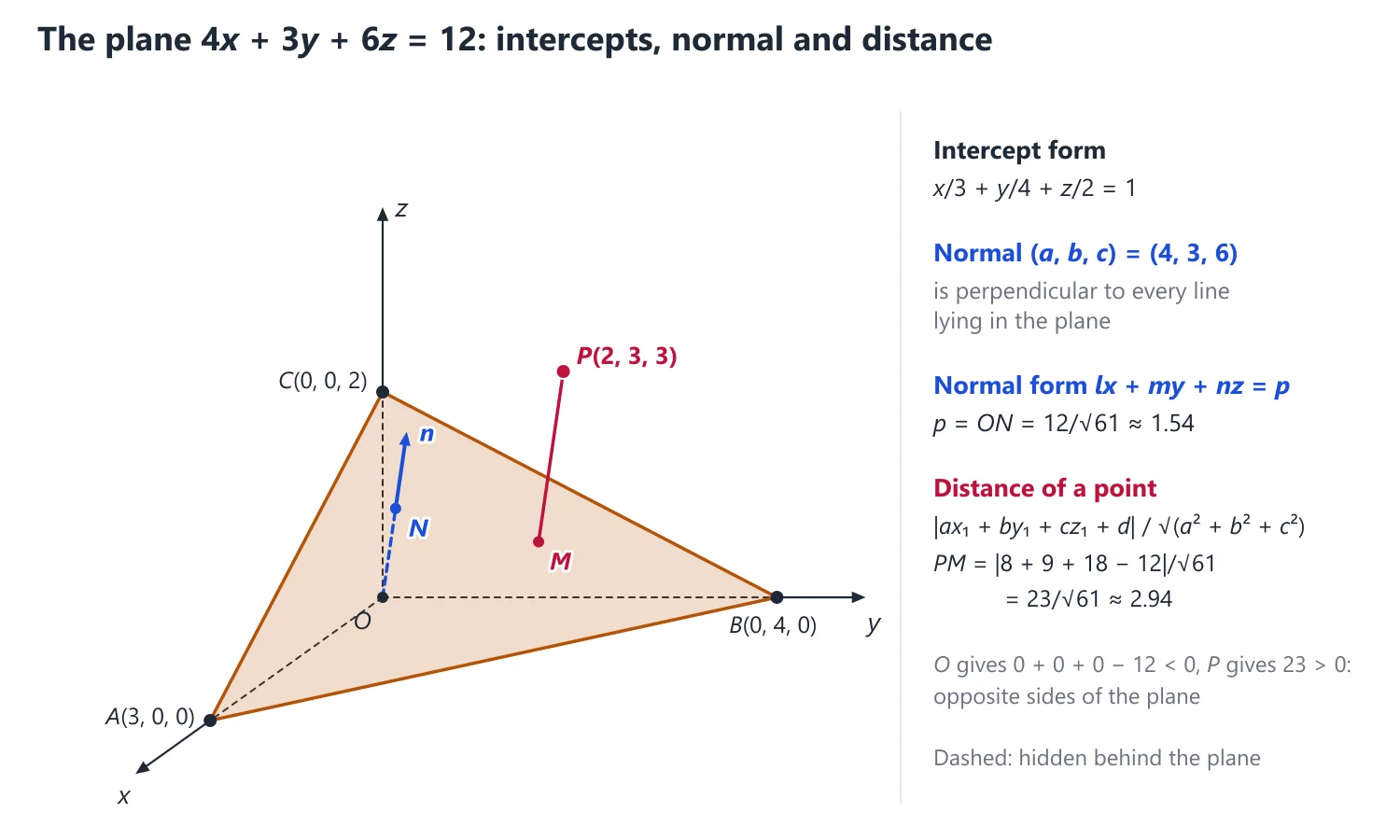
A point in space is located by Cartesian (x, y, z), cylindrical (r, θ, z) or spherical polar (r, θ, φ) coordinates. Lines are described by direction cosines with l2 + m2 + n2 = 1. A plane ax + by + cz + d = 0 has normal (a, b, c), and distances, angles and the family P1 + λP2 = 0 solve most plane problems.
1. Understanding Cylindrical and Spherical Coordinates
Why we need it: Cartesian coordinates are ideal for boxes and planes, but awkward for objects with an axis or a centre. The cylinder x2 + y2 = 4 becomes simply r = 2, and the sphere x2 + y2 + z2 = 9 becomes r = 3. Choosing coordinates that match the shape turns a hard equation or integral into an easy one.
In words (cylindrical): drop a perpendicular from the point P to the xy-plane, with foot N. Then r is the distance ON (also the distance of P from the z-axis), θ is the angle from the positive x-axis to ON, measured anticlockwise, and z is the height NP. So cylindrical coordinates are plane polar coordinates of N plus the height.
In words (spherical): r = OP is the distance from the origin; θ is the angle between OP and the positive z-axis, so 0 ≤ θ ≤ π (θ = 0 is the "north pole", θ = π/2 the xy-plane); φ is the same longitude angle as the cylindrical θ, so 0 ≤ φ < 2π. Notice that the surfaces r = constant are spheres, θ = constant are cones about the z-axis, and φ = constant are half-planes through the z-axis.
First example, slowly: convert P(1, √3, 2) to cylindrical and to spherical coordinates.
Step 1 (cylindrical r): r = √(x2 + y2) = √(1 + 3) = 2, the distance from the z-axis.
Step 2 (angle round the axis): tan θ = y/x = √3, and x, y > 0 put N in the first quadrant, so θ = π/3. The height is z = 2, so P = (2, π/3, 2) in cylindrical coordinates.
Step 3 (spherical r): r = √(1 + 3 + 4) = √8 = 2√2.
Step 4 (polar angle): cos θ = z/r = 2/(2√2) = 1/√2, and θ must lie in [0, π], so θ = π/4. The azimuth φ is the cylindrical angle, φ = π/3.
Step 5 (check by converting back): x = 2√2 sin(π/4) cos(π/3) = 2√2 · (1/√2) · (1/2) = 1, y = 2√2 · (1/√2) · (√3/2) = √3, z = 2√2 cos(π/4) = 2. All three agree, so P = (2√2, π/4, π/3).
Non-example: for Q(−1, −1, 0) the formula tan φ = y/x = 1 tempts you to write φ = π/4, but that angle points into the first quadrant while Q is in the third. The condition "choose the quadrant from the signs of x and y" fails, and the correct value is φ = 5π/4. Similarly θ = −π/4 is never a valid polar angle: θ is a non-negative angle from the z-axis.
Building up: in the right triangle ONP the angle at O between OP and the z-axis is θ, so the height is NP = r cos θ and the horizontal distance is ON = r sin θ. Now N has plane polar coordinates (r sin θ, φ), so x = r sin θ cos φ and y = r sin θ sin φ. A small spherical "box" has edges dr (outward), r dθ (along a meridian) and r sin θ dφ (along a circle of latitude of radius r sin θ), which gives the volume element r2 sin θ dr dθ dφ in the table below.
Where it is used: short conversion questions; triple integrals over spheres, cones and cylinders (Calculus); the Laplacian and divergence in curvilinear coordinates (Vector Analysis); and recognising that θ = constant is a right circular cone (Cone and Cylinder).
2. Coordinate Systems
Cartesian (x, y, z). Cylindrical (r, θ, z): x = r cos θ, y = r sin θ, z = z. Spherical polar (r, θ, φ): x = r sin θ cos φ, y = r sin θ sin φ, z = r cos θ, with r ≥ 0, 0 ≤ θ ≤ π, 0 ≤ φ < 2π.
Idea: θ is measured down from the positive z-axis (like co-latitude) and φ round the z-axis from the positive x-axis (like longitude). The quantity r sin θ is the distance of the point from the z-axis, which is exactly the cylindrical r.
Inverse relations: r = √(x2 + y2 + z2), cos θ = z/r, tan φ = y/x (choose the quadrant of φ from the signs of x and y).
Distance: PQ = √((x2 − x1)2 + (y2 − y1)2 + (z2 − z1)2). The point dividing PQ internally in the ratio m : n is ((mx2 + nx1)/(m + n), (my2 + ny1)/(m + n), (mz2 + nz1)/(m + n)).
Idea: the section formula is a weighted average: the dividing point is pulled towards the end with the larger weight. For external division in the ratio m : n replace n by −n.
3. Understanding Direction Cosines and Direction Ratios
Why we need it: in the plane one angle fixes a direction. In space we need a way to say "which way a line points" that works with coordinates, so that angles between lines, perpendicularity and parallelism become arithmetic. Direction cosines and direction ratios are that language; every line, plane, cone axis and normal in this chapter is described by them.
In words: give the line a direction (an arrow). Let α, β, γ be the angles this directed line makes with the positive x-, y- and z-axes, each between 0 and π. Then l = cos α, m = cos β, n = cos γ are its direction cosines. Any three numbers a, b, c, not all zero, proportional to l, m, n are direction ratios: they tell the direction but not the length.
Notice the difference: a line has exactly two sets of direction cosines, (l, m, n) and (−l, −m, −n), one for each sense, but infinitely many sets of direction ratios.
First example, slowly: find the direction cosines of the line from A(1, 2, 3) to B(3, −1, 9) and the angle it makes with the z-axis.
Step 1: subtract coordinates to get direction ratios: B − A = (2, −3, 6).
Step 2: the length is AB = √(4 + 9 + 36) = 7.
Step 3: divide by the length: (l, m, n) = (2/7, −3/7, 6/7). Check: 4/49 + 9/49 + 36/49 = 1.
Step 4: cos γ = n = 6/7, so γ = cos−1(6/7) ≈ 31.0°. Notice that the projection of AB on the z-axis is AB · n = 7 · 6/7 = 6, which is just the change in z, as it must be.
Non-example: (1/2, 1/2, 1/2) are not direction cosines, because 1/4 + 1/4 + 1/4 = 3/4 ≠ 1; they are only direction ratios, and the true direction cosines are (1/√3, 1/√3, 1/√3). In the same way no line can make 45° with all three axes, since 3 cos2 45° = 3/2 ≠ 1.
Building up: take the point P at distance r from O along the directed line through O. Its x-coordinate is the projection of OP on the x-axis, r cos α = lr; similarly y = mr, z = nr. Then x2 + y2 + z2 = r2 gives l2 + m2 + n2 = 1. For two lines with unit vectors u = (l1, m1, n1) and v = (l2, m2, n2), the cosine rule in the triangle with sides u, v, u − v gives cos θ = u · v, the angle formula of the next section.
A direction perpendicular to two given directions (a1, b1, c1) and (a2, b2, c2) is their cross product (b1c2 − b2c1, c1a2 − c2a1, a1b2 − a2b1); you will use this constantly for normals of planes and for the shortest-distance line.
Where it is used: angles between lines and between planes, tests for perpendicular and parallel lines, projections, the symmetric form of a line, normals to planes and conicoids, and the axis of a cone or cylinder.
4. Direction Cosines and Direction Ratios
Direction cosines l, m, n (cosines of the angles with the axes) satisfy l2 + m2 + n2 = 1; direction ratios a, b, c are proportional to them: l = a/√(a2 + b2 + c2), and similarly m, n.
Idea: (l, m, n) are the components of a unit vector along the line, so l2 + m2 + n2 = 1 is just Pythagoras. Direction ratios are any non-zero multiple of this vector; (l, m, n) and (−l, −m, −n) describe the same line traced in opposite senses.
Angle between two lines: cos θ = l1l2 + m1m2 + n1n2; perpendicular ⇔ a1a2 + b1b2 + c1c2 = 0; parallel ⇔ a1/a2 = b1/b2 = c1/c2.
Why it works: for unit vectors u and v, u · v = |u||v| cos θ = cos θ. With direction ratios you must divide by both lengths: cos θ = (a1a2 + b1b2 + c1c2)/(√(a12 + b12 + c12) √(a22 + b22 + c22)).
Projection of PQ on a line with direction cosines l, m, n: (x2 − x1)l + (y2 − y1)m + (z2 − z1)n.
Idea: the projection is PQ · (unit vector of the line), the length of the shadow of PQ on the line; it is signed, and its absolute value never exceeds PQ.
5. Understanding the Equation of a Plane
Why we need it: planes are the simplest surfaces in space. Every later object (a line as the meet of two planes, a tangent plane to a sphere, a section of a cone) is described with them, so we need one equation that captures "flat" and lets us read off the orientation and position of the plane.
In words: a plane is fixed by one point A on it and one direction n = (a, b, c) perpendicular to it, called the normal. A point X lies on the plane exactly when the segment AX is perpendicular to n, that is n · (X − A) = 0. Expanding gives ax + by + cz + d = 0. Read it like this: the coefficients of x, y, z are the normal; the constant d fixes which of the parallel planes with that normal we mean; d = 0 means the plane passes through the origin.
First example, slowly: find the plane through A(2, −1, 3) with normal (1, 2, −2), its distance from the origin and its intercepts.
Step 1: write n · (X − A) = 0: 1(x − 2) + 2(y + 1) − 2(z − 3) = 0.
Step 2: expand: x + 2y − 2z + 6 = 0. Check that A satisfies it: 2 − 2 − 6 + 6 = 0.
Step 3 (normal form): divide by √(1 + 4 + 4) = 3 and move the constant so that it is positive on the right: (−x − 2y + 2z)/3 = 2. So the distance from O is p = 2, and the unit normal pointing away from O is (−1/3, −2/3, 2/3).
Step 4 (intercepts): put two coordinates zero at a time: x = −6, y = −3, z = 3. So the intercept form is x/(−6) + y/(−3) + z/3 = 1; multiplying by −6 gives back x + 2y − 2z = −6.
Non-example: the planes x + 2y − 2z + 6 = 0 and 2x + 4y − 4z + 6 = 0 have parallel normals but are different planes: the ratio 1 : 2 of the coefficients does not match the ratio 6 : 6 of the constants. Two equations describe the same plane only when all four numbers are proportional. Also 0x + 0y + 0z + 5 = 0 is not a plane at all: the condition (a, b, c) ≠ (0, 0, 0) fails.
Building up: every other form follows from "point plus normal". Normal form: take A to be the foot N of the perpendicular from O, so the normal (l, m, n) is a unit vector and lx + my + nz = (l, m, n) · N = p. Three-point form: the normal is the cross product of two edges, (P2 − P1) × (P3 − P1), which is exactly the determinant form. Angle between planes: the planes turn exactly as their normals do, so the angle between them is the angle between the normals.
Where it is used: writing any plane in one line, reading the normal for angle and perpendicularity questions, and later as the tangent plane of a sphere or conicoid (whose normal is the gradient of the surface).
6. Understanding Signed Distance and the Pencil of Planes
Why we need it: many questions ask on which side of a plane a point lies, how far it is, which bisector contains the origin, or for a plane through a given line. Two tools answer all of these: the signed distance and the one-parameter family P1 + λP2 = 0.
In words: for the plane ax + by + cz + d = 0 and a point P(x1, y1, z1), the number S(P) = (ax1 + by1 + cz1 + d)/√(a2 + b2 + c2) is the signed distance: its size is the distance and its sign tells the side (positive on the side the normal (a, b, c) points to). The pencil of planes through the line where P1 = 0 and P2 = 0 meet is the family P1 + λP2 = 0, one plane for each real λ.
First example, slowly: for the plane 2x − y + 2z − 6 = 0, decide whether A(1, 1, 1) and B(3, 0, 1) lie on the same side, and find where AB meets the plane.
Step 1: √(4 + 1 + 4) = 3, so S(A) = (2 − 1 + 2 − 6)/3 = −1 and S(B) = (6 − 0 + 2 − 6)/3 = 2/3.
Step 2: the signs differ, so A and B are on opposite sides and the segment AB crosses the plane. A is at distance 1 and B at distance 2/3.
Step 3: the crossing point divides AB in the ratio of the distances, 1 : 2/3 = 3 : 2, so it is (3B + 2A)/5 = (11/5, 2/5, 1). Check: 22/5 − 2/5 + 2 − 6 = 0.
Step 4 (pencil): the plane through the line of x − y + z = 2 and 2x + y − z = 1 that passes through O is (x − y + z − 2) + λ(2x + y − z − 1) = 0 with −2 − λ = 0 at O, so λ = −2 and the plane is −3x − 3y + 3z = 0, that is x + y − z = 0. Check with two points of the line, (1, 0, 1) and (1, 2, 3): both give 0.
Non-example: if P1 = 0 and P2 = 0 are parallel, say x + y + z = 1 and x + y + z = 5, they have no common line, and P1 + λP2 = 0 is just the family of parallel planes x + y + z = (1 + 5λ)/(1 + λ). The pencil argument needs the two planes to intersect. Also, the signed-distance comparison is valid only when both points are substituted in the same equation; multiplying the equation by −1 flips both signs together, never one.
Building up: why does the pencil contain every plane through the line L? Let Q be any plane containing L, and R a point of Q not on L. If P2(R) = 0 then Q is P2 = 0 itself. Otherwise choose λ = −P1(R)/P2(R); then P1 + λP2 = 0 contains L and R, and only one plane contains a line and a point off it, so it is Q. The bisector rule follows from the signed distance: points of a bisector have S1 = ±S2, and the origin, where both S are positive once the constants are positive, lies in the angle of the + bisector.
Where it is used: plane through a line and a point or perpendicular to a plane, bisectors, images and feet of perpendiculars (next topic), coplanarity of lines, and tangent planes to a sphere through a given line.
7. The Plane
General form ax + by + cz + d = 0, where (a, b, c) is normal to the plane. Normal form lx + my + nz = p (p ≥ 0 is the distance from the origin). Intercept form x/a + y/b + z/c = 1.
Idea: if P(x1, y1, z1) and Q(x2, y2, z2) both lie on ax + by + cz + d = 0, subtracting gives a(x2 − x1) + b(y2 − y1) + c(z2 − z1) = 0, so (a, b, c) is perpendicular to every segment lying in the plane. That is the whole meaning of "normal". A plane is fixed by one point and one normal direction.
Why the three-point determinant works: P(x, y, z) lies in the plane of P1, P2, P3 if and only if the vectors P − P1, P2 − P1, P3 − P1 are coplanar, that is their scalar triple product (the determinant below) is zero.
Plane through three points: det[[x − x1, y − y1, z − z1], [x2 − x1, y2 − y1, z2 − z1], [x3 − x1, y3 − y1, z3 − z1]] = 0.
Angle between planes: cos θ = (a1a2 + b1b2 + c1c2)/(√(a12 + b12 + c12) √(a22 + b22 + c22)).
Idea: the angle between two planes is the angle between their normals. Taking the absolute value of the numerator gives the acute angle; without it you may get the obtuse supplement.
The planes are perpendicular if a1a2 + b1b2 + c1c2 = 0 and parallel if a1/a2 = b1/b2 = c1/c2.
Distance of (x1, y1, z1) from ax + by + cz + d = 0 is |ax1 + by1 + cz1 + d|/√(a2 + b2 + c2). Distance between parallel planes ax + by + cz + d1 = 0 and ax + by + cz + d2 = 0 is |d1 − d2|/√(a2 + b2 + c2).
Any plane through the line of intersection of P1 = 0 and P2 = 0 is P1 + λP2 = 0 (or P2 = 0 itself).
Idea: P1 + λP2 is zero at every point where P1 and P2 are both zero, so every member of this one-parameter family (a pencil of planes) contains the common line. One extra condition (a point, a perpendicularity, a distance) fixes λ. If the condition leads to "λ = ∞", the answer is P2 = 0 itself.
Bisectors of the angles between two planes: (a1x + b1y + c1z + d1)/√(a12 + b12 + c12) = ±(a2x + b2y + c2z + d2)/√(a22 + b22 + c22); when d1 and d2 are both positive, the + sign gives the bisector of the angle containing the origin.
Idea: a bisector plane is the locus of points equidistant from the two planes; equating the two signed distances gives the two bisectors. The sign of a1x + b1y + c1z + d1 tells on which side of the plane a point lies, which is why the constants are made positive first (then the origin gives a positive value in both).
Two points lie on the same side of a plane if ax + by + cz + d has the same sign at both.
Pair of planes: the homogeneous equation ax2 + by2 + cz2 + 2fyz + 2gzx + 2hxy = 0 represents a pair of planes through the origin only if abc + 2fgh − af2 − bg2 − ch2 = 0.
Idea: the quadratic form must split into two linear factors (a1x + b1y + c1z)(a2x + b2y + c2z); then its symmetric matrix [[a, h, g], [h, b, f], [g, f, c]] has rank at most 2, so its determinant vanishes. The same determinant D reappears in the reduction of the general second-degree equation.
8. Derivation: Distance of a Point from a Plane
Let P(x1, y1, z1) be the point and Q(x0, y0, z0) any point of the plane ax + by + cz + d = 0, so ax0 + by0 + cz0 = −d.
The perpendicular distance is the length of the projection of QP on the unit normal (a, b, c)/√(a2 + b2 + c2): |a(x1 − x0) + b(y1 − y0) + c(z1 − z0)|/√(a2 + b2 + c2).
Using ax0 + by0 + cz0 = −d, the numerator becomes |ax1 + by1 + cz1 + d|, which gives the formula. The choice of Q does not matter, as it should not.
Without the absolute value the expression is a signed distance: it is positive on the side towards which (a, b, c) points and negative on the other side. This proves the "same side" rule.
Parallel planes: a point of ax + by + cz + d2 = 0 gives ax1 + by1 + cz1 = −d2, so its distance from ax + by + cz + d1 = 0 is |d1 − d2|/√(a2 + b2 + c2); this needs identical coefficients of x, y, z in both equations.
9. Derivation: Normal Form, Area and Volume Formulas
Normal form: let ON be the perpendicular from O to the plane, of length p and direction cosines l, m, n. A point P lies in the plane exactly when NP ⟂ ON, that is when the projection of OP on ON equals p: lx + my + nz = p.
To reach this form from ax + by + cz + d = 0, divide by √(a2 + b2 + c2) with the sign chosen so that the constant on the right, p = −d/(±√(a2 + b2 + c2)), is positive.
Area by projections: the vector (1/2)(AB × AC) has length equal to the area of triangle ABC and points along its normal. Its x-component is (1/2) of the 2 × 2 determinant of the y and z coordinates of AB and AC, which is the signed area of the projection on the yz-plane; similarly for the other components. So area2 = Ayz2 + Azx2 + Axy2.
Volume of a tetrahedron: the parallelepiped on AB, AC, AD has volume |AB · (AC × AD)|, and the tetrahedron is one-sixth of it. Subtracting the first row of the 4 × 4 determinant from the others and expanding along the last column turns it into this triple product, which proves the determinant formula.
10. Choosing the Method
If a point and the normal direction are known → a(x − x1) + b(y − y1) + c(z − z1) = 0.
If three points, or one point and two directions parallel to the plane, are given → take the normal as the cross product of two vectors in the plane (or use the three-point determinant).
If the plane must contain the line of intersection of two given planes → P1 + λP2 = 0, with λ from the remaining condition.
If the plane cuts the axes at variable points, or a locus of a point linked to a variable plane is asked → intercept form x/a + y/b + z/c = 1, then eliminate a, b, c.
If the distance from the origin and the direction of the normal are given → normal form lx + my + nz = p.
If three planes are given and the question is whether they meet in a point, a line or form a prism → compare the ranks of the coefficient matrix and the augmented matrix.
11. Common Mistakes
Using direction ratios in cos θ = l1l2 + m1m2 + n1n2 without dividing by their lengths; the formula needs direction cosines.
Applying |d1 − d2|/√(a2 + b2 + c2) before making the x, y, z coefficients of the two parallel planes identical (Example 3 first halves the second equation).
Choosing the bisector of the angle containing the origin, or testing acute/obtuse, without first making both constant terms positive.
Concluding that three planes have a common line merely because the determinant of their normals is zero; they may form a triangular prism, so check the augmented matrix too.
Taking φ = tan−1(y/x) without checking the quadrant from the signs of x and y in spherical or cylindrical coordinates.
12. Connections
Link: the three-planes question is the geometry of a 3 × 3 linear system: a unique point when the rank is 3, a common line when both ranks are 2, a prism when the ranks are 2 and 3 (Linear Algebra, systems of linear equations).
Link: cylindrical and spherical coordinates return in triple integrals with the Jacobians r and r2 sin θ (Calculus), and in the Laplacian in curvilinear coordinates (Vector Analysis).
13. Worked Examples
Example 1: Find the plane through (1, 1, 1), (1, −1, 1) and (−7, −3, −5).
Two vectors in the plane are (0, −2, 0) and (−8, −4, −6); their cross product is (12, 0, −16), proportional to (3, 0, −4). The plane is 3(x − 1) − 4(z − 1) = 0, that is 3x − 4z + 1 = 0, which is parallel to the y-axis.
Example 2: Convert (1, 1, √2) to spherical polar coordinates. r = √(1 + 1 + 2) = 2, cos θ = √2/2 so θ = π/4, and tan φ = 1 with x, y > 0 so φ = π/4.
Example 3: Find the distance between the planes 2x − 2y + z + 3 = 0 and 4x − 4y + 2z + 5 = 0. Writing the second as 2x − 2y + z + 5/2 = 0, the distance is |3 − 5/2|/√(4 + 4 + 1) = 1/6.
Example 4: Find the plane through the line of intersection of x + y + z = 1 and 2x + 3y + 4z = 5 that is perpendicular to x − y + z = 0.
The plane (x + y + z − 1) + λ(2x + 3y + 4z − 5) = 0 has normal (1 + 2λ, 1 + 3λ, 1 + 4λ). Perpendicularity gives (1 + 2λ) − (1 + 3λ) + (1 + 4λ) = 1 + 3λ = 0, so λ = −1/3, and the plane is x − z + 2 = 0.
Example 5: Find the planes bisecting the angles between 3x − 6y + 2z + 5 = 0 and 4x − 12y + 3z − 3 = 0. Which one bisects the angle containing the origin, and is that angle acute or obtuse?
Write both planes with positive constant terms: 3x − 6y + 2z + 5 = 0 and −4x + 12y − 3z + 3 = 0; the normals have lengths 7 and 13.
The bisectors are (3x − 6y + 2z + 5)/7 = ±(−4x + 12y − 3z + 3)/13.
The + sign gives the bisector of the angle containing the origin: 13(3x − 6y + 2z + 5) = 7(−4x + 12y − 3z + 3), that is 67x − 162y + 47z + 44 = 0. The − sign gives 11x + 6y + 5z + 86 = 0.
With the constants positive, a1a2 + b1b2 + c1c2 = −12 − 72 − 6 = −90 < 0, so the origin lies in the acute angle, and 67x − 162y + 47z + 44 = 0 bisects the acute angle.
Example 6: Show that the planes x = cy + bz, y = az + cx, z = bx + ay have a common line through the origin if a2 + b2 + c2 + 2abc = 1.
All three planes pass through the origin; their common points are the solutions of the homogeneous system x − cy − bz = 0, −cx + y − az = 0, −bx − ay + z = 0.
The determinant of coefficients is det[[1, −c, −b], [−c, 1, −a], [−b, −a, 1]] = 1(1 − a2) + c(−c − ab) − b(ac + b) = 1 − a2 − b2 − c2 − 2abc.
Under the given condition this determinant is 0, so the rank of the system is at most 2 and its solution space has dimension at least 1: the planes have (at least) a common line through the origin.
14. Areas, Volumes and Variable Planes
Area of a triangle with vertices A, B, C: (1/2)|AB × AC|. Its projections on the coordinate planes have areas Ayz, Azx, Axy, and the area is √(Ayz2 + Azx2 + Axy2).
Volume of a tetrahedron with vertices (xi, yi, zi), i = 1, ..., 4: (1/6)|det[[x1, y1, z1, 1], [x2, y2, z2, 1], [x3, y3, z3, 1], [x4, y4, z4, 1]]|; for OABC with A, B, C on the axes at a, b, c it is |abc|/6.
Locus method for a variable plane: write the plane as x/a + y/b + z/c = 1, translate the given condition into one relation between a, b, c, express a, b, c through the coordinates (α, β, γ) of the moving point, and substitute. The centroid of triangle ABC is (a/3, b/3, c/3); the centroid of tetrahedron OABC is (a/4, b/4, c/4).
For a plane at distance p from O: 1/a2 + 1/b2 + 1/c2 = 1/p2. With the tetrahedron centroid (a/4, b/4, c/4) this gives the locus 1/x2 + 1/y2 + 1/z2 = 16/p2; at distance 3p it becomes 9(1/x2 + 1/y2 + 1/z2) = 16/p2.
Why it works: the normal form of x/a + y/b + z/c = 1 has direction cosines proportional to (1/a, 1/b, 1/c), so p = 1/√(1/a2 + 1/b2 + 1/c2). Substituting a = 4x, b = 4y, c = 4z for the centroid gives the locus.
Intersection of three planes: three planes meet in a single point if the determinant of their normals is non-zero; if it is zero and no two of them are parallel, they either have a common line (all 3 × 3 minors of the augmented matrix vanish) or form a triangular prism. If two or three are parallel there is no common point, unless parallel planes coincide.
15. Practice Exercises
Exercise 1 (basic): Find the direction cosines of a line with direction ratios (2, −1, −2).
Answer: the length is √(4 + 1 + 4) = 3, so (l, m, n) = ±(2/3, −1/3, −2/3).
Exercise 2 (basic): Can a line make angles 45°, 60° and 30° with the x-, y- and z-axes?
Answer: no: cos2 45° + cos2 60° + cos2 30° = 1/2 + 1/4 + 3/4 = 3/2 ≠ 1.
Exercise 3 (basic): Convert the spherical polar point (r, θ, φ) = (4, π/3, π/2) to Cartesian coordinates.
Answer: x = 4 sin(π/3) cos(π/2) = 0, y = 4 sin(π/3) sin(π/2) = 2√3, z = 4 cos(π/3) = 2; the point is (0, 2√3, 2).
Exercise 4 (standard): Find the plane through (1, 0, −1), (2, 1, 1) and (0, 2, 1).
Answer: the edge vectors (1, 1, 2) and (−1, 2, 2) have cross product (−2, −4, 3), so the plane is 2x + 4y − 3z = 5.
Exercise 5 (standard): Find the distance of the point (2, 1, −1) from the plane x − 2y + 4z = 9.
Answer: |2 − 2 − 4 − 9|/√21 = 13/√21.
Exercise 6 (standard): Find the angle between the planes 2x − y + z = 6 and x + y + 2z = 3.
Answer: cos θ = (2 − 1 + 2)/(√6 √6) = 1/2, so θ = 60°.
Exercise 7 (standard): Find the plane through the line of intersection of x + 2y + 3z = 4 and 2x + y − z + 5 = 0 that is perpendicular to the plane x + y + z = 0.
Answer: the normal of (x + 2y + 3z − 4) + λ(2x + y − z + 5) = 0 is (1 + 2λ, 2 + λ, 3 − λ); perpendicularity gives 6 + 2λ = 0, λ = −3, and the plane is 5x + y − 6z + 19 = 0.
Exercise 8 (UPSC level): A variable plane at a constant distance p from the origin meets the axes at A, B, C. Find the locus of the centroid of triangle ABC.
Answer: with the plane x/a + y/b + z/c = 1, 1/a2 + 1/b2 + 1/c2 = 1/p2 and the centroid is (a/3, b/3, c/3); the locus is 1/x2 + 1/y2 + 1/z2 = 9/p2.
Exercise 9 (UPSC level): For which k do the planes x + y + z = 3, x + 2y + 3z = 6 and 2x + 3y + 4z = k have a common line? Find that line, and describe the configuration for other values of k.
Answer: the determinant of the normals is 0 because row 3 = row 1 + row 2; both ranks are 2 exactly when k = 9, giving the line x/1 = (y − 3)/(−2) = z/1. For k ≠ 9 no two planes are parallel and the ranks are 2 and 3, so they form a triangular prism.
Exercise 10 (UPSC level): Find the plane bisecting the acute angle between x + 2y + 2z = 9 and 4x − 3y + 12z + 13 = 0.
Answer: with positive constants, −x − 2y − 2z + 9 = 0 and 4x − 3y + 12z + 13 = 0, a1a2 + b1b2 + c1c2 = −22 < 0, so the origin is in the acute angle and the + bisector 13(−x − 2y − 2z + 9) = 3(4x − 3y + 12z + 13) gives 25x + 17y + 62z − 78 = 0.
| System | Coordinates | Relation to (x, y, z) | Volume element |
|---|---|---|---|
| Cartesian | (x, y, z) | — | dx dy dz |
| Cylindrical | (r, θ, z) | x = r cos θ, y = r sin θ, z = z | r dr dθ dz |
| Spherical polar | (r, θ, φ) | x = r sin θ cos φ, y = r sin θ sin φ, z = r cos θ | r2 sin θ dr dθ dφ |
Mains points
- Plane questions usually come as parts of larger questions: plane through a line and a point, plane through a line perpendicular to another plane, or the bisector containing the origin.
- Use the family P1 + λP2 = 0 instead of finding points on the line; it saves time and avoids arithmetic slips.
- For bisector questions, first make both constant terms positive, then state which sign gives the acute and which the obtuse bisector (compare the angle with the original planes).
- Conversions between Cartesian, cylindrical and spherical coordinates appear as short parts; state the ranges of θ and φ.
- Present the final plane in the form ax + by + cz + d = 0 with integer coefficients and verify that the given points satisfy it.
Did you know?
- These notes, most Indian textbooks and the ISO convention of physics use θ for the polar angle from the z-axis and φ for the azimuth, but many calculus textbooks swap the two letters; always state your convention in the answer.
Straight Lines and Shortest Distance between Skew Lines
A line is given in symmetric form through a point with given direction ratios, or as the intersection of two planes. Two lines are coplanar when a 3 × 3 determinant vanishes; otherwise they are skew, and their shortest distance is the projection of the join of two points on the common perpendicular, |(c − a)·(b1 × b2)|/|b1 × b2|.
1. Understanding the Equations of a Line
Why we need it: a line in space cannot be given by one linear equation, because one linear equation in x, y, z is a plane. We need a description that says "start here and move in this direction", and a second description as the meeting of two planes, and we must be able to pass from one to the other.
In words: a point P is on the line through A with direction b exactly when P − A is a multiple of b: P = A + rb for some real r. Writing this coordinate by coordinate and solving each for r gives the symmetric form (x − x1)/l = (y − y1)/m = (z − z1)/n = r. The common value r is the parameter; each value of r is one point. The unsymmetric form lists two planes whose common points are the line.
First example, slowly: write the line x + y + z = 6, x − y + 2z = 5 in symmetric form.
Step 1 (direction): the line lies in both planes, so its direction is perpendicular to both normals (1, 1, 1) and (1, −1, 2). Their cross product is (1·2 − 1·(−1), 1·1 − 1·2, 1·(−1) − 1·1) = (3, −1, −2).
Step 2 (one point): give one coordinate a convenient value. With y = 0 the equations become x + z = 6 and x + 2z = 5, so z = −1 and x = 7. The point (7, 0, −1) is on the line.
Step 3 (write it): (x − 7)/3 = y/(−1) = (z + 1)/(−2), with general point (7 + 3r, −r, −1 − 2r).
Step 4 (check): r = 1 gives (10, −1, −3); then 10 − 1 − 3 = 6 and 10 + 1 − 6 = 5, so this point is on both planes too.
Non-example: the planes x + y + z = 1 and 2x + 2y + 2z = 5 do not define a line: their normals are parallel, the cross product is (0, 0, 0), and the planes never meet. Similarly x/0 = y/0 = z/0 is not a line, because (0, 0, 0) is not a direction. If y = 0 had made the two equations inconsistent, that would only mean the line is parallel to the plane y = 0; then try x = 0 or z = 0 instead.
Building up: the two-point form is the symmetric form with b = B − A. When (l, m, n) are direction cosines, |r| = |P − A| is the actual distance from A, which is how "the point at distance 3 from A along the line" is found. The general point (x1 + lr, y1 + mr, z1 + nr) is the key to almost every later method: substitute it into a plane, a sphere or a perpendicularity condition and solve for r.
Where it is used: meeting point of a line with a plane, sphere or conicoid; feet of perpendiculars; shortest distance by the points method; and generating lines of cones and conicoids.
2. Equations of a Line
Symmetric form: (x − x1)/l = (y − y1)/m = (z − z1)/n, through (x1, y1, z1) with direction ratios l, m, n; its general point is (x1 + lr, y1 + mr, z1 + nr).
Idea: a line is "a point plus a direction". The parameter r says how far along the direction you have moved; when (l, m, n) are direction cosines, |r| is the actual distance from (x1, y1, z1).
A zero in a denominator is a convention, not a division: (x − 1)/0 = (y − 2)/3 = z/4 means x = 1 along the whole line together with (y − 2)/3 = z/4.
Two-point form: (x − x1)/(x2 − x1) = (y − y1)/(y2 − y1) = (z − z1)/(z2 − z1).
Unsymmetric form: the intersection of two planes a1x + b1y + c1z + d1 = 0 and a2x + b2y + c2z + d2 = 0.
Conversion to symmetric form: the direction ratios are (b1c2 − b2c1, c1a2 − c2a1, a1b2 − a2b1); find one point on the line by putting, for example, z = 0 and solving.
Why it works: the line lies in both planes, so its direction is perpendicular to both normals (a1, b1, c1) and (a2, b2, c2); the cross product of the normals is such a vector. If the normals are parallel the planes do not define a line.
3. Understanding a Line and a Plane Together
Why we need it: a line and a plane can meet in one point, be parallel, or the line can lie in the plane. Exam questions ask which case occurs, the angle between them, the meeting point, the foot of a perpendicular, or the image of a point. All of these use the same two numbers.
In words: for the line through A(x1, y1, z1) with direction (l, m, n) and the plane ax + by + cz + d = 0, look at k = al + bm + cn (normal · direction) and f(A) = ax1 + by1 + cz1 + d. If k ≠ 0 the line crosses the plane at exactly one point. If k = 0 the direction is perpendicular to the normal, so the line is parallel to the plane; it lies in the plane when also f(A) = 0, and is at distance |f(A)|/√(a2 + b2 + c2) otherwise.
First example, slowly: take the line (x − 1)/2 = (y + 1)/1 = (z − 2)/(−1), through A(1, −1, 2) with direction (2, 1, −1).
Step 1 (plane x + y + 3z = 6): k = 2 + 1 − 3 = 0, so the line is parallel to the plane; f(A) = 1 − 1 + 6 − 6 = 0, so A is on the plane. Conclusion: the whole line lies in x + y + 3z = 6.
Step 2 (plane 2x − y + z = 1): k = 4 − 1 − 1 = 2 ≠ 0, so the line crosses this plane. The angle satisfies sin θ = |k|/(√6 √6) = 1/3, so θ = sin−1(1/3) ≈ 19.5°.
Step 3 (meeting point): substitute the general point (1 + 2r, −1 + r, 2 − r): 2(1 + 2r) − (−1 + r) + (2 − r) = 5 + 2r = 1, so r = −2 and the point is (−3, −3, 4). Check: −6 + 3 + 4 = 1.
Non-example: the line through (0, 0, 1) with direction (1, 1, 1) and the plane x + y − 2z = 0 have k = 1 + 1 − 2 = 0, which looks like "the line lies in the plane". It does not: f(0, 0, 1) = −2 ≠ 0, so the line is parallel to the plane at distance 2/√6. Do not confuse the parallel test k = 0 with the perpendicular test a/l = b/m = c/n (direction along the normal).
Building up: substituting the general point always gives f(A) + kr = 0. So k ≠ 0 gives the single value r = −f(A)/k; k = 0 and f(A) ≠ 0 gives no solution (parallel); k = 0 and f(A) = 0 gives every r (the line lies in the plane). The foot of the perpendicular from P to the plane is the special case where the line is the normal through P: direction (a, b, c), k = a2 + b2 + c2, and doubling r gives the image (see the derivation of the image formula below).
Where it is used: deciding whether a line lies in a plane (needed for coplanarity and for generating lines), projections and images of lines, and the angle between a line and a plane.
4. Line and Plane
The line (x − x1)/l = (y − y1)/m = (z − z1)/n is parallel to the plane ax + by + cz + d = 0 if al + bm + cn = 0, perpendicular to it if a/l = b/m = c/n, and lies in it if al + bm + cn = 0 and ax1 + by1 + cz1 + d = 0.
Idea: parallel to the plane means the direction is perpendicular to the normal; lying in the plane needs, in addition, one point of the line in the plane. The x-axis direction (1, 0, 0) and the plane z = 1 satisfy al + bm + cn = 0, but the x-axis is not in that plane.
Angle θ between the line and the plane: sin θ = |al + bm + cn|/(√(a2 + b2 + c2) √(l2 + m2 + n2)).
Why sine: the angle between a line and a plane is the complement of the angle between the line and the normal, and cos(90° − θ) = sin θ.
Foot of the perpendicular from P to a line: take the general point Q of the line and impose PQ · (l, m, n) = 0 to find r. The image of a point in a plane lies on the normal through the point, at twice the perpendicular distance.
5. Understanding Coplanar and Skew Lines
Why we need it: before asking for the meeting point of two lines we must know whether they meet at all. In space two lines can meet, be parallel, or be skew, and only the first two cases lie in a common plane.
In words: two lines are coplanar if some plane contains both. Line 1 through A with direction b1 and line 2 through C with direction b2 are coplanar exactly when the three vectors C − A, b1, b2 lie in one plane, which happens exactly when the determinant with rows C − A, b1, b2 is zero. Coplanar and not parallel means they intersect; not coplanar means skew.
First example, slowly: line 1: (x − 1)/1 = (y − 2)/2 = (z − 3)/3; line 2: (x − 3)/1 = (y − 5)/1 = (z − 4)/(−2).
Step 1: A = (1, 2, 3), C = (3, 5, 4), so C − A = (2, 3, 1); b1 = (1, 2, 3), b2 = (1, 1, −2). The directions are not proportional, so the lines are not parallel.
Step 2: det[[2, 3, 1], [1, 2, 3], [1, 1, −2]] = 2(−4 − 3) − 3(−2 − 3) + 1(1 − 2) = −14 + 15 − 1 = 0. So the lines are coplanar, hence they intersect.
Step 3 (the point): equate general points (1 + r, 2 + 2r, 3 + 3r) = (3 + s, 5 + s, 4 − 2s). The first two coordinates give r − s = 2 and 2r − s = 3, so r = 1, s = −1. The third coordinate must agree as a check: 3 + 3 = 6 and 4 + 2 = 6. The common point is (2, 4, 6).
Step 4 (the plane): its normal is b1 × b2 = (−7, 5, −1), and it passes through A: −7(x − 1) + 5(y − 2) − (z − 3) = 0, that is 7x − 5y + z = 0. Both A and C satisfy it.
Non-example: x/1 = y/1 = z/1 and (x − 1)/2 = y/2 = z/2 give det[[1, 0, 0], [1, 1, 1], [2, 2, 2]] = 0 (two proportional rows), yet the lines never meet: they are distinct parallel lines. A zero determinant gives "coplanar", and "intersecting" needs, in addition, non-parallel directions.
Building up: if the lines meet at P, then C − A = (P − A) − (P − C) is a combination of b1 and b2, so the determinant vanishes. Conversely, if the determinant vanishes and b1, b2 are independent, then C − A = rb1 − sb2 for some r, s, and A + rb1 = C + sb2 is a common point. For lines in unsymmetric form u1 = 0 = v1, u2 = 0 = v2, the lines meet exactly when the four planes have a common point, that is when the 4 × 4 determinant of their coefficients is zero (provided the lines are not parallel).
Where it is used: "show that the lines intersect and find the point and the plane" questions, the test SD = 0, and checking that a line is a generator of a cone or conicoid.
6. Coplanar Lines
The lines (x − x1)/l1 = (y − y1)/m1 = (z − z1)/n1 and (x − x2)/l2 = (y − y2)/m2 = (z − z2)/n2 are coplanar if and only if det[[x2 − x1, y2 − y1, z2 − z1], [l1, m1, n1], [l2, m2, n2]] = 0; the plane containing them is det[[x − x1, y − y1, z − z1], [l1, m1, n1], [l2, m2, n2]] = 0.
Why it works: both lines lie in one plane exactly when the three vectors AB (joining their given points), b1 and b2 lie in one plane, that is when their scalar triple product, the determinant above, is zero.
Lines that are neither parallel nor intersecting are skew; skew lines are not coplanar.
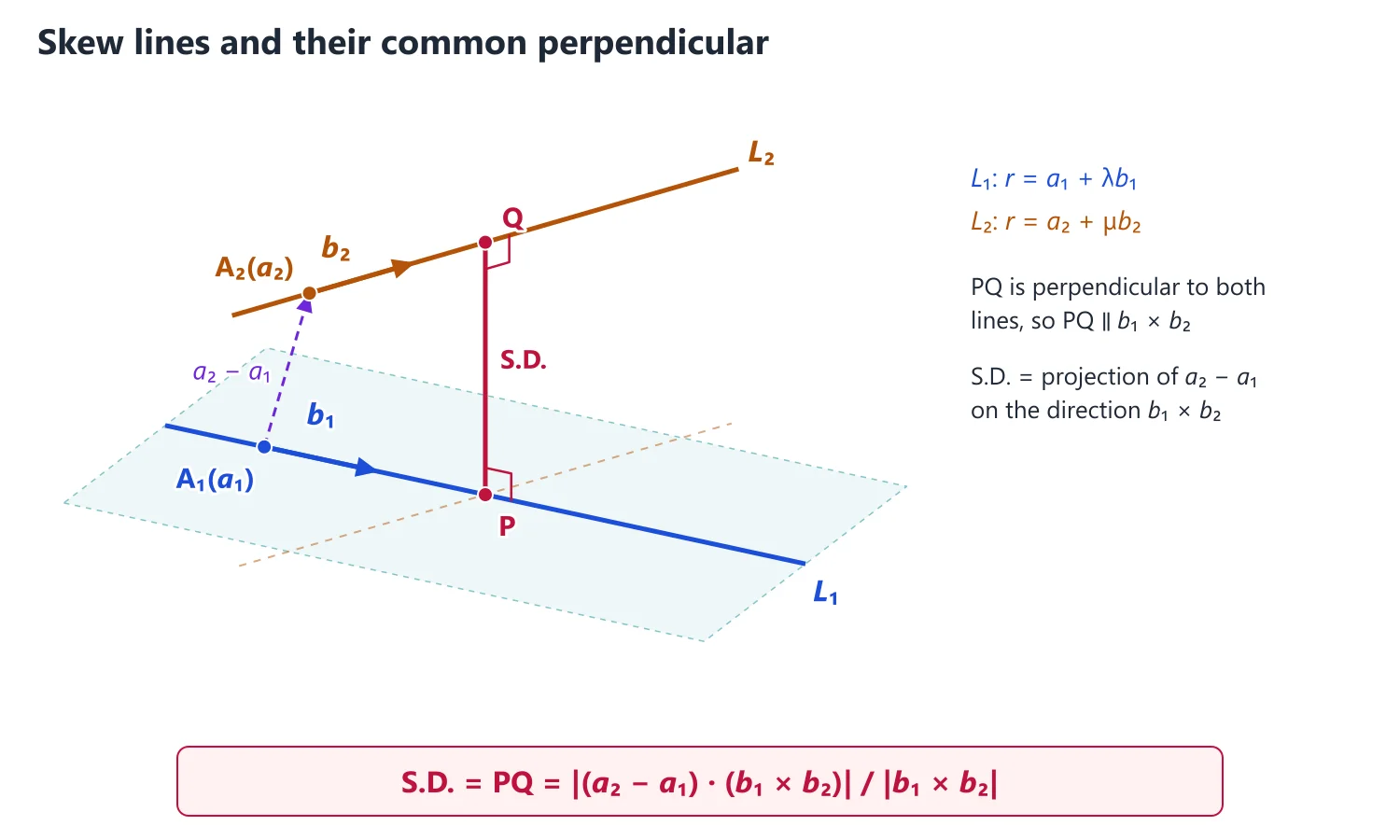
Idea: in a plane two lines either meet or are parallel; in space there is a third possibility. Think of a road passing over a railway line on a bridge: the two never meet and are not parallel. See the figure above.
7. Understanding the Shortest Distance
Why we need it: two skew lines never meet, but some pair of points, one on each line, is closer than every other pair. That distance measures how far apart the lines are, and the segment joining the two closest points is the only line that meets both at right angles.
In words: the common perpendicular is the line meeting both given lines and perpendicular to both; its direction is n = b1 × b2. The shortest distance (SD) is the length of the common perpendicular between the two lines. To compute it, take any point A of line 1 and any point C of line 2 and project AC on n: SD = |(C − A) · n|/|n|.
First example, slowly: find the SD between the x-axis and the line through (1, 0, 2) parallel to the y-axis.
Step 1 (picture): line 1 lies on the floor (z = 0) along the x-axis; line 2 runs at height 2 in the y-direction, above the point (1, 0, 0). We expect SD = 2, with the common perpendicular vertical through (1, 0, 0).
Step 2 (formula): A = (0, 0, 0), b1 = (1, 0, 0), C = (1, 0, 2), b2 = (0, 1, 0). Then n = b1 × b2 = (0, 0, 1), (C − A) · n = 2 and |n| = 1, so SD = 2.
Step 3 (points method): P = (r, 0, 0) on line 1 and Q = (1, s, 2) on line 2, so PQ = (1 − r, s, 2). PQ · b1 = 1 − r = 0 and PQ · b2 = s = 0. The feet are P(1, 0, 0) and Q(1, 0, 2), and |PQ| = 2, as expected.
Notice: changing A or C to other points of the same lines changes C − A only by multiples of b1 and b2, which are perpendicular to n, so the projection, and the SD, do not change.
Non-example: for the parallel lines x/1 = y/2 = z/2 and (x − 1)/1 = y/2 = z/2, b1 × b2 = (0, 0, 0) and the formula becomes 0/0: the hypothesis "not parallel" fails. Use the parallel-lines formula instead: |(C − A) × b|/|b| = |(1, 0, 0) × (1, 2, 2)|/3 = |(0, −2, 2)|/3 = 2√2/3.
Building up: the full argument is in the derivation below: PQ · n is the same for every pair P, Q, and the Cauchy-Schwarz inequality shows |PQ| is smallest exactly when PQ is parallel to n. The two perpendicularity equations of the points method always have a unique solution for non-parallel lines, so the feet exist. The volume picture helps memory: |(C − A) · (b1 × b2)| is the volume of a box with base area |b1 × b2|, and SD is its height.
Where it is used: the standard 10–15 mark SD question (value, line of SD, feet), conditions for two lines to intersect (SD = 0), the smallest sphere touching two lines, and distances between a line and an axis.
8. Shortest Distance between Skew Lines
Let line 1 pass through A (position vector a) with direction b1, and line 2 through C (position vector c) with direction b2. The shortest distance is measured along the common perpendicular, whose direction is b1 × b2.
Formula: SD = |(c − a) · (b1 × b2)|/|b1 × b2|. SD = 0 if and only if the lines are coplanar (for non-parallel lines, intersecting).
Idea: the shortest distance is the projection of AC on the common perpendicular (see the figure above). In coordinates: SD = |det[[x2 − x1, y2 − y1, z2 − z1], [l1, m1, n1], [l2, m2, n2]]|/√((m1n2 − m2n1)2 + (n1l2 − n2l1)2 + (l1m2 − l2m1)2).
Parallel lines (common direction b): distance = |(c − a) × b|/|b|.
Why it works: |(c − a) × b| = |AC| |b| sin α, where α is the angle between AC and the lines, and |AC| sin α is the perpendicular height from C to line 1.
Equations of the line of SD: with (l, m, n) proportional to b1 × b2, it is the intersection of the plane through line 1 containing the common perpendicular and the plane through line 2 containing it: det[[x − x1, y − y1, z − z1], [l1, m1, n1], [l, m, n]] = 0 and det[[x − x2, y − y2, z − z2], [l2, m2, n2], [l, m, n]] = 0.
Points method: take general points P(r) on line 1 and Q(s) on line 2; impose PQ ⟂ b1 and PQ ⟂ b2; solve for r and s. Then SD = |PQ|, and P, Q are the feet of the common perpendicular.
Lines in unsymmetric form: if the lines are u1 = 0 = v1 and u2 = 0 = v2, choose λ so that the plane u1 + λv1 = 0 through line 1 is parallel to line 2; the SD is the distance of any point of line 2 from this plane.
Why it works: the plane through line 1 parallel to line 2 contains both directions b1 and b2, so its normal is along the common perpendicular. Every point of line 2 is at the same distance from this plane, and that distance is the SD.
9. Derivation: The Shortest Distance Formula
Take any points P = a + rb1 on line 1 and Q = c + sb2 on line 2. Then PQ = (c − a) + sb2 − rb1.
Let n = b1 × b2, which is non-zero because the lines are not parallel. Since b1 · n = b2 · n = 0, we get PQ · n = (c − a) · n for every r and s.
By the Cauchy-Schwarz inequality |PQ| |n| ≥ |PQ · n| = |(c − a) · n|, so |PQ| ≥ |(c − a) · n|/|n| for every pair of points P, Q.
Equality holds exactly when PQ is parallel to n, that is when PQ ⟂ b1 and PQ ⟂ b2: the two equations of the points method. Their 2 × 2 system has determinant |b1|2|b2|2 − (b1 · b2)2 = |b1 × b2|2 ≠ 0, so the feet P, Q exist and are unique.
Hence the minimum distance is attained along the common perpendicular and equals |(c − a) · (b1 × b2)|/|b1 × b2|. Geometrically this is the volume of the parallelepiped on c − a, b1, b2 divided by the area of its base.
10. Derivation: Image of a Point in a Plane
The image P′ of P(x1, y1, z1) lies on the normal through P, so P′ = P + t(a, b, c) for some t, and the midpoint M = P + (t/2)(a, b, c) lies in the plane.
Substituting M in ax + by + cz + d = 0: (ax1 + by1 + cz1 + d) + (t/2)(a2 + b2 + c2) = 0, so t = −2(ax1 + by1 + cz1 + d)/(a2 + b2 + c2).
This is the common ratio in the image formula used in Example 3; the foot of the perpendicular corresponds to t/2, that is half of that ratio.
11. Choosing the Method
If only the value of the SD is asked and both lines are in symmetric form → use the determinant formula.
If the SD together with its line or the feet of the common perpendicular is asked → use the points method; it gives all three at once.
If a line is given as the intersection of two planes, or one line is a coordinate axis → take the plane through that line parallel to the other line and find the distance of a point of the other line from it (Example 11).
If the question is whether two lines intersect → check the coplanarity determinant and that the directions are not parallel, then equate the general points to find the common point.
If a line meeting two given lines and satisfying one more condition is asked, or the surface such lines generate → u1 + λv1 = 0, u2 + μv2 = 0, then eliminate λ and μ.
If the projection of a line on a plane is asked → intersect the given plane with the plane through the line perpendicular to it.
12. Common Mistakes
Dropping the absolute value and reporting a negative SD.
Taking c − a as the difference of a point and a direction; it must join a point of line 1 to a point of line 2.
Concluding "the lines intersect" from a zero coplanarity determinant alone; distinct parallel lines are also coplanar.
In the points method, imposing PQ ⟂ b1 only; both perpendicularity conditions are needed to fix r and s.
Using cos instead of sin for the angle between a line and a plane.
13. Connections
Link: the points method is a minimisation: setting ∂/∂r and ∂/∂s of |PQ|2 equal to zero gives exactly PQ · b1 = 0 and PQ · b2 = 0 (Calculus, maxima and minima of functions of two variables).
Link: lines meeting two skew lines and parallel to a fixed plane sweep a hyperbolic paraboloid (Example 9); these are its generating lines, studied in the Conicoids topic.
14. Worked Examples
Example 1: Find the shortest distance and the line of shortest distance between (x − 3)/3 = (y − 8)/(−1) = (z − 3)/1 and (x + 3)/(−3) = (y + 7)/2 = (z − 6)/4.
Here a = (3, 8, 3), b1 = (3, −1, 1), c = (−3, −7, 6), b2 = (−3, 2, 4). Then b1 × b2 = (−6, −15, 3) and c − a = (−6, −15, 3).
SD = |(−6)(−6) + (−15)(−15) + 3·3|/√(36 + 225 + 9) = 270/√270 = √270 = 3√30.
Points method: P = (3 + 3r, 8 − r, 3 + r) and Q = (−3 − 3s, −7 + 2s, 6 + 4s); PQ · b1 = 0 and PQ · b2 = 0 give 11r − 7s = 0 and 7r − 29s = 0, so r = s = 0.
The feet of the common perpendicular are (3, 8, 3) and (−3, −7, 6), and the line of SD is (x − 3)/2 = (y − 8)/5 = (z − 3)/(−1).
Example 2: Show that (x − 1)/2 = (y − 2)/3 = (z − 3)/4 and (x − 4)/5 = (y − 1)/2 = z/1 intersect, and find the common point.
det[[3, −1, −3], [2, 3, 4], [5, 2, 1]] = 3(3 − 8) + 1(2 − 20) − 3(4 − 15) = −15 − 18 + 33 = 0, so the lines are coplanar, and they are not parallel. Equating general points gives r = s = −1 and the common point (−1, −1, −1).
Example 3: Find the image of the point (1, 3, 4) in the plane 2x − y + z + 3 = 0.
The image of P(x1, y1, z1) in ax + by + cz + d = 0 is given by (x − x1)/a = (y − y1)/b = (z − z1)/c = −2(ax1 + by1 + cz1 + d)/(a2 + b2 + c2).
Here ax1 + by1 + cz1 + d = 2 − 3 + 4 + 3 = 6 and a2 + b2 + c2 = 6, so the common ratio is −2.
The image is (1 − 4, 3 + 2, 4 − 2) = (−3, 5, 2). Check: the midpoint (−1, 4, 3) satisfies −2 − 4 + 3 + 3 = 0.
Example 4: Find the plane that contains the line (x − 1)/2 = (y + 1)/(−1) = (z − 3)/4 and is perpendicular to the plane x + 2y + z = 12.
The normal must be perpendicular both to the direction (2, −1, 4) of the line and to the normal (1, 2, 1) of the given plane: (2, −1, 4) × (1, 2, 1) = (−9, 2, 5).
The plane passes through (1, −1, 3): −9(x − 1) + 2(y + 1) + 5(z − 3) = 0, that is 9x − 2y − 5z + 4 = 0.
Example 5: Find the foot and the length of the perpendicular from P(1, 6, 3) to the line x/1 = (y − 1)/2 = (z − 2)/3.
A general point of the line is Q(r, 1 + 2r, 2 + 3r), so PQ has direction ratios (r − 1, 2r − 5, 3r − 1).
PQ is perpendicular to the line: (r − 1) + 2(2r − 5) + 3(3r − 1) = 14r − 14 = 0, so r = 1.
The foot is (1, 3, 5) and the length of the perpendicular is √(0 + 9 + 4) = √13.
Example 6: Prove or disprove: the lines x = y = z and x − 1 = y/2 = z/3 intersect.
The first line passes through A(0, 0, 0) with direction b1 = (1, 1, 1); the second through B(1, 0, 0) with direction b2 = (1, 2, 3).
b1 × b2 = (1, −2, 1) and (B − A)·(b1 × b2) = 1 ≠ 0, so the lines are not coplanar: they are skew and do not intersect. The statement is false.
Their shortest distance is |(B − A)·(b1 × b2)|/|b1 × b2| = 1/√6.
15. Projection, Image, Symbolic SD and Lines Meeting Given Lines
Projection of a line on a plane: the plane through the line perpendicular to the given plane (its normal is the cross product of the line's direction and the plane's normal) meets the given plane in the projection.
Image of a line in a plane: if the line meets the plane at Q, the image passes through Q and through the image of any one other point of the line; if the line is parallel to the plane, the image is the parallel line through the image of one point.
Lines meeting two (or three) given lines: if the given lines are u1 = 0 = v1 and u2 = 0 = v2, every line meeting both is u1 + λv1 = 0, u2 + μv2 = 0. Impose the extra condition (parallel to a plane, meets a curve, ...) to get one relation between λ and μ, then eliminate λ = −u1/v1 and μ = −u2/v2 to obtain the surface generated.
The sphere of smallest radius touching two skew lines has the segment of shortest distance as a diameter: use the diameter form with the feet of the common perpendicular.
Example 7 (UPSC 2015, 13 marks): (i) Obtain the equation of the plane passing through the points (2, 3, 1) and (4, −5, 3) parallel to x-axis. (6)
(ii) Verify if the lines (x − a + d)/(α − δ) = (y − a)/α = (z − a − d)/(α + δ) and (x − b + c)/(β − γ) = (y − b)/β = (z − b − c)/(β + γ) are coplanar. If yes, then find the equation of the plane in which they lie. (7)
(i) The normal is perpendicular to (4 − 2, −5 − 3, 3 − 1) = (2, −8, 2) and to the x-axis (1, 0, 0): (2, −8, 2) × (1, 0, 0) = (0, 2, 8), proportional to (0, 1, 4). The plane is (y − 3) + 4(z − 1) = 0, that is y + 4z = 7 (check: −5 + 12 = 7).
(ii) The lines pass through A(a − d, a, a + d) and B(b − c, b, b + c) with directions (α − δ, α, α + δ) and (β − γ, β, β + γ). Coplanarity needs det[[b − c − a + d, b − a, b + c − a − d], [α − δ, α, α + δ], [β − γ, β, β + γ]] = 0.
Apply C1 → C1 + C3 − 2C2: every entry of the first column becomes 0, so the determinant is 0 and the lines are coplanar.
Their plane is det[[x − a + d, y − a, z − a − d], [α − δ, α, α + δ], [β − γ, β, β + γ]] = 0; the same column operation turns the first column into (x − 2y + z, 0, 0), so the equation is (x − 2y + z)(αγ − βδ) = 0.
Answer: (i) y + 4z = 7; (ii) the lines are coplanar and lie in the plane x − 2y + z = 0 (assuming αγ ≠ βδ, that is the lines are not parallel).
Example 8 (UPSC 2016, 10 marks): Find the shortest distance between the lines (x − 1)/2 = (y − 2)/4 = z − 3 and y − mx = z = 0. For what value of m will the two lines intersect?
Line 1: A(1, 2, 3), b1 = (2, 4, 1). Line 2 (y = mx, z = 0): through O, b2 = (1, m, 0).
b1 × b2 = (−m, 1, 2m − 4), with |b1 × b2|2 = m2 + 1 + (2m − 4)2 = 5m2 − 16m + 17, and (O − A)·(b1 × b2) = (−1, −2, −3)·(−m, 1, 2m − 4) = 10 − 5m.
SD = |10 − 5m|/√(5m2 − 16m + 17). The lines are never parallel, so they intersect exactly when SD = 0, that is m = 2; then line 1 meets z = 0 at (−5, −10, 0), which lies on y = 2x.
Answer: SD = 5|2 − m|/√(5m2 − 16m + 17); the lines intersect for m = 2, at (−5, −10, 0).
Example 9 (UPSC 2016, 10 marks): Find the surface generated by a line which intersects the lines y = a = z, x + 3z = a = y + z and parallel to the plane x + y = 0.
Any line meeting both given lines is (y − a) + λ(z − a) = 0, (x + 3z − a) + μ(y + z − a) = 0. Its direction is (0, 1, λ) × (1, μ, 3 + μ) = (3 + μ − λμ, λ, −1).
Parallel to x + y = 0: (3 + μ − λμ) + λ = 0. Put λ = −(y − a)/(z − a) and μ = −(x + 3z − a)/(y + z − a) and clear denominators: 3(z − a)(y + z − a) − (x + 3z − a)(z − a) − (y − a)(y + z − a) − (y − a)(x + 3z − a) = 0.
Expanding, the z2 terms, the y terms and the constants cancel, leaving −y2 − yz − zx − xy + 2ax + 2az = 0, that is y2 + yz + zx + xy = 2a(x + z).
Answer: the surface is (x + y)(y + z) = 2a(x + z), a hyperbolic paraboloid.
Example 10 (UPSC 2018, 10 marks): Find the projection of the straight line (x − 1)/2 = (y − 1)/3 = (z + 1)/(−1) on the plane x + y + 2z = 6.
The line passes through (1, 1, −1) with direction (2, 3, −1); the plane has normal (1, 1, 2). The plane through the line perpendicular to the given plane has normal (2, 3, −1) × (1, 1, 2) = (7, −5, −1): 7(x − 1) − 5(y − 1) − (z + 1) = 0, that is 7x − 5y − z = 3.
The projection is the line 7x − 5y − z = 3, x + y + 2z = 6. Its direction is (7, −5, −1) × (1, 1, 2) = (−9, −15, 12), proportional to (3, 5, −4).
The given line meets the plane where (1 + 2t) + (1 + 3t) + 2(−1 − t) = 6, so t = 2 and the point is (5, 7, −3); this point lies on the projection.
Answer: the projection is (x − 5)/3 = (y − 7)/5 = (z + 3)/(−4), that is 7x − 5y − z = 3, x + y + 2z = 6.
Example 11 (UPSC 2018, 12 marks): Find the shortest distance between the lines
a1x + b1y + c1z + d1 = 0
a2x + b2y + c2z + d2 = 0
and the z-axis.
Write Pi = aix + biy + ciz + di. A plane through the given line is P1 + λP2 = 0; it is parallel to the z-axis (direction (0, 0, 1)) when c1 + λc2 = 0, so take c2P1 − c1P2 = 0.
This plane is (a1c2 − a2c1)x + (b1c2 − b2c1)y + (d1c2 − d2c1) = 0. The SD is the distance of any point of the z-axis, say the origin, from it.
Answer: SD = |d1c2 − d2c1|/√((a1c2 − a2c1)2 + (b1c2 − b2c1)2).
Example 12 (UPSC 2022, 15 marks): Find the equation of the sphere of smallest possible radius which touches the straight lines: (x − 3)/3 = (y − 8)/(−1) = (z − 3)/1 and (x + 3)/(−3) = (y + 7)/2 = (z − 6)/4.
By Example 1 of this topic the feet of the common perpendicular are P(3, 8, 3) and Q(−3, −7, 6), and PQ = 3√30.
A sphere touching both lines has radius at least half the distance between them, because its centre's distances to the two lines add up to at least PQ. Equality holds for the sphere on PQ as diameter, which touches each line at P and Q (the radius there is along the common perpendicular).
Diameter form: (x − 3)(x + 3) + (y − 8)(y + 7) + (z − 3)(z − 6) = 0, that is x2 + y2 + z2 − y − 9z − 47 = 0, with centre (0, 1/2, 9/2) and radius √270/2 = 3√30/2.
Answer: x2 + y2 + z2 − y − 9z − 47 = 0.
Example 13 (UPSC 2023, 15 marks): Prove that the locus of a line which meets the lines y = mx, z = c; y = −mx, z = −c and the circle x2 + y2 = a2, z = 0 is c2m2(cy − mzx)2 + c2(yz − cmx)2 = a2m2(z2 − c2)2.
A line meeting the first two lines is (y − mx) + λ(z − c) = 0, (y + mx) + μ(z + c) = 0. It meets z = 0 where y − mx = λc and y + mx = −μc, that is at x = −c(λ + μ)/(2m), y = c(λ − μ)/2.
This point lies on the circle: c2(λ + μ)2/(4m2) + c2(λ − μ)2/4 = a2.
With λ = −(y − mx)/(z − c) and μ = −(y + mx)/(z + c): λ + μ = −2(yz − cmx)/(z2 − c2) and λ − μ = −2(cy − mzx)/(z2 − c2).
Substituting and multiplying by m2(z2 − c2)2: c2(yz − cmx)2 + c2m2(cy − mzx)2 = a2m2(z2 − c2)2.
Answer: the locus is c2m2(cy − mzx)2 + c2(yz − cmx)2 = a2m2(z2 − c2)2, as required.
Example 14 (UPSC 2024, 20 marks): Find the image of the line x = 3 − 6t, y = 2t, z = 3 + 2t in the plane 3x + 4y − 5z + 26 = 0.
The line passes through A(3, 0, 3) with direction (−6, 2, 2); the plane has normal (3, 4, −5), and (−6, 2, 2)·(3, 4, −5) = −20 ≠ 0, so the line meets the plane.
Meeting point: 3(3 − 6t) + 4(2t) − 5(3 + 2t) + 26 = 20 − 20t = 0, so t = 1 and Q = (−3, 2, 5).
Image of A: 3·3 + 0 − 15 + 26 = 20 and 32 + 42 + 52 = 50, so the common ratio is −2·20/50 = −4/5 and A′ = (3 − 12/5, −16/5, 3 + 4) = (3/5, −16/5, 7).
The image line joins Q and A′: direction (18/5, −26/5, 2), proportional to (9, −13, 5).
Answer: (x + 3)/9 = (y − 2)/(−13) = (z − 5)/5, that is x = −3 + 9k, y = 2 − 13k, z = 5 + 5k.
16. Practice Exercises
Exercise 1 (basic): Write the line through (2, −1, 3) and (4, 3, −1) in symmetric form.
Answer: the direction (2, 4, −4) is proportional to (1, 2, −2): (x − 2)/1 = (y + 1)/2 = (z − 3)/(−2).
Exercise 2 (basic): Is the line (x − 1)/2 = (y − 2)/3 = (z − 3)/4 parallel to the plane x + 2y − 2z = 5? Does it lie in it?
Answer: 2 + 6 − 8 = 0, so it is parallel; the point (1, 2, 3) gives 1 + 4 − 6 = −1 ≠ 5, so it does not lie in the plane, and its distance from the plane is |−1 − 5|/3 = 2.
Exercise 3 (basic): Find the angle between the line x/2 = y/3 = z/6 and the plane x − 2y + 2z = 1.
Answer: sin θ = |2 − 6 + 12|/(7 · 3) = 8/21, so θ = sin−1(8/21).
Exercise 4 (standard): Write the line x + 2y − z = 3, 2x − y + 3z = 1 in symmetric form.
Answer: the direction (1, 2, −1) × (2, −1, 3) = (5, −5, −5) is proportional to (1, −1, −1); putting z = 0 gives the point (1, 1, 0); the line is (x − 1)/1 = (y − 1)/(−1) = z/(−1).
Exercise 5 (standard): Find the foot and the length of the perpendicular from (4, 5, 6) to the line x/2 = (y − 2)/3 = (z − 3)/4.
Answer: with Q = (2r, 2 + 3r, 3 + 4r), the condition 29r − 29 = 0 gives r = 1; the foot is (2, 5, 7) and the length is √5.
Exercise 6 (standard): Show that the lines (x − 1)/1 = (y + 1)/2 = (z − 2)/(−1) and (x − 1)/2 = (y − 2)/1 = (z + 1)/1 intersect. Find the common point and the plane containing them.
Answer: det[[0, 3, −3], [1, 2, −1], [2, 1, 1]] = 0 and the directions are not parallel; r = 2, s = 1 give the point (3, 3, 0), and the plane is x − y − z = 0.
Exercise 7 (standard): Find the shortest distance between the line through (1, 0, −1) with direction (1, 1, 0) and the line through (0, 2, 1) with direction (0, 1, 1).
Answer: n = (1, −1, 1), (C − A) · n = (−1, 2, 2) · (1, −1, 1) = −1, so SD = 1/√3.
Exercise 8 (UPSC level): Find the shortest distance between x/1 = (y + 1)/2 = z/1 and (x + 3)/1 = (y − 2)/1 = (z − 1)/(−1), the feet of the common perpendicular, and the equations of the line of shortest distance.
Answer: b1 × b2 = (−3, 2, −1); the points method gives r = 1, s = 1, feet (1, 1, 1) and (−2, 3, 0); SD = √14; the line of SD is (x − 1)/(−3) = (y − 1)/2 = (z − 1)/(−1).
Exercise 9 (UPSC level): Find the shortest distance between the line x + y + 2z − 3 = 0 = 2x + 3y + 4z − 4 and the z-axis.
Answer: the plane through the line parallel to the z-axis is 4(x + y + 2z − 3) − 2(2x + 3y + 4z − 4) = 0, that is y = −2; the SD is the distance of the origin from it, 2.
Exercise 10 (UPSC level): Find the surface generated by a line that meets the lines y = 0, z = c and x = 0, z = −c and is parallel to the plane x + 2y = 0.
Answer: the line is y + λ(z − c) = 0, x + μ(z + c) = 0 with direction (μ, λ, −1); parallelism gives μ + 2λ = 0, and eliminating λ, μ gives z(x + 2y) = c(x − 2y), a hyperbolic paraboloid.
Exercise 11 (UPSC level): Find the image of the line (x − 1)/1 = (y − 2)/2 = (z − 3)/1 in the plane x + y + z = 2.
Answer: the line meets the plane at (0, 0, 2) (r = −1); the image of (1, 2, 3) is (−5/3, −2/3, 1/3); the image line is x/5 = y/2 = (z − 2)/5.
| Situation | Formula |
|---|---|
| Point (x1, y1, z1) to plane ax + by + cz + d = 0 | |ax1 + by1 + cz1 + d|/√(a2 + b2 + c2) |
| Point P to line through A with direction b | |AP × b|/|b| |
| Two parallel lines (direction b) through A and C | |(c − a) × b|/|b| |
| Two skew lines | |(c − a) · (b1 × b2)|/|b1 × b2| |
| Angle between line (l, m, n) and plane (a, b, c) | sin θ = |al + bm + cn|/(√(a2 + b2 + c2) √(l2 + m2 + n2)) |
| Coplanarity of two lines | det[[x2 − x1, y2 − y1, z2 − z1], [l1, m1, n1], [l2, m2, n2]] = 0 |
Mains points
- Shortest distance between skew lines, with the equations of the line of SD and the feet of the perpendicular, is one of the most frequently asked 10-15 mark questions of this unit.
- The points method gives the SD, the feet and the line of SD together; use it when the question asks for all three.
- When lines are given as intersections of planes, either convert to symmetric form first or use the parallel-plane method; state which one you use.
- Always simplify the final SD (for example √270 = 3√30) and check the sign of each component of b1 × b2; most errors come from the cross product.
- Coplanarity questions: show the determinant is zero, then give the common point and the plane containing both lines for full marks.
Did you know?
- Skew lines exist only in three or more dimensions: in a plane any two lines are either parallel or meet, which is why the shortest-distance problem first appears in solid geometry.
The Sphere
The general sphere x2 + y2 + z2 + 2ux + 2vy + 2wz + d = 0 has centre (−u, −v, −w) and radius √(u2 + v2 + w2 − d). A plane section is a circle, and S + λP = 0 gives all spheres through it. Tangent planes, orthogonal spheres (2u1u2 + 2v1v2 + 2w1w2 = d1 + d2) and the radical plane S1 − S2 = 0 complete the topic.
1. Understanding the Equation of a Sphere
Why we need it: a sphere is the set of points at a fixed distance from a fixed point. Questions give it either by centre and radius or by an expanded equation, and we must move between the two quickly, and recognise when an equation is not a real sphere at all.
In words: P(x, y, z) is on the sphere with centre C(a, b, c) and radius r exactly when CP = r; squaring removes the root and gives (x − a)2 + (y − b)2 + (z − c)2 = r2. Expanding always produces x2 + y2 + z2 with equal coefficients, no product terms xy, yz, zx, then linear terms and a constant. So the general form has four free numbers u, v, w, d: three fix the centre and one more fixes the radius.
First example, slowly: find the centre and radius of 2x2 + 2y2 + 2z2 − 4x + 8y − 12z + 10 = 0.
Step 1: make the coefficient of x2 equal to 1 by dividing by 2: x2 + y2 + z2 − 2x + 4y − 6z + 5 = 0.
Step 2: read 2u = −2, 2v = 4, 2w = −6, d = 5, so u = −1, v = 2, w = −3 and the centre is (−u, −v, −w) = (1, −2, 3).
Step 3: radius2 = u2 + v2 + w2 − d = 1 + 4 + 9 − 5 = 9, so the radius is 3.
Step 4 (check by completing squares): (x − 1)2 + (y + 2)2 + (z − 3)2 = 1 + 4 + 9 − 5 = 9, the same answer.
Non-example: x2 + y2 + z2 − 2x + 4y + 6 = 0 has the form of a sphere, but u2 + v2 + w2 − d = 1 + 4 − 6 = −1 < 0: no real point satisfies it (a virtual sphere). And x2 + 2y2 + z2 = 4 or x2 + y2 + z2 + xy = 4 are not spheres at all, because the square coefficients are unequal or a product term is present.
Building up: because the general form has four unknowns, four independent conditions fix a sphere: four non-coplanar points (four linear equations in u, v, w, d), or a centre condition plus points, or tangency conditions. When two of the given points are ends of a diameter, use the diameter form instead: it encodes "angle in a semicircle is a right angle" and needs no solving.
Where it is used: every sphere question starts by reading the centre and radius correctly; the same "divide first, then read" step is needed for conicoids and for the radical plane.
2. Equations of a Sphere
Centre (a, b, c) and radius r: (x − a)2 + (y − b)2 + (z − c)2 = r2.
General form: x2 + y2 + z2 + 2ux + 2vy + 2wz + d = 0, with centre (−u, −v, −w) and radius √(u2 + v2 + w2 − d), real when u2 + v2 + w2 > d. A second-degree equation is a sphere only if the coefficients of x2, y2, z2 are equal and there are no xy, yz, zx terms.
Idea: the centre and radius come from completing squares: x2 + 2ux = (x + u)2 − u2, and similarly for y and z, so the equation becomes (x + u)2 + (y + v)2 + (z + w)2 = u2 + v2 + w2 − d.
If u2 + v2 + w2 = d the sphere shrinks to a point (a point-sphere); if it is less than d there are no real points (a virtual sphere). An xy term or unequal x2, y2 coefficients would stretch or tilt the surface into an ellipsoid or a hyperboloid.
Diameter form (ends (x1, y1, z1) and (x2, y2, z2)): (x − x1)(x − x2) + (y − y1)(y − y2) + (z − z1)(z − z2) = 0.
Why it works: the angle in a semicircle is a right angle, so P lies on the sphere with diameter AB exactly when PA ⟂ PB, that is (P − A) · (P − B) = 0, which is the diameter form written out.
Four non-coplanar points determine a unique sphere: substitute them in the general form and solve for u, v, w, d.
Idea: four unknowns u, v, w, d need four conditions. If the four points are coplanar they lie on one circle (infinitely many spheres) or on none (no sphere), so the linear system is singular.
3. Understanding Plane Sections and the Family S + λP = 0
Why we need it: in space a circle has no single equation; it is described as a sphere cut by a plane. We need to find its centre and radius, and to write all spheres through a given circle, because many questions fix a sphere by "through this circle and one more condition".
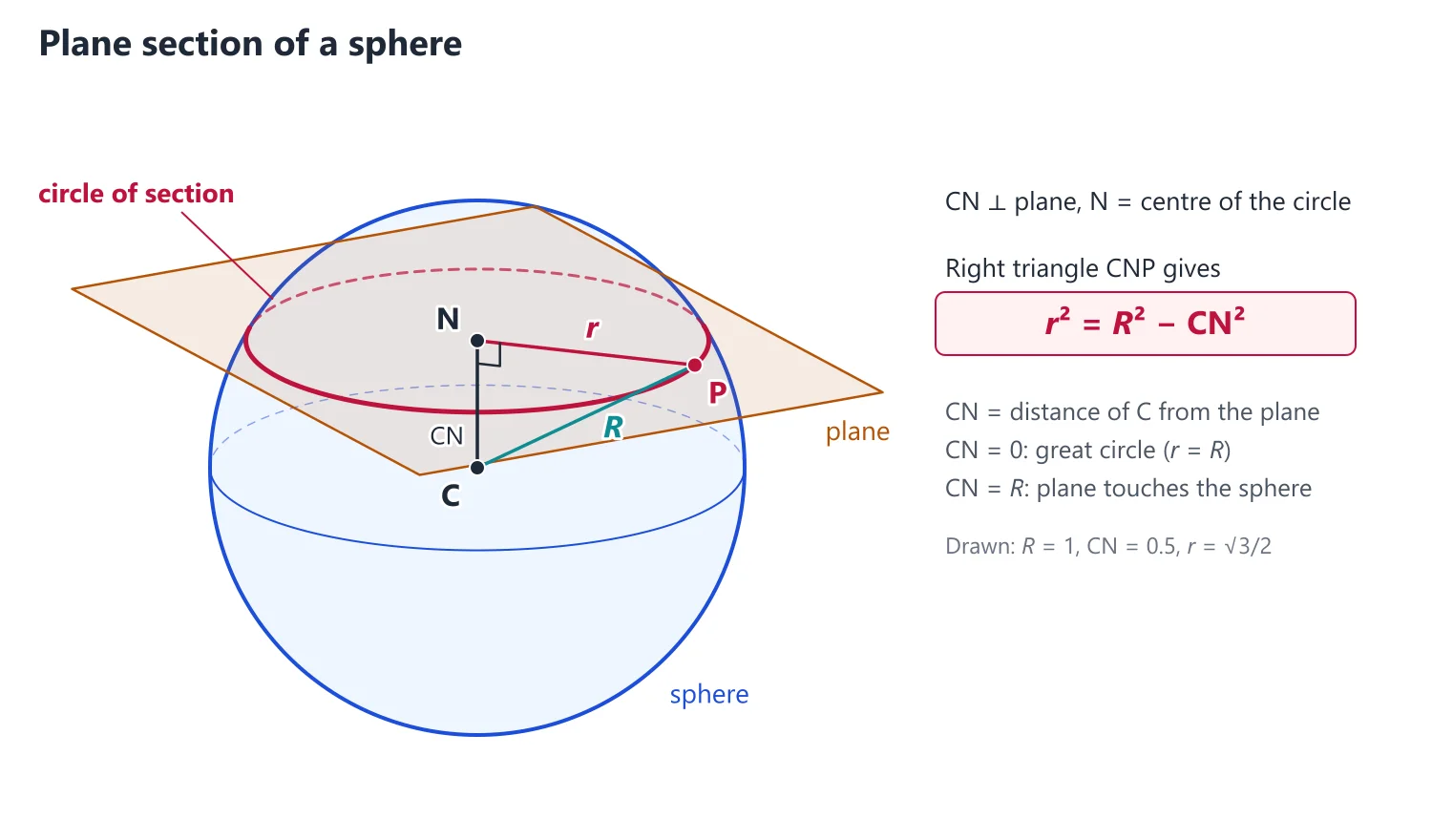
In words: the pair S = 0, P = 0 (sphere and plane together) is the circle of section. Its centre N is the foot of the perpendicular from the sphere's centre C to the plane, and its radius is √(R2 − p2), where p = CN. The equation S + λP = 0, with λ any real number, is a sphere for each λ, and it passes through every point of the circle, because both S and P are zero there.
First example, slowly: the sphere x2 + y2 + z2 = 25 is cut by the plane 2x + y + 2z = 9.
Step 1: centre C = (0, 0, 0), R = 5; distance p = |−9|/√(4 + 1 + 4) = 3. Since p < R, the section is a real circle.
Step 2: radius of the circle = √(25 − 9) = 4.
Step 3: centre of the circle: move from C along the normal, N = t(2, 1, 2), and put N in the plane: 9t = 9, t = 1, so N = (2, 1, 2). Check: 4 + 1 + 4 = 9.
Step 4 (sphere through this circle and the origin): x2 + y2 + z2 − 25 + λ(2x + y + 2z − 9) = 0 at (0, 0, 0) gives −25 − 9λ = 0, λ = −25/9. Multiplying by 9: 9(x2 + y2 + z2) − 50x − 25y − 50z = 0; the constant term vanishes, as it must for a sphere through O.
Non-example: the plane 2x + y + 2z = 18 is at distance 6 from O, and 6 > 5, so R2 − p2 = −11 < 0: there is no real circle. The pair S = 0, P = 0 is then empty, even though S + λP = 0 still gives a family of spheres. Always check p < R before talking about "the circle".
Building up: why does S + λP = 0 contain every sphere Σ = 0 through the circle? Write both with x2 coefficient 1. Then Σ − S is linear (the square terms cancel) and is zero at every point of the circle. A linear expression vanishing at three non-collinear points of the plane P = 0 and at all its other circle points must be a multiple of P, so Σ − S = λP. For a great circle the plane must pass through the centre of S + λP = 0, which gives one linear equation in λ.
Where it is used: sphere through a circle and a point, through a circle and touching a plane (a quadratic in λ), a circle as a great circle, and the circumcircle of a triangle cut off by a plane on the axes.
4. Plane Sections and Circles
A sphere S = 0 and a plane P = 0 together represent a circle. Its centre is the foot of the perpendicular from the centre of the sphere to the plane, and its radius is √(R2 − p2), where R is the radius of the sphere and p the distance of its centre from the plane.
Idea: see the figure above. The centre C of the sphere, the centre N of the circle and any point Q of the circle form a right triangle with the right angle at N, so NQ2 = CQ2 − CN2 = R2 − p2. If p > R the plane misses the sphere; if p = R it touches it.
Spheres through the circle S = 0, P = 0: S + λP = 0. Spheres through the circle of intersection of two spheres: S1 + λS2 = 0 (λ ≠ −1).
Idea: S + λP vanishes at every point of the circle, and it is still of sphere form (equal square terms, no cross terms), so each λ gives a sphere through the circle; one extra condition fixes λ. In S1 + λS2 the value λ = −1 is excluded because S1 − S2 = 0 is the plane of the circle, not a sphere.
A great circle is the section by a plane through the centre; its radius equals that of the sphere.
5. Understanding the Tangent Plane and the Power of a Point
Why we need it: a plane can cut a sphere in a circle, miss it, or touch it at exactly one point. The touching plane, the length of a tangent from an outside point, and the position of a point (inside, on, outside) are asked again and again, and all come from two simple facts.
In words: fact 1: the tangent plane at a point T of the sphere is the plane through T perpendicular to the radius CT. Fact 2: for any point P, the number S1 obtained by substituting P in S (with x2 coefficient 1) equals CP2 − R2; this is the power of P. It is positive outside, zero on, negative inside the sphere, and for an outside point it is the square of the tangent length.
First example, slowly: take S: x2 + y2 + z2 − 2x − 4y − 6z − 2 = 0, with centre (1, 2, 3) and radius √(1 + 4 + 9 + 2) = 4.
Step 1: T(1, 2, 7) is on S, since 1 + 4 + 49 − 2 − 8 − 42 − 2 = 0. It is the "top" of the sphere, 4 units above the centre.
Step 2 (replacement rule): x·1 + y·2 + z·7 − (x + 1) − 2(y + 2) − 3(z + 7) − 2 = 0 simplifies to 4z − 28 = 0, that is z = 7: the horizontal plane through the top, exactly as the picture predicts.
Step 3 (power): for P(5, 2, 7), S1 = 25 + 4 + 49 − 10 − 8 − 42 − 2 = 16 > 0, so P is outside and every tangent from P has length √16 = 4. Check: CP2 − R2 = (16 + 0 + 16) − 16 = 16.
Non-example: applying the replacement rule at P(5, 2, 7), which is not on the sphere, gives 4x + 4z − 32 = 0, that is x + z = 8. This is not a tangent plane: its distance from the centre is |1 + 3 − 8|/√2 = 2√2 < 4, so it cuts the sphere. It is the polar plane of P, and it cuts the sphere in the circle along which the tangents from P touch. The rule gives the tangent plane only when the point lies on the surface.
Building up: the derivations below show that "perpendicular to CT" expands to the replacement rule, and that S1 = CP2 − R2. For a plane with a prescribed normal or through a prescribed line, you do not know T in advance; then use the equivalent test "distance from the centre = radius". Finally, substituting P + te in S gives a quadratic in t whose product of roots is S1, so the power is the same along every line through P.
Where it is used: tangent planes at a point or parallel to a plane, spheres touching a plane, position of a point, the radical plane (points of equal power), and later the enveloping cone SS1 = T2.
6. Tangent Plane, Power and Polar Plane
Tangent plane at (x1, y1, z1): xx1 + yy1 + zz1 + u(x + x1) + v(y + y1) + w(z + z1) + d = 0.
Memory rule: replace x2 by xx1 and 2x by x + x1 (and similarly for y, z). The same rule gives the tangent plane of every conicoid; it is derived below.
A plane touches the sphere if and only if its distance from the centre equals the radius; for x2 + y2 + z2 = a2 the plane lx + my + nz = p touches when p2 = a2(l2 + m2 + n2).
Power of a point (x1, y1, z1): S1 = x12 + y12 + z12 + 2ux1 + 2vy1 + 2wz1 + d; for an external point it is the square of the length of the tangent. The point is outside, on or inside the sphere according as S1 > 0, = 0 or < 0.
Idea: S1 = CP2 − R2, where C is the centre. For any line through P meeting the sphere at A and B, PA · PB = |S1| whatever the direction of the line; this constant is why it is called the power of P.
The polar plane of (x1, y1, z1) has the same equation as the tangent plane; the tangent lines from an external point touch the sphere along the circle in which the polar plane cuts it.
7. Understanding Orthogonal Spheres and the Radical Plane
Why we need it: when two spheres meet, we want to know the angle at which they cut, the plane of their common circle, and conditions such as "cuts a given sphere at right angles". These lead to many locus questions.
In words: the angle between two spheres at a common point Q is the angle between their tangent planes there, which equals the angle between the radii C1Q and C2Q. They are orthogonal when this angle is 90°. The radical plane is the set of points having equal power with respect to both spheres; it contains their common circle when they meet.
First example, slowly: find d so that S2: x2 + y2 + z2 − 6x + d = 0 cuts S1: x2 + y2 + z2 − 4 = 0 orthogonally, and find their common circle.
Step 1: for S1, u1 = v1 = w1 = 0 and d1 = −4; for S2, u2 = −3, v2 = w2 = 0, d2 = d.
Step 2: orthogonality, 2u1u2 + 2v1v2 + 2w1w2 = d1 + d2, reads 0 = −4 + d, so d = 4. Then S2 has centre (3, 0, 0) and radius2 9 − 4 = 5.
Step 3 (check with geometry): δ2 = 9 and r12 + r22 = 4 + 5 = 9, so the triangle C1QC2 has a right angle at Q.
Step 4 (common circle): S1 − S2 = 6x − 8 = 0, so the circle lies in x = 4/3, at distance 4/3 from C1; its radius is √(4 − 16/9) = 2√5/3, which agrees with r1r2/δ = 2√5/3.
Non-example: if the second sphere is written as 2x2 + 2y2 + 2z2 − 12x + 8 = 0 (the same sphere), then S1 − S2 = −x2 − y2 − z2 + 12x − 12 is not a plane. The rule "radical plane = S1 − S2" and the orthogonality condition both need the x2 coefficients to be 1 first.
Building up: in triangle C1QC2 the sides are r1, r2, δ, so the cosine rule gives the angle, and 90° means δ2 = r12 + r22; writing δ, r1, r2 in terms of u, v, w, d turns this into 2u1u2 + 2v1v2 + 2w1w2 = d1 + d2. Equal power means S1 = S2, a linear equation whose normal 2(u1 − u2, v1 − v2, w1 − w2) is along the line of centres, so the radical plane is perpendicular to it.
Where it is used: spheres cutting given spheres orthogonally, loci of centres, the common circle of two spheres, coaxal systems and limiting points.
8. Intersecting Spheres
Angle of intersection: if the spheres have radii r1, r2 and their centres are a distance δ apart, the angle θ between the radii at a common point satisfies cos θ = (r12 + r22 − δ2)/(2r1r2).
Orthogonal spheres: they cut at right angles if and only if δ2 = r12 + r22, that is 2u1u2 + 2v1v2 + 2w1w2 = d1 + d2.
Why it works: at a common point the radii are along the normals; the triangle formed by the two centres and the common point has sides r1, r2, δ, so the cosine rule gives the angle. For orthogonality, δ2 = (u1 − u2)2 + (v1 − v2)2 + (w1 − w2)2 and ri2 = ui2 + vi2 + wi2 − di; the squares cancel and leave 2u1u2 + 2v1v2 + 2w1w2 = d1 + d2.
Touching spheres: they touch externally if δ = r1 + r2 and internally if δ = |r1 − r2|.
Radical plane of S1 = 0 and S2 = 0 (both with coefficient of x2 equal to 1): S1 − S2 = 0, the locus of points with equal powers; it is perpendicular to the line of centres.
Why it works: with both x2 coefficients equal to 1, the square terms cancel in S1 − S2, leaving a linear equation. At a point of this plane S1 = S2, so the tangents drawn to the two spheres have equal lengths.
The radical planes of three spheres taken in pairs pass through a line (the radical line), provided the centres are not collinear; those of four spheres meet in a point (the radical centre), provided the centres are not coplanar.
Coaxal system: S + λP = 0; every pair has the same radical plane P = 0. The point-spheres (radius 0) of the system are its limiting points.
Idea: a coaxal system is a "pencil" of spheres sharing one radical plane, the 3-D analogue of a coaxal family of circles. The centres of its members lie on one line perpendicular to P = 0.
9. Derivation: Tangent Plane and Tangency Condition
The tangent plane at P(x1, y1, z1) is perpendicular to the radius CP, where C = (−u, −v, −w): (x − x1)(x1 + u) + (y − y1)(y1 + v) + (z − z1)(z1 + w) = 0.
Expanding: xx1 + yy1 + zz1 + ux + vy + wz − (x12 + y12 + z12 + ux1 + vy1 + wz1) = 0.
Since P is on the sphere, x12 + y12 + z12 = −2ux1 − 2vy1 − 2wz1 − d, so the bracket equals −ux1 − vy1 − wz1 − d.
Substituting gives xx1 + yy1 + zz1 + u(x + x1) + v(y + y1) + w(z + z1) + d = 0, the stated tangent plane.
Tangency condition: a plane meets the sphere in a circle of radius √(R2 − p2), which shrinks to a point exactly when p = R. For x2 + y2 + z2 = a2 and lx + my + nz = p this reads |p|/√(l2 + m2 + n2) = a.
10. Derivation: Power of a Point
CP2 − R2 = (x1 + u)2 + (y1 + v)2 + (z1 + w)2 − (u2 + v2 + w2 − d) = S1. For an external point the tangent PT is perpendicular to CT, so PT2 = CP2 − R2 = S1.
Put the point P + te (e a unit vector) in S = 0: t2 + 2t e · (P − C) + S1 = 0. The product of the roots is S1, so PA · PB = |S1| for every direction e.
11. Choosing the Method
If four points are given → general form and four linear equations; if two of the points are ends of a diameter → diameter form.
If the sphere passes through a given circle S = 0, P = 0 → S + λP = 0; through the circle of two spheres → S1 + λS2 = 0, or S1 + λ(S1 − S2) = 0.
If the sphere touches a given plane P = 0 at a given point (x1, y1, z1) → (x − x1)2 + (y − y1)2 + (z − z1)2 + λP = 0 (point-sphere plus the plane).
If the tangent plane at a point is asked → the replacement rule; with a given normal direction, or through a given line → distance from the centre = radius.
If the centre or radius of a circle of section is asked → foot of the perpendicular from the centre, and √(R2 − p2).
If orthogonal cutting or a locus of centres is asked → 2u1u2 + 2v1v2 + 2w1w2 = d1 + d2, then write the centre as (α, β, γ) and eliminate the parameters.
12. Common Mistakes
Reading the centre as (−u, −v, −w) before dividing the equation by the coefficient of x2.
Measuring p for the circle of section from the origin instead of from the centre of the sphere.
Taking λ = −1 in S1 + λS2 = 0, which gives the plane of the circle and not a sphere.
Keeping only one root when the tangency condition gives a quadratic in λ; usually there are two spheres (or two tangent planes).
Reversing the sign test: S1 > 0 means the point is outside the sphere, not inside.
13. Connections
Link: S + λP = 0 is the same "pencil" idea as P1 + λP2 = 0 for planes and as the family of circles through the meeting points of a circle and a line in plane geometry.
Link: the polar plane and the power S1 return for every conicoid in the enveloping cone SS1 = T2 (Cone and Cylinder topic); the parametrisation (a sin θ cos φ, a sin θ sin φ, a cos θ) of the sphere is used for surface integrals in Vector Analysis.
14. Worked Examples
Example 1: Find the centre and radius of the circle x2 + y2 + z2 − 2y − 4z = 11, x + 2y + 2z = 15.
The sphere has centre C(0, 1, 2) and radius √(1 + 4 + 11) = 4. The distance of C from the plane is |0 + 2 + 4 − 15|/3 = 3, so the circle has radius √(16 − 9) = √7.
Foot of the perpendicular from C: the point (t, 1 + 2t, 2 + 2t) lies in the plane when 9t + 6 = 15, so t = 1 and the centre of the circle is (1, 3, 4).
Example 2: Find the sphere through the circle x2 + y2 + z2 = 9, 2x + 3y + 4z = 5 and the point (1, 2, 3).
x2 + y2 + z2 − 9 + λ(2x + 3y + 4z − 5) = 0 passes through (1, 2, 3) when 5 + 15λ = 0, so λ = −1/3 and the sphere is 3(x2 + y2 + z2) − 2x − 3y − 4z − 22 = 0.
Example 3: Show that the spheres x2 + y2 + z2 = 25 and x2 + y2 + z2 − 18x − 24y − 40z + 225 = 0 touch externally, and find the point of contact.
The centres are (0, 0, 0) and (9, 12, 20) with radii 5 and √(81 + 144 + 400 − 225) = 20. The distance between the centres is √625 = 25 = 5 + 20, so they touch externally, at the point dividing the join in the ratio 5 : 20 = 1 : 4, namely (9/5, 12/5, 4).
Example 4: Find the sphere that touches the plane 3x + 2y − z + 2 = 0 at (1, −2, 1) and cuts the sphere x2 + y2 + z2 − 4x + 6y + 4 = 0 orthogonally.
Spheres touching the plane at the point: (x − 1)2 + (y + 2)2 + (z − 1)2 + λ(3x + 2y − z + 2) = 0, that is x2 + y2 + z2 + (3λ − 2)x + (2λ + 4)y − (λ + 2)z + (2λ + 6) = 0.
Orthogonality, 2u1u2 + 2v1v2 + 2w1w2 = d1 + d2, with u2 = −2, v2 = 3, w2 = 0, d2 = 4: −2(3λ − 2) + 3(2λ + 4) = 2λ + 10, that is 16 = 2λ + 10, so λ = 3.
The required sphere is x2 + y2 + z2 + 7x + 10y − 5z + 12 = 0.
Example 5: Find the tangent planes to the sphere x2 + y2 + z2 − 4x + 2y − 6z + 5 = 0 that are parallel to the plane 2x + 2y − z = 0, and their points of contact.
Centre C(2, −1, 3), radius √(4 + 1 + 9 − 5) = 3. A parallel plane is 2x + 2y − z + k = 0.
Tangency: |4 − 2 − 3 + k|/3 = 3, so |k − 1| = 9 and k = 10 or k = −8.
The planes are 2x + 2y − z + 10 = 0 and 2x + 2y − z − 8 = 0, touching at C ∓ (2, 2, −1), that is at (0, −3, 4) and (4, 1, 2) respectively.
Example 6: Show that the spheres x2 + y2 + z2 − 2x − 4y − 6z + 5 = 0 and x2 + y2 + z2 + 2x − 2y + 2z − 9 = 0 cut orthogonally, and find the radius of their common circle.
Centres C1(1, 2, 3) and C2(−1, 1, −1); r12 = 1 + 4 + 9 − 5 = 9 and r22 = 1 + 1 + 1 + 9 = 12. Then δ2 = 4 + 1 + 16 = 21 = r12 + r22, so they cut orthogonally (equivalently 2(−1 + 2 − 3) = −4 = d1 + d2).
The common circle lies in the radical plane S1 − S2 = 0, that is 2x + y + 4z − 7 = 0, at distance |2 + 2 + 12 − 7|/√21 = 9/√21 from C1.
Radius of the circle = √(9 − 81/21) = √(36/7) = 6/√7, which equals r1r2/δ = 3·2√3/√21, as it must for orthogonal spheres.
15. Spheres through Points and Circles, Tangency and Locus Problems
Sphere through O and the intercepts A(α, 0, 0), B(0, β, 0), C(0, 0, γ): x2 + y2 + z2 − αx − βy − γz = 0, with centre (α/2, β/2, γ/2) and radius √(α2 + β2 + γ2)/2. The circle ABC is this sphere together with the plane x/α + y/β + z/γ = 1.
Tangency to a plane, from the family S + λP = 0: write the centre and radius in terms of λ and set (distance of centre from the plane)2 = radius2; this is a quadratic in λ, so there are in general two such spheres.
Tangent planes through a line: a plane P1 + λP2 = 0 through the line touches the sphere when its distance from the centre equals the radius. No real λ exists exactly when the line cuts the sphere in two real points.
Example 7 (UPSC 2016, 10 marks): Find the equation of the sphere which passes through the circle x2 + y2 = 4; z = 0 and is cut by the plane x + 2y + 2z = 0 in a circle of radius 3.
Spheres through the circle: x2 + y2 + z2 − 4 + λz = 0, with centre (0, 0, −λ/2) and R2 = λ2/4 + 4.
Distance of the centre from x + 2y + 2z = 0: |2(−λ/2)|/3 = |λ|/3. The section has radius 3, so R2 − λ2/9 = 9, that is 5λ2/36 = 5 and λ = ±6.
Answer: x2 + y2 + z2 ± 6z − 4 = 0 (two spheres, each of radius √13).
Example 8 (UPSC 2022, 10 marks; also asked in 2017): A variable plane passes through a fixed point (a, b, c) and meets the axes at points A, B and C respectively. Find the locus of the centre of the sphere passing through the points O, A, B and C, O being the origin.
Let the plane be x/α + y/β + z/γ = 1, cutting the axes at A(α, 0, 0), B(0, β, 0), C(0, 0, γ). It passes through (a, b, c): a/α + b/β + c/γ = 1.
The sphere OABC is x2 + y2 + z2 − αx − βy − γz = 0, with centre (x, y, z) = (α/2, β/2, γ/2), so α = 2x, β = 2y, γ = 2z.
Substituting: a/(2x) + b/(2y) + c/(2z) = 1.
Answer: the locus of the centre is a/x + b/y + c/z = 2.
Example 9 (UPSC 2018, 12 marks): Find the equation of the sphere in xyz-plane passing through the points (0, 0, 0), (0, 1, −1), (−1, 2, 0) and (1, 2, 3).
Take x2 + y2 + z2 + 2ux + 2vy + 2wz + d = 0; the origin gives d = 0.
(0, 1, −1): 2 + 2v − 2w = 0, so w = v + 1. (−1, 2, 0): 5 − 2u + 4v = 0. (1, 2, 3): 14 + 2u + 4v + 6w = 0.
Adding the last two: 19 + 8v + 6w = 0, so 14v + 25 = 0 and v = −25/14, w = −11/14, u = (5 + 4v)/2 = −15/14.
Answer: 7(x2 + y2 + z2) − 15x − 25y − 11z = 0 (check with (1, 2, 3): 98 − 15 − 50 − 33 = 0).
Example 10 (UPSC 2019, 10 marks): (i) The plane x + 2y + 3z = 12 cuts the axes of coordinates in A, B, C. Find the equations of the circle circumscribing the triangle ABC.
A = (12, 0, 0), B = (0, 6, 0), C = (0, 0, 4). The sphere through O, A, B, C is x2 + y2 + z2 − 12x − 6y − 4z = 0.
The circumcircle of ABC is the section of this sphere by the plane ABC.
Answer: x2 + y2 + z2 − 12x − 6y − 4z = 0, x + 2y + 3z = 12.
Example 11 (UPSC 2021, 15 marks): A sphere of constant radius r passes through the origin O and cuts the axes at the points A, B and C. Find, the locus of the foot of the perpendicular drawn from O to the plane ABC.
Let A(α, 0, 0), B(0, β, 0), C(0, 0, γ). The sphere OABC is x2 + y2 + z2 − αx − βy − γz = 0, and its radius is r, so α2 + β2 + γ2 = 4r2.
The foot F(x, y, z) of the perpendicular from O to x/α + y/β + z/γ = 1 lies on the normal through O, so (x, y, z) = t(1/α, 1/β, 1/γ). Then x2 + y2 + z2 = t2(1/α2 + 1/β2 + 1/γ2), while F on the plane gives t(1/α2 + 1/β2 + 1/γ2) = 1.
Hence t = x2 + y2 + z2 and α = t/x = (x2 + y2 + z2)/x, β = (x2 + y2 + z2)/y, γ = (x2 + y2 + z2)/z.
Answer: substituting in α2 + β2 + γ2 = 4r2, the locus is (x2 + y2 + z2)2(x−2 + y−2 + z−2) = 4r2.
Example 12 (UPSC 2023, 15 marks): Find the equation of the sphere through the circle x2 + y2 + z2 − 4x − 6y + 2z − 16 = 0; 3x + y + 3z − 4 = 0 in the following two cases.
(i) the point (1, 0, −3) lies on the sphere.
(ii) the given circle is a great circle of the sphere.
Let S = x2 + y2 + z2 − 4x − 6y + 2z − 16 and P = 3x + y + 3z − 4; every sphere through the circle is S + λP = 0.
(i) At (1, 0, −3): S = 1 + 9 − 4 − 6 − 16 = −16 and P = 3 − 9 − 4 = −10, so λ = −8/5 and 5S − 8P = 0: 5(x2 + y2 + z2) − 44x − 38y − 14z − 48 = 0.
(ii) The centre of S + λP = 0 is (2 − 3λ/2, 3 − λ/2, −1 − 3λ/2). For a great circle it lies on P = 0: 3(2 − 3λ/2) + (3 − λ/2) + 3(−1 − 3λ/2) − 4 = 2 − 19λ/2 = 0, so λ = 4/19.
Answer: (i) 5(x2 + y2 + z2) − 44x − 38y − 14z − 48 = 0; (ii) 19(x2 + y2 + z2) − 64x − 110y + 50z − 320 = 0.
Example 13 (UPSC 2025, 15 marks): Find the equations of the spheres which pass through the circle x2 + y2 + z2 − 2x + 2y + 4z − 3 = 0, 2x + y + z = 4 and touch the plane 3x + 4y = 14.
S + λP = 0: x2 + y2 + z2 + (2λ − 2)x + (2 + λ)y + (4 + λ)z − 3 − 4λ = 0, with centre (1 − λ, −(2 + λ)/2, −(4 + λ)/2).
R2 = (1 − λ)2 + (2 + λ)2/4 + (4 + λ)2/4 + 3 + 4λ = (3/2)λ2 + 5λ + 9.
Distance of the centre from 3x + 4y − 14 = 0: |3(1 − λ) − 2(2 + λ) − 14|/5 = |λ + 3|. Tangency: (λ + 3)2 = (3/2)λ2 + 5λ + 9, that is λ2/2 − λ = 0, so λ = 0 or λ = 2.
Answer: x2 + y2 + z2 − 2x + 2y + 4z − 3 = 0 (centre (1, −1, −2), radius 3) and x2 + y2 + z2 + 2x + 4y + 6z − 11 = 0 (centre (−1, −2, −3), radius 5).
Example 14 (UPSC 2025, 15 marks): Show that there is no tangent plane to the sphere
x2 + y2 + z2 − 4x + 2y − 4z + 4 = 0
that can be passed through the straight line
(x + 6)/2 = y + 3 = z + 1.
The sphere has centre (2, −1, 2) and radius √(4 + 1 + 4 − 4) = √5. A general point of the line is (−6 + 2t, −3 + t, −1 + t).
Substituting in the sphere: 6t2 − 42t + 72 = 6(t − 3)(t − 4) = 0, so the line cuts the sphere in the two real points (0, 0, 2) and (2, 1, 3).
Every plane through the line contains these two points of the sphere, so it meets the sphere in a circle through two distinct points, which cannot be a single point of contact. Hence no plane through the line touches the sphere.
Answer: the line is a secant of the sphere (its distance from the centre, √(7/2), is less than √5), so no tangent plane passes through it.
Example 15 (UPSC 2026, 10 marks): Obtain the equation of the sphere having its centre on the line 5y + 2z = 0 = 2x − 3y and passing through the points (0, −2, −4) and (2, −1, −1).
The line 5y + 2z = 0 = 2x − 3y passes through the origin with direction (0, 5, 2) × (2, −3, 0) = (6, 4, −10), proportional to (3, 2, −5); so the centre is (3t, 2t, −5t).
Equal distances to the two points: 9t2 + (2t + 2)2 + (4 − 5t)2 = (3t − 2)2 + (2t + 1)2 + (1 − 5t)2, that is 38t2 − 32t + 20 = 38t2 − 18t + 6, so t = 1.
Centre (3, 2, −5); radius2 = 9 + 16 + 1 = 26.
Answer: x2 + y2 + z2 − 6x − 4y + 10z + 12 = 0.
16. Practice Exercises
Exercise 1 (basic): Find the centre and radius of x2 + y2 + z2 + 4x − 6y + 2z − 2 = 0.
Answer: centre (−2, 3, −1), radius √(4 + 9 + 1 + 2) = 4.
Exercise 2 (basic): Does the point (1, 1, 1) lie inside, on or outside the sphere x2 + y2 + z2 − 2x + 4y − 6z = 11?
Answer: S1 = 3 − 2 + 4 − 6 − 11 = −12 < 0, so the point is inside.
Exercise 3 (basic): Find the sphere on the join of (2, −1, 3) and (0, 3, −1) as diameter, and its centre and radius.
Answer: (x − 2)x + (y + 1)(y − 3) + (z − 3)(z + 1) = 0, that is x2 + y2 + z2 − 2x − 2y − 2z − 6 = 0; centre (1, 1, 1), radius 3.
Exercise 4 (standard): Find the centre and radius of the circle x2 + y2 + z2 − 2x + 2y − 4z − 3 = 0, x + 2y + 2z = 6.
Answer: the sphere has centre (1, −1, 2) and radius 3; p = |1 − 2 + 4 − 6|/3 = 1; the circle has radius 2√2 and centre (4/3, −1/3, 8/3).
Exercise 5 (standard): Find the sphere through the circle x2 + y2 + z2 = 9, x + y + z = 3 and the point (1, 1, 2).
Answer: at (1, 1, 2), S = −3 and P = 1, so λ = 3: x2 + y2 + z2 + 3x + 3y + 3z − 18 = 0.
Exercise 6 (standard): Find the tangent plane to x2 + y2 + z2 − 2x − 4y + 2z − 3 = 0 at (3, 3, 1).
Answer: the point is on the sphere; the radius direction is (3, 3, 1) − (1, 2, −1) = (2, 1, 2), so the tangent plane is 2x + y + 2z = 11.
Exercise 7 (standard): For what values of k does the plane x + y + z = k touch the sphere x2 + y2 + z2 − 2x − 2y − 2z − 6 = 0?
Answer: centre (1, 1, 1), radius 3; |3 − k|/√3 = 3 gives k = 3 ± 3√3.
Exercise 8 (UPSC level): Show that the spheres x2 + y2 + z2 − 2x + 4y − 4 = 0 and x2 + y2 + z2 + 4x + 2y − 2z + 4 = 0 cut orthogonally, and find the plane and the radius of their common circle.
Answer: 2(−2 + 2 + 0) = 0 = −4 + 4, so they are orthogonal; the radical plane is 3x − y − z + 4 = 0; with r1 = 3, r2 = √2, δ = √11 the circle has radius r1r2/δ = 3√2/√11.
Exercise 9 (UPSC level): Find the spheres through the circle x2 + y2 + z2 = 4, x + z = 1 that touch the plane x = 3.
Answer: S + λP has centre (−λ/2, 0, −λ/2) and R2 = λ2/2 + λ + 4; tangency (3 + λ/2)2 = R2 gives λ2 − 8λ − 20 = 0, λ = −2 or 10: x2 + y2 + z2 − 2x − 2z − 2 = 0 (radius 2) and x2 + y2 + z2 + 10x + 10z − 14 = 0 (radius 8).
Exercise 10 (UPSC level): Find the locus of the centres of spheres that pass through (1, 0, 0) and cut the sphere x2 + y2 + z2 = 4 orthogonally.
Answer: with centre (α, β, γ) the sphere is x2 + y2 + z2 − 2αx − 2βy − 2γz + d = 0; orthogonality gives d = 4 and the point gives d = 2α − 1, so α = 5/2: the locus is the plane x = 5/2.
Exercise 11 (UPSC level): Find the tangent planes to the sphere x2 + y2 + z2 = 4 that pass through the line x + y = 3, z = 0.
Answer: planes through the line are x + y − 3 + λz = 0; the distance condition 3/√(2 + λ2) = 2 gives λ = ±1/2, so the planes are 2x + 2y + z = 6 and 2x + 2y − z = 6.
Mains points
- Standard questions: sphere through a given circle and a point, or touching a given plane; centre and radius of a circle of section; spheres cutting a given sphere orthogonally.
- Use the family S + λP = 0 or S1 + λS2 = 0 instead of finding the centre and radius from scratch.
- For a tangent plane condition, equate the perpendicular distance from the centre to the radius; for the point of contact, take the foot of the perpendicular.
- Before using the radical plane S1 − S2 = 0, make the coefficient of x2 equal to 1 in both equations.
- Proof questions such as 'find the locus of centres of spheres that pass through a point and cut a given sphere orthogonally' reduce to the condition 2u1u2 + 2v1v2 + 2w1w2 = d1 + d2.
Did you know?
- A neat check for orthogonality: two spheres cut orthogonally exactly when the power of the centre of one with respect to the other equals the square of the first radius, so the tangent from each centre to the other sphere is the radius.
Cone and Cylinder
A cone is generated by lines through a fixed vertex meeting a guiding curve; with vertex at the origin its equation is homogeneous of degree two. The cone ax2 + by2 + cz2 + 2fyz + 2gzx + 2hxy = 0 has three mutually perpendicular generators if and only if a + b + c = 0. A cylinder is generated by lines parallel to a fixed direction meeting a guiding curve; right circular cones and cylinders are written from the axis and the angle or radius.
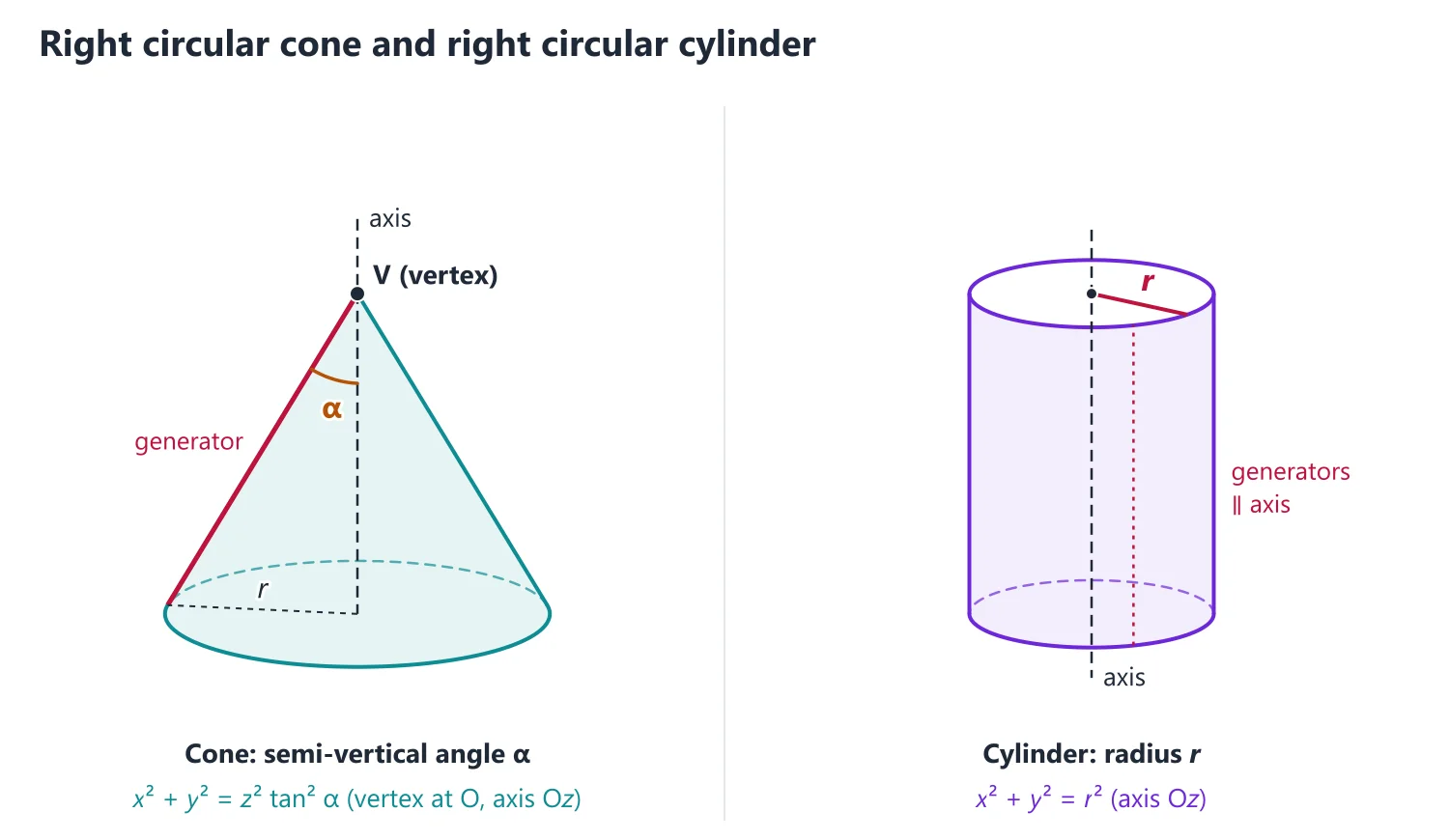
1. Understanding Cones and Homogeneous Equations
Why we need it: many surfaces are made entirely of straight lines through one point: the light cone of a torch, the set of tangent lines from a point to a sphere. We need to write their equations and to recognise, from an equation, that a surface is such a cone and where its vertex is.
In words: a cone with vertex V is a surface such that, whenever P is on it, the whole line VP is on it. These lines are the generators. A polynomial f is homogeneous of degree 2 if every term has total degree 2 (x2, yz, ...), so f(tx, ty, tz) = t2f(x, y, z). That scaling property is exactly the statement "if P is on f = 0, so is every point tP of the line OP", which is why homogeneous equations are cones with vertex O.
First example, slowly: find the cone with vertex O whose guiding curve is x2 + y2 + 2x = 3, z = 2.
Step 1: on the curve's plane z/2 = 1. Multiply each term of the curve's equation by the power of z/2 that makes it degree 2: x2 and y2 stay, 2x becomes 2x(z/2), and 3 becomes 3(z/2)2.
Step 2: x2 + y2 + xz = 3z2/4, that is 4x2 + 4y2 + 4xz − 3z2 = 0. It is homogeneous, so it is a cone with vertex O.
Step 3 (check): the curve point (1, 0, 2) gives 4 + 8 − 12 = 0, and (−3, 0, 2) gives 36 − 24 − 12 = 0. The point (−1.5, 0, 1), halfway from O to (−3, 0, 2), also gives 9 − 6 − 3 = 0, as a cone must.
Notice why this works: on the plane z = 2 the new equation is the old one, and the new equation is homogeneous; so it is the cone through the curve.
Non-example: x2 + y2 = z2 + 1 contains (1, 0, 0) but not (2, 0, 0), so the line from O through (1, 0, 0) leaves the surface; it is a hyperboloid, not a cone, because the constant term spoils homogeneity. Also x2 + y2 + z2 = 0 is homogeneous but contains only the origin, and x2 − y2 = 0 is homogeneous but is the pair of planes x = ±y (degenerate cones).
Building up: with the vertex at V(α, β, γ), shift the origin to V: in the new coordinates the cone is homogeneous. Equivalently, write the generator through V with direction (l, m, n), make it meet the guiding curve, and replace l : m : n by (x − α) : (y − β) : (z − γ). Conversely, to test a given second-degree equation F = 0 for being a cone, look for a point where all first partial derivatives vanish (after homogenising with t): that point is the vertex, because moving the origin there removes all linear terms and the constant.
Where it is used: cones through conics, cones through the axes (fyz + gzx + hxy = 0), enveloping cones, the circle ABC cone, and identifying cones in the reduction of the general second-degree equation.
2. Cone
A cone is a surface generated by straight lines (generators) that pass through a fixed point (the vertex) and meet a given curve (the guiding curve).
Idea: picture a torch at the vertex shining through a wire loop: the light rays are the generators (see the figure above). The guiding curve can be any curve, so a cone in this sense need not be circular, and it extends on both sides of the vertex.
A homogeneous second-degree equation ax2 + by2 + cz2 + 2fyz + 2gzx + 2hxy = 0 represents a cone with vertex at the origin, and conversely.
Why it works: if f is homogeneous and f(x, y, z) = 0, then f(tx, ty, tz) = t2f(x, y, z) = 0 for every t, so the whole line joining O to the point lies on the surface: the surface is made of lines through O. Caution: x2 + y2 + z2 = 0 is only the origin, and a homogeneous equation that factorises is a pair of planes (a degenerate cone).
If the cone with vertex at the origin is f(x, y, z) = 0 (f homogeneous), then the direction ratios (l, m, n) of every generator satisfy f(l, m, n) = 0.
Cone with vertex (α, β, γ) and guiding curve f(x, y) = 0, z = 0: the generator (x − α)/l = (y − β)/m = (z − γ)/n meets z = 0 at (α − lγ/n, β − mγ/n). Substitute this point in f = 0 and eliminate l/n and m/n using l/n = (x − α)/(z − γ), m/n = (y − β)/(z − γ).
Why it works: a point (x, y, z) is on the cone exactly when the line joining it to the vertex meets the guiding curve; that line has l : m : n = (x − α) : (y − β) : (z − γ), so the condition "meets the curve" becomes one equation in x, y, z.
Vertex of a cone F(x, y, z) = 0 of second degree: make F homogeneous with a fourth variable t; the equation represents a cone if and only if Fx = Fy = Fz = Ft = 0 (with t = 1) have a common solution, and that solution is the vertex.
Why it works: shifting the origin to the vertex makes the equation homogeneous, and every first partial derivative of a homogeneous quadratic vanishes at the origin. Conversely, by Euler's theorem 2F = xFx + yFy + zFz + tFt, so a common zero of the four derivatives lies on the surface and acts as its vertex.
Enveloping cone of a sphere (or any conicoid) S = 0 with vertex (x1, y1, z1): SS1 = T2, where T = 0 is the equation of the polar plane of the vertex (the tangent-plane form).
Right circular cone with vertex (α, β, γ), axis direction (l, m, n) and semi-vertical angle θ: [l(x − α) + m(y − β) + n(z − γ)]2 = cos2θ (l2 + m2 + n2)[(x − α)2 + (y − β)2 + (z − γ)2].
Why it works: a point P is on the right circular cone exactly when the angle between VP and the axis is θ (or π − θ): cos2θ = [l(x − α) + m(y − β) + n(z − γ)]2/((l2 + m2 + n2)VP2). Squaring takes both nappes at once.
3. Understanding Generators and Perpendicular Generators
Why we need it: a cone with vertex O is completely described by its set of generator directions. Questions ask for the generators in which a plane through O cuts the cone, the angle between them, and whether the cone has three mutually perpendicular generators.
In words: the line x/l = y/m = z/n is a generator of f(x, y, z) = 0 exactly when f(l, m, n) = 0. A plane ux + vy + wz = 0 through O meets the cone in the directions satisfying both f(l, m, n) = 0 and ul + vm + wn = 0: eliminating one variable leaves a quadratic, so there are two generators, one repeated generator (the plane is tangent), or none (real).
First example, slowly: the cone xy + yz + zx = 0 has a + b + c = 0. Find a set of three mutually perpendicular generators containing the direction (2, 2, −1).
Step 1: (2, 2, −1) is a generator, since 4 − 2 − 2 = 0.
Step 2: the other two must be perpendicular to it, so they lie in the plane 2x + 2y − z = 0 through O. Substitute z = 2x + 2y: xy + (x + y)(2x + 2y) = 2x2 + 5xy + 2y2 = (2x + y)(x + 2y) = 0.
Step 3: y = −2x gives z = −2x, direction (1, −2, −2); x = −2y gives z = −2y, direction (2, −1, 2).
Step 4 (check): all three satisfy xy + yz + zx = 0, and the dot products (2, 2, −1)·(1, −2, −2), (2, 2, −1)·(2, −1, 2) and (1, −2, −2)·(2, −1, 2) are all 0. Notice that the coordinate axes form another such set, since this cone contains all three axes.
Non-example: the right circular cone x2 + y2 − z2 = 0 has a + b + c = 1 ≠ 0, and indeed it has no three mutually perpendicular generators: every generator makes 45° with the z-axis, so its unit vector has z-component of square 1/2; three mutually perpendicular unit vectors would need these squares to add to 1, but 3 × 1/2 = 3/2.
Building up: the non-example is the general proof in miniature. If e1, e2, e3 are perpendicular unit vectors, then f(e1) + f(e2) + f(e3) is the trace a + b + c (trace is unchanged by rotation), so three perpendicular generators force a + b + c = 0. The converse uses the perpendicularity condition for the two generators in a plane, proved in the later section. The tangent plane along a generator (l, m, n) has normal (al + hm + gn, hl + bm + fn, gl + fm + cn), that is M(l, m, n)T.
Where it is used: "find the other two generators" questions, the angle between the lines cut by a plane, tangency of planes to cones, and the reciprocal cone.
4. Properties of the Cone ax2 + by2 + cz2 + 2fyz + 2gzx + 2hxy = 0
Three mutually perpendicular generators: the cone has infinitely many sets of three mutually perpendicular generators if and only if a + b + c = 0.
Why a + b + c = 0 is necessary: if three mutually perpendicular generators exist, take them as new rectangular axes. Each axis lies on the cone, so the new coefficients of x2, y2, z2 are zero. The sum a + b + c is the trace of the matrix of the form, which does not change under a rotation of axes, so a + b + c = 0. Sufficiency is shown in the section "Perpendicular Generators, Cone Conditions and Right Circular Cylinders" below.
Tangent plane at a point (x1, y1, z1) of the cone: x(ax1 + hy1 + gz1) + y(hx1 + by1 + fz1) + z(gx1 + fy1 + cz1) = 0; it passes through the vertex and touches the cone along the whole generator through the point.
Tangency condition: the plane ux + vy + wz = 0 touches the cone if and only if Au2 + Bv2 + Cw2 + 2Fvw + 2Gwu + 2Huv = 0, where A = bc − f2, B = ca − g2, C = ab − h2, F = gh − af, G = hf − bg, H = fg − ch are the cofactors.
Idea: a tangent plane of a cone always passes through the vertex and contains a whole generator, the line of contact. Two cutting generators merging into one is what "touching" means here.
Reciprocal cone: the locus of the normals through the vertex to the tangent planes is Ax2 + By2 + Cz2 + 2Fyz + 2Gzx + 2Hxy = 0; for ax2 + by2 + cz2 = 0 it is x2/a + y2/b + z2/c = 0.
Idea: the normals of the tangent planes of one cone form the reciprocal cone, and the reciprocal of the reciprocal cone is the original cone; its matrix is the adjugate of the original matrix.
Section by a plane through the vertex: the plane ux + vy + wz = 0 meets the cone in two generators; they are perpendicular if and only if (a + b + c)(u2 + v2 + w2) = au2 + bv2 + cw2 + 2fvw + 2gwu + 2huv, and they coincide when the plane satisfies the tangency condition above.
5. Understanding Right Circular Cones and Cylinders
Why we need it: the most symmetric cones and cylinders are those with an axis of rotational symmetry. Their equations come straight from one geometric property, and questions give exactly that data: the axis and an angle, or the axis and a radius.
In words: a right circular cone with vertex V, axis direction a and semi-vertical angle θ is the set of points P for which VP makes the angle θ (or π − θ) with the axis. A right circular cylinder with axis through A in direction a and radius r is the set of points at distance r from the axis. So the cone is an "angle" condition (dot product) and the cylinder a "distance" condition (Pythagoras).
First example, slowly: (a) the right circular cone with vertex O and axis the z-axis through the point (3, 0, 4); (b) the right circular cylinder of radius 1 with axis x = y = z.
Step 1 (angle from the given point): the point (3, 0, 4) is at distance 5 from O, and its projection on the axis (0, 0, 1) is 4, so cos θ = 4/5.
Step 2 (cone): z2 = (16/25)(x2 + y2 + z2), that is 16x2 + 16y2 − 9z2 = 0. Check with (3, 0, 4): 144 − 144 = 0.
Step 3 (cylinder): the axis passes through O with direction (1, 1, 1) of length √3. For P(x, y, z), OP2 = x2 + y2 + z2 and the projection on the axis is (x + y + z)/√3, so (distance)2 = x2 + y2 + z2 − (x + y + z)2/3 = 1.
Step 4: multiplying by 3 and expanding, 2(x2 + y2 + z2) − 2(xy + yz + zx) = 3. Check with (1/√2, −1/√2, 0), which is perpendicular to the axis at distance 1: 2(1) − 2(−1/2) = 3.
Non-example: for the cone with axis (1, 1, 1) and θ = 45°, writing (x + y + z)2 = cos245° (x2 + y2 + z2) forgets the factor l2 + m2 + n2 = 3. That surface is a right circular cone, but with cos2θ = 1/6, a semi-vertical angle of about 65.9°, not 45°. The formula needs direction cosines, or the factor l2 + m2 + n2.
Building up: the cone formula is cos θ = (VP · a)/(|VP| |a|) squared, which also includes the opposite nappe (angle π − θ). The cylinder formula is AP2 − (projection of AP on the axis)2 = r2. A general (not circular) cylinder with generators parallel to (l, m, n) through a curve in z = 0 is obtained by sliding each point back along the generator to z = 0, which gives f(x − lz/n, y − mz/n) = 0.
Where it is used: right circular cones through given points, cylinders through a circle, areas of sections of cylinders, and recognising rotation surfaces after reduction to canonical form.
6. Cylinder
A cylinder is a surface generated by straight lines parallel to a fixed direction that meet a given curve.
Idea: a cylinder is a cone whose vertex has gone to infinity: all the generators become parallel.
Cylinder with generators parallel to (l, m, n) and guiding curve f(x, y) = 0, z = 0: the generator through (x, y, z) meets z = 0 at (x − lz/n, y − mz/n), so the cylinder is f(x − lz/n, y − mz/n) = 0.
An equation free of z, f(x, y) = 0, represents a cylinder with generators parallel to the z-axis.
Right circular cylinder of radius r with axis (x − α)/l = (y − β)/m = (z − γ)/n: (x − α)2 + (y − β)2 + (z − γ)2 − [l(x − α) + m(y − β) + n(z − γ)]2/(l2 + m2 + n2) = r2.
Why it works: the distance of P from the axis satisfies (distance)2 = AP2 − (projection of AP on the axis)2, where A = (α, β, γ) is on the axis (Pythagoras); setting it equal to r2 gives the equation.
Enveloping cylinder of a sphere or conicoid with generators parallel to (l, m, n): the locus of the lines in that direction that touch the surface, found by putting the discriminant of the quadratic in the line parameter equal to zero.
7. Understanding the Enveloping Cone
Why we need it: from an outside point V you can draw infinitely many tangent lines to a sphere; together they form a cone that wraps around the sphere and touches it along a circle. Its equation SS1 = T2 is one of the most quoted formulas of the chapter.
In words: S is the left side of the surface equation at a general point (x, y, z); S1 is S evaluated at the vertex (the power of V); T is the tangent-plane expression with the vertex as the "point" (so T = 0 is the polar plane of V). The enveloping cone (tangent cone) is SS1 = T2.
First example, slowly: the enveloping cone of x2 + y2 + z2 = 1 from V(0, 0, 2).
Step 1: S = x2 + y2 + z2 − 1, S1 = 0 + 0 + 4 − 1 = 3, and T = x·0 + y·0 + z·2 − 1 = 2z − 1.
Step 2: 3(x2 + y2 + z2 − 1) = (2z − 1)2, which simplifies to 3x2 + 3y2 − z2 + 4z − 4 = 0. The vertex satisfies it: −4 + 8 − 4 = 0.
Step 3 (geometric check): the tangent from V makes angle α with VO where sin α = radius/VO = 1/2, so α = 30°. The right circular cone with vertex (0, 0, 2), axis the z-axis and θ = 30° is (z − 2)2 = 3(x2 + y2), which expands to the same equation.
Step 4 (circle of contact): it lies in the polar plane T = 0, that is z = 1/2, where the sphere gives x2 + y2 = 3/4.
Non-example: from the inside point V(0, 0, 1/2), S1 = −3/4 < 0 and no tangent lines exist. The formula still produces an equation, −(3/4)(x2 + y2 + z2 − 1) = (z/2 − 1)2, but it simplifies to (3/4)x2 + (3/4)y2 + (z − 1/2)2 = 0, whose only real point is the vertex. The enveloping cone is real only when the vertex is outside (S1 > 0).
Building up: the derivation below puts a general point of the line VP into S = 0, getting a quadratic k2S + 2kT + S1 = 0; "VP is a tangent" means a repeated root, that is T2 = SS1. Exactly the same algebra works for any conicoid. If instead of a vertex we fix a direction (l, m, n) for the tangent lines, the repeated-root condition gives the enveloping cylinder.
Where it is used: enveloping cones of spheres and conicoids, sections of these cones (rectangular hyperbola or parabola questions), and the locus of points from which the enveloping cone has a given property.
8. Derivation: The Enveloping Cone SS1 = T2
Take the sphere S = x2 + y2 + z2 − a2 and the vertex V(x1, y1, z1). Let P(x, y, z) be a point of the cone; the points of the line VP are ((kx + x1)/(k + 1), (ky + y1)/(k + 1), (kz + z1)/(k + 1)).
Substituting in S = 0 and multiplying by (k + 1)2: k2S + 2kT + S1 = 0, where S = x2 + y2 + z2 − a2, T = xx1 + yy1 + zz1 − a2 and S1 = x12 + y12 + z12 − a2.
VP touches the sphere exactly when this quadratic in k has equal roots: 4T2 = 4SS1, that is SS1 = T2. The same computation works for ax2 + by2 + cz2 = 1 with S = ax2 + by2 + cz2 − 1 and T = axx1 + byy1 + czz1 − 1.
On the sphere S = 0 the cone equation reduces to T2 = 0, so the cone touches the sphere along the circle in which the polar plane T = 0 cuts it.
9. Derivation: Condition for a Plane to Touch the Cone
Write the cone as XTMX = 0 with M = [[a, h, g], [h, b, f], [g, f, c]] and let ux + vy + wz = 0 touch it along the generator with direction X0 = (l, m, n).
The tangent plane along X0 has normal MX0, so MX0 = k(u, v, w)T, and X0 lies in the plane: ul + vm + wn = 0.
If det M ≠ 0, X0 = kM−1(u, v, w)T = (k/det M) adj(M)(u, v, w)T; substituting in ul + vm + wn = 0 gives (u, v, w) adj(M) (u, v, w)T = 0.
Written out, this is Au2 + Bv2 + Cw2 + 2Fvw + 2Gwu + 2Huv = 0 with the cofactors A, B, C, F, G, H. It also shows that the normals (u, v, w) of the tangent planes generate the reciprocal cone.
10. Choosing the Method
If the vertex is the origin and the guiding curve is a conic in a plane → homogenise: use the plane's equation (for example z/c = 1) to make every term of the conic of degree 2.
If the vertex is not the origin → the general-generator method (l/n, m/n eliminated), or shift the origin to the vertex and homogenise.
If tangent lines from a point to a sphere or conicoid are involved → SS1 = T2; tangent lines in a fixed direction → enveloping cylinder (discriminant of the quadratic in the line parameter).
If the axis and semi-vertical angle are known → right circular cone formula; if the axis and one point of the cone are known, find cos θ from that point first.
If the cone passes through the three coordinate axes → fyz + gzx + hxy = 0; if it is to have three mutually perpendicular generators → a + b + c = 0.
If a right circular cylinder is to be found → distance from the axis = radius; if it passes through a given circle, the axis is the normal to the circle's plane through its centre.
11. Common Mistakes
Homogenising only some terms: the constant term must be multiplied by (z/c)2 and each linear term by (z/c).
Writing T without its constant term (for example xx1 + yy1 + zz1 instead of xx1 + yy1 + zz1 − a2) in SS1 = T2.
Using the full vertex angle instead of the semi-vertical angle θ in the right circular cone formula.
Applying the test a + b + c = 0 to an equation whose vertex is not at the origin; shift the origin to the vertex first.
Calling every homogeneous second-degree equation a real cone without checking for a factorisable form (pair of planes) or x2 + y2 + z2 = 0 type (only a point).
12. Connections
Link: the tangency condition and the reciprocal cone use the adjugate of a symmetric matrix, and the a + b + c = 0 proof uses the invariance of the trace (Linear Algebra).
Link: in the classification of the general second-degree equation, a cone is the case D ≠ 0, Δ = 0, and the elliptic, hyperbolic and parabolic cylinders are cases with a zero eigenvalue (Reduction to Canonical Form topic).
13. Worked Examples
Example 1: Find the cone with vertex at the origin and guiding curve x2/a2 + y2/b2 = 1, z = c.
Make the equation of the curve homogeneous using z/c = 1: x2/a2 + y2/b2 = z2/c2.
Example 2: Find the right circular cone with vertex at the origin, axis x = y = z and semi-vertical angle 45°.
(x + y + z)2 = cos245° · 3(x2 + y2 + z2) gives 2(x + y + z)2 = 3(x2 + y2 + z2), that is x2 + y2 + z2 − 4xy − 4yz − 4zx = 0.
Example 3: Find the right circular cylinder of radius 2 whose axis is x/1 = y/2 = z/2.
9(x2 + y2 + z2) − (x + 2y + 2z)2 = 36, that is 8x2 + 5y2 + 5z2 − 4xy − 8yz − 4zx − 36 = 0.
Example 4: The cone 3yz − 2zx − 4xy = 0 has a = b = c = 0, so a + b + c = 0, and it has infinitely many sets of three mutually perpendicular generators.
Example 5: Find the cone with vertex (1, 2, 3) whose guiding curve is x2 + y2 = 4, z = 0.
The line joining the vertex (α, β, γ) to a point (x, y, z) of the cone meets z = 0 at ((αz − γx)/(z − γ), (βz − γy)/(z − γ), 0), here ((z − 3x)/(z − 3), (2z − 3y)/(z − 3), 0).
This point lies on the guiding curve: (z − 3x)2 + (2z − 3y)2 = 4(z − 3)2.
Expanding, the cone is 9x2 + 9y2 + z2 − 12yz − 6zx + 24z − 36 = 0 (check: the vertex (1, 2, 3) gives 9 + 36 + 9 − 72 − 18 + 72 − 36 = 0).
Example 6: Find the angle between the lines in which the plane 3x + y + 5z = 0 cuts the cone 6yz − 2zx + 5xy = 0.
Put y = −3x − 5z in the cone: 6z(−3x − 5z) − 2zx + 5x(−3x − 5z) = −15x2 − 45zx − 30z2 = 0, that is (x + z)(x + 2z) = 0.
x = −z gives y = −2z: direction (1, 2, −1). x = −2z gives y = z: direction (2, −1, −1).
cos θ = (2 − 2 + 1)/(√6·√6) = 1/6, so θ = cos−1(1/6).
14. Perpendicular Generators, Cone Conditions and Right Circular Cylinders
Finding the other two of three mutually perpendicular generators (when a + b + c = 0): take the plane through the vertex perpendicular to the known generator; it cuts the cone in two generators, which are perpendicular to each other and to the known one.
Why a + b + c = 0 is enough: if a + b + c = 0, the plane lx + my + nz = 0 through the vertex perpendicular to a generator (l, m, n) (its normal is (l, m, n)) satisfies the perpendicularity condition (a + b + c)(l2 + m2 + n2) = f(l, m, n), because both sides are 0; so its two generators are perpendicular. Each generator gives such a set, hence infinitely many.
Area of an ellipse Ax2 + 2Hxy + By2 = K (AB − H2 > 0, K > 0): πK/√(AB − H2). Use it for the area of a plane section of a cylinder or cone.
Right circular cylinder through a circle S = 0, P = 0: its axis is the normal to P through the centre of S, and its radius is the radius of the circle, √(R2 − p2).
A section of a cone with vertex O by a plane z = k is a rectangular hyperbola when its x2 and y2 coefficients add to zero (and it is not a line pair).
Example 7 (UPSC 2014, 10 marks): (ii) Prove that the equation ax2 + by2 + cz2 + 2ux + 2vy + 2wz + d = 0 represents a cone if u2/a + v2/b + w2/c = d.
Make the equation homogeneous: F(x, y, z, t) = ax2 + by2 + cz2 + 2uxt + 2vyt + 2wzt + dt2. A second-degree equation is a cone if and only if Fx = Fy = Fz = Ft = 0 have a common solution with t = 1.
Fx = 0, Fy = 0, Fz = 0 give ax + u = 0, by + v = 0, cz + w = 0, so x = −u/a, y = −v/b, z = −w/c.
Ft = 0 is ux + vy + wz + d = 0; substituting, −u2/a − v2/b − w2/c + d = 0, which is exactly the given condition.
Answer: under the condition the surface is a cone with vertex (−u/a, −v/b, −w/c) (equivalently, shifting the origin there removes the linear terms and the constant, leaving a homogeneous equation).
Example 8 (UPSC 2020, 15 marks; also asked in 2015 and 2026): If the straight line x/1 = y/2 = z/3 represents one of a set of three mutually perpendicular generators of the cone 5yz − 8zx − 3xy = 0, then find the equations of the other two generators.
Here a = b = c = 0, so a + b + c = 0 and sets of three perpendicular generators exist. The line x/1 = y/2 = z/3 (the same line as 6x = 3y = 2z) is a generator: 5·6 − 8·3 − 3·2 = 0.
The plane through O perpendicular to it is x + 2y + 3z = 0. Put x = −2y − 3z in the cone: 5yz + 8z(2y + 3z) + 3y(2y + 3z) = 6y2 + 30yz + 24z2 = 6(y + z)(y + 4z) = 0.
y = −z gives x = −z: direction (1, 1, −1). y = −4z gives x = 5z: direction (5, −4, 1).
Check: (1, 1, −1)·(5, −4, 1) = 0, (1, 2, 3)·(1, 1, −1) = 0 and (1, 2, 3)·(5, −4, 1) = 0.
Answer: x/1 = y/1 = z/(−1) and x/5 = y/(−4) = z/1.
Example 9 (UPSC 2016, 10 marks): Show that the cone 3yz − 2zx − 2xy = 0 has an infinite set of three mutually perpendicular generators. If x/1 = y/1 = z/2 is a generator belonging to one such set, find the other two.
The cone has a = b = c = 0, so a + b + c = 0: by the result above it has infinitely many sets of three mutually perpendicular generators. The line x/1 = y/1 = z/2 is a generator: 3·2 − 2·2 − 2·1 = 0.
Plane perpendicular to it through O: x + y + 2z = 0. With x = −y − 2z: 3yz + 2z(y + 2z) + 2y(y + 2z) = 2y2 + 9yz + 4z2 = (2y + z)(y + 4z) = 0.
z = −2y gives x = 3y: direction (3, 1, −2). y = −4z gives x = 2z: direction (2, −4, 1). Check: 6 − 4 − 2 = 0, 3 + 1 − 4 = 0, 2 − 4 + 2 = 0.
Answer: x/3 = y/1 = z/(−2) and x/2 = y/(−4) = z/1.
Example 10 (UPSC 2022, 15 marks): If the plane ux + vy + wz = 0 cuts the cone ax2 + by2 + cz2 = 0 in perpendicular generators, then prove that (b + c)u2 + (c + a)v2 + (a + b)w2 = 0.
A generator (l, m, n) in the plane satisfies ul + vm + wn = 0 and al2 + bm2 + cn2 = 0. Eliminating n = −(ul + vm)/w: (aw2 + cu2)l2 + 2cuv lm + (bw2 + cv2)m2 = 0.
If the two generators are (l1, m1, n1) and (l2, m2, n2), the product of the roots gives l1l2/(bw2 + cv2) = m1m2/(cu2 + aw2), and by symmetry both equal n1n2/(av2 + bu2).
The generators are perpendicular if and only if l1l2 + m1m2 + n1n2 = 0, that is the sum of the denominators vanishes: (b + c)u2 + (c + a)v2 + (a + b)w2 = 0.
Answer: hence proved; this is the special case f = g = h = 0 of the general condition (a + b + c)(u2 + v2 + w2) = au2 + bv2 + cw2 + ... stated above.
Example 11 (UPSC 2021, 20 marks): Show that the planes, which cut the cone ax2 + by2 + cz2 = 0 in perpendicular generators, touch the cone x2/(b + c) + y2/(c + a) + z2/(a + b) = 0.
By the previous example, ux + vy + wz = 0 cuts the cone in perpendicular generators if and only if (b + c)u2 + (c + a)v2 + (a + b)w2 = 0.
The plane ux + vy + wz = 0 touches the cone αx2 + βy2 + γz2 = 0 if and only if u2/α + v2/β + w2/γ = 0 (the tangency condition with A = βγ, B = γα, C = αβ, divided by αβγ).
For α = 1/(b + c), β = 1/(c + a), γ = 1/(a + b) this condition reads (b + c)u2 + (c + a)v2 + (a + b)w2 = 0, the same as the perpendicularity condition.
Answer: every such plane touches x2/(b + c) + y2/(c + a) + z2/(a + b) = 0; hence proved.
Example 12 (UPSC 2019, 10 marks): (ii) Prove that the plane z = 0 cuts the enveloping cone of the sphere x2 + y2 + z2 = 11 which has the vertex at (2, 4, 1) in a rectangular hyperbola.
S = x2 + y2 + z2 − 11, S1 = 4 + 16 + 1 − 11 = 10, T = 2x + 4y + z − 11. The enveloping cone is SS1 = T2: 10(x2 + y2 + z2 − 11) = (2x + 4y + z − 11)2.
Put z = 0: 10x2 + 10y2 − 110 = 4x2 + 16y2 + 16xy − 44x − 88y + 121, that is 6x2 − 16xy − 6y2 + 44x + 88y − 231 = 0.
Here h2 − ab = 64 + 36 > 0, so the conic is a hyperbola (its 3 × 3 discriminant is non-zero, so it is not a line pair), and the coefficients of x2 and y2 add to 6 − 6 = 0.
Answer: the section is the rectangular hyperbola 6x2 − 16xy − 6y2 + 44x + 88y − 231 = 0, z = 0; hence proved.
Example 13 (UPSC 2023, 10 marks): (ii) The plane x/a + y/b + z/c = 1 meets the coordinate axes in A, B, C respectively. Prove that the equation of the cone generated by the lines drawn from the origin O to meet the circle ABC is yz(b/c + c/b) + zx(c/a + a/c) + xy(b/a + a/b) = 0.
The circle ABC is x2 + y2 + z2 − ax − by − cz = 0, x/a + y/b + z/c = 1 (sphere OABC with the plane).
Make the sphere equation homogeneous with the plane: x2 + y2 + z2 − (ax + by + cz)(x/a + y/b + z/c) = 0.
The product contains x2 + y2 + z2, which cancels, plus xy(a/b + b/a) + yz(b/c + c/b) + zx(c/a + a/c).
Answer: the cone is yz(b/c + c/b) + zx(c/a + a/c) + xy(b/a + a/b) = 0; hence proved.
Example 14 (UPSC 2024, 10 marks): Find the equation of the right circular cylinder which passes through the circle x2 + y2 + z2 = 9, x − y + z = 3.
The sphere has centre O and radius 3; the distance of O from x − y + z = 3 is 3/√3 = √3, so the circle has radius √(9 − 3) = √6.
The axis is the normal through O: x/1 = y/(−1) = z/1. Right circular cylinder: x2 + y2 + z2 − (x − y + z)2/3 = 6.
Multiplying by 3 and expanding: 2x2 + 2y2 + 2z2 + 2xy + 2yz − 2zx = 18.
Answer: x2 + y2 + z2 + xy + yz − zx − 9 = 0.
Example 15 (UPSC 2026, 10 marks): (ii) Find the equation of the right circular cylinder whose axis is x = 2y = −z, and radius is 4. Prove that the area of the section of this cylinder by the plane z = 0 is 24π.
Writing x = 2y = −z = t, the axis passes through O with direction (1, 1/2, −1), that is (2, 1, −2), of length 3.
Cylinder: x2 + y2 + z2 − (2x + y − 2z)2/9 = 16, that is 5x2 + 8y2 + 5z2 − 4xy + 4yz + 8zx − 144 = 0.
Section z = 0: 5x2 − 4xy + 8y2 = 144, an ellipse with A = 5, H = −2, B = 8, K = 144; area = πK/√(AB − H2) = 144π/√36 = 24π.
Check by geometry: a plane whose normal makes an angle φ with the axis cuts a cylinder of radius r in an ellipse of area πr2/cos φ; here cos φ = |(2, 1, −2)·(0, 0, 1)|/3 = 2/3 and 16π/(2/3) = 24π.
Answer: 5x2 + 8y2 + 5z2 − 4xy + 4yz + 8zx − 144 = 0; the section by z = 0 has area 24π.
15. Practice Exercises
Exercise 1 (basic): Find the cone with vertex O whose guiding curve is y2 = 4x, z = 2.
Answer: homogenise with z/2 = 1: y2 = 4x(z/2), that is y2 = 2zx.
Exercise 2 (basic): Which of the cones x2 + 2y2 − 3z2 = 0 and x2 + y2 − z2 = 0 has sets of three mutually perpendicular generators?
Answer: only the first, since 1 + 2 − 3 = 0 while 1 + 1 − 1 = 1 ≠ 0.
Exercise 3 (basic): Write the right circular cylinder of radius 2 whose axis is the x-axis.
Answer: x2 + y2 + z2 − x2 = 4, that is y2 + z2 = 4.
Exercise 4 (standard): Find the right circular cone with vertex O, axis the z-axis, passing through (1, 1, 1).
Answer: cos2θ = 1/3, so z2 = (x2 + y2 + z2)/3, that is x2 + y2 − 2z2 = 0.
Exercise 5 (standard): Find the cone with vertex (0, 0, 2) and guiding curve x2 + y2 = 1, z = 0.
Answer: the line from the vertex through (x, y, z) meets z = 0 at (2x/(2 − z), 2y/(2 − z), 0); the cone is 4x2 + 4y2 = (z − 2)2, that is 4x2 + 4y2 − z2 + 4z − 4 = 0.
Exercise 6 (standard): Find the enveloping cone of the sphere x2 + y2 + z2 = 4 with vertex (0, 0, 4), and its semi-vertical angle.
Answer: S1 = 12, T = 4z − 4; 12(x2 + y2 + z2 − 4) = 16(z − 1)2 gives 3x2 + 3y2 − z2 + 8z − 16 = 0; sin θ = 2/4, θ = 30°.
Exercise 7 (standard): Find the right circular cylinder of radius 1 whose axis is (x − 1)/2 = y/1 = (z + 1)/2.
Answer: 9[(x − 1)2 + y2 + (z + 1)2] − (2x + y + 2z)2 = 9, that is 5x2 + 8y2 + 5z2 − 4xy − 4yz − 8zx − 18x + 18z + 9 = 0.
Exercise 8 (UPSC level): Show that x/1 = y/2 = z/1 is a generator of the cone 2yz + 2zx − 3xy = 0 and find the other two generators of the set of three mutually perpendicular generators containing it.
Answer: 4 + 2 − 6 = 0 and a + b + c = 0; the plane x + 2y + z = 0 cuts the cone in (2x + y)(x + 4y) = 0, giving x/1 = y/(−2) = z/3 and x/(−4) = y/1 = z/2.
Exercise 9 (UPSC level): Prove that the plane x + y + z = 0 cuts the cone 2x2 + y2 − 3z2 = 0 in perpendicular generators.
Answer: the condition (a + b + c)(u2 + v2 + w2) = au2 + bv2 + cw2 reads 0 · 3 = 2 + 1 − 3, which holds; equivalently (b + c)u2 + (c + a)v2 + (a + b)w2 = −2 − 1 + 3 = 0.
Exercise 10 (UPSC level): Show that the plane z = 0 cuts the enveloping cone of the sphere x2 + y2 + z2 = 4 with vertex (1, 1, 2) in a parabola.
Answer: 2(x2 + y2 + z2 − 4) = (x + y + 2z − 4)2; at z = 0 this is x2 − 2xy + y2 + 8x + 8y − 24 = 0, with h2 = ab and a non-zero 3 × 3 discriminant (−64), so it is a parabola.
Exercise 11 (UPSC level): Show that 2x2 + y2 − 3z2 + 2xy − 8x − 6y − 6z + 7 = 0 represents a cone and find its vertex.
Answer: Fx = 4x + 2y − 8, Fy = 2x + 2y − 6, Fz = −6z − 6 vanish at (1, 2, −1), and Ft = −8x − 6y − 6z + 14 also vanishes there; the vertex is (1, 2, −1), and the cone is 2X2 + Y2 − 3Z2 + 2XY = 0 with X = x − 1, Y = y − 2, Z = z + 1.
| Surface | Data | Equation |
|---|---|---|
| Cone, vertex at origin | Guiding curve f(x, y) = 0, z = k | Make f homogeneous using z/k = 1 |
| Enveloping cone | Conicoid S = 0, vertex (x1, y1, z1) | SS1 = T2 |
| Right circular cone | Vertex (α, β, γ), axis (l, m, n), angle θ | [l(x − α) + m(y − β) + n(z − γ)]2 = cos2θ (l2 + m2 + n2)[(x − α)2 + (y − β)2 + (z − γ)2] |
| Cylinder | Generators ∥ (l, m, n), curve f(x, y) = 0, z = 0 | f(x − lz/n, y − mz/n) = 0 |
| Right circular cylinder | Axis through (α, β, γ) with direction (l, m, n), radius r | (x − α)2 + (y − β)2 + (z − γ)2 − [l(x − α) + m(y − β) + n(z − γ)]2/(l2 + m2 + n2) = r2 |
Mains points
- Frequently asked: the condition a + b + c = 0 for three mutually perpendicular generators, and proving that if one set exists then infinitely many exist.
- Standard derivations: cone with a given vertex and guiding conic, enveloping cone of a sphere, right circular cone through given points with a given axis.
- For a cone through the coordinate axes, the equation has no x2, y2, z2 terms: fyz + gzx + hxy = 0; use this to shorten such questions.
- Right circular cylinder questions: write the distance of a general point from the axis and equate it to the radius; show the expansion neatly.
- Common mistake: forgetting the factor (l2 + m2 + n2) when the axis direction ratios are not direction cosines.
Did you know?
- Memory trick: 'trace zero, three at right angles'. The cone has three mutually perpendicular generators exactly when the trace a + b + c of its matrix is zero, as for the cone xy + yz + zx = 0 through the three coordinate axes.
Ellipsoid, Hyperboloids and Paraboloids
The central conicoids ax2 + by2 + cz2 = 1 are the ellipsoid and the hyperboloids of one and two sheets; the paraboloids ax2 + by2 = 2z have no centre. Key properties are the tangent plane and the condition of tangency, the director sphere, normals, conjugate diameters, and the two systems of generating lines on the hyperboloid of one sheet and the hyperbolic paraboloid.
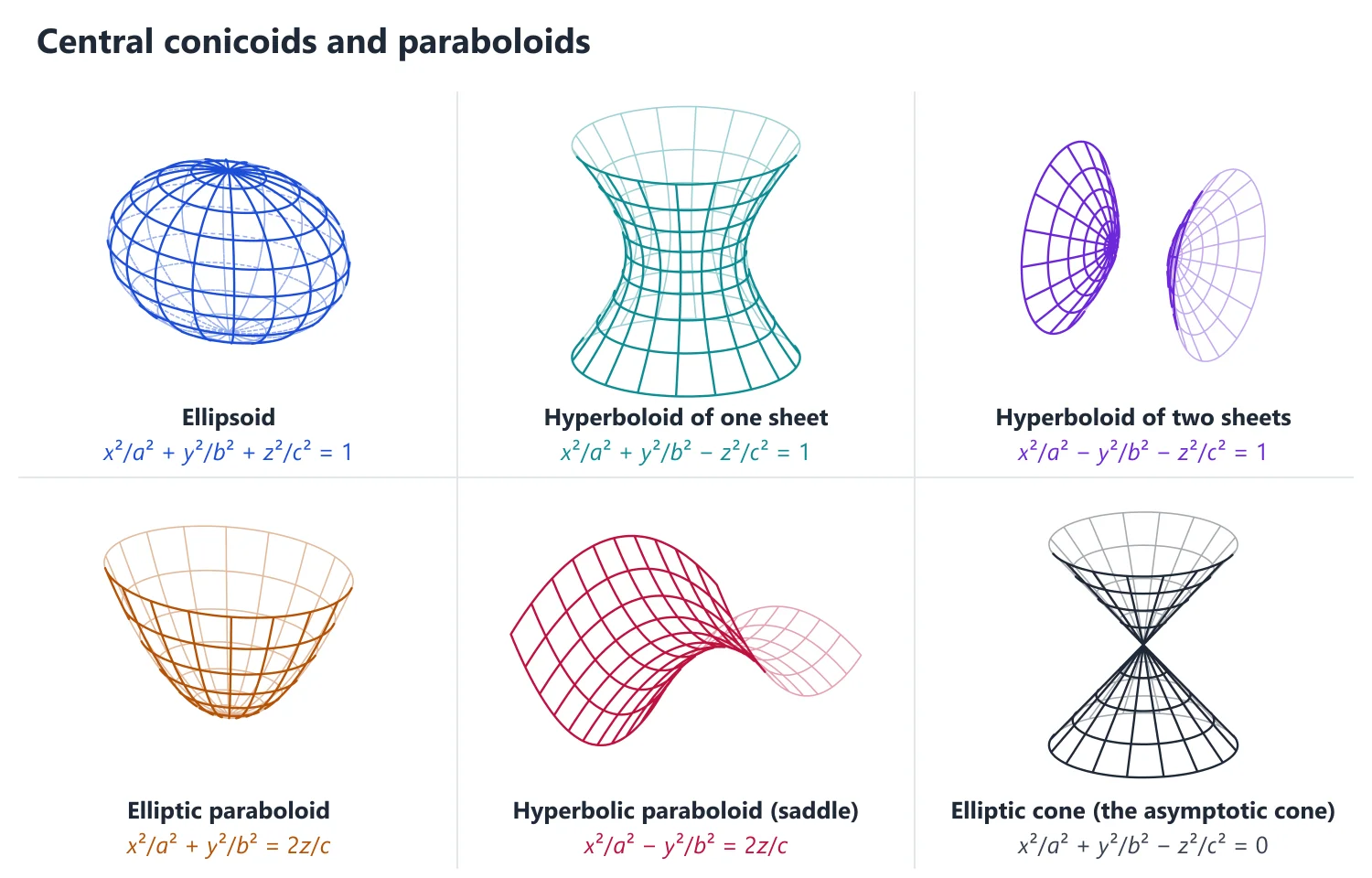
1. Understanding the Standard Quadrics through Their Sections
Why we need it: a second-degree equation in x, y, z can describe five quite different surfaces. Before using any formula you must name the surface, because tangency conditions, generators and normals differ from one type to another.
In words: slice the surface by planes parallel to the coordinate planes and look at the curves you get. A central conicoid has a centre (here the origin) that bisects every chord through it; it is written ±x2/a2 ± y2/b2 ± z2/c2 = 1. A paraboloid has one variable appearing only to the first power, and has no centre. The signs, once the right side is +1, decide the type.
First example, slowly: identify 9x2 + 4y2 − 36z2 = 36 and describe its shape.
Step 1: divide by 36 to make the right side 1: x2/4 + y2/9 − z2/1 = 1.
Step 2: there is one minus sign, so it is a hyperboloid of one sheet, with axis the z-axis (the variable with the odd sign).
Step 3 (horizontal sections): z = k gives x2/4 + y2/9 = 1 + k2, an ellipse for every k; the smallest, at z = 0, has semi-axes 2 and 3 (the throat).
Step 4 (vertical section): x = 0 gives y2/9 − z2 = 1, a hyperbola. Ellipses that widen in both directions, joined along hyperbolas: the cooling-tower shape.
Non-example: x2 + 4y2 − z2 + 4 = 0 also shows one minus sign on the left, but it is not a hyperboloid of one sheet. Bringing the right side to +1 gives −x2/4 − y2 + z2/4 = 1, with two minus signs: a hyperboloid of two sheets, since z = k gives x2 + 4y2 = k2 − 4, empty for |k| < 2. And x2 + 4y2 − z2 = 0 (right side 0) is a cone.
Building up: the signs are the signs of the eigenvalues of the matrix of the quadratic part, so this naming rule is the same as the eigenvalue classification of the Reduction topic. Writing the central forms as ax2 + by2 + cz2 = 1 (a, b, c of any signs) lets one set of formulas cover the ellipsoid and both hyperboloids; the paraboloids get their own formulas, ax2 + by2 = 2z.
Where it is used: the first line of every conicoid answer, the choice between central and paraboloid formulas, deciding whether real generators exist, and the final step of reducing a general second-degree equation.
2. Standard Forms
Ellipsoid: x2/a2 + y2/b2 + z2/c2 = 1; it is closed and bounded, symmetric about each coordinate plane, and every plane section is an ellipse, a point or empty.
Idea: an ellipsoid is a sphere stretched by the factors a, b, c along the axes (see the figure above). The section z = k is x2/a2 + y2/b2 = 1 − k2/c2: an ellipse for |k| < c, a point for |k| = c and empty beyond.
Hyperboloid of one sheet: x2/a2 + y2/b2 − z2/c2 = 1; it is connected, the sections z = k are ellipses for every k, and it is a ruled surface.
Idea: think of a cooling tower. The sections z = k satisfy x2/a2 + y2/b2 = 1 + k2/c2, ellipses that grow as |k| grows, with the smallest (the throat) at z = 0; the sections by x = 0 and y = 0 are hyperbolas.
Hyperboloid of two sheets: x2/a2 − y2/b2 − z2/c2 = 1; it has two separate pieces and no real points with |x| < a.
Memory rule: with the right side +1, the number of minus signs equals the number of sheets: none (ellipsoid), one (one sheet), two (two sheets); three minus signs give no real points.
Elliptic paraboloid: x2/a2 + y2/b2 = 2z/c. Hyperbolic paraboloid: x2/a2 − y2/b2 = 2z/c; it is saddle-shaped and ruled.
Idea: the elliptic paraboloid is a bowl: sections z = k > 0 are ellipses. The hyperbolic paraboloid is a saddle: sections z = k are hyperbolas, z = 0 gives the line pair x/a = ±y/b, and the sections x = 0 and y = 0 are parabolas opening in opposite directions.
The first three are central conicoids ax2 + by2 + cz2 = 1 with centre at the origin; the paraboloids ax2 + by2 = 2z have no centre.
3. Understanding Tangent Planes and the Condition of Tangency
Why we need it: most conicoid questions are about tangent planes: at a given point, parallel to a given plane, through a given line, or three at right angles. Two tools do all of this: the replacement rule (when the point is known) and the condition of tangency (when it is not).
In words: for ax2 + by2 + cz2 = 1, the tangent plane at a point P(x1, y1, z1) of the surface is axx1 + byy1 + czz1 = 1; its normal (ax1, by1, cz1) is the gradient direction. A given plane lx + my + nz = p is a tangent plane (at some point) exactly when l2/a + m2/b + n2/c = p2, and then it touches at (l/(ap), m/(bp), n/(cp)).
First example, slowly: take the ellipsoid 2x2 + y2 + 4z2 = 7.
Step 1 (standard form): divide by 7: a = 2/7, b = 1/7, c = 4/7, so 1/a = 7/2, 1/b = 7, 1/c = 7/4.
Step 2 (at a known point): (1, 1, 1) is on the surface (2 + 1 + 4 = 7). Replace x2 by x·1 and so on: 2x + y + 4z = 7.
Step 3 (check with the condition): for 2x + y + 4z = 7, l2/a + m2/b + n2/c = 4(7/2) + 1(7) + 16(7/4) = 14 + 7 + 28 = 49 = 72, as it must be.
Step 4 (point unknown): tangent planes parallel to x + y + z = 0 are x + y + z = p with 7/2 + 7 + 7/4 = 49/4 = p2, so p = ±7/2. For p = 7/2 the point of contact is (1/(ap), 1/(bp), 1/(cp)) = (1, 2, 1/2); check: 2 + 4 + 1 = 7 and 1 + 2 + 1/2 = 7/2.
Non-example: if you forget to divide by 7 and use a = 2, b = 1, c = 4 for the plane 2x + y + 4z = 7, you get 4/2 + 1 + 16/4 = 7 ≠ 49 and wrongly conclude that the plane is not a tangent plane. The condition l2/a + m2/b + n2/c = p2 is valid only for the form with right side exactly 1.
Building up: comparing lx + my + nz = p with axx1 + byy1 + czz1 = 1 gives the point of contact, and putting it into the surface gives the condition (derivation below). Three mutually perpendicular tangent planes have squared distances pi2 that add up to 1/a + 1/b + 1/c, which gives the director sphere. The same "compare with the tangent plane" idea gives the polar plane, the enveloping cone SS1 = T2 and the section with a given centre T = S1.
Where it is used: tangent planes through a line (P1 + λP2 = 0 plus the condition), director spheres, loci of poles, normals and normal chords.
4. Central Conicoid ax2 + by2 + cz2 = 1
Tangent plane at (x1, y1, z1): axx1 + byy1 + czz1 = 1.
Memory rule: replace x2 by xx1, y2 by yy1, z2 by zz1 (and 2z by z + z1 for a paraboloid). The plane is perpendicular to the gradient (ax1, by1, cz1); derivation below.
Condition of tangency: the plane lx + my + nz = p touches the conicoid if and only if l2/a + m2/b + n2/c = p2.
Director sphere: the locus of the point of intersection of three mutually perpendicular tangent planes is x2 + y2 + z2 = 1/a + 1/b + 1/c; for the ellipsoid x2/a2 + y2/b2 + z2/c2 = 1 it is x2 + y2 + z2 = a2 + b2 + c2.
Idea: the director sphere is the 3-D version of the director circle of a conic: it is where an orthogonal "corner" of three tangent planes can sit. Derivation below.
Normal at (x1, y1, z1): (x − x1)/(ax1) = (y − y1)/(by1) = (z − z1)/(cz1). In general six normals can be drawn to an ellipsoid from a given point.
Idea: the normal of a surface F = 0 is along the gradient ∇F, here (ax1, by1, cz1). Unlike for a sphere, the normal at a general point does not pass through the centre.
Polar plane of (x1, y1, z1): axx1 + byy1 + czz1 = 1. The enveloping cone from this point is SS1 = T2, with S = ax2 + by2 + cz2 − 1.
Diametral plane conjugate to the direction (l, m, n): alx + bmy + cnz = 0; it bisects all chords parallel to that direction.
Why it works: put the point (x0 + lr, y0 + mr, z0 + nr) of a chord in the equation. The chord is bisected at (x0, y0, z0) exactly when the two roots in r are equal and opposite, that is when the coefficient of r vanishes: alx0 + bmy0 + cnz0 = 0.
The same idea gives the plane section with a given centre (α, β, γ): it is T = S1, that is aαx + bβy + cγz = aα2 + bβ2 + cγ2.
Conjugate semi-diameters of the ellipsoid x2/a2 + y2/b2 + z2/c2 = 1: if OP, OQ, OR are conjugate, then OP2 + OQ2 + OR2 = a2 + b2 + c2, and the parallelepiped on OP, OQ, OR has volume abc.
Idea: under the map (x, y, z) ↦ (x/a, y/b, z/c) the ellipsoid becomes the unit sphere and conjugate semi-diameters become three mutually perpendicular radii. This is why the sum of squares and the volume abc stay constant.
5. Understanding Paraboloids
Why we need it: a paraboloid has no centre, so the central formulas do not apply. Its tangent planes, condition of tangency and director plane have their own short forms, and examiners check that you do not mix them up.
In words: write the paraboloid as ax2 + by2 = 2z. If a and b have the same sign it is elliptic (a bowl), otherwise hyperbolic (a saddle). The replacement rule now also replaces 2z by z + z1, giving the tangent plane axx1 + byy1 = z + z1; the plane lx + my + nz = p is tangent exactly when l2/a + m2/b + 2np = 0.
First example, slowly: the paraboloid x2 + 2y2 = 4z and its point (2, 1, 3/2).
Step 1 (standard form): divide by 2: (1/2)x2 + y2 = 2z, so a = 1/2, b = 1. The point is on it: 2 + 1 = 3 = 2(3/2).
Step 2 (tangent plane): (1/2)(2)x + (1)(1)y = z + 3/2, that is x + y − z = 3/2.
Step 3 (check with the condition): l = 1, m = 1, n = −1, p = 3/2: l2/a + m2/b + 2np = 2 + 1 − 3 = 0.
Non-example: the vertical plane x = 1 (l = 1, m = n = 0, p = 1) gives l2/a + m2/b + 2np = 2 ≠ 0, so it is not a tangent plane; indeed every vertical plane cuts this paraboloid in a parabola. And trying the central test l2/a + m2/b + n2/c = p2 here is meaningless: there is no z2 term, so no c.
Building up: comparing lx + my + nz = p with ax1x + by1y − z = z1 gives the contact point (−l/(an), −m/(bn), −p/n), and putting it into the surface gives the condition. For three mutually perpendicular tangent planes the terms 2nipi add up to 2z, so their common point satisfies 1/a + 1/b + 2z = 0: a director plane instead of a director sphere.
Where it is used: tangent planes and normals of paraboloids, envelope questions on x2 + y2 = 2z, the director plane, and generators of the hyperbolic paraboloid.
6. Paraboloid ax2 + by2 = 2z
Tangent plane at (x1, y1, z1): axx1 + byy1 = z + z1. The plane lx + my + nz = p touches the paraboloid if and only if l2/a + m2/b + 2np = 0.
The locus of the point of intersection of three mutually perpendicular tangent planes is the plane 2z + 1/a + 1/b = 0 (the director plane).
7. Understanding Generating Lines
Why we need it: it is surprising that a curved surface can be made entirely of straight lines. The hyperboloid of one sheet and the hyperbolic paraboloid are such ruled surfaces, each in two different ways. Questions ask for the lines through a point, their angle, and loci of their intersections.
In words: a generating line (generator) of a surface is a straight line every point of which lies on the surface. On the hyperboloid of one sheet there are two families (systems), labelled by λ and μ; through each point passes exactly one line of each family.
First example, slowly: find the generators of x2 + y2 − z2 = 1 through (1, 0, 0).
Step 1 (factorise): (x − z)(x + z) = (1 − y)(1 + y).
Step 2 (λ-system): x − z = λ(1 − y), x + z = (1/λ)(1 + y). At (1, 0, 0): 1 = λ, so λ = 1. Adding the two equations gives x = 1, and then z = y: the line x = 1, y = z, direction (0, 1, 1).
Step 3 (μ-system): x − z = μ(1 + y), x + z = (1/μ)(1 − y). At (1, 0, 0), μ = 1, giving x = 1, z = −y, direction (0, 1, −1).
Step 4 (check): the points (1, t, t) and (1, t, −t) give 1 + t2 − t2 = 1 for every t, so both lines lie entirely on the surface. Notice also that the λ = −1 line, x = −1, z = −y, never meets the λ = 1 line (x would have to be both 1 and −1): lines of the same system are skew.
Non-example: the hyperboloid of two sheets x2 − y2 − z2 = 1 has no real generators. Try the direct method at (1, 0, 0): putting (1 + lr, mr, nr) in gives 2lr + (l2 − m2 − n2)r2 = 0 for all r, so l = 0 and then m2 + n2 = 0, which forces m = n = 0: there is no direction at all.
Building up: the factorisation turns "product = product" into "ratio = ratio = λ", two linear equations, that is a line, for each λ. The direct method works for any quadric: a line through a surface point lies on the surface exactly when the coefficients of r and r2 vanish (the constant term is already zero). The r-coefficient says the direction lies in the tangent plane, and the r2-coefficient says it lies on the asymptotic cone, so the two generators through a point are the lines in which the tangent plane cuts the surface.
Where it is used: generators through a point, perpendicular generators and their locus, surfaces generated by lines meeting skew lines (Straight Lines topic), and the structural use of hyperboloids in towers.
8. Generating Lines
The hyperboloid of one sheet x2/a2 + y2/b2 − z2/c2 = 1 contains two systems of straight lines: the λ-system x/a − z/c = λ(1 − y/b), x/a + z/c = (1/λ)(1 + y/b), and the μ-system x/a − z/c = μ(1 + y/b), x/a + z/c = (1/μ)(1 − y/b).
Why there are lines: write the equation as (x/a − z/c)(x/a + z/c) = (1 − y/b)(1 + y/b). A product equals a product, so equating the ratios, (x/a − z/c)/(1 − y/b) = (1 + y/b)/(x/a + z/c) = λ, gives two linear equations, that is a straight line, for each λ. Pairing the factors the other way gives the μ-system.
Properties: through every point of the surface passes exactly one line of each system; two lines of the same system do not meet (they are skew); a line of one system and a line of the other system are coplanar (they meet or are parallel).
Why lines of one system are skew: take λ1 ≠ λ2. Subtracting the first equations gives (λ1 − λ2)(1 − y/b) = 0, so y = b and x/a − z/c = 0; then the second equations give x/a + z/c = 2/λ1 = 2/λ2, a contradiction. So the lines never meet, and they are not parallel, so they are skew.
Why exactly one line of each system passes through a point: at a point of the surface, λ = (x/a − z/c)/(1 − y/b), or (1 + y/b)/(x/a + z/c) if the first is 0/0, is a single definite value (λ = ∞ is the limiting line).
The hyperbolic paraboloid x2/a2 − y2/b2 = 2z/c has the systems x/a − y/b = λ, λ(x/a + y/b) = 2z/c and x/a + y/b = μ, μ(x/a − y/b) = 2z/c; all lines of one system are parallel to a fixed plane (x/a − y/b = 0 or x/a + y/b = 0).
The ellipsoid, the hyperboloid of two sheets and the elliptic paraboloid contain no real straight lines.
Why: the ellipsoid is bounded, so it cannot contain an infinite line. For the hyperboloid of two sheets, a line not parallel to the plane x = 0 must cross the slab |x| < a, which has no points of the surface; a line with l = 0 would need m2/b2 + n2/c2 = 0 from the r2 coefficient, which is impossible. For the elliptic paraboloid the r2 coefficient l2/a2 + m2/b2 = 0 forces a vertical line, along which z changes while x, y do not.
9. Derivation: Tangent Plane and Condition of Tangency
For F = ax2 + by2 + cz2 − 1, the normal at P(x1, y1, z1) is ∇F = 2(ax1, by1, cz1). The tangent plane ax1(x − x1) + by1(y − y1) + cz1(z − z1) = 0 becomes axx1 + byy1 + czz1 = ax12 + by12 + cz12 = 1.
Central conicoid: if lx + my + nz = p is the tangent plane at (x1, y1, z1), comparing with axx1 + byy1 + czz1 = 1 gives ax1/l = by1/m = cz1/n = 1/p, so the point of contact is (l/(ap), m/(bp), n/(cp)).
This point lies on the conicoid: l2/(ap2) + m2/(bp2) + n2/(cp2) = 1, that is l2/a + m2/b + n2/c = p2.
Paraboloid ax2 + by2 = 2z: the tangent plane ax1x + by1y − z = z1 compared with lx + my + nz = p gives x1 = −l/(an), y1 = −m/(bn), z1 = −p/n. Substituting in ax12 + by12 = 2z1 gives l2/a + m2/b + 2np = 0.
10. Derivation: The Director Sphere
Let three mutually perpendicular tangent planes be lix + miy + niz = pi (i = 1, 2, 3), with (li, mi, ni) direction cosines. Tangency gives pi2 = li2/a + mi2/b + ni2/c.
The matrix with rows (li, mi, ni) is orthogonal, so its columns are also unit vectors: Σli2 = Σmi2 = Σni2 = 1. Adding, Σpi2 = 1/a + 1/b + 1/c.
At the common point (x, y, z), squaring and adding the three plane equations gives Σ(lix + miy + niz)2 = x2 + y2 + z2 (an orthogonal matrix preserves length). Hence x2 + y2 + z2 = 1/a + 1/b + 1/c.
For the paraboloid the same steps with li2/a + mi2/b + 2nipi = 0 and Σnipi = Σni(lix + miy + niz) = z give 1/a + 1/b + 2z = 0, the director plane.
11. Choosing the Method
If the tangent plane at a given point is asked → the replacement rule.
If tangent planes parallel to a given plane, or through a given line, are asked → write the plane as lx + my + nz = p and use l2/a + m2/b + n2/c = p2 (central) or l2/a + m2/b + 2np = 0 (paraboloid).
If a locus of the meeting point of three perpendicular tangent planes is asked → director sphere (or director plane).
If chords bisected at a point, or the centre of a plane section, are involved → T = S1 or the diametral plane alx + bmy + cnz = 0.
If normals through a given point are involved → the λ-parametrisation x = a2α/(a2 + λ), ... of the feet.
If generators are asked → the λ- and μ-systems for standard forms; for any other ruled quadric, the direct method (coefficients of r and r2 vanish).
If circular sections are asked → S − λ(x2 + y2 + z2 − 1/λ) = 0, with S = x2/a2 + y2/b2 + z2/c2 − 1, must be a pair of real planes; for a > b > c this needs λ = 1/b2.
12. Common Mistakes
Naming the surface by the number of minus signs without first bringing the right side to +1 (for example −x2 − y2 + z2 = −1 is a hyperboloid of one sheet).
Using the central tangency condition l2/a + m2/b + n2/c = p2 for a paraboloid.
Assuming that the normal at a point passes through the centre, which is true only for a sphere.
Giving two generators of the same system through a point; the two lines through a point belong to different systems.
Choosing λ = 1/a2 or 1/c2 for circular sections, which gives imaginary planes.
13. Connections
Link: which standard form a quadric takes is decided by the signs of the eigenvalues of its symmetric matrix (Sylvester's law of inertia, Linear Algebra); see the Reduction to Canonical Form topic.
Link: the normal as ∇F and the tangent plane as the plane perpendicular to it are the gradient ideas of Vector Analysis; the hyperboloid of one sheet and the hyperbolic paraboloid are the ruled surfaces swept by lines meeting given skew lines (Straight Lines topic).
14. Worked Examples
Example 1: Find the tangent planes to 2x2 − 6y2 + 3z2 = 5 that pass through the line x + 9y − 3z = 0 = 3x − 3y + 6z − 5.
Planes through the line: (3x − 3y + 6z − 5) + λ(x + 9y − 3z) = 0, that is (3 + λ)x + (9λ − 3)y + (6 − 3λ)z = 5. The conicoid is (2/5)x2 − (6/5)y2 + (3/5)z2 = 1, and l2/a + m2/b + n2/c = p2 reduces to −60λ2 + 90 = 30, so λ = ±1.
The tangent planes are 4x + 6y + 3z = 5 (λ = 1) and 2x − 12y + 9z = 5 (λ = −1).
Example 2: Find the generators of x2/4 + y2/9 − z2/16 = 1 through the point (2, 3, −4).
Here x/2 = 1, y/3 = 1 and z/4 = −1. The μ-system x/2 − z/4 = μ(1 + y/3), x/2 + z/4 = (1/μ)(1 − y/3) gives μ = 1 and the line x = 2, (y − 3)/(−3) = (z + 4)/4.
In the λ-system, x/2 − z/4 = 2 while 1 − y/3 = 0, so λ → ∞; the line is 1 − y/3 = 0, x/2 + z/4 = 0, that is (x − 2)/1 = (y − 3)/0 = (z + 4)/(−2).
Example 3: Find the tangent planes to x2 + 2y2 + 3z2 = 6 that are parallel to x + 2y + 3z = 0, and their points of contact.
In the form ax2 + by2 + cz2 = 1: a = 1/6, b = 1/3, c = 1/2. The plane x + 2y + 3z = p touches it if 1/a + 4/b + 9/c = p2, that is 6 + 12 + 18 = 36, so p = ±6.
Comparing lx + my + nz = p with the tangent plane axx1 + byy1 + czz1 = 1 gives x1 = l/(ap), y1 = m/(bp), z1 = n/(cp).
The tangent planes are x + 2y + 3z = 6, touching at (1, 1, 1), and x + 2y + 3z = −6, touching at (−1, −1, −1).
Example 4: Find the centre of the conic in which the plane x + y + z = 1 cuts the ellipsoid x2 + 2y2 + 3z2 = 6.
The section with centre (α, β, γ) lies in the plane T = S1, that is αx + 2βy + 3γz = α2 + 2β2 + 3γ2. This must be the plane x + y + z = 1, so α = 2β = 3γ = k (say).
Then (α, β, γ) = (k, k/2, k/3), and since the centre lies on the plane, k(1 + 1/2 + 1/3) = 1, so k = 6/11.
The centre of the section is (6/11, 3/11, 2/11).
Example 5: Show that the plane 8x − 6y − z = 5 touches the paraboloid x2/2 − y2/3 = z, and find the point of contact.
Write the paraboloid as x2 − (2/3)y2 = 2z, so a = 1 and b = −2/3. For lx + my + nz = p with (l, m, n, p) = (8, −6, −1, 5): l2/a + m2/b + 2np = 64 − 54 − 10 = 0, so the plane touches.
The tangent plane at (x1, y1, z1) is xx1 − (2/3)yy1 = z + z1. Comparing with 8x − 6y − z = 5 gives x1 = 8, y1 = 9, z1 = 5.
Check: 64/2 − 81/3 = 32 − 27 = 5. The point of contact is (8, 9, 5).
Example 6: Find the two generators of the hyperbolic paraboloid x2/4 − y2/9 = 2z through the point (2, 3, 0).
Here a = 2, b = 3, c = 1. The two systems are x/2 − y/3 = λ, λ(x/2 + y/3) = 2z and x/2 + y/3 = μ, μ(x/2 − y/3) = 2z.
At (2, 3, 0), x/2 − y/3 = 0, so λ = 0 and the first generator is x/2 − y/3 = 0, z = 0, that is x/2 = y/3, z = 0.
Also x/2 + y/3 = 2, so μ = 2 and the second generator is x/2 + y/3 = 2, x/2 − y/3 = z; its direction is (2, −3, 2), giving (x − 2)/2 = (y − 3)/(−3) = z/2.
Check: the point (4, 0, 2) of the second line gives 16/4 − 0 = 4 = 2z, so it lies on the surface.
15. Normals to Conicoids
Normal to the ellipsoid x2/a2 + y2/b2 + z2/c2 = 1 at P(x1, y1, z1): direction (x1/a2, y1/b2, z1/c2). Its direction cosines are p(x1/a2, y1/b2, z1/c2), where 1/p2 = x12/a4 + y12/b4 + z12/c4 and p is the perpendicular from the centre to the tangent plane at P.
Six normals: the normal at (x, y, z) passes through (α, β, γ) when x = a2α/(a2 + λ), y = b2β/(b2 + λ), z = c2γ/(c2 + λ); putting these in the ellipsoid gives a sextic in λ, so six normals pass through a general point. The feet lie on the curve given by these parametric equations (a cubic curve), and on the three cylinders (b2 − c2)yz + c2γy − b2βz = 0 and its cyclic analogues.
Normals to the paraboloid x2/a + y2/b = 2z at (x1, y1, z1): (x − x1)/(x1/a) = (y − y1)/(y1/b) = (z − z1)/(−1); in general five normals pass through a given point. For the paraboloid of revolution x2 + y2 = 2az the count drops to three: every normal meets the axis, so the normals from a point lie in the plane through the point and the axis, and the condition on the foot becomes a cubic (Example 8).
Example 7 (UPSC 2014, 15 marks): Show that the lines drawn from the origin parallel to the normals to the central conicoid ax2 + by2 + cz2 = 1, at its points of intersection with the plane lx + my + nz = p generate the cone p2(x2/a + y2/b + z2/c) = (lx/a + my/b + nz/c)2.
Let (α, β, γ) be a point of the conicoid on the plane: aα2 + bβ2 + cγ2 = 1 and lα + mβ + nγ = p. The normal there has direction (aα, bβ, cγ).
The parallel line through O is x/(aα) = y/(bβ) = z/(cγ) = 1/k (say), so α = kx/a, β = ky/b, γ = kz/c for a point (x, y, z) of it.
The plane condition gives k(lx/a + my/b + nz/c) = p; the conicoid gives k2(x2/a + y2/b + z2/c) = 1.
Eliminating k (square the first and divide by the second): p2(x2/a + y2/b + z2/c) = (lx/a + my/b + nz/c)2.
Answer: this is homogeneous of degree 2, so the lines generate the cone stated; hence proved.
Example 8 (UPSC 2019, 15 marks): Prove that, in general, three normals can be drawn from a given point to the paraboloid x2 + y2 = 2az, but if the point lies on the surface
27a(x2 + y2) + 8(a − z)3 = 0
then two of the three normals coincide.
The normal at (x1, y1, z1) to x2 + y2 = 2az is (x − x1)/x1 = (y − y1)/y1 = (z − z1)/(−a). If it passes through (α, β, γ), with common ratio t: x1 = α/(1 + t), y1 = β/(1 + t), z1 = γ + at.
The foot lies on the paraboloid: f(t) = 2a(γ + at)(1 + t)2 − (α2 + β2) = 0, a cubic in t; each root gives one normal, so in general three normals pass through (α, β, γ).
Two normals coincide when f has a double root: f′(t) = 2a(1 + t)[3at + a + 2γ] = 0. The root t = −1 would need α2 + β2 = 0, so t = −(a + 2γ)/(3a), giving 1 + t = 2(a − γ)/(3a) and γ + at = −(a − γ)/3.
Then f(t) = 0 becomes −2a·(a − γ)/3·4(a − γ)2/(9a2) = α2 + β2, that is 27a(α2 + β2) + 8(a − γ)3 = 0.
Answer: two of the three normals coincide exactly when (α, β, γ) lies on 27a(x2 + y2) + 8(a − z)3 = 0; hence proved.
Example 9 (UPSC 2019, 15 marks): Find the length of the normal chord through a point P of the ellipsoid
x2/a2 + y2/b2 + z2/c2 = 1
and prove that if it is equal to 4PG3, where G3 is the point where the normal chord through P meets the xy-plane, then P lies on the cone
(x2/a6)(2c2 − a2) + (y2/b6)(2c2 − b2) + z2/c4 = 0
Let the normal at P(x1, y1, z1) have direction cosines (l, m, n) = p(x1/a2, y1/b2, z1/c2), with 1/p2 = ∑x12/a4. The point at distance r along it is (x1 + lr, y1 + mr, z1 + nr).
It lies on the ellipsoid when 2r∑(lx1/a2) + r2∑(l2/a2) = 0. Here ∑lx1/a2 = p∑x12/a4 = 1/p and ∑l2/a2 = p2∑x12/a6.
So the length of the normal chord is |r| = 2/(p3∑x12/a6).
The normal meets z = 0 where z1 + nr = 0, that is r = −z1/n = −c2/p, so PG3 = c2/p.
Chord = 4PG3 gives 2/(p3∑x12/a6) = 4c2/p, that is ∑x12/a4 = 2c2∑x12/a6 (using 1/p2 = ∑x12/a4).
Collecting terms: (x12/a6)(2c2 − a2) + (y12/b6)(2c2 − b2) + z12(2c2 − c2)/c6 = 0.
Answer: normal chord = 2/(p3∑x12/a6), and P lies on the cone (x2/a6)(2c2 − a2) + (y2/b6)(2c2 − b2) + z2/c4 = 0; hence proved.
Example 10 (UPSC 2022, 20 marks): If P, Q, R; P′, Q′, R′ are feet of the six normals drawn from a point to the ellipsoid x2/a2 + y2/b2 + z2/c2 = 1, and the plane PQR is represented by lx + my + nz = p, show that the plane P′Q′R′ is given by x/(a2l) + y/(b2m) + z/(c2n) + 1/p = 0.
Let the normals be drawn from (α, β, γ). A foot (x, y, z) satisfies a2α/x − a2 = b2β/y − b2 = c2γ/z − c2 (= λ), so the six feet lie on the ellipsoid S ≡ ∑x2/a2 − 1 = 0 and on the three conicoids f1 ≡ (b2 − c2)yz + c2γy − b2βz = 0, f2 ≡ (c2 − a2)zx + a2αz − c2γx = 0, f3 ≡ (a2 − b2)xy + b2βx − a2αy = 0.
Let P′Q′R′ be l′x + m′y + n′z = p′. The pair of planes (lx + my + nz − p)(l′x + m′y + n′z − p′) = 0 passes through all six feet; the standard argument (Shanti Narayan) identifies it with a member kS + k1f1 + k2f2 + k3f3 = 0 of the family of conicoids through the feet.
The fi have no x2, y2, z2 or constant terms. Comparing x2, y2, z2 and constant terms: ll′ = k/a2, mm′ = k/b2, nn′ = k/c2 and pp′ = −k.
Hence l′ = −pp′/(a2l), m′ = −pp′/(b2m), n′ = −pp′/(c2n), and l′x + m′y + n′z = p′ becomes −pp′[x/(a2l) + y/(b2m) + z/(c2n)] = p′.
Answer: dividing by −pp′, the plane P′Q′R′ is x/(a2l) + y/(b2m) + z/(c2n) + 1/p = 0; hence proved (a numerical check with the six computed feet confirms it).
16. Generating Lines: Past Questions
Direct method for generators through a point (x1, y1, z1) of a surface F = 0: put (x1 + lr, y1 + mr, z1 + nr) in F and make the coefficients of r and r2 vanish; this gives two equations for l : m : n and hence the two generators.
For a surface UV = kz with U, V linear (a hyperbolic paraboloid), the two systems are U = λ, λV = kz and V = μ, μU = kz.
The generators of x2/a2 − y2/b2 = 2z of the two systems have directions (a, b, λ) and (a, −b, μ), where λ = x/a − y/b and μ = x/a + y/b at their common point.
Example 11 (UPSC 2014, 15 marks): Find the equations of the two generating lines through any point (a cos θ, b sin θ, 0), of the principal elliptic section x2/a2 + y2/b2 = 1, z = 0, of the hyperboloid by the plane z = 0.
The point P(a cos θ, b sin θ, 0) lies on x2/a2 + y2/b2 − z2/c2 = 1. Put (a cos θ + lr, b sin θ + mr, nr) in the equation.
Coefficient of r: (l cos θ)/a + (m sin θ)/b = 0, so l/a : m/b = sin θ : −cos θ, that is l = ka sin θ, m = −kb cos θ.
Coefficient of r2: l2/a2 + m2/b2 − n2/c2 = 0 gives k2 = n2/c2, so n = ±kc.
Answer: (x − a cos θ)/(a sin θ) = (y − b sin θ)/(−b cos θ) = z/(±c).
Example 12 (UPSC 2018, 13 marks): Find the equations to the generating lines of the paraboloid (x + y + z)(2x + y − z) = 6z which pass through the point (1, 1, 1).
Write U = x + y + z, V = 2x + y − z, so UV = 6z; at (1, 1, 1), U = 3, V = 2 and UV = 6 = 6z, so the point is on the surface.
System U = λ, λV = 6z: λ = 3 gives x + y + z = 3, 3(2x + y − z) = 6z, that is 2x + y − 3z = 0; direction (1, 1, 1) × (2, 1, −3) = (−4, 5, −1).
System V = μ, μU = 6z: μ = 2 gives 2x + y − z = 2, 2(x + y + z) = 6z, that is x + y − 2z = 0; direction (2, 1, −1) × (1, 1, −2) = (−1, 3, 1).
Answer: (x − 1)/4 = (y − 1)/(−5) = (z − 1)/1 and (x − 1)/(−1) = (y − 1)/3 = (z − 1)/1 (check: (5, −4, 2) and (0, 4, 2) lie on the surface).
Example 13 (UPSC 2020, 15 marks): Find the locus of the point of intersection of the perpendicular generators of the hyperbolic paraboloid x2/a2 − y2/b2 = 2z.
λ-system: x/a − y/b = λ, λ(x/a + y/b) = 2z; its direction is (1/a, −1/b, 0) × (λ/a, λ/b, −2), proportional to (a, b, λ).
μ-system: x/a + y/b = μ, μ(x/a − y/b) = 2z; its direction is proportional to (a, −b, μ).
The two generators through a point (x, y, z) of the surface have λ = x/a − y/b, μ = x/a + y/b, so λμ = x2/a2 − y2/b2 = 2z.
They are perpendicular when a2 − b2 + λμ = 0, that is 2z = b2 − a2.
Answer: the locus is the curve x2/a2 − y2/b2 = b2 − a2, 2z = b2 − a2 (the section of the surface by the plane 2z + a2 − b2 = 0).
Example 14 (UPSC 2026, 10 marks): (i) Find the equations of the generating lines of the hyperboloid x2/4 + y2/9 − z2/16 = 1 which pass through the points (2, 3, −4) and (2, −1, 4/3).
Through (2, 3, −4) (Example 2 of this topic): x = 2, (y − 3)/(−3) = (z + 4)/4 and (x − 2)/1 = (y − 3)/0 = (z + 4)/(−2).
At (2, −1, 4/3): x/2 = 1, y/3 = −1/3, z/4 = 1/3. λ-system x/2 − z/4 = λ(1 − y/3): 2/3 = (4/3)λ, so λ = 1/2; the line is 6x + 2y − 3z = 6, 6x − 8y + 3z = 24, with direction (3, 6, 10).
μ-system x/2 − z/4 = μ(1 + y/3): 2/3 = (2/3)μ, so μ = 1; the line is x/2 − z/4 = 1 + y/3, x/2 + z/4 = 1 − y/3, that is x = 2, 4y + 3z = 0.
The second line is the same as the generator x = 2, (y − 3)/(−3) = (z + 4)/4 through (2, 3, −4): the two given points lie on one common generator.
Answer: through (2, 3, −4): x = 2, (y − 3)/(−3) = (z + 4)/4 and (x − 2)/1 = (y − 3)/0 = (z + 4)/(−2); through (2, −1, 4/3): (x − 2)/3 = (y + 1)/6 = (z − 4/3)/10 and x = 2, (y + 1)/3 = (z − 4/3)/(−4).
17. Envelopes, Circular Sections and Areas of Sections
Envelope of a one-parameter family f(x, y, m) = 0 in a plane: eliminate m between f = 0 and ∂f/∂m = 0.
Circular sections of x2/a2 + y2/b2 + z2/c2 = 1 (a > b > c): with S = x2/a2 + y2/b2 + z2/c2 − 1, S − (x2 + y2 + z2 − b2)/b2 = 0 is the pair of real planes za√(b2 − c2) = ±xc√(a2 − b2) through the mean axis; they cut the ellipsoid in circles of radius b, and every plane parallel to either one cuts it in a circle.
Why it works: on the ellipsoid, S = 0, so the curve where a plane cuts it also lies on x2 + y2 + z2 = b2 whenever that plane is part of S − (x2 + y2 + z2 − b2)/b2 = 0; a plane section that lies on a sphere is a circle. With λ = 1/b2 the y2 term disappears and the remaining x2, z2 terms have opposite signs, so the equation factorises into real planes.
Umbilics (points where the tangent plane is parallel to a circular section): (±a√((a2 − b2)/(a2 − c2)), 0, ±c√((b2 − c2)/(a2 − c2))), four real points.
Area of a central section of the ellipsoid by lx + my + nz = 0 (l, m, n direction cosines): πabc/√(a2l2 + b2m2 + c2n2).
Example 15 (UPSC 2015, 13 marks): Two perpendicular tangent planes to the paraboloid x2 + y2 = 2z intersect in a straight line in the plane x = 0. Obtain the curve to which this straight line touches.
A tangent plane to z = (x2 + y2)/2 is z = lx + my − (l2 + m2)/2, with normal (l, m, −1).
Two such planes (l1, m1) and (l2, m2) meet in a line lying in x = 0 only if their traces on x = 0 coincide: m1 = m2 = m and l12 = l22, so l2 = −l1 = −l for distinct planes.
Perpendicular: l1l2 + m1m2 + 1 = −l2 + m2 + 1 = 0, so l2 = m2 + 1. The common line is x = 0, z = my − (2m2 + 1)/2.
Envelope in the plane x = 0: differentiating with respect to m, 0 = y − 2m, so m = y/2 and z = y2/2 − y2/4 − 1/2.
Answer: the line always touches the parabola y2 = 4z + 2, x = 0.
18. Practice Exercises
Exercise 1 (basic): Name the surface 4x2 − y2 + 2z2 = −4.
Answer: dividing by −4 gives −x2 + y2/4 − z2/2 = 1, with two minus signs: a hyperboloid of two sheets with axis along the y-axis.
Exercise 2 (basic): Name the surface x2 − 4y2 = 6z and describe its sections z = k.
Answer: a hyperbolic paraboloid; z = k gives hyperbolas for k ≠ 0 and the line pair x = ±2y for k = 0.
Exercise 3 (basic): Write the tangent plane to 3x2 − y2 + 2z2 = 4 at (1, 1, 1).
Answer: the point is on the surface (3 − 1 + 2 = 4), and the replacement rule gives 3x − y + 2z = 4.
Exercise 4 (standard): Show that the plane x + 2y + 2z = 6 touches the ellipsoid x2 + 2y2 + 4z2 = 9, and find the point of contact.
Answer: with a = 1/9, b = 2/9, c = 4/9: 9 + 18 + 9 = 36 = 62; the point of contact is (l/(ap), m/(bp), n/(cp)) = (3/2, 3/2, 3/4).
Exercise 5 (standard): Find the tangent planes to x2 − 2y2 + 3z2 = 2 that are parallel to x − 2y + 3z = 0, with their points of contact.
Answer: a = 1/2, b = −1, c = 3/2, so p2 = 2 − 4 + 6 = 4: x − 2y + 3z = ±2, touching at (1, 1, 1) and (−1, −1, −1).
Exercise 6 (standard): For what k does the plane 2x + 4y + z = k touch the paraboloid x2 + 2y2 = 2z? Find the point of contact.
Answer: a = 1, b = 2: 4 + 8 + 2k = 0, so k = −6; the point of contact is (−l/(an), −m/(bn), −p/n) = (−2, −2, 6).
Exercise 7 (standard): Find the director sphere of the ellipsoid 2x2 + 3y2 + 6z2 = 6.
Answer: the ellipsoid is x2/3 + y2/2 + z2/1 = 1, so the director sphere is x2 + y2 + z2 = 3 + 2 + 1 = 6.
Exercise 8 (UPSC level): Find the generators of the hyperboloid x2/4 + y2 − z2/9 = 1 through the point (2, 1, 3).
Answer: the λ-system gives λ = 1: x/2 − z/3 = 1 − y, x/2 + z/3 = 1 + y, that is x = 2, (y − 1)/1 = (z − 3)/3; the μ-system gives μ = 0: y = 1, x/2 = z/3, that is (x − 2)/2 = (y − 1)/0 = (z − 3)/3.
Exercise 9 (UPSC level): Find the two generators of the hyperbolic paraboloid x2 − y2 = 4z through (3, 1, 2).
Answer: from (x − y)(x + y) = 4z: x − y = 2, x + y = 2z, that is (x − 3)/1 = (y − 1)/1 = (z − 2)/1; and x + y = 4, x − y = z, that is (x − 3)/1 = (y − 1)/(−1) = (z − 2)/2.
Exercise 10 (UPSC level): Find the locus of the point of intersection of three mutually perpendicular tangent planes to the paraboloid 2x2 + 3y2 = 6z.
Answer: the paraboloid is (2/3)x2 + y2 = 2z, so a = 2/3, b = 1 and the director plane is 2z + 3/2 + 1 = 0, that is 4z + 5 = 0.
Exercise 11 (UPSC level): Find the centre of the conic in which the plane x + y + z = 1 cuts the ellipsoid x2/4 + y2/9 + z2 = 1.
Answer: T = S1 must be the given plane, so α/4 = β/9 = γ = k; the centre is on the plane, 14k = 1, so the centre is (2/7, 9/14, 1/14).
| Surface | Equation | Sections z = k | Real generators |
|---|---|---|---|
| Ellipsoid | x2/a2 + y2/b2 + z2/c2 = 1 | Ellipses for |k| < c | None |
| Hyperboloid of one sheet | x2/a2 + y2/b2 − z2/c2 = 1 | Ellipses for all k | Two systems |
| Hyperboloid of two sheets | x2/a2 − y2/b2 − z2/c2 = 1 | Hyperbolas for all k | None |
| Elliptic paraboloid | x2/a2 + y2/b2 = 2z/c (c > 0) | Ellipses for k > 0 | None |
| Hyperbolic paraboloid | x2/a2 − y2/b2 = 2z/c | Hyperbolas (a line pair for k = 0) | Two systems |
| Cone | x2/a2 + y2/b2 − z2/c2 = 0 | Ellipses for k ≠ 0 | One system through the vertex |
Mains points
- Standard questions: tangent planes through a given line, the director sphere, the locus of poles, and the normal at a point meeting the axes.
- Generating lines of the hyperboloid of one sheet: find the generators through a given point, prove that lines of the same system are skew, and find the locus of points of intersection of perpendicular generators.
- Write the conicoid in the form ax2 + by2 + cz2 = 1 before using l2/a + m2/b + n2/c = p2; forgetting to divide by the constant is the most common error.
- Proof questions on conjugate diameters (OP2 + OQ2 + OR2 = a2 + b2 + c2) use the fact that the matrix whose rows are (xi/a, yi/b, zi/c) for P, Q, R is orthogonal.
- When a generator parameter becomes infinite, take the limiting form of the equations instead of saying no generator exists.
Did you know?
- Because the hyperboloid of one sheet is made of straight lines, cooling towers and many lattice towers (such as Shukhov's towers) are built from straight steel or concrete members that form a curved surface.
General Second Degree Equation and Reduction to Canonical Form
The general second degree equation in x, y, z is reduced to canonical form by rotating the axes to the eigenvectors of the 3 × 3 symmetric matrix of its quadratic part and shifting the origin to the centre. The eigenvalues (roots of the discriminating cubic) together with the determinants D and Δ classify the surface as an ellipsoid, hyperboloid, cone, paraboloid, cylinder or pair of planes.
1. Understanding the Matrix of a Second Degree Equation
Why we need it: an equation such as 2x2 − y2 + 3z2 + 4xy − 6yz + 2x − 8z + 7 = 0 hides its shape, because the cross terms tilt it and the linear terms move it. Writing the coefficients as a matrix turns "what surface is this?" into questions about eigenvalues and determinants, which have mechanical answers.
In words: the quadratic part ax2 + by2 + cz2 + 2fyz + 2gzx + 2hxy equals XTAX for the symmetric matrix A = [[a, h, g], [h, b, f], [g, f, c]]: the squares go on the diagonal and half of each cross coefficient goes in each of the two symmetric places. The 4 × 4 matrix E adds the column of half the linear coefficients (u, v, w) and the constant d. D = det A and Δ = det E.
First example, slowly: write A, E and D for 2x2 − y2 + 3z2 + 4xy − 6yz + 2x − 8z + 7 = 0.
Step 1 (squares): a = 2, b = −1, c = 3.
Step 2 (cross terms, halved): 4xy gives h = 2; −6yz gives f = −3; there is no zx term, so g = 0. Hence A = [[2, 2, 0], [2, −1, −3], [0, −3, 3]].
Step 3 (linear terms, halved): 2x gives u = 1, there is no y term so v = 0, and −8z gives w = −4; d = 7. So E = [[2, 2, 0, 1], [2, −1, −3, 0], [0, −3, 3, −4], [1, 0, −4, 7]].
Step 4: D = 2(−3 − 9) − 2(6 − 0) + 0 = −36 (and Δ = −192). Check the matrix by expanding XTAX: the xy entries contribute 2 + 2 = 4xy and the yz entries −3 − 3 = −6yz, matching the equation.
Non-example: putting the full coefficient 4 in the xy places, A = [[2, 4, 0], [4, −1, −3], ...], would make XTAX contain 8xy, not 4xy: that matrix belongs to a different surface, and every eigenvalue computed from it is wrong. Each off-diagonal entry is half the coefficient.
Building up: in matrix form F = XTAX + 2bTX + d with b = (u, v, w)T, and F = (X, 1)E(X, 1)T. A rotation X = PY (P orthogonal) changes A to PTAP, and a shift of origin changes only b and d. So everything that does not change under these moves, the eigenvalues of A, D and Δ, describes the surface itself rather than the chosen axes.
Where it is used: every reduction question begins here; the same matrix appears in pairs of planes (D = 0), cone tests, tangency conditions of cones (cofactors of A) and the Hessian test for extrema.
2. General Equation
F(x, y, z) = ax2 + by2 + cz2 + 2fyz + 2gzx + 2hxy + 2ux + 2vy + 2wz + d = 0. Its quadratic part has the symmetric matrix A = [[a, h, g], [h, b, f], [g, f, c]].
Idea: with X = (x, y, z)T and b = (u, v, w)T, F = XTAX + 2bTX + d. The cross terms (f, g, h not all 0) are present because the coordinate axes are tilted relative to the axes of symmetry of the surface; the linear terms are present because the origin is not at the centre.
The 4 × 4 matrix of F is E = [[a, h, g, u], [h, b, f, v], [g, f, c, w], [u, v, w, d]]; write D = det A and Δ = det E.
Idea: E is the matrix of F in homogeneous coordinates: F = (x, y, z, 1) E (x, y, z, 1)T. D governs the shape of the quadratic part; Δ also feels the linear terms and the constant, and decides whether the surface degenerates (cone, cylinder, planes).
3. Understanding Rotation to the Principal Axes
Why we need it: the cross terms disappear only in one special set of rectangular axes, the principal axes of the surface. Finding them is an eigenvalue problem, and the eigenvalues become the coefficients of X2, Y2, Z2.
In words: an eigenvector e of A with eigenvalue λ satisfies Ae = λe: along that direction the quadratic form simply multiplies the squared length by λ. A real symmetric A has three real eigenvalues and three mutually perpendicular unit eigenvectors; using these unit vectors as new axes removes every cross term.
First example, slowly: reduce 2x2 + 2y2 + 5z2 + 2xy = 6.
Step 1: A = [[2, 1, 0], [1, 2, 0], [0, 0, 5]]. The cubic has coefficients a + b + c = 9, bc + ca + ab − h2 = 10 + 10 + 4 − 1 = 23 and D = 5(4 − 1) = 15: λ3 − 9λ2 + 23λ − 15 = (λ − 1)(λ − 3)(λ − 5).
Step 2 (eigenvectors): λ = 1: (1, −1, 0); λ = 3: (1, 1, 0); λ = 5: (0, 0, 1). Normalise: (1, −1, 0)/√2, (1, 1, 0)/√2, (0, 0, 1). Notice they are mutually perpendicular, as the theory promises.
Step 3: in these axes the equation is X2 + 3Y2 + 5Z2 = 6, an ellipsoid with semi-axes √6, √2, √(6/5) along the three directions.
Step 4 (check one axis): the point at distance √2 along (1, 1, 0)/√2 is (1, 1, 0), and 2 + 2 + 0 + 2 = 6, so it is on the surface, as Y = √2 predicts. Check the invariants too: 1 + 3 + 5 = 9 = trace and 1 · 3 · 5 = 15 = D.
Non-example: rotating with the unnormalised vector (1, 1, 0), that is putting (x, y, z) = Y(1, 1, 0), gives 2Y2 + 2Y2 + 2Y2 = 6Y2 instead of 3Y2: the coefficient doubles because |(1, 1, 0)|2 = 2. Only unit eigenvectors give a rotation, and only a rotation preserves the shape.
Building up: with P = [e1 e2 e3] orthogonal, AP = P diag(λ1, λ2, λ3), so PTAP is diagonal and XTAX = λ1X2 + λ2Y2 + λ3Z2. Eigenvectors for different eigenvalues of a symmetric matrix are automatically perpendicular; for a repeated eigenvalue any orthonormal pair in its eigenplane works, and the surface is one of revolution.
Where it is used: principal axes and semi-axes of central conicoids, axes of surfaces of revolution, right circular cones and cylinders given in tilted form, and the diagonalisation questions of Linear Algebra.
4. Reduction Method
Step 1 (remove the xy, yz, zx terms): find the eigenvalues λ1, λ2, λ3 of A from the discriminating cubic λ3 − (a + b + c)λ2 + (bc + ca + ab − f2 − g2 − h2)λ − D = 0. The roots are real, because A is real symmetric.
Why it works: by the spectral theorem a real symmetric matrix has real eigenvalues and an orthonormal basis of eigenvectors. Let P be the orthogonal matrix with these eigenvectors as columns and put X = PY. Then XTAX = YT(PTAP)Y = λ1Y12 + λ2Y22 + λ3Y32. Since P is orthogonal, the change X = PY is a rotation (or reflection) and does not change lengths or the shape.
Find orthonormal eigenvectors (li, mi, ni); they give the directions of the principal axes. Rotating the axes to these directions changes the quadratic part to λ1X2 + λ2Y2 + λ3Z2.
If two eigenvalues are equal, any orthonormal pair in their eigenplane will do, and the surface is one of revolution about the third principal axis.
Step 2 (centre): a centre exists if Fx = Fy = Fz = 0, that is ax + hy + gz + u = 0, hx + by + fz + v = 0, gx + fy + cz + w = 0, is consistent. If D ≠ 0 the centre (x0, y0, z0) is unique.
Idea: the centre is the point where the gradient of F vanishes; about it the surface is symmetric, since F(x0 + X) = F(x0 − X) when there are no linear terms in X.
Shifting the origin to the centre gives λ1X2 + λ2Y2 + λ3Z2 + d′ = 0, where d′ = ux0 + vy0 + wz0 + d = Δ/D.
Why d′ = Δ/D: with Ax0 = −b, F(x0 + X) = XTAX + F(x0) and F(x0) = x0TAx0 + 2bTx0 + d = bTx0 + d. The block determinant formula gives Δ = det A · (d − bTA−1b) = D(d + bTx0), so d′ = Δ/D.
Step 3 (no unique centre, D = 0): if one eigenvalue is 0, say λ3 = 0, the linear terms in the rotated coordinates have coefficients 2(uli + vmi + wni); completing the squares gives λ1X2 + λ2Y2 = 2kZ, a paraboloid (or a cylinder if k = 0).
For the paraboloid λ1X2 + λ2Y2 = 2kZ, k2 = −Δ/(λ1λ2).
Why k2 = −Δ/(λ1λ2): Δ is unchanged by rotations and translations. After rotation the 4 × 4 matrix is [[λ1, 0, 0, p1], [0, λ2, 0, p2], [0, 0, 0, p3], [p1, p2, p3, d]], whose determinant is −λ1λ2p32. Completing squares leaves λ1X2 + λ2Y2 + 2p3Z = 0, so k = −p3 and k2 = p32 = −Δ/(λ1λ2).
5. Understanding the Centre, d′ and the Classification
Why we need it: after rotation the linear terms remain; they mean that the surface is not centred at the origin. Moving the origin to the centre leaves λ1X2 + λ2Y2 + λ3Z2 + d′ = 0, and the signs of the λ's together with d′ name the surface.
In words: the centre is the point where all three first partial derivatives of F vanish; when D ≠ 0 there is exactly one. The new constant d′ is the value of F at the centre, and it can be found without the centre as d′ = Δ/D.
First example, slowly: classify 2x2 + 2y2 + 5z2 + 2xy − 6x − 6y − 10z + d = 0 for d = 5, 11 and 17.
Step 1 (centre): half-derivatives 2x + y − 3 = 0, x + 2y − 3 = 0, 5z − 5 = 0 give the centre (1, 1, 1).
Step 2 (d′): d′ = ux0 + vy0 + wz0 + d = −3 − 3 − 5 + d = d − 11. (Check with Δ/D: for d = 5, Δ = −90 and D = 15, so Δ/D = −6.)
Step 3 (classify): the quadratic part is the one reduced above, with eigenvalues 1, 3, 5. For d = 5: X2 + 3Y2 + 5Z2 = 6, an ellipsoid. For d = 11: X2 + 3Y2 + 5Z2 = 0, only the point (1, 1, 1) (an imaginary cone with a real vertex). For d = 17: X2 + 3Y2 + 5Z2 = −6, no real points.
Non-example: saying "all eigenvalues are positive, so it is an ellipsoid" is wrong for d = 11 and d = 17 above: the same quadratic part gave a point and an empty set. The eigenvalues fix the shape only up to the sign and size of d′; the classification needs both.
Building up: at the centre x0 we have Ax0 = −b, so F(x0 + X) = XTAX + F(x0): no linear terms remain, and the surface is symmetric about x0. The block determinant then gives Δ = D · F(x0), which is d′ = Δ/D. In particular Δ = 0 with D ≠ 0 means d′ = 0, a cone with vertex at the centre.
Where it is used: naming the surface, its centre and semi-axes, and showing that an equation is a cone (Δ = 0) and finding its vertex.
6. Understanding the Case D = 0: Paraboloids and Cylinders
Why we need it: when an eigenvalue is zero, the surface has no unique centre, and the method of the previous lesson breaks down. What happens next depends on whether the linear terms have a component along the zero-eigenvalue direction.
In words: let n be a unit eigenvector with eigenvalue 0. If the linear part has a non-zero component along n, completing squares in the other two directions leaves λ1X2 + λ2Y2 = 2kZ, a paraboloid, with k2 = −Δ/(λ1λ2). If that component is zero, Z does not appear at all and the surface is a cylinder (or a pair of planes) with generators along n; then Δ = 0.
First example, slowly: identify x2 + 2xy + y2 + 2z2 − 4x + 4y = 0.
Step 1: A = [[1, 1, 0], [1, 1, 0], [0, 0, 2]] has eigenvalues 2 (along (1, 1, 0)), 2 (along (0, 0, 1)) and 0 (along (1, −1, 0)). So D = 0.
Step 2 (centre?): x + y − 2 = 0 and x + y + 2 = 0 cannot both hold, so there is no centre.
Step 3 (rotate): put X = (x + y)/√2, Z = (x − y)/√2 and keep z. Then (x + y)2 = 2X2 and −4x + 4y = −4√2 Z, so 2X2 + 2z2 = 4√2 Z: an elliptic paraboloid, in fact one of revolution since the two non-zero eigenvalues are equal.
Step 4 (check by invariants): here 2k = 4√2, so k2 = 8, and −Δ/(λ1λ2) = 32/4 = 8, since Δ = −32.
Non-example: change the linear part to −4x − 4y. Now it lies along (1, 1, 0) and has no component along the zero direction (1, −1, 0). The centre equations x + y − 2 = 0 (twice) and z = 0 are consistent (a line of centres), Δ = 0, and the equation becomes 2(X − √2)2 + 2z2 = 4: a circular cylinder of radius √2, not a paraboloid.
Building up: the formula k2 = −Δ/(λ1λ2) comes from Δ being unchanged by rotation and translation (derivation in the Reduction Method section). The vertex is found by completing the squares: X = Y = 0 and the value of Z that removes the constant. With two zero eigenvalues the quadratic part is a perfect square, and the surface is a parabolic cylinder or a pair of parallel planes.
Where it is used: paraboloid reductions with axis and vertex, right circular cylinders in tilted form, and pairs of planes.
7. Classification by Eigenvalues
Write the central form as λ1X2 + λ2Y2 + λ3Z2 = −d′.
All λi of the same sign as −d′: ellipsoid (a sphere if all are equal). Two of the same sign as −d′ and one opposite: hyperboloid of one sheet. One of the same sign as −d′ and two opposite: hyperboloid of two sheets. All of the sign opposite to −d′: no real points (imaginary ellipsoid).
Idea: dividing by −d′ gives the form X2/A + Y2/B + Z2/C = 1 with A = −d′/λ1, and so on; the number of negative denominators is the number of sheets, exactly as in the Conicoids topic. Which signs occur cannot be changed by any rectangular change of axes (Sylvester's law of inertia).
d′ = 0 (Δ = 0, D ≠ 0): a cone, which is real if the λi are not all of one sign.
One λi = 0: an elliptic paraboloid (other two of the same sign) or a hyperbolic paraboloid (opposite signs) if Δ ≠ 0; an elliptic or hyperbolic cylinder, or a pair of planes, if Δ = 0.
Two λi = 0: a parabolic cylinder or a pair of parallel planes.
Invariants under a change of rectangular axes: a + b + c, bc + ca + ab − f2 − g2 − h2, D and Δ.
Why they are invariant: under X = PY + x0 the matrix A becomes PTAP, which has the same characteristic polynomial, so the coefficients a + b + c, bc + ca + ab − f2 − g2 − h2 and D of the discriminating cubic do not change. E is transformed by a 4 × 4 matrix of determinant ±1, so Δ does not change either.
8. Choosing the Method
If there are no xy, yz, zx terms → complete the squares directly; no eigenvalues are needed.
If D ≠ 0 → find the centre from Fx = Fy = Fz = 0, compute d′ = ux0 + vy0 + wz0 + d and check it against Δ/D; Δ = 0 means a cone with vertex at the centre.
If D = 0 and the centre equations are consistent → a line (or plane) of centres: a cylinder or a pair of planes. If D = 0 with exactly one zero eigenvalue and they are inconsistent → a paraboloid, with k2 = −Δ/(λ1λ2); with two zero eigenvalues and inconsistent equations it is a parabolic cylinder (for example x2 = y).
If only the name of the surface is asked → signs of the eigenvalues from the discriminating cubic (all roots are real, so Descartes' rule of signs counts the positive roots exactly), together with Δ; eigenvectors are not needed.
If a "right circular" cylinder or cone, or a surface of revolution, is to be shown → show that two eigenvalues are equal; the axis is along the eigenvector of the third.
If the quadratic part is a perfect square (rank 1, two zero eigenvalues) → a parabolic cylinder or a pair of parallel planes.
9. Common Mistakes
Putting the full coefficient of xy in the matrix: the entries are half the coefficients, h = (coefficient of xy)/2, f = (coefficient of yz)/2, g = (coefficient of zx)/2, and likewise u, v, w are half the coefficients of x, y, z.
Rotating with eigenvectors that are not normalised, which rescales the axes and changes the coefficients.
Pairing an eigenvalue with the wrong eigenvector, so that the principal axes are stated in the wrong order.
Classifying from the signs of the λi alone; the sign of −d′ (or whether Δ = 0) must be taken into account.
Trying to solve for a unique centre when D = 0.
10. Connections
Link: this topic is the diagonalisation of a real symmetric matrix (Linear Algebra: eigenvalues, orthogonal matrices, quadratic forms) applied to geometry.
Link: the Hessian matrix in maxima and minima of f(x, y, z) is also real symmetric, and the signs of its eigenvalues classify the critical point in the same way as here (Calculus); in two dimensions the same method classifies conics by ab − h2.
11. Worked Examples
Example 1: Reduce 3x2 + 5y2 + 3z2 + 2yz + 2zx + 2xy − 4x − 8z + 5 = 0 to canonical form.
A = [[3, 1, 1], [1, 5, 1], [1, 1, 3]]: the discriminating cubic is λ3 − 11λ2 + 36λ − 36 = 0, that is (λ − 2)(λ − 3)(λ − 6) = 0.
Principal directions: λ = 2: (1, 0, −1)/√2; λ = 3: (1, −1, 1)/√3; λ = 6: (1, 2, 1)/√6.
Centre: 3x + y + z − 2 = 0, x + 5y + z = 0, x + y + 3z − 4 = 0 give (1/3, −1/3, 4/3).
d′ = ux0 + vy0 + wz0 + d = (−2)(1/3) + 0 + (−4)(4/3) + 5 = −1.
Canonical form: 2X2 + 3Y2 + 6Z2 = 1, an ellipsoid with semi-axes 1/√2, 1/√3, 1/√6 along the principal directions through the centre.
Example 2: Identify the surface 4x2 − y2 − z2 + 2yz − 8x − 4y + 8z − 2 = 0.
The eigenvalues of [[4, 0, 0], [0, −1, 1], [0, 1, −1]] are 4, −2, 0, so D = 0 and there is no unique centre. Δ = 16 ≠ 0, so the surface is a paraboloid, with k2 = −Δ/(λ1λ2) = −16/(−8) = 2.
Canonical form: 4X2 − 2Y2 = 2√2 Z, that is 2X2 − Y2 = √2 Z, a hyperbolic paraboloid.
Example 3: Reduce x2 + y2 + z2 + 4yz + 4zx + 4xy − 10x − 10y − 10z + 12 = 0 to canonical form and name the surface.
A = [[1, 2, 2], [2, 1, 2], [2, 2, 1]]; the discriminating cubic is λ3 − 3λ2 − 9λ − 5 = (λ − 5)(λ + 1)2 = 0, so λ = 5, −1, −1, with λ = 5 along (1, 1, 1).
Centre: x + 2y + 2z − 5 = 0 and its cyclic forms give x = y = z = 1. Then d′ = ux0 + vy0 + wz0 + d = −5 − 5 − 5 + 12 = −3.
Canonical form: 5X2 − Y2 − Z2 = 3, that is X2/(3/5) − Y2/3 − Z2/3 = 1: a hyperboloid of two sheets, and a surface of revolution about the line x = y = z.
Example 4: Show that x2 + y2 − z2 + 4xy − 6x − 6y + 2z + 5 = 0 represents a cone, and find its vertex and semi-vertical angle.
Fx = Fy = Fz = 0 give x + 2y − 3 = 0, 2x + y − 3 = 0, −z + 1 = 0, so (1, 1, 1). This point satisfies F = 0 (1 + 1 − 1 + 4 − 6 − 6 + 2 + 5 = 0), so the surface is a cone with vertex (1, 1, 1); equivalently Δ = 0 with D = 3 ≠ 0.
A = [[1, 2, 0], [2, 1, 0], [0, 0, −1]] has cubic λ3 − λ2 − 5λ − 3 = (λ − 3)(λ + 1)2, so λ = 3, −1, −1, with λ = 3 along (1, 1, 0).
With the vertex as origin: 3X2 − Y2 − Z2 = 0, that is Y2 + Z2 = 3X2. This is a right circular cone with axis through (1, 1, 1) along (1, 1, 0), and tan α = √3, so the semi-vertical angle is 60°.
Example 5: Show that x2 + y2 + z2 − yz − zx − xy = 3 is a right circular cylinder, and find its axis and radius.
The square of the distance of (x, y, z) from the line x = y = z is x2 + y2 + z2 − (x + y + z)2/3 = (2/3)(x2 + y2 + z2 − yz − zx − xy).
So the equation says that this squared distance equals (2/3)·3 = 2: the locus is a right circular cylinder with axis x = y = z and radius √2.
Check by eigenvalues: A = [[1, −1/2, −1/2], [−1/2, 1, −1/2], [−1/2, −1/2, 1]] has eigenvalues 0, 3/2, 3/2, with λ = 0 along (1, 1, 1), giving (3/2)(X2 + Y2) = 3, that is X2 + Y2 = 2.
Example 6: Identify the surface x2 + y2 + z2 + 2xy + 4x − 4y + 2z + 1 = 0 and write its canonical form.
A = [[1, 1, 0], [1, 1, 0], [0, 0, 1]] has eigenvalues 2, 1, 0, so D = 0. The centre equations x + y + 2 = 0 and x + y − 2 = 0 are inconsistent: there is no centre.
Δ = det[[1, 1, 0, 2], [1, 1, 0, −2], [0, 0, 1, 1], [2, −2, 1, 1]] = −16 ≠ 0, so the surface is a paraboloid; λ1 = 2 and λ2 = 1 have the same sign, so it is elliptic, with k2 = −Δ/(λ1λ2) = 8.
Directly: the equation is (x + y)2 + (z + 1)2 + 4(x − y) = 0; with X = (x + y)/√2, Y = z + 1, Z = −(x − y)/√2 it becomes the elliptic paraboloid 2X2 + Y2 = 4√2 Z.
12. Paraboloids: Completing Squares, Axis and Vertex
When the quadratic part has no cross terms, complete the squares directly; when it has a zero eigenvalue with eigenvector n, the linear part's component along n gives the 2kZ term, and completing squares in the other two directions gives the vertex.
The principal axis of a paraboloid is the line through the vertex along n; the principal planes are the two planes through this axis along the other two principal directions.
Example 7 (UPSC 2017, 15 marks): Reduce the following equation to the standard form and hence determine the nature of the conicoid: x2 + y2 + z2 − yz − zx − xy − 3x − 6y − 9z + 21 = 0.
The quadratic part has eigenvalues 0, 3/2, 3/2 (as in Example 5), with λ = 0 along n = (1, 1, 1)/√3. Take the orthonormal directions e1 = (1, −1, 0)/√2, e2 = (1, 1, −2)/√6, e3 = n.
The linear part −3x − 6y − 9z has components 3/√2, 9/√6 and −18/√3 = −6√3 along e1, e2, e3, so the equation becomes (3/2)(X2 + Y2) + (3/√2)X + (9/√6)Y − 6√3Z + 21 = 0.
Completing squares: (3/2)[(X + 1/√2)2 + (Y + 3/√6)2] − 3 − 6√3Z + 21 = 0, that is (3/2)(X′2 + Y′2) = 6√3(Z − √3).
The vertex X′ = Y′ = 0, Z = √3 is −(1/√2)e1 − (3/√6)e2 + √3n = (0, 1, 2), which satisfies the equation. Check by invariants: Δ = −243/4 and k2 = −Δ/(λ1λ2) = (243/4)/(9/4) = 27, so 2k = 6√3.
Answer: X2 + Y2 = 4√3 Z, a paraboloid of revolution with vertex (0, 1, 2) and axis x/1 = (y − 1)/1 = (z − 2)/1.
Example 8 (UPSC 2023, 10 marks): (i) Show that the equation 2x2 + 3y2 − 8x + 6y − 12z + 11 = 0 represents an elliptic paraboloid. Also find its principal axis and principal planes.
Completing squares: 2(x − 2)2 − 8 + 3(y + 1)2 − 3 − 12z + 11 = 0, that is 2(x − 2)2 + 3(y + 1)2 = 12z.
With X = x − 2, Y = y + 1, Z = z: X2/6 + Y2/4 = Z, and both coefficients are positive, so it is an elliptic paraboloid with vertex (2, −1, 0).
Answer: principal axis x = 2, y = −1 (parallel to the z-axis); principal planes x = 2 and y = −1.
13. Practice Exercises
Exercise 1 (basic): Write the matrix A of the quadratic form x2 + 2y2 − z2 + 6yz − 2zx + 4xy and find D = det A.
Answer: A = [[1, 2, −1], [2, 2, 3], [−1, 3, −1]] (h = 2, f = 3, g = −1), and D = 1(−2 − 9) − 2(−2 + 3) − 1(6 + 2) = −21.
Exercise 2 (basic): After reduction a surface is λ1X2 + λ2Y2 + λ3Z2 + d′ = 0 with eigenvalues 1, 4, −2 and d′ = −4. Name it.
Answer: X2 + 4Y2 − 2Z2 = 4, that is X2/4 + Y2 − Z2/2 = 1: a hyperboloid of one sheet.
Exercise 3 (basic): Find the discriminating cubic and the eigenvalues of the quadratic form x2 + y2 + z2 + 2xy.
Answer: λ3 − 3λ2 + 2λ = λ(λ − 1)(λ − 2) = 0, so the eigenvalues are 0, 1, 2.
Exercise 4 (standard): Reduce 2x2 + 2y2 + 2z2 + 2xy + 2yz + 2zx = 4 to canonical form and name the surface.
Answer: the eigenvalues are 4 (along (1, 1, 1)) and 1, 1; the canonical form is 4X2 + Y2 + Z2 = 4, an ellipsoid of revolution about the line x = y = z.
Exercise 5 (standard): Find the centre and the canonical form of x2 + 3y2 + 3z2 − 2yz − 2x − 2y + 6z + 3 = 0.
Answer: the eigenvalues are 1, 2, 4; the centre equations x − 1 = 0, 3y − z − 1 = 0, −y + 3z + 3 = 0 give (1, 0, −1); d′ = −1 − 0 − 3 + 3 = −1 (= Δ/D = −8/8); so X2 + 2Y2 + 4Z2 = 1, an ellipsoid.
Exercise 6 (standard): Identify the surface x2 + y2 − 2z2 + 4xy + 6 = 0.
Answer: the eigenvalues are 3, −1, −2 and the centre is O, so 3X2 − Y2 − 2Z2 = −6, that is −X2/2 + Y2/6 + Z2/3 = 1: a hyperboloid of one sheet.
Exercise 7 (standard): Show that 5x2 + 5y2 + 8z2 − 8yz − 8zx − 2xy = 36 is an elliptic cylinder, and find its axis and semi-axes.
Answer: the eigenvalues are 0 (along (1, 1, 1)), 6 (along (1, −1, 0)) and 12 (along (1, 1, −2)); the form is 6X2 + 12Y2 = 36, an elliptic cylinder with axis x = y = z and semi-axes √6 and √3.
Exercise 8 (UPSC level): Show that x2 + y2 + z2 − 2yz − 2zx − 2xy + 2x + 2y + 2z − 3 = 0 is a right circular cone; find its vertex, axis and semi-vertical angle.
Answer: the centre equations give (1, 1, 1) and d′ = 1 + 1 + 1 − 3 = 0, so Δ = 0: a cone with vertex (1, 1, 1). The eigenvalues are −1 (along (1, 1, 1)) and 2, 2, so 2(X2 + Y2) = Z2: axis x − 1 = y − 1 = z − 1, semi-vertical angle tan−1(1/√2).
Exercise 9 (UPSC level): Reduce x2 + y2 + 2yz + z2 − 2x + 4y − 4z = 0 to canonical form and find the vertex.
Answer: the eigenvalues are 1, 2, 0 (zero along (0, 1, −1)) and Δ = −16, so it is an elliptic paraboloid; with Y = (y + z)/√2, Z = (y − z)/√2 the equation is (x − 1)2 + 2Y2 = −4√2(Z − 1/(4√2)), that is X2 + 2Y2 = 4√2 Z′ (k2 = 16/2 = 8); the vertex is (1, 1/8, −1/8).
Exercise 10 (UPSC level): Show that x2 − y2 − z2 + 2yz + 2y − 2z − 1 = 0 represents a pair of planes, and find their line of intersection.
Answer: D = 0 and Δ = 0; the equation is x2 − (y − z − 1)2 = 0, that is (x − y + z + 1)(x + y − z − 1) = 0; the planes meet in the line x = 0, y − z = 1.
| Eigenvalues of A | Further condition | Surface |
|---|---|---|
| All non-zero, all with the sign of −d′ | d′ ≠ 0 | Ellipsoid |
| All non-zero, two with the sign of −d′ | d′ ≠ 0 | Hyperboloid of one sheet |
| All non-zero, one with the sign of −d′ | d′ ≠ 0 | Hyperboloid of two sheets |
| All non-zero, not all of one sign | d′ = 0 (Δ = 0) | Real cone |
| One zero, other two of the same sign | Δ ≠ 0 | Elliptic paraboloid |
| One zero, other two of opposite signs | Δ ≠ 0 | Hyperbolic paraboloid |
| One zero | Δ = 0 | Elliptic or hyperbolic cylinder, or a pair of planes |
| Two zero | — | Parabolic cylinder or a pair of parallel planes |
Mains points
- Reduction of a second degree equation to canonical form, with the nature of the surface, its centre and the equations of the principal axes, is a regular 15-20 mark question.
- Show the discriminating cubic, its roots, the normalised eigenvectors, the centre and d′ as separate numbered steps; each step carries marks.
- Check the cubic with the invariants (sum of roots = a + b + c, product = D) before continuing; a wrong eigenvalue spoils the whole answer.
- For D = 0, do not try to find a unique centre: compute Δ, decide between paraboloid and cylinder, and find k from k2 = −Δ/(λ1λ2).
- This topic links Linear Algebra (eigenvalues of real symmetric matrices) to Analytic Geometry; quote the result that the eigenvalues are real and the eigenvectors orthogonal.
Did you know?
- Apart from cones, cylinders and pairs of planes, every real quadric surface is one of exactly five types: the ellipsoid, the two hyperboloids and the two paraboloids. Euler gave the first systematic classification of quadric surfaces in 1748.
Solved Problems: Analytic Geometry
Fourteen mixed problems covering the whole chapter: planes and lines, shortest distance, spheres, cones and cylinders, conicoids and generators, and reduction of the general second degree equation. Each solution shows the steps an examiner looks for and ends with a clear Answer line.
1. Planes and Straight Lines
Problem 1 (10 marks): A variable plane at a constant distance p from the origin meets the axes in A, B, C. Show that the locus of the centroid of triangle ABC is 1/x2 + 1/y2 + 1/z2 = 9/p2.
Let the plane be x/a + y/b + z/c = 1, so A = (a, 0, 0), B = (0, b, 0), C = (0, 0, c).
Its distance from the origin is 1/√(1/a2 + 1/b2 + 1/c2) = p, so 1/a2 + 1/b2 + 1/c2 = 1/p2.
The centroid is (α, β, γ) = (a/3, b/3, c/3), so a = 3α, b = 3β, c = 3γ.
Substituting: 1/(9α2) + 1/(9β2) + 1/(9γ2) = 1/p2, that is 1/α2 + 1/β2 + 1/γ2 = 9/p2.
Answer: the locus is 1/x2 + 1/y2 + 1/z2 = 9/p2.
Problem 2 (15 marks): Find the magnitude and the equations of the line of shortest distance between (x − 1)/2 = (y − 2)/3 = (z − 3)/4 and (x − 2)/3 = (y − 4)/4 = (z − 5)/5, and the points where it meets the two lines.
A(1, 2, 3), b1 = (2, 3, 4); B(2, 4, 5), b2 = (3, 4, 5). Then b1 × b2 = (−1, 2, −1), of length √6, and B − A = (1, 2, 2).
SD = |(B − A)·(b1 × b2)|/|b1 × b2| = |−1 + 4 − 2|/√6 = 1/√6.
General points: P(1 + 2r, 2 + 3r, 3 + 4r) and Q(2 + 3s, 4 + 4s, 5 + 5s). PQ·b1 = 0 and PQ·b2 = 0 give 29r − 38s = 16 and 38r − 50s = 21.
Solving, r = 1/3 and s = −1/6, so P = (5/3, 3, 13/3) and Q = (3/2, 10/3, 25/6). Then PQ = (−1/6, 1/3, −1/6), parallel to (−1, 2, −1) and of length 1/√6, which checks the SD.
Answer: SD = 1/√6; the line of SD is (x − 5/3)/1 = (y − 3)/(−2) = (z − 13/3)/1, meeting the lines at (5/3, 3, 13/3) and (3/2, 10/3, 25/6).
Problem 3 (10 marks): Find the point where the line (x − 2)/3 = (y + 1)/4 = (z − 2)/12 meets the plane x − y + z = 5, its distance from (−1, −5, −10), and the angle between the line and the plane.
A general point of the line is (2 + 3t, −1 + 4t, 2 + 12t). In the plane: (2 + 3t) − (−1 + 4t) + (2 + 12t) = 5 + 11t = 5, so t = 0 and the point is (2, −1, 2).
Its distance from (−1, −5, −10) is √(32 + 42 + 122) = √169 = 13.
The angle θ between a line with direction (3, 4, 12) and a plane with normal (1, −1, 1) satisfies sin θ = |3 − 4 + 12|/(13·√3) = 11/(13√3).
Answer: the point is (2, −1, 2); the distance is 13; θ = sin−1(11/(13√3)).
2. The Sphere
Problem 4 (10 marks): Find the sphere through the circle x2 + y2 + z2 + 2x + 3y + 6 = 0, x − 2y + 4z − 9 = 0 and the centre of the sphere x2 + y2 + z2 − 2x + 4y − 6z + 5 = 0.
Every sphere through the circle is S + λP = 0, where S = 0 is the given sphere and P = 0 the plane. The second sphere has centre (1, −2, 3).
At (1, −2, 3): S = 1 + 4 + 9 + 2 − 6 + 6 = 16 and P = 1 + 4 + 12 − 9 = 8, so 16 + 8λ = 0 and λ = −2.
The sphere is x2 + y2 + z2 + 2x + 3y + 6 − 2(x − 2y + 4z − 9) = 0.
Answer: x2 + y2 + z2 + 7y − 8z + 24 = 0.
Problem 5 (15 marks): Find the sphere of smallest radius that passes through (1, 0, 0), (0, 1, 0) and (0, 0, 1).
Let the sphere be x2 + y2 + z2 + 2ux + 2vy + 2wz + d = 0. The three points give 1 + 2u + d = 0, 1 + 2v + d = 0, 1 + 2w + d = 0, so u = v = w = −(1 + d)/2.
Then r2 = u2 + v2 + w2 − d = (3/4)(1 + d)2 − d.
Setting the derivative with respect to d to zero: (3/2)(1 + d) − 1 = 0, so d = −1/3; the second derivative 3/2 > 0 confirms a minimum. Then u = v = w = −1/3 and r2 = 1/3 + 1/3 = 2/3.
The centre (1/3, 1/3, 1/3) is the circumcentre of the triangle formed by the three points, so the circle through them is a great circle of this sphere, as expected for the smallest sphere.
Answer: 3(x2 + y2 + z2) − 2(x + y + z) − 1 = 0, with radius √(2/3).
Problem 6 (10 marks): Show that the plane 2x − 2y + z + 12 = 0 touches the sphere x2 + y2 + z2 − 2x − 4y + 2z − 3 = 0, and find the point of contact.
Centre (1, 2, −1), radius √(1 + 4 + 1 + 3) = 3. The distance of the centre from the plane is |2 − 4 − 1 + 12|/√9 = 3, equal to the radius, so the plane touches the sphere.
The point of contact is the foot of the perpendicular from the centre: the point (1 + 2t, 2 − 2t, −1 + t) lies in the plane when 9 + 9t = 0, so t = −1.
Answer: the plane touches the sphere at (−1, 4, −2).
3. Cone and Cylinder
Problem 7 (15 marks): Find the enveloping cone of the sphere x2 + y2 + z2 + 2x − 2y = 2 with its vertex at (1, 1, 1).
S = x2 + y2 + z2 + 2x − 2y − 2 and S1 = 1 + 1 + 1 + 2 − 2 − 2 = 1 > 0, so the vertex is outside the sphere.
T = x·1 + y·1 + z·1 + (x + 1) − (y + 1) − 2 = 2x + z − 2.
The cone is SS1 = T2: x2 + y2 + z2 + 2x − 2y − 2 = 4x2 + z2 + 4zx − 8x − 4z + 4.
Check: (1, 1, 1) satisfies the result (3 − 1 + 4 − 10 + 2 − 4 + 6 = 0), and all first partial derivatives vanish there, as they must at the vertex.
Answer: 3x2 − y2 + 4zx − 10x + 2y − 4z + 6 = 0.
Problem 8 (10 marks): Find the cylinder whose generators are parallel to x/1 = y/(−2) = z/3 and whose guiding curve is x2 + y2 = 4, z = 0.
The generator through a point (x, y, z) of the cylinder has direction (1, −2, 3); it meets z = 0 at (x − z/3, y + 2z/3, 0).
This point lies on the guiding curve: (x − z/3)2 + (y + 2z/3)2 = 4, that is (3x − z)2 + (3y + 2z)2 = 36.
Answer: 9x2 + 9y2 + 5z2 − 6zx + 12yz − 36 = 0.
Problem 9 (15 marks): Find the cone with vertex at the origin that passes through the curve x2 + y2 + z2 + x − 2y + 3z − 4 = 0, x − y + 2z = 2. Does it have three mutually perpendicular generators?
Make the sphere equation homogeneous using (x − y + 2z)/2 = 1: x2 + y2 + z2 + (x − 2y + 3z)(x − y + 2z)/2 − 4(x − y + 2z)2/4 = 0.
Multiplying by 2: 2(x2 + y2 + z2) + (x2 + 2y2 + 6z2 − 3xy + 5zx − 7yz) − 2(x2 + y2 + 4z2 − 2xy + 4zx − 4yz) = 0.
Collecting terms: x2 + 2y2 + xy − 3zx + yz = 0. It is homogeneous of degree 2, so it is a cone with vertex at the origin.
Here a + b + c = 1 + 2 + 0 = 3 ≠ 0, so the cone does not have sets of three mutually perpendicular generators.
Answer: x2 + 2y2 + xy − 3zx + yz = 0; no, because a + b + c ≠ 0.
4. Conicoids and Generating Lines
Problem 10 (15 marks): Show that the plane 3x + 12y − 6z − 17 = 0 touches the conicoid 3x2 − 6y2 + 9z2 + 17 = 0, and find the point of contact.
Write the conicoid as ax2 + by2 + cz2 = 1 with a = −3/17, b = 6/17, c = −9/17, and the plane as lx + my + nz = p with (l, m, n, p) = (3, 12, −6, 17).
l2/a + m2/b + n2/c = −51 + 408 − 68 = 289 = 172 = p2, so the plane touches the conicoid.
Point of contact: x1 = l/(ap) = −1, y1 = m/(bp) = 2, z1 = n/(cp) = 2/3. Check: 3 − 24 + 4 + 17 = 0.
Answer: the plane touches the conicoid at (−1, 2, 2/3).
Problem 11 (15 marks): Find the equations of the generating lines of the hyperboloid yz + 2zx + 3xy + 6 = 0 that pass through the point (−1, 0, 3).
The point lies on the surface: 0 − 6 + 0 + 6 = 0. The line (x + 1)/l = y/m = (z − 3)/n lies on the surface if and only if (−1 + lt, mt, 3 + nt) satisfies the equation for every t.
The coefficient of t2 gives mn + 2nl + 3lm = 0. The coefficient of t is l(2z + 3y) + m(z + 3x) + n(y + 2x) at (−1, 0, 3), that is 6l − 2n = 0, so n = 3l. The constant term is 0 because the point is on the surface.
Then 3lm + 6l2 + 3lm = 6l(l + m) = 0. If l = 0 then n = 0, giving direction (0, 1, 0); if m = −l, the direction is (1, −1, 3).
Answer: x = −1, z = 3 (that is (x + 1)/0 = y/1 = (z − 3)/0) and (x + 1)/1 = y/(−1) = (z − 3)/3.
Problem 12 (15 marks): Prove that the locus of the point of intersection of three mutually perpendicular tangent planes to the central conicoid ax2 + by2 + cz2 = 1 is the sphere x2 + y2 + z2 = 1/a + 1/b + 1/c.
Let the planes have mutually perpendicular unit normals (li, mi, ni), i = 1, 2, 3. By the tangency condition they are lix + miy + niz = pi with pi2 = li2/a + mi2/b + ni2/c.
At their common point (x, y, z), square the three equations and add.
The matrix with rows (li, mi, ni) is orthogonal, so its columns are orthonormal too: ∑li2 = ∑mi2 = ∑ni2 = 1 and ∑limi = ∑mini = ∑nili = 0.
Hence the left side becomes x2 + y2 + z2 (the cross terms cancel) and the right side ∑pi2 becomes 1/a + 1/b + 1/c, independent of the choice of planes.
Answer: the locus is the director sphere x2 + y2 + z2 = 1/a + 1/b + 1/c; for x2/a2 + y2/b2 + z2/c2 = 1 it is x2 + y2 + z2 = a2 + b2 + c2.
5. Reduction of the General Second Degree Equation
Problem 13 (20 marks): Reduce 2x2 + y2 + 4xy + 4yz − 8x − 10y − 4z + 7 = 0 to canonical form. Find the centre and the principal directions, and name the surface.
A = [[2, 2, 0], [2, 1, 2], [0, 2, 0]]. The discriminating cubic is λ3 − 3λ2 − 6λ + 8 = (λ − 1)(λ + 2)(λ − 4) = 0, so λ = 4, 1, −2.
Unit eigenvectors: λ = 4: (2, 2, 1)/3; λ = 1: (−2, 1, 2)/3; λ = −2: (1, −2, 2)/3. They are mutually orthogonal, as they must be for a real symmetric matrix.
Centre: 2x + 2y − 4 = 0, 2x + y + 2z − 5 = 0, 2y − 2 = 0 give (1, 1, 1).
d′ = ux0 + vy0 + wz0 + d = −4 − 5 − 2 + 7 = −4 (check: D = −8 and Δ = 32, so Δ/D = −4).
With the centre as origin and the principal directions as axes: 4X2 + Y2 − 2Z2 − 4 = 0.
Answer: X2/1 + Y2/4 − Z2/2 = 1, a hyperboloid of one sheet with centre (1, 1, 1) and axes along (2, 2, 1), (−2, 1, 2) and (1, −2, 2).
Problem 14 (15 marks): Show that 2x2 − 2y2 − z2 + 3xy + 3yz − zx − x − 7y + 4z − 3 = 0 represents a pair of planes, and find the angle between them.
The quadratic part factorises: 2x2 − 2y2 − z2 + 3xy + 3yz − zx = (x + 2y − z)(2x − y + z).
Try (x + 2y − z + p)(2x − y + z + q). Comparing the coefficients of x, y and z: 2p + q = −1, 2q − p = −7, p − q = 4.
The first and third give p = 1, q = −3; these satisfy the second (−6 − 1 = −7) and the constant term pq = −3. Hence the equation is (x + 2y − z + 1)(2x − y + z − 3) = 0, a pair of planes.
The normals (1, 2, −1) and (2, −1, 1) give cos θ = |2 − 2 − 1|/(√6·√6) = 1/6.
Answer: the planes x + 2y − z + 1 = 0 and 2x − y + z − 3 = 0, inclined at cos−1(1/6).
Mains points
- Analytic geometry parts in Paper I are mostly computational: write the standard result first (SD formula, S + λP, SS1 = T2, the tangency condition), then substitute. A correctly stated method earns marks even if the arithmetic slips.
- End every answer with a one-line check: substitute the point of contact, confirm the vertex satisfies the cone, or verify that the line of SD is perpendicular to both lines.
- In locus problems, call the moving point (α, β, γ), eliminate the parameters, and replace α, β, γ by x, y, z only in the last line.
- In reduction problems, show the discriminating cubic, the eigenvectors, the centre and d′ (or Δ for paraboloids) as separate steps; the classification depends on the signs, so state them explicitly.
- Budget about 12 minutes for a 10-mark part and 18 minutes for a 15-mark part; set up the structure (pencil of planes or spheres, general point of a line) before expanding any products.
Did you know?
- Problem 11 shows a quick test for straight lines on any quadric: a line through a point of the surface lies on it exactly when its direction satisfies the quadratic part and lies in the tangent plane at that point. This avoids writing out the λ- and μ-systems.
UPSC Previous Year Questions: Analytic Geometry
All 57 question parts (781 marks) on Analytic Geometry asked in UPSC CSE Mathematics Optional papers from 2014–2026, transcribed from the official papers on upsc.gov.in and grouped by the topic in these notes that teaches them. The most heavily examined areas are Ellipsoid, Hyperboloids and Paraboloids and The Sphere.
1. Coordinates in Three Dimensions and the Plane
2023 Paper I, Q1(e), 10 marks: A variable plane which is at a constant distance 3p from the origin O cuts the axes in the points A, B, C respectively. Show that the locus of the centroid of the tetrahedron OABC is 9(1/x2 + 1/y2 + 1/z2) = 16/p2.
2018 Paper I, Q4(d), 12 marks: Find the equation of the plane parallel to 3x − y + 3z = 8 and passing through the point (1, 1, 1).
2. Straight Lines and Shortest Distance between Skew Lines
2026 Paper I, Q2(c), 15 marks: Find the points on the lines (x − 3)/1 = (y − 5)/(−2) = (z − 7)/1 and (x + 1)/7 = (y + 1)/(−6) = (z + 1)/1 which are nearest to each other. Hence find the shortest distance between the lines and its equation.
2024 Paper I, Q2(c), 20 marks: Find the image of the line x = 3 − 6t, y = 2t, z = 3 + 2t in the plane 3x + 4y − 5z + 26 = 0.
2023 Paper I, Q4(c), 15 marks: Prove that the locus of a line which meets the lines y = mx, z = c; y = −mx, z = −c and the circle x2 + y2 = a2, z = 0 is c2m2(cy − mzx)2 + c2(yz − cmx)2 = a2m2(z2 − c2)2.
2022 Paper I, Q3(c), 15 marks: Find the equation of the sphere of smallest possible radius which touches the straight lines: (x − 3)/3 = (y − 8)/(−1) = (z − 3)/1 and (x + 3)/(−3) = (y + 7)/2 = (z − 6)/4.
2021 Paper I, Q4(c), 15 marks: Find equation of the plane containing the lines (x + 1)/3 = (y + 3)/5 = (z + 5)/7, (x − 2)/1 = (y − 4)/3 = (z − 6)/5. Also find the point of intersection of the given lines.
2019 Paper I, Q1(e), 10 marks: Show that the lines
(x + 1)/(−3) = (y − 3)/2 = (z + 2)/1 and x/1 = (y − 7)/(−3) = (z + 7)/2
intersect. Find the coordinates of the point of intersection and the equation of the plane containing them.
2018 Paper I, Q1(e), 10 marks: Find the projection of the straight line (x − 1)/2 = (y − 1)/3 = (z + 1)/(−1) on the plane x + y + 2z = 6.
2018 Paper I, Q2(d), 12 marks: Find the shortest distance between the lines
a1x + b1y + c1z + d1 = 0
a2x + b2y + c2z + d2 = 0
and the z-axis.
2017 Paper I, Q1(e), 10 marks: Find the shortest distance between the skew lines:
(x − 3)/3 = (8 − y)/1 = (z − 3)/1 and (x + 3)/(−3) = (y + 7)/2 = (z − 6)/4.
2016 Paper I, Q1(e), 10 marks: Find the shortest distance between the lines (x − 1)/2 = (y − 2)/4 = z − 3 and y − mx = z = 0. For what value of m will the two lines intersect?
2016 Paper I, Q4(a), 10 marks: Find the surface generated by a line which intersects the lines y = a = z, x + 3z = a = y + z and parallel to the plane x + y = 0.
2015 Paper I, Q3(c), 13 marks: (i) Obtain the equation of the plane passing through the points (2, 3, 1) and (4, −5, 3) parallel to x-axis. (6)
(ii) Verify if the lines (x − a + d)/(α − δ) = (y − a)/α = (z − a − d)/(α + δ) and (x − b + c)/(β − γ) = (y − b)/β = (z − b − c)/(β + γ) are coplanar. If yes, then find the equation of the plane in which they lie. (7)
3. The Sphere
2026 Paper I, Q1(e), 10 marks: Obtain the equation of the sphere having its centre on the line 5y + 2z = 0 = 2x − 3y and passing through the points (0, −2, −4) and (2, −1, −1).
2025 Paper I, Q3(b), 15 marks: Find the equations of the spheres which pass through the circle x2 + y2 + z2 − 2x + 2y + 4z − 3 = 0, 2x + y + z = 4 and touch the plane 3x + 4y = 14.
2025 Paper I, Q4(a), 15 marks: Show that there is no tangent plane to the sphere
x2 + y2 + z2 − 4x + 2y − 4z + 4 = 0
that can be passed through the straight line
(x + 6)/2 = y + 3 = z + 1.
2024 Paper I, Q4(c), 15 marks: Find the equation of the sphere which touches the plane 3x + 2y − z + 2 = 0 at the point (1, −2, 1) and cuts orthogonally the sphere x2 + y2 + z2 − 4x + 6y + 4 = 0.
2023 Paper I, Q3(c), 15 marks: Find the equation of the sphere through the circle x2 + y2 + z2 − 4x − 6y + 2z − 16 = 0; 3x + y + 3z − 4 = 0 in the following two cases.
(i) the point (1, 0, −3) lies on the sphere.
(ii) the given circle is a great circle of the sphere.
2022 Paper I, Q1(e), 10 marks: A variable plane passes through a fixed point (a, b, c) and meets the axes at points A, B and C respectively. Find the locus of the centre of the sphere passing through the points O, A, B and C, O being the origin.
2021 Paper I, Q3(b), 15 marks: A sphere of constant radius r passes through the origin O and cuts the axes at the points A, B and C. Find, the locus of the foot of the perpendicular drawn from O to the plane ABC.
2019 Paper I, Q2(c), 20 marks: (i) The plane x + 2y + 3z = 12 cuts the axes of coordinates in A, B, C. Find the equations of the circle circumscribing the triangle ABC. (10 marks)
(ii) Prove that the plane z = 0 cuts the enveloping cone of the sphere x2 + y2 + z2 = 11 which has the vertex at (2, 4, 1) in a rectangular hyperbola. (10 marks)
2018 Paper I, Q3(d), 12 marks: Find the equation of the sphere in xyz-plane passing through the points (0, 0, 0), (0, 1, −1), (−1, 2, 0) and (1, 2, 3).
2017 Paper I, Q2(b), 15 marks: A plane passes through a fixed point (a, b, c) and cuts the axes at the points A, B, C respectively. Find the locus of the centre of the sphere which passes through the origin O and A, B, C.
2017 Paper I, Q2(c), 10 marks: Show that the plane 2x − 2y + z + 12 = 0 touches the sphere x2 + y2 + z2 − 2x − 4y + 2z − 3 = 0. Find the point of contact.
2016 Paper I, Q1(d), 10 marks: Find the equation of the sphere which passes through the circle x2 + y2 = 4; z = 0 and is cut by the plane x + 2y + 2z = 0 in a circle of radius 3.
2015 Paper I, Q1(e), 10 marks: For what positive value of a, the plane ax − 2y + z + 12 = 0 touches the sphere x2 + y2 + z2 − 2x − 4y + 2z − 3 = 0 and hence find the point of contact.
2014 Paper I, Q4(a), 20 marks: (i) Find the co-ordinates of the points on the sphere x2 + y2 + z2 − 4x + 2y = 4, the tangent planes at which are parallel to the plane 2x − y + 2z = 1. (10)
(ii) Prove that the equation ax2 + by2 + cz2 + 2ux + 2vy + 2wz + d = 0 represents a cone if u2/a + v2/b + w2/c = d. (10)
4. Cone and Cylinder
2026 Paper I, Q3(c), 15 marks: If x/1 = y/2 = z/3 represents one of a set of three mutually perpendicular generators of the cone 5yz − 8zx − 3xy = 0, then find the equations of the other two.
2025 Paper I, Q1(e), 10 marks: Find the equation of the cone whose vertex is the point (1, 1, 0) and whose guiding curve is y = 0, x2 + z2 = 4.
2025 Paper I, Q2(c), 20 marks: (i) Find the equation of the cylinder whose generators are parallel to the line x/1 = y/2 = z/3 and that passes through the curve x2 + y2 = 16, z = 0. (10 marks)
(ii) Find the shortest distance between the straight lines (x − 3)/3 = (y − 8)/(−1) = (z − 3)/1 and (x + 3)/(−3) = (y + 7)/2 = (z − 6)/4. (10 marks)
2024 Paper I, Q1(e), 10 marks: Find the equation of the right circular cylinder which passes through the circle x2 + y2 + z2 = 9, x − y + z = 3.
2024 Paper I, Q3(c), 15 marks: Find the vertex of the cone 4x2 − y2 + 2z2 + 2xy − 3yz + 12x − 11y + 6z + 4 = 0.
2022 Paper I, Q4(c), 15 marks: If the plane ux + vy + wz = 0 cuts the cone ax2 + by2 + cz2 = 0 in perpendicular generators, then prove that (b + c)u2 + (c + a)v2 + (a + b)w2 = 0.
2021 Paper I, Q1(e), 10 marks: Find the equation of the cylinder whose generators are parallel to the line x = −y/2 = z/3 and whose guiding curve is x2 + 2y2 = 1, z = 0.
2021 Paper I, Q2(a), 20 marks: Show that the planes, which cut the cone ax2 + by2 + cz2 = 0 in perpendicular generators, touch the cone x2/(b + c) + y2/(c + a) + z2/(a + b) = 0.
2020 Paper I, Q2(c), 15 marks: Find the equation of the cylinder whose generators are parallel to the line x/1 = y/(−2) = z/3 and whose guiding curve is x2 + y2 = 4, z = 2.
2020 Paper I, Q3(c), 15 marks: If the straight line x/1 = y/2 = z/3 represents one of a set of three mutually perpendicular generators of the cone 5yz − 8zx − 3xy = 0, then find the equations of the other two generators.
2018 Paper I, Q4(c), 13 marks: Find the equation of the cone with (0, 0, 1) as the vertex and 2x2 − y2 = 4, z = 0 as the guiding curve.
2016 Paper I, Q4(b), 10 marks: Show that the cone 3yz − 2zx − 2xy = 0 has an infinite set of three mutually perpendicular generators. If x/1 = y/1 = z/2 is a generator belonging to one such set, find the other two.
2015 Paper I, Q2(d), 13 marks: If 6x = 3y = 2z represents one of the three mutually perpendicular generators of the cone 5yz − 8zx − 3xy = 0 then obtain the equations of the other two generators.
2014 Paper I, Q1(e), 10 marks: Examine whether the plane x + y + z = 0 cuts the cone yz + zx + xy = 0 in perpendicular lines.
5. Ellipsoid, Hyperboloids and Paraboloids
2026 Paper I, Q4(c), 20 marks: (i) Find the equations of the generating lines of the hyperboloid x2/4 + y2/9 − z2/16 = 1 which pass through the points (2, 3, −4) and (2, −1, 4/3). (10)
(ii) Find the equation of the right circular cylinder whose axis is x = 2y = −z, and radius is 4. Prove that the area of the section of this cylinder by the plane z = 0 is 24π. (10)
2023 Paper I, Q2(c), 20 marks: (i) Show that the equation 2x2 + 3y2 − 8x + 6y − 12z + 11 = 0 represents an elliptic paraboloid. Also find its principal axis and principal planes. (10)
(ii) The plane x/a + y/b + z/c = 1 meets the coordinate axes in A, B, C respectively. Prove that the equation of the cone generated by the lines drawn from the origin O to meet the circle ABC is yz(b/c + c/b) + zx(c/a + a/c) + xy(b/a + a/b) = 0. (10)
2022 Paper I, Q2(c), 20 marks: If P, Q, R; P′, Q′, R′ are feet of the six normals drawn from a point to the ellipsoid x2/a2 + y2/b2 + z2/c2 = 1, and the plane PQR is represented by lx + my + nz = p, show that the plane P′Q′R′ is given by x/(a2l) + y/(b2m) + z/(c2n) + 1/p = 0.
2020 Paper I, Q1(e), 10 marks: Find the equations of the tangent plane to the ellipsoid 2x2 + 6y2 + 3z2 = 27 which passes through the line x − y − z = 0 = x − y + 2z − 9.
2020 Paper I, Q4(b), 15 marks: Find the locus of the point of intersection of the perpendicular generators of the hyperbolic paraboloid x2/a2 − y2/b2 = 2z.
2019 Paper I, Q3(b), 15 marks: Prove that, in general, three normals can be drawn from a given point to the paraboloid x2 + y2 = 2az, but if the point lies on the surface
27a(x2 + y2) + 8(a − z)3 = 0
then two of the three normals coincide.
2019 Paper I, Q4(b), 15 marks: Find the length of the normal chord through a point P of the ellipsoid
x2/a2 + y2/b2 + z2/c2 = 1
and prove that if it is equal to 4PG3, where G3 is the point where the normal chord through P meets the xy-plane, then P lies on the cone
(x2/a6)(2c2 − a2) + (y2/b6)(2c2 − b2) + z2/c4 = 0
2018 Paper I, Q3(c), 13 marks: Find the equations to the generating lines of the paraboloid (x + y + z)(2x + y − z) = 6z which pass through the point (1, 1, 1).
2017 Paper I, Q1(d), 10 marks: Find the equation of the tangent plane at point (1, 1, 1) to the conicoid 3x2 − y2 = 2z.
2017 Paper I, Q3(d), 10 marks: Find the locus of the point of intersection of three mutually perpendicular tangent planes to ax2 + by2 + cz2 = 1.
2016 Paper I, Q4(d), 15 marks: Find the locus of the point of intersection of three mutually perpendicular tangent planes to the conicoid ax2 + by2 + cz2 = 1.
2015 Paper I, Q4(c), 13 marks: Two perpendicular tangent planes to the paraboloid x2 + y2 = 2z intersect in a straight line in the plane x = 0. Obtain the curve to which this straight line touches.
2014 Paper I, Q4(b), 15 marks: Show that the lines drawn from the origin parallel to the normals to the central conicoid ax2 + by2 + cz2 = 1, at its points of intersection with the plane lx + my + nz = p generate the cone p2(x2/a + y2/b + z2/c) = (lx/a + my/b + nz/c)2.
2014 Paper I, Q4(c), 15 marks: Find the equations of the two generating lines through any point (a cos θ, b sin θ, 0), of the principal elliptic section x2/a2 + y2/b2 = 1, z = 0, of the hyperboloid by the plane z = 0.
6. General Second Degree Equation and Reduction to Canonical Form
2017 Paper I, Q4(a), 15 marks: Reduce the following equation to the standard form and hence determine the nature of the conicoid: x2 + y2 + z2 − yz − zx − xy − 3x − 6y − 9z + 21 = 0.
| Topic | Parts asked | Total marks | Years |
|---|---|---|---|
| Coordinates in Three Dimensions and the Plane | 2 | 22 | 2018, 2023 |
| Straight Lines and Shortest Distance between Skew Lines | 12 | 155 | 2015, 2016, 2017, 2018, 2019, 2021, 2022, 2023, 2024, 2026 |
| The Sphere | 14 | 192 | 2014, 2015, 2016, 2017, 2018, 2019, 2021, 2022, 2023, 2024, 2025, 2026 |
| Cone and Cylinder | 14 | 191 | 2014, 2015, 2016, 2018, 2020, 2021, 2022, 2024, 2025, 2026 |
| Ellipsoid, Hyperboloids and Paraboloids | 14 | 206 | 2014, 2015, 2016, 2017, 2018, 2019, 2020, 2022, 2023, 2026 |
| General Second Degree Equation and Reduction to Canonical Form | 1 | 15 | 2017 |
Mains points
- Attempt each question here only after finishing the matching topic; time yourself at about 7 minutes per 10 marks.
- Questions repeat in idea, not wording: if a method appears in three or more years, practise it until it is routine.
- After solving, compare your method with the topic's worked examples and note any step you missed in your error log.
- Use the frequency table to prioritise revision in the last two months before the exam.
Mathematics Optional: All chapters
- Exam Pattern, Syllabus and Strategy
- Linear Algebra
- Calculus
- Analytic Geometry
- Ordinary Differential Equations
- Dynamics and Statics
- Vector Analysis
- Abstract Algebra
- Real Analysis
- Complex Analysis
- Linear Programming
- Partial Differential Equations
- Numerical Analysis and Computer Programming
- Mechanics and Fluid Dynamics