
Mathematics Optional · UPSC Notes
Vector Analysis — UPSC Maths Optional Notes
Free, exam-focused notes for UPSC Prelims and Mains, with Prelims tips and Mains points for every topic. 8 topics.
Open in the interactive reader: bookmarks, progress tracking and read-aloud.
Scalar and Vector Fields; Differentiation of Vector Functions
A scalar field assigns a number and a vector field a vector to each point of space. A vector function r(t) is differentiated component-wise; dr/dt is tangent to the curve. The product rules hold with the order of cross products kept, and |A| is constant if and only if A·dA/dt = 0.
1. Understanding Scalar and Vector Fields
Why we need it: many physical quantities are not single numbers but vary from point to point: the temperature in a room, the pressure in the atmosphere, the velocity of water in a river.
To ask how such a quantity changes as we move, we first need a name for the whole spread-out quantity, not just its value at one point.
That name is a field: a function whose input is a point of space.
In words: a scalar field φ on a region R is a rule that gives, for each point (x, y, z) of R, exactly one real number φ(x, y, z).
"On a region R" names the set of points where the rule is defined; "for each point" means it must be defined everywhere in R; "exactly one" means it is single-valued.
A vector field F on R gives, for each point, exactly one vector F(x, y, z); in a fixed basis it is just three scalar fields F1, F2, F3 written together as F1i + F2j + F3k.
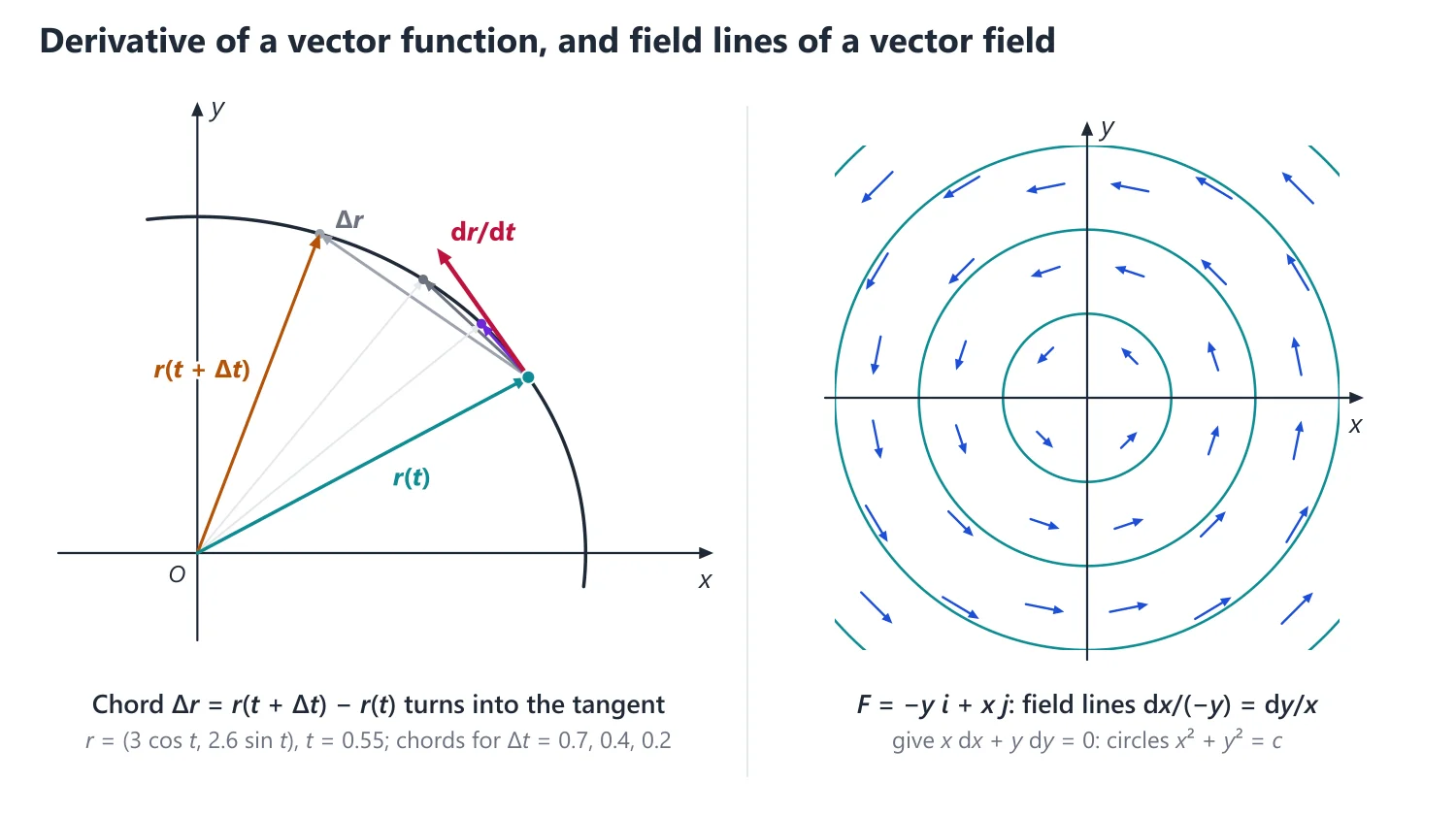
A level surface of φ is the set of points where φ takes one fixed value c; a field line of F is a curve that is tangent to F at each of its points.
First example, slowly: take φ(x, y, z) = x2 + y2 + z2, the square of the distance from the origin.
Step 1: at (1, 2, 2) the field has the value 1 + 4 + 4 = 9, and at the origin the value 0.
Step 2: the level surface φ = 9 is x2 + y2 + z2 = 9, the sphere of radius 3; every level surface φ = c with c > 0 is a sphere about the origin.
Step 3: now take the vector field F = −yi + xj; at (1, 0, 0) it is j, at (0, 1, 0) it is −i, and at (1, 1, 0) it is −i + j.
Step 4: notice that F·(xi + yj) = −yx + xy = 0, so the arrow at each point is perpendicular to the line joining it to the z-axis: the arrows go round the axis.
Step 5: the field lines solve dx/(−y) = dy/x, that is x dx + y dy = 0, so x2 + y2 = constant: circles about the z-axis, as the arrows suggested.
Notice the two pictures: a scalar field is drawn by its level surfaces, a vector field by its arrows and field lines.
Non-example: the rule "at each point, the unit vector pointing away from the origin", that is r/|r|, looks like a vector field on all of space, but at the origin there is no such direction and |r| = 0 makes r/|r| undefined.
The condition that fails is "defined at every point of R": r/|r| is a vector field on space with the origin removed, and every theorem about it must keep the origin out of the region.
Building up: because |A − B|2 is the sum of the squares of the component differences, a vector quantity tends to a limit exactly when each of its components does.
So a vector field is continuous or differentiable exactly when its three components are, and all the calculus of fields reduces to the calculus of three scalar functions in the fixed basis i, j, k.
The field-line condition is dr parallel to F, that is dr × F = 0, which written in components is dx/F1 = dy/F2 = dz/F3; the next topic adds the operators grad, div and curl that measure how fields change.
Where it is used: every later topic of this chapter acts on fields: gradients of scalar fields, divergence and curl of vector fields, and line and surface integrals of fields.
Velocity fields of fluids (Chapter 14) and force fields of dynamics (Chapter 6) are vector fields, and the field-line equations are the auxiliary equations of Lagrange's method (Chapter 12).
2. Scalar and Vector Fields
A scalar field assigns a number φ(x, y, z) to each point of a region (temperature, potential); a vector field assigns a vector F(x, y, z) = F1i + F2j + F3k (velocity, force).
Idea: a field is a function of position, not a single number or vector: think of the temperature at every point of a room (scalar field) and the wind velocity at every point of the sky (vector field); the operators grad, div and curl then describe how these change from point to point.
A scalar field is pictured by its level surfaces φ = c, and a vector field by its field lines, given by dx/F1 = dy/F2 = dz/F3.
Why it works: a field line is a curve whose tangent dr is parallel to F at every point, so dr × F = 0, which is the same as dx/F1 = dy/F2 = dz/F3; for F = −yi + xj this gives x dx + y dy = 0, so the field lines are the circles x2 + y2 = c, z = constant.
A field is continuous or differentiable when its component functions are.
Why it works: |A − B|2 is the sum of the squares of the component differences, so A(t) → A(t0) exactly when each component converges; limits, continuity and derivatives of vectors are therefore taken component by component in a fixed basis.
3. Understanding the Derivative of a Vector Function
Why we need it: a moving particle has a position vector r(t) that changes with time t.
Its velocity must tell us both how fast it moves and in which direction, so it must itself be a vector; we need a derivative that turns a vector function into another vector function.
In words: a vector function r(t) gives one vector for each value of the scalar t in an interval.
Δr = r(t + Δt) − r(t) is the displacement during the short time Δt; Δr/Δt is the average velocity over that time.
dr/dt is the vector L that Δr/Δt approaches, in the sense that the length |Δr/Δt − L| tends to 0 as Δt → 0 from either side; if no such L exists, r is not differentiable at t.
First example, slowly: let r(t) = ti + t2j, whose tip traces the parabola y = x2; find dr/dt at t = 1 from the definition.
Step 1: r(1) = i + j, the point (1, 1) of the parabola.
Step 2: r(1 + Δt) = (1 + Δt)i + (1 + Δt)2j = (1 + Δt)i + (1 + 2Δt + Δt2)j.
Step 3: subtract to get the chord Δr = Δt i + (2Δt + Δt2)j.
Step 4: divide by Δt: Δr/Δt = i + (2 + Δt)j.
Step 5: let Δt → 0: dr/dt = i + 2j; the same answer comes from differentiating the components, dx/dt = 1 and dy/dt = 2t = 2.
Step 6: the slope of y = x2 at x = 1 is 2, and the vector i + 2j also has slope 2/1 = 2, so dr/dt is indeed along the tangent; its length √5 is the speed of the tip.
Step 7: differentiating again, d2r/dt2 = 2j: the acceleration is constant and points in the direction in which the parabola bends.
Non-example: r(t) = |t| i + tj traces the V-shaped curve x = |y|; at t = 0, Δr/Δt = (|Δt|/Δt)i + j equals i + j for Δt > 0 and −i + j for Δt < 0.
The two one-sided values differ, so the condition "the same limit from either side" fails: r is not differentiable at t = 0, and geometrically the curve has a corner with no single tangent there.
Building up: since |Δr/Δt − L|2 is the sum of the squares of the component differences, the limit exists exactly when each component has a limit, which gives dr/dt = (dx/dt)i + (dy/dt)j + (dz/dt)k.
This step uses that i, j, k do not change with t; with turning unit vectors the extra terms appear (see the lesson on moving unit vectors below).
As Δt → 0 the chord Δr turns into the tangent, so dr/dt is tangent to the curve; its length |dr/dt| = ds/dt is the speed, and dr/ds is the unit tangent T used in the Curves in Space topic.
Where it is used: velocity and acceleration in dynamics (Chapter 6), the tangent, curvature and torsion of a space curve, and every line integral, since ∫F·dr = ∫F·(dr/dt) dt.
4. Understanding the Product Rules, Constant Length and Constant Direction
Why we need it: in many questions the vectors are not given in components at all; we are told only, for example, that r × dr/dt or A·dA/dt has some property.
We then need rules that differentiate products of unknown vector functions, and tests that recognise a vector of constant length or of constant direction.
In words: each product rule says "differentiate one factor at a time, leave the others unchanged and in their places, and add".
In d(A × B)/dt = A × dB/dt + dA/dt × B, A stays on the left in both terms; this matters because A × B = −B × A.
"|A| is constant" means the length of A does not change with t, although its direction may; "A has constant direction" means A/|A| does not change, although its length may.
The tests are: |A| constant if and only if A·dA/dt = 0; for non-zero A, direction constant if and only if A × dA/dt = 0.
First example, slowly: let A = cos t i + sin t j + tk, a helix-shaped vector function.
Step 1: A·A = cos2t + sin2t + t2 = 1 + t2, so |A| = √(1 + t2) is not constant.
Step 2: dA/dt = −sin t i + cos t j + k, so A·dA/dt = −sin t cos t + sin t cos t + t = t, which is not identically 0, agreeing with Step 1.
Step 3: the dot rule predicts d(A·A)/dt = 2A·dA/dt = 2t, and directly d(1 + t2)/dt = 2t: the rule checks.
Step 4: by contrast B = cos t i + sin t j has B·dB/dt = −cos t sin t + sin t cos t = 0, so |B| is constant (it equals 1).
Step 5: A × dA/dt = (sin t − t cos t)i − (t sin t + cos t)j + k, which is never 0 (its k-component is 1), so the direction of A keeps changing.
Step 6: the cross rule gives d(A × dA/dt)/dt = dA/dt × dA/dt + A × d2A/dt2 = A × d2A/dt2; with d2A/dt2 = −cos t i − sin t j this is t sin t i − t cos t j, exactly the derivative of the vector in Step 5.
Notice in Step 6 how the term dA/dt × dA/dt vanished: this is the trick behind ∫A × d2A/dt2 dt = A × dA/dt + c.
Non-example: the formula d(A × B)/dt = dA/dt × B + dB/dt × A looks like a product rule but has the second factor in the wrong order.
Test it with A = i and B = tj: A × B = tk, whose derivative is k, but the wrong formula gives 0 + j × i = −k; the condition that fails is "keep each factor in its original position".
Building up: the product rules come from writing Δ(A × B) = ΔA × B + A × ΔB + ΔA × ΔB and letting Δt → 0 (Derivation: Product Rules and Components of Acceleration, below).
For constant length: (1) |A|2 = A·A; (2) by the dot rule d(A·A)/dt = 2A·dA/dt; (3) a function on an interval is constant exactly when its derivative is zero, so |A| is constant exactly when A·dA/dt = 0.
For constant direction: (1) write A = aâ with a = |A| > 0; (2) â has constant length 1, so dâ/dt is perpendicular to â; (3) A × dA/dt = a2(â × dâ/dt), which is zero exactly when dâ/dt = 0; the full proof is Standard Proofs, Theorem 6.
Where it is used: showing that the angular momentum r × v is constant under a central force (Chapter 6), that the unit tangent T is perpendicular to dT/ds (Serret-Frenet formulae), and recognising integrands such as A × d2A/dt2.
5. Derivative of a Vector Function of a Scalar Variable
Definition: dr/dt = limΔt→0 [r(t + Δt) − r(t)]/Δt; for r = xi + yj + zk with fixed i, j, k, dr/dt = (dx/dt)i + (dy/dt)j + (dz/dt)k.
Idea: r(t + Δt) − r(t) is a chord of the curve traced by the tip of r; dividing by Δt and letting Δt → 0 turns the chord into the tangent, so dr/dt points along the curve and its length is the rate at which the tip moves.
The component formula needs i, j, k to be constant; when the basis vectors themselves change (polar, cylindrical or moving axes) they must be differentiated too, as in the section on moving unit vectors below.
Geometrically dr/dt is tangent to the curve traced by r(t); if t is time, dr/dt is the velocity and d2r/dt2 the acceleration.
Rules: d(φA)/dt = φ dA/dt + (dφ/dt)A; d(A·B)/dt = A·dB/dt + dA/dt·B; d(A × B)/dt = A × dB/dt + dA/dt × B, keeping the order of the factors.
Idea: every product rule has the same shape as for scalars, differentiate one factor at a time; the only new point is that A × B = −B × A, so in a cross product the factors must stay in their original order.
For the scalar triple product: d[A B C]/dt = [dA/dt B C] + [A dB/dt C] + [A B dC/dt]; the vector triple product is differentiated in the same way.
Constant magnitude: |A| is constant if and only if A·dA/dt = 0, so a non-zero vector of constant length is perpendicular to its derivative.
Why it works: d(A·A)/dt = 2A·dA/dt, and A·A = |A|2; so |A| is constant exactly when A·dA/dt = 0; picture the tip of A moving on a sphere, where every velocity is tangent to the sphere and so perpendicular to the radius A.
In general d|A|/dt = (A·dA/dt)/|A|, which is not |dA/dt|: for A = (cos t, sin t, 0), |A| = 1 is constant while |dA/dt| = 1.
Constant direction: a non-zero A has constant direction if and only if A × dA/dt = 0.
Reason: write A = aâ with a = |A|; then A × dA/dt = a2(â × dâ/dt), and since dâ/dt is perpendicular to â, this vanishes if and only if dâ/dt = 0.
Partial derivatives of A(x, y, z) are taken component-wise, and dA = (∂A/∂x)dx + (∂A/∂y)dy + (∂A/∂z)dz.
Geometric uses: the vectorial area of the parallelogram with sides a, b is a × b (half of it for the triangle), and the volume of the parallelepiped with coterminous edges a, b, c is [a b c]; their rates of change follow from the product rules above.
Components of a vector: the component of a along a non-zero u is a·u/|u|; the component perpendicular to the plane of u and v is a·(u × v)/|u × v|.
Tangential and normal acceleration: aT = (v·a)/|v| along the velocity and aN = |v × a|/|v| towards the centre of curvature.
Idea: aT is the part of the acceleration that changes the speed and aN the part that bends the path; aN = v2/ρ, so |v × a|/|v|3 is the curvature of the path.
6. Understanding Moving Unit Vectors and the Components of Acceleration
Why we need it: for a particle going round a circle or an orbit it is natural to resolve its velocity and acceleration along the radius and across it, or along the path and across it.
But these directions turn as the particle moves, so we must know how to differentiate unit vectors that are themselves changing.
In words: er = cos θ i + sin θ j is the unit vector from the origin towards the particle, and eθ = −sin θ i + cos θ j is er turned through 90° anticlockwise; here θ = θ(t) changes with time.
der/dt = (dθ/dt)eθ reads: "a turning unit vector changes at the rate of turning, in the perpendicular direction".
The tangential acceleration aT is the part of the acceleration along the velocity, and it changes the speed; the normal acceleration aN is the part perpendicular to the velocity, and it bends the path.
First example, slowly: uniform circular motion r = a(cos ωt i + sin ωt j), with a and ω positive constants.
Step 1: this is r = a er with θ = ωt, so dθ/dt = ω.
Step 2: v = a der/dt = aω eθ: the speed is aω and the velocity is along the circle.
Step 3: acceleration = aω deθ/dt = −aω2 er: it points to the centre and has magnitude aω2.
Step 4: v·a = 0, so aT = (v·a)/|v| = 0, as it must be when the speed is constant.
Step 5: v and a are perpendicular, so |v × a| = aω · aω2 = a2ω3 and aN = |v × a|/|v| = aω2 = (aω)2/a = v2/a.
Step 6: comparing with aN = v2/ρ gives radius of curvature ρ = a, and the curvature |v × a|/|v|3 = a2ω3/(a3ω3) = 1/a: a circle bends equally everywhere, by the reciprocal of its radius.
Non-example: treating er as a constant vector in r = a er gives v = 0, which is absurd for a particle that is clearly moving.
The condition that fails is the one behind the component rule: components may be differentiated alone only in a fixed basis, and er, eθ are not fixed.
Building up: for general plane motion r = r er, the product rule gives v = (dr/dt)er + r(dθ/dt)eθ.
Differentiating once more and using both rules der/dt = (dθ/dt)eθ, deθ/dt = −(dθ/dt)er: a = [d2r/dt2 − r(dθ/dt)2]er + [2(dr/dt)(dθ/dt) + r d2θ/dt2]eθ.
The transverse bracket equals (1/r) d(r2 dθ/dt)/dt, which is the form used for central orbits.
Along and across the path, write v = vT and a = (dv/dt)T + (v2/ρ)N; dotting and crossing with v give aT = (v·a)/|v| and aN = |v × a|/|v| (Derivation: Product Rules and Components of Acceleration, below).
Where it is used: radial and transverse components give r2 dθ/dt = h for central orbits (Chapter 6); aT and aN answer the frequent UPSC request for the components of acceleration along the velocity and along the normal.
7. Derivation: Product Rules and Components of Acceleration
Cross product: write ΔA = A(t + Δt) − A(t) and similarly ΔB; then Δ(A × B) = ΔA × B + A × ΔB + ΔA × ΔB, each term keeping A on the left.
Dividing by Δt and letting Δt → 0, the last term (ΔA/Δt) × ΔB tends to (dA/dt) × 0 = 0, leaving d(A × B)/dt = dA/dt × B + A × dB/dt; the dot-product and φA rules follow in the same way.
Triple product: [A B C] = A·(B × C), so applying the dot rule and then the cross rule gives the sum of the three terms with one factor differentiated in each.
Tangential and normal components: with v = vT and a = (dv/dt)T + (v2/ρ)N, v·a = v dv/dt and v × a = (v3/ρ)B.
Hence aT = dv/dt = (v·a)/|v| and aN = v2/ρ = |v × a|/|v|; in a numerical question aN can also be found as √(|a|2 − aT2).
8. Choosing the Method
If the vectors are given in components with fixed i, j, k → differentiate each component.
If the question involves a product of vector functions given only symbolically (A × dA/dt, [r r′ r″]) → use the product rules and the vanishing of a triple product with two equal factors; do not expand into components.
If you must show that a vector has constant length or constant direction → show A·dA/dt = 0 or A × dA/dt = 0.
If the component of velocity or acceleration along a direction d is asked → dot with d/|d|; if the tangential and normal parts are asked → use (v·a)/|v| and |v × a|/|v|.
If an integral like ∫A × d2A/dt2 dt or ∫(dA/dt·A) dt appears → recognise it as the derivative of A × dA/dt or of (1/2)|A|2.
9. Common Mistakes
Reversing the order of the factors when differentiating a cross product, which changes the sign of a term.
Treating er, eθ (or eρ, eφ) as constants when differentiating.
Confusing d|A|/dt with |dA/dt|; a vector of constant length can have a large derivative.
Writing a scalar constant of integration; integrating a vector function gives an arbitrary constant vector c, fixed by the initial data.
Finding a component along d without dividing by |d|.
10. Connections
Link: the derivatives of er, eθ give the radial and transverse components used for central orbits (Chapter 6), and |v × a|/|v|3 is the curvature formula of the Curves in Space topic.
Link: the field-line equations dx/F1 = dy/F2 = dz/F3 are the auxiliary equations of Lagrange's method for first-order PDEs (Chapter 12).
11. Worked Examples
Example 1: If r = a cos ωt + b sin ωt, where a, b are constant vectors, show that r × dr/dt = ω(a × b) and d2r/dt2 = −ω2r.
dr/dt = −ωa sin ωt + ωb cos ωt, so r × dr/dt = ω cos2ωt (a × b) − ω sin2ωt (b × a) = ω(a × b).
d2r/dt2 = −ω2(a cos ωt + b sin ωt) = −ω2r: the motion is simple harmonic and, when a and b are not parallel, the path is an ellipse in the plane of a and b (if a × b = 0 it shrinks to a line segment).
Example 2: For r = t2i − tj + (2t + 1)k, find the components of velocity and acceleration at t = 1 in the direction i − 3j + 2k.
v = 2ti − j + 2k = (2, −1, 2) at t = 1 and a = 2i; with the unit vector (i − 3j + 2k)/√14, the components are (2 + 3 + 4)/√14 = 9/√14 and 2/√14.
Example 3: If A = t2i − tj + (2t + 1)k and B = (2t − 3)i + j − tk, find d(A·B)/dt at t = 1.
A·B = t2(2t − 3) − t − t(2t + 1) = 2t3 − 5t2 − 2t, so d(A·B)/dt = 6t2 − 10t − 2 = −6 at t = 1.
Check by the product rule: A·dB/dt + dA/dt·B = (1, −1, 3)·(2, 0, −1) + (2, −1, 2)·(−1, 1, −1) = −1 − 5 = −6.
Example 4: A particle moves along x = e−t, y = 2 cos 3t, z = 2 sin 3t; find the magnitudes of its velocity and acceleration at t = 0.
v = (−e−t, −6 sin 3t, 6 cos 3t) = (−1, 0, 6) at t = 0, so |v| = √37.
a = (e−t, −18 cos 3t, −18 sin 3t) = (1, −18, 0) at t = 0, so |a| = √325 = 5√13.
Example 5: Show that d/dt[r · (dr/dt × d2r/dt2)] = r · (dr/dt × d3r/dt3).
Writing r′ = dr/dt, the derivative of [r r′ r″] is [r′ r′ r″] + [r r″ r″] + [r r′ r‴].
A scalar triple product with two equal vectors is zero, so the first two terms vanish and the result is [r r′ r‴].
Example 6: If dA/dt = ω × A and dB/dt = ω × B for a vector ω, show that d(A × B)/dt = ω × (A × B).
d(A × B)/dt = (ω × A) × B + A × (ω × B) = [A(ω·B) − ω(A·B)] + [ω(A·B) − B(A·ω)].
The ω(A·B) terms cancel, leaving A(ω·B) − B(ω·A) = ω × (A × B).
Example 7: Find r(t) if d2r/dt2 = 6ti − 24t2j + 4 sin t k, r(0) = 2i + j and dr/dt = −i − 3k at t = 0.
Integrating, dr/dt = 3t2i − 8t3j − 4 cos t k + c, and t = 0 gives c = −i + k.
Integrating again and using r(0) = 2i + j: r = (t3 − t + 2)i + (1 − 2t4)j + (t − 4 sin t)k.
12. Moving Unit Vectors and Integration
er = cos θ i + sin θ j and eθ = −sin θ i + cos θ j satisfy der/dt = (dθ/dt)eθ and deθ/dt = −(dθ/dt)er.
Idea: er and eθ are unit vectors that turn with angular speed dθ/dt; a unit vector can only change direction, so its derivative is perpendicular to it, and turning er forward gives eθ while turning eθ forward gives −er.
Differentiating r = r er twice with these rules gives the radial and transverse components of velocity and acceleration used in dynamics.
Integration: ∫A(t) dt is taken component-wise; for example ∫(A × d2A/dt2) dt = A × dA/dt + c, since d/dt(A × dA/dt) = A × d2A/dt2.
13. Solved UPSC Questions
Example 8 (UPSC 2017, 10 marks): The position vector of a moving point at time t is r̄ = sin t î + cos 2t ĵ + (t2 + 2t)k̂. Find the components of acceleration ā in the directions parallel to the velocity vector v̄ and perpendicular to the plane of r̄ and v̄ at time t = 0.
v = dr/dt = cos t i − 2 sin 2t j + (2t + 2)k and a = d2r/dt2 = −sin t i − 4 cos 2t j + 2k.
At t = 0: r = j, v = i + 2k and a = −4j + 2k.
Component along v: a·v/|v| = (0 + 0 + 4)/√5 = 4/√5.
The normal to the plane of r and v is r × v = j × (i + 2k) = 2i − k, with |r × v| = √5.
Component perpendicular to that plane: a·(r × v)/|r × v| = (0 + 0 − 2)/√5 = −2/√5.
Answer: 4/√5 along v, and −2/√5 along the normal 2i − k (that is, magnitude 2/√5 in the direction −(2i − k)).
Example 9 (UPSC 2023, 10 marks): If a = sin θ î + cos θ ĵ + θ k̂, b = cos θ î − sin θ ĵ − 3k̂, c = 2î + 3ĵ − 3k̂, then find the values of the derivative of the vector function a × (b × c) w.r.t. θ at θ = π/2 and θ = π.
Expand first: a × (b × c) = (a·c)b − (a·b)c, with a·c = 2 sin θ + 3 cos θ − 3θ and a·b = sin θ cos θ − sin θ cos θ − 3θ = −3θ.
So F(θ) = (2 sin θ + 3 cos θ − 3θ)b + 3θc and dF/dθ = (2 cos θ − 3 sin θ − 3)b + (2 sin θ + 3 cos θ − 3θ)b′ + 3c, where b′ = −sin θ i − cos θ j.
At θ = π/2: b = −j − 3k, b′ = −i and the coefficients are −6 and 2 − 3π/2, so dF/dθ = (6j + 18k) − (2 − 3π/2)i + (6i + 9j − 9k) = (4 + 3π/2)i + 15j + 9k.
At θ = π: b = −i − 3k, b′ = j and the coefficients are −5 and −3 − 3π, so dF/dθ = (5i + 15k) − (3 + 3π)j + (6i + 9j − 9k) = 11i + (6 − 3π)j + 6k.
Answer: (4 + 3π/2)i + 15j + 9k at θ = π/2 and 11i + (6 − 3π)j + 6k at θ = π.
Example 10 (UPSC 2024, 10 marks): At any time t (in seconds), the coterminous edges of a variable parallelepiped are represented by the vectors
α̅ = t î + (t + 1) ĵ + (2t + 1) k̂
β̅ = 2t î + (3t − 1) ĵ + t k̂
γ̅ = î + 3t ĵ + k̂
What is the rate of change of the vectorial area of the parallelogram, whose coterminous edges are α̅ and γ̅? Also find the rate of change of the volume of the parallelepiped at t = 1 second.
The vectorial area of the parallelogram on α and γ is S = α × γ = (−6t2 − 2t + 1)i + (t + 1)j + (3t2 − t − 1)k.
dS/dt = α′ × γ + α × γ′ = (1 − 6t, 1, 3t − 1) + (−6t − 3, 0, 3t) = (−12t − 2)i + j + (6t − 1)k, which is −14i + j + 5k at t = 1.
The volume is V = [α β γ] = det[[t, t + 1, 2t + 1], [2t, 3t − 1, t], [1, 3t, 1]] = 9t3 + 2t2 − 3t + 1.
dV/dt = 27t2 + 4t − 3, which is 28 at t = 1 (check: V(1) = 9 and V(2) = 75 from the determinant directly).
Answer: dS/dt = (−12t − 2)i + j + (6t − 1)k, equal to −14i + j + 5k at t = 1; the volume changes at 28 cubic units per second at t = 1.
14. Practice Exercises
Exercise 1 (basic): For r = t2i + 2tj + t3k, find dr/dt and d2r/dt2 at t = 1.
Answer: dr/dt = 2i + 2j + 3k and d2r/dt2 = 2i + 6k.
Exercise 2 (basic): Show that A = cos 2t i + sin 2t j + 3k has constant magnitude by computing A·dA/dt.
Answer: dA/dt = −2 sin 2t i + 2 cos 2t j, so A·dA/dt = 0; indeed |A| = √10.
Exercise 3 (basic): Find the unit tangent vector to the curve r = 3 cos t i + 3 sin t j + 4tk at t = 0.
Answer: dr/dt = 3j + 4k at t = 0, of length 5, so T = (3j + 4k)/5.
Exercise 4 (standard): For A = ti + t2j + k and B = i + tk, find d(A × B)/dt at t = 1 both by expanding A × B and by the product rule.
Answer: A × B = t3i + (1 − t2)j − t2k, so the derivative at t = 1 is 3i − 2j − 2k; the product rule gives the same.
Exercise 5 (standard): A particle moves along r = et cos t i + et sin t j. Find its tangential and normal components of acceleration at t = 0.
Answer: v = i + j and a = 2j at t = 0, so aT = 2/√2 = √2 and aN = |v × a|/|v| = 2/√2 = √2.
Exercise 6 (standard): Which of A = t2i + t2j and B = ti + t2j (t > 0) has constant direction? Justify with the cross-product test.
Answer: A × dA/dt = 0, so A has constant direction (i + j)/√2; B × dB/dt = t2k ≠ 0, so B turns.
Exercise 7 (standard): Find r(t) if d2r/dt2 = 12ti − 2j + etk, with dr/dt = j + k and r = i at t = 0.
Answer: dr/dt = 6t2i + (1 − 2t)j + etk and r = (2t3 + 1)i + (t − t2)j + (et − 1)k.
Exercise 8 (UPSC level): If r = a ent + b e−nt, where a, b are constant vectors and n is a constant, show that d2r/dt2 − n2r = 0 and r × dr/dt = −2n(a × b).
Answer: dr/dt = n(a ent − b e−nt); in r × dr/dt the a × a and b × b terms vanish and the cross terms give −n(a × b) + n(b × a) = −2n(a × b).
Exercise 9 (UPSC level): If r(t) is a unit vector for every t, prove that |r × dr/dt| = |dr/dt|.
Answer: hint: |r| = 1 gives r·dr/dt = 0, so the angle between r and dr/dt is 90° and |r × dr/dt| = |r||dr/dt| sin 90° = |dr/dt|.
Exercise 10 (UPSC level): The coterminous edges of a variable parallelepiped are α = ti + j, β = tj + k and γ = i + tk. Find the rate of change of its volume and of the vectorial area of the parallelogram on α and β at t = 2.
Answer: V = [α β γ] = t3 + 1, so dV/dt = 3t2 = 12; α × β = i − tj + t2k, whose derivative is −j + 2tk = −j + 4k at t = 2.
Exercise 11 (UPSC level): A particle moves along x = t, y = t2, z = t3. Find the components of its acceleration along the velocity and along the principal normal at t = 1.
Answer: v = i + 2j + 3k, a = 2j + 6k, so aT = 22/√14 and aN = |v × a|/|v| = |6i − 6j + 2k|/√14 = 2√19/√14 ≈ 2.33; check aT2 + aN2 = 40 = |a|2.
| Expression | Derivative with respect to t |
|---|---|
| φA | φ dA/dt + (dφ/dt)A |
| A·B | A·dB/dt + dA/dt·B |
| A × B | A × dB/dt + dA/dt × B |
| [A B C] | [A′ B C] + [A B′ C] + [A B C′] |
| A × (B × C) | A′ × (B × C) + A × (B′ × C) + A × (B × C′) |
| |A|2 = A·A | 2A·dA/dt |
Mains points
- Short proofs are common: show that a vector of constant magnitude is perpendicular to its derivative, or that A × dA/dt = 0 characterises constant direction; give both directions of an 'if and only if'.
- Keep the order of factors in cross products while differentiating; reversing them silently changes the sign.
- In kinematics-style questions, resolve velocity and acceleration along a given direction by taking the dot product with a unit vector, not the raw vector.
- State that i, j, k are constant vectors when differentiating component-wise; with moving unit vectors (er, eθ) their derivatives must be included.
Did you know?
- Modern vector notation (dot, cross, ∇) was shaped in the 1880s by J. W. Gibbs and Oliver Heaviside, who extracted it from Hamilton's quaternions.
Gradient, Divergence and Curl in Cartesian and Cylindrical Coordinates
grad φ points normal to level surfaces and gives directional derivatives; div F measures outward flux per unit volume; curl F measures rotation. In cylindrical coordinates the scale factors 1, ρ, 1 enter every formula. Second-order combinations give the Laplacian and the identities curl grad = 0, div curl = 0.
1. Understanding the Gradient and the Directional Derivative
Why we need it: standing at a point of a room where the temperature is φ(x, y, z), we may ask: if I step in a given direction, how fast does the temperature change, and in which direction does it rise fastest?
The partial derivatives answer this only for the three axis directions; the gradient packs them into one vector that answers it for every direction, and also gives the normal to a surface.
In words: ∂φ/∂x is the rate of change of φ per unit distance when you move parallel to the x-axis, with y and z held fixed; similarly for y and z.
grad φ = ∇φ is the vector with these three rates as components.
The directional derivative in the direction of a unit vector â is the limit of [φ(P + sâ) − φ(P)]/s as s → 0: the change of φ per unit distance moved along â; the word "unit" matters, because s is then the true distance.
First example, slowly: take φ = x2 + y2 + z2 at P(1, 2, 2), where φ = 9.
Step 1: ∇φ = (2x, 2y, 2z) = (2, 4, 4) at P, and |∇φ| = √(4 + 16 + 16) = 6.
Step 2: in the direction â = (2i − j)/√5 the rate is (4 − 4)/√5 = 0; notice that (2, −1, 0)·(1, 2, 2) = 0, so this direction is tangent to the sphere φ = 9 through P, and on that sphere φ does not change.
Step 3: the greatest rate should be |∇φ| = 6, along ∇φ/|∇φ| = (1, 2, 2)/3, the outward radius.
Step 4: check from the definition: moving a distance s that way gives the point (1 + s/3)P, where φ = 9(1 + s/3)2 = 9 + 6s + s2; the rate at s = 0 is 6.
Step 5: so the unit normal to the sphere at P is (1, 2, 2)/3 and the tangent plane is (r − P)·∇φ = 0, that is x + 2y + 2z = 9.
Non-example: φ = √(x2 + y2) at the origin, the tip of a cone: moving a distance s > 0 in any horizontal unit direction raises φ by exactly s, so the one-sided rate is +1 in every horizontal direction.
No vector g can give g·â = +1 and g·(−â) = +1 together, so the rate is not ∇φ·â; the condition that fails is differentiability of φ at the point (∂φ/∂x does not even exist there).
Building up: (1) if φ is differentiable (continuous partial derivatives suffice), the chain rule gives d/ds φ(P + sâ) = (∂φ/∂x)a1 + (∂φ/∂y)a2 + (∂φ/∂z)a3 = ∇φ·â.
(2) ∇φ·â = |∇φ| cos θ, so the rate is greatest, |∇φ|, along ∇φ, zero at right angles to it and least, −|∇φ|, opposite to it.
(3) along any curve on the level surface φ = c, φ stays equal to c, so ∇φ·dr/dt = 0: ∇φ is perpendicular to every tangent of the surface, hence normal to it (when ∇φ ≠ 0).
(4) from the normal come the tangent plane, the normal line, the angle between two surfaces (angle between their normals) and the orthogonality test ∇φ1·∇φ2 = 0.
Where it is used: normals and tangent planes to conicoids (Chapter 4), Lagrange multipliers (Chapter 3), where ∇f = λ∇g says a level surface of f touches the constraint surface, and conservative forces F = −∇V in dynamics (Chapters 6 and 14).
2. Gradient
∇ = i ∂/∂x + j ∂/∂y + k ∂/∂z; grad φ = ∇φ = (∂φ/∂x)i + (∂φ/∂y)j + (∂φ/∂z)k.
Idea: ∇ (del) is a vector of differentiations; applied to a scalar it gives a vector (grad), dotted with a vector field it gives a scalar (div), and crossed with a vector field it gives a vector (curl), so the algebra of dot and cross products tells you which combinations make sense.
∇φ is normal to the level surface φ = c through the point; the unit normal is ∇φ/|∇φ|.
Why it works: for any curve r(t) lying on the surface φ = c, φ(r(t)) = c for all t, so by the chain rule ∇φ·dr/dt = 0; thus ∇φ is perpendicular to every tangent direction of the surface.
The hypothesis ∇φ ≠ 0 is needed: for φ = (x − y)2 the level surface φ = 0 is the plane x = y, but ∇φ = 0 on it and gives no normal; write that surface as x − y = 0 instead.
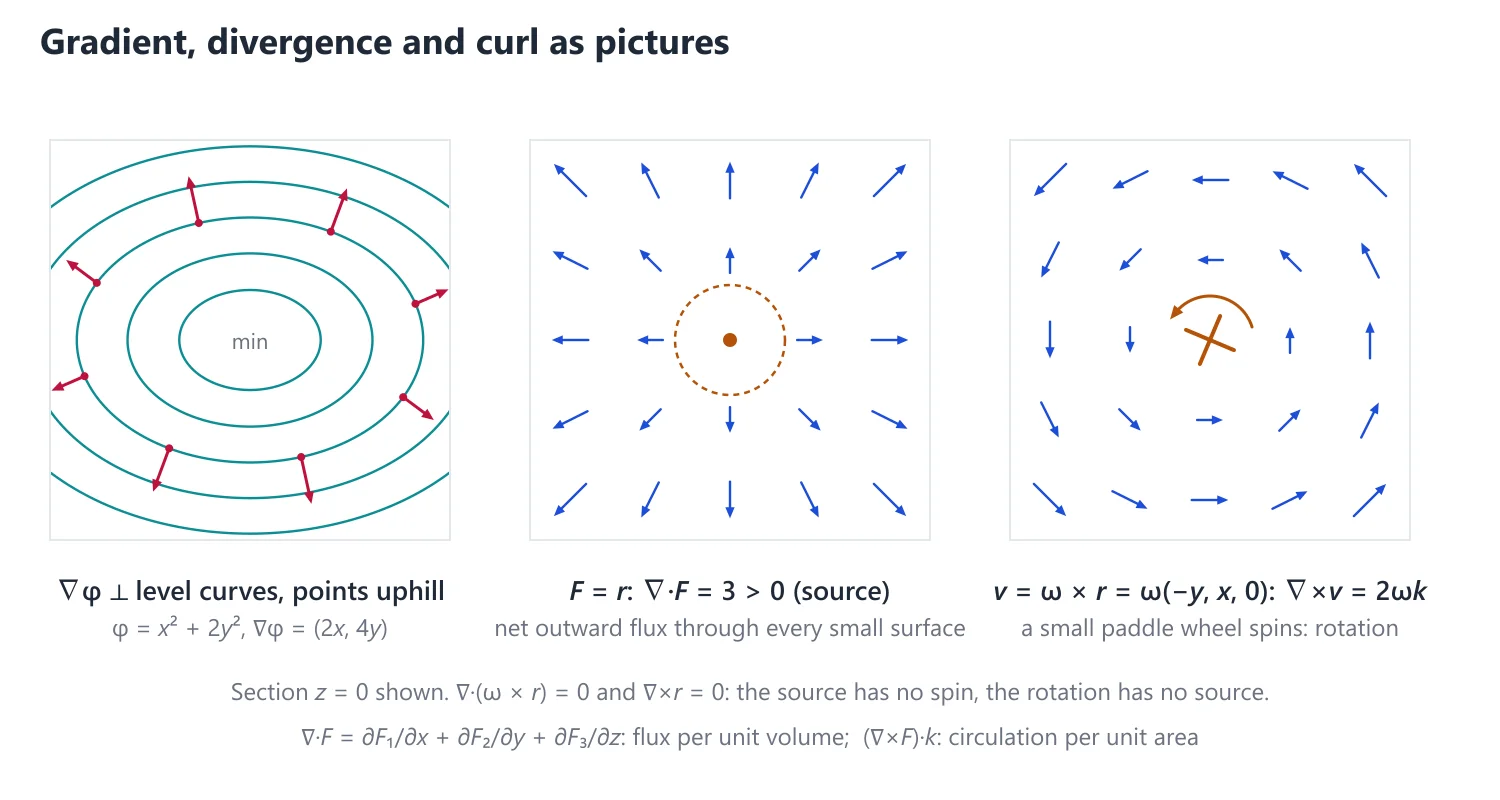
Directional derivative of φ in the direction of a unit vector â is ∇φ·â; it is greatest in the direction of ∇φ, with maximum value |∇φ|.
Why it works: moving a distance s from r0 in the direction â, d/ds φ(r0 + sâ) = ∇φ·â = |∇φ| cos θ, where θ is the angle between ∇φ and â; this is greatest (|∇φ|) for θ = 0, zero along the level surface and least (−|∇φ|) for θ = π.
Picture: on a hill with height φ(x, y), ∇φ points straight uphill, its length is the steepest slope, and the contour lines are perpendicular to it.
Example 1: Find the directional derivative of φ = x2yz + 4xz2 at (1, −2, −1) in the direction 2i − j − 2k.
∇φ = (2xyz + 4z2, x2z, x2y + 8xz) = (8, −1, −10) at the point; with â = (2, −1, −2)/3, ∇φ·â = (16 + 1 + 20)/3 = 37/3.
The angle between two surfaces at a common point is the angle between their normals ∇φ1 and ∇φ2 there.
Example 2: Find the angle between the surfaces x2 + y2 + z2 = 9 and z = x2 + y2 − 3 at (2, −1, 2).
Normals: ∇(x2 + y2 + z2) = (4, −2, 4) and ∇(x2 + y2 − z) = (4, −2, −1), of lengths 6 and √21.
cos θ = (16 + 4 − 4)/(6√21) = 8/(3√21), so θ = cos−1(8/(3√21)) ≈ 54.4°.
Tangent plane and normal line to φ(x, y, z) = c at r0: (r − r0)·∇φ = 0 and r = r0 + λ∇φ.
Orthogonal surfaces: φ1 = c1 and φ2 = c2 cut orthogonally at a common point if ∇φ1·∇φ2 = 0 there; use also the fact that the point lies on both surfaces to find unknown constants.
Directional derivative along a curve: along the tangent to r(t) at t0, take â = r′(t0)/|r′(t0)|, first checking which t0 gives the point.
Functional dependence: ∇u, ∇v, ∇w are coplanar at every point if and only if [∇u ∇v ∇w] = ∂(u, v, w)/∂(x, y, z) vanishes identically, which (for smooth u, v, w, and locally, near points where the gradients are not all parallel) is the condition for a functional relation between u, v, w.
3. Understanding the Divergence
Why we need it: think of F as the velocity of a fluid; at a given point we want to know whether fluid is being produced (a source), absorbed (a sink), or simply passing through.
In words: div F = ∂F1/∂x + ∂F2/∂y + ∂F3/∂z, a scalar.
∂F1/∂x says how much faster the flow in the x-direction becomes as you move in the x-direction: if it speeds up, more leaves the far face of the box than enters the near face.
Adding the three such terms gives the net outflow per unit volume; div F > 0 means a source, div F < 0 a sink, and div F = 0 everywhere (solenoidal) means what flows in flows out.
First example, slowly: take F = xi, a flow away from the yz-plane that gets faster with x; div F = 1.
Step 1: take the unit box 1 ≤ x ≤ 2, 0 ≤ y ≤ 1, 0 ≤ z ≤ 1.
Step 2: on the face x = 2 the outward normal is i and F·i = 2, so the outflow is 2 × (area 1) = 2.
Step 3: on the face x = 1 the outward normal is −i and F·(−i) = −1, so the outflow is −1 (an inflow of 1).
Step 4: on the other four faces F has no component along the normal, so they contribute 0; the net outflow is 2 − 1 = 1 = (div F) × (volume 1).
Step 5: now take G = yi: the flow is again along x, but its speed depends only on y, so the same amount y enters at x = 1 and leaves at x = 2 and div G = 0.
Step 6: for r = xi + yj + zk, div r = 3, and the unit cube 0 ≤ x, y, z ≤ 1 loses 1 through each of the faces x = 1, y = 1, z = 1 and nothing through the faces at 0: total 3, as predicted.
Non-example: the unit radial field eρ = (xi + yj)/ρ, with ρ = √(x2 + y2), has the constant cylindrical component Aρ = 1, and the Cartesian-looking guess ∂Aρ/∂ρ = 0 suggests no sources.
In fact ∂(x/ρ)/∂x + ∂(y/ρ)/∂y = 2/ρ − (x2 + y2)/ρ3 = 1/ρ, which is what the correct formula (1/ρ)∂(ρ · 1)/∂ρ gives; the condition that fails is that the formula ∑∂Fi/∂xi holds only for Cartesian components (the arrows spread apart, so the flow thins out).
Building up: the box computation above, done for a general small box of volume dx dy dz, gives net outflow (div F) dV (Derivation: Divergence as Flux and Curl as Circulation).
Adding over many small boxes, the flux through the shared inner faces cancels, leaving the flux through the outer surface: this is the Gauss divergence theorem of the integral-theorems topic.
Two rules to remember: div(φA) = φ div A + A·∇φ (Standard Proofs, Theorem 16) and div curl A = 0 (Standard Proofs, Theorem 2), so every curl is solenoidal.
Where it is used: finding constants that make a field solenoidal, the equation of continuity div v = 0 for an incompressible fluid (Chapter 14), and turning flux integrals into volume integrals by Gauss's theorem.
4. Understanding the Curl and Conservative Fields
Why we need it: two questions arise for a vector field: does the flow rotate locally (like a whirlpool), and is a force field conservative, so that its work depends only on the end points and a potential exists?
In words: the k-component of curl F, ∂F2/∂x − ∂F1/∂y, compares how the y-velocity changes as you move along x with how the x-velocity changes as you move along y.
It equals the circulation ∮F·dr round a small anticlockwise loop in the xy-plane, per unit area enclosed; the other two components do the same for the yz- and zx-planes.
F is irrotational in a region if curl F = 0 at every point of it; a scalar potential is a function φ with ∇φ = F, and then the work ∫F·dr from A to B is φ(B) − φ(A), whatever the path.
First example, slowly: compare the rotation v = −yi + xj with the field F = yi + xj.
Step 1: for v, the k-component of the curl is ∂(x)/∂x − ∂(−y)/∂y = 1 + 1 = 2 and the other components are 0, so curl v = 2k: rigid rotation with angular velocity k.
Step 2: round the unit circle r = cos t i + sin t j, v·dr/dt = sin2t + cos2t = 1, so the circulation is 2π = (2)(area π): the loop picture checks.
Step 3: for F, the k-component is ∂(x)/∂x − ∂(y)/∂y = 0 and the other two are 0, so F is irrotational in all of space.
Step 4: find φ: ∂φ/∂x = y gives φ = xy + g(y, z); then ∂φ/∂y = x + ∂g/∂y must equal x, so g does not depend on y; ∂φ/∂z = ∂g/∂z = 0, so g is a constant.
Step 5: so φ = xy + c, and the work from (0, 0, 0) to (1, 2, 0) is φ(1, 2, 0) − φ(0, 0, 0) = 2 along any path.
Step 6: check along the straight path r = t(i + 2j), 0 ≤ t ≤ 1: F·dr/dt = (2t)(1) + (t)(2) = 4t, and ∫01 4t dt = 2.
Notice that v has no potential: its work round a closed loop is 2π, not 0, while a gradient does zero work round every closed loop.
Non-example: F = (−yi + xj)/(x2 + y2) has curl F = 0 at every point off the z-axis, yet its circulation round the unit circle is 2π, so it is not a gradient there.
The condition that fails is "simply connected": space with the z-axis removed has a hole, and a loop round the axis cannot be shrunk to a point without crossing it.
Building up: (1) every gradient is irrotational, curl grad φ = 0, because mixed partial derivatives are equal (Standard Proofs, Theorem 1).
(2) conversely, if curl F = 0 in a simply connected region, Stokes' theorem makes ∮F·dr = 0 round every closed curve, so ∫F·dr is independent of the path.
(3) defining φ(P) as ∫F·dr from a fixed point to P then gives ∇φ = F (Standard Proofs, Theorem 11); in practice integrate ∂φ/∂x = F1 and fix the leftover function, as in Step 4, or use the three-segment formula below.
Where it is used: conservative forces and energy equations in dynamics (Chapter 6), evaluating line integrals by a potential (integral-theorems topic), velocity potentials of irrotational flow (Chapter 14), and exact differential equations M dx + N dy = 0, whose test ∂M/∂y = ∂N/∂x is a k-component of curl being zero (Chapter 5).
5. Divergence and Curl
div F = ∇·F = ∂F1/∂x + ∂F2/∂y + ∂F3/∂z: the net outward flux per unit volume at a point.
Idea: think of F as the velocity of a fluid: div F > 0 at a point means fluid is being created there (a source) and spreads outwards, div F < 0 means a sink; for F = r every point is a source of strength 3 (uniform expansion), while a rigid rotation has divergence 0.
curl F = ∇ × F = (∂F3/∂y − ∂F2/∂z)i + (∂F1/∂z − ∂F3/∂x)j + (∂F2/∂x − ∂F1/∂y)k; for a rigid rotation v = ω × r, curl v = 2ω.
Idea: curl measures local spin: a tiny paddle wheel placed in the flow turns with angular velocity (1/2) curl F; curved field lines do not imply curl (the flow (−yi + xj)/(x2 + y2) has curl 0 off the axis), and straight field lines do not rule it out (the shear flow yi has curl −k).
Memory aid: curl F is the formal determinant with rows (i, j, k), (∂/∂x, ∂/∂y, ∂/∂z) and (F1, F2, F3), expanded along the first row.
F is solenoidal if div F = 0 and irrotational if curl F = 0; a continuously differentiable irrotational field in a simply connected region is a gradient, F = ∇φ, φ being a scalar potential.
Idea: solenoidal fields have no sources or sinks (incompressible flow, magnetic field), so whatever flows into a region flows out; irrotational fields have no local spin and are gradients, so their line integrals depend only on the end points.
The hypothesis simply connected matters: (−yi + xj)/(x2 + y2) is irrotational outside the z-axis but its circulation round the axis is 2π, so it is not a gradient there (proof of the positive result in Standard Proofs, Theorem 11).
Example 3: F = (x + 3y)i + (y − 2z)j + (x + az)k is solenoidal when div F = 1 + 1 + a = 0, that is a = −2.
Example 4: Show that F = (2xy + z3)i + x2j + 3xz2k is irrotational and find its scalar potential.
curl F = (0 − 0)i + (3z2 − 3z2)j + (2x − 2x)k = 0; integrating ∂φ/∂x = 2xy + z3 and matching the other components, φ = x2y + xz3 + c.
Example 5: Find constants a, b, c so that F = (x + 2y + az)i + (bx − 3y − z)j + (4x + cy + 2z)k is irrotational, and find its scalar potential.
curl F = (c + 1)i + (a − 4)j + (b − 2)k = 0 gives a = 4, b = 2, c = −1.
Integrating the components: φ = x2/2 − 3y2/2 + z2 + 2xy + 4xz − yz + constant; check ∂φ/∂y = 2x − 3y − z and ∂φ/∂z = 4x − y + 2z.
Scalar potential by a line integral: if curl F = 0 in ℝ3, then φ(x, y, z) = ∫0xF1(u, 0, 0) du + ∫0yF2(x, u, 0) du + ∫0zF3(x, y, u) du, integrating along three segments parallel to the axes.
Why it works: curl F = 0 in ℝ3 makes ∫F·dr independent of the path, so φ(x, y, z) = ∫F·dr from the origin can be computed along the most convenient path, three segments parallel to the axes; then ∇φ = F, which can be checked by differentiating.
Radial gradients: ∇f(r) = f′(r) r/r, so the equation ∇f = g(r) r is solved by f′(r) = r g(r).
6. Understanding Cylindrical Coordinates and Scale Factors
Why we need it: fields with symmetry about an axis (the field of a long wire, flow in a pipe, a rotating body) have messy Cartesian expressions but simple ones in terms of the distance from the axis and the angle round it.
In words: ρ is the distance of the point from the z-axis, φ is the angle from the positive x-axis to the projection of the point on the xy-plane, and z is the height.
The unit vectors are eρ = cos φ i + sin φ j (away from the axis), eφ = −sin φ i + cos φ j (round the axis) and ez = k.
The scale factor of a coordinate u is hu = |∂r/∂u|: the distance moved when u alone increases by 1 (per unit, for a small increase).
First example, slowly: start from r = ρ cos φ i + ρ sin φ j + zk.
Step 1: ∂r/∂ρ = cos φ i + sin φ j has length 1, so hρ = 1 and the unit vector in that direction is eρ.
Step 2: ∂r/∂φ = −ρ sin φ i + ρ cos φ j has length ρ, so hφ = ρ and the unit vector is eφ.
Step 3: ∂r/∂z = k, so hz = 1; the dot products eρ·eφ, eφ·ez, ez·eρ are all 0, so the system is orthogonal.
Step 4: the volume element is hρhφhz dρ dφ dz = ρ dρ dφ dz.
Step 5: test the gradient formula on f = ρ2 = x2 + y2: the cylindrical formula gives 2ρ eρ, and the Cartesian gradient 2xi + 2yj = 2ρ(cos φ i + sin φ j) = 2ρ eρ: they agree.
Step 6: now f = φ itself: the formula gives (1/ρ)eφ; in Cartesian form φ = tan−1(y/x) has gradient (−yi + xj)/ρ2 = (1/ρ)(−sin φ i + cos φ j), the same.
Non-example: writing ∇f = (∂f/∂ρ)eρ + (∂f/∂φ)eφ + (∂f/∂z)ez, without the 1/ρ, gives ∇φ = eφ, of length 1 at every radius.
But walking a distance s round the circle of radius ρ changes the angle by s/ρ, so the true rate is 1/ρ; the condition that fails is that a gradient component must be a rate per unit distance, while ∂f/∂φ is a rate per radian.
Building up: the gradient comes from dr = dρ eρ + ρ dφ eφ + dz ez and df = ∇f·dr; the divergence from the flux through a curved box whose faces at ρ and ρ + dρ have area ρ dφ dz (Derivation: The Cylindrical Formulas).
The Laplacian is div grad; the curl comes from circulation round small curved rectangles, whose sides have lengths hi dui.
Where it is used: UPSC asks for the divergence or curl of a field in cylindrical coordinates and a check against the Cartesian value; the cylindrical Laplacian is the starting point for Laplace's equation in a cylinder (Chapter 12) and for axisymmetric flow (Chapter 14).
7. Cylindrical Coordinates (ρ, φ, z)
x = ρ cos φ, y = ρ sin φ, z = z; scale factors hρ = 1, hφ = ρ, hz = 1; the unit vectors eρ, eφ, ez form a right-handed orthonormal set that changes from point to point.
Idea: a scale factor converts a change in a coordinate into a distance: increasing ρ by dρ moves a distance dρ, but increasing φ by dφ moves a distance ρ dφ along a circle, so hφ = ρ; the factors 1/ρ and ρ in the formulas below all come from this.
∇f = (∂f/∂ρ)eρ + (1/ρ)(∂f/∂φ)eφ + (∂f/∂z)ez.
∇·A = (1/ρ)∂(ρAρ)/∂ρ + (1/ρ)∂Aφ/∂φ + ∂Az/∂z.
∇ × A = [(1/ρ)∂Az/∂φ − ∂Aφ/∂z]eρ + [∂Aρ/∂z − ∂Az/∂ρ]eφ + (1/ρ)[∂(ρAφ)/∂ρ − ∂Aρ/∂φ]ez.
∇2f = (1/ρ)∂/∂ρ(ρ ∂f/∂ρ) + (1/ρ2)∂2f/∂φ2 + ∂2f/∂z2.
In general orthogonal coordinates (u1, u2, u3) with scale factors hi: ∇·A = [1/(h1h2h3)][∂(h2h3A1)/∂u1 + ∂(h3h1A2)/∂u2 + ∂(h1h2A3)/∂u3].
Changing components to cylindrical: Aρ = Ax cos φ + Ay sin φ, Aφ = −Ax sin φ + Ay cos φ, Az unchanged; divergence and curl do not depend on the coordinates, so the cylindrical formula must reproduce the Cartesian value.
Spherical coordinates (r, θ, φ): x = r sin θ cos φ, y = r sin θ sin φ, z = r cos θ, scale factors 1, r, r sin θ and volume element r2 sin θ dr dθ dφ; the operators are listed in the table below.
Example 6: For A = ρeφ (rigid rotation about the z-axis), ∇·A = 0 and ∇ × A = (1/ρ)∂(ρ2)/∂ρ ez = 2ez, agreeing with A = −yi + xj in Cartesian form.
Example 7: Find the divergence of A = ρ2eρ + ρz ez in cylindrical coordinates.
∇·A = (1/ρ)∂(ρ·ρ2)/∂ρ + 0 + ∂(ρz)/∂z = 3ρ + ρ = 4ρ.
8. Higher Order Derivatives
Laplacian: div grad φ = ∇2φ = ∂2φ/∂x2 + ∂2φ/∂y2 + ∂2φ/∂z2; φ is harmonic if ∇2φ = 0.
Idea: ∇2φ compares the value of φ at a point with its average over a small sphere around it; harmonic functions equal their own averages (mean value property), which is why a steady temperature distribution with no heat sources satisfies ∇2φ = 0 and, unless it is constant, has no interior maximum.
curl grad φ = 0 and div curl A = 0, for functions with continuous second partial derivatives.
curl curl A = grad div A − ∇2A, where ∇2A means the Laplacian of each Cartesian component.
Example 8: With r = |r|, ∇2(rn) = n(n − 1)rn−2 + 2nrn−2 = n(n + 1)rn−2; hence 1/r is harmonic for r ≠ 0.
9. Derivation: Divergence as Flux and Curl as Circulation
Divergence: take a small box with edges dx, dy, dz at (x, y, z); the net outward flux through the two faces perpendicular to i is [F1(x + dx, y, z) − F1(x, y, z)] dy dz ≈ (∂F1/∂x) dx dy dz.
Adding the other two pairs of faces, the outward flux is (∂F1/∂x + ∂F2/∂y + ∂F3/∂z) dV, so div F is the outward flux per unit volume; summing over many boxes gives the divergence theorem.
Curl: round a small rectangle dx by dy in the xy-plane, taken anticlockwise, the bottom and top sides contribute [F1(y) − F1(y + dy)] dx ≈ −(∂F1/∂y) dx dy and the two vertical sides contribute (∂F2/∂x) dx dy.
So the circulation is (∂F2/∂x − ∂F1/∂y) dx dy = (curl F)·k dA: each component of curl F is the circulation per unit area in the plane perpendicular to it, and summing over many rectangles gives Stokes' theorem.
Rigid rotation: for v = ω × r = (ω2z − ω3y, ω3x − ω1z, ω1y − ω2x), the i-component of curl v is ∂(ω1y − ω2x)/∂y − ∂(ω3x − ω1z)/∂z = 2ω1, and similarly for the others, so curl v = 2ω.
10. Derivation: The Cylindrical Formulas
Gradient: dr = dρ eρ + ρ dφ eφ + dz ez, and df = (∂f/∂ρ)dρ + (∂f/∂φ)dφ + (∂f/∂z)dz must equal ∇f·dr for every displacement; matching coefficients gives ∇f = (∂f/∂ρ)eρ + (1/ρ)(∂f/∂φ)eφ + (∂f/∂z)ez.
Divergence: the volume element is ρ dρ dφ dz; the curved faces at ρ and ρ + dρ have area ρ dφ dz, so their net outward flux is ∂(ρAρ)/∂ρ dρ dφ dz, while the flat faces give ∂Aφ/∂φ dρ dφ dz and ∂Az/∂z ρ dρ dφ dz.
Dividing by ρ dρ dφ dz gives ∇·A = (1/ρ)∂(ρAρ)/∂ρ + (1/ρ)∂Aφ/∂φ + ∂Az/∂z; the ρ inside the first derivative is there because the faces get larger as ρ grows.
Laplacian: ∇2f = ∇·(∇f); putting Aρ = ∂f/∂ρ, Aφ = (1/ρ)∂f/∂φ, Az = ∂f/∂z into the divergence formula gives the stated cylindrical Laplacian.
11. Choosing the Method
If a normal, a tangent plane or the angle between surfaces is asked → compute ∇φ at the point (first check the point lies on the surface), and use the acute angle between the normals.
If a rate of change in a direction or along a curve is asked → ∇φ·â with â a unit vector (for a curve, the unit tangent at the right parameter value); for the greatest rate, give |∇φ| and the direction ∇φ.
If you must decide whether F is conservative and find a potential → compute curl F; if zero, integrate ∂φ/∂x = F1 and fix the arbitrary function of (y, z) from the other components, or use the three-segment line integral.
If the field depends only on the distance from an axis or has an eρ, eφ form → use cylindrical formulas; if it depends only on r = |r| → use the f(r) results of the next topic.
12. Common Mistakes
Using the direction vector without normalising it; the directional derivative needs a unit vector.
Sign errors in the middle component of the curl: it is ∂F1/∂z − ∂F3/∂x, not the reverse.
Applying the Cartesian divergence formula to cylindrical components, for example writing ∂Aρ/∂ρ instead of (1/ρ)∂(ρAρ)/∂ρ.
Counting a term twice when assembling a potential from the three partial integrations; write φ once and check all three partial derivatives.
Concluding that F is a gradient from curl F = 0 in a region that is not simply connected.
13. Connections
Link: the normal ∇φ gives the tangent plane xx1/a2 + yy1/b2 + zz1/c2 = 1 to a conicoid (Chapter 4), and [∇u ∇v ∇w] is the Jacobian ∂(u, v, w)/∂(x, y, z) of Calculus (Chapter 3).
Link: for a fluid velocity v, div v = 0 is the equation of continuity of an incompressible fluid and curl v is the vorticity, while ∇2φ = 0 is Laplace's equation for the velocity potential (Chapters 12 and 14); in the plane, the real and imaginary parts of an analytic function are harmonic (Chapter 10).
14. Solved UPSC Questions
Example 9 (UPSC 2015, 12 marks): Find the value of λ and μ so that the surfaces λx2 − μyz = (λ + 2)x and 4x2y + z3 = 4 may intersect orthogonally at (1, −1, 2).
The point lies on the first surface: λ − μ(−1)(2) = λ + 2, so 2μ = 2 and μ = 1; it also lies on the second, since 4(1)(−1) + 8 = 4.
For f = λx2 − μyz − (λ + 2)x: ∇f = (2λx − λ − 2, −μz, −μy) = (λ − 2, −2, 1) at the point, with μ = 1.
For g = 4x2y + z3: ∇g = (8xy, 4x2, 3z2) = (−8, 4, 12).
Orthogonality: ∇f·∇g = −8(λ − 2) − 8 + 12 = 0, so 8λ = 20.
Answer: λ = 5/2, μ = 1.
Example 10 (UPSC 2016, 10 marks): Find f(r) such that ∇f = r⃗/r5 and f(1) = 0.
∇f(r) = f′(r) r/r, so f′(r)/r = 1/r5 and f′(r) = r−4.
Integrating, f(r) = −1/(3r3) + c, and f(1) = 0 gives c = 1/3.
Answer: f(r) = (1/3)(1 − 1/r3), r ≠ 0.
Example 11 (UPSC 2017, 10 marks): For what values of the constants a, b and c the vector V̄ = (x + y + az)î + (bx + 2y − z)ĵ + (−x + cy + 2z)k̂ is irrotational. Find the divergence in cylindrical coordinates of this vector with these values.
curl V = (c + 1)i + (a + 1)j + (b − 1)k = 0 gives a = −1, b = 1, c = −1.
Then V = (x + y − z)i + (x + 2y − z)j + (−x − y + 2z)k, and in Cartesian form ∇·V = 1 + 2 + 2 = 5.
With x = ρ cos φ, y = ρ sin φ and C = cos φ, S = sin φ: Vρ = VxC + VyS = ρ(C2 + 2CS + 2S2) − z(C + S), Vφ = −VxS + VyC = ρ(C2 − S2 + CS) + z(S − C), Vz = −ρ(C + S) + 2z.
(1/ρ)∂(ρVρ)/∂ρ = 2(C2 + 2CS + 2S2) − z(C + S)/ρ and (1/ρ)∂Vφ/∂φ = C2 − S2 − 4CS + z(C + S)/ρ, while ∂Vz/∂z = 2.
Adding: 3C2 + 3S2 + 2 = 5.
Answer: a = −1, b = 1, c = −1, and the divergence in cylindrical coordinates is 5, as in Cartesian form.
Example 12 (UPSC 2019, 10 marks): Find the directional derivative of the function xy2 + yz2 + zx2 along the tangent to the curve x = t, y = t2, z = t3 at the point (1, 1, 1).
∇φ = (y2 + 2zx, 2xy + z2, 2yz + x2) = (3, 3, 3) at (1, 1, 1).
The point is t = 1, where the tangent r′ = (1, 2t, 3t2) = (1, 2, 3) has length √14.
Directional derivative = (3, 3, 3)·(1, 2, 3)/√14 = 18/√14.
Answer: 18/√14 = 9√14/7 ≈ 4.81.
Example 13 (UPSC 2025, 10 marks): If u = x + y + z, v = x2 + y2 + z2 and w = xy + yz + zx, then show that grad u, grad v and grad w are coplanar.
∇u = (1, 1, 1), ∇v = 2(x, y, z) and ∇w = (y + z, z + x, x + y).
[∇u ∇v ∇w] = 2 det[[1, 1, 1], [x, y, z], [y + z, z + x, x + y]].
Adding the second row to the third gives (x + y + z)(1, 1, 1), a multiple of the first row, so the determinant is 0 at every point.
Answer: the scalar triple product vanishes identically, so grad u, grad v, grad w are coplanar; this reflects the functional relation v = u2 − 2w.
15. Practice Exercises
Exercise 1 (basic): Find ∇φ for φ = x2y + yz3 at (1, −1, 1).
Answer: ∇φ = (2xy, x2 + z3, 3yz2) = −2i + 2j − 3k.
Exercise 2 (basic): Find div F and curl F for F = xyi + yzj + zxk.
Answer: div F = x + y + z and curl F = −yi − zj − xk.
Exercise 3 (basic): Find the unit normal to the surface x2 + y2 − z = 1 at (1, 1, 1).
Answer: ∇(x2 + y2 − z) = (2, 2, −1), of length 3, so n = (2i + 2j − k)/3 (or its negative).
Exercise 4 (standard): Find the directional derivative of φ = xyz at (1, 2, 3) towards the point (2, 4, 5), and the greatest rate of increase of φ at (1, 2, 3).
Answer: ∇φ = (6, 3, 2) and â = (1, 2, 2)/3, so the rate is 16/3; the greatest rate is |∇φ| = 7, along (6i + 3j + 2k)/7.
Exercise 5 (standard): Find the constant a for which F = (axy − z3)i + (a − 2)x2j + (1 − a)xz2k is irrotational, and then find a scalar potential.
Answer: curl F = (a − 4)z2j + (a − 4)xk, so a = 4; then φ = 2x2y − xz3 + c.
Exercise 6 (standard): Find the angle between the surfaces x2 + y2 + z2 = 6 and z = x2 + y2 at (1, 1, 2).
Answer: normals (2, 2, 4) and (2, 2, −1); cos θ = 4/(3√24) = 2/(3√6), so θ ≈ 74.2°.
Exercise 7 (standard): Find the divergence of A = ρ eρ + ρ2 sin φ eφ + z2 ez in cylindrical coordinates.
Answer: (1/ρ)∂(ρ2)/∂ρ + (1/ρ)∂(ρ2 sin φ)/∂φ + ∂(z2)/∂z = 2 + ρ cos φ + 2z.
Exercise 8 (standard): Using the cylindrical Laplacian, show that f = ln ρ is harmonic for ρ ≠ 0.
Answer: ∂f/∂ρ = 1/ρ, so ρ ∂f/∂ρ = 1 and (1/ρ)∂(1)/∂ρ = 0; the φ and z terms are 0, hence ∇2f = 0.
Exercise 9 (UPSC level): Find a and b so that the surface ax2 + byz = (a + 1)x cuts the surface x2 + 2y2 + 3z2 = 6 orthogonally at (1, 1, 1).
Answer: the point lies on the first surface only if b = 1; the normals are (a − 1, 1, 1) and (2, 4, 6), and 2(a − 1) + 4 + 6 = 0 gives a = −4, b = 1.
Exercise 10 (UPSC level): Find all functions f(r), r = |r|, with ∇2f = 0 for r ≠ 0, and the one with f(1) = 0 and f(2) = 1.
Answer: ∇2f = f″ + 2f′/r = (1/r2)(r2f′)′ = 0 gives f = A − B/r; the conditions give A = B = 2, so f = 2 − 2/r.
Exercise 11 (UPSC level): Show that F = (y2 cos x + z2)i + 2y sin x j + (2xz + 1)k is conservative, find its potential, and find the work done by F in moving a particle from (0, 1, 1) to (π/2, 2, 1).
Answer: curl F = 0 in all of space; φ = y2 sin x + xz2 + z, and the work is φ(π/2, 2, 1) − φ(0, 1, 1) = (5 + π/2) − 1 = 4 + π/2.
| Operator | Cartesian (x, y, z) | Cylindrical (ρ, φ, z) | Spherical (r, θ, φ) |
|---|---|---|---|
| Scale factors | 1, 1, 1 | 1, ρ, 1 | 1, r, r sin θ |
| ∇f | (fx, fy, fz) | (∂f/∂ρ, (1/ρ)∂f/∂φ, ∂f/∂z) | (∂f/∂r, (1/r)∂f/∂θ, (1/(r sin θ))∂f/∂φ) |
| ∇·A | ∂A1/∂x + ∂A2/∂y + ∂A3/∂z | (1/ρ)∂(ρAρ)/∂ρ + (1/ρ)∂Aφ/∂φ + ∂Az/∂z | (1/r2)∂(r2Ar)/∂r + (1/(r sin θ))∂(sin θ Aθ)/∂θ + (1/(r sin θ))∂Aφ/∂φ |
| ∇2f | fxx + fyy + fzz | (1/ρ)∂/∂ρ(ρ ∂f/∂ρ) + (1/ρ2)∂2f/∂φ2 + ∂2f/∂z2 | (1/r2)∂/∂r(r2 ∂f/∂r) + (1/(r2 sin θ))∂/∂θ(sin θ ∂f/∂θ) + (1/(r2 sin2θ))∂2f/∂φ2 |
| Question asked | Compute | Watch out for |
|---|---|---|
| Normal, tangent plane, angle between surfaces | ∇φ at the point | Point must lie on the surface; take the acute angle |
| Rate of change in a direction | ∇φ·â | â must be a unit vector |
| Greatest rate of change | |∇φ|, in the direction of ∇φ | Give both the value and the direction |
| Is F solenoidal? | ∇·F | Find unknown constants from ∇·F = 0 identically |
| Is F conservative? Potential? | ∇ × F, then integrate | Region must be simply connected |
| Is φ harmonic? | ∇2φ | Exclude points where φ is not defined, such as r = 0 |
Mains points
- Directional derivative, normal to a surface and angle between surfaces are quick 10-mark items; always normalise the direction vector.
- Deriving div, curl or the Laplacian in cylindrical coordinates is asked from time to time; start from the scale factors hρ = 1, hφ = ρ, hz = 1 and the general orthogonal-coordinate formula.
- For 'find the scalar potential' questions, first show curl F = 0, then integrate step by step and check ∇φ = F.
- Remember that the cylindrical unit vectors eρ, eφ vary with φ; differentiating components alone, as in Cartesian form, is a common error.
- Results such as ∇2(rn) = n(n + 1)rn−2 can be quoted after a one-line derivation via ∇2f(r) = f″ + 2f′/r.
Did you know?
- The symbol ∇ is called nabla after an ancient harp of similar shape; the name was suggested to P. G. Tait, and Maxwell used it in his letters.
Vector Identities and Vector Equations
The product vector identities for ∇ acting on φψ, φA, A·B and A × B, together with the results for the position vector r, settle most proof questions. Vector equations such as x × a = b or λx + x × a = b are solved by taking dot and cross products with the known vectors.
1. Understanding ∇ Acting on the Position Vector
Why we need it: gravity, electrostatics and point sources in fluids produce fields that depend only on the distance r from a centre, such as r/r3 or f(r)r.
Almost every identity question in UPSC uses r, r = |r| and functions f(r).
If you know how ∇ acts on r and on r, you can evaluate most such expressions in two lines instead of expanding nine partial derivatives.
In words: r = xi + yj + zk is the position vector of the point (x, y, z); it is itself a vector field, assigning to each point the arrow from the origin O to that point.
r = |r| = √(x2 + y2 + z2) is a scalar field: the distance from O.
f(r) means a scalar field whose value depends only on that distance, so it is constant on every sphere centred at O.
∇f(r) is a vector, ∇·(f(r)r) is a scalar and ∇ × (f(r)r) is a vector; keep track of which kind of object each line produces.
First example, slowly: find ∇r, then ∇f(r).
Step 1: r = (x2 + y2 + z2)1/2, so ∂r/∂x = (1/2)(x2 + y2 + z2)−1/2·2x = x/r.
Step 2: in the same way ∂r/∂y = y/r and ∂r/∂z = z/r; nothing new happens because r is symmetric in x, y, z.
Step 3: ∇r = (x/r)i + (y/r)j + (z/r)k = r/r.
Step 4: notice what this says: ∇r has length |r|/r = 1 and points straight away from O, the direction in which the distance grows fastest.
Step 5: for any differentiable f, the chain rule gives ∂f(r)/∂x = f′(r)·∂r/∂x = f′(r)x/r, so ∇f(r) = f′(r)∇r = f′(r) r/r.
Step 6: check with f = r2: the rule gives ∇(r2) = 2r·r/r = 2r, which agrees with ∇(x2 + y2 + z2) = (2x, 2y, 2z).
Step 7: finally ∇·r = ∂x/∂x + ∂y/∂y + ∂z/∂z = 1 + 1 + 1 = 3; this 3 is the dimension of space and appears in every divergence of a radial field.
Non-example: the shortcut ∇f(r) = f′(r) r/r works only when the scalar depends on x, y, z through r alone.
For φ = xr, which is not a function of r only, ∇φ = r i + x r/r; there is no single-variable derivative φ′(r) to use.
The results also fail at r = 0: r/r is undefined there and r itself is not differentiable at the origin, which is why every statement about r/r3 carries the condition r ≠ 0.
Building up: combine ∇f(r) = f′ r/r with the product rules of the next section.
∇·(f r) = f(∇·r) + r·∇f = 3f + f′(r·r)/r = 3f + rf′, and ∇ × (f r) = f(∇ × r) + ∇f × r = 0, because ∇f is parallel to r.
Taking f = rn gives ∇·(rnr) = (n + 3)rn; taking f′/r in place of f gives ∇2f(r) = f″ + 2f′/r (Standard Proofs, Theorem 5).
So four short facts, ∇r = r/r, ∇·r = 3, ∇ × r = 0 and the chain rule, generate the whole of Section 1 below.
Where it is used: questions such as "find n so that rnr is solenoidal" (n = −3) or "show that rn is harmonic only for n = 0, −1"; the inverse-square field r/r3 in Gauss's law (Integral Theorems topic); and the central-force fields of Chapter 6.
2. Results for r = xi + yj + zk, r = |r|
∇r = r/r; ∇·r = 3; ∇ × r = 0; (A·∇)r = A.
Idea: ∇r = r/r says that the distance from the origin increases fastest straight outwards, at unit rate; ∇·r = 3 counts the three directions of uniform expansion; ∇ × r = 0 because a purely radial field has no spin; (A·∇)r = A because the rate of change of position in the direction A is A itself.
∇f(r) = f′(r) r/r; ∇·(f(r)r) = 3f + rf′; ∇ × (f(r)r) = 0.
Why it works: by the chain rule ∂f(r)/∂x = f′(r) ∂r/∂x = f′(r) x/r, so ∇f(r) = f′(r)∇r = f′(r) r/r; then ∇·(f r) = f(∇·r) + r·∇f = 3f + f′ r·r/r = 3f + rf′, and ∇ × (f r) = f(∇ × r) + ∇f × r = 0 since ∇f is parallel to r.
∇2f(r) = f″(r) + (2/r)f′(r); ∇·(rnr) = (n + 3)rn, so r/r3 is solenoidal for r ≠ 0.
Why it works: ∇2f = ∇·((f′/r) r) = 3f′/r + r d/dr(f′/r) = 3f′/r + f″ − f′/r = f″ + 2f′/r (Standard Proofs, Theorem 5); so the radial harmonic functions solve r2f″ + 2rf′ = 0, giving f = A + B/r.
For a constant vector a: ∇(a·r) = a; ∇·(a × r) = 0; ∇ × (a × r) = 2a.
3. Understanding the Product Rules for ∇
Why we need it: fields in applications are often products: a density times a velocity (ρv), a scalar times a gradient (φ∇ψ), or the cross product of two fields (E × H).
We need to differentiate such products without expanding every component; the product identities are the vector form of the ordinary rule (uv)′ = u′v + uv′.
In words: ∇ = i ∂/∂x + j ∂/∂y + k ∂/∂z is an operator, not a vector: it waits for something to act on.
In ∇·(φA), "∇·" means: differentiate the product φA with respect to x, y, z and take the dot products with i, j, k.
Because ∇ differentiates, it acts on φ once (with A held fixed) and on A once (with φ held fixed).
Because ∇ also behaves like a vector, the two pieces are combined by the rules of vector algebra, and in cross products the order of the factors matters.
(A·∇) is the scalar operator A1∂/∂x + A2∂/∂y + A3∂/∂z: it differentiates in the direction of A, scaled by |A|.
First example, slowly: verify ∇·(φA) = φ(∇·A) + A·∇φ for φ = xy and A = (z, x, y).
Step 1: φA = (xyz, x2y, xy2).
Step 2: ∇·(φA) = ∂(xyz)/∂x + ∂(x2y)/∂y + ∂(xy2)/∂z = yz + x2 + 0.
Step 3: ∇·A = ∂z/∂x + ∂x/∂y + ∂y/∂z = 0, so the term φ(∇·A) is 0.
Step 4: ∇φ = (y, x, 0), so A·∇φ = zy + x·x + y·0 = yz + x2.
Step 5: adding, φ(∇·A) + A·∇φ = yz + x2, the same as Step 2.
Notice: φ(∇·A) is the term in which A is differentiated and A·∇φ the term in which φ is differentiated; no other term can appear.
Non-example: ∇ × (φA) = φ(∇ × A) + A × ∇φ follows the same pattern but is wrong: in the term where φ is differentiated, ∇ stays in the first slot of the cross product, so the term is ∇φ × A = −A × ∇φ.
Test with φ = x and A = j: ∇ × (xj) = k and ∇φ × A = i × j = k, while A × ∇φ = j × i = −k.
In the same way ∇ × (A × B) is not just A(∇·B) − B(∇·A): ∇ is not a number and cannot simply be moved past A.
Building up: every product identity is proved in the same three steps.
(1) Write ∇·F = Σ i·∂F/∂x and ∇ × F = Σ i × ∂F/∂x. (2) Use the ordinary product rule on ∂F/∂x. (3) Rearrange with a·(b × c) = [a b c] and a × (b × c) = (a·c)b − (a·b)c, and recognise each sum as ∇·, ∇ × or (B·∇).
This is done for ∇·(A × B) in Worked Example 1, for ∇ × (A × B) in the Derivation section below and in Standard Proofs, Theorem 3, and for ∇·(φA) and ∇ × (φA) in Standard Proofs, Theorem 16.
Where it is used: proving identities (frequent short questions), simplifying fields such as (a × r)/r3 (Example 6), and Green's identities, which are the divergence theorem applied to ∇·(φ∇ψ) = φ∇2ψ + ∇φ·∇ψ; the same rules give the energy equation of fluid dynamics in Chapter 14.
4. Understanding curl grad = 0 and div curl = 0
Why we need it: two questions occur constantly: is a given field the gradient of a potential (a conservative force), and is it the curl of another field (as a magnetic field is)?
The second-order identities give quick necessary tests: a gradient must have zero curl, and a curl must have zero divergence.
In words: ∇ × ∇φ = 0 says: take the gradient of a scalar field and then the curl; the result is always the zero vector.
∇·(∇ × A) = 0 says: the curl of any field has no sources or sinks.
Both need φ and A to have continuous second partial derivatives, so that the mixed partial derivatives are equal.
In ∇ × (∇ × A) = ∇(∇·A) − ∇2A, the vector Laplacian ∇2A means ∇2 applied to each Cartesian component of A.
First example, slowly: check curl grad φ = 0 for φ = x2y + z3.
Step 1: ∇φ = (2xy, x2, 3z2).
Step 2: the i-component of the curl is ∂(3z2)/∂y − ∂(x2)/∂z = 0 − 0 = 0.
Step 3: the j-component is ∂(2xy)/∂z − ∂(3z2)/∂x = 0 − 0 = 0.
Step 4: the k-component is ∂(x2)/∂x − ∂(2xy)/∂y = 2x − 2x = 0.
Step 5: notice that Step 4 is exactly ∂2φ/∂x∂y − ∂2φ/∂y∂x; every component of curl grad φ is a difference of two equal mixed partial derivatives, which is why it vanishes.
Non-example: the converse needs a condition on the region. F = (−y, x, 0)/(x2 + y2) has ∇ × F = 0 everywhere off the z-axis, yet it is not the gradient of a single-valued φ there.
Its circulation round the unit circle x2 + y2 = 1, z = 0 is ∫02π (sin2t + cos2t) dt = 2π, while for a gradient it would be 0; the region (space without the z-axis) is not simply connected, and that is the condition that fails.
Building up: curl grad φ = 0 and div curl A = 0 are proved by writing out the components and using the equality of mixed partial derivatives (Standard Proofs, Theorems 1 and 2).
curl curl A = grad div A − ∇2A follows the pattern a × (b × c) = b(a·c) − (a·b)c with a = b = ∇, keeping ∇ to the left of A (Standard Proofs, Theorem 4).
For the converse on all of ℝ3 or a simply connected region, Standard Proofs, Theorem 11 builds φ as the line integral of F from a fixed point; curl F = 0 makes this integral independent of the path.
Where it is used: showing that a force is conservative and finding its potential (Chapters 6 and 14), showing that ∇φ × ∇ψ is solenoidal (Example 3), turning Maxwell's equations into wave equations (Example 12), and Stokes' theorem questions, where curl F = 0 makes a line integral path-independent.
5. Product Identities
∇(φψ) = φ∇ψ + ψ∇φ.
∇·(φA) = φ(∇·A) + A·∇φ.
Idea: each product identity is Leibniz's rule: ∇ acts once on each factor while the other is held fixed, and the vector algebra decides how the pieces combine; that is why ∇·(φA) has one term in which φ is differentiated and one in which A is.
∇ × (φA) = φ(∇ × A) + ∇φ × A.
∇·(A × B) = B·(∇ × A) − A·(∇ × B).
∇ × (A × B) = A(∇·B) − B(∇·A) + (B·∇)A − (A·∇)B.
Idea: compare the algebraic rule a × (b × c) = b(a·c) − c(a·b); with ∇ in place of a, each of the two terms splits into two because ∇ must differentiate both A and B, which gives four terms; (B·∇)A = B1∂A/∂x + B2∂A/∂y + B3∂A/∂z is the rate of change of A in the direction of B.
∇(A·B) = (A·∇)B + (B·∇)A + A × (∇ × B) + B × (∇ × A).
Second order: ∇ × ∇φ = 0; ∇·(∇ × A) = 0; ∇ × (∇ × A) = ∇(∇·A) − ∇2A; ∇2(φψ) = φ∇2ψ + 2∇φ·∇ψ + ψ∇2φ.
Idea: gradient fields have no spin and curl fields have no sources; both follow from the equality of mixed partial derivatives, so the functions must have continuous second partial derivatives (Standard Proofs, Theorems 1, 2 and 4).
The converses need a continuously differentiable F and a condition on the region: in ℝ3 (or any simply connected region) curl F = 0 implies F = ∇φ, and in ℝ3 (or any star-shaped region) div F = 0 implies F = curl A for some vector potential A; r/r3 on ℝ3 without the origin is solenoidal but is not a curl there, since its flux through a sphere about O is 4π and not 0.
Proof technique: write ∇ = Σ i ∂/∂x, so that ∇·F = Σ i·∂F/∂x and ∇ × F = Σ i × ∂F/∂x; differentiate each factor in turn and use the algebraic triple-product identities.
Example 1: Prove ∇·(A × B) = B·(∇ × A) − A·(∇ × B).
∇·(A × B) = Σ i·(∂A/∂x × B) + Σ i·(A × ∂B/∂x) = B·Σ(i × ∂A/∂x) − A·Σ(i × ∂B/∂x) = B·(∇ × A) − A·(∇ × B).
Example 2: For constant a, ∇ × (a × r) = a(∇·r) − r(∇·a) + (r·∇)a − (a·∇)r = 3a − 0 + 0 − a = 2a.
Example 3: ∇φ × ∇ψ is solenoidal, because ∇·(∇φ × ∇ψ) = ∇ψ·(∇ × ∇φ) − ∇φ·(∇ × ∇ψ) = 0.
Example 4: Prove that ∇ × (φ∇φ) = 0.
∇ × (φ∇φ) = φ(∇ × ∇φ) + ∇φ × ∇φ = 0 + 0, since curl grad φ = 0 and the cross product of a vector with itself is zero.
Example 5: Find all f(r) such that f(r)r is solenoidal.
∇·(f(r)r) = 3f + rf′ = 0, so f′/f = −3/r and f = c/r3; the field is cr/r3 (r ≠ 0), the inverse-square field.
Example 6: For a constant vector a, show that ∇ × [(a × r)/r3] = −a/r3 + 3(a·r)r/r5.
With φ = r−3: ∇ × (φG) = φ(∇ × G) + ∇φ × G, where G = a × r, ∇ × G = 2a and ∇φ = −3r/r5.
So the curl is 2a/r3 − (3/r5) r × (a × r) = 2a/r3 − (3/r5)[r2a − (r·a)r] = −a/r3 + 3(a·r)r/r5.
6. Understanding Vector Equations
Why we need it: in mechanics and geometry an unknown vector is often described through its products with known vectors: a force with a known moment, a velocity with a known component along an axis.
Such conditions give equations like x × a = b, which cannot be "divided" by a; we need a systematic way to recover x.
In words: x is the unknown vector; a, b are given vectors; λ, p are given scalars.
"Solve x × a = b" asks for every vector x whose cross product with a equals b; "solvable" means at least one such x exists, and the "general solution" is a formula that gives every such x.
There is no division by a vector, so we multiply the equation (dot or cross) by a known vector and use the triple-product identities to isolate x.
First example, slowly: solve x × j = k.
Step 1 (solvability): x × j is always perpendicular to j, so k must be perpendicular to j; indeed j·k = 0, so solutions may exist.
Step 2: cross with j on the left: j × (x × j) = (j·j)x − (j·x)j = x − (j·x)j.
Step 3: the right side becomes j × k = i, so x − (j·x)j = i.
Step 4: the number j·x is not fixed by the equation; call it λ, so x = i + λj.
Step 5 (check): (i + λj) × j = i × j + λ(j × j) = k + 0 = k for every λ.
Notice: the answer is a whole line of vectors, the particular solution (a × b)/|a|2 = (j × k)/1 = i plus any multiple of a = j.
Non-example: x × j = j has no solution, because x × j is perpendicular to j while the right side is parallel to it; the condition a·b = 0 fails (j·j = 1).
Applying the formula blindly gives x = (j × j)/1 + λj = λj, but (λj) × j = 0 ≠ j; always test solvability first.
Building up: the same idea handles harder equations.
For x·a = p together with x × a = b, the cross step gives |a|2x − (a·x)a = a × b and the dot equation supplies a·x = p, so x = [pa + (a × b)]/|a|2 is fully determined.
For λx + x × a = b, dotting with a kills the cross term and gives x·a = (a·b)/λ; crossing with a and substituting then gives the formula proved in the Derivation section below.
For three dot equations x·a = p, x·b = q, x·c = r, the reciprocal vectors a′, b′, c′ act like the rows of an inverse matrix and give x = pa′ + qb′ + rc′.
Where it is used: finding a force from its moment, recovering an angular velocity from v = ω × r (ω is found only up to a component along r), solving linear systems geometrically (Chapter 2), and short 10-mark UPSC questions on vector equations.
7. Vector Equations
Method: take dot and cross products of the equation with the known vectors to obtain enough scalar and vector relations, then eliminate.
x × a = b (a ≠ 0): solvable only if a·b = 0; then x = (a × b)/|a|2 + λa, λ arbitrary.
Why it works: x × a is always perpendicular to a, so a·b = 0 is necessary; crossing with a, a × (x × a) = |a|2x − (a·x)a = a × b gives x = (a × b)/|a|2 + ((a·x)/|a|2)a, and the component of x along a is not determined because a × a = 0.
x·a = p and x × a = b (a·b = 0): x = [pa + (a × b)]/|a|2.
λx + x × a = b (λ ≠ 0): dotting with a gives x·a = (a·b)/λ, and crossing with a then gives x = [λ2b + (a·b)a + λ(a × b)]/[λ(λ2 + |a|2)].
Reciprocal system: for non-coplanar a, b, c, the vectors a′ = (b × c)/[a b c], b′ = (c × a)/[a b c], c′ = (a × b)/[a b c] satisfy a·a′ = b·b′ = c·c′ = 1 and a·b′ = a·c′ = ... = 0; every x = (x·a′)a + (x·b′)b + (x·c′)c.
Why it works: write x = αa + βb + γc (possible since a, b, c are non-coplanar) and dot with a′: since a·a′ = 1 and b·a′ = c·a′ = 0, α = x·a′, and similarly β = x·b′, γ = x·c′; the reciprocal vectors pick out the coefficients, just as the rows of an inverse matrix do.
Example 7: Solve x·a = p, x·b = q, x·c = r with a, b, c non-coplanar.
x = pa′ + qb′ + rc′ = [p(b × c) + q(c × a) + r(a × b)]/[a b c]; dotting with a, b, c confirms each equation.
Example 8: Solve x + x × k = i (λ = 1, a = k, b = i): x = [i + 0 + (k × i)]/2 = (i + j)/2, and indeed (i + j)/2 + (i + j)/2 × k = (i + j)/2 + (i − j)/2 = i.
8. Vector Algebra Toolkit
Three non-parallel vectors a, b, c form the sides of a triangle if and only if one of them is the sum of the other two, or a + b + c = 0, possibly after reversing one of them.
If AB = b and BC = c, the median from A to the midpoint of BC is b + c/2, and similarly for the others; the sum of the squares of the medians is (3/4) of the sum of the squares of the sides (Apollonius).
a × (b × c) = (a·c)b − (a·b)c; (a × b)·(c × d) = (a·c)(b·d) − (a·d)(b·c) (Lagrange's identity); a, b, c are coplanar if and only if [a b c] = 0.
Divergence of a radial field: ∇·(g(r) r) = 3g + rg′; with g = f(r)/r this gives ∇·((f(r)/r) r) = f′(r) + 2f(r)/r.
Maxwell's equations in free space (units with the speed of light 1): ∇·E = 0, ∇·H = 0, ∇ × E = −∂H/∂t, ∇ × H = ∂E/∂t; taking the curl and using curl curl = grad div − ∇2 gives wave equations for E and H.
9. Derivation: The Curl of a Cross Product and λx + x × a = b
Write ∇ × F = Σ i × ∂F/∂x (sum over x, y, z with i, j, k); then ∇ × (A × B) = Σ i × (∂A/∂x × B) + Σ i × (A × ∂B/∂x).
By a × (b × c) = (a·c)b − (a·b)c, i × (∂A/∂x × B) = (i·B)∂A/∂x − (i·∂A/∂x)B; summing, Σ(i·B)∂A/∂x = (B·∇)A and Σ(i·∂A/∂x) = ∇·A, so the first sum is (B·∇)A − B(∇·A).
Likewise i × (A × ∂B/∂x) = (i·∂B/∂x)A − (i·A)∂B/∂x sums to A(∇·B) − (A·∇)B; adding the two gives the identity (also Standard Proofs, Theorem 3).
Solving λx + x × a = b: dotting with a gives λ(x·a) = a·b; crossing on the right with a gives λ(x × a) + (x·a)a − |a|2x = b × a.
Substituting x × a = b − λx and x·a = (a·b)/λ: λb − λ2x + (a·b)a/λ − |a|2x = b × a, so x = [λ2b + (a·b)a + λ(a × b)]/[λ(λ2 + |a|2)], as stated.
10. Choosing the Method
If a general identity with arbitrary fields A, B, φ must be proved → use ∇ = Σ i ∂/∂x and the algebraic triple-product rules, or work with the x-component only and quote symmetry for the others.
If the expression involves r, r = |r|, f(r) and constant vectors → reduce it with the Section 1 results and the product identities; components are rarely needed.
If an f(r) with a property (solenoidal, harmonic) is asked → write the property as an ODE in r (3f + rf′ = 0, f″ + 2f′/r = 0) and solve it.
If an unknown vector x appears linearly → dot and cross the equation with the known vectors; for three scalar conditions x·a = p, x·b = q, x·c = r → use the reciprocal system.
11. Common Mistakes
Treating ∇ as an ordinary vector and writing ∇ × (A × B) = A(∇·B) − B(∇·A), dropping the two directional-derivative terms.
Confusing (A·∇)B, a vector obtained by differentiating B, with A(∇·B).
Writing ∇ × (φA) = φ(∇ × A) + A × ∇φ; the correct order is ∇φ × A, and reversing it changes the sign.
Forgetting to exclude r = 0 when calling r/r3 solenoidal or 1/r harmonic.
In x × a = b, omitting the arbitrary multiple λa or the solvability condition a·b = 0.
12. Connections
Link: if the matrix M has columns a, b, c, then the reciprocal vectors a′, b′, c′ are the rows of M−1, so solving x·a = p, x·b = q, x·c = r is solving a linear system by the inverse matrix (Chapter 2).
Link: curl curl = grad div − ∇2 turns Maxwell's equations into the wave equation of Chapter 12, and ∇·(r/r3) = 0 for r ≠ 0 is the key step in Gauss's law (Integral Theorems topic).
13. Solved UPSC Questions
Example 9 (UPSC 2016, 10 marks): Prove that the vectors a⃗ = 3î + ĵ − 2k̂, b⃗ = −î + 3ĵ + 4k̂, c⃗ = 4î − 2ĵ − 6k̂ can form the sides of a triangle. Find the lengths of the medians of the triangle.
b + c = (−1 + 4, 3 − 2, 4 − 6) = (3, 1, −2) = a, and no two of a, b, c are parallel (their components are not proportional).
So with AB = b and BC = c we get AC = a: the vectors are the sides of a triangle ABC, with |a| = √14, |b| = √26, |c| = √56.
Median from A: b + c/2 = (1, 2, 1), length √6.
Median from B: −b + a/2 = (5/2, −5/2, −5), length √(75/2) = 5√6/2.
Median from C: −a + b/2 = (−7/2, 1/2, 4), length √(57/2) = √114/2.
Check (Apollonius): 6 + 75/2 + 57/2 = 72 = (3/4)(14 + 26 + 56).
Answer: the medians have lengths √6, 5√6/2 and √114/2.
Example 10 (UPSC 2021, 10 marks): Show that ∇2[∇ · (r/r)] = 2/r4, where r = xî + yĵ + zk̂.
[As printed the result is false: ∇·(r/r) = 2/r and ∇2(2/r) = 0 for r ≠ 0; the intended field is r/r2, solved below.]
By ∇·(rnr) = (n + 3)rn with n = −2: ∇·(r/r2) = 1/r2.
By ∇2rn = n(n + 1)rn−2 with n = −2: ∇2(r−2) = (−2)(−1)r−4 = 2/r4.
Answer: ∇2[∇·(r/r2)] = 2/r4, while ∇2[∇·(r/r)] = 0 (r ≠ 0).
Example 11 (UPSC 2023, 15 marks): For a scalar point function φ and vector point function f, prove the identity ∇ · (φf) = ∇φ · f + φ(∇ · f). Also find the value of ∇ · ((f(r)/r) r) and then verify stated identity.
Proof: with f = (f1, f2, f3), ∇·(φf) = Σ ∂(φf1)/∂x = Σ(φ ∂f1/∂x + f1 ∂φ/∂x) = φ(∇·f) + f·∇φ, the sums running over the three coordinates.
Take φ = f(r)/r and the field r: ∇φ = φ′(r) r/r with φ′ = f′/r − f/r2, and ∇·r = 3.
By the identity: ∇·((f/r) r) = 3f/r + (f′/r − f/r2)(r·r)/r = 3f/r + f′ − f/r = f′ + 2f/r.
Directly: using ∂r/∂x = x/r, ∂(fx/r)/∂x = f/r + x2(f′/r2 − f/r3); adding the three such terms gives 3f/r + r2(f′/r2 − f/r3) = f′ + 2f/r.
Answer: ∇·((f(r)/r) r) = f′(r) + 2f(r)/r by both methods, which verifies the identity.
Example 12 (UPSC 2025, 20 marks): (i) Find the absolute value of the directional derivative of φ(x, y, z) = x2y2z2 at the point (1, 1, −1) in the direction of the tangent to the curve x = et, y = 2 sin t + 1, z = t − cos t, at t = 0. (10 marks)
(ii) If ∇ · E = 0, ∇ · H = 0, ∇ × E = −∂H/∂t and ∇ × H = ∂E/∂t, then show that ∇2H = ∂2H/∂t2 and ∇2E = ∂2E/∂t2. (10 marks)
(i) ∇φ = (2xy2z2, 2x2yz2, 2x2y2z) = (2, 2, −2) at (1, 1, −1).
At t = 0 the curve is at (1, 1, −1), and r′ = (et, 2 cos t, 1 + sin t) = (1, 2, 1), of length √6.
Directional derivative = (2 + 4 − 2)/√6 = 4/√6 = 2√6/3.
(ii) Take the curl of ∇ × H = ∂E/∂t: ∇ × (∇ × H) = ∂(∇ × E)/∂t = −∂2H/∂t2, since space and time derivatives commute for smooth fields.
The left side is ∇(∇·H) − ∇2H = −∇2H, because ∇·H = 0; hence ∇2H = ∂2H/∂t2.
Similarly ∇ × (∇ × E) = −∂(∇ × H)/∂t = −∂2E/∂t2, and the left side is −∇2E since ∇·E = 0, so ∇2E = ∂2E/∂t2.
Answer: (i) 2√6/3; (ii) both E and H satisfy the wave equation.
Example 13 (UPSC 2026, 20 marks): (i) For a scalar point function φ and a vector point function F, prove that ∇ × (φF) = (∇φ) × F + φ(∇ × F). If r = x î + y ĵ + z k̂ and r = |r|, then verify the above identity for φ = 1/r and F = r. (10)
(ii) If r = a cos t î + a sin t ĵ + bt k̂, then show that |r′ × r″|2 = a2(a2 + b2) and [r′ r″ r‴] = a2b. (10)
(i) Proof: ∇ × (φF) = Σ i × ∂(φF)/∂x = Σ i × [(∂φ/∂x)F + φ ∂F/∂x] = (Σ i ∂φ/∂x) × F + φ Σ i × ∂F/∂x = (∇φ) × F + φ(∇ × F).
For φ = 1/r, F = r: ∇(1/r) = −r/r3 and ∇ × r = 0, so the right side is (−r/r3) × r + 0 = 0.
Directly, the i-component of ∇ × (r/r) is ∂(z/r)/∂y − ∂(y/r)/∂z = −yz/r3 + yz/r3 = 0, and likewise for j and k, so both sides are 0.
(ii) r′ = (−a sin t, a cos t, b), r″ = (−a cos t, −a sin t, 0), r‴ = (a sin t, −a cos t, 0), and r′ × r″ = (ab sin t, −ab cos t, a2).
|r′ × r″|2 = a2b2 + a4 = a2(a2 + b2) and [r′ r″ r‴] = (r′ × r″)·r‴ = a2b sin2t + a2b cos2t = a2b.
Answer: the identity holds (both sides are 0 for φ = 1/r, F = r); |r′ × r″|2 = a2(a2 + b2) and [r′ r″ r‴] = a2b.
14. Practice Exercises
Exercise 1 (basic): Find ∇(r2) and ∇·(r2r), where r = xi + yj + zk.
Answer: ∇(r2) = 2r; ∇·(r2r) = 3r2 + r·2r = 5r2.
Exercise 2 (basic): For a constant vector a, find ∇(a·r) and ∇·[(a·r)r].
Answer: ∇(a·r) = a; ∇·[(a·r)r] = (a·r)(∇·r) + r·a = 4(a·r).
Exercise 3 (basic): Show that F = (y + z)i + (z + x)j + (x + y)k is irrotational and find a scalar potential φ with F = ∇φ.
Answer: each component of ∇ × F is 1 − 1 = 0; φ = xy + yz + zx + constant.
Exercise 4 (standard): Find all n for which rn is harmonic in the region r > 0.
Answer: ∇2rn = n(n + 1)rn−2 = 0 gives n = 0 or n = −1.
Exercise 5 (standard): For constant vectors a and b, prove that ∇[(a·r)(b·r)] = (b·r)a + (a·r)b.
Answer: use ∇(φψ) = φ∇ψ + ψ∇φ with φ = a·r, ψ = b·r and ∇(a·r) = a, ∇(b·r) = b.
Exercise 6 (standard): Find ∇2(r ln r) for r > 0.
Answer: with f = r ln r, f′ = ln r + 1 and f″ = 1/r, so ∇2f = f″ + 2f′/r = (3 + 2 ln r)/r.
Exercise 7 (standard): Show that x × (i + j) = i − j is solvable and find its general solution.
Answer: (i + j)·(i − j) = 0, so it is solvable; x = [(i + j) × (i − j)]/2 + λ(i + j) = −k + λ(i + j), λ arbitrary.
Exercise 8 (standard): Solve 2x + x × (i + k) = 3j.
Answer: here λ = 2, a = i + k, b = 3j, a·b = 0 and a × b = −3i + 3k, so x = [4b + 2(a × b)]/[2(4 + 2)] = −(1/2)i + j + (1/2)k.
Exercise 9 (UPSC level): Find the general function f(r) with ∇2f(r) = 6 for r > 0, and the one that stays finite at r = 0 with f(0) = 1.
Answer: f″ + 2f′/r = 6 means (r2f′)′ = 6r2, so r2f′ = 2r3 + C and f = r2 − C/r + D; finiteness forces C = 0, so f = r2 + 1.
Exercise 10 (UPSC level): Prove that ∇ × (φ∇ψ) = ∇φ × ∇ψ, deduce that ∇φ × ∇ψ is solenoidal, and verify both for φ = x2, ψ = yz.
Answer: ∇ × (φ∇ψ) = φ(∇ × ∇ψ) + ∇φ × ∇ψ = ∇φ × ∇ψ, and a curl has zero divergence; here ∇φ × ∇ψ = (2x, 0, 0) × (0, z, y) = (0, −2xy, 2xz), whose divergence is −2x + 2x = 0.
Exercise 11 (UPSC level): Using the reciprocal system, solve x·(i + j) = 2, x·(j + k) = 3, x·(k + i) = 5.
Answer: [a b c] = 2 and x = [2(b × c) + 3(c × a) + 5(a × b)]/2 = 2i + 3k (check: 2 + 0 = 2, 0 + 3 = 3, 3 + 2 = 5).
| Quantity | Identity |
|---|---|
| ∇·(φA) | φ∇·A + A·∇φ |
| ∇ × (φA) | φ∇ × A + ∇φ × A |
| ∇·(A × B) | B·(∇ × A) − A·(∇ × B) |
| ∇ × (A × B) | A(∇·B) − B(∇·A) + (B·∇)A − (A·∇)B |
| ∇(A·B) | (A·∇)B + (B·∇)A + A × (∇ × B) + B × (∇ × A) |
| ∇ × (∇ × A) | ∇(∇·A) − ∇2A |
| ∇·(rnr) | (n + 3)rn |
| ∇2(rn) | n(n + 1)rn−2 |
Mains points
- Identity proofs are frequent short questions; prove them either with the Σ i ∂/∂x technique or by expanding one Cartesian component, and say which you are doing.
- In ∇ × (A × B) and ∇(A·B), keep track of which factor ∇ acts on; mixing up (A·∇)B and (B·∇)A is the usual slip.
- Questions on rnr and f(r) (for example, find n so that rnr is solenoidal: n = −3) are best done with ∇·(f r) = 3f + rf′.
- For vector equations, state the consistency condition (such as a·b = 0) before solving and verify the solution by substitution.
- Mention the smoothness assumption (continuous second partial derivatives) when using curl grad = 0 or div curl = 0.
Did you know?
- Memory trick for ∇ × (A × B): it follows the BAC-CAB pattern of A × (B × C) = B(A·C) − C(A·B), applied once with ∇ acting on B and once with ∇ acting on A.
Curves in Space: Curvature, Torsion and Serret-Frenet Formulae
Along a space curve the unit tangent T, principal normal N and binormal B form a moving right-handed frame. The Serret-Frenet formulae dT/ds = κN, dN/ds = τB − κT, dB/ds = −τN describe how it turns, with curvature κ and torsion τ. For any parameter, κ = |r′ × r″|/|r′|3 and τ = [r′ r″ r‴]/|r′ × r″|2.
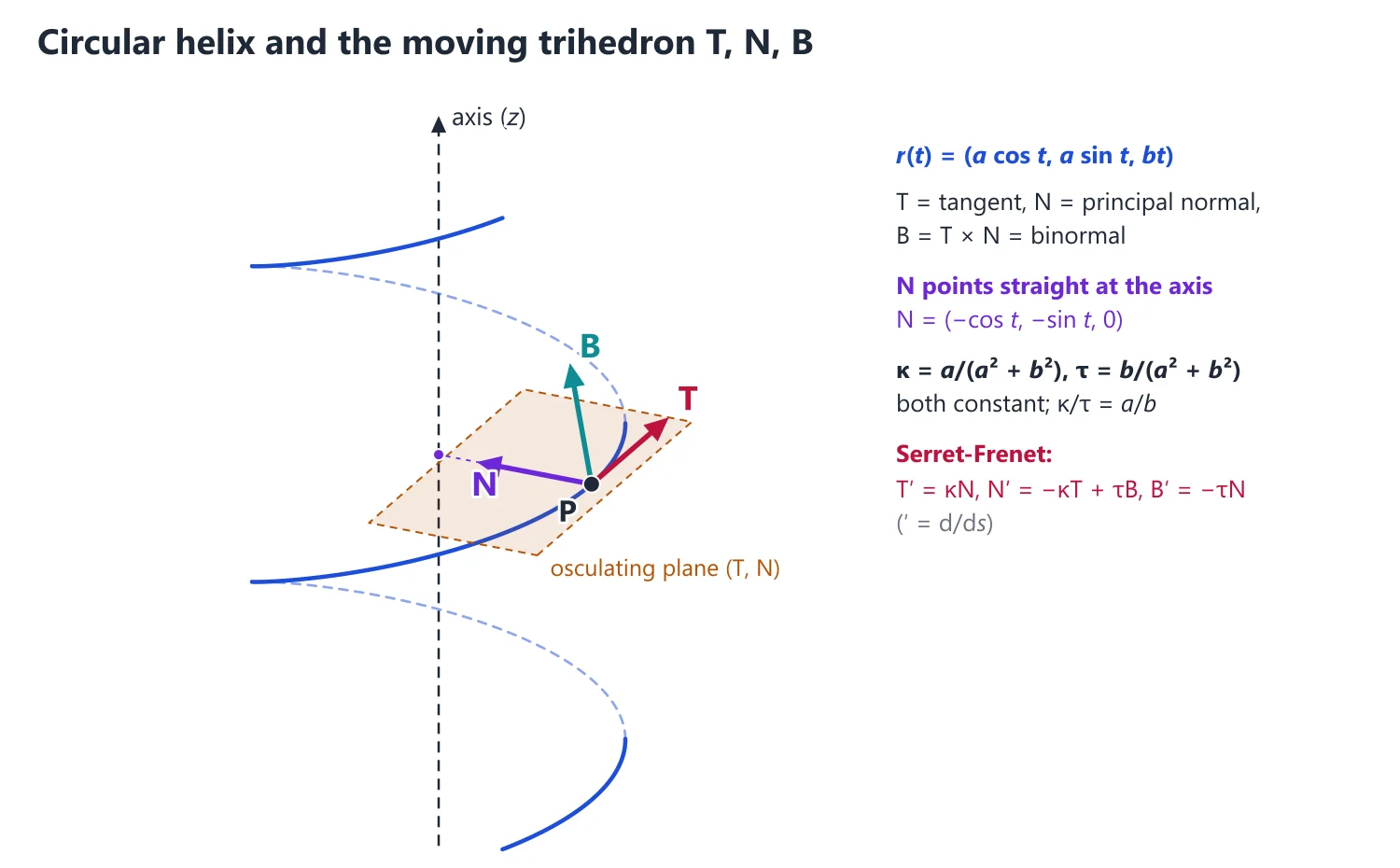
1. Understanding Arc Length and the Unit Tangent
Why we need it: a curve can be traced in many ways: fast or slow, forwards or backwards.
Geometric properties, such as how sharply the curve bends, should not depend on that choice.
Arc length s is the one parameter fixed by the curve itself, so quantities measured per unit of s are purely geometric.
In words: a space curve is a vector function r(t) = (x(t), y(t), z(t)) with t in an interval; it is regular if r′(t) ≠ 0 for every t, so that it has a definite direction everywhere.
The arc length measured from t = t0 is s(t) = ∫t0t |r′(u)| du, so ds/dt = |r′(t)|, the speed.
The unit tangent is T = dr/ds = r′/|r′|: the velocity divided by the speed.
First example, slowly: the circle r = (a cos t, a sin t, 0), a > 0.
Step 1: r′ = (−a sin t, a cos t, 0).
Step 2: |r′| = √(a2sin2t + a2cos2t) = a, so ds/dt = a.
Step 3: measuring from t = 0, s = at, so t = s/a.
Step 4: in terms of s, r = (a cos(s/a), a sin(s/a), 0).
Step 5: T = dr/ds = (−sin(s/a), cos(s/a), 0), and |T| = 1, as promised.
Step 6: the same T comes out as r′/|r′| = (−a sin t, a cos t, 0)/a without ever finding s; this is the practical route when s cannot be found in closed form.
Non-example: r(t) = (t2, t3, 0), the semicubical parabola, is not regular at t = 0, because r′(0) = 0.
There T = r′/|r′| is 0/0, the curve has a cusp at the origin, and none of the frame quantities T, N, B, κ, τ exist at that point.
Building up: because |T| = 1 for every s, differentiating T·T = 1 gives 2T·dT/ds = 0, so dT/ds is perpendicular to T.
This single fact starts the whole theory: dT/ds measures only the change of direction, never a change of length, and its size and direction define the curvature and the principal normal in the next lesson.
The chain rule d/ds = (1/|r′|) d/dt converts every t-derivative into an s-derivative; it is used in every formula of Section 3.
Where it is used: lengths of arcs of helices and cycloids, tangent lines and the angle between a tangent and a fixed line (Example 10), and the tangential component of velocity in Chapter 6.
2. Understanding Curvature and the Principal Normal
Why we need it: a straight line and a circle of radius 1 both have unit tangents, but one keeps its direction while the other keeps turning.
We need a number that says how fast the direction turns per unit length, and a vector that says towards which side it turns.
In words: κ = |dT/ds| is the curvature, the rate of turning of the tangent in radians per unit length, and ρ = 1/κ is the radius of curvature.
Where κ ≠ 0, N = (1/κ) dT/ds is the unit principal normal: it is perpendicular to T and points to the inside of the bend.
B = T × N, the binormal, completes a right-handed set of three mutually perpendicular unit vectors.
First example, slowly: continue with the circle r = (a cos(s/a), a sin(s/a), 0).
Step 1: T = (−sin(s/a), cos(s/a), 0).
Step 2: by the chain rule, dT/ds = (−(1/a) cos(s/a), −(1/a) sin(s/a), 0).
Step 3: κ = |dT/ds| = 1/a: a small circle bends sharply, a large one gently.
Step 4: N = a dT/ds = (−cos(s/a), −sin(s/a), 0) = −r/a, the unit vector from the point towards the centre.
Step 5: B = T × N = (0, 0, sin2(s/a) + cos2(s/a)) = k, perpendicular to the plane of the circle.
Step 6: ρ = a, the radius itself; the osculating circle of a circle is the circle.
Non-example: the line r = (1 + s, 2, 3) has T = i constant, so dT/ds = 0 and κ = 0; N = (1/κ) dT/ds would be 0/0, because the line bends towards no side, so N, B and τ are undefined.
Also, when t is not arc length, |r″| is not the curvature: the same kind of line traced as r = (t2, 0, 0), t > 0, has r″ = (2, 0, 0) ≠ 0 although κ = 0.
Building up: κ = |dT/ds| needs arc length, but the chain rule gives dT/ds = (dT/dt)/|r′|.
Write r′ = vT with v = |r′|; differentiating, r″ = v′T + v(dT/ds)(ds/dt) = v′T + κv2N, the tangential-normal resolution of acceleration.
Then r′ × r″ = vT × (v′T + κv2N) = κv3B, which gives κ = |r′ × r″|/|r′|3 and B = (r′ × r″)/|r′ × r″| (Standard Proofs, Theorem 8).
Where it is used: radius of curvature of plane curves in Cartesian, polar and pedal forms (Chapter 3 and Example 8), the normal acceleration v2/ρ for motion on curves (Chapter 6), the osculating plane and circle, and every κ computation in UPSC questions.
3. Space Curves and the Moving Trihedral
A curve r = r(s), with s the arc length, has unit tangent T = dr/ds.
Idea: with arc length as the parameter the curve is traced at unit speed, since |dr| = ds; so dr/ds has length 1 automatically, and every rate of change with respect to s is a purely geometric quantity, independent of how fast the curve is traversed.
Curvature κ = |dT/ds|; principal normal N = (1/κ) dT/ds where κ ≠ 0; binormal B = T × N.
Idea: κ is the rate at which the tangent turns per unit length: a straight line has κ = 0 and a circle of radius a has κ = 1/a everywhere; dT/ds is perpendicular to T (T has constant length) and points towards the side to which the curve bends, which defines N.
The hypothesis κ ≠ 0 is needed: on a straight piece dT/ds = 0 and N, B and τ are not defined.
T, N, B form a right-handed orthonormal triad: the osculating plane contains T and N (normal B), the normal plane contains N and B (normal T), and the rectifying plane contains T and B (normal N).
Idea: the triad T, N, B is a small set of axes carried along the curve (see the figure above); the osculating plane is the plane in which the curve is bending at that instant, the plane that fits the curve best near the point.
Torsion τ is defined by dB/ds = −τN and measures how fast the osculating plane turns; ρ = 1/κ is the radius of curvature and σ = 1/τ the radius of torsion.
Idea: curvature measures bending within the osculating plane and torsion measures twisting out of it; a plane curve keeps the same osculating plane, so B is constant and τ = 0; with the sign convention dB/ds = −τN, a right-handed helix (like an ordinary screw thread) has τ > 0.
4. Understanding Torsion and the Serret-Frenet Formulae
Why we need it: curvature alone cannot tell a circle from a helix with the same κ: both bend at a constant rate, but the helix also climbs out of each osculating plane.
We need a second number for this twisting, and a compact description of how the whole frame T, N, B moves along the curve.
In words: B is perpendicular to the osculating plane, so the rate at which B turns measures how fast the osculating plane twists.
One can show (below) that dB/ds always points along N; the torsion τ is the number with dB/ds = −τN.
The minus sign is a convention, chosen so that a right-handed helix has τ > 0; some books use the opposite sign, so state yours.
The Serret-Frenet formulae dT/ds = κN, dN/ds = τB − κT, dB/ds = −τN express the derivative of each frame vector in terms of the frame itself.
First example, slowly: the helix r = (a cos t, a sin t, bt) with a > 0, b > 0 and c = √(a2 + b2).
Step 1: |r′| = c, so s = ct and d/ds = (1/c) d/dt.
Step 2: from Worked Example 4, N = (−cos t, −sin t, 0) and B = (b sin t, −b cos t, a)/c.
Step 3: dB/ds = (1/c)·(b cos t, b sin t, 0)/c = (b/c2)(cos t, sin t, 0).
Step 4: compare with N: (cos t, sin t, 0) = −N, so dB/ds = −(b/c2)N.
Step 5: hence τ = b/c2 = b/(a2 + b2), positive for this right-handed helix.
Step 6: notice what happens as b → 0: the helix flattens into a circle and τ → 0, as it must for a plane curve.
Non-example: zero torsion does not make a curve a circle: the parabola y = x2 has τ = 0 but κ = 2/(1 + 4x2)3/2, which varies (Worked Example 6); τ = 0 says only that the osculating plane does not turn.
Also, at a point where κ = 0 the torsion is not defined at all, since B = T × N needs N.
Building up: (1) dB/ds ⊥ B, because |B| = 1. (2) Differentiate B·T = 0: (dB/ds)·T + B·κN = 0, and B·N = 0, so (dB/ds)·T = 0.
(3) Being perpendicular to both B and T, dB/ds is a multiple of N; call it −τN. (4) N = B × T, so dN/ds = (dB/ds) × T + B × (dT/ds) = −τN × T + κB × N = τB − κT.
The full proof, including the skew-symmetry of the coefficient matrix, is Standard Proofs, Theorem 7.
Where it is used: proving that τ = 0 characterises plane curves (Standard Proofs, Theorem 9), Lancret's theorem on helices (Theorem 10), identities such as T′·B′ = −κτ, consecutive principal normals (Example 12(ii)), and the dynamics of a particle on a twisted curve.
5. Serret-Frenet Formulae
dT/ds = κN; dN/ds = τB − κT; dB/ds = −τN.
Idea: the formulas express the derivatives of the moving frame in terms of the frame itself; the coefficient matrix must be skew-symmetric because the frame stays orthonormal (differentiate T·N = 0 to get T′·N = −T·N′, and so on); the proof is in Standard Proofs, Theorem 7.
In matrix form, d/ds of the column (T, N, B) equals [[0, κ, 0], [−κ, 0, τ], [0, −τ, 0]] times (T, N, B); the coefficient matrix is skew-symmetric.
Darboux vector ω = τT + κB: dT/ds = ω × T, dN/ds = ω × N, dB/ds = ω × B.
Idea: as a point moves along the curve the triad turns like a rigid body with angular velocity ω per unit arc length: about B at rate κ (bending) and about T at rate τ (twisting).
Proof of the middle formula: N = B × T, so dN/ds = dB/ds × T + B × dT/ds = −τ(N × T) + κ(B × N) = τB − κT.
Why dB/ds is parallel to N: dB/ds is perpendicular to B (B has constant length) and to T (differentiate B·T = 0 and use dT/ds = κN), so it is a multiple of N.
Fundamental theorem: given continuous functions κ(s) > 0 and τ(s), there is a curve, unique up to a rigid motion, with these as curvature and torsion; κ = κ(s), τ = τ(s) are its intrinsic equations.
Idea: κ and τ play the role of the coefficients of a differential equation for the frame; once they and a starting point and frame are fixed, the curve is determined; κ and τ both constant non-zero give a circular helix, κ constant with τ = 0 gives a circle.
6. Understanding the Formulas for an Arbitrary Parameter
Why we need it: most curves in exam questions come with a parameter t that is not arc length, such as (t, t2, t3), and s = ∫|r′| dt usually has no closed form.
We need formulas for κ and τ that use only r′, r″ and r‴ taken with respect to t.
In words: r′ is the velocity, r″ the acceleration and r‴ the rate of change of acceleration, all with respect to t.
r′ × r″ is perpendicular to the osculating plane, and |r′ × r″| is the area of the parallelogram on r′ and r″.
[r′ r″ r‴] = r′·(r″ × r‴) is the scalar triple product, the volume of the box on the three vectors; it is non-zero exactly when r‴ leaves the osculating plane.
Then κ = |r′ × r″|/|r′|3 and τ = [r′ r″ r‴]/|r′ × r″|2.
First example, slowly: the twisted cubic r = (t, t2, t3) at t = 1.
Step 1: r′ = (1, 2t, 3t2) = (1, 2, 3), r″ = (0, 2, 6t) = (0, 2, 6) and r‴ = (0, 0, 6).
Step 2: r′ × r″ = (2·6 − 3·2, 3·0 − 1·6, 1·2 − 2·0) = (6, −6, 2).
Step 3: |r′ × r″| = √(36 + 36 + 4) = √76 = 2√19, and |r′| = √(1 + 4 + 9) = √14.
Step 4: κ = 2√19/(√14)3 = 2√19/(14√14) = √19/(7√14) ≈ 0.166.
Step 5: [r′ r″ r‴] = (r′ × r″)·r‴ = 2·6 = 12.
Step 6: τ = 12/76 = 3/19, which agrees with the general formula 3/(9t4 + 9t2 + 1) of Worked Example 3 at t = 1.
Non-example: the arc-length formula κ = |r″| gives a wrong answer here: |r″(1)| = √40 ≈ 6.32, against the true κ ≈ 0.166.
The t-derivative r″ contains a tangential part from the changing speed, and the cross product with r′ is what removes it; likewise τ = [r′ r″ r‴]/κ2 is correct only for derivatives with respect to s.
Building up: with v = |r′|, the chain rule and the Serret-Frenet formulae give r′ = vT, r″ = v′T + κv2N and r‴ = (…)T + (…)N + κτv3B, the B-part coming from κv2(dN/ds)v.
In the cross product only T × N survives, so r′ × r″ = κv3B and |r′ × r″| = κv3.
In the triple product only the B-part of r‴ survives: [r′ r″ r‴] = (κv3B)·(κτv3B) = κ2τv6 = τ|r′ × r″|2; these give both formulas (Standard Proofs, Theorem 8).
Where it is used: every numerical κ, τ question (helix variants, twisted cubics, the cycloidal curve of Example 11), testing whether a curve is plane ([r′ r″ r‴] ≡ 0) or a general helix (κ/τ constant), and the plane-curve curvature formulas of Chapter 3.
7. Formulas for an Arbitrary Parameter t
With r′ = dr/dt and so on: κ = |r′ × r″|/|r′|3 and τ = [r′ r″ r‴]/|r′ × r″|2.
Idea: r″ contains a tangential part (change of speed) that has nothing to do with bending; the cross product r′ × r″ removes it, and dividing by |r′|3 converts the rate per unit t into a rate per unit length; the κ formula needs only r′ ≠ 0, while τ, N and B need r′ × r″ ≠ 0, that is κ ≠ 0 (proof in Standard Proofs, Theorem 8).
T = r′/|r′|, B = (r′ × r″)/|r′ × r″|, N = B × T.
A curve with κ ≠ 0 is a plane curve if and only if τ = 0 at every point.
Idea: τ = 0 means B is constant, so (r − r0)·B has derivative T·B = 0 and the curve stays in the plane through r0 normal to B (Standard Proofs, Theorem 9); the condition κ ≠ 0 is needed, since two plane arcs in different planes joined smoothly at a point where κ = 0 give a curve with τ = 0 wherever it is defined that is not plane.
A curve is a general helix (its tangent makes a constant angle with a fixed direction) if and only if κ/τ is constant (Lancret's theorem).
Idea: a general helix winds on a cylinder at a constant slope; the fixed direction is that of the Darboux vector τT + κB, which is constant exactly when κ/τ is constant (Standard Proofs, Theorem 10).
Curvature vector: dT/ds = κN = [|r′|2r″ − (r′·r″)r′]/|r′|4; its length is κ and it points to the centre of curvature r + ρN, and the circle of radius ρ about that centre in the osculating plane is the osculating circle.
Tangent line and osculating plane at r(t): R = r + λr′ and (R − r)·(r′ × r″) = 0; the angle between the tangent and a line of direction d is cos−1(|r′·d|/(|r′||d|)).
Plane curves: for r = (f(t), g(t), 0), κ = |f′g″ − g′f″|/(f′2 + g′2)3/2 and τ = 0; for y = y(x), κ = |y″|/(1 + y′2)3/2.
Polar curves r = r(θ): with r1 = dr/dθ and r2 = d2r/dθ2, the radius of curvature is ρ = (r2 + r12)3/2/|r2 + 2r12 − rr2|; in pedal form ρ = r dr/dp.
Evolute and involute: the locus of the centres of curvature of a plane curve is its evolute; the normals of the curve are tangent to the evolute, and the curve is an involute of its evolute.
8. Derivation: The Curve near a Point (Canonical Form)
Expand r(s) by Taylor's theorem about s = 0: r(s) = r0 + s r′ + (s2/2) r″ + (s3/6) r‴ + ..., dashes now meaning d/ds.
By the Serret-Frenet formulas r′ = T, r″ = κN and r‴ = κ′N + κ(τB − κT) = −κ2T + κ′N + κτB.
So, in coordinates along T, N, B at the point, the curve is x ≈ s, y ≈ κs2/2, z ≈ κτs3/6.
Hence the curve leaves its tangent line at a rate set by κ, bending towards N, and leaves its osculating plane (z = 0) only at third order, at a rate set by κτ; the sign of τ tells on which side of the osculating plane the curve rises.
9. Derivation: Darboux Vector and Plane-Curve Curvature
Darboux vector: with ω = τT + κB, ω × T = κ(B × T) = κN, ω × N = τ(T × N) + κ(B × N) = τB − κT and ω × B = τ(T × B) = −τN, which are the three Serret-Frenet formulas.
Plane curves: for r = (f(t), g(t), 0), r′ × r″ = (0, 0, f′g″ − g′f″) and |r′| = √(f′2 + g′2), so κ = |f′g″ − g′f″|/(f′2 + g′2)3/2; r‴ also lies in the plane, so [r′ r″ r‴] = 0 and τ = 0.
Taking t = x, f = x and g = y(x) gives f′ = 1, f″ = 0 and κ = |y″|/(1 + y′2)3/2.
Centre of curvature: the osculating circle has the same tangent and the same curvature as the curve at the point, so its centre lies along N at distance ρ = 1/κ, at r + ρN.
10. Choosing the Method
If the curve is given with arc length s (or |r′| is constant) → use T = r′, κ = |T′|, N = T′/κ, B = T × N directly.
If the parameter is general → compute r′, r″, r‴, then r′ × r″ and [r′ r″ r‴], and use κ = |r′ × r″|/|r′|3, τ = [r′ r″ r‴]/|r′ × r″|2, B ∥ r′ × r″.
If you must show a curve is plane → show [r′ r″ r‴] = 0 identically (with r′ × r″ ≠ 0), then find the plane from B at one point.
If you must show a curve is a helix → show κ/τ is constant, or exhibit a fixed unit vector a with T·a constant.
If the question is about derivatives of T, N, B or curves defined from a given curve (locus of centres of curvature, Bertrand curves) → differentiate with respect to s and substitute the Serret-Frenet formulas at each step.
11. Common Mistakes
Using κ = |r″| or N = r″/|r″| when t is not the arc length; r″ then has a tangential component.
Writing the torsion denominator as |r′|6 or |r′ × r″|; it is |r′ × r″|2.
Taking B = N × T, which reverses B and the sign of τ; the triad is T, N, B with B = T × N.
Concluding that τ = 0 means a circle; it means only a plane curve, and a circle needs κ constant as well (Worked Example 6).
Confusing the radius of torsion σ = 1/τ with τ, or the radius of curvature ρ = 1/κ with κ, in the final answer.
12. Connections
Link: for a moving particle, a = (dv/dt)T + (v2/ρ)N is the tangential-normal resolution of Chapter 6, and the plane-curve formulas for ρ (Cartesian, polar, pedal) are used there for motion on curves and central orbits.
Link: the Frenet matrix is skew-symmetric because the frame is an orthogonal matrix Q(s) and Q′QT is skew-symmetric for any differentiable orthogonal Q (Chapter 2); a circular helix lies on a right circular cylinder (Chapter 4).
13. Worked Examples
Example 1: For the circular helix r = (a cos t, a sin t, bt), a > 0, find κ and τ.
r′ = (−a sin t, a cos t, b), r″ = (−a cos t, −a sin t, 0), r‴ = (a sin t, −a cos t, 0); r′ × r″ = (ab sin t, −ab cos t, a2).
|r′| = √(a2 + b2), |r′ × r″| = a√(a2 + b2) and [r′ r″ r‴] = a2b.
Hence κ = a/(a2 + b2) and τ = b/(a2 + b2), both constant.
Example 2: For x = 3t − t3, y = 3t2, z = 3t + t3, show that κ = τ = 1/[3(1 + t2)2].
r′ = (3 − 3t2, 6t, 3 + 3t2) with |r′| = 3√2(1 + t2); r″ = (−6t, 6, 6t); r′ × r″ = 18(t2 − 1, −2t, 1 + t2), of length 18√2(1 + t2).
κ = 18√2(1 + t2)/[54√2(1 + t2)3] = 1/[3(1 + t2)2].
r‴ = (−6, 0, 6), so [r′ r″ r‴] = 18(−6t2 + 6 + 6 + 6t2) = 216 and τ = 216/[648(1 + t2)2] = 1/[3(1 + t2)2].
Since κ/τ = 1 is constant, this curve is a general helix.
Example 3: Find the curvature and torsion of the twisted cubic r = (t, t2, t3) at the origin.
r′ = (1, 2t, 3t2), r″ = (0, 2, 6t), r‴ = (0, 0, 6) and r′ × r″ = (6t2, −6t, 2), [r′ r″ r‴] = 12.
In general κ = 2√(9t4 + 9t2 + 1)/(1 + 4t2 + 9t4)3/2 and τ = 3/(9t4 + 9t2 + 1); at t = 0, κ = 2 and τ = 3.
Example 4: Find T, N, B for the circular helix r = (a cos t, a sin t, bt), with c = √(a2 + b2).
T = r′/|r′| = (−a sin t, a cos t, b)/c; dT/dt = (−a cos t, −a sin t, 0)/c, so N = (−cos t, −sin t, 0), pointing horizontally towards the axis.
B = T × N = (b sin t, −b cos t, a)/c, which makes the constant angle cos−1(a/c) with the z-axis.
Example 5: Show that r = (1 + 3t + 2t2, 2 − 2t + 5t2, 1 − t2) is a plane curve and find its plane.
r‴ = 0, so [r′ r″ r‴] = 0 and τ = 0 wherever κ ≠ 0; r′ × r″ ≠ 0 here, so the curve is plane.
At t = 0, r′ = (3, −2, 0), r″ = (4, 10, −2) and r′ × r″ = (4, 6, 38) ∥ (2, 3, 19); the plane through r(0) = (1, 2, 1) is 2x + 3y + 19z = 27 (check: r(1) = (6, 5, 0) gives 27).
Example 6: Prove or disprove: a curve with zero torsion everywhere is a circle.
False. The parabola r = (t, t2, 0) has r‴ = 0, so τ = 0, but κ = 2/(1 + 4t2)3/2 is not constant, so it is not a circle.
τ = 0 only makes the curve plane; it is a circle exactly when also κ is a non-zero constant.
14. Solved UPSC Questions
Example 7 (UPSC 2014, 10 marks): Find the curvature vector at any point of the curve r̄(t) = t cos t î + t sin t ĵ, 0 ≤ t ≤ 2π. Give its magnitude also.
r′ = (cos t − t sin t, sin t + t cos t, 0) with |r′|2 = 1 + t2, and r″ = (−2 sin t − t cos t, 2 cos t − t sin t, 0).
r′·r″ = t and r′ × r″ = (2 + t2)k.
Curvature vector κN = [(1 + t2)r″ − t r′]/(1 + t2)2.
The bracket has x-component (1 + t2)(−2 sin t − t cos t) − t(cos t − t sin t) = −(2 + t2)(sin t + t cos t) and y-component (1 + t2)(2 cos t − t sin t) − t(sin t + t cos t) = (2 + t2)(cos t − t sin t).
So κN = [(2 + t2)/(1 + t2)2][−(sin t + t cos t)i + (cos t − t sin t)j].
The last vector has length √(1 + t2), so κ = (2 + t2)/(1 + t2)3/2, agreeing with |r′ × r″|/|r′|3.
Answer: κN = [(2 + t2)/(1 + t2)2][−(sin t + t cos t)i + (cos t − t sin t)j], with magnitude (2 + t2)/(1 + t2)3/2.
Example 8 (UPSC 2016, 15 marks): For the cardioid r = a(1 + cos θ), show that the square of the radius of curvature at any point (r, θ) is proportional to r. Also find the radius of curvature if θ = 0, π/4, π/2.
r = a(1 + cos θ), r1 = −a sin θ, r2 = −a cos θ.
r2 + r12 = a2(2 + 2 cos θ) = 2ar.
r2 + 2r12 − rr2 = a2[(1 + cos θ)2 + 2 sin2θ + cos θ(1 + cos θ)] = 3a2(1 + cos θ) = 3ar.
ρ = (2ar)3/2/(3ar) = (2√2/3)√(ar), so ρ2 = (8a/9)r, proportional to r.
Since r = 2a cos2(θ/2), ρ = (4a/3) cos(θ/2) for −π < θ < π.
Answer: ρ = 4a/3 at θ = 0; ρ = (4a/3) cos(π/8) = (2a/3)√(2 + √2) ≈ 1.232a at θ = π/4; ρ = 2√2a/3 ≈ 0.943a at θ = π/2.
Example 9 (UPSC 2017, 16 marks): Find the curvature vector and its magnitude at any point r̄ = (θ) of the curve r̄ = (a cos θ, a sin θ, aθ). Show that the locus of the feet of the perpendicular from the origin to the tangent is a curve that completely lies on the hyperboloid x2 + y2 − z2 = a2.
This is the helix of Example 1 with b = a: |r′| = √2a, so ds = √2a dθ and T = (−sin θ, cos θ, 1)/√2.
dT/ds = (1/(√2a)) dT/dθ = −(cos θ, sin θ, 0)/(2a): this is the curvature vector, of magnitude κ = 1/(2a), directed horizontally towards the axis.
The foot F of the perpendicular from O to the tangent at P is F = r − (r·T)T, and r·T = (−a cos θ sin θ + a sin θ cos θ + aθ)/√2 = aθ/√2.
So F = r − (aθ/2)(−sin θ, cos θ, 1) = (a cos θ + (aθ/2) sin θ, a sin θ − (aθ/2) cos θ, aθ/2).
Then x2 + y2 = a2 + a2θ2/4 (the cross terms cancel) and z2 = a2θ2/4.
Answer: curvature vector −(cos θ i + sin θ j)/(2a), magnitude 1/(2a); x2 + y2 − z2 = a2 for every θ, so the locus of F lies on the hyperboloid.
Example 10 (UPSC 2018, 10 marks): Find the angle between the tangent at a general point of the curve whose equations are x = 3t, y = 3t2, z = 3t3 and the line y = z − x = 0.
r′ = (3, 6t, 9t2), parallel to (1, 2t, 3t2).
The line y = 0, z = x has direction (1, 0, 1).
cos θ = (1 + 3t2)/(√2 √(1 + 4t2 + 9t4)).
Answer: θ = cos−1[(1 + 3t2)/√(2(1 + 4t2 + 9t4))]; for example θ = 45° at t = 0.
Example 11 (UPSC 2018, 12 marks): Find the curvature and torsion of the curve r = a(u − sin u)i + a(1 − cos u)j + buk.
r′ = (a(1 − cos u), a sin u, b), r″ = (a sin u, a cos u, 0), r‴ = (a cos u, −a sin u, 0).
|r′|2 = 2a2(1 − cos u) + b2 = 4a2 sin2(u/2) + b2.
r′ × r″ = (−ab cos u, ab sin u, −a2(1 − cos u)), so |r′ × r″|2 = a2b2 + 4a4 sin4(u/2).
[r′ r″ r‴] = −a2b cos2u − a2b sin2u = −a2b.
Answer: κ = a√(b2 + 4a2 sin4(u/2))/(b2 + 4a2 sin2(u/2))3/2 and τ = −a2b/(a2b2 + 4a4 sin4(u/2)) = −b/(b2 + 4a2 sin4(u/2)).
Example 12 (UPSC 2024, 10 marks): (i) Let C be a plane curve r̅(t) = f(t) î + g(t) ĵ, where f and g have second-order derivatives. Show that the curvature at a point is given by
κ = |f′(t) g″(t) − g′(t) f″(t)| / ([f′(t)]2 + [g′(t)]2)3/2
What is the value of torsion τ at any point of this curve? (5 marks)
(ii) Show that the principal normals at two consecutive points of a curve do not intersect unless torsion τ is zero. (5 marks)
(i) r′ = (f′, g′, 0) and r″ = (f″, g″, 0), so r′ × r″ = (f′g″ − g′f″)k and κ = |r′ × r″|/|r′|3 = |f′g″ − g′f″|/(f′2 + g′2)3/2.
r‴ = (f‴, g‴, 0) also lies in the xy-plane, so [r′ r″ r‴] = 0 and τ = 0 at every point where κ ≠ 0 (τ needs third derivatives to be defined).
(ii) The principal normals at P(s) and Q(s + δs) are the lines R = r + λN and R = r + δr + μ(N + δN); they meet only if δr, N, N + δN are coplanar, that is [δr N δN] = 0.
By Taylor's theorem and Serret-Frenet, δr = Tδs + (1/2)κNδs2 + O(δs3) and δN = (τB − κT)δs + O(δs2).
Hence [δr N δN] = τ[T N B]δs2 + O(δs3) = τδs2 + O(δs3), which can vanish for all small δs only if τ = 0.
Answer: (i) κ as stated and τ = 0; (ii) consecutive principal normals intersect only when τ = 0 (see Standard Proofs).
Example 13 (UPSC 2026, 15 marks): Determine T̂, N̂, B̂, κ and τ for the parabola y2 = 4ax, where a is a constant. Here T̂, N̂, B̂, κ and τ denote unit tangent vector, unit principal normal vector, unit binormal vector, curvature and torsion respectively.
Parametrise y2 = 4ax as r = (at2, 2at, 0): r′ = 2a(t, 1, 0), |r′| = 2a√(1 + t2), r″ = (2a, 0, 0) and r′ × r″ = (0, 0, −4a2).
T = (ti + j)/√(1 + t2) and B = (r′ × r″)/|r′ × r″| = −k.
N = B × T = (i − tj)/√(1 + t2), pointing into the concave side (N = i at the vertex).
κ = 4a2/[8a3(1 + t2)3/2] = 1/[2a(1 + t2)3/2]; since 1 + t2 = (a + x)/a, κ = √a/[2(a + x)3/2].
r‴ = 0, so [r′ r″ r‴] = 0 and τ = 0, as for every plane curve.
Answer: T = (ti + j)/√(1 + t2), N = (i − tj)/√(1 + t2), B = −k (for the sense of increasing y), κ = 1/[2a(1 + t2)3/2] = √a/[2(a + x)3/2], τ = 0.
15. Practice Exercises
Exercise 1 (basic): Find the curvature and torsion of the circle r = (3 cos t, 3 sin t, 0).
Answer: κ = 1/3 (the reciprocal of the radius) and τ = 0, since the curve is plane.
Exercise 2 (basic): Show that r = (t, 2t, 3t) has κ = 0 everywhere and explain why N is not defined.
Answer: r″ = 0, so r′ × r″ = 0 and κ = 0; the curve is a straight line, T is constant, and N = (1/κ) dT/ds would be 0/0.
Exercise 3 (basic): Check that r(s) = (cos(s/√2), sin(s/√2), s/√2) is parametrised by arc length and find κ and τ.
Answer: |dr/ds|2 = 1/2 + 1/2 = 1; it is the helix a = b = 1, so κ = τ = 1/2.
Exercise 4 (standard): Find κ and τ for r = (cosh t, sinh t, t).
Answer: |r′| = √2 cosh t, r′ × r″ = (−sinh t, cosh t, −1) with length √2 cosh t, and [r′ r″ r‴] = 1, so κ = τ = 1/(2 cosh2t).
Exercise 5 (standard): Find T, N, B and the osculating plane of r = (t, t2, t3) at the origin.
Answer: r′(0) = (1, 0, 0), r″(0) = (0, 2, 0), so T = i, B = k, N = B × T = j, and the osculating plane is z = 0.
Exercise 6 (standard): Show that x = t, y = (1 + t)/t, z = (1 − t2)/t (t ≠ 0) is a plane curve and find its plane.
Answer: y − 1 = 1/t and z = 1/t − t, so z = (y − 1) − x for every t: the curve lies in the plane x − y + z + 1 = 0 (equivalently [r′ r″ r‴] ≡ 0).
Exercise 7 (standard): Find κ and τ for the conical helix r = (et cos t, et sin t, et) and show that it is a general helix.
Answer: κ = √2/(3et) and τ = 1/(3et), so κ/τ = √2 is constant and the curve is a general helix (Lancret).
Exercise 8 (standard): Find the radius of curvature of y = x3 at (1, 1).
Answer: y′ = 3, y″ = 6, so ρ = (1 + 9)3/2/6 = 5√10/3 ≈ 5.27.
Exercise 9 (UPSC level): For a curve with κ, τ ≠ 0, prove that [B′ B″ B‴] = τ5 d(κ/τ)/ds, dashes denoting d/ds.
Answer: B′ = −τN, B″ = κτT − τ′N − τ2B, and B‴ has T-component κ′τ + 2κτ′ and B-component −3ττ′; expanding the determinant in the basis T, N, B gives τ(κ′τ3 − κτ2τ′) = τ5(κ/τ)′.
Exercise 10 (UPSC level): For r = (2t, t2, t3/3), find κ and τ, show that the curve is a general helix, and find the fixed direction and the constant angle.
Answer: |r′| = t2 + 2 and κ = τ = 2/(t2 + 2)2; T + B = (1, 0, 1) for every t, so the fixed direction is (i + k)/√2 and T makes the constant angle 45° with it.
Exercise 11 (UPSC level): Prove that if all the osculating planes of a curve with κ ≠ 0 pass through a fixed point, the curve is plane.
Answer: differentiating (c − r)·B = 0 gives τ(c − r)·N = 0; if τ ≠ 0 on an interval, then c − r = λT, and differentiating gives −T = λ′T + λκN, so λ = 0 and λ′ = −1, a contradiction; hence τ ≡ 0.
| Quantity | Arc-length parameter s | General parameter t |
|---|---|---|
| Tangent T | dr/ds | r′/|r′| |
| Curvature κ | |d2r/ds2| | |r′ × r″|/|r′|3 |
| Binormal B | T × N | (r′ × r″)/|r′ × r″| |
| Torsion τ | [r′ r″ r‴]/κ2 (derivatives in s) | [r′ r″ r‴]/|r′ × r″|2 |
| Circular helix | κ = a/(a2 + b2) | τ = b/(a2 + b2) |
Mains points
- Computing κ and τ for a given parametric curve (helix and its variants are favourites) is a regular 10-15 mark question; set out r′, r″, r‴, r′ × r″ and the triple product in separate lines.
- Deriving the Serret-Frenet formulae, or proving that τ = 0 characterises plane curves, is a standard theory question; justify why dB/ds is parallel to N.
- Use the Darboux vector to prove results such as T′·B′ = −κτ or [T′ T″ T‴] = κ5(τ/κ)′ quickly.
- Sign convention: with dB/ds = −τN, a right-handed helix (b > 0) has positive torsion; state the convention you use.
- When asked to show a curve is a helix, show κ/τ is constant rather than trying to find the fixed direction.
Did you know?
- The formulae were found independently by Jean Frédéric Frenet (thesis, 1847) and Joseph Alfred Serret (1851).
Gauss and Stokes' Theorems and Green's Identities
The integral theorems convert integrals over a region into integrals over its boundary: Green's theorem in the plane, the Gauss divergence theorem (volume to closed surface) and Stokes' theorem (open surface to boundary curve). Applying Gauss's theorem to φ∇ψ gives Green's identities.
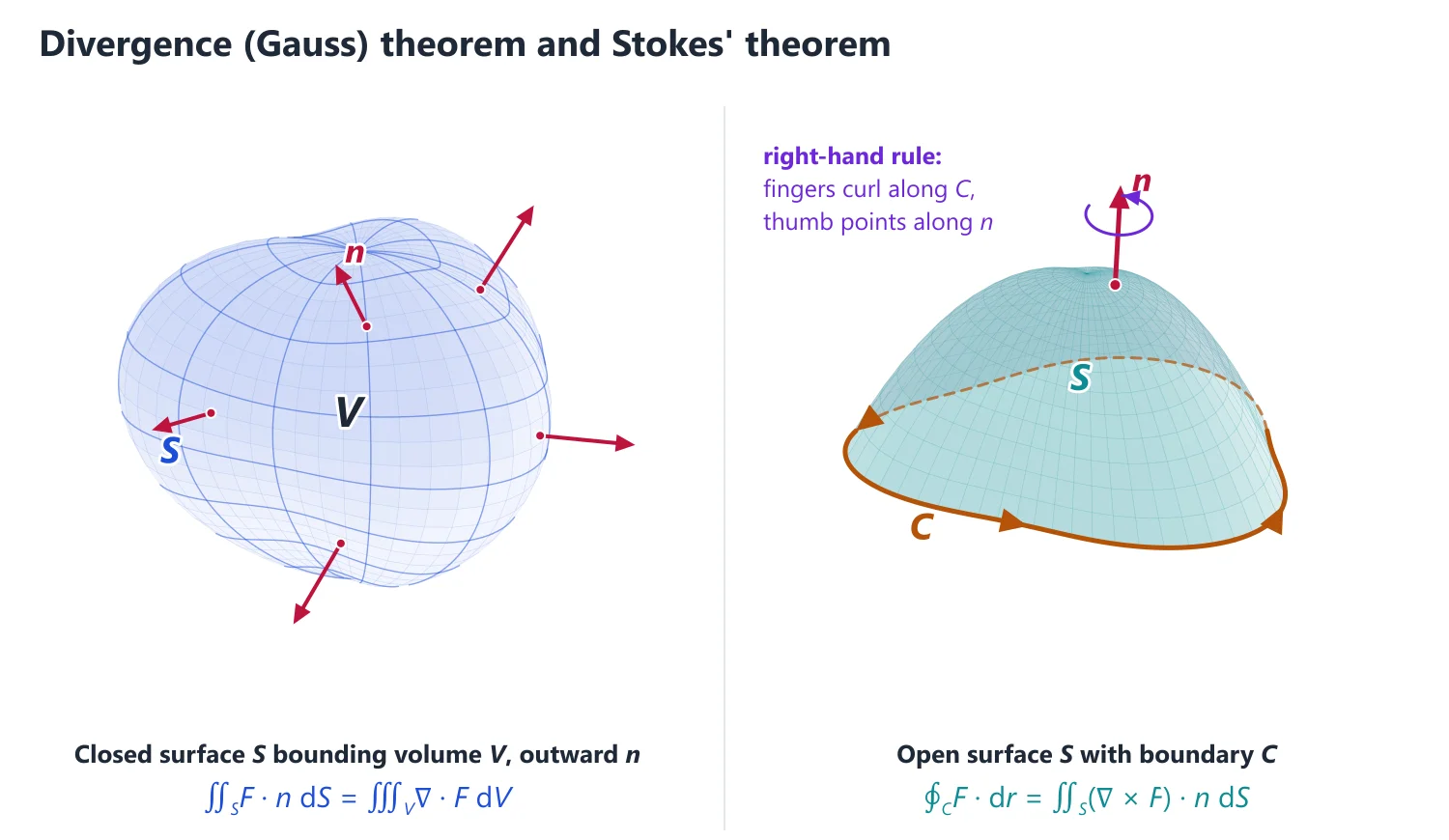
1. Understanding Line Integrals and Flux
Why we need it: a force F pushes a particle along a curved path C, and F changes from point to point, so the work done is not simply force × distance.
We need a way to add up, along the whole path, the part of F that acts in the direction of motion; the same tool measures the circulation of a fluid round a loop.
In the same way, when a fluid flows through a curved sheet S, we need the volume crossing it per second, which adds up the part of F that crosses S; this is the flux.
In words: in ∫C F·dr the symbol C is an oriented curve, that is, a curve together with a chosen direction of travel from a start point A to an end point B.
dr is a tiny step along C, a vector pointing in the direction of travel; F·dr is the component of F along that step times its length, the work done on that step.
The integral sign adds these contributions over all the steps from A to B; if C is closed (B = A) we write ∮ and call the result the circulation of F round C.
To compute it, describe C by r(t) = (x(t), y(t), z(t)), a ≤ t ≤ b, with t increasing in the direction of travel; then dr = r′(t) dt and ∫C F·dr = ∫ab F(r(t))·r′(t) dt, an ordinary integral in t.
In ∬S F·n dS, n is a unit normal to S (one of the two possible ones, chosen once and kept), dS is the area of a tiny patch, and F·n dS is the volume crossing that patch per unit time.
For a parametrised surface r(u, v) the vector (ru × rv) du dv is already n dS, so ∬S F·n dS = ∬ F(r(u, v))·(ru × rv) du dv; always check that ru × rv points to the side you want.
First example, slowly: find the work done by F = −y i + x j in moving a particle from A(1, 0) to B(0, 1) along the quarter circle x2 + y2 = 1.
Step 1, parametrise: r(t) = (cos t, sin t), 0 ≤ t ≤ π/2; at t = 0 we are at A and at t = π/2 at B, so t increases in the direction of travel.
Step 2, differentiate: r′(t) = (−sin t, cos t).
Step 3, put the curve into the field: on C, x = cos t and y = sin t, so F(r(t)) = (−sin t, cos t).
Step 4, take the dot product: F·r′ = sin2t + cos2t = 1; notice that F is tangent to the circle, so the whole of F does work.
Step 5, integrate: ∫0π/2 1 dt = π/2.
Now go from A to B along the straight segment r(t) = (1 − t, t), 0 ≤ t ≤ 1: r′ = (−1, 1), F(r(t)) = (−t, 1 − t), F·r′ = t + 1 − t = 1, and the work is 1.
Notice: the same end points, two paths, two answers (π/2 and 1); for this field the line integral depends on the path.
Non-example: F = −y i + x j looks harmless but is not conservative; the condition that fails is curl F = 0, since curl F = (∂x/∂x − ∂(−y)/∂y)k = 2k.
Compare G = y i + x j: curl G = (1 − 1)k = 0 in the whole plane, G = ∇(xy), and both paths above give 0, the value of xy at B minus its value at A; for G the path does not matter.
A second trap: ∫C |F| ds is not the work; only the tangential component F·T, with T the unit tangent, does work, and ∫F·dr = ∫F·T ds.
Building up: (1) If F = ∇φ, then along any r(t), F(r(t))·r′(t) = dφ(r(t))/dt by the chain rule, so ∫C F·dr = φ(B) − φ(A): the integral depends only on the end points.
(2) Hence a gradient field has zero circulation round every closed curve, and its curl is zero because curl grad φ = 0 (Standard Proofs, Theorem 1).
(3) Conversely, if curl F = 0 in a simply connected region, Stokes' theorem makes every circulation zero, and φ(P) = ∫F·dr from a fixed point P0 to P is a potential (Standard Proofs, Theorem 11).
(4) For flux, the patch with sides ru du and rv dv is almost a parallelogram, whose area vector is (ru × rv) du dv; this is the source of every surface-element formula in the next sub-section.
Where it is used: work and potential energy in dynamics (Chapter 6), circulation and flux in fluid motion (Chapter 14), and as the two sides of Green's, Gauss's and Stokes' theorems below.
2. Line and Surface Integrals
Line integral: ∫C F·dr = ∫C(F1 dx + F2 dy + F3 dz); it is the work done by F along C.
Idea: a line integral adds up the component of F along the path, step by step; it depends on the orientation of C (reversing the path changes the sign) and, in general, on the path itself, which is why parametrising C as r(t) and writing ∫F(r(t))·r′(t) dt is the basic method.
For continuously differentiable F in an open, connected and simply connected region the following are equivalent: ∫F·dr is independent of the path; ∮F·dr = 0 for every closed curve; F = ∇φ; curl F = 0.
Why it works: two paths from P to Q together form a closed curve, so path independence and zero circulation are the same; given path independence, φ(P) = ∫ F·dr from a fixed point P0 to P is well defined and ∇φ = F; and curl F = 0 gives zero circulation by Stokes' theorem applied to a surface spanning the curve, which exists because the region is simply connected.
Surface integral (flux): ∬S F·n dS; if S projects one-to-one onto a region R of the xy-plane, dS = dx dy/|n·k|.
Idea: if F is the velocity of a fluid, the flux is the volume crossing S per unit time; only the normal component F·n carries fluid across, and the answer changes sign if the other unit normal is chosen, so the orientation must always be stated.
Path dependence: compute ∇ × F first; if it is not zero, the line integral between two points generally depends on the path, and each path must be parametrised separately.
Notation: ∬(F1 dy dz + F2 dz dx + F3 dx dy) means the flux ∬F·n dS of F = (F1, F2, F3).
Standard surface elements: sphere of radius a: n = r/a, dS = a2 sin θ dθ dφ; cylinder x2 + y2 = a2: n = (xi + yj)/a, dS = a dφ dz; surface z = f(x, y): n dS = (−fx, −fy, 1) dx dy (upward); parametric surface r(u, v): n dS = (ru × rv) du dv.
3. Understanding Green's Theorem
Why we need it: computing ∮C(M dx + N dy) round a closed plane curve means parametrising every piece of C separately, which is slow when C is made of several arcs.
Green's theorem replaces the whole closed line integral by one double integral over the region inside, and it also gives areas from boundary data alone.
In words: C is a simple closed curve: it ends where it starts and does not cross itself; piecewise smooth means that it is made of finitely many smooth arcs, such as the sides of a triangle.
Anticlockwise (positive) orientation means that as you walk along C, the region R is always on your left.
M and N are the x- and y-components of the plane field F = M i + N j; they and the partial derivatives ∂M/∂y and ∂N/∂x must be continuous at every point of R and of C, with no exceptional point inside.
The integrand ∂N/∂x − ∂M/∂y is the k-component of curl F; it measures how much F rotates about a point, per unit area, so the theorem says: total circulation round the edge = total rotation inside.
First example, slowly: verify Green's theorem for M = xy, N = x2 on the boundary of the unit square 0 ≤ x ≤ 1, 0 ≤ y ≤ 1, taken anticlockwise.
Line integral, side by side, keeping the square on the left: bottom y = 0, x from 0 to 1: dy = 0 and M = 0, so the contribution is 0.
Right side x = 1, y from 0 to 1: dx = 0 and N dy = 1·dy, contribution 1.
Top y = 1, x from 1 down to 0: dy = 0 and M dx = x dx, contribution ∫10 x dx = −1/2; the limits run from 1 to 0 because we walk leftwards.
Left side x = 0, y from 1 to 0: N = 0 and dx = 0, contribution 0; total ∮ = 0 + 1 − 1/2 + 0 = 1/2.
Double integral: ∂N/∂x − ∂M/∂y = 2x − x = x, and ∫01∫01 x dy dx = 1/2.
The two sides agree; notice that the double integral took one line, while the line integral took four.
Non-example: the figure-eight x = sin t, y = sin t cos t, 0 ≤ t ≤ 2π, crosses itself at the origin, so it is not a simple closed curve.
Each lobe has area 2/3, so the enclosed area is 4/3, yet (1/2)∮(x dy − y dx) = 0, because the curve goes round one lobe anticlockwise and the other clockwise and the two areas cancel; the condition that fails is that C must be simple.
Building up: (1) Take R of type I, a ≤ x ≤ b, g1(x) ≤ y ≤ g2(x); integrating ∂M/∂y in y first, and walking the lower arc left to right and the upper arc right to left, gives ∮M dx = −∬∂M/∂y dx dy.
(2) Taking R of type II in the same way gives ∮N dy = ∬∂N/∂x dx dy; adding (1) and (2) proves the theorem (Standard Proofs, Theorem 12).
(3) A general region is cut into pieces of these types; each cut is walked twice in opposite directions, so the cuts cancel and only the outer boundary is left.
(4) Choosing M = −y/2, N = x/2 makes the integrand 1, which gives the area formula (1/2)∮(x dy − y dx).
Where it is used: closed plane line integrals and areas (a standard 10–15 mark question), the proof of Cauchy's theorem in complex analysis (Chapter 10), and as the flat case of Stokes' theorem.
4. Green's Theorem in the Plane
Statement: let C be a piecewise smooth simple closed curve bounding a region R, traversed anticlockwise, and let M, N, ∂M/∂y, ∂N/∂x be continuous on R ∪ C; then ∮C(M dx + N dy) = ∬R(∂N/∂x − ∂M/∂y) dx dy.
Idea: cut R into tiny squares; the circulation round each square is (∂N/∂x − ∂M/∂y) × area, and on adding them the shared inner edges are traversed twice in opposite directions and cancel, leaving only the outer boundary C.
The continuity hypothesis matters: for M = −y/(x2 + y2), N = x/(x2 + y2) and C the unit circle, the left side is 2π while ∂N/∂x − ∂M/∂y = 0 away from the origin; the theorem fails because the partial derivatives are not continuous at the origin, which lies inside R.
Area of R = (1/2)∮C(x dy − y dx).
Why it works: with M = −y/2 and N = x/2, ∂N/∂x − ∂M/∂y = 1/2 + 1/2 = 1, so Green's theorem turns ∬1 dx dy into the line integral; ∮x dy and −∮y dx also give the area separately.
Example 1: Evaluate ∮C[(xy + y2) dx + x2 dy], where C bounds the region between y = x and y = x2.
∂N/∂x − ∂M/∂y = 2x − (x + 2y) = x − 2y, so the integral = ∫01∫x2x(x − 2y) dy dx = ∫01(x4 − x3) dx = −1/20.
Example 2: Use Green's theorem to find the area of the ellipse x = a cos t, y = b sin t.
Area = (1/2)∮(x dy − y dx) = (1/2)∫02π(ab cos2t + ab sin2t) dt = πab.
Multiply connected regions: if R has holes, Green's theorem holds when the whole boundary is traversed with R on the left (outer curve anticlockwise, inner curves clockwise).
Standard case: for F = (−yi + xj)/(x2 + y2), ∂N/∂x = ∂M/∂y away from the origin, yet ∮F·dr = 2π round every anticlockwise simple closed curve enclosing the origin; curl F = 0 does not make F conservative in the punctured plane, which is not simply connected.
5. Understanding Flux and the Divergence Theorem
Why we need it: the outward flux through a closed surface, such as the six faces of a cube or the curved side and two ends of a cylinder, needs one surface integral per face, each with its own normal.
The divergence theorem replaces all of them by one volume integral of a single scalar, div F, which is usually a much simpler function.
In words: V is a bounded solid, and its boundary S is a closed surface: it encloses V completely, with no holes or open edges.
Piecewise smooth means that S is made of finitely many smooth pieces (faces, curved sides); orientable means that S has an inside and an outside, and n is the unit normal pointing out of V at every point.
div F = ∂F1/∂x + ∂F2/∂y + ∂F3/∂z measures the net outflow per unit volume at a point: positive at a source, negative at a sink.
F must have continuous first partial derivatives on a region containing V, so there may be no singular point of F inside V or on S.
So the theorem reads: total outflow through the skin S = total strength of the sources inside V.
First example, slowly: verify the theorem for F = x2 i + y2 j + z2 k over the unit cube 0 ≤ x, y, z ≤ 1.
Volume side: div F = 2x + 2y + 2z; over the cube ∭x dV = 1/2, and likewise for y and z, so ∭div F dV = 2(1/2 + 1/2 + 1/2) = 3.
Surface side, one pair of faces at a time: on x = 1 the outward normal is i, F·n = x2 = 1 and the face has area 1, so the flux is 1.
On x = 0 the outward normal is −i, so F·n = −x2 = 0 and the flux is 0; notice that on this face the outward normal points in the negative x-direction.
By symmetry the faces y = 1 and z = 1 each give 1, and the faces y = 0 and z = 0 give 0, so the total outward flux is 3.
Both sides equal 3, as the theorem promises.
Non-example: the upper hemisphere x2 + y2 + z2 = 1, z ≥ 0, is not a closed surface, so the theorem cannot be applied to it directly.
For the constant field F = k, div F = 0, yet the upward flux through the hemisphere is π (the area of its shadow, the unit disc); the condition that fails is that S must enclose a solid.
Close it with the base disc z = 0, where the outward normal is −k and the flux is −π: now the total is π − π = 0, which does equal ∭0 dV.
Building up: (1) Prove it for one component F3k over a solid lying between two surfaces z = z1(x, y) and z = z2(x, y): integrating ∂F3/∂z in z gives top value minus bottom value, which is exactly the flux through the top and the bottom (derivation sub-section below).
(2) Do the same for F1i and F2j and add the three results.
(3) A general solid is cut into such pieces; on each internal cut the two outward normals are opposite, so those fluxes cancel and only the outer surface S remains.
(4) Applying the theorem to φa with a constant vector a gives ∭∇φ dV = ∬φn dS, and applying it to r gives volume = (1/3)∬r·n dS (Standard Proofs, Theorem 13).
(5) Applying it to F = φ∇ψ gives Green's identities (sub-section below), and these give uniqueness for Laplace's equation (Standard Proofs, Theorem 15).
Where it is used: 'verify Gauss's theorem' questions, flux through open surfaces after closing them, Gauss's law of electrostatics, and the equation of continuity in fluid dynamics (Chapter 14).
6. Gauss Divergence Theorem
Statement: let V be a bounded region whose boundary S is a closed, piecewise smooth, orientable surface with outward unit normal n, and let F have continuous first partial derivatives in a region containing V; then ∭V ∇·F dV = ∬S F·n dS.
Idea: the total outflow through the closed surface equals the total strength of the sources inside, since div F is the source density; the surface must be closed, so for an open surface such as a hemisphere you must first add the flat base (see the figure above).
The smoothness hypothesis matters: F = r/r3 has div F = 0 for r ≠ 0, yet its flux through a sphere about the origin is 4π, because F is not differentiable at the origin inside V.
Example 3: For F = xi + yj + zk and the sphere x2 + y2 + z2 = a2, ∬F·n dS = ∭3 dV = 4πa3.
Example 4: For F = 4xz i − y2 j + yz k over the cube 0 ≤ x, y, z ≤ 1, ∇·F = 4z − 2y + y = 4z − y, so the outward flux = ∭(4z − y) dV = 2 − 1/2 = 3/2.
Corollaries: ∭∇φ dV = ∬φn dS and ∭∇ × F dV = ∬n × F dS.
Example 5: Using the divergence theorem, find the outward flux of F = 4xi − 2y2j + z2k through the closed cylinder x2 + y2 ≤ 4, 0 ≤ z ≤ 3.
∇·F = 4 − 4y + 2z; the volume is 12π, ∭y dV = 0 by symmetry and ∭z dV = 4π∫03 z dz = 18π.
Flux = 4(12π) − 0 + 2(18π) = 84π.
Gauss's law: ∬S r·n/r3 dS = 4π if the origin lies inside the closed surface S and 0 if it lies outside, because ∇·(r/r3) = 0 for r ≠ 0 (proof in Standard Proofs).
Verification questions: compute ∭∇·F dV and, separately, the flux through every face of S (including flat ends and bases), and show that the totals agree.
7. Understanding Stokes' Theorem and Orientation
Why we need it: the circulation of F round a curve in space, such as a circle cut from a sphere by a plane, is awkward to parametrise, and Green's theorem works only for flat curves in the xy-plane.
Stokes' theorem turns such a circulation into the flux of curl F through any surface spanning the curve, and we may choose the simplest such surface, usually a flat disc.
In words: S is an open surface: it has an edge, like a bowl or a disc, and that edge is a single simple closed curve C.
S must be orientable (two-sided), so that a unit normal n can be chosen continuously over the whole of S; a Möbius strip is not allowed.
The sense of C and the choice of n are tied by the right-hand rule: curl the fingers of the right hand in the direction of travel on C and the thumb points along n; equivalently, walking along C with your head in the direction of n, the surface is on your left.
(curl F)·n is the circulation of F per unit area about the axis n, so the theorem says: circulation round the rim = total spin of F through the cap.
First example, slowly: verify the theorem for F = −y i + x j + z k with C the unit circle x2 + y2 = 1, z = 0, taken anticlockwise when seen from above.
Line integral: r(t) = (cos t, sin t, 0), r′ = (−sin t, cos t, 0) and F = (−sin t, cos t, 0) on C, so F·r′ = 1 and ∮F·dr = 2π.
Curl: curl F = (∂z/∂y − ∂x/∂z, ∂(−y)/∂z − ∂z/∂x, ∂x/∂x − ∂(−y)/∂y) = (0, 0, 2).
Orientation: anticlockwise when seen from above means, by the right-hand rule, that n must point upward.
Surface 1, the flat disc z = 0: n = k and (curl F)·n = 2, so the flux is 2 × (area π) = 2π.
Surface 2, the upper hemisphere: n = r (outward, hence upward), (curl F)·n = 2z = 2 cos θ and dS = sin θ dθ dφ, and ∬2 cos θ sin θ dθ dφ over 0 ≤ θ ≤ π/2, 0 ≤ φ ≤ 2π equals 2π.
All three numbers agree; notice that every cap with the same rim gives the same flux of curl F, so the disc was the easy choice.
Non-example: the open cylinder x2 + y2 = 1, 0 ≤ z ≤ 1, without its ends, has a boundary made of two circles, not one simple closed curve.
For F = −y i + x j, curl F = 2k is parallel to the curved side, so its flux through the side is 0, yet the circulation round the top circle alone is 2π; the theorem fails if only one boundary curve is used.
Counting both circles, oriented by the right-hand rule with the outward normal (top circle clockwise and bottom circle anticlockwise, seen from above), the circulations are −2π and 2π, total 0, and the theorem holds again.
Building up: (1) Green's theorem is Stokes' theorem for a flat region with n = k (derivation sub-section below).
(2) For a curved S, cut it into small, almost flat patches; on each patch the circulation round its edge is approximately (curl F)·n times its area, by Green's theorem in the plane of the patch.
(3) Adding over all patches, every inner edge is traversed twice in opposite directions and cancels, leaving the circulation round the outer edge C; in the limit the sum becomes ∬(curl F)·n dS.
(4) For a surface z = f(x, y) this can be made exact: the flux of curl F reduces to a double integral over the projection R, and Green's theorem on R completes the proof.
(5) Consequences: zero curl in a simply connected region gives a potential (Standard Proofs, Theorem 11), and applying the theorem to φa gives ∮φ dr = ∬n × ∇φ dS (Standard Proofs, Theorem 14).
Where it is used: line integrals round space curves, fluxes of a curl through caps (replace the cap by a disc), tests for conservative fields, and circulation and vorticity in fluid dynamics (Chapter 14).
8. Stokes' Theorem
Statement: let S be a piecewise smooth orientable open surface bounded by a piecewise smooth simple closed curve C, with C described anticlockwise as seen from the side to which the normal n points (right-hand rule), and let F have continuous first partial derivatives on a region containing S; then ∬S(∇ × F)·n dS = ∮C F·dr.
Idea: the circulation round the rim equals the total flux of curl F through any cap spanning it; as in Green's theorem, the circulations round tiny patches of S cancel along shared edges, and the right-hand rule ties the sense of C to the choice of n.
Green's theorem is the special case of Stokes' theorem for a plane region with n = k.
Example 6: Verify Stokes' theorem for F = (2x − y)i − yz2j − y2zk over the upper hemisphere x2 + y2 + z2 = 1, z ≥ 0.
∇ × F = k, so ∬(∇ × F)·n dS = ∬k·n dS = area of the projection (the unit disc) = π.
On C (x = cos t, y = sin t, z = 0), ∮F·dr = ∫02π(2 cos t − sin t)(−sin t) dt = ∫02π sin2t dt = π, verifying the theorem.
Example 7: Evaluate ∮C(y dx + z dy + x dz), where C is the circle x2 + y2 + z2 = a2, x + y + z = 0, described anticlockwise as seen from the side of n = (i + j + k)/√3.
For F = (y, z, x), ∇ × F = (−1, −1, −1); take S to be the disc of radius a cut from the plane (the plane passes through the centre).
By Stokes' theorem the integral is ∬(∇ × F)·n dS = (−3/√3)(πa2) = −√3πa2.
Choosing the surface: any surface with the same boundary and orientation gives the same value of ∬(∇ × F)·n dS, so a cap may be replaced by the flat disc, or the whole integral by the line integral round the boundary.
Orientation from a description: (radius vector from the centre of the curve) × (initial direction of motion) points along the n that goes with the given sense of C.
9. Green's Identities
Let φ, ψ have continuous second partial derivatives in a region V bounded by a closed surface S as in Gauss's theorem, and write ∂ψ/∂n = ∇ψ·n.
First identity: ∭V(φ∇2ψ + ∇φ·∇ψ) dV = ∬S φ ∂ψ/∂n dS.
Idea: Green's first identity is integration by parts in three dimensions: ∇ is moved from one factor to the other at the cost of a boundary term, just as ∫ab φψ″ dx = [φψ′]ab − ∫ab φ′ψ′ dx.
Second (symmetric) identity: ∭V(φ∇2ψ − ψ∇2φ) dV = ∬S(φ ∂ψ/∂n − ψ ∂φ/∂n) dS.
Proof: apply the divergence theorem to F = φ∇ψ, using ∇·(φ∇ψ) = φ∇2ψ + ∇φ·∇ψ; subtract the same identity with φ and ψ interchanged to get the second.
Application: taking φ = ψ harmonic, ∭|∇ψ|2 dV = ∬ψ ∂ψ/∂n dS; so a harmonic function that vanishes on S is zero throughout V, which proves uniqueness for the Dirichlet problem.
10. Derivation: The Divergence Theorem for One Component
Take V = {(x, y, z): (x, y) ∈ R, z1(x, y) ≤ z ≤ z2(x, y)} and the component F = F3k; the general case adds three such pieces.
Integrating in z first, ∭V ∂F3/∂z dV = ∬R[F3(x, y, z2) − F3(x, y, z1)] dx dy, by the fundamental theorem of calculus.
On the top surface k·n dS = dx dy, on the bottom k·n dS = −dx dy (outward normal points down), and on any vertical side k·n = 0.
So the right-hand side is exactly ∬S F3k·n dS, which is the divergence theorem for F3k; Green's theorem in the plane is proved the same way (Standard Proofs, Theorem 12).
11. Derivation: Surface Elements and Green as a Case of Stokes
Parametric surface: a small patch with sides ru du and rv dv is nearly a parallelogram, so n dS = (ru × rv) du dv and dS = |ru × rv| du dv.
For z = f(x, y), r = (x, y, f) gives rx × ry = (1, 0, fx) × (0, 1, fy) = (−fx, −fy, 1), the upward n dS; its k-component shows that the projection of dS on the xy-plane is |n·k| dS = dx dy.
Green from Stokes: take S to be the plane region R with n = k and F = Mi + Nj; then (∇ × F)·k = ∂N/∂x − ∂M/∂y and F·dr = M dx + N dy, and the anticlockwise sense of C is the one given by the right-hand rule about k.
12. Choosing the Method
If a line integral round a closed plane curve is asked → Green's theorem, after checking that M, N are smooth inside; if there is a singular point inside, cut it out with a small circle.
If a line integral along an open path is asked → compute curl F; if it is zero, use a potential (value at the end minus value at the start), otherwise parametrise, or close the path with a simple segment, apply Green or Stokes, and subtract the segment.
If the flux through a closed surface is asked → divergence theorem; through an open surface → close it (for example a hemisphere with its base disc), apply the divergence theorem and subtract the flux through the added piece, or project onto a coordinate plane.
If a line integral round a space curve (a circle cut from a sphere by a plane) or the flux of a curl through a cap is asked → Stokes' theorem, using the flat disc bounded by the curve as the surface.
If the field is r/r3 or another field singular at a point inside → remove a small sphere round the point and use Gauss's law.
13. Common Mistakes
Applying the divergence theorem to an open surface without adding and subtracting the missing piece.
Ignoring a singularity of the field inside the region, as with (−yi + xj)/(x2 + y2) or r/r3.
Getting the orientation wrong: a clockwise curve, an inner boundary of a ring-shaped region, or a sense of C that does not match the chosen n by the right-hand rule each change the sign.
Using dS = dx dy on a curved surface instead of dx dy/|n·k|, or using a normal that is not a unit vector together with dS.
In a verification question, leaving out a flat face (the ends of a cylinder, the base of a hemisphere or cone).
14. Connections
Link: for f = u + iv analytic, ∮f dz = ∮(u dx − v dy) + i∮(v dx + u dy), and Green's theorem with the Cauchy-Riemann equations makes both integrals zero, which is Cauchy's theorem (Chapter 10); Green, Stokes and Gauss are one idea in two and three dimensions.
Link: applying the divergence theorem to a fixed volume of fluid gives the equation of continuity ∂ρ/∂t + ∇·(ρv) = 0 (Chapter 14), and Green's identities prove uniqueness for Laplace's equation (Chapter 12; Standard Proofs, Theorem 15); line integrals of force are the work of Chapter 6.
15. Solved UPSC Questions: Line Integrals and Green's Theorem
Example 8 (UPSC 2020, 15 marks): For the vector function A, where A = (3x2 + 6y)î − 14yzĵ + 20xz2k̂, calculate ∫C A · dr from (0, 0, 0) to (1, 1, 1) along the following paths :
(i) x = t, y = t2, z = t3
(ii) Straight lines joining (0, 0, 0) to (1, 0, 0), then to (1, 1, 0) and then to (1, 1, 1)
(iii) Straight line joining (0, 0, 0) to (1, 1, 1)
Is the result same in all the cases? Explain the reason.
(i) With x = t, y = t2, z = t3: A·dr = [(3t2 + 6t2) − 14t5(2t) + 20t7(3t2)] dt = (9t2 − 28t6 + 60t9) dt, and ∫01 = 3 − 4 + 6 = 5.
(ii) On (0, 0, 0) → (1, 0, 0): y = z = 0 and ∫013x2 dx = 1; on (1, 0, 0) → (1, 1, 0): z = 0, so A·dr = −14yz dy = 0; on (1, 1, 0) → (1, 1, 1): A·dr = 20z2 dz, giving 20/3; total 23/3.
(iii) With x = y = z = t: A·dr = (3t2 + 6t − 14t2 + 20t3) dt, and ∫01 = 1 + 3 − 14/3 + 5 = 13/3.
Reason: ∇ × A = 14y i − 20z2 j − 6k ≠ 0, so A is not a gradient field and its line integral depends on the path.
Answer: 5, 23/3 and 13/3; the results differ because A is not conservative.
Example 9 (UPSC 2015, 12 marks): Evaluate ∫C e−x(sin y dx + cos y dy), where C is the rectangle with vertices (0, 0), (π, 0), (π, π/2), (0, π/2).
M = e−x sin y, N = e−x cos y; the vertices in the given order run anticlockwise.
∂N/∂x − ∂M/∂y = −e−x cos y − e−x cos y = −2e−x cos y.
By Green's theorem the integral is −2∫0πe−x dx ∫0π/2cos y dy = −2(1 − e−π)(1).
Answer: 2(e−π − 1) ≈ −1.914.
Example 10 (UPSC 2018, 13 marks): Let F = xy2i + (y + x)j. Integrate (∇ × F)·k over the region in the first quadrant bounded by the curves y = x2 and y = x using Green's theorem.
With M = xy2, N = y + x: (∇ × F)·k = ∂N/∂x − ∂M/∂y = 1 − 2xy, and Green's theorem turns ∬(∇ × F)·k dA into ∮(xy2 dx + (x + y) dy).
Double integral over x2 ≤ y ≤ x, 0 ≤ x ≤ 1: ∫01[(x − x2) − x(x2 − x4)] dx = 1/2 − 1/3 − 1/4 + 1/6 = 1/12.
Line check: along y = x2 (x: 0 → 1), ∫[x5 + (x + x2)2x] dx = 4/3; along y = x (x: 1 → 0), ∫(x3 + 2x) dx = −5/4; total 1/12.
Answer: 1/12.
Example 11 (UPSC 2019, 15 marks): Find the circulation of F round the curve C, where F = (2x + y2)i + (3y − 4x)j and C is the curve y = x2 from (0, 0) to (1, 1) and the curve y2 = x from (1, 1) to (0, 0).
C goes out along y = x2 and back along y2 = x, so the region x2 ≤ y ≤ √x is on the left: C is anticlockwise.
∂N/∂x − ∂M/∂y = −4 − 2y, so the circulation = ∫01[−4(√x − x2) − (x − x4)] dx = −4/3 − 3/10 = −49/30.
Direct check: on y = x2, F·dr = (2x + x4 + 6x3 − 8x2) dx with integral 1/30; on x = y2 (y: 1 → 0), F·dr = (6y3 − 4y2 + 3y) dy with integral −5/3; total −49/30.
Answer: −49/30.
Example 12 (UPSC 2021, 15 marks): Evaluate ∫C F · dr, where C is an arbitrary closed curve in the xy-plane and F = (−yî + xĵ)/(x2 + y2).
M = −y/(x2 + y2), N = x/(x2 + y2); for (x, y) ≠ (0, 0), ∂N/∂x = (y2 − x2)/(x2 + y2)2 = ∂M/∂y.
Origin outside C: F is smooth on C and its interior, so Green's theorem gives ∮F·dr = ∬0 dA = 0.
Origin inside C (C anticlockwise): take a small circle Cε: x = ε cos t, y = ε sin t inside C; Green's theorem on the ring between them gives ∮C = ∮Cε, both anticlockwise.
On Cε, F·dr = (ε2 sin2t + ε2 cos2t)/ε2 dt = dt, so the integral is 2π.
If C passes through the origin, F is undefined there and the integral does not exist as an ordinary integral.
Answer: 0 if the origin is outside C, 2π if it is inside (−2π for clockwise C); in general 2π times the number of times C winds round the origin.
Example 13 (UPSC 2022, 15 marks): Verify Green's theorem in the plane for ∮C (3x2 − 8y2) dx + (4y − 6xy) dy, where C is the boundary curve of the region defined by x = 0, y = 0, x + y = 1.
Double integral: ∂N/∂x − ∂M/∂y = −6y + 16y = 10y, and ∬10y dA = 10∫01∫01−xy dy dx = 5∫01(1 − x)2 dx = 5/3.
OA (y = 0, x: 0 → 1): ∫3x2 dx = 1.
AB (x = 1 − t, y = t, t: 0 → 1): M dx + N dy = (−3 + 4t + 11t2) dt, with integral −3 + 2 + 11/3 = 8/3.
BO (x = 0, y: 1 → 0): ∫4y dy = −2.
Answer: the line integral is 1 + 8/3 − 2 = 5/3, equal to the double integral, which verifies Green's theorem.
Example 14 (UPSC 2025, 15 marks): Verify Green's theorem in the plane for ∮C [(xy + y2) dx + x2 dy], where C is the boundary of the region bounded by the curves y = x and y = x2.
Double integral (Example 1): ∬(x − 2y) dA = −1/20.
Along y = x2 from (0, 0) to (1, 1): M dx + N dy = (x3 + x4) dx + x2(2x dx), with integral ∫01(3x3 + x4) dx = 19/20.
Along y = x from (1, 1) to (0, 0): M dx + N dy = 3x2 dx, with integral −1.
Answer: the line integral is 19/20 − 1 = −1/20, equal to the double integral.
16. Solved UPSC Questions: Gauss Divergence Theorem
Example 15 (UPSC 2017, 17 marks): (i) Evaluate the integral: ∬S F̄ · n̂ ds where F̄ = 3xy2 î + (yx2 − y3)ĵ + 3zx2 k̂ and S is a surface of the cylinder y2 + z2 ≤ 4, −3 ≤ x ≤ 3, using divergence theorem. (9 marks)
(ii) Using Green's theorem, evaluate the ∫C F(r̄) · dr̄ counterclockwise where F(r̄) = (x2 + y2)î + (x2 − y2)ĵ and dr̄ = dx î + dy ĵ and the curve C is the boundary of the region R = {(x, y) | 1 ≤ y ≤ 2 − x2}. (8 marks)
(i) ∇·F = 3y2 + (x2 − 3y2) + 3x2 = 4x2; the solid is a cylinder along the x-axis with cross-section y2 + z2 ≤ 4 of area 4π.
∬F·n dS = ∭4x2 dV = 4π∫−334x2 dx = 4π × 72 = 288π.
(ii) M = x2 + y2, N = x2 − y2; R lies between y = 1 and y = 2 − x2, which meet at x = ±1, and ∂N/∂x − ∂M/∂y = 2x − 2y.
The 2x term is odd in x and integrates to 0; the rest is −2∫−11∫12−x2y dy dx = −∫−11(3 − 4x2 + x4) dx = −(6 − 8/3 + 2/5) = −56/15.
Answer: (i) 288π; (ii) −56/15.
Example 16 (UPSC 2019, 20 marks): (i) State Gauss divergence theorem. Verify this theorem for F = 4xi − 2y2j + z2k, taken over the region bounded by x2 + y2 = 4, z = 0 and z = 3. (15 marks)
(ii) Evaluate by Stokes' theorem ∮C ex dx + 2y dy − dz, where C is the curve x2 + y2 = 4, z = 2. (5 marks)
(i) Statement: as in sub-section 3. Volume side (Example 5): ∭(4 − 4y + 2z) dV = 84π.
Base z = 0: n = −k and F·n = −z2 = 0, flux 0; top z = 3: n = k and F·n = 9, flux 9 × 4π = 36π.
Curved surface x = 2 cos φ, y = 2 sin φ: n = (cos φ, sin φ, 0), dS = 2 dφ dz and F·n = 8 cos2φ − 8 sin3φ, so the flux is ∫03∫02π(16 cos2φ − 16 sin3φ) dφ dz = 3 × 16π = 48π.
Total flux 0 + 36π + 48π = 84π, equal to the volume integral.
(ii) For F = (ex, 2y, −1), ∇ × F = 0 (each component depends only on its own variable), so by Stokes' theorem over the disc x2 + y2 ≤ 4, z = 2, the integral is 0.
Answer: (i) both sides equal 84π; (ii) 0.
Example 17 (UPSC 2021, 20 marks): Verify Gauss divergence theorem for F = 2x2yî − y2ĵ + 4xz2k̂ taken over the region in the first octant bounded by y2 + z2 = 9 and x = 2.
∇·F = 4xy − 2y + 8xz; the region is 0 ≤ x ≤ 2 over the quarter disc y, z ≥ 0, y2 + z2 ≤ 9, for which ∬y dA = ∬z dA = 9.
Volume integral: 4(2)(9) − 2(2)(9) + 8(2)(9) = 72 − 36 + 144 = 180, using ∫02x dx = 2.
Faces x = 0, y = 0, z = 0: F·n is −2x2y, y2 and −4xz2 respectively, all zero there.
Face x = 2: n = i, F·n = 8y, flux ∬8y dy dz = 72.
Curved face y = 3 cos θ, z = 3 sin θ (0 ≤ θ ≤ π/2): n = (0, cos θ, sin θ), dS = 3 dθ dx, F·n = −9 cos3θ + 36x sin3θ, flux ∫02∫0π/2(−27 cos3θ + 108x sin3θ) dθ dx = −36 + 144 = 108.
Answer: total flux 72 + 108 = 180 = ∭∇·F dV, verifying the theorem.
Example 18 (UPSC 2023, 20 marks): Evaluate the integral ∬S (3y2z2 î + 4z2x2 ĵ + z2y2 k̂) · n̂ dS, where S is the upper part of the surface 4x2 + 4y2 + 4z2 = 1 above the plane z = 0 and bounded by the xy-plane. Hence, verify Gauss-Divergence theorem.
S is the upper hemisphere of radius R = 1/2: n = r/R and dS = R2 sin θ dθ dφ.
F·n = (3xy2z2 + 4x2yz2 + y2z3)/R; the first two terms are odd in x and in y and integrate to 0.
∬y2z3/R dS = R6∫02πsin2φ dφ ∫0π/2cos3θ sin3θ dθ = R6π/12 = π/768.
Close S by the disc z = 0, where F = 0 (every component contains z2), so the disc adds no flux.
∇·F = 2y2z, and ∭2y2z dV = 2∫0Rr5 dr ∫0π/2cos θ sin3θ dθ ∫02πsin2φ dφ = 2(R6/6)(1/4)π = π/768.
Answer: the surface integral is π/768, equal to the volume integral, which verifies the theorem.
Example 19 (UPSC 2024, 15 marks): Using Gauss divergence theorem, evaluate the integral
∬S (y2 î + xz3 ĵ + (z − 1)2 k̂) · n̂ dS
over the region bounded by the cylinder x2 + y2 = 16 and the planes z = 1 and z = 5.
∇·F = 0 + 0 + 2(z − 1).
∭2(z − 1) dV = (cross-section area 16π) × ∫152(z − 1) dz = 16π × 16.
Answer: 256π.
Example 20 (UPSC 2025, 15 marks): Verify Gauss's divergence theorem for F = [(x2 − yz) î + (y2 − zx) ĵ + (z2 − xy) k̂], taken over the rectangular parallelopiped 0 ≤ x ≤ a, 0 ≤ y ≤ b, 0 ≤ z ≤ c.
∇·F = 2(x + y + z), so ∭∇·F dV = 2[(a2/2)bc + (b2/2)ca + (c2/2)ab] = abc(a + b + c).
Face x = a (n = i): ∬(a2 − yz) dy dz = a2bc − b2c2/4; face x = 0 (n = −i): ∬yz dy dz = b2c2/4; together a2bc.
In the same way the faces y = b, y = 0 give b2ca and the faces z = c, z = 0 give c2ab.
Answer: both sides equal abc(a + b + c).
Example 21 (UPSC 2026, 15 marks): If F = 4xz î − y2 ĵ + yz k̂, then evaluate ∬S F · n̂ dS, where S is the surface of a unit cube with two opposite corners at (0, 0, 0) and (1, 1, 1) respectively. Hence verify the divergence theorem.
x = 1: F·n = 4z, flux 2; x = 0: F·n = −4xz = 0.
y = 1: F·n = −y2 = −1, flux −1; y = 0: F·n = y2 = 0.
z = 1: F·n = yz = y, flux 1/2; z = 0: F·n = −yz = 0.
Answer: ∬F·n dS = 2 − 1 + 1/2 = 3/2, equal to ∭(4z − y) dV = 3/2 (Example 4), which verifies the theorem.
17. Solved UPSC Questions: Stokes' Theorem
Example 22 (UPSC 2014, 20 marks): Evaluate by Stokes' theorem ∫Γ (y dx + z dy + x dz) where Γ is the curve given by x2 + y2 + z2 − 2ax − 2ay = 0, x + y = 2a, starting from (2a, 0, 0) and then going below the z-plane.
The sphere is (x − a)2 + (y − a)2 + z2 = 2a2; its centre (a, a, 0) lies on the plane x + y = 2a, so Γ is a great circle of radius √2a about (a, a, 0).
For F = (y, z, x), ∇ × F = −(i + j + k).
At the start (2a, 0, 0) the radius from the centre is (a, −a, 0) and the motion is along −k (below the xy-plane), so n ∥ (1, −1, 0) × (0, 0, −1) = (1, 1, 0) and n = (i + j)/√2.
Taking S as the flat disc bounded by Γ: ∬(∇ × F)·n dS = (−2/√2)(π · 2a2) = −2√2πa2.
Check with r = (a + a cos t, a − a cos t, −√2a sin t), 0 ≤ t ≤ 2π, which starts at (2a, 0, 0) going below the plane: the line integral is also −2√2πa2.
Answer: −2√2πa2 (the opposite sense would give +2√2πa2).
Example 23 (UPSC 2018, 13 marks): Evaluate the line integral ∫C −y3 dx + x3 dy + z3 dz using Stokes' theorem. Here C is the intersection of the cylinder x2 + y2 = 1 and the plane x + y + z = 1. The orientation on C corresponds to counterclockwise motion in the xy-plane.
For F = (−y3, x3, z3), ∇ × F = (0, 0, 3x2 + 3y2).
Take S as the part of the plane z = 1 − x − y inside the cylinder, oriented upward to match the anticlockwise sense: n dS = (1, 1, 1) dx dy.
∬(∇ × F)·n dS = ∬x2+y2≤13(x2 + y2) dx dy = 3∫02π∫01ρ3 dρ dφ = 3π/2.
Check: with x = cos t, y = sin t, ∮(−y3 dx + x3 dy) = ∫02π(sin4t + cos4t) dt = 3π/2, and ∮z3 dz = 0.
Answer: 3π/2.
Example 24 (UPSC 2020, 20 marks; repeated in 2024): Verify the Stokes’ theorem for the vector field F = xyî + yzĵ + xzk̂ on the surface S which is the part of the cylinder z = 1 − x2 for 0 ≤ x ≤ 1, −2 ≤ y ≤ 2; S is oriented upwards.
(Statement of Stokes' theorem: sub-section 4.) For F = (xy, yz, zx), ∇ × F = (−y, −z, −x).
On z = 1 − x2 the upward n dS = (2x, 0, 1) dx dy, so (∇ × F)·n dS = (−2xy − x) dx dy, and ∫01∫−22(−2xy − x) dy dx = ∫01(−4x) dx = −2.
Boundary (anticlockwise seen from above): C1: y = −2, z = 1 − x2, x: 0 → 1; C2: x = 1, z = 0, y: −2 → 2; C3: y = 2, z = 1 − x2, x: 1 → 0; C4: x = 0, z = 1, y: 2 → −2.
F·dr = xy dx + yz dy + zx dz with dz = −2x dx on C1, C3: C1 gives ∫01(−2x − 2x2 + 2x4) dx = −19/15 and C3 gives ∫10(2x − 2x2 + 2x4) dx = −11/15.
On C2, z = 0 and dx = dz = 0, so F·dr = 0; on C4, F·dr = y dy, whose integral from 2 to −2 is 0.
Answer: ∮F·dr = −19/15 − 11/15 = −2 = ∬(∇ × F)·n dS, verifying Stokes' theorem.
Example 25 (UPSC 2020, 15 marks): Evaluate the surface integral ∬S ∇ × F · n̂ dS for F = yî + (x − 2xz)ĵ − xyk̂ and S is the surface of the sphere x2 + y2 + z2 = a2 above the xy-plane.
By Stokes' theorem the integral equals ∮F·dr round x = a cos t, y = a sin t, z = 0, anticlockwise seen from above (outward normal on the upper hemisphere).
On this circle z = 0, so F·dr = y dx + x dy = d(xy), an exact differential, and ∮ = 0.
Direct check: ∇ × F = (x, y, −2z) and n = r/a, so ∬ = ∬(x2 + y2 − 2z2)/a dS = 2πa3∫0π/2(sin2θ − 2 cos2θ) sin θ dθ = 2πa3(2/3 − 2/3) = 0.
Answer: 0.
Example 26 (UPSC 2022, 20 marks): Verify Stokes' theorem for F = x î + z2 ĵ + y2 k̂ over the plane surface: x + y + z = 1 lying in the first octant.
∇ × F = (2y − 2z, 0, 0); on x + y + z = 1, n = (1, 1, 1)/√3 and dS = √3 dx dy over the triangle T: x, y ≥ 0, x + y ≤ 1.
∬(∇ × F)·n dS = ∬T(2y − 2z) dx dy = ∬T(2x + 4y − 2) dx dy = 2(1/6) + 4(1/6) − 2(1/2) = 0.
Boundary A(1, 0, 0) → B(0, 1, 0) → C(0, 0, 1) → A, with F·dr = x dx + z2 dy + y2 dz.
AB (z = 0): ∫10x dx = −1/2; BC (x = 0, y = 1 − t, z = t): ∫01[−t2 + (1 − t)2] dt = 0; CA (y = 0): ∫01x dx = 1/2.
Answer: both sides are 0, verifying Stokes' theorem.
Example 27 (UPSC 2026, 10 marks): Given F = (2x + 3y) î − 4z ĵ − 5x k̂ and S is the surface 2x + 4y + 4z = 5, bounded by x = 0, x = 2, y = 0 and y = 3. Evaluate ∬S (∇ × F) · n̂ dS.
For F = (2x + 3y, −4z, −5x): ∇ × F = (0 + 4)i + (0 + 5)j + (0 − 3)k = 4i + 5j − 3k.
On 2x + 4y + 4z = 5 the upward unit normal is n = (1, 2, 2)/3, so (∇ × F)·n = (4 + 10 − 6)/3 = 8/3.
dS = dx dy/|n·k| = (3/2) dx dy over the projection 0 ≤ x ≤ 2, 0 ≤ y ≤ 3, of area 6.
∬(∇ × F)·n dS = (8/3)(3/2)(6) = 24; the line integral round the four edges of this piece of the plane also gives 24.
Answer: 24 with the upward normal (−24 with the downward normal).
18. Practice Exercises
Exercise 1 (basic): Show that F = 3x2 i + 2yz j + y2 k is conservative and find the work done by F from (0, 0, 0) to (1, 2, 3) along any path.
Answer: curl F = 0 and F = ∇φ with φ = x3 + y2z, so the work is φ(1, 2, 3) − φ(0, 0, 0) = 13.
Exercise 2 (basic): Use Green's theorem to find the area enclosed by the astroid x = cos3t, y = sin3t, 0 ≤ t ≤ 2π.
Answer: x dy − y dx = 3 sin2t cos2t dt, so the area is (3/2)∫02π sin2t cos2t dt = 3π/8.
Exercise 3 (basic): Find ∬S (r·n/r3) dS when S is (a) the ellipsoid x2/4 + y2/9 + z2 = 1; (b) the sphere (x − 3)2 + y2 + z2 = 1.
Answer: by Gauss's law, (a) 4π, since the origin is inside; (b) 0, since the origin is at distance 3 from the centre, outside the sphere of radius 1.
Exercise 4 (standard): Using Green's theorem, evaluate ∮C(−x2y dx + xy2 dy), where C is the boundary of the quarter disc x2 + y2 ≤ 4, x ≥ 0, y ≥ 0, taken anticlockwise.
Answer: ∂N/∂x − ∂M/∂y = y2 + x2; in polar coordinates ∫0π/2∫02 ρ3 dρ dφ = 2π.
Exercise 5 (standard): Using the divergence theorem, find the outward flux of F = x3 i + y3 j + z2 k through the closed cylinder x2 + y2 ≤ 1, 0 ≤ z ≤ 2 (curved side and both ends).
Answer: div F = 3ρ2 + 2z, and ∫02∫02π∫01(3ρ2 + 2z)ρ dρ dφ dz = 3π + 4π = 7π.
Exercise 6 (standard): Find the upward flux of F = y i − x j + z k through the paraboloid z = 4 − x2 − y2, z ≥ 0, by closing the surface with the disc z = 0.
Answer: div F = 1, so the closed surface gives the volume ∫02π∫02(4 − ρ2)ρ dρ dφ = 8π; on the disc F·(−k) = −z = 0, so the flux through the paraboloid is 8π.
Exercise 7 (standard): Using Stokes' theorem, evaluate ∮C(2y dx + 3z dy − x dz), where C is the intersection of the cylinder x2 + y2 = 4 with the plane x + z = 3, taken anticlockwise when seen from above.
Answer: curl F = (−3, 1, −2); on z = 3 − x the upward n dS = (1, 0, 1) dx dy, so (curl F)·n dS = −5 dx dy over the disc of area 4π, giving −20π.
Exercise 8 (UPSC level): Verify Stokes' theorem for F = z i + x j + y k over the part of the paraboloid z = 1 − x2 − y2 with z ≥ 0, the normal pointing upward.
Answer: curl F = (1, 1, 1) and n dS = (2x, 2y, 1) dx dy, so the surface side is ∬(2x + 2y + 1) dx dy over the unit disc = π; on the circle x = cos t, y = sin t, z = 0, F·dr = cos2t dt, whose integral over 0 ≤ t ≤ 2π is also π.
Exercise 9 (UPSC level): Evaluate ∮C[(x − y) dx + (x + y) dy]/(x2 + y2), where C is the square |x| + |y| = 1 taken anticlockwise, and explain why Green's theorem cannot be applied to the square directly.
Answer: the integrand is singular at the origin, which lies inside C; write it as (x dx + y dy)/r2 + (−y dx + x dy)/r2, where the first part is d(ln r) and integrates to 0, and the second gives 2π after cutting out a small circle, so the value is 2π.
Exercise 10 (UPSC level): Using the divergence theorem, evaluate ∬S(x2 dy dz + y2 dz dx + z2 dx dy) over the sphere (x − 1)2 + (y − 2)2 + (z − 3)2 = 4.
Answer: div F = 2(x + y + z), and ∭x dV equals the x-coordinate of the centre times the volume, so the integral is 2(1 + 2 + 3)(32π/3) = 128π.
Exercise 11 (UPSC level): Let V be a bounded connected region with closed boundary S, and let φ have continuous second derivatives in V and continuous first derivatives on V ∪ S, with ∇2φ = 0 in V and ∂φ/∂n = 0 on S. Prove that φ is constant, and say what this means for uniqueness in the Neumann problem.
Answer: Green's first identity with ψ = φ gives ∭|∇φ|2 dV = ∬φ ∂φ/∂n dS = 0, so ∇φ = 0 and φ is constant on the connected region V; hence a solution of the Neumann problem is unique only up to an added constant.
| Theorem | Statement | Relates |
|---|---|---|
| Green (plane) | ∮C(M dx + N dy) = ∬R(Nx − My) dx dy | Plane region and its boundary curve |
| Gauss (divergence) | ∭V ∇·F dV = ∬S F·n dS | Volume and its closed boundary surface |
| Stokes | ∬S(∇ × F)·n dS = ∮C F·dr | Open surface and its boundary curve |
| Green's first identity | ∭(φ∇2ψ + ∇φ·∇ψ) dV = ∬φ ∂ψ/∂n dS | Gauss applied to φ∇ψ |
| Green's second identity | ∭(φ∇2ψ − ψ∇2φ) dV = ∬(φ ∂ψ/∂n − ψ ∂φ/∂n) dS | Symmetric form |
Mains points
- 'Verify Gauss's (or Stokes') theorem' is among the most frequent 15-20 mark questions; compute both sides fully, face by face for a cube or cylinder, and state that they agree.
- Write the theorem with its hypotheses (orientation, smoothness, outward normal) before using it; examiners reward a correct statement.
- In Stokes' problems check the orientation of C against n with the right-hand rule; a wrong orientation flips the sign.
- Choose the easier side: replace a hard surface integral by a volume integral (Gauss) or by a line integral over a simpler surface with the same boundary (Stokes).
- For Green's theorem, sketch the region, fix the limits from the sketch and remember that the boundary is traversed anticlockwise.
Did you know?
- Stokes' theorem first appeared in a letter from Lord Kelvin to Stokes in 1850; Stokes set it as a question in the Smith's Prize examination at Cambridge in 1854, and the name stuck.
Standard Proofs: Vector Analysis
Eighteen results that UPSC asks students to prove: the second-order identities curl grad = 0 and div curl = 0, the curl of a cross product, curl curl, the Laplacian of f(r), the constant-magnitude and constant-direction tests, the Serret-Frenet formulae, the κ and τ formulas, plane curves, Lancret's theorem, irrotational fields as gradients, Green's theorem, and consequences of the Gauss and Stokes theorems including uniqueness for the Dirichlet problem; also the divergence and curl of φA, the condition for consecutive principal normals to meet, and Gauss's law for the flux of r/r3.
1. curl grad φ = 0
Statement: If φ(x, y, z) has continuous second partial derivatives in a region, then ∇ × ∇φ = 0 there.
Proof: ∇φ = (φx, φy, φz), so the i-component of ∇ × ∇φ is ∂(φz)/∂y − ∂(φy)/∂z = φzy − φyz.
Since the second partial derivatives are continuous, Schwarz's theorem gives φzy = φyz, so this component is 0.
In the same way the j- and k-components are φxz − φzx = 0 and φyx − φxy = 0.
Hence proved.
2. div curl A = 0
Statement: If A = A1i + A2j + A3k has components with continuous second partial derivatives, then ∇·(∇ × A) = 0.
Proof: ∇ × A = (∂A3/∂y − ∂A2/∂z, ∂A1/∂z − ∂A3/∂x, ∂A2/∂x − ∂A1/∂y).
Its divergence is (A3yx − A2zx) + (A1zy − A3xy) + (A2xz − A1yz), where A3yx means ∂2A3/∂x∂y, and so on.
By continuity of the mixed partials, A3yx = A3xy, A2zx = A2xz, A1zy = A1yz, and the six terms cancel in pairs.
Hence proved.
3. Curl of a Cross Product
Statement: For differentiable vector fields A, B: ∇ × (A × B) = A(∇·B) − B(∇·A) + (B·∇)A − (A·∇)B.
Proof: Write ∇ × F = Σ i × ∂F/∂x, the sum running over (x, i), (y, j), (z, k).
Then ∇ × (A × B) = Σ i × (∂A/∂x × B) + Σ i × (A × ∂B/∂x).
By a × (b × c) = (a·c)b − (a·b)c: i × (∂A/∂x × B) = (i·B)∂A/∂x − (i·∂A/∂x)B = B1∂A/∂x − (∂A1/∂x)B.
Summing over the three axes, Σ i × (∂A/∂x × B) = (B·∇)A − B(∇·A).
Similarly i × (A × ∂B/∂x) = (∂B1/∂x)A − A1∂B/∂x, which sums to A(∇·B) − (A·∇)B.
Adding the two sums gives the stated identity.
Hence proved.
4. curl curl A = grad div A − ∇2A
Statement: If A has continuous second partial derivatives, then ∇ × (∇ × A) = ∇(∇·A) − ∇2A, where ∇2A = (∇2A1, ∇2A2, ∇2A3).
Proof: Let C = ∇ × A = (A3y − A2z, A1z − A3x, A2x − A1y).
The x-component of ∇ × C is ∂C3/∂y − ∂C2/∂z = A2xy − A1yy − A1zz + A3xz.
Add and subtract A1xx: this equals ∂/∂x(A1x + A2y + A3z) − (A1xx + A1yy + A1zz), using equality of mixed partials.
That is the x-component of ∇(∇·A) − ∇2A; the y- and z-components follow by cyclic change of x, y, z.
Hence proved.
5. Laplacian of f(r)
Statement: If f is twice differentiable and r = |r| ≠ 0, then ∇2f(r) = f″(r) + (2/r)f′(r); in particular ∇2rn = n(n + 1)rn−2, and 1/r is harmonic for r ≠ 0.
Proof: From r2 = x2 + y2 + z2, ∂r/∂x = x/r, so ∇f(r) = f′(r)(x/r, y/r, z/r) = (f′(r)/r) r.
With g(r) = f′(r)/r, ∇2f = ∇·(g r) = g(∇·r) + r·∇g = 3g + r·(g′(r) r/r) = 3g + rg′.
g′ = f″/r − f′/r2, so 3g + rg′ = 3f′/r + f″ − f′/r = f″ + (2/r)f′.
For f = rn: n(n − 1)rn−2 + 2nrn−2 = n(n + 1)rn−2, which vanishes for n = −1.
Hence proved.
6. Vectors of Constant Magnitude and Constant Direction
Statement: Let A(t) be a differentiable non-zero vector function on an interval. (a) |A| is constant if and only if A·dA/dt = 0. (b) A has constant direction if and only if A × dA/dt = 0.
Proof: (a) d(A·A)/dt = 2A·dA/dt, so |A|2 = A·A is constant on the interval if and only if A·dA/dt = 0.
(b) Write A = aâ with a = |A| > 0 and â a unit vector; a and â are differentiable since a = √(A·A) and â = A/a.
Then dA/dt = (da/dt)â + a dâ/dt and A × dA/dt = a2(â × dâ/dt), since â × â = 0.
If the direction is constant, dâ/dt = 0 and A × dA/dt = 0.
Conversely, if A × dA/dt = 0 then â × dâ/dt = 0; by (a), dâ/dt is perpendicular to â, and a vector both parallel and perpendicular to the unit vector â is zero, so dâ/dt = 0 and â is constant.
Hence proved.
7. Serret-Frenet Formulae
Statement: For a curve r(s) with continuous third derivatives, parametrised by arc length, with κ = |dT/ds| > 0, N = (1/κ)dT/ds and B = T × N: dT/ds = κN, dB/ds = −τN for a scalar τ, and dN/ds = τB − κT.
Proof: dT/ds = κN is the definition of N. Since |T| = 1, T·dT/ds = 0, so N ⊥ T and T, N, B is a right-handed orthonormal triad.
|B| = 1 gives B·dB/ds = 0. Differentiating B·T = 0: dB/ds·T = −B·dT/ds = −κB·N = 0.
So dB/ds is perpendicular to both B and T, hence parallel to N; write dB/ds = −τN, which defines τ.
Finally N = B × T, so dN/ds = dB/ds × T + B × dT/ds = −τ(N × T) + κ(B × N) = τB − κT, using N × T = −B and B × N = −T.
Hence proved.
8. Curvature and Torsion for an Arbitrary Parameter
Statement: For a regular curve r(t) (r′ ≠ 0) with continuous third derivatives and κ > 0: κ = |r′ × r″|/|r′|3 and τ = [r′ r″ r‴]/|r′ × r″|2.
Proof: Let ṡ = ds/dt = |r′| > 0. By the chain rule and Serret-Frenet, r′ = ṡT and r″ = s̈T + ṡ2κN.
Hence r′ × r″ = ṡ3κ(T × N) = ṡ3κB, so |r′ × r″| = ṡ3κ and κ = |r′ × r″|/|r′|3.
Differentiating r″ once more, the only term with a B-component is ṡ2κ dN/dt = ṡ3κ(τB − κT), so r‴ = (...)T + (...)N + ṡ3κτB.
Therefore [r′ r″ r‴] = (r′ × r″)·r‴ = ṡ3κ · ṡ3κτ = |r′ × r″|2τ, which gives the formula for τ.
Hence proved.
9. A Curve Is Plane if and only if τ = 0
Statement: Let r(s) be a curve with continuous third derivatives and κ > 0 on an interval. The curve lies in a plane if and only if τ = 0 at every point.
Proof: If τ = 0, then dB/ds = −τN = 0, so B = B0 is a constant vector.
Then d(r·B0)/ds = T·B0 = 0, so r·B0 = constant: the curve lies in a plane with normal B0.
Conversely, let r·a = p for a constant unit vector a. Differentiating twice, T·a = 0 and κN·a = 0, so N·a = 0 as κ > 0.
So a is perpendicular to T and N, hence B = ±a; B is continuous and the sign cannot jump, so B is constant and τN = −dB/ds = 0, giving τ = 0.
Hence proved.
10. Lancret's Theorem on Helices
Statement: Let a curve have continuous third derivatives with κ > 0 and τ ≠ 0. Its tangent makes a constant angle with a fixed direction (a general helix) if and only if κ/τ is constant.
Proof: Suppose T·a = cos α for a fixed unit vector a and constant α. Differentiating, κN·a = 0, so N·a = 0.
Then a lies in the plane of T and B: a = cos α T + sin α B (taking α with this sign).
Differentiating the constant vector a: 0 = cos α κN − sin α τN, so κ cos α = τ sin α and κ/τ = tan α, a constant.
Conversely, if κ/τ = tan α is constant, put a = cos α T + sin α B; then da/ds = (κ cos α − τ sin α)N = 0.
So a is a fixed unit vector and T·a = cos α is constant.
Hence proved.
11. An Irrotational Field Is a Gradient
Statement: Let F have continuous first partial derivatives in an open simply connected region D, so that every closed curve in D bounds a piecewise smooth surface in D. If ∇ × F = 0 in D, then F = ∇φ for some φ, and ∫F·dr is independent of the path.
Proof: For a closed curve C in D bounding a surface S in D, Stokes' theorem gives ∮CF·dr = ∬S(∇ × F)·n dS = 0.
If C1, C2 are two paths from P0 to P, then C1 followed by C2 reversed is closed, so ∫C1F·dr = ∫C2F·dr.
Fix P0 and define φ(x, y, z) = ∫F·dr along any path from P0 to (x, y, z) in D.
Reaching (x + h, y, z) via (x, y, z) and then a segment parallel to the x-axis: φ(x + h, y, z) − φ(x, y, z) = ∫xx+h F1(u, y, z) du.
Dividing by h and letting h → 0, continuity of F1 gives ∂φ/∂x = F1; similarly ∂φ/∂y = F2, ∂φ/∂z = F3, so F = ∇φ.
Hence proved.
12. Green's Theorem in the Plane
Statement: Let R be a region that is both of type I, {a ≤ x ≤ b, g1(x) ≤ y ≤ g2(x)}, and of type II, {c ≤ y ≤ d, h1(y) ≤ x ≤ h2(y)}, with piecewise smooth boundary C traversed anticlockwise, and let M, N, ∂M/∂y, ∂N/∂x be continuous on R ∪ C. Then ∮C(M dx + N dy) = ∬R(∂N/∂x − ∂M/∂y) dx dy.
Proof: Using type I and the fundamental theorem of calculus: ∬R ∂M/∂y dy dx = ∫ab[M(x, g2(x)) − M(x, g1(x))] dx.
On C, the lower arc y = g1(x) runs from x = a to b and the upper arc y = g2(x) from x = b to a; on any vertical segments dx = 0.
So ∮CM dx = ∫abM(x, g1(x)) dx − ∫abM(x, g2(x)) dx = −∬R ∂M/∂y dx dy.
Using type II in the same way (the right arc x = h2(y) runs upwards, the left arc downwards), ∮CN dy = ∬R ∂N/∂x dx dy.
Adding the two results gives the theorem.
Hence proved.
13. Consequences of the Divergence Theorem
Statement: Under the hypotheses of Gauss's theorem for a region V with closed boundary S and outward normal n, and φ continuously differentiable on V ∪ S: (a) ∭V∇φ dV = ∬Sφn dS; (b) ∬Sn dS = 0; (c) the volume of V is (1/3)∬Sr·n dS.
Proof: (a) Let a be any constant vector and apply the divergence theorem to F = φa: ∇·(φa) = a·∇φ and F·n = a·(φn).
So a·∭∇φ dV = a·∬φn dS for every a; taking a = i, j, k gives equality of all three components.
(b) Put φ = 1 in (a): ∇φ = 0, so ∬n dS = 0.
(c) Apply the divergence theorem to F = r: ∇·r = 3, so ∬r·n dS = ∭3 dV = 3V.
Hence proved.
14. A Consequence of Stokes' Theorem: ∮φ dr = ∬n × ∇φ dS
Statement: Let S and its boundary C satisfy the hypotheses of Stokes' theorem and let φ be continuously differentiable on a region containing S. Then ∮Cφ dr = ∬S(n × ∇φ) dS.
Proof: Let a be a constant vector and apply Stokes' theorem to F = φa: ∮Cφa·dr = ∬S[∇ × (φa)]·n dS.
∇ × (φa) = φ(∇ × a) + ∇φ × a = ∇φ × a, and (∇φ × a)·n = a·(n × ∇φ) by the cyclic property of the scalar triple product.
Hence a·∮φ dr = a·∬(n × ∇φ) dS for every constant a, and taking a = i, j, k gives the vector identity.
Hence proved.
15. Uniqueness for the Dirichlet Problem
Statement: Let V be a bounded connected region with closed boundary S satisfying the hypotheses of Gauss's theorem. If u1, u2 have continuous second derivatives in V, continuous first derivatives on V ∪ S, satisfy ∇2u = 0 in V and u = f on S, then u1 = u2.
Proof: Let w = u1 − u2; then ∇2w = 0 in V and w = 0 on S.
Green's first identity with φ = ψ = w: ∭V(w∇2w + |∇w|2) dV = ∬Sw ∂w/∂n dS.
The first term on the left and the right side are zero, so ∭V|∇w|2 dV = 0.
|∇w|2 is continuous and non-negative, so ∇w = 0 throughout V, and w is constant on the connected region V.
By continuity up to S, where w = 0, the constant is 0, so u1 = u2.
Hence proved.
16. Divergence and Curl of φA
Statement: If φ is a differentiable scalar field and A = (A1, A2, A3) a differentiable vector field on a region, then ∇·(φA) = φ(∇·A) + A·∇φ and ∇ × (φA) = φ(∇ × A) + ∇φ × A.
Proof: By the product rule, ∂(φA1)/∂x = φ ∂A1/∂x + A1 ∂φ/∂x, and similarly for y and z.
Adding: ∇·(φA) = φ(∂A1/∂x + ∂A2/∂y + ∂A3/∂z) + (A1φx + A2φy + A3φz) = φ(∇·A) + A·∇φ.
The i-component of ∇ × (φA) is ∂(φA3)/∂y − ∂(φA2)/∂z = φ(∂A3/∂y − ∂A2/∂z) + (φyA3 − φzA2).
The first bracket is the i-component of ∇ × A and the second is the i-component of ∇φ × A; the j- and k-components follow by cyclic change of x, y, z.
So ∇ × (φA) = φ(∇ × A) + ∇φ × A.
Hence proved.
17. Consecutive Principal Normals Meet only if τ = 0
Statement: Let r(s) have continuous third derivatives with κ > 0. The principal normals at s and s + δs intersect, to the lowest order in δs, only if τ = 0 at s; conversely, if τ = 0 everywhere, any two non-parallel principal normals intersect.
Proof: The normals are the lines through r with direction N and through r + δr with direction N + δN.
Two lines through points P, Q with directions u, v are coplanar (meet or are parallel) if and only if [PQ u v] = 0; here this is [δr N N + δN] = [δr N δN] = 0.
By Taylor's theorem and Serret-Frenet, δr = Tδs + (1/2)κNδs2 + O(δs3) and δN = (τB − κT)δs + O(δs2).
Substituting, and using [T N B] = 1 and that a triple product with a repeated vector is 0, [δr N δN] = τδs2 + O(δs3).
Dividing by δs2 and letting δs → 0, the condition gives τ = 0.
Conversely, if τ = 0 the curve lies in a plane (Theorem 9); all its principal normals lie in that plane, and two non-parallel lines in a plane intersect.
Hence proved.
18. Gauss's Law: Flux of r/r3
Statement: Let S be a closed surface satisfying the hypotheses of the divergence theorem and not passing through the origin O. Then ∬S(r·n/r3) dS = 0 if O lies outside S and 4π if O lies inside S.
Proof: Let F = r/r3. For r ≠ 0, ∇·F = ∇·(r−3r) = (−3 + 3)r−3 = 0, by ∇·(rnr) = (n + 3)rn.
If O is outside S, F is smooth on the region V enclosed by S, and the divergence theorem gives ∬SF·n dS = ∭V0 dV = 0.
If O is inside S, remove a small ball of radius ε about O lying inside V; on the remaining region V′, F is smooth with ∇·F = 0, so the total outward flux from V′ is 0.
The boundary of V′ is S together with the small sphere Σ, on which the normal outward from V′ is −r/ε; hence ∬SF·n dS = ∬Σ(r/ε3)·(r/ε) dS = (1/ε2)(4πε2) = 4π.
Hence proved.
Mains points
- The most frequently asked proofs are the Serret-Frenet formulae, the κ and τ formulas for an arbitrary parameter, and product identities such as ∇ × (A × B) and ∇·(A × B); learn these until you can write them in under five minutes.
- For identities, use the Σ i × ∂/∂x notation: it turns every identity into two applications of the algebraic BAC-CAB rule and saves writing nine components.
- State the smoothness hypothesis (continuous second partial derivatives) whenever you swap mixed partials; it is exactly what makes curl grad and div curl vanish.
- For integral-theorem consequences, the trick is the same each time: apply Gauss or Stokes to φa with a constant vector a, then remove a because it is arbitrary.
- In curve-theory proofs say why each dot product is zero (unit vector, orthogonality of T, N, B, κ > 0); examiners deduct marks for unexplained steps.
Did you know?
- The formulae dT/ds = κN, dN/ds = τB − κT, dB/ds = −τN were found independently by Jean Frédéric Frenet (1847, thesis) and Joseph Serret (1851); Frenet's work was published only in 1852.
Solved Problems: Vector Analysis
Fifteen original UPSC-style problems across the chapter: derivatives of vector functions, directional derivatives, conservative fields and work done, solenoidal and harmonic fields, vector identities and equations, curvature and torsion, and evaluations by Green's, Gauss's and Stokes' theorems. Each has a full solution and a final answer.
1. Vector Differentiation
Problem 1 (10 marks): If r = cos nt i + sin nt j, where n is a constant, show that r × dr/dt = nk and r·dr/dt = 0, and interpret the results.
dr/dt = −n sin nt i + n cos nt j.
r × dr/dt = (cos nt · n cos nt − sin nt · (−n sin nt))k = n(cos2nt + sin2nt)k = nk.
r·dr/dt = −n sin nt cos nt + n sin nt cos nt = 0, as it must be since |r| = 1 is constant.
Answer: The particle moves on the unit circle with constant angular velocity n; the velocity is tangential and the angular momentum per unit mass is nk.
Problem 2 (10 marks): A particle moves along x = 2t2, y = t2 − 4t, z = 3t − 5. Find the components of its velocity and acceleration at t = 1 in the direction i − 3j + 2k.
v = (4t, 2t − 4, 3) = (4, −2, 3) and a = (4, 2, 0) at t = 1.
The unit vector is (1, −3, 2)/√14.
v·(1, −3, 2)/√14 = (4 + 6 + 6)/√14 = 16/√14 and a·(1, −3, 2)/√14 = (4 − 6 + 0)/√14 = −2/√14.
Answer: Velocity component 16/√14 = 8√14/7; acceleration component −2/√14 = −√14/7.
2. Gradient, Divergence and Curl
Problem 3 (15 marks): Find the directional derivative of φ = 4xz3 − 3x2y2z at (2, −1, 2) in the direction 2i − 3j + 6k, and the greatest rate of change of φ at that point.
∇φ = (4z3 − 6xy2z, −6x2yz, 12xz2 − 3x2y2).
At (2, −1, 2): ∇φ = (32 − 24, 48, 96 − 12) = (8, 48, 84).
With â = (2, −3, 6)/7: ∇φ·â = (16 − 144 + 504)/7 = 376/7.
The greatest rate is |∇φ| = √(64 + 2304 + 7056) = √9424 = 4√589, in the direction of ∇φ.
Answer: 376/7; greatest rate 4√589 ≈ 97.1.
Problem 4 (15 marks): Show that F = (y2 cos x + z3)i + (2y sin x − 4)j + (3xz2 + 2)k is conservative, find its scalar potential, and find the work done in moving a particle from (0, 1, −1) to (π/2, −1, 2).
curl F: i-component 0 − 0 = 0; j-component 3z2 − 3z2 = 0; k-component 2y cos x − 2y cos x = 0. F is smooth on all of ℝ3, so it is conservative.
∂φ/∂x = y2 cos x + z3 gives φ = y2 sin x + xz3 + g(y, z); matching the other components, g = −4y + 2z.
Work = φ(π/2, −1, 2) − φ(0, 1, −1) = (1 + 4π + 4 + 4) − (−4 − 2) = 15 + 4π.
Answer: φ = y2 sin x + xz3 − 4y + 2z + c; work done = 15 + 4π.
Problem 5 (10 marks): Find n such that rnr is solenoidal, and show that rnr is irrotational for every n.
∇·(rnr) = rn(∇·r) + r·∇rn = 3rn + r·(nrn−2r) = (n + 3)rn, which is zero for r ≠ 0 only if n = −3.
∇ × (rnr) = rn(∇ × r) + ∇rn × r = 0 + nrn−2(r × r) = 0.
Answer: n = −3; rnr is irrotational for all n (r ≠ 0).
Problem 6 (10 marks): Using cylindrical coordinates, show that f = ρ2 cos 2φ is harmonic, and verify in Cartesian form.
(1/ρ)∂/∂ρ(ρ ∂f/∂ρ) = (1/ρ)∂/∂ρ(2ρ2 cos 2φ) = 4 cos 2φ.
(1/ρ2)∂2f/∂φ2 = (1/ρ2)(−4ρ2 cos 2φ) = −4 cos 2φ, and ∂2f/∂z2 = 0; the sum is 0.
In Cartesian form f = ρ2(cos2φ − sin2φ) = x2 − y2, and ∇2f = 2 − 2 = 0.
Answer: ∇2f = 0 in both coordinate systems, so f is harmonic.
3. Vector Identities and Equations
Problem 7 (10 marks): For a constant vector a, find ∇ × [(a·r)r] and ∇·[(a·r)r].
Let φ = a·r, so ∇φ = a.
∇ × (φr) = φ(∇ × r) + ∇φ × r = 0 + a × r.
∇·(φr) = φ(∇·r) + r·∇φ = 3(a·r) + r·a = 4(a·r).
Answer: ∇ × [(a·r)r] = a × r and ∇·[(a·r)r] = 4(a·r).
Problem 8 (15 marks): Prove that ∇2[∇·(r/r2)] = 2/r4.
By ∇·(rnr) = (n + 3)rn with n = −2: ∇·(r/r2) = 1/r2.
By ∇2rn = n(n + 1)rn−2 with n = −2: ∇2(r−2) = (−2)(−1)r−4 = 2/r4.
Answer: ∇2[∇·(r/r2)] = 2/r4 (r ≠ 0).
Problem 9 (10 marks): Solve the vector equation x + (x·a)b = c, given a·b ≠ −1.
Dot with a: x·a + (x·a)(a·b) = c·a, so x·a = (c·a)/(1 + a·b).
Substituting back: x = c − (x·a)b.
Check: x·a = c·a − (c·a)(a·b)/(1 + a·b) = (c·a)/(1 + a·b), as required.
Answer: x = c − [(c·a)/(1 + a·b)]b.
4. Curves in Space
Problem 10 (15 marks): For the conical helix r = (et cos t, et sin t, et), find κ and τ and show that it is a general helix.
r′ = et(cos t − sin t, sin t + cos t, 1), |r′| = √3et; r″ = et(−2 sin t, 2 cos t, 1).
r′ × r″ = e2t(sin t − cos t, −sin t − cos t, 2), of length √6e2t, so κ = √6e2t/(3√3e3t) = √2/(3et).
r‴ = et(−2 sin t − 2 cos t, 2 cos t − 2 sin t, 1), and [r′ r″ r‴] = e3t[−2(sin2t − cos2t) − 2(cos2t − sin2t) + 2] = 2e3t.
τ = 2e3t/(6e4t) = 1/(3et), so κ/τ = √2 is constant and by Lancret's theorem the curve is a general helix.
Answer: κ = √2e−t/3, τ = e−t/3, κ/τ = √2.
Problem 11 (15 marks): For a curve r(s) parametrised by arc length with κ > 0, prove that [r″ r‴ r⁗] = κ5 d(τ/κ)/ds, where dashes denote d/ds.
By Serret-Frenet: r″ = κN and r‴ = −κ2T + κ′N + κτB.
Differentiating again: r⁗ = −3κκ′T + (κ″ − κ3 − κτ2)N + (2κ′τ + κτ′)B.
In the orthonormal basis T, N, B the triple product is the determinant with rows (0, κ, 0), (−κ2, κ′, κτ), (−3κκ′, κ″ − κ3 − κτ2, 2κ′τ + κτ′).
Expanding along the first row: −κ[−κ2(2κ′τ + κτ′) + 3κ2κ′τ] = κ3(κτ′ − κ′τ) = κ5(κτ′ − κ′τ)/κ2.
Answer: Since d(τ/κ)/ds = (κτ′ − κ′τ)/κ2, [r″ r‴ r⁗] = κ5 d(τ/κ)/ds.
5. Integral Theorems
Problem 12 (15 marks): Using Green's theorem, evaluate ∮C[(x2 − 2xy) dx + (x2y + 3) dy], where C is the boundary of the region bounded by y2 = 8x and x = 2, taken anticlockwise.
∂N/∂x − ∂M/∂y = 2xy − (−2x) = 2xy + 2x.
The region is 0 ≤ x ≤ 2, −√(8x) ≤ y ≤ √(8x); the term 2xy is odd in y and integrates to 0.
∬2x dA = ∫02 2x · 2√(8x) dx = 8√2∫02 x3/2 dx = 8√2 · (2/5) · 4√2 = 128/5.
Answer: 128/5.
Problem 13 (15 marks): Using the divergence theorem, evaluate ∬S(x3 dy dz + x2y dz dx + x2z dx dy), where S is the closed surface of the cylinder x2 + y2 = a2, 0 ≤ z ≤ b.
The integral is the outward flux of F = (x3, x2y, x2z), and ∇·F = 3x2 + x2 + x2 = 5x2.
∭5x2 dV = 5b∬x2 + y2 ≤ a2 x2 dx dy = 5b∫02π∫0a ρ3 cos2φ dρ dφ = 5b(a4/4)π.
Answer: 5πa4b/4.
Problem 14 (15 marks): Evaluate ∬S(∇ × F)·n dS for F = (x2 + y − 4)i + 3xy j + (2xz + z2)k, where S is the hemisphere x2 + y2 + z2 = 16, z ≥ 0, with n pointing outward.
By Stokes' theorem the integral equals ∮CF·dr, where C is the circle x = 4 cos t, y = 4 sin t, z = 0, traversed anticlockwise (seen from above).
On C: F·dr = (16 cos2t + 4 sin t − 4)(−4 sin t) dt + 48 cos t sin t (4 cos t) dt.
Over 0 ≤ t ≤ 2π the terms in cos2t sin t and sin t integrate to 0, leaving −16∫02π sin2t dt = −16π.
Answer: −16π.
Problem 15 (10 marks): Show that ∬S r·n dS = 4πa3 over the sphere |r| = a, both directly and by the divergence theorem.
Directly: on the sphere n = r/a, so r·n = a2/a = a, and the integral is a × 4πa2 = 4πa3.
By Gauss: ∇·r = 3, so the integral is 3 × (4/3)πa3 = 4πa3.
Answer: 4πa3 by both methods.
Mains points
- Write the formula you are using (∇φ·â, κ = |r′ × r″|/|r′|3, Green's integrand ∂N/∂x − ∂M/∂y) before substituting numbers; a correct method earns most of the marks even if arithmetic slips.
- For a conservative field show curl F = 0 first, then build φ component by component and check every partial derivative.
- In surface integrals over closed surfaces, move to the volume integral by Gauss whenever the divergence is simple; use symmetry (odd integrands vanish) to save time.
- In Stokes' problems state the orientation of C relative to n; the sign of the answer depends on it.
- Keep exact answers (4√589, 15 + 4π, 128/5) and add a decimal only if asked.
Did you know?
- The identity [r″ r‴ r⁗] = κ5 d(τ/κ)/ds gives a one-line test for a general helix: the triple product of the second, third and fourth derivatives vanishes exactly when κ/τ is constant.
UPSC Previous Year Questions: Vector Analysis
All 52 question parts (721 marks) on Vector Analysis asked in UPSC CSE Mathematics Optional papers from 2014–2026, transcribed from the official papers on upsc.gov.in and grouped by the topic in these notes that teaches them. The most heavily examined areas are Gauss and Stokes' Theorems and Green's Identities and Curves in Space: Curvature, Torsion and Serret-Frenet Formulae.
1. Scalar and Vector Fields; Differentiation of Vector Functions
2024 Paper I, Q5(c), 10 marks: At any time t (in seconds), the coterminous edges of a variable parallelepiped are represented by the vectors
α̅ = t î + (t + 1) ĵ + (2t + 1) k̂
β̅ = 2t î + (3t − 1) ĵ + t k̂
γ̅ = î + 3t ĵ + k̂
What is the rate of change of the vectorial area of the parallelogram, whose coterminous edges are α̅ and γ̅? Also find the rate of change of the volume of the parallelepiped at t = 1 second.
2023 Paper I, Q5(e), 10 marks: If a = sin θ î + cos θ ĵ + θ k̂, b = cos θ î − sin θ ĵ − 3k̂, c = 2î + 3ĵ − 3k̂, then find the values of the derivative of the vector function a × (b × c) w.r.t. θ at θ = π/2 and θ = π.
2017 Paper I, Q5(e), 10 marks: The position vector of a moving point at time t is r̄ = sin t î + cos 2t ĵ + (t2 + 2t)k̂. Find the components of acceleration ā in the directions parallel to the velocity vector v̄ and perpendicular to the plane of r̄ and v̄ at time t = 0.
2. Gradient, Divergence and Curl in Cartesian and Cylindrical Coordinates
2025 Paper I, Q5(e), 10 marks: If u = x + y + z, v = x2 + y2 + z2 and w = xy + yz + zx, then show that grad u, grad v and grad w are coplanar.
2022 Paper I, Q5(e), 10 marks: Show that A = (6xy + z3) î + (3x2 − z) ĵ + (3xz2 − y) k̂ is irrotational. Also find φ such that A = ∇φ.
2020 Paper I, Q5(c), 10 marks: For what value of a, b, c is the vector field V = (−4x − 3y + az)î + (bx + 3y + 5z)ĵ + (4x + cy + 3z)k̂ irrotational? Hence, express V as the gradient of a scalar function φ. Determine φ.
2019 Paper I, Q5(e), 10 marks: Find the directional derivative of the function xy2 + yz2 + zx2 along the tangent to the curve x = t, y = t2, z = t3 at the point (1, 1, 1).
2017 Paper I, Q5(d), 10 marks: For what values of the constants a, b and c the vector V̄ = (x + y + az)î + (bx + 2y − z)ĵ + (−x + cy + 2z)k̂ is irrotational. Find the divergence in cylindrical coordinates of this vector with these values.
2016 Paper I, Q8(a), 10 marks: Find f(r) such that ∇f = r⃗/r5 and f(1) = 0.
2015 Paper I, Q5(e), 10 marks: Find the angle between the surfaces x2 + y2 + z2 − 9 = 0 and z = x2 + y2 − 3 at (2, −1, 2).
2015 Paper I, Q6(c), 12 marks: Find the value of λ and μ so that the surfaces λx2 − μyz = (λ + 2)x and 4x2y + z3 = 4 may intersect orthogonally at (1, −1, 2).
2015 Paper I, Q7(c), 12 marks: A vector field is given by F̄ = (x2 + xy2)î + (y2 + x2y)ĵ. Verify that the field F̄ is irrotational or not. Find the scalar potential.
3. Vector Identities and Vector Equations
2026 Paper I, Q8(c), 20 marks: (i) For a scalar point function φ and a vector point function F, prove that ∇ × (φF) = (∇φ) × F + φ(∇ × F). If r = x î + y ĵ + z k̂ and r = |r|, then verify the above identity for φ = 1/r and F = r. (10)
(ii) If r = a cos t î + a sin t ĵ + bt k̂, then show that |r′ × r″|2 = a2(a2 + b2) and [r′ r″ r‴] = a2b. (10)
2025 Paper I, Q6(c), 20 marks: (i) Find the absolute value of the directional derivative of φ(x, y, z) = x2y2z2 at the point (1, 1, −1) in the direction of the tangent to the curve x = et, y = 2 sin t + 1, z = t − cos t, at t = 0. (10 marks)
(ii) If ∇ · E = 0, ∇ · H = 0, ∇ × E = −∂H/∂t and ∇ × H = ∂E/∂t, then show that ∇2H = ∂2H/∂t2 and ∇2E = ∂2E/∂t2. (10 marks)
2023 Paper I, Q8(c), 15 marks: For a scalar point function φ and vector point function f, prove the identity ∇ · (φf) = ∇φ · f + φ(∇ · f). Also find the value of ∇ · ((f(r)/r) r) and then verify stated identity.
2021 Paper I, Q5(e), 10 marks: Show that ∇2[∇ · (r/r)] = 2/r4, where r = xî + yĵ + zk̂.
2018 Paper I, Q8(a), 12 marks: Let v = v1i + v2j + v3k. Show that curl (curl v) = grad (div v) − ∇2v.
2016 Paper I, Q5(b), 10 marks: Prove that the vectors a⃗ = 3î + ĵ − 2k̂, b⃗ = −î + 3ĵ + 4k̂, c⃗ = 4î − 2ĵ − 6k̂ can form the sides of a triangle. Find the lengths of the medians of the triangle.
4. Curves in Space: Curvature, Torsion and Serret-Frenet Formulae
2026 Paper I, Q6(c), 15 marks: Determine T̂, N̂, B̂, κ and τ for the parabola y2 = 4ax, where a is a constant. Here T̂, N̂, B̂, κ and τ denote unit tangent vector, unit principal normal vector, unit binormal vector, curvature and torsion respectively.
2024 Paper I, Q5(e), 10 marks: (i) Let C be a plane curve r̅(t) = f(t) î + g(t) ĵ, where f and g have second-order derivatives. Show that the curvature at a point is given by
κ = |f′(t) g″(t) − g′(t) f″(t)| / ([f′(t)]2 + [g′(t)]2)3/2
What is the value of torsion τ at any point of this curve? (5 marks)
(ii) Show that the principal normals at two consecutive points of a curve do not intersect unless torsion τ is zero. (5 marks)
2023 Paper I, Q7(c), 15 marks: If the tangent to a curve makes a constant angle θ with a fixed line, then prove that the ratio of radius of torsion to radius of curvature is proportional to tan θ. Further prove that if this ratio is constant, then the tangent makes a constant angle with a fixed direction.
2019 Paper I, Q7(b), 15 marks: Find the radius of curvature and radius of torsion of the helix x = a cos u, y = a sin u, z = au tan α.
2018 Paper I, Q5(b), 10 marks: Find the angle between the tangent at a general point of the curve whose equations are x = 3t, y = 3t2, z = 3t3 and the line y = z − x = 0.
2018 Paper I, Q7(b), 12 marks: Find the curvature and torsion of the curve r = a(u − sin u)i + a(1 − cos u)j + buk.
2017 Paper I, Q7(a), 16 marks: Find the curvature vector and its magnitude at any point r̄ = (θ) of the curve r̄ = (a cos θ, a sin θ, aθ). Show that the locus of the feet of the perpendicular from the origin to the tangent is a curve that completely lies on the hyperboloid x2 + y2 − z2 = a2.
2016 Paper I, Q8(d), 15 marks: For the cardioid r = a(1 + cos θ), show that the square of the radius of curvature at any point (r, θ) is proportional to r. Also find the radius of curvature if θ = 0, π/4, π/2.
2014 Paper I, Q5(e), 10 marks: Find the curvature vector at any point of the curve r̄(t) = t cos t î + t sin t ĵ, 0 ≤ t ≤ 2π. Give its magnitude also.
5. Gauss and Stokes' Theorems and Green's Identities
2026 Paper I, Q5(e), 10 marks: Given F = (2x + 3y) î − 4z ĵ − 5x k̂ and S is the surface 2x + 4y + 4z = 5, bounded by x = 0, x = 2, y = 0 and y = 3. Evaluate ∬S (∇ × F) · n̂ dS.
2026 Paper I, Q7(b), 15 marks: If F = 4xz î − y2 ĵ + yz k̂, then evaluate ∬S F · n̂ dS, where S is the surface of a unit cube with two opposite corners at (0, 0, 0) and (1, 1, 1) respectively. Hence verify the divergence theorem.
2025 Paper I, Q7(b), 15 marks: Verify Green's theorem in the plane for ∮C [(xy + y2) dx + x2 dy], where C is the boundary of the region bounded by the curves y = x and y = x2.
2025 Paper I, Q8(b), 15 marks: Verify Gauss's divergence theorem for F = [(x2 − yz) î + (y2 − zx) ĵ + (z2 − xy) k̂], taken over the rectangular parallelopiped 0 ≤ x ≤ a, 0 ≤ y ≤ b, 0 ≤ z ≤ c.
2024 Paper I, Q7(c), 20 marks: State Stokes' theorem and verify it for the vector field F = xy î + yz ĵ + zx k̂ over the surface S, which is the upwardly oriented part of the cylinder z = 1 − x2, for 0 ≤ x ≤ 1, −2 ≤ y ≤ 2.
2024 Paper I, Q8(b), 15 marks: Using Gauss divergence theorem, evaluate the integral
∬S (y2 î + xz3 ĵ + (z − 1)2 k̂) · n̂ dS
over the region bounded by the cylinder x2 + y2 = 16 and the planes z = 1 and z = 5.
2023 Paper I, Q6(c), 20 marks: Evaluate the integral ∬S (3y2z2 î + 4z2x2 ĵ + z2y2 k̂) · n̂ dS, where S is the upper part of the surface 4x2 + 4y2 + 4z2 = 1 above the plane z = 0 and bounded by the xy-plane. Hence, verify Gauss-Divergence theorem.
2022 Paper I, Q6(c), 15 marks: Verify Green's theorem in the plane for ∮C (3x2 − 8y2) dx + (4y − 6xy) dy, where C is the boundary curve of the region defined by x = 0, y = 0, x + y = 1.
2022 Paper I, Q7(a), 20 marks: Verify Stokes' theorem for F = x î + z2 ĵ + y2 k̂ over the plane surface: x + y + z = 1 lying in the first octant.
2022 Paper I, Q8(c), 15 marks: Using Gauss' divergence theorem, evaluate ∬S F · n dS, where F = x î − y ĵ + (z2 − 1) k̂ and S is the cylinder formed by the surfaces z = 0, z = 1, x2 + y2 = 4.
2021 Paper I, Q6(c), 15 marks: Evaluate ∫C F · dr, where C is an arbitrary closed curve in the xy-plane and F = (−yî + xĵ)/(x2 + y2).
2021 Paper I, Q7(a), 20 marks: Verify Gauss divergence theorem for F = 2x2yî − y2ĵ + 4xz2k̂ taken over the region in the first octant bounded by y2 + z2 = 9 and x = 2.
2021 Paper I, Q8(c), 15 marks: Using Stokes’ theorem, evaluate ∬S (∇ × F) · n̂ dS, where F = (x2 + y − 4)î + 3xyĵ + (2xy + z2)k̂ and S is the surface of the paraboloid z = 4 − (x2 + y2) above the xy-plane. Here, n̂ is the unit outward normal vector on S.
2020 Paper I, Q6(b), 15 marks: For the vector function A, where A = (3x2 + 6y)î − 14yzĵ + 20xz2k̂, calculate ∫C A · dr from (0, 0, 0) to (1, 1, 1) along the following paths :
(i) x = t, y = t2, z = t3
(ii) Straight lines joining (0, 0, 0) to (1, 0, 0), then to (1, 1, 0) and then to (1, 1, 1)
(iii) Straight line joining (0, 0, 0) to (1, 1, 1)
Is the result same in all the cases? Explain the reason.
2020 Paper I, Q7(a), 20 marks: Verify the Stokes’ theorem for the vector field F = xyî + yzĵ + xzk̂ on the surface S which is the part of the cylinder z = 1 − x2 for 0 ≤ x ≤ 1, −2 ≤ y ≤ 2; S is oriented upwards.
2020 Paper I, Q8(b), 15 marks: Evaluate the surface integral ∬S ∇ × F · n̂ dS for F = yî + (x − 2xz)ĵ − xyk̂ and S is the surface of the sphere x2 + y2 + z2 = a2 above the xy-plane.
2019 Paper I, Q6(b), 15 marks: Find the circulation of F round the curve C, where F = (2x + y2)i + (3y − 4x)j and C is the curve y = x2 from (0, 0) to (1, 1) and the curve y2 = x from (1, 1) to (0, 0).
2019 Paper I, Q8(c), 20 marks: (i) State Gauss divergence theorem. Verify this theorem for F = 4xi − 2y2j + z2k, taken over the region bounded by x2 + y2 = 4, z = 0 and z = 3. (15 marks)
(ii) Evaluate by Stokes' theorem ∮C ex dx + 2y dy − dz, where C is the curve x2 + y2 = 4, z = 2. (5 marks)
2018 Paper I, Q6(d), 12 marks: If S is the surface of the sphere x2 + y2 + z2 = a2, then evaluate ∬S [(x + z) dydz + (y + z) dzdx + (x + y) dxdy] using Gauss' divergence theorem.
2018 Paper I, Q8(b), 13 marks: Evaluate the line integral ∫C −y3 dx + x3 dy + z3 dz using Stokes' theorem. Here C is the intersection of the cylinder x2 + y2 = 1 and the plane x + y + z = 1. The orientation on C corresponds to counterclockwise motion in the xy-plane.
2018 Paper I, Q8(c), 13 marks: Let F = xy2i + (y + x)j. Integrate (∇ × F)·k over the region in the first quadrant bounded by the curves y = x2 and y = x using Green's theorem.
2017 Paper I, Q8(c), 17 marks: (i) Evaluate the integral: ∬S F̄ · n̂ ds where F̄ = 3xy2 î + (yx2 − y3)ĵ + 3zx2 k̂ and S is a surface of the cylinder y2 + z2 ≤ 4, −3 ≤ x ≤ 3, using divergence theorem. (9 marks)
(ii) Using Green's theorem, evaluate the ∫C F(r̄) · dr̄ counterclockwise where F(r̄) = (x2 + y2)î + (x2 − y2)ĵ and dr̄ = dx î + dy ĵ and the curve C is the boundary of the region R = {(x, y) | 1 ≤ y ≤ 2 − x2}. (8 marks)
2016 Paper I, Q8(b), 10 marks: Prove that
∮C f dr⃗ = ∬S dS⃗ × ∇f
2015 Paper I, Q8(c), 12 marks: Evaluate ∫C e−x(sin y dx + cos y dy), where C is the rectangle with vertices (0, 0), (π, 0), (π, π/2), (0, π/2).
2014 Paper I, Q6(c), 20 marks: Evaluate by Stokes' theorem ∫Γ (y dx + z dy + x dz) where Γ is the curve given by x2 + y2 + z2 − 2ax − 2ay = 0, x + y = 2a, starting from (2a, 0, 0) and then going below the z-plane.
| Topic | Parts asked | Total marks | Years |
|---|---|---|---|
| Scalar and Vector Fields; Differentiation of Vector Functions | 3 | 30 | 2017, 2023, 2024 |
| Gradient, Divergence and Curl in Cartesian and Cylindrical Coordinates | 9 | 94 | 2015, 2016, 2017, 2019, 2020, 2022, 2025 |
| Vector Identities and Vector Equations | 6 | 87 | 2016, 2018, 2021, 2023, 2025, 2026 |
| Curves in Space: Curvature, Torsion and Serret-Frenet Formulae | 9 | 118 | 2014, 2016, 2017, 2018, 2019, 2023, 2024, 2026 |
| Gauss and Stokes' Theorems and Green's Identities | 25 | 392 | 2014, 2015, 2016, 2017, 2018, 2019, 2020, 2021, 2022, 2023, 2024, 2025, 2026 |
Mains points
- Attempt each question here only after finishing the matching topic; time yourself at about 7 minutes per 10 marks.
- Questions repeat in idea, not wording: if a method appears in three or more years, practise it until it is routine.
- After solving, compare your method with the topic's worked examples and note any step you missed in your error log.
- Use the frequency table to prioritise revision in the last two months before the exam.
Mathematics Optional: All chapters
- Exam Pattern, Syllabus and Strategy
- Linear Algebra
- Calculus
- Analytic Geometry
- Ordinary Differential Equations
- Dynamics and Statics
- Vector Analysis
- Abstract Algebra
- Real Analysis
- Complex Analysis
- Linear Programming
- Partial Differential Equations
- Numerical Analysis and Computer Programming
- Mechanics and Fluid Dynamics