
Mathematics Optional · UPSC Notes
Mechanics and Fluid Dynamics — UPSC Maths Optional Notes
Free, exam-focused notes for UPSC Prelims and Mains, with Prelims tips and Mains points for every topic. 8 topics.
Open in the interactive reader: bookmarks, progress tracking and read-aloud.
Generalized Coordinates, D'Alembert's Principle and Lagrange's Equations
A system with n degrees of freedom is described by n independent generalized coordinates qj. D'Alembert's principle ∑(Fi − mir̈i)·δri = 0 removes the unknown forces of workless constraints, and leads to Lagrange's equations d/dt(∂L/∂q̇j) − ∂L/∂qj = 0 with L = T − V for conservative systems. Cyclic coordinates give conserved momenta, and a time-independent L gives the energy integral.
1. Understanding Generalized Coordinates and Degrees of Freedom
Why we need it: Newton's laws are written in Cartesian coordinates, one vector equation for each particle. In a pendulum, a bead on a wire or a rolling hoop the particles are not free: rods, wires and surfaces push on them with forces (forces of constraint) that we do not know in advance. We want to describe the motion with as few numbers as possible, and without ever meeting those unknown forces.
In words: a constraint is a condition that the positions must satisfy at all times, such as "the bob always stays at distance l from O". The number of degrees of freedom n is the number of quantities you can still choose freely after every constraint is obeyed.
Generalized coordinates q1, ..., qn are any n such quantities (lengths, angles, arc lengths) which together fix the position of every particle, and which are independent: no equation links them. A dot means a time derivative, so q̇ = dq/dt is a generalized velocity and θ̈ = d2θ/dt2.
First example, slowly: a simple pendulum: a bob of mass m on a light rod of length l swings about O in a fixed vertical plane.
Step 1: take O as origin, Ox horizontal and Oy vertically downward. The bob is at (x, y): two Cartesian coordinates, because the motion stays in one plane.
Step 2: the rod gives one constraint, x2 + y2 = l2. It involves positions only, not velocities, so it is holonomic, and it removes one coordinate: n = 2 − 1 = 1.
Step 3: choose q = θ, the angle of the rod with the downward vertical. Then x = l sin θ and y = l cos θ, and these satisfy x2 + y2 = l2 for every θ: the constraint is now built in.
Step 4: differentiate: ẋ = l cos θ θ̇ and ẏ = −l sin θ θ̇, so ẋ2 + ẏ2 = l2θ̇2 and the kinetic energy is T = (1/2)ml2θ̇2.
Step 5: notice what has happened. One function θ(t) describes the whole motion, and the tension of the rod appears nowhere. This is the gain from generalized coordinates.
Non-example: for the same pendulum the pair (x, θ) is not a set of generalized coordinates, because x = l sin θ links them: they are not independent. Taking two angles for this pendulum also fails for the opposite reason: there is only one degree of freedom, so a second coordinate is redundant.
Building up: N particles in space have 3N Cartesian coordinates. Each independent holonomic constraint f(r1, ..., rN, t) = 0 can be solved for one coordinate in terms of the others, so k constraints leave n = 3N − k free quantities.
Writing every position as ri = ri(q1, ..., qn, t) makes all the constraints hold automatically; the explicit t appears only when a constraint moves (a rotating wire). A non-holonomic constraint, a condition on velocities that cannot be integrated (a coin rolling on a plane), does not reduce the number of coordinates and must be carried along separately (Section 13).
Where it is used: every Lagrangian or Hamiltonian answer begins with "the generalized coordinates are ..., and n = ...". A good choice (the angle of a pendulum, the distance of a rolling hoop down the plane) is half the solution, and the same count gives n = 3 for a rigid body moving in a plane.
2. Constraints and Generalized Coordinates
Notation: a dot denotes d/dt, so q̇ = dq/dt and θ̈ = d2θ/dt2.
Holonomic constraint: expressible as f(r1, ..., rN, t) = 0; otherwise non-holonomic (for example a sphere rolling on a rough plane, or inequality constraints).
Idea: a holonomic constraint can be solved for one coordinate, so each one removes a coordinate outright. A coin rolling upright on a plane is the standard non-holonomic case: its contact conditions ẋ = aθ̇ cos φ, ẏ = aθ̇ sin φ restrict the velocities but cannot be integrated into relations among x, y, θ, φ, so all four coordinates remain.
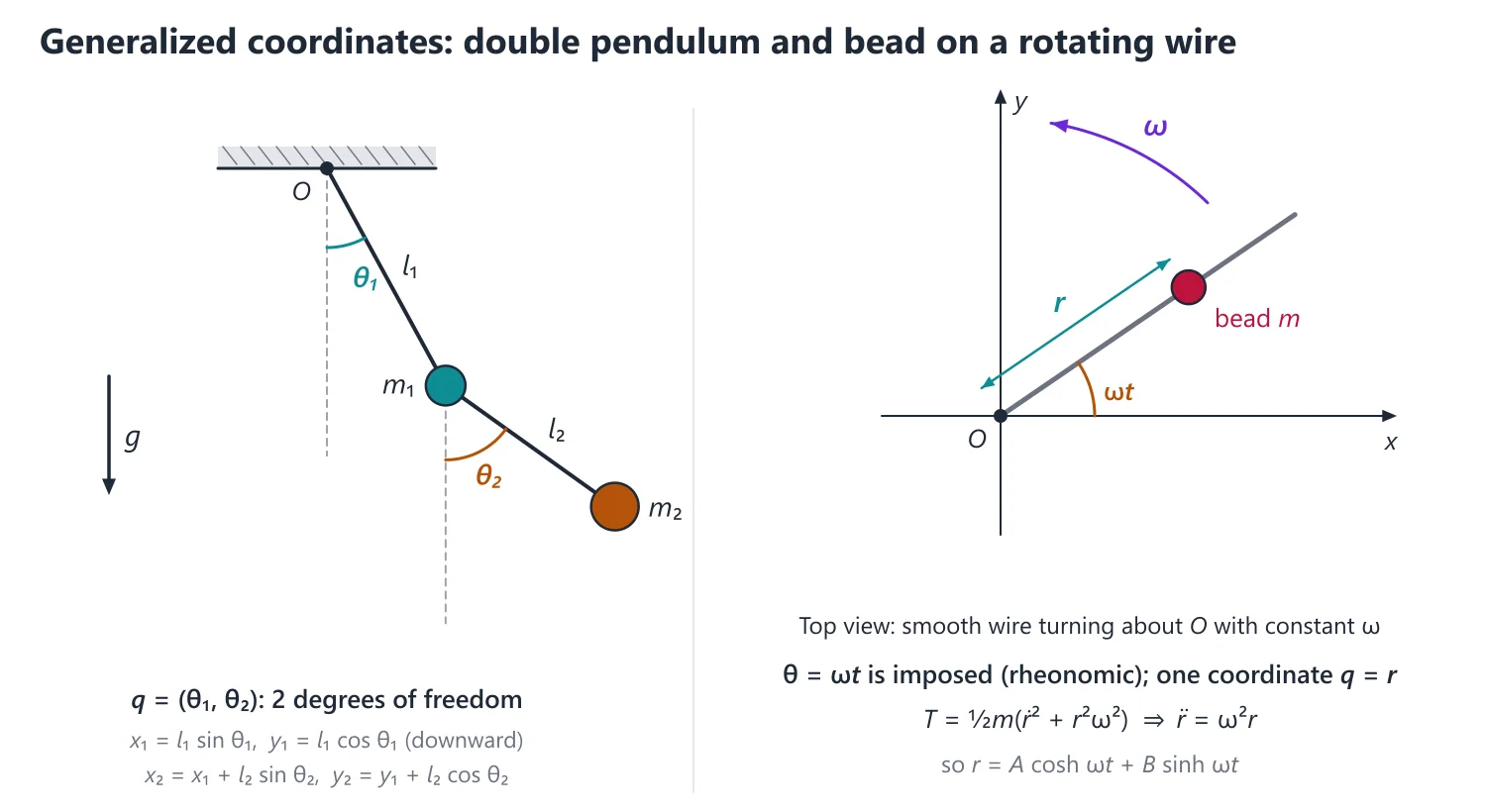
Scleronomic constraints do not involve t explicitly; rheonomic constraints do (for example a bead on a rotating wire).
Degrees of freedom: N particles with k independent holonomic constraints have n = 3N − k degrees of freedom.
Idea: count the quantities you could still set at will. The double pendulum in the figure above has two particles in a vertical plane (4 coordinates) and two rod-length constraints, so n = 4 − 2 = 2 and q = (θ1, θ2); a rigid body moving in a plane has n = 3 (two for G and one angle).
Generalized coordinates q1, ..., qn: independent quantities fixing the configuration, ri = ri(q1, ..., qn, t); q̇j are the generalized velocities.
Idea: generalized coordinates need not be lengths: angles, arc lengths or the u = cos(θ/2) of Example 10 all qualify, provided they are independent (no relation links them) and sufficient (they fix every particle). A good choice makes the constraints automatic, so the forces of constraint never appear.
Virtual displacement δri: an infinitesimal change of configuration consistent with the constraints at a fixed instant (δt = 0).
Idea: for the rotating wire in the figure above, an actual displacement in time dt includes the turning of the wire, but a virtual displacement freezes the wire and lies along it. So the normal reaction of a smooth wire does no virtual work even though it does real work on the bead: this is why the virtual (δt = 0) displacement, and not the actual one, is used.
Generalized force: Qj = ∑i Fi·∂ri/∂qj, so the virtual work is ∑ Qjδqj; for conservative forces Qj = −∂V/∂qj.
Idea: Qj is the force conjugate to qj: Qjδqj always has the units of work, so if qj is a length Qj is a force, and if qj is an angle Qj is a torque about the corresponding axis.
3. Understanding Virtual Displacements and D'Alembert's Principle
Why we need it: we want equations of motion in which the forces of constraint (normal reactions, tensions in rods) never appear. In statics the principle of virtual work does exactly this for bodies at rest; D'Alembert's idea extends it to bodies in motion.
In words: a virtual displacement δri is an imagined, infinitesimally small change of the positions, made at one frozen instant (δt = 0) and allowed by the constraints as they are at that instant. "Virtual" means that it need not be the actual motion. The virtual work of a force F is F·δr.
A constraint is workless if the total virtual work of its forces is zero for every virtual displacement: a smooth surface (the reaction is normal and δr is tangent), a rigid rod (equal and opposite pulls along the rod), an inextensible string, a rolling contact (the contact point has δr = 0).
D'Alembert's principle then says: the applied forces together with the reversed effective forces −mir̈i do zero total virtual work.
First example, slowly: a bead of mass m slides on a smooth straight wire inclined at angle α to the horizontal. Find its acceleration.
Step 1: let s be the distance moved down the wire. The forces on the bead are its weight mg (an applied force) and the normal reaction N of the wire (a force of constraint), perpendicular to the wire.
Step 2: the only displacement the wire allows is along itself: δr = δs times the unit vector down the wire.
Step 3: virtual work of N: N is perpendicular to δr, so N·δr = 0. This is why N will never appear.
Step 4: virtual work of the weight: its component down the wire is mg sin α, so it gives mg sin α δs.
Step 5: virtual work of the reversed effective force: the acceleration is s̈ along the wire, so it gives −ms̈ δs.
Step 6: D'Alembert: (mg sin α − ms̈)δs = 0 for every δs, hence s̈ = g sin α. This is the familiar answer, found without ever computing N.
Non-example: on a rough wire the friction μN acts along the wire against the motion and does virtual work −μN δs. The principle still holds, but friction must now be counted among the applied forces and N found separately (here N = mg cos α): the friction part of the reaction is not workless, so the shortcut "forces of constraint drop out" fails.
Building up: start from Newton's law mir̈i = Fi + Ri, Ri being the force of constraint on particle i, so Fi − mir̈i = −Ri. Dot each with δri and add: ∑(Fi − mir̈i)·δri = −∑Ri·δri, which is zero for workless constraints.
Putting r̈i = 0 gives back the principle of virtual work of statics. The argument is written out under "Why it works" just below, and Section 7 turns the principle into Lagrange's equations.
Where it is used: UPSC sometimes asks "using D'Alembert's principle, find the equation of motion" (Example 7). More often the principle is the first step in deriving Lagrange's equations, a standard 15-mark theory question.
4. D'Alembert's Principle
Principle of virtual work: a system with workless constraints is in equilibrium if and only if ∑ Fi·δri = 0 for all virtual displacements, Fi being the applied forces.
D'Alembert's principle: adding the reversed effective force −mir̈i, ∑i (Fi − mir̈i)·δri = 0, provided the constraint forces do no virtual work.
It reduces dynamics to statics and eliminates the unknown forces of constraint.
Why it works: Newton's law for particle i is mir̈i = Fi + Ri, Ri being the constraint force. Dotting with δri and summing, ∑(Fi − mir̈i)·δri = −∑Ri·δri, and the right side is zero for workless constraints: smooth surfaces and wires, rigid rods, inextensible strings, and rolling without slipping.
Idea: the hypothesis matters. Sliding friction on a rough surface does virtual work, so it cannot be dropped; it must be kept among the applied forces Fi, with its value μR found separately.
Link: D'Alembert's principle is the dynamic version of the principle of virtual work used in Statics (Paper I); setting r̈i = 0 recovers it.
5. Understanding Lagrange's Equations
Why we need it: Newton's equations need every force, reactions included, and become awkward when the natural coordinates are angles. We want one recipe that works in any coordinates: write two scalar functions, the kinetic energy T and the potential energy V, and obtain the equations of motion by differentiation alone.
In words: the Lagrangian is L = T − V, written as a function of the generalized coordinates qj, the generalized velocities q̇j and possibly t. Lagrange's equation for qj is d/dt(∂L/∂q̇j) − ∂L/∂qj = 0, one equation for each degree of freedom.
Read it as three moves. (1) Differentiate L partially with respect to q̇j, treating q and q̇ as independent letters; the result pj is the generalized momentum. (2) Differentiate pj totally with respect to t along the motion, so that every q and q̇ in it also changes. (3) Subtract ∂L/∂qj.
First example, slowly: a particle of mass m moves on a smooth horizontal plane and is attracted to a fixed point O by a force kr, so V = (1/2)kr2. Use polar coordinates (r, θ).
Step 1: the velocity has radial component ṙ and transverse component rθ̇, so T = (m/2)(ṙ2 + r2θ̇2) and L = (m/2)(ṙ2 + r2θ̇2) − (1/2)kr2.
Step 2 (the r-equation): ∂L/∂ṙ = mṙ, whose time derivative is mr̈; ∂L/∂r = mrθ̇2 − kr. So mr̈ − mrθ̇2 + kr = 0.
Step 3 (the θ-equation): ∂L/∂θ̇ = mr2θ̇, and ∂L/∂θ = 0 because θ does not appear in L. So d/dt(mr2θ̇) = 0.
Step 4: interpret. The r-equation reads "mass × radial acceleration (r̈ − rθ̇2) = radial force −kr"; the centripetal term −rθ̇2 came out of ∂L/∂r by itself. The θ-equation says that the angular momentum mr2θ̇ is constant.
Step 5: notice that we never resolved a force and never wrote down an acceleration in polar coordinates: T and V did all the work.
Non-example: the form d/dt(∂L/∂q̇j) − ∂L/∂qj = 0 needs all the applied forces to come from a potential V(q, t). For a particle moving against air resistance −cv no such V exists, and using L = T alone would simply lose the resistance. The correct form keeps a generalized force on the right, d/dt(∂T/∂q̇j) − ∂T/∂qj = Qj, or uses Rayleigh's function as below.
Building up: the derivation (Section 7) has four ideas: (i) every virtual displacement is δri = ∑(∂ri/∂qj)δqj; (ii) the applied forces then contribute ∑Qjδqj; (iii) two calculus identities turn the inertia terms into d/dt(∂T/∂q̇j) − ∂T/∂qj; (iv) the δqj are independent, so each coefficient vanishes separately.
When Qj = −∂V/∂qj, V can be moved inside both derivatives (it does not contain q̇), and L = T − V appears. A coordinate missing from L gives a conserved momentum, and an L without explicit t gives the energy integral (Section 8).
Where it is used: almost every mechanics question of Paper II: pendulums, beads on rotating wires, rolling bodies, coupled oscillators. It is also the doorway to Hamilton's equations, where pj = ∂L/∂q̇j becomes a new variable.
6. Lagrange's Equations
From D'Alembert's principle with T = (1/2)∑miṙi2 and independent qj: d/dt(∂T/∂q̇j) − ∂T/∂qj = Qj, j = 1, ..., n.
The derivation uses ∂ṙi/∂q̇j = ∂ri/∂qj and d/dt(∂ri/∂qj) = ∂ṙi/∂qj.
Conservative system: with L = T − V (V independent of q̇), d/dt(∂L/∂q̇j) − ∂L/∂qj = 0.
Generalized momentum pj = ∂L/∂q̇j; if qj does not appear in L (a cyclic or ignorable coordinate), pj is constant.
Idea: a cyclic coordinate expresses a symmetry: L does not change when qj is shifted. Invariance under translation gives conservation of linear momentum, and invariance under rotation (θ cyclic in Example 2) gives conservation of angular momentum.
Energy integral: if L does not contain t explicitly, h = ∑q̇j∂L/∂q̇j − L is constant; for scleronomic constraints h = T + V.
Idea: h is the Jacobi integral. It equals the energy T + V only when the constraints do not depend on time; a moving constraint (rotating wire or hoop) can feed energy into the system, yet h is still conserved.
Dissipative forces: with Rayleigh's dissipation function R = (1/2)∑kivi2, d/dt(∂L/∂q̇j) − ∂L/∂qj + ∂R/∂q̇j = 0.
Why it works: for resisting forces −kivi, the generalized force is Qj = −∑kivi·∂ri/∂qj = −∑kivi·∂vi/∂q̇j = −∂R/∂q̇j, using ∂vi/∂q̇j = ∂ri/∂qj; for fixed constraints the energy is lost at the rate 2R.
Link: Lagrange's equations are the Euler–Lagrange equations of the action ∫L dt (Hamilton's principle, next topic), and the multiplier rule of Section 13 is the same idea as Lagrange multipliers for constrained maxima and minima in Paper I calculus.
7. Derivation: Lagrange's Equations from D'Alembert's Principle
Step 1 (two identities): from ri = ri(q1, ..., qn, t), ṙi = ∑k(∂ri/∂qk)q̇k + ∂ri/∂t. This is linear in the q̇k, so ∂ṙi/∂q̇j = ∂ri/∂qj (cancellation of dots).
Also d/dt(∂ri/∂qj) = ∑k(∂2ri/∂qk∂qj)q̇k + ∂2ri/∂t∂qj = ∂ṙi/∂qj (the order of d/dt and ∂/∂qj can be swapped).
Step 2 (applied forces): a virtual displacement has δt = 0, so δri = ∑j(∂ri/∂qj)δqj and ∑iFi·δri = ∑jQjδqj.
Step 3 (inertia terms): ∑imir̈i·∂ri/∂qj = d/dt(∑miṙi·∂ri/∂qj) − ∑miṙi·d/dt(∂ri/∂qj).
By the two identities this is d/dt(∑miṙi·∂ṙi/∂q̇j) − ∑miṙi·∂ṙi/∂qj = d/dt(∂T/∂q̇j) − ∂T/∂qj.
Step 4: D'Alembert's principle becomes ∑j[d/dt(∂T/∂q̇j) − ∂T/∂qj − Qj]δqj = 0. The constraints are holonomic, so the δqj are independent and arbitrary; choosing all but one equal to zero shows that each bracket vanishes.
Step 5: if Qj = −∂V/∂qj with V = V(q, t), then ∂V/∂q̇j = 0, so V can be moved inside both derivatives and L = T − V gives d/dt(∂L/∂q̇j) − ∂L/∂qj = 0.
Idea: Step 4 is exactly where the holonomic hypothesis is used. With a non-holonomic or an uneliminated constraint the δqj are linked, the brackets need not vanish separately, and multipliers are required (Section 13).
8. Derivation: The Energy (Jacobi) Integral
Put h = ∑q̇j∂L/∂q̇j − L. Then dh/dt = ∑q̈j∂L/∂q̇j + ∑q̇jd/dt(∂L/∂q̇j) − ∑(∂L/∂qj q̇j + ∂L/∂q̇j q̈j) − ∂L/∂t.
The q̈ terms cancel, and the rest is ∑q̇j[d/dt(∂L/∂q̇j) − ∂L/∂qj] − ∂L/∂t = −∂L/∂t by Lagrange's equations. So h is constant whenever L has no explicit t.
Write T = T2 + T1 + T0, the parts of degree 2, 1, 0 in the q̇j. By Euler's theorem on homogeneous functions ∑q̇j∂T/∂q̇j = 2T2 + T1, so h = T2 − T0 + V.
Scleronomic constraints give T = T2 and h = T + V. For the rotating wire (Example 4) T2 = (m/2)ṙ2, T0 = (m/2)ω2r2, V = 0, so h = (m/2)(ṙ2 − ω2r2), as stated there.
9. Understanding Small Oscillations
Why we need it: a pendulum, a double pendulum or a bead in a bowl usually stays close to a position of equilibrium. The exact equations are non-linear (they contain sin θ) and rarely solvable, but near equilibrium they become linear and can be solved completely. We need a systematic way to find the frequencies and the shapes of the motions.
In words: an equilibrium q0 is a configuration where every ∂V/∂qj = 0, so all generalized forces vanish. "Small oscillations" means that, with η = q − q0, we keep in T and V only the terms of second order in η and η̇.
Then T = (1/2)η̇TAη̇ and V = (1/2)ηTBη with constant symmetric matrices A (inertia, the coefficients of T frozen at q0) and B (stiffness, the second derivatives of V at q0), and Lagrange's equations become Aη̈ + Bη = 0.
First example, slowly: the simple pendulum, T = (1/2)ml2θ̇2 and V = −mgl cos θ.
Step 1: equilibria: V′(θ) = mgl sin θ = 0 gives θ = 0 and θ = π.
Step 2: at θ = 0, V″(0) = mgl cos 0 = mgl > 0, so V has a minimum there.
Step 3: expand: cos θ ≈ 1 − θ2/2, so V ≈ −mgl + (1/2)mglθ2. Thus A = ml2 and B = mgl (the constant −mgl does not affect the motion).
Step 4: Lagrange's equation of the quadratic L is ml2θ̈ + mglθ = 0, so θ = θ0cos(ωt + ε) with ω2 = B/A = g/l.
Step 5: at θ = π, V″(π) = −mgl, negative. The equation becomes η̈ − (g/l)η = 0, with solutions e±√(g/l) t: the slightest disturbance grows, so the inverted position is unstable.
Step 6: notice that ω2 = B/A is the one-coordinate case of det(B − ω2A) = 0.
Non-example: a point where ∂V/∂q ≠ 0 is not an equilibrium. Expanding about it leaves a linear term in V, that is a constant force, and there is no oscillation about that point at all. Likewise, keeping θ-dependent coefficients in T (such as sin2θ) is not the small-oscillation approximation: the coefficients must be frozen at q0.
Building up: with two or more coordinates, try η = X cos(ωt + ε). Then (B − ω2A)X = 0, which has a non-zero solution X exactly when det(B − ω2A) = 0, an equation of degree n in ω2.
For two equal masses m joined to each other and to two fixed walls by three equal springs k (motion along the line): A = mI and B = [[2k, −k], [−k, 2k]], so (2k − mω2)2 − k2 = 0 and ω2 = k/m (the masses move together, X = (1, 1)) or 3k/m (they move oppositely, X = (1, −1)).
Each such motion is a normal mode, and the general small motion is a sum of the modes; normal coordinates make T and V sums of squares (Section 14).
Where it is used: UPSC asks for the frequencies and normal modes of coupled systems and for normal coordinates (Examples 12 and 13). The computation is the generalized eigenvalue problem of linear algebra, and stability (all ω2 positive) is the positive definiteness of B.
10. Choosing the Method
If only the motion is wanted and the constraints are smooth or rolling → choose n independent qj that satisfy the constraints automatically, write T and V, and use Lagrange's equations with L = T − V.
If a reaction, a tension or the friction in rolling is also wanted → keep one extra coordinate and a multiplier λ for the constraint (Section 13), or apply Newton's law to the body concerned after finding the motion.
If the question says "using D'Alembert's principle" → write ∑(Fi − mir̈i)·δri = 0 with a virtual displacement tangent to the constraint (Example 7), not Lagrange's equations directly.
If some qj is cyclic → write pj = constant at once and use it to eliminate q̇j from the other equations or from the energy integral.
If L has no explicit t and a speed is asked ("velocity at the bottom") → the energy integral h = constant is a first-order equation and is usually quickest.
If motion near equilibrium is asked → expand T and V to second order and solve det(B − ω2A) = 0 (Section 14).
11. Common Mistakes
Substituting a first integral into L. Replacing φ̇ by pφ/(I sin2θ) in L = (1/2)I(θ̇2 + sin2θ φ̇2) − V before forming the θ-equation reverses the sign of the centrifugal term. Substitute into the equations of motion (or the energy), never into L.
Incomplete kinetic energy of a rigid body. T is (1/2)MvG2 + (1/2)IGω2, or (1/2)IOω2 about a fixed point O only; the rotational term is often forgotten, and I about a moving point other than G is not allowed.
Calling h the energy for a moving constraint. For a rotating wire or hoop h = T2 − T0 + V is conserved while T + V is not.
Too many coordinates. Treating x and θ of a rolling hoop as independent without the constraint x = aθ (or a multiplier) describes a hoop that slides freely and gives the wrong acceleration.
Sign of V. With y measured downward V = −mgy; using +mgy turns a pendulum into an inverted one, and the stable equilibrium appears unstable.
Partial instead of total time derivative. d/dt(sin2θ φ̇) = sin2θ φ̈ + 2sin θ cos θ θ̇φ̇; the second term is often dropped.
12. Worked Examples
Example 1 (simple pendulum): q = θ, T = (1/2)ml2θ̇2, V = −mgl cos θ; Lagrange's equation gives θ̈ + (g/l) sin θ = 0, with period 2π√(l/g) for small oscillations.
Example 2 (central force): L = (m/2)(ṙ2 + r2θ̇2) − V(r). The r-equation is m(r̈ − rθ̇2) = −V′(r); θ is cyclic, so mr2θ̇ is constant (angular momentum).
Example 3 (Atwood machine): masses m1, m2 on a light string over a smooth light pulley, x = descent of m1: L = (1/2)(m1 + m2)ẋ2 + m1gx + m2g(l − x).
Then (m1 + m2)ẍ = (m1 − m2)g, so ẍ = (m1 − m2)g/(m1 + m2).
Example 4 (bead on a rotating wire): a smooth straight wire rotates with constant ω in a horizontal plane; L = (m/2)(ṙ2 + ω2r2), so r̈ = ω2r and r = Aeωt + Be−ωt.
The constraint is rheonomic, so the conserved quantity h = (m/2)(ṙ2 − ω2r2) is not the kinetic energy T.
Example 5 (bead on a rotating hoop): A bead slides on a smooth circular hoop of radius a that rotates with constant angular velocity ω about its vertical diameter, θ being measured from the downward vertical. Find the equation of motion and the positions of relative equilibrium.
T = (1/2)ma2(θ̇2 + ω2sin2θ), V = −mga cos θ, so Lagrange's equation gives θ̈ = sin θ(ω2cos θ − g/a).
Equilibria: θ = 0, θ = π, and cos θ0 = g/(aω2), which exists only when ω2 > g/a.
Linearising: the derivative of sin θ(ω2cos θ − g/a) at θ0 is −ω2sin2θ0, so θ0 is stable with small-oscillation frequency ω sin θ0; at θ = 0 the derivative is ω2 − g/a > 0, so θ = 0 is then unstable.
Example 6 (ladder): A uniform rod of length 2a rests in a vertical plane with its ends on a smooth vertical wall and a smooth horizontal floor, and slips from rest at inclination α to the vertical. Show that it leaves the wall when cos θ = (2/3)cos α.
With θ the inclination to the vertical, G = (a sin θ, a cos θ), T = (1/2)Ma2θ̇2 + (1/2)(Ma2/3)θ̇2 = (2/3)Ma2θ̇2 and V = Mga cos θ.
Lagrange's equation: (4/3)Ma2θ̈ = Mga sin θ, so θ̈ = (3g/(4a))sin θ, and the energy integral gives θ̇2 = (3g/(2a))(cos α − cos θ).
The wall reaction is R = MẍG = Ma(θ̈ cos θ − θ̇2sin θ) = (3Mg/4)sin θ(3cos θ − 2cos α), which vanishes when cos θ = (2/3)cos α; the rod leaves the wall there.
13. Rolling Constraints, Multipliers and Generalized Forces
Rolling without slipping of a body of radius r on a straight track: the contact point is at rest, so ẋ = rθ̇, which integrates to x = rθ; the constraint is holonomic and removes one coordinate.
Idea: rolling on a straight line is holonomic because ẋ = rθ̇ integrates to x = rθ. A disc rolling upright on a plane while its plane turns is not: the velocity conditions cannot be integrated, and multipliers are then essential.
Lagrange's undetermined multipliers: if coordinates are linked by a holonomic constraint f(q, t) = 0 that is not eliminated, use d/dt(∂L/∂q̇j) − ∂L/∂qj = λ ∂f/∂qj; the terms λ ∂f/∂qj are the generalized forces of constraint (for example the friction in rolling).
Why it works: write Ej = d/dt(∂L/∂q̇j) − ∂L/∂qj. D'Alembert's principle gives ∑Ejδqj = 0 for every δq satisfying ∑(∂f/∂qj)δqj = 0. So the vector (Ej) is orthogonal to every vector orthogonal to (∂f/∂qj), hence parallel to it: Ej = λ∂f/∂qj for one λ(t).
Idea: λ is not a mere device: λ∂f/∂qj is the generalized force that the constraint exerts, so the multiplier method gives the motion and the reaction (or friction) together, as in Example 8.
Generalized force of a force (X, Y) at a point P: express xP, yP in the qj; Qj is the coefficient of δqj in X δxP + Y δyP, i.e. Qj = X ∂xP/∂qj + Y ∂yP/∂qj.
Kinetic energy of rods: for a rod of length 2a in plane motion T = (1/2)MvG2 + (1/2)(Ma2/3)ω2 (König's theorem); for a rod turning about a fixed end O with polar angles θ, φ, T = (1/2)(4Ma2/3)(θ̇2 + sin2θ φ̇2).
D'Alembert's principle for a constrained particle: take a virtual displacement tangent to the constraint (for f(x, y) = 0, δx : δy = fy : −fx) and set the virtual work of F − mr̈ equal to zero.
Example 7 (UPSC 2021, 10 marks): A particle is constrained to move along a circle lying in the vertical xy-plane. With the help of the D’Alembert’s principle, show that its equation of motion is ẍy − ÿx − gx = 0, where g is the acceleration due to gravity.
Take y vertically upward, so F = (0, −mg); the constraint x2 + y2 = a2 gives x δx + y δy = 0, so we may take δx = yε, δy = −xε.
D'Alembert: (Fx − mẍ)δx + (Fy − mÿ)δy = 0, i.e. (−mẍ)(yε) + (−mg − mÿ)(−xε) = 0.
Dividing by −mε gives ẍy − ÿx − gx = 0; with x = a sin θ, y = −a cos θ this becomes θ̈ + (g/a)sin θ = 0, the simple pendulum.
Answer: ẍy − ÿx − gx = 0.
Example 8 (UPSC 2016, 15 marks): A hoop with radius r is rolling, without slipping, down an inclined plane of length l and with angle of inclination φ. Assign appropriate generalized coordinates to the system. Determine the constraints, if any. Write down the Lagrangian equations for the system. Hence or otherwise determine the velocity of the hoop at the bottom of the inclined plane.
Coordinates: x, the distance of the centre down the plane, and θ, the angle turned; rolling gives the holonomic constraint x = rθ, so there is one degree of freedom, q = x.
A hoop has k = r, so T = (1/2)Mẋ2 + (1/2)Mr2θ̇2 = Mẋ2, V = −Mgx sin φ, and L = Mẋ2 + Mgx sin φ.
Lagrange's equation: 2Mẍ − Mg sin φ = 0, so ẍ = (1/2)g sin φ; from rest, v2 = 2ẍl = gl sin φ at the bottom.
With both x and θ and a multiplier λ for f = x − rθ = 0: Mẍ − Mg sin φ = λ and Mr2θ̈ = −λr, giving λ = −(1/2)Mg sin φ, the friction acting up the plane.
Answer: constraint x = rθ; equation 2ẍ = g sin φ; speed at the bottom √(gl sin φ).
Example 9 (UPSC 2017, 20 marks): Two uniform rods AB, AC, each of mass m and length 2a, are smoothly hinged together at A and move on a horizontal plane. At time t, the mass centre of the rods is at the point (ξ, η) referred to fixed perpendicular axes Ox, Oy in the plane, and the rods make angles θ ± φ with Ox. Prove that the kinetic energy of the system is
m[ξ̇2 + η̇2 + (1/3 + sin2φ)a2θ̇2 + (1/3 + cos2φ)a2φ̇2].
Also derive Lagrange's equations of motion for the system if an external force with components [X, Y] along the axes acts at A.
Let A = (xA, yA). The centres of AB and AC are A + a(cos(θ ± φ), sin(θ ± φ)), so their mean is G = (ξ, η) = A + a cos φ(cos θ, sin θ).
Relative to G the rod-centres are at ±a sin φ(−sin θ, cos θ), with squared speed a2(φ̇2cos2φ + θ̇2sin2φ); the rods turn with angular velocities θ̇ ± φ̇.
Summing (1/2)mv2 + (1/2)(ma2/3)ω2 (the cross terms cancel): T = m(ξ̇2 + η̇2) + ma2(φ̇2cos2φ + θ̇2sin2φ) + (ma2/3)(θ̇2 + φ̇2), which is the stated form.
Generalized forces: xA = ξ − a cos φ cos θ, yA = η − a cos φ sin θ, so Qξ = X, Qη = Y, Qθ = a cos φ(X sin θ − Y cos θ), Qφ = a sin φ(X cos θ + Y sin θ).
Lagrange's equations: 2mξ̈ = X, 2mη̈ = Y, d/dt[2ma2(1/3 + sin2φ)θ̇] = a cos φ(X sin θ − Y cos θ).
and 2ma2(1/3 + cos2φ)φ̈ − ma2sin 2φ(φ̇2 + θ̇2) = a sin φ(X cos θ + Y sin θ).
Answer: T as stated, and the four equations above; the first two say that G moves like a particle of mass 2m under the force (X, Y).
Example 10 (UPSC 2025, 10 marks): A bead of mass m slides on a frictionless wire in the shape of a cycloid given by x = a(θ − sin θ), y = a(1 + cos θ), (0 ≤ θ ≤ 2π). Find the Lagrangian function. Hence show that the equation of motion can be written as
d2u/dt2 + (g/4a) u = 0
where u = cos(θ/2). (4 + 6 = 10 marks)
ẋ = a(1 − cos θ)θ̇, ẏ = −a sin θ θ̇, so v2 = 2a2(1 − cos θ)θ̇2 = 4a2sin2(θ/2)θ̇2.
With y vertically upward, V = mgy = 2mga cos2(θ/2), so L = 2ma2sin2(θ/2)θ̇2 − 2mga cos2(θ/2).
Put u = cos(θ/2), a valid coordinate since it is monotonic on 0 ≤ θ ≤ 2π: u̇ = −(1/2)sin(θ/2)θ̇, so sin2(θ/2)θ̇2 = 4u̇2 and L = 8ma2u̇2 − 2mgau2.
Lagrange's equation in u: 16ma2ü + 4mgau = 0.
Answer: L = 2ma2sin2(θ/2)θ̇2 − 2mga cos2(θ/2); d2u/dt2 + (g/(4a))u = 0, simple harmonic with period 4π√(a/g) whatever the amplitude (the cycloid is tautochronous).
Example 11 (UPSC 2026, 20 marks): A smooth uniform rod, say OA, of length 2a and mass m is pivoted at one end to a fixed point O. The rod is inclined at an angle θ with the downward vertical line OZ and the plane OAZ makes an angle φ with a fixed vertical plane. A bead of mass λm slides smoothly on the rod and is connected to O by a light elastic string of modulus nmg and natural length a. Show that the kinetic energy T of the system is given by 2T = (4/3)ma2(θ̇2 + φ̇2 sin θ) + λm(ẋ2 + x2θ̇2 + x2θ̇2 sin2θ), where x is the stretched length of the string, and derive the equations of motion.
[The printed 2T has two misprints: the rod term should be θ̇2 + φ̇2sin2θ and the last bead term x2φ̇2sin2θ; the corrected form is proved.]
Rod: it turns about O, the square of its angular velocity is θ̇2 + sin2θ φ̇2, and its moment about every line through O perpendicular to it is 4ma2/3, so 2Trod = (4/3)ma2(θ̇2 + φ̇2sin2θ).
Bead at distance x along the rod, in spherical coordinates (x, θ, φ): 2Tbead = λm(ẋ2 + x2θ̇2 + x2φ̇2sin2θ).
V = −mga cos θ − λmgx cos θ + nmg(x − a)2/(2a), the string energy being modulus × extension2/(2 × natural length), for x ≥ a.
Put I = (4/3)ma2 + λmx2. φ is cyclic: I sin2θ φ̇ = constant.
θ-equation: d/dt(Iθ̇) − I sin θ cos θ φ̇2 + mg(a + λx)sin θ = 0.
x-equation: λmẍ − λmx(θ̇2 + sin2θ φ̇2) − λmg cos θ + nmg(x − a)/a = 0.
Answer: 2T = (4/3)ma2(θ̇2 + φ̇2sin2θ) + λm(ẋ2 + x2θ̇2 + x2φ̇2sin2θ), with the three equations of motion above.
14. Small Oscillations and Normal Coordinates
Small oscillations: near a stable equilibrium (V minimum) with scleronomic constraints, T = (1/2)∑aijq̇iq̇j and V = (1/2)∑bijqiqj with constant symmetric matrices A, B, A positive definite.
Lagrange's equations become AQ̈ + BQ = 0; trying Q = Xeiωt gives the frequency equation det(B − ω2A) = 0.
Why it works: about an equilibrium q0 put q = q0 + η. Taylor's theorem gives V = V(q0) + ∑(∂V/∂qj)0ηj + (1/2)∑bijηiηj + ..., and the linear terms vanish because q0 is an equilibrium.
In T = (1/2)∑aij(q)η̇iη̇j the coefficients may be frozen at q0, since the error is of third order. Lagrange's equations of these quadratic T and V are linear: Aη̈ + Bη = 0.
A is positive definite, so the roots ω2 of det(B − ω2A) = 0 are real. They are all positive exactly when B is positive definite, i.e. when V has a strict minimum; a negative root means exponential growth, an unstable equilibrium.
Normal coordinates: a linear change of variables reducing T and V together to sums of squares, T = (1/2)∑ξ̇k2, V = (1/2)∑ωk2ξk2; each ξk then obeys ξ̈k + ωk2ξk = 0.
When T = (m/2)(ẋ2 + ẏ2), a rotation of axes keeps T in this form, and its angle is chosen to remove the cross term of V, exactly as a conic is rotated to its principal axes.
Idea: in a normal mode every particle moves with the same frequency and in phase (or in antiphase), and any small motion is a superposition of the modes. For the double pendulum of the figure above with equal masses and lengths, ω2 = (2 ∓ √2)g/l: the slower mode swings both bobs the same way, the faster one in opposite ways.
Link: det(B − ω2A) = 0 is a generalized eigenvalue problem, and the normal coordinates diagonalise two quadratic forms at once (linear algebra, Paper I), exactly as a central conic or conicoid is reduced to its principal axes.
Example 12 (UPSC 2018, 20 marks): Suppose the Lagrangian of a mechanical system is given by
L = (1/2) m(aẋ2 + 2bẋẏ + cẏ2) − (1/2) k(ax2 + 2bxy + cy2),
where a, b, c, m (> 0), k (> 0) are constants and b2 ≠ ac. Write down the Lagrangian equations of motion and identify the system.
∂L/∂ẋ = m(aẋ + bẏ), ∂L/∂x = −k(ax + by); ∂L/∂ẏ = m(bẋ + cẏ), ∂L/∂y = −k(bx + cy).
Lagrange's equations: m(aẍ + bÿ) + k(ax + by) = 0 and m(bẍ + cÿ) + k(bx + cy) = 0.
In matrix form P(mẌ + kX) = 0 with P = [[a, b], [b, c]], X = (x, y); det P = ac − b2 ≠ 0, so P cancels: ẍ + (k/m)x = 0, ÿ + (k/m)y = 0.
So x = C1cos(ωt + ε1), y = C2cos(ωt + ε2) with ω = √(k/m).
Answer: the equations above; the system is a two-dimensional isotropic harmonic oscillator (two uncoupled oscillations of the same frequency √(k/m)) written in oblique coordinates, the path being in general an ellipse.
Example 13 (UPSC 2023, 20 marks): A mechanical system with 2 degrees of freedom has the Lagrangian L = (1/2)m(ẋ2 + ẏ2) − (1/2)m(w12x2 + w22y2) + kxy where m, w1, w2, k are constants. Find the parameter θ so that under the transformation x = q1 cos θ − q2 sin θ, y = q1 sin θ + q2 cos θ the Lagrangian in terms of q1, q2 will not contain the product term q1q2. Find the Lagrange's equations w.r.t. q1 and q2 independent of parameter θ.
A rotation keeps the kinetic energy: ẋ2 + ẏ2 = q̇12 + q̇22. With c = cos θ, s = sin θ: x2 = c2q12 − 2csq1q2 + s2q22, y2 = s2q12 + 2csq1q2 + c2q22, xy = csq12 + (c2 − s2)q1q2 − csq22.
The coefficient of q1q2 in L is (m/2)(w12 − w22)sin 2θ + k cos 2θ, which vanishes when tan 2θ = 2k/(m(w22 − w12)).
Then L = (m/2)(q̇12 + q̇22) − (m/2)(Ω12q12 + Ω22q22), with Ω12 = w12c2 + w22s2 − (k/m)sin 2θ and Ω22 = w12s2 + w22c2 + (k/m)sin 2θ.
Ω12, Ω22 are the eigenvalues of [[w12, −k/m], [−k/m, w22]], so, free of θ, Ω2 = (w12 + w22)/2 ± √((w12 − w22)2/4 + k2/m2).
Answer: tan 2θ = 2k/(m(w22 − w12)); q̈1 + Ω12q1 = 0 and q̈2 + Ω22q2 = 0 with Ω2 as above (q1, q2 are normal coordinates).
15. Practice Exercises
Exercise 1 (basic): State the number of degrees of freedom of (a) a double pendulum moving in a vertical plane, (b) a rigid body moving freely in space, (c) a bead on a fixed circular wire.
Answer: (a) 2 (two angles); (b) 6 (three for G, three angles); (c) 1.
Exercise 2 (basic): Classify each constraint as holonomic or non-holonomic, and as scleronomic or rheonomic: (a) a bead on a straight wire rotating with constant angular velocity ω; (b) a particle that must stay inside a sphere of radius a.
Answer: (a) holonomic and rheonomic (y cos ωt − x sin ωt = 0 contains t); (b) non-holonomic, because x2 + y2 + z2 ≤ a2 is an inequality; it is scleronomic.
Exercise 3 (basic): For L = (m/2)(ṙ2 + r2θ̇2) + mμ/r, name the cyclic coordinate and write two constants of the motion.
Answer: θ is cyclic, so mr2θ̇ is constant; L has no explicit t, so the energy (m/2)(ṙ2 + r2θ̇2) − mμ/r is constant.
Exercise 4 (standard): A bead of mass m slides on a smooth wire in the form of the parabola y = x2/(4a), with Oy vertically upward. Taking x as the coordinate, find L, the equation of motion, and the period of small oscillations about the lowest point.
Answer: L = (m/2)(1 + x2/(4a2))ẋ2 − mgx2/(4a); (1 + x2/(4a2))ẍ + xẋ2/(4a2) + gx/(2a) = 0; small oscillations have ω2 = g/(2a), period 2π√(2a/g).
Exercise 5 (standard): Masses m1 > m2 hang from a light inextensible string over a pulley which is a uniform disc of mass M and radius a turning about a fixed smooth axis; the string does not slip. Use Lagrange's equation to find the acceleration.
Answer: with x the descent of m1, T = (1/2)(m1 + m2 + M/2)ẋ2, so ẍ = (m1 − m2)g/(m1 + m2 + M/2).
Exercise 6 (standard): A smooth straight wire rotates with constant angular velocity ω in a vertical plane about a horizontal axis through a point O of the wire, and is horizontal at t = 0. A bead of mass m slides on it, r being its distance from O. Find the equation of motion and its general solution.
Answer: L = (m/2)(ṙ2 + ω2r2) − mgr sin ωt, so r̈ − ω2r = −g sin ωt and r = Aeωt + Be−ωt + (g/(2ω2))sin ωt.
Exercise 7 (standard): A particle of mass m hangs from a spring of stiffness k and moves vertically against a resistance cv. Using Rayleigh's dissipation function, write the equation of motion and the rate at which the energy E = T + V decreases.
Answer: R = (1/2)cẋ2 with x measured from the equilibrium position; mẍ + cẋ + kx = 0, and dE/dt = −cẋ2 = −2R.
Exercise 8 (UPSC level): A uniform rod of mass M and length 2a has its end A on a smooth horizontal wire along Ox, and the rod moves in the vertical plane through the wire. With x the abscissa of A and θ the angle of the rod with the downward vertical, find T and V, a first integral from the cyclic coordinate, and the period of small oscillations if the system starts from rest.
Answer: T = (M/2)[(ẋ + aθ̇ cos θ)2 + a2θ̇2sin2θ] + (Ma2/6)θ̇2, V = −Mga cos θ; x is cyclic, so M(ẋ + aθ̇ cos θ) is constant (zero from rest, G stays on a vertical line); small oscillations have ω2 = 3g/a, period 2π√(a/(3g)).
Exercise 9 (UPSC level): Two simple pendulums, each of length l and bob m, hang from points at the same level, and their bobs are joined by a light spring of stiffness k whose natural length equals the distance between the points of suspension. Find the normal frequencies and describe the modes.
Answer: for small angles θ1, θ2: A = ml2I, B = [[mgl + kl2, −kl2], [−kl2, mgl + kl2]]; ω2 = g/l (θ1 = θ2, the spring is not stretched) and ω2 = g/l + 2k/m (θ1 = −θ2).
Exercise 10 (UPSC level): A particle of mass m slides from rest at the top of a smooth fixed sphere of radius a. Use coordinates (r, θ), θ from the upward vertical, keep the constraint r = a with a Lagrange multiplier λ, and find the normal reaction and the point where the particle leaves the sphere.
Answer: the r-equation gives λ = mg cos θ − maθ̇2, and energy gives aθ̇2 = 2g(1 − cos θ); so the reaction is λ = mg(3cos θ − 2), which vanishes when cos θ = 2/3, where the particle leaves the sphere.
| Type | Meaning | Example |
|---|---|---|
| Holonomic | f(r1, ..., rN, t) = 0 | Rigid body, pendulum rod |
| Non-holonomic | Not reducible to such equations | Sphere rolling on a rough plane, gas in a box |
| Scleronomic | No explicit t | Bead on a fixed wire |
| Rheonomic | Explicit t | Bead on a rotating wire |
Mains points
- Deriving Lagrange's equations from D'Alembert's principle is a standard 15-mark theory question; state the assumptions (holonomic, workless constraints) and the two key identities.
- In problems, clearly state the generalized coordinates and the number of degrees of freedom before writing T and V.
- Write T in the chosen coordinates carefully (velocity of the centre of mass plus rotation for rigid bodies); most errors arise here.
- Identify cyclic coordinates and the energy integral, and use them to reduce the problem to quadratures where possible.
- Common mistake: taking V with the wrong sign for heights measured downward, or calling h the energy when the constraints are rheonomic.
Did you know?
- Lagrange's Mécanique analytique (1788) proudly contained no diagrams: he wrote that the methods he presented required only algebraic operations.
Hamilton's Equations
The Hamiltonian H(q, p, t) = ∑pjq̇j − L, with pj = ∂L/∂q̇j, replaces the n second-order Lagrange equations by 2n first-order canonical equations q̇j = ∂H/∂pj, ṗj = −∂H/∂qj. For scleronomic conservative systems H = T + V, and H is conserved whenever it does not contain t explicitly. Both formulations follow from Hamilton's principle δ∫L dt = 0.
1. Understanding the Hamiltonian and the Legendre Transform
Why we need it: Lagrange's equations are n second-order equations for the q's. Hamilton's idea is to use the momenta pj as independent variables beside the qj. This gives 2n first-order equations of a strikingly symmetric form, governed by a single function H that is usually the energy. To change variables from (q, q̇) to (q, p) correctly we need a precise recipe: the Legendre transform.
In words: pj = ∂L/∂q̇j is the momentum conjugate to qj. The Hamiltonian H = ∑pjq̇j − L has the same value as the Jacobi integral h of the previous topic, but it must be written as a function of q, p and t only: every q̇j is replaced by its expression in terms of the p's.
"H is a function of p" is the whole point: a formula that still contains q̇ is the right number but not yet the Hamiltonian, and its derivatives ∂H/∂p have no meaning.
First example, slowly: a particle of mass m on a line in a potential V(x), so L = (1/2)mẋ2 − V(x).
Step 1: the momentum is p = ∂L/∂ẋ = mẋ.
Step 2: solve for the velocity: ẋ = p/m. This inversion is the step that must always be possible.
Step 3: form pẋ − L = p(p/m) − (1/2)m(p/m)2 + V(x) = p2/m − p2/(2m) + V(x).
Step 4: so H(x, p) = p2/(2m) + V(x): the kinetic energy written with p, plus the potential energy.
Step 5: check with numbers: m = 2, ẋ = 3 and V = 4 at the point. Then p = 6 and H = 36/4 + 4 = 13, while T + V = (1/2)(2)(9) + 4 = 13. The value is the same; only the variables have changed.
Non-example: for a bead on a wire rotating with constant ω, L = (m/2)(ṙ2 + ω2r2) gives H = p2/(2m) − (1/2)mω2r2, which is not T + V = p2/(2m) + (1/2)mω2r2: the condition that fails is "constraints independent of t".
A different failure: L = qq̇ − q2 is only linear in q̇, so p = q contains no q̇ at all, Step 2 is impossible, and no Hamiltonian of this kind exists.
Building up: (i) the inversion is possible exactly when det(∂2L/∂q̇i∂q̇j) ≠ 0. For T = (1/2)q̇TA(q)q̇ with A positive definite this holds, p = Aq̇ and q̇ = A−1p.
(ii) Then ∑pjq̇j = q̇TAq̇ = 2T, so H = 2T − (T − V) = T + V = (1/2)pTA−1p + V. (iii) With moving constraints T also has parts T1 and T0 of degrees 1 and 0 in the velocities, and the same computation gives H = T2 − T0 + V ("Why it works" below).
Where it is used: the first step of every Hamiltonian question is "find p, invert, form H"; most marks are lost when H still contains velocities. H is also the starting point for Poisson brackets and for the Hamilton–Jacobi equation.
2. The Hamiltonian
Generalized momenta: pj = ∂L/∂q̇j, j = 1, ..., n.
Idea: pj is the natural "momentum" of the coordinate qj: for a Cartesian coordinate it is mẋ, for an angle it is an angular momentum (pθ = mr2θ̇), and it can contain velocity-free terms (for a charge in a magnetic field p = mv + eA).
Hamiltonian (Legendre transform of L): H(q, p, t) = ∑ pjq̇j − L, with every q̇j expressed in terms of q, p and t.
Idea: the Legendre transform trades the variable q̇ for the slope p = ∂L/∂q̇ of L. It needs the equations pj = ∂L/∂q̇j to be solvable for the q̇j, i.e. det(∂2L/∂q̇i∂q̇j) ≠ 0, which holds whenever T is a positive definite quadratic in the velocities.
If L is only linear in q̇ (say L = qq̇ − q2), then p = q contains no q̇ at all, the transform fails, and no Hamiltonian of this kind exists.
If the constraints are scleronomic and V does not depend on velocities, T is a homogeneous quadratic in the q̇j; by Euler's theorem ∑q̇j∂T/∂q̇j = 2T, so H = T + V, the total energy.
Why it works: H = ∑q̇j∂L/∂q̇j − L = ∑q̇j∂T/∂q̇j − T + V = 2T − T + V. With moving constraints T = T2 + T1 + T0 and the same computation gives H = T2 − T0 + V, as in Example 5; a velocity-dependent potential also breaks H = T + V.
3. Understanding Hamilton's Canonical Equations and Phase Space
Why we need it: once H(q, p, t) is known we need the equations of motion in terms of it. Hamilton's equations give them as 2n first-order equations, which can be pictured as a flow of points in the (q, p) plane and solved by quadrature or numerically.
In words: q̇j = ∂H/∂pj recovers the velocity by differentiating H with respect to the momentum, holding all q's and the other p's fixed. ṗj = −∂H/∂qj says that the momentum changes at the rate of the generalized force −∂H/∂qj, holding all p's fixed. The minus sign belongs to the ṗ equation.
The phase space is the set of all states (q, p). One point of it fixes the present state, and through these equations the whole future: the motion is a curve, the phase path, traced by that point.
First example, slowly: the oscillator H = p2/(2m) + (1/2)kx2.
Step 1: ẋ = ∂H/∂p = p/m. This simply gives back p = mẋ.
Step 2: ṗ = −∂H/∂x = −kx. This is Newton's law: the rate of change of momentum equals the force.
Step 3: eliminate p: mẍ = ṗ = −kx, so x = A cos(√(k/m) t + ε) and p = mẋ = −A√(mk) sin(√(k/m) t + ε).
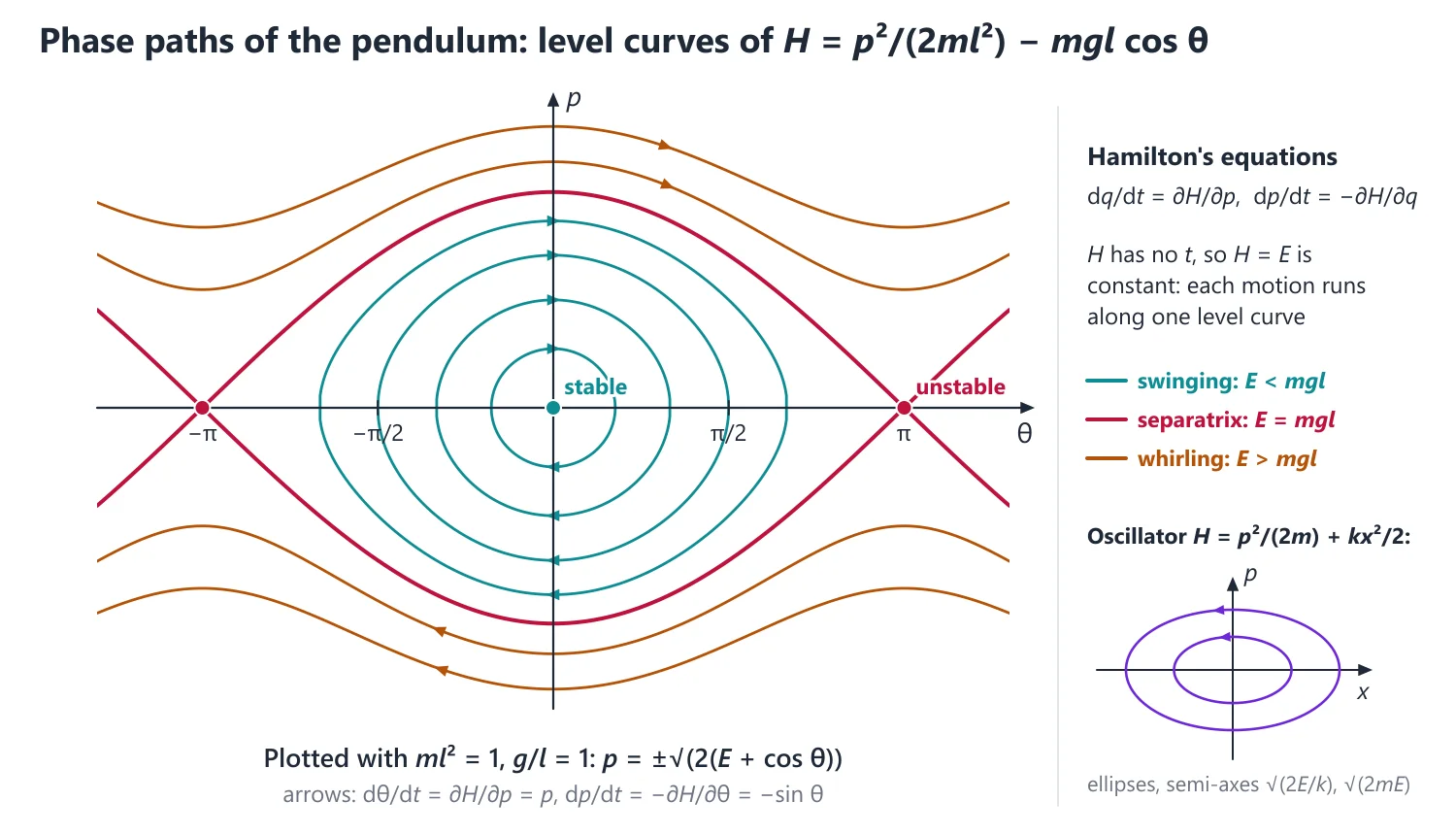
Step 4: the phase path: H has no explicit t, so p2/(2m) + (1/2)kx2 = E is constant, an ellipse in the (x, p) plane.
Step 5: the direction: at the point (A, 0) we have ṗ = −kA, negative, so with x drawn across and p upward the state moves clockwise round the ellipse.
Non-example: writing H = (1/2)mẋ2 + (1/2)kx2 and then "∂H/∂p" is meaningless, because H must first be expressed in p. And the sign matters: ṗ = +∂H/∂x would give mẍ = +kx, whose solutions grow exponentially, a wrong motion.
Building up: differentiate H = ∑pjq̇j − L; the dq̇ terms cancel because pj = ∂L/∂q̇j, and comparing the coefficients of dpj, dqj and dt with dH gives the three relations ("Derivation" and "Why it works" below).
Two consequences follow at once: dH/dt = ∂H/∂t, so H is conserved when t is absent; and a coordinate missing from H has a constant conjugate momentum.
Where it is used: writing and solving Hamilton's equations for pendulums, central forces and particles on surfaces (Examples 8 to 14); proving that H is a constant of motion; reading off conserved momenta from coordinates that do not appear in H.
4. Hamilton's Canonical Equations
q̇j = ∂H/∂pj, ṗj = −∂H/∂qj (j = 1, ..., n), and ∂H/∂t = −∂L/∂t.
Derivation: dH = ∑(q̇jdpj − ṗjdqj) − (∂L/∂t)dt, using ṗj = ∂L/∂qj from Lagrange's equations; comparing with dH = ∑(∂H/∂qj dqj + ∂H/∂pj dpj) + (∂H/∂t)dt gives the equations.
Why it works: from H = ∑pjq̇j − L(q, q̇, t), dH = ∑(q̇jdpj + pjdq̇j) − ∑(∂L/∂qj dqj + ∂L/∂q̇j dq̇j) − (∂L/∂t)dt. The dq̇j terms cancel because pj = ∂L/∂q̇j, which is exactly why H depends on q, p, t only.
The partial derivatives of H are then taken with p held fixed (∂H/∂qj) or q held fixed (∂H/∂pj), never with q̇ held fixed.
These 2n first-order equations are equivalent to the n second-order Lagrange equations.
Idea: the state is a point (q, p) of the 2n-dimensional phase space, and Hamilton's equations give the velocity of that point. For one degree of freedom with H = E constant the phase paths are the level curves of H: for the oscillator p2/(2m) + (1/2)kx2 = E they are ellipses with semi-axes √(2E/k) and √(2mE).
For the pendulum H = p2/(2ml2) − mgl cos θ, the curves with E less than mgl are closed (swinging), those with E greater than mgl are open (whirling round), and E = mgl is the separatrix between them.
dH/dt = ∂H/∂t, so if H does not contain t explicitly, H is a constant of the motion.
Why it works: along a motion dH/dt = ∑(∂H/∂qj q̇j + ∂H/∂pj ṗj) + ∂H/∂t = ∑(∂H/∂qj ∂H/∂pj − ∂H/∂pj ∂H/∂qj) + ∂H/∂t = ∂H/∂t.
A coordinate absent from H is cyclic, and its conjugate momentum is constant.
Idea: a coordinate cyclic in L is cyclic in H as well, since ∂H/∂qj = −∂L/∂qj. In H it simply drops out with its constant momentum, which is why the Hamiltonian form handles ignorable coordinates so cleanly (the spherical pendulum of Example 3 becomes a one-degree-of-freedom problem in θ).
5. Understanding Hamilton's Principle
Why we need it: Newton's, Lagrange's and Hamilton's equations all describe the motion locally, instant by instant. Hamilton's principle describes the same motion by one statement about the whole path. It explains why Lagrange's equations keep the same form in every coordinate system, and it links mechanics with the calculus of variations.
In words: fix the configuration at two times t1 and t2. For every imaginable path q(t) joining them, compute the action S = ∫t1t2L(q, q̇, t) dt, a single number. Hamilton's principle: the actual path is the one for which S is stationary, meaning that any small change δq(t) that vanishes at both ends changes S only to second order.
First example, slowly: a free particle on a line, L = (1/2)mẋ2, going from x = 0 at t = 0 to x = d at t = 1.
Step 1: the actual path is x = dt (uniform motion), with ẋ = d, so its action is S = (1/2)md2.
Step 2: compare the family of neighbouring paths x = dt + ε sin πt. Each one still starts at 0 and ends at d, since sin 0 = sin π = 0.
Step 3: along such a path ẋ = d + επ cos πt.
Step 4: S(ε) = (1/2)m∫01(d + επ cos πt)2 dt = (1/2)m[d2 + 2dεπ∫01cos πt dt + ε2π2∫01cos2πt dt] = (1/2)m[d2 + 0 + ε2π2/2].
Step 5: the term of first order in ε is zero, so S is stationary at ε = 0; here it is even a minimum, since the ε2 term is positive.
Step 6: notice that the straight, uniform path picked out by the principle is exactly the solution of Lagrange's equation mẍ = 0.
Non-example: if the end points are not held fixed, the boundary term [∑pjδqj] in the derivation does not vanish, and the first variation of S need not be zero even along the true path. And "stationary" is not "least": for an oscillator over more than half a period the true path is a saddle point of S (the "Idea" below).
Building up: vary the path by δqj(t) with fixed ends, integrate the δq̇j term by parts, drop the boundary term, and apply the fundamental lemma of the calculus of variations: each coefficient d/dt(∂L/∂q̇j) − ∂L/∂qj must vanish (Section 8).
Since S is defined without reference to any coordinates, its stationarity, and so the form of Lagrange's equations, is the same in all coordinates. Varying q and p independently in ∫(∑pq̇ − H) dt gives Hamilton's equations.
Where it is used: theory questions ask to derive Lagrange's or Hamilton's equations from the principle. Keeping the final end free gives ∂S/∂qj = pj, the starting point of the Hamilton–Jacobi theory (Section 12).
6. Understanding Poisson Brackets and Constants of Motion
Why we need it: we often want to know whether a quantity (an angular momentum, one part of the energy, some combination of q's and p's) stays constant, without solving the equations of motion. The Poisson bracket gives a mechanical test for this, and it also packs Hamilton's equations into one formula.
In words: for two functions F(q, p, t) and G(q, p, t), [F, G] = ∑j(∂F/∂qj ∂G/∂pj − ∂F/∂pj ∂G/∂qj): for each pair (qj, pj) take "F by q times G by p, minus F by p times G by q", and add over the pairs.
The key fact is that along every motion dF/dt = [F, H] + ∂F/∂t. So F is a constant of motion exactly when [F, H] + ∂F/∂t = 0.
First example, slowly: take the two-dimensional oscillator H = (px2 + py2)/(2m) + (1/2)k(x2 + y2), and test F = px2/(2m) + (1/2)kx2, the energy of the x-motion alone.
Step 1: the derivatives of F are ∂F/∂x = kx, ∂F/∂px = px/m, ∂F/∂y = ∂F/∂py = 0, and ∂F/∂t = 0.
Step 2: the derivatives of H that we need are ∂H/∂x = kx and ∂H/∂px = px/m.
Step 3: the x-pair gives (kx)(px/m) − (px/m)(kx) = 0, and the y-pair gives 0 because F contains neither y nor py.
Step 4: so [F, H] = 0 and the x-energy is conserved by itself: the x- and y-motions exchange no energy.
Step 5: now add a coupling term cxy to H. Then ∂H/∂x = kx + cy, and [F, H] = (kx)(px/m) − (px/m)(kx + cy) = −cypx/m ≠ 0: the coupling transfers energy between the two motions.
Non-example: for a free particle, H = p2/(2m), test F = x − pt/m. Here [F, H] = (1)(p/m) − (−t/m)(0) = p/m ≠ 0, which on its own suggests "not conserved". But ∂F/∂t = −p/m cancels it, so F is conserved (it is the initial position). Forgetting ∂F/∂t gives the wrong verdict.
Building up: the rule dF/dt = [F, H] + ∂F/∂t is just the chain rule with q̇j and ṗj replaced from Hamilton's equations ("Why it works" below). Taking F = qj or pj gives Hamilton's equations themselves, and [qi, pj] = δij.
The bracket is antisymmetric and satisfies Jacobi's identity, and these give Poisson's theorem: the bracket of two constants of motion is again a constant of motion.
Where it is used: questions of the form "show that ... is a constant of the motion", "prove Jacobi's identity" or "show that [Lx, Ly] = Lz"; the brackets also test whether a change of variables is canonical.
7. Hamilton's Principle and Poisson Brackets
Hamilton's principle: among all paths between fixed configurations at times t1 and t2, the actual motion makes the action ∫t1t2 L dt stationary, δ∫L dt = 0; its Euler–Lagrange equations are Lagrange's equations.
Idea: "stationary", not "least": for a harmonic oscillator of frequency ω the action is a true minimum only when t2 − t1 is less than π/ω (half a period); over longer intervals the actual path is a saddle point of the action.
Poisson bracket: [F, G] = ∑(∂F/∂qj ∂G/∂pj − ∂F/∂pj ∂G/∂qj); then dF/dt = [F, H] + ∂F/∂t and [qi, pj] = δij.
Why it works: by the chain rule dF/dt = ∑(∂F/∂qj q̇j + ∂F/∂pj ṗj) + ∂F/∂t, and replacing q̇j by ∂H/∂pj and ṗj by −∂H/∂qj gives [F, H] + ∂F/∂t. In particular Hamilton's equations themselves read q̇j = [qj, H], ṗj = [pj, H].
Properties: [F, G] = −[G, F] (so [F, F] = 0), the bracket is linear in each slot, [FG, K] = F[G, K] + [F, K]G, and Jacobi's identity [F, [G, K]] + [G, [K, F]] + [K, [F, G]] = 0 holds.
F is a constant of motion if and only if [F, H] + ∂F/∂t = 0.
Poisson's theorem: if F and G are constants of motion with no explicit t, so is [F, G] (by Jacobi's identity with K = H). For example the angular momentum components satisfy [Lx, Ly] = Lz, so conservation of Lx and Ly forces conservation of Lz.
8. Derivation: Lagrange's Equations from Hamilton's Principle
Vary the path: qj(t) → qj(t) + δqj(t) with δqj(t1) = δqj(t2) = 0. Then δ∫L dt = ∫∑(∂L/∂qj δqj + ∂L/∂q̇j δq̇j) dt, and δq̇j = d(δqj)/dt.
Integrate the second term by parts: ∫(∂L/∂q̇j)(d δqj/dt) dt = [∂L/∂q̇j δqj]t1t2 − ∫d/dt(∂L/∂q̇j)δqj dt, and the boundary term vanishes.
So δ∫L dt = ∫∑[∂L/∂qj − d/dt(∂L/∂q̇j)]δqj dt = 0 for all such δqj. The δqj are independent (holonomic system), so by the fundamental lemma of the calculus of variations each bracket is zero: Lagrange's equations.
Modified Hamilton's principle: δ∫(∑pjq̇j − H) dt = 0 with q and p varied independently gives q̇j = ∂H/∂pj (from δp) and ṗj = −∂H/∂qj (from δq, after an integration by parts).
9. Choosing the Method
If the constraints are fixed and V does not depend on velocities → write H = T + V at once and then replace every q̇j by its expression in the p's.
If L is given with cross terms, time dependence or a moving constraint → compute pj = ∂L/∂q̇j, solve for q̇j, and form H = ∑pjq̇j − L.
If T = (1/2)q̇TAq̇ with a non-diagonal A → p = Aq̇, q̇ = A−1p and H = (1/2)pTA−1p + V.
If H is given and L is asked → solve q̇j = ∂H/∂pj for the pj, then L = ∑pjq̇j − H (Example 10); Lagrangians differing by dF(q, t)/dt are equivalent.
If a constant of motion is asked → look for cyclic coordinates and for ∂H/∂t = 0 first; otherwise show [F, H] + ∂F/∂t = 0.
If the problem says "Hamilton–Jacobi" or "characteristic function" → separate variables in ∂S/∂t + H(q, ∂S/∂q, t) = 0 (Section 12).
10. Common Mistakes
Leaving velocities in H. H = (1/2)ml2θ̇2 − mgl cos θ is the right value but the wrong function; ∂H/∂p is meaningless until θ̇ is replaced by p/(ml2).
Assuming H = T + V for a rotating wire, a rotating frame or a velocity-dependent potential; use the definition (Example 5).
Sign of ṗ. Writing ṗ = +∂H/∂q turns the oscillator into exponential growth; the minus sign belongs to ṗ.
Inverting p = Aq̇ wrongly. For L = mẋẏ − mω02xy, px = mẏ and py = mẋ, so H = pxpy/m + mω02xy, not (px2 + py2)/(2m) + ...
Confusing "conserved" with "energy". H with no explicit t is conserved even when it is not T + V; conversely H = T + V need not be conserved if ∂H/∂t ≠ 0.
Forgetting ∂F/∂t when testing a quantity F(q, p, t) with Poisson brackets.
Link: the Hamilton–Jacobi equation is a first-order non-linear PDE, solved by separation of variables or Charpit's method (PDE chapter); Hamilton's principle is the Euler–Lagrange problem of the calculus of variations.
Link: Hamilton's equations form the first-order system ż = J∇H with z = (q, p) and J = [[0, I], [−I, 0]]; for a quadratic H the matrix of the linear system has eigenvalues in pairs ±λ (linear algebra).
11. Steps and Examples
Step 1: Choose qj and write T, V and L.
Step 2: Find pj = ∂L/∂q̇j and solve for each q̇j.
Step 3: Form H = ∑pjq̇j − L in terms of q and p (or T + V when allowed), then write the canonical equations.
Example 1 (harmonic oscillator): L = (1/2)mẋ2 − (1/2)kx2, p = mẋ, H = p2/(2m) + (1/2)kx2.
ẋ = p/m and ṗ = −kx, so mẍ + kx = 0 and x = A cos(√(k/m) t + ε).
Example 2 (central force): pr = mṙ, pθ = mr2θ̇, H = pr2/(2m) + pθ2/(2mr2) + V(r).
ṙ = pr/m, θ̇ = pθ/(mr2), ṗr = pθ2/(mr3) − V′(r), ṗθ = 0, so the angular momentum pθ is constant.
Example 3 (spherical pendulum): with θ measured from the downward vertical, T = (1/2)ml2(θ̇2 + sin2θ φ̇2), V = −mgl cos θ.
pθ = ml2θ̇, pφ = ml2sin2θ φ̇, H = pθ2/(2ml2) + pφ2/(2ml2sin2θ) − mgl cos θ; φ is cyclic, so pφ is constant.
Example 4 (projectile): H = (px2 + py2)/(2m) + mgy gives ṗx = 0 and ṗy = −mg: horizontal momentum is conserved and the vertical acceleration is −g.
Example 5 (H ≠ T + V): A bead of mass m slides on a smooth straight wire that rotates with constant angular velocity ω in a horizontal plane about a fixed point O of the wire. Find H and Hamilton's equations.
L = (m/2)(ṙ2 + ω2r2), p = mṙ, H = pṙ − L = p2/(2m) − (1/2)mω2r2.
ṙ = p/m, ṗ = mω2r, so r̈ = ω2r; H has no explicit t and is conserved, but H ≠ T = p2/(2m) + (1/2)mω2r2 because the constraint is rheonomic.
Example 6 (Poisson bracket): For H = (px2 + py2)/(2m) + V(r), r = √(x2 + y2), show that Lz = xpy − ypx is a constant of the motion.
[Lz, H] = (∂Lz/∂x)(∂H/∂px) − (∂Lz/∂px)(∂H/∂x) + (∂Lz/∂y)(∂H/∂py) − (∂Lz/∂py)(∂H/∂y).
= pypx/m + yV′(r)x/r − pxpy/m − xV′(r)y/r = 0, and Lz has no explicit t, so dLz/dt = 0: angular momentum is conserved.
12. Hamilton–Jacobi Theory and the Principal Function
Hamilton's principal function: S(q, t) = ∫t0t L dt taken along the actual path from a fixed initial configuration to the configuration q at time t.
It satisfies ∂S/∂qj = pj and ∂S/∂t = −H, hence the Hamilton–Jacobi equation ∂S/∂t + H(q, ∂S/∂q, t) = 0.
Why it works: in the derivation of Section 8 keep the final end free: then δS = [∑pjδqj] at time t, so ∂S/∂qj = pj. Along the actual path dS/dt = L, while the chain rule gives dS/dt = ∂S/∂t + ∑(∂S/∂qj)q̇j = ∂S/∂t + ∑pjq̇j; hence ∂S/∂t = L − ∑pjq̇j = −H.
Hamilton's characteristic function: for a conservative system with H = E, S = W(q) − Et, where W = ∫∑pjdqj satisfies H(q, ∂W/∂q) = E; some books and papers use the name for S itself.
Method: solve the H–J equation by separation of variables with constants αk; then ∂S/∂αk = βk (new constants) gives the motion.
Idea: for one degree of freedom with H = p2/(2m) + V(x) = E, W = ∫√(2m(E − V)) dx, and ∂S/∂E = β gives t + β = ∂W/∂E = ∫dx/√(2(E − V)/m) = ∫dx/v. This is the familiar energy-integral quadrature, so the H–J method is the systematic version of "use the energy equation".
Example 7 (UPSC 2016, 10 marks): Consider a single free particle of mass m, moving in space under no forces. If the particle starts from the origin at t = 0 and reaches the position (x, y, z) at time τ, find the Hamilton's characteristic function S as a function of x, y, z, τ.
With no forces the particle moves uniformly in a straight line: r(t) = (t/τ)(x, y, z), with constant speed v = √(x2 + y2 + z2)/τ.
L = (1/2)mv2 is constant along the path, so S = ∫0τ L dt = (1/2)mv2τ = m(x2 + y2 + z2)/(2τ).
Check: ∂S/∂x = mx/τ = px, and ∂S/∂τ = −m(x2 + y2 + z2)/(2τ2) = −(1/2)mv2 = −H, so ∂S/∂τ + |∇S|2/(2m) = 0.
Answer: S = m(x2 + y2 + z2)/(2τ); in terms of the energy E, W = √(2mE) √(x2 + y2 + z2).
13. Hamilton's Equations for Standard Systems
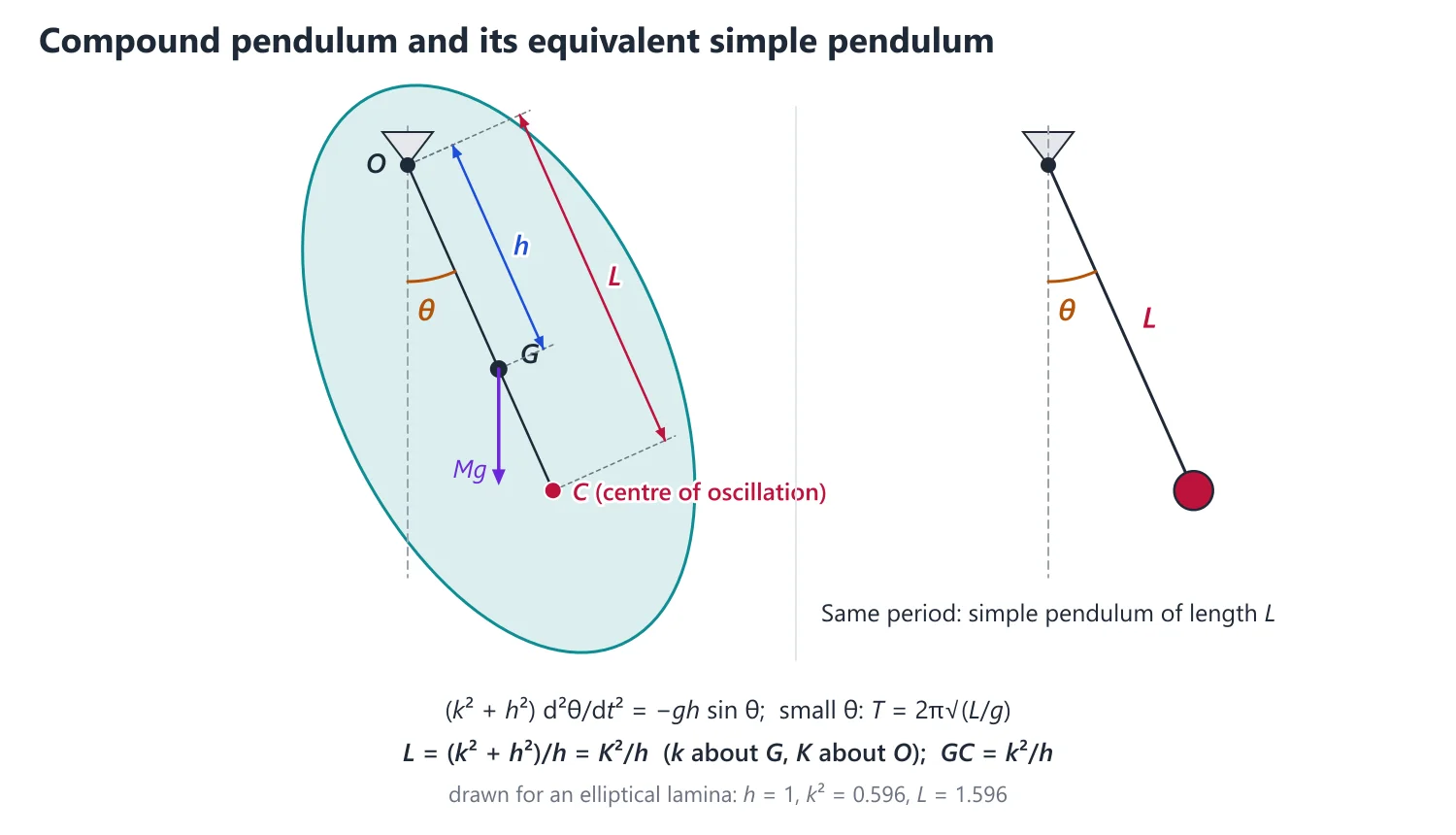
Example 8 (UPSC 2014, 10 marks): Find the equation of motion of a compound pendulum using Hamilton's equations.
Let the body (mass M, radius of gyration k about G) turn about a fixed horizontal axis through O with OG = h, and let θ be the angle of OG with the downward vertical.
T = (1/2)M(k2 + h2)θ̇2, V = −Mgh cos θ, p = M(k2 + h2)θ̇, and H = T + V = p2/(2M(k2 + h2)) − Mgh cos θ.
θ̇ = ∂H/∂p = p/(M(k2 + h2)), ṗ = −∂H/∂θ = −Mgh sin θ.
Answer: θ̈ + (gh/(k2 + h2))sin θ = 0; small oscillations have period 2π√((k2 + h2)/(gh)).
Example 9 (UPSC 2015, 15 marks): Solve the plane pendulum problem using the Hamiltonian approach and show that H is a constant of motion.
q = θ, T = (1/2)ml2θ̇2, V = −mgl cos θ, p = ml2θ̇, H = p2/(2ml2) − mgl cos θ.
θ̇ = p/(ml2), ṗ = −mgl sin θ, so θ̈ + (g/l)sin θ = 0; for small θ, θ = θ0cos(√(g/l) t + ε).
dH/dt = (∂H/∂θ)θ̇ + (∂H/∂p)ṗ + ∂H/∂t = (∂H/∂θ)(∂H/∂p) − (∂H/∂p)(∂H/∂θ) + 0 = 0.
Answer: H = p2/(2ml2) − mgl cos θ is a constant of motion (the energy); for amplitude α it gives θ̇2 = (2g/l)(cos θ − cos α).
Example 10 (UPSC 2015, 20 marks): A Hamiltonian of a system with one degree of freedom has the form H = p2/(2α) − bqpe−αt + (bα/2)q2e−αt(α + be−αt) + (k/2)q2 where α, b, k are constants, q is the generalized coordinate and p is the corresponding generalized momentum.
(i) Find a Lagrangian corresponding to this Hamiltonian.
(ii) Find an equivalent Lagrangian that is not explicitly dependent on time. (10 + 10 = 20)
Write E = e−αt. q̇ = ∂H/∂p = p/α − bqE, so p = α(q̇ + bqE); substituting, H = (α/2)q̇2 + (α2b/2)Eq2 + (k/2)q2 (the b2E2 terms cancel).
(i) L = pq̇ − H = (α/2)q̇2 + αbe−αtqq̇ − (α2b/2)e−αtq2 − (k/2)q2.
(ii) d/dt[(αb/2)e−αtq2] = αbe−αtqq̇ − (α2b/2)e−αtq2, so L = (α/2)q̇2 − (k/2)q2 + dF/dt with F = (αb/2)e−αtq2.
Lagrangians that differ by a total time derivative dF(q, t)/dt give the same equations of motion.
Answer: (i) the L above; (ii) L′ = (α/2)q̇2 − (k/2)q2, a harmonic oscillator αq̈ + kq = 0.
Example 11 (UPSC 2018, 20 marks): The Hamiltonian of a mechanical system is given by,
H = p1q1 − aq12 + bq22 − p2q2, where a, b are the constants. Solve the Hamiltonian equations and show that (p2 − bq2)/q1 = constant.
q̇1 = ∂H/∂p1 = q1, q̇2 = ∂H/∂p2 = −q2, ṗ1 = −∂H/∂q1 = −p1 + 2aq1, ṗ2 = −∂H/∂q2 = −2bq2 + p2.
So q1 = Aet, q2 = Be−t; then ṗ1 + p1 = 2aAet gives p1 = aAet + Ce−t, and ṗ2 − p2 = −2bBe−t gives p2 = bBe−t + Det.
Hence p2 − bq2 = Det and (p2 − bq2)/q1 = D/A, a constant.
Answer: q1 = Aet, q2 = Be−t, p1 = aAet + Ce−t, p2 = bBe−t + Det; (p2 − bq2)/q1 = D/A is constant.
Example 12 (UPSC 2019, 15 marks): Using Hamilton's equation, find the acceleration for a sphere rolling down a rough inclined plane, if x be the distance of the point of contact of the sphere from a fixed point on the plane.
Sphere of mass M and radius a on a rough plane of inclination α; rolling gives angular velocity ẋ/a.
T = (1/2)Mẋ2 + (1/2)(2Ma2/5)(ẋ/a)2 = (7/10)Mẋ2, V = −Mgx sin α; p = (7/5)Mẋ and H = 5p2/(14M) − Mgx sin α.
ẋ = ∂H/∂p = 5p/(7M), ṗ = −∂H/∂x = Mg sin α, so (7/5)Mẍ = Mg sin α.
Answer: ẍ = (5/7)g sin α.
Example 13 (UPSC 2020, 20 marks): By writing down the Hamiltonian, find the equations of motion of a particle of mass m constrained to move on the surface of a cylinder defined by x2 + y2 = R2, R is a constant. The particle is subject to a force directed towards the origin and proportional to the distance r of the particle from the origin given by F = −kr, k is a constant.
Use cylindrical coordinates (R, θ, z) with R fixed; F = −kr is conservative, V = (k/2)r2 = (k/2)(R2 + z2).
T = (m/2)(R2θ̇2 + ż2), pθ = mR2θ̇, pz = mż, and H = pθ2/(2mR2) + pz2/(2m) + (k/2)(R2 + z2).
θ̇ = pθ/(mR2), ṗθ = 0, ż = pz/m, ṗz = −kz.
Answer: θ is cyclic, so θ̇ = ω is constant; z̈ + (k/m)z = 0, z = A cos(√(k/m) t + ε): the particle goes round the cylinder uniformly while oscillating along it.
Example 14 (UPSC 2025, 20 marks): (i) A particle of mass m moves in a force field of potential
V(r) = −k cos θ/r2, k is constant
Find the Hamiltonian and the Hamilton's equations in spherical polar coordinates (r, θ, φ). (10 marks)
(ii) Consider the Lagrangian
L = m ẋ ẏ − mω02 xy
where m and ω0 are constants. Find the Hamiltonian and Hamilton's equations of motion. Identify the system. (10 marks)
(i) T = (m/2)(ṙ2 + r2θ̇2 + r2sin2θ φ̇2); pr = mṙ, pθ = mr2θ̇, pφ = mr2sin2θ φ̇; H = (1/(2m))(pr2 + pθ2/r2 + pφ2/(r2sin2θ)) − k cos θ/r2.
ṙ = pr/m, θ̇ = pθ/(mr2), φ̇ = pφ/(mr2sin2θ), ṗr = (pθ2 + pφ2/sin2θ)/(mr3) − 2k cos θ/r3.
ṗθ = pφ2cos θ/(mr2sin3θ) − k sin θ/r2, ṗφ = 0 (φ is cyclic).
(ii) px = ∂L/∂ẋ = mẏ, py = mẋ; H = pxẋ + pyẏ − L = mẋẏ + mω02xy = pxpy/m + mω02xy.
ẋ = py/m, ẏ = px/m, ṗx = −mω02y, ṗy = −mω02x, so ẍ + ω02x = 0 and ÿ + ω02y = 0.
Answer: (i) H and the six equations above; (ii) H = pxpy/m + mω02xy, and the system is a two-dimensional isotropic harmonic oscillator of frequency ω0 (H is conserved, though not of the form T + V).
14. Practice Exercises
Exercise 1 (basic): For L = (1/2)(q̇12 + 2q̇22) − q1q2, find the momenta and the Hamiltonian.
Answer: p1 = q̇1, p2 = 2q̇2; H = p12/2 + p22/4 + q1q2.
Exercise 2 (basic): For one degree of freedom, evaluate [q, p2] and [q2, p2].
Answer: [q, p2] = 2p and [q2, p2] = (2q)(2p) = 4qp.
Exercise 3 (basic): For a particle falling freely, H = p2/(2m) + mgq, decide which of (a) p and (b) p + mgt is a constant of the motion.
Answer: (a) no: ṗ = [p, H] = −mg; (b) yes: [p + mgt, H] + ∂(p + mgt)/∂t = −mg + mg = 0.
Exercise 4 (standard): A charged particle in a uniform magnetic field has L = (m/2)(ẋ2 + ẏ2) + (m/2)Ω(xẏ − yẋ), Ω constant. Find px, py, H, and show that the particle moves in a circle with angular velocity Ω.
Answer: px = mẋ − mΩy/2, py = mẏ + mΩx/2; H = [(px + mΩy/2)2 + (py − mΩx/2)2]/(2m) (H = T, the field does no work); the equations reduce to ẍ = Ωẏ, ÿ = −Ωẋ, so the velocity turns at the constant rate Ω and the path is a circle of radius (speed)/Ω.
Exercise 5 (standard): A particle of mass m moves on the smooth inner surface of a right circular cone of semi-vertical angle α, axis vertical and vertex downward. With r the distance from the vertex along a generator and ψ the azimuth, write H and Hamilton's equations, and name the conserved quantities.
Answer: H = pr2/(2m) + pψ2/(2mr2sin2α) + mgr cos α; ṙ = pr/m, ψ̇ = pψ/(mr2sin2α), ṗr = pψ2/(mr3sin2α) − mg cos α, ṗψ = 0; pψ (angular momentum about the axis) and H (energy) are conserved.
Exercise 6 (standard): For H = (p2 + q2)/2, show that F = q cos t − p sin t is a constant of the motion and identify it.
Answer: [F, H] = p cos t + q sin t and ∂F/∂t = −q sin t − p cos t, so the sum is 0. Since q = q0cos t + p0sin t and p = −q0sin t + p0cos t, F = q0, the initial position.
Exercise 7 (standard): For L = (1/2)ẋ2 on 0 ≤ t ≤ 1 with x(0) = 0 and x(1) = 1, compute the action along x = t and along x = t2, and comment.
Answer: 1/2 and 2/3. The true path x = t (the solution of ẍ = 0) gives the smaller value, as Hamilton's principle predicts for a free particle.
Exercise 8 (UPSC level): A system has H = (p2/(2m))e−γt + (1/2)mω2q2eγt, with γ and ω constants. Find a Lagrangian, the equation of motion, and say whether H is conserved.
Answer: q̇ = (p/m)e−γt, so p = mq̇eγt and L = eγt[(1/2)mq̇2 − (1/2)mω2q2]; the equation is q̈ + γq̇ + ω2q = 0, a damped oscillator; H contains t explicitly and is not conserved.
Exercise 9 (UPSC level): Solve the motion of a particle falling under gravity, H = p2/(2m) + mgq, by the Hamilton–Jacobi method.
Answer: with S = W(q) − Et, (W′)2/(2m) + mgq = E gives W = −(2m(E − mgq))3/2/(3m2g); then ∂S/∂E = β gives q = E/(mg) − (1/2)g(t + β)2, free fall.
Exercise 10 (UPSC level): A particle of mass m moves in a plane with H = (px2 + py2)/(2m) + (k/2)(x2 + 4y2). Solve Hamilton's equations, show that every path is closed, and find the period.
Answer: ẍ + (k/m)x = 0 and ÿ + (4k/m)y = 0, so x = A cos(ωt + α), y = B cos(2ωt + β) with ω = √(k/m); the frequencies are in the ratio 1 : 2, so the path closes after 2π/ω = 2π√(m/k).
| Feature | Lagrangian | Hamiltonian |
|---|---|---|
| Variables | qj, q̇j, t | qj, pj, t |
| Function | L = T − V | H = ∑pjq̇j − L |
| Equations | n second-order | 2n first-order |
| Cyclic coordinate | pj = ∂L/∂q̇j constant | qj absent from H, pj constant |
| Energy | h = ∑q̇j∂L/∂q̇j − L | H itself (= T + V if scleronomic) |
| Situation | Quick route to H | Watch out for |
|---|---|---|
| Fixed constraints, V = V(q) | H = T + V, then q̇ → p | Express T in p, not q̇ |
| Moving constraint (rotating wire, hoop) | H = ∑pq̇ − L = T2 − T0 + V | H is conserved but is not T + V |
| T = (1/2)q̇TAq̇, A not diagonal | H = (1/2)pTA−1p + V | Invert A correctly |
| H given, L wanted | Solve q̇ = ∂H/∂p for p, L = ∑pq̇ − H | L is unique only up to dF(q, t)/dt |
| Cyclic coordinate qk | pk = constant; treat it as a parameter | Do not substitute it into L |
Mains points
- A typical question asks to set up the Hamiltonian of a given system (pendulum, particle on a surface, central force) and write Hamilton's equations.
- Always express H in terms of p, not q̇; leaving velocities in H is the most common error and loses most of the marks.
- State whether H = T + V applies and why (scleronomic constraints, velocity-independent potential).
- Derivation of Hamilton's equations from Lagrange's equations, or from Hamilton's principle, is a frequently asked theory part.
- Point out cyclic coordinates and conserved quantities explicitly; examiners expect this physical interpretation.
Did you know?
- Hamilton introduced his equations in 1834–35 while working on optics; the same mathematics later became the starting point of quantum mechanics, where H is the energy operator.
Moment of Inertia and Motion of Rigid Bodies in Two Dimensions
The moment of inertia I = ∫r2 dm measures resistance to rotation; the parallel axes and perpendicular axes theorems transfer it between axes, and principal axes make the products of inertia vanish. Plane motion of a rigid body is governed by translation of the centre of mass G and rotation about G: M aG = ∑F and Mk2θ̈ = ∑(moments about G), with energy T = (1/2)MvG2 + (1/2)Mk2ω2.
1. Understanding the Moment of Inertia and the Axis Theorems
Why we need it: in translation, mass measures how hard a body is to accelerate: F = Ma. In rotation about an axis the same force can produce very different angular accelerations, depending on how far from the axis the mass sits. We need a number that plays the part of mass for rotation: the moment of inertia.
In words: cut the body into small elements of mass dm. For each element take r, its perpendicular distance from the chosen axis (a distance from a line, not from a point). Then I = ∫r2 dm adds up every element weighted by the square of its distance.
The same body has different moments about different axes, so always say "about which axis". The radius of gyration k, defined by I = Mk2, is the distance at which the whole mass, if concentrated, would have the same I.
First example, slowly: a uniform rod of mass M and length 2a, about the axis through its centre perpendicular to the rod.
Step 1: the mass per unit length is M/(2a). Put the rod along −a ≤ x ≤ a; the element from x to x + dx has dm = (M/(2a))dx.
Step 2: the distance of that element from the axis is |x|, so it contributes x2 dm.
Step 3: I = ∫−aa x2(M/(2a)) dx = (M/(2a))(2a3/3) = Ma2/3.
Step 4: so k2 = a2/3 and k = a/√3 ≈ 0.577a: for rotation about this axis the rod behaves as if all its mass were at 0.577a from the centre.
Step 5: about a parallel axis through an end, the parallel axes theorem gives Ma2/3 + Ma2 = 4Ma2/3; directly, ∫02a x2(M/(2a)) dx = (M/(2a))(8a3/3) = 4Ma2/3, the same.
Non-example: the parallel axes theorem does not say I1 = I2 + Md2 for two axes neither of which passes through G. For the rod, the axis through an end has 4Ma2/3 and the parallel axis at a/2 from the centre (on the same side) has Ma2/3 + Ma2/4 = 7Ma2/12. Their difference is 3Ma2/4, not M(a/2)2 = Ma2/4.
Building up: the three tools are the parallel axes theorem I = IG + Md2, the perpendicular axes theorem Iz = Ix + Iy for a lamina, and the formula for an inclined line (all proved under "Why it works" below).
Together they turn one integral into many results. For a disc, symmetry gives Ix = Iy, so the perpendicular axes theorem gives the diameter moment Ma2/4 from the axial moment Ma2/2, and the parallel axes theorem then gives 5Ma2/4 about a tangent.
Where it is used: I appears in every equation of rotation (IOθ̈ = moment), in the kinetic energy (1/2)Iω2 and in the period of a compound pendulum. UPSC also asks for direct calculations for a cone, a hemisphere, an ellipse or a triangle (Section 10).
2. Understanding Products of Inertia and Principal Axes
Why we need it: the moments about three axes through a point do not tell us the moment about every other line through it, and a body turning about a line that is not "balanced" tends to wobble. Products of inertia measure this lack of balance, and principal axes are the directions in which it disappears. With them, six numbers give the moment about every line through the point.
In words: with axes Ox, Oy, Oz through O, A, B and C are the moments about the axes, and D = ∫yz dm, E = ∫zx dm, F = ∫xy dm are the products of inertia. A product is zero when the mass is spread symmetrically, for example F = 0 if every element at (x, y, z) is matched by an equal one at (x, −y, z).
The principal axes at O are three perpendicular lines through O about which all three products vanish; the moments about them are the principal moments. They are the eigenvectors and eigenvalues of the inertia matrix [[A, −F, −E], [−F, B, −D], [−E, −D, C]].
First example, slowly: a uniform square lamina of side 2a and mass M, with axes Ox and Oy along two sides from the corner O, so the lamina fills 0 ≤ x ≤ 2a, 0 ≤ y ≤ 2a.
Step 1: A = ∫y2 dm. Over the lamina y is uniformly spread on [0, 2a], so the mean of y2 is (2a)2/3 and A = 4Ma2/3. In the same way B = ∫x2 dm = 4Ma2/3.
Step 2: F = ∫xy dm. Here x and y are independent with mean a each, so F = M·a·a = Ma2, which is not zero.
Step 3: in the plane the principal directions satisfy tan 2θ = 2F/(B − A) = 2Ma2/0, which is infinite. So 2θ = π/2 and θ = π/4: the principal axes in the plane are the diagonal through O and the line through O perpendicular to it.
Step 4: the moments about them, from I(θ) = A cos2θ + B sin2θ − 2F sin θ cos θ, are 4Ma2/3 − Ma2 = Ma2/3 at θ = π/4 and 4Ma2/3 + Ma2 = 7Ma2/3 at θ = 3π/4.
Step 5: the third principal axis is the normal to the lamina at O, with C = A + B = 8Ma2/3. Check: Ma2/3 + 7Ma2/3 = 8Ma2/3, as the perpendicular axes theorem requires.
Non-example: the lines through the corner along the sides are not principal axes at the corner, because F = Ma2 ≠ 0. Yet the parallel lines through the centre are principal (they are lines of symmetry, so F = 0 there). Principal axes belong to a point: the same directions can be principal at one point and not at another.
Building up: the formula for an inclined line, I = Al2 + Bm2 + Cn2 − 2Dmn − 2Enl − 2Flm, is the quadratic form of the inertia matrix evaluated on the unit vector (l, m, n).
A real symmetric matrix always has three perpendicular eigenvectors (the spectral theorem), so principal axes exist at every point. In the axes they define, the form has no cross terms, and the momental ellipsoid is in its standard position; for a lamina the same idea reduces to tan 2θ = 2F/(B − A), and an axis of symmetry is always principal.
Where it is used: UPSC asks for the principal axes at a corner of a rectangle or at a vertex of a triangle, and for the moment about a diagonal, a generator or any inclined line (Examples 3 and 11). The same computation reduces a central conicoid to its principal axes.
3. Moments and Products of Inertia
Moment of inertia about a line: I = ∑miri2 = ∫r2 dm, r being the distance from the line; the radius of gyration k is defined by I = Mk2.
Idea: I is the rotational counterpart of mass: it measures resistance to angular acceleration about the line, and mass far from the line counts with the weight r2. A ring and a disc of the same mass and radius have I = Ma2 and Ma2/2; the radius of gyration k is the distance at which the whole mass, concentrated, would give the same I.
About the coordinate axes: A = ∫(y2 + z2) dm, B = ∫(z2 + x2) dm, C = ∫(x2 + y2) dm; products of inertia D = ∫yz dm, E = ∫zx dm, F = ∫xy dm.
Parallel axes theorem: I = IG + Md2, where IG is about the parallel axis through the centre of mass G and d is the distance between the axes.
Why it works: take G as origin and the axis through G as Oz, and let the parallel axis pass through (a, b, 0). Then I = ∫[(x − a)2 + (y − b)2] dm = IG − 2a∫x dm − 2b∫y dm + M(a2 + b2), and ∫x dm = ∫y dm = 0 because G is the centre of mass.
Idea: one of the two axes must pass through G. Between two parallel axes at distances d1, d2 from G, I1 − I2 = M(d12 − d22), not M times the square of the distance between them; IG is the least moment in each family of parallel axes.
Perpendicular axes theorem (plane lamina in the xy-plane): Iz = Ix + Iy.
Why it works: Iz = ∫(x2 + y2) dm = ∫y2 dm + ∫x2 dm = Ix + Iy, because z = 0 at every point of a lamina. For a solid the z2 terms remain and the theorem fails (for a solid sphere Iz = (2/5)Ma2 but Ix + Iy = (4/5)Ma2).
For a disc it gives the diameter moment at once: Ix = Iy = Iz/2 = Ma2/4.
MI about a line through O with direction cosines (l, m, n): I = Al2 + Bm2 + Cn2 − 2Dmn − 2Enl − 2Flm.
Why it works: the square of the distance of (x, y, z) from the line through O with unit vector (l, m, n) is r2 − (lx + my + nz)2 = (x2 + y2 + z2)(l2 + m2 + n2) − (lx + my + nz)2.
Expanding, this is l2(y2 + z2) + m2(z2 + x2) + n2(x2 + y2) − 2mnyz − 2nlzx − 2lmxy; multiplying by dm and integrating gives the formula.
Momental ellipsoid at O: Ax2 + By2 + Cz2 − 2Dyz − 2Ezx − 2Fxy = constant; its axes are the principal axes at O, about which all products of inertia vanish.
Idea: along each line through O mark the point at distance 1/√I from O; since (x, y, z) = (l, m, n)/√I, the formula for I turns into Ax2 + By2 + Cz2 − 2Dyz − 2Ezx − 2Fxy = 1. The longest axis of the ellipsoid is the axis of least moment.
The principal axes are the eigenvectors, and the principal moments the eigenvalues, of the inertia matrix [[A, −F, −E], [−F, B, −D], [−E, −D, C]]; it is real symmetric, so three mutually perpendicular principal axes always exist.
Principal axes of a lamina in the xy-plane (A = ∫y2 dm, B = ∫x2 dm, F = ∫xy dm): they make angle θ with Ox where tan 2θ = 2F/(B − A).
Why it works: about the line through O at angle θ to Ox, with direction (cos θ, sin θ), I(θ) = A cos2θ + B sin2θ − 2F sin θ cos θ. Then dI/dθ = (B − A)sin 2θ − 2F cos 2θ, which is zero exactly when tan 2θ = 2F/(B − A): the principal axes are the directions of greatest and least moment.
If B = A and F = 0 (a square or a circle about its centre), every line through O is principal; if B = A and F ≠ 0, the axes are at θ = π/4 and 3π/4.
An axis of symmetry of a body is a principal axis at every point on it.
Why it works: if the body is symmetric about Oz, the element at (x, y, z) is matched by an equal one at (−x, −y, z), so D = ∫yz dm = 0 and E = ∫zx dm = 0 for any origin on Oz. For a lamina symmetric about Ox, (x, y) is matched by (x, −y) and F = ∫xy dm = 0.
Example 1: uniform rectangular lamina with sides 2a, 2b: about the axis through the centre parallel to the side 2b, I = Ma2/3; about the perpendicular axis through the centre, I = M(a2 + b2)/3.
Example 2: uniform circular disc of radius a about a tangent in its plane: I = Ma2/4 + Ma2 = 5Ma2/4.
Example 3: Find the principal axes at a corner O of a uniform rectangular lamina of mass M with sides 2a along Ox and 2b along Oy.
A = ∫y2 dm = M(2b)2/3 = 4Mb2/3, B = ∫x2 dm = 4Ma2/3, and F = ∫xy dm = M · a · b = Mab, since x and y are independent and uniformly spread with means a and b.
tan 2θ = 2F/(B − A) = 2Mab/((4M/3)(a2 − b2)) = 3ab/(2(a2 − b2)); the third principal axis at O is the normal to the lamina.
4. Understanding the Equations of Plane Motion
Why we need it: a rigid body moving in a plane (a ladder sliding, a wheel rolling, a rod struck by a blow) both moves along and turns. The single vector equation F = Ma does not say how fast it turns, so we need equations for both motions, and a rule for the point about which moments may be taken.
In words: three numbers fix the body: the coordinates xG, yG of its centre of mass and the angle θ through which it has turned. There are three equations: MẍG = ∑X and MÿG = ∑Y (G moves like a particle carrying the whole mass, acted on by all the external forces), and Mk2θ̈ = ∑(moments about G) (the turning about G responds to the moments about G as if G were fixed).
Internal forces cancel in pairs and never appear; reactions at hinges, floors and walls are external and must be included.
First example, slowly: a uniform rod AB of mass M and length 2a is smoothly hinged at A and released from rest in a horizontal position. Find its initial angular acceleration and the reaction at the hinge at that instant.
Step 1: A is a fixed point, so take moments about A: IAθ̈ = (moment of the weight about A), that is (4Ma2/3)θ̈ = Mga, so θ̈ = 3g/(4a).
Step 2: G moves on a circle of radius a about A. At the start ω = 0, so G has no centripetal acceleration; its acceleration is tangential, of size aθ̈ = 3g/4, vertically downward.
Step 3: the vertical equation for G, with R the upward reaction: M(3g/4) = Mg − R, so R = Mg/4.
Step 4: the horizontal acceleration of G is the centripetal aω2 = 0, so the horizontal reaction is zero.
Step 5: notice the result: at the instant of release the hinge carries only a quarter of the weight, because the rod has started to fall.
Non-example: for a ladder sliding down a smooth wall, taking moments about its lower end as if that end were fixed gives a wrong θ̈: the end accelerates, and about an accelerating point other than G the moment equation needs an extra inertia term. Use G, or a fixed point.
Building up: add Newton's law over all particles of the body; internal forces cancel, leaving Mr̈G = ∑F. The angular momentum about G is Mk2ω in plane motion, and its rate of change is the moment of the external forces about G; König's theorem gives T = (1/2)MvG2 + (1/2)Mk2ω2 (all under "Why it works" below).
Integrating the equations over the very short time of a blow gives the impulsive form: MΔvG = J and Mk2Δω = moment of J about G.
Where it is used: ladders and rods sliding on smooth or rough planes, struck rods (Examples 7 and 15), trucks with wheels (Example 18), and every rolling problem; when only speeds are needed the energy equation replaces the moment equation.
5. Equations of Plane Motion
Plane motion has three degrees of freedom: the coordinates (xG, yG) of G and the angle θ turned by the body.
Equations of motion: MẍG = ∑X, MÿG = ∑Y, Mk2θ̈ = ∑(moments of the external forces about G).
Why it works: summing mir̈i = (external + internal force) over all particles, the internal forces cancel in pairs (Newton's third law), leaving Mr̈G = ∑Fext. For angular momentum about G, hG = ∑mir′i × ṙ′i (r′ measured from G) equals Mk2ω in plane motion, and dhG/dt is the moment of the external forces about G.
Idea: the moment equation holds about G (even when G accelerates) and about a fixed point, but not about an arbitrary moving point. About the contact point of a rolling uniform wheel it happens to hold, because that point moves parallel to G; for a rocking hemisphere it does not.
For rotation about a fixed axis through O: IOθ̈ = ∑(moments about O), and the reaction at the axis follows from the equations for G.
Kinetic energy: T = (1/2)MvG2 + (1/2)Mk2ω2; angular momentum about G: Mk2ω.
Why it works (König's theorem): write ri = rG + r′i. Then T = (1/2)∑mi|ṙG + ṙ′i|2 = (1/2)MvG2 + ṙG·∑miṙ′i + (1/2)∑mi|ṙ′i|2. The middle term is zero since ∑mir′i = 0, and in rigid plane motion |ṙ′i| = ωr′i, so the last term is (1/2)Mk2ω2.
Energy principle: the change in T equals the work done by the forces; for conservative forces T + V is constant.
Impulsive motion: change in linear momentum = total impulse; change in angular momentum about G = moment of the impulses about G.
Idea: an impulsive force is very large and acts for a very short time, so during the blow finite forces such as gravity give negligible impulse and the body does not move appreciably; only the velocities jump. Kinetic energy is generally not conserved in an impact, so momentum, not energy, is the tool.
6. Understanding Rolling without Slipping
Why we need it: wheels, balls and cylinders usually roll, and rolling ties translation to rotation: the body cannot move along and spin independently. We need the condition that expresses "no slipping", what it implies for friction and energy, and a way to check that rolling is actually possible.
In words: rolling without slipping means that the point of the body in contact with the surface has zero velocity relative to the surface. For a body of radius a on a fixed straight track this gives vG = aω and, differentiating, f = aω̇, f being the acceleration of G.
The friction F at the contact is then an unknown, of which only |F| ≤ μR is known. It is static friction acting at a point at rest, so it does no work.
First example, slowly: a thin uniform spherical shell (k2 = 2a2/3) rolls from rest down a rough plane inclined at α. Find the acceleration, the friction and the least μ.
Step 1: the forces are the weight Mg, the normal reaction R and the friction F, taken up the plane.
Step 2: for G along the plane: Mf = Mg sin α − F.
Step 3: moments about G: only F has a moment, so Mk2ω̇ = Fa, that is (2/3)Ma2ω̇ = Fa.
Step 4: rolling: ω̇ = f/a, so F = (2/3)Mf.
Step 5: substitute: Mf = Mg sin α − (2/3)Mf, so f = (3/5)g sin α and F = (2/5)Mg sin α.
Step 6: perpendicular to the plane R = Mg cos α. Rolling is possible only if F ≤ μR, that is μ ≥ (2/5)tan α.
Step 7: check by energy: after a distance s from rest, (1/2)Mv2(1 + k2/a2) = (5/6)Mv2 = Mgs sin α, so v2 = (6/5)gs sin α = 2fs, in agreement.
Non-example: if μ is less than (2/5)tan α the shell cannot roll; it slides while spinning. Then vG ≠ aω, the friction is kinetic with the known value μMg cos α, the equations Mf = Mg sin α − μMg cos α and (2/3)Ma2ω̇ = μMga cos α are solved separately, and mechanical energy is not conserved.
Building up: in general f = g sin α/(1 + k2/a2), F = Mk2f/a2 and μ ≥ k2tan α/(k2 + a2) ("Why it works" below). Since the contact point is the instantaneous centre, T = (1/2)ICω2 with IC = IG + M·CG2.
Rolling inside a circle, on the outside of a sphere or on a moving surface uses the same condition with the appropriate geometry (Section 12).
Where it is used: incline races, cylinders rolling inside cylinders (Example 17), balls in moving rollers (Example 19), rocking hemispheres (Example 20), and Lagrangian problems in which x = aθ removes a coordinate.
7. Standard Situations
Rolling without slipping: vG = aω, and the friction at the point of contact does no work, so energy is conserved.
Idea: rolling means instantaneous rotation about the contact point C, which is momentarily at rest; static friction acts at a point of zero velocity and so does no work. If the friction needed exceeds μR the body slips, vG ≠ aω, and kinetic friction μR then does work.
Rolling down a rough incline of angle α: acceleration f = g sin α/(1 + k2/a2), which needs μ ≥ [k2/(k2 + a2)] tan α; ring g sin α/2, solid cylinder 2g sin α/3, solid sphere 5g sin α/7.
Why it works: with friction F up the plane, Mf = Mg sin α − F and Mk2ω̇ = Fa, while rolling gives ω̇ = f/a. So F = Mk2f/a2 and f(1 + k2/a2) = g sin α. Rolling needs F ≤ μMg cos α, i.e. μ ≥ k2tan α/(k2 + a2).
Idea: the larger k/a, the more of the energy goes into spin and the slower the descent: from rest, a solid sphere beats a solid cylinder, which beats a ring, whatever their masses and radii.
Compound pendulum: a body swinging about a horizontal axis at distance h from G satisfies θ̈ + [gh/(k2 + h2)] sin θ = 0.
Its period for small oscillations is 2π√((k2 + h2)/(gh)), the equivalent simple pendulum has length (k2 + h2)/h, and the period is least when h = k.
Why it works: moments about the fixed axis O give M(k2 + h2)θ̈ = −Mgh sin θ, since IO = M(k2 + h2). The equivalent length L(h) = h + k2/h has dL/dh = 1 − k2/h2, zero at h = k, where L = 2k is least.
Idea: the point C on OG produced with OC = L is the centre of oscillation (see the figure above), and GC = L − h = k2/h. Since h·GC = k2, suspending the body from C gives the same equivalent length L: the centres of suspension and oscillation are interchangeable, which is the principle of Kater's reversible pendulum.
Example 4: uniform rod of length 2a swinging about one end: k2 = a2/3, h = a, so the equivalent length is 4a/3 and the period is 2π√(4a/(3g)).
Example 5: a uniform rod of length 2a hinged at one end falls from the horizontal: (1/2)(4Ma2/3)ω2 = Mga, so ω2 = 3g/(2a) when it is vertical.
Example 6: a solid sphere rolls from rest down a rough incline of angle 30°: f = (5/7)g sin 30° = 5g/14, and rolling needs μ ≥ (2/7)tan 30° ≈ 0.165.
Example 7 (impulse): A uniform rod AB of mass M and length 2a lies at rest on a smooth horizontal table and is struck at A by a horizontal impulse J perpendicular to the rod. Find the initial motion.
Linear momentum: MvG = J; angular momentum about G: M(a2/3)ω = Ja; so vG = J/M and ω = 3J/(Ma).
Velocity of A = vG + aω = 4J/M; velocity of B = vG − aω = −2J/M (opposite to the blow); the point at rest is at distance vG/ω = a/3 from G towards B.
8. Choosing the Method
If the body turns about a fixed axis → IOθ̈ = moment about O for the motion (or energy for the angular speed), then MẍG = ∑X, MÿG = ∑Y for the reaction at the axis.
If the body is free in its plane → three equations: two for the motion of G and one for moments about G.
If it rolls without slipping and only a speed is wanted → energy, with T = (1/2)ICω2 or König's form; if friction or the normal reaction is wanted → force and moment equations, then check F ≤ μR.
If a blow or a sudden jerk acts → impulse = change of linear momentum and moment of impulse about G (or about a fixed hinge, to avoid the hinge impulse) = change of angular momentum.
If no external force has a horizontal component → horizontal momentum is conserved, and from rest G does not move horizontally (Example 16).
If a moment of inertia is asked → use the table: slices or shells for solids of revolution, parallel and perpendicular axes for composites, I = Al2 + Bm2 + Cn2 − 2Dmn − 2Enl − 2Flm for an inclined line, equimomental particles for a triangle, and a Jacobian for variable density.
9. Common Mistakes
Parallel axes without G. Applying I = I1 + Md2 between two axes neither of which passes through G.
Perpendicular axes for a solid. The theorem is for plane laminae only.
Moments about the wrong point. Taking moments about an accelerating point other than G (for example the lowest point of a rocking hemisphere) without the extra inertia term.
Assuming rolling. Not checking that the friction required is at most μR; if it is not, the body slips and vG = aω is false.
Energy in impacts. Using conservation of energy across a blow or a sudden tightening of a string; use momentum, and energy only before or after.
Mixing k and K. In the compound pendulum k is about G and K2 = k2 + h2 is about O; the period uses K2/h.
Link: principal axes are eigenvectors of the real symmetric inertia matrix, the same computation as reducing a central conicoid to its principal axes (analytic geometry, Paper I); MI integrals are multiple integrals with a Jacobian (calculus).
Link: the same rigid bodies reappear in Lagrange's and Hamilton's equations (the compound pendulum is Example 8 of Hamilton's Equations), where only T = (1/2)MvG2 + (1/2)IGω2 is needed.
10. Computing Moments of Inertia
Method: cut the body into elements (strips, discs, shells) whose own moment about the axis is known and integrate; then use parallel and perpendicular axes, symmetry, and I = Al2 + Bm2 + Cn2 − 2Dmn − 2Enl − 2Flm for an inclined line.
Equimomental systems: two systems are equimomental if they have equal moments and products of inertia about every line (hence the same mass and centre of mass). A uniform triangular lamina of mass M is equimomental with particles M/3 at the mid-points of its sides, and also with M/12 at each vertex and 3M/4 at the centroid.
Idea: equal moments about every line need only equal mass, the same centre of mass and the same second moments ∫x2 dm, ∫xy dm, ... about one point, because every moment and product follows from these by the parallel axes theorem and the formula for an inclined line. So a lamina can be replaced by three or four particles and I about any line becomes arithmetic (Example 10).
Variable density: M = ∭ρ dV and I = ∭ρd2 dV; over an elliptic region put x = ar cos θ, y = br sin θ, so dA = ab r dr dθ.
Example 8 (UPSC 2015, 10 marks): Calculate the moment of inertia of a solid uniform hemisphere x2 + y2 + z2 = a2, z ≥ 0 with mass m about the OZ-axis.
Slice into discs of radius √(a2 − z2) and thickness dz, mass ρπ(a2 − z2)dz, each with moment (1/2)(mass)(radius)2 about OZ.
I = (ρπ/2)∫0a(a2 − z2)2 dz = (ρπ/2)(8a5/15) = 4ρπa5/15, and m = (2/3)πa3ρ.
Answer: IOZ = 2ma2/5, the same as for a whole sphere about a diameter (each half contributes equally).
Example 9 (UPSC 2017, 10 marks): Show that the moment of inertia of an elliptic area of mass M and semi-axis a and b about a semi-diameter of length r is (1/4)M a2b2/r2. Further, prove that the moment of inertia about a tangent is (5M/4)p2, where p is the perpendicular distance from the centre of the ellipse to the tangent.
About the axes A = Mb2/4, B = Ma2/4, F = 0, so about a diameter at angle θ to the major axis I = A cos2θ + B sin2θ = (M/4)(b2cos2θ + a2sin2θ).
The semi-diameter ends at (r cos θ, r sin θ) on the ellipse, so 1/r2 = cos2θ/a2 + sin2θ/b2, i.e. b2cos2θ + a2sin2θ = a2b2/r2; hence I = Ma2b2/(4r2).
The tangent parallel to this diameter touches at an end of the conjugate diameter, and its distance p from the centre satisfies pr = ab (area of the parallelogram on conjugate semi-diameters).
Parallel axes: Itangent = Ma2b2/(4r2) + Mp2 = Mp2/4 + Mp2.
Answer: Ma2b2/(4r2) about the semi-diameter and 5Mp2/4 about the tangent.
Example 10 (UPSC 2020, 10 marks): Prove that the moment of inertia of a triangular lamina ABC about any axis through A in its plane is (M/6)(β2 + βγ + γ2) where M is the mass of the lamina and β, γ are respectively the length of perpendiculars from B and C on the axis.
Replace the lamina by its equimomental system: M/3 at the mid-points of AB, AC and BC.
With B and C on the same side of the axis, their distances from it are β/2, γ/2 and (β + γ)/2.
I = (M/3)[β2 + γ2 + (β + γ)2]/4 = (M/12)(2β2 + 2βγ + 2γ2).
Answer: I = (M/6)(β2 + βγ + γ2) (if B and C lie on opposite sides, γ is taken negative).
Example 11 (UPSC 2022, 15 marks): Find the moment of inertia of a right circular solid cone about one of its slant sides (generator) in terms of its mass M, height h and the radius of base as a.
Vertex O as origin, axis Oz; discs at height z have radius az/h, and for the solid cone ∫(x2 + y2) dm = (3/10)Ma2, ∫x2 dm = (3/20)Ma2, ∫z2 dm = (3/5)Mh2.
At O: C = (3/10)Ma2 about the axis, A = B = (3/20)Ma2 + (3/5)Mh2 = (3/20)M(a2 + 4h2), and the products of inertia vanish by symmetry.
A generator through O makes angle α with the axis, sin α = a/√(a2 + h2), cos α = h/√(a2 + h2); taking it in the xz-plane, I = A sin2α + C cos2α.
I = [(3/20)M(a2 + 4h2)a2 + (3/10)Ma2h2]/(a2 + h2).
Answer: I = 3Ma2(a2 + 6h2)/(20(a2 + h2)).
Example 12 (UPSC 2024, 15 marks): Find the moment of inertia of a quadrant of an elliptic disk x2/a2 + y2/b2 = 1, of mass M about the line passing through its centre and perpendicular to its plane. Given that the density at any point is proportional to xy.
Density ρ = λxy. With x = ar cos θ, y = br sin θ (0 ≤ r ≤ 1, 0 ≤ θ ≤ π/2), dA = ab r dr dθ.
M = λ∬xy dA = λa2b2∫01r3 dr ∫0π/2sin θ cos θ dθ = λa2b2/8.
I = λ∬xy(x2 + y2) dA = λa2b2∫01r5 dr ∫0π/2sin θ cos θ(a2cos2θ + b2sin2θ) dθ = λa2b2(1/6)(a2 + b2)/4.
Answer: I = M(a2 + b2)/3.
Example 13 (UPSC 2025, 15 marks): Calculate the moment of inertia of a uniform solid cylinder of mass M, radius R and length L with respect to a set of axes passing through the centre of the cylinder, where z-axis is the axis of the cylinder and ρ is the constant density at any point of the cylinder. Also find L/R for which the moment of inertia about x- or y-axis will be minimum for a given mass of the cylinder.
Cylindrical coordinates (s, θ, z), −L/2 ≤ z ≤ L/2, M = ρπR2L: Iz = ρ∭s2 · s ds dθ dz = ρ · 2π · L · R4/4 = MR2/2.
∫x2 dm = ∫y2 dm = Iz/2 = MR2/4 and ∫z2 dm = ρπR2∫z2 dz = ML2/12, so Ix = Iy = M(R2/4 + L2/12); all products of inertia vanish (principal axes).
For fixed M, R2 = M/(ρπL), so Ix = M[M/(4ρπL) + L2/12] and dIx/dL = M[−M/(4ρπL2) + L/6] = 0 gives L3 = 3M/(2ρπ) = (3/2)R2L.
The second derivative M[M/(2ρπL3) + 1/6] is positive, so this is a minimum.
Answer: Iz = MR2/2, Ix = Iy = M(3R2 + L2)/12; minimum when L/R = √(3/2) ≈ 1.225.
11. Rotating Bodies, Momentum and Impulse
D'Alembert's principle for a rigid body: the external forces and the reversed effective forces (−dm × acceleration of each element) are in equilibrium; take moments about a fixed point to avoid the reactions there.
For an element of a body turning steadily with angular velocity ω about a vertical axis, the reversed effective force is the centrifugal force dm ω2ϖ horizontally outward, ϖ being its distance from the axis.
Conservation of linear momentum: if the external forces have no horizontal component, horizontal momentum is constant; starting from rest, the centre of mass does not move horizontally.
Impulsive blow on a free body: vG = P/M and ω = Pd/IG, d being the distance of the line of the blow from G; the kinetic energy set up is (1/2)MvG2 + (1/2)IGω2.
Idea: a blow P at distance d from G produces both translation and spin; the point of the body on the line through G perpendicular to the blow, at distance k2/d from G on the far side, starts from rest. This is the centre of percussion; because the relation d · (k2/d) = k2 is symmetric, a bat held at one of the two points and struck at the other gives no jar to the hands.
Example 14 (UPSC 2019, 10 marks): A uniform rod OA, of length 2a, free to turn about its end O, revolves with angular velocity ω about the vertical OZ through O, and is inclined at a constant angle α to OZ; find the value of α.
An element ds at distance s from O has mass (m/(2a))ds and moves in a horizontal circle of radius s sin α, so its reversed effective force is (m/(2a))ω2s sin α ds horizontally outward.
Its moment about O is (m/(2a))ω2s2sin α cos α ds; integrating over 0 ≤ s ≤ 2a gives (4/3)ma2ω2sin α cos α.
The weight acts at the centre with opposite moment mga sin α; equating, (4/3)ma2ω2sin α cos α = mga sin α.
Answer: cos α = 3g/(4aω2), possible only if ω2 ≥ 3g/(4a); otherwise the rod stays along the vertical (α = 0).
Example 15 (UPSC 2020, 10 marks): A light rigid rod ABC has three particles each of mass m attached to it at A, B and C. The rod is struck by a blow P at right angles to it at a point distant from A equal to BC. Prove that the kinetic energy set up is (1/2)(P2/m)(a2 − ab + b2)/(a2 + ab + b2), where AB = a and BC = b.
Put A, B, C at x = 0, a, a + b; the blow is at x = b. The centre of mass is at x̄ = (2a + b)/3 and the total mass is 3m.
IG = m[(2a + b)2 + (a − b)2 + (a + 2b)2]/9 = (2m/3)(a2 + ab + b2).
The blow is at distance d = x̄ − b = 2(a − b)/3 from G, so vG = P/(3m), ω = Pd/IG, and KE = P2/(6m) + P2d2/(2IG) = P2/(6m) + P2(a − b)2/(3m(a2 + ab + b2)).
= (P2/(6m))[(a2 + ab + b2) + 2(a − b)2]/(a2 + ab + b2) = (P2/(6m)) · 3(a2 − ab + b2)/(a2 + ab + b2).
Answer: KE = (1/2)(P2/m)(a2 − ab + b2)/(a2 + ab + b2).
Example 16 (UPSC 2024, 10 marks): A rough uniform board of mass m and length 2a rests on a smooth horizontal plane and a man of mass M walks on it from one end to the other. Find the distance covered by the board during this time.
There is no horizontal external force and the system starts from rest, so the centre of mass of man and board stays fixed: MΔxman + mΔxboard = 0.
The man moves 2a relative to the board: Δxman − Δxboard = 2a; solving, Δxboard = −2Ma/(M + m) and Δxman = 2ma/(M + m).
Answer: the board moves backwards through 2Ma/(M + m) (the friction between man and board is internal).
12. Rolling on Curved and Moving Surfaces
Rolling inside a fixed circle: a body of radius a rolling inside a circle of radius b has its centre on a circle of radius b − a; with θ the angle of the line of centres, vG = (b − a)θ̇ and rolling gives ω = (b − a)θ̇/a.
Instantaneous centre: in rolling without slipping the contact point C is at rest, so T = (1/2)ICω2 with IC = IG + M·CG2; friction does no work and energy is conserved.
Moving surface: if the surface moves uniformly, work in its rest frame (inertial); if it also turns, friction does work in that frame, so use the force and moment equations rather than energy.
Idea: for rolling inside a fixed circle, the rolling condition and the energy equation give a pendulum equation; the larger the radius of gyration, the longer the equivalent pendulum (l = (b − a)(1 + k2/a2) in Example 17). Rolling on the outside of a sphere or cylinder ends when the normal reaction becomes zero, so always write R and find where it vanishes.
Example 17 (UPSC 2019, 20 marks): A circular cylinder of radius a and radius of gyration k rolls without slipping inside a fixed hollow cylinder of radius b. Show that the plane through axes moves in a circular pendulum of length (b − a)(1 + k2/a2).
T = (1/2)M(b − a)2θ̇2 + (1/2)Mk2ω2 = (1/2)M(b − a)2(1 + k2/a2)θ̇2 and V = −Mg(b − a)cos θ, θ measured from the downward vertical.
T + V is constant; differentiating and dividing by M(b − a)2θ̇: (1 + k2/a2)θ̈ = −(g/(b − a))sin θ.
This is θ̈ + (g/l)sin θ = 0 with l = (b − a)(1 + k2/a2).
Answer: the plane through the axes moves like a simple (circular) pendulum of length (b − a)(1 + k2/a2).
Example 18 (UPSC 2020, 15 marks): A four-wheeled railway truck has a total mass M, the mass and radius of gyration of each pair of wheels and axle are m and k respectively, and the radius of each wheel is r. Prove that if the truck is propelled along a level track by a force P, the acceleration is P/(M + 2mk2/r2), and find the horizontal force exerted on each axle by the truck. The axle friction and wind resistance are to be neglected.
Let f be the acceleration and F the backward friction of the rails on each pair of wheels; each pair rolls, so its angular acceleration is f/r and mk2(f/r) = Fr, F = mk2f/r2.
Whole truck (axle reactions are internal): Mf = P − 2F = P − 2mk2f/r2, so f = P/(M + 2mk2/r2).
One axle: if R is the forward horizontal force of the truck on it, mf = R − F, so R = m(1 + k2/r2)f.
Answer: f = P/(M + 2mk2/r2); the force on each axle is R = m(r2 + k2)P/(Mr2 + 2mk2).
Example 19 (UPSC 2023, 15 marks): A perfectly rough ball is at rest within a hollow cylindrical roller. The roller is drawn along a level path with uniform velocity V. Let a and b be the radii of the ball and the roller respectively. If V2 > (27/7)g(b − a), then show that the ball will roll completely round the inside of the roller.
The roller rolls uniformly, turning with Ω = V/b; in the frame of its axis (inertial) the ball starts at the lowest point with velocity V backwards and no spin, which already matches the roller's surface there, so no impulse acts.
Let θ be the angle of the line of centres from the downward vertical and ω the ball's spin; rolling on the uniformly turning surface gives (b − a)θ̇ + aω = constant, so aω̇ = −(b − a)θ̈.
Tangential equation m(b − a)θ̈ = −mg sin θ + F and moment equation (2/5)ma2ω̇ = aF give F = −(2/5)m(b − a)θ̈, hence (7/5)(b − a)θ̈ = −g sin θ.
Integrating with (b − a)θ̇ = V at θ = 0: (b − a)θ̇2 = V2/(b − a) − (10/7)g(1 − cos θ).
Normal reaction R = m(b − a)θ̇2 + mg cos θ = m[V2/(b − a) − (10/7)g + (17/7)g cos θ], least at the top, where R = m[V2/(b − a) − (27/7)g].
Answer: R stays positive all the way round when V2 > (27/7)g(b − a), so the ball then rolls completely round the inside of the roller.
Example 20 (UPSC 2026, 10 marks): A uniform heavy solid hemisphere of radius 'a' is held at rest with its base vertical and its curved surface in contact with a horizontal plane. If the hemisphere is released when the plane is rough enough to prevent slipping, show that the angle θ that the base makes with the horizontal at time t, is such that (dθ/dt)2 = 15g cos θ/(a(28 − 15 cos θ)).
Let O be the centre of the base and G the centre of mass, OG = c = 3a/8; θ is the angle of the base with the horizontal, which equals the angle of OG with the vertical. O stays at height a, and the contact point C is vertically below O.
CG2 = a2 + c2 − 2ac cos θ and IG = (2/5)Ma2 − Mc2, so IC = M[(7/5)a2 − 2ac cos θ] = Ma2(28 − 15 cos θ)/20.
G is at height a − c cos θ; energy from rest at θ = π/2: (1/2)ICθ̇2 = Mgc cos θ = (3/8)Mga cos θ.
Answer: θ̇2 = (3/4)ga cos θ · 20/(a2(28 − 15 cos θ)) = 15g cos θ/(a(28 − 15 cos θ)).
13. Practice Exercises
Exercise 1 (basic): Find the moment of inertia of a uniform ring of mass M and radius a about (a) a tangent in its plane, (b) a tangent perpendicular to its plane.
Answer: (a) Ma2/2 + Ma2 = 3Ma2/2; (b) Ma2 + Ma2 = 2Ma2.
Exercise 2 (basic): Find the radius of gyration of a uniform solid sphere of radius a about a tangent line.
Answer: I = (2/5)Ma2 + Ma2 = (7/5)Ma2, so k = a√(7/5) ≈ 1.18a.
Exercise 3 (basic): Can the perpendicular axes theorem give the moment of a uniform solid cylinder (radius a, length L) about its axis from its moments about two perpendicular diameters of the central section? Explain.
Answer: no: the theorem holds only for a lamina. Here Ix + Iy = M(a2/2 + L2/6), which differs from Iz = Ma2/2 by ML2/6 = 2∫z2 dm.
Exercise 4 (standard): Find the moment of inertia of a uniform rectangular lamina with sides 2a, 2b about a diagonal.
Answer: at the centre A = Mb2/3, B = Ma2/3, F = 0; the diagonal has direction (a, b)/√(a2 + b2), so I = 2Ma2b2/(3(a2 + b2)).
Exercise 5 (standard): Find the moment of inertia of a uniform solid right circular cone of mass M, height h and base radius a about a diameter of its base.
Answer: about the parallel axis through the vertex 3M(a2 + 4h2)/20; G is at 3h/4 from the vertex, so IG = 3Ma2/20 + 3Mh2/80, and the base diameter at distance h/4 from G gives M(3a2 + 2h2)/20.
Exercise 6 (standard): A uniform rod of length 2a swings as a compound pendulum about a horizontal axis perpendicular to it at distance x from its centre. Find x for the least period and the least period.
Answer: k2 = a2/3, and the period 2π√((k2 + x2)/(gx)) is least at x = k = a/√3, where the equivalent length is 2a/√3 and the period is 2π√(2a/(√3 g)).
Exercise 7 (standard): A light string is wound round a uniform disc of mass M and radius a, and its free end is held fixed with the string vertical (a yo-yo). Find the acceleration of the disc and the tension.
Answer: Mf = Mg − T and (Ma2/2)(f/a) = Ta give f = 2g/3 and T = Mg/3.
Exercise 8 (UPSC level): A uniform rod of mass M and length 2a stands vertically on a rough floor and falls, its lower end not slipping. Find θ̇2 when the rod makes angle θ with the vertical, and show that the normal reaction is (Mg/4)(3cos θ − 1)2.
Answer: about the fixed end, energy gives (2/3)Ma2θ̇2 = Mga(1 − cos θ), so θ̇2 = 3g(1 − cos θ)/(2a) and θ̈ = (3g/(4a))sin θ; the vertical equation of G, R − Mg = −Ma(θ̈ sin θ + θ̇2cos θ), simplifies to R = (Mg/4)(3cos θ − 1)2.
Exercise 9 (UPSC level): A uniform sphere of radius a rolls without slipping from rest at the top of a fixed rough sphere of radius b. Show that it leaves the fixed sphere when the line of centres makes angle cos−1(10/17) with the vertical.
Answer: rolling gives T = (7/10)Mv2, so energy gives v2 = (10/7)g(a + b)(1 − cos θ); the radial equation R = Mg cos θ − Mv2/(a + b) vanishes when 17cos θ = 10.
Exercise 10 (UPSC level): A uniform rod of mass m and length 2a lies on a smooth horizontal table and is struck by a horizontal impulse J perpendicular to it at distance b from its centre. Find the point that starts from rest and the kinetic energy generated.
Answer: vG = J/m and ω = 3Jb/(ma2); the point at distance a2/(3b) from G on the far side starts from rest (it lies on the rod only if b ≥ a/3); KE = (J2/(2m))(1 + 3b2/a2).
| Body | Axis | I |
|---|---|---|
| Rod of length 2a | Perpendicular to rod through centre | Ma2/3 |
| Rod of length 2a | Perpendicular to rod through an end | 4Ma2/3 |
| Rectangular lamina 2a × 2b | Through centre, parallel to side 2b | Ma2/3 |
| Ring of radius a | Through centre, perpendicular to plane | Ma2 |
| Ring of radius a | A diameter | Ma2/2 |
| Disc of radius a | Through centre, perpendicular to plane | Ma2/2 |
| Disc of radius a | A diameter | Ma2/4 |
| Elliptic disc, semi-axes a, b | Major axis (length 2a) | Mb2/4 |
| Triangular lamina, height h | A side (base) | Mh2/6 |
| Solid sphere of radius a | A diameter | 2Ma2/5 |
| Spherical shell of radius a | A diameter | 2Ma2/3 |
| Solid cylinder of radius a | Its axis | Ma2/2 |
| Solid right circular cone, base radius a | Its axis | 3Ma2/10 |
| Solid hemisphere of radius a | Its axis of symmetry | 2Ma2/5 |
| Solid cylinder, radius a, length L | Diameter of the central cross-section | M(a2/4 + L2/12) |
| Solid cone, height h, base radius a | Axis through the vertex perpendicular to the cone's axis | 3M(a2 + 4h2)/20 |
| Solid cone, height h, base radius a | A generator | 3Ma2(a2 + 6h2)/(20(a2 + h2)) |
| Elliptic disc, semi-axes a, b | Diameter with semi-diameter r | Ma2b2/(4r2) |
| Triangular lamina ABC | Line through A in its plane (β, γ = distances of B, C) | (M/6)(β2 + βγ + γ2) |
| Form of the problem | Method | Watch out for |
|---|---|---|
| Rotation about a fixed axis | IOθ̈ = moment about O; energy for ω | Reaction needs the equations for G |
| Free plane motion | Mr̈G = ∑F, Mk2θ̈ = moment about G | Moments about G or a fixed point only |
| Rolling, speed wanted | Energy: T = (1/2)ICω2 | Check μ ≥ required friction / R |
| Blow or jerk | Impulse–momentum, angular impulse about G or hinge | Energy is not conserved in the blow |
| No horizontal external force | Horizontal momentum constant | From rest, G stays on its vertical |
Mains points
- MI questions ask to compute I by integration for a lamina or solid (triangle, ellipse, cone), or to find principal axes at a point; set up dm carefully.
- For rigid body problems, draw a force diagram with friction and reactions, write the three equations of motion and the rolling condition, then solve.
- Use the energy equation when only speeds are needed; use the moment equation when accelerations or reactions are needed.
- Compound pendulum questions often ask for the period, the centre of oscillation or the position of minimum period; quote k2 for the body.
- Common mistake: applying the parallel axes theorem between two axes neither of which passes through G.
Did you know?
- A rolling body's acceleration down an incline depends only on k2/a2, not on mass or size: any solid sphere beats any solid cylinder, which beats any ring, in a race from rest.
Kinematics of Fluids: Continuity, Streamlines and Potential Flow
Fluid motion is described by a velocity field q(r, t) (Eulerian view), with the material derivative D/Dt = ∂/∂t + q·∇ following a particle. Streamlines are tangent to q at an instant, while path lines are actual particle paths; they coincide in steady flow. Conservation of mass gives the equation of continuity ∂ρ/∂t + ∇·(ρq) = 0, and an irrotational flow has a velocity potential φ which satisfies Laplace's equation when the fluid is incompressible.
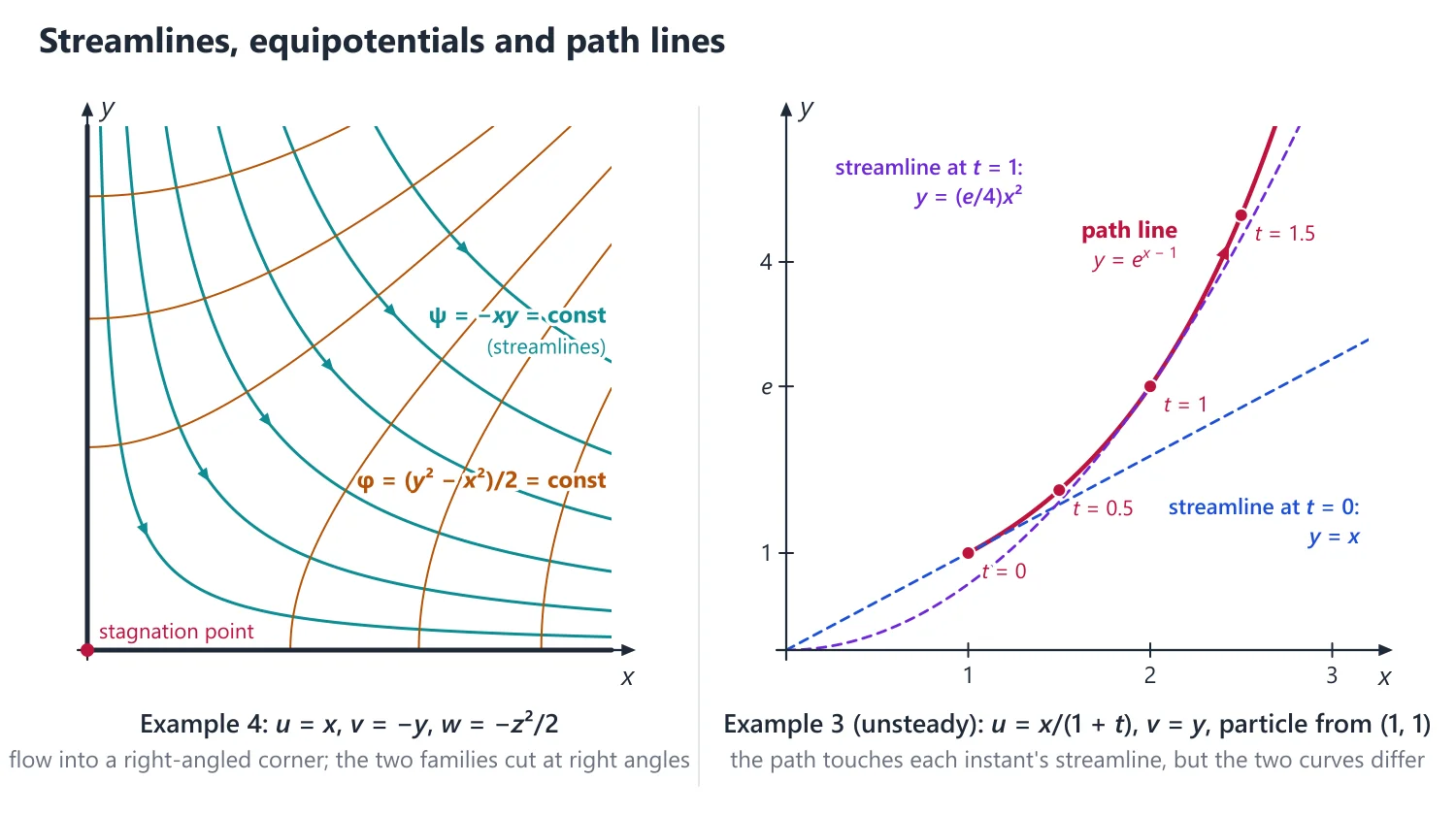
1. Understanding the Eulerian Description and the Material Derivative
Why we need it: a fluid contains so many particles that following each one is hopeless. Instead we describe the flow by what is measured at fixed points: the velocity field. But Newton's laws apply to particles, so we need a way to compute the rate of change experienced by a moving particle from a field that is given at fixed points.
In words: in the Eulerian description q(x, y, z, t) is the velocity of whichever particle happens to be at (x, y, z) at time t. For any quantity f(x, y, z, t) (temperature, density, a velocity component) the material derivative Df/Dt is its rate of change following one particle.
It has two parts: ∂f/∂t is the change seen by an instrument fixed at the point (the local change), and q·∇f = u∂f/∂x + v∂f/∂y + w∂f/∂z is the change caused by the particle moving to a place where f has a different value (the convective change).
First example, slowly: a river flows with uniform speed U along Ox, and its temperature is T(x, t) = T0 + αx − βt, with α, β positive constants.
Step 1: a thermometer fixed at one point records ∂T/∂t = −β: the water there is cooling.
Step 2: a particle moves downstream with u = U, into water that is warmer by α per unit length, so it gains u∂T/∂x = Uα per unit time.
Step 3: following the particle, DT/Dt = ∂T/∂t + u∂T/∂x = −β + Uα.
Step 4: interpret: if Uα = β, every fixed thermometer shows cooling, yet each particle keeps its own temperature; the pattern is merely carried downstream.
Step 5: the same rule applied to the velocity components gives the acceleration. For the steady flow u = x, v = −y: ax = ∂u/∂t + u∂u/∂x + v∂u/∂y = 0 + x·1 + (−y)·0 = x and ay = 0 + x·0 + (−y)(−1) = y. At (2, 3) the acceleration is (2, 3), although nothing changes at any fixed point.
Non-example: computing the acceleration as ∂q/∂t alone. For the steady flow u = x, v = −y this gives zero, which is wrong: particles speed up as they move away from the stagnation point at the origin. The partial derivative ∂/∂t is not the material derivative D/Dt.
Building up: along a particle path x(t), y(t), z(t) with ẋ = u, ẏ = v, ż = w, the chain rule gives df/dt = ∂f/∂t + ẋ∂f/∂x + ẏ∂f/∂y + ż∂f/∂z = Df/Dt ("Why it works" below).
Applied to ρ it enters the equation of continuity, Dρ/Dt + ρ∇·q = 0; applied to q it gives the acceleration Dq/Dt = ∂q/∂t + (q·∇)q of Euler's equation; applied to the equation F = 0 of a boundary it gives the condition DF/Dt = 0.
Where it is used: acceleration questions (Examples 1 and 11), the boundary condition at rigid and free surfaces, and every equation of motion of the next topic.
2. Describing Fluid Motion
Sign convention (used throughout this chapter): the velocity potential φ is defined by q = −∇φ, so u = −∂φ/∂x, v = −∂φ/∂y, w = −∂φ/∂z, as in the Indian textbooks of Raisinghania and Chorlton; books that use q = ∇φ have φ of the opposite sign.
Lagrangian description: follow each particle, r = r(r0, t). Eulerian description: give the velocity q = (u, v, w) as a function of position and time.
Idea: the Lagrangian description is a camera riding on one particle (a float released in a river); the Eulerian description is a set of fixed meters, each recording the velocity at its own point. Almost all problems use the Eulerian field q(x, y, z, t).
Material derivative: D/Dt = ∂/∂t + q·∇ = ∂/∂t + u∂/∂x + v∂/∂y + w∂/∂z; the acceleration is Dq/Dt = ∂q/∂t + (q·∇)q.
Why it works: a particle at (x(t), y(t), z(t)) has velocity q(x(t), y(t), z(t), t), with ẋ = u, ẏ = v, ż = w. By the chain rule its rate of change is ∂q/∂t + ẋ∂q/∂x + ẏ∂q/∂y + ż∂q/∂z = ∂q/∂t + (q·∇)q.
Idea: ∂q/∂t is the change seen by a fixed meter; (q·∇)q is the convective change from moving to a place where the velocity is different. So a steady flow can still accelerate its particles: u = x, v = −y is steady, yet Dq/Dt = (x, y) ≠ 0.
Steady flow: ∂/∂t = 0 at every fixed point; uniform flow: q is the same at every point at a given time.
Idea: steadiness depends on the observer: the flow round a body moving uniformly through still fluid is unsteady for a fixed observer but steady in axes moving with the body, which is why such problems are usually solved in the body's frame.
Example 1: For u = x2t, v = −2xyt, show that the flow is a possible incompressible flow and find the acceleration at (1, 1) when t = 1.
∂u/∂x + ∂v/∂y = 2xt − 2xt = 0.
ax = ∂u/∂t + u∂u/∂x + v∂u/∂y = x2 + 2x3t2, ay = ∂v/∂t + u∂v/∂x + v∂v/∂y = −2xy − 2x2yt2 + 4x2yt2 = −2xy + 2x2yt2.
At (1, 1), t = 1: the acceleration is (3, 0), of magnitude 3.
3. Understanding Streamlines and Path Lines
Why we need it: to picture a flow we draw curves, and there are two natural kinds: a snapshot of the directions of motion at one instant, and the actual tracks of particles. In unsteady flow these differ, and examiners test whether you know which equation gives which.
In words: a streamline at a fixed instant t0 is a curve whose tangent at every point is the velocity q(x, y, z, t0) there: solve dx/u = dy/v = dz/w with t frozen as a constant.
A path line is the trajectory of one particle: solve dx/dt = u(x, y, z, t), dy/dt = v, dz/dt = w with t as the variable, starting from the particle's initial position. A streak line joins, at one instant, all particles that have passed through a fixed point (a line of dye).
First example, slowly: the unsteady plane flow u = 1, v = t.
Step 1 (streamlines at time t0): dx/1 = dy/t0, so y = t0x + c: straight lines of slope t0. At t0 = 0 they are horizontal; at t0 = 1 they make 45° with Ox.
Step 2 (the path line of the particle at the origin at t = 0): dx/dt = 1 gives x = t, and dy/dt = t gives y = t2/2.
Step 3: eliminating t, the path is the parabola y = x2/2.
Step 4: compare: at t = 0 the particle at O moves along the streamline y = 0 (both have slope 0), but afterwards the streamlines turn while the particle's path bends gradually: the two families differ because the direction of the velocity changes with time.
Step 5 (the streak line through O): the particle released at O at time τ is at x = t − τ, y = (t2 − τ2)/2 at time t. Eliminating τ = t − x gives y = tx − x2/2, a third, different curve (at t = 1, y = x − x2/2).
Non-example: for u = 1, v = t, writing dy/dx = v/u = t and then putting t = x (because x = t along the particle) gives y = x2/2, which is the path line and not a streamline: t was allowed to vary. In streamline equations t must be held fixed.
Building up: in steady flow the direction field does not change, so path lines, streamlines and streak lines coincide; the converse is false, since a flow whose speed alone varies in time keeps the same streamlines ("Why it works" below).
In three dimensions two independent integrals F1 = c1, F2 = c2 of dx/u = dy/v = dz/w are needed, usually found with multipliers, and in polar coordinates the equations become dr/qr = r dθ/qθ.
Where it is used: the standard 10-mark parts "find the streamlines and path lines" (Examples 2, 3 and 8 to 10), and the vortex lines dx/ω1 = dy/ω2 = dz/ω3, found in exactly the same way.
4. Streamlines, Path Lines and Streak Lines
Streamline: a curve tangent at each point to the velocity at a fixed instant: dx/u = dy/v = dz/w with t held fixed.
Path line: the actual path of a particle: dx/dt = u(x, y, z, t), dy/dt = v, dz/dt = w, integrated from the particle's initial position.
Streak line: the locus at a given time of all particles that have passed through a fixed point (dye released from a point).
Idea: a streamline is a snapshot of the direction field at one instant; a path line is a long-exposure photograph of one particle; a streak line is a photograph of the smoke from a chimney. In unsteady flow these are three different families of curves (Example 3).
In steady flow streamlines, path lines and streak lines coincide.
Why it works: in steady flow the path-line equations dx/dt = u(x, y, z) have the same direction field as dx/u = dy/v = dz/w, so their solution curves coincide; every particle passing a fixed point then follows the same path, so the streak line is that path too.
The converse is false: q = f(t)(x, −y) is unsteady, but its direction never changes, so streamlines and path lines are the same curves xy = constant.
Example 2 (steady): u = x, v = −y: dx/x = dy/(−y) gives streamlines xy = constant; the path lines x = x0et, y = y0e−t lie on the same hyperbolas.
Example 3 (unsteady): u = x/(1 + t), v = y: streamlines at time t are y = Cx1 + t; the path line from (x0, y0) is x = x0(1 + t), y = y0et, that is y = y0ex/x0 − 1.
At t = 0 the streamline through (x0, y0) is the straight line y = (y0/x0)x, which differs from the path line.
5. Understanding the Equation of Continuity
Why we need it: in a flow without sources, mass is neither created nor destroyed. This one physical fact restricts which velocity fields can occur, and we need it as an equation in u, v, w and ρ.
In words: take any fixed closed surface in the fluid. The mass inside can change only because fluid crosses the surface. The equation ∂ρ/∂t + ∇·(ρq) = 0 is this mass budget per unit volume: ∇·(ρq) is the net rate at which mass flows out of a unit volume.
For a liquid (incompressible fluid) it becomes ∇·q = 0: there is no net outflow of volume from any small region, whatever goes in comes out.
First example, slowly: a flow along Ox with velocity u(x) in a tube of constant cross-section A, density constant.
Step 1: consider the slice between x and x + δx. Mass enters through the face at x at the rate ρuA.
Step 2: mass leaves through the face at x + δx at the rate ρ(u + (du/dx)δx)A, to first order.
Step 3: the net outflow is ρ(du/dx)δx A = ρ(du/dx)δV.
Step 4: the fluid is incompressible and the slice cannot gain or lose mass, so du/dx = 0: the speed is the same all along a tube of constant section.
Step 5: in three dimensions the three pairs of faces of a small box add their net outflows, giving ∂u/∂x + ∂v/∂y + ∂w/∂z = 0.
Step 6: test it: u = x, v = y, w = −2z gives 1 + 1 − 2 = 0, a possible motion of a liquid; u = x, v = y, w = z gives 3 ≠ 0, which would need fluid to be created at every point.
Non-example: the plane polar field qr = 1/r, qθ = 0 checked with the Cartesian-looking formula ∂qr/∂r = −1/r2 ≠ 0 seems impossible. The correct polar divergence is (1/r)∂(rqr)/∂r = (1/r)∂(1)/∂r = 0, so it is a possible flow, a line source; the error is using the Cartesian form for polar components.
Building up: for a fixed volume V, d/dt∭ρ dV equals minus the outflow ∬ρq·n dS, and Gauss's theorem turns the outflow into ∭∇·(ρq) dV; since V is arbitrary the integrand vanishes ("Why it works" below).
Expanding ∇·(ρq) = q·∇ρ + ρ∇·q gives the material form Dρ/Dt + ρ∇·q = 0. In curvilinear coordinates the area factors r and r2sin θ appear inside the derivatives.
Where it is used: "is this a possible motion of a liquid?", finding a missing velocity component (Example 11), proving that a stream function exists (continuity is exactly its exactness condition), and the derivation itself, a frequent 15-mark theory question.
6. Equation of Continuity
Conservation of mass for any fixed volume gives ∂ρ/∂t + ∇·(ρq) = 0, equivalently Dρ/Dt + ρ∇·q = 0.
Why it works: for a fixed volume V with surface S and outward normal n, the mass inside decreases at the rate of outflow: d/dt∭Vρ dV = −∬Sρq·n dS = −∭V∇·(ρq) dV by Gauss's divergence theorem.
So ∭V[∂ρ/∂t + ∇·(ρq)] dV = 0 for every V, and a continuous integrand whose integral over every volume is zero must vanish. Expanding ∇·(ρq) = q·∇ρ + ρ∇·q gives the second form.
Idea: ∇·q is the rate of expansion per unit volume of a fluid element, (1/δV)D(δV)/Dt. Incompressible means every element keeps its volume, Dρ/Dt = 0; it does not mean that ρ is the same everywhere (a layered ocean is incompressible but not homogeneous).
Incompressible fluid (Dρ/Dt = 0): ∇·q = ∂u/∂x + ∂v/∂y + ∂w/∂z = 0.
Cylindrical (r, θ, z): ∂ρ/∂t + (1/r)∂(ρrqr)/∂r + (1/r)∂(ρqθ)/∂θ + ∂(ρqz)/∂z = 0.
Spherical (r, θ, φ): ∂ρ/∂t + (1/r2)∂(ρr2qr)/∂r + (1/(r sin θ))∂(ρqθ sin θ)/∂θ + (1/(r sin θ))∂(ρqφ)/∂φ = 0.
Idea: the factors r and r2 sin θ are the area factors of the coordinate surfaces: for steady radial flow from a point source the flux 4πr2qr through every sphere is the same, so (1/r2)∂(r2qr)/∂r = 0 gives qr ∝ 1/r2.
Boundary condition: a surface F(x, y, z, t) = 0 that always consists of the same fluid particles (such as a rigid or free boundary) satisfies DF/Dt = 0, so the normal velocity of the fluid equals that of the surface.
Why it works: a particle on the surface stays on it, so F(x(t), y(t), z(t), t) = 0 for all t and DF/Dt = ∂F/∂t + q·∇F = 0. Dividing by |∇F|, q·n = −(∂F/∂t)/|∇F|, which is the normal speed of the surface itself.
For a fixed sphere r = a this gives qr = 0 on r = a; for a sphere whose centre moves with velocity U along Ox, F = (x − Ut)2 + y2 + z2 − a2 gives q·n = U nx.
7. Understanding the Velocity Potential and the Stream Function
Why we need it: a velocity field has three components. If one scalar function could describe it, problems would become far easier. Two situations allow this: a flow without vorticity has a velocity potential φ, and a two-dimensional incompressible flow has a stream function ψ. When both hold, φ + iψ is an analytic function and complex analysis takes over.
In words: the vorticity ω = ∇ × q measures the local spin of fluid elements, and the flow is irrotational when ω = 0. Then, in a simply connected region, there is a function φ with q = −∇φ (the convention of this chapter: fluid flows from higher to lower φ, as heat flows from higher to lower temperature).
For a plane incompressible flow the stream function ψ is defined by u = −∂ψ/∂y, v = ∂ψ/∂x; it is constant along each streamline, and the difference of its values on two streamlines is the volume flux between them.
First example, slowly: the plane flow u = 2x, v = −2y.
Step 1 (continuity): ∂u/∂x + ∂v/∂y = 2 − 2 = 0, so ψ exists.
Step 2 (vorticity): ∂v/∂x − ∂u/∂y = 0 − 0 = 0, so φ exists.
Step 3 (φ): −∂φ/∂x = 2x gives φ = −x2 + f(y); then −∂φ/∂y = −f′(y) must equal v = −2y, so f = y2 and φ = y2 − x2.
Step 4 (ψ): ∂ψ/∂x = v = −2y gives ψ = −2xy + g(y); then −∂ψ/∂y = 2x − g′(y) must equal u = 2x, so g is constant and ψ = −2xy.
Step 5 (check): w = φ + iψ = −(x2 − y2 + 2ixy) = −z2, an analytic function, and dw/dz = −2z = −2x − 2iy, which is −u + iv as it should be.
Step 6: the streamlines xy = constant and the equipotentials x2 − y2 = constant are two families of rectangular hyperbolas that cut at right angles.
Non-example: the shear flow u = y, v = 0 satisfies continuity, so it has the stream function ψ = −y2/2; but ∂v/∂x − ∂u/∂y = −1 ≠ 0, so it has no velocity potential. Indeed −∂φ/∂x = y gives φ = −xy + f(y), and then −∂φ/∂y = x − f′(y) would have to vanish for every x, which is impossible.
Building up: q·dr = −dφ, so φ(P) = −∫q·dr, which is independent of the path by Stokes' theorem exactly when ∇ × q = 0 in a simply connected region. Continuity then gives Laplace's equation ∇2φ = 0.
In two dimensions the defining relations of φ and ψ are the Cauchy–Riemann equations, ∇2ψ equals the vorticity, and the two families of curves are orthogonal (all under "Why it works" below).
Where it is used: finding φ and ψ (Examples 4 to 13), Milne-Thomson's method, and the complex potential of the topic on two-dimensional motion; Laplace's equation links this topic to the PDE chapter.
8. Vorticity and Potential Flow
Vorticity ω = ∇ × q; the flow is irrotational if ω = 0.
Idea: vorticity is twice the local angular velocity of a fluid element: for rigid rotation u = −Ωy, v = Ωx, ω = 2Ωk. It is not about the shape of the streamlines: the line vortex q = k/r (Example 5) has circular streamlines and ω = 0, while the shear flow u = y, v = 0 has straight streamlines and ω = −k ≠ 0.
Irrotational flow (∇ × q = 0) in a simply connected region has a velocity potential φ with q = −∇φ, since the curl of a gradient vanishes.
Why it works: with q = −∇φ, q·dr = −dφ, so φ(P) = −∫OPq·dr. By Stokes' theorem this integral is independent of the path exactly when ∇ × q = 0 and every closed curve in the region bounds a surface inside it (simple connectivity).
Outside a cylinder this fails: the line vortex has φ = −kθ, which changes by −2πk round each circuit of the cylinder, so φ is many-valued.
For incompressible irrotational flow, ∇·q = 0 gives Laplace's equation ∇2φ = 0.
Stream function (2D incompressible): u = −∂ψ/∂y, v = ∂ψ/∂x satisfy continuity identically and match q = −∇φ, so that φ + iψ is analytic; ψ is constant along streamlines, and the volume flux between two streamlines equals the difference of their ψ values in magnitude.
Why it works: v dx − u dy is an exact differential dψ exactly when ∂v/∂y = ∂(−u)/∂x, i.e. ∂u/∂x + ∂v/∂y = 0, which is continuity; then ψx = v and ψy = −u. Along a streamline dx/u = dy/v, so v dx − u dy = 0 and dψ = 0.
The flux across a curve from A to B, with n = (dy, −dx)/ds, is ∫(u dy − v dx) = −∫ABdψ = ψ(A) − ψ(B).
In irrotational 2D flow ψ is also harmonic, and the curves φ = constant and ψ = constant cut orthogonally.
Why it works: ∇2ψ = ψxx + ψyy = ∂v/∂x − ∂u/∂y, the vorticity, so ψ is harmonic exactly when the flow is irrotational. Orthogonality: ∇φ·∇ψ = φxψx + φyψy = ψyψx − ψxψy = 0 by the Cauchy–Riemann equations.
Example 4: u = x, v = −y has ∇·q = 0 and ω = 0; −∂φ/∂x = x, −∂φ/∂y = −y give φ = (y2 − x2)/2, and ∂ψ/∂x = −y, −∂ψ/∂y = x give ψ = −xy, so w = φ + iψ = −z2/2: flow in a right-angled corner.
Example 5: q = (−ky/(x2 + y2), kx/(x2 + y2), 0) has ∇·q = 0 and is irrotational except at the origin; φ = −kθ, ψ = k log r and w = ik log z, a line vortex of anticlockwise circulation 2πk.
Example 6: Show that u = −2xyz/(x2 + y2)2, v = (x2 − y2)z/(x2 + y2)2, w = y/(x2 + y2) is a possible irrotational motion of an incompressible fluid, and find φ.
Try φ = −yz/(x2 + y2): −∂φ/∂x = −2xyz/(x2 + y2)2 = u, −∂φ/∂y = z(x2 − y2)/(x2 + y2)2 = v, −∂φ/∂z = y/(x2 + y2) = w.
So q = −∇φ and the motion is irrotational wherever x2 + y2 ≠ 0, since curl grad = 0.
∇·q = −∇2φ, and φ = −z · y/(x2 + y2) is z times a 2D harmonic function (the imaginary part of 1/z̄), so ∇2φ = 0 and the motion satisfies continuity.
9. Choosing the Method
If asked whether a motion is possible for a liquid → check ∇·q = 0 using the divergence formula of the coordinates in which q is given; for a gas use the full equation of continuity with ρ.
If asked whether it is irrotational, or to find φ → compute ∇ × q; if it is zero, integrate −∂φ/∂x = u and fix the arbitrary function from v and w.
If φ is given → q = −∇φ, and it is a possible liquid motion exactly when ∇2φ = 0.
If φ is given in 2D and ψ is wanted → use ∂ψ/∂y = ∂φ/∂x, ∂ψ/∂x = −∂φ/∂y, or Milne-Thomson: w′(z) = φx(z, 0) − iφy(z, 0), integrate, and take the imaginary part.
If streamlines are wanted → solve dx/u = dy/v = dz/w with t held fixed (in polars dr/qr = r dθ/qθ); for path lines integrate dx/dt = u, dy/dt = v with t varying.
If an acceleration is wanted → Dq/Dt with the convective terms; in plane polars the components are Dqr/Dt − qθ2/r and Dqθ/Dt + qrqθ/r.
10. Common Mistakes
Mixing sign conventions. This chapter uses q = −∇φ; copying a formula from a book with q = ∇φ changes the sign of φ and ψ. State the convention at the start of every answer.
Cartesian divergence for polar components. In polars ∇·q = (1/r)∂(rqr)/∂r + (1/r)∂qθ/∂θ, not ∂qr/∂r + ∂qθ/∂θ.
Letting t vary in streamline equations. For unsteady flow that produces path lines, not streamlines.
Dropping arbitrary functions. Integrating ∂w/∂z in z gives + f(x, y); finding ψ from ∂ψ/∂y gives + g(x), which must then be fixed from the other equation (Examples 11 and 13).
Judging rotation from the picture. Circular streamlines do not imply vorticity, and straight ones do not rule it out; compute ∇ × q.
Zero circulation round a singularity. Round a curve enclosing a vortex or the axis of a cylinder Γ can be non-zero even though ∇ × q = 0 in the fluid, because φ is many-valued there.
Link: continuity is the divergence theorem and circulation is Stokes' theorem (vector analysis); irrotational flow is a conservative field, and φ exists by the same exactness test as for a conservative force.
Link: w = φ + iψ is analytic, so φ and ψ are harmonic conjugates found by the Cauchy–Riemann equations or Milne-Thomson's method (complex analysis); the streamline equations dx/u = dy/v = dz/w are Lagrange's auxiliary equations of a first-order linear PDE, solved with the same multipliers (PDE chapter).
11. Streamlines in Three Dimensions, Circulation and Potentials
Streamlines in 3D: solve dx/u = dy/v = dz/w for two independent integrals F1 = c1, F2 = c2; the streamlines are their intersections. In spherical polars use dr/qr = r dθ/qθ = r sin θ dφ/qφ.
Circulation round a closed curve C: Γ = ∮Cq·dr = ∬S(∇ × q)·n dS (Stokes' theorem); if q = −∇φ with φ single-valued on C, then Γ = 0.
Idea: circulation measures the net swirl carried round a loop. For a line vortex Γ = 2πk round every loop that encloses the axis, although ω = 0 at every point of the fluid; Stokes' theorem is not contradicted, because such a loop bounds no surface lying wholly in the fluid.
Curl in spherical polars for axisymmetric flow (qφ = 0): the only component is (1/r)[∂(rqθ)/∂r − ∂qr/∂θ].
Finding φ: integrate −∂φ/∂x = u in x, then fix the arbitrary function from the other components. Finding ψ in 2D: use ∂ψ/∂y = ∂φ/∂x and ∂ψ/∂x = −∂φ/∂y (the Cauchy–Riemann equations of w = φ + iψ).
Example 7 (UPSC 2016, 10 marks): Does a fluid with velocity q⃗ = [z − 2x/r, 2y − 3z − 2y/r, x − 3y − 2z/r] possess vorticity, where q⃗(u, v, w) is the velocity in the Cartesian frame, r⃗ = (x, y, z) and r2 = x2 + y2 + z2? What is the circulation in the circle x2 + y2 = 9, z = 0?
Write q = (z, 2y − 3z, x − 3y) − 2r⃗/r; the second part is −2∇r, whose curl is zero.
For the first part curl = (∂w/∂y − ∂v/∂z, ∂u/∂z − ∂w/∂x, ∂v/∂x − ∂u/∂y) = (−3 + 3, 1 − 1, 0 − 0) = 0, so ∇ × q = 0 for r ≠ 0.
Indeed q = −∇φ with φ = 2r − xz − y2 + 3yz, which is single-valued on the circle x2 + y2 = 9, z = 0 (where r = 3 ≠ 0), so Γ = −∮dφ = 0.
Answer: the fluid has no vorticity (the motion is irrotational), and the circulation round the circle is 0.
Example 8 (UPSC 2017, 15 marks): If the velocity of an incompressible fluid at the point (x, y, z) is given by
(3xz/r5, 3yz/r5, (3z2 − r2)/r5), r2 = x2 + y2 + z2,
then prove that the liquid motion is possible and that the velocity potential is z/r3. Further, determine the streamlines.
With φ = z/r3: −∂φ/∂x = 3xz/r5, −∂φ/∂y = 3yz/r5, −∂φ/∂z = −1/r3 + 3z2/r5 = (3z2 − r2)/r5, which are u, v, w; so q = −∇φ.
∇·q = −∇2φ = 0, since z/r3 = −∂(1/r)/∂z and 1/r is harmonic for r ≠ 0; so the liquid motion is possible (and irrotational).
Streamlines: dx/(3xz) = dy/(3yz) gives y = c1x (planes through Oz); in spherical polars φ = cos θ/r2, qr = 2cos θ/r3, qθ = sin θ/r3, so dr/(2cos θ) = r dθ/sin θ and r = c2sin2θ.
Answer: φ = z/r3 (a doublet along Oz); streamlines y = c1x, (x2 + y2 + z2)3 = c(x2 + y2)2.
Example 9 (UPSC 2022, 10 marks): The velocity components of an incompressible fluid in spherical polar coordinates (r, θ, ψ) are (2Mr−3 cos θ, Mr−2 sin θ, 0), where M is a constant. Show that the velocity is of the potential kind. Find the velocity potential and the equations of the streamlines.
[As printed, qθ = Mr−2sin θ is dimensionally inconsistent with qr and fails continuity; the intended field (2Mr−3cos θ, Mr−3sin θ, 0) is solved.]
Continuity: (1/r2)∂(r2qr)/∂r + (1/(r sin θ))∂(qθsin θ)/∂θ = −2M cos θ/r4 + 2M cos θ/r4 = 0.
Curl: (1/r)[∂(rqθ)/∂r − ∂qr/∂θ] = (1/r)[−2M sin θ/r3 + 2M sin θ/r3] = 0, so the velocity is of potential kind; −∂φ/∂r = 2M cos θ/r3, −(1/r)∂φ/∂θ = M sin θ/r3 give φ = M cos θ/r2.
Streamlines: dr/(2cos θ) = r dθ/sin θ, so dr/r = 2cot θ dθ and r = c sin2θ, lying in the planes ψ = constant.
Answer: φ = M cos θ/r2 (a three-dimensional doublet); streamlines r = c sin2θ, ψ = constant.
Example 10 (UPSC 2024, 10 marks): The velocity potential φ of a flow is given by
φ = (1/2)(x2 + y2 − 2z2).
Determine the streamlines.
q = −∇φ = (−x, −y, 2z), and ∇2φ = 1 + 1 − 2 = 0, so this is a possible incompressible flow.
dx/(−x) = dy/(−y) = dz/(2z): the first pair gives y = Ax; the first and third give −2 log x = log z + constant, i.e. x2z = B.
Answer: the streamlines are the curves y = Ax, x2z = B (equivalently (x2 + y2)z = constant in each plane y = Ax).
12. Continuity and Stream-Function Problems
Example 11 (UPSC 2018, 10 marks): For an incompressible fluid flow, two components of velocity (u, v, w) are given by u = x2 + 2y2 + 3z2, v = x2y − y2z + zx. Determine the third component w so that they satisfy the equation of continuity. Also, find the z-component of acceleration.
Continuity: ∂w/∂z = −(∂u/∂x + ∂v/∂y) = −(2x + x2 − 2yz), so w = −2xz − x2z + yz2 + f(x, y); take f = 0, the simplest choice.
The flow is steady, so az = Dw/Dt = u ∂w/∂x + v ∂w/∂y + w ∂w/∂z, with ∂w/∂x = −2z(1 + x), ∂w/∂y = z2, ∂w/∂z = 2yz − 2x − x2.
Answer: w = yz2 − 2xz − x2z (+ f(x, y)); az = −2z(1 + x)(x2 + 2y2 + 3z2) + z2(x2y − y2z + zx) + (yz2 − 2xz − x2z)(2yz − 2x − x2).
Example 12 (UPSC 2018, 15 marks): For a two-dimensional potential flow, the velocity potential is given by φ = x2y − xy2 + (1/3)(x3 − y3). Determine the velocity components along the directions x and y. Also, determine the stream function ψ and check whether φ represents a possible case of flow or not.
u = −∂φ/∂x = −(x2 + 2xy − y2), v = −∂φ/∂y = −(x2 − 2xy − y2).
∇2φ = (2x + 2y) + (−2x − 2y) = 0, so ∇·q = 0 and φ represents a possible (incompressible, irrotational) flow.
∂ψ/∂y = ∂φ/∂x = x2 + 2xy − y2 gives ψ = x2y + xy2 − y3/3 + g(x); then ∂ψ/∂x = 2xy + y2 + g′(x) = −∂φ/∂y = −x2 + 2xy + y2, so g = −x3/3.
Answer: u = −(x2 + 2xy − y2), v = 2xy + y2 − x2; ψ = x2y + xy2 − (x3 + y3)/3; the flow is possible. (With the convention q = ∇φ, u, v and ψ change sign.)
Example 13 (UPSC 2020, 15 marks): A velocity potential in a two-dimensional fluid flow is given by φ(x, y) = xy + x2 − y2. Find the stream function for this flow.
∇2φ = 2 − 2 = 0, so a stream function exists; ∂ψ/∂y = ∂φ/∂x = y + 2x and ∂ψ/∂x = −∂φ/∂y = 2y − x.
The first gives ψ = y2/2 + 2xy + g(x); the second then gives 2y + g′(x) = 2y − x, so g = −x2/2.
Answer: ψ = 2xy + (y2 − x2)/2 + constant; indeed w = φ + iψ = (1 − i/2)z2.
13. Practice Exercises
Exercise 1 (basic): Is u = x2 − y2, v = −2xy, w = 0 a possible motion of a liquid? Is it irrotational?
Answer: ∇·q = 2x − 2x = 0, so it is possible; ∂v/∂x − ∂u/∂y = −2y + 2y = 0, so it is irrotational.
Exercise 2 (basic): Find the streamlines of the plane flow u = y, v = x.
Answer: dx/y = dy/x gives x dx = y dy, so x2 − y2 = constant (rectangular hyperbolas).
Exercise 3 (basic): Find the acceleration at the point (1, 2) of the steady flow u = y, v = x.
Answer: ax = u∂u/∂x + v∂u/∂y = x and ay = u∂v/∂x + v∂v/∂y = y, so the acceleration is (1, 2).
Exercise 4 (standard): For the unsteady flow u = x(1 + t), v = y, find the streamlines at time t and the path line of the particle that is at (1, 1) when t = 0.
Answer: streamlines y = Cx1/(1 + t); path line x = et + t2/2, y = et, that is x = y1 + (log y)/2.
Exercise 5 (standard): With q = −∇φ, a plane flow has φ = log r. Describe the flow and find ψ and the complex potential.
Answer: qr = −1/r, qθ = 0: a unit line sink at the origin (volume flux 2π inward per unit length); ψ = θ and w = log z.
Exercise 6 (standard): In spherical polars, qr = −U(1 − a3/r3)cos θ, qθ = U(1 + a3/(2r3))sin θ, qφ = 0. Show that this is a possible irrotational motion of a liquid, find φ, and identify the flow.
Answer: the divergence terms −U(2/r + a3/r4)cos θ and +U(2/r + a3/r4)cos θ cancel, and the curl component vanishes; φ = U(r + a3/(2r2))cos θ: a uniform stream of speed U in the −x direction past a fixed sphere r = a (qr = 0 there).
Exercise 7 (standard): Find the circulation round the square with vertices (±1, ±1) for the flow u = −y, v = x, both directly and by Stokes' theorem.
Answer: each side contributes 2, so Γ = 8; by Stokes, the vorticity is 2 and the area is 4, so Γ = 8.
Exercise 8 (UPSC level): Show that q = (y + z, z + x, x + y) is a possible irrotational motion of a liquid, find φ, and find the streamlines.
Answer: ∇·q = 0 and ∇ × q = 0; φ = −(xy + yz + zx); with the multipliers (1, −1, 0), (0, 1, −1) and (1, 1, 1), the streamlines are (x − y)/(y − z) = c1 and (x − y)2(x + y + z) = c2.
Exercise 9 (UPSC level): A sphere of radius R(t) expands in an infinite liquid with its centre fixed. Use continuity to find the radial velocity at distance r, and find the acceleration of the liquid there.
Answer: r2q = R2Ṙ, so q = R2Ṙ/r2; Dq/Dt = ∂q/∂t + q∂q/∂r = (2RṘ2 + R2R̈)/r2 − 2R4Ṙ2/r5.
Exercise 10 (UPSC level): A plane flow has stream function ψ = x2y − y3/3 (convention u = −∂ψ/∂y, v = ∂ψ/∂x). Find the velocity, show that the flow is irrotational, and find φ and the complex potential.
Answer: u = y2 − x2, v = 2xy; ∇2ψ = 2y − 2y = 0, so the flow is irrotational; φ = x3/3 − xy2 and w = z3/3.
| Line | Definition | Equations |
|---|---|---|
| Streamline | Tangent to q at a fixed instant | dx/u = dy/v = dz/w (t fixed) |
| Path line | Trajectory of one particle | dx/dt = u, dy/dt = v, dz/dt = w |
| Streak line | Particles that passed through one fixed point | Path lines through the point, at the current time |
| Vortex line | Tangent to ω at a fixed instant | dx/ω1 = dy/ω2 = dz/ω3 |
Mains points
- Derivation of the equation of continuity (Cartesian, cylindrical or spherical form) is one of the most frequently asked fluid dynamics theory questions.
- Questions often give a velocity field and ask whether it is a possible incompressible flow, whether it is irrotational, and to find the streamlines and path lines.
- When finding φ or ψ, state the sign convention you use at the start and keep it throughout.
- For unsteady flows, show clearly that streamlines are found with t fixed and path lines by integrating in t; the difference is the point of the question.
- Common mistake: forgetting the 1/r and 1/(r sin θ) factors in curvilinear forms of divergence and curl.
Did you know?
- Smoke from a chimney on a gusty day traces a streak line, not a streamline or path line; only on a perfectly steady day would all three coincide.
Euler's Equation, Bernoulli's Theorem and the Navier–Stokes Equation
For an inviscid fluid, Newton's law applied to a fluid element gives Euler's equation Dq/Dt = F − (1/ρ)∇p. With conservative forces and a barotropic fluid it integrates to Bernoulli's equation, along streamlines for steady flow and everywhere for irrotational flow. Adding viscous stresses for a Newtonian fluid gives the Navier–Stokes equation ρDq/Dt = ρF − ∇p + μ∇2q (incompressible), whose exact solutions include Couette and Poiseuille flows.
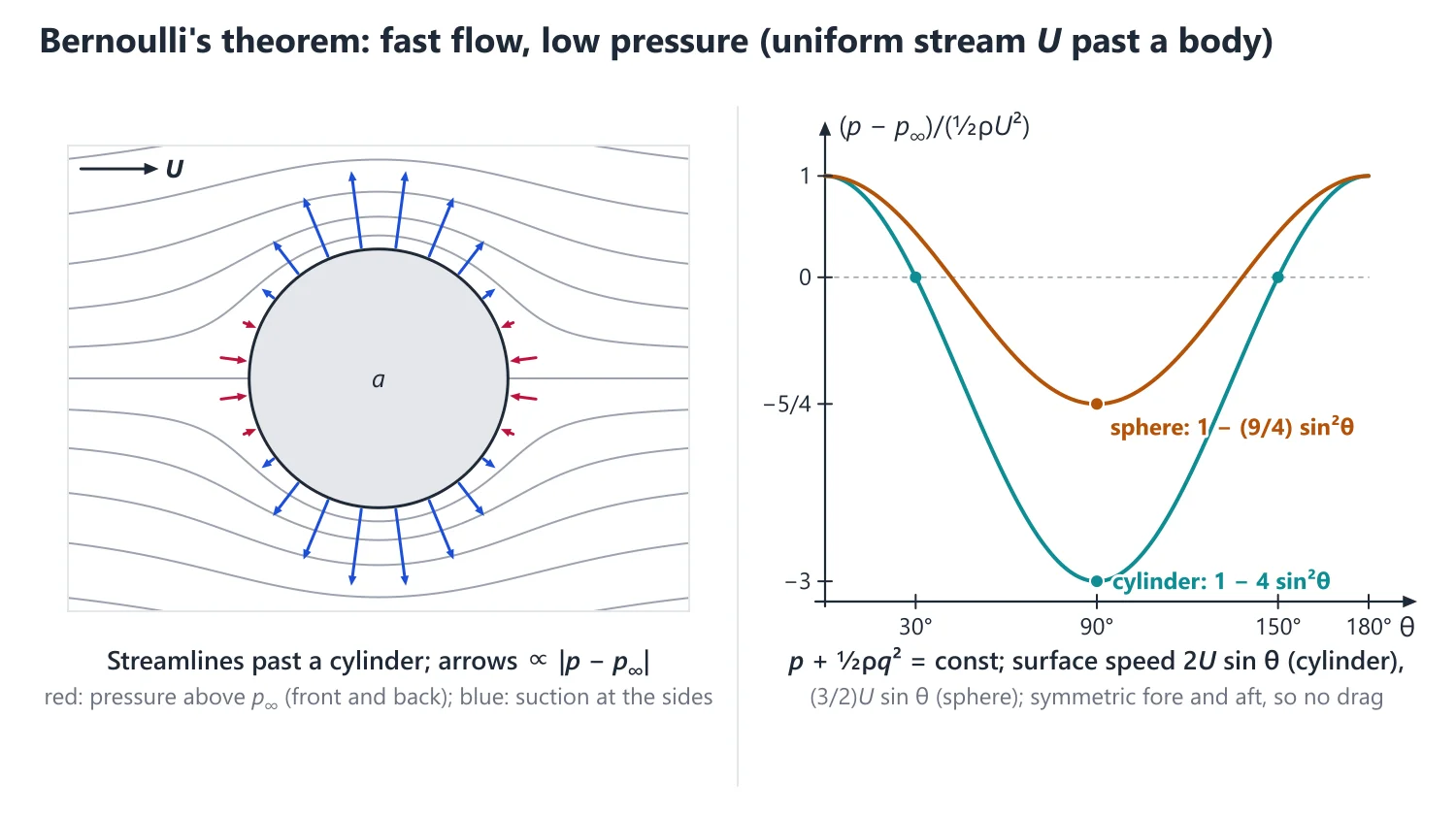
1. Understanding Euler's Equation of Motion
Why we need it: kinematics tells us which flows are possible; dynamics tells us which flow actually occurs under given forces, and how the pressure is distributed. Euler's equation is Newton's second law for a small parcel of inviscid fluid.
In words: Dq/Dt = F − (1/ρ)∇p. The left side is the acceleration of the parcel, including the convective part (q·∇)q. F is the body force per unit mass, for example (0, 0, −g) for gravity with Oz upward. −(1/ρ)∇p is the net pressure force per unit mass: pressure pushes from higher to lower pressure, so the force points down the pressure gradient.
"Inviscid" means that the only surface force is the pressure, which acts normally to every surface element; there is no tangential (frictional) stress.
First example, slowly: liquid at rest in a container under gravity, with Oz vertically upward.
Step 1: q = 0 everywhere, so Dq/Dt = 0.
Step 2: Euler's equation gives 0 = −(1/ρ)∂p/∂x, 0 = −(1/ρ)∂p/∂y and 0 = −g − (1/ρ)∂p/∂z.
Step 3: so p depends on z only, with dp/dz = −ρg, and p = p0 − ρgz. At depth h below a free surface where p = pa, p = pa + ρgh: the hydrostatic law.
Step 4: now let the container move with constant horizontal acceleration a along Ox, the liquid being at rest relative to it. Then Dq/Dt = (a, 0, 0), so a = −(1/ρ)∂p/∂x and 0 = −g − (1/ρ)∂p/∂z.
Step 5: integrating, p = p0 − ρax − ρgz. The free surface p = p0 is the plane z = −(a/g)x, tilted at the angle tan−1(a/g) to the horizontal, lower at the front.
Non-example: for the steady flow u = x, v = −y with no body force it is tempting to say "steady, so no acceleration, so the pressure is uniform". This is wrong: Dq/Dt = (x, y) ≠ 0, so ∇p = −ρ(x, y) and p = p0 − (1/2)ρ(x2 + y2), greatest at the stagnation point.
Building up: for a material volume, the rate of change of momentum equals the body force plus the pressure force −∬pn dS. Gauss's theorem turns the surface integral into −∭∇p dV, and since the volume is arbitrary the integrands balance pointwise (Section 3).
The identity (q·∇)q = ∇(q2/2) − q × ω then gives Lamb's form, from which Bernoulli's equations follow.
Where it is used: derivation questions (vector and component forms), pressure in rotating or accelerating liquids (Example 5), and the starting point of Bernoulli's equation and Kelvin's circulation theorem.
2. Euler's Equation of Motion
Forces on a fluid element: body force F per unit mass, and pressure p, which in an inviscid fluid acts normally and is the same in all directions at a point.
Why the pressure is the same in all directions: balance the forces on a small tetrahedron of size ε with three faces on the coordinate planes. The surface forces are of order ε2, while the body force and the mass times acceleration are of order ε3; letting ε → 0 leaves px = py = pz = pn, provided there is no tangential stress (fluid at rest or inviscid).
Euler's equation: Dq/Dt = ∂q/∂t + (q·∇)q = F − (1/ρ)∇p.
Component form: ∂u/∂t + u∂u/∂x + v∂u/∂y + w∂u/∂z = X − (1/ρ)∂p/∂x, and similarly for v and w.
Lamb's form: using (q·∇)q = ∇(q2/2) − q × ω, ∂q/∂t − q × ω = F − (1/ρ)∇p − ∇(q2/2).
Idea: the identity (q·∇)q = ∇(q2/2) − q × (∇ × q) splits the convective acceleration into the gradient of the kinetic energy per unit mass and a vortex term. The vortex term vanishes in irrotational flow, and that is what makes Bernoulli's equation hold throughout such a flow.
Derivation outline: for a material volume V, d/dt∭ρq dV = ∭ρF dV − ∬p n dS; Gauss's theorem and continuity give the pointwise equation.
3. Derivation: Euler's Equation
Euler (integral form): for a material volume V(t) with surface S, Newton's second law reads d/dt∭Vρq dV = ∭VρF dV − ∬Spn dS.
The mass ρ dV of each element is constant in time, so d/dt∭ρq dV = ∭ρ(Dq/Dt) dV. Gauss's theorem in gradient form gives ∬Spn dS = ∭V∇p dV.
Hence ∭V[ρDq/Dt − ρF + ∇p] dV = 0 for every V, so the integrand vanishes: Dq/Dt = F − (1/ρ)∇p.
Euler (elementary box): on a box δx δy δz the pressure force in the x-direction is p δy δz − (p + (∂p/∂x)δx)δy δz = −(∂p/∂x)δV; dividing ρδV Du/Dt = ρXδV − (∂p/∂x)δV by ρδV gives the x-component.
4. Understanding Bernoulli's Equation
Why we need it: Euler's equation is a vector partial differential equation, but usually we only want the pressure at some point once the speed is known. Under suitable hypotheses Euler's equation can be integrated once, into an algebraic relation between pressure, speed and height.
In words: for steady flow of an inviscid incompressible fluid under gravity (potential gz per unit mass, Oz upward), p/ρ + q2/2 + gz is constant along each streamline. Each term is an energy per unit mass: the work of pressure, the kinetic energy and the potential energy.
If the flow is also irrotational, the same constant holds throughout the fluid. For unsteady irrotational flow (with q = −∇φ) the term −∂φ/∂t is added and the constant becomes a function of t alone.
First example, slowly: water (ρ = 1000 kg/m3) flows steadily in a horizontal pipe that narrows from cross-section A1 = 0.02 m2 to A2 = 0.01 m2; the speed in the wide part is q1 = 2 m/s. Find the pressure difference.
Step 1 (continuity): A1q1 = A2q2, so q2 = 0.02 × 2/0.01 = 4 m/s.
Step 2 (Bernoulli along a streamline, same height): p1/ρ + q12/2 = p2/ρ + q22/2.
Step 3: p1 − p2 = (ρ/2)(q22 − q12) = 500 × (16 − 4) = 6000 Pa.
Step 4: notice that the pressure is lower where the speed is higher: the fluid is accelerated into the narrow part by the excess pressure behind it.
Step 5: reversing the argument, measuring p1 − p2 gives the discharge Q = A1A2√(2(p1 − p2)/(ρ(A12 − A22))) = 0.04 m3/s here, which is the principle of the Venturi meter.
Non-example: in viscous flow along a uniform horizontal pipe (Poiseuille flow) the speed and the height are the same at both ends, so Bernoulli would predict equal pressures; in fact the pressure falls steadily along the pipe to overcome viscosity. Bernoulli fails because the fluid is not inviscid, so Euler's equation, from which Bernoulli is derived, does not hold.
Building up: with F = −∇Ω and a barotropic fluid, Lamb's form reads ∂q/∂t − q × ω = −∇(P + q2/2 + Ω). For steady flow, dotting with q kills the q × ω term along a streamline; for irrotational flow that term is zero everywhere; with q = −∇φ the left side becomes −∇(∂φ/∂t) ("Proof" lines below).
For a gas P = ∫dp/ρ replaces p/ρ, for example P = K log ρ for isothermal flow.
Where it is used: pressure on a cylinder or a sphere, Torricelli's theorem and the emptying of tanks, the pressure in a vortex, and the pressure equation for expanding bubbles and vibrating spheres (Example 12).
5. Bernoulli's Equations
Assume a conservative body force F = −∇Ω and a barotropic fluid ρ = ρ(p), and put P = ∫dp/ρ (P = p/ρ for an incompressible fluid).
Steady flow: P + q2/2 + Ω = constant along each streamline (and along each vortex line).
Steady irrotational flow: the constant is the same throughout the fluid.
Unsteady irrotational flow (q = −∇φ): −∂φ/∂t + q2/2 + Ω + P = f(t) throughout the fluid.
Derivation of Bernoulli: with F = −∇Ω and a barotropic fluid, (1/ρ)∇p = ∇P because dP = dp/ρ(p). Lamb's form becomes ∂q/∂t − q × ω = −∇B, where B = P + q2/2 + Ω.
Proof, steady flow: ∇B = q × ω. Dotting with q, q·∇B = 0, so B is constant along each streamline; dotting with ω, B is constant along each vortex line.
Proof, steady irrotational flow: ω = 0 gives ∇B = 0, so B is the same constant everywhere.
Proof, unsteady irrotational flow: q = −∇φ gives ∂q/∂t = −∇(∂φ/∂t), so ∇(−∂φ/∂t + B) = 0 and −∂φ/∂t + q2/2 + Ω + P depends on t only.
Idea: Bernoulli's equation is energy per unit mass: pressure energy plus kinetic energy plus potential energy. Where the fluid speeds up the pressure falls (the throat of a Venturi tube, the upper surface of a wing).
Idea: each hypothesis matters. In viscous pipe flow the speed is constant along the pipe but the pressure falls, so the steady Bernoulli equation fails; in rotational flow the constant differs from one streamline to the next (Example 5 below).
Example 1 (Torricelli): liquid leaves a small hole at depth h below the free surface of a large open tank; p is atmospheric at both points and the surface speed is negligible, so q2/2 = gh and q = √(2gh).
Example 2 (circular cylinder): for a uniform stream U past a fixed cylinder the surface speed is 2U|sin θ|, so p = p∞ + (1/2)ρU2(1 − 4sin2θ).
This pressure is symmetric fore and aft, so the net force is zero (d'Alembert's paradox), a consequence of neglecting viscosity.
Example 3 (pressure in a line vortex): For the vortex w = ik log z (speed k/r) with pressure p∞ at infinity and no body force, find p and the radius at which it would vanish.
The flow is steady and irrotational for r > 0, so p/ρ + k2/(2r2) = p∞/ρ, giving p = p∞ − ρk2/(2r2).
p = 0 at r0 = k√(ρ/(2p∞)), so a real vortex must have a hollow or rotational core of at least this radius.
Example 4 (sphere): A uniform stream U flows past a fixed sphere of radius a, whose surface speed is (3/2)U sin θ. Find the pressure on the sphere and its least value.
Bernoulli (steady irrotational flow, no body force): p = p∞ + (1/2)ρU2(1 − (9/4)sin2θ).
The least pressure is at θ = π/2: pmin = p∞ − (5/8)ρU2; the greatest, p∞ + (1/2)ρU2, is at the stagnation points θ = 0, π.
Kelvin's circulation theorem: in an inviscid barotropic fluid with conservative body forces, the circulation round any closed circuit moving with the fluid is constant in time.
Hence irrotational motion, once established, remains irrotational (permanence of irrotational motion).
Why it works (Kelvin): for a closed curve C moving with the fluid, dΓ/dt = d/dt∮q·dr = ∮(Dq/Dt)·dr + ∮q·dq. Here Dq/Dt = −∇(Ω + P) is a gradient, so its circuit integral is zero, and ∮q·dq = ∮d(q2/2) = 0. If the fluid starts from rest, Γ = 0 for every circuit, so ω = 0 for all time.
Idea: the theorem needs all three hypotheses: viscosity (boundary layers), a non-barotropic fluid (sea breezes, where ρ depends on temperature as well as p) or a non-conservative force (Coriolis forces in a rotating frame) can all create vorticity.
Example 5 (rotational flow): Find the pressure in the steady flow u = −ωy, v = ωx with no body force, and show that Bernoulli's constant changes from one streamline to another.
Euler: u∂u/∂x + v∂u/∂y = −ω2x = −(1/ρ)∂p/∂x and u∂v/∂x + v∂v/∂y = −ω2y = −(1/ρ)∂p/∂y, so p = p0 + (1/2)ρω2(x2 + y2).
Then p/ρ + q2/2 = p0/ρ + ω2r2, constant on each streamline r = constant but different on different ones, because the vorticity 2ω is non-zero.
6. Understanding Viscosity and the Navier–Stokes Equation
Why we need it: real fluids stick to walls and resist being sheared: honey in a pipe, oil between the plates of a bearing. An inviscid fluid cannot explain drag, the pressure drop along a pipe or the fluid at rest on a wall. We need to add internal friction to Euler's equation.
In words: in a shear flow u = u(y), neighbouring layers slide over each other, and the tangential stress (force per unit area) between them is τ = μ du/dy, μ being the viscosity.
The Navier–Stokes equation for an incompressible fluid is ρDq/Dt = ρF − ∇p + μ∇2q, with ∇·q = 0. The new term μ∇2q is the net viscous force on a unit volume; it is non-zero when the velocity of a parcel differs from the average velocity of its neighbours. At a solid wall the no-slip condition holds: the fluid has the velocity of the wall.
First example, slowly: plane Couette flow: fluid between a fixed plate y = 0 and a plate y = h moving with speed U along Ox, with no pressure gradient and no body force.
Step 1: look for u = u(y), v = w = 0. Continuity ∂u/∂x = 0 holds.
Step 2: the inertia terms u∂u/∂x + v∂u/∂y + w∂u/∂z all vanish, so the left side is zero.
Step 3: the x-equation becomes 0 = −∂p/∂x + μu″(y) with ∂p/∂x = 0, so u″ = 0 and u = C1y + C2.
Step 4: no slip: u(0) = 0 gives C2 = 0, and u(h) = U gives C1 = U/h. So u = Uy/h, a linear profile.
Step 5: the shear stress τ = μ du/dy = μU/h is the same at every level; it is the force per unit area needed to drag the upper plate. For μ = 0.1 Pa s, U = 2 m/s and h = 0.01 m, τ = 20 Pa.
Non-example: the potential flow past a circular cylinder satisfies the Navier–Stokes equations, because ∇2q = 0 for an irrotational incompressible flow, but on the cylinder it slips with speed 2U|sin θ|. It violates the no-slip condition, so it is not the viscous flow past a cylinder.
Building up: for a Newtonian fluid the stress is −p plus terms proportional to the rates of strain; Cauchy's equation ρDq/Dt = ρF + (divergence of the stress) holds for every continuum, and with constant μ the divergence becomes −∇p + μ∇2q + (λ + μ)∇(∇·q) ("Why it works" below).
The ratio of inertia to viscous terms is the Reynolds number UL/ν. For flow between plates, in pipes and between cylinders the equations reduce to ordinary differential equations, solved with no slip and regularity on the axis.
Where it is used: writing the Navier–Stokes equations and explaining each term, exact solutions (Couette, Poiseuille and Hagen–Poiseuille flows, flow between rotating cylinders), and checking whether a given field is a solution (Examples 8 and 9).
7. Navier–Stokes Equation
Newtonian fluid: stress σij = −pδij + λ(∇·q)δij + 2μeij, with rate of strain eij = (1/2)(∂ui/∂xj + ∂uj/∂xi); Stokes' hypothesis is 3λ + 2μ = 0.
Idea: viscosity is internal friction: stress is proportional to the rate of strain, the three-dimensional form of Newton's law τ = μ du/dy for a shear flow. The mean normal stress is −p + (λ + 2μ/3)∇·q, so Stokes' hypothesis 3λ + 2μ = 0 makes it equal to −p.
Incompressible, constant μ: ρ(∂q/∂t + (q·∇)q) = ρF − ∇p + μ∇2q, together with ∇·q = 0.
Why it works: Cauchy's equation of motion ρDui/Dt = ρFi + ∂σij/∂xj holds for any continuum. With the Newtonian stress and constant μ, ∂σij/∂xj = −∂p/∂xi + (λ + μ)∂(∇·q)/∂xi + μ∇2ui.
For an incompressible fluid ∇·q = 0 and this is −∂p/∂xi + μ∇2ui; with λ = −2μ/3 the compressible form below follows, since λ + μ = μ/3.
Compressible (Stokes' hypothesis): ρDq/Dt = ρF − ∇p + μ∇2q + (μ/3)∇(∇·q).
Kinematic viscosity ν = μ/ρ; the Reynolds number Re = UL/ν measures inertial forces relative to viscous forces.
Why it works: with a speed scale U and a length scale L, the inertia term ρ(q·∇)q is of size ρU2/L and the viscous term μ∇2q of size μU/L2; their ratio is ρUL/μ = Re. For small Re (creeping flow) inertia can be dropped; for large Re the flow is nearly inviscid except in thin boundary layers near walls.
No-slip condition: at a solid wall the fluid velocity equals the wall velocity.
Idea: an inviscid fluid needs only the normal velocity to match at a wall and may slip along it (the potential flow past a cylinder has speed 2U on the surface). A viscous fluid must also match the tangential velocity, so the order of the equations rises and one more boundary condition is needed.
Plane Couette flow (plate y = 0 fixed, plate y = h moving with speed U, no pressure gradient): u = Uy/h.
Plane Poiseuille flow (fixed plates y = 0 and y = h, G = −dp/dx constant): u = (G/(2μ))y(h − y), with maximum Gh2/(8μ) midway.
Hagen–Poiseuille flow in a pipe of radius a: u = (G/(4μ))(a2 − r2), discharge Q = πGa4/(8μ).
Why it works: for u = u(r) along the pipe, the axial Navier–Stokes equation is μ(1/r)d/dr(r du/dr) = −G. Integrating, r du/dr = −Gr2/(2μ) + A, and A = 0 for a finite velocity gradient on the axis; then u = B − Gr2/(4μ) and no slip u(a) = 0 gives B = Ga2/(4μ).
The discharge is Q = ∫0a2πr u dr = (πG/(2μ))∫0a(a2r − r3) dr = (πG/(2μ))(a4/4) = πGa4/(8μ): the fourth-power law, so halving the radius cuts the flow sixteenfold.
Example 6: For plane Poiseuille flow, show that the mean velocity is two-thirds of the maximum and find the shear stress on the walls.
Mean = (1/h)∫0h (G/(2μ))y(h − y) dy = (G/(2μ))(h2/6) = Gh2/(12μ) = (2/3)(Gh2/(8μ)).
Wall stress μ du/dy at y = 0 is μ(G/(2μ))h = Gh/2, with the same magnitude at y = h; the two walls together resist Gh per unit length, which balances the pressure drop across the gap.
8. Choosing the Method
If the fluid is inviscid and the flow steady → Bernoulli along a streamline; between different streamlines only if the flow is irrotational.
If the flow is irrotational and unsteady (an expanding bubble, a sphere started impulsively, moving sources) → the pressure equation −∂φ/∂t + q2/2 + Ω + p/ρ = f(t).
If the flow is rotational and the pressure across streamlines is wanted → integrate the components of Euler's equation directly (Example 5).
If a viscous flow is parallel (between plates, in a pipe) or circular (between cylinders) → reduce the Navier–Stokes equations to an ODE and apply no slip.
If asked whether a given field solves the Navier–Stokes equations → check ∇·q = 0, compute ρDq/Dt − μ∇2q − ρF, and test whether it is a gradient (its curl is zero); if so it equals −∇p and p follows by integration (Example 9).
If the fluid is a gas with p = Kρ or p = Kργ → P = ∫dp/ρ is K log ρ or γp/((γ − 1)ρ), and continuity ρqA = constant along a stream tube.
9. Common Mistakes
Bernoulli across streamlines in rotational flow. The constant differs from one streamline to the next unless ω = 0.
Wrong sign or omission of ∂φ/∂t. With q = −∇φ the unsteady term is −∂φ/∂t; with q = ∇φ it is +∂φ/∂t. Omitting it in an expanding-bubble problem loses the R̈ term.
Bernoulli in viscous flow. In Poiseuille flow the pressure drop is balanced by viscosity, not by a change of speed.
Forgetting the convective acceleration. Steady does not mean Dq/Dt = 0; (q·∇)q stays.
Wrong boundary conditions. Keeping a log r or 1/r term on the axis of a pipe, or using u = 0 at a moving plate instead of the plate's velocity.
P = p/ρ for a gas. For a compressible fluid P = ∫dp/ρ must be worked out from the given relation between p and ρ.
Link: Euler's equation is Newton's second law for a fluid element, with the pressure term from Gauss's theorem (vector analysis); Bernoulli's equation plays the role of the energy integral of Lagrangian mechanics.
Link: parallel viscous flows reduce to μu″ = dp/dx, and circular Couette flow to the Euler–Cauchy equation r2v″ + rv′ − v = 0 with solutions r and 1/r (ODE chapter); in 2D irrotational flow q2 = |dw/dz|2 links Bernoulli to the complex potential (next topic).
10. Exact Solutions of the Navier–Stokes Equations
Cartesian form (incompressible, constant μ): ρ(∂u/∂t + u∂u/∂x + v∂u/∂y + w∂u/∂z) = ρX − ∂p/∂x + μ(∂2u/∂x2 + ∂2u/∂y2 + ∂2u/∂z2), and similarly for v and w.
Parallel flow u = u(y), v = w = 0: continuity holds, the inertia terms vanish, and with no body force the equations reduce to dp/dx = μ d2u/dy2, ∂p/∂y = ∂p/∂z = 0; each side is then the same constant.
Circular flow q = v(r)eθ in cylindrical coordinates: with ∂p/∂θ = 0 the θ-equation is μ(v″ + v′/r − v/r2) = 0, i.e. d/dr[(1/r)d(rv)/dr] = 0, so v = Ar + B/r; the r-equation dp/dr = ρv2/r gives the pressure.
Potential flows are viscous solutions: if ∇·q = 0 and ∇ × q = 0, then ∇2q = ∇(∇·q) − ∇ × (∇ × q) = 0, so the viscous term vanishes; only the no-slip condition fails.
Idea: this is why the line vortex v = B/r appears in circular Couette flow: it is irrotational, so viscosity exerts no net force on a fluid element, although the shear stress μ(dv/dr − v/r) = −2μB/r2 is not zero and does act on the walls.
Example 7 (UPSC 2014, 20 marks): Find Navier-Stokes equation for a steady laminar flow of a viscous incompressible fluid between two infinite parallel plates.
Take fixed plates y = 0 and y = h with flow along Ox: q = (u(y), 0, 0), steady, no body force; continuity ∂u/∂x = 0 holds and (q·∇)q = u ∂q/∂x = 0.
The Navier–Stokes equations become 0 = −∂p/∂x + μ d2u/dy2, 0 = −∂p/∂y, 0 = −∂p/∂z, so p = p(x) and dp/dx = μu″(y) = constant = −G.
Integrating, u = −(G/(2μ))y2 + C1y + C2; no slip u(0) = u(h) = 0 gives u = (G/(2μ))y(h − y).
Discharge per unit width Q = Gh3/(12μ); maximum speed Gh2/(8μ) at y = h/2; wall shear stress Gh/2.
Answer: the equations reduce to μ d2u/dy2 = dp/dx with ∂p/∂y = ∂p/∂z = 0, giving the parabolic profile u = (G/(2μ))y(h − y) (plane Poiseuille flow).
Example 8 (UPSC 2025, 20 marks): Show that for an incompressible steady flow with constant viscosity, the velocity components
u(y) = (U/h) y − (hy/2μ)(dp/dx)(1 − y/h)
v = 0 = w, with p = p(x), satisfy the equation of motion in the absence of body force. Given that U, h and dp/dx are constants.
Here u = (U/h)y − (1/(2μ))(dp/dx)(hy − y2), v = w = 0, so ∂u/∂x = 0 and continuity holds; the inertia terms u∂u/∂x + v∂u/∂y + w∂u/∂z all vanish.
d2u/dy2 = (1/(2μ))(dp/dx) · 2 = (1/μ)dp/dx, and ∂2u/∂x2 = ∂2u/∂z2 = 0, so the x-equation 0 = −dp/dx + μ∇2u holds.
The y- and z-equations reduce to ∂p/∂y = ∂p/∂z = 0, true since p = p(x).
Answer: the field satisfies all the equations of motion; it is Couette–Poiseuille flow with u(0) = 0 and u(h) = U (lower plate fixed, upper plate moving with speed U).
Example 9 (UPSC 2023, 20 marks): Determine under what conditions the velocity field u = c(x2 − y2), v = −2cxy, w = 0 is a solution to the Navier-Stokes momentum equations. Assuming that the conditions are met, determine the resulting pressure distribution, when z is up and the external body forces are Bx = 0 = By, Bz = −g.
Continuity: ∂u/∂x + ∂v/∂y = 2cx − 2cx = 0 for every c, so the field is admissible for an incompressible fluid; it is also irrotational (∂v/∂x − ∂u/∂y = −2cy + 2cy = 0).
∇2u = 2c − 2c = 0 and ∇2v = 0, so the viscous terms vanish for any μ; inertia: u∂u/∂x + v∂u/∂y = 2c2x(x2 + y2), u∂v/∂x + v∂v/∂y = 2c2y(x2 + y2).
So ∂p/∂x = −2ρc2x(x2 + y2), ∂p/∂y = −2ρc2y(x2 + y2), ∂p/∂z = −ρg; these are compatible (both give ∂2p/∂x∂y = −4ρc2xy).
Answer: it is a steady solution for any constant c, provided the fluid is incompressible (any viscosity); the pressure is p = p0 − (1/2)ρc2(x2 + y2)2 − ρgz.
Example 10 (UPSC 2026, 20 marks): A viscous incompressible fluid is filled between two concentric cylinders of radius a, b (b > a). The flow is steady and no body forces are taken into consideration. Discuss and formulate the velocity of the fluid if:
(i) the inner cylinder is given angular velocity Ω while the outer one is held at rest;
(ii) the outer cylinder is rotated with angular velocity Ω while the inner one is held at rest.
Take q = v(r)eθ; continuity holds, and with ∂p/∂θ = 0 the θ-equation gives d/dr[(1/r)d(rv)/dr] = 0, so v = Ar + B/r.
(i) No slip: Aa + B/a = Ωa and Ab + B/b = 0, so A = −Ωa2/(b2 − a2), B = Ωa2b2/(b2 − a2).
(ii) Aa + B/a = 0 and Ab + B/b = Ωb, so A = Ωb2/(b2 − a2), B = −Ωa2b2/(b2 − a2).
In both cases the pressure follows from dp/dr = ρv2/r, and the shear stress is μr d(v/r)/dr = −2μB/r2.
Answer: (i) v = Ωa2(b2 − r2)/((b2 − a2)r); (ii) v = Ωb2(r2 − a2)/((b2 − a2)r) (circular Couette flow).
11. Pressure from Bernoulli's Equation
Isothermal gas, p = Kρ: P = ∫dp/ρ = K log ρ, so K log ρ + q2/2 = constant along a streamline in steady flow, and continuity gives ρqA = constant along a stream tube of cross-section A.
Spherically symmetric motion of a liquid: incompressibility gives r2q = F(t), so φ = F(t)/r (q = −∇φ), and the pressure follows from −∂φ/∂t + q2/2 + p/ρ = constant.
Idea: in spherically symmetric motion the whole flow is fixed by one function of time, the radius R(t) of the bubble or sphere, because incompressibility forces r2q to be the same on every sphere; the pressure equation then gives an ODE for R (the Rayleigh equation of Example 12).
Example 11 (UPSC 2017, 15 marks): A stream is rushing from a boiler through a conical pipe, the diameters of the ends of which are D and d. If V and v be the corresponding velocities of the stream and if the motion is assumed to be steady and diverging from the vertex of the cone, then prove that
v/V = (D2/d2) e(v2 − V2)/2K,
where K is the pressure divided by the density and is constant.
The flow is radial from the vertex, so the cross-section at distance r is proportional to r2, i.e. to (diameter)2; continuity gives ρ1VD2 = ρ2vd2.
Bernoulli with p = Kρ (steady, no body force): K log ρ + q2/2 is constant, so K log(ρ1/ρ2) = (v2 − V2)/2 and ρ1/ρ2 = e(v2 − V2)/(2K).
From continuity v/V = (ρ1/ρ2)(D2/d2).
Answer: v/V = (D2/d2)e(v2 − V2)/(2K).
Example 12 (UPSC 2019, 15 marks): A sphere of radius R, whose centre is at rest, vibrates radially in an infinite incompressible fluid of density ρ, which is at rest at infinity. If the pressure at infinity is Π, so that the pressure at the surface of the sphere at time t is
Π + (1/2)ρ{d2R2/dt2 + (dR/dt)2}.
Continuity: r2q = R2Ṙ, so q = R2Ṙ/r2 and φ = R2Ṙ/r (q = −∂φ/∂r); then ∂φ/∂t = (2RṘ2 + R2R̈)/r.
Pressure equation with q, φ → 0 and p → Π at infinity: p/ρ = Π/ρ + ∂φ/∂t − q2/2; at r = R, p/ρ = Π/ρ + 2Ṙ2 + RR̈ − Ṙ2/2 = Π/ρ + RR̈ + (3/2)Ṙ2.
Since d2(R2)/dt2 = 2RR̈ + 2Ṙ2, RR̈ + (3/2)Ṙ2 = (1/2)[d2(R2)/dt2 + Ṙ2].
Answer: p = Π + (1/2)ρ{d2(R2)/dt2 + (dR/dt)2} on the surface.
Example 13 (UPSC 2024, 20 marks): Let the velocity field
u(x, y) = B(x2 − y2)/(x2 + y2)2, v(x, y) = 2Bxy/(x2 + y2)2, w(x, y) = 0
satisfy the equations of motion for inviscid incompressible flow, where B is a constant. Determine the pressure associated with this velocity field.
u − iv = B(x − iy)2/(x2 + y2)2 = B/z2 is analytic, so the flow is incompressible and irrotational, with complex potential w = B/z (a doublet).
q2 = |B/z2|2 = B2/(x2 + y2)2; for steady irrotational flow without body force Euler's equations integrate to p/ρ + q2/2 = constant throughout.
Answer: p = p∞ − ρB2/(2(x2 + y2)2), p∞ being the pressure at infinity (add −ρgz if gravity acts along −Oz).
12. Practice Exercises
Exercise 1 (basic): Find the pressure at a depth of 5 m in water at rest (ρ = 1000 kg/m3, g = 9.8 m/s2) if the atmospheric pressure is 1.013 × 10⁵ Pa.
Answer: p = pa + ρgh = 1.013 × 10⁵ + 49 000 ≈ 1.503 × 10⁵ Pa.
Exercise 2 (basic): Water escapes from a small hole 1.8 m below the free surface of a large open tank. Find the speed of the jet (g = 9.8 m/s2).
Answer: q = √(2gh) = √35.28 ≈ 5.94 m/s.
Exercise 3 (basic): In a steady rotational flow of an inviscid liquid, can Bernoulli's equation be used to compare the pressures at two points on different streamlines? What should be done instead?
Answer: no: the Bernoulli constant changes from streamline to streamline when ω ≠ 0. Integrate the components of Euler's equation directly (as in Example 5).
Exercise 4 (standard): Liquid in an open vertical cylinder rotates as a rigid body with angular velocity ω about the axis Oz (upward). Show that the free surface is a paraboloid of revolution.
Answer: Euler's equations give ∂p/∂r = ρω2r and ∂p/∂z = −ρg, so p = p0 + (1/2)ρω2r2 − ρgz; on the free surface p = pa, so z = ω2r2/(2g) + constant.
Exercise 5 (standard): A steady plane irrotational flow without body force has w = z2 (q = −∇φ), and the pressure at the origin is p0. Find the pressure at any point.
Answer: dw/dz = 2z, so q2 = 4r2; Bernoulli gives p = p0 − 2ρr2, r2 = x2 + y2.
Exercise 6 (standard): Water (μ = 0.001 Pa s) flows between two fixed parallel plates 2 mm apart under a pressure gradient G = −dp/dx = 100 Pa/m. Find the discharge per unit width and the greatest speed.
Answer: Q = Gh3/(12μ) = 100 × 8 × 10−9/0.012 ≈ 6.67 × 10⁻⁵ m2/s; umax = Gh2/(8μ) = 0.05 m/s.
Exercise 7 (standard): In Hagen–Poiseuille flow, how does the discharge change if the radius of the pipe is doubled with the same pressure gradient? By what factor must the pressure gradient change to keep the discharge when the radius is halved?
Answer: Q = πGa4/(8μ), so doubling a multiplies Q by 16, and halving a needs G multiplied by 16.
Exercise 8 (UPSC level): A spherical cavity of radius a is suddenly formed in an infinite liquid of density ρ, at rest, with pressure Π at infinity. Assuming the pressure in the cavity is zero, find Ṙ when the radius is R, and the time taken for the cavity to close.
Answer: the pressure equation at r = R gives RR̈ + (3/2)Ṙ2 = −Π/ρ, whose first integral is R3Ṙ2 = (2Π/(3ρ))(a3 − R3); the time is √(3ρ/(2Π))∫0adR/√(a3/R3 − 1) ≈ 0.915a√(ρ/Π).
Exercise 9 (UPSC level): Viscous liquid fills the space between coaxial cylinders of radii a and b (a less than b); the inner cylinder turns with angular velocity Ω and the outer one is at rest. Find the torque per unit length needed to keep the inner cylinder turning.
Answer: v = Ar + B/r with B = Ωa2b2/(b2 − a2); the shear stress has magnitude 2μB/r2, so the torque is 2πa · a · 2μB/a2 = 4πμΩa2b2/(b2 − a2).
Exercise 10 (UPSC level): Liquid fills a length l of a U-tube of uniform small cross-section and oscillates. Neglecting viscosity, show that the motion is simple harmonic and find its period.
Answer: if one surface rises by x the other falls by x; energy gives (1/2)ρAlẋ2 + ρgAx2 = constant, so ẍ + (2g/l)x = 0, with period 2π√(l/(2g)).
| Flow | Equation | Where it holds |
|---|---|---|
| Steady, rotational | p/ρ + q2/2 + Ω = C | Along a streamline or vortex line |
| Steady, irrotational | p/ρ + q2/2 + Ω = C | Everywhere in the fluid |
| Unsteady, irrotational (q = −∇φ) | −∂φ/∂t + q2/2 + Ω + p/ρ = f(t) | Everywhere at each instant |
| Compressible, barotropic | ∫dp/ρ + q2/2 + Ω = C | As above, with P = ∫dp/ρ |
| Form of the problem | Equation to use | Watch out for |
|---|---|---|
| Steady, inviscid, along one streamline | P + q2/2 + Ω = constant | Constant may change across streamlines |
| Steady, irrotational | Same constant everywhere | Check ∇ × q = 0 first |
| Unsteady, irrotational | −∂φ/∂t + q2/2 + Ω + P = f(t) | Sign of ∂φ/∂t depends on the convention |
| Rotational, pressure wanted | Integrate Euler's equations | Bernoulli alone is not enough |
| Viscous parallel or circular flow | Navier–Stokes reduced to an ODE | No slip; regularity on the axis |
Mains points
- Derivation of Euler's equation of motion and of Bernoulli's equation, with all assumptions stated, is a high-frequency 15-mark question.
- Pressure problems (pressure on a cylinder or sphere, pressure at a point in a given flow, maximum or minimum pressure) use Bernoulli after finding q from φ or w.
- For Navier–Stokes, questions ask for the equation in vector form, its physical meaning term by term, or exact solutions between plates and in pipes.
- State the boundary conditions (no slip for viscous, normal velocity only for inviscid) explicitly in any flow problem.
- Common mistake: applying Bernoulli between points on different streamlines in a rotational flow.
Did you know?
- Whether smooth solutions of the 3D Navier–Stokes equations always exist is one of the Clay Mathematics Institute's seven Millennium Prize Problems, with a prize of one million US dollars.
Two-Dimensional and Axisymmetric Motion: Sources, Sinks and Vortices
Two-dimensional incompressible irrotational flow is described by an analytic complex potential w = φ + iψ with dw/dz = −u + iv (convention q = −∇φ). Standard building blocks are the uniform stream, source, sink, doublet and line vortex; the method of images and the Milne-Thomson circle theorem handle walls and cylinders. Vortex theory (Kelvin, Helmholtz) describes how circulation moves with the fluid, and axisymmetric flows use the Stokes stream function.
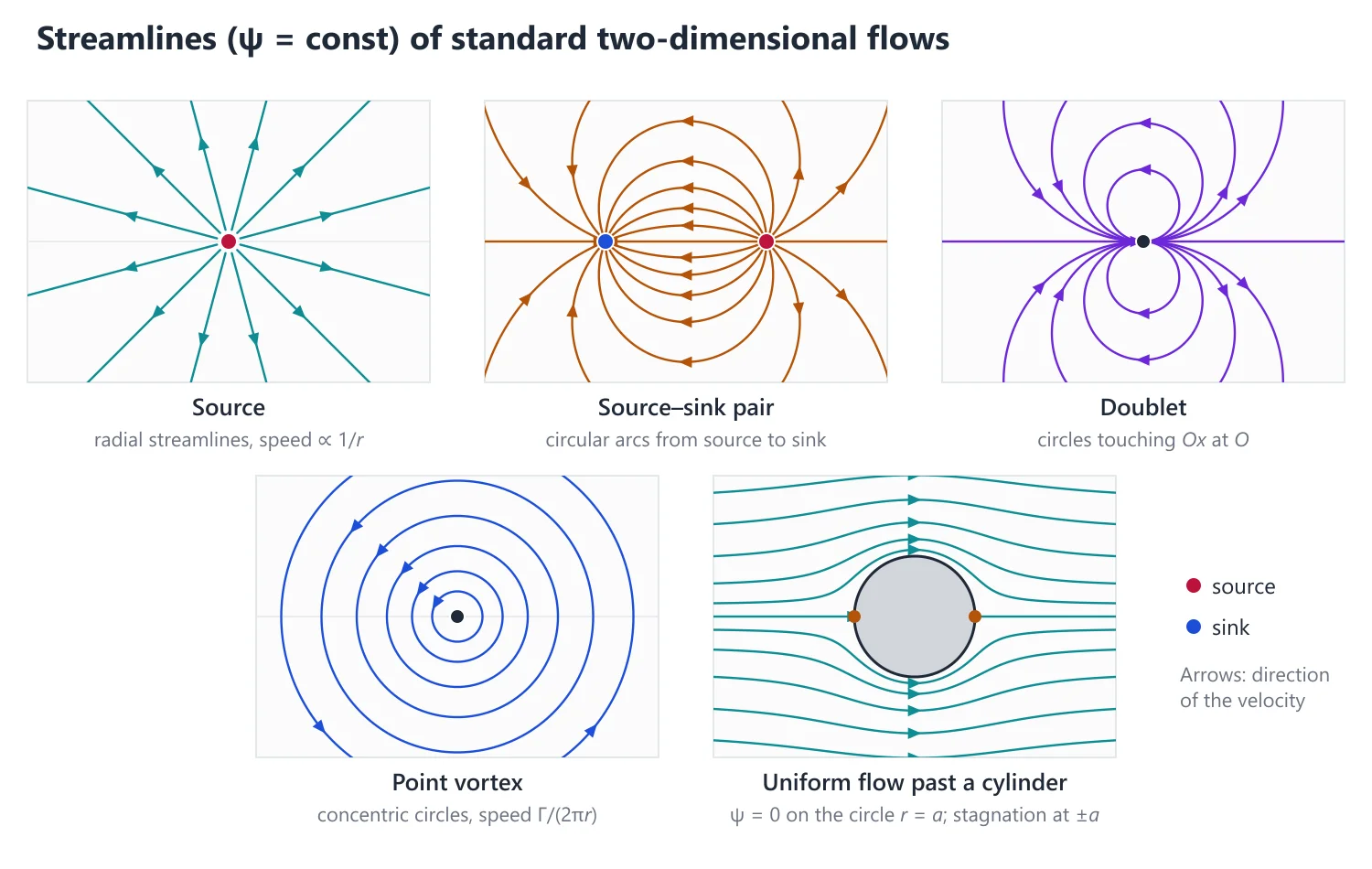
1. Understanding the Complex Potential
Why we need it: a two-dimensional irrotational flow of a liquid needs two functions, φ and ψ, each harmonic and linked by the Cauchy–Riemann equations. Complex analysis is designed for exactly such pairs: one analytic function w(z) carries both, and a single differentiation gives the velocity.
In words: the complex potential is w(z) = φ + iψ, z = x + iy: its real part is the velocity potential and its imaginary part the stream function. With the convention q = −∇φ of this chapter, dw/dz = −u + iv, so u − iv = −dw/dz and the speed is |dw/dz|.
Points where dw/dz = 0 are stagnation points, the curves ψ = constant are the streamlines, and every analytic function w is a possible flow.
First example, slowly: w = −Uz, with U a positive constant.
Step 1: w = −U(x + iy), so φ = −Ux and ψ = −Uy.
Step 2: dw/dz = −U, and comparing with −u + iv gives u = U, v = 0: a uniform stream of speed U along +Ox.
Step 3: the streamlines ψ = constant are the lines y = constant, horizontal as expected, and the equipotentials φ = constant are vertical lines.
Step 4: now w = −(1 + i)z: dw/dz = −1 − i = −u + iv, so u = 1, v = −1, a stream of speed √2 directed at −45° to Ox.
Step 5: and w = iUz: dw/dz = iU = −u + iv, so u = 0, v = U, a stream straight up Oy, with ψ = Ux.
Step 6: notice the pattern: multiplying w by a complex constant rotates and scales the whole flow.
Non-example: x2 + y2 = zz̄ is not an analytic function of z, so it is not a complex potential. Correspondingly φ = x2 + y2 is not harmonic (∇2φ = 4), and the flow q = −∇φ = (−2x, −2y) has ∇·q = −4: it is not incompressible. Rigid rotation fails for the other reason: it has ψ but no φ.
Building up: the definitions u = −∂φ/∂x = −∂ψ/∂y and v = −∂φ/∂y = ∂ψ/∂x are exactly the Cauchy–Riemann equations, so φ + iψ is analytic; its derivative may be taken along Ox, giving dw/dz = φx + iψx = −u + iv ("Why it works" below).
Laplace's equation is linear, so complex potentials add; Bernoulli's equation uses q2 = |dw/dz|2, and Blasius' theorem uses (dw/dz)2 to find forces.
Where it is used: every question on sources, sinks, doublets, vortices and images in two dimensions, the location of stagnation points, and the forces on cylinders.
2. Complex Potential
For 2D incompressible irrotational flow, w(z) = φ + iψ is analytic in z = x + iy: u = −∂φ/∂x = −∂ψ/∂y and v = −∂φ/∂y = ∂ψ/∂x give the Cauchy–Riemann equations φx = ψy, φy = −ψx.
Why it works: incompressibility gives ψ and irrotationality gives φ (previous topic); their defining relations are exactly the Cauchy–Riemann equations, and the partial derivatives are continuous, so φ + iψ is analytic. Both hypotheses are needed: rigid rotation u = −Ωy, v = Ωx has a stream function but no velocity potential, so it has no complex potential.
Complex velocity: dw/dz = φx + iψx = −u + iv, so the speed is |dw/dz|; points where dw/dz = 0 are stagnation points.
Why it works: an analytic w has the same derivative in every direction, so dw/dz = ∂w/∂x = φx + iψx = −u + iv. Hence u − iv = −dw/dz and q2 = |dw/dz|2, which is what Bernoulli's equation needs.
Every analytic w is a possible flow, with streamlines ψ = constant.
Idea: Laplace's equation is linear, so complex potentials add: complicated flows are built by superposing the five building blocks drawn in the figure above (source, source–sink pair, doublet, vortex, stream past a cylinder), and the streamlines of the sum are ψ1 + ψ2 + ... = constant.
3. Understanding Sources, Sinks, Doublets and Vortices
Why we need it: complicated plane flows are built from a few elementary ones. If we know their complex potentials, and exactly what "strength" means for each, we can write w for any arrangement just by adding logarithms.
In words: a line source of strength m emits fluid at the volume rate 2πm per unit length (check each question's definition, since some books call the output itself the strength); in our convention w = −m log(z − z0), and the radial speed is m/r. A sink is a source with the sign reversed.
A doublet is a source and an equal sink brought together while their strength times separation stays fixed at μ: w = μ/z for the axis along Ox from the sink to the source. A line vortex makes the fluid circulate round z0 with speed Γ/(2πr): w = (iΓ/(2π))log(z − z0), anticlockwise when Γ > 0.
First example, slowly: a source of strength m at the origin.
Step 1: w = −m log z = −m(log r + iθ), so φ = −m log r and ψ = −mθ.
Step 2: dw/dz = −m/z, so u − iv = m/z = (m/r)e−iθ, that is u = (m/r)cos θ and v = (m/r)sin θ.
Step 3: so the velocity points radially outward with speed m/r: fluid streams away from the origin in every direction.
Step 4: the flux across a circle of radius r is speed × circumference = (m/r)(2πr) = 2πm, the same for every circle, as continuity requires.
Step 5: the streamlines ψ = constant are θ = constant, the radial lines through the source.
Step 6: at r = 0 the speed is infinite: the source is a singular point and is not part of the fluid.
Non-example: a point source in three dimensions is not a line source: it has φ = m/r and speed m/r2, with flux 4πm through every sphere. Using φ = −m log r in a 3D problem, or m/r in a 2D one, gives wrong speeds and pressures.
Building up: multiplying a source potential by ±i turns it into a vortex (φ and ψ exchange roles). Superposing a source m at z = δ and a sink at the origin and letting δ → 0 with mδ = μ gives the doublet μ/z (the "Doublet" line below).
Adding the doublet −Ua2/z to the stream −Uz makes the circle |z| = a a streamline, the flow past a cylinder, and adding a vortex gives circulation and lift; the force follows from Blasius' theorem.
Where it is used: Rankine bodies, stagnation points and the equations of streamlines (Examples 1, 2 and 10 to 17), flow past cylinders with circulation, and the Kutta–Joukowski lift.
4. Standard Flows
Uniform stream of speed U at angle α to Ox: w = −Ue−iαz.
Source of strength m at z0 (volume flux 2πm per unit depth): w = −m log(z − z0), so φ = −m log r, ψ = −mθ (r, θ measured from z0) and the radial speed is m/r; a sink has w = m log(z − z0).
Why it works: qr = −∂φ/∂r = m/r, so the flux across a circle of radius r is 2πr·(m/r) = 2πm, the same for every circle, as continuity requires. ψ = −mθ changes by −2πm round the source, the many-valuedness of ψ recording the fluid it emits.
Doublet: a source m at z = δ and a sink m at the origin give w = −m log(z − δ) + m log z = −m log(1 − δ/z) → μ/z as δ → 0 with mδ = μ fixed (axis from sink to source, along Ox).
Idea: a doublet is a source and a sink merged so that their fluxes cancel but their separation times strength stays finite. For w = μ/z, ψ = −μy/(x2 + y2), so the streamlines x2 + y2 + (μ/c)y = 0 are circles touching Ox at the origin, as in the figure.
Line vortex of anticlockwise circulation Γ at z0: w = (iΓ/(2π)) log(z − z0), so φ = −Γθ/(2π), ψ = (Γ/(2π)) log r; the speed is Γ/(2πr) and the streamlines are circles.
Why it works: φ = −Γθ/(2π) changes by −Γ round any circuit enclosing z0, so the circulation is ∮q·dr = −∮dφ = Γ. The flow is irrotational at every point except z0, where all the vorticity is concentrated; a source and a vortex are interchanged by multiplying w by ±i (ψ and φ swap roles).
Uniform stream past a circular cylinder |z| = a (stream U along Ox): w = −U(z + a2/z), ψ = −U(r − a2/r)sin θ, which is 0 on r = a; stagnation points z = ±a, surface speed 2U|sin θ|, maximum 2U.
Why it works: on |z| = a, a2/z = z̄, so z + a2/z = z + z̄ = 2x is real and ψ = 0: the circle is a streamline. As |z| → ∞, dw/dz → −U, so u → U, v → 0. On z = aeiθ, |dw/dz| = U|1 − e−2iθ| = 2U|sin θ|.
Idea: the term −Ua2/z is a doublet at the centre that pushes the stream aside just enough to keep fluid out of the circle; the fluid is fastest (2U) at the shoulders θ = ±π/2 and at rest at the front and rear stagnation points.
Adding anticlockwise circulation Γ, w = −U(z + a2/z) + (iΓ/(2π)) log z; the cylinder then feels a force ρUΓ per unit length perpendicular to the stream and no drag (Kutta–Joukowski theorem).
Idea: an anticlockwise vortex adds speed below the cylinder and removes it above, so by Bernoulli the pressure is lower underneath and the cylinder is pushed down; this is the Magnus effect of a spinning ball, and the same circulation mechanism gives the lift of an aerofoil.
Blasius theorem: for a fixed cylinder C in steady flow, the force per unit length satisfies X − iY = (iρ/2)∮C(dw/dz)2 dz; the formula is the same in either sign convention, because (dw/dz)2 = (u − iv)2 in both.
Why it works: with C described anticlockwise, the pressure on an element of the boundary gives dX = −p dy, dY = p dx, so d(X − iY) = −ip dz̄. By Bernoulli p = p0 − (1/2)ρ|w′|2, and the constant p0 contributes nothing since ∮dz̄ = 0.
On the streamline C, dψ = 0, so w′dz = dw = dφ is real and w̄′dz̄ = w′dz. Hence |w′|2dz̄ = w′(w̄′dz̄) = (w′)2dz, and X − iY = (iρ/2)∮C(w′)2dz.
By Cauchy's theorem C may then be replaced by any contour enclosing the body and no other singularity, so the force is 2πi times the residue: only the coefficient of 1/z in (dw/dz)2 matters.
Example 1: a source m at z = a and a sink m at z = −a: w = −m log(z − a) + m log(z + a) = −m log((z − a)/(z + a)), so ψ = −m(θ1 − θ2), and the streamlines θ1 − θ2 = constant are circular arcs through (a, 0) and (−a, 0).
Example 2 (Rankine half-body): A source m at the origin is placed in a uniform stream U along Ox. Find the stagnation point and the width of the body formed by the dividing streamline far downstream.
w = −Uz − m log z, and dw/dz = −U − m/z = 0 at z = −m/U, the stagnation point.
ψ = −Uy − mθ; at the stagnation point θ = π, y = 0, so ψ = −mπ and the dividing streamline is Uy + mθ = mπ.
As θ → 0, y → mπ/U, and as θ → 2π, y → −mπ/U, so the width tends to 2πm/U: the source output 2πm divided by U.
Example 3 (Blasius): Find the force on the cylinder |z| = a in the flow w = −U(z + a2/z) + (iΓ/(2π)) log z.
dw/dz = −U(1 − a2/z2) + iΓ/(2πz); in (dw/dz)2 the only 1/z term is 2(−U)(iΓ/(2πz)) = −iUΓ/(πz).
By the residue theorem ∮(dw/dz)2 dz = 2πi(−iUΓ/π) = 2UΓ, so X − iY = (iρ/2)(2UΓ) = iρUΓ.
Hence X = 0 (no drag) and Y = −ρUΓ: a force ρUΓ per unit length, directed downward for a stream along +Ox with anticlockwise circulation.
Example 4 (find all stagnation points): For the same flow, locate the stagnation points.
On r = a, φ = −2Ua cos θ − Γθ/(2π), so qr = 0 and qθ = −(1/a)∂φ/∂θ = −2U sin θ + Γ/(2πa).
qθ = 0 when sin θ = Γ/(4πaU): two stagnation points on the cylinder if Γ < 4πaU, one (at θ = π/2) if Γ = 4πaU.
If Γ > 4πaU, dw/dz = 0 gives Uz2 − iΓz/(2π) − Ua2 = 0, whose roots lie on the positive imaginary axis with product of moduli a2, so exactly one stagnation point lies in the fluid, on the axis θ = π/2.
5. Understanding the Method of Images and the Circle Theorem
Why we need it: a rigid boundary, a wall or a cylinder, changes the flow due to a source or a vortex, because fluid cannot cross it. Instead of solving a boundary-value problem directly, we place fictitious singularities outside the fluid so that the boundary becomes a streamline.
In words: a fixed rigid boundary must be a streamline, ψ = constant on it, so that there is no velocity across it. An image system is a set of singularities placed in the region not occupied by fluid to achieve this.
Laplace's equation with prescribed normal velocity on the boundary and prescribed singularities in the fluid has only one solution (apart from the circulation round an obstacle), so if a guessed image system makes the boundary a streamline, it gives the flow.
First example, slowly: a vortex of circulation Γ at (0, d) above the rigid wall y = 0.
Step 1: try an image vortex −Γ at the mirror point (0, −d).
Step 2: w = (iΓ/(2π))[log(z − id) − log(z + id)].
Step 3: then ψ = (Γ/(2π))log(r1/r2), with r1, r2 the distances from (0, d) and (0, −d).
Step 4: on y = 0 every point is equidistant from the two vortices, r1 = r2, so ψ = 0: the wall is a streamline, as required.
Step 5: the vortex moves with the velocity induced by its image only: −u + iv = d/dz[−(iΓ/(2π))log(z + id)] at z = id, which is −(iΓ/(2π))/(2id) = −Γ/(4πd). So u = Γ/(4πd), v = 0.
Step 6: the vortex glides parallel to the wall with speed Γ/(4πd), to the right for an anticlockwise vortex above the wall; it never approaches the wall.
Non-example: taking an equal vortex +Γ as the image, as one would for a source, gives ψ = (Γ/(2π))log(r1r2); on y = 0, r1r2 = x2 + d2 is not constant, so the wall is not a streamline. Vortex images have the opposite sign because reflection reverses the sense of rotation.
Building up: for a circle |z| = a, the Milne-Thomson circle theorem w = f(z) + f̄(a2/z) produces the image automatically (proof under "Why it works" below).
For a source at distance c outside the circle the image is an equal source at the inverse point a2/c and a sink at the centre; for a vortex Γ it is −Γ at the inverse point and +Γ at the centre; for a uniform stream it is a doublet at the centre, which gives the flow past a cylinder.
Where it is used: sources and vortices near walls, in corners and outside cylinders (Examples 5, 6, 16, 19 and 20, and the vortex in a corner among the solved problems), followed by Blasius' theorem for the force on the boundary.
6. Method of Images
An image system is a set of singularities outside the fluid that makes a given boundary a streamline.
Idea: outside the fluid we may place any singularities we like; if they make the boundary a streamline and leave the given singularities in the fluid unchanged, the uniqueness of the solution of Laplace's equation with given normal velocity guarantees that this is the flow.
Plane wall: the image of a source is an equal source at the mirror point; the image of a vortex is an equal and opposite vortex at the mirror point.
Why it works: a source at (0, a) and an equal source at (0, −a) give equal and opposite normal velocities at each point of y = 0, so v = 0 there; for a vortex the image must be opposite, since reflection reverses the sense of rotation.
Milne-Thomson circle theorem: if f(z) is a complex potential with no singularities in |z| ≤ a, then w = f(z) + f̄(a2/z), where f̄(z) is the conjugate of f(z̄), has |z| = a as a streamline and the same singularities as f in |z| > a.
Why it works: on |z| = a, a2/z = z̄, so f̄(a2/z) = f̄(z̄), the complex conjugate of f(z); hence w = f(z) + conj(f(z)) = 2 Re f(z) is real and ψ = 0 on the circle. If f is regular in |z| ≤ a, then f̄(a2/z) is regular in |z| ≥ a, so no new singularity enters the fluid.
Source outside a circle: a source m at distance c (> a) from the centre has as image an equal source at the inverse point a2/c and an equal sink at the centre.
Why it works: for f = −m log(z − c) (c real, c > a), f̄(a2/z) = −m log(a2/z − c) = −m log(z − a2/c) + m log z + constant: a source at the inverse point and a sink at the centre. The sink is needed because the cylinder cannot absorb fluid: the net flux out of it must be zero.
Example 5: applying the theorem to f(z) = −Uz (a stream U along Ox) gives w = −Uz − Ua2/z = −U(z + a2/z), the flow past a cylinder above.
Example 6 (image in a wall): A source m is at (0, a) above the rigid wall y = 0. Find the velocity and pressure on the wall, given pressure p∞ at infinity.
The image is an equal source at (0, −a), so w = −m log(z − ia) − m log(z + ia) = −m log(z2 + a2).
dw/dz = −2mz/(z2 + a2) is real on z = x, so v = 0 and u = 2mx/(x2 + a2), with greatest speed m/a at x = ±a.
Bernoulli, with q → 0 at infinity: p = p∞ − 2ρm2x2/(x2 + a2)2, least at x = ±a where p = p∞ − ρm2/(2a2).
7. Vortex Motion
Circulation: Γ = ∮q·dr = ∬(∇ × q)·n dS by Stokes' theorem; vortex lines are everywhere tangent to ω.
Helmholtz's theorems (inviscid, barotropic, conservative forces): vortex lines move with the fluid, and the strength of a vortex tube is the same at every cross-section and constant in time, so a vortex tube cannot end inside the fluid.
Idea: in an ideal fluid vortex lines behave like material threads: they are carried with the fluid and keep their strength, which is why a smoke ring travels a long way without breaking up. The theorems follow from Kelvin's theorem (previous topic) applied to circuits drawn on and round a vortex tube.
A rectilinear vortex moves with the velocity induced at its position by all the other vortices and images, not by itself.
Why it works: the vortex's own field is purely circular about its centre, of speed Γ/(2πr) in every direction, so it has no net velocity there. In practice the velocity of the vortex Γk at zk is u − iv = −d/dz[w − (iΓk/(2π))log(z − zk)] evaluated at z = zk.
Vortex pair: vortices +Γ and −Γ a distance 2d apart move together, perpendicular to the line joining them, with speed Γ/(4πd).
Two equal vortices Γ a distance 2d apart rotate about their midpoint with angular velocity Γ/(4πd2).
Why it works: each vortex lies at distance 2d from the other and so moves with speed Γ/(2π·2d) = Γ/(4πd) at right angles to the line joining them. For opposite vortices the two velocities are parallel and the pair translates; for equal vortices they are opposite, the midpoint stays fixed and each vortex describes a circle of radius d, so the angular velocity is Γ/(4πd2).
A vortex at distance d from a wall is the same problem as the pair: its image is −Γ at distance 2d, so it runs parallel to the wall with speed Γ/(4πd).
Vortex near a wall: a vortex at distance d from a plane wall moves parallel to the wall with speed Γ/(4πd), induced by its image.
8. Understanding Axisymmetric Flow and the Stokes Stream Function
Why we need it: the flow past a sphere, the flow from a point source and the flow round any body of revolution are three-dimensional, so the complex potential cannot be used. But when the flow is the same in every plane through an axis, one function of two variables can still describe it, just as ψ does in two dimensions.
In words: in spherical polars (r, θ) with the axis θ = 0, an axisymmetric flow has nothing depending on the azimuthal angle and no azimuthal velocity. The velocity potential (q = −∇φ) gives qr = −∂φ/∂r and qθ = −(1/r)∂φ/∂θ.
The Stokes stream function ψ(r, θ) gives qr = −(1/(r2sin θ))∂ψ/∂θ and qθ = (1/(r sin θ))∂ψ/∂r. It is constant on each stream surface, and 2π times the difference of its values on two stream surfaces is the volume flux between them.
First example, slowly: a point source of strength m (output 4πm) at the origin.
Step 1: by symmetry the velocity is radial, qr = Q(r), qθ = 0.
Step 2: continuity: the flux through the sphere of radius r is 4πr2Q, and it must equal 4πm for every r, so Q = m/r2.
Step 3 (φ): −∂φ/∂r = m/r2 gives φ = m/r.
Step 4 (ψ): −(1/(r2sin θ))∂ψ/∂θ = m/r2 gives ∂ψ/∂θ = −m sin θ, so ψ = m cos θ; and (1/(r sin θ))∂ψ/∂r = 0 = qθ, as it should be.
Step 5 (flux check): through the cap 0 ≤ θ ≤ θ0 of a sphere the flux is ∫qr·2πr2sin θ dθ = 2πm(1 − cos θ0), which is 2π[ψ(0) − ψ(θ0)].
Step 6: so ψ = constant means θ = constant: the stream surfaces are cones about the axis, made of radial streamlines.
Non-example: the Stokes stream function is not harmonic. For the uniform stream ψ = −(1/2)Ur2sin2θ = −(1/2)Uϖ2, ϖ being the distance from the axis, one finds ∇2ψ = −2U ≠ 0, while Stokes' operator gives E2ψ = 0. Using Laplace's equation for ψ, or a complex potential for a sphere, gives wrong answers.
Building up: continuity in axisymmetric form is exactly the condition for ψ to exist, and irrotationality gives Stokes' equation E2ψ = 0 (Section 12).
Since φ is still harmonic, it is often easier to find φ first from the separated solutions r cos θ and cos θ/r2: the uniform stream plus a doublet at the centre gives the flow past a sphere, with greatest surface speed (3/2)U.
Where it is used: Examples 7 to 9 (existence of ψ and Stokes' equation, a source in a uniform stream, spheres moving in liquid), and the pressure on a sphere by Bernoulli's equation.
9. Axisymmetric Motion
For flows symmetric about an axis (spherical r, θ, no azimuthal dependence) the Stokes stream function ψ is taken, consistently with q = −∇φ and the 2D signs above, as qr = −(1/(r2 sin θ))∂ψ/∂θ, qθ = (1/(r sin θ))∂ψ/∂r (some books reverse the sign of ψ); 2π times the difference of ψ between two stream surfaces is the volume flux between them.
Idea: in axisymmetric flow the stream surfaces ψ = constant are surfaces of revolution about the axis, and the flux between two of them is 2π times the difference of ψ, not the difference itself, because ψ is defined per radian of azimuth.
Uniform stream U along the axis θ = 0: φ = −Ur cos θ, ψ = −(1/2)Ur2sin2θ; point source of strength m (flux 4πm): φ = m/r, ψ = m cos θ.
Sphere of radius a in a uniform stream U: φ = −U(r + a3/(2r2))cos θ, ψ = −(1/2)U(r2 − a3/r)sin2θ; qr = 0 and ψ = 0 on r = a, and the surface speed is (3/2)U sin θ.
Why it works: try the stream plus a doublet at the centre: φ = −Ur cos θ + μ cos θ/r2, both harmonic. Then qr = −∂φ/∂r = U cos θ + 2μ cos θ/r3, and qr = 0 on r = a forces μ = −Ua3/2.
So φ = −U(r + a3/(2r2))cos θ and qθ = −(1/r)∂φ/∂θ = −U(1 + a3/(2r3))sin θ, which is −(3/2)U sin θ on the sphere: the greatest speed on a sphere is 1.5U, against 2U on a cylinder.
10. Choosing the Method
If the boundary is a plane wall → reflect: a source has an equal source as image, a vortex an opposite vortex.
If the boundary is a circle and the singularities lie outside it → the circle theorem w = f(z) + f̄(a2/z); if they lie inside, place images at the inverse points a2/c̄.
If the force on a cylinder is wanted → Blasius: find the coefficient of 1/z in (dw/dz)2; for a circulating cylinder in a stream the answer is ρUΓ (Kutta–Joukowski), with no drag.
If streamlines are wanted → ψ = Im w; with logarithms ψ is a sum of angles, and taking the tangent of ψ = constant gives an algebraic curve.
If stagnation points are wanted → solve dw/dz = 0 and discard roots inside the body.
If the pressure is wanted → Bernoulli p + (1/2)ρ|dw/dz|2 = constant (steady), with −ρ∂φ/∂t added if the singularities move.
If vortices move → each moves with the velocity induced by all the others and all images, never by itself.
If the flow is three-dimensional and axisymmetric (spheres, point sources) → use φ and Stokes' ψ in spherical polars; the complex potential does not apply.
11. Common Mistakes
Convention clash. With q = −∇φ a source is w = −m log(z − z0); the book form w = m log z belongs to q = ∇φ, and mixing them reverses the flow.
Self-induced velocity. Including a vortex's own term when computing its velocity gives an infinite answer.
Blasius errors. Using |dw/dz|2 instead of (dw/dz)2, or taking residues at singularities outside the contour (in the fluid) or only inside the body when the contour encloses both.
Missing image at the centre. A source outside a circle needs a sink at the centre as well as the source at the inverse point; a vortex Γ outside a circle has the image −Γ at the inverse point and, when the circulation round the cylinder is to be zero (the circle-theorem image), a vortex +Γ at the centre as well.
Stagnation points inside the body. Roots of dw/dz = 0 with |z| less than a are not points of the flow.
2D and 3D formulas mixed. A line source has φ = −m log r; a point source has φ = m/r. Stokes' ψ satisfies E2ψ = 0, not ∇2ψ = 0.
Link: complex potentials, Blasius' theorem and the circle theorem are applications of analytic functions, Cauchy's theorem and residues (complex analysis); the map z → a2/z̄ is inversion in the circle.
Link: the axisymmetric potentials r cos θ and cos θ/r2 are the n = 1 separated solutions rnPn(cos θ), r−n−1Pn(cos θ) of Laplace's equation in spherical polars (PDE chapter).
12. Stokes Stream Function: Existence, Equation and Spheres
Existence: for axisymmetric incompressible flow (qφ = 0, no φ-dependence) continuity is ∂(r2sin θ qr)/∂r + ∂(r sin θ qθ)/∂θ = 0, exactly the condition for r sin θ qθ dr − r2sin θ qr dθ to be an exact differential dψ.
So ψ exists, with qr = −(1/(r2sin θ))∂ψ/∂θ, qθ = (1/(r sin θ))∂ψ/∂r; in cylindrical coordinates (ϖ, z) the same ψ gives qϖ = (1/ϖ)∂ψ/∂z, qz = −(1/ϖ)∂ψ/∂ϖ.
Irrotational case: setting the vorticity (1/r)[∂(rqθ)/∂r − ∂qr/∂θ] to zero gives Stokes' equation E2ψ ≡ ∂2ψ/∂r2 + (sin θ/r2)∂/∂θ((1/sin θ)∂ψ/∂θ) = 0, or ∂2ψ/∂z2 + ∂2ψ/∂ϖ2 − (1/ϖ)∂ψ/∂ϖ = 0.
ψ is not harmonic, since E2 differs from ∇2; for example the uniform stream ψ = −(1/2)Uϖ2 satisfies E2ψ = 0 but not ∇2ψ = 0.
Idea: in (ϖ, z) the axisymmetric Laplacian is ψzz + ψϖϖ + (1/ϖ)ψϖ, while E2ψ has −(1/ϖ)ψϖ; the sign change comes from the factor 1/ϖ in qz = −(1/ϖ)∂ψ/∂ϖ. Since φ is still harmonic, in axisymmetric problems it is often easier to find φ first and deduce ψ.
Moving spheres: a sphere r = a moving with velocity U along Ox requires −∂φ/∂r = Ux/r on r = a; harmonic trial functions are x, x/r3 (and y, y/r3, ...), i.e. r cos θ and cos θ/r2.
Example 7 (UPSC 2015, 20 marks): In an axisymmetric motion, show that stream function exists due to equation of continuity. Express the velocity components in terms of the stream function. Find the equation satisfied by the stream function if the flow is irrotational.
Continuity (axisymmetric, incompressible) ∂(r2sin θ qr)/∂r + ∂(r sin θ qθ)/∂θ = 0 is the integrability condition for ψ with ∂ψ/∂θ = −r2sin θ qr, ∂ψ/∂r = r sin θ qθ; so ψ exists because of continuity.
Velocity components: qr = −(1/(r2sin θ))∂ψ/∂θ, qθ = (1/(r sin θ))∂ψ/∂r; the flux through the circle cut out by a stream surface is 2π|ψ| when ψ = 0 on the axis.
Irrotational: (1/r)[∂(rqθ)/∂r − ∂qr/∂θ] = (1/(r sin θ))[∂2ψ/∂r2 + (sin θ/r2)∂/∂θ((1/sin θ)∂ψ/∂θ)] = 0.
Answer: ∂2ψ/∂r2 + (sin θ/r2)∂/∂θ((1/sin θ)∂ψ/∂θ) = 0 (books that define ψ with the opposite sign get the same equation).
Example 8 (UPSC 2016, 15 marks; repeated in UPSC 2026, 10 marks): A simple source of strength m is fixed at the origin O in a uniform stream of incompressible fluid moving with velocity U i⃗. Show that the velocity potential φ at any point P of the stream is m/r − Ur cos θ, where OP = r and θ is the angle which OP⃗ makes with the direction i⃗. Find the differential equation of the streamlines and show that they lie on the surfaces Ur2 sin2θ − 2m cos θ = constant.
A simple source of strength m (flux 4πm) has qr = m/r2, φ = m/r; the stream U along Ox (θ = 0) has φ = −Ur cos θ; superposing, φ = m/r − Ur cos θ.
qr = −∂φ/∂r = m/r2 + U cos θ, qθ = −(1/r)∂φ/∂θ = −U sin θ; streamlines in each plane through Ox: dr/qr = r dθ/qθ, i.e. −U sin θ dr = (m/r + Ur cos θ)dθ.
Multiplying by 2r sin θ: 2Ur sin2θ dr + 2Ur2sin θ cos θ dθ + 2m sin θ dθ = 0, i.e. d(Ur2sin2θ − 2m cos θ) = 0.
Answer: φ = m/r − Ur cos θ; the streamlines lie on Ur2sin2θ − 2m cos θ = constant (Stokes stream function ψ = m cos θ − (1/2)Ur2sin2θ).
Example 9 (UPSC 2016, 20 marks): The space between two concentric spherical shells of radii a, b (a < b) is filled with a liquid of density ρ. If the shells are set in motion, the inner one with velocity U in the x-direction and the outer one with velocity V in the y-direction, then show that the initial motion of the liquid is given by velocity potential
φ = {a3U(1 + (1/2)b3r−3)x − b3V(1 + (1/2)a3r−3)y}/(b3 − a3),
where r2 = x2 + y2 + z2, the coordinates being rectangular. Evaluate the velocity at any point of the liquid.
The liquid starts from rest and is set moving impulsively, so the motion is irrotational: ∇2φ = 0 with −∂φ/∂r = Ux/r on r = a and −∂φ/∂r = Vy/r on r = b (normal velocity of each shell).
Try φ = (A + B/r3)x + (C + D/r3)y; then −∂φ/∂r = −(A − 2B/r3)x/r − (C − 2D/r3)y/r, and the conditions are A − 2B/a3 = −U, A − 2B/b3 = 0, C − 2D/a3 = 0, C − 2D/b3 = −V.
So A = a3U/(b3 − a3), B = a3b3U/(2(b3 − a3)), C = −b3V/(b3 − a3), D = −a3b3V/(2(b3 − a3)), which is the stated φ.
With P = a3U/(b3 − a3), Q = b3V/(b3 − a3), S = Pb3x − Qa3y, q = −∇φ gives u = −P(1 + b3/(2r3)) + 3xS/(2r5), v = Q(1 + a3/(2r3)) + 3yS/(2r5), w = 3zS/(2r5).
Answer: φ is as stated, and the velocity at any point is (u, v, w) above.
13. Sources, Sinks, Vortices and Images: Past Questions
Method: write w as a sum of logarithms, take ψ = Im w as a sum of angles, and turn ψ = constant into an algebraic curve by taking the tangent of the angle (arg of a product or quotient).
Images inside a circle: the circle theorem also holds for a flow inside |z| = a with singularities inside; a source and an equal sink at points c1, c2 inside have images an equal source and sink at the inverse points a2/c̄1, a2/c̄2 (the terms at the centre cancel).
Vortex convention used here: w = ik log(z − z0) is a vortex of strength k, anticlockwise circulation 2πk; a vortex moves with the velocity induced by all other vortices and images.
Example 10 (UPSC 2014, 20 marks): Given the velocity potential φ = (1/2) log[((x + a)2 + y2)/((x − a)2 + y2)], determine the streamlines.
φ = log r1 − log r2, with r1, r2 the distances from (−a, 0) and (a, 0), is the real part of w = log(z + a) − log(z − a): a unit source at (a, 0) and a unit sink at (−a, 0) (q = −∇φ).
ψ = θ1 − θ2, the angles at (−a, 0) and (a, 0); tan(θ1 − θ2) = [y/(x + a) − y/(x − a)]/[1 + y2/(x2 − a2)] = −2ay/(x2 + y2 − a2).
Answer: the streamlines are x2 + y2 − a2 = λy (λ a parameter), the coaxal circles through (±a, 0).
Example 11 (UPSC 2019, 20 marks): Two sources, each of strength m, are placed at the points (−a, 0), (a, 0) and a sink of strength 2m at origin. Show that the stream lines are the curves (x2 + y2)2 = a2(x2 − y2 + λxy), where λ is a variable parameter.
Show also that the fluid speed at any point is (2ma2)/(r1r2r3), where r1, r2 and r3 are the distances of the points from the sources and the sink, respectively.
w = −m log(z − a) − m log(z + a) + 2m log z = −m log((z2 − a2)/z2), and (z2 − a2)/z2 = 1 − a2z̄2/r4 = [r4 − a2(x2 − y2) + 2ia2xy]/r4.
ψ = −m tan−1[2a2xy/(r4 − a2(x2 − y2))] = constant gives r4 − a2(x2 − y2) = λa2xy.
dw/dz = −m[2z/(z2 − a2) − 2/z] = −2ma2/(z(z − a)(z + a)).
Answer: streamlines (x2 + y2)2 = a2(x2 − y2 + λxy); speed |dw/dz| = 2ma2/(r1r2r3).
Example 12 (UPSC 2020, 15 marks): Two sources of strength m/2 are placed at the points (±a, 0). Show that at any point on the circle x2 + y2 = a2, the velocity is parallel to the y-axis and is inversely proportional to y.
w = −(m/2)log(z − a) − (m/2)log(z + a) = −(m/2)log(z2 − a2), so dw/dz = −mz/(z2 − a2).
On z = aeiθ: z2 − a2 = a2eiθ(eiθ − e−iθ) = 2ia2eiθsin θ, so dw/dz = −m/(2ia sin θ) = im/(2y); since dw/dz = −u + iv, u = 0 and v = m/(2y).
Answer: on the circle the velocity is parallel to Oy, of magnitude m/(2|y|), inversely proportional to y.
Example 13 (UPSC 2021, 10 marks): What arrangements of sources and sinks can have the velocity potential w = loge(z − a2/z)? Draw the corresponding sketch of the streamlines and prove that two of them subdivide into the circle r = a and the axis of y.
w = log(z − a2/z) = log(z − a) + log(z + a) − log z; with q = −∇φ (source m: w = −m log(z − z0)) this is a unit sink at each of z = ±a and a unit source at z = 0 (with q = ∇φ: sources at ±a and a sink at O).
ψ = arg(z − a2/z) and z − a2/z = x(1 − a2/r2) + iy(1 + a2/r2), so tan ψ = y(r2 + a2)/(x(r2 − a2)).
ψ = 0, π gives y = 0 (the x-axis); ψ = ±π/2 needs x(1 − a2/r2) = 0, i.e. x = 0 or r = a. Sketch: curves symmetric in both axes, leaving the source O (or coming from infinity) and ending at the sinks ±a.
Answer: sinks at ±a and a source at O (strength 1 in this convention); the streamline ψ = ±π/2 splits into the circle r = a and the y-axis.
Example 14 (UPSC 2021, 20 marks): Show that for the complex potential tan−1z, the streamlines and equipotential curves are circles. Find the velocity at any point and check the singularities at z = ±i.
tan−1z = (1/(2i))log((1 + iz)/(1 − iz)) = −(i/2)log((z − i)/(z + i)) + constant; with z − i = r1eiθ1, z + i = r2eiθ2, φ = (θ1 − θ2)/2 and ψ = −(1/2)log(r1/r2).
Streamlines r1/r2 = λ: x2 + (y − 1)2 = λ2[x2 + (y + 1)2], circles with limiting points ±i; equipotentials θ1 − θ2 = constant: x2 + y2 − 1 = μx, circles through ±i.
dw/dz = 1/(1 + z2), so the speed is 1/|1 + z2| = 1/(r1r2), infinite at z = ±i.
Near z = i, w ≈ −(i/2)log(z − i): φ is many-valued and ψ single-valued, so this is a point vortex, with circulation −π (clockwise) round i and +π round −i.
Answer: streamlines and equipotentials are two orthogonal families of coaxal circles; speed 1/(r1r2); the singularities at ±i are equal and opposite point vortices of circulation π (they would be a source and a sink for the potential i tan−1z).
Example 15 (UPSC 2022, 20 marks): Two point vortices each of strength k are situated at (±a, 0) and a point vortex of strength −k/2 is situated at the origin. Show that the fluid motion is stationary and also find the equations of streamlines. If the streamlines, which pass through the stagnation points, meet the x-axis at (±b, 0), then show that 3√3 (b2 − a2)2 = 16a3b.
w = ik[log(z − a) + log(z + a) − (1/2)log z]. The vortex at a moves with the velocity of the others: −u + iv = ik/(2a) − (ik/2)/a = 0; by symmetry the vortex at −a is also at rest, and at O the effects of ±a cancel, so the motion is stationary.
ψ = k[log r1 + log r2 − (1/2)log r], so the streamlines are r12r22 = cr, i.e. [(x2 + y2 + a2)2 − 4a2x2]2 = c2(x2 + y2).
Stagnation points: dw/dz = ik(3z2 + a2)/(2z(z2 − a2)) = 0 at z = ±ia/√3, where r12r22 = |z2 − a2|2 = 16a4/9 and r = a/√3, so c = 16√3a3/9.
At (b, 0), r12r22 = (b2 − a2)2 and r = b, so (b2 − a2)2 = 16√3a3b/9.
Answer: the motion is stationary; streamlines r12r22 = cr; multiplying the last relation by 3√3 gives 3√3(b2 − a2)2 = 16a3b.
Example 16 (UPSC 2022, 20 marks): Verify that w = ik log{(z − ia)/(z + ia)} is the complex potential of a steady flow of fluid about a circular cylinder, where the plane y = 0 is a rigid boundary. Find also the force exerted by the fluid on unit length of the cylinder.
With z − ia = r1eiθ1, z + ia = r2eiθ2: ψ = k log(r1/r2); on y = 0, r1 = r2 and ψ = 0, so the plane y = 0 is a streamline (rigid boundary).
Each circle r1/r2 = λ (0 < λ < 1) is a streamline round z = ia; taking one as the fixed cylinder, w is a steady flow outside it in y > 0: circulation 2πk round the cylinder, with its image −k at −ia in the wall.
Blasius (the contour encloses only z = ia): (dw/dz)2 = −k2[1/(z − ia)2 + 1/(z + ia)2 − 2/((z − ia)(z + ia))], whose residue at ia is −k2(−2/(2ia)) = −ik2/a.
So ∮(dw/dz)2dz = 2πi(−ik2/a) = 2πk2/a and X − iY = (iρ/2)(2πk2/a) = iπρk2/a: X = 0, Y = −πρk2/a.
Answer: w is the stated steady flow; the force per unit length is πρk2/a, perpendicular to the wall and towards it (the cylinder is attracted to the wall).
Example 17 (UPSC 2023, 10 marks): In a fluid motion, there is a source of strength 2m placed at z = 2 and two sinks of strength m are placed at z = 2 + i and z = 2 − i. Find the streamlines.
w = −2m log(z − 2) + m log(z − 2 − i) + m log(z − 2 + i) = m log(1 + 1/ζ2), where ζ = z − 2 = X + iY, X = x − 2, Y = y.
1 + 1/ζ2 = 1 + ζ̄2/|ζ|4 = [(X2 + Y2)2 + X2 − Y2 − 2iXY]/(X2 + Y2)2, so ψ = −m tan−1[2XY/((X2 + Y2)2 + X2 − Y2)].
Answer: streamlines ((x − 2)2 + y2)2 + (x − 2)2 − y2 = λ(x − 2)y, λ a parameter.
Example 18 (UPSC 2024, 20 marks): Suppose an infinite liquid contains two parallel, equal and opposite rectilinear vortices at a distance 2a. Show that the streamlines relative to the vortex are given by the equation
log [(x2 + (y − a)2)/(x2 + (y + a)2)] + y/a = C,
where C is a constant, the origin is the middle point of the join, and the line joining the vortices is the axis of y.
Put a vortex k at ia and −k at −ia: w = ik log((z − ia)/(z + ia)). The vortex at ia has −u + iv = −ik/(2ia) = −k/(2a), so u = k/(2a), v = 0; the other has the same velocity, so the pair moves along Ox with speed U = k/(2a).
To bring the vortices to rest, superpose a stream −U along Ox (potential Uz): w′ = ik log((z − ia)/(z + ia)) + kz/(2a).
ψ′ = k log(r1/r2) + ky/(2a) = (k/2){log[(x2 + (y − a)2)/(x2 + (y + a)2)] + y/a}.
Answer: the relative streamlines ψ′ = constant are log[(x2 + (y − a)2)/(x2 + (y + a)2)] + y/a = C.
Example 19 (UPSC 2025, 10 marks): A source and a sink of equal strength are placed at points (±a/2, 0) within a fixed circular boundary x2 + y2 = a2. Show that the streamlines are given by
(r2 − a2/4)(r2 − 4a2) − 4a2y2 = ky(r2 − a2)
where k is a constant and r2 = x2 + y2.
f(z) = −m log(z − a/2) + m log(z + a/2); by the circle theorem f̄(a2/z) = −m log(z − 2a) + m log(z + 2a) + constant (the log z terms cancel): images a source at 2a and a sink at −2a.
w = −m log[(P − Q)/(P + Q)] with P = z2 + a2, Q = (5a/2)z, since (z − a/2)(z − 2a) = P − Q and (z + a/2)(z + 2a) = P + Q.
arg[(P − Q)/(P + Q)] = arg[(P − Q)(P̄ + Q̄)] and (P − Q)(P̄ + Q̄) = |P|2 − |Q|2 + 2i Im(PQ̄), with Im(PQ̄) = (5a/2)y(r2 − a2).
|P|2 − |Q|2 = r4 + 2a2(x2 − y2) + a4 − (25/4)a2r2 = (r2 − a2/4)(r2 − 4a2) − 4a2y2.
Answer: ψ = constant gives (r2 − a2/4)(r2 − 4a2) − 4a2y2 = ky(r2 − a2); the boundary r = a and the x-axis form the streamline y(r2 − a2) = 0.
Example 20 (UPSC 2026, 15 marks): Suppose that there is an infinitely long cylinder of radius 'a' placed in a uniform stream having velocity −V î. Then using Milne-Thomson's circle theorem, what will be its complex velocity potential? If in addition, a circulation round the cylinder of k is produced, find out the stagnation points. Do they produce a lifting tendency in the vertical direction? Explain how.
A stream U along Ox has potential −Uz, so the stream −Vî has f(z) = Vz; the circle theorem gives w = Vz + Va2/z = V(z + a2/z), and with anticlockwise circulation k, w = V(z + a2/z) + (ik/(2π))log z.
dw/dz = V(1 − a2/z2) + ik/(2πz) = 0 gives Vz2 + (ik/(2π))z − Va2 = 0, z = [−ik/(2π) ± √(4V2a2 − k2/(4π2))]/(2V).
If k < 4πaV both lie on r = a with sin θ = −k/(4πaV) (lower half); if k = 4πaV they coincide at z = −ia; if k > 4πaV one lies in the fluid on the negative y-axis.
Blasius: the 1/z term of (dw/dz)2 is iVk/(πz), so ∮(dw/dz)2dz = −2Vk and X − iY = (iρ/2)(−2Vk) = −iρVk: X = 0, Y = ρVk.
Answer: w = V(z + a2/z) + (ik/(2π))log z; stagnation points as above; yes, a lift ρVk per unit length acts vertically upward: the circulation adds to the stream speed above the cylinder and reduces it below, so by Bernoulli the pressure is lower above (Kutta–Joukowski; the Magnus effect).
14. Practice Exercises
Exercise 1 (basic): For w = z2 (convention q = −∇φ), find the velocity components and the speed at z = 1 + i.
Answer: dw/dz = 2z = 2 + 2i = −u + iv, so u = −2, v = 2 and the speed is 2√2.
Exercise 2 (basic): Write the complex potential of a source of strength 2 at z = 1 and a sink of strength 2 at z = −1, and find the velocity at the origin.
Answer: w = −2 log(z − 1) + 2 log(z + 1); dw/dz at z = 0 is 2 + 2 = 4 = −u + iv, so u = −4, v = 0: speed 4 towards the sink.
Exercise 3 (basic): Describe the flow with complex potential w = −(iΓ/(2π))log z, Γ > 0.
Answer: a line vortex at the origin with clockwise circulation Γ (circulation −Γ in the anticlockwise sense); the speed is Γ/(2πr).
Exercise 4 (standard): Show that the streamlines of w = −(m + ik)log z (m, k positive) are equiangular spirals, and find the speed.
Answer: ψ = −(mθ + k log r), so ψ = constant gives r = Ce−mθ/k, an equiangular spiral; the speed is |dw/dz| = √(m2 + k2)/r (a source combined with a vortex).
Exercise 5 (standard): For a uniform stream U past a fixed circular cylinder of radius a without circulation, find the points of the surface at which the pressure equals the pressure p∞ at infinity.
Answer: p = p∞ + (1/2)ρU2(1 − 4sin2θ), which equals p∞ where sin θ = ±1/2: θ = ±π/6 and ±5π/6, where the surface speed is exactly U.
Exercise 6 (standard): Two line vortices of circulations Γ1 and Γ2 (with Γ1 + Γ2 ≠ 0) are a distance d apart in an infinite liquid. Show that they rotate about a fixed point and find the angular velocity.
Answer: each moves perpendicular to the join with speed Γother/(2πd); the point dividing the join in the ratio Γ2 : Γ1 stays fixed, and the angular velocity of the join is (Γ1 + Γ2)/(2πd2).
Exercise 7 (standard): A line vortex Γ is at z = c (c real, c > a) outside a fixed cylinder |z| = a with no circulation round the cylinder. Find the image system and the velocity of the vortex.
Answer: by the circle theorem the images are −Γ at a2/c and +Γ at the centre; the vortex moves perpendicular to the line of centres with speed Γa2/(2πc(c2 − a2)), so it circles the cylinder with angular velocity Γa2/(2πc2(c2 − a2)), in the sense opposite to its own rotation.
Exercise 8 (UPSC level): A source of strength m is at z = c (c > a) outside a fixed circular cylinder |z| = a in liquid of density ρ. Using the circle theorem and Blasius' theorem, find the force on the cylinder per unit length.
Answer: w = −m log(z − c) − m log(z − a2/c) + m log z; the residues of (dw/dz)2 at a2/c and 0 give a force 2πρm2a2/(c(c2 − a2)) along the line of centres, directed towards the source (the cylinder is attracted).
Exercise 9 (UPSC level): A sphere of radius a moves with velocity U along Ox through liquid of density ρ at rest at infinity. Find φ (q = −∇φ) and the kinetic energy of the liquid.
Answer: φ = Ua3cos θ/(2r2), which gives qr = U cos θ on r = a; the kinetic energy is (1/3)πρa3U2, that is (1/2)M′U2 with the added mass M′ = (2/3)πρa3, half the mass of liquid displaced.
Exercise 10 (UPSC level): A point source m (output 4πm) at the origin is placed in a uniform stream U along Ox. Using ψ = m cos θ − (1/2)Ur2sin2θ, find the stagnation point, the dividing stream surface, and the radius of the body it forms far downstream.
Answer: qr = m/r2 + U cos θ = 0 at θ = π, r = √(m/U); there ψ = −m, so the dividing surface is Ur2sin2θ = 2m(1 + cos θ); as θ → 0 the distance from the axis tends to 2√(m/U).
| Flow | w(z) | Streamlines |
|---|---|---|
| Uniform stream U along Ox | −Uz | y = constant |
| Source m at z0 | −m log(z − z0) | Radial lines through z0 |
| Sink m at z0 | m log(z − z0) | Radial lines through z0 |
| Doublet at origin | μ/z | Circles touching Ox at the origin |
| Vortex Γ (anticlockwise) at z0 | (iΓ/(2π)) log(z − z0) | Circles centred at z0 |
| Stream past cylinder |z| = a | −U(z + a2/z) | ψ = −U(r − a2/r) sin θ = constant |
| Flow in a right-angled corner | −z2/2 (u = x, v = −y) | Rectangular hyperbolas xy = constant |
Mains points
- Common questions: find the complex potential for a configuration of sources, sinks and vortices, locate stagnation points, and sketch or identify the streamlines.
- Image problems (source or vortex near a wall, between parallel walls, or outside a cylinder) and the circle theorem appear regularly; state the image system before computing velocities.
- For vortex motion, compute the velocity of each vortex from the others and the images, then integrate to find its path.
- For pressure and force, combine dw/dz with Bernoulli's equation or Blasius' theorem, and show the residue calculation clearly.
- Common mistake: mixing the q = ∇φ and q = −∇φ conventions, which reverses the signs of source and vortex potentials; declare the convention once.
Did you know?
- A single vortex next to a wall never approaches it: it glides parallel to the wall at speed Γ/(4πd), which is why smoke rings and wingtip vortices drift sideways near the ground.
Solved Problems: Mechanics and Fluid Dynamics
Fifteen UPSC-style problems with full solutions across the chapter: Lagrange's and Hamilton's equations and Poisson brackets, moments of inertia and plane rigid-body motion, fluid kinematics, Bernoulli and viscous flow, and complex potentials, images and vortices. All fluid work uses the convention q = −∇φ, w = φ + iψ, dw/dz = −u + iv.
1. Lagrangian and Hamiltonian Mechanics
Problem 1 (15 marks): A particle of mass m moves on the smooth inner surface of a right circular cone of semi-vertical angle α, whose axis is vertical with the vertex downward. Using Lagrange's equations, show that the angular momentum about the axis is constant, and find the angular velocity for steady motion in a horizontal circle at distance r0 from the vertex along a generator.
Generalized coordinates: r (distance from the vertex along a generator) and the azimuth θ; the particle is at height r cos α and at distance r sin α from the axis.
T = (m/2)(ṙ2 + r2sin2α θ̇2), V = mgr cos α.
θ is cyclic, so pθ = mr2sin2α θ̇ is constant: this is the angular momentum about the axis.
The r-equation is r̈ − r sin2α θ̇2 + g cos α = 0.
For steady motion r = r0, r̈ = 0 gives r0sin2α θ̇2 = g cos α.
Answer: mr2sin2α θ̇ is constant; θ̇2 = g cos α/(r0sin2α).
Problem 2 (15 marks): A particle of mass m on a smooth horizontal table is attached to a fixed point O of the table by a light spring of stiffness k and natural length l. Write the Hamiltonian in polar coordinates and Hamilton's equations, and find the angular velocity ω of steady circular motion of radius b (b > l).
T = (m/2)(ṙ2 + r2θ̇2), V = (k/2)(r − l)2; pr = mṙ, pθ = mr2θ̇.
The constraints are scleronomic, so H = T + V = pr2/(2m) + pθ2/(2mr2) + (k/2)(r − l)2.
ṙ = pr/m, θ̇ = pθ/(mr2), ṗr = pθ2/(mr3) − k(r − l), ṗθ = 0.
Steady motion r = b needs pr = 0 and ṗr = 0; with pθ = mb2ω this gives mbω2 = k(b − l).
Answer: H = pr2/(2m) + pθ2/(2mr2) + (k/2)(r − l)2; ω = √(k(b − l)/(mb)).
Problem 3 (10 marks): For the oscillator H = (p2 + ω2q2)/2, show that F = log(p + iωq) − iωt is a constant of the motion.
dF/dt = [F, H] + ∂F/∂t, with ∂F/∂t = −iω.
∂F/∂q = iω/(p + iωq), ∂F/∂p = 1/(p + iωq), ∂H/∂q = ω2q, ∂H/∂p = p.
[F, H] = (∂F/∂q)(∂H/∂p) − (∂F/∂p)(∂H/∂q) = (iωp − ω2q)/(p + iωq) = iω(p + iωq)/(p + iωq) = iω.
So dF/dt = iω − iω = 0.
Answer: F is constant; equivalently p + iωq = Ceiωt, which contains the solution q = A sin(ωt + ε), p = Aω cos(ωt + ε).
2. Moments of Inertia and Plane Rigid-Body Motion
Problem 4 (15 marks): A uniform solid cylinder of mass M and radius a rolls without slipping down a rough plane inclined at α to the horizontal. Find the acceleration of its centre, the friction, the least coefficient of friction needed, and its speed after descending a distance s from rest.
Along the plane Mf = Mg sin α − F; about G (Ma2/2)ω̇ = Fa; rolling gives f = aω̇.
So F = Mf/2 and Mf = Mg sin α − Mf/2, giving f = (2/3)g sin α and F = (1/3)Mg sin α.
The normal reaction is Mg cos α, and rolling needs F ≤ μMg cos α, that is μ ≥ (1/3)tan α.
Energy (friction does no work in rolling): (1/2)Mv2 + (1/2)(Ma2/2)(v/a)2 = (3/4)Mv2 = Mgs sin α.
Answer: f = (2/3)g sin α, F = (1/3)Mg sin α, μ ≥ (1/3)tan α, v = √((4/3)gs sin α).
Problem 5 (15 marks): A uniform rod of length 2a is held vertically with its lower end on a smooth horizontal floor and is released. Find its angular velocity when it makes angle θ with the vertical, and the speed of its centre when it reaches the floor.
The floor is smooth, so there is no horizontal force: the horizontal coordinate of G stays constant and G falls vertically, with yG = a cos θ.
ẏG = −a sin θ θ̇, so T = (1/2)Ma2sin2θ θ̇2 + (1/2)(Ma2/3)θ̇2.
Energy: (1/2)Ma2(sin2θ + 1/3)θ̇2 = Mga(1 − cos θ), so θ̇2 = 6g(1 − cos θ)/(a(1 + 3sin2θ)).
At θ = π/2: θ̇2 = 6g/(4a) = 3g/(2a), and the speed of G is aθ̇ sin θ = a√(3g/(2a)).
Answer: θ̇2 = 6g(1 − cos θ)/(a(1 + 3sin2θ)); G reaches the floor with speed √(3ga/2).
Problem 6 (10 marks): Find the moment of inertia of a uniform triangular lamina of mass M about one of its sides, the altitude on that side being h.
Let the side have length b and lie along Ox; the strip at height y has length b(1 − y/h) and width dy, and the surface density is σ = 2M/(bh).
I = ∫0h y2σb(1 − y/h) dy = σb(h3/3 − h3/4) = σbh3/12.
Substituting σ: I = (2M/(bh))(bh3/12).
Answer: I = Mh2/6.
Problem 7 (10 marks): A uniform circular disc of radius a swings in its own vertical plane about a horizontal axis through a point of its rim. Find the length of the equivalent simple pendulum, and the least period obtainable with axes perpendicular to the disc.
About the parallel axis through G, k2 = a2/2, and here h = a.
Equivalent length (k2 + h2)/h = (a2/2 + a2)/a = 3a/2, so the period is 2π√(3a/(2g)).
The period 2π√((k2 + h2)/(gh)) is least when h = k = a/√2, where the equivalent length is 2k = √2 a.
Answer: 3a/2, with period 2π√(3a/(2g)); the least period is 2π√(√2 a/g), for an axis at distance a/√2 from the centre.
3. Fluid Kinematics (convention q = −∇φ)
Problem 8 (15 marks): Show that u = −2xy/(x2 + y2)2, v = (x2 − y2)/(x2 + y2)2 is a possible irrotational motion of an incompressible fluid. Find φ, ψ, the complex potential and the streamlines.
−u + iv = (2xy + i(x2 − y2))/(x2 + y2)2 = i(x − iy)2/|z|4 = i/z2, an analytic function of z for z ≠ 0.
The Cauchy–Riemann equations of −u + iv are exactly ∂u/∂x + ∂v/∂y = 0 and ∂v/∂x − ∂u/∂y = 0, so the motion is incompressible and irrotational; integrating dw/dz = i/z2 gives w = −i/z.
w = −i(x − iy)/(x2 + y2) = (−y − ix)/(x2 + y2), so φ = −y/(x2 + y2) and ψ = −x/(x2 + y2).
Check: −∂φ/∂x = −2xy/(x2 + y2)2 = u and −∂ψ/∂y = −2xy/(x2 + y2)2 = u.
Streamlines ψ = constant: x2 + y2 = cx, circles touching the y-axis at the origin; the flow is a doublet at the origin with its axis along the negative y-axis (w = μeiα/z with μ = 1, α = −π/2).
Answer: φ = −y/(x2 + y2), ψ = −x/(x2 + y2), w = −i/z; streamlines x2 + y2 = cx.
Problem 9 (10 marks): For the unsteady flow u = x + t, v = −y + t, find the streamlines at time t and the path line of the particle that is at (1, 1) when t = 0.
Streamlines (t fixed): dx/(x + t) = dy/(t − y), so log(x + t) = −log(y − t) + constant, that is (x + t)(y − t) = C.
Path lines: dx/dt = x + t gives x = Aet − t − 1, and dy/dt = −y + t gives y = Be−t + t − 1.
x = y = 1 at t = 0 gives A = 2, B = 2.
The streamline through (1, 1) at t = 0 is xy = 1, while the path line leaves (1, 1) along it but then departs from it, as expected in unsteady flow.
Answer: streamlines (x + t)(y − t) = C; path line x = 2et − t − 1, y = 2e−t + t − 1.
Problem 10 (10 marks): Find the most general f(r), where r2 = x2 + y2 + z2, for which φ = xf(r) is the velocity potential of a motion of an incompressible fluid.
Since ∇·q = −∇2φ, continuity requires ∇2φ = 0.
∇2(xf) = x∇2f + 2∇x·∇f + f∇2x = x(f″ + 2f′/r) + 2f′x/r = x(f″ + 4f′/r).
So f″ + 4f′/r = 0, that is (r4f′)′ = 0, giving f′ = C/r4 and f = A + B/r3.
With A = −U and B = −Ua3/2 this is the flow past a sphere of radius a, φ = −U(r + a3/(2r2))cos θ.
Answer: f(r) = A + B/r3, with A and B constants.
4. Euler, Bernoulli and Viscous Flow
Problem 11 (15 marks): A circular cylinder of radius a with anticlockwise circulation Γ is held in a uniform stream U along Ox. Find the pressure on the cylinder and, by integrating it, the force per unit length.
From w = −U(z + a2/z) + (iΓ/(2π)) log z, on r = a the velocity is tangential with qθ = −2U sin θ + Γ/(2πa).
Bernoulli: p = p∞ + (1/2)ρU2 − (1/2)ρ[4U2sin2θ − 2UΓ sin θ/(πa) + Γ2/(4π2a2)].
The force is (X, Y) = −∫02π p(cos θ, sin θ)a dθ; constant, sin θ and sin2θ terms all integrate to 0 against cos θ, so X = 0.
Against sin θ only the term ρUΓ sin θ/(πa) survives: Y = −(ρUΓ/(πa)) · a∫02π sin2θ dθ = −ρUΓ.
Answer: p = p∞ + (1/2)ρ[U2 − (2U sin θ − Γ/(2πa))2]; force ρUΓ per unit length perpendicular to the stream (downward here) and zero drag, agreeing with Blasius' theorem.
Problem 12 (15 marks): Starting from the Navier–Stokes equations, find the steady flow of a viscous incompressible fluid through a circular pipe of radius a under a constant pressure gradient G = −dp/dz, and find the discharge and the shear stress on the wall.
Take the velocity as u(r) along the axis Oz in cylindrical coordinates; continuity holds, (q·∇)q = 0, and the axial equation reduces to 0 = G + μ(1/r)d/dr(r du/dr).
Integrating: r du/dr = −Gr2/(2μ) + A, with A = 0 so that du/dr is finite on the axis; then u = −Gr2/(4μ) + B.
No slip u(a) = 0 gives u = (G/(4μ))(a2 − r2).
Q = ∫0a 2πru dr = (πG/(2μ))(a4/2 − a4/4) = πGa4/(8μ); the mean speed Q/(πa2) = Ga2/(8μ) is half the maximum.
Wall shear stress: μ|du/dr| at r = a equals μ · Ga/(2μ) = Ga/2.
Answer: u = (G/(4μ))(a2 − r2), Q = πGa4/(8μ), wall shear stress Ga/2.
Problem 13 (10 marks): A vertical cylindrical tank of cross-section A holds liquid to a height H and drains through a small hole of area a in its base. Assuming quasi-steady flow, find the time taken to empty it.
Bernoulli between the free surface and the jet (both at atmospheric pressure, surface speed neglected): the efflux speed at depth h is √(2gh).
Continuity: A dh/dt = −a√(2gh).
Separating variables: dh/√h = −(a/A)√(2g) dt, so 2√H = (a/A)√(2g) T.
Answer: T = (A/a)√(2H/g).
5. Complex Potential, Images and Vortices
Problem 14 (15 marks): A source of strength m at (−a, 0) and a sink of strength m at (a, 0) are placed in a uniform stream U along Ox. Find the complex potential, the stagnation points and the length of the closed body (Rankine oval) bounded by the dividing streamline.
w = −Uz − m log(z + a) + m log(z − a).
dw/dz = −U − m/(z + a) + m/(z − a) = −U + 2ma/(z2 − a2).
dw/dz = 0 gives z2 = a2 + 2ma/U, so the stagnation points are z = ±√(a2 + 2ma/U) on Ox.
ψ = −Uy − mθ1 + mθ2, θ1 and θ2 being the angles at the source and the sink; ψ = 0 on Ox outside the segment joining them, so the dividing streamline is ψ = 0 and it passes through both stagnation points.
Answer: w = −Uz − m log((z + a)/(z − a)); stagnation points (±√(a2 + 2ma/U), 0); the oval has length 2√(a2 + 2ma/U).
Problem 15 (15 marks): A rectilinear vortex of anticlockwise circulation Γ lies in the quadrant x > 0, y > 0 bounded by rigid walls along the positive axes. Find the image system, and show that the vortex moves along the curve 1/x2 + 1/y2 = constant.
Images: −Γ at (−x, y), −Γ at (x, −y) and +Γ at (−x, −y); this system makes both axes streamlines.
The image −Γ at distance 2x induces velocity −Γ/(4πx) in the y-direction; the image −Γ at distance 2y induces Γ/(4πy) in the x-direction.
The image +Γ at distance 2r (r2 = x2 + y2) induces (Γ/(4πr2))(−y, x).
So ẋ = (Γ/(4π))(1/y − y/r2) = Γx2/(4πyr2) and ẏ = −(Γ/(4π))(1/x − x/r2) = −Γy2/(4πxr2).
Dividing, dy/dx = −y3/x3, so dx/x3 + dy/y3 = 0.
Answer: the path is 1/x2 + 1/y2 = constant, a curve asymptotic to lines parallel to both walls.
Mains points
- Lagrange's equations for a constrained particle or rigid body, rolling and sliding problems, and complex-potential problems (stagnation points, images, vortex paths) are the most frequent 15-mark items in this chapter.
- In mechanics, list the generalized coordinates and constraints, write T and V separately, and only then form L or H; a wrong T loses all the marks that follow.
- In rigid-body problems, write the three equations (two for G, one for moments) and the rolling or no-slip condition before solving, and check the friction inequality at the end.
- In fluid problems, state the sign convention (here q = −∇φ, dw/dz = −u + iv) in the first line and keep it; examiners accept either convention used consistently.
- For forces on cylinders, show the residue in Blasius' theorem or the pressure integral explicitly, and state the direction of the lift.
Did you know?
- Problem 11 finds the lift ρUΓ by integrating the pressure, while the Blasius example in the complex-potential topic gets the same force from a single residue; working a problem both ways is a reliable self-check when time allows.
UPSC Previous Year Questions: Mechanics and Fluid Dynamics
All 62 question parts (935 marks) on Mechanics and Fluid Dynamics asked in UPSC CSE Mathematics Optional papers from 2014–2026, transcribed from the official papers on upsc.gov.in and grouped by the topic in these notes that teaches them. The most heavily examined areas are Two-Dimensional and Axisymmetric Motion: Sources, Sinks and Vortices and Moment of Inertia and Motion of Rigid Bodies in Two Dimensions.
1. Generalized Coordinates, D'Alembert's Principle and Lagrange's Equations
2026 Paper II, Q7(c), 20 marks: A smooth uniform rod, say OA, of length 2a and mass m is pivoted at one end to a fixed point O. The rod is inclined at an angle θ with the downward vertical line OZ and the plane OAZ makes an angle φ with a fixed vertical plane. A bead of mass λm slides smoothly on the rod and is connected to O by a light elastic string of modulus nmg and natural length a. Show that the kinetic energy T of the system is given by 2T = (4/3)ma2(θ̇2 + φ̇2 sin θ) + λm(ẋ2 + x2θ̇2 + x2θ̇2 sin2θ), where x is the stretched length of the string, and derive the equations of motion.
2025 Paper II, Q5(d), 10 marks: A bead of mass m slides on a frictionless wire in the shape of a cycloid given by x = a(θ − sin θ), y = a(1 + cos θ), (0 ≤ θ ≤ 2π). Find the Lagrangian function. Hence show that the equation of motion can be written as
d2u/dt2 + (g/4a) u = 0
where u = cos(θ/2). (4 + 6 = 10 marks)
2023 Paper II, Q6(c), 20 marks: A mechanical system with 2 degrees of freedom has the Lagrangian L = (1/2)m(ẋ2 + ẏ2) − (1/2)m(w12x2 + w22y2) + kxy where m, w1, w2, k are constants. Find the parameter θ so that under the transformation x = q1 cos θ − q2 sin θ, y = q1 sin θ + q2 cos θ the Lagrangian in terms of q1, q2 will not contain the product term q1q2. Find the Lagrange's equations w.r.t. q1 and q2 independent of parameter θ.
2022 Paper II, Q5(d), 10 marks: A particle at a distance r from the centre of force moves under the influence of the central force F = −k/r2, where k is a constant. Obtain the Lagrangian and derive the equations of motion.
2021 Paper II, Q5(d), 10 marks: A particle is constrained to move along a circle lying in the vertical xy-plane. With the help of the D’Alembert’s principle, show that its equation of motion is ẍy − ÿx − gx = 0, where g is the acceleration due to gravity.
2021 Paper II, Q6(c), 15 marks: Obtain the Lagrangian equation for the motion of a system of two particles of unequal masses connected by an inextensible string passing over a small smooth pulley.
2018 Paper II, Q6(c), 20 marks: Suppose the Lagrangian of a mechanical system is given by
L = (1/2) m(aẋ2 + 2bẋẏ + cẏ2) − (1/2) k(ax2 + 2bxy + cy2),
where a, b, c, m (> 0), k (> 0) are constants and b2 ≠ ac. Write down the Lagrangian equations of motion and identify the system.
2017 Paper II, Q6(c), 20 marks: Two uniform rods AB, AC, each of mass m and length 2a, are smoothly hinged together at A and move on a horizontal plane. At time t, the mass centre of the rods is at the point (ξ, η) referred to fixed perpendicular axes Ox, Oy in the plane, and the rods make angles θ ± φ with Ox. Prove that the kinetic energy of the system is
m[ξ̇2 + η̇2 + (1/3 + sin2φ)a2θ̇2 + (1/3 + cos2φ)a2φ̇2].
Also derive Lagrange's equations of motion for the system if an external force with components [X, Y] along the axes acts at A.
2016 Paper II, Q8(b), 15 marks: A hoop with radius r is rolling, without slipping, down an inclined plane of length l and with angle of inclination φ. Assign appropriate generalized coordinates to the system. Determine the constraints, if any. Write down the Lagrangian equations for the system. Hence or otherwise determine the velocity of the hoop at the bottom of the inclined plane.
2. Hamilton's Equations
2025 Paper II, Q8(c), 20 marks: (i) A particle of mass m moves in a force field of potential
V(r) = −k cos θ/r2, k is constant
Find the Hamiltonian and the Hamilton's equations in spherical polar coordinates (r, θ, φ). (10 marks)
(ii) Consider the Lagrangian
L = m ẋ ẏ − mω02 xy
where m and ω0 are constants. Find the Hamiltonian and Hamilton's equations of motion. Identify the system. (10 marks)
2023 Paper II, Q5(d), 10 marks: A planet of mass m is revolving around the sun of mass M. The kinetic energy T and the potential energy V of the planet are given by T = (1/2)m(ṙ2 + r2θ̇2) and V = GMm(1/(2a) − 1/r), where (r, θ) are the polar coordinates of the planet at time t, G is the gravitational constant and 2a is the major axis of the ellipse (the path of the planet). Find the Hamiltonian and the Hamilton equations of the planet's motion.
2020 Paper II, Q6(c), 20 marks: By writing down the Hamiltonian, find the equations of motion of a particle of mass m constrained to move on the surface of a cylinder defined by x2 + y2 = R2, R is a constant. The particle is subject to a force directed towards the origin and proportional to the distance r of the particle from the origin given by F = −kr, k is a constant.
2019 Paper II, Q7(a), 15 marks: Using Hamilton's equation, find the acceleration for a sphere rolling down a rough inclined plane, if x be the distance of the point of contact of the sphere from a fixed point on the plane.
2018 Paper II, Q7(c), 20 marks: The Hamiltonian of a mechanical system is given by,
H = p1q1 − aq12 + bq22 − p2q2, where a, b are the constants. Solve the Hamiltonian equations and show that (p2 − bq2)/q1 = constant.
2016 Paper II, Q5(c), 10 marks: Consider a single free particle of mass m, moving in space under no forces. If the particle starts from the origin at t = 0 and reaches the position (x, y, z) at time τ, find the Hamilton's characteristic function S as a function of x, y, z, τ.
2015 Paper II, Q6(b), 15 marks: Solve the plane pendulum problem using the Hamiltonian approach and show that H is a constant of motion.
2015 Paper II, Q7(c), 20 marks: A Hamiltonian of a system with one degree of freedom has the form H = p2/(2α) − bqpe−αt + (bα/2)q2e−αt(α + be−αt) + (k/2)q2 where α, b, k are constants, q is the generalized coordinate and p is the corresponding generalized momentum.
(i) Find a Lagrangian corresponding to this Hamiltonian.
(ii) Find an equivalent Lagrangian that is not explicitly dependent on time. (10 + 10 = 20)
2014 Paper II, Q5(e), 10 marks: Find the equation of motion of a compound pendulum using Hamilton's equations.
3. Moment of Inertia and Motion of Rigid Bodies in Two Dimensions
2026 Paper II, Q5(e), 10 marks: A uniform heavy solid hemisphere of radius 'a' is held at rest with its base vertical and its curved surface in contact with a horizontal plane. If the hemisphere is released when the plane is rough enough to prevent slipping, show that the angle θ that the base makes with the horizontal at time t, is such that (dθ/dt)2 = 15g cos θ/(a(28 − 15 cos θ)).
2025 Paper II, Q6(c), 15 marks: Calculate the moment of inertia of a uniform solid cylinder of mass M, radius R and length L with respect to a set of axes passing through the centre of the cylinder, where z-axis is the axis of the cylinder and ρ is the constant density at any point of the cylinder. Also find L/R for which the moment of inertia about x- or y-axis will be minimum for a given mass of the cylinder.
2024 Paper II, Q5(d), 10 marks: A rough uniform board of mass m and length 2a rests on a smooth horizontal plane and a man of mass M walks on it from one end to the other. Find the distance covered by the board during this time.
2024 Paper II, Q6(c), 15 marks: Find the moment of inertia of a quadrant of an elliptic disk x2/a2 + y2/b2 = 1, of mass M about the line passing through its centre and perpendicular to its plane. Given that the density at any point is proportional to xy.
2023 Paper II, Q7(b), 15 marks: A perfectly rough ball is at rest within a hollow cylindrical roller. The roller is drawn along a level path with uniform velocity V. Let a and b be the radii of the ball and the roller respectively. If V2 > (27/7)g(b − a), then show that the ball will roll completely round the inside of the roller.
2022 Paper II, Q6(c), 15 marks: Find the moment of inertia of a right circular solid cone about one of its slant sides (generator) in terms of its mass M, height h and the radius of base as a.
2020 Paper I, Q5(e), 10 marks: A light rigid rod ABC has three particles each of mass m attached to it at A, B and C. The rod is struck by a blow P at right angles to it at a point distant from A equal to BC. Prove that the kinetic energy set up is (1/2)(P2/m)(a2 − ab + b2)/(a2 + ab + b2), where AB = a and BC = b.
2020 Paper I, Q8(c), 15 marks: A four-wheeled railway truck has a total mass M, the mass and radius of gyration of each pair of wheels and axle are m and k respectively, and the radius of each wheel is r. Prove that if the truck is propelled along a level track by a force P, the acceleration is P/(M + 2mk2/r2), and find the horizontal force exerted on each axle by the truck. The axle friction and wind resistance are to be neglected.
2020 Paper II, Q5(e), 10 marks: Prove that the moment of inertia of a triangular lamina ABC about any axis through A in its plane is (M/6)(β2 + βγ + γ2) where M is the mass of the lamina and β, γ are respectively the length of perpendiculars from B and C on the axis.
2019 Paper II, Q5(c), 10 marks: A uniform rod OA, of length 2a, free to turn about its end O, revolves with angular velocity ω about the vertical OZ through O, and is inclined at a constant angle α to OZ; find the value of α.
2019 Paper II, Q6(c), 20 marks: A circular cylinder of radius a and radius of gyration k rolls without slipping inside a fixed hollow cylinder of radius b. Show that the plane through axes moves in a circular pendulum of length (b − a)(1 + k2/a2).
2017 Paper II, Q5(e), 10 marks: Show that the moment of inertia of an elliptic area of mass M and semi-axis a and b about a semi-diameter of length r is (1/4)M a2b2/r2. Further, prove that the moment of inertia about a tangent is (5M/4)p2, where p is the perpendicular distance from the centre of the ellipse to the tangent.
2015 Paper II, Q5(e), 10 marks: Calculate the moment of inertia of a solid uniform hemisphere x2 + y2 + z2 = a2, z ≥ 0 with mass m about the OZ-axis.
4. Kinematics of Fluids: Continuity, Streamlines and Potential Flow
2024 Paper II, Q5(e), 10 marks: The velocity potential φ of a flow is given by
φ = (1/2)(x2 + y2 − 2z2).
Determine the streamlines.
2022 Paper II, Q5(e), 10 marks: The velocity components of an incompressible fluid in spherical polar coordinates (r, θ, ψ) are (2Mr−3 cos θ, Mr−2 sin θ, 0), where M is a constant. Show that the velocity is of the potential kind. Find the velocity potential and the equations of the streamlines.
2021 Paper II, Q7(c), 20 marks: Show that q = λ(−yî + xĵ)/(x2 + y2), (λ = constant) is a possible incompressible fluid motion. Determine the streamlines. Is the kind of the motion potential? If yes, then find the velocity potential.
2020 Paper II, Q7(c), 15 marks: A velocity potential in a two-dimensional fluid flow is given by φ(x, y) = xy + x2 − y2. Find the stream function for this flow.
2018 Paper II, Q5(c), 10 marks: For an incompressible fluid flow, two components of velocity (u, v, w) are given by u = x2 + 2y2 + 3z2, v = x2y − y2z + zx. Determine the third component w so that they satisfy the equation of continuity. Also, find the z-component of acceleration.
2018 Paper II, Q8(b), 15 marks: For a two-dimensional potential flow, the velocity potential is given by φ = x2y − xy2 + (1/3)(x3 − y3). Determine the velocity components along the directions x and y. Also, determine the stream function ψ and check whether φ represents a possible case of flow or not.
2017 Paper II, Q8(c), 15 marks: If the velocity of an incompressible fluid at the point (x, y, z) is given by
(3xz/r5, 3yz/r5, (3z2 − r2)/r5), r2 = x2 + y2 + z2,
then prove that the liquid motion is possible and that the velocity potential is z/r3. Further, determine the streamlines.
2016 Paper II, Q5(b), 10 marks: Does a fluid with velocity q⃗ = [z − 2x/r, 2y − 3z − 2y/r, x − 3y − 2z/r] possess vorticity, where q⃗(u, v, w) is the velocity in the Cartesian frame, r⃗ = (x, y, z) and r2 = x2 + y2 + z2? What is the circulation in the circle x2 + y2 = 9, z = 0?
5. Euler's Equation, Bernoulli's Theorem and the Navier–Stokes Equation
2026 Paper II, Q8(c), 20 marks: A viscous incompressible fluid is filled between two concentric cylinders of radius a, b (b > a). The flow is steady and no body forces are taken into consideration. Discuss and formulate the velocity of the fluid if:
(i) the inner cylinder is given angular velocity Ω while the outer one is held at rest;
(ii) the outer cylinder is rotated with angular velocity Ω while the inner one is held at rest.
2025 Paper II, Q7(c), 20 marks: Show that for an incompressible steady flow with constant viscosity, the velocity components
u(y) = (U/h) y − (hy/2μ)(dp/dx)(1 − y/h)
v = 0 = w, with p = p(x), satisfy the equation of motion in the absence of body force. Given that U, h and dp/dx are constants.
2024 Paper II, Q7(c), 20 marks: Let the velocity field
u(x, y) = B(x2 − y2)/(x2 + y2)2, v(x, y) = 2Bxy/(x2 + y2)2, w(x, y) = 0
satisfy the equations of motion for inviscid incompressible flow, where B is a constant. Determine the pressure associated with this velocity field.
2023 Paper II, Q8(c), 20 marks: Determine under what conditions the velocity field u = c(x2 − y2), v = −2cxy, w = 0 is a solution to the Navier-Stokes momentum equations. Assuming that the conditions are met, determine the resulting pressure distribution, when z is up and the external body forces are Bx = 0 = By, Bz = −g.
2019 Paper II, Q8(b), 15 marks: A sphere of radius R, whose centre is at rest, vibrates radially in an infinite incompressible fluid of density ρ, which is at rest at infinity. If the pressure at infinity is Π, so that the pressure at the surface of the sphere at time t is
Π + (1/2)ρ{d2R2/dt2 + (dR/dt)2}.
2017 Paper II, Q7(c), 15 marks: A stream is rushing from a boiler through a conical pipe, the diameters of the ends of which are D and d. If V and v be the corresponding velocities of the stream and if the motion is assumed to be steady and diverging from the vertex of the cone, then prove that
v/V = (D2/d2) e(v2 − V2)/2K,
where K is the pressure divided by the density and is constant.
2014 Paper II, Q8(c), 20 marks: Find Navier-Stokes equation for a steady laminar flow of a viscous incompressible fluid between two infinite parallel plates.
6. Two-Dimensional and Axisymmetric Motion: Sources, Sinks and Vortices
2026 Paper II, Q5(d), 10 marks: A simple source of strength m is fixed at the origin O in a uniform stream of incompressible fluid moving with velocity U î. Find out the velocity potential φ at any point P of the stream where OP = r and θ is the angle OP makes with the direction î. Find the differential equation of the stream lines and show that they lie on the surface Ur2 sin2θ − 2m cos θ = constant.
2026 Paper II, Q6(c), 15 marks: Suppose that there is an infinitely long cylinder of radius 'a' placed in a uniform stream having velocity −V î. Then using Milne-Thomson's circle theorem, what will be its complex velocity potential? If in addition, a circulation round the cylinder of k is produced, find out the stagnation points. Do they produce a lifting tendency in the vertical direction? Explain how.
2025 Paper II, Q5(e), 10 marks: A source and a sink of equal strength are placed at points (±a/2, 0) within a fixed circular boundary x2 + y2 = a2. Show that the streamlines are given by
(r2 − a2/4)(r2 − 4a2) − 4a2y2 = ky(r2 − a2)
where k is a constant and r2 = x2 + y2.
2024 Paper II, Q8(c), 20 marks: Suppose an infinite liquid contains two parallel, equal and opposite rectilinear vortices at a distance 2a. Show that the streamlines relative to the vortex are given by the equation
log [(x2 + (y − a)2)/(x2 + (y + a)2)] + y/a = C,
where C is a constant, the origin is the middle point of the join, and the line joining the vortices is the axis of y.
2023 Paper II, Q5(e), 10 marks: In a fluid motion, there is a source of strength 2m placed at z = 2 and two sinks of strength m are placed at z = 2 + i and z = 2 − i. Find the streamlines.
2022 Paper II, Q7(c), 20 marks: Two point vortices each of strength k are situated at (±a, 0) and a point vortex of strength −k/2 is situated at the origin. Show that the fluid motion is stationary and also find the equations of streamlines. If the streamlines, which pass through the stagnation points, meet the x-axis at (±b, 0), then show that 3√3 (b2 − a2)2 = 16a3b.
2022 Paper II, Q8(c), 20 marks: Verify that w = ik log{(z − ia)/(z + ia)} is the complex potential of a steady flow of fluid about a circular cylinder, where the plane y = 0 is a rigid boundary. Find also the force exerted by the fluid on unit length of the cylinder.
2021 Paper II, Q5(e), 10 marks: What arrangements of sources and sinks can have the velocity potential w = loge(z − a2/z)? Draw the corresponding sketch of the streamlines and prove that two of them subdivide into the circle r = a and the axis of y.
2021 Paper II, Q8(c), 20 marks: Show that for the complex potential tan−1z, the streamlines and equipotential curves are circles. Find the velocity at any point and check the singularities at z = ±i.
2020 Paper II, Q8(c), 15 marks: Two sources of strength m/2 are placed at the points (±a, 0). Show that at any point on the circle x2 + y2 = a2, the velocity is parallel to the y-axis and is inversely proportional to y.
2019 Paper II, Q8(c), 20 marks: Two sources, each of strength m, are placed at the points (−a, 0), (a, 0) and a sink of strength 2m at origin. Show that the stream lines are the curves (x2 + y2)2 = a2(x2 − y2 + λxy), where λ is a variable parameter.
Show also that the fluid speed at any point is (2ma2)/(r1r2r3), where r1, r2 and r3 are the distances of the points from the sources and the sink, respectively.
2016 Paper II, Q6(b), 15 marks: A simple source of strength m is fixed at the origin O in a uniform stream of incompressible fluid moving with velocity U i⃗. Show that the velocity potential φ at any point P of the stream is m/r − Ur cos θ, where OP = r and θ is the angle which OP⃗ makes with the direction i⃗. Find the differential equation of the streamlines and show that they lie on the surfaces Ur2 sin2θ − 2m cos θ = constant.
2016 Paper II, Q7(b), 20 marks: The space between two concentric spherical shells of radii a, b (a < b) is filled with a liquid of density ρ. If the shells are set in motion, the inner one with velocity U in the x-direction and the outer one with velocity V in the y-direction, then show that the initial motion of the liquid is given by velocity potential
φ = {a3U(1 + (1/2)b3r−3)x − b3V(1 + (1/2)a3r−3)y}/(b3 − a3),
where r2 = x2 + y2 + z2, the coordinates being rectangular. Evaluate the velocity at any point of the liquid.
2015 Paper II, Q5(d), 10 marks: Consider a uniform flow U0 in the positive x-direction. A cylinder of radius a is located at the origin. Find the stream function and the velocity potential. Find also the stagnation points.
2015 Paper II, Q8(c), 20 marks: In an axisymmetric motion, show that stream function exists due to equation of continuity. Express the velocity components in terms of the stream function. Find the equation satisfied by the stream function if the flow is irrotational.
2014 Paper II, Q7(c), 20 marks: Given the velocity potential φ = (1/2) log[((x + a)2 + y2)/((x − a)2 + y2)], determine the streamlines.
| Topic | Parts asked | Total marks | Years |
|---|---|---|---|
| Generalized Coordinates, D'Alembert's Principle and Lagrange's Equations | 9 | 140 | 2016, 2017, 2018, 2021, 2022, 2023, 2025, 2026 |
| Hamilton's Equations | 9 | 140 | 2014, 2015, 2016, 2018, 2019, 2020, 2023, 2025 |
| Moment of Inertia and Motion of Rigid Bodies in Two Dimensions | 13 | 165 | 2015, 2017, 2019, 2020, 2022, 2023, 2024, 2025, 2026 |
| Kinematics of Fluids: Continuity, Streamlines and Potential Flow | 8 | 105 | 2016, 2017, 2018, 2020, 2021, 2022, 2024 |
| Euler's Equation, Bernoulli's Theorem and the Navier–Stokes Equation | 7 | 130 | 2014, 2017, 2019, 2023, 2024, 2025, 2026 |
| Two-Dimensional and Axisymmetric Motion: Sources, Sinks and Vortices | 16 | 255 | 2014, 2015, 2016, 2019, 2020, 2021, 2022, 2023, 2024, 2025, 2026 |
Mains points
- Attempt each question here only after finishing the matching topic; time yourself at about 7 minutes per 10 marks.
- Questions repeat in idea, not wording: if a method appears in three or more years, practise it until it is routine.
- After solving, compare your method with the topic's worked examples and note any step you missed in your error log.
- Use the frequency table to prioritise revision in the last two months before the exam.
Mathematics Optional: All chapters
- Exam Pattern, Syllabus and Strategy
- Linear Algebra
- Calculus
- Analytic Geometry
- Ordinary Differential Equations
- Dynamics and Statics
- Vector Analysis
- Abstract Algebra
- Real Analysis
- Complex Analysis
- Linear Programming
- Partial Differential Equations
- Numerical Analysis and Computer Programming
- Mechanics and Fluid Dynamics