
History Optional · UPSC Notes
Akbar and the Mughal State in the 17th Century — UPSC History Optional Notes
Free, exam-focused notes for UPSC Prelims and Mains, with Prelims tips and Mains points for every topic. 8 topics.
Open in the interactive reader: bookmarks, progress tracking and read-aloud.
Akbar: Conquests and Consolidation
Akbar (r. 1556–1605) turned a fragile foothold won at Panipat (1556) into an empire stretching from Kabul to Bengal and the northern Deccan. Conquest was joined to consolidation: a uniform suba administration (1580), measured cash revenue under the dahsala of Raja Todar Mal, and a mixed nobility bound to the throne through the mansab-jagir system. Our main source is Abul Fazl's Akbarnama and Ain-i-Akbari, checked against Badauni.
In simple words
Akbar became king at 13 with almost nothing secure.
Over fifty years he won wars, but more importantly he built a system to hold what he won: provinces with fixed officers, a measured land tax, and nobles who were paid by the state and moved around.
It is like a founder who not only wins customers but also builds the company's offices and accounts.
UPSC asks how Akbar consolidated the empire, not just the list of his battles.
1. Accession and the Regency (1556–1562)
Birth and accession: Akbar was born at Amarkot (Umarkot, Sindh) in 1542 during Humayun's exile and was enthroned at Kalanaur (Punjab) on 14 February 1556, aged 13, after Humayun's death.
Second Battle of Panipat (5 November 1556): Bairam Khan's army defeated Hemu, the Sur general who had taken Delhi and Agra and assumed the title Vikramaditya; an arrow in Hemu's eye turned the battle.
Bairam Khan's regency (1556–1560): Bairam recovered Gwalior, Ajmer and Jaunpur, but his dominance alienated the nobles; Akbar dismissed him in 1560 and he was killed on his way to Mecca in 1561.
The harem party (1560–1562): Maham Anaga, her son Adham Khan and their allies were dominant for a short time; older writers such as V.A. Smith called this 'petticoat government', a label modern historians treat as exaggerated.
Personal rule: In 1562 Akbar had Adham Khan thrown from a terrace after he murdered the wakil Atga Khan; from then on Akbar ruled in person.
2. Expansion in North and Central India (1561–1576)
Malwa (1561–62): Baz Bahadur was driven out; Adham Khan's excesses there led Akbar to intervene personally.
Gondwana (1564): Asaf Khan conquered Garha-Katanga; Rani Durgavati, ruling as regent for her son, died fighting.
Uzbek revolts (1564–67): Uzbek nobles such as Khan Zaman and Bahadur Khan, and later the Mirzas, rebelled; Akbar crushed them, and the episode pushed him to build a more mixed nobility.
Rajputana: Chittor fell in February 1568 after a long siege in which Jaimal and Patta died defending it; Ranthambhor and Kalinjar followed in 1569, and Bikaner and Jaisalmer submitted in 1570.
Gujarat (1572–73): Akbar annexed Gujarat in 1572 and in 1573 made a famous forced march from Agra to Ahmedabad, taking under two weeks, to crush the Mirzas' revolt; Gujarat gave access to Cambay, Surat and the sea trade.
Bengal and Bihar (1574–76): Daud Khan Karrani, the Afghan ruler, was defeated and killed after the battle of Rajmahal (July 1576).
Haldighati (June 1576): Man Singh of Amber led the Mughal army against Maharana Pratap of Mewar; Pratap escaped and kept up resistance from the hills until his death in 1597.
3. The Crisis of 1580–81 and the North-West
Revolt in Bihar and Bengal (1580–81): Nobles who resented stricter branding rules, revenue checks and Akbar's religious ideas rebelled, and some qazis declared Akbar a heretic.
Mirza Hakim (1581): The rebels proclaimed Akbar's half-brother at Kabul; Akbar marched to Kabul in 1581 and the challenge collapsed.
Kashmir (1586), Sindh (1591), Orissa (1592), Baluchistan (1595): these annexations rounded off the north, and Qandahar was handed over by its Persian governor in 1595.
Lahore as capital (1585–98): Akbar stayed in the Punjab to watch the Uzbek ruler Abdullah Khan, which secured the north-west frontier.
4. The Deccan and the Last Years
Deccan campaigns: When embassies failed, Mughal armies took Berar (1596) from Ahmadnagar, where Chand Bibi led the defence; Ahmadnagar fort fell in 1600 and Asirgarh in Khandesh in 1601.
Prince Salim's revolt (1599–1604): Salim set up a court at Allahabad, and Abul Fazl was killed in 1602 by Bir Singh Bundela at Salim's instance; father and son were reconciled before Akbar died in October 1605.
5. Administrative Consolidation
Central ministers: The wakil's powers were cut down; the diwan (wazir) handled revenue, the mir bakhshi military pay and the mansab records, the sadr-us-sudur grants and religious matters, and the mir saman the royal karkhanas.
Provinces (subas): In 1580 the empire was divided into 12 subas, rising to 15 with the Deccan; each had a subadar (sipahsalar), a separate diwan, a bakhshi, a sadr, a qazi and news-writers (waqia-navis), so that officers checked one another.
Below the suba: The sarkar had a faujdar for order and an amalguzar for revenue; the pargana had a shiqdar, an amil and the qanungo, a hereditary record-keeper; the kotwal policed towns.
Land revenue: After experiments, including the karori arrangement of 1574–75, Raja Todar Mal's dahsala (1580) fixed cash rates per bigha for each crop on the average produce and prices of the previous ten years, under the zabt system of measurement.
Land classes: Polaj (cultivated every year), parauti (fallow for a year or two), chachar (fallow for three or four years) and banjar (fallow five years or more) were assessed differently; crop-sharing (batai), kankut and nasaq continued in some regions.
Currency and standards: A pure silver rupee, the copper dam (40 to a rupee) and the gold mohur were issued, and the Ilahi gaz and a standard bigha made measurement uniform.
6. Sources
Abul Fazl: The Akbarnama, the official history, and its third part, the Ain-i-Akbari, a statistical account of provinces, revenue rates, mansabs and the court.
Critical voices: Abdul Qadir Badauni's Muntakhab-ut-Tawarikh, written secretly, attacks Akbar's religious innovations; Nizamuddin Ahmad's Tabaqat-i-Akbari is a sober contemporary chronicle.
Other sources: Gulbadan Begum's Humayun-nama; Jesuit letters and Antonio Monserrate's Commentarius from the 1580 mission; Ralph Fitch's account of the 1580s; illustrated Akbarnama manuscripts; farmans and revenue papers.
7. Analysis: Why Akbar Succeeded
Military means: A large cavalry under mansabdars, field artillery and siege power (Chittor, Ranthambhor) overcame regional rulers.
Political means: Alliances with Rajput chiefs, a nobility balanced among Turanis, Iranis, Indian Muslims (Shaikhzadas) and Rajputs, and service rather than birth as the basis of rank.
Fiscal means: Measured cash revenue and the mansab-jagir system tied the nobles' income to the centre's assessments and allowed frequent transfers.
Ideological means: A kingship above sect (sulh-i-kul), the idea of divine light (farr-i-izidi) and court rituals such as jharokha darshan built loyalty to the person of the emperor.
Continuity and change: Akbar built on Sher Shah's revenue and coinage reforms but went further by drawing local power-holders into imperial service.
8. Historiography
Older view: V.A. Smith (Akbar the Great Mogul, 1917) admired the conqueror but saw raw ambition behind the conquests and judged his religious experiments harshly.
Nobility as policy: Iqtidar Alam Khan argued that after the Uzbek revolts Akbar deliberately recruited Rajputs and Indian Muslims to balance the Central Asian nobles, so consolidation was political engineering.
Aligarh school: M. Athar Ali and Irfan Habib present the empire as a centralised system resting on the mansab-jagir machinery and measured revenue; Habib edited the volume Akbar and His India (1997).
Negotiated power: Douglas Streusand (The Formation of the Mughal Empire, 1989) stressed that Akbar's power combined centralised institutions with continuous bargaining with nobles and chiefs.
Institution-building: J.F. Richards (The Mughal Empire, 1993) treats the 1570s and 1580s as the decisive decades in which the imperial system took shape.
9. Using It in the Exam
10-mark (150 words): One-line context (1556), three phases of expansion with dates, and one line on why the empire endured.
15-mark (200 words): Add administration: the suba system, the dahsala and the checks among officers, citing the Ain as the source.
20-mark (250 words): Argue 'conquest plus consolidation' through military, political, fiscal and ideological means; cite Iqtidar Alam Khan on the nobility and Streusand on negotiated power.
Keywords: Panipat 1556, subas of 1580, dahsala, Todar Mal, mixed nobility, Ain-i-Akbari.
Source extract: Abul Fazl writes in the Ain that royalty is a light emanating from God (Blochmann's translation), a line that shows the ideology of Akbar's kingship.
| Year | Event | Significance |
|---|---|---|
| 1556 | Second Battle of Panipat; defeat of Hemu | Mughal hold on Delhi and Agra restored |
| 1562 | Amber alliance; end of the harem party | Start of Rajput policy and personal rule |
| 1564 | Conquest of Gondwana | Central India opened |
| 1568–69 | Chittor, Ranthambhor, Kalinjar | Rajput strongholds taken |
| 1572–73 | Conquest of Gujarat | Access to ports and sea trade |
| 1574–76 | Bihar and Bengal; Haldighati | Eastern Afghans crushed; Mewar resists |
| 1580 | Twelve subas; dahsala | Uniform administration and revenue |
| 1581 | Kabul campaign against Mirza Hakim | Crisis of 1580–81 overcome |
| 1586–95 | Kashmir, Sindh, Orissa, Baluchistan, Qandahar | Northern frontier rounded off |
| 1596–1601 | Berar, Ahmadnagar fort, Asirgarh | Foothold in the Deccan |
Mains points
- UPSC usually asks about consolidation, not a list of wars: show how conquest was converted into durable institutions (subas, dahsala, mansab-jagir).
- Link the crisis of 1580–81 to the reforms of 1580 (branding, revenue checks, religious ideas) to show cause and effect.
- Use the composition of the nobility (Turani, Irani, Shaikhzada, Rajput) as evidence of political consolidation, citing Iqtidar Alam Khan.
- Common mistake: treating the dahsala as a ten-year settlement; it was a schedule of cash rates based on ten-year averages, not a fixed demand for ten years.
- Mention continuity with Sher Shah's revenue and coinage reforms and what Akbar added.
- Balance Abul Fazl's official picture with Badauni and the Jesuits, and close with a historiographical line (Aligarh centralisation versus Streusand's negotiated power).
Did you know?
- Akbar is generally believed to have been unable to read or write, yet he built one of the largest libraries of his age and had books read aloud to him daily, as Abul Fazl records.
- Memory trick for land classes, from most to least cultivated: Polaj, Parauti, Chachar, Banjar — 'Please Plough Close to Barren land'.
The Mansab and Jagir Systems
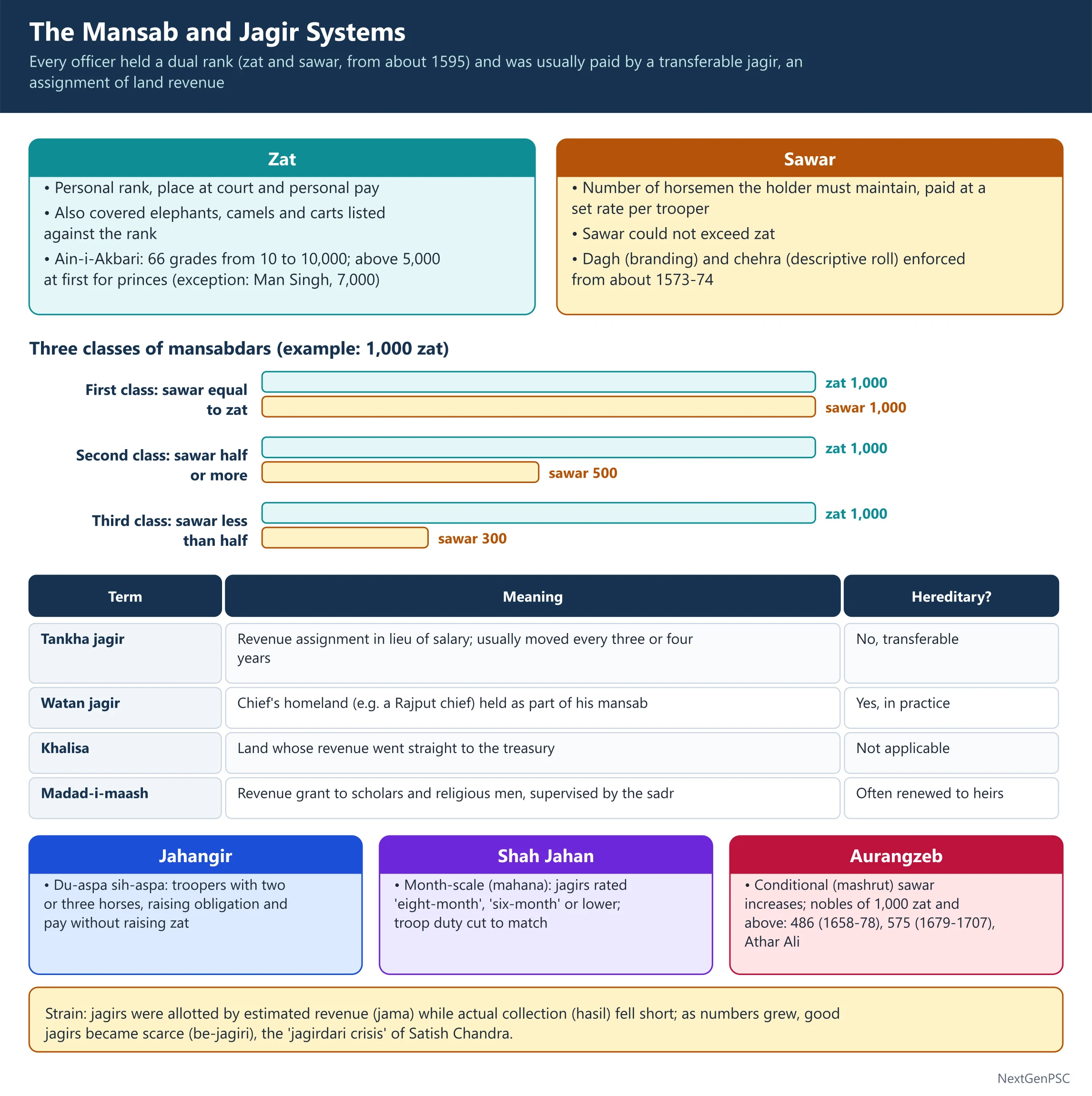
Under Akbar every noble and officer held a numerical rank, the mansab, expressed from about 1595 as a pair: zat (personal status and pay) and sawar (the cavalry he had to maintain). Most mansabdars were paid not in cash but by a jagir, an assignment of the land revenue of a territory, which was transferable and not hereditary. The two systems together made the nobility a salaried, mobile service class, and their later strains lie at the heart of the 'jagirdari crisis' debate.
In simple words
Think of the Mughal nobility as an army-cum-civil service with grades.
A mansab was a grade number, like a pay band, which fixed both a noble's salary and how many horsemen he must bring.
Instead of cash, he was given the right to collect the land tax of some villages, the jagir, and he was moved to a new jagir every few years so that he never became a local king.
UPSC asks how these systems worked, how they changed, and why they ran into crisis.
1. Origins and Introduction
Background: Ranking of commanders by decimal units had Turko-Mongol roots, and the Delhi Sultanate's iqta was an earlier form of revenue assignment, but the Mughal system was more uniform and closely audited.
Akbar's measures: Mansabs were systematised in the 1570s; the dagh (branding of horses) and chehra (descriptive roll of troopers) were enforced from about 1573–74 to stop nobles from presenting the same horses twice.
Range of ranks: The Ain-i-Akbari speaks of 66 grades from 10 to 10,000, though in practice only some grades were used; ranks above 5,000 were at first reserved for princes, with a few exceptions such as Man Singh (7,000).
Zat and sawar: The dual rank appears in the 1590s, most historians placing it around 1595 (Akbar's 40th regnal year); the exact date and meaning were long debated by Abdul Aziz, W.H. Moreland, Irfan Habib and M. Athar Ali.
2. How the Mansab Worked
Zat: Fixed the holder's personal rank, his place at court and his personal pay, from which he also met the cost of elephants, camels and carts listed against his rank.
Sawar: Fixed the number of horsemen he had to maintain, paid at a set rate per trooper; the sawar rank could not exceed the zat rank.
Three classes: A mansabdar whose sawar equalled his zat was of the first class, one whose sawar was half or more of the zat was second class, and one with less than half was third class.
Appointment and promotion: Ranks were granted, raised or reduced by the emperor alone, usually on the mir bakhshi's report; nobles of all origins could rise, but birth, connection and service all mattered.
Military role: The sawars formed the bulk of the imperial cavalry; troopers were often recruited from the mansabdar's own clan or region, with the emperor also keeping his own ahadis (gentlemen troopers).
3. The Jagir
Meaning: A jagir (also tuyul) was an assignment of the land revenue of an area to a mansabdar in lieu of salary; it gave a right to revenue, not ownership of land or rights over the peasants beyond collection.
Jama and hasil: Jagirs were allotted by their estimated revenue (jama or jama-dami, reckoned in dams), while the actual collection (hasil) often fell short, which became a lasting grievance.
Types: The tankha jagir was given in lieu of pay and was transferable; the watan jagir was the hereditary homeland of a Rajput or other chief, left with him as part of his mansab; the khalisa was land whose revenue went straight to the treasury.
Transfers: Jagirs were usually moved every three or four years to stop nobles from striking roots, a practice Bernier blamed for short-term exploitation of the peasantry.
Escheat (zabt): On a noble's death the state recovered its dues from his property; Athar Ali argued this was recovery of debts owed to the treasury rather than wholesale confiscation, and heirs were often re-employed.
Madad-i-maash: Separate revenue grants to scholars, Sufis and other religious men were supervised by the sadr; Akbar had many of them reviewed and reduced, as Badauni bitterly records.
Checks: Imperial diwans, faujdars, qanungos and waqia-navis watched the jagirdar's agents (amils), and the peasants' revenue rates were fixed by the state, not the jagirdar.
4. Changes under Jahangir, Shah Jahan and Aurangzeb
Jahangir: Introduced the du-aspa sih-aspa rank, under which part of the sawar rank required troopers with two or three horses each, enlarging a favoured noble's obligation and pay without raising the zat.
Shah Jahan: Brought in the month-scale (mahana): when jagirs yielded only a fraction of their paper value, they were rated as 'eight-month', 'six-month' or lower, and troop obligations were reduced to a fraction of the sawar rank.
Aurangzeb: Granted conditional (mashrut) increases in sawar for particular duties, and the number of mansabdars grew sharply after the Deccan conquests.
Growth in numbers: M. Athar Ali counted 486 nobles of 1,000 zat and above for 1658–78 and 575 for 1679–1707, the rise reflecting the absorption of Deccanis and Marathas.
5. Sources
Ain-i-Akbari: Lists the grades of mansabs, rates of pay, rules of branding and the mansabdars of the time of Akbar.
Later records: Chronicles such as Lahori's Badshahnama list nobles with their ranks; the Dastur-ul-Amal manuals and surviving pay and jagir papers give the working rules.
Travellers: Bernier (1656–68) and Pelsaert (1620s) describe the nobles' dependence on the emperor, their extravagance and the pressure on peasants.
6. Analysis
Strengths: The system created a nobility of service, linked military and civil functions, prevented hereditary local power and recycled the surplus through the court.
Integration: It allowed the empire to absorb Rajputs, Afghans, Iranis, Deccanis and Marathas on a common scale of rank, which was central to Mughal political inclusion.
Weaknesses: Short tenures encouraged extraction, the gap between jama and hasil widened, the cost of nobles and troops was high, and good jagirs became scarce as numbers grew.
Continuity and change: It drew on the iqta tradition but was more centralised; in the 18th century jagirs became de facto hereditary, signalling the weakening of the centre.
7. Historiography
Early studies: W.H. Moreland (The Agrarian System of Moslem India, 1929) and Abdul Aziz (The Mansabdari System and the Mughal Army, 1945) reconstructed the mechanics of rank and pay.
Irfan Habib: In The Agrarian System of Mughal India (1963), he showed the jagir as the instrument by which the ruling class appropriated the peasants' surplus, and linked transferability to agrarian oppression.
Athar Ali: In The Mughal Nobility under Aurangzeb (1966) and The Apparatus of Empire (1985), he analysed the composition of the nobility and its ranks.
Satish Chandra: In Parties and Politics at the Mughal Court (1959) and later writing, he argued that the system worked only while enough revenue was available for jagirs, and that a shortage (be-jagiri) produced a crisis.
Shireen Moosvi: In The Economy of the Mughal Empire c.1595 (1987), she used the Ain's figures to estimate how much of the revenue went to the mansabdars and how much to the khalisa.
Revisionist note: Later scholars such as Muzaffar Alam stress regional variation and the growing local roots of jagirdars, warning against reading the Ain's ideal rules as practice everywhere.
8. Using It in the Exam
10-mark (150 words): Define mansab, zat and sawar with the three classes; one line on jagir and transfers.
15-mark (200 words): Explain the mansab-jagir link, types of jagir and checks on the jagirdar, with one change in the 17th century.
20-mark (250 words): Evaluate it as an instrument of centralisation and integration, then its strains (jama-hasil gap, be-jagiri) with Habib, Satish Chandra and Athar Ali.
Keywords: zat, sawar, dagh-chehra, tankha and watan jagir, khalisa, jama-hasil, month-scale, be-jagiri.
Source extract: Bernier observed that jagirdars, knowing they might be moved at any time, had no motive to care for the land and squeezed the peasants hard (paraphrase of his Travels).
| Class | Sawar in relation to zat | Example |
|---|---|---|
| First | Equal to zat | 1,000 zat / 1,000 sawar |
| Second | Half or more of zat | 1,000 zat / 500 sawar |
| Third | Less than half of zat | 1,000 zat / 300 sawar |
| Term | Meaning | Hereditary? |
|---|---|---|
| Tankha jagir | Revenue assignment in lieu of salary | No, transferable |
| Watan jagir | Chief's homeland held as part of his mansab | Yes, in practice |
| Khalisa | Land whose revenue went to the treasury | Not applicable |
| Madad-i-maash | Revenue grant to scholars and religious men | Often renewed to heirs |
Mains points
- Always explain the mansab and the jagir together: rank fixed the pay claim, the jagir met it.
- Define zat and sawar precisely and give the three classes; avoid saying the mansabdar 'owned' the jagir land.
- Show change over time: dagh-chehra (Akbar), du-aspa sih-aspa (Jahangir), month-scale (Shah Jahan), mashrut ranks (Aurangzeb).
- Evaluate: an instrument of centralisation and political integration, but costly and dependent on available revenue.
- Bring in the debate: Habib (agrarian exploitation), Satish Chandra (be-jagiri), Athar Ali (composition of nobility), Moosvi (quantification).
- Use the jama-hasil gap and Athar Ali's figures on rising numbers as evidence in crisis questions.
Did you know?
- The dagh rule existed because nobles hired horses and men for the muster day and dismissed them afterwards; branding made each horse traceable to its master.
Akbar's Rajput Policy, Sulh-i-kul and Court Patronage
Akbar turned the Rajput chiefs from rivals into partners through matrimonial alliances, high mansabs and the return of their homelands as watan jagirs; only Mewar held out. His religious outlook moved from orthodox Sunni practice to the Ibadat Khana debates (1575), the Mahzar (1579) and the ideal of sulh-i-kul (peace with all), expressed in the small discipleship order later called Din-i-Ilahi (1582). The same court patronised translation, painting, architecture and mechanical inventions.
In simple words
Akbar ruled a land where most subjects and many powerful chiefs were not Muslims.
Instead of fighting the Rajputs forever, he married into their families, gave them top jobs and let them keep their home states, much like a company merging with a rival and making its owners directors.
In religion he listened to scholars of every faith and made sulh-i-kul, peace with all, the rule of his state.
UPSC asks whether this was statecraft, personal belief or both.
1. The Rajput Policy
Amber (1562): Raja Bharmal of Amber gave his daughter in marriage to Akbar at Sambhar; she became the mother of Jahangir and is known by her title Mariam-uz-Zamani, while the name 'Jodha Bai' is a later tradition.
Rise of the Kachhwahas: Bharmal's son Bhagwant Das and grandson Man Singh became senior mansabdars; Man Singh rose to 7,000 and governed Kabul, Bihar and Bengal.
Other houses: Bikaner and Jaisalmer made alliances in 1570, and Marwar's rulers entered service later in the reign; the Hada chiefs of Bundi accepted terms after Ranthambhor (1569) that exempted them from sending daughters.
Terms of the alliance: Chiefs kept their ancestral lands as watan jagirs, received mansabs and further jagirs elsewhere, served in campaigns and at court, and accepted Mughal paramountcy and succession disputes settled by the emperor.
Mewar's resistance: Udai Singh lost Chittor in 1568 and his son Rana Pratap fought on after Haldighati (1576); Mewar submitted on honourable terms only in 1615 under Jahangir.
Non-religious measures: Akbar abolished the pilgrim tax (1563) and the jizya (1564), allowed Rajput princesses to keep their worship in the palace, and appointed Rajputs to high command, including against Muslim rulers.
Why it worked: It gave the chiefs security, honour and income on an imperial scale, while giving Akbar a loyal, locally rooted cavalry to balance the Central Asian nobles.
2. Evolution of Akbar's Religious Outlook
Early phase: In the 1560s Akbar was a practising Sunni, devoted to the Chishti shrine at Ajmer and to Shaikh Salim Chishti of Sikri, after whom he named his son Salim (born 1569).
Ibadat Khana (1575): A hall of worship at Fatehpur Sikri where Sunni scholars first debated; their bitter quarrels disillusioned Akbar, and from 1578 Shias, Hindus, Jains, Zoroastrians and Christians were admitted.
Participants: Jain monk Hiravijaya Suri, the Parsi priest Dastur Meherji Rana, Brahmin scholars such as Purushottam and Devi, and the Jesuits Rudolf Acquaviva and Antonio Monserrate (from 1580).
Mahzar (1579): A declaration signed by leading ulama, drafted under Shaikh Mubarak, stated that where the jurists disagreed, Akbar as a just ruler (imam-i-adil) could choose the interpretation best for the realm; V.A. Smith's label 'infallibility decree' overstates it.
Tauhid-i-Ilahi (1582): A discipleship (muridi) in which a few chosen nobles pledged loyalty to Akbar as spiritual guide, ready to sacrifice life, property, honour and religion; Badauni names only about eighteen members, with Birbal the only Hindu.
Other symbols: The Ilahi era (from 1584), sun worship and fire rituals at court, sijda (prostration) before the emperor and jharokha darshan, which orthodox critics resented.
3. Sulh-i-kul
Meaning: 'Absolute peace' or 'peace with all', a principle that the ruler stands above sects, treats all subjects alike and allows freedom of belief so long as it does not harm the state.
Intellectual roots: Sufi ideas of wahdat-ul-wujud (unity of being), the teaching of Shaikh Mubarak and his sons Faizi and Abul Fazl, and Persian ideas of just kingship.
In practice: Non-Muslims were appointed to high office, forcible conversion of war captives was stopped (1562), temples were allowed to be built, and Akbar discouraged forced sati.
Abul Fazl's theory: In the Ain, the king receives a divine light (farr-i-izidi) and acts as a father to all communities, so tolerance becomes a duty of kingship rather than a concession.
4. Court Patronage of Learning and Art
Translation bureau (maktab khana): The Mahabharata was rendered into Persian as the Razmnama, and the Ramayana, Atharvaveda, Lilavati (by Faizi) and Rajatarangini were also translated; Abdur Rahim Khan-i-Khanan translated the Baburnama into Persian (1589).
Painting: The atelier founded under Humayun by Mir Sayyid Ali and Abdus Samad produced the huge Hamzanama (c.1562–77), then the Razmnama, Akbarnama and Baburnama manuscripts; Daswanth and Basawan were leading Indian painters.
Architecture: Agra Fort (1565 onwards), Fatehpur Sikri (from 1571) with the Buland Darwaza and Jama Masjid, and the Lahore and Allahabad forts combined Persian, Timurid and Indian elements.
Music and letters: Tansen came to Akbar's court in 1562; the poet Faizi was made malik-ush-shuara (poet laureate) and Hindi poets such as Birbal and Abdur Rahim enjoyed favour.
5. Akbar and Technology
Abul Fazl's record: The Ain credits Akbar with devices such as a cart that also ground corn as it moved, a wheel that cleaned several gun barrels at once, and improved matchlocks and gun-making.
Fathullah Shirazi: The Iranian scholar at Akbar's court is credited with mechanical devices and with reform of the calendar for the Ilahi era.
Cooling with saltpetre: The Ain describes cooling water with saltpetre and bringing ice from the hills for the court.
Limits: Irfan Habib's essay on Akbar and technology argues that such inventions were court curiosities that did not spread into general production, though they show interest in practical knowledge.
6. Sources
Supporters: Abul Fazl's Akbarnama and Ain-i-Akbari present the official philosophy; Faizi's letters reflect the same circle.
Critics: Badauni's Muntakhab-ut-Tawarikh is the main hostile account of the Ibadat Khana, the Mahzar and the discipleship.
Outsiders: Jesuit letters and Monserrate's Commentarius, Jain texts such as the Hirasaubhagya tradition on Hiravijaya, and the later Dabistan-i-Mazahib (mid-17th century) describe Akbar's religious discussions.
7. Analysis
Statecraft or conviction: The Rajput policy and sulh-i-kul served imperial needs, but Akbar's long personal search, visible in the debates and his mystical experiences, shows real belief as well.
Not a new religion: The Tauhid-i-Ilahi had no scripture, priesthood or mass following; it was a bond of loyalty between the emperor and a small elite.
Consequences: It widened the social base of the empire, drew Hindu elites into a shared court culture and set a standard against which Aurangzeb's policies were later judged.
Continuity: Elements of sulh-i-kul survived under Jahangir and Shah Jahan, and the Rajput alliance remained the backbone of the empire until the Marwar crisis of 1679.
8. Historiography
Critical view: V.A. Smith saw the Divine Faith as a product of vanity and called it a monument of Akbar's folly rather than his wisdom.
Rejecting the 'religion' label: Makhanlal Roy Choudhury (The Din-i-Ilahi, 1941) argued that it was not a religion but an order of discipleship; S.R. Sharma (The Religious Policy of the Mughal Emperors) stressed its political purpose.
Political reading: Iqtidar Alam Khan and M. Athar Ali tie the Mahzar and the discipleship to the struggle with the orthodox ulama and the revolt of 1580–81, while seeing sulh-i-kul as a coherent ideology of rule.
Rajput policy: Satish Chandra describes it as a partnership of mutual benefit rather than simple subordination, while some Rajput-centred writers emphasise the loss of autonomy and the resistance of Mewar.
9. Using It in the Exam
10-mark (150 words): Define sulh-i-kul, give its roots and two practical expressions.
15-mark (200 words): Trace the evolution in stages (1560s, 1575, 1578, 1579, 1582), with Badauni and Abul Fazl as contrasting sources.
20-mark (250 words): Assess whether the Rajput policy and religious policy were statecraft or conviction, using the nobility's composition and the historians' debate.
Keywords: Amber 1562, watan jagir, Ibadat Khana, Mahzar, imam-i-adil, Tauhid-i-Ilahi, sulh-i-kul, maktab khana.
Source extract: Badauni complains that Akbar's mind became so changed by the debates that within a few years not a trace of Islam was left in him (paraphrase of the Muntakhab), a biased view to quote as evidence of orthodox opposition.
| Year | Measure | Meaning |
|---|---|---|
| 1562 | End of forced conversion of war captives | Early sign of tolerance |
| 1563–64 | Pilgrim tax and jizya abolished | Equal treatment of non-Muslims |
| 1575 | Ibadat Khana built at Fatehpur Sikri | Debates among Sunni scholars |
| 1578 | Ibadat Khana opened to all faiths | Comparative religious enquiry |
| 1579 | Mahzar signed by the ulama | Emperor as arbiter among jurists |
| 1582 | Tauhid-i-Ilahi discipleship | Bond of loyalty with select nobles |
| 1584 | Ilahi era introduced | Solar calendar of the reign |
Mains points
- Present the Rajput policy as a political partnership with clear terms (mansab, watan jagir, service), not merely marriages.
- Show the evolution of religious policy as stages with dates; examiners reward chronology plus explanation.
- Never call Din-i-Ilahi a 'new religion' without qualification; explain why most historians call it a discipleship order.
- Correct the 'infallibility decree' label for the Mahzar and say what it actually claimed.
- Use Badauni and Abul Fazl as contrasting, biased sources, and add the Jesuits as outsiders.
- For patronage questions, link translation, painting and technology to Akbar's ideology of an inclusive court.
Did you know?
- The Hamzanama was painted on cloth in about 1,400 large folios, and the big pictures are thought to have been held up before Akbar while the story was narrated aloud.
- Akbar granted Hiravijaya Suri's request to ban animal slaughter on certain Jain holy days, and conferred on Hiravijaya the title Jagadguru.
Jahangir, Shah Jahan and Aurangzeb: Administration and Religious Policy
Akbar's successors kept his institutions but adapted them: Jahangir (1605–27) issued twelve ordinances and governed with Nur Jahan's family; Shah Jahan (1628–58) extended the empire in the Deccan, tightened the mansab system through the month-scale and built on a grand scale; Aurangzeb (1658–1707) pushed the frontier to its widest but turned to a more sharia-minded policy, reimposing jizya in 1679. Whether his religious policy caused the empire's troubles is one of the central debates of Mughal history.
In simple words
Think of three managers who inherit a big company.
Jahangir kept things running and loved art and justice rituals; Shah Jahan expanded the business and spent heavily on buildings; Aurangzeb took over the largest company but changed its rules to follow religious law more strictly and spent decades fighting in the Deccan.
Historians argue whether his religious policy or deeper structural problems explain the troubles that followed.
UPSC asks you to compare the three reigns and weigh this debate.
1. Jahangir (1605–1627)
Twelve ordinances: At his accession Jahangir issued rules recorded in his memoirs: abolition of certain cesses and tolls, building of sarais and wells on roads, no opening of merchants' bales without consent, inheritance of property by heirs, a ban on making wine, and hospitals in large towns.
Chain of justice: He hung a golden chain with bells (zanjir-i-adl) from the Agra fort so that complainants could appeal to him directly, a symbol of royal justice.
Khusrau's revolt (1606): His son Khusrau rebelled and was defeated; Guru Arjan, who had blessed the prince, was executed in 1606, beginning Mughal-Sikh hostility.
Nur Jahan: Married in 1611, she, her father Itimad-ud-Daula, her brother Asaf Khan and Prince Khurram were dominant at court; Beni Prasad's History of Jahangir (1922) called this a 'junta', a thesis S. Nurul Hasan later questioned.
Military record: Mewar submitted in 1615 through Khurram, Kangra fort was taken in 1620, but Qandahar was lost to Persia in 1622, followed by Khurram's revolt (1622–25) and Mahabat Khan's coup (1626).
Foreign contact: Sir Thomas Roe, ambassador of James I (1615–19), won trading concessions for the English at Surat.
Religious policy: Broadly Akbar's sulh-i-kul: Jahangir conversed with the Hindu ascetic Jadrup, honoured Sufis and celebrated Hindu festivals, but acted against Guru Arjan for political reasons and imprisoned Guru Hargobind at Gwalior for a time.
2. Shah Jahan (1628–1658)
Early revolts: Shah Jahan suppressed the Bundela chief Jujhar Singh and the Afghan noble Khan Jahan Lodi (1628–31), and expelled the Portuguese from Hugli (1632).
Deccan: The Nizam Shahi kingdom of Ahmadnagar was extinguished in 1633; in 1636 Bijapur and Golkonda accepted Mughal overlordship by treaty, and the Mughal Deccan was organised into four subas under Prince Aurangzeb.
Murshid Quli Khan: As diwan of the Deccan in the 1650s he extended measurement and survey-based assessment there, adapted to local conditions, to raise revenue and encourage cultivation.
Central Asia and Qandahar: Qandahar was regained in 1638 and lost again in 1649; three sieges (1649, 1652, 1653) failed, and the Balkh-Badakhshan campaign (1646–47) was a costly failure.
Mansab reform: The month-scale (mahana) adjusted pay and troop obligations to the real yield of jagirs, a sign that jagirs were yielding less than their paper value.
Court and capital: Shahjahanabad (Delhi) was built in 1639–48; the Peacock Throne and the Taj Mahal show the scale of royal spending.
Religious policy: Lahori's Badshahnama records a 1632–33 order to demolish newly built temples, with many destroyed at Benares; later the policy eased, and Prince Dara Shikoh translated the Upanishads as Sirr-i-Akbar (1657) and wrote Majma-ul-Bahrain (1655).
War of succession (1657–59): On Shah Jahan's illness his sons fought; Aurangzeb and Murad won at Dharmat (April 1658) and Samugarh (May–June 1658), Shah Jahan was confined in Agra fort until his death (1666), and Dara was defeated at Deorai (1659) and executed.
3. Aurangzeb: Administration (1658–1707)
Revenue rules: His farmans to Rasikdas Krori and Muhammad Hashim (late 1660s) restated the revenue rules, forbade illegal cesses and urged officials to extend cultivation, and are key sources for Habib's study of the agrarian system.
Abolition of cesses: He abolished the rahdari (road toll) and many local cesses (abwab) at accession, though enforcement was uneven.
Fatawa-i-Alamgiri: A board of jurists compiled this digest of Hanafi law in the 1660s–70s to guide qazis.
Rajput war (1679–81): After Jaswant Singh of Marwar died in 1678, Aurangzeb took Marwar under direct control; Rathor resistance led by Durgadas for the infant Ajit Singh, joined by Mewar, turned into a long war, and Prince Akbar rebelled in 1681 and fled to the Marathas.
Deccan wars (1681–1707): Aurangzeb moved south, annexed Bijapur (1686) and Golkonda (1687), executed Sambhaji (1689), but could not end Maratha resistance, and died at Ahmadnagar in 1707.
Composition of the nobility: Athar Ali's counts show the share of Hindus among nobles of 1,000 zat and above rising from 21.6 per cent (1658–78) to 31.6 per cent (1679–1707), mostly through Marathas.
4. Aurangzeb: Religious Policy
Early measures: Muhtasibs (censors of morals) were appointed; the kalima was removed from coins, Nauroz celebrations stopped, and in the late 1660s court music, jharokha darshan and the official chronicle were discontinued.
Temples: The Maasir-i-Alamgiri records a 1669 order against temples and schools of the infidels; the Vishwanath temple at Benares (1669) and the Keshava Rai temple at Mathura (1670) were demolished.
Grants to temples: At the same time Aurangzeb confirmed or made grants to some temples and maths, such as the Jangambari math at Benares and the Umananda temple at Guwahati, shown by surviving farmans.
Jizya (1679): Reimposed on non-Muslims, with exemptions for the poor, women and some officials; it was protested by crowds in Delhi and became a grievance in Rajput and Maratha propaganda.
Sikhs: Guru Tegh Bahadur was executed at Delhi in 1675, and conflict with Guru Gobind Singh followed.
5. Sources
Memoirs and chronicles: Jahangir's Tuzuk-i-Jahangiri; Mutamad Khan's Iqbalnama-i-Jahangiri; Lahori's Badshahnama, Inayat Khan's Shahjahannama and Kambo's Amal-i-Salih; Kazim's Alamgirnama; Saqi Mustaid Khan's Maasir-i-Alamgiri (1710).
Unofficial histories: Khafi Khan's Muntakhab-ul-Lubab and Bhimsen Saxena's Nuskha-i-Dilkusha give critical views of Aurangzeb's Deccan years.
Europeans: Roe, Pelsaert, Peter Mundy, Bernier, Tavernier and Manucci, valuable but often hostile or based on gossip.
6. Analysis
Continuity: The mansab-jagir system, the revenue machinery and the Rajput alliance continued, with adjustments for rising costs.
Change: Royal spending and the size of the nobility grew, the empire turned south, and under Aurangzeb religious identity became more prominent in state policy.
Comparison: Jahangir's reign was relatively stable but saw factional politics; Shah Jahan's was the high point of court splendour; Aurangzeb's saw the widest extent and the deepest strains.
7. Historiography
Religious explanation: Jadunath Sarkar (History of Aurangzib, five volumes) blamed Aurangzeb's bigotry for alienating Hindus and causing the revolts that ruined the empire.
Political motives: Satish Chandra argued that the jizya of 1679 was a political move to rally the ulama and Muslim opinion when the empire faced crisis in the Deccan and Rajputana, not simple fanaticism.
Temple desecration: Richard Eaton (2000) argued that Indo-Muslim rulers usually targeted temples linked to rebellious or enemy rulers, treating them as political acts, a view others contest.
Recent debate: Audrey Truschke (Aurangzeb, 2017) presented him as a ruler shaped by Mughal kingship as much as by piety, a reading strongly criticised by others; examiners expect you to note that the debate is live.
Nur Jahan: Ellison Banks Findly's biography (1993) stresses her role in trade, building and coinage, beyond the junta model.
8. Using It in the Exam
10-mark (150 words): One reign, two or three administrative measures and one religious measure, with dates.
15-mark (200 words): Compare the religious policies of the three rulers, showing continuity from Akbar and the shift under Aurangzeb.
20-mark (250 words): Was Aurangzeb's religious policy the cause of decline? Set Sarkar against Satish Chandra, Habib and Athar Ali, and conclude with a balanced view.
Keywords: twelve ordinances, Nur Jahan junta, month-scale, Murshid Quli Khan, Fatawa-i-Alamgiri, jizya 1679, muhtasib, Marwar crisis.
Source extract: Jahangir writes in the Tuzuk that he ordered a chain of justice to be hung so that the oppressed would not be kept from him by officials (paraphrase).
| Aspect | Jahangir | Shah Jahan | Aurangzeb |
|---|---|---|---|
| Key measure | Twelve ordinances; chain of justice | Month-scale; Deccan subas | Fatawa-i-Alamgiri; abolition of cesses |
| Expansion | Mewar (1615), Kangra (1620) | Ahmadnagar (1633); treaties of 1636 | Bijapur (1686), Golkonda (1687) |
| Setbacks | Loss of Qandahar (1622) | Balkh (1646–47); Qandahar lost (1649) | Rajput war; Maratha resistance |
| Religious policy | Broadly sulh-i-kul; action against Guru Arjan | 1633 order on new temples; later relaxed | Muhtasibs, 1669 order, jizya 1679 |
| Main chronicle | Tuzuk-i-Jahangiri | Badshahnama (Lahori) | Maasir-i-Alamgiri |
Mains points
- Comparison questions reward a structured table-like answer: measure, expansion, setbacks, religion for each ruler.
- Do not present Aurangzeb's policy as uniform: give both the 1669 order and the temple grants, and the rise in Hindu nobles.
- Separate religious policy from the political context (Marwar succession, Deccan wars, jagir shortage) when explaining the jizya.
- Name historians on each side: Sarkar versus Satish Chandra, Athar Ali and Habib; mention Eaton and Truschke as recent, contested views.
- Avoid presenting Nur Jahan's 'junta' as settled fact; note Nurul Hasan's critique.
- Use contemporary sources by name (Tuzuk, Badshahnama, Maasir-i-Alamgiri, Khafi Khan) to support each claim.
Did you know?
- Nur Jahan is the only Mughal empress in whose name coins were struck, bearing verses that pair her name with Jahangir's.
- Khafi Khan wrote his history in secret because Aurangzeb had banned official chronicles after the first decade of his reign.
The Empire and the Zamindars; Nature of the Mughal State
Between the emperor and the peasant stood the zamindars, holders of hereditary rights to a share of the produce, ranging from autonomous chieftains who paid tribute to village-level primary zamindars. The empire both depended on them to collect revenue and feared their armed power. How to characterise the state that managed this balance — centralised and bureaucratic, patrimonial, theocratic, or a negotiated, flexible empire — is a major historiographical debate.
In simple words
Imagine a big franchise network: head office (the emperor) sets the rules, but local owners (the zamindars) actually run the shops, collect money and keep their own guards.
Head office needs them, yet worries they may break away.
The Mughals made many zamindars part of the system and used force on those who resisted.
Historians argue whether this empire was a tightly run machine or a looser web of deals. UPSC asks both about zamindars and about this 'nature of the state' debate.
1. Who Were the Zamindars?
Meaning: In Mughal usage a zamindar was the holder of a hereditary right (zamindari) to a share of the produce of land, distinct from the state's claim to land revenue and from the peasant's right to cultivate.
Saleable right: Sale deeds and documents from many regions show zamindari rights being bought, sold, mortgaged and divided among heirs, which makes it a form of property.
Caste and clan: In most of north India zamindars were drawn from dominant castes and clans (Rajputs, Jats, Brahmins, Afghans and others), who also controlled the villages socially.
Armed power: The Ain-i-Akbari records the troops of zamindars province by province, in all more than four million infantry and several hundred thousand cavalry, far larger than the imperial army.
2. Classification
Nurul Hasan's scheme: S. Nurul Hasan, in his essay 'Zamindars under the Mughals' (1969), grouped them as autonomous chieftains, intermediary zamindars and primary zamindars, a scheme now widely used.
Autonomous chieftains: Rajas and rais who ruled their own territories, paid tribute (peshkash) and gave military service; many were made mansabdars and had their lands as watan jagirs.
Intermediary zamindars: Those who collected revenue from primary zamindars or peasants and passed it to the state or jagirdar, keeping a commission; they included chaudhuris, deshmukhs, desais and ijaradars (revenue farmers).
Primary zamindars: Holders of proprietary rights over land in villages, often cultivating part themselves through tenants and labourers, who paid revenue directly or through intermediaries.
Overlap: The same family could be primary zamindar in one village and intermediary in a pargana, and the categories varied regionally (for example, the deshmukhs of the Deccan).
3. The Zamindar's Share and Duties
Share: Zamindars received a share of the revenue known in north India as malikana (Habib notes about a tenth in many areas), or tax-free land called nankar; in Gujarat a similar share was called banth.
Duties: They helped collect revenue, kept order, supplied troops when required, and were expected to extend cultivation by settling peasants.
State control: Their rights were confirmed by the state, they could be removed for default or rebellion, and imperial officials (faujdars, qanungos) watched them.
4. Cooperation and Conflict
Cooperation: Akbar's policy, continued by his successors, was to absorb chieftains into the mansab system and use local zamindars as the base of revenue administration.
Conflict: Zamindars resisted high revenue demands, refused payment (zor-talab or mawas areas were known for this) and led peasant risings; faujdars were posted to suppress them.
Dual role: Nurul Hasan stressed that zamindars were both collaborators and rivals of the state, because their interest lay in a larger share of the same surplus.
Late 17th century: Habib saw the Jat, Satnami, Maratha and other risings as zamindar-led revolts drawing on peasant discontent, while others emphasise the ambitions of rising local lineages.
5. Theories of the Mughal State: Older Views
Oriental despotism: Bernier argued that the king owned all land, so there was no secure private property, and Marx later built on such accounts in his idea of the Asiatic mode of production.
Islamic state: Ishtiaq Husain Qureshi (The Administration of the Mughal Empire, 1966) saw the Mughal state as a Muslim polity guided by sharia, though adapted to Indian needs.
Civilian-military bureaucracy: R.P. Tripathi and Ibn Hasan described a centralised, bureaucratic state headed by the emperor as the source of all power.
6. The Aligarh View
Centralised extraction: Irfan Habib and M. Athar Ali argued that the empire was a highly centralised system in which a ruling class of mansabdars, paid by jagirs, appropriated a large share of the peasants' surplus through a uniform revenue machinery.
Evidence: Uniform revenue rates, transferable jagirs, branding, news-writers, the khalisa and the emperor's control over ranks.
Shireen Moosvi quantified this, using the Ain's figures to show how revenue was distributed among the emperor, the nobles and the zamindars.
7. Weberian and Revisionist Views
Patrimonial-bureaucratic: Stephen Blake ('The Patrimonial-Bureaucratic Empire of the Mughals', 1979), using Max Weber, argued that the state was an extension of the emperor's household, with nobles as personal dependants and the camp-court as its centre.
Negotiated empire: Douglas Streusand and later Muzaffar Alam and Sanjay Subrahmanyam (introduction to The Mughal State, 1526–1750, 1998) stressed bargaining with zamindars, nobles and merchants, and the flexibility of a state that worked through local power.
Fitna and sovereignty: Andre Wink (Land and Sovereignty in India, 1986) argued that rulers absorbed rivals by exploiting their internal divisions (fitna), so sovereignty was shared and constantly renegotiated.
Kingship and culture: Harbans Mukhia (The Mughals of India, 2004) and others emphasise ideas of kingship, court culture and legitimacy rather than only revenue machinery.
8. Analysis: Reconciling the Views
Both are true in part: The central institutions were unusually uniform for a pre-modern empire, yet in practice they depended on zamindars and local elites.
Regional variation: Control was strongest in the Gangetic plain and Punjab and weakest in hill, forest and frontier zones where chieftains kept autonomy.
Change over time: Centralisation peaked under Akbar and Shah Jahan; by the late 17th century local power grew, preparing the regional states of the 18th century.
Not theocratic: Most historians reject the theocratic label, since policy was shaped by political needs and included non-Muslims at the highest levels.
9. Sources
Administrative: The Ain-i-Akbari, the Dastur-ul-Amal manuals, farmans, revenue papers (for example, documents studied from Rajasthan's archives, such as the arhsatta records of Amber).
Travellers: Bernier's letter to Colbert on the land of Hindustan and Pelsaert's Remonstrantie shaped the despotism thesis.
Local records: Sale deeds of zamindari rights, qanungo papers and Rajput chronicles such as Nainsi's Khyat show the zamindar's view.
10. Using It in the Exam
10-mark (150 words): Define zamindar, give Nurul Hasan's three categories and their share (malikana, nankar).
15-mark (200 words): Explain the relationship of cooperation and conflict, with examples of integration and revolt.
20-mark (250 words): On the nature of the state, set out three models (Aligarh centralisation, Blake's patrimonial-bureaucratic, the negotiated empire), test each against evidence and conclude with a synthesis.
Keywords: zamindari right, peshkash, malikana, nankar, autonomous chieftain, patrimonial-bureaucratic, fitna, negotiated sovereignty.
Source extract: Bernier wrote that the king of Hindustan was the proprietor of all the land in the kingdom (paraphrase), a claim later historians such as Habib reject by pointing to the saleable rights of zamindars and peasants.
| Category | Examples | Relation to the state |
|---|---|---|
| Autonomous chieftains | Rajput rajas, hill and forest chiefs | Paid peshkash; often made mansabdars |
| Intermediary zamindars | Chaudhuris, deshmukhs, desais, ijaradars | Collected revenue for a commission |
| Primary zamindars | Village landholding lineages | Paid revenue; held saleable proprietary rights |
| Model | Main proponents | Core claim |
|---|---|---|
| Oriental despotism | Bernier; Marx | King owned all land; no secure property |
| Islamic state | I.H. Qureshi | State guided by sharia |
| Centralised extraction | Irfan Habib, M. Athar Ali | Ruling class appropriated surplus through uniform machinery |
| Patrimonial-bureaucratic | Stephen Blake | State as the emperor's extended household |
| Negotiated empire | Streusand; Alam and Subrahmanyam; Wink | Power shared and bargained with local elites |
Mains points
- Define zamindari as a right to a share of produce, not ownership in the modern sense, and distinguish it from jagir.
- Use Nurul Hasan's threefold classification and give regional terms (deshmukh, chaudhuri, desai).
- Show both cooperation and conflict; the 'dual role' is the key analytical point.
- In 'nature of the state' answers, present at least three models with their authors and evidence, then synthesise.
- Avoid the outdated 'theocracy' and 'oriental despotism' labels unless you are explaining and critiquing them.
- Link to the late 17th-century crisis: zamindar ambitions are central to Habib's and Alam's explanations.
Did you know?
- By the Ain's own figures, the zamindars' armed retainers outnumbered the imperial cavalry many times over, a reminder that Mughal power rested on cooperation as much as force.
The Late 17th-Century Crisis and the Revolts
From the 1660s the Mughal empire faced a chain of revolts — Jats, Satnamis, Afghans, Rajputs, Sikhs, Bundelas and above all the Marathas — while the long Deccan wars strained its resources. Historians explain this crisis in different ways: religious reaction (Jadunath Sarkar), an agrarian crisis of peasant exploitation (Irfan Habib), a jagirdari crisis of too many nobles chasing too little revenue (Satish Chandra), a failure to absorb new elites (Athar Ali, J.F. Richards), or the rise of regional prosperity and local power (Muzaffar Alam, C.A. Bayly).
In simple words
In the last forty years of the 17th century, group after group rose against the Mughals, from Jat farmers near Agra to Maratha warriors in the Deccan.
Why?
Imagine a company whose costs (more nobles, endless wars) rise faster than its income (land tax), so managers squeeze customers and the customers revolt.
Historians disagree on whether religion, money, or politics mattered most in this crisis. UPSC regularly asks you to explain the revolts and weigh these explanations.
1. The Revolts: Narrative
Jats (from 1669): Gokula, a zamindar of Tilpat near Mathura, led peasants against the faujdar and was executed in 1670; Rajaram led a second rising in the 1680s and plundered Akbar's tomb at Sikandra (1688); Churaman continued it, and in the 18th century Badan Singh and Suraj Mal founded the Jat state of Bharatpur.
Satnamis (1672): A sect of peasants, artisans and small traders near Narnaul and Mewat rose after a quarrel with a Mughal soldier; they defeated local forces before a large imperial army crushed them.
Afghans (1667–75): The Yusufzai and Afridi tribes of the north-west rose, the Afridis destroying a Mughal army in the Khyber in 1672; the Pashto poet-chief Khushhal Khan Khattak joined them, and Aurangzeb himself went to the frontier (1674–75).
Rajputs (1679–81 and after): The Marwar succession dispute after Jaswant Singh's death led to a long Rathor resistance under Durgadas for Ajit Singh, and Mewar's Raj Singh joined; peace with Mewar came in 1681, but Marwar fought on for decades.
Bundelas: Champat Rai and then his son Chhatrasal resisted in Bundelkhand; Chhatrasal built an independent principality around Panna.
Sikhs: After Guru Tegh Bahadur's execution (1675), Guru Gobind Singh fought the hill chiefs and Mughal forces and founded the Khalsa (1699); Banda Bahadur's rising (1709–16) followed after Aurangzeb's death.
Marathas: Shivaji's state, Sambhaji's war and, after his execution (1689), a people's war under Rajaram and Tarabai wore down the Mughal armies in the Deccan.
2. Sources
Persian chronicles: Maasir-i-Alamgiri, Khafi Khan's Muntakhab-ul-Lubab, Bhimsen's Nuskha-i-Dilkusha and Ishwardas Nagar's Futuhat-i-Alamgiri narrate the revolts and the Deccan wars.
Administrative documents: Akhbarat (court newsletters), farmans, revenue papers and the Amber and Jaipur records (vakil reports, arhsatta) show rising arrears and disorder.
Europeans: Bernier's account of the peasantry (1660s) and Manucci's Storia do Mogor describe oppression and flight of peasants, though with bias.
Regional sources: Marathi bakhars, Sikh texts and Rajasthani khyats give the rebels' perspective.
3. Explanation 1: Religious Reaction
Jadunath Sarkar: In his History of Aurangzib he argued that Aurangzeb's orthodoxy — temple destruction, jizya, discrimination — provoked Hindu revolts and alienated the Rajputs, destroying Akbar's work.
Rajput alienation: Sarkar and later writers stressed that the Marwar crisis of 1679 cost the empire the goodwill of its oldest allies and opened a second front while the Deccan war was beginning.
Critique: Rebels included Muslims (Afghans), the timing of revolts does not match religious measures closely, Hindu nobles increased in number, and many rebels were zamindars with material grievances.
4. Explanation 2: Agrarian Crisis
Irfan Habib's thesis: In The Agrarian System of Mughal India (1963) he argued that the revenue demand, set to take nearly all of the peasant's surplus, combined with jagirdars' short-term extraction, drove peasants to flight and revolt.
Leadership: Revolts were led by zamindars, who mobilised peasants through caste and religious bonds; the Jat and Satnami risings are his main examples.
Contradiction: Habib saw the crisis as the system's own contradiction: the more the ruling class extracted, the more it undermined the production on which it rested.
5. Explanation 3: Jagirdari Crisis
Satish Chandra: He argued that the mansab-jagir system could work only if enough revenue was available to pay the nobles; under Aurangzeb the number of mansabdars outran the paibaqi (revenue land available for assignment), producing be-jagiri (nobles without jagirs).
Symptoms: The widening gap between jama (paper revenue) and hasil (actual collection), long waits for jagirs, the inflated jama of the Deccan, and the spread of ijara (revenue farming).
Political result: Factional struggle among nobles for good jagirs weakened the centre and fed into the wars of succession after 1707.
6. Explanation 4: The Deccan and the Nobility
Athar Ali: In The Mughal Nobility under Aurangzeb (1966) he showed the influx of Deccani and Maratha nobles after 1679, which unsettled the older groups and increased the demand for jagirs.
Cultural explanation: In 'The Passing of Empire: The Mughal Case' (Modern Asian Studies, 1975) Athar Ali also suggested a wider intellectual and technological stagnation in the Islamic empires of the time.
Richards: In Mughal Administration in Golconda (1975) and The Mughal Empire (1993) he argued that the conquests of Bijapur and Golkonda were administratively sound, but the failure to make a durable settlement with the Marathas drained the empire.
The Deccan ulcer: A comparison usually credited to Jadunath Sarkar holds that the Deccan ruined Aurangzeb as the Spanish ulcer ruined Napoleon, summing up the cost of a quarter-century of war in men, money and imperial attention.
7. Explanation 5: Regional Prosperity and Local Power
Muzaffar Alam: The Crisis of Empire in Mughal North India: Awadh and the Punjab, 1707–48 (1986) argued that the provinces were growing in wealth, so local zamindars, merchants and officials asserted autonomy; the crisis was one of the centre, not of the economy.
Bayly: Saw the 18th century as a period of commercial expansion and new regional elites, a view developed in Rulers, Townsmen and Bazaars (1983).
Great firm theory: Karen Leonard (1979) suggested that big banking houses shifted their credit from the Mughal centre to regional powers, weakening the empire.
Debate continues: Critics reply that regional growth was uneven and that the revolts and arrears of the 1680s–1700s point to real distress.
8. Analysis
Multi-causal: Most historians now combine factors: agrarian pressure, jagir shortage, Deccan wars and the ambitions of zamindars and regional elites, with religious policy as an aggravating factor rather than the root cause.
Continuity and change: The revolts mark a shift from imperial integration to regional assertion, foreshadowing the successor states (Awadh, Bengal, Hyderabad) and the Maratha, Jat and Sikh polities.
Chronology: The crisis was visible from the 1670s–80s, decades before the post-1707 breakdown, so the decline cannot be explained only by weak later emperors.
Comparative note: Historians also compare the Mughal crisis with the contemporary strains of the Ottoman and Safavid empires, a reminder that the problems of large agrarian empires were not unique to India.
9. Using It in the Exam
10-mark (150 words): One revolt (for example, the Jats or Satnamis): leaders, dates, social base, and one historian's explanation.
15-mark (200 words): Classify the revolts (peasant-zamindar, tribal, Rajput, Sikh, Maratha) and identify common causes.
20-mark (250 words): 'The late 17th-century crisis was agrarian rather than religious.' Discuss, setting Sarkar against Habib, Satish Chandra, Athar Ali and Alam, and conclude with a multi-causal view.
Keywords: agrarian crisis, jagirdari crisis, be-jagiri, jama-hasil gap, paibaqi, zamindar-led revolt, Deccan ulcer, regional assertion.
Source extract: Bernier warned that the jagirdars' attitude was to ask why they should care for land they might lose tomorrow, and so they drained the peasants (paraphrase), the passage Habib uses to explain agrarian decline.
| Revolt | Dates | Leaders | Social base |
|---|---|---|---|
| Jat | 1669 onwards | Gokula, Rajaram, Churaman | Jat zamindars and peasants of the Agra-Mathura region |
| Satnami | 1672 | Sect leaders | Peasants, artisans and petty traders of Narnaul |
| Afghan | 1667–75 | Yusufzai and Afridi chiefs; Khushhal Khan Khattak | Frontier tribes |
| Rajput | 1679 onwards | Durgadas Rathor; Raj Singh of Mewar | Rathor and Sisodia clans |
| Bundela | 1660s onwards | Champat Rai, Chhatrasal | Bundela chiefs |
| Sikh | 1675–1716 | Guru Gobind Singh; Banda Bahadur | Khalsa of Punjab peasants and artisans |
| Maratha | 1650s–1707 | Shivaji, Sambhaji, Rajaram, Tarabai | Deshmukhs, peasants and soldiers of the Deccan |
Mains points
- Start with a short classification of the revolts; it shows grasp and saves words.
- Present at least three explanations with their historians and the evidence each relies on.
- Critique the purely religious explanation with specific counter-evidence (Afghan revolts, rising Hindu nobility, zamindar leadership).
- Distinguish the agrarian crisis (Habib) from the jagirdari crisis (Satish Chandra); students often merge them.
- Bring in the revisionists (Alam, Bayly, Leonard) and show that 'crisis' may mean crisis of the centre, not of the economy.
- Conclude with a multi-causal synthesis and link forward to the 18th-century regional states.
Did you know?
- Aurangzeb spent roughly the last quarter-century of his life in the Deccan and never returned to Delhi or Agra after 1681; he is buried in a simple grave at Khuldabad near Aurangabad.
The Ahom Kingdom, Shivaji and the Early Marathas
Two regional powers resisted the Mughals successfully in the 17th century. The Ahoms of the Brahmaputra valley, organised through the paik system of compulsory service, defeated the Mughals at Saraighat (1671). In the western Deccan, Shivaji (1630–80) built a state from a small jagir, was crowned at Raigad in 1674, and created an administration with the Ashtapradhan and the claims of chauth and sardeshmukhi; after his death the Marathas survived Aurangzeb's onslaught in a long war of independence (1689–1707).
In simple words
While the Mughals were the giant of north India, two smaller powers refused to bow.
In Assam the Ahom kings made every adult man serve the state in turns, so they always had soldiers and workers; they beat the Mughals on the river at Saraighat.
In Maharashtra, Shivaji used hill forts and fast cavalry like a small, quick team beating a heavy one, and built his own kingdom.
UPSC asks about their administration, their resistance and how historians explain the Maratha rise.
1. The Ahom Kingdom: Origins and Polity
Origins: The Ahoms were a Tai (Shan) people who entered the Brahmaputra valley from upper Burma under Sukaphaa in 1228 and gradually absorbed local Bodo-Kachari, Chutiya and other groups.
Expansion: Under Suhungmung (1497–1539), who took the Hindu title Swarganarayan, the kingdom absorbed the Chutiya and Dimasa territories and resisted Afghan invasions from Bengal.
Paik system: Every adult male (paik) owed the state service for part of the year, in war, building or cultivation; paiks were grouped in gots and larger units called khels, under officers such as the bora (20), saikia (100) and hazarika (1,000), and in return held a plot of land.
Officers: The three great gohains (Burhagohain, Borgohain, Borpatrogohain) were hereditary councillors; Pratap Singha (1603–41) created the posts of Barbarua and Barphukan, the latter governing lower Assam from Guwahati.
Economy and culture: Wet-rice cultivation expanded under the paik system; Ahom rulers gradually adopted Hinduism, Assamese replaced the Tai language at court, and the neo-Vaishnava satras founded by Sankaradeva spread widely.
2. The Ahoms and the Mughals
Early conflicts: Mughal expansion into Kamrup after the 1610s brought repeated wars; the treaty of 1639 fixed the boundary near the Barnadi river.
Mir Jumla's invasion (1662–63): Aurangzeb's governor of Bengal occupied the Ahom capital Garhgaon, but the monsoon, disease and guerrilla attacks wore down his army; the treaty of Ghilajharighat (1663) imposed an indemnity and ceded territory.
Saraighat (1671): The Ahom general Lachit Borphukan defeated the Mughal force under Raja Ram Singh of Amber in a river battle on the Brahmaputra near Guwahati.
Itakhuli (1682): Under Gadadhar Singha the Ahoms recaptured Guwahati and pushed the frontier back to the Manas river, where it remained.
Later history: The kingdom peaked under Rudra Singha (1696–1714), weakened in the Moamoria rebellion (from 1769), and fell to Burmese invasions (1817–26) before the British annexed it after the Treaty of Yandabo (1826).
3. Shivaji: Rise (1630–1665)
Background: Shivaji was born at Shivneri, most historians accepting 1630 (an alternative date of 1627 is also found), son of Shahji Bhonsle, a noble of Ahmadnagar and then Bijapur, and Jijabai; he grew up in his father's jagir of Pune.
Early forts: From the mid-1640s he seized hill forts such as Torna and built Rajgad, using the weakness of Bijapur and the support of the Maval peasant-soldiers.
Afzal Khan (1659): Bijapur's general was killed at a meeting near Pratapgarh, and the Bijapuri army was routed.
Shaista Khan (1663): Aurangzeb's governor of the Deccan, camped in Pune, was wounded in a night raid led by Shivaji.
Surat (1664): Shivaji sacked the richest Mughal port, a blow to imperial prestige; he sacked it again in 1670.
Treaty of Purandar (1665): Raja Jai Singh of Amber forced Shivaji to surrender 23 of his 35 forts, keeping 12, and to serve the Mughals in Bijapur; his son Sambhaji received a mansab.
4. Shivaji: Kingship (1666–1680)
Agra (1666): At Aurangzeb's court Shivaji felt slighted by being placed among lesser nobles, was confined, and escaped, by tradition hidden in fruit baskets.
Recovery: From 1670 he regained most forts ceded at Purandar, raided Surat and Khandesh, and began collecting chauth.
Coronation (1674): Crowned at Raigad in June 1674 by Gaga Bhatt of Benares, taking the title Chhatrapati; a second, Tantric coronation followed later that year.
Karnataka expedition (1677–78): In alliance with Golkonda he took Jinji and Vellore and part of his father's lands in the south, which later gave the Marathas a refuge.
Death (1680): He died at Raigad in April 1680, leaving a compact state, a strong fort network and a navy on the Konkan coast.
5. Shivaji's Administration
Ashtapradhan: A council of eight ministers: Peshwa (chief minister), Amatya or Majumdar (finance), Mantri or Waqianavis (records), Sachiv or Surnavis (correspondence), Sumant or Dabir (foreign affairs), Senapati or Sar-i-naubat (army), Pandit Rao (religious affairs) and Nyayadhish (justice).
Nature: Ministers were appointed by and responsible to the king, and the posts were not meant to be hereditary, though they became so later.
Revenue: Annaji Datto's survey assessed land by measurement and fixed the demand at about two-fifths of the produce, later in cash; Shivaji tried to curb the power of deshmukhs and preferred cash salaries to jagirs.
Chauth and sardeshmukhi: Chauth, a quarter of the revenue, was levied on territories outside his kingdom as the price of protection from raids; sardeshmukhi, a further tenth, was claimed as hereditary head deshmukh of the region.
Forts and army: Each fort was held by a havaldar, a sabnis and a sarnaubat of equal rank to check one another; the cavalry was divided into bargirs (horses supplied by the state) and shiledars (who brought their own).
Navy: Shivaji built sea forts such as Sindhudurg and a fleet to challenge the Siddis of Janjira and the Portuguese.
6. The Early Marathas after Shivaji
Sambhaji (1680–89): He sheltered the rebel Prince Akbar and fought the Mughals, the Siddis and the Portuguese; he was captured in 1689 and executed at Tulapur.
Rajaram (1689–1700): Escaped to Jinji, which the Mughals besieged until 1698, while Maratha commanders such as Santaji Ghorpade and Dhanaji Jadhav raided Mughal territory.
Tarabai (1700–07): As regent for her son Shivaji II she carried the war into Mughal territory, as far as Malwa, turning it into a people's war.
Shahu (1707): Released by the Mughals after Aurangzeb's death, he defeated Tarabai's forces at Khed (1707); the appointment of Balaji Vishwanath as Peshwa (1713) opened the Peshwa era.
7. Sources
Ahoms: The Buranjis, chronicles written first in Ahom and then in Assamese; Shihabuddin Talish's Fathiya-i-Ibriya, a Persian account of Mir Jumla's campaign.
Marathas: Krishnaji Anant Sabhasad's Sabhasad Bakhar (1697), the Chitnis Bakhar, Kavindra Paramananda's Sanskrit Shivabharata, the Jedhe Shakavali (chronology), Persian chronicles such as Khafi Khan, and English, Dutch and Portuguese factory records.
8. Historiography
Grant Duff (A History of the Mahrattas, 1826) compared the Maratha rise to a sudden fire in the dry forests of the Sahyadri, an image of opportunistic plunder.
M.G. Ranade (Rise of the Maratha Power, 1900) saw a national awakening prepared by the Bhakti saints (Tukaram, Ramdas) and the social unity of the Maharashtra dharma.
Jadunath Sarkar (Shivaji and His Times, 1919) praised Shivaji as a nation-builder but criticised the dependence on plunder and the failure to build lasting institutions.
Agrarian and zamindar view: Irfan Habib and Satish Chandra placed the Maratha rise within zamindar resistance to Mughal revenue pressure and the ambitions of deshmukh lineages.
Shared sovereignty: Andre Wink (Land and Sovereignty in India, 1986) and Stewart Gordon (The Marathas 1600–1818, 1993) stress that the Marathas grew within the Deccan sultanates' service and built power by negotiation, fitna and shared revenue rights.
Ahom historiography: Edward Gait's A History of Assam (1906) and Amalendu Guha's Medieval and Early Colonial Assam (1991) analyse the paik system as the basis of Ahom strength.
9. Using It in the Exam
10-mark (150 words): The paik system, Saraighat, or the Ashtapradhan: define, give dates and one point of significance.
15-mark (200 words): Shivaji's administration: council, revenue, forts, army, chauth and sardeshmukhi, with a line on how far it was original.
20-mark (250 words): Explain the rise of the Marathas by comparing Grant Duff, Ranade, Sarkar and the agrarian and shared-sovereignty views.
Keywords: paik, khel, Lachit Borphukan, Saraighat 1671, Purandar 1665, Raigad 1674, Ashtapradhan, chauth, sardeshmukhi, Maval.
Source extract: Sabhasad's bakhar describes how Shivaji treated forts as the strength of the kingdom, giving them his closest attention (paraphrase).
| Minister | Other name | Function |
|---|---|---|
| Peshwa | Mukhya Pradhan | Chief minister, general administration |
| Amatya | Majumdar | Finance and accounts |
| Mantri | Waqianavis | King's daily records and intelligence |
| Sachiv | Surnavis | Royal correspondence |
| Sumant | Dabir | Foreign affairs |
| Senapati | Sar-i-naubat | Commander of the army |
| Pandit Rao | Danadhyaksha | Religious affairs and charities |
| Nyayadhish | — | Justice |
| Year | Event | Outcome |
|---|---|---|
| 1639 | Treaty after border wars | Boundary fixed near the Barnadi |
| 1662–63 | Mir Jumla's invasion; Ghilajharighat treaty | Garhgaon occupied; indemnity imposed |
| 1671 | Battle of Saraighat | Lachit Borphukan defeats Ram Singh |
| 1682 | Battle of Itakhuli | Guwahati recovered; frontier at the Manas |
Mains points
- For the Ahoms, the paik system is the core analytical point: explain how it supplied soldiers, labour and revenue.
- Saraighat questions need the context of Mir Jumla's invasion and the role of river warfare and terrain.
- For Shivaji's administration, cover council, revenue, forts, army and navy, and assess originality against Deccani and Mughal models.
- Explain chauth and sardeshmukhi precisely and say why they were both a revenue claim and a political instrument.
- In 'rise of the Marathas' answers, compare at least three historiographical views (Grant Duff, Ranade, Sarkar, Wink or Gordon).
- Common mistake: treating the Ashtapradhan as a cabinet with collective responsibility; it was a council of royal appointees.
Did you know?
- The National Defence Academy's best cadet receives the Lachit Borphukan gold medal, named after the victor of Saraighat.
- Memory trick for Purandar: '23 given, 12 kept' — the forts Shivaji surrendered and retained in 1665.
UPSC Previous Year Questions: Akbar and the Mughal State in the 17th Century
From 2014 to 2026 UPSC asked 25 question parts worth 410 marks on Akbar and the 17th-century Mughal state, all in Paper I. The most-asked themes are Akbar's Rajput policy and religious ideas (Ibadat Khana, sulh-i-kul), the zamindars and the nature of the Mughal state, the late 17th-century crisis (agrarian and jagirdari crisis, revolts, the Marathas) and Shivaji. Every question below has a model answer written to the UPSC word limit.
In simple words
This section collects every UPSC question on this chapter from 2014 to 2026, grouped by topic and newest first.
First read the question and the Approach line, then write your own answer in the time and word limit (10 marks: about 150 words, 15 marks: 200, 20 marks: 250).
Only then compare it with the model answer: check your introduction, the historians and sources you used, both sides of the debate and your conclusion.
1. Akbar: Conquests and Consolidation
Example 1 (UPSC 2025, 15 marks): Discuss the structural features of Todar Mal’s revenue system and evaluate its effectiveness in standardized land revenue assessment in India.
Paper and question: Paper I, Q6(a)
Approach: Describe the main features of the zabt or dahsala system built by Todar Mal, then judge how far it standardised assessment, with its regional and practical limits.
Raja Todar Mal, Akbar's revenue minister, built on Sher Shah's crop rates (rai) and the experiments of the 1560s and 1570s to produce the Ain-i-Dahsala of 1580, described in Abul Fazl's Ain-i-Akbari.
Structural features: land was measured with the standard Ilahi gaz and a bamboo tanab joined by iron rings, which did not shrink or stretch like rope. Land was classed by continuity of cultivation into polaj, parauti, chachar and banjar. The average produce and prices of the ten years 1570–1579 were used to fix cash rates per bigha for each crop in each assessment circle (dastur). The state claimed about one-third of the average produce, payable in cash, and the amalguzar, bitikchi, qanungo and patwari kept the records, with patta and qabuliyat recording the terms.
Effectiveness: in the core provinces from Lahore and Multan to Allahabad the demand became predictable, crop-wise and known in advance. It produced the jama figures on which jagirs were assigned and, as Irfan Habib notes, encouraged high-value crops.
Limits: Bengal, Kashmir, Thatta and much of Gujarat kept crop-sharing (ghallabakhshi), appraisal (kankut) or group assessment (nasaq). Fixed rates were rigid when prices fell, honest measurement depended on officials, and the zamindar remained between the state and the peasant.
Todar Mal thus standardised assessment in the heartland, not across the empire, but his methods of measurement and record shaped revenue practice into British times.
Example 2 (UPSC 2016, 20 marks): Identify the broad contours of the Mughal foreign policy and their impacts on the Mughal empire.
Paper and question: Paper I, Q6(c)
Approach: Identify the main lines of Mughal foreign policy (north-west frontier, Safavids, Uzbeks, Central Asia, Europeans at sea), then assess their political, military and economic impact on the empire.
Mughal foreign policy was shaped by the dynasty's Central Asian origins and by the need to guard the passes through which every invader had entered India. Its broad aim, in Satish Chandra's reading, was a defensible frontier rather than endless conquest.
The north-west frontier: Akbar treated the line Kabul–Ghazni–Kandahar as India's natural defence. He stayed at Lahore from 1585 to 1598 to face the Uzbek ruler Abdullah Khan, and an understanding of about 1585 made the Hindu Kush the boundary between them.
Kandahar and the Safavids: Humayun regained his throne with Shah Tahmasp's help, but Kandahar remained the bone of contention. Akbar recovered it in 1595, Shah Abbas I took it in 1622, Shah Jahan regained it in 1638 through Ali Mardan Khan's defection, and it was lost for good in 1649 despite three failed sieges (1649, 1652, 1653). Relations otherwise stayed courteous, as Riazul Islam's study of Indo-Persian relations shows.
The Timurid homeland: Shah Jahan's Balkh and Badakhshan campaign (1646–47) briefly realised the dream of Samarqand, but the army could not hold the region and withdrew at great cost.
The sea and the Europeans: the Mughals kept no real navy. They accepted Portuguese cartaz passes for Hajj ships and received Jesuit missions and Sir Thomas Roe (1615–19).
Impacts: the frontier policy kept India free of invasion for nearly two centuries and protected the Kabul and Kandahar caravan routes. But Kandahar and Balkh drained treasure and prestige, Aurangzeb faced costly Afghan tribal risings (1667–75), and neglect of the sea left maritime power to the Europeans.
On balance the policy was realistic and defensive, and its main failures came when it chased dynastic dreams beyond the Hindu Kush.
2. The Mansab and Jagir Systems
Example 3 (UPSC 2022, 15 marks): Examine the nature of the Mansabdari system during the reign of Akbar.
Paper and question: Paper I, Q6(b)
Approach: Explain how the mansab worked under Akbar (ranks, zat and sawar, pay, branding) and then characterise the system: bureaucratic, centralised, composite, non-hereditary.
A mansab was a numerical rank that fixed a holder's status, pay and military obligation. Akbar gave it a regular form from 1573–74, together with branding of horses (dagh) and descriptive rolls of troopers (chehra), as Abul Fazl records in the Ain-i-Akbari.
Ranks: the Ain lists 66 grades from 10 to 10,000, though only about 33 were actually used. Ranks above 5,000 were long reserved for princes.
Zat and sawar: from the 1590s every officer held a dual rank. In the generally accepted reading of Irfan Habib and M. Athar Ali, zat fixed personal status and pay, and sawar the number of horsemen to be maintained; the relation of the two placed an officer in one of three classes within his grade.
Pay and control: mansabdars were paid in cash (naqdi) or by a jagir yielding the equivalent revenue. Appointment, promotion and transfer lay with the emperor alone.
Nature: the system was bureaucratic and centralised: ranks were not hereditary and the same men served as generals, governors and ministers. It was also composite, mixing Turanis, Iranis, Afghans, Indian Muslims and Rajputs, which Iqtidar Alam Khan shows Akbar used to balance factions.
Under Akbar the mansab thus turned an unruly military aristocracy into a graded imperial service bound to the throne, which made it the steel frame of the empire.
Example 4 (UPSC 2019, 15 marks): Critically analyse whether the success of the Mughals is to be credited to their robust Jagirdari and Mansabdari system.
Paper and question: Paper I, Q8(a)
Approach: Weigh the claim: show how the mansab-jagir system underpinned Mughal success, then bring in the other causes (revenue system, alliances, ideology, military power, economy) and the system's own later crisis.
The mansabdari and jagirdari systems, given shape by Akbar, joined rank, pay and military service and assigned revenue in lieu of salary. Historians of the Aligarh school, such as Irfan Habib and M. Athar Ali, see them as the core of a centralised empire.
Case for: the emperor alone gave ranks, so nobles depended on him, not on lineage. Frequent transfer of jagirs, every three or four years on average, prevented local roots, while dagh and chehra checked fraud in contingents. The system absorbed Turanis, Iranis, Afghans, Rajputs and Deccanis into one service and gave the empire a large cavalry paid from assessed revenue.
Other causes: the system rested on the zabt revenue system and on the zamindars' cooperation, without which jagirs yielded nothing. The Rajput alliance, sulh-i-kul and Abul Fazl's theory of divine light (farr-i-izadi) gave legitimacy; field artillery and siegecraft from Babur to Akbar won the wars; and a commercialised, silver-rich economy paid the bill.
Its own weakness: when mansabdars multiplied in Aurangzeb's Deccan wars, the shortage of jagirs created what Satish Chandra called the jagirdari crisis, and Habib links short tenure to exploitation of peasants.
Mughal success was therefore credited to the system only in part: it was the framework that converted conquest, revenue and alliances into lasting power, and its later strain shows that it worked only while those supports held.
Example 5 (UPSC 2014, 15 marks): How was Iqta system of the Sultans different from the Jagir system under the Mughals?
Paper and question: Paper I, Q8(b)
Approach: Compare the two institutions point by point (functions, rights, tenure, central control, link to rank and pay) and note the continuity between them.
Both the Sultanate iqta and the Mughal jagir were assignments of land revenue to officers in place of cash salary, and both were in principle transferable. W.H. Moreland, K.A. Nizami and Irfan Habib, however, bring out important differences.
Functions: the muqti or wali of an iqta, especially a large one, collected revenue, kept the army, maintained law and order and governed the territory. The jagirdar was only an assignee of revenue; administration lay with the faujdar, the diwan and other imperial officers appointed separately.
Link with rank: the iqta was not tied to a fixed grade, and the muqti paid the surplus (fawazil) over his expenses to the centre. The jagir was matched to the mansab: its estimated revenue (jama, in dams) had to equal the pay fixed for the holder's zat and sawar ranks.
Control and assessment: Balban and Alauddin Khalji audited iqtas through khwajas and the diwan-i-wizarat, but assessment varied. In the jagir, the demand followed imperial rules such as the zabt rates, so the jagirdar could not fix it himself.
Tenure: iqtas tended to become hereditary, notably under Firuz Shah Tughlaq. Jagirs were regularly transferred, every three or four years on average, except the watan jagirs of Rajput chiefs.
The jagir thus grew out of the iqta, but it separated revenue from administration and placed both under a far more systematic central bureaucracy.
3. Akbar's Rajput Policy, Sulh-i-kul and Court Patronage
Example 6 (UPSC 2025, 15 marks): Akbar’s Rajput policy was shaped by considerations of factional politics in the Mughal court. Discuss.
Paper and question: Paper I, Q7(b)
Approach: Present Iqtidar Alam Khan's thesis that Akbar drew in the Rajputs to balance rival noble factions, test it with the events of 1560–81, and then add the strategic and ideological motives.
The view that court factions shaped Akbar's Rajput policy was argued most clearly by Iqtidar Alam Khan in his work on the nobility under Akbar. He held that Akbar, facing an overbearing Central Asian nobility, built up Rajputs and Indian Shaikhzadas as a counterweight.
Evidence for: in the early 1560s Akbar was dominated first by Bairam Khan (removed in 1560) and then by the Atka clan and Maham Anaga's circle. The Uzbek nobles revolted in 1564–67 and the Mirzas soon after, so Turani loyalty could not be taken for granted. The Amber alliance of 1562 with Raja Bharmal came in exactly these years.
During the great revolt of 1580–81 in Bihar and Bengal, led mostly by Turani and Qaqshal nobles, Rajput commanders and Raja Todar Mal stayed loyal, which seemed to justify the policy.
Other considerations: Rajasthan lay across the routes to Gujarat and Malwa, so strategic need was strong. Rajput clans offered fighting men, and chiefs sought imperial protection against rivals. Force also mattered: Chittor was stormed in 1568 and Mewar resisted for decades.
Ideology: marriage without forced conversion, abolition of the pilgrim tax (1563) and jizya (1564), and later sulh-i-kul turned an alliance into a principle of partnership.
Factional politics explains the timing and urgency of the policy, but its durability came from strategic gain and an inclusive ideology of rule.
Example 7 (UPSC 2024, 20 marks): “Instead of bringing credit, the Ibadat Khana brought growing discredit to Akbar.” Comment.
Paper and question: Paper I, Q7(a)
Approach: Comment on the statement by tracing the Ibadat Khana debates (1575–c.1582), setting out the discredit they brought among the orthodox and the 1580–81 revolt, and then the lasting credit in sulh-i-kul and Akbar's reputation.
Akbar built the Ibadat Khana (House of Worship) at Fatehpur Sikri in 1575 for discussions on religion. The statement echoes the hostile account of Abd al-Qadir Badauni in his Muntakhab-ut-Tawarikh, while Abul Fazl's Akbarnama presents the debates as a search for truth.
The course of the debates: at first only Sunni ulama took part, and the meetings turned into quarrels over seating and precedence. The leading theologians, Makhdum-ul-Mulk Abdullah Sultanpuri and the sadr Shaikh Abdun Nabi, abused each other in open court.
From 1578 Akbar opened the hall to Shias, Hindus, Jains, Zoroastrians such as Dastur Meherji Rana, and, from 1580, the Jesuits of the first mission, including Rudolf Acquaviva and Antonio Monserrate.
Discredit: the orthodox saw the emperor humiliating the ulama and listening to infidels. The mahzar of 1579, which let Akbar decide between conflicting juristic opinions, deepened suspicion. In 1580–81 the qazi Mulla Muhammad Yazdi issued a fatwa calling for rebellion, and nobles in Bihar and Bengal revolted while Mirza Hakim of Kabul was invited to take the throne.
The Jesuits, expecting his conversion, left disappointed and wrote of him as inconstant, and Akbar himself closed the debates around 1582 because they bred bitterness rather than agreement.
Credit: the debates convinced Akbar that truth was found in all faiths, which led to sulh-i-kul, the translation of Sanskrit texts, and a policy that won the loyalty of Rajputs and Hindu subjects. The revolt was crushed, and in the long run the Ibadat Khana became the symbol of Akbar's enquiring and tolerant rule.
The statement is therefore true of the short term and of orthodox opinion, as Badauni's bitterness shows. Judged by its results in policy and reputation, however, the experiment brought Akbar more credit than discredit.
Example 8 (UPSC 2021, 15 marks): Discuss with relevant illustrations the relations between Akbar and the Rajput states.
Paper and question: Paper I, Q8(b)
Approach: Survey Akbar's dealings with the main Rajput states (Amber, Merta, Chittor/Mewar, Ranthambhor, Bikaner, Jaisalmer, Marwar) and draw out the pattern of alliance, rank and force.
Akbar's relations with the Rajput states mixed alliance and coercion, and by the 1580s most chiefs had become partners in the empire. Abul Fazl's Akbarnama and Nainsi's Khyat record the process.
Amber (1562): Raja Bharmal, pressed by the Mughal governor of Mewat, offered his daughter in marriage and entered service. His son Bhagwant Das and grandson Man Singh became leading generals.
Force against resisters: Merta was taken in 1562, Chittor was stormed in 1568 after a long siege and a massacre of its defenders, and Ranthambhor surrendered in 1569, when Surjan Hada of Bundi entered Mughal service.
Submission by agreement: at the Nagaur durbar of 1570 the rulers of Bikaner and Jaisalmer submitted and made marriage alliances. In Marwar, Chandrasen resisted, but his brother Udai Singh was given Jodhpur in 1583.
Mewar: Rana Pratap refused to attend court, fought Man Singh at Haldighati in 1576 and kept up resistance from the hills until his death in 1597. Only his son Amar Singh accepted Mughal suzerainty under Jahangir in 1615.
The pattern: chiefs kept their home states as watan jagirs, received high mansabs and governorships, were not required to convert, and served across the empire.
The relationship was thus unequal but mutually beneficial: the Rajputs gained rank and security, and Akbar gained soldiers, a secure Rajasthan and a wider base of loyalty.
Example 9 (UPSC 2018, 10 marks): "Akbar wished to assert his strong belief in God, but his concept of the way God is to be worshipped was independent of either orthodox Islam or Hinduism". Comment.
Paper and question: Paper I, Q5(d)
Approach: Explain the statement with the evidence of Akbar's religious evolution after 1575, show how his worship drew on several traditions yet followed none, and note Badauni's contrary reading.
The statement sums up the modern reading of Akbar's faith: he remained a firm believer in one God, but sought him outside the rules of any single creed.
Belief in God: Abul Fazl describes Akbar's night-long prayers and a mystical experience during a hunt in 1578. The fellowship he formed around 1582, which Abul Fazl calls Tauhid-i-Ilahi (divine monotheism), was centred on one God.
Independent worship: after the Ibadat Khana debates he honoured the sun and fire, partly under Zoroastrian influence. He adopted the solar Ilahi calendar, gave up meat on many days under Jain influence, and accepted prostration (sijda) before himself as a mark of discipleship, not worship.
Neither orthodoxy: the mahzar of 1579 set his judgement above the ulama, yet he never adopted Hindu ritual or caste rules.
Badauni saw this as apostasy, but Abul Fazl presented it as the vision of a perfect man above sects. The best reading is a personal, eclectic monotheism that also served the political ideal of sulh-i-kul.
Example 10 (UPSC 2017, 15 marks): Do you think that Akbar’s Rajput policy was a conscious attempt to incorporate the Indian ruling elite with the Mughal Imperial System?
Paper and question: Paper I, Q7(b)
Approach: Argue that the policy became a deliberate scheme of incorporation (ranks, watan jagirs, marriages, offices, religious concessions), but show that it began pragmatically and used force where chiefs resisted.
Akbar's Rajput policy is often presented as the first planned attempt to make India's hereditary ruling class partners in an imperial system. The evidence suggests it became conscious incorporation over time, though it began as a practical response to circumstances.
Pragmatic beginnings: the Amber alliance of 1562 arose from Raja Bharmal's own need for protection against the Mughal governor of Mewat, and Akbar's early campaigns against Merta, Chittor (1568) and Ranthambhor (1569) relied on force.
A deliberate system: from the 1570s the terms became standard. Chiefs who submitted kept their lands as hereditary watan jagirs, received mansabs (Man Singh rose to 7,000, among the highest ranks given to a noble) and held governorships and commands far from home. Marriages linked them to the dynasty without demanding conversion.
Akbar also removed the pilgrim tax (1563) and jizya (1564), and the ideal of sulh-i-kul gave the partnership an ideological basis. As Satish Chandra argues, the Rajputs were treated as a pillar of the state rather than as defeated enemies.
Limits: Mewar resisted until 1615, Marwar's Chandrasen held out, and Rajputs remained a minority among the high nobility. Akbar's aim was also political balance against Turani nobles, as Iqtidar Alam Khan stresses.
It was, therefore, a conscious policy of incorporation that grew out of pragmatic beginnings and rested on both generosity and the threat of force.
Example 11 (UPSC 2015, 20 marks): "In medieval Indian history Akbar was unique for his religio-political ideas and policies." Analyse this statement.
Paper and question: Paper I, Q8(a)
Approach: Set out what was new in Akbar's ideas and policies (sulh-i-kul, divine-light kingship, mahzar, abolition of jizya, Rajput partnership), then test 'uniqueness' against precedents and contemporaries, ending with a balanced judgement.
Akbar (1556–1605) is often treated as unique among medieval Indian rulers because he made religious tolerance a principle of state. The claim must be tested against the traditions he drew on.
What was new: Abul Fazl's Akbarnama and Ain-i-Akbari present kingship as a divine light (farr-i-izadi) passed directly to the ruler, not through the ulama. The mahzar of 1579 allowed Akbar to choose between conflicting opinions of jurists, and the ideal of sulh-i-kul (peace with all) obliged the ruler to treat all subjects alike.
These ideas were turned into policy: abolition of the pilgrim tax (1563) and jizya (1564), the Ibadat Khana debates (1575–c.1582), translations of the Mahabharata and other texts into Persian, and the Rajput partnership through ranks and marriage.
Precedents: Alauddin Khalji, as Barani reports, said he framed policy by the needs of the state rather than the opinions of the ulama. Zain-ul-Abidin of Kashmir had abolished jizya and patronised Sanskrit, and Muhammad bin Tughlaq conversed with Jain scholars. The Timurid-Mongol tradition kept customary law (yasa) beside the sharia, and Chishti Sufis, Kabir and Nanak had already preached unity beyond sect.
Contemporaries and successors: Jahangir, Shah Jahan and Dara Shukoh largely continued the tradition, which shows it had become a Mughal norm rather than one man's eccentricity.
Historiography: Iqtidar Alam Khan stresses political motives, such as balancing factions, while S.A.A. Rizvi traces the intellectual roots in Sufism. Vincent Smith judged the Din-i-Ilahi a sign of folly, but most modern historians, including M. Athar Ali, read sulh-i-kul as a coherent theory of rule.
Akbar was not unique in any single idea, since most had precedents. He was unique in making them into a consistent ideology and system of government for a vast empire.
4. Jahangir, Shah Jahan and Aurangzeb: Administration and Religious Policy
Example 12 (UPSC 2025, 15 marks): “Aurangzeb’s religious policy was a reflection of the changed political realities of the Mughal Empire.” Elucidate.
Paper and question: Paper I, Q8(a)
Approach: Outline Aurangzeb's main religious measures and then show how each related to political pressures (the succession war, revolts, the Rajput and Deccan wars, the jagir shortage), while weighing his personal orthodoxy.
Aurangzeb (1658–1707) is remembered for an orthodox religious policy. Jadunath Sarkar saw in it personal bigotry, while Satish Chandra, M. Athar Ali and Richard Eaton read it largely as a response to the changed politics of the empire.
The measures: he appointed muhtasibs to enforce Islamic morals, ordered the demolition of certain temples (Vishvanath at Varanasi in 1669 and Keshava Rai at Mathura in 1670), reimposed jizya in 1679 and sponsored the legal digest Fatawa-i-Alamgiri.
The political context: in the war of succession (1657–59) he presented Dara Shukoh as a heretic and needed the support of the orthodox ulama and nobles. The Jat, Satnami and Sikh revolts of the 1660s and 1670s, the Rathor war after Jaswant Singh's death (1679) and the long Deccan war made him seek a common ideological bond among his Muslim nobles and soldiers.
Eaton shows that the temples destroyed were usually linked with rebels or hostile chiefs.
Limits of the political reading: Athar Ali's figures show Hindu nobles rising from about 22 to over 31 per cent of the higher mansabdars after 1679, largely through Maratha recruits, and land grants to temples continued. Yet Aurangzeb's personal piety was real, and the policy alienated Rajputs and others whose support the empire needed.
The policy thus reflected political realities, but it was shaped by Aurangzeb's convictions, and it deepened the crisis it was meant to resolve.
Example 13 (UPSC 2023, 20 marks): Discuss the role of Nur Jahan in the Mughal court politics during the reign of Jahangir.
Paper and question: Paper I, Q6(a)
Approach: Trace Nur Jahan's rise and the 'junta' of her family, her visible exercise of power, and her role in the succession struggles of the 1620s, then evaluate the historiographical debate on how great her influence was.
Mihr-un-Nisa, daughter of the Persian noble Mirza Ghiyas Beg (Itimad-ud-Daula) and widow of Sher Afgan, married Jahangir in 1611 and received the title Nur Jahan. She became the most powerful woman in Mughal history.
The 'junta': Beni Prasad, in his History of Jahangir, argued that from 1611 to about 1620 a group of Nur Jahan, her father, her brother Asaf Khan and Prince Khurram (married to Asaf Khan's daughter Mumtaz Mahal) controlled the court and promotions.
Signs of power: coins were struck bearing her name, and orders were issued with her seal. She traded in indigo and cloth and owned ships, and she built the tomb of Itimad-ud-Daula at Agra and caravanserais.
The break of the 1620s: as Jahangir's health declined, she married her daughter Ladli Begum to Prince Shahryar and backed him. Khurram (Shah Jahan) revolted in 1622, and the crisis contributed to the loss of Kandahar to Persia in the same year. In 1626 the general Mahabat Khan seized Jahangir, and Nur Jahan organised his escape.
Her eclipse: on Jahangir's death in 1627 Asaf Khan supported Shah Jahan, and Nur Jahan retired to Lahore, where she died in 1645.
Debate: S. Nurul Hasan challenged the junta theory, showing that Khurram's rise rested on his military success and that Jahangir kept the final say. Ellison Banks Findly's biography stresses her independent authority, while others see the period as ordinary factional politics in which she was one leading player.
Nur Jahan was therefore a real political force, especially after 1622, but her power worked through faction and the emperor's favour, and it ended when her party lost the succession.
5. The Empire and the Zamindars; Nature of the Mughal State
Example 14 (UPSC 2026, 20 marks): Trace the formulation of the Mughal imperial authority from Akbar to Aurangzeb. Focus on the influence of Persian ideas of kingship in the construction of Mughal royalty.
Paper and question: Paper I, Q7(b)
Approach: Trace how imperial authority was built and changed from Akbar to Aurangzeb, and at each stage show the Persian ideas (farr, akhlaq ethics, Illuminationism, court ceremony) that shaped Mughal kingship, along with Timurid and Indian elements.
The Mughals inherited Timurid and Chingizid claims to rule, but the theory of their kingship was written in Persian categories. Muzaffar Alam's The Languages of Political Islam shows how Persian ethical literature (akhlaq) shaped Mughal ideas of just rule.
Persian sources of ideas: the ancient Iranian notion of farr, the divine glory of kings celebrated in Firdausi's Shahnama, and Suhrawardi's philosophy of light (ishraq) supplied the idea of a ruler lit by God. Nasir al-Din Tusi's Akhlaq-i-Nasiri taught that the king, like a physician, must keep the classes of society in balance.
Akbar: Abul Fazl fused these ideas into the theory of farr-i-izadi, a light passed from God to the emperor, who was the perfect man (insan-i-kamil) and the guardian of sulh-i-kul. The mahzar of 1579 placed his judgement above the ulama. Persian-style ceremonies followed: the solar Ilahi calendar, the celebration of Nauroz, prostration before the throne, and disciples bound to the emperor. Indian rites such as jharokha darshan and weighing against gold were added.
Jahangir and Shah Jahan: Jahangir kept discipleship, styled himself Nur-ud-Din (light of the faith) and set up his chain of justice. Shah Jahan took the Timurid title of Sahib-i-Qiran-i-Sani, sat on the Peacock Throne and gave court ritual its most elaborate form, while presenting himself as a more Sunni ruler.
Aurangzeb: he grounded authority in the sharia, ended jharokha darshan, the weighing ceremony and court music, and had the Fatawa-i-Alamgiri compiled. Yet Persian remained the language of rule and akhlaq ideals of justice survived.
From Akbar to Aurangzeb imperial authority moved from a Persianate, light-centred kingship above religious law towards a sharia-centred one, but its Persianate framework of court, language and ethics stayed in place throughout.
Example 15 (UPSC 2025, 20 marks): Evaluate the impact of Mughal revenue administration on the agrarian structure of North India. To what extent did it bring continuity and change in the rural socio-economic fabric?
Paper and question: Paper I, Q7(c)
Approach: Evaluate how the Mughal revenue system (high cash demand, zamindari rights, jagir transfers, encouragement of cultivation) affected the agrarian structure of North India, then separate what changed from what continued in rural society.
The Mughal revenue system, given its classic form in Akbar's zabt, claimed a large share of the peasant's produce, normally one-third and often half, mostly in cash. Irfan Habib's The Agrarian System of Mughal India (1963) remains the basic study of its effects.
Monetisation and markets: cash demand forced peasants to sell grain, so rural markets (qasbas, ganjs and mandis), grain dealers and moneylenders spread. The zabt rates favoured cash crops such as cotton, sugarcane, indigo and later tobacco, which tied villages to wider commerce.
Rural hierarchy: the state recognised and regulated the zamindars, giving them a fixed share (malikana, about a tenth in northern India) and drawing them into revenue collection. S. Nurul Hasan saw this as the integration of local power into the empire. Below them, the village headman (muqaddam), resident peasants (khud-kasht) and outsider cultivators (pahi-kasht) formed a stratified peasantry, with landless labourers at the bottom.
Pressure and protection: the state gave taqavi loans and remissions and encouraged the extension of cultivation. But Habib argues that frequent jagir transfers led assignees to squeeze peasants, causing flight and, in the late 17th century, revolts led by zamindars.
Continuity: the self-governing village, caste divisions of labour, the jajmani exchange of services and hereditary local power (khuts and muqaddams of the Sultanate) survived. The Mughals regulated rural society more than they transformed it.
Change: standard measurement and records, wider monetisation, the market-oriented crop pattern and a more formal zamindari right were new. Muzaffar Alam's studies of Awadh and Punjab show that these changes also strengthened local gentry who would later shape the regional states.
The impact was therefore deep but uneven: the Mughal system commercialised and stratified the countryside while leaving its basic social framework intact.
Example 16 (UPSC 2023, 15 marks): Discuss the nature of the Mughal State under Akbar.
Paper and question: Paper I, Q8(c)
Approach: Lay out the main features of the state under Akbar, then compare the theories of its nature (Islamic state, centralised bureaucratic, patrimonial-bureaucratic, negotiated or 'war state'), and give a reasoned view.
Under Akbar (1556–1605) the Mughal state took the form it kept for a century. Historians agree on its institutions but differ sharply on its nature.
Features: a graded service elite of mansabdars paid by cash or transferable jagirs; the zabt revenue system based on measurement; twelve (later fifteen) provinces with parallel governors and diwans to check one another; a theory of kingship based on divine light (farr-i-izadi); and the policy of sulh-i-kul, which treated all subjects alike.
Islamic state: I.H. Qureshi stressed the Islamic basis of Mughal government, but under Akbar the mahzar of 1579 and the abolition of jizya placed the ruler above the ulama, so this view fits him least.
Centralised bureaucratic state: the Aligarh school, especially Irfan Habib and M. Athar Ali, sees a highly centralised state that extracted the agrarian surplus through a bureaucracy of nobles.
Patrimonial-bureaucratic state: Stephen Blake, following Max Weber, argued that the empire was an extension of the emperor's household, held together by personal loyalty, gifts and ceremony.
A negotiated empire: Douglas Streusand and others stress that Akbar ruled through bargains with zamindars, Rajput chiefs and regional elites, mixing force with ideology.
The best view combines these: Akbar's state was centralised in design and bureaucratic in method, but it depended on personal loyalty to the emperor and on constant negotiation with local power.
Example 17 (UPSC 2018, 20 marks): Discuss the working of Zamindari System under the Mughal rulers. Also describe the role played by the Zamindars in the agrarian economy of Mughal India.
Paper and question: Paper I, Q8(a)
Approach: Explain who the zamindars were, their rights and duties and how the state worked with them, then describe their role in production, revenue, credit, markets and local power, ending with their ambivalent relation to the empire.
In Mughal usage a zamindar was anyone holding a hereditary claim to a share of the produce of land, above the peasant and below the state. Irfan Habib and S. Nurul Hasan have shown how central they were to the Mughal agrarian order.
Types: Nurul Hasan distinguished autonomous chieftains, who ruled their own territories and paid tribute; intermediary zamindars (chaudhuris, deshmukhs) who collected revenue from other zamindars for the state; and primary zamindars, who held proprietary rights over villages or parts of them.
Rights: zamindari was hereditary and could be sold, mortgaged or divided, as surviving sale deeds show. In northern India the zamindar normally received a share (malikana) of about a tenth of the revenue, and in Bengal revenue-free land (nankar).
Duties and working: zamindars collected revenue in their area, kept order, guarded roads and supplied troops when called. The Ain-i-Akbari records that they commanded over four million retainers, most of them infantry. The state confirmed successions, could dismiss defaulters and used the qanungo's records to watch them.
Role in the agrarian economy: zamindars settled new villages and brought waste land under the plough, dug wells and tanks, advanced seed and loans, and founded markets (ganjs and qasbas) that drew grain into trade. Through them the cash demand reached the peasant.
They were also a burden: they added their own levies, and in Habib's account the zamindars led peasant revolts when the revenue demand pressed too hard, as among the Jats and Marathas.
The zamindars were therefore both partners and rivals of the empire: indispensable to its revenue and order, yet the main local power that could defy it when central authority weakened.
6. The Late 17th-Century Crisis and the Revolts
Example 18 (UPSC 2024, 15 marks): Examine the causes and consequences of peasants uprising during the reign of Aurangzeb.
Paper and question: Paper I, Q6(c)
Approach: Identify the main uprisings (Jats, Satnamis, Sikhs, Bundelas, with the Marathas), explain their economic, social and religious causes with the historians' views, and then set out their consequences for the empire.
Aurangzeb's reign (1658–1707) saw a chain of risings in which peasants joined their zamindars and caste or sect leaders against the Mughal state.
The uprisings: the Jats of the Mathura region rose under Gokula in 1669 and later under Raja Ram and Churaman. The Satnamis, a sect of peasants and artisans, revolted near Narnaul in 1672. The Sikhs resisted after Guru Tegh Bahadur's execution in 1675, and the Bundelas fought under Chhatrasal.
Economic causes: Irfan Habib argues that the revenue demand had reached the limit of the peasant's surplus, and that jagirdars, insecure because of frequent transfers, squeezed the peasants further. Peasant flight and armed resistance followed.
Social causes: the risings were led by zamindars and bound by caste or sect, which gave them leadership and cohesion.
Religious causes: the Mathura temple demolition (1670), the reimposition of jizya (1679) and the execution of the Sikh Guru gave the revolts a religious edge, though Satish Chandra sees this as a contributing, not a primary, cause.
Consequences: revenue collection in the Agra–Delhi region was disrupted and roads became unsafe; Raja Ram's Jats raided Akbar's tomb at Sikandra in 1688. The revolts laid the foundations of the Jat state of Bharatpur and of Sikh power in Punjab.
The uprisings thus exposed the agrarian and political strains of the empire and hastened the rise of regional powers in the 18th century.
Example 19 (UPSC 2023, 20 marks): The Marathas posed a significant threat to the integrity of the Mughal Empire. Discuss.
Paper and question: Paper I, Q7(a)
Approach: Show how the Maratha challenge grew from Shivaji's raids to the war of independence after 1689 and how it strained Mughal resources and nobility, then weigh it against the empire's internal weaknesses.
The Marathas were the most persistent challenge Aurangzeb faced. Jadunath Sarkar described the Deccan war as the ulcer that drained the empire, and Satish Chandra links it to the crisis of the jagirdari system.
Shivaji's challenge (1656–1680): Shivaji built a state in the western ghats, killed Afzal Khan of Bijapur in 1659, raided Shaista Khan's camp at Pune in 1663 and sacked the Mughal port of Surat in 1664 and 1670. Jai Singh forced the Treaty of Purandar in 1665, but Shivaji escaped from Agra in 1666 and was crowned in 1674.
The Deccan war (1681–1707): Aurangzeb moved south in 1681 and annexed Bijapur (1686) and Golconda (1687), and Sambhaji was captured and executed in 1689. Instead of ending resistance, this began a people's war under Rajaram, from Jinji, and then Tarabai. Commanders such as Santaji Ghorpade and Dhanaji Jadhav raided far and wide, levying chauth and sardeshmukhi.
Effects on the empire: the emperor stayed in the Deccan for over a quarter of a century, the treasury was drained and northern India was neglected. Maratha and Deccani nobles admitted to win them over increased the number of mansabdars, as M. Athar Ali shows, deepening the shortage of jagirs.
A wider view: the threat was serious because the empire was already weakened by the Rajput war, peasant revolts, factional nobles and the agrarian strain described by Irfan Habib. J.F. Richards argued that the Deccan could have been held with better management of its revenue.
The Marathas did pose a grave threat to the empire's integrity, but they grew strong largely because Mughal resources and loyalty were already overstretched, and their real triumph came only after 1707.
Example 20 (UPSC 2021, 20 marks): The late seventeenth century Mughal India is considered to be a period of Jagirdari crisis. Discuss.
Paper and question: Paper I, Q7(c)
Approach: Define the jagirdari crisis as argued by Satish Chandra, set out its causes and evidence, then examine the critiques and alternative explanations before reaching a judgement.
The idea of a jagirdari crisis was set out by Satish Chandra in Parties and Politics at the Mughal Court (1959). He argued that by the late 17th century the system of paying nobles through revenue assignments had broken down because there was not enough revenue-yielding land to go round.
Causes: the number of mansabdars rose sharply after 1679 as Aurangzeb took in Deccani and Maratha nobles, a growth that M. Athar Ali's lists of the nobility document. The new conquests in the Deccan yielded little revenue because of war and Maratha raids, and the gap widened between the estimated revenue (jama) and what was actually collected (hasil).
Evidence: contemporary writers such as Bhimsen in his Nuskha-i-Dilkusha and Khafi Khan describe nobles waiting years for a jagir and holding assignments that paid only a fraction of their salary. A remark attributed to Aurangzeb, comparing one pomegranate to a hundred sick men, sums up the shortage.
Consequences: nobles formed factions to win the best jagirs, squeezed peasants during short tenures, and some made deals with the Marathas, so loyalty weakened.
Critiques: Irfan Habib places the root in an agrarian crisis of peasant exploitation rather than among nobles alone. J.F. Richards argued that the shortage was a failure of management, since the Deccan was rich. Muzaffar Alam and Chetan Singh show that Awadh and Punjab were prospering, so the problem was of central control over local resources, not of absolute scarcity.
The late 17th century was indeed a period of jagirdari crisis, but it was a symptom of deeper political and agrarian strains rather than their single cause.
Example 21 (UPSC 2016, 20 marks): Do you think that the agrarian crisis of the 17th century led to the disintegration of the Mughal empire? Discuss.
Paper and question: Paper I, Q8(a)
Approach: Present Irfan Habib's agrarian-crisis explanation with its evidence, then test it against the jagirdari-crisis, political and regional (revisionist) explanations, and give a balanced verdict.
The link between agrarian crisis and Mughal decline was argued most forcefully by Irfan Habib in The Agrarian System of Mughal India (1963).
The argument: the Mughal ruling class took almost the whole surplus of the peasant through a heavy cash demand. Because jagirs were transferred every few years, jagirdars had no interest in the long-term welfare of the land and pressed the peasants harder. François Bernier, who was in India in the 1650s and 1660s, observed that such officers ruined the land because they might lose it at any time.
Peasants responded by flight and then by armed revolt led by zamindars, as among the Jats, Satnamis, Sikhs and Marathas. Habib concludes that the empire was destroyed by the very system of exploitation that had sustained it.
Support: the revolts of Aurangzeb's reign, complaints of ruined villages in chronicles and administrative manuals, and the fall in collections fit this picture.
Other explanations: Satish Chandra stresses the jagirdari crisis among the nobles, and M. Athar Ali the Deccan war, the growth of the nobility and the empire's failure to renew its ideology.
Revisionist critique: Muzaffar Alam's study of Awadh and Punjab, Chetan Singh's work on Punjab and C.A. Bayly's on north India show that many regions were growing richer in the 18th century. In this view the empire decentralised because local gentry and regional governors grew strong, not because the economy collapsed.
The agrarian crisis was therefore a real and important cause of the weakening of the empire, especially in the core around Agra and Delhi. But disintegration came from its combination with political, military and regional changes, so it should not be treated as the sole cause.
7. The Ahom Kingdom, Shivaji and the Early Marathas
Example 22 (UPSC 2024, 15 marks): How did the Maratha guerrilla warfare tactics contribute to their military successes against larger and more established armies?
Paper and question: Paper I, Q7(b)
Approach: Explain the elements of Maratha guerrilla warfare (ganimi kava) with examples from Shivaji to the 1690s, show why they worked against heavy Mughal and Bijapuri armies, and note their limits.
The Marathas called their method ganimi kava, the art of the raider: avoiding pitched battle, striking by surprise and wearing down a larger enemy. It suited the hills and forests of the Sahyadri.
Elements: light cavalry, both bargirs mounted by the state and shiledars with their own horses, moved fast without heavy baggage, lived off the land and cut enemy supplies. Hill forts gave secure bases, and the Mavala infantry knew every pass.
Examples: Shivaji killed Afzal Khan at Pratapgarh in 1659 and routed his army in the forest. In 1663 he raided Shaista Khan's quarters at Pune at night, and he struck the rich port of Surat in 1664 and 1670. After 1689 Santaji Ghorpade and Dhanaji Jadhav ranged across the Deccan, defeating isolated Mughal forces such as Qasim Khan's at Dodderi in 1695.
Why it worked: Mughal armies moved with vast camps, heavy artillery and slow baggage, as Bhimsen describes, and depended on long supply lines. The monsoon, rough terrain and dispersed targets blunted their strength, while chauth raids carried the war into Mughal territory.
Limits: guerrilla war could not stop sieges; Jai Singh's siege of Purandar forced Shivaji to cede forts in 1665, and Aurangzeb took many forts in the 1690s.
Guerrilla tactics thus turned Maratha weakness in numbers into strategic advantage and made the Deccan war unwinnable for the Mughals.
Example 23 (UPSC 2020, 10 marks): Examine the sources of the history of Chhatrapati Shivaji with special reference to Shivabharat and Sabhasad Bakhar.
Paper and question: Paper I, Q5(e)
Approach: Introduce the range of sources on Shivaji, then examine the Shivabharat and the Sabhasad Bakhar (author, date, nature, value, limits), and close with the need to cross-check them against Persian and European records.
Shivaji's history rests on Marathi bakhars and letters, Sanskrit works, Persian chronicles such as Khafi Khan's, Rajasthani letters of Jai Singh's camp, and English, Dutch and Portuguese factory records.
Shivabharat: a Sanskrit epic poem by Kavindra Paramananda, a poet at Shivaji's court, composed in his lifetime. It narrates the family's history and Shivaji's career to the early 1660s, including the killing of Afzal Khan. Its value is its closeness to events and its picture of how Shivaji's court wished him to be seen, but its epic form presents him as a divine hero.
Sabhasad Bakhar: written in Marathi in 1694–97 by Krishnaji Anant Sabhasad, a former official, at the request of Rajaram at Jinji. It is the earliest bakhar, giving a full account of Shivaji's campaigns, coronation, administration and the Ashtapradhan. It is valuable on institutions but written from memory, with some errors of chronology and a eulogistic tone.
Both must be checked against Persian and European records, as Jadunath Sarkar and G.S. Sardesai did, to build a reliable history.
Example 24 (UPSC 2019, 15 marks): Shivaji was not merely a military conqueror but also was an enlightened ruler. Discuss.
Paper and question: Paper I, Q8(c)
Approach: Accept Shivaji's military achievement briefly, then show the 'enlightened ruler' through his administration, revenue, justice, religious policy, navy and cultural initiatives, with a word on the limits of the claim.
Shivaji (1630–1680) is best known for his campaigns against Bijapur and the Mughals, but the Sabhasad Bakhar and even hostile Persian writers show that he also built a well-ordered state.
Administration: after his coronation in 1674 he governed through a council of eight ministers, the Ashtapradhan, including the Peshwa, the Amatya for finance and the Nyayadhish for justice. Ministers were salaried and transferable, and Sabhasad says he preferred cash salaries to granting lands (saranjams) that could become hereditary.
Revenue: his officials, notably Annaji Datto, surveyed and assessed land, and the demand was collected directly from cultivators where possible, curbing the power of deshmukhs. Chauth and sardeshmukhi were levied from neighbouring territories.
Religious policy: he protected Hindu dharma but respected other faiths. Khafi Khan, otherwise hostile, records that Shivaji ordered that mosques, the Quran and women were not to be harmed. Muslims served in his army and navy.
Vision: he built a navy and sea forts such as Sindhudurg, and had Raghunath Pandit compile the Rajavyavahara Kosha, which replaced Persian administrative terms with Sanskrit ones.
His raids caused hardship, and his state lived partly on plunder. Still, his institutions and tolerance justify the view that he was a builder of a state, not merely a conqueror.
Example 25 (UPSC 2014, 10 marks): Give a brief account of resistance offered by Ahom State against the Mughal rule.
Paper and question: Paper I, Q5(d)
Approach: Narrate the main phases of Mughal–Ahom conflict (Mir Jumla, Saraighat, the final recovery of Guwahati) and explain the reasons for Ahom success.
The Ahoms, a Tai people who ruled the Brahmaputra valley from the 13th century, resisted Mughal expansion into Assam through the 17th century. Their chronicles (buranjis) and Shihabuddin Talish's Persian account of Mir Jumla's campaign are the main sources.
Mir Jumla's invasion (1662–63): Aurangzeb's governor of Bengal captured the Ahom capital Garhgaon, but rains, disease and guerrilla attacks ruined his army. The Treaty of Ghilajharighat (1663) forced Jayadhwaj Singha to pay an indemnity and cede western Assam, and Mir Jumla died on the way back.
Recovery and Saraighat: Chakradhwaj Singha retook Guwahati in 1667. A large Mughal army under Raja Ram Singh of Amber was then defeated in the naval battle of Saraighat (1671) by the Ahom general Lachit Borphukan.
After Guwahati was lost in 1679, Gadadhar Singha recovered it in 1682, and the Manas river became the frontier.
Ahom success rested on the paik system of militia service, river fleets, forts and knowledge of a difficult, rain-soaked terrain.
Mains points
- Akbar's Rajput policy is asked almost every other year, from different angles (factional politics, incorporation of the ruling elite, relations with states): always mix motives (Iqtidar Alam Khan's factional balance, strategy, ideology) with named events and dates.
- Religious questions on Akbar and Aurangzeb reward a balance of Abul Fazl and Badauni, and of Jadunath Sarkar against Satish Chandra, Athar Ali and Richard Eaton; avoid presenting either ruler in purely personal terms.
- Crisis questions (agrarian, jagirdari, Marathas, disintegration) are best answered by setting Irfan Habib, Satish Chandra and Athar Ali against the regional revisionists (Muzaffar Alam, Chetan Singh, C.A. Bayly) and J.F. Richards.
- For the nature of the state, name the models (centralised bureaucratic, patrimonial-bureaucratic, negotiated) with their authors, then give your own reasoned synthesis.
- Shivaji and the Ahoms appear as 10- and 15-mark parts on sources, administration and warfare: precise dates (1659, 1665, 1674, Saraighat 1671) and sources (Sabhasad Bakhar, buranjis) earn marks.
Did you know?
- Akbar's Rajput policy has been asked in 2017, 2021 and 2025 in three different forms, so practise one core answer that can be bent to any directive word.
History Optional: All chapters
- Exam Pattern, Syllabus and Strategy
- Sources, Prehistory and the Indus Civilization
- Megaliths, the Vedic Age and the Mahajanapadas
- The Mauryas and the Post-Mauryan World
- The Deccan, the Sangam Age and the Guptas
- Regional States and Early Indian Cultural History
- Early Medieval India, 750–1200
- The Delhi Sultanate, 13th–14th Centuries
- Society, Culture and Economy under the Sultanate
- The Fifteenth and Early Sixteenth Centuries
- Akbar and the Mughal State in the 17th Century
- Mughal Economy, Society and Culture
- The Eighteenth Century
- Historical Sites for the Map Question
- European Penetration and British Expansion
- Early British Raj and Its Economic Impact
- Social, Cultural and Reform Movements
- Peasant and Tribal Uprisings and the Revolt of 1857
- The Rise of Indian Nationalism
- The Gandhian Era, 1915–1947
- Constitutional Developments, Other Strands and Partition
- India after Independence
- Enlightenment, Revolutions and Modern Politics
- Industrialisation, Nationalism and Imperialism
- Revolutions, World Wars and the Post-War World
- Decolonisation, European Unity and the End of the Cold War