
History Optional · UPSC Notes
The Eighteenth Century — UPSC History Optional Notes
Free, exam-focused notes for UPSC Prelims and Mains, with Prelims tips and Mains points for every topic. 7 topics.
Open in the interactive reader: bookmarks, progress tracking and read-aloud.
Decline of the Mughal Empire: Causes and Debates
After Aurangzeb's death in 1707 the Mughal centre lost control over its provinces within four decades, while Nadir Shah's sack of Delhi (1739) exposed its military weakness. Historians explain the decline through the jagirdari crisis, the agrarian crisis, noble factionalism and imperial policy. Since the 1980s revisionists have argued that the 18th century saw decentralisation and regional growth rather than an all-India 'dark age'.
In simple words
After 1707 the Mughal emperors at Delhi slowly lost power, and governors in the provinces began to rule on their own.
Think of a large company whose head office becomes weak: the branch managers keep running the branches, but stop sending profits to the centre.
This matters because the regional states that grew out of this weakness were the ones the British later fought and conquered.
UPSC asks you to weigh the causes and to judge whether this was decline or transformation.
1. The Later Mughals: Main Narrative
Death of Aurangzeb (1707): Aurangzeb died at Ahmadnagar in the Deccan in March 1707, after more than 25 years of campaigning there; his sons fought a war of succession.
Bahadur Shah I (1707–12): Muazzam won the battle of Jajau (1707), followed a conciliatory policy towards Rajputs and Marathas (released Shahu), but faced the Sikh rising under Banda Bahadur.
Jahandar Shah (1712–13): his rule was dominated by the wazir Zulfiqar Khan, who tried to conciliate Rajputs and Marathas and is linked with the spread of ijara (revenue farming).
Farrukhsiyar (1713–19): raised to the throne by the Sayyid brothers, Abdullah Khan and Husain Ali Khan, called the 'king makers'; he issued the 1717 farman giving the English East India Company duty-free trade in Bengal; the Sayyids deposed and killed him in 1719.
Muhammad Shah (1719–48): the Sayyids were removed in 1720; Nizam-ul-Mulk became wazir in 1722 but left for the Deccan, defeated the Mughal governor at Shakar Kheda (1724) and founded Hyderabad state.
Nadir Shah's invasion (1739): the Persian ruler defeated the Mughal army at Karnal (February 1739), sacked Delhi and carried away the Peacock Throne and the Koh-i-noor.
Ahmad Shah Abdali: repeated Afghan invasions from 1748; Delhi was plundered again in 1757; Punjab passed out of Mughal hands.
Shah Alam II (1759–1806): lost at Buxar (1764), granted the diwani of Bengal to the Company by the Treaty of Allahabad (1765), returned to Delhi under Maratha protection in 1772, was blinded by the Rohilla Ghulam Qadir in 1788, and came under British protection after Lake took Delhi in 1803.
End of the dynasty: Akbar II and Bahadur Shah II (1837–57) were pensioners of the Company; Bahadur Shah II was exiled to Rangoon after 1857.
2. Sources and Evidence
Persian chronicles: Khafi Khan's Muntakhab-ul-Lubab on Aurangzeb and his successors; Ghulam Husain Khan Tabatabai's Siyar-ul-Mutakhkhirin (1780s) on Bengal and the later Mughals; Bhimsen Saxena's Nuskha-i-Dilkusha on the Deccan wars.
Court newsletters and letters: akhbarat (news reports from provinces) and insha collections show how revenue and appointments actually worked.
Literature of lament: shahr-ashob poetry by Mir Taqi Mir and Sauda mourned the ruin of Delhi; Shah Waliullah wrote letters on the moral crisis of Muslim rule.
Non-Mughal records: Maratha papers (the Peshwa Daftar, edited in selections by G.S. Sardesai), the diary of Ananda Ranga Pillai at Pondicherry and East India Company factory records.
Use of sources: older historians read the chronicles of court decay; revisionists used regional revenue papers and Company records to show local prosperity.
3. Causes: Analysis
Succession and rulers: there was no fixed rule of primogeniture; wars of succession (1707, 1712, 1719) weakened the treasury and the army, and weak emperors became tools of nobles.
Aurangzeb's legacy: long Deccan wars (1681–1707), the conflict with Marwar and Mewar (from 1679), reimposition of jizya (1679) and conflicts with Marathas, Jats and Sikhs left the empire overstretched.
Jagirdari crisis: the number of mansabdars grew, especially with Deccani and Maratha nobles under Aurangzeb, while revenue-yielding land did not; nobles waited years for jagirs (be-jagiri).
Revenue gap: the estimated revenue (jama) was much higher than the revenue actually collected (hasil), so assignments lost value and nobles squeezed the peasants.
Agrarian crisis and revolts: Jat risings (Gokula 1669, later Churaman and Suraj Mal), the Satnamis (1672), the Sikhs under Banda Bahadur (1709–16) and the Marathas combined peasant grievance with zamindar ambition.
Noble factionalism: Irani, Turani, Afghan and Hindustani groups competed for the wazirship and the best jagirs; the Sayyid episode showed the emperor's helplessness.
Military weakness: mansabdars did not maintain the required contingents; the Mughal army failed against the mobile Maratha cavalry and the Persian and Afghan forces.
Foreign invasions: Nadir Shah and Abdali drained the treasury, destroyed prestige and cut off Punjab and Kabul.
Rise of regional power: provincial governors (Bengal, Awadh, Hyderabad) made their posts hereditary but still used Mughal titles and coin, so authority was divided rather than destroyed.
4. Historiography and Debates
Jadunath Sarkar (History of Aurangzib; Fall of the Mughal Empire): blamed Aurangzeb's religious policy and the moral decay of emperors and nobles; William Irvine (Later Mughals) likewise stressed the degeneration of the nobility.
Satish Chandra (Parties and Politics at the Mughal Court, 1707–1740, 1959): the crisis was structural; the jagirdari system could no longer provide enough jagirs, and factions fought over a shrinking pool.
Irfan Habib (The Agrarian System of Mughal India, 1963): the revenue demand was so heavy that it pushed peasants to flight and revolt; zamindars led these revolts, so the empire was destroyed by its own exploitation.
M. Athar Ali (The Mughal Nobility under Aurangzeb, 1966): the entry of many Deccani nobles worsened the jagir shortage; in a 1975 article he linked the decline to a wider cultural and technological failure of the Islamic empires.
J.F. Richards: argued that the failure lay in the Deccan, where the empire could not integrate the conquered elites and money flows; he doubted that the jagir shortage was as acute as claimed.
Karen Leonard (1979, the 'great firm' theory): big banking houses withdrew credit from the Mughal state and shifted it to regional rulers and the Company, which hastened the collapse.
Muzaffar Alam (The Crisis of Empire in Mughal North India: Awadh and the Punjab, 1707–48, 1986): the weakening of the centre came with economic growth in the provinces; local elites and zamindars grew stronger.
C.A. Bayly (Rulers, Townsmen and Bazaars, 1983): new towns, merchants and service gentry flourished; Bayly and Sanjay Subrahmanyam used the term 'portfolio capitalists' for men who combined trade, revenue farming and office.
Overall debate: the 'dark age' view (Sarkar) gave way to a 'decentralisation' or 'transformation' view; P.J. Marshall's edited volume The Eighteenth Century in Indian History: Evolution or Revolution? (2003) collects both sides.
Balanced view: most now accept that the centre declined while many regions did not; but Habib and others warn against ignoring war, plunder and peasant distress.
5. Using It in the Exam
10 marks (150 words): one-line context (1707), three or four causes in short points, one line on the revisionist view, one-line conclusion.
15 marks (200 words): group causes into political, administrative, economic and external; cite Satish Chandra and Irfan Habib; end with regional continuity.
20 marks (250 words): introduce the debate, explain the imperial-centric, structural (jagirdari and agrarian) and revisionist schools with names and books, then give your judgement.
Keywords: jagirdari crisis, be-jagiri, jama-hasil gap, ijara, agrarian crisis, factionalism, decentralisation, regional elites.
Source extract: the popular saying about Shah Alam II, 'the empire of Shah Alam runs from Delhi to Palam', is a vivid way to show how small the emperor's real domain had become.
Paraphrase for use: Muzaffar Alam's view can be stated as 'the decline of the centre was not the decline of the regions'; this is a summary, not a quotation.
Common link: connect the decline to the rise of the Nizam, Bengal, Awadh and the Marathas (next topics) and to the opening it gave the English Company.
Avoid: do not blame only Aurangzeb's religious policy; examiners expect structural causes and the historiographical debate.
Map link: Karnal, Jajau, Shakar Kheda, Panipat and Buxar are useful places to mention in answers.
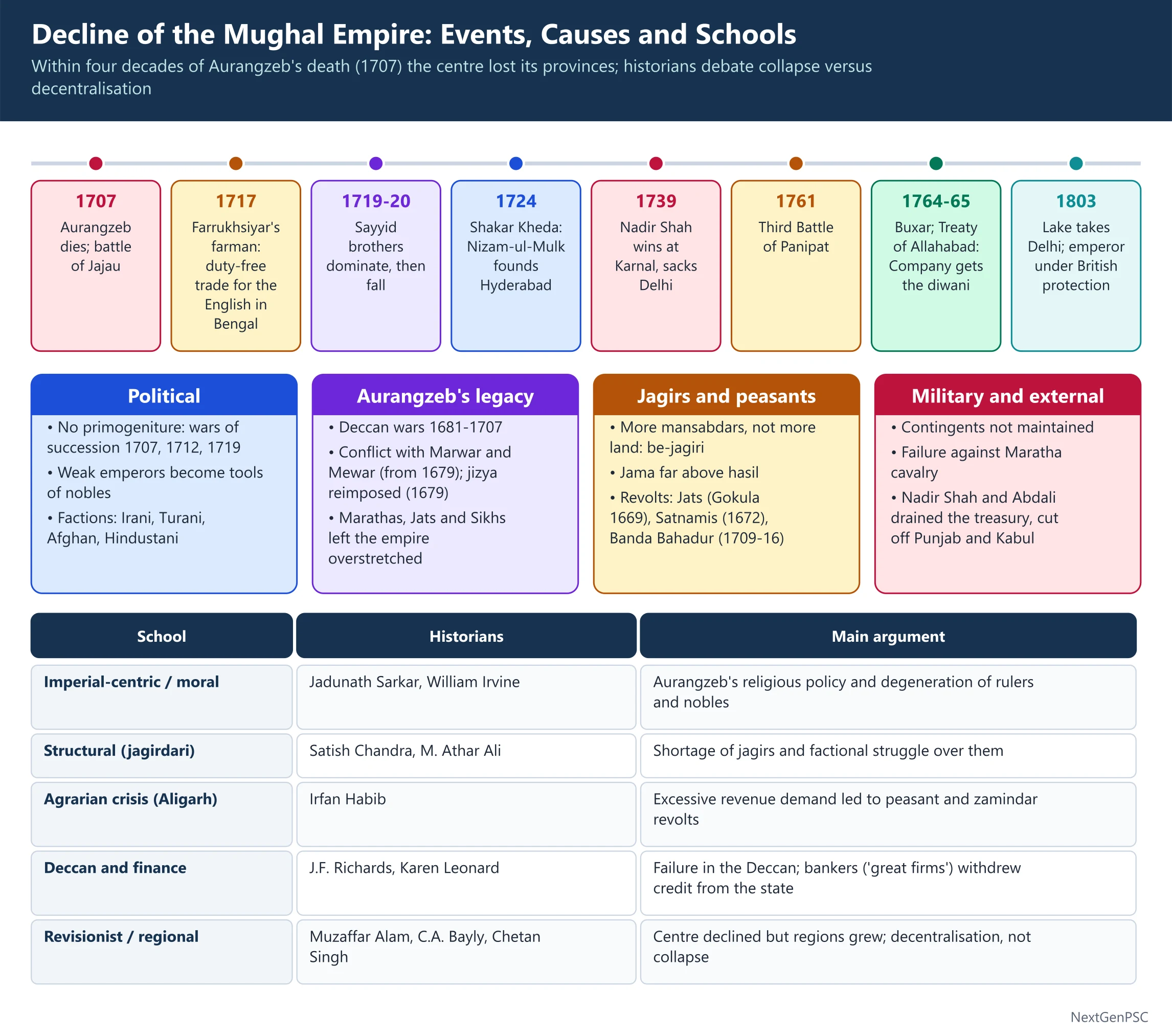
| Year | Event | Significance |
|---|---|---|
| 1707 | Death of Aurangzeb; battle of Jajau | Start of succession wars |
| 1717 | Farrukhsiyar's farman to the English Company | Duty-free trade in Bengal; later disputes with nawabs |
| 1719–20 | Sayyid brothers dominate, then fall | Emperor becomes a tool of nobles |
| 1724 | Battle of Shakar Kheda | Nizam-ul-Mulk founds Hyderabad state |
| 1739 | Nadir Shah wins at Karnal and sacks Delhi | Treasury and prestige destroyed |
| 1761 | Third Battle of Panipat | Marathas checked in the north |
| 1764–65 | Buxar; Treaty of Allahabad | Company gets the diwani of Bengal, Bihar and Orissa |
| 1803 | Lake captures Delhi | Emperor under British protection |
| School | Historians | Main argument |
|---|---|---|
| Imperial-centric / moral | Jadunath Sarkar, William Irvine | Aurangzeb's religious policy and degeneration of rulers and nobles |
| Structural (jagirdari) | Satish Chandra, M. Athar Ali | Shortage of jagirs and factional struggle over them |
| Agrarian crisis (Aligarh) | Irfan Habib | Excessive revenue demand led to peasant and zamindar revolts |
| Deccan and finance | J.F. Richards, Karen Leonard | Failure in the Deccan; bankers withdrew credit from the state |
| Revisionist / regional | Muzaffar Alam, C.A. Bayly, Chetan Singh | Centre declined but regions grew; decentralisation, not collapse |
Mains points
- Typical question: 'Was the decline of the Mughal Empire due to the personal failings of Aurangzeb or to structural factors?' Answer with both and lean on the structural evidence.
- Explain the jagirdari crisis precisely: more mansabdars, fixed land, the jama-hasil gap, and be-jagiri; do not just write 'jagir problem'.
- Name at least three historians with their books; examiners reward correct attribution (Satish Chandra 1959, Irfan Habib 1963, Muzaffar Alam 1986).
- Show the revisionist turn: decline at the centre, growth in Awadh, Bengal, Hyderabad and the Maratha lands.
- Common mistake: treating 1707 as sudden collapse; the empire retained symbolic legitimacy until 1857, and regional rulers kept using Mughal titles.
- Link the decline to European expansion: the 1717 farman, Buxar and the diwani show how the vacuum was filled.
- Conclude with a balanced judgement, for example that the 18th century was a period of political decentralisation with mixed economic outcomes.
Did you know?
- A Delhi saying mocked Shah Alam II: 'Sultanat-i-Shah Alam, az Dilli ta Palam', meaning the empire of Shah Alam stretches only from Delhi to Palam, the village where Delhi's airport now stands.
- Nadir Shah carried the Peacock Throne of Shah Jahan to Persia; the original was later broken up, and the throne used by later Iranian rulers was a different piece.
Regional States: The Nizam's Deccan, Bengal and Awadh
Hyderabad, Bengal and Awadh were successor states: Mughal governors who made their offices hereditary while still acknowledging the emperor. Nizam-ul-Mulk (Hyderabad, 1724), Murshid Quli Khan (Bengal, from 1717) and Saadat Khan (Awadh, 1722) built regional regimes on alliances with zamindars, bankers and local officials. All three were later drawn into the English Company's orbit through war, treaty and the subsidiary alliance.
In simple words
When Delhi became weak, three powerful Mughal governors in Hyderabad, Bengal and Awadh started ruling almost like kings, while still calling themselves the emperor's servants.
It is like a regional manager who keeps the company logo on the door but takes all decisions and passes the job to his son.
These states show that the 18th century was not only chaos; they gave order and prosperity to their regions until the British took over.
UPSC asks about their nature, their administration and how they fell to the Company.
1. Nature of the Regional States
Three types: textbooks such as Sekhar Bandyopadhyay's From Plassey to Partition distinguish successor states (Hyderabad, Bengal, Awadh), 'warrior' or insurgent states (Marathas, Sikhs, Jats, Afghans) and independent kingdoms (Mysore, Travancore, the Rajput states).
Mughal forms kept: the successor rulers struck coins and read the khutba in the emperor's name, sought imperial titles and farmans, and used Mughal revenue and office terms.
Real autonomy: they appointed their own officials, kept the revenue, conducted war and diplomacy, and passed office to sons or relatives.
Social base: each regime rested on an alliance of the ruler with zamindars, revenue farmers, bankers and local service groups, many of them Hindu.
2. The Nizam's Deccan (Hyderabad)
Founder: Chin Qilich Khan, a Turani noble titled Nizam-ul-Mulk and later Asaf Jah, served as viceroy of the Deccan and was wazir at Delhi (1722–24).
Foundation (1724): he left Delhi, defeated the Mughal governor Mubariz Khan at Shakar Kheda in 1724 and established control over the six Deccan subas; he never formally declared independence.
Relations with the Marathas: Peshwa Baji Rao I defeated him at Palkhed (1728), forcing him to accept Maratha chauth and sardeshmukhi; after defeat near Bhopal (1738) he accepted Maratha claims over Malwa.
Administration: he kept the Mughal jagirdari system, used revenue farming, and conciliated local zamindars, deshmukhs and Telugu and Marathi-speaking officials rather than displacing them.
After 1748: his death led to a succession war between Nasir Jang and Muzaffar Jang in which the French under Dupleix and Bussy and the English intervened (the Carnatic wars).
Decline into dependence: the Marathas defeated the Nizam at Kharda (1795); in 1798 the Nizam became the first ruler to accept Wellesley's subsidiary alliance.
3. Bengal
Murshid Quli Khan: appointed diwan of Bengal by Aurangzeb (c. 1700), he moved the revenue office from Dhaka to Maqsudabad, renamed Murshidabad, and became governor (nazim) in 1717.
Revenue reforms: he reduced jagirs by transferring much land to khalisa, collected revenue through ijaradars (revenue farmers) who gave security, gave taqavi loans to peasants and remitted a regular tribute to Delhi.
Big zamindars and bankers: large zamindaris such as Burdwan, Rajshahi and Nadia grew under him; the banking house of Manikchand and Fatehchand, given the title Jagat Seth, managed the mint and remittances.
Successors: Shuja-ud-din (1727–39) and Sarfaraz Khan, who was killed by Alivardi Khan at Giria in 1740.
Alivardi Khan (1740–56): faced Maratha (bargi) raids from Nagpur under Bhaskar Pandit between 1742 and 1751; in 1751 he agreed to pay chauth and ceded the revenue of Orissa.
Siraj-ud-daula (1756–57): quarrelled with the English over fortification of Calcutta and misuse of dastaks, took Calcutta (1756), and was defeated at Plassey on 23 June 1757 after Mir Jafar and the Jagat Seths sided with Clive.
4. Awadh
Saadat Khan Burhan-ul-Mulk: a Persian (Irani) noble from Nishapur, appointed governor of Awadh in 1722; he curbed rebellious zamindars and reduced the power of Mughal jagirdars in the province; he died in 1739 after the Karnal campaign.
Safdar Jang (1739–54): his nephew and son-in-law, also wazir of the empire from 1748; he employed Hindu officials such as Nawal Rai and fought the Rohillas and Bangash Afghans.
Shuja-ud-daula (1754–75): joined Mir Qasim and Shah Alam II against the English, lost at Buxar (1764), and by the Treaty of Allahabad (1765) got Awadh back on payment of 50 lakh rupees and accepted an English alliance.
Asaf-ud-daula (1775–97): shifted the capital from Faizabad to Lucknow (1775) and built the Bara Imambara (1784), traditionally said to have been built as famine relief work.
Path to annexation: subsidiary obligations rose; Wellesley took half of Awadh's territory in 1801, and Dalhousie annexed the rest in 1856 on grounds of misgovernment.
5. Sources and Evidence
Bengal: Salimullah's Tarikh-i-Bangala, Ghulam Husain Salim's Riyaz-us-Salatin (1788), Ghulam Husain Khan Tabatabai's Siyar-ul-Mutakhkhirin and English Company records (Orme's history, Fort William consultations).
Awadh: Persian histories of the nawabs and Company residents' reports; Lucknow monuments and coins show the nawabs' cultural ambitions.
Hyderabad: Persian revenue papers of the Asaf Jahi state, Maratha records in the Peshwa Daftar, and French accounts of Bussy's period.
6. Historiography and Debates
Philip Calkins (article in the Journal of Asian Studies, 1970): in Bengal a 'regionally oriented ruling group' of the nawab, zamindars and bankers formed between 1700 and 1740.
Richard Barnett (North India Between Empires: Awadh, the Mughals and the British, 1720–1801, 1980) and Muzaffar Alam (1986) showed how Awadh's nawabs built a regional state through zamindar alliances.
M.A. Nayeem wrote on the Mughal administration of the Deccan under Nizam-ul-Mulk; Munis Faruqui's recent study At Empire's End treats Hyderabad as a Mughal successor that still worked within imperial norms.
Plassey debate: P.J. Marshall (Bengal: The British Bridgehead, 1987) and Rajat Kanta Ray stress an internal political crisis and an alliance of Bengal elites with the English; Sushil Chaudhury (The Prelude to Empire, 2000) argues that English commercial interests and private trade drove the conquest.
Prosperity or decay: revisionists see these states as stable and prosperous; others note heavy revenue farming, Maratha raids in Bengal, and dependence on bankers.
7. Using It in the Exam
10 marks: define successor state, give one feature each of Hyderabad, Bengal and Awadh, and a line on their continued Mughal allegiance.
15 marks: compare the three on foundation, administration (jagir, ijara, zamindar alliances) and relations with the English.
20 marks: argue the nature of these states using Calkins, Barnett and Alam, assess their stability, and explain why they could not resist the Company (finance, army, internal elites).
Keywords: successor state, hereditary nizamat, ijaradari, zamindar-banker alliance, Jagat Seth, subsidiary alliance, de facto autonomy.
Paraphrased view: Calkins's idea can be stated as the nawabs ruling through a regional ruling group rather than through Delhi's appointees.
Avoid: calling them fully independent kingdoms; stress that they combined real autonomy with Mughal legitimacy.
Map link: Murshidabad, Plassey, Faizabad, Lucknow, Buxar, Hyderabad, Aurangabad and Shakar Kheda are useful places.
Comparison line: Bengal was the richest, Awadh the most culturally brilliant, and Hyderabad the most closely tied to Mughal forms.
Linkage: connect Bengal to Plassey and the diwani, Awadh to Buxar and the 1856 annexation, and Hyderabad to the Carnatic wars and the subsidiary alliance.
| Feature | Hyderabad | Bengal | Awadh |
|---|---|---|---|
| Founder | Nizam-ul-Mulk Asaf Jah | Murshid Quli Khan | Saadat Khan Burhan-ul-Mulk |
| Start of autonomy | 1724 (Shakar Kheda) | 1717 (nazim and diwan) | 1722 (governor) |
| Capital | Aurangabad, later Hyderabad | Murshidabad | Faizabad, then Lucknow (1775) |
| Revenue method | Jagirs kept, revenue farming | Khalisa expanded, ijaradars, big zamindars | Jagirs curbed, zamindar settlements, ijara |
| Key allies | Deccani zamindars, deshmukhs | Jagat Seths, zamindars | Hindu officials, local zamindars |
| Fate | First subsidiary alliance (1798) | Plassey (1757), diwani (1765) | Half ceded (1801), annexed (1856) |
Mains points
- Frequent question: 'Discuss the nature of the successor states of the 18th century.' Stress de facto autonomy with de jure Mughal allegiance.
- Bring out the social base: alliances with zamindars, revenue farmers and bankers (Jagat Seth in Bengal; Hindu officials in Awadh).
- Use historians: Calkins on Bengal's ruling group, Barnett and Muzaffar Alam on Awadh, and the Plassey debate between Marshall and Sushil Chaudhury.
- Explain weaknesses: dependence on bankers, revenue farming, Maratha raids, and divided elites that the English exploited.
- Common mistake: mixing up dates of founders; learn 1717, 1722 and 1724 firmly.
- Show the end point of each state: Plassey and diwani, Buxar and annexation, subsidiary alliance; this links Paper I with modern India.
- A good conclusion notes that these states proved the vitality of regional politics but lacked the military and fiscal strength to resist the Company.
Did you know?
- The title Jagat Seth means 'banker of the world'; the Mughal emperor conferred it on Fatehchand in the 1720s, and the house was so rich that English writers compared it to the Bank of England.
- Memory trick for founders: 'M-S-N, 17-22-24': Murshid Quli 1717, Saadat Khan 1722, Nizam-ul-Mulk 1724.
Maratha Ascendancy under the Peshwas
After Shahu's release in 1707 the Peshwas, hereditary chief ministers from Balaji Vishwanath (1713) onwards, turned the Maratha kingdom into the strongest power in India. Baji Rao I carried Maratha arms into Malwa, Gujarat and Bundelkhand, and under Balaji Baji Rao Maratha influence reached Delhi and Punjab before the defeat at Panipat (1761). The state became a confederacy of the Peshwa and the Scindia, Holkar, Gaekwad and Bhonsle chiefs, which the English broke up between 1775 and 1818.
In simple words
The Peshwas were the chief ministers of the Maratha king, but from 1713 they became the real rulers, governing from Pune.
It is like a family business where the manager's family becomes more powerful than the owner's and runs everything.
Under them the Marathas collected tribute across much of India and were the main rival of the English in the late 18th century.
UPSC asks why they rose so fast, whether they wanted an all-India empire, and why their confederacy failed.
1. From Shahu to the Peshwas
Release of Shahu (1707): Bahadur Shah released Shivaji's grandson Shahu, partly to divide the Marathas; Shahu defeated Tarabai's forces at Khed (1707) and was crowned at Satara (1708), leading to a long rivalry with the Kolhapur branch.
Balaji Vishwanath (Peshwa 1713–20): won over Maratha chiefs for Shahu and negotiated with the Sayyid brothers; in 1719 the Mughal emperor granted sanads recognising Shahu's swarajya and his right to chauth and sardeshmukhi of the six Deccan subas.
Baji Rao I (1720–40): the outstanding cavalry general; he defeated Nizam-ul-Mulk at Palkhed (1728), helped Chhatrasal of Bundelkhand against the Bangash Afghans, raided up to Delhi (1737) and forced the Nizam's settlement near Bhopal (1738).
Western coast: his brother Chimaji Appa took Bassein (Vasai) from the Portuguese in 1739.
Division of Malwa (1730s): conquered Malwa was shared among the Peshwa's commanders, Ranoji Scindia, Malhar Rao Holkar and Udaji Pawar, the origin of the Gwalior, Indore and Dhar states.
Bundelkhand grant: Chhatrasal, rescued from the Bangash Afghans in 1729, granted Baji Rao a share of his territory, including areas around Jhansi and Sagar.
Balaji Baji Rao, Nana Saheb (1740–61): after Shahu died in 1749 the Sangola arrangement (1750) made the Peshwa the real head of the state, with Pune as the capital.
Treaty with the Mughals (1752): the Marathas agreed to protect the emperor against internal and external enemies in return for chauth of the northern provinces, which drew them into north Indian politics.
Expansion north: Raghunath Rao reached Lahore and Attock in 1758, bringing the Marathas into direct conflict with Ahmad Shah Abdali and leading to Panipat (1761).
Madhav Rao I (1761–72): restored Maratha power after Panipat, defeated the Nizam at Rakshasbhuvan (1763) and checked Haidar Ali; Mahadji Scindia escorted Shah Alam II back to Delhi in 1772.
Crisis and the English: Narayan Rao's murder (1773) and Raghunath Rao's alliance with Bombay led to the First Anglo-Maratha War (1775–82), ended by the Treaty of Salbai (1782); Nana Phadnavis then led the Pune government.
End: Baji Rao II signed the subsidiary Treaty of Bassein (1802); the Second (1803–05) and Third (1817–18) Anglo-Maratha Wars destroyed Maratha power and the Peshwaship was abolished in 1818.
2. Sources and Evidence
Peshwa Daftar: the vast Marathi records of the Pune government (revenue accounts, letters, orders); G.S. Sardesai edited the Selections from the Peshwa Daftar.
Bakhars: Marathi prose chronicles, for example the Bhausahebanchi Bakhar on Sadashiv Rao Bhau and Panipat; useful but often written later and partisan.
Persian and English records: Mughal and Nizam papers, Company records at Bombay and Calcutta, and Residents' reports from Pune.
Early histories: James Grant Duff's History of the Mahrattas (1826), based on Maratha papers he collected as Resident at Satara.
3. Causes of the Rise and Nature of the State
Mughal weakness: succession wars and the jagirdari crisis left the Deccan and Malwa open; the Marathas exploited Mughal factions such as the Sayyids.
Military method: light cavalry (bargirs and shiledars), speed, guerrilla tactics and the ability to live off the land suited a fragmenting empire.
Chauth and sardeshmukhi: claims of one-fourth and one-tenth of the revenue were a way to extract tribute without full annexation, and to build a network of revenue rights.
Confederacy: the great chiefs, Scindia (Gwalior), Holkar (Indore), Gaekwad (Baroda) and Bhonsle (Nagpur), held their own territories and armies under the Peshwa's nominal leadership.
Within the Mughal frame: the Marathas sought Mughal sanads and acted as protectors of the emperor (1752; Mahadji as deputy regent, 1784); they did not formally replace the dynasty.
'Hindu Pad Padshahi': the idea of a Hindu empire is associated in later tradition with Baji Rao I, but most historians see Maratha policy as pragmatic and driven by revenue, not religion.
Weaknesses: rivalry among chiefs, the Peshwa's dependence on bankers and revenue farming, raids that alienated Rajputs, Jats and Bengal, and a slow response to disciplined infantry and artillery.
Relations with Rajputs and Jats: Maratha interference in the Jaipur succession dispute (1740s) and heavy tribute demands alienated the Rajputs, who stayed away from the Maratha side at Panipat.
Military change after 1761: Mahadji Scindia raised infantry battalions trained by the French officer Benoît de Boigne, showing that the Marathas tried to adapt to European-style warfare.
4. Historiography and Debates
Grant Duff: described the Maratha rise as sudden and predatory, comparing it to a fire spreading in the Sahyadri forests (paraphrase); this colonial view stressed plunder.
M.G. Ranade (Rise of the Maratha Power, 1900): rejected this; he saw the Marathas as a popular, almost national movement prepared by the Bhakti saints and a sense of Maharashtra dharma.
Jadunath Sarkar and Sardesai: G.S. Sardesai (New History of the Marathas) wrote a detailed narrative sympathetic to the Peshwas; Sarkar admired Shivaji but criticised later Maratha raiding and disunity.
Satish Chandra: saw the Maratha rise as linked to the Mughal jagirdari crisis and to the ambitions of Deccani zamindars (deshmukhs), and stressed that Maratha aims were set within the Mughal system.
André Wink (Land and Sovereignty in India, 1986): Maratha expansion worked through fitna, the winning over of rivals' supporters, and through the sharing of revenue rights; sovereignty was layered.
Stewart Gordon (The Marathas 1600–1818, 1993): the Marathas were state builders who adopted Mughal revenue and administrative practice, not just raiders; their rule in Malwa and Khandesh brought settlement and revenue stability.
Debate summary: predatory raiders (colonial), national movement (Ranade), regional state within the Mughal order (Satish Chandra, Gordon, Wink).
5. Using It in the Exam
10 marks: trace the rise from Balaji Vishwanath to Baji Rao I with two or three dated events and one line on chauth and sardeshmukhi.
15 marks: explain causes of ascendancy and the confederacy structure, with one historian's view.
20 marks: 'Were the Marathas empire-builders or plunderers?' Present Grant Duff, Ranade and Gordon, then show the Maratha working of revenue and administration (see next topic).
Keywords: Peshwa, sanad of 1719, chauth, sardeshmukhi, saranjam, confederacy, fitna, Mughal legitimacy.
Paraphrased view: Gordon's position can be summed up as 'the Marathas inherited and adapted Mughal practice'; do not put it in quotation marks as his words.
Avoid: treating the Marathas as a single unified state after 1761; stress the autonomy of the great chiefs.
Map link: Pune, Satara, Palkhed, Vasai, Gwalior, Indore, Baroda, Nagpur and Salbai can appear in answers.
Connection: link the confederacy's divisions to its defeat in the Anglo-Maratha wars and to the Treaty of Bassein.
| Peshwa | Period | Key events |
|---|---|---|
| Balaji Vishwanath | 1713–20 | Sanads of 1719: swarajya, chauth and sardeshmukhi of the Deccan |
| Baji Rao I | 1720–40 | Palkhed 1728; Malwa, Gujarat, Bundelkhand; raid on Delhi 1737; Bassein 1739 |
| Balaji Baji Rao (Nana Saheb) | 1740–61 | Sangola 1750; 1752 treaty with Mughals; Attock 1758; Panipat 1761 |
| Madhav Rao I | 1761–72 | Revival; Rakshasbhuvan 1763; return of Shah Alam to Delhi 1772 |
| Narayan Rao / Sawai Madhav Rao (Nana Phadnavis) | 1772–95 | Murder of Narayan Rao 1773; First Anglo-Maratha War; Salbai 1782; Kharda 1795 |
| Baji Rao II | 1796–1818 | Treaty of Bassein 1802; Second and Third Anglo-Maratha Wars; Peshwaship abolished 1818 |
| House | Seat | Notable figure |
|---|---|---|
| Peshwa (Bhat family) | Pune | Baji Rao I |
| Scindia (Shinde) | Gwalior (earlier Ujjain) | Mahadji Scindia |
| Holkar | Indore | Ahilyabai Holkar |
| Gaekwad | Baroda | Damaji Gaekwad |
| Bhonsle | Nagpur | Raghuji Bhonsle I |
Mains points
- Common question: 'Assess the causes of the Maratha ascendancy in the 18th century' or 'Were the Marathas mere plunderers?'
- Use the 1719 sanads and the 1752 treaty to show that the Marathas sought legitimacy within the Mughal order.
- Contrast Grant Duff, Ranade and Stewart Gordon; examiners like a clear three-way historiographical frame.
- Explain the confederacy as both strength (rapid expansion) and weakness (disunity before the English).
- Do not confuse Balaji Vishwanath with Balaji Baji Rao; give the years for each Peshwa.
- Add the social and economic side: revenue settlement in Malwa and Khandesh, bankers at Pune, and the burden of chauth on other regions.
- End with a balanced judgement: a powerful regional state-system that failed to create a centralised state or modern army.
Did you know?
- Baji Rao I began the Shaniwar Wada palace at Pune in 1730; it was the seat of the Peshwas until 1818 and was gutted by a fire in 1828, leaving only its walls and gates.
- Ahilyabai Holkar, who ruled Indore from 1767 to 1795 from Maheshwar, rebuilt the Kashi Vishwanath temple at Varanasi in 1780.
The Maratha Fiscal and Financial System
The Maratha state drew income from two zones: swarajya, its home territory, where it collected land revenue directly through village and district officers, and mughlai lands, where it claimed chauth (one-fourth) and sardeshmukhi (one-tenth). Under the Peshwas revenue was assessed through annual settlements (jamabandi) by mamlatdars and kamavisdars, checked by hereditary darakhdars, while military chiefs held saranjam assignments. Constant war kept the Peshwas in debt to Pune's bankers, and later revenue farming weakened the system.
In simple words
The Marathas raised money in two ways: normal land tax in their own territory, and a protection payment called chauth from other rulers' lands.
Chauth worked a little like a security fee: pay one-fourth and the Maratha armies would not raid you.
This money paid for the large cavalry armies that carried Maratha power across India, but it never fully covered their cost.
UPSC asks you to explain chauth and sardeshmukhi, the revenue officials, and why the Peshwas were always in debt.
1. Background: From Shivaji to the Peshwas
Deccan inheritance: the Marathas built on the revenue systems of the Deccan sultanates and on Malik Ambar's settlement in Ahmadnagar, which measured land and fixed a standard assessment (tankha).
Shivaji's system: Shivaji (1674–80 as crowned king) collected land revenue through his own officials, avoided giving jagirs in principle, and levied chauth and sardeshmukhi from neighbouring Mughal and Bijapur territory.
Expansion of claims (1719): the Mughal sanads of 1719 recognised Shahu's right to chauth and sardeshmukhi of the six Deccan subas; later the Peshwas extended such claims to Malwa, Gujarat, Bundelkhand and the north.
Two zones: swarajya (directly ruled home lands, assessed in detail) and mughlai (lands of other rulers on which only shares of revenue were claimed).
2. Chauth and Sardeshmukhi
Chauth: one-fourth of the revenue (or of the assessed land revenue) of an area, demanded as the price of protection from Maratha raids; historians differ on whether it was a military contribution or a regular tax.
Sardeshmukhi: an extra one-tenth, claimed by the Maratha king as the hereditary sardeshmukh, the head deshmukh, of Maharashtra.
Division of chauth: textbooks list four shares: babti (25 per cent) for the king, mokasa (66 per cent) assigned to sardars for maintaining troops, sahotra (6 per cent) for the Pant Sachiv and nadgaunda (3 per cent) granted at the king's pleasure.
Nature: these levies let the Marathas share in the revenue of territories without annexing or administering them, creating a layered sovereignty.
3. Land Revenue in Swarajya under the Peshwas
Assessment: land was classified by quality and crop; the Peshwa-era assessment known as kamal (the highest standard rate) was fixed after surveys in the mid-18th century.
Jamabandi: every year the revenue of each village was settled with the patil after inspecting the crop; remissions were given for bad seasons.
Village officers: the patil (headman) collected revenue and the kulkarni (accountant) kept the records; artisans and servants of the village received customary grain shares under the balutedari system.
Pargana officers: hereditary deshmukhs and deshpandes held vatan rights and shares of revenue; they were the Maratha form of the zamindar class.
District officers: the mamlatdar (in larger districts) and kamavisdar (in smaller ones) were appointed by Pune, settled revenue, ran police and justice, and paid a security deposit (rasad) on appointment.
Checks on officials: hereditary darakhdars (such as the diwan, mujumdar and phadnis of a district) were appointed by the centre and reported independently, so the mamlatdar could not easily hide collections.
Accounts: the central Huzur Daftar at Pune audited district accounts; the Peshwa Daftar preserves these detailed records.
4. Other Sources of Income
Customs and transit duties: jakat on goods moving through markets and routes, often farmed out.
Fees and tributes: succession fees (nazar), tribute (khandani) from chiefs, fines, and levies such as ghasdana (originally for fodder).
Mint and trade: the Peshwas and great chiefs struck rupees at several mints; Pune grew as a banking and commercial centre.
Plunder and war indemnities: booty and payments extracted after campaigns (for example from the Nizam) were an irregular but important source.
5. Assignments and Grants
Saranjam: revenue assignments to military chiefs for maintaining troops, resumable in theory but increasingly hereditary; the great houses of Scindia and Holkar grew from such assignments.
Inam: revenue-free grants to temples, Brahmins, scholars and village servants; many Peshwa-era inams were later inquired into by the British Inam Commission (1850s).
Vatan: hereditary rights and dues of village and pargana officers, which made the Maratha state depend on a deeply rooted local gentry.
6. Finances and Crisis
Chronic debt: the cost of cavalry campaigns exceeded revenue; Baji Rao I and his successors borrowed heavily from Pune and other sahukars and repaid through revenue assignments.
Bankers and credit: bankers advanced money against future collections and moved funds by hundi (bill of exchange), making them partners in the state.
Nana Phadnavis: tried to restore order in accounts and treasury in the 1780s and 1790s.
Revenue farming under Baji Rao II: districts were auctioned to the highest bidder (ijara), which raised short-term income but encouraged oppression of peasants and the decay of the old checks.
7. Sources and Historiography
Sources: Peshwa Daftar accounts, village and pargana records, Marathi letters and orders, and early British reports such as Mountstuart Elphinstone's report on the territories conquered from the Peshwa (1819).
S.N. Sen (Administrative System of the Marathas, 1923) gave the classic account of these institutions and judged Peshwa administration fairly efficient in its prime.
Hiroshi Fukazawa (The Medieval Deccan, 1991) studied village revenue, balutedari and the state's relationship with peasants and hereditary officers.
Stewart Gordon argued that the Peshwas adapted Mughal assessment and accounting methods; André Wink stressed shared revenue rights (vatan, chauth) as the core of Maratha sovereignty.
Frank Perlin argued that 18th-century Maharashtra saw growing monetisation and commercial activity, against the idea of stagnation.
Critical view: others point to the burden of chauth on non-Maratha regions and the oppression of revenue farming in the last Peshwa's time.
8. Using It in the Exam
10 marks: define chauth and sardeshmukhi, give their shares and purpose, and note their political meaning.
15 marks: describe the revenue hierarchy (patil, kulkarni, deshmukh, mamlatdar, darakhdar, Huzur Daftar) and income sources.
20 marks: assess the strengths (detailed accounts, checks, local roots) and weaknesses (debt, saranjam, revenue farming) with historians' views.
Keywords: swarajya and mughlai, chauth, sardeshmukhi, babti and mokasa, jamabandi, kamal, mamlatdar, darakhdar, saranjam, inam, vatan, ijara.
Source use: cite Elphinstone's 1819 report, which noted the hereditary village and district officers as the backbone of revenue collection (paraphrase).
Avoid: equating chauth with simple plunder; explain it as a negotiated revenue share backed by force.
| Term | Meaning |
|---|---|
| Chauth | One-fourth of revenue claimed from mughlai lands for protection |
| Sardeshmukhi | Additional one-tenth claimed as hereditary sardeshmukh |
| Babti / Mokasa | King's 25 per cent share of chauth / 66 per cent assigned to sardars |
| Jamabandi | Annual revenue settlement of a village |
| Kamal | Peshwa-era full standard assessment |
| Mamlatdar / Kamavisdar | District revenue officers appointed by Pune |
| Darakhdar | Hereditary district officials who checked the mamlatdar |
| Saranjam | Revenue assignment to a military chief for troops |
| Inam / Vatan | Revenue-free grant / hereditary office with dues |
| Ijara | Revenue farming to the highest bidder |
Mains points
- Typical question: 'Examine the main features of the Maratha revenue system under the Peshwas' or 'Explain chauth and sardeshmukhi and their political significance.'
- Separate swarajya and mughlai lands at the start; it gives your answer structure.
- Show the official hierarchy from patil to Huzur Daftar and highlight the darakhdar check, which many candidates miss.
- Discuss finances honestly: debt to bankers, the cost of cavalry and the shift to revenue farming under Baji Rao II.
- Cite S.N. Sen for the classic description and Gordon or Wink for the interpretation of Maratha sovereignty.
- Compare briefly with the Mughal zabt and jagir systems to show continuity and change.
- Conclude that the fiscal system was sophisticated in design but strained by military expansion and decentralisation.
Did you know?
- Memory trick for the four shares of chauth, 'Babti-Mokasa-Sahotra-Nadgaunda = 25-66-6-3', which adds up to 100.
Afghan Power and the Third Battle of Panipat (1761)
Ahmad Shah Abdali (Durrani) founded an Afghan empire at Kandahar in 1747 and invaded north India repeatedly, while the Rohilla Afghans of the Doab, led by Najib-ud-daula, became a power at Delhi. Maratha expansion into Punjab brought the two sides into conflict, ending in the Third Battle of Panipat on 14 January 1761, where the Maratha army under Sadashiv Rao Bhau was destroyed. Abdali could not hold north India, but the battle checked the Marathas and left a vacuum that helped the English and the Sikhs.
In simple words
In 1761 the Maratha army fought the Afghan ruler Ahmad Shah Abdali at Panipat, north of Delhi, and suffered one of the bloodiest defeats of the century.
Think of two strong teams fighting for control of a field while a third team, the English, waits and later takes the field.
The battle stopped the Marathas from becoming masters of north India for about ten years, and Abdali soon went home.
UPSC asks for the causes of the Maratha defeat and the battle's consequences.
1. The Rise of Afghan Power
Ahmad Shah Abdali: a commander of Nadir Shah from the Abdali (later Durrani) tribe; after Nadir's assassination in 1747 he was chosen ruler at Kandahar and built an empire from Khurasan to Punjab.
Invasions of India: he is usually said to have invaded about eight times between 1748 and 1767; his first invasion was checked at Manupur near Sirhind (1748) by a Mughal army.
Gains: the Mughals ceded Lahore and Multan (1752); in 1757 he sacked Delhi, Mathura and Vrindavan and annexed Punjab, Kashmir and Sirhind, leaving his son Timur Shah at Lahore.
Rohillas: Afghan settlers in Katehr, renamed Rohilkhand, under Ali Muhammad Khan and later Hafiz Rahmat Khan; the Bangash Afghans held Farrukhabad.
Najib-ud-daula (Najib Khan): a Rohilla chief who rose to be mir bakhshi at Delhi, became the chief enemy of the Marathas and invited Abdali to return in 1759.
Abdali's motives: plunder to pay his tribal army, control of the rich revenue of Punjab and Sirhind, and prestige as a Muslim ruler appealed to by Indian nobles such as Najib and, according to tradition, the theologian Shah Waliullah.
2. Road to Panipat
Maratha advance: under the 1752 treaty the Marathas became protectors of the emperor; Raghunath Rao drove Timur Shah out of Punjab and reached Attock in 1758.
Abdali returns (1759): Dattaji Scindia was killed at Barari Ghat near Delhi in January 1760.
Bhau's expedition: the Peshwa sent his cousin Sadashiv Rao Bhau with his son Vishwas Rao and a large army with artillery under Ibrahim Khan Gardi; they took Delhi (August 1760) and Kunjpura (October 1760).
Diplomacy: Shuja-ud-daula of Awadh joined Abdali; the Jat ruler Suraj Mal left the Maratha camp after disagreements; the Rajputs stayed neutral; the Sikhs were not allies.
Blockade: Abdali crossed the Yamuna near Baghpat and cut the Marathas off from Delhi; from November 1760 the Maratha army was entrenched at Panipat, and food and fodder ran out.
The battle (14 January 1761): the Marathas attacked; Ibrahim Khan Gardi's guns broke the Rohilla wing, but Abdali's reserves and camel-mounted swivel guns (zamburaks) turned the battle; Vishwas Rao and Bhau were killed, and the army and its camp followers were massacred in the pursuit.
Aftermath: Peshwa Balaji Baji Rao died in June 1761; Abdali, faced with unrest among his troops, recognised Shah Alam II as emperor and returned to Afghanistan.
3. Sources and Evidence
Kashiraj Pandit: a Maratha Brahmin in Shuja-ud-daula's service who was present with Abdali's side; his Persian account was translated by James Browne in 1791 and is the main eyewitness narrative.
Marathi sources: the Bhausahebanchi Bakhar and letters in the Peshwa Daftar, including reports sent to the Peshwa during the blockade.
Persian histories: the Siyar-ul-Mutakhkhirin and Afghan histories of Ahmad Shah's reign; Abdali's own letters to Indian rulers survive in collections.
Modern studies: Jadunath Sarkar's Fall of the Mughal Empire (volume 2), T.S. Shejwalkar's Panipat: 1761 (1946), Ganda Singh's Ahmad Shah Durrani (1959) and Uday S. Kulkarni's Solstice at Panipat (2011).
4. Causes of the Maratha Defeat
Supply failure: the two-month blockade starved men and horses; Najib controlled the Doab, and the Marathas had no secure supply line.
Lack of allies: Maratha demands for tribute had alienated the Rajputs, Jats and Sikhs; Shuja and the Rohillas sided with Abdali.
Generalship: Abdali kept fresh reserves and coordinated cavalry and firepower; Bhau's choice to fight a pitched, entrenched battle abandoned the traditional Maratha strength of mobile warfare (a common criticism, debated by Kulkarni and others).
Internal tensions: friction between Bhau and senior chiefs such as Malhar Rao Holkar affected coordination, according to many accounts.
Camp followers: a large body of non-combatants, including pilgrims, travelled with the army, adding to the supply problem and the death toll.
Afghan military advantages: heavy cavalry, mounted musketeers and zamburaks, and the motivation of troops fighting for plunder.
5. Consequences
For the Marathas: heavy loss of leaders and men and a halt to northern expansion; but under Madhav Rao I and Mahadji Scindia they returned to Delhi within about a decade (1771–72).
For the Afghans: Abdali could not stay in India; his power in Punjab collapsed as the Sikh misls rose, despite his massacre of Sikhs in 1762 (the Vadda Ghallughara).
For the Mughals: the emperor remained powerless, dependent first on Najib and then on the Marathas.
For the Sikhs and Jats: the weakening of both Afghans and Marathas let the Sikh misls take Lahore (1765) and Suraj Mal's Jats expand around Agra.
For the English: the weakening of both the Marathas and the Afghans in the north removed a possible check during the crucial years of Buxar (1764) and the diwani (1765).
Debate on significance: a common textbook verdict is that Panipat decided not who would rule India but who would not; others argue that the Maratha recovery shows the defeat was not decisive.
6. Historiography
Jadunath Sarkar: gave a detailed military narrative and saw Panipat as a national disaster that weakened the only Indian power able to resist the British.
T.S. Shejwalkar: analysed the campaign critically, presenting the Marathas as fighting to defend India against a foreign invader while exposing their strategic and political errors.
Afghan perspective: Ganda Singh and later historians of the Durrani state stress Abdali's limited aims (plunder, control of Punjab, legitimacy as a Muslim ruler) rather than conquest of India.
Regional view: the battle is also read as a clash between two expanding regional powers over Punjab and the revenue of the Doab, with Indian rulers on both sides.
7. Using It in the Exam
10 marks: background (Maratha advance to Attock, Najib's invitation), the date and outcome, and two consequences.
15 marks: causes of defeat in four headings: supply, allies, generalship, military technology.
20 marks: 'Assess the significance of the Third Battle of Panipat': short narrative, consequences for each party, and a judgement on whether it was decisive.
Keywords: Durrani empire, Rohillas, Najib-ud-daula, blockade, Ibrahim Khan Gardi, zamburak, Shuja-ud-daula, power vacuum.
Source extract: the news reached the Peshwa in a coded message traditionally rendered as 'two pearls have been dissolved, twenty-seven gold coins lost, and of silver and copper the total cannot be cast up' (traditional wording; the two pearls were Vishwas Rao and Bhau).
Map link: Panipat, Kunjpura, Barari Ghat, Sirhind, Attock and Rohilkhand are useful places.
| Date | Event |
|---|---|
| 1747 | Ahmad Shah Abdali becomes ruler at Kandahar |
| 1757 | Abdali sacks Delhi and annexes Punjab |
| 1758 | Raghunath Rao expels Timur Shah and reaches Attock |
| January 1760 | Dattaji Scindia killed at Barari Ghat |
| August–October 1760 | Bhau takes Delhi and Kunjpura |
| November 1760 – January 1761 | Marathas blockaded at Panipat |
| 14 January 1761 | Battle; Bhau and Vishwas Rao killed |
| June 1761 | Death of Peshwa Balaji Baji Rao |
| 1771–72 | Marathas under Mahadji Scindia restore Shah Alam II to Delhi |
Mains points
- Frequent angles: causes of the Maratha defeat, the consequences of the battle, and whether it 'paved the way' for British rule.
- Include the Afghan side: Abdali's aims, the Rohillas and Najib-ud-daula; answers that discuss only the Marathas lose marks.
- Explain the diplomatic isolation of the Marathas with names: Shuja-ud-daula, Suraj Mal, the Rajputs.
- Use one eyewitness source (Kashiraj Pandit) and one modern historian (Sarkar or Shejwalkar).
- Avoid exaggerating: the Marathas recovered within a decade, and Abdali left India.
- Link to the British: the coincidence with Plassey (1757) and Buxar (1764) is the key analytic point.
- A strong conclusion: Panipat was a severe but not final blow; its main beneficiary was the English Company.
Did you know?
- Panipat in Haryana saw three decisive battles: 1526 (Babur over Ibrahim Lodi), 1556 (Akbar's forces over Hemu) and 1761 (Abdali over the Marathas).
- In Marathi the phrase 'Panipat zhala' (a Panipat happened) is still used to mean a total disaster.
Politics, Culture and Economy on the Eve of British Conquest
On the eve of British conquest India was a mosaic of regional states: successor states, Maratha, Sikh and Jat powers, and kingdoms such as Mysore and Travancore that modernised armies and revenue (military fiscalism). The economy was commercial and monetised, with textile exports, banking houses and new port towns, but faced war, revenue farming and the decline of old centres like Surat. Culture flourished in regional courts, from Urdu poetry and Lucknow's arts to Pahari painting and Jai Singh's observatories, which undermines the old idea of an 18th-century 'dark age'.
In simple words
Before the British took over, India had many regional kingdoms, busy markets, rich bankers and lively art and poetry, even though the Mughal centre had weakened.
Picture a city after its big central market closes: many smaller neighbourhood markets grow, some thriving and some struggling.
Understanding this helps explain why the British could conquer India: not because India was empty or backward, but because of divisions, money and military change.
UPSC asks whether the 18th century was a dark age and what condition India was in when the British arrived.
1. The Political Map
Successor states: Hyderabad, Bengal and Awadh, nominally Mughal but autonomous (see the earlier topic).
Maratha confederacy: the largest power, led from Pune, with Scindia, Holkar, Gaekwad and Bhonsle chiefs.
Sikhs: after Banda Bahadur's execution (1716) the Sikhs organised in the Dal Khalsa and twelve misls; they gained control of most of Punjab after Abdali's withdrawal, and Ranjit Singh took Lahore in 1799.
Jats: Churaman and Badan Singh built a Jat state; Suraj Mal (d. 1763) made Bharatpur and Deeg strong and briefly held Agra.
Rajputs: Sawai Jai Singh of Amber founded Jaipur (1727) and served as Mughal governor of Malwa and Agra; Rajput states were later weakened by succession disputes and Maratha tribute.
Mysore: Haidar Ali took control from the Wodeyars by 1761 and, with Tipu Sultan (1782–99), built a centralised state with a standing army, state trade monopolies and direct revenue collection.
Travancore: Marthanda Varma (1729–58) defeated the Dutch at Colachel (1741), curbed local chiefs and made pepper a royal monopoly.
Carnatic and Rohilkhand: the Nawab of Arcot and the Rohilla chiefs were drawn into Anglo-French rivalry and Awadh's expansion.
Common features: these states raised standing armies with European-style infantry and artillery, relied on revenue farmers and bankers, and kept using Mughal forms of legitimacy.
2. Economy
Agriculture: still the base; expansion of cultivation in some regions (Awadh, Bengal, Punjab in parts) and disruption by war, famine and raids in others.
Textiles and trade: Bengal, Gujarat and the Coromandel coast exported cotton and silk cloth through Asian and European traders; silver flowed in to pay for Indian goods.
Ports: Surat declined in the first half of the century while Bombay, Madras and Calcutta, the English Company towns, grew; Ashin Das Gupta (Indian Merchants and the Decline of Surat, c.1700–1750, 1979) linked Surat's decline to the collapse of Mughal, Safavid and Ottoman markets.
Banking and credit: houses such as the Jagat Seths in Bengal and the sahukars of Pune and Benares financed states, remitted revenue by hundi and farmed revenue.
Towns: new regional capitals (Lucknow, Faizabad, Murshidabad, Hyderabad, Pune, Jaipur) grew, while Delhi and Agra suffered.
Limits: technology in crafts and agriculture changed little; there was no move towards factory production; heavy revenue demands and revenue farming pressed on peasants.
3. Society and Culture
Urdu poetry: Wali Dakhani's verse reached Delhi early in the century; Mir Taqi Mir and Mirza Sauda wrote in Delhi and Lucknow, including laments for the ruined capital.
Lucknow culture: the nawabs patronised Shia ritual (imambaras, Muharram), poetry, music, and dance forms that developed into the Lucknow style of Kathak.
Music: the khayal style was refined at Muhammad Shah's court by Niyamat Khan, known as Sadarang.
Painting: Pahari schools at Basohli, Guler and Kangra (under Sansar Chand) and Rajasthani schools such as Kishangarh, where Nihal Chand painted under Raja Sawant Singh, flourished with regional patrons.
Architecture and science: Safdar Jang's tomb at Delhi (1750s), the Bara Imambara at Lucknow (1784), the Jat palaces at Deeg, and Jai Singh's observatories (Jantar Mantar) at Delhi, Jaipur, Ujjain, Varanasi and Mathura.
Regional literatures: Bharatchandra's Annadamangal in Bengali (1752), Waris Shah's Heer in Punjabi (1766), Shah Abdul Latif's Shah jo Risalo in Sindhi, Kunchan Nambiar's thullal in Malayalam, and Marathi powada and lavani.
Religious thought: Shah Waliullah of Delhi translated the Quran into Persian and called for reform and political revival; Bhakti and Sufi traditions continued in the regions.
Education and society: pathshalas, tols and madrasas taught local elites; caste and gender hierarchies remained strong, and practices such as sati and slavery existed in some regions and groups.
4. Why the British Won
Finance: after 1765 the Company controlled the revenue of Bengal, which paid for its armies; Indian states depended on unstable revenue farming and bankers.
Military: disciplined sepoy infantry, artillery and regular pay; Indian rulers also hired European officers but rarely matched the Company's organisation and supply.
Sea power: the English controlled the sea routes, trade and supplies from Europe after defeating the French.
Divisions: Indian powers fought one another (Marathas, Mysore, Hyderabad), and the Company used alliances and subsidiary treaties to isolate each.
Collaboration: bankers, merchants and sections of the gentry found the Company a reliable partner, a point stressed by C.A. Bayly.
5. Sources
Indian sources: Persian histories (Siyar-ul-Mutakhkhirin), Marathi records, Urdu shahr-ashob poetry, temple and court paintings, and observatory instruments.
European sources: Company records, the diary of Ananda Ranga Pillai at Pondicherry, Robert Orme's history, and travellers' accounts.
6. Historiography: Dark Age or Dynamic Century?
Dark age view: colonial writers and Jadunath Sarkar described the century as one of anarchy and decline, which justified British rule as restoring order.
Aligarh historians: Irfan Habib and M. Athar Ali accepted regional vitality but stressed the agrarian crisis, war and the failure to develop capitalist or technological change.
Revisionists: C.A. Bayly (Indian Society and the Making of the British Empire, 1988), Muzaffar Alam and Sanjay Subrahmanyam argued for regional dynamism and a continuity across 1757, with the Company building on Indian institutions.
Military fiscalism: Burton Stein used this term for states such as Tipu's Mysore that raised revenue directly to pay standing armies; it shows that Indian states were modernising.
Critics of revisionism: some historians warn that stressing continuity underplays the break caused by colonial conquest and the drain of wealth.
P.J. Marshall's synthesis: the volume The Eighteenth Century in Indian History: Evolution or Revolution? (2003) presents both continuity and rupture.
7. Using It in the Exam
10 marks: one line each on politics, economy and culture with a concluding line on the dark age debate.
15 marks: focus on one theme (for example, the state of the economy) with two historians' views.
20 marks: 'Was the 18th century a dark age?' Present the colonial view, the Aligarh view and the revisionist view, and give regional examples (Awadh, Mysore, Bengal, the Marathas).
Keywords: regional states, military fiscalism, portfolio capitalists, commercialisation, decline of Surat, continuity thesis, cultural efflorescence.
Paraphrased view: Bayly's argument can be summed up as 'the British conquered India with Indian money and Indian allies'; this is a summary, not his exact words.
Avoid: one-sided answers; mention both regional growth and the distress of war, famine and revenue farming.
| State | Key ruler(s) | Notable feature |
|---|---|---|
| Mysore | Haidar Ali, Tipu Sultan | Standing army, state trade, direct revenue collection |
| Travancore | Marthanda Varma | Defeated the Dutch at Colachel (1741); pepper monopoly |
| Sikh misls | Dal Khalsa; Ranjit Singh (Lahore, 1799) | Rose in Punjab after Abdali's withdrawal |
| Jats | Suraj Mal | Bharatpur and Deeg; palaces and forts |
| Jaipur | Sawai Jai Singh II | Planned city (1727); observatories |
| Marathas | Peshwas and chiefs | Confederacy; chauth over much of India |
| View | Historians | Argument |
|---|---|---|
| Dark age | Colonial writers, Jadunath Sarkar | Anarchy and decline; British restored order |
| Crisis with limits | Irfan Habib, M. Athar Ali | Agrarian crisis, war, no technological breakthrough |
| Regional dynamism | C.A. Bayly, Muzaffar Alam, Sanjay Subrahmanyam | Growth of regions, commerce and new elites; continuity across 1757 |
| Military fiscalism | Burton Stein | States like Mysore modernised revenue and armies |
Mains points
- Common question: 'Was the 18th century a dark age in Indian history?' or 'Describe the state of Indian economy and culture on the eve of British conquest.'
- Organise your answer by theme (politics, economy, culture) and support each with regional examples.
- Use the vocabulary of current scholarship: military fiscalism, portfolio capitalists, continuity thesis.
- Explain British success without implying Indian backwardness: finance, organisation, sea power, divisions and collaboration.
- Cultural examples score well when specific: Mir and Sauda, Sadarang's khayal, Kangra and Kishangarh painting, Jai Singh's Jantar Mantars.
- Common mistake: describing only the decline of Delhi; examiners want the regions too.
- End with a balanced conclusion: political fragmentation with economic and cultural vitality in many regions, but structural limits that the Company exploited.
Did you know?
- The Samrat Yantra at Jaipur's Jantar Mantar, built for Sawai Jai Singh, is a giant sundial about 27 metres high that can show local time to within about two seconds.
- Nihal Chand's Kishangarh painting of Radha, popularly called 'Bani Thani', is often described as the Mona Lisa of India and appeared on an Indian postage stamp in 1973.
UPSC Previous Year Questions: The Eighteenth Century
From 2014 to 2026 UPSC asked 20 question parts (330 marks) from this chapter, all in Paper I and in every year, mostly as 15- and 20-mark parts of Q7 and Q8. The most-asked topics are Maratha ascendancy under the Peshwas (6 parts), the regional states including Hyderabad, Bengal, Mysore and the Sikhs (5), and politics, culture and economy on the eve of British conquest with the dark age debate (4), followed by Mughal decline (3) and Panipat and the Afghans (2). Every question below has a model answer written to the UPSC word limit.
In simple words
Read the question and write your own answer first, in the word limit and in about 9 minutes for 15 marks or 12 minutes for 20 marks.
Then compare it with the model answer: did you give dates and evidence, name the historians on both sides (Sarkar, Satish Chandra, Habib, Muzaffar Alam, Bayly, Gordon), and answer the directive word?
Note what you missed in the matching notes topic, and rewrite the answer a week later to fix it in memory.
1. Decline of the Mughal Empire: Causes and Debates
Example 1 (UPSC 2026, 20 marks): Would you consider eighteenth century in India an era of 'Dark Age', or a period of economic growth? Elucidate.
Paper and question: Paper I, Q8(b)
Approach: Weigh the 'dark age' view against the revisionist case for regional economic growth with evidence for each, add culture briefly, and conclude that the century saw uneven regional growth amid political decentralisation.
Colonial writers and Jadunath Sarkar saw the eighteenth century as an age of anarchy between Aurangzeb's death (1707) and British order. Since the 1980s Muzaffar Alam, C.A. Bayly and others have argued that the decline of the Mughal centre was not the decline of the economy.
The case for a dark age: Nadir Shah sacked Delhi (1739) and Abdali plundered Delhi and Mathura (1757); Maratha bargi raids devastated western Bengal (1742–51); Delhi and Agra shrank, mourned in the shahr-ashob poetry of Mir and Sauda. Irfan Habib stressed the agrarian crisis and the oppression of revenue farming (ijara), and Ashin Das Gupta traced the decline of Surat.
The case for growth: Muzaffar Alam found agrarian and commercial expansion in Awadh and parts of Punjab. Bayly (Rulers, Townsmen and Bazaars) showed new towns, merchant families and service gentry, and with Sanjay Subrahmanyam described portfolio capitalists who combined trade, revenue farming and office. Frank Perlin found growing monetisation in Maharashtra. Bengal's textile exports rose, the Jagat Seths and the hundi network financed states, and Lucknow, Hyderabad and Pune grew as capitals. Mysore and Travancore built standing armies and state trade, the military fiscalism described by Burton Stein.
Culture also flourished: Urdu poetry, the khayal, Pahari and Kishangarh painting, and Jai Singh's observatories.
Limits: growth was regional and uneven, technology hardly changed, and war and revenue farming pressed on peasants, as the Aligarh historians insist.
The century was neither a dark age nor a golden one: Delhi-centred sources record collapse at the centre, while regional records show reorganisation and growth, the balance captured in P.J. Marshall's The Eighteenth Century in Indian History: Evolution or Revolution? (2003).
Example 2 (UPSC 2022, 15 marks): Aurangzeb's Deccan policy was a major factor in Mughal decline. Discuss.
Paper and question: Paper I, Q8(b)
Approach: Explain what the Deccan policy was and how it weakened the empire, then set it against the structural explanations of decline, and conclude that it was a major accelerating factor but not the only one.
After his son Akbar rebelled and joined Sambhaji, Aurangzeb moved to the Deccan in 1681 and never returned north; he died at Ahmadnagar in 1707. He annexed Bijapur (1686) and Golconda (1687) and executed Sambhaji (1689), but could not end Maratha resistance.
How it weakened the empire: twenty-six years of war drained the treasury and exhausted the army. Under Rajaram and Tarabai the Marathas fought a mobile war the heavy Mughal army could not win. With the emperor away, the north saw Jat, Satnami and Sikh risings and slack revenue supervision.
The jagir crisis: M. Athar Ali showed that the entry of many Deccani and Maratha nobles swelled the nobility, while Deccan jagirs ravaged by raids yielded little; the resulting be-jagiri sharpened factional conflict. Jadunath Sarkar likened the Deccan to Napoleon's Spanish ulcer.
The other side: the policy had a rationale, since the Deccan kingdoms and the Marathas threatened Mughal territory. Satish Chandra traced the decline to a structural crisis of the jagirdari system, and Irfan Habib to an agrarian crisis of over-exploitation, both wider than the Deccan. The empire survived 1707 largely intact; its collapse came after 1712 through succession wars, factions and invasions.
The Deccan policy therefore accelerated a decline whose roots were structural: a major factor, but not the sole cause.
Example 3 (UPSC 2019, 20 marks): It was as much the court intrigues as also the defiance of the provincial powers that hastened the decline of the Mughals in the 18th century. Comment.
Paper and question: Paper I, Q8(b)
Approach: Show with dated examples how court intrigues and provincial defiance weakened the centre and fed each other, then add the structural and external causes, and judge the statement.
Between 1707 and 1748 the Mughal empire turned from a centralised state into a set of autonomous provinces. The statement rightly links two processes, intrigue at the court and defiance in the provinces, which reinforced each other.
Court intrigues: succession wars followed the deaths of Aurangzeb (1707) and Bahadur Shah (1712). Under Jahandar Shah power lay with the wazir Zulfiqar Khan; the Sayyid brothers made Farrukhsiyar emperor (1713), then deposed and killed him (1719) and set up puppets until their fall in 1720. Irani, Turani, Afghan and Hindustani groups competed for the wazirship and the best jagirs, and Muhammad Shah ruled through shifting favourites.
Provincial defiance: nobles who lost at court built power in the provinces. Nizam-ul-Mulk, frustrated as wazir, defeated the Mughal governor at Shakar Kheda (1724) and founded Hyderabad; Saadat Khan made Awadh a family domain; Murshid Quli Khan's successors made the Bengal nizamat hereditary. The Marathas used the sanads of 1719 to push into Malwa and Gujarat, while Jats and Sikhs asserted themselves. Provincial chiefs in turn used court factions.
Deeper causes: Satish Chandra (Parties and Politics at the Mughal Court) explained the factions as a struggle over a shrinking pool of jagirs, the jagirdari crisis; Irfan Habib pointed to the agrarian crisis behind zamindar and peasant revolts; Muzaffar Alam showed that provincial autonomy rested on regional economic growth and local elites.
External blows: Nadir Shah's sack of Delhi (1739) and Abdali's invasions from 1748 exposed the centre and stripped away Punjab.
The statement describes well how the decline unfolded, but intrigue and defiance were symptoms of a structural crisis and of rising regional power, which foreign invasions then completed.
2. Regional States: The Nizam's Deccan, Bengal and Awadh
Example 4 (UPSC 2024, 15 marks): Examine the role of Asaf Jahi Dynasty in the political transformation of the State of Hyderabad.
Paper and question: Paper I, Q7(c)
Approach: Trace how Nizam-ul-Mulk and his successors turned a Mughal province into a hereditary regional state, covering foundation, administration, relations with the Marathas and Europeans, and the slide into subsidiary alliance.
The Asaf Jahi dynasty was founded by Chin Qilich Khan, a Turani noble titled Nizam-ul-Mulk and later Asaf Jah. Under it the Mughal Deccan, six subas ruled by appointed viceroys, became a hereditary regional state that lasted until 1948.
Foundation: after a frustrating spell as wazir (1722–24) he defeated the Mughal governor Mubariz Khan at Shakar Kheda (1724) and took control of the Deccan. He never declared independence: coins and the khutba stayed in the emperor's name, making Hyderabad a classic successor state.
Administration: he kept the Mughal jagirdari system, used revenue farming, and drew local zamindars, deshmukhs, bankers and Telugu and Marathi-speaking officials into the regime rather than displacing them; Munis Faruqui sees this as a Mughal successor working within imperial norms.
Limits of power: Baji Rao I defeated him at Palkhed (1728) and near Bhopal (1738), forcing him to concede chauth and sardeshmukhi. After his death (1748) the succession war between Nasir Jang and Muzaffar Jang drew in the French under Dupleix and Bussy and the English, and the Nizams became pawns in the Carnatic wars.
Dependence: after defeat by the Marathas at Kharda (1795) the Nizam became the first ruler to accept Wellesley's subsidiary alliance (1798).
The Asaf Jahis transformed a Mughal province into a durable dynastic state, but military and financial weakness turned it from an autonomous power into a British ally.
Example 5 (UPSC 2023, 15 marks): "Haidar Ali was born to build an empire, and Tipu Sultan to lose one." Comment.
Paper and question: Paper I, Q7(b)
Approach: Note that the remark reflects an older, largely colonial-era verdict, then assess Haidar's achievement and Tipu's record (reforms, wars, diplomacy) and the changed odds Tipu faced, ending with a balanced judgement.
The remark reflects an older verdict, common in British writing, contrasting the self-made founder of Mysore's power with a son who threw it away. It is only partly fair.
Haidar the builder: a soldier in the Wodeyar army, Haidar Ali controlled Mysore by 1761. With French help he built an army with infantry and artillery, extended Mysore to Malabar, and fought the English as an equal: the First Anglo-Mysore War ended in the Treaty of Madras (1769) on his terms, and he destroyed Baillie's force at Pollilur (1780). He was diplomatically flexible, allying with the Nizam and the Marathas in 1780.
Tipu's record: he ended the Second War by the Treaty of Mangalore (1784) without loss. He reformed coinage and the calendar, collected revenue directly, curbed the poligars and sent embassies to the Ottomans and France; Burton Stein saw this as military fiscalism. But his attack on Travancore (1789) gave Cornwallis a pretext, the Third War cost him half his kingdom (1792), and he died defending Srirangapatna in 1799.
Changed odds: Tipu faced a Company financed by Bengal's revenue and a Triple Alliance of the English, the Marathas and the Nizam; his hostility to neighbours deepened his isolation.
Tipu lost the empire less through personal failure than through a new balance of power; Mohibbul Hasan and later historians reject the colonial picture of him as a mere fanatic.
Example 6 (UPSC 2023, 15 marks): Analyze the rise of the Sikhs under Ranjit Singh.
Paper and question: Paper I, Q7(c)
Approach: Set out the background of the misls, then analyse Ranjit Singh's rise through conquest, diplomacy with the British, army and administration, and end with the limits of his personal state.
After Banda Bahadur's execution (1716) the Sikhs organised in the Dal Khalsa and twelve misls. After 1765 the misls held most of Punjab, but they were divided. Ranjit Singh (1780–1839) of the Sukerchakia misl united them into a kingdom.
Conquest: he took Lahore (1799), assumed the title of Maharaja (1801) and took Amritsar (1802), absorbed the other misls, and then expanded to Multan (1818), Kashmir (1819) and Peshawar (under direct control from 1834).
Diplomacy: by the Treaty of Amritsar (1809), negotiated with Charles Metcalfe, he accepted the Sutlej as his eastern limit, avoiding war with the Company while expanding west and north.
Army: infantry and artillery trained on European lines by officers such as Allard, Ventura and Avitabile made the Khalsa army the strongest Indian force of the time.
State and legitimacy: he ruled in the name of the Khalsa (Sarkar-i-Khalsa) and struck coins in the Gurus' name, yet gave high office to Muslims, Hindus and Dogras such as Fakir Azizuddin and Dhian Singh. Kardars collected revenue on Mughal-style lines; J.S. Grewal stresses this continuity with Mughal administration.
Limits: the state rested on his personal authority; after his death succession disputes and an assertive army led to the Anglo-Sikh wars and annexation (1849).
His rise combined Sikh political tradition, military modernisation and shrewd diplomacy, but not durable institutions.
Example 7 (UPSC 2021, 20 marks): How far is it justified to consider the states like Bengal, Awadh and Hyderabad as 'successor states' of the Mughal state?
Paper and question: Paper I, Q8(c)
Approach: Define 'successor state', give the evidence of Mughal continuity in the three states and then the evidence of new, regional features, using Calkins, Barnett and Muzaffar Alam, and judge how far the label fits.
Historians distinguish successor states, founded by Mughal governors who made their offices hereditary, from 'warrior' states such as the Marathas and Sikhs and from independent kingdoms such as Mysore. Bengal, Awadh and Hyderabad are the standard examples of the first type.
Mughal continuity: each was founded by a high Mughal official, Murshid Quli Khan as diwan and then nazim of Bengal (1717), Saadat Khan as governor of Awadh (1722) and Nizam-ul-Mulk as viceroy of the Deccan (1724). None declared independence: coins were struck and the khutba read in the emperor's name, rulers sought imperial titles and sanads, and the Mughal vocabulary of jagir, khalisa, diwan and faujdar continued. Murshid Quli Khan remitted tribute to Delhi regularly.
Regional novelty: succession became hereditary or was decided locally, as when Alivardi Khan seized Bengal after the battle of Giria (1740) and was confirmed only afterwards. Philip Calkins showed that in Bengal a regionally oriented ruling group of the nawab, zamindars and bankers such as the Jagat Seths formed between 1700 and 1740. Richard Barnett and Muzaffar Alam showed how the nawabs of Awadh built their state by alliances with local zamindars and Hindu service groups.
Differences: Hyderabad stayed closest to Mughal forms, Bengal rested most on bankers, and Awadh developed a distinctive Shia court culture at Faizabad and Lucknow.
Significance: the label reflects the revisionist view that the eighteenth century saw decentralisation, not collapse: Mughal institutions survived in new regional hands.
The term is justified for their origin, legitimacy and institutions, but it understates how far these states were new regional polities with their own social base; 'successor' should mean inheritors who transformed, not mere continuations.
Example 8 (UPSC 2014, 15 marks): "The Battle of Plassey that decided the fate of Bengal was won by Clive through intrigues." Explain.
Paper and question: Paper I, Q7(c)
Approach: Narrate briefly the quarrel and the conspiracy, show how betrayal decided the battle, then weigh the other factors (Company strength, Bengal's internal crisis, the historians' debate) and conclude.
Siraj-ud-daula succeeded Alivardi Khan in 1756 and quarrelled with the English over the fortification of Calcutta, misuse of dastaks and the shelter given to Krishna Das. He took Calcutta (June 1756); Clive and Watson recovered it (January 1757) and took French Chandernagore (March 1757).
The conspiracy: Clive joined a plot of Mir Jafar, the nawab's bakhshi, the bankers Jagat Seth, Rai Durlabh, Yar Lutf Khan and the merchant Amir Chand (Omichund), sealed by a secret treaty promising Mir Jafar the throne; Amir Chand was deceived with a fictitious copy of the treaty.
The battle (23 June 1757): Clive had about 3,000 men against a far larger army. The forces of Mir Jafar, Rai Durlabh and Yar Lutf Khan stood aside; only Mir Madan and Mohan Lal fought, and after Mir Madan's death Siraj fled. Plassey is therefore often called more a transaction than a battle.
Other factors: intrigue alone did not win. Clive's boldness, the Company's disciplined troops and naval support mattered, and Siraj had alienated his nobles and bankers. P.J. Marshall and Rajat Kanta Ray see an internal political crisis of Bengal's ruling group, whereas Sushil Chaudhury argues that English private trade interests drove a deliberate conspiracy.
The statement is largely true: treachery decided the day, but the conspiracy succeeded because a divided Bengal elite and an aggressive Company found common interest.
3. Maratha Ascendancy under the Peshwas
Example 9 (UPSC 2026, 15 marks): Trace the trajectory of Maratha polity from Shivaji to Peshwa Balaji Baji Rao. What was the impact of the Third Battle of Panipat (1761) on the Maratha State? Analyze.
Paper and question: Paper I, Q8(c)
Approach: Trace the stages of Maratha polity from Shivaji's kingdom to the Peshwa-led confederacy with dates, then analyse the impact of Panipat on Maratha leadership, finances and structure, noting the recovery.
Shivaji: crowned at Raigad (1674), he built swarajya, a compact kingdom with the Ashtapradhan council, salaried officers and forts, and levied chauth and sardeshmukhi on neighbouring lands.
War of independence (1689–1707): after Sambhaji's execution, Rajaram (from Jinji) and Tarabai sustained a decentralised resistance in which chiefs fought for their own gain.
Shahu and the Peshwas: released in 1707, Shahu relied on Balaji Vishwanath, who secured the Mughal sanads of 1719 for swarajya and chauth of the six Deccan subas. Baji Rao I (1720–40) carried Maratha power into Malwa, Gujarat and Bundelkhand, and shared conquests among Scindia, Holkar and others, creating a confederacy. Under Balaji Baji Rao the Sangola arrangement (1750) made the Peshwa the real ruler at Pune; the 1752 treaty made the Marathas protectors of the emperor, and Raghunath Rao reached Attock (1758). The polity moved from a kingdom to a Mughal-framed, revenue-sharing empire.
Impact of Panipat (1761): the Peshwa's son Vishwas Rao and Sadashiv Rao Bhau died with many commanders, and the Peshwa died months later. Northern expansion stopped, finances suffered, and the Nizam and Haidar Ali gained. The defeat also strengthened the great chiefs at the Peshwa's expense.
Recovery: Madhav Rao I restored power, and Mahadji Scindia took Shah Alam II back to Delhi (1772). Panipat thus checked rather than destroyed the Marathas, but it hastened their transformation into a loose confederacy.
Example 10 (UPSC 2025, 20 marks): Critically examine the political, military and administrative factors that led to the transformation of the Maratha character in the 18th century. How did these changes influence its rise and eventual decline?
Paper and question: Paper I, Q8(c)
Approach: Identify the political, military and administrative changes in the Maratha state after 1707 with examples and historians' views, then show how the same changes first drove its expansion and later its decline.
Shivaji's state was a compact kingdom (swarajya) under a crowned king. By the 1750s it had become a Peshwa-led confederacy claiming revenue across India within a Mughal framework.
Political factors: the civil war between Shahu and Tarabai after 1707 made Shahu dependent on the Peshwa Balaji Vishwanath; the office became hereditary, and the Sangola arrangement (1750) left the Chhatrapati a figurehead at Satara. The Marathas accepted Mughal sanads (1719), became protectors of the emperor (1752), and Mahadji Scindia became the emperor's deputy regent (1784). The aim shifted from independence to a share in the Mughal order.
Military factors: light cavalry raiding, which suited a fragmenting empire, carried Baji Rao I to Delhi (1737). Later they added artillery (Ibrahim Khan Gardi at Panipat) and Mahadji's costly, mercenary-based battalions under de Boigne.
Administrative factors: conquests were assigned as saranjams to Scindia, Holkar, Gaekwad and Bhonsle, who became hereditary chiefs with their own armies. The Peshwas adapted Mughal revenue practice (Stewart Gordon) and worked through shared rights and fitna (André Wink), but relied on bankers' credit and revenue farming.
Influence on the rise: these changes allowed rapid expansion and the collection of chauth over a vast area without the cost of direct rule; by 1760 the Marathas were the leading Indian power.
Influence on the decline: the same structure bred rivalry among chiefs, debt and a weak centre once strong Peshwas were gone. After Narayan Rao's murder (1773) and Nana Phadnavis's death (1800), the Scindia–Holkar conflict led Baji Rao II to the Treaty of Bassein (1802), and the British defeated the chiefs one by one by 1818.
The transformation was both the secret of Maratha success and the root of their fall.
Example 11 (UPSC 2022, 10 marks): Account for the rise of the Maratha power in the eighteenth century.
Paper and question: Paper I, Q5(e)
Approach: List the main causes of the Maratha rise after 1707 (Mughal weakness, Peshwa leadership, military method, revenue claims, social base) with dates, and end with a line on the historiography.
Released by the Mughals in 1707, Shahu and his Peshwas turned a Deccan kingdom into the leading power of India within fifty years.
Mughal weakness: succession wars and the jagir crisis left the Deccan and Malwa open, and the Marathas exploited court factions; Balaji Vishwanath's deal with the Sayyids won the sanads of 1719.
Leadership: Baji Rao I defeated the Nizam at Palkhed (1728), took Malwa and Bundelkhand and raided Delhi (1737); Balaji Baji Rao extended claims to the north.
Method: fast light cavalry and the levy of chauth and sardeshmukhi let them extract revenue without costly annexation, while commanders such as Scindia and Holkar shared the gains.
Social base: Satish Chandra links the rise to ambitious Deccani zamindars (deshmukhs); M.G. Ranade saw a popular movement prepared by the Bhakti saints; Stewart Gordon stresses state-building on Mughal lines.
The rise was thus the product of Mughal decline, able leadership and a flexible system of revenue sharing.
Example 12 (UPSC 2017, 20 marks): How will you view the Maratha policy of expansion? Delineate.
Paper and question: Paper I, Q8(c)
Approach: Describe the phases, directions and methods of Maratha expansion, then evaluate its gains and costs (alienation of neighbours, overextension, Panipat) with historians' views, and give a verdict.
Between 1719 and 1760 the Marathas grew from a Deccan power into the largest state in India. Their expansion was dynamic but more extractive than integrative.
Phases: Balaji Vishwanath secured the sanads of 1719 for the Deccan. Baji Rao I turned north (tradition credits him with urging a strike at the trunk of the Mughal tree); he took Malwa and Gujarat, aided Chhatrasal in Bundelkhand (1729) and raided Delhi (1737), while Chimaji Appa took Bassein (1739). Under Balaji Baji Rao the Bhonsles raided Bengal and gained Orissa's revenue (1751), the Marathas intervened in Rajput successions, and Raghunath Rao reached Attock (1758).
Methods: expansion worked through chauth and sardeshmukhi rather than annexation, through alliances and the winning over of rivals' men (André Wink's fitna), and through a Mughal framework, culminating in the 1752 treaty to protect the emperor. Conquered areas were assigned to chiefs, building the confederacy.
Gains: the Marathas became the arbiters of north Indian politics, and Stewart Gordon shows that in Malwa and Khandesh they settled revenue and administration, so they were state builders and not mere raiders, as Grant Duff had claimed.
Costs: heavy tribute and repeated raids alienated Rajputs, Jats, Sikhs and Bengal; the north was never consolidated; and the advance into Punjab provoked Ahmad Shah Abdali. At Panipat (1761) the Marathas fought without allies.
Ideology: the slogan of Hindu Pad Padshahi is a later gloss; Maratha policy was pragmatic and revenue-driven, and Muslim and Hindu rulers alike were taxed.
The policy of expansion was a remarkable success in extent and speed, but its predatory methods and lack of consolidation left the Marathas isolated and divided before the Afghans and the English.
Example 13 (UPSC 2016, 15 marks): Is it true that the court intrigues and weak revenue system led to the collapse of the Maratha empire? Comment.
Paper and question: Paper I, Q8(c)
Approach: Examine court intrigues and the weaknesses of the revenue system with dated evidence, then add the other causes (confederacy rivalry, British strength, military lag), and judge how far the statement holds.
The Maratha state, the leading power of the 1760s, collapsed in the three Anglo-Maratha wars (1775–82, 1803–05, 1817–18). Court intrigue and a weak revenue base were real causes, but not the whole story.
Court intrigues: the murder of Peshwa Narayan Rao (1773) and Raghunath Rao's alliance with Bombay began the First Anglo-Maratha War. Nana Phadnavis's regency was contested by Mahadji Scindia; after the deaths of Sawai Madhav Rao (1795) and Nana (1800), Baji Rao II was caught between Scindia and Holkar, and after Holkar's victory at Pune (1802) he signed the subsidiary Treaty of Bassein, which opened the door to British control.
Weak revenue system: Maratha finances rested on chauth, tribute and plunder rather than settled revenue outside swarajya; the Peshwas were chronically in debt to bankers; and revenue farming under Baji Rao II, with districts auctioned to the highest bidder, oppressed peasants and eroded the old checks. The saranjam system made Scindia, Holkar, Gaekwad and Bhonsle financially autonomous.
Other causes: the chiefs never united against the British, the Company had Bengal's revenue, a disciplined army and able diplomacy under Wellesley and Hastings, and Panipat had already cost a generation of leaders.
The statement is true in part: intrigues and a fragile fiscal base weakened the state from within, but the decisive blows came from British power exploiting a divided confederacy.
Example 14 (UPSC 2015, 15 marks): Compare the Peshwas' bureaucratic management with that of the Imperial Mughal administration.
Paper and question: Paper I, Q8(c)
Approach: Outline the Mughal and the Peshwa administrative systems side by side (centre, district, revenue, officials, checks), bring out similarities and differences, and conclude on what the Peshwas borrowed and adapted.
The Mughal empire ran a centralised imperial bureaucracy; the Peshwas, ruling from Pune in the eighteenth century, ran a smaller bureaucracy that borrowed Mughal methods but rested more on hereditary local power.
Mughal system: officials held graded mansabs (zat and sawar) and were paid by transferable jagirs or cash; the diwan and bakhshi at the centre were matched in each suba by a diwan independent of the subadar; revenue was assessed by the zabt system.
Peshwa system: the Huzur Daftar at Pune audited accounts; mamlatdars and kamavisdars settled revenue, police and justice in districts after paying a security deposit; hereditary darakhdars reported independently on them. Revenue was fixed each year in the jamabandi with the village patil, on the kamal standard; deshmukhs and deshpandes held hereditary vatan rights. Brahmins, many of them Chitpavans, dominated the bureaucracy.
Similarities: both measured and assessed land, kept detailed accounts, and used parallel officials to check governors; Stewart Gordon shows that the Peshwas adapted Mughal assessment and accounting.
Differences: Mughal officers were transferable servants of an emperor, whereas Peshwa power rested on hereditary chiefs (saranjam) and vatan holders, and the great chiefs ran their own administrations.
S.N. Sen judged the Peshwa administration efficient in its prime, but it was a regional adaptation of Mughal practice with weaker central control.
4. Afghan Power and the Third Battle of Panipat (1761)
Example 15 (UPSC 2024, 15 marks): Evaluate the impact of the Third Battle of Panipat on the political economy of 18th century India.
Paper and question: Paper I, Q8(b)
Approach: Give the battle in one line, then assess its effects on each power and on the political economy of north India (revenue, plunder, the Punjab, the Company's opening), and judge whether it was decisive.
On 14 January 1761 Ahmad Shah Abdali, allied with Najib-ud-daula's Rohillas and Shuja-ud-daula of Awadh, destroyed the Maratha army of Sadashiv Rao Bhau at Panipat after a long blockade.
Marathas: Bhau, Vishwas Rao and many commanders died, and the Peshwa died in June 1761. The flow of chauth and tribute from the north stopped for a decade, worsening the Peshwa's debts, and the great chiefs gained at the centre's expense. Recovery came under Madhav Rao I, and Mahadji Scindia was back in Delhi in 1772.
Afghans: Abdali could not stay, as his troops wanted to go home. His hold on Punjab collapsed as the Sikh misls took Lahore (1765) and its revenue.
North Indian powers: Suraj Mal's Jats took Agra (1761); Najib-ud-daula controlled Delhi; Shah Alam II stayed away from his capital. Delhi, the Doab and Punjab suffered plunder and disrupted trade, and the Mughal fiscal system in the north was finally fragmented among regional chiefs.
The Company: with the Marathas and Afghans both weakened, no northern power could check the English during Buxar (1764) and the grant of the diwani of Bengal (1765), which gave the Company the richest revenue base in India.
Panipat did not decide who would rule India, but it removed the strongest Indian contender at the critical moment and shifted the balance of revenue and power towards the regional chiefs and the English.
Example 16 (UPSC 2018, 15 marks): "The Afghan invasions in the Eighteenth Century not only signified the military irrelevance of the Mughal Empire but also hastened its decline". Explain.
Paper and question: Paper I, Q8(c)
Approach: Show with dated examples how the invasions exposed Mughal military weakness and accelerated decline (treasury, territory, prestige, factions), then qualify by noting that the decline began earlier and had structural causes.
Nadir Shah's Persian invasion (1739) prepared the ground, but it was Ahmad Shah Abdali, the Afghan ruler who succeeded him in the east, who invaded India repeatedly between 1748 and 1767.
Military irrelevance: after Nadir Shah's victory at Karnal the Mughal army never recovered. Its one success, at Manupur near Sirhind (1748), was not repeated: Lahore and Multan were ceded (1752), Delhi, Mathura and Vrindavan were sacked (1757), and Punjab, Kashmir and Sirhind passed to the Afghans. By the 1752 agreement the emperor relied on the Marathas for protection, and at Panipat (1761) the decisive battle for north India was fought between Marathas and Afghans while the Mughals stood aside.
Hastening the decline: the invasions drained the treasury, cut off the revenue of Punjab and the north-west, and destroyed imperial prestige. Factions invited the invader, as Najib-ud-daula did in 1759, and the ruin of Delhi was mourned by Mir and Sauda.
Qualification: the invaders exploited a decline already under way. Satish Chandra's jagirdari crisis, Irfan Habib's agrarian crisis and the rise of autonomous provinces after 1720 had hollowed out the centre, and Abdali sought plunder and Punjab rather than rule over India.
The statement holds: the Afghan invasions revealed that the Mughals no longer counted militarily and sped their decline, but they were the final blows to an empire already weakened from within.
5. Politics, Culture and Economy on the Eve of British Conquest
Example 17 (UPSC 2023, 15 marks): The economy of India was not stagnant in the eighteenth century. Discuss.
Paper and question: Paper I, Q8(b)
Approach: State the stagnation view, then give the evidence of growth in agriculture, trade, banking and towns with historians' names, add the limits, and conclude on regional and uneven dynamism.
Colonial writers and Jadunath Sarkar treated the eighteenth century as an age of economic decay, and the Aligarh historians stressed an agrarian crisis. Research since the 1980s shows that the economy, though disturbed, was not stagnant.
Agriculture: Muzaffar Alam found the extension of cultivation and growing prosperity of zamindars in Awadh and parts of Punjab; Frank Perlin found monetisation and market growth in Maharashtra.
Trade and manufacture: Bengal's textile exports through the Dutch and English companies grew in the first half of the century, as Om Prakash's work on Dutch trade shows; Gujarat and the Coromandel coast continued to export cloth, and silver kept flowing in.
Banking and towns: the Jagat Seths of Murshidabad and the sahukars of Pune and Banaras financed states and moved revenue by hundi. C.A. Bayly showed new towns, merchant families and service gentry, and with Sanjay Subrahmanyam described portfolio capitalists. Lucknow, Hyderabad, Pune and Jaipur grew; Bombay, Madras and Calcutta rose as ports.
Limits: Surat declined after 1700 (Ashin Das Gupta), Delhi and Agra suffered invasions, Bengal faced Maratha raids, technology stayed unchanged and revenue farming squeezed peasants.
The economy was regionally dynamic and unevenly growing rather than stagnant; what declined was the Mughal centre, not Indian economic life as a whole.
Example 18 (UPSC 2020, 20 marks): Critically evaluate history of the Eighteenth century India with reference to culture and economy.
Paper and question: Paper I, Q8(c)
Approach: Present the dark age and revisionist readings, then evaluate the economy and the culture of the century with evidence and limits for each, and give a balanced judgement.
The eighteenth century was long called a dark age of anarchy between Mughal and British rule (Jadunath Sarkar, colonial writers). Revisionists such as Muzaffar Alam and C.A. Bayly see it instead as a century of regional reorganisation. A critical evaluation must test both views on the economy and culture.
Economy, growth: Awadh and parts of Punjab saw agrarian expansion (Alam); Bengal's textile exports grew; banking houses such as the Jagat Seths and the hundi network financed states; new capitals, Lucknow, Hyderabad, Pune and Jaipur, created markets; Bayly and Sanjay Subrahmanyam identified portfolio capitalists; Mysore under Tipu built state trade and direct revenue collection, a form of military fiscalism (Burton Stein).
Economy, distress: Nadir Shah and Abdali plundered the north, Maratha raids devastated western Bengal (1742–51), Surat declined (Ashin Das Gupta), revenue farming pressed on peasants, and technology did not change; Irfan Habib warns against romanticising the period.
Culture, vitality: regional courts replaced Delhi as patrons. Urdu poetry flowered with Mir Taqi Mir and Sauda; Lucknow developed Shia ritual, the Bara Imambara (1784) and early forms of Lucknow Kathak; the khayal was refined by Sadarang at Muhammad Shah's court; Pahari painting peaked at Guler and Kangra, and Nihal Chand painted at Kishangarh; Sawai Jai Singh built observatories; Waris Shah's Heer (1766) and Bharatchandra's Annadamangal (1752) enriched regional literatures.
Culture, limits: much creativity was courtly and elite, Delhi's ruin produced a literature of lament, and science and education showed little new direction.
The century was neither wholly dark nor wholly bright: political decentralisation went with regional economic and cultural vitality, but also with war, plunder and peasant distress.
Example 19 (UPSC 2017, 20 marks): “The political disintegration was responsible for the socio-economic decline in India during the 18th century.” Comment.
Paper and question: Paper I, Q7(c)
Approach: Identify the statement with the dark age school, give the evidence that political breakdown caused distress, then question both 'disintegration' and 'decline' with revisionist evidence, and conclude.
The statement reflects the older view of Jadunath Sarkar and colonial writers that the collapse of Mughal authority after 1707 plunged India into anarchy and socio-economic decline, from which British rule rescued it.
Evidence for the statement: succession wars and factions weakened the centre; Nadir Shah (1739) and Abdali (1748–67) plundered Delhi and Punjab; Maratha raids devastated western Bengal (1742–51); Delhi and Agra declined, mourned in the shahr-ashob poetry of Mir and Sauda. Irfan Habib linked imperial collapse to an agrarian crisis, and revenue farming (ijara) let farmers squeeze peasants. Surat's decline (Ashin Das Gupta) followed the loss of Mughal protection for its hinterland trade.
Evidence against: the Mughal centre declined, but power was decentralised rather than dissolved. Muzaffar Alam showed agrarian and commercial growth in Awadh and Punjab; C.A. Bayly found new towns, merchant families and service gentry; Frank Perlin traced monetisation in Maharashtra. Bengal's textile exports rose, banking houses such as the Jagat Seths flourished, and regional capitals such as Lucknow, Hyderabad and Pune grew. Society saw no general collapse: Urdu poetry, Pahari painting and regional literatures flowered under new patrons.
A different cause of decline: where decline was sharpest, as in Bengal after 1757, it owed as much to Company plunder, private trade and the drain as to Indian political breakdown.
Balance: war, plunder and peasant distress were real, and technology stagnated, as the Aligarh historians insist; but the pattern was regional and uneven.
The statement is overstated: political decentralisation caused distress in some regions, especially the north-west and Delhi, but it did not produce a general socio-economic decline across eighteenth-century India.
Example 20 (UPSC 2016, 15 marks): Was it the weakening of the Mughal empire or the rise of regional powers that led to the British conquest of India? Discuss.
Paper and question: Paper I, Q8(b)
Approach: Assess the contribution of Mughal weakening and of the rise of regional powers with examples, then add the Company's own advantages, and conclude that the conquest came from British strength exploiting a fragmented political order.
The British conquest (1757–1818) took place in a political order transformed by the decline of the Mughal centre and the rise of regional states. Both conditions mattered, but neither alone explains it.
Mughal weakening: after 1707 no imperial power could defend the provinces or control the Company. The emperor's grants legitimised its gains: the farman of 1717 gave duty-free trade in Bengal, and the diwani of 1765 gave it Bengal's revenue. Shah Alam II became a pensioner, and Delhi passed under British protection in 1803.
Rise of regional powers: fragmentation produced rival states, Hyderabad, Awadh, Bengal, the Marathas and Mysore, which fought one another and sought Company help. Bengal's bankers and nobles joined Clive at Plassey (1757); the Nizam and the Marathas joined the English against Tipu; Maratha chiefs never united. Yet the strongest regional powers, Mysore and the Marathas, resisted fiercely, so regional states were also the main obstacle.
British advantages: Bengal's revenue financed a disciplined sepoy army; sea power and the defeat of the French secured supplies; the subsidiary alliance isolated rulers one by one; and C.A. Bayly stresses that Indian bankers and gentry found the Company a reliable partner.
The conquest was the work of a militarily and financially superior Company exploiting the opportunities created both by Mughal decline and by the rivalries of the regional powers.
Mains points
- The dark age versus dynamic century debate is the core of this chapter (2017, 2020, 2023, 2026): always set Jadunath Sarkar and the Aligarh view (Habib, Athar Ali) against the revisionists (Muzaffar Alam, Bayly, Perlin), give regional examples, and end with 'decentralisation, not collapse, but uneven'.
- Mughal decline questions reward structural causes, the jagirdari crisis (Satish Chandra), the agrarian crisis (Habib) and the Deccan (Athar Ali, Richards), placed above personal or religious explanations.
- Maratha questions recur almost every year: know the dated sequence (1707, 1719, 1728, 1737, 1750, 1752, 1758, 1761, 1773, 1802, 1818), the confederacy and saranjam, chauth and sardeshmukhi, and the debate from Grant Duff and Ranade to Stewart Gordon and André Wink.
- For the regional states, define 'successor state' and test it with Calkins, Barnett and Alam; note that UPSC also tags Mysore and Ranjit Singh here.
- Quotation questions (Plassey 'through intrigues', Haidar and Tipu, political disintegration) score when the answer names the school behind the view, accepts what is true and then qualifies it with evidence.
Did you know?
- Shah Alam II's shrunken power gave rise to the popular saying that 'the empire of Shah Alam runs from Delhi to Palam', Palam being a village just outside the capital.
History Optional: All chapters
- Exam Pattern, Syllabus and Strategy
- Sources, Prehistory and the Indus Civilization
- Megaliths, the Vedic Age and the Mahajanapadas
- The Mauryas and the Post-Mauryan World
- The Deccan, the Sangam Age and the Guptas
- Regional States and Early Indian Cultural History
- Early Medieval India, 750–1200
- The Delhi Sultanate, 13th–14th Centuries
- Society, Culture and Economy under the Sultanate
- The Fifteenth and Early Sixteenth Centuries
- Akbar and the Mughal State in the 17th Century
- Mughal Economy, Society and Culture
- The Eighteenth Century
- Historical Sites for the Map Question
- European Penetration and British Expansion
- Early British Raj and Its Economic Impact
- Social, Cultural and Reform Movements
- Peasant and Tribal Uprisings and the Revolt of 1857
- The Rise of Indian Nationalism
- The Gandhian Era, 1915–1947
- Constitutional Developments, Other Strands and Partition
- India after Independence
- Enlightenment, Revolutions and Modern Politics
- Industrialisation, Nationalism and Imperialism
- Revolutions, World Wars and the Post-War World
- Decolonisation, European Unity and the End of the Cold War