
History Optional · UPSC Notes
The Gandhian Era, 1915–1947 — UPSC History Optional Notes
Free, exam-focused notes for UPSC Prelims and Mains, with Prelims tips and Mains points for every topic. 8 topics.
Open in the interactive reader: bookmarks, progress tracking and read-aloud.
Rise of Gandhi and the Character of Gandhian Nationalism
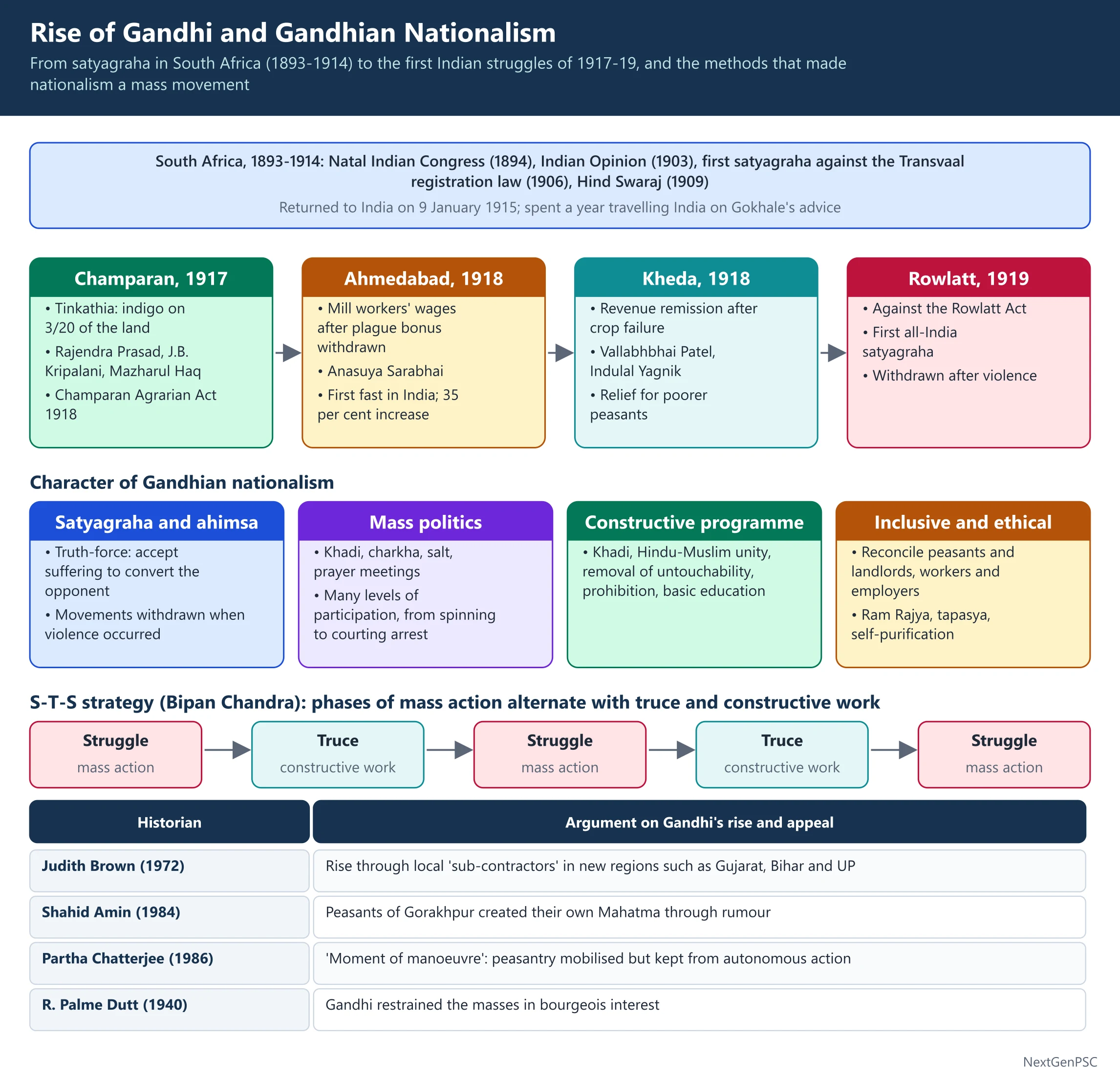
After two decades in South Africa (1893–1914), where he developed satyagraha, M.K. Gandhi returned to India in January 1915 and rose to leadership through local struggles at Champaran, Ahmedabad and Kheda (1917–18). Gandhian nationalism combined non-violent mass struggle, constructive work, religious-moral language and a strategy of controlled movements, which brought peasants, women and the urban poor into the national movement on an unprecedented scale.
In simple words
Gandhi learned to fight injustice without violence in South Africa, then came home and helped indigo farmers, mill workers and tax-burdened peasants win small victories. He spoke in simple words, dressed like a villager and asked ordinary people to break unjust laws peacefully and accept jail. Think of a teacher who makes a whole class brave by going first. His method, satyagraha, turned nationalism into a mass movement. UPSC asks about the character and popular appeal of Gandhian nationalism.
1. Gandhi in South Africa (1893–1914)
Arrival: Gandhi went to South Africa in 1893 as a lawyer for a merchant firm; being thrown off a first-class train at Pietermaritzburg made him confront racial discrimination.
Organisation: He founded the Natal Indian Congress (1894), started the paper Indian Opinion (1903) and set up the Phoenix Settlement (1904) and later Tolstoy Farm (1910).
Satyagraha: Against the Transvaal Asiatic registration law (1906) he led the first satyagraha, with Indians courting arrest; later campaigns opposed the £3 tax on ex-indentured labourers and the non-recognition of Indian marriages.
Settlement: The Gandhi-Smuts agreement and the Indian Relief Act (1914) met several demands.
Ideas: Hind Swaraj (1909), written on board a ship from London, attacked modern Western civilisation and argued that swaraj meant self-rule over oneself, not just replacing British rulers with Indian ones.
Influences: Tolstoy, Ruskin's Unto This Last, Thoreau, the Gita, the Sermon on the Mount and Jain and Vaishnava traditions of Gujarat.
2. Return and the Early Indian Struggles (1915–18)
Return: Gandhi landed at Bombay on 9 January 1915; on Gokhale's advice he spent a year travelling India and set up an ashram at Ahmedabad (moved to Sabarmati in 1917).
Champaran (1917): At the request of Rajkumar Shukla he went to Champaran (Bihar) to inquire into the tinkathia system, which forced peasants to grow indigo on 3/20 of their land; he defied an order to leave, and the Champaran Agrarian Act (1918) abolished the system.
Associates at Champaran: Rajendra Prasad, J.B. Kripalani, Mazharul Haq, Mahadev Desai and Narhari Parikh.
Ahmedabad mill strike (1918): He led textile workers demanding higher wages after the plague bonus was withdrawn, undertaking his first fast in India; the arbitrator awarded a 35 percent increase.
Kheda (1918): He backed peasants of Kheda (Gujarat) who sought remission of revenue after crop failure; Vallabhbhai Patel joined him, and the government quietly gave relief to poorer peasants.
Result: These struggles gave Gandhi a reputation, a team of loyal workers and direct contact with the masses.
3. Character of Gandhian Nationalism
Satyagraha: Truth-force; non-violent resistance in which the satyagrahi accepts suffering to convert the opponent, not to destroy him.
Ahimsa: Non-violence as a creed for Gandhi and a policy for many Congress leaders; Gandhi withdrew movements when violence occurred.
Mass politics: Nationalism was taken to villages through simple symbols such as khadi, the charkha, salt and prayer meetings.
Constructive programme: Khadi, Hindu-Muslim unity, removal of untouchability, prohibition, basic education and village industries prepared cadres between struggles.
Inclusive nationalism: Gandhi tried to unite religions, castes, classes and regions, and sought to reconcile peasants with landlords and workers with employers rather than set them against each other.
Ethical and religious idiom: Terms like Ram Rajya, tapasya and self-purification made politics a moral duty.
Strategy: Bipan Chandra calls it Struggle-Truce-Struggle (S-T-S): phases of mass action followed by phases of truce and constructive work.
4. Gandhi's Popular Appeal
Personal style: His simple dress (the loincloth from 1921), ascetic life and use of Hindustani and Gujarati made him look like a saint, a mahatma, to peasants.
Rumours and myths: Shahid Amin's study of Gorakhpur (1921–22) shows that peasants spread stories of Gandhi's miraculous powers and interpreted his message in their own terms.
Room for many: His programme let people participate at different levels, from spinning to picketing to courting arrest, so women and the poor could join.
Local grievances: Peasant, tribal and worker grievances were linked to the national cause through local leaders.
Limits of control: People often went beyond Gandhi's instructions, for example in no-rent campaigns and violence such as Chauri Chaura (1922).
5. Sources and Evidence
Gandhi's writings: Hind Swaraj (1909), Satyagraha in South Africa (1928), the autobiography The Story of My Experiments with Truth (1927–29), and the journals Young India, Navajivan and later Harijan; all collected in The Collected Works of Mahatma Gandhi.
Contemporary records: Government reports on Champaran, local police and intelligence records, and the papers of associates such as Rajendra Prasad (Satyagraha in Champaran).
Testimony: Nehru's An Autobiography (1936) and The Discovery of India (1946) describe, in substance, Gandhi's coming as a powerful current of fresh air that removed fear.
6. Analysis
Continuity: Gandhi drew on Swadeshi methods (boycott, national schools) but gave them non-violent discipline and mass reach.
Change: Politics shifted from elite drawing rooms and annual sessions to a year-round mass organisation.
Tensions: His refusal to support class struggle drew Left criticism; his religious idiom worried some Muslims and secular leaders; Ambedkar disputed his approach to caste.
7. Historiography and Debates
Judith Brown: Gandhi's Rise to Power: Indian Politics 1915–1922 (1972) explains his rise through alliances with local leaders, whom she calls sub-contractors, in previously backward regions such as Gujarat, Bihar and UP.
Shahid Amin: His essay 'Gandhi as Mahatma' (in Subaltern Studies III, 1984) shows how peasants made their own Mahatma, independent of the Congress.
Partha Chatterjee: He calls the Gandhian phase the moment of manoeuvre, when nationalism appropriated the peasantry while keeping them away from autonomous action.
Bipan Chandra: Gandhi's S-T-S strategy suited a semi-hegemonic colonial state and built a mass, multi-class movement.
Marxist critique: R. Palme Dutt argued that Gandhi protected bourgeois and landlord interests by halting movements when the masses became radical.
Bhikhu Parekh: Colonialism, Tradition and Reform (1989) analyses Gandhi's political discourse and his creative reinterpretation of Hindu ideas.
8. Using It in the Exam
10-marker (150 words): Define satyagraha and give three features of Gandhian nationalism with the 1917–18 struggles as examples.
15-marker (200 words): Explain the sources of Gandhi's popular appeal, using Shahid Amin and Judith Brown.
20-marker (250 words): Assess how Gandhi changed the character of Indian nationalism: methods, social base, ideology and limits, with historiographical views.
Keywords: Satyagraha, ahimsa, constructive programme, S-T-S, mass mobilisation, Mahatma myth, sub-contractors, moment of manoeuvre.
Source line (paraphrase): In Hind Swaraj Gandhi argued that if Indians simply wanted English rule without the Englishman, they would get Englistan, not Hindustan.
| Year | Struggle | Issue | Associates | Outcome |
|---|---|---|---|---|
| 1917 | Champaran (Bihar) | Tinkathia system of forced indigo cultivation | Rajendra Prasad, J.B. Kripalani, Mazharul Haq | Champaran Agrarian Act 1918 |
| 1918 | Ahmedabad mill strike | Wages of textile workers after withdrawal of plague bonus | Anasuya Sarabhai | 35 percent wage increase; first fast in India |
| 1918 | Kheda (Gujarat) | Revenue remission after crop failure | Vallabhbhai Patel, Indulal Yagnik | Relief for poorer peasants |
| 1919 | Rowlatt Satyagraha | Rowlatt Act | All-India | First all-India satyagraha; withdrawn after violence |
| Historian | Work | Argument |
|---|---|---|
| Judith Brown | Gandhi's Rise to Power (1972) | Rise through local sub-contractors in new regions |
| Shahid Amin | Gandhi as Mahatma (1984) | Peasants created their own Mahatma through rumour |
| Partha Chatterjee | Nationalist Thought and the Colonial World (1986) | Moment of manoeuvre: peasantry mobilised but contained |
| Bipan Chandra | India's Struggle for Independence (1988, with others) | S-T-S strategy built a mass, multi-class movement |
| R. Palme Dutt | India Today (1940) | Gandhi restrained the masses in bourgeois interest |
Mains points
- UPSC asks about the 'character of Gandhian nationalism' and 'Gandhi's popular appeal' separately; keep method and appeal distinct.
- Use Champaran, Ahmedabad and Kheda to show how Gandhi built a base before the all-India movements.
- Bring in Shahid Amin and Judith Brown for appeal, and Bipan Chandra's S-T-S for strategy.
- Mention critiques (Marxist, Ambedkarite, Muslim League) to show balance.
- Link South African experience to Indian methods: satyagraha, ashrams, journals, constructive work.
- Avoid hagiography; a strong answer explains why masses joined in their own ways and sometimes outran Gandhi.
Did you know?
- Gandhi wrote Hind Swaraj in Gujarati in about ten days on board the Kildonan Castle in 1909, writing with his left hand when his right hand grew tired.
- Memory trick for the 1917–18 struggles: 'CAK' — Champaran (indigo), Ahmedabad (wages), Kheda (revenue) — peasants, workers, peasants.
Rowlatt Satyagraha, Khilafat and Non-Cooperation
The Rowlatt Act (March 1919) provoked Gandhi's first all-India satyagraha, which was followed by the Jallianwala Bagh massacre (13 April 1919). Anger over Punjab and over the treatment of the Ottoman Caliph united Hindus and Muslims in the Khilafat and Non-Cooperation Movement (1920–22), the first nationwide mass movement, which Gandhi withdrew after the violence at Chauri Chaura (February 1922).
In simple words
In 1919 the British passed a law allowing arrest and trial without normal courts. Gandhi called a nationwide strike, and soon after, soldiers fired on a peaceful crowd at Jallianwala Bagh. Muslims were also angry that Britain was breaking up Turkey, whose Sultan was the Caliph. Gandhi joined both causes and asked Indians to stop cooperating: leave government schools, courts, titles and foreign cloth. It is like workers all refusing to work for a boss at once. UPSC asks about the Khilafat-Non-Cooperation alliance and its withdrawal.
1. The Rowlatt Act and the Satyagraha (1919)
Background: The Sedition Committee under Justice S.A.T. Rowlatt (1918) recommended continuing wartime powers; the Anarchical and Revolutionary Crimes Act was passed in March 1919 despite the opposition of all Indian members of the Imperial Legislative Council.
Provisions: It allowed detention without trial and trial by special courts without the usual right of appeal, summed up in the slogan 'no vakil, no appeal, no dalil'.
Satyagraha Sabha: Gandhi formed it in February 1919 in Bombay; volunteers pledged to disobey the Act and other unjust laws.
Hartal: A nationwide hartal was called for 6 April 1919 (Delhi observed it on 30 March); it was the first all-India mass protest under Gandhi.
Violence and withdrawal: After Gandhi's arrest near Palwal on 9 April, violence broke out in Ahmedabad, Bombay and Punjab; Gandhi suspended the satyagraha on 18 April and later called it a Himalayan miscalculation to launch civil disobedience before people were trained in non-violence.
2. Jallianwala Bagh and the Punjab Wrongs
Arrests: The arrest of Dr Saifuddin Kitchlew and Dr Satyapal in Amritsar on 10 April 1919 led to protests and violence.
Massacre (13 April 1919): General Reginald Dyer fired without warning on a crowd, including Baisakhi visitors, in the enclosed Jallianwala Bagh, Amritsar; official figures gave 379 dead, while unofficial estimates were much higher.
Martial law: Punjab was placed under martial law with public floggings and the crawling order in Amritsar.
Inquiries: The government's Hunter Committee (1919–20) criticised Dyer mildly; the Congress inquiry committee report blamed the government severely.
Protests: Rabindranath Tagore renounced his knighthood (May 1919); Gandhi later returned the Kaiser-i-Hind medal.
Dyer's support: The House of Lords' support for Dyer and a fund raised for him in Britain deepened Indian anger.
3. The Khilafat Movement
Issue: After the First World War the Allies planned to dismember the Ottoman Empire; Indian Muslims saw this as an attack on the Caliph (Khalifa), the spiritual head of Sunni Islam.
Leaders: The Ali brothers (Mohammad Ali and Shaukat Ali), Maulana Abul Kalam Azad, Hakim Ajmal Khan and Hasrat Mohani.
Organisation: The All-India Khilafat Committee was formed in 1919; Khilafat Day was observed on 17 October 1919, and Gandhi presided over the Khilafat Conference at Delhi in November 1919.
Treaty of Sevres (August 1920): Its harsh terms for Turkey confirmed Muslim fears, and the Khilafat Committee adopted non-cooperation.
Gandhi's view: He saw the Khilafat as a chance to unite Hindus and Muslims in a way that might not come again for a hundred years (his words in substance).
4. The Non-Cooperation Movement: Launch and Programme
Launch: Non-cooperation began on 1 August 1920, the day Tilak died.
Congress approval: The special Calcutta session (September 1920, Lala Lajpat Rai presiding) accepted the programme, and the Nagpur session (December 1920) confirmed it.
Three grievances: The Punjab wrongs, the Khilafat wrong and the demand for swaraj; Gandhi promised swaraj within a year if the programme was followed.
Boycott: Surrender of titles, boycott of government schools, law courts, the 1920 council elections and foreign cloth, and later non-payment of taxes as the final stage.
Constructive side: National schools such as Jamia Millia Islamia (Aligarh, 1920), Kashi Vidyapith and Gujarat Vidyapith; panchayats for settling disputes; khadi and the charkha; the Tilak Swaraj Fund, which crossed one crore rupees.
Nagpur reforms: The Congress goal became swaraj by peaceful and legitimate means; Provincial Congress Committees were reorganised on linguistic lines, a Working Committee was set up, and membership was opened at four annas a year.
5. Spread and Popular Participation
Students and lawyers: Thousands left government colleges; C.R. Das, Motilal Nehru, Rajendra Prasad, Vallabhbhai Patel and others gave up legal practice.
Foreign cloth: Bonfires of foreign cloth and picketing reduced cloth imports sharply in 1921–22.
Prince of Wales: His arrival in Bombay on 17 November 1921 was met with a hartal and riots.
Regional upsurges: Awadh kisan sabhas under Baba Ramchandra and the Eka movement; the Akali movement in Punjab for control of gurdwaras; tea-garden workers in Assam; no-tax campaigns in Guntur (Andhra) and Midnapore (Bengal); forest satyagraha in Andhra.
Malabar (1921): The Moplah (Mappila) uprising began as an anti-British and anti-landlord revolt linked with the Khilafat, but turned violent and in places communal.
6. Chauri Chaura and the Withdrawal
Chauri Chaura (4 February 1922): In Gorakhpur district (UP) a crowd set fire to a police station after police firing, killing 22 policemen.
Bardoli resolution (12 February 1922): The Congress Working Committee, at Gandhi's insistence, suspended mass civil disobedience and turned to constructive work.
Criticism: Motilal Nehru, C.R. Das, Lajpat Rai and Subhas Bose criticised the decision; Bose later called it a national calamity.
Gandhi's arrest: Gandhi was arrested in March 1922 and sentenced to six years for sedition by Judge C.N. Broomfield in the Great Trial at Ahmedabad.
End of Khilafat: The issue lost meaning when Mustafa Kemal's Turkey abolished the Caliphate in March 1924.
7. Sources and Evidence
Government records: The Sedition Committee Report (1918), the Hunter Committee Report (1920) and fortnightly reports from provinces.
Congress records: The Congress Punjab Inquiry report (1920) and the resolutions of the Calcutta and Nagpur sessions.
Gandhi's writings: Articles in Young India and Navajivan, including his explanation of the Bardoli decision, and his statement at the Great Trial (1922).
8. Analysis: Achievements and Limits
Mass base: For the first time peasants, artisans, workers, women and Muslims joined the national movement in large numbers across India.
Hindu-Muslim unity: The movement produced a high point of unity, though it rested partly on a religious issue.
Fearlessness: Indians lost the fear of jail and of the colonial state, which Nehru and others stressed.
Congress transformed: It became a mass organisation with a permanent structure down to the district level.
Limits: Swaraj was not achieved in a year; the Khilafat issue mixed religion with politics; the Moplah violence and the withdrawal led to communal tensions in 1922–24.
9. Historiography and Debates
On the withdrawal: Bipan Chandra defends it as a sound decision because the movement was tiring and violence would invite repression; R. Palme Dutt and other Marxists argue that Gandhi halted it to protect propertied interests when peasants turned radical.
Subaltern view: Shahid Amin's work on Chauri Chaura (Event, Metaphor, Memory, 1995) shows how peasants acted on their own understanding of Gandhi's message.
Gyanendra Pandey: His essay on the Awadh peasant movement of 1919–22 (in Subaltern Studies I, 1982) shows tension between peasant radicalism and Congress leadership.
Khilafat: Gail Minault's The Khilafat Movement (1982) treats it as a pan-Indian Islamic mobilisation by the ulama and Muslim politicians, not just pan-Islamism; critics such as Ambedkar and later writers argue it strengthened religious politics.
Judith Brown: She notes that non-cooperation drew in new groups and regions but was uneven, with local leaders shaping it to local ends.
10. Using It in the Exam
10-marker (150 words): Explain the Rowlatt Satyagraha, its significance as the first all-India movement and why it was suspended.
15-marker (200 words): Discuss the Khilafat-Non-Cooperation alliance: reasons, programme and effect on Hindu-Muslim unity.
20-marker (250 words): Assess the Non-Cooperation Movement: spread, social base, achievements, reasons for withdrawal and the debate over Bardoli.
Keywords: Rowlatt Act, hartal, Jallianwala Bagh, Hunter Committee, Khilafat, Treaty of Sevres, Nagpur session, Chauri Chaura, Bardoli resolution.
Quotation (paraphrase): At his trial in 1922 Gandhi said that non-cooperation with evil was as much a duty as cooperation with good, and asked for the severest penalty.
| Date | Event |
|---|---|
| March 1919 | Rowlatt Act passed |
| 6 April 1919 | All-India hartal against the Rowlatt Act |
| 13 April 1919 | Jallianwala Bagh massacre |
| 17 October 1919 | Khilafat Day |
| August 1920 | Treaty of Sevres; Non-Cooperation begins (1 August) |
| September 1920 | Calcutta special session approves Non-Cooperation |
| December 1920 | Nagpur session: new creed and organisation |
| August 1921 | Moplah uprising in Malabar |
| 17 November 1921 | Prince of Wales arrives in Bombay; hartal |
| 4–12 February 1922 | Chauri Chaura; Bardoli resolution suspends the movement |
| March 1924 | Turkey abolishes the Caliphate |
Mains points
- UPSC often asks whether the Khilafat alliance was a wise strategy; weigh the unity it produced against the long-term mixing of religion and politics.
- Explain the Rowlatt Satyagraha as the first all-India satyagraha and a rehearsal for Non-Cooperation.
- In assessing Non-Cooperation, cover programme, regional upsurges and changes in Congress organisation at Nagpur.
- On the withdrawal, present both the Gandhian (and Bipan Chandra) justification and the critique of Bose, Das and Marxist historians.
- Use regional examples (Awadh, Malabar, Punjab Akalis, Assam, Guntur, Midnapore) to show depth.
- Common errors: dating Jallianwala Bagh to 1920, or saying Gandhi launched the no-tax stage nationwide; it was planned for Bardoli but never begun.
Did you know?
- Udham Singh, who was in Amritsar in 1919, shot Michael O'Dwyer, the Lieutenant-Governor of Punjab at the time of the massacre, in London in March 1940.
- Memory trick for Non-Cooperation boycotts: 'TSCCF' — Titles, Schools, Courts, Councils, Foreign cloth.
From Non-Cooperation to Civil Disobedience: Swarajists, Simon Commission and Nehru Report
After Non-Cooperation (1922) the Congress split between the Swarajists (C.R. Das, Motilal Nehru), who entered the councils to obstruct from within, and the No-Changers, who continued Gandhi's constructive work. The years 1922–29 also saw communal riots, the rise of the Left and the HSRA. The all-white Simon Commission (1927) reunited nationalists in boycott, and the Nehru Report (1928) offered an Indian constitution but failed to settle the communal question, leading to the Lahore Congress's demand for Purna Swaraj (1929).
In simple words
After Gandhi stopped Non-Cooperation, Congress leaders disagreed on what to do next. Some went into the councils to fight the government from inside; others worked in villages spinning khadi and fighting untouchability. It is like a team between matches: some study the rules to beat the referee, others train the players. In 1927 Britain sent a commission with no Indian member to decide India's future, so Indians wrote their own plan, the Nehru Report. UPSC asks how these years prepared the Civil Disobedience movement.
1. Background: The Debate After 1922
Crisis: The withdrawal of Non-Cooperation and Gandhi's imprisonment (March 1922 to February 1924) left the Congress uncertain.
Pro-changers: C.R. Das, Motilal Nehru, Vithalbhai Patel and others wanted to enter the councils created by the Montford Reforms to wreck them from within and keep political interest alive.
No-changers: C. Rajagopalachari, Vallabhbhai Patel, Rajendra Prasad and M.A. Ansari opposed council entry and stressed constructive work.
Gaya session (December 1922): Council entry was rejected; Das resigned as Congress president.
2. The Swaraj Party
Formation: The Congress-Khilafat Swaraj Party was formed on 1 January 1923, with C.R. Das as president and Motilal Nehru as a secretary.
Compromise: The special Delhi session (September 1923) allowed Congressmen to contest elections, avoiding a split.
1923 elections: The Swarajists did well, especially in the Central Provinces, where they won a majority, in Bengal, and in the Central Legislative Assembly, where they formed the largest group with allies.
Work in councils: They defeated budgets, passed resolutions for self-government, exposed the weaknesses of dyarchy and, with Vithalbhai Patel as President of the Central Legislative Assembly (1925), embarrassed the government.
Decline: C.R. Das died in June 1925; some members, called Responsivists (M.R. Jayakar, N.C. Kelkar), accepted office, and communal divisions weakened the party by 1926.
3. Constructive Work and Gandhi
Programme: Khadi through the All-India Spinners' Association (1925), national schools, Hindu-Muslim unity and anti-untouchability work.
Vaikom satyagraha (1924–25): In Travancore, a struggle led by T.K. Madhavan, K.P. Kesava Menon and others, supported by Gandhi and E.V. Ramasamy, for the right of lower castes to use roads near the Vaikom temple.
Bardoli satyagraha (1928): Vallabhbhai Patel led peasants of Bardoli (Gujarat) against a revenue enhancement of about 22 percent and won an inquiry that reduced it; women gave him the title Sardar.
4. Communalism and New Forces (1922–29)
Communal riots: Tensions rose after the Khilafat collapse; the Shuddhi and Sangathan campaigns and the Tabligh and Tanzim movements competed, and riots broke out in many towns.
Left wing: The Communist Party of India was organised at Kanpur (1925); Workers' and Peasants' Parties were active; the Meerut Conspiracy Case (1929) targeted trade union and communist leaders.
Revolutionaries: The Hindustan Republican Association (1924) carried out the Kakori train action (1925); it became the Hindustan Socialist Republican Association (1928) under Chandrashekhar Azad and Bhagat Singh.
HSRA actions: Saunders was shot in Lahore (December 1928) to avenge Lajpat Rai, and Bhagat Singh and B.K. Dutt threw bombs in the Central Legislative Assembly (8 April 1929) to protest the Public Safety and Trade Disputes Bills.
Youth: Jawaharlal Nehru and Subhas Chandra Bose led youth leagues and the Independence for India League (1928), pressing for complete independence.
5. The Simon Commission (1927)
Appointment: Announced in November 1927, two years before it was due under the 1919 Act, to review the working of the reforms; it had seven British MPs under Sir John Simon, including Clement Attlee, and no Indian.
Indian reaction: The Madras Congress (December 1927) decided to boycott it at every stage and also passed a resolution declaring complete independence as the goal; the Liberals and a section of the Muslim League also joined the boycott.
Protests: The Commission landed at Bombay on 3 February 1928 to hartals and black flags with the slogan 'Simon Go Back'.
Lajpat Rai: He was injured in a police lathi-charge at Lahore on 30 October 1928 and died on 17 November 1928.
Report: Published in 1930, it proposed provincial autonomy with safeguards and a federation, but not dominion status.
6. The Nehru Report (1928)
Challenge: Secretary of State Lord Birkenhead challenged Indians to produce an agreed constitution.
Drafting: An All Parties Conference appointed a committee headed by Motilal Nehru, with members including Tej Bahadur Sapru, Ali Imam and Subhas Bose; it reported in August 1928.
Main recommendations: Dominion status, a responsible government at the centre and in provinces, joint electorates with reservation of seats for Muslims at the centre and where they were a minority, linguistic provinces, separation of Sindh, and nineteen fundamental rights including universal adult suffrage.
Muslim objections: At the All Parties Convention in Calcutta (December 1928) Jinnah's amendments, including one-third Muslim seats in the central legislature, were rejected.
Fourteen Points (March 1929): Jinnah then set out his demands, including separate electorates, a federal system with residuary powers in provinces and one-third representation at the centre.
Inside the Congress: Nehru and Bose opposed dominion status; the Calcutta session (December 1928) accepted the report but gave the government one year to grant dominion status or face civil disobedience.
7. Road to Civil Disobedience
Irwin's Declaration (31 October 1929): Irwin said dominion status was the natural issue of India's constitutional progress and promised a Round Table Conference.
Failure of talks: At a meeting in December 1929 Irwin could not assure that the conference would draft a dominion constitution.
Lahore session (December 1929): Under Jawaharlal Nehru's presidency the Congress declared Purna Swaraj (complete independence) its goal, boycotted the Round Table Conference and authorised civil disobedience.
Independence Day: 26 January 1930 was celebrated as Independence Day, with a pledge read across the country.
8. Sources and Evidence
Reports: Report of the Indian Statutory Commission (1930) and the Nehru Report (All Parties Conference, 1928).
Debates: Legislative Assembly debates of 1924–29 record Swarajist tactics.
Writings: Bhagat Singh's Why I am an Atheist (1930) and HSRA leaflets, and Jinnah's Fourteen Points (1929).
9. Analysis
Swarajist contribution: They kept nationalism visible during a lull and showed that the reformed councils were hollow.
Constructive work: It built cadres and rural contact that were used in 1930.
Communal failure: The Nehru Report's rejection of separate electorates and Jinnah's amendments marked a parting of ways in Muslim politics.
Radicalisation: Youth, workers, the Left and the HSRA pushed the Congress towards complete independence.
10. Historiography and Debates
Bipan Chandra: He treats the Swarajists and No-Changers as complementary, both necessary in a passive phase of the S-T-S strategy.
Sumit Sarkar: He stresses the importance of the Left, labour unrest and the youth movement in pushing the Congress to radical goals.
Cambridge view: The essays in Locality, Province and Nation (1973, edited by Gallagher, Johnson and Seal) treat council entry as a sign that nationalist politics followed constitutional opportunities created by the Raj.
On the Nehru Report: David Page's Prelude to Partition (1982) examines how the imperial system of control encouraged provincial Muslim politics; other historians debate whether the Congress missed a chance to settle with Jinnah in 1928.
11. Using It in the Exam
10-marker (150 words): Explain the Swarajist programme and its achievements.
15-marker (200 words): Discuss the Nehru Report's recommendations and why it failed to win Muslim support.
20-marker (250 words): Trace national politics from 1922 to 1929, from the Swarajist-No-Changer debate through the Simon Commission and Nehru Report to the Lahore resolution.
Keywords: Council entry, obstruction from within, No-Changers, constructive programme, Simon Go Back, Birkenhead's challenge, Nehru Report, Fourteen Points, Purna Swaraj.
Quotation (paraphrase): The Independence pledge of 1930 said the British government had ruined India economically, politically, culturally and spiritually, and that India must sever the British connection and attain Purna Swaraj.
| Issue | Nehru Report (1928) | Jinnah's Fourteen Points (1929) |
|---|---|---|
| Status | Dominion status | Federal constitution |
| Electorates | Joint electorates with reserved seats | Separate electorates to continue |
| Centre | Strong centre; residuary powers with the centre | Residuary powers with the provinces |
| Muslim share at centre | Reservation in proportion to population | One-third of seats in the central legislature |
| Provinces | Sindh separated; NWFP on par with others; linguistic provinces | Sindh separated; reforms in NWFP and Baluchistan |
| Rights | Nineteen fundamental rights, adult suffrage | Protection of Muslim religion, culture and personal law |
| Date | Event |
|---|---|
| December 1922 | Gaya Congress rejects council entry |
| 1 January 1923 | Swaraj Party formed |
| 1924–25 | Vaikom satyagraha |
| 9 August 1925 | Kakori train action |
| November 1927 | Simon Commission announced |
| August 1928 | Nehru Report |
| 1928 | Bardoli satyagraha; HSRA formed |
| March 1929 | Jinnah's Fourteen Points; Meerut Conspiracy arrests |
| December 1929 | Lahore Congress: Purna Swaraj |
| 26 January 1930 | First Independence Day |
Mains points
- The syllabus phrase 'national politics from the end of Non-Cooperation to the beginning of Civil Disobedience' calls for a connected narrative, not isolated events.
- Present Swarajists and No-Changers as two complementary responses, and assess both.
- On the Simon Commission, explain why its all-white composition united diverse groups, and its outcome.
- On the Nehru Report, give its main recommendations and explain the Muslim and Hindu Mahasabha positions and the Congress dominion status versus independence debate.
- Bring in the Left, HSRA and youth movement as forces that radicalised the Congress towards Purna Swaraj.
- Common mistake: saying the Simon Commission recommended dominion status; it did not.
Did you know?
- Clement Attlee, a member of the all-white Simon Commission, was the British Prime Minister when India became independent in 1947.
- Bhagat Singh and B.K. Dutt threw their bombs into empty benches of the Assembly so that no one would be killed, and shouted 'Inquilab Zindabad' as they courted arrest.
Civil Disobedience and the Round Table Conferences
The Civil Disobedience Movement ran in two phases: from the Dandi March (March–April 1930) to the Gandhi-Irwin Pact (March 1931), and from January 1932 to its withdrawal in 1934. Unlike Non-Cooperation, it involved deliberate breaking of laws such as the salt law, and it drew in women, peasants, traders and the North-West Frontier on a large scale. Three Round Table Conferences (1930–32) in London failed to produce agreement, and the Communal Award (1932) led to the Poona Pact.
In simple words
In 1930 Gandhi walked about 240 miles to the sea at Dandi and picked up a lump of natural salt, breaking a law that taxed something everyone needs. Soon millions broke laws peacefully: making salt, refusing taxes, picketing liquor and foreign cloth shops. It is like a whole town choosing to pay a fine rather than obey an unfair rule. Talks in London, the Round Table Conferences, failed over the minorities question. UPSC asks about the movement's two phases, its social base and its results.
1. Background and the Choice of Salt
Lahore mandate: The Lahore Congress (December 1929) authorised civil disobedience for Purna Swaraj.
Eleven demands: On 31 January 1930 Gandhi sent Irwin eleven demands, including abolition of the salt tax, a lower rupee-sterling ratio, protective tariffs on foreign cloth, a 50 percent cut in land revenue and military spending, release of political prisoners and reform of the CID.
Why salt: Salt was used by all, the tax hit the poor, and making salt was a simple act anyone could perform; it linked the ideal of swaraj to a concrete grievance.
Doubts: Many leaders and the government initially ridiculed the choice; it turned out to be highly effective.
2. First Phase (1930–31)
Dandi March: Gandhi left Sabarmati on 12 March 1930 with 78 followers and reached Dandi on 5 April; on 6 April he broke the salt law.
Spread: C. Rajagopalachari marched from Trichinopoly to Vedaranyam in Tamil Nadu, K. Kelappan led a march to Payyanur in Malabar, and salt was made on coasts across India.
Dharasana (May 1930): Volunteers led by Sarojini Naidu and Imam Sahib marched on the Dharasana salt works and were beaten by police; the American journalist Webb Miller's report shocked world opinion.
North-West Frontier: Khan Abdul Ghaffar Khan's Khudai Khidmatgars (Red Shirts) mobilised Pathans; after the Qissa Khwani Bazaar firing in Peshawar (23 April 1930) soldiers of the Garhwal Rifles under Chandra Singh Garhwali refused to fire on the crowd.
Sholapur: Textile workers took control of the town for some days in May 1930 before martial law was imposed.
Other forms: No-chaukidari-tax campaigns in Bihar and Bengal, forest satyagraha in Maharashtra, Karnataka and the Central Provinces, no-revenue campaigns in Gujarat, and no-rent campaigns in UP.
Boycott: Picketing of foreign cloth and liquor shops reduced imports of British cloth sharply in 1930–31.
Revolutionary action: Surya Sen's Chittagong armoury raid (18 April 1930) happened in the same period, though outside the Gandhian programme.
3. Social Base of Civil Disobedience
Women: Thousands of women joined salt-making, picketing and processions, a scale far larger than before.
Merchants and business: Traders observed hartals and supported boycott; leading industrialists such as G.D. Birla backed the Congress, though some business groups later pressed for a settlement.
Peasants: Rich and middle peasants in Gujarat and UP (the Patidars of Kheda and Bardoli, the Jats of UP) joined no-revenue campaigns.
Weaker participation: Muslim participation was lower than in 1920–22 except in the NWFP; industrial workers took part less than in 1920–22, apart from places such as Sholapur; Ambedkar's depressed class followers stayed away.
4. The First Round Table Conference and the Gandhi-Irwin Pact
First RTC (November 1930–January 1931): Opened in London by George V and chaired by Prime Minister Ramsay MacDonald; Liberals, princes, the Muslim League and depressed class representatives attended, but the Congress did not.
Outcome: Agreement in principle on an all-India federation including the princely states, and on provincial responsible government, but without the Congress little could be settled.
Gandhi-Irwin Pact (5 March 1931): The government agreed to release prisoners not convicted of violence, permit salt-making for consumption in coastal villages, allow peaceful picketing and return confiscated property not yet sold; the Congress agreed to suspend civil disobedience and attend the second RTC.
What was not won: No inquiry into police excesses and no commutation of the death sentences of Bhagat Singh, Sukhdev and Rajguru, who were hanged on 23 March 1931.
Karachi Congress (March 1931): Under Vallabhbhai Patel it endorsed the pact and passed resolutions on Fundamental Rights and the National Economic Programme.
5. The Second and Third Round Table Conferences
Second RTC (September–December 1931): Gandhi attended as the sole Congress representative and claimed that the Congress represented all of India.
Deadlock: The conference broke down over minority representation; the Muslim League, Ambedkar and others demanded separate electorates, and a Minorities Pact was presented.
Gandhi in England: He stayed in the East End of London and visited Lancashire mill workers, who had lost jobs because of the boycott.
Third RTC (November–December 1932): The Congress and the British Labour Party did not attend; its recommendations led to the White Paper (1933) and the Government of India Act 1935.
6. Second Phase (1932–34)
Resumption: Gandhi returned on 28 December 1931; under Viceroy Willingdon he was arrested on 4 January 1932, the Congress was banned and emergency ordinances were issued.
Repression: Tens of thousands were jailed, property was confiscated and the movement weakened under the severe crackdown.
Communal Award (16 August 1932): MacDonald's award extended separate electorates to the depressed classes.
Poona Pact (24 September 1932): After Gandhi's fast in Yerawada jail, Ambedkar and Gandhi's side agreed on joint electorates with 148 reserved seats for the depressed classes in provincial legislatures, instead of 71 under the Award.
Harijan campaign: Gandhi founded the Harijan Sevak Sangh (1932) and the weekly Harijan (1933), turning his energy to removing untouchability.
Withdrawal: Mass civil disobedience was suspended in 1933 and replaced by individual satyagraha; the movement was formally withdrawn in April 1934.
7. Sources and Evidence
Contemporary reports: Webb Miller's dispatches (1930), Home Political files, provincial fortnightly reports and Indian Round Table Conference proceedings.
Agreements: The text of the Gandhi-Irwin Pact (1931), the Communal Award (1932) and the Poona Pact (1932).
Writings: Gandhi's letters to Irwin (1930), Nehru's An Autobiography and Ambedkar's What Congress and Gandhi Have Done to the Untouchables (1945).
8. Analysis: Achievements and Limits
Wider base: Civil Disobedience reached more women, peasants and traders than earlier movements, and broke laws directly rather than just withdrawing cooperation.
International attention: Dandi and Dharasana made India's struggle visible across the world.
Limits: Lower Muslim and worker participation, the failure of the second RTC and the severity of repression in 1932–34.
Political result: The movement forced the British to negotiate with the Congress as an equal party (the Pact), and paved the way for the 1935 Act and the 1937 elections.
9. Historiography and Debates
Sumit Sarkar: In 'The Logic of Gandhian Nationalism' (1976) he argues that pressure from Indian business and fear of peasant radicalism helped push the Congress into the Gandhi-Irwin Pact.
Bipan Chandra: He sees the Pact as a sensible truce in the S-T-S strategy, made when the movement was losing momentum, not a betrayal.
Judith Brown: Gandhi and Civil Disobedience: The Mahatma in Indian Politics 1928–34 (1977) examines Gandhi's leadership and the regional variations of the movement.
Ambedkar and the Poona Pact: Ambedkar later argued that the Poona Pact deprived the depressed classes of independent political representation; Gandhian writers defend it as a step against permanent division of Hindu society.
Business historians: Claude Markovits' Indian Business and Nationalist Politics 1931–1939 (1985) shows that businessmen's attitudes to the Congress varied with their interests.
10. Using It in the Exam
10-marker (150 words): Explain why salt was chosen and the main features of the Dandi March.
15-marker (200 words): Compare the two phases of Civil Disobedience in scale, social base and government response.
20-marker (250 words): Assess the Round Table Conferences and the Gandhi-Irwin Pact, with the communal question, the Poona Pact and the views of Sumit Sarkar and Bipan Chandra.
Keywords: Eleven demands, Dandi, Dharasana, Khudai Khidmatgars, Gandhi-Irwin Pact, Karachi resolution, Communal Award, Poona Pact, Willingdon's repression.
Quotation (paraphrase): Webb Miller reported that the Dharasana volunteers marched forward without raising an arm in defence and were struck down by police lathis, one line after another.
| Aspect | First Phase (1930–31) | Second Phase (1932–34) |
|---|---|---|
| Start | Dandi March, 12 March 1930 | Gandhi's arrest, 4 January 1932 |
| Viceroy | Irwin | Willingdon |
| Scale | Very wide; salt, forest, no-tax, boycott | Narrower; crushed by ordinances |
| Government policy | Repression with negotiation | Severe repression, no talks |
| Key events | Dharasana, Peshawar, Sholapur, first RTC | Communal Award, Poona Pact, third RTC |
| End | Gandhi-Irwin Pact, 5 March 1931 | Suspended 1933; withdrawn April 1934 |
| Conference | Dates | Congress | Main Outcome |
|---|---|---|---|
| First | November 1930–January 1931 | Absent | Agreement in principle on all-India federation |
| Second | September–December 1931 | Gandhi as sole representative | Deadlock on minorities; Communal Award followed |
| Third | November–December 1932 | Absent | White Paper 1933; basis of the 1935 Act |
Mains points
- The syllabus says 'the two phases of the Civil Disobedience Movement'; always compare the phases rather than narrate only Dandi.
- Explain the significance of salt as a symbol that connected swaraj to everyday life.
- Show regional variety (NWFP, Sholapur, forest satyagraha, no-chaukidari tax) and the social base, including the weak points.
- Present the Gandhi-Irwin Pact debate (Sumit Sarkar vs Bipan Chandra) for higher-mark answers.
- Link the second RTC's failure to the Communal Award and the Poona Pact, giving the seat numbers correctly (71 vs 148).
- Common mistake: placing the Karachi resolution on Fundamental Rights at Lahore; it was passed at Karachi in March 1931.
Did you know?
- Churchill mocked the sight of Gandhi, whom he called a half-naked fakir, striding up the steps of the Viceregal palace to negotiate on equal terms with the King-Emperor's representative.
- Memory trick for the Gandhi-Irwin Pact gains: 'RSPP' — Release of prisoners, Salt for coastal villages, Peaceful picketing, Property returned.
Peasants, Workers, Women and Students in the National Movement
From 1918 onwards peasant and working-class movements developed alongside and sometimes in tension with Congress nationalism, through Kisan Sabhas, the All India Kisan Sabha (1936) and the AITUC (1920). Women moved from token delegates in 1889 to mass participation in 1930 and leadership in 1942, while students and youth provided volunteers from the Swadeshi movement to Quit India. The relationship between class struggle and national unity is the central question.
In simple words
The freedom struggle was not only led by lawyers in cities. Farmers fought high rents, factory workers formed unions for better wages, women marched and went to jail, and students left colleges to join protests. Think of a river fed by many streams: each stream had its own source and direction, but together they made the river strong. Sometimes the streams pulled in different directions, for example tenants against Indian landlords. UPSC asks how nationalism and these class and social movements shaped each other.
1. Nationalism and the Peasant Movements: 1918–1934
UP Kisan Sabha (1918): Formed with the help of Gauri Shankar Mishra, Indra Narain Dwivedi and Madan Mohan Malaviya to voice tenants' grievances in UP.
Awadh Kisan Sabha (1920): Baba Ramchandra mobilised tenants in Pratapgarh and Rae Bareli against illegal cesses (nazrana), begar and eviction; Jawaharlal Nehru first came into contact with peasants here.
Eka movement (1921–22): Led by Madari Pasi in Hardoi, Bahraich and Sitapur, it organised tenants, including low castes, outside Congress control.
Congress response: Gandhi and the Congress discouraged no-rent campaigns against Indian landlords during Non-Cooperation, to preserve unity.
Bardoli (1928): Patel's successful satyagraha showed a peasant struggle directed against the colonial state, not landlords, which fitted Congress strategy.
Depression years (1929–34): The collapse of agricultural prices pushed peasants into Civil Disobedience through no-rent and no-revenue campaigns in UP, Gujarat and Andhra.
2. Organised Peasant Politics: 1934–1947
Bihar Provincial Kisan Sabha (1929): Founded by Swami Sahajanand Saraswati, it later demanded abolition of zamindari.
All India Kisan Sabha (April 1936): Founded at Lucknow with Sahajanand as president and N.G. Ranga as general secretary; its Kisan Manifesto (1936) demanded abolition of zamindari, reduction of rent and cancellation of debts.
Faizpur Congress (December 1936): The first rural session of the Congress adopted an agrarian programme in response to Kisan Sabha pressure.
Congress ministries (1937–39): Tenancy and debt relief laws were passed, but disputes with the Kisan Sabha over the pace of reform continued.
Post-war upsurges: Tebhaga in Bengal (1946–47) demanded two-thirds of the crop for sharecroppers; the Telangana armed struggle (1946–51) fought the Nizam and landlords; Punnapra-Vayalar in Travancore (1946) and the Warli revolt in Maharashtra (1945–47) were other Communist-led movements.
3. Nationalism and the Working-Class Movement
Early phase: Before 1918 labour action was mostly scattered; Tilak's conviction in 1908 led to a political strike by Bombay textile workers.
AITUC (1920): Founded in Bombay on 31 October 1920 with Lala Lajpat Rai as president; N.M. Joshi was a key organiser; Lajpat Rai linked labour exploitation to imperialism.
Laws: The Trade Unions Act (1926) gave legal recognition to unions, while the Trade Disputes Act (1929) restricted strikes.
Communist influence: The Girni Kamgar Union led the long Bombay textile strike of 1928; the Meerut Conspiracy Case (1929–33) jailed communist and trade union leaders.
Splits: Moderates under N.M. Joshi left in 1929 to form the Indian Trade Union Federation, and Communists formed the Red Trade Union Congress in 1931; unity was restored by 1940.
Later phase: Workers joined the Quit India strikes (Ahmedabad mills stayed closed for weeks, Jamshedpur struck) and the 1946 strikes in support of the Royal Indian Navy ratings.
Congress attitude: Gandhi's Ahmedabad Textile Labour Association (1920) favoured arbitration; Nehru and the Congress Socialists sought closer links with labour, while many Congress leaders feared class conflict.
4. The Congress Socialist Party and the Left
CSP (1934): Formed within the Congress by Acharya Narendra Dev, Jayaprakash Narayan, Minoo Masani and others, to radicalise the Congress programme.
Left in the Congress: Nehru's presidential addresses at Lucknow (1936) and Faizpur (1936) and Bose's election (1938, 1939) showed the strength of the left wing.
5. Women in Indian Politics (1885–1947)
Early years: Women delegates attended Congress from 1889; Kadambini Ganguly spoke in 1890; Swarnakumari Devi was also among early participants.
Swadeshi (1905–08): Women boycotted foreign goods and observed arandhan (not cooking) on 16 October 1905.
Organisations: The Women's Indian Association (1917) of Annie Besant, Margaret Cousins and Dorothy Jinarajadasa, and the All India Women's Conference (1927) worked for suffrage, education and reform such as the Sarda Act (1929).
Leadership: Annie Besant presided over the Congress in 1917 and Sarojini Naidu in 1925, the first Indian woman president.
Civil Disobedience: Women joined salt-making and picketing in very large numbers; Gandhi saw non-violence as suited to women's strength.
Revolutionaries: Pritilata Waddedar and Kalpana Dutt of Surya Sen's group, and Bina Das, who fired at the Bengal Governor in 1932.
Quit India and after: Aruna Asaf Ali hoisted the flag at Gowalia Tank, Usha Mehta ran the underground Congress Radio, Sucheta Kripalani organised underground work, and Matangini Hazra was shot leading a procession at Tamluk; the INA's Rani of Jhansi Regiment was led by Lakshmi Swaminathan.
6. Students and Youth (1885–1947)
Swadeshi: Students picketed shops, and the Carlyle Circular (1905) threatened to disaffiliate schools whose students joined; the Anti-Circular Society was formed in response.
Non-Cooperation: Thousands left government schools and colleges for national institutions such as Jamia Millia, Kashi Vidyapith and Bihar Vidyapith.
Youth leagues: In the late 1920s Nehru and Bose led youth and student conferences; Bhagat Singh's Naujawan Bharat Sabha (1926) worked in Punjab.
All India Students' Federation (1936): Founded at Lucknow in August 1936 as an all-India student body, later divided along political lines.
Quit India (1942): Students were among the most active participants, organising strikes, sabotage and underground networks.
7. Sources and Evidence
Organisational records: AIKS and AITUC proceedings, Kisan Manifesto (1936), Royal Commission on Labour Report (1931) and the reports of the Floud Commission (Bengal Land Revenue, 1940).
Memoirs: Sahajanand Saraswati's autobiography Mera Jeevan Sangharsh, Nehru's An Autobiography on Awadh peasants, and accounts by women participants.
Official sources: Police and intelligence reports, which often exaggerated communist influence.
8. Analysis
Two streams: Peasant and worker movements sometimes merged with the national movement (Bardoli, Civil Disobedience) and sometimes clashed with it when directed against Indian landlords and employers.
Congress strategy: The Congress tried to keep a multi-class coalition, limiting class struggle to preserve national unity.
Women's participation: It was large but often framed in terms of sacrifice and motherhood; most women leaders came from educated families.
Legacy: Demands like zamindari abolition, labour rights and women's equality entered the programme of independent India.
9. Historiography and Debates
Subaltern view: Ranajit Guha's Elementary Aspects of Peasant Insurgency in Colonial India (1983) argued that peasant politics had an autonomous domain not controlled by elite nationalists.
Regional studies: Majid Siddiqi's Agrarian Unrest in North India: The United Provinces 1918–22 (1978) and Kapil Kumar's Peasants in Revolt (1984) show tensions between Awadh peasants and the Congress.
Bipan Chandra: He argues that the Congress was a multi-class movement which rightly put national unity first while gradually adopting peasant and worker demands.
Labour history: Dipesh Chakrabarty's Rethinking Working-Class History: Bengal 1890–1940 (1989) and Rajnarayan Chandavarkar's work on Bombay explore the community and cultural ties of workers.
Women: Geraldine Forbes' Women in Modern India (1996) and Radha Kumar's The History of Doing (1993) trace women's activism; Partha Chatterjee's essay on the nationalist resolution of the women's question (1989) argues that nationalism placed women in an inner, spiritual domain.
10. Using It in the Exam
10-marker (150 words): Write on the All India Kisan Sabha or the AITUC: formation, demands and link with the Congress.
15-marker (200 words): Discuss the role of women from 1885 to 1947 in phases, with named examples.
20-marker (250 words): Examine the relationship between nationalism and peasant or working-class movements: convergence, conflict and the views of Guha and Bipan Chandra.
Keywords: Kisan Sabha, Eka, AIKS 1936, Kisan Manifesto, AITUC 1920, Meerut Conspiracy, CSP, Tebhaga, autonomous domain, multi-class movement.
Quotation (paraphrase): Lajpat Rai, presiding over the first AITUC, argued that imperialism and capitalism were closely linked and that Indian workers had to organise against both.
| Year | Organisation or Movement | Leaders | Significance |
|---|---|---|---|
| 1918 | UP Kisan Sabha | Gauri Shankar Mishra, Indra Narain Dwivedi, M.M. Malaviya | First organised tenant body in UP |
| 1920 | Awadh Kisan Sabha | Baba Ramchandra | Linked peasants with Non-Cooperation |
| 1920 | AITUC | Lala Lajpat Rai, N.M. Joshi | First all-India trade union centre |
| 1928 | Bardoli satyagraha | Vallabhbhai Patel | Successful no-revenue struggle |
| 1934 | Congress Socialist Party | Narendra Dev, Jayaprakash Narayan | Left wing within the Congress |
| 1936 | All India Kisan Sabha | Sahajanand Saraswati, N.G. Ranga | Demanded zamindari abolition |
| 1946–47 | Tebhaga | Bengal Provincial Kisan Sabha | Sharecroppers' demand for two-thirds of the crop |
| Phase | Forms of Participation | Examples |
|---|---|---|
| 1885–1905 | Delegates, speakers | Kadambini Ganguly, Swarnakumari Devi |
| 1905–1918 | Boycott, arandhan, Home Rule | Swadeshi women, Annie Besant |
| 1920–1929 | Non-Cooperation, khadi, organisations | Sarojini Naidu, WIA, AIWC |
| 1930–1934 | Salt-making, picketing, jail | Dharasana volunteers, Kamaladevi Chattopadhyay |
| 1930s revolutionaries | Armed action | Pritilata Waddedar, Kalpana Dutt, Bina Das |
| 1942–1947 | Underground leadership, INA | Aruna Asaf Ali, Usha Mehta, Matangini Hazra, Lakshmi Swaminathan |
Mains points
- The syllabus pairs 'nationalism and the peasant movements' and 'nationalism and working class movements'; the core question is the relationship, so discuss convergence and conflict.
- For women and students, the syllabus period is 1885–1947; organise the answer in phases with named people and events.
- Use the Awadh and Eka movements to show peasant autonomy, and Bardoli to show convergence with Congress strategy.
- Mention AITUC's founding, the Meerut case and the CSP to show the rise of the Left inside and outside the Congress.
- Bring in at least one subaltern and one Bipan Chandra-type argument for a balanced 20-mark answer.
- Avoid treating women's participation only as numbers; discuss how it changed women's public role and its limits.
Did you know?
- Matangini Hazra, about 73 years old, kept holding the national flag and shouting Vande Mataram after being shot during a Quit India procession at Tamluk in September 1942; locals called her Gandhi Buri (old lady Gandhi).
- Usha Mehta's secret Congress Radio began broadcasting in August 1942 with the words 'This is the Congress Radio calling on 42.34 metres from somewhere in India'.
The 1937 Elections, Ministries, Cripps Mission and Quit India
Under the Government of India Act 1935 the Congress won the 1937 provincial elections and formed ministries in most provinces, which ruled for about 28 months until they resigned in 1939 over India's entry into the Second World War. The Cripps Mission (March–April 1942) offered dominion status after the war but failed. The Congress then launched the Quit India Movement (August 1942), a largely leaderless mass rebellion that was crushed but showed that British rule could not last.
In simple words
In 1937 Indians voted in provincial elections, and the Congress won and ran governments in most provinces, learning how to govern. In 1939 Britain dragged India into the World War without asking, so the Congress ministers resigned. In 1942 Britain sent Cripps with a promise of freedom after the war, which Gandhi found too vague. Then Gandhi told the British to Quit India and told Indians to Do or Die. It is like a tenant who, tired of promises, tells the landlord to leave now. UPSC asks about the ministries' record and the character of Quit India.
1. The Government of India Act 1935 and the 1937 Elections
Act of 1935: It introduced provincial autonomy with responsible ministries, a proposed all-India federation (never formed), separate electorates and wide discretionary powers for governors; the franchise was widened to about 30 million people, still a minority of adults.
Congress debate: The Congress condemned the Act but decided at Lucknow and Faizpur (1936) to contest the elections; whether to accept office was left open.
Results (early 1937): The Congress won a clear majority in Madras, Bihar, Orissa, the Central Provinces and the United Provinces, and was the largest party in Bombay; it did well in general seats but poorly in Muslim seats.
Muslim League: It won only about a quarter of the Muslim seats; in Punjab the Unionist Party and in Bengal the Krishak Praja Party of Fazlul Huq were stronger.
Office acceptance: After assurances by Viceroy Linlithgow that governors would not interfere lightly, the Congress formed ministries in July 1937, later in eight provinces including the NWFP and Assam.
2. Work of the Congress Ministries (1937–39)
Civil liberties: Bans on organisations and newspapers were lifted, political prisoners released and emergency powers repealed.
Agrarian measures: Tenancy laws in UP and Bihar, debt relief in Madras and other provinces, and restoration of lands confiscated during Civil Disobedience.
Social programme: Prohibition, the Wardha scheme of basic education (1937), harijan welfare and temple-entry measures, and expansion of primary schools and health services.
Labour: Some ministries supported workers, but the Bombay Trade Disputes Act (1938), which restricted strikes, was criticised by the Left.
Planning: The National Planning Committee (1938) under Jawaharlal Nehru began work on economic planning.
Limits: Limited finances, governors' powers and caution about property interests restricted reforms.
Communal tensions: The Congress refused a coalition with the League in UP in 1937; the League's Pirpur Report (1938) alleged Muslim grievances under Congress rule, which the Congress denied.
Resignation: Linlithgow declared India at war on 3 September 1939 without consulting Indian leaders; the Congress ministries resigned in October–November 1939, and the League celebrated a Day of Deliverance on 22 December 1939.
3. From Resignation to Cripps (1939–42)
Internal politics: Subhas Bose was re-elected Congress president at Tripuri (1939) against Gandhi's candidate Pattabhi Sitaramayya, but resigned and formed the Forward Bloc.
Lahore Resolution (March 1940): The Muslim League demanded independent states in Muslim-majority areas.
August Offer (8 August 1940): Linlithgow offered dominion status as the objective, an expanded Executive Council and a post-war constitution-making body, with a veto for minorities; the Congress rejected it.
Individual Satyagraha (1940–41): Gandhi chose individual satyagrahis, Vinoba Bhave first and Nehru second, to protest against being forced into war.
4. The Cripps Mission (March–April 1942)
Context: Japan's advance through South-East Asia, the fall of Singapore and Rangoon, and American and Chinese pressure on Britain to win Indian support.
Proposals: Dominion status after the war with the right to secede; a constituent assembly elected by provincial assemblies with princely states' representatives; the right of any province to stay out and form a separate union; Britain to keep control of defence during the war.
Objections: The Congress objected to the provincial opt-out, which opened the way to partition, the nomination of princely representatives and the lack of real power in the interim; the League objected that Pakistan was not explicitly conceded.
Failure: Talks broke down in April 1942 over defence and the powers of the Viceroy's Council; Churchill's government was unwilling to concede a real national government.
Gandhi's comment (paraphrase): Gandhi reportedly called the offer a post-dated cheque; the words 'on a crashing bank' were added by others.
5. The Quit India Movement (1942)
Reasons: Failure of Cripps, rising prices and war shortages, fear of a Japanese invasion and of British scorched-earth policies, and the treatment of Indian refugees from Burma and Malaya.
Resolution: The Working Committee at Wardha (14 July 1942) proposed it; the AICC adopted the Quit India resolution at Gowalia Tank, Bombay, on 8 August 1942.
Do or Die: Gandhi told Indians to act as free people and to do or die, either freeing India or dying in the attempt.
Arrests: Early on 9 August Gandhi and the Congress leaders were arrested; the Congress was banned.
Spread: Spontaneous strikes, attacks on railways, telegraph lines and police stations, especially in Bihar, eastern UP, Midnapore, Maharashtra, Karnataka and Orissa.
Parallel governments: Ballia (August 1942, under Chittu Pandey), Tamluk in Midnapore (Jatiya Sarkar, 1942–44) and Satara (Prati Sarkar under Nana Patil, 1943–45).
Underground leadership: Jayaprakash Narayan, Ram Manohar Lohia, Aruna Asaf Ali, Achyut Patwardhan, Sucheta Kripalani and Usha Mehta's Congress Radio.
Repression: Machine-gunning from the air, collective fines and mass arrests; Linlithgow told Churchill it was by far the most serious rebellion since 1857.
Gandhi's fast (February 1943): A 21-day fast in the Aga Khan Palace in protest against the government blaming him for the violence; he was released in May 1944.
6. Who Stood Apart
Muslim League: It opposed the movement and gained ground during the war.
Communists: After the German invasion of the Soviet Union (1941), the CPI called the war a People's War and stayed away.
Others: The Hindu Mahasabha, the depressed classes under Ambedkar, the Liberals and most princes did not join.
7. Sources and Evidence
Official: The government's Congress Responsibility for the Disturbances 1942–43 (1943), Linlithgow's telegrams and the Transfer of Power documents edited by Nicholas Mansergh.
Congress and underground: The Quit India resolution text, Gandhi's speech of 8 August 1942, underground bulletins and Congress Radio broadcasts.
Ministries: Provincial legislative proceedings, the Pirpur Report (1938) and Congress responses.
8. Analysis
Ministries: They showed Indians could govern and raised Congress prestige, but the experience also widened the Congress-League gap and exposed tensions with peasants and workers.
Character of Quit India: It was the most militant mass movement of the Gandhian era, with violence on a scale Gandhi had not sanctioned, though he refused to condemn the people.
Result: It was crushed within weeks in most places, but it showed that India could no longer be governed without consent, and the demand for immediate independence became non-negotiable.
9. Historiography and Debates
Spontaneous revolution: Francis Hutchins' India's Revolution: Gandhi and the Quit India Movement (1973) saw it as a spontaneous revolution inspired by Gandhi.
Government view: The 1943 official report blamed a Congress conspiracy for planned violence; historians have rejected this as wartime propaganda.
Regional studies: Gyanendra Pandey edited The Indian Nation in 1942 (1988), which shows wide regional variation and local leadership.
Bipan Chandra: He treats Quit India as the climax of the Gandhian strategy, showing the high level of nationalist consciousness reached among the masses.
On the ministries: Some historians argue that the Congress refusal of a coalition in UP (1937) pushed the League towards separatism; others, such as Ayesha Jalal in The Sole Spokesman (1985), place Jinnah's strategy in a wider bargaining context.
10. Using It in the Exam
10-marker (150 words): Write on the Cripps proposals and why the Congress rejected them.
15-marker (200 words): Evaluate the work of the Congress ministries (1937–39) in terms of achievements and limits.
20-marker (250 words): Discuss the causes, spread and character of Quit India, using the debate on spontaneity versus organisation.
Keywords: Provincial autonomy, office acceptance, 28 months, Day of Deliverance, August Offer, Cripps, opt-out clause, Do or Die, parallel governments, People's War.
Quotation: Gandhi's mantra of 8 August 1942 was 'Do or Die': 'We shall either free India or die in the attempt.'
| Date | Event |
|---|---|
| Early 1937 | Provincial elections under the 1935 Act |
| July 1937 | Congress ministries formed |
| 3 September 1939 | Linlithgow declares India at war |
| October–November 1939 | Congress ministries resign |
| 22 December 1939 | League's Day of Deliverance |
| March 1940 | Lahore Resolution of the Muslim League |
| 8 August 1940 | August Offer |
| October 1940 | Individual satyagraha begins |
| March–April 1942 | Cripps Mission |
| 8–9 August 1942 | Quit India resolution; leaders arrested |
| February 1943 | Gandhi's 21-day fast |
| May 1944 | Gandhi released |
| Proposal | Congress Response | League Response |
|---|---|---|
| Dominion status after the war | Wanted immediate national government | Not the main concern |
| Constituent assembly with nominated princely members | Objected to nomination by princes | Wanted separate assembly for Pakistan |
| Provinces may opt out | Opposed: opened the way to partition | Welcomed the principle but wanted Pakistan explicitly |
| Defence with Britain during war | Wanted an Indian defence member with real power | Not decisive |
Mains points
- The syllabus names 'the election of 1937 and the formation of ministries'; assess the ministries' record with specific measures, not general praise.
- Connect the 1937 coalition question and the Pirpur Report to the growth of the League, while noting different historians' views.
- Explain the Cripps proposals clause by clause and link the opt-out clause to later partition debates.
- For Quit India, cover causes, spread, parallel governments, underground leadership, groups that stayed away and the debate on spontaneity.
- Quote Linlithgow's description of the rising as the most serious since 1857 to show its scale.
- Common mistake: saying the Congress ministries resigned because of the Muslim League; they resigned over the war declaration.
Did you know?
- Aruna Asaf Ali hoisted the Congress flag at Gowalia Tank Maidan on 9 August 1942 after the leaders were arrested; the ground is now called August Kranti Maidan.
- Kasturba Gandhi and Mahadev Desai both died while interned with Gandhi in the Aga Khan Palace, Poona, during the Quit India period.
The Wavell Plan and the Cabinet Mission
As the war ended, Viceroy Wavell tried to form an all-Indian Executive Council through the Simla Conference (June–July 1945), which failed over Jinnah's claim to nominate all Muslim members. After the 1945–46 elections, the INA trials and the RIN mutiny, the Labour government sent the Cabinet Mission (March–June 1946), whose plan for a loose three-tier union rejected Pakistan. Disputes over grouping and the interim government led to the League's Direct Action Day (16 August 1946) and moved India towards partition.
In simple words
After the Second World War Britain knew it had to leave India, but the question was how, and to whom. Wavell first tried to form an Indian cabinet in 1945, but the Congress and the League could not agree on who would choose the Muslim members. In 1946 three British ministers proposed one India with strong provinces grouped by region. It is like parents trying to keep a quarrelling family under one roof with separate floors. Both sides accepted and then disagreed. UPSC asks why these last plans for a united India failed.
1. Background: India at the End of the War
Wavell: Lord Wavell became Viceroy in October 1943, during the Bengal famine, which killed an estimated two to three million people.
Changed balance: Britain was economically exhausted, the Indian army and bureaucracy could no longer be fully relied upon, and American opinion favoured Indian independence.
Rise of the League: While the Congress was in jail (1942–45), the Muslim League expanded its organisation and its demand for Pakistan.
Gandhi-Jinnah talks (September 1944): Based on C. Rajagopalachari's formula, they failed because Jinnah wanted Pakistan before independence and rejected a plebiscite of all inhabitants.
2. The Wavell Plan and the Simla Conference (1945)
Release: Congress leaders were released in June 1945.
Proposals (14 June 1945): The Executive Council would be reconstituted with all members Indian except the Viceroy and the Commander-in-Chief; caste Hindus and Muslims would have equal numbers; an Indian member would hold external affairs; the Viceroy's veto would remain, and the arrangement would work within the existing constitution.
Simla Conference (25 June–14 July 1945): Leaders of the Congress (Maulana Azad as president), the League, Sikhs, Scheduled Castes and others met.
Breakdown: Jinnah insisted that the League alone could nominate Muslim members and objected to the Unionist Party's claim in Punjab; the Congress refused to accept that it could not nominate Muslims.
Wavell's decision: Wavell ended the conference, which in effect gave the League a veto over constitutional progress and strengthened Jinnah's position.
3. Post-War Upsurge (1945–46)
Labour government: Clement Attlee's Labour Party won the British election in July 1945 and was more willing to transfer power.
INA trials (from November 1945): The trial of Shah Nawaz Khan, Prem Kumar Sahgal and Gurbaksh Singh Dhillon at the Red Fort, defended by Bhulabhai Desai, Nehru and others, provoked nationwide protests; the sentences of transportation were remitted.
Protests: Student-led demonstrations and clashes in Calcutta in November 1945 and February 1946 and in other cities.
RIN mutiny (February 1946): Ratings of the Royal Indian Navy struck in Bombay from 18 February 1946, beginning on HMIS Talwar, and were supported by workers' strikes; it ended after Patel and Jinnah persuaded them to surrender.
Elections (winter 1945–46): The Congress won most general seats, and the League won all the Muslim seats in the Central Assembly and a large majority of Muslim seats in the provinces, showing polarisation.
Attlee's statement (15 March 1946): He said a minority could not be allowed to veto the progress of the majority.
4. The Cabinet Mission (March–June 1946)
Members: Lord Pethick-Lawrence (Secretary of State), Sir Stafford Cripps and A.V. Alexander arrived in March 1946.
Rejection of Pakistan: The plan of 16 May 1946 rejected a sovereign Pakistan as unworkable, because large non-Muslim minorities would remain in it, and because it would divide defence and communications.
Three tiers: A Union of India dealing with foreign affairs, defence and communications; provinces with all other powers; and groups of provinces.
Groups: Group A (Madras, Bombay, UP, Bihar, CP, Orissa), Group B (Punjab, NWFP, Sindh) and Group C (Bengal, Assam).
Constituent Assembly: Elected by the provincial assemblies on the basis of roughly one member per million people, divided into General, Muslim and Sikh categories, with representatives of the princely states; total 389 members.
Opting out: A province could leave its group after the first general elections under the new constitution; the constitution could be reviewed after ten years.
Interim government: An interim government of Indian parties would run the country while the constitution was framed.
5. Acceptance, Disputes and Collapse
League's acceptance (6 June 1946): The League accepted the plan, seeing compulsory grouping as the basis of a future Pakistan.
Congress position: The Congress accepted the long-term plan in June 1946 but interpreted grouping as optional, and declined to join the interim government on the terms offered.
Nehru's statement (10 July 1946): As Congress president, Nehru said the Congress would enter the Constituent Assembly free of commitments, which the League took as a rejection of grouping.
League's withdrawal (29 July 1946): The League withdrew its acceptance and called for Direct Action to achieve Pakistan.
Direct Action Day (16 August 1946): Communal killings in Calcutta left thousands dead, followed by violence in Noakhali, Bihar and Garhmukteshwar.
Interim government: Formed on 2 September 1946 with Nehru as vice-president of the Executive Council; the League joined in October 1946, with Liaquat Ali Khan as finance member, but obstructed its work.
Constituent Assembly: It first met on 9 December 1946; the League boycotted it.
Next step: Attlee announced on 20 February 1947 that Britain would leave by June 1948, and Mountbatten replaced Wavell.
6. Sources and Evidence
Official: The Cabinet Mission statement of 16 May 1946, Wavell's broadcasts and the Transfer of Power volumes edited by Nicholas Mansergh.
Diaries and memoirs: Wavell: The Viceroy's Journal (edited by Penderel Moon, 1973), Maulana Azad's India Wins Freedom (1959), and V.P. Menon's The Transfer of Power in India (1957).
Party records: Congress Working Committee and League Council resolutions of 1945–46.
7. Analysis
Why the Wavell Plan failed: Parity and the League's claim to sole Muslim representation could not be reconciled with the Congress's national claim.
Why the Cabinet Mission failed: Its ambiguity over compulsory grouping allowed opposite interpretations; mutual distrust, communal violence and the weakness of the British will to enforce a settlement did the rest.
Significance: The failure of the Cabinet Mission ended the last serious plan for a united India and made partition increasingly likely.
8. Historiography and Debates
Ayesha Jalal: The Sole Spokesman (1985) argues that Jinnah used the Pakistan demand as a bargaining counter and that the Cabinet Mission's loose federation was close to what he wanted; the Congress preference for a strong centre pushed him to partition.
Maulana Azad: In India Wins Freedom he called Nehru's statement of 10 July 1946 one of the most unfortunate events in Indian history (in substance), because it gave Jinnah an excuse to withdraw.
Seervai: H.M. Seervai's Partition of India: Legend and Reality (1989) puts much responsibility on the Congress leadership.
Other views: Anita Inder Singh's The Origins of the Partition of India 1936–1947 (1987) and Bipan Chandra stress the League's communal mobilisation and British policy that gave the League a veto, beginning with Simla.
Sumit Sarkar: He highlights the post-war popular upsurge (INA trials, RIN mutiny, strikes) as a factor that hastened British withdrawal.
9. Using It in the Exam
10-marker (150 words): Explain the Wavell Plan and why the Simla Conference failed.
15-marker (200 words): Describe the main features of the Cabinet Mission Plan, including grouping and opting out.
20-marker (250 words): Assess why the Cabinet Mission failed and whether it was the last chance for a united India, using Jalal, Azad and Bipan Chandra.
Keywords: Parity, Simla Conference, League veto, INA trials, RIN mutiny, three-tier union, compulsory grouping, Nehru's July statement, Direct Action Day, interim government.
Quotation (paraphrase): Attlee told the Commons in March 1946 that Britain could not allow a minority to place a veto on the advance of the majority.
| Aspect | Wavell Plan (1945) | Cabinet Mission Plan (1946) |
|---|---|---|
| Aim | Interim all-Indian Executive Council | Long-term constitution and interim government |
| Framework | Within the 1935 constitution | New constitution by a Constituent Assembly |
| Communal formula | Parity of caste Hindus and Muslims | Three groups of provinces; Muslim-majority Groups B and C |
| Pakistan | Not addressed | Sovereign Pakistan rejected |
| Why it failed | Dispute over nominating Muslim members | Dispute over compulsory grouping; League withdrew in July 1946 |
| Result | League gained a de facto veto | Direct Action Day; road to partition |
| Group | Provinces | Majority |
|---|---|---|
| A | Madras, Bombay, United Provinces, Bihar, Central Provinces, Orissa | Hindu-majority |
| B | Punjab, North-West Frontier Province, Sindh | Muslim-majority |
| C | Bengal, Assam | Muslim-majority taken together |
Mains points
- UPSC often asks why the Cabinet Mission Plan failed or whether it was the last chance for unity; give the plan, the disputes over grouping and the July 1946 turn.
- For the Wavell Plan, stress parity and the question of who nominates Muslims, and explain how ending the conference gave the League a veto.
- Place both plans in the post-war context: Labour government, INA trials, RIN mutiny and the 1945–46 election results.
- Present the debate on responsibility (Jalal and Seervai versus Bipan Chandra and Anita Inder Singh) without taking an extreme position.
- Use exact dates for key turning points: 16 May, 6 June, 10 July, 29 July and 16 August 1946.
- Common mistake: saying the Cabinet Mission accepted Pakistan; it rejected a sovereign Pakistan but allowed Muslim-majority groups.
Did you know?
- The INA trial slogan 'Lal Qile se aayi awaaz, Sahgal, Dhillon, Shahnawaz' united Hindu, Sikh and Muslim opinion, since the three accused belonged to the three communities.
- Memory trick for the Cabinet Mission groups: 'A is All the rest, B is the Big west, C is the Corner east.'
UPSC Previous Year Questions: The Gandhian Era, 1915–1947
From 2014 to 2026 UPSC asked 20 question parts worth 320 marks on the Gandhian era, all in Paper II. The most-asked themes are Quit India and the Cripps Mission (5 parts), peasants, workers and women in the national movement (5 parts) and Rowlatt, Khilafat and Non-Cooperation (4 parts). Every question below has a model answer written to the UPSC word limit.
In simple words
Read the question and spend five minutes writing your own outline or full answer before you look at the model answer.
Then compare: check whether you used the same dates, events and historians, and whether you answered the directive word (comment, critically examine, elucidate).
Note the points you missed and revise that topic in the notes above, then try a similar question from another year.
1. Rise of Gandhi and the Character of Gandhian Nationalism
Example 1 (UPSC 2025, 10 marks): “The emergence of Gandhi signified the Indianization of the national movement.” Analyze with reference to his early movements between 1917–1922.
Paper and question: Paper II, Q3(c)
Approach: Analyse what 'Indianization' meant (Indian idiom, issues, languages and social groups) and test it against Champaran, Kheda, Ahmedabad, Rowlatt and Non-Cooperation (1917–22), with its limits.
Before Gandhi, nationalist politics was led by an English-speaking elite and conducted largely in English, through petitions and councils. Indianization means that Gandhi gave the movement Indian issues, Indian languages, Indian symbols and an Indian social base.
His early campaigns took up local grievances of ordinary people: indigo cultivators under the tinkathia system in Champaran (1917), Kheda peasants seeking revenue remission (1918) and Ahmedabad mill workers (1918). He spoke in Hindustani and Gujarati, dressed simply and used the religious vocabulary of truth, ahimsa, fasting and Ram Rajya.
The Rowlatt Satyagraha (1919) and Non-Cooperation with Khilafat (1920–22) turned this into all-India mass action, with khadi, the charkha, national schools and Hindu-Muslim unity. Judith Brown shows how he drew in neglected regions such as Gujarat, Bihar and UP, and Shahid Amin how peasants made their own Mahatma.
The claim has limits: Tilak and Swadeshi had already used Indian idioms, and his religious language made some Muslims and liberals uneasy. Still, between 1917 and 1922 Gandhi made nationalism a movement of the Indian people.
Example 2 (UPSC 2020, 20 marks): "In the divided and contestable space of Indian politics, Gandhiji could claim for himself a centrist position because he alienated neither and tactically combined the goal of the moderates with the means of the extremists." Discuss.
Paper and question: Paper II, Q4(a)
Approach: Discuss the claim that Gandhi occupied the centre of Indian politics by combining Moderate goals with Extremist means: explain both halves, how he held Right and Left, communities and classes together, and where the centrist position failed.
When Gandhi entered Indian politics after 1915, the field was divided: Moderates committed to constitutional methods, Extremists to boycott and passive resistance, revolutionaries to violence, and communal and caste groups to their own aims. The statement argues that he claimed the centre by alienating none of them.
The goal of the Moderates: Gandhi called Gokhale his political guru and accepted the Moderate ideals of gradual progress, legality, moral appeal to the British and dominion-type swaraj until 1929. He kept negotiating with the Raj, as in the Gandhi-Irwin Pact (1931) and the Round Table Conference.
The means of the Extremists: like Tilak and Aurobindo he relied on mass action, boycott, swadeshi and defiance of unjust laws. But he made the means non-violent and disciplined through satyagraha, which reassured Moderates and propertied classes.
Holding the centre: Bipan Chandra's idea of Struggle-Truce-Struggle explains how mass phases alternated with constructive work and negotiation. Gandhi kept Right-wing leaders such as Patel and Rajendra Prasad and Left-wing ones such as Nehru and Bose within the Congress, and Judith Brown shows how he built alliances with local sub-contractors across regions.
He also sought to reconcile communities and classes: the Khilafat alliance, the trusteeship idea between capital and labour and landlord and tenant, and work for Harijans.
Limits: the centre did not hold everyone. Liberals left the Congress, Bose was forced out in 1939, Ambedkar opposed him on separate electorates, and the Muslim League moved away after the 1920s. Marxists such as R. Palme Dutt saw the centrism as protecting bourgeois interests.
The statement is largely valid: his synthesis made the Congress a broad national front, though it could not contain every group.
Example 3 (UPSC 2017, 20 marks): Discuss how the Satyagrahas of Gandhi removed the spell of fear among Indians and thus knocked off an important pillar of imperialism.
Paper and question: Paper II, Q4(a)
Approach: Discuss how fear sustained colonial rule, how Gandhian satyagraha broke it (methods, examples, testimony), and whether this really knocked out a pillar of imperialism, with limits.
British rule in India rested on force and on consent. Bipan Chandra argues that its hegemony depended on the belief that it was benevolent and invincible, and on the fear of its police, courts and army. Fear of punishment kept peasants, clerks and traders obedient.
Satyagraha attacked this fear directly. It asked people to break unjust laws openly, accept arrest, beatings and loss of property without retaliation, and refuse to cooperate. Once jail lost its terror, the state's main weapon lost much of its force.
Examples: in Champaran (1917) Gandhi defied an order to leave the district and the government withdrew the case; peasants who had feared planters testified openly. In Kheda (1918) and Bardoli (1928) peasants refused revenue despite threats of confiscation. During Non-Cooperation about 30,000 people courted arrest by early 1922, and in the Civil Disobedience movement about 90,000 were jailed in 1930–31. At Dharasana (May 1930) volunteers advanced in rows to be struck down, as the American journalist Webb Miller reported.
Testimony: Jawaharlal Nehru wrote in The Discovery of India that the essence of Gandhi's teaching was fearlessness, and that his coming removed the pervasive fear that had gripped Indians. Women, students and villagers entered politics, which showed this change.
Limits: the Raj still had a strong army and used repression effectively in 1932–34 and 1942. Fear of violence was not the only pillar; collaboration of princes, landlords and loyal services and divide and rule remained. Some groups, such as many Muslims and depressed classes, stayed outside Gandhian campaigns.
Overall, by teaching Indians to face the state without fear, satyagraha weakened the moral authority and coercive power on which imperialism stood, and made continued rule by consent impossible.
2. Rowlatt Satyagraha, Khilafat and Non-Cooperation
Example 4 (UPSC 2023, 10 marks): "Awakened political consciousness of Indian masses, bound with dishonourable and cowardly insults of the British led to the movement of Non-Cooperation." Critically examine.
Paper and question: Paper II, Q1(c)
Approach: Examine the two causes named (mass political awakening and British insults), give the evidence for each, then add the other causes the statement leaves out, and conclude.
The Non-Cooperation Movement, launched in August 1920 and adopted by the Congress at Calcutta (September) and Nagpur (December 1920), was the first all-India mass movement.
Awakened consciousness: the Home Rule Leagues (1916), Gandhi's campaigns in Champaran, Kheda and Ahmedabad, and the Rowlatt Satyagraha of April 1919 had brought new groups into politics. Post-war price rises, epidemics and demobilisation added to discontent.
Insults: the Rowlatt Act (1919) was passed against the votes of every Indian member. The Jallianwala Bagh massacre (13 April 1919), martial law in Punjab and the crawling order humiliated Indians. The Hunter Committee's mild verdict, the House of Lords' support for Dyer and the fund raised for him in Britain deepened the anger.
The statement leaves out two factors: the Khilafat grievance after the Treaty of Sèvres (1920), which brought Muslims in, and disappointment with the Montagu-Chelmsford reforms. Gandhi's leadership turned these into a programme.
The statement is therefore valid but incomplete: insult and awakening supplied the emotion, while Khilafat and Gandhi supplied the alliance and method.
Example 5 (UPSC 2018, 20 marks): Do you consider the suspension of Non-Cooperation Movement a "national calamity"?
Paper and question: Paper II, Q4(a)
Approach: Explain the suspension (Chauri Chaura, Bardoli resolution), present the critics' view (Bose's 'national calamity', Marxist reading) and Gandhi's reasons and the defenders' view, and give a balanced verdict.
On 5 February 1922 a crowd at Chauri Chaura in Gorakhpur district set fire to a police station, killing 22 policemen. Gandhi, who was about to launch mass civil disobedience in Bardoli, persuaded the Congress Working Committee to suspend the movement through the Bardoli resolution of 12 February 1922.
The critics: Subhas Chandra Bose, in The Indian Struggle, called the retreat at the moment when public enthusiasm was at its peak nothing short of a national calamity. Motilal Nehru, C.R. Das and Lajpat Rai, then in jail, were angry that one village's violence should halt a whole nation. Muslims felt let down when Khilafat lost its partner, and the Hindu-Muslim unity of 1920–22 broke down in the riots that followed. R. Palme Dutt argued that Gandhi halted the movement because peasant radicalism, with no-rent campaigns, threatened landlord and propertied interests.
The defence: Gandhi feared that violence would let the government crush the movement and its non-violent discipline. Bipan Chandra argues the movement was already tiring, with falling council boycotts and a strong state ready for repression, so withdrawal preserved strength for a later struggle in line with Struggle-Truce-Struggle. Swaraj in one year had been an impossible promise, and a retreat avoided defeat.
Shahid Amin's study of Chauri Chaura shows that peasants had their own understanding of Gandhi's message, which the leadership could not control.
Consequences: the national movement did not collapse; the Swarajists entered the councils, constructive work spread, and the masses returned in 1930 in larger numbers.
It was a serious setback, especially for Hindu-Muslim unity, but calling it a 'national calamity' overstates it; it was a tactical retreat that kept the method and the movement intact.
Example 6 (UPSC 2015, 10 marks): "This retention of Rowlatt legislation in the teeth of universal opposition is an affront to the nation. Its repeal is necessary to appease national honour." Critically examine.
Paper and question: Paper II, Q1(e)
Approach: The statement expresses nationalist (Gandhian) opinion of 1919–20. Explain the Rowlatt Act, why it was seen as an affront, the satyagraha against it, and assess the claim with the government's case.
The statement expresses the nationalist view, voiced by Gandhi and the Congress in 1919–20, of the Rowlatt Act. Based on the Sedition Committee report of Justice Sidney Rowlatt (1918), the Anarchical and Revolutionary Crimes Act was passed in March 1919. It allowed trial without jury and detention without trial in political cases.
It was an affront for three reasons. Every Indian non-official member of the Imperial Legislative Council voted against it, and Jinnah resigned in protest. It came just after India's large sacrifices in the First World War, when Indians expected self-government. It extended wartime powers into peacetime.
Gandhi launched the Rowlatt Satyagraha with a hartal in early April 1919; protests spread, and Punjab saw firing, martial law and the Jallianwala Bagh massacre. Repeal became a matter of national honour and was part of the Non-Cooperation programme.
The government argued that revolutionary violence justified it. But the Act was hardly used and was repealed in 1922, which suggests its effect was symbolic: it united Indians and made Gandhi a national leader.
Example 7 (UPSC 2014, 10 marks): "M.K. Gandhi made a gross mistake in championing the Khilafat cause, an extra-territorial issue which cut at the very roots of Indian nationality." Critically examine.
Paper and question: Paper II, Q1(e)
Approach: Critically examine the charge that supporting Khilafat was a blunder: give the critics' arguments, then Gandhi's reasons and the gains of the alliance, and conclude.
The Khilafat movement (1919–24), led by the Ali brothers, Maulana Azad and Hakim Ajmal Khan, demanded that the Ottoman Sultan keep his position as Caliph and control over the holy places after the Treaty of Sèvres (1920). Gandhi joined it to Non-Cooperation.
The critics' case: the issue was extra-territorial and religious, and it brought the ulama and religious slogans into politics. When Mustafa Kemal abolished the Caliphate in 1924, the movement lost its purpose, and communal riots, including the Malabar rebellion of 1921 and its aftermath, followed. Jinnah opposed mixing religion with politics, and Ambedkar later criticised the alliance.
The defence: Gandhi saw a chance to unite Hindus and Muslims against the Raj. Gail Minault shows the movement was a pan-Indian Muslim mobilisation, not mere pan-Islamism. It brought Muslims into the national movement in unprecedented numbers.
Supporting Khilafat was a calculated risk. It did not cut at the roots of Indian nationality, but its religious idiom left a fragile unity that collapsed after 1924.
3. Civil Disobedience and the Round Table Conferences
Example 8 (UPSC 2023, 10 marks): When Gandhiji launched the Civil Disobedience Movement he was "desperately in search of an effective formula." Critically examine.
Paper and question: Paper II, Q1(d)
Approach: Explain the situation of 1928–30 in which Gandhi needed a new formula, show how the Eleven Points and the salt satyagraha met that need, and critically assess whether this was desperation or calculation.
After the Lahore Congress (December 1929) declared Purna Swaraj and authorised civil disobedience, Gandhi had to find a programme that could unite a divided country. The Congress was split between Left and Right, Muslims were alienated after the Nehru Report and the business class feared radicalism.
In this sense he was in search of an effective formula. In January 1930 he put Eleven Points to Viceroy Irwin, including halving land revenue, abolishing the salt tax, cutting military spending and a protective tariff, which offered something to peasants, the poor and capitalists. When Irwin rejected them, he chose salt: a necessity for everyone, a tax that hit the poor, and an issue that did not divide communities.
The Dandi March (12 March to 6 April 1930) drew wide support.
But 'desperately' is too strong. Gandhi was calculating, and the choice of salt, at first mocked, proved brilliant. Sumit Sarkar notes his caution towards radical agrarian demands, while Bipan Chandra sees a carefully timed new phase of struggle.
4. Peasants, Workers, Women and Students in the National Movement
Example 9 (UPSC 2024, 20 marks): The trade union movement joined forces with the mainstream of nationalist politics to strengthen each other in their struggle against colonial rule. – Comment.
Paper and question: Paper II, Q4(b)
Approach: Comment on the relationship between the trade union movement and nationalism: phases of mutual support with examples, how each strengthened the other, then the tensions and divergences, and a balanced conclusion.
Organised labour grew with Indian industry in Bombay, Ahmedabad, Calcutta, Kanpur and the railways. Its relationship with nationalism was one of mutual reinforcement, though not without conflict.
Early convergence: during Swadeshi, workers in Calcutta's printing presses and railways struck, and in July 1908 Bombay textile workers held a political strike against Tilak's conviction. Gandhi's leadership of the Ahmedabad mill strike (1918) led to the Textile Labour Association (1920).
The AITUC was founded in 1920 with Lala Lajpat Rai as its first president, and leaders such as C.R. Das, Nehru and Bose later presided over it. Lajpat Rai linked imperialism with capitalism. Workers joined the Non-Cooperation hartals, the Prince of Wales boycott (1921) and the protests against the Simon Commission.
Strengthening each other: nationalism gave workers leadership, legitimacy and protection, while workers gave the movement mass strength in cities. In 1930 Sholapur workers took over the town for some days; in 1942 strikes at Tata Steel in Jamshedpur and the Ahmedabad mills supported Quit India, and in 1946 Bombay workers struck in support of the naval ratings.
Tensions: the Communist-led Girni Kamgar Union's strikes of 1928–29 alarmed the Congress Right and Indian capitalists; the government replied with the Meerut Conspiracy Case (1929) and the Trade Disputes Act. AITUC split in 1929 and 1931. Gandhi's trusteeship idea and the Congress ministries' Bombay Trade Disputes Act (1938) disappointed the Left, and Communists opposed Quit India after 1941.
Bipan Chandra stresses the multi-class unity, while Sumit Sarkar highlights labour's autonomy. Both views hold: labour and nationalism strengthened each other, though class demands were often subordinated to national unity.
Example 10 (UPSC 2022, 20 marks): Do you think that the Indian National Movement was a 'multi class movement' which represented the anti-imperialist interests of all classes and strata? Give reasons in support of your answer.
Paper and question: Paper II, Q3(a)
Approach: Take a reasoned position on the multi-class thesis: present Bipan Chandra's argument with evidence of participation by different classes, then the Marxist, Subaltern and communal-question critiques, and conclude with a qualified answer.
The idea of the national movement as a multi-class movement is associated with Bipan Chandra and his colleagues in India's Struggle for Independence (1988). They argue that the Congress was a platform for all classes and strata whose common interest lay in ending colonial rule.
Reasons in support: colonialism hurt nearly every class: peasants through land revenue and debt, artisans through de-industrialisation, workers through low wages, capitalists through free trade and discriminatory policy, and the educated through racial exclusion. The movement drew all of them: peasants in Champaran, Kheda, Bardoli and the no-revenue campaigns of 1930; workers in hartals and strikes; capitalists such as G.D. Birla and the FICCI (1927); students, women and professionals.
The Congress programme widened to include them: the Karachi resolution on fundamental rights and economic policy (1931), the Faizpur agrarian programme (1936), and the Kisan Sabha and Congress Socialist Party working within the Congress. Gandhian non-violence and Struggle-Truce-Struggle allowed different classes to join.
Reasons for doubt: Marxists such as R. Palme Dutt argued that the bourgeois leadership checked mass radicalism, as at Chauri Chaura (1922) and in the Gandhi-Irwin Pact. The Subaltern school, led by Ranajit Guha, held that peasants and workers had an autonomous politics the Congress did not represent.
Large sections stayed outside or were divided: Muslims, mostly with the League after 1937; Ambedkar's depressed classes; many zamindars and princes; and Communists who opposed Quit India.
On balance, the movement was multi-class in composition and aimed to represent all anti-imperialist interests, but representation was uneven: national unity often took priority over the class demands of peasants and workers, and communal divisions limited its reach.
Example 11 (UPSC 2020, 10 marks): "In the early twentieth century, there came into existence a number of women's organisations, which operated more actively in the public arena and focused more directly on women's political and legal rights." Critically examine.
Paper and question: Paper II, Q1(c)
Approach: Examine the rise of women's organisations in the early 20th century, their focus on political and legal rights (franchise, marriage, property), and the limits of their reach and agenda.
In the 19th century women's issues were taken up mainly by male reformers. The early 20th century saw women organise themselves, as Geraldine Forbes shows in Women in Modern India.
The Women's Indian Association (1917), founded at Madras by Annie Besant, Margaret Cousins and Dorothy Jinarajadasa, sent a deputation led by Sarojini Naidu to Montagu in 1917 to demand the vote. The National Council of Women in India (1925) and the All India Women's Conference (1927) followed.
They worked in the public arena on political and legal rights: provinces began granting limited franchise from 1921 (Madras first), the Sarda Act (1929) raised the age of marriage, and the AIWC pressed for divorce and property rights, which led to the Hindu law reform debates. Some women entered legislatures, such as Muthulakshmi Reddy in Madras (1927).
The statement is valid, but these bodies were led by elite, urban, mostly Hindu women, and the franchise remained tied to property and education. Partha Chatterjee argues that nationalism kept women's emancipation within a domestic, spiritual frame.
Example 12 (UPSC 2020, 10 marks): "The Trade Union Movement in India not only supported the call for national struggle at critical junctures, but also impacted its course and character in several ways." Critically examine.
Paper and question: Paper II, Q1(d)
Approach: Examine both claims: that unions supported the national struggle at key moments, and that they shaped its course and character; then note the tensions.
The trade union movement took organised form with the Madras Labour Union (1918) and the AITUC (1920), whose first president was Lala Lajpat Rai.
Support at critical junctures: Bombay workers struck against Tilak's conviction in 1908; workers joined the Non-Cooperation hartals and the boycott of the Prince of Wales (1921); they took part in the Simon Commission protests and the Civil Disobedience movement, notably at Sholapur (1930); and they struck in Jamshedpur and Ahmedabad during Quit India (1942).
Impact on course and character: labour radicalism, especially the Communist-led strikes of 1928–29, pushed the Congress Left, Nehru and Bose, towards socialist goals, reflected in the Karachi resolution (1931). It added economic demands to the national programme and made the movement more mass-based.
But the relationship was uneven. Gandhi's trusteeship idea, business pressure and the Congress ministries' labour laws (1938) limited worker militancy, and Communists stayed out of Quit India. The statement is broadly valid, with these qualifications.
Example 13 (UPSC 2016, 20 marks): What significant role did women play in the Indian National Movement?
Paper and question: Paper II, Q4(b)
Approach: Describe women's roles phase by phase (Swadeshi, Non-Cooperation, Civil Disobedience, Quit India, revolutionary and INA), with names and numbers where sure, then analyse the significance and limits of their participation.
Women's participation turned the national movement from a male, middle-class affair into a mass movement. Historians such as Geraldine Forbes and Radha Kumar trace a shift from women as symbols of the nation to women as political actors.
Early phase: during Swadeshi (1905–08) women boycotted foreign goods, gave up glass bangles and joined rakhi bandhan. Annie Besant led the Home Rule League (1916), and Sarojini Naidu became Congress president in 1925.
Gandhian mass movements: Gandhi's non-violence and khadi gave women a respectable role. In Non-Cooperation they picketed liquor and cloth shops and spun; Basanti Devi, wife of C.R. Das, was among the first to be arrested in Calcutta (1921). In Civil Disobedience (1930) women made salt, picketed and courted arrest in large numbers; Sarojini Naidu led the Dharasana raid.
Revolutionary and military roles: Pritilata Waddedar died in the Chittagong group's attack (1932), and Kalpana Dutta was jailed; Bina Das fired at the Bengal Governor (1932). The INA's Rani of Jhansi Regiment was led by Lakshmi Swaminathan (later Sahgal).
Quit India (1942): with male leaders in jail, Aruna Asaf Ali hoisted the flag at Gowalia Tank, Usha Mehta ran the underground Congress Radio, and Matangini Hazra was shot leading a procession in Tamluk.
Significance and limits: participation strengthened the mass base, gave women political experience, and helped secure equal adult franchise in the Constitution. Yet leadership was mostly elite and urban, Gandhi saw women's role in terms of sacrifice and suffering, and the nationalist leadership often subordinated women's rights to the national cause.
Women thus played a significant, varied and growing role that shaped both the movement and the democratic republic that followed.
5. The 1937 Elections, Ministries, Cripps Mission and Quit India
Example 14 (UPSC 2026, 20 marks): 'The Quit India Movement of 1942 was a decisive phase in India's struggle for independence, rooted in the circumstances of the second world war, colonial policies and the growing strength of Indian Nationalism.' Analyse.
Paper and question: Paper II, Q3(b)
Approach: Analyse the three roots named (Second World War, colonial policies, growing nationalism), then the course of the movement, and why it was a decisive phase, with the limits of that claim.
The Quit India resolution was passed by the AICC at Bombay on 8 August 1942, and Gandhi gave the call 'Do or Die'. Its roots lay in three sets of circumstances.
The Second World War: Linlithgow declared India at war in September 1939 without consulting Indians, and the Congress ministries resigned. Japan's advance in 1942, the fall of Singapore and Rangoon and the British retreat from Burma destroyed the image of British invincibility.
Colonial policies: the August Offer (1940) and the failure of the Cripps Mission (April 1942) showed Britain would not transfer real power during the war. Wartime inflation, shortages and a scorched-earth policy in Bengal and Assam caused hardship.
Growing nationalism: the Individual Satyagraha (1940–41), the radicalism of the Left, and Gandhi's own new militancy reflected impatience for freedom.
Course: leaders were arrested on 9 August, and the movement became leaderless but massive: attacks on railways, police stations and telegraph lines, and parallel governments in Ballia, Tamluk and Satara. Over 60,000 people were arrested by the end of 1942, and Linlithgow described it as the most serious rebellion since 1857.
Why decisive: it showed that the demand for independence could no longer be postponed, and that the masses were ready for great sacrifices. Combined with the INA trials and the RIN mutiny (1946), it convinced Britain that India could not be held, and after 1945 the debate was about how, not whether, to leave.
Limits: it was crushed within months; the League, Communists and Hindu Mahasabha stayed aloof, and the League gained in the leaders' absence. Still, it was the last great mass struggle and a decisive moral turning point.
Example 15 (UPSC 2021, 20 marks): The same Gandhiji who withdrew the Non-Cooperation Movement on the issue of violence at Chauri-Chaura, refused to condemn people's violence during the Quit India Movement. Do you think that he was losing his faith in the efficacy of non-violence and was willing to deviate from this path? Elucidate.
Paper and question: Paper II, Q3(b)
Approach: Contrast Gandhi's response in 1922 and 1942, explain what changed (context, his reasoning, his view of state violence), and judge whether this marked a loss of faith in non-violence or a reinterpretation of it.
In February 1922 Gandhi suspended the Non-Cooperation Movement after the killing of 22 policemen at Chauri Chaura. In 1942, when Quit India saw widespread sabotage of railways, telegraph lines and police stations, he refused to condemn the people. This apparent contrast has been read as a weakening of his commitment to ahimsa.
Evidence of change: in 1942 Gandhi said that he would not call off the movement even if violence broke out, and that the risk of anarchy was preferable to the existing slavery. 'Do or Die' was a more militant call than any before. He accepted that, if leaders were arrested, every Indian would be his own leader.
Why he did not condemn the violence: he held the government responsible, arguing that the arrest of all leaders on 9 August provoked the outbreak, and that the state's violence, firing, whipping and aerial machine-gunning, was far greater. In his correspondence with Linlithgow he refused to accept blame. His 21-day fast in February 1943 was a protest against the government's charge that he was responsible.
Continuity of belief: Gandhi never endorsed violence; he still described non-violence as his creed and the resolution asked for a non-violent struggle. The context differed: in 1922 he had time to rebuild, but in 1942 the war, the Japanese threat and Britain's refusal after Cripps made it a final struggle. He also realised that a mass movement could not be fully controlled.
Historians such as Bipan Chandra see a shift of tactics, not principles. Francis Hutchins saw Quit India as a 'spontaneous revolution' that Gandhi inspired but did not direct.
Thus Gandhi was not abandoning non-violence; he was ready to accept greater risks and placed responsibility for violence on the Raj.
Example 16 (UPSC 2019, 10 marks): "The Cripps Mission was plagued throughout, and ultimately torpedoed." Critically examine.
Paper and question: Paper II, Q1(e)
Approach: Examine the claim that the Cripps Mission was troubled throughout and finally sabotaged: give its proposals, the objections of Indian parties, and the role of Churchill, Linlithgow and Amery in its failure.
Sir Stafford Cripps came to India in March 1942, under pressure from the United States, China and Labour members of the war cabinet, as Japan advanced in Southeast Asia.
His proposals offered dominion status after the war, a constituent assembly elected by the provincial legislatures with princes' nominees, and the right of any province to stay out of the new union. For the present, only minor changes in the Viceroy's Executive Council were offered, with defence under British control.
It was plagued throughout: the Congress objected to the provincial option, which opened the door to partition, and to the lack of real power now; the League wanted Pakistan clearly accepted; the depressed classes and Sikhs feared being left out. Gandhi is said to have called it a post-dated cheque.
It was also torpedoed: Cripps seemed to promise a cabinet-type government, but Churchill, Amery and Linlithgow would not allow it. R.J. Moore notes that Churchill never wanted it to succeed. The statement is largely valid.
Example 17 (UPSC 2019, 20 marks): Why is the Quit India Movement characterised as a 'Spontaneous Revolution'? Did it accelerate the process of Indian independence?
Paper and question: Paper II, Q4(a)
Approach: Two parts: explain why Quit India has been called a 'spontaneous revolution' (leaderless mass action, Hutchins' interpretation) and then assess whether and how it accelerated independence.
The term spontaneous revolution is associated with Francis Hutchins, whose India's Revolution: Gandhi and the Quit India Movement (1973) argued that the movement was a popular revolution inspired by Gandhi but not organised by the Congress.
Why spontaneous: on 9 August 1942, the morning after the Quit India resolution, the government arrested Gandhi and the entire Congress leadership in Operation Zero Hour. No detailed programme had been issued. Yet within days people across Bihar, eastern UP, Bengal, Maharashtra, Orissa and Karnataka attacked railway lines, telegraph wires, police stations and post offices.
Students, peasants and workers acted on their own. Parallel governments arose in Ballia, Tamluk (Jatiya Sarkar) and Satara (Prati Sarkar), and underground leaders such as Jayaprakash Narayan, Aruna Asaf Ali and Ram Manohar Lohia improvised. Linlithgow called it by far the most serious rebellion since 1857.
Qualifications: the movement was not unprepared: Gandhi's 'Do or Die' speech, the circulated AICC instructions and years of Congress organisation gave it direction. The government's 1943 report blamed the Congress for planned violence, though historians treat that as propaganda.
Did it accelerate independence? In the short run it was crushed by the end of 1942 and the League gained. But it showed that India could not be governed without massive force, made independence the only acceptable goal, and radicalised the army and the public. With the INA trials and the RIN mutiny (1946) it convinced post-war Britain, weakened by the war, to plan withdrawal.
It was spontaneous in its execution but rooted in Gandhian mobilisation, and it accelerated independence by making continued British rule untenable.
Example 18 (UPSC 2015, 20 marks): "To characterize the Quit India Movement as 'Spontaneous Revolution' would be partial interpretation, so also would be to look up at it as the culmination of Gandhian Satyagraha movements." Elucidate.
Paper and question: Paper II, Q2(b)
Approach: Elucidate why both readings are partial: the 'spontaneous revolution' view (Hutchins) and the 'culmination of Gandhian satyagraha' view; show what each captures and misses, and offer a synthesis.
The Quit India Movement of August 1942 has been interpreted in two contrasting ways. The statement holds that both are partial, and the evidence supports this.
Spontaneous revolution: Francis Hutchins (1973) argued that after the arrest of all leaders on 9 August, the people acted on their own, creating a revolution Gandhi inspired but did not direct. The sabotage of railways and telegraph lines, the attacks on police stations, and the parallel governments in Ballia, Tamluk and Satara were neither planned nor controlled by the Congress. Regional studies, such as those edited by Gyanendra Pandey, show local initiative by students and peasants.
What this misses: the movement drew on years of Congress organisation, Gandhian mobilisation and the AICC resolution and instructions. Underground leaders such as Jayaprakash Narayan, Aruna Asaf Ali and Ram Manohar Lohia gave it some direction, and Usha Mehta's Congress Radio spread news.
Culmination of Gandhian satyagraha: Quit India was the last of Gandhi's great mass struggles after Non-Cooperation and Civil Disobedience, called by him with 'Do or Die'. Bipan Chandra places it within the Struggle-Truce-Struggle strategy as the final phase.
What this misses: the movement was not a disciplined non-violent satyagraha. Violence and sabotage were widespread, there was no constructive programme, and leadership passed to local and socialist activists. Gandhi himself was in jail throughout.
A balanced view treats Quit India as a mass upsurge prepared by Gandhian politics but carried out spontaneously, with methods that went beyond Gandhian limits. Its importance lay in showing that independence had become a non-negotiable demand of the people.
6. The Wavell Plan and the Cabinet Mission
Example 19 (UPSC 2017, 20 marks): Explain why the efforts at finding solution to India’s constitutional impasse failed during 1942–1946.
Paper and question: Paper II, Q3(b)
Approach: Explain why each attempt at a settlement between 1942 and 1946 failed (Cripps, Gandhi-Jinnah talks, Wavell Plan and Simla, Cabinet Mission), then draw out the common causes: British policy, the League's demand for parity and Pakistan, and Congress positions.
Between 1942 and 1946 the British, the Congress and the Muslim League made several attempts to break the constitutional impasse, but each failed.
Cripps Mission (1942): it offered dominion status after the war with a provincial right to opt out, but no real power now. The Congress rejected it over the opt-out and defence, the League because Pakistan was not explicitly conceded, and Churchill and Linlithgow undermined Cripps.
Gandhi-Jinnah talks (1944): based on C. Rajagopalachari's formula of a post-war plebiscite in Muslim-majority areas, they failed because Jinnah wanted the whole of Punjab and Bengal, partition before independence, and recognition of the League as the sole representative of Muslims.
Wavell Plan and Simla Conference (June–July 1945): Wavell proposed an Executive Council of Indians with parity between caste Hindus and Muslims. It broke down when Jinnah insisted that the League alone nominate all Muslim members, which the Congress could not accept.
Cabinet Mission (1946): its plan of 16 May proposed a three-tier federation with groups of provinces. Both parties accepted it with conflicting readings of grouping, compulsory for the League, optional for the Congress. After Nehru's press statement of 10 July 1946, the League withdrew its acceptance and called for Direct Action on 16 August.
Common causes: Wavell's handling of Simla gave the League a veto, and British policy was in no hurry to transfer power; Jinnah's demand for parity and Pakistan, which Ayesha Jalal sees partly as a bargaining counter, left little room for compromise; the Congress insisted on a strong centre and its claim to represent all Indians. Mutual distrust deepened after the 1945–46 elections, in which the League won most Muslim seats.
These failures made partition, settled by the Mountbatten Plan of June 1947, increasingly likely.
Example 20 (UPSC 2014, 20 marks): "... instead of rejecting the plan (Cabinet Mission Plan), they (the Congress Leadership) resorted to a half-baked legalistic stratagem to reserve their position on its long-term arrangements and accepted its short-term provisions." Critically examine.
Paper and question: Paper II, Q2(b)
Approach: Critically examine the charge that the Congress used a legalistic stratagem over the Cabinet Mission Plan: set out the plan, the Congress and League responses, the grouping dispute and Nehru's statement, and weigh the Congress's reasons against the consequences.
The Cabinet Mission of Pethick-Lawrence, Stafford Cripps and A.V. Alexander announced its plan on 16 May 1946. It rejected a sovereign Pakistan and proposed a Union with control over defence, foreign affairs and communications; provinces would form three groups, A (Hindu-majority), B (the north-west) and C (Bengal and Assam), which could frame group constitutions.
Responses: the Muslim League accepted the plan on 6 June 1946, seeing compulsory grouping as the basis of Pakistan. The Congress Working Committee, on 25 June, accepted the long-term plan with its own interpretation, that provinces need not join groups, and declined the interim government proposal of 16 June.
The legalistic stratagem: critics, echoing the statement, argue that the Congress accepted the framework while reserving its position on grouping, which was the heart of the compromise. Nehru's press statement of 10 July 1946, that the Congress would enter the Constituent Assembly unfettered by agreements, confirmed Jinnah's suspicion. Maulana Azad, in India Wins Freedom, called it one of those unfortunate events that change the course of history.
The League withdrew its acceptance on 29 July and called for Direct Action Day (16 August 1946), followed by the Calcutta killings. Both later joined the interim government, but the deadlock continued.
The Congress's case: compulsory grouping would have forced Assam and the NWFP into Muslim-majority groups against their wishes, and a weak centre could not govern India. The plan itself was ambiguous, and the League's acceptance was also tactical, seeing it as a step to Pakistan.
The statement is partly fair: Congress reservations helped wreck the last chance of a united India. But it ignores the plan's ambiguity and the League's own aims; the failure was shared.
Mains points
- Quit India has been asked five times with the Cripps Mission: know Hutchins' 'spontaneous revolution', the parallel governments, Gandhi's stand on violence and why the movement mattered for 1947.
- Many questions set Gandhi's choices against critics (suspension in 1922, Khilafat, the salt formula): give the critics' case (Bose, R. Palme Dutt) and the defence (Bipan Chandra's Struggle-Truce-Struggle), then judge.
- Social-group questions (workers, women, multi-class) reward concrete examples with dates and names, and the debate between Bipan Chandra's multi-class view and the Subaltern school.
- For 1942–46, explain each failed settlement in turn (Cripps, Gandhi-Jinnah, Simla, Cabinet Mission) and then the common causes; the grouping dispute and Nehru's 10 July 1946 statement are key.
- Quotation questions are often unattributed: identify the view, test it with evidence on both sides, and end with a qualified judgement rather than full agreement.
Did you know?
- At Dharasana in May 1930, the American journalist Webb Miller's reports of unarmed volunteers walking forward to be struck down by police lathis were read around the world and did much to win sympathy for the Indian cause.
History Optional: All chapters
- Exam Pattern, Syllabus and Strategy
- Sources, Prehistory and the Indus Civilization
- Megaliths, the Vedic Age and the Mahajanapadas
- The Mauryas and the Post-Mauryan World
- The Deccan, the Sangam Age and the Guptas
- Regional States and Early Indian Cultural History
- Early Medieval India, 750–1200
- The Delhi Sultanate, 13th–14th Centuries
- Society, Culture and Economy under the Sultanate
- The Fifteenth and Early Sixteenth Centuries
- Akbar and the Mughal State in the 17th Century
- Mughal Economy, Society and Culture
- The Eighteenth Century
- Historical Sites for the Map Question
- European Penetration and British Expansion
- Early British Raj and Its Economic Impact
- Social, Cultural and Reform Movements
- Peasant and Tribal Uprisings and the Revolt of 1857
- The Rise of Indian Nationalism
- The Gandhian Era, 1915–1947
- Constitutional Developments, Other Strands and Partition
- India after Independence
- Enlightenment, Revolutions and Modern Politics
- Industrialisation, Nationalism and Imperialism
- Revolutions, World Wars and the Post-War World
- Decolonisation, European Unity and the End of the Cold War