
History Optional · UPSC Notes
The Mauryas and the Post-Mauryan World — UPSC History Optional Notes
Free, exam-focused notes for UPSC Prelims and Mains, with Prelims tips and Mains points for every topic. 9 topics.
Open in the interactive reader: bookmarks, progress tracking and read-aloud.
Chandragupta Maurya, Kautilya and the Arthashastra
Chandragupta Maurya (c. 321 to 297 BCE), guided by the Brahmin Kautilya (Chanakya), overthrew the Nandas, took over the north-west after Alexander and defeated Seleucus Nicator, founding India's first large empire. The Arthashastra, a treatise on statecraft attributed to Kautilya, sets out the saptanga theory of the state, the mandala theory of foreign policy and a detailed administration; its date and authorship are debated.
In simple words
Chandragupta Maurya was a young leader who, with the help of his clever teacher Kautilya, defeated the rich Nanda kings and built an empire from Afghanistan to Bengal.
Kautilya's book, the Arthashastra, is like a handbook for running a country: how to collect taxes, appoint officials, use spies and deal with neighbours.
Think of Chandragupta as the founder of a company and Kautilya as the strategist who wrote its rule-book.
UPSC asks about the rise of the Mauryas, the Arthashastra's ideas and whether the text really belongs to the Mauryan age.
1. Origins of Chandragupta
Buddhist view: the Mahavamsa and other Buddhist texts make him a Kshatriya of the Moriya clan of Pipphalivana, a gana-sangha.
Jain view: Hemachandra's Parishishtaparvan (twelfth century) calls him the son of a daughter of a chief of peacock-tamers (mayura-poshaka).
Brahmanical view: later commentators on the Puranas and on the Mudrarakshasa derive 'Maurya' from Mura, a Shudra wife of a Nanda king; this story appears only in late sources and is not reliable.
Greek view: Justin says Sandrocottus was of humble birth; Plutarch says he met Alexander as a youth.
Conclusion: his exact origin is uncertain; most historians accept that he came from a modest or non-royal background.
2. Foundation of the Empire
Rise: with Kautilya's help, Chandragupta raised an army, probably first in the north-west after Alexander's death left a power vacuum, and then overthrew Dhana Nanda at Pataliputra around c. 321 BCE (dates vary between c. 324 and 321 BCE).
Mudrarakshasa: Vishakhadatta's play (Gupta period or later) dramatises Chanakya's plots against the Nanda minister Rakshasa; it is literature, not history, but preserves a tradition of alliance with a Himalayan king, Parvataka.
War with Seleucus (c.305 to 303 BCE): Seleucus Nicator, Alexander's general ruling Babylonia and Iran, tried to regain the Indian satrapies; the treaty gave Chandragupta Arachosia (Kandahar), Gedrosia (Baluchistan) and the Paropamisadae (Kabul region), with Aria (Herat) included by some accounts, while Seleucus received 500 war elephants (Strabo).
Marriage alliance: Greek sources mention an epigamia (marriage agreement); whether Chandragupta married a Seleucid princess is uncertain.
Megasthenes: Seleucus sent him as ambassador to the Mauryan court at Pataliputra; his Indica survives only in quotations.
Southern memory: Sangam poems, such as those of Mamulanar in the Akananuru, refer to the Moriyar (Mauryas) cutting a path through the hills towards the south; the reference is usually taken as a memory of Mauryan expansion, though its details are debated.
Extent: the Junagadh inscription of Rudradaman (150 CE) says Chandragupta's governor Pushyagupta, a Vaishya, built the Sudarshana lake in Saurashtra; Jain tradition and later inscriptions link him with Karnataka; the empire reached from Afghanistan to Bengal and into the Deccan.
End: Jain tradition says he abdicated, became a Jain monk under Bhadrabahu and died by fasting (sallekhana) at Shravanabelagola; this is tradition, supported by later local inscriptions.
Bindusara (c.297 to 273 BCE): his son, called Amitrochates (Amitraghata, slayer of foes) by the Greeks, kept the empire and may have extended it in the Deccan; Taranatha credits him with conquering the land between two seas.
3. Kautilya and the Arthashastra: The Text
Discovery: R. Shamasastry found a palm-leaf manuscript in Mysore in 1905, published the text in 1909 and an English translation in 1915.
Structure: 15 books (adhikaranas), 150 chapters and 180 topics (prakaranas), mostly in prose with some verse; the text itself claims a length of 6,000 shlokas.
Authorship: the text names Kautilya (also Vishnugupta) as author; tradition identifies him with Chanakya, Chandragupta's minister.
Dating debate: R.P. Kangle, in his three-volume edition (1960 to 1965), defended a Mauryan core; Thomas Trautmann, in Kautilya and the Arthasastra (1971), used statistical study of style to argue for several authors; Patrick Olivelle (2013) dates the main composition to c. 50 BCE to 125 CE with a later revision.
Use as a source: most historians now treat the Arthashastra as a normative manual with possible Mauryan roots, to be checked against inscriptions and Megasthenes rather than read as a description of Mauryan reality.
4. Ideas of the Arthashastra
Saptanga: the state has seven limbs, svami (king), amatya (ministers), janapada (territory and people), durga (fort), kosha (treasury), danda (army and coercion) and mitra (ally).
Matsyanyaya: without a king and punishment the strong eat the weak like big fish eat small ones; danda (force) is the basis of order.
Welfare of subjects: the text says, in a well-known passage of Book I (paraphrased), that the king's happiness lies in the happiness of his subjects and his good in their good.
Mandala theory: the would-be conqueror (vijigishu) sits at the centre of a circle of states; the immediate neighbour is the enemy (ari), the next beyond is the friend (mitra), with the middle (madhyama) and neutral (udasina) kings outside.
Six-fold policy (shadgunya): peace (sandhi), war (vigraha), staying quiet (asana), marching (yana), seeking shelter (samshraya) and double policy (dvaidhibhava); the four upayas are sama, dana, bheda and danda.
Administration: Book II lists about thirty superintendents (adhyakshas) for the treasury, mines, mint, trade, agriculture, liquor, weaving, ships and more; the samaharta collected revenue and the sannidhata kept stores and treasury.
Spies: fixed (samstha) and roving (sanchara) spies, disguised as monks, merchants or students, watched officials and enemies.
Law: civil courts (dharmasthiya) and courts for the 'removal of thorns' (kantakashodhana) dealing with crime and threats to the state.
Economy in the text: crown lands (sita) farmed under a superintendent, state control of mines, salt and liquor, fixed prices and weights, and a share of one-sixth (bhaga) as the normal land tax.
Diplomacy: envoys (duta) are graded by their powers, from the plenipotentiary to the mere bearer of a message, and the text treats diplomacy and secret agents as tools of war by other means.
5. Analysis and Historiography
Comparison with Machiavelli: Max Weber, in 'Politics as a Vocation' (1919), said in effect that compared with the Arthashastra, Machiavelli's The Prince is harmless; the comparison captures its realism but ignores its emphasis on dharma and welfare.
Nationalist reading: K.P. Jayaswal and R.K. Mookerji used the Arthashastra to show that ancient India had a developed science of politics.
Artha and dharma: Kautilya places artha (material well-being and power) first among the three goals of life, since dharma and kama depend on it, yet he expects the king to protect the varna order and the social duties of his subjects.
Centralised empire debate: early scholars read the Arthashastra as proof of a highly centralised bureaucratic state; Romila Thapar and Gerard Fussman later argued that Mauryan control varied by region.
Chandragupta's achievement: he united the Ganga valley and the north-west for the first time, drove out Greek rule and built an administration that lasted for over a century.
Sources together: the Greek accounts, the Arthashastra, Buddhist and Jain texts and the Junagadh inscription give different pictures, and a good answer shows how they fit and where they clash.
6. Using It in the Exam
10-mark answer (150 words): on Chandragupta's achievements, list the overthrow of the Nandas, the north-west, the Seleucus treaty, the extent and the administration, each with a source.
15-mark answer (200 words): on the Arthashastra as a source, give its discovery, content, the dating debate (Kangle, Trautmann, Olivelle) and how to use it with care.
20-mark answer (250 words): on Kautilya's theory of the state, explain saptanga, matsyanyaya, mandala and shadgunya, then assess realism versus welfare.
Keywords: Moriya, Sandrocottus, Seleucus, Megasthenes, Sudarshana lake, saptanga, mandala, vijigishu, shadgunya, adhyaksha, samaharta.
Source extract: Strabo records that Seleucus gave up territory and received five hundred elephants; quote this when dating the treaty and explaining Mauryan elephant power.
| Source | Type and Date | What It Tells Us |
|---|---|---|
| Megasthenes, Indica | Greek account, c. 300 BCE (fragments) | Pataliputra, administration, society |
| Arthashastra | Treatise; Mauryan core debated | Theory of state, administration, economy |
| Mudrarakshasa | Sanskrit play, Gupta period or later | Chanakya's plots against the Nandas |
| Justin, Plutarch, Strabo, Arrian | Greek and Roman writers | Meeting with Alexander, Seleucus treaty |
| Junagadh inscription of Rudradaman | Sanskrit inscription, 150 CE | Pushyagupta built Sudarshana lake |
| Parishishtaparvan of Hemachandra | Jain text, 12th century | Jain conversion, death at Shravanabelagola |
| Mahavamsa | Sri Lankan Pali chronicle | Moriya Kshatriya origin |
Mains points
- Questions often test the Arthashastra as a historical source: always mention the dating debate and the need to cross-check with inscriptions and Megasthenes.
- On Kautilya's political thought, explain saptanga and mandala clearly with Sanskrit terms; examiners look for precise vocabulary.
- Balance the realist image (spies, force) with the welfare and dharma elements of the text.
- For Chandragupta, use multiple sources and note where they disagree, especially on his origin.
- Do not state as fact the marriage to a Seleucid princess or the Mura story; mark them as uncertain.
- Link the foundation of the empire to the preceding Nanda state and the vacuum left by Alexander.
Did you know?
- The Arthashastra was lost to modern scholars until 1905, when a palm-leaf manuscript surfaced in Mysore; one find changed how the world saw ancient Indian political thought.
- Bindusara is said by the Greek writer Athenaeus to have asked Antiochus I for sweet wine, dried figs and a philosopher; the reply was that Greeks did not sell philosophers.
Ashoka: Dhamma and the Edicts
Ashoka (c. 268 to 232 BCE) is known chiefly through his own edicts, inscribed on rocks and pillars across the subcontinent in Prakrit, Greek and Aramaic. After the Kalinga war he turned to dhamma, a moral code of tolerance, non-violence, respect and welfare spread by officials called dhamma-mahamattas. Historians debate whether dhamma was Buddhism, a universal ethic or a state policy to hold a diverse empire together.
In simple words
Ashoka was the Mauryan emperor who fought a terrible war in Kalinga (Odisha) and was so shaken by the killing that he decided to rule by dhamma, a code of good conduct.
He had his messages carved on rocks and pillars all over India, like public notice boards that still speak to us after 2,200 years.
His dhamma asked people to respect parents, be kind to servants and animals and honour all religions.
UPSC asks what dhamma meant, how it differed from Buddhism and what the edicts tell us about his empire.
1. Ashoka's Reign: Outline
Accession: son of Bindusara; he seems to have come to the throne around c. 273 to 268 BCE after a struggle; Sri Lankan chronicles say he killed 99 brothers, a legend meant to contrast his wicked early life with his later piety.
Before the throne: Buddhist tradition says he was viceroy at Ujjain and put down a revolt at Taxila; the Panguraria inscription (Madhya Pradesh) refers to him as a prince (kumara) visiting the area.
Kalinga war (c.261 to 260 BCE): fought in the eighth year after his consecration; Major Rock Edict XIII says 150,000 people were deported, 100,000 killed and many times that number died.
Remorse: the same edict records his deep regret and his decision to prefer conquest by dhamma (dhamma-vijaya) to conquest by arms.
Buddhism: Minor Rock Edict I says he had been a lay follower (upasaka) for over two and a half years but became truly zealous after he drew close to the sangha.
Names: the edicts call him Devanampiya Piyadasi (beloved of the gods, of gracious looks); the name Ashoka appears in the Minor Rock Edicts at Maski (found in 1915), Gujarra, Nittur and Udegolam.
2. The Edicts: Sources
Decipherment: James Prinsep deciphered Brahmi in 1837, which unlocked the edicts; the identification of Piyadasi with Ashoka was confirmed when the Maski edict was found.
Major Rock Edicts (14): at Kalsi (Uttarakhand), Girnar (Gujarat), Shahbazgarhi and Mansehra (Pakistan), Sopara (Maharashtra), Dhauli and Jaugada (Odisha), Erragudi (Andhra Pradesh), with fragments at Sannati (Karnataka) and Greek versions of parts at Kandahar.
Separate Kalinga Edicts: at Dhauli and Jaugada, replacing edicts XI to XIII; they tell officials that 'all men are my children' (in paraphrase) and warn them against unjust imprisonment and torture.
Minor Rock Edicts: at Bairat, Rupnath, Sasaram, Maski, Brahmagiri, Gavimath, Erragudi (which has both sets), Gujarra, Ahraura and others, mostly in central and south India.
Bhabru (Calcutta-Bairat) edict: addressed to the sangha, it declares faith in the Buddha, Dhamma and Sangha and lists seven Buddhist texts he recommends.
Pillar Edicts (7): Delhi-Topra (the only pillar with all seven), Delhi-Meerut, Allahabad-Kosam, Lauriya-Araraj, Lauriya-Nandangarh and Rampurva.
Minor Pillar inscriptions: Rummindei (Lumbini), where he exempted the village from bali and reduced the bhaga to one-eighth because the Buddha was born there; Nigali Sagar; the Schism Edict at Sarnath, Sanchi and Allahabad; and the Queen's Edict (Karuvaki, mother of Tivara).
Cave inscriptions: the Barabar caves in Bihar were given to the Ajivikas, showing gifts to sects other than the Buddhists.
Languages and scripts: Prakrit in Brahmi for most of India; Prakrit in Kharoshthi at Shahbazgarhi and Mansehra; Greek and Aramaic at Kandahar (the Shar-i-Kuna bilingual) and Aramaic at Taxila and Laghman.
Other sources: the Ashokavadana (part of the Divyavadana), the Dipavamsa and Mahavamsa, and Kalhana's Rajatarangini for Kashmir.
3. The Content of Dhamma
Ethics: obedience to parents and elders, respect for teachers, generosity to Brahmins and shramanas, kindness to slaves and servants (dasa-bhataka), and truthfulness (MRE IX and XI).
Non-violence: MRE I banned animal sacrifice at certain festivals and certain festive gatherings (samaja), and said that only two peacocks and one deer were now killed daily in the royal kitchen, and soon not even these; Pillar Edict V lists protected animals.
Tolerance: MRE XII asks for restraint in speech (vachaguti), honour to all sects and concord (samavaya), saying that whoever praises his own sect and condemns others harms his own.
Rejecting empty ritual: MRE IX criticises trivial ceremonies performed by women at births and marriages and calls dhamma the ritual that bears fruit.
Welfare: MRE II records medical care for humans and animals, herbs, wells and shade trees, even in neighbouring lands of the Cholas, Pandyas, Satiyaputras, Keralaputras and Tamraparni (Sri Lanka); Pillar Edict VII lists banyan trees, mango groves, wells and rest-houses.
Dhamma-yatras: MRE VIII says that in his tenth regnal year he went to Sambodhi (Bodh Gaya) and replaced pleasure tours (vihara-yatra) with tours of dhamma.
4. Machinery of Dhamma
Dhamma-mahamattas: appointed in his thirteenth regnal year (MRE V) to spread dhamma among all sects and classes, including women and frontier peoples.
Officials on tour: MRE III orders the yuktas, rajukas and pradeshikas to tour every five years to teach dhamma along with their regular work.
Rajukas: Pillar Edict IV gives them independent powers of reward and punishment and orders uniformity in judicial procedure and a three-day stay for those sentenced to death.
Dhamma-vijaya abroad: MRE XIII names Greek kings Antiochus II of Syria (Amtiyoka), Ptolemy II of Egypt (Turamaya), Antigonus Gonatas of Macedonia (Amtikini), Magas of Cyrene (Maka) and Alexander of Epirus or Corinth (Alikasudara), where he claims dhamma had won.
Missions: the Mahavamsa says that after the third council his son Mahinda and daughter Sanghamitta took Buddhism to Sri Lanka, and other monks went to Kashmir, the Himalaya, Suvarnabhumi and the west.
Frontier and forest people: MRE XIII warns the forest tribes (atavikas) that the king, though repentant, still has power to punish them; dhamma did not end coercion.
5. Interpretations of Dhamma
Dhamma as Buddhism: V.A. Smith, in Asoka: The Buddhist Emperor of India (1901), and D.R. Bhandarkar, in Asoka (1925), saw it as the Buddhist ethic for laymen (upasaka-dharma).
Dhamma as universal ethic: R.K. Mookerji, in Asoka (1928), saw a common moral code drawn from all faiths, since the edicts never mention the Four Noble Truths, nirvana or the Eightfold Path.
Dhamma as policy: Romila Thapar, in Asoka and the Decline of the Mauryas (1961), argued that dhamma was a conscious state ideology to bind together an empire of many peoples, faiths and economies, and to reduce tensions.
Personal and political: most historians now combine these: Ashoka was a sincere Buddhist, but his public dhamma was broader and served the needs of empire; Nayanjot Lahiri's Ashoka in Ancient India (2015) stresses his personal development across his reign.
Effect on the empire: H.C. Raychaudhuri blamed his pacifism for weakening the army; others reply that he kept his army, warned the atavikas and did not give up Kalinga.
6. Analysis: Why the Edicts Matter
Direct voice: they are among the earliest datable Indian writings and record a ruler's own words, often in the first person.
Extent of empire: their findspots, from Kandahar to Karnataka and from Gujarat to Odisha, map the empire; their absence in the far south fits the mention of independent Tamil kingdoms.
Placement: edicts stand near routes, towns and pilgrimage centres, showing that they were meant to be read aloud to the public, as the texts themselves instruct on certain days.
Regional voice: the language changes by region (eastern Prakrit at Dhauli, western at Girnar), and the Kandahar versions adapt the message to Greek and Iranian readers.
7. Using It in the Exam
10-mark answer (150 words): define dhamma, give four principles each with an edict number, and end with one line on its purpose.
15-mark answer (200 words): on the edicts as a source, classify them (rock, pillar, minor, cave), give languages and scripts, and state what they reveal about administration and ideology.
20-mark answer (250 words): on 'Was Ashoka's dhamma Buddhism?', set out the Smith-Bhandarkar, Mookerji and Thapar views with evidence, then give your judgment.
Keywords: Devanampiya Piyadasi, dhamma-vijaya, dhamma-mahamatta, samavaya, vachaguti, rajuka, MRE XIII, Rummindei, Bhabru, Kandahar bilingual.
Quotation: MRE XII, in paraphrase: one who honours his own sect and condemns another out of devotion to his own in fact does his own sect the greatest harm; use it for tolerance.
| Edict | Main Content |
|---|---|
| MRE I | Ban on animal sacrifice and some samajas; royal kitchen |
| MRE II | Medical care for men and animals; Cholas, Pandyas, Satiyaputras, Keralaputras, Tamraparni |
| MRE III | Quinquennial tours of yuktas, rajukas, pradeshikas |
| MRE V | Appointment of dhamma-mahamattas |
| MRE VIII | Dhamma-yatras replace pleasure tours; visit to Sambodhi |
| MRE XII | Tolerance of all sects; vachaguti, samavaya |
| MRE XIII | Kalinga war, remorse, dhamma-vijaya, five Greek kings |
| Separate Kalinga Edicts | 'All men are my children'; justice to the people |
| Pillar Edict IV | Powers of rajukas; three-day respite |
| Pillar Edict VII | Summary of dhamma works; trees, wells, rest-houses |
| Rummindei | Lumbini exempt from bali, bhaga cut to one-eighth |
| Bhabru | Faith in Buddha, Dhamma, Sangha; seven texts |
Mains points
- The most frequent question is on the nature of dhamma: always present the three main interpretations with names and edict evidence.
- Cite edict numbers precisely (MRE XII for tolerance, XIII for Kalinga); vague references lose marks.
- Show that dhamma had limits, such as the warning to the atavikas and the retention of the army and Kalinga.
- Use the spread and languages of the edicts to discuss the extent and diversity of the empire.
- Avoid saying Ashoka made Buddhism the state religion; the edicts show patronage of many sects.
- Link dhamma to administration (dhamma-mahamattas, rajukas) to show how ideas became policy.
Did you know?
- Firoz Shah Tughlaq moved two Ashokan pillars, from Topra and Meerut, to Delhi in the fourteenth century, but no one at his court could read their Brahmi script.
- In the Kandahar Greek inscription, Ashoka's dhamma is translated as eusebeia, the Greek word for piety, showing how the message was adapted for Greek readers.
Mauryan Polity, Administration and Economy
The Mauryan state had a powerful king, a council of ministers, a large body of mahamattas and superintendents, a standing army and an extensive network of spies. The empire was run through provinces under princes at Taxila, Ujjain, Tosali and Suvarnagiri, with rajukas, pradeshikas and yuktas below. The state drew revenue from land (bhaga), controlled mines and trade, and minted punch-marked coins; how far this control reached is debated.
In simple words
The Mauryas ran a huge empire with a king at the top, ministers around him and officers in every province, district and town.
It worked like a large company with a head office at Pataliputra and branch offices at Taxila, Ujjain and other cities, all watched by inspectors and spies.
The state earned money from farmers' crops, mines, trade and fines, and even ran its own farms and workshops.
UPSC asks how centralised this system really was and what Megasthenes, the Arthashastra and the edicts tell us.
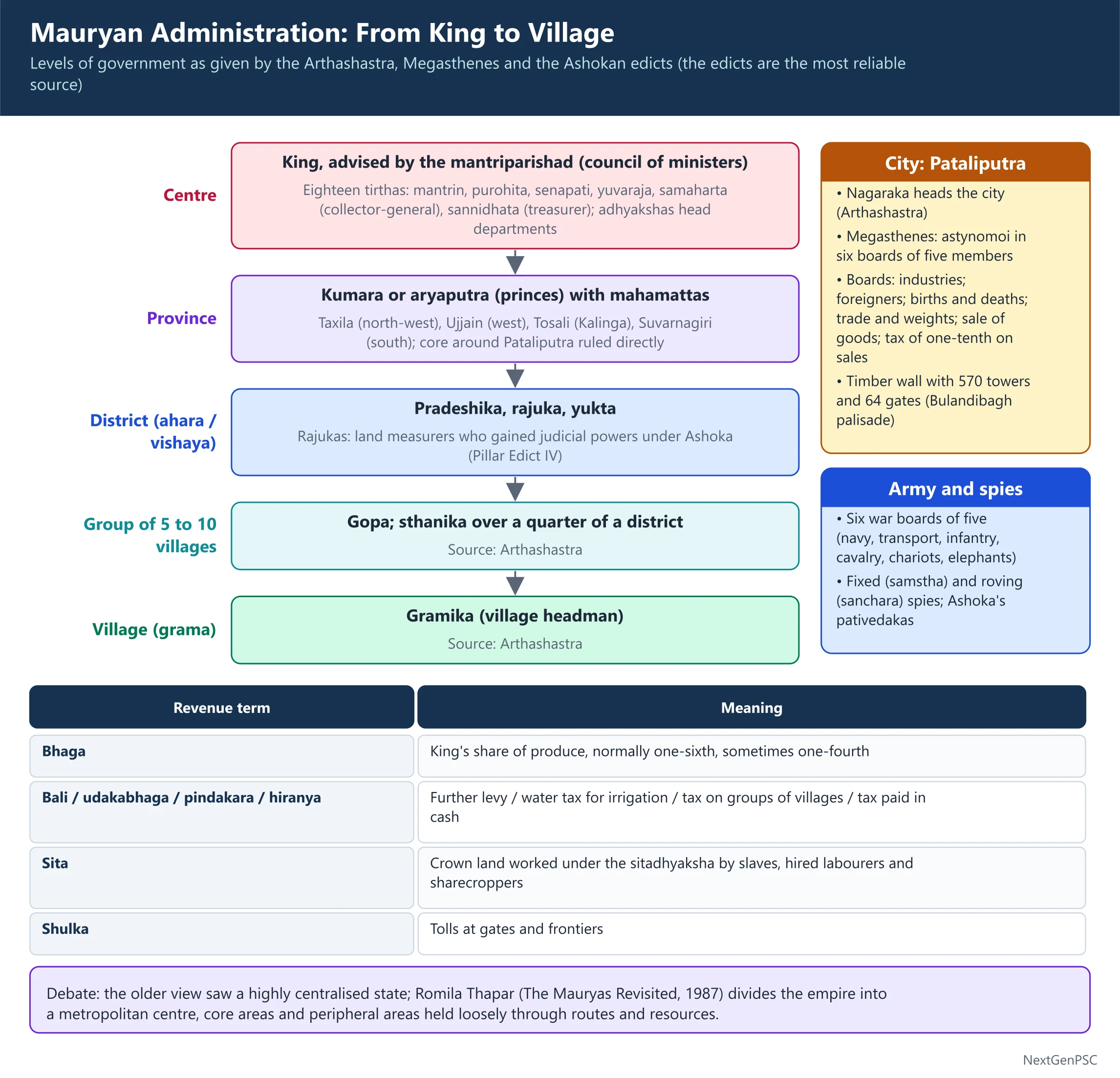
1. Sources for Mauryan Administration
Arthashastra: gives a full theoretical scheme of officials and revenue, but its date is debated, so it must be used with care.
Megasthenes's Indica: survives in fragments quoted by Strabo, Diodorus and Arrian, collected by E.A. Schwanbeck (1846) and translated by J.W. McCrindle; it describes Pataliputra, its city boards and Indian society, with some errors.
Ashokan edicts: name real officials (mahamattas, rajukas, pradeshikas, yuktas) and provincial centres, and are the most reliable source.
Archaeology: remains of the timber palisade of Pataliputra at Bulandibagh and the pillared hall at Kumrahar, both in Patna; NBPW and punch-marked coins across the empire.
Other texts: Buddhist works such as the Divyavadana (revolts at Taxila), the Junagadh inscription (provincial governors) and the Sohgaura and Mahasthan inscriptions (state granaries and famine relief, possibly Mauryan).
2. The King and Central Government
King: head of the executive, army, justice and revenue; the Arthashastra describes a strict daily timetable for him, and the edicts show Ashoka saying that he could be approached on public business at any time, even at meals or in the inner apartments (MRE VI).
Council: the mantriparishad (council of ministers) advised the king; MRE III and VI refer to the parisa (council) receiving and checking royal orders.
High officials: the Arthashastra lists eighteen tirthas, including the mantrin (chief minister), purohita, senapati, yuvaraja, samaharta (collector-general) and sannidhata (treasurer).
Superintendents (adhyakshas): heads of departments such as the treasury, mint (lakshanadhyaksha), mines (akaradhyaksha), trade (panyadhyaksha), crown lands (sitadhyaksha), weights, liquor, ports and ships.
Salaries: the Arthashastra fixes cash salaries for officials, from 48,000 panas a year for the top ministers to 60 panas for the lowest servants, suggesting a monetised bureaucracy.
3. Army and Espionage
Army: Greek sources describe a huge standing army; Pliny credits Chandragupta with 600,000 infantry, 30,000 cavalry and 9,000 elephants (Roman figures, probably exaggerated).
War office: Megasthenes describes six boards of five members each for the navy, transport and supply, infantry, cavalry, chariots and elephants.
Spies: the Arthashastra describes fixed (samstha) and roving (sanchara) spies; Megasthenes calls the sixth class of Indians the overseers who report to the king, and Ashoka's pativedakas (reporters) kept him informed (MRE VI).
4. Provinces and Local Government
Provinces: the edicts name centres at Taxila (north-west), Ujjain (west), Tosali (Kalinga), Suvarnagiri (south) and Isila; the core region around Pataliputra was ruled directly.
Viceroys: princes (kumara, aryaputra) governed the major provinces, helped by mahamattas; Junagadh shows that some governors were not princes, such as Pushyagupta (Vaishya) and Tushaspha (a Yavana) under Ashoka.
District and below: the pradeshika, rajuka and yukta worked at district level; the Arthashastra adds the sthanika over a quarter of a district and the gopa over five or ten villages, with the gramika heading the village.
Rajukas: originally land measurers, they gained judicial powers under Ashoka (Pillar Edict IV).
City government: Megasthenes describes the astynomoi of Pataliputra in six boards of five: industries, foreigners, births and deaths, trade and weights, sale of manufactured goods, and collection of a tax of one-tenth on sales; the Arthashastra's nagaraka heads the city.
Pataliputra: Megasthenes says the city stretched along the Ganga, surrounded by a timber wall with 570 towers and 64 gates and a moat; the Bulandibagh palisade confirms timber defences.
5. Justice and Law
Courts: the Arthashastra describes dharmasthiya courts (civil disputes) and kantakashodhana courts (crime), each with three judges.
Punishments: fines graded by offence, mutilation and death for serious crimes; Ashoka tried to ensure uniform procedure and mercy (Pillar Edict IV) and released prisoners on his consecration anniversaries (Pillar Edict V).
Megasthenes's claim: he says theft was rare and Indians seldom went to law, an idealised picture.
6. Economy and Revenue
Land revenue: bhaga, the king's share, normally one-sixth but sometimes one-fourth; bali, a further levy; udakabhaga, water tax for irrigation; pindakara, a tax on groups of villages; and hiranya, tax paid in cash.
Crown lands: sita land worked by slaves, hired labourers and sharecroppers under the sitadhyaksha.
Settling new land: the Arthashastra advises settling Shudra peasants on new land (janapada-nivesha) and giving them seed, cattle and tax remission.
Irrigation: the Sudarshana lake in Saurashtra, built under Chandragupta and fitted with channels under Ashoka, is the best-known work; Megasthenes mentions officials who measured land and supervised sluices.
Mines, salt and crafts: the state controlled mines, salt, liquor and some weaving, and ran workshops, according to the Arthashastra.
Trade: the panyadhyaksha regulated prices and the samsthadhyaksha watched markets; a royal road linked Pataliputra with Taxila; tolls (shulka) were collected at gates and frontiers.
Coinage: silver punch-marked coins (pana or karshapana) with symbols such as the crescent-on-hill are widely linked to the Mauryas; copper mashakas served small change.
Labour: dasas (slaves), karmakaras (hired workers) and vishti (forced labour) are mentioned; Megasthenes's claim that India had no slaves is a misunderstanding.
Famine relief: the Sohgaura copper plate and the Mahasthan inscription order the opening of state granaries in distress.
7. Historiography: How Centralised Was the Empire?
Centralised model: early scholars, reading the Arthashastra and Megasthenes together, saw a highly centralised, bureaucratic state; some, following Karl Wittfogel's idea of 'Oriental despotism', even called it despotic.
Thapar's revision: Romila Thapar, in The Mauryas Revisited (1987), divided the empire into a metropolitan centre, core areas (such as Gandhara, Ujjain and Kalinga) and peripheral areas with only loose control over routes and resources.
Fussman: Gerard Fussman argued that distance, slow communications and regional diversity made full centralisation impossible; provincial governors had wide powers.
Sharma and Kosambi: R.S. Sharma and D.D. Kosambi stressed the state's direct role in agriculture, mining and trade; Kosambi linked the later debasement of coins to fiscal strain.
Balanced view: the core around the Ganga valley was tightly run, while frontier and forest areas were held through tribute, alliances and the control of key routes.
8. Using It in the Exam
10-mark answer (150 words): on city administration, give Megasthenes's six boards, the nagaraka and the Bulandibagh evidence.
15-mark answer (200 words): on provincial administration, list provinces, viceroys, district officials and the rajukas, citing the edicts.
20-mark answer (250 words): on 'Was the Mauryan state centralised?', describe the machinery, then present the Thapar and Fussman critique and conclude with the core-periphery view.
Keywords: mantriparishad, mahamatta, adhyaksha, samaharta, sannidhata, rajuka, pradeshika, astynomoi, bhaga, sita, janapada-nivesha, core-periphery.
Source line: MRE VI, in paraphrase: at all times, whether I am eating, in the women's quarters or in the garden, reporters should inform me of the people's affairs; use it to show royal accessibility.
| Level | Unit | Officials | Main Source |
|---|---|---|---|
| Centre | Empire | King, mantriparishad, tirthas, adhyakshas | Arthashastra, edicts |
| Province | Taxila, Ujjain, Tosali, Suvarnagiri | Kumara/aryaputra, mahamattas | Ashokan edicts |
| District | Ahara / vishaya | Pradeshika, rajuka, yukta | Edicts |
| Group of villages | 5 to 10 villages | Gopa, sthanika | Arthashastra |
| Village | Grama | Gramika | Arthashastra |
| City | Pataliputra | Nagaraka; six boards (astynomoi) | Arthashastra, Megasthenes |
Mains points
- The 'centralised versus decentralised' debate is UPSC's favourite angle: describe the system, then use Thapar's core-periphery model to qualify it.
- Distinguish clearly between what the Arthashastra prescribes, what Megasthenes observed and what the edicts confirm.
- Revenue questions need Sanskrit terms (bhaga, bali, udakabhaga, pindakara, hiranya, sita) with meanings.
- Mention archaeological evidence (Bulandibagh, Kumrahar, Sudarshana lake, Sohgaura) to support textual claims.
- Point out Megasthenes's errors (seven castes, no slavery, no famine) to show source criticism.
- A hierarchy table or flow diagram earns quick marks in 15-mark parts.
Did you know?
- Megasthenes divided Indian society into seven 'castes', including philosophers, farmers, herdsmen, artisans, soldiers, overseers and councillors, a mix of occupations and varnas no Indian text uses.
- The timber palisade found at Bulandibagh in Patna survived for over two thousand years because it lay in waterlogged soil.
Mauryan Art, External Contacts and Literature
Mauryan art falls into court art, seen in the polished monolithic pillars with animal capitals, the palace at Pataliputra and the Barabar caves, and popular art, seen in the yaksha and yakshi figures and terracottas. The empire had regular embassies with the Seleucid and other Hellenistic kingdoms and sent Buddhist missions to Sri Lanka and beyond. Its literature includes the edicts, the Arthashastra tradition and Buddhist and Jain texts.
In simple words
The Mauryas gave India its first great stone monuments: tall, glass-smooth pillars topped with lions and bulls, and caves cut into solid granite.
Alongside this royal art, ordinary people worshipped big stone figures of yakshas, local guardian spirits, a bit like village deities today.
The empire also traded and exchanged envoys with Greek kings, and Ashoka sent monks to carry Buddhism to Sri Lanka.
UPSC asks about court versus popular art, foreign influence on the pillars and how Buddhism spread.
1. Court Art: The Pillars
Material and finish: monolithic shafts of buff Chunar sandstone, often over 12 metres high, with the famous high 'Mauryan polish'; they stand without a base.
Parts: a tapering round shaft, a bell-shaped inverted lotus capital, an abacus (round or square slab) with carved friezes, and a crowning animal.
Rampurva (Bihar): two pillars, one with a bull capital (now in Rashtrapati Bhavan) and one with a lion.
Lauriya-Nandangarh (Bihar): a single seated lion, the best preserved pillar still in place.
Sankisa (Uttar Pradesh): an elephant capital; Vaishali (Basarh-Bakhira): a lion on a squat pillar without an edict.
Sarnath lion capital: four lions back to back on an abacus carrying four animals (elephant, bull, horse and lion) separated by wheels; it was adopted as India's national emblem on 26 January 1950, and the wheel appears on the national flag.
Purpose: the pillars mark sacred or royal places and carry edicts; the animals and wheel are read as symbols of the Buddha and of royal power.
2. Court Art: Architecture and Caves
Palace at Pataliputra: D.B. Spooner's excavations at Kumrahar (1912 to 1915) found remains of a hall of polished stone pillars, about 80 in rows; it is often called the Mauryan assembly hall.
Barabar caves (Gaya, Bihar): cut into hard granite and polished inside like glass; Ashoka's inscriptions give the Sudama and Karna Chaupar caves to the Ajivikas.
Lomas Rishi cave: its doorway copies a timber hut with a curved (ogee) arch and a frieze of elephants approaching stupas, the model for later chaitya facades.
Nagarjuni caves: nearby caves given to the Ajivikas by Dasharatha, Ashoka's grandson.
Stupas: Buddhist tradition credits Ashoka with 84,000 stupas; the original brick core of the Great Stupa at Sanchi, the Dharmarajika stupa at Sarnath and the Dharmarajika at Taxila are linked to his time.
Dhauli elephant (Odisha): the front of an elephant carved from the living rock above the Dhauli edicts, a symbol of the Buddha.
3. Popular Art
Yaksha and yakshi figures: large free-standing stone images of local deities, heavy and frontal; the Parkham yaksha (Mathura), the Besnagar yakshi and the Patna yakshas are examples, often dated to the late Mauryan or immediately post-Mauryan period.
Didarganj yakshi (Patna, found 1917): a polished chauri-bearer, much admired; some scholars date it to the Mauryan period because of the polish, others to the first or second century CE on grounds of style.
Lohanipur torso (Patna): a polished nude male torso, often taken as an early Jain image.
Terracottas: mother goddesses and toys from Pataliputra, Mathura and Buxar show a lively folk tradition.
Pottery: NBPW was the luxury tableware of the age.
4. Historiography of Mauryan Art
Persian influence view: John Marshall and Mortimer Wheeler stressed parallels with Achaemenid Persepolis (polish, bell capitals, animal figures), suggesting that Persian craftsmen came to India after the fall of the Persian empire.
Indigenous view: John Irwin, in a series of articles in The Burlington Magazine (1973 to 1976), argued that the pillars belong to an older Indian cult of the cosmic axis; Persepolis columns are fluted, built in sections and have bases, unlike Mauryan pillars.
Court and folk: Niharranjan Ray, in Maurya and Post-Maurya Art (1975), separated the court art, foreign-looking and short-lived, from the popular art rooted in Indian soil, which shaped later sculpture.
Indian roots: Ananda Coomaraswamy, in History of Indian and Indonesian Art (1927), traced the yaksha tradition to Indian folk religion.
Balanced view: most scholars now accept Persian and Hellenistic stimulus for some motifs, but see the pillars as Indian in purpose, form and symbolism.
5. External Contacts
Seleucid embassies: Megasthenes at Chandragupta's court; Deimachus at Bindusara's court; Dionysius sent by Ptolemy II Philadelphus of Egypt (Pliny).
Bindusara's request: Athenaeus, quoting Hegesander, says Bindusara asked Antiochus I for sweet wine, dried figs and a sophist.
Ashoka and the Hellenistic world: MRE XIII names five Greek kings; the Kandahar edicts in Greek and Aramaic, and the Yavana governor Tushaspha in Saurashtra, show Greeks inside the empire.
Sri Lanka: the Mahavamsa says Ashoka's friend Devanampiya Tissa received Mahinda and Sanghamitta, who brought a branch of the Bodhi tree; MRE II and XIII name Tamraparni.
South India: MRE II and XIII name the Cholas, Pandyas, Satiyaputras and Keralaputras as neighbours; Sangam poems remember the Moriyar.
Trade: the north-west routes linked the empire with Iran and Central Asia; the east coast port of Tamralipti linked it with Sri Lanka and Southeast Asia.
6. Religion, Its Spread, and Literature
Royal patronage of many faiths: Chandragupta was linked with Jainism, Bindusara with the Ajivikas (according to the Divyavadana), and Ashoka with Buddhism, while Brahmins and shramanas were both honoured in the edicts.
Third Buddhist council: held at Pataliputra under Ashoka, presided by Moggaliputta Tissa; the Kathavatthu, which refutes rival views, is attributed to him.
Missions: the Mahavamsa lists Majjhantika to Kashmir and Gandhara, Mahadeva to Mahishamandala, Rakkhita to Vanavasi, the Yona Dhammarakkhita to Aparanta, Mahadhammarakkhita to Maharashtra, Maharakkhita to the Yona country, Majjhima to the Himalaya, Sona and Uttara to Suvarnabhumi, and Mahinda to Sri Lanka.
Literature: the edicts are the first long Indian texts in writing; the Arthashastra tradition, the Jain Kalpasutra attributed to Bhadrabahu, the Kathavatthu and Megasthenes's Indica belong to or describe this age; Prakrit was the language of the state.
Script: Brahmi, used across most of the empire, is the parent of most later Indian and Southeast Asian scripts; whether it was created under the Mauryas or slightly earlier is debated (early Brahmi finds at Anuradhapura are dated by some to the fifth or fourth century BCE).
7. Using It in the Exam
10-mark answer (150 words): on the Mauryan pillars, describe material, polish, parts and two examples, then the foreign influence debate in two lines.
15-mark answer (200 words): distinguish court art and popular art with three examples each and their later influence.
20-mark answer (250 words): on external contacts, cover the Seleucid embassies, Ashoka's dhamma-vijaya, Sri Lanka, the south and trade, with sources.
Keywords: Mauryan polish, Chunar sandstone, bell capital, abacus, Sarnath capital, Lomas Rishi, yaksha, Didarganj, court art, folk art, Kathavatthu.
Source line: MRE XIII claims that dhamma had won as far as the lands of five Greek kings, six hundred yojanas away; use it in paraphrase on external relations.
| Aspect | Court Art | Popular Art |
|---|---|---|
| Patron | Emperor and court | Local communities, guilds |
| Examples | Pillars (Sarnath, Rampurva, Lauriya-Nandangarh), Kumrahar hall, Barabar caves | Parkham yaksha, Besnagar yakshi, Didarganj yakshi, terracottas |
| Style | Polished, refined, partly foreign-looking | Massive, frontal, rooted in folk cult |
| Purpose | Royal and Buddhist propaganda, dhamma | Worship of local deities |
| Legacy | Did not continue after the Mauryas | Shaped Shunga, Kushana and later sculpture |
Mains points
- The 'foreign influence on Mauryan pillars' debate is a recurring question; give both sides with specific points of comparison and conclude.
- Use Niharranjan Ray's court and folk division to organise answers on Mauryan art.
- Name specific monuments with places; vague references to 'pillars and stupas' score poorly.
- On external contacts, draw on Greek writers (Strabo, Athenaeus, Pliny) and the edicts together.
- Mention the debated dates of the Didarganj yakshi and the yaksha figures rather than stating them as certain.
- Link Ashoka's missions to the later spread of Buddhism in Sri Lanka and Southeast Asia.
Did you know?
- The polish inside the Barabar caves is so fine that a voice echoes for several seconds, and E.M. Forster used the caves as the model for the Marabar Caves in A Passage to India.
- The Sarnath capital's four lions face the four directions, but the national emblem shows only three, as the fourth is hidden from view.
Decline of the Mauryas: Sungas and Kanvas
After Ashoka's death (c. 232 BCE) the Mauryan empire split and shrank under weak successors until Pushyamitra Shunga killed the last king, Brihadratha, around 185 BCE. Historians explain the decline through Brahmanical reaction, Ashoka's pacifism, financial strain, over-centralisation, provincial revolts and the rise of regional powers. The Shungas (c. 185 to 73 BCE) revived Vedic sacrifice and patronised the art of Bharhut and Sanchi; the Kanvas (c. 73 to 28 BCE) followed before the Satavahanas.
In simple words
Within fifty years of Ashoka's death the great Mauryan empire fell apart, and its army chief Pushyamitra Shunga killed the last Mauryan king during a parade.
It was like a giant company losing its branch offices one by one after its founder's family weakened.
Historians still argue why it happened: weak kings, empty treasuries, unhappy provinces or a reaction against Ashoka's policies.
UPSC often asks you to weigh these causes and to describe the Shungas who followed.
1. The Later Mauryas
Successors: the Puranas and Buddhist and Jain texts give different lists, including Kunala, Dasharatha, Samprati, Shalishuka, Devavarman, Shatadhanvan and Brihadratha; the Puranas give the dynasty 137 years.
Dasharatha: Ashoka's grandson, known from his Nagarjuni cave inscriptions, which give caves to the Ajivikas.
Samprati: remembered in Jain tradition as a great patron of Jainism, ruling from Ujjain according to some accounts.
Division: the empire seems to have split into an eastern and a western half; Kalhana's Rajatarangini says Jalauka, a son of Ashoka, ruled Kashmir independently.
North-west: Polybius reports that the Seleucid king Antiochus III renewed friendship with an Indian king Sophagasenus (Subhagasena) in c. 206 BCE and took elephants from him, a sign that the north-west had broken away.
Greek invasions: Bactrian Greeks under Demetrius crossed the Hindu Kush in the early second century BCE; the Yuga Purana of the Gargi Samhita describes Yavanas reaching Saketa, Panchala, Mathura and Pataliputra.
End: Bana's Harshacharita (seventh century CE) says the commander Pushyamitra killed Brihadratha, 'weak in keeping his promise', while showing him the army, around c. 185 BCE (some give c. 187 BCE).
2. Causes of Decline: The Main Theories
Brahmanical reaction: Haraprasad Shastri argued that Ashoka's ban on animal sacrifice, the dhamma-mahamattas' interference and the equal treatment of all before the law (vyavahara-samata) angered Brahmins, and that a Brahmin general's coup was the result.
Reply: H.C. Raychaudhuri and others note that Ashoka honoured Brahmins in his edicts, that the ban covered only some sacrifices, and that the empire did not collapse until fifty years after his death.
Pacifism: Raychaudhuri argued that Ashoka's policy of non-violence and dhamma-vijaya weakened the army's fighting spirit; critics point out that he kept his army, did not return Kalinga and threatened the forest tribes.
Economic crisis: D.D. Kosambi pointed to the debasement of later punch-marked coins and to the Arthashastra's emergency taxes (pranaya) as signs of fiscal strain caused by the costs of a huge army and bureaucracy and by gifts to religious orders.
Oppressive provincial rule: the Divyavadana records revolts at Taxila under Bindusara and Ashoka against wicked ministers, and the Separate Kalinga Edicts warn officials against harshness.
Over-centralisation and weak successors: a system built around a strong king could not run under weak or divided heirs; there were no rules of succession, and princely viceroys could break away.
Institutional weakness: Romila Thapar, in Asoka and the Decline of the Mauryas (1961), stressed that loyalty was owed to the king, not to the state; there was no permanent bureaucracy independent of the ruler and no representative institutions to bind the provinces.
Spread of material culture: R.S. Sharma argued that iron, writing and new crafts spread from Magadha to the peripheries, allowing new regional states (Kalinga, the Satavahanas, the Shungas themselves) to rise; the empire's success created its rivals.
Frontier neglect: the failure to hold the north-west let Greek armies in; some writers blame Ashoka for not building a frontier defence.
3. Sources for the Shungas
Puranas: give ten Shunga kings and a rule of 112 years.
Patanjali's Mahabhashya: the grammarian, often taken to be a contemporary of Pushyamitra, uses the example 'here we perform sacrifices for Pushyamitra' (in paraphrase) and refers to a Yavana siege of Saketa and Madhyamika.
Kalidasa's Malavikagnimitram: a later play whose hero is Agnimitra, Pushyamitra's son and viceroy at Vidisha; it describes a war with Vidarbha and a victory of Vasumitra over the Yavanas on the Sindhu river (its identification is debated) during a horse sacrifice.
Ayodhya inscription of Dhanadeva: calls Pushyamitra the performer of two horse sacrifices (dvir-ashvamedha-yajin).
Bharhut gateway inscription: records a gift made 'in the reign of the Sungas' (suganam raje) by Dhanabhuti.
Besnagar (Heliodorus) pillar: set up at Vidisha by Heliodorus, son of Dion, envoy of the Indo-Greek king Antialcidas of Taxila, to the court of King Kashiputra Bhagabhadra, who is usually taken to be a later Shunga; Heliodorus calls himself a Bhagavata and dedicates the Garuda pillar to Vasudeva.
Divyavadana: says Pushyamitra destroyed monasteries and offered 100 dinaras for each monk's head at Sakala; most historians treat this as exaggerated sectarian polemic, since Bharhut and Sanchi flourished under Shunga rule.
4. The Shunga Dynasty (c. 185 to 73 BCE)
Pushyamitra: ruled from Pataliputra and Vidisha; fought the Yavanas and Vidarbha; revived Vedic sacrifices, including two ashvamedhas.
Successors: Agnimitra, Vasumitra and later kings such as Bhagabhadra; the realm shrank to the middle Ganga valley and central India.
End: the last king, Devabhuti, was killed at the instigation of his minister Vasudeva Kanva; the Harshacharita tells a story of a slave girl disguised as the queen.
Kharavela: the Hathigumpha inscription of Kharavela of Kalinga claims an attack on Magadha and a king called Bahasatimita; his identity with Pushyamitra was once proposed but is now generally rejected.
Brahmanical revival: sacrifices, Sanskrit learning (Patanjali) and the rise of Bhagavata worship; the Manusmriti is generally dated c. 200 BCE to 200 CE, around this time.
Art: the Bharhut stupa railings and gateway (found by Alexander Cunningham in 1873, now in the Indian Museum, Kolkata), the enlargement and stone casing of the Sanchi stupa and its railing, and terracottas from Kaushambi and Chandraketugarh.
5. The Kanvas (c. 73 to 28 BCE)
Rulers: Vasudeva, Bhumimitra, Narayana and Susharman, four kings in about 45 years according to the Puranas.
End: the Puranas say the Andhra (Satavahana) king Simuka killed Susharman; the dates and the extent of Kanva rule are uncertain.
Significance: after the Kanvas the Ganga valley lost its central place for nearly three centuries, while power moved to the Satavahanas in the Deccan and the Indo-Greeks, Sakas and Kushanas in the north and west.
6. Analysis
Multi-causal decline: no single factor explains the fall; structural weaknesses (succession, finance, loyalty) combined with external pressure and regional growth.
Not a sudden collapse: the core survived for half a century after Ashoka; the empire faded from the edges inward.
Continuity: many Mauryan institutions, ideas of kingship, the dhamma ideal and the art of the yaksha tradition were carried on by successors such as the Shungas, Satavahanas and Kushanas.
7. Using It in the Exam
10-mark answer (150 words): list four causes of decline with one line of evidence each and one line of critique.
15-mark answer (200 words): evaluate the Brahmanical reaction theory: state it, give evidence for and against, and conclude.
20-mark answer (250 words): survey all major theories (Shastri, Raychaudhuri, Kosambi, Thapar, Sharma), add the external factor, and present a reasoned multi-causal conclusion; add a short note on the Shungas as the immediate beneficiaries.
Keywords: Brihadratha, Pushyamitra, Harshacharita, dvir-ashvamedha-yajin, Brahmanical reaction, pranaya, debasement, institutional weakness, Bharhut, Heliodorus.
Source line: Romila Thapar's argument, in paraphrase, is that the decline is best explained by the organisation of the administration and the concept of the state rather than by Ashoka's personal policy; quote it to frame a balanced answer.
| Theory | Proponent | Main Argument | Main Criticism |
|---|---|---|---|
| Brahmanical reaction | Haraprasad Shastri | Ashoka's policies angered Brahmins; Pushyamitra's coup | Ashoka honoured Brahmins; decline came 50 years later |
| Pacifism | H.C. Raychaudhuri | Dhamma weakened military spirit | Army retained; Kalinga kept; atavikas warned |
| Economic crisis | D.D. Kosambi | Debased coins, heavy costs, emergency taxes | Evidence of debasement is limited and hard to date |
| Institutional weakness | Romila Thapar | Loyalty to king not state; no independent bureaucracy | Hard to test directly; widely accepted |
| Spread of material culture | R.S. Sharma | Iron and new techniques let peripheries form states | Explains regional rise more than central collapse |
| Provincial oppression and weak heirs | Several historians | Revolts at Taxila; succession disputes | Partly based on later Buddhist legends |
Mains points
- Decline questions reward a structured survey of theories with names, evidence and criticism, followed by your own multi-causal judgment.
- Do not blame Ashoka alone; examiners expect awareness that the empire survived him by fifty years.
- Use the Divyavadana, Harshacharita, Polybius and Gargi Samhita as sources, noting their bias or late date.
- On the Shungas, combine inscriptions (Ayodhya, Bharhut, Besnagar) with literature (Patanjali, Kalidasa).
- Treat the persecution story in the Divyavadana critically and mention the flourishing of Buddhist art under the Shungas.
- A comparative table of decline theories is an efficient way to present a 15- or 20-mark answer.
Did you know?
- The Heliodorus pillar at Vidisha is one of the earliest inscriptions recording a Greek who called himself a devotee of Vasudeva, dated to the late second century BCE.
- Bharhut's sculptures label their scenes with inscriptions, so visitors could read which Jataka story each panel told, an ancient version of museum captions.
Indo-Greeks, Sakas, Kushanas and Western Kshatrapas
Between c. 200 BCE and 300 CE, north-western and western India were ruled by a series of Central Asian and Hellenistic powers: the Indo-Greeks (best known through Menander and their coins), the Sakas and Indo-Parthians, the Kushanas under Kanishka, whose empire stretched from Central Asia to the Ganga valley, and the Western Kshatrapas, of whom Rudradaman I left the first long Sanskrit inscription. They were absorbed into Indian society and transformed its coinage, art, religion and trade.
In simple words
After the Mauryas, groups from Bactria and Central Asia, Greeks, Scythians (Sakas) and the Kushanas, entered north-west India one after another and set up kingdoms.
Think of them as newcomers who arrived as conquerors but soon took Indian names, worshipped Indian gods and supported Buddhism.
Their coins with kings' portraits and names, and their control of the Silk Road, made this a rich, mixed age.
UPSC asks about their contribution to Indian culture, the Kushana empire and Kanishka's date.
1. The Indo-Greeks
Origin: Diodotus made Bactria independent of the Seleucids around c. 250 BCE; Euthydemus and his son Demetrius I crossed the Hindu Kush in the early second century BCE.
Rival houses: the families of Euthydemus and Eucratides divided Bactria and north-west India; more than thirty Indo-Greek kings are known, most only from coins.
Menander (Milinda), c.165/155 to 130 BCE: ruled from Sakala (Sialkot); the Pali Milindapanha records his dialogue with the monk Nagasena and says he became a Buddhist; Strabo, citing Apollodorus of Artemita, says he advanced beyond the Hypanis (Beas).
Antialcidas: ruled from Taxila and sent Heliodorus to Vidisha (the Besnagar pillar).
End: pressed by Sakas and Yuezhi, Indo-Greek rule in the Punjab ended around the turn of the era; Strato II is among the last known kings.
Coins: fine silver drachms and tetradrachms with realistic royal portraits, Greek legends on one side and Prakrit in Kharoshthi on the other; they are the main source for Indo-Greek history and set the model for later Indian coins with names and portraits.
2. The Sakas and Indo-Parthians
Migration: Chinese histories (Sima Qian's Shiji and the Han shu) record that the Yuezhi, driven out by the Xiongnu, pushed the Sakas (Scythians) south-west in the second century BCE; the Sakas entered India through Seistan and the Bolan route.
Branches: Sakas at Taxila (Maues or Moga, first century BCE; the Taxila copper plate of Patika), at Mathura (the satraps Rajuvula and Sodasa; the Mathura Lion Capital inscription), and in western India (the Western Kshatrapas).
Vikrama Samvat: Jain tradition (the Kalakacharya-kathanaka) links an era of 57 BCE with a king Vikramaditya of Ujjain who expelled the Sakas; the historical basis of this story is uncertain.
Indo-Parthians (Pahlavas): Gondophernes ruled from Taxila in the early first century CE; the Takht-i-Bahi inscription dates his reign; Christian tradition (the Acts of Thomas) says the apostle St Thomas visited his court.
Taxila as a mirror: John Marshall's excavations (1913 to 1934) at Sirkap, the city of the Indo-Greek and Saka-Parthian period, revealed a planned grid of streets, a large apsidal temple and the 'double-headed eagle' shrine, showing a mixed Greek, Iranian and Indian urban culture.
3. The Kushanas
Origin: the Yuezhi settled in Bactria and divided into five clans; the Hou Hanshu says Kujula Kadphises of the Guishuang (Kushana) clan united them and conquered Kabul and Gandhara.
Rabatak inscription: found in 1993 in Baghlan province, Afghanistan, written in the Bactrian language in Greek script; it gives Kanishka's genealogy (Kujula Kadphises, Vima Taktu, Vima Kadphises, Kanishka) and lists cities in India under his rule, read as including Saketa, Kaushambi, Pataliputra and Champa (readings partly uncertain).
Vima Kadphises: issued large gold coins (based on the Roman weight standard) showing Shiva with the bull Nandi and calling himself maheshvara.
Kanishka: the greatest Kushana; capitals at Purushapura (Peshawar) and Mathura; empire from the Oxus to the Ganga valley; patron of the fourth Buddhist council in Kashmir; builder of the great stupa at Shah-ji-ki-Dheri near Peshawar, where a relic casket naming him was found.
Kanishka's date: his first year was long equated with 78 CE, the start of the Saka era; Harry Falk (2001) argued for 127 CE, a view many now accept; earlier proposals ranged from 58 BCE to 248 CE.
Royal image: titles maharaja, rajatiraja, devaputra (son of god, perhaps from the Chinese 'son of heaven') and kaisara (Caesar, in an Ara inscription of a later Kanishka); dynastic shrines (devakula) at Mat near Mathura and Surkh Kotal in Afghanistan held royal statues, including the headless statue of Kanishka from Mat.
Successors: Huvishka and Vasudeva I (the first Kushana with an Indian name); by the third century CE the Sasanians took over Bactria and the Kushana realm broke up.
Court culture (tradition): Ashvaghosha, Vasumitra, Parshva and the physician Charaka are linked with Kanishka's court in Buddhist and later traditions; Nagarjuna's link is less certain.
4. The Western Kshatrapas
Kshaharatas: Bhumaka and Nahapana ruled in Gujarat, Malwa and the northern Deccan; Nahapana's son-in-law Ushavadata (Rishabhadatta) recorded rich gifts in the Nasik and Karle cave inscriptions; the Periplus seems to call Nahapana 'Nambanus'.
Defeat by the Satavahanas: the Nasik inscription of Gautami Balashri says her son Gautamiputra Satakarni rooted out the Kshaharata line; in the Jogalthembi hoard many of Nahapana's silver coins were restruck by Gautamiputra.
Kardamakas: Chashtana (Ptolemy's Tiastenes of Ozene, Ujjain) founded a second line.
Rudradaman I: his Junagadh rock inscription (Saka year 72, c. 150 CE) is the first long inscription in classical Sanskrit; it records the repair of the Sudarshana lake after a storm, his victories over the Yaudheyas, and his twice defeating Satakarni, lord of Dakshinapatha, whom he spared because of a close relationship; he boasts of knowledge of grammar, music and logic.
Long rule: the dynasty lasted until Chandragupta II Gupta conquered it around c. 400 CE; their dated silver coins, in the Saka era, give a rare continuous chronology.
Frontier against the Satavahanas: the long struggle between the Kshatrapas and the Satavahanas was largely for the ports of the western coast, Barygaza (Bharuch) and Sopara, and the routes inland to Ujjain and Pratishthana.
5. Sources
Coins: the most important source, giving names, titles, gods, languages and dates.
Inscriptions: Rabatak, Mathura Lion Capital, Taxila copper plate, Takht-i-Bahi, Junagadh, Nasik, Karle and the Kushana inscriptions from Mathura.
Chinese histories: the Shiji, Han shu and Hou Hanshu on the Yuezhi and Kushanas; the Hou Hanshu also records conflict with the Chinese general Ban Chao in Central Asia around 90 CE.
Greek and Roman writers: Strabo, Justin, the Periplus and Ptolemy's Geography; Indian texts such as the Milindapanha, the Yuga Purana and the Buddhist Avadanas.
6. Analysis and Historiography
Assimilation: foreign rulers took Indian names (Rudradaman, Vasudeva), patronised Buddhism, Shaivism and Bhagavatism, and wrote in Prakrit and Sanskrit; the Manusmriti treats Sakas and Yavanas as Kshatriyas who had fallen from their duties (vratya Kshatriyas), a way of fitting them into the varna order.
Contributions: portrait and gold coinage, the satrap system, new dress and cavalry (trousers, boots, saddles), the trans-Asian Silk Road under Kushana control, Gandhara and Mathura art, and Mahayana Buddhism.
Tarn and Narain: W.W. Tarn, in The Greeks in Bactria and India (1938), saw the Indo-Greeks as part of Hellenistic history; A.K. Narain, in The Indo-Greeks (1957), replied that their history belongs to India, famously concluding (in paraphrase) that they came and saw, but India conquered them.
Kushana studies: B.N. Mukherjee's The Rise and Fall of the Kushana Empire (1988) and the Rabatak find transformed Kushana chronology; the Kanishka era remains debated.
Dark age or golden age: older nationalist writing saw this as an age of foreign rule and decline; modern historians see it as a time of cultural fusion, trade and urban growth.
7. Using It in the Exam
10-mark answer (150 words): on Indo-Greek contribution, focus on coins, astronomy terms, art and Buddhism (Menander), with sources.
15-mark answer (200 words): on Kanishka, give extent, capitals, coins, religion, the fourth council, art and the date debate.
20-mark answer (250 words): on 'Foreign invaders became Indian', trace assimilation across all four groups with names, coins, inscriptions and the Manusmriti's view.
Keywords: Milindapanha, bilingual coins, Kharoshthi, Yuezhi, Rabatak, devaputra, devakula, Shah-ji-ki-Dheri, Saka era, Junagadh, Kshaharata, Kardamaka.
Source extract: the Junagadh inscription says, in paraphrase, that Rudradaman repaired the Sudarshana lake from his own treasury without forced labour or extra taxes on his subjects; use it for the ideal of kingship and for the history of the lake from Chandragupta to Rudradaman.
| Dynasty | Period | Key Rulers | Key Sources | Main Legacy |
|---|---|---|---|---|
| Indo-Greeks | c. 200 BCE to c. 10 CE | Demetrius, Menander, Antialcidas | Bilingual coins, Milindapanha, Besnagar pillar | Portrait coins, Greek astronomy terms, Hellenistic art |
| Sakas | c. 1st century BCE to 1st century CE | Maues, Rajuvula, Sodasa | Taxila plate, Mathura Lion Capital | Satrap system, Mathura patronage |
| Indo-Parthians | c. 1st century CE | Gondophernes | Takht-i-Bahi inscription, Acts of Thomas | Link with the Parthian west |
| Kushanas | c. 1st to 3rd century CE | Kujula, Vima Kadphises, Kanishka, Huvishka, Vasudeva | Rabatak, coins, Hou Hanshu | Gold coinage, Silk Road, Gandhara and Mathura art, Mahayana |
| Western Kshatrapas | c. 1st to c. 400 CE | Nahapana, Chashtana, Rudradaman I | Junagadh, Nasik, Karle; dated coins | First long Sanskrit inscription; dated coinage |
Mains points
- UPSC often asks about the cultural contribution of the foreign dynasties: organise by coinage, polity, art, religion, science and trade, with sources.
- For Kanishka, mention the dating problem (78 CE versus 127 CE) and the importance of the Rabatak inscription.
- Use the Junagadh inscription for Rudradaman and for continuity of the Sudarshana lake from the Mauryas.
- Show assimilation through names, religion and the Manusmriti's vratya Kshatriya category.
- Avoid calling the period a 'dark age'; examiners reward the view of cultural synthesis.
- Name at least two historians (Tarn, Narain, Mukherjee) when discussing interpretations.
Did you know?
- The headless statue of Kanishka from Mat near Mathura shows him in a long Central Asian coat and heavy felt boots, clothing suited to the steppe, not the Indian plains.
- A Kanishka coin carries one of the earliest images of the Buddha labelled in Greek letters as BODDO.
Post-Mauryan Economy, Trade and Coinage
The five centuries after the Mauryas (c. 200 BCE to 300 CE) were a high point of Indian trade and urbanisation. The Indo-Roman sea trade, helped by knowledge of the monsoon winds, linked ports such as Barygaza, Muziris and Arikamedu with the Mediterranean, while the Kushanas controlled a section of the Silk Road. Strong guilds, a flood of new coinage (Indo-Greek, Kushana gold, Satavahana, Kshatrapa and tribal) and the growth of many cities marked the age.
In simple words
After the Mauryas, India became a busy marketplace of the ancient world: ships carried pepper, cotton cloth and gems to Rome and came back with gold coins and wine.
Think of it as an early global trade network, with Indian ports as stations on routes that ran from Rome to China.
Craftsmen and traders formed guilds that worked like banks and trade unions, and many new kinds of coins came into use.
UPSC asks about Indo-Roman trade, the role of guilds and whether this boom later declined.
1. Background: Why Trade Expanded
Political links: Indo-Greek, Saka and Kushana rule tied north-west India to Central Asia, Iran and the Hellenistic world; the Satavahanas and Kshatrapas controlled the western ports.
Roman demand: after Augustus annexed Egypt (30 BCE), Roman merchants used Red Sea ports such as Berenike and Myos Hormos to sail to India, and Rome's elite wanted pepper, spices, gems, pearls and fine textiles.
Monsoon route: the Periplus credits a pilot named Hippalus with finding the direct route across the open sea using the south-west monsoon; Indian and Arab sailors probably knew the winds earlier.
Overland routes: the Silk Road linked China with the Mediterranean; its southern branches passed through Kushana Bactria and Gandhara to the Indian ports.
2. Sources and Evidence
The Periplus of the Erythraean Sea: an anonymous Greek merchant's guide of the mid-first century CE, listing ports, goods and rulers from Egypt to the Bay of Bengal (translated by Lionel Casson, 1989).
Pliny's Natural History (c.77 CE): complains, in paraphrase, that India, China and Arabia take a hundred million sesterces a year from the Roman empire, and elsewhere puts India's share at not less than fifty million; this is moral rhetoric as much as accounting.
Ptolemy's Geography (second century CE): lists Indian ports and inland towns with coordinates.
Muziris papyrus (second century CE, Vienna): a loan contract for a cargo shipped from Muziris on the ship Hermapollon, showing the huge value of single cargoes.
Tamil Sangam poems: the Akananuru describes, in paraphrase, the fine ships of the Yavanas arriving at Muziris with gold and leaving with pepper; the Pattinappalai describes the port of Kaveripattinam (Puhar).
Arikamedu (Puducherry): excavated by Mortimer Wheeler (1945) and later by Vimala Begley; Roman Arretine ware, amphorae, glass and Indian rouletted ware show a trading and bead-making station.
Pattanam (Ernakulam, Kerala): excavations since 2007 found amphorae, Roman glass and other imports; many scholars identify it with ancient Muziris, though this is still discussed.
Roman coins: large hoards, mainly gold aurei and silver denarii of Augustus, Tiberius and later emperors, found chiefly in South India, especially the Coimbatore region and Andhra.
Other finds: the Begram hoard (Afghanistan) mixed Indian ivories, Roman glass and Chinese lacquer; Indian pottery and beads occur at Berenike in Egypt and at sites in Southeast Asia such as Oc Eo (Vietnam) and Sembiran (Bali).
3. Goods of Trade
Exports: black pepper (called yavanapriya, dear to the Yavanas), malabathrum, spikenard, ginger, cinnamon re-exported from Southeast Asia, pearls, beryl from the Coimbatore region, diamonds and other gems, ivory, indigo, cotton muslins, rice, sesame oil and Chinese silk passing through India.
Imports: Roman gold and silver coins, wine, olive oil, coral, glass, tin, lead, copper, and, according to the Periplus, singing boys and slave girls for kings at Barygaza.
Ports: Barbaricum (Indus delta), Barygaza (Bharuch), Sopara, Kalyan, Muziris, Nelcynda, Kaveripattinam, Poduke (Arikamedu), Sopatma, Masalia (Masulipatnam region) and Tamralipti; inland towns like Ujjain, Pratishthana and Ter fed the ports.
Southeast Asia: Suvarnabhumi and Suvarnadvipa in Indian texts; traders and Buddhist monks from India reached Myanmar, Thailand, Vietnam and Indonesia, laying the base for later Indianised states.
4. Crafts and Guilds
Variety of crafts: the Milindapanha lists many occupations; inscriptions at Sanchi, Bharhut, Mathura, Karle and Nasik name donors who were goldsmiths, perfumers, weavers, potters, ivory workers, bankers and merchants.
Guild (shreni) functions: guilds fixed rules of work, quality and prices, settled disputes, and acted as banks that received endowments and paid interest.
Nasik inscription of Ushavadata: records deposits of 2,000 karshapanas with a weavers' guild at one per cent a month and 1,000 with another at three-quarters of one per cent a month, the interest to clothe and feed monks.
Ivory workers of Vidisha: an inscription on the southern gateway of the Sanchi stupa records that the carving was done by the ivory carvers of Vidisha.
Law books: the Manusmriti and the Yajnavalkya Smriti recognise guild customs as law and fix rates of interest by varna.
5. Coinage
Indo-Greek: die-struck silver and copper coins with royal portraits and bilingual legends.
Kushana: plentiful gold (dinara, from Latin denarius) from Vima Kadphises onwards, with Greek, Iranian and Indian gods (Helios, Mithro, Oesho, Buddha), and large copper issues used in daily trade across north India.
Satavahana: coins of lead, potin and copper, some with ships (on the Andhra coast) and portrait silver coins of later kings influenced by the Kshatrapas.
Western Kshatrapa: silver coins with the king's bust, a Greek-style legend and a Brahmi date in the Saka era.
Tribal and city coins: the Yaudheyas, Malavas, Arjunayanas, Audumbaras and Kunindas issued their own coins, as did cities such as Taxila, Ujjain and Kaushambi.
South India: early Chera, Chola and Pandya coins, with bows, tigers and fish emblems, and the heavy use of Roman coins, perhaps as bullion.
Monetisation: historians, R.S. Sharma among them, treat this as one of the most monetised phases of early Indian history; the use of cash spread into wages, taxes and gifts.
6. Urban Centres
North-west and north: Taxila (Sirkap), Purushapura, Mathura (Sonkh), Sanghol (Punjab), Kaushambi, Bhita, Ahichchhatra and Varanasi grew under the Kushanas.
Deccan: Pratishthana (Paithan), Ter (Tagara), Nevasa, Bhokardan, Nasik, Kondapur and Dhulikatta under the Satavahanas.
Andhra and Tamil country: Amaravati, Nagarjunakonda, Arikamedu, Kaveripattinam, Uraiyur, Madurai and Karur.
Urban signs: baked-brick houses, ring wells, drains, coin moulds, seals, workshops, and Buddhist monasteries close to trade routes.
7. Historiography and Debates
E.H. Warmington, in The Commerce between the Roman Empire and India (1928), and Mortimer Wheeler, in Rome Beyond the Imperial Frontiers (1954), described a Roman-led trade; Wheeler saw Arikamedu as an Indo-Roman trading station.
Indian agency: Himanshu Prabha Ray, in Monastery and Guild (1986) and The Winds of Change (1994), stressed Indian traders, Buddhist monasteries and regional networks, not only Roman demand.
Drain or balance: Pliny's complaint is often quoted as proof of a Roman drain of gold; modern scholars argue that the figures are rhetorical and that Roman profits from customs duties on Indian goods were very large.
Urban decay: R.S. Sharma, in Urban Decay in India (c.300 to c.1000) (1987), argued that many of these cities declined after the third century CE, part of his feudalism thesis; critics such as B.D. Chattopadhyaya see new forms of urban growth rather than general decay.
8. Using It in the Exam
10-mark answer (150 words): on Indo-Roman trade, give the monsoon route, three ports, three exports and imports, and two sources (Periplus, Arikamedu).
15-mark answer (200 words): on guilds, explain their organisation, functions and evidence from the Nasik and Sanchi inscriptions.
20-mark answer (250 words): on the post-Mauryan economy, link trade, crafts, coinage and cities, and close with the debate on Roman trade and later urban decline.
Keywords: Periplus, Hippalus, Muziris, Barygaza, Arikamedu, rouletted ware, yavanapriya, shreni, Kushana dinara, potin, monetisation, urban decay.
Source extract: the Nasik inscription of Ushavadata recording money deposited with the weavers' guild is the single best source on guild banking; give its figures.
| Port | Present Location | Key Evidence or Goods |
|---|---|---|
| Barbaricum | Indus delta, Pakistan | Periplus; turquoise, lapis, Chinese silk, indigo |
| Barygaza | Bharuch, Gujarat | Periplus; chief western port; wine and coins imported |
| Sopara | Palghar, Maharashtra | Ashokan edict; Satavahana-era port |
| Muziris | Near Kodungallur, Kerala (Pattanam proposed) | Periplus, Muziris papyrus, Sangam poems; pepper |
| Arikamedu (Poduke) | Puducherry | Arretine ware, amphorae, rouletted ware, beads |
| Kaveripattinam (Puhar) | Mayiladuthurai district, Tamil Nadu | Pattinappalai; Chola port |
| Tamralipti | Tamluk, West Bengal | Gateway to Southeast Asia and Sri Lanka |
Mains points
- Indo-Roman trade questions need sources from three directions: Greek and Roman texts, Tamil poems and archaeology (Arikamedu, Pattanam, coin hoards).
- Discuss Pliny's 'drain' critically rather than repeating it as fact.
- Guild questions reward the Nasik inscription figures and examples of guild donations to Buddhist sites.
- On coinage, show variety by region and ruler and link it to monetisation and trade.
- Mention the role of Buddhist monasteries along trade routes (Himanshu Prabha Ray).
- Close with the urban decay debate to show awareness of what followed.
Did you know?
- Black pepper was so prized in Rome that the Sanskrit word yavanapriya, 'beloved of the Greeks', became one of its names.
- Some Roman gold coins found in South India have deep cuts across the emperor's face, possibly to mark them as bullion rather than currency.
Post-Mauryan Religion, Mahayana, Art and Science
The post-Mauryan centuries saw the rise of Mahayana Buddhism with its bodhisattva ideal and image worship, the growth of Bhagavata and Shaiva devotion, and the absorption of foreigners into the varna order. Art flowered in three schools, Gandhara, Mathura and Amaravati, which produced the first images of the Buddha, while stupas such as Sanchi and chaityas such as Karle were built. Literature and science advanced with Ashvaghosha, the medical works of Charaka and Sushruta, and Greek-influenced astronomy.
In simple words
In this age Buddhism changed: a new school, Mahayana, taught that the Buddha was a saviour to be worshipped and that kind beings called bodhisattvas help others reach freedom.
For the first time artists carved the Buddha as a human figure, in a Greek-looking style in Gandhara and an Indian style at Mathura, like two artists painting the same person in different ways.
Hindu devotion to Krishna-Vasudeva and Shiva grew too, and doctors wrote the great medical books of Charaka and Sushruta.
UPSC asks about Mahayana, the art schools and the origin of the Buddha image.
1. Mahayana Buddhism
Emergence: between about the first century BCE and the second century CE, in the north-west and in Andhra, new texts and ideas formed the 'Great Vehicle'; followers called the older schools Hinayana, a term now replaced by Theravada or Nikaya Buddhism.
Bodhisattva ideal: a being who postpones his own nirvana to help all others; Avalokiteshvara, Manjushri and Maitreya became objects of worship.
Buddha as divine: the Buddha became an eternal, saving figure with many Buddhas in many worlds; devotion (bhakti) and image worship spread.
Texts in Sanskrit: the Prajnaparamita (Perfection of Wisdom) sutras, the Saddharmapundarika (Lotus Sutra), the Sukhavati-vyuha (Pure Land) and the Lalitavistara.
Nagarjuna (c.second century CE): founder of the Madhyamaka school, whose Mulamadhyamakakarika taught shunyata (emptiness); tradition links him with the Satavahanas and with Nagarjunakonda, though the link is uncertain.
Fourth council: held in Kashmir under Kanishka, presided by Vasumitra with Ashvaghosha as vice-president, according to tradition; it is linked with the Sarvastivada school and the compilation of the Mahavibhasha commentary.
Spread: along the Silk Road to Central Asia and China (the monks Lokakshema and An Shigao translated texts into Chinese in the second century CE), helped by Kushana rule and merchant patronage.
2. Brahmanical Religions and Bhakti
Bhagavatism: worship of Vasudeva-Krishna; the Besnagar pillar of Heliodorus (late second century BCE) and the Ghosundi inscription (Chittorgarh, Rajasthan) mention Vasudeva and Sankarshana.
Vrishni heroes: the Mora well inscription near Mathura records images of five Vrishni heroes (Vasudeva, Sankarshana, Pradyumna, Samba and Aniruddha) in the time of the Saka satrap Sodasa.
Nanaghat inscription: of the Satavahana queen Naganika invokes Sankarshana, Vasudeva, Indra and other gods and lists many Vedic sacrifices performed by the royal family.
Bhagavad Gita: usually dated between the second century BCE and the second century CE; its doctrine of devotion (bhakti) and selfless action (nishkama karma) gave the new religion its philosophy.
Shaivism: the Gudimallam linga (Andhra Pradesh, c. second or first century BCE) shows Shiva standing on a dwarf; Kushana coins show Oesho (Shiva) with the bull; the Pashupata sect, linked with Lakulisha, appears by the early centuries CE.
Jainism: Kharavela of Kalinga patronised Jain monks (Udayagiri and Khandagiri caves, Hathigumpha inscription); Kankali Tila at Mathura gave Jain images and ayagapattas (votive slabs) of the Kushana period.
Social conditions: the Manusmriti (c. 200 BCE to 200 CE) hardened varna rules and placed women under male guardianship, but inscriptions record many women donors at Sanchi, Bharhut and Karle, and queens such as Naganika and Gautami Balashri held power.
Foreigners in society: the Manusmriti called Sakas, Yavanas and Pahlavas degraded Kshatriyas; many took Indian names and religions, and new mixed groups were explained by the theory of varnasamkara (mixing of varnas).
3. Art: The Three Schools
Gandhara school: in Taxila, Peshawar, Swat and eastern Afghanistan, in grey-blue schist and stucco; Buddha with wavy hair, heavy folded drapery like a Roman toga, and serene, Apollo-like face; mostly Buddhist, under Kushana and later patronage.
Mathura school: in spotted red sandstone; early Buddhas (such as the Katra Buddha) are robust, smiling, with a shaven or spiral topknot (kapardin) and thin clinging robe; it produced Buddhist, Jain and Brahmanical images and Kushana royal portraits.
Amaravati school: in the lower Krishna valley (Amaravati, Nagarjunakonda, Goli), in white-green limestone; lively narrative reliefs of the Buddha's life and the Jatakas, with graceful, crowded scenes; patrons were the Satavahanas and Ikshvakus and local merchants.
Origin of the Buddha image: Alfred Foucher, in L'art greco-bouddhique du Gandhara (1905 to 1951), argued that Greek artists in Gandhara created it; Ananda Coomaraswamy, in 'The Origin of the Buddha Image' (1927), argued for an Indian origin at Mathura from the yaksha tradition; J.E. van Lohuizen-de Leeuw argued that Mathura's images were as early or earlier. Most now see the two schools as roughly simultaneous and independent.
Aniconic phase: earlier art at Bharhut and Sanchi showed the Buddha only through symbols, such as the Bodhi tree, footprints, an empty throne, the wheel and the stupa.
4. Architecture: Stupas and Rock-Cut Caves
Sanchi: the Great Stupa's four carved gateways (toranas) date to the first century BCE; an inscription on the southern gateway names Ananda, foreman of the artisans of King Siri Satakarni; scenes include the Jatakas and the Buddha's life in symbols.
Bharhut: railing and gateway with labelled reliefs of Jatakas, yakshas and yakshis, mostly of the second century BCE.
Western Deccan caves: Buddhist chaityas (prayer halls with a stupa) and viharas (residences) at Bhaja, Bedsa, Karle, Kanheri, Nasik, Junnar and the early caves (9 and 10) at Ajanta; Karle's chaitya is the largest and finest, funded partly by Ushavadata and merchants.
Odisha: the Jain caves of Udayagiri and Khandagiri near Bhubaneswar, including the Rani Gumpha with sculpted friezes.
Andhra stupas: Amaravati, Nagarjunakonda, Bhattiprolu and Jaggayyapeta, with platforms carrying ayaka pillars.
5. Literature
Ashvaghosha: the Buddhacharita (life of the Buddha) and Saundarananda in Sanskrit verse, and the play Shariputraprakarana, fragments of which were found in Central Asia.
Grammar: Patanjali's Mahabhashya (second century BCE) on Panini.
Prakrit poetry: the Gathasaptashati (Gaha Sattasai) attributed to the Satavahana king Hala; its date is debated and it was probably compiled over time.
Tamil: the earliest Sangam anthologies and the grammar Tolkappiyam belong roughly to these centuries, though their dates are debated.
Buddhist works: the Milindapanha, the Divyavadana and the Mahavastu, a text that mixes Sanskrit and Prakrit.
6. Science
Medicine: the Charaka Samhita, on internal medicine, and the Sushruta Samhita, on surgery, including the repair of the nose (rhinoplasty) and many instruments; both were revised over centuries, and tradition makes Charaka the physician of Kanishka.
Astronomy and astrology: the Yavanajataka, a Sanskrit version of a Greek astrological work, was translated by Yavaneshvara (c. 149 to 150 CE) and versified by Sphujidhvaja (c. 269 to 270 CE); Greek terms such as hora (hour), kendra (centre) and dramma (from drachm) entered Sanskrit.
Later echoes: the Romaka and Paulisha siddhantas, summarised by Varahamihira in the sixth century, show continuing Greek and Roman influence on Indian astronomy.
Metallurgy and crafts: Kushana gold coinage, fine iron and steel, glass-making at Arikamedu and Ter and bead industries show technical skill.
7. Using It in the Exam
10-mark answer (150 words): on Mahayana, give its new ideas (bodhisattva, Buddha as god, image worship, Sanskrit texts) and the reasons for its rise.
15-mark answer (200 words): compare Gandhara, Mathura and Amaravati on material, style, themes and patrons; a table helps.
20-mark answer (250 words): on the origin of the Buddha image, present Foucher and Coomaraswamy with evidence, add the aniconic background and conclude with the present view.
Keywords: bodhisattva, shunyata, Prajnaparamita, Sarvastivada, Bhagavata, Vrishni heroes, Gudimallam, schist, red sandstone, aniconic, torana, chaitya, Yavanajataka.
Quotation: Coomaraswamy's view, in paraphrase, is that the Buddha image grew naturally out of the Indian tradition of yaksha figures; set it against Foucher's Greek-origin view.
| Feature | Gandhara | Mathura | Amaravati |
|---|---|---|---|
| Region | North-west (Taxila, Peshawar, Swat, Afghanistan) | Mathura region, Ganga-Yamuna doab | Lower Krishna valley, Andhra |
| Material | Grey-blue schist, stucco | Spotted red sandstone | White-green limestone |
| Influence | Graeco-Roman | Indigenous (yaksha tradition) | Indigenous, narrative |
| Buddha image | Wavy hair, heavy drapery, spiritual calm | Robust, smiling, shaven or spiral topknot, thin robe | Mostly symbolic at first, later human figures in narrative panels |
| Themes | Mainly Buddhist | Buddhist, Jain, Brahmanical, royal portraits | Mainly Buddhist (Buddha's life, Jatakas) |
| Patrons | Kushanas, merchants | Kushanas, local donors | Satavahanas, Ikshvakus, merchants |
Mains points
- Art-school comparisons are a staple; use a table with material, style, themes, patrons and examples.
- On the Buddha image, present Foucher and Coomaraswamy with works and close with the current view of parallel origins.
- Explain the rise of Mahayana by linking ideas to social change: urban patrons, foreign rulers, devotion and the Silk Road.
- Use inscriptions (Besnagar, Ghosundi, Mora, Nanaghat) to show the growth of Bhagavatism; examiners value epigraphic evidence.
- Mention women donors and queens to balance the Manusmriti's picture of women.
- Give dates with caution for Charaka, Sushruta, the Gita and the Gathasaptashati, since all are debated.
Did you know?
- Some Gandhara reliefs show the Buddha accompanied by a figure modelled on the Greek hero Heracles, who serves as Vajrapani, his protector.
- The Sushruta Samhita describes rebuilding a nose with a flap of skin from the cheek; a related Indian operation seen near Pune was reported in a London magazine in 1794 and helped inspire modern plastic surgery.
UPSC Previous Year Questions: The Mauryas and the Post-Mauryan World
From 2014 to 2026 UPSC asked 24 question parts worth 405 marks from this chapter, all in Paper I. Ashoka's Dhamma leads with five parts (80 marks), followed by Mauryan polity, administration and economy (4 parts, 70 marks), post-Mauryan trade, guilds and coinage (4, 70) and post-Mauryan art and culture (4, 70). Questions on the nature of the Mauryan state and on the roots and purpose of the Dhamma recur most often. Every question below has a model answer written to the UPSC word limit.
In simple words
Read each question and the approach line, then write your own answer first within the word limit: about 200 words for 15 marks and 250 words for 20 marks.
Then compare it with the model answer: check your introduction, the sources and historians you named, whether you argued both sides, and your conclusion.
Note what you missed, revise that topic in the chapter notes above, and try the question again after a few days.
1. Chandragupta Maurya, Kautilya and the Arthashastra
Example 1 (UPSC 2021, 20 marks): How would you characterize the nature of Mauryan state on the basis of Kautilya's Arthashastra?
Paper and question: Paper I, Q3(b)
Approach: Characterise the Mauryan state as the Arthashastra presents it (saptanga theory, bureaucracy, economic role, coercion and welfare), then note the problems of using the text as evidence for the actual Mauryan state.
The Arthashastra, ascribed to Kautilya, the minister of Chandragupta Maurya, was published by R. Shamasastry in 1909. Thomas Trautmann's statistical study (1971) shows that it was compiled by several hands, with the final text possibly dating to the early centuries CE.
Saptanga state: the state has seven limbs: the king (svami), ministers (amatya), territory and people (janapada), fort (durga), treasury (kosha), army (danda) and ally (mitra).
Bureaucratic and centralised: the text describes eighteen high officers (tirthas), a samaharta (chief collector) and sannidhata (treasurer), and some thirty superintendents (adhyakshas) for agriculture, mines, trade and other branches. A network of spies watched officials and subjects.
Interventionist economy: the state owned crown lands (sita), settled new villages with Shudra cultivators, ran mines and workshops, controlled trade and fixed prices. Artha, material well-being, is placed first among the goals of life.
Coercive but paternal: danda, punishment, holds society together. Yet the text states that the king's happiness lies in the happiness of his subjects, and it provides for widows, orphans and famine relief.
Realist in foreign policy: the mandala theory treats the neighbour as a natural enemy, and the six measures (shadgunya) guide war and peace.
Limits as evidence: the Arthashastra is normative, describing an ideal kingdom, not a record of Mauryan practice. Romila Thapar and Gerard Fussman argue that the real empire was less uniform, and Ashoka's edicts and Megasthenes give a partly different picture.
The Arthashastra thus characterises the Mauryan state as a centralised, bureaucratic, economically active and coercive monarchy tempered by welfare, an ideal that the empire's core, more than its periphery, approached.
2. Ashoka: Dhamma and the Edicts
Example 2 (UPSC 2024, 15 marks): Discuss the role of Buddhism in shaping the socio-religious landscape of the Mauryan Empire.
Paper and question: Paper I, Q3(b)
Approach: Discuss how Buddhism, mainly through Ashoka's patronage, changed the religious and social landscape of the empire: sangha, missions, monuments, ethics and social practice, and note the plural context.
Buddhism had spread in the middle Ganga plain before the Mauryas, but under Ashoka (c. 268–232 BCE) it became a religion of the whole subcontinent and beyond.
Royal patronage: Minor Rock Edict I says that Ashoka became a lay follower (upasaka) and grew zealous after more than a year. The Bairat (Bhabru) edict names Buddhist texts for monks and nuns to study, and the Lumbini pillar records his visit to the Buddha's birthplace and a cut in that village's tax.
The sangha: the schism edicts at Sarnath, Sanchi and Kaushambi order dissident monks expelled. Sri Lankan chronicles place the third council at Pataliputra under Moggaliputta Tissa in his reign.
Spread: according to the same chronicles, missions went to Kashmir, Gandhara, the Himalayas and Suvarnabhumi, and Mahinda and Sanghamitta took Buddhism to Sri Lanka.
Landscape of monuments: stupas at Sanchi and Bharhut and Bodh Gaya became pilgrimage centres, and pillars marked sacred places.
Social practice: Buddhist ethics shaped the Dhamma: non-violence, the ban on animal sacrifice in samajas (Rock Edict I), kindness to slaves and servants, and the criticism of mangala rituals (Rock Edict IX).
Plural context: Ashoka also gave caves at Barabar to the Ajivikas and asked respect for Brahmanas and shramanas (Rock Edict XII). Jainism and Brahmanism continued to thrive.
Buddhism thus became a pan-Indian institution with royal support, while the landscape remained plural.
Example 3 (UPSC 2022, 15 marks): Ashoka's Dhamma was propagated not just for moral upliftment and social harmony but also for the extension of the state's authority. Analyse the statement.
Paper and question: Paper I, Q3(b)
Approach: Analyse both aims of the Dhamma: the moral and social, and the political (extending and consolidating state authority), with edict evidence for each, and conclude on how they were linked.
Ashoka's Dhamma was a code of conduct set out in his rock and pillar edicts after the Kalinga war (c. 261 BCE). It asked for obedience to parents, respect for elders, Brahmanas and shramanas, kindness to slaves, non-violence and tolerance.
Moral upliftment and harmony: Rock Edict XII urges restraint in speech and honour to all sects, since honouring others' faith honours one's own. Ashoka banned animal sacrifice at festivals, criticised empty rituals, planted trees, dug wells and provided medical care for men and animals (Rock Edict II).
Extension of state authority: the same Dhamma was carried by the state's own agents. Dhamma-mahamattas, created in the thirteenth regnal year (Rock Edict V), worked among all sects, the families of prisoners and frontier peoples. Rajukas and pradeshikas toured every five years. The edicts were inscribed across the empire, from Kandahar to Brahmagiri, in local scripts and languages.
Ashoka addressed subjects directly, saying all men are his children (Separate Kalinga Edicts). In Rock Edict XIII he warned forest peoples of his power to punish even while he regretted Kalinga.
Interpretation: Romila Thapar, in Asoka and the Decline of the Mauryas (1961), sees the Dhamma as a policy to unite a diverse empire under an ideology above sect. Others stress Ashoka's sincere Buddhist faith.
Both aims coexisted: moral reform was itself a means of binding subjects to a paternal state.
Example 4 (UPSC 2019, 15 marks): Explain how Ashoka used religion as a tool of political aggrandizement?
Paper and question: Paper I, Q4(a)
Approach: The question assumes political use of religion; explain how Ashoka's religious policy served his power, then qualify it, since he renounced conquest and showed sincere faith, and judge the balance.
After the Kalinga war (c. 261 BCE), Ashoka turned to Buddhism and preached Dhamma. Historians debate whether this was faith or statecraft.
Religion as a political tool: the empire held many peoples and creeds, so a common moral ideology helped bind it. The Dhamma was spread by state officers, the dhamma-mahamattas (Rock Edict V), and inscribed at strategic points along routes and frontiers.
Ashoka presented himself as devanampiya, beloved of the gods, a father to his subjects (Separate Kalinga Edicts). His dhamma-vijaya, conquest by Dhamma, claimed influence over five Hellenistic kings named in Rock Edict XIII, as well as the Cholas, Pandyas and Sri Lanka.
Control over the sangha through the schism edicts and the reported third council at Pataliputra made the king the guardian of religion. Forest peoples were warned that his power to punish remained.
Qualifications: Ashoka renounced further conquest, which no aggrandiser would do, and his remorse in Rock Edict XIII is unusual in royal records. He honoured all sects, Brahmanas, shramanas and Ajivikas alike, rather than imposing Buddhism. Romila Thapar treats the Dhamma as a policy of social cohesion, not of expansion.
'Aggrandizement' overstates the case: Ashoka used religion to consolidate and legitimise authority, not to enlarge his realm, and political purpose and personal faith reinforced each other.
Example 5 (UPSC 2017, 15 marks): “The concept of Ashoka’s Dhamma as found through his inscriptions had its roots in Vedic-Upanishadic literature.” Discuss.
Paper and question: Paper I, Q3(b)
Approach: Discuss the roots of Ashoka's Dhamma in Vedic-Upanishadic texts with parallels, then its Buddhist and practical sources and the points where it departs from Vedic religion, and conclude.
Ashoka's Dhamma, set out in his edicts, was a general ethic of conduct rather than a creed. Its roots are debated: Buddhist, Brahmanical or a royal synthesis.
Vedic-Upanishadic roots: the word dhamma (dharma) descends from the Vedic idea of rita and duty. Obedience to mother and father and respect for teachers recall the Taittiriya Upanishad's teaching to treat mother, father and teacher as gods. The Chandogya Upanishad already lists ahimsa, truthfulness and charity among virtues. The edicts ask gifts and respect for Brahmanas as well as shramanas, and Ashoka's title devanampiya, beloved of the gods, uses Vedic religious language.
Other roots: the stress on non-violence, compassion to all living beings and the Bhabru edict's list of Buddhist texts reflect his Buddhist faith. The tour of dhamma-yatras recalls the Buddha's wanderings.
Rajadharma, the king's duty to protect and care for his people, appears in the Arthashastra too.
Departures from Vedic religion: the Dhamma rejects animal sacrifice (Rock Edict I) and dismisses mangala rites as of little value (Rock Edict IX). It says nothing of varna duties, sacrifices or Vedic gods, and it is addressed to all subjects equally.
The Dhamma drew on a common ethical stock shared by the Upanishads, Buddhism and Jainism, so it had Vedic-Upanishadic roots, but its anti-ritual and universal form was new.
Example 6 (UPSC 2014, 20 marks): Discuss different interpretations of historians about the nature of Asoka's 'Dhamma'. Did his principle of 'Dhamma-vijaya' render the Mauryan Empire militaristically weak?
Paper and question: Paper I, Q3(c)
Approach: Two parts: first set out the main interpretations of the Dhamma with their authors, then examine the charge that dhamma-vijaya weakened the empire militarily, and weigh it against other causes of decline.
Ashoka's Dhamma, preached through some thirty-three edicts after the Kalinga war (c. 261 BCE), has been read in very different ways.
Buddhist faith: D.R. Bhandarkar, in Asoka (1925), and V.A. Smith held that the Dhamma was Buddhism for the laity, the upasaka dharma, since Ashoka calls himself a lay follower and favours the sangha.
Universal religion: Radhakumud Mookerji saw it as the essence of all religions, since the edicts omit Buddhist doctrines such as the Four Noble Truths and nirvana and honour all sects.
Royal duty: J.F. Fleet read the Dhamma as rajadharma, a king's code for governance.
State policy: Romila Thapar, in Asoka and the Decline of the Mauryas (1961), argued that it was an ideology designed to unite a diverse empire and reduce tensions between sects and social groups.
Dhamma-vijaya and military weakness: H.C. Raychaudhuri, in Political History of Ancient India, argued that conquest by Dhamma sapped the martial spirit of the empire, leaving it unable to resist the Bactrian Greeks. Haraprasad Shastri saw a Brahmanical reaction against pro-Buddhist policy.
Against this: Ashoka kept his army and the death penalty, giving only three days' respite (Pillar Edict IV). He warned forest peoples of his power to punish (Rock Edict XIII), and he did not hand back Kalinga.
The empire lasted about fifty years after him. Its decline is better explained by weak successors and the division of the empire, by an overcentralised administration that depended on the king, and by financial strain, which D.D. Kosambi saw in debased later coins.
The Dhamma was a mix of personal faith and statecraft. Dhamma-vijaya may have reduced aggression but did not by itself make the empire militarily weak.
3. Mauryan Polity, Administration and Economy
Example 7 (UPSC 2025, 15 marks): How far did the Mauryans facilitate the diffusion of the material culture of the Gangetic plains? Explain.
Paper and question: Paper I, Q3(b)
Approach: Explain what Gangetic material culture was, then show how Mauryan rule carried each element (iron, NBPW, coins, writing, towns, agrarian settlement) into new regions, and qualify by noting pre-Mauryan spread and regional variation.
By the fourth century BCE the middle Ganga plain had a distinctive material culture: iron tools, plough agriculture with rice, Northern Black Polished Ware (NBPW), punch-marked coins, burnt-brick and fortified towns, and writing. R.S. Sharma, in Material Culture and Social Formations in Ancient India (1983), argued that Mauryan rule spread these to the peripheries.
Agrarian settlement: the Arthashastra advises settling new villages (janapadanivesha) with Shudra cultivators on crown land and promoting irrigation. The Sudarshana lake at Girnar, built under Chandragupta, shows state works in Gujarat.
Iron, pottery and coins: NBPW and punch-marked coins appear in Mauryan levels at sites in Odisha, Bengal, central India and the Deccan. State control of mines in the Arthashastra suggests iron working spread too.
Writing: Ashokan edicts in Brahmi, Kharoshthi, Aramaic and Greek, from Kandahar to Brahmagiri and Maski in Karnataka, carried literacy to new regions.
Towns and routes: provincial centres at Taxila, Ujjain, Tosali and Suvarnagiri, and the royal road to the north-west described by Megasthenes, linked regions. Sisupalgarh in Odisha shows early urban growth.
Qualifications: some elements had spread before the Mauryas through trade and the Mahajanapadas. Diffusion was uneven, strongest along routes and in core areas, as Romila Thapar's model of core and periphery suggests.
The Mauryans greatly accelerated the diffusion of Gangetic material culture, preparing the ground for the post-Mauryan states.
Example 8 (UPSC 2023, 15 marks): Analyze the contours of imperial ideology as exhibited during the Mauryan period.
Paper and question: Paper I, Q3(b)
Approach: Analyse the elements of Mauryan imperial ideology: Kautilyan theory of kingship, Ashoka's Dhamma and paternalism, dhamma-vijaya, and its visual and epigraphic expression, with a note on its aims and limits.
The Mauryas ruled the first empire covering most of the subcontinent, and they developed an imperial ideology to justify and sustain rule over many peoples.
Kautilyan theory: the Arthashastra makes the king the pivot of the seven-limbed state. He is the vijigishu, the would-be conqueror at the centre of a mandala of states. The king's welfare lies in his subjects' welfare, a paternal ideal of kingship.
Ashoka's paternalism: the Separate Kalinga Edicts declare 'all men are my children'. In Rock Edict VI he says he works to repay his debt to all living beings.
Dhamma as ideology: a moral code above sect, spread by dhamma-mahamattas, made loyalty to the king a matter of righteous conduct. Romila Thapar sees it as an ideology of unity for a diverse empire.
Dhamma-vijaya: Rock Edict XIII replaces conquest by arms with conquest by Dhamma. It claims moral influence over Antiochus and four other Hellenistic kings as well as southern kingdoms, an imperial claim in new form.
Display: the polished pillars with animal capitals, the Sarnath lion capital and the edicts at frontier points proclaimed one authority across the land.
Limits: forest peoples were warned of the king's power. The ideology rested on Ashoka's person and faded with the decline of the empire after him.
Mauryan imperial ideology joined power with morality, a model later recalled in the idea of the chakravartin.
Example 9 (UPSC 2018, 20 marks): Do you agree with the popular view that Mauryas established a unitary and highly centralized if not monolithic state system?
Paper and question: Paper I, Q3(a)
Approach: State the popular view and its sources, then test it with evidence for central control and against it (regional variation, provincial autonomy, communication limits), and give a balanced verdict.
The popular view, built on a combined reading of the Arthashastra, Megasthenes' Indika and Ashoka's edicts, holds that the Mauryas created a unitary, highly centralised and even monolithic state. Some writers, borrowing Karl Wittfogel's idea of 'Oriental despotism', called it despotic.
Evidence for centralisation: the Arthashastra describes eighteen tirthas, some thirty adhyakshas and a pervasive spy system. Megasthenes describes a city board of thirty members in six committees at Pataliputra, officers who measured land and supervised irrigation, and a large standing army.
Ashoka's edicts show the king issuing direct orders across the empire, sending mahamattas, rajukas and dhamma-mahamattas, and demanding reports at any hour (Rock Edict VI). Princes as viceroys at Taxila, Ujjain, Tosali and Suvarnagiri ruled in the king's name.
Evidence against: the Arthashastra is normative and partly post-Mauryan, so it cannot prove practice. Distance, slow communications and the diversity of peoples made uniform control impossible, as Gerard Fussman argued.
The princes and provincial mahamattas had wide powers. Taxila revolted twice, under Bindusara and Ashoka, according to the Divyavadana, and the forest peoples (atavikas) and frontier peoples were treated as separate.
Romila Thapar's revision: in The Mauryas Revisited (1987) she divided the empire into the metropolitan centre (Magadha), core areas such as Gandhara, Ujjain and Kalinga with direct control over resources, and peripheral areas held loosely through routes and tribute.
Ashoka's edicts themselves vary by region in language and script (Greek and Aramaic at Kandahar, Kharoshthi in the north-west, Brahmi elsewhere), which reflects accommodation, not uniformity.
I do not fully agree with the popular view. The Mauryan state was highly centralised in its core, but it was neither unitary nor monolithic across the empire as a whole.
Example 10 (UPSC 2016, 20 marks): Critically evaluate the theory and practice of land revenue system in ancient India.
Paper and question: Paper I, Q4(a)
Approach: Contrast theory (lawbooks and the Arthashastra) with practice (inscriptions and grants) across the main phases, Vedic, Mauryan, post-Mauryan and Gupta, and evaluate how far practice followed theory.
Land revenue was the main source of income for ancient Indian states. Its theory appears in the Dharmashastras and the Arthashastra, and its practice in inscriptions, Megasthenes and grants.
Theory: the Gautama Dharmasutra and the Manusmriti justify the king's share of produce, usually one-sixth (shadbhaga) and up to one-fourth in emergencies, as payment for protection. The Arthashastra lists bhaga (share of produce), bali, kara and udakabhaga (water cess). It also allows an emergency levy (pranaya).
Vedic origins: voluntary bali in the Rig Vedic period became a regular levy in the later Vedic age.
Mauryan practice: Megasthenes reports that cultivators paid a quarter of produce besides rent on royal land. Ashoka's Lumbini pillar inscription exempts the village from bali and reduces its bhaga to one-eighth, which shows both taxes in force and rates varying by favour.
Post-Mauryan practice: Rudradaman's Junagadh inscription (150 CE) boasts that he repaired the Sudarshana lake without oppressing subjects with kara, vishti (forced labour) and pranaya, which shows that such levies were common. Satavahana grants to Buddhist monks exempted land from royal officers and taxes.
Gupta and later practice: grants now list bhaga, bhoga, hiranya (cash tax) and uparikara. Brahmadeya and agrahara grants transferred revenue rights, and R.S. Sharma saw this as a step towards feudalism.
Evaluation: theory justified taxation as a contract of protection and fixed a moderate share. In practice rates varied by region and period, extra levies and forced labour were common, and the burden rose as the state sought revenue.
Over time, as grants alienated revenue to donees, the state's direct link with the cultivator weakened. The ideal of a just sixth was often an ideal only.
4. Mauryan Art, External Contacts and Literature
Example 11 (UPSC 2015, 15 marks): Delineate the nature and impact of India's contact with Western Asia and the Mediterranean world during the Mauryan period.
Paper and question: Paper I, Q3(b)
Approach: Delineate the nature of the contacts (diplomatic, political, commercial, cultural) with evidence, then their impact on Mauryan India and on the West, and note their limits.
The Mauryan period saw India's closest contacts yet with the Hellenistic world created by Alexander: the Seleucid kingdom of West Asia, Ptolemaic Egypt and the Greek states of the Mediterranean.
Diplomatic and political: Chandragupta's treaty with Seleucus Nicator (c. 303 BCE) gave the Mauryas Arachosia, Gedrosia and the Paropamisadae in exchange for 500 elephants, and a marriage alliance is mentioned. Megasthenes was sent to Pataliputra and Deimachus to Bindusara, and Pliny says Ptolemy II sent Dionysius. Athenaeus records Bindusara asking Antiochus for sweet wine, dried figs and a sophist.
Rock Edict XIII names Antiochus II, Ptolemy II, Antigonus Gonatas, Magas of Cyrene and Alexander of Epirus or Corinth as reached by his Dhamma.
Commercial: trade by land through the north-west and by sea from the western coast carried Indian goods, and elephants became a feature of Hellenistic armies.
Cultural: Ashoka's Kandahar edicts in Greek and Aramaic show Greek-speaking subjects. The polish and bell-shaped capitals of the pillars and motifs such as the palmette show Persian and Hellenistic influence, though John Irwin stressed their Indian roots.
Impact: Megasthenes' Indika became the West's main source on India. India gained new art motifs and ideas of royal display, and possibly the use of rock inscriptions on the Achaemenid model.
The contacts were real but mostly diplomatic and elite, and their deep cultural effects came later, under the Indo-Greeks.
5. Decline of the Mauryas: Sungas and Kanvas
Example 12 (UPSC 2026, 15 marks): Evaluate the political and socio-cultural changes occurred in North India after the decline of the Mauryan Empire under the Shunga and Kanva Dynasties.
Paper and question: Paper I, Q3(b)
Approach: Evaluate both kinds of change after c. 185 BCE: political (fragmentation, foreign pressure, regional powers) and socio-cultural (Brahmanical revival, Bhagavatism, Sanskrit, art), and weigh continuity against change.
In c. 185 BCE Pushyamitra Shunga, the Mauryan commander, killed the last Mauryan king Brihadratha. The Shungas ruled until c. 73 BCE and the Kanvas until c. 28 BCE, when, according to the Puranas, the Satavahanas ended their rule.
Political change: the empire shrank to the middle Ganga valley and central India, with centres at Pataliputra and Vidisha. Kalinga rose under Kharavela, whose Hathigumpha inscription claims raids on Magadha, and the Satavahanas rose in the Deccan. Yavana attacks reached Saketa and Madhyamika, as Patanjali notes, and Kalidasa's Malavikagnimitram records Vasumitra's victory over the Yavanas on the Sindhu.
Provincial governors became hereditary rulers, and the age of a single north Indian empire ended until the Guptas.
Brahmanical revival: the Ayodhya inscription of Dhanadeva says Pushyamitra performed two ashvamedhas, and Patanjali's Mahabhashya on Panini's grammar shows Sanskrit learning flourishing. The Manusmriti began to take shape in this broad period.
Bhagavatism: the Heliodorus pillar at Besnagar, set up by an envoy of the Indo-Greek king Antialcidas to the court of Bhagabhadra, honours Vasudeva.
Buddhism and art: despite the Divyavadana's claim that Pushyamitra persecuted Buddhists, the Bharhut stupa railing and the stone casing of the Sanchi stupa belong to this period.
The change was real in politics but more a shift of emphasis in culture, with Brahmanism and Buddhism both flourishing.
Example 13 (UPSC 2019, 15 marks): The development of art and architecture during the Sunga period belies the belief that they were anti-Buddhist. Discuss.
Paper and question: Paper I, Q2(b)
Approach: Discuss the belief and its source (the Divyavadana), then show the Buddhist art and architecture of the Sunga period as evidence against it, and conclude on how far it is belied.
The belief that the Shungas (c. 185–73 BCE) were anti-Buddhist rests mainly on the Divyavadana, a later Buddhist text. It says that Pushyamitra destroyed monasteries and offered a reward for the head of every monk. His ashvamedhas, recorded in the Ayodhya inscription, are seen as a Brahmanical reaction.
Bharhut: the stupa at Bharhut in Madhya Pradesh received its stone railing and gateway in this period. An inscription on the eastern gateway records its gift 'in the reign of the Sungas' by Dhanabhuti. Its carvings of Jatakas, yakshas and yakshis, and the Buddha shown only through symbols, are among the finest early Buddhist art.
Sanchi: Ashoka's brick stupa was enlarged to about twice its size and cased in stone, with a railing and terraces, in the Sunga period.
Other sites: Buddhist work continued at Bodh Gaya, whose early railing is dated to the late Sunga period. Donor inscriptions show that Buddhism thrived in Sunga lands.
Interpretation: the Divyavadana was written centuries later, and its story may exaggerate local conflicts. Most of these works were funded by lay donors, not kings, so they show tolerance rather than royal patronage. Pushyamitra may have withdrawn the special favour Ashoka had given Buddhism.
Sunga-period art therefore largely belies the image of a persecuting dynasty, though Brahmanism clearly gained royal favour.
6. Indo-Greeks, Sakas, Kushanas and Western Kshatrapas
Example 14 (UPSC 2025, 20 marks): Examine the nature and impact of India’s contacts with Central Asia during the 1st to 3rd century CE. How did these interactions influence India’s political, cultural and economic spheres?
Paper and question: Paper I, Q3(c)
Approach: Two parts: the nature of the contacts with Central Asia in the 1st–3rd century CE (mainly through the Kushanas and the Silk Road), and their impact on India's political, cultural and economic life.
In the first to third centuries CE, north India was drawn into a single political and commercial zone with Central Asia under the Kushanas, a branch of the Yuezhi who moved from China's frontier to Bactria. Their empire, at its height under Kanishka, stretched from the Oxus to the middle Ganga plain.
Nature of the contacts: they were political, through Kushana rule over Bactria, Gandhara and Mathura, and commercial, through control of the Silk Road linking China, Central Asia, Iran and the Roman world.
Political impact: the Kushanas brought new royal titles, maharaja rajatiraja and devaputra, son of god. Satraps governed provinces, and the Rabatak inscription (found 1993) in the Bactrian language gives Kanishka's genealogy.
The north-west became a meeting point of empires.
Cultural impact: Mahayana Buddhism developed under Kanishka, who is linked with the fourth council in Kashmir. Monks carried Buddhism to Central Asia and China, and Lokakshema began translating Mahayana texts into Chinese in the second century.
Gandhara art blended Hellenistic, Iranian and Indian forms. New dress, the tunic, trousers and boots, came from Central Asia.
Economic impact: silk, horses and gold came from or through Central Asia, and Indian textiles, spices and gems went out. The Kushanas issued abundant gold coins, starting with Vima Kadphises. Towns such as Taxila, Begram, Peshawar and Mathura grew, and the Begram hoard mixes Indian ivories, Chinese lacquer and Roman glass.
These contacts made India part of an Asian world system, and its cultural influence spread outward as much as foreign influence came in.
Example 15 (UPSC 2024, 15 marks): Western Kshatrapas are known for their socio-economic contribution, particularly in trade, agriculture and urbanization. Examine the statement.
Paper and question: Paper I, Q2(c)
Approach: Examine the claim under its three heads, trade, agriculture and urbanisation, with inscriptional, numismatic and textual evidence, and note the limits of the evidence and other actors.
The Western Kshatrapas, Saka rulers of Gujarat, Malwa and parts of Maharashtra, included the Kshaharata line of Nahapana and the Kardamaka line of Chashtana and Rudradaman. They ruled from the first to the fourth century CE.
Trade: their domain included Barygaza (Bharuch), the chief port of the western coast in the Periplus of the Erythraean Sea, and the routes from Ujjain to the sea. Their silver coins, dated in the Saka era and the earliest regularly dated coins in India, served trade for three centuries. Nahapana's son-in-law Ushavadata invested endowments with weavers' guilds at Govardhana near Nasik, and his inscriptions record the interest rates, which shows organised credit.
Agriculture: Rudradaman's Junagadh inscription (150 CE) records that he repaired the Sudarshana lake, first built under Chandragupta Maurya, after a storm breached it. It says he did so from his own treasury, without forced labour or extra taxes. Ushavadata also gifted fields, rest houses and ferries.
Urbanisation: Ujjain, Bharuch and Junagadh flourished. The Nasik and Karle caves, with their merchant donors, reflect the wealth of the routes.
Limits: much of the credit belongs to Satavahana rivals and to merchants themselves, and the inscriptions praise rulers.
The statement is broadly valid: the Kshatrapas protected and promoted the commercial and agrarian economy of western India.
Example 16 (UPSC 2020, 15 marks): Evaluate the significant political features of the Post Mauryan Northern India. What are the main sources of it?
Paper and question: Paper I, Q3(a)
Approach: Two parts: the main political features of post-Mauryan north India (fragmentation, foreign dynasties, new forms of kingship and administration), then its main sources, briefly by type.
The five centuries between the Mauryas and the Guptas (c. 200 BCE–300 CE) were once called a dark age. They are now seen as an age of regional states and political experiment.
Political features: first, fragmentation: the Shungas and Kanvas in the Ganga valley, Kharavela in Kalinga and the Satavahanas in the Deccan replaced the single empire. Second, a series of foreign dynasties ruled the north-west: the Indo-Greeks, Sakas, Parthians and Kushanas.
Third, new ideas of kingship: titles such as maharaja rajatiraja, basileus basileon and devaputra, and portrait coins, raised the ruler's status. Fourth, the satrap system: Sakas and Kushanas ruled through kshatrapas and mahakshatrapas, and dual rule by two kings is seen in some Indo-Greek and Saka houses.
Fifth, republics such as the Yaudheyas, Malavas and Arjunayanas revived in Punjab and Rajasthan. Sixth, rulers sought legitimacy through Indian religions and Sanskrit, as in Rudradaman's Junagadh inscription.
Sources: coins are central, since many Indo-Greek kings are known only from them. Inscriptions include the Hathigumpha inscription of Kharavela, the Nasik inscription of Gautami Balashri, the Junagadh inscription of Rudradaman, the Besnagar pillar and the Rabatak inscription.
Literary sources include Patanjali's Mahabhashya, the Puranas, the Buddhist Milindapanha, the Periplus and Chinese histories of the Yuezhi.
The period was politically fragmented but creative, laying the base for the Gupta synthesis.
7. Post-Mauryan Economy, Trade and Coinage
Example 17 (UPSC 2024, 20 marks): Symbiotic relationships between Buddhist establishments, traders, artisan guilds, and royal support led to a close proximity of religion, economy and polity in the Mauryan and post-Mauryan periods. Examine the statement.
Paper and question: Paper I, Q3(a)
Approach: Examine the four-way relationship: show how each party (monasteries, traders, guilds, rulers) gained from the others, with epigraphic and archaeological evidence from Mauryan and post-Mauryan sites, and assess the statement.
From the Mauryan period to the third century CE, Buddhist monasteries, traders, artisan guilds and rulers formed a mutually supporting network. Himanshu Prabha Ray's Monastery and Guild (1986) sees it as central to the economy of the Deccan.
Monasteries and trade: monasteries were built along trade routes and near ports and passes: Sanchi on the route from Ujjain, Karle, Bhaja, Kanheri and Nasik on the passes from the western coast, and Amaravati and Nagarjunakonda in the Krishna delta. They offered rest, storage and a moral community for travellers.
Traders and guilds as donors: inscriptions at Sanchi, Bharhut, Karle and Amaravati record gifts by merchants (setthis), caravan leaders (sarthavahas) and guilds. A gateway at Sanchi was carved by the ivory workers of Vidisha.
Ushavadata's Nasik inscription shows endowments invested with weavers' guilds, whose interest fed the monks. In this way guilds acted as banks.
Buddhist ethics and commerce: Buddhism accepted trade, lending and wealth earned rightly, and gift (dana) gave merchants merit and status.
Royal support: Ashoka built stupas and granted Lumbini tax relief. The Satavahanas granted villages to monks, and Gautami Balashri's Nasik inscription records such a cave and grant. The Kushana king Kanishka built a great stupa at Peshawar.
Rulers gained legitimacy, trade revenues and stable routes; the Arthashastra too recognises the shrenis as part of the state.
Assessment: the statement holds for Buddhism, though Jainism and Brahmanical shrines also received such gifts. The network was strongest in the Deccan and north-west, and it weakened as trade declined after the third century.
The proximity of religion, economy and polity was a defining feature of this age.
Example 18 (UPSC 2018, 20 marks): What was the impact of trans-regional and trans-continental trade in the post Mauryan period on social and cultural life of India?
Paper and question: Paper I, Q4(a)
Approach: Show the scale of trade first, then its social impact (new groups, guilds, foreigners, mobility, urban life) and cultural impact (religion, art, language, science, literature), with evidence, and close with a balanced view.
After the Mauryas, India's trade expanded across the continent and overseas: by land along the Uttarapatha and Dakshinapatha and the Silk Road to China and Central Asia, and by sea to the Roman world and Southeast Asia. The Periplus of the Erythraean Sea, Pliny and Roman coin hoards in the south document it.
Social impact: merchants (setthis, sarthavahas) and artisans grew rich and prominent, and donor inscriptions name them alongside kings. Guilds (shrenis) gained legal recognition, and the lawbooks allow them their own customs. Towns such as Taxila, Mathura, Ujjain, Bharuch, Arikamedu and Muziris grew.
Foreigners, Greeks, Sakas and Kushanas, were absorbed. The Manusmriti calls them fallen Kshatriyas (vratya), and Indian names were adopted. Brahmanical texts, fearing the mixing of varnas, condemned sea travel and spoke of a Kali age.
Religious impact: Buddhism and Jainism, favoured by merchants, flourished along routes. Mahayana and the Bodhisattva ideal spread to Central Asia and China. The Bhagavata cult received foreign devotees such as Heliodorus.
Art: trade wealth funded the Sanchi gateways, Karle and Amaravati. Gandhara art absorbed Greco-Roman forms, and Mathura and Amaravati developed rich narrative styles.
Science and language: Greek ideas entered Indian astronomy; the Greek Yavanajataka was rendered into Sanskrit in the second century CE. Bilingual coins, Kharoshthi and Prakrit spread, and Sanskrit became a language of royal inscriptions.
Limits: benefits went mainly to urban elites and port regions. R.S. Sharma traces the decline of many towns after the third century CE, which shows how dependent this prosperity was on trade.
Trade thus made the post-Mauryan period one of social fluidity and cultural cosmopolitanism.
Example 19 (UPSC 2016, 15 marks): How does the numismatic evidence of the period reflect the political and economic outlook of the Kushanas and the Satavahanas?
Paper and question: Paper I, Q3(b)
Approach: Explain what the coins of each dynasty show about political ideology (titles, portraits, deities, languages) and economic outlook (metals, denominations, trade), and compare the two.
The Kushanas in the north and the Satavahanas in the Deccan were the two great powers of the first to third centuries CE. Their coins reveal very different political and economic worlds.
Kushana political outlook: coins carry titles such as shaonanoshao (king of kings) and portraits of the king in Central Asian dress, sacrificing at an altar. The reverse shows a wide range of deities: Greek, Iranian (Mihiro, Nana, Ardoxsho), Indian (Oesho, linked with Shiva) and the Buddha. The shift from Greek to Bactrian legends under Kanishka asserts Kushana identity.
Kushana economic outlook: Vima Kadphises began a large gold coinage (dinara), on a weight standard related to the Roman aureus. Abundant copper coins point to a monetised economy.
Satavahana political outlook: coins carry the king's name with his mother's name, such as Gautamiputra and Vasishthiputra. Some later issues carry portraits with Prakrit legends and a second legend in a Dravidian language, which reflects regional identity. Gautamiputra Satakarni restruck the silver coins of Nahapana, as the Jogalthembi hoard shows, a numismatic record of victory.
Satavahana economic outlook: coins were mostly lead, potin and copper, for local markets. The ship-motif coins, linked with Yajna Sri Satakarni, point to maritime trade.
The Kushanas show a cosmopolitan, gold-based imperial economy; the Satavahanas a regional, trade-oriented one rooted in the Deccan.
Example 20 (UPSC 2015, 15 marks): Trace the role of guilds and trade organisations in the development of early Indian economy.
Paper and question: Paper I, Q4(a)
Approach: Trace the role of guilds from their emergence to the Gupta period: functions in production, trade, banking, law and patronage, with textual and inscriptional evidence.
A guild (shreni) was an association of artisans or merchants of the same trade, usually in one town, under a headman (jetthaka or shreshthi). Related bodies included the puga and the nigama, a merchant or town association.
Emergence: for c. 600–300 BCE, Jatakas speak of guilds of carpenters, smiths and potters living in separate streets, and the setthi as a rich merchant. The Arthashastra recognises shrenis, allows their own laws and even refers to shreni troops.
Production and trade: guilds organised production, fixed standards and controlled entry, and caravans under sarthavahas linked them with markets.
Banking: in the post-Mauryan period they acted as bankers. Ushavadata's Nasik inscription records money deposited with weavers' guilds at Govardhana at fixed rates of interest. A Mathura inscription of Huvishka's time records an endowment with a guild of flour-makers.
Law and status: the Manusmriti and later Narada and Brihaspati lawbooks ask kings to respect guild customs.
Patronage: guilds gave gifts at Sanchi, where the ivory carvers of Vidisha carved a gateway, and at Karle and other caves.
Gupta period: the Basarh (Vaishali) seals of a combined guild of bankers, traders and artisans, and the Damodarpur copper plates, show such representatives on district councils. The Mandasor inscription (436 CE) records silk weavers from Lata building a sun temple.
Guilds were the backbone of early Indian commerce, though they declined with trade after the sixth century.
8. Post-Mauryan Religion, Mahayana, Art and Science
Example 21 (UPSC 2021, 15 marks): Analyze the significance of external influences and indigenous development on post-Mauryan art.
Paper and question: Paper I, Q2(c)
Approach: Analyse both sides: the external influences (Persian, Hellenistic, Roman) and indigenous developments (Bharhut, Sanchi, Mathura, Amaravati, rock-cut architecture), and judge their relative weight.
Post-Mauryan art (c. 200 BCE–300 CE) was shaped by contact with the outside world and by a strong indigenous tradition of Indian folk and religious art.
External influences: Gandhara art in the north-west drew on Hellenistic and Roman models: realistic anatomy, wavy hair, draped robes like the toga and Greek motifs such as Atlas and acanthus leaves. Alfred Foucher argued that the first Buddha image came from Greek sculptors.
Iranian elements appear in Kushana royal portraits at Mat, and Roman objects reached Taxila and Begram. Indo-Greek coins introduced realistic portraiture.
Indigenous development: the reliefs of Bharhut and Sanchi, made in this period, grew from the Mauryan yaksha tradition. They show Jatakas and the Buddha through symbols, the empty throne, footprints and the Bodhi tree. Ananda Coomaraswamy argued that the Mathura school developed the Buddha image independently from the yaksha type, in red sandstone, alongside Jain tirthankaras and Brahmanical deities.
The Amaravati school in the Krishna valley created dynamic narrative reliefs in limestone. Rock-cut chaityas and viharas at Bhaja, Karle and Nasik show Indian wooden architecture translated into stone.
Assessment: external influence was strongest in Gandhara and in technique. Indian religious needs, iconography and narrative traditions dominated, and even Gandhara served Buddhist themes.
Post-Mauryan art was an Indian art enriched, not created, by foreign contact.
Example 22 (UPSC 2019, 15 marks): The flourishing international trade during the Kushana period gave tremendous impetus to the development of art. Discuss.
Paper and question: Paper I, Q3(a)
Approach: Discuss the link between Kushana-period international trade and the growth of art: how trade wealth, routes, patrons and contact shaped Gandhara, Mathura and Buddhist monuments, and note other factors.
The Kushanas (c. 1st–3rd century CE) controlled the overland routes from China and Central Asia to India and the Roman world, and sea trade grew through the western ports. This prosperity coincided with a great flowering of art.
Wealth for patronage: merchants and guilds grown rich from trade funded stupas, monasteries and images. Donor inscriptions at Mathura and in Gandhara name merchants, monks and lay devotees.
Gandhara: on the trade crossroads of the north-west, sculptors absorbed Hellenistic and Roman forms through contact with Bactria and the Roman east. They produced the Buddha in realistic, draped form in grey schist and later stucco. Monasteries at Taxila, Takht-i-Bahi and Peshawar, with Kanishka's great stupa, lay on the routes.
Mathura: a commercial city on the Uttarapatha produced Buddhist, Jain and Brahmanical images in red sandstone. These were traded as far as Sarnath and Sanchi, and the Kushana royal portraits at Mat reflect Central Asian dress.
Spread outwards: traders and monks carried Gandharan forms along the Silk Road, and they influenced Buddhist art in Central Asia and China.
Other factors: the rise of Mahayana and devotion to the Buddha and Bodhisattvas created demand for images. Royal patronage and older Indian traditions mattered too, and Amaravati flourished under the Satavahanas outside Kushana rule.
Trade gave the means and the contacts, and religious change gave the purpose.
Example 23 (UPSC 2017, 20 marks): The period of Indian History from 3rd century B.C.E. to 5th century C.E. was the period of innovation and interaction. How will you react?
Paper and question: Paper I, Q3(c)
Approach: React to the statement by testing it: show innovation (in religion, polity, economy, art, science, literature) and interaction (with Greeks, Iranians, Central Asians, Romans, Southeast Asia) across the period, then qualify and conclude.
The period from the Mauryas to the early Guptas (3rd century BCE–5th century CE) joined the first Indian empire, an age of foreign dynasties and trade, and the Gupta revival. I largely agree with the statement.
Interaction: Mauryan contacts with the Seleucids and Ptolemies were followed by Indo-Greek, Saka, Parthian and Kushana rule in the north-west. Trade with Rome through Bharuch, Muziris and Arikamedu followed, along with the Silk Road and contacts with Southeast Asia. Heliodorus, a Greek, worshipped Vasudeva, and Menander debated with Nagasena in the Milindapanha.
Innovation in religion: Mahayana and the Bodhisattva ideal, image worship and Bhakti in the Bhagavata and Shaiva cults emerged, and Puranic Hinduism began.
Innovation in polity: Ashoka's Dhamma as an imperial ideology, divine kingship and portrait coinage, the satrap system and the land grant appeared.
Innovation in the economy: gold coinage under the Kushanas and Guptas, guild banking and an expanded monetised trade marked the age.
Innovation in art: stone sculpture and architecture, the Buddha image in Gandhara and Mathura, rock-cut chaityas at Karle and the Amaravati reliefs, and the Gupta temple at Deogarh.
Science and literature: Charaka and Sushruta in medicine, Greek influence in astronomy (Yavanajataka) and later Aryabhata. Sangam poetry, Ashvaghosha's Buddhacharita, Kalidasa's works and Sanskrit kavya also flourished.
Qualification: much innovation was indigenous, drawing on earlier traditions, and interaction was uneven, strongest in the north-west and on the coasts. R.S. Sharma also notes signs of crisis and urban decay from the late third century.
The period deserves the description: interaction stimulated innovation, and India assimilated outsiders while shaping its classical civilisation.
Example 24 (UPSC 2014, 20 marks): Review critically the evolution of different schools of art in the Indian subcontinent between the second century BCE and the third century CE, and evaluate the socio-religious factors responsible for it.
Paper and question: Paper I, Q2(c)
Approach: Review critically the major schools of art of the period (Bharhut and Sanchi, Gandhara, Mathura, Amaravati, rock-cut architecture), then evaluate the socio-religious factors behind their growth.
Between the second century BCE and the third century CE Indian art moved from the court art of the Mauryas to several regional schools. These schools largely served Buddhism, but also Jainism and Brahmanical cults.
Central Indian school (2nd–1st century BCE): the railings and gateways of Bharhut and Sanchi carry narrative reliefs of Jatakas and the Buddha's life, with the Buddha shown only through symbols. They also show yakshas and yakshis taken from folk cults.
Gandhara school (1st–3rd century CE): in grey schist and stucco in the north-west, it gave the Buddha a realistic, Hellenistic form with wavy hair and heavy drapery. Foucher stressed its Greek origin, but its themes are Indian Buddhist.
Mathura school (1st–3rd century CE): in spotted red sandstone, it produced vigorous Buddhas and Bodhisattvas, Jain tirthankaras, Brahmanical deities and Kushana royal portraits. Coomaraswamy argued that it created the Buddha image independently.
Amaravati school (2nd century BCE–3rd century CE): in the Krishna valley under the Satavahanas and Ikshvakus, it made crowded, dynamic narrative reliefs in limestone at Amaravati and Nagarjunakonda.
Rock-cut architecture: chaityas and viharas at Bhaja, Karle, Nasik and Kanheri, and the Jain caves of Udayagiri-Khandagiri in Odisha.
Critical review: the schools overlapped in time and shared motifs. The old idea that the Buddha image was Greek is now balanced by Mathura's claim.
Socio-religious factors: the rise of Mahayana and Bhakti created demand for images of the Buddha, Bodhisattvas and deities. Lay donors, merchants, guilds, monks and nuns, rather than kings alone, funded art, as donor inscriptions show. Foreign rulers seeking legitimacy and Satavahana and Kushana patronage of several faiths also mattered.
These schools reflect a society that was prosperous, plural and open to new ideas.
Mains points
- Dhamma questions come in many forms (nature, roots, political use, effect on the empire); keep the interpretations of Bhandarkar, Mookerji, Fleet, Raychaudhuri and Romila Thapar ready, and cite edicts by number (Rock Edicts I, V, IX, XII, XIII; Pillar Edict IV; the Separate Kalinga Edicts).
- For the nature of the Mauryan state, present the centralised model (Arthashastra, Megasthenes) and then Thapar's metropolitan, core and peripheral zones and Fussman's limits; examiners reward a qualified verdict.
- Always flag the Arthashastra as a normative text of uncertain date (Trautmann) before using it as evidence for Mauryan practice.
- Post-Mauryan economy answers score with named inscriptions and finds: Ushavadata's Nasik inscription, Rudradaman's Junagadh inscription, the Periplus, Arikamedu, the Begram hoard and the Jogalthembi hoard.
- Art questions need the three schools compared (Gandhara, Mathura, Amaravati) with medium, patrons and themes, and the Foucher versus Coomaraswamy debate on the Buddha image.
- Avoid treating the post-Mauryan centuries as a dark age; link foreign rule to trade, Mahayana, coinage and cultural fusion.
Did you know?
- According to Athenaeus, Bindusara asked Antiochus I for sweet wine, dried figs and a philosopher; Antiochus sent the figs and wine but replied that Greeks did not sell philosophers.
History Optional: All chapters
- Exam Pattern, Syllabus and Strategy
- Sources, Prehistory and the Indus Civilization
- Megaliths, the Vedic Age and the Mahajanapadas
- The Mauryas and the Post-Mauryan World
- The Deccan, the Sangam Age and the Guptas
- Regional States and Early Indian Cultural History
- Early Medieval India, 750–1200
- The Delhi Sultanate, 13th–14th Centuries
- Society, Culture and Economy under the Sultanate
- The Fifteenth and Early Sixteenth Centuries
- Akbar and the Mughal State in the 17th Century
- Mughal Economy, Society and Culture
- The Eighteenth Century
- Historical Sites for the Map Question
- European Penetration and British Expansion
- Early British Raj and Its Economic Impact
- Social, Cultural and Reform Movements
- Peasant and Tribal Uprisings and the Revolt of 1857
- The Rise of Indian Nationalism
- The Gandhian Era, 1915–1947
- Constitutional Developments, Other Strands and Partition
- India after Independence
- Enlightenment, Revolutions and Modern Politics
- Industrialisation, Nationalism and Imperialism
- Revolutions, World Wars and the Post-War World
- Decolonisation, European Unity and the End of the Cold War