
History Optional · UPSC Notes
The Rise of Indian Nationalism — UPSC History Optional Notes
Free, exam-focused notes for UPSC Prelims and Mains, with Prelims tips and Mains points for every topic. 6 topics.
Open in the interactive reader: bookmarks, progress tracking and read-aloud.
Factors Behind the Birth of Indian Nationalism
Modern Indian nationalism grew in the second half of the 19th century out of the contradiction between Indian interests and colonial rule. Economic exploitation, administrative unification, Western education, the press, social reform movements and racial arrogance (the Ilbert Bill controversy, Lytton's measures) together produced a new political consciousness among the educated middle class.
In simple words
Indian nationalism was the feeling that people from Bengal, Punjab, Madras and Bombay belonged to one nation with common interests against British rule. Think of tenants of one big building who never met until the same landlord raised everyone's rent: shared hurt makes a community. British rule unified India by railways, English and one law, but also exploited it. UPSC asks whether nationalism was a product of colonialism or a response to it, so explain the contradiction.
1. Background: Nationalism as a Modern Phenomenon
Modern idea: Pre-colonial India had cultural unity and regional patriotism, but the idea of a single political nation with common interests against a foreign power took shape mainly after c. 1850.
Time frame: Historians usually place the emergence of organised nationalism between the 1850s and 1885, culminating in the Indian National Congress.
Core contradiction: Bipan Chandra argues that nationalism arose from the basic contradiction between the interests of the Indian people and those of colonialism, which Indians gradually came to recognise.
1857 as a turning point: The suppression of the Revolt showed that armed resistance by old elites had failed, and political leadership passed to the new English-educated middle class.
2. Economic Factors
Ruin of artisans: Cheap Manchester textiles and one-way free trade hurt Indian handicrafts, a process nationalists called de-industrialisation.
Peasant distress: High land revenue under the Permanent, Ryotwari and Mahalwari settlements, moneylender debt and recurrent famines (Orissa 1866, the Great Famine of 1876–78) pushed peasants into poverty.
Drain of wealth: Dadabhai Naoroji's Poverty and Un-British Rule in India (1901, based on papers from the 1860s–70s), R.C. Dutt's Economic History of India and M.G. Ranade's writings showed how India's wealth flowed to Britain through Home Charges, interest and salaries.
Tariff grievances: The removal of cotton import duties in 1879 and 1882 to please Lancashire showed that policy served British industry, not Indian welfare.
Economic critique as foundation: Bipan Chandra's The Rise and Growth of Economic Nationalism in India (1966) treats this critique as the intellectual core of early nationalism.
3. Administrative and Physical Unification
One administration: A uniform system of administration, law, courts and currency brought different regions under one government.
Railways, telegraph and post: Railways (from 1853), the telegraph and a uniform postal service made all-India contact, conferences and newspapers possible.
Irony of unity: Communications built for British trade and military control also let leaders from Bombay, Madras and Calcutta meet and organise.
4. Western Education and Intellectual Influences
English education: After Macaulay's Minute (1835), Wood's Despatch (1854) and the universities of Calcutta, Bombay and Madras (1857), a class of lawyers, teachers, journalists and doctors emerged.
Common language: English gave this class a common medium across regions and access to ideas of liberty, democracy and nationalism (Mill, Burke, Mazzini, the French Revolution).
Limits: This class was small, and the British hoped it would be loyal; instead it used liberal principles to measure and criticise British rule.
Rediscovery of the past: Orientalist scholarship (William Jones, the Asiatic Society of Bengal from 1784, Max Muller) and Indian scholars gave Indians pride in their civilisation, sometimes in a Hindu-centred form.
5. Press and Literature
Newspapers: Papers such as The Hindu (1878), Amrita Bazar Patrika (1868), Kesari and Mahratta (1881), The Bengalee and Indian Mirror spread political criticism.
Vernacular literature: Bankim Chandra Chattopadhyay's Anandamath (1882), containing Vande Mataram, and Bharatendu Harishchandra's Hindi writings gave nationalism an emotional language.
Drama and protest: Dinabandhu Mitra's play Nil Darpan (1860) exposed the oppression of indigo planters.
6. Socio-Religious Reform Movements
Reform and self-respect: The Brahmo Samaj, Prarthana Samaj, Arya Samaj (1875), Ramakrishna Mission (1897) and Aligarh movement attacked social evils and encouraged rational inquiry.
Two effects: Reform built self-confidence and public organisation, but religious revivalism also created separate community identities that later fed communal politics.
7. Racial Arrogance and Lytton's Reactionary Measures
Lytton (1876–80): The lavish Delhi Durbar of 1877 during the famine, the Vernacular Press Act (1878), the Arms Act (1878) and lowering the ICS maximum age to 19 (1876) angered educated Indians.
ICS issue: The age cut made it almost impossible for Indians to compete in London, and Surendranath Banerjea's Indian Association toured India on this issue in 1877–78.
Ilbert Bill (1883): Ripon's bill to let Indian judges try Europeans in rural areas was diluted after a racist European agitation, teaching Indians the value of organised protest.
8. Sources and Evidence
Economic writings: Naoroji's Poverty and Un-British Rule, R.C. Dutt's two-volume Economic History and Ranade's Essays on Indian Economics.
Newspapers and reports: Native newspaper reports compiled by the government, Congress and association proceedings, and famine commission reports (1880, 1898, 1901).
Literature: Anandamath, Nil Darpan and Bharatendu's Bharat Durdasha show the emotional and cultural side of early nationalism.
9. Analysis: Nature of Early Nationalism
Middle-class base: Early nationalism was led by an urban, educated, mostly upper-caste middle class, but it spoke of the interests of peasants and the nation.
Product or response: Colonialism created conditions (communications, education) but did not create nationalism; Indians built it by analysing their own exploitation.
Nation in the making: Bipan Chandra describes India as a nation in the making, where nationalism was built step by step, not inherited ready-made.
Fault lines: The same period saw growing caste and religious identities, so national unity coexisted with competing loyalties.
10. Historiography and Debates
Imperialist view: Writers such as Valentine Chirol (Indian Unrest, 1910) argued that India was not a nation and that nationalism was the work of a disgruntled minority.
Nationalist view: Writers such as R.C. Majumdar saw nationalism as the awakening of an ancient nation, with roots in Indian civilisation.
Marxist view: A.R. Desai's Social Background of Indian Nationalism (1948) linked nationalism to new classes created by colonial capitalism and saw its leadership as bourgeois.
Cambridge School: Anil Seal's The Emergence of Indian Nationalism (1968) saw early nationalism as competition among small educated elites for jobs and favours, not a mass ideology.
Bipan Chandra and others: Bipan Chandra criticised the Cambridge view for ignoring ideology and the anti-colonial critique.
Benedict Anderson and Partha Chatterjee: Anderson's Imagined Communities (1983) stressed print capitalism; Partha Chatterjee's Nationalist Thought and the Colonial World (1986) argued that Indian nationalism was a derivative discourse yet asserted autonomy in the inner, spiritual domain.
11. Using It in the Exam
10-marker (150 words): Define nationalism, give four to five factors in brief, end with the contradiction between Indian and colonial interests.
15-marker (200 words): Group factors as economic, political-administrative and intellectual-cultural, with one example each, and add one historiographical view.
20-marker (250 words): Discuss whether nationalism was a product of colonialism; compare the imperialist, Cambridge, Marxist and nationalist views and conclude with Bipan Chandra's nation in the making.
Keywords: Contradiction of colonialism, drain of wealth, English-educated middle class, print and press, Ilbert Bill, nation in the making.
Source line: Naoroji's charge, in paraphrase, was that British rule in India was un-British because it violated Britain's own liberal principles.
Quotation (paraphrase): Surendranath Banerjea described the Indian Association's aim as creating strong public opinion and unifying the Indian races and peoples on the basis of common political interests.
| Factor | Key Examples | Effect |
|---|---|---|
| Economic exploitation | Drain of wealth, de-industrialisation, famines 1876–78, cotton duties removed 1879–82 | Gave nationalism its economic critique |
| Administrative unification | Uniform law, railways (1853), telegraph, post | Made all-India organisation possible |
| Western education | Wood's Despatch 1854, universities 1857 | Created an English-educated middle class |
| Press and literature | Amrita Bazar Patrika, The Hindu, Kesari, Anandamath | Spread political ideas and emotion |
| Reform movements | Brahmo Samaj, Arya Samaj, Prarthana Samaj | Self-confidence and public organisation |
| Racial arrogance | Lytton's Acts 1878, ICS age 19, Ilbert Bill 1883 | Taught the value of organised protest |
| School | Representative Historian | Main Argument |
|---|---|---|
| Imperialist | Valentine Chirol | India not a nation; nationalism of a disgruntled few |
| Nationalist | R.C. Majumdar | Awakening of an ancient nation |
| Marxist | A.R. Desai | Product of new classes under colonial capitalism |
| Cambridge School | Anil Seal | Elite competition for jobs and patronage |
| Anti-colonial synthesis | Bipan Chandra | Contradiction with colonialism; nation in the making |
| Postcolonial | Partha Chatterjee | Derivative discourse with an autonomous inner domain |
Mains points
- UPSC often asks whether Indian nationalism was a product of colonial rule; answer that colonialism created conditions but Indians built nationalism through their critique of it.
- Always include the economic critique (Naoroji, R.C. Dutt, Ranade) as the intellectual base, not just a list of causes.
- Use Lytton's measures and the Ilbert Bill as concrete triggers that explain the timing of political associations in the late 1870s and 1880s.
- Bring in at least two schools of historiography (Cambridge vs nationalist or Marxist) for 15 and 20-mark answers.
- A common mistake is to treat nationalism as fully formed in 1885; stress that it was a process and remained limited to the middle class until the 20th century.
- Mention the dual role of reform movements: they built confidence but also sharpened religious identities.
Did you know?
- Lytton held the grand Delhi Durbar of 1877, proclaiming Queen Victoria Empress of India, while millions were dying in the Great Famine of 1876–78; nationalists never let this contrast be forgotten.
- Memory trick for the causes: 'PEARL-R' stands for Press, Economic exploitation, Administrative unity, Reform movements, Lytton's measures and Racial arrogance.
Politics of Association and the Foundation of the Congress (Safety-Valve Thesis)
Between 1838 and 1885 educated Indians formed political associations, first landlord-dominated and regional, then middle-class and all-India in outlook, which prepared the ground for the Indian National Congress (Bombay, December 1885). The view that the Congress was created by A.O. Hume and Lord Dufferin as a safety valve for Indian discontent has been largely rejected; most historians see it as the culmination of Indian political efforts, with Hume as a useful organiser.
In simple words
Before the Congress, Indians formed smaller clubs called associations in Calcutta, Bombay, Madras and Poona to send petitions to the government. In 1885 these local groups came together in one national body, the Indian National Congress. It is like several neighbourhood residents' groups forming one city federation. A retired British officer, Hume, helped organise it, so some claimed the British created it as a safety valve. UPSC asks you to examine that claim critically.
1. Politics of Association: Meaning
Meaning: The politics of association refers to the formation of public bodies by educated Indians to discuss public questions, petition the government and educate opinion, before mass politics existed.
Method: Petitions, memorials, public meetings, newspaper campaigns and deputations to Britain were the main tools.
Phases: Early bodies (1830s–1850s) were dominated by landlords and rich merchants; after the 1870s middle-class professionals led more radical, wider associations.
2. Early Associations (1838–1866)
Landholders' Society (1838), Calcutta: Founded by Dwarkanath Tagore, Prasanna Kumar Tagore and others to protect zamindari interests; often described as the first political association in modern India.
Bengal British India Society (1843): Linked with George Thompson and young Bengal radicals, it aimed at the welfare of all classes.
British Indian Association (1851): Formed by merging the two Calcutta bodies; it petitioned Parliament before the Charter Act of 1853, but remained landlord-dominated.
Bombay Association and Madras Native Association (1852): Similar bodies in the other presidencies, led by merchants and notables.
East India Association (1866), London: Founded by Dadabhai Naoroji to influence British public opinion on Indian questions.
3. Middle-Class Associations (1870–1885)
Poona Sarvajanik Sabha (1870): M.G. Ranade was a leading figure; it worked on peasant and famine questions and sent reports to the government.
Indian League (1875): Started by Sisir Kumar Ghosh of the Amrita Bazar Patrika in Calcutta to spread nationalism among the middle class.
Indian Association (1876): Founded by Surendranath Banerjea and Ananda Mohan Bose; it campaigned against the ICS age reduction, the Vernacular Press Act and the Arms Act, and reached out to peasants and tea-garden workers.
Madras Mahajana Sabha (1884): Formed by G. Subramania Iyer, M. Viraraghavachari, P. Ananda Charlu and others.
Bombay Presidency Association (1885): Founded by Pherozeshah Mehta, K.T. Telang and Badruddin Tyabji.
Indian National Conference (1883, 1885): Organised by the Indian Association in Calcutta; it was an all-India gathering just before the Congress and merged with the Congress in 1886.
4. Foundation of the Indian National Congress (1885)
Hume's initiative: Allan Octavian Hume, a retired ICS officer, issued an appeal to Calcutta University graduates in 1883 and worked with Indian leaders to organise an Indian National Union.
First session: Held on 28–31 December 1885 at Gokuldas Tejpal Sanskrit College, Bombay, with 72 delegates; it had been planned for Poona but was shifted because of cholera.
Leaders: W.C. Bonnerjee presided; Dadabhai Naoroji, Pherozeshah Mehta, K.T. Telang, Dinshaw Wacha, S. Subramania Iyer and P. Ananda Charlu were among those present.
Name: The name Indian National Congress was adopted at the session, reportedly on Naoroji's suggestion.
Aims: Building friendly ties among nationalist workers of different regions, developing national unity regardless of caste, religion or province, formulating popular demands and training public opinion.
5. The Safety-Valve Thesis
The claim: Congress was founded by Hume under official guidance as a safety valve to release growing Indian discontent and prevent a second 1857.
Origin of the thesis: William Wedderburn's biography Allan Octavian Hume, Father of the Indian National Congress (1913) said Hume had seen seven volumes of secret reports warning of an imminent revolt.
Dufferin story: W.C. Bonnerjee later wrote that Dufferin advised Hume to make the body political rather than social, which seemed to confirm official sponsorship.
Political use: Lala Lajpat Rai in Young India (1916) used the thesis to attack the Moderates; R. Palme Dutt's India Today (1940) gave it a Marxist form, seeing Congress as a pre-arranged plan of the government that the national movement later outgrew.
6. Evidence Against the Safety-Valve Thesis
Missing evidence: The seven volumes of reports have never been found in official archives.
Dufferin's hostility: Dufferin's private papers show suspicion of Hume; in his St Andrew's Day speech (1888) he dismissed the Congress as representing a microscopic minority.
Indian initiative: All-India bodies were already forming (the Indian National Conference), and Indians had been seeking a national organisation for years.
Research: Studies such as S.R. Mehrotra's The Emergence of the Indian National Congress (1971) and Briton Martin Jr.'s New India, 1885 (1969) used private papers to show that the foundation grew from Indian efforts.
Hume's motives: Hume was a liberal sympathiser who feared agrarian violence, but his concern does not prove an official plan.
7. The Lightning Conductor Argument
Gokhale's view (paraphrase): In 1913 Gokhale said that no Indian could have started the Congress, because officials would have suppressed any body launched by Indians.
Bipan Chandra's view: If Hume wanted to use Congress as a safety valve, the early nationalists used Hume as a lightning conductor to protect their political work from official hostility.
Result: Most historians now treat Hume as a catalyst and organiser, not the creator.
8. Sources and Evidence
Primary records: Reports of the first Congress session (1885), proceedings of the Indian Association and Poona Sarvajanik Sabha, and Hume's circular letter to graduates (1883).
Private papers: Dufferin Papers, Hume's correspondence, Wedderburn's biography of Hume (1913).
Memoirs: Surendranath Banerjea's A Nation in Making (1925) describes the Indian Association and its campaigns.
9. Historiography and Debates
Safety-valve school: Lajpat Rai and R. Palme Dutt, from opposite political positions, treated the Congress as a British creation.
Nationalist and anti-colonial school: Bipan Chandra, S.R. Mehrotra and others see Congress as the culmination of Indian political awakening.
Cambridge School: Anil Seal and others see the early Congress as an alliance of regional elites seeking patronage; John McLane's Indian Nationalism and the Early Congress (1977) gives a more balanced account of its interests.
Sumit Sarkar: In Modern India 1885–1947 (1983) he notes that the seven volumes have never been traced and treats the thesis as unproven.
10. Using It in the Exam
10-marker (150 words): Explain the safety-valve claim, two pieces of evidence against it and the lightning conductor answer.
15-marker (200 words): Trace the politics of association in two phases, then show how the Congress emerged from it.
20-marker (250 words): Critically examine the safety-valve thesis with origin, supporters, evidence against, Gokhale's statement and Bipan Chandra's conclusion.
Keywords: Politics of association, Indian Association 1876, Indian National Conference, Hume, Dufferin, safety valve, lightning conductor, culmination thesis.
Tip: Name the associations with founders and years in a short chronological list; examiners reward accuracy.
| Year | Association | Place | Key Founders |
|---|---|---|---|
| 1838 | Landholders' Society | Calcutta | Dwarkanath Tagore, Prasanna Kumar Tagore |
| 1851 | British Indian Association | Calcutta | Merger of earlier Calcutta bodies |
| 1866 | East India Association | London | Dadabhai Naoroji |
| 1870 | Poona Sarvajanik Sabha | Poona | M.G. Ranade and associates |
| 1876 | Indian Association | Calcutta | Surendranath Banerjea, Ananda Mohan Bose |
| 1884 | Madras Mahajana Sabha | Madras | G. Subramania Iyer, M. Viraraghavachari, P. Ananda Charlu |
| 1885 | Bombay Presidency Association | Bombay | Pherozeshah Mehta, K.T. Telang, Badruddin Tyabji |
| 1885 | Indian National Congress | Bombay | A.O. Hume with Indian leaders; W.C. Bonnerjee presided |
| Argument For | Argument Against |
|---|---|
| Wedderburn's account of seven volumes of secret reports | The volumes have never been found in the archives |
| Bonnerjee's story of Dufferin's advice to Hume | Dufferin called Congress a microscopic minority in 1888 |
| Hume, a Briton and ex-official, was the organiser | Indian associations and the National Conference already aimed at an all-India body |
| Early Congress was loyal and moderate | Gokhale: officials would not have allowed an Indian-founded body; lightning conductor view |
Mains points
- The safety-valve thesis is a favourite UPSC theme; structure the answer as claim, origin, supporters, counter-evidence and conclusion.
- Show that the Congress was the culmination of the politics of association, naming two or three associations with years.
- Quote Gokhale's 1913 remark in paraphrase and Bipan Chandra's lightning conductor image to show balance.
- Do not dismiss Hume entirely; credit him as an organiser while denying that the Congress was an official plan.
- Mention the shift from landlord-led to middle-class associations as the social change behind organised nationalism.
- A common error is to say Dufferin founded or presided over Congress; he did neither.
Did you know?
- The first Congress session was meant to meet in Poona, but an outbreak of cholera there moved it to a Sanskrit college in Bombay.
- Memory trick: Safety valve versus lightning conductor; the British wanted to let off steam, the Indians wanted to divert the lightning.
The Early Congress: Programme, Objectives and Social Composition
From 1885 to 1905 the Moderates led the Congress with a programme of constitutional reform, economic critique of colonialism and defence of civil rights, using petitions, speeches and press campaigns. Its leadership came from an English-educated professional class of lawyers, journalists and teachers, with some merchants and landlords. Its achievements in political education and economic analysis were real, but its social base was narrow.
In simple words
The early Congress was like a group of skilled lawyers arguing India's case politely before a judge, the British Parliament. They asked for more Indians in councils and jobs, lower taxes and less military spending, and they proved with figures that British rule was making India poor. They did not lead mass protests. UPSC asks you to judge their programme and social composition: were they timid loyalists, or the builders of the foundation of the national movement?
1. Background: The Moderate Phase (1885–1905)
Leaders: Dadabhai Naoroji, Pherozeshah Mehta, Surendranath Banerjea, W.C. Bonnerjee, M.G. Ranade, G.K. Gokhale, Badruddin Tyabji, Dinshaw Wacha, Romesh Chunder Dutt and Madan Mohan Malaviya.
Annual sessions: The Congress met once a year in a different city, passed resolutions and sent them to the government; it had no permanent organisation for years.
Faith in British justice: Most Moderates believed that the British people and Parliament would correct injustice if properly informed, and saw British rule as having some providential value for modernisation.
2. Objectives
National unity: To build a feeling of national unity across region, religion and caste.
Political education: To create an all-India public opinion and train Indians in modern politics.
Gradual self-government: To win a larger share for Indians in government; by 1905 Gokhale spoke of self-government on colonial lines, and in 1906 Naoroji declared swaraj as the goal at Calcutta.
3. Programme: Constitutional and Administrative Demands
Legislative councils: Expansion of central and provincial councils with elected Indian members and power to discuss the budget.
Result: The Indian Councils Act of 1892 increased members and allowed budget discussion and questions, with indirect election through nominated bodies; Moderates called it inadequate.
Indianisation of services: Simultaneous ICS examinations in India and England and a higher age limit; the House of Commons passed a resolution for simultaneous exams in 1893, but it was not implemented.
Other demands: Separation of the judiciary from the executive, trial by jury, repeal of the Arms Act, and freedom of speech and press.
4. Programme: Economic Demands
Drain of wealth: Reduction of Home Charges and an inquiry into the drain; Naoroji estimated the drain and India's per capita income in his writings.
Military expenditure: Cut in the army budget and an end to using Indian revenue for wars beyond India's frontiers, such as in Burma and Afghanistan.
Land revenue: Reduction of land revenue and extension of the Permanent Settlement to protect peasants.
Industry and tariffs: Protection for Indian industries, opposition to the cotton excise duty of 1894–96 imposed to equalise Lancashire's position.
Salt tax and welfare: Abolition of the salt tax, more spending on education, irrigation and famine relief, and better conditions for plantation labour.
5. Methods
Constitutional agitation: Petitions, memorials, resolutions, speeches and pamphlets, described by critics as prayer, petition and protest.
British public: The British Committee of the Indian National Congress was set up in London in 1889 and published the journal India from 1890.
Deputations: Naoroji, elected to the House of Commons from Finsbury Central in 1892, raised Indian issues in Parliament.
No mass action: The Moderates avoided mass agitation, fearing repression and the unreadiness of the masses.
6. Social Composition of Early Leadership
Professionals: Delegates were mostly lawyers, journalists, teachers and doctors; lawyers were the largest single group.
Merchants and landlords: Some merchants (especially in Bombay) and zamindars joined, giving the movement funds and status.
Regional and caste profile: Leadership came mainly from the presidency towns and from upper castes such as Brahmins, Kayasthas and Parsis in Bombay.
Muslims: Badruddin Tyabji presided in 1887, but Sayyid Ahmad Khan opposed the Congress and backed the United Indian Patriotic Association (1888).
Women: Women delegates attended from 1889, and Kadambini Ganguly addressed the Congress in 1890.
Growth: From 72 delegates in 1885 the number rose to about 1,889 at the Bombay session of 1889.
7. Sources and Evidence
Congress reports: Annual session proceedings and presidential addresses, collected in volumes such as Congress Presidential Addresses.
Economic works: Naoroji's Poverty and Un-British Rule in India, R.C. Dutt's Economic History of India (1902–04), Ranade's Essays on Indian Economics (1898) and Gokhale's budget speeches in the Imperial Legislative Council.
Official views: Dufferin's 1888 speech and Curzon's letters to the Secretary of State show official hostility.
8. Analysis: Achievements and Limitations
Economic critique: The Moderates' analysis of the drain exposed the exploitative nature of colonialism and became the core of later nationalism.
Political training: They popularised ideas of representative government, civil liberties and the rule of law.
Common platform: They created an all-India forum for leaders from different regions.
Narrow base: They did not mobilise peasants, workers or women on a large scale and relied on the goodwill of the rulers.
Limited gains: Apart from the 1892 Act, few demands were met, which led younger leaders to call their method mendicancy.
Social reform kept separate: The Congress avoided social questions; Ranade's National Social Conference (1887) met separately.
9. Historiography and Debates
Cambridge School: Anil Seal and Gordon Johnson (Provincial Politics and Indian Nationalism, 1973) treated the early Congress as a federation of local elites competing for patronage.
Marxist view: A.R. Desai and R. Palme Dutt saw the leadership as representing the rising Indian bourgeoisie, cautious and compromising.
Extremist critique: Aurobindo Ghose, in his articles New Lamps for Old (1893–94) in Indu Prakash, attacked the Congress as unrepresentative and its methods as weak.
Bipan Chandra's view: The Moderates were not loyalists; their economic critique and political education laid the ideological foundation of the national movement.
Balanced view: Sekhar Bandyopadhyay (From Plassey to Partition, 2004) notes both their elite character and their real contribution to building national consciousness.
10. Using It in the Exam
10-marker (150 words): List the programme in three heads (political, administrative, economic) with one example each.
15-marker (200 words): Explain the social composition, with evidence on professions, region, caste and religion, and what it meant for the programme.
20-marker (250 words): Assess the Moderates as either mendicants or founders of nationalism, using the economic critique, the 1892 Act and Cambridge and Bipan Chandra views.
Keywords: Constitutional agitation, drain theory, Indianisation, Councils Act 1892, British Committee 1889, professional middle class, economic nationalism.
Quotation: Curzon wrote to the Secretary of State in 1900 that the Congress was tottering to its fall and that he hoped to assist it to a peaceful demise.
| Area | Main Demands | Outcome |
|---|---|---|
| Constitutional | Expanded councils, elected members, budget debate | Indian Councils Act 1892 (partial) |
| Administrative | Simultaneous ICS exams, separation of judiciary and executive | Commons resolution 1893, not implemented |
| Economic | End drain, cut military spending, lower land revenue, protect industry | Largely rejected; cotton excise imposed 1894–96 |
| Civil rights | Freedom of speech and press, repeal of Arms Act | Little change |
| Welfare | Abolish salt tax, more on education, irrigation, famine relief | Famine Codes and commissions, limited relief |
Mains points
- UPSC asks for an assessment of the Moderates; avoid both extremes and argue that their economic critique was their lasting contribution.
- Present the programme under clear heads (political, administrative, economic, civil rights) with specific demands.
- For social composition, give professions, regions, castes and the Muslim and women question, not just 'middle class'.
- Use Curzon's 1900 remark and Dufferin's 1888 speech to show that the rulers did not see the Moderates as harmless.
- Bring in Aurobindo's New Lamps for Old to explain the internal critique that led to Extremism.
- Common mistake: crediting the Moderates with demanding complete independence; their goal was self-government within the Empire.
Did you know?
- By a happy coincidence, about 1,889 delegates attended the Bombay Congress of 1889.
- Dadabhai Naoroji, the Grand Old Man of India, won his House of Commons seat in 1892 by just five votes, earning the nickname 'Mr Narrow Majority'.
Moderates, Extremists, the Partition of Bengal and Swadeshi
Discontent with the limited gains of the Moderates produced a new Extremist or militant nationalism led by Tilak, Lajpat Rai, Bipin Chandra Pal and Aurobindo Ghose. Curzon's Partition of Bengal (effective 16 October 1905) triggered the Swadeshi Movement, which used boycott, national education, swadeshi industry and samitis, and widened nationalism beyond petitions. Differences over methods led to the Surat split (1907), and the movement declined by 1908 under repression, though the partition was annulled in 1911.
In simple words
In 1905 Lord Curzon cut Bengal into two provinces, saying it was too big to govern, but Indians saw it as a plan to divide and weaken Bengali nationalism. Bengalis replied with Swadeshi: buy Indian goods, burn foreign cloth, open Indian schools and factories. It is like a family refusing to shop at a store that insulted them and opening its own shop instead. UPSC asks about the movement's economic and political aspects, its achievements and its limits.
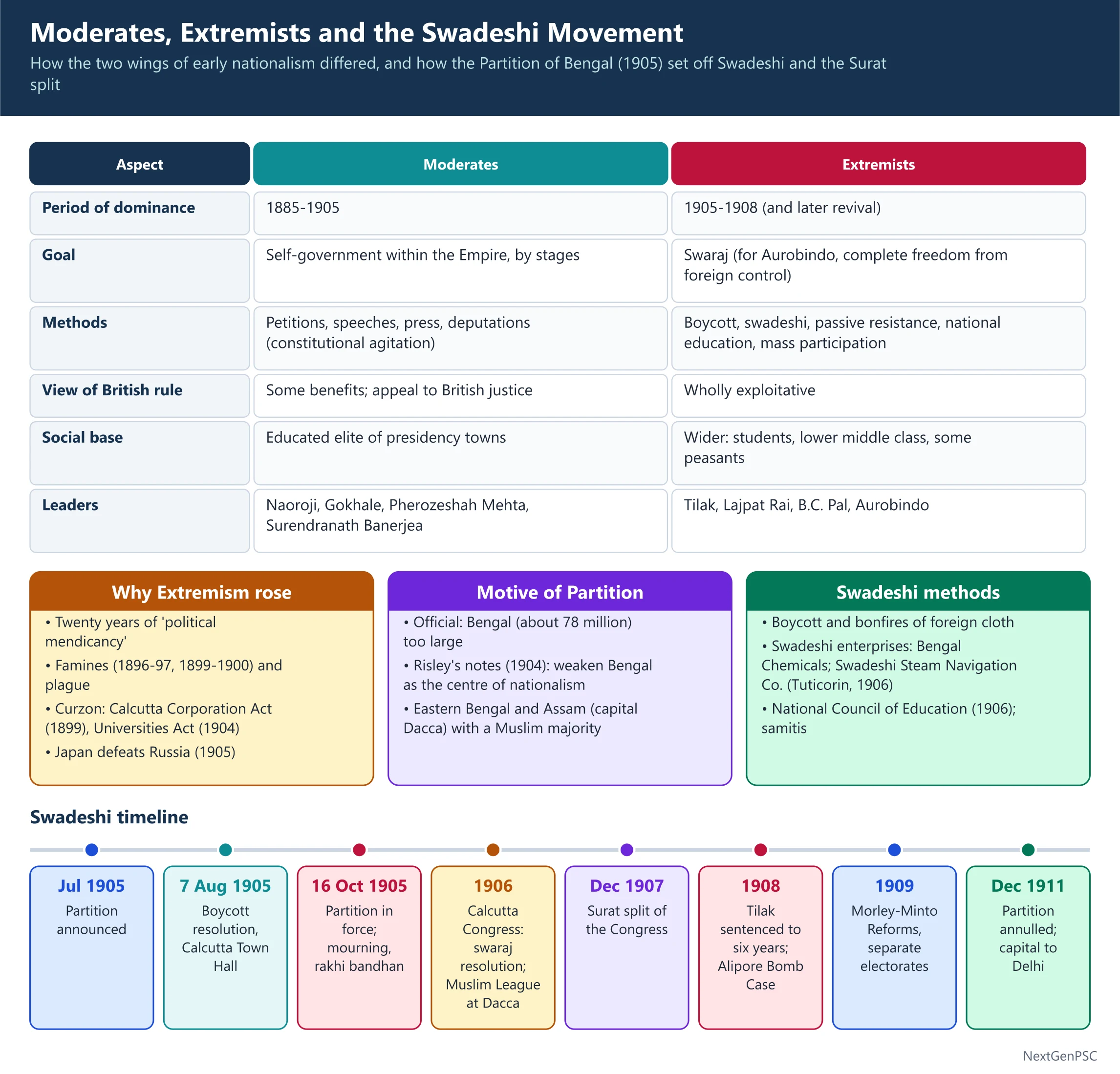
1. Rise of Extremism: Causes
Failure of Moderate methods: Twenty years of petitions brought few results, and younger nationalists called it political mendicancy.
Economic distress: Famines (1896–97, 1899–1900) and plague in Bombay (from 1896), with harsh plague measures, increased anger.
Curzon's policies (1899–1905): The Calcutta Corporation Act (1899) reduced elected members, the Universities Act (1904) tightened official control, and the Official Secrets Act was widened.
International events: Japan's victory over Russia (1905) broke the myth of European invincibility; nationalist struggles in Ireland, Egypt, Turkey and Persia also inspired Indians.
Cultural revival: Tilak's Ganapati festival (1893) and Shivaji festival (1895), Vivekananda's teachings and Bankim's writings gave nationalism a religious-cultural idiom.
2. Moderates and Extremists Compared
Goal: Moderates wanted self-government within the Empire by stages; Extremists wanted swaraj, which Aurobindo understood as complete freedom from foreign control.
Methods: Moderates used constitutional agitation; Extremists favoured passive resistance, boycott, swadeshi and mass participation.
View of British rule: Moderates saw some benefits in British rule; Extremists saw it as wholly exploitative.
Leaders: Extremist leaders were Bal Gangadhar Tilak (Maharashtra), Lala Lajpat Rai (Punjab), Bipin Chandra Pal and Aurobindo Ghose (Bengal).
Self-reliance: Aurobindo's essays The Doctrine of Passive Resistance (1907, in Bande Mataram) set out the method of non-cooperation with government institutions.
3. The Partition of Bengal (1905)
Announcement: The decision was announced in July 1905 and took effect on 16 October 1905.
New provinces: Eastern Bengal and Assam (capital Dacca) had a Muslim majority; the rest of Bengal (with Bihar and Orissa) had Hindu and Bengali-speaking people outnumbered by Hindi and Oriya speakers.
Official reason: Bengal Presidency, with about 78 million people, was said to be too large to administer.
Real motive: Home Secretary H.H. Risley's notes of 1904 show the aim of weakening Bengal as the centre of nationalism; he wrote, in substance, that Bengal united was a power and Bengal divided would pull in different directions.
Communal angle: Curzon, at Dacca in 1904, presented the new province as giving Muslims a unity they had not enjoyed since the old Muslim rulers.
4. The Swadeshi Movement: Course
Boycott resolution: At a meeting in the Calcutta Town Hall on 7 August 1905, boycott of British goods was adopted.
16 October 1905: Observed as a day of mourning, with fasting, hartal, bathing in the Ganga and tying of rakhis as a symbol of unity, suggested by Rabindranath Tagore.
Songs: Tagore's Amar Sonar Bangla and Bankim's Vande Mataram became the anthems of the movement.
Spread: Tilak in Maharashtra, Lajpat Rai and Ajit Singh in Punjab, Syed Haider Raza in Delhi and V.O. Chidambaram Pillai in Madras took the movement beyond Bengal.
Congress sessions: Benares (1905, Gokhale) supported boycott in Bengal; Calcutta (1906, Naoroji) adopted resolutions on swaraj, swadeshi, boycott and national education.
5. Economic Aspects of Swadeshi
Boycott: Bonfires of foreign cloth, picketing of shops selling foreign goods, and a sharp fall in imports of British cloth into Bengal in 1905–06.
Swadeshi enterprises: Textile mills, soap and match factories, tanneries and potteries; P.C. Ray's Bengal Chemicals and the Banga Lakshmi Cotton Mills are well-known examples.
Banks and insurance: Swadeshi banks and insurance companies were set up in Bengal and elsewhere.
Beyond Bengal: V.O. Chidambaram Pillai founded the Swadeshi Steam Navigation Company at Tuticorin (1906) to challenge British shipping.
Limits: Indian industry could not replace cheap imports quickly, and prices of swadeshi goods were often higher, burdening the poor.
6. Political and Cultural Aspects of Swadeshi
National education: The National Council of Education (1906), the Bengal National College with Aurobindo as principal, and the Bengal Technical Institute (1906).
Samitis: Volunteer bodies such as Ashwini Kumar Dutt's Swadesh Bandhab Samiti in Barisal spread the message, settled disputes and organised relief.
Self-help: Tagore's idea of atmashakti (self-strengthening) through village reconstruction was one strand of constructive swadeshi.
Culture: Abanindranath Tagore's art, Nandalal Bose's painting, swadeshi songs, jatras and Acharya J.C. Bose's science were seen as part of national revival.
Women and students: Students picketed shops and women boycotted foreign bangles and cloth, entering politics in a new way.
7. The Surat Split (1907) and Repression
Split: At the Surat session of December 1907 Moderates and Extremists clashed over the presidency (Rash Behari Ghosh) and fears that the Calcutta resolutions would be diluted; the Congress split.
Government strategy: The British followed a policy of rallying the Moderates while repressing the Extremists.
Repression: Lajpat Rai and Ajit Singh were deported in 1907, Tilak was sentenced to six years in Mandalay in 1908, and Aurobindo was tried in the Alipore Bomb Case and later withdrew to Pondicherry.
Reforms: The Morley-Minto Reforms (Indian Councils Act, 1909) introduced separate electorates for Muslims.
Annulment: At the Delhi Durbar of December 1911 George V announced the annulment of the partition and the shifting of the capital from Calcutta to Delhi.
8. Sources and Evidence
Official records: Risley's note (1904), Curzon's speeches at Dacca and Mymensingh (1904) and Home Department political files.
Press: Bande Mataram, Sandhya, Yugantar, Kesari and Sanjivani show the language of the movement.
Literature: Tagore's novel Ghare Baire (1916) gives a critical picture of coercive swadeshi and its effect on Muslim peasants.
9. Analysis: Achievements and Limitations
Achievements: Swadeshi took nationalism to students, women and some urban and rural groups, introduced boycott and passive resistance, and produced a rich cultural revival.
Rehearsal: Many methods of Gandhian mass politics, such as boycott, picketing, constructive work and national schools, were first tried here.
Muslim alienation: The movement failed to win most Muslim peasants, many of whom cultivated under Hindu landlords; Nawab Salimullah of Dacca supported the partition and the All-India Muslim League was founded at Dacca in 1906.
Coercion: Social boycott and the use of Hindu religious symbols alienated some groups.
Weak organisation: The movement lacked an effective organisation and a programme of sustained mass action; by 1908 it had declined.
10. Historiography and Debates
Sumit Sarkar: The Swadeshi Movement in Bengal, 1903–1908 (1973) identified four trends: moderate, constructive swadeshi, political extremism and revolutionary terrorism, and argued that the movement failed to achieve mass mobilisation, especially among Muslim peasants.
Bipan Chandra: He sees Swadeshi as a major step that broadened the social base of the national movement and prepared the ground for later mass struggles.
Cambridge view: J.H. Broomfield's Elite Conflict in a Plural Society (1968) stresses the role of the Bengali bhadralok and their concern over status and position.
Communal reading: Some writers see Swadeshi's Hindu idiom as a cause of communal divide; others argue that the colonial state's partition and separate electorates were the main causes.
11. Using It in the Exam
10-marker (150 words): Give the motive of partition with Risley's note and two forms of response (boycott, national education).
15-marker (200 words): Discuss the economic and political aspects of Swadeshi with examples, as the syllabus words them.
20-marker (250 words): Assess Swadeshi as a turning point: methods, social base, limits (Muslim peasants, coercion) and legacy, using Sumit Sarkar's four trends.
Keywords: Divide and rule, Risley's note, boycott, atmashakti, samitis, passive resistance, Surat split, Sumit Sarkar's four trends.
Quotation (paraphrase): Aurobindo held that political freedom was the life-breath of a nation, and that social reform or education without it was futile.
| Aspect | Moderates | Extremists |
|---|---|---|
| Period of dominance | 1885–1905 | 1905–1908 (and later revival) |
| Goal | Self-government within the Empire, by stages | Swaraj |
| Methods | Petitions, speeches, press, deputations | Boycott, swadeshi, passive resistance, national education |
| View of British rule | Some benefits; appeal to British justice | Wholly exploitative |
| Social base | Educated elite of presidency towns | Wider: students, lower middle class, some peasants |
| Leaders | Naoroji, Gokhale, Pherozeshah Mehta, Surendranath Banerjea | Tilak, Lajpat Rai, B.C. Pal, Aurobindo |
| Date | Event |
|---|---|
| July 1905 | Partition of Bengal announced |
| 7 August 1905 | Boycott resolution at Calcutta Town Hall |
| 16 October 1905 | Partition takes effect; day of mourning, rakhi bandhan |
| 1906 | National Council of Education; Calcutta Congress adopts swaraj resolution; Muslim League founded at Dacca |
| December 1907 | Surat split of the Congress |
| 1908 | Tilak sentenced to six years; Alipore Bomb Case |
| 1909 | Morley-Minto Reforms with separate electorates |
| December 1911 | Partition annulled; capital to move to Delhi |
Mains points
- The syllabus names the 'economic and political aspects of Swadeshi'; answer with separate headings and concrete examples for each.
- Prove the political motive of partition with Risley's note and Curzon's Dacca speech, not just by assertion.
- Use Sumit Sarkar's four trends to show the internal variety of the movement.
- Assess why Swadeshi failed to win Muslim peasants: landlord-tenant divide, Hindu symbolism, official encouragement of Muslim separatism.
- Explain the Surat split as a clash over methods and the Calcutta resolutions, and its cost: government exploited the division.
- Link Swadeshi forward to Gandhian methods to show continuity in the national movement.
Did you know?
- Rabindranath Tagore led processions on 16 October 1905 tying rakhis on the wrists of Hindus and Muslims alike; his song Amar Sonar Bangla, written in the movement, became Bangladesh's national anthem in 1971.
- At Surat in 1907 a shoe was thrown at the dais, and the session broke up in chaos; the Moderates and Extremists reunited only at Lucknow in 1916.
Beginnings of Revolutionary Extremism
Revolutionary extremism (also called revolutionary nationalism or, by Sumit Sarkar, revolutionary terrorism) began in Maharashtra in the 1890s and grew in Bengal after the decline of the Swadeshi movement (c. 1907–08). Secret societies such as the Anushilan Samiti, Jugantar and Abhinav Bharat used bombs and assassinations of unpopular officials, and revolutionaries abroad formed India House and the Ghadar Party. They inspired sacrifice but lacked a mass base and were crushed by repression.
In simple words
When peaceful protest seemed to fail, some young Indians decided that only force could frighten the British into leaving. They formed secret groups, learned to make bombs and tried to kill harsh officials. Think of a few people who stop arguing with a bully and strike back on their own, without the crowd behind them. Their courage became legend, but they could not defeat an empire. UPSC asks about the causes, nature and limits of this revolutionary extremism.
1. Causes of Revolutionary Extremism
Frustration with methods: Young nationalists felt that both Moderate petitions and Extremist mass agitation had failed against repression.
Decline of Swadeshi: After the Surat split (1907) and the arrest of leaders, the open movement lost direction, and some activists turned to secret action.
Repression: Deportations, press laws and police violence convinced them that the colonial state understood only force.
Inspiration: Russian nihilists and Irish nationalists, Mazzini's Young Italy, and Indian traditions such as the Gita's doctrine of action and the cult of Shivaji and Kali.
Ideology: Writings such as Aurobindo's pamphlet Bhawani Mandir (1905) and the paper Yugantar called for heroic sacrifice for the motherland.
2. Maharashtra: The First Phase
Chapekar brothers (1897): Damodar and Balkrishna Chapekar shot the Plague Commissioner W.C. Rand and Lt. Ayerst in Poona on 22 June 1897, in protest against harsh plague searches; this is usually seen as the first political assassination of the period.
Mitra Mela and Abhinav Bharat: V.D. Savarkar and his brother Ganesh founded the Mitra Mela (1899) at Nasik, which became the Abhinav Bharat society (1904).
Nasik Conspiracy (1909): Anant Kanhere shot A.M.T. Jackson, the Collector of Nasik, in December 1909; the trial led to the transportation of members including the Savarkar brothers.
3. Bengal: Anushilan and Jugantar
Anushilan Samiti (1902): Began in Calcutta as a physical culture society linked with Pramathanath Mitra; its Dacca branch (1906) under Pulin Behari Das became a large revolutionary organisation.
Jugantar group: Barindra Kumar Ghosh (Aurobindo's brother), Bhupendranath Dutta and others ran the paper Yugantar (from 1906), which openly preached revolution.
Bomb-making: Hem Chandra Kanungo learned bomb-making techniques in Paris and set up a workshop at the Maniktala garden house in Calcutta.
Muzaffarpur (30 April 1908): Khudiram Bose and Prafulla Chaki threw a bomb at a carriage they believed carried the judge Kingsford, but killed two English women, Mrs and Miss Kennedy; Chaki shot himself and Khudiram was hanged.
Alipore Bomb Case (1908–09): The Maniktala group was arrested; Aurobindo, defended by C.R. Das, was acquitted, while Barindra and others were transported.
Jail killing: The approver Narendra Gosain was shot inside Alipore jail by Kanailal Dutta and Satyendranath Bose, who were hanged.
Later action: Jatindranath Mukherjee (Bagha Jatin) of the Jugantar group tried to obtain German arms during the First World War and died after a gunfight near Balasore in 1915.
4. Other Regions
Madras: Vanchi Iyer of the Bharat Mata Association shot Collector Ashe of Tirunelveli at Maniyachi in 1911 and then shot himself.
Punjab: Ajit Singh and others organised agrarian unrest in 1907 over the Punjab Colonisation Bill; later the Ghadar movement drew heavily on Punjab.
Delhi Conspiracy (1912): A bomb was thrown at the Viceroy Lord Hardinge during his state entry into Delhi on 23 December 1912; Rash Behari Bose was the organiser and escaped to Japan in 1915.
5. Revolutionaries Abroad
India House (1905), London: Founded by Shyamji Krishna Varma, who also published The Indian Sociologist; Savarkar was its leading figure from 1906.
Curzon Wyllie: Madan Lal Dhingra, linked with India House, shot Sir William Curzon Wyllie in London on 1 July 1909 and was hanged.
Madame Bhikaji Cama: She unfurled an Indian national flag at the International Socialist Congress at Stuttgart in 1907.
Ghadar Party (1913): Formed in San Francisco with Lala Har Dayal as a key leader, among mainly Punjabi Sikh migrants; its paper Ghadar called for armed revolt.
Komagata Maru (1914): The ship carrying Indian migrants was refused entry at Vancouver and, on its return, passengers were fired upon at Budge Budge near Calcutta.
Ghadar rising (February 1915): A planned army mutiny in Punjab was betrayed and crushed; the Lahore Conspiracy trials followed, and Kartar Singh Sarabha was among those hanged.
6. Government Response
Laws: The Explosive Substances Act (1908), the Newspapers (Incitement to Offences) Act (1908), the Indian Press Act (1910) and the Defence of India Act (1915).
Tilak's case: Tilak was convicted of sedition in 1908 for his Kesari articles on the Muzaffarpur bombing and sent to Mandalay.
Rowlatt (Sedition) Committee (1918): It surveyed revolutionary crime since 1897 and recommended the powers that became the Rowlatt Act of 1919.
7. Sources and Evidence
Official sources: The Sedition Committee Report (1918), James Campbell Ker's confidential Political Trouble in India 1907–1917 (1917) and court records of the Alipore, Nasik and Lahore Conspiracy cases.
Revolutionary writings: Yugantar, Bhawani Mandir, The Indian Sociologist, Ghadar, and Savarkar's The Indian War of Independence of 1857 (1909).
Memoirs: Barindra Kumar Ghosh's and Hem Chandra Kanungo's accounts of the Maniktala group, and Aurobindo's Tales of Prison Life.
8. Analysis: Nature and Limits
Individual action: The method was the killing of unpopular officials and dacoities to raise funds, by small groups, not mass revolt.
Social base: Members were mostly young, educated, upper-caste Hindu men from the middle class, especially the Bengali bhadralok.
Religious idiom: Oaths on the Gita and worship of Kali gave strength and discipline but kept Muslims away.
Weaknesses: No mass base, poor coordination, informers and harsh repression; actions sometimes killed innocents, as at Muzaffarpur.
Contribution: They showed fearless defiance, kept the anti-colonial spirit alive between 1908 and 1915, and became martyrs who inspired later generations, including Bhagat Singh.
9. Historiography and Debates
Terminology: Colonial records used words like anarchism and terrorism; nationalist writers prefer revolutionary nationalism; Sumit Sarkar uses revolutionary terrorism in an analytical sense.
Sumit Sarkar: He argues that the turn to terrorism reflected the failure of Swadeshi to build mass action, and he criticises its Hindu revivalist idiom and elitism.
Bipan Chandra: He praises their heroism but argues that individual action could not replace mass mobilisation against a strong colonial state.
Nationalist view: R.C. Majumdar and others gave them a central place in the freedom struggle.
Peter Heehs: The Bomb in Bengal (1993) studies the Maniktala group and Aurobindo's role in detail.
10. Using It in the Exam
10-marker (150 words): Give two to three causes, three key actions with dates and one limitation.
15-marker (200 words): Explain why revolutionary extremism arose after Swadeshi, with Bengal and Maharashtra examples.
20-marker (250 words): Evaluate its contribution and limitations, with revolutionaries abroad and the views of Sumit Sarkar and Bipan Chandra.
Keywords: Secret societies, individual heroic action, Anushilan, Jugantar, Alipore Bomb Case, India House, Ghadar, Sedition Committee.
Caution: Keep the first phase (1897–1918) separate from the later HSRA phase of Bhagat Singh, which falls under the Gandhian era.
| Year | Event | Persons Involved | Place |
|---|---|---|---|
| 1897 | Assassination of Rand and Ayerst | Chapekar brothers | Poona |
| 1908 | Muzaffarpur bombing | Khudiram Bose, Prafulla Chaki | Muzaffarpur (Bihar) |
| 1908–09 | Alipore Bomb Case | Barindra Ghosh, Aurobindo (acquitted) | Calcutta |
| 1909 | Assassination of Curzon Wyllie | Madan Lal Dhingra | London |
| 1909 | Assassination of Collector Jackson | Anant Kanhere (Abhinav Bharat) | Nasik |
| 1911 | Assassination of Collector Ashe | Vanchi Iyer | Maniyachi (Tamil Nadu) |
| 1912 | Bomb on Lord Hardinge | Rash Behari Bose and associates | Delhi |
| 1915 | Ghadar rising; Balasore encounter | Ghadarites; Bagha Jatin | Punjab; Odisha |
Mains points
- UPSC frames this as 'the beginning of revolutionary extremism'; explain why it began when it did, linking it to the decline of Swadeshi.
- Give a regional spread (Maharashtra, Bengal, Punjab, Madras, abroad) with two or three dated examples.
- Discuss the debate over the term terrorism versus revolutionary nationalism briefly; it shows historiographical awareness.
- Balance contribution (courage, inspiration, keeping resistance alive) against limits (no mass base, religious idiom, repression).
- Use the Sedition Committee Report (1918) as a source and link it to the Rowlatt Act to connect with the Gandhian era.
- Common mistake: mixing up the Muzaffarpur bombing with the Alipore case, or calling Aurobindo convicted; he was acquitted.
Did you know?
- Khudiram Bose was about eighteen when he was hanged in August 1908, and Bengali folk songs about him, such as 'Ekbar biday de ma', are still sung.
- Savarkar's attempt to escape by jumping through a porthole of the ship at Marseilles in 1910 led to a case between Britain and France before the Permanent Court of Arbitration at The Hague.
UPSC Previous Year Questions: The Rise of Indian Nationalism
From 2014 to 2026 UPSC asked 17 question parts worth 260 marks on the rise of Indian nationalism, all in Paper II. The most-asked themes are the safety-valve thesis and the foundation of the Congress (4 parts), the Moderates' methods and programme (4 parts) and the Swadeshi movement (5 parts). Every question below has a model answer written to the UPSC word limit.
In simple words
Read the question and spend five minutes writing your own outline or full answer before you look at the model answer.
Then compare: check whether you used the same dates, sources and historians, and whether you answered the directive word (comment, critically examine, elucidate).
Note the points you missed and revise that topic in the notes above, then try a similar question from another year.
1. Factors Behind the Birth of Indian Nationalism
Example 1 (UPSC 2026, 10 marks): "No educated Indian has ever forgotten the lesson of Ilbert Bill." Critically examine.
Paper and question: Paper II, Q1(b)
Approach: The statement treats the Ilbert Bill controversy (1883–84) as a formative lesson for educated Indians. Explain the episode, state the lessons Indians drew from it, and then test how far it alone shaped later politics.
In 1883 Lord Ripon's government introduced the Ilbert Bill, drafted by the Law Member Courtenay Ilbert, to let senior Indian district magistrates and sessions judges try Europeans in the mofussil.
The Anglo-Indian and planter community organised a fierce white counter-agitation. In January 1884 the government compromised: a European accused could demand a jury of which at least half were Europeans, which in effect withdrew the reform.
Educated Indians drew three lessons. First, the Raj would not concede equality when white interests were at stake, so loyal faith in British justice was naive. Second, organised all-India agitation worked. Third, Indians needed a national body; Surendranath Banerjea's Indian National Conference (1883) and then the Congress (1885) followed.
The statement still needs qualification. The lesson was absorbed by a small English-educated elite, not the masses. Earlier grievances, such as the Vernacular Press Act (1878) and the lowered ICS age limit (1876), mattered too.
Thus the Ilbert Bill was a catalyst rather than a sole cause: it sharpened racial consciousness and taught the value of organisation.
Example 2 (UPSC 2021, 20 marks): What were the various ways in which nationalism manifested itself in India during colonial rule?
Paper and question: Paper II, Q2(b)
Approach: A descriptive-analytical question: classify the main forms through which nationalism expressed itself (economic, political-organisational, cultural-religious, literary, revolutionary, mass and subaltern) with examples, and close with an assessment of their unity and tensions.
Indian nationalism, in Bipan Chandra's phrase, grew out of the contradiction between the interests of the Indian people and those of colonialism. It was a nation in the making and found expression in many overlapping forms.
Economic nationalism: Dadabhai Naoroji's drain theory (Poverty and Un-British Rule in India, 1901), R.C. Dutt's Economic History of India and M.G. Ranade's writings exposed colonial exploitation and became the intellectual core of early nationalism.
Associations and constitutional politics: the British Indian Association, Poona Sarvajanik Sabha (1870), Indian Association (1876), Madras Mahajana Sabha and finally the Indian National Congress (1885), using petitions, the press and council debates.
Cultural and religious forms: reform movements such as the Brahmo Samaj, Arya Samaj and Ramakrishna-Vivekananda gave self-respect; Tilak's Ganapati (1893) and Shivaji (1896) festivals mobilised people through religious symbols. Literature such as Bankim's Anandamath, with Vande Mataram, and the vernacular press (Kesari, Amrita Bazar Patrika) spread the idea of the motherland.
Swadeshi and boycott (1905–08) brought national education, swadeshi enterprise and samitis; revolutionary nationalism appeared in the Anushilan Samiti, Jugantar, the Ghadar Party and later the HSRA and the INA.
Gandhian mass movements (1919–42) used satyagraha, non-cooperation and the constructive programme to draw peasants, workers, women and students. Peasant, tribal and labour struggles also expressed anti-colonial feeling, often autonomously, as Ranajit Guha and the Subaltern school stress.
Not every expression was inclusive: religious idioms sometimes fed communal and regional identities, as the Muslim League's rise showed. Yet these varied currents converged into a broad anti-imperialist movement that made colonial rule untenable by 1947.
2. Politics of Association and the Foundation of the Congress (Safety-Valve Thesis)
Example 3 (UPSC 2026, 10 marks): Alan Hume's ultimate aim in encouraging the foundation of the Indian National Congress was to provide a 'Safety Valve' for the release of growing Indian discontent. Critically examine.
Paper and question: Paper II, Q1(e)
Approach: Examine Hume's motive as stated in the safety-valve thesis: give its basis, then the evidence that weakens it, and conclude on Hume's real role and the Indian initiative behind the Congress.
Allan Octavian Hume, a retired civil servant, convened the first session of the Indian National Congress at Bombay in December 1885. The safety-valve thesis holds that his ultimate aim was to give a harmless outlet to mounting discontent.
It rests on William Wedderburn's 1913 biography, which said Hume had seen seven volumes of secret reports warning of revolt. Hume's own letters show his fear of an agrarian upheaval.
Against it: the seven volumes have never been traced, as Sumit Sarkar notes. The Dufferin Papers show the Viceroy was suspicious of Hume and dismissed the Congress as a 'microscopic minority' in 1888. Indians were already organised in the Indian Association and the Indian National Conference.
Hume was both a liberal humanitarian and an imperial loyalist. Bipan Chandra's answer is that if Hume wanted a safety valve, Indian leaders used him as a lightning conductor against official hostility.
A safety valve may have been part of Hume's motive, but the Congress was the product of Indian political awakening.
Example 4 (UPSC 2025, 20 marks): Why has the ‘safety valve theory’ related to the foundation of the Indian National Congress been thoroughly discredited by recent researchers? Analyze.
Paper and question: Paper II, Q3(b)
Approach: Explain why recent research has rejected the safety-valve theory: outline the theory and its origins, then the archival and political evidence against it, the alternative explanations, and conclude on what replaced it.
The safety-valve theory holds that the Indian National Congress (1885) was created by A.O. Hume, with the blessing of Viceroy Dufferin, to provide a safe outlet for Indian discontent and so prevent a second 1857.
Its origin was William Wedderburn's 1913 biography of Hume, which said Hume had read seven volumes of secret police reports warning of an imminent revolt. W.C. Bonnerjee's account that Dufferin advised Hume to make the body political seemed to confirm official sponsorship. Extremists such as Lala Lajpat Rai (Young India, 1916) and the Marxist R. Palme Dutt (India Today, 1940) used it to attack the Moderates.
Archival evidence: when the Dufferin Papers were opened, historians found that Dufferin distrusted Hume, regarded the Congress as seditious and in his St Andrew's Day speech (1888) dismissed it as a microscopic minority. The seven volumes have never been found in any archive, as Sumit Sarkar notes.
Indian initiative: research on the politics of association, especially by S.R. Mehrotra and Bipan Chandra, showed that Indians had built the Indian Association (1876), the Poona Sarvajanik Sabha and the Madras Mahajana Sabha, and held the Indian National Conference in 1883 and 1885.
Hume's role reinterpreted: Bipan Chandra argued that Indian leaders used Hume as a lightning conductor, since a body founded by a retired British official would face less official hostility. Gokhale said much the same in 1913.
Alternative readings: the Cambridge School (Anil Seal) explained the Congress through elite competition, while nationalists stressed anti-colonial ideology; both reject a conspiracy of the Raj.
The theory has thus been discredited because its key evidence is untraceable, official records contradict it, and it ignores two decades of Indian political organisation.
Example 5 (UPSC 2020, 20 marks): In its political behaviour the Indian National Congress in its early career was never a radical organisation, besides the founders of the Congress involved A.O. Hume in their project. Do these facts verify that the Congress was founded as a 'Safety valve'? Explain.
Paper and question: Paper II, Q3(a)
Approach: Two facts are offered as proof of the safety-valve thesis: the early Congress was not radical, and Hume was involved. Accept the facts, then show why neither proves the thesis, using evidence on Congress's aims, methods and official hostility.
Both facts are true. The early Congress (1885–1905) was a moderate body that professed loyalty to the Crown and used petitions, resolutions and deputations. Its founders worked with A.O. Hume, who became its general secretary. The question is whether these facts prove that the Congress was a safety valve designed by the Raj.
Moderation was a strategy, not a sign of official design. In a society with a tiny educated class and a powerful colonial state, open confrontation would have invited repression. The Moderates aimed to build national unity, create public opinion and educate people politically. Their methods were constitutional, but their content was anti-colonial.
Their economic critique, from Naoroji's drain theory to R.C. Dutt's writings, attacked the foundations of colonial rule. They demanded expansion of the councils, simultaneous ICS examinations, a cut in military spending and the separation of the judiciary from the executive. A safety valve would not have produced the ideas that later fed mass nationalism.
Hume's involvement does not prove official sponsorship. Hume did fear an agrarian outbreak, but Wedderburn's story of seven secret volumes has never been verified. The Dufferin Papers show that the Viceroy distrusted Hume, and by 1888 Dufferin was mocking the Congress as a microscopic minority.
The Indian founders had their own reasons. Bipan Chandra argues they used Hume as a lightning conductor to avoid suspicion, and Gokhale said in 1913 that no Indian could then have started such a body without official hostility.
The Congress was also the culmination of the politics of association: the Indian Association (1876), the Poona Sarvajanik Sabha and the Indian National Conference (1883, 1885).
These facts therefore show prudence and tactical use of Hume, not a colonial safety valve.
Example 6 (UPSC 2014, 10 marks): "The 'safety-valve thesis' does not adequately explain the birth of the Indian National Congress in 1885." Critically examine.
Paper and question: Paper II, Q1(d)
Approach: Critically examine why the safety-valve thesis is inadequate: state it briefly, give what truth it holds, then the factors it ignores, and conclude with a fuller explanation of 1885.
The safety-valve thesis, drawn from William Wedderburn's 1913 biography of A.O. Hume, claims that Hume, with Viceroy Dufferin's approval, founded the Congress to vent Indian discontent and avert a revolt.
It contains some truth. Hume feared an agrarian upheaval after the famines of the 1870s and wished to preserve British rule, and he organised the Bombay session of 1885.
But it is inadequate. It ignores the politics of association: the Indian Association (1876), the Poona Sarvajanik Sabha and Surendranath Banerjea's Indian National Conference, which met in 1883 and again in December 1885. It ignores the grievances that politicised the educated class, such as the Vernacular Press Act and the Ilbert Bill. The Dufferin Papers show official hostility, not sponsorship, and the seven secret volumes have never been traced.
Bipan Chandra's view that Indians used Hume as a lightning conductor fits the evidence better. The Congress of 1885 was the product of an emerging national consciousness, with Hume as catalyst rather than creator.
3. The Early Congress: Programme, Objectives and Social Composition
Example 7 (UPSC 2026, 10 marks): "In my belief, congress is to tottering to its fall and one of my great ambitions which in India is to assist it to a peaceful demise." Comment.
Paper and question: Paper II, Q2(c)
Approach: Identify the statement (Curzon, 1900), explain the context of official hostility and Congress weakness behind it, and comment on how far his prediction proved right.
The words are Viceroy Lord Curzon's, written in a letter of November 1900 to the Secretary of State, Lord George Hamilton. They show how the Raj, far from treating the Congress as a safety valve, wished to see it die.
Curzon's confidence had a basis. Around 1900 the Congress was at a low ebb: its annual sessions drew less enthusiasm, the Moderates' petitions had won little beyond the Indian Councils Act of 1892, and younger nationalists such as Tilak and Aurobindo mocked its 'political mendicancy'.
His own policies had the opposite effect. The Calcutta Corporation Act (1899), the Indian Universities Act (1904) and, above all, the Partition of Bengal (1905) united Indian opinion against him. The Swadeshi and boycott movement followed, and the Congress at Benares (1905) and Calcutta (1906) adopted swadeshi and swaraj.
Curzon misread a temporary lull as terminal decline. His statement is a classic example of imperial arrogance: instead of assisting the Congress to a peaceful demise, he helped to radicalise and revive it.
Example 8 (UPSC 2022, 20 marks): Discuss the policies and programmes of the early nationalists (moderates). To what extent they were able to fulfil the aspirations of the people?
Paper and question: Paper II, Q4(a)
Approach: Two demands: describe the Moderates' policies and programmes (economic, political, administrative, methods), then assess how far they met popular aspirations, giving achievements and limits and the historiographical judgement.
The early nationalists or Moderates (1885–1905), led by Dadabhai Naoroji, Pherozeshah Mehta, Surendranath Banerjea, G.K. Gokhale and M.G. Ranade, dominated the Congress in its first twenty years.
Economic programme: their most lasting work was the economic critique of colonialism. Naoroji's drain theory, R.C. Dutt's economic histories and Ranade's writings showed how tribute, Home Charges, free trade and high land revenue impoverished India. They demanded lower land revenue, protection for industry and a cut in military expenditure.
Political and administrative programme: expansion and reform of the legislative councils with elected members, simultaneous ICS examinations in India and England, separation of the judiciary from the executive and freedom of the press. Their long-term goal was self-government within the Empire.
Methods: petitions, prayers and protests through annual sessions, memorials and the press; a British Committee of the Congress (1889) and the journal India in London to lobby British opinion.
Achievements: they built an all-India platform and political education, exposed the economic exploitation behind British rule, and won the Indian Councils Act of 1892 and the Welby Commission on expenditure (1895). Bipan Chandra regards their critique as the ideological foundation of the national movement.
Limits: their social base was a narrow urban educated elite; peasants and workers were outside their politics, and they rarely touched zamindari exploitation. Their faith in British justice brought few concessions, and the 1892 Act fell short of their demands. Sumit Sarkar notes that politics remained a part-time affair for most of them, and the Extremists derided their 'mendicancy'.
They therefore fulfilled the aspirations of the people only partly: they did not win swaraj or mass relief, but they laid the intellectual and organisational ground on which later mass movements stood.
Example 9 (UPSC 2018, 10 marks): Can methods and policies of the moderates be referred to as 'political mendicancy'?
Paper and question: Paper II, Q4(c)
Approach: Explain the charge of 'political mendicancy' and who made it, then weigh it against the substance and context of Moderate politics, and conclude with a balanced verdict.
The charge of political mendicancy was made by the Extremists. Aurobindo Ghose's articles 'New Lamps for Old' (1893–94) attacked the Congress as timid, and Tilak and Bipin Chandra Pal derided its prayers and petitions.
There is some basis for it. The Moderates relied on petitions, memorials and deputations, professed loyalty to the Crown and trusted British liberalism and justice. They did not try to mobilise the masses, and the meagre Indian Councils Act of 1892 showed how little these methods won.
But the label is unfair. Their method was constitutional agitation, meant to educate Indians and build public opinion in a country with a tiny political class and a strong state. Their content was not begging: Naoroji's drain theory and R.C. Dutt's histories were a fundamental indictment of colonial economics. Bipan Chandra calls the Moderates the founders of economic nationalism.
Thus 'mendicancy' describes their methods in part, but not their aims or achievements: they laid the ideological foundation on which the Extremists and Gandhi built.
Example 10 (UPSC 2014, 20 marks): "Politics remained for the bulk of the Moderates very much a part-time affair. The Congress was not a political party, but an annual three-day show..." Elucidate.
Paper and question: Paper II, Q3(a)
Approach: Elucidate the statement (it reflects Sumit Sarkar's assessment of the early Congress): explain what 'part-time' politics and the 'annual three-day show' meant, why it was so, and then qualify it with the Moderates' real contributions.
The statement reflects Sumit Sarkar's assessment of the early Congress in Modern India 1885–1947. It points to the organisational weakness of the Moderate phase (1885–1905).
Part-time politics: the leaders were successful lawyers, journalists, teachers and businessmen, such as Pherozeshah Mehta, W.C. Bonnerjee and Surendranath Banerjea. They gave politics their spare time; few, like Gokhale, devoted their lives to it.
An annual three-day show: the Congress had no permanent organisation, membership, funds or full-time workers for most of this period. It met for three days each December, passed resolutions, and dispersed. Even a constitution and a standing committee came only later, and the provincial committees were weak.
The social base was narrow: the English-educated professional classes of the presidency towns. Peasants, workers and most of the lower middle class were outside it, and Muslims took little part after Syed Ahmad Khan opposed the Congress. The Cambridge School, including Anil Seal, saw it as a loose alliance of local elites seeking patronage.
Yet the statement needs balance. The annual sessions created an all-India platform, brought leaders from different regions together, and built national unity in a fragmented country. Between sessions, work went on through the press, local associations and the British Committee in London.
The Moderates' economic critique, especially Naoroji's drain theory and Dutt's histories, gave nationalism its ideological core. Their demands on councils, the ICS and military spending kept constant pressure on the government.
Bipan Chandra argues that political education, not organisation of the masses, was their historic task. Hence the statement is accurate about their organisation and social base, but underestimates their role in preparing the ground for later mass politics.
4. Moderates, Extremists, the Partition of Bengal and Swadeshi
Example 11 (UPSC 2024, 20 marks): Political extremism in colonial India often converged with cultural nationalism, but not always. – Comment.
Paper and question: Paper II, Q3(a)
Approach: Comment on the overlap between political extremism and cultural (often religious) nationalism: give the cases where they converged, then the cases where extremism was secular, economic or political, and conclude on the consequences of the convergence.
Political extremism in the Indian context meant the rejection of Moderate petitioning in favour of swaraj, boycott and passive resistance, led by Tilak, Lajpat Rai, Bipin Chandra Pal and Aurobindo Ghose. Cultural nationalism sought the nation's strength in its own traditions, religion and history rather than in Western models.
Convergence: in Maharashtra Tilak used the Ganapati festival (1893) and the Shivaji festival (1896) to mobilise people. In Bengal Aurobindo described nationalism as a religion that comes from God, Bankim's Vande Mataram became the anthem of Swadeshi, and the nation was imagined as the mother goddess. Lajpat Rai drew on the Arya Samaj in Punjab.
Cultural nationalism gave extremism emotional power and a language people understood.
But not always: extremism had a strong economic and political side. Boycott and swadeshi drew on the Moderates' drain theory; Tilak led no-revenue campaigns in the famine of 1896–97; Aurobindo's 'Doctrine of Passive Resistance' (1907) set out a political strategy of boycott. Tilak later joined the Lucknow Pact (1916) with the Muslim League and the Home Rule movement, both secular political programmes.
Conversely, cultural nationalism was not always extremist: Tagore's constructive swadeshi and the Ramakrishna Mission stressed self-reliance without political extremism, and later revolutionaries such as the Ghadar Party and Bhagat Singh's HSRA were secular and socialist.
Consequences: Sumit Sarkar argues that the Hindu idiom of Swadeshi failed to draw Muslim peasants in East Bengal, and the colonial state exploited this gap. Bipan Chandra regards the religious symbols as tools of mobilisation, not communal intent.
Thus the two often converged, but extremism was at heart a political demand for swaraj, which could and did take secular forms.
Example 12 (UPSC 2024, 20 marks): The Swadeshi movement of 1905 anticipated many of the tactics that were later developed during the Gandhian mass movement. – Critically examine.
Paper and question: Paper II, Q4(a)
Approach: Critically examine the claim of continuity: list the Swadeshi tactics that reappeared under Gandhi, then the important differences (non-violence, mass base, discipline, idiom), and conclude on Swadeshi as a rehearsal.
The Swadeshi movement began as a protest against Curzon's Partition of Bengal (announced July 1905, effective 16 October 1905) and became the first major attempt to go beyond Moderate petitioning. Sumit Sarkar's The Swadeshi Movement in Bengal, 1903–1908 (1973) shows that many techniques of the Gandhian era were first tried in this movement.
Boycott and swadeshi: the boycott of British cloth, bonfires of foreign goods, picketing of shops and promotion of Indian goods prefigured the boycott and khadi campaigns of 1920–22 and 1930.
Passive resistance and non-cooperation: Aurobindo's 'Doctrine of Passive Resistance' (1907) called for boycotting government schools, courts, titles and services, which is close to the Non-Cooperation programme. Constructive programme: national schools and the National Council of Education (1906), arbitration courts, swadeshi industries and village work by samitis such as Ashwini Kumar Dutt's Swadesh Bandhab Samiti anticipated Gandhi's constructive work.
Mass mobilisation through culture: songs by Tagore and Mukunda Das, festivals, rakhi bandhan on 16 October 1905, and the participation of women and students foreshadowed later mass politics. Labour strikes in Calcutta and the use of volunteers also appeared.
Differences: Swadeshi had no commitment to non-violence, and it produced revolutionary terrorism. It remained largely confined to the Hindu middle class and failed to draw Muslim peasants, partly because of its Hindu idiom and coercion of those who bought foreign goods. It lacked a single leadership and disciplined organisation, and it collapsed after the Surat split (1907) and repression in 1908.
Gandhi, by contrast, combined these tactics with ahimsa, a peasant base and the Struggle-Truce-Struggle strategy that Bipan Chandra describes.
Swadeshi thus anticipated many Gandhian tactics but not the philosophy or social reach that made them effective; it was a rehearsal for the mass movements.
Example 13 (UPSC 2019, 20 marks): How would you explain the major trends of the Swadeshi Movement in Bengal?
Paper and question: Paper II, Q3(a)
Approach: Explain the major trends of Swadeshi in Bengal, using Sumit Sarkar's fourfold classification, with leaders, methods and examples for each, and then assess the movement's achievements and limits.
The Swadeshi movement (1903–08) arose against Curzon's plan to partition Bengal, which nationalists saw as divide and rule. Sumit Sarkar, in The Swadeshi Movement in Bengal, 1903–1908 (1973), identified four trends within it.
First, the moderate trend: leaders such as Surendranath Banerjea and Krishna Kumar Mitra first used petitions, meetings and press campaigns against the partition (1903–05). The boycott of British goods was announced at the Calcutta Town Hall meeting of 7 August 1905.
Second, constructive swadeshi: associated with Rabindranath Tagore's call for atmashakti (self-reliance), it stressed national education, swadeshi industries such as P.C. Ray's Bengal Chemicals and the Banga Lakshmi cotton mill, village reconstruction and samitis. It avoided direct conflict with the state.
Third, political extremism: Aurobindo Ghose, Bipin Chandra Pal and Brahmabandhab Upadhyay turned boycott into passive resistance, rejecting government schools, courts and services and demanding complete swaraj. Newspapers such as Bande Mataram and Sandhya spread this view.
Fourth, revolutionary terrorism: after 1907, frustrated youth of the Anushilan Samiti and the Jugantar group turned to bombs and assassinations, as in the Muzaffarpur attack of April 1908 and the Alipore bomb case.
Achievements and limits: the movement brought students, women and some workers into politics, and its songs, festivals and swadeshi enterprises created a new national culture. But Sarkar shows that it failed to win the Muslim peasantry of East Bengal, which the Muslim League (1906) and the colonial state exploited. Its Hindu idiom, social coercion and lack of an agrarian programme limited it, and repression and the Surat split (1907) ended it by 1908.
Bipan Chandra calls it a major leap that broadened the base of nationalism. Its trends foreshadowed both Gandhian mass politics and the revolutionary movement.
Example 14 (UPSC 2016, 10 marks): Explain “Constructive Swadeshi” characterised by atmashakti (self-reliance), which propelled the Swadeshi Movement in Bengal.
Paper and question: Paper II, Q1(e)
Approach: Explain the meaning of constructive swadeshi and atmashakti, its proponents, its concrete programmes, and how it propelled the movement, with a brief note on its limits.
Constructive swadeshi is Sumit Sarkar's term for the trend in the Swadeshi movement that sought national regeneration through self-help rather than through petitions or confrontation. Its keyword was atmashakti, self-reliance, which Rabindranath Tagore set out in his 'Swadeshi Samaj' address (1904).
Its programme was concrete. In education, Satish Chandra Mukherjee's Dawn Society, the National Council of Education (1906) and the Bengal National College, with Aurobindo as its first principal, offered national education. In the economy, swadeshi enterprises such as P.C. Ray's Bengal Chemicals, the Banga Lakshmi cotton mill, match and soap factories and swadeshi stores grew. In the villages, samitis like Ashwini Kumar Dutt's Swadesh Bandhab Samiti in Barisal ran relief, arbitration courts and social work.
It propelled the movement by giving boycott a positive side, creating institutions and drawing in people who would not join agitation.
Its limits were that it reached few peasants, and many enterprises failed for want of capital. Still, Gandhi's constructive programme later revived its core idea.
Example 15 (UPSC 2014, 20 marks): "The Anti-Partition Agitation (1909) had an economic character in Bengal unlike the Extremist Agitation in Maharashtra which had a religious character." Examine.
Paper and question: Paper II, Q3(b)
Approach: Examine the contrast between an 'economic' Bengal agitation and a 'religious' Maharashtra extremism: show what supports it, then the religious elements in Bengal and the economic elements in Maharashtra, and conclude that both blended the two. Note that the anti-partition agitation is usually dated 1905–08/1911.
The anti-partition agitation in Bengal (usually dated 1905–08, with the partition annulled in 1911) and the extremism led by Tilak in Maharashtra from the 1890s were the two main centres of early militant nationalism. The statement contrasts them as economic and religious.
Support for the view: in Bengal the central weapons were the boycott of British goods, especially Manchester cloth, and swadeshi enterprise. Bengal Chemicals, the Banga Lakshmi cotton mill, swadeshi stores and national education aimed at economic self-reliance.
In Maharashtra Tilak opposed the Age of Consent Bill (1891) as interference in Hindu custom, organised the public Ganapati festival (1893) and the Shivaji festival (1896), and used cow-protection sentiment. The Chapekar brothers' assassination of the plague commissioner Rand (1897) was linked to resentment of searches of homes and temples.
Against the view: Bengal's movement was also deeply religious in idiom. Bankim's Vande Mataram, worship of the motherland as Kali or Durga, Aurobindo's description of nationalism as a religion gave it a Hindu tone. Sumit Sarkar shows that this idiom alienated Muslim peasants of East Bengal.
Maharashtra's extremism had a strong economic side. Tilak's Kesari and Mahratta spread the drain theory, he organised no-revenue campaigns during the famine of 1896–97, and he supported swadeshi and boycott in 1905–08. When he was sentenced in 1908, Bombay textile workers struck in protest.
Both regions used religion as a means of mass mobilisation and economics as the content of their critique of colonial rule. Bipan Chandra stresses that the religious symbols were means of mobilisation, while the goal was swaraj.
The statement is therefore an oversimplification: it captures the emphasis in each region, but both movements combined economic and religious elements.
5. Beginnings of Revolutionary Extremism
Example 16 (UPSC 2021, 10 marks): In the first decade of the 20th century, the atmosphere was ripe for the emergence of revolutionary groups to fill up the vacant space in the political map of the country. Critically examine.
Paper and question: Paper II, Q1(e)
Approach: Examine why the first decade of the 20th century produced revolutionary groups: the 'vacant space' left by Moderate failure and the decline of Swadeshi, other causes, and the limits of the claim.
The 'vacant space' in the statement refers to the gap left when Moderate methods had failed and the Extremist-led Swadeshi movement lost momentum after the Surat split (1907) and heavy repression in 1908. Into this gap came revolutionary groups such as the Anushilan Samiti and the Jugantar group in Bengal and the Abhinav Bharat of V.D. Savarkar in Maharashtra.
The atmosphere was indeed ripe. The partition of Bengal enraged the youth; Tilak's deportation (1908) removed open leadership; repressive laws such as the Newspapers Act (1908) closed legal outlets. Japan's victory over Russia (1905) and European revolutionaries inspired them. Sumit Sarkar argues that revolutionary terrorism grew out of the failure of Swadeshi to build mass action.
But the space was not wholly vacant. Secret societies and akharas had existed since the 1890s, and the Chapekars acted in 1897. The Moderates still led the Congress, and Bipan Chandra notes that individual heroism could not replace mass politics.
The statement is thus broadly valid for 1907–10, though revolutionaries complemented rather than replaced other nationalist currents.
Example 17 (UPSC 2015, 10 marks): "The very idea of the bomb and the secret society, and of propaganda through action and sacrifice were imports from the West." Critically examine.
Paper and question: Paper II, Q1(d)
Approach: Examine the claim that revolutionary methods were Western imports: show the Western influences, then the Indian roots and Indian ideological content, and conclude on adaptation.
The early revolutionaries of 1905–1918 used the bomb, the secret society and 'propaganda by deed', a phrase from European anarchism. The statement holds that these methods were borrowed from the West.
Much supports it. Hem Chandra Kanungo learned bomb-making in Paris, reportedly from Russian émigrés, and set up the Maniktala workshop in Calcutta. Revolutionaries read about the Russian Narodniks, Mazzini's Young Italy and the Irish Fenians; Savarkar translated Mazzini and wrote of 1857 as a war of independence. India House in London and groups in Paris and Berlin linked Indians to European radicals.
But the inspiration was also Indian. Physical-culture akharas, the Chapekars' action of 1897 and Shivaji's guerrilla tradition predated these contacts. Their ideology drew on the Gita, Bankim's Anandamath, Kali worship and Vivekananda's call for strength, and the idea of self-sacrifice was framed in Hindu religious terms.
So the techniques were largely imported, but they were fused with indigenous symbols and anti-colonial goals. Sumit Sarkar's view that this religious idiom narrowed their appeal shows how Indian their content was.
Mains points
- The safety-valve thesis has been asked four times: always give its origin (Wedderburn 1913), the evidence against it (Dufferin Papers, untraced seven volumes, politics of association) and Bipan Chandra's lightning-conductor reply.
- Questions on the Moderates usually turn on a label (mendicancy, part-time politics): accept what is true about their methods, then defend their economic critique and political education.
- Swadeshi questions reward Sumit Sarkar's four trends, concrete examples (atmashakti, national education, samitis, boycott figures) and the limits among Muslim peasants.
- Quotation questions often come from historians or officials (Curzon 1900, Sumit Sarkar): name the source if you know it, and examine both sides with evidence.
- Link this chapter forward: show how the Swadeshi and revolutionary phases anticipated Gandhian methods and later revolutionaries, which examiners reward as analytical depth.
Did you know?
- The same Curzon who hoped in 1900 to assist the Congress to a peaceful demise did more than anyone to revive it, by partitioning Bengal five years later.
History Optional: All chapters
- Exam Pattern, Syllabus and Strategy
- Sources, Prehistory and the Indus Civilization
- Megaliths, the Vedic Age and the Mahajanapadas
- The Mauryas and the Post-Mauryan World
- The Deccan, the Sangam Age and the Guptas
- Regional States and Early Indian Cultural History
- Early Medieval India, 750–1200
- The Delhi Sultanate, 13th–14th Centuries
- Society, Culture and Economy under the Sultanate
- The Fifteenth and Early Sixteenth Centuries
- Akbar and the Mughal State in the 17th Century
- Mughal Economy, Society and Culture
- The Eighteenth Century
- Historical Sites for the Map Question
- European Penetration and British Expansion
- Early British Raj and Its Economic Impact
- Social, Cultural and Reform Movements
- Peasant and Tribal Uprisings and the Revolt of 1857
- The Rise of Indian Nationalism
- The Gandhian Era, 1915–1947
- Constitutional Developments, Other Strands and Partition
- India after Independence
- Enlightenment, Revolutions and Modern Politics
- Industrialisation, Nationalism and Imperialism
- Revolutions, World Wars and the Post-War World
- Decolonisation, European Unity and the End of the Cold War