
History Optional · UPSC Notes
Industrialisation, Nationalism and Imperialism — UPSC History Optional Notes
Free, exam-focused notes for UPSC Prelims and Mains, with Prelims tips and Mains points for every topic. 8 topics.
Open in the interactive reader: bookmarks, progress tracking and read-aloud.
The English Industrial Revolution: Causes and Impact on Society
The Industrial Revolution (c. 1760–1840) was Britain's shift from hand and animal power to machines, coal and steam, beginning in cotton textiles and iron and spreading through canals and railways. Its causes combined agricultural change, population growth, cheap coal, high wages, capital from trade and empire, stable institutions and a culture of invention. It created the factory system, rapid urbanisation and a new working class, and historians still debate its pace and whether workers' living standards rose or fell.
In simple words
Before about 1760, cloth was spun and woven by hand at home, like a family making rotis one by one. Then machines driven by water and steam began making thousands at once in big buildings called factories.
Britain had coal, money from trade and colonies, and inventors, so it went first.
Life changed: people moved to crowded towns, children worked long hours, but goods became cheap and the economy grew year after year.
UPSC asks why it began in Britain and how it changed society.
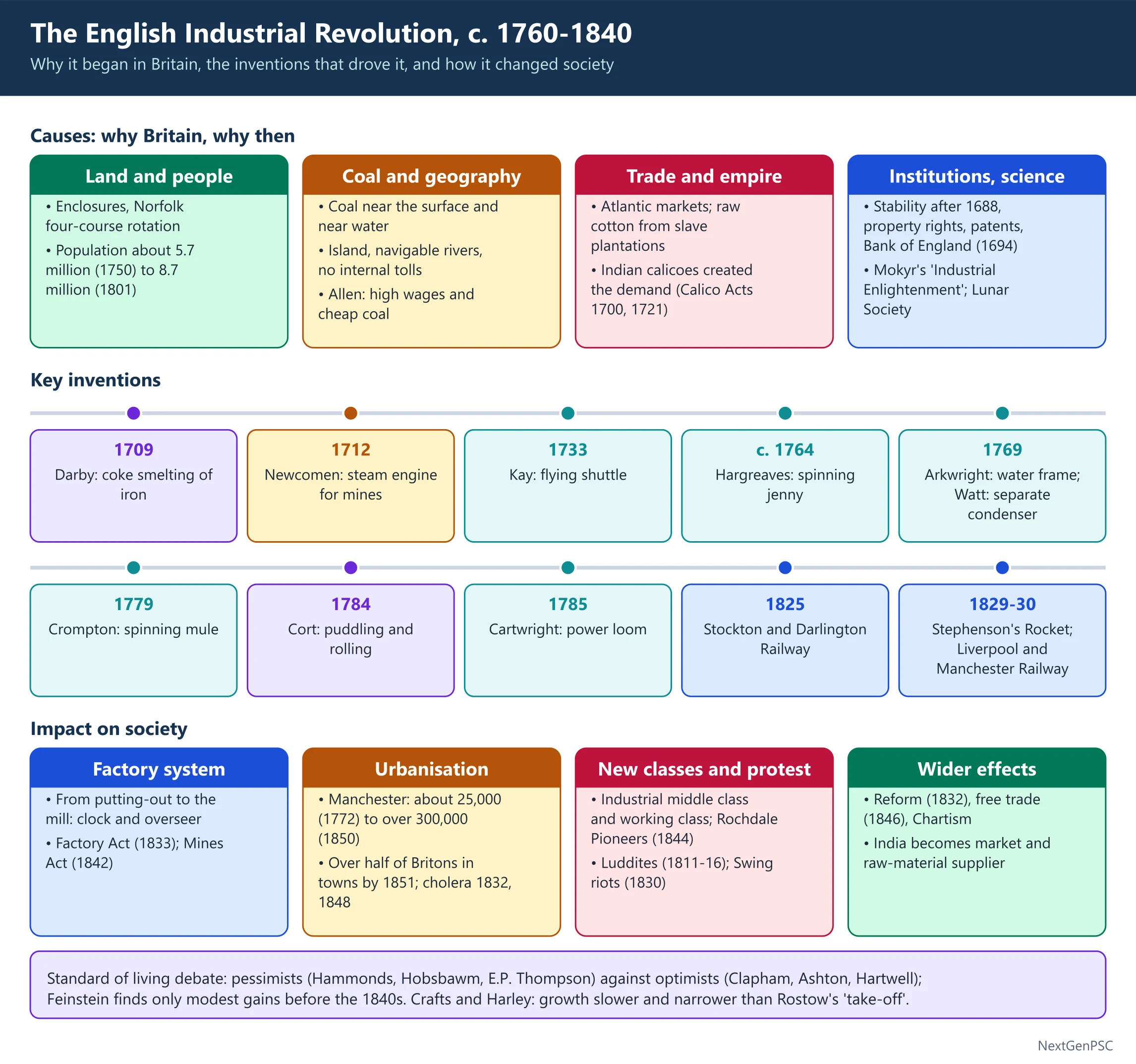
1. Meaning and Chronology
The term: used by French writers and by Engels in the 1840s, and popularised in English by Arnold Toynbee's Lectures on the Industrial Revolution in England (published 1884).
Dates: usually c. 1760–1830 or 1840; the shift was from an 'organic' economy based on land and muscle to a 'mineral-based energy economy' (E.A. Wrigley) using coal.
Leading sectors: cotton, iron, coal, steam power and, from 1830, railways.
2. Key Inventions
Textiles: John Kay's flying shuttle (1733), James Hargreaves's spinning jenny (c. 1764), Richard Arkwright's water frame (patented 1769) and his Cromford mill (1771), Samuel Crompton's mule (1779), Edmund Cartwright's power loom (1785).
Iron: Abraham Darby smelted iron with coke at Coalbrookdale (1709); Henry Cort's puddling and rolling process (1784) made cheap wrought iron.
Steam: Thomas Newcomen's engine (1712) pumped mines; James Watt's separate condenser (patent 1769) and the Boulton and Watt partnership (from 1775) made rotary engines for mills.
Transport: the Bridgewater Canal (1761) halved the price of coal in Manchester; the Stockton and Darlington Railway (1825) and the Liverpool and Manchester Railway (1830), on which Stephenson's Rocket ran, began the railway age.
3. Causes: Why Britain, Why Then
Agricultural change: enclosures, new crops and rotations (turnips, clover; the Norfolk four-course system) and better breeding raised output to feed a growing population, though historians now see this change as gradual.
Population: England's population rose from about 5.7 million in 1750 to about 8.7 million in 1801 (first census), supplying labour and consumers.
Coal and geography: abundant coal near the surface and near water, an island with navigable rivers and coastal shipping, and no internal tolls.
High wages, cheap energy: Robert Allen's The British Industrial Revolution in Global Perspective (2009) argues that high wages and cheap coal made it profitable to invent labour-saving, coal-using machines in Britain rather than elsewhere.
Trade and empire: Atlantic markets, raw cotton from slave plantations and profits from colonial trade; Eric Williams's Capitalism and Slavery (1944) argued that slavery profits helped finance industrialisation, a claim still debated.
India: Indian calicoes created the demand that British machines learned to meet; protective laws (Calico Acts, 1700 and 1721) kept them out, and later Indian handloom weaving declined under British competition.
Institutions: political stability after 1688, secure property rights, a patent system, a national banking network and the Bank of England (1694).
Culture of science: Joel Mokyr's 'Industrial Enlightenment', societies such as the Lunar Society of Birmingham (Boulton, Watt, Wedgwood), and many dissenters among entrepreneurs.
Comparative view: Kenneth Pomeranz's The Great Divergence (2000) argues that the Yangzi delta was comparable to England until c. 1800, and that coal and colonial 'ghost acres' explain Britain's break-out.
4. Impact on Society
Factory system: work moved from the home (the putting-out system) to the mill, with fixed hours, discipline, the clock and the overseer; E.P. Thompson's essay 'Time, Work-Discipline and Industrial Capitalism' (1967) studied this change.
Child and women's labour: children worked in mills and mines; parliamentary inquiries led to the Factory Acts (1833) and the Mines Act (1842), which barred women and boys under ten from underground work.
Urbanisation: Manchester grew from about 25,000 in 1772 to over 300,000 by 1850; by 1851 more than half of Britain's people lived in towns, with slums, cholera (1832, 1848) and poor sanitation.
New classes: an industrial middle class of manufacturers and a working class of wage-earners, with trade unions, friendly societies and cooperatives (Rochdale Pioneers, 1844).
Protest: the Luddites (1811–16) broke machines in the Midlands and North, and the Swing riots (1830) destroyed threshing machines.
Decline of crafts: handloom weavers, some 250,000 at their peak, were reduced to poverty by the power loom by the 1830s–40s.
Politics and ideas: industrial wealth fed demands for reform (1832), free trade (1846) and Chartism, and new ideas: Smith's political economy, Bentham's utilitarianism, and the socialism of Owen and Marx.
Global impact: Britain became the 'workshop of the world', imports of raw cotton and food grew, and colonies such as India became markets for manufactures and suppliers of raw materials.
5. Sources and Evidence
Official reports: the Sadler Committee on child labour (1832), factory inspectors' reports, and Chadwick's sanitary report (1842).
Contemporary accounts: Engels's The Condition of the Working Class in England (1845) on Manchester, Andrew Ure's The Philosophy of Manufactures (1835) praising the factory, and Elizabeth Gaskell's Mary Barton (1848).
Quantitative data: census returns from 1801, wage and price series, and patent records.
6. Historiography and Debates
Revolution or evolution: Toynbee and W.W. Rostow (The Stages of Economic Growth, 1960, with a 'take-off' c. 1783–1802) saw a sharp break; Phyllis Deane and W.A. Cole's estimates (1962) supported fast growth.
Gradualist revision: N.F.R. Crafts and C.K. Harley in the 1980s recalculated growth at about 2 per cent a year or less, confined to a few modern sectors, so the change was slower and narrower.
Industrious revolution: Jan de Vries argued that households worked harder and bought more market goods before mechanisation, creating demand.
Standard of living, pessimists: J.L. and Barbara Hammond (The Town Labourer, 1917), Eric Hobsbawm and E.P. Thompson stressed falling quality of life, loss of independence and harsh discipline.
Standard of living, optimists: J.H. Clapham, T.S. Ashton (The Industrial Revolution 1760–1830, 1948) and R.M. Hartwell argued real wages rose, especially after 1820; Charles Feinstein's wage series (1998) found only modest gains before the 1840s.
Heights and health: anthropometric studies showing falling average heights in some cohorts c. 1820–50 support a 'growth paradox' of rising output and worsening health.
Global and colonial view: Pomeranz, Prasannan Parthasarathi (Why Europe Grew Rich and Asia Did Not, 2011) and Indian economic nationalists link British industrialisation to Indian de-industrialisation.
7. Using It in the Exam
10 marks: four or five causes with one fact each, or three social effects with evidence.
15 marks: causes grouped as economic, geographical, institutional and global, with one historian such as Allen or Pomeranz.
20 marks: meaning and dates, inventions, causes, social impact (factory, towns, classes, protest), the standard-of-living debate and global consequences including India.
Keywords: mechanisation, factory system, steam power, urbanisation, working class, take-off, gradualism, standard-of-living debate, de-industrialisation.
Quotation: Hobsbawm, Industry and Empire (1968): 'Whoever says Industrial Revolution says cotton'.
| Year | Inventor | Invention | Effect |
|---|---|---|---|
| 1709 | Abraham Darby | Coke smelting of iron | Iron no longer limited by charcoal |
| 1712 | Thomas Newcomen | Atmospheric steam engine | Drained deep mines |
| 1733 | John Kay | Flying shuttle | Faster weaving; yarn shortage |
| c. 1764 | James Hargreaves | Spinning jenny | Many spindles at once |
| 1769 | Richard Arkwright | Water frame | Strong yarn; water-powered mills |
| 1769 | James Watt | Separate condenser | Efficient steam engine |
| 1779 | Samuel Crompton | Spinning mule | Fine, strong yarn |
| 1784 | Henry Cort | Puddling and rolling | Cheap wrought iron |
| 1785 | Edmund Cartwright | Power loom | Mechanised weaving |
| 1829–30 | George and Robert Stephenson | Rocket; Liverpool and Manchester Railway | Railway age |
| View | Historians | Main argument |
|---|---|---|
| Pessimist | Hammonds, Hobsbawm, E.P. Thompson | Worse housing, health, discipline and loss of independence |
| Optimist | Clapham, Ashton, Hartwell | Real wages and consumption rose, especially after 1820 |
| Quantitative middle view | Feinstein; anthropometric studies | Modest gains before 1840s; health and heights fell for some |
Mains points
- 'Why Britain first' is the commonest angle; group causes (economic, geographical, institutional, scientific, global) and rank them instead of listing.
- Use one recent explanation (Allen's high-wage, cheap-coal thesis or Pomeranz's coal and colonies) to show current historiography.
- For social impact, cover work, family, towns, class formation, protest and politics, with dated evidence (Factory Act 1833, Engels 1845).
- Present the standard-of-living debate with names on both sides and a measured conclusion.
- Connect to India: calico competition, de-industrialisation and the colonial market; examiners reward this link.
- Common mistake: treating the revolution as sudden and universal; mention the gradualist revision and the uneven spread across sectors.
- Avoid long lists of inventions; three or four with dates and effects are enough.
Did you know?
- The Luddites took their name from 'Ned Ludd' or 'General Ludd', a probably mythical apprentice said to have smashed a stocking frame; letters threatening mill-owners were signed in his name.
Industrialisation in the USA, Germany, Russia and Japan; Industrialisation and Globalisation
After Britain, other countries industrialised in different ways: the USA through a huge internal market, resources and immigration; Germany through railways, banks, cartels and science-based industry; Russia through state-led growth under Witte and foreign capital; and Japan through the Meiji state's programme of 'rich country, strong army'. Alexander Gerschenkron argued that the more backward a country, the bigger the role of banks and the state. Industrialisation also drove the first globalisation (about 1870–1914) of trade, capital and migration, which tied colonies to the industrial core as suppliers of raw materials.
In simple words
Britain was the first runner in the industrial race; others started later but ran faster by copying and borrowing. America had land, coal and millions of migrants; Germany used big banks and chemistry; Russia's government built railways with French loans; Japan's new rulers sent students abroad and built model factories.
Think of latecomers using a ready-made recipe instead of inventing it.
The race also tied the world together through steamships, telegraph and trade, the first globalisation.
UPSC asks how each country's path differed and what late industrialisation meant.
1. Patterns of Late Industrialisation
Second Industrial Revolution (about 1870–1914): steel (Bessemer converter, 1856; open-hearth process), electricity, chemicals, the internal combustion engine and the telephone, based more on science and large firms.
Gerschenkron thesis: in Economic Backwardness in Historical Perspective (1962) Alexander Gerschenkron argued that latecomers grew in spurts, favoured heavy industry and large plants, and substituted banks (Germany) or the state (Russia) for missing private capital.
Critiques: later scholars noted that Britain was not purely private either, that Japan and the USA do not fit neatly, and that agriculture and small firms remained important everywhere.
2. The United States
Early start: Samuel Slater built an Arkwright-type mill in Rhode Island (1790); the Boston Associates' Lowell mills (1820s) employed young farm women.
American system: interchangeable parts and mass production, associated with Eli Whitney and the Springfield armoury, later perfected by Henry Ford's moving assembly line (1913).
Railways and the West: the first transcontinental railroad was completed in 1869, creating a continental market; rail mileage multiplied after the Civil War.
Resources and people: vast land, coal, iron ore, oil and some 25 million immigrants between 1870 and 1914 supplied labour and markets.
Big business: Carnegie in steel, Rockefeller's Standard Oil (1870), and J.P. Morgan's finance; the Sherman Antitrust Act (1890) tried to curb monopolies.
Policy: high protective tariffs (for example the McKinley Tariff, 1890), land grants to railways and patents.
Result: by about 1900 the USA had become the world's largest industrial producer.
3. Germany
Foundations: the Zollverein customs union (1834), led by Prussia, created a large free-trade area; Friedrich List argued for railways and protection of 'infant industries' (The National System of Political Economy, 1841).
Railways and coal: railway building from the 1840s and the Ruhr and Silesian coalfields drove heavy industry; Krupp at Essen became a giant of steel and armaments.
Universal banks: banks such as the Deutsche Bank (1870) and Disconto-Gesellschaft both lent long-term and held shares, guiding industrial investment.
Science-based industry: chemicals (BASF, Bayer, Hoechst) and electricals (Siemens, AEG), supported by technical universities and research laboratories.
Cartels and protection: Bismarck's tariff of 1879, the alliance of 'iron and rye' (industrialists and Junker landlords), and cartels that fixed prices and output.
Social policy: health insurance (1883), accident insurance (1884) and old-age pensions (1889), partly to weaken the socialists.
Result: by about 1900–1910 Germany produced more steel than Britain and led Europe in chemicals and electricals.
4. Russia
Backwardness: serfdom until the Emancipation of 1861; even then peasants were tied to the commune (mir) by redemption payments.
Witte system: Sergei Witte, finance minister 1892–1903, built railways (the Trans-Siberian, begun 1891), raised tariffs, put the rouble on the gold standard (1897) and attracted foreign, especially French and Belgian, capital.
Growth: industrial output grew very fast in the 1890s (Gerschenkron estimated about 8 per cent a year), with oil at Baku, coal and iron in the Donbas and textiles around Moscow.
Strains: peasants bore heavy taxes, factory workers were concentrated in huge plants in a few cities, and these tensions fed the revolutions of 1905 and 1917.
Later: Stolypin's agrarian reforms (from 1906) and, after 1928, Stalin's Five-Year Plans were further, more extreme versions of state-led industrialisation.
5. Japan
Opening: Commodore Perry's 'black ships' (1853–54) and unequal treaties ended Tokugawa isolation; the Meiji Restoration (1868) brought a reforming oligarchy to power.
Slogans: fukoku kyōhei (rich country, strong army) and shokusan kōgyō (increase production, promote industry).
State action: the Iwakura Mission (1871–73) studied the West; the state built railways (Tokyo–Yokohama, 1872), telegraphs and model factories such as the Tomioka silk mill (1872), and reformed the land tax (1873) to fund development.
Privatisation: during the Matsukata deflation of the 1880s many state enterprises were sold cheaply to private firms, helping the rise of the zaibatsu (Mitsui, Mitsubishi, Sumitomo, Yasuda).
Industries: raw silk exports and cotton spinning (Osaka Spinning Company, 1882) led, followed by heavy industry with the state Yawata ironworks (1901).
Empire and growth: victories over China (1895) and Russia (1905), an indemnity from China, and colonies in Taiwan (1895) and Korea (1910) fed industrial and military growth.
Debate: some historians, such as Kazushi Ohkawa and Henry Rosovsky, emphasise the state's role; others stress the commercial base of the Tokugawa period and private enterprise.
6. Industrialisation and Globalisation
Technology: steamships, refrigeration (from the 1870s), the Suez Canal (1869) and the telegraph (transatlantic cable, 1866) collapsed distance and costs.
Trade and prices: Kevin O'Rourke and Jeffrey Williamson (Globalization and History, 1999) show commodity prices converging across the Atlantic, the hallmark of a true world market.
Capital and money: Britain exported capital on a large scale, and most major economies joined the gold standard by the 1890s, with London as the financial centre.
Migration: tens of millions of Europeans went to the Americas and Australasia, and Indian and Chinese indentured labourers went to plantations and mines in the Caribbean, Africa, Fiji and South-East Asia.
International division of labour: industrial countries exported manufactures; India, Egypt, Malaya, Argentina and others specialised in cotton, jute, tea, rubber, tin, wheat and beef.
Critiques: Karl Polanyi's The Great Transformation (1944) argued that the self-regulating market society provoked protective reactions; Immanuel Wallerstein's world-systems theory sees a core exploiting a periphery.
Collapse: World War I, tariffs and the Depression broke this globalisation; trade only regained its 1913 share of world output after the Second World War.
7. Sources and Evidence
Data: national statistics of steel, coal and rail mileage; Angus Maddison's historical estimates of world output.
Documents: Witte's memorandum to Nicholas II (1899) on industrialisation, the Iwakura Mission's report, and Friedrich List's writings.
8. Using It in the Exam
10 marks: one country's distinctive path, with three features and dates.
15 marks: compare two countries using Gerschenkron's categories (role of state, banks, heavy industry).
20 marks: British model, latecomer patterns, four countries in brief, link to globalisation and to colonies as raw-material suppliers, with an assessment of Gerschenkron.
Keywords: late industrialisation, relative backwardness, universal banks, cartels, Witte system, zaibatsu, fukoku kyōhei, first globalisation, international division of labour.
Quotation: Keynes, in The Economic Consequences of the Peace (1919), described how before 1914 a Londoner could order goods from the whole world by telephone over his morning tea (paraphrase).
| Country | Take-off period | Main agent | Leading sectors | Distinctive feature |
|---|---|---|---|---|
| USA | c. 1840s–1890s | Private enterprise, tariffs, immigration | Railways, steel, oil, mass production | Continental market; big trusts |
| Germany | c. 1850s–1890s | Universal banks, Zollverein, cartels | Coal, steel, chemicals, electricals | Science-based industry; social insurance |
| Russia | 1890s | State (Witte) and foreign capital | Railways, coal, iron, oil | Heavy industry amid peasant backwardness |
| Japan | 1880s–1900s | Meiji state, then zaibatsu | Silk, cotton, shipbuilding, steel | Defensive modernisation; empire |
Mains points
- Comparison questions are common: use a common frame (timing, role of state, finance, leading sectors, social cost) for each country.
- Gerschenkron's relative-backwardness thesis is the essential analytical tool; state it and test it against Japan and the USA.
- For Japan, stress defensive modernisation in response to Western pressure and the link to empire.
- For Russia, connect Witte's industrialisation to the social tensions behind 1905 and 1917.
- Globalisation questions need the technology, trade, capital and migration channels and the colonial division of labour.
- Common mistake: dating Japanese industrialisation from 1853; the decisive state programme began after 1868.
- Bring in India where relevant: indentured migration, raw cotton and jute exports, and the drain debate.
Did you know?
- The Tomioka silk mill (1872) hired French engineers, and rumours spread among villagers that the foreigners drank blood, because they had seen them drinking red wine; the mill is now a UNESCO World Heritage Site (2014).
Rise of Nationalism and the Unification of Germany and Italy
Nationalism, the idea that each nation should have its own state, spread through Europe after the French Revolution, Napoleonic conquest and Romanticism, and burst out in the revolutions of 1848. Italy was unified (1859–1870) through Mazzini's ideals, Cavour's diplomacy and Garibaldi's volunteers, and Germany (1864–1871) through Bismarck's 'blood and iron' wars against Denmark, Austria and France. Both unifications were achieved from above by monarchies and armies more than by popular revolution, and historians debate the roles of ideas, economics and statecraft.
In simple words
In 1815 'Italy' and 'Germany' were like a jigsaw puzzle scattered across many small boxes, with Austria holding several pieces.
Nationalism was the feeling that people sharing a language and history should live in one state.
Poets and rebels dreamed of it, but in the end clever statesmen and armies put the pieces together: Cavour and Garibaldi in Italy, Bismarck in Germany, through wars and deals.
UPSC asks about the roles of these leaders and whether unification came from the people or from above.
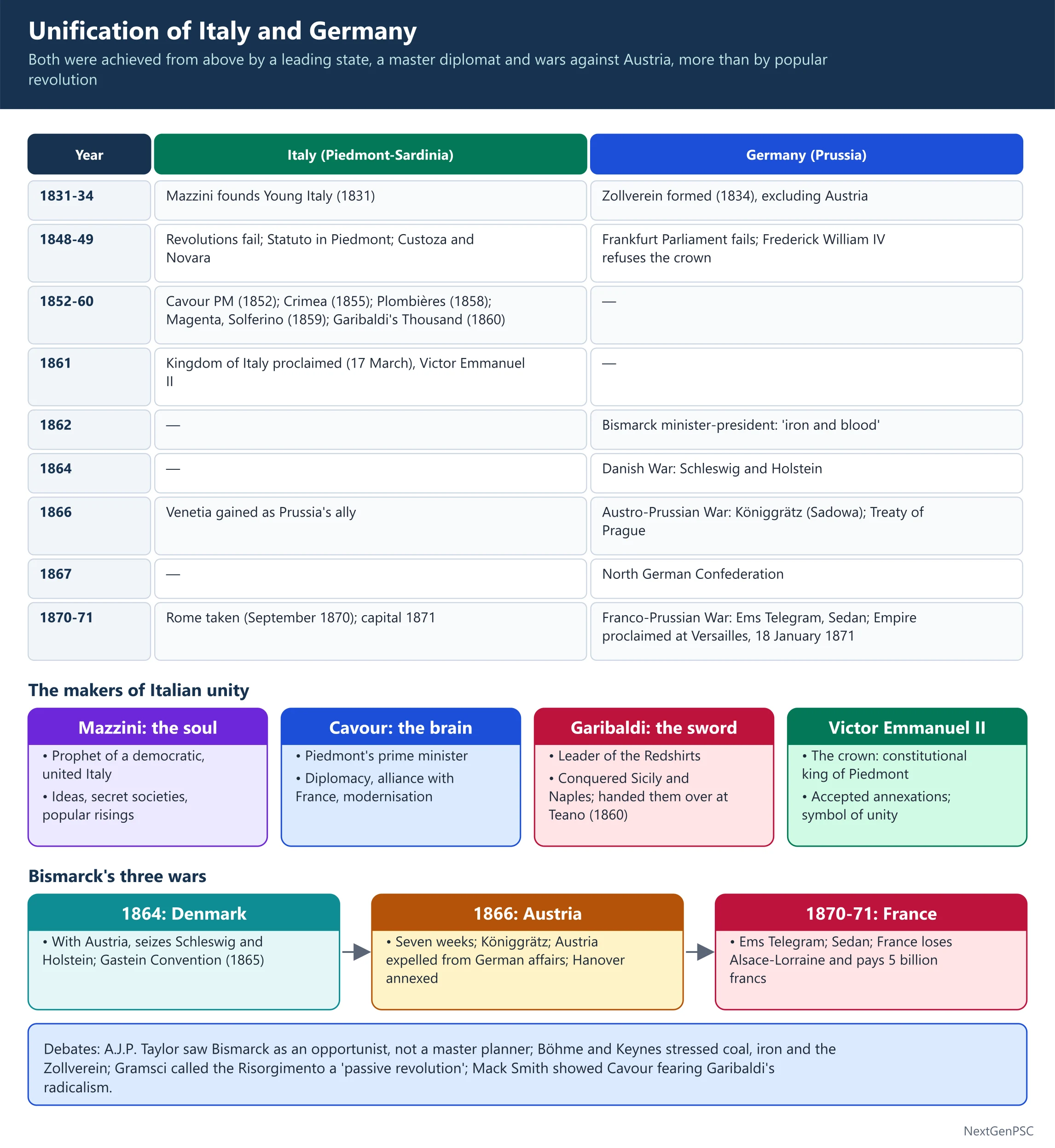
1. The Rise of Nationalism in the 19th Century
French Revolution: it made the nation, not the king, sovereign, and its armies spread the idea of citizens defending a patrie.
Napoleonic impact: he simplified the maps of Germany and Italy and introduced common laws, but occupation also provoked national resistance in Spain, Prussia and the Tyrol.
Cultural nationalism: Johann Gottfried Herder stressed each people's Volksgeist (national spirit) in language and folklore; Fichte's Addresses to the German Nation (1807–08) and the Grimm brothers' folk tales gave it a German voice.
Liberal nationalism: in the first half of the century nationalism was usually allied with liberalism and constitutional government against the dynastic order of Vienna.
Early successes: Greek independence (1821–1832, recognised in 1830–32) and Belgian independence (1830–31).
1848, the springtime of peoples: revolutions in France, the German states, the Habsburg lands and Italy; the Frankfurt Parliament (1848–49) offered the German crown to Frederick William IV of Prussia, who refused it in April 1849; all were crushed by 1849.
Lesson of 1848: idealism and parliaments alone could not unify; power and armies were needed, the basis of Realpolitik.
Later nationalism: after 1870 nationalism became more conservative, ethnic and imperialist, as in pan-Germanism and pan-Slavism.
2. Unification of Italy
Divisions in 1815: Piedmont-Sardinia, Lombardy-Venetia under Austria, the duchies of Parma, Modena and Tuscany, the Papal States and the Kingdom of the Two Sicilies; Metternich called Italy a 'geographical expression'.
Early movements: the secret Carbonari risings (1820–21, 1831) failed.
Mazzini: founded Young Italy (1831) for a united, democratic republic achieved by the people; the Roman Republic of 1849, defended by Garibaldi, was crushed by French troops.
Piedmont's leadership: King Charles Albert granted the Statuto (1848) but was defeated by Austria at Custoza (1848) and Novara (1849); Victor Emmanuel II kept the constitution.
Cavour (prime minister from 1852): modernised Piedmont's economy and railways, sent troops to the Crimean War (1855) to gain a hearing, and made a secret pact with Napoleon III at Plombières (1858).
War of 1859: French and Piedmontese victories at Magenta and Solferino; Napoleon III made a separate peace at Villafranca, and Piedmont gained Lombardy.
Central Italy (1860): plebiscites joined Tuscany, Parma, Modena and the Romagna to Piedmont; Nice and Savoy were ceded to France.
Garibaldi and the Thousand (1860): his volunteers (the Redshirts) conquered Sicily and Naples; Cavour sent Piedmontese troops through the Papal States to stop him reaching Rome, and Garibaldi handed his conquests to Victor Emmanuel at Teano (October 1860).
Kingdom of Italy (17 March 1861): proclaimed with Victor Emmanuel II as king; Cavour died in June 1861.
Completion: Venetia was gained in 1866 as Prussia's ally against Austria, and Rome in September 1870 when French troops left during the Franco-Prussian War; Rome became the capital in 1871.
Problems: a narrow electorate, the 'Southern question' of poverty and brigandage in the south, and conflict with the papacy; the saying attributed to Massimo d'Azeglio, 'we have made Italy, now we must make Italians', summed up the task (the exact wording is debated).
3. Unification of Germany
German Confederation (1815): 39 states under Austrian presidency, with Austria and Prussia rivals for leadership.
Economic unity: the Prussian-led Zollverein (1834) excluded Austria and tied German states' economies to Prussia.
Bismarck: appointed minister-president of Prussia in 1862 during a budget conflict over army reform; told the budget committee that the great questions of the day would be decided not by speeches and majority resolutions but by iron and blood.
Danish War (1864): Prussia and Austria seized Schleswig and Holstein from Denmark; the Gastein Convention (1865) divided their administration.
Austro-Prussian War (1866): after neutralising France and allying with Italy, Prussia defeated Austria at Königgrätz (Sadowa) in seven weeks; the Treaty of Prague expelled Austria from German affairs, and Prussia annexed Hanover and other states.
North German Confederation (1867): under Prussian leadership with a Reichstag elected by manhood suffrage; the southern states (Bavaria, Württemberg, Baden) signed military alliances.
Franco-Prussian War (1870–71): the Hohenzollern candidature to the Spanish throne and Bismarck's edited Ems Telegram (July 1870) provoked France to declare war; Napoleon III was captured at Sedan (September 1870).
German Empire: proclaimed in the Hall of Mirrors at Versailles on 18 January 1871, with William I as emperor; France lost Alsace-Lorraine and paid an indemnity of 5 billion francs.
Nature of the new state: a federal empire dominated by Prussia, with a Reichstag of limited power and a chancellor answerable to the emperor.
4. Sources and Evidence
Speeches and writings: Mazzini's The Duties of Man (1860), Bismarck's 'iron and blood' speech (30 September 1862) and his memoirs Thoughts and Reminiscences, Garibaldi's proclamations.
Documents: the Ems Telegram in its original and edited forms, plebiscite results of 1860, and the records of the Frankfurt Parliament.
5. Analysis: Comparing the Two Unifications
Similarities: a leading state (Piedmont, Prussia), a master diplomat (Cavour, Bismarck), wars against Austria, use of French policy, and unification from above.
Differences: Italy relied on foreign help (France) and a popular volunteer force (Garibaldi), while Germany relied on Prussia's own army and industrial strength; Italy was a weaker, poorer state at the end.
Economics: the Zollverein and railways prepared German unity; Italy lacked such an economic base, which is one reason for its weaker result.
6. Historiography and Debates
Bismarck's planning: older German historians (Heinrich von Treitschke, Heinrich von Sybel) saw a master plan; A.J.P. Taylor's Bismarck: The Man and the Statesman (1955) presented him as an opportunist who exploited events; Otto Pflanze stressed his flexible strategy of alternatives.
Economic interpretation: Helmut Böhme (1966) argued that unity was built through the Zollverein and economic interests; Keynes wrote in 1919 that the German Empire was built more truly on coal and iron than on blood and iron.
Sonderweg: Hans-Ulrich Wehler argued that unification from above left Germany with a pre-modern ruling elite and authoritarian politics, while David Blackbourn and Geoff Eley (The Peculiarities of German History, 1984) challenged this 'special path'.
Italy: Denis Mack Smith's Cavour and Garibaldi 1860 (1954) showed Cavour as an opportunist who feared Garibaldi's radicalism and aimed at first at an enlarged Piedmont; Rosario Romeo defended Cavour as a far-sighted liberal statesman.
Gramsci: in his Prison Notebooks he called the Risorgimento a 'passive revolution' in which moderates achieved unity without an agrarian revolution or mass participation; Lucy Riall's The Italian Risorgimento (1994) surveys these debates.
Theories of nationalism: Ernest Gellner (Nations and Nationalism, 1983) linked nations to industrial society; Benedict Anderson (Imagined Communities, 1983) to print capitalism; Hobsbawm (Nations and Nationalism since 1780, 1990) and Hobsbawm and Ranger (The Invention of Tradition, 1983) to elite invention; Anthony D. Smith stressed older ethnic roots; Miroslav Hroch described three phases (scholars, activists, mass movement).
7. Using It in the Exam
10 marks: the role of one leader (Cavour, Garibaldi, Mazzini or Bismarck) with three dated actions.
15 marks: compare the unifications, or assess 'blood and iron' versus economic factors in Germany.
20 marks: rise of nationalism, failure of 1848, the two unifications, comparison, historiography (Taylor, Böhme, Mack Smith, Gramsci) and consequences for Europe.
Keywords: Volksgeist, liberal nationalism, Realpolitik, blood and iron, Zollverein, Risorgimento, passive revolution, unification from above, imagined communities.
Quotation: Bismarck (1862): not through speeches and majority decisions are the great questions of the day decided, but by iron and blood.
| Year | Italy | Germany |
|---|---|---|
| 1831–34 | Mazzini founds Young Italy | Zollverein formed (1834) |
| 1848–49 | Revolutions fail; Statuto in Piedmont | Frankfurt Parliament fails |
| 1852–62 | Cavour PM (1852); Plombières (1858); war of 1859; Thousand (1860) | Bismarck minister-president (1862) |
| 1861 | Kingdom of Italy proclaimed | — |
| 1864 | — | Danish War |
| 1866 | Venetia gained | Austro-Prussian War; Königgrätz |
| 1867 | — | North German Confederation |
| 1870–71 | Rome taken; capital 1871 | Franco-Prussian War; Empire proclaimed 18 January 1871 |
| Leader | Role | Method |
|---|---|---|
| Mazzini | The soul: prophet of a democratic, united Italy | Ideas, secret societies, popular risings |
| Cavour | The brain: Piedmont's prime minister | Diplomacy, alliance with France, modernisation |
| Garibaldi | The sword: leader of volunteers | Guerrilla warfare; conquest of the south |
| Victor Emmanuel II | The crown: constitutional king of Piedmont | Accepted annexations; symbol of unity |
Mains points
- Begin nationalism questions with its sources (French Revolution, Napoleon, Romanticism, liberalism) and its change from liberal to conservative nationalism after 1870.
- Leader questions (Cavour, Garibaldi, Bismarck) need dated actions and an assessment of how far events, not plans, shaped results.
- Comparison of the two unifications is a favourite; use a table-like structure of similarities and differences.
- Use the 'blood and iron versus coal and iron' debate for Germany and Gramsci's 'passive revolution' for Italy.
- Mention the role of international factors: Crimean War, Napoleon III, Austrian isolation.
- Common mistake: saying Italy was complete in 1861; Venetia (1866) and Rome (1870) came later.
- Connect to later topics: Alsace-Lorraine and French revanche before 1914, and nationalism in the Habsburg and Ottoman empires.
Did you know?
- Memory trick for Italy's makers: Mazzini the soul, Cavour the brain, Garibaldi the sword, a popular way of describing the Risorgimento.
- The German Empire was proclaimed in France, at Versailles, a deliberate humiliation that France returned in 1919 by having the Treaty of Versailles signed in the same Hall of Mirrors.
Disintegration of Empires and the Emergence of Nationalities
The 19th century saw old multinational dynastic empires, the Ottoman, Habsburg and Russian (and in the Americas the Spanish), challenged by peoples who began to see themselves as nations. Balkan peoples broke away from the Ottomans in stages (Serbia, Greece, Romania, Bulgaria), the Habsburgs survived through the Compromise of 1867 but faced Czech, Polish and South Slav demands, and Russia tried Russification. World War I and Wilson's self-determination finally destroyed these empires in 1917–1923, leaving a map of new nation-states and new minority problems.
In simple words
Old empires were like big joint families ruled by one patriarch, holding many groups who spoke different languages and followed different faiths.
In the 19th century each group began to feel it was a separate family that deserved its own house: Greeks, Serbs, Czechs, Poles and others.
With help or interference from great powers, they broke away one by one, and World War I brought the whole house down.
UPSC asks why multinational empires collapsed and how nationalism and great-power rivalry worked together.
1. Empires and Nationalities
Dynastic principle: empires were held together by loyalty to a ruling house and religion, not by a shared nationality; the Habsburg lands included Germans, Magyars, Czechs, Slovaks, Poles, Ukrainians, Croats, Serbs, Slovenes, Romanians and Italians.
New challenge: nationalism claimed that state borders should follow nations, which threatened every multinational empire.
Process: Miroslav Hroch's model describes how small national movements grew from scholarly interest in language and history (phase A) to patriotic agitation (B) and mass movements (C).
2. The Ottoman Empire and the Eastern Question
The Eastern Question: the problem of what would replace Ottoman power in the Balkans and the Middle East, and how Russia, Austria, Britain and France would compete for advantage.
Serbia: revolts under Karađorđe (1804) and Miloš Obrenović (1815) won autonomy (recognised 1830) and full independence in 1878.
Greece: the war of independence began in 1821; Britain, France and Russia destroyed the Ottoman-Egyptian fleet at Navarino (1827), and the London Protocol (1830) recognised an independent Greece.
Egypt: Muhammad Ali, governor from 1805, built a modern army and nearly overthrew the sultan in the 1830s; the powers stopped him in 1840.
Reform from above: the Tanzimat (1839–1876), beginning with the Gülhane Edict (1839) and the Reform Edict (1856), promised equality of all subjects; the constitution of 1876 was suspended by Abdülhamid II in 1878.
Crimean War (1853–56): Britain and France fought Russia to keep the Ottoman Empire alive; Tsar Nicholas I had called it a 'sick man' in talks with the British ambassador in 1853.
Romania: the principalities of Moldavia and Wallachia united under one prince in 1859 and won independence in 1878.
Crisis of 1875–78: revolts in Bosnia and Bulgaria, the 'Bulgarian horrors' of 1876 publicised by Gladstone, a Russo-Turkish war, and the Treaty of San Stefano (March 1878) creating a large Bulgaria.
Congress of Berlin (1878): the powers cut back Bulgaria, recognised Serbia, Montenegro and Romania as independent, gave Austria-Hungary the administration of Bosnia-Herzegovina and Britain Cyprus.
Further losses: Bulgaria declared full independence and Austria annexed Bosnia (1908); the Young Turk Revolution (1908) brought Turkish nationalism; the Balkan Wars (1912–13) almost expelled the Ottomans from Europe and created Albania.
End: defeat in World War I, the Arab Revolt (1916), the Treaty of Sèvres (1920), the Turkish War of Independence under Mustafa Kemal and the Republic of Turkey (1923) after the Treaty of Lausanne.
3. The Habsburg Empire
1848: Hungarians under Kossuth, Czechs at the Prague Slav Congress, Italians and Croats rose; the Hungarian revolt was crushed in 1849 with Russian help.
Austro-Slavism: the Czech historian František Palacký, refusing to attend the Frankfurt Parliament (1848), argued that a reformed Austria was needed to protect the small Slav peoples from Germany and Russia.
Defeats: losses to France and Piedmont (1859) and Prussia (1866) forced a settlement with the Hungarians.
Compromise (Ausgleich) of 1867: created the Dual Monarchy of Austria-Hungary with a common monarch, army and foreign policy, but Hungary dominated its own Slovaks, Romanians and Croats through Magyarisation.
Nationalities question: Czech-German disputes over language in Bohemia (the Badeni language ordinances, 1897), Polish autonomy in Galicia, and South Slav attraction to Serbia.
Collapse: the Sarajevo assassination (28 June 1914) by a Bosnian Serb nationalist led to war; in October–November 1918 Czechoslovakia, the Kingdom of Serbs, Croats and Slovenes (later Yugoslavia) and Poland declared independence, and the treaties of Saint-Germain (1919) and Trianon (1920) confirmed the break-up.
4. The Russian Empire
Poland: risings in 1830–31 and 1863 were crushed, followed by repression of the Polish language and Church.
Russification: under Alexander III (1881–94) and Nicholas II, Russian language and Orthodoxy were imposed on Poles, Ukrainians, Baltic peoples and Finns; Jews suffered pogroms and restrictions.
Resistance: Finnish, Ukrainian, Georgian and Baltic national movements, and the 1905 revolution, in which non-Russian regions were active.
1917–18: after the revolutions Finland, Estonia, Latvia, Lithuania and Poland became independent; Ukraine and the Caucasus states were later absorbed into the Soviet Union, which Lenin presented as a federation of nations.
5. Beyond Europe
Spanish America: Napoleon's invasion of Spain (1808) triggered independence wars (1810–25) that broke up the Spanish empire into many republics; Brazil separated peacefully from Portugal in 1822.
Qing China: the 1911 revolution ended the dynasty, and Tibet and Outer Mongolia moved away from Chinese control.
Self-determination: Woodrow Wilson's Fourteen Points (January 1918) promised autonomous development to the peoples of Austria-Hungary and the Ottoman Empire, and the idea was taken up by colonised peoples in Egypt, India, China and Korea in 1919 (Erez Manela's 'Wilsonian moment').
6. Sources and Evidence
Documents: the Gülhane Edict, the Treaty of Berlin (1878), the Compromise of 1867, the Fourteen Points, the peace treaties of 1919–23 and minority treaties.
Contemporary voices: Gladstone's pamphlet Bulgarian Horrors and the Question of the East (1876), Palacký's letter to Frankfurt (1848), and census data on language and nationality.
7. Analysis and Historiography
Causes of collapse: nationalism, economic and military weakness, great-power intervention, failed reforms and, above all, the strain of total war in 1914–18.
Ottoman decline debate: older writers such as Bernard Lewis (The Emergence of Modern Turkey, 1961) wrote of long decline; Donald Quataert and others argue that the empire was reforming and adapting, and that decline is a misleading term.
Habsburg debate: Oscar Jászi's The Dissolution of the Habsburg Monarchy (1929) and A.J.P. Taylor's The Habsburg Monarchy 1809–1918 saw the empire as doomed by its nationalities; Alan Sked (1989) argued that the war, not nationalism, destroyed it; Pieter Judson's The Habsburg Empire: A New History (2016) shows many subjects were loyal and that the empire worked better than nationalist histories admit.
Comparative empire: Dominic Lieven's Empire: The Russian Empire and Its Rivals (2000) compares how land empires coped with nationalism.
Consequences: new states contained large minorities (Germans in Czechoslovakia, Hungarians in Romania), population exchanges (Greece and Turkey, 1923) and conflicts that fed the crises of the 1930s; the term 'Balkanisation' came to mean fragmentation into hostile small states.
Matthew Anderson: his The Eastern Question, 1774–1923 (1966) remains a standard account of great-power diplomacy over the Ottoman lands.
8. Using It in the Exam
10 marks: the Eastern Question explained in five points, or the Compromise of 1867 and its results.
15 marks: why the Ottoman or Habsburg empire disintegrated, with internal and external causes.
20 marks: nationalism versus dynastic empires across Ottoman, Habsburg and Russian cases, the role of great powers and World War I, historiography (Taylor, Sked, Judson, Quataert) and the legacy of new minorities.
Keywords: multinational empire, Eastern Question, sick man of Europe, Tanzimat, Ausgleich, Russification, self-determination, Balkanisation.
Quotation: Palacký (1848), in substance: if the Austrian state did not already exist, it would be necessary in the interest of Europe and humanity to create it (paraphrased from his letter to Frankfurt).
| State | From which empire | Year of independence or recognition |
|---|---|---|
| Greece | Ottoman | 1830 |
| Belgium | Kingdom of the Netherlands (Vienna settlement) | 1830–31 (recognised 1839) |
| Serbia, Montenegro, Romania | Ottoman | 1878 (Congress of Berlin) |
| Bulgaria | Ottoman | Autonomous 1878; independent 1908 |
| Albania | Ottoman | 1912 |
| Finland, Estonia, Latvia, Lithuania | Russian | 1917–18 |
| Poland | Russian, German and Habsburg | 1918 |
| Czechoslovakia; Kingdom of Serbs, Croats and Slovenes | Habsburg | 1918 |
| Republic of Turkey | Ottoman (successor state) | 1923 |
Mains points
- Define the problem first: dynastic, multinational empires versus the principle of nationality.
- For the Ottoman case, combine internal reform (Tanzimat), Balkan nationalism and great-power rivalry (Eastern Question, Berlin 1878).
- For the Habsburgs, explain the 1867 Compromise and why it solved the Hungarian problem but worsened the Slav one.
- Make World War I the decisive factor in 1918 while showing the long-term pressures; this is where historians disagree.
- Use recent historiography (Judson, Quataert) to show that 'inevitable decline' is now questioned.
- Common mistake: treating all national movements as mass movements from the start; many were elite-led until late (Hroch).
- End with the legacy: new minorities, Balkanisation and the instability of interwar eastern Europe.
Did you know?
- Emperor Franz Joseph reigned from 1848 to 1916, 68 years; he came to the throne in one revolution and died in the middle of the war that would destroy his empire two years later.
Imperialism in South and South-East Asia
Between the mid-18th and early 20th centuries almost all of South and South-East Asia came under European or American rule: Britain in India, Ceylon, Burma and Malaya; the Dutch in Indonesia; the French in Indochina; and Spain and then the USA in the Philippines, with Siam the only state to stay independent. Colonial rule built plantation and export economies (rice, sugar, coffee, rubber, tin), drew in migrant labour and created plural societies, while also producing Western-educated elites who led nationalist movements.
In simple words
European trading companies first came to Asia like shopkeepers renting a stall in a busy market; within a century they owned the market. Britain took India, Burma and Malaya, the Dutch took Java and the other islands, France took Vietnam, Laos and Cambodia, and the USA took the Philippines.
They grew rubber, sugar and coffee for world markets, brought in workers from India and China, and changed local societies for ever.
Only Siam (Thailand) stayed free, as a buffer.
UPSC asks how and why imperialism spread here and what it did to these societies.
1. From Trade to Territorial Empire
Early phase: the Portuguese took Goa (1510) and Malacca (1511); the Dutch VOC (1602) founded Batavia (1619) and took Malacca (1641); the English East India Company (1600) had factories in India.
Turn to territory: in the 18th century company wars, local political rivalries and the need to secure revenue turned trading posts into territorial states.
Motives: profits from trade and land revenue, control of the route to China, raw materials for industry, strategic rivalry among Britain, France and the Netherlands, and later prestige and the 'civilising mission'.
2. South Asia
India: Plassey (1757), Buxar (1764) and the Diwani of Bengal (1765) began British rule; subsidiary alliances (Wellesley), wars against Mysore, the Marathas and the Sikhs, and Dalhousie's annexations (Doctrine of Lapse; Awadh, 1856) completed it.
After 1857: the Crown took over from the Company (1858), princely states were preserved as allies, and India became the centre of the British Empire in Asia and a source of soldiers for imperial wars.
Ceylon: taken from the Dutch in 1796 and confirmed by the Treaty of Amiens (1802); the Kandyan kingdom was annexed in 1815; coffee and then tea plantations used Tamil labour from South India.
Burma: three Anglo-Burmese wars (1824–26, 1852, 1885) ended with the annexation of the whole country (1886) as a province of British India until 1937; the Irrawaddy delta became a great rice exporter.
Frontiers: Afghanistan was kept as a buffer against Russia (the 'Great Game'), and Nepal and Bhutan were tied to British India by treaties.
3. The Dutch East Indies
From company to state: the VOC was dissolved in 1799 and its territories passed to the Dutch state; Britain held Java briefly under Raffles (1811–16).
Java War (1825–30): Prince Diponegoro led a major revolt; its defeat confirmed Dutch control of Java.
Cultivation System (Cultuurstelsel, from 1830): under Governor-General Johannes van den Bosch, villages had to set aside land or labour for export crops (coffee, sugar, indigo) sold to the government at fixed prices; the profits greatly helped the Dutch treasury.
Critique: Multatuli's novel Max Havelaar (1860) exposed abuses; a liberal period after 1870 opened estates to private capital.
Expansion and Ethical Policy: the long Aceh War (from 1873) brought the outer islands under control by the early 20th century; the Ethical Policy (1901) promised welfare, education and irrigation.
4. British Malaya, Singapore and Borneo
Straits Settlements: Penang (1786), Singapore (founded by Stamford Raffles in 1819) and Malacca (from the Dutch by the Anglo-Dutch Treaty of 1824) became the Straits Settlements (1826).
Residential system: the Pangkor Treaty (1874) placed British Residents in Perak whose advice the sultan had to follow, except on Malay religion and custom; the Federated Malay States were formed in 1895.
Economy: tin mining, worked largely by Chinese labour, and from the 1900s rubber plantations worked by Indian, mainly Tamil, labour made Malaya one of Britain's most profitable colonies.
Borneo: the Brooke family ruled Sarawak as 'White Rajahs' from 1841, and the British North Borneo Company took Sabah (1881).
5. French Indochina
Conquest: using attacks on missionaries as a pretext, France took Saigon (1859) and Cochinchina by the Treaty of Saigon (1862), made Cambodia a protectorate (1863), and took Annam and Tonkin by 1883–85 after the Sino-French War.
Indochinese Union (1887): joined Cochinchina, Annam, Tonkin and Cambodia; Laos was added in 1893.
Economy and society: rice exports from the Mekong delta, rubber plantations, state monopolies on salt, opium and alcohol, and heavy taxes that impoverished peasants.
Resistance: the Can Vuong movement (1885–96) to restore the emperor; later Phan Boi Chau and, after 1911, Ho Chi Minh.
6. The Philippines and Siam
Spanish rule: from 1565 (Manila founded 1571), with friars controlling much land; the novelist José Rizal criticised colonial abuses and was executed in 1896, the year the Katipunan revolution began.
American conquest: the Spanish-American War (1898) and the Treaty of Paris gave the Philippines to the USA for 20 million dollars; the Philippine-American War (1899–1902) crushed Emilio Aguinaldo's republic at great human cost.
Siam: Kings Mongkut (Rama IV, 1851–68) and Chulalongkorn (Rama V, 1868–1910) signed the Bowring Treaty (1855) opening trade, modernised the administration and played Britain against France; Siam stayed independent but ceded territory to France (1893, 1907) and Britain (1909).
7. Sources and Evidence
Colonial records: Dutch colonial reports on the Cultivation System, British Residents' reports, census reports (for example the Malayan and Burmese censuses), and the Philippine Commission reports.
Indigenous voices: Diponegoro's autobiographical chronicle (Babad Diponegoro), Rizal's novels Noli Me Tángere (1887) and El Filibusterismo (1891), and Indian nationalist economic writings.
8. Analysis: Impact of Colonialism
Economic: export economies tied to world markets, plantations and mines owned by Europeans, peasants exposed to price falls, and the drain of resources.
Plural society: J.S. Furnivall, writing on Burma and the Netherlands Indies, described colonial societies in which Europeans, Chinese, Indians and natives lived side by side but separately, meeting only in the market.
Agricultural involution: Clifford Geertz's Agricultural Involution (1963) argued that Java's rice economy absorbed growing population by ever more labour-intensive cultivation, without development; his thesis is debated.
Political: new borders, centralised bureaucracies, and Western education that created elites who demanded self-rule (Indian National Congress 1885, Budi Utomo 1908 in Java).
9. Historiography and Debates
Colonial viewpoint: older works told the story from the deck of the ship, a phrase from J.C. van Leur, who criticised Europe-centred histories of Indonesia.
Autonomous history: John Smail's essay 'On the Possibility of an Autonomous History of Modern Southeast Asia' (1961) urged historians to centre local societies; Anthony Reid's work on the 'age of commerce' showed vibrant pre-colonial trade.
Indian debate: nationalists (Dadabhai Naoroji's Poverty and Un-British Rule in India, 1901; R.C. Dutt) stressed drain and de-industrialisation; the Cambridge School and Morris D. Morris questioned the scale of decline; Marxist historians such as Irfan Habib and Bipan Chandra stressed colonial exploitation.
Economic theories: Gallagher and Robinson saw expansion driven by crises on the periphery, Hobson and Lenin by capitalism's needs (see the topic on neo-imperialism).
10. Using It in the Exam
10 marks: one colony's system, such as the Cultivation System or the Residential system, with dates and effects.
15 marks: why Siam stayed independent, or compare Dutch and British colonial economies.
20 marks: stages of expansion across the region, motives, methods (war, protectorates, treaties), economic and social impact, and the rise of nationalism.
Keywords: Cultivation System, residential system, protectorate, plural society, plantation economy, buffer state, Ethical Policy, civilising mission.
Quotation: Furnivall described a plural society as one where groups 'mix but do not combine' (paraphrase of his view).
| Territory | Colonial power | Key dates | Main exports or features |
|---|---|---|---|
| India | Britain | 1757–1858 Company; Crown from 1858 | Cotton, jute, indigo, opium, tea; land revenue |
| Ceylon | Britain | 1796; Kandy 1815 | Coffee, then tea |
| Burma | Britain | 1826, 1852, 1886 | Rice, teak, oil |
| Malaya and Singapore | Britain | 1786, 1819, 1824, 1874, 1895 | Tin, rubber; Chinese and Indian labour |
| Dutch East Indies | Netherlands | VOC 1602; state 1800; Cultivation System 1830 | Coffee, sugar, later rubber and oil |
| French Indochina | France | 1862, 1863, 1883–85, 1887, 1893 | Rice, rubber; state monopolies |
| Philippines | Spain, then USA | 1565/1571; 1898 | Sugar, tobacco, abaca |
| Siam | Independent | Bowring Treaty 1855 | Buffer state; modernising monarchy |
Mains points
- Cover the whole region: India alone is not enough; bring in at least three of Burma, Ceylon, Malaya, Indonesia, Indochina and the Philippines.
- Explain the shift from trading companies to territorial rule and the motives at each stage.
- Compare methods: direct rule (Burma, Cochinchina), protectorates and residents (Malaya, Cambodia), and forced cultivation (Java).
- On impact, use concepts like plural society (Furnivall) and agricultural involution (Geertz), with migrant labour as a key theme.
- Siam's survival is a frequent short question: modernising kings, buffer between Britain and France, and territorial concessions.
- Common mistake: dating the American takeover of the Philippines as peaceful; mention the war of 1899–1902.
- Link to later units: Vietnamese liberation, Indian and Indonesian nationalism, and decolonisation.
Did you know?
- Rubber came to Malaya from Brazil via Kew Gardens in London: seeds collected by Henry Wickham in 1876 were germinated at Kew and seedlings sent to Ceylon and Singapore, where H.N. Ridley promoted rubber planting.
Imperialism in Latin America, South Africa and Australia
Imperialism took different forms in these three regions. In Latin America, independent after the 1820s, Britain built an informal empire of loans, trade and railways, and the USA moved from the Monroe Doctrine (1823) to open intervention after 1898. In South Africa, Dutch and British settlers dispossessed African peoples, and the discovery of diamonds and gold led to the South African War (1899–1902) and a white-ruled Union (1910). In Australia, British settler colonialism from 1788 rested on the doctrine of terra nullius and the dispossession of Aboriginal peoples.
In simple words
Empire does not always mean a flag. In Latin America the countries were free, but British banks and later American companies and marines controlled much of their economy and politics, like a moneylender who owns a family without owning its house.
In South Africa and Australia, settlers came to stay and took the land from the people already living there, which is called settler colonialism.
Gold, diamonds and wool made these lands valuable.
UPSC asks how informal and settler empires worked and what they did to local peoples.
1. Latin America: From Independence to Informal Empire
Independence: most of Spanish America became independent between 1810 and 1825 (Bolívar, San Martín), and Brazil separated from Portugal in 1822; Britain quickly recognised the new states and George Canning boasted in 1824 that Spanish America was free and, if Britain did not mismanage matters, she was English (a remark often quoted in paraphrase).
Informal empire: British merchants, loans and investment in railways, ports, mines and public utilities dominated Argentina, Brazil, Chile and others; by 1914 Latin America held a large share of British overseas investment.
Export economies: each country specialised in one or two commodities for world markets: Argentine beef and wheat, Brazilian coffee and rubber, Chilean nitrates and copper, Cuban sugar, Central American bananas.
Gunboats and debt: European powers blockaded or intervened to collect debts (Anglo-French blockade of the Río de la Plata in the 1840s; the blockade of Venezuela by Britain, Germany and Italy, 1902–03).
French adventure in Mexico (1861–67): Napoleon III installed the Habsburg Archduke Maximilian as emperor; he was defeated by Benito Juárez's forces and executed in 1867.
2. The United States in Latin America
Monroe Doctrine (1823): President Monroe declared the Americas closed to new European colonisation; Britain's navy, not US power, made it effective at first.
Continental expansion: the Mexican-American War (1846–48) and the Treaty of Guadalupe Hidalgo took about half of Mexico's territory, including California.
1898: the Spanish-American War made Cuba a US protectorate under the Platt Amendment (1901), which allowed US intervention and the Guantánamo base, and gave Puerto Rico to the USA.
Panama: the USA backed Panama's secession from Colombia (1903), took the Canal Zone and opened the Panama Canal in 1914.
Roosevelt Corollary (1904): Theodore Roosevelt claimed a right to act as an 'international police power' in the hemisphere; 'big stick' policy was followed by Taft's 'dollar diplomacy'.
Interventions: US Marines occupied Nicaragua (1912–33, with a break), Haiti (1915–34) and the Dominican Republic (1916–24); the United Fruit Company (1899) became a symbol of 'banana republics'.
Change: Franklin Roosevelt's Good Neighbor Policy (1933) renounced armed intervention, though economic dominance continued.
3. South Africa
Dutch Cape: the VOC founded a supply station at the Cape in 1652 under Jan van Riebeeck; settlers (Boers, later Afrikaners) took land from the Khoikhoi and San and used slave labour.
British takeover: Britain occupied the Cape in 1795 and again in 1806, keeping it in 1814; the abolition of slavery (1834) and British rule angered the Boers.
Great Trek (1835–1840s): some 12,000–15,000 Boers moved inland, clashing with the Zulu (Battle of Blood River, 1838); they founded the Transvaal (South African Republic, recognised 1852) and the Orange Free State (1854).
African kingdoms: the rise of the Zulu kingdom under Shaka in the early 19th century and the upheavals known as the Mfecane; the Xhosa fought a long series of frontier wars against the colonists.
Minerals revolution: diamonds at Kimberley (1867) and gold on the Witwatersrand (1886) transformed the region, drew in British capital and migrant African labour under compound and pass systems.
Wars: the Anglo-Zulu War (1879) began with the British defeat at Isandlwana and ended with the destruction of the Zulu kingdom; the Transvaal defeated Britain at Majuba (1881) and regained independence.
Rhodes and the Jameson Raid: Cecil Rhodes, diamond magnate and Cape prime minister, founded the British South Africa Company (1889) which seized the lands later called Rhodesia; the failed Jameson Raid (1895–96) against the Transvaal forced his resignation.
South African War (1899–1902): Britain under Milner and Chamberlain fought the two Boer republics; British 'scorched earth' and concentration camps caused the deaths of over 20,000 Boer women and children and many thousands of Black Africans held in separate camps.
Union (1910): the Peace of Vereeniging (1902) and the Union of South Africa brought Boers and British together under white minority rule; the Natives Land Act (1913) reserved most land for whites.
African and Indian resistance: the South African Native National Congress (1912, later ANC) and Gandhi's satyagraha for Indians (1906–14) answered segregation.
4. Australia
Claim: James Cook charted the east coast and claimed it for Britain (1770); the First Fleet under Captain Arthur Phillip founded Sydney on 26 January 1788 as a penal colony.
Convicts: about 160,000 convicts were transported to Australia between 1788 and 1868.
Terra nullius: British law treated the land as belonging to no one, ignoring Aboriginal ownership; the High Court rejected this doctrine in the Mabo case (1992).
Dispossession: smallpox and other diseases, frontier violence and massacres (Myall Creek, 1838, where some perpetrators were hanged), and the near-destruction of Aboriginal Tasmanians during the 'Black War' (1820s–1832).
Economy: merino wool (John Macarthur) made Australia a great wool exporter; the gold rushes from 1851 in New South Wales and Victoria brought a population boom.
Self-government: responsible government in most colonies in the 1850s, the Eureka Stockade revolt of miners (1854), the secret ballot (often called the 'Australian ballot'), and Federation as the Commonwealth of Australia on 1 January 1901.
White Australia: the Immigration Restriction Act (1901) used a dictation test to exclude Asian migrants; Aboriginal children were removed from families in policies later called the Stolen Generations (c. 1910–1970).
5. Sources and Evidence
Documents: Monroe's message (1823), the Platt Amendment, the Roosevelt Corollary; the Treaty of Vereeniging; Cook's journals and Phillip's instructions.
Critical voices: J.A. Hobson's The War in South Africa (1900), Emily Hobhouse's reports on the concentration camps (1901), and Aboriginal testimony recorded in later inquiries such as Bringing Them Home (1997).
6. Analysis: Types of Imperialism
Informal empire: control through trade, finance and occasional force without formal annexation (Latin America).
Settler colonialism: the settlers came to stay and replace the native population on the land; Patrick Wolfe argued that settler invasion is a structure, not an event, because dispossession continues.
Comparison: in South Africa Africans remained the majority and their labour was essential, producing segregation; in Australia the Aboriginal population was small and marginalised, producing exclusion.
7. Historiography and Debates
Gallagher and Robinson: their article 'The Imperialism of Free Trade' (1953) used Latin America to argue that informal and formal empire were parts of one continuous British expansion.
Platt's critique: D.C.M. Platt, in Finance, Trade, and Politics in British Foreign Policy, 1815–1914 (1968) and later articles he argued that the British government rarely intervened for business and that 'informal empire' overstated control.
Dependency theory: André Gunder Frank argued that Latin America suffered the 'development of underdevelopment' (1966) through ties to the capitalist core; Fernando Henrique Cardoso and Enzo Faletto (Dependency and Development in Latin America, 1969) offered a more nuanced 'dependent development'.
South Africa: liberal historians (W.M. Macmillan, C.W. de Kiewiet) stressed frontier racism; radical historians (Shula Marks, Stanley Trapido) linked the 1899 war and segregation to mining capital's need for cheap labour, echoing Hobson's blame of the mine-owners.
Mfecane debate: Julian Cobbing (1988) challenged the idea that Zulu expansion alone caused the upheavals and pointed to slave raiding and settler pressure; the debate continues.
Australian 'history wars': W.E.H. Stanner (1968) spoke of the 'great Australian silence' on Aboriginal history; Henry Reynolds's The Other Side of the Frontier (1981) documented resistance and violence, while Keith Windschuttle's The Fabrication of Aboriginal History (2002) disputed the scale of killings; Geoffrey Blainey criticised a 'black armband' view (1993).
8. Using It in the Exam
10 marks: the Monroe Doctrine and Roosevelt Corollary, or the causes of the South African War, or terra nullius.
15 marks: informal empire in Latin America with the Gallagher–Robinson versus Platt debate.
20 marks: compare imperialism in the three regions: forms (informal, settler, mixed), economic drivers (finance, minerals, wool), effects on indigenous peoples, and legacies (dependency, apartheid, Aboriginal rights).
Keywords: informal empire, Monroe Doctrine, dollar diplomacy, banana republic, Great Trek, minerals revolution, settler colonialism, terra nullius, dependency.
Quotation: Gallagher and Robinson (1953): trade with informal control if possible; trade with rule when necessary.
| Aspect | Latin America | South Africa | Australia |
|---|---|---|---|
| Form | Informal empire; US protectorates and interventions | Settler colony with African majority | Settler colony; indigenous minority |
| Main powers | Britain (finance), USA (after 1898) | Dutch, then Britain | Britain |
| Economic driver | Loans, railways, export commodities | Diamonds (1867), gold (1886) | Wool, gold (1851) |
| Key events | Monroe Doctrine 1823; 1898; Panama 1903 | Great Trek; war of 1899–1902; Union 1910 | 1788 settlement; gold rush; Federation 1901 |
| Effect on local people | Export dependency, US-backed dictators | Land loss, migrant labour, segregation | Dispossession, disease, Stolen Generations |
Mains points
- Start by distinguishing formal, informal and settler imperialism; the syllabus groups these regions because they show different forms.
- For Latin America, explain informal empire and US hegemony with dated doctrines and interventions, and use the Gallagher–Robinson versus Platt debate.
- For South Africa, link the minerals revolution to the war of 1899–1902 and to segregation, citing Hobson and the radical historians.
- For Australia, use settler colonialism, terra nullius and the Mabo judgement, and mention the 'history wars'.
- Include indigenous perspectives and resistance in all three regions; this is now expected.
- Common mistake: treating Latin America as a colony of Spain after 1825; after independence the issue is informal and US imperialism.
- Connect forward to dependency and underdevelopment, apartheid and its end, and decolonisation units in the syllabus.
Did you know?
- Australia's secret ballot of the 1850s (first used in Victoria and South Australia in 1856) was so influential that in the USA it was long called the 'Australian ballot'; Britain adopted it in 1872, fulfilling one of the Chartist points.
Imperialism, Free Trade and the Rise of Neo-Imperialism
Mid-Victorian Britain preached free trade and seemed anti-imperial, yet it expanded through treaties, gunboats and informal control, what Gallagher and Robinson called the imperialism of free trade. From about 1870–1880 a new imperialism (neo-imperialism) began: rival industrial powers, facing depression and protectionism, carved up Africa (Berlin Conference, 1884–85) and much of Asia and the Pacific. Its causes are explained by economic theories (Hobson, Lenin), by strategic and peripheral theories (Robinson and Gallagher, Fieldhouse), and by nationalism, Social Darwinism and technology.
In simple words
In the mid-1800s Britain said: we do not need colonies, we only want open markets. But when a country refused to open its doors, as China did, Britain sent gunboats.
That was free-trade imperialism.
After about 1880, many powers like France, Germany, Belgium, Italy and the USA wanted colonies of their own, and they rushed to grab Africa and Asia like children grabbing seats in musical chairs. This rush is called the new imperialism.
UPSC asks why it happened and which theory explains it best.
1. Free Trade and Empire, c. 1846–1870
Free-trade turn: after the repeal of the Corn Laws (1846) and the Navigation Acts (1849), Britain removed most tariffs and relied on its industrial lead to win markets; the Cobden–Chevalier Treaty (1860) cut Anglo-French tariffs.
Anti-colonial mood: Cobden and the Manchester School saw colonies as costly and warlike; Disraeli in 1852 privately called the colonies 'millstones round our necks'.
Expansion continued: in this supposedly anti-imperial period Britain annexed Sind (1843), Punjab (1849), Lower Burma (1852), Awadh (1856), New Zealand (1840), Natal (1843) and Hong Kong (1842).
Opening markets by force: the Opium War (1839–42) and the Treaty of Nanjing (1842) opened Chinese treaty ports; the Anglo-Ottoman Convention of Balta Liman (1838) and the Bowring Treaty with Siam (1855) imposed low tariffs; Perry's mission (1853–54) opened Japan for the USA.
Imperialism of free trade: John Gallagher and Ronald Robinson (Economic History Review, 1953) argued that Britain's policy was continuous: 'trade with informal control if possible; trade with rule when necessary', so the formal empire was only the visible part of an iceberg.
2. The New Imperialism, c. 1870–1914
Scale: between about 1876 and 1914 European powers, the USA and Japan took about a quarter of the world's land surface; by 1914 only Ethiopia and Liberia in Africa were independent.
Scramble for Africa: the British occupation of Egypt (1882), King Leopold II's ambitions in the Congo and German claims (1884) set off a race; the Berlin Conference (1884–85) set rules of 'effective occupation' for claims on the coast and recognised Leopold's Congo Free State.
Asia and the Pacific: French Indochina (1887), British Burma (1886), the partition of the Pacific islands, and spheres of influence in China after 1895 (the 'scramble for concessions', 1897–98); the USA took Hawaii and the Philippines (1898).
New powers: Germany gained Togo, Cameroon, South-West Africa and East Africa (1884–85) and Pacific islands; Italy took Eritrea and Somaliland and later Libya (1911–12); Leopold of Belgium, the USA and Japan joined the older empires.
Conflicts: Fashoda (1898) between Britain and France, the South African War (1899–1902), and the Moroccan crises (1905, 1911) with Germany fed the tensions before 1914.
Resistance: Ethiopia's victory over Italy at Adwa (1896), the Maji Maji rising in German East Africa (1905–07), the Herero and Nama war in German South-West Africa (1904–08, now widely described as genocide), and the Boxer rising in China (1900).
Atrocity: forced rubber collection in Leopold's Congo, exposed by E.D. Morel and Roger Casement (report of 1904), caused huge loss of life; Belgium took over the colony in 1908.
3. Why the New Imperialism: Explanations
Economic depression: the 'Great Depression' of prices (1873–96) and growing competition led to tariffs (Germany 1879, France's Méline Tariff 1892) and the search for protected markets and raw materials.
Surplus capital: J.A. Hobson's Imperialism: A Study (1902) argued that unequal distribution of income caused underconsumption at home, so financiers pushed for colonies as fields for investment; he called finance the 'economic taproot' of imperialism and saw imperialism as bad business for the nation.
Marxist theory: Rudolf Hilferding's Finance Capital (1910), Rosa Luxemburg's The Accumulation of Capital (1913) and Lenin's Imperialism, the Highest Stage of Capitalism (1916, published 1917) linked imperialism to monopoly capitalism.
Lenin's five features: concentration of production into monopolies, merger of bank and industrial capital into finance capital, export of capital, international monopoly cartels dividing the world, and the completed territorial division of the world among the great powers.
Non-economic theories: Joseph Schumpeter (1919) saw imperialism as an atavism of pre-capitalist warrior elites; others stressed nationalism and prestige, missionaries, the 'civilising mission' and Social Darwinism.
Missionaries and explorers: David Livingstone's call for Christianity, commerce and civilisation, and explorers such as Henry Morton Stanley, prepared public opinion and opened routes into the African interior.
Ideas and propaganda: J.R. Seeley's The Expansion of England (1883) joked that the British had conquered half the world 'in a fit of absence of mind'; Disraeli's Crystal Palace speech (1872), Jules Ferry's speeches on colonies as markets and a duty of superior races, and Kipling's poem 'The White Man's Burden' (1899).
Social imperialism: Hans-Ulrich Wehler argued that Bismarck used colonies to divert social tensions at home; Joseph Chamberlain's tariff reform campaign (1903) linked empire to social reform.
Technology: Daniel Headrick's The Tools of Empire (1981) showed how quinine against malaria, steamboats on rivers, breech-loading rifles and the Maxim gun made conquest cheap.
4. The Peripheral and Strategic Theories
Robinson and Gallagher: Africa and the Victorians (1961, with Alice Denny) argued that the British 'official mind' was driven by strategy, above all protecting the route to India via Suez and the Cape; the occupation of Egypt in 1882 after the Urabi revolt set off the scramble.
Peripheral crises: local collapses of collaborating regimes, not metropolitan economics, drew Europeans into formal rule; Robinson later developed a theory of 'collaboration'.
David Fieldhouse: in The Theory of Capitalist Imperialism (1967) and Economics and Empire 1830–1914 (1973) he showed that most British capital went to the USA, Latin America and the settler dominions, not to the new tropical colonies, weakening Hobson and Lenin.
Gentlemanly capitalism: P.J. Cain and A.G. Hopkins (British Imperialism, 1993) argued that the drive came from the City of London's financial and service interests allied with the landed elite, more than from industry.
Bismarck's colonies: A.J.P. Taylor's Germany's First Bid for Colonies, 1884–1885 (1938) argued that Bismarck took colonies mainly as a diplomatic move, to quarrel with Britain and draw closer to France, rather than for economic reasons; Wehler's social-imperialism thesis is the main alternative.
Cultural approaches: Edward Said's Orientalism (1978) and later postcolonial work showed how knowledge and representation sustained imperial power.
5. Neo-Imperialism After Empire
Second meaning: the term neo-imperialism or neo-colonialism is also used for domination without formal rule after decolonisation, through debt, investment, aid and military bases.
Nkrumah: Kwame Nkrumah's Neo-Colonialism: The Last Stage of Imperialism (1965), echoing Lenin's title, argued that formally independent states remained economically controlled from outside.
Link: dependency theorists (Frank, Samir Amin) and world-systems theory (Wallerstein) connect the older informal empire of free trade to this later neo-colonial order.
6. Sources and Evidence
Documents: the General Act of the Berlin Conference (1885), treaties with African rulers, the Casement Report, parliamentary debates and the colonial office papers used by Robinson and Gallagher.
Data: statistics of British overseas investment (for example in the work of Herbert Feis and later scholars), which show the geographical spread of capital.
Context of the theories: Hobson reported on the South African crisis for the Manchester Guardian (1899) before writing his book, and Lenin drew heavily on Hobson's and Hilferding's data, so the theories were shaped by contemporary events.
7. Using It in the Exam
10 marks: 'imperialism of free trade' explained with two examples, or Lenin's five features.
15 marks: causes of the Scramble for Africa, weighing economic against strategic and political explanations.
20 marks: free trade and informal empire, the shift to new imperialism, the theories (Hobson, Lenin, Schumpeter, Robinson and Gallagher, Fieldhouse, Cain and Hopkins), evidence for and against, and a judged conclusion.
Keywords: informal empire, imperialism of free trade, new imperialism, scramble, effective occupation, finance capital, underconsumption, official mind, peripheral theory, gentlemanly capitalism, neo-colonialism.
Quotation: Hilaire Belloc, The Modern Traveller (1898): 'Whatever happens, we have got / The Maxim gun, and they have not'.
| Theorist | Work (year) | Main cause of imperialism | Main criticism |
|---|---|---|---|
| J.A. Hobson | Imperialism: A Study (1902) | Underconsumption and surplus capital; financiers | Most capital went to non-colonial regions |
| Lenin | Imperialism, the Highest Stage of Capitalism (1916–17) | Monopoly and finance capital; export of capital | Scramble began before monopoly capitalism matured |
| Schumpeter | The Sociology of Imperialisms (1919) | Atavism of pre-capitalist elites | Ignores economic interests |
| Robinson and Gallagher | Imperialism of Free Trade (1953); Africa and the Victorians (1961) | Strategy, official mind, peripheral crises | Underplays economic and domestic pressures |
| D.K. Fieldhouse | Economics and Empire (1973) | Peripheral political problems | Downplays capitalism's role |
| Cain and Hopkins | British Imperialism (1993) | Gentlemanly capitalism of the City of London | Neglects industry and other powers |
Mains points
- Clarify the two meanings of neo-imperialism: the 'new imperialism' of 1870–1914 (the syllabus focus) and post-colonial neo-colonialism; mention both briefly.
- Show the continuity argument of Gallagher and Robinson: free trade did not mean an end to empire, with examples (Opium War, annexations of 1840s–50s).
- For causes of the new imperialism, present the economic theories and their critics, then add strategic, political, cultural and technological factors.
- State Lenin's five features precisely; examiners often ask for them.
- Use the Fieldhouse evidence on capital flows to test Hobson and Lenin; this shows analytical depth.
- Common mistake: claiming the Berlin Conference partitioned Africa on a map; it set rules for claims and recognised the Congo Free State.
- Connect to India (free-trade imperialism and de-industrialisation; India as the strategic pivot in Robinson and Gallagher) and to World War I rivalries.
Did you know?
- No African ruler was invited to the Berlin Conference of 1884–85, which met in Bismarck's residence on the Wilhelmstrasse; fourteen states attended, including the USA and the Ottoman Empire.
UPSC Previous Year Questions: Industrialisation, Nationalism and Imperialism
Between 2014 and 2026 UPSC asked 41 question parts worth 610 marks from this chapter, all in Paper II: 20 of 20 marks and 21 of 10 marks. The most-asked topics are the English Industrial Revolution (10 parts) and the unification of Germany and Italy (10 parts), followed by industrialisation outside Britain and imperialism in Africa, Latin America and South-East Asia. Every question below has a model answer written to the UPSC word limit.
In simple words
First read the question and the approach line, then write your own answer in the time limit: about 7 minutes for 10 marks and 12 minutes for 20 marks.
Only then read the model answer and compare: did you cover both sides, name the right historians and give dates and examples?
Note the points you missed in a notebook, and revise the matching topic of this chapter before trying the next question.
1. The English Industrial Revolution: Causes and Impact on Society
Example 1 (UPSC 2026, 20 marks): The Industrial Revolution in England accelerated the decline of traditional Indian handicrafts and cottage Industries. Critically examine the factors responsible for this decline and its impact on the Indian economy and society.
Paper and question: Paper II, Q7(a)
Approach: The question links British industrialisation to Indian de-industrialisation. Explain the factors (machine competition, tariff policy, loss of patrons, railways), then the impact on economy and society, and close with the debate on the extent of the decline.
Until the late 18th century India was a leading exporter of cotton textiles. The English Industrial Revolution reversed this flow within about half a century and made India an importer of Lancashire cloth and an exporter of raw cotton.
Factors of decline: First, machine competition: the jenny, mule and power loom cut costs so sharply that Manchester goods undersold Indian hand-made cloth. Second, discriminatory policy: Indian cloth faced high duties in Britain, while the Charter Act of 1813 opened India to British goods at nominal duties, which R.C. Dutt called one-way free trade. Third, the loss of patrons as princely courts disappeared with annexation. Fourth, railways after 1853 carried cheap imports into the interior.
Impact on the economy: Weavers and spinners lost their livelihood and towns such as Dacca and Murshidabad declined. Displaced artisans crowded into agriculture, increasing pressure on land and rural indebtedness. Trade took a colonial pattern of raw material exports against manufactured imports.
Impact on society: Artisan castes lost status and income, famines struck a more vulnerable population, and many migrated as indentured labour. The weavers' ruin became central to the nationalist critique of de-industrialisation by Dadabhai Naoroji and R.C. Dutt, and later to Gandhi's khadi programme.
Debate: Morris David Morris argued that the decline was exaggerated and that handloom weaving survived by using cheap mill yarn. Amiya Kumar Bagchi, using Buchanan-Hamilton's surveys of Gangetic Bihar, found a sharp fall in the industrial population, and Tirthankar Roy shows that some crafts adapted while others collapsed.
Thus the Industrial Revolution, aided by colonial policy, broke India's handicraft economy, though the decline was uneven by region and craft.
Example 2 (UPSC 2024, 20 marks): The course of the English industrialization was too long drawn to be considered a revolution. Comment.
Paper and question: Paper II, Q6(a)
Approach: A 'comment' on the gradualist critique. Explain the origin of the term, give the gradualist evidence, then the case for a real revolution in structure and energy, and end with a balanced view.
The term 'Industrial Revolution', used earlier by French writers, was popularised in Britain by Arnold Toynbee's lectures (published 1884). It suggests a sudden break between about 1760 and 1830, but since J.H. Clapham many economic historians have questioned whether the change was fast enough to be called a revolution.
The gradualist case: The estimates of N.F.R. Crafts and C.K. Harley in the 1980s showed that national income grew slowly, under 2 per cent a year until the 1830s, and that productivity rose sharply only in cotton and iron. In 1830 most workers were still in agriculture, domestic service, handicrafts and small workshops. Steam spread slowly and water power remained important. The coal economy that J.U. Nef traced to the 16th century, agricultural change and proto-industry show long continuity.
The case for a revolution: Supporters reply that structure matters more than speed. Britain moved from an economy limited by land and organic energy to one powered by coal and steam, which E.A. Wrigley calls the shift to a mineral-based energy economy. The factory, machine production and urbanisation transformed work and society.
Eric Hobsbawm in Industry and Empire and W.W. Rostow, who dated Britain's take-off to 1783–1802, kept the idea of a decisive break.
The gradualists are right about the pace, but the results were revolutionary: by 1850 Britain was the first industrial, urban society. It was a long revolution rather than a sudden event.
Example 3 (UPSC 2023, 20 marks): The impact of industrial revolution on the middle class world view is reflected in the views of Adam Smith, Thomas Malthus and Jeremy Bentham. Comment.
Paper and question: Paper II, Q7(a)
Approach: Show how each thinker expressed the outlook of the rising industrial middle class (self-interest, markets, population, utility), how this shaped policy, and note the limits of that link.
The Industrial Revolution created a confident manufacturing middle class whose outlook was individualist, rational and hostile to aristocratic privilege and state regulation. This outlook, classical liberalism, drew its arguments from Smith, Malthus and Bentham.
Adam Smith: In The Wealth of Nations (1776) Smith argued that the division of labour, shown by his pin factory, raised productivity, and that individuals pursuing their own interest were led by an invisible hand to promote the general good. Manufacturers used his attack on mercantilist monopolies to demand laissez-faire and free trade, won with the repeal of the Corn Laws in 1846.
Thomas Malthus: His Essay on the Principle of Population (1798) held that population tends to outgrow food supply, so poverty results from the numbers of the poor rather than social injustice. This justified low wages and the harsh New Poor Law of 1834 with its workhouses.
Jeremy Bentham: Bentham judged institutions by their utility, the greatest happiness of the greatest number. Followers such as Edwin Chadwick applied this test to Parliament, prisons, the Poor Law and public health.
Together they described society as a market of free individuals practising self-help and competition, a creed popularised by Samuel Smiles's Self-Help (1859).
The link has limits. Smith wrote before mature factory industry and warned against merchants' combinations and the stunting effect of repetitive labour, and Benthamism produced more state inspection, not less. Carlyle, Dickens and the Chartists attacked the creed's human cost.
The three thinkers thus supplied the framework of the middle-class world view, though each was more complex than the creed built on him.
Example 4 (UPSC 2022, 20 marks): Do you agree that the economic effects of the Industrial Revolution were to add enormously to wealth and capital on the one hand and to degrade the masses to permanent poverty as the other? Elucidate.
Paper and question: Paper II, Q6(a)
Approach: This is the standard-of-living debate. Accept the growth of wealth, test 'permanent poverty' with pessimist and optimist evidence, distinguish the early and later phases, and conclude.
The view echoes the pessimist tradition from Engels's The Condition of the Working Class in England (1845) to the Hammonds and Eric Hobsbawm. It raises the standard-of-living debate: did industrialisation make workers poorer while making the nation richer?
Wealth and capital: The first part is clearly true. Output of cotton, coal and iron multiplied, Britain became the workshop of the world, profits were reinvested in factories, canals and railways, and London became the centre of world finance.
The pessimist case: From about 1780 to the 1840s real wages rose very little, as Charles Feinstein's estimates show. Hours were long, child labour was common and handloom weavers were ruined by the power loom. Towns such as Manchester suffered overcrowding and cholera, as Chadwick's report of 1842 showed. E.P. Thompson in The Making of the English Working Class (1963) stressed the loss of independence and harsh factory discipline.
The optimist case: J.H. Clapham, T.S. Ashton and R.M. Hartwell argued that real wages rose, cheap cotton and food improved living standards, and factory work paid better than farm labour.
Not permanent: From the 1850s real wages rose clearly, Factory Acts limited hours, and trade unions, cooperatives and public health measures improved working-class life.
The statement is true of the first generations of industrial workers, who bore the cost of rapid growth, but 'permanent' overstates it. Industrialisation first widened inequality and then, through labour struggle and reform, gradually raised the masses' living standards.
Example 5 (UPSC 2021, 10 marks): There were many reasons why the industrial revolution first happened in England. Critically examine.
Paper and question: Paper II, Q5(a)
Approach: Examine the main causes of England's lead, then qualify the list with the comparative view of why other advanced regions did not industrialise first.
The Industrial Revolution began in Britain in about 1760–1830 because several conditions came together there first.
Resources and labour: Coal and iron lay close together, and coasts, rivers and canals made transport cheap. Enclosures and improved farming fed a growing population and released labour.
Capital and markets: Profits of Atlantic and colonial trade and a banking system supplied capital; Eric Williams linked it to the slave trade, though most historians stress domestic savings. A large home market without internal tariffs and colonial markets supplied demand.
State and ideas: After 1688 the state protected property and patents and defended trade with a strong navy. Joel Mokyr stresses an Industrial Enlightenment of practical science.
Comparison qualifies the list. Robert Allen argues that high wages and cheap coal made labour-saving machines profitable in Britain first, and Kenneth Pomeranz that coal and colonies let Britain escape limits the Yangzi delta also faced. England's lead came from this combination, not a single cause.
Example 6 (UPSC 2020, 10 marks): "Industrial Revolution had far reaching social and political consequences with the advent of assembly line factories, urbanization and rise of the urban working class." Critically examine.
Paper and question: Paper II, Q5(c)
Approach: Examine the social and political consequences named, correct the anachronism of 'assembly lines', and balance the picture.
The statement is broadly right, though assembly line is anachronistic: the moving assembly line came with Henry Ford in 1913. The British Industrial Revolution produced the factory system.
Social consequences: Factories imposed clock discipline and wage labour. By 1851 more than half of Britain's people lived in towns, and cities such as Manchester grew without planning or sanitation. A new urban working class faced long hours, child labour and periodic unemployment, while manufacturers grew wealthy.
Political consequences: The middle class won the Reform Act of 1832 and the repeal of the Corn Laws in 1846. Workers formed unions after 1824 and demanded the vote through Chartism (1838–48). Factory Acts began state regulation, and socialism, from Owen to Marx and Engels, grew from these conditions.
The change was gradual, many people still worked in workshops and service, and democracy came much later. Still, industrialisation reshaped British society and politics.
Example 7 (UPSC 2018, 10 marks): "The Industrial Revolution put mobility in the place of stability." Critically examine.
Paper and question: Paper II, Q5(c)
Approach: Explain the kinds of mobility that replaced the settled agrarian order, then show the new forms of discipline that also emerged.
Pre-industrial England was largely a society of villages, customary rights and inherited status. The Industrial Revolution loosened these ties.
Geographical mobility: Enclosures and population growth pushed people into towns such as Manchester and Birmingham; the Irish moved to English cities and millions later emigrated. Canals and railways moved goods and people faster than ever.
Occupational and social mobility: Wage labour replaced customary ties to land. Men such as Richard Arkwright and Josiah Wedgwood made new fortunes, and a self-made middle class challenged the aristocracy; Samuel Smiles's Self-Help (1859) celebrated rising by effort.
Insecurity: Mobility also brought slumps, unemployment and the ruin of handloom weavers.
Yet a new order replaced the old: E.P. Thompson showed how factory time-discipline replaced the irregular rhythm of work, class identities hardened and upward mobility stayed limited for most. Mobility replaced customary stability, but a new discipline of class and capital took its place.
Example 8 (UPSC 2017, 20 marks): Explain why England became the harbinger of Industrial Revolution. Also throw light on its social consequences.
Paper and question: Paper II, Q6(a)
Approach: Two parts: why England led (a combination of factors, with comparative historiography), then its social consequences. Give them roughly equal weight.
Britain was the first country to industrialise, between about 1760 and 1830, because several conditions came together there first.
Why England: Agricultural improvement fed a growing population and supplied labour. Coal and iron lay close together, and coasts and canals made transport cheap. Profits of overseas trade, including the Atlantic slave economy, and a banking system supplied capital. A large home market and colonial markets supplied demand, and America and India supplied raw cotton. The settlement of 1688 protected property and patents, and the navy protected trade. Practical inventors formed what Joel Mokyr calls an Industrial Enlightenment.
Robert Allen adds that high wages and cheap coal made labour-saving machines profitable, and Kenneth Pomeranz that coal and colonies let Britain escape ecological limits China also faced.
Social consequences: A new class structure of industrial bourgeoisie and an urban working class dependent on wages emerged. Towns grew rapidly and insanitary. The factory imposed long hours, child labour and time-discipline, as E.P. Thompson described, and work moved out of the household. Workers protested through Luddism (1811–16), trade unions and Chartism.
Reform followed: Factory Acts of 1833 and 1847, the Mines Act of 1842 and the Public Health Act of 1848. Optimist historians note that living standards rose after about 1850.
England led because resources, capital, markets, institutions and invention came together, and the result was a new class society.
Example 9 (UPSC 2015, 10 marks): "The oppressive exploitation of the working class in the wake of Industrial Revolution had jolted the social conscience of England." Elucidate.
Paper and question: Paper II, Q7(c)
Approach: Explain the exploitation, show how it stirred conscience and produced legislation, then note that workers' own agitation qualifies the statement.
Early factory industry rested on long hours, low wages and the labour of women and children. By the 1830s this raised what Carlyle called the Condition of England question.
Exposure: Richard Oastler's letters on 'Yorkshire Slavery' (1830) and Michael Sadler's committee (1832) recorded children working twelve hours or more. The mines commission (1842) and Chadwick's Sanitary Report (1842) exposed underground child labour and urban disease.
Writers and reformers: Dickens's Hard Times, Gaskell's Mary Barton and Engels moved opinion; Lord Ashley (later Shaftesbury) led the campaign in Parliament.
Legislation: The Factory Act of 1833 appointed inspectors, the Mines Act of 1842 banned women and young children underground, and the Ten Hours Act of 1847 limited hours.
Conscience alone did not bring reform. The Ten Hours movement, unions and Chartism pushed from below, enforcement was weak and laissez-faire resisted. The jolt was real but worked with working-class pressure.
Example 10 (UPSC 2014, 20 marks): Critically examine the socio-cultural and economic impact of migration in Europe and Asia in the 18th and 19th centuries.
Paper and question: Paper II, Q7(b)
Approach: Cover both continents and both kinds of impact: the main streams of migration, then their economic and socio-cultural effects.
The 19th century saw migration on an unprecedented scale, driven by population growth, industry, steamships and the labour needs of empires. Adam McKeown has shown that Asian migration was comparable in scale to European migration.
Europe: Peasants moved to industrial towns, the Irish to Britain and Poles to the Ruhr; Catherine II settled Germans on the Volga after 1763, and Russian peasants later moved to Siberia. Roughly 50 million Europeans emigrated overseas between 1815 and 1914, chiefly to the Americas and Australia; the Irish famine of 1845–49 alone sent over a million abroad.
Asia: After slavery was abolished in the British Empire (1833), indentured labour from India went to Mauritius, the Caribbean, Natal and Fiji, and the kangani system took Tamils to Ceylon and Malaya. Chinese migrants went to South-East Asia, California and Australia. Hugh Tinker called indenture a new system of slavery.
Economic impact: Emigration eased population pressure in Europe and remittances supported families. Migrants built the railways and farms of the Americas and the plantations and mines of the colonies, integrating a global economy; O'Rourke and Williamson show that Atlantic wages converged.
Socio-cultural impact: Migration created diasporas with their own temples, churches and associations, and mixed societies in Trinidad, Mauritius and Malaya. It also bred racism: the US Chinese Exclusion Act (1882), White Australia (1901) and discrimination in South Africa, which drew Gandhi into politics.
Migration thus helped build the industrial world economy and new plural societies, but much Asian migration was coerced and its cost fell on the poorest.
2. Industrialisation in the USA, Germany, Russia and Japan; Industrialisation and Globalisation
Example 11 (UPSC 2026, 10 marks): "The Meiji reign (1868-1912) was an epoch making in the industrial history of Japan." Critically examine.
Paper and question: Paper II, Q5(c)
Approach: Show what the Meiji state did to start industrialisation and why it was epoch-making, then qualify it with Tokugawa foundations and the limits of Meiji industry.
The Meiji Restoration of 1868 brought to power reformers whose slogan was 'rich country, strong army' (fukoku kyohei). In four decades Japan became Asia's first industrial nation.
State-led beginning: The abolition of the domains (1871) and the land tax of 1873 gave the state revenue. The Iwakura Mission studied Western industry. The state built the Tokyo–Yokohama railway (1872), telegraphs, shipyards and model factories such as the Tomioka silk mill, and founded the Bank of Japan (1882).
Private growth: After the Matsukata deflation of the 1880s, state enterprises were sold to firms that grew into zaibatsu such as Mitsui and Mitsubishi. Silk and cotton led exports, and the Yawata steelworks opened in 1901.
Limits: Tokugawa Japan already had commerce, high literacy and skilled crafts. Heavy industry stayed small until 1914, and growth rested on taxing peasants and on low-paid women mill workers.
Even so, the Meiji era built the institutions that made Japan an industrial power.
Example 12 (UPSC 2026, 10 marks): "Globalization tends to benefit the privileged sections of society and further marginalized those who are already disadvantaged." Critically examine.
Paper and question: Paper II, Q5(d)
Approach: Examine the claim that globalisation widens inequality, give evidence for it, then evidence that it also reduced poverty, and conclude that outcomes depend on policy.
Globalisation is the growing integration of markets for goods, capital, technology and labour; its first wave came in 1870–1914 and its second after 1980. The statement echoes Joseph Stiglitz's Globalization and Its Discontents (2002).
Evidence for: Gains have gone disproportionately to owners of capital, skilled workers and the top one per cent, as Thomas Piketty's work shows. Branko Milanovic's elephant curve shows that in 1988–2008 the global elite and Asian middle classes gained most while the lower middle classes of rich countries stagnated. Small farmers, artisans and informal workers face cheap imports, and capital moves while labour cannot. In the 19th century, too, colonial free trade ruined Indian weavers.
Evidence against: Trade and investment helped lift hundreds of millions out of extreme poverty in China, India and East Asia, and cheap goods and medicines reached the poor.
Globalisation is not inherently anti-poor, but without social protection, education and fair rules it concentrates gains among the already advantaged.
Example 13 (UPSC 2025, 10 marks): Examine the impact of the links between scientific education and industrial expansion on German society in the early 20th century.
Paper and question: Paper II, Q8(c)
Approach: Explain the links between science, technical education and industry in Germany, then their social effects, with a historian's view and a short conclusion.
By 1900 Germany led the Second Industrial Revolution in chemicals and electrical engineering, largely through close ties between universities, technical colleges and industry.
The links: Universities on the Humboldtian model combined teaching and research, and the Technische Hochschulen won the right to award doctorates in 1899. BASF, Bayer and Hoechst employed chemists in research laboratories, and Germany made most of the world's synthetic dyes before 1914. BASF industrialised the Haber–Bosch process for ammonia in 1913; Siemens and AEG led in electricity, and the Kaiser Wilhelm Society (1911) funded research.
Impact on society: A new class of engineers, chemists and white-collar employees grew, and technical schools offered a path upward, though the classical Gymnasium kept its prestige. Fritz Ringer showed that the academic mandarins feared this technical culture threatened humanistic values. Industrial cities also strengthened the working class and the Social Democrats.
Science also served war: Fritz Haber developed poison gas in 1915. These links made Germany an industrial and military power but sharpened social and cultural tensions.
Example 14 (UPSC 2024, 10 marks): The state was the most important factor in the industrialization of Russia. Comment.
Paper and question: Paper II, Q6(c)
Approach: A 'comment' on the Gerschenkron thesis. Show the state's role under Witte, then the other factors and the revisionist view, and conclude.
Alexander Gerschenkron, in Economic Backwardness in Historical Perspective (1962), argued that in very backward economies such as Russia the state had to substitute for missing capital, entrepreneurs and markets.
The state's role: After the Crimean defeat the state abolished serfdom (1861). Under Finance Minister Sergei Witte (1892–1903) it built railways, including the Trans-Siberian (from 1891), imposed the high tariff of 1891, put the rouble on gold (1897) to attract foreign capital, and placed large orders for rails and arms. Industrial output grew fast in the 1890s.
Other factors: Much capital came from French and Belgian investors, and private enterprise was strong in Moscow textiles and Ukrainian coal and steel. Gerschenkron himself noted that after 1906 banks and private industry led growth, and Paul Gregory argued that agriculture and markets mattered more.
Heavy taxes on peasants paid for this growth and fed the discontent of 1905. The state initiated Russian industrialisation, but foreign capital and private enterprise sustained it.
Example 15 (UPSC 2019, 20 marks): How did the policies of governments facilitate the process of industrialisation in Europe?
Paper and question: Paper II, Q6(a)
Approach: Show, country by country, how governments helped industrialisation (laws, tariffs, transport, banks, education), compare Britain with late industrialisers using Gerschenkron, and conclude on the limits of state action.
Industrialisation in Europe was led by private enterprise, but governments shaped it everywhere. Alexander Gerschenkron argued that the later and more backward a country, the greater the role of banks and the state.
Britain: Navigation Acts and the navy protected trade and colonies, Parliament passed enclosure, canal and railway acts, patents protected inventors and India was opened to British goods. Once Britain led, it adopted free trade with the repeal of the Corn Laws (1846).
Germany: The Prussian-led Zollverein (1834) created a large internal market. Friedrich List, in The National System of Political Economy (1841), urged tariffs for infant industry, and Bismarck's tariff of 1879 provided them. Prussia nationalised most railways and supported technical education.
France and Belgium: Belgium built a state railway network from 1834. Napoleon III encouraged investment banks such as the Crédit Mobilier (1852), railways and the rebuilding of Paris, and signed the Cobden–Chevalier treaty (1860).
Russia: After emancipation (1861), Sergei Witte used railways, tariffs, the gold standard and foreign loans to force rapid growth in the 1890s.
Common tools: Governments unified currencies, abolished internal customs and guilds, built transport, protected markets with tariffs, promoted education and placed military orders.
Policy could not create industry without resources, capital and entrepreneurs, and Spain and Italy progressed slowly despite intervention. Yet from British free trade to Russian state capitalism, government policy was essential to European industrialisation.
Example 16 (UPSC 2018, 20 marks): Discuss how Japan industrialized after the Meiji Restoration. What were the consequences for its neighbours?
Paper and question: Paper II, Q6(b)
Approach: Two parts: how Japan industrialised after 1868, and its consequences for China, Korea, Taiwan and Russia. End with an assessment.
Forced open by Commodore Perry (1853–54) and bound by unequal treaties, Japan's leaders after the Meiji Restoration of 1868 resolved to build a 'rich country, strong army'.
Foundations: The domains were abolished (1871), a conscript army created (1873) and a money land tax (1873) gave the state revenue. Elementary education was introduced in 1872, and the Iwakura Mission (1871–73) studied Western industry.
State enterprise: The state built railways (Tokyo–Yokohama, 1872), telegraphs, mines, shipyards and model factories such as the Tomioka silk mill, hiring foreign experts.
Private industry: After the Matsukata deflation of the 1880s most state enterprises were sold to private firms; Mitsui, Mitsubishi, Sumitomo and Yasuda grew into the zaibatsu. Textiles, worked largely by young women, earned foreign exchange. The Chinese indemnity helped fund the Yawata steelworks (1901), and the wars of 1894–95 and 1904–05 boosted shipbuilding and armaments.
Consequences for neighbours: Industrial strength made Japan an imperial power. It forced Korea open by the Treaty of Ganghwa (1876), defeated China (1894–95) and took Taiwan at Shimonoseki, defeated Russia (1904–05) and gained South Manchuria, annexed Korea in 1910 and pressed the Twenty-One Demands on China in 1915. Korea and Taiwan became suppliers of rice and raw materials under harsh colonial rule.
Japan's victory over Russia also inspired Asian nationalists, and Chinese reformers saw Japan as a model.
Meiji industrialisation was a remarkable state-led achievement, but tied to the army it made Japan an aggressive imperial power in East Asia.
Example 17 (UPSC 2014, 10 marks): "The Russo-Japanese War helped in the rise of Japan as a great power." Critically examine.
Paper and question: Paper II, Q5(e)
Approach: Explain the war and its results for Japan's status, then qualify: Japan's rise had begun earlier, and the war also strained it.
The Russo-Japanese War (1904–05) arose from rivalry over Manchuria and Korea. Japan attacked the Russian fleet at Port Arthur, took the fortress, won at Mukden and destroyed the Baltic Fleet at Tsushima (May 1905).
Rise to great-power status: It was the first modern victory of an Asian power over a European great power. By the Treaty of Portsmouth (1905), mediated by Theodore Roosevelt, Japan gained the Liaodong lease, the South Manchurian railway, southern Sakhalin and a free hand in Korea. The victory inspired Asian nationalists; Nehru later recalled how it stirred him as a boy.
Qualifications: Japan's rise had begun earlier with Meiji industrialisation, victory over China in 1894–95 and the Anglo-Japanese Alliance of 1902. The war nearly exhausted Japan's finances, and the lack of an indemnity caused riots in Tokyo.
The war confirmed rather than created Japan's rise, but it made that rise visible to the world.
3. Rise of Nationalism and the Unification of Germany and Italy
Example 18 (UPSC 2025, 20 marks): “Nationalism in the 19th century was a driving force for both integration and disintegration.” Illustrate with examples from Europe and other parts of the world.
Paper and question: Paper II, Q6(a)
Approach: Illustrate both effects of nationalism: integration (Italy, Germany, Japan, India) and disintegration (Ottoman and Habsburg lands, Latin America, Belgium), then explain why the same force worked both ways.
Nationalism, the belief that a people sharing language, culture or history should form its own state, was the most powerful political idea of the 19th century. Because existing states rarely matched nations, it both joined small states together and broke multinational empires apart.
Integration: Italy, divided into about seven states in 1815, was unified between 1859 and 1870 through Mazzini's propaganda, Cavour's diplomacy and Garibaldi's Thousand. Germany's 39 states, bound together economically by the Zollverein, were unified by Prussia's wars of 1864, 1866 and 1870–71. Outside Europe, Meiji Japan built a centralised nation-state after 1868, and in India the National Congress (1885) began to forge a sense of common nationhood across regions.
Disintegration: The Ottoman Empire lost Greece (1830), and Serbia, Montenegro and Romania became independent at Berlin in 1878, followed by Bulgaria in 1908. In the Habsburg Empire, Hungarians rose in 1848 and won the Ausgleich of 1867, while Czechs, Poles and South Slavs pressed their claims. Belgium broke away from the Netherlands in 1830. In Latin America, Gran Colombia split in 1830–31 and the Central American federation dissolved by about 1840.
Why both: Nationalism integrated where a cultural nation was divided among many states, and disintegrated where one state ruled many nations. Ernest Gellner linked it to industrial society's need for a common culture, and Benedict Anderson to print capitalism creating imagined communities. Hobsbawm noted that early liberal nationalists favoured large viable nations, not every small group.
The statement is therefore well founded: the same principle that built Italy and Germany destroyed the Ottoman and, after 1918, the Habsburg empire.
Example 19 (UPSC 2024, 10 marks): The unification of Germany was as much a product of coal and iron as it was of blood and iron. Critically examine.
Paper and question: Paper II, Q5(c)
Approach: Examine Keynes's argument that economic strength rather than war alone united Germany, give the evidence for 'coal and iron', then the role of 'blood and iron', and conclude.
Bismarck told the Prussian budget committee in 1862 that the great questions of the day would be decided by blood and iron. J.M. Keynes, in The Economic Consequences of the Peace (1919), replied that the German Empire was built more truly on coal and iron.
Coal and iron: The Prussian-led Zollverein (1834) excluded Austria and tied the German states' economies to Prussia. Prussia gained the Rhineland and Ruhr in 1815, and coal, iron, railways and firms such as Krupp gave it the industrial base to arm and move armies. Helmut Böhme argued that economic power decided the rivalry with Austria before the battlefield did.
Blood and iron: Yet the economic union did not unite Germany politically; southern states stayed close to Austria. Unification came through three wars: against Denmark (1864), Austria (1866) and France (1870–71), won by Roon's army reforms, Moltke's planning and Bismarck's diplomacy.
Economic strength supplied the means, and war and diplomacy decided the outcome. Germany was a product of both.
Example 20 (UPSC 2023, 20 marks): Discuss the different stages of the unification of Italy from 1848 to the occupation of Rome in 1870.
Paper and question: Paper II, Q7(b)
Approach: Narrate the stages chronologically from 1848 to 1870, showing the role of each leader and of foreign powers, and end with an assessment of how unification was achieved.
In 1848 Italy was divided among Piedmont-Sardinia, Austrian Lombardy-Venetia, the Papal States, the Kingdom of the Two Sicilies and smaller duchies. Unification, the Risorgimento, came in stages.
Stage 1, 1848–49: Revolutions broke out across Italy. Charles Albert of Piedmont declared war on Austria but was defeated at Custozza (1848) and Novara (1849). Mazzini and Garibaldi defended the Roman Republic until French troops crushed it. The failure showed that Italy could not 'do it by herself' and that a strong state and foreign help were needed, though Piedmont kept its liberal constitution, the Statuto.
Stage 2, 1852–59: Cavour, prime minister of Piedmont from 1852, modernised its economy and army, sent troops to the Crimean War and secured Napoleon III's support at Plombières (1858). In 1859 France and Piedmont defeated Austria at Magenta and Solferino, and Piedmont gained Lombardy.
Stage 3, 1860: Plebiscites joined Tuscany, Modena, Parma and Romagna to Piedmont, with Nice and Savoy ceded to France. Garibaldi's Thousand conquered Sicily and Naples, Cavour sent troops through the Papal States, and Garibaldi handed his conquests to Victor Emmanuel II. The Kingdom of Italy was proclaimed in 1861.
Stage 4, 1866: Allied with Prussia in the Austro-Prussian War, Italy gained Venetia.
Stage 5, 1870: When the Franco-Prussian War forced the French garrison to leave, Italian troops entered Rome in September 1870, and it became the capital.
Unification was achieved less by popular revolution than by Piedmontese diplomacy, war and foreign help, which explains the strong regional divisions that followed.
Example 21 (UPSC 2020, 20 marks): "From Bismarck's 'Blood and Iron' speech and his forceful actions to achieve German unification, Bismarck came to be known as the Iron Chancellor." Critically examine.
Paper and question: Paper II, Q7(a)
Approach: Explain the speech and the title, show how Bismarck used force and diplomacy to unify Germany, then qualify the 'Iron Chancellor' image with his limited wars, moderation and peace diplomacy after 1871.
Appointed Minister-President of Prussia in 1862 during a constitutional conflict over army reform, Otto von Bismarck told the budget committee that the great questions of the day would be decided not by speeches and majority votes, as in 1848–49, but by blood and iron. He then collected taxes without parliamentary approval.
Forceful actions: He fought three short wars. The Danish War (1864) won Schleswig and Holstein. The Austro-Prussian War (1866), won at Königgrätz, excluded Austria and created the North German Confederation. The Franco-Prussian War (1870–71), provoked partly by his editing of the Ems telegram, brought the southern states in, and the German Empire was proclaimed at Versailles on 18 January 1871.
Diplomacy, not only force: Each war was carefully isolated. He secured Russian goodwill, Napoleon III's neutrality in 1866 and an alliance with Italy. After Königgrätz he insisted on a lenient peace with Austria, against the king and the generals, to keep Austria as a future ally.
After 1871: He called Germany a satiated power and built alliances to keep peace: the League of Three Emperors (1873), the Dual Alliance (1879) and the Reinsurance Treaty (1887), and acted as 'honest broker' at Berlin in 1878. At home he fought Catholics in the Kulturkampf and socialists with the anti-socialist law (1878), but also introduced social insurance.
Historians differ: A.J.P. Taylor saw an opportunist, Otto Pflanze a realist, Lothar Gall a 'white revolutionary'. The title fits his methods in 1862–71, but his greatness lay in combining force with limited aims and diplomatic restraint.
Example 22 (UPSC 2019, 20 marks): How was Italy transformed from 'a geographical expression' to a nation-state?
Paper and question: Paper II, Q6(b)
Approach: Explain Metternich's phrase and the obstacles, then the forces that made the nation-state (ideas, Piedmont, diplomacy, war, popular action), and end with the limits of unification.
In 1847 Metternich dismissed Italy as a mere geographical expression. After 1815 it was divided among Piedmont-Sardinia, Austrian Lombardy-Venetia, the Papal States, the Kingdom of the Two Sicilies and the central duchies, with Austrian troops guarding the settlement.
Obstacles: Austrian dominance, the Pope's temporal power, regional dialects and economies, and a gulf between the developed north and the agrarian south.
Ideas: The Napoleonic period had given a taste of unified rule. Mazzini's Young Italy (1831) preached a democratic republic; Gioberti hoped for a federation under the Pope; others looked to Piedmont. Secret societies such as the Carbonari led revolts in 1820–21 and 1831.
1848: The failure of the revolutions showed that a strong state and foreign help were needed.
Cavour and Piedmont: Cavour built railways, modernised the army and won French support at Plombières (1858). War in 1859 gave Lombardy, and plebiscites joined the central duchies in 1860.
Garibaldi: His Thousand conquered the Two Sicilies in 1860, and the Kingdom of Italy was proclaimed in 1861. Venetia came in 1866 and Rome in 1870 through Prussia's wars.
Unification was political rather than social; the saying attributed to d'Azeglio, that having made Italy the task was to make Italians, captures the problem. The southern question and the Pope's hostility persisted. Italy became a nation-state through diplomacy and war more than popular will.
Example 23 (UPSC 2018, 10 marks): At the end of the Battle of Sedan (1870), "Europe lost a mistress and gained a master". Critically examine.
Paper and question: Paper II, Q5(d)
Approach: Explain the quotation (France displaced, Germany dominant), give evidence for the shift, then qualify 'master' with Bismarck's restraint after 1871.
At Sedan (1 September 1870) Napoleon III and his army surrendered to the Prussians. The often-quoted remark means that France, the leading continental power since Louis XIV, lost its primacy, and a united Germany became dominant.
Evidence for: The German Empire was proclaimed at Versailles in January 1871. By the Treaty of Frankfurt France lost Alsace-Lorraine and paid an indemnity of five billion francs. Germany had the strongest army and a growing industrial base. Disraeli told Parliament in 1871 that the balance of power had been entirely destroyed.
Qualifications: Bismarck declared Germany satiated and used the alliance system to isolate France and preserve peace until 1890. Britain remained the leading world and naval power, and France recovered quickly. Germany became a threatening 'master' mainly under Wilhelm II's Weltpolitik.
The remark captures the shift in the continental balance of power, though German mastery was restrained under Bismarck and contested later.
Example 24 (UPSC 2018, 20 marks): Examine the role of Bismarck in state building in Germany.
Paper and question: Paper II, Q7(a)
Approach: Distinguish unification (1862–71) from state-building after 1871: constitution, economic unity, Kulturkampf, anti-socialism, social insurance, foreign policy. Then evaluate with historians' views.
Otto von Bismarck, Minister-President of Prussia from 1862 and Chancellor of the German Empire from 1871 to 1890, both unified Germany and built the institutions of the new state.
Unification: Through the wars of 1864, 1866 and 1870–71, each diplomatically isolated, he excluded Austria, formed the North German Confederation (1867) and brought in the southern states. The empire was proclaimed at Versailles in 1871.
Constitution: The 1871 constitution created a federal empire of 25 states under the Prussian king as Kaiser, a Bundesrat of the states dominated by Prussia, and a Reichstag elected by universal male suffrage but with limited power. Ministers answered to the Kaiser, not to parliament, which preserved monarchical authority.
Economic and administrative unity: A single currency, the mark, and the Reichsbank (1876), common commercial and civil law, and the protective tariff of 1879 integrated the national economy.
Internal enemies: In the Kulturkampf of the 1870s Bismarck attacked the Catholic Church and the Centre Party, then abandoned it. The anti-socialist law (1878) banned socialist organisations, while sickness (1883), accident (1884) and old-age insurance (1889) aimed to wean workers from socialism.
Foreign policy: Alliances secured the new state and isolated France.
Assessment: Lothar Gall called him a 'white revolutionary' who used revolutionary means for conservative ends. Hans-Ulrich Wehler saw a Bonapartist system that united Germans by 'negative integration' against Catholics and socialists. A.J.P. Taylor stressed opportunism. His state was strong and modern economically, but its authoritarian structure and dependence on one man left lasting problems.
Example 25 (UPSC 2017, 10 marks): “18 January, 1871 had been a day of triumph for the strength and pride of Germany and 28 June, 1919 was the day of chastisement.” Critically examine.
Paper and question: Paper II, Q5(d)
Approach: Explain the two dates and the symbolism of the Hall of Mirrors, then examine how far 1919 was a 'chastisement' and how far Germany's strength survived.
On 18 January 1871 the German Empire was proclaimed in the Hall of Mirrors at Versailles, after the defeat of France. On 28 June 1919, in the same hall, Germany signed the Treaty of Versailles.
Triumph of 1871: The ceremony crowned Bismarck's wars, displayed Prussian military power and humiliated France, which also lost Alsace-Lorraine.
Chastisement of 1919: The victors chose the place deliberately. Germany lost Alsace-Lorraine, the Polish Corridor and all its colonies, its army was limited to 100,000 men, the Rhineland was demilitarised, and Article 231, the war guilt clause, justified reparations. Germans called it a dictated peace.
Qualifications: Germany remained united and potentially Europe's strongest power, as A.J.P. Taylor stressed. Keynes condemned the treaty as a Carthaginian peace, but later historians such as Sally Marks consider it less harsh than claimed.
The two dates mark the rise and humiliation of German power, though 1919 left the potential for revival intact.
Example 26 (UPSC 2017, 20 marks): What determinant factors, along with diplomatic, shaped the process of German Unification?
Paper and question: Paper II, Q7(a)
Approach: Identify the determinant factors beyond diplomacy (economic, military, nationalist, the weakness of Austria, international conditions), then show how Bismarck's diplomacy combined them.
German unification, completed in January 1871, is often credited to Bismarck's diplomacy, but several other factors determined its form and success.
Economic: The Zollverein (1834), led by Prussia and excluding Austria, created a common market. Railways, Ruhr coal and iron and firms such as Krupp made Prussia the strongest economy in Germany; Keynes said the empire was built on coal and iron.
Military: Roon's army reforms of the 1860s, Moltke's general staff, railways for mobilisation and the needle gun gave Prussia rapid victories at Königgrätz (1866) and Sedan (1870).
Nationalism: The Frankfurt Parliament (1848–49) showed a widespread desire for unity, and the Nationalverein (1859) spread the Kleindeutsch idea of Germany without Austria. Liberals accepted Bismarck once he delivered unity, and French aggression in 1870 roused the southern states.
Austria's weakness: Austria was multinational, financially strained, defeated in Italy in 1859 and isolated after its ambiguous neutrality in the Crimean War.
International conditions: Russia was grateful for Prussian help during the Polish revolt of 1863, Britain was uninvolved, and Napoleon III miscalculated in 1866 and 1870.
Diplomacy: Bismarck isolated each enemy and kept the wars short, from the Schleswig-Holstein question to the Ems telegram.
Unification was thus the product of Prussian economic and military strength, national feeling and a favourable European situation, which Bismarck's diplomacy combined skilfully.
Example 27 (UPSC 2015, 10 marks): "Mazzini's conception of Italian nationality was not exclusive and his dominant ideal was the recreation of moral unity of mankind." Critically examine.
Paper and question: Paper II, Q5(d)
Approach: Explain Mazzini's idea of nationality as a step towards humanity, then examine the limits of its inclusiveness, and conclude.
Giuseppe Mazzini (1805–72), founder of Young Italy (1831) and Young Europe (1834), was the prophet of Italian nationalism.
Not exclusive: For Mazzini, nations were the God-given means by which humanity would be organised. In The Duties of Man he taught that duties to humanity came first, then to the nation, then to family. Young Europe linked Italian, Polish, German and Swiss patriots, and he supported Poles, Hungarians and other oppressed peoples. His motto 'God and the People' made nationalism a moral and religious mission, aiming at a fraternal association of free nations.
Limits: His ideal was selective. Hobsbawm notes his threshold principle: his map of Europe of 1857 had only about a dozen nations, leaving no place for smaller peoples. His insistence on a unitary Italy also ignored regional identities.
Legacy: His moral, democratic nationalism inspired Indian nationalists such as Lala Lajpat Rai and Savarkar.
The statement is largely true, though his universalism had a narrow view of which peoples counted as nations.
4. Disintegration of Empires and the Emergence of Nationalities
Example 28 (UPSC 2021, 20 marks): The rise of nationalism across nations shattered the chains which held together the empires of modern Europe. Discuss.
Paper and question: Paper II, Q7(a)
Approach: Discuss how nationalism weakened the multinational Ottoman, Habsburg and Russian empires, show the final break-up in 1918–23, then qualify the role of nationalism against war and other factors.
Modern Europe in 1815 was dominated by multinational dynastic empires: the Ottoman, the Habsburg and the Russian. Their legitimacy rested on dynasty and religion, so the principle that each nation should have its own state threatened them directly.
Ottoman Empire: Serbia gained autonomy after the revolts of 1804–17 and Greece independence by 1830. The Congress of Berlin (1878) recognised the independence of Serbia, Montenegro and Romania, and Bulgaria became fully independent in 1908. The Balkan Wars of 1912–13 drove the Ottomans almost out of Europe, and Arab nationalism helped end their rule in the Middle East.
Habsburg Empire: The Hungarian revolt of 1848 forced the Ausgleich of 1867, creating Austria-Hungary. Czechs, Poles, Croats, Serbs and Romanians demanded autonomy, and South Slav nationalism led to the assassination at Sarajevo in June 1914.
Russian Empire: Polish revolts in 1830 and 1863 and nationalism in Finland, the Baltic and Ukraine resisted Russification.
Final break-up: Defeat in the First World War and Wilson's principle of self-determination completed the process. The treaties of Saint-Germain, Trianon, Sèvres and Lausanne recognised Poland, Czechoslovakia, Yugoslavia, the Baltic states and a Turkish republic.
Qualifications: Before 1914 most national movements sought autonomy within the empire rather than independence. Historians such as Pieter Judson argue that the Habsburg Empire remained viable and was destroyed by war, not by nationalism alone. Great-power rivalry, economic backwardness and military defeat mattered as much.
Nationalism eroded the empires' legitimacy, but the First World War broke them apart.
Example 29 (UPSC 2015, 20 marks): "The Berlin Congress (1878) failed to unlock the Eastern Question. Though there was no major war in Europe for nearly three decades after the Treaty of Berlin, it contained the seeds of many future wars." Critically evaluate.
Paper and question: Paper II, Q6(a)
Approach: Explain the background (San Stefano), the terms of Berlin, why it did not solve the Eastern Question, why it nonetheless kept peace, and how it sowed later wars.
The Eastern Question was the problem of what would replace the declining Ottoman Empire in the Balkans, given the rivalry of Russia, Austria-Hungary and Britain. After the Russo-Turkish War of 1877–78, the Treaty of San Stefano created a large Bulgaria under Russian influence. Britain and Austria objected, and Bismarck hosted the Congress of Berlin as an 'honest broker'.
Terms: Big Bulgaria was divided into an autonomous Bulgaria, Eastern Rumelia under Ottoman authority and Macedonia returned to the Sultan. Serbia, Montenegro and Romania became independent. Austria-Hungary occupied Bosnia-Herzegovina, Britain took Cyprus, and Russia gained southern Bessarabia, Kars and Batum. Disraeli claimed 'peace with honour'.
Failure to solve the question: The settlement ignored national aspirations. Bulgaria united with Eastern Rumelia in 1885. Macedonia, claimed by Bulgarians, Serbs and Greeks, stayed under misrule.
Three decades of peace: No major European war followed, because Bismarck's alliance system held the powers in balance.
Seeds of future wars: Russia felt cheated and blamed Germany, which ended the Three Emperors' League and led to the Dual Alliance of 1879. Austria's annexation of Bosnia in 1908 enraged Serbia and Russia. The Macedonian question produced the Balkan Wars of 1912–13, and Austro-Serbian rivalry over Bosnia led to the Sarajevo assassination of 1914.
The statement is largely valid: Berlin postponed rather than solved the Eastern Question, and it left the Balkans the powder keg of Europe.
5. Imperialism in South and South-East Asia
Example 30 (UPSC 2023, 20 marks): The historical causes for the rise of anti-colonial movement in South-East Asia were cultural differences, spread of western education and the emergence of Communist ideas. Discuss.
Paper and question: Paper II, Q8(b)
Approach: Discuss each of the three causes named with South-East Asian examples, add the factors the statement omits (economic exploitation, Japan, world wars), and conclude.
Anti-colonial movements in South-East Asia grew from the late 19th century against Dutch, British, French and American rule.
Cultural differences: Religion and culture gave the first focus. In Burma the Young Men's Buddhist Association (1906) defended Buddhism, and the Saya San rebellion (1930–32) blended Buddhist kingship with peasant grievances. In Indonesia Sarekat Islam (1912) became a mass movement, and in Vietnam scholar-gentry resisted French cultural arrogance.
Western education: A small Western-educated elite used Western ideas against colonial rule. José Rizal's novel Noli Me Tangere (1887) inspired Filipino nationalism. In Indonesia Budi Utomo (1908) and Sukarno's Indonesian Nationalist Party (1927) came from this elite; in Burma the Rangoon students and the Dobama Asiayone (1930) produced Aung San.
Communist ideas: After 1917 communism offered organisation and an anti-imperialist programme. The PKI was founded in 1920 and revolted in 1926–27. Ho Chi Minh founded the Indochinese Communist Party in 1930, and a Malayan Communist Party was formed the same year.
Other causes: Economic exploitation, such as the Dutch Cultivation System, plantations and peasant taxes, and the Depression of 1929–33, drove peasant revolts like the Nghe-Tinh soviets (1930–31). Japan's victory over Russia in 1905 inspired Asians, and the Japanese occupation of 1942–45 destroyed colonial prestige.
The three causes were important, but anti-colonialism also rested on economic grievance and the shocks of war.
Example 31 (UPSC 2019, 20 marks): Which factors would you attribute to the British colonial intervention in Malaya in the 19th century? How did Malays react to British colonial rule?
Paper and question: Paper II, Q7(a)
Approach: Two parts: the factors behind British intervention (trade, tin, strategy, local disorder, rival powers), then the Malay responses from resistance to accommodation and early nationalism.
Britain's presence in Malaya began with the Straits Settlements of Penang (1786), Singapore (1819) and Malacca (1824), but until 1874 it avoided involvement in the Malay states.
Factors of intervention: First, economic: the tin mines of Perak and Selangor attracted Chinese miners and Straits capital, and the growth of the British tinplate industry raised demand. Second, disorder: civil wars among Chinese secret societies in Larut and disputed Malay successions threatened trade, and Straits merchants lobbied for intervention. Third, strategy: the Suez Canal (1869) made the Malacca Strait a major route, and Britain feared Germany or another power might step in. Fourth, the new Colonial Office policy under Kimberley and Governor Andrew Clarke.
Expansion: The Pangkor Engagement (1874) made the Sultan of Perak accept a British Resident, whose advice he had to follow except on religion and Malay custom. The system spread to Selangor, Negeri Sembilan and Pahang, which formed the Federated Malay States (1896). Kedah, Kelantan, Terengganu and Perlis came from Siam in 1909, and Johor accepted an adviser in 1914.
Malay reaction: Armed resistance: Resident J.W.W. Birch was killed in 1875, leading to the Perak War; Pahang chiefs rebelled in 1891–95; and Terengganu peasants rose in 1928. Accommodation: most sultans and aristocrats accepted British rule, which preserved their status and Islam, and Malay elites entered the civil service.
Early nationalism: Reformist journals such as Al-Imam (1906) and the Kesatuan Melayu Muda (1938) criticised British rule and Chinese and Indian economic dominance.
British intervention combined economic interest and strategic fear, and Malay reactions moved from local resistance to elite collaboration and later nationalism.
Example 32 (UPSC 2017, 10 marks): Examine the nature of Dutch imperialism in Indonesia.
Paper and question: Paper II, Q8(c)
Approach: Trace the phases of Dutch rule (VOC, Cultivation System, Liberal period, Ethical Policy) and characterise its nature: extractive, indirect, plural.
Dutch power in Indonesia began with the VOC (1602), which controlled the spice trade and parts of Java. After the VOC dissolved in 1799, the Dutch state took over.
Extraction: After the Java War (1825–30) against Prince Diponegoro, Governor-General van den Bosch introduced the Cultivation System (1830), forcing Javanese villages to grow export crops such as coffee, sugar and indigo for the state. It produced large profits for the Netherlands but famines in Java in the 1840s, exposed in Multatuli's novel Max Havelaar (1860).
Liberal period: The Agrarian Law (1870) opened Java to private plantations. The long Aceh War (1873–1904) completed territorial conquest.
Ethical Policy (1901) promised welfare, education and irrigation, but results were limited.
Nature: Rule was indirect, through Javanese regents and priyayi. J.S. Furnivall described a plural society of Europeans, Chinese and natives meeting only in the market, and Clifford Geertz argued that Javanese agriculture underwent 'involution'. Dutch imperialism was among the most extractive colonial systems.
Example 33 (UPSC 2014, 10 marks): Discuss the nature of American overseas expansion in Asia and explain the consequences.
Paper and question: Paper II, Q8(c)
Approach: Explain the nature of American expansion (commercial, strategic, ideological, formal and informal) with examples, then its consequences for Asia and the United States.
American expansion in Asia began with trade with China and Commodore Perry's opening of Japan (1853–54), and became territorial in 1898.
Nature: It was chiefly commercial and strategic: Alfred Mahan argued that sea power needed coaling stations. Hawaii was annexed in 1898; after the Spanish-American War the US took the Philippines and Guam. John Hay's Open Door notes (1899–1900) sought equal access to China rather than colonies. It was justified by Manifest Destiny and McKinley's 'benevolent assimilation', with racial paternalism.
Consequences: The Philippine-American War (1899–1902) killed many thousands of Filipinos. The US then built schools and an elected assembly (1907) but tied the economy to American markets. It joined the suppression of the Boxer rising (1900), mediated the Russo-Japanese peace (1905) and accepted Japan's control of Korea in the Taft–Katsura understanding.
Rivalry with Japan over the Pacific grew. American expansion combined informal trade empire with limited colonial rule, and drew the US into Asian power politics.
6. Imperialism in Latin America, South Africa and Australia
Example 34 (UPSC 2023, 10 marks): "The British imperialism in South Africa from 1867 to 1902 was influenced to a large extent by the capitalist mining of diamonds." Critically examine.
Paper and question: Paper II, Q5(d)
Approach: Explain how diamonds (1867) changed British policy, then show that gold, strategy and local politics also mattered, and conclude.
The discovery of diamonds near Kimberley in 1867 transformed southern Africa from a strategic outpost on the route to India into a source of mineral wealth.
Role of diamonds: Britain annexed the diamond fields as Griqualand West in 1871, overriding Boer claims. Carnarvon's confederation scheme led to the annexation of the Transvaal (1877) and the Zulu War (1879). Cecil Rhodes amalgamated the mines into De Beers (1888), and diamond profits funded his British South Africa Company (1889). Mining created migrant labour, closed compounds and pass laws.
Other factors: Gold on the Witwatersrand (1886) mattered even more, leading to the Jameson Raid (1895–96) and the South African War (1899–1902); J.A. Hobson blamed mining capitalists for the war. Robinson and Gallagher stress the security of the Cape route, and Afrikaner nationalism shaped events.
Diamonds began the shift to capitalist imperialism, but gold, strategy and local conflict completed it.
Example 35 (UPSC 2019, 20 marks): Explain why Latin America was beset with chronic political instability and endemic military conflicts throughout most of the 19th century.
Paper and question: Paper II, Q7(b)
Approach: Explain the causes of instability (colonial legacy, caudillos, regionalism, Church-state conflict, economic dependence, foreign intervention) and the main wars, then conclude.
After the wars of independence (1810–25) Spanish America broke into many republics, and Brazil became an empire. For most of the century the region suffered coups, civil wars and wars between states.
Colonial legacy: Spain left no tradition of self-government; power lay with a creole elite while Indians, mestizos and slaves were excluded. Independence destroyed central authority without creating new institutions.
Caudillos: The wars produced armed strongmen, such as Rosas in Argentina and Santa Anna in Mexico, who ruled through personal followings. John Lynch's study of the caudillo shows how they filled the vacuum of authority.
Regionalism and ideology: Federalists fought centralists, and liberals fought conservatives over the Church's land and privileges, as in Mexico's War of Reform (1857–61). Gran Colombia and the Central American federation broke apart.
Economic dependence: Economies relied on exporting silver, guano, nitrates, coffee and beef to Britain. Dependency theorists such as Andre Gunder Frank and Cardoso and Faletto argue that this informal empire strengthened landed oligarchies and weak states.
Wars: Border disputes caused the Paraguayan War (1864–70), which devastated Paraguay, and the War of the Pacific (1879–84), in which Chile took Bolivia's coast. Foreign intervention included the Mexican-American War (1846–48) and the French intervention in Mexico (1861–67).
Late in the century export booms brought order under dictators such as Porfirio Díaz, but stability rested on oligarchy, not consensus. Instability was rooted in the colonial legacy, militarised politics and dependent economies.
Example 36 (UPSC 2016, 10 marks): Trace the growth of British imperialism in South Africa from 1800 to 1907.
Paper and question: Paper II, Q7(c)
Approach: Trace the growth chronologically from the occupation of the Cape to the grant of self-government in 1906–07, showing changing motives (strategy, settlers, minerals).
Britain occupied the Cape in 1795 and again in 1806 to secure the sea route to India, and it was confirmed as British in 1814.
Settlers and Boers: About 4,000 British settlers arrived in 1820. Anglicisation and the abolition of slavery (1834) alienated the Dutch-speaking Boers, who left on the Great Trek from 1835 and founded the Transvaal and Orange Free State, which Britain recognised in 1852 and 1854. Britain annexed Natal (1843) and fought frontier wars against the Xhosa.
Minerals: Diamonds at Kimberley (1867) led to the annexation of Griqualand West (1871), the Transvaal (1877) and the Zulu War (1879); the Boers won back the Transvaal at Majuba (1881). Gold on the Witwatersrand (1886) brought Rhodes's expansion northwards and the Jameson Raid (1895–96).
Boer War: The South African War (1899–1902), with concentration camps, ended with the Treaty of Vereeniging. Self-government was granted to the Transvaal (1906) and Orange River Colony (1907), leading to the Union of South Africa in 1910 under a white minority.
Example 37 (UPSC 2015, 20 marks): "History of Africa appears to be simply an extension or mere sub-theme under the broad headings of European and American history. According to this historiography, Africa seems to be without any history before the European scramble." Elucidate.
Paper and question: Paper II, Q6(b)
Approach: Elucidate the Eurocentric view, its sources (Hegel, Trevor-Roper, colonial historiography), then the evidence and historians that refuted it, and conclude.
The statement describes the Eurocentric historiography of Africa, which treated the continent as having no history of its own before European contact, so that African history became a footnote to European expansion.
Roots of the view: Hegel's lectures on the philosophy of history excluded Africa from world history. As late as 1963 Hugh Trevor-Roper remarked that there was only the history of Europeans in Africa and that the rest was largely darkness. Colonial historians wrote about explorers, missionaries, the partition and colonial administration, while Africans appeared as passive subjects. The absence of written records in many regions was taken as an absence of history.
Evidence against: Africa had ancient Egypt and Nubia, the kingdom of Aksum, the gold-trading empires of Ghana, Mali and Songhai, the scholarship of Timbuktu, the Swahili city-states and the stone walls of Great Zimbabwe. Arab geographers and Ibn Battuta described West African states.
New historiography: From the 1950s, with decolonisation, historians recovered this past. K.O. Dike's Trade and Politics in the Niger Delta (1956) founded the Ibadan school; J.F. Ade Ajayi stressed African continuity under colonialism; Jan Vansina showed how oral tradition could be used as historical evidence; Cheikh Anta Diop argued for Africa's contribution to ancient civilisation; and Walter Rodney's How Europe Underdeveloped Africa (1972) reversed the colonial narrative. UNESCO's General History of Africa brought this work together.
Archaeology, linguistics and oral sources thus restored Africa's history. The view in the statement is now rejected as a product of colonial ideology and a narrow definition of historical sources.
Example 38 (UPSC 2014, 10 marks): To what extent did the expansion of European Powers in the late 19th century help in the modernization of Africa ?
Paper and question: Paper II, Q6(c)
Approach: Weigh the modernising effects (infrastructure, education, medicine, administration) against exploitation, coercion and distortion, and give a judgement on 'to what extent'.
After the Berlin Conference (1884–85) European powers partitioned almost all of Africa. Imperial apologists claimed this brought modernisation.
Modernising effects: Colonial states built railways, ports, roads and telegraphs, introduced cash crops such as cocoa and groundnuts, and opened mines. Missions brought schools and a literate elite, and Western medicine reduced some diseases. Unified administration and law created the frame of later nation-states.
Limits: Infrastructure linked mines and plantations to ports, not African regions to each other. Forced labour, as in Leopold II's Congo Free State, land alienation in Kenya and southern Africa, and monoculture distorted economies. Education reached few. Walter Rodney argued that Europe underdeveloped Africa, and arbitrary borders divided peoples.
African responses, from the Maji Maji rising (1905–07) to mission-educated nationalists, show that Africans shaped this change too. Modernisation was partial and served European interests; Africans gained some modern tools, but at heavy human and economic cost.
7. Imperialism, Free Trade and the Rise of Neo-Imperialism
Example 39 (UPSC 2026, 10 marks): Review the features of the 'New Imperialism' in the context of the revival of colonialism in the nineteenth century.
Paper and question: Paper II, Q6(c)
Approach: Review the main features of the New Imperialism of c. 1870–1914 (scale, new powers, economic, strategic and ideological drives, technology), and note the debate on its novelty.
The New Imperialism refers to the rapid expansion of European, American and Japanese empires between about 1870 and 1914, after a period when free-trading Britain had preferred informal influence.
Features: First, speed and scale: in the Scramble for Africa, regulated by the Berlin Conference (1884–85), almost the whole continent except Ethiopia and Liberia was partitioned, and South-East Asia and the Pacific were divided. Second, new players: Germany, Italy, Belgium, the United States and Japan joined Britain and France. Third, economic drives: industrial powers sought raw materials, markets and outlets for capital during the Long Depression, the argument of J.A. Hobson (1902) and Lenin (1916).
Motives and means: Fourth, strategic rivalry and nationalism. Fifth, ideology: Social Darwinism, racial superiority and the 'civilising mission'. Sixth, technology: steamships, quinine, railways and the Maxim gun, which Daniel Headrick called the tools of empire.
Robinson and Gallagher argued that there was continuity with the earlier imperialism of free trade, which only became formal when informal influence failed.
Example 40 (UPSC 2025, 10 marks): Did new imperialism represent a continuation of old colonial practices or did it mark a fundamental shift in global power structure? Discuss critically.
Paper and question: Paper II, Q6(c)
Approach: Present the case for continuity (Robinson and Gallagher, informal empire, older motives) and for a fundamental shift (scale, new powers, capitalism, technology, global hierarchy), then conclude.
The New Imperialism of about 1870–1914 saw the partition of Africa, much of South-East Asia and the Pacific.
Continuity: Robinson and Gallagher, in 'The Imperialism of Free Trade' (1953), argued that Britain expanded throughout the 19th century, preferring informal empire and annexing only when influence failed. Trade, strategy, settlement and missionary motives were old, and Britain's empire grew before 1870 in India, New Zealand and South Africa.
Shift: The pace and scale were new: Africa was divided within thirty years. New powers, Germany, Italy, the United States and Japan, made empire a measure of great-power status. Hobson and Lenin linked it to monopoly and finance capital. Technology widened the power gap, and racial ideology hardened. By 1914 a few industrial states ruled most of the world.
New imperialism grew from old practices, but it created a new, global hierarchy of power.
Example 41 (UPSC 2014, 10 marks): "The commercial and industrial interests created a veritable hothouse atmosphere in Europe for the establishment of colonies." Critically examine.
Paper and question: Paper II, Q5(b)
Approach: Examine the economic interpretation (Hobson, Lenin, Ferry) with evidence, then qualify it with the findings of Fieldhouse and Robinson and Gallagher and with political motives.
The statement reflects the economic interpretation of the New Imperialism of 1870–1914.
Evidence for: During the Long Depression (1873–96) industrial countries turned to tariffs and sought protected markets, raw materials such as rubber, copper and cotton, and investment outlets. J.A. Hobson's Imperialism (1902) blamed surplus capital, and Lenin (1916) called imperialism the highest stage of capitalism. Jules Ferry defended French colonies as outlets for capital and goods, and colonial societies, chartered companies and chambers of commerce lobbied for annexation.
Qualifications: D.K. Fieldhouse showed that most British capital went to the Americas and the white dominions, not to tropical Africa. Robinson and Gallagher stressed strategic concerns, such as Egypt and the route to India. Nationalism and prestige, Bismarck's domestic calculations and Social Darwinism also mattered.
Commercial and industrial interests created strong pressure, but politics and strategy also shaped the scramble.
Mains points
- The Industrial Revolution is asked almost every year from three angles: why Britain first, its social impact (class, cities, standard of living), and whether it was really a revolution. Examiners reward the historiography: Crafts and Harley, Allen, Pomeranz, Mokyr, Thompson and the optimist-pessimist debate.
- German and Italian unification questions often quote a phrase ('blood and iron', 'a geographical expression', Sedan, Versailles). Explain the quotation first, then test it with evidence on both sides.
- For Bismarck, separate unification (1862–71) from state-building and diplomacy after 1871; for Italy, give the stages with dates and the roles of Mazzini, Cavour, Garibaldi and the foreign powers.
- Imperialism questions reward theory linked to cases: Hobson and Lenin versus Robinson and Gallagher and Fieldhouse, applied to Africa, Malaya, Indonesia or Latin America.
- Link world history to India where it fits (de-industrialisation, indentured migration, Japan's example, Mazzini's influence); examiners value such connections but the answer must stay on the question.
Did you know?
- Bismarck's 'blood and iron' speech of 1862 was made to a parliamentary budget committee, not to a crowd, and at the time it was widely criticised, even by conservatives.
History Optional: All chapters
- Exam Pattern, Syllabus and Strategy
- Sources, Prehistory and the Indus Civilization
- Megaliths, the Vedic Age and the Mahajanapadas
- The Mauryas and the Post-Mauryan World
- The Deccan, the Sangam Age and the Guptas
- Regional States and Early Indian Cultural History
- Early Medieval India, 750–1200
- The Delhi Sultanate, 13th–14th Centuries
- Society, Culture and Economy under the Sultanate
- The Fifteenth and Early Sixteenth Centuries
- Akbar and the Mughal State in the 17th Century
- Mughal Economy, Society and Culture
- The Eighteenth Century
- Historical Sites for the Map Question
- European Penetration and British Expansion
- Early British Raj and Its Economic Impact
- Social, Cultural and Reform Movements
- Peasant and Tribal Uprisings and the Revolt of 1857
- The Rise of Indian Nationalism
- The Gandhian Era, 1915–1947
- Constitutional Developments, Other Strands and Partition
- India after Independence
- Enlightenment, Revolutions and Modern Politics
- Industrialisation, Nationalism and Imperialism
- Revolutions, World Wars and the Post-War World
- Decolonisation, European Unity and the End of the Cold War