
History Optional · UPSC Notes
Enlightenment, Revolutions and Modern Politics — UPSC History Optional Notes
Free, exam-focused notes for UPSC Prelims and Mains, with Prelims tips and Mains points for every topic. 8 topics.
Open in the interactive reader: bookmarks, progress tracking and read-aloud.
The Enlightenment: Kant, Rousseau and Its Spread to the Colonies
The Enlightenment (c. 1680–1800) was a European intellectual movement that put reason, natural rights, toleration and progress above tradition, revealed religion and absolute authority. Kant defined it as humanity's exit from 'self-incurred immaturity' and Rousseau gave it the radical ideas of popular sovereignty and the general will. Its ideas travelled to the colonies, shaping the American and Haitian revolutions, Spanish American independence and the reformers of colonial India, while critics later exposed its limits on race, gender and empire.
In simple words
The Enlightenment was an age when European thinkers said: do not accept anything just because a king, priest or old book says so; test it with your own reason. It is like a student who stops memorising and starts asking 'why?'.
Kant gave it the motto 'dare to know', Rousseau said power belongs to the people.
These ideas later fed revolutions in America, France, Haiti and Latin America and reform in India.
UPSC asks what its main ideas were and how far they spread to the colonies.
1. Background and Meaning
Roots: The Scientific Revolution (Copernicus, Galileo, Newton's Principia, 1687) showed that nature follows laws discoverable by reason, and thinkers asked whether society and government could be studied the same way.
Political roots: John Locke's Two Treatises of Government (1689) argued for natural rights to life, liberty and property and for government by consent, which could be resisted if it broke its trust.
Core values: reason, scepticism towards revealed religion, religious toleration, natural rights, the idea of progress, secular knowledge, and reform of law, education and economy.
Centres: Paris salons and the philosophes, the Scottish Enlightenment (Hume, Adam Smith), Germany (Aufklärung: Kant, Lessing), and networks of academies, coffee houses, masonic lodges and the 'Republic of Letters'.
2. Major Thinkers Before Kant and Rousseau
Montesquieu: The Spirit of the Laws (1748) proposed the separation of legislative, executive and judicial powers, later used by the framers of the US Constitution.
Voltaire: attacked religious intolerance and the Church ('écrasez l'infâme', crush the infamous thing), praised English liberty in his Philosophical Letters (1734) and campaigned in the Calas case (1762–65).
Diderot and d'Alembert: edited the Encyclopédie (1751–72), a summary of all knowledge with a critical, secular slant, censored and banned at times.
Economists and jurists: the Physiocrats (Quesnay) and Adam Smith's Wealth of Nations (1776) argued for free trade, and Beccaria's On Crimes and Punishments (1764) attacked torture and the death penalty.
Enlightened despots: Frederick II of Prussia, Catherine II of Russia and Joseph II of Austria borrowed Enlightenment language for administrative reform while keeping absolute power.
3. Rousseau (1712–1778)
Discourses: his Discourse on the Arts and Sciences (1750) said civilisation had corrupted morals, and the Discourse on Inequality (1755) traced inequality to private property.
The Social Contract (1762): it opens with the line 'Man is born free, and everywhere he is in chains' and argues that legitimate authority comes only from an agreement among free and equal citizens.
General will: sovereignty belongs to the whole people and is expressed in the general will, which aims at the common good and is different from the sum of private interests (the 'will of all').
Radical edge: sovereignty cannot be transferred to representatives or a king, and a citizen may be 'forced to be free' if he disobeys the general will, which later critics read as a danger.
Emile (1762): a treatise on natural education which, with the Social Contract, was condemned in Paris and Geneva.
A critic within: Rousseau quarrelled with Voltaire and the philosophes, valued feeling and virtue over cold reason, and so also anticipated Romanticism.
4. Kant (1724–1804)
What is Enlightenment? (1784): Kant defined Enlightenment as man's emergence from self-incurred immaturity, the inability to use one's understanding without another's guidance, and gave the motto Sapere aude, dare to know.
Public use of reason: he asked for freedom of scholars to argue in public while citizens still obeyed the law, and praised Frederick II's toleration.
Critical philosophy: the Critique of Pure Reason (1781) set out the limits of human knowledge, showing that the mind actively shapes experience.
Ethics: the Groundwork of the Metaphysics of Morals (1785) gave the categorical imperative: act only on a rule you could will to be a universal law, and treat humanity always as an end, never merely as a means.
Perpetual Peace (1795): proposed republican constitutions and a federation of free states, a distant ancestor of the League of Nations idea.
Blind spots: Kant also wrote on race in ways that ranked peoples, a point now central to critiques of the Enlightenment.
5. Sources and Evidence
Primary texts: Locke, Montesquieu, Voltaire, the Encyclopédie, Rousseau's Social Contract, Kant's essay of 1784 in the Berlinische Monatsschrift, Paine's Common Sense (1776).
Documents of revolution: the US Declaration of Independence (1776) and the French Declaration of the Rights of Man and of the Citizen (1789) translate Enlightenment ideas into political claims.
Book history: publishers' records, police files and lists of banned books, used by Robert Darnton, show how ideas reached a wide reading public.
6. Spread to the Colonies
British North America: Jefferson's 'self-evident' truths of equality and unalienable rights echo Locke, Franklin was a celebrated man of science, and Paine popularised republicanism.
Haiti (1791–1804): enslaved people of Saint-Domingue led by Toussaint Louverture took the language of the rights of man further than France itself, ending slavery and founding the first Black republic in 1804.
Spanish America: creole leaders such as Francisco de Miranda and Simón Bolívar read Rousseau and Montesquieu, and the Spanish crown's own Bourbon reforms carried Enlightened ideas of administration.
India: Raja Rammohan Roy used reason against sati and idolatry and supported Western science education, Henry Derozio's Young Bengal at Hindu College (founded 1817) questioned custom, and the Bengal Renaissance absorbed Enlightened rationalism.
Two-way flow: Enlightenment writers drew on travel accounts of China, Persia and India (Voltaire admired Confucian ethics), so the colonies were sources as well as recipients.
Contradiction: the same ideas were used to justify a 'civilising mission' and colonial rule, as in James Mill's History of British India (1817), which judged Indian civilisation backward.
7. Analysis: Nature and Consequences
Political legacy: government by consent, written constitutions, separation of powers, rights of the individual and secularism.
Limits: most philosophes feared the uneducated masses, many excluded women (Rousseau's Emile gave girls a domestic education) and many tolerated slavery or racial hierarchy.
Internal critics: Mary Wollstonecraft's A Vindication of the Rights of Woman (1792) and Olympe de Gouges's Declaration of the Rights of Woman (1791) turned Enlightenment logic against male privilege.
Link to revolution: ideas did not cause the revolutions alone, but they supplied the vocabulary in which fiscal, social and colonial grievances were expressed.
8. Historiography and Debates
Ernst Cassirer: The Philosophy of the Enlightenment (1932) presented it as a coherent defence of critical reason.
Peter Gay: The Enlightenment: An Interpretation (1966–69) saw a single 'family' of philosophes and called it 'the rise of modern paganism'.
Roy Porter and Mikuláš Teich: The Enlightenment in National Context (1981) argued for many Enlightenments shaped by national settings, not one French model.
Jonathan Israel: Radical Enlightenment (2001) traced a radical, democratic and secular strand back to Spinoza, distinct from a moderate mainstream.
Robert Darnton: studied Grub Street hacks and the trade in forbidden books, showing an Enlightenment from below.
Adorno and Horkheimer: Dialectic of Enlightenment (1944/1947) argued that instrumental reason turned into domination, and J.L. Talmon's The Origins of Totalitarian Democracy (1952) traced a line from Rousseau's general will to Jacobin terror.
Postcolonial critique: Dipesh Chakrabarty's Provincializing Europe (2000) accepts that Enlightenment categories are indispensable but shows they were presented as universal while serving colonial rule.
9. Using It in the Exam
10 marks (150 words): define the Enlightenment in one line, give two or three ideas each of Kant and Rousseau with their works, and end with one line on legacy.
15 marks (200 words): add context (Scientific Revolution, Locke), a paragraph on how the ideas reached the colonies with two examples, and one limitation.
20 marks (250 words): intro, ideas, spread (America, Haiti, Spanish America, India), contradictions (slavery, empire, gender), historians' views (Gay, Israel, Chakrabarty) and a balanced conclusion.
Keywords: reason, natural rights, general will, popular sovereignty, Sapere aude, categorical imperative, Republic of Letters, civilising mission.
Quotations: Rousseau, 'Man is born free, and everywhere he is in chains'; Kant, 'Sapere aude! Have courage to use your own understanding'.
| Thinker | Key work (year) | Central idea |
|---|---|---|
| John Locke | Two Treatises of Government (1689) | Natural rights; government by consent |
| Montesquieu | The Spirit of the Laws (1748) | Separation of powers |
| Voltaire | Philosophical Letters (1734) | Toleration; attack on clerical power |
| Diderot and d'Alembert | Encyclopédie (1751–72) | Critical, secular summary of knowledge |
| Rousseau | The Social Contract (1762) | Popular sovereignty; general will |
| Adam Smith | The Wealth of Nations (1776) | Free markets; division of labour |
| Kant | What is Enlightenment? (1784) | Sapere aude; public use of reason |
| Mary Wollstonecraft | A Vindication of the Rights of Woman (1792) | Equal education and rights for women |
| Region | Carriers | Outcome |
|---|---|---|
| British North America | Jefferson, Franklin, Paine | Declaration of Independence (1776); republican constitution |
| Saint-Domingue (Haiti) | Toussaint Louverture, Dessalines | Abolition of slavery; independent Haiti (1804) |
| Spanish America | Miranda, Bolívar, creole elites | Wars of independence (1810–25) |
| Bengal (India) | Rammohan Roy, Derozio, Young Bengal | Social reform and rationalist critique of custom |
Mains points
- Expect questions on the 'major ideas' of Kant and Rousseau: give each thinker's works with years and two or three precise concepts, not a general essay on reason.
- For 'spread to the colonies', cover at least three regions (North America, Haiti, Spanish America, India) and show both adoption and adaptation.
- Always note the contradictions: Enlightenment universalism coexisted with slavery, empire and the exclusion of women; this earns analysis marks.
- Use Kant's definition and Rousseau's opening line of the Social Contract as anchors in the introduction.
- Bring in historiography briefly: Peter Gay (unified movement), Porter (national contexts), Israel (radical strand), Chakrabarty (postcolonial critique).
- Common mistake: treating Rousseau as a typical philosophe; point out that he also criticised reason and civilisation and anticipated Romanticism.
- Link forward to the American and French Revolutions and to Indian reform movements to show continuity across the syllabus.
Did you know?
- Kant was famously regular; local legend in Königsberg says neighbours could set their clocks by his afternoon walk, and that he missed it only when absorbed in Rousseau's Emile.
- Memory trick for Rousseau's 1762: in one year he published both the Social Contract and Emile, and both were condemned, so '1762 = two books, two bans'.
Socialist Ideas up to Marx and the Spread of Marxian Socialism
Socialism arose in the early 19th century as a reply to the inequality of the Industrial Revolution and the unfinished promises of the French Revolution. Early or utopian socialists (Saint-Simon, Fourier, Owen, Louis Blanc, Proudhon) imagined cooperative communities, while Marx and Engels built scientific socialism on historical materialism, class struggle and surplus value. Marxism spread through the First International (1864), the German SPD and the Second International (1889), and split into revisionist, orthodox and revolutionary (Bolshevik) strands.
In simple words
When factories made a few owners rich and left workers poor, some thinkers asked: why should society be run for profit alone? Early socialists dreamed of model villages where everyone shared work and food, like a big joint family.
Marx said dreams were not enough: history moves through class struggle and workers would one day overthrow capitalism.
His ideas spread through parties and workers' unions across Europe and later the world.
UPSC asks how Marx differed from earlier socialists and how his ideas spread.
1. Background
Industrial context: factory towns, long hours, child labour and recurring slumps created a new urban working class, described by Engels in The Condition of the Working Class in England (1845).
Political context: the French Revolution had promised equality, but property qualifications kept workers out of politics; the Jacobin Babeuf's 'Conspiracy of the Equals' (1796) was an early call for common ownership.
The word: 'socialist' came into common use in Britain and France around the 1830s, for those who put society and cooperation before individual competition.
2. The Early (Utopian) Socialists
Saint-Simon (1760–1825): wanted society run by 'industrials', scientists and bankers for the benefit of the poorest class, and inspired a technocratic school.
Charles Fourier (1772–1837): attacked commerce and boring labour and proposed the phalanstère, a community of about 1,600 people sharing work according to inclination.
Robert Owen (1771–1858): ran the New Lanark mills in Scotland with schools, shorter hours and decent housing, founded New Harmony in Indiana (1825), and backed cooperatives and the Grand National Consolidated Trades Union (1834).
Louis Blanc: The Organisation of Labour (1839) asked the state to fund social workshops, an idea distorted into the National Workshops of 1848 in Paris.
Proudhon: What is Property? (1840) answered 'property is theft', and he became a founder of anarchism and mutualism, opposing the state itself.
Common traits: moral appeal to all classes, faith in example and education, small communities, and little theory of how change would actually come.
3. Marx and Engels: Scientific Socialism
Lives: Karl Marx (1818–1883), a Rhineland journalist and philosopher, met Friedrich Engels (1820–1895) in Paris in 1844; Marx later lived in exile in London from 1849.
Three sources: Lenin later summed up Marxism as drawing on German philosophy (Hegel's dialectic), British political economy (Smith, Ricardo) and French socialism.
Communist Manifesto (February 1848): written for the Communist League, it declared that the history of all hitherto existing society is the history of class struggles and ended 'Working men of all countries, unite!'.
Historical materialism: the economic base (forces and relations of production) shapes the legal and political superstructure, as set out in the Preface to A Contribution to the Critique of Political Economy (1859).
Stages: primitive communism, slavery, feudalism, capitalism and finally socialism and communism; Marx also wrote of an 'Asiatic mode of production'.
Capital, Volume I (1867): labour creates value, capitalists appropriate surplus value, competition drives accumulation and crises, and workers face alienation.
Revolution and the state: the proletariat would seize power, rule through a transitional 'dictatorship of the proletariat' (a phrase Marx used, for example in the Critique of the Gotha Programme, 1875) and the state would eventually wither away (Engels's phrase).
Why 'scientific': Engels's Socialism: Utopian and Scientific (1880) argued that earlier socialists had good intentions but no understanding of the laws of history and the agency of the working class.
4. Spread of Marxian Socialism
1848: the revolutions failed, but the June Days in Paris showed workers and the bourgeoisie as opponents, which Marx analysed in The Class Struggles in France.
First International (1864–1876): the International Workingmen's Association, founded in London, joined British trade unionists, French Proudhonists and others; Marx wrote its Inaugural Address.
Split with anarchists: Bakunin's followers were expelled at the Hague Congress (1872), and the International faded after moving to New York.
Paris Commune (1871): Marx's The Civil War in France hailed it as a first workers' government; its bloody suppression made it a socialist legend.
Germany: the Social Democratic Party formed at Gotha (1875), survived Bismarck's Anti-Socialist Laws (1878–1890) and adopted a Marxist Erfurt Programme (1891) drafted largely by Karl Kautsky; by 1912 it was the largest party in the Reichstag.
Second International (1889): founded in Paris, it made 1 May an international labour day and grouped mass socialist parties until it broke in 1914 when most parties backed their national war efforts.
Britain: the Fabian Society (1884; Sidney and Beatrice Webb, G.B. Shaw) chose gradual, non-Marxist reform, and the Labour Party grew from the Labour Representation Committee (1900).
Russia: Plekhanov brought Marxism to Russian exiles, the RSDLP was founded in 1898, and the party split into Bolsheviks and Mensheviks in 1903 after Lenin's What Is to Be Done? (1902) called for a party of professional revolutionaries.
Beyond Europe: Marxism reached Asia mainly after 1917; M.N. Roy and the Comintern linked it to anti-colonial struggles.
5. Debates Within Socialism
Revisionism: Eduard Bernstein's Evolutionary Socialism (1899) argued capitalism was not collapsing and socialism could come through democracy and reform.
Orthodoxy: Kautsky defended Marxist theory but in practice the SPD worked through elections, and Rosa Luxemburg's Reform or Revolution (1900) attacked Bernstein.
Syndicalism and anarchism: Sorel and French unions preferred the general strike to parliamentary politics.
6. Sources and Evidence
Texts: Owen's A New View of Society (1813), the Manifesto, Capital, Marx–Engels letters, and congress minutes of the Internationals.
Social evidence: British parliamentary blue books and factory inspectors' reports, which Marx mined in the British Museum reading room.
7. Analysis and Historiography
Achievement: socialism turned the 'social question' into a central issue of politics and helped bring factory laws, unions, social insurance and universal suffrage.
Failed predictions: revolution came first in peasant Russia, not industrial Britain, and real wages in western Europe rose after 1870.
Eric Hobsbawm: in The Age of Capital and The Age of Empire he placed socialism within the growth of a self-conscious working class.
Edward Thompson: The Making of the English Working Class (1963) showed class as an experience workers made themselves, not just an economic category.
Critics: Karl Popper's The Open Society and Its Enemies (1945) rejected Marx's historical laws as 'historicism', and Isaiah Berlin's Karl Marx (1939) gave a critical liberal biography.
Utopian label: historians such as G.D.H. Cole noted that 'utopian' was Engels's polemical label; Owen's cooperatives and Saint-Simon's planning had lasting practical influence.
8. Using It in the Exam
10 marks: contrast utopian and scientific socialism in three points (method, agency, change) with one name each.
15 marks: sketch the early socialists, Marx's core ideas, and one paragraph on spread (Internationals, SPD).
20 marks: context, utopians, Marx's theory, spread and splits (revisionism, Bolshevism), critical assessment with historians.
Keywords: class struggle, historical materialism, surplus value, alienation, dictatorship of the proletariat, International, revisionism.
Quotation: the Manifesto: 'The history of all hitherto existing society is the history of class struggles'; Marx's eleventh thesis on Feuerbach: 'The philosophers have only interpreted the world, in various ways; the point is to change it'.
| Aspect | Utopian socialists | Marx and Engels |
|---|---|---|
| Method | Moral appeal, model communities | Analysis of historical laws and economy |
| Agent of change | Enlightened rich, all classes | The organised working class |
| Means | Example, education, cooperation | Class struggle and revolution |
| View of the state | Reform or bypass it | Seize it, then let it wither away |
| Examples | New Lanark, phalanstère, social workshops | Communist Manifesto, Capital, the Internationals |
| Year | Event |
|---|---|
| 1796 | Babeuf's Conspiracy of the Equals |
| 1825 | Owen founds New Harmony |
| 1848 | Communist Manifesto; revolutions in Europe |
| 1864 | First International founded in London |
| 1867 | Capital, Volume I |
| 1871 | Paris Commune |
| 1875 | German SPD formed at Gotha |
| 1889 | Second International founded in Paris |
| 1899 | Bernstein's Evolutionary Socialism |
| 1903 | Bolshevik–Menshevik split |
Mains points
- The most common angle is the contrast between utopian and scientific socialism; organise it around method, agent and means of change.
- Explain Marx's core concepts precisely (historical materialism, class struggle, surplus value) with the works where they appear.
- For 'spread', trace organisations (First and Second International, SPD, Fabians, RSDLP) rather than only ideas.
- Show the internal splits (anarchists, revisionists, Bolsheviks) to demonstrate that Marxism was not a single movement.
- Assess critically: what Marx got right (crises, concentration of capital) and wrong (revolution in advanced countries, immiseration).
- Avoid stretching 'up to Marx' into Soviet history; a line on 1917 as the outcome is enough.
- Name at least two historians or critics (Thompson, Hobsbawm, Popper, Berlin) to lift the answer.
Did you know?
- At Marx's funeral in Highgate Cemetery, London, in March 1883, only about a dozen people were present; Engels's graveside speech compared Marx's discovery of the law of human history to Darwin's discovery in biology.
The European States System
The European states system is the network of sovereign, territorial states that recognised one another and managed their rivalry through diplomacy, alliances and war. Its classic starting point is the Peace of Westphalia (1648), its organising rule the balance of power (made explicit at Utrecht, 1713), and its high point the Congress of Vienna (1814–15) and the Concert of Europe. Wars, standing armies and bureaucracies built the modern state, and the system later spread across the world.
In simple words
Imagine a classroom with five strong students where none is allowed to become the bully: whenever one grows too strong, the others team up against him. That is the balance of power, the rule of the European states system.
After 1648 each state was treated as sovereign, master in its own house, and kings settled disputes through ambassadors, treaties and, often, wars.
This system shaped modern diplomacy and the world map.
UPSC asks how it arose and how it worked up to 1815.
1. From Christendom to Sovereign States
Medieval order: authority was layered among pope, emperor, kings, nobles and towns, with the idea of a single Christian commonwealth.
Breakdown: the Renaissance city-states of Italy developed resident ambassadors and the habit of balancing (Machiavelli, Guicciardini), and the Reformation broke religious unity.
Peace of Augsburg (1555): allowed German princes to choose Lutheranism or Catholicism for their lands, the principle later summed up as cuius regio, eius religio.
Thirty Years' War (1618–1648): a religious and dynastic war in the Holy Roman Empire that drew in Sweden, France and Spain and devastated Germany.
2. The Peace of Westphalia (1648)
Treaties: signed at Osnabrück and Münster, they ended the Thirty Years' War and the Eighty Years' War between Spain and the Dutch.
Terms: Dutch independence and Swiss separation recognised; Calvinism added to Augsburg's settlement; German princes gained the right to make alliances; France and Sweden gained territory.
Significance: it is usually taken as the birth of a system of sovereign states legally equal and free from outside religious authority, and of multilateral peace conferences.
3. The Balance of Power in the Age of Absolutism
Louis XIV (ruled 1643–1715): his wars of expansion provoked coalitions led by the Dutch Republic and England under William III.
Peace of Utrecht (1713): ended the War of the Spanish Succession, kept the crowns of France and Spain separate, and named the balance of power as a basis of peace.
Eighteenth-century wars: the War of the Austrian Succession (1740–48) and the Seven Years' War (1756–63), the latter fought in Europe, America and India.
Diplomatic Revolution (1756): old enemies Austria and France allied, while Britain joined Prussia, showing that interest, not tradition, governed alliances.
Partitions of Poland (1772, 1793, 1795): Russia, Prussia and Austria divided a weak state among themselves, the dark side of balance through compensation.
Pentarchy: by the late 18th century five great powers dominated: Britain, France, Austria, Prussia and Russia.
4. State-Building Through War
Military revolution: Michael Roberts (1956) argued that new tactics and larger armies in 1560–1660 forced states to build taxes and bureaucracies; Geoffrey Parker extended the idea to fortifications and naval power.
Fiscal-military state: John Brewer's The Sinews of Power (1989) showed how 18th-century Britain financed wars through taxes, an excise service and a national debt managed by the Bank of England (1694).
Charles Tilly: in Coercion, Capital, and European States (1990) he argued that war made states and states made war, with different paths for capital-rich and coercion-rich regions.
Diplomacy: permanent embassies, foreign ministries, French as the language of diplomacy, and international law (Grotius, On the Law of War and Peace, 1625; Vattel, 1758).
5. Revolution and the Vienna Settlement
Challenge: revolutionary and Napoleonic France (1792–1815) overturned the balance, redrew borders, abolished the Holy Roman Empire (1806) and spread nationalism.
Congress of Vienna (1814–15): led by Metternich (Austria), Castlereagh (Britain), Alexander I (Russia), Hardenberg (Prussia) and Talleyrand (France).
Principles: legitimacy (restoring old dynasties, such as the Bourbons), compensation, and containment of France with buffer states (enlarged Netherlands, Piedmont-Sardinia, Prussia on the Rhine).
German Confederation: 39 states under Austrian presidency replaced the Holy Roman Empire.
Weaknesses: it ignored national and liberal aspirations in Italy, Germany, Poland and Belgium.
6. The Concert of Europe (1815–c. 1850s)
Quadruple Alliance (1815): Britain, Austria, Prussia and Russia agreed to meet periodically; France joined at Aix-la-Chapelle (1818).
Holy Alliance (1815): Alexander I's declaration that rulers would act on Christian principles, signed by Russia, Austria and Prussia; Castlereagh privately called it a piece of sublime mysticism and nonsense.
Congress system: Troppau (1820) and Laibach (1821) authorised intervention against revolutions in Naples and Piedmont, Verona (1822) against Spain; Britain refused to support intervention in principle.
End: the congress system broke down by 1823 (Canning's policy, the Monroe Doctrine, Greek independence), but great-power consultation continued, as at London over Belgium (1830–39).
Crimean War (1853–56): a war between great powers that broke the Concert's spirit and opened the way for the unification of Italy and Germany.
Later system: Bismarck's alliances (Dual Alliance 1879, Triple Alliance 1882, Reinsurance Treaty 1887) and then two blocs (Franco-Russian alliance 1894, Entente Cordiale 1904, Anglo-Russian Convention 1907) leading to 1914.
7. Sources and Evidence
Treaty texts: the Westphalian instruments (Instrumentum Pacis Osnabrugensis, Monasteriense), the Utrecht treaties and the Final Act of Vienna (June 1815).
Diplomatic archives: ambassadors' dispatches (Venetian relazioni), foreign-office papers, and memoirs such as Metternich's and Talleyrand's.
Theory: Vattel's The Law of Nations and the writings of Friedrich von Gentz, Metternich's secretary at Vienna.
8. Historiography and Debates
Leopold von Ranke: his essay 'The Great Powers' (1833) saw European history as the interplay of great powers whose rivalry preserved diversity and freedom.
Henry Kissinger: A World Restored (1957) praised Metternich and Castlereagh for a settlement based on legitimacy and balance that kept a general war away for about a century.
Paul Schroeder: The Transformation of European Politics, 1763–1848 (1994) argued that Vienna replaced raw balance-of-power competition with a new system of shared norms, restraint and consultation.
Hedley Bull: The Anarchical Society (1977) described Europe as an 'international society' with common rules even without a world government.
The myth of 1648: Andreas Osiander (2001) and Benno Teschke's The Myth of 1648 (2003) argue that Westphalia did not create modern sovereignty; the treaties strengthened the Empire's constitution, and dynastic, not national, states continued long after.
Critical views: Marxist and liberal nationalist historians saw Vienna as a conservative restoration that suppressed peoples' rights, and postcolonial scholars note that the system's 'equality' did not extend to non-European polities.
9. Using It in the Exam
10 marks: define the system, note Westphalia and the balance of power, and give one example of its working (Utrecht or Vienna).
15 marks: trace stages (1648, 1713, 1815), the role of war in state-building and one weakness.
20 marks: origins, principles (sovereignty, balance, legitimacy), institutions (diplomacy, congresses), evolution to the Concert, historiography (Kissinger, Schroeder, Teschke) and its global spread.
Keywords: sovereignty, raison d'état, balance of power, legitimacy, compensation, Concert of Europe, fiscal-military state, pentarchy.
Quotation: Tilly: 'War made the state, and the state made war' (from his work on European state formation, 1975).
| Year | Treaty or event | Significance |
|---|---|---|
| 1555 | Peace of Augsburg | Princes choose the religion of their lands |
| 1648 | Peace of Westphalia | Sovereign states and multilateral peacemaking |
| 1713 | Peace of Utrecht | Balance of power named as basis of peace |
| 1756 | Diplomatic Revolution | Austria–France alliance; interest over tradition |
| 1772–95 | Partitions of Poland | Balance by compensation; a state erased |
| 1814–15 | Congress of Vienna | Legitimacy, containment of France, German Confederation |
| 1815–22 | Congress system | Great powers meet to manage Europe |
| 1853–56 | Crimean War | Concert of Europe breaks down |
Mains points
- Define the states system clearly at the start: sovereign territorial states, mutual recognition, diplomacy, balance of power.
- Show its evolution in stages rather than treating it as fixed in 1648.
- Link war and state formation (military revolution, fiscal-military state, Tilly) for analytical depth.
- For Vienna, discuss both achievements (long general peace) and failures (ignored nationalism and liberalism).
- Mention the 'myth of 1648' debate briefly; examiners reward awareness that Westphalia's role is contested.
- Common mistake: confusing the Holy Alliance (a declaration of principles) with the Quadruple Alliance (the working alliance behind the congresses).
- Connect to later syllabus units: nationalism and unification, alliance systems before World War I, and the spread of the system to the colonised world.
Did you know?
- The Westphalian negotiations were held in two towns about 50 km apart, Catholic powers at Münster and Protestant powers at Osnabrück, partly to avoid quarrels over precedence among the delegates.
The American Revolution and the Constitution
Between 1763 and 1783 thirteen British colonies in North America moved from protest against new taxes to a war of independence, proclaiming in the Declaration of Independence (4 July 1776) that governments rest on the consent of the governed. Victory, sealed by the Treaty of Paris (1783), was followed by the weak Articles of Confederation and then the Constitution of 1787, with federalism, separation of powers and a Bill of Rights (1791). Historians debate whether it was a conservative colonial rebellion, an economic conflict or a genuinely radical revolution.
In simple words
The American colonists were like tenants who paid rent happily until the landlord began raising it without asking them. Britain, in debt after the Seven Years' War, taxed the colonies, and the colonists replied: no taxation without representation.
Protest became war, and in 1776 they declared independence.
After winning, they wrote a Constitution that divided power so no one could become a tyrant.
UPSC asks about the causes, the character of the revolution and the features and significance of the Constitution.
1. The Colonies Before 1763
Thirteen colonies: from Massachusetts to Georgia, with about 2.5 million people by the 1770s (including about half a million enslaved Africans), elected assemblies and a tradition of self-government.
Mercantilism: the Navigation Acts made colonial trade serve Britain, but loose enforcement ('salutary neglect') kept relations easy.
Seven Years' War (1756–63): Britain removed the French threat from Canada but doubled its national debt and kept an army in America, so colonists needed Britain less while Britain wanted them to pay more.
2. From Protest to Revolution, 1763–1776
Proclamation of 1763: closed lands west of the Appalachians to settlement, angering land-hungry colonists.
Sugar Act (1764) and Stamp Act (1765): the Stamp Act taxed newspapers, legal documents and playing cards; the Stamp Act Congress and the Sons of Liberty organised boycotts, and Parliament repealed it in 1766 but passed the Declaratory Act asserting full authority.
Townshend Duties (1767): taxes on glass, paint, paper and tea; John Dickinson's Letters from a Farmer in Pennsylvania denied Parliament's right to tax for revenue.
Boston Massacre (March 1770): British soldiers killed five civilians, an event used powerfully by Paul Revere's engraving.
Boston Tea Party (December 1773): protest against the Tea Act, which helped the East India Company; Parliament replied with the Coercive or 'Intolerable' Acts (1774), closing Boston harbour.
First Continental Congress (1774): delegates from twelve colonies coordinated a boycott (the Continental Association).
War begins: fighting at Lexington and Concord (April 1775); the Second Continental Congress made George Washington commander of the Continental Army.
Common Sense (January 1776): Thomas Paine attacked monarchy itself and argued it was absurd for a continent to be ruled by an island; it sold in huge numbers.
Declaration of Independence (4 July 1776): drafted mainly by Thomas Jefferson, it listed grievances against George III and asserted that all men are created equal with unalienable rights to life, liberty and the pursuit of happiness.
3. The War of Independence, 1775–1783
Turning point: the American victory at Saratoga (October 1777) persuaded France to sign an alliance (February 1778); Spain (1779) and the Dutch Republic (1780) also joined the war against Britain.
Yorktown (October 1781): General Cornwallis surrendered to American and French forces, the same Cornwallis who later became Governor-General of India (1786).
Treaty of Paris (1783): Britain recognised the independence of the United States with a western boundary at the Mississippi.
Loyalists: perhaps a fifth of the white population stayed loyal to Britain and tens of thousands left for Canada and Britain, showing the war was also a civil war.
Enslaved people: British offers of freedom (Dunmore's Proclamation, 1775) drew thousands of enslaved Africans to the British side.
4. Making the Constitution
Articles of Confederation (ratified 1781): a weak league in which Congress could not tax, regulate trade or raise an army directly.
Crisis: war debts, state trade quarrels and Shays' Rebellion of indebted farmers in Massachusetts (1786–87) convinced many leaders that a stronger union was needed.
Philadelphia Convention (May–September 1787): 55 delegates, with Washington presiding and James Madison as the chief planner, wrote a new constitution.
Great (Connecticut) Compromise: equal representation of states in the Senate and representation by population in the House of Representatives.
Three-fifths Compromise: enslaved people counted as three-fifths of a person for representation and taxation, and the slave trade was protected until 1808.
Features: federalism, separation of powers (Congress, President, Supreme Court), checks and balances, an Electoral College, amendment procedure and a written supreme law.
Ratification debate: Federalists (Hamilton, Madison, Jay in The Federalist papers, 1787–88) against Anti-Federalists who feared central power; ratified in 1788 after the ninth state approved.
Bill of Rights (1791): the first ten amendments guaranteed freedom of speech, religion, press, assembly, jury trial and other liberties, as promised to win ratification.
5. Sources and Evidence
Documents: Stamp Act resolutions, the Declaration, the Articles, Madison's notes of the Convention debates (published 1840), The Federalist and the Anti-Federalist writings.
Pamphlets: Bernard Bailyn's study of over 400 pamphlets of 1750–1776 revealed the colonists' ideology.
Other evidence: Loyalist claims papers, newspapers, Revere's engraving, and letters such as Abigail Adams's 'remember the ladies' letter to John Adams (March 1776).
6. Analysis: Nature and Significance
Causes: constitutional (rights of Englishmen, representation), economic (taxes, trade, western lands), ideological (Locke, republicanism, Paine) and the changed strategic situation after 1763.
Radical or conservative: it destroyed monarchy and founded a republic, yet kept slavery, property qualifications and the exclusion of women and Native Americans.
Global impact: it showed that a colony could break free; French officers such as Lafayette carried its ideas home, war costs helped bankrupt the French monarchy, and Latin American leaders later cited it.
Constitutional legacy: the oldest written national constitution still in force, a model of federalism and judicial review (Marbury v. Madison, 1803), and an influence on later constitutions, including features of India's.
7. Historiography and Debates
Whig/nationalist school: George Bancroft (19th century) saw a heroic struggle for liberty guided by providence.
Imperial school: Charles M. Andrews and Lawrence Gipson studied the empire as a whole and found British policy largely reasonable.
Progressive school: Carl Becker (1909) said the revolution was about home rule and also about who should rule at home, and Charles Beard's An Economic Interpretation of the Constitution (1913) argued the framers protected their own property and bond holdings.
Critics of Beard: Forrest McDonald's We the People (1958) found that delegates' economic interests did not divide as Beard claimed.
Ideological school: Bernard Bailyn's The Ideological Origins of the American Revolution (1967) stressed fear of conspiracy against liberty, and Gordon Wood's The Radicalism of the American Revolution (1992) argued it transformed a hierarchical society into a democratic one.
New social history: Gary Nash and Woody Holton highlighted artisans, farmers, women, enslaved people and Native Americans, showing pressure from below and its limits.
Atlantic view: R.R. Palmer's The Age of the Democratic Revolution (1959–64) placed it in a wider wave of Atlantic revolutions.
8. Using It in the Exam
10 marks: three or four causes with dates, or four features of the Constitution with one line each.
15 marks: causes plus character of the revolution (radical vs conservative) with one historian.
20 marks: background, path to independence, war and French help, Constitution, significance for the world, and historiography (Beard, Bailyn, Wood).
Keywords: no taxation without representation, salutary neglect, republicanism, consent of the governed, federalism, checks and balances, Bill of Rights.
Quotation: the Declaration: 'We hold these truths to be self-evident, that all men are created equal'; the irony that its author, Jefferson, owned enslaved people is a strong analytical point.
| Year | Event |
|---|---|
| 1763 | Treaty of Paris ends Seven Years' War; Proclamation Line |
| 1765 | Stamp Act and Stamp Act Congress |
| 1767 | Townshend Duties |
| 1770 | Boston Massacre |
| 1773 | Boston Tea Party |
| 1774 | Coercive Acts; First Continental Congress |
| 1775 | Lexington and Concord |
| 1776 | Common Sense; Declaration of Independence |
| 1777–78 | Saratoga; alliance with France |
| 1781 | Yorktown; Articles of Confederation ratified |
| 1783 | Treaty of Paris recognises independence |
| 1787 | Philadelphia Convention drafts the Constitution |
| 1788–91 | Ratification; Washington president (1789); Bill of Rights (1791) |
| Feature | Articles (1781) | Constitution (1787) |
|---|---|---|
| Taxation | Congress could not tax | Congress can levy taxes |
| Executive | None separate | President |
| Judiciary | No national courts | Supreme Court and federal courts |
| Legislature | One house, one vote per state | Two houses: Senate (equal) and House (by population) |
| Amendment | Unanimous consent | Two-thirds of Congress and three-quarters of states |
Mains points
- Causes questions need a layered answer: long-term (self-government, Enlightenment), immediate (post-1763 taxes) and triggers (Tea Party, Coercive Acts).
- On character, weigh radical features (republic, written constitution, popular sovereignty) against conservative ones (slavery, property qualifications, elite leadership).
- For the Constitution, explain why the Articles failed before listing features.
- Bring in the historiographical schools (Imperial, Progressive/Beard, Ideological/Bailyn and Wood, social history).
- Show the global significance: France (debt, ideas), Latin America, and later anti-colonial movements, including India.
- Common mistake: dating independence to 1776 alone; independence was declared in 1776 but recognised in 1783.
- Use the Cornwallis link to India sparingly as a memorable connection, not as filler.
Did you know?
- John Adams and Thomas Jefferson, who worked on the Declaration together and later became rivals, both died on the same day, 4 July 1826, exactly fifty years after it was adopted.
The French Revolution and Its Aftermath, 1789–1815
The French Revolution began in 1789 when a bankrupt monarchy summoned the Estates-General and the Third Estate declared itself the National Assembly. In five years it abolished feudal privileges, proclaimed the Rights of Man, executed the king, founded a republic and passed through the Terror, before the Directory gave way to Napoleon Bonaparte (1799–1815), who consolidated many gains through the Civil Code and spread them by conquest. Its interpretation divides Marxist historians (Lefebvre, Soboul) from revisionists (Cobban, Furet).
In simple words
France in 1789 was like a house where the poorest family paid all the bills while the richest lived free. When the king ran out of money and called a meeting to raise taxes, the common people demanded a say.
They stormed the Bastille, ended noble privileges and declared that all men are born free and equal.
The revolution grew violent and finally Napoleon took power, but ideas of liberty, equality and fraternity spread across Europe.
UPSC asks about its causes, its phases, Napoleon and its legacy.
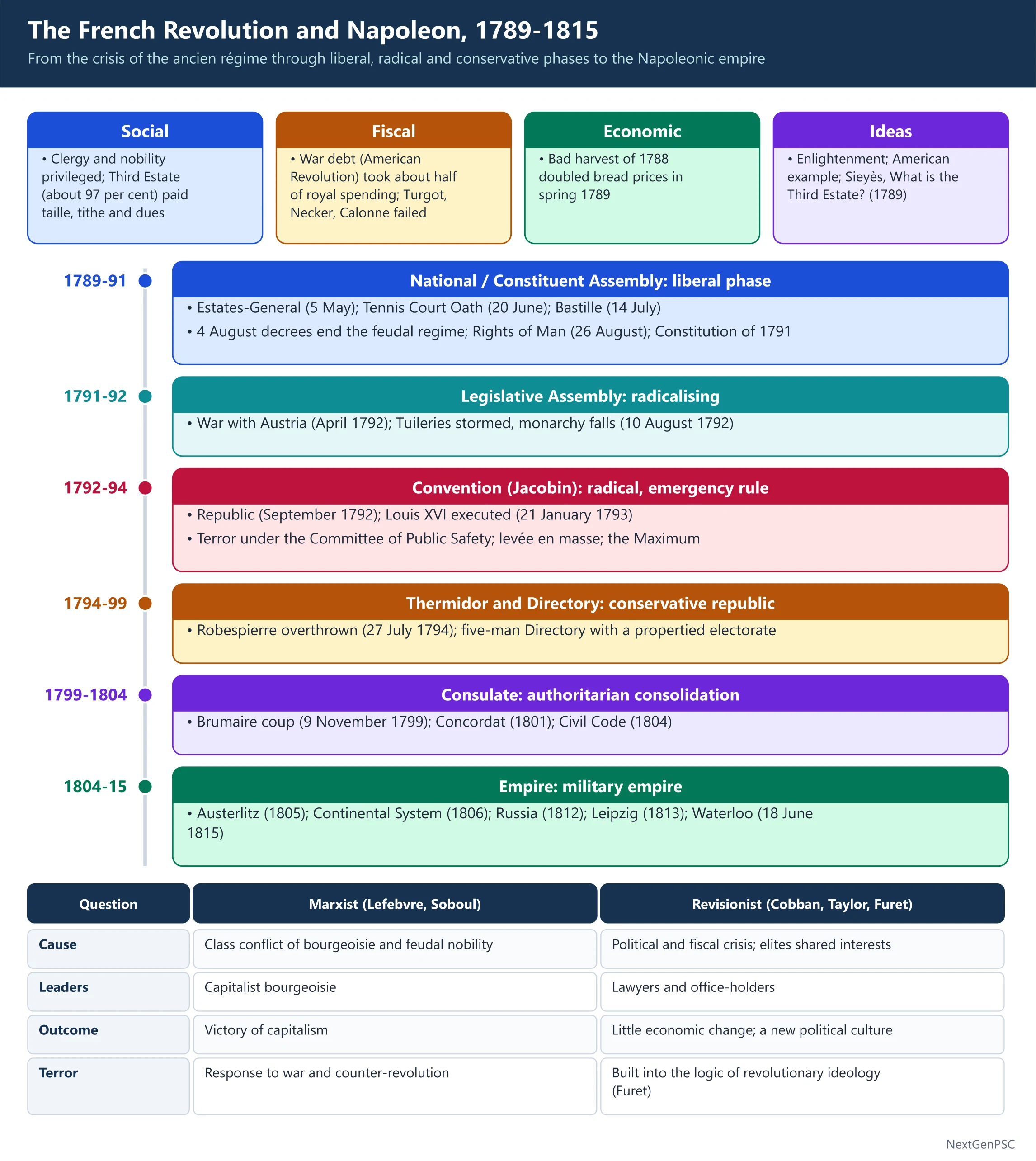
1. Causes: The Ancien Régime in Crisis
Society of orders: the First Estate (clergy) and Second Estate (nobility) held privileges and tax exemptions, while the Third Estate, about 97 per cent of the population, carried the taille, tithe and seigneurial dues.
Fiscal crisis: wars, above all support for the American Revolution, left a debt whose interest consumed about half of royal spending; ministers Turgot, Necker and Calonne failed to reform taxes.
Aristocratic revolt: the Assembly of Notables (1787) and the parlements refused new taxes and demanded the Estates-General, which had not met since 1614.
Economic hardship: the bad harvest of 1788 doubled bread prices in spring 1789, linking urban and rural discontent.
Ideas: Enlightenment criticism of privilege and absolutism, the American example, and Sieyès's pamphlet What is the Third Estate? (January 1789), which answered 'Everything'.
2. The Liberal Revolution, 1789–1791
Estates-General (5 May 1789): the Third Estate demanded voting by head, not by order, and on 17 June proclaimed itself the National Assembly.
Tennis Court Oath (20 June): deputies swore not to separate until France had a constitution.
Fall of the Bastille (14 July): Parisians seized arms and stormed the royal fortress; the Great Fear swept the countryside in late July and early August as peasants attacked manor houses.
Night of 4 August: the Assembly decreed the abolition of the feudal regime, tithes and privileges (some dues were to be redeemed, and were finally abolished without compensation in 1793).
Declaration of the Rights of Man and of the Citizen (26 August): men are born and remain free and equal in rights; sovereignty resides in the nation; law is the expression of the general will.
October Days (1789): market women marched to Versailles and brought the royal family to Paris.
Reforms: Church lands nationalised and assignats issued, the Civil Constitution of the Clergy (1790) split the Church, and 83 departments replaced the provinces.
Constitution of 1791: a constitutional monarchy with 'active' citizens who paid a tax qualification, while the king's flight to Varennes (June 1791) destroyed trust in him.
3. The Radical Revolution, 1792–1794
War: France declared war on Austria in April 1792; the Brunswick Manifesto threatened Paris, and on 10 August 1792 crowds stormed the Tuileries and the monarchy fell.
Republic: the National Convention, elected by manhood suffrage, proclaimed the Republic in September 1792; Louis XVI was executed on 21 January 1793.
Girondins and Jacobins: the Montagnard Jacobins, backed by the Paris sans-culottes, expelled the Girondin deputies in June 1793.
Terror (1793–94): the Committee of Public Safety led by Robespierre ruled through revolutionary tribunals; about 17,000 people were officially executed and many more died in prison and in the civil war in the Vendée.
Emergency measures: the levée en masse (August 1793) conscripted the nation, the Maximum fixed prices, and a dechristianising campaign and new calendar were introduced.
Thermidor (27 July 1794): the Convention overthrew Robespierre, who was executed the next day.
4. Directory and Napoleon, 1795–1815
Directory (1795–99): a five-man executive with a propertied electorate, weak, corrupt and dependent on the army against royalists and radicals.
Coup of 18 Brumaire (9 November 1799): Napoleon Bonaparte, famous from Italy and Egypt, became First Consul; a plebiscite approved the new constitution.
Consolidation: the Concordat with the pope (1801), the Bank of France (1800), centralised prefects, lycées and the Legion of Honour.
Civil Code (1804): equality before the law, secure property, abolition of feudalism and a secular state, but strong paternal authority over wives and children; Napoleon also restored slavery in the colonies in 1802.
Empire: crowned Emperor in December 1804; victories at Austerlitz (1805), Jena (1806) and Wagram (1809); the Holy Roman Empire abolished (1806); satellite kingdoms ruled by his family.
Continental System (Berlin Decree, 1806): an attempt to ruin Britain by closing Europe to British goods, which hurt Europe and led to the Peninsular War (1808–14) and the invasion of Russia (1812).
Fall: defeat at Leipzig (1813), abdication (1814), exile to Elba, the Hundred Days, defeat at Waterloo (18 June 1815) and exile to St Helena.
5. Sources and Evidence
Cahiers de doléances: about 60,000 lists of grievances drawn up in 1789 show what each order and community wanted.
Contemporary witnesses: Arthur Young's Travels in France recorded rural poverty; Burke's Reflections on the Revolution in France (1790) attacked it, and Paine's Rights of Man (1791) defended it.
State records: debates in the Archives parlementaires, police reports, tribunal records and Napoleon's correspondence.
6. Analysis: Nature and Legacy
Achievements: end of feudalism and privilege, legal equality, national sovereignty, the metric system, a centralised modern state and the language of left and right.
Limits: women excluded from citizenship (Olympe de Gouges was guillotined in 1793), slavery abolished in 1794 but restored in 1802, and liberty sacrificed in the Terror.
Spread: Napoleonic armies exported codes, abolished feudal dues and Church privileges in conquered lands, and unintentionally awakened nationalism in Spain, Germany and Italy.
Colonies: the revolution set off the Haitian Revolution, and in India Tipu Sultan corresponded with the French and is said to have joined a Jacobin club at Seringapatam (the episode is reported in British sources and debated).
7. Historiography and Debates
Tocqueville: The Old Regime and the Revolution (1856) argued that the revolution continued the centralisation begun by the monarchy, and that it broke out where conditions were improving.
Classic (Marxist) interpretation: Jean Jaurès, Albert Mathiez and Georges Lefebvre (The Coming of the French Revolution, 1939) saw a bourgeois revolution against feudal aristocracy, with separate aristocratic, bourgeois, popular and peasant revolutions; Albert Soboul studied the sans-culottes.
Revisionist challenge: Alfred Cobban's lecture 'The Myth of the French Revolution' (1955) and The Social Interpretation of the French Revolution (1964) argued that the revolutionaries were lawyers and office-holders, not capitalists; George V. Taylor showed that noble and bourgeois wealth was largely of the same 'proprietary' kind.
Political culture: François Furet's Interpreting the French Revolution (1978) shifted the focus to language and the logic of popular sovereignty that led to the Terror; Lynn Hunt studied symbols and political culture.
Narrative and synthesis: William Doyle's Origins of the French Revolution (1980) and Simon Schama's Citizens (1989), which stressed violence from the start.
Napoleon: Pieter Geyl's Napoleon: For and Against (1949) showed how French historians alternately saw him as heir of the revolution or as its betrayer.
Dual revolution: Hobsbawm's The Age of Revolution (1962) paired the French political revolution with the British Industrial Revolution as the twin makers of the modern world.
8. Using It in the Exam
10 marks: one theme, such as the role of the Third Estate, the Declaration, or the Civil Code, with dates and one historian.
15 marks: causes in categories (fiscal, social, intellectual, immediate) or Napoleon as 'child of the revolution'.
20 marks: phases (liberal, radical, Thermidorian, Napoleonic), achievements and limits, spread across Europe, and the Lefebvre–Cobban–Furet debate.
Keywords: ancien régime, Third Estate, popular sovereignty, sans-culottes, Terror, Thermidor, Civil Code, bourgeois revolution.
Quotation: Article 1 of the Declaration: 'Men are born and remain free and equal in rights'; Zhou Enlai's reported remark that it is 'too early to say' its impact is now thought to refer to 1968, so avoid it.
| Phase | Years | Key events | Character |
|---|---|---|---|
| National/Constituent Assembly | 1789–91 | Bastille, 4 August decrees, Rights of Man, Constitution of 1791 | Liberal, constitutional monarchy |
| Legislative Assembly | 1791–92 | War with Austria, fall of the monarchy | Radicalising |
| Convention (Jacobin) | 1792–94 | Republic, regicide, Terror, levée en masse | Radical, emergency rule |
| Thermidor and Directory | 1794–99 | Fall of Robespierre, propertied republic | Conservative republic |
| Consulate | 1799–1804 | Brumaire coup, Concordat, Civil Code | Authoritarian consolidation |
| Empire | 1804–15 | Austerlitz, Continental System, Russia, Waterloo | Military empire |
| Question | Marxist (Lefebvre, Soboul) | Revisionist (Cobban, Taylor, Furet) |
|---|---|---|
| Cause | Class conflict of bourgeoisie and feudal nobility | Political and fiscal crisis; elites shared interests |
| Leaders | Capitalist bourgeoisie | Lawyers and office-holders |
| Outcome | Victory of capitalism | Little economic change; a new political culture |
| Terror | Response to war and counter-revolution | Built into the logic of revolutionary ideology (Furet) |
Mains points
- Causes questions: separate long-term (social structure, Enlightenment), medium-term (fiscal crisis, aristocratic revolt) and immediate (harvest of 1788, Estates-General) causes.
- Questions on Napoleon usually ask whether he consolidated or betrayed the revolution; give evidence for both (Civil Code, Concordat vs dictatorship, restoration of slavery).
- Use the Marxist–revisionist debate in every 20-mark answer; it is the single most valued piece of historiography in this topic.
- Do not neglect women, peasants and the colonies; they show breadth and fit current historiography.
- Explain the Terror through war, counter-revolution and ideology instead of simply condemning it.
- Common mistake: dating the Republic to 1789; it was proclaimed in September 1792.
- Link to later units: nationalism in Germany and Italy, the Vienna settlement and 1848.
Did you know?
- When the Bastille fell on 14 July 1789 it held only seven prisoners; its value was symbolic, and its stones were carved into souvenir models sold across France.
The American Civil War, Lincoln and the Abolition of Slavery
The American Civil War (1861–1865) was fought between the Union and eleven Southern states that seceded to form the Confederacy after Abraham Lincoln's election in 1860. At its root lay slavery and its expansion into the western territories. Begun as a war to save the Union, it became a war for freedom with the Emancipation Proclamation (1 January 1863) and ended with Union victory and the Thirteenth Amendment (1865) abolishing slavery, though Reconstruction failed to secure lasting equality for freed people.
In simple words
By the 1850s the United States was like a house split into two rooms that could not agree on one rule: the North ran on free labour and factories, the South on cotton grown by enslaved Black people. When Lincoln, who opposed spreading slavery, became president, the South broke away and war followed.
Lincoln first fought to keep the country united, then declared enslaved people in rebel areas free.
The North won and slavery was abolished.
UPSC asks about the causes, Lincoln's role and the meaning of emancipation.
1. Two Societies
The South: the cotton gin (Eli Whitney, 1793) made short-staple cotton profitable, and by 1860 about four million enslaved people worked in an economy that supplied most of the raw cotton for British mills.
The North: free labour, small farms, growing industry, railways and immigration; by 1860 it had a much larger population and most of the country's manufacturing.
Ideology: Northern Republicans praised 'free labor', while Southern leaders such as John C. Calhoun defended slavery as a 'positive good' and states' rights.
2. The Road to War, 1820–1861
Missouri Compromise (1820): Missouri entered as a slave state, Maine as free, and slavery was barred north of latitude 36°30' in the Louisiana Purchase.
Abolitionism: William Lloyd Garrison's The Liberator (1831), the formerly enslaved orator Frederick Douglass, and the Underground Railroad (Harriet Tubman) made slavery a moral issue.
Mexican War and the Compromise of 1850: new territory reopened the question; California entered free, but a harsh Fugitive Slave Act made Northerners complicit in returning escapees.
Uncle Tom's Cabin (1852): Harriet Beecher Stowe's novel sold hundreds of thousands of copies and hardened Northern opinion.
Kansas–Nebraska Act (1854): Stephen Douglas's 'popular sovereignty' repealed the Missouri line, causing violence in 'Bleeding Kansas' and the founding of the Republican Party.
Dred Scott case (1857): Chief Justice Roger Taney ruled that Black people were not citizens and that Congress could not ban slavery in the territories.
Lincoln–Douglas debates (1858): Lincoln, who had said that a house divided against itself cannot stand, argued that slavery must not spread.
John Brown's raid (1859): an attack on the arsenal at Harpers Ferry to start a slave rising; his execution made him a martyr in the North and a symbol of Northern aggression in the South.
Election of 1860: Lincoln won without a single Southern electoral vote; South Carolina seceded in December 1860, and the Confederate States of America formed in February 1861 under Jefferson Davis.
3. The War, 1861–1865
Outbreak: Confederates fired on Fort Sumter on 12 April 1861; four more states then joined the seven already seceded, making eleven, while border slave states stayed in the Union.
Strategy: the Union blockaded Southern ports (the Anaconda Plan) and aimed to control the Mississippi; the South hoped British dependence on cotton would bring recognition, but it did not.
Turning points: Antietam (September 1862) stopped Lee's first invasion; Gettysburg and the fall of Vicksburg (July 1863) turned the war decisively.
Total war: Grant's war of attrition in Virginia and Sherman's march through Georgia (1864) destroyed the South's resources.
End: Lee surrendered to Grant at Appomattox Court House on 9 April 1865; Lincoln was shot by John Wilkes Booth on 14 April and died the next day.
Cost: traditionally about 620,000 soldiers died; a 2011 census-based estimate by J. David Hacker raised this to around 750,000.
4. Lincoln and Emancipation
Union first: in his reply to Horace Greeley (August 1862) Lincoln wrote that his paramount object was to save the Union, and not either to save or to destroy slavery.
Pressures: enslaved people fleeing to Union lines ('contrabands'), Confiscation Acts (1861, 1862), abolitionists and Radical Republicans, and the need to keep Britain and France out of the war.
Emancipation Proclamation: announced after Antietam (September 1862) and issued on 1 January 1863 as a war measure, it freed enslaved people in areas in rebellion, not in loyal border states.
Black soldiers: about 180,000 African Americans served in the Union Army, turning freedom into a cause they fought for themselves.
Gettysburg Address (19 November 1863): recast the war as a 'new birth of freedom' so that government of the people, by the people, for the people should not perish.
Thirteenth Amendment: passed by Congress in January 1865 and ratified in December 1865, it abolished slavery throughout the United States.
5. Reconstruction, 1865–1877
Amendments: the Fourteenth (1868) gave citizenship and equal protection, and the Fifteenth (1870) barred racial denial of the vote to men.
Achievements: the Freedmen's Bureau, schools and churches, and Black men elected to state legislatures and Congress.
Reaction: Black Codes, the Ku Klux Klan, sharecropping and debt; the Compromise of 1877 withdrew federal troops, and Jim Crow segregation followed, upheld in Plessy v. Ferguson (1896).
6. Sources and Evidence
Documents: Lincoln's speeches and letters, the Proclamation, secession declarations of Southern states (several of which named slavery explicitly), and Confederate Vice-President Alexander Stephens's 'Cornerstone Speech' (March 1861).
Voices of the enslaved: Frederick Douglass's Narrative (1845) and the Works Progress Administration interviews with former slaves in the 1930s.
Other records: census data, army records and the photographs of Mathew Brady's studio, among the first images of war dead.
7. Analysis and Historiography
Causes debate: Southern 'Lost Cause' writers stressed states' rights and denied slavery's centrality; today most historians, using the secession documents, see slavery as the root cause.
Economic interpretation: Charles and Mary Beard's The Rise of American Civilization (1927) called the war a 'Second American Revolution' in which industrial capitalism defeated the planter class.
Revisionists: James G. Randall and Avery Craven (1930s–40s) blamed a 'blundering generation' of politicians for an avoidable war.
Free labour ideology: Eric Foner's Free Soil, Free Labor, Free Men (1970) showed that Republicans saw slavery as a threat to the free-labour society of the North.
Synthesis: James McPherson's Battle Cry of Freedom (1988) and David Potter's The Impending Crisis (1976) traced how the expansion of slavery broke the party system.
Self-emancipation: W.E.B. Du Bois's Black Reconstruction in America (1935) described the enslaved people's flight as a 'general strike', and Ira Berlin and others argued that enslaved people helped free themselves, not only Lincoln.
Lincoln: Foner's The Fiery Trial (2010) traced Lincoln's growth from opponent of slavery's expansion, who once favoured colonisation of freed people abroad, to champion of abolition.
Comparative view: Barrington Moore's Social Origins of Dictatorship and Democracy (1966) called it the last capitalist revolution, and Reconstruction is compared with emancipation in Russia (1861) and Brazil (1888).
8. Using It in the Exam
10 marks: Lincoln's role in abolition in four steps (Union first, Proclamation, Black soldiers, Thirteenth Amendment).
15 marks: causes of the war, tracing the crises of 1820, 1850, 1854, 1857 and 1860.
20 marks: causes, course in brief, emancipation, Reconstruction and its failure, historiography (Beard, Foner, McPherson, Du Bois), and global significance.
Keywords: sectionalism, free labour, popular sovereignty, secession, Emancipation Proclamation, Thirteenth Amendment, Reconstruction, self-emancipation.
Quotation: Lincoln's Second Inaugural (March 1865): 'With malice toward none, with charity for all'.
| Year | Event | Significance |
|---|---|---|
| 1820 | Missouri Compromise | 36°30' line divides slave and free territory |
| 1850 | Compromise of 1850 | Fugitive Slave Act angers the North |
| 1854 | Kansas–Nebraska Act | Popular sovereignty; Republican Party founded |
| 1857 | Dred Scott decision | Congress cannot ban slavery in territories |
| 1860 | Lincoln elected; South Carolina secedes | Secession crisis |
| 1861 | Fort Sumter | War begins |
| 1863 | Emancipation Proclamation; Gettysburg | War for freedom; turning point |
| 1865 | Appomattox; Lincoln killed; Thirteenth Amendment | Union victory; slavery abolished |
| 1868–70 | Fourteenth and Fifteenth Amendments | Citizenship and voting rights |
| 1877 | Compromise of 1877 | End of Reconstruction |
Mains points
- Causes: make slavery and its expansion the centre, but show how economic, constitutional (states' rights) and political (party breakdown) factors were tied to it.
- Lincoln questions: show the evolution of his policy from 'Union first' to emancipation, and the pressures (enslaved people, Radicals, war needs) that drove it.
- Note the limits of the Emancipation Proclamation (rebel areas only) and the need for the Thirteenth Amendment.
- Include the agency of enslaved people and Black soldiers; this is now central to the historiography.
- Add Reconstruction to show that abolition did not bring equality; examiners value this continuity.
- Common mistake: writing that the Proclamation freed all slaves on 1 January 1863.
- Use comparative points (Russian emancipation 1861, British abolition 1833) for 20-mark answers.
Did you know?
- The Gettysburg Address has only about 270 words and took around two minutes to deliver; the main speaker that day, Edward Everett, spoke for about two hours and later wrote to Lincoln that Lincoln had come nearer the central idea in two minutes than he had in two hours.
British Democratic Politics, 1815–1850: Reformers, Free Traders and Chartists
After 1815 Britain faced economic distress and demands for change, met at first by repression (Peterloo, 1819; the Six Acts). From the 1820s the state chose reform instead of revolution: Catholic Emancipation (1829), the Great Reform Act (1832), and Whig social laws. Middle-class free traders of the Anti-Corn Law League won the repeal of the Corn Laws (1846), while the working-class Chartists (1838–1848) demanded manhood suffrage and failed in their time, though most of their six points later became law.
In simple words
In 1815 Britain was ruled by a small club of landowners, and most people, even rich factory owners, had no vote. It was like a school where only the oldest families sat on the student council.
Step by step, through petitions, mass meetings and pressure, the club let others in: the middle class in 1832, cheaper bread for all in 1846, and working men only much later.
The Chartists asked for a vote for every man and lost at first, but won in the long run.
UPSC asks why Britain chose reform instead of revolution.
1. Britain After Waterloo
Unreformed system: Parliament was dominated by landed aristocracy; 'rotten' boroughs with few voters (Old Sarum) sent MPs while new industrial towns such as Manchester and Birmingham had none of their own.
Distress: demobilised soldiers, falling wages, high bread prices and the abolition of income tax (1816), which shifted the burden to indirect taxes on the poor.
Corn Law (1815): banned imports of foreign wheat until the home price reached 80 shillings a quarter, protecting landlords' rents at consumers' expense.
2. Repression and Radical Protest, 1815–1822
Radicals: William Cobbett's cheap Political Register and 'Orator' Henry Hunt demanded parliamentary reform; mass meetings at Spa Fields (1816) and the march of the Blanketeers (1817).
Government response: Lord Liverpool's Tory ministry suspended habeas corpus (1817) and used spies and informers.
Peterloo (16 August 1819): yeomanry and hussars charged a peaceful reform meeting of about 60,000 at St Peter's Field, Manchester; around 15–18 people were killed and hundreds injured.
Six Acts (1819): restricted public meetings, increased stamp duty on newspapers and gave magistrates search powers; the Cato Street Conspiracy (1820) to murder the cabinet was used to justify repression.
3. Liberal Toryism and Catholic Emancipation, 1822–1830
Reforming ministers: Robert Peel at the Home Office reformed criminal law and founded the Metropolitan Police (1829); William Huskisson reduced tariffs; George Canning pursued a liberal foreign policy.
Workers and dissenters: the Combination Acts against trade unions were repealed (1824), and the Test and Corporation Acts barring Protestant dissenters from office were repealed (1828).
Catholic Emancipation (1829): after Daniel O'Connell, a Catholic barred from sitting, won the County Clare election (1828), Wellington and Peel conceded Catholics' right to sit in Parliament to avoid revolt in Ireland.
4. The Great Reform Act (1832)
Crisis: the 1830 July Revolution in France, the Swing riots of farm labourers, and Wellington's refusal of any reform brought the Whigs under Earl Grey to power.
Struggle: the House of Lords rejected the bill (1831), riots broke out in Bristol, Nottingham and Derby, political unions such as Thomas Attwood's Birmingham Political Union mobilised, and in the 'Days of May' (1832) the king agreed to create new peers if needed, so the Lords gave way.
Terms: 56 boroughs lost both seats and 30 lost one; seats went to industrial towns and counties; in boroughs men occupying property worth 10 pounds a year got the vote.
Limits: the electorate grew by roughly half to about 650,000 in England and Wales (estimates vary), still only about one adult man in five; voting stayed open, and the 1832 Act for the first time explicitly said 'male persons', excluding women.
Macaulay's plea: in the debates T.B. Macaulay urged MPs to 'reform, that you may preserve', capturing the logic of concession to prevent revolution.
5. Whig Reforms of the 1830s
Abolition of slavery (1833): slavery ended in most of the empire, with 20 million pounds compensation to slave-owners and an 'apprenticeship' for the freed until 1838.
Factory Act (1833): limited child labour in textile mills and appointed the first factory inspectors.
New Poor Law (1834): shaped by Edwin Chadwick and Benthamite ideas, it ended outdoor relief for the able-bodied and created harsh union workhouses, hated by workers.
Municipal Corporations Act (1835): elected town councils replaced closed corporations.
Repression continued: the Tolpuddle Martyrs, Dorset labourers, were transported to Australia (1834) for swearing a union oath.
6. Free Traders and the Repeal of the Corn Laws
Anti-Corn Law League (1838): founded in Manchester, led by Richard Cobden and John Bright; it used the penny post, pamphlets, lecturers and registration of voters, a model of middle-class pressure politics.
Argument: cheap food would lower wage costs, expand exports and promote peace through trade; landlords were attacked as a parasitic class.
Peel's ministry (1841–46): revived income tax (1842) and cut many tariffs; the Irish potato famine (from 1845) convinced Peel that the Corn Laws must go.
Repeal (1846): passed with Whig votes while most Conservatives, led by Disraeli and Lord George Bentinck, voted against; the party split and Peel fell.
After repeal: the Navigation Acts were repealed (1849), and Britain became the leading free-trade nation of the mid-Victorian age.
7. Chartism, 1838–1848
Origins: anger at the 'betrayal' of 1832, the New Poor Law, the trade slump of 1837–42 and repression of unions.
People's Charter (1838): drafted by William Lovett of the London Working Men's Association (1836) with the help of Francis Place.
Six points: votes for all men over 21, secret ballot, no property qualification for MPs, payment of MPs, equal constituencies and annual parliaments.
Petitions: rejected by Parliament in 1839 (about 1.3 million signatures), 1842 (over 3 million claimed) and 1848; after the Kennington Common meeting of 10 April 1848 the last petition was found to have far fewer genuine signatures than the 5 million claimed.
Moral force vs physical force: Lovett preferred education and persuasion, while Feargus O'Connor, owner of the Northern Star (1837), used fiery language; the Newport Rising (November 1839) was crushed and its leader John Frost transported.
Strikes: the 'Plug Plot' general strike of 1842 in the northern industrial districts.
Decline: better trade after 1848, the repeal of the Corn Laws, divisions among leaders and the strength of the state.
Legacy: five of the six points became law later: property qualification abolished (1858), secret ballot (1872), more equal constituencies (1885), payment of MPs (1911), manhood suffrage (1918); only annual parliaments never came.
8. Sources and Evidence
Records: Hansard debates, the Charter and petitions, the Northern Star, Home Office papers on unrest, and reports such as Chadwick's Report on the Sanitary Condition of the Labouring Population (1842).
Witnesses: Samuel Bamford's account of Peterloo, Engels's Condition of the Working Class, and novels such as Disraeli's Sybil (1845), with its idea of 'two nations', the rich and the poor.
9. Analysis and Historiography
Why no revolution: timely concessions, a flexible ruling class, middle class drawn into the system in 1832, a strong state and economic recovery.
Halévy thesis: the French historian Élie Halévy argued in his History of the English People in the Nineteenth Century that Methodism channelled discontent away from revolution.
Whig interpretation: older historians saw steady progress toward democracy; Herbert Butterfield's The Whig Interpretation of History (1931) criticised such hindsight.
Economic view of Chartism: Mark Hovell (1918) and Asa Briggs's Chartist Studies (1959) linked it to hunger and local economic conditions, the 'knife and fork question' in the phrase of the Chartist preacher J.R. Stephens.
Political view: Gareth Stedman Jones's 'Rethinking Chartism' in Languages of Class (1983) argued that Chartism was a political movement in the radical tradition, blaming a corrupt state, not capitalism; Dorothy Thompson's The Chartists (1984) stressed its mass, national and class character.
Marxist view: E.P. Thompson's The Making of the English Working Class (1963) treated the period as the formation of working-class consciousness; Norman Gash studied Peel and the post-1832 system.
10. Using It in the Exam
10 marks: the six points of the Charter and why it failed, or the main terms and limits of the 1832 Act.
15 marks: 'Reform instead of revolution': repression, concession, middle-class alliance.
20 marks: trace 1815–1850 through repression, Liberal Toryism, 1832, Whig reforms, free trade and Chartism, with historiography and long-term legacy.
Keywords: rotten boroughs, Peterloo, Great Reform Act, ten-pound householder, Anti-Corn Law League, laissez-faire, People's Charter, moral and physical force.
Quotation: Macaulay (1831): 'Reform, that you may preserve'.
| Point | Became law |
|---|---|
| Vote for every man over 21 | Largely by the Representation of the People Act 1918 |
| Secret ballot | Ballot Act 1872 |
| No property qualification for MPs | 1858 |
| Payment of MPs | 1911 |
| Equal constituencies | Approached through redistribution in 1885 and later |
| Annual parliaments | Never adopted |
| Movement | Social base | Main aim | Outcome |
|---|---|---|---|
| Parliamentary reformers (1830–32) | Whig aristocrats, middle class, political unions | Redistribute seats; enfranchise property owners | Great Reform Act 1832 |
| Anti-Corn Law League (1838–46) | Manufacturers and merchants | Repeal of the Corn Laws; free trade | Repeal 1846 |
| Chartists (1838–48) | Artisans, factory and outworkers | Manhood suffrage and democratic reform | Failed then; most points later enacted |
Mains points
- The syllabus names three groups: structure answers around reformers, free traders and Chartists and show how their aims and social bases differed.
- For 'why Britain avoided revolution', combine repression, timely concession, the middle-class alliance of 1832 and economic recovery.
- On Chartism, give the six points, the three petitions, the moral/physical force split, causes of failure and long-term success.
- Use the Stedman Jones vs economic-interpretation debate on Chartism; it is the key historiographical point.
- Do not overstate 1832; stress that it enfranchised property, not people, and excluded women explicitly.
- Link free trade to empire and to India (free-trade imperialism and the decline of Indian textiles) when the question allows.
- Common mistake: confusing the 1815 Corn Law with the 1846 repeal date, or attributing repeal to the Whigs alone; Peel, a Conservative, carried it.
Did you know?
- The name 'Peterloo' was a bitter joke coined by the radical press, mixing St Peter's Field with Waterloo, where British soldiers had won glory four years earlier.
- Memory trick for the Charter: 'BAMPES', Ballot, Annual parliaments, Manhood suffrage, Payment of MPs, Equal constituencies, and no Seat qualification.
UPSC Previous Year Questions: Enlightenment, Revolutions and Modern Politics
From 2014 to 2026 UPSC asked 53 question parts (700 marks) from this chapter in History Paper II: 36 of 10 marks and 17 of 20 marks. The most-asked topics are the French Revolution and Napoleon (14 parts), the Enlightenment (11) and socialist ideas up to Marx (8), with regular questions on the Reform Act and Chartism. Every question below has a model answer written to the UPSC word limit.
In simple words
Read the question and the approach line first, then write your own answer in the time limit: about 7 minutes for 10 marks (150 words) and 12 minutes for 20 marks (250 words).
Only then read the model answer and compare: did you cover both sides, name the right thinkers, works and dates, and answer the directive word (critically examine, explain, discuss)?
Note the historians and key terms you missed, revise the matching topic in the notes, and rewrite one weak answer a week later.
1. The Enlightenment: Kant, Rousseau and Its Spread to the Colonies
Example 1 (UPSC 2026, 10 marks): "Immanuel Kant was an advocate of liberalism and nationalism." Critically examine.
Paper and question: Paper II, Q5(a)
Approach: Test both labels separately: show Kant's liberalism from his political writings, then show that he was a cosmopolitan rather than a nationalist, and note how later thinkers drew nationalism out of his idea of autonomy.
Immanuel Kant (1724–1804) defined Enlightenment in 1784 as humanity's emergence from self-incurred immaturity. His political thought is rightly called liberal, but the label 'nationalist' needs qualification.
Liberalism: Kant made individual autonomy the basis of morality, demanded freedom of the pen, and in Perpetual Peace (1795) asked every state to have a 'republican' constitution resting on the rule of law, legal equality and the separation of executive and legislative power.
Not a nationalist: Kant's horizon was cosmopolitan. Perpetual Peace proposed a federation of free states and a 'cosmopolitan right' of hospitality, not the glorification of a nation. The language-based nationalism of Herder and Fichte (Addresses to the German Nation, 1807–08) was not his.
Yet Elie Kedourie in Nationalism (1960) argued that Kant's doctrine of self-determination, reworked by Fichte, became a philosophical root of nationalism.
Kant was thus a liberal and a cosmopolitan; nationalism was a later, indirect offshoot of his ideas rather than his own position.
Example 2 (UPSC 2025, 10 marks): “Anti-clericalism of the Enlightenment echoed the sentiments of the Renaissance and the Reformation. Yet it neither endorsed the paganism of the Renaissance nor did it share the faith of Reformation.” Discuss.
Paper and question: Paper II, Q7(c)
Approach: Show the continuity of anti-clericalism from Renaissance and Reformation, then explain how the Enlightenment differed from both: rational deism and scepticism instead of pagan revival or renewed faith.
The philosophes attacked the power and intolerance of the clergy; Voltaire's cry 'écrasez l'infâme' (crush the infamous thing) summed up their hostility to the persecuting Church.
Echo of earlier movements: Renaissance humanists had already mocked clerical ignorance and exposed forgery, as in Lorenzo Valla's proof that the Donation of Constantine was false and Erasmus's Praise of Folly (1511). The Reformation attacked papal corruption, indulgences and priestly mediation. The Enlightenment inherited this critical spirit.
Not pagan: the philosophes admired the classical critical temper, and Peter Gay even called the movement 'the rise of modern paganism'; but they revived no pagan cults. Their alternative was deism, natural religion and, in d'Holbach, open atheism.
Not the faith of the Reformation: Luther and Calvin sought a purer Christianity resting on scripture and grace, whereas the philosophes made reason, not revelation, the judge of belief and preached toleration.
Since the Scottish and German Enlightenments often worked within religion, the contrast was not absolute; still, Enlightenment anti-clericalism was distinctively secular and rational.
Example 3 (UPSC 2024, 10 marks): The ideas raised by Enlightenment thinkers were profoundly unsettling and challenging to old regime society and political order. Critically examine.
Paper and question: Paper II, Q5(a)
Approach: Show how Enlightenment ideas challenged the Church, absolutism and privilege, with examples of the old regime's reaction, then qualify by noting the moderate, reformist side of many philosophes.
The Enlightenment applied reason to every inherited authority, which was deeply unsettling in an old regime resting on divine right, privilege and an established Church.
Challenge to Church and belief: Voltaire's attacks on intolerance and Diderot and d'Alembert's Encyclopédie (1751–72) treated religion critically; its licence was revoked in 1759.
Challenge to absolutism: Montesquieu's Spirit of the Laws (1748) praised the separation of powers, and Rousseau's Social Contract (1762) placed sovereignty in the people, undermining divine right.
Challenge to privilege: Natural-rights theory implied legal equality, and Robert Darnton has shown how forbidden books desacralised the monarchy.
Limits: many philosophes were reformers, not revolutionaries. Voltaire and Diderot courted Frederick II and Catherine II, and rulers adopted parts of the programme as enlightened absolutism; Roger Chartier warns against seeing ideas as a direct cause of 1789.
The ideas were indeed corrosive of the old order's legitimacy, even though most of their authors sought reform from above.
Example 4 (UPSC 2023, 10 marks): Enlightenment was not confined to scientific revolution alone, but humanism and ideas of progress too were its inseparable constituents. Examine.
Paper and question: Paper II, Q6(c)
Approach: Accept the scientific basis, then show humanism and the idea of progress as equally essential parts, with thinkers and works for each, and end on how the three combined.
The Enlightenment drew confidence from the Scientific Revolution, especially Newton's Principia (1687), which showed nature governed by simple laws. Voltaire popularised Newton in France. But the movement was more than applied science.
Humanism: the philosophes put human welfare and dignity at the centre. Beccaria's On Crimes and Punishments (1764) attacked torture, Voltaire defended victims of intolerance, and Kant taught that every person must be treated as an end.
Progress: the belief that humanity could improve through knowledge ran through Turgot's lectures (1750) and Condorcet's Sketch for a Historical Picture of the Progress of the Human Mind (1795), which predicted equality between nations and sexes. Adam Smith expected commerce to raise living standards.
Toleration and natural rights completed the programme.
Science supplied the method, humanism the purpose and progress the hope; together they made the Enlightenment a programme for reforming society, not merely for understanding nature.
Example 5 (UPSC 2022, 10 marks): 'Rousseau kindled a hope which became the spirit of the Enlightenment'. Critically examine.
Paper and question: Paper II, Q5(a)
Approach: Explain what hope Rousseau kindled (freedom, equality, popular sovereignty, educability), then show where he stood apart from the mainstream Enlightenment, and judge.
Jean-Jacques Rousseau (1712–78) kindled the hope that men, naturally good, could recover freedom and equality by remaking society on just principles.
The hope: his Discourse on Inequality (1755) blamed private property and society, not human nature, for oppression. The Social Contract (1762) offered a remedy: a community governed by the general will in which the people are sovereign. Émile (1762) argued that education could form free and virtuous citizens. These ideas inspired Kant and the Jacobins.
But apart from the mainstream: his Discourse on the Sciences and Arts (1750) argued that progress in arts and sciences had corrupted morals, challenging the philosophes' faith in progress. He exalted feeling over reason, preparing the way for Romanticism.
J.L. Talmon later traced 'totalitarian democracy' to the general will, while others see him as the prophet of democratic equality.
Rousseau gave the Enlightenment its most powerful political hope, but he did so partly as its internal critic; his spirit was one current, not the whole of it.
Example 6 (UPSC 2021, 20 marks): What was "enlightened" about the Age of Enlightenment?
Paper and question: Paper II, Q6(a)
Approach: Begin with Kant's definition, then set out what was genuinely 'enlightened' (reason, toleration, rights, humanitarian reform, progress, public sphere), then the blind spots and modern critiques, and end with a balanced judgement.
Kant's essay What is Enlightenment? (1784) defined it as humanity's release from self-incurred immaturity, the courage to use one's own understanding without another's guidance. Contemporaries saw their age as one of light dispelling the darkness of superstition, tradition and arbitrary power.
Reason and criticism: inspired by Newton and Locke, the philosophes judged beliefs and institutions by reason and evidence. The Encyclopédie (1751–72) of Diderot and d'Alembert aimed to gather all useful knowledge.
Toleration and humanity: Locke's Letter Concerning Toleration (1689), Voltaire's defence of Jean Calas, and Beccaria's attack on torture (1764) produced real reforms; Frederick II largely abolished torture in 1740 and Joseph II issued the Edict of Toleration (1781).
Rights and government by consent: Locke's natural rights, Montesquieu's separation of powers and Rousseau's popular sovereignty fed into the American Declaration (1776) and the French Declaration of the Rights of Man (1789).
Progress and the public sphere: Turgot and Condorcet believed human improvement was possible; salons, academies, coffee houses and periodicals created what Habermas called a public sphere of critical opinion.
Limits: rights were not extended equally. Rousseau confined women to the home, which Mary Wollstonecraft answered in 1792; Hume and Kant wrote racial hierarchies; slavery was attacked by Raynal and Diderot but tolerated by many. Several philosophes trusted enlightened despots rather than the people.
Critiques: Adorno and Horkheimer's Dialectic of Enlightenment (1944/1947) argued that instrumental reason became domination, while Jonathan Israel distinguishes a radical, democratic Enlightenment from a moderate one.
What was enlightened was the method of free criticism and the universal claims it produced; that those claims were applied selectively was later exposed by the same critical reason.
Example 7 (UPSC 2020, 10 marks): "The principles of Enlightenment were in some ways a continuation of the discoveries and theories of the Scientific Revolution." Critically examine.
Paper and question: Paper II, Q5(a)
Approach: Show the continuity of method and confidence from the Scientific Revolution to the Enlightenment, then show its other sources and its extension of science to society, and conclude.
The Scientific Revolution, from Copernicus (1543) to Newton's Principia (1687), showed that nature obeyed laws discoverable by observation and mathematics. The Enlightenment was in many ways its continuation.
Continuity: Bacon's empiricism and Newton's method became the model of knowledge. Locke's Essay Concerning Human Understanding (1690) argued that ideas came from experience. Voltaire's Letters on the English (1733–34) spread Newtonian science.
Extension to society: if nature had laws, so did society. Montesquieu searched for the laws of political systems, the Physiocrats and Adam Smith for natural economic laws, and deists pictured God as a clockmaker who did not interfere.
But not only science: the Enlightenment also drew on Renaissance humanism, the scepticism of Bayle, English constitutional thought and the growth of print. Rousseau even doubted that the sciences improved morals.
The Scientific Revolution supplied the method and the confidence, but the Enlightenment turned these into a critique of politics, religion and society.
Example 8 (UPSC 2018, 20 marks): Explain the major ideas of Enlightenment. Discuss the contribution of Rousseau in Enlightenment.
Paper and question: Paper II, Q6(a)
Approach: Part one: the major ideas of the Enlightenment with thinkers and works. Part two: Rousseau's distinctive contribution, its influence and its tensions with the mainstream.
The Enlightenment was the European intellectual movement of the late seventeenth and eighteenth centuries that sought to apply reason to nature, religion, politics and society. Its centres were Paris, Edinburgh, Berlin and London.
Reason and empiricism: following Newton and Locke, the philosophes held that knowledge came from experience and reason, not authority. Diderot and d'Alembert's Encyclopédie (1751–72) aimed to spread useful knowledge.
Natural rights and limited government: Locke's Two Treatises (1689) argued for life, liberty and property and government by consent; Montesquieu's Spirit of the Laws (1748) proposed the separation of powers.
Toleration, secularism and humanity: Voltaire fought religious persecution, deism replaced revealed religion for many, and Beccaria (1764) attacked torture and the death penalty. Progress: Turgot and Condorcet believed in the improvement of humanity, and Adam Smith's Wealth of Nations (1776) argued for free trade.
Rousseau's contribution: his Discourse on Inequality (1755) traced inequality to private property and society. The Social Contract (1762), opening with 'Man is born free, and everywhere he is in chains', placed sovereignty in the people and made the general will the basis of legitimate law. Émile (1762) gave a child-centred theory of education.
Influence: Kant credited Rousseau with teaching him to respect the common man; Robespierre and the Jacobins revered him, and his popular sovereignty shaped modern democracy and nationalism.
Tension: Rousseau also criticised the Enlightenment's faith in the arts and sciences (1750), quarrelled with Voltaire and Diderot, and valued sentiment, which links him to Romanticism; J.L. Talmon saw in the general will the seed of totalitarian democracy.
Rousseau was thus both the Enlightenment's most radical democrat and its sharpest internal critic, which is why his influence outlasted that of many contemporaries.
Example 9 (UPSC 2017, 10 marks): “Kant’s redefinition of reason and his rehabilitation of conscience marked a high point in the intellectual reaction against dominant rationalism of the Enlightenment.” Critically examine.
Paper and question: Paper II, Q5(a)
Approach: Explain what Kant changed in the idea of reason and morality, show why it can be read as a reaction against rationalism, then show he was also the Enlightenment's culmination.
Kant (1724–1804) wrote when Hume's scepticism had shaken confidence in reason.
Redefinition of reason: in the Critique of Pure Reason (1781) Kant argued that the mind does not simply copy nature; it orders experience through its own forms and categories. Reason cannot prove God, freedom or the soul, which limited the rationalism of Leibniz and Wolff.
Rehabilitation of conscience: the Critique of Practical Reason (1788) grounded morality in the inner moral law, the categorical imperative, binding regardless of consequences.
Reaction? By limiting knowledge to make room for faith and duty, Kant opened the way to German idealism and Romanticism; Isaiah Berlin saw his stress on the autonomous will as a root of the Romantic revolt.
Or culmination? Yet Kant also wrote What is Enlightenment? (1784), defended free public reason and grounded morality in reason, not revelation.
Kant corrected the Enlightenment's overconfident rationalism from within rather than rejecting it.
Example 10 (UPSC 2014, 10 marks): "Rousseau strove to reconcile the liberty of the individual and the institution of Government through a new vision of the Contract-Theory of Government." Critically examine.
Paper and question: Paper II, Q5(a)
Approach: Explain the problem Rousseau set himself and his solution (contract, general will, sovereignty of the people), contrast with Hobbes and Locke, then examine whether liberty is really preserved.
Jean-Jacques Rousseau's Social Contract (1762) set out to reconcile authority and freedom: each, uniting with all, should still obey only himself.
Rousseau's solution: each person gives himself wholly to the community, and the community is governed by the general will, the will of all citizens for the common good. Since every citizen shares in making the law, obeying it is obedience to oneself.
New vision of the contract: Hobbes (1651) gave sovereignty to an absolute ruler and Locke (1689) to a limited government. Rousseau kept sovereignty inalienable and indivisible in the people; government was only their agent, removable at will.
Criticism: his remark that a person who refuses to obey the general will may be 'forced to be free' troubled liberals. Benjamin Constant (1819) argued that Rousseau confused ancient collective liberty with modern individual liberty, and J.L. Talmon linked the general will to Jacobin dictatorship.
Rousseau made popular sovereignty the foundation of legitimate government, but his reconciliation rests on civic virtue and risks subordinating the individual to the collective.
Example 11 (UPSC 2014, 10 marks): "Enlightened despots (Europe) were not necessarily politically liberal." Critically examine.
Paper and question: Paper II, Q5(c)
Approach: Define enlightened despotism, show its genuine reforms through Frederick II, Joseph II and Catherine II, then show why it was not politically liberal.
Enlightened despotism describes rulers of the later eighteenth century, notably Frederick II of Prussia (1740–86), Catherine II of Russia (1762–96) and Joseph II of Austria (1780–90), who borrowed Enlightenment ideas to make their states stronger and more efficient.
Enlightened side: Frederick, the self-styled first servant of the state, largely abolished torture and promoted toleration. Joseph II issued the Edict of Toleration (1781) and the patent of 1781 abolishing personal serfdom. Catherine drew on Montesquieu and Beccaria in her Nakaz (1767).
Not politically liberal: none accepted limits on royal power, representative assemblies or popular sovereignty. Catherine's Legislative Commission was dismissed, and after Pugachev's revolt (1773–75) she extended serfdom and gave the nobility its Charter (1785). Frederick kept the Junker-serf order intact.
Reform served the state: efficient taxation, armies and power politics, seen in Frederick's seizure of Silesia (1740) and the partition of Poland (1772).
Enlightened despots were reformers in administration and law, but their aim was rational absolutism, not liberty; the statement is largely valid.
2. Socialist Ideas up to Marx and the Spread of Marxian Socialism
Example 12 (UPSC 2025, 10 marks): “The pre-Marxian socialist thinkers envisioned socialist societies without fully considering the practical mechanisms for achieving or maintaining them.” Critically examine.
Paper and question: Paper II, Q5(e)
Approach: Accept that most pre-Marxian socialists relied on persuasion and model communities without a theory of how change would come, then show the exceptions where practical mechanisms were proposed or achieved.
The socialists before Marx, whom Engels called 'utopian' in Socialism: Utopian and Scientific (1880), criticised competitive capitalism and imagined cooperative societies.
Validity of the statement: Charles Fourier designed detailed phalanstères but waited in vain for a rich patron to fund one. Saint-Simon looked to bankers and industrialists to reorganise society voluntarily. Robert Owen's New Harmony (1825) soon broke up. They had no theory of how power would be won and relied on moral appeal to the propertied.
But practical mechanisms existed: Owen's New Lanark showed that humane conditions could be profitable, and the Rochdale Pioneers (1844) built a lasting cooperative model. Louis Blanc proposed state-financed social workshops, Proudhon a People's Bank (1849), and Blanqui an armed seizure of power by a disciplined minority.
Saint-Simonian ideas influenced banking and large public works under the Second Empire.
The statement holds for the community-builders, but pre-Marxian socialism was more practical than the 'utopian' label suggests.
Example 13 (UPSC 2023, 20 marks): Marxian socialism claims itself to be a scientific socialist theory capable of explaining the history of humankind. Discuss.
Paper and question: Paper II, Q6(b)
Approach: Explain why Marxism claimed to be scientific and how it explained history (historical materialism, modes of production, class struggle, surplus value), then assess its strengths and the main criticisms, and conclude.
Marx and Engels distinguished their theory from earlier 'utopian' socialism by claiming that it rested on the laws of historical development. Engels's Socialism: Utopian and Scientific (1880) named the two discoveries he credited to Marx: the materialist conception of history and the theory of surplus value.
Historical materialism: in the Preface to A Contribution to the Critique of Political Economy (1859) Marx argued that the economic base, the forces and relations of production, conditions the legal, political and ideological superstructure. History moves through modes of production: primitive communal, ancient slave, feudal and capitalist, with an 'Asiatic' mode outside the European sequence.
Class struggle: the Communist Manifesto (1848) declared that the history of all hitherto existing society is the history of class struggles. Each mode creates the class that will overthrow it.
Capitalism and its end: Capital (vol. I, 1867) explained profit as unpaid labour extracted from workers, and predicted concentration of capital, crises and the growth of a proletariat that would establish socialism through revolution.
Strengths: it made economic and social structures central to history and shaped historians such as Hobsbawm, E.P. Thompson, D.D. Kosambi and R.S. Sharma.
Criticisms: Karl Popper argued in The Poverty of Historicism (1957) that a theory claiming laws of history cannot be scientifically tested. Max Weber's Protestant Ethic (1905) stressed ideas as causes. Revolution came in Russia and China, not industrial Britain, and Bernstein's revisionism noted that workers' conditions improved. Thompson stressed human agency against rigid determinism, and the 'Asiatic mode' fitted India poorly.
Marxism is best seen as a powerful framework for analysing history, not a predictive science; its claim to scientific certainty has not survived, but its questions remain central to historical writing.
Example 14 (UPSC 2022, 10 marks): Engels did much more than Marx himself to popularise the ideas of Marxism. Critically examine.
Paper and question: Paper II, Q5(c)
Approach: Set out Engels's contributions (writings, editing, finance, organisation, popular expositions), weigh them against Marx's original work, and note the debate on whether Engels simplified Marx.
Friedrich Engels (1820–95), Marx's lifelong collaborator, did much to make Marx's theory a widely read doctrine.
Engels's role in popularising: his Condition of the Working Class in England (1845) gave Marxism its empirical picture of industrial misery, and he co-wrote the Communist Manifesto (1848). Anti-Dühring (1878) and its extract Socialism: Utopian and Scientific (1880) presented Marxism as a complete world view in accessible form. After Marx's death (1883) he edited volumes II (1885) and III (1894) of Capital, and advised the parties of the Second International (1889).
Marx's own primacy: the theory of surplus value, the critique of political economy and the analysis of class struggle were Marx's. Engels's financial support made Marx's work possible, not a substitute for it.
Debate: scholars such as Terrell Carver argue that Engels turned Marx's critical method into a deterministic 'scientific' system.
Engels was the chief populariser of Marxism, though the doctrine he spread was Marx's creation.
Example 15 (UPSC 2019, 10 marks): How would you explain the nature of pre-Marxian Socialism?
Paper and question: Paper II, Q5(e)
Approach: Define pre-Marxian socialism, set out its common features with thinkers, then show its diversity, and end with why Engels called it utopian.
Pre-Marxian socialism arose in Britain and France between the 1790s and 1848 in reaction to the Industrial and French Revolutions.
Common features: it criticised competition, private profit and the misery of the new working class. It was moral and humanitarian, appealing to reason and justice rather than to class conflict. It favoured association and cooperation: Fourier's phalanstères, Owen's model communities at New Lanark and New Harmony, and Saint-Simon's society organised by producers.
Diversity: Saint-Simon was a technocrat who looked to industrialists; Proudhon (What is Property?, 1840) was an anarchist who distrusted the state; Louis Blanc (Organisation of Labour, 1839) wanted state-aided workshops; Babeuf (1796) and Blanqui planned insurrection. So it was not uniformly peaceful.
Limits: it usually lacked an analysis of historical change and relied on the goodwill of the rich, which is why Engels called it utopian in 1880.
It was ethical, experimental and varied, and it supplied Marx with many of his criticisms of capitalism.
Example 16 (UPSC 2018, 10 marks): "With the writings of Karl Marx, Socialism assumed the form of Scientific Socialism." Critically examine.
Paper and question: Paper II, Q5(a)
Approach: Explain what made Marx's socialism 'scientific' in his and Engels's claim, then examine the claim critically.
The term scientific socialism comes from Engels's Socialism: Utopian and Scientific (1880), which contrasted Marx's system with the moral schemes of Saint-Simon, Fourier and Owen.
Basis of the claim: Marx tried to show that socialism was the outcome of historical laws, not a wish. Historical materialism explained social change by changes in the mode of production; the Communist Manifesto (1848) made class struggle the motor of history; and Capital (1867) used the labour theory of value to explain profit as surplus value taken from workers.
Agency: unlike the utopians, Marx named the working class as the agent of change and linked theory to organisation through the First International (1864).
Criticism: Karl Popper argued that Marxist predictions were framed so they could not be refuted. The expected revolution in advanced countries did not come, and Bernstein's Evolutionary Socialism (1899) noted that capitalism was adapting.
With Marx, socialism gained a systematic theory of history and economics, but its claim to scientific certainty was more a programme than a proof.
Example 17 (UPSC 2016, 10 marks): “Karl Marx applied his critical intelligence to Wealth of Nations ... Where Smith had seen only the sunlight, Marx saw only the shadows thrown upon the human scene by the unimpeded exercise of individual liberty ...” Elucidate.
Paper and question: Paper II, Q5(a)
Approach: Explain the contrast in the quotation (Smith's harmony of self-interest versus Marx's exploitation), show how Marx built on and inverted Smith, then qualify both halves of the image.
Adam Smith's Wealth of Nations (1776) argued that individuals pursuing self-interest in free markets were led, as if by an invisible hand, to promote the general good, and that the division of labour multiplied productivity.
Marx's critique: Marx took up the labour theory of value of Smith and Ricardo but drew opposite conclusions. In Capital (1867) he argued that profit was surplus value, unpaid labour taken from workers; that competition concentrated capital and created a reserve army of the unemployed; and that the division of labour produced alienation, a theme of his 1844 Manuscripts.
Qualification: the contrast is overdrawn. Smith himself warned that the repetitive division of labour stunted workers' minds and that employers combined to keep wages low. Marx, for his part, praised in the Communist Manifesto (1848) the enormous productive achievements of the bourgeoisie.
Marx thus did not reject Smith but subjected classical political economy to critical analysis, turning its concepts into a theory of capitalism's contradictions.
Example 18 (UPSC 2015, 10 marks): "France was even more fertile than Britain in producing new socialist theories and movements, though bore less concrete results in France than Britain." Critically examine.
Paper and question: Paper II, Q5(a)
Approach: Show France's fertility in socialist theory, then Britain's more concrete results, and test both halves of the statement.
Between 1800 and 1848 both France and Britain produced socialist ideas, but in different ways. Lenin later named French socialism, alongside German philosophy and English political economy, as one of the three sources of Marxism.
French fertility: France produced Babeuf's communism (1796), Saint-Simon's industrial planning, Fourier's phalanstères, Proudhon's mutualist anarchism (What is Property?, 1840), Louis Blanc's state-aided workshops (1839), Cabet's Icarian communism and Blanqui's revolutionary conspiracy. The revolutionary tradition of 1789 and 1830 made France a laboratory of ideas.
Fewer concrete results in France: in 1848 the Luxembourg Commission and the National Workshops failed, and the June Days ended in repression. Trade unions were legalised only in 1884.
Concrete results in Britain: Owen's New Lanark, the cooperative movement (Rochdale Pioneers, 1844), the trade unions after the repeal of the Combination Acts (1824), and pressure for Factory Acts (1833, 1847) yielded lasting gains, even if Owen's Grand National Consolidated Trades Union (1834) collapsed.
The statement is broadly valid, though French ideas had a long influence through Marx and the Paris Commune (1871).
Example 19 (UPSC 2014, 20 marks): "If we were to define our conception of the State, our answer would be that the State is the banker of the poor. The government would finance and supervise the purchase of productive equipments and the formation of social workshops." In light of the above statement of Louis Blanc, throw light on the Pre-Marxist Socialist Thought in Europe.
Paper and question: Paper II, Q6(b)
Approach: Explain Louis Blanc's idea of the state as the 'banker of the poor', place it within pre-Marxist socialist thought (Babeuf, Saint-Simon, Fourier, Owen, Proudhon, Ricardian socialists), and assess its character and limits.
The quotation sums up Louis Blanc's Organisation of Labour (1839). Blanc held that competition ruined workers and small producers, and that the democratic state should lend capital to set up social workshops run by workers, which would gradually displace private firms.
Blanc in 1848: as a member of the Provisional Government he headed the Luxembourg Commission on labour. The National Workshops, run by his opponents, were mere relief works; their closure provoked the June Days and the defeat of the workers.
The wider pre-Marxist tradition: Babeuf's Conspiracy of Equals (1796) sought communism by insurrection. Saint-Simon wanted society directed by producers and scientists for the poorest class. Fourier planned cooperative phalanstères. Robert Owen built New Lanark and New Harmony and inspired cooperatives and unions. Proudhon declared that property was theft but distrusted the state, preferring mutual credit. In Britain the Ricardian socialists, such as Thomas Hodgskin and William Thompson, argued that labour was entitled to its whole product.
Common character: moral criticism of competition, faith in association, and appeal to reason and the goodwill of the rich or the state rather than to class struggle.
Variety on the state: Blanc gave the state a central role; Proudhon and Owen relied on voluntary association; Saint-Simon on experts. This distinguishes Blanc as a forerunner of democratic and state socialism.
Limits: most lacked a theory of how capitalism developed and how power would be won, which Engels later criticised as utopian.
Blanc's idea of the state as banker of the poor marked a shift from private utopias to political action, foreshadowing both social democracy and the welfare state.
3. The European States System
Example 20 (UPSC 2026, 20 marks): The Vienna Settlement of 1815 was based on three principles, restoration, legitimacy and compensation. Elucidate.
Paper and question: Paper II, Q6(a)
Approach: Explain each principle with concrete territorial examples from the Final Act of 1815, then show where the settlement departed from them (balance of power, great-power interests, nationalism ignored), and assess.
The Congress of Vienna (September 1814 to June 1815), guided by Metternich, Castlereagh, Alexander I, Hardenberg and Talleyrand, redrew Europe after Napoleon. Its Final Act (9 June 1815) is explained through three principles.
Legitimacy: promoted by Talleyrand, it held that rightful dynasties should be restored. This let defeated France keep its old frontiers under a legitimate king and justified the return of old dynasties.
Restoration: the Bourbons returned in France (Louis XVIII), Spain (Ferdinand VII) and Naples; the Pope recovered his states; the House of Orange gained the Netherlands.
Compensation: powers that gave up territory were rewarded elsewhere. Austria surrendered the Austrian Netherlands and took Lombardy-Venetia; Prussia received part of Saxony, the Rhineland and Westphalia; Russia got most of Poland as a kingdom under the tsar; Sweden gained Norway for the loss of Finland; Britain kept colonies such as the Cape, Ceylon, Malta and Heligoland.
Balance of power: behind these principles lay containment of France. Belgium was united with Holland, Piedmont received Genoa and Prussia guarded the Rhine, while a German Confederation of 39 states replaced the Holy Roman Empire.
Principles bent: legitimacy was ignored for the republics of Genoa and Venice, which were not restored, and for the Saxon king, who lost territory. Nationalism and liberalism were disregarded in Italy, Germany, Poland and Belgium, which revolted in 1830.
Assessment: Harold Nicolson and Henry Kissinger (A World Restored, 1957) praised it for preventing a general war for a century, and Paul Schroeder saw a new system of consultation; liberal and nationalist historians saw it as reaction.
The three principles were real guides, but they served the great powers' interest in balance and stability.
Example 21 (UPSC 2019, 20 marks): Do you subscribe to the view that the Greek War of Independence was mired in contrasts of the best and the worst episodes? How did it affect the Concert of Europe?
Paper and question: Paper II, Q8(a)
Approach: Two parts: show the 'best' (idealism, philhellenism, liberation) and 'worst' (massacres, factionalism, great-power self-interest) of the Greek war, then its effect on the Concert of Europe.
The Greek War of Independence (1821–32) began with Alexander Ypsilantis's raid into the Danubian principalities and the rising in the Morea in 1821, inspired by the Philiki Etaireia.
The best: it was the first successful national liberation movement in post-Napoleonic Europe. It aroused European philhellenism: volunteers and funds came from Britain, France and Germany, and Lord Byron died at Missolonghi (1824). The Greek constitutions of 1822 and 1827 showed liberal aspirations.
The worst: it was savage on both sides. Greek forces massacred Muslim inhabitants at Tripolitsa (1821); Ottoman forces massacred and enslaved the people of Chios (1822), an event Delacroix painted. Ibrahim Pasha of Egypt devastated the Morea from 1825. The Greeks fought civil wars among themselves, and their first governor, Kapodistrias, was assassinated in 1831.
Great-power intervention: the Treaty of London (1827) bound Britain, France and Russia to impose an armistice; their fleets destroyed the Ottoman-Egyptian fleet at Navarino (October 1827). Russia's war of 1828–29 ended in the Treaty of Adrianople, and the London Protocol (1830) recognised Greek independence, with Otto of Bavaria as king (1832).
Effect on the Concert of Europe: Metternich's principle of intervention against revolution (Troppau, 1820) was reversed: great powers now intervened for rebels against a legitimate sovereign.
The war divided the powers. Austria was isolated, Britain under Canning broke with the congress system, and Russia gained influence, opening the Eastern Question.
Yet the Concert survived in a looser form: the powers jointly managed Greek and later Belgian independence, showing it could regulate change as well as resist it.
The war thus combined the noblest and the cruellest episodes, and it turned the Concert from a defender of the status quo into a looser forum of great-power management.
Example 22 (UPSC 2016, 10 marks): What is Metternich system? Assess its impact on Europe.
Paper and question: Paper II, Q5(b)
Approach: Define the Metternich system and its instruments, then assess its impact: decades of peace and repression, followed by its decline and collapse in 1848.
The Metternich system was the conservative European order of 1815–48 named after the Austrian chancellor. It aimed to preserve the Vienna Settlement and suppress liberalism and nationalism, which he saw as threats to the multinational Habsburg empire.
Instruments: the Quadruple Alliance (1815) and the congress system; the Holy Alliance of the eastern monarchs; the Carlsbad Decrees (1819), which imposed censorship and supervised German universities; the Troppau Protocol (1820), which claimed a right of intervention; and the crushing of revolts in Naples, Piedmont and Spain (1821–23).
Impact: it gave Europe a long period without a general war and kept Austria's position in Germany and Italy. But it delayed constitutional government, drove liberals into secret societies such as the Carbonari, and identified Austria with repression.
Decline: Britain withdrew under Canning, the Monroe Doctrine (1823) closed Latin America, and Greece (1830) and Belgium (1831) won independence. The revolutions of 1848 forced Metternich to flee Vienna.
The system bought stability at the price of postponing change.
4. The American Revolution and the Constitution
Example 23 (UPSC 2025, 20 marks): “The American Revolution was, in many respects, a manifestation of the Enlightenment in political, civil and ecclesiastical spheres.” Explain.
Paper and question: Paper II, Q6(b)
Approach: Take the three spheres named in the question one by one, showing Enlightenment ideas and the concrete measures they produced, then note other sources and the limits of the revolution's enlightenment, and conclude.
The American Revolution (1763–89) was fought by colonists steeped in the ideas of Locke, Montesquieu and the Scottish Enlightenment. Leaders such as Jefferson, Franklin, Madison and John Adams were men of the Enlightenment, and the revolution put many of its principles into practice.
Political sphere: the Declaration of Independence (1776) proclaimed self-evident truths of equality and unalienable rights to life, liberty and the pursuit of happiness, and the right to alter a government that destroyed them, echoing Locke. The state constitutions and the federal Constitution (1787) applied Montesquieu's separation of powers, checks and balances, a written fundamental law and popular sovereignty.
Civil sphere: Virginia abolished entail (1776) and primogeniture (1785), measures championed by Jefferson; penal codes were softened; Pennsylvania passed a gradual abolition act (1780) and other northern states followed; the Bill of Rights (1791) protected speech, press and fair trial. Gordon Wood argues the revolution dissolved a hierarchical society of deference.
Ecclesiastical sphere: the Anglican Church was disestablished in the southern states; the Virginia Statute for Religious Freedom (drafted by Jefferson, passed 1786) separated church and state; the Constitution banned religious tests for office (Article VI) and the First Amendment forbade a federal establishment of religion.
Other sources: Bernard Bailyn showed that the colonists also drew on English 'Country' opposition thought, common law and Puritan covenant traditions, and the Great Awakening had already weakened clerical authority.
Limits: slavery survived and was protected by the three-fifths clause; women and Native Americans were excluded; Massachusetts kept its established church until 1833.
The revolution was the most practical expression of Enlightenment ideas in the eighteenth century, though it applied them selectively; R.R. Palmer saw it as the first of the Atlantic democratic revolutions.
Example 24 (UPSC 2023, 10 marks): "The American War of Independence finally ended in 1783 when Britain acknowledged the independence of the United States of America." Critically examine.
Paper and question: Paper II, Q5(a)
Approach: Accept the formal end in the Treaty of Paris (1783), then show that fighting had ended earlier and that full independence and nationhood were completed only later.
By the Treaty of Paris (3 September 1783) Britain recognised the independence of the United States, with boundaries extending to the Mississippi, fishing rights off Newfoundland and promises on debts and Loyalists. Separate treaties at Versailles settled Britain's war with France and Spain.
Earlier end in practice: the decisive military event was Cornwallis's surrender at Yorktown (October 1781), won with French troops and fleet; Lord North's ministry fell in 1782 and preliminary articles were signed in November 1782.
Incomplete independence: the Articles of Confederation proved weak, and a working nation came only with the Constitution of 1787. Britain kept forts in the North-West until the Jay Treaty (1794) and continued to impress American sailors, leading to the War of 1812, often called the second war of independence.
Wider war: the conflict was global, and its costs pushed France towards its fiscal crisis of 1787–89.
Legally the war ended in 1783, but independence was won at Yorktown and consolidated only through the Constitution and the War of 1812.
Example 25 (UPSC 2022, 20 marks): Do you understand that the lack of statesmanship in London during the 1760's and the 1770's, was an important contributory factor in precipitating the American Revolution. Analyse.
Paper and question: Paper II, Q7(a)
Approach: Trace British policy from 1763 to 1776 to show inconsistency, provocation and missed chances for conciliation, then weigh it against deeper colonial causes (self-government, ideology, the end of the French threat), and judge.
After the Seven Years' War (1756–63) Britain had a vast debt and a larger empire to defend. Its attempts to make the colonies contribute, made by a rapidly changing set of ministries, turned a dispute over taxation into a revolution.
Inconsistency: Grenville's Sugar Act (1764) and Stamp Act (1765) provoked the Stamp Act Congress and boycotts; Rockingham repealed the Stamp Act (1766) but passed the Declaratory Act asserting Parliament's right to legislate 'in all cases whatsoever'; Townshend's duties (1767) revived the conflict; North repealed most of them (1770) but kept the tea duty. Such swings showed weakness and invited resistance.
Provocation: the Tea Act (1773) led to the Boston Tea Party, and the Coercive Acts (1774), which closed Boston port and curtailed Massachusetts' charter, united the colonies in the First Continental Congress. The Quebec Act (1774) added alarm.
Missed conciliation: Chatham and Burke (speech on conciliation, March 1775) urged compromise; George III rejected the Olive Branch Petition and proclaimed the colonies in rebellion (August 1775). The Prohibitory Act and the hiring of German troops made independence seem the only course.
Historiography: Whig historians blamed George III's personal rule; Lewis Namier showed that ministers, not a royal plot, made policy, but the instability and short-sightedness he described support the charge.
Deeper causes: the removal of the French threat in 1763 reduced colonial dependence; a century of self-government in colonial assemblies had made colonists jealous of their rights; Bailyn's study of pamphlets shows an ideology that saw a conspiracy against liberty; and the Proclamation Line (1763) and debts angered settlers and planters.
Lack of statesmanship was an important contributory factor that turned grievances into rebellion, but the roots lay in a maturing colonial society with its own political ideas.
Example 26 (UPSC 2018, 10 marks): "The American War of Independence transformed Europe as well as America." Critically examine.
Paper and question: Paper II, Q5(b)
Approach: Show the effects on America and on Europe (France above all, Britain, the Dutch Republic, Ireland), then qualify how far it 'transformed' Europe.
The American War of Independence (1775–83) created the first modern republic based on a written constitution and popular sovereignty.
America: thirteen colonies became a federal republic; monarchy and many hereditary privileges were rejected, and the Constitution of 1787 became a model.
Europe: France gained revenge on Britain but at the cost of huge debt that produced the fiscal crisis of 1787–89; officers such as Lafayette returned with republican ideals, and the Declaration influenced the Rights of Man (1789). R.R. Palmer saw the war as opening an age of democratic revolutions, including the Dutch Patriot movement (1780s). Ireland won legislative independence in 1782, and in Britain the defeat encouraged administrative and financial reform under Pitt; the empire's focus shifted towards Asia, a shift V.T. Harlow called the 'swing to the East'.
Limits: Europe's monarchies survived, and the French Revolution grew mainly from internal conflicts; the war was a catalyst, not the sole cause.
The war transformed America outright and accelerated change in Europe, above all by bankrupting the French monarchy.
Example 27 (UPSC 2016, 10 marks): Explain the main features of the US Federal Constitution.
Paper and question: Paper II, Q5(d)
Approach: List and briefly explain the main features of the 1787 Constitution with the relevant articles and compromises.
The US Constitution, drafted at the Philadelphia Convention (1787) and in force from 1789, is the oldest written national constitution still in use.
Written and rigid: it is the supreme law (Article VI), amendable only by special majorities (Article V). Federal: powers are divided between the Union and the states, with residual powers left to states by the Tenth Amendment.
Separation of powers with checks and balances: Congress legislates, the President executes and the Supreme Court judges; the presidential veto, Senate approval of treaties and appointments, and impeachment keep each in check. Judicial review was established in Marbury v. Madison (1803).
Presidential system: a President chosen for four years by an Electoral College. Bicameral Congress: the Connecticut (Great) Compromise gave states equal votes in the Senate and representation by population in the House; the three-fifths clause counted enslaved people.
Rights: the Bill of Rights (1791) guaranteed freedom of religion, speech and press. Brief and flexible, it balanced liberty with an effective national government.
Example 28 (UPSC 2014, 20 marks): "American Revolution seems to have come with remarkable suddenness. A roster of talented leaders emerged during 1763 to 1775 to make it happen." Elucidate.
Paper and question: Paper II, Q6(a)
Approach: Examine both claims: the apparent suddenness (1763–75) and the role of talented leaders, then show the long roots and the role of ordinary people, and conclude.
In 1763 the colonists celebrated British victory in the Seven Years' War; by April 1775 they were fighting British troops at Lexington and Concord, and in July 1776 they declared independence.
The suddenness: the change came within twelve years, driven by a chain of British measures: the Proclamation of 1763, Sugar Act (1764), Stamp Act (1765), Townshend duties (1767), Boston Massacre (1770), Tea Act (1773) and Coercive Acts (1774).
The leaders: James Otis argued against writs of assistance; Patrick Henry's Virginia Resolves (1765) denied Parliament's right to tax colonists; John Dickinson's Letters from a Farmer in Pennsylvania (1767–68) rejected revenue duties; Samuel Adams organised committees of correspondence; John Adams, Franklin, Jefferson and Washington gave it law, diplomacy and military leadership; Thomas Paine's Common Sense (1776) attacked monarchy itself.
Long roots: the suddenness was more apparent than real. A century of salutary neglect had let colonial assemblies grow used to self-government; Lockean and 'Country' Whig ideas, as Bernard Bailyn showed, shaped colonial thinking; and the end of the French threat in 1763 lessened dependence on Britain. John Adams later wrote that the real revolution was in the minds and hearts of the people before the war began.
Popular agency: the Sons of Liberty, crowds, boycotts and town meetings mobilised artisans, farmers and women; Gary Nash stresses this pressure from below.
Economic interests: Progressive historians such as Carl Becker and Charles Beard linked the movement to merchants' and planters' interests and to the question of who should rule at home.
The talented leaders turned grievances into a coherent cause and won the war, but they worked on a society long prepared for self-rule; the revolution was sudden in its outbreak, not in its origins.
5. The French Revolution and Its Aftermath, 1789–1815
Example 29 (UPSC 2026, 10 marks): "The rise of the Cordelier Club in France was significant for the revolutionary body." Critically examine.
Paper and question: Paper II, Q5(b)
Approach: Describe the Cordeliers Club, its founding, members and social base, then show its significance at key moments (1791–94) and its limits.
The Cordeliers Club (Society of the Friends of the Rights of Man and of the Citizen) was founded in Paris in April 1790 in the former Franciscan convent of the Cordeliers.
Character: its low subscription admitted artisans, shopkeepers and 'passive citizens' excluded from voting, so it was more popular and radical than the Jacobin Club. Its leaders included Danton, Marat, Camille Desmoulins and later Hébert.
Significance: After the king's flight to Varennes (June 1791) it was among the first to demand a republic, and its petition led to the gathering on the Champ de Mars on 17 July 1791, where the National Guard fired on the crowd. Its members helped prepare the rising of 10 August 1792 that overthrew the monarchy, voicing sans-culotte demands.
Limits: its influence passed largely through the Jacobins and the sections, and it declined after the execution of the Hébertists in March 1794.
The Cordeliers carried popular radicalism into revolutionary politics and pushed the revolution from constitutional monarchy to republic.
Example 30 (UPSC 2026, 20 marks): The conquests of Napoleon were ephemeral but his civilian work was built on granite. Explain.
Paper and question: Paper II, Q6(b)
Approach: Explain both halves: why the conquests did not last (1812–15, Vienna) and which civil institutions endured (Code, administration, finance, education, Concordat, honours), with evidence of their survival and limits.
Napoleon Bonaparte ruled France as First Consul (1799–1804) and Emperor (1804–14, 1815). He himself spoke of casting 'masses of granite' on the soil of France, meaning solid institutions.
Ephemeral conquests: by 1810 the Grand Empire stretched from Spain to Poland, with dependent kingdoms and the Confederation of the Rhine. But it rested on force and on the Continental System, which provoked resistance. The Peninsular War (1808–14), the Russian disaster (1812) and the battle of Leipzig (1813) broke it; after Waterloo (1815) the Congress of Vienna reduced France to its 1790 frontiers.
The Civil Code (1804): it fixed equality before the law, abolition of feudal privilege, secure property and a secular state, and it still forms the basis of French civil law and influenced the codes of Belgium, Italy, the Netherlands and Latin America.
Administration: the prefects (1800) gave France a centralised administration that survived every later regime.
Finance, education and honours: the Bank of France (1800) and the franc of 1803 gave stability; the lycées (1802) and the Imperial University (1808) built state secondary and higher education; the Legion of Honour (1802) rewarded merit.
Religion: the Concordat (1801) reconciled the Church with the revolution, accepting the loss of church lands; it lasted until 1905.
Qualification: the conquests were not entirely ephemeral, since they swept away feudalism in western Germany and Italy, simplified the German map and stirred nationalism. The civil work also had flaws: it was authoritarian and patriarchal, and he restored slavery in the colonies in 1802.
Pieter Geyl showed how historians have alternately praised and condemned him, but his civil institutions outlived his empire, so the statement is largely valid.
Example 31 (UPSC 2025, 10 marks): “The French Revolution started and led to the victory in its first phase by the aristocracy.” Critically examine.
Paper and question: Paper II, Q5(a)
Approach: Explain the 'aristocratic revolt' of 1787–88 that began the revolution, then show how the Third Estate seized leadership in 1789, and judge.
Georges Lefebvre (The Coming of the French Revolution, 1939) saw 1789 as four revolutions, the first being the aristocratic revolution.
Aristocratic start: facing bankruptcy, Calonne proposed a land tax on all to the Assembly of Notables (1787), which refused. Brienne's reforms were resisted by the parlements, which declared that only the Estates General could approve new taxes. After the Vizille assembly in Dauphiné (July 1788), in August the crown yielded and summoned the Estates General.
Victory of the first phase: the privileged orders forced the king to call the Estates General, overturning absolutism.
Limits: the victory was short-lived. When the Parlement of Paris ruled (September 1788) that the Estates meet in the form of 1614, it lost popularity, and the struggle shifted to the Third Estate. Sieyès's What is the Third Estate? (1789), the National Assembly (17 June), the fall of the Bastille and peasant risings made the revolution bourgeois and popular.
The aristocracy did start the revolution, but its victory opened the door to forces that destroyed its own privileges.
Example 32 (UPSC 2023, 20 marks): The philosophers and thinkers may have laid the foundation of the French Revolution, but it was precipitated by social and economic reasons. Explain.
Paper and question: Paper II, Q6(a)
Approach: Explain the intellectual foundation laid by the philosophes, then the social and economic causes that precipitated the revolution, and the political trigger, with historians on the relative weight of each.
The French Revolution of 1789 has been explained both by ideas and by social and economic conditions. The statement assigns the philosophers a preparatory role and makes social and economic forces the immediate cause.
The intellectual foundation: Montesquieu's separation of powers, Voltaire's attack on intolerance, Rousseau's popular sovereignty and the Encyclopédie taught educated Frenchmen to judge institutions by reason and utility. The Declaration of the Rights of Man (1789) bore their stamp. Daniel Mornet showed that these ideas spread widely, and Robert Darnton that forbidden literature desacralised the monarchy.
Social causes: society was divided into three estates. The clergy and nobility, a small minority, held privileges such as exemption from the taille, while the Third Estate bore the tax burden. The wealthy bourgeoisie resented the closure of high office to commoners, and the peasants paid tithes, seigneurial dues and royal taxes.
Economic causes: the debt from the American war meant that by 1788 debt service consumed about half of royal spending. A poor harvest in 1788 drove bread prices to their peak in July 1789, and a commercial slump after the Anglo-French treaty of 1786 hurt textile workers.
Precipitation: these pressures exploded through the political crisis: the aristocratic revolt of 1787–88, the calling of the Estates General, the dispute over voting by head and the king's dismissal of Necker on 11 July 1789.
Historiography: Lefebvre and Soboul saw a bourgeois revolution rooted in class conflict; Cobban and Doyle stressed political and fiscal causes; Furet stressed revolutionary political culture.
Ideas gave the revolution its language and goals, while economic distress and social resentment supplied the force; the political crisis brought them together in 1789.
Example 33 (UPSC 2022, 10 marks): 'The codification of French Law was perhaps the most enduring of Napoleon's achievements'. Critically examine.
Paper and question: Paper II, Q5(b)
Approach: Explain the Civil Code's content and diffusion to show why it endured, then compare with Napoleon's other lasting work and note its limits.
The Civil Code of 1804 completed work begun under the revolution. Drafted by a commission including Portalis and Tronchet, it was followed by codes of commerce (1807) and penal law (1810).
Why enduring: it consolidated the gains of 1789: equality before the law, abolition of feudalism, freedom of conscience, secular civil marriage and secure property. It is still the basis of French civil law and spread to Belgium, Luxembourg, the Netherlands, Italy, Poland and the Rhineland, and influenced Louisiana and Latin America. At St Helena Napoleon said his Code, not his victories, would live for ever.
Other lasting achievements: the prefects, the Bank of France, the lycées, the Legion of Honour and the Concordat also endured.
Limits: the Code was patriarchal, requiring a wife's obedience to her husband, weak on workers' rights, and much was borrowed from revolutionary drafts by Cambacérès.
Codification was his most widely enduring achievement, though only one part of a wider institutional legacy.
Example 34 (UPSC 2021, 10 marks): Napoleon's continental system may be reckoned as the greatest blunder and may be described as a "monument of misdirected energy". Critically examine.
Paper and question: Paper II, Q5(b)
Approach: Explain the Continental System and why it is called a blunder (economic failure, political consequences), then give the counter-arguments, and judge.
Unable to invade Britain after Trafalgar (1805), Napoleon tried to ruin it economically. The Berlin Decree (1806) and Milan Decree (1807) closed European ports to British goods; Britain replied with Orders in Council (1807).
Misdirected energy: Britain held the seas, smuggled through Heligoland, Malta and Sweden, and found markets in Latin America. Europe's ports such as Hamburg and Bordeaux decayed, and Napoleon himself sold licences to trade with Britain.
Greatest blunder: enforcing it led to the occupation of Portugal and Spain (1807–08) and the Peninsular War, the annexation of Holland (1810) and the Papal States, quarrels with the Pope, and Russia's withdrawal (December 1810), which led to the invasion of 1812.
Counter-view: the system did hurt Britain, which suffered a crisis in 1810–11, and its Orders in Council helped cause the Anglo-American war of 1812. French cotton and beet-sugar industries grew. Eli Heckscher and François Crouzet studied these mixed effects.
The economic logic was not absurd, but the political cost made it a decisive blunder.
Example 35 (UPSC 2020, 10 marks): "The causes of the French Revolution of 1789 included both long term and structural factors, as well as more immediate events." Critically examine.
Paper and question: Paper II, Q5(b)
Approach: Separate the long-term structural causes (social, fiscal, intellectual) from the immediate events of 1787–89, then show how they combined, with historians.
The French Revolution of 1789 had deep structural roots, but specific events turned crisis into revolution.
Long-term and structural: a society of three estates in which the privileged clergy and nobility paid little tax; a growing bourgeoisie resenting closure; a peasantry burdened by tithes and seigneurial dues; the Enlightenment critique of absolutism. Debt from wars, especially the American war, meant that by 1788 debt service took about half of royal expenditure.
Immediate: the Assembly of Notables (1787) refused reform; the aristocratic revolt forced the summoning of the Estates General (August 1788); the hailstorm of July 1788 and a poor harvest drove bread prices to a peak in July 1789; and the Tennis Court Oath (20 June) and the dismissal of Necker (11 July) led to the fall of the Bastille.
Debate: Lefebvre and Soboul emphasised social structure; Cobban, Doyle and Furet emphasised political choices and contingency.
The structural factors made revolution possible, while immediate events made it happen in 1789.
Example 36 (UPSC 2020, 20 marks): "Napoleon was not a revolutionary but he solidified many of the revolutionary changes of 1789 – 1791 and he himself supported most of the ideas and proposals of Enlightenment philosophers." Substantiate.
Paper and question: Paper II, Q6(a)
Approach: Explain why Napoleon was not a revolutionary, how he consolidated the gains of 1789–91, and how far he supported Enlightenment ideas, then weigh his authoritarian departures, and conclude.
Napoleon came to power in the coup of 18 Brumaire (November 1799) and proclaimed that the revolution was ended. He was not a revolutionary in the sense of the men of 1789 or 1793, yet he preserved much of what they had done.
Not a revolutionary: he destroyed representative government; the Constitution of the Year VIII concentrated power in the First Consul, and plebiscites replaced real elections. He curtailed the press, used police surveillance under Fouché, made himself Emperor (1804), created an imperial nobility (1808) and restored slavery in the colonies (1802).
Consolidating 1789–91: the abolition of feudal dues and privileges, equality before the law and careers open to talent were confirmed in the Civil Code (1804). The sale of church lands was accepted by the Pope in the Concordat (1801). The departments created in 1790 were kept and given prefects. Religious toleration continued, and Jews were integrated through the Grand Sanhedrin (1807).
Enlightenment ideas: like an enlightened despot, he favoured rational, uniform law, efficient administration, a merit-based Legion of Honour, secular state education in the lycées, and science; he took scholars with him to Egypt (1798).
Departures: he rejected the liberal ideas of free speech, the separation of powers and government by consent, and the Code reduced women's rights compared with revolutionary laws.
Historians: Georges Lefebvre saw him as a consolidator of the bourgeois revolution; Pieter Geyl showed how French historians alternately saw him as heir or betrayer of the revolution.
Napoleon was an authoritarian heir of the revolution: he kept its social gains and Enlightenment rationalism while sacrificing its political liberty.
Example 37 (UPSC 2019, 10 marks): How far did the Napoleonic preferential stance to help out the French economy result in embroiling France in continental conflicts?
Paper and question: Paper II, Q6(c)
Approach: Explain Napoleon's 'France first' economic policy within the Continental System and show how it drew France into wars and occupations, then qualify.
Napoleon's Continental System (Berlin Decree 1806, Milan Decree 1807) aimed to exclude British trade from Europe and also to give French industry a privileged market. He wrote in 1810 that his principle was France before all.
Preferential stance: allied and satellite states had to buy French goods while French tariffs shut out their products; Italy was forced to send raw silk to France; the Trianon tariff (1810) taxed colonial goods; and France alone sold licences to trade with Britain.
Embroilment: enforcement required control of every coast. Portugal's refusal led to invasion (1807) and the Spanish war (1808–14). Holland was annexed (1810) after Louis Bonaparte failed to enforce the blockade, as were the north German coast and Oldenburg, offending Russia. Tsar Alexander's ukase of December 1810 opened Russia to neutral ships and taxed French goods, leading to the invasion of 1812.
Qualification: the wars had other causes, such as Napoleon's dynastic ambitions and the rivalry with Britain and Austria.
The preferential economic policy alienated allies and drew France into its most ruinous conflicts.
Example 38 (UPSC 2017, 10 marks): “The spirit behind the great reforms of Napoleon’s Consulate at home was the transference of the methods of Bonaparte the general to the task of Bonaparte the statesman.” Critically examine.
Paper and question: Paper II, Q5(b)
Approach: List the Consulate's reforms and show the military methods (command, speed, centralisation, merit) behind them, then qualify by pointing to continuity and collective work.
As First Consul (1799–1804) Napoleon carried out the reforms that gave France its modern institutions.
The reforms: the Constitution of the Year VIII; prefects in every department (1800); the Bank of France (1800); a centralised tax system; the Concordat (1801); the lycées (1802); the Legion of Honour (1802); and the Civil Code (1804).
Military methods: the structure was a chain of command, with the First Consul at the top, prefects and mayors as appointed officers, and decisions taken quickly and enforced uniformly. He chose men by ability regardless of past loyalties, demanded information and discipline, and treated administration as a campaign to restore order after the Directory's chaos.
Qualification: the reforms also continued the centralisation of the old monarchy, as Tocqueville argued, and completed revolutionary projects such as codification. They were collective work of jurists and experts such as Portalis, Cambacérès and Gaudin in the Council of State.
The general's methods gave the reforms their speed and uniformity, but their substance drew on the old regime and the revolution.
Example 39 (UPSC 2016, 20 marks): Critically examine the statement that the French Revolution was not caused by the French philosophers but by the conditions of national life and by the mistakes of the government.
Paper and question: Paper II, Q6(a)
Approach: Weigh the philosophers' role against national conditions and governmental mistakes, giving evidence for each and the historians' views, and reach a balanced judgement.
The statement echoes a long debate: did the Enlightenment cause the French Revolution, or did ideas only give shape to a crisis created by conditions and policy?
Conditions of national life: French society was divided into privileged orders and a Third Estate that paid the taille, tithes and seigneurial dues. The bourgeoisie was excluded from the highest offices, and the peasants bore heavy burdens. Ernest Labrousse showed the long rise in prices and the crisis of 1788–89; bread reached its highest price in July 1789.
Government mistakes: Louis XV and Louis XVI failed to reform the tax system; Louis XVI dismissed Turgot (1776) and supported the costly American war, financed by Necker's loans. Calonne and Brienne could not overcome the privileged; the king recalled the parlements (1774), which then blocked reform; he summoned the Estates General without deciding on voting; and his dismissal of Necker and massing of troops in July 1789 provoked Paris.
The philosophers' role: Montesquieu, Voltaire and Rousseau did not call for revolution, but they discredited absolutism and privilege and supplied the language of 1789: natural rights, sovereignty of the nation and the separation of powers.
Mornet's Intellectual Origins of the French Revolution (1933) showed that ideas spread widely but argued that they did not alone cause the upheaval; Roger Chartier's The Cultural Origins of the French Revolution (1990) suggests that the revolution in turn created the image of the Enlightenment as its cause.
Historiography: Lefebvre and Soboul stressed social conflict; Cobban, Doyle and Furet stressed politics and fiscal crisis.
The statement is largely valid: the revolution came from social conditions and governmental failure, but the philosophers gave the grievances a programme.
Example 40 (UPSC 2015, 10 marks): "The multiple contradictions that quickly undermined the new edifice, had been expressed even before the meeting of the Estates General in France. The internal conflict among Estates had manifested itself." Critically examine.
Paper and question: Paper II, Q5(b)
Approach: Show the conflicts within and between the estates in 1787–89, before the Estates General met in May 1789, and examine how far they foreshadowed the later collapse.
The Estates General met at Versailles on 5 May 1789, but the conflicts that later undermined the revolutionary order had already appeared.
Crown against privilege: the Assembly of Notables (1787) and the parlements resisted Calonne's and Brienne's tax reforms; the nobility of Dauphiné met at Vizille (1788).
Estate against estate: the Parlement of Paris ruled in September 1788 that the Estates meet as in 1614, voting by order. The Third Estate demanded double representation and voting by head; Sieyès's What is the Third Estate? (January 1789) answered that it was everything. The crown conceded doubling (December 1788) but left the voting question open.
Conflicts within estates: parish priests resented the bishops; liberal nobles such as Lafayette sided with the Third Estate; the bourgeois leaders of the Third Estate differed from peasants and urban workers, as the Réveillon riots of April 1789 showed.
The contradictions of privilege and divided interests were present from the start, though their outcome was not predetermined.
Example 41 (UPSC 2015, 10 marks): "The Continental Blockade was a misconceived idea of economically defeating Great Britain." Critically examine.
Paper and question: Paper II, Q5(e)
Approach: Explain the Continental Blockade's aims and the arguments that it was misconceived, then the arguments that it was rational and partly effective, and judge.
After Trafalgar (1805) Napoleon could not defeat Britain at sea, so the Continental Blockade (Berlin Decree 1806, Milan Decree 1807) aimed to close European markets, drain Britain's bullion and provoke economic collapse.
Misconceived: it rested on a mercantilist view that Britain's strength lay in exports; it could not be enforced without control of every coast, which France lacked; smuggling flourished; Britain opened markets in Latin America; and Europe needed British manufactures and colonial goods, so the costs fell on France's allies.
Counter-view: the idea was not absurd: Britain suffered a serious crisis in 1810–11, with falling exports and bankruptcies, and the dispute over the Orders in Council led to the Anglo-American war of 1812. French cotton and beet-sugar industries grew behind the barrier. Eli Heckscher and François Crouzet concluded the effects were real but not decisive.
Consequences: enforcement led to the Peninsular War and the 1812 invasion of Russia.
It was not wholly misconceived, but its execution and political costs made failure almost certain.
Example 42 (UPSC 2014, 20 marks): "The Declaration of Rights was the death-warrant of the system of privilege, and so of the ancient regime ... Yet in the history of ideas it belonged rather to the past than to the future." Examine.
Paper and question: Paper II, Q7(a)
Approach: Explain the Declaration's content and how it destroyed privilege, then examine in what sense it looked to the past (natural law, property, individualism, exclusions) and in what sense to the future, and conclude.
The Declaration of the Rights of Man and of the Citizen was adopted by the National Assembly on 26 August 1789, three weeks after the night of 4 August when deputies renounced feudal privileges.
Death-warrant of privilege: Article 1 declared that men are born and remain free and equal in rights, and that social distinctions may be founded only on common utility. Article 6 opened all offices to all citizens according to ability; Article 3 placed sovereignty in the nation, ending divine-right monarchy. Legal privilege of orders, provinces and corporations had no place in such a framework.
Belonged to the past: its ideas came from the eighteenth century: Locke's natural rights, Montesquieu's separation of powers (Article 16), Rousseau's general will (Article 6), and the English Bill of Rights (1689) and Virginia Declaration of Rights (1776). It was individualist and liberal, declaring property inviolable and sacred (Article 17).
Silences: it said nothing about the right to work, subsistence or association; the Assembly soon divided citizens into active and passive by property; slaves in the colonies remained enslaved until 1794; and women were excluded, which Olympe de Gouges answered with her Declaration of the Rights of Woman (1791).
The future? the Jacobin declaration of 1793 added rights to subsistence, education and insurrection.
Lasting influence: yet the Declaration inspired liberal constitutions across Europe in the nineteenth century and the Universal Declaration of Human Rights (1948), and Marxist historians such as Lefebvre read it as the expression of the bourgeois revolution.
The statement is largely valid: the Declaration destroyed the old regime but stated the ideas of the Enlightenment rather than the social democracy of the future; its universal language, however, made it a weapon for later struggles.
6. The American Civil War, Lincoln and the Abolition of Slavery
Example 43 (UPSC 2024, 10 marks): The American Civil War was a result of disparity of needs of industrial north and agrarian south. Critically examine.
Paper and question: Paper II, Q5(b)
Approach: Show the economic differences and the policy disputes they produced, then show that slavery was the central issue behind them, citing contemporary evidence and historians, and judge.
By 1860 the North was urbanising and industrialising with free labour and immigrants, while the South's economy rested on cotton grown by about four million enslaved people.
Disparity of needs: the North wanted protective tariffs, federal aid for railways and canals, a national bank and free western land for settlers; the South, exporting cotton and importing manufactures, wanted low tariffs. The 1828 tariff provoked South Carolina's nullification crisis (1832). Charles and Mary Beard saw the war as a clash in which industrial capitalism defeated the planter class.
But slavery was central: the tariff issue had eased by 1860. The secession declarations of South Carolina and Mississippi named the defence of slavery, and Confederate Vice-President Alexander Stephens called slavery the cornerstone of the Confederacy (March 1861). The crises of the 1850s concerned slavery's expansion.
Eric Foner's free-labour thesis and James McPherson's Battle Cry of Freedom (1988) treat economic difference as part of a conflict over slavery.
Economic disparity sharpened sectional rivalry, but slavery was the root cause of the war.
Example 44 (UPSC 2021, 20 marks): In the American civil war, the victory of the North had many consequences. Some of them were direct and obvious. However, its indirect effects on American development were perhaps even more important. Comment.
Paper and question: Paper II, Q7(b)
Approach: Set out the direct consequences (Union, abolition, deaths, Reconstruction amendments), then the indirect ones (federal power, economic legislation, industrial growth, Southern and racial outcomes), and assess why the latter mattered more.
The American Civil War (1861–65) ended with Lee's surrender at Appomattox in April 1865. Its outcome reshaped the United States.
Direct consequences: the Union was preserved and secession discredited; slavery was abolished by the Thirteenth Amendment (1865), freeing about four million people; the war killed about 620,000 soldiers by the traditional estimate, and recent demographic work suggests about 750,000; and the Fourteenth (1868) and Fifteenth (1870) Amendments promised citizenship, equal protection and the vote regardless of race.
Stronger federal government: the war shifted power from the states to Washington. The Union introduced an income tax, national banking acts (1863), the greenback currency and conscription, and the Fourteenth Amendment allowed federal protection of rights against the states.
Economic transformation: with Southern members absent, Congress passed the Morrill Tariff (1861), the Homestead Act (1862), the Pacific Railway Act (1862) and the Morrill Land-Grant Act (1862). These promoted western settlement, the transcontinental railroad (1869), protected industry and state universities. Charles and Mary Beard called the war a 'Second American Revolution' that gave industrial capitalism mastery.
Politics: the Republican Party dominated national politics for decades, and Northern business interests guided policy.
The South and race: the South remained poor and agrarian, with sharecropping binding freed people and poor whites to debt. After the Compromise of 1877 ended Reconstruction, Jim Crow laws and disfranchisement undid many promises; W.E.B. Du Bois and Eric Foner called Reconstruction an unfinished revolution.
National identity: the war forged a stronger sense of a single nation, and the amendments later became the legal basis of the civil rights movement.
The direct results ended slavery and secession, but the indirect results, a strong national state and industrial capitalism, shaped modern America more deeply.
Example 45 (UPSC 2020, 20 marks): "Lincoln's main thesis was that the Slavery issue had to be decided one way or the other and could no longer be evaded by compromise." Comment in the light of his role in the American Civil War.
Paper and question: Paper II, Q6(b)
Approach: Explain Lincoln's thesis and the failed compromises behind it, then show how it guided his role during the war (Union, emancipation, amendment), and assess.
Abraham Lincoln (1809–65) argued from 1854 that slavery was a moral wrong and that the nation could not indefinitely compromise between slavery and freedom.
Failed compromises: the Missouri Compromise (1820) excluded slavery north of 36°30'; the Compromise of 1850 added a harsh Fugitive Slave Act; the Kansas-Nebraska Act (1854) of Stephen Douglas repealed the Missouri line in favour of popular sovereignty; and the Dred Scott decision (1857) denied Congress's power to ban slavery in the territories.
Lincoln's thesis: in his 'House Divided' speech (June 1858) he said the nation would become all slave or all free. After his election (1860) he rejected the Crittenden Compromise because it would have extended slavery westward, while promising not to interfere where slavery existed.
Role in the war: his first aim was to save the Union. He kept the border states loyal, and in his letter to Horace Greeley (1862) said he would free all, some or none of the slaves if that saved the Union. Yet he moved towards abolition: the Emancipation Proclamation (1 January 1863) freed slaves in rebel areas and opened the army to Black soldiers; and he pressed Congress to pass the Thirteenth Amendment (January 1865).
Qualification: Lincoln was not an abolitionist before the war and once supported colonisation of freed people abroad; Eric Foner's The Fiery Trial (2010) traces his evolution, and historians such as Ira Berlin stress that enslaved people pressed emancipation by fleeing to Union lines.
The statement reflects Lincoln's core belief: slavery's future had to be settled, and the war, under his leadership, settled it in favour of freedom.
Example 46 (UPSC 2016, 20 marks): “A house divided against itself cannot stand. I believe this government cannot endure permanently, half slave and half free.” Explain Abraham Lincoln’s perspective.
Paper and question: Paper II, Q6(b)
Approach: Place the quotation in its 1858 context, explain Lincoln's view of slavery and the Union, show how it developed during the war, and assess his perspective.
Lincoln spoke these words at Springfield, Illinois, on 16 June 1858, accepting the Republican nomination for the Senate against Stephen Douglas. Borrowing a biblical image, he added that he did not expect the Union to be dissolved, but that it would cease to be divided and become all one thing or all the other.
Context: the Kansas-Nebraska Act (1854) had opened territories to slavery by popular sovereignty, and the Dred Scott decision (1857) held that Congress could not exclude slavery from them. Lincoln feared a conspiracy to nationalise slavery.
Lincoln's perspective: slavery was a moral, social and political wrong that contradicted the Declaration's principle that all men are created equal. Its extension must be stopped and it must be placed where the public mind could rest in the belief of its ultimate extinction. He accepted that the Constitution protected slavery in existing states and did not then demand immediate abolition.
Douglas's reply: Douglas called the speech sectional and an invitation to war, defending popular sovereignty.
Development during the war: Lincoln's first aim was preserving the Union, but military need and moral conviction led to the Emancipation Proclamation (1863), the enlistment of about 180,000 Black soldiers and the Thirteenth Amendment (1865). The house was united as free.
Assessment: Eric Foner's The Fiery Trial (2010) shows a leader who moved from limiting slavery to abolishing it, though he long held racial views of his time and once favoured colonisation.
The speech captured Lincoln's conviction that the Union could not survive as a compromise between freedom and slavery; the Civil War proved him right.
7. British Democratic Politics, 1815–1850: Reformers, Free Traders and Chartists
Example 47 (UPSC 2025, 10 marks): “With the Reform Act of 1832 began an activity in reconstructing legislation to which there had been no parallel in British history.” Critically examine.
Paper and question: Paper II, Q5(b)
Approach: List the reforming legislation of the 1830s and 1840s, show its link to 1832 and to Benthamite ideas, then qualify the 'no parallel' claim with earlier reforms and limits.
The Reform Act of 1832 brought the middle classes into politics and was followed by a wave of legislation.
Reconstruction: the Abolition of Slavery Act (1833); the Factory Act (1833) with inspectors; the first education grant (1833); the Poor Law Amendment Act (1834) with workhouses; the Municipal Corporations Act (1835); civil registration and the Marriage Act (1836); the Mines Act (1842); the Repeal of the Corn Laws (1846); the Ten Hours Act (1847); and the Public Health Act (1848).
Why: a reformed Commons responded to new interests, and Benthamite utilitarians such as Edwin Chadwick shaped inquiry and inspection. A.V. Dicey called the years after 1830 the age of Benthamism, and Oliver MacDonagh described a 'revolution in government'.
Qualification: the 'liberal Tories' of the 1820s had already reformed the criminal law and police under Peel, eased tariffs under Huskisson, repealed the Combination Acts (1824) and the Test and Corporation Acts (1828), and passed Catholic Emancipation (1829). Many acts were weak or harsh.
1832 accelerated reconstruction, but continued a process already begun.
Example 48 (UPSC 2023, 10 marks): "The Chartist Movement not only fulfilled some of the demands of the middle class, but its ramifications were felt among the working class and the colonies as well." Critically examine.
Paper and question: Paper II, Q5(b)
Approach: Examine each of the three claims (middle class, working class, colonies) with evidence, and judge how far they hold.
Chartism (1838–58) was a working-class movement for the six points of the People's Charter, drafted by William Lovett of the London Working Men's Association.
Middle class: the claim is the weakest. Chartist demands were mainly working-class, and attempts at alliance, such as Joseph Sturge's Complete Suffrage Union (1842), failed; the middle class pursued its own aims through the Anti-Corn Law League.
Working class: Chartism created the first national working-class political movement, with mass petitions (1839, 1842, 1848), the Northern Star, schools, halls and O'Connor's Land Company. Its traditions passed into trade unionism, cooperation and later Labour politics, as Dorothy Thompson stressed.
Colonies: transported Chartists such as John Frost went to Australia, and Chartist veterans influenced the Ballarat Reform League and the Eureka Stockade (1854) in Victoria, which then pioneered the secret ballot (1856). Its influence was limited to settler colonies.
The statement holds for the working class and settler colonies, but overstates any gains for the middle class.
Example 49 (UPSC 2022, 10 marks): 'The first Reformation Act (1832) occupies a significant place in the constitutional development of Britain'. Critically examine.
Paper and question: Paper II, Q5(e)
Approach: Set out the provisions of the 1832 Act and its constitutional significance, then qualify by showing its limits and the later reforms that completed democracy.
The Reform Act of 1832, passed by Earl Grey's Whig ministry after a constitutional crisis in which the King agreed to create peers if needed, was the first major reform of the House of Commons.
Provisions: it abolished 56 rotten and pocket boroughs and reduced 30 to one member, gave seats to towns such as Manchester and Birmingham, and created a uniform £10 household franchise in boroughs; the electorate rose from about 400,000 to about 650,000.
Significance: it showed that the constitution could be changed by Parliament under popular pressure, shifted power from the Lords and the Crown towards the Commons, gave the industrial middle class a voice, and encouraged party organisation through voter registration.
Limits: only about one in five adult men could vote; there was no secret ballot, and corruption and aristocratic influence continued, as Norman Gash showed. Working-class disappointment fed Chartism.
The Act was a turning point that opened the path to the reforms of 1867, 1872 and 1884.
Example 50 (UPSC 2021, 10 marks): The Chartist Movement failed to achieve its stated objectives, but succeeded in seeding the idea that a representative democracy should include all citizens. Critically examine.
Paper and question: Paper II, Q5(c)
Approach: Show why Chartism failed in its time, then show how its six points were later achieved and how it seeded the idea of inclusive democracy, and judge.
The People's Charter (1838) demanded six points: universal male suffrage, the secret ballot, no property qualification for MPs, payment of MPs, equal electoral districts and annual parliaments.
Failure: Parliament rejected the petitions of 1839, 1842 and 1848; the Newport Rising (1839) was crushed; and the Kennington Common meeting of 10 April 1848 ended without result. Reasons included division between Lovett's moral force and O'Connor's physical force, middle-class hostility, state repression and rising prosperity after 1848.
Seeding democracy: five points were later enacted: the property qualification was abolished in 1858, the secret ballot came in 1872, payment of MPs in 1911, and manhood suffrage in 1918; electoral districts were largely equalised by the twentieth century. Only annual parliaments were never adopted.
Idea: Chartism argued that political rights belonged to all men, not property owners; a few Chartists raised women's suffrage.
Chartism failed in the short term but set the agenda of British democracy.
Example 51 (UPSC 2019, 10 marks): "The arguments of the free traders were a curious mixture of economic hard-headedness, social benevolence, cosmopolitan idealism and class prejudice." Critically examine.
Paper and question: Paper II, Q5(a)
Approach: Take each element of the statement in turn with evidence from the Anti-Corn Law League and the Manchester School, and judge.
The free traders of the Anti-Corn Law League (1838), led by Richard Cobden and John Bright, campaigned for the repeal of the Corn Laws, achieved by Peel in 1846.
Economic hard-headedness: following Smith and Ricardo, they argued that cheap imported grain would lower costs, open foreign markets to British manufactures and promote specialisation.
Social benevolence: they claimed that cheap bread would relieve the poor; the Irish famine (1845–46) gave this argument urgency.
Cosmopolitan idealism: Cobden believed that free trade would bind nations together and promote peace, a faith later expressed in the Cobden–Chevalier Treaty with France (1860).
Class prejudice: the League attacked the landed aristocracy as monopolists. Many manufacturers expected cheap bread to allow lower wages, and Bright opposed factory legislation; Chartists distrusted the League as a middle-class diversion.
The description is apt: free trade combined economic interest with moral idealism and middle-class self-interest.
Example 52 (UPSC 2017, 10 marks): “The roots of the Chartist movement in Great Britain were partly political and partly economic.” Critically examine.
Paper and question: Paper II, Q5(c)
Approach: Explain the political roots and the economic roots of Chartism with evidence and historians, then judge their relative weight.
Chartism (1838–58) was the first mass working-class political movement in Britain.
Political roots: working men felt betrayed by the Reform Act of 1832, which they had supported but which excluded them. The Whigs then passed the New Poor Law (1834), and the Tolpuddle Martyrs were transported the same year. The Charter's six points were wholly political, rooted in the radical tradition of Paine and Cobbett.
Economic roots: the movement peaked in years of depression and high bread prices (1837–42, 1847–48); handloom weavers and northern textile workers were its strongest supporters, and the Plug Plot strikes of 1842 linked it to wage struggles. The Chartist preacher J.R. Stephens called it a 'knife and fork question'.
Historiography: Mark Hovell and Asa Briggs stressed economic and local conditions; Gareth Stedman Jones argued that Chartists blamed a corrupt state rather than capitalism; Dorothy Thompson stressed class consciousness.
Economic distress gave Chartism its mass following, while political exclusion gave it its programme; the statement is valid.
Example 53 (UPSC 2014, 10 marks): "... the passing of the 'Reform Act' marked the real beginning of modern party organisation in England ... In a real sense, the present political system of England dates from 1832." Critically examine.
Paper and question: Paper II, Q5(d)
Approach: Show how the 1832 Act encouraged modern party organisation and a new political system, then examine continuities and later reforms that qualify the claim.
The Reform Act of 1832 redistributed seats and created a £10 household franchise in the boroughs.
Beginning of party organisation: because voters had to register, both parties formed registration societies. The Tories founded the Carlton Club (1832) and the Whigs and radicals the Reform Club (1836) as party headquarters. Peel's Tamworth Manifesto (1834) accepted the Act and turned the Tories into the Conservative Party, while the Whigs, radicals and Irish members coalesced into the Liberals.
Present system: ministries now depended on the Commons rather than the Crown; when William IV dismissed Melbourne and appointed Peel (1834), Peel had to resign in 1835 for lack of a Commons majority.
Qualification: Whigs and Tories had existed since the 1680s; Norman Gash showed that influence and corruption continued after 1832. Mass parties came after 1867, with the National Union of Conservative Associations (1867), the secret ballot (1872) and the National Liberal Federation (1877).
1832 began modern party organisation and parliamentary government, but the democratic system dates more from 1867–85.
Mains points
- Most questions are quotations followed by 'Critically examine': identify the thinker or historian behind the view if you can, accept what is valid with evidence, then qualify it; one-sided answers lose marks.
- The French Revolution is examined through causes (ideas versus social, economic and political conditions), the aristocratic revolt, the Declaration of 1789 and Napoleon's Code and Continental System; know Lefebvre, Cobban, Doyle and Furet.
- Enlightenment questions ask what was new or 'enlightened' and test Kant and Rousseau directly; quote the right works (Social Contract 1762, What is Enlightenment? 1784, Perpetual Peace 1795) and note critics such as Talmon.
- Socialism questions repeatedly contrast pre-Marxian 'utopian' and Marxian 'scientific' socialism; name Saint-Simon, Fourier, Owen, Blanc and Proudhon, and weigh Engels's label critically.
- British questions centre on the Reform Act of 1832 and Chartism: give the provisions and electorate figures, the six points and their later fulfilment, and historians such as Gash, Briggs and Stedman Jones.
- Examiners reward dates, treaties and acts used as evidence, a clear structure with sub-headings, and a short balanced conclusion that answers the question directly.
Did you know?
- Napoleon's Civil Code of 1804 still forms the core of French civil law today, and he himself said at St Helena that his Code, not his forty battles, would live for ever.
History Optional: All chapters
- Exam Pattern, Syllabus and Strategy
- Sources, Prehistory and the Indus Civilization
- Megaliths, the Vedic Age and the Mahajanapadas
- The Mauryas and the Post-Mauryan World
- The Deccan, the Sangam Age and the Guptas
- Regional States and Early Indian Cultural History
- Early Medieval India, 750–1200
- The Delhi Sultanate, 13th–14th Centuries
- Society, Culture and Economy under the Sultanate
- The Fifteenth and Early Sixteenth Centuries
- Akbar and the Mughal State in the 17th Century
- Mughal Economy, Society and Culture
- The Eighteenth Century
- Historical Sites for the Map Question
- European Penetration and British Expansion
- Early British Raj and Its Economic Impact
- Social, Cultural and Reform Movements
- Peasant and Tribal Uprisings and the Revolt of 1857
- The Rise of Indian Nationalism
- The Gandhian Era, 1915–1947
- Constitutional Developments, Other Strands and Partition
- India after Independence
- Enlightenment, Revolutions and Modern Politics
- Industrialisation, Nationalism and Imperialism
- Revolutions, World Wars and the Post-War World
- Decolonisation, European Unity and the End of the Cold War