
History Optional · UPSC Notes
The Delhi Sultanate, 13th–14th Centuries — UPSC History Optional Notes
Free, exam-focused notes for UPSC Prelims and Mains, with Prelims tips and Mains points for every topic. 7 topics.
Open in the interactive reader: bookmarks, progress tracking and read-aloud.
Ghurian Invasions and the Factors Behind Their Success
Muizzuddin Muhammad bin Sam (Muhammad Ghuri), ruling Ghazni for his brother Ghiyasuddin of Ghur, conquered Multan (1175), Lahore (1186) and, after defeat at the first battle of Tarain (1191), crushed Prithviraja Chauhan at the second battle of Tarain (1192) and the Gahadavalas at Chandawar (1194). Historians explain Ghurid success by mounted archery and cavalry, the slave-officer system, Rajput political divisions and social factors; the conquest brought new technology, monetisation and Indo-Islamic culture.
In simple words
In the late 12th century a ruler from the hills of Ghur in Afghanistan, Muhammad Ghuri, invaded north India and, after losing once, defeated the Rajput king Prithviraja at Tarain in 1192.
It is like a smaller but faster team beating a bigger one through better tactics and teamwork.
His victory led to the Delhi Sultanate.
UPSC repeatedly asks why the Turks succeeded and what the conquest changed in economy and culture.
1. Background: The Ghurids
Ghur: a mountainous region in central Afghanistan between Herat and Ghazni; its Shansabani chiefs rose in the 12th century as the Ghaznavid and Seljuq powers weakened.
Two brothers: Ghiyasuddin Muhammad bin Sam ruled from Firuzkoh and fought in Khurasan; his younger brother Muizzuddin (also called Shihabuddin) governed Ghazni from 1173 and led the Indian campaigns.
Motives: the Khwarazm Shahs blocked expansion westward; India offered plunder, revenue and lands for a growing body of Turkish slave officers; the Ghaznavid remnant at Lahore was a rival.
2. The Campaigns
Multan and Uch (1175): taken from the Ismaili (Qarmatian) rulers, using the Gomal pass route.
Gujarat (1178): defeated near Mount Abu (at Kayadara) by the Chaulukya army of the young Mularaja II, led according to Indian sources by his mother Naikidevi; he then turned to the Punjab route.
Punjab: took Peshawar (1179), Sialkot and finally Lahore (1186) from Khusrau Malik, the last Ghaznavid.
First Tarain (1191): near Thanesar, Prithviraja III (Chahamana of Ajmer and Delhi) with his vassal Govindaraja of Delhi routed the Ghurid army; Muizzuddin was wounded.
Second Tarain (1192): Muizzuddin returned with a large cavalry army; according to Minhaj, he divided it into units that harassed the Rajput army with mounted archers, feigned retreat and attacked at the end of the day; Prithviraja was captured and later killed.
After Tarain: Ajmer was left for a time under Prithviraja's son as a tributary; Delhi was taken (1193) and Qutbuddin Aibak was placed in charge of the Indian conquests.
Chandawar (1194): near Etawah, Jayachandra Gahadavala was defeated and killed; Varanasi and Kannauj were opened to the Turks.
Further conquests: Aibak took Gwalior, Anhilwara (raid, 1197), Kalinjar (1202–03); Bakhtiyar Khalji raided Bihar (the destruction of Odantapuri and other monasteries c. 1200) and surprised Lakshmanasena at Nadia (c. 1204–05), setting up a base at Lakhnauti.
Death: Muizzuddin was assassinated in 1206 at Damyak on the Indus while returning from crushing a Khokhar rising; sources differ on whether the killers were Khokhars or Ismailis.
3. Sources
Persian: Minhaj-us-Siraj Juzjani's Tabaqat-i-Nasiri (c. 1259–60), the main narrative; Hasan Nizami's Taj-ul-Maasir (early 13th century, an ornate court history); Fakhr-i-Mudabbir's Adab al-Harb wa'l-Shujaa on warfare; Ibn al-Athir's Arabic al-Kamil.
Sanskrit and vernacular: Jayanaka's Prithvirajavijaya (contemporary, incomplete); Nayachandra Suri's Hammira Mahakavya (15th century); the Prithvirajaraso (late and expanded).
Coins: Muizzuddin's gold coins struck in north India carry the image of Lakshmi and his name in Nagari ('Sri Mahamada bini Sama'); bull-and-horseman coins of the Delhi Chauhan type continued, showing continuity in minting.
Monuments: the Quwwat-ul-Islam mosque at Delhi and the Adhai-din-ka-Jhonpra at Ajmer, built partly from temple materials in the 1190s.
4. Factors Behind Ghurid Success
Military technique: mobile cavalry of Turkish mounted archers, using feigned retreat and flank attacks, against Indian armies that relied on elephants, infantry and heavy cavalry fighting as clan contingents.
Horses: Simon Digby ('War-Horse and Elephant in the Delhi Sultanate', 1971) showed that the Turks controlled the supply of good Central Asian and Arabian horses, which Indian states had to import.
Iron stirrups and equipment: Irfan Habib and others have argued that the iron stirrup, horseshoes and better saddles improved Turkish cavalry; the timing of these innovations in India is debated.
Organisation: the Ghurid army had a unified command and a corps of slave officers (bandagan) personally loyal to the sultan, while Rajput forces were levies of feudatories with divided loyalties.
Political disunity: the Chahamanas, Gahadavalas, Chaulukyas and Chandellas fought each other and did not form a lasting alliance; there was no single north Indian power.
Social factors: Mohammad Habib argued that caste restricted fighting to certain groups, while the Turks recruited widely; K.A. Nizami stressed the feudal structure of Rajput states and the lack of a strategic frontier policy.
Strategy: Indian rulers did not hold the north-western passes and fought defensive battles; the Ghurids had long experience of Central Asian warfare.
Religious zeal: older accounts stressed jihad; modern historians see it as one motive among political and economic ones, and note that Rajput armies were also highly motivated.
5. Consequences: Economic
Centralised revenue: the conquerors took over the land revenue system and channelled the surplus to towns and the ruling class through the iqta system.
Monetisation: the silver tanka and copper jital (from Iltutmish) created a uniform currency; revenue was increasingly demanded in cash.
Urbanisation: Irfan Habib ('Economic History of the Delhi Sultanate: An Essay in Interpretation', Indian Historical Review, 1978) argued that the Sultanate brought an urban revival, new crafts and wider markets.
Technology: Habib links the spread of the spinning wheel, the carding bow, paper, the Persian wheel with gearing, and the true arch and lime mortar to the period after the conquest (dates of some are debated).
6. Consequences: Social and Cultural
New ruling class: Turkish, Persian and Afghan nobles and slave officers replaced the Rajput elite in the Ganga plain; Rajput chiefs survived as local landholders.
Mohammad Habib's 'urban revolution' and 'rural revolution': in his introduction to the reprint of Elliot and Dowson, vol. 2 (1952), he argued that urban workers gained by the end of caste-based restrictions in towns, and peasants by a uniform state demand; most historians see this as overstated.
Architecture: the arch and dome, calligraphy and geometric decoration of Indo-Islamic buildings (Qutb Minar, Quwwat-ul-Islam).
Language and religion: Persian became the language of administration; Sufi orders spread; the destruction of Buddhist monasteries in Bihar and Bengal hastened Buddhism's end in India.
7. Historiography
Nationalist and communal readings: some older writers presented the conquest as a civilisational clash; R.C. Majumdar's series emphasised Rajput valour and disunity.
Aligarh school: Mohammad Habib, K.A. Nizami and Irfan Habib stressed social and economic explanations and the new urban order.
Recent work: Peter Jackson (The Delhi Sultanate: A Political and Military History, 1999) places the conquest in the context of Ghurid-Khwarazmian rivalry and the Mongol threat; Sunil Kumar (The Emergence of the Delhi Sultanate, 2007) stresses the fragile, contested nature of early Turkish rule.
Andre Wink (Al-Hind, vol. 2, 1997) sees the conquest as part of the expansion of a frontier of nomadic warrior groups into settled agrarian India.
8. Using It in the Exam
10 marks: on the significance of the second battle of Tarain, give the date, sides, tactics and results.
15 marks: on the factors of Turkish success, classify them as military, organisational, political, social and economic, with historians' names.
20 marks: on the economic, social and cultural consequences of the Ghurid conquest, cite Irfan Habib, Mohammad Habib and the evidence of coins and buildings.
Keywords: Tarain, Chandawar, mounted archery, war-horse, bandagan, iqta, tanka and jital, urban revolution, Indo-Islamic architecture.
Source line: Minhaj's account of the second battle of Tarain (paraphrased): Muizzuddin divided his horsemen into divisions that attacked the Hindu army on all sides and wore it down until evening.
| Year | Event | Opponent |
|---|---|---|
| 1173 | Muizzuddin made governor of Ghazni | — |
| 1175 | Multan and Uch taken | Ismaili rulers |
| 1178 | Defeat near Mount Abu (Kayadara) | Chaulukya Mularaja II |
| 1186 | Lahore taken | Khusrau Malik (Ghaznavid) |
| 1191 | First battle of Tarain: Ghurid defeat | Prithviraja III |
| 1192 | Second battle of Tarain: Ghurid victory | Prithviraja III |
| 1194 | Battle of Chandawar | Jayachandra Gahadavala |
| c. 1200–1205 | Bihar raids; Nadia surprised | Monasteries; Lakshmanasena |
| 1206 | Muizzuddin assassinated at Damyak | — |
Mains points
- 'Factors behind Ghurian success' is directly in the syllabus and frequently asked; classify factors and attribute each to a historian.
- Avoid a one-cause answer (religion or disunity alone); stress military technology, horses and organisation along with politics.
- Use sources: Minhaj on Tarain, Hasan Nizami, Muizzuddin's Lakshmi coins.
- For consequences, separate economic (monetisation, urbanisation, technology), social (new ruling class) and cultural (architecture, Persian, Sufism).
- Mention Mohammad Habib's 'urban revolution' thesis and its critics; examiners like a named debate.
- Note the Indian victories (Kayadara 1178, Tarain 1191) to avoid a one-sided narrative.
- Link the conquest to the Mongol context only for the 13th century; do not mix them up for 1192.
Did you know?
- Muhammad Ghuri's Indian gold coins show the Hindu goddess Lakshmi on one side and his own name in Nagari script, a sign that the conquerors first kept local minting traditions to make their money acceptable.
Foundation of the Sultanate: Aibak, Iltutmish and Balban
Qutbuddin Aibak (1206–10) founded the Delhi Sultanate as the Ghurids' Indian successor; Iltutmish (1210–36) was its real consolidator, defeating rivals Yildiz and Qubacha, keeping out the Mongols, receiving caliphal investiture (1229), and creating the silver tanka and copper jital and the iqta system. After a period of struggle between the crown and the Turkish nobles, Balban (1266–87) restored royal power through a theory of kingship based on zill-i-ilahi (shadow of God), strict court ceremonial and ruthless control of the nobility.
In simple words
After Muhammad Ghuri died, his slave generals in India set up their own kingdom at Delhi.
Think of a new company founded by former managers: the first boss (Aibak) started it, the second (Iltutmish) gave it rules, money and legitimacy, and later a tough boss (Balban) brought the quarrelling senior managers under control.
This is the story of the early Delhi Sultanate.
UPSC asks about Iltutmish's consolidation and Balban's theory of kingship.
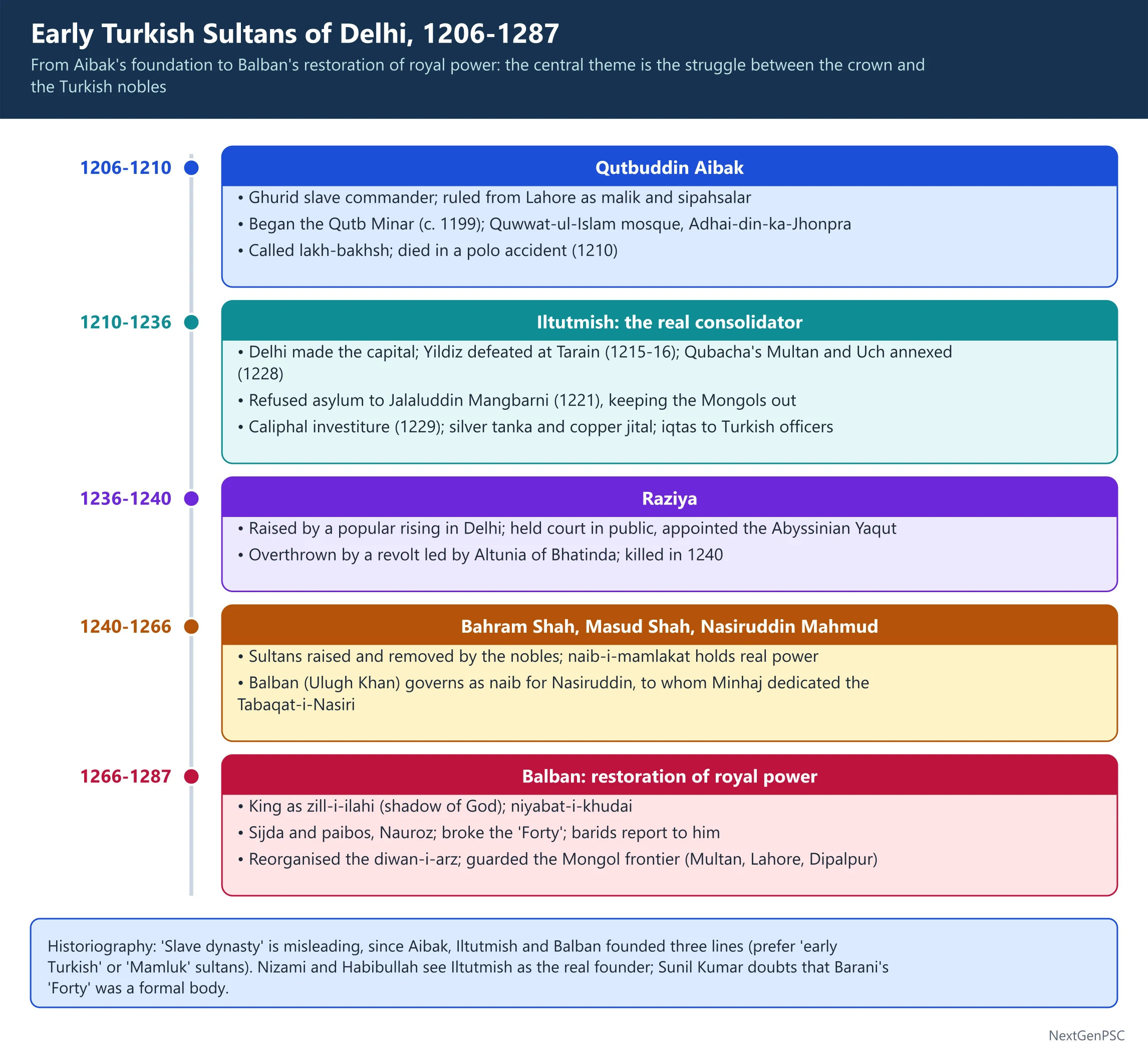
1. Qutbuddin Aibak (1206–1210)
Origins: a Turkish slave bought by Muizzuddin, rose to command the Indian conquests after 1192.
Accession: after Muizzuddin's death (1206) he ruled from Lahore with the title malik and sipahsalar; he received manumission and recognition from Muizzuddin's successor Ghiyasuddin Mahmud only around 1208; Minhaj does not record him issuing coins in his own name.
Rivals: Tajuddin Yildiz (Ghazni) and Nasiruddin Qubacha (Multan, Uch) were fellow Ghurid slave commanders; Aibak used marriage alliances (he married Yildiz's daughter, gave his daughter to Iltutmish and his sister to Qubacha).
Buildings: the Quwwat-ul-Islam mosque at Delhi and the Adhai-din-ka-Jhonpra at Ajmer; he began the Qutb Minar (c. 1199), completed by Iltutmish.
Reputation: called lakh-bakhsh (giver of lakhs) for his generosity; he died in a polo accident at Lahore (1210).
2. Iltutmish (1210–1236): Consolidation
Background: an Ilbari Turk, sold as a slave, bought by Aibak, became governor of Badaun and his son-in-law; he displaced Aibak's son Aram Shah and moved the capital firmly to Delhi.
Rivals defeated: Yildiz at Tarain (1215–16); Qubacha's lands of Multan and Uch annexed (1228); Bengal's Khalji chiefs brought under control (1225–29, Iwaz Khalji defeated).
Mongol danger: when Chingiz Khan pursued the Khwarazmian prince Jalaluddin Mangbarni to the Indus (1221), Iltutmish refused Jalaluddin asylum, avoiding Mongol invasion of the Sultanate's core.
Rajput states: he recovered Ranthambhor, Mandor, Gwalior and raided Malwa (Bhilsa, Ujjain), but Rajput power was not destroyed.
Investiture: in 1229 envoys of the Abbasid caliph al-Mustansir brought robes of investiture, recognising him as sultan, which gave him legitimacy over rival Turkish chiefs.
Currency: he standardised the silver tanka (about 175 grains, c. 11 g) and the copper (billon) jital, the basis of Sultanate coinage.
Iqta: he assigned iqtas (revenue assignments in return for service) to Turkish officers, especially in the Doab, to pay troops and control new territory.
Turkan-i-Chihalgani: Barani later wrote of the 'Forty', a group of Iltutmish's Turkish slave officers (bandagan) who monopolised high office; modern historians (e.g. Sunil Kumar) doubt that it was a formal body of forty.
Buildings: completed the Qutb Minar; built the Hauz-i-Shamsi tank; the tomb of his son Nasiruddin Mahmud (Sultan Ghari, 1231) is the earliest monumental Islamic tomb in India.
Succession: he nominated his daughter Raziya as heir, according to Minhaj, after his sons proved unfit.
3. Raziya and the Struggle with the Nobles (1236–1266)
Rukhnuddin Firuz (1236) was set aside by a popular rising in Delhi that brought Raziya to the throne.
Raziya (1236–1240): held court in public, wore male dress, appointed the Abyssinian Jamaluddin Yaqut as amir-i-akhur, and tried to build a party outside the Turkish slave nobles; she was overthrown by a revolt led by Altunia of Bhatinda and killed in 1240.
Minhaj on Raziya: he praised her as a great ruler with every royal quality except that she was not born a man (paraphrase).
Weak sultans: Bahram Shah and Masud Shah were raised and removed by the nobles; the office of naib-i-mamlakat (regent) became the seat of real power.
Nasiruddin Mahmud (1246–1266): Balban (Ulugh Khan) was his naib and father-in-law and governed in his name; Minhaj's Tabaqat-i-Nasiri is dedicated to Nasiruddin.
4. Balban (1266–1287): Restoration of Royal Power
Background: an Ilbari Turk, himself one of Iltutmish's slaves, rose through the 'Forty'; as sultan he destroyed the power of his old colleagues.
Theory of kingship: the king was zill-i-ilahi (shadow of God on earth), his heart a mirror of divine will; kingship was niyabat-i-khudai (vicegerency of God), second only to prophethood; nobles had no right to share power.
Persian ceremonial: he introduced sijda (prostration) and paibos (kissing the king's feet), celebrated Nauroz (the Persian new year), kept a grim court with no jesting, and claimed descent from the Iranian hero Afrasiyab.
Policy of 'blood and iron': a phrase used by modern historians for his harsh methods; he suppressed the Mewatis near Delhi, cleared forests, built forts and posted Afghan garrisons; he crushed rebellions in the Doab and Katehar.
Nobility: broke the Forty by punishing powerful nobles (e.g. Sher Khan's death is attributed by some to Balban) and appointed only men of high birth; Barani says he refused office to the low-born.
Spies: barids (news-writers) were posted in every province and reported directly to him.
Army: reorganised the diwan-i-arz (military department) under Imadul Mulk; tried to resume iqtas of aged holders who no longer served, but softened this on the plea of his kotwal Fakhruddin.
Bengal: marched in person to crush the rebellion of Tughril Beg (c. 1280), and made his son Bughra Khan governor.
Mongols: strengthened the north-west frontier (Multan, Lahore, Dipalpur) under his son Prince Muhammad, who was killed fighting the Mongols in 1285; this broke Balban, who died in 1287.
5. Sources
Minhaj-us-Siraj (Tabaqat-i-Nasiri, c. 1259–60): contemporary for Iltutmish, Raziya and Nasiruddin; favourable to Balban, who was in power when it was written.
Ziauddin Barani (Tarikh-i-Firuz Shahi, 1357): begins with Balban; writes 70 years later, from the viewpoint of a noble of good birth, and puts his own political ideas into Balban's speeches.
Isami (Futuh-us-Salatin, 1350): a verse history; Amir Khusrau was in the service of Prince Muhammad at Multan.
Coins and inscriptions: Iltutmish's tankas with caliph's name; Qutb Minar inscriptions record builders and repairs.
6. Analysis and Historiography
'Slave dynasty': the term is misleading: Aibak, Iltutmish and Balban were slaves (or freed slaves) of different masters and founded three lines; historians prefer 'early Turkish sultans' or 'Mamluk sultans'.
Iltutmish as real founder: K.A. Nizami and A.B.M. Habibullah (The Foundation of Muslim Rule in India, 1945) regard Iltutmish as the real founder, for the capital, currency, iqta, investiture and defence against rivals and Mongols.
Crown versus nobility: the central theme of 1236–1266 is the conflict between sultans seeking absolute power and slave nobles seeking to share it; Balban resolved it in favour of the crown.
Sunil Kumar (The Emergence of the Delhi Sultanate, 1192–1286, 2007) argues that the bandagan were a household of military slaves whose loyalty was to individual masters, and that Barani's account of the Forty is a later idealised construction.
Peter Jackson stresses the Mongol threat as the driving force behind Balban's centralisation and military preparation.
Sources of Balban's theory: Persian Sasanian ideas of kingship transmitted through texts such as Nizam al-Mulk's Siyasatnama; I.H. Qureshi (The Administration of the Sultanate of Delhi, 1942) discussed the relation between sharia and royal law (zawabit).
7. Using It in the Exam
10 marks: on Iltutmish as the real founder of the Sultanate, give five achievements with dates.
15 marks: on Balban's theory of kingship, give its concepts, sources, practices and purpose.
20 marks: on the crown-nobility conflict in the 13th century, cover Raziya, the Forty, the naib, Balban and the historiography (Barani, Sunil Kumar).
Keywords: bandagan, Turkan-i-Chihalgani, iqta, tanka, jital, caliphal investiture, naib-i-mamlakat, zill-i-ilahi, niyabat-i-khudai, sijda, paibos, diwan-i-arz, barid.
Source line: Barani reports Balban's view (paraphrased) that the king's heart is the mirror of God's will and that the king should never be familiar with ordinary people.
| Ruler | Reign | Key Measures / Events |
|---|---|---|
| Qutbuddin Aibak | 1206–1210 | Ruled from Lahore; Qutb Minar begun; lakh-bakhsh |
| Iltutmish | 1210–1236 | Delhi capital; Yildiz and Qubacha defeated; investiture 1229; tanka and jital; iqta |
| Raziya | 1236–1240 | Woman sultan; Yaqut; overthrown by Turkish nobles |
| Bahram Shah, Masud Shah | 1240–1246 | Puppets of the nobles; naib-i-mamlakat |
| Nasiruddin Mahmud | 1246–1266 | Balban as naib; Tabaqat-i-Nasiri dedicated to him |
| Balban | 1266–1287 | Zill-i-ilahi; sijda and paibos; diwan-i-arz; barids; Mongol frontier |
Mains points
- The syllabus names 'the rule of Iltutmish and Balban'; prepare comparative answers on their contributions to consolidation.
- For Iltutmish, give concrete achievements: capital, rivals, Mongol policy, investiture, currency, iqta, succession.
- For Balban, connect theory (zill-i-ilahi) with practice (ceremony, spies, army) and purpose (crushing the nobles, facing the Mongols).
- Question Barani's reliability: he wrote decades later and projected his own ideals onto Balban.
- Avoid the term 'slave dynasty' without qualification.
- Raziya is often asked as a short note: give her measures and why she fell (Turkish nobles' resistance, not only gender).
- Use the Mongol threat as a context that shaped Sultanate centralisation (Peter Jackson).
Did you know?
- Aibak's generosity made 'lakh-bakhsh' a byword, yet he probably never struck coins in his own name; his successor Iltutmish created the silver tanka, a forerunner of later silver coins such as Sher Shah's rupiya.
The Khalji Revolution and Alauddin's Conquests
The accession of Jalaluddin Khalji (1290) ended the monopoly of the Ilbari Turkish nobility and opened high office to Khaljis, Indian Muslims and others; historians call this the Khalji Revolution. Alauddin Khalji (1296–1316) conquered Gujarat, Ranthambhor, Chittor, Malwa and Jalor, sent Malik Kafur to make Devagiri, Warangal, Dwarasamudra and Madurai pay tribute, and defeated repeated Mongol invasions.
In simple words
Until 1290 only a small circle of Turkish nobles ran the Delhi Sultanate, a bit like a club that admitted only old members.
The Khaljis broke this club open and gave power to new men, including Indian Muslims.
Their greatest ruler, Alauddin Khalji, built the largest Sultanate empire so far and beat back the Mongols.
UPSC asks what was 'revolutionary' about the Khalji Revolution and how far Alauddin's conquests went.
1. The End of the Balbanid Line
Kaiqubad (1287–90), Balban's grandson, was a weak and pleasure-loving ruler; his paralysed state and the infant Kayumars led to a struggle between Turkish and Khalji factions.
Jalaluddin Firuz Khalji, the ariz-i-mamalik (head of the military department) and an experienced frontier commander, seized power and was crowned at Kilokhari in 1290.
Khaljis: of Turkish origin, from the Khalaj tribe long settled in the Afghan region; the Ilbari nobles regarded them as non-Turkish and of lower status, which is why their rise was resented in Delhi.
2. The Meaning of the 'Khalji Revolution'
End of Turkish monopoly: the old Turkish ruling group lost its hold on high office; Khaljis, Indian-born Muslims, converts and men of humble birth could now rise.
New basis of power: kingship was seen to rest on power and the support of the army rather than on noble birth or racial descent.
Broader state: K.S. Lal (History of the Khaljis, 1950) and Mohammad Habib stressed that the state became more 'Indian', relying on Indian Muslims and later on Hindu officials and soldiers.
Policy shift: the Khaljis separated state policy from the advice of the ulama, most clearly under Alauddin.
Debate: some historians say 'revolution' overstates the change, since the political structure stayed the same; it was a change of ruling group within the same system.
3. Jalaluddin Khalji (1290–1296)
Mild policy: at about seventy he pardoned rebels such as Malik Chhajju, Balban's nephew; Barani criticises this leniency as unfit for kingship.
Sidi Maula: the dervish was executed (1291) on suspicion of plotting, a rare harsh act.
Mongols: defeated a Mongol force (1292) and allowed Mongols who accepted Islam (later called 'new Muslims') to settle near Delhi.
Alauddin's Devagiri raid (1296): his nephew and son-in-law Alauddin, governor of Kara, raided Devagiri, the Yadava capital, without permission and took huge wealth; he then had Jalaluddin murdered at Kara (1296) and marched to Delhi, winning over nobles with gold.
4. Alauddin's Conquests in the North
Gujarat (1299): Ulugh Khan and Nusrat Khan defeated the Vaghela king Karna; Somnath was sacked; Malik Kafur, a slave, was acquired at Cambay.
Ranthambhor (1301): Hammira Deva Chauhan, who had sheltered Mongol rebels, resisted a long siege; the fort fell, and the women of the fort performed jauhar according to Amir Khusrau.
Chittor (1303): taken after an eight-month siege from Ratan Singh (Ratnasimha) of the Guhila dynasty; renamed Khizrabad for his son Khizr Khan.
The Padmini story: the tale of Alauddin's desire for queen Padmini comes from Malik Muhammad Jayasi's Padmavat (1540); contemporary sources, including Amir Khusrau, do not mention it, and most historians treat it as literary.
Malwa (1305): Ain-ul-Mulk Multani defeated Mahlakdeva; Ujjain, Mandu, Dhar and Chanderi were taken.
Marwar: Siwana (1308) and Jalor (1311, Kanhadadeva) were conquered.
Policy in the north: Gujarat and Malwa were annexed and governed directly; many Rajput chiefs became tributaries.
5. The Deccan and the South
Devagiri (1307): Malik Kafur brought the Yadava Ramachandra to Delhi; he was treated with honour, given the title Rai Rayan and returned as a tributary ally.
Warangal (1309–10): the Kakatiya Prataparudra II paid a huge tribute and accepted annual payment.
Dwarasamudra (1311): the Hoysala Vira Ballala III submitted and helped Kafur's march south.
Madurai (1311): Kafur exploited the succession war between the Pandya brothers Sundara Pandya and Vira Pandya, plundered Madurai and reached the coast; Amir Khusrau mentions Rameswaram but whether Kafur reached it is uncertain.
Nature of southern policy: Alauddin sought tribute and plunder, not annexation; the southern kings remained in place as tributaries, though Devagiri was annexed after Ramachandra's successor Shankaradeva defaulted (c. 1313).
Purpose: wealth from the south paid for the army against the Mongols; Barani and Khusrau describe enormous treasure in gold, jewels and elephants.
6. The Mongol Threat
Chaghatai Mongols: rulers of Transoxiana under Duwa sent repeated invasions between 1297 and 1306.
Jalandhar (1297–98): Ulugh Khan and Zafar Khan defeated a Mongol army.
Kili (1299): Qutlugh Khwaja reached the outskirts of Delhi; Zafar Khan was killed in the battle, but the Mongols withdrew.
Targhi (1303): Mongols besieged Delhi while Alauddin's army was at Chittor; he built the new fortified city of Siri afterwards.
Amroha (1305) and Ravi (1306): the Mongol commanders Ali Beg and Tartaq, and later Kebek, were defeated; prisoners were executed in large numbers.
Frontier defence: Ghazi Malik (later Ghiyasuddin Tughluq) guarded the frontier at Dipalpur; forts were repaired and garrisoned; the large standing army and market controls were linked to this threat.
7. Alauddin's Ambitions and Attitude to the Ulama
Barani's anecdotes: Alauddin thought of founding a new religion and of conquering the world like Alexander, and took the title Sikandar-i-Sani (the second Alexander) on his coins; his friend Alaul Mulk, the kotwal of Delhi, advised him to give up these plans.
State above the ulama: Barani reports his talk with Qazi Mughis, where he said he gave orders for the good of the state without asking whether they were lawful by sharia (paraphrase).
Control of nobles: after early revolts (Akat Khan, Haji Maula) he banned feasts and drinking parties, tightened spies, confiscated grants and forbade marriages between noble families without permission.
8. Sources
Amir Khusrau: Khazain-ul-Futuh (1311), a contemporary prose account of Alauddin's conquests; Ashiqa (also called Deval Rani Khizr Khan).
Barani: Tarikh-i-Firuz Shahi (1357), the fullest account, written 40 years later with a moralising purpose.
Isami: Futuh-us-Salatin (1350), written at the Bahmani court, often critical of Delhi.
Indian sources: the Kanhadade Prabandha (Padmanabha, 1455) on Jalor; Jain prabandhas; Hammira-centred texts such as the Hammira Mahakavya.
9. Historiography and Using It in the Exam
Views: K.S. Lal sees Alauddin as an able imperialist; Banarsi Prasad Saksena (in the Comprehensive History of India, vol. 5, ed. Habib and Nizami, 1970) and Peter Jackson stress the Mongol threat as the driving force of his policies.
10 marks: on the Khalji Revolution, give its meaning, causes and significance, with the debate over the word 'revolution'.
15 marks: on Alauddin's Deccan policy, give campaigns, dates, kings, the tribute-not-annexation policy and its purpose.
20 marks: on Alauddin's conquests and his response to the Mongols, link expansion, defence and internal reforms.
Keywords: Khalji Revolution, Kilokhari, Malik Kafur, tributary policy, jauhar, Sikandar-i-Sani, Siri, Chaghatai Mongols, Khazain-ul-Futuh.
| Year | Target | Ruler Opposed | Commander / Result |
|---|---|---|---|
| 1296 | Devagiri (raid) | Ramachandra (Yadava) | Alauddin; wealth used to seize throne |
| 1299 | Gujarat | Karna (Vaghela) | Ulugh Khan, Nusrat Khan; annexed |
| 1301 | Ranthambhor | Hammira Deva (Chauhan) | Alauddin; fort taken |
| 1303 | Chittor | Ratan Singh (Guhila) | Alauddin; renamed Khizrabad |
| 1305 | Malwa | Mahlakdeva | Ain-ul-Mulk Multani; annexed |
| 1307 | Devagiri | Ramachandra | Malik Kafur; tributary |
| 1309–10 | Warangal | Prataparudra II (Kakatiya) | Malik Kafur; tribute |
| 1311 | Dwarasamudra, Madurai | Vira Ballala III; Pandyas | Malik Kafur; tribute and plunder |
| 1308–11 | Siwana, Jalor | Sitaladeva; Kanhadadeva | Annexed |
Mains points
- 'The Khalji Revolution' is a syllabus term: define it (change in the social composition of the ruling class) and discuss whether 'revolution' is justified.
- Separate Alauddin's northern policy (annexation) from his southern policy (tribute), and explain why.
- Link conquests, Mongol defence and the market reforms into one argument; examiners reward this connection.
- Use Amir Khusrau as the contemporary source and Barani as the later, interpretive source.
- Treat the Padmini story as literature from 1540, not as history.
- Give Mongol invasion names and dates (Kili 1299, Targhi 1303, Amroha 1305) to show precision.
- Mention Isami's Bahmani perspective when discussing the reliability of sources.
Did you know?
- Alauddin built Siri after the Mongol siege of 1303; Delhi folklore claims the heads of Mongol soldiers were buried in its foundations, a story recorded in later tradition rather than in contemporary sources.
Alauddin Khalji's Agrarian and Market Measures
Alauddin Khalji fixed the land revenue at half the produce, assessed by measurement (masahat), in the Doab and the Delhi region, added grazing and house taxes, and cut the privileges of the rural intermediaries (khuts, muqaddams, chaudhuris). In Delhi he set up controlled markets with fixed prices, state granaries, registered merchants and spies. Barani says both measures served one aim: to keep a large standing army on low salaries to face the Mongols.
In simple words
Alauddin needed a huge army but could not pay high salaries.
So he did two things. He took half of the peasants' crop as tax, and he fixed low prices in Delhi's markets so that a soldier's small pay could still buy enough food and cloth.
Think of a government ration shop combined with strict price inspectors.
UPSC asks how these agrarian and market reforms worked, whether they succeeded, and whether Barani's account can be trusted.
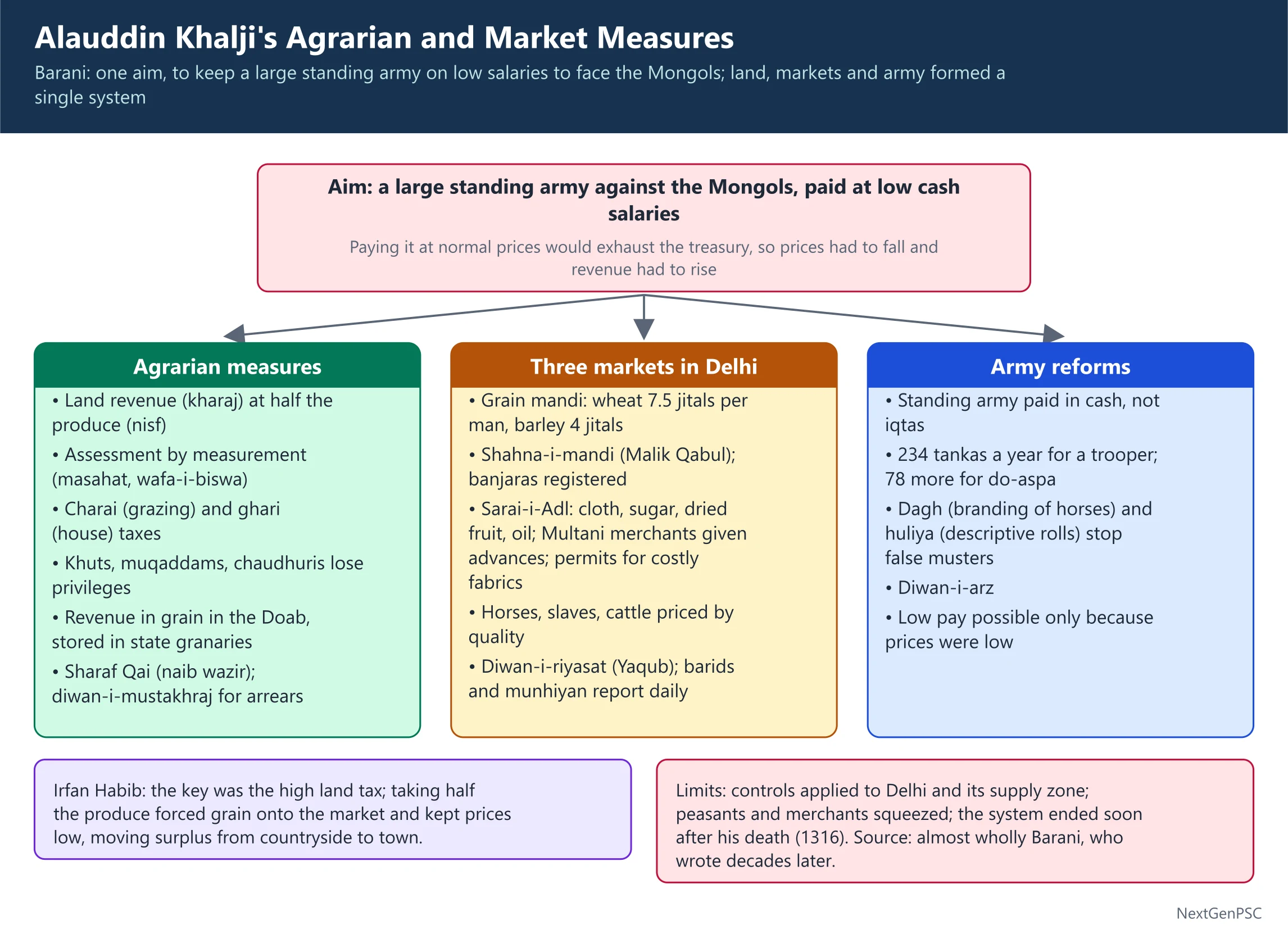
1. Aims and Context
Barani's explanation: the Mongol invasions required a large standing army; paying it at normal prices would exhaust the treasury in a few years, so prices had to be lowered and revenue raised.
Political aim: to break the power of rural intermediaries and the nobility, whose wealth Alauddin saw as a cause of rebellion.
Area: the land measures applied mainly to the Doab and the region around Delhi, with parts of eastern Rajasthan and Malwa mentioned by Barani; the market controls applied to Delhi.
2. Agrarian Measures
Rate: land revenue (kharaj) was fixed at half the produce (nisf), the highest rate in Sultanate history.
Assessment: by measurement of the cultivated area and a fixed yield per biswa (a unit of area), described by Barani as masahat and wafa-i-biswa; the same rule applied to all, including the khuts and balahars.
Additional taxes: a grazing tax (charai) on milch cattle and a house tax (ghari).
Intermediaries: the khuts, muqaddams and chaudhuris (rural chiefs and headmen) lost their exemption and their share (haqq-i-khoti); Barani says they became so poor that their wives worked as maids in Muslim houses (paraphrase of his account).
Grants resumed: many revenue-free grants (milk, inam, waqf) were brought back into the khalisa (crown land).
Collection in kind: in the Doab revenue was taken in grain, stored in state granaries for Delhi's supply.
Officials: Sharaf Qai, the naib wazir, organised the system; the patwaris' records were checked; a department, the diwan-i-mustakhraj, recovered arrears from officials; amils and others were punished severely for corruption.
Barani's verdict: the revenue officials became so feared that no one would give his daughter in marriage to a revenue clerk (paraphrase).
3. Market Control: The Three Markets
Grain market (mandi): prices of wheat, barley, gram, rice and pulses were fixed; Barani gives wheat at 7.5 jitals per man and barley at 4 jitals per man.
Officials: the shahna-i-mandi (controller of the grain market, Malik Qabul) and the diwan-i-riyasat under the naib-i-riyasat Yaqub supervised the markets; barids and secret agents (munhiyan) reported daily to the sultan.
Supply: state granaries held grain collected as revenue; the karwanis and banjaras (grain carriers) were registered, settled with families along the Yamuna and made jointly responsible; peasants of the Doab had to sell surplus grain to them at fixed prices at the field.
Famine measures: in scarcity grain was rationed to households according to need, so that, Barani claims, prices did not rise even in drought.
Sarai-i-Adl: a market for cloth, sugar, dried fruit, oil and other goods; Multani merchants were registered and given advances from the treasury to bring goods; costly fabrics could be bought only with a permit.
Horses, slaves and cattle: prices were fixed by quality; brokers (dallals) were controlled and speculators expelled.
Enforcement: short weight was punished by cutting flesh from the seller's body equal to the shortfall, according to Barani; the sultan sent slave boys to buy goods to test the shopkeepers.
4. Army Reforms
Standing army: paid in cash from the treasury instead of by iqtas; Firishta (17th century) gives the number as 475,000 horsemen, a figure most historians treat as exaggerated.
Salary: 234 tankas a year for a trooper (murattab) and 78 more for a man with an extra horse (do-aspa), according to Barani.
Dagh and huliya: branding of horses (dagh) and descriptive rolls of soldiers (huliya, chehra) prevented fraud by false musters.
Link: the low salary was possible only because market prices were kept low.
5. Sources
Barani's Tarikh-i-Firuz Shahi (1357) is the main and almost only detailed source; he was a child in Alauddin's reign and wrote decades later, partly to give advice to Firuz Tughluq.
Amir Khusrau (Khazain-ul-Futuh) mentions low prices and justice in the markets in general terms.
Isami mentions some measures; Ibn Battuta, writing later, records that Alauddin was remembered in Delhi as one of the best sultans.
Barani's Fatawa-i-Jahandari gives his political theory, which explains his interest in the state's control of the economy.
6. Analysis: Success and Effects
Success: Barani says prices remained stable throughout the reign, even in drought; the army was maintained and the Mongols were defeated.
Burden on peasants: the half-share demand, cash needs and compulsory sale at low prices squeezed the peasantry; Barani's account of the ruined khuts shows the impact on rural intermediaries.
Merchants: traders lost freedom and profit; Multani merchants were partly compensated by state advances.
Limits of area: controls applied to Delhi and its supply zone; there is no evidence of empire-wide price control.
Collapse: the system ended soon after his death (1316); Qutbuddin Mubarak Shah relaxed it.
Long-term legacy: measurement-based assessment and a salaried army prefigured later systems (Sher Shah, Akbar's zabt), and the attack on intermediaries showed the state's ambition to reach the peasant directly.
7. Historiography
W.H. Moreland (The Agrarian System of Moslem India, 1929) first analysed Alauddin's revenue system and saw it as a major step in direct assessment.
Irfan Habib (in the Cambridge Economic History of India, vol. 1, 1982, and other essays) argued that the key to the market control was the high land tax: by taking revenue in cash or kind at half the produce, the state forced grain onto the market and kept prices low, transferring surplus from countryside to town.
K.S. Lal saw the measures as an efficient but harsh system that served the army; other historians have discussed whether the controls were limited to Delhi.
Barani's bias: Peter Hardy (Historians of Medieval India, 1960) and others show that Barani wrote as a moralist, using Alauddin as an example of a strong but irreligious king; his precise figures should be used with caution.
Modern comparison: some writers compare the system to wartime rationing and price control; historians warn against anachronism, but the comparison helps explain the logic.
8. Using It in the Exam
10 marks: on Alauddin's market control, give three markets, officials, price examples, supply measures and enforcement.
15 marks: on his agrarian measures, give rate, masahat, cesses, the attack on intermediaries, officials and effects.
20 marks: 'Alauddin's economic measures were dictated by military needs.' Discuss, linking Mongols, army pay, revenue, markets, Barani's reliability and Habib's interpretation.
Keywords: nisf, masahat, wafa-i-biswa, charai, ghari, khut, muqaddam, chaudhuri, diwan-i-mustakhraj, shahna-i-mandi, Sarai-i-Adl, diwan-i-riyasat, dagh, huliya.
Source line: Barani (paraphrased): the sultan's aim was that the army should be maintained on a fixed small salary, which was possible only if the prices of necessities were brought low.
| Measure | Details | Officials / Institutions |
|---|---|---|
| Land revenue | Half the produce; measurement per biswa; Doab and Delhi region | Sharaf Qai (naib wazir); patwaris |
| Cesses | Charai (grazing), ghari (house) | Revenue officials |
| Attack on intermediaries | Khuts, muqaddams, chaudhuris lose privileges | Diwan-i-mustakhraj |
| Grain market | Fixed prices; granaries; registered carriers; rationing | Shahna-i-mandi (Malik Qabul) |
| Sarai-i-Adl | Cloth and other goods; Multani merchants given advances; permits | Diwan-i-riyasat (Yaqub) |
| Army | Cash salaries (234 tankas); dagh and huliya | Diwan-i-arz |
Mains points
- This is one of the most frequently asked Sultanate topics; know the measures precisely with Barani's terms.
- Always connect the agrarian and market measures; Irfan Habib's argument that high revenue made low prices possible is the key analytical point.
- Discuss Barani's reliability: late, moralising, the only detailed source.
- State the geographical limits (Delhi and the Doab) to avoid exaggeration.
- Assess impact on different groups: peasants, intermediaries, merchants, soldiers, the urban population.
- Mention the long-term significance: measurement, cash salaries and the state reaching the peasant.
- Avoid presenting the system as 'welfare'; its purpose was military and fiscal.
Did you know?
- According to Barani, Alauddin tested his market officials by sending young slave boys to buy goods; if a boy came back with short weight, the shopkeeper paid for it with flesh cut from his own body.
Muhammad bin Tughluq: Projects, Agrarian Measures and Bureaucracy
Muhammad bin Tughluq (1325–51) ruled the largest territory of any Delhi sultan and attempted bold projects: the transfer of the capital to Daulatabad (1327), a token currency of bronze or brass (1329–30), the planned Khurasan and the disastrous Qarachil expeditions, higher taxation in the Doab, and an agricultural department, the Diwan-i-Amir-i-Kohi. He recruited foreigners and men of low birth into a new bureaucracy, which alienated the old nobility; more than twenty rebellions broke the empire.
In simple words
Muhammad bin Tughluq was a brilliant, learned and restless ruler whose ideas were often ahead of the means to carry them out, like a start-up founder with great plans but no working systems.
He moved his capital a thousand kilometres south, issued copper coins to be used like silver ones, and tried to boost farming through a new department.
Most plans failed.
UPSC asks whether he was a 'mad' or a misunderstood ruler, and how his projects, agrarian measures and bureaucracy worked.
1. Background: The Tughluqs
Ghiyasuddin Tughluq (1320–25), formerly Ghazi Malik, the frontier commander at Dipalpur, overthrew the usurper Khusrau Khan (1320); he restored order, moderated revenue demand, built Tughlaqabad and sent his son Jauna Khan (Ulugh Khan) to annex Warangal (1323).
Death: he died in 1325 when a wooden pavilion at Afghanpur collapsed on him; Ibn Battuta suspected that his son arranged it, while Barani is silent; the question remains open.
Muhammad bin Tughluq: learned in philosophy, logic, poetry, medicine and astronomy; Barani and Ibn Battuta both describe his generosity and his severity.
2. Transfer of the Capital to Daulatabad (1327)
The move: Devagiri was renamed Daulatabad and made a second capital; officials, nobles, ulama, Sufis and a large part of Delhi's elite population were ordered to move, with arrangements on the road.
Reasons suggested: to control the newly annexed south; a central location for an empire stretching from the Punjab to Madurai; security from Mongol raids; and the spread of Muslim culture in the Deccan.
Sources differ: Barani says Delhi was emptied so completely that no cat or dog remained (his exaggerated image, paraphrased); Ibn Battuta (in Delhi from 1334) heard that the whole population was forced out; Isami, himself a victim, is bitter.
Evidence against total desertion: Sanskrit inscriptions of 1327–28 from the Delhi region (for example from Naraina) record Hindu residents carrying on normal life; historians such as Agha Mahdi Husain argue that mainly the Muslim elite was moved.
Result: after a few years most were allowed to return (c. 1335); Daulatabad grew as a centre of Indo-Islamic culture in the Deccan and later helped the rise of the Bahmani kingdom (1347).
3. Token Currency (1329–30)
The measure: brass or copper (bronze) coins were issued as tokens, to pass at the value of the silver tanka; inscriptions on them called on people to obey the sultan.
Reasons: a shortage of silver in the 14th-century Islamic world and in India (H. Nelson Wright, The Coinage and Metrology of the Sultans of Dehli, 1936); the expense of the army and projects; Muhammad may have known of paper money in Yuan China and of the Ilkhan Gaikhatu's paper money in Iran (1294).
Failure: the state could not stop forgery; Barani says the house of every Hindu became a mint (paraphrase); people paid tax in tokens and hoarded silver; trade was disrupted.
Withdrawal: the sultan redeemed the tokens with good silver and gold; Barani says heaps of them lay at Tughlaqabad for years; the loss to the treasury was heavy.
Assessment: historians see the idea as sound but the execution flawed, since the coins were easy to imitate and the state lacked a monopoly of minting.
4. Military Projects
Khurasan expedition: a large army (Barani gives 370,000, an exaggerated figure) was raised and paid for a year to attack Khurasan and Iraq, perhaps in alliance with Egypt and the Chaghatai ruler Tarmashirin; when the political situation in Central Asia changed, it was disbanded.
Qarachil expedition: an army sent into the Kumaon-Garhwal Himalaya (c. 1333) to subdue hill chiefs was destroyed by rains and attacks; some see it as a limited frontier campaign, Barani as a disaster.
Mongols: Tarmashirin's raid (c. 1327) reached near Delhi; the sources disagree on whether he was bought off or driven back.
5. Agrarian Measures
Doab taxation (c. 1330s): revenue in the Doab was raised (Barani speaks of ten or twenty times, clearly exaggerated; modern historians think the demand was increased and new cesses added) at a time of famine; peasants abandoned land and fled to the forests, and the sultan's punitive campaigns worsened the crisis.
Relief: during the famine he distributed grain from the treasury, gave takavi (sondhar) loans for seed, cattle and wells, and moved his court to Swargadwari near Kannauj (c. 1338–41) to be near supplies.
Diwan-i-Amir-i-Kohi: a department of agriculture created to extend and improve cultivation; according to Barani a tract of about 30 kos by 30 kos was taken, crops were rotated under state direction and about 70 lakh tankas were advanced to officials (shiqqdars) over three years.
Failure: the land chosen was poor, the officials were inexperienced and corrupt, and the money was spent without result; the plan was abandoned.
Significance: it was an early attempt by the state to increase agricultural production directly, not only to collect revenue; Irfan Habib sees it as showing the state's interest in expanding cultivation and the crop pattern.
6. Bureaucracy and Nobility
New men: the sultan welcomed foreigners (aizza, 'honoured ones') from Khurasan, Iraq and elsewhere, granting them high posts and gifts; Ibn Battuta was made qazi of Delhi.
Low-born officials: Barani lists, with disgust, men of humble origin given high office, such as Aziz Khammar (vintner), Firuz Hajjam (barber), Manka Tabbakh (cook) and Ladha Baghban (gardener); Ibn Battuta notes Hindus in office too, such as Ratan, placed in charge of revenue in Sindh.
Aim: to create a nobility dependent on the sultan and loyal to him, not to the old families.
Iqta and revenue farming: some provinces were given to revenue farmers who promised large sums, which led to oppression and revolts (e.g. in the Deccan and Gujarat).
Ulama and Sufis: he forced some Sufis and ulama into state service and punished those who refused, causing tension with the religious elite; he also sought legitimacy from the Abbasid caliph in Cairo (c. 1340s).
Other contacts: he gave favours to the Jain monk Jinaprabha Suri, according to Jain sources; this shows a ruler willing to patronise non-Muslim religious figures.
7. Rebellions and Decline
Scale: historians count over twenty rebellions, including those of Bahauddin Gurshasp (Sagar, 1326–27), Kishlu Khan (Multan), Fakhruddin (Bengal, 1338), Jalaluddin Ahsan Shah (Madurai, 1335), and the amiran-i-sada (centurion officers) in the Deccan and Gujarat.
Loss of the south: the Vijayanagara kingdom (1336) and the Bahmani kingdom (1347) were founded on the Sultanate's southern lands.
Death: he died near Thatta in Sindh (1351) while pursuing the rebel Taghi.
Badauni's comment (late 16th century): the king was freed from his people and they from their king (a widely cited line, paraphrased).
8. Historiography
Barani: called him a mixture of opposites and blamed his contempt for tradition and for birth; Barani's own class prejudice shapes this view.
Ibn Battuta: described him (in H.A.R. Gibb's translation) as of all men the most addicted to the making of gifts and the shedding of blood.
Colonial and early modern views: Elphinstone and V.A. Smith saw him as unbalanced; the 'mad king' label became common in textbooks.
Revisionists: Agha Mahdi Husain (The Rise and Fall of Muhammad bin Tughluq, 1938) and Ishwari Prasad (A History of the Qaraunah Turks in India, 1936) presented him as an intelligent ruler whose plans were rational but badly implemented or opposed by vested interests.
Economic historians: Irfan Habib and others stress structural problems: silver shortage, famine, over-taxation, and the strain of ruling the whole subcontinent from one centre.
Peter Jackson sees the reign as the high point of the Sultanate's reach and the start of its fragmentation.
9. Using It in the Exam
10 marks: on the token currency, give reasons, date, failure and assessment.
15 marks: on his agrarian measures, cover Doab taxation, famine relief, takavi and the Diwan-i-Amir-i-Kohi.
20 marks: 'Muhammad bin Tughluq was a man of ideas but not of action.' Examine his projects, bureaucracy and rebellions with Barani, Ibn Battuta and modern views.
Keywords: Daulatabad, token currency, silver famine, Khurasan, Qarachil, Doab, takavi, sondhar, Diwan-i-Amir-i-Kohi, aizza, amiran-i-sada.
Quotation: Ibn Battuta's line on gifts and bloodshed, or Badauni's on the king and his people, both given as paraphrased translations.
| Project | Date | Aim | Outcome |
|---|---|---|---|
| Transfer of capital to Daulatabad | 1327 | Control the south; central capital | Return to Delhi c. 1335; Deccan Muslim culture grew |
| Token currency | 1329–30 | Meet silver shortage and costs | Forgery; withdrawn; treasury loss |
| Khurasan expedition | c. 1329–32 | Conquest in Central Asia | Army disbanded after a year |
| Qarachil expedition | c. 1333 | Subdue Himalayan chiefs | Army destroyed |
| Doab taxation | c. 1330s | Raise revenue | Peasant flight during famine |
| Diwan-i-Amir-i-Kohi | c. 1340s | Extend and improve cultivation | Failed; abandoned |
Mains points
- The syllabus names his 'major projects, agrarian measures, bureaucracy'; prepare each separately and in combination.
- Avoid the 'mad king' cliché; evaluate each project on its aims, execution and results.
- Use multiple sources and note their biases: Barani (class prejudice), Ibn Battuta (personal experience, foreigner), Isami (Bahmani court, bitter).
- Use the Naraina-type Sanskrit inscriptions and Nelson Wright's numismatic work to show source criticism.
- Link agrarian policy to famine and peasant flight, and the Diwan-i-Amir-i-Kohi to the idea of a developmental state.
- Explain how his recruitment of new men alienated the old nobility and helped cause the rebellions.
- Conclude with structural causes: the size of the empire, silver shortage and dependence on a centralised army.
Did you know?
- The road from Delhi to Daulatabad was lined with trees and rest-houses for the migrants, according to the sources, yet Isami, who lost his grandfather on the journey, wrote of it with lasting bitterness.
Firuz Tughluq, Decline of the Sultanate and Ibn Battuta
Firuz Shah Tughluq (1351–88) followed a policy of conciliation: he fixed the revenue by a fresh assessment, abolished many cesses and kept only the four taxes sanctioned by sharia plus an irrigation tax, built canals, new towns, gardens and hospitals, and made iqtas and offices hereditary. These measures pleased nobles and ulama but weakened central control, and after his death, factional strife, regional revolts and Timur's invasion (1398) broke the Sultanate. The Moroccan traveller Ibn Battuta (in India 1333–42) left a vivid account of Muhammad bin Tughluq's India.
In simple words
After the stormy reign of Muhammad bin Tughluq, his cousin Firuz chose to keep everyone happy: lower taxes, canals for farmers, gifts for nobles and respect for religious scholars.
It was like a manager who stops all risky projects and gives staff permanent jobs, which brings peace but slowly makes the firm weak.
Soon after him the Sultanate split into regional kingdoms.
UPSC asks about Firuz's agrarian measures and public works, the decline of the Sultanate, and Ibn Battuta's account.
1. Accession and Character of the Reign
Accession: Firuz, cousin of Muhammad bin Tughluq (son of Ghiyasuddin's brother Rajab and a Bhatti Rajput princess), was raised to the throne at Thatta in 1351 by the nobles and ulama of the camp.
Policy: he sought the support of nobles, ulama and the army by conciliation, generosity and adherence to sharia, reversing the harshness of his predecessor.
Military record: two expeditions to Bengal (1353–54, 1359–60) failed to recover it; he raided Jajnagar (Odisha) and Nagarkot (Kangra, 1361), and took Thatta after a difficult campaign (1365–67).
2. Agrarian Measures
Fresh assessment: Khwaja Husamuddin Junaid surveyed the revenue (jama) of the empire, which was fixed at 6 crore 75 lakh tankas, according to Afif; this fixed demand was not revised during the reign.
Abolition of cesses: he abolished 24 cesses (abwab) he regarded as unlawful and kept only the four taxes allowed by Islamic law: kharaj (land tax), khams (one-fifth of war booty), jizya and zakat.
Irrigation tax: haqq-i-sharb (about one-tenth of produce) on lands watered by state canals, approved by the ulama.
Jizya: extended to brahmanas, who had previously been exempt; when they protested, the burden was reduced but not removed, according to Afif.
Takavi: loans given under Muhammad bin Tughluq were written off.
Results: Afif describes a prosperous countryside with cheap grain and many villages; modern historians accept that agriculture expanded in the canal-irrigated areas of Haryana but treat Afif's praise with caution.
Crops: the canals made possible the cultivation of two crops (kharif and rabi) and of cash crops such as sugarcane in areas like Hisar.
3. Civil Engineering and Public Works
Canals: Afif mentions five canals, among them the Rajwah and the Ulughkhani; the main ones drew water from the Yamuna and the Sutlej and carried it to Hisar (which canal came from which river is reported differently in modern works); the Western Yamuna canal was later restored by Akbar and Shah Jahan.
New towns: Firuzabad (Delhi, with the Kotla palace-fort), Hisar-Firuza, Fatehabad, Firuzpur and Jaunpur (named after Muhammad bin Tughluq, whose name was Jauna).
Ashokan pillars: he moved Ashoka's pillars from Topra (Ambala region) and Meerut to Delhi, an operation described by Afif with the help of a huge cart and boats; the Topra pillar stands on the Kotla.
Repairs: repaired the Qutb Minar after lightning damage (1368), adding the upper storeys, and many older monuments and tanks such as the Hauz Khas, where he built a madrasa and his tomb.
Gardens and sarais: Afif mentions 1,200 gardens around Delhi; dams (bunds), wells, bridges and sarais were built.
4. Welfare and Administration
Diwan-i-Khairat: a department of charity that helped poor Muslims marry their daughters and supported widows and orphans.
Dar-ul-Shifa: a hospital with free medicine and food.
Employment bureau: the kotwal was told to find unemployed men and give them work.
Diwan-i-Bandagan: a department of slaves; Afif gives the number of the sultan's slaves as 180,000, trained in crafts and posted across the empire; they became a burden and a faction after his death.
Hereditary iqtas and posts: iqtas, offices and even military posts became hereditary; old or unfit soldiers could send a substitute; Afif reports the sultan himself giving a soldier a tanka to bribe the muster clerk (paraphrase), showing laxity.
Religious policy: he banned some practices he considered against sharia, punished heterodox sects, destroyed some new temples, and stopped the depiction of living beings in palaces; he also had Sanskrit texts translated into Persian (the Dalail-i-Firuz Shahi on astronomy from works taken at Nagarkot).
5. Sources for Firuz
Futuhat-i-Firuz Shahi: a short account by Firuz himself of his reforms and pious deeds, inscribed, according to tradition, on an octagonal tower of the Firuzabad mosque.
Shams-i-Siraj Afif's Tarikh-i-Firuz Shahi (written after 1398): admiring, detailed on administration and public works.
Barani's Tarikh-i-Firuz Shahi (1357) and Fatawa-i-Jahandari: dedicated to Firuz; the Sirat-i-Firuz Shahi (anonymous, c. 1370) describes his buildings and canals.
6. Decline of the Sultanate
After Firuz: weak successors (Ghiyasuddin Tughluq II, Abu Bakr, Nasiruddin Muhammad, Nasiruddin Mahmud) were put up and pulled down by factions of nobles and Firuz's slaves.
Regional kingdoms: Bengal was independent from the 1330s–1350s; Vijayanagara (1336) and the Bahmanis (1347) took the south; in the 1390s Gujarat, Malwa, Khandesh and Jaunpur (Malik Sarwar, 1394) broke away.
Timur's invasion (1398): Timur sacked Delhi, killing large numbers and carrying off artisans to Samarqand; the Sultanate was reduced to a small territory; the Sayyids and then the Lodis ruled a much smaller kingdom.
Structural causes: the iqta system gave governors their own armies and revenue; hereditary iqtas reduced the sultan's control; the slave-officer system produced factions; the size of the empire made distant provinces hard to hold.
Policy causes: Muhammad bin Tughluq's failures and revolts drained resources; Firuz's leniency, hereditary posts and military laxity weakened the army.
Religious factor: some older historians blamed Firuz's orthodoxy for alienating Hindus; others (e.g. Mohammad Habib) stress administrative and economic causes over religion.
Historiography: R.P. Tripathi (Some Aspects of Muslim Administration, 1936) stressed the weakness of the Sultanate's theory of sovereignty and succession; K.A. Nizami and Peter Jackson emphasise the rise of provincial power and the effects of Timur's raid.
7. Foreign Contacts
Caliphate: Muhammad bin Tughluq sought and received investiture from the Abbasid caliph in Cairo (c. 1340s), and Firuz also received robes and letters from the caliph.
China: in 1342 an embassy of the Yuan emperor arrived; Muhammad bin Tughluq sent Ibn Battuta at the head of a return embassy, which was shipwrecked at Calicut.
Central Asia and Iran: diplomatic exchanges with the Chaghatai ruler Tarmashirin and others; scholars and adventurers from Khurasan, Iraq and North Africa came to the Delhi court.
Trade: horses from Central Asia and Arabia, Bengal textiles and Gujarat ports linked the Sultanate to the Indian Ocean and overland trade.
8. Ibn Battuta's Account
Traveller: Abu Abdullah Ibn Battuta (1304–1368/69) of Tangier reached Sindh in 1333, served as qazi of Delhi under Muhammad bin Tughluq, left for China in 1342, and visited the Maldives, Sri Lanka and Bengal.
The Rihla: dictated in Morocco to Ibn Juzayy, completed in 1355; translated into English by H.A.R. Gibb and, for the Indian part, by Mahdi Husain (The Rehla of Ibn Battuta, 1953).
Contents: the sultan's court, generosity and cruelty; Delhi as a great city; the postal system of horse relays (ulaq) and runners (dawa) that brought news and fruit from Khurasan to the sultan; markets, slaves, betel, coconuts; sati, which he witnessed; and the Hindu population of the countryside.
Value: an outsider's eyewitness account of a reign for which Barani gives a moralising version; it confirms many projects and adds social detail.
Limits: written from memory years later, with some borrowings from other writers; he exaggerates numbers, and his personal disputes with the sultan colour his view.
9. Using It in the Exam
10 marks: on Firuz's public works, give canals, towns, Ashokan pillars, repairs, hospitals and gardens with sources.
15 marks: on Firuz's agrarian measures, cover the assessment, cesses abolished, four taxes, haqq-i-sharb, takavi waived and their effects.
20 marks: on the causes of the decline of the Delhi Sultanate, separate structural, policy and external (Timur) causes with historians' views; or on Ibn Battuta's account as a source, give contents, value and limits.
Keywords: jama, abwab, kharaj, khams, jizya, zakat, haqq-i-sharb, Diwan-i-Khairat, Dar-ul-Shifa, Diwan-i-Bandagan, hereditary iqta, ulaq, dawa, Rihla.
Source line: Firuz in the Futuhat-i-Firuz Shahi (paraphrased): he wrote that he recorded his deeds so that others might follow the path of justice and piety.
| Area | Measure | Effect |
|---|---|---|
| Revenue | Fixed jama (6 crore 75 lakh tankas); 24 cesses abolished; four sharia taxes | Relief to peasants; stable demand |
| Irrigation | Canals from Yamuna and Sutlej; haqq-i-sharb | Two crops and cash crops in Haryana |
| Towns and works | Firuzabad, Hisar, Jaunpur; Ashokan pillars moved; Qutb Minar repaired | Urban growth; preservation of monuments |
| Welfare | Diwan-i-Khairat, Dar-ul-Shifa, employment bureau | Patronage of Muslim poor and learned |
| Administration | Hereditary iqtas and posts; Diwan-i-Bandagan | Loyal nobles but weak central control |
| Religion | Jizya on brahmanas; ban on some practices; translations from Sanskrit | Support of ulama; mixed effects |
| Type | Causes |
|---|---|
| Structural | Iqta-holders with own armies; no fixed law of succession; slave-officer factions; vast empire |
| Policy | Muhammad bin Tughluq's failed projects and revolts; Firuz's hereditary posts and military laxity |
| Regional | Rise of Bengal, Vijayanagara, Bahmanis, Gujarat, Malwa, Jaunpur |
| External | Mongol pressure in the 13th–14th centuries; Timur's sack of Delhi (1398) |
Mains points
- The syllabus names Firuz's 'agrarian measures, achievements in civil engineering and public works'; prepare dated examples from Afif and the Futuhat.
- Balance praise and criticism: welfare and canals versus hereditary posts, slaves and a weakened army.
- For decline, classify causes and avoid a single-cause (religion) explanation.
- Use Ibn Battuta critically: eyewitness detail, but written later, with exaggeration and personal bias.
- Compare Ibn Battuta with Barani on Muhammad bin Tughluq to show source criticism.
- Mention foreign contacts briefly but specifically: caliph in Cairo, Chinese embassy of 1342.
- Link Firuz's canals to the later Mughal restoration of the Western Yamuna canal to show continuity.
Did you know?
- When Firuz moved the Ashokan pillar from Topra to Delhi, no one at his court could read its Brahmi script; it was finally deciphered by James Prinsep in 1837.
- Ibn Battuta says the Tughluq postal relays were so fast that fresh fruit from Khurasan reached the sultan's table in Delhi.
UPSC Previous Year Questions: The Delhi Sultanate, 13th–14th Centuries
From 2014 to 2026 UPSC asked 28 question parts worth 370 marks from this chapter, all in Paper I: ten on the foundation of the Sultanate, Iltutmish and Balban (130 marks), eight on Alauddin Khalji's agrarian and market measures (110 marks), four on Muhammad bin Tughluq (55 marks), three on the Ghurian invasions (40 marks), two on Firuz Tughluq and the decline (20 marks) and one on the Khalji Revolution (15 marks). Alauddin's economic measures (asked in six different years), Balban's kingship and Mongol policy, and the nobility and kingship of the Sultans recur most often. Every question below has a model answer written to the UPSC word limit.
In simple words
Read the question and the approach line, then write your own answer in the time UPSC allows: about 7 minutes for 10 marks, 9 minutes for 15 marks and 11 minutes for 20 marks.
Only then read the model answer and compare: did you cite Barani, Minhaj or Afif correctly, name the historians, give dates and Persian terms, and end with a clear judgement?
Note what you missed, revise it in the chapter notes above, and write the same question again a week later.
1. Ghurian Invasions and the Factors Behind Their Success
Example 1 (UPSC 2020, 15 marks): Assess the causes of the defeat of Northern Indian States against the Turkish invasion.
Paper and question: Paper I, Q6(a)
Approach: "Assess" asks you to weigh the causes, not just list them: group them as military, organisational-political and social, test each against the evidence, and say which mattered most.
Between 1175 and about 1205 Muizzuddin Muhammad of Ghur and his slave commanders overcame the Chahamanas of Ajmer, the Gahadavalas of Kannauj and the Sena kingdom of Bengal. Minhaj-us-Siraj's Tabaqat-i-Nasiri is the main narrative source.
Military technique: the Turkish army was built around mobile mounted archers who used feigned retreat and flank attacks, as at the second battle of Tarain (1192), while Indian armies relied on elephants, infantry and clan contingents. Simon Digby showed that the Turks controlled the supply of Central Asian and Arab war-horses.
Organisation and politics: the Ghurids had a unified command and a corps of slave officers (bandagan) loyal to the sultan; Rajput forces were levies of feudatories. The Chahamanas, Gahadavalas, Chaulukyas and Chandellas fought one another and did not guard the north-western passes after Lahore fell in 1186.
Social factors: Mohammad Habib argued that caste confined fighting to a narrow group, and K.A. Nizami stressed the feudal fragmentation of Rajput states. Religious zeal was only one Turkish motive beside plunder and land.
Indian armies were not inherently weak: the Chaulukyas defeated Muizzuddin in 1178 and Prithviraja routed him at the first Tarain (1191). Defeat came from a combination of causes, of which the military and organisational gap was decisive.
Example 2 (UPSC 2019, 15 marks): Internal strife and conflict beset with personal ambitions was enough of an invitation for the Ghurids to invade India. Discuss.
Paper and question: Paper I, Q7(b)
Approach: The statement makes Indian disunity the main cause of the Ghurid invasions; discuss it by showing the rivalries among Rajput kingdoms, then add the Ghurids' own motives and military strengths, which the statement leaves out.
In the late twelfth century north India was divided among the Chahamanas of Ajmer and Delhi, the Gahadavalas of Kannauj, the Chaulukyas of Gujarat and the Chandellas. Their mutual wars gave Muizzuddin Muhammad of Ghur an open field.
Rivalries: Prithviraja III sacked the Chandella capital Mahoba (1182) and fought the Chaulukyas. The Gahadavala Jayachandra stood aside at Tarain; the story of his enmity over Samyogita comes from the late Prithvirajaraso and is legendary, but no common front was formed. After Tarain Jayachandra was defeated alone at Chandawar (1194).
Personal ambition: each ruler sought prestige through digvijaya over neighbours, and some Rajput chiefs accepted Ghurid overlordship, as Prithviraja's son did at Ajmer for a time.
The other side: blocked in the west by the Khwarazm Shahs, Muizzuddin sought wealth, revenue and land for his slave officers; he took Multan (1175) and Lahore (1186) before any Rajput quarrel mattered. His mounted archers, the supply of war-horses and the loyal slave corps gave him an edge that unity might not have cancelled: even so, the Chaulukyas alone defeated him in 1178. Peter Jackson places the invasions in the wider Ghurid-Khwarazmian contest.
The statement is partly valid: internal strife and personal ambition removed the chance of joint resistance, but Ghurid motives and military superiority drove the invasion.
Example 3 (UPSC 2018, 10 marks): "The battles of Tarain and Chandawar laid the foundations of Turkish rule in India". Elaborate.
Paper and question: Paper I, Q5(a)
Approach: Elaborate how the two battles opened north India to the Turks: give the date, sides and outcome of Tarain (1191, 1192) and Chandawar (1194), then show what each made possible.
Muizzuddin Muhammad of Ghur had taken Multan (1175) and Lahore (1186), but the Ganga plain was held by the Chahamanas of Ajmer-Delhi and the Gahadavalas of Kannauj. Two battles removed both.
Tarain: near Thanesar, Prithviraja III routed the Ghurids in 1191. In 1192 Muizzuddin returned and, as Minhaj-us-Siraj describes, divided his cavalry into units that harassed the Rajput army with mounted archers until it broke; Prithviraja was captured and killed. Ajmer became tributary, Delhi was taken (1193) and Qutbuddin Aibak was placed in charge of the Indian conquests.
Chandawar (1194): near Etawah, Jayachandra Gahadavala was defeated and killed, opening Kannauj and Varanasi to the Turks and the road to Bihar and Bengal, which Bakhtiyar Khalji raided soon after.
Together the battles gave the Turks Delhi as a base, the revenue of the Doab and a body of officers with iqtas in India, from which the Delhi Sultanate emerged in 1206. Yet they were foundations, not completion: Rajput chiefs resisted for decades, and Iltutmish still had to consolidate the state.
2. Foundation of the Sultanate: Aibak, Iltutmish and Balban
Example 4 (UPSC 2023, 15 marks): Why did Balban prefer 'consolidation' over 'expansion' of the Delhi Sultanate?
Paper and question: Paper I, Q6(b)
Approach: Explain the reasons for Balban's choice: the Mongol threat, the internal disorder and the power of the nobles; then show what consolidation meant in practice and judge whether it was wise.
Balban (1266–1287), who had governed for twenty years as naib of Nasiruddin Mahmud, made almost no new conquests, unlike Iltutmish before him and Alauddin Khalji after him. Barani's Tarikh-i-Firuz Shahi explains this choice.
The Mongol threat: the Mongols held much of the Punjab beyond the Beas. Barani reports that when advised to conquer Malwa and Gujarat, Balban replied (paraphrased) that he could not leave Delhi unguarded while the Mongols waited to strike. His son Prince Muhammad was killed fighting them in 1285.
Disorder at home: the Crown had lost prestige after Iltutmish; the Mewatis plundered up to Delhi, the Doab and Katehar were in revolt, and Bengal under Tughril Beg rebelled (c. 1280).
Power of the nobles: the Turkish slave officers (the 'Forty') had made and unmade sultans; expansion would have given generals new armies and iqtas.
Consolidation in practice: a theory of kingship (zill-i-ilahi) with sijda and paibos; destruction of the Forty; barids in every province; army reform under the diwan-i-arz; forts with Afghan garrisons around Delhi; frontier forts under his sons.
The policy was realistic: it restored royal authority and secured the core for later Khalji expansion. Its limit was dependence on one ruler and a narrow, birth-based nobility, which collapsed within three years of his death.
Example 5 (UPSC 2022, 10 marks): Much of the political instability after the death of Iltutmish was the doing of the Chahalgan. Elucidate.
Paper and question: Paper I, Q5(c)
Approach: Elucidate the role of the Turkish slave nobles in the instability of 1236–1266 with examples, and then qualify: other causes, and the modern doubt about the "Forty" as a formal group.
Barani uses the term Turkan-i-Chihalgani ("the Forty") for Iltutmish's Turkish slave officers who monopolised high office after his death in 1236. In thirty years five rulers sat on the throne and four were removed.
Their role: they set aside Rukhnuddin Firuz (1236), and when Raziya promoted outsiders such as the Abyssinian Yaqut, a revolt led by Altunia of Bhatinda overthrew her (1240). They created the post of naib-i-mamlakat (regent), and raised and removed Bahram Shah and Masud Shah. Under Nasiruddin Mahmud (1246–66) one of them, Balban, held real power.
Qualifications: there was no settled law of succession, Iltutmish's sons were weak, and Mongol pressure added to the crisis. Sunil Kumar argues that the Forty was Barani's later construction of a group whose loyalty was personal, not a formal body.
The statement is largely correct: the slave nobility caused most of the instability, and Balban, himself one of them, ended it by destroying their power.
Example 6 (UPSC 2021, 10 marks): Do you consider Sultan Iltutmish to be the real founder of the Delhi Sultanate? Discuss.
Paper and question: Paper I, Q5(b)
Approach: Weigh Iltutmish's claim against Aibak's: list his achievements in territory, legitimacy, institutions and defence, then note what remained incomplete before giving a verdict.
Qutbuddin Aibak (1206–1210) ruled from Lahore as a Ghurid commander, recognised by Ghazni only around 1208, and died before his position was secure. A.B.M. Habibullah and K.A. Nizami regard Iltutmish (1210–1236) as the real founder of the Sultanate.
Territory: he defeated Yildiz at Tarain (1215–16), annexed Qubacha's Multan and Uch (1228), brought Bengal under control and recovered Ranthambhor and Gwalior.
Legitimacy: he made Delhi the capital, and in 1229 received investiture from the Abbasid caliph al-Mustansir, raising him above rival Turkish chiefs.
Institutions and defence: he standardised the silver tanka and copper jital, distributed iqtas and built a corps of loyal slave nobles. By refusing asylum to Jalaluddin Mangbarni (1221) he kept Chingiz Khan's Mongols away.
Limits: his slave nobles dominated his weak successors, and Balban had to restore royal power. Still, Iltutmish turned a set of conquests into a state with a capital, currency, administration and legitimacy, which justifies the title.
Example 7 (UPSC 2021, 15 marks): Discuss the importance of Iqta system. How did it help in centralization of administration of the Delhi Sultanate?
Paper and question: Paper I, Q7(a)
Approach: Explain what the iqta was and why it mattered (revenue, army, conquest, integration), then show how its transferable, non-hereditary and audited character served centralisation, with its later weakening.
The iqta was an assignment of the revenue of a territory to an officer, the muqti, who collected it, maintained troops and sent the surplus (fawazil) to the centre. Known from the Seljuq state, it was made the basis of Sultanate administration by Iltutmish.
Importance: it let a small conquering elite draw on the agrarian surplus without dismantling village structures; it paid the army in a weakly monetised economy; frontier iqtas such as Badaun and Awadh pushed Turkish rule outward; and it tied distant regions to Delhi.
Centralisation: the iqta was a transferable and non-hereditary charge, not a fief. Iltutmish gave small iqtas in the Doab to his Turkish officers, binding them to the throne. Balban posted khwajas (accountants) to check muqtis. Alauddin Khalji assessed the expected revenue of each iqta, audited accounts and paid much of the army in cash. Ghiyasuddin Tughluq allowed muqtis only a small margin above the fixed sum.
Moreland compared the muqti to a governor whose income was fixed by the centre, not a feudal lord; Irfan Habib stresses that the system channelled the surplus to an urban ruling class dependent on the Sultan.
Limits: a strong muqti could rebel, as Tughril did in Bengal, and under Firuz Tughluq iqtas became hereditary and central control weakened. The iqta's value for centralisation depended on the Sultan's power to transfer and audit its holders.
Example 8 (UPSC 2017, 10 marks): Critically examine the ‘blood and iron’ policy of Balban.
Paper and question: Paper I, Q5(c)
Approach: Explain what the 'blood and iron' policy was (a modern label for Balban's harsh methods), give its measures and results, then examine its costs and limits.
'Blood and iron' is a phrase modern historians borrowed from Bismarck for the harsh methods by which Balban (1266–1287) restored royal power after thirty years of weak sultans. Barani is the main source.
Measures: he crushed the Mewatis, cleared the forests around Delhi and built forts with Afghan garrisons; he put down rebels in the Doab and Katehar with massacres; and he marched to Bengal to execute the rebel Tughril Beg and his followers (c. 1280). He punished powerful members of the Forty and set spies (barids) over officials, backed by the theory of zill-i-ilahi and the rituals of sijda and paibos.
Results: order returned to the core region, roads became safe, royal prestige was restored and the Mongols were held back.
Limits: the policy rested on fear and one man's personality, and Balban excluded the low-born and non-Turks from office. Within three years of his death the dynasty fell to the Khaljis. It was effective, but it did not create lasting institutions.
Example 9 (UPSC 2017, 15 marks): To what extent was the Caliphate the source and sanction to the legal authority of the Sultans of Delhi?
Paper and question: Paper I, Q6(a)
Approach: "To what extent" asks for a measured verdict: explain the theory that the Caliph was the source of authority, show how Sultans used investiture, then show the Sultans who ignored or replaced it, and conclude that the sanction was moral rather than real.
In Sunni political theory the Caliph headed the Muslim community and a sultan ruled lawfully as his deputy. In practice the Abbasid caliph at Baghdad (till 1258), and later the shadow caliphs at Cairo, had no power in India.
Use of the Caliphate: Iltutmish's investiture by al-Mustansir (1229) placed him above rivals such as Yildiz and Qubacha. Balban's coins kept the name of the caliph al-Mustasim even after Baghdad fell. Muhammad bin Tughluq, facing revolts and hostile ulama, obtained investiture from the Abbasid caliph in Cairo (c. 1340s), and Firuz Tughluq called himself the caliph's deputy.
Departures: Balban's idea of kingship as niyabat-i-khudai placed the king directly under God. Alauddin Khalji did not seek investiture and, in Barani's account, told Qazi Mughis that he acted for the good of the state. His son Qutbuddin Mubarak Shah took the title of caliph himself.
Real basis: authority rested on the army and the nobles; Barani's Fatawa-i-Jahandari admits that rulers made state laws (zawabit) beyond the sharia. I.H. Qureshi notes that investiture gave moral legitimacy, not a legal check.
The Caliphate was thus a source of legitimacy invoked in crises, not the real source of the Sultans' legal authority.
Example 10 (UPSC 2016, 10 marks): Evaluate the contents of the Tabaqat-i-Nasiri as a source of medieval history.
Paper and question: Paper I, Q5(a)
Approach: Evaluate the source: describe the author, date and contents of the Tabaqat-i-Nasiri, then weigh its value against its limitations.
The Tabaqat-i-Nasiri was written in Persian by Minhaj-us-Siraj Juzjani, a scholar from Ghur who came to India in 1227 and rose to be chief qazi of Delhi. He completed it around 1259–60 and dedicated it to Sultan Nasiruddin Mahmud.
Contents: a general history arranged in tabaqas (sections), from early Islamic dynasties to the Ghaznavids, the Ghurids, the Shamsi Sultans of Delhi and their nobles, and the Mongol invasions. H.G. Raverty translated it into English.
Value: it is the main contemporary narrative of the Ghurid conquest, including Tarain, and of the reigns of Iltutmish, Raziya and Nasiruddin. Its biographies of nobles reveal the slave elite, and its account of the Mongols is a key Indian record.
Limitations: Minhaj wrote while Balban held power and praises him; he is brief on events that embarrassed his patrons, such as Raziya's fall, says little about economy or Hindu society, and ends in 1259–60.
Read with coins, inscriptions and Hasan Nizami's Taj-ul-Maasir, it remains indispensable for the early Sultanate.
Example 11 (UPSC 2016, 15 marks): What measures were initiated by the Sultans for the consolidation of the Delhi Sultanate? Discuss.
Paper and question: Paper I, Q6(b)
Approach: Discuss the measures by which the Sultans turned the Ghurid conquests into a stable state: political, institutional, military and ideological, ruler by ruler from Aibak to Alauddin, and end with a judgement on their success.
The Ghurid conquests of 1192–1206 left a thin layer of Turkish commanders over a hostile country, with rivals in Ghazni and Multan and the Mongols beyond the Indus. Consolidation was the work of the thirteenth-century Sultans, completed by Alauddin Khalji.
Aibak (1206–10): used marriage alliances with the rival commanders Yildiz and Qubacha and with Iltutmish.
Iltutmish (1210–36): defeated Yildiz and Qubacha, brought Bengal under control, made Delhi the capital, obtained caliphal investiture (1229), standardised the silver tanka and copper jital, and gave iqtas to loyal Turkish slave officers.
Balban (1266–87): restored royal authority through the theory of zill-i-ilahi, sijda and paibos, destroyed the power of the Forty, posted barids, reorganised the army through the diwan-i-arz and built forts in the north-west against the Mongols.
Alauddin Khalji (1296–1316): took revenue at half the produce by measurement in the Doab, paid a large standing army in cash with dagh and huliya, controlled prices in Delhi, defeated the Mongols and drew tribute from the Deccan.
K.A. Nizami sees steady growth of a centralised monarchy, while Sunil Kumar stresses that early Turkish rule stayed fragile and depended on personal loyalty. By 1316 the Sultanate was an all-India power, but its dependence on the ruler's personality remained its weakness.
Example 12 (UPSC 2015, 10 marks): What measures did Balban adopt to combat the Mongol menace ?
Paper and question: Paper I, Q5(d)
Approach: List and explain Balban's measures against the Mongols, both defensive and political, and end with an assessment of their success.
By the mid-thirteenth century the Mongols held Ghazni and much of the Punjab beyond the Beas, and had sacked Lahore (1241). Balban (1266–1287) made defence of the north-west his first concern.
Consolidation: as Barani reports, he refused distant conquests such as Malwa and Gujarat so as not to leave Delhi exposed.
Forts: he garrisoned forts at Bhatinda, Sunam, Samana and Dipalpur and rebuilt Lahore; his cousin Sher Khan Sunqar held the frontier until his death.
Frontier commands: Prince Muhammad held Multan and Bughra Khan held Samana and Sunam, each with a strong army.
Army: he reorganised the diwan-i-arz under Imadul Mulk and kept a large force ready near Delhi; barids gave early warning.
Diplomacy: as naib he had received an embassy from the Ilkhan Hulagu (1260), which helped limit major invasions.
Assessment: no large Mongol army reached Delhi in his reign, but Prince Muhammad was killed fighting them in 1285. Alauddin Khalji later built on this defensive frontier.
Example 13 (UPSC 2014, 20 marks): Evaluating the theory of kingship of the Sultanate, discuss the deviations seen in the reigns of different Sultans.
Paper and question: Paper I, Q7(b)
Approach: Evaluate the theory (sharia, Caliph, ulama, the Persian tradition) and then discuss how individual Sultans departed from it: Iltutmish, Balban, Alauddin, Mubarak Shah, Muhammad bin Tughluq and Firuz, ending with a judgement on theory versus practice.
The Sultanate's theory of kingship drew on two traditions. In Islamic law the ruler governed as deputy of the Caliph, bound by the sharia and advised by the ulama. The Persian tradition, carried by texts such as Nizam al-Mulk's Siyasatnama, saw the king as God's chosen, set apart from his subjects. I.H. Qureshi and R.P. Tripathi have analysed how Delhi combined them.
Iltutmish: obtained investiture from the Abbasid caliph (1229) to secure legitimacy over rival chiefs. Succession was undefined, as Raziya's rise and fall showed.
Balban: raised kingship to niyabat-i-khudai, second only to prophethood; the king was zill-i-ilahi. He introduced sijda, paibos and Nauroz and reserved office for the well-born: Persian absolutism rather than caliphal theory.
Alauddin Khalji: separated statecraft from religion; Barani reports his reply to Qazi Mughis that he gave orders for the good of the state without asking whether they were lawful (paraphrase). He did not seek investiture, and his son Qutbuddin Mubarak Shah declared himself caliph.
Muhammad bin Tughluq: at first ruled as an absolute monarch, forcing ulama and Sufis into service; facing revolt, he sought investiture from the caliph in Cairo and put his name on coins.
Firuz Tughluq: presented himself in the Futuhat-i-Firuz Shahi as a ruler of the sharia, abolished unlawful cesses and consulted the ulama, the closest practice came to theory.
Barani's Fatawa-i-Jahandari admits that kings needed state laws (zawabit) beyond the sharia. Real kingship rested on military power and the nobles' support; theory legitimised those who already held power.
3. The Khalji Revolution and Alauddin's Conquests
Example 14 (UPSC 2021, 15 marks): Why is the reign of the Khaljis known as the 'Khalji Revolution'?
Paper and question: Paper I, Q7(b)
Approach: Explain why historians call the Khalji accession of 1290 a 'revolution': the end of the Turkish monopoly, the new basis of kingship and the wider state; then weigh the view that it was only a change of ruling group.
In 1290 Jalaluddin Firuz Khalji, the ariz-i-mamalik, overthrew the last Balbanid ruler and was crowned at Kilokhari. Historians such as K.S. Lal (History of the Khaljis, 1950) and Mohammad Habib call the change the Khalji Revolution, because it changed more than the dynasty.
End of the Turkish monopoly: the Khaljis, though of Turkish origin, had long lived in the Afghan region and were seen by the Ilbari nobles as outsiders of lower status. Their rise ended the old slave nobility's hold on high office; under Alauddin, Indian-born Muslims, converts such as Malik Kafur and men of humble birth rose to command.
New basis of kingship: Balban had tied the throne to noble birth; the Khaljis showed that it rested on military power. Alauddin won over Delhi's nobles with the gold of Devagiri.
State and religion: Alauddin separated policy from the ulama's advice, as his exchange with Qazi Mughis in Barani shows.
Wider state: the Sultanate expanded into Gujarat, Malwa and Rajasthan and, through tributaries, the Deccan, while the agrarian measures gave it a direct hold on the countryside.
The other view: some historians argue that 'revolution' overstates the change, since iqta, nobility and absolute monarchy remained. It was a revolution in the composition of the ruling class and the scale of the state, not a social revolution.
4. Alauddin Khalji's Agrarian and Market Measures
Example 15 (UPSC 2025, 10 marks): “Alauddin Khilji’s economic measures aimed at centralising political authority in the Delhi Sultanate.” Elucidate.
Paper and question: Paper I, Q5(b)
Approach: Elucidate how Alauddin's revenue, market and army measures served to centralise power: show the link of each to the Crown's control over intermediaries, nobles and the army, and add a brief qualification.
Alauddin Khalji (1296–1316) faced noble revolts early in his reign and repeated Mongol invasions. Barani's Tarikh-i-Firuz Shahi shows that his economic measures put wealth and force in the hands of the Crown alone.
Agrarian measures: revenue at half the produce, assessed by measurement (masahat) in the Doab, took away the privileges of the khuts and muqaddams, and revenue-free grants were resumed into the khalisa. The state reached the peasant directly and the rural aristocracy lost the means to rebel.
Nobles: confiscation of grants, a ban on feasts and unapproved marriages, spies and audited iqta accounts weakened the nobility.
Markets and army: fixed prices in Delhi let a large standing army live on a low cash salary paid by the Crown and checked by dagh and huliya, so troopers were loyal to the Sultan, not to iqta-holders.
The measures were also driven by Mongol defence and were confined to the Delhi region, but their effect was a marked centralisation of authority.
Example 16 (UPSC 2023, 10 marks): The motive of Alauddin Khalji's agrarian policy was to curb the powers of the intermediaries. Examine the measures which he adopted to achieve his objective.
Paper and question: Paper I, Q5(e)
Approach: Examine the measures one by one (rate, measurement, cesses, loss of perquisites, resumption of grants, officials) and show how each struck at the intermediaries; end with their effect and limits.
The rural intermediaries, the khuts, muqaddams and chaudhuris, collected revenue from the peasants, kept a share (haqq-i-khoti) and paid little themselves; Barani says they rode fine horses and ignored the state. Alauddin Khalji's agrarian policy aimed to end this.
Uniform rate: revenue was fixed at half the produce for all, the khut and the balahar alike, so the strong could not pass their burden to the weak.
Measurement: assessment by masahat and a standard yield per biswa removed the intermediaries' freedom to fix the demand.
Cesses and perquisites: grazing tax (charai) and house tax (ghari) fell on them too; the haqq-i-khoti was abolished, and revenue-free grants were resumed.
Officials: the naib wazir Sharaf Qai organised the system, patwaris' records were checked and the diwan-i-mustakhraj recovered arrears from amils.
Barani claims the khuts' wives had to work in Muslim homes. The policy succeeded in the Doab, but rested on coercion and was relaxed after 1316.
Example 17 (UPSC 2022, 15 marks): The market regulations of Ala-ud-din Khilji were useful for the Sultan's military might but harmful for the economy of the Sultanate. Comment.
Paper and question: Paper I, Q6(a)
Approach: "Comment" asks for a judgement on both halves of the statement: show how the controls served the army, then test the claim of harm to the economy (peasants, merchants, artisans, towns), and qualify it.
Barani states plainly that Alauddin Khalji controlled prices so that a large army could be kept on a modest salary against the Mongols. The question is whether this was bought at the cost of the economy.
Useful for military might: with wheat fixed at 7.5 jitals a man and goods controlled in the grain market, the Sarai-i-Adl and the horse market, a trooper could live on 234 tankas a year. The cash-paid army, checked by dagh and huliya, defeated the Mongols at Amroha (1305) and the Ravi (1306) and took Ranthambhor and Chittor.
Harm to peasants: revenue at half the produce and compulsory sale of grain to registered karwanis at low prices left the cultivator little surplus. Irfan Habib argues that the high land tax forced grain onto the market and transferred the rural surplus to the town and the army.
Harm to traders: profits were limited, speculation punished and harsh penalties for short weight bred fear; Barani admits merchants disliked the system.
Qualifications: the controls covered only Delhi and its supply zone; townsmen gained stable prices even in drought, and Amir Khusrau speaks of order in the markets. Barani's figures cannot be checked.
The statement is broadly fair: this war economy served the army and the capital while its cost fell on peasants and traders, and, resting on coercion, it collapsed after 1316.
Example 18 (UPSC 2020, 20 marks): Elaborate upon the agrarian reforms of Alauddin Khilji.
Paper and question: Paper I, Q6(c)
Approach: Elaborate the agrarian reforms in full: aims and area, the rate and method of assessment, new taxes, the attack on intermediaries and grants, collection in kind, the revenue machinery, and finally their effects and historians' assessment.
Alauddin Khalji's agrarian reforms are known almost entirely from Barani's Tarikh-i-Firuz Shahi (1357). W.H. Moreland (The Agrarian System of Moslem India, 1929) saw them as the first serious attempt at direct assessment in the Sultanate.
Aims and area: to raise revenue for a large army against the Mongols, and to break the rural aristocracy whose wealth bred rebellion. They applied to the Doab and the region around Delhi, with parts of eastern Rajasthan and Malwa.
Rate and assessment: the land tax (kharaj) was fixed at half the produce, the highest in Sultanate history, assessed by measurement (masahat) and a standard yield per biswa, equally on the khut and the balahar.
New taxes: a grazing tax (charai) on milch cattle and a house tax (ghari).
Intermediaries and grants: the khuts, muqaddams and chaudhuris lost their exemption and perquisite (haqq-i-khoti); revenue-free grants were resumed into the khalisa.
Collection and machinery: in the Doab revenue was taken in grain for the royal granaries. The naib wazir Sharaf Qai organised the system; patwaris' papers were checked, and the diwan-i-mustakhraj recovered arrears from officials, punished severely for corruption.
Effects: state revenue and control of the surplus rose, and the market controls and cash-paid army rested on it; Irfan Habib sees this high demand as the real foundation of low prices. Peasants were heavily burdened and the rural chiefs humbled.
Assessment: confined to the core and relaxed after 1316, the reforms still anticipated Sher Shah's and Akbar's measurement-based systems; they were an instrument of central power rather than agrarian welfare.
Example 19 (UPSC 2019, 10 marks): The economic measures of Alauddin Khalji were aimed at greater political control. Discuss.
Paper and question: Paper I, Q5(d)
Approach: Discuss the political purpose behind the economic measures (control of nobles, intermediaries and the army, defence against the Mongols), and note the economic motives and limits that qualify the statement.
Early in his reign Alauddin Khalji faced the revolts of Akat Khan, his nephews and Haji Maula. Barani reports that the Sultan traced rebellion to the nobles' wealth, their gatherings, wine parties and the lack of intelligence. His economic measures followed from this diagnosis.
Nobles: grants were confiscated so that, in Barani's words (paraphrased), men were busy earning a living and had no time for rebellion.
Intermediaries: revenue at half the produce, assessed by masahat, and the loss of the khuts' privileges broke the rural aristocracy, the base of local revolt.
Army: market control in Delhi allowed a large cash-paid army loyal to the Sultan, which defeated the Mongols who threatened Delhi itself in 1299 and 1303.
Qualification: the measures also had fiscal aims, and Irfan Habib reads them as a transfer of the agrarian surplus to the town. Still, their enforcement through spies and harsh penalties shows that political control was the main goal.
Example 20 (UPSC 2016, 20 marks): Do you think that the economic measures introduced by the Sultanate rulers were beneficial to the common people as well? Illustrate with examples.
Paper and question: Paper I, Q7(b)
Approach: The question asks whether the Sultans' economic measures helped ordinary people: take the main measures of Iltutmish, Alauddin, Muhammad bin Tughluq and Firuz, show who gained and who lost from each, and conclude that most served the state first.
The economic measures of the Delhi Sultans were designed mainly to feed the treasury, the army and the urban ruling class; Irfan Habib describes the Sultanate as a system for extracting the agrarian surplus for the towns. Yet some measures did benefit common people.
Iltutmish: the standard silver tanka and copper jital gave a uniform currency that helped trade and artisans in the towns.
Alauddin Khalji: market controls kept prices low and stable in Delhi, and grain was rationed in scarcity, which helped the urban poor and soldiers. But revenue at half the produce and forced sale of grain squeezed the peasants, and merchants lost freedom and profit.
Muhammad bin Tughluq: in the famine of the 1330s he distributed grain, gave takavi loans for seed, cattle and wells and created the Diwan-i-Amir-i-Kohi. But the raised Doab demand drove peasants to flight, and the token currency disrupted trade.
Firuz Tughluq: he came closest to public welfare: he abolished about two dozen cesses, wrote off takavi loans, built canals that supported two crops in Haryana, and set up the Diwan-i-Khairat, the Dar-ul-Shifa hospital and an employment bureau. Yet jizya was extended to brahmanas, an irrigation tax (haqq-i-sharb) was charged, and much charity was for Muslims.
Wider effects: Habib links the spread of crafts such as the spinning wheel and paper to urban demand, while Mohammad Habib's 'urban revolution' thesis, which saw gains for urban workers, is thought overstated.
Common people thus gained only incidentally, chiefly in Delhi and under Firuz. Policy aimed above all at revenue and military power, and its cost fell mainly on the peasantry.
Example 21 (UPSC 2015, 15 marks): Discuss in brief the land-revenue system and judicial administration of the Delhi Sultanate.
Paper and question: Paper I, Q6(b)
Approach: Two parts, treated in brief: first the land-revenue system (taxes, khalisa and iqta, assessment and changes under different Sultans), then the judicial administration (the Sultan, qazis, other officials, law applied), ending with a short assessment.
Land revenue: the main tax was kharaj on cultivators, beside jizya, zakat and khams (a share of war booty). Land was divided into khalisa, whose revenue went to the treasury, and iqtas assigned to muqtis who collected revenue and maintained troops.
Changes: in the thirteenth century the state took the customary demand through village headmen. Alauddin Khalji fixed revenue at half the produce in the Doab by measurement (masahat) and ended the khuts' privileges. Ghiyasuddin Tughluq lowered the burden and limited increases on an iqta to a tenth or eleventh a year. Muhammad bin Tughluq raised the Doab demand; Firuz fixed the revenue (jama) after a survey, abolished extra cesses and added an irrigation tax.
Judiciary: the Sultan was the highest court, hearing complaints in the mazalim court. The qazi-ul-quzat, often also sadr-us-sudur, headed the judiciary; town qazis tried cases by the sharia, advised by muftis. The amir-i-dad dealt with cases involving officials, the kotwal kept order and the muhtasib supervised morals and markets.
Law: Muslims were judged by the sharia, while Hindus settled most matters through their customs and caste and village panchayats; Sultans also issued state laws (zawabit).
The system was centralised in theory but uneven in practice, reaching towns more than villages.
Example 22 (UPSC 2014, 10 marks): Analyse the ordinances mentioned by Barani which Alauddin Khalji promulgated for market control.
Paper and question: Paper I, Q5(c)
Approach: Analyse the ordinances as Barani reports them, market by market (grain, cloth and goods, horses and cattle), with officials, supply and enforcement, and end with a note on their purpose and on Barani's reliability.
Barani's Tarikh-i-Firuz Shahi (1357) sets out the regulations (zawabit) by which Alauddin Khalji controlled the markets of Delhi, so that a large army could be kept on a low salary.
Grain market: prices were fixed (wheat 7.5 and barley 4 jitals a man); the shahna-i-mandi Malik Qabul controlled the market; revenue grain was stored in royal granaries; karwanis were registered and settled along the Yamuna; hoarding was banned and peasants sold surplus at the field; and the shahna, barids and secret agents reported daily. In scarcity grain was rationed.
Sarai-i-Adl: cloth, sugar, dried fruit and oil were sold at fixed prices; Multani merchants received advances, and costly fabrics needed a permit.
Horses, slaves and cattle: prices were fixed by quality and brokers were removed.
Enforcement: the diwan-i-riyasat supervised; short weight was punished by cutting flesh from the seller.
The ordinances served the army and the capital. Barani, a later moralist, may have idealised their success, but their logic is clear.
5. Muhammad bin Tughluq: Projects, Agrarian Measures and Bureaucracy
Example 23 (UPSC 2026, 10 marks): "Muhammad-bin-Tughlaq's token currency scheme was an innovative economic experiment in medieval India, but its failure exposed the limitations of State control over the medieval economy." Evaluate.
Paper and question: Paper I, Q5(e)
Approach: Evaluate both halves: show what was innovative about the token currency and why it was introduced, then explain why it failed and what this reveals about the limits of state control in a medieval economy.
Around 1329–30 Muhammad bin Tughluq issued brass or copper coins to pass at the value of the silver tanka. Barani describes the experiment and its collapse within a few years.
Innovation: money was to rest on the state's command, not on the metal in the coin. H. Nelson Wright linked it to a silver shortage, and the Sultan may have known of paper money in Yuan China and in Ilkhanid Iran (1294).
Failure: the tokens were easy to imitate and the state had no monopoly of minting; Barani says the house of every Hindu became a mint (paraphrase). People paid taxes in tokens and hoarded silver, and the Sultan had to redeem the tokens in good coin, at heavy loss.
Limits exposed: a token currency needs public trust, control of coinage and enforcement across markets, none of which the Sultanate had; as with Alauddin's price controls, command worked only where coercion reached. Its failure showed the limits of state control over a medieval economy.
Example 24 (UPSC 2020, 10 marks): Critically evaluate the Muslim Nobility during the period of Tughlaq dynasty.
Paper and question: Paper I, Q5(a)
Approach: Critically evaluate the Tughluq nobility: its composition and changes under Ghiyasuddin, Muhammad bin Tughluq and Firuz, its relations with the Sultans, and its part in the Sultanate's strength and decline.
After the Khalji Revolution the nobility of Delhi was no longer a closed Turkish group. Under the Tughluqs (1320–1414) its composition changed sharply, as Barani and Afif show.
Ghiyasuddin Tughluq: relied on the frontier commanders who helped him overthrow Khusrau Khan (1320), and won over the old nobles by moderation.
Muhammad bin Tughluq: built a heterogeneous nobility of foreigners (aizza), Indian Muslims, Hindus such as Ratan, Afghans and men of humble birth, whom Barani lists with contempt. Dependent on the Sultan, it was unstable; the revolt of the amiran-i-sada in the Deccan produced the Bahmani kingdom (1347).
Firuz Tughluq: conciliated the nobles: iqtas and offices became hereditary, and his wazir Khan-i-Jahan Maqbul, a convert from Telangana, held great power. The nobility grew independent, and after 1388 its factions and Firuz's slaves tore the state apart.
The Tughluq nobility was more open and Indian than before, but never a stable, loyal service class; coercion and indulgence alike weakened the state.
Example 25 (UPSC 2018, 20 marks): "The policy of creating heterogeneous nobility by Muhammad Tughluq started the process of disintegration of Delhi Sultanate". Explain.
Paper and question: Paper I, Q6(c)
Approach: Explain the policy (who the new nobles were and why Muhammad bin Tughluq chose them), then show how it led to revolts and the break-up of the Sultanate, and finally weigh other causes and Barani's bias before a verdict.
Muhammad bin Tughluq (1325–1351) ruled the largest territory of any Delhi Sultan, from the Punjab to Madurai. To govern it he broke with the tradition that office belonged to the well-born. Barani, our main source, blamed this policy for the disasters of the reign.
The policy: the Sultan welcomed foreigners, the aizza, from Khurasan and Iraq with high posts and gifts; Ibn Battuta was made qazi of Delhi. He promoted Indian Muslims and men of humble origin, whom Barani names with disgust, such as Aziz Khammar (a vintner) and Firuz Hajjam (a barber); Ibn Battuta notes Hindus in office, such as Ratan in Sindh.
Aims: nobles dependent on the Sultan alone, able men for a vast empire, and a check on the entrenched old families.
How it fed disintegration: the new nobles had no common tradition or loyalty to the dynasty, and many enriched themselves through revenue farming. The old nobility and the ulama were alienated. Over twenty revolts followed, including Bahauddin Gurshasp (1326–27), Fakhruddin in Bengal (1338) and Jalaluddin Ahsan Shah in Madurai (1335). The amiran-i-sada of the Deccan and Gujarat rose in the 1340s, producing the Bahmani kingdom (1347).
Other causes: the size of the empire, the failed projects and the famine drained resources, and the Sultan's harsh punishments drove officials to revolt out of fear.
Barani's bias: writing as a high-born noble who saw low-born officials as a moral evil, Barani exaggerates the role of the new men.
The statement is partly valid: the heterogeneous nobility made provincial revolts possible, but it was one cause beside over-extension, failed projects and the Sultan's own severity.
Example 26 (UPSC 2017, 15 marks): Do you agree that the schemes of Muhammad bin Tughluq were correctly conceived, badly executed and disastrously abandoned? Discuss.
Paper and question: Paper I, Q7(a)
Approach: Test the three-part verdict scheme by scheme: for the transfer of capital, token currency, Doab taxation, Khurasan and Qarachil expeditions and the agricultural department, ask whether the idea was sound, how it was carried out and how it was given up; then give a balanced judgement.
The verdict that Muhammad bin Tughluq's schemes were well conceived, badly executed and disastrously abandoned is a common textbook judgement, close to the revisionist view of Agha Mahdi Husain and Ishwari Prasad, who rejected the older 'mad king' image.
Transfer of the capital (1327): a second capital at Daulatabad suited an empire reaching Madurai, but forcing Delhi's Muslim elite to move caused great hardship, and the return wasted the effort.
Token currency (1329–30): a response to a silver shortage, but forgery could not be stopped, and redeeming the tokens in good coin was a heavy loss.
Doab taxation: raising revenue in a fertile region coincided with famine, and harsh collection drove peasants to flight; takavi relief came late.
Military plans: the Khurasan army was disbanded when Central Asian politics changed, and the Qarachil expedition was destroyed in the hills. Here the conception itself is doubtful.
Diwan-i-Amir-i-Kohi: state-directed cultivation was imaginative, but poor land and corrupt officials wasted the money, and it was dropped.
The statement fits the currency, capital and agricultural department, but not the military schemes. Modern historians add silver scarcity, famine and imperial over-extension to Barani's blame of the Sultan's temperament.
6. Firuz Tughluq, Decline of the Sultanate and Ibn Battuta
Example 27 (UPSC 2024, 10 marks): Evaluate Firuz Shah Tughluq’s economic policies.
Paper and question: Paper I, Q5(b)
Approach: Evaluate Firuz's economic policies under agrarian, irrigation, fiscal and welfare heads, then weigh their gains against their costs for the state and the people.
Firuz Shah Tughluq (1351–1388) inherited a Sultanate exhausted by his predecessor's projects and revolts. His policies, described in his Futuhat-i-Firuz Shahi and in Afif's history, aimed at recovery through conciliation.
Agrarian and fiscal: a survey fixed the revenue (jama) at 6 crore 75 lakh tankas, not revised thereafter; he abolished about two dozen cesses, kept the four taxes allowed by Islamic law and wrote off takavi loans.
Irrigation: canals from the Yamuna and the Sutlej watered Hisar and Haryana, allowing two crops and sugarcane, on payment of an irrigation tax (haqq-i-sharb).
Towns and welfare: he founded Firuzabad, Hisar and Jaunpur, ran royal karkhanas, and set up the Diwan-i-Khairat, the Dar-ul-Shifa and an employment bureau.
Costs: jizya was extended to brahmanas; hereditary iqtas and 180,000 slaves (Afif) strained the treasury. Afif's praise needs caution. The policies brought prosperity to the core but weakened the central authority on which the Sultanate depended.
Example 28 (UPSC 2023, 10 marks): What factors do you attribute for the decline of the Delhi Sultanate?
Paper and question: Paper I, Q5(d)
Approach: Attribute the decline to a set of factors grouped as structural, policy-related and external, with examples, and say which you consider most important.
From its height under Muhammad bin Tughluq, the Delhi Sultanate shrank by 1400 to a small kingdom around Delhi. Historians such as R.P. Tripathi, K.A. Nizami and Peter Jackson explain this by several factors.
Structural: there was no settled law of succession; the iqta gave governors their own armies and revenue; and distance made provinces such as Bengal and the Deccan hard to hold. Tripathi stressed the weak theoretical basis of the Sultan's sovereignty.
Policies: Muhammad bin Tughluq's failed projects and severity provoked revolts, and Vijayanagara (1336) and the Bahmanis (1347) took the south. Firuz's hereditary iqtas, military laxity and huge slave establishment weakened control.
Factions: after 1388 nobles and Firuz's slaves made and unmade weak Sultans, while Gujarat, Malwa and Jaunpur broke away.
External: Timur's sack of Delhi (1398) destroyed its remaining power and wealth.
Timur struck the final blow, but the deeper cause was an over-centralised structure that depended on a strong ruler.
Mains points
- Alauddin Khalji's economic measures are the single most repeated theme (2014, 2016, 2019, 2020, 2022, 2023, 2025): prepare one full answer covering the agrarian measures, the three markets, the army and the debate on their purpose (Mongol defence, political control, Irfan Habib's surplus-transfer reading).
- Most questions rest on Barani; examiners reward answers that use his evidence (prices, officials, named low-born officers) and also point out his bias as a high-born moralist writing decades later.
- Kingship and nobility form a second cluster: the Caliphate's sanction, Balban's zill-i-ilahi and blood and iron, the Chihalgani, the Khalji Revolution and Muhammad bin Tughluq's heterogeneous nobility. Trace change ruler by ruler and use Persian terms correctly (niyabat-i-khudai, zawabit, aizza, amiran-i-sada).
- Quotation-type questions ("Do you agree", "Comment", "Elucidate") need a verdict: accept the statement only in part and show the other causes, as with Ghurid success or the decline of the Sultanate.
- Give exact dates and names (Tarain 1191 and 1192, Chandawar 1194, investiture 1229, token currency 1329–30, Bahmani 1347, Timur 1398) and cite modern historians such as K.A. Nizami, Irfan Habib, Peter Jackson and Sunil Kumar.
Did you know?
- Barani says that after the token currency was withdrawn, heaps of the redeemed brass and copper coins lay at Tughlaqabad for years, like mounds of stones.
History Optional: All chapters
- Exam Pattern, Syllabus and Strategy
- Sources, Prehistory and the Indus Civilization
- Megaliths, the Vedic Age and the Mahajanapadas
- The Mauryas and the Post-Mauryan World
- The Deccan, the Sangam Age and the Guptas
- Regional States and Early Indian Cultural History
- Early Medieval India, 750–1200
- The Delhi Sultanate, 13th–14th Centuries
- Society, Culture and Economy under the Sultanate
- The Fifteenth and Early Sixteenth Centuries
- Akbar and the Mughal State in the 17th Century
- Mughal Economy, Society and Culture
- The Eighteenth Century
- Historical Sites for the Map Question
- European Penetration and British Expansion
- Early British Raj and Its Economic Impact
- Social, Cultural and Reform Movements
- Peasant and Tribal Uprisings and the Revolt of 1857
- The Rise of Indian Nationalism
- The Gandhian Era, 1915–1947
- Constitutional Developments, Other Strands and Partition
- India after Independence
- Enlightenment, Revolutions and Modern Politics
- Industrialisation, Nationalism and Imperialism
- Revolutions, World Wars and the Post-War World
- Decolonisation, European Unity and the End of the Cold War