
History Optional · UPSC Notes
Constitutional Developments, Other Strands and Partition — UPSC History Optional Notes
Free, exam-focused notes for UPSC Prelims and Mains, with Prelims tips and Mains points for every topic. 6 topics.
Open in the interactive reader: bookmarks, progress tracking and read-aloud.
Constitutional Developments, 1858–1935
Between 1858 and 1935 the British slowly widened Indian participation in legislatures through the Indian Councils Acts (1861, 1892, 1909), dyarchy under the Act of 1919 and provincial autonomy under the Government of India Act 1935. Each step was a reply to nationalist pressure, but each also kept real power with the Viceroy and Whitehall and widened communal electorates. Historians debate whether these reforms were steps towards self-government or devices to divide and contain the national movement.
In simple words
After 1857 the British Crown took over India and, over the next 77 years, passed a series of laws that let a few Indians sit in councils and later run some provincial departments.
Think of a landlord who lets tenants form a committee but keeps the keys and the veto.
These laws matter because they shaped the federal structure, elections and even the communal divide that independent India inherited.
UPSC asks whether the reforms were real concessions or a strategy to contain nationalism.
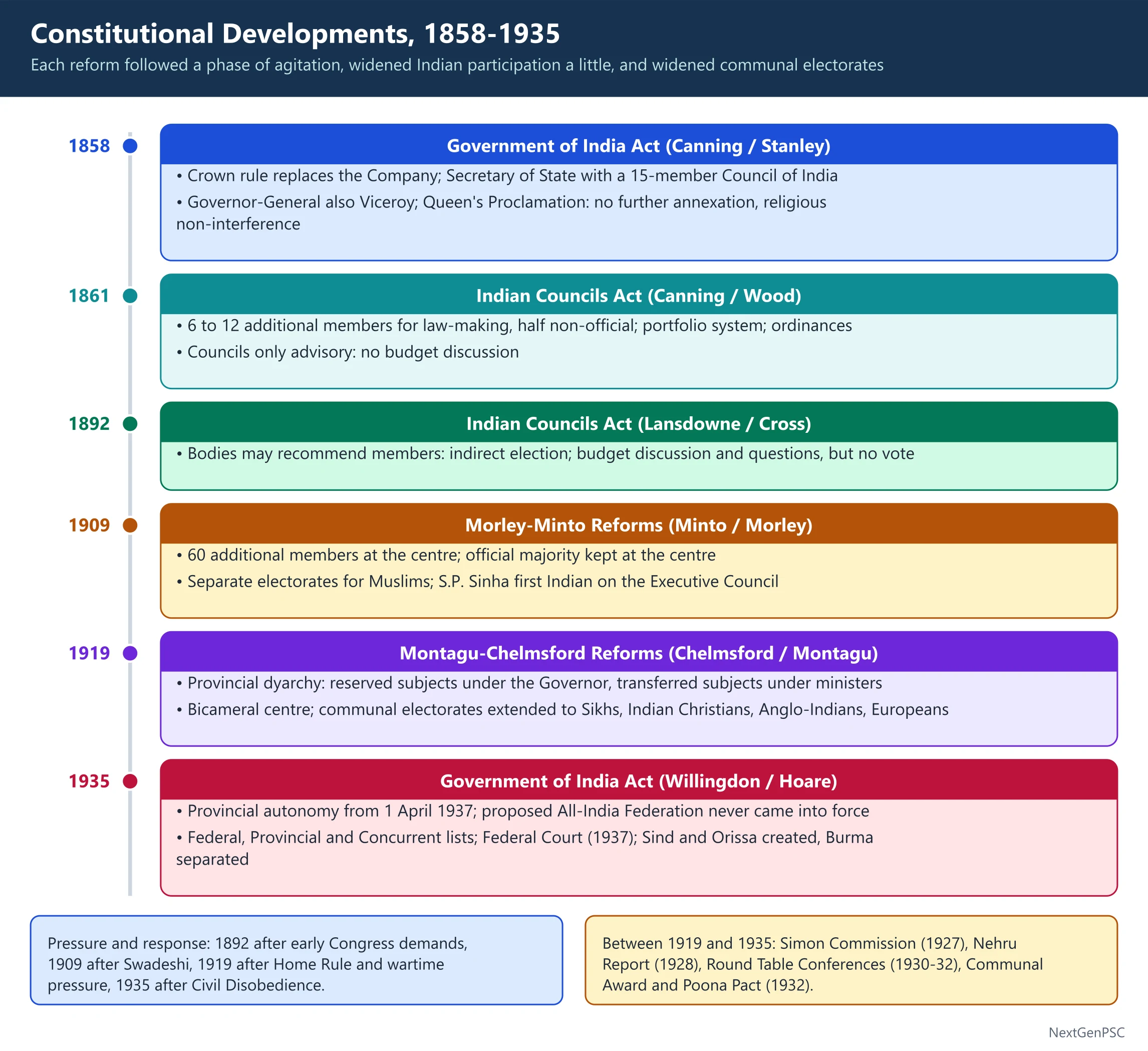
1. The Crown Takes Over: 1858
Government of India Act 1858: Passed after the Revolt of 1857, it ended the rule of the East India Company and transferred the government of India to the British Crown.
A Secretary of State for India, a member of the British Cabinet, was created with a 15-member Council of India to advise him; the Board of Control and Court of Directors were abolished.
The Governor-General also became the Viceroy, the Crown's representative; Lord Canning was the first.
Queen's Proclamation (1 November 1858): Read at Allahabad, it promised no further annexation, respect for the rights of princes, religious non-interference and equal access to office regardless of race or creed.
The Act centralised control in London; the Viceroy was now answerable to a Cabinet minister and, through him, to Parliament.
2. The Indian Councils Acts of 1861 and 1892
Indian Councils Act 1861: Added 6 to 12 additional members, at least half non-official, to the Viceroy's Executive Council for law-making; some Indians (often princes and landlords) were nominated.
It gave legal status to Canning's portfolio system, restored law-making powers to Bombay and Madras, and allowed the Viceroy to issue ordinances in emergencies.
The councils were advisory; they could not discuss the budget or question the executive.
Indian Councils Act 1892: Passed partly in response to early Congress demands, it raised the number of additional members (10 to 16 at the centre) and allowed bodies such as municipalities, district boards, universities and chambers of commerce to recommend members, an indirect and unacknowledged form of election.
Members could now discuss the annual budget and ask questions, but could not vote on the budget or ask supplementary questions.
The Moderates welcomed the principle of representation but criticised the Act as inadequate; Tilak and the younger nationalists dismissed it.
3. Morley-Minto Reforms: Indian Councils Act 1909
Context: The Partition of Bengal (1905), the Swadeshi movement and revolutionary activity made the government seek to win over the Moderates and the Muslim elite.
Simla Deputation (1 October 1906): A Muslim delegation led by the Aga Khan met Viceroy Minto and asked for separate electorates and weightage; the Muslim League was founded at Dacca in December 1906.
Main provisions: The Imperial Legislative Council was enlarged to 60 additional members and the provincial councils were also enlarged, with a non-official majority in the provinces but an official majority kept at the centre.
Muslims were given separate electorates, in which only Muslims voted for Muslim candidates; this is why Minto is often called the father of communal electorates.
Members could move resolutions and ask supplementary questions; Satyendra Prasanna Sinha became the first Indian member of the Viceroy's Executive Council (Law Member).
Morley told the House of Lords that he did not intend the reforms to lead to a parliamentary system in India; this is a much-quoted admission of their limited aim.
4. Montagu-Chelmsford Reforms: Government of India Act 1919
August Declaration (20 August 1917): Secretary of State Edwin Montagu announced the goal of the increasing association of Indians in administration and the progressive realisation of responsible government in India as an integral part of the British Empire.
The Montagu-Chelmsford Report (1918) became the Government of India Act 1919, which came into force in 1921.
Dyarchy in the provinces: Provincial subjects were split into reserved (law and order, finance, land revenue) under the Governor and his executive councillors, and transferred (education, health, local self-government, agriculture) under Indian ministers responsible to the legislature.
Centre: A bicameral legislature, the Central Legislative Assembly and the Council of State, with elected majorities; but the Governor-General kept veto, certification and ordinance powers, and the executive was not responsible to the legislature.
Central and provincial budgets were separated, communal electorates were extended to Sikhs, Indian Christians, Anglo-Indians and Europeans, and a statutory commission was promised after ten years.
The franchise rested on property and tax qualifications and remained very narrow.
The Congress at its special Bombay session (1918) called the reforms disappointing and unsatisfactory; the Moderates left to form the Liberal Federation and worked the reforms.
Dyarchy failed in practice: ministers held transferred subjects without control over finance, and Governors could override them.
5. From the Simon Commission to the Communal Award
Simon Commission (appointed November 1927): An all-white seven-member statutory commission under Sir John Simon; its arrival in February 1928 was met with black flags and the slogan Simon Go Back.
Lala Lajpat Rai was injured in a police lathi-charge at Lahore in October 1928 and died in November 1928.
Nehru Report (August 1928): In reply to Birkenhead's challenge that Indians could not agree on a constitution, a committee under Motilal Nehru proposed dominion status, joint electorates with reserved seats for minorities, fundamental rights and linguistic provinces.
Jinnah's Fourteen Points (March 1929) restated Muslim demands for separate electorates, one-third representation at the centre and residuary powers to the provinces.
Simon Report (1930): Recommended ending dyarchy, provincial autonomy and an eventual federation, but did not mention dominion status.
Round Table Conferences: First (November 1930 to January 1931) without the Congress; Second (September to December 1931), attended by Gandhi as the sole Congress representative after the Gandhi-Irwin Pact; Third (November to December 1932), again without the Congress.
Communal Award (16 August 1932): Ramsay MacDonald extended separate electorates to the Depressed Classes; Gandhi fasted in Yerwada jail.
Poona Pact (24 September 1932): Gandhi and Ambedkar agreed to joint electorates with reserved seats for the Depressed Classes, raising their provincial seats from 71 under the Award to 148.
A White Paper (1933) and a Joint Parliamentary Committee under Lord Linlithgow prepared the final bill.
6. The Government of India Act 1935
All-India Federation: Proposed of British Indian provinces and princely states, but it depended on the princes acceding, which they never did, so the federal part never came into force.
Provincial autonomy: Dyarchy ended in the provinces; all provincial subjects went to ministers responsible to elected legislatures, from 1 April 1937.
Dyarchy at the centre: Defence and foreign affairs were to be reserved subjects under the Governor-General, but this was never implemented.
Three lists: Federal, Provincial and Concurrent lists divided legislative powers; residuary powers lay with the Governor-General.
A Federal Court was set up (1937); Burma was separated from India and Sind and Orissa became new provinces.
Separate electorates were extended further, and the franchise was widened to a few crore voters, still only a minority of adults.
Governors and the Governor-General kept special responsibilities and discretionary powers, so the Act was autonomy with brakes.
Nehru called it a charter of slavery and described it as a machine with strong brakes but no engine.
In the 1937 elections the Congress formed ministries in most provinces (seven at first, later eight), which shaped Congress-League relations.
7. Sources and Evidence
Official reports: the Montagu-Chelmsford Report (1918), the Simon Commission Report (1930), proceedings of the Round Table Conferences and the Joint Parliamentary Committee report.
Private papers and diaries: Morley's Recollections, the Minto papers and Montagu's An Indian Diary show the private aims behind public statements.
Indian documents: Congress resolutions, the Nehru Report (1928), Jinnah's Fourteen Points and the Poona Pact text.
Parliamentary debates (Hansard) and the statutes themselves are the core primary sources.
8. Analysis: Concession, Control or Division?
Pressure and response: Each reform followed a phase of agitation: 1892 after early Congress demands, 1909 after Swadeshi, 1919 after the Home Rule and wartime pressure, 1935 after Civil Disobedience.
Collaborators and the carrot-and-stick: Reforms were paired with repression (Rowlatt Act with 1919; repression of 1932 with the RTCs) to win moderates while isolating militants.
Communal electorates: Begun in 1909 and widened in 1919, 1932 and 1935, they made religion a political category and later fed the politics of partition.
Continuity into the Constitution: The 1935 Act gave independent India its federal scheme, provincial governors, the Federal Court, three lists and emergency provisions.
Limits: No reform granted responsible government at the centre before 1947; the franchise remained narrow and the British kept the final say.
9. Historiography and Debates
Imperialist view: Writers such as Reginald Coupland presented the reforms as a planned, gradual training of Indians in self-government.
Nationalist view: Nationalist writers and later Bipan Chandra see the reforms as reluctant concessions wrung out by struggle, deliberately limited and designed to divide Indians.
Cambridge School: Anil Seal, John Gallagher and Gordon Johnson (Locality, Province and Nation, 1973) argue that the reforms created new arenas of power, and Indian politics grew as local elites competed for the patronage these councils offered.
Critics of the Cambridge School: Bipan Chandra and others reply that this reduces nationalism to factional self-interest and ignores mass struggle and ideology.
On 1935: R.J. Moore and Carl Bridge read the federal scheme as a conservative device: princes would balance the Congress and preserve British control, which is why historians call it a strategy to hold India to the empire.
On separate electorates: Nationalist historians stress divide-and-rule from 1909, while some recent work also points to the active role of Muslim elites in demanding them; the debate is about the balance of British design and Indian agency.
10. Using It in the Exam
10-mark answer (150 words): One-line context, three or four key provisions, one line of assessment; for example, how dyarchy worked and why it failed.
15-mark answer (200 words): Context of agitation, provisions, nationalist response, and one historiographical view.
20-mark answer (250 words): Treat 1858 to 1935 as one process, compare the stages in a short table or flow, and close with the legacy for the Constitution of 1950.
Keywords examiners look for: progressive realisation of responsible government, dyarchy, separate electorates, provincial autonomy, federation, safeguards.
Useful extracts: the August Declaration's phrase about the progressive realisation of responsible government; Nehru's description of the 1935 Act as a machine with strong brakes but no engine.
| Act | Viceroy / Secretary of State | Key provisions | Indian response |
|---|---|---|---|
| Government of India Act 1858 | Canning / Stanley | Crown rule; Secretary of State and Council of India; Viceroy | Accepted; Queen's Proclamation seen as a charter of rights |
| Indian Councils Act 1861 | Canning / Wood | Nominated non-officials in legislative councils; portfolio system; ordinances | Little political response |
| Indian Councils Act 1892 | Lansdowne / Cross | Indirect recommendation of members; budget discussion; questions | Moderates: inadequate |
| Indian Councils Act 1909 | Minto / Morley | Larger councils; separate Muslim electorates; resolutions | Congress welcomed councils, opposed communal electorates |
| Government of India Act 1919 | Chelmsford / Montagu | Provincial dyarchy; bicameral centre; wider communal electorates | Congress: disappointing; Liberals worked it |
| Government of India Act 1935 | Willingdon / Hoare | Provincial autonomy; proposed federation; three lists; Federal Court | Congress rejected but contested 1937 elections |
Mains points
- Questions often ask whether the reforms were steps to self-government or tools of control and division; argue both and conclude that they were concessions under pressure with built-in safeguards.
- Dyarchy (1919) is asked repeatedly: explain reserved and transferred subjects, then show why it failed (no control over finance, Governor's override, narrow franchise).
- Link separate electorates (1909, 1919, 1932, 1935) to the growth of communal politics and partition, but note Muslim elite agency as well as British policy.
- For the 1935 Act, separate what worked (provincial autonomy, 1937 ministries) from what never came into force (federation, central dyarchy), and stress its legacy in the Constitution.
- A common mistake is to list provisions without context; always tie each Act to the agitation or crisis that produced it.
- Use one historiographical contrast (Coupland or the Cambridge School versus Bipan Chandra) to lift a descriptive answer to an analytical one.
Did you know?
- Memory trick for the sequence of reforms: Councils, Councils, Councils, then Government of India: the three Councils Acts (1861, 1892, 1909) only enlarged councils, while the two Government of India Acts (1919, 1935) changed who governed, first through dyarchy and then through provincial autonomy.
- About 250 articles of the Constitution of India are often said to be drawn from or modelled on the 1935 Act, which is why it is called the blueprint of the Constitution; treat the exact number as an approximation.
Revolutionaries in India and Abroad
The revolutionary stream used secret societies, bombs, assassinations and planned armed risings against British rule. Its first phase (c. 1897–1918) grew out of the Swadeshi movement in Bengal and Maharashtra and spread abroad through India House and the Ghadar Party; its second phase (1924–1934) in the HSRA and the Chittagong group moved from individual heroism towards socialism and mass mobilisation. Historians debate whether to call it terrorism or revolutionary nationalism and how far it shaped the main movement.
In simple words
Some young Indians felt that petitions and even mass protests were too slow, so they formed secret groups, collected arms and attacked British officials, hoping to inspire the people and frighten the rulers.
It is like a small group lighting a signal fire, hoping a whole village will wake up.
They rarely won militarily, but figures like Bhagat Singh and Surya Sen gave the national movement courage and later a socialist vision.
UPSC asks about their ideology, their regional spread and their relation to Gandhian methods.
1. Why Revolutionary Methods Arose
The first wave came out of the Swadeshi movement (1905–08): when the movement was repressed and the Moderate-Extremist split of 1907 left the young without a lead, many turned to secret action.
Influences included the Irish nationalists, the Russian nihilists, Mazzini and the Italian Carbonari, and a religious idiom drawn from the Gita, Kali and Shivaji.
The methods were individual action: killing hated officials and informers, raising funds through dacoities, and hoping to provoke a general rising or win over Indian soldiers.
2. Maharashtra
Vasudev Balwant Phadke led an armed band against British rule in the late 1870s and is often counted as a forerunner.
Chapekar brothers: Damodar and Balkrishna Chapekar shot W.C. Rand, the Plague Commissioner of Poona, and Lieutenant Ayerst on 22 June 1897, in anger at harsh plague measures.
Savarkar brothers: V.D. Savarkar and his brother Ganesh founded the Mitra Mela (1899), which became the Abhinav Bharat society (1904).
Nasik Conspiracy: A.M.T. Jackson, Collector of Nasik, was shot by Anant Kanhere in December 1909; the Savarkars were tried and transported.
3. Bengal: The First Phase
Anushilan Samiti began in Calcutta in 1902 (Pramathanath Mitra), with a strong Dacca branch under Pulin Behari Das; the Jugantar group formed round the paper of that name (1906) of Barindra Kumar Ghosh and Bhupendranath Dutta.
Muzaffarpur (30 April 1908): Khudiram Bose and Prafulla Chaki threw a bomb at a carriage they thought carried the judge Kingsford; it killed two English women; Chaki shot himself and Khudiram was hanged.
Alipore (Maniktala) Bomb Case (1908–09): Barindra and others were sentenced; Aurobindo Ghosh, defended by C.R. Das, was acquitted and later withdrew to Pondicherry.
Delhi bomb (23 December 1912): A bomb thrown at Viceroy Hardinge during his state entry into Delhi was linked to Rash Behari Bose's group.
Jatindranath Mukherjee (Bagha Jatin) planned a rising with German arms during the First World War; he was fatally wounded in a fight near Balasore in 1915.
4. The Punjab and the Ghadar Movement
1907 agitation: Lala Lajpat Rai and Ajit Singh led protests against the Punjab Colonisation Bill and were deported to Mandalay.
Ghadar Party (1913): Founded in San Francisco by Indian migrants, mainly Punjabi Sikh peasants and ex-soldiers, with Sohan Singh Bhakna as president and Lala Har Dayal as its leading ideologue; its paper Ghadar was published in Urdu and Gurmukhi.
Komagata Maru (1914): The ship carrying Indian emigrants was refused entry at Vancouver; on return, a clash at Budge Budge near Calcutta (29 September 1914) left many dead and inflamed the Ghadarites.
Failed rising (February 1915): Ghadarites returned to raise the army; the plan was betrayed, and the Lahore Conspiracy Cases followed; Kartar Singh Sarabha was hanged at the age of 19.
Singapore mutiny (February 1915): Indian soldiers of the 5th Light Infantry rebelled and were suppressed.
5. The Madras Presidency
Tirunelveli and Tuticorin: The Swadeshi Steam Navigation Company of V.O. Chidambaram Pillai and the 1908 Tirunelveli unrest radicalised young men in the south.
Ashe murder (17 June 1911): Vanchinathan (Vanchi Iyer) shot Robert Ashe, Collector of Tirunelveli, at Maniyachi railway station and then shot himself; he was linked to the Bharata Matha Association.
Pondicherry exiles: French Pondicherry sheltered Aurobindo, Subramania Bharati and V.V.S. Aiyar, who had links with India House in London.
6. Revolutionaries Abroad
India House, London (1905): Founded by Shyamji Krishna Varma, who published The Indian Sociologist; it became a centre for Savarkar and others.
Madan Lal Dhingra shot Sir William Curzon Wyllie in London on 1 July 1909 and was hanged; Savarkar was arrested in 1910 and made a famous attempt to escape at Marseilles.
Madame Bhikaji Cama unfurled an Indian national flag at the International Socialist Congress at Stuttgart in 1907.
Berlin Committee (1915): Virendranath Chattopadhyaya, Bhupendranath Dutta and others worked with Germany during the war to send arms and organise Indian prisoners of war.
Provisional Government of India, Kabul (December 1915): Raja Mahendra Pratap as president, Maulana Barkatullah as prime minister and Obaidullah Sindhi among its members.
7. The Second Phase: HRA, HSRA and Chittagong
Hindustan Republican Association (1924): Founded at Kanpur by Sachindranath Sanyal, Jogesh Chandra Chatterjee and Ramprasad Bismil, after the withdrawal of Non-Cooperation disillusioned many young men.
Kakori (9 August 1925): HRA men looted government cash from a train near Lucknow; Ramprasad Bismil, Ashfaqulla Khan, Roshan Singh and Rajendra Lahiri were hanged in 1927.
HSRA (September 1928): At a meeting at Ferozeshah Kotla, Delhi, the group was renamed the Hindustan Socialist Republican Association under Chandrashekhar Azad, adopting socialism as its goal.
Saunders killing (17 December 1928): To avenge Lajpat Rai's death, Bhagat Singh and Rajguru, covered by Chandrashekhar Azad, shot J.P. Saunders, a police officer, at Lahore.
Assembly bomb (8 April 1929): Bhagat Singh and B.K. Dutt threw harmless bombs in the Central Legislative Assembly against the Public Safety and Trade Disputes Bills and courted arrest to use the trial as a platform.
Jatin Das died on 13 September 1929 after a hunger strike of 63 days in Lahore jail; Bhagat Singh, Sukhdev and Rajguru were hanged on 23 March 1931; Azad died in a police encounter at Allahabad on 27 February 1931.
Chittagong (18 April 1930): Surya Sen's Indian Republican Army raided the armouries; the group fought at Jalalabad hills; Surya Sen was hanged in 1934.
Women took active roles in this phase: Pritilata Waddedar led the 1932 attack on the Pahartali European Club; Kalpana Dutt was tried with Surya Sen; Santi Ghosh, Suniti Choudhury and Bina Das carried out shootings of officials.
8. Sources and Evidence
Colonial records: the Sedition Committee (Rowlatt) Report of 1918 and James Campbell Ker's confidential Political Trouble in India, 1907–1917 collected police intelligence.
Trial records: the Alipore, Lahore, Kakori and Chittagong cases preserve statements, confessions and seized documents.
Revolutionary writings: Jugantar and Bande Mataram, Bhagat Singh's jail notebook and essay Why I Am an Atheist (1930), and the HSRA manifesto The Philosophy of the Bomb (1930, drafted by Bhagwati Charan Vohra) written in reply to Gandhi's article The Cult of the Bomb.
Memoirs: Sachindranath Sanyal's Bandi Jivan, Hemchandra Kanungo's account of the Bengal groups and Manmathnath Gupta's histories.
9. Analysis
Strengths: sacrifice and courage that inspired the young; links with soldiers, emigrants and workers; a growing socialist and secular vision in the HSRA.
Weaknesses: small secret groups without a mass base, religious symbolism in Bengal that limited Muslim support in the first phase, easy penetration by informers, and heavy repression.
Evolution: from Hindu revivalist imagery and individual heroism (1900s) to the secular, socialist and anti-imperialist programme of Bhagat Singh, who in jail came to stress mass organisation over the bomb.
Relation to Gandhi and the Congress: Gandhi condemned violence, yet the Congress praised the patriotism of Bhagat Singh; the 1931 Karachi session recorded admiration for their bravery while disapproving of violence.
10. Historiography and Debates
Colonial view: the Rowlatt Report and police writers treated the movement as a criminal, anarchical conspiracy and used the term terrorism.
Nationalist view: R.C. Majumdar and popular histories treat the revolutionaries as martyrs and as a vital force for freedom.
Sumit Sarkar (The Swadeshi Movement in Bengal, 1903–1908, 1973) sees revolutionary terrorism in Bengal as a result of the failure to build a mass movement, and notes how its Hindu idiom alienated Muslims.
Bipan Chandra (India's Struggle for Independence) stresses the ideological shift of Bhagat Singh and the HSRA towards socialism, while judging individual violence as unable to replace mass struggle.
Newer work: Peter Heehs (The Bomb in Bengal, 1993), Harish K. Puri on the ideology of the Ghadar movement, S. Irfan Habib (To Make the Deaf Hear, 2007) on HSRA ideas, Kama Maclean (A Revolutionary History of Interwar India, 2015) on how revolutionary and Congress worlds overlapped, and Durba Ghosh (Gentlemanly Terrorists, 2017) on Bengal and the colonial state.
The naming debate: many historians avoid the colonial word terrorism and prefer revolutionary nationalism; examiners accept either if you explain the choice.
11. Using It in the Exam
10-mark answer: pick one strand (for example the Ghadar movement), give origin, aims, action and reasons for failure in about 150 words.
15-mark answer: compare the two phases: methods, ideology, social base and regional spread.
20-mark answer: assess the contribution of the revolutionaries to the national movement, with a regional sweep (Bengal, Punjab, Maharashtra, U.P., Madras, abroad), the evolution of ideology and a balanced conclusion.
Keywords: secret societies, individual heroic action, Ghadar, HSRA socialism, propaganda by deed, mass base, Philosophy of the Bomb.
Useful extracts: the Assembly leaflet of 1929 said it needed a loud voice to make the deaf hear; in court Bhagat Singh and Dutt declared that revolution is an inalienable right of mankind.
| Region | Organisation / leaders | Key action | Date |
|---|---|---|---|
| Maharashtra | Chapekar brothers | Killing of Rand and Ayerst, Poona | 1897 |
| Maharashtra | Abhinav Bharat (Savarkars) | Killing of Collector Jackson, Nasik | 1909 |
| Bengal | Anushilan Samiti, Jugantar | Muzaffarpur bomb; Alipore case | 1908 |
| Delhi | Rash Behari Bose's group | Bomb on Viceroy Hardinge | 1912 |
| Madras Presidency | Vanchinathan, Bharata Matha Association | Killing of Collector Ashe, Maniyachi | 1911 |
| Abroad / Punjab | Ghadar Party (Har Dayal, Sohan Singh Bhakna) | Planned army rising | 1915 |
| United Provinces | HRA (Bismil, Ashfaqulla Khan) | Kakori train action | 1925 |
| Punjab / Delhi | HSRA (Bhagat Singh, Azad) | Saunders killing; Assembly bomb | 1928–29 |
| Bengal | Indian Republican Army (Surya Sen) | Chittagong armoury raid | 1930 |
Mains points
- UPSC asks you to assess the role and limits of the revolutionaries; balance their inspirational value against the absence of a mass base and their failure to win militarily.
- Show the change from the first phase (religious idiom, individual action) to the second (HSRA socialism, secularism, mass orientation); this contrast is the core of a high-scoring answer.
- Cover every region named in the syllabus, including the Madras Presidency and outside India, since a Bengal-Punjab-only answer looks incomplete.
- Avoid presenting the revolutionaries simply as opposed to Gandhi; mention the overlap of personnel and sympathy with the Congress (Kama Maclean) and the Karachi resolution of 1931.
- Use precise dates for key events (1897, 1908, 1909, 1912, 1915, 1925, 1928, 1929, 1930, 1931) and name at least one historian.
- Explain the terminology choice (terrorism versus revolutionary nationalism) in one line; it shows historiographical awareness.
Did you know?
- Bhagat Singh was reading a book on Lenin in his cell when he was called for execution; this story is widely told by his comrades, though details vary between accounts.
- Memory trick for the first phase: C-A-M-D-G, Chapekars 1897, Alipore 1908, Madan Lal Dhingra 1909, Delhi bomb 1912, Ghadar 1915.
The Left: Nehru, Bose, the Congress Socialists and the CPI
From the 1920s a Left current, inspired by the Russian Revolution and the Depression, tried to give the national movement a socio-economic programme for workers and peasants. It worked in two ways: inside the Congress through Jawaharlal Nehru, Subhas Chandra Bose and the Congress Socialist Party (1934), and outside it through the Communist Party of India, trade unions and the Kisan Sabha. It pushed the Congress leftwards (Karachi 1931, Faizpur 1936, planning) but never displaced the Gandhian leadership, and the communists isolated themselves in 1928–34 and 1942.
In simple words
In the 1920s and 1930s many young nationalists asked a new question: freedom for whom? They wanted independence to also bring land to peasants, fair wages to workers and planned industry.
Think of a family that agrees to leave a bad landlord but argues about how to share the new house.
The Left, led by figures like Nehru, Bose, Jayaprakash Narayan and the communists, gave the movement this social vision.
UPSC asks how the Left shaped the Congress and why it failed to lead it.
1. Roots of the Left
The Russian Revolution of 1917, the post-war economic crisis, the withdrawal of Non-Cooperation in 1922 and the Great Depression of 1929 led many nationalists to look at class, land and labour.
Trade unions grew: the All India Trade Union Congress was founded at Bombay in 1920 with Lala Lajpat Rai as its first president; the Bombay textile strikes of 1928 were led by the communist-influenced Girni Kamgar Union.
Peasant organisations followed: Swami Sahajanand Saraswati formed the Bihar Provincial Kisan Sabha (1929), and the All India Kisan Sabha was founded at Lucknow in April 1936 with Sahajanand as president and N.G. Ranga among its leaders.
Cultural fronts appeared in 1936: the Progressive Writers' Association (its first conference at Lucknow was presided over by Premchand) and the All India Students' Federation.
2. The Communist Party of India
Tashkent (October 1920): M.N. Roy, Abani Mukherjee and others formed a Communist Party of India among émigrés; at the Second Comintern Congress (1920) Roy debated Lenin on whether communists should support bourgeois national movements in the colonies.
Groups inside India: S.A. Dange in Bombay, Muzaffar Ahmad in Calcutta, Singaravelu Chettiar in Madras and Ghulam Hussain in Lahore.
Repression: the Peshawar Conspiracy Cases (1922–27) and the Kanpur Bolshevik Conspiracy Case (1924), in which Dange, Muzaffar Ahmad, Shaukat Usmani and Nalini Gupta were convicted.
Kanpur conference (December 1925): a communist conference at Kanpur is taken by the CPI as its founding date; the CPI(M) dates the party to Tashkent 1920, so the founding date is itself debated.
Workers and Peasants Parties (1926–28): open fronts in Bengal, Bombay, the Punjab and U.P. worked within the Congress.
Meerut Conspiracy Case (1929–33): 31 labour and communist leaders, including three Britons (Philip Spratt, Ben Bradley and Lester Hutchinson), were arrested in March 1929; the long trial publicised communist ideas but crippled the leadership.
Sectarian turn (1928–34): following the Sixth Comintern Congress (1928), the communists denounced the Congress and Gandhi as bourgeois and stayed out of the Civil Disobedience Movement, isolating themselves; the party was banned in 1934.
United front (1935–39): after the Seventh Comintern Congress (1935), the Dutt-Bradley thesis (1936) urged an anti-imperialist people's front; communists worked inside the Congress and the CSP.
People's War (1941–45): after Germany invaded the USSR, the CPI called the war a people's war and opposed the Quit India Movement; the ban was lifted in July 1942.
The CPI also accepted the right of nationalities to self-determination (the Adhikari thesis, 1942–43) and gave qualified support to the Pakistan demand, which further separated it from mainstream nationalism.
3. Jawaharlal Nehru: The Left Inside the Congress
Nehru attended the Brussels Congress of Oppressed Nationalities (February 1927), which founded the League against Imperialism, and visited the Soviet Union in 1927.
With Bose he pressed for complete independence: the Madras session (1927) passed an independence resolution, and in 1928 they formed the Independence for India League against the dominion status of the Nehru Report.
As Congress president at Lahore (1929) he presided over the Purna Swaraj resolution; he drafted the Karachi resolution on Fundamental Rights and Economic Policy (1931).
Lucknow (1936): his presidential address declared that the only key to the solution of the world's and India's problems lay in socialism; Faizpur (1936) adopted an agrarian programme.
He chaired the National Planning Committee (1938) and wrote on world affairs and imperialism (Whither India?, 1933; Glimpses of World History).
Yet Nehru never broke with Gandhi: he put the unity of the national movement above socialist purity, and in 1936 accepted a Working Committee dominated by the Gandhian right.
4. Subhas Chandra Bose
Bose, a leader of the Bengal Congress, wrote The Indian Struggle (1935) and favoured a more militant, uncompromising line and a planned economy.
As Congress president at Haripura (1938) he set up a planning committee and spoke of state-led industrialisation.
Tripuri crisis (1939): Bose was re-elected president, defeating Gandhi's candidate Pattabhi Sitaramayya; Gandhi said that Pattabhi's defeat was more his own than Pattabhi's.
The Pant resolution asked Bose to appoint a Working Committee in line with Gandhi's wishes; unable to do so, Bose resigned in April 1939 and formed the Forward Bloc (May 1939).
A Left Consolidation Committee briefly brought together the Forward Bloc, the CSP, the communists and the Royists, but it soon split; Bose's later path led to the Indian National Army.
5. The Congress Socialist Party
Founded in 1934 (first meeting at Patna in May, formal conference at Bombay in October) by young Congressmen released from jail after Civil Disobedience.
Leaders: Acharya Narendra Dev (president), Jayaprakash Narayan (general secretary), Minoo Masani, Achyut Patwardhan, Asoka Mehta, Ram Manohar Lohia, Yusuf Meherally and Kamaladevi Chattopadhyay.
Aims: to work within the Congress, radicalise its programme, and organise peasants and workers; Jayaprakash Narayan's Why Socialism? (1936) set out its case.
The CSP admitted communists in the united-front years but expelled them by 1940 after bitter disputes.
Quit India (1942): CSP leaders led the underground: Jayaprakash Narayan escaped from Hazaribagh jail, Lohia and Usha Mehta ran the Congress Radio, and Aruna Asaf Ali hoisted the flag at Gowalia Tank.
After independence the socialists left the Congress in 1948 to form the Socialist Party.
6. Other Left Groups
Radical Democratic Party (1940): M.N. Roy, expelled from the Comintern in 1929, supported the Allied war effort and later developed radical humanism.
Revolutionary Socialist Party (1940): formed largely from former Anushilan revolutionaries of Bengal.
The Forward Bloc, the Kisan Sabha (which drifted towards the communists by the 1940s) and smaller Trotskyist groups made up the rest of the Left spectrum.
7. Sources and Evidence
Congress presidential addresses (Lucknow 1936, Haripura 1938), the Karachi and Faizpur resolutions and AICC papers.
Communist documents: the Meerut trial record, Comintern resolutions, the Dutt-Bradley thesis and party journals.
Writings and memoirs: Nehru's An Autobiography (1936), Bose's The Indian Struggle, Sahajanand's Mera Jivan Sangharsh, and M.N. Roy's memoirs.
Intelligence Bureau and police reports on communist and kisan activity.
8. Analysis: Achievements and Limits
Achievements: the Left brought workers and peasants into the movement, put land reform, labour rights and planning on the Congress agenda, and shaped the Nehruvian state after 1947.
Limits: it was divided (CSP, CPI, Royists, Forward Bloc), relied on foreign lines in the case of the CPI, and misread the Gandhian mass movement as bourgeois.
Why it did not capture the Congress: Gandhi's hold over the masses, Nehru's choice of unity over a split, the 1939 defeat of Bose, and the CPI's errors of 1928–34 and 1942.
Legacy: the Left made socialism part of the nationalist consensus, visible in the Constitution's Directive Principles and the Planning Commission.
9. Historiography and Debates
Communist reading: R. Palme Dutt (India Today, 1940) saw the Congress leadership as bourgeois, compromising at each crisis to protect property.
Bipan Chandra (The Indian Left: Critical Appraisal, 1983; India's Struggle for Independence) argues the Left failed because it did not understand the Gandhian strategy of struggle-truce-struggle and misjudged the national movement as a whole.
Sumit Sarkar (Modern India, 1885–1947) shows the Left's real influence on mass mobilisation in the 1930s, while noting how the Gandhian right outmanoeuvred it in 1939.
Aditya Mukherjee argues that Indian capitalists, fearing the Left, backed the Congress right and helped keep the movement within a capitalist path.
Cold War-era studies such as Overstreet and Windmiller (Communism in India, 1959) stressed Comintern control of the CPI; later scholars such as Sobhanlal Datta Gupta show a more complex relationship.
10. Using It in the Exam
10-mark answer: for example the CSP: founding, leaders, aims, achievements in 1942, and one limitation.
15-mark answer: Nehru and Bose compared: both radical, but Nehru chose unity with Gandhi while Bose chose confrontation.
20-mark answer: assess the role of the Left in the national movement: rise, forms (inside and outside the Congress), impact on programme, failures and legacy.
Keywords: socialism, class, Comintern, united front, people's war, planning, agrarian programme, Tripuri, hegemony.
Useful extracts: Nehru at Lucknow (1936) on socialism as the only key; Gandhi's remark after Tripuri that Pattabhi's defeat was his own.
| Strand | Founded / leaders | Relation to the Congress | Position in 1942 |
|---|---|---|---|
| Communist Party of India | 1920 Tashkent / 1925 Kanpur; Dange, Muzaffar Ahmad, P.C. Joshi | Hostile 1928–34; united front 1935–39 | Opposed Quit India (people's war) |
| Congress Socialist Party | 1934; Narendra Dev, Jayaprakash Narayan, Lohia | A group inside the Congress | Led the underground movement |
| Nehru | Congress president 1929, 1936, 1937 | Leader of the Left within the Congress, loyal to Gandhi | Arrested; supported the movement |
| Forward Bloc | 1939; Subhas Chandra Bose | Broke after Tripuri | Bose abroad; later the INA |
| Radical Democratic Party | 1940; M.N. Roy | Left the Congress | Supported the Allied war effort |
Mains points
- The standard question asks you to evaluate the role of the Left in the national movement; structure it as rise, forms, impact, failures and legacy.
- Compare Nehru and Bose as leaders of the Left: shared radicalism, different choices about Gandhi and unity, and the Tripuri crisis of 1939 as the turning point.
- Explain the CPI's shifting lines (1928 sectarian turn, 1935 united front, 1941 people's war, support for self-determination) as the main reason for its isolation.
- Do not treat the Left as a single body; distinguish the CSP, CPI, Royists, Forward Bloc and Kisan Sabha.
- Show positive impact concretely: Karachi resolution 1931, Faizpur agrarian programme 1936, National Planning Committee 1938, and the CSP's lead in 1942.
- End with the post-1947 legacy (planning, land reform, Directive Principles) to show continuity.
Did you know?
- Two of the three British communists tried at Meerut, Philip Spratt and Ben Bradley, had been sent to help organise Indian labour; Spratt stayed on in India, later turned against communism and worked as a journalist in Bangalore.
The Muslim League, the Hindu Mahasabha and Communal Politics
Communalism is the belief that people who follow one religion share common secular interests opposed to those of other religious groups. In colonial India it grew through religious revival, competition for jobs and seats, and separate electorates, and took organised form in the All India Muslim League (1906) and the Hindu Mahasabha (1915). After the 1937 elections the League under Jinnah turned the defensive politics of a minority into the two-nation theory, while Hindu communal bodies argued for a Hindu nation.
In simple words
Communal politics means treating religion as the basis of political interest, so that a Hindu or a Muslim is told that his jobs, votes and future depend on his religious group rather than on his class or region.
It is like neighbours who share one street being told they must fence off separate halves.
In India this idea, organised by the Muslim League and the Hindu Mahasabha and encouraged by British policy, ended in partition.
UPSC asks about its causes, its stages and the role of the British, the Congress and the communal parties.
1. Roots of Communal Consciousness (to 1906)
Sir Syed Ahmad Khan founded the Muhammadan Anglo-Oriental College at Aligarh (1875) to give Muslims modern education; from 1887–88 he urged Muslims to stay away from the Congress, fearing majority rule by Hindus.
Hindu revivalism: the cow-protection movement (riots in 1893), the Arya Samaj's shuddhi campaign, and Tilak's public Ganapati (1893) and Shivaji festivals used religious symbols for mass politics.
Hindi-Urdu controversy: the 1900 order of the U.P. government under MacDonnell allowing Nagari in courts alarmed Urdu-speaking Muslim elites.
Colonial categories: the census (from 1871–72) counted people by religion and caste, and official policy increasingly spoke of Hindus and Muslims as separate political communities.
Uneven development: Muslims in many regions lagged in English education and government jobs, so competition among the educated middle class took a religious form.
2. The All India Muslim League, 1906–1937
Founding (30 December 1906): at Dacca, during the session of the All India Muhammadan Educational Conference hosted by Nawab Salimullah; the Aga Khan became its president.
Early aims: loyalty to the British government, protection of Muslim political rights and separate electorates; members were landlords, ex-officials and professionals.
Change after 1911: the annulment of the Partition of Bengal (1911), the Balkan Wars, the Kanpur mosque incident (1913) and pan-Islamic feeling turned younger leaders against the British; in 1913 the League adopted self-government as its goal, and Jinnah joined it.
Lucknow Pact (December 1916): the Congress and the League agreed on joint demands; the Congress accepted separate electorates and weightage for Muslims in provinces where they were a minority.
Khilafat and Non-Cooperation (1919–22): Hindu-Muslim unity reached its height under Gandhi and the Ali brothers, but the abolition of the Caliphate by Turkey (1924) ended the Khilafat issue.
1920s: riots grew (Kohat 1924, Calcutta 1926); the League split over the Simon Commission, and Jinnah's Fourteen Points (1929) answered the Nehru Report.
Iqbal's Allahabad address (December 1930): Muhammad Iqbal, as League president, spoke of a consolidated North-West Indian Muslim state; in 1933 Choudhary Rahmat Ali's pamphlet Now or Never coined the name Pakistan.
3. The Hindu Mahasabha and Hindu Nationalism
Punjab Hindu Sabha (1909): formed in reaction to the Morley-Minto reforms and Muslim separate electorates; U.N. Mukherji's tract Hindus: A Dying Race (1909) spread fear of Hindu decline.
All India Hindu Mahasabha: its first all-India session met at Hardwar in 1915; Madan Mohan Malaviya and Lala Lajpat Rai were associated with it in the 1920s, when many members were also Congressmen.
Shuddhi and sangathan (1920s): campaigns to reconvert and organise Hindus, met by Muslim tabligh and tanzim; Swami Shraddhanand was murdered in 1926.
Savarkar's Hindutva: V.D. Savarkar's Hindutva: Who is a Hindu? (1923) defined a Hindu as one who regards India as both fatherland and holy land; as Mahasabha president (1937–42) he argued that Hindus and Muslims were two nations.
RSS (1925): founded at Nagpur by K.B. Hedgewar as a cultural organisation for Hindu discipline and unity; it stayed out of the Congress movements.
1940s: the Mahasabha opposed Quit India and joined ministries with the League in Sind and with Fazlul Huq in Bengal (Syama Prasad Mookerjee as finance minister, 1941–42).
4. 1937 to 1940: The Turn to Mass Communalism
1937 elections: the Congress won a majority in most provinces; the League won only a minority of the Muslim seats and could not form a government in any Muslim-majority province, where regional parties (Unionists in the Punjab, Krishak Praja Party in Bengal) were stronger.
Coalition refusal in U.P.: the Congress declined to share ministry posts with the League unless its members merged into the Congress; many historians see this as a turning point that drove League leaders to mass politics.
Congress Muslim Mass Contact (1937): launched by Nehru and K.M. Ashraf to reach Muslim peasants directly, it alarmed the League but achieved little.
League propaganda: the Pirpur Report (1938) and similar reports accused Congress ministries of anti-Muslim actions; the League celebrated a Day of Deliverance when they resigned (22 December 1939).
Reorganisation: at Lucknow (October 1937) Jinnah broadened the League's base; Sikander Hayat Khan (Jinnah-Sikander Pact) and Fazlul Huq brought their followers into it.
Lahore Resolution (23 March 1940): moved by Fazlul Huq, it demanded that Muslim-majority areas in the north-west and east be grouped into independent states; it became known as the Pakistan Resolution.
5. Sources and Evidence
Speeches and writings: Sir Syed's speeches at Lucknow and Meerut (1887–88), Iqbal's Allahabad address, Savarkar's Hindutva, Jinnah's Lahore address (1940).
Party papers: Muslim League resolutions, the Pirpur Report, Hindu Mahasabha proceedings and RSS literature.
Official records: census reports, the Simla Deputation's address, fortnightly reports of provincial governments and inquiry reports on riots.
Vernacular press: Urdu and Hindi newspapers show how symbols such as cow, music before mosques and script were used.
6. Analysis: Causes and Nature of Communalism
Modern, not medieval: most historians agree that communalism as a political ideology was a modern phenomenon, produced by colonial politics, middle-class competition and electoral representation.
British policy: separate electorates (1909 onwards), the Communal Award (1932), and the use of the League and princes as counterweights to the Congress encouraged division.
Socio-economic factors: a weak, job-seeking middle class, landlord interests and uneven modernisation gave communal appeals a material base.
Nationalist shortcomings: the use of Hindu symbols by some nationalists, the Congress's compromises with communal leaders (Lucknow Pact) and its failure to win the Muslim masses after 1937.
Stages (Bipan Chandra): first, the belief that followers of a religion share secular interests; second, liberal communalism that saw these interests as different but compatible; third, extreme communalism that saw them as hostile, which became dominant after 1937.
7. Historiography and Debates
Bipan Chandra (Communalism in Modern India, 1984) treats communalism as a false consciousness that diverted attention from colonial and class exploitation.
Gyanendra Pandey (The Construction of Communalism in Colonial North India, 1990) argues that the colonial state's knowledge and narratives helped construct communalism as a category.
Christopher Bayly (The Pre-history of Communalism?, 1985) points to earlier religious conflicts in the eighteenth century, arguing for some pre-colonial roots.
Francis Robinson versus Paul Brass: Robinson (Separatism among Indian Muslims, 1974) stresses Islamic ideas and identity, while Brass (Language, Religion and Politics in North India, 1974) argues that elites selected and manipulated religious symbols.
Hindu nationalism: Christophe Jaffrelot and William Gould show how Hindu nationalist organisations grew and how Hindu idioms also entered Congress politics.
Mushirul Hasan (Nationalism and Communal Politics in India) studies the 1916–28 years and the failure of Congress-League understanding.
8. Using It in the Exam
10-mark answer: for example the founding of the Muslim League: context (Partition of Bengal, Simla Deputation), aims, early character.
15-mark answer: role of separate electorates or the 1937 elections in the growth of communal politics.
20-mark answer: causes and stages of communalism from Sir Syed to the Lahore Resolution, giving British, Muslim and Hindu communal and Congress roles, with one historiographical debate.
Keywords: communalism, separate electorates, liberal and extreme communalism, two-nation theory, Hindutva, shuddhi, Lahore Resolution.
Useful extracts: Savarkar's definition of a Hindu (fatherland and holy land); the Lahore Resolution's demand for independent states in the Muslim-majority zones.
| Year | Event | Significance |
|---|---|---|
| 1875 | Aligarh college founded by Sir Syed | Modern education for a Muslim elite; later anti-Congress stance |
| 1906 | Simla Deputation; Muslim League founded at Dacca | Demand for separate electorates |
| 1909 | Morley-Minto reforms; Punjab Hindu Sabha | Separate electorates granted; Hindu reaction |
| 1915 | First all-India Hindu Mahasabha session at Hardwar | Organised Hindu communal politics |
| 1916 | Lucknow Pact | Congress accepts separate electorates |
| 1923–25 | Savarkar's Hindutva; RSS founded | Ideology and organisation of Hindu nationalism |
| 1930 | Iqbal's Allahabad address | Idea of a north-western Muslim state |
| 1937 | Provincial elections; U.P. coalition dispute | League turns to mass communal politics |
| 1940 | Lahore Resolution | Demand for separate Muslim states |
Mains points
- Define communalism at the start and state that it was a modern political ideology; this framing earns marks in any communalism question.
- Give a multi-causal answer: British policy, socio-economic competition, religious revival, nationalist shortcomings and the role of communal organisations on both sides.
- Treat Hindu and Muslim communalism together and in parallel; one-sided answers lose marks for balance.
- Use the 1937 elections and the U.P. coalition dispute as the turning point from liberal to extreme communalism, noting that this interpretation is debated.
- Cite at least one debate, such as Robinson versus Brass or Bipan Chandra versus Gyanendra Pandey.
- Avoid loaded or present-day political language; keep the tone analytical and source-based.
Did you know?
- Rahmat Ali's 1933 pamphlet built the name Pakistan from the regions it claimed: P for Punjab, A for the Afghan (North-West Frontier) province, K for Kashmir, S for Sind and the ending from Baluchistan.
- Jinnah was called the ambassador of Hindu-Muslim unity by Sarojini Naidu for his role in the Lucknow Pact of 1916, a striking contrast with his later politics.
Politics of Partition, Transfer of Power and Independence
Between 1940 and 1947 the British, the Congress and the Muslim League bargained over how power would be transferred. Proposals for a united but loose federation (Cripps 1942, Cabinet Mission 1946) failed amid mistrust, the League's Direct Action and spreading riots, and the Mountbatten Plan of 3 June 1947 divided British India into India and Pakistan on 14–15 August 1947. Historians still debate who was responsible: British policy, Jinnah's strategy, Congress choices or the momentum of communal violence.
In simple words
By the 1940s everyone knew the British would leave; the question was how, and to whom.
The Congress wanted one strong India, the Muslim League wanted Muslim-majority areas to have their own state, and the British wanted a quick and orderly exit.
Like heirs who cannot agree on the family house and end up splitting it as a fire spreads, the leaders accepted partition as riots grew.
UPSC asks why the plans for unity failed and who bears responsibility for partition.
1. The War Years, 1940–1945
August Offer (8 August 1940): Linlithgow promised dominion status after the war and an Indian body to frame a constitution, but also assured minorities that power would not be transferred to a system whose authority large elements denied, in effect a veto for the League.
Cripps Mission (March–April 1942): Sir Stafford Cripps offered dominion status after the war and a constituent assembly, but allowed any province to stay out of the new union; this provincial option was the first official acceptance of the possibility of partition.
Both the Congress and the League rejected the offer; Gandhi's description of it as a post-dated cheque is widely quoted, though the addition on a crashing bank is of doubtful origin.
Quit India (August 1942): with Congress leaders in jail until 1944–45, the League expanded its organisation and influence, and formed or joined ministries in Sind, Bengal and the North-West Frontier Province.
Rajaji formula and Gandhi-Jinnah talks (1944): C. Rajagopalachari proposed a post-war plebiscite in Muslim-majority districts; talks between Gandhi and Jinnah in Bombay (September 1944) failed over the scope and timing of separation.
Wavell Plan and Simla Conference (June–July 1945): Wavell proposed a reconstituted Executive Council with parity between caste Hindus and Muslims; it broke down when Jinnah insisted that the League alone nominate all Muslim members.
2. 1945–46: Elections, Upsurge and the Cabinet Mission
New British context: Attlee's Labour government (July 1945), war-weariness and Britain's economic weakness made a quick withdrawal likely.
Elections (winter 1945–46): the Congress swept the general seats; the League won almost all Muslim seats in the Central Assembly and most Muslim seats in the provinces, establishing its claim to speak for Muslims.
Popular upsurge: the INA trials at the Red Fort (November 1945, Shah Nawaz Khan, P.K. Sahgal and G.S. Dhillon) and the Royal Indian Navy mutiny at Bombay (February 1946) showed that the loyalty of the armed forces could no longer be assumed.
Cabinet Mission (March–June 1946): Pethick-Lawrence, Cripps and A.V. Alexander rejected a sovereign Pakistan and proposed (16 May 1946) a three-tier plan.
The plan: a Union for defence, foreign affairs and communications; provinces grouped into Section A (Hindu-majority provinces), Section B (Punjab, the North-West Frontier Province and Sind) and Section C (Bengal and Assam); and a constituent assembly elected by provincial legislatures.
Disputes: the League accepted the plan in June, seeing the groups as a basis for Pakistan; the Congress accepted the constituent assembly but disputed compulsory grouping, and Nehru's press statement of 10 July 1946 that the Congress was free to modify the plan alarmed the League.
The League withdrew its acceptance on 29 July 1946 and called for Direct Action.
3. Direct Action, Riots and the Interim Government
Direct Action Day (16 August 1946): in Calcutta, under the League ministry of H.S. Suhrawardy, it led to the Great Calcutta Killing, in which several thousand people died in a few days.
Violence spread to Noakhali in East Bengal (October 1946), where Gandhi walked from village to village, to Bihar (October–November 1946) and to Garhmukteshwar in U.P.; in March 1947 riots began in the Punjab.
Interim Government (2 September 1946): formed with Nehru as vice-president of the Executive Council; the League joined in October 1946 with Liaquat Ali Khan as finance member, but used its position to obstruct.
Constituent Assembly (9 December 1946): it met without the League, which boycotted it.
4. The Final Stage, 1947
Attlee's statement (20 February 1947): the British would leave India by June 1948, handing power to one or more authorities.
Mountbatten (from March 1947): after rejecting an early plan that risked many successor states, he and V.P. Menon framed a plan for two dominions.
3 June Plan: the Punjab and Bengal legislatures would vote on partition of their provinces; referendums were held in the North-West Frontier Province and Sylhet; Sind and Baluchistan would decide; boundary commissions under Cyril Radcliffe would draw the lines.
The date of transfer was brought forward to 15 August 1947; the AICC accepted the plan in June 1947, with Gandhi unhappy but not opposing it publicly.
Indian Independence Act (July 1947): created the dominions of India and Pakistan, ended British paramountcy over the princely states and gave each dominion's assembly full sovereignty.
Pakistan became independent on 14 August and India on 15 August 1947; the Radcliffe awards were made public only on 17 August.
Human cost: estimates of deaths range from about 200,000 to two million, and around 10 to 15 million people were displaced; tens of thousands of women were abducted, and both states later ran recovery operations.
5. Sources and Evidence
Official: The Transfer of Power 1942–7, twelve volumes of British documents edited by Nicholas Mansergh and others (1970–83), and the Cabinet Mission and Mountbatten papers.
Memoirs: V.P. Menon's The Transfer of Power in India (1957); Maulana Azad's India Wins Freedom (1959, full text released in 1988), which blames Nehru's July 1946 statement; Wavell: The Viceroy's Journal (edited by Penderel Moon, 1973).
Oral history and literature: Urvashi Butalia's The Other Side of Silence (1998); Saadat Hasan Manto's stories such as Toba Tek Singh; Khushwant Singh's Train to Pakistan (1956); Bhisham Sahni's Tamas; Yashpal's Jhootha Sach.
6. Analysis: Why Partition Happened
British policy: separate electorates, official recognition of the League as the Muslim voice (1940 offer, Simla 1945) and the haste of withdrawal in 1947.
League strategy: the two-nation theory, the success of the 1946 elections and Direct Action made a united India without Muslim consent impossible.
Congress choices: refusal to share power in 1937, rejection of compulsory grouping, and the preference of Nehru and Patel for a strong centre that a loose federation with the League would not allow.
Violence and fear: riots from August 1946 made leaders feel that partition was the only way to stop civil war; Patel argued that without partition India could break into many pieces.
Continuity and change: the transfer of power was negotiated and constitutional, but the new borders created refugees, the Kashmir dispute and lasting minority questions.
7. Historiography and Debates
Nationalist view: Bipan Chandra and others stress British divide-and-rule and the growth of communalism, with the Congress accepting partition as the lesser evil.
Ayesha Jalal (The Sole Spokesman, 1985) argues that Jinnah used the Pakistan demand as a bargaining counter to win parity for Muslims within a loose Indian federation, and that the Congress, wanting a strong centre, preferred partition.
Critics of Jalal: Anita Inder Singh (The Origins of the Partition of India, 1987) gives more weight to the League's actual aims, and Venkat Dhulipala (Creating a New Medina, 2015) shows that Pakistan was a widely discussed, popular idea in north India, not only a tactic.
Seervai (H.M. Seervai, Partition of India: Legend and Reality, 1989) places much of the blame on Congress leaders, echoing Azad.
Joya Chatterji (Bengal Divided, 1994) shows that Bengali Hindu leaders and the Mahasabha campaigned for the partition of Bengal.
On British policy: R.J. Moore (Escape from Empire, 1983) studies the Attlee government's aims, while Stanley Wolpert (Shameful Flight, 2006) criticises the haste of the British exit.
History from below: Gyanendra Pandey (Remembering Partition, 2001), Urvashi Butalia and Yasmin Khan (The Great Partition, 2007) shift attention from high politics to violence, memory, women and refugees.
8. Using It in the Exam
10-mark answer: for example the Cabinet Mission Plan: provisions, reasons for failure, consequences.
15-mark answer: why did the Congress accept partition in 1947? Give political, strategic and humanitarian reasons.
20-mark answer: assess the responsibility for partition: British, League, Congress and the role of violence, with at least two historians compared, and a balanced conclusion.
Keywords: provincial option, parity, grouping, Direct Action, transfer of power, two dominions, boundary commission, sole spokesman.
Useful extracts: Nehru's midnight speech (14–15 August 1947) that at the stroke of the midnight hour, when the world sleeps, India will awake to life and freedom; Attlee's statement of 20 February 1947 fixing June 1948 as the deadline.
| Plan | Date | Main proposal | Outcome |
|---|---|---|---|
| August Offer | August 1940 | Dominion status after the war; assurance to minorities | Rejected by the Congress |
| Cripps Mission | March–April 1942 | Post-war dominion, constituent assembly, provincial option | Rejected by the Congress and the League |
| C.R. formula / Gandhi-Jinnah talks | 1944 | Plebiscite in Muslim-majority districts after the war | Talks failed |
| Wavell Plan (Simla Conference) | June–July 1945 | Reconstituted Executive Council with parity | Failed over Muslim nominations |
| Cabinet Mission Plan | 16 May 1946 | Three-tier Union with groups A, B and C | Broke down over grouping; Direct Action |
| Mountbatten (3 June) Plan | June 1947 | Partition into two dominions; provincial votes and referendums | Indian Independence Act; 14–15 August 1947 |
Mains points
- The commonest question is about the inevitability of or responsibility for partition; avoid single-cause answers and weigh British, League, Congress and situational factors.
- Explain the Cabinet Mission Plan precisely (three tiers, three groups) and why grouping became the breaking point; this is asked often.
- Use the Jalal thesis and at least one critique (Anita Inder Singh or Venkat Dhulipala) to show historiographical depth.
- Include the human dimension (refugees, abducted women, violence in the Punjab and Bengal) through history-from-below writers; examiners reward it.
- Keep the chronology clean (1940, 1942, 1944, 1945, 1946, February 1947, 3 June 1947, July 1947, 14–15 August 1947); confused dates cost marks.
- Conclude by linking the mode of the transfer of power to post-independence problems such as integration of states, refugees and Kashmir.
Did you know?
- Cyril Radcliffe had never been to India before he arrived in July 1947 and had about five weeks to draw the boundaries of the Punjab and Bengal; he is said to have destroyed his papers afterwards.
UPSC Previous Year Questions: Constitutional Developments, Other Strands and Partition
From 2014 to 2026 UPSC asked 26 question parts (380 marks) from this chapter, all in Paper II. The most-asked topic is constitutional development from 1858 to 1935 (10 parts, especially dyarchy and the 1935 Act), followed by the revolutionaries, the Left and the politics of partition (5 parts each). Every question below has a model answer written to the UPSC word limit.
In simple words
Read a question and first write your own answer in the time limit: about 7 minutes for 10 marks and 12 minutes for 20 marks.
Then compare it with the model answer: check the introduction, the Acts, dates and historians you used, and whether you answered the directive word.
Note what you missed in a notebook and revise the matching topic in the notes before trying the next question.
1. Constitutional Developments, 1858–1935
Example 1 (UPSC 2026, 20 marks): Why did the British Crown assume direct control over the Indian Government in 1858? Mention the new administrative arrangements.
Paper and question: Paper II, Q4(a)
Approach: A two-part question: first the causes of the Crown's takeover, then the new arrangements in London and India. Give causes, then the administrative, military and princely changes, and end with their purpose.
The revolt of 1857 convinced Parliament that a trading company could no longer rule India. The Government of India Act of 2 August 1858 transferred power from the East India Company to the Crown, and Queen Victoria's Proclamation, read by Canning at Allahabad on 1 November 1858, announced the change.
Why the Crown took over: The Company was blamed for the revolt: annexations under the Doctrine of Lapse, the take-over of Awadh, fears of religious interference and sepoy grievances. Parliament also saw the double government of the Board of Control and the Directors as unaccountable.
In London: The Board of Control and the Court of Directors were abolished. A Secretary of State for India, a cabinet minister answerable to Parliament, took charge, advised by a Council of India of fifteen members.
In India: The Governor-General also became Viceroy, the Crown's representative. The Indian Councils Act of 1861 added nominated members, some Indian, to the Viceroy's council for law-making and recognised the portfolio system; the High Courts and Civil Services Acts followed the same year.
Army and princes: On the Peel Commission's advice (1859) the share of European troops was raised, artillery kept in European hands and recruitment shifted to the so-called martial races. The Proclamation ended annexation, honoured treaties with the princes and promised religious non-interference and equal entry to public service.
Thomas Metcalf, in The Aftermath of Revolt, shows that after 1858 the Raj turned conservative, allying with princes and landlords and retreating from social reform.
Crown rule thus aimed at tighter control, not at sharing power.
Example 2 (UPSC 2025, 10 marks): “The significant feature of the Indian Councils Act of 1892 was the principle of election which it introduced, though the word ‘election’ was very carefully avoided in it.” Critically examine.
Paper and question: Paper II, Q1(d)
Approach: Explain how the 1892 Act brought in election without using the word, then weigh how limited this 'election' was, and judge its significance.
The Indian Councils Act of 1892, passed in Lansdowne's viceroyalty after the Congress had demanded elected councils since 1885, enlarged the central and provincial legislative councils.
The principle of election: The Act called the additional members nominated, but rules under it let the Viceroy and governors nominate persons recommended by municipalities, district boards, universities, chambers of commerce and landholders; non-official members of provincial councils recommended members for the central council. In practice this was indirect election, though the word was kept out of the statute.
Its limits: The recommending bodies were narrow, so members came from landlords, merchants and lawyers. Government could reject a recommendation and kept an official majority. Members could discuss the budget and ask questions, but could not vote on the budget or ask supplementary questions.
The Congress called the Act inadequate, yet Gokhale and Pherozeshah Mehta used the councils to criticise government finance.
The statement is largely correct: 1892 quietly admitted the elective principle that the Morley-Minto reforms of 1909 made open, though it gave no real power.
Example 3 (UPSC 2024, 10 marks): The federal provisions of the Government of India Act of 1935 foundered on the rock of princely intransigence. Critically examine.
Paper and question: Paper II, Q1(d)
Approach: Show how the federal part of the 1935 Act depended on the princes, why they held back, and then add the other causes (Congress and League opposition, the war) to reach a balanced verdict.
The Government of India Act of 1935 planned an All-India Federation of provinces and princely states. Since states joined voluntarily, it could begin only when rulers entitled to half the states' seats in the Council of State, and representing half the states' population, signed an Instrument of Accession.
Princely intransigence: The princes had welcomed federation at the first Round Table Conference (1930) but soon demanded guarantees of treaty rights, internal autonomy and financial concessions. Linlithgow's emissaries negotiated from 1936, but in June 1939 the Chamber of Princes at Bombay found the revised terms unacceptable. Smaller states feared the larger ones, and the States' People's agitations of 1938–39 made rulers fear democracy in their own states.
Other rocks: The Congress rejected the scheme because nominated princes would form a conservative bloc, the Muslim League also opposed it, London was half-hearted, and the outbreak of war in September 1939 suspended it.
The princes were the immediate cause of failure, but nationalist opposition and imperial hesitation also sank the federation.
Example 4 (UPSC 2023, 20 marks): While introducing the Indian Councils Bill of 1861, the British thought that the only Government suitable for India 'is a despotism controlled from home'. Comment.
Paper and question: Paper II, Q2(b)
Approach: Identify the quotation (Sir Charles Wood, 1861), explain the provisions of the Act that reflected 'despotism controlled from home', note the small openings it made, and judge the statement.
The words are those of Sir Charles Wood, Secretary of State, introducing the Indian Councils Bill in the Commons in 1861. After 1857 the British wished to associate a few loyal Indians with law-making but rejected representative government for India.
Despotism in India: The Act added six to twelve nominated members, at least half non-officials, to the Viceroy's council for legislation. The council could only make laws: it could not discuss administration or the budget, bills on key subjects needed the Viceroy's prior sanction, and the Viceroy could veto bills and issue ordinances valid for six months.
Controlled from home: Final authority lay with the Secretary of State and Parliament, which could disallow Indian laws. 'Control' meant officials' accountability to Britain, not to Indians.
Indian association: Canning nominated the Maharaja of Patiala, the Raja of Benares and Sir Dinkar Rao in 1862, loyal allies of the post-revolt settlement rather than representatives of the people.
Openings: The Act restored legislative powers to Bombay and Madras, provided for new councils (Bengal 1862, the North-Western Provinces 1886, the Punjab 1897) and recognised the portfolio system. It began a decentralisation carried further by Mayo's financial resolution (1870) and Ripon's local self-government (1882).
Nationalist historians such as Bipan Chandra see these councils as advisory bodies to gauge opinion; imperial writers such as Coupland saw a first step to self-government.
Wood's phrase fits 1861 well: autocracy in India was joined to parliamentary supervision in London, yet the councils became the base on which Indian demands for representation grew.
Example 5 (UPSC 2021, 20 marks): Discuss the major constitutional developments in India after 1858 and their impact on society and polity.
Paper and question: Paper II, Q4(a)
Approach: A survey question: trace the main Acts from 1858 to 1935 in sequence, then show their impact on polity (representation, responsibility, federalism) and society (elites, communal electorates, franchise). Conclude on their overall direction.
Between 1858 and 1935 Britain slowly widened Indian participation while keeping real power. Each measure answered a crisis or nationalist pressure and left a mark on society and politics.
1858 and 1861: The Act of 1858 replaced the Company with the Crown, a Secretary of State and a Viceroy. The Indian Councils Act of 1861 added nominated Indians, mostly princes and landlords, to the legislature and restored provincial law-making, rewarding loyal elites.
1892 and 1909: The 1892 Act brought indirect election and budget discussion. The Morley-Minto Reforms (1909) enlarged the councils, made election explicit and gave Muslims separate electorates, institutionalising religious identity in politics.
1919: The Montagu-Chelmsford Reforms, following the declaration of August 1917, brought dyarchy in the provinces, a bicameral central legislature and direct elections, and extended separate electorates to Sikhs, Indian Christians, Anglo-Indians and Europeans.
1935: Shaped by the Simon Commission, the Round Table Conferences and the Communal Award, the 1935 Act gave provincial autonomy, proposed a federation, set up a Federal Court and raised the electorate to about 35 million, with wide safeguards for the Governor-General and governors.
Impact: Indians gained experience of elections, debate and office, shown by the Congress ministries of 1937–39, and much of the 1935 Act passed into the 1950 Constitution. But the reforms favoured propertied groups, separate electorates hardened communal division, and the Poona Pact (1932) brought reserved seats for the depressed classes.
Coupland saw planned training in self-government, the Cambridge School new arenas for elite competition, and Bipan Chandra reluctant concessions meant to divide and contain nationalism.
The legacy was double: democratic institutions without responsibility at the centre, and communal division.
Example 6 (UPSC 2019, 20 marks): Is it justified to say that the Government of India Act of 1935 had all brakes, but no engine?
Paper and question: Paper II, Q3(b)
Approach: Identify the remark (Nehru's 'strong brakes but no engine'), show the 'brakes' in the Act, then the 'engine' that did exist in provincial autonomy and later use, and give a balanced verdict.
Jawaharlal Nehru likened the Government of India Act of 1935 to a machine with strong brakes but no engine, and the Congress called it a new charter of slavery, though it contested the 1937 elections under it.
The brakes: The Governor-General and governors had 'special responsibilities' and discretionary powers over law and order, minorities, the services, the princes and British commerce; Section 93 let governors take over a province. Defence and foreign affairs were reserved at the centre, much of the central budget was non-votable, and the ICS stayed under the Secretary of State.
More brakes: The federation gave nominated princes a third of the lower house and two-fifths of the upper house, a conservative bloc against the Congress. Separate electorates were extended, and only Parliament could amend the Act.
The engine that existed: Provincial autonomy ended dyarchy and gave elected ministers all provincial subjects, and the electorate rose to about 35 million. Congress ministries in eight provinces (1937–39) released prisoners, passed tenancy and debt-relief laws and proved Indians could govern.
A long-term engine: The Federal Court, the three lists of subjects and the governor and emergency provisions passed into the 1950 Constitution.
R.J. Moore and Carl Bridge read the Act as a strategy to hold India within the empire by balancing the Congress with princes and minorities; Bipan Chandra sees it as a plan to divide nationalists.
The remark fits the centre, where federation never began, but it underrates the provincial engine of 1937–39 and the framework the Act left for independent India.
Example 7 (UPSC 2018, 10 marks): Could Dyarchy (1919) satisfy the national sentiments of the Indians?
Paper and question: Paper II, Q2(c)
Approach: Explain what dyarchy offered, then why it fell short of Indian national aspirations, noting who accepted it, and conclude.
Dyarchy, introduced by the Government of India Act of 1919, split provincial subjects into 'transferred' ones (education, health, agriculture, local self-government) under ministers responsible to the legislature, and 'reserved' ones (law and order, land revenue, finance) under the Governor and his council.
What it offered: It followed Montagu's declaration of 20 August 1917 on the progressive realisation of responsible government and gave Indians ministerial office for the first time. The Moderates, now the Liberal Federation, worked it.
Why it failed national sentiment: There was no responsibility at the centre. Ministers held nation-building departments but not the purse, and the Governor could overrule them. The franchise was narrow, separate electorates grew, and the reforms came with the Rowlatt Act and the Jallianwala Bagh massacre of 1919.
The Congress at its special Bombay session (1918) called the proposals disappointing and unsatisfactory, Non-Cooperation boycotted the councils, and the Swarajists obstructed dyarchy in Bengal and the Central Provinces.
Dyarchy could not satisfy national sentiment; it trained a few ministers but deepened the demand for full self-government.
Example 8 (UPSC 2016, 10 marks): “India’s need for a federal system was more an imperative than a political choice.” Do you agree?
Paper and question: Paper II, Q2(c)
Approach: 'Do you agree' needs a position. Show why India's size and diversity made federation necessary, then how political bargaining (princes, Muslims, Congress, British aims) shaped its form, and conclude.
A federal system divides power between a centre and units by a written constitution. The question is whether India's nature forced it or politics chose it.
Imperative: India had many languages, regions and religions, eleven British provinces and over five hundred princely states bound by treaties. A unitary state run from Delhi could not hold this space together by consent, and the Simon Commission (1930) itself proposed an eventual federation.
Political choice: The form came from bargaining. Britain adopted federation in 1935 partly to bring in the princes as a conservative counterweight to the Congress. Jinnah's Fourteen Points (1929) asked for residuary powers in the provinces, and the Cabinet Mission (1946) offered a loose three-tier union. The Congress, which wanted a strong centre in the Nehru Report (1928), accepted federation as the price of unity.
After partition the Constituent Assembly chose a federation with a strong centre, which K.C. Wheare called quasi-federal.
I agree that federation was an imperative, but its timing and character were political choices.
Example 9 (UPSC 2015, 10 marks): "Although the Government of India Act of 1935 replaced dyarchy with Provincial Autonomy, the overriding powers of the Governor diluted the spirit of autonomy." Elucidate.
Paper and question: Paper II, Q4(c)
Approach: Elucidate means explain with examples. Show what provincial autonomy gave, then the Governor's powers that limited it, how they were used or feared in 1937–39, and conclude.
The Government of India Act of 1935 abolished dyarchy and gave provincial autonomy: all provincial subjects, including law and order, went to ministers responsible to elected legislatures.
The Governor's powers: The Governor had 'special responsibilities' to prevent grave threats to peace, protect minorities and the services, prevent discrimination against British commerce and safeguard princely rights. Here he could act in his 'individual judgement' or 'discretion', overruling ministers. He could issue ordinances, enact Governor's Acts and, under Section 93, suspend the constitution and rule directly.
Effect: In 1937 the Congress refused office until assured that governors would not use these powers lightly; Linlithgow's statement of June 1937 gave only a general assurance. When the Congress ministries resigned over the war in 1939, governors ruled several provinces under Section 93.
Yet in 1937–39 the ministries worked with considerable freedom, so the powers were more a threat than daily interference.
The statement is correct: autonomy was real but conditional, held at the Governor's pleasure.
Example 10 (UPSC 2014, 10 marks): "Montague-Chelmsford reform proposals introduced 'dyarchy', but blurred the lines of responsibility." Critically examine.
Paper and question: Paper II, Q1(b)
Approach: Explain how dyarchy worked, show where responsibility was blurred (finance, Governor, services, joint working), give evidence from its working, and judge.
The Montagu-Chelmsford Report (1918), enacted in 1919, brought dyarchy to the provinces: transferred subjects went to Indian ministers responsible to the legislature, reserved subjects to the Governor's executive councillors, answerable only to the Secretary of State.
Blurred responsibility: Ministers ran education, health and agriculture but depended on a finance department under a reserved member. The Governor appointed, overruled and dismissed them, and ICS officers in their departments were protected by the Secretary of State.
In practice: Decisions were often taken in joint meetings, so voters could not tell whom to blame; the reserved half sheltered behind ministers, who had responsibility without power. The minority report of the Muddiman Committee (1924), signed among others by Tej Bahadur Sapru and Jinnah, judged dyarchy unworkable.
Defenders called dyarchy a deliberate transitional experiment, and it did give Indians administrative experience.
The statement is largely valid: responsibility was admitted but divided so that no one was fully accountable, which is why the 1935 Act abolished provincial dyarchy.
2. Revolutionaries in India and Abroad
Example 11 (UPSC 2026, 20 marks): 'Subhas Chandra Bose and the Indian National Army awakened an unprecedented sense of national consciousness among both the Indian armed forces and masses.' Evaluate.
Paper and question: Paper II, Q4(b)
Approach: 'Evaluate' asks for a judgement on both groups named: the armed forces and the masses. Outline the INA, show its effect through the Red Fort trials and the 1946 unrest, then weigh its limits.
The first INA, raised by Mohan Singh with Japanese help in 1942, collapsed by the end of that year. Subhas Chandra Bose reached Singapore in July 1943, took command of the Indian Independence League and the INA, and proclaimed the Provisional Government of Azad Hind on 21 October 1943.
The INA's appeal: Bose's slogans 'Dilli Chalo' and 'Jai Hind', the Rani of Jhansi Regiment under Lakshmi Swaminathan, and a force that drew soldiers and civilians of different religions and regions made the INA a symbol of united, armed patriotism.
The masses: The Red Fort trials of Shah Nawaz Khan, Prem Sahgal and Gurbaksh Singh Dhillon (November 1945), in which Bhulabhai Desai led the defence, became a national cause. Calcutta saw violent protests in November 1945 and in February 1946 over Abdul Rashid's sentence, and the Congress, League and Communists all backed the soldiers. Auchinleck remitted the sentences of transportation.
The armed forces: The RIN revolt of February 1946, strikes in the Royal Indian Air Force and unrest at Jabalpur showed that the loyalty of Indian servicemen was no longer certain. British officials recognised that the army could not be relied on to suppress a national movement.
Limits: The INA was militarily defeated and depended on Japan, and Gandhi and Nehru had opposed links with the Axis. Its impact came mainly through the post-war trials, not the battlefield, and it worked alongside the Quit India legacy and Britain's post-war weakness.
Peter Ward Fay (The Forgotten Army, 1993) and Sugata Bose (His Majesty's Opponent, 2011) stress the INA's role in shaking the Raj's military base.
The statement is largely valid: the INA's real victory was over Indian minds, which hastened the end of British rule.
Example 12 (UPSC 2025, 10 marks): “Bhagat Singh and his comrades significantly expanded the meaning and scope of revolution, redefining it beyond mere political upheaval to include social and ideological transformation.” Critically examine.
Paper and question: Paper II, Q1(c)
Approach: Show how Bhagat Singh and the HSRA redefined revolution (socialism, secularism, social questions, mass politics), then examine the limits of that redefinition in practice.
Earlier revolutionaries saw revolution mainly as the armed overthrow of British rule, often in a religious idiom. Bhagat Singh and his comrades changed this by forming the Hindustan Socialist Republican Association (HSRA) at Delhi in September 1928.
New meaning: The word 'Socialist' in the name signalled the goal of ending exploitation of man by man, not only foreign rule. In his statements at the Assembly Bomb Case trial (1929) Bhagat Singh said revolution did not mean the cult of the bomb and pistol but a change of the unjust social order.
Social and ideological breadth: He wrote on untouchability, criticised communal riots and religious politics, and in Why I Am an Atheist (1930) defended reason.
Limits: In practice the HSRA still relied on individual actions, had little mass organisation, and declined after Chandrashekhar Azad's death in 1931.
Bipan Chandra and S. Irfan Habib (To Make the Deaf Hear) credit them with this ideological shift; it was a real redefinition in thought, though not yet in organisation.
Example 13 (UPSC 2022, 10 marks): Analyse how the revolutionaries taught people self confidence and widened the social base of the freedom movement.
Paper and question: Paper II, Q3(c)
Approach: Give evidence for both claims (self-confidence; a wider social base), then note the limits of the social base, and conclude.
Revolutionary nationalism ran from the Chapekar brothers (1897) and the Bengal groups of the Swadeshi years to the Ghadar movement, the HSRA and the Chittagong rising.
Self-confidence: Acts of courage against a powerful state, the trials of Khudiram Bose (1908), Kartar Singh Sarabha (1915) and Bhagat Singh (1929–31) broke the fear of British power. Congress historian Pattabhi Sitaramayya recorded that Bhagat Singh's name became as widely known as Gandhi's.
Wider social base: The Ghadar movement drew Punjabi peasants and ex-soldiers; the HSRA reached students and youth of north India; and at Chittagong (1930–32) Surya Sen's group included women such as Pritilata Waddedar and Kalpana Dutta. Bhagat Singh's secular, socialist message spoke to workers and peasants.
Limits: In Bengal the groups were largely upper-caste Hindu bhadralok, their Hindu religious idiom kept Muslims away, as Sumit Sarkar notes, and secret action could not involve the masses directly.
The revolutionaries inspired many beyond their ranks, but the mass base was built chiefly by Gandhian movements.
Example 14 (UPSC 2020, 20 marks): Do you agree with the fact that the virtual failure of the Non-Cooperation Movement and the gloom that descended on the nationalist scene, created conditions for revolutionary activities? Discuss.
Paper and question: Paper II, Q3(b)
Approach: 'Do you agree … Discuss' needs a position. Show how the withdrawal of Non-Cooperation produced the second wave (HRA, Kakori, Bengal), then add the other causes (socialist ideas, Simon Commission, labour unrest), and conclude.
Gandhi withdrew the Non-Cooperation Movement after the Chauri Chaura violence of 5 February 1922, through the Bardoli resolution of 12 February. Many young participants who had given up studies and jobs felt betrayed, and the movement's unity gave way to the Swarajist split, the No-Changers' constructive work and communal riots.
Conditions for revolutionary activity: Bipan Chandra notes that most of the new revolutionaries had been active non-cooperators who now doubted non-violence. In October 1924 Sachindranath Sanyal, Ramprasad Bismil and Jogesh Chatterjee founded the Hindustan Republican Association at Kanpur. The Kakori train robbery (9 August 1925) led to the hanging of Bismil, Ashfaqulla Khan, Roshan Singh and Rajendra Lahiri in 1927.
Bengal: Anushilan and Jugantar revived; Gopinath Saha's attempt on Charles Tegart (1924) killed another Englishman by mistake, and the government answered with the Bengal Criminal Law Amendment Ordinance of 1924.
Other causes: The gloom alone does not explain the second phase. The Russian Revolution and socialist ideas, the rise of labour and youth movements, the boycott of the all-white Simon Commission, and the death of Lala Lajpat Rai after a police lathi charge in 1928 drove Bhagat Singh's HSRA (1928).
Not only gloom: The Chittagong Armoury Raid (April 1930) came during the Civil Disobedience upsurge, showing revolutionary action could run alongside mass struggle.
Sumit Sarkar and Kama Maclean show that revolutionary and Congress circles overlapped in these years rather than standing apart.
I largely agree: the failure of Non-Cooperation created the immediate conditions, but new ideas and events of the late 1920s shaped the movement's character.
Example 15 (UPSC 2017, 20 marks): Trace the origin of the Ghadar movement and discuss its impact on the revolutionaries in India.
Paper and question: Paper II, Q3(a)
Approach: Two parts: trace the origins (emigrants, racism, organisation, the paper) and then the impact on revolutionaries in India (1915 rising, trials, later movements). End with an assessment.
The Ghadar movement grew among Punjabi emigrants, mostly Sikh peasants and ex-soldiers, who worked on farms, railways and lumber mills on the Pacific coast of Canada and the USA in the early 1900s.
Origins: Racial discrimination, immigration curbs and the scorn they met abroad turned these workers to nationalism. Earlier efforts included Taraknath Das's Free Hindustan in Vancouver. In 1913 the Hindi Association of the Pacific Coast was formed, with Sohan Singh Bhakna as president and Lala Har Dayal as a leading organiser, based at the Yugantar Ashram in San Francisco. Its weekly Ghadar (first issue 1 November 1913) called for armed revolt.
Catalysts: The Komagata Maru incident (1914), when Indian passengers were refused entry at Vancouver and fired on at Budge Budge on return, and the outbreak of the First World War convinced the Ghadarites to act.
Impact in India: Several thousand returned to Punjab to rouse soldiers and peasants. A rising planned for February 1915, with Rash Behari Bose's help, was betrayed by an informer. The Lahore Conspiracy Cases sent many to the gallows or the Andamans, including Kartar Singh Sarabha, hanged in November 1915. The Singapore mutiny of 1915 also drew on Ghadar propaganda.
Legacy: The movement's secular, egalitarian outlook and its martyrs inspired later revolutionaries; Bhagat Singh revered Sarabha. Former Ghadarites joined the Babbar Akali and Kirti Kisan movements and later the communists.
Harish K. Puri shows that its ideology was secular and radical, though weak in organisation and planning.
The movement failed militarily but carried revolutionary nationalism to the peasantry and influenced the next generation.
3. The Left: Nehru, Bose, the Congress Socialists and the CPI
Example 16 (UPSC 2023, 20 marks): The Congress Socialist Party agenda was not to cut off from the Congress, but 'intended to give the Congress and the national movement a socialist direction'. Analyse.
Paper and question: Paper II, Q4(b)
Approach: Analyse the CSP's founding aim (work inside the Congress, push it leftwards), show how it did this in programme and mass work, then the limits and tensions, and judge.
The Congress Socialist Party (CSP) was formed in 1934 (Patna in May, the founding conference at Bombay in October) by Congressmen such as Jayaprakash Narayan, Acharya Narendra Dev, Minoo Masani, Achyut Patwardhan, Asoka Mehta and Ram Manohar Lohia, many of them young leaders disillusioned after the Civil Disobedience Movement.
Not a split: Members had to belong to the Congress. The founders believed the Congress was the main anti-imperialist front and that leaving it, as the Communists had in 1929–34, would isolate socialists from the masses. Jayaprakash Narayan's Why Socialism? (1936) set out the aim of a socialist direction for the freedom struggle.
Socialist direction in practice: The CSP organised peasants and workers, helped found the All India Kisan Sabha (1936) with Swami Sahajanand Saraswati, and pressed for the Faizpur agrarian programme (1936) and Nehru's Lucknow presidential address. It joined the Communists in a united front from 1936.
Tensions: The Gandhian right resisted it. In 1939 the CSP backed Bose's election but stayed neutral on the Pant resolution at Tripuri, which helped force Bose out. The Communists were expelled in 1940 amid bitter disputes.
Quit India: Jayaprakash Narayan, Lohia, Achyut Patwardhan and Aruna Asaf Ali led the underground struggle of 1942, the CSP's most visible contribution.
Bipan Chandra holds that the socialists radicalised the Congress programme but never captured its leadership; in 1948 they left to form the Socialist Party.
The statement is correct: the CSP aimed at transforming the Congress from within, and it succeeded in shifting its agenda more than its leadership.
Example 17 (UPSC 2021, 10 marks): The rise of the Communist Movement in India in the 1920s lent a militant and revolutionary content to the Trade Union Movement. Critically examine.
Paper and question: Paper II, Q1(d)
Approach: Show what the communists added to trade unionism in the 1920s (organisation, strikes, ideology), then examine the limits and the earlier roots of labour militancy.
The All India Trade Union Congress (AITUC) was founded in 1920 with Lala Lajpat Rai as president. Communist groups emerged from the early 1920s; the CPI held its Kanpur conference in 1925, and Workers' and Peasants' Parties were formed in 1926–28.
Militant content: Communists such as S.A. Dange and Muzaffar Ahmad organised mill and railway workers. The Girni Kamgar Union led the long Bombay textile strike of 1928, and strikes spread to jute mills, railways and the Tata works. They brought the ideas of class struggle and a workers' role in the freedom struggle.
State response: The government passed the Trade Disputes Act (1929) and arrested 31 labour leaders in the Meerut Conspiracy Case (1929).
Limits: Labour militancy predated the communists, as the strike wave of 1918–21 shows. The Comintern's left turn of 1928 led communists to attack the Congress, the AITUC split in 1929 and 1931, and the movement weakened.
The statement is largely true for 1926–29, but the radical surge was short-lived and partly self-defeating.
Example 18 (UPSC 2019, 20 marks): Assess the role of Subhas Chandra Bose in India's struggle for independence.
Paper and question: Paper II, Q4(b)
Approach: An 'assess' question on a whole career: his role inside the Congress, the break of 1939, the INA phase, and an evaluation including criticism.
Subhas Chandra Bose (1897–1945?) resigned from the ICS in 1921 to join the Non-Cooperation Movement under C.R. Das. He rose to lead the radical youth of the Congress and later led an armed struggle from abroad.
Inside the Congress: With Nehru he founded the Independence League (1928) and pressed for complete independence, adopted at Lahore in 1929. He was jailed often, led youth and labour bodies and became mayor of Calcutta (1930). As Congress president at Haripura (1938) he set up the National Planning Committee under Nehru.
The break of 1939: He was re-elected at Tripuri in 1939, defeating Gandhi's candidate Pattabhi Sitaramayya, but the Pant resolution and the Working Committee's refusal to cooperate forced him to resign. He formed the Forward Bloc and urged mass struggle while Britain was at war.
Abroad: He escaped from Calcutta in January 1941, worked from Germany, and in 1943 reached Southeast Asia to lead the Indian National Army and the Provisional Government of Azad Hind. In a broadcast from Rangoon in July 1944 he called Gandhi the Father of the Nation.
Impact: The INA's military campaign failed, but the Red Fort trials of 1945–46 united Indian opinion and shook the loyalty of the armed forces.
Criticism: His alliance with Nazi Germany and imperial Japan is criticised, and his authoritarian leanings worried colleagues. Leonard Gordon (Brothers Against the Raj) and Sugata Bose offer contrasting emphases on these choices.
Bose's role was that of a radical alternative to Gandhian strategy, and his INA helped hasten British withdrawal.
Example 19 (UPSC 2018, 20 marks): Underline the growth of various forms of Socialist ideologies in the Indian National Movement between World Wars I and II.
Paper and question: Paper II, Q3(a)
Approach: 'Underline the growth' asks for the main forms of socialist thought between the wars, in sequence, with their bearers and their effect on the national movement.
Between the two World Wars socialist ideas entered Indian nationalism through the Russian Revolution (1917), the post-war economic crisis, labour and peasant unrest and the Great Depression. They took several forms.
Communism: M.N. Roy founded an émigré CPI at Tashkent (1920); groups in Bombay, Calcutta, Madras and Lahore met at Kanpur (1925). Workers' and Peasants' Parties (1926–28) worked inside the Congress, but the Comintern's left turn of 1928 and the Meerut case isolated the party until the united front of 1935–36.
Nehru's socialism: After the Brussels Congress against Imperialism (1927) and a visit to the Soviet Union, Nehru linked freedom to social change. His Lucknow address (1936) declared socialism the key to India's problems, and the Karachi resolution (1931) on fundamental rights and economic policy bore his stamp.
Bose and the radicals: Bose urged militant struggle and planning; the National Planning Committee (1938) came under his presidency.
Congress Socialist Party (1934): Jayaprakash Narayan, Narendra Dev and Lohia combined Marxism with democratic and, in Narendra Dev's case, Gandhian ideas, and built kisan sabhas and unions.
Other strands: Bhagat Singh's HSRA (1928) joined socialism to revolution; M.N. Roy's Radical Democrats and the Revolutionary Socialist Party appeared later; Ambedkar's Independent Labour Party (1936) linked class to caste.
Bipan Chandra argues that the Left radicalised the Congress programme without capturing it; R. Palme Dutt saw the leadership as bourgeois.
Socialism thus became a powerful current that shaped the economic goals of free India.
Example 20 (UPSC 2015, 10 marks): "A powerful left-wing group developed in India in the late 1920s and 1930s, contributing to the radicalization of national movement." Critically examine.
Paper and question: Paper II, Q2(c)
Approach: Show the growth of the left wing in the late 1920s and 1930s (its components), how it radicalised the movement (goals, programmes, mass organisations), then its limits.
In the late 1920s a left wing grew inside and outside the Congress, fed by the Russian Revolution, the Depression and the frustration of youth with Gandhian caution.
Its components: Nehru and Bose led the radical youth; the Workers' and Peasants' Parties and the CPI organised labour; the HSRA gave revolutionary nationalism a socialist turn; and the Congress Socialist Party (1934) organised socialists within the Congress.
Radicalisation: The Left pressed the Congress to adopt complete independence (Lahore, 1929), the Karachi resolution (1931) on fundamental rights and economic policy, and the Faizpur agrarian programme (1936). The All India Kisan Sabha (1936) and the AITUC brought peasants and workers into the struggle. Bose's victory at Tripuri (1939) marked its peak.
Limits: Divided between communists and socialists, the Left lost to the Gandhian leadership in 1939, and the CPI's 'People's War' line from 1941 cut it off in 1942.
The statement is valid: the Left radicalised the movement's aims and social base, though it never controlled its leadership.
4. The Muslim League, the Hindu Mahasabha and Communal Politics
Example 21 (UPSC 2024, 10 marks): The strength of the Pakistan programme was its vagueness. It meant everything to everyone. Critically examine.
Paper and question: Paper II, Q1(e)
Approach: Show the vagueness of the Lahore resolution, how different groups read Pakistan in their own way and how this helped the League in 1946, then the costs of vagueness and the debate (Jalal vs Dhulipala).
The Lahore Resolution of 23 March 1940 demanded that Muslim-majority areas in the north-west and east be grouped into 'independent states' whose units would be 'autonomous and sovereign'. It did not use the word Pakistan, or fix boundaries.
Strength of vagueness: Pakistan meant an Islamic polity to ulama and pirs, freedom from Hindu moneylenders and landlords to peasants of Punjab and Bengal, jobs and security to the Muslim professionals of U.P., and protection to minority-province Muslims who would never live in it. This let the League unite rival groups, and in 1945–46 it swept the Muslim seats.
Weakness: The lack of detail left the League unable to resist the partition of Punjab and Bengal, and Jinnah was left with what he called a 'moth-eaten' Pakistan.
Ayesha Jalal (The Sole Spokesman) sees vagueness as Jinnah's deliberate bargaining strategy; Venkat Dhulipala (Creating a New Medina) shows Pakistan was debated in detail in north India.
The statement is largely valid for the League's mobilisation, though not for all its supporters.
5. Politics of Partition, Transfer of Power and Independence
Example 22 (UPSC 2023, 10 marks): "If abdication of British responsibility at the time of transfer of power was callous, the speed with which it was done made it worse." Critically examine.
Paper and question: Paper II, Q1(e)
Approach: Examine both charges, callousness and haste, with evidence from 1947 (deadlines, Radcliffe, Boundary Force, violence), then the British and other defences, and judge.
Attlee's statement of 20 February 1947 set June 1948 as the deadline for British withdrawal. Mountbatten, arriving in March, advanced it to 15 August 1947 after the 3 June Plan.
Callous abdication: Britain left without ensuring the safety of minorities in Punjab and Bengal. The Punjab Boundary Force was too small and was disbanded on 1 September 1947, and British troops were not used to stop the massacres. Estimates of deaths range from about two hundred thousand to a million, and some twelve to fifteen million people were uprooted.
Speed made it worse: Cyril Radcliffe drew the boundaries in about five weeks, and the award was published only on 17 August, after independence, so millions did not know which country they were in.
Defence: Officials argued that delay would have meant civil war as administration collapsed, and Congress and League leaders also wanted early power.
Stanley Wolpert's Shameful Flight supports the charge; on balance the haste magnified a tragedy Britain had helped create.
Example 23 (UPSC 2020, 10 marks): "Based on his discussion with Indian leaders, as well as his own perception, Lord Mountbatten soon came to the conclusion that partition was the only practicable and feasible solution." Critically examine.
Paper and question: Paper II, Q1(e)
Approach: Explain how Mountbatten reached the partition solution (talks, Plan Balkan, V.P. Menon's plan), then examine whether partition had become inevitable before him and how far his own priorities shaped it.
Mountbatten became Viceroy in March 1947 with orders to transfer power by June 1948. In talks with Indian leaders he found Jinnah unwilling to accept a united India and Congress leaders resigned to partition.
Basis of his conclusion: The Cabinet Mission Plan had collapsed after the League's Direct Action (August 1946) and the Calcutta and Noakhali killings. The Interim Government was deadlocked. Patel had come to accept partition, and the Congress Working Committee asked for the partition of Punjab in March 1947.
His plans: 'Plan Balkan', which let provinces choose their future, was rejected by Nehru at Simla in May; Mountbatten then adopted V.P. Menon's plan of two dominions, announced on 3 June 1947.
Critique: Partition was largely settled before his arrival, and his haste, his wish to keep both dominions in the Commonwealth and his closeness to Nehru shaped its form. Gandhi opposed it to the end.
The statement is partly true: Mountbatten confirmed rather than created a solution that events had made unavoidable.
Example 24 (UPSC 2018, 20 marks): Critically examine the turns and twists in the politics of partition in 1930's and 1940's.
Paper and question: Paper II, Q4(b)
Approach: A chronological 'turns and twists' answer: the 1930s (Iqbal, 1937 elections, Lahore), the war years (Cripps, Rajaji, Simla), 1945–47 (elections, Cabinet Mission, Direct Action, 3 June), with the roles of all actors and the debate on responsibility.
Partition was not inevitable in 1930; it emerged through a series of turns in which the League, the Congress, the Hindu Mahasabha and the British all played a part.
The 1930s: Iqbal's Allahabad address (1930) proposed a consolidated Muslim state in the north-west, and Rahmat Ali coined 'Pakistan' in 1933. In the 1937 elections the League won less than a quarter of the Muslim seats; the Congress refused a coalition with it in U.P., and the League's Pirpur Report (1938) attacked the Congress ministries.
The Lahore turn: The League observed a 'Day of Deliverance' when the ministries resigned (1939) and passed the Lahore Resolution (1940). The August Offer (1940) and the Cripps proposals (1942) let provinces stay out of a union, giving the demand official sanction.
The war years: With Congress leaders jailed after Quit India, the League expanded. The Rajaji formula and the Gandhi-Jinnah talks (1944) failed, and the Simla Conference (1945) broke down on Jinnah's claim to nominate all Muslim members.
1946: The League swept the Muslim seats in the 1945–46 elections. It accepted the Cabinet Mission Plan with its groupings, but withdrew after Nehru's press statement of 10 July and called for Direct Action on 16 August; the Calcutta killings, Noakhali and Bihar followed.
1947: With the Interim Government deadlocked, the Congress accepted partition, the Mahasabha campaigned for dividing Bengal and Punjab, and the 3 June Plan ended the process.
Ayesha Jalal sees Pakistan as Jinnah's bargaining counter, Anita Inder Singh and Dhulipala stress the League's real aims, and Bipan Chandra emphasises British policy and communalism.
Each turn narrowed the options until partition became the only settlement all parties would accept.
Example 25 (UPSC 2015, 10 marks): "The Royal Indian Navy Revolt was seen as an event which marked the end of the British rule almost as finally as Independence Day." Explain.
Paper and question: Paper II, Q3(c)
Approach: Explain the revolt and why it was seen as a death-knell of British rule (loyalty of forces, popular support, communal unity), then the reasons for caution, and conclude.
On 18 February 1946 ratings of HMIS Talwar in Bombay struck against poor food, racial insults and the INA trials. The Royal Indian Navy revolt spread to about 78 ships and 20 shore establishments, involving some 20,000 ratings, under a Naval Central Strike Committee headed by M.S. Khan.
Why it seemed final: The navy was a pillar of British power, and its ratings hoisted Congress, League and Communist flags together. Bombay workers struck in support, Karachi and Madras were affected, and the RIAF also saw strikes. The British saw that Indian forces could no longer be trusted to hold India.
Caution: The revolt lasted barely five days. Patel and Jinnah persuaded the ratings to surrender on 23 February, the Congress disowned the violence, and the Attlee government had announced the Cabinet Mission on 19 February.
Sumit Sarkar treats such post-war upsurges as evidence of how unstable British rule had become.
The revolt was thus a symbolic end, showing the loss of the Raj's coercive base, though freedom came through negotiation.
Example 26 (UPSC 2014, 20 marks): "Why did the British finally quit India on 15th August, 1947 ? The Imperialist answer is that independence was simply the fulfilment of Britain's self-appointed mission to assist the Indian people to self-government." Examine.
Paper and question: Paper II, Q4(b)
Approach: State the imperialist view, then test it against the other explanations (nationalist struggle, collapse of control, Britain's post-war weakness, economic and international factors), and reach a judgement.
The imperialist view, found in Attlee's statements and in Reginald Coupland's writing, presents 15 August 1947 as the fulfilment of a long British mission to train Indians for self-government, from the Councils Acts to the 1935 Act.
Some support: Britain did introduce representative institutions step by step, and the Labour government of 1945, long committed to Indian self-rule, chose to leave by negotiation.
Nationalist answer: Bipan Chandra and others argue the British quit because the national movement had made rule impossible. Quit India (1942) showed mass defiance, and the INA trials, the RIN revolt and strikes of 1945–46 showed that the army, police and services could no longer be relied on.
Collapse of control: Wavell warned London that Britain lacked the men to govern against Indian opposition; ICS recruitment had virtually stopped during the war and the service was thinning.
Britain's weakness: The Second World War left Britain exhausted and in debt, owing India large sterling balances. B.R. Tomlinson argues that India had ceased to be an economic asset, and the USA and world opinion favoured decolonisation.
Why the date: 15 August was fixed by Mountbatten's haste, amid communal violence, not by any timetable of tutelage. R.J. Moore (Escape from Empire) shows that the Attlee government sought above all an orderly exit that would keep India in the Commonwealth and protect Britain's strategic interests.
The imperialist answer explains the form of the transfer, but the decision to quit resulted from nationalist pressure combined with Britain's post-war weakness.
Mains points
- Constitutional questions recur almost every year: know the provisions of the Acts of 1858, 1861, 1892, 1909, 1919 and 1935 with exact years, and always judge them against nationalist demands.
- Quotation questions ('brakes but no engine', 'despotism controlled from home', 'blurred responsibility') reward naming the source, explaining the phrase and testing it with evidence on both sides.
- For the revolutionaries and the Left, examiners reward ideology (socialism, secularism) and social base, not just a list of actions; quote Bhagat Singh's idea of revolution and Bipan Chandra's assessment.
- Partition answers score when they show turns in sequence (1937, 1940, 1942, 1945–46, 1947) and give the historiographical debate: Jalal, Anita Inder Singh, Dhulipala, Joya Chatterji, Wolpert.
- Always end with a balanced judgement; 'critically examine' needs a clear 'largely valid' or 'partly true' verdict.
Did you know?
- The 1935 Government of India Act was the longest statute the British Parliament had passed until then, and many of its provisions live on in India's Constitution.
History Optional: All chapters
- Exam Pattern, Syllabus and Strategy
- Sources, Prehistory and the Indus Civilization
- Megaliths, the Vedic Age and the Mahajanapadas
- The Mauryas and the Post-Mauryan World
- The Deccan, the Sangam Age and the Guptas
- Regional States and Early Indian Cultural History
- Early Medieval India, 750–1200
- The Delhi Sultanate, 13th–14th Centuries
- Society, Culture and Economy under the Sultanate
- The Fifteenth and Early Sixteenth Centuries
- Akbar and the Mughal State in the 17th Century
- Mughal Economy, Society and Culture
- The Eighteenth Century
- Historical Sites for the Map Question
- European Penetration and British Expansion
- Early British Raj and Its Economic Impact
- Social, Cultural and Reform Movements
- Peasant and Tribal Uprisings and the Revolt of 1857
- The Rise of Indian Nationalism
- The Gandhian Era, 1915–1947
- Constitutional Developments, Other Strands and Partition
- India after Independence
- Enlightenment, Revolutions and Modern Politics
- Industrialisation, Nationalism and Imperialism
- Revolutions, World Wars and the Post-War World
- Decolonisation, European Unity and the End of the Cold War