
History Optional · UPSC Notes
Peasant and Tribal Uprisings and the Revolt of 1857 — UPSC History Optional Notes
Free, exam-focused notes for UPSC Prelims and Mains, with Prelims tips and Mains points for every topic. 6 topics.
Open in the interactive reader: bookmarks, progress tracking and read-aloud.
Rangpur Dhing, the Kol Rebellion and the Santal Hul
Early Company rule provoked armed resistance from peasants and tribes. The Rangpur Dhing (1783) was a rising of Hindu and Muslim peasants of north Bengal against the revenue farmer Debi Singh. The Kol Rebellion (1831–32) in Chotanagpur and the Santal Hul (1855) in the Rajmahal hills were tribal revolts against dikus (outsiders): moneylenders, traders, zamindars and the colonial police and courts that backed them.
In simple words
Imagine a forest village where your family has cleared and farmed land for generations without paying anyone.
Then an outsider arrives with a government paper saying the land is his, a moneylender doubles your debt each year, and the police side with them.
Eventually the whole village picks up bows and arrows.
That is the story of the Kol and Santal rebellions, and of the peasants of Rangpur. UPSC asks for causes, leadership, character and how these risings differ from later movements.
1. The Setting: Why Early Colonial Rule Provoked Revolt
Revenue pressure: The Company's drive to maximise land revenue, through farming out collection (ijara) after 1772 and the Permanent Settlement of 1793, pushed up demand on cultivators.
New intermediaries: Revenue farmers, zamindars and their agents used force to collect; courts and police were remote and costly.
Tribal lands: In the hill and forest tracts, outsiders (dikus) entered as landlords, moneylenders and traders, taking land that tribes held under customary rights.
Classification: Kathleen Gough, in 'Indian Peasant Uprisings' (1974), grouped such risings into types such as restorative, religious, social banditry, terrorist vengeance and mass insurrection for redress of grievances.
2. The Rangpur Dhing (1783)
Debi Singh: Appointed ijaradar (revenue farmer) of Rangpur and Dinajpur in north Bengal in 1781, he and his agents raised demands far beyond customary rates and tortured defaulters.
Rising (January–February 1783): Peasants of Rangpur, Hindu and Muslim, refused to pay, attacked revenue offices and courts, and freed prisoners.
Leadership: The rebels chose Nurul Uddin as their nawab and Dirjinarayan as dewan, and raised a levy called dhing kharcha to fund the revolt.
Suppression: Company troops under Lieutenant Macdonald crushed the rising in February 1783.
Inquiry: The Paterson inquiry exposed Debi Singh's oppression and he was removed.
In Britain: Edmund Burke used Debi Singh's cruelties in the impeachment of Warren Hastings.
Significance: It shows peasants of both religions uniting against an oppressive revenue system, and the rebels' use of the forms of Mughal authority (nawab, dewan).
3. The Kol Rebellion (1831–32)
Region and people: Chotanagpur, Singhbhum and adjoining areas; the term Kol covered Mundas, Hos and Oraons.
Causes: The Raja of Chotanagpur leased villages to outsiders (thikadars, including Sikh, Muslim and Hindu traders), who raised rents, seized land and demanded forced labour; Company courts and laws were alien to tribal custom.
Outbreak: Beginning in late 1831, Kols attacked and killed outsiders and burned their property across Ranchi, Hazaribagh, Palamau and Manbhum.
Leaders: Buddhu Bhagat, Joa Bhagat, Madara Mahato, and in Singhbhum Bindrai Manki and Singrai Manki are named in accounts.
Suppression: Troops crushed the revolt by 1832 after heavy fighting.
Result: The South-West Frontier Agency (1833–34) placed the region under a special non-regulation administration with a political agent, recognising that ordinary law had failed there.
4. The Santal Hul (1855–56)
Damin-i-koh: Santals had migrated into the Rajmahal hills, demarcated by the Company in the early 1830s as the Damin-i-koh, where they cleared forest for farming.
Grievances: Bengali and north Indian moneylenders (mahajans) charged huge interest, traders cheated with false weights, zamindars raised rents, police and courts were corrupt, and railway construction brought abuse of labour and women.
Leadership: Brothers Sidhu and Kanhu Murmu, with Chand and Bhairav, of Bhognadih village, claimed that Thakur (God) had commanded them to free the land.
Declaration (30 June 1855): A gathering of about ten thousand Santals at Bhognadih declared the Hul; they aimed to drive out dikus and set up their own rule.
Spread: Rebels attacked mahajans, zamindars, police posts and railway workers between Bhagalpur and Rajmahal; other poor groups, including some low-caste non-tribals, joined.
Suppression: Martial law was declared; the army crushed the rising by early 1856, and many villages were burned; Santal deaths ran into thousands, with estimates varying widely.
Leaders' fate: Sidhu and Kanhu were captured and executed.
Result: The Santal Parganas was formed as a separate non-regulation district (Act XXXVII of 1855), with some protection of Santal custom and later tenancy laws.
5. Sources and Evidence
Official records: Revenue and judicial proceedings of the Bengal government, the Paterson report on Rangpur, and military despatches on 1832 and 1855.
Rebel voices: Statements of Santal leaders recorded after capture, and Santal oral traditions and songs about the Hul.
Later accounts: W.W. Hunter's Annals of Rural Bengal (1868) described the Santal rising.
Caution: Almost all written sources are colonial, so historians read them against the grain to recover rebel motives.
6. Analysis: Character and Common Features
Targets: Not only the colonial state but its local allies: moneylenders, revenue farmers, thikadars, zamindars.
Religion and prophecy: Divine commands (the Santal Thakur) gave legitimacy and unity.
Restorative goal: Rebels wanted to restore customary rights and a just older order rather than build a new state.
Violence and selectivity: Violence was directed at specific oppressors and symbols of authority, a point stressed by Ranajit Guha.
Weakness: Bows and axes against firearms, local scale and lack of links with other regions.
Policy results: Each revolt led to special administrative zones or laws, the beginning of protective tribal administration.
7. Historiography and Debates
Narahari Kaviraj, A Peasant Uprising in Bengal, 1783 (1972): A Marxist study of the Rangpur Dhing as an anti-feudal, anti-colonial peasant war.
Kalikinkar Datta, The Santal Insurrection of 1855–57 (1940): An early detailed account based on official records.
Ranajit Guha, Elementary Aspects of Peasant Insurgency in Colonial India (1983) and 'The Prose of Counter-Insurgency' (1983): Argued that colonial and even nationalist writing denied rebels their own consciousness, and used the Hul to show the rebels' religious-political vision.
K.S. Singh: His work on tribal movements stresses agrarian roots and the diku question.
Tribal versus peasant: Some historians treat these as tribal movements with ethnic identity at the core; others, like Bipan Chandra's school, place them within peasant resistance to colonial agrarian change.
8. Using It in the Exam
10 marks: For the Santal Hul, give causes, leaders, date, outcome and the Santal Parganas.
15 marks: Compare the Kol and Santal rebellions, stressing dikus, prophecy and administrative results.
20 marks: On the nature of early peasant and tribal uprisings, use Rangpur, Kol and Santal cases with Gough's types and Guha's argument.
Keywords: ijaradar, dikus, Damin-i-koh, thikadars, Thakur, non-regulation tract, restorative rebellion.
Source extract: W.W. Hunter wrote in Annals of Rural Bengal that the Santals did not understand yielding, and that as long as their drums beat they would stand and be shot down (paraphrased).
| Uprising | Year | Region | Leaders | Main target | Outcome |
|---|---|---|---|---|---|
| Rangpur Dhing | 1783 | Rangpur, north Bengal | Nurul Uddin, Dirjinarayan | Revenue farmer Debi Singh | Suppressed; Debi Singh removed |
| Kol Rebellion | 1831–32 | Chotanagpur, Singhbhum | Buddhu Bhagat, Bindrai Manki | Thikadars and outsiders | South-West Frontier Agency |
| Santal Hul | 1855–56 | Rajmahal hills, Damin-i-koh | Sidhu, Kanhu, Chand, Bhairav | Mahajans, zamindars, police | Santal Parganas district |
Mains points
- UPSC frequently asks on the Santal Hul: causes, nature and significance; give dikus, Damin-i-koh, prophecy and Santal Parganas.
- Show that the enemy was the colonial system plus its local intermediaries, not only the British.
- Use Ranajit Guha to discuss rebel consciousness and the bias of colonial sources.
- Distinguish restorative goals of early risings from the reformist, legal goals of later peasant movements.
- Give administrative consequences (South-West Frontier Agency, Santal Parganas) to show how revolts shaped tribal policy.
- Common mistake: dating the Santal Hul to 1857 or confusing the Kol Rebellion with the later Munda Ulgulan.
Did you know?
- 30 June is observed in Jharkhand and among Santals as Hul Divas to remember the declaration of the rising at Bhognadih in 1855.
The Moplah Rebellions, Indigo Revolt, Deccan Riots and Munda Ulgulan
Four movements show the range of nineteenth-century agrarian protest. The Mappila (Moplah) outbreaks in Malabar (1836 onward, culminating in 1921) pitted Muslim tenants against Hindu janmi landlords backed by British law. The Indigo Revolt (1859–60) in Bengal was a peasant refusal to grow indigo for European planters. The Deccan Riots (1875) targeted moneylenders' bonds, and the Munda Ulgulan (1899–1900) under Birsa Munda sought to restore khuntkatti land rights.
In simple words
Each of these four revolts began with a farmer being squeezed by someone the British legal system protected.
In Malabar it was the landlord who could evict at will; in Bengal, the planter forcing indigo on rice fields; in the Deccan, the moneylender holding the land deed; in Chotanagpur, the outsider grabbing clan land.
When courts failed them, peasants burned bonds, refused to sow, or followed a prophet like Birsa Munda.
UPSC asks for causes, character and results of each.
1. The Mappila Uprisings in Malabar (1836–1921)
Agrarian structure: After annexing Malabar (1792), the British treated the janmis (mostly Namboodiri Brahmins and Nairs) as absolute owners and the Mappila Muslim kanamdars and verumpattamdars as tenants-at-will.
Grievances: Rack-renting, renewal fees and frequent evictions backed by courts, while customary sharing of produce was ignored.
Outbreaks: Between 1836 and the 1850s there were more than twenty outbreaks, often small bands attacking a janmi and then dying fighting as shahids (martyrs).
Religious leadership: The Mamburam Tangals, Sayyid Alavi and his son Sayyid Fazl, gave religious sanction; the British deported Fazl Tangal in 1852.
Inquiries and laws: T.L. Strange's report (1852) blamed fanaticism; the Mappila Outrages Acts (1854 and later) imposed collective fines; William Logan's report (1881–82) and his Malabar Manual (1887) admitted the agrarian roots.
Tenancy law: The Malabar Compensation for Tenants' Improvements Act (1887) gave limited relief.
1921 Malabar rebellion: Merged with the Khilafat and Non-Cooperation movements; leaders included Variyankunnath Kunjahammed Haji and Ali Musliyar; it took on a communal colour in places and was crushed by martial law.
Wagon tragedy (November 1921): About 70 Mappila prisoners suffocated in a closed railway goods wagon on the way from Tirur to Podanur.
2. The Indigo Revolt (1859–60)
System: European planters in Bengal forced ryots to take advances (dadan) and grow indigo on their best land at prices below cost, enforced by the planters' armed retainers (lathiyals) and a debt cycle.
Trigger: In 1859 ryots in Nadia (Govindpur, Chaugacha) refused to sow; Digambar Biswas and Bishnu Biswas are named as early local leaders.
Spread: The refusal spread to Jessore, Pabna, Rajshahi and other districts; ryots attacked indigo factories and resisted planters' gangs.
Methods: Mass refusal to sow, social boycott of planters' servants, rent strikes against planter-zamindars and use of the courts.
Support: The Bengali intelligentsia joined: Harish Chandra Mukherjee's Hindoo Patriot, Dinabandhu Mitra's play Nil Darpan (1860), and missionaries such as James Long.
Government response: The Indigo Commission (1860), set up under Lieutenant-Governor J.P. Grant, criticised the system; a notification made clear that ryots could not be compelled to grow indigo.
Result: By the early 1860s indigo cultivation in Bengal collapsed and planters moved to Bihar, where the system survived until Champaran (1917).
Significance: Bipan Chandra calls it the most militant and widespread of the nineteenth-century peasant movements, notable for Hindu-Muslim unity and middle-class support.
3. The Deccan Riots (1875)
Background: Ryotwari settlements in Bombay Deccan fixed high assessments in cash; peasants borrowed from Marwari and Gujarati sahukars.
Cotton boom and bust: The American Civil War (1861–65) raised cotton prices; after 1865 prices fell, while a revision settlement around 1867 raised assessments in some talukas.
Courts and land: Civil courts enforced bonds strictly, and land passed to moneylenders through decrees.
Outbreak (May 1875): Began at Supa in Poona district and spread to about 30 villages in Poona and Ahmednagar; peasants seized and burned bonds and account books, with little personal violence.
Social boycott: Earlier in 1874 villagers had refused to serve or trade with moneylenders.
Response: Police suppressed the riots; the Deccan Riots Commission (1876) reported, and the Deccan Agriculturists' Relief Act (1879) restricted land transfer through courts and arrest for debt.
Role of Poona Sarvajanik Sabha: It had campaigned against the revised assessment and helped publicise peasant distress.
4. The Munda Ulgulan (1899–1900)
Khuntkatti: Munda land was held jointly by the lineage that first cleared it; this was undermined by jagirdars, thikadars and moneylenders who turned owners into tenants and imposed beth begari (forced labour).
Sardari larai: From the 1860s Munda sardars had petitioned and litigated for decades with little success, sometimes helped by missionaries.
Birsa Munda (1875–1900): Educated briefly in a mission school, he became a religious leader around 1895, claiming divine revelation, healing powers and a new faith that rejected sacrifices and drink.
Message: He called for the end of the rule of dikus, the British and missionaries and the establishment of a Munda raj; followers called him Dharti Aba (father of the earth).
First arrest: He was jailed from 1895 to 1897.
Ulgulan (great tumult): From Christmas Eve 1899 his followers attacked churches, police stations and thikadars around Khunti and Ranchi.
Defeat: Forces dispersed rebels at Dombari hill in January 1900; Birsa was captured in February 1900 and died in Ranchi jail on 9 June 1900.
Result: Survey and settlement operations followed, and the Chotanagpur Tenancy Act (1908) recognised khuntkatti rights and banned beth begari.
5. Sources and Evidence
Reports: Strange (1852) and Logan (1881–82) on Malabar; the Indigo Commission Report (1860); the Deccan Riots Commission Report (1876).
Literature: Nil Darpan; Birsa's songs and Munda oral traditions; Mahasweta Devi's novel Aranyer Adhikar (1977) on Birsa.
Official files: District records of Ranchi and Poona and police reports.
6. Analysis
Common causes: Colonial property law favoured landlords, planters and creditors over cultivators; courts became tools of dispossession.
Different idioms: Religion (Mappila martyrdom, Birsa's faith), economic boycott (Indigo, Deccan) and appeal to legal redress.
Targets: Mostly local oppressors; the state was attacked mainly when it protected them, except in Birsa's call to end British rule.
Results: Each led to inquiry and protective legislation, showing the colonial state's pattern of repression followed by limited reform.
7. Historiography and Debates
Mappilas: Stephen Dale, Islamic Society on the South Asian Frontier (1980), stresses the religious tradition of martyrdom; K.N. Panikkar, Against Lord and State (1989), and Conrad Wood, The Moplah Rebellion and Its Genesis (1987), stress agrarian and anti-colonial roots.
Indigo: Blair Kling, The Blue Mutiny (1966), studied the revolt and the role of the Bengali middle class and officials.
Deccan: Ravinder Kumar, Western India in the Nineteenth Century (1968), argued that the riots reflected social tension between peasants and outsider moneylenders more than absolute poverty; Neil Charlesworth, Peasants and Imperial Rule (1985), questioned the extent of land transfer.
Birsa: K. Suresh Singh, The Dust-Storm and the Hanging Mist (1966), the standard study, treats it as an agrarian and millenarian movement.
8. Using It in the Exam
10 marks: On the Indigo Revolt, give the dadan system, refusal to sow, Nil Darpan, the 1860 Commission and its significance.
15 marks: On the Mappilas, show the janmi-kanamdar conflict, religious idiom and Logan's agrarian explanation.
20 marks: On the Munda Ulgulan, cover khuntkatti, sardari larai, Birsa's religion and politics, the rising and the 1908 Act, and the agrarian versus millenarian debate.
Keywords: janmi, kanam, dadan, lathiyal, sahukar, Deccan Agriculturists' Relief Act, khuntkatti, beth begari, Dharti Aba.
Source extract: William Logan concluded in his Malabar report that the outbreaks were caused by the insecurity of tenure and the power of eviction given to janmis, not by religious fanaticism alone (paraphrased).
| Movement | Years | Region | Against | Leaders | Outcome |
|---|---|---|---|---|---|
| Mappila uprisings | 1836–1921 | Malabar | Janmi landlords, British law | Mamburam Tangals; Kunjahammed Haji (1921) | Logan inquiry; 1887 Tenants Act |
| Indigo Revolt | 1859–60 | Nadia, Jessore, Pabna (Bengal) | European indigo planters | Digambar and Bishnu Biswas | Indigo Commission 1860; end of Bengal indigo |
| Deccan Riots | 1875 | Poona, Ahmednagar | Marwari and Gujarati moneylenders | Village-level; Supa | Deccan Agriculturists' Relief Act 1879 |
| Munda Ulgulan | 1899–1900 | Ranchi, Khunti (Chotanagpur) | Dikus, thikadars, missionaries, British | Birsa Munda | Chotanagpur Tenancy Act 1908 |
Mains points
- Birsa Munda and the Ulgulan are a favourite; combine agrarian (khuntkatti, beth begari) and religious-political (Birsaite faith, Munda raj) dimensions.
- On the Mappilas, avoid calling them simply fanatical; show the agrarian structure and Logan's conclusion, and handle 1921 with care.
- On the Indigo Revolt, stress its peaceful mass refusal, Hindu-Muslim unity and the role of press and literature.
- On the Deccan Riots, mention the cotton boom, the courts and the targeted burning of bonds rather than random violence.
- Always end with the protective law that followed each movement.
- Connect these to the post-1857 shift in peasant movements (next topic): legal methods, local targets, limited goals.
Did you know?
- Birsa Munda's birth anniversary, 15 November, is also Jharkhand's foundation day (2000), and since 2021 it has been observed nationally as Janjatiya Gaurav Divas.
The Revolt of 1857: Origin, Causes and Character
The Revolt of 1857 began as a sepoy mutiny at Meerut on 10 May 1857, and soon spread to Delhi, where Bahadur Shah II was proclaimed emperor, and across north and central India. Its causes were political (annexations, Doctrine of Lapse, Awadh), economic (land revenue, ruin of taluqdars and artisans), socio-religious (fear of conversion) and military (the Enfield cartridges, service conditions). Its character is one of the classic debates of Indian history: sepoy mutiny, feudal reaction, peasant revolt or first war of independence.
In simple words
Think of 1857 as a dam bursting. For a hundred years water had been rising: kings lost thrones, landlords lost estates, weavers lost work, and soldiers feared for their caste and faith.
The rumour about cartridges greased with cow and pig fat was the crack.
Soldiers mutinied at Meerut, marched to Delhi, and peasants, chiefs and townspeople joined across north India.
Historians still argue whether it was a mutiny or a war of independence. UPSC asks for causes and that debate.
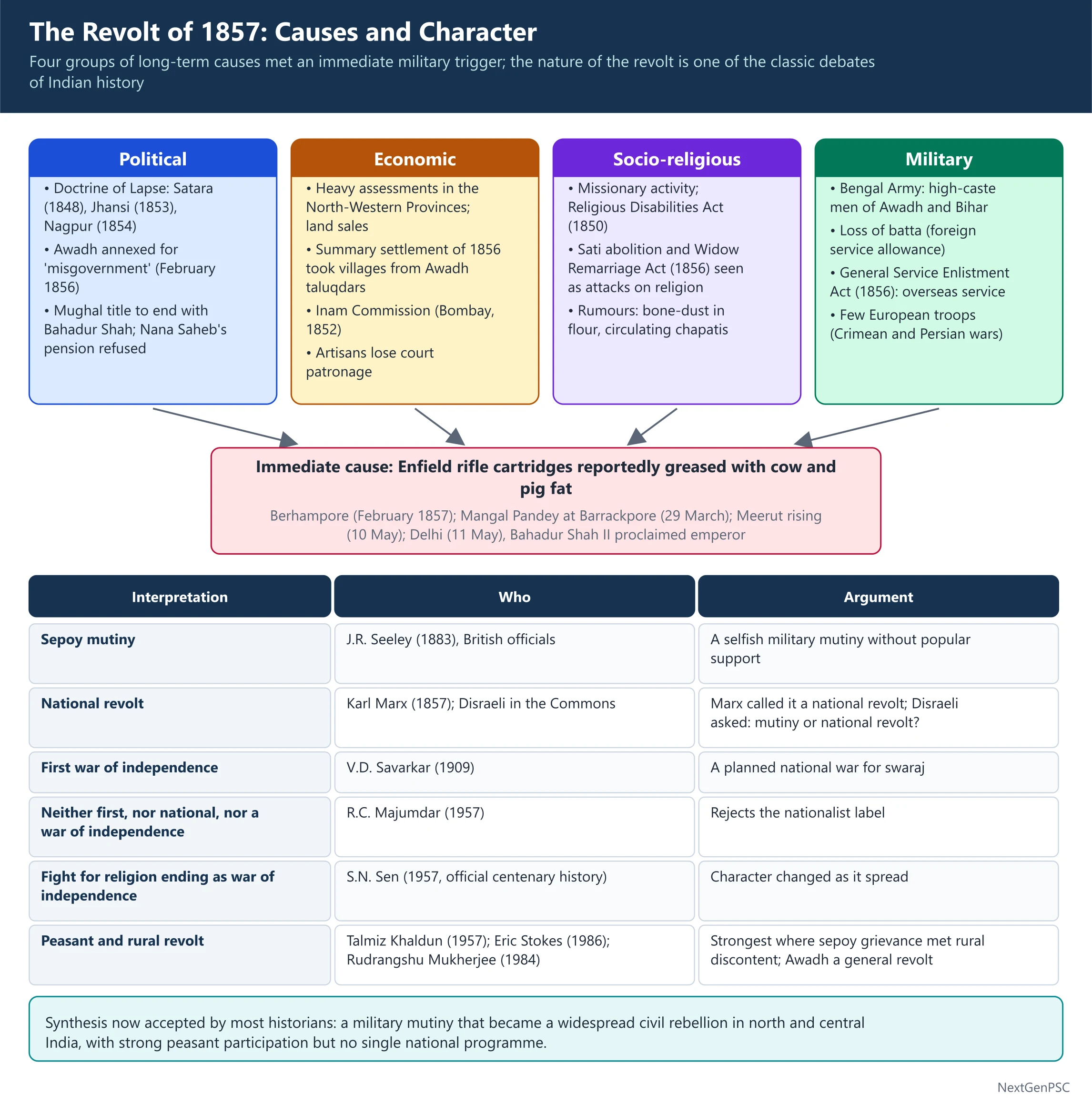
1. Origin and Course
Early signs: In February 1857 the 19th Native Infantry at Berhampore refused the new cartridges; on 29 March Mangal Pandey of the 34th Native Infantry attacked officers at Barrackpore and was hanged on 8 April.
Meerut (10 May 1857): After 85 troopers of the 3rd Light Cavalry were jailed for refusing cartridges, sepoys rose, freed them, killed officers and marched to Delhi.
Delhi (11 May): The rebels proclaimed the aged Mughal Bahadur Shah II as emperor; later Bakht Khan of Bareilly led the rebel army in Delhi.
Spread: In the following weeks the revolt spread through the North-Western Provinces, Awadh, Rohilkhand, Bundelkhand, parts of Bihar and central India.
Kanpur: Nana Saheb, the adopted son of Peshwa Baji Rao II, led the revolt, with Tantia Tope and Azimullah Khan.
Lucknow: Begum Hazrat Mahal led the revolt in Awadh in the name of her son Birjis Qadr; the British Residency was besieged.
Jhansi: Rani Lakshmibai, whose adopted son was denied succession, joined and became the most famous rebel leader.
Bihar: Kunwar Singh, the elderly zamindar of Jagdishpur, led a long campaign.
Others: Khan Bahadur Khan at Bareilly, Maulvi Ahmadullah Shah at Faizabad, and Shah Mal and others in the western United Provinces.
2. Political Causes
Expansion and annexation: Dalhousie's Doctrine of Lapse annexed Satara (1848), Jhansi (1853), Nagpur (1854) and others.
Awadh (February 1856): Annexed on the ground of misgovernment, despite the Nawab's loyalty; this hurt nobles, soldiers and the many sepoys who came from Awadh.
Mughal dynasty: The British announced that Bahadur Shah's successors would lose the imperial title and leave the Red Fort.
Pensions and titles: Nana Saheb's pension was refused, and titles of several rulers were abolished.
Alien rule: Indians were excluded from higher posts and treated with racial contempt.
3. Economic Causes
Land revenue: Heavy assessments in the North-Western Provinces led to sales of land and the rise of moneylenders and new purchasers.
Taluqdars of Awadh: The summary settlement of 1856 took away many villages from taluqdars, who then led their peasants into revolt.
Inam Commission (Bombay, 1852): Confiscated thousands of rent-free holdings, alarming landed classes in western India.
Artisans and traders: The loss of court patronage and competition from British goods hurt craftsmen in towns such as Delhi and Lucknow.
4. Socio-Religious Causes
Fear of conversion: Missionary activity, the Religious Disabilities Act (1850) protecting converts' inheritance, and Christian teaching in schools fed fears.
Reform laws: Abolition of sati and the Widow Remarriage Act (1856) were seen by the orthodox as attacks on religion.
Rumours: Stories of bone-dust in flour and the circulation of chapatis from village to village spread unease; the meaning of the chapatis remains unclear.
5. Military Causes
Composition: The Bengal Army drew heavily on high-caste Brahmins and Rajputs of Awadh and Bihar.
Service conditions: Low pay, poor promotion, and loss of the foreign service allowance (batta) when Sindh and Punjab became British territory.
General Service Enlistment Act (1856): Required new recruits to serve overseas if ordered, which threatened caste.
Enfield rifle: Its cartridges were reportedly greased with cow and pig fat, offending both Hindus and Muslims; the government's withdrawal of the grease came too late to remove the suspicion.
Ratio and confidence: European troops were few in north India, partly because of the Crimean War and Persian War, and the British defeat in the First Afghan War had damaged their aura.
6. Sources and Evidence
Indian accounts: Ghalib's diary Dastanbuy; the Delhi narratives of Munshi Jiwan Lal and Mainodin Hassan (translated in Two Native Narratives of the Mutiny in Delhi, 1898); Vishnubhatt Godse's Marathi travelogue Majha Pravas.
Rebel documents: The Mutiny Papers in the National Archives of India (Delhi), and the Azamgarh Proclamation (August 1857), attributed to the Mughal prince Firoz Shah, which addressed zamindars, merchants, officials, artisans and religious leaders.
British accounts: J.W. Kaye and G.B. Malleson's History of the Indian Mutiny; official reports and letters.
Modern use: William Dalrymple's The Last Mughal (2006) drew heavily on the Mutiny Papers.
7. Character: The Main Interpretations
Sepoy mutiny: Contemporary British officials and writers such as J.R. Seeley (The Expansion of England, 1883) saw it as a selfish military mutiny without popular support.
Muslim conspiracy or feudal reaction: Some officials, such as James Outram, saw Muslim intrigue; others saw a last stand of dispossessed princes and landlords.
National revolt: Karl Marx's articles in the New York Daily Tribune (1857) called it a national revolt; Benjamin Disraeli in the House of Commons asked whether it was a military mutiny or a national revolt.
First war of independence: V.D. Savarkar's The Indian War of Independence of 1857 (1909) presented it as a planned national war for swaraj.
R.C. Majumdar, The Sepoy Mutiny and the Revolt of 1857 (1957): Argued that it was neither first, nor national, nor a war of independence.
S.N. Sen, Eighteen Fifty-Seven (1957): The official centenary history; Sen concluded that what began as a fight for religion ended as a war of independence.
Marxist view: Talmiz Khaldun (in P.C. Joshi, ed., Rebellion 1857, 1957) described it as a peasant war against foreign rule and feudal landlords.
Eric Stokes, The Peasant Armed (1986): Showed great local variation; the revolt was strongest where sepoy grievances met rural discontent, led often by magnates, and was in parts a rural revolt.
Rudrangshu Mukherjee, Awadh in Revolt 1857–1858 (1984): Showed a popular, almost general revolt in Awadh, where peasants and taluqdars fought together for the old order.
Tapti Roy, The Politics of a Popular Uprising (1994): Studied Bundelkhand, showing complex local loyalties.
Synthesis: Most historians now see a military mutiny that became a widespread civil rebellion in north and central India, with strong peasant and popular participation but no single national programme.
8. Using It in the Exam
10 marks: Give the four types of causes in one line each and the immediate cause.
15 marks: Explain why Awadh became the heartland of the revolt, using the annexation, summary settlement and sepoy recruitment.
20 marks: On character, set out at least four interpretations with authors and works, then give your synthesis.
Keywords: Doctrine of Lapse, Awadh annexation, summary settlement, taluqdars, General Service Enlistment Act, Enfield cartridges, Azamgarh Proclamation.
Quotation: R.C. Majumdar's verdict that the so-called first national war of independence of 1857 was neither first, nor national, nor a war of independence is one of the most cited lines on the revolt.
| Centre | Rebel leader(s) | British commander(s) | Recaptured |
|---|---|---|---|
| Delhi | Bahadur Shah II, Bakht Khan | John Nicholson, Archdale Wilson | September 1857 |
| Kanpur | Nana Saheb, Tantia Tope | Henry Havelock, Colin Campbell | December 1857 (final) |
| Lucknow | Begum Hazrat Mahal | Colin Campbell | March 1858 |
| Jhansi | Rani Lakshmibai | Hugh Rose | April 1858 |
| Jagdishpur (Bihar) | Kunwar Singh | Vincent Eyre, Edward Lugard | August 1857; fighting till April 1858 |
| Bareilly | Khan Bahadur Khan | Colin Campbell | May 1858 |
| Faizabad | Maulvi Ahmadullah Shah | Various columns | 1858 (Maulvi killed June 1858) |
Mains points
- The character question is asked repeatedly; structure it as a historiographical survey ending with a reasoned synthesis.
- Avoid listing causes mechanically; show how they converged in Awadh and the Bengal Army.
- Use rebel sources such as the Azamgarh Proclamation to show rebel aims went beyond the sepoys.
- Treat the cartridges as the immediate cause, not the root cause.
- Distinguish the views of Majumdar and Sen precisely; both wrote in 1957 for the centenary.
- Mention Stokes and Rudrangshu Mukherjee to show awareness of regional and peasant-centred research.
Did you know?
- Savarkar's book on 1857 was banned by the British even before publication; it was first printed in the Netherlands in 1909 and smuggled into India.
1857: Causes of Failure and Consequences
The revolt failed because it was geographically limited, many princes, zamindars and the educated class stayed loyal, its leaders lacked a common programme and coordination, and the British had superior resources, communications and command. Its consequences were far-reaching: the Government of India Act (1858) ended Company rule, the Queen's Proclamation promised non-interference and respect for princes, the army was reorganised, and British policy turned towards conservative alliance with princes and landlords.
In simple words
Imagine a strike where workers in five factories walk out, but the other twenty keep working, the managers have phones while the strikers send messages by runner, and each group of strikers wants something different.
That strike would fail, and the owners would then change the rules to prevent another.
That is 1857: the revolt was scattered and divided, the British were organised, and afterwards the Crown took over and reshaped the army and policy.
UPSC asks for both failure and consequences.
1. The Suppression: Main Events
Delhi: British forces on the Ridge stormed Delhi in September 1857 (city taken by 20 September); John Nicholson was killed; Bahadur Shah was captured at Humayun's Tomb, his sons shot by William Hodson.
Fate of the emperor: Bahadur Shah II was tried in 1858 and exiled to Rangoon, where he died in 1862.
Kanpur and Lucknow: After the killings at Kanpur (Satichaura Ghat and Bibighar, June–July 1857), Havelock retook Kanpur; Colin Campbell relieved the Lucknow Residency in November 1857 and recaptured the city in March 1858.
Central India: Hugh Rose took Jhansi in April 1858; Rani Lakshmibai died fighting near Gwalior in June 1858.
End: Tantia Tope carried on guerrilla war until betrayed and hanged in April 1859; Nana Saheb and Begum Hazrat Mahal escaped to Nepal; Kunwar Singh died in April 1858.
Repression: Martial law, summary executions, blowing from guns and burning of villages; the reprisals left deep bitterness.
2. Causes of Failure
Limited area: The revolt was concentrated in the Gangetic plain and central India; the south, most of Bengal proper, Punjab, Sindh and Rajputana were largely quiet.
Loyal princes and chiefs: Sindhia of Gwalior and his minister Dinkar Rao, the Holkar, the Nizam and his minister Salar Jung, the Sikh chiefs of Patiala, Nabha and Jind, and the Rana of Nepal helped the British; Canning described such princes as breakwaters that broke the storm (paraphrase).
Punjab: Sikh and Punjabi troops, recently recruited, fought for the British, and John Lawrence sent troops from Punjab to Delhi.
Educated middle class: The Western-educated in Calcutta, Bombay and Madras saw the revolt as backward-looking and stayed loyal.
Leadership and organisation: Leaders were brave but local; they lacked unified command, communication and strategy; Delhi had several competing authorities.
No common programme: Rebels wanted to restore the old order; there was no agreed vision of a future state, and different groups had different aims.
Military disadvantage: The British had Enfield rifles, artillery, the telegraph and railways in places, and reinforcements from Britain and from the China expedition.
British command: Commanders such as Colin Campbell, Hugh Rose, Havelock and Nicholson were experienced; the British also had control of the sea and finances.
Internal divisions: Peasants and moneylenders, landlords and tenants, Hindus and Muslims in some areas were divided; some rebels attacked local enemies rather than the British.
3. Consequences: Constitutional and Administrative
Government of India Act (2 August 1858): Transferred power from the East India Company to the British Crown.
Secretary of State: A Secretary of State for India with a Council of India of 15 members replaced the Board of Control and Court of Directors.
Viceroy: The Governor-General also became the Viceroy, the Crown's representative; Canning was the first.
Queen's Proclamation (1 November 1858): Read by Canning at Allahabad, it disclaimed further annexation, promised to respect the rights and dignity of princes, pledged religious non-interference and equal admission to services regardless of race or creed, and offered pardon to rebels not involved in killing British subjects.
Indian Councils Act (1861): Brought a few Indian non-officials into the legislative council, partly a lesson of 1857 about consulting Indian opinion.
4. Consequences: Army and Policy
Army reorganisation: The Peel Commission (1859) recommended a higher proportion of European troops; the ratio was roughly one European to two Indians in the Bengal Army and two to five in Madras and Bombay.
Control of artillery: Key artillery was kept in European hands.
Divide and balance: Regiments were mixed by caste, region and religion to prevent combination.
Martial races: Recruitment shifted towards Sikhs, Gurkhas, Pathans and Punjabi Muslims, and away from Awadh and Bihar.
Princes as allies: The Doctrine of Lapse was abandoned; adoption sanads (1860–62) allowed princes to adopt heirs, making them pillars of British rule.
Landlords: Awadh taluqdars recovered their estates in return for loyalty; the British became wary of upsetting rural magnates.
Caution on social reform: The state became much more hesitant to legislate on religion and custom.
Finance: The cost of the revolt added to the Indian public debt; James Wilson introduced an income tax in 1860.
5. Consequences: Society and Memory
Racial distance: Mutual suspicion and racial arrogance deepened; Thomas Metcalf, The Aftermath of Revolt (1964), traces the turn to conservative, racially exclusive rule.
Muslims: The British at first blamed Muslims more, which affected Muslim elites in north India and influenced Syed Ahmad Khan's Asbab-i-Baghawat-i-Hind (The Causes of the Indian Revolt, 1858).
End of the Mughal dynasty: The last link with the old imperial order was broken.
Memory: Later nationalists, from Savarkar to the Indian National Army's Rani of Jhansi Regiment, used 1857 as a symbol of resistance.
6. Sources and Evidence
Syed Ahmad Khan's Asbab-i-Baghawat-i-Hind: Blamed the lack of Indian representation in the legislative council, misunderstanding of Indian feelings and interference with religion.
Queen's Proclamation text: The basic document of the new order.
Peel Commission Report (1859): Main source on army reorganisation.
Canning's correspondence: Shows the new policy of conciliation with princes and taluqdars.
7. Historiography and Debates
Bipan Chandra: Stresses lack of a modern, forward-looking programme and of unity as the main reason for failure, while honouring the revolt's heroism and Hindu-Muslim unity.
Eric Stokes: Explains failure partly by the localism of the revolt: rural magnates fought for local ends and could not combine.
Thomas Metcalf: Argues that the aftermath ended the reformist, Anglicising phase of rule and produced a policy of alliance with traditional elites.
Continuity or break: Some historians note that many post-1858 changes (Crown control, army reform) had been discussed before 1857, so the revolt accelerated rather than created them.
8. Using It in the Exam
10 marks: Give five crisp causes of failure with examples (loyal princes, educated class, no programme, British resources, local leadership).
15 marks: On consequences, divide into constitutional, military, policy and social.
20 marks: On how 1857 changed British policy, use the Proclamation, adoption sanads, taluqdars, Peel Commission and Metcalf's argument, and judge continuity versus change.
Keywords: Government of India Act 1858, Secretary of State, Queen's Proclamation, Peel Commission, martial races, adoption sanads, policy of association with princes.
Source extract: The Queen's Proclamation declared that the Crown desired no extension of its territorial possessions and would respect the rights, dignity and honour of native princes as its own.
| Area | Change | Instrument |
|---|---|---|
| Constitutional | Company rule ended; Crown rule | Government of India Act, 2 August 1858 |
| Administrative | Secretary of State and Council of India; Viceroy | Act of 1858 |
| Princes | No more annexation; right of adoption | Queen's Proclamation; adoption sanads 1860–62 |
| Army | More Europeans; mixed regiments; martial races | Peel Commission 1859 |
| Legislature | Indian non-officials nominated | Indian Councils Act 1861 |
| Land | Taluqdars restored in Awadh | Canning's settlement policy |
| Finance | Debt; new income tax | James Wilson's budget, 1860 |
Mains points
- Failure questions want analysis, not a list; group causes into geographical, social (who stayed loyal), organisational and military.
- Name specific loyal princes and ministers (Sindhia, Salar Jung, Patiala) to show precision.
- For consequences, show the shift from reform and annexation to conservatism and alliance with princes and landlords.
- Use the Queen's Proclamation as a document; quote or paraphrase its key promises.
- Mention Syed Ahmad Khan's Asbab-i-Baghawat-i-Hind as an Indian analysis of causes.
- Discuss continuity: some changes were already planned, so judge how far 1857 was a turning point.
Did you know?
- Bahadur Shah Zafar, a fine Urdu poet, is buried in Yangon (Rangoon); his grave was rediscovered in 1991 during digging work.
Peasant Movements after 1857 and in the 1920s–1930s
After 1857 the character of peasant uprisings shifted: peasants now fought mainly for specific demands against landlords, planters and moneylenders, used legal and organised methods, and rarely sought to overthrow British rule, as in the Pabna agrarian leagues (1873–76) and the Deccan Riots. In the 1920s and 1930s peasant movements merged with nationalism: Kisan Sabhas in Awadh, the Bardoli Satyagraha (1928), and the founding of the All India Kisan Sabha (1936) under Swami Sahajanand Saraswati.
In simple words
Before 1857 angry villagers often took up arms and tried to drive out every outsider.
After 1857 they behaved more like a modern trade union: they formed leagues, refused rent together, went to court and petitioned officials.
In the 1920s and 1930s Congress leaders and socialists began to organise them, linking the farmer's rent to the fight for freedom.
The great example is Bardoli, where Vallabhbhai Patel led a no-tax campaign. UPSC asks how and why peasant protest changed.
1. The Shift in Character after 1857
Peasants as the main force: Bipan Chandra argues that after 1857 peasants themselves became the main actors, fighting for their own demands, unlike earlier risings led by dispossessed chiefs or religious leaders.
Specific, limited goals: Demands centred on rent, illegal cesses, eviction, moneylenders' bonds and forced cultivation rather than restoration of an old order.
Immediate enemies: Targets were landlords, planters and moneylenders, not the colonial state as such.
Legal methods: Combination, rent strikes, petitions and lawsuits, using knowledge of rights under colonial tenancy law.
Limits: Little understanding of colonialism as a system; movements were local, and once demands were met they faded.
Reasons: Stronger colonial military power after 1857, growth of law courts and tenancy legislation, and the spread of the market economy.
2. Nineteenth-Century Examples
Indigo Revolt (1859–60): The first major example of the new pattern, with mass refusal and use of courts (see previous topic).
Pabna agrarian leagues (1873–76): In Yusufshahi pargana of Pabna district (Serajganj), tenants resisted zamindars' attempts to raise rents and deny occupancy rights under Act X of 1859.
Methods at Pabna: Agrarian leagues raised funds, organised rent strikes and fought cases; leaders included Ishan Chandra Roy, Shambhu Pal and Khoodi Mollah; violence was rare.
Character: The movement accepted British authority; its slogan was reportedly that the peasants wished to be ryots of the Queen and of her alone.
Support: Bengali intellectuals such as R.C. Dutt and Surendranath Banerjea's Indian Association backed it, while some zamindar-led bodies opposed it.
Result: The Bengal Tenancy Act (1885) strengthened occupancy rights.
Deccan Riots (1875): Targeted moneylenders' bonds; led to the Deccan Agriculturists' Relief Act (1879).
Punjab: Fear of land passing to moneylenders led to the Punjab Land Alienation Act (1900).
3. Peasant Movements in the 1920s
Champaran (1917) and Kheda (1918): Gandhi's early satyagrahas against the tinkathia system of indigo in Bihar and for revenue remission in Gujarat brought peasants into nationalist politics.
UP Kisan Sabha (1918): Founded in February 1918 by Gauri Shankar Misra and Indra Narain Dwivedi, with Madan Mohan Malaviya's support.
Awadh Kisan Sabha (October 1920): Baba Ramchandra, a former indentured labourer from Fiji, organised tenants of Pratapgarh, Rae Bareli and Sultanpur against bedakhli (eviction), nazrana and begar; Jawaharlal Nehru toured these villages.
Turn to violence (1921): Peasants looted bazaars and attacked taluqdars' property; the government repressed the movement and passed the Oudh Rent (Amendment) Act (1921).
Eka movement (1921–22): In Hardoi, Bahraich and Sitapur, led by Madari Pasi, peasants took an oath of unity against high rents; it was suppressed by 1922.
Malabar (1921): The Mappila rebellion merged with Khilafat and Non-Cooperation.
Andhra: Alluri Sitarama Raju led the Rampa rebellion of hill tribes (1922–24) against forest laws.
Bardoli Satyagraha (1928): When the Bombay government raised revenue by about 22 per cent, peasants of Bardoli taluka in Surat refused to pay under Vallabhbhai Patel; women of Bardoli gave him the title Sardar.
Bardoli result: The Maxwell-Broomfield inquiry found the increase unjustified and cut it to about 6 per cent; land was restored.
4. Peasant Movements in the 1930s
Depression: The world depression from 1929 halved agricultural prices, so fixed rents and revenue became crushing.
Civil Disobedience: No-revenue campaigns in Gujarat and no-rent campaigns in the United Provinces (1930–31) linked agrarian distress with the national movement.
Bihar Provincial Kisan Sabha (1929): Founded by Swami Sahajanand Saraswati; it later demanded abolition of zamindari.
Andhra: N.G. Ranga organised the Ryots' Association and peasant schools.
All India Kisan Sabha (April 1936): Founded at Lucknow with Sahajanand Saraswati as president and N.G. Ranga as general secretary; its Kisan Manifesto (August 1936) demanded abolition of zamindari, reduction of rent and cancellation of debts.
Congress response: The Faizpur session (December 1936), the first held in a village, adopted an agrarian programme; Congress ministries (1937–39) passed tenancy and debt relief laws in several provinces.
Struggles under Congress ministries: Bakasht land struggles in Bihar (1937–39) and campaigns in Kerala (Karshaka Sangham) and Andhra.
Later: The Tebhaga movement in Bengal (1946) and Telangana (1946–51) grew out of this Kisan Sabha tradition.
5. Sources and Evidence
Official: Reports such as the Pabna district records, the Deccan Riots Commission, and the Maxwell-Broomfield Report (1929) on Bardoli.
Leaders' writings: Sahajanand Saraswati's autobiography Mera Jeevan Sangharsh; Nehru's An Autobiography (1936) describing his visits to Awadh villages.
Press: Nationalist and Kisan Sabha papers recorded meetings and demands.
6. Analysis
Nationalism and class: Congress tried to unite peasants and landlords against colonialism, so it often restrained no-rent campaigns against Indian landlords.
Peasant autonomy: Peasants frequently pushed beyond Congress instructions, as in Awadh (1921) and the Eka movement.
Organisation: The Kisan Sabhas created the first nationwide peasant organisation with a class programme.
Achievements: Tenancy reform, debt relief, political awakening and, after independence, zamindari abolition.
7. Historiography and Debates
Bipan Chandra, India's Struggle for Independence (1988): Sees the post-1857 change and argues that Congress built a multi-class movement that integrated peasant demands.
Ranajit Guha and Subaltern Studies: Stress the autonomy of peasant politics; Gyanendra Pandey's essay 'Peasant Revolt and Indian Nationalism' (Subaltern Studies I, 1982) argues that Congress restrained the Awadh movement to protect landlord support.
Shahid Amin, 'Gandhi as Mahatma' (Subaltern Studies III, 1984): Shows how peasants in Gorakhpur understood Gandhi in their own terms.
Majid Siddiqi, Agrarian Unrest in North India: The United Provinces 1918–22 (1978), and Kapil Kumar, Peasants in Revolt (1984): Detailed studies of the Awadh movement.
D.N. Dhanagare, Peasant Movements in India 1920–1950 (1983): Examines which strata of peasants took part, questioning simple class models.
David Hardiman, Peasant Nationalists of Gujarat: Kheda District 1917–1934 (1981): Shows the leading role of middle peasants (Patidars).
8. Using It in the Exam
10 marks: On the post-1857 shift, give four features with Pabna as the example.
15 marks: On Bardoli or Awadh, give causes, leadership, methods, outcome and link to nationalism.
20 marks: On peasant movements of the 1920s–30s, cover Awadh, Eka, Bardoli, Depression, Civil Disobedience, Kisan Sabhas, Faizpur, and the Bipan Chandra versus Subaltern debate.
Keywords: occupancy rights, Pabna leagues, Bengal Tenancy Act 1885, Kisan Sabha, bedakhli, Eka, Bardoli, Kisan Manifesto, Faizpur.
Source extract: The Kisan Manifesto of 1936 demanded abolition of zamindari, a 50 per cent reduction in rent and revenue, and cancellation of agricultural debts (summary of main demands).
| Movement | Years | Region | Leaders | Outcome |
|---|---|---|---|---|
| Pabna agrarian leagues | 1873–76 | Pabna (Bengal) | Ishan Chandra Roy, Shambhu Pal, Khoodi Mollah | Bengal Tenancy Act 1885 |
| Awadh Kisan Sabha | 1918–22 | Pratapgarh, Rae Bareli (UP) | Baba Ramchandra; Nehru | Oudh Rent (Amendment) Act 1921 |
| Eka movement | 1921–22 | Hardoi, Bahraich (UP) | Madari Pasi | Suppressed |
| Bardoli Satyagraha | 1928 | Surat (Gujarat) | Vallabhbhai Patel | Increase cut from about 22% to about 6% |
| All India Kisan Sabha | 1936 | All-India (Lucknow) | Sahajanand Saraswati, N.G. Ranga | Kisan Manifesto; Faizpur programme |
| Bakasht struggle | 1937–39 | Bihar | Sahajanand Saraswati, Karyanand Sharma | Partial restoration of land |
Mains points
- The syllabus phrase 'shift in the character of peasant uprisings in the post-1857 period' is a direct question; answer with clear before-and-after contrasts.
- Use Pabna as the model example and quote or paraphrase its Queen's ryots slogan.
- For the 1920s–30s, show the two-way relationship: peasants energised nationalism, but Congress restrained class struggle against Indian landlords.
- Present the Bipan Chandra versus Subaltern debate with named works.
- Include regional variety: UP, Gujarat, Bihar, Andhra, Kerala, Malabar.
- Common mistake: treating the Kisan Sabha and Congress as identical; note the growing left influence and tension by 1937–39.
Did you know?
- Baba Ramchandra used to carry a copy of the Ramcharitmanas and recite its verses at peasant meetings, linking the idea of Ram Raj to justice for tenants.
UPSC Previous Year Questions: Peasant and Tribal Uprisings and the Revolt of 1857
From 2014 to 2026 UPSC asked 18 question parts worth 270 marks from this chapter, all in Paper II: five on the Moplah, Indigo and related revolts (80 marks), five on the early tribal risings (70 marks), four on the origin and character of 1857 (60 marks), three on later peasant movements (40 marks) and one on the failure and consequences of 1857 (20 marks). The character of 1857, the Moplah rebellion (set in the same words in 2018 and 2026) and the link between tribal and peasant risings and nationalism recur most often. Every question below has a model answer written to the UPSC word limit.
In simple words
Read the question and the approach line, then write your own answer in the time UPSC allows: about 7 minutes for 10 marks and 11 minutes for 20 marks.
Only then read the model answer and compare: did you name the right historians and sources, cover both sides of the debate, and end with a clear judgement?
Note the facts and arguments you missed, revise them in the chapter notes above, and try the same question again a week later.
1. Rangpur Dhing, the Kol Rebellion and the Santal Hul
Example 1 (UPSC 2023, 20 marks): The historical significance of tribal and peasant uprisings in India 'lies in that they established strong and valuable traditions of resistance to British rule'. Discuss.
Paper and question: Paper II, Q3(b)
Approach: The question quotes Bipan Chandra's verdict and asks for a discussion: show the traditions of resistance with examples from tribal and peasant risings, then weigh their limits before a balanced judgement.
The statement reflects Bipan Chandra's assessment in India's Struggle for Independence: the many civil rebellions, tribal risings and peasant revolts of the first century of Company rule were local and were crushed, yet they left a legacy of defiance on which later movements drew.
Tribal risings showed that colonial power could be challenged. The Rangpur Dhing (1783) united Hindu and Muslim peasants against the ijaradar Debi Singh. The Kol rising (1831–32) and the Santal Hul (1855–56) turned forest peoples against the dikus and the Company that protected them. Birsa Munda's Ulgulan (1899–1900) openly called for an end to British rule.
Peasant movements refined the methods. In the Indigo Revolt (1859–60) mass refusal to sow, social boycott and the use of courts defeated European planters in Bengal. The Pabna agrarian leagues (1873–76) and the Deccan riots (1875) showed organised, largely non-violent pressure.
These struggles also forced protective laws, such as the creation of the Santal Parganas (1855), the Deccan Agriculturists' Relief Act (1879), the Bengal Tenancy Act (1885) and the Chotanagpur Tenancy Act (1908).
The claim has limits. Most risings were local and restorative, aimed at immediate oppressors rather than colonialism as a system, and their leaders sought old rights rather than a modern nation. Ranajit Guha argues that they expressed an autonomous subaltern consciousness, which should not be read only as a preparation for Congress nationalism.
Their significance therefore lay less in what they won than in what they demonstrated: that colonial rule could be resisted, that peasants and tribals could act for themselves, and that land and forest were central to Indian politics. These traditions of resistance fed the mass nationalism of the twentieth century.
Example 2 (UPSC 2022, 10 marks): 'Penetration of outsiders – called dikus by the Santhals – completely destroyed their familiar world, and forced them into action to take possession of their lost territory'. Critically examine.
Paper and question: Paper II, Q1(d)
Approach: Explain how the entry of dikus undermined the Santal world and drove the Hul, then test the word "completely" against the anti-colonial and religious sides of the revolt.
The statement explains the Santal Hul (1855–56) as a response to the loss of the Damin-i-koh, the Rajmahal hill tract that the Santals had cleared and settled in the early nineteenth century.
It is largely valid. Bengali and north Indian mahajans lent at huge interest and seized crops and land; zamindars and the Company raised rents; police and courts sided with these dikus. The Santal world of communal land and village headmen was being dismantled.
At Bhognadih on 30 June 1855 Sidhu and Kanhu declared that Thakur had commanded them to drive out the dikus and restore Santal rule over the land.
But "completely" overstates the case. The Hul was also anti-colonial: rebels attacked police posts and Company authority. Poor low-caste non-tribals joined them, and its millenarian religious vision, stressed by Ranajit Guha, went beyond a claim to land.
Thus diku penetration was the core cause, but the Hul became a wider revolt against the colonial order that sustained the dikus.
Example 3 (UPSC 2020, 10 marks): Do you feel that the Santhal Hool (rebellion) 1855 – 56, was the most effective tribal movement in pre-1857 India?
Paper and question: Paper II, Q2(c)
Approach: Define effectiveness (scale, organisation, results), test the Hul against these and against the Kol and Bhil risings, and give a reasoned verdict.
The Santal Hul of 1855–56, led by the brothers Sidhu and Kanhu Murmu of Bhognadih, is often described as the most powerful tribal rising before 1857.
On scale and organisation the case is strong. About ten thousand Santals gathered to declare the Hul, and the rising spread across the Bhagalpur–Rajmahal region. The government had to declare martial law and use the army before it was crushed in early 1856.
On results, it forced the creation of the Santal Parganas as a separate non-regulation district (1855).
The Kol rebellion (1831–32) also spread widely across Chotanagpur and produced the South-West Frontier Agency, and the Bhil risings in Khandesh lasted longer.
The Hul's achievement was also limited: bows and axes faced firearms, thousands of Santals died, the leaders were executed and the dikus were not expelled.
Thus the Hul was the largest and best-remembered pre-1857 tribal movement, but "most effective" is a relative judgement: like the Kol rising, it won protection, not freedom.
Example 4 (UPSC 2019, 10 marks): "... the Kol Insurrection was mainly a war of the tribal inhabitants of Chotanagpur against the non-tribal settlers and service-holders." Critically examine.
Paper and question: Paper II, Q1(d)
Approach: Identify the view, show the evidence that outsiders (thikadars, moneylenders) were the main target, then show the agrarian and anti-colonial sides before concluding.
The view, associated with J.C. Jha's study of the Kol insurrection, sees the rising of 1831–32 in Chotanagpur as a war of the Mundas, Hos and Oraons against outsiders who had settled among them.
Much supports it. The Raja of Chotanagpur had leased villages to thikadars, Sikh, Muslim and Hindu traders and moneylenders, who raised rents, seized land and exacted forced labour. From late 1831 the Kols attacked these settlers and service-holders across Ranchi, Hazaribagh, Palamau and Manbhum, while tribal villagers were generally spared.
Yet it was not only an ethnic war. The outsiders' claims rested on Company courts, laws and revenue demands alien to tribal custom, so the revolt was also against the colonial order. The grievances were agrarian, about land, rent and labour.
The South-West Frontier Agency (1833–34) placed the region under special non-regulation rule.
Thus the Kol insurrection was mainly directed at non-tribal settlers, but because colonial power upheld them it was also an agrarian and anti-colonial revolt.
Example 5 (UPSC 2016, 20 marks): How far is it correct to say that the 19th century tribal uprisings are a part of subaltern nationalism?
Paper and question: Paper II, Q3(b)
Approach: Define subaltern nationalism, examine the consciousness and targets of the major tribal risings, and then test whether "nationalism" is the right word before giving a "how far" verdict.
The idea of a subaltern politics comes from Ranajit Guha and the Subaltern Studies historians (from 1982), who argued that peasants and tribals had an autonomous domain of politics, separate from elite-led nationalism. The question asks whether the tribal risings of the nineteenth century belong to such a subaltern nationalism.
The risings were certainly autonomous. The Kol rebellion (1831–32), the Santal Hul (1855–56), the Rampa rising (1879) and the Munda Ulgulan (1899–1900) were led by men of the community and drew on religion and prophecy: Sidhu and Kanhu spoke for Thakur, and Birsa was hailed as Dharti Aba.
Guha's Elementary Aspects of Peasant Insurgency in Colonial India (1983) shows that such insurgency was a conscious political act, not a spontaneous outburst or crime, as colonial records described it. Rebels chose their targets with care, such as police posts, mahajans' houses and courts, and inverted the symbols of authority.
They were also anti-colonial. The tribals saw the British as protectors of the dikus; the Santals attacked police posts, and Birsa called for an end to British rule and a Munda raj.
But "nationalism" is harder to sustain. Their goal was to restore a local, ethnic homeland, not to build an Indian nation, and their enemies were often non-tribal Indians. The risings had no links with each other or with the educated classes. Bipan Chandra sees in them a tradition of resistance rather than nationalism, and K.S. Singh reads Birsa's movement as agrarian and millenarian.
It is therefore correct only in part. The uprisings were subaltern and anti-colonial, and their memory later fed nationalism and Jharkhand politics, but they are better called subaltern resistance or proto-nationalism than nationalism proper.
2. The Moplah Rebellions, Indigo Revolt, Deccan Riots and Munda Ulgulan
Example 6 (UPSC 2026, 20 marks): Was the Moplah Rebellion in Malabar an expression of anti-landlord and anti-foreign discontent? Discuss.
Paper and question: Paper II, Q2(b)
Approach: Take the two kinds of discontent in turn across the two phases (the outbreaks of 1836–1919 and the rebellion of 1921), then bring in the religious idiom and communal turn before a balanced verdict.
The Mappila (Moplah) Muslims of south Malabar rose repeatedly against janmis and the colonial state, in over twenty outbreaks from 1836 to the 1850s, further outbreaks later in the century, and the great rebellion of 1921. Whether this was class or foreign-rule discontent has been debated since T.L. Strange blamed "fanaticism" in 1852.
The anti-landlord side is clear. After annexing Malabar in 1792 the British treated janmis, mostly Namboodiri Brahmins and Nairs, as absolute owners, and turned Mappila kanamdars and verumpattamdars into tenants-at-will. Rack-renting, renewal fees and court-backed evictions followed. The early outbreaks were attacks by small bands on particular janmis, and William Logan's report (1881–82) traced them to insecurity of tenure.
The anti-foreign side grew from this. Courts and police enforced janmi rights, so the state appeared as the landlords' ally. The British deported Sayyid Fazl Tangal in 1852 and imposed collective fines under the Mappila Outrages Acts, deepening hostility.
In 1921 the two merged with the Khilafat and Non-Cooperation movements. After a police raid at Tirurangadi in August 1921, rebels attacked police stations, courts and treasuries, and Variyankunnath Kunjahammed Haji ran a rebel administration in parts of Eranad and Valluvanad.
The picture is complicated by religion. Stephen Dale stresses the tradition of martyrdom (the shahid ideal), and in 1921 some Hindus were killed or forcibly converted, which alienated Hindus and nationalists.
K.N. Panikkar's title Against Lord and State sums up the answer. The Mappila risings expressed both anti-landlord and anti-colonial discontent, carried by a religious idiom that gave them unity but also, at times, a communal edge.
Example 7 (UPSC 2025, 20 marks): In what ways did the tribal and peasant uprisings of the 19th century contribute to the rise and growth of nationalism in India? Examine.
Paper and question: Paper II, Q4(b)
Approach: Examine the ways the uprisings contributed (exposing exploitation, linking peasants and intelligentsia, traditions and symbols, methods, pushing nationalism towards agrarian demands), then note the limits.
The nineteenth century saw many tribal risings, such as the Kol (1831–32), Santal (1855–56) and Munda (1899–1900), and peasant revolts, such as Indigo (1859–60), Pabna (1873–76) and the Deccan riots (1875). They were local and mostly crushed, yet they shaped Indian nationalism in several ways.
First, they exposed colonial exploitation. The Indigo Commission (1860) and the Deccan Riots Commission (1876) put on record the coercion of planters and the loss of land to moneylenders. This evidence fed the economic critique of colonial rule developed by Dadabhai Naoroji and R.C. Dutt.
Second, they brought peasants and the intelligentsia into contact. Harish Chandra Mukherjee's Hindoo Patriot and Dinabandhu Mitra's Nil Darpan took up the indigo ryots' cause, and the Indian Association and R.C. Dutt backed the Pabna tenants.
Third, they created traditions of resistance and symbols, in Bipan Chandra's phrase. Sidhu and Kanhu, Birsa Munda and the indigo ryots became part of popular memory, and Gandhi's Champaran satyagraha (1917) took up the indigo grievance again.
Fourth, their methods anticipated mass politics. Refusal to sow, rent strikes, social boycott and organised legal action foreshadowed the no-revenue and no-rent campaigns of the Gandhian era. Their pressure also produced tenancy laws.
The contribution had limits. The risings were local and restorative, and many were aimed at Indian moneylenders and landlords rather than the Raj. The Pabna leagues professed loyalty to the Queen. Ranajit Guha and the Subaltern Studies historians warn that their autonomous consciousness should not be reduced to a prelude to Congress nationalism.
Their contribution was therefore indirect but real: they supplied evidence, symbols, methods and a mass base that the national movement later drew upon.
Example 8 (UPSC 2023, 10 marks): The root of the whole question behind the Indigo Revolt 'is the struggle to make the raiyats grow indigo plants without paying them the price of it'. Analyse.
Paper and question: Paper II, Q2(c)
Approach: Explain the forced-cultivation system the statement describes, show how the revolt grew out of it, then add the other grievances and conclude.
The statement sums up the evidence placed before the Indigo Commission (1860): the Bengal indigo system rested on compelling ryots to grow a crop that did not pay them.
European planters forced ryots to accept advances (dadan), sow indigo on their best land and deliver the plant at prices below the cost of cultivation. Lathiyals enforced the contracts by beating, kidnapping and confinement in factory godowns, and many planters were also zamindars who could raise rents on defiant tenants.
The revolt grew directly from this compulsion. In 1859 ryots in Nadia, led locally by Digambar and Bishnu Biswas, refused to sow, and the refusal spread to Jessore, Pabna and other districts.
Other strands widened it: rent strikes against planter-zamindars, and the support of the press and of Dinabandhu Mitra's Nil Darpan.
Thus unpaid, forced cultivation was the root, as the Commission found, but the revolt also became a protest against planter power, and its success made ryots free to refuse indigo.
Example 9 (UPSC 2018, 20 marks): Was the Moplah Rebellion in Malabar an expression of anti-landlord and anti-foreign discontent? Discuss.
Paper and question: Paper II, Q2(a)
Approach: Discuss the agrarian (anti-janmi) and anti-colonial strands with evidence from the nineteenth-century outbreaks and 1921, bring in the historiographical debate on religion, and conclude.
The Mappila uprisings of Malabar, from the outbreaks of 1836 to the rebellion of 1921, have been read in three ways: as religious fanaticism (the colonial view of T.L. Strange, 1852), as agrarian revolt (William Logan, K.N. Panikkar, Conrad Wood), and as anti-colonial struggle.
The agrarian roots lay in British land policy. From 1792 the British recognised the janmis as absolute proprietors, while Mappila tenants holding on kanam and verumpattam lost customary security. Rents rose, renewal fees multiplied and courts enforced evictions.
The nineteenth-century outbreaks targeted these landlords: small bands killed a janmi or desecrated his temple and then fought to death as shahids. Logan, as Special Commissioner, concluded in 1881–82 that insecurity of tenure lay behind them, and the Malabar Compensation for Tenants' Improvements Act (1887) followed.
Hostility to foreign rule ran alongside. Courts, police and the Mappila Outrages Acts with their collective fines made the state the landlords' shield. The Mamburam Tangals gave religious sanction, and the deportation of Sayyid Fazl Tangal (1852) sharpened resentment.
In 1921 the Khilafat and Non-Cooperation movements gave this an explicitly anti-British form. After the Tirurangadi raid of August 1921, rebels under Variyankunnath Kunjahammed Haji and Ali Musliyar attacked police stations, courts and treasuries. Martial law and the Wagon tragedy (November 1921) ended it.
Religion shaped both strands. Stephen Dale traces a long tradition of holy war on the Malabar frontier, and in 1921 attacks on Hindus and forced conversions in some areas gave the rising a communal colour that Congress condemned.
The rebellion was therefore an expression of both anti-landlord and anti-foreign discontent. The agrarian grievance was the base, the colonial state was the target because it upheld the janmis, and Islam supplied the idiom of mobilisation.
Example 10 (UPSC 2015, 10 marks): "The Indigo Revolt of 1859-60 holds a very significant place in our history of national liberation movement. For the first time in the history of our anti-colonial struggle, its two independent currents—spontaneous peasant resistance and constitutional agitation in defence of the peasantry—came into mutual contact." Critically examine.
Paper and question: Paper II, Q1(c)
Approach: Identify the nationalist reading, show the two currents (peasant action and intelligentsia's constitutional agitation) and their contact, then examine the limits of calling it part of national liberation.
The statement gives the nationalist reading of the Indigo Revolt, a view found in the work of Bipan Chandra and his co-authors.
The first current was spontaneous peasant resistance. In 1859 the ryots of Nadia refused to sow indigo, and the movement spread to other districts. Hindu and Muslim peasants attacked factories and withheld rents.
The second was constitutional agitation. Harish Chandra Mukherjee's Hindoo Patriot reported planter oppression, Dinabandhu Mitra's Nil Darpan (1860) dramatised it, and the Reverend James Long, who published its English translation, was fined and jailed. The Indigo Commission (1860) followed.
The claim needs qualification. Blair Kling, in The Blue Mutiny, also stresses sympathetic officials and missionaries. Some zamindars backed the ryots to oust rival planters, the middle class did not question colonial rule itself, and the peasants fought planters rather than the Raj.
It was thus a real first meeting of the two currents and a precedent for Champaran, but calling it part of "national liberation" reads later nationalism back into it.
3. The Revolt of 1857: Origin, Causes and Character
Example 11 (UPSC 2022, 20 marks): The British rule had differential impact on the Indian Society. Describe in what ways, the Indians responded to the Revolt of 1857.
Paper and question: Paper II, Q3(b)
Approach: Explain briefly why British rule affected groups differently, then describe the range of Indian responses in 1857 (rebels, loyalists, the neutral and the ambivalent) with examples, and conclude.
British rule did not affect all Indians alike. Annexation, new land settlements, Western education and new markets ruined some groups and benefited others. That differential impact shaped their responses in 1857.
The groups that had lost most rebelled. Sepoys of the Bengal Army, mostly high-caste men from Awadh and Bihar, resented the cartridges, the General Service Enlistment Act (1856) and the annexation of Awadh. Dispossessed rulers and their heirs, such as Nana Saheb, Rani Lakshmibai and Begum Hazrat Mahal, led them.
In Awadh the taluqdars, stripped of villages by the summary settlement of 1856, led their peasants into revolt. Peasants in the North-Western Provinces, artisans who had lost court patronage, and maulvis such as Ahmadullah Shah also joined.
The beneficiaries stayed loyal. Bengal zamindars secure under the Permanent Settlement, merchants and moneylenders, and the Western-educated middle class of Calcutta, Bombay and Madras saw the revolt as a return to the past.
Many rulers who had kept their thrones sided with the British: Sindhia, Holkar, the Nizam with Salar Jung, and the Sikh chiefs of Patiala, Nabha and Jind. Punjabi and Sikh troops helped retake Delhi, and the south and Rajputana stayed largely quiet.
Some responses were ambivalent or opportunistic. Ghalib's Dastanbuy shows a Delhi noble distancing himself from the rebels while mourning his city. Some peasants used the breakdown of order to attack moneylenders and destroy records. Syed Ahmad Khan stayed loyal, but in Asbab-i-Baghawat-i-Hind (1858) he blamed British policy for the revolt.
Indians thus responded according to how colonial rule had touched them. Eric Stokes's local studies show this variation village by village, which explains both the strength of the revolt in the north and its failure to become national.
Example 12 (UPSC 2020, 20 marks): For long, the Revolt of 1857, has been mistaken to be a mere mutiny of the Indian sepoys in the Bengal army. However, its causes need to be searched for not only in the dissatisfaction of the army, but in a long drawn process of fundamental social and economic change that upset the peasant communities. Discuss.
Paper and question: Paper II, Q2(b)
Approach: Accept the military trigger, then show the long-term agrarian, social and economic changes behind civil participation, using the historiography (Stokes, Rudrangshu Mukherjee, Talmiz Khaldun), and conclude on how the two fused.
British writers such as J.R. Seeley called 1857 a sepoy mutiny, a revolt of discontented soldiers without popular roots. Later research has shown that the army's grievances were only the spark; the fuel was a long process of change in the countryside.
Low pay and poor promotion, the loss of batta, the General Service Enlistment Act (1856) and the greased Enfield cartridges drove the Bengal sepoys to revolt at Meerut on 10 May 1857. But the sepoys were themselves peasant sons, largely from Awadh, and they carried village grievances into the ranks.
The deeper causes lay in land. Heavy land revenue assessments in the North-Western Provinces from the 1830s forced sales of land at auction to moneylenders, traders and officials. In Awadh the summary settlement of 1856 stripped taluqdars of villages, so lords and tenants joined against the new order.
Wider economic and social changes added to the unrest. Artisans and service groups lost court patronage after annexations, and the Inam Commission (1852) unsettled holders of rent-free land. Missionary activity and reform laws fed fears for religion and caste.
Talmiz Khaldun (in P.C. Joshi's Rebellion 1857, 1957) called it a peasant war. Eric Stokes's The Peasant Armed (1986) showed rural revolt varying with revenue pressure, land transfer and the hold of local magnates. Rudrangshu Mukherjee's Awadh in Revolt (1984) found an almost general popular rising in Awadh.
Yet participation was uneven, many areas stayed quiet, magnates often led and peasants followed, and some rebels attacked moneylenders rather than the British.
The revolt was therefore a military mutiny that became a civil rebellion where it met agrarian distress. Its causes lay as much in decades of rural dislocation as in the barracks.
Example 13 (UPSC 2016, 10 marks): “The Mutiny of 1857 was much more than a Mutiny of Sepoys and much less than a National Rebellion.” Comment.
Paper and question: Paper II, Q1(d)
Approach: Comment on both halves of the statement: show why the revolt was more than a sepoy mutiny, then why it fell short of a national rebellion, and endorse the middle position with the historiography.
The statement stands between the British view of 1857 as a sepoy mutiny (J.R. Seeley) and the nationalist view of a war of independence (V.D. Savarkar, 1909).
It was much more than a mutiny. In Awadh, Rohilkhand, Bundelkhand and western Bihar the sepoy rising spread to taluqdars, peasants, artisans and religious leaders. Rudrangshu Mukherjee shows an almost general revolt in Awadh. The Azamgarh Proclamation addressed many social groups.
It was much less than a national rebellion. The south, Bengal proper, Punjab and Rajputana stayed largely quiet, and many princes, the educated and Sikh troops sided with the British. The rebels sought only to restore the old order. R.C. Majumdar concluded that it was neither first, nor national, nor a war of independence.
S.N. Sen's verdict, that what began as a fight for religion ended as a war of independence, shows how the revolt grew beyond the barracks.
The statement is therefore apt: 1857 was a widespread popular revolt in north and central India, but without national scope or vision.
Example 14 (UPSC 2014, 10 marks): "The military, feudal and traditional overtones of the Revolt of 1857 were overshadowed by its nationalist or proto-nationalist character." Critically examine.
Paper and question: Paper II, Q1(c)
Approach: Set out the military, feudal and traditional elements, then the nationalist or proto-nationalist elements, and judge whether the second really overshadowed the first.
The statement asks whether the patriotic side of 1857 outweighed its military, feudal and traditional elements.
The traditional overtones were strong. It began as a sepoy mutiny. Its leaders were dispossessed princes and magnates, such as Nana Saheb, Lakshmibai, Hazrat Mahal and the Awadh taluqdars, and the rebels proclaimed Bahadur Shah emperor. Religion was the idiom and restoration the aim.
There were also proto-nationalist features. The rebels united against a common foreign enemy, and Hindus and Muslims cooperated under the Mughal symbol. The Azamgarh Proclamation appealed to many classes against British rule. Marx and Savarkar saw a national revolt.
Yet these features did not overshadow the others. There was no idea of an Indian nation, the revolt was regionally confined, the educated classes opposed it, and leaders fought largely for their own lost rights. R.C. Majumdar and Eric Stokes stress its localism.
The better view is that the two coexisted: a traditional, restorative revolt with an anti-foreign spirit that later nationalists turned into a symbol.
4. 1857: Causes of Failure and Consequences
Example 15 (UPSC 2024, 20 marks): Why was the Great Revolt of 1857 confined only to North India? How did it change the character of British rule in the subcontinent? Explain.
Paper and question: Paper II, Q2(b)
Approach: Answer the two parts in turn: the reasons for the revolt's confinement to the north (military, political, social), then the changes in the character of British rule after 1858, with a short conclusion on continuity and change.
The Revolt of 1857 engulfed the Gangetic plain and central India, but the south, Bengal proper, Punjab, Sindh and Rajputana stayed largely quiet.
The first reason for this regional confinement lay in the army. The revolt was a rising of the Bengal Army, recruited mainly from Awadh and Bihar, so it spread where that army was stationed. The Madras and Bombay armies, recruited more widely and less affected by caste grievances, stayed loyal.
The grievances were also concentrated in the north. The annexation of Awadh (1856), the summary settlement, the Doctrine of Lapse in Jhansi, and heavy revenue in the North-Western Provinces hit the north hardest. The south had been under Company rule longer, so its ruling class had already lost power or adjusted.
Political choices mattered too. Major princes, among them the Nizam, Sindhia, Holkar, Travancore, Mysore and the Rajput rulers, stayed loyal, and the educated classes of the presidency towns saw the revolt as backward-looking.
The revolt then changed the character of British rule. The Government of India Act (1858) transferred power to the Crown, with a Secretary of State and a Viceroy. The Queen's Proclamation promised no further annexation, respect for the princes and non-interference in religion.
The army was reorganised on the Peel Commission's advice, with more European troops, artillery kept in European hands, and recruitment shifted to the "martial races". Adoption sanads made the princes allies, the Awadh taluqdars regained their estates, and social reform slowed. Thomas Metcalf traces this turn from reform to conservative alliance with traditional elites and to racial distance.
The revolt's regional character thus shaped its failure, and its shock replaced the reforming, annexationist Company with a cautious, conservative Raj.
5. Peasant Movements after 1857 and in the 1920s–1930s
Example 16 (UPSC 2023, 10 marks): After 1857, "the peasants emerged as the main force in agrarian movements." Critically examine.
Paper and question: Paper II, Q1(b)
Approach: Identify Bipan Chandra's view, explain what changed after 1857 with examples (Indigo, Pabna, Deccan), and then examine the limits of the claim before concluding.
The statement is Bipan Chandra's in India's Struggle for Independence: before 1857 agrarian risings were often led by dispossessed chiefs, zamindars or religious figures, but afterwards peasants themselves fought directly for their own demands.
The evidence supports him. In the Indigo Revolt (1859–60) ryots of Nadia and Jessore organised mass refusal to sow. In the Pabna agrarian leagues (1873–76) tenants raised funds, struck rents and went to court. In the Deccan riots (1875) peasants burned moneylenders' bonds.
The goals had changed too. These movements made specific demands on rent, eviction, cesses and debt, used legal methods, and targeted planters, zamindars and sahukars rather than seeking to restore an old order.
There are limits. Middle-class allies and local notables still played important roles. The peasants did not see colonialism as the enemy, and the Pabna tenants professed loyalty to the Queen. Movements remained local and faded once grievances were met.
So peasants did become the main actors after 1857, but within local, reformist limits.
Example 17 (UPSC 2017, 10 marks): Discuss the nature of peasant movements under the Kisan Sabhas during 1920–1940.
Paper and question: Paper II, Q3(c)
Approach: Trace the Kisan Sabhas from the UP and Awadh sabhas of 1918–20 to the All India Kisan Sabha of 1936, and discuss their nature: demands, methods, leadership, relations with Congress and limits.
The Kisan Sabhas organised peasant protest between 1920 and 1940, moving from local grievances to a class demand for the abolition of zamindari.
In the 1920s they were local and tied to nationalism. The UP Kisan Sabha (1918) and Baba Ramchandra's Awadh Kisan Sabha (1920) mobilised tenants in Pratapgarh, Rae Bareli and Sultanpur against bedakhli, nazrana and begar. When peasants turned violent, Congress drew back. Gyanendra Pandey argues that it restrained them to protect landlord support.
In the 1930s they grew radical and national. Swami Sahajanand Saraswati founded the Bihar Provincial Kisan Sabha (1929). The All India Kisan Sabha (Lucknow, 1936), with N.G. Ranga as secretary, adopted a Kisan Manifesto demanding abolition of zamindari, rent reduction and debt cancellation.
Socialists and communists led them within the Congress fold, and the Faizpur agrarian programme (1936) and the tenancy laws of the Congress ministries followed.
The sabhas thus combined anti-colonial nationalism with class struggle, though their base lay mainly among tenants and middle peasants rather than landless labourers.
Example 18 (UPSC 2015, 20 marks): Analyze the nature of peasant movements during the nationalist phase and bring out their shortcomings.
Paper and question: Paper II, Q4(a)
Approach: Analyse the nature of peasant movements from Champaran (1917) to the 1940s (phases, demands, methods, leadership, links with Congress), then bring out their shortcomings, with the historiographical debate.
In the nationalist phase, from Gandhi's return to independence, peasant movements became part of mass politics. Their nature changed from local protest to organised struggle linked to the national movement.
They began with Gandhian satyagraha. Champaran (1917) against the tinkathia indigo system and Kheda (1918) for revenue remission brought peasants into Congress politics, and Bardoli (1928) under Vallabhbhai Patel won a cut in the revenue enhancement after the Maxwell-Broomfield inquiry. Their methods were non-violent.
Peasant action often outran Congress. The Awadh Kisan Sabha (1920) under Baba Ramchandra, the Eka movement (1921–22) and the Malabar rising (1921) went beyond the Congress line.
The movements then turned to class organisation. The Depression and Civil Disobedience brought no-revenue and no-rent campaigns, and the All India Kisan Sabha (1936) demanded the abolition of zamindari. The tenancy laws of the Congress ministries followed, and Tebhaga (1946) and Telangana (1946–51) were later, more radical struggles.
The movements had shortcomings. Congress, seeking a multi-class front, restrained campaigns against Indian landlords: Gyanendra Pandey shows this in Awadh, and Bipan Chandra defends it as the strategy of a national movement. Their base lay among tenants and middle peasants, such as the Patidars of Gujarat studied by David Hardiman, while agricultural labourers and many low castes were marginal, a point D.N. Dhanagare makes.
They also remained regional and uneven, with no national peasant body before 1936. Bursts of militancy were followed by withdrawal, as after Chauri Chaura (1922), and religion and caste at times divided peasants, as in Malabar.
Peasant movements thus gave nationalism its mass base and pushed it towards agrarian reform, but subordination to Congress and narrow class bases limited what they won before 1947.
Mains points
- Character questions dominate: on 1857 (mutiny, feudal reaction, peasant war or national revolt) and on tribal risings (ethnic, agrarian or anti-colonial). Set out at least three interpretations with their authors (Seeley, Savarkar, R.C. Majumdar, S.N. Sen, Stokes, Rudrangshu Mukherjee; Guha, K.S. Singh) and then give your own synthesis.
- Many questions quote a historian, often Bipan Chandra. Name the source if you know it, then test the quotation with evidence for and against; examiners reward a qualified verdict over blind agreement.
- Concrete evidence scores: dates (30 June 1855, 10 May 1857), terms (dikus, dadan, janmi, khuntkatti, taluqdar), and commissions and laws (Indigo Commission 1860, Deccan Riots Commission 1876, Chotanagpur Tenancy Act 1908, Government of India Act 1858).
- Link the risings to nationalism carefully: show traditions of resistance, methods and symbols, but avoid calling local, restorative revolts "national".
- Repeated questions (the Moplah rebellion in 2018 and 2026) show that UPSC returns to core themes, so prepare full answers on the Mappilas, Indigo, the Santal Hul, Birsa and the character of 1857.
Did you know?
- When the Reverend James Long was jailed and fined in 1861 for publishing the English translation of Nil Darpan, the Bengali writer Kaliprasanna Singha paid his fine.
History Optional: All chapters
- Exam Pattern, Syllabus and Strategy
- Sources, Prehistory and the Indus Civilization
- Megaliths, the Vedic Age and the Mahajanapadas
- The Mauryas and the Post-Mauryan World
- The Deccan, the Sangam Age and the Guptas
- Regional States and Early Indian Cultural History
- Early Medieval India, 750–1200
- The Delhi Sultanate, 13th–14th Centuries
- Society, Culture and Economy under the Sultanate
- The Fifteenth and Early Sixteenth Centuries
- Akbar and the Mughal State in the 17th Century
- Mughal Economy, Society and Culture
- The Eighteenth Century
- Historical Sites for the Map Question
- European Penetration and British Expansion
- Early British Raj and Its Economic Impact
- Social, Cultural and Reform Movements
- Peasant and Tribal Uprisings and the Revolt of 1857
- The Rise of Indian Nationalism
- The Gandhian Era, 1915–1947
- Constitutional Developments, Other Strands and Partition
- India after Independence
- Enlightenment, Revolutions and Modern Politics
- Industrialisation, Nationalism and Imperialism
- Revolutions, World Wars and the Post-War World
- Decolonisation, European Unity and the End of the Cold War