
History Optional · UPSC Notes
Sources, Prehistory and the Indus Civilization — UPSC History Optional Notes
Free, exam-focused notes for UPSC Prelims and Mains, with Prelims tips and Mains points for every topic. 7 topics.
Open in the interactive reader: bookmarks, progress tracking and read-aloud.
Archaeological Sources: Excavation, Epigraphy, Numismatics and Monuments
Archaeological sources are the material remains of the past: sites found by exploration and dug by excavation, inscriptions studied by epigraphy, coins studied by numismatics, and standing monuments. They are the only source for prehistory and the Harappan civilization, and for later periods they test, date and correct what texts say.
In simple words
Archaeology is history from the ground up, like a detective reading clues left at a scene: a broken pot, a coin, a line cut in stone.
Texts tell us what kings and priests wanted remembered, while these objects show how ordinary people lived and when things happened.
UPSC asks how far these sources help reconstruct early Indian history, so learn named examples for each type.
1. Background: how Indian archaeology began
Asiatic Society (1784): founded in Calcutta by William Jones, it began the systematic study of Indian texts, coins and inscriptions.
Archaeological Survey (1861): Alexander Cunningham was appointed Archaeological Surveyor and used Xuanzang's itinerary to locate Buddhist sites across north India.
Marshall and Wheeler: John Marshall (Director-General 1902-1928) announced the Indus civilization in 1924; Mortimer Wheeler (Director-General 1944-1948) introduced strict stratigraphic excavation.
Protection: the Ancient Monuments Preservation Act of 1904, under Curzon, gave legal protection to monuments.
2. Exploration and excavation
Exploration: surface survey of mounds, sherds and tools locates sites; today it uses aerial and satellite images, GIS mapping and geophysical survey.
Vertical excavation: a deep, narrow cut through all layers to establish the cultural sequence of a site.
Horizontal excavation: a wide opening of one layer to expose the plan of a settlement, its houses, streets and workshops.
Stratigraphy: lower layers are normally older than upper ones; Wheeler's grid (box) method at Arikamedu (1945) and Brahmagiri (1947) made this the standard in India.
Cross-dating at Arikamedu: Roman amphorae and Arretine ware, datable in the Mediterranean, dated the Indian layers to around the first century CE.
Allied sciences: archaeobotany (charred seeds), archaeozoology (animal bones), metallurgy and ancient DNA now add evidence on diet, farming and population history.
3. Epigraphy: inscriptions
Why inscriptions matter: they are contemporary, often dated and hard to alter, written on rocks, pillars, cave walls, copper plates, seals and temple walls.
Decipherment: James Prinsep deciphered the Brahmi script in 1837, which opened the Ashokan edicts; most are in Prakrit in Brahmi, with Kharosthi in the north-west and Greek and Aramaic at Kandahar.
Ashoka named: the edicts call the king Devanampiya Piyadasi; the name Ashoka appears in the Maski minor rock edict (Karnataka), found in 1915.
Prashastis: court eulogies such as Harishena's Allahabad pillar inscription of Samudragupta and Ravikirti's Aihole inscription of Pulakeshin II (dated 634-35 CE).
Junagadh inscription of Rudradaman (c. 150 CE): an early long inscription in Sanskrit; it records repair of the Sudarshana lake first built under Chandragupta Maurya's governor Pushyagupta.
Other key records: Kharavela's Hathigumpha inscription (Udayagiri, Odisha), Gautami Balashri's Nasik inscription, the Heliodorus pillar at Besnagar (Vidisha) and the Rabatak inscription of Kanishka (Afghanistan, found 1993).
Donative records: hundreds of short gift inscriptions at Sanchi and Bharhut name monks, nuns, guilds, merchants and women donors, revealing the social base of Buddhism.
Land grants: copper-plate grants to Brahmanas and temples become common from the Gupta period; they record villages, rights and officials and are central to the feudalism debate.
Village administration: the Uttaramerur inscriptions of Parantaka I (c. 919 and 921 CE, Kanchipuram district) describe how members of the village sabha were chosen by lot.
Languages over time: Prakrit dominates early inscriptions, Sanskrit spreads from about the second century CE and prevails from the Gupta age, and Tamil-Brahmi cave inscriptions appear in Tamil Nadu from about the second century BCE (earlier dates have been proposed).
4. Numismatics: coins
Punch-marked coins: silver (and some copper) pieces stamped with symbols, in use from about the sixth or fifth century BCE (the start is debated); D.D. Kosambi used statistical analysis of their weights to sequence them.
Indo-Greek coins: the first Indian coins with a ruler's portrait and name, often bilingual in Greek and Kharosthi; many Indo-Greek kings are known almost only from coins.
Kushana gold: issued in quantity from Vima Kadphises onward; Kanishka's coins show Greek, Iranian and Indian deities, including the Buddha.
Deccan and west: Satavahana lead and potin coins, some with ship motifs, and dated silver coins of the Western Kshatrapas.
Gupta gold: dinaras of many types, such as Samudragupta's archer, Ashvamedha and lyre-player types, which reflect royal ideology; gold content falls in the later Gupta period.
Roman coins: hoards of Roman gold and silver coins, many of the first century CE, found mainly in south India, are evidence of Indo-Roman trade.
5. Monuments and other material remains
Religious architecture: stupas (Sanchi, Bharhut, Amaravati), rock-cut caves (Barabar, Karle, Ajanta, Ellora) and temples (Deogarh, Bhitargaon, Pattadakal) show religion, patronage and technique.
Sculpture: the Gandhara, Mathura and Amaravati schools record changing religious imagery and foreign contact.
Pottery as a time marker: Ochre Coloured Pottery, Black-and-Red Ware, Painted Grey Ware, Northern Black Polished Ware and Rouletted Ware help date and link sites.
Dating methods: relative dating by stratigraphy and pottery types, and absolute dating by radiocarbon (organic remains), thermoluminescence (pottery) and optically stimulated luminescence (sediments).
6. Analysis: strengths and limits
Strengths: material remains reveal everyday life, technology, trade and non-elite groups whom texts ignore, and give independent dates.
Survival bias: stone, metal and pottery survive while wood, textiles and palm leaves mostly perish, especially in wet regions.
Uneven coverage: some regions and periods are heavily excavated and others barely, and many excavations remain unpublished.
Inscriptions as ideology: prashastis present the king's image of himself; Upinder Singh and Romila Thapar stress reading them as political statements, not neutral reports.
7. Historiography and debates
Colonial antiquarianism and Indian scholars: early work was led by British officials, but Indian scholars such as Bhagwanlal Indraji, R.D. Banerji and D.R. Bhandarkar made major contributions to epigraphy and excavation.
Texts versus spade: B.B. Lal's excavation at Hastinapur (1950-52) tried to link Painted Grey Ware with epic sites; most historians treat such correlations as uncertain.
The coin debate: R.S. Sharma read the scarcity of coins after the Guptas as a sign of declining trade and urban decay, supporting his feudalism thesis; John Deyell's Living Without Silver (1990) argued that debased coinage continued in north India.
Combined method: D.D. Kosambi argued for joining numismatics, field survey and ethnography with texts, an approach now standard.
8. Using it in the exam
10-mark answer: define the source type, give three named examples with what each reveals, and one limitation.
15-mark answer: compare two source types (for example inscriptions and coins) on what they reveal about polity, economy and religion.
20-mark answer: assess how far archaeology alone can reconstruct early Indian history, using prehistory and the Harappan case as strengths and the dynastic narrative as a limit, with historians' views.
Keywords: stratigraphy, cross-dating, prashasti, land grant, punch-marked coin, hoard.
Quotation: Wheeler wrote in Archaeology from the Earth (1954) that the archaeologist is digging up not things but people.
Source extract (paraphrase): Ashoka's Major Rock Edict XIII says that in the Kalinga war 150,000 people were deported, 100,000 killed and many times that number died, and that the king felt deep remorse.
| Inscription | Ruler or donor | Place | Why it matters |
|---|---|---|---|
| Major Rock Edict XIII | Ashoka | Several sites (e.g. Shahbazgarhi, Kalsi) | Kalinga war and conquest by dhamma |
| Hathigumpha | Kharavela | Udayagiri, Odisha | Year-by-year record of a Kalinga king |
| Junagadh (c. 150 CE) | Rudradaman | Girnar, Gujarat | Early long Sanskrit text; Sudarshana lake |
| Nasik cave | Gautami Balashri | Nasik, Maharashtra | Achievements of Gautamiputra Satakarni |
| Allahabad pillar | Samudragupta (by Harishena) | Prayagraj, Uttar Pradesh | Conquests and policy towards rulers |
| Aihole (634-35 CE) | Pulakeshin II (by Ravikirti) | Bagalkot, Karnataka | Victory over Harsha; names Kalidasa |
| Uttaramerur (c. 919, 921 CE) | Parantaka I | Kanchipuram, Tamil Nadu | Selection of village sabha by lot |
| Method | Type | Used on |
|---|---|---|
| Stratigraphy | Relative | Layers of a site |
| Pottery typology and cross-dating | Relative, sometimes linked to known dates | Ceramics and imported objects |
| Radiocarbon (C-14) | Absolute | Charcoal, seeds, bone (up to about 50,000 years) |
| Thermoluminescence | Absolute | Fired pottery and burnt stone |
| Optically stimulated luminescence | Absolute | Buried sediments |
Mains points
- UPSC often asks how far archaeological sources help reconstruct early Indian history; answer by source type with named examples, then limits.
- Inscriptions and coins are favourite 10-mark themes; know at least five inscriptions and four coin series with what each proves.
- Do not treat a prashasti as plain fact; say it is a royal claim and test it against other evidence.
- Link coin evidence to economic debates: Roman coins and trade, post-Gupta scarcity and the feudalism thesis.
- Mention modern scientific methods (radiocarbon, archaeobotany, ancient DNA) to show updated knowledge.
- A common mistake is listing sources without saying what each reveals; every example needs a because.
Did you know?
- The Allahabad pillar carries three rulers across some 1,800 years: Ashoka's edicts, Samudragupta's prashasti and an inscription of the Mughal emperor Jahangir.
- The Junagadh rock in Gujarat holds records of Ashoka, Rudradaman and Skandagupta on one boulder.
Literary Sources and Foreign Accounts
Literary sources include religious texts (Vedic, epic-Puranic, Buddhist and Jain), secular works (the Arthashastra, grammar, drama, biography, chronicles such as Kalhana's Rajatarangini), scientific treatises and regional literature such as Sangam poetry. Foreign accounts by Greek, Chinese and Arab writers add an outsider's view and fixed dates. Each must be read for its author, audience and date of composition.
In simple words
Literary sources are the written memories of a society, like old family letters and diaries: full of detail, but each written by someone with a point of view.
A Brahmana law-book, a Buddhist monk's story and a Chinese pilgrim's diary describe the same India in different ways.
UPSC asks how reliable these texts are, so always say who wrote a text, when, and for whom.
1. Religious literature
Vedic texts: the four Vedas, Brahmanas, Aranyakas and Upanishads, composed orally over roughly 1500-500 BCE, are the main source for early Vedic and later Vedic society.
Sutras and Dharmashastras: the Dharmasutras and later law-books such as the Manusmriti set out the Brahmanical norms of varna, marriage and kingship; they are prescriptive, telling what should be, not always what was.
Epics: the Mahabharata and Ramayana grew over many centuries (roughly 400 BCE to 400 CE in their main compilation), so they carry layers from different periods.
Puranas: the eighteen Mahapuranas contain genealogies of dynasties up to about the Guptas; F.E. Pargiter used them in The Purana Text of the Dynasties of the Kali Age (1913).
Buddhist texts: the Pali Tipitaka (Vinaya, Sutta, Abhidhamma), the Jataka stories, and the Sri Lankan chronicles Dipavamsa and Mahavamsa give information on the Mahajanapadas, Ashoka and the spread of Buddhism.
Jain texts: the Agamas (Angas), Bhadrabahu's Kalpasutra and Hemachandra's Parishishtaparvan record Mahavira's life and traditions such as Chandragupta Maurya's turn to Jainism.
2. Secular, biographical and scientific literature
Arthashastra: Kautilya's treatise on statecraft was rediscovered by R. Shamasastry (published 1909); its date is debated, and Thomas Trautmann's statistical study (1971) argued that it was compiled in stages.
Grammar: Panini's Ashtadhyayi (c. fifth or fourth century BCE) and Patanjali's Mahabhashya (c. second century BCE) incidentally mention janapadas, coins and contemporary events.
Drama and poetry: Kalidasa's plays, Vishakhadatta's Mudrarakshasa (on Chandragupta Maurya and Chanakya) and Shudraka's Mrichchhakatika reflect court and urban life.
Biographies (charitas): Banabhatta's Harshacharita on Harsha and Bilhana's Vikramankadevacharita on the Chalukya Vikramaditya VI are partial but rich.
Rajatarangini: Kalhana's chronicle of Kashmir (1148-49 CE) used earlier works, inscriptions and coins, and is often called the closest early Indian text to critical history.
Scientific literature: Aryabhata's Aryabhatiya (499 CE), Varahamihira's Brihat Samhita, Brahmagupta's Brahmasphutasiddhanta (628 CE), and the medical Charaka Samhita and Sushruta Samhita show the state of science and also give social detail.
3. Literature in regional languages
Sangam literature: Tamil poems of the Ettuttokai and Pattuppattu collections, with the grammar Tolkappiyam, are usually dated to the early centuries BCE and CE, with debate over exact dates.
What Sangam poems show: chiefdoms of the Cheras, Cholas and Pandyas, the five tinai landscapes, bards, warfare, trade with Yavanas, and akam (love) and puram (war) themes.
Tamil epics: Silappadikaram and Manimekalai, of later date, describe towns such as Puhar and Madurai.
Other regions: the Kannada Kavirajamarga (ninth century, Rashtrakuta court) and devotional literature of the Alvars and Nayanars show the rise of regional languages and bhakti.
4. Foreign accounts: Greek and Roman
Herodotus (fifth century BCE): mentions the Indian satrapy as the richest province of the Achaemenid empire, paying tribute in gold dust.
Megasthenes: Seleucus's envoy to Chandragupta Maurya's court at Pataliputra; his Indica is lost and survives in fragments quoted by Strabo, Diodorus and Arrian; he described seven classes of Indian society.
Periplus of the Erythraean Sea: an anonymous Greek sailors' guide of about the first century CE listing ports such as Barygaza (Bharuch) and Muziris, with goods traded.
Pliny and Ptolemy: Pliny the Elder's Natural History (first century CE) complained of Roman money flowing to the East for luxuries; Ptolemy's Geography (second century CE) lists Indian places and ports.
Alexander's historians: later writers such as Arrian and Curtius, drawing on lost eyewitness accounts, describe the north-west in 327-325 BCE.
5. Foreign accounts: Chinese and Arab
Faxian (Fa-hien): Buddhist pilgrim in India c. 399-414 CE, in the reign of Chandragupta II; he described a peaceful, prosperous Madhyadesha and the treatment of Chandalas as outcastes.
Xuanzang (Hiuen Tsang): travelled in India c. 630-644 CE, studied at Nalanda, attended Harsha's assemblies at Kanauj and Prayag; his Si-yu-ki (Records of the Western World) is a major source for Harsha's age.
Yijing (I-tsing): in India in the late seventh century, he left detailed accounts of monastic life at Nalanda.
Arab writers: the merchant Sulaiman (ninth century) and al-Masudi (tenth century) described the Rashtrakuta king (the Balhara) as one of the great kings of the world.
Al-Biruni: came with Mahmud of Ghazni; his Kitab al-Hind (c. 1030) studied Sanskrit learning, caste, religion and science with unusual rigour, while noting barriers of language and prejudice.
Chachnama: a thirteenth-century Persian work based on earlier Arabic material, the main narrative of the Arab conquest of Sindh (712 CE).
6. Analysis: reading texts critically
Date and layers: many texts were composed, edited and copied over centuries, so a passage must be dated before it is used as evidence.
Author and audience: most early texts were written by male Brahmana, Buddhist or Jain elites, so women, peasants and lower castes appear mainly through their eyes.
Prescriptive versus descriptive: law-books say what ought to happen; inscriptions and foreign accounts sometimes show a different practice.
Foreign accounts: they give external dates (Megasthenes fixes Chandragupta, Faxian Chandragupta II) but suffer from language barriers, hearsay and religious interest, as Megasthenes' seven classes and his claim that Indians did not know slavery show.
7. Historiography: did early India have a sense of history?
Colonial view: many colonial scholars held that India had no historical writing, contrasting it with Greek historiography; Al-Biruni much earlier had remarked that Hindus paid little attention to the historical order of events.
Itihasa-Purana tradition: Indian scholars pointed to genealogies, vamshavalis, charitas and chronicles as forms of historical consciousness.
Romila Thapar: in The Past Before Us (2013) she distinguishes embedded history (in myth, epic and genealogy) from externalised history (charitas, vamshavalis, chronicles such as the Rajatarangini).
Puranic chronology: Pargiter treated Puranic king-lists as usable historical tradition, while others warn that they were compiled later and mix myth with memory.
8. Using it in the exam
10-mark answer: on one foreign traveller, give date, ruler, what he saw, and a limitation of his account.
15-mark answer: compare indigenous and foreign sources for one period (for example the Mauryas: Arthashastra, edicts, Megasthenes).
20-mark answer: discuss the nature of historical writing in early India, using Kalhana, the Puranas and the charitas, and Thapar's embedded-externalised distinction.
Keywords: prescriptive text, interpolation, oral tradition, itihasa-purana, embedded history, corroboration.
Source extract (paraphrase): Kalhana says that a good poet-historian should, like a judge, keep himself free from love and hatred when recounting the past.
| Writer | Origin | Period in India or of writing | Contemporary ruler or subject | Key work |
|---|---|---|---|---|
| Megasthenes | Greek (Seleucid envoy) | c. 300 BCE | Chandragupta Maurya | Indica (fragments) |
| Anonymous | Greek sailor-merchant | c. 1st century CE | Indian Ocean ports | Periplus of the Erythraean Sea |
| Faxian | Chinese pilgrim | c. 399-414 CE | Chandragupta II | Foguoji (Record of Buddhist Kingdoms) |
| Xuanzang | Chinese pilgrim | c. 630-644 CE | Harsha, Pulakeshin II | Si-yu-ki |
| Yijing | Chinese pilgrim | late 7th century | Nalanda monastic life | Record of Buddhist practices |
| Al-Biruni | Khwarazmian scholar | c. 1017-1030 | Hindu learning and society | Kitab al-Hind |
Mains points
- UPSC asks about the value and limits of literary sources; balance their richness against their elite, religious and prescriptive bias.
- Foreign accounts are asked as a group (Greek, Chinese, Arab); compare what each group noticed and why.
- Always corroborate a text with archaeology or inscriptions, for example Megasthenes on Pataliputra with the excavations at Kumrahar and Bulandibagh.
- For the question of historical sense in early India, use Kalhana and Thapar's framework and avoid the colonial claim that India had no history.
- Give dates of composition, not just the period described; epics and Puranas describe earlier ages but were compiled later.
- Include regional and scientific literature; answers that cite only Sanskrit religious texts look narrow.
Did you know?
- Megasthenes' Indica has not survived as a book; everything we know of it comes from quotations by later writers such as Strabo and Arrian.
- Xuanzang is said to have carried hundreds of Buddhist manuscripts back to China and spent his later years translating them.
Geography and the Palaeolithic and Mesolithic Cultures
India's geography (mountain walls, river plains, plateaus and coasts) shaped where people lived and how regions interacted. The Palaeolithic (from about 1.5 million years ago at Attirampakkam to c. 10,000 BCE) saw hunter-gatherers making handaxes, flakes and blades; the Mesolithic (from c. 10,000 BCE, varying by region) brought microliths, more settled camps, burials, early herding and rock art such as Bhimbetka.
In simple words
For most of human time in India, people lived like campers who never went home: they followed animals and seasons, made tools by chipping stone, and sheltered in caves.
Over time their tools became smaller and sharper, like moving from a hammer to a set of blades, and they began painting on rock walls.
UPSC asks about the regional spread of these cultures and what the tools and paintings tell us, so link each phase to named sites.
1. Geographical factors in Indian history
Mountain frame: the Himalayas and the north-western ranges protected the subcontinent but passes such as the Khyber and Bolan let in migrants, traders and invaders.
River plains: the Indus and Ganga plains, with fertile alluvium and easy movement, became the cores of the first and second urbanisations and of large states.
Peninsula and coasts: the Deccan plateau and its river valleys (Godavari, Krishna, Kaveri) supported regional kingdoms, while long coastlines linked India to West Asia, Africa and Southeast Asia.
Monsoon: the timing and strength of the monsoon governed farming, and shifts in it are linked to the rise and decline of cultures, including the Harappan.
Regions of attraction and isolation: B. Subbarao in The Personality of India (1956) classified regions as areas of attraction (fertile cores), relative isolation and isolation (forests and hills), which explains uneven historical development.
Raw materials: sources of quartzite, chert, copper (Khetri in Rajasthan), iron ore and semi-precious stones shaped where tool-making and crafts developed.
2. Discovery and dating of the Stone Age
First find: Robert Bruce Foote, a geologist, found a Palaeolithic handaxe at Pallavaram near Madras in 1863, beginning Indian prehistory.
Soan valley: the Yale-Cambridge expedition led by H. de Terra and T.T. Paterson (1935) defined a Soanian chopper-chopping tradition in the Potwar plateau, now in Pakistan.
Indian pioneers: H.D. Sankalia (Deccan College) and later V.N. Misra, G.R. Sharma and others built regional sequences through excavation.
Three-stage scheme: the Palaeolithic is divided into Lower, Middle and Upper phases by tool type, followed by the Mesolithic; dates overlap and differ across regions.
3. Lower Palaeolithic
Tools: Acheulian handaxes and cleavers made of quartzite, and chopper-chopping tools, used for butchering, digging and woodwork.
Attirampakkam (Tamil Nadu): Acheulian tools here were dated in 2011 to about 1.5 million years ago, among the earliest in South Asia.
Other sites: Isampur in the Hunsgi valley (Karnataka), Didwana (Rajasthan), the Belan valley (Uttar Pradesh), Bhimbetka (Madhya Pradesh) and Nevasa (Maharashtra).
Hathnora (Narmada valley, Madhya Pradesh): Arun Sonakia found a fossil hominin skull cap here in 1982, the best-known Pleistocene hominin fossil from India; its date and species are debated.
Way of life: small mobile bands near water sources and raw material, hunting large animals and gathering plants.
4. Middle and Upper Palaeolithic
Middle Palaeolithic tools: smaller flake tools such as scrapers, points and borers, often made by prepared-core (Levallois) technique; Sankalia named a Nevasian industry after Nevasa.
Early Middle Palaeolithic date: a 2018 study dated Middle Palaeolithic tools at Attirampakkam to about 385,000 years ago, earlier than once thought.
Jwalapuram (Andhra Pradesh): tools found below and above the ash of the Toba eruption (about 74,000 years ago) have been used in a debate on whether modern humans reached India before Toba.
Upper Palaeolithic: blades and burins, bone tools (Kurnool caves, Andhra Pradesh) and the first art, such as the engraved ostrich eggshell from Patne (Maharashtra).
Baghor I (Son valley, Madhya Pradesh): a circular platform with a natural triangular stone, reported by G.R. Sharma and J.M. Kenoyer, has been read as an early shrine resembling later Shakti worship; the interpretation is debated.
5. Mesolithic cultures
Date and climate: with the end of the Ice Age (Holocene, from about 10,000 BCE), a warmer, wetter climate changed plants and animals; Mesolithic cultures lasted in places until the second millennium BCE or later.
Microliths: tiny blades, lunates, triangles and trapezes hafted on wood or bone to make arrows, spears and sickles, a composite-tool technology.
Bagor (Bhilwara, Rajasthan): excavated by V.N. Misra, a large Mesolithic site with evidence of domesticated sheep or goat in its early levels.
Adamgarh (Hoshangabad, Madhya Pradesh): another site claimed to show early animal domestication; such claims are debated.
Ganga plain sites: Sarai Nahar Rai, Mahadaha and Damdama (Pratapgarh district, Uttar Pradesh) show semi-settled camps, hearths and human burials, some with grave goods.
Chopani Mando (Belan valley): shows a sequence from Mesolithic into the Neolithic, with huts and early hand-made pottery.
Other regions: Langhnaj (Gujarat) and the Teri sand-dune sites of coastal Tamil Nadu show microlithic cultures adapted to local environments.
6. Rock art and the Mesolithic mind
Bhimbetka (Raisen district, Madhya Pradesh): discovered for archaeology by V.S. Wakankar in 1957; hundreds of rock shelters with paintings from the Upper Palaeolithic or Mesolithic to historical times; a UNESCO World Heritage Site since 2003.
Themes: hunting scenes, animals such as bison, deer and rhinoceros, dancing groups, honey collection and family life, painted mainly in red and white.
What it reveals: social life, division of labour, ritual and the animals hunted; dating rests on style, superimposition and associated finds, so it remains approximate.
7. Analysis: continuity and change
From large to small tools: the move from handaxes to flakes, blades and microliths reflects better use of raw material and more varied food sources.
Towards settlement: Mesolithic burials, hearths and herding at Bagor show a transition towards the food-producing life of the Neolithic.
Long survival: hunter-gatherer ways continued alongside farming communities for millennia, and exchange between them continued into historical times.
8. Historiography and debates
Soanian versus Acheulian: earlier scholars saw two separate traditions, a Soanian north and an Acheulian south; later work found Acheulian tools in the Soan region too, weakening the division.
Early dates: claims of very early tools (such as at Riwat in Pakistan or Bori in Maharashtra) are contested, while the Attirampakkam dates have wider acceptance.
Toba and modern humans: Michael Petraglia and colleagues used Jwalapuram to argue for a pre-Toba presence of modern humans; others link Indian Middle Palaeolithic tools with archaic humans.
Ethnographic analogy: archaeologists such as V.N. Misra used living hunter-gatherers to interpret prehistoric sites, an approach useful but open to the charge of treating present groups as frozen in the past.
9. Using it in the exam
10-mark answer: on Mesolithic culture, give date and climate, microliths, three sites with their key evidence, and the transition to food production.
15-mark answer: on rock art, describe Bhimbetka's themes and phases and what they reveal about society and belief.
20-mark answer: trace the evolution of stone tool cultures with a sketch map of sites, show regional variation and close with the geography-culture link.
Keywords: Acheulian, Levallois, microlith, composite tool, Holocene, ethnographic analogy.
Useful line (paraphrase of Subbarao): India's history has been shaped by the interplay of open nuclear regions and isolated pockets where older ways of life survived.
| Phase | Approximate date | Typical tools | Key sites |
|---|---|---|---|
| Lower Palaeolithic | c. 1.5 million to c. 250,000 years ago (varies) | Handaxes, cleavers, choppers | Attirampakkam, Isampur, Didwana, Hathnora |
| Middle Palaeolithic | c. 385,000 to c. 40,000 years ago (varies) | Flake scrapers, points, borers | Nevasa, Attirampakkam, Jwalapuram |
| Upper Palaeolithic | c. 40,000 to c. 10,000 BCE | Blades, burins, bone tools | Belan valley, Kurnool caves, Patne, Baghor I |
| Mesolithic | from c. 10,000 BCE, regionally later | Microliths, composite tools | Bagor, Adamgarh, Sarai Nahar Rai, Mahadaha, Bhimbetka |
Mains points
- UPSC asks how geography shaped Indian history; use regions of attraction and isolation, passes, rivers, monsoon and raw materials with examples.
- Mesolithic culture and rock art are frequent 10- and 15-mark questions; name Bhimbetka, Bagor, Adamgarh and the Pratapgarh sites with specific evidence.
- Present the Stone Age as a regional mosaic with overlapping dates, not a single all-India sequence.
- Mark contested dates and interpretations (Riwat, Bori, Baghor shrine, Toba) as debated.
- A sketch map of prehistoric sites is quick and strongly rewarded; these sites also appear in the map question.
- A common error is to call Mesolithic people farmers; they were hunter-gatherers with early herding at some sites.
Did you know?
- Bhimbetka's name is linked by local tradition to Bhima of the Mahabharata, read as Bhima's sitting place, though its paintings are many thousands of years older than the epic.
Neolithic and Chalcolithic Cultures: The Beginning of Agriculture
The Neolithic marks the shift from food gathering to food production: farming, herding, polished stone tools, pottery and village life, seen first at Mehrgarh (c. 7000 BCE) and then in several regional cultures (Kashmir, the Vindhyas and Ganga valley, the south, the north-east). The Chalcolithic (copper and stone) cultures of Rajasthan, Malwa and Maharashtra, such as Ahar-Banas, Malwa and Jorwe, built large villages like Inamgaon with painted pottery and copper tools.
In simple words
The Neolithic is when people stopped only shopping in the forest and started growing their own food, like a family that plants a kitchen garden and keeps a cow instead of foraging every day.
Villages, pots and stored grain followed, and later copper joined stone in the toolkit.
UPSC asks about the regional features of these cultures and the significance of sites such as Mehrgarh and Inamgaon, so learn each region with its key evidence.
1. The Neolithic transition
The concept: V. Gordon Childe called the shift to farming and herding a Neolithic Revolution in Man Makes Himself (1936); most scholars now see it as a gradual process over millennia.
Features: domesticated plants and animals, ground and polished stone axes (celts), querns, pottery, storage, and permanent or seasonal villages.
Regional variety: Indian Neolithic cultures began at different times, from the seventh millennium BCE in Baluchistan to the second millennium BCE in parts of the south and east.
2. Mehrgarh: the earliest farming village
Location and excavation: on the Kachhi plain near the Bolan pass, Baluchistan (Pakistan); excavated by a French team under Jean-François Jarrige from 1974.
Period I (from c. 7000 BCE): aceramic phase with mud-brick houses, barley and wheat, and domesticated goat and sheep, with cattle becoming important.
Later periods: pottery, cotton, copper, compartmented storage buildings and beads of lapis lazuli and turquoise show growing craft and exchange.
Burials and health: burials with ornaments; a 2006 study reported drilled human teeth from Mehrgarh, among the earliest evidence of dentistry.
Significance: it shows a local sequence from early farming to the eve of the Harappan civilization, supporting an indigenous background for the Indus cities.
3. Regional Neolithic cultures
Kashmir: Burzahom (near Srinagar) and Gufkral show pit dwellings, bone tools, a perforated stone harvester and dogs buried with humans; the culture dates from about the third millennium BCE.
Vindhyas and middle Ganga: Koldihwa and Mahagara in the Belan valley and Lahuradewa (Sant Kabir Nagar, Uttar Pradesh) show early rice; very early dates claimed for rice here are debated.
Bihar: Chirand (Saran district) has a Neolithic level rich in bone and antler tools.
South India: sites such as Brahmagiri, Maski, Piklihal, Sanganakallu, Tekkalakota, Hallur, Utnur and Paiyampalli (roughly third to first millennium BCE) combine cattle herding with millet and pulse farming.
Ash mounds: large mounds of burnt cow dung at Utnur, Kupgal and Budihal were interpreted by F.R. Allchin as the remains of periodically burnt cattle pens.
North-east: Daojali Hading and Sarutaru (Assam) have cord-impressed pottery and shouldered celts that suggest links with Southeast Asia.
4. Chalcolithic cultures: copper and stone
Definition: village cultures using copper alongside stone (especially microlithic blades), with painted pottery, mostly in areas outside the Harappan zone and largely after it.
Ahar-Banas (south-east Rajasthan): Ahar, Gilund and Balathal, c. 3000-1500 BCE; black-and-red ware, copper from local ores, mud and stone houses.
Kayatha (Ujjain district, Madhya Pradesh): c. 2400-2000 BCE, with copper axes and bangles and links to Harappan crafts.
Malwa culture: Navdatoli, Eran and Nagda, roughly the first half of the second millennium BCE; rich painted pottery and large villages.
Jorwe culture (Maharashtra): Jorwe, Nevasa, Daimabad, Chandoli and Inamgaon, c. 1400-700 BCE; red pottery painted in black, child burials in urns under house floors.
Daimabad bronzes: a hoard of four heavy bronze objects (a chariot with rider, a rhinoceros, an elephant and a buffalo) found in 1974; their date and cultural attribution are debated.
Ganga-Yamuna doab: the Ochre Coloured Pottery culture and the Copper Hoards (harpoons, antennae swords, anthropomorphs) belong to the second millennium BCE.
Sinauli (Baghpat, Uttar Pradesh): excavations in 2018 by the ASI revealed burials with copper-covered wooden carts described as chariots, dated to about 2000-1800 BCE; whether they were horse-drawn war chariots is debated.
Eastern India: Pandu Rajar Dhibi (West Bengal), Chirand and Senuwar (Bihar) show chalcolithic rice-growing villages.
5. Inamgaon: a chalcolithic village in detail
Site: on the Ghod river, Pune district, Maharashtra; excavated by Deccan College (H.D. Sankalia, M.K. Dhavalikar, Z.D. Ansari) between 1968 and 1983.
Settlement: over a hundred houses in its Jorwe phase, with an embankment and an irrigation channel against river floods, and granaries.
Social ranking: a large house near the centre, read as the chief's, and differences in burials suggest emerging inequality.
Ritual: a female figurine and a four-legged urn burial with an adult male are among its notable finds; Dhavalikar linked the decline of Late Jorwe settlements to increasing aridity.
6. Analysis: nature and significance
Rural base: chalcolithic cultures were village societies with limited copper, little writing or urban planning, unlike the Harappans.
Mixed economy: wheat, barley, rice, millets and pulses, with cattle, sheep, goat and hunting; crop choice varied by region.
Bridge between ages: these cultures carried farming into central and peninsular India and preceded the iron-using and early historic phases.
Limits: chronology rests on a limited number of radiocarbon dates and many sites are known only from small trenches.
7. Historiography and debates
Diffusion or local origin: farming was once thought to have spread from West Asia; Jarrige's work at Mehrgarh showed a long local sequence, though West Asian crops such as wheat and barley still point to wider contacts.
Rice: archaeobotanists such as Dorian Fuller argue that rice cultivation in the Ganga plain had a long local pre-domestication phase and was later influenced by rice from East Asia; dates for domestication remain debated.
Multiple centres: most scholars, including Upinder Singh, now describe several independent or semi-independent centres of early farming in South Asia rather than one origin.
Chalcolithic and Harappan: some chalcolithic cultures were contemporary with or influenced by the Harappans (Kayatha, Ahar), while others flourished after them, so the relationship varies by region.
8. Using it in the exam
10-mark answer: on the significance of Mehrgarh or Inamgaon, give location, date, key finds and what they show.
15-mark answer: compare the Neolithic cultures of Kashmir, the Vindhyas and the south, noting crops, houses and tools.
20-mark answer: discuss the chalcolithic cultures of western and central India as the first village farming communities beyond the Indus, with a table of cultures and a sketch map.
Keywords: food production, domestication, celt, ash mound, black-and-red ware, regional diversity.
Quotation: Childe's phrase Neolithic Revolution can open an answer, followed by the point that in South Asia the change was gradual and regionally varied.
| Region | Key sites | Distinctive evidence |
|---|---|---|
| Baluchistan | Mehrgarh | Wheat, barley, goat and sheep from c. 7000 BCE; mud-brick houses |
| Kashmir | Burzahom, Gufkral | Pit dwellings, bone tools, dog burials |
| Vindhyas and middle Ganga | Koldihwa, Mahagara, Lahuradewa | Early rice, cord-impressed pottery |
| Bihar | Chirand | Bone and antler tools |
| South India | Brahmagiri, Maski, Sanganakallu, Utnur, Budihal | Cattle pens, ash mounds, millets |
| North-east | Daojali Hading, Sarutaru | Shouldered celts, cord-impressed pottery |
| Culture | Region | Approximate date | Key sites |
|---|---|---|---|
| Ahar-Banas | South-east Rajasthan | c. 3000-1500 BCE | Ahar, Gilund, Balathal |
| Kayatha | Malwa, Madhya Pradesh | c. 2400-2000 BCE | Kayatha |
| Malwa | Malwa and parts of Maharashtra | first half of 2nd millennium BCE | Navdatoli, Eran, Nagda, Inamgaon (early phase) |
| Jorwe | Maharashtra | c. 1400-700 BCE | Jorwe, Nevasa, Daimabad, Chandoli, Inamgaon |
| OCP and Copper Hoards | Ganga-Yamuna doab | 2nd millennium BCE | Atranjikhera, Saipai, Sinauli |
Mains points
- UPSC asks about the regional diversity of Neolithic and chalcolithic cultures; organise the answer region by region with sites and evidence.
- Mehrgarh is essential for any question on the origins of agriculture or of the Harappan civilization.
- Inamgaon is the best case study of chalcolithic village life and appears in map questions too.
- Treat the Neolithic Revolution as a gradual, multi-centred process, and say so explicitly.
- Mark recent or contested finds (Sinauli chariots, early rice dates, Daimabad bronzes) as debated.
- A common error is to treat all chalcolithic cultures as post-Harappan; some were contemporary with it.
Did you know?
- At Burzahom, dogs were sometimes buried with their human owners, one of the oldest signs in South Asia of the bond between people and dogs.
Harappan Civilization: Origin, Date, Extent and Characteristics
The Harappan or Indus civilization was South Asia's first urbanisation, with a mature phase of about 2600-1900 BCE spread over roughly 1.5 million square km from Shortugai to Daimabad. It grew out of local Early Harappan cultures and is marked by planned cities, standard bricks and weights, seals, an undeciphered script, craft specialisation and trade with Mesopotamia (Meluhha). Its political organisation and religion remain debated.
In simple words
Imagine finding the remains of well-planned towns with drains under every street, built about 4,500 years ago, whose people left thousands of carved seals but no writing we can read.
That is the Harappan civilization: farmers, craftsmen and traders who ran cities without leaving us the names of a single king.
UPSC asks about its origins, its town planning and how it was governed, so learn the evidence from named sites and the main debates.
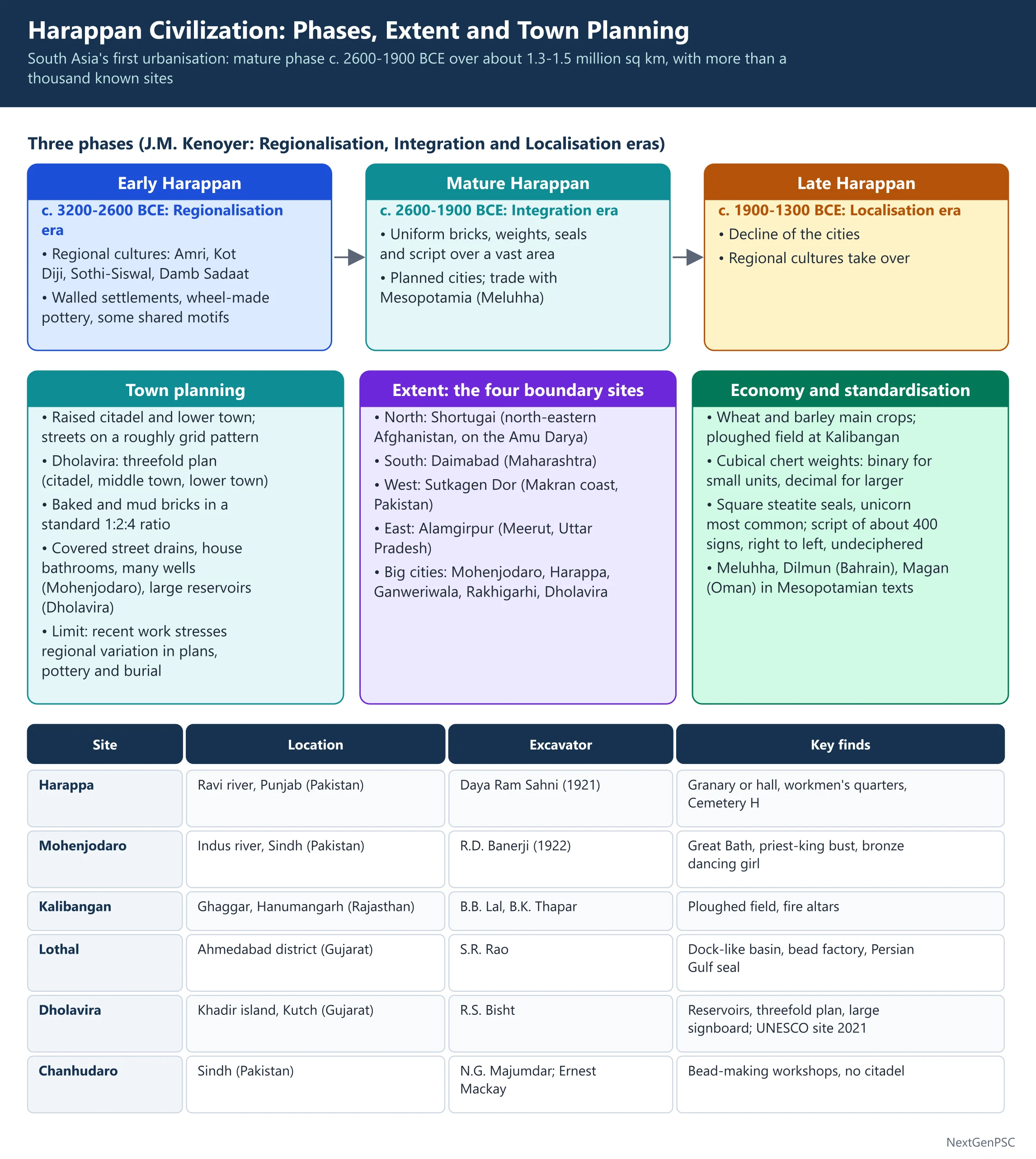
1. Discovery
Early notice: Charles Masson described the ruins of Harappa in 1826, and Alexander Cunningham collected a seal there in the 1850s-70s without recognising its age.
Excavation: Daya Ram Sahni excavated Harappa (on the Ravi, Punjab, Pakistan) in 1921 and R.D. Banerji excavated Mohenjodaro (on the Indus, Sindh) in 1922.
Announcement: John Marshall announced the discovery of a new civilization in the Illustrated London News in 1924.
Names: Harappan (after the first site, the usual archaeological convention) and Indus civilization; some prefer Sindhu-Sarasvati because many sites lie on the Ghaggar-Hakra, a naming that is debated.
2. Origin and phases
Diffusion view: early scholars, including Wheeler, thought the idea of civilization came from Mesopotamia; Wheeler wrote that ideas have wings.
Indigenous evolution: excavations at Mehrgarh, Amri, Kot Diji, Kalibangan I, Rehman Dheri and Harappa showed a long local development, now the accepted view; A. Ghosh, M.R. Mughal and G.L. Possehl contributed to it.
Early Harappan (c. 3200-2600 BCE): regional cultures (Amri, Kot Diji, Sothi-Siswal, Damb Sadaat) with walled settlements, wheel-made pottery and some shared motifs.
Mature Harappan (c. 2600-1900 BCE): integration across a vast area with uniform bricks, weights, seals and script.
Late Harappan (c. 1900-1300 BCE): decline of cities and regional cultures; J.M. Kenoyer calls the phases Regionalisation, Integration and Localisation eras.
3. Date
Marshall: estimated c. 3250-2750 BCE on the basis of Mesopotamian links.
Cross-dating: Harappan seals and beads found in Mesopotamian contexts, and Akkadian texts of Sargon's time (c. 2300 BCE) naming Meluhha, anchor the mature phase in the late third millennium BCE.
Radiocarbon: D.P. Agrawal's early radiocarbon work suggested c. 2300-1750 BCE; with calibration and more dates the mature phase is now placed at c. 2600-1900 BCE.
Very early claims: a 2016 study proposed early dates for the lowest levels at Bhirrana (Haryana), but these remain contested.
4. Extent and major sites
Boundaries: Shortugai (north-eastern Afghanistan, on the Amu Darya) in the north, Daimabad (Maharashtra) in the south, Sutkagen Dor (Makran coast, Pakistan) in the west and Alamgirpur (Meerut, Uttar Pradesh) in the east.
Area: larger than contemporary Egypt and Mesopotamia combined, usually given as around 1.3 to 1.5 million square km, with over a thousand known sites.
Big cities: Mohenjodaro, Harappa, Ganweriwala (Cholistan), Rakhigarhi (Hisar, Haryana) and Dholavira (Kutch, Gujarat).
Other key sites in India: Lothal (dock-like basin, bead factory), Kalibangan (ploughed field, fire altars), Banawali, Surkotada, Bhirrana, Kunal and Manda (Jammu); Chanhudaro in Sindh was a craft centre without a citadel.
5. Town planning
Layout: many cities have a raised citadel and a lower town, with streets on a roughly grid pattern; Dholavira has a threefold division (citadel, middle town, lower town).
Bricks: baked and mud bricks in a standard ratio of 1:2:4 across the whole area.
Drainage and water: covered street drains, house bathrooms, many wells at Mohenjodaro and large reservoirs at Dholavira show strong civic organisation.
Limits of uniformity: recent work stresses regional variation in plans, pottery and burial, so standardisation should not be exaggerated.
6. Economy: agriculture, crafts and trade
Agriculture: wheat and barley as main crops, with pulses, sesame, cotton and, at some sites, rice and millets; the Kalibangan field shows criss-cross ploughing.
Animals: humped cattle, buffalo, sheep and goat; the horse is not securely attested in the mature phase.
Crafts: carnelian and steatite beads (Chanhudaro, Lothal), shell work, faience, copper-bronze tools and casting, and pottery painted black on red.
Weights and measures: cubical chert weights in a binary series for small units and decimal for larger ones, uniform across sites.
Trade: Mesopotamian texts name Meluhha (the Indus region), Dilmun (Bahrain) and Magan (Oman); Harappan seals and beads are found in the Gulf and Mesopotamia, and Shortugai was an outpost for lapis lazuli.
7. Seals, script, polity and religion
Seals: mostly square steatite seals with an animal (the unicorn most common) and a short inscription, used in trade and administration.
Script: about 400 signs, usually written right to left, with short texts; it is undeciphered and claims of decipherment have not been accepted.
Polity: no palaces or royal tombs have been identified; views range from a centralised state (Shereen Ratnagar) and city-states to a heterarchy of competing elites (Kenoyer, Possehl).
Religion: terracotta female figurines (read as mother goddesses), the seated figure on the so-called Pashupati seal (Marshall's proto-Shiva, a reading questioned by Doris Srinivasan and others), pipal leaves, fire altars at Kalibangan and Lothal, and the Great Bath.
Rakhigarhi DNA (2019): a study of a female skeleton by Vasant Shinde, Niraj Rai, David Reich and colleagues (published in Cell) found no steppe-related ancestry and an Iranian-related ancestry that separated very early from that of Iranian farmers.
8. Historiography and debates
Mesopotamian model rejected: Wheeler's The Indus Civilization (1953) saw a strongly centralised, priest-led empire; later scholars find little evidence for such a single centre.
Rulers without display: Possehl (The Indus Civilization, 2002) stressed the absence of royal display and called its ideology distinctive, unlike Egypt or Mesopotamia.
Granary or hall: Wheeler's great granaries at Harappa and Mohenjodaro have been reinterpreted by Kenoyer and others as possible public halls, since no grain was found in them.
Language of the script: proposals include proto-Dravidian (Asko Parpola, Iravatham Mahadevan) and Indo-Aryan, while Steve Farmer and others argued that the signs were not a full writing system; none is proven.
9. Using it in the exam
10-mark answer: on town planning, give citadel and lower town, bricks, drains, water management at Dholavira, and the limits of uniformity.
15-mark answer: on origins, contrast the diffusion and indigenous views, using Mehrgarh and Early Harappan sites as evidence.
20-mark answer: on political organisation, weigh the evidence of uniform weights, bricks and seals against the absence of palaces, citing Wheeler, Ratnagar, Possehl and Kenoyer.
Keywords: first urbanisation, citadel, standardisation, Meluhha, heterarchy, undeciphered script.
Source extract (paraphrase): an inscription of Sargon of Akkad boasts that ships from Meluhha, Magan and Dilmun moored at the quay of his capital.
| Site | Location | Excavator (main) | Key finds |
|---|---|---|---|
| Harappa | Ravi river, Punjab (Pakistan) | Daya Ram Sahni (1921) | Granary or hall, workmen's quarters, Cemetery H |
| Mohenjodaro | Indus river, Sindh (Pakistan) | R.D. Banerji (1922) | Great Bath, priest-king bust, bronze dancing girl |
| Kalibangan | Ghaggar, Hanumangarh (Rajasthan) | B.B. Lal, B.K. Thapar | Ploughed field, fire altars |
| Lothal | Ahmedabad district (Gujarat) | S.R. Rao | Dock-like basin, bead factory, Persian Gulf seal |
| Dholavira | Khadir island, Kutch (Gujarat) | R.S. Bisht | Reservoirs, threefold plan, large signboard; UNESCO site 2021 |
| Rakhigarhi | Hisar (Haryana) | Amarendra Nath; Vasant Shinde | One of the largest sites; 2019 ancient DNA study |
| Chanhudaro | Sindh (Pakistan) | N.G. Majumdar; Ernest Mackay | Bead-making workshops, no citadel |
Mains points
- UPSC asks repeatedly about town planning, origins and the nature of polity; prepare each as a separate 15-mark answer with sites.
- Use the three phases (Early, Mature, Late) with dates; it shows command of recent scholarship.
- Balance uniformity with regional diversity; examiners reward the qualification.
- Name Indian sites (Dholavira, Rakhigarhi, Kalibangan, Lothal) and draw a quick sketch map of the extent.
- Mark readings such as the proto-Shiva seal, the granary and the Lothal dock as interpretations, not facts.
- On recent science (Rakhigarhi DNA), state only what the study reported and avoid broader claims.
Did you know?
- Dholavira's signboard of ten large signs, made of inlaid gypsum pieces and found near the north gate, has the largest signs of any known Harappan inscription.
Harappan Art, Architecture, Decline, Survival and Significance
Harappan art includes the bronze dancing girl, the steatite priest-king, stone torsos, terracotta figurines and finely carved seals, while its architecture is best seen in the Great Bath, large halls, drains and the reservoirs of Dholavira. From about 1900 BCE the cities declined; explanations range from the discredited Aryan invasion to floods, river shifts, climate change and loss of trade. The civilization did not vanish but was localised, and many of its practices survived.
In simple words
Harappan art is small and precise, like jewellery rather than giant statues: a bronze girl the size of a hand, seals no bigger than a stamp.
Its cities faded slowly, the way a busy market town empties when the river moves away and trade dries up, not in a single battle.
UPSC asks why the cities declined and what survived, so weigh several causes and avoid a single-cause answer.
1. Sculpture, figurines and seals
Bronze dancing girl (Mohenjodaro): about 10.5 cm tall, made by the lost-wax (cire perdue) method, with bangles on one arm and a confident pose; now in the National Museum, New Delhi.
Priest-king (Mohenjodaro): a steatite bust of a bearded man wearing a robe with trefoil patterns and a fillet on the head; the name is a modern label, not proof of a priest-ruler.
Stone torsos (Harappa): a red sandstone male torso and a grey stone dancing figure show a naturalistic modelling that surprised early scholars; their date has been questioned.
Terracotta: female figurines with elaborate headdresses, animals, toy carts and whistles show popular art and possibly household ritual.
Seals as miniature art: finely carved animals (unicorn, humped bull, elephant, tiger, rhinoceros) and scenes such as the seated figure with animals.
Pottery and ornaments: red ware painted in black with pipal leaves, fish-scale and intersecting circles; beads of carnelian, gold and faience; the long carnelian beads were drilled with special stone drills.
2. Architecture
Great Bath (Mohenjodaro): a brick tank about 12 m by 7 m and about 2.4 m deep, made watertight with gypsum mortar and bitumen, with steps at both ends and rooms around; most scholars read it as a ritual bathing place.
Large buildings: the so-called granaries at Harappa and Mohenjodaro, a pillared hall at Mohenjodaro, and the warehouse at Lothal show public construction on a large scale.
Houses: one or two storeys around a courtyard, doors opening onto side lanes, private wells and bathrooms linked to street drains.
Dholavira: stone-built fortifications, a series of rock-cut and masonry reservoirs, and a large open ground, a design adapted to an arid island.
Lothal basin: S.R. Rao interpreted the brick basin as a dockyard; L.S. Leshnik and others suggested it was a water reservoir, so the point is debated.
What is missing: no clearly identified palaces, temples or monumental royal tombs, a contrast with Egypt and Mesopotamia.
Building materials: burnt brick dominated in the Indus plains, while stone was widely used at Dholavira and other sites in Kutch and Saurashtra, an adaptation to local resources.
3. Decline: what the evidence shows
Timing: from about 1900 BCE big cities shrank or were abandoned, standard weights, seals and script went out of use, and long-distance trade faded.
Not uniform: decline was gradual and uneven; settlements increased in number in the east (Haryana, western Uttar Pradesh) and in Gujarat while the Indus heartland emptied.
Signs of stress: late levels at Mohenjodaro show poorer construction and crowding, suggesting declining civic control.
Shift of settlement: surveys such as M.R. Mughal's in Cholistan show site numbers along the dry Hakra falling sharply in the Late Harappan phase, while sites multiply further east.
4. Theories of decline
Aryan invasion: Wheeler pointed to skeletons at Mohenjodaro and the Rigveda's Indra as a destroyer of forts, writing that on circumstantial evidence Indra stands accused.
Rejected: George Dales in The Mythical Massacre at Mohenjo-daro (1964) showed the skeletons came from different levels and periods, not a single massacre; the dates also do not match.
Floods and tectonics: Robert Raikes and M.R. Sahni argued that tectonic uplift dammed the lower Indus and caused repeated floods at Mohenjodaro; critics say silt layers do not prove such a dam.
River shifts: H.T. Lambrick stressed shifts of the Indus course; others link the drying of the Ghaggar-Hakra to the loss of its Himalayan feeders and to weaker monsoon flow.
Climate change: Gurdip Singh's pollen studies (1971) from Rajasthan lakes suggested increasing aridity; later research links decline to weakening monsoons around the 4.2 thousand-year event, for example Liviu Giosan and colleagues (2012).
Ecology and economy: W.A. Fairservis argued that cities exhausted local resources such as fuel and pasture, and Shereen Ratnagar stressed the decline of trade with Mesopotamia around this time.
Multi-causal view: most historians now combine climatic, riverine, economic and social factors, which acted differently in each region.
5. Survival: the Late Harappan cultures
Localisation: Possehl and Kenoyer describe a transformation into regional cultures rather than a collapse.
Regional successors: the Cemetery H culture (Punjab), the Jhukar culture (Sindh), Late Sorath sites such as Rangpur (Gujarat), and Late Harappan sites in Haryana and the Ganga-Yamuna doab.
What continued: crops and farming methods, bullock carts, bead and shell crafts, pottery forms, weights in some trade practice, and village life.
Possible cultural survivals: pipal worship, a mother goddess cult, fire rituals, and postures compared with yoga have been suggested as legacies; these links are plausible but not proven.
What was lost: the script, city planning, seals and standard weights disappeared, and cities returned only with the second urbanisation in the Ganga valley around the sixth century BCE.
Eastward drift: in the Ganga-Yamuna doab some scholars see Late Harappan elements overlapping with Ochre Coloured Pottery sites, a sign of population moving east.
6. Significance
First urbanisation: it shows that South Asia developed one of the world's earliest urban societies, comparable with Egypt and Mesopotamia.
Different path: its civic planning without visible kings or monumental temples offers a distinct model of early complex society.
Pushed back Indian history: its discovery in the 1920s extended the known past of India by well over a thousand years before the Vedic texts.
Technological legacy: standard measures, lost-wax casting, long-bead drilling and planned drainage are among the early achievements of South Asian technology.
7. Using it in the exam
10-mark answer: on Harappan art, describe three named objects (dancing girl, priest-king, seals) and what they show about technique and society.
15-mark answer: on survival, list what continued and what was lost, with Late Harappan cultures as evidence.
20-mark answer: on decline, set out each theory with its proponent and evidence, refute the invasion thesis with Dales, and conclude with a regional, multi-causal view.
Keywords: lost-wax casting, Great Bath, localisation, 4.2 ka event, Late Harappan, second urbanisation.
Quotation: Wheeler's line that on circumstantial evidence Indra stands accused is useful to introduce, and then dismantle, the invasion theory.
| Theory | Main proponents | Evidence used | Criticism |
|---|---|---|---|
| Aryan invasion | Mortimer Wheeler | Skeletons at Mohenjodaro; Rigvedic Indra as fort-destroyer | Skeletons from different periods (George Dales); dates do not match |
| Floods and tectonic uplift | Robert Raikes, M.R. Sahni | Silt layers at Mohenjodaro | Explains one site at most; dam not proven |
| River shifts and drying | H.T. Lambrick; others on the Ghaggar-Hakra | Abandoned channels, site distribution | Timing of drying debated |
| Climate change | Gurdip Singh; Liviu Giosan and others | Pollen cores, monsoon records | Climate alone cannot explain regional differences |
| Ecological exhaustion | W.A. Fairservis | Pressure on fuel, pasture and soil | Hard to measure directly |
| Decline of trade | Shereen Ratnagar | Fewer Meluhha references after c. 1900 BCE | Effect rather than cause, some argue |
Mains points
- Decline is one of the most asked Harappan questions; present several theories with names and end with a multi-causal, regional view.
- Use the word localisation and the Late Harappan cultures to show that the civilization transformed rather than vanished.
- For art questions, give technique (lost-wax, steatite carving) as well as description.
- Do not present the invasion theory as current; state it and then its refutation.
- Mark cultural survivals (yoga, Shiva, mother goddess) as possible, not proven.
- Close significance answers by contrasting the first and second urbanisations.
Did you know?
- Wheeler is said to have called the bronze dancing girl a girl perfectly confident of herself and the world; treat the exact wording as a reported remark.
- The Great Bath is often called the earliest public water tank in the world, a reminder of how central water and purity were to Harappan life.
UPSC Previous Year Questions: Sources, Prehistory and the Indus Civilization
From 2014 to 2026 UPSC asked 23 question parts worth 390 marks from this chapter, all in Paper I, Question 2 or 3. The Harappan civilization dominates with 11 parts (origin, subsistence, settlement, art, architecture and decline), followed by literary sources and foreign accounts (5) and the Neolithic and Chalcolithic cultures (4). Every question below has a model answer written to the UPSC word limit: about 200 words for 15 marks and 250 words for 20 marks.
In simple words
Read the question and the Approach line, then write your own answer in the time you would get in the exam (about 9 minutes for 15 marks, 12 for 20).
Only then read the model answer and compare: did you define the key term, cite named sites, sources and historians, and give both sides?
Note what you missed in your notebook and revise that part of the chapter notes before trying the next question.
1. Archaeological Sources: Excavation, Epigraphy, Numismatics and Monuments
Example 1 (UPSC 2019, 15 marks): Do you agree that archaeological evidence often helps in the better understanding of literary sources? Comment.
Paper and question: Paper I, Q2(a)
Approach: The question asks whether archaeology aids the reading of texts; agree with qualification, showing how it corroborates, locates, dates and corrects literary evidence, then note its limits.
Literary sources such as the Vedas, Puranas and foreign accounts are often undated, layered and written by elites. Archaeological evidence, datable by stratigraphy and radiocarbon, gives them a setting in space and time, so the statement largely holds.
Corroboration: Ashoka's Rummindei pillar records his visit to Lumbini because the Buddha was born there, confirming Buddhist tradition. The Maski edict (found 1915) named Devanampiya Piyadasi as Ashoka, linking the edicts to the Ashoka of the chronicles.
Locating texts on the ground: Alexander Cunningham used Xuanzang's itinerary to identify Buddhist sites such as Sravasti and Sankisa. Wheeler's excavation at Arikamedu (1945), with Roman amphorae and Arretine ware, gave material form to the Yavana trade of the Periplus and Sangam poems.
Dating and correcting: the Boghazkoi inscription (c. 1380 BCE), naming Indra, Mitra, Varuna and the Nasatyas, helps date Rigvedic deities. Painted Grey Ware sites show that later Vedic settlements in the doab were modest villages, not the grand cities of epic imagination.
Limits: material remains are silent on beliefs, names and events, and forced matching misleads; B.B. Lal's link between a flood layer at Hastinapur and the Puranic shift of capital to Kaushambi remains debated.
Archaeology therefore does not merely confirm texts; it tests, dates and sometimes contradicts them. As D.D. Kosambi urged, sound history combines the spade with the text.
Example 2 (UPSC 2017, 15 marks): Art and culture are reflected to a far greater extent than political history in the epigraphic sources. Comment.
Paper and question: Paper I, Q2(a)
Approach: Weigh the statement: show the rich cultural content of inscriptions (donations, temples, literature, music, guilds), then show that many inscriptions are primarily political, and reach a balanced verdict.
Epigraphy, the study of inscriptions on rock, pillar, copper plate and temple wall, is the most contemporary source for early India. Whether it reflects culture more than political history depends on which class of inscriptions we read.
Art and culture: the hundreds of donative records at Sanchi and Bharhut name monks, nuns, guilds and women who paid for railings and gateways, revealing the social base of Buddhist art. The Mandasor inscription of the silk weavers' guild records the building and repair of a Sun temple in polished Sanskrit verse by Vatsabhatti.
Inscriptions are also literature: Rudradaman's Junagadh record (c. 150 CE) is an early specimen of ornate Sanskrit prose, and Harishena's Allahabad prashasti is kavya in its own right. The Kudumiyamalai inscription in Pudukkottai preserves a text on music.
Political history: yet the core of many inscriptions is political. Ashoka's edicts reveal his dhamma policy and the Kalinga war; the Allahabad pillar lists Samudragupta's conquests; the Aihole inscription records Pulakeshin II's victory over Harsha; the Rabatak inscription gives the Kushana genealogy. Copper-plate land grants show officials, revenue and administration.
The statement therefore holds for the vast body of donative and temple inscriptions, but not for the royal records that remain the backbone of dynastic chronology; art, culture and polity are intertwined in the epigraphic record.
2. Literary Sources and Foreign Accounts
Example 3 (UPSC 2026, 20 marks): "Greek writers viewed India largely from a political perspective, Chinese travellers from a religious perspective, and Arab scholars from a scientific and cultural perspective." Comment.
Paper and question: Paper I, Q2(c)
Approach: Test the threefold generalisation against each group of writers: accept the dominant interest of each, then show the political, social and economic content that cuts across it, and conclude that the scheme is useful but too neat.
Foreign accounts supply external dates and an outsider's view of early India. The statement captures the dominant interest of three groups of writers, shaped by why they came: Greek envoys and soldiers, Chinese Buddhist pilgrims and Arab merchants and scholars.
Greek writers: Megasthenes, Seleucus's envoy at Chandragupta's court, described the royal palace, the six boards of five that ran Pataliputra, the army and the king's spies, which is political material.
Yet the Greeks were not only political. Megasthenes' seven classes, his remark that Indians did not know slavery, and his notes on philosophers and rivers are ethnography, while the Periplus of the Erythraean Sea and Pliny are essentially commercial, listing ports such as Barygaza and Muziris and the drain of Roman money.
Chinese travellers: Faxian (c. 399-414 CE) and Xuanzang (c. 630-644 CE) came to collect texts and visit holy places, so monasteries, relics, Nalanda and the state of the sangha dominate. But Faxian records mild punishments and the segregation of Chandalas, and Xuanzang describes Harsha's assemblies, his revenue, his failure against Pulakeshin II and robbers on the roads, which is political and social history.
Arab scholars: Al-Biruni's Kitab al-Hind (c. 1030) studied Indian astronomy, mathematics, philosophy and caste with remarkable rigour, which justifies the scientific and cultural label. Earlier Arab merchants such as Sulaiman and al-Masudi, however, were interested in kings and trade, ranking the Rashtrakuta Balhara among the great rulers of the world, and the Chachnama narrates the conquest of Sindh.
The generalisation therefore identifies each group's primary lens accurately, but every account mixes political, religious, economic and cultural observation, so the historian must read them for more than their declared purpose.
Example 4 (UPSC 2022, 15 marks): Foreign accounts as a source of ancient Indian history may have some advantages but also have a few shortcomings. Citing appropriate examples, examine the statement.
Paper and question: Paper I, Q2(b)
Approach: Examine both sides with examples: set out the advantages of foreign accounts (dates, outsider observation, trade and society), then their shortcomings (language, hearsay, bias, limited travel), and conclude on how historians use them.
Greek, Roman, Chinese and Arab writers have left accounts of India from the fifth century BCE onward. They are valuable precisely because they are external, but the same outsider position creates their weaknesses.
Advantages: they provide fixed points of chronology: the identification of Sandrokottos with Chandragupta Maurya anchors Indian dates, and Faxian's visit (c. 399-414 CE) falls in the reign of Chandragupta II. They notice what Indian texts take for granted, such as Megasthenes on Pataliputra's administration, Faxian on the treatment of Chandalas, and Xuanzang on Nalanda and Harsha's assemblies.
They illuminate trade and economy: the Periplus lists ports, exports and imports, and Pliny complains of Roman gold flowing to India, a picture confirmed by Roman coin hoards and Arikamedu.
Shortcomings: most writers did not know Indian languages and relied on interpreters, so Megasthenes' seven classes confuse varna, jati and occupation, and his claim that Indians knew no slavery conflicts with Indian texts. Many reported hearsay, like Herodotus' gold-digging ants.
Their interests narrowed their vision: Chinese pilgrims dwelt on Buddhism and exaggerated the patronage of rulers like Harsha, while Al-Biruni, despite his rigour, admitted barriers of language and prejudice and described caste through Brahmanical texts.
Foreign accounts are thus indispensable but must be read critically, corroborated with inscriptions, coins and archaeology, and set against Indian literary sources.
Example 5 (UPSC 2018, 20 marks): How did the early Indian historical tradition, as reflected in Itihasa-Purana, emerge? What are the distinctive features of this genre?
Paper and question: Paper I, Q2(a)
Approach: Two parts: first trace how the Itihasa-Purana tradition emerged (bardic genealogies, Vedic references, Brahmanical compilation), then list its distinctive features, ending with how historians assess it.
Colonial scholars often claimed that early India had no historical writing, and Al-Biruni himself remarked that Hindus paid little attention to the historical order of events. The Itihasa-Purana tradition shows instead a distinctive Indian form of historical consciousness.
Emergence: the term appears in later Vedic texts; the Atharvaveda mentions itihasa and purana, and the Chandogya Upanishad calls itihasa-purana the fifth Veda. Its roots lay in the oral recitations of bards, the sutas and magadhas, who preserved the genealogies and deeds of chiefs.
The bardic material was later taken over and recast by Brahmanas. The epics, the Mahabharata and Ramayana, grew over centuries (roughly 400 BCE to 400 CE), and the Puranas were compiled mainly in the early centuries CE.
Distinctive features: first, the Puranas follow the five themes (pancha-lakshana) of creation, re-creation, genealogy of gods and sages, the ages of Manu, and the history of royal dynasties. Second, the dynastic lists of the Kali age, covering the Nandas, Mauryas, Shungas, Satavahanas and early Guptas, are written in the future tense as prophecy.
Third, time is cyclical, measured in yugas and manvantaras, and the past is presented as a moral lesson. Fourth, the tradition is genealogical: Solar and Lunar lineages (Suryavamsha, Chandravamsha) connect later kings to ancient heroes and so give them legitimacy.
Assessment: F.E. Pargiter treated the Puranic king-lists as usable historical tradition, and Romila Thapar describes this as embedded history, in which historical memory lies within myth and genealogy, later externalised in charitas, vamshavalis and Kalhana's Rajatarangini. Critics warn of late compilation, interpolation and inflated chronology.
Itihasa-Purana is thus not history in the modern sense, but a genre that preserved and shaped the memory of the past.
Example 6 (UPSC 2015, 15 marks): How far can the ancient Indian Sruti literature be used as historical sources ?
Paper and question: Paper I, Q2(a)
Approach: A 'how far' question: define Sruti, show what the Vedic Samhitas, Brahmanas, Aranyakas and Upanishads reveal about society, polity, economy and thought, then set out their limits as evidence.
Sruti, literally what is heard, denotes the texts held to be revealed: the four Veda Samhitas, the Brahmanas, Aranyakas and Upanishads, composed orally over roughly 1500-500 BCE. They are religious texts, yet they remain the main source for the Vedic age.
Value for the early Vedic period: the Rigveda's geography places its composers in the land of the Sapta Sindhu. Its hymns reveal a pastoral society that valued cattle, wars over cattle (gavishti), tribal assemblies such as the sabha and samiti, and the rajan as a tribal chief.
Value for the later Vedic period: the Brahmanas show the eastward expansion, as in the Shatapatha Brahmana's story of Videgha Mathava carrying the fire to the Sadanira. Royal rituals such as the rajasuya and ashvamedha, the ratnins and the hardening of varna, first stated in the Purusha Sukta, trace the growth of monarchy and hierarchy.
The Upanishads record a turn from sacrifice to knowledge, with the ideas of atman, brahman, karma and rebirth.
Limits: the texts were composed by priests for ritual, so they say little about the lives of ordinary people, women or non-Aryan groups. Their dates are uncertain and they have layers (the tenth book of the Rigveda is later).
Sruti literature is therefore indispensable for the Vedic age, but as a priestly and normative source it must be read critically and alongside archaeology.
Example 7 (UPSC 2014, 15 marks): "While using the accounts of foreign writers, historians must distinguish between statements based on hearsay and those grounded in perceptive observations." Elaborate with examples.
Paper and question: Paper I, Q2(a)
Approach: Elaborate the statement: explain why foreign accounts mix hearsay and observation, give examples of each from Greek, Chinese and Arab writers, and show how historians separate the two.
Foreign writers travelled through limited regions, depended on interpreters and often repeated what they were told. Their accounts therefore combine first-hand observation with hearsay, and the historian's task is to separate the two.
Hearsay: Herodotus, who never visited India, reported gold-digging ants. Megasthenes, quoted by Strabo and Arrian, repeated tales of men with ears large enough to sleep in, and his statements that Indians did not know slavery or writing contradict Indian evidence.
Perceptive observation: Megasthenes' description of Pataliputra as a long city enclosed by a timber palisade is confirmed by the wooden palisade found at Bulandibagh. The Periplus, a sailors' guide, lists ports and goods accurately, as Arikamedu and Roman coin hoards confirm.
Faxian's observation that Chandalas lived outside towns and struck a piece of wood to warn others of their approach, and Xuanzang's detailed account of Nalanda and of Harsha's assemblies at Kanauj and Prayag, rest on what they saw. Al-Biruni, who learnt Sanskrit, built his account on texts and discussion with pandits rather than rumour.
Method: historians test foreign statements by asking whether the writer was present and whether the claim is supported by inscriptions, coins or excavation.
Read critically in this way, foreign accounts become a valuable independent check on Indian sources rather than a collection of travellers' tales.
3. Geography and the Palaeolithic and Mesolithic Cultures
Example 8 (UPSC 2026, 15 marks): Analyze the role of terrain, climate and vegetation in shaping the settlement and movement of prehistoric communities in India.
Paper and question: Paper I, Q2(a)
Approach: Analyse how terrain, climate and vegetation shaped where prehistoric people lived and how they moved, phase by phase from the Lower Palaeolithic to the Mesolithic, with named sites, and note the limits of environmental explanation.
Hunter-gatherers depend directly on their environment for water, stone, game and plants, so terrain, climate and vegetation largely decided where prehistoric communities in India camped and how they moved.
Terrain and raw material: Lower Palaeolithic Acheulian sites cluster where quartzite and water met, in river valleys and foothills such as Attirampakkam, the Hunsgi-Isampur valley, the Belan, the Narmada at Hathnora, and Bhimbetka. The thick alluvium of the Ganga plain, lacking stone, has few Palaeolithic sites.
Climate: Pleistocene wet and dry phases shifted settlement. Sites at Didwana in the Thar show occupation during wetter phases, while arid phases pushed groups to rivers and springs. With the warmer, wetter Holocene after about 10,000 BCE, grasslands and lakes spread and Mesolithic groups occupied new zones.
Vegetation and fauna: forests of the Vindhyas sheltered rock-shelter camps like Bhimbetka, whose paintings show the hunting of deer and bison. The oxbow lakes of the Ganga plain drew semi-settled groups at Sarai Nahar Rai, Mahadaha and Damdama.
Movement: people moved seasonally between hills and valleys following game and plants, a pattern V.N. Misra inferred partly from living hunter-gatherers.
Environment set the possibilities, but technology, social choice and exchange also mattered, as the early herding at Bagor shows. Geography explains much of prehistoric settlement, though not all of it.
4. Neolithic and Chalcolithic Cultures: The Beginning of Agriculture
Example 9 (UPSC 2025, 15 marks): “The Chalcolithic people were experts in microliths and were also skilful workers in stone.” Elucidate.
Paper and question: Paper I, Q2(a)
Approach: Elucidate both halves of the statement: show the chalcolithic blade-and-microlith industry, then their wider skill in ground stone, beads and querns, explaining why stone stayed central despite copper, with regional examples.
The term chalcolithic, copper and stone, itself states the point: the village cultures of Rajasthan, Malwa and the Deccan (c. 3000-700 BCE) used copper, but copper was scarce and costly, so stone remained the everyday material.
Expertise in microliths: almost every chalcolithic site yields a rich stone blade industry. Long parallel-sided blades were struck from prepared cores of chalcedony, chert, agate and jasper and were then backed and shaped into lunates, triangles, trapezes, points and borers.
These blades were hafted in wood or bone as sickles, knives and arrowheads. Jorwe sites such as Inamgaon, Nevasa and Chandoli, and Malwa sites such as Navdatoli, have yielded them in large numbers, so microlithic technology inherited from the Mesolithic was refined rather than abandoned.
Skill in other stone work: chalcolithic people made ground and polished stone axes, saddle querns and mullers for grinding grain, pounders, hammer stones and perforated ring stones. Bead-makers worked carnelian, agate and other stones, and Kayatha is known for necklaces of tiny steatite micro-beads.
Regional variation: at Ahar, close to the copper of the Aravallis, stone tools are comparatively scarce, which shows that the balance of stone and copper depended on access to ore.
The statement is thus accurate: the chalcolithic economy rested on a highly developed stone technology, with copper used mainly for axes, chisels, bangles and prestige objects.
Example 10 (UPSC 2023, 20 marks): "The Neolithic Age represents a revolution due to significant changes that took place during this period." Examine.
Paper and question: Paper I, Q2(a)
Approach: Examine Childe's idea of a Neolithic Revolution: set out the changes that justify the term with Indian evidence, then the arguments that the change was gradual and regionally varied, and conclude on the sense in which it was revolutionary.
V. Gordon Childe, in Man Makes Himself (1936), called the shift from food gathering to food production the Neolithic Revolution. The term stresses the depth of change rather than its speed.
Food production: the domestication of plants and animals transformed the relation of humans to nature. At Mehrgarh in Baluchistan, from about 7000 BCE, people grew barley and wheat and herded goat, sheep and later cattle; Koldihwa and Mahagara in the Belan valley and Lahuradewa show rice, and southern sites combine cattle herding with millets and pulses.
Settled life and technology: farming encouraged permanent villages, mud-brick houses at Mehrgarh and pit dwellings at Burzahom. New tools appeared: ground and polished stone axes (celts) for clearing land, querns for grinding, and pottery for cooking and storage.
Social change: surplus and storage, seen in Mehrgarh's compartmented buildings, allowed population growth, craft specialisation in beads and copper, notions of property and ritual burial.
Limits of the term: the change was not sudden. At Mehrgarh it took millennia, and the Mesolithic herding at Bagor and Adamgarh show a long transition. Neolithic cultures began at different times, from the seventh millennium BCE in the north-west to the second millennium BCE in the south and east.
Hunting and gathering continued alongside farming, many southern Neolithic groups were largely pastoral, as F.R. Allchin's reading of the ash mounds shows, and most scholars, including Upinder Singh, now speak of several centres of early farming rather than one event.
The Neolithic was therefore a revolution in its consequences, creating the agrarian base of all later Indian history, but in South Asia it unfolded as a gradual and regionally varied process.
Example 11 (UPSC 2017, 15 marks): The emergence of Non-Harappan Chalcolithic cultures in Central India and the Deccan mark a change not only in the subsistence pattern of people but an overall transition from pre to proto historic period. Critically analyze.
Paper and question: Paper I, Q2(c)
Approach: Critically analyse both claims: show the change in subsistence brought by the non-Harappan chalcolithic cultures, then assess whether they mark a transition from prehistory to protohistory, noting continuities and reversals.
Outside the Harappan zone, a chain of copper-using village cultures arose in south-east Rajasthan (Ahar-Banas), Malwa (Kayatha, Navdatoli) and the Deccan (Jorwe, Inamgaon, Daimabad) between about 3000 and 700 BCE. They are often classed as protohistoric, a stage between prehistory and the age of written records.
Change in subsistence: they brought settled farming to central India and the Deccan, growing wheat, barley, rice, millets and pulses and herding cattle, sheep and goat. Inamgaon had an irrigation channel and embankment against floods and granaries, while Navdatoli and Daimabad were large villages with planned houses.
Wider transition: the change was more than economic. Copper metallurgy, wheel-made painted pottery, craft specialisation in beads, and long-distance exchange appear. Social ranking emerges, as in the large central house at Inamgaon read as a chief's dwelling.
Critical points: they had no writing, so the label protohistoric is a matter of definition. Stone, especially the microlithic blade, remained central, hunting continued, and copper was scarce. The process was not linear: in the Late Jorwe phase, linked by M.K. Dhavalikar to increasing aridity, Inamgaon shrank into poorer settlements and many sites were abandoned before the iron age.
The non-Harappan chalcolithic cultures thus marked a real shift to village farming and a step towards protohistory, but the transition was regional, partial and reversible rather than a single forward leap.
Example 12 (UPSC 2016, 15 marks): Delineate and account for the regional characteristics of the Neolithic period in India.
Paper and question: Paper I, Q2(a)
Approach: Two tasks: delineate the main Neolithic regions with their sites, crops, tools and houses, then account for the differences through ecology, raw materials, timing and external contacts.
The Neolithic in India was not a single culture but a set of regional farming traditions that began at different times, from the seventh millennium BCE in Baluchistan to the second millennium BCE in the south and east.
North-west: Mehrgarh on the Kachhi plain shows wheat and barley farming, goat, sheep and cattle, and mud-brick houses from about 7000 BCE. Kashmir: Burzahom and Gufkral, from about the third millennium BCE, have pit dwellings, bone tools, a perforated stone harvester and dogs buried with humans.
Vindhyas and middle Ganga: Koldihwa and Mahagara in the Belan valley and Lahuradewa show early rice. South India: Brahmagiri, Maski, Sanganakallu, Tekkalakota and Utnur combine cattle herding with millets and pulses; the ash mounds of Utnur and Kupgal were read by F.R. Allchin as burnt cattle pens.
North-east: Daojali Hading and Sarutaru in Assam have shouldered celts and cord-impressed pottery.
Explaining the differences: ecology decided crops, with winter wheat and barley in the arid north-west, rice in the wet Ganga plain and millets on the dry southern plateau. Raw materials shaped tools, with dolerite axes on the granite hills of the south and bone tools where stone was scarce.
Contacts also mattered: Mehrgarh's crops link it with West Asia, Burzahom's harvester has been compared with north Chinese types, and the north-east shows Southeast Asian affinities. Timing reflects the spread of farming from several independent centres.
5. Harappan Civilization: Origin, Date, Extent and Characteristics
Example 13 (UPSC 2023, 15 marks): The Indus-Saraswati cultural zone exhibited both homogeneity and diversity. Discuss.
Paper and question: Paper I, Q2(b)
Approach: Discuss both sides: first the elements of uniformity across the Harappan zone, then the regional diversity in planning, materials, economy, ritual and burial, and conclude with how the two coexisted.
The Mature Harappan civilization (c. 2600-1900 BCE) covered over a million square km; some scholars call it the Indus-Saraswati civilization because many sites lie on the Ghaggar-Hakra, a naming that is debated. Across this zone it shows striking homogeneity along with marked regional diversity.
Homogeneity: baked and mud bricks in a standard 1:2:4 ratio, cubical chert weights in a binary system, square steatite seals with the unicorn motif, and a common undeciphered script appear from Sindh to Gujarat and Haryana.
Diversity in planning and materials: Dholavira has a threefold division and stone fortifications with large reservoirs, Lothal a brick basin and bead workshops, while Chanhudaro lacked a citadel.
Diversity in economy and ritual: wheat and barley predominated in the Indus valley, while Gujarat sites such as Rojdi grew millets and Lothal and Rangpur used rice. Fire altars appear at Kalibangan and Lothal, but not the Great Bath type of Mohenjodaro. Burial varied from extended burials at Harappa to pot burials at Kalibangan and paired burials at Lothal.
Possehl described the civilization as a set of regional domains, such as Sindh, Sorath and the eastern Punjab-Haryana region, each with its own ceramic and cultural traits.
Harappan unity thus lay in shared standards of exchange, writing and urban design, while daily life, belief and material culture remained regionally rooted, a combination of integration and local tradition.
Example 14 (UPSC 2022, 20 marks): The urban character of the Harappan Civilization was a result neither of any outside influence nor a sudden act but a gradual evolution of regional socio-economic factors. Comment.
Paper and question: Paper I, Q2(a)
Approach: Comment on the indigenous-evolution thesis: reject the diffusion view with evidence, trace the regional sequence from Mehrgarh through the Early Harappan to the Mature phase, then qualify 'not sudden' with the debate on a rapid transition and the role of contacts.
Early scholars explained the Harappan cities by outside influence: Mortimer Wheeler held that the idea of civilization reached the Indus from Mesopotamia, remarking that ideas have wings. Excavations since the 1950s have replaced this view with one of indigenous evolution, which the statement expresses.
Against diffusion: the Harappan script, seals, weights, brick ratio and grid-planned towns have no Mesopotamian prototype, and there are no ziggurats, palaces or royal tombs. Mesopotamian contact through Meluhha trade belongs mainly to the mature phase, so it followed rather than caused urbanism.
Long regional roots: Mehrgarh, from about 7000 BCE, shows the local growth of farming, mud-brick architecture, storage, copper, cotton and bead-making. In the Early Harappan phase (c. 3200-2600 BCE), regional cultures such as Amri, Kot Diji, Sothi-Siswal and Damb Sadaat built walled settlements, used wheel-made pottery and shared motifs.
Proto-urban features appear before the mature phase: Kot Diji had a fortification wall, Kalibangan I a walled town and a ploughed field, Rehman Dheri a planned rectangular layout, and Harappa's Ravi and Kot Dijian phases show growth from village to town.
Socio-economic factors: agricultural surplus from inundation farming, craft specialisation, exchange networks for lapis lazuli, shell and carnelian, and emerging elites drove integration, which Kenoyer calls the change from the Regionalisation to the Integration era.
Qualifications: Possehl argued that the final change from Early to Mature Harappan was rapid, perhaps within a century or two around 2600-2500 BCE. Contacts with Iran and Central Asia also contributed raw materials and ideas.
The statement is broadly correct: urbanism grew from regional roots over millennia, though its final crystallisation was relatively swift and took place within a wider world of exchange.
Example 15 (UPSC 2019, 20 marks): Did the mastery over agriculture act as a leverage for the rise of Harappan towns and cities? Discuss.
Paper and question: Paper I, Q2(c)
Approach: Discuss whether agricultural mastery was the lever of urbanisation: show the evidence of advanced farming and surplus, then argue that surplus alone did not create cities, bringing in crafts, trade, ideology and organisation, and conclude that agriculture was necessary but not sufficient.
Gordon Childe argued that an urban revolution rested on an agricultural surplus that could feed specialists, priests and rulers who did not produce food. The Harappan case largely supports this, but shows that surplus had to be organised and exchanged before towns could arise.
Mastery over agriculture: farming had a long history in the region, from Mehrgarh (c. 7000 BCE) onward. Harappans grew wheat and barley as rabi crops, along with pulses, sesame, cotton, and in places rice and millets.
The ploughed field at Kalibangan, with criss-cross furrows from the Early Harappan phase, and terracotta plough models from Banawali show the use of the plough. Flood-plain (inundation) farming on the Indus and Ghaggar-Hakra used silt left by the summer floods, and Dholavira's reservoirs show water management.
Surplus and the city: large buildings at Harappa and Mohenjodaro, long read by Wheeler as granaries, point to the collection of grain, though Kenoyer and others now doubt this reading. Cities like Mohenjodaro, with perhaps tens of thousands of people, could not have survived without a productive countryside of village sites.
Not the only lever: Early Harappan villages practised agriculture for centuries without becoming cities, so farming alone does not explain the leap. Specialised crafts in beads, shell, copper and faience, trade with Mesopotamia (Meluhha), Oman (Magan) and Bahrain (Dilmun), and the control of raw materials from Shortugai to Gujarat were equally important.
Integration also required standardised weights, seals and script and an elite or civic authority able to organise labour, whatever its exact form.
Agricultural mastery was therefore the necessary base of Harappan urbanism, the lever that supplied surplus, but it became decisive only when combined with crafts, exchange and social organisation.
Example 16 (UPSC 2016, 20 marks): Explain why the majority of the known Harappan settlements are located in the semi-arid areas with saline groundwater.
Paper and question: Paper I, Q2(b)
Approach: Explain the pattern: show where the sites lie, then give the reasons, namely past river systems and inundation farming, open land easy to clear, access to raw materials and routes, Harappan water management, and the archaeological visibility of sites in dry zones.
Most of the more than a thousand known Harappan sites lie in semi-arid lands: Sindh, Cholistan and the Ghaggar-Hakra plain, north Rajasthan, Haryana, Kutch and Saurashtra. Groundwater here is often saline today, yet these zones supported the first urbanisation of South Asia.
Rivers then flowed: settlement followed the Indus and its tributaries and the Ghaggar-Hakra, which carried more water in the third millennium BCE; M.R. Mughal's survey in Cholistan found dense clusters of sites along the now dry Hakra bed. Life depended on river water and silt, not on groundwater.
Inundation farming: summer floods left moist, fertile silt on which wheat and barley could be sown as rabi crops. Liviu Giosan and colleagues (2012) argued that weakening monsoons made these floods gentler and more predictable, favouring floodplain agriculture.
Easy land and movement: the open, lightly wooded plains could be cleared and worked with stone and copper tools, unlike the dense forests and heavy soils of the middle Ganga valley, which were settled widely only after iron.
Raw materials and trade: these zones lay close to copper from Khetri, carnelian and agate from Gujarat, shell from the coasts, and routes to Baluchistan, Afghanistan and the Gulf.
Managing scarce water: the Harappans adapted to aridity: Mohenjodaro had several hundred wells (Michael Jansen estimated about 700), and Dholavira built a series of reservoirs and channels to store monsoon run-off from its seasonal streams.
Archaeological visibility: in dry areas mounds survive and are easy to spot, while sites in wetter, densely farmed regions are buried under alluvium or destroyed, so the pattern also partly reflects preservation and survey. The concentration of sites thus reflects both Harappan choices and modern discovery.
Example 17 (UPSC 2014, 15 marks): Do you think the Harappan civilization had a diversity of subsistence base?
Paper and question: Paper I, Q3(b)
Approach: Answer yes with evidence: show the range of subsistence activities (crops, animals, fishing and hunting, crafts and trade) and the regional variation in them, and conclude on what this diversity meant for the civilization.
The Harappan economy did rest on a diverse subsistence base. Archaeobotanical and faunal evidence from many sites shows a mix of farming, herding, fishing, hunting, crafts and exchange that varied from region to region.
Crops: wheat and barley were the staple winter crops, with pulses such as lentil and pea, sesame, linseed and dates. Cotton was grown, and Mohenjodaro has yielded traces of cotton cloth. Rice is attested at Lothal and Rangpur, and millets were important in Gujarat, as Possehl's excavation at Rojdi showed, which allowed summer as well as winter cropping.
Animals: humped cattle, buffalo, sheep, goat and pig were domesticated, and cattle bones dominate many faunal collections. Pastoral groups probably moved between villages and cities. The horse is not securely attested in the mature phase.
Fishing and hunting: fish bones and copper fish-hooks are found at riverine and coastal sites, and deer and other wild animals were hunted, as bones and seal imagery suggest.
Crafts and trade: bead-making, shell work, copper and bronze casting and pottery supported specialist communities, while trade with Mesopotamia, Oman and Bahrain brought in metals and stones.
Regional mosaic: the Indus plains relied on inundation farming, Kalibangan's field shows two crops grown together, and Gujarat combined millets with coastal resources. This diversity spread risk and fed the cities, and its breakdown under climatic stress later shaped the uneven decline.
6. Harappan Art, Architecture, Decline, Survival and Significance
Example 18 (UPSC 2026, 15 marks): "Harappan architecture reflects an integrated vision of environmental adaptation, technological rationality and urban aesthetics, going beyond functionality." Examine the statement.
Paper and question: Paper I, Q2(b)
Approach: Examine the three claims in turn, environmental adaptation, technological rationality and urban aesthetics, with named structures, then test 'beyond functionality' against the plainness of Harappan building.
Harappan architecture is known for planned cities rather than palaces or temples. The statement reads it as an integrated design, and the evidence largely bears this out.
Environmental adaptation: Mohenjodaro was raised on massive mud-brick platforms against Indus floods. In arid Kutch, Dholavira built a chain of stone reservoirs and channels to store monsoon run-off. Burnt brick was used in the alluvial plains, but stone in Kutch and Saurashtra, matching local resources.
Technological rationality: bricks in a standard 1:2:4 ratio, streets on a roughly grid pattern, and covered drains show engineering logic. The Great Bath was made watertight with gypsum mortar and a layer of bitumen. Mohenjodaro's many wells and house bathrooms linked to street drains show civic planning.
Urban aesthetics: the symmetry of the Great Bath, the ordered citadel and lower town, Dholavira's threefold plan and the inscribed signboard near its northern gate suggest a sense of civic order and display.
Limits: house facades were plain, ornament on buildings was rare, and there were no monumental temples or palaces, so many scholars, following Possehl, see an ideology of restraint rather than visual grandeur. The aesthetic lay in order and proportion, not decoration.
The statement is therefore largely valid: Harappan architecture joined ecology, engineering and civic ideals, though its beauty was one of planning rather than ornament.
Example 19 (UPSC 2025, 15 marks): “The Harappans were not an artistic people.” Comment.
Paper and question: Paper I, Q2(b)
Approach: Comment on the claim: state the basis of the view (absence of monumental art, utilitarian uniformity), then refute it with sculpture, bronze, seals, terracotta, pottery and beads, and conclude on the nature of Harappan art.
Some early observers, struck by the standardised bricks, plain houses and the lack of temples, palaces or large statues, saw the Harappans as practical, utilitarian people with little artistic urge. The surviving objects show that this view is mistaken, though it points to a real feature: Harappan art was small in scale.
Sculpture and bronze: the bronze dancing girl from Mohenjodaro, about 10.5 cm tall, cast by the lost-wax method, captures a confident pose with great economy. The steatite priest-king bust, with its trefoil-patterned robe, and the naturalistic red sandstone torso from Harappa show skill in modelling the human form.
Seals: thousands of steatite seals carry finely carved animals, the unicorn, humped bull, elephant, tiger and rhinoceros, with a sure sense of anatomy and composition in a space of a few centimetres.
Popular art: terracotta female figurines with elaborate headdresses, animals, toy carts and whistles show the art of ordinary households. Black-on-red pottery bears pipal leaves, fish-scales and intersecting circles.
Ornament and craft: long carnelian beads drilled with special stone drills, gold and faience jewellery and shell inlay reflect refined taste and high technique. The planned cities and the Great Bath show an aesthetic of order.
The Harappans were thus an artistic people whose art was miniature, functional and widely shared rather than monumental and royal, a different aesthetic, not an absent one.
Example 20 (UPSC 2024, 20 marks): Harappan art contributes to our understanding of their aesthetic sensibilities in addition to spiritual and ritualistic life. Comment.
Paper and question: Paper I, Q2(a)
Approach: Comment on both functions of Harappan art: first its aesthetic qualities in sculpture, seals, pottery and ornaments, then what it reveals of belief and ritual, noting that religious readings are inferences since the script is undeciphered.
With the Harappan script undeciphered, art and artefacts are our main window into Harappan minds. They reveal both a refined aesthetic sensibility and, more tentatively, the spiritual and ritual life of the people.
Aesthetic sensibility in sculpture: the bronze dancing girl from Mohenjodaro, made by the lost-wax method, shows a lively, confident stance. The red sandstone torso from Harappa is so naturalistic that John Marshall found it hard to believe it was prehistoric, and the stone priest-king bust shows careful detail in its trefoil-patterned robe.
Seals, pottery and ornament: the steatite seals show a sure handling of animal anatomy in a tiny space. Pottery painted in black on red with pipal leaves, fish-scales and intersecting circles, long carnelian beads reveal a taste for pattern, colour and fine finish.
Spiritual life: terracotta female figurines have been read as mother goddesses, suggesting a fertility cult. The seated figure surrounded by animals on the so-called Pashupati seal was taken by Marshall as a proto-Shiva, a reading Doris Srinivasan and others question.
Ritual life: seals showing a figure in a pipal tree with a kneeling worshipper and a procession, the 'sacred brazier' placed before the unicorn point to ritual use. Beyond art, the Great Bath suggests ritual bathing and the fire altars of Kalibangan and Lothal suggest fire rituals.
Caution: these religious meanings are inferred by analogy with later Hindu practice, and terms such as priest-king and mother goddess are modern labels, so they should be presented as probable rather than proven.
Harappan art thus combines aesthetic refinement with ritual meaning; its small, finely made objects show a society that valued both beauty and belief, even if its gods remain unnamed.
Example 21 (UPSC 2021, 20 marks): Do you agree that ecological factors influenced the flow and ebb of the Harappan Civilization? Comment.
Paper and question: Paper I, Q2(a)
Approach: Agree with qualification: show how ecology shaped the rise (the flow) of the civilization, then its decline (the ebb), with the main climatic and riverine studies, and close by adding the non-ecological factors.
The Harappan civilization grew in a semi-arid zone dependent on rivers and the monsoon, so ecological change deeply affected both its flow, the rise and spread of cities, and its ebb, the decline after about 1900 BCE.
Ecology and the rise: the Indus, its tributaries and the Ghaggar-Hakra laid down fertile silt on which wheat and barley could be grown after summer floods. Gurdip Singh's pollen studies from the Rajasthan lakes (1971) suggested a wetter phase that favoured settlement. Liviu Giosan and colleagues (2012) argued that weakening monsoons made floods gentler and more predictable, which favoured flood-plain farming and urban growth.
Ecology also shaped the spread of the civilization: sites clustered along river courses, and in open plains that were easy to clear.
Ecology and the decline: further weakening of the monsoon, linked to the 4.2 thousand-year event, reduced the floods on which farming depended. The Ghaggar-Hakra dried, and Mughal's Cholistan survey shows site numbers along it falling sharply in the Late Harappan phase as settlement shifted east to Haryana and the doab.
Other ecological theories point the same way: Robert Raikes and M.R. Sahni argued for tectonic damming and floods on the lower Indus, and H.T. Lambrick stressed shifts of the river's course.
Limits: ecology was not everything. Decline was uneven, with settlements multiplying in the east and Gujarat. The end of trade with Mesopotamia, stressed by Shereen Ratnagar, and the weakening of the networks and elites that held the system together also mattered.
Ecological factors therefore shaped both the rise and the decline of Harappan cities, but they acted through economic and social systems, and the outcome varied by region, a process of localisation rather than sudden collapse.
Example 22 (UPSC 2018, 15 marks): "Archaeological evidence does not give direct access to the possible social and political dimensions of the decline of the Harappan civilization. What it does indicate very clearly is that the Harappan culture underwent a gradual process of de-urbanization." Comment.
Paper and question: Paper I, Q2(b)
Approach: Comment on both sentences: accept that archaeology cannot directly reveal the social and political causes, explain why, then show the clear material evidence of gradual de-urbanisation and the shift to regional Late Harappan cultures.
The statement reflects the present consensus among archaeologists such as Possehl and Kenoyer: the Harappan cities did not fall in a single catastrophe but went through a long process of de-urbanisation, whose human causes remain hard to read.
Why social and political dimensions are elusive: the script is undeciphered, so we have no records of rulers, conflicts or beliefs. Even the nature of Harappan polity is debated, from Shereen Ratnagar's state to a heterarchy of elites. Whether decline involved the breakdown of elite authority, social conflict or loss of ideological unity can only be inferred.
What archaeology shows clearly: from about 1900 BCE, large cities such as Mohenjodaro shrank, and its late levels show poorer construction and crowding. The hallmarks of integration disappeared: standard weights, seals, the script and long-distance trade with Mesopotamia faded.
Gradual and regional: M.R. Mughal's Cholistan survey shows site numbers along the Hakra falling sharply, while sites multiplied in Haryana, the Ganga-Yamuna doab and Gujarat. Regional cultures took over, such as Cemetery H in Punjab, Jhukar in Sindh and Late Sorath sites like Rangpur in Gujarat, which Kenoyer calls the Localisation era.
Farming, crafts and village life continued, so the change was a transformation rather than an extinction.
The statement is therefore apt: archaeology documents the process of de-urbanisation with clarity, while its social and political causes remain matters of reasoned inference.
Example 23 (UPSC 2015, 20 marks): The decline of Harappan civilization was caused by ecological degradation rather than external invasion. Discuss.
Paper and question: Paper I, Q2(b)
Approach: Discuss both theories: present and refute the invasion thesis, set out the ecological explanations with their proponents and evidence, then show that ecology itself is not the whole story and conclude with a multi-causal, regional view.
From about 1900 BCE the Mature Harappan cities declined: they shrank or were abandoned, and seals, script, standard weights and long-distance trade disappeared. Explanations have moved from external invasion to ecological degradation, and the statement reflects this shift.
The invasion theory: Mortimer Wheeler pointed to groups of skeletons at Mohenjodaro and to the Rigvedic Indra as a destroyer of forts (puramdara), concluding that on circumstantial evidence Indra stands accused.
Its rejection: George Dales, in The Mythical Massacre at Mohenjo-daro (1964), showed that the skeletons came from different levels and periods, not a single massacre. There is no layer of destruction across sites, and the Rigveda is usually dated after the decline, so the chronology does not fit.
Ecological explanations: Robert Raikes and M.R. Sahni argued that tectonic uplift dammed the lower Indus and flooded Mohenjodaro repeatedly; H.T. Lambrick stressed shifts in the river's course. The drying of the Ghaggar-Hakra is shown by Mughal's Cholistan survey.
Gurdip Singh's pollen studies (1971) suggested increasing aridity, and Liviu Giosan and colleagues (2012) linked decline to weakening monsoons around the 4.2 thousand-year event.
Beyond ecology: decline was uneven, as settlements multiplied in Haryana, the doab and Gujarat, which an ecological crisis alone does not explain. Shereen Ratnagar stressed the end of Mesopotamian trade, and the weakening of the elites and networks that held the system together also mattered. Possehl and Kenoyer describe a localisation, not a collapse.
The statement is thus largely correct in rejecting invasion and giving ecology a central place, but most historians now see a multi-causal and regionally varied process in which environmental stress worked through economic and social change.
Mains points
- Harappan decline and ecology recur (2015, 2018, 2021): reject the invasion thesis with George Dales, give each ecological theory with its proponent, and end with a regional, multi-causal view of localisation.
- Harappan origins and economy (2014, 2016, 2019, 2022, 2023): use Mehrgarh and the Early Harappan sites for indigenous evolution, and Kalibangan, Rojdi, Lothal and Dholavira for subsistence and water management.
- Art and architecture appear in three consecutive years (2024-2026): name specific objects (dancing girl, priest-king, Harappa torso, seals, Great Bath) and keep religious readings tentative.
- Sources questions (2014, 2015, 2017, 2018, 2019, 2022, 2026) reward source criticism: who wrote, when, from what position, and how inscriptions, coins and excavation confirm or correct the text.
- Examiners reward answers that address the directive word, quote or paraphrase historians accurately (Childe, Wheeler, Possehl, Kenoyer, Thapar), and close with a balanced judgement rather than a summary.
Did you know?
- Question 2 of Paper I has drawn on this chapter in every year from 2014 to 2026 except 2020, and in 2026 all three of its parts came from here.
History Optional: All chapters
- Exam Pattern, Syllabus and Strategy
- Sources, Prehistory and the Indus Civilization
- Megaliths, the Vedic Age and the Mahajanapadas
- The Mauryas and the Post-Mauryan World
- The Deccan, the Sangam Age and the Guptas
- Regional States and Early Indian Cultural History
- Early Medieval India, 750–1200
- The Delhi Sultanate, 13th–14th Centuries
- Society, Culture and Economy under the Sultanate
- The Fifteenth and Early Sixteenth Centuries
- Akbar and the Mughal State in the 17th Century
- Mughal Economy, Society and Culture
- The Eighteenth Century
- Historical Sites for the Map Question
- European Penetration and British Expansion
- Early British Raj and Its Economic Impact
- Social, Cultural and Reform Movements
- Peasant and Tribal Uprisings and the Revolt of 1857
- The Rise of Indian Nationalism
- The Gandhian Era, 1915–1947
- Constitutional Developments, Other Strands and Partition
- India after Independence
- Enlightenment, Revolutions and Modern Politics
- Industrialisation, Nationalism and Imperialism
- Revolutions, World Wars and the Post-War World
- Decolonisation, European Unity and the End of the Cold War