
History Optional · UPSC Notes
Early British Raj and Its Economic Impact — UPSC History Optional Notes
Free, exam-focused notes for UPSC Prelims and Mains, with Prelims tips and Mains points for every topic. 7 topics.
Open in the interactive reader: bookmarks, progress tracking and read-aloud.
From Dual Government to Direct Control: Regulating Act to Charter Act 1833
After the dual government of 1765–72 failed, Warren Hastings took direct control of Bengal's revenue and justice, and Parliament began to regulate the Company. The Regulating Act (1773) created a Governor-General in Council and a Supreme Court; Pitt's India Act (1784) set up a Board of Control and a 'double government' of Company and Crown; the Charter Acts ended the Company's trade monopoly in India (1813) and all its commercial functions (1833), making it an agent of the British state.
In simple words
After winning Bengal, the East India Company was both a trading firm and a government, and it ruled badly and corruptly.
The British Parliament then passed a series of laws, from the Regulating Act (1773) to the Charter Act (1833), to control it step by step.
It is like a shop that has started running a town: the state first appoints an inspector, then a supervising board, and finally takes away the shop's trading licence.
These Acts built India's central government and laws; UPSC asks how far they established parliamentary control and why the Company's character changed.
1. The Early Administrative Structure
Presidencies: Before 1773 Bengal, Madras and Bombay were separate presidencies, each under a Governor (or President) and Council answerable directly to the Court of Directors in London.
Company in London: The Court of Proprietors (shareholders) elected 24 Directors, who sent orders by ship; replies took many months.
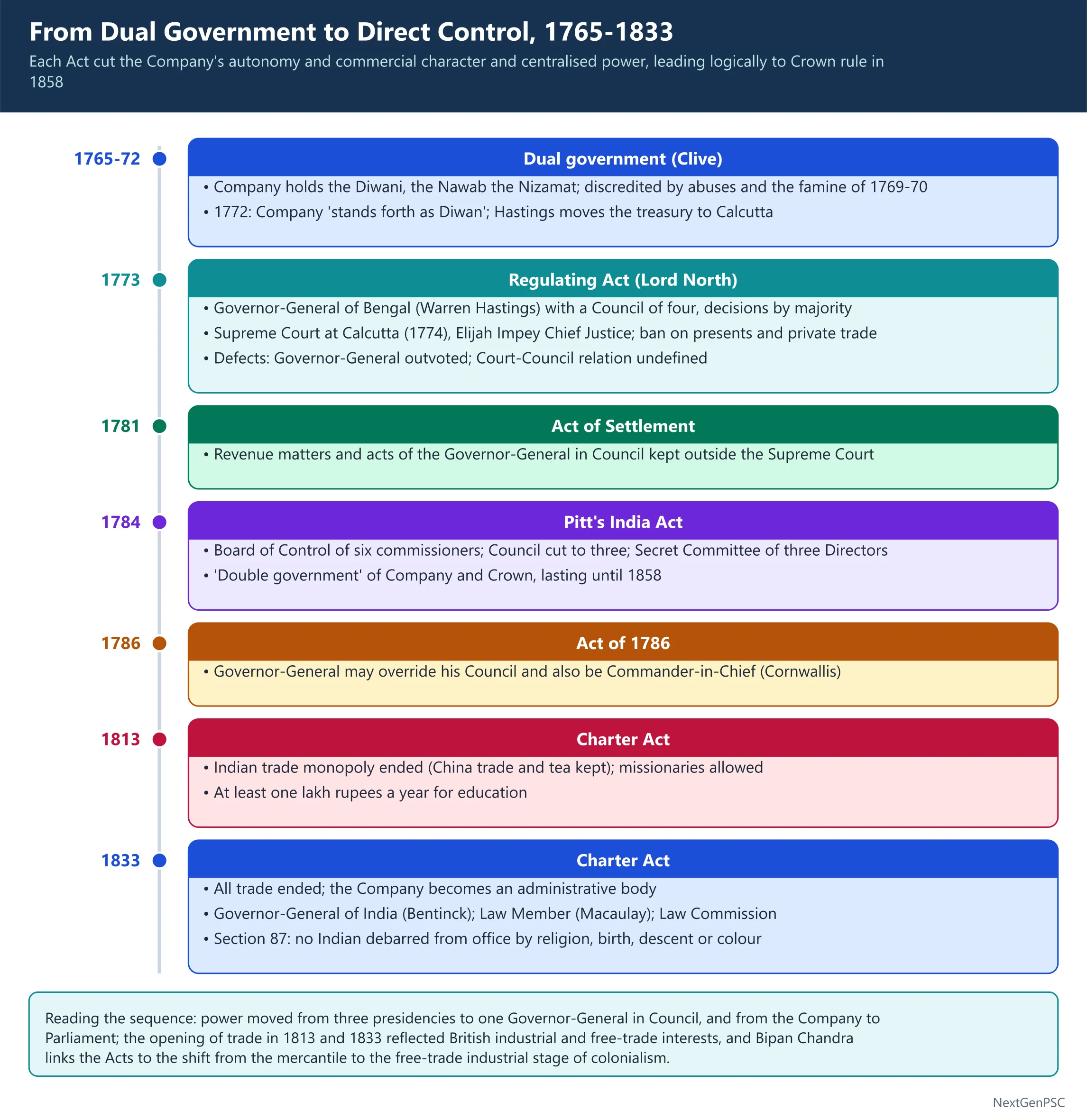
Dual government (1765–72): Under Clive's system the Company held the Diwani while the Nawab kept the Nizamat, with Muhammad Reza Khan and Shitab Rai as deputies; abuse of power, private trade and the famine of 1769–70 discredited it.
Hastings takes control (1772): The Company decided to 'stand forth as Diwan'; Warren Hastings moved the treasury from Murshidabad to Calcutta, removed the naib diwans, appointed European Collectors and farmed revenue for five years by auction.
Judicial plan (1772): District Diwani (civil) and Faujdari (criminal) Adalats were set up, with appeal courts, the Sadar Diwani Adalat and Sadar Nizamat Adalat; Hindu and Muslim law was applied with the help of pandits and maulvis.
2. The Regulating Act, 1773
Why Parliament acted: The Company was near bankruptcy and sought a loan, while the 'nabobs' returning rich from India provoked public anger; two parliamentary committees investigated in 1772–73.
Main provisions: Lord North's Act made the Governor of Bengal the Governor-General of Bengal (Warren Hastings first) with a Council of four, decisions by majority; Madras and Bombay were subordinated to him in matters of war and peace.
Supreme Court: A Supreme Court of Judicature was set up at Calcutta (1774) with Sir Elijah Impey as Chief Justice and three judges.
Controls: Company servants were forbidden to receive presents or engage in private trade; the Directors had to place revenue and political correspondence before the British government.
Defects: The Governor-General could be outvoted by his council (Francis, Clavering and Monson against Hastings in 1774–76); the relation between the Supreme Court and the Council was undefined, leading to clashes such as the Patna and Cossijurah cases; the trial and execution of Nandakumar (1775) became notorious.
Act of Settlement (1781): It exempted revenue matters and acts of the Governor-General in Council from the Supreme Court's jurisdiction and required it to respect Indian personal laws.
3. Pitt's India Act, 1784
Background: Fox's India Bill (1783), which would have transferred control to commissioners appointed by Parliament, was defeated in the Lords and brought down the Fox–North coalition; the younger Pitt then passed his own Act.
Board of Control: Six commissioners, including a Secretary of State and the Chancellor of the Exchequer, were to supervise all civil, military and revenue affairs; the Directors kept patronage and commerce.
Double government: This dual system of Company and Crown, with a Secret Committee of three Directors to transmit urgent orders, lasted until 1858.
In India: The Governor-General's council was cut to three; Madras and Bombay were clearly subordinated; aggressive war and conquest were declared against the wish of the nation (a clause soon ignored).
Act of 1786: At Cornwallis's request the Governor-General could override his council in special cases and also be Commander-in-Chief.
4. The Charter Acts of 1793, 1813 and 1833
Charter Act 1793: Renewed the Company's monopoly for twenty years and confirmed the powers of the Governor-General; salaries of the Board of Control were charged to Indian revenues.
Charter Act 1813: Ended the Company's monopoly of trade with India (keeping the China trade and tea), allowed missionaries to enter India, and set aside at least one lakh rupees a year for education and the encouragement of learning.
Charter Act 1833, the Company: Ended the China and tea monopoly and all commercial activity; the Company became a purely administrative body holding India 'in trust' for the Crown.
Charter Act 1833, centralisation: The Governor-General of Bengal became the Governor-General of India (Lord William Bentinck first), with sole legislative power for all British India; the laws of Madras and Bombay councils were ended.
Law Member and codification: A fourth (law) member was added to the council, the first being T.B. Macaulay, and a Law Commission was set up whose work led to the Indian Penal Code (drafted 1837, enacted 1860).
Section 87: No Indian was to be debarred from any office under the Company by reason of religion, place of birth, descent or colour, though in practice higher posts stayed closed.
Slavery: The Act directed the mitigation and eventual abolition of slavery, which followed by an Act of 1843.
5. Sources and Evidence
Parliamentary papers: The reports of the Select and Secret Committees (1772–73), the Ninth and Eleventh Reports of the Select Committee (1783, largely drafted by Burke), and the Fifth Report (1812) on the administration of the Company's territories.
The Hastings impeachment (1788–95): Edmund Burke's speeches charged Hastings with corruption and oppression (Nandakumar, the Begums of Awadh, Chait Singh of Banaras); the House of Lords acquitted him in 1795.
Minutes and despatches: Hastings' and Cornwallis's minutes and the Directors' despatches show how policy was made; Macaulay's speech in Parliament on the 1833 Bill set out its liberal aims.
6. Analysis: Continuity and Change
From merchant to ruler: Each Act reduced the Company's autonomy and commercial character and increased Crown and parliamentary control, leading logically to 1858.
Centralisation: Power moved from three presidencies to one Governor-General in Council with legislative authority over all British India.
Interests in Britain: The changes reflected the rise of industrial and free-trade interests that wanted India opened to British goods (1813, 1833), together with evangelical and utilitarian pressure.
Limits: Indians had no share in power; the 'double government' blurred responsibility, and the Directors kept patronage.
7. Historiography and Debates
Constitutional school: A.B. Keith (A Constitutional History of India 1600–1935, 1936) and B.B. Misra (The Central Administration of the East India Company, 1773–1834, 1959) trace a steady growth of parliamentary control and administrative rationality.
Company politics: Lucy Sutherland (The East India Company in Eighteenth-Century Politics, 1952) shows the Acts arose from party politics, Company finances and the power of the nabob interest in London.
Burke and the scandal of empire: P.J. Marshall (The Impeachment of Warren Hastings, 1965) and Nicholas Dirks (The Scandal of Empire, 2006) read the trial as a moment when Britain debated the morality of empire and, Dirks argues, in the end absolved itself.
Stages of colonialism: Bipan Chandra links the Acts to the shift from the mercantile stage (Company trade and plunder) to the free-trade industrial stage, in which India became a market and raw-material supplier.
8. Using It in the Exam
10 marks (150 words): On the Regulating Act, give the context, four main provisions and two defects, and conclude that it began parliamentary control.
15 marks (200 words): On Pitt's India Act, explain the double government and how it corrected the 1773 defects.
20 marks (250 words): 'From diarchy to direct control': trace 1765, 1772, 1773, 1784, 1813 and 1833, and explain the changing character of the Company with reference to British industrial interests.
Keywords: Governor-General in Council, Board of Control, double government, centralisation, codification, Section 87, trusteeship.
Quotation: In his 1833 speech Macaulay said that the day when Indians might demand European institutions would be the proudest day in English history; quote it in paraphrase to show the liberal rhetoric of the Act.
| Act | Main provisions | Significance |
|---|---|---|
| Regulating Act 1773 | Governor-General of Bengal and Council of four; Supreme Court at Calcutta; ban on presents | First parliamentary regulation; centralisation begun |
| Act of Settlement 1781 | Revenue and Council's acts outside Supreme Court jurisdiction | Resolved Council–Court conflict |
| Pitt's India Act 1784 | Board of Control; Council of three; Secret Committee | Double government of Company and Crown till 1858 |
| Act of 1786 | Governor-General may override Council; also Commander-in-Chief | Strengthened the executive |
| Charter Act 1793 | Monopoly renewed for 20 years | Continuity of Company rule |
| Charter Act 1813 | Indian trade monopoly ended; missionaries allowed; one lakh rupees for education | Free-trade interests win; start of state role in education |
| Charter Act 1833 | All trade ended; Governor-General of India; Law Member; Law Commission; Section 87 | Company becomes an administrative agent; legal centralisation |
Mains points
- UPSC asks how these Acts changed the character of British rule; frame the answer as a move from a trading company with political power to a government agent of the Crown.
- Always pair provisions with defects and the next Act's correction (1773 defects, 1781 and 1784 fixes).
- Link 1813 and 1833 to the Industrial Revolution and free-trade lobbying; this is the 'voice of free trade' in the syllabus.
- Do not say the 1784 Act created the office of Secretary of State for India; that came in 1858.
- Use historians (Sutherland, Misra, Marshall, Dirks, Bipan Chandra) to lift the answer beyond a list of clauses.
- A short table of Acts with provisions and significance saves words in a 20-mark answer.
Did you know?
- Memory trick for the Acts: 73 Regulates, 84 Pitts in a Board, 13 opens Trade, 33 makes India one.
- Warren Hastings' impeachment trial lasted about seven years (1788–95) and ended in his acquittal, though it cost him most of his fortune.
Free Trade, the Utilitarians and the Changing Character of Colonial Rule
In the early 19th century British rule in India changed from a conservative, revenue-seeking regime that respected 'Indian ways' to a reforming one. Industrialists demanded free trade to sell British goods, Evangelicals such as Charles Grant wanted moral and religious improvement, and Utilitarians led by Bentham and James Mill saw India as a field for rational law and government. Their combined influence shaped the Charter Acts, Bentinck's reforms, Macaulay's education policy and codification.
In simple words
Around 1800–1850 the ideas of the British rulers about India changed: they stopped trying only to collect taxes and started trying to 'reform' India.
Factory owners wanted India open to their cloth (free trade), missionaries wanted Christian morals, and thinkers called Utilitarians wanted good laws judged by the greatest happiness of the greatest number.
It is like a landlord who first only collects rent, then starts rewriting the house rules, convinced he knows better than the tenants.
These ideas produced the abolition of sati, English education and the Penal Code; UPSC asks how far Utilitarianism really shaped British policy.
1. From Mercantilism to Free Trade
Adam Smith: The Wealth of Nations (1776) attacked monopoly companies, arguing that the East India Company's dual role as sovereign and merchant was harmful to both India and Britain.
Industrial interests: Lancashire cotton manufacturers and the outports such as Liverpool and Glasgow campaigned against the Company's monopoly, which they won in 1813 for India and in 1833 for China.
New role for India: India was to become a market for British manufactures and a supplier of raw materials such as cotton, indigo and later jute, rather than an exporter of finished textiles.
One-way free trade: British goods entered India at low duties, while Indian textiles faced high duties in Britain until the 1820s–40s, so free trade was unequal.
Effect on government: Free traders wanted secure property, low-cost administration, roads and law so that markets could work, which pushed government toward 'improvement'.
2. Orientalists, Paternalists and Evangelicals
Orientalists: Warren Hastings patronised Indian learning; William Jones founded the Asiatic Society of Bengal (1784); the Calcutta Madrasa (1781) and Benares Sanskrit College (1791) were set up to govern through Indian law and tradition.
Paternalists or Romantics: Thomas Munro, Mountstuart Elphinstone, John Malcolm and Charles Metcalfe favoured gradual change, direct contact with peasants and respect for local institutions; Metcalfe's minute of 1830 described Indian villages as 'little republics'.
Evangelicals: Charles Grant's Observations on the State of Society among the Asiatic Subjects of Great Britain (written 1792) portrayed Indian society as morally degraded and urged Christianity and English education; William Wilberforce and the Clapham Sect pressed for missionaries' entry, won in 1813.
3. The Utilitarians
Jeremy Bentham: His principle of utility, the greatest happiness of the greatest number, called for clear codified laws, efficient administration and reform by legislation.
James Mill: His History of British India (1817), written without visiting India, judged Hindu and Muslim civilisations as backward and argued that good laws and light taxation, not representative institutions, would improve India; he joined the East India House in 1819 and drafted despatches.
Periodisation: Mill's division of Indian history into Hindu, Muslim and British periods shaped later communal readings of the past.
Rent theory: Drawing on Ricardo, Mill held that land revenue should take the economic rent, the surplus above costs and normal profit, which supported ryotwari settlements and the state as chief landlord.
John Stuart Mill: He worked at the India House (1823–58) and defended Company rule as a benevolent despotism suited to a 'backward' society.
4. The Age of Reform under Bentinck (1828–35)
Bentinck's outlook: Before leaving for India he is reported to have told James Mill that Mill would be the real Governor-General; the remark, recorded in later accounts, shows Utilitarian sympathies.
Social reforms: Sati was banned by Regulation XVII of 1829, supported by Rammohan Roy; thuggee was suppressed by William Sleeman's campaign; measures against female infanticide were extended.
Education: Macaulay's Minute on Education (2 February 1835) rejected Oriental learning, and the resolution of March 1835 directed funds to English education; Macaulay hoped to form 'a class of persons, Indian in blood and colour, but English in taste, in opinions, in morals, and in intellect'.
Administration: Economy measures, the opening of subordinate judicial posts to Indians, Persian replaced by English and vernaculars in courts and government (1837), and the 1833 Charter's Law Commission.
Codification: Macaulay's draft Penal Code (1837) applied Benthamite principles of clarity and uniformity; it was enacted only in 1860, with civil and criminal procedure codes around the same time.
5. Sources and Evidence
Texts of the reformers: James Mill's History of British India, Grant's Observations, Macaulay's Minute (1835) and his 1833 parliamentary speech, and Bentinck's minute on sati (1829).
Paternalist writings: Munro's minutes on ryotwari, Elphinstone's Report on the Territories Conquered from the Paishwa (1819) and Malcolm's Memoir of Central India (1823).
Indian voices: Rammohan Roy's tracts against sati and his letter to Lord Amherst (1823) urging Western scientific education.
6. Analysis: The Changing Character of Rule
From conservatism to improvement: Cornwallis and Hastings mainly sought stable revenue and order; after about 1813 rulers claimed a civilising mission, the idea that British rule would 'improve' India.
Economic logic: Reform also served British interests, since a cheaper, rule-bound state and an English-educated class suited trade and administration.
Authoritarian liberalism: The Utilitarians favoured strong executive government and law, not self-government, for India; liberty at home went with despotism in the colony.
Anglicist–Orientalist controversy: The General Committee of Public Instruction split in the early 1830s between Orientalists (H.T. Prinsep and others) and Anglicists; Bentinck's 1835 decision for English marked the victory of the reformers.
Backlash: Rapid interference with customs, annexations and missionary activity contributed to the anxieties that surfaced in 1857, after which policy turned conservative again.
7. Historiography and Debates
Eric Stokes: The English Utilitarians and India (1959) argued that India became a testing ground for Utilitarian ideas, especially in land revenue, law and administration, and that liberalism took an authoritarian form in India.
Limits of influence: Critics note that many reforms owed more to Evangelicals, Indian reformers and practical administrators than to doctrine, and that the Penal Code waited until 1860.
Ideology of empire: Thomas Metcalf (Ideologies of the Raj, 1995) shows the tension between liberal ideas of similarity and later ideas of Indian difference; Uday Singh Mehta (Liberalism and Empire, 1999) studies how liberal thinkers justified empire.
Mill's History: Javed Majeed (Ungoverned Imaginings, 1992) analyses Mill's History as a Utilitarian attack on Orientalism, while Ranajit Guha and others see it as foundational for colonial knowledge.
Sati debate: Lata Mani (Contentious Traditions, 1998) argues that in the sati debate women were the ground rather than the subject, as officials and reformers argued over scripture.
Marxist reading: Bipan Chandra places this phase in the second, free-trade stage of colonialism, when India was restructured to serve British industrial capitalism.
8. Using It in the Exam
10 marks (150 words): On 'the English Utilitarians and India', define utility, name Bentham and the two Mills, give two policy areas (land revenue, law) and cite Stokes.
15 marks (200 words): On the 'voice of free trade', link the Industrial Revolution, the 1813 and 1833 Acts, and India's new role as market and raw-material source.
20 marks (250 words): On the changing character of British rule, compare Orientalists, paternalists, Evangelicals and Utilitarians, show the policies they produced, and assess with Stokes, Metcalf and Bipan Chandra.
Quotation: Macaulay's Minute (1835) claimed that a single shelf of a good European library was worth the whole native literature of India and Arabia; use it to illustrate the Anglicist contempt for Indian learning.
Keywords: greatest happiness principle, rent theory, codification, civilising mission, authoritarian liberalism, Anglicist–Orientalist controversy.
| School | Leading figures | View of India | Policy influence |
|---|---|---|---|
| Orientalists | Warren Hastings, William Jones, H.T. Colebrooke | An ancient civilisation to be understood and governed by its own laws | Asiatic Society, Calcutta Madrasa, Sanskrit College, codes of Hindu and Muslim law |
| Paternalists | Munro, Elphinstone, Malcolm, Metcalfe | A society of villages to be changed slowly | Ryotwari, respect for local institutions, caution |
| Evangelicals | Charles Grant, Wilberforce, Clapham Sect | Morally degraded, needing Christianity | Missionaries admitted (1813); support for social reform |
| Free traders | Adam Smith, Lancashire manufacturers | A market and raw-material source | End of Company monopoly (1813, 1833) |
| Utilitarians | Bentham, James Mill, J.S. Mill, Macaulay (allied) | Backward, to be reformed by law and efficient government | Rent theory in revenue, Law Commission, Penal Code, English education |
Mains points
- UPSC has asked about the English Utilitarians and India; anchor the answer in Stokes and show concrete policies, not only philosophy.
- Distinguish the schools clearly; many answers wrongly treat Macaulay as a pure Utilitarian, whereas he was a Whig liberal who shared some aims with them.
- Show the link between free trade, the 1813 and 1833 Acts and de-industrialisation; this connects Part 3 and Part 4 of the syllabus.
- Evaluate: reform was real in some fields (sati, law) but served colonial interests and stopped short of self-government.
- Mention the Indian side: Rammohan Roy and other reformers were active agents, not passive recipients.
- Close with the post-1857 turn to conservatism to show the full arc of change.
Did you know?
- James Mill wrote his multi-volume History of British India without ever visiting India, and argued that this made him more objective.
- Father and son, James Mill and John Stuart Mill, both worked at the East India Company's headquarters in London, writing despatches for India.
Permanent, Ryotwari and Mahalwari Settlements
The British tried three main ways of collecting land revenue, their largest source of income. The Permanent Settlement (1793) fixed revenue for ever with zamindars as proprietors in Bengal and Bihar; the Ryotwari Settlement (Munro, Madras and Bombay) dealt directly with peasant cultivators; the Mahalwari Settlement (1822 and 1833, North-Western Provinces and Punjab) settled with village communities. All three set high demands, made land a saleable commodity and pushed many peasants into debt.
In simple words
Land tax was the British government's main income, so it had to decide whom to collect it from: big landlords, individual farmers or whole villages.
It chose landlords in Bengal (Permanent Settlement), farmers in the south and west (Ryotwari), and villages in the north (Mahalwari).
It is like a school fee collected through a contractor, directly from each parent, or from each class as a group; whoever pays, a fee set too high hurts the families.
These systems shaped Indian rural society for 150 years; UPSC asks you to compare them and judge their economic impact.
1. The Permanent Settlement (1793)
Experiments before 1793: Hastings' five-year farming (1772) and annual settlements (from 1777) led to over-assessment, arrears and the ruin of many old zamindar families.
The debate: Philip Francis had proposed a fixed, permanent revenue in 1776; in 1789–90 John Shore argued for caution and a ten-year settlement, while James Grant held that the state owned the land; Cornwallis favoured permanence.
Decennial to permanent: The ten-year settlement of 1789–90 was declared permanent on 22 March 1793, in Bengal, Bihar and Orissa, later extended to Banaras and parts of northern Madras.
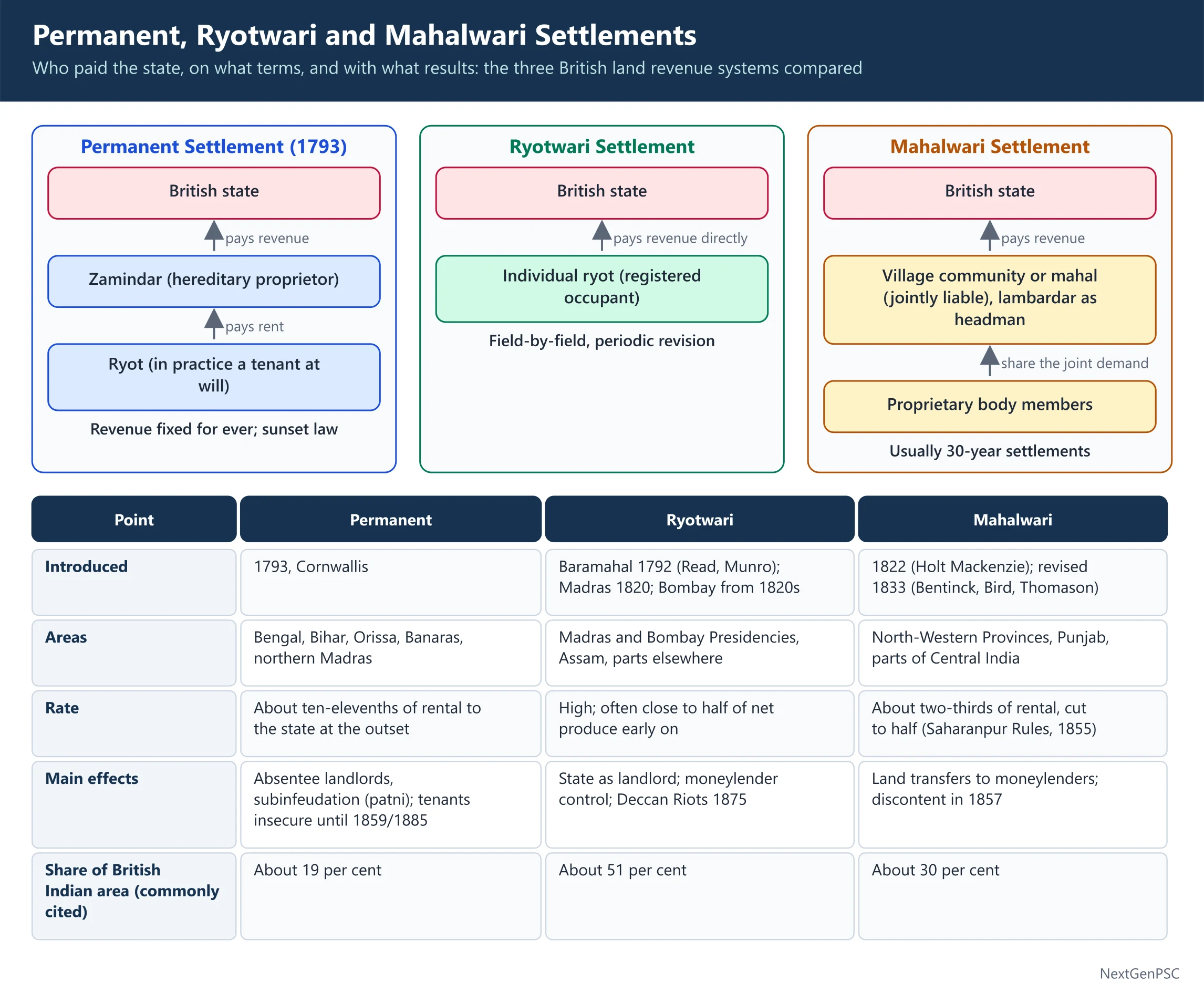
Terms: Zamindars became hereditary proprietors with the right to sell, mortgage or transfer; the revenue demand was fixed for ever, commonly described as about ten-elevenths of the rental, leaving one-eleventh to the zamindar.
Sunset law: If revenue was not paid by sunset on the due date, the estate could be auctioned.
Aims: Cornwallis wanted a secure revenue, a loyal landed class like the English gentry who would invest in improvement, and lower collection costs.
Peasants' rights: Ryots were supposed to receive pattas (written leases), but in practice they became tenants at will; Regulation VII of 1799 (haptam) and Regulation V of 1812 (panjam) gave zamindars wide powers to distrain tenants' property for arrears.
Results: Many estates were sold in the first decades, passing to merchants, officials and moneylenders; absentee landlordism and subinfeudation (for example the patni tenures of Burdwan, legalised in 1819) multiplied intermediaries.
Long run: As cultivation and prices rose, the fixed demand became light and the state lost the increase; tenant protection came only with the Rent Act of 1859 and the Bengal Tenancy Act of 1885.
2. The Ryotwari Settlement
Origins: Alexander Read and Thomas Munro began it in the Baramahal (1792) after its cession by Tipu; Munro, as Governor of Madras (1820–27), made it the general system there.
Principle: The state settled directly with each registered occupant (ryot), who held the land as long as he paid; revenue was fixed field by field after survey and was revised periodically (often every 30 years later in the century).
Bombay: After 1818 Elphinstone extended it to the Deccan; R.K. Pringle's survey (from 1824) used Ricardian rent theory but was flawed and over-assessed, and the Wingate and Goldsmid survey from the mid-1830s produced the Bombay system.
Reality: The rate was high, often said to be close to half of net produce in early Madras, and collection was harsh; the Madras Torture Commission (1855) reported the use of torture in collecting revenue.
Consequences: The state became, in effect, a giant landlord; ryots turned to moneylenders to pay in cash, and land passed to creditors, which provoked the Deccan Riots (1875) and the Deccan Agriculturists' Relief Act (1879).
3. The Mahalwari Settlement
Origins: Holt Mackenzie's Regulation VII of 1822 provided for settlement with the village community or mahal (estate) in the Ceded and Conquered Provinces, with detailed survey of rights.
Revision of 1833: The demand of 1822 proved unworkable; Bentinck's Regulation IX of 1833 simplified survey and assessment, and R.M. Bird and later James Thomason carried out settlements, generally for 30 years.
Rates: The demand was initially about two-thirds of the rental, reduced to half by the Saharanpur Rules of 1855.
Joint responsibility: The village proprietary body (often lineage brotherhoods of zamindars) was jointly responsible, with a lambardar as headman; the system was extended to the Punjab after 1849 and parts of Central India.
Forms of tenure: Settlement officers recorded different village types, such as zamindari (held jointly by a proprietary body), pattidari (shares by ancestral descent) and bhaiachara (shares by actual possession), the last common in the Punjab.
Effects: High assessments led to sales of land to moneylenders and traders; the dispossession of taluqdars and the heavy demand in the North-Western Provinces and Awadh (summary settlement, 1856) fed the discontent of 1857.
4. Sources and Evidence
Official reports: Cornwallis's minutes and the Bengal Regulations of 1793 (the Cornwallis Code); the Fifth Report (1812) with its debates on zamindari and ryotwari; Munro's minutes.
Settlement reports: District settlement reports, village records (khasra, khatauni, record of rights) and Thomason's Directions for Settlement Officers.
Inquiries: The Madras Torture Commission (1855), the Deccan Riots Commission (1876) and Francis Buchanan's surveys provide evidence of agrarian conditions.
5. Analysis: Economic Impact
Land as property: All three systems created private, saleable rights in land on a European model, so land could be mortgaged and sold, unlike older layered rights.
High demand and cash: Rigid cash demands, fixed regardless of harvests, forced peasants to borrow and to sell crops at low prices soon after harvest.
New classes: Moneylenders and merchants acquired land; intermediaries multiplied in Bengal; the old village elites and the peasants lost ground.
Little investment: High revenue, insecurity and rent-seeking discouraged agricultural improvement, except where irrigation and markets made cash crops profitable.
Continuity and change: The Mughal state also took a large share of produce, but colonial demands were more rigid, regularly enforced through courts and sales, and part of the surplus left India.
6. Historiography and Debates
Ideas behind the Permanent Settlement: Ranajit Guha (A Rule of Property for Bengal, 1963) traced it to Physiocratic and Whig ideas of property held by Philip Francis and others, rather than to purely practical needs.
Who gained in Bengal: Ratnalekha Ray (Change in Bengal Agrarian Society, c.1760–1850, 1979) and Rajat Ray argued that rich peasants, the jotedars, kept real control of villages; Sugata Bose (Peasant Labour and Colonial Capital, 1993) shows regional variation; Sirajul Islam studied the early sales of estates.
North India: Eric Stokes (The Peasant and the Raj, 1978) linked over-assessment and land transfers to the pattern of revolt in 1857; Asiya Siddiqi and Thomas Metcalf (Land, Landlords and the British Raj, 1979) studied the agrarian structure of the region.
South India: Nilmani Mukherjee (The Ryotwari System in Madras, 1792–1827, 1962), Burton Stein (Thomas Munro, 1989) and Dharma Kumar (Land and Caste in South India, 1965) debate whether ryotwari helped or harmed cultivators.
Nationalist critique: R.C. Dutt (The Economic History of India, 1902–04) praised the fixity of the Permanent Settlement and blamed high, revisable demands elsewhere for poverty and famine.
7. Using It in the Exam
10 marks (150 words): On the Permanent Settlement, give date, terms, aims and two consequences, ending with Guha's view of its origins.
15 marks (200 words): Compare the three systems in a table (area, with whom, period, rate, effects) and add two lines of judgement.
20 marks (250 words): On the economic impact of revenue arrangements, discuss land as property, indebtedness, new landed classes, lack of investment and regional differences, with Stokes, the Rays and Dutt.
Keywords: proprietary right, sunset law, subinfeudation, ryot, mahal, lambardar, over-assessment, rent theory.
Quotation: Cornwallis argued, in paraphrase, that a fixed demand would give the zamindar a motive to improve his estate, since all increase would be his own; contrast this hope with the outcome.
| Point | Permanent Settlement | Ryotwari | Mahalwari |
|---|---|---|---|
| Introduced | 1793, Cornwallis | 1792 (Baramahal), 1820 (Madras), Read and Munro; Bombay from 1820s | 1822 (Holt Mackenzie); revised 1833 (Bentinck, Bird, Thomason) |
| Areas | Bengal, Bihar, Orissa, Banaras, northern Madras | Madras and Bombay Presidencies, Assam, parts elsewhere | North-Western Provinces, Punjab, parts of Central India |
| Settled with | Zamindar as proprietor | Individual ryot (cultivator) | Village community or mahal, jointly |
| Duration | Fixed in perpetuity | Periodic revision (often 30 years later) | Periodic revision (usually 30 years) |
| Rate | About ten-elevenths of rental to the state at the outset | High; often close to half of net produce early on | About two-thirds of rental, cut to half in 1855 |
| Main effects | Absentee landlords, subinfeudation, tenants insecure until 1859/1885 | State as landlord, moneylender control, Deccan Riots 1875 | Land transfers to moneylenders, discontent in 1857 |
| Approximate share of British Indian area (commonly cited) | About 19 per cent | About 51 per cent | About 30 per cent |
Mains points
- This is among the most frequently asked areas; a comparative table is almost expected, but follow it with analysis and historians.
- Do not say ryotwari gave peasants ownership; the ryot was an occupant liable to pay the state, which behaved as the landlord.
- Bring out the ideas behind each system: Physiocratic and Whig property ideas (Permanent), Ricardian rent and paternalism (Ryotwari), village community ideas (Mahalwari).
- For 'economic impact' questions, link revenue to commercialisation, indebtedness, landless labour and famine, which shows command of the whole unit.
- Mention later tenancy laws (1859, 1885) to show that the colonial state itself had to correct the settlement's effects.
- Present the area percentages as approximate, commonly cited figures, not exact data.
Did you know?
- Under the 'sunset law' a zamindari could be auctioned if the revenue was not paid by sunset on the due day, which is how many old families lost their estates within a generation.
- Memory trick: 'Z-R-M = Zamindar, Ryot, Mahal' matches 'East, South-West, North' on the map.
Commercialisation of Agriculture and Rural Impoverishment
Under British rule more Indian land was turned to cash crops such as indigo, opium, cotton, jute, tea and wheat for export. Nationalist and Marxist historians call this forced commercialisation, driven by cash revenue demands, debt and planters' coercion, which enriched traders and moneylenders, created more landless labourers and left peasants vulnerable to price crashes and famine. Other historians stress market response and regional growth, especially in canal-irrigated Punjab.
In simple words
Commercialisation of agriculture means farmers growing crops to sell in the market, often for export, rather than to eat.
Under British rule peasants grew indigo, cotton, jute and opium, often because they needed cash to pay land tax and debts, not because it made them richer.
It is like a worker forced to take a job paid in a foreign currency whose value keeps jumping, while rent must be paid on a fixed day.
It changed village life, debt and labour; UPSC asks whether commercialisation was forced and how it led to rural poverty.
1. Background and Drivers
Pre-colonial markets: Cash crops such as cotton, indigo, sugarcane and tobacco were grown under the Mughals, and revenue was often collected in cash, so markets were not new.
What changed: After about 1813, and especially after 1850, Indian agriculture was tied to world markets and British industry's need for raw materials.
Drivers: High cash revenue demands, rising British demand, railways and ports, the Suez Canal (1869), and the advances of merchants, moneylenders and European firms.
2. The Main Cash Crops
Indigo: European planters in Bengal and Bihar forced ryots to grow indigo on their best land under advances (dadan) at low prices; the Indigo Revolt (1859–60) and Dinabandhu Mitra's play Nil Darpan (1860) exposed this, and the Indigo Commission (1860) reported; in Champaran the tinkathia system continued until Gandhi's satyagraha (1917).
Opium: A Company monopoly through the agencies at Patna and Ghazipur made Bihar and Banaras peasants grow poppy under advances; Malwa opium from the princely states was taxed in transit; exports to China paid for tea and led to the Opium Wars (1839–42, 1856–60).
Cotton: The American Civil War (1861–65) cut supplies to Lancashire and caused a cotton boom in the Bombay Deccan, Gujarat and Berar; prices crashed after 1865, leaving peasants indebted, a background to the Deccan Riots of 1875.
Jute: Grown in eastern Bengal for the Dundee mills and, from 1855, for mills near Calcutta; output expanded with world demand for sacking, but growers were exposed to sharp price swings.
Tea and coffee: The Assam Company (1839) and later gardens in Assam, Darjeeling and the Nilgiris used indentured labour recruited from Chota Nagpur and elsewhere under penal contracts such as the Workman's Breach of Contract Act (1859).
Wheat and the Punjab: Canal colonies from the 1880s turned western Punjab into a wheat and cotton exporting region via Karachi, with real gains for some peasant proprietors.
Others: Groundnut in Madras, sugarcane in the United Provinces and tobacco in Guntur also spread.
3. Indebtedness and Land Alienation
The moneylender: Cash revenue at fixed dates, crop failures and price falls made the sahukar indispensable; the new laws of contract and civil courts let creditors enforce bonds and seize land.
Land transfers: Land increasingly passed from cultivators to moneylenders and traders, who often kept the former owners as tenants or sharecroppers.
State response: The Deccan Agriculturists' Relief Act (1879) and the Punjab Land Alienation Act (1900), which restricted transfer of land from 'agricultural' to 'non-agricultural' castes, were attempts to check this.
Credit alternatives: The Co-operative Credit Societies Act (1904) tried to offer cheaper rural credit, but its reach remained small and the moneylender stayed dominant.
4. Landless Labourers and Rural Impoverishment
Rise of landless labour: Loss of land to creditors, the decline of crafts (which pushed artisans onto the land) and population growth increased the number of agricultural labourers in the census.
Bondage: In many regions labourers were tied to masters through debt, as with the hali system of south Gujarat studied by Jan Breman.
Pressure on land: With deindustrialisation more people depended on agriculture, holdings were subdivided and fragmented, and rents rose.
Food versus cash crops: George Blyn (Agricultural Trends in India, 1891–1947, 1966) found that per capita foodgrain output declined in British India in that period while non-food crops grew faster.
Vulnerability: Peasants with little grain in store and heavy debts were exposed to famine when harvests failed or prices rose.
5. Sources and Evidence
Commissions: The Indigo Commission (1860), the Deccan Riots Commission (1876), the Famine Commissions (1880, 1898, 1901) and later the Royal Commission on Agriculture (1928).
Literature and surveys: Nil Darpan, settlement reports, census reports, and M.L. Darling's The Punjab Peasant in Prosperity and Debt (1925).
Nationalist economics: R.C. Dutt's Economic History of India and the writings of Dadabhai Naoroji and M.G. Ranade on rural poverty.
6. Analysis
Forced or voluntary: In indigo and opium coercion and advances were central; in jute, cotton and wheat peasants did respond to prices, but often under the pressure of revenue and debt.
Who gained: Traders, exporters, European firms and moneylenders took much of the surplus; a minority of rich peasants also gained.
No agrarian capitalism: Commercialisation did not bring large-scale investment or technical change; it went with stagnant yields, small holdings and rent-receiving landlords.
Regional variation: Canal Punjab and parts of coastal Andhra saw growth, while Bengal, Bihar and the Deccan saw more distress.
Continuity and change: Markets and moneylenders existed before, but colonial law, cash revenue and world-market links made the peasant's dependence on them deeper and more enforceable.
7. Historiography and Debates
Forced commercialisation: Irfan Habib, Bipan Chandra and A.R. Desai argue that commercialisation was imposed by colonial needs and revenue pressure and impoverished the peasantry.
Market response view: Dharma Kumar and Tirthankar Roy stress that peasants responded rationally to prices and that some regions grew; Neil Charlesworth (Peasants and Imperial Rule, 1985) found mixed outcomes in the Bombay Presidency.
Landless labour debate: Dharma Kumar (Land and Caste in South India, 1965) argued that a large class of agrestic labourers, often from untouchable castes, already existed before British rule, so the rise was partly a matter of census categories; others hold that pauperisation was real.
Daniel Thorner: He used the term 'the depressor' for the combination of legal, economic and social relations, landlordism, usury and petty trade, that held back agricultural growth.
Regional studies: Sugata Bose on Bengal, Sumit Guha (The Agrarian Economy of the Bombay Deccan, 1818–1941, 1985) and Ravinder Kumar (Western India in the Nineteenth Century, 1968) show local variation in the effects.
8. Using It in the Exam
10 marks (150 words): On 'Was commercialisation forced?', define it, give two coercive examples (indigo, opium) and two market examples (jute, Punjab wheat), and conclude that it was largely compulsion-driven.
15 marks (200 words): On the rise of landless labourers, give causes (debt, land transfer, deindustrialisation, population) and note Dharma Kumar's caution.
20 marks (250 words): On the impoverishment of rural society, combine revenue, commercialisation, indebtedness, food output and famine into one causal chain, with historians on both sides.
Keywords: forced commercialisation, dadan, tinkathia, indebtedness, land alienation, agrestic servitude, the depressor.
Usable line: Darling's often-quoted observation that the Punjab peasant was born in debt, lived in debt and died in debt sums up rural indebtedness; attribute it to his 1925 study.
| Crop | Main region | Mechanism | Outcome |
|---|---|---|---|
| Indigo | Bengal, Bihar | Planters' advances and coercion | Indigo Revolt 1859–60; Champaran 1917 |
| Opium | Bihar, Banaras; Malwa | State monopoly with advances; transit duty on Malwa | China trade; Opium Wars |
| Cotton | Bombay Deccan, Gujarat, Berar | Export boom during American Civil War | Price crash after 1865; Deccan Riots 1875 |
| Jute | Eastern Bengal | Demand from Dundee and Calcutta mills | Expansion with price instability |
| Tea | Assam, Darjeeling, Nilgiris | Plantations with indentured labour | Harsh labour regime; profits to British firms |
| Wheat | Punjab canal colonies | Irrigation, railways, export via Karachi | Growth for some proprietors; rising debt |
Mains points
- UPSC asks whether commercialisation was 'forced' and how it caused rural impoverishment; take a clear position but acknowledge the market-response school.
- Use crop-specific examples with regions and dates; general statements score poorly.
- Connect commercialisation to the revenue systems and to famine, showing a chain of causes rather than separate facts.
- Mention peasant resistance (Indigo Revolt, Deccan Riots, Champaran) to show agency.
- Treat the growth of landless labour as debated and avoid unsupported statistics.
- Note that commercialisation did not create agrarian capitalism, and explain why (the depressor, small holdings, rent-seeking).
Did you know?
- Nil Darpan was translated into English and published by the missionary James Long, who was fined and imprisoned for a month in 1861 for libel.
- The Bombay cotton boom of the 1860s made so much money so fast that the city saw a share-market mania, followed by a crash in 1865 when the American war ended.
De-industrialisation, Decline of Crafts and the Drain of Wealth
India, once the world's leading exporter of cotton textiles, became an importer of British machine-made cloth in the 19th century. Loss of export markets, British tariffs, one-way free trade and the loss of courtly patrons caused de-industrialisation, the decline of crafts and a shift of artisans onto the land. Nationalist economists led by Dadabhai Naoroji and Romesh Chunder Dutt argued that a drain of wealth, an unrequited transfer through Home Charges and export surpluses, impoverished India; both theses remain debated.
In simple words
De-industrialisation means that a country's industries shrink and people who made goods go back to farming.
This happened to Indian weavers and other craftsmen when cheap British factory cloth flooded India and Indian cloth lost its markets abroad.
The drain of wealth is like a family that sends part of its income every month to a distant relative and gets nothing in return.
These ideas became the core of economic nationalism; UPSC asks whether de-industrialisation was real and how the drain theory was argued.
1. Dislocation of Traditional Trade and Crafts
India's pre-colonial position: In the 17th and 18th centuries Indian calicoes, muslins and chintzes were exported across Asia, Africa and Europe; Britain itself passed Calico Acts (1700, 1721) restricting their use to protect its woollen and silk industries.
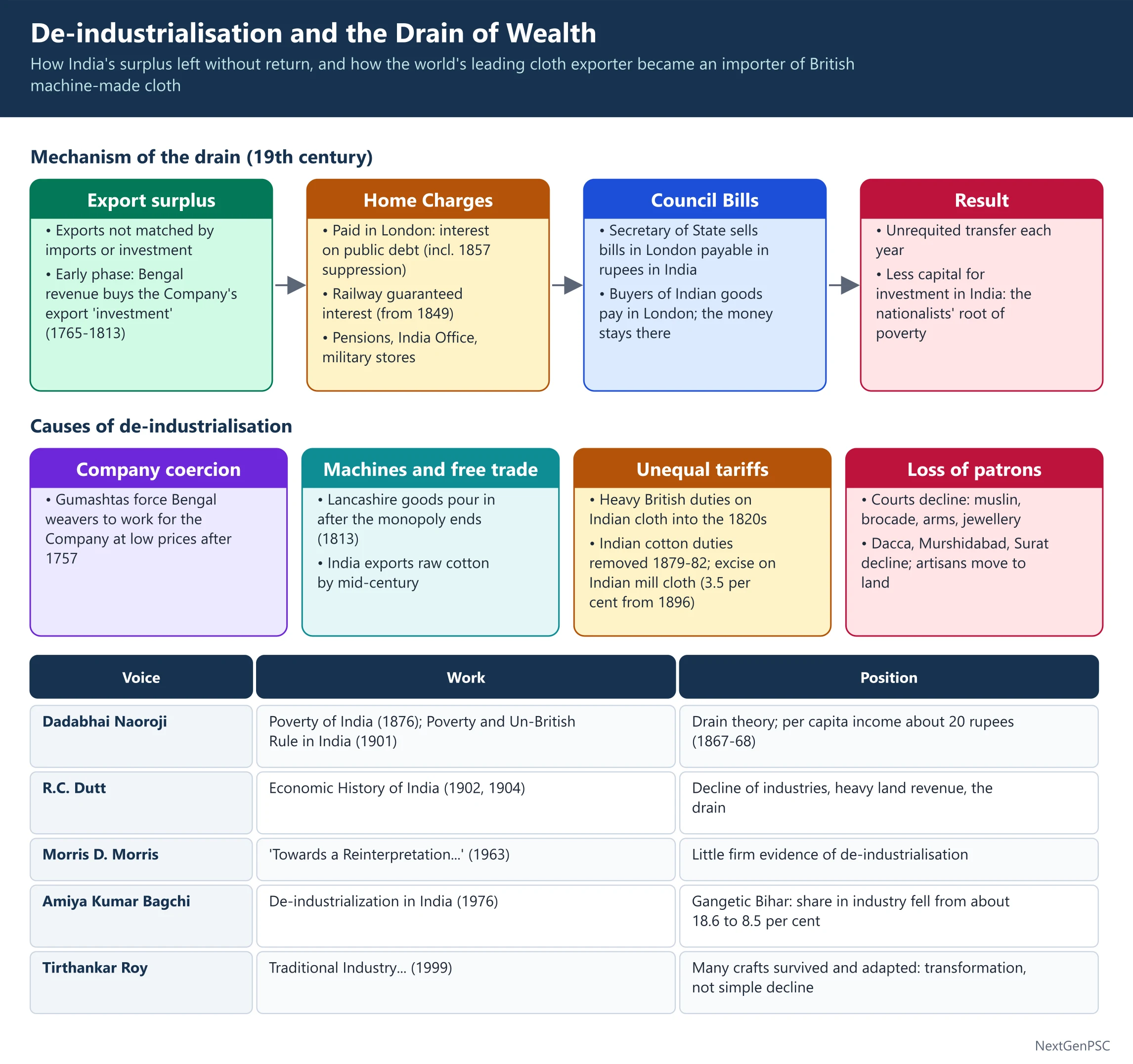
Company control after 1757: Company gumashtas forced weavers in Bengal to work for the Company at low prices through advances, and banned them from selling to others, which hurt weavers even before machine competition.
The reversal: Lancashire's mechanised spinning and weaving cut costs dramatically; after the end of the Company's monopoly (1813) British cotton goods poured into India, and by the mid-19th century India was a net importer of cloth and an exporter of raw cotton.
Tariff policy: Indian textiles faced heavy duties in Britain into the 1820s, while British goods entered India at low duties; Indian import duties on cotton goods were removed in 1879–82, and when a duty was reimposed in 1894 a matching excise was placed on Indian mill cloth (3.5 per cent from 1896).
Loss of patrons: The decline of Indian courts and nobility after annexations destroyed demand for luxury crafts such as fine muslin, brocade, arms and jewellery.
Urban decline: Old manufacturing towns such as Dacca, Murshidabad and Surat lost population and importance; Dacca's muslin industry is the classic example.
Other crafts: Iron smelting, shipbuilding, glass, paper and dyeing also declined under competition from imports, while some crafts survived by changing products.
Ruralisation: Displaced artisans moved into agriculture as labourers or tenants, adding to pressure on land.
2. Evidence for De-industrialisation
Trade statistics: Cotton piece-goods exports from India fell steeply after about 1813, while imports of British cotton goods rose many times over the following decades.
Buchanan's surveys: Francis Buchanan's surveys of Bihar and Bengal (1807–14) recorded large numbers of spinners and weavers; Amiya Kumar Bagchi (1976) compared them with the 1901 census and estimated that in Gangetic Bihar the share of the population in secondary industry fell from about 18.6 to about 8.5 per cent.
Contemporary testimony: Witnesses before parliamentary committees (1813, 1832, 1840) and writers such as Montgomery Martin described the ruin of weavers.
Marx's view: In 'The British Rule in India' (New York Daily Tribune, 1853) Marx wrote that it was the British intruder who broke up the Indian hand-loom and destroyed the spinning-wheel.
Qualitative sources: Bishop Heber, Charles Trevelyan's evidence on Dacca and district gazetteers describe deserted weaving quarters, though such accounts are impressionistic and vary by region.
3. The Drain of Wealth
Meaning: The drain was the part of India's national product transferred to Britain without any economic or material return, mainly through an export surplus that was not matched by imports or investment.
Early phase: After Plassey, 'presents', private fortunes and the use of Bengal revenue to buy the Company's export 'investment' meant goods left without silver coming in.
Home Charges: Later the main channels were the Home Charges paid in London: interest on the public debt (including debt from the 1857 suppression), guaranteed interest on railway capital, pensions and leave allowances of British officials, India Office costs and military stores.
Mechanism: The Secretary of State sold Council Bills in London, payable in rupees in India, so British buyers of Indian goods paid in London and the money stayed there.
Other channels: Profits of British firms, salaries remitted by British officers and the payment for 'invisible' services such as shipping and insurance.
Size of the drain: Naoroji and other nationalists produced different annual estimates using trade and budget data; the figures varied with method, but all pointed to a persistent export surplus without matching return.
4. The Nationalist Critique
Dadabhai Naoroji: He first set out the theory in 'The Wants and Means of India' (1870) and the papers on 'The Poverty of India' (1876), later collected as Poverty and Un-British Rule in India (1901); he estimated per capita income at about 20 rupees a year for 1867–68.
Romesh Chunder Dutt: His Economic History of India (two volumes, 1902 and 1904) traced the decline of industries, heavy land revenue and the drain, and his Open Letters to Lord Curzon (1900) linked revenue to famine.
Others: M.G. Ranade, G.V. Joshi, G. Subramania Iyer and William Digby ('Prosperous' British India, 1901) developed the critique; the Indian National Congress adopted the drain in its resolutions, and Bipan Chandra calls this body of thought 'economic nationalism'.
Political effect: The drain theory exposed the economic basis of colonialism, undermined claims of British benevolence, and laid the ground for swadeshi.
5. Analysis
Causes of de-industrialisation: Technological superiority of British industry combined with political choices: Company coercion, unequal tariffs, free trade imposed on India, and railway rates favouring ports.
Uneven impact: Spinning was hit hardest; handloom weaving of coarse cloth using imported yarn survived in many areas, and some crafts adapted.
No compensating industrialisation: Unlike Britain, where displaced workers moved into factories, India gained only limited modern industry in the 19th century, so the loss of crafts meant ruralisation.
Drain and growth: Removing a share of the surplus each year reduced the capital available for investment in India, which the nationalists saw as the root of poverty.
Modern industry: Cotton mills in Bombay from the 1850s and jute mills near Calcutta began a new factory sector, but it employed far fewer people than the crafts that had been lost.
6. Historiography and Debates
Morris's challenge: Morris D. Morris argued in 'Towards a Reinterpretation of Nineteenth-Century Indian Economic History' (1963, reprinted in the Indian Economic and Social History Review, 1968) that there was little firm evidence of de-industrialisation or general impoverishment.
The replies: Bipan Chandra, Toru Matsui and Tapan Raychaudhuri responded in the same 1968 symposium, defending the reality of de-industrialisation and criticising Morris's use of evidence.
Bagchi's evidence: Amiya Kumar Bagchi's 1976 article on 'De-industrialization in India in the Nineteenth Century' gave quantitative support to the nationalist position for Bihar.
Revisionist economic history: Tirthankar Roy (Traditional Industry in the Economy of Colonial India, 1999) shows that many handloom and craft sectors survived and adapted, arguing for transformation rather than simple decline.
The drain debated: Colonial defenders such as Theodore Morison (The Economic Transition in India, 1911) argued that Home Charges paid for real services such as administration, defence and capital; Irfan Habib ('Colonialization of the Indian Economy', 1975) and others treat the drain as central; Utsa Patnaik's recent very large estimate of the total transfer is widely reported and contested.
7. Using It in the Exam
10 marks (150 words): On the drain of wealth, define it, list the channels (Home Charges, remittances, profits), name Naoroji and Dutt, and state its political significance.
15 marks (200 words): On de-industrialisation, give causes, evidence (trade figures, Buchanan, Bagchi) and the Morris debate.
20 marks (250 words): 'The economic critique of colonialism was the foundation of Indian nationalism': discuss the drain, de-industrialisation and poverty, the critics, and the colonial response.
Keywords: unrequited export surplus, Home Charges, Council Bills, ruralisation, one-way free trade, economic nationalism.
Quotation with caution: The line that 'the bones of the cotton-weavers are bleaching the plains of India', often attributed to Governor-General Bentinck (1834–35), reaches us through Marx's Capital and its original source is uncertain, so cite it as attributed.
| Channel | What it was | Period |
|---|---|---|
| Presents and private fortunes | Gifts from Nawabs and private trade profits of Company servants | 1757–c. 1790s |
| The 'investment' | Bengal revenue used to buy goods for export without importing silver | 1765–1813 |
| Interest on public debt | Debt raised for wars, including the suppression of 1857 | Whole 19th century |
| Railway guaranteed interest | Guaranteed return to British investors in railway companies | From 1849 |
| Pensions and salaries | Pensions, leave allowances and remittances of British officials | Whole period |
| India Office and military charges | Costs of the India Office and military stores bought in Britain | From 1858 |
| Private profits and services | Profits of British firms; payments for shipping, banking and insurance | Later 19th century onward |
Mains points
- UPSC asks both 'Was de-industrialisation a myth?' and 'Explain the drain theory'; for the first, present the Morris debate and conclude with evidence; for the second, explain the mechanism, not only the slogan.
- Show that de-industrialisation was caused by policy as well as technology; examiners reward the tariff and Company-coercion points.
- Distinguish the early drain (plunder, investment) from the later drain (Home Charges); many answers merge them.
- Link the drain theory to the rise of economic nationalism and to the Moderates' critique.
- Mention the survival and adaptation of handloom (Tirthankar Roy) to show balanced judgement.
- Avoid large unexplained figures for the total drain; if you mention Patnaik's estimate, label it as contested.
Did you know?
- Dacca muslin was so fine that travellers' stories called it 'woven air'; the traditional technique was lost in the 19th century.
- Dadabhai Naoroji, the leading drain theorist, was elected to the British House of Commons for Finsbury Central in 1892, the first Indian MP.
Railways, Telegraph, Famines and European Enterprise
From the 1850s the British built railways under a guarantee system, a telegraph network and a uniform postal service, which tied India's interior to ports and world markets and strengthened imperial control. The same decades saw repeated famines (1866, 1876–78, 1896–1900) that killed millions and led to the Famine Codes. European enterprise through managing agency houses developed tea, jute, coal and banking, but stayed export-oriented and racially exclusive and did not industrialise India.
In simple words
The British built railways, telegraph lines and a cheap postal system in India from the 1850s.
These carried cotton and wheat to the ports, British goods inland, and troops and orders quickly across the country.
It is like building highways mainly from farms to the harbour: trade grows, but villages still go hungry when rains fail and grain is shipped away.
UPSC asks whether railways helped or hurt India, why famines were so deadly, and why European business did not industrialise India.
1. Railways
Dalhousie's minute (1853): Lord Dalhousie argued for a network of trunk lines for commercial, political and military reasons, linking the interior to the ports of Calcutta, Bombay and Madras.
First lines: The first passenger train ran from Bombay (Bori Bunder) to Thane on 16 April 1853 (about 34 km); lines followed from Howrah to Hooghly (1854) and near Madras (1856).
Guarantee system: Private British companies such as the East Indian Railway and the Great Indian Peninsula Railway were guaranteed about 5 per cent interest on capital, paid from Indian revenues if profits fell short, which encouraged costly construction.
Later phases: The state built lines directly from 1869 to the early 1880s, then returned to modified guarantees; by 1900 India had roughly 40,000 km of track, one of the largest networks in the world.
Design and purpose: Lines ran mainly from the interior to the ports; freight rates favoured traffic to and from the ports over internal trade; locomotives, rails and much rolling stock were imported from Britain.
Military role: Strategic lines, especially toward the North-West Frontier, were built to move troops quickly, a lesson drawn from 1857.
2. Telegraph and Post
Telegraph: William O'Shaughnessy built an experimental line from Calcutta to Diamond Harbour (1851); under Dalhousie lines linking Calcutta, Agra, Bombay, Peshawar and Madras were completed by the mid-1850s.
In 1857: The telegraph helped the British pass warnings and coordinate troops, which is why rebels often cut the wires; a direct link to Britain followed in 1870.
Post: The Post Office Act (1854) created a single department with uniform postage of half an anna for a letter regardless of distance, and postage stamps were issued from 1854 (after the local Scinde Dawk stamp of 1852).
Effects: Faster communication helped administration, commerce and the press, and later the organisation of nationalist politics.
3. Famine and Poverty in the Rural Interior
Major famines: Bengal (1769–70), Chalisa (1783–84), Agra (1837–38), Orissa (1866), Rajputana (1868–69), the Great Famine of 1876–78 in Madras, Bombay and Mysore, and those of 1896–97 and 1899–1900.
Orissa 1866: Officials failed to import grain in time, and roughly a third of Orissa's population is estimated to have died; the Campbell Commission criticised the administration.
1876–78: Under Lytton relief was kept minimal; Richard Temple's ration of about one pound of grain a day for heavy work was criticised as starvation-level; official estimates put deaths at over five million, and other estimates are higher.
Famine Commission of 1880: Under Richard Strachey it recommended famine codes, relief works, a famine fund and better railways; provisional Famine Codes followed from 1883.
Later commissions: The Lyall Commission (1898) and the MacDonnell Commission (1901) refined relief and stressed early action and irrigation.
Causes debated: Drought was the trigger, but deaths followed from poverty, debt, high revenue, grain exports and price rises, low wages and the government's laissez-faire refusal to interfere in grain markets.
Ideology of relief: Many officials, influenced by Malthusian and laissez-faire ideas, feared that generous relief would create dependence and strain finances, so relief was tied to hard work on public works at low wages.
4. European Business Enterprise
Managing agency system: Firms such as Andrew Yule, Bird and Co., Jardine Skinner and Martin and Co. managed many joint-stock companies in tea, jute, coal, shipping and engineering, controlling them through small holdings and contracts.
Sectors: Indigo and tea plantations, jute mills on the Hooghly (the first at Rishra, 1855), Raniganj coal, and exchange banks dominated by British capital.
Indian enterprise: Indian capital entered cotton textiles, with the first Bombay mill set up by Cowasji Nanabhai Davar (company formed 1854, production from 1856), and mills in Ahmedabad followed.
5. Limitations of European Enterprise
Export orientation: European capital went into plantations, extraction and processing for export rather than machine-making or heavy industry.
Racial exclusivity: British firms, banks and chambers of commerce worked through social networks that excluded most Indians from credit and management.
State policy: Free trade, no tariff protection until the 1920s, and the purchase of government stores from Britain denied Indian industry a market.
Weak linkages: Railways bought engines and rails abroad, so they did not create the engineering and steel industries they created in Britain; only a few railway workshops built locomotives.
Enclave character: Profits were largely remitted abroad, adding to the drain.
6. Sources and Evidence
Official records: Dalhousie's railway minute (1853), the Famine Commission reports (1880, 1898, 1901), railway administration reports and the decennial census.
Critics: R.C. Dutt's Open Letters to Lord Curzon (1900) and Famines and Land Assessments in India (1900), and William Digby's 'Prosperous' British India (1901), blamed high revenue and the drain for famines.
Marx on railways: In 'The Future Results of British Rule in India' (1853) Marx predicted that railways would become the forerunner of modern industry in India, a prediction only partly fulfilled.
7. Historiography and Debates
Railways: Daniel Thorner (Investment in Empire, 1950) studied British capital and the guarantee system; nationalists saw railways as serving imperial trade and the drain; Dave Donaldson's econometric study (published 2018) finds that railways lowered trade costs and raised real agricultural incomes.
Railways and famine: Some economic historians, including Robin Burgess and Donaldson, argue that rail-linked districts suffered lower famine mortality later in the period, while critics note that railways also moved grain out of famine areas toward higher prices.
Famines: B.M. Bhatia (Famines in India, 1963) traced the shift from food shortage to lack of purchasing power; Mike Davis (Late Victorian Holocausts, 2001) links El Nino droughts with imperial market policy; Amartya Sen's entitlement approach (Poverty and Famines, 1981), developed mainly for 1943, is widely applied.
European enterprise: Amiya Kumar Bagchi (Private Investment in India 1900–1939, 1972) and Rajat Kanta Ray (Industrialization in India, 1979) stress colonial constraints; Maria Misra (Business, Race and Politics in British India, 1999) explains the conservatism of British agency houses through their 'gentlemanly' and racial outlook.
8. Using It in the Exam
10 marks (150 words): On the railways' purpose, give commercial, military and administrative aims, the guarantee system, and one line on their mixed results.
15 marks (200 words): On famines, distinguish natural trigger from structural causes, list commissions and codes, and cite Bhatia or Davis.
20 marks (250 words): 'European enterprise transformed but did not industrialise India': discuss sectors, managing agencies, limitations and the historiography.
Source to paraphrase: R.C. Dutt argued in his open letters to Curzon that famines in India were caused less by lack of food than by the poverty of the people, which high land revenue had deepened; this gives a strong nationalist voice for a famine answer.
Keywords: guarantee system, port-oriented network, Famine Codes, entitlement, managing agency, enclave economy, weak backward linkages.
| Famine | Region | Official response |
|---|---|---|
| 1769–70 | Bengal and Bihar | Little relief; part of the case against dual government |
| 1866 | Orissa | Campbell Commission criticised delay in importing grain |
| 1876–78 | Madras, Bombay, Mysore, Hyderabad | Minimal relief (Temple ration); Strachey Famine Commission (1880) |
| 1896–97 | Much of north and central India | Famine Codes applied; Lyall Commission (1898) |
| 1899–1900 | Bombay, Central Provinces, Rajputana | MacDonnell Commission (1901); stress on early relief and irrigation |
Mains points
- UPSC often asks whether railways were for India's development or for imperial interests; give both sides, with Thorner and nationalists on one side and recent economic history on the other.
- For famines, never stop at 'drought'; explain structural causes and the slow growth of a relief policy.
- Connect the guarantee system and Home Charges to the drain of wealth.
- On European enterprise, explain the managing agency system and why it did not lead to industrialisation.
- Mention unintended consequences: railways and post also helped national integration and the spread of nationalist ideas.
- Give famine death figures as estimates and attribute them; avoid exact numbers you cannot defend.
Did you know?
- The first passenger train in India, on 16 April 1853, was hauled by three locomotives named Sahib, Sindh and Sultan.
- Lytton held the grand Delhi Durbar of January 1877 to proclaim Queen Victoria Empress of India while the Great Famine was raging in the south.
UPSC Previous Year Questions: Early British Raj and Its Economic Impact
From 2014 to 2026 UPSC asked 28 question parts (440 marks) from this chapter, all in Paper II, more than half of them 20-mark questions. The most-asked topics are de-industrialisation, decline of crafts and the drain of wealth (8 parts), the early administrative structure from dual government to the Charter Act (5) and free trade and the utilitarians (5), followed by famines and railways, land settlements and commercialisation. Every question below has a model answer written to the UPSC word limit.
In simple words
Read the question and write your own answer first, in the word limit and in about 7 minutes for 10 marks or 12 minutes for 20 marks.
Then compare it with the model answer: did you define the key term, give dates, acts and evidence, and name the historians on both sides of the debate?
Note what you missed in the matching notes topic, and rewrite the answer once a week later to fix it in memory.
1. From Dual Government to Direct Control: Regulating Act to Charter Act 1833
Example 1 (UPSC 2022, 10 marks): Can you explain how, after acquiring Diwani, the government of the East India Company functioned like 'an Indian ruler'?
Paper and question: Paper II, Q2(c)
Approach: Explain the Diwani as a Mughal office, show the Indian forms the Company kept in revenue, justice, coinage and patronage, and end with how its aims differed from an Indian ruler's.
By the Treaty of Allahabad (August 1765) Shah Alam II granted the Company the Diwani of Bengal, Bihar and Orissa. Legally the Company became a Mughal officer, the emperor's diwan, and for some decades it governed through Indian forms.
Revenue: collection stayed with Indian officers, the naib diwans Muhammad Reza Khan and Shitab Rai, using Mughal terms, records and zamindars. Justice: Warren Hastings's plan of 1772 set up diwani and faujdari adalats; Muslim law officers sat in criminal courts, and pandits and maulvis advised judges on personal law.
Symbols and patronage: coins were struck in the emperor's name, Persian remained the language of government, nazrana and durbar ritual continued, and Hastings founded the Calcutta Madrasa (1781) as a patron of learning.
Yet the resemblance was a mask: the revenue was used to finance the Company's "investment" in exports and its armies, power lay with Calcutta and London, and an alien company replaced the nawab's court. The Company was an Indian ruler in form but a colonial power in purpose.
Example 2 (UPSC 2016, 20 marks): How far is it correct to say that if Clive was the founder of the British Empire in India, Warren Hastings was its administrative organiser?
Paper and question: Paper II, Q2(a)
Approach: Assess Clive as founder and Hastings as organiser with evidence for each, then qualify: Clive's administrative failure, the experimental nature of Hastings's system and Cornwallis's role.
The contrast between Robert Clive the conqueror and Warren Hastings (Governor of Bengal 1772, Governor-General 1774–85) the administrator is a standard judgement, and it is largely correct.
Clive as founder: his defence of Arcot (1751) helped decide the Carnatic struggle; Plassey (1757) made the Company kingmaker of Bengal; and in his second governorship he secured the Diwani (1765). He restored discipline in the army, but his dual government gave the Company revenue without responsibility.
Hastings as organiser: in 1772 he ended the dual system, moved the treasury and revenue administration from Murshidabad to Calcutta, and made Company servants collectors. His judicial plan (1772) created district civil and criminal courts and appeal courts at Calcutta, and he sponsored the Code of Gentoo Laws (1776). He reduced internal duties and abolished dastaks. As the first Governor-General under the Regulating Act he coordinated Bombay and Madras and saved the Company in the wars with the Marathas and Haidar Ali.
Qualifications: his revenue experiments, the five-year farming settlement of 1772 and annual settlements, were unstable, and his methods (Nandakumar's trial, Chait Singh, the Begums of Awadh) led to his impeachment (1788–95). The lasting framework of the civil service, police, courts and the Permanent Settlement was built by Cornwallis (1786–93).
Clive won the territory and Hastings gave it its first administration; Hastings was the first organiser rather than the final one.
Example 3 (UPSC 2016, 20 marks): “The need to impose greater parliamentary control over the Company’s affairs increased during the decades (1773 – 1853) after Plassey.” Elucidate.
Paper and question: Paper II, Q4(a)
Approach: Explain the reasons for growing parliamentary control, then trace it act by act from 1773 to 1853, ending with the transfer to the Crown in 1858.
After Plassey and the Diwani a trading company governed millions of people, and Parliament steadily brought it under control between 1773 and 1853.
Why control grew: the corruption and private fortunes of the "nabobs", the Bengal famine of 1770, and the Company's near bankruptcy, which forced it to seek a government loan in 1773, raised questions of morality and finance. Critics such as Burke saw Company rule as a scandal, free traders attacked its monopoly, and ministers held that sovereignty could not rest with a company.
Stages: the Regulating Act (1773) created a Governor-General and Council for Bengal with authority over Bombay and Madras and a Supreme Court at Calcutta, and required Company despatches to be shown to ministers. Pitt's India Act (1784) set up a Board of Control of ministers to direct civil, military and revenue affairs, creating dual control with the directors. The Act of 1786 let the Governor-General override his council.
The Charter Act of 1813 ended the trade monopoly except in tea and the China trade and asserted Crown sovereignty; the Charter Act of 1833 ended all Company trade, made the Governor-General of Bengal the Governor-General of India and added a law member. The Charter Act of 1853 did not renew the charter for a fixed term, opened the civil service to competition and placed Crown nominees on the Court of Directors.
Each renewal reduced the Company to an administrative agent of Parliament, and after the revolt the Government of India Act (1858) transferred rule to the Crown.
Example 4 (UPSC 2015, 10 marks): "The Regulating Act (1773), the Pitt's India Act (1784) and eventually the Charter Act of 1833 left the East India Company as a mere shadow of its earlier political and economic power in India." Critically examine.
Paper and question: Paper II, Q1(b)
Approach: Show act by act how the Company lost political and commercial power, then qualify "mere shadow" by noting what it still controlled until 1858.
Between 1773 and 1833 Parliament turned the East India Company from a sovereign trading monopoly into an agent of British government.
Loss of power: the Regulating Act (1773) placed its Indian government under a Governor-General and Council answerable to ministers and created a Supreme Court; Pitt's India Act (1784) gave a Board of Control of ministers authority over all political, military and revenue matters; the Charter Act of 1813 ended its trade monopoly except tea and China; and the Charter Act of 1833 ended its commerce altogether, leaving it purely a governing body.
Qualifications: the Company still governed India until 1858. The directors kept patronage over appointments until competition began in 1853, ran the administration through their servants, and initiated despatches; the Company's armies continued to conquer, as in Sindh and the Punjab.
The Company was therefore a shadow of its commercial self, but it remained a real administrative power, a trustee of the Crown, until 1858.
Example 5 (UPSC 2014, 20 marks): "The Dual System of Government was a complete failure from the outset. In the first place, the abuse of the private trade reached a greater height than ever. In the second place, the demands of the Company for the increase led to gross oppression of the peasantry." Examine.
Paper and question: Paper II, Q2(a)
Approach: Explain the dual system of 1765–72, examine the two charges (private trade abuse, revenue oppression) with evidence, then qualify "from the outset" and "complete failure".
After the Diwani (1765) Clive left the Nawab responsible for law and order (nizamat) while the Company took the revenue (diwani), collected through the naib diwans Muhammad Reza Khan in Bengal and Shitab Rai in Bihar. This dual system gave the Company power without responsibility and lasted until 1772.
Abuse of private trade: Company servants and their agents (gomasthas) traded duty-free under the dastak in salt, betel nut, tobacco and other goods, forced weavers to sell cheap, and squeezed Indian merchants out. William Bolts's Considerations on India Affairs (1772) described the coercion of weavers, and the "presents" taken by Company servants were later examined by a parliamentary committee.
Oppression of the peasantry: the Company pressed for higher revenue to fund its "investment" and dividends; collections were farmed out and enforced harshly, and in 1769 the Resident at Murshidabad, Richard Becher, reported that the condition of the people had worsened since the Company took over. When drought struck, demand was not eased, and the famine of 1770 killed a very large part of Bengal's population, often estimated at a third.
Qualifications: the system was not a failure from the Company's own viewpoint at first: it gave large revenue while avoiding open sovereignty, which might have provoked Parliament and other European powers. Clive adopted it deliberately because the Company lacked trained administrators. The supervisors of 1769 were an early attempt at correction.
The charges are well founded: for the people of Bengal the system was a disaster, and Hastings abolished it in 1772.
2. Free Trade, the Utilitarians and the Changing Character of Colonial Rule
Example 6 (UPSC 2024, 10 marks): The values of utilitarianism prompted the Company administration to attempt reform of Indian society. Critically examine.
Paper and question: Paper II, Q1(b)
Approach: Show the utilitarian ideas and the reforms they inspired, then examine how far other forces (evangelicals, Indian reformers, revenue needs, caution) shaped or limited reform.
Utilitarianism, from Jeremy Bentham and James Mill, judged institutions by whether they produced the greatest happiness of the greatest number. Eric Stokes (The English Utilitarians and India, 1959) showed that India became a field for these ideas.
Reforms prompted: James Mill, at East India House from 1819, argued that good laws, efficient administration and light, fixed taxation would improve India. This inspired the drive to codify law, the Law Commission under Macaulay and its draft Penal Code (1837), Ricardian rent theory in some revenue settlements, and Bentinck's reforming administration.
Limits: many reforms had other sources. The abolition of sati (1829) owed much to evangelicals and to Rammohun Roy; English education came from Anglicist liberalism. Revenue needs and fear of unrest kept reform cautious; the Penal Code was enacted only in 1860, and Mill rejected representative institutions.
Utilitarian values did prompt reform, but they mixed with other influences and produced an authoritarian liberalism.
Example 7 (UPSC 2021, 20 marks): How did English utilitarian thinking impact India in the British era?
Paper and question: Paper II, Q3(a)
Approach: Define English utilitarianism and its India programme, then show its impact field by field (law, land revenue, administration, education and reform), and end with its limits and authoritarian character.
English utilitarianism, the philosophy of Jeremy Bentham and James Mill, judged every law and institution by its utility, the greatest happiness of the greatest number. Mill's History of British India (1817) condemned Indian society as backward, and from 1819 Mill shaped policy at East India House. Eric Stokes (The English Utilitarians and India, 1959) showed how far these ideas entered Company rule.
Law: Bentham's faith in clear, codified law inspired the Charter Act of 1833's law member and the Law Commission under Macaulay, whose draft Indian Penal Code (1837) was enacted in 1860; codes of civil and criminal procedure followed.
Land revenue: Ricardo's theory of rent, which Mill championed, suggested that the state could take the surplus as rent without harming production. It influenced the ryotwari idea of dealing directly with cultivators and R.K. Pringle's survey and settlement in the Bombay Deccan (from the late 1820s), which failed because its assessments proved too high and complex.
Administration: utilitarians favoured a strong, efficient executive, the district collector combining revenue and magisterial powers, separation of functions, and government by experts rather than by representative bodies.
Society and education: the utilitarian contempt for "irrational" custom joined evangelical and liberal ideas behind Bentinck's reforms, the abolition of sati (1829) and the Anglicist decision of 1835.
Limits: utilitarianism in India was authoritarian liberalism: it rejected Indian self-government, sought reform from above, and its revenue experiments raised demands on peasants. After 1857 caution replaced reforming zeal. Its legacy was lasting in law and bureaucratic administration rather than in social transformation.
Example 8 (UPSC 2018, 10 marks): "An ideology of paternalistic benevolence, occasionally combined with talk of trusteeship and training towards self-government, thinly veiled the realities of a Raj uncompromisingly white and despotic." Critically examine.
Paper and question: Paper II, Q1(d)
Approach: Explain the ideology (paternalism, trusteeship, training for self-government), then the realities of race and despotism with evidence, and conclude on how far the ideology was a veil.
British rule justified itself by an ideology of benevolence: the paternalism of Munro, Elphinstone and the Punjab school, Burke's and Macaulay's language of trusteeship, and promises such as the Charter Act of 1833 and the Queen's Proclamation (1858) that Indians would not be barred from office.
The reality: power stayed with a white bureaucracy. The ICS examination was held only in London and the maximum age was cut to 19 in 1876; Lytton's Vernacular Press Act and Arms Act (1878) were openly discriminatory; and the Ilbert Bill controversy (1883) showed Europeans refusing trial by Indian judges. Legislative councils were nominated and advisory, and Lytton privately admitted that the pledges to Indians had not been kept.
Qualification: the ideology was not only a veil. Some officials believed in it; it produced canals, famine codes, law and education, and from Ripon (1882) local self-government. Indians used the promises to judge the Raj, as the Moderates did.
The statement is largely correct: benevolence legitimised a racially exclusive despotism, but its promises became weapons for nationalists.
Example 9 (UPSC 2016, 20 marks): “Peace hath her victories no less renowned than war.” Examine this statement with reference to Lord William Bentinck.
Paper and question: Paper II, Q2(b)
Approach: Explain the line (Milton) and why it fits Bentinck, then examine his "victories of peace" in finance, social reform, education and administration, and qualify with his annexations and the limits of reform.
The line comes from John Milton's sonnet to Cromwell (1652). Applied to Lord William Bentinck (Governor-General 1828–35), it contrasts his peaceful reforms with the wars of Wellesley and Hastings before him.
Finance: sent to end the deficit after the First Burma War, he cut civil salaries and the half batta of officers (1828), and raised revenue from Malwa opium.
Social reform: Regulation XVII of 1829 declared sati illegal in Bengal, a step supported by Rammohun Roy; William Sleeman's campaign suppressed thuggee; measures were taken against female infanticide.
Education and administration: on Macaulay's Minute (1835) he decided that government funds should promote English education and Western learning; he founded the Calcutta Medical College (1835); he opened higher judicial and executive posts such as sadr amin and deputy collector to Indians; and he abolished the provincial courts of appeal and circuit. Under the Charter Act of 1833 he became the first Governor-General of India.
Qualifications: Bentinck was not wholly a man of peace: he took over the administration of Mysore (1831) and annexed Coorg (1834). His reforms owed as much to utilitarian, evangelical and Indian reformist pressure as to him, and the policy of Anglicisation devalued Indian learning. Economies also served Company finances more than Indian welfare.
Even so, his term marked a shift from conquest to reform, and he is rightly remembered for victories of peace.
Example 10 (UPSC 2015, 20 marks): "James Mill, the apostle of utilitarian philosophy, proposed a revolution of Indian society through the 'weapon of law' solely. But in actual policy framing, other influences and considerations weighed much more than the colonial State." Elucidate.
Paper and question: Paper II, Q3(b)
Approach: Explain Mill's programme of reform through law, then show the other influences that weighed more in actual policy (revenue needs, paternalists, evangelicals, free traders, Orientalists, security), using Stokes, and conclude.
James Mill's History of British India (1817) judged Indian society backward and held that it could be improved not by representative institutions but by good government: a clear, codified law, efficient courts and a light, fixed land tax. As an official of East India House from 1819 he drafted despatches on these lines. Eric Stokes (The English Utilitarians and India, 1959) traced how far this programme shaped policy.
Mill's influence: the Charter Act of 1833 added a law member, and Macaulay's Law Commission drafted a Penal Code (1837) in a Benthamite spirit. Ricardian rent theory inspired R.K. Pringle's Bombay Deccan settlement.
Other influences that weighed more: (i) revenue needs came first; settlements were pitched high, and Pringle's scheme failed in practice. (ii) The paternalist school of Munro, Elphinstone and Malcolm distrusted sweeping change and preferred working through Indian custom. (iii) Evangelicals such as Charles Grant pressed for missionaries and moral reform. (iv) Free traders and Manchester interests shaped tariff and commercial policy. (v) Orientalists defended Indian learning and personal law.
(vi) Fear of unrest made officials cautious, so the Penal Code waited until 1860, after the revolt, and personal law was left largely untouched.
Mill's "weapon of law" thus set the direction of codification and bureaucratic rule, but in practice policy was a compromise in which the colonial state's need for revenue and security prevailed.
3. Permanent, Ryotwari and Mahalwari Settlements
Example 11 (UPSC 2026, 10 marks): "Permanent settlement policy resulted in an unfair distribution of assessment, particularly when there was no survey." Critically examine.
Paper and question: Paper II, Q1(c)
Approach: Explain how the 1793 assessment was fixed without survey, show the resulting inequalities between estates and for cultivators, and qualify with the later light incidence as cultivation expanded.
The Permanent Settlement (1793) fixed the revenue of Bengal and Bihar in perpetuity with the zamindars. The demand was based on the decennial settlement of 1789–90, which used past collections and zamindars' accounts, not a field survey.
Unfair distribution: without measurement of land or soil, estates were assessed unevenly. Some, already heavily assessed, could not pay and were sold under the "sunset" rule; large estates such as Rajshahi, Nadia and Dinajpur were broken up by sales in the following decades. Others, with large waste lands, paid relatively little.
For cultivators: no record of rights was prepared, so ryots had no defined rent or tenure, and Regulations VII of 1799 and V of 1812 gave zamindars powers of distraint.
Qualification: as cultivation and prices rose, the fixed demand became light, and zamindars and intermediaries gained. The inequality thus shifted from the state's demand to the zamindar's rent.
The statement is valid: the absence of a survey made the settlement arbitrary, a lesson later systems sought to correct by survey.
Example 12 (UPSC 2025, 20 marks): Do you agree that the idea of permanent fixation of land revenue of 1793 in Bengal was highly influenced by the Physiocratic school of thinking? Discuss.
Paper and question: Paper II, Q2(a)
Approach: Explain Physiocratic ideas and Ranajit Guha's thesis on how they reached the Permanent Settlement through Philip Francis, then weigh other influences (Whig landlordism, Adam Smith, revenue needs, Cornwallis's practical aims) and conclude.
The Physiocrats of eighteenth-century France, led by François Quesnay, held that land alone produced a net surplus, that the state should take a single tax on land, and that secure property would encourage investment. Ranajit Guha, in A Rule of Property for Bengal (1963), argued that these ideas shaped the idea of a permanent settlement.
The Physiocratic thread: Guha traced the idea through Alexander Dow and Henry Pattullo to Philip Francis, member of the Governor-General's council, whose plan of 1776 proposed a fixed, permanent land tax on zamindars as owners. Francis argued that a fixed demand would make land valuable and encourage improvement, a recognisably Physiocratic argument.
Other influences: (i) Whig landlordism: Cornwallis, a great English landowner, believed that a propertied gentry was the basis of social order and agricultural improvement, as in England. (ii) Adam Smith's attack on uncertain taxation and his faith in secure property also mattered. (iii) Practical needs: revenue farming had failed after 1772, the 1770 famine had disrupted collections, and the Company wanted a steady, predictable revenue and a loyal class of collaborators. (iv) Debate shaped the timing: John Shore urged caution and a ten-year settlement (1789–90), but Cornwallis secured its declaration as permanent in 1793.
Qualification: the Physiocrats' ideal was a moderate tax that left a surplus to the landowner, yet the Bengal assessment was very high, and strict sale laws followed. Guha's account brings out the irony that a French doctrine of agrarian capitalism produced a rentier landlordism.
I agree that Physiocratic thinking strongly influenced the idea of permanence, but the decision of 1793 owed as much to Whig political beliefs and to the Company's fiscal needs.
Example 13 (UPSC 2022, 20 marks): Explain how the Permanent Settlement initiated a rule of property in Bengal and what were its consequences?
Paper and question: Paper II, Q2(a)
Approach: Explain the idea of a "rule of property" (Guha) and the terms of 1793 that created it, then analyse its consequences for the state, zamindars, peasants and the economy, with the historiographical debate.
Ranajit Guha's A Rule of Property for Bengal (1963) showed that the Permanent Settlement (1793) aimed to replace the uncertain, overlapping rights of Mughal Bengal with a single, transferable private property in land, held by the zamindar.
How it created property: Cornwallis's regulations recognised zamindars as proprietors, fixed their revenue for ever (roughly ten-elevenths of the estimated rental went to the state), and made estates saleable for arrears under the sunset law. Land became a commodity that could be inherited, mortgaged and sold, and courts under the Cornwallis Code were to protect it.
Consequences for zamindars: the high initial demand and strict sales ruined many old houses; by the early nineteenth century a large part of the land had changed hands, often to Calcutta merchants and officials who became absentee landlords. Sub-infeudation followed, as in the patni tenures legalised in 1819.
For peasants: the cultivators' customary rights were not recorded; Regulations of 1799 and 1812 gave zamindars powers to distrain, and rack-renting and insecurity grew until the Rent Act of 1859 and the Bengal Tenancy Act (1885). For the state: it lost all future increase in land revenue as cultivation expanded, though it gained a loyal landed class.
Debate: Ratnalekha Ray and Rajat Ray argue that rich peasants, the jotedars, kept real control of the villages, so the settlement changed less below the zamindar than once thought; Sirajul Islam documents the scale of early sales.
The Settlement did initiate a rule of property, but it created a rentier landlordism rather than the improving landlords Cornwallis expected.
4. Commercialisation of Agriculture and Rural Impoverishment
Example 14 (UPSC 2024, 20 marks): The pace of commercialisation of agriculture increased as a result of British revenue policies in India. – Critically examine.
Paper and question: Paper II, Q2(a)
Approach: Explain how cash revenue demands forced peasants to grow and sell for the market, with regional examples, then weigh other drivers (railways, world prices, plantations, merchant capital) and conclude.
Commercialisation of agriculture means production for sale rather than for the household. It grew rapidly in nineteenth-century India, and British revenue policy was one of its main drivers.
How revenue drove it: the Permanent, ryotwari and mahalwari settlements fixed high demands in cash, payable on fixed dates regardless of harvest. To pay, peasants had to sell grain or grow cash crops soon after harvest, when prices were lowest, and turned to the moneylender. Under ryotwari in Bombay and Madras the direct demand on the ryot pushed cotton and other crops for sale; in Bengal the zamindar's rent and the indigo planters' advances did the same. Irfan Habib and Bipan Chandra call this forced commercialisation.
Other drivers: (i) railways and the Suez Canal (1869) linked the interior to ports; (ii) world demand, as in the cotton boom during the American Civil War (1861–65); (iii) the needs of British industry for raw cotton, jute, indigo and opium, the last two often grown under advances or state monopoly; (iv) canal colonies in the Punjab from the 1880s, where peasants responded to wheat and cotton prices.
Debate: Dharma Kumar, Neil Charlesworth and Tirthankar Roy show that some regions and richer peasants gained by responding to prices, so commercialisation was not wholly forced.
Consequences: growing debt, land transfer to moneylenders, the Deccan riots (1875), and greater exposure to price falls and famine.
Revenue policy accelerated commercialisation, but it worked together with transport, world markets and imperial needs; its benefits went mostly to traders and richer peasants.
Example 15 (UPSC 2023, 10 marks): "Colonialism had a twisted logic of its own for commercialization. It emerges on analysis to have been often an artificial and forced process." Critically examine.
Paper and question: Paper II, Q1(a)
Approach: Show the "twisted logic": commercialisation driven by revenue, advances, coercion and imperial needs (indigo, opium, cotton), then qualify with regions where peasants responded to markets.
Commercialisation normally means peasants responding to market opportunities. Under colonialism, as nationalist and Marxist historians such as Bipan Chandra and Irfan Habib argue, it was often forced.
Evidence: heavy cash revenue made peasants sell at harvest prices; indigo in Bengal was grown under planters' advances and coercion until the revolt of 1859–60 and Nil Darpan (1860) exposed it; Bihar opium was grown under a state monopoly for export to China; the cotton boom of the American Civil War collapsed after 1865, leaving Deccan peasants indebted, which fed the Deccan riots (1875). Profits went to planters, exporters and moneylenders, while food security fell.
Qualification: Dharma Kumar, Neil Charlesworth and Tirthankar Roy show genuine market responses, as in Punjab canal colonies and in parts of the jute and wheat belts, where richer peasants gained.
The statement is largely valid: commercialisation served imperial and revenue needs more than peasant choice, though its effects varied by region and class.
Example 16 (UPSC 2018, 10 marks): "The passing of the land from the hands of the peasant proprietors into the hands of non-cultivating landlords brought about increasing polarization of classes in agrarian areas." Critically examine.
Paper and question: Paper II, Q1(b)
Approach: Show how land passed to non-cultivating owners (sales, debt, sub-infeudation) and the resulting polarisation, then qualify with the revisionist debate and regional variation.
By making land a saleable property and demanding high cash revenue, British settlements opened the way for land to pass from cultivating owners to non-cultivating landlords, moneylenders and merchants.
Process: in Bengal, sales under the sunset law and sub-infeudation (patni tenures, 1819) created layers of rent-receivers; in ryotwari and mahalwari areas, debt led to mortgage and sale of peasant land to moneylenders, as in the Deccan, which provoked the riots of 1875 and the Deccan Agriculturists' Relief Act (1879), and in the Punjab, which led to the Land Alienation Act (1900).
Polarisation: at one end grew landlords and rich peasants; at the other, tenants-at-will, sharecroppers and landless labourers, whose numbers rose in the censuses.
Qualification: Dharma Kumar argued that a large class of agrestic labourers existed before British rule, and studies of Bengal jotedars show that rich peasants, not only absentee landlords, gained. Polarisation was real but uneven, and a middle peasantry persisted.
5. De-industrialisation, Decline of Crafts and the Drain of Wealth
Example 17 (UPSC 2026, 10 marks): "The poverty of India was not a product of the Geography or of the lack of natural resources, it was mainly a product of the History of the last two centuries." Critically examine.
Paper and question: Paper II, Q1(d)
Approach: Support the historical explanation of poverty (drain, de-industrialisation, revenue, stagnation) with evidence, then qualify with pre-colonial poverty, geography and the "great divergence" debate.
The statement expresses the nationalist economic critique of Dadabhai Naoroji and R.C. Dutt: India, rich in land, labour and skills, was made poor by colonial history, not by nature.
Support: the drain of wealth through Home Charges and remitted profits; de-industrialisation of crafts; high land revenue that left little for investment; railways and tariffs designed for British trade; and recurrent famines. Angus Maddison's estimates show India's share of world output falling from about a quarter around 1700 to about 4 per cent by 1950, and per capita income was nearly stagnant between 1900 and 1947.
Qualification: most Indians were poor before 1757, with low agricultural productivity; monsoon dependence and disease were real geographical constraints; and Kenneth Pomeranz and Prasannan Parthasarathi frame the "great divergence" in terms of technology and energy as well as empire. Revisionists such as Tirthankar Roy stress limited growth in some sectors.
Colonial history did not create poverty, but it turned a potentially dynamic economy into a stagnant one, and the statement is largely valid.
Example 18 (UPSC 2026, 20 marks): Underline the various factors for decline of the Indian cottage industries during the nineteenth century.
Paper and question: Paper II, Q2(a)
Approach: Underline the factors for the decline of cottage industries (not only textiles: salt, iron, shipbuilding, dyes), grouped as political, economic-policy, technological and social, then note the debate on the extent of decline.
India's cottage industries, cotton and silk weaving, metalwork, salt-making, shipbuilding, dyeing and many local crafts, declined sharply in the nineteenth century, a process nationalists called de-industrialisation.
Political factors: the disappearance of Indian courts and nobles removed the main patrons of luxury crafts such as fine muslins, brocades and arms; the Company's early monopoly and coercion of weavers through gomasthas and advances in Bengal cut their earnings.
Policy factors: after the Charter Act of 1813 British manufactures entered India with low duties, while Indian goods faced high tariffs in Britain until the 1820s–30s; this one-way free trade left artisans unprotected. Salt manufacture suffered from the salt monopoly and imports of Liverpool salt; forest laws (1865, 1878) restricted charcoal and raw materials for smelters and other forest-based artisans.
Technological and market factors: machine-made cloth and yarn from Lancashire were far cheaper; railways after 1853 carried them into the interior and cheap imported iron and steel hurt village smelters such as the Agarias; European steamships displaced Indian shipbuilding.
Social factors: new Western-educated elites changed tastes, and artisans lacked credit, organisation and state support to adopt new techniques.
Debate: Amiya Kumar Bagchi's study of Gangetic Bihar found a sharp fall in the share of population dependent on industry during the nineteenth century, while Morris D. Morris and Tirthankar Roy argue that handloom weaving survived and adapted by using mill yarn.
The decline was real and the result of policy as well as technology, though it was uneven across crafts and regions.
Example 19 (UPSC 2025, 10 marks): “The colonial rule opened the Indian markets for British-manufactured goods and led to ‘deindustrialization’ or destruction of indigenous handicraft industries.” Critically examine.
Paper and question: Paper II, Q1(e)
Approach: Explain how colonial rule opened markets and with what effect on crafts, giving evidence, then qualify "destruction" with the survival and adaptation argument.
The statement reflects the nationalist view of R.C. Dutt and later Bipan Chandra, and Marx's remark (1853) that the British intruder broke up the Indian hand-loom.
Opening the market: the Charter Act of 1813 ended the Company's monopoly and let British manufacturers sell freely in India at low duties, while Indian textiles faced high duties in Britain. India changed from an exporter of cotton cloth to an importer of Lancashire goods, and railways carried them inland. Fine weaving centres such as Dhaka declined, and Amiya Bagchi found a fall in industrial employment in Gangetic Bihar.
Qualification: Morris D. Morris argued that the evidence for general decline was weak, and Tirthankar Roy shows that handloom weaving survived by using cheap mill yarn and serving markets for coarse and specialised cloth. Some crafts adapted; others, such as fine spinning, vanished.
Colonial free trade did cause serious de-industrialisation, but "destruction" overstates a process that was uneven and partly one of transformation.
Example 20 (UPSC 2023, 20 marks): Do you agree that 'the decline of traditional Indian artisan production was a fact, sad but inevitable'? Discuss.
Paper and question: Paper II, Q3(a)
Approach: Discuss both halves of the claim: the decline as a fact (evidence), and whether it was inevitable (technology and world trends) or made worse by colonial policy; take a position.
The view that artisan decline was "sad but inevitable" belongs to economic historians who see the fall of hand production as the universal effect of the Industrial Revolution, rather than as a specifically colonial crime.
Decline as a fact: India's cotton textile exports collapsed after about 1815 and Lancashire cloth flooded Indian markets; Dhaka's fine muslin industry shrank; Amiya Kumar Bagchi's study of Gangetic Bihar, based on Buchanan-Hamilton's surveys and the 1901 census, shows a sharp fall in the share of the population in industry. Even critics such as Tirthankar Roy accept that hand spinning and many luxury crafts disappeared.
The case for inevitability: machine production lowered costs so far that hand spinners everywhere lost out; hand-loom weavers in Britain and craftsmen in China also suffered; and changing tastes and the end of court patronage were partly independent of colonial policy.
The case against: the form and speed of decline were shaped by colonial rule. Britain protected its own industry with high tariffs in the early stage while forcing one-way free trade on India; the colonial state gave no support or protection to Indian industry, unlike Germany, the United States or Meiji Japan, which protected infant industries; and the drain and high land revenue reduced the capital and demand that could have financed industrial transition. Modern industry grew only slowly after 1850.
Balance: some crafts adapted, and handloom weaving survived by using mill yarn, so decline was not total.
I partly agree: decline under industrial competition was probably unavoidable, but its depth and the absence of a compensating industrialisation were consequences of colonial policy, not of fate.
Example 21 (UPSC 2021, 20 marks): India had been the world leader in the field of hand spun and hand woven yarn and cloth for many centuries. Many nationalist and Marxist critiques considered that the British dominion deliberately shattered the traditional and world famous handicrafts of India. Comment.
Paper and question: Paper II, Q2(a)
Approach: Establish India's pre-eminence in textiles, set out the nationalist and Marxist charge of deliberate destruction with its evidence, then examine the counter-view (impersonal forces, survival of handloom) and comment on "deliberately".
For centuries Indian cotton cloth, the muslins of Dhaka, the calicoes and chintzes of Gujarat and the Coromandel, clothed markets from Southeast Asia to Africa and Europe; English and Dutch companies bought it in huge quantities in the seventeenth and eighteenth centuries.
The charge of deliberate destruction: R.C. Dutt (The Economic History of India, 1901–03), Dadabhai Naoroji and later Marxists such as R.P. Dutt argued that British policy ruined Indian crafts. Evidence: Britain's Calico Acts (1700, 1721) and later high tariffs kept Indian cloth out while British industry grew; in Bengal after 1765 Company gomasthas forced advances on weavers and fixed low prices, as William Bolts described; after 1813 British goods entered India almost duty-free, a one-way free trade; and the colonial state refused protection to Indian industry. Marx (1853) wrote that it was the British intruder who broke up the Indian hand-loom.
The counter-view: Morris D. Morris and Tirthankar Roy argue that the main cause was the Industrial Revolution itself: machine-spun yarn was so cheap that hand spinners everywhere lost out. Changing tastes and the end of court patronage also mattered. Roy shows that handloom weavers adapted by using mill yarn, and that handloom output and employment remained large into the twentieth century.
Comment on "deliberately": there is little evidence of a plan to destroy Indian crafts as such; the popular story of weavers' thumbs being cut off is not supported by reliable sources. But policy consistently favoured British manufacturers, through tariffs, monopoly and refusal of protection, and so made the decline faster and deeper.
The nationalist charge is right about the outcome and the bias of policy, though "deliberately shattered" overstates intention and understates the survival of handloom.
Example 22 (UPSC 2019, 20 marks): How far was the drain theory a focal point of nationalist critique of colonialism?
Paper and question: Paper II, Q2(a)
Approach: Explain the drain theory (Naoroji, Dutt, Ranade) and its components, show how it became central to economic nationalism, then weigh the other strands of the critique and the counter-arguments.
The drain theory held that a part of India's national product was transferred to Britain without an economic return. Dadabhai Naoroji developed it from the 1860s and set it out in Poverty and Un-British Rule in India (1901); R.C. Dutt, M.G. Ranade, G.V. Joshi and G.K. Gokhale extended it.
Components: the Home Charges (interest on debt, pensions, India Office costs, military charges), salaries and savings remitted by British officials, profits and interest on foreign capital, and the export surplus that paid for them.
Why it was focal: (i) it explained Indian poverty, which Naoroji estimated from per capita income, by British rule rather than by Indian backwardness; (ii) it attacked the moral claim of the Raj, since rule that drained wealth could not be benevolent, hence "un-British"; (iii) it united other grievances, high land revenue, military spending and costly European services, under one argument; (iv) it shaped Congress resolutions and later Swadeshi and Gandhian economics. Bipan Chandra (The Rise and Growth of Economic Nationalism in India, 1966) treats it as the core of the nationalist critique.
Other strands: the critique also attacked de-industrialisation and one-way free trade, tariff policy and the cotton excise (1896), land revenue and famines, and the refusal to protect Indian industry; R.C. Dutt's famine letters stressed revenue more than the drain.
Counter-arguments: Theodore Morison and other defenders argued that Home Charges paid for real services, defence, administration and capital for railways; modern scholars debate its size relative to national income.
The drain theory was the focal point because it linked all the strands into a single indictment of colonialism, even if it was not the whole critique.
Example 23 (UPSC 2016, 20 marks): Critically examine the causes responsible for the phenomenon called ‘de-industrialisation’ in India during the nineteenth century.
Paper and question: Paper II, Q3(a)
Approach: Define de-industrialisation and give evidence of it, then critically examine its causes (patronage, Company coercion, tariffs, machine competition, railways, lack of protection), ending with the Morris–Bagchi–Roy debate.
De-industrialisation means a fall in the share of the population or national output dependent on industry. Nationalists argued that India experienced it in the nineteenth century as traditional crafts declined without modern industry taking their place.
Evidence: India's cotton textile exports collapsed after about 1815 and imports of Lancashire cloth and yarn soared; old centres such as Dhaka and Murshidabad decayed; and Amiya Kumar Bagchi (1976), comparing Buchanan-Hamilton's surveys (1809–13) with the 1901 census, found that the share of Gangetic Bihar's population in industry fell from about 18.6 to 8.5 per cent.
Causes: (i) the decline of Indian courts removed patrons of luxury goods; (ii) in Bengal after 1765 the Company's monopoly and coercion of weavers reduced their earnings; (iii) Britain protected its industry with prohibitions and high duties on Indian cloth until the 1820s–30s, while the Charter Act of 1813 opened India to British goods at low duties, a one-way free trade; (iv) machine competition from the Industrial Revolution made British yarn and cloth far cheaper; (v) railways after 1853 carried imports into the interior; (vi) the colonial state gave no tariff protection or support to Indian industry.
Critical examination: Morris D. Morris (1963) questioned whether general decline occurred, and J. Krishnamurty criticised Bagchi's use of the data. Tirthankar Roy shows that handloom weaving adapted by using mill yarn. Technology was the deepest cause, but policy decided that India bore its costs without its benefits.
De-industrialisation was real, especially in spinning and fine textiles, and it was caused jointly by industrial technology and colonial economic policy.
Example 24 (UPSC 2015, 20 marks): "Under the forceful thrust of British colonialism, Indian economy was transformed into a colonial one, the structure of which was determined by the requirements of Britain's fast developing industrial economy." Examine.
Paper and question: Paper II, Q3(a)
Approach: Explain the idea of a colonial economy and its stages (mercantile, free-trade, finance capital), show its structural features in trade, agriculture, industry, transport and finance, then examine the revisionist critique.
The statement sums up the nationalist and Marxist view, developed by R.P. Dutt (India Today, 1940) and Bipan Chandra, that colonialism was a structure in which India's economy was subordinated to Britain's industrial needs.
Stages: R.P. Dutt distinguished a mercantile phase (1757–1813), when the Company drew tribute and bought Indian goods with Bengal's revenue; a phase of industrial capital and free trade (1813–58), when India became a market for British manufactures and a source of raw materials; and a phase of finance capital, when British investment in railways, plantations and loans to the state dominated.
Structural features: (i) trade: India exported raw cotton, jute, indigo, opium and grain and imported manufactures, its export surplus paying for the Home Charges; (ii) agriculture: high cash revenue and forced commercialisation tied peasants to world markets; (iii) industry: crafts declined while tariffs and the cotton excise (1896) hampered Indian mills; (iv) transport: railways linked the interior to the ports more than region to region; (v) finance: the currency and exchange were managed in Britain's interest and the drain limited investment.
Revisionist critique: Morris D. Morris and Tirthankar Roy argue that markets grew, cotton and jute mills arose from the 1850s, Indian business communities such as the Parsis and Marwaris prospered, and some regions benefited from canals and railways. Indian agency was greater than the model allows.
Even so, the overall pattern, export of primary goods, little industrialisation and slow growth of per capita income, supports the statement: India's economy was transformed into a colonial one, though not wholly without growth.
6. Railways, Telegraph, Famines and European Enterprise
Example 25 (UPSC 2022, 10 marks): 'Famines were not just because of foodgrain scarcity, but were a direct result of colonial economic policies'. Critically examine.
Paper and question: Paper II, Q1(c)
Approach: Separate natural triggers from the colonial causes of famine mortality (revenue, exports, poverty, laissez-faire), using famines and nationalist critics, then qualify with the role of drought and later relief.
Nineteenth-century India suffered repeated famines: Orissa (1866), the Great Famine of 1876–78 and those of 1896–97 and 1899–1900 killed millions. Drought was the trigger, but mortality depended on policy and poverty.
Colonial causes: high cash revenue, collected even in bad years, left peasants with no reserves and in debt; grain continued to be exported from famine areas in 1876–78 under a policy of non-interference in trade; commercialisation reduced food stocks; and relief was minimal and harsh, as in Richard Temple's low ration. R.C. Dutt argued that famines arose less from lack of food than from the poverty that high revenue had created, and Amartya Sen's entitlement approach shows that people die because they cannot buy food, not only because food is scarce.
Qualification: monsoon failure linked to El Niño was real, and the Famine Codes after the 1880 Commission reduced mortality in the early twentieth century, until the man-made Bengal famine of 1943.
The statement is largely valid: scarcity triggered famines, but colonial policy turned scarcity into mass death.
Example 26 (UPSC 2019, 10 marks): "Not until independence, when economic development became a conscious and pursued policy, did the Railways begin to realize their potential for assisting in the transformation of the Indian economy." Critically examine.
Paper and question: Paper II, Q1(b)
Approach: Show how colonial railway policy limited the railways' developmental role (guarantees, port orientation, freight rates, imported equipment), note what they did achieve, then contrast with planned development after 1947.
India had one of the world's largest railway networks by 1900, yet critics such as Daniel Thorner argued that it did little to industrialise the economy.
Colonial limits: lines were built by British companies under a guaranteed return of 5 per cent, so costs were high and the burden fell on Indian taxpayers; routes linked the interior to the ports for exports and military needs; freight rates favoured traffic to and from ports; and locomotives, rails and engineers came from Britain, so the railways created few backward linkages to Indian industry.
Achievements: they integrated markets and narrowed regional price differences, speeded famine relief, moved people, and helped build a national consciousness.
After independence: under planning, railways were tied to national goals: the Chittaranjan Locomotive Works (1950) and Integral Coach Factory (1955) produced equipment at home, and freight policy served steel, coal and industrial growth.
The statement is broadly valid: railways transformed the economy only when policy made them part of development.
Example 27 (UPSC 2017, 10 marks): “The British railway construction policy in India benefitted British economy in the nineteenth century.” Critically examine.
Paper and question: Paper II, Q1(c)
Approach: Show the ways railway policy served the British economy (investment returns, exports of equipment, raw materials and markets, strategy), then qualify with benefits to India.
Railway construction in India began in 1853 (Bombay–Thane), and Dalhousie's minute of 1853 justified it on commercial, political and military grounds.
Benefits to Britain: (i) British investors received a guaranteed return of 5 per cent, paid from Indian revenues if profits fell short; (ii) rails, locomotives and much rolling stock were ordered from British firms, sustaining British engineering and iron industries; (iii) lines connected cotton, jute and wheat areas to Bombay, Calcutta and Karachi, cheapening raw materials for British industry and opening the interior to Lancashire cloth; (iv) rapid troop movement, as feared after 1857, protected British rule.
Qualification: India also gained: market integration, faster famine relief, travel and the spread of ideas; Indian mills later used the network, and Indian railway workshops trained skilled labour.
The statement is correct that the policy was designed for British economic interests, though its effects in India were mixed rather than wholly negative.
Example 28 (UPSC 2017, 20 marks): Explain the factors responsible for the recurrence of famines in the nineteenth century. What remedial measures were adopted by the British Indian Government?
Paper and question: Paper II, Q2(a)
Approach: Explain the factors behind recurring famines (natural, economic, policy), then the remedial measures in stages (early relief, the Famine Commissions, Famine Codes, irrigation and railways), and assess them.
The nineteenth century saw a series of major famines: north India (1837–38), Orissa (1866), the Great Famine of 1876–78 in the south and west, and the famines of 1896–97 and 1899–1900. Together they killed many millions.
Factors: (i) natural: monsoon failure, often linked to El Niño years, and epidemics; (ii) economic: mass poverty and indebtedness, the decline of crafts that pushed artisans onto the land, and commercialisation that reduced grain reserves and exposed peasants to price swings; (iii) policy: high and rigid land revenue, collected even in bad years; laissez-faire, which allowed grain to be exported from famine regions and left prices to the market; and inadequate, delayed relief. Nationalists such as R.C. Dutt and William Digby blamed poverty created by colonial policy, and Amartya Sen's entitlement approach explains how people starve when wages and purchasing power collapse.
Remedial measures: after Orissa (1866) the Campbell inquiry admitted official failure. The Famine Commission of 1880 under Richard Strachey recommended relief works, gratuitous relief for the infirm, and suspension of revenue, leading to the Famine Codes (from 1883) and a Famine Relief and Insurance Fund. The Lyall Commission (1898) and the MacDonnell Commission (1901) refined them, stressing early action and moral strategy.
Long-term measures: irrigation canals such as the Ganges Canal (1854) and the Punjab canal colonies, and railways that moved grain to famine areas.
Assessment: the codes and railways reduced famine deaths after 1900, but relief remained limited by fiscal caution, and the root causes of poverty and high revenue were not tackled, as the Bengal famine of 1943 showed.
Mains points
- De-industrialisation and the drain come almost every year: prepare the nationalist case (Naoroji, R.C. Dutt, Bipan Chandra), the evidence (trade figures, Bagchi's Bihar data) and the revisionist case (Morris, Tirthankar Roy), and end with a balanced verdict on policy versus technology.
- For the Regulating Act, Pitt's India Act and the Charter Acts, examiners reward a clear act-by-act sequence of what changed, linked to the theme asked (parliamentary control, decline of the Company), not a list of provisions.
- Utilitarian questions need Eric Stokes, James Mill and Bentham, examples in law (Penal Code), land revenue (Ricardian rent) and Bentinck's reforms, and the point that liberalism in India took an authoritarian form.
- On land settlements, Ranajit Guha's A Rule of Property for Bengal (Physiocrats, Philip Francis) and the consequences for zamindars, peasants and the state are asked repeatedly; give dates (1793, 1799, 1812, 1819, 1859, 1885).
- Famine and railway answers score when they separate natural triggers from policy causes, cite R.C. Dutt and Amartya Sen's entitlement idea, and name the Famine Commissions of 1880, 1898 and 1901.
Did you know?
- Dadabhai Naoroji, the chief theorist of the drain, was elected to the British House of Commons for Finsbury Central in 1892, so the case against the drain was argued inside the Parliament that governed India.
History Optional: All chapters
- Exam Pattern, Syllabus and Strategy
- Sources, Prehistory and the Indus Civilization
- Megaliths, the Vedic Age and the Mahajanapadas
- The Mauryas and the Post-Mauryan World
- The Deccan, the Sangam Age and the Guptas
- Regional States and Early Indian Cultural History
- Early Medieval India, 750–1200
- The Delhi Sultanate, 13th–14th Centuries
- Society, Culture and Economy under the Sultanate
- The Fifteenth and Early Sixteenth Centuries
- Akbar and the Mughal State in the 17th Century
- Mughal Economy, Society and Culture
- The Eighteenth Century
- Historical Sites for the Map Question
- European Penetration and British Expansion
- Early British Raj and Its Economic Impact
- Social, Cultural and Reform Movements
- Peasant and Tribal Uprisings and the Revolt of 1857
- The Rise of Indian Nationalism
- The Gandhian Era, 1915–1947
- Constitutional Developments, Other Strands and Partition
- India after Independence
- Enlightenment, Revolutions and Modern Politics
- Industrialisation, Nationalism and Imperialism
- Revolutions, World Wars and the Post-War World
- Decolonisation, European Unity and the End of the Cold War