
History Optional · UPSC Notes
Revolutions, World Wars and the Post-War World — UPSC History Optional Notes
Free, exam-focused notes for UPSC Prelims and Mains, with Prelims tips and Mains points for every topic. 9 topics.
Open in the interactive reader: bookmarks, progress tracking and read-aloud.
19th-Century European Revolutions
After 1815 the Congress of Vienna restored monarchies, but liberalism, nationalism and early socialism produced three revolutionary waves: 1820-21, 1830 and 1848. The 1848 revolutions, the Springtime of Peoples, spread from Paris to Vienna, Berlin, Budapest and the Italian states but were crushed by 1849. They failed in the short run yet ended serfdom in Central Europe and set the agenda of national unification and mass politics.
In simple words
Imagine a strict headmaster who, after a long school riot, brings back all the old rules. Students keep protesting every few years until a huge strike in 1848 shakes every classroom.
That is Europe after 1815: kings were restored, but middle classes wanted constitutions, nations wanted their own states and workers wanted bread.
The revolts of 1830 and 1848 mostly lost, but they changed what people expected from government.
UPSC asks why 1848 failed and what it achieved.
1. Background: The Vienna Settlement and its Critics
Congress of Vienna (1814-15): Metternich of Austria, Castlereagh, Alexander I and Talleyrand redrew Europe on the principles of legitimacy, compensation and balance of power.
Concert of Europe: the Quadruple Alliance (1815) and congresses at Aix-la-Chapelle (1818), Troppau (1820), Laibach (1821) and Verona (1822) were used to put down revolts.
Holy Alliance (1815): a declaration by the Tsar, Austria and Prussia to rule by Christian principles; in practice a symbol of conservative monarchy.
Ideologies of change: liberalism (constitutions, a free press, rights for property owners), nationalism (Germans, Italians, Poles, Hungarians, Greeks) and early socialism (Saint-Simon, Fourier, Louis Blanc).
Social base: the Industrial Revolution created a professional and commercial middle class and an urban working class, both shut out of political power.
Repression: the Carlsbad Decrees (1819) censored the press and watched the universities in the German Confederation.
2. The Revolutions of 1820-21 and 1830
1820-21: military revolts in Spain (1820), Naples (1820), Portugal (1820) and Piedmont (1821) demanded constitutions; Austria crushed Naples and Piedmont, and a French army restored Ferdinand VII in Spain (1823).
Decembrist revolt (December 1825): liberal army officers in St Petersburg rose against Nicholas I and were suppressed.
Greek War of Independence (1821-32): backed by Britain, France and Russia (Navarino, 1827); Greece became an independent kingdom by 1832, the first major breach of the Vienna system.
July Revolution (1830): Charles X's July Ordinances provoked three days of street fighting in Paris; Louis Philippe became the citizen king of the July Monarchy.
Belgium (1830): the Belgians broke away from the Netherlands; the Treaty of London (1839) guaranteed Belgian independence and neutrality.
Poland and Italy (1830-31): the Polish November Uprising was crushed by Russia; revolts in Modena, Parma and the Papal States were crushed by Austria.
Mazzini: founded Young Italy in 1831, giving nationalism a republican, romantic and popular form.
3. The Revolutions of 1848: Narrative
Economic crisis: potato blight and poor harvests (1845-47), high bread prices and an industrial slump formed the immediate background.
France (February 1848): a ban on reform banquets led to street fighting; Louis Philippe abdicated and the Second Republic proclaimed universal male suffrage and set up the National Workshops.
June Days (1848): the closure of the National Workshops led to a workers' rising in Paris, crushed by General Cavaignac with thousands killed.
Louis Napoleon: elected President in December 1848, he seized power by a coup on 2 December 1851 and became Emperor Napoleon III in 1852.
Austrian Empire (March 1848): Metternich fled Vienna; Hungary under Kossuth passed the April Laws; Czechs met at the Prague Slav Congress.
Counter-revolution in Austria: Windischgrätz bombarded Prague (June) and Vienna (October 1848); Hungary was defeated in August 1849 with Russian help.
Germany: the Frankfurt Parliament (May 1848) drafted a liberal constitution; in April 1849 Frederick William IV of Prussia refused the imperial crown and the parliament was dispersed.
Italy: Piedmont's Charles Albert was defeated by Radetzky at Custoza (1848) and Novara (1849); the Roman Republic of Mazzini and Garibaldi fell to French troops in 1849.
Britain and Russia: the Chartist petition of April 1848 failed peacefully, and Russia saw no revolution; both became props of order.
4. Sources and Evidence
Contemporary accounts: Alexis de Tocqueville's Recollections (on Paris in 1848) and Marx's The Class Struggles in France and The Eighteenth Brumaire of Louis Bonaparte (1852).
Programmes: the Communist Manifesto of Marx and Engels (February 1848), the Frankfurt constitution and the Hungarian April Laws.
Records: parliamentary debates of Frankfurt, police reports, petitions, newspapers and the cartoons of a newly free press.
5. Analysis: Causes, Failure and Results
Why 1848 failed: liberals feared workers after the June Days and sided with order; the armies stayed loyal to the dynasties.
National rivalries: Germans, Magyars, Czechs, Croats and Romanians had competing claims, which Vienna used to divide them.
Peasants: once the Austrian Reichstag abolished serfdom (September 1848), peasants lost interest in revolution.
Lack of leadership and unity: no co-ordination between centres, and Frankfurt had no army of its own.
Achievements: serfdom ended in the Habsburg lands, Piedmont kept its constitution (Statuto, 1848), Prussia kept a constitution, and universal male suffrage survived in France.
Long-term change: the revolutions showed that nationalism could be used by conservatives; Cavour and Bismarck later achieved unification from above.
Paris Commune (March-May 1871): after defeat by Prussia, Paris set up a radical municipal government, crushed in the Bloody Week with very heavy loss of life; Marx saw it as the first workers' government.
6. Historiography and Debates
Lewis Namier, 1848: The Revolution of the Intellectuals (1946): stressed the role of liberal professors and lawyers and their weakness before nationalism and armed power.
Marx: read 1848 as class struggle in which the bourgeoisie betrayed the workers and the peasantry backed Bonapartism.
Eric Hobsbawm, The Age of Revolution 1789-1848 and The Age of Capital 1848-1875: saw 1848 as the end of the dual revolution era and the start of a bourgeois age.
Turning point debate: the remark that 1848 was a turning point at which history failed to turn is usually attributed to G.M. Trevelyan; A.J.P. Taylor used it for Germany.
Jonathan Sperber, The European Revolutions, 1848-1851: stresses social history, popular politics and the lasting spread of associations and newspapers.
Revisionist view: recent historians see 1848 less as failure and more as the birth of mass politics, political parties and constitutional expectations.
7. Using it in the Exam
10-marker (150 words): define the wave, give two causes and two reasons for failure, and end with one lasting result.
15-marker (200 words): compare 1830 and 1848 or France with Central Europe; use a short table of causes and outcomes.
20-marker (250 words): causes (economic, ideological, social), course in three or four centres, reasons for failure, achievements, and a historiographical close (Namier vs Sperber).
Keywords: Concert of Europe, legitimacy, Springtime of Peoples, June Days, Frankfurt Parliament, revolution from above.
Source line: Metternich is often quoted as saying that when France sneezes, Europe catches a cold; use it as a commonly attributed remark.
| Wave | Main centres | Aims | Outcome |
|---|---|---|---|
| 1820-21 | Spain, Naples, Portugal, Piedmont; Greece from 1821 | Constitutions; Greek independence | Crushed by Austria and France, except Greece (independent by 1832) |
| 1830 | France, Belgium, Poland, central Italy | Liberal monarchy; national independence | July Monarchy and independent Belgium; Poland and Italy crushed |
| 1848 | Paris, Vienna, Berlin, Budapest, Prague, Milan, Rome, Frankfurt | Constitutions, nation-states, social reform, universal suffrage | Crushed by 1849; serfdom ended, Second Empire in France |
| 1871 | Paris | Radical municipal self-government | Paris Commune crushed in May 1871 |
Mains points
- Typical questions: why did the revolutions of 1848 fail; was 1848 a turning point; role of liberalism and nationalism in 19th-century revolutions.
- Always separate causes into long-term (ideology, industrialisation, Vienna settlement) and immediate (1845-47 crisis).
- Do not treat Europe as one unit: contrast France (social question) with the Habsburg lands (national question) and Germany and Italy (unification).
- Balance failure with achievement: end of serfdom, constitutions in Piedmont and Prussia, universal male suffrage in France.
- Quote at least one historian (Namier, Hobsbawm or Sperber) and one primary text (Tocqueville or Marx).
- Common mistake: placing Italian or German unification inside 1848; they came later, from above, in 1859-71.
Did you know?
- Frederick William IV refused the crown offered by the Frankfurt Parliament in 1849, privately calling it a crown picked up from the gutter.
- Memory trick for 1848 centres: PVB-BMR (Paris, Vienna, Berlin, Budapest, Milan, Rome).
The Russian Revolution, 1917–1921
In February 1917 war, hunger and strikes in Petrograd ended the Romanov monarchy and produced dual power between the Provisional Government and the Petrograd Soviet. In October 1917 the Bolsheviks under Lenin and Trotsky seized power, withdrew from the war at Brest-Litovsk and won a brutal Civil War by 1921 using War Communism and the Cheka. The Kronstadt revolt forced a retreat to the New Economic Policy (1921).
In simple words
Think of an old shop whose owner keeps running it badly during a crisis until the workers lock him out.
Two committees then fight over the keys, and the most organised one, the Bolsheviks, takes over and promises peace, land and bread.
Russia in 1917 went through exactly this, then a civil war, and became the first communist state.
UPSC asks why the Bolsheviks won and whether October was a popular revolution or a coup.
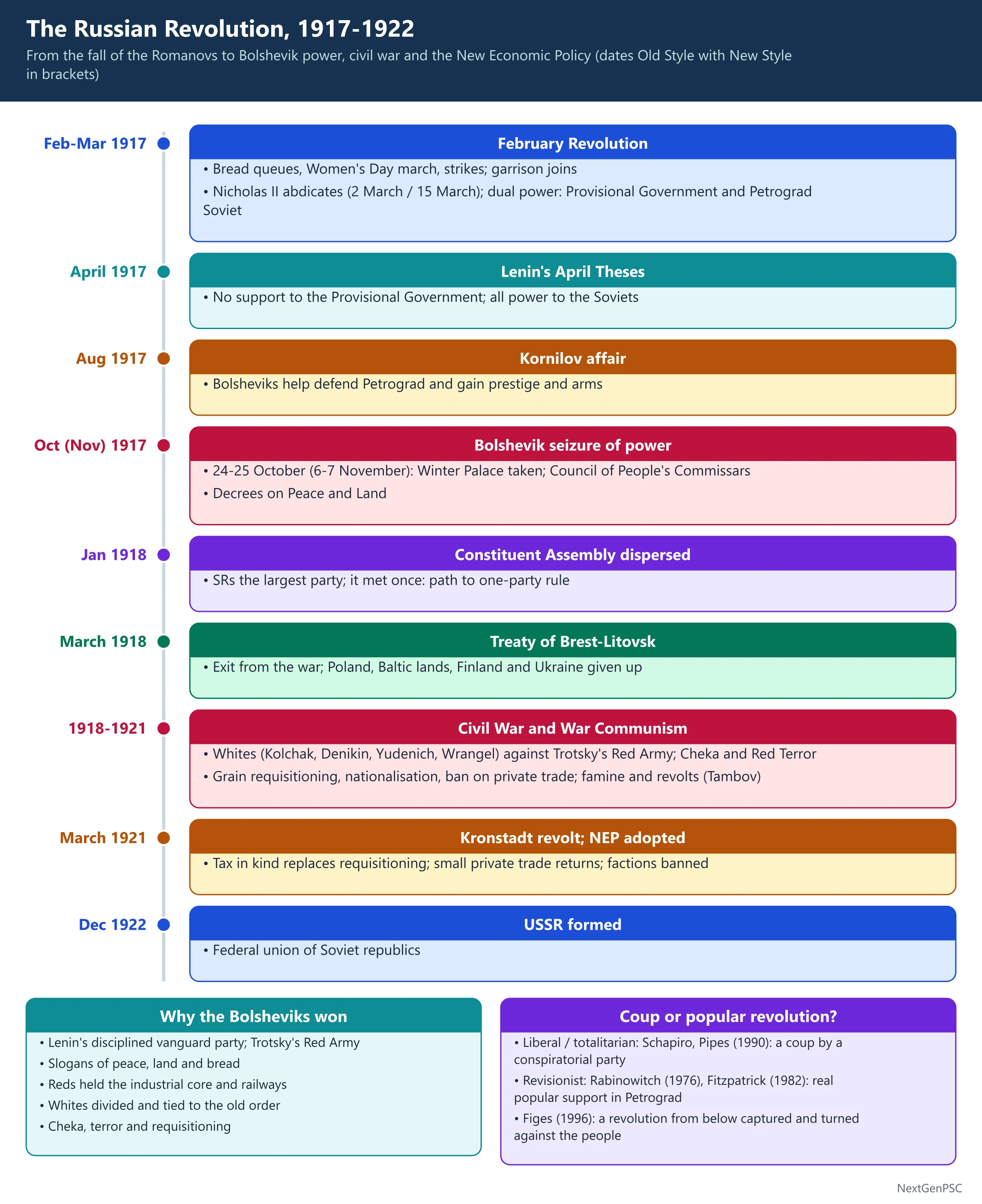
1. Background: Tsarist Russia before 1917
Autocracy: Nicholas II (1894-1917) ruled with a weak Duma created after the 1905 Revolution and Bloody Sunday; Stolypin's land reforms (1906-11) were incomplete.
Society: about four-fifths of the people were peasants, serfdom had ended only in 1861, and rapid state-led industrialisation under Witte created a concentrated working class in Petrograd and Moscow.
Parties: the Russian Social Democratic Labour Party split in 1903 into Bolsheviks (Lenin) and Mensheviks (Martov); the Socialist Revolutionaries spoke for the peasants; the Kadets were liberals.
World War I: defeats such as Tannenberg (1914), millions of casualties, inflation, food shortages and the influence of Rasputin destroyed faith in the monarchy.
2. The February Revolution (1917)
Rising: bread queues, the International Women's Day march (23 February Old Style, 8 March New Style) and strikes in Petrograd turned into revolution when soldiers of the garrison joined.
Abdication: Nicholas II abdicated on 2 March (15 March New Style) 1917; three centuries of Romanov rule ended.
Dual power: the Provisional Government (Prince Lvov, later Kerensky) held formal authority while the Petrograd Soviet, through Order No. 1, controlled the soldiers.
Weakness: the Provisional Government continued the war, postponed land reform and the Constituent Assembly, and lost support month by month.
3. The October Revolution (1917)
Lenin's return: back in Petrograd in April 1917 via Germany, he issued the April Theses: no support to the Provisional Government and all power to the Soviets.
Crises: the failed June offensive, the July Days (after which Lenin hid in Finland) and the Kornilov affair (August), when the Bolsheviks helped defend Petrograd and gained prestige.
Bolshevik majorities: by September the Bolsheviks controlled the Petrograd and Moscow Soviets; Trotsky headed the Petrograd Soviet and its Military Revolutionary Committee.
Seizure of power: on 24-25 October (6-7 November New Style) 1917 Red Guards and soldiers took key points and the Winter Palace; the Second Congress of Soviets approved the new Council of People's Commissars.
First decrees: the Decree on Peace and the Decree on Land (land to the peasants), followed by workers' control and nationalisation of banks.
Constituent Assembly: elected in November 1917 with the SRs the largest party; it met once and was dispersed in January 1918.
4. Consolidation and Civil War (1918-1921)
Cheka: the secret police was founded in December 1917 under Dzerzhinsky; the Red Terror followed the attempt on Lenin's life in August 1918.
Treaty of Brest-Litovsk (March 1918): Russia gave up Poland, the Baltic lands, Finland and Ukraine to make peace with Germany; it was annulled after Germany's defeat.
Civil War: Whites (Kolchak, Denikin, Yudenich, Wrangel), the Czech Legion and Allied intervention forces fought the Red Army built by Trotsky.
Royal family: Nicholas II and his family were shot at Ekaterinburg in July 1918.
War Communism: grain requisitioning, nationalisation of industry and a ban on private trade fed the army but caused famine and peasant revolts such as Tambov (1920-21).
Polish-Soviet War (1920): the Red Army was halted before Warsaw; the Treaty of Riga (1921) fixed the border.
Kronstadt (March 1921): sailors once loyal to the revolution demanded free soviets; the rising was crushed and the Tenth Party Congress introduced the NEP and banned factions.
NEP: a tax in kind replaced requisitioning and small private trade returned, while the state kept the commanding heights; the USSR was formed in December 1922.
5. Sources and Evidence
Bolshevik texts: Lenin's April Theses and State and Revolution (1917), and the decrees of the Soviet government.
Eyewitnesses: John Reed's Ten Days that Shook the World (1919), N.N. Sukhanov's notes on the revolution and Kerensky's memoirs.
Participant history: Trotsky's History of the Russian Revolution (1930-32).
Archives: opened after 1991, they revealed the scale of the Red Terror and peasant resistance.
6. Analysis: Why the Bolsheviks Won
Leadership and organisation: Lenin's disciplined vanguard party and Trotsky's command of the Red Army.
Simple slogans: peace, land and bread, and all power to the Soviets, matched popular demands that the Provisional Government ignored.
Geography: the Reds held the central industrial core and railways; the Whites were scattered on the periphery.
Divided enemies: the Whites had no common programme, were linked with landlords and the old order, and foreign intervention let the Bolsheviks pose as patriots.
Ruthlessness: the Cheka, terror and requisitioning gave the state means to survive.
Consequences: the first one-party socialist state, the Comintern (1919), a long ideological rivalry with the West and inspiration for anti-colonial movements in Asia.
7. Historiography and Debates
Soviet view: a proletarian revolution led by the party according to the laws of history.
Liberal or totalitarian school: Leonard Schapiro and Richard Pipes (The Russian Revolution, 1990) saw October as a coup by a small conspiratorial party.
Revisionist social historians: Alexander Rabinowitch (The Bolsheviks Come to Power, 1976) and Sheila Fitzpatrick (The Russian Revolution, 1982) showed real popular support for the Bolsheviks in Petrograd in 1917.
Carr (E.H.), The Bolshevik Revolution 1917-1923: a multi-volume history that treated the regime's institutions seriously.
Orlando Figes, A People's Tragedy (1996): a revolution from below that was captured and turned against the people.
Continuity debate: was Stalinism already present in Lenin's methods of 1918-21 or a break from them.
8. Using it in the Exam
10-marker: define dual power or War Communism, give two causes or features and one result.
15-marker: why the Provisional Government failed or why the Reds won the Civil War, in four or five headed points.
20-marker: causes of 1917, February to October, consolidation, Civil War and NEP, then the coup versus popular revolution debate.
Keywords: dual power, April Theses, vanguard party, Brest-Litovsk, War Communism, Kronstadt, NEP.
Source line: Lenin described the NEP as a retreat needed to save the revolution; paraphrase it as his view in 1921.
| Date | Event | Significance |
|---|---|---|
| Feb-Mar 1917 | February Revolution; abdication of Nicholas II | End of autocracy; dual power |
| April 1917 | Lenin's April Theses | Break with the Provisional Government |
| Aug 1917 | Kornilov affair | Bolsheviks gain prestige and arms |
| Oct (Nov) 1917 | Bolshevik seizure of power | Decrees on Peace and Land |
| Jan 1918 | Constituent Assembly dispersed | Path to one-party rule |
| March 1918 | Treaty of Brest-Litovsk | Exit from World War I at heavy territorial cost |
| 1918-1921 | Civil War and War Communism | Red victory; famine and terror |
| March 1921 | Kronstadt revolt; NEP adopted | Economic retreat, political tightening |
| Dec 1922 | USSR formed | Federal union of Soviet republics |
Mains points
- Frequent angles: why the Provisional Government failed; Lenin's role; why the Bolsheviks won the Civil War; War Communism versus NEP.
- Distinguish February (spontaneous, mass) from October (organised, party-led); examiners reward this contrast.
- Give Old Style and New Style dates once to show precision, then stick to one.
- Present both sides of the coup versus revolution debate with named historians (Pipes vs Rabinowitch or Fitzpatrick).
- Link outcomes to world history: Comintern, Cold War roots, and influence on Asian nationalism including India.
- Common mistake: treating 1917 as the end; the syllabus runs to 1921, so cover the Civil War, Kronstadt and NEP.
Did you know?
- Russia still used the Julian calendar in 1917, so the October Revolution is celebrated on 7 November; the Bolsheviks adopted the Gregorian calendar in February 1918.
Fascist Counter-Revolution in Italy and Germany
Fascism was a mass movement of the inter-war years that combined extreme nationalism, the cult of a leader, violence and hostility to both liberal democracy and Marxism. It is called a counter-revolution because it rose on the fear of Bolshevism and was helped into power by conservative elites: Mussolini after the March on Rome (1922) and Hitler as Chancellor (January 1933). Both built one-party states, but Nazism added biological racism that ended in the Holocaust.
In simple words
Picture a town frightened by riots and rising prices, where a loud strongman promises order and national glory and blames outsiders for every problem.
The rich and the police quietly back him, thinking they can control him, and he ends up controlling everyone.
That is fascism in Italy and Germany after World War I.
UPSC asks why it rose, how it differed from communism and why it is called a counter-revolution.
1. The Post-War Crisis
Italy: the peace of 1919 denied Italy Fiume and much of Dalmatia, which nationalists called the mutilated victory; d'Annunzio seized Fiume in 1919.
Biennio Rosso (1919-20): strikes, factory occupations in Turin and Milan and land seizures frightened landowners and industrialists.
Germany: defeat, the Treaty of Versailles, the stab-in-the-back myth, the Spartacist rising (1919), the Kapp Putsch (1920) and hyperinflation (1923) weakened the Weimar Republic.
Weak liberal states: proportional representation produced unstable coalitions in both countries, and the elites had little loyalty to parliamentary rule.
2. Italy: Mussolini's Road to Power
Origins: Mussolini, a former socialist editor, founded the Fasci di Combattimento in Milan in March 1919.
Squadrismo: blackshirt squads attacked socialist offices, trade unions and peasant leagues, often with the tolerance of the police and landlords.
March on Rome (October 1922): King Victor Emmanuel III refused to declare martial law and appointed Mussolini Prime Minister.
Acerbo Law (1923): gave two-thirds of seats to the party with the most votes; the fascist list won the 1924 election.
Matteotti crisis (1924): the murder of the socialist deputy Giacomo Matteotti led to the Aventine secession; in January 1925 Mussolini took responsibility and began open dictatorship.
The regime: opposition parties banned (1926), OVRA secret police, the Corporate State, Battle for Grain, and the Lateran Treaties with the Pope (1929).
Foreign policy: invasion of Ethiopia (1935-36), intervention in Spain, the Rome-Berlin Axis (1936) and the Pact of Steel (1939).
3. Germany: Hitler's Road to Power
Early Nazism: Hitler led the National Socialist German Workers' Party from 1921; the Munich Beer Hall Putsch (November 1923) failed and in prison he wrote Mein Kampf.
Great Depression: after 1929 unemployment rose to about six million by early 1932, and the Nazi vote grew from 2.6 per cent (1928) to 37.3 per cent (July 1932).
Backstairs intrigue: President Hindenburg, Papen and conservative circles appointed Hitler Chancellor on 30 January 1933, hoping to tame him.
Reichstag Fire (February 1933): used to suspend civil liberties and arrest communists.
Enabling Act (23 March 1933): gave the cabinet power to make laws without the Reichstag; Gleichschaltung (co-ordination) brought states, unions and parties under Nazi control.
Night of the Long Knives (June-July 1934): Röhm and the SA leadership were killed; on Hindenburg's death (August 1934) Hitler became Führer and the army swore an oath to him.
Racial state: the Nuremberg Laws (1935), Kristallnacht (November 1938) and, in wartime, the Holocaust; the SS and Gestapo enforced terror.
Economy: public works, rearmament and the Four-Year Plan (1936) under Göring cut unemployment while preparing for war.
4. Sources and Evidence
Ideological texts: Mein Kampf (1925-26), the Nazi 25-Point Programme (1920) and the article on the Doctrine of Fascism (1932) credited to Mussolini and Giovanni Gentile.
State records: election results, laws such as the Enabling Act and Nuremberg Laws, and Gestapo files.
Propaganda: Goebbels' ministry, Leni Riefenstahl's film Triumph of the Will (1935), posters and radio.
Trial records: the Nuremberg Trials (1945-46) produced vast documentary evidence on the Nazi state.
5. Analysis: Nature and Comparison
Common features: a leader cult (Duce, Führer), one party, a paramilitary, propaganda, anti-communism, aggressive expansion and mass mobilisation of youth and women.
Why counter-revolution: it destroyed independent working-class organisations, protected property and was backed by army, business and landlords afraid of revolution.
But also revolutionary in form: it mobilised masses, claimed to create a new man and a national community, and used modern technology and propaganda.
Differences: the Italian regime shared power with the king, the Church and the army; the Nazi state was more total and placed race at its centre.
Fascism versus communism: both were one-party and terror-based, but fascism kept private property and preached national and racial hierarchy, while communism preached class war and collective ownership.
Consequences: destruction of democracy, aggressive war leading to World War II, the Holocaust, and post-war constitutions in Italy and West Germany designed to prevent its return.
6. Historiography and Debates
Marxist view: the Comintern (Dimitrov, 1935) defined fascism as the open terrorist dictatorship of the most reactionary elements of finance capital.
Liberal view: Benedetto Croce saw Italian fascism as a parenthesis in Italy's liberal history; Friedrich Meinecke wrote of The German Catastrophe (1946).
Totalitarian model: Hannah Arendt, The Origins of Totalitarianism (1951), grouped Nazism with Stalinism.
Sonderweg debate: Fritz Fischer and Hans-Ulrich Wehler saw a German special path of weak liberalism; David Blackbourn and Geoff Eley (The Peculiarities of German History, 1984) challenged it.
Intentionalists vs functionalists: Lucy Dawidowicz and Klaus Hildebrand stressed Hitler's plans; Martin Broszat and Hans Mommsen stressed chaotic rivalry; Ian Kershaw's phrase working towards the Führer bridges the two.
Generic fascism: Ernst Nolte, Three Faces of Fascism (1963), saw it as anti-Marxism; Roger Griffin (The Nature of Fascism, 1991) defined it as palingenetic ultranationalism; Robert Paxton, The Anatomy of Fascism (2004), studied it in stages.
Consent: Renzo De Felice argued that Mussolini enjoyed real consensus in the early 1930s, a view that sparked controversy in Italy.
7. Using it in the Exam
10-marker: define fascism and give three features with one Italian and one German example.
15-marker: why Weimar collapsed or how Mussolini consolidated power, in dated stages.
20-marker: compare Italian and German fascism: causes, rise, nature of the state, and why it is called a counter-revolution, ending with a historiographical view.
Keywords: mutilated victory, squadrismo, March on Rome, Enabling Act, Gleichschaltung, Volksgemeinschaft, totalitarianism.
Source line: Mussolini's formula, everything within the state, nothing outside the state, nothing against the state (speech of 1925), sums up the totalitarian claim.
| Aspect | Italy (Mussolini) | Germany (Hitler) |
|---|---|---|
| Came to power | March on Rome, October 1922 | Appointed Chancellor, 30 January 1933 |
| Main grievance | Mutilated victory, Biennio Rosso | Versailles, hyperinflation, Depression |
| Route to dictatorship | Acerbo Law, Matteotti crisis, 1925-26 laws | Reichstag Fire decree, Enabling Act, Night of the Long Knives |
| Rival centres of power | King, Church, army survived | Hindenburg's death removed the last check |
| Core idea | Totalitarian state, corporatism, Roman glory | Race, Volksgemeinschaft, Lebensraum |
| Racial laws | From 1938, under German influence | Nuremberg Laws 1935; Holocaust |
Mains points
- Frequent angles: why fascism is called a counter-revolution; causes of the rise of Nazism; comparison of Italian and German fascism; role of the Depression.
- Stress the role of conservative elites: neither Mussolini nor Hitler won power by revolution or by an electoral majority.
- Use figures carefully: Nazi vote 37.3 per cent in July 1932, about 33 per cent in November 1932.
- Bring in at least two schools (Marxist, liberal, totalitarian, intentionalist or functionalist) with names.
- Avoid treating fascism and Nazism as identical; examiners look for the difference on race and the limits of Italian totalitarianism.
- End by linking to World War II causes and post-war safeguards in Europe.
Did you know?
- Mussolini travelled to Rome by overnight train in October 1922 after the king's invitation; the famous March on Rome was largely staged after the appointment.
The Chinese Revolution of 1949
The Chinese Revolution of 1949 ended a century of foreign humiliation and civil strife when the Chinese Communist Party under Mao Zedong defeated Chiang Kai-shek's Kuomintang and proclaimed the People's Republic of China on 1 October 1949. Unlike Russia, it was a peasant-based revolution built over two decades of rural bases, the Long March, the war against Japan and the civil war of 1946-49.
In simple words
Imagine a huge family farm run down by debt, quarrelling heirs and greedy neighbours. One brother wins over the farm workers by giving them land and fighting off the intruders, while the other brother is seen as corrupt.
In the end the workers back the first brother.
That is China from 1911 to 1949, where Mao's communists won through the peasants.
UPSC asks why the communists won and how this revolution differed from Russia's.
1. Background: From Empire to Republic
Century of humiliation: the Opium Wars (1839-42, 1856-60), unequal treaties, the Taiping Rebellion and the Boxer Rising (1900) exposed Qing weakness.
1911 Revolution: the Wuchang uprising (October 1911) ended the Qing dynasty; Sun Yat-sen proclaimed the Republic, but power passed to Yuan Shikai and then to warlords (1916-28).
Three Principles of the People: Sun Yat-sen's programme of nationalism, democracy and people's livelihood became the creed of the Kuomintang (KMT).
May Fourth Movement (1919): protests against the transfer of Shandong to Japan at Versailles spread new ideas, science, democracy and Marxism.
Founding of the CCP (July 1921): held in Shanghai with Comintern help; Chen Duxiu and Li Dazhao were leading figures and Mao attended.
2. United Front and the Split (1923-1927)
First United Front: on Comintern advice the CCP joined the KMT; the Soviet Union helped found the Whampoa Military Academy (1924).
Northern Expedition (1926-28): Chiang Kai-shek moved north to defeat the warlords.
Shanghai Massacre (April 1927): Chiang turned on the communists and labour unions, ending the alliance; the Nanjing government was set up in 1928.
Mao's turn to the peasants: his Report on an Investigation of the Peasant Movement in Hunan (1927) argued that peasant power would sweep the country.
3. Rural Bases, Long March and Yan'an
Jiangxi Soviet (1931-34): Mao and Zhu De built a rural base and the Red Army; Chiang's encirclement campaigns forced them out.
Long March (October 1934 to October 1935): about 6,000 miles (roughly 9,600 km) to Shaanxi; most marchers died or left, but it became a founding legend.
Zunyi Conference (January 1935): Mao rose to leadership of the party's military affairs.
Yan'an period (1936-47): rent and interest reduction, mass line, rectification campaign (1942-44) and the development of Mao Zedong Thought.
Japanese aggression: seizure of Manchuria (1931) and full-scale war from July 1937 after the Marco Polo Bridge incident.
Xi'an Incident (December 1936): Zhang Xueliang detained Chiang and pressed him into a Second United Front against Japan.
War of resistance: the KMT bore the main conventional battles and lost its best troops; the CCP grew from about 40,000 members in 1937 to over a million by 1945 behind Japanese lines.
4. Civil War and Victory (1946-1949)
Failed mediation: the US mission of General George Marshall (1946) could not create a coalition government.
Military campaigns: the People's Liberation Army won the Liaoshen, Huaihai and Pingjin campaigns (1948-49); Beijing fell in January 1949.
Proclamation: Mao proclaimed the People's Republic of China at Tiananmen on 1 October 1949; Chiang withdrew to Taiwan.
Early measures: the Agrarian Reform Law (1950), the Marriage Law (1950) and the Sino-Soviet Treaty of Friendship (February 1950).
5. Sources and Evidence
Mao's writings: the Hunan Report (1927), On Protracted War (1938) and On New Democracy (1940).
Western observers: Edgar Snow's Red Star Over China (1937) made Mao known abroad.
American records: the US State Department's China White Paper (1949) explained the KMT's failure.
Local studies: William Hinton's Fanshen (1966) describes land reform in a Shanxi village.
6. Analysis: Why the Communists Won
KMT weakness: corruption, hyperinflation after 1945, reliance on landlords and warlords, and heavy losses against Japan.
Peasant support: land reform, rent reduction and the disciplined conduct of the Red Army won rural loyalty.
Nationalism: the CCP was seen as the more determined fighter against Japan.
Strategy: guerrilla warfare and protracted war, encircling the cities from the countryside, then large conventional campaigns.
Organisation: a disciplined party, the mass line and capture of Japanese weapons in Manchuria with Soviet help after 1945.
Contrast with Russia: a peasant revolution built over decades through armed bases, not a rapid urban seizure of power.
Significance: restored Chinese sovereignty, shifted the Cold War balance in Asia, led to the Korean War and inspired guerrilla movements in the Third World.
7. Historiography and Debates
Chalmers Johnson, Peasant Nationalism and Communist Power (1962): the Japanese invasion turned peasants towards the CCP as nationalists.
Mark Selden, The Yenan Way in Revolutionary China (1971): social and economic reform in the base areas won peasant support.
Lloyd Eastman, Seeds of Destruction (1984): the KMT collapsed from its own corruption and incompetence.
Odd Arne Westad, Decisive Encounters (2003): stresses military decisions and the international setting of the civil war.
Theda Skocpol, States and Social Revolutions (1979): compares France, Russia and China and stresses state breakdown and peasant revolt.
Benjamin Schwartz (1951): argued Maoism was a heretical departure from Soviet orthodoxy, based on peasants rather than workers.
8. Using it in the Exam
10-marker: the significance of the Long March or the Yan'an period in four or five points.
15-marker: why the KMT failed, balancing internal weakness with Japanese invasion.
20-marker: causes of the communist victory, contrast with the Russian Revolution, and the Johnson versus Selden debate.
Keywords: Three Principles, United Front, Long March, mass line, protracted war, New Democracy, land reform.
Source line: in 1938 Mao wrote that political power grows out of the barrel of a gun; at the opening of the People's Political Consultative Conference in September 1949 he declared that the Chinese people had stood up.
| Year | Event | Effect on the revolution |
|---|---|---|
| 1911 | Fall of the Qing | Republic, then warlordism |
| 1919 | May Fourth Movement | Spread of nationalism and Marxism |
| 1921 | CCP founded in Shanghai | Communist organisation begins |
| 1927 | Shanghai Massacre | End of the First United Front; CCP goes rural |
| 1934-35 | Long March | Mao's leadership; Yan'an base |
| 1936-37 | Xi'an Incident; war with Japan | Second United Front; CCP expands |
| 1946-49 | Civil War | PLA victory in Manchuria and Huaihai |
| 1 Oct 1949 | People's Republic proclaimed | KMT withdraws to Taiwan |
Mains points
- Common angles: why the CCP defeated the KMT; role of the peasantry and of the Japanese invasion; compare the Chinese and Russian revolutions.
- Begin from 1911 but keep the background short; the marks lie in 1927-49.
- Balance the causes: KMT failure, CCP strengths and the external factor (Japan, Soviet help, limited US support).
- Use the Johnson (nationalism) versus Selden (social reform) debate as the analytical core.
- Draw a simple comparison table with Russia: social base, duration, role of the party, military path.
- Common mistake: calling the Long March a victory in itself; it was a retreat that became a political triumph.
Did you know?
- Of the roughly 80,000-86,000 people who left Jiangxi on the Long March in 1934, only a small fraction, often put at under 10,000, reached Shaanxi a year later.
The World Wars as Total Wars; Causes and Consequences of World War I
The two World Wars were total wars: whole societies, economies and populations were mobilised, and civilians became targets. World War I (1914-18) grew from alliances, militarism, imperial rivalry and nationalism, and was triggered by the Sarajevo assassination and the July Crisis of 1914. It destroyed four empires, produced the Treaty of Versailles and the League of Nations, and left grievances that fed the next war.
In simple words
In older wars armies fought while most people carried on with life.
In a total war every factory makes shells, women run the trains, food is rationed and bombs fall on cities, so the whole nation is at war.
World War I began like a chain of falling dominoes when an archduke was shot at Sarajevo and the alliances pulled every great power in.
UPSC asks about its causes, who was to blame and how total war changed society.
1. The Idea of Total War
Meaning: a war in which the state mobilises the entire population, economy and culture, and in which the distinction between soldier and civilian breaks down.
Origin of the term: used by the French writer Léon Daudet (1918) and by Ludendorff in Der totale Krieg (1935); Goebbels called for total war in his Sportpalast speech of February 1943.
Mass armies: conscription put millions in uniform; about 65 million men were mobilised in World War I.
War economy: state control of industry, labour and food, for example Britain's Defence of the Realm Act (1914) and Ministry of Munitions (1915), and Germany's Hindenburg Programme (1916).
Home front: rationing, propaganda, censorship, war loans and the targeting of civilians by blockade, U-boats, Zeppelin raids and, in World War II, strategic bombing and genocide.
2. Societal Implications of Total War
Women: millions entered munitions factories, transport and offices; women won the vote in Britain (1918, partly), Germany (1918) and the USA (1920), and later in France (1944).
Labour and the state: trade unions gained recognition, and the state took responsibility for welfare, leading later to the Beveridge Report (1942) in Britain.
Demography and loss: about 9-10 million soldiers died in World War I and perhaps 70-85 million people in World War II, most of them civilians.
Social levelling and protest: heavy taxation, inflation and food shortages bred strikes and revolution, as in Russia in 1917 and Germany in 1918.
Culture and memory: war poetry (Wilfred Owen), memorials, the Unknown Soldier and a mood of disillusion in the 1920s.
Colonies: about 1.3-1.5 million Indians served in World War I, and colonial contributions sharpened demands for self-rule.
3. Long-Term Causes of World War I
Alliance system: the Dual Alliance (1879) and Triple Alliance (1882) faced the Franco-Russian Alliance (1894), the Entente Cordiale (1904) and the Anglo-Russian Convention (1907).
Militarism and the arms race: the Anglo-German naval race after the Tirpitz plans and HMS Dreadnought (1906); rigid war plans such as the Schlieffen Plan.
Imperialism: Weltpolitik under Wilhelm II, the Moroccan crises (1905-06 and 1911) and rivalry over colonies and markets.
Nationalism: French revanche over Alsace-Lorraine, Pan-Slavism, Serbian nationalism and the decline of the Ottoman Empire.
Balkan crises: Austria's annexation of Bosnia (1908) and the Balkan Wars (1912-13) left Serbia enlarged and Austria alarmed.
4. The July Crisis of 1914
28 June: Archduke Franz Ferdinand was shot at Sarajevo by Gavrilo Princip, linked to the Serbian secret society Black Hand.
5-6 July: Germany gave Austria-Hungary the blank cheque of unconditional support.
23 July: Austria sent Serbia a harsh ultimatum; Serbia accepted most of it, but Austria declared war on 28 July.
Mobilisation: Russia's general mobilisation (30 July) led Germany to declare war on Russia (1 August) and France (3 August).
Belgium: the German march through neutral Belgium under the Schlieffen Plan brought Britain into the war on 4 August.
Course in brief: the Marne (1914) ended hopes of a short war; Verdun and the Somme (1916); the USA entered in April 1917 after unrestricted submarine warfare and the Zimmermann telegram; the armistice came on 11 November 1918.
5. Consequences of World War I
Fall of empires: the German, Austro-Hungarian, Russian and Ottoman empires collapsed; new states included Poland, Czechoslovakia, Yugoslavia and the Baltic states.
Treaty of Versailles (28 June 1919): Germany lost Alsace-Lorraine, its colonies and the Polish Corridor; the army was limited to 100,000; Article 231 assigned war guilt; reparations were fixed at 132 billion gold marks in 1921.
Other treaties: Saint-Germain (Austria), Trianon (Hungary), Neuilly (Bulgaria) and Sèvres (Turkey, 1920), replaced by Lausanne (1923).
League of Nations and mandates: Wilson's Fourteen Points (January 1918) promised self-determination; mandates in West Asia and Africa extended Anglo-French power.
Economic effects: war debts, inflation, the shift of financial leadership to the USA and the instability that led to 1929.
Political effects: the Russian Revolution, fascism in Italy, the rise of the USA and Japan, and stronger nationalism in India, Egypt and China.
6. Sources and Evidence
Diplomatic documents: the coloured books published by each government in 1914, and later the multi-volume Die Grosse Politik and British Documents on the Origins of the War.
Key texts: Wilson's Fourteen Points, the Treaty of Versailles and Keynes's The Economic Consequences of the Peace (1919), which attacked the reparations.
War memoirs and literature: Lloyd George's War Memoirs, Remarque's All Quiet on the Western Front (1929) and the war poets.
7. Historiography: Who Was Responsible?
Versailles view: Article 231 placed responsibility on Germany and its allies.
Inter-war revisionism: Sidney Fay and others spread the blame; Lloyd George later wrote that the nations slithered over the brink into war.
Fritz Fischer, Griff nach der Weltmacht (1961): Germany sought European domination and bore the main responsibility, citing Bethmann Hollweg's September Programme (1914); this set off the Fischer controversy.
Taylor (A.J.P.), War by Timetable (1969): railway mobilisation plans made the war hard to stop.
Marxist view: Lenin's Imperialism, the Highest Stage of Capitalism (1917) saw the war as a struggle for colonies and markets.
Recent works: James Joll (The Origins of the First World War, 1984) on the mood of 1914; Christopher Clark (The Sleepwalkers, 2012) on shared responsibility; Margaret MacMillan (The War That Ended Peace, 2013).
8. Using it in the Exam
10-marker: explain total war with three societal effects and one example from each war.
15-marker: evaluate the Treaty of Versailles as a cause of later instability.
20-marker: long-term and immediate causes, the July Crisis, then the responsibility debate (Fischer vs Clark) and a balanced conclusion.
Keywords: total war, home front, alliance system, blank cheque, Schlieffen Plan, Article 231, self-determination.
Source line: on 3 August 1914 Sir Edward Grey reportedly said that the lamps were going out all over Europe; treat it as reported in his memoirs.
| Cause | Examples | Weight in debate |
|---|---|---|
| Alliances | Triple Alliance 1882; Triple Entente by 1907 | Turned a Balkan quarrel into a general war |
| Militarism | Naval race; Schlieffen Plan | Stressed by A.J.P. Taylor |
| Imperialism | Moroccan crises 1905, 1911 | Stressed by Lenin and Marxists |
| Nationalism | Serbian, Pan-Slav, French revanche | Central to the Balkan spark |
| German policy | Weltpolitik; blank cheque | Stressed by Fritz Fischer |
| Crisis management | Ultimatum, mobilisation, July 1914 | Stressed by Christopher Clark |
Mains points
- Frequent angles: World Wars as total wars and their societal impact; causes of World War I; was Germany responsible; was Versailles a Carthaginian peace.
- For total war, give concrete evidence: conscription figures, DORA, women's suffrage, rationing, bombing of civilians.
- Separate underlying causes from the July Crisis and show how one turned into the other.
- Name the historians on war guilt (Fischer, Taylor, Clark, Lenin) instead of writing vague phrases.
- Link consequences to Paper II topics: League of Nations, rise of fascism, Arab mandates, Indian nationalism.
- Common mistake: listing MAIN causes without dates or examples; examiners treat this as superficial.
Did you know?
- Franz Ferdinand's driver took a wrong turn in Sarajevo and stopped near Princip, who had given up after the morning's failed bomb attack.
Causes and Consequences of World War II
World War II (1939-45) grew out of the unsettled Versailles order, the Great Depression, the failure of the League of Nations and the expansionist aims of Nazi Germany, Fascist Italy and militarist Japan, which the Western powers met with appeasement. The Nazi-Soviet Pact and the invasion of Poland began it in Europe, and Pearl Harbor made it global. It killed some 70-85 million people, produced the United Nations, two superpowers, the Cold War and rapid decolonisation.
In simple words
Think of a playground bully who keeps grabbing a little more each week while the teachers look away, hoping he will stop. Each time nothing happens, he grabs more, until a real fight breaks out.
That is the 1930s: Hitler, Mussolini and Japan expanded step by step while Britain and France followed appeasement.
The war that followed was the deadliest in history and remade the world.
UPSC asks how far Hitler, Versailles and appeasement were to blame.
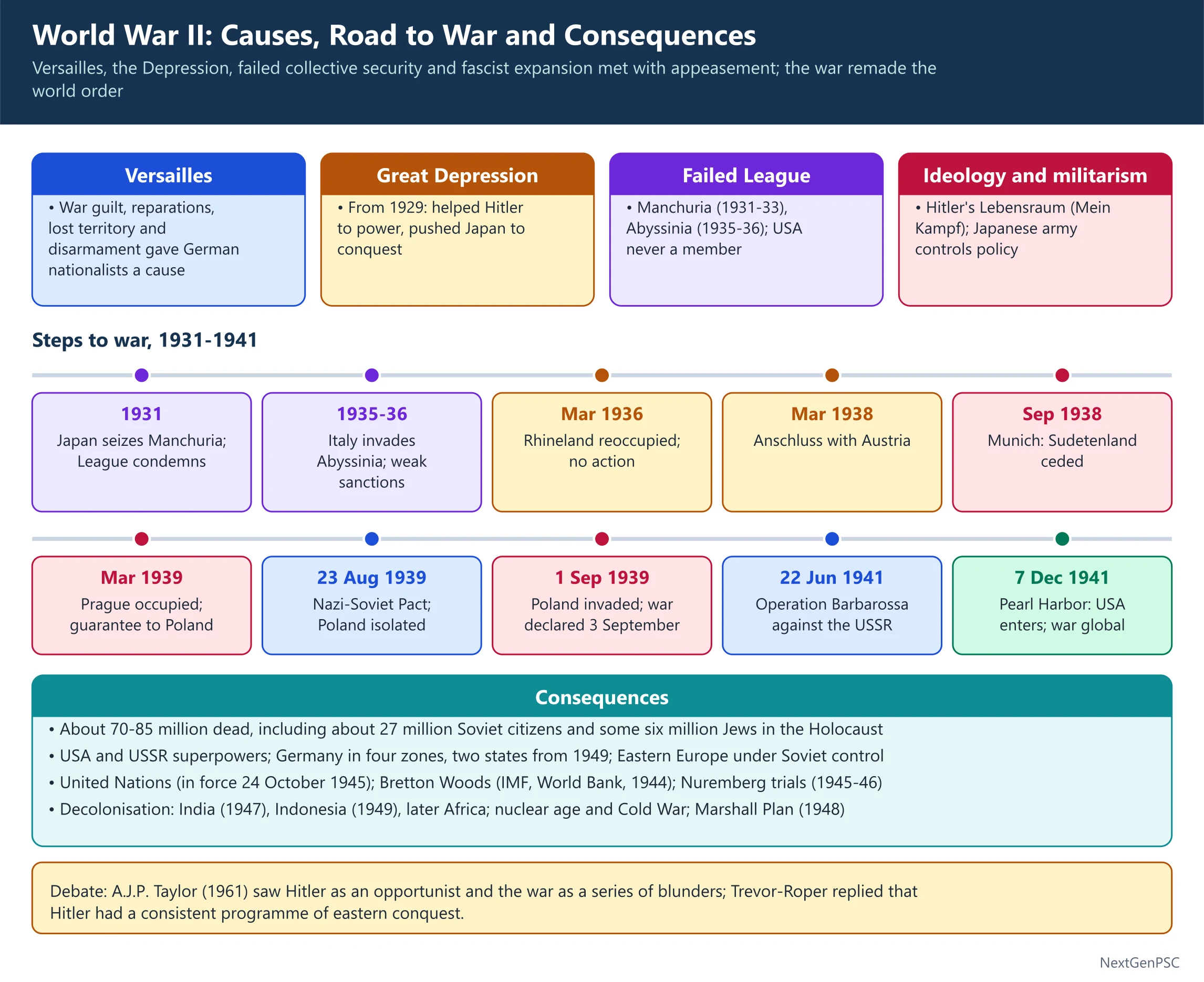
1. Long-Term Causes
Versailles settlement: German resentment at war guilt, reparations, territorial loss and disarmament gave nationalists a cause.
Great Depression (from 1929): mass unemployment helped Hitler to power, pushed Japan towards conquest and made democracies inward-looking.
Failure of collective security: the League of Nations failed over Manchuria (1931-33) and Abyssinia (1935-36); the USA was never a member and the USSR joined only in 1934.
Ideology: Hitler's aims of overturning Versailles, uniting all Germans and winning Lebensraum in the east were set out in Mein Kampf.
Japanese militarism: army control of policy and the drive for resources led to the Manchurian Incident (1931) and full war with China from 1937.
2. The Road to War in Europe (1933-1939)
1933-35: Germany left the League and the Disarmament Conference (1933), announced conscription and an air force (1935), and the Saar voted to rejoin Germany (1935).
Anglo-German Naval Agreement (1935): Britain accepted a German navy of 35 per cent of its own, weakening the Stresa Front.
Rhineland (March 1936): German troops reoccupied the demilitarised zone without resistance.
Axis forms: the Rome-Berlin Axis (1936), the Anti-Comintern Pact with Japan (1936, Italy joined 1937) and German and Italian aid to Franco in the Spanish Civil War (1936-39).
Anschluss (March 1938): Austria was absorbed into Germany.
Munich Agreement (September 1938): Chamberlain, Daladier, Mussolini and Hitler gave the Sudetenland to Germany; Czechoslovakia was not consulted.
Prague (March 1939): Germany occupied the rest of Bohemia and Moravia; Britain and France then guaranteed Poland.
Nazi-Soviet Pact (23 August 1939): Ribbentrop and Molotov agreed on non-aggression, with a secret protocol dividing Poland and the Baltic region.
Outbreak: Germany invaded Poland on 1 September 1939; Britain and France declared war on 3 September.
3. The War Becomes Global
Blitzkrieg: Denmark, Norway, the Low Countries and France fell in 1940; the Battle of Britain (1940) denied Germany air supremacy.
Operation Barbarossa (22 June 1941): the German invasion of the USSR opened the largest land front of the war.
Pearl Harbor (7 December 1941): Japan attacked the US fleet, bringing the USA into the war; Germany declared war on the USA.
Turning points (1942-43): Midway (June 1942), El Alamein (October-November 1942) and Stalingrad (August 1942 to February 1943).
Final stage: D-Day (6 June 1944), the Yalta Conference (February 1945), German surrender (7-8 May 1945), the atomic bombs on Hiroshima (6 August) and Nagasaki (9 August), and Japan's surrender (15 August, formally 2 September 1945).
4. Sources and Evidence
Nazi documents: Mein Kampf and the Hossbach Memorandum of a meeting on 5 November 1937 at which Hitler discussed plans for expansion.
Diplomatic records: the Munich Agreement, the Nazi-Soviet Pact and its secret protocol, and Allied conference records from Tehran, Yalta and Potsdam.
Trial evidence: the Nuremberg and Tokyo war crimes trials.
Memoirs: Churchill's The Second World War (six volumes, 1948-53), which called it the unnecessary war.
5. Consequences of World War II
Human cost: about 70-85 million dead, including about 27 million Soviet citizens and some six million Jews in the Holocaust.
New world order: the USA and USSR emerged as superpowers; Britain and France were weakened.
Division of Europe: Germany was split into four zones, and later two states (1949); Eastern Europe fell under Soviet control.
Institutions: the United Nations (Charter signed June 1945, in force 24 October 1945) and the Bretton Woods system of IMF and World Bank (1944).
Justice: Nuremberg (1945-46) established crimes against peace and crimes against humanity as international offences.
Decolonisation: weakened European empires gave way; India (1947), Indonesia (1949) and later Africa.
Nuclear age and Cold War: Hiroshima began the atomic era; disputes over Germany and Eastern Europe led to the Cold War.
Welfare state and planning: Britain's welfare reforms, mixed economies and the Marshall Plan (1948) shaped post-war Western Europe.
6. Historiography and Debates
Orthodox view: the Nuremberg judgment and early historians blamed Hitler's planned aggression.
Taylor (A.J.P.), The Origins of the Second World War (1961): Hitler was an opportunist pursuing traditional German aims, and the war of 1939 came from blunders on all sides.
Hugh Trevor-Roper's reply: Hitler had a consistent programme of eastern conquest set out in his writings.
Appeasement debate: Guilty Men (1940), by Cato, condemned the appeasers; revisionists pointed to British weakness, public opinion and the need to rearm; R.A.C. Parker (Chamberlain and Appeasement, 1993) argued Chamberlain had alternatives.
Soviet view: Western appeasement aimed to turn Hitler east, which justified the pact of 1939.
Continuity debate: historians influenced by Fritz Fischer see links between German aims of 1914 and Nazi expansion.
Asian dimension: some historians date the war from 1937 in China or even 1931 in Manchuria.
7. Using it in the Exam
10-marker: the role of appeasement or of the Nazi-Soviet Pact, with two dated events and an assessment.
15-marker: how far Versailles caused World War II; balance it against the Depression and Hitler.
20-marker: long-term and immediate causes, European and Asian theatres, consequences, and the Taylor versus Trevor-Roper debate.
Keywords: collective security, appeasement, Lebensraum, Munich, Nazi-Soviet Pact, Pearl Harbor, superpowers, bipolarity.
Source line: on returning from Munich Chamberlain claimed he had brought peace for our time; use it to show the failure of appeasement.
| Date | Event | Response |
|---|---|---|
| 1931 | Japan seizes Manchuria | League condemns; Japan leaves (1933) |
| 1935-36 | Italy invades Abyssinia | Weak League sanctions |
| March 1936 | Rhineland reoccupied | No action by Britain or France |
| March 1938 | Anschluss with Austria | Protests only |
| Sept 1938 | Munich Agreement | Sudetenland ceded; appeasement at its height |
| March 1939 | Occupation of Prague | Guarantee to Poland |
| Aug 1939 | Nazi-Soviet Pact | Poland isolated |
| Sept 1939 | Invasion of Poland | Britain and France declare war |
| Dec 1941 | Pearl Harbor | USA enters; war becomes global |
Mains points
- Frequent angles: was World War II Hitler's war; role of appeasement; Versailles as a cause; consequences for the world order and for decolonisation.
- Always cover the Asian theatre (Manchuria, 1937 war with China, Pearl Harbor); answers limited to Europe lose marks.
- Use the Taylor versus Trevor-Roper debate as the analytical frame for responsibility.
- Judge appeasement fairly: give the reasons (public opinion, rearmament, dominions, fear of communism) before criticising it.
- For consequences, organise under political, economic, social and international heads, and link to the UN and the Cold War topics.
- Common mistake: dating the end of the war to the atomic bombs alone; Soviet entry against Japan on 8-9 August also mattered.
Did you know?
- Hitler expected Britain and France to back down over Poland as they had at Munich, and is reported to have dismissed them in August 1939 as the little worms he had seen at Munich.
Two Power Blocs, the Third World and Non-Alignment
After 1945 the wartime alliance broke into two power blocs: a US-led Western bloc (Truman Doctrine, Marshall Plan, NATO) and a Soviet-led Eastern bloc (Cominform, COMECON, Warsaw Pact). The newly independent states of Asia and Africa, called the Third World, refused to be pawns; after Bandung (1955) they formed the Non-Aligned Movement at Belgrade (1961) under Nehru, Nasser, Tito, Sukarno and Nkrumah.
In simple words
Imagine two big gangs dividing up a school after a fight with a common enemy, each pressing new students to join.
A group of newcomers says, we will be friends with both but join neither, and we will judge each issue ourselves.
That is the Cold War and non-alignment: the USA and USSR formed rival blocs, and new nations like India chose their own path.
UPSC asks how the blocs formed and whether non-alignment worked.
1. Origins of the Cold War (1945-1949)
Wartime tensions: the delayed second front, Poland's future and spheres of influence at Yalta (February 1945) and Potsdam (July-August 1945).
Soviet control of Eastern Europe: communist governments were installed in Poland, Romania, Bulgaria and Hungary by 1947-48, and in Czechoslovakia by the coup of February 1948.
Iron Curtain speech (5 March 1946): Churchill at Fulton, Missouri, said an iron curtain had descended across the continent.
Containment: George Kennan's Long Telegram (February 1946) and his X article (1947) argued for containing Soviet expansion.
Truman Doctrine (12 March 1947): US aid to Greece and Turkey and support for free peoples resisting subjugation.
Marshall Plan (announced June 1947): the European Recovery Programme gave about 13 billion dollars (1948-52); the USSR and its satellites refused it and set up the Cominform (1947).
Berlin Blockade (June 1948 to May 1949): the Western airlift kept West Berlin supplied; Germany was divided into the FRG and GDR in 1949.
2. The Two Blocs Take Shape
Western bloc: NATO (April 1949), followed by ANZUS (1951), SEATO (1954) and the Baghdad Pact (1955), later CENTO.
Eastern bloc: COMECON (January 1949) and the Warsaw Pact (May 1955), formed after West Germany joined NATO.
Arms race: the Soviet atomic bomb (August 1949), hydrogen bombs (1952-53), Sputnik (1957) and nuclear deterrence.
Hot spots: the Korean War (1950-53), Hungary (1956), the Berlin Wall (August 1961) and the Cuban Missile Crisis (October 1962).
Cracks within blocs: Tito's break with Stalin (1948), the Sino-Soviet split (from about 1960) and Gaullist France's withdrawal from NATO's military command (1966).
Détente: the Hotline (1963), the Partial Test Ban Treaty (1963), the NPT (1968), SALT I (1972) and the Helsinki Final Act (1975).
3. The Third World
The term: coined by the French demographer Alfred Sauvy in 1952 by analogy with the Third Estate of 1789, for countries outside both blocs.
Features: recent colonial rule, poverty, dependence on primary exports, and a wish for rapid development and dignity.
Bandung Conference (April 1955): 29 Asian and African states met in Indonesia; its ten principles drew on Panchsheel (1954) and condemned colonialism in all its forms.
Economic agenda: the Group of 77 and UNCTAD (1964) and the UN declaration on a New International Economic Order (1974).
4. The Non-Aligned Movement
Founders: Nehru (India), Nasser (Egypt), Tito (Yugoslavia), Sukarno (Indonesia) and Nkrumah (Ghana); Nehru, Nasser and Tito met at Brioni in July 1956.
Belgrade summit (September 1961): 25 member states attended; the Cairo preparatory meeting set criteria such as an independent policy and no military alliance with a great power.
Principles: peaceful coexistence, opposition to colonialism, racism and apartheid, disarmament and support for the UN.
Not neutrality: Nehru insisted non-alignment meant judging each issue on its merits, not passive neutrality.
Achievements: a voice for small states at the UN, pressure for decolonisation and against apartheid, and mediation (for example India in Korea and Indo-China).
Limits: members' tilts (India's 1971 treaty with the USSR, Cuba under Castro), the India-China war (1962), and weak economic power.
Later course: summits at Cairo (1964), Lusaka (1970), Algiers (1973), Havana (1979) and New Delhi (1983); after 1991 it turned to development and South-South co-operation.
5. Sources and Evidence
Policy texts: Kennan's Long Telegram, the Truman Doctrine speech, NSC-68 (1950) and Zhdanov's two-camp speech at the Cominform (1947).
Conference records: the Bandung final communiqué and the Belgrade declaration (1961).
Leaders' speeches: Nehru's speeches on foreign policy and Nasser's The Philosophy of the Revolution (1954).
6. Analysis
Why the blocs formed: ideological conflict, security fears after two invasions of Russia, US economic interests and mutual misperception.
Character: bipolar but not rigid; nuclear weapons kept the superpowers from direct war, while proxy wars were fought in the Third World.
Non-alignment as strategy: it let poor states gain aid from both sides and keep their freedom of action.
Criticisms: US Secretary of State John Foster Dulles called neutralism immoral (1956); others saw NAM as rhetorical and divided.
Relevance today: strategic autonomy and multi-alignment continue the idea in a multipolar world.
7. Historiography and Debates
Orthodox school: Herbert Feis and Arthur Schlesinger Jr. blamed Soviet expansionism.
Revisionist school: William Appleman Williams (The Tragedy of American Diplomacy, 1959) and Gabriel Kolko blamed US economic expansion and the Open Door.
Post-revisionists: John Lewis Gaddis (The United States and the Origins of the Cold War, 1972) spread responsibility; after Soviet archives opened, his We Now Know (1997) placed more weight on Stalin.
Melvyn Leffler, A Preponderance of Power (1992): US security planning sought global dominance.
Global Cold War: Odd Arne Westad (The Global Cold War, 2005) put the Third World at the centre; Vijay Prashad (The Darker Nations, 2007) wrote a history of the Third World project.
8. Using it in the Exam
10-marker: significance of Bandung or of the Truman Doctrine in four points.
15-marker: the relevance of non-alignment in the Cold War, with achievements and limits.
20-marker: causes and stages of bloc formation, emergence of the Third World, NAM, and the orthodox, revisionist and post-revisionist debate.
Keywords: containment, Iron Curtain, bipolarity, proxy war, Third World, Panchsheel, peaceful coexistence, strategic autonomy.
Source line: Nehru told the Indian Constituent Assembly (Legislative) in 1948 and on later occasions that India would keep away from power blocs; paraphrase rather than quote.
| Feature | Western bloc | Eastern bloc | Non-Aligned |
|---|---|---|---|
| Leader | USA | USSR | Collective: Nehru, Nasser, Tito, Sukarno, Nkrumah |
| Ideology | Liberal democracy, market economy | Communism, planned economy | Independent judgement; anti-colonialism |
| Military | NATO 1949, SEATO 1954, CENTO | Warsaw Pact 1955 | No bloc alliances |
| Economic | Marshall Plan 1947; IMF, World Bank | COMECON 1949 | G-77, UNCTAD 1964, NIEO 1974 |
| Founding moment | Truman Doctrine 1947 | Cominform 1947 | Bandung 1955; Belgrade 1961 |
Mains points
- Frequent angles: origins of the Cold War and who was responsible; emergence of the Third World; relevance and achievements of non-alignment.
- Use a dated chain (1946 Iron Curtain, 1947 Truman Doctrine and Marshall Plan, 1948-49 Berlin, 1949 NATO, 1955 Warsaw Pact) to show bloc formation.
- Distinguish non-alignment from neutrality and from isolation; examiners check this.
- Include India's role but keep the answer global: Egypt, Yugoslavia, Indonesia, Ghana and the African states.
- Bring in the orthodox, revisionist and post-revisionist schools with one name each.
- Conclude with relevance: strategic autonomy, the Global South and multipolarity.
Did you know?
- Alfred Sauvy's 1952 article ended by echoing Sieyès on the Third Estate: the Third World, ignored and exploited, also wanted to become something.
The UNO and Global Disputes
The United Nations was founded at San Francisco in 1945 to save succeeding generations from war; its Charter came into force on 24 October 1945. Its record in global disputes is mixed: the veto of the five permanent members often paralysed the Security Council during the Cold War, yet the UN fought in Korea, invented peacekeeping at Suez (1956), intervened in the Congo, and helped end colonial and regional conflicts.
In simple words
Think of a residents' association for the whole world: every country gets a vote in the general meeting, but five big owners sit on a special committee and any one of them can block a decision.
When the big five agree, the association can stop fights; when they disagree, it mostly watches.
That is the UN and its Security Council.
UPSC asks how well the UN handled global disputes and why it so often failed.
1. Origins and Founding
Failure of the League: the League of Nations (1920) lacked the USA, had no force of its own and failed over Manchuria and Abyssinia.
Wartime planning: the Atlantic Charter (August 1941), the Declaration by United Nations (January 1942), the Moscow Declaration (1943) and the Dumbarton Oaks talks (1944).
Yalta (February 1945): Roosevelt, Churchill and Stalin agreed on the veto formula for the Security Council.
San Francisco Conference (April-June 1945): the Charter was signed on 26 June 1945 by 50 states (Poland signed later as the 51st original member).
Entry into force: 24 October 1945, now observed as United Nations Day; headquarters in New York.
2. Structure and Principles
Principal organs: the General Assembly, Security Council, Economic and Social Council, Trusteeship Council (suspended in 1994), International Court of Justice and Secretariat.
Security Council: five permanent members with the veto (USA, USSR or Russia, UK, France, China) and non-permanent members raised from six to ten in 1965.
Chapters VI and VII: peaceful settlement of disputes, and enforcement action against threats to peace.
Principles: sovereign equality, non-intervention in domestic jurisdiction (Article 2(7)) and the ban on the threat or use of force (Article 2(4)).
Human rights: the Universal Declaration of Human Rights, adopted on 10 December 1948.
Uniting for Peace (Resolution 377, November 1950): let the General Assembly act when a veto blocked the Council.
3. Global Disputes: Early Cold War
Kashmir (1948-49): India referred the issue in January 1948; the UN Commission for India and Pakistan proposed a ceasefire and plebiscite, a ceasefire came on 1 January 1949, and UNMOGIP observers were posted.
Palestine: General Assembly Resolution 181 (November 1947) proposed partition; Israel was proclaimed in May 1948; UNTSO (1948) and UNRWA (1949) followed; mediator Count Bernadotte was assassinated (1948).
Korea (1950-53): with the Soviet Union boycotting the Council, it authorised help to South Korea; a US-led UN Command fought until the armistice of July 1953.
Suez Crisis (1956): after Anglo-French-Israeli action, the Assembly under Uniting for Peace created UNEF I, the first armed peacekeeping force, proposed by Lester Pearson.
Hungary (1956): a Soviet veto blocked action; the UN could only condemn.
Congo (1960-64): ONUC kept the country together and ended Katanga's secession, but Lumumba was killed (1961) and Secretary-General Dag Hammarskjöld died in a plane crash (1961).
4. Global Disputes: Later Cold War and After
Cyprus (1964): UNFICYP was set up and remains in place.
Cuban Missile Crisis (1962): Secretary-General U Thant helped open channels, though the settlement was reached directly between Kennedy and Khrushchev.
Arab-Israeli wars: Resolution 242 (1967) set the land-for-peace formula; Resolution 338 (1973) called for a ceasefire.
China seat: Resolution 2758 (October 1971) gave China's seat to the People's Republic in place of Taiwan.
Apartheid: General Assembly condemnations and the mandatory arms embargo of Resolution 418 (1977) against South Africa.
Iran-Iraq War: Resolution 598 (1987) provided the basis for the 1988 ceasefire.
Successes after 1988: Namibia's independence under UNTAG (1990), Cambodia under UNTAC (1992-93) and Resolution 678 (1990) authorising force to free Kuwait.
Failures: Somalia (1993), Rwanda (1994 genocide) and Srebrenica (1995); the 2003 Iraq war went ahead without Security Council authorisation.
5. Sources and Evidence
Documents: the UN Charter, Security Council and General Assembly resolutions, and the Official Records of their debates.
Reports: the Brahimi Report on peace operations (2000), the reports on Rwanda and Srebrenica (1999) and An Agenda for Peace by Boutros-Ghali (1992).
Memoirs: those of Trygve Lie, U Thant and Brian Urquhart on peacekeeping.
6. Analysis: Achievements and Limits
Achievements: no third world war, peacekeeping as a new tool, support for decolonisation (the 1960 Declaration on Granting Independence), and specialised agencies (WHO, UNESCO, FAO).
Limits: the veto (the USSR cast many vetoes in the early years, the USA many later), dependence on great-power consent and lack of a standing force.
Cold War effect: the Council was often deadlocked; real crises such as Berlin, Cuba and Vietnam were managed outside the UN.
Representation: the permanent five reflect 1945 power; India, Brazil, Germany and Japan (G4) seek reform.
Norms: the UN spread norms of self-determination, human rights and, from 2005, the Responsibility to Protect.
7. Historiography and Debates
Realist view: Hans Morgenthau (Politics Among Nations, 1948) saw international organisation as limited by national power and interest.
Liberal view: Inis Claude (Swords into Plowshares, 1956) analysed the UN as a step in the growth of international organisation.
Paul Kennedy, The Parliament of Man (2006): a balanced history stressing the UN's quiet successes and need for reform.
Mark Mazower, No Enchanted Palace (2009): argues that the UN's founders, including Smuts, drew on ideas of empire and great-power order.
Third World view: new states used the General Assembly to push decolonisation and a New International Economic Order.
8. Using it in the Exam
10-marker: the role of the UN in one dispute (Korea, Suez or Congo) with dates and an assessment.
15-marker: how the Cold War limited the Security Council; use the veto and Uniting for Peace.
20-marker: origins, structure, record in five or six disputes in a table, achievements, limits and reform debate.
Keywords: collective security, veto, Chapter VII, peacekeeping, Uniting for Peace, Responsibility to Protect, UNSC reform.
Source line: the Charter's preamble begins with the resolve to save succeeding generations from the scourge of war; Hammarskjöld is often quoted as saying the UN was created not to take mankind to heaven but to save humanity from hell.
| Dispute | Years | UN action | Assessment |
|---|---|---|---|
| Kashmir | 1948-49 | UNCIP resolutions; ceasefire; UNMOGIP | Ceasefire held; plebiscite never held |
| Palestine | 1947-48 onward | Resolution 181; UNTSO; UNRWA; Resolution 242 | Partition not peacefully achieved; conflict continues |
| Korea | 1950-53 | Council authorises UN Command | South Korea saved; possible only due to Soviet boycott |
| Suez | 1956 | Uniting for Peace; UNEF I | First peacekeeping force; withdrawal of invaders |
| Congo | 1960-64 | ONUC | Unity preserved at high cost |
| Kuwait | 1990-91 | Resolution 678 | Aggression reversed in post-Cold War consensus |
| Rwanda | 1994 | UNAMIR reduced | Failed to prevent genocide |
Mains points
- Frequent angles: the UN's role in resolving global disputes; why it succeeded more than the League; impact of the Cold War on the Security Council.
- Build the answer around specific disputes with resolution numbers and dates; general praise or blame scores poorly.
- Contrast the UN with the League: universal membership, Chapter VII, peacekeeping, specialised agencies.
- Show the effect of the veto and Uniting for Peace as the main institutional story of the Cold War.
- Add India's role: Kashmir reference, Korean repatriation commission, peacekeeping in Congo and elsewhere, support for decolonisation and against apartheid.
- Conclude with reform: Security Council expansion and the gap between 1945 structure and today's world.
Did you know?
- The Korean War resolutions passed only because the Soviet delegate Jacob Malik was boycotting the Council over the China seat; the USSR returned in August 1950 and never repeated the mistake.
UPSC Previous Year Questions: Revolutions, World Wars and the Post-War World
From 2014 to 2026 UPSC asked 51 question parts worth 770 marks from this chapter in Paper II. The most-asked areas are the Cold War blocs, the Third World and Non-Alignment (10 parts), the causes and consequences of the Second World War and the League (8), and the 1830 and 1848 revolutions and the First World War (7 each). Every question below has a model answer written to the UPSC word limit.
In simple words
Read the question and its Approach line first, then write your own answer in the time you would get in the exam (about 7 minutes for 10 marks, 11 for 20 marks).
Only then read the model answer and compare: did you cover the context, the evidence, both sides of the debate and a clear conclusion?
Note the dates, names and historians you missed and add them to your revision sheet for this chapter.
1. 19th-Century European Revolutions
Example 1 (UPSC 2026, 10 marks): 'The July Revolution of 1830 marked a significant turning point in the advancement of liberalism and constitutionalism in France.' Analyse.
Paper and question: Paper II, Q5(e)
Approach: The question asks for an analysis of 1830 as a liberal and constitutional turning point: show what changed in the Charter and the nature of the monarchy, then weigh the limits of the new regime.
The July Revolution of 1830 (the Three Glorious Days, 27–29 July) overthrew Charles X after his Four Ordinances dissolved the newly elected Chamber, muzzled the press and narrowed the franchise. It replaced a monarchy claiming divine right with Louis-Philippe, "King of the French".
The turning point was real. The revised Charter of 1830 was presented as a contract between king and nation, not a royal grant. Article 14 was rewritten so that the king could no longer suspend laws; censorship was abolished; Catholicism ceased to be the state religion; and the Chamber gained the right to initiate legislation. The tax qualification for voters was lowered, roughly doubling the electorate.
Yet the gains were narrow. Only a small, propertied minority could vote, the July Monarchy became a government of bankers and notables, workers' revolts at Lyon (1831, 1834) were crushed, and the September Laws of 1835 curbed the press again.
1830 thus fixed parliamentary constitutional monarchy in France, but as a liberal oligarchy whose refusal to widen it led to 1848.
Example 2 (UPSC 2023, 10 marks): "The Revolutions of 1848 were shaped by the ideas of democracy and nationalism." Critically examine.
Paper and question: Paper II, Q5(c)
Approach: The question asks whether democracy and nationalism shaped 1848: show both ideas at work in France, Germany, Italy and the Habsburg lands, then add the social and economic forces and the conflicts between the ideas themselves.
The revolutions of 1848, spreading from Paris to Vienna, Berlin, Milan, Budapest and Prague, were the first Europe-wide rising against the Vienna order.
Democracy was central in France, where the Second Republic introduced universal male suffrage, and liberals everywhere demanded constitutions, a free press and elected assemblies.
Nationalism drove the Frankfurt Parliament's quest for a united Germany, Mazzini's Roman Republic and Piedmont's war against Austria, Kossuth's Hungarian April Laws and the Czech demands voiced by Palacký.
But the statement is incomplete. The famine years of 1845–47 and the 1847 slump brought artisans and peasants into the streets, and the "social question" produced the National Workshops and the Paris June Days. The ideas also clashed: German liberals denied Polish and Czech claims, and Magyars refused Croat and Romanian rights, which let Vienna use Jelačić against Hungary. Lewis Namier saw 1848 as a "revolution of the intellectuals" whose liberalism gave way to national egoism.
Democracy and nationalism gave 1848 its programme, but hunger gave it its crowds and national rivalries helped defeat it.
Example 3 (UPSC 2021, 20 marks): What were the causes and consequences of the revolutionary upsurge of the 1840s in Europe?
Paper and question: Paper II, Q6(b)
Approach: The question asks for causes and consequences: group causes into long-term political, ideological and economic factors and the immediate triggers, trace the spread briefly, then separate short-term failure from lasting results.
The revolutionary wave that broke in 1848 was the climax of the "hungry forties", when the restored order of Vienna faced the combined pressure of new ideas and economic distress. Hobsbawm saw it as the end of the age of the "dual revolution".
Long-term causes: the Metternich system suppressed liberal and national hopes in Germany, Italy and the Habsburg lands; France's July Monarchy kept the vote for a tiny propertied class; liberalism, nationalism (Mazzini's Young Italy) and early socialism (Louis Blanc's Organisation du travail, 1839) spread through a growing press; and early industrialisation ruined artisans, as the Silesian weavers' revolt of 1844 showed.
Immediate causes: potato blight from 1845 and the bad grain harvest of 1846 doubled food prices in places and caused food riots; the commercial and financial crisis of 1847 brought bankruptcies and unemployment. In France Guizot refused electoral reform, and the ban on the banquet campaign in February 1848 sparked the Paris rising.
Short-term consequences: by 1849 the revolutions had failed. Cavaignac crushed the June Days; Windischgrätz retook Prague and Vienna; Radetzky won at Custoza and Novara; Frederick William IV refused the imperial crown in April 1849; Russian troops crushed Hungary; French troops ended the Roman Republic; and Louis Napoleon, elected president in December 1848, made himself emperor.
Lasting consequences: serfdom was abolished in the Austrian Empire (1848); Piedmont kept its Statuto and Prussia a constitution; universal male suffrage survived in France; Metternich's era ended; and the failure of idealism led to the Realpolitik of Cavour and Bismarck, who achieved unification from above.
The upsurge failed in its immediate aims but changed the methods and goals of European politics, which is why 1848 is called a turning point at which history failed to turn.
Example 4 (UPSC 2020, 10 marks): "The 1848 revolutions frightened the crowned heads of Europe and caused several to abdicate. Those who remained were cognizant of the threats posed by liberalism, nationalism and socialism." Comment.
Paper and question: Paper II, Q6(c)
Approach: The question asks for a comment on the fear 1848 caused among rulers: give the abdications, then show how surviving rulers responded to liberalism, nationalism and socialism through repression and through controlled concessions.
The speed of the 1848 risings shook monarchs who had believed the Vienna settlement secure.
Abdications: Louis-Philippe abdicated on 24 February 1848 and fled to England; Ludwig I of Bavaria abdicated in March 1848; Emperor Ferdinand I of Austria abdicated in December 1848 in favour of Franz Joseph; and Charles Albert of Piedmont abdicated after defeat at Novara in March 1849.
Lessons of those who remained: rulers learned that these forces could not simply be ignored. Frederick William IV imposed a constitution in Prussia, kept in 1850 with a three-class franchise; Franz Joseph ruled first by neo-absolutism but conceded the Ausgleich of 1867; Napoleon III combined manhood suffrage and plebiscites with authoritarian rule and public works. Later, Bismarck and Cavour harnessed nationalism to strengthen their states, and Bismarck answered socialism with anti-socialist laws and social insurance in the 1880s.
The statement is broadly valid, though the first response was repression, and concessions came slowly and on the rulers' terms. Fear produced conservative modernisation rather than real democracy.
Example 5 (UPSC 2017, 10 marks): Discuss how agrarian crisis accompanied by severe industrial depression triggered the Revolutions of 1848.
Paper and question: Paper II, Q6(c)
Approach: The question asks how economic crisis triggered 1848: explain the agrarian crisis and the industrial and financial depression and their social effects, then weigh them against political causes.
The French historian Ernest Labrousse argued that 1848, like 1789, followed an economic crisis of an old type, in which a harvest failure spread into industry.
Agrarian crisis: potato blight struck Ireland, Flanders and Germany from 1845, and the grain harvest of 1846 failed across much of Europe. Food prices rose sharply, peasants and the urban poor went hungry, and food riots broke out, as in the Berlin "potato revolution" of April 1847.
Industrial depression: high food prices cut demand for manufactures; the railway speculation boom collapsed in 1847, causing bank failures and bankruptcies; and artisans were pushed into distress. Unemployed workers swelled the crowds of Paris, Vienna and Berlin.
Limits: the harvest of 1847 was better and prices were falling by early 1848, and Britain, also hit, had no revolution. The economic crisis prepared discontent, but the triggers were political: Guizot's refusal of reform, the banquet ban and resentment of Metternich's system.
Economic crisis thus supplied the mass base, while liberal and national ideas supplied leadership and aims.
Example 6 (UPSC 2015, 10 marks): "The whole episode that is known as the July Revolution (1830) was fought and won not for the establishment of an extreme democracy but to get rid of the aristocratic and clericalist attitude of the restored Bourbons." Critically examine.
Paper and question: Paper II, Q5(c)
Approach: The question asks whether 1830 was a revolt against Bourbon aristocratic and clerical reaction rather than a democratic revolution: show the grievances against Charles X, then who won and what they gained, and note the democratic hopes that were disappointed.
The statement captures the liberal character of the July Revolution. Its target was the Ultra-royalist policy of Charles X (1824–30), not monarchy or property as such.
Aristocratic and clerical reaction: The Indemnity Law of 1825 compensated émigré nobles; the Sacrilege Law of 1825 prescribed severe penalties for profaning the sacred host. In 1829 Charles X appointed the ultra Polignac, and in July 1830 the Four Ordinances attacked the Chamber and the press.
Outcome: Parisian artisans, students and workers fought on the barricades, but liberal notables such as Thiers, Laffitte and Lafayette blocked a republic and installed Louis-Philippe. The revised Charter ended clerical privilege and royal emergency powers, but the vote stayed limited to a small propertied minority. This confirms that the aim was not "extreme democracy".
Qualification: many who fought had republican and social hopes, and their disappointment fed republican societies, the Lyon revolts and finally 1848.
The statement holds for the leaders and the result, less for the crowd: 1830 was a bourgeois liberal revolution against the old aristocratic-clerical order.
Example 7 (UPSC 2014, 20 marks): "The language of narrow nationalism held at Frankfurt destroyed the German Revolution; as the fatal idea of aggrandisement of the House of Savoy destroyed the Italian Revolution." Discuss.
Paper and question: Paper II, Q8(b)
Approach: The question asks for a discussion of two explanations of failure in 1848: test the Frankfurt nationalism argument with the Polish, Czech and Schleswig cases, test the Savoy argument with Piedmont's war and its rivals, then add the deeper causes.
The statement blames ideas for the defeat of 1848: in Germany a nationalism that denied the rights of others, and in Italy the ambition of Piedmont's House of Savoy to enlarge its kingdom.
Frankfurt's narrow nationalism: the Frankfurt Parliament (May 1848) claimed German-ruled lands regardless of their peoples. Palacký refused its invitation, declaring that Bohemia's Czechs were not Germans; in the Posen debate of July 1848 Wilhelm Jordan called for "healthy national egoism" against Polish claims; and over Schleswig-Holstein the Parliament backed war with Denmark, then had to accept Prussia's armistice of Malmö, which discredited it.
House of Savoy: Charles Albert declared war on Austria in March 1848 but was suspected of fighting to enlarge Piedmont rather than to free Italy. Pius IX withdrew in his allocution of April 1848 and Naples recalled its troops; and Milanese republicans such as Cattaneo distrusted the hasty fusion of Lombardy with Piedmont. Radetzky defeated Piedmont at Custoza (July 1848) and Novara (March 1849).
Other causes: the decisive factor was force. The old regimes kept control of their armies, Russia crushed Hungary, and France ended the Roman Republic. The middle classes, frightened by the Paris June Days and radical demands, made peace with the princes. Frankfurt had no army or executive; in April 1849 Frederick William IV refused a crown offered by a popular assembly.
Historiography: Lewis Namier's 1848: The Revolution of the Intellectuals develops the first half of the statement, arguing that the liberals put national power before freedom.
The statement is valid in part: national egoism and dynastic ambition divided the revolutionaries, but division mattered because the old order had kept its armies and the propertied classes feared social revolution more than they wanted unity.
2. The Russian Revolution, 1917–1921
Example 8 (UPSC 2026, 20 marks): Lenin was the brilliant strategist of the socialist revolution. Substantiate.
Paper and question: Paper II, Q7(b)
Approach: The question asks for substantiation of Lenin as strategist: show his party theory, his reading of 1917, his timing of insurrection and his tactical retreats after power, then add the limits and the role of others and of circumstance.
Lenin's claim to be the strategist of the socialist revolution rests on his ability to adapt Marxism to a backward, mainly peasant country and to judge when to advance and when to retreat.
The party: in What Is to Be Done? (1902) he argued that workers left alone would reach only trade-union consciousness, so a disciplined vanguard party of professional revolutionaries must lead them; this caused the Bolshevik-Menshevik split of 1903 and gave him the instrument of 1917.
Reading 1917: returning in April 1917, his April Theses rejected support for the Provisional Government, which most Bolsheviks then accepted, and demanded "All power to the Soviets". After the Kornilov affair he insisted, against Zinoviev and Kamenev, that the time to seize power had come, and the Military Revolutionary Committee under Trotsky carried out the October rising.
Keeping power: the Decrees on Peace and Land won support; he dissolved the Constituent Assembly in January 1918; he forced acceptance of the harsh Treaty of Brest-Litovsk (March 1918), trading territory for survival; and the Cheka, War Communism and the Red Army helped win the Civil War. In 1921, after Kronstadt and peasant risings, he made a tactical retreat to the New Economic Policy.
Limits: chance and others mattered: Germany helped his return in the sealed train, the Provisional Government's failures and the war opened the way, and Trotsky organised both the rising and the Red Army. Richard Pipes saw October as a coup by a small party, while Alexander Rabinowitch showed real popular support in Petrograd.
Lenin was a brilliant strategist of seizing and holding power, flexible in tactics and ruthless in purpose, though the socialist society he promised was not achieved.
Example 9 (UPSC 2021, 10 marks): Revolutions, whether in Russia (1917) or in China (1949), are a disastrous way of transforming a country. Comment.
Paper and question: Paper II, Q7(c)
Approach: The question asks for a comment on the human cost of revolution: set out the costs in Russia and China, then the transformations achieved, and close with a balanced judgement on whether other routes were available.
The statement reflects the liberal critique of revolution: that violent seizure of power, whatever its aims, brings terror, famine and dictatorship.
Costs: in Russia the Civil War and the famine of 1921–22 killed millions; Stalin's collectivisation produced the famine of 1932–33 and the Great Terror and the Gulag followed. In China land reform involved the killing of many landlords, the Great Leap Forward caused a famine with tens of millions of deaths (1959–61), and the Cultural Revolution persecuted millions.
Gains: both revolutions ended old regimes that had failed to modernise. The USSR industrialised rapidly and defeated Nazi Germany; the People's Republic unified China, ended landlordism, gave women legal rights through the Marriage Law of 1950.
Barrington Moore argued that peasant-based revolutions were one of several routes to modernity. Much of the cost came from later policy choices, not from revolution itself, and Tsarist Russia and Guomindang China had blocked peaceful reform.
The statement is persuasive on the human cost, but it understates the transformation achieved and the failure of the alternatives.
Example 10 (UPSC 2020, 20 marks): How did Stalin build on Lenin's legacy of Bolshevik Revolution and introduce new elements of totalitarianism to transform USSR as a superpower?
Paper and question: Paper II, Q8(a)
Approach: The question has three parts: what Stalin inherited from Lenin, what new totalitarian elements he added, and how these made the USSR a superpower. Organise the answer in that order and close with the continuity debate.
Stalin presented himself as Lenin's faithful disciple, and much of his system rested on foundations laid between 1917 and 1924, but he turned the revolutionary dictatorship into a fully totalitarian state.
Lenin's legacy: a one-party state after the suppression of other parties; the Cheka and the Red Terror; democratic centralism and the ban on factions at the Tenth Party Congress (1921); and the post of General Secretary (1922), which Stalin used to control appointments.
Building on it: with "socialism in one country" (1924) Stalin defeated first the Left (Trotsky, Zinoviev, Kamenev) and then the Right (Bukharin). In 1928 he abandoned the NEP for the Five-Year Plans, which built heavy industry at Magnitogorsk and the Dnieper dam, and forced collectivisation (1929–33), destroying the "kulaks" and causing the famine of 1932–33, most severe in Ukraine and Kazakhstan.
New totalitarian elements: after Kirov's murder (1934) came the show trials and the Great Terror of 1937–38, in which NKVD records show roughly 680,000 executions; the Gulag expanded into a vast forced-labour system; and a cult of personality made Stalin the infallible leader. These fit the model of Friedrich and Brzezinski (1956): one ideology, one party, terror police, monopoly of communications and arms, and a planned economy.
Superpower: industrialisation and the relocation of factories east of the Urals enabled victory over Germany; after 1945 the USSR controlled Eastern Europe, tested an atomic bomb in 1949 and stood as the second pole of the Cold War.
Debate: Richard Pipes and Solzhenitsyn saw Stalinism as the logical outcome of Leninism, while Stephen Cohen argued that Bukharin's NEP offered a real alternative.
Stalin thus used Lenin's instruments but magnified them to a degree Lenin had not, creating superpower strength at an immense human cost.
Example 11 (UPSC 2017, 20 marks): Examine the statement that “the danger of ‘Bolshevism’ dominated not only the history of the years immediately following the Russian Revolution of 1917 but the entire history of the world since that date”.
Paper and question: Paper II, Q7(b)
Approach: The question asks you to examine how far fear of Bolshevism shaped world history after 1917: trace its effect in the interwar years, in the Second World War and in the Cold War, then weigh other forces that shaped the century.
The October Revolution created the first state committed to world revolution, and the fear it inspired among propertied classes and Western governments became a lasting force in international and domestic politics.
Immediate years: Britain, France, the USA and Japan intervened in the Russian Civil War (1918–20); the Spartacist rising in Berlin (1919), the Bavarian and Hungarian soviet republics under Béla Kun and the Biennio Rosso in Italy (1919–20) alarmed Europe; the USA had its Red Scare of 1919–20; and a cordon sanitaire of new states was used to isolate Soviet Russia.
Interwar politics: Mussolini and Hitler won middle-class and business support by promising to save the nation from Bolshevism; the Anti-Comintern Pact (1936) linked Germany and Japan; and many in Britain and France saw Hitler as a barrier to communism, one reason for appeasement and for distrust of the USSR, which ended in the Nazi-Soviet Pact of 1939.
World War and Cold War: Hitler presented Operation Barbarossa as a crusade against "Judeo-Bolshevism". After 1945 the Truman Doctrine, Marshall Plan, NATO, McCarthyism, and the wars in Korea and Vietnam were all framed as containment of communism, and the Cold War ended only with the collapse of the USSR in 1991. Hobsbawm in The Age of Extremes placed the conflict of capitalism and communism at the centre of the "short twentieth century".
Limits: fascism also grew from nationalism, defeat and depression; Nazi racial aims were not mainly anti-communist; the World Wars, decolonisation and the rise of the USA had independent causes; and Soviet example also encouraged Western welfare states and planning.
The statement is largely valid: fear of Bolshevism was one of the organising forces of the twentieth century, though not the only one.
Example 12 (UPSC 2016, 20 marks): How did Lenin achieve an abrupt transition from a Monarchical autocratic to a Socialist State?
Paper and question: Paper II, Q7(a)
Approach: The question asks how Lenin achieved the change: note that the monarchy fell in February, then show how Lenin turned the bourgeois phase into a socialist one through theory, seizure of power, decrees, coercion and war, and assess how socialist the result was.
The Tsarist autocracy fell in the February Revolution of 1917, not through Lenin, but within eight months he turned the resulting liberal-democratic phase into a Bolshevik state claiming to build socialism. Orthodox Marxists, including the Mensheviks, expected a long bourgeois stage first; Lenin telescoped the stages.
Theory and slogans: the April Theses called for no support to the Provisional Government, transfer of power to the soviets, peace and land to the peasants. This brought Lenin close to Trotsky's idea of permanent revolution and his own view that Russia could break first as the weakest link in the imperialist chain.
Seizing power: the Provisional Government's continuation of the war, delay over land reform and the Kornilov affair turned the Petrograd soviet Bolshevik by September. On 25 October (7 November) 1917 the Military Revolutionary Committee took the capital and the Second Congress of Soviets approved a Bolshevik government (Sovnarkom).
Socialist measures: the Decree on Land allowed peasants to take landed estates; workers' control was introduced; banks were nationalised (December 1917); and the 1918 Constitution created the RSFSR as a state of workers and peasants. Under War Communism industry was nationalised (June 1918) and grain was requisitioned.
Coercion and war: the Cheka (December 1917) suppressed opponents; the Constituent Assembly was dissolved in January 1918; Brest-Litovsk bought peace with Germany; Trotsky's Red Army won the Civil War; and other parties were banned.
Assessment: the transition was abrupt but incomplete. Revolts at Kronstadt and in Tambov forced the NEP in 1921, and Lenin himself spoke of "state capitalism".
Lenin thus achieved the leap through clear strategy, a disciplined party and ruthless use of power in a collapsing state, but the result was a one-party state moving towards socialism rather than socialism achieved.
3. Fascist Counter-Revolution in Italy and Germany
Example 13 (UPSC 2026, 20 marks): 'The Acerbo law played a crucial role in strengthening Mussolini's hold on power by undermining democratic institutions in Italy.' Examine.
Paper and question: Paper II, Q8(a)
Approach: The question asks you to examine the role of the Acerbo Law: explain what it provided and how it was passed, trace its use in 1924 and the road to dictatorship, then weigh it against violence and royal and liberal complicity.
When Mussolini became Prime Minister in October 1922 the Fascists had only about 35 deputies. The Acerbo Law (1923), drafted by Giacomo Acerbo, was his instrument for turning a minority movement into a parliamentary majority.
Provisions and passage: the party list winning the most votes, provided it had at least 25 per cent, would receive two-thirds of the seats. The Chamber passed it in July 1923 under the threat of squad violence, with many liberals and some Popolari voting for it; the Vatican withdrew support from Don Sturzo, leader of the Popular Party, who resigned.
Use in 1924: in the April 1924 election the Fascist-led National List, which included liberal notables, won about 65 per cent of the vote amid intimidation and fraud. When the socialist Giacomo Matteotti denounced the fraud he was murdered (June 1924). The opposition's Aventine Secession left parliament, but the king did not dismiss Mussolini.
Towards dictatorship: in his speech of 3 January 1925 Mussolini took responsibility for what had happened; the "most fascist laws" of 1925–26 made him Head of Government responsible only to the king, banned other parties, controlled the press and created a Special Tribunal and the OVRA secret police.
Assessment: the law mattered because it gave a legal cover to the conquest of parliament and showed liberals surrendering their own institutions. But the National List won a majority of votes anyway, so the bonus was not decisive in 1924; violence, the king's passivity and elite support were. Adrian Lyttelton's The Seizure of Power shows this mixture of legality and terror.
The Acerbo Law was a crucial legal step in undermining Italian democracy, though force and complicity completed the work.
Example 14 (UPSC 2025, 20 marks): “By the time of 1932 elections, Germany’s ruling classes began to feel that the only way to escape from a deep economic crisis was to hand over political power to a totalitarian agency.” Explain.
Paper and question: Paper II, Q7(a)
Approach: The question asks you to explain how Germany's elites came to see a dictatorship as the way out of the Depression: set out the crisis and presidential rule, the elections of 1932, the elites' calculations and the appointment of Hitler, then assess the statement with the historiographical debate.
The Great Depression hit Germany harder than almost any other country: by early 1932 about six million were unemployed. The crisis destroyed confidence in the Weimar Republic among the army, Junker landowners, industrialists and senior civil servants, who had never fully accepted it.
Presidential rule: after the Grand Coalition fell in March 1930, Chancellor Brüning governed through presidential decrees under Article 48 and imposed deflation. His successors Papen and Schleicher, both creatures of Hindenburg's circle, openly sought an authoritarian state without the SPD.
The 1932 elections: in July the Nazis won 37.3 per cent and became the largest party; in November they fell to 33.1 per cent while the Communists rose to 100 seats. The elites feared both parliamentary deadlock and a Communist advance, and saw that no authoritarian cabinet could govern without mass support.
Handing over power: in November 1932 a petition of industrialists, bankers and landowners, including Schacht and Thyssen, urged Hindenburg to appoint Hitler; Papen met Hitler at the banker Schröder's house on 4 January 1933; and on 30 January Hindenburg made Hitler Chancellor of a cabinet with only three Nazis, believing that conservatives such as Papen could control him.
Debate: the Comintern described fascism as the dictatorship of the most reactionary sections of finance capital, which fits the statement. Henry Ashby Turner, in German Big Business and the Rise of Hitler (1985), showed that most big business gave limited funds and preferred conservative rule, and Ian Kershaw stressed backstairs intrigue by a small group around Hindenburg.
The statement is valid in that elites chose authoritarianism over democracy, but they meant to use Hitler, not to surrender power; within months the Nazi dictatorship escaped their control.
Example 15 (UPSC 2024, 20 marks): The social and political landscape of Europe after the first world war was uniquely suited to the rise of Fascism. Discuss.
Paper and question: Paper II, Q6(b)
Approach: The question asks for a discussion of why post-war Europe suited fascism: set out the social, political and economic conditions with examples from Italy and Germany, then test the claim against the democracies that survived the same conditions.
Fascism was a new movement of the post-1918 world: Mussolini founded the Fasci di Combattimento in March 1919, and by 1939 democracy survived in only a minority of European states. The war created the conditions in which such movements could grow.
Social landscape: millions of demobilised soldiers found no jobs and missed the comradeship of the trenches; George Mosse described a "brutalisation" of politics in which violence became normal. Inflation ruined middle-class savings, above all in Germany in 1923, and the lower middle classes, squeezed between big capital and organised labour, sought protection.
Political landscape: new democracies such as Weimar Germany lacked legitimacy and were blamed for defeat, as in the "stab-in-the-back" myth; proportional representation produced unstable coalitions; Italy felt cheated by a "mutilated victory", and D'Annunzio seized Fiume in 1919. The Russian Revolution, the Biennio Rosso in Italy and the Spartacist rising in Germany made propertied classes fear communism.
Economic crisis: post-war slumps and then the Great Depression discredited liberal economics and gave the Nazis their mass vote after 1930.
Limits: Britain, France, Czechoslovakia, the Low Countries and Scandinavia faced similar strains but kept democracy, while regimes such as those of Horthy, Piłsudski, Salazar and Franco were conservative-authoritarian rather than fully fascist. Fascism came to power where national traditions were weak and old elites invited it in, as Robert Paxton stresses in The Anatomy of Fascism (2004).
The post-war landscape was uniquely favourable, but national histories and elite choices decided where fascism actually won.
Example 16 (UPSC 2022, 20 marks): Discuss how Fascism was a response to the post-war situation arising out of political instability, thwarted nationalist hopes and fears of the spread of communism?
Paper and question: Paper II, Q6(b)
Approach: The question asks for a discussion of fascism as a response to three post-war conditions: take each in turn with Italian and German evidence, then add the other factors that explain its success.
Fascism presented itself as the answer to a nation in crisis: it promised order instead of weak governments, national greatness instead of humiliation, and unity instead of class war.
Political instability: Italy had five prime ministers between 1919 and 1922 (Orlando, Nitti, Giolitti, Bonomi, Facta), and after the 1919 election under proportional representation the Socialists and the Catholic Popolari could neither govern together nor be ignored. In Germany Weimar faced the Kapp Putsch (1920), political murders and short-lived coalitions, and after 1930 government by decree.
Thwarted nationalist hopes: Italy had been promised Dalmatia and other gains in the Treaty of London (1915) but received less, which nationalists called a "mutilated victory"; D'Annunzio's seizure of Fiume showed the mood. Germans saw the Treaty of Versailles as a "diktat", resenting war guilt, reparations and lost territory, and Hitler exploited this.
Fear of communism: the Biennio Rosso (1919–20) brought land seizures and the factory occupations of September 1920; landowners and industrialists then funded the squadristi who smashed socialist unions in the Po valley. In Germany the Spartacist rising and the growth of the KPD to 100 seats in November 1932 frightened property owners.
Other factors: economic crisis (Italian post-war inflation, the German hyperinflation of 1923 and the Depression), the charisma and propaganda of the leaders, and above all the collaboration of elites: the king refused martial law during the March on Rome (October 1922), and Hindenburg's circle appointed Hitler in January 1933. Robert Paxton stresses this alliance with conservative elites, while Zeev Sternhell traced fascism's ideas to pre-1914 thought.
Fascism was indeed a response to these three conditions, but it succeeded only where crisis met elite complicity and a mass movement able to exploit it.
Example 17 (UPSC 2017, 20 marks): Examine the circumstances which led to the overthrow of democracy and the establishment of Fascist dictatorship in Italy.
Paper and question: Paper II, Q8(a)
Approach: The question asks you to examine the circumstances in Italy: show the weaknesses of the liberal state, the impact of the war and its aftermath, the rise of squadrismo and the March on Rome, then the steps from government to dictatorship, with a historiographical close.
Italy became the first European democracy to fall to fascism. Liberal Italy had a narrow base: government rested on trasformismo, deals among notables.
War and aftermath: Italy lost about 600,000 soldiers, ran up huge debts and suffered inflation and unemployment. The peace gave it Trentino and South Tyrol but not Dalmatia or Fiume, and nationalists spoke of a "mutilated victory". The 1919 election under proportional representation made the Socialists and Popolari the largest parties, so stable majorities became impossible.
Fear of revolution: during the Biennio Rosso (1919–20) peasants seized land and workers occupied factories in September 1920; the government's passivity convinced landowners and industrialists that the state could not protect property.
Rise of squadrismo: from late 1920 Fascist squads, financed by agrarians in the Po valley, burned socialist offices with police tolerance. Giolitti included Fascists in his National Blocs in 1921, giving them 35 seats.
March on Rome: in October 1922 King Victor Emmanuel III refused to sign the martial law decree and invited Mussolini to form a government. The Acerbo Law (1923), the violent 1924 election, the murder of Matteotti and the failure of the Aventine opposition were followed by the January 1925 speech and the laws of 1925–26 that created a one-party dictatorship.
Historiography: Benedetto Croce called fascism a "parenthesis" in liberal Italy's history, while Marxists saw it as a revelation of the weaknesses of Italian capitalism and the liberal state; Renzo De Felice stressed the support of the middle classes.
Democracy fell not to a revolutionary seizure but through the weakness of the liberal state and the surrender of the king and the elites to organised violence.
4. The Chinese Revolution of 1949
Example 18 (UPSC 2024, 10 marks): The new regime in China addressed the peasant question by instituting wholesale land redistribution, which was carried out swiftly and ruthlessly. Critically examine.
Paper and question: Paper II, Q5(d)
Approach: The question asks you to examine the land reform of 1950–52: describe how it was carried out and why it was violent, then weigh its achievements against its cost and its short life before collectivisation.
The Agrarian Reform Law of June 1950 extended to the whole country the land reform the Communists had begun in the northern "liberated areas" from 1946–47.
Method: party work teams classified every household as landlord, rich, middle or poor peasant or labourer, and organised "speak bitterness" meetings at which tenants accused landlords. Landlords' land and property were confiscated and distributed; roughly 40 per cent of cultivated land passed to some 300 million peasants.
Ruthlessness: struggle sessions often ended in beatings or executions; estimates of landlords killed commonly run to a million or more. The violence was deliberate: it destroyed the rural gentry and bound peasants to the party through shared guilt and gain.
Limits: it was not wholly chaotic, since rich peasants' holdings were largely protected at first. But the gains proved temporary: mutual aid teams and cooperatives (1953–56) and the communes of 1958 took the land back into collective hands.
The statement is accurate: the reform was swift, sweeping and brutal, and served political control as much as social justice.
Example 19 (UPSC 2018, 20 marks): In the Chinese Revolution of 1949, the elements of communism and nationalism were discernible. Explain the statement in the light of Mao's strategy which was different from that of Lenin.
Paper and question: Paper II, Q8(a)
Approach: The question has two parts: show the communist and the nationalist elements in the revolution of 1949, then explain how Mao's strategy differed from Lenin's, ending with the historians' debate on why the communists won.
The Chinese Revolution of 1949 brought a Marxist-Leninist party to power, but it won as much as the defender of the nation against imperialism and Japan as through class struggle.
Communist elements: the CCP, founded in 1921, accepted Marxism-Leninism, a disciplined party and the goal of socialism. Land reform in its base areas mobilised poor peasants against landlords.
Nationalist elements: the movement grew out of the anti-imperialist May Fourth Movement of 1919; during the Second United Front (1937) the CCP led resistance to Japan behind enemy lines; Mao's On New Democracy (1940) offered a bloc of workers, peasants, petty bourgeoisie and national bourgeoisie; and in 1949 Mao presented the revolution as China standing up after a century of humiliation.
Mao versus Lenin: Lenin's party relied on the urban working class and seized power by insurrection in the capital within months in 1917. Mao, after the defeat of the urban communists in 1927, argued in his Hunan Report (1927) that the peasantry was the main revolutionary force. He built rural base areas at Jinggangshan, in Jiangxi and after the Long March at Yan'an; developed protracted people's war and guerrilla tactics (On Protracted War, 1938); and encircled the cities from the countryside. His "mass line" and the sinification of Marxism adapted the doctrine to Chinese conditions.
Debate: Chalmers Johnson (1962) argued that Japanese invasion produced a "peasant nationalism" that the CCP harnessed; Mark Selden's The Yenan Way (1971) stressed the appeal of communist social reforms.
The revolution fused communism and nationalism, and Mao's peasant-based, protracted strategy was what made that fusion possible in a country where the working class was small.
Example 20 (UPSC 2015, 20 marks): "The failure of Kuomintang against the communist onslaught was unimaginable and it was Mao Tse-tung whose tenacity and innovative approach had accomplished the unthinkable." Discuss.
Paper and question: Paper II, Q7(b)
Approach: The question asks for a discussion of why the Guomindang lost and how far Mao deserves the credit: compare the two sides in 1945, set out the Guomindang's weaknesses and Mao's strategy, then judge whether the result was really "unimaginable".
In 1945 the victory of the Guomindang (Kuomintang) seemed certain. Chiang Kai-shek's government was internationally recognised, held the cities, received American aid and commanded far larger armies than the Communists. Within four years it had fled to Taiwan.
Guomindang weaknesses: eight years of war with Japan had destroyed its best divisions and its tax base in the coastal cities. Corruption and hyperinflation ruined the urban middle classes; the gold yuan reform of 1948 collapsed within months. Forced conscription and grain levies alienated peasants, repression alienated students and intellectuals, and Chiang's poor strategy, especially overextending into Manchuria, and his distrust of capable generals led to defeats and mass defections.
Mao's contribution: his tenacity was shown in the Long March (1934–35) and the rebuilding of the party at Yan'an, where the Rectification Movement made it disciplined. His doctrine of people's war, the strict conduct of the PLA towards peasants and the renewed land reform of 1946–47 won rural support and recruits. Under commanders such as Lin Biao the PLA won the decisive Liaoshen, Huaihai and Pingjin campaigns (1948–49), capturing whole Guomindang armies.
Other factors: the Japanese invasion gave the CCP its chance to grow, as Chalmers Johnson argued; Soviet forces in Manchuria let the Communists take Japanese arms; and Lloyd Eastman's Seeds of Destruction (1984) showed that the Guomindang was rotting from within long before 1945.
The outcome looked unimaginable only from the balance of armies in 1945. Mao's leadership was crucial, but it worked because the Guomindang had already lost the confidence of peasants and cities alike.
5. The World Wars as Total Wars; Causes and Consequences of World War I
Example 21 (UPSC 2025, 10 marks): “The First World War did not produce just political consequences, it also had a deep impact on the ways of thinking.” Critically examine.
Paper and question: Paper II, Q5(c)
Approach: The question asks you to examine the war's impact on ideas: note the political results briefly, then show the changes in thought, culture and attitudes, and test the claim against the persistence of older ways of thinking.
The First World War destroyed four empires and redrew the map, but it also shook the nineteenth-century faith in reason, progress and European civilisation.
Disillusionment: the war poets Wilfred Owen and Siegfried Sassoon and Remarque's All Quiet on the Western Front (1929) attacked the language of glory; Spengler's The Decline of the West (1918) caught the mood of pessimism; Freud's Beyond the Pleasure Principle (1920) introduced the death drive; Dada (Zurich, 1916) mocked reason. Paul Fussell argued that the war created a modern ironic memory.
New political thinking: Keynes attacked the peace in The Economic Consequences of the Peace (1919); pacifism produced the League and the Kellogg-Briand Pact (1928); Wilson's self-determination and Lenin's anti-imperialism inspired colonial nationalists, which Erez Manela called the "Wilsonian moment". Women's war work strengthened suffrage claims.
Limits: Jay Winter showed that many mourners turned to traditional religious and patriotic forms, and nationalism and militarism revived in fascism.
The war did transform ways of thinking, though old values coexisted with the new.
Example 22 (UPSC 2022, 10 marks): 'Roaring Twenties' in Europe and America had many positive points. It helped women to uplift themselves in the region. Critically examine.
Paper and question: Paper II, Q5(d)
Approach: The question asks you to examine the positive side of the 1920s and its effect on women: give the gains in economy, culture and women's rights, then the limits and the crash.
The Roaring Twenties were the years of boom and cultural change between post-war recovery and the crash of 1929, most marked in the USA and, after the Dawes Plan (1924), in Weimar Germany's "golden twenties".
Positive points: mass production (Ford's Model T), electricity, radio, cinema and consumer credit raised living standards; jazz and modernist art flourished in New York, Paris and Berlin.
Women: women won the vote in Britain (1918, equal terms in 1928), Germany (1918) and the USA (19th Amendment, 1920); more worked in offices and shops; the "flapper" defied old dress codes; and birth-control campaigners such as Margaret Sanger and Marie Stopes spread contraception.
Limits: prosperity bypassed farmers, many workers and African Americans; Prohibition fed gangsterism and the Ku Klux Klan revived. French and Italian women won the vote only after 1944, many women lost war jobs, and the ideal of domesticity persisted. The Wall Street Crash of 1929 ended the boom.
The decade advanced women's rights, but unevenly and for a mainly urban middle class.
Example 23 (UPSC 2021, 20 marks): Europe was at war with itself in the first half of the twentieth century with a long cease-fire. Comment.
Paper and question: Paper II, Q8(a)
Approach: The question asks for a comment on the "second Thirty Years' War" view of 1914–45: show the links between the two wars and the violence of the interwar years, then the arguments that the interwar period was a real peace and that 1939 had new causes.
The statement reflects the idea of a "second Thirty Years' War" (1914–45), used by Charles de Gaulle and by many historians, in which the two World Wars form one conflict separated by an uneasy truce.
Continuity: the German question was left unresolved. Germany was defeated but not destroyed, resented the Treaty of Versailles and remained potentially Europe's strongest power; Marshal Foch is said to have called the treaty an armistice for twenty years. Hitler's aims of overturning Versailles and conquering living space in the East echoed, in more radical form, the annexationist aims that Fritz Fischer found in Germany's war aims of 1914.
A violent ceasefire: fighting did not stop in 1918. The Russian Civil War, the Polish-Soviet War (1920), the Greco-Turkish War (1919–22), the Freikorps battles in Germany, the occupation of the Ruhr (1923), the Italian conquest of Ethiopia (1935–36) and the Spanish Civil War (1936–39) kept Europe at war in parts. Ideological conflict between communism, fascism and liberal democracy split nations internally.
Counter-arguments: the years 1924–29 brought real détente: the Dawes Plan, the Locarno treaties (1925), Germany's entry into the League (1926) and the Kellogg-Briand Pact (1928). The Second World War had new causes: the Great Depression, Nazi racial ideology and Japanese expansion in Asia. It was also a global war, not only Europe at war with itself.
The statement is valid as a description of unfinished business and continuing violence, but war after 1939 was not inevitable; the collapse of the 1920s settlement in the Depression made the truce end.
Example 24 (UPSC 2019, 10 marks): "There are many ways in which the war of 1914 – 18 was unprecedented, and in human history, entirely novel." Critically examine.
Paper and question: Paper II, Q5(b)
Approach: The question asks you to examine the novelty of the war: list the ways it was unprecedented in scale, technology, mobilisation and consequences, then note its precedents.
Contemporaries called it the Great War because nothing on its scale had been seen before.
Unprecedented features: some 65 million men were mobilised and about nine to ten million soldiers died. Industrial weapons dominated: machine guns and heavy artillery, poison gas (Ypres, 1915), tanks (the Somme, 1916), aircraft and submarines. Whole economies and societies were mobilised through conscription, rationing, propaganda and women's labour, making it a total war. It was fought in Europe, the Middle East, Africa, Asia and on the oceans, with soldiers from the colonies, including over a million from India. It brought the Armenian genocide (1915) and the collapse of the German, Austro-Hungarian, Russian and Ottoman empires.
Precedents: the French levée en masse of 1793 mobilised a nation; the American Civil War used railways, trenches and mass armies; and the Russo-Japanese War (1904–05) showed the power of trenches and machine guns.
The war was novel less in any single feature than in their combination and scale, which made it a break in human history.
Example 25 (UPSC 2017, 20 marks): Why was the First World War termed as the first ‘total’ war in modern history?
Paper and question: Paper II, Q6(b)
Approach: The question asks why the war is called the first total war: define total war, show military, economic, political and social mobilisation and the targeting of civilians, then weigh the claim against earlier wars and the Second World War.
A total war is one in which a state mobilises all its human, economic and moral resources and the line between soldier and civilian breaks down. Ludendorff popularised the term in Der totale Krieg (1935), drawing on his experience of 1914–18.
Military mobilisation: mass conscription, even in Britain from 1916, put about 65 million men into uniform, and colonies supplied soldiers and labour.
Economic mobilisation: governments took control of industry, transport and labour. Britain set up a Ministry of Munitions under Lloyd George (1915); Germany's raw materials office under Walther Rathenau and the Hindenburg Programme (1916) directed production; rationing and price controls followed.
State and society: laws such as Britain's Defence of the Realm Act (1914) gave sweeping powers; censorship and propaganda mobilised opinion; women entered munitions factories, transport and offices; trade unions were drawn into government.
Civilians as targets: the British blockade caused hunger in Germany, as in the "turnip winter" of 1916–17; German U-boats sank merchant and passenger ships such as the Lusitania (1915); Zeppelins bombed London; occupied Belgium and northern France suffered deportations; and the Armenians were massacred.
Debate: Arthur Marwick's The Deluge (1965) treated the war as a motor of social change. Other historians, such as Roger Chickering, treat total war as an ideal type: the French levée en masse of 1793 and the American Civil War anticipated it, and the Second World War, with strategic bombing and genocide, was far more total.
The war of 1914–18 was the first modern total war because, for the first time, industrial societies as a whole were organised for war over years.
Example 26 (UPSC 2016, 20 marks): Do you agree with the view that the Treaty of Versailles was a bad compromise between a treaty based upon force and a treaty based on ideas?
Paper and question: Paper II, Q7(b)
Approach: The question asks whether you agree that Versailles was a bad compromise: set out the "ideas" (Wilson) and the "force" (Clemenceau) in the treaty, show where they clashed, then give the historians' verdicts and your own judgement.
The Treaty of Versailles (28 June 1919) was drafted mainly by Wilson, Clemenceau and Lloyd George, whose aims differed sharply.
A treaty of ideas: Wilson's Fourteen Points (January 1918) promised open diplomacy, disarmament, national self-determination and a League of Nations. The Covenant of the League formed Part I of the treaty, Poland was restored, and colonies were placed under League mandates.
A treaty of force: Clemenceau wanted security against Germany. Germany lost Alsace-Lorraine, territory to Poland and all its colonies; its army was limited to 100,000 men with no air force; the Rhineland was demilitarised and occupied; the Saar went under League control; union with Austria was banned; Article 231 placed responsibility for the war on Germany; and reparations were fixed in 1921 at 132 billion gold marks. Germany was not allowed to negotiate, so Germans called it a "diktat".
A bad compromise: self-determination was applied against the defeated: Germans in the Sudetenland and Danzig and South Tyrol's German speakers were placed under other states, and mandates looked like annexation. Lloyd George's Fontainebleau Memorandum (March 1919) warned that a harsh peace would create grievance. The treaty humiliated Germany but left it united and potentially the strongest state in Europe, while the USA refused to ratify it and to guarantee France.
Historians: Keynes called it a "Carthaginian peace" in The Economic Consequences of the Peace (1919). Margaret MacMillan's Peacemakers (2001) and Sally Marks argued that it was less harsh than claimed and that its failure lay in later non-enforcement.
I largely agree: the treaty was too harsh to reconcile Germany and too weak to restrain it, a compromise that satisfied neither principle.
Example 27 (UPSC 2015, 20 marks): How far is it correct to say that the First World War was fought essentially for the preservation of the balance of power?
Paper and question: Paper II, Q7(a)
Approach: The question asks "how far": show how balance-of-power concerns drove each great power in 1914, then the other causes and the expanding war aims that went beyond preserving the balance, and conclude with the responsibility debate.
The balance of power, the principle that no single state should dominate Europe, had shaped European diplomacy since 1815, and in 1914 each great power justified its entry into war partly in these terms.
Balance-of-power motives: Europe was divided into the Triple Alliance (1882) and the Triple Entente (1907). Austria-Hungary saw Serbia and South Slav nationalism as a threat to its existence after the Sarajevo murder; Russia, humiliated in the Bosnian crisis (1908), could not let Serbia fall and lose its Balkan position; Germany feared encirclement and Russia's growing strength and backed Austria with the "blank cheque"; France was bound to Russia; and Britain, as Eyre Crowe's memorandum of 1907 shows, would not allow Germany to dominate the continent, with the violation of Belgian neutrality the immediate trigger.
Other causes: nationalism in the Balkans and in public opinion; imperial rivalry, which Lenin saw as the root cause; the naval race; militarism and the rigid mobilisation timetables of the Schlieffen Plan, stressed by A.J.P. Taylor.
Beyond preservation: once war began, aims went far beyond keeping the balance. Fritz Fischer showed through Bethmann Hollweg's September Programme (1914) that Germany sought hegemony in Europe. The Allies' secret treaties, such as the Treaty of London (1915) with Italy and the Sykes-Picot Agreement (1916), divided enemy territory, and Wilson's entry in 1917 added ideological aims.
Debate: Fischer placed the main responsibility on Germany, while Christopher Clark's The Sleepwalkers (2012) stressed shared responsibility among statesmen who misjudged each other.
The statement is valid for why the war began and why it spread, but it was not essentially a war to preserve the balance: it became a war to overturn it in one side's favour.
6. Causes and Consequences of World War II
Example 28 (UPSC 2026, 10 marks): 'The League of Nations failed to achieve its objectives of maintaining international peace and security.' Analyse the major factors responsible for its failure during the period 1919-1946.
Paper and question: Paper II, Q7(c)
Approach: The question asks you to analyse why the League failed to keep peace: group the factors into structural weaknesses, the attitudes of the great powers and the crises of the 1930s, note its successes, and end with its dissolution in 1946.
The League of Nations, created by the Covenant in the Treaty of Versailles, rested on collective security: members would act together against an aggressor.
Structural weaknesses: the US Senate rejected membership; Germany joined only in 1926 and the USSR in 1934; decisions needed unanimity; the League had no armed force and relied on sanctions; and its link to Versailles made it look like a club of victors.
Great-power attitudes: Britain and France, its leading members, put national interest first and avoided commitments, as the Hoare-Laval Pact (1935) showed.
Crises: it failed against Japan in Manchuria (1931–33), and Japan left; sanctions against Italy over Abyssinia (1935–36) excluded oil; the Disarmament Conference (1932–34) collapsed; Germany left in 1933, and the League did nothing over the Rhineland, Spain or Munich. The Depression made states reluctant to act.
It settled small disputes (Åland Islands, 1921; Greece-Bulgaria, 1925) and did valuable refugee, health and labour work, but by 1939 it was irrelevant; it was formally dissolved in April 1946.
Example 29 (UPSC 2024, 20 marks): The second world war was a truly global conflict. Discuss.
Paper and question: Paper II, Q7(a)
Approach: The question asks for a discussion of the war's global character: show its theatres, participants and economic reach, then note how it began as separate regional wars and how unevenly regions were involved.
The Second World War (1939–45) was fought on every continent except Antarctica and on all the oceans, and drew in almost every independent state.
Theatres: in Europe it ran from the fall of Poland and France to the Eastern Front, the largest land war in history; it spread to North Africa (El Alamein, 1942), the Middle East (Iraq, Syria and Iran in 1941), East Africa, and the Battle of the Atlantic. In Asia Japan's war in China from 1937 merged with the Pacific war after Pearl Harbor (December 1941), extending from Hawaii to Burma and India's north-east, where the Japanese were stopped at Imphal and Kohima (1944).
Participants: empires mobilised their colonies: the British Indian Army grew to about 2.5 million volunteers, the largest volunteer army in history, and African, Caribbean, Australian, New Zealand and Canadian forces fought on several fronts. Brazil sent troops to Italy, and by 1945 most Latin American states had declared war.
Economic and human reach: the USA's Lend-Lease supplied Britain, the USSR and China; shipping and food shortages contributed to the Bengal famine of 1943; and occupation, forced labour and refugees affected peoples from Europe to Southeast Asia. Atomic bombs on Hiroshima and Nagasaki (August 1945) brought a new global danger.
Qualifications: it began as two separate wars, in China (1937) and Europe (1939), linked only in 1941; Germany and Japan never coordinated strategy; and much of Latin America and Africa saw little fighting.
It was truly global in reach and consequence, more so than 1914–18, though it was a set of linked regional wars rather than a single conflict.
Example 30 (UPSC 2023, 10 marks): The Treaty of Versailles contained in itself the seeds of the Second World War. Examine.
Paper and question: Paper II, Q7(c)
Approach: The question asks you to examine the link between Versailles and 1939: show the grievances the treaty created and how Hitler exploited them, then the arguments that other causes turned grievance into war.
Many contemporaries, from Keynes to Hitler, saw the Treaty of Versailles (1919) as the root of the next war.
Seeds in the treaty: Germans saw it as a dictated peace and resented the war-guilt clause (Article 231); reparations fed economic crisis and the inflation of 1923; German minorities were left in the Sudetenland, Danzig and the Polish Corridor; Italy and Japan felt cheated too. Hitler's programme of revision, from rearmament and the Rhineland (1936) to the Anschluss and Munich (1938) and Danzig (1939), drew on these grievances.
Limits: the treaty left Germany united and potentially the strongest power, as A.J.P. Taylor noted; it was revised in the 1920s through the Dawes and Young Plans and Locarno, and reparations ended in 1932. War came from later causes: the Depression, Hitler's racial aims for living space in the East, appeasement, American isolationism and the weakness of the League.
Versailles created the grievances, but only the crises of the 1930s turned them into war.
Example 31 (UPSC 2020, 20 marks): Do you agree with the statement that the Second World War was history's most destructive war? Elaborate.
Paper and question: Paper II, Q7(b)
Approach: The question asks whether you agree and wants elaboration: give the evidence of destruction in lives, civilians, genocide, bombing and displacement, compare it with other wars in absolute and relative terms, and conclude.
By the usual estimates the Second World War killed some 60 to 70 million people or more, several times the toll of 1914–18, and for the first time most of the dead were civilians.
Human losses: the Soviet Union lost about 27 million people and China perhaps 15 to 20 million; Poland lost roughly a sixth of its pre-war population. The Holocaust murdered about six million Jews, along with Roma, disabled people and Soviet prisoners of war, in a deliberate, industrialised genocide.
Destruction from the air: German raids on Warsaw, Rotterdam and London were followed by Allied bombing of Hamburg (1943) and Dresden (1945); the fire-raid on Tokyo in March 1945 killed around 100,000 in one night; the atomic bombs on Hiroshima and Nagasaki introduced weapons that could destroy a city at once.
Famine and displacement: the siege of Leningrad, the Dutch "hunger winter" and the Bengal famine of 1943 starved millions; tens of millions became refugees, and in 1945 about 12 million Germans were expelled from Eastern Europe. Cities, industry and transport across Europe and Asia lay in ruins.
Comparisons: in absolute terms no war has killed more. In relative terms, however, the Thirty Years' War (1618–48) killed a comparable or larger share of the population in parts of Germany, and the Mongol conquests and the Taiping Rebellion also caused enormous death.
Legacy: the scale of destruction led to the United Nations, the Genocide Convention (1948) and the Universal Declaration of Human Rights.
I agree: in total lives lost, civilian suffering and the power of its weapons, the Second World War was the most destructive war in history, even if some earlier wars were as devastating for particular regions.
Example 32 (UPSC 2019, 10 marks): "The ineffectiveness of the League of Nations to prevent or to check Japanese aggression against China was the first serious blow to its prestige as an agency for providing security." Critically examine.
Paper and question: Paper II, Q5(c)
Approach: The question asks you to examine whether Manchuria was the first serious blow to the League: narrate the crisis and the League's response, then compare it with earlier failures and the later blow over Abyssinia.
After the Mukden Incident of September 1931, the Japanese army occupied Manchuria and in 1932 set up the puppet state of Manchukuo. China appealed to the League.
League's response: the League sent the Lytton Commission, whose report (October 1932) condemned Japan's action and proposed an autonomous Manchuria under Chinese sovereignty. The Assembly adopted it in February 1933; Japan walked out and announced its withdrawal from the League. No sanctions were imposed: Britain and France would not risk war in the Far East, and the USA, not a member, offered only the Stimson Doctrine of non-recognition.
Why a serious blow: for the first time a great power committed open aggression and kept its gains, showing that collective security did not bind the strong.
Qualifications: the League had earlier failed to act when Poland seized Vilna (1920) and when Mussolini occupied Corfu (1923). The decisive blow came with the half-hearted sanctions over Abyssinia (1935–36).
Manchuria was the first serious blow because it set a precedent that Italy and Germany followed.
Example 33 (UPSC 2019, 20 marks): Was Czechoslovakia served on a dish to Hitler at Munich? What were its implications?
Paper and question: Paper II, Q8(b)
Approach: The question has two parts: judge whether Czechoslovakia was "served on a dish" at Munich by narrating the crisis and weighing the case for and against appeasement, then set out the implications for Czechoslovakia, Europe and the coming war.
Czechoslovakia, the only democracy left in Central Europe, had about three million Germans in the Sudetenland. In 1938 Hitler used Konrad Henlein's Sudeten German Party to demand the region.
The crisis: Chamberlain flew to meet Hitler at Berchtesgaden (15 September) and Bad Godesberg (22 September); at Munich on 29–30 September Hitler, Chamberlain, Daladier and Mussolini agreed that Germany would occupy the Sudetenland. Neither Czechoslovakia nor the USSR was invited; the Czechs were told to accept or fight alone.
Served on a dish: France abandoned its 1925 alliance with Czechoslovakia; the Czechs lost their border fortifications and industry; Poland seized Teschen and Hungary took southern Slovakia; and the "guarantee" of what remained proved worthless. Guilty Men (1940) by "Cato" condemned the appeasers.
The defence: Britain's rearmament was incomplete, the chiefs of staff warned against war, the dominions and public opinion opposed it, and many thought Sudeten Germans had a case under self-determination. A.J.P. Taylor saw Munich as a triumph for British ideals; R.A.C. Parker argued that Chamberlain had alternatives, such as an alliance with France and the USSR.
Implications: Hitler occupied Prague in March 1939, ending appeasement and prompting the British guarantee to Poland. Stalin concluded that the West could not be trusted and signed the Nazi-Soviet Pact (August 1939). Germany gained the Skoda works and Czech arms, and "Munich" became a byword for surrender to aggression.
Czechoslovakia was indeed sacrificed without being consulted; whatever time Munich bought for Britain, it made Hitler stronger and war more likely.
Example 34 (UPSC 2018, 10 marks): "Until December 1941, the battlefield of the Second World War was exclusively European and Atlantic; thereafter it became also Asiatic and Pacific." Critically examine.
Paper and question: Paper II, Q5(e)
Approach: The question asks you to examine the turning point of December 1941: show how Pearl Harbor widened the war to Asia and the Pacific, then show that Asia and other regions were already battlefields before that date.
On 7 December 1941 Japan attacked Pearl Harbor and, within hours, Malaya, Hong Kong and the Philippines; Germany declared war on the USA on 11 December. The European war and Japan's war became one world war.
What changed: Japan overran Southeast Asia, taking Singapore (February 1942) and Burma, and threatened India and Australia; the war at sea shifted to carrier battles such as Midway (June 1942) and island campaigns such as Guadalcanal.
Why "exclusively" is wrong: Japan had been at war with China since July 1937, and many historians date the Second World War in Asia from then; Japanese and Soviet forces fought at Khalkhin Gol (1939); Japan occupied northern Indochina in 1940 and joined the Tripartite Pact. Before 1941 the war also reached North Africa, East Africa and the Middle East (Iraq, Syria and Iran in 1941).
The statement is true of the European war, but December 1941 fused existing wars rather than creating an Asian one.
Example 35 (UPSC 2014, 20 marks): "Europe was eclipsed through European folly due to the two world wars." Elucidate.
Paper and question: Paper II, Q8(a)
Approach: The question asks you to elucidate how the two wars ended Europe's world dominance: show Europe's position in 1914, the "folly" that caused the wars, and the eclipse in economics, power and empire, then note the structural forces that would have reduced Europe's dominance anyway.
In 1914 Europe dominated the world: its empires ruled much of Asia and Africa, London was the centre of world finance, and European powers decided world affairs. By 1945 Europe was ruined, divided and dependent on two outside superpowers.
European folly: rival nationalisms, rigid alliances, arms races and the misjudgements of the July Crisis led to a war no one could control; a peace that humiliated Germany without restraining it, the rise of fascism, appeasement and Hitler's racial war of conquest led to a second and worse one.
Economic eclipse: Britain sold overseas investments and turned from the world's creditor into a debtor dependent on American loans and Lend-Lease; Europe's recovery after 1945 depended on the Marshall Plan.
Political eclipse: the USA and the USSR emerged as superpowers; Europe was divided by the Iron Curtain and became the main arena of the Cold War, its security resting on NATO and the Warsaw Pact.
Imperial eclipse: the wars weakened colonial rule and encouraged nationalism; Japan's victories of 1942 destroyed European prestige in Asia. India became independent in 1947, Indonesia in 1949 and Indochina after Dien Bien Phu (1954); the Suez crisis (1956) showed that Britain and France could no longer act alone; and most of Africa was free by the 1960s.
Qualification: some decline was structural: Tocqueville had predicted in 1835 that America and Russia would each sway half the globe, and anti-colonial movements had their own roots. Western Europe also recovered quickly and turned to integration (ECSC, 1951; EEC, 1957).
The statement is broadly valid: the wars, products of European choices, turned a gradual relative decline into a sudden eclipse.
7. Two Power Blocs, the Third World and Non-Alignment
Example 36 (UPSC 2025, 10 marks): “In the Soviet Union, as also in China, there was a strong belief that anti-imperial movements in the colonies would result in their moving into the socialist orbit.” Critically examine.
Paper and question: Paper II, Q5(d)
Approach: The question asks you to examine the communist expectation about colonial liberation: trace the belief from Lenin to Khrushchev and Mao, then test it against what newly independent states actually did.
The belief went back to Lenin, who held that imperialism was the highest stage of capitalism and that colonial revolts would weaken it.
Soviet view: Lenin's theses at the Second Comintern Congress (1920), debated with M.N. Roy, backed national liberation movements; Stalin's two-camp line dismissed leaders such as Nehru as bourgeois, but Khrushchev, after 1956, courted them with aid (Bhilai, Aswan) and spoke of a non-capitalist path leading towards socialism.
Chinese view: Mao saw the colonies as an "intermediate zone"; Lin Biao's Long Live the Victory of People's War (1965) pictured the world's countryside surrounding its cities.
Results: North Vietnam, North Korea, Cuba, and later Angola, Mozambique and Ethiopia did join the socialist camp. But most new states chose non-alignment and nationalism; Nasser jailed communists, the Indonesian communist party was destroyed in 1965–66, and the Sino-Soviet split divided the camp itself.
The belief was strong but largely mistaken: nationalism, not socialism, was the main force of decolonisation.
Example 37 (UPSC 2024, 20 marks): The emergence of two power blocs not only symbolised two competing ideologies but also two alternative models of economic growth. Explain.
Paper and question: Paper II, Q8(a)
Approach: The question asks you to explain the blocs as rival ideologies and rival growth models: show how the blocs formed, contrast the American and Soviet political and economic models and their institutions, show the competition for the Third World, and close with limits and a historian's view.
After 1945 the wartime alliance broke into two power blocs: the Truman Doctrine and Marshall Plan (1947) and NATO (1949) on one side, the Cominform (1947), Comecon (1949) and Warsaw Pact (1955) on the other.
Rival ideologies: the Western bloc proclaimed liberal democracy, individual rights and free elections; the Soviet bloc proclaimed Marxism-Leninism, the leading role of one party and the end of class exploitation. Each saw the other as a threat to its way of life, as Zhdanov's two-camp speech (1947) and Kennan's containment argument showed.
Capitalist model: the Bretton Woods institutions (IMF and World Bank, 1944) and GATT (1947) built an open trading order led by the dollar. Western Europe combined markets with Keynesian demand management and welfare states, and consumer prosperity became its showcase.
Socialist model: the USSR offered state ownership, central planning through Gosplan, collectivised agriculture and priority to heavy industry, which had industrialised a peasant country in a generation. Its high growth in the 1950s and Sputnik (1957) made the model look credible; the Nixon-Khrushchev "kitchen debate" (1959) showed how far the contest was about living standards.
Competition for the Third World: new states were offered rival paths: Soviet-style planning influenced India's Second Five-Year Plan, while W.W. Rostow's The Stages of Economic Growth (1960), subtitled A Non-Communist Manifesto, offered a Western road to modernisation.
Limits: the blocs were also about power and security; the West backed dictatorships, and the Soviet model stagnated under Brezhnev. Odd Arne Westad's The Global Cold War (2005) describes the conflict as a struggle between two visions of modernity.
The statement is valid: the two blocs were as much rival models of growth as rival ideologies, and the economic failure of one decided the outcome in 1991.
Example 38 (UPSC 2022, 20 marks): Describe the launching of Non-Alignment Movement. Why the small nations wanted to remain aloof from the powerful nations?
Paper and question: Paper II, Q8(a)
Approach: The question has two parts: describe the stages by which the Non-Aligned Movement was launched, from Bandung to Belgrade, then explain why newly independent and small states wanted to stay out of the blocs, noting the limits of that aim.
Non-alignment meant refusing to join either Cold War military bloc while keeping the freedom to judge each issue on its merits. Nehru outlined it in his broadcast of September 1946 and at the Asian Relations Conference (1947).
Launching: the Asian-African Conference at Bandung (April 1955), attended by 29 countries, adopted ten principles drawing on the Panchsheel of 1954. Nehru, Tito and Nasser met at Brioni in July 1956. A preparatory meeting at Cairo (June 1961) set the criteria for membership, and the first summit at Belgrade (September 1961) brought together 25 states under the leadership of Tito, Nehru, Nasser, Sukarno and Nkrumah. It called for peace, disarmament and an end to colonialism.
Why stay aloof: first, sovereignty: states that had just won independence would not trade it for dependence on a new patron. Second, development: aid, trade and technology could be obtained from both sides, as India obtained Soviet and Western help. Third, security: joining a bloc risked becoming a battlefield, as Korea showed, or hosting foreign bases. Fourth, peace: in the nuclear age small states had most to lose from a superpower war, so they pressed for disarmament and the test ban. Fifth, solidarity: together they could fight colonialism and apartheid and use their votes in the UN General Assembly. Tito, after the split with Stalin in 1948, also needed independence from both camps.
Limits: many members leaned towards one side, relying on Soviet or Western arms and aid, and NAM's unity weakened in later decades.
The movement was launched to give small and new states an independent voice, and their fear of losing their freshly won freedom was its main motive.
Example 39 (UPSC 2021, 10 marks): During the Cold War, some important leaders of the Non-Aligned Movement wanted to keep the movement away from the military blocs. Critically examine.
Paper and question: Paper II, Q5(d)
Approach: The question asks you to examine the effort to keep NAM away from military blocs: show the criteria and the leaders' stand, then the tilts and divisions that compromised it.
The Cairo preparatory meeting of 1961 laid down that a member should not belong to a multilateral military alliance linked to great-power conflicts, nor have a bilateral military alliance with a great power, nor grant bases for such purposes.
Leaders' stand: Nehru rejected SEATO (1954) and the Baghdad Pact (1955), which Pakistan joined, insisting that non-alignment was not neutrality but independent judgement; Nasser campaigned against the Baghdad Pact; and Tito kept Yugoslavia outside both NATO and the Warsaw Pact.
Compromises: practice diverged. India sought Western arms after the 1962 war with China and signed the Indo-Soviet Treaty (1971); Egypt depended on Soviet arms; Castro's Cuba called the USSR the movement's "natural ally" at the Havana summit (1979), which moderates such as Tito resisted; Pakistan joined only in 1979 after leaving CENTO.
The leaders did keep the movement formally outside the blocs, but security needs pulled many members towards one superpower.
Example 40 (UPSC 2020, 10 marks): "The multitude of newly independent countries came to be known as the 'Third World', belonging neither to the First World of capitalist democracies, nor the Communist Second World." Critically examine.
Paper and question: Paper II, Q5(d)
Approach: The question asks you to examine the term "Third World": explain its origin and meanings, then show how far the newly independent states really stood outside the First and Second Worlds and how varied they were.
The French demographer Alfred Sauvy coined the term Tiers Monde in 1952, comparing the poor, ignored new nations to the Third Estate of 1789.
Meanings: politically it meant states outside the Western and Soviet blocs, expressed at Bandung (1955) and in the Non-Aligned Movement; economically it meant poor, mainly ex-colonial countries, which formed the Group of 77 (1964) at UNCTAD and demanded a New International Economic Order (1974).
Critique: the category was not uniform. Pakistan, Thailand and the Philippines joined Western alliances, while North Vietnam and Cuba sided with Moscow; Latin American states had been independent for over a century; and the group ranged from oil-rich states to the poorest. Mao's Three Worlds theory (1974) even placed the USSR with the USA as the First World. Later the term became a byword for poverty, and "Global South" replaced it.
The term captured a shared colonial past and wish for independence, but concealed great political and economic diversity.
Example 41 (UPSC 2019, 10 marks): "Non-alignment came to symbolize the struggle of India and other newly independent nations to retain and strengthen their independence from colonialism and imperialism." Critically examine.
Paper and question: Paper II, Q5(d)
Approach: The question asks you to examine non-alignment as a struggle to protect independence: show its anti-colonial and sovereignty aims with Indian and other examples, then its pragmatic side and inconsistencies.
For Nehru, non-alignment was the foreign-policy expression of freedom: a country that took orders from a bloc would not be truly independent.
Against colonialism: non-aligned states pressed the UN Declaration on the Granting of Independence to Colonial Countries and Peoples (1960), backed the liberation of Algeria, Africa's colonies and Namibia, and led the campaign against apartheid.
Protecting independence: they rejected foreign bases and alliances, accepted aid from both sides on their own terms, and sought economic independence through the Group of 77 and the call for a New International Economic Order. India's role in Korea and Indochina (1954) showed independent diplomacy.
Critique: non-alignment was also pragmatic: it maximised aid and bargaining power. It was applied unevenly: India was muted over Soviet action in Hungary (1956), sought Western arms in 1962 and drew close to Moscow in 1971; and members' own conflicts weakened the movement.
The statement is largely valid: non-alignment symbolised the defence of hard-won sovereignty, even if national interest shaped its practice.
Example 42 (UPSC 2018, 10 marks): Outline the circumstances leading to adoption of Marshall Plan.
Paper and question: Paper II, Q7(c)
Approach: The question asks for an outline of the circumstances: set out Europe's economic crisis, the political fear of communism and American interests, then the announcement and the Soviet response.
The Marshall Plan, or European Recovery Programme, was announced by US Secretary of State George Marshall at Harvard on 5 June 1947.
Economic crisis: two years after the war Europe's cities, transport and industry were still in ruins; the severe winter of 1946–47 brought fuel and food shortages; and Europe lacked dollars to buy American goods.
Political fear: the communist parties of France and Italy were strong; Britain's announcement that it could no longer aid Greece and Turkey led to the Truman Doctrine (March 1947); and the failure of the Moscow conference on Germany (March–April 1947) convinced Washington that Western Europe and western Germany must be rebuilt.
American interests: a prosperous Europe would buy American exports and prevent a return to depression, and recovery fitted Kennan's strategy of containment.
Outcome: aid was offered to all of Europe, but Molotov walked out of the Paris conference (July 1947), and Poland and Czechoslovakia were made to refuse. From 1948 to 1952 about 13 billion US dollars went to Western Europe.
Example 43 (UPSC 2016, 10 marks): Outline the circumstances leading to Détente.
Paper and question: Paper II, Q8(c)
Approach: The question asks for an outline of the circumstances leading to détente: list the strategic, economic, diplomatic and political factors of the 1960s, then name the agreements they produced.
Détente was the easing of US-Soviet tension from the late 1960s to the late 1970s.
Nuclear danger: the Cuban Missile Crisis (1962) brought the world close to war and led to the hotline and the Partial Test Ban Treaty (1963); by the late 1960s the USSR had reached rough nuclear parity, making mutually assured destruction a reality.
Costs and strains: the arms race strained both economies; the USA was bogged down in Vietnam, and the USSR needed Western grain and technology.
A changing balance: the Sino-Soviet split, with border clashes on the Ussuri (1969), let Nixon and Kissinger practise triangular diplomacy, and Nixon visited China in February 1972. In Europe Willy Brandt's Ostpolitik produced treaties with Moscow and Warsaw (1970) and the Basic Treaty with East Germany (1972).
Leadership: Nixon and Kissinger's realism and Brezhnev's wish for recognition of post-war borders made agreement possible.
These circumstances produced the Nuclear Non-Proliferation Treaty (1968), SALT I and the ABM Treaty (1972) and the Helsinki Final Act (1975).
Example 44 (UPSC 2015, 10 marks): "The Truman Doctrine and the Marshall Plan were considered by the Russian Bloc as a weapon against Russia in order to restrict her influence." Critically examine.
Paper and question: Paper II, Q6(c)
Approach: The question asks you to examine the Soviet perception of the Truman Doctrine and Marshall Plan: explain both policies, the Soviet reading and response, then judge how far the perception was accurate, using the historians' debate.
The Truman Doctrine (12 March 1947) promised American support to "free peoples" resisting subjugation, beginning with aid to Greece and Turkey; the Marshall Plan (June 1947) offered economic aid for European recovery.
Soviet reading: Molotov walked out of the Paris conference, arguing that the plan would interfere in states' internal affairs. At the founding of the Cominform (September 1947) Zhdanov described the world as divided into an imperialist camp led by the USA and a democratic camp led by the USSR. Moscow answered with Comecon (1949), and the Berlin Blockade.
How accurate? The perception was partly right: both policies applied Kennan's containment, and the plan bound Western Europe to the USA. Revisionists such as Gabriel Kolko stressed American economic expansion. But aid was offered to the USSR and Eastern Europe too, and post-revisionists such as John Lewis Gaddis note that Stalin refused partly to keep control of his sphere.
The Soviet view captured the strategic purpose, but turned a recovery programme into a pure weapon.
Example 45 (UPSC 2015, 10 marks): "The role of the Non-Alignment Movement in world affairs has suffered greatly due to the theatre of internecine conflicts among the Third World countries who spearheaded it." Elucidate.
Paper and question: Paper II, Q8(c)
Approach: The question asks you to elucidate how conflicts among member states hurt NAM: give the main conflicts and their effect on the movement, then add the other causes of its decline.
NAM's influence rested on the moral authority of states that claimed to stand for peace; wars among them undermined that claim.
Conflicts: Indonesia's Konfrontasi with Malaysia (1963–66), the Ethiopia-Somalia war over the Ogaden (1977–78), Vietnam's invasion of Cambodia (1978), which split the Havana summit (1979) over Cambodia's seat, and above all the Iran-Iraq War (1980–88) between two members, which forced the summit planned for Baghdad in 1982 to move to New Delhi in 1983. The Sino-Indian war (1962) also pushed India, a founder, to seek Western arms.
Effects: the movement could not mediate among its own members, its summits were consumed by quarrels, and the superpowers exploited the rivalries by arming opposing sides.
Other causes: members' tilt towards one bloc, the division over the Soviet invasion of Afghanistan (1979), dependence on aid, the debt crisis of the 1980s, and after 1991 the end of the Cold War, which removed its main rationale.
Internal conflicts badly damaged NAM's role, though they were one cause among several.
8. The UNO and Global Disputes
Example 46 (UPSC 2023, 20 marks): "UNO was the necessity of the time when the World War II ended." Critically examine its achievements and shortcomings.
Paper and question: Paper II, Q8(a)
Approach: The question asks you first to show why the UN was a necessity in 1945 and then to examine its achievements and shortcomings critically, ending with a balanced judgement.
Necessity: the League had failed, the war had killed tens of millions and the atomic bomb had made another world war unthinkable. The Atlantic Charter (1941), the Declaration by United Nations (1942), Dumbarton Oaks (1944) and Yalta (1945) prepared a new body; the Charter was signed at San Francisco on 26 June 1945 and came into force on 24 October 1945 with 51 members.
Design: it learned from the League: the great powers were made permanent members of the Security Council with a veto, the Council's decisions under Chapter VII were binding, and economic and social work was given a central place.
Achievements: no third world war; peacekeeping, from UNEF in Suez (1956) to the Congo and Cyprus; ceasefires in Kashmir (1949) and the Iran-Iraq War (1988); support for decolonisation, as in Resolution 1514 (1960), as membership grew to 193; the Universal Declaration of Human Rights (1948); and specialised agencies such as WHO, which led the eradication of smallpox (1980), UNICEF and UNHCR.
Shortcomings: the veto paralysed the Council during the Cold War, and it could do nothing when great powers acted, as in Hungary (1956), Czechoslovakia (1968), Vietnam and Afghanistan (1979). It failed to prevent the genocides in Rwanda (1994) and Srebrenica (1995), and the Iraq war of 2003 bypassed it. The Palestine and Kashmir disputes remain unresolved. The Security Council reflects the power structure of 1945, so countries such as India demand reform, and the UN depends on members' funds and troops.
The UN was and remains a necessity: it has not abolished war, but it has given the world a forum, a peacekeeping tool and a body of norms, limited by the will of its strongest members.
Example 47 (UPSC 2021, 10 marks): Do you think that the United Nations Organisation has played a significant role in resolving international disputes and ensuring peace in the world?
Paper and question: Paper II, Q8(c)
Approach: The question asks for your view on the UN's role in disputes and peace: give the cases where it succeeded, the cases where it failed, the reason for the difference, and a judgement.
The UN Charter makes the maintenance of international peace and security the organisation's first purpose, chiefly through the Security Council.
Significant role: it helped Indonesia to independence (1949) and arranged the Kashmir ceasefire (1949); UNEF supervised the withdrawal from Suez (1956); U Thant helped ease the Cuban Missile Crisis (1962); Resolution 598 ended the Iran-Iraq War (1988); and UN missions oversaw Namibia's independence (1990) and the Cambodian election (1993).
Limits: it was powerless where a permanent member was involved, as in Hungary, Vietnam, Afghanistan and, in 2022, Ukraine; it failed in Rwanda and Bosnia; and the Palestine and Kashmir disputes remain unsettled. Peacekeeping depends on the consent of the parties and the troops of members.
Why the difference: the UN succeeds when the great powers agree or are not directly involved.
It has played a significant but limited role: it has contained and ended many conflicts and prevented a global war, but cannot impose peace on great powers.
Example 48 (UPSC 2020, 10 marks): "The British were slated to withdraw from Palestine in May 1948, and both sides prepared for that day. Violence between Arabs and Jews, already endemic, escalated." Critically examine.
Paper and question: Paper II, Q5(e)
Approach: The question asks you to examine the end of the Palestine Mandate: explain the background to British withdrawal, the UN partition plan and the civil war of 1947–48, then judge the statement and its consequences.
Britain ruled Palestine under a League mandate (1922) that incorporated the Balfour Declaration (1917), promising a Jewish national home while protecting the rights of the Arab majority.
Background: the Arab Revolt (1936–39) and the White Paper of 1939, which limited Jewish immigration, were followed after 1945 by Jewish insurgency, such as the Irgun's bombing of the King David Hotel (1946). Britain referred the problem to the UN in 1947, and on 29 November 1947 the General Assembly adopted Resolution 181 for partition into Jewish and Arab states with Jerusalem under international rule.
Escalation: Arab leaders rejected partition, and civil war followed. Arab forces attacked Jewish areas and roads; the Haganah's Plan Dalet (March 1948) took control of territory, and the Deir Yassin massacre (April 1948) spread fear. On 14 May Israel declared independence and Arab states invaded the next day.
Assessment: the statement is accurate, but Britain's unplanned exit and the partition vote itself escalated the violence. Benny Morris showed that some 700,000 Palestinians fled or were expelled, the Nakba.
Example 49 (UPSC 2018, 20 marks): Discuss how far the United Nations has been successful in resolving global disputes from year 1946 to 1991.
Paper and question: Paper II, Q8(b)
Approach: The question asks "how far": group the UN's record from 1946 to 1991 into clear successes, partial successes and failures with examples, explain the pattern through the Cold War, and close with a judgement.
Between 1946 and 1991 the UN worked under the shadow of the Cold War, when the veto often blocked the Security Council. Its record was therefore mixed.
Successes: Iran's complaint (1946) helped secure the withdrawal of Soviet troops; UN mediation aided Indonesia's independence (1949); the Kashmir ceasefire (1949) was supervised by UNMOGIP; UNEF, the first major peacekeeping force, oversaw the withdrawal of British, French and Israeli forces from Suez (1956); Cyprus received a peacekeeping force (1964); Resolution 598 ended the Iran-Iraq War (1988); the Geneva Accords (1988) arranged Soviet withdrawal from Afghanistan; and UNTAG oversaw Namibia's independence (1989–90).
Partial successes: in Korea (1950–53) the Council acted only because the USSR was boycotting it, and the war ended in a stalemate under US command. In the Congo (1960–64) the UN kept the country united but was drawn into its politics. Resolutions 242 (1967) and 338 (1973) set a framework for Arab-Israeli peace but no settlement.
Failures: the UN could not act over Hungary (1956), Czechoslovakia (1968), Vietnam or the Soviet invasion of Afghanistan (1979); it did nothing to stop the Khmer Rouge killings in Cambodia; and the Palestine and Kashmir disputes remained unresolved.
Pattern: the UN succeeded where both superpowers wanted a settlement or stood aside, and failed where one of them was involved. As the Cold War ended, cooperation revived: Resolution 678 (1990) authorised the expulsion of Iraq from Kuwait (1991).
The UN was moderately successful: it managed and contained many regional disputes and helped prevent a third world war, but it could not resolve conflicts that touched the core interests of the great powers.
Example 50 (UPSC 2016, 10 marks): “League of Nations is a League of Notions.” Comment.
Paper and question: Paper II, Q5(c)
Approach: The question asks for a comment on the jibe that the League was a "League of Notions": show the idealism and the weaknesses behind the phrase, then the League's practical achievements, and judge.
The pun mocked the League as a body of fine ideas, such as collective security, disarmament, arbitration and open diplomacy, with no means of enforcing them.
Why the jibe stuck: the League had no army and relied on sanctions that members would not apply; decisions needed unanimity; the USA never joined; and Britain and France put national interest first. It failed in Manchuria (1931–33) and Abyssinia (1935–36), and the Disarmament Conference collapsed (1932–34).
Practical work: it settled the Åland Islands dispute (1921), partitioned Upper Silesia after a plebiscite (1921), stopped the Greek-Bulgarian clash (1925) and ran the Saar plebiscite (1935). Its Nansen passport (1922) helped refugees; its health organisation, the ILO and the Mandates Commission did lasting work.
Legacy: its ideas passed to the United Nations, which kept its agencies and tried to correct its weaknesses.
The jibe fits its record against great-power aggression, but not its humanitarian and technical achievements.
Example 51 (UPSC 2015, 20 marks): "The UNO was created in the light of experience of the 'League of Nations', but in spite of the mandate contained in the UNO constitution, its effective role in maintaining world peace has lacked cohesiveness and collective approach." Examine.
Paper and question: Paper II, Q8(a)
Approach: The question asks you to examine two claims: that the UN was designed on the lessons of the League, and that it has nonetheless lacked cohesion and a collective approach. Show the design changes, then the evidence of division, and weigh it against its achievements.
The founders of the UN at Dumbarton Oaks (1944), Yalta and San Francisco (1945) set out to avoid the failures of the League of Nations.
Lessons applied: unlike the League, the UN included the USA and the USSR from the start; the great powers were made permanent members of the Security Council with a veto, so that they would stay inside; Council decisions under Chapter VII were binding on all members; Article 43 provided for national forces to be placed at the Council's disposal; and the Charter was kept separate from the peace treaties.
Lack of cohesion: the veto, meant to keep the great powers united, became a weapon of the Cold War. The Article 43 forces were never created. Collective action in Korea (1950) was possible only because of a Soviet boycott and was led by the USA; the Uniting for Peace Resolution (1950) shifted responsibility to the General Assembly. Peacekeeping, not provided for in the Charter, had to be improvised from UNEF (1956). The great powers acted outside the UN in Hungary, Vietnam, Afghanistan and Grenada (1983). The refusal of the USSR and France to pay for the Congo and Suez operations caused a financial crisis in the 1960s, and North-South divisions split the General Assembly.
The other side: the UN still prevented a world war, kept ceasefires in Kashmir, Suez and Cyprus, supported decolonisation and human rights, and its agencies did lasting work. After 1990 it showed it could act collectively, as against Iraq's invasion of Kuwait.
The statement is valid: the UN learned the League's structural lessons, but it could not overcome the divisions among its most powerful members, so collective action has been the exception rather than the rule.
Mains points
- Most questions in this chapter are quotations followed by "Critically examine", "Comment" or "Discuss": accept what is true in the statement, then show its limits with evidence, and end with your own judgement.
- Revolutions (1830, 1848, 1917, 1949) are asked as causes, nature and outcome; always add the comparison (Lenin versus Mao, 1830 versus 1848) and one named historian such as Namier, Pipes, Fitzpatrick or Chalmers Johnson.
- War questions reward precise dates and treaties (Versailles articles, Munich, Pearl Harbor) and the responsibility debates: Fischer and Clark for 1914, Taylor and the appeasement debate for 1939.
- Cold War, NAM and UN questions are judged on balance: give successes and failures in a clear list of cases (Suez, Congo, Kashmir, Hungary, Afghanistan) and explain the pattern through superpower interests.
- Examiners reward a short introduction that defines the key term (total war, fascism, non-alignment, collective security), subheaded body paragraphs and a conclusion that answers the directive word.
Did you know?
- The phrase "Third World" was coined in 1952 by the French demographer Alfred Sauvy, who compared the new nations to the Third Estate of 1789: ignored, exploited, and wanting to become something.
History Optional: All chapters
- Exam Pattern, Syllabus and Strategy
- Sources, Prehistory and the Indus Civilization
- Megaliths, the Vedic Age and the Mahajanapadas
- The Mauryas and the Post-Mauryan World
- The Deccan, the Sangam Age and the Guptas
- Regional States and Early Indian Cultural History
- Early Medieval India, 750–1200
- The Delhi Sultanate, 13th–14th Centuries
- Society, Culture and Economy under the Sultanate
- The Fifteenth and Early Sixteenth Centuries
- Akbar and the Mughal State in the 17th Century
- Mughal Economy, Society and Culture
- The Eighteenth Century
- Historical Sites for the Map Question
- European Penetration and British Expansion
- Early British Raj and Its Economic Impact
- Social, Cultural and Reform Movements
- Peasant and Tribal Uprisings and the Revolt of 1857
- The Rise of Indian Nationalism
- The Gandhian Era, 1915–1947
- Constitutional Developments, Other Strands and Partition
- India after Independence
- Enlightenment, Revolutions and Modern Politics
- Industrialisation, Nationalism and Imperialism
- Revolutions, World Wars and the Post-War World
- Decolonisation, European Unity and the End of the Cold War