
Economics Optional · UPSC Notes
Exam Pattern, Syllabus and Strategy — UPSC Economics Optional Notes
Free, exam-focused notes for UPSC Prelims and Mains, with Prelims tips and Mains points for every topic. 3 topics.
Open in the interactive reader: bookmarks, progress tracking and read-aloud.
Paper Pattern and Question Types
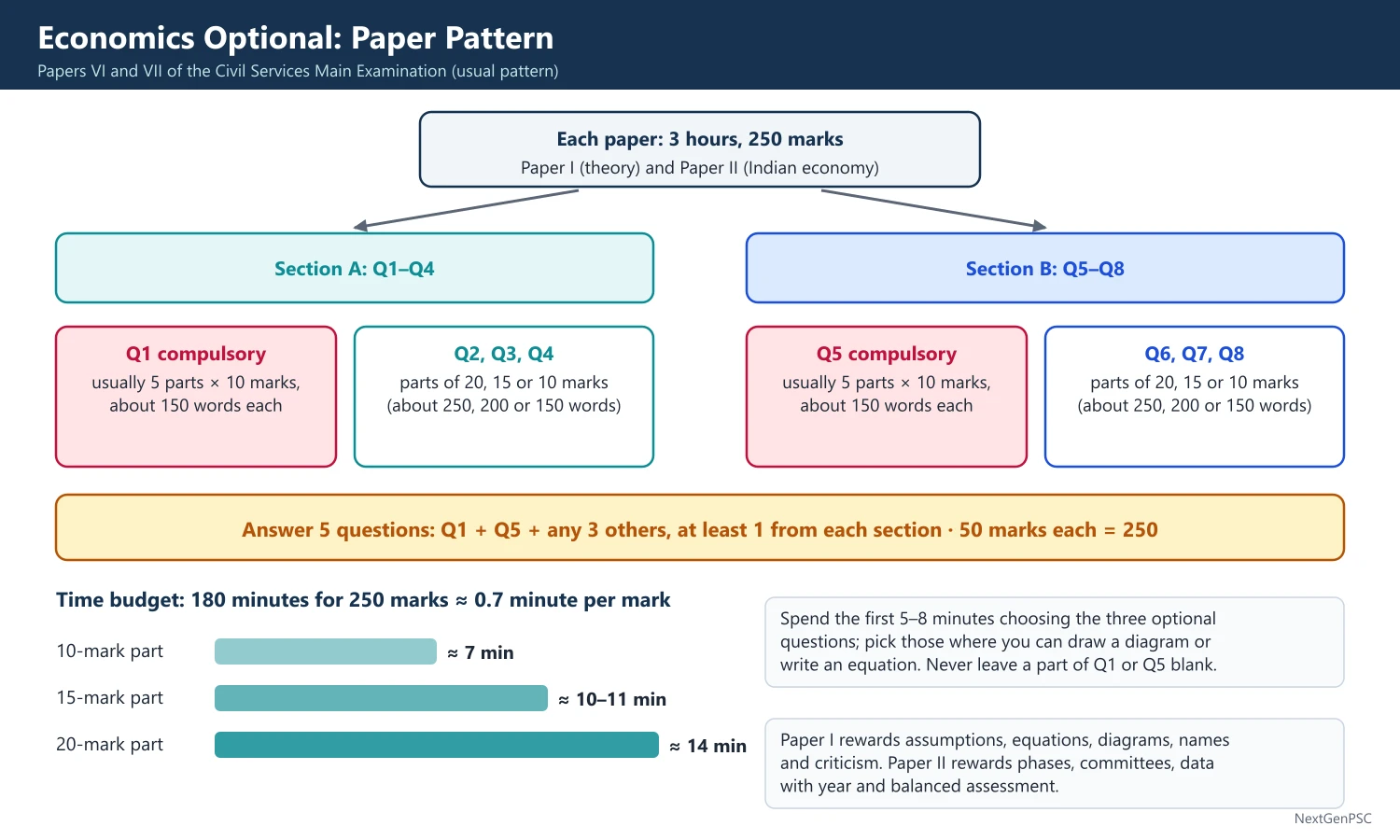
Economics optional has two papers of 250 marks each (Papers VI and VII of the Main examination), three hours each. Each paper has eight questions in two sections; Q1 and Q5 are compulsory and the candidate answers three more, at least one from each section. Paper I tests economic theory and Paper II tests the Indian economy.
In simple words
The Economics optional is two exam papers in UPSC Mains, each worth 250 marks and three hours long.
Think of each paper as a menu of eight dishes where two are fixed and you choose three more: you answer five questions of 50 marks each.
Paper I asks about theories such as markets, money and trade; Paper II asks about how India's economy developed and how its policies work.
Knowing the pattern helps you plan time, pick questions wisely and avoid losing easy marks in the short compulsory parts.
1. Where the optional fits in Mains
Civil Services Main Examination: nine written papers; two qualifying language papers (an Indian language and English, 300 marks each) and seven merit papers: Essay, GS I–IV and the two optional papers, 250 marks each, a written total of 1,750; with the interview (275) the final total is 2,025.
Optional subject: Economics is one of the optional subjects listed by UPSC; Papers VI and VII of Mains are Economics Paper I and Paper II.
Choice of optional: the candidate chooses one optional subject (both its papers) in the application form; it cannot be changed later for that year's examination.
Weight: the two optional papers carry 500 marks, about 28.6% of the written total, so the optional often decides the final rank.
Overlap: Economics overlaps heavily with GS Paper III (Indian economy, growth, budgeting, agriculture, inflation) and with the Essay paper, so the same preparation serves three papers.
2. Structure of each paper
Time and marks: each paper is of three hours and 250 marks.
Two sections: eight questions, four in Section A (Q1–Q4) and four in Section B (Q5–Q8).
Compulsory questions: Q1 and Q5 are compulsory; of the remaining six the candidate answers any three, with at least one from each section, so five questions are answered in all.
Marks per question: each question carries 50 marks, so five answers make 250.
Q1 and Q5: usually five short parts of 10 marks each, to be answered in about 150 words each.
Q2–Q4 and Q6–Q8: usually two or three parts, such as 20 + 15 + 15 or 20 + 20 + 10 marks; about 250 words for a 20-mark part and 200 words for a 15-mark part; the split varies from year to year.
Medium: the question paper is printed in English and Hindi; the candidate writes in the medium chosen in the application form.
Answer booklet: UPSC uses a question-cum-answer (QCA) booklet with fixed space after each question, so length is limited by space as well as by time.
3. What each paper covers
Paper I (economic theory): Advanced Micro Economics; Advanced Macro Economics; Money, Banking and Finance; International Economics; Growth and Development.
Paper I sections: Section A usually draws on micro, macro, money and public finance; Section B usually draws on international economics and growth and development, though topics can cross over.
Paper II (Indian economy): Indian Economy in the Pre-Independence Era; Indian Economy after Independence (pre-liberalisation era); and the post-liberalisation era of new economic reform.
Paper II sections: Section A usually covers the colonial economy and the planning era up to 1991; Section B usually covers the reforms since 1991; current data are expected throughout.
4. Types of questions
Define and explain: e.g. state Walras' Law, explain the kinked demand curve; tests precise definitions.
Derive with a diagram: e.g. derive the IS and LM curves, show the effects of a tariff; tests the ability to build a model step by step.
Compare models: e.g. Cournot versus Bertrand, Ricardo versus Kaldor on distribution; tests assumptions and results side by side.
Critically examine: e.g. Arrow's impossibility theorem, or the relevance of the Lewis model to India; tests criticism and balance.
Numerical or algebraic: e.g. compute the investment multiplier, the money multiplier or the Cournot output; tests that the student can apply equations.
Statement to comment on: e.g. 'Supply creates its own demand'; tests whether the student can place a statement in a theory and evaluate it.
Indian application: e.g. assess fiscal consolidation since the FRBM Act or the impact of the Green Revolution; tests data with year and source.
Policy evaluation: e.g. whether India should move to full capital account convertibility; tests reasoning plus a clear conclusion.
5. How Paper I and Paper II differ
Paper I: rewards rigour: assumptions, equations, diagrams, the name of the economist and the criticism.
Paper II: rewards facts and analysis: phases, committees, data with year, and a balanced assessment of policy.
Linkage: the best Paper II answers use Paper I theory, e.g. the Mahalanobis strategy through the two-sector capital goods logic, or MSP through price-support analysis.
Data currency: Paper II data should be the latest available, e.g. from the Economic Survey and the Union Budget of the examination year.
Common trap: writing general GS-style answers in Paper I; the examiner wants theory, not description.
6. Time management
Budget: 180 minutes for 250 marks is about 0.7 minute per mark; a 10-mark part gets about 7 minutes, a 15-mark part about 10–11 minutes and a 20-mark part about 14 minutes.
Choosing questions: spend the first 5–8 minutes choosing the three optional questions; pick those where you can draw a diagram or write an equation.
Order: many candidates begin with their strongest question, but Q1 and Q5 must be attempted; leaving a 10-mark part blank loses easy marks.
Diagrams: practise drawing each standard diagram in under two minutes; a neat, labelled pencil diagram saves words.
Full attempt: attempting all 250 marks matters more than polishing one answer.
7. Using it in the exam
10-mark part (150 words): one-line definition with the economist's name, one equation or a small diagram, two or three points and a one-line conclusion.
15-mark part (200 words): definition, assumptions, mechanism with diagram, one criticism or Indian example, conclusion.
20-mark part (250 words): introduction, model with assumptions and equations, diagram, comparative statics, criticism, Indian application, conclusion.
Keywords examiners look for: assumptions, equilibrium, stability condition, comparative statics, criticism, Indian evidence.
Remember: each question carries 50 marks, so choosing the three optional questions is the single biggest decision in the paper.
| Item | Detail |
|---|---|
| Duration and marks | 3 hours, 250 marks |
| Questions set | 8 (Section A: Q1–Q4; Section B: Q5–Q8) |
| Questions to answer | 5: Q1 and Q5 compulsory + 3 more, at least 1 from each section |
| Marks per question | 50 |
| Q1 and Q5 | Usually 5 parts × 10 marks, about 150 words each |
| Other questions | Usually parts of 20, 15 or 10 marks (about 250, 200 or 150 words) |
| Paper I content | Micro, macro, money and public finance, international economics, growth and development |
| Paper II content | Colonial economy, planning era to 1991, post-1991 reforms |
Mains points
- Treat Q1 and Q5 as guaranteed marks: ten short parts worth 100 marks across the two sections; prepare crisp 150-word answers on every syllabus phrase.
- Choose optional questions by how many parts you can answer with a model, an equation or a diagram, not by how familiar the topic sounds.
- Read the directive word (derive, compare, critically examine, comment) and shape the answer to it.
- Paper I wants theory with assumptions and diagrams; Paper II wants data with year and source and a balanced policy assessment.
- Divide time by marks (about 0.7 minute per mark) and keep 5 minutes at the end to label diagrams and finish conclusions.
- A common mistake is spending 40 minutes on the first question and rushing the last; an incomplete fifth answer costs more than a slightly shorter first one.
Did you know?
- Memory trick for the pattern: '8–5–2–1': eight questions set, five answered, two compulsory (Q1 and Q5), at least one from each section.
Syllabus Map, Study Order and Standard Books
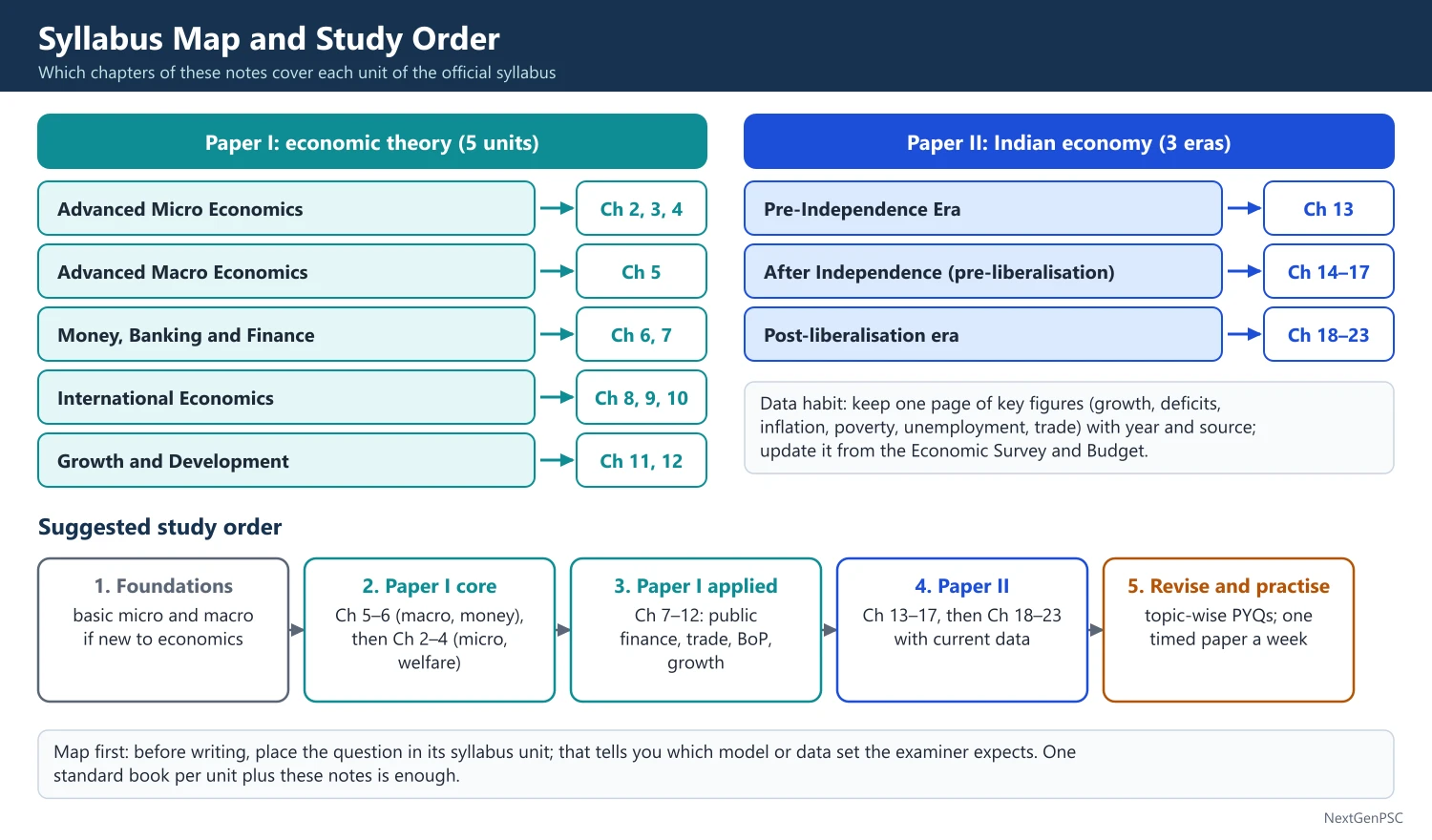
Paper I has five units (Advanced Micro, Advanced Macro, Money Banking and Finance, International Economics, Growth and Development) covered in Chapters 2–12. Paper II has three eras (pre-Independence, pre-liberalisation, post-liberalisation) covered in Chapters 13–23. Study macro and money first, then micro, then applied theory, then the Indian economy, with one standard book per unit plus official data.
In simple words
The syllabus map shows which chapter of these notes covers each line of the official UPSC syllabus.
It works like a city map before a trip: you see every place you must visit and the best route between them.
Following a sensible order saves months, because later topics such as public finance and trade use ideas from macro and money.
UPSC questions often copy syllabus phrases almost word for word, so every phrase deserves a prepared answer.
1. The syllabus at a glance
Paper I has five units: Advanced Micro Economics; Advanced Macro Economics; Money, Banking and Finance; International Economics; Growth and Development.
Paper II has three parts: Indian Economy in the Pre-Independence Era; Indian Economy after Independence (pre-liberalisation era); and the post-liberalisation era of new economic reform.
Reading the syllabus: each phrase of the official syllabus can become a question, so learn it word by word; these notes follow it unit by unit.
2. Paper I map
Advanced Micro (a) and (b): Marshallian and Walrasian approaches to price determination; distribution theories of Ricardo, Kaldor and Kalecki: Chapter 2.
Advanced Micro (c): monopolistic competition, duopoly, oligopoly: Chapter 3.
Advanced Micro (d): Pareto, Hicks and Scitovsky criteria, Arrow's impossibility theorem, Sen's social welfare function: Chapter 4.
Advanced Macro: Classical, Keynes (IS-LM), neo-classical synthesis, New Classical; theories of interest rate determination and interest rate structure: Chapter 5.
Money, Banking and Finance (a): demand for and supply of money, money multiplier, quantity theories, Keynes, monetary management, central bank and treasury, ceiling on money growth: Chapter 6.
Money, Banking and Finance (b): role of public finance, taxes and subsidies, limits to taxation and borrowing, crowding out, public expenditure: Chapter 7.
International Economics (a): comparative advantage, terms of trade and offer curve, product cycle and strategic trade, trade as an engine of growth: Chapter 8.
International Economics (b) and parts of (c): tariff and quota, trade policy and developing countries, trade blocs and monetary unions, WTO: Chapter 9.
International Economics (c): BoP adjustment approaches, policy mix, capital mobility, floating rates, currency boards, speculation: Chapter 10.
Growth and Development (a): Harrod, Lewis, balanced and unbalanced growth, human capital, R&D: Chapter 11.
Growth and Development (b)–(f): Myrdal, Kuznets, agriculture, trade and MNCs, planning, Tinbergen, PPP, HDI, basic needs, sustainability: Chapter 12.
3. Paper II map
Pre-Independence: land system, commercialisation of agriculture, drain theory, laissez-faire, jute, cotton, railways, money and credit: Chapter 13.
After Independence, planning and decentralisation: contributions of Vakil, Gadgil and V.K.R.V. Rao; central to indicative planning; 73rd and 74th Amendments: Chapter 14.
Pre-liberalisation agriculture: land reforms, Green Revolution, capital formation: Chapter 15.
Pre-liberalisation industry: trends, public and private sectors, small-scale and cottage industries: Chapter 16.
National and per capita income, factors of distribution, measures and trends of poverty and inequality: Chapter 17.
Post-liberalisation agriculture: WTO, food processing, subsidies, prices, PDS, public expenditure: Chapter 18.
Industry: strategy of industrialisation, privatisation, disinvestment, FDI and multinationals: Chapter 19.
Trade: TRIPS, TRIMS, GATS, EXIM policy, exchange rate regime and convertibility: Chapter 20.
Public finance: Fiscal Responsibility Act, Finance Commissions and fiscal federalism, fiscal consolidation, tax reform: Chapter 21.
Monetary system: role of the RBI under the new regime: Chapter 22.
Employment and poverty, rural wages, employment generation, poverty alleviation and rural employment guarantee: Chapter 23.
4. Suggested study order
Step 1, foundations: if you have no economics background, first read basic micro (demand, cost, market forms) and basic macro (national income, multiplier) from an introductory text.
Step 2, Paper I core: Chapters 5 and 6 (macro and money) first, because public finance, BoP and Indian monetary policy build on them; then Chapters 2–4 (micro and welfare).
Step 3, Paper I applied: Chapters 7–12 (public finance, trade, BoP, growth, development).
Step 4, Paper II: Chapters 13–17 (history and the pre-1991 economy), then Chapters 18–23 (reforms), updated with the Economic Survey and the Budget.
Step 5, revision and practice: previous years' questions topic-wise; at least one timed full paper a week in the last two months.
GS linkage: read Paper II alongside GS Paper III so that one set of notes serves both.
5. Standard books for Paper I
Microeconomics: A. Koutsoyiannis, Modern Microeconomics (market structures, distribution, general equilibrium, welfare); H.L. Ahuja, Advanced Economic Theory (comprehensive and exam-oriented).
Macroeconomics: Dornbusch, Fischer and Startz, Macroeconomics; Richard T. Froyen, Macroeconomics: Theories and Policies (strong on the Classical, Keynesian, monetarist and new classical schools).
Money: M.L. Jhingan, Monetary Economics; for India, the RBI's Monetary Policy Reports and Annual Report.
Public finance: R.A. Musgrave and P.B. Musgrave, Public Finance in Theory and Practice.
International economics: Dominick Salvatore, International Economics.
Growth and development: M.L. Jhingan, The Economics of Development and Planning; Michael Todaro and Stephen Smith, Economic Development; Debraj Ray, Development Economics.
6. Standard books and sources for Paper II
Colonial economy: Tirthankar Roy, The Economic History of India, 1857–1947; for the nationalist view, Dadabhai Naoroji and R.C. Dutt in summary.
Indian economy: Uma Kapila, Indian Economy: Performance and Policies; V.K. Puri and S.K. Misra, Indian Economy.
Official sources: the latest Economic Survey and Union Budget documents, RBI Annual Report, NSO national accounts and PLFS, Finance Commission reports, NITI Aayog papers.
Data habit: keep a one-page sheet of key figures (growth, deficits, inflation, poverty, unemployment, trade) with year and source, updated each year.
7. Using it in the exam
Map first: before writing, place the question in its syllabus unit; that tells you which model or data set the examiner expects.
Cross-unit questions: Paper I often joins units (e.g. Keynesian theory with public finance, trade theory with development); prepare the linkages.
Previous questions: sort previous years' questions by these chapters; frequently asked themes (IS-LM, the Harrod model, the Lewis model, welfare criteria, BoP approaches, quantity theories) deserve full model answers.
Books versus notes: one standard book per unit, these notes and short self-made summaries are enough; too many books dilute revision.
| Paper | Syllabus unit | Chapters |
|---|---|---|
| I | Advanced Micro Economics | 2, 3, 4 |
| I | Advanced Macro Economics | 5 |
| I | Money, Banking and Finance | 6, 7 |
| I | International Economics | 8, 9, 10 |
| I | Growth and Development | 11, 12 |
| II | Pre-Independence Era | 13 |
| II | After Independence (pre-liberalisation) | 14, 15, 16, 17 |
| II | Post-liberalisation era | 18, 19, 20, 21, 22, 23 |
Mains points
- Print the official syllabus and tick each phrase only when you can write a 150-word answer on it with a diagram or data.
- Paper I units are interlinked: the multiplier, IS-LM and money demand reappear in public finance, BoP and development questions.
- For Paper II, read the latest Economic Survey and Budget in the months before Mains and update figures with year and source.
- Use standard books for depth, but revise from compact notes; examiners reward accuracy and structure more than volume.
- Make a list of economists and their models (who said what, in which work and year) and revise it weekly; wrong attribution is a common loss of marks.
- Sort previous years' questions by chapter to see which themes recur and which syllabus lines are still unasked.
Did you know?
- Memory trick for Paper I units: 'MiMa-MoIn-GD': Micro, Macro, Money, International, Growth and Development.
Answer Writing, Diagrams and Equations for Economics
A high-scoring Economics answer has a precise definition with the economist's name, the model's assumptions, equations in plain notation, a labelled diagram, comparative statics, attributed criticism and an Indian application with data and year. Structure and accuracy matter more than length.
In simple words
Writing an Economics answer is like presenting a recipe: name the dish, list the ingredients (assumptions), show the steps (equations), and show a picture (diagram).
Examiners read hundreds of copies quickly, so clear headings and a neat labelled diagram catch their eye.
Theory gains marks when you add a real Indian example with a year.
UPSC asks you to derive, compare or critically examine, and each of these words needs a slightly different structure.
1. What the examiner rewards
Precision: correct definitions with the economist's name (e.g. Walras' Law, Pareto optimality, Harrod's warranted rate of growth).
Structure: introduction, body with sub-headings, conclusion; the examiner reads quickly.
Analytics: a model with assumptions, equations and diagrams scores higher than description.
Balance: criticism and alternative views, with names.
Application: an Indian example or data with year and source.
2. Standard answer structure
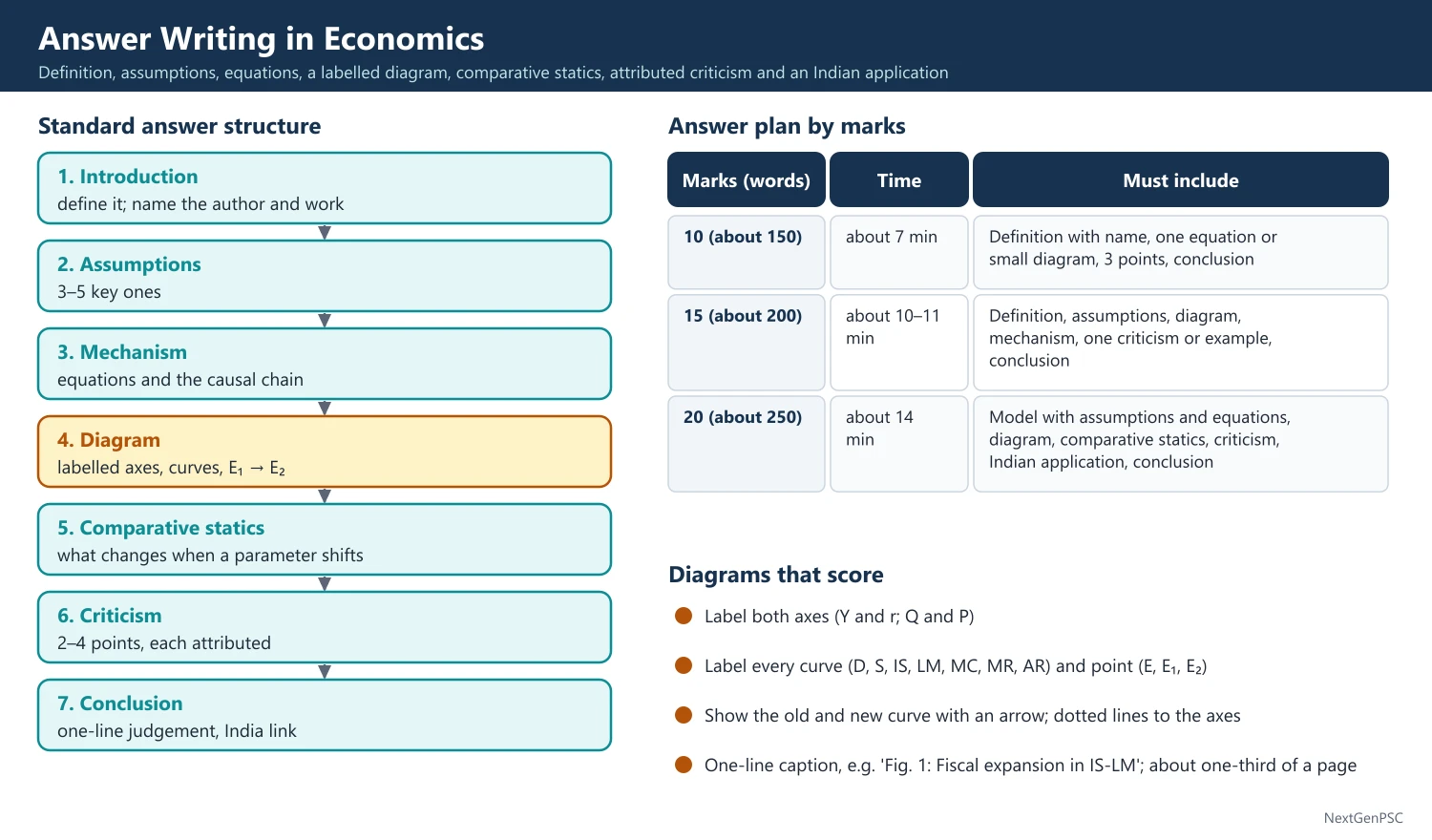
Introduction (2–3 lines): define the concept or state the model, naming the author and the work where you are sure (e.g. Keynes, The General Theory of Employment, Interest and Money, 1936).
Assumptions: list 3–5 key assumptions in one or two lines; many criticisms come from relaxing them.
Mechanism: the equations and the causal chain (e.g. rise in G → rise in Y through the multiplier 1/(1 − c) → rise in money demand → rise in r → fall in I).
Diagram: one neat, labelled diagram with a caption.
Comparative statics: what happens to the equilibrium when a parameter changes.
Criticism and evaluation: 2–4 points, each attributed to a school or economist.
Conclusion: a one or two-line judgement, if possible linked to India or current policy.
3. Drawing diagrams that score
Tools: pencil and a small scale; diagrams in the answer booklet are allowed and expected.
Axes: always label both axes with the variable (e.g. Y for income and r for the interest rate; Q and P for quantity and price).
Curves: label every curve (D, S, IS, LM, MC, MR, AR) and every equilibrium point (E, E1, E2).
Shifts: show the old and the new curve with an arrow; mark the old and new equilibrium values on the axes with dotted lines.
Caption: one line under the diagram (e.g. 'Fig. 1: Fiscal expansion in IS-LM') and refer to it in the text.
Size: about one-third of a page; a very large diagram leaves no space for the text.
Core diagrams to master: Marshallian and Walrasian stability; Edgeworth box and contract curve; utility possibility frontier; Chamberlin tangency; Cournot reaction curves; kinked demand curve; Keynesian cross; IS-LM; AD-AS; Phillips curve; liquidity preference; offer curves; tariff in partial equilibrium; Swan diagram; Harrod knife-edge and Solow steady state; Lewis model.
4. Writing equations
Plain notation: Y = C + I + G; C = a + bY; MV = PT; M = kPY; g = s/v; M = mH with m = (1 + c)/(c + r).
Define every symbol: immediately after the equation, in one line.
Show the derivation briefly: e.g. Y = a + bY + I gives Y = (a + I)/(1 − b), so the investment multiplier is 1/(1 − b).
State conditions exactly: e.g. Marshall-Lerner condition: starting from balanced trade, a devaluation improves the trade balance if the sum of the absolute values of the price elasticities of export and import demand is greater than one.
Numerical parts: write the formula, substitute the values, give the result with units, then interpret it in one line.
5. Using Indian data and examples
Data with year and source: e.g. 'a CPI inflation target of 4% with a band of ±2%, under the RBI Act as amended in 2016'.
Paper I applications: RBI's inflation targeting (monetary policy), GST (indirect taxation), India's 1991 BoP crisis (BoP adjustment), OPEC (cartels), telecom price wars (oligopoly), Kerala (human development).
Paper II analysis: trend (what changed), cause (why), assessment (what worked and what did not), way forward.
Committees and reports: name them correctly with the year; a wrong name costs credibility.
Never invent figures: if unsure of the latest number, write the trend and the latest year you are sure of.
6. Common mistakes
Description instead of analysis: in Paper I, writing an essay without a model.
Unlabelled diagrams: a diagram without axis labels or equilibrium points earns little.
Missing assumptions: a model makes sense only with its assumptions.
Wrong attribution: e.g. giving the compensation principle to Pareto (it is Kaldor, 1939, and Hicks, 1939) or the kinked demand curve to Chamberlin (it is Sweezy, and Hall and Hitch, 1939).
Ignoring the directive word: 'critically examine' needs both sides; 'derive' needs steps; 'compare' needs a table or parallel points.
Overwriting: exceeding the space in the booklet or the time for one question.
7. Using it in the exam
10-mark answer: definition, one equation or a small diagram, three points, one-line conclusion.
15-mark answer: definition, assumptions, diagram, mechanism, one criticism, conclusion.
20-mark answer: full model with assumptions, equations, diagram, comparative statics, criticism with names, Indian application, conclusion.
Practice routine: write two answers a day under time, then compare with the notes for missing keywords.
Revision aid: a one-page sheet for each chapter with its equations, diagrams and names.
| Marks (words) | Time | Must include |
|---|---|---|
| 10 (about 150) | About 7 minutes | Definition with name, one equation or small diagram, 3 points, conclusion |
| 15 (about 200) | About 10–11 minutes | Definition, assumptions, diagram, mechanism, one criticism or example, conclusion |
| 20 (about 250) | About 14 minutes | Model with assumptions and equations, diagram, comparative statics, criticism, Indian application, conclusion |
| Directive | What the answer needs |
|---|---|
| Derive | Assumptions, step-by-step equations or diagram construction, final result |
| Compare / distinguish | Parallel points or a table on assumptions, mechanism and results |
| Critically examine | Model, then strengths and weaknesses with names, then a balanced judgement |
| Comment / discuss | Place the statement in a theory, give evidence for and against, conclude |
| Assess / evaluate (Paper II) | Trend with data and year, causes, outcomes, way forward |
Mains points
- Open with a precise, attributed definition; it signals command of the subject in the first two lines.
- Every Paper I answer of 15 or 20 marks should carry at least one labelled diagram or a set of equations.
- State the assumptions explicitly; criticisms then follow naturally from relaxing them.
- Show comparative statics: examiners look for what happens when a parameter changes, not only the equilibrium.
- Use Indian examples with year and source even in Paper I; it shows application.
- End with a judgement, not a summary; avoid unlabelled diagrams, wrong attributions and invented data.
Did you know?
- Memory trick for a full answer: 'DAME-DCC': Definition, Assumptions, Mechanism, Equations, Diagram, Criticism, Conclusion.
Economics Optional: All chapters
- Exam Pattern, Syllabus and Strategy
- Price Determination and Theories of Distribution
- Market Structures
- Welfare Economics
- Theories of Employment, Income and Interest
- Money and Monetary Management
- Public Finance
- Theories of International Trade
- Trade Policy, Protection and the WTO
- Balance of Payments and Exchange Rates
- Theories of Growth
- Economic Development
- Indian Economy in the Pre-Independence Era
- Planning in India
- Agriculture before Liberalisation
- Industry before Liberalisation
- National Income, Poverty and Inequality
- Agriculture after Liberalisation
- Industry after Liberalisation
- External Sector after Liberalisation
- Public Finance and Fiscal Federalism in India
- Monetary System and the RBI
- Employment, Wages and Poverty Alleviation