
Economics Optional · UPSC Notes
Monetary System and the RBI — UPSC Economics Optional Notes
Free, exam-focused notes for UPSC Prelims and Mains, with Prelims tips and Mains points for every topic. 4 topics.
Open in the interactive reader: bookmarks, progress tracking and read-aloud.
Role of the RBI under the New Regime
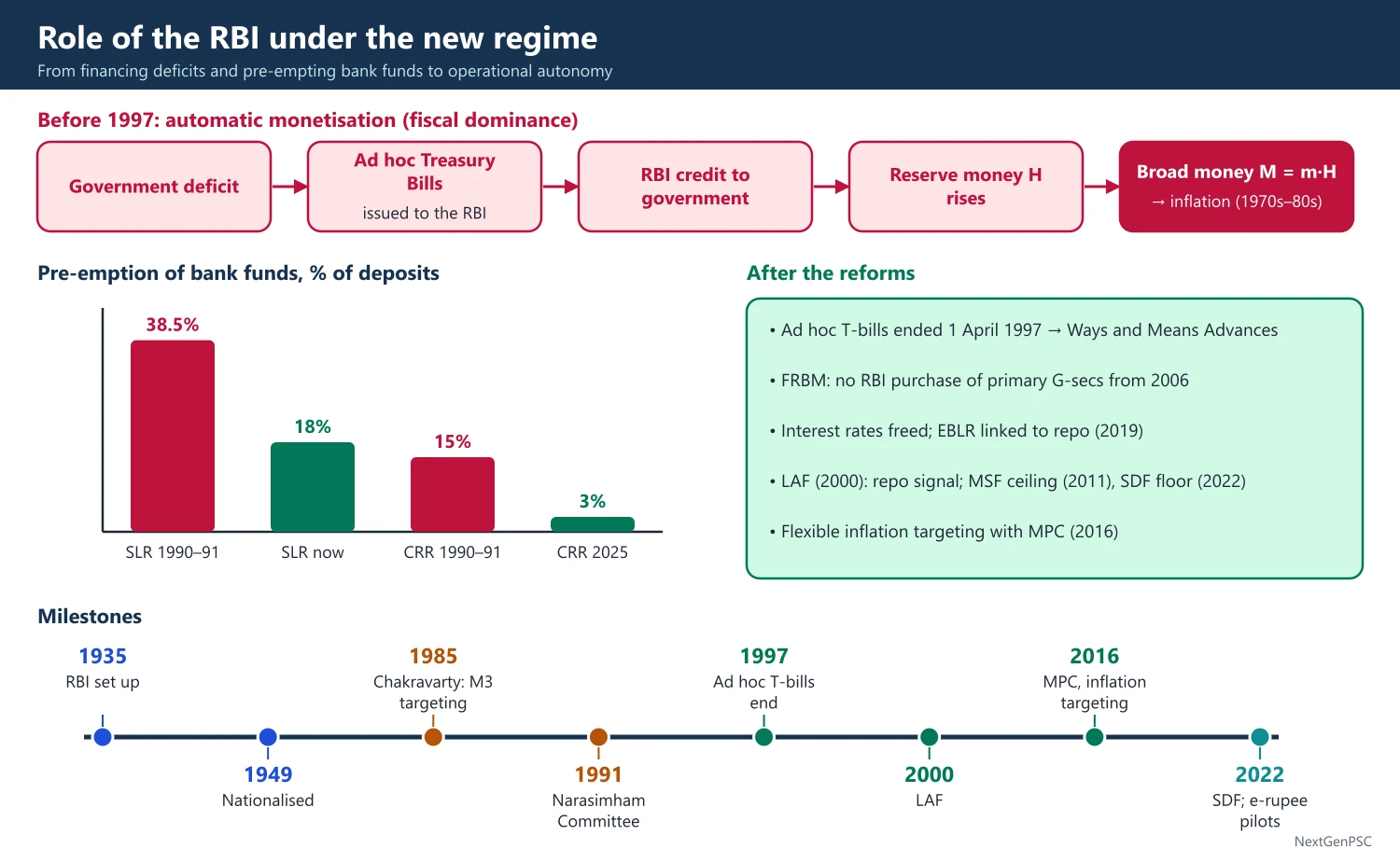
Before 1991 the RBI worked under fiscal dominance: it financed deficits through ad hoc Treasury Bills, pre-empted bank funds through high CRR and SLR, and fixed interest rates. Under the new regime it gained operational freedom: automatic monetisation ended in 1997, interest rates were deregulated, monetary policy moved to market-based tools (LAF, repo) and, from 2016, to flexible inflation targeting with a Monetary Policy Committee.
In simple words
The RBI is India's central bank: it prints currency, sets interest rates, regulates banks and manages foreign exchange.
Think of it as the referee and the bank of all banks: it keeps the game fair and lends to banks when they run short.
Before 1991 it mostly helped the government borrow; after reforms it got freedom to control inflation and regulate banks using market tools.
UPSC asks how the RBI's role changed after 1991 and how independent it is.
1. Origins and Functions
Establishment: set up on 1 April 1935 under the RBI Act, 1934, following the Hilton Young Commission (1926); nationalised on 1 January 1949.
Monetary authority: formulates and implements monetary policy to maintain price stability while keeping growth in mind (Preamble, as amended in 2016).
Issuer of currency: sole authority to issue banknotes (except one-rupee notes and coins issued by the Government); uses the minimum reserve system (gold and foreign exchange of at least ₹200 crore, gold at least ₹115 crore) since 1957.
Banker to the government: manages central and state government accounts and public debt; gives Ways and Means Advances for temporary mismatches.
Banker's bank and lender of last resort: holds banks' reserves, provides liquidity (LAF, MSF) and emergency support.
Regulator and supervisor: under the Banking Regulation Act, 1949 for banks, the RBI Act for NBFCs, and the Board for Financial Supervision (1994).
Foreign exchange manager: manages reserves and the rupee under FEMA, 1999.
Payment systems: regulates payment systems under the Payment and Settlement Systems Act, 2007; promoted NPCI (2008), UPI (2016) and the digital rupee (pilots from November–December 2022).
Developmental role: built institutions such as IDBI (1964), NABARD (1982) and EXIM Bank (1982); promotes financial inclusion and literacy.
2. The Pre-1991 Regime: Fiscal Dominance
Automatic monetisation: the government covered deficits by issuing ad hoc Treasury Bills to the RBI, creating reserve money; monetised deficits fed inflation in the 1970s and 1980s.
Financial repression: SLR reached 38.5% and CRR 15% by 1990–91, so over half of deposits were pre-empted for government and reserves; interest rates were administered and credit was directed.
Chakravarty Committee (1985): recommended monetary targeting with feedback, using broad money (M3) growth consistent with output growth and acceptable inflation; it also called for ending automatic monetisation.
Vaghul Committee (1987): recommended developing the money market (commercial paper, certificates of deposit, call money reforms).
3. Reforms under the New Regime
Narasimham Committee (1991): recommended cutting SLR to 25% and CRR gradually, deregulating interest rates and strengthening prudential norms; SLR is now 18%.
End of ad hoc Treasury Bills: under a September 1994 agreement between the Government and the RBI, ad hoc T-bills were phased out from 1 April 1997 and replaced by Ways and Means Advances with limits.
FRBM Act (2003): barred the RBI from subscribing to primary issues of government securities from April 2006 (except in specified emergencies), completing the separation of debt and monetary management in law.
Interest rate deregulation: lending rates were freed from 1994 (above ₹2 lakh) and savings deposit rates in 2011; benchmark systems moved from PLR to base rate (2010), MCLR (2016) and external benchmark lending rates linked to the repo rate (October 2019).
Multiple indicator approach (1998–99): under Governor Bimal Jalan, the RBI moved away from M3 targeting to watching many indicators (rates, credit, output, inflation, exchange rate).
Liquidity Adjustment Facility (June 2000): repo and reverse repo operations made short-term interest rates the main policy signal; MSF (2011) set the ceiling; the Standing Deposit Facility (April 2022) became the floor without collateral.
Inflation targeting: the Urjit Patel Committee (2014) led to the Monetary Policy Framework Agreement (February 2015) and the RBI Act amendment (Finance Act, 2016) creating the MPC (constituted September 2016).
Economic Capital Framework: the Bimal Jalan Committee (2019) set rules for reserves and surplus transfer to the government; the RBI transferred ₹1.76 lakh crore in 2019 and a record ₹2.69 lakh crore for 2024–25 (May 2025).
4. Regulation and Financial Stability
Prudential regulation: Basel capital norms, asset classification and provisioning, the Prompt Corrective Action framework (revised 2017) and the Asset Quality Review (2015–16) that exposed hidden bad loans.
NBFC regulation: after the IL&FS default (2018), the RBI introduced scale-based regulation of NBFCs (effective October 2022) and digital lending guidelines (2022).
Cooperative banks: the Banking Regulation (Amendment) Act, 2020 brought urban and multi-state cooperative banks under fuller RBI supervision after the PMC Bank failure (2019).
Consumer protection: the Integrated Ombudsman Scheme (2021) unified grievance redress.
Financial Stability Report: published twice a year; the June 2026 report put banks' gross NPAs at a multi-decadal low near 2% in March 2026.
5. Diagrams to Draw
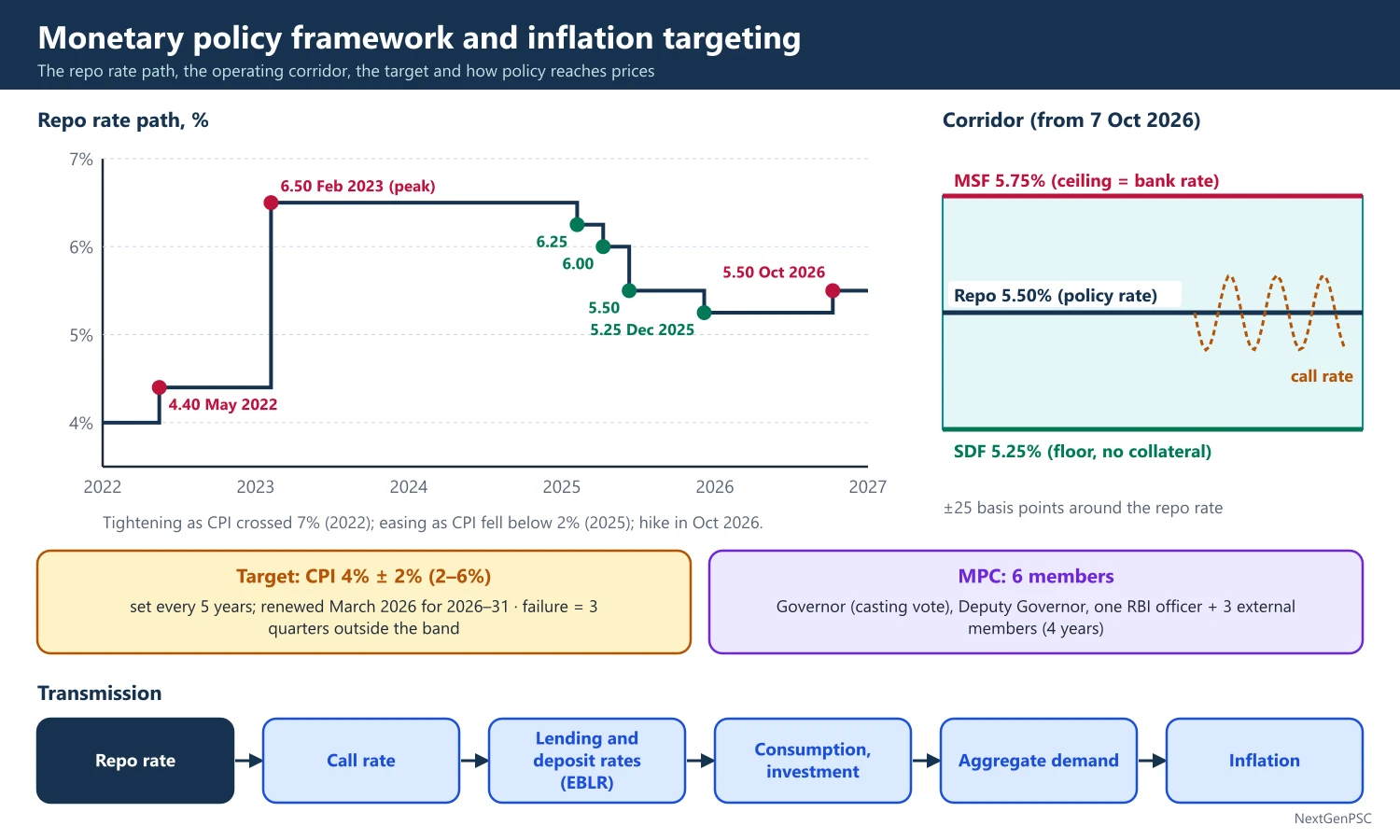
Interest rate corridor: draw a horizontal band with the MSF rate as the ceiling, the repo rate in the middle and the SDF rate as the floor (25 basis points each side); show the weighted average call rate moving within the band as liquidity changes.
Reserve money creation: draw a flow from government deficit to ad hoc T-bills to RBI credit to reserve money to broad money (M = mH) to show pre-1997 monetisation.
Timeline chart: mark 1935, 1949, 1985 (Chakravarty), 1991 (Narasimham), 1997 (end of ad hoc T-bills), 2000 (LAF), 2016 (MPC), 2022 (SDF and e-rupee).
6. Theory and Debates
Central bank independence: Kydland and Prescott (1977) and Barro and Gordon (1983) showed that discretionary policy has an inflation bias (time inconsistency); Rogoff (1985) proposed a 'conservative central banker'; independence improves credibility.
Fiscal dominance: Sargent and Wallace ('Some Unpleasant Monetarist Arithmetic', 1981) showed that if fiscal policy is unsustainable, monetary policy eventually loses control of inflation.
Section 7 controversy (2018): the government's consultations under Section 7 of the RBI Act over capital reserves and lending rules led to tensions; Governor Urjit Patel resigned in December 2018; the episode raised questions about autonomy.
Multiple mandates: critics argue that the RBI's roles as monetary authority, debt manager and bank regulator can conflict; proposals for a separate Public Debt Management Agency (2015) were not implemented.
Digital era: UPI made India a world leader in real-time payments, while the e-rupee raises questions about bank disintermediation and privacy.
7. Using It in the Exam
10-mark answer: list RBI functions and three changes after 1991 (end of ad hoc T-bills, LAF, inflation targeting).
15/20-mark answer: contrast fiscal dominance before 1991 with operational autonomy after, use the Chakravarty and Narasimham committees, the FRBM Act, LAF and MPC, and discuss independence with theory and the 2018 episode.
Keywords: fiscal dominance, ad hoc Treasury Bills, Ways and Means Advances, financial repression, LAF, corridor, MPC, economic capital framework, central bank independence.
Quotable line: Sargent and Wallace's argument that monetary policy cannot control inflation for long if fiscal policy is unsustainable (paraphrased).
| Aspect | Before 1991 | After reforms |
|---|---|---|
| Deficit financing | Automatic via ad hoc T-bills | Ended 1997; WMA with limits; no primary purchases from 2006 |
| Reserve requirements | SLR 38.5%, CRR 15% (1990–91) | SLR 18%; CRR cut to 3% (2025) |
| Interest rates | Administered | Market-determined; EBLR linked to repo (2019) |
| Policy framework | Monetary targeting (M3) | Multiple indicators (1998), then inflation targeting with MPC (2016) |
| Operating tool | CRR, SLR, credit controls | LAF corridor: SDF, repo, MSF |
Mains points
- Frame the answer as a shift from fiscal dominance to operational autonomy.
- Give dates: 1994 agreement and 1997 end of ad hoc T-bills, 2000 LAF, 2006 FRBM ban, 2016 MPC, 2022 SDF.
- Mention committees: Chakravarty (1985), Vaghul (1987), Narasimham (1991), Urjit Patel (2014), Bimal Jalan (2019).
- Include regulatory and payments roles (PCA, AQR, NBFC rules, UPI, e-rupee).
- Discuss independence with Kydland-Prescott and Sargent-Wallace, and the 2018 Section 7 episode.
- Common mistake: saying the RBI sets the inflation target; the government sets it in consultation with the RBI.
Did you know?
- The RBI's emblem of a tiger and palm tree was adapted from the East India Company's double mohur, with the lion replaced by a tiger.
Monetary Policy Framework and Inflation Targeting
India adopted flexible inflation targeting in 2016 after the Urjit Patel Committee (2014): the government sets a CPI inflation target of 4% with a band of 2–6% every five years, and a six-member Monetary Policy Committee sets the repo rate. The target was renewed in March 2026 for 2026–31. After cutting the repo rate to 5.25% by December 2025, the MPC raised it to 5.50% in October 2026 as inflation pressures returned.
In simple words
Inflation targeting means the central bank promises to keep price rises near a set number, here 4% a year, and adjusts interest rates to get there.
It is like a thermostat: if the room (inflation) gets too hot, raise interest rates to cool spending; if too cold, cut them.
A committee of six (three from RBI, three outside experts) votes on the repo rate, which then affects loan and deposit rates across banks.
UPSC asks about the framework, how well it has worked and whether food inflation should be excluded.
1. Concepts
Inflation targeting: a framework in which the central bank publicly commits to a numerical inflation target and is accountable for meeting it; New Zealand was first (1990).
Flexible inflation targeting: the central bank aims at the inflation target over the medium term while also caring about output stabilisation (Svensson); India's framework is of this type.
Nominal anchor: a variable that ties down price expectations; India moved from M3 (1985–98) to multiple indicators (1998–2015) to CPI inflation (from 2015).
Taylor rule (1993): i = r* + π + 0.5(π − π*) + 0.5(y − y*), a guide to how the policy rate should respond to inflation and output gaps; the Taylor principle requires the nominal rate to rise more than one-for-one with inflation.
Time inconsistency: Kydland and Prescott (1977) showed that discretionary policy leads to higher inflation without higher output; rules and independent committees reduce this bias.
2. Urjit Patel Committee and the Legal Framework
Urjit Patel Committee (January 2014): recommended CPI (combined) inflation as the nominal anchor, a target of 4% ± 2%, a glide path (8% by January 2015, 6% by January 2016) and a Monetary Policy Committee.
Monetary Policy Framework Agreement (February 2015): signed between the Government and the RBI, adopting the glide path.
RBI Act amendment (Finance Act, 2016): Sections 45ZA to 45ZO; the government, in consultation with the RBI, sets the target once every five years.
Targets notified: 4% with 6% upper and 2% lower tolerance for August 2016–March 2021; renewed for April 2021–March 2026; renewed again (notification of 25 March 2026) for 1 April 2026–31 March 2031.
Failure clause: if average inflation is above 6% or below 2% for three consecutive quarters, the RBI must report reasons, remedial actions and the time to return to target; the first such failure occurred in January–September 2022 and a report was sent in November 2022.
3. The Monetary Policy Committee
Composition: six members: the Governor (chair, with a casting vote), the Deputy Governor in charge of monetary policy, one RBI officer nominated by the Board, and three external members appointed by the government for four years.
Meetings: at least four a year (in practice six); the quorum is four; decisions by majority; minutes are published after two weeks.
Accountability: the RBI publishes a Monetary Policy Report twice a year with inflation and growth forecasts.
Leadership: Governor Sanjay Malhotra has chaired the MPC since December 2024.
4. Instruments and Operating Framework
Repo rate: the rate at which the RBI lends to banks against government securities; the main policy signal.
Corridor: the Standing Deposit Facility (floor, from April 2022) and the Marginal Standing Facility (ceiling) sit 25 basis points below and above the repo rate; the bank rate equals the MSF rate.
Operating target: the weighted average call rate, kept close to the repo rate through variable rate repo and reverse repo auctions and fine-tuning operations.
Reserve requirements: CRR was cut from 4% to 3% in four tranches between September and November 2025 (announced June 2025); SLR is 18%.
Other tools: open market operations, forex swaps and long-term repo operations (used in 2020 during COVID-19).
5. Transmission
Channels: interest rate channel (borrowing costs), credit channel (bank lending), exchange rate channel, asset price channel and expectations channel (Mishkin).
Lending benchmarks: PLR to BPLR (2003), base rate (2010), MCLR (April 2016) and external benchmark lending rates linked to the repo rate for retail and MSME loans (October 2019), which sped up transmission.
Obstacles: small savings rates set by the government, the share of fixed-rate deposits, banks' bad loans and fiscal dominance in bond markets slow transmission.
6. Recent Policy Path
2022–23 tightening: the repo rate rose from 4.00% (raised first to 4.40% in May 2022) to 6.50% (February 2023) as inflation crossed 7%.
2025 easing: with inflation falling well below 4% (CPI inflation dropped below 2% for several months in mid- and late-2025), the MPC cut the repo rate to 6.25% (February), 6.00% (April), 5.50% (June, a 50 basis point cut) and 5.25% (December 2025), with a neutral stance.
2026: the MPC held the rate at 5.25% in February 2026 and through mid-2026; on 7 October 2026 it raised the repo rate by 25 basis points to 5.50% (SDF 5.25%, MSF 5.75%) and projected 2026–27 CPI inflation at 5.2% amid higher crude oil prices and a weaker rupee.
Record: average CPI inflation was close to 4–5% for most of 2016–2026 except for 2020–22 supply shocks, suggesting that the framework anchored expectations better than the double-digit inflation of 2009–13.
7. Diagrams to Draw
Taylor rule diagram: draw the policy rate on the y-axis against inflation on the x-axis; a line steeper than 45° through (π*, r* + π*) shows the Taylor principle.
AD-AS with inflation targeting: draw an upward-sloping Phillips curve and a downward-sloping monetary policy rule; a supply shock shifts the Phillips curve up; show the central bank accepting a temporary rise in inflation and a fall in output (flexible targeting).
Transmission chain: draw repo rate to call rate to bank lending and deposit rates to consumption and investment to aggregate demand to inflation, with lags marked.
8. Theory and Debates
Food inflation debate: food has a large weight in CPI (about 46% in the 2012 series); the Economic Survey 2023–24 suggested exploring a target that excludes food, while the RBI argued that food inflation feeds expectations and must be addressed; the March 2026 renewal kept headline CPI.
Supply shocks: critics argue that rate hikes cannot fix supply-driven food and fuel inflation and may hurt growth; supporters reply that second-round effects and expectations still need monetary response.
Growth vs inflation: some argue that 4% is too low for a fast-growing emerging economy; an RBI review (2021) found 4% appropriate given trend inflation and the costs of inflation.
Global spillovers: US Federal Reserve policy affects capital flows and the rupee, limiting independent policy (the impossible trinity).
9. Using It in the Exam
10-mark answer: define flexible inflation targeting, give the target, MPC composition and the latest policy rate with date.
15/20-mark answer: add the Urjit Patel Committee, legal provisions, instruments and corridor, transmission, the 2022 failure, the 2025–26 rate path and the food inflation debate, with a Taylor rule or transmission diagram.
Keywords: nominal anchor, CPI-combined, 4% ± 2%, MPC, Section 45ZA, corridor, SDF, EBLR, Taylor principle, second-round effects.
Quotable line: the Urjit Patel Committee's view that low and stable inflation is the best contribution monetary policy can make to sustainable growth (paraphrased).
| Date | Repo rate | Move |
|---|---|---|
| May 2022 | 4.40% | Start of tightening (from 4.00%) |
| February 2023 | 6.50% | Peak of tightening cycle |
| February 2025 | 6.25% | First cut |
| April 2025 | 6.00% | Cut |
| June 2025 | 5.50% | 50 bp cut; CRR cut to 3% announced |
| December 2025 | 5.25% | Cut |
| October 2026 | 5.50% | 25 bp hike |
Mains points
- Explain the logic of inflation targeting (nominal anchor, time inconsistency) before describing India's framework.
- State the legal basis: Section 45ZA, target set by government every five years, renewed for 2026–31.
- Describe MPC composition and voting precisely.
- Show the corridor (SDF, repo, MSF) and transmission reforms (MCLR, EBLR).
- Evaluate the record with the 2022 failure and the 2025–26 rate path, and discuss the food-inflation debate.
- Common mistake: confusing the target (4%) with the tolerance band (2–6%).
Did you know?
- Memory trick for the corridor: 'SDF sits below, MSF sits above, repo sits in the middle' — 25 basis points on each side.
Banking Sector Reforms and Financial Inclusion
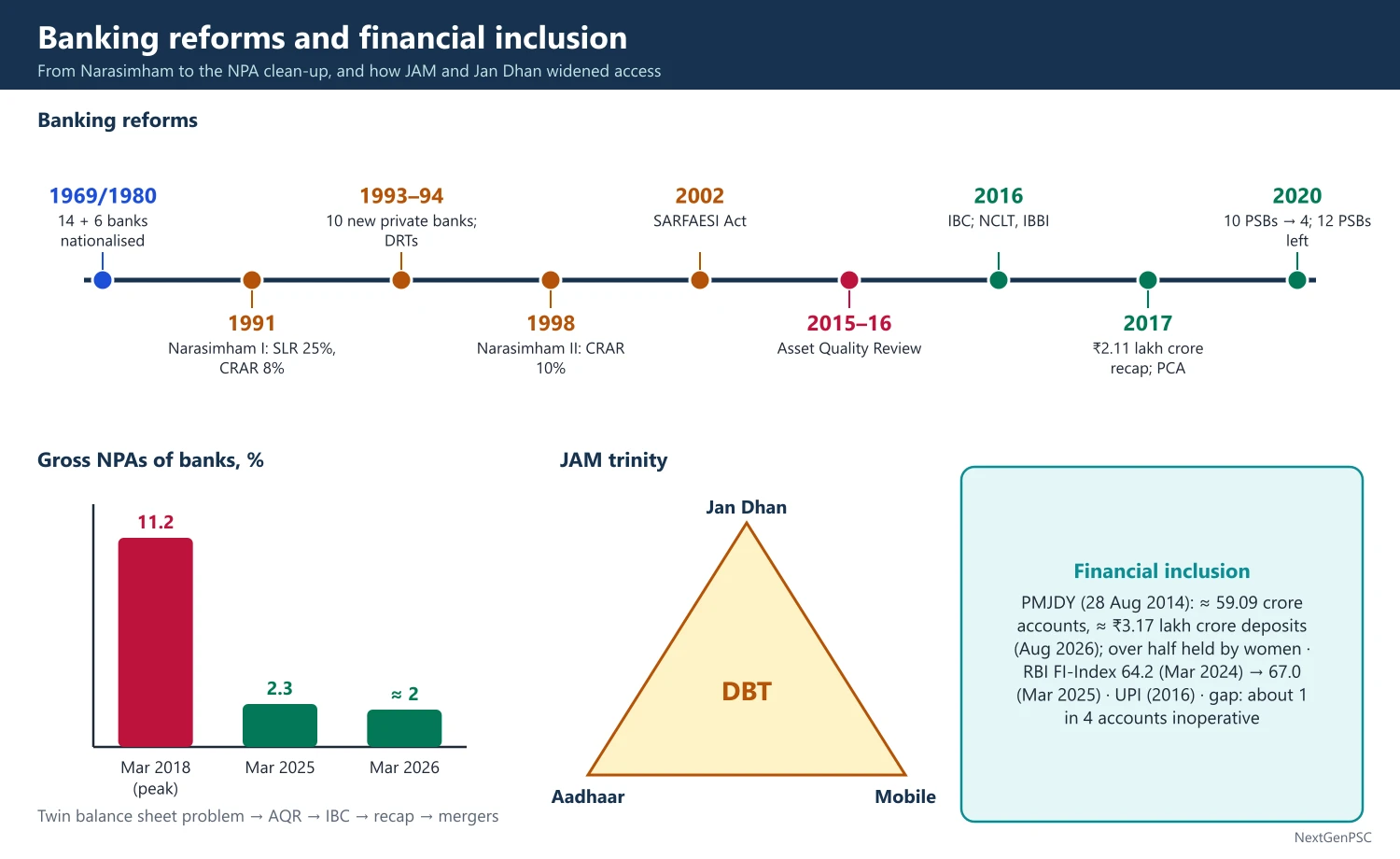
Banking reforms began with the Narasimham Committee (1991, 1998): lower pre-emption, interest rate freedom, prudential norms, capital adequacy and new private banks. After the twin balance sheet crisis, gross NPAs peaked at about 11% in March 2018 and fell to around 2% by 2026 after the AQR, IBC, recapitalisation and mergers. Financial inclusion expanded through PMJDY (over 59 crore accounts by August 2026), the JAM trinity and UPI.
In simple words
Banking reforms made banks freer to set interest rates and lend, but stricter about capital and bad loans.
It is like letting a shopkeeper set his own prices while making him keep proper accounts and enough savings for bad days.
Financial inclusion means bringing the poor into the banking system with accounts, insurance, credit and digital payments, as Jan Dhan accounts did.
UPSC asks about Narasimham reforms, the NPA problem, bank mergers and inclusion schemes.
1. Background
Nationalisation: 14 major banks were nationalised in July 1969 and six more in April 1980 to extend branches to rural areas, direct credit to priority sectors and end 'class banking'.
Achievements: rapid branch expansion (lead bank scheme, 1969), regional rural banks (1975), NABARD (1982) and higher rural savings mobilisation.
Problems by 1991: high SLR and CRR, administered rates, directed credit, low profitability, weak capital and hidden bad loans; McKinnon and Shaw (1973) called such systems 'financial repression'.
2. Narasimham Committees
Narasimham Committee I (1991): cut SLR to 25% and lower CRR; deregulate interest rates; prudential norms on income recognition, asset classification and provisioning; capital adequacy of 8% (Basel I); allow new private and foreign banks; set up Debt Recovery Tribunals; and reduce directed credit (the priority sector target was not cut).
Results: ten new private banks licensed in 1993–94 (including HDFC Bank, ICICI Bank and UTI Bank, now Axis); DRTs set up under the 1993 Act; NPA norms tightened to 90 days by 2004.
Narasimham Committee II (1998): raised capital adequacy to 10%, recommended mergers of strong banks, asset reconstruction companies, narrow banking for weak banks and greater autonomy for public sector banks.
SARFAESI Act (2002): allowed banks to enforce security without courts and enabled asset reconstruction companies.
Basel norms: Basel II from 2008–09 and Basel III from 2013 (with capital conservation buffer), with Indian capital requirements stricter than the global minimum.
Other committees: Raghuram Rajan Committee on Financial Sector Reforms (2008), Nachiket Mor Committee on financial inclusion (2013) and P.J. Nayak Committee on bank governance (2014).
3. The NPA Crisis and Its Resolution
Twin balance sheet problem: over-leveraged companies (infrastructure, steel, power) and stressed banks fed each other after the 2003–08 credit boom (Economic Survey 2016–17).
Asset Quality Review (2015–16): under Governor Raghuram Rajan, it forced recognition of hidden bad loans; gross NPAs of scheduled commercial banks peaked at about 11.2% in March 2018, higher for public sector banks.
Insolvency and Bankruptcy Code (2016): created a time-bound resolution process run by creditors, with the NCLT and the IBBI; cases like Essar Steel (to ArcelorMittal) and Bhushan Steel (to Tata Steel) recovered large sums.
Recapitalisation: ₹2.11 lakh crore announced in October 2017, mostly through recapitalisation bonds, plus Indradhanush (2015).
Prompt Corrective Action: the revised framework (2017) restricted lending by weak banks until they recovered.
Bad bank: the National Asset Reconstruction Company Ltd (NARCL), backed by government guarantees, was announced in 2021 to take over large legacy NPAs.
Recovery: gross NPAs fell steadily, to about 2.3% in March 2025 and to a multi-decadal low near 2% in March 2026 (RBI Financial Stability Report, June 2026), with capital adequacy around 17%.
4. Consolidation and Governance
Mergers: SBI's associate banks and Bharatiya Mahila Bank merged into SBI (April 2017); Vijaya Bank and Dena Bank merged with Bank of Baroda (April 2019); ten public sector banks were merged into four from 1 April 2020, leaving 12 public sector banks (from 27 in 2017).
Governance: the Banks Board Bureau (2016), later the Financial Services Institutions Bureau, advises on top appointments; the P.J. Nayak Committee had recommended a holding company and lower government stakes.
Privatisation: the 2021–22 Budget announced the privatisation of two public sector banks; the IDBI Bank stake sale has been the main live case.
Differentiated banks: payments banks and small finance banks (licences from 2015), on-tap universal bank licensing (2016).
5. Financial Inclusion
Definition: the Rangarajan Committee (2008) defined financial inclusion as ensuring access to financial services and timely, adequate credit for vulnerable groups at affordable cost.
Early steps: lead bank scheme (1969), RRBs (1975), SHG-bank linkage (1992), no-frills accounts (2005) and the business correspondent model (2006).
PMJDY (28 August 2014): zero-balance accounts with RuPay debit cards, accident insurance and overdraft; by August 2026 about 59.09 crore accounts with deposits of about ₹3.17 lakh crore, over half held by women and about 78% in rural and semi-urban areas.
JAM trinity: Jan Dhan, Aadhaar and Mobile (Economic Survey 2014–15) enabled direct benefit transfers, cutting leakages in LPG, PDS and scholarships.
Social security schemes (May 2015): PM Jeevan Jyoti Bima Yojana (life), PM Suraksha Bima Yojana (accident) and Atal Pension Yojana; credit schemes include MUDRA (April 2015) and Stand-Up India (2016).
Digital payments: UPI (2016) became the world's largest real-time payment system by volume; RuPay and Aadhaar-enabled payments reach rural users.
Measurement: the RBI's Financial Inclusion Index (0–100, with access, usage and quality sub-indices) rose to 67.0 in March 2025 from 64.2 in March 2024; the World Bank's Global Findex (2021) found about 78% of Indian adults had an account.
Gaps: many dormant accounts (an RTI reply in 2026 suggested about one in four Jan Dhan accounts was inoperative), low usage of credit and insurance by the poor, digital fraud and a large MSME credit gap.
6. Diagrams to Draw
NPA trend chart: draw gross NPA ratio of scheduled commercial banks from 2011 to 2026, rising to about 11% in March 2018 and falling to about 2% by 2026; mark AQR (2015), IBC (2016), recapitalisation (2017) and mergers (2020).
Financial repression diagram: draw saving (supply of loanable funds) and investment demand; an interest rate ceiling below equilibrium causes excess demand for credit and lower saving (McKinnon-Shaw).
JAM triangle: draw a triangle linking Jan Dhan, Aadhaar and Mobile with DBT at the centre.
7. Theory and Debates
Financial liberalisation: McKinnon and Shaw (1973) argued that freeing interest rates raises saving and efficiency; critics (Stiglitz) point to credit rationing and market failures that justify some regulation.
Public vs private banks: public banks carried more bad loans but also more rural branches and social lending; privatisation debates weigh efficiency against inclusion.
Regulatory forbearance: loan restructuring schemes (CDR, 5:25, SDR) in 2008–2015 delayed NPA recognition, a lesson in regulatory capture.
Inclusion vs usage: accounts opened quickly, but meaningful inclusion needs usage, credit and insurance; Demirgüç-Kunt and others stress usage over access.
8. Using It in the Exam
10-mark answer: list Narasimham I recommendations and one inclusion scheme with data.
15/20-mark answer: trace reforms (1991, 1998, SARFAESI, Basel), the NPA crisis and resolution (AQR, IBC, recapitalisation, mergers) with figures, and financial inclusion (PMJDY, JAM, UPI, FI-Index), with a balanced assessment.
Keywords: financial repression, prudential norms, CRAR, twin balance sheet, AQR, IBC, PCA, consolidation, JAM, FI-Index.
Quotable line: the Rangarajan Committee's definition of financial inclusion as access to financial services and adequate credit for vulnerable groups at affordable cost (paraphrased).
| Aspect | Narasimham I (1991) | Narasimham II (1998) |
|---|---|---|
| Focus | Deregulation and prudential norms | Strengthening banks and structure |
| Capital adequacy | 8% (Basel I) | 10% |
| Pre-emption | SLR to 25%, lower CRR | Further cuts in CRR |
| Structure | New private and foreign banks | Mergers of strong banks, narrow banking for weak |
| Bad loans | Debt Recovery Tribunals | Asset reconstruction companies (led to SARFAESI 2002) |
Mains points
- Start with financial repression and the 1991 problems to justify reforms.
- Compare Narasimham I and II precisely and link to SARFAESI and Basel norms.
- Use NPA data: peak about 11.2% (March 2018), about 2% (March 2026), and explain AQR, IBC, recapitalisation, mergers.
- For inclusion, give PMJDY figures with date, JAM, UPI and the FI-Index value.
- Discuss gaps: dormant accounts, credit access, digital fraud.
- Common mistake: claiming Narasimham I cut priority sector lending; it recommended it, but the government did not accept.
Did you know?
- PMJDY entered the Guinness World Records for opening about 1.8 crore bank accounts in a single week in August 2014.
UPSC Previous Year Questions: Monetary System and the RBI
From 2014 to 2026 UPSC asked 17 question parts worth 250 marks on the monetary system and the RBI in Paper II. The most-asked areas are the monetary policy framework and inflation targeting (6 parts: transmission, LAF, external benchmarks, the 2022 tightening) and banking reforms and financial inclusion (6 parts: NPAs, public sector banks, inclusion strategy), followed by the RBI's role in financial stability, NBFCs and demonetisation. Every question below has a model answer written to the UPSC word limit.
In simple words
First read the question and write your own answer in the time UPSC gives: about 7 minutes for 10 marks and 10–12 minutes for 15 or 20 marks.
Then compare it with the model answer: did you give the framework with its year (MPC 2016, LAF 2000, EBLR 2019), a diagram where it fits, and recent RBI data?
Note the points you missed and rewrite the answer once; doing this for every question is the fastest way to learn this chapter.
1. Role of the RBI under the New Regime
Example 1 (UPSC 2020, 20 marks): Critically examine the role of the RBI in maintaining financial stability under the new regime of monetary system.
Paper and question: Paper II, Q7(a)
Approach: Define financial stability and explain the RBI's tools for it under the post-1991 regime (regulation, supervision, macroprudential policy, lender of last resort, resolution), then assess its record with episodes such as the NPA crisis, IL&FS and Yes Bank.
Financial stability means a financial system that absorbs shocks and keeps credit and payments flowing. After 1991 the RBI moved from directed credit to market-based regulation: the Narasimham Committees (1991, 1998) brought Basel capital norms, prudential asset classification and deregulated rates, and the RBI created the Board for Financial Supervision (1994).
Tools: (i) micro-prudential: Basel III capital, liquidity coverage ratio, large exposure limits; (ii) supervision: risk-based supervision and the Prompt Corrective Action framework (2002, revised 2017); (iii) macroprudential policy: higher risk weights on unsecured consumer credit (November 2023) and D-SIB surcharges on SBI, HDFC Bank and ICICI Bank; (iv) lender of last resort: LAF, MSF and the 2020 COVID windows (TLTRO, moratorium); (v) resolution: Asset Quality Review (2015), IBC (2016) and the June 2019 prudential framework; (vi) the half-yearly Financial Stability Report.
Record: the AQR exposed hidden bad loans; banks' gross NPA ratio peaked near 11% in March 2018 and fell to 2.3% by March 2025 (FSR, June 2025). After the IL&FS default (2018) large NBFCs came under scale-based regulation (2021); Yes Bank (2020) was rescued by a reconstruction scheme, and cooperative banks came under RBI supervision through the Banking Regulation (Amendment) Act, 2020.
Limitations: supervision was late each time, as ever-greening hid stress for years; the RBI lacks full powers over public sector bank boards; and its stability role can clash with government priorities, as in the 2018 dispute over PCA and surplus transfer, settled by the Bimal Jalan Committee (2019).
In conclusion, the RBI has moved from a reactive to a pre-emptive stability regulator; the next tests are unsecured retail credit, NBFC interconnections, and cyber and climate risks.
Example 2 (UPSC 2018, 20 marks): Demonetisation has been a radical and unprecedented step with short-run costs and long-term benefits. Give reasons in support of this statement.
Paper and question: Paper II, Q7(a)
Approach: The question asks for reasons supporting the claim, so briefly state what happened in November 2016, then list the short-run costs and argue the long-run benefits (formalisation, digitisation, tax base), ending with a balanced note.
On 8 November 2016 the government withdrew the legal tender status of ₹500 and ₹1,000 notes, about 86% of currency in circulation (₹15.41 lakh crore). It was radical because no large economy had cancelled so much cash at one stroke; the aims were to curb black money, counterfeit notes and terror finance and to push a less-cash economy.
Short-run costs: a severe cash shortage hit the informal sector, which employs over 80% of workers and runs on cash; farm prices fell in the rabi season; quarterly GDP growth slowed from 7.9% in Q1 2016–17 to 5.7% in Q1 2017–18 (CSO estimates of that time); and printing new notes cost the RBI about ₹8,000 crore in 2016–17.
Long-term benefits: (i) formalisation: deposited cash had to be explained, so income tax returns filed by August 2017 were about 25% higher than a year earlier (CBDT) and the tax base widened; (ii) digitisation: UPI transactions rose from under 1 million in October 2016 to billions a month in later years; (iii) financial savings shifted from cash to deposits, mutual funds and insurance, lowering interest rates; (iv) deposit data aided tax enforcement and GST compliance; (v) fake notes were removed.
Caveats: 99.3% of the notes returned (RBI Annual Report 2017–18), so black money was not destroyed as cash; currency in circulation later exceeded its 2016 level; and part of the gain owed to GST, Jan Dhan and Aadhaar.
Thus the costs were sharp but temporary, while gains in tax compliance and digital payments have lasted; whether they could have come at lower cost is debated.
Example 3 (UPSC 2017, 15 marks): What is your assessment of the principal impact of the recent demonetization in India in the immediate and medium terms?
Paper and question: Paper II, Q3(a)
Approach: Assess the impact in two time frames: immediate (liquidity, output, informal sector, prices, banks) and medium term (digital payments, tax base, financial savings, black money), using official data, then give a verdict.
Demonetisation of 8 November 2016 withdrew ₹500 and ₹1,000 notes worth ₹15.41 lakh crore, about 86% of currency, to curb black money, counterfeits and terror finance and to push digital payments.
Immediate impact: (i) a liquidity shock: currency with the public fell by about half between November 2016 and January 2017, hurting cash-based trade, construction, small firms and daily-wage workers; (ii) GDP growth slowed (quarterly growth fell from 7.9% in Q1 2016–17 to 6.1% in Q4 2016–17, CSO); (iii) prices of perishables fell sharply, lowering farm incomes; (iv) banks received huge deposits, so deposit and lending rates fell and the RBI absorbed surplus liquidity with a temporary incremental CRR of 100% and Market Stabilisation Scheme bonds.
Medium-term impact: (i) digital payments: UPI, cards and wallets grew rapidly and stayed higher even after cash returned; (ii) tax base: new taxpayers and advance tax collections rose, aided later by GST; (iii) financial savings moved into bank deposits, mutual funds and insurance; (iv) real estate prices, which are linked to unaccounted cash, softened. But 99.3% of the notes returned (RBI Annual Report 2017–18), so the black money effect was small, and cash in circulation regained its earlier level by 2018.
Overall the immediate costs fell mainly on the informal sector and farmers, while the medium-term gains were in formalisation and digitisation; the net effect remains debated among economists.
Example 4 (UPSC 2016, 15 marks): Trace the development of Non Banking Financial Companies in India since the liberalisation era and comment on their impact on the effectiveness of the interest rate policies of the RBI.
Paper and question: Paper II, Q6(b)
Approach: Trace NBFC growth in phases since 1991 with the regulatory milestones, then explain how a large NBFC sector weakens or complicates the transmission of the RBI's policy rate.
Non-Banking Financial Companies (NBFCs) are companies registered under the Companies Act that lend and invest but cannot accept demand deposits or issue cheques; they include asset finance, housing finance, microfinance and infrastructure finance companies.
Development: (i) 1990s: rapid growth of deposit-taking finance companies, then failures such as CRB Capital (1997); the RBI Act was amended in 1997 to make registration and minimum net owned funds compulsory, with prudential norms from 1998. (ii) 2000s: consolidation; deposit-taking was restricted and systemically important non-deposit NBFCs were defined (2006). (iii) After 2010: NBFCs grew faster than banks in MSME, vehicle, gold and micro loans; the Usha Thorat group (2011) shaped reforms and the 2014 revised framework raised minimum net owned funds to ₹2 crore.
Impact on interest rate policy: (i) NBFCs fund themselves from banks, bonds and commercial paper, not the RBI's LAF, so a repo change reaches them only indirectly and with a lag; (ii) their lending rates depend on risk and funding cost, so transmission to their borrowers is weaker; (iii) their credit can offset an RBI tightening; (iv) stress in NBFCs can choke the credit channel through bank exposures.
Hence the RBI has steadily brought NBFCs closer to bank-like regulation.
Example 5 (UPSC 2015, 15 marks): Non-banking financial institutions need to be effectively regulated and monitored in India. Can you suggest some measures in this direction?
Paper and question: Paper II, Q6(b)
Approach: Explain why NBFCs need regulation (size, interconnection, risks), then suggest concrete regulatory and supervisory measures, many of which the RBI later adopted.
Non-banking financial institutions (NBFCs, housing finance and microfinance companies) fill gaps left by banks in MSME, vehicle, gold and rural credit. But they depend on short-term wholesale funds, are supervised less strictly than banks, and some take public deposits; failures like CRB Capital (1997) and the Andhra Pradesh microfinance crisis (2010) showed the risks.
Suggested measures: (i) scale-based regulation: light rules for small NBFCs and bank-like norms for the largest; (ii) capital and asset-quality norms close to banks: 15% capital adequacy, NPA recognition at 90 days instead of 180, adequate provisioning; (iii) liquidity rules on asset-liability mismatch; (iv) curbs on deposit-taking; (v) governance: fit-and-proper directors, audit committees, disclosure; (vi) consumer protection: fair practices code and pricing transparency for microfinance (Malegam Committee, 2011); (vii) supervision: on-site inspection, data sharing with SEBI, NHB and credit bureaus, and a resolution route.
Many were later adopted: the 2014 revised framework, the 90-day NPA norm by 2018, the 2019 liquidity framework and the four-layer scale-based regulation of October 2021. Regulation must curb systemic risk while preserving NBFCs' reach.
2. Monetary Policy Framework and Inflation Targeting
Example 6 (UPSC 2026, 10 marks): How has the role of the Reserve Bank of India (RBI) shifted from stabilization policy to inflation targeting as a monetary authority? Explain.
Paper and question: Paper II, Q5(d)
Approach: Trace the shift in phases (credit planning and monetary targeting, the multiple indicators approach, flexible inflation targeting) with years, explain what changed in objectives and instruments, and note what stabilisation role remains.
Until 2016 the RBI had a broad stabilisation mandate (prices, growth, credit, financial and exchange rate stability) without a single nominal anchor: monetary targeting after the Chakravarty Committee (1985), and from 1998 a 'multiple indicators approach'.
Shift: the Urjit Patel Committee (2014) recommended CPI as the anchor; the Monetary Policy Framework Agreement (2015) and the RBI Act amendment of 2016 (Section 45ZA) made flexible inflation targeting statutory: a CPI target of 4% within 2–6%, notified for 2016–21, 2021–26 and in March 2026 for 2026–31. A six-member Monetary Policy Committee sets the repo rate, and missing the band for three quarters requires a report to the government (first in November 2022).
What changed: one accountable objective, one policy rate within a corridor, and published minutes. Stabilisation remains: the RBI still weighs growth, cutting rates in 2019–20 and 2025 and raising the repo rate to 5.50% in October 2026.
Average CPI inflation fell from about 9–10% in 2009–14 to about 5% after 2016, though food supply shocks still limit monetary policy.
Example 7 (UPSC 2024, 20 marks): What are the main objectives of monetary policy adopted by the R.B.I. during last 5 years? Discuss the steps taken by the R.B.I. to encourage investment and maintain price-stability during this period.
Paper and question: Paper II, Q8(a)
Approach: State the objective under the FIT framework, then divide 2019–2024 into phases (easing 2019, COVID support 2020–21, tightening 2022–23, pause 2023–24) and show the tools used for investment and for price stability, ending with an assessment.
Under the amended RBI Act (2016) the primary objective of monetary policy is price stability, a CPI inflation target of 4% within 2–6%, while keeping growth in mind. During 2019–2024 the RBI pursued three aims: supporting growth and investment, keeping inflation in the band, and preserving financial stability through COVID-19.
Steps to encourage investment: (i) repo cuts of 135 basis points in 2019 (6.50% to 5.15%) and 115 basis points in March–May 2020 to a record low of 4.00%, with an accommodative stance; (ii) liquidity: long-term repo operations (2020), targeted long-term repo operations for corporate bonds, a CRR cut to 3%, Operation Twist (December 2019) and the G-SAP bond purchase programme (2021) to cap long-term yields; (iii) a loan moratorium and Resolution Frameworks 1.0 and 2.0 (2020–21); (iv) external benchmark linked lending (October 2019) for faster transmission; (v) refinance windows for NABARD, SIDBI and NHB.
Steps for price stability: when CPI inflation hit 7.8% in April 2022, the RBI made an off-cycle hike in May 2022 and raised the repo rate by 250 basis points to 6.50% by February 2023; it introduced the Standing Deposit Facility (April 2022), raised CRR to 4.5%, adopted a 'withdrawal of accommodation' stance and held the rate at 6.50% through 2024.
Assessment: easing supported a quick recovery (GDP grew 9.7% in 2021–22) and double-digit credit growth by 2023; tightening brought CPI inflation down to 5.4% in 2023–24 and 4.6% in 2024–25. Food-price shocks and slow transmission to deposit rates were the limits.
The policy was counter-cyclical and broadly successful; with inflation low, the repo rate was cut to 5.25% during 2025, before a hike to 5.50% in October 2026.
Example 8 (UPSC 2023, 10 marks): Show how Liquidity Adjustment Facility (LAF) in India emerged as an effective monetary policy instrument to control market fluctuations in the short run.
Paper and question: Paper II, Q5(d)
Approach: Define LAF and trace its evolution with years, explain how the repo, reverse repo/SDF and MSF form a corridor that steers the overnight call rate, and add a corridor diagram.
The Liquidity Adjustment Facility (LAF) is the RBI's daily window through which banks borrow (repo) or park (reverse repo, now SDF) funds. Introduced in June 2000 on the Narasimham Committee II (1998) recommendation, it shifted policy from quantity tools like CRR to interest rates.
Evolution: in May 2011 the repo became the single policy rate, with the Marginal Standing Facility (MSF) as ceiling; the corridor narrowed to ±25 basis points by 2017; variable rate auctions improved fine-tuning; and in April 2022 the collateral-free Standing Deposit Facility replaced the fixed reverse repo as floor.
Why effective: the operating target, the weighted average call rate, stays inside the corridor because no bank borrows above MSF or lends below SDF; daily operations offset shocks such as tax outflows, demonetisation (2016) or capital outflows; and the signal passes to T-bill yields and lending rates.
Diagram: Overnight rate on the vertical axis against time; horizontal lines for MSF (repo + 25 bps) on top, repo in the middle and SDF (repo − 25 bps) below; the call rate fluctuates inside the band, and a repo hike shifts the whole corridor up.
LAF thus gives precise control of short-term rates, though transmission to longer-term bank rates depends on banks.
Example 9 (UPSC 2022, 15 marks): Describe the main features of Monetary Policy, 2022. How far the objectives of this policy differ from the previous monetary policy?
Paper and question: Paper II, Q7(c)
Approach: Describe the main features of the RBI's monetary policy in 2022 (rate hikes, SDF, liquidity, stance, CRR) and contrast them with the accommodative policy of 2019–21 in objective and instruments.
Monetary policy in 2022 turned from emergency support to tightening, forced by inflation after the Russia–Ukraine war: CPI inflation reached 7.8% in April 2022 and stayed above 6% for most of the year.
Main features: (i) the April 2022 policy introduced the Standing Deposit Facility at 3.75% as the corridor floor; (ii) an off-cycle hike of 40 basis points on 4 May 2022, then hikes in June, August, September and December, taking the repo rate from 4.00% to 6.25% (6.50% in February 2023); (iii) CRR raised to 4.5% in May 2022; (iv) the stance changed to 'withdrawal of accommodation'; (v) surplus liquidity was absorbed through variable rate reverse repo auctions; (vi) in November 2022 the RBI, for the first time, reported to the government on missing the target for three quarters.
How the objectives differed: in 2019–21 the priority was reviving growth: repo cut to a record low of 4%, an accommodative stance 'as long as necessary', TLTROs, G-SAP purchases and a loan moratorium, with inflation tolerated near 6%. In 2022 the priority returned to the statutory goal of price stability and anchoring expectations, even at some cost to growth; the instruments were the same, but their direction was reversed.
The tightening worked: CPI inflation returned to the band in 2023 while growth stayed above 7%.
Example 10 (UPSC 2019, 20 marks): Why is monetary transmission not effective in India? In the context of the recent announcement by the RBI, compare the efficacy of external benchmarks in bank loans with internal benchmarks for improving monetary transmissions through the banking channel.
Paper and question: Paper II, Q7(a)
Approach: Define monetary transmission and give the reasons for weak transmission in India, then compare internal benchmarks (BPLR, base rate, MCLR) with the external benchmark regime of October 2019, with a transmission-chain diagram.
Monetary transmission is the passage of a change in the repo rate to money market rates, bank deposit and lending rates, and then to spending and inflation. In India it has been slow and partial: in 2015–17 a repo cut of about 200 basis points produced a much smaller fall in rates on outstanding loans.
Reasons: (i) banks rely on fixed-rate term deposits, so funding costs fall only as deposits are repriced; (ii) high government-set small savings rates prevented deposit rate cuts; (iii) high NPAs (over 11% in 2018) made banks keep spreads wide; (iv) heavy government borrowing kept bond yields high; (v) liquidity deficits in 2018–19; (vi) opaque internal benchmarks set by banks themselves; (vii) a large informal credit sector.
Internal benchmarks: BPLR (2003), Base Rate (2010) and MCLR (April 2016) were computed by each bank from its own costs; MCLR helped but lagged, being reset annually with discretionary spreads. An RBI internal study group (Janak Raj, 2017) recommended an external benchmark.
External benchmarks: from 1 October 2019 new floating-rate retail and MSE loans must be linked to the repo rate, a T-bill yield or another FBIL benchmark; the spread changes only with the borrower's credit risk, and rates reset at least every three months. Transmission is therefore faster, transparent and symmetric: in the 2022–23 hiking cycle EBLR loans repriced almost fully, while MCLR loans moved slowly. The cost is interest rate risk for banks whose deposits stay fixed-rate.
Diagram: A flow chain: repo rate → call and T-bill rates → bank cost of funds and lending rates (EBLR fast path, MCLR slow path) → investment and consumption → aggregate demand → output and inflation.
External benchmarks have improved transmission through the banking channel, but full effectiveness also needs flexible deposit pricing, lower government borrowing and market-linked small savings rates.
Example 11 (UPSC 2016, 20 marks): Monetary Policy in India is often criticised as ineffective because large part of the country is not yet monetised. Do you agree with the view? Give reasons.
Paper and question: Paper II, Q6(a)
Approach: Explain why a large non-monetised and informal sector weakens monetary policy (channels of transmission), then argue the counter-view with evidence of growing monetisation and financial inclusion, and give a qualified answer.
Monetary policy works through transmission channels: interest rates, bank credit, asset prices, the exchange rate and expectations. Its reach depends on how much activity is monetised, that is, conducted through money and the formal financial system.
Arguments for the view: (i) part of output is non-monetised: subsistence farming and wages in kind; (ii) the informal sector employs over 80% of workers and borrows from moneylenders and traders at rates unrelated to the repo rate; the All India Debt and Investment Survey (2013) found a large share of rural household debt from non-institutional sources; (iii) cash dominates, with a currency-GDP ratio of about 12% in 2015–16; (iv) much inflation comes from food and supply shocks that interest rates do not touch; (v) administered prices, MSP and small savings rates blunt the signal. So the interest rate channel covers only the formal segment.
Arguments against: (i) monetisation is rising, and even informal producers buy and sell for money, so policy reaches them indirectly through wages, prices and formal-sector demand; (ii) financial inclusion through Jan Dhan (2014), Aadhaar and mobile banking is bringing millions into banks; (iii) the formal sector, which produces most GDP and investment, responds to rates; (iv) policy anchors inflation expectations of all households; (v) RBI studies find policy rates affect output with a lag of 2–3 quarters and inflation with 3–4 quarters.
Diagram: AD–AS diagram with price level against output; monetary tightening shifts AD left from AD1 to AD2, a smaller shift when the formal sector is small; a supply shock shifts AS left and raises prices regardless of policy.
I partly agree: incomplete monetisation weakens transmission but does not make policy ineffective. The remedy is deeper monetisation and inclusion, better bank transmission, and coordination with fiscal and supply-side measures against food inflation.
3. Banking Sector Reforms and Financial Inclusion
Example 12 (UPSC 2025, 15 marks): Discuss the initiatives launched by the Reserve Bank of India (RBI) to promote financial inclusion.
Paper and question: Paper II, Q8(c)
Approach: Define financial inclusion, then present the RBI's initiatives in phases (institutional, branchless, differentiated banks, digital, strategy and measurement), with data, and end with remaining gaps.
Financial inclusion, in the sense of the Rangarajan Committee (2008), means access for weaker sections and low-income groups to financial services and timely, adequate credit at affordable cost. The RBI has pursued it in phases.
Institutions: the Lead Bank Scheme (1969), priority sector lending (now 40% of adjusted net bank credit), Regional Rural Banks (1975), NABARD (1982) and SHG–bank linkage (1992).
Accounts and branchless banking: no-frills accounts (2005), later Basic Savings Bank Deposit Accounts (2012); simplified KYC; the business correspondent model (2006); Financial Inclusion Plans of banks (2010); and the 2017 rule that a quarter of new banking outlets be in unbanked rural centres.
Differentiated banks: payments banks and small finance banks licensed in 2015, following the Nachiket Mor Committee (2014).
Digital infrastructure: support for UPI (2016), UPI123Pay and UPI Lite (2022), the account aggregator framework, and the Unified Lending Interface (2024) for small loans.
Strategy and literacy: the National Strategy for Financial Inclusion 2019–24, Centres for Financial Literacy, and the Financial Inclusion Index (2021), which rose from 64.2 in March 2024 to 67.0 in March 2025, mainly on usage and quality.
With over 59 crore Jan Dhan accounts (August 2026), access is near-universal; the gaps are dormant accounts, low credit and insurance use, digital fraud and literacy, so the focus is rightly shifting from access to usage and consumer protection.
Example 13 (UPSC 2021, 10 marks): Discuss the strategies adopted by the RBI to promote financial inclusion in India.
Paper and question: Paper II, Q5(d)
Approach: Define financial inclusion briefly and group the RBI's strategies under access, institutions, technology, credit and literacy, with years and one or two data points.
Financial inclusion means affordable access to savings, credit, payments, insurance and pensions for all, especially the poor. The RBI combines mandates on banks with new delivery channels.
Strategies: (i) access: Basic Savings Bank Deposit Accounts (2012) with no minimum balance and Aadhaar e-KYC, which enabled the Jan Dhan drive (2014); (ii) outreach: the business correspondent model (2006) and rural banking outlets; (iii) payments banks and small finance banks (2015); (iv) credit: priority sector lending with sub-targets for small and marginal farmers and weaker sections, SHG–bank linkage and Kisan Credit Cards; (v) technology: UPI (2016) and the Aadhaar Enabled Payment System; (vi) planning: the National Strategy for Financial Inclusion 2019–24, Centres for Financial Literacy and the Financial Inclusion Index (August 2021).
Account ownership among adults rose from 35% in 2011 to about 78% in 2021 (World Bank Global Findex). The next step is usage: credit, insurance and pensions, and protection from digital fraud.
Example 14 (UPSC 2018, 15 marks): The state-controlled section of India's banking sector continues to be a major problem for policy makers. Do you agree? Give reasons in support of your answer.
Paper and question: Paper II, Q6(b)
Approach: Take a reasoned position: show why public sector banks were a major problem in 2018 (NPAs, losses, PCA, frauds, governance, recapitalisation burden), give the counter-arguments for their role, and suggest reforms.
Public sector banks (PSBs), created by nationalisation in 1969 and 1980, held about 70% of banking assets in 2018 and sat at the centre of the twin balance sheet problem identified by the Economic Survey 2016–17.
Yes, a major problem: (i) PSBs held most gross NPAs, with a GNPA ratio near 15% in March 2018 against under 5% for private banks (RBI); (ii) most made losses in 2017–18; (iii) 11 PSBs were under the Prompt Corrective Action framework, restricting lending; (iv) the Punjab National Bank fraud (2018) exposed weak controls; (v) ₹2.11 lakh crore of recapitalisation (October 2017) burdened the budget; (vi) governance: dual regulation by the Finance Ministry and RBI, political pressure in lending, fear of investigation slowing decisions, as the P.J. Nayak Committee (2014) noted.
Counter-view: PSBs carry social obligations such as rural branches, Jan Dhan and government schemes, enjoy depositor trust in crises, and private banks too have failed (Yes Bank, 2020).
Reforms: Indradhanush (2015), the Banks Board Bureau (2016), IBC (2016), the EASE agenda (2018) and mergers cutting PSBs from 27 to 12 by 2020. PSBs exited PCA by 2022 and earned record profits by 2024–25; lasting health still needs board autonomy and a lower government stake.
Example 15 (UPSC 2017, 10 marks): What caused the problem of non-performing assets of Indian commercial banks and what cures are being suggested to solve the problem?
Paper and question: Paper II, Q1(c)
Approach: Give the causes of the NPA build-up (macro, sectoral, bank-side, legal) and then the cures implemented or proposed by 2017 (AQR, IBC, ordinance, recapitalisation, bad bank).
A non-performing asset is a loan whose interest or principal is overdue for over 90 days. Banks' gross NPAs reached about 9.6% of advances by March 2017 (RBI).
Causes: (i) the 2004–08 credit boom in infrastructure, power, steel and telecom on optimistic projections; (ii) the post-2011 slowdown, clearance delays, cancellation of coal blocks (2014) and falling commodity prices; (iii) ever-greening through restructuring schemes (CDR, SDR, S4A); (iv) weak appraisal and political pressure, especially in public sector banks; (v) slow recovery under DRTs and SARFAESI; (vi) wilful defaults and frauds.
Cures: the Asset Quality Review (2015) forced recognition; the Insolvency and Bankruptcy Code (2016) set time-bound resolution; the May 2017 ordinance let the RBI direct banks to insolvency, and 12 large accounts were referred in June 2017; ₹2.11 lakh crore of recapitalisation was announced in October 2017; the Economic Survey 2016–17 proposed a bad bank (PARA); and the revised PCA framework (2017) disciplined weak banks: the 4R approach of recognition, resolution, recapitalisation and reform.
Example 16 (UPSC 2015, 10 marks): What are the major factors behind accumulation of non-performing assets in the Indian banking sector in recent years? Discuss.
Paper and question: Paper II, Q5(d)
Approach: Explain the NPA build-up up to 2015 with data, grouping factors into macroeconomic, sectoral, bank-specific and institutional, and end with the policy response then under way.
Gross non-performing assets of scheduled commercial banks rose from about 2.4% of advances in March 2011 to 4.6% in March 2015, and stressed advances including restructured loans were about 11% (RBI Financial Stability Report, June 2015), mostly in public sector banks.
Macroeconomic: GDP growth fell below 6% in 2012–14; high interest rates in 2011–13 raised debt-service costs; the rupee's fall in 2013 hurt firms with foreign debt.
Sectoral: loans to infrastructure, power, steel, mining and aviation, made in the 2004–08 boom, soured as land, environmental and fuel problems delayed projects, the Supreme Court cancelled coal blocks (2014) and commodity prices fell.
Bank-specific: weak appraisal, large concentrated exposures and restructuring under the CDR mechanism that postponed recognition.
Institutional: slow recovery through Debt Recovery Tribunals and SARFAESI, no effective bankruptcy law, and wilful defaulters.
The response included the Joint Lenders' Forum (2014), the end of forbearance on restructured loans from April 2015, Strategic Debt Restructuring (2015) and Indradhanush (2015).
Example 17 (UPSC 2015, 10 marks): 'Financial inclusion is one of the most essential components of inclusive growth.' Comment.
Paper and question: Paper II, Q5(e)
Approach: Comment by linking financial inclusion to the meaning of inclusive growth through specific channels, give evidence, and note its limits as a stand-alone tool.
Inclusive growth, the theme of the Eleventh Plan (2007–12), is broad-based growth whose benefits reach the poor. Financial inclusion, affordable access to savings, credit, insurance and payments, is one of its essential components.
Channels: (i) safe savings let households smooth consumption; (ii) affordable credit frees the poor from moneylenders and lets small farmers and micro-enterprises invest, raising productivity and jobs; (iii) insurance guards against health and crop shocks that push families into poverty; (iv) direct benefit transfers into accounts cut leakages; (v) women's own accounts raise their bargaining power.
Evidence: only about 35% of adults had an account in 2011 (Global Findex); Jan Dhan (August 2014) opened over 12 crore accounts within months, and SHG credit has supported women's incomes, as in Kerala's Kudumbashree.
Limits: accounts alone do not create income; without jobs, skills and literacy many stay dormant, and easy credit can cause over-indebtedness, as in the Andhra Pradesh microfinance crisis (2010). Financial inclusion is necessary but not sufficient for inclusive growth.
Mains points
- Questions keep returning to three themes: how the RBI's objective moved from multiple goals to flexible inflation targeting (2016), why monetary transmission is weak, and the health of public sector banks.
- Examiners reward the institutional chronology with correct years: Narasimham Committees (1991, 1998), LAF (2000), Urjit Patel Committee (2014), MPFA (2015), MPC (2016), MCLR (2016), EBLR (2019), SDF (2022).
- Always add recent numbers with their source: repo rate path (6.50% to 5.25% in 2025, hiked to 5.50% in October 2026), the 4% ±2% target retained for 2026–31, GNPA ratio from the Financial Stability Report.
- Use a simple diagram where it fits: the LAF corridor (SDF floor, repo, MSF ceiling) or the transmission chain from policy rate to output and inflation.
- End with a balanced judgement: credibility gains of inflation targeting against concerns over growth, supply shocks and fiscal dominance.
Did you know?
- The RBI began in 1935 as a private shareholders' bank under the RBI Act, 1934, and was nationalised only on 1 January 1949.
Economics Optional: All chapters
- Exam Pattern, Syllabus and Strategy
- Price Determination and Theories of Distribution
- Market Structures
- Welfare Economics
- Theories of Employment, Income and Interest
- Money and Monetary Management
- Public Finance
- Theories of International Trade
- Trade Policy, Protection and the WTO
- Balance of Payments and Exchange Rates
- Theories of Growth
- Economic Development
- Indian Economy in the Pre-Independence Era
- Planning in India
- Agriculture before Liberalisation
- Industry before Liberalisation
- National Income, Poverty and Inequality
- Agriculture after Liberalisation
- Industry after Liberalisation
- External Sector after Liberalisation
- Public Finance and Fiscal Federalism in India
- Monetary System and the RBI
- Employment, Wages and Poverty Alleviation