
Economics Optional · UPSC Notes
Indian Economy in the Pre-Independence Era — UPSC Economics Optional Notes
Free, exam-focused notes for UPSC Prelims and Mains, with Prelims tips and Mains points for every topic. 6 topics.
Open in the interactive reader: bookmarks, progress tracking and read-aloud.
Land Systems under British Rule and Their Changes
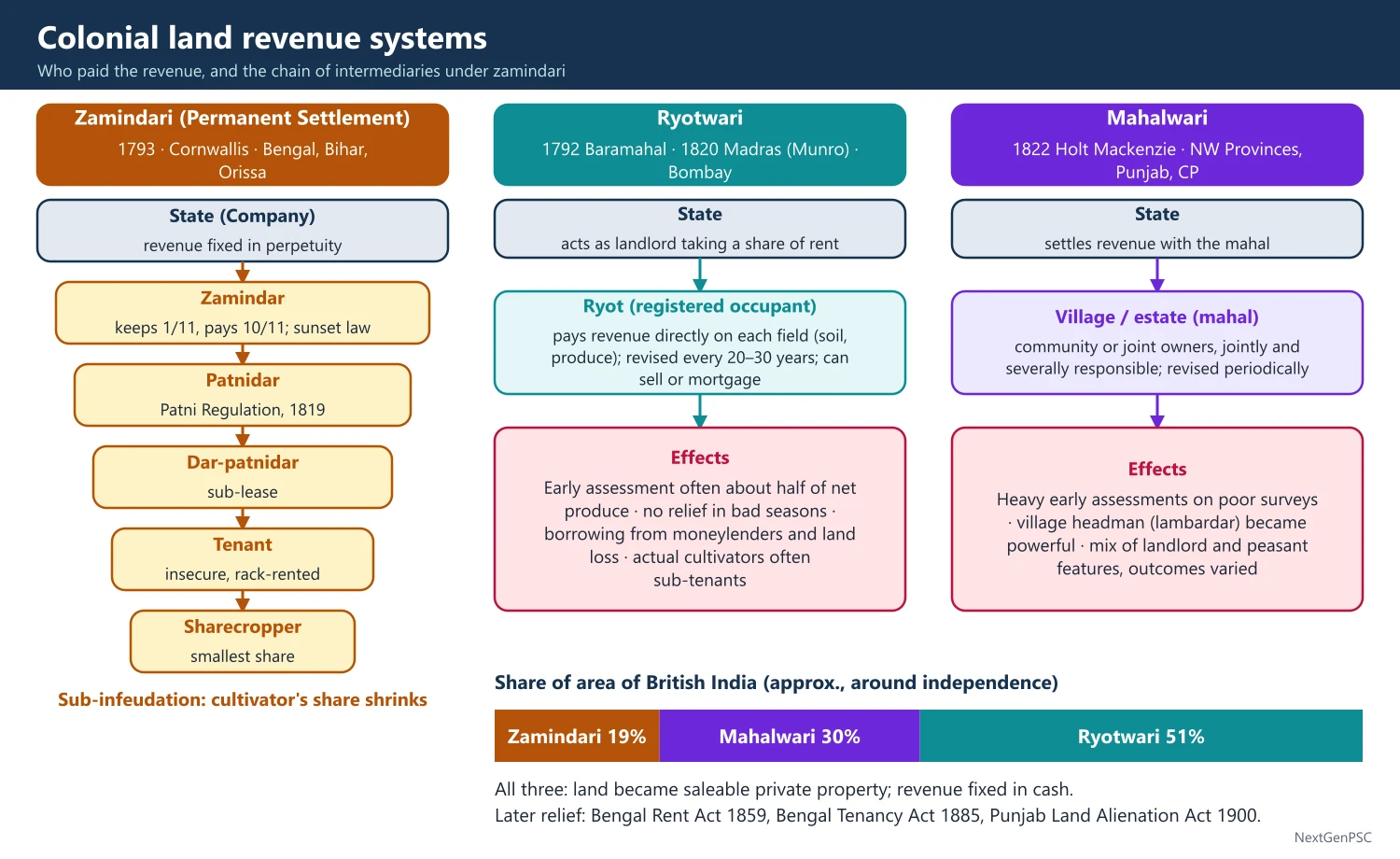
The British created three land revenue systems: the Permanent Settlement or zamindari (Bengal, 1793), the ryotwari system (Madras and Bombay, from the 1790s–1820s) and the mahalwari system (North-Western Provinces, Punjab, Central Provinces, from 1822). All treated land as private, saleable property and fixed revenue in cash, which brought high revenue demand, indebtedness, sub-infeudation and the rise of moneylenders, later softened by tenancy and land-alienation laws.
In simple words
The British needed steady money from land, so they decided who would pay the land tax: big landlords (zamindari), each farmer directly (ryotwari) or the village as a group (mahalwari).
It is like a landlord deciding whether to collect rent from one building manager, from each tenant, or from the whole housing society.
These choices shaped who owned land, who fell into debt and why land reform was needed after 1947.
UPSC asks you to compare the three systems and assess their effects on Indian agriculture.
1. Background and Concepts
Diwani of 1765: after the Battle of Buxar (1764) and the Treaty of Allahabad, the East India Company obtained the right to collect revenue in Bengal, Bihar and Orissa; land revenue became its main source of income.
Early experiments: Warren Hastings auctioned revenue-collection rights to the highest bidder on five-year leases (1772) and then annual leases (1777), which led to over-assessment, the ruin of many zamindars and the famine-hit decline of cultivation after 1770.
Ideas behind the settlements: the Physiocrats and Whig belief in secure property creating improving landlords influenced Cornwallis; Ricardian rent theory and utilitarianism (James Mill) influenced ryotwari, which treated the state as the landlord taking a share of economic rent.
Land as a commodity: all three systems created transferable private rights in land, so land could be mortgaged and sold for arrears, a major break from pre-colonial custom where rights to a share of the produce were layered.
Cash revenue: revenue fixed in money, not in kind, forced peasants to sell produce soon after harvest, often at low prices, linking the land system to commercialisation and debt.
2. The Permanent Settlement (Zamindari), 1793
Introduced by: Lord Cornwallis in 1793 (after a Decennial Settlement of 1789–90 declared permanent), in Bengal, Bihar and Orissa, later extended to Benares and parts of northern Madras.
Features: zamindars became owners of land with hereditary, saleable rights; revenue fixed in perpetuity, set at about 10/11 of the rental the zamindar collected, the zamindar keeping 1/11; land was sold if revenue was not paid by sunset on the due date (the 'sunset law').
Aims: stable revenue for the Company, a loyal landed class, and the hope that secure owners would invest in improvement like English landlords.
Outcomes: many old zamindari estates were sold within two decades because of the high initial demand; new buyers were often urban merchants and officials, creating absentee landlordism; tenants had no secure rights and were rack-rented.
Sub-infeudation: zamindars leased out rights to intermediaries (patnidars, recognised by the Patni Regulation of 1819), who sub-leased further, so several layers stood between the state and the cultivator.
Long-run fiscal effect: because revenue was fixed while prices and rents rose, the state lost the gains from rising land values; the zamindars captured them.
3. The Ryotwari System
Introduced by: Alexander Read and Thomas Munro in Baramahal (1792); extended to Madras Presidency under Munro as Governor (1820) and to Bombay Presidency under Mountstuart Elphinstone and later the Wingate-Goldsmid survey settlements (1830s).
Features: each registered occupant (ryot) dealt directly with the state; revenue assessed on each field based on soil and estimated produce; settlements revised every 20–30 years; the ryot could sell, mortgage or transfer land as long as revenue was paid.
Problems: initial assessments were very high (often around half of the net produce in the early years), revisions raised demand, and there was no protection in bad seasons; many ryots borrowed from moneylenders and lost land; subletting meant actual cultivators were often tenants.
Spread: ryotwari covered parts of Madras, Bombay, Assam and Coorg, the largest share of British Indian territory.
4. The Mahalwari System
Introduced by: Holt Mackenzie under Regulation VII of 1822 in the North-Western Provinces (Agra-Oudh region); modified by Regulation IX of 1833 under William Bentinck, with settlement work by R. M. Bird and James Thomason; extended to Punjab and Central Provinces.
Features: the unit of assessment was the village or estate (mahal); revenue was settled with the village community or joint owners, who were jointly and severally responsible; it was periodically revised.
Problems: early assessments were heavy and based on poor surveys; the village headman (lambardar) often became powerful; the system combined landlord and peasant features, so outcomes varied.
5. Changes and Tenancy Legislation
Agrarian unrest: the Indigo Revolt in Bengal (1859–60), the Pabna agrarian leagues (1873), the Deccan Riots against moneylenders (1875) and the Moplah uprisings in Malabar showed the strain.
Tenancy laws: the Bengal Rent Act (Act X of 1859) gave occupancy rights to tenants who had cultivated for 12 years; the Bengal Tenancy Act, 1885, strengthened occupancy rights; similar laws followed in Oudh (1868, 1886), Punjab (1868, 1887) and other provinces.
Land alienation laws: the Deccan Agriculturists' Relief Act, 1879, and the Punjab Land Alienation Act, 1900, restricted transfer of land from agriculturist to non-agriculturist castes to check moneylenders.
Twentieth century: provincial ministries after 1937 passed debt-relief and tenancy acts; the Congress Agrarian Reforms Committee under J. C. Kumarappa (1949) set the agenda for post-independence abolition of intermediaries.
6. Charts to Draw
Comparison chart: three columns (zamindari, ryotwari, mahalwari) with rows for year, region, revenue payer, fixity of revenue and effects; examiners value a neat table.
Map sketch: outline of British India shading Bengal-Bihar-Orissa (zamindari), Madras and Bombay (ryotwari), and the Gangetic north-west and Punjab (mahalwari).
Chain of intermediaries: a vertical chart from the state → zamindar → patnidar → dar-patnidar → tenant → sharecropper, showing sub-infeudation and the shrinking share of the cultivator.
7. Debates
Nationalist view: R. C. Dutt, in The Economic History of India and his Open Letters to Lord Curzon (1900), argued that heavy land revenue impoverished peasants and caused famines, and urged extending the permanent settlement's moderation everywhere.
Curzon's government replied (Land Resolution, 1902) that famines were caused by drought, not assessment, and that revenue was moderate; the debate on the burden of land revenue is still debated by historians.
Historians: Ranajit Guha, A Rule of Property for Bengal (1963), traced the intellectual origins of the Permanent Settlement; Dharma Kumar, Land and Caste in South India (1965), showed that landless labour in Madras pre-dated British rule, challenging the view that colonial land systems created it; Eric Stokes and others studied the rise of rich peasants.
Long-run effects: Banerjee and Iyer, 'History, Institutions and Economic Performance', American Economic Review (2005), found that districts where revenue was collected by landlords had lower agricultural investment, productivity and public goods after independence than districts with individual cultivator-based systems.
Share of area (approximate, around independence): zamindari about 19%, mahalwari about 30% and ryotwari about 51% of the area of British India, figures commonly cited in textbooks.
Princely states: about two-fifths of the subcontinent's area was under princely states, with their own revenue systems (jagirs, inams and khalsa lands), so colonial settlements did not cover all of India.
Record of rights: survey and settlement operations created detailed village maps and records of rights, which became the base of land administration after independence and of today's land-record digitisation.
Rise of rich peasants: in ryotwari and mahalwari areas, groups such as the Patidars of Gujarat and the Jats of Punjab and western United Provinces consolidated holdings and gained from commercial crops.
Fiscal weight: land revenue was the largest single source of the Government of India's revenue for most of the 19th century; its share fell in the 20th century as customs and income tax grew.
8. Using It in the Exam
10 marks: features of one system with year and the official who introduced it.
15 marks: compare the three systems in a table and give two effects.
20 marks: origins, features, consequences (commercialisation, indebtedness, sub-infeudation, famines), tenancy legislation and long-run effects (Banerjee-Iyer) and link to post-1947 land reforms.
Keywords: Diwani, Permanent Settlement, sunset law, ryot, mahal, lambardar, sub-infeudation, occupancy rights, land alienation, absentee landlordism.
| Feature | Zamindari (Permanent Settlement) | Ryotwari | Mahalwari |
|---|---|---|---|
| Year and official | 1793, Cornwallis | 1792 Baramahal; 1820 Madras (Munro); Bombay (Elphinstone) | 1822, Holt Mackenzie; revised 1833 (Bentinck, Bird) |
| Region | Bengal, Bihar, Orissa, Benares | Madras, Bombay, Assam | North-Western Provinces, Punjab, Central Provinces |
| Who paid revenue | Zamindar | Individual ryot | Village community or joint owners |
| Revenue fixity | Fixed in perpetuity | Revised every 20–30 years | Revised periodically |
| Main effects | Absentee landlords, sub-infeudation, rack-renting | High assessment, debt, land loss to moneylenders | Heavy early demand, power of lambardars |
Mains points
- Give the year, region and the official for each system; precision earns marks.
- Explain the common features (private property in land, cash revenue, saleability) before the differences.
- Link land systems to commercialisation, indebtedness and famines rather than describing them in isolation.
- Use Banerjee and Iyer (2005) to show long-run economic effects; it impresses examiners in economics papers.
- Mention tenancy and land alienation laws as the colonial state's partial corrections.
- Common mistake: saying the ryotwari system gave peasants secure, light taxation; assessments were high and revised upward.
Did you know?
- Under the 'sunset law', a zamindar who failed to pay revenue by sunset on the due date lost his estate at auction; within about two decades of 1793 a large share of Bengal's estates had changed hands.
Commercialisation of Agriculture
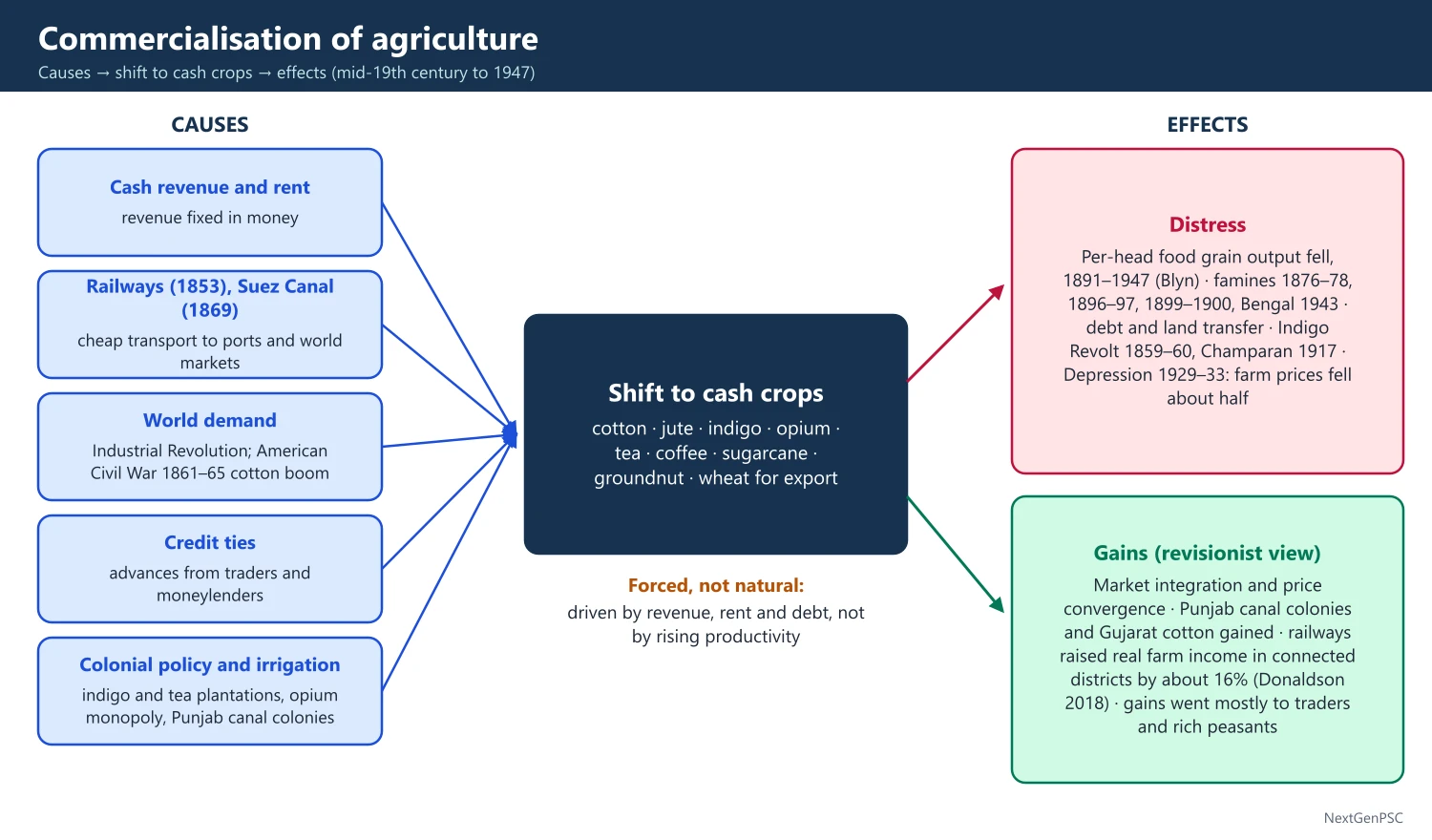
From the mid-19th century Indian agriculture shifted towards cash crops (cotton, jute, indigo, opium, tea, sugarcane, groundnut) for markets at home and abroad, driven by cash revenue demands, railways, the Suez Canal (1869) and world demand. Nationalists and many historians call it forced commercialisation because it was pushed by revenue and debt, not by rising productivity, and link it to stagnant food output and recurring famines; others stress gains in regions such as the Punjab canal colonies.
In simple words
Commercialisation means farmers grew crops mainly to sell, like cotton and jute, instead of food for their own families.
It is like a family garden switched from vegetables for the kitchen to flowers for the market: fine in good years, risky when prices crash or food is scarce.
Under British rule this change was often forced by cash taxes and debt, and it is linked to famines.
UPSC asks for the causes and effects of commercialisation and whether it helped or harmed peasants.
1. Concepts and Definitions
Commercialisation of agriculture: production of crops for sale in the market rather than for family consumption, together with the growth of markets in land, labour and credit.
Natural versus forced commercialisation: natural commercialisation follows rising productivity and price incentives; forced commercialisation is driven by the need to pay cash revenue, rent and interest, so peasants sell even at low prices and even food they need (the term is associated with nationalist writers and with historians such as Amit Bhaduri on 'forced commerce').
Cash crops: cotton (Bombay Deccan, Berar, Gujarat), jute (eastern Bengal), indigo (Bengal and Bihar), opium (Bihar and Malwa), tea (Assam, from the 1830s–40s), coffee (south India), sugarcane (United Provinces), groundnut (Madras), wheat for export (Punjab).
2. Causes
Cash land revenue and rent: revenue fixed in money forced peasants to sell produce.
Transport revolution: railways from 1853 and the opening of the Suez Canal in 1869 cut transport costs and linked the interior to ports and world markets.
World demand: the Industrial Revolution in Britain created demand for raw cotton, jute and oilseeds; the American Civil War (1861–65) cut US cotton supplies and caused a cotton boom in the Bombay Deccan, followed by a crash in 1865.
Colonial policy: plantations (indigo, tea) were promoted by European planters with state support; the opium trade to China was a Company and later government monopoly in Bihar, an important revenue source until the opium agreements with China (1907) ended it by 1913.
Credit and moneylenders: advances from traders and moneylenders tied peasants to cash crops and to selling at harvest.
Irrigation: the Punjab canal colonies (from the 1880s, Lower Chenab Colony from 1892) turned desert into wheat and cotton land for export.
3. Effects
Stagnant food output: George Blyn, Agricultural Trends in India, 1891–1947 (1966), estimated that per capita food grain output fell in British India over this period, sharply in Greater Bengal, while non-food crop output grew much faster.
Famines: major famines in 1876–78, 1896–97, 1899–1900 and the Bengal famine of 1943 (about 2–3 million deaths) occurred while grain was exported or moved to towns; Amartya Sen, Poverty and Famines (1981), explained the 1943 famine through a collapse of entitlements, not of food supply.
Famine Commissions: 1880 (Richard Strachey) led to the Famine Codes (1883); 1898 (James Lyall) and 1901 (Antony MacDonnell) refined relief policy.
Indebtedness and land transfer: price fluctuations and cash demands raised debt; Malcolm Darling's The Punjab Peasant in Prosperity and Debt (1925) documented heavy rural debt even in prosperous areas.
Planter oppression: the indigo system forced ryots to grow indigo on advances, leading to the Indigo Revolt (1859–60) and Gandhi's Champaran Satyagraha (1917).
Regional specialisation and market integration: prices across regions converged as railways spread; some regions (canal colonies of Punjab, cotton tracts of Gujarat) gained substantially.
Beneficiaries: traders, moneylenders, exporters and rich peasants gained more than small cultivators; profits went largely to European export houses and shipping.
4. Charts and Diagrams to Draw
Flow chart of causes: cash revenue + railways and Suez Canal + world demand + credit ties → shift to cash crops → effects (debt, famine vulnerability, market integration).
Trend sketch (Blyn): x-axis 1891–1947, y-axis index of output; draw non-food crop output rising and food grain output per head falling, with sharper decline after 1920.
Map: mark crop regions: jute (eastern Bengal), cotton (Deccan, Gujarat, Berar), indigo (Bihar, Bengal), tea (Assam), wheat (Punjab canal colonies), opium (Bihar, Malwa).
5. Examples and Applications
Cotton boom and bust: the price of Indian cotton rose steeply during 1861–65 and collapsed afterwards, leaving Deccan peasants indebted; this background led to the Deccan Riots of 1875.
Jute: eastern Bengal became the world's main source of raw jute, supplying the mills of Dundee and Calcutta; peasants were exposed to world price swings, especially in the Great Depression after 1929.
Great Depression (1929–33): agricultural prices fell by about half while revenue and debt stayed fixed in money, intensifying distress and feeding the Civil Disobedience Movement's no-revenue campaigns.
Present-day echo: cash crop farmers' exposure to world prices (cotton, rubber, pepper) and debt-related distress still shape India's agricultural policy debates.
6. Debates
Nationalist view (Naoroji, Dutt, Ranade): commercialisation served British industry and the drain; it was forced, not a sign of prosperity.
Marxist and later views: commercialisation did not lead to capitalist farming; instead semi-feudal relations, usury and sharecropping persisted (Amit Bhaduri, 'A Study in Agricultural Backwardness under Semi-Feudalism', Economic Journal, 1973).
Revisionist view: Tirthankar Roy and others argue that market access raised incomes in irrigated and well-connected regions and that the main constraint was low productivity from poor irrigation and technology; Dave Donaldson, 'Railroads of the Raj', American Economic Review (2018), estimated that railways raised real agricultural income in connected districts by about 16%.
Famine debate: whether famines were caused mainly by policy (export of grain, laissez-faire relief, revenue demand) or by drought in a poor economy is debated; famine mortality fell after the Famine Codes and railways, until 1943.
7. Regional Patterns
Non-food crops: the share of non-food crops in total cropped area rose from the late 19th century, while yields of food grains stagnated, especially in Bengal, Bihar and Orissa.
Punjab: canal irrigation turned the province into a wheat and cotton exporter through the port of Karachi; it is the strongest case for gains from commercialisation.
Madras: groundnut spread rapidly from the early 20th century for export, largely to Europe, raising cash incomes but also exposure to world prices.
Peasant differentiation: commercialisation widened the gap between surplus-producing rich peasants, who could hold stocks and get credit, and smallholders who sold at harvest and bought back grain later at higher prices.
Agricultural labourers: censuses show a growing number of agricultural labourers, but changes in census categories make the trend hard to measure, so its size is debated.
Link to land systems: commercialisation went furthest where revenue pressure and market access were greatest, showing how land revenue, transport and credit worked together.
8. Using It in the Exam
10 marks: define commercialisation and give four causes with dates (Suez Canal 1869, railways 1853, American Civil War).
15 marks: causes and effects with Blyn's evidence on food output.
20 marks: forced versus natural commercialisation, effects on food security, famines and debt, regional variation and the revisionist view with Donaldson's estimate.
Keywords: forced commercialisation, cash crops, Famine Codes, entitlement failure, indebtedness, market integration, canal colonies.
Attributed idea: Sen argued that famines are about some people not having enough food, not about there not being enough food (paraphrase of Poverty and Famines).
| Crop | Main region | Driver | Notable consequence |
|---|---|---|---|
| Cotton | Bombay Deccan, Gujarat, Berar | Lancashire demand, American Civil War | Boom and bust, Deccan Riots 1875 |
| Jute | Eastern Bengal | Dundee and Calcutta mills | Exposure to world prices, Depression distress |
| Indigo | Bengal, Bihar | European planters, dye demand | Indigo Revolt 1859–60, Champaran 1917 |
| Opium | Bihar, Malwa | Government monopoly, China trade | Major revenue until about 1913 |
| Tea | Assam | British plantation capital | Indentured labour under harsh contracts |
Mains points
- Distinguish natural from forced commercialisation at the start; it frames the whole answer.
- Give dated causes (railways 1853, Suez 1869, American Civil War 1861–65, canal colonies from the 1880s).
- Use Blyn's evidence on falling per capita food output and link it to famines and Sen's entitlement approach.
- Present the revisionist side (Roy, Donaldson's railway estimate) to show balance.
- Mention the Famine Commissions and Famine Codes as the state's response.
- Common mistake: treating commercialisation as automatically beneficial; examiners expect you to discuss who gained and who lost.
Did you know?
- During the American Civil War so much money flowed into Bombay from cotton that the city saw a share-mania and the 'Back Bay' reclamation craze, which collapsed when the war ended in 1865.
Drain Theory, Laissez-faire and Its Critique
Dadabhai Naoroji's drain theory held that a large part of India's national product was transferred to Britain each year without an equivalent return, through Home Charges, salaries and pensions, interest and profits, impoverishing India. The colonial state followed laissez-faire and one-way free trade, which nationalists (Ranade, Dutt, Gokhale) criticised as a cover for British interests; the policy shifted to discriminating protection only after 1923.
In simple words
Drain theory says Britain took a share of India's wealth every year as salaries, pensions, interest and profits, and India got little back; Naoroji called this the drain.
It is like a family that earns well but must send a big part of its income every month to a distant relative, so it never saves or grows.
The British also kept trade open for their goods while refusing protection to Indian industry.
UPSC asks you to explain the drain, its parts and the nationalist critique of laissez-faire.
1. Concepts and Definitions
Drain of wealth: the unilateral transfer of a part of India's national product to Britain for which India received no adequate economic or commercial return.
Dadabhai Naoroji: presented 'The Poverty of India' (paper read in 1876, based on data for 1867–70), estimated India's per capita income at about Rs 20 a year in 1867–68, and published Poverty and Un-British Rule in India (1901); called the 'Grand Old Man of India'.
Romesh Chunder Dutt: The Economic History of India under Early British Rule (1902) and The Economic History of India in the Victorian Age (1904) analysed land revenue, deindustrialisation and the drain.
Other nationalist economists: M. G. Ranade (Essays on Indian Economics, 1898), G. V. Joshi, G. K. Gokhale (budget speeches in the Imperial Legislative Council), William Digby ('Prosperous' British India, 1901), and K. T. Shah and K. J. Khambata (Wealth and Taxable Capacity of India, 1924).
Laissez-faire: the doctrine that the state should not interfere in markets; in colonial India it meant free trade, no protection to Indian industry, minimal state investment except in railways and canals, and a hands-off famine policy for long periods.
2. The Drain: Mechanism and Components
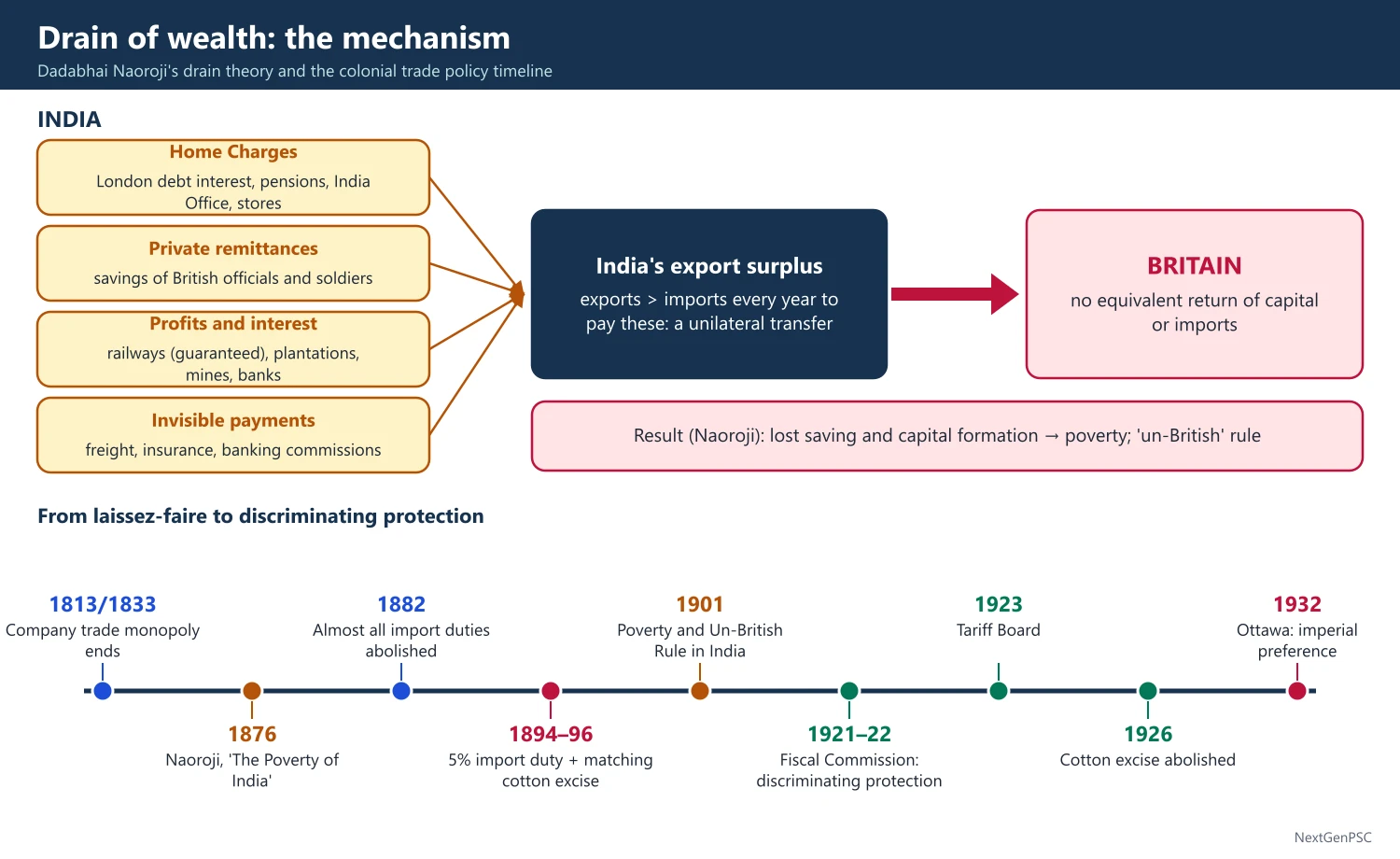
Home Charges: expenditure in Britain charged to Indian revenues: interest on the public debt raised in London (including debt from the Company's wars and the 1857 revolt), dividends to East India Company shareholders (until 1874), pensions and furlough pay of British officials and officers, costs of the India Office in London, and purchases of military and railway stores.
Remittances by Europeans: savings of British officials, soldiers and professionals sent home.
Profits and interest on foreign capital: returns on British investment in railways (guaranteed interest), plantations, mines, jute mills and banks.
Invisible payments: shipping freight, insurance and banking commissions paid to British firms.
Mechanism: to pay these, India had to run a large export surplus of goods (an excess of exports over imports) every year; the surplus did not return as capital or imports, so it represented a loss of potential saving and investment.
Naoroji's argument: the drain was 'un-British' because it contradicted British principles of fair government; the drain reduced India's capital and its capacity to grow, explaining poverty despite peace and railways.
Estimates: nationalists estimated the drain at a significant share of national income and of revenue; modern estimates vary widely, from about 1–2% of GDP a year (several economic historians) to very large cumulative figures such as Utsa Patnaik's estimate (2018) of about 45 trillion US dollars at compounded value; the size of the drain is debated.
3. Laissez-faire and One-way Free Trade
Tariff policy: after the Company's trade monopoly ended (1813 for India, 1833 entirely), British manufactures entered India almost free while Indian goods faced high duties in Britain in the early decades.
Cotton duties: import duties on cotton goods were cut and in 1882 nearly all import duties were abolished; when revenue needs forced a 5% import duty in 1894, a matching 'countervailing' excise was imposed on Indian mill cloth (3.5% from 1896), to satisfy Lancashire; the cotton excise was abolished only in 1926.
Currency and exchange: exchange-rate decisions (the 1s 6d rupee of 1927) were seen as favouring British exporters and creditors.
Stores purchase: government departments and railways bought stores mainly from Britain, denying demand to Indian industry until a Stores Purchase Committee (1920) and rules favouring Indian sources in the 1920s.
Famine policy: during 1876–78 the government under Lytton refused to interfere with private grain trade, consistent with laissez-faire, while mortality was very high.
4. The Shift: Discriminating Protection
Fiscal autonomy convention (1919): the Joint Select Committee recommended that the Government of India be allowed to set its tariffs when it agreed with the legislature.
Indian Fiscal Commission (1921–22), chaired by Ibrahim Rahimtoola: recommended 'discriminating protection' for industries that had natural advantages, could not develop without protection and would eventually face world competition without it (the triple formula).
Tariff Board (1923): examined cases; protection was granted to steel (Steel Industry (Protection) Act, 1924), cotton textiles, paper, sugar (1932), matches and others.
Imperial preference: the Ottawa Agreement (1932) gave preference to British goods, criticised by nationalists.
5. Charts to Draw
Drain flow chart: boxes for Home Charges, remittances, profits and interest, invisible payments, all flowing to Britain; India's export surplus as the channel; arrow showing lost capital formation and growth.
Timeline: 1813 and 1833 (end of monopoly), 1876 (Naoroji's paper), 1882 (abolition of duties), 1894–96 (cotton excise), 1901 (Poverty and Un-British Rule), 1921–22 (Fiscal Commission), 1923 (Tariff Board), 1926 (excise abolished), 1932 (Ottawa).
6. Debates
British and imperialist counter-view: writers such as Theodore Morison (The Economic Transition in India, 1911) argued that Home Charges were payments for services (administration, defence, capital and its returns) that India would otherwise have had to buy, so there was no 'drain'.
Reply: nationalists argued that the services were not chosen by Indians, were overpriced, and that the capital itself was largely accumulated from Indian revenues; the export surplus was not matched by capital inflows.
Modern economic history: Tirthankar Roy treats the drain as real but modest relative to GDP and stresses low productivity and weak state investment; Utsa Patnaik and Amiya Bagchi stress the large, sustained transfer and its effect on India's development; this remains debated.
Significance: the drain theory provided the economic foundation of Indian nationalism and influenced post-independence planning, self-reliance and import substitution (Bipan Chandra, The Rise and Growth of Economic Nationalism in India, 1966).
7. Economic Nationalism and Its Legacy
Ranade's Indian political economy: M. G. Ranade argued that classical economic laws are not universal, that India needed a state that actively promoted industry, and he drew on Friedrich List's infant-industry ideas.
Gokhale's budget critique: in the Imperial Legislative Council G. K. Gokhale attacked high military spending, the salt tax and surplus budgets, and demanded spending on education.
Estimates of per capita income: Naoroji (Rs 20, 1867–68), Baring and Barbour (Rs 27, 1882), Curzon's government (Rs 30, 1897–98), Digby (Rs 18, 1899) and V. K. R. V. Rao (Rs 62, 1931–32, with a far better method) are commonly cited; they differ in method and coverage.
Swadeshi Movement (1905–08): turned the economic critique into action: boycott of British goods and promotion of Indian enterprises such as Bengal Chemicals (founded by P. C. Ray) and Swadeshi banks.
Bombay Plan (1944): leading industrialists (including J. R. D. Tata and G. D. Birla) proposed planned investment of about Rs 10,000 crore over 15 years with a large state role, showing that even Indian capital rejected laissez-faire.
Legacy: the drain theory and the critique of laissez-faire shaped the Second Plan's emphasis on self-reliance, state-led industrialisation and import substitution.
8. Using It in the Exam
10 marks: define the drain and list its four components.
15 marks: the drain theory with Naoroji's and Dutt's works and the counter-view of Morison.
20 marks: drain theory, laissez-faire and one-way free trade (cotton duties, stores purchase), critique by nationalists, the 1923 shift to discriminating protection and the modern debate on the drain's size.
Keywords: Home Charges, export surplus, unilateral transfer, un-British rule, countervailing excise, discriminating protection, triple formula, imperial preference.
Attributed idea: Naoroji held that the drain was the chief cause of India's poverty and described British rule as un-British in its economic effects (paraphrase).
| Component | What it included | Why nationalists objected |
|---|---|---|
| Home Charges | Interest on debt in London, pensions, India Office costs, stores | Debt arose from wars and conquest charged to India |
| Private remittances | Savings of British officials and soldiers | High salaries for posts closed to Indians |
| Profits and interest | Returns on railways, plantations, mines, banks | Guaranteed returns paid from Indian taxes |
| Invisible payments | Freight, insurance, banking charges | Indian shipping and banking were kept out |
Mains points
- Cite Naoroji's works with years (1876 paper, 1901 book) and Dutt's two volumes (1902, 1904).
- List the components of the drain and explain why the export surplus is the channel.
- Present the counter-view (Morison) and the nationalist reply to show balance.
- Give concrete examples of laissez-faire: abolition of duties (1882), the cotton excise (1894–96 to 1926), stores purchase, famine policy.
- End with the 1921–22 Fiscal Commission, discriminating protection and the drain theory's influence on planning after 1947.
- Common mistake: giving a single precise figure for the drain as settled fact; say estimates vary and are debated.
Did you know?
- Dadabhai Naoroji became the first Indian elected to the British House of Commons, from Finsbury Central in 1892, winning by just 5 votes.
Manufacture and Transport: Jute, Cotton and Railways
Colonial India saw the decline of traditional handicrafts (the deindustrialisation debate) alongside the rise of modern factory industry: Indian-owned cotton mills in Bombay and Ahmedabad from the 1850s and British-owned jute mills around Calcutta from 1855. Railways, built from 1853 under a guarantee system, integrated markets but were designed for colonial trade and bought their equipment from Britain. Most firms were run through the managing agency system.
In simple words
Under British rule many Indian weavers lost work to cheap machine-made cloth from Lancashire; historians call this deindustrialisation and still argue about how big it was.
At the same time Indians built cotton mills in Bombay, the British built jute mills near Calcutta, and railways spread across the country, like a new road network that mainly led to the ports.
These changes shaped India's industrial base at independence.
UPSC asks about deindustrialisation, the growth of cotton and jute industries, and the economics of railways.
1. Deindustrialisation: Concept and Debate
Meaning: a decline in the share of the population dependent on industry (or in industrial output) in an economy; in India it refers to the decline of handloom weaving, spinning and other crafts in the 19th century under competition from British machine-made goods and the loss of court patronage.
Nationalist view: Naoroji, R. C. Dutt and D. R. Gadgil (The Industrial Evolution of India in Recent Times, 1924) argued that British policy (one-way free trade, duties in Britain on Indian textiles in the early 19th century, Company monopsony over weavers) destroyed Indian handicrafts and pushed artisans onto the land, raising pressure on agriculture.
Morris's challenge (1963, 1968): Morris D. Morris, in 'Towards a Reinterpretation of Nineteenth-Century Indian Economic History' (Journal of Economic History, 1963; reprinted with responses in Indian Economic and Social History Review, 1968), argued that there was no clear evidence of absolute decline; handloom weavers shifted to cheaper imported yarn, and growing population and incomes may have expanded total demand.
Responses to Morris: Bipan Chandra, Toru Matsui and Tapan Raychaudhuri criticised his reliance on assumptions rather than data; the IESHR symposium (1968) is the standard reference.
Quantitative evidence: Amiya Kumar Bagchi, 'De-industrialization in India in the Nineteenth Century' (Journal of Development Studies, 1976), used Buchanan-Hamilton's survey (1809–13) and the 1901 census for Gangetic Bihar and found the share of population dependent on industry fell from about 18.6% to about 8.5%; Daniel Thorner (1962) found no clear trend in census data for 1881–1931.
Current consensus (broadly): significant decline of hand-spinning and some weaving in the first half of the 19th century, partial survival and adaptation of handloom weaving later (Tirthankar Roy, Traditional Industry in the Economy of Colonial India, 1999); the extent and region-wise pattern remain debated.
2. The Cotton Textile Industry
Beginnings: the first successful cotton mill in Bombay was started by Cowasji Nanabhai Davar in 1854 (Bombay Spinning and Weaving Company, production from 1856); Ranchhodlal Chhotalal started the first Ahmedabad mill in 1861.
Features: Indian (largely Parsi, Gujarati and Bhatia) capital and enterprise; early output was mainly yarn exported to China and Japan; after Japanese competition in yarn from the 1890s, Bombay mills moved to cloth for the home market.
Growth factors: local raw cotton, a large home market, Swadeshi Movement (1905–08), World War I (which cut imports), protection after 1927, and Gandhian boycott of foreign cloth.
Problems: the countervailing excise (1894–96 to 1926), Japanese competition in the 1920s–30s, and labour disputes such as the Bombay textile strike of 1928.
By the 1940s cotton textiles were India's largest modern industry, and India met most of its mill cloth needs domestically.
3. The Jute Industry
Beginnings: the first jute mill was set up at Rishra near Calcutta in 1855 by George Acland, with power looms from 1859; the industry grew along the Hooghly river.
Ownership: mainly British (largely Scottish, linked to Dundee) capital, managed by agency houses such as Andrew Yule and Bird and Company; Indian Marwari business houses (for example the Birlas from 1919) entered later.
Organisation: the Indian Jute Mills Association (1884) regulated working hours to restrict output and keep prices up, a cartel-like arrangement.
Markets: gunny bags and hessian for world trade in grain, sugar, cotton and wool; demand jumped during World War I; the Great Depression hit it hard.
Raw material: grown in eastern Bengal, so the Partition of 1947 separated most jute-growing areas (East Pakistan) from the mills (West Bengal).
4. Other Industries
Iron and steel: the Tata Iron and Steel Company (TISCO) was founded in 1907 and began production at Sakchi (Jamshedpur) in 1911–12; it was the first large integrated steel plant in India and gained protection in 1924.
Coal, tea, cement, sugar, paper: coal in Raniganj and Jharia served the railways; sugar grew rapidly after protection in 1932.
Managing agency system: a firm (managing agent) promoted, financed and managed several joint-stock companies under long-term contracts for a commission, often on sales or profits; houses such as Andrew Yule, Bird and Company, Martin Burn, Tata and Birla used it; it saved scarce managerial talent and capital but led to concentration of economic power and abuse of minority shareholders; it was abolished with effect from 3 April 1970 by the Companies (Amendment) Act, 1969.
5. Railways
Beginning: the first passenger train ran from Bombay (Bori Bunder) to Thane, about 34 km, on 16 April 1853; Lord Dalhousie's Railway Minute (1853) set out the commercial, administrative and military case for a trunk network.
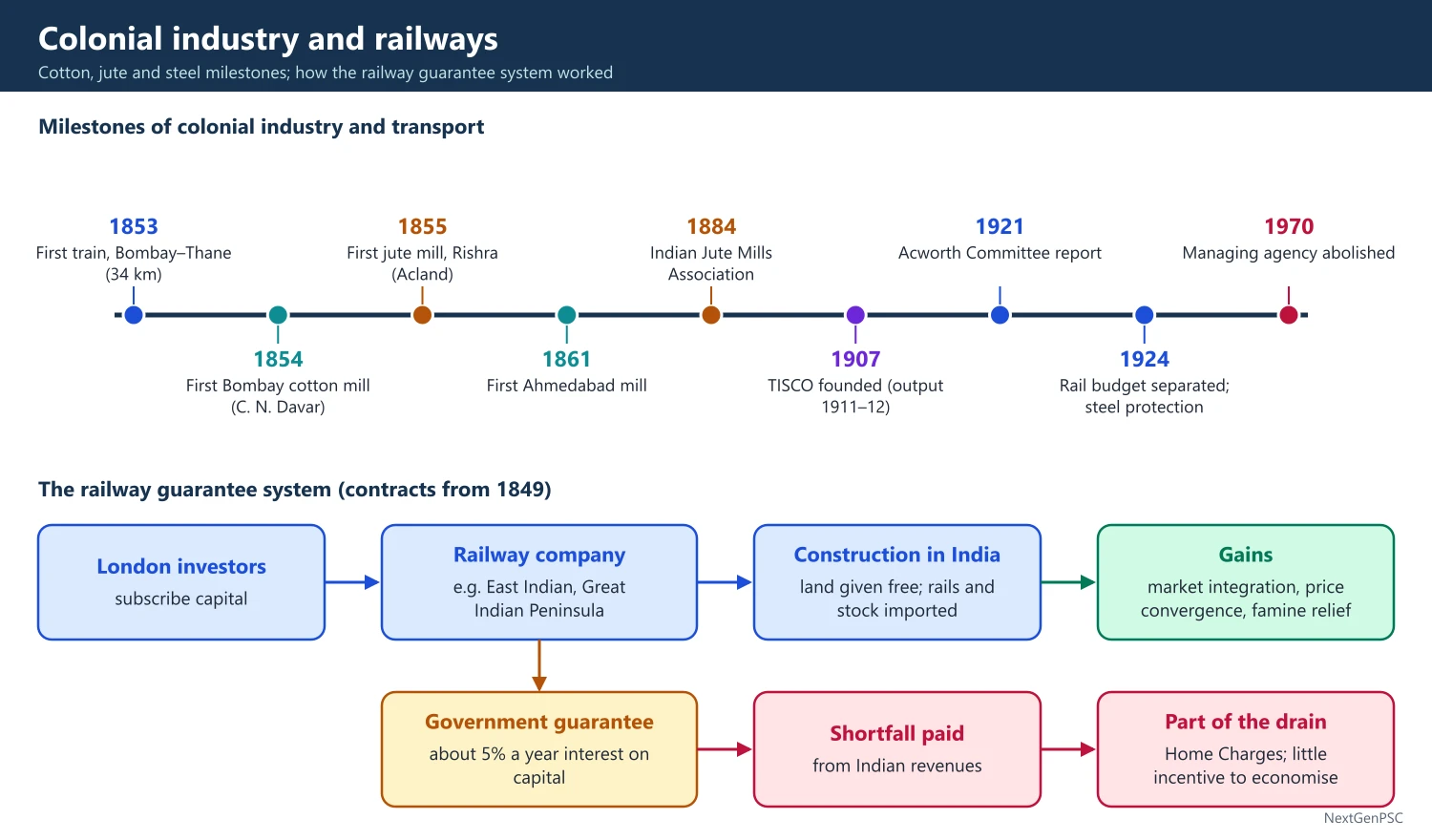
Guarantee system: under contracts signed from 1849 with the East Indian Railway and the Great Indian Peninsula Railway, private English companies raised capital in London and the Government of India guaranteed interest of about 5% a year on it, paying any shortfall from Indian revenues; the government also gave land free.
Problems of the guarantee system: companies had little incentive to economise, construction costs were high, and losses were charged to Indian taxpayers; it is a key item in the drain argument.
State construction (1869–1880s) and the new guarantee system (1880s): after the first phase the state built some lines itself and then offered less generous terms to new companies; famine and frontier (strategic) lines were added.
Acworth Committee (1920–21): recommended state management and the separation of railway finances; the railway budget was separated from the general budget in 1924 (it was merged back into the Union Budget from 2017–18); the state took over management of the East Indian and Great Indian Peninsula railways in 1925.
Network size: by the 1940s the network exceeded 40,000 route miles, among the largest in the world.
Effects: integration of markets and price convergence, famine relief, commercialisation of agriculture, labour mobility and administrative unity; but rail lines connected the interior to ports rather than linking Indian regions to one another, freight rates favoured the movement of raw materials to ports and imports inward, rolling stock and rails were imported from Britain (weak backward linkages in India), and Indians were kept out of senior posts.
6. Charts to Draw
Timeline: 1853 (first train), 1854 (first Bombay cotton mill), 1855 (Rishra jute mill), 1861 (Ahmedabad mill), 1884 (Indian Jute Mills Association), 1907 (TISCO), 1921 (Acworth report), 1924 (separation of railway budget and steel protection), 1970 (managing agency abolished).
Map: cotton mills in Bombay, Ahmedabad, Sholapur, Kanpur and Coimbatore; jute mills along the Hooghly near Calcutta; railway trunk lines radiating from the ports of Bombay, Calcutta, Madras and Karachi.
Guarantee system flow: London investors → railway company → construction in India; government guarantee of about 5% interest → shortfall paid from Indian revenues → part of Home Charges.
7. Industrial Growth: Constraints and Evidence
Small industrial base: at independence modern factory industry employed only a small fraction of the workforce, and India had almost no capital goods industry, relying on imported machinery.
Constraints: lack of state support and technical education, one-way free trade until the 1920s, the stores purchase policy and limited long-term finance held back industry.
Indian Industrial Commission (1916–18): chaired by Sir Thomas Holland, it recommended that the state take an active part in industrial development, a break from laissez-faire.
The two World Wars: both cut imports and raised war demand, giving Indian industry room to grow (steel, cement, textiles, engineering), though shortages of machinery limited expansion during World War II.
Indian enterprise: Scindia Steam Navigation (1919) in shipping and Walchand Hirachand's Hindustan Aircraft (1940) show Indian capital entering new sectors despite British competition.
8. Using It in the Exam
10 marks: features of the guarantee system or of the managing agency system.
15 marks: compare the cotton and jute industries (ownership, markets, location, growth factors).
20 marks: the deindustrialisation debate (nationalists, Morris, Bagchi, Roy), growth of modern industry and the role of railways with their costs and benefits.
Keywords: deindustrialisation, handloom, Rishra, Bombay Spinning and Weaving Company, guarantee system, Dalhousie's Minute, Acworth Committee, managing agency, Indian Jute Mills Association.
| Feature | Cotton textiles | Jute |
|---|---|---|
| First mill | Bombay, 1854 (C. N. Davar) | Rishra near Calcutta, 1855 (George Acland) |
| Ownership | Mainly Indian (Parsi, Gujarati) | Mainly British (Scottish) agency houses |
| Main market | Yarn to China early; later home market | World market for sacking and hessian |
| Location | Bombay, Ahmedabad, Sholapur, Kanpur | Hooghly belt near Calcutta |
| Key support | Swadeshi, World War I, protection after 1927 | World War I demand, IJMA output controls |
Mains points
- Present the deindustrialisation debate with names and works: Gadgil (1924), Morris (1963), Bagchi (1976), Roy (1999).
- Contrast Indian-owned cotton with British-owned jute to show how ownership shaped growth and markets.
- Explain the guarantee system's 5% interest and why it became part of the drain argument.
- Weigh the benefits of railways (market integration, famine relief, Donaldson 2018) against colonial design and weak domestic linkages.
- Mention the managing agency system and its abolition in 1970, which links Paper II's colonial and post-independence parts.
- Common mistake: dating the first Indian railway line to 1857 or calling the jute industry Indian-owned from the start.
Did you know?
- The first train of 16 April 1853 had 14 carriages and about 400 passengers and was pulled by three locomotives named Sahib, Sultan and Sindh.
Money and Credit in Colonial India
Colonial India moved from a silver standard (uniform rupee, 1835) through the closing of the mints (1893) to a gold exchange standard (rupee at 1s 4d from 1899), studied by the Chamberlain (1913), Babington Smith (1919) and Hilton Young (1926) commissions, and then a sterling link (1931). Banking grew from the Presidency banks (Bengal 1806/1809, Bombay 1840, Madras 1843), merged into the Imperial Bank of India (1921), to the Reserve Bank of India (1935). Rural credit stayed with moneylenders and indigenous bankers.
In simple words
Money in colonial India was first a silver rupee; when silver's world price fell, the rupee lost value against the British pound, so the government tied the rupee to gold and sterling, the gold exchange standard.
Think of a shopkeeper who prices goods in a metal whose value keeps falling and finally switches to a steadier measure.
Banks grew in big cities while villagers still borrowed from moneylenders at high interest, a problem that shaped India's later banking policy.
UPSC asks about currency standards, commissions and the evolution of banking up to the RBI.
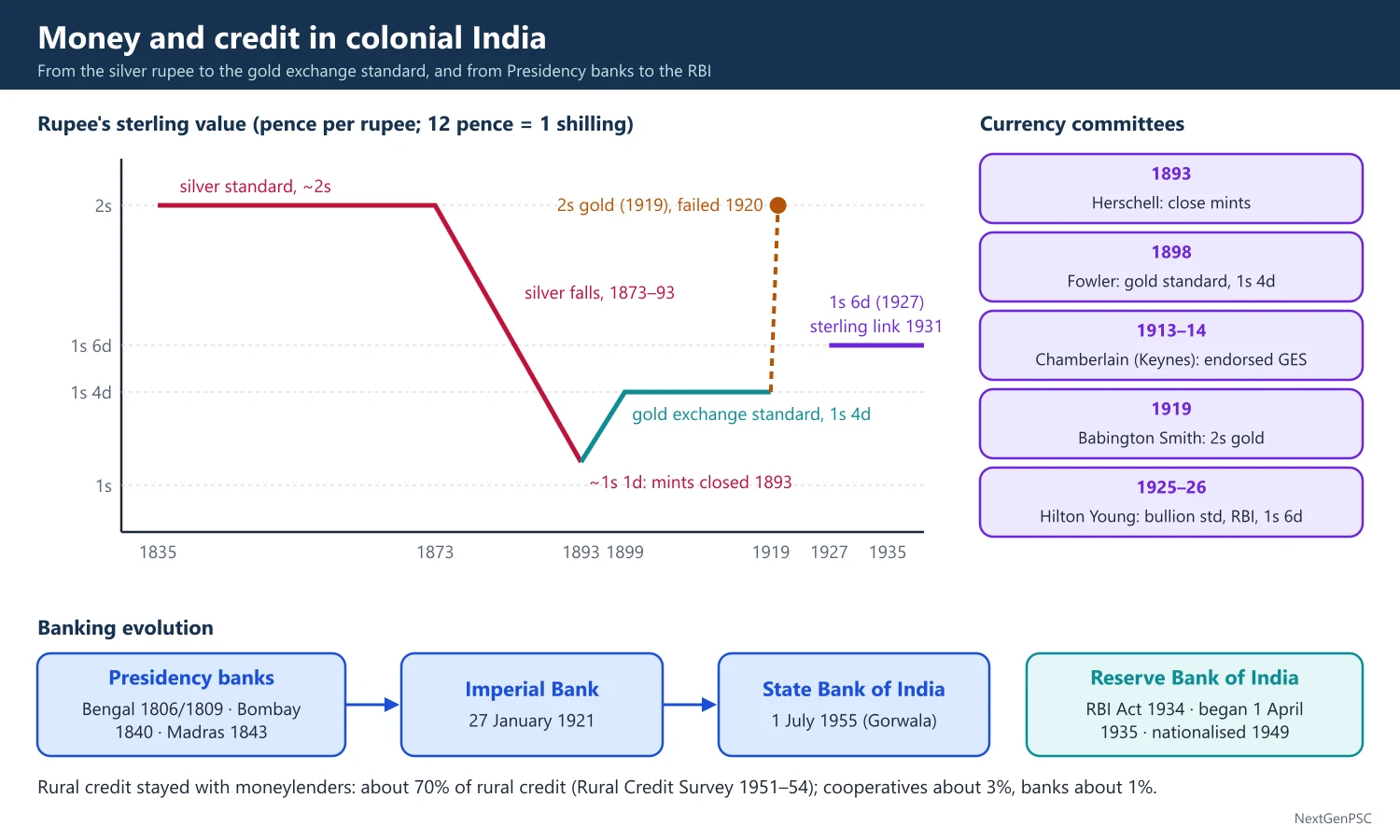
1. Currency: From Silver to Gold Exchange Standard
Silver standard: the Coinage Act of 1835 introduced a uniform silver rupee of 180 grains (165 grains fine silver) for British India, with free coinage of silver.
Paper Currency Act, 1861: gave the Government of India the monopoly of note issue, ending the note issues of the Presidency banks; notes were backed partly by securities and partly by metal (a fiduciary system).
Fall of the rupee (1873–1893): as major countries adopted gold and new silver mines opened, world silver prices fell; the rupee fell from about 2 shillings to about 1s 1d; since Home Charges were paid in sterling, the rupee cost of Home Charges rose sharply, straining the budget.
Herschell Committee (1893): recommended closing the mints to the free coinage of silver, which was done in June 1893, so that the rupee's value could be raised above its silver content.
Fowler Committee (1898): recommended a gold standard with gold currency at a rate of 1s 4d per rupee (15 rupees = 1 sovereign); in practice the system that emerged from 1899 was a gold exchange standard: the rupee circulated as a token coin, its sterling value was held at 1s 4d by sales of Council Bills and Reverse Councils, and reserves (the Gold Standard Reserve and Paper Currency Reserve) were partly held in London.
Chamberlain Commission (1913–14): the Royal Commission on Indian Finance and Currency, of which John Maynard Keynes was a member; it endorsed the gold exchange standard; Keynes's Indian Currency and Finance (1913) also defended it and proposed a central bank.
Babington Smith Committee (1919): faced with high silver prices in World War I, it recommended fixing the rupee at 2 shillings gold; the attempt failed in 1920 with heavy losses on reserves.
Hilton Young Commission (1925–26): the Royal Commission on Indian Currency and Finance recommended a gold bullion standard, a central bank (the Reserve Bank) and a rupee rate of 1s 6d; Sir Purshotamdas Thakurdas dissented in favour of 1s 4d, and the 'ratio controversy' became a nationalist issue; the Currency Act, 1927, fixed the rate at 1s 6d.
Sterling link (1931): when Britain left gold in September 1931, the rupee was linked to sterling at 1s 6d; gold exports from India in the 1930s ('distress gold') helped Britain's balance of payments.
Ambedkar's view: B. R. Ambedkar, The Problem of the Rupee: Its Origin and Its Solution (1923), criticised the gold exchange standard for giving the government discretionary power that caused inflation, and argued for a gold standard with gold currency, against Keynes's view.
2. Banking: Presidency Banks to Imperial Bank
Early agency houses and banks: agency houses in Calcutta combined trade and banking; the Bank of Hindostan (1770) and the General Bank of India (1786) were among the first; many failed in the crisis of 1829–32.
Presidency banks: the Bank of Calcutta (1806), renamed the Bank of Bengal (1809); the Bank of Bombay (1840); the Bank of Madras (1843); partly government-owned, they held government balances and, until 1861, issued notes.
Imperial Bank of India (27 January 1921): formed by merging the three Presidency banks; it held government balances, acted as a bankers' bank in some functions and managed the public debt until the RBI was formed; it was nationalised as the State Bank of India on 1 July 1955 on the recommendation of the All-India Rural Credit Survey Committee (A. D. Gorwala, 1954).
Exchange banks: foreign banks (for example Chartered Bank, HSBC, Mercantile Bank) financed foreign trade and dominated foreign exchange business.
Indian joint-stock banks: Allahabad Bank (1865), Punjab National Bank (registered 1894, opened 1895), and Swadeshi-era banks such as Bank of India (1906), Central Bank of India (1911) and Bank of Baroda (1908); many small banks failed in waves (1913–17 and later) because of poor regulation.
Cooperative credit: the Cooperative Credit Societies Act, 1904, and the Cooperative Societies Act, 1912, created rural and urban cooperatives as an alternative to moneylenders, with limited success; the Maclagan Committee (1915) reviewed them.
3. The Reserve Bank of India
Background: recommended by the Hilton Young Commission (1926) and the Central Banking Enquiry Committee (1929–31).
RBI Act, 1934: the Reserve Bank started operations on 1 April 1935 as a shareholders' bank with headquarters first in Calcutta (moved to Bombay in 1937); it took over note issue and the management of government accounts and became the bankers' bank.
Agricultural Credit Department: created under Section 54 of the RBI Act to study rural credit and advise cooperatives.
Nationalisation: the RBI was nationalised on 1 January 1949 under the RBI (Transfer to Public Ownership) Act, 1948; the Banking Companies Act, 1949 (later Banking Regulation Act) gave it regulatory powers over banks.
4. Indigenous Bankers and Rural Credit
Indigenous bankers: shroffs, sahukars, Marwaris, Chettiars, Multanis and others accepted deposits, lent money and dealt in hundis (indigenous bills of exchange), financing internal trade.
Moneylenders: provided most rural credit at high interest (often 18–36% or more a year), often with land as collateral, leading to land transfer and bonded labour.
Legislation: the Deccan Agriculturists' Relief Act (1879), the Usurious Loans Act (1918), provincial moneylenders' acts and debt-relief acts of the 1930s.
Central Banking Enquiry Committee (1929–31) and provincial committees: estimated rural indebtedness in British India at about Rs 900 crore around 1929; the All-India Rural Credit Survey (1951–54) later found that moneylenders supplied about 70% of rural credit, cooperatives only about 3% and commercial banks about 1%.
5. Charts to Draw
Currency timeline: 1835 silver rupee → 1861 Paper Currency Act → 1873–93 fall of silver → 1893 mints closed (Herschell) → 1898–99 Fowler and gold exchange standard at 1s 4d → 1913 Chamberlain → 1919 Babington Smith (2s) → 1926 Hilton Young (1s 6d, gold bullion standard) → 1931 sterling link → 1935 RBI.
Banking evolution chart: Presidency banks (1806/1809, 1840, 1843) → Imperial Bank of India (1921) → State Bank of India (1955); parallel lines for exchange banks, Indian joint-stock banks, cooperatives (1904) and the RBI (1935, nationalised 1949).
Gold exchange standard mechanism: rupee token coin; London reserves; Council Bills sold in London when India had an export surplus and Reverse Councils sold in India when the rupee weakened, holding the rate near 1s 4d.
6. Wartime Finance and the Money Market
World War I: heavy British purchases in India and high silver prices caused inflation and pressure on the rupee, leading to the Babington Smith Committee.
World War II finance: Britain paid for goods and services bought in India largely by crediting sterling to the RBI, against which rupees were issued; note circulation rose several-fold and prices rose steeply, contributing to the distress behind the Bengal famine of 1943.
Sterling balances: India accumulated large sterling balances (well over a billion pounds by 1945–46), which after independence financed imports for the early plans and the purchase of British assets.
Dual money market: an organised sector (Imperial Bank, exchange banks, joint-stock banks) and an unorganised sector (indigenous bankers, moneylenders) with much higher interest rates and little connection between them, a gap the RBI was unable to close before 1947.
Seasonal stringency: in the busy season (roughly November to April) crop movement raised the demand for cash and pushed interest rates up sharply, while in the slack season money was idle.
Post Office Savings Bank (1882): extended small savings facilities across the country and remained an important channel of household saving.
Legacy for independent India: weak rural credit, a dual money market and a limited bank network led to the Rural Credit Survey (1954), the creation of SBI (1955) and bank nationalisation (1969).
Insurance and other finance: Indian life insurance companies grew from the late 19th century, often linked to the Swadeshi spirit, and were later nationalised into the Life Insurance Corporation of India in 1956.
7. Using It in the Exam
10 marks: features of the gold exchange standard, or the formation of the Imperial Bank (1921) and RBI (1935).
15 marks: the currency commissions and the ratio controversy.
20 marks: evolution of currency and banking, the weakness of rural credit and how it led to post-independence reforms (SBI 1955, bank nationalisation 1969).
Keywords: free coinage, closing of mints, gold exchange standard, Council Bills, ratio controversy, Presidency banks, Imperial Bank, hundi, Central Banking Enquiry Committee.
| Committee | Year | Main recommendation |
|---|---|---|
| Herschell Committee | 1893 | Close mints to free coinage of silver |
| Fowler Committee | 1898 | Gold standard at 1s 4d per rupee (became gold exchange standard) |
| Chamberlain Commission (Keynes a member) | 1913–14 | Endorsed gold exchange standard |
| Babington Smith Committee | 1919 | Rupee at 2 shillings gold (failed in 1920) |
| Hilton Young Commission | 1925–26 | Gold bullion standard, Reserve Bank, rupee at 1s 6d |
Mains points
- Give the currency sequence with dates and the rupee rate at each stage (1s 4d in 1899, 2s attempted in 1920, 1s 6d in 1927).
- Explain why the fall of silver hurt the budget: Home Charges were payable in sterling.
- Present the Keynes versus Ambedkar debate on the gold exchange standard; it is a high-scoring point.
- Trace the Presidency banks to the Imperial Bank (1921) and SBI (1955), and the RBI from 1935 to nationalisation in 1949.
- Use the All-India Rural Credit Survey's finding on moneylenders to link colonial credit to post-1947 reforms.
- Common mistake: saying the RBI was a government-owned bank from 1935; it began as a shareholders' bank.
Did you know?
- Keynes's first book, Indian Currency and Finance (1913), was about India, a country he never visited, and he served on the Chamberlain Commission while still under 30.
UPSC Previous Year Questions: Indian Economy in the Pre-Independence Era
From 2014 to 2026 UPSC asked 54 question parts worth 695 marks from this chapter in Paper II, almost every year in the compulsory Q1. The most-asked topics are manufacture and transport (railways, cotton, jute and deindustrialisation, 20 parts) and the drain theory and laissez-faire (17 parts), followed by land systems (7), commercialisation (6) and money and credit (4). Every question below has a model answer written to the UPSC word limit.
In simple words
Read the question and write your own answer in the time limit first: about 7 minutes for 10 marks and 11 minutes for 15 or 20 marks.
Then compare it with the model answer: did you give the right dates, name the person, committee or Act, and show both sides of the debate?
Note what you missed, revise that topic in the notes above, and rewrite the answer after a few days.
1. Land Systems under British Rule and Their Changes
Example 1 (UPSC 2025, 10 marks): Distinguish between the Zamindari system and the Ryotwari system of land revenue under the British rule in India.
Paper and question: Paper II, Q1(a)
Approach: Define each system with its originator and year, then distinguish them point by point (revenue payer, ownership, fixity of revenue, areas, effects).
The British introduced different land revenue systems to secure a stable income from land.
Zamindari (Permanent Settlement): introduced by Lord Cornwallis in 1793 in Bengal, Bihar and Orissa. Zamindars were made proprietors of land and paid a revenue fixed in perpetuity, about ten-elevenths of the rental at the time; the cultivators became their tenants.
Ryotwari: started by Alexander Read and Thomas Munro in Baramahal (1792) and extended to Madras (1820) and Bombay. Each cultivator (ryot) was recognised as owner and paid revenue directly to the state; the assessment was revised every 20–30 years.
Differences: (i) intermediary in zamindari, none in ryotwari; (ii) revenue fixed permanently versus periodically revised; (iii) the state lost the gains of rising rents under zamindari but raised revenue under ryotwari; (iv) zamindari created rack-renting and sub-infeudation, while ryotwari had high assessments that drove ryots to moneylenders.
Both systems made land a saleable commodity, raised indebtedness and left little surplus for investment.
Example 2 (UPSC 2023, 10 marks): Land system during the British rule was responsible for sustained poverty and stagnant growth in India. Comment.
Paper and question: Paper II, Q1(a)
Approach: Agree largely: explain how each land system extracted surplus and blocked investment, causing poverty and stagnation, with evidence, and add a brief qualification.
British land systems, the zamindari (1793), ryotwari (1820s) and mahalwari (1822–33), were designed to maximise revenue, not to develop agriculture, and they contributed heavily to India's agrarian poverty and stagnation.
Surplus extraction: high revenue demands and rents left cultivators little surplus; under zamindari, layers of intermediaries (patnidars) practised rack-renting; under ryotwari the state's assessment was often half the net produce or more.
No investment: absentee landlords lived on rents rather than improving land, while tenants without security had no incentive to invest. Banerjee and Iyer (2005) found that districts with landlord-based revenue systems still had lower agricultural investment and productivity after independence.
Indebtedness and land transfer: cash revenue fixed regardless of harvest forced peasants to borrow; land passed to moneylenders, as the Deccan Riots of 1875 showed. George Blyn estimated that per capita foodgrain output fell between 1891 and 1947.
Other factors, such as limited irrigation and the drain of wealth, also mattered, but the land system was a central cause of sustained poverty.
Example 3 (UPSC 2022, 10 marks): Examine the impact of land tenure system during British India on Indian agriculture.
Paper and question: Paper II, Q1(e)
Approach: Outline the three tenure systems briefly, then examine their impact on investment, productivity, tenancy, indebtedness and crop pattern, with evidence.
The British introduced three land tenure systems: the zamindari or Permanent Settlement (Cornwallis, 1793), the ryotwari (Read and Munro, 1792–1820) and the mahalwari (Holt Mackenzie, 1822). Their impact on agriculture was largely negative.
Investment and productivity: rent-seeking zamindars and insecure tenants did not invest in land; per acre yields of major crops stagnated, and per capita foodgrain output fell between 1891 and 1947 (George Blyn, 1966).
Tenancy and sub-infeudation: layers of intermediaries pushed rents up and created tenants-at-will, which Bengal Tenancy Act (1885) only partly corrected.
Indebtedness: rigid cash revenue forced borrowing, and land passed to moneylenders; the Deccan Riots (1875) led to the Deccan Agriculturists' Relief Act, 1879.
Crop pattern: cash needs pushed commercial crops at the expense of food. These effects left a legacy of inequality that land reforms after 1947 had to address.
Example 4 (UPSC 2020, 10 marks): Assess the impact of land tenure system adopted by the British on the peasants and productivity of Indian agriculture.
Paper and question: Paper II, Q1(c)
Approach: Assess the impact separately on peasants (burden, insecurity, debt, land loss) and on productivity (investment, yields), citing evidence and a brief qualification.
British land tenure systems, the zamindari (1793), ryotwari (1820) and mahalwari (1822), were designed to maximise and stabilise revenue.
Impact on peasants: under zamindari, cultivators became tenants-at-will facing rack-renting and illegal cesses by layers of intermediaries; under ryotwari and mahalwari, high cash assessments, often near half the net produce in the early decades, and rigid collection forced peasants into debt; land passed to moneylenders and absentee owners. Distress showed in the Indigo Revolt (1859–60), the Pabna leagues (1873) and the Deccan Riots (1875).
Impact on productivity: landlords preferred rent extraction to investment; tenants lacked security and incentive; holdings were subdivided; yields stagnated, and per capita foodgrain output fell between 1891 and 1947 (Blyn). Banerjee and Iyer (2005) show that landlord areas lagged in productivity even after 1947.
Canal colonies in Punjab were an exception, but overall the tenure systems impoverished peasants and kept productivity low.
Example 5 (UPSC 2018, 20 marks): Examine the features of permanent land settlement as introduced by Lord Cornwallis.
Paper and question: Paper II, Q2(a)
Approach: Give the background and objectives, then the main features (proprietorship, fixed revenue, sunset law, tenant status), and close with consequences and an assessment.
After the Diwani of 1765, farming out revenue to the highest bidder (1772, 1777) caused over-assessment and ruin. Lord Cornwallis, believing in secure private property, made the Decennial Settlement of 1789–90 permanent through the Permanent Settlement of 1793 in Bengal, Bihar and Orissa.
Objectives: a fixed, assured revenue for the Company; a loyal landed class; and the hope that secure proprietors would improve agriculture, as English landlords had.
Features: (i) zamindars, earlier revenue collectors, were recognised as hereditary proprietors with the right to sell, mortgage and bequeath land; (ii) the revenue demand was fixed in perpetuity at about ten-elevenths (about 89%) of the rental then assessed, the zamindar keeping one-eleventh; (iii) the 'sunset law' meant that an estate was auctioned if revenue was not paid by sunset on the due date; (iv) cultivators became tenants, with their rights left undefined, though zamindars were expected to issue pattas; (v) Regulation VII of 1799 (haftam) gave zamindars power to seize tenants' property for arrears; (vi) the state gave up any future share in rising rents.
Consequences: many old zamindars lost estates in the early years and were replaced by urban merchants and moneylenders; absentee landlordism and sub-infeudation (patnidars, legalised by the Patni Regulation of 1819) multiplied; rack-renting and insecurity of tenants grew; little investment in land followed. The state lost revenue as prices and rents rose in the nineteenth century.
Later tenancy laws, the Bengal Rent Act of 1859 and the Bengal Tenancy Act of 1885, gave occupancy rights to some tenants.
The Permanent Settlement achieved revenue certainty and a loyal class but failed its developmental aim; its legacy of inequality made zamindari abolition the first land reform after 1947.
Example 6 (UPSC 2017, 15 marks): What were the broad considerations underlying the different types of land settlements in India during the colonial rule? Discuss.
Paper and question: Paper II, Q2(c)
Approach: Explain the considerations (revenue, political, ideological, administrative, regional conditions) behind each settlement, showing how they changed from 1793 to the 1820s–30s.
The British made three main land settlements, the Permanent (zamindari), ryotwari and mahalwari, and the choice in each region reflected changing considerations.
Revenue security: the Company needed an assured income to pay for wars, trade investment and administration; after the failed auctions of 1772–77, Cornwallis's Permanent Settlement (1793) fixed revenue to guarantee collections.
Political: creating a loyal class of landed proprietors in Bengal would support British rule, a motive Cornwallis stated openly.
Ideological: Cornwallis believed, with Whig and Physiocratic thinkers, that secure private property would encourage improvement. Later, Ricardo's theory of rent and utilitarian thinkers (James Mill) argued that rent belonged to the state, favouring direct settlements with cultivators and periodic revision so the state could share rising rents.
Experience and conditions: the loss of future revenue under the Permanent Settlement and the absence of large zamindars in the south led Munro to the ryotwari (Madras, 1820; Bombay). In the North-Western Provinces, strong village communities led Holt Mackenzie (1822) and Bird and Thomason (1833) to the mahalwari, settling with village bodies.
Administrative: settlement with a few zamindars was easy to administer, while ryotwari required detailed surveys.
Thus revenue maximisation remained the constant aim, while political needs, economic ideas and local agrarian structures decided the form.
Example 7 (UPSC 2014, 10 marks): Land system during the British period was responsible for sustained poverty in India and stagnant growth of Indian economy. Discuss.
Paper and question: Paper II, Q1(a)
Approach: Discuss how revenue pressure, intermediaries, insecurity and indebtedness under the land systems caused poverty and stagnation, with evidence, and note other contributing factors.
The land systems introduced by the British, the zamindari (1793), ryotwari (1820) and mahalwari (1822), aimed at maximum revenue and became a major cause of sustained poverty.
Heavy burden: revenue and rents absorbed much of the surplus; zamindars and sub-tenure holders practised rack-renting, while ryotwari assessments were high and inflexible in bad years.
No incentive to invest: absentee landlords and insecure tenants did not improve land, so yields stagnated; per capita foodgrain output fell between 1891 and 1947 (Blyn). Banerjee and Iyer (2005) show landlord districts still lag in productivity and public goods today.
Debt and land transfer: cash revenue drove peasants to moneylenders, causing land alienation (Deccan Riots, 1875) and a growing class of landless labourers.
Stagnant economy: a poor peasantry meant weak demand for industry, and rents flowed into land purchase and usury rather than productive investment.
Other causes, such as the drain, deindustrialisation and neglect of irrigation, added to it, but the land system lay at the root of stagnation.
2. Commercialisation of Agriculture
Example 8 (UPSC 2026, 10 marks): "Commercialization of agriculture in British India was a forced process rather than a natural one." Elucidate with reference to cash crops like indigo.
Paper and question: Paper II, Q1(b)
Approach: Explain why commercialisation was forced (revenue in cash, debt, planters' coercion, colonial demand) using indigo as the main example, and note where it was partly market-driven.
Commercialisation of agriculture means producing crops for sale rather than for the family's own use. In British India it was largely a forced process because peasants grew cash crops under compulsion, not in response to profitable opportunities.
Indigo: European planters in Bengal and Bihar gave ryots cash advances (dadan) that bound them to grow indigo on their best land at prices far below its value; under the tinkathia system in Champaran, peasants had to plant indigo on 3 of every 20 kathas. Refusal brought beatings, confinement and false cases. This led to the Indigo Revolt of 1859–60 and the Indigo Commission (1860), and later Gandhi's Champaran Satyagraha (1917).
Other compulsions: high cash revenue demands, debt to moneylenders and traders who advanced money against crops, and plantation labour contracts in Assam tea pushed peasants into cash crops regardless of their interest.
Some regions, such as the Punjab canal colonies, did respond to market incentives, but in most cases the gains went to planters, traders and moneylenders, confirming that commercialisation was forced.
Example 9 (UPSC 2025, 10 marks): What were the major impacts of 'commercialisation of agriculture' on Indian farmers during the pre-Independence India? Discuss.
Paper and question: Paper II, Q1(b)
Approach: Briefly define commercialisation and its drivers, then discuss impacts on farmers (positive and mainly negative): prices, debt, food security, famines, differentiation.
From the mid-nineteenth century, railways (1853), the Suez Canal (1869), British industrial demand and cash revenue demands turned Indian farmers towards cash crops such as cotton, jute, indigo, opium, tea and wheat.
Limited gains: some richer peasants in Punjab canal colonies and cotton tracts gained from higher prices; markets widened and regional specialisation grew.
Exposure to price swings: the cotton boom during the American Civil War (1861–65) was followed by a crash that left Deccan peasants indebted, leading to the Deccan Riots (1875); the Great Depression halved farm prices after 1929.
Debt and land loss: traders and moneylenders advanced money against crops and captured most of the gains, and land passed to them.
Food security: food crops lost ground to non-food crops; George Blyn estimated a fall in per capita foodgrain output between 1891 and 1947, and famines (1876–78, 1896–1900, 1943) struck repeatedly.
Differentiation: a small rich-peasant class rose while small peasants and labourers sank; commercialisation thus deepened poverty more than prosperity.
Example 10 (UPSC 2024, 10 marks): Describe why farmers derived little benefits from the commercialisation of agriculture in pre-independence India.
Paper and question: Paper II, Q1(d)
Approach: Explain the reasons why farmers gained little: forced nature, middlemen and moneylenders, price instability, revenue and rent burden, lack of investment and technology, and famines.
Commercialisation of Indian agriculture accelerated after 1850 with railways, the Suez Canal (1869) and British demand for raw materials, yet farmers derived little benefit.
Forced, not voluntary: peasants grew cash crops to pay cash revenue and debts, or under planters' coercion, as with indigo, so they could not choose crops for profit.
Middlemen and moneylenders: poor peasants sold immediately after harvest at low prices to traders who had advanced loans; export houses and traders captured most of the price gains.
Price instability: linkage to world markets brought booms and crashes, such as the cotton crash after 1865 and the fall of prices after 1929, while revenue and debt stayed fixed in money.
High rents and revenue: landlords and the state absorbed the surplus; no investment in irrigation, seeds or technology followed, so yields stayed low.
Food insecurity: the shift from food to non-food crops left peasants vulnerable to famines. Thus the benefits went to traders, planters and British industry rather than to farmers.
Example 11 (UPSC 2021, 10 marks): Examine the factors that facilitated commercialisation of Indian agriculture during the British rule.
Paper and question: Paper II, Q1(a)
Approach: List and explain the facilitating factors: transport (railways, Suez Canal), world demand, revenue in cash, colonial policy and plantations, irrigation, and money and markets.
Commercialisation, the production of crops for sale in distant markets, spread rapidly in India in the second half of the nineteenth century because of several factors.
Transport revolution: railways from 1853 and the opening of the Suez Canal in 1869 sharply cut freight costs and linked the interior to ports and world markets.
World demand: Britain's Industrial Revolution created demand for raw cotton, jute, indigo and oilseeds; the American Civil War (1861–65) caused a cotton boom.
Cash revenue: land revenue had to be paid in money, forcing peasants to sell their produce.
Colonial policy and plantations: the state supported European planters in indigo and tea, kept the opium monopoly, and promoted one-way free trade.
Irrigation: canal colonies in Punjab from the 1880s produced wheat and cotton for export.
Money and markets: a uniform rupee (1835), telegraphs and export firms widened markets. These factors together turned subsistence farming towards a market orientation, though largely on colonial terms.
Example 12 (UPSC 2019, 10 marks): Account for the commercialisation of Indian agriculture during the second half of the 19th century and analyse its effects.
Paper and question: Paper II, Q1(a)
Approach: Account for (explain the causes of) commercialisation after 1850 briefly, then analyse its effects, positive and negative, with examples.
Causes: after 1850, railways (1853), the Suez Canal (1869), steamships and the telegraph integrated Indian agriculture with world markets; British industry demanded raw cotton and jute; the American Civil War (1861–65) raised cotton prices; and cash land revenue forced sales. Cotton (Deccan, Gujarat), jute (Bengal), wheat (Punjab), tea (Assam), indigo and opium spread.
Positive effects: markets widened, prices of farm products rose in the long run, regional specialisation developed, and some richer peasants and canal colonists in Punjab prospered.
Negative effects: (i) exposure to price crashes, as after 1865, which led to the Deccan Riots of 1875; (ii) indebtedness and land transfer to moneylenders; (iii) a shift from food to non-food crops, with falling per capita foodgrain output after 1891 (Blyn) and severe famines in 1876–78 and 1896–1900; (iv) profits captured by traders, exporters and planters; (v) growing differentiation of the peasantry.
Thus commercialisation integrated India with world markets but, without investment or tenant security, it impoverished most peasants.
Example 13 (UPSC 2016, 15 marks): Critically examine condition of Agriculture and rural economy during the pre-independence era.
Paper and question: Paper II, Q2(b)
Approach: Examine agriculture and the rural economy under several heads (land systems, productivity, commercialisation, debt, famines, rural industry, labour) and give a critical, balanced conclusion.
On the eve of independence about 70% of India's workforce depended on agriculture, yet the sector was stagnant and the rural economy impoverished.
Land systems: zamindari, ryotwari and mahalwari settlements put a heavy revenue and rent burden on cultivators, created intermediaries and absentee landlords, and gave tenants little security.
Low productivity: George Blyn (1966) estimated that total crop output grew only about 0.4% a year from 1891 to 1947 and foodgrain output per head fell, especially in Bengal; irrigation covered a small share of land outside Punjab and parts of the south.
Forced commercialisation: cash crops spread under the pressure of revenue and debt, exposing peasants to price swings and famines.
Indebtedness: moneylenders dominated rural credit; the Punjab Land Alienation Act (1900) and the Deccan Agriculturists' Relief Act (1879) tried to curb land transfer; Darling (1925) showed heavy debt even in prosperous Punjab.
Famines: major famines in 1876–78, 1896–97, 1899–1900 and Bengal 1943 (about 2–3 million deaths) exposed the fragility of the rural economy.
Rural industry and labour: decline of handicrafts pushed artisans onto land, raising pressure on agriculture; landless labourers increased. Positives were limited: canal irrigation in Punjab, railways and some agricultural research (Pusa, 1905). Overall, the rural economy was stagnant, unequal and vulnerable.
3. Drain Theory, Laissez-faire and Its Critique
Example 14 (UPSC 2026, 10 marks): Critically examine the 'drain theory' as propounded by Dadabhai Naoroji. How did it explain the root cause of poverty in colonial India?
Paper and question: Paper II, Q1(a)
Approach: State Naoroji's theory and its components, show how it explained poverty (loss of capital, export surplus, low per capita income), then critically examine it.
Dadabhai Naoroji, in 'The Poverty of India' (1876) and Poverty and Un-British Rule in India (1901), argued that a part of India's national product was transferred to Britain every year without any economic return; he called this the drain of wealth.
Components: the Home Charges (interest on sterling debt, pensions of British officials, India Office and army expenses, stores), remittances of officials' savings, and profits of British firms. Naoroji measured the drain by India's export surplus.
Root cause of poverty: the drain removed savings that could have financed investment, so capital formation stayed low; it kept per capita income at about Rs 20 a year (1867–68, his estimate), too low for subsistence; and rule by foreigners, whom he called 'un-British', meant the surplus was spent abroad.
Critique: British writers such as Theodore Morison (1911) said the payments bought administration, defence and capital, and estimates of its size vary widely. Yet the theory rightly stressed that the surplus was not reinvested at home, and it became the economic basis of Indian nationalism.
Example 15 (UPSC 2026, 15 marks): Discuss the application of laissez-faire theory in colonial India. Why did the nationalist economists criticize this policy as a tool for deindustrialization?
Paper and question: Paper II, Q3(c)
Approach: Explain laissez-faire and how it was applied in India (one-way free trade, tariffs, famine policy, no industrial support), then give the nationalist critique linking it to deindustrialisation.
Laissez-faire, from Adam Smith's Wealth of Nations (1776) and the classical economists, holds that the state should not interfere with markets and trade. The British applied it selectively in India from the 1830s to the First World War.
Application: (i) one-way free trade: after the end of the Company's trade monopoly (1813, 1833), British manufactures entered India at low duties while Indian textiles had faced high duties in Britain; (ii) in 1882 nearly all import duties were abolished, and when a 5% duty was imposed in 1894 for revenue, a countervailing excise was levied on Indian mill cloth (3.5% from 1896), to please Lancashire; (iii) the state gave no protection, credit or technical education to industry and bought stores from Britain; (iv) in famines such as 1876–78, the government refused to interfere with grain trade.
Nationalist critique: M.G. Ranade (Essays on Indian Economics, 1898), Naoroji, R.C. Dutt and G.V. Joshi argued that laissez-faire suited an industrialised Britain but not an infant economy; free trade destroyed handicrafts without building modern industry, turning India into a supplier of raw materials and a market for British goods. Ranade, following Friedrich List, demanded state support for industry. They also noted that the state was not neutral: it intervened for British interests (railway guarantees, plantations, cotton excise).
The critique was later vindicated by the Industrial Commission (1916–18) and discriminating protection (1923).
Example 16 (UPSC 2025, 10 marks): What were the economic consequences of the 'Drain of Wealth' theory as practised during the British rule in India? Analyse.
Paper and question: Paper II, Q1(c)
Approach: Briefly define the drain and its channels, then analyse its economic consequences: capital formation, poverty, trade pattern, deindustrialisation, famines and fiscal burden.
The drain of wealth, as Dadabhai Naoroji and R.C. Dutt described it, was the unrequited transfer of India's resources to Britain through Home Charges, remittances of officials' salaries and savings, and profits of British capital, financed by an export surplus.
Consequences: (i) low capital formation: savings that could have been invested at home left the country, so industry and agriculture lacked capital; (ii) poverty: per capita income stayed very low, about Rs 20 a year in 1867–68 by Naoroji's estimate; (iii) distorted trade: India had to export raw materials and foodgrains to generate the surplus.
Further consequences: (iv) heavy taxation: land revenue and salt tax financed Home Charges, so less was spent on development; (v) famines: grain exports continued even in famine years; (vi) currency strain: as the rupee fell in 1873–93, the rupee cost of sterling Home Charges rose.
R.C. Dutt held the drain to be a central cause of India's decline; British writers saw the payments as returns for services and capital.
Example 17 (UPSC 2025, 10 marks): Describe the phases of colonisation in British India.
Paper and question: Paper II, Q1(e)
Approach: Use R. Palme Dutt's and Bipan Chandra's three stages: mercantile (1757–1813), free-trade industrial capitalism (1813–1860), and finance capitalism (after 1860), with the features of each.
Historians such as R. Palme Dutt (India Today, 1940) and Bipan Chandra describe colonialism in India in three overlapping stages, each serving a different form of British capital.
1. Mercantile stage (1757–1813): after Plassey (1757) and the Diwani (1765), the East India Company used its trade monopoly and Bengal's revenues to buy Indian goods for export ('investment') without sending bullion; weavers were forced to sell to the Company; open plunder and the drain began.
2. Free-trade or industrial capital stage (1813–1860): the Charter Act of 1813 ended the Company's trade monopoly; India became a market for Lancashire goods and a supplier of raw materials; one-way free trade, new land settlements and the beginning of railways served British industry; handicrafts declined.
3. Finance-capital stage (after about 1860): British capital was invested in railways, plantations, mines, jute mills, banking and government loans, earning guaranteed interest and profits; the drain took the form of interest, dividends and Home Charges.
In each stage India's economy was subordinated to Britain's changing needs, explaining its underdevelopment.
Example 18 (UPSC 2024, 10 marks): Mention the items of 'Economic Drain' from India as conceived by Dadabhai Naoroji.
Paper and question: Paper II, Q1(a)
Approach: List the items of the drain as Naoroji conceived them, grouped into public (Home Charges) and private remittances, with a line on how he measured it.
Dadabhai Naoroji, in 'The Poverty of India' (1876) and Poverty and Un-British Rule in India (1901), described the economic drain as the portion of India's national product sent to Britain for which India received no economic return.
Public items (Home Charges): (i) interest on the public debt raised in Britain, including debt from the Company's wars and the 1857 revolt; (ii) dividends to East India Company shareholders until 1874; (iii) pensions, furlough and leave pay of British civil and military officers; (iv) expenses of the India Office and the Secretary of State in London; (v) army charges paid in Britain, including recruitment and training; (vi) purchase of military and railway stores in Britain; (vii) guaranteed interest to railway companies.
Private items: (viii) salaries and savings remitted home by British officials, lawyers and doctors; (ix) profits and interest of British firms, banks, shipping and insurance companies.
Naoroji measured the drain as India's export surplus that had no corresponding import of goods or bullion.
Example 19 (UPSC 2024, 10 marks): Discuss why 'Laissez Faire' was not good for India during the pre-independence India.
Paper and question: Paper II, Q1(c)
Approach: Define laissez-faire, then explain why it harmed India: infant economy, one-way free trade, deindustrialisation, famine policy, and the state's selective intervention for British interests.
Laissez-faire is the policy of non-intervention by the state in markets and trade, advocated by Adam Smith and the classical economists. In colonial India it did more harm than good.
Infant economy: as Friedrich List argued and M.G. Ranade applied to India, free trade benefits an industrialised nation but prevents a backward economy from developing industry; India's crafts could not compete with machine-made goods.
One-way free trade: British goods entered at low duties after 1813, and duties were abolished in 1882; when a revenue duty came in 1894, a countervailing excise was imposed on Indian mill cloth, so Indian industry received no protection.
Deindustrialisation: handicrafts declined and artisans were pushed onto land, raising dependence on agriculture.
Famine policy: refusal to control grain trade or prices in 1876–78 and 1896–97 contributed to high mortality.
Selective application: the state intervened where British capital gained, through railway guarantees, plantation laws and stores purchase. Laissez-faire thus served British interests rather than India's development.
Example 20 (UPSC 2021, 10 marks): Examine the arguments to explain the theory of 'economic drain' from India in the second half of the 19th century.
Paper and question: Paper II, Q5(a)
Approach: Present the arguments of the drain theorists (Naoroji, Dutt, Ranade, Digby): the channels, the export-surplus measure, the effects, and the counter-arguments, briefly.
In the second half of the nineteenth century, Dadabhai Naoroji ('The Poverty of India', 1876), R.C. Dutt, M.G. Ranade, G.V. Joshi and William Digby developed the theory of the economic drain.
Arguments: (i) a large part of India's revenue and savings was transferred to Britain through Home Charges (interest on debt, pensions, India Office and army costs, stores) and private remittances of salaries and profits; (ii) this transfer appeared as a persistent export surplus with no matching import, so it was unrequited; (iii) the drain reduced capital available for investment, causing low productivity and poverty, with per capita income only about Rs 20 a year in 1867–68 (Naoroji).
Further arguments: (iv) it forced heavy land revenue and exports of food and raw materials even in famines; (v) Dutt held that the drain rose as the rupee fell (1873–93) because Home Charges were fixed in sterling.
Counter-arguments: British officials said the payments bought administration, defence and capital; nationalists replied that these were imposed and priced by Britain.
Example 21 (UPSC 2020, 10 marks): Examine how the laissez-faire policy was responsible for the famine in the late 19th century India.
Paper and question: Paper II, Q1(a)
Approach: Explain how the laissez-faire approach to grain trade, prices and relief, together with revenue demands and exports, made the famines of 1876–78 and 1896–1900 so deadly, then note the Famine Codes.
The late nineteenth century saw devastating famines in 1876–78, 1896–97 and 1899–1900. The government's laissez-faire approach, based on the classical belief that markets would move grain to where it was needed, made them far worse.
No control of grain trade: Lord Lytton's government in 1876–78 refused to interfere with private trade or prices, so grain was exported or moved to towns while famine areas starved.
Minimal relief: relief was kept low to avoid 'dependency'; Sir Richard Temple's ration of about one pound of grain a day for heavy work on relief works was below subsistence, and distant relief camps added to deaths.
Revenue and exports: land revenue was collected even in drought years, and grain exports continued.
No investment: little was spent on irrigation, while commercialisation had weakened food reserves.
Mortality was very high; estimates run into millions. The Famine Commission of 1880 (Strachey) led to the Famine Codes (1883), a partial departure from laissez-faire.
Example 22 (UPSC 2019, 15 marks): Examine the theory of "Economic Drain" in the second half of the 19th century in India and discuss its economic effects.
Paper and question: Paper II, Q2(c)
Approach: Examine the theory (proponents, channels, measure) and then discuss its economic effects, ending with the debate on its validity and size.
The theory of economic drain was developed by Dadabhai Naoroji ('The Poverty of India', 1876; Poverty and Un-British Rule in India, 1901), R.C. Dutt (Economic History of India, 1902–04), M.G. Ranade and William Digby. It held that a part of India's wealth flowed to Britain each year without any return.
Channels: Home Charges (interest on sterling debt, pensions and leave pay, India Office and army costs, stores purchases, railway guarantee interest) and private remittances (officials' savings and salaries, profits of British firms). Naoroji measured the drain by India's export surplus.
Economic effects: (i) loss of investible surplus: savings that could have built industry and irrigation were sent abroad; (ii) poverty: per capita income about Rs 20 a year in 1867–68 (Naoroji), below a subsistence minimum; (iii) high taxation of land and salt to meet Home Charges; (iv) pattern of trade: India exported raw materials and food to finance the drain; (v) famines: grain exports continued during famines; (vi) deindustrialisation: lack of capital and protection hurt industry.
Debate: British writers such as Theodore Morison saw the payments as fair returns for services and capital; later economic historians agree that a transfer occurred but dispute its size and effects.
The theory gave Indian nationalism its economic foundation and shaped post-independence emphasis on self-reliance.
Example 23 (UPSC 2018, 10 marks): Do you agree with the view that the objective of industrial and commercial policies of British was to transform India as a complementary economy of England? Give reasons.
Paper and question: Paper II, Q1(a)
Approach: Agree, giving reasons: trade policy (free trade, raw material exports), industrial neglect, railways and freight rates, tariffs and excise, stores purchase; add a brief qualification.
Yes, broadly. British industrial and commercial policies aimed to make India a complementary economy: a supplier of raw materials and food and a market for British manufactures.
Trade policy: after 1813 British goods entered at low duties and duties were abolished in 1882, while India exported raw cotton, jute, indigo, oilseeds and wheat.
Tariffs and excise: the countervailing excise on Indian mill cloth (1894–96 to 1926) protected Lancashire, not Indian industry.
Railways: lines linked raw-material regions to ports, and freight rates favoured traffic to and from ports over internal movement.
Industrial neglect: no protection, technical education or credit before 1916; government stores were bought in Britain.
Qualification: some modern industry (cotton, jute, steel) grew, and after 1923 discriminating protection marked a partial change, driven by war needs and nationalist pressure. Overall the evidence supports the view.
Example 24 (UPSC 2018, 15 marks): 'British rule led to India's underdevelopment'. Do you agree? Give reasons in support of your answer.
Paper and question: Paper II, Q2(c)
Approach: Take a position (largely yes), give reasons (drain, deindustrialisation, agrarian stagnation, low investment, famines, data on income), then weigh the counter-view (railways, institutions) and conclude.
Largely yes. Over 1900–1947 India's per capita income grew very slowly, estimated at about 0.1–0.2% a year (Sivasubramonian), and at independence life expectancy was about 32 years and literacy about 18% (Census 1951).
Drain of wealth: Home Charges and private remittances transferred savings abroad, limiting capital formation (Naoroji, Dutt).
Deindustrialisation: one-way free trade destroyed handicrafts; India's share of world manufacturing output fell from about a quarter in 1750 to about 2% by 1900 (Paul Bairoch, 1982).
Agrarian stagnation: extractive land systems and forced commercialisation kept yields low; per capita foodgrain output fell between 1891 and 1947 (Blyn); famines recurred, ending with Bengal in 1943.
Neglect of development: low spending on education, health and irrigation; no protection for industry until 1923; investment of the economy stayed at about 5–7% of GDP.
Counter-view: Morris D. Morris and others argue British rule brought railways (about 40,000 miles by 1947), canals, a unified market, legal system, modern banking and some industry, and that India was already poor in 1757. Tirthankar Roy stresses that geography and the monsoon also limited growth.
Balance: these modern elements served colonial interests and spread little benefit. Combining the drain, deindustrialisation and agrarian stagnation, the weight of evidence supports the view that British rule caused India's underdevelopment, or at least prevented its development.
Example 25 (UPSC 2017, 20 marks): What is drain theory? How does it explain the backwardness of India in the 19th century?
Paper and question: Paper II, Q2(a)
Approach: Define the drain theory with its proponents and items, then explain the mechanism by which it caused backwardness in the 19th century, and close with criticism and significance.
The drain theory, formulated by Dadabhai Naoroji ('The Poverty of India', 1876; Poverty and Un-British Rule in India, 1901) and developed by R.C. Dutt, M.G. Ranade, G.V. Joshi and William Digby, holds that British rule transferred a part of India's national product to Britain each year without any economic return.
Items: the Home Charges, which included interest on the sterling public debt, dividends of the East India Company until 1874, pensions and leave pay of British officers, India Office and army expenses, and stores purchased in Britain; and private remittances of officials' salaries and savings and of profits of British firms. The drain appeared as a persistent export surplus.
How it explains backwardness: (i) capital shortage: the drained surplus, which Naoroji and Dutt considered a large share of revenue, could otherwise have financed investment in agriculture and industry; (ii) low income and demand: per capita income of about Rs 20 a year in 1867–68 meant little saving or demand for manufactures; (iii) fiscal burden: heavy land revenue and salt tax financed Home Charges rather than development; (iv) trade pattern: India had to export raw materials and food; (v) foreign capital: British investment, financed in part by the drain, earned profits that were repatriated, creating a cycle of dependence; (vi) the rupee's fall in 1873–93 raised the rupee cost of the drain.
Criticism: British writers argued that the payments bought administration, defence, railways and capital; others noted that India's export surplus also financed imports of gold and silver. Estimates of the size remain debated.
Significance: the theory shifted the nationalist critique from administration to economics, inspired the Swadeshi movement (1905) and shaped the post-1947 emphasis on self-reliance and planning.
Example 26 (UPSC 2017, 15 marks): Do you think that the attitude of the British Government towards the Indian economy changed markedly at the turn of the 19th century? Give specific instances supporting your argument.
Paper and question: Paper II, Q2(b)
Approach: Argue that the attitude changed partly (from about 1900 to the 1920s), giving specific instances in agriculture, famine, industry, tariffs and finance, and note the continuities.
Around 1900 the British government's attitude moved from strict laissez-faire towards limited intervention, driven by famines, nationalist criticism, the needs of the First World War and competition from Germany and Japan. The change was real but partial.
Agriculture and famine: the Famine Commission of 1901 (MacDonnell) improved relief; the Irrigation Commission (1901–03) expanded canals; the Punjab Land Alienation Act (1900) restricted land transfer to moneylenders; the Cooperative Credit Societies Act (1904) and Act of 1912 created rural credit cooperatives; the Imperial Agricultural Research Institute was set up at Pusa (1905).
Industry: a Department of Commerce and Industry was created (1905); the Indian Industrial Commission (1916–18), chaired by Thomas Holland, recommended active state support; the Munitions Board helped wartime production; stores purchase rules were relaxed in the 1920s.
Tariffs: the fiscal autonomy convention (1919) and the Indian Fiscal Commission (1921–22) led to discriminating protection through the Tariff Board (1923), protecting steel (1924), cotton, paper and sugar (1932); the cotton excise was abolished in 1926.
Continuities: Home Charges and the drain continued; the 1s 6d exchange rate (1927) and imperial preference (Ottawa, 1932) favoured Britain; protection was hedged with conditions.
Thus the change was marked in form but limited in substance, reflecting imperial needs as much as Indian interests.
Example 27 (UPSC 2016, 10 marks): What were the economic consequences of discriminating protection in the trade policy during British Regime?
Paper and question: Paper II, Q1(e)
Approach: Explain discriminating protection (Fiscal Commission's triple formula, Tariff Board), then its economic consequences, positive and negative.
Discriminating protection was recommended by the Indian Fiscal Commission (1921–22), chaired by Ibrahim Rahimtoola. Protection was to be given only to industries that (i) had natural advantages such as raw materials, labour and a home market, (ii) could not develop without protection, and (iii) would eventually face world competition without it, the 'triple formula'. A Tariff Board (1923) examined each case.
Positive consequences: steel (Steel Industry (Protection) Act, 1924) helped TISCO survive and expand; sugar, protected in 1932, grew from about 30 factories to over 130 within a few years and India became nearly self-sufficient; cotton textiles, paper and matches also expanded; Indian capital entered new industries.
Negative consequences: protection was slow, case by case and conditional, so new and basic industries such as chemicals and machinery were excluded; consumers paid higher prices; imperial preference (Ottawa, 1932) favoured British goods.
Overall it marked a partial break from laissez-faire and laid a modest base for later industrialisation.
Example 28 (UPSC 2015, 10 marks): What specific trade policies during the British period led to the decline of Indian industry? Explain.
Paper and question: Paper II, Q1(c)
Approach: Name and explain the specific trade policies: duties in Britain on Indian goods, end of Company monopoly and one-way free trade, abolition of duties (1882), cotton excise (1894–96), stores purchase and imperial preference.
Several British trade policies contributed to the decline of Indian industry, especially handicrafts.
Duties in Britain: in the late eighteenth and early nineteenth centuries Indian cotton and silk goods faced high import duties or bans in Britain (from the Calico Acts of 1700 and 1721), protecting the young British textile industry.
One-way free trade: the Charter Acts of 1813 and 1833 ended the Company's trade monopoly and opened India to British manufactures at low duties, while machine-made cloth undersold Indian handloom goods.
Abolition of import duties (1882) left Indian industry with no protection at all.
Cotton excise (1894–96): when a revenue duty on imports was reimposed, a countervailing excise was levied on Indian mill cloth to remove any protective effect, at Lancashire's insistence; it lasted until 1926.
Stores purchase and preference: government stores were bought in Britain, and imperial preference (Ottawa, 1932) favoured British goods. Together these policies deindustrialised India and made it a raw-material exporter.
Example 29 (UPSC 2015, 15 marks): During the British Rule, India was rooted with seeds of modernisation, but the country remained underdeveloped. Discuss.
Paper and question: Paper II, Q2(c)
Approach: List the seeds of modernisation (railways, telegraph, modern industry, banking, education, law, irrigation), then explain why underdevelopment persisted, concluding on the colonial nature of modernisation.
British rule introduced several elements of a modern economy, yet India remained one of the poorest countries at independence, with per capita income almost stagnant in 1900–47.
Seeds of modernisation: (i) railways from 1853, about 40,000 miles by the 1940s, and telegraphs and postal services that unified markets; (ii) modern industry: cotton mills (Bombay, 1854), jute mills (Rishra, 1855), coal, tea plantations and TISCO (1907); (iii) modern banking: Presidency banks, the Imperial Bank (1921) and the RBI (1935); (iv) a uniform currency, legal system and property rights; (v) Western education and universities (1857), which produced a modern middle class; (vi) canal irrigation in Punjab.
Why underdevelopment persisted: (i) modernisation served colonial needs: railways carried raw materials to ports and their stores came from Britain, so they did not spawn engineering industry; (ii) the drain removed investible surplus; (iii) one-way free trade destroyed crafts without industrialisation on the required scale; (iv) agriculture stagnated under extractive land systems; (v) public spending on education and health was low, leaving literacy at about 18% in 1951; (vi) no protection until 1923, and modern industry employed under 2% of workers.
Debate: Morris D. Morris saw a positive legacy; Bipan Chandra and A.K. Bagchi stress its enclave character.
Hence the seeds were sown in barren colonial soil: without political control over economic policy, modernisation could not trigger self-sustained growth, which began only after 1947.
Example 30 (UPSC 2014, 10 marks): Write about the policy of discriminating protection during the British rule and its impact on industrial development in India.
Paper and question: Paper II, Q1(b)
Approach: Explain the policy (Fiscal Commission 1921–22, triple formula, Tariff Board 1923) and its impact on industrial development, with examples and limitations.
After the First World War, nationalist pressure and the fiscal autonomy convention (1919) led the Indian Fiscal Commission (1921–22) under Ibrahim Rahimtoola to recommend discriminating protection.
Policy: protection only for industries meeting the 'triple formula': natural advantages (raw materials, cheap labour, a large home market), inability to develop without protection, and ability to face world competition eventually. A Tariff Board (1923) examined applications one by one.
Impact: steel was protected in 1924 and TISCO's output expanded; cotton textiles received protection from 1927 against Japanese imports; sugar, protected in 1932, grew from about 30 to over 130 factories within a few years; paper, matches and heavy chemicals also grew. Industrial production rose even during the Depression of the 1930s.
Limitations: the conditions were restrictive and slow, basic and capital goods industries were left out, imperial preference (Ottawa, 1932) favoured British goods, and the policy came too late. It was a modest but real beginning of industrialisation.
4. Manufacture and Transport: Jute, Cotton and Railways
Example 31 (UPSC 2026, 15 marks): "Railways in India were the forerunner in facilitating modern industries." Discuss. Critically analyze the role of railways in the economic development of India.
Paper and question: Paper II, Q4(c)
Approach: Discuss the claim (railways as forerunner of industry) with both sides, then critically analyse railways' role in development: market integration, famines, linkages, costs and biases.
India's first train ran from Bombay to Thane on 16 April 1853; by the 1940s the network exceeded 40,000 route miles.
As a forerunner of industry: railways created demand for coal (Raniganj, Jharia), carried raw cotton and jute to mills in Bombay and Calcutta, widened markets for mill goods, built large workshops (Jamalpur, 1862) that trained mechanics, and later bought rails from TISCO (founded 1907).
But the linkages were weak: locomotives, rails and stores were mostly imported from Britain, so railways did not create a domestic engineering industry as they did in Britain, the USA or Germany; freight rates favoured traffic to and from ports over internal routes, helping imports of manufactures and exports of raw materials.
Role in development: (i) market integration: Dave Donaldson (2018) estimated that railways cut trade costs, narrowed price gaps between regions and raised real agricultural income in connected districts by about 16%; (ii) famine relief: grain could move to deficit areas, and famine mortality fell after 1900 (Burgess and Donaldson); (iii) commercialisation of agriculture; (iv) mobility of people and ideas.
Costs: the guarantee system (5% interest from 1849) loaded losses on Indian taxpayers, and the main lines were chosen for military and commercial needs.
Railways thus aided commercialisation and some industry but, under colonial priorities, were more a carrier of trade than a forerunner of industrialisation.
Example 32 (UPSC 2025, 10 marks): Why did the British lead to the destruction of India's traditional cotton industry? Discuss.
Paper and question: Paper II, Q1(d)
Approach: Explain the causes of the destruction of the traditional cotton industry: Company coercion, British tariffs, machine competition and one-way free trade, loss of patronage, railways; note its extent.
India's handloom cotton textiles, such as Dhaka muslins and Coromandel calicoes, were world-famous and a major export until the late eighteenth century. British rule led to their decline for several reasons.
Company coercion: after 1765 the East India Company's agents (gomasthas) forced Bengal weavers to accept advances and sell to it at low prices, ruining their independence.
British tariffs: Indian cloth faced high duties or bans in Britain (Calico Acts, 1700 and 1721), while after 1813 British goods entered India at low duties: one-way free trade.
Machine competition: Lancashire's machine-made yarn and cloth, cheaper after the Industrial Revolution, undersold hand-spun yarn and hand-woven cloth; India became a net importer of cotton cloth in the early nineteenth century.
Loss of patronage and railways: the decline of princely courts removed demand for fine cloth, and railways carried British goods into the interior.
Hand-spinning was almost wiped out, though coarse handloom weaving survived. Artisans moved to agriculture, deepening rural poverty.
Example 33 (UPSC 2024, 10 marks): Discuss why the railway system developed by the East India Company went against the Indian interest.
Paper and question: Paper II, Q1(b)
Approach: Explain why early railways (1849–1858 under the Company, and the guarantee system) went against Indian interests: guarantee burden, route choice, freight rates, imported stores, and employment.
Railways began under the East India Company, with guarantee contracts signed in 1849 with the East Indian and Great Indian Peninsula Railway companies and the first line opened in 1853 under Lord Dalhousie.
Guarantee burden: British investors were promised 5% interest on their capital, paid from Indian revenues if earnings fell short, and land was given free; companies had no incentive to economise, so construction costs per mile were very high and Indian taxpayers bore the losses for decades.
Route choice: lines linked ports (Calcutta, Bombay, Madras) to the interior for exporting raw materials and moving troops, rather than serving internal trade.
Freight rates: lower rates for goods moving to and from ports helped British imports and raw-material exports, hurting Indian industry.
No industrial linkage: rails, locomotives and stores were bought in Britain; senior posts went to Europeans.
Thus the early railways served British capital, trade and military needs more than India's development, as nationalists such as R.C. Dutt argued.
Example 34 (UPSC 2024, 15 marks): Explain the problems faced by the Jute industry during pre-independence India. Why the problem aggravated after partition of the country?
Paper and question: Paper II, Q2(c)
Approach: Explain the jute industry's pre-independence problems (raw material, ownership, demand swings, cartel, labour), then why Partition in 1947 aggravated them (mills in India, jute fields in East Pakistan).
The jute industry began with a spinning mill at Rishra near Calcutta in 1855 (George Acland) and grew along the Hooghly into one of India's largest modern industries, supplying sacking and hessian to world markets.
Problems before independence: (i) foreign control: mills were largely owned by British, mainly Scottish, capital through managing agencies such as Andrew Yule and Bird and Company, so profits were repatriated and Indian entrepreneurs entered only after 1919; (ii) dependence on world demand: output was mostly exported, so the industry boomed in the First World War (sandbags) and slumped in the Great Depression after 1929; (iii) over-capacity: the Indian Jute Mills Association (1884) repeatedly imposed short-time working to restrict output and keep prices up; (iv) raw material price swings, which hurt growers in eastern Bengal; (v) poor labour conditions and strikes; (vi) narrow product range and competition from Dundee and from substitutes such as bulk handling.
Why Partition aggravated it: about four-fifths of the jute-growing area went to East Pakistan, while virtually all the mills remained in West Bengal. Mills lost their raw material supply; Pakistan imposed export duties, and after the 1949 devaluation dispute trade broke down; East Pakistan began building its own mills.
India responded with a drive to grow jute in West Bengal, Bihar, Assam and Odisha, but the shock caused shortages and idle capacity in the early 1950s.
Example 35 (UPSC 2023, 15 marks): Explain the development of cotton industry in India during pre-Independence era. Also point out its growth constraints.
Paper and question: Paper II, Q4(c)
Approach: Trace the development of the cotton mill industry in phases (1854 to 1947) with causes of growth, then list the growth constraints.
The cotton mill industry was the first major modern industry built largely with Indian capital and enterprise.
Beginnings (1854–1890s): Cowasji Nanabhai Davar founded the Bombay Spinning and Weaving Company in 1854; Ranchhodlal Chhotalal started Ahmedabad's first mill in 1861. Parsi, Gujarati and Bhatia merchants, using profits from the China trade, set up mills in Bombay producing mainly yarn for China and Japan.
1890s–1914: Japanese competition in the China yarn market pushed Bombay mills towards cloth for the home market; the Swadeshi movement (1905–08) boosted demand; by 1914 there were about 270 mills.
1914–1947: the First World War cut imports and raised profits; protection from 1927 against Japanese goods, Gandhian boycott of foreign cloth and the Second World War helped further expansion, especially in Ahmedabad and up-country centres; by the 1940s India met most of its mill-cloth needs.
Constraints: (i) the countervailing excise (1894–96 to 1926) and absence of protection before 1927; (ii) Japanese competition and loss of the China market; (iii) dependence on imported machinery and short-staple cotton; (iv) inefficient managing agents and old equipment; (v) low labour productivity and strikes, such as in Bombay in 1928; (vi) the Great Depression.
Despite constraints, cotton textiles became India's largest industry, the base for later industrialisation.
Example 36 (UPSC 2022, 10 marks): Outline the factors that caused decline of handicrafts during British rule in India.
Paper and question: Paper II, Q1(a)
Approach: Outline the factors behind the decline of handicrafts: loss of patronage, competition from machine goods, one-way free trade, Company coercion, railways, changing tastes, and lack of technical change.
India's handicrafts, textiles, metalware, ivory and woodwork, flourished under Mughal and regional courts but declined steeply under British rule.
Loss of patronage: the decline of princely courts and the old nobility removed the main buyers of luxury crafts; towns like Dhaka and Murshidabad decayed.
Machine-made competition: cheap British factory goods after the Industrial Revolution undersold hand products.
One-way free trade: British tariffs (Calico Acts) shut Indian goods out of Britain, while after 1813 British goods entered India at low duties.
Company coercion: Bengal weavers were forced to sell to the Company at low prices after 1765.
Railways: after 1853 they carried imported goods into the interior, breaking local artisans' protected markets.
Changing tastes and no technical change: an English-educated middle class preferred Western goods, and artisans lacked capital and new techniques. The decline pushed artisans onto land, raising pressure on agriculture.
Example 37 (UPSC 2022, 15 marks): Discuss the development of Jute industry during pre-independent India. What were the main problems faced by this industry?
Paper and question: Paper II, Q3(b)
Approach: Discuss the development of the jute industry in phases (1855 to 1947) with reasons for growth, then list its main problems.
Jute manufacturing became one of India's largest modern industries, concentrated along the Hooghly near Calcutta.
Beginnings: George Acland set up a spinning mill at Rishra in 1855, and power-loom weaving followed in 1859. Eastern Bengal's monopoly of raw jute, cheap labour and the supply of Dundee's know-how favoured growth.
Expansion (1870s–1914): world demand for sacking and hessian to pack grain, cotton and sugar soared; British (mainly Scottish) capital, organised through managing agencies such as Andrew Yule and Bird and Company, built mills; by 1913–14 there were over 60 mills, and Calcutta overtook Dundee as the world's main jute manufacturing centre.
1914–1947: the First World War brought huge demand for sandbags and high profits; Indian Marwari houses such as the Birlas entered after 1919; the Great Depression brought a slump, and the Indian Jute Mills Association enforced short-time working; the Second World War revived demand.
Main problems: (i) foreign ownership and repatriation of profits; (ii) dependence on export markets and wide price swings; (iii) over-capacity and cartel restrictions; (iv) poor labour conditions; (v) exploitation of jute growers by middlemen; (vi) a narrow product range.
At Partition (1947) most jute-growing land went to East Pakistan while the mills stayed in India, creating an acute raw-material crisis.
Example 38 (UPSC 2021, 10 marks): Do you think that the 'new guarantee' system was better than the 'old guarantee' system in the history of Railways in India? Give reasons.
Paper and question: Paper II, Q1(b)
Approach: Describe the old guarantee (1849–69) and new guarantee (1880s) systems, compare them on interest, ownership, profit sharing and control, and conclude that the new one was better for India.
Indian railways were built first by private English companies under guarantees from the Government of India.
Old guarantee system (1849–1869): companies raised capital in London and the government guaranteed 5% interest on it, paying any shortfall from Indian revenues; land was given free; surplus profits above 5% were shared equally with the state, which could buy the lines after 25 or 50 years. Since returns were assured, companies had no incentive to economise; costs per mile were very high.
State construction (1869–1880s) followed, but funds were short, so a new guarantee system was adopted from the 1880s: lines were state-owned and worked by companies, the guaranteed rate was lower (about 3–3.5%), the state took a larger share of surplus profits and could end contracts after a fixed period, and it had more control over construction and rates.
Yes, the new system was better: it lowered the taxpayers' burden, gave the state ownership and more profit, and enforced economy, though both served British investors first.
Example 39 (UPSC 2021, 20 marks): Compare the main features of development of jute and cotton textile industry in India during the British period.
Paper and question: Paper II, Q2(a)
Approach: Compare the two industries on origin, ownership and capital, management, markets, labour, growth path, state policy and Partition, ideally in a point-wise comparison, and conclude.
Cotton and jute textiles were the two largest modern industries of colonial India, but they developed along very different lines.
Origin and location: the first cotton mill was set up in Bombay in 1854 by Cowasji Nanabhai Davar, followed by Ahmedabad (1861) and up-country centres; the first jute mill was set up at Rishra near Calcutta in 1855 by George Acland, and the industry stayed concentrated along the Hooghly.
Ownership and capital: cotton was built mainly with Indian capital by Parsi, Gujarati and Bhatia merchants; jute was dominated by British, chiefly Scottish, capital, with Indian Marwari houses entering only after 1919.
Management: both used the managing agency system, Indian agencies (Tata, Petit, Sarabhai) in cotton and British agencies (Andrew Yule, Bird and Company) in jute.
Markets: cotton first exported yarn to China and Japan and later turned to cloth for the home market, helped by Swadeshi; jute was export-oriented, selling sacking and hessian worldwide, and so was more exposed to world demand swings.
Raw material: cotton used cotton grown across western and central India; jute depended on raw jute from eastern Bengal, a near-monopoly.
State policy: cotton suffered from the countervailing excise (1894–96 to 1926) before gaining protection in 1927; jute, being British-owned and export-led, faced no such hostility and organised its own cartel through the Indian Jute Mills Association (1884).
Partition: jute was hit hard as about four-fifths of jute land went to East Pakistan; cotton lost some cotton-growing areas but was less affected.
Thus cotton symbolised Indian enterprise oriented to the home market, while jute was a foreign-controlled export enclave; both laid foundations for post-independence industry.
Example 40 (UPSC 2020, 15 marks): Evaluate the development of the transport system in India during 1857 to 1947.
Paper and question: Paper II, Q2(b)
Approach: Evaluate railways, roads, shipping and ports, and air transport from 1857 to 1947 with dates and policies, then assess their purpose and impact.
After the revolt of 1857 the British expanded India's transport system rapidly, mainly for military control, administration and trade.
Railways: from a few hundred miles in 1857 the network grew to over 40,000 route miles by the 1940s under the old guarantee system (1849–69), state construction (1869–1880s) and the new guarantee system; famine and strategic lines were added after the Famine Commission of 1880. The Acworth Committee (1920–21) led to state management and the separation of the railway budget (1924).
Roads: the Grand Trunk Road was rebuilt and metalled, Public Works Departments (1854) built feeder roads, and the Jayakar Committee (1927) led to the Central Road Fund (1929); the Nagpur Plan (1943) set road targets.
Shipping and ports: steamships and the Suez Canal (1869) linked India to Britain; Bombay, Calcutta, Madras and Karachi ports were developed; coastal shipping was dominated by British lines until Indian firms such as Scindia Steam Navigation (1919) entered. Air transport began with the first airmail flight (1911) and Tata Airlines (1932).
Evaluation: transport integrated markets, cut famine mortality and spread commercialisation (Donaldson, 2018, estimated a rise in real agricultural income in connected districts); but routes linked raw-material regions to ports, freight rates favoured foreign trade, stores were imported, and the guarantee system burdened taxpayers.
Transport thus grew impressively in scale but served imperial and commercial interests first.
Example 41 (UPSC 2020, 15 marks): Analyse the effects of colonialism on de-industrialisation in India during the 18th century.
Paper and question: Paper II, Q3(c)
Approach: Describe India's manufacturing strength around 1750, then analyse how colonialism in the second half of the 18th century began deindustrialisation (Company monopsony, drain, tariffs, loss of patronage), noting that the steep decline came after 1800.
Deindustrialisation means a fall in the share of industry in output and employment. In the mid-eighteenth century India was a leading manufacturer; Paul Bairoch (1982) estimated its share of world manufacturing output at about a quarter around 1750, led by cotton textiles of Bengal, Gujarat and the Coromandel coast.
Company monopsony in Bengal: after Plassey (1757) and the Diwani (1765), the East India Company used political power to force weavers to accept advances (dadni) and sell only to its agents (gomasthas) at low prices; weavers lost independence and some abandoned the craft.
Drain and loss of demand: Bengal's revenues financed the Company's 'investment' in goods for export, so exports no longer brought bullion; the plunder of the Nawabs' treasuries and the famine of 1770 reduced local demand and artisan numbers.
Loss of patronage: the decline of the Mughal and regional courts and wars of succession weakened markets for fine crafts.
British protectionism: the Calico Acts (1700, 1721) and high duties protected Britain's infant textile industry against Indian goods, while mechanisation after the 1770s began to cut British costs.
Assessment: the eighteenth century laid the foundations; the large collapse of Indian textile exports and hand-spinning came after 1800, when cheap Lancashire cloth flooded India under one-way free trade. Historians such as Prasannan Parthasarathi stress that Indian competition spurred Britain's own mechanisation.
Example 42 (UPSC 2019, 10 marks): Do you agree that the development of Indian railways during the British Rule helped facilitate the process of industrialisation? Give reasons.
Paper and question: Paper II, Q1(b)
Approach: Give a partly-yes answer: list ways railways helped industry (markets, coal, raw materials, workshops) and ways they did not (imported stores, freight rates, guarantee costs), and conclude.
Only partly. Railways, begun in 1853, reached over 40,000 route miles by the 1940s, but their contribution to industrialisation was limited.
How they helped: they widened markets for mill cloth and other goods; carried coal from Raniganj and Jharia and raw cotton and jute to mills in Bombay and Calcutta; created railway workshops such as Jamalpur (1862) that trained skilled workers; and later bought rails from TISCO.
Why the effect was limited: locomotives, rails and equipment were imported from Britain, so the backward linkages that railways created in Britain, the USA and Germany went abroad; freight rates favoured traffic to and from ports, helping imports of British manufactures and exports of raw materials; the guarantee system burdened the budget; and imported goods carried by rail hastened the decline of rural crafts.
Railways thus served commercialisation more than industrialisation, as Daniel Thorner and nationalist writers argued.
Example 43 (UPSC 2019, 20 marks): Trace the development of the cotton textile industry in India during the British period. Discuss the major problems faced by the industry in different stages of its growth during this period.
Paper and question: Paper II, Q2(a)
Approach: Trace growth in four stages (1854–1890s, 1890s–1914, 1914–1929, 1929–1947), and for each stage give the main problems faced, ending with an assessment.
The cotton mill industry was the first large modern industry in India built mainly by Indian enterprise.
Stage 1 (1854–1890s), birth and yarn exports: C.N. Davar's Bombay Spinning and Weaving Company (1854) and Ranchhodlal Chhotalal's Ahmedabad mill (1861) started the industry; Bombay mills, run by Parsi, Gujarati and Bhatia merchants, mainly exported coarse yarn to China. Problems: competition from Lancashire under free trade, abolition of import duties (1882), imported machinery and dependence on British technicians.
Stage 2 (1890s–1914), shift to cloth: the closure of mints (1893), the countervailing excise (1894–96), the Bombay plague (1896) and Japanese competition in China hit yarn exports, so mills turned to weaving cloth for the home market; the Swadeshi movement (1905–08) helped; mills numbered about 270 by 1914.
Stage 3 (1914–1929), war boom and post-war slump: the First World War cut imports and brought high profits; after 1922 a slump, Japanese competition, high wages relative to productivity and strikes (Bombay, 1928) followed; the excise was abolished in 1926 and protection began in 1927.
Stage 4 (1929–1947), protection and swadeshi: despite the Depression, tariff protection, the boycott of foreign cloth in the Civil Disobedience Movement and the Second World War boosted output; growth shifted to Ahmedabad, Kanpur, Coimbatore and other up-country centres. Problems: obsolete machinery, inefficient managing agents, short-staple cotton and labour unrest.
Assessment: by 1947 India produced most of its mill cloth domestically and cotton textiles were the largest modern industry; colonial policy, not lack of Indian enterprise, was the main obstacle in the early stages.
Example 44 (UPSC 2019, 15 marks): Explain the underlying causes and effects of deindustrialisation in India during the 19th century.
Paper and question: Paper II, Q2(b)
Approach: Explain the causes (machine competition, one-way free trade, loss of patronage, railways, Company coercion) and effects (ruralisation, pressure on land, poverty), citing Bagchi's evidence and the Morris debate.
Deindustrialisation in nineteenth-century India meant the decline of traditional handicrafts and a fall in the share of the population dependent on industry, without a compensating rise of modern industry.
Causes: (i) competition from cheap machine-made British goods after the Industrial Revolution; (ii) one-way free trade after the Charter Acts of 1813 and 1833, with high British duties on Indian goods in the early decades and Indian duties abolished in 1882; (iii) loss of royal and aristocratic patronage as Indian courts declined; (iv) railways (from 1853) carrying imported goods into the interior; (v) earlier coercion of weavers by the Company.
Effects: (i) ruralisation: artisans moved to agriculture; Amiya Kumar Bagchi (1976) found that in Gangetic Bihar the share of population dependent on industry fell from about 18.6% (1809–13) to about 8.5% (1901); (ii) greater pressure on land, subdivision of holdings and growth of landless labour; (iii) decline of towns such as Dhaka; (iv) India became an exporter of raw materials and importer of manufactures; (v) rising poverty and vulnerability to famine.
Debate: Morris D. Morris (1963) questioned the extent of decline, arguing that handloom weaving adjusted by using cheaper mill yarn; Tirthankar Roy shows partial survival of handlooms. Most historians accept a significant decline of hand-spinning and of the industrial share, though its extent varied by region.
Deindustrialisation thus explains much of the overcrowding of agriculture at independence.
Example 45 (UPSC 2018, 15 marks): Explain the problems faced by jute mills in India during the early years of their existence.
Paper and question: Paper II, Q2(b)
Approach: Explain the problems of jute mills in their early decades (1855 to about 1900): competition from Dundee, capital and machinery, skilled labour, raw material and demand fluctuations, over-production and the IJMA response.
The jute industry began with George Acland's spinning mill at Rishra near Calcutta in 1855, with power-loom weaving from 1859. Its early years were difficult.
Competition from Dundee: the Scottish city was the established centre of jute manufacture, with experience, finance and world market links; Calcutta mills initially struggled to match its quality and reputation.
Capital and machinery: all machinery and spare parts had to be imported from Britain, raising costs; capital was raised largely in Britain or by British agency houses, and some early mills failed.
Skilled labour and management: mill hands had to be trained, and supervisors and engineers were brought from Scotland at high cost; labour turnover was high because workers were seasonal migrants.
Raw material and demand fluctuations: the price of raw jute from eastern Bengal varied with harvests, while demand for gunny bags depended on world trade in grain and other commodities, causing alternating booms and slumps.
Over-production: rapid expansion in the 1870s and 1880s led to falling prices; the Indian Jute Mills Association, formed in 1884, responded with agreements to work shorter hours and seal looms, a cartel-like control of output.
Despite these problems, cheap labour and proximity to raw jute allowed Calcutta to overtake Dundee by the early twentieth century.
Example 46 (UPSC 2017, 10 marks): What were the considerations underlying the initiation of the railways and the road transport system in India in the 19th century?
Paper and question: Paper II, Q1(d)
Approach: Explain the considerations (military and administrative, commercial and British capital, famine relief) behind railways (Dalhousie's minute) and roads in the 19th century.
Lord Dalhousie's Railway Minute of 1853 set out the case for a trunk railway network in India; road building expanded through Public Works Departments created in 1854.
Military and administrative: rapid movement of troops to frontiers and trouble spots, a need underlined by the revolt of 1857, and effective control of a vast territory.
Commercial: carrying raw cotton, jute, wheat and other raw materials from the interior to ports for export to Britain, and taking British manufactures inland; Lancashire cotton interests lobbied strongly for railways to the cotton tracts.
Investment for British capital: the guarantee system (from 1849) offered British investors an assured 5% return paid from Indian revenues, and British industry supplied rails and locomotives.
Famine relief: after the famines of the 1870s, the Famine Commission of 1880 recommended famine lines to move grain.
Roads: the Grand Trunk Road was rebuilt and feeder roads linked villages to railway stations. Indian economic needs came last among these considerations.
Example 47 (UPSC 2017, 10 marks): Write a brief note on the state of manufacturing in India in the 18th century and the subsequent de-industrialisation.
Paper and question: Paper II, Q1(e)
Approach: Describe the state of manufacturing around 1750 (scale, centres, organisation), then explain the subsequent de-industrialisation and its causes briefly.
Eighteenth-century manufacturing: India was a major manufacturing economy; Paul Bairoch (1982) estimated its share of world manufacturing at about a quarter around 1750. Cotton textiles (Dhaka muslins, Gujarat and Coromandel calicoes), silk, shipbuilding, metalwork and indigo were produced by skilled artisans organised in households and guilds, financed by merchants through advances, and exported to Asia, Africa and Europe.
Limitations: production was labour-intensive with little mechanisation, and much depended on courts and merchant networks.
De-industrialisation: after 1757 the East India Company coerced Bengal weavers; British duties (Calico Acts) excluded Indian cloth; after 1813 one-way free trade let cheap Lancashire goods flood India; courts declined; railways later spread imports inland. India became a net importer of cloth in the early nineteenth century, and Bagchi (1976) found the industrial share of population in Gangetic Bihar fell from about 18.6% to 8.5% between 1809–13 and 1901.
Artisans were pushed onto land, raising agrarian pressure.
Example 48 (UPSC 2016, 20 marks): Discuss the manufacturing condition prevailed during pre-independence period. Do you feel that private sector did not come forward for investment due to fear of Nationalisation? Give reasons.
Paper and question: Paper II, Q2(a)
Approach: First describe pre-independence manufacturing (industries, ownership, size, constraints); then answer the second part: fear of nationalisation was a minor factor; the main reasons were colonial policy, capital, markets and technology.
Manufacturing before independence: modern industry was small and narrowly based. It comprised cotton textiles (Bombay, Ahmedabad), jute (Calcutta), coal, tea plantations, iron and steel (TISCO, 1907; IISCO), sugar and cement (both expanding after protection in the 1930s), paper and matches. It employed only a small fraction of the workforce, while handicrafts had declined.
Features: consumer goods dominated, with almost no capital-goods or machine-building sector; ownership was divided between British capital (jute, tea, mining, engineering) and Indian capital (cotton, sugar, steel); the managing agency system controlled firms; industry was concentrated in a few port cities, leaving vast regions untouched.
Constraints: one-way free trade until 1923 and only discriminating protection afterwards; lack of long-term finance, technical education and domestic machinery; the drain of savings; small home markets due to rural poverty; and government stores bought in Britain.
Fear of nationalisation? Largely no. Nationalisation appeared on the agenda only in the 1930s and 1940s, in the Karachi Resolution of 1931 (state ownership of key industries) and the Congress National Planning Committee (1938) chaired by Nehru, when the state was still colonial. Indian industrialists themselves proposed the Bombay Plan (1944), accepting a large state role, and invested heavily during the Second World War when profits were high.
Real reasons for limited private investment: colonial policy that offered no protection or support, competition from imports, scarce capital and no capital-goods base, low demand, and wartime controls on capital issues and materials.
After independence, the Industrial Policy Resolution of 1948 gave existing units a ten-year assurance against nationalisation, showing that the fear was addressed early.
Thus the backwardness of manufacturing stemmed mainly from colonial conditions, not from fear of nationalisation.
Example 49 (UPSC 2016, 15 marks): Explain how Railways played an important role in unifying the people of India during pre-independence period.
Paper and question: Paper II, Q6(c)
Approach: Explain how railways unified people: mobility and mixing, a national market, spread of ideas and the press, the national movement and pilgrimage, with limitations (segregation, colonial motives).
Although built for imperial purposes from 1853, the railways had the unintended effect of drawing Indians of different regions, castes and languages closer together.
Mobility and social mixing: cheap third-class travel allowed millions to move for work, trade, education and pilgrimage; people of different castes shared compartments and platforms, weakening ritual barriers.
A national market: railways linked distant regions, narrowing price differences (Donaldson, 2018) and creating a sense of a single economy.
Spread of ideas: newspapers, books and letters travelled quickly; reformers and leaders toured widely. The annual sessions of the Indian National Congress (from 1885), held in different cities, depended on rail travel, and Gandhi's third-class journeys after 1915 helped him understand and mobilise the masses.
Common grievances: the guarantee burden, freight-rate discrimination and racial segregation in carriages became shared nationalist complaints, voiced by R.C. Dutt and others.
Limitations: the network served colonial and military needs, first-class carriages were largely European, and Gandhi in Hind Swaraj (1909) criticised railways for spreading disease and famine.
Overall, railways helped forge a national consciousness and the physical basis of a unified Indian nation, an outcome their builders had not intended.
Example 50 (UPSC 2015, 10 marks): How did railways contribute to India's economic development in the pre-independence era?
Paper and question: Paper II, Q1(a)
Approach: List railways' contributions (market integration, commercialisation, famine relief, industry, employment, mobility) with evidence, then add one line on limitations.
From the first line between Bombay and Thane in 1853, Indian railways grew to over 40,000 route miles by the 1940s and contributed to economic development in several ways.
Market integration: they sharply cut transport costs and linked regional markets; Dave Donaldson (2018) found that railways narrowed price gaps and raised real agricultural income in connected districts by about 16%.
Commercialisation: cash crops such as cotton, jute, wheat and groundnut could reach ports and mills.
Famine relief: grain could be moved quickly to famine areas, and famine mortality fell after 1900.
Industry and employment: railways created demand for coal, supported mills by carrying raw materials and goods, employed several lakh workers and trained mechanics in workshops such as Jamalpur.
Mobility: they enabled labour migration and the spread of ideas. However, imported stores, port-biased freight rates and the costly guarantee system limited their developmental impact.
5. Money and Credit in Colonial India
Example 51 (UPSC 2023, 20 marks): Explain the main features of money and credit policies in India during the pre-Independence era.
Paper and question: Paper II, Q2(a)
Approach: Cover money (currency standards from 1835 to 1931, paper currency, exchange-rate policy) and credit (Presidency and Imperial Bank, joint-stock banks, cooperatives, moneylenders, RBI), then evaluate.
Money and credit policies in British India served sterling obligations and British trade more than India's development.
Currency standards: the Coinage Act of 1835 introduced a uniform silver rupee; the fall of silver prices in 1873–93 depreciated the rupee from about 2 shillings to about 1s 1d, raising the rupee cost of Home Charges; on the Herschell Committee's advice the mints were closed to free coinage of silver in 1893; the Fowler Committee (1898) led to a gold exchange standard at 1s 4d, with Council Bills and reserves in London; the Hilton Young Commission (1926) led to a gold bullion standard at 1s 6d (Currency Act, 1927), causing the 'ratio controversy'; in 1931 the rupee was linked to sterling.
Paper currency: the Paper Currency Act of 1861 gave the government a monopoly of note issue.
Banking: the Presidency banks of Bengal (1806/1809), Bombay (1840) and Madras (1843) merged into the Imperial Bank of India (1921); Indian joint-stock banks grew in the Swadeshi era (Bank of India 1906, Central Bank 1911) but many failed for lack of regulation.
Rural credit: moneylenders dominated; cooperatives were created under the Acts of 1904 and 1912 with limited reach; the All India Rural Credit Survey later found that in 1951–52 moneylenders supplied about 70% of rural credit and cooperatives about 3%.
Central banking: after the Central Banking Enquiry Committee (1931), the RBI Act (1934) created the Reserve Bank of India, which began on 1 April 1935.
Evaluation: policy gave a uniform currency and modern banks, but exchange-rate choices favoured British interests, banks neglected agriculture and small industry, and rural credit stayed with moneylenders, a legacy that SBI (1955) and bank nationalisation (1969) tried to correct.
Example 52 (UPSC 2022, 15 marks): Describe in brief the factors that led to the establishment of Reserve Bank of India (RBI) in the country.
Paper and question: Paper II, Q2(b)
Approach: Describe the factors: dual control of currency and credit, absence of a lender of last resort and bank failures, Keynes and the Chamberlain Commission, Hilton Young Commission, Central Banking Enquiry Committee, constitutional reforms; end with the RBI Act and its start.
The Reserve Bank of India was established on 1 April 1935 under the RBI Act, 1934, after decades of debate.
Divided control: currency was managed by the Government of India while credit was dispersed among the Imperial Bank (1921), exchange banks and indigenous bankers; no single authority coordinated money supply, credit and exchange rate.
Bank failures: waves of failures, notably in 1913–17, revealed the absence of a lender of last resort and of banking regulation.
Expert recommendations: J.M. Keynes, in Indian Currency and Finance (1913) and as a member of the Chamberlain Commission (1913–14), proposed a central bank; the Hilton Young Commission (1926) recommended a 'Reserve Bank of India'; a bill of 1927 lapsed; the Indian Central Banking Enquiry Committee (1931) stressed the need for a central bank to develop banking and agricultural credit.
Constitutional reform: the White Paper (1933) and the reforms that led to the Government of India Act, 1935, made an independent central bank a condition for transferring financial responsibility to Indian ministers.
Other needs: seasonal money shortages, agricultural credit and managing the exchange rate after the 1931 sterling link. The RBI began as a shareholders' bank in Calcutta and moved to Bombay in 1937.
Example 53 (UPSC 2020, 20 marks): Examine how the currency policy of the British affected the growth of monetisation in the Indian economy during 19th century.
Paper and question: Paper II, Q2(a)
Approach: Define monetisation, then examine how 19th-century currency policy (uniform silver rupee 1835, paper currency 1861, falling rupee, closure of mints 1893, gold exchange standard) helped or hindered it, with an assessment.
Monetisation is the spread of money as the medium of exchange into areas earlier run by barter, payment in kind and self-sufficiency, especially rural India.
Factors that promoted monetisation: (i) the Coinage Act of 1835 replaced a confusing variety of local coins with a uniform silver rupee, easing inter-regional trade; (ii) land revenue demanded in cash under the new settlements forced peasants to sell crops for money; (iii) commercialisation of agriculture, railways and expanding foreign trade increased transactions in money; (iv) large silver imports, financed by India's export surplus, increased the money supply.
Paper currency: the Paper Currency Act of 1861 gave the government a monopoly of note issue, but notes were issued in high denominations, could be encashed only at certain centres and circulated mainly in towns.
Factors that hindered: (i) the fall in the gold price of silver from 1873 depreciated the rupee from about 2 shillings to about 1s 1d by 1893, raising the burden of sterling Home Charges and prompting heavier taxation; (ii) the closure of mints to free coinage of silver in 1893 (Herschell Committee) and the gold exchange standard after the Fowler Committee (1898), with the rupee held at 1s 4d, made the rupee a managed token and restricted money supply, which some scholars link to deflationary pressure; (iii) the absence of banks in rural areas left credit with moneylenders and encouraged hoarding of precious metals rather than their use as money.
Assessment: currency policy created a uniform, increasingly monetised economy, but its priority was sterling obligations and a stable exchange rate for British trade. Rural monetisation was driven more by revenue and commercialisation than by currency policy, and it deepened peasants' dependence on moneylenders.
Example 54 (UPSC 2018, 10 marks): How did Gold Bullion Standard end with 'ratio controversy' in British India?
Paper and question: Paper II, Q1(c)
Approach: Explain the gold bullion standard (Hilton Young Commission, Currency Act 1927), the ratio controversy (1s 6d vs 1s 4d), and how the standard ended in 1931 with the sterling link.
Gold bullion standard: the Hilton Young Commission (Royal Commission on Indian Currency and Finance, 1925–26) recommended replacing the gold exchange standard with a gold bullion standard, under which the rupee was not a gold coin but the authority would buy and sell gold in large bars at a fixed price, and a central bank (the future RBI). The Currency Act of 1927 adopted it.
Ratio controversy: the Commission fixed the rupee at 1s 6d sterling (about 8.47 grains of gold). Sir Purshotamdas Thakurdas dissented in favour of the pre-war 1s 4d.
Nationalist objection: Indian industrialists and nationalists argued that the higher ratio overvalued the rupee, cheapened imports, hurt exporters and farmers, deflated prices and benefited British creditors and importers; the government argued that prices had already adjusted to 1s 6d.
End: when Britain abandoned the gold standard in September 1931, the rupee was linked to sterling at 1s 6d, ending the gold bullion standard; India then exported large amounts of 'distress gold'.
Mains points
- Q1 almost always has two or three colonial-economy parts of 10 marks; dates (1793, 1853, 1854, 1855, 1882, 1894–96, 1923, 1927, 1935) earn easy marks.
- Drain questions reward listing the items of Home Charges and private remittances, Naoroji's export-surplus measure and the British counter-view.
- Railway questions repeat: guarantee systems (old 1849, new 1880s), freight-rate bias, imported stores, and Donaldson's evidence on market integration.
- Deindustrialisation answers should cite Bairoch's world-share estimate, Bagchi's Bihar figures and the Morris debate, and separate the 18th from the 19th century.
- Examiners reward balanced judgement: name nationalist writers (Naoroji, Dutt, Ranade, Gadgil) and revisionists (Morris, Tirthankar Roy) and conclude with your view.
Did you know?
- The 'countervailing' excise of 1896 taxed Indian mill cloth only so that Lancashire cloth would not lose its edge when India imposed a revenue duty on imports; it lasted 30 years, until 1926.
Economics Optional: All chapters
- Exam Pattern, Syllabus and Strategy
- Price Determination and Theories of Distribution
- Market Structures
- Welfare Economics
- Theories of Employment, Income and Interest
- Money and Monetary Management
- Public Finance
- Theories of International Trade
- Trade Policy, Protection and the WTO
- Balance of Payments and Exchange Rates
- Theories of Growth
- Economic Development
- Indian Economy in the Pre-Independence Era
- Planning in India
- Agriculture before Liberalisation
- Industry before Liberalisation
- National Income, Poverty and Inequality
- Agriculture after Liberalisation
- Industry after Liberalisation
- External Sector after Liberalisation
- Public Finance and Fiscal Federalism in India
- Monetary System and the RBI
- Employment, Wages and Poverty Alleviation