
Economics Optional · UPSC Notes
Planning in India — UPSC Economics Optional Notes
Free, exam-focused notes for UPSC Prelims and Mains, with Prelims tips and Mains points for every topic. 5 topics.
Open in the interactive reader: bookmarks, progress tracking and read-aloud.
Contributions of Vakil, Gadgil and V.K.R.V. Rao
Three economists shaped Indian economic thought around independence. C. N. Vakil built the Bombay School of Economics and, with P. R. Brahmananda, proposed the wage-goods model as an alternative to Mahalanobis. D. R. Gadgil wrote on industrial evolution, championed cooperatives, led the Fourth Plan as Deputy Chairman and gave the Gadgil formula. V. K. R. V. Rao pioneered national income estimation, questioned the Keynesian multiplier in underdeveloped economies and founded leading institutions.
In simple words
These three economists helped India think about its own economy after 1947: Vakil said produce enough food and cloth (wage goods) first, Gadgil said farmers should organise in cooperatives and states should share plan money fairly, and Rao measured India's national income.
They are like the architects, the engineers and the surveyors of a new building.
Their ideas still shape planning, cooperatives and statistics.
UPSC asks you to explain each one's contribution and how it differed from the Mahalanobis approach.
1. C. N. Vakil (1895–1979)
Institution builder: Chandulal Nagindas Vakil headed the University School of Economics and Sociology at Bombay (founded 1921), which became the leading centre of applied Indian economics; students included P. R. Brahmananda and others who shaped Indian monetary economics.
Early works: Financial Developments in Modern India, 1860–1924 (1924), studies of fiscal policy and of the economic consequences of Partition (Economic Consequences of Divided India, 1950).
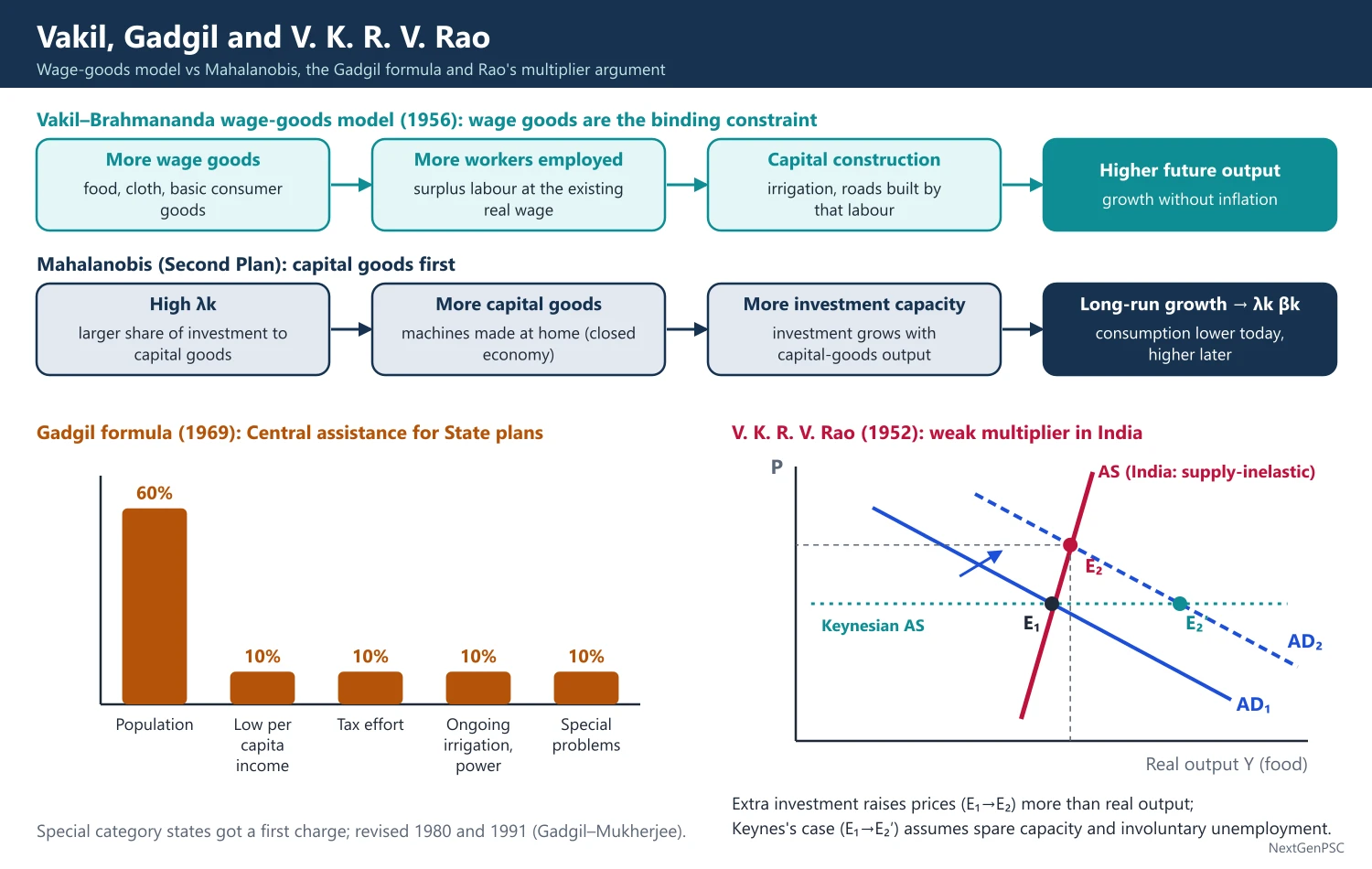
Wage-goods model: with P. R. Brahmananda, Planning for an Expanding Economy (1956), Vakil argued that in an economy with disguised unemployment the binding constraint on growth is the supply of wage goods (food, cloth, basic consumer goods) needed to feed workers drawn into employment.
Mechanism: if wage-goods output rises, more surplus labour can be employed on capital construction (irrigation, roads) at the existing real wage without inflation; investment should therefore go first to agriculture and labour-intensive consumer goods, not heavy industry.
Critique of Mahalanobis: the Second Plan's heavy-industry bias, in this view, would cause food shortages, inflation and low employment; the food crises and inflation of the 1960s were later cited as support.
Inflation and finance: Vakil warned against excessive deficit financing and inflationary methods of financing plans, a position shared by B. R. Shenoy, whose note of dissent (1955) on the Second Plan's draft frame is well known.
2. D. R. Gadgil (1901–1971)
Economic historian: Dhananjay Ramchandra Gadgil wrote The Industrial Evolution of India in Recent Times (1924), a key nationalist account of deindustrialisation and the slow growth of modern industry.
Gokhale Institute: he was the first Director of the Gokhale Institute of Politics and Economics, Pune (founded 1930), and built its tradition of empirical rural and regional surveys.
Cooperation: Gadgil saw cooperatives as a middle path between capitalism and state control; he guided the cooperative sugar movement in Maharashtra, beginning with the Pravara cooperative sugar factory (1950), and chaired many cooperative bodies.
Agricultural credit: he chaired the Agricultural Finance Sub-Committee (1944–45) and the RBI Study Group on Organisational Framework for Social Objectives (1969), whose area approach led to the Lead Bank Scheme (1969).
Planning Commission: as Deputy Chairman (1967–71) he framed the Fourth Plan (1969–74) with the objectives of 'growth with stability' and 'progressive achievement of self-reliance', after the plan holiday of 1966–69.
Gadgil formula (1969): for distributing Central assistance for State plans: 60% on population, 10% on per capita income below the national average, 10% on tax effort, 10% on ongoing major irrigation and power projects, and 10% on special problems; special category states got a first charge; it was revised in 1980 and 1991 (Gadgil-Mukherjee formula).
Decentralisation: he favoured district-level planning and a strong role for local bodies and cooperatives, anticipating the 73rd Amendment's spirit.
3. V. K. R. V. Rao (1908–1991)
National income: Vijendra Kasturi Ranga Varadaraja Rao's Cambridge work produced An Essay on India's National Income, 1925–1929 (1939) and The National Income of British India, 1931–32 (1940), the first systematic estimates combining the production (census of output) and income methods; he estimated per capita income at Rs 62 for 1931–32.
Multiplier in underdeveloped economies: in 'Investment, Income and the Multiplier in an Underdeveloped Economy' (Indian Economic Review, 1952) he argued that the Keynesian multiplier works weakly in India because output (especially food) is supply-inelastic, there is disguised unemployment rather than involuntary unemployment of the Keynesian type, a large non-monetised sector, and a high marginal propensity to consume food; extra investment raises prices more than real output.
Policy implication: deficit financing can be inflationary; growth needs real investment in agriculture and supply capacity, and the multiplier should be used through labour-intensive works that produce wage goods.
Institution builder: founded the Delhi School of Economics (1949), the Institute of Economic Growth, Delhi (1958) and the Institute for Social and Economic Change, Bangalore (1972).
Public roles: member of the Planning Commission (1963–66), Union Minister of Education (1969–71), and at the UN he proposed the Special UN Fund for Economic Development (SUNFED, early 1950s), which fed into later UN development funding.
4. Comparison with Mahalanobis
Mahalanobis (Second Plan): priority to capital goods to raise the long-run growth rate; closed economy; agriculture and small industry to provide employment and consumer goods.
Vakil-Brahmananda: priority to wage goods and agriculture; employment and price stability first; capital formation through mobilising surplus labour.
Gadgil: agriculture, cooperation and regional balance; plans financed without high inflation; stronger role for states.
Rao: realism about the limits of Keynesian demand management in a supply-constrained economy, supporting caution on deficit financing.
5. Charts to Draw
Wage-goods constraint: a flow chart: wage-goods output → number of workers who can be employed at the given real wage → capital construction → higher future output; contrast with the Mahalanobis chain: capital goods share λk → future investment capacity → long-run growth.
Rao's multiplier argument: sketch aggregate supply nearly vertical in the food sector; a rightward shift of demand from investment raises prices rather than output; compare with the Keynesian horizontal supply below full employment.
Gadgil formula pie chart: 60% population, 10% low per capita income, 10% tax effort, 10% ongoing projects, 10% special problems.
6. Relevance Today
Wage goods and inflation: food inflation remains the main driver of CPI volatility in India, supporting the wage-goods emphasis; the RBI's inflation targeting framework (4% CPI, ±2%) must contend with supply shocks in food.
Cooperatives: a separate Ministry of Cooperation was created in July 2021, and multi-state cooperative law was amended in 2023, continuing Gadgil's agenda.
National accounts: Rao's legacy lives in the NSO's national accounts; the base year was 2011–12 for many years, and a new GDP series with base year 2022–23 was released on 27 February 2026.
Fiscal federalism: plan transfers by formula ended with the Planning Commission (2015); devolution is now mainly through the Finance Commission, whose criteria (population, income distance, area, forest, demographic performance) echo Gadgil's logic.
7. Other Economists of the Planning Era
Brahmananda (1926–2003): P. R. Brahmananda was Vakil's co-author and successor in Bombay; developed the wage-goods theory further and wrote on money and inflation, consistently warning against inflationary finance.
Raj (1924–2010): K. N. Raj is credited with drafting parts of the First Plan, helped build the Delhi School of Economics and founded the Centre for Development Studies, Thiruvananthapuram (1971).
Shenoy (1905–1978): B. R. Shenoy was the lone dissenter on the Panel of Economists for the Second Plan (1955), who opposed heavy deficit financing and the priority to heavy industry and favoured markets.
Sukhamoy Chakravarty (1934–1990): member of the Planning Commission and chairman of the Prime Minister's Economic Advisory Council (1983); his Development Planning: The Indian Experience (1987) is the standard assessment of Indian planning.
Raj Krishna (1925–1985): coined the 'Hindu rate of growth' and did pioneering work on the supply response of Indian farmers to prices, which supported price incentives in agricultural policy.
8. Using It in the Exam
10 marks: one contribution of each economist, with a work and year.
15 marks: the wage-goods model versus the Mahalanobis model, or Rao's multiplier argument.
20 marks: all three economists' contributions to theory, policy and institutions, contrasted with Mahalanobis and linked to present policy.
Keywords: wage goods, disguised unemployment, deficit financing, cooperative commonwealth, Gadgil formula, growth with stability, national income estimates, supply-inelastic multiplier.
| Economist | Key works | Main ideas | Institutions and roles |
|---|---|---|---|
| C. N. Vakil | Planning for an Expanding Economy (with Brahmananda, 1956) | Wage-goods constraint, caution on deficit financing | Bombay University School of Economics |
| D. R. Gadgil | The Industrial Evolution of India in Recent Times (1924) | Cooperation, regional balance, growth with stability | Gokhale Institute (1930); Deputy Chairman, Planning Commission (1967–71) |
| V. K. R. V. Rao | The National Income of British India, 1931–32 (1940) | National income estimation; weak multiplier in underdeveloped economies | Delhi School of Economics (1949), IEG (1958), ISEC (1972) |
Mains points
- Give at least one book with year for each economist; examiners look for precise attribution.
- Explain the wage-goods model as a structured alternative to the Mahalanobis strategy, not just a criticism.
- State the Gadgil formula's weights exactly and note its later revision (Gadgil-Mukherjee, 1991).
- Present Rao's multiplier argument with its four reasons (supply inelasticity, disguised unemployment, non-monetised sector, high MPC on food).
- Link each economist to present-day issues: food inflation, cooperatives ministry (2021), Finance Commission formulas, national accounts.
- Common mistake: attributing the 1955 dissent note on the Second Plan to Vakil; it was B. R. Shenoy's, though Vakil shared the concern about inflation.
Did you know?
- Memory trick: Vakil = Wages (food first), Gadgil = Groups (cooperatives) and Grants (formula), Rao = Rupee count of the nation (national income).
Five-Year Plans and the Mahalanobis Strategy
India planned through twelve Five-Year Plans (1951–2017). The Second Plan (1956–61) adopted the Mahalanobis model, which, like Feldman's, showed that a higher share of investment in capital goods (λk) raises long-run growth, while agriculture and small industry provide jobs and consumer goods. The strategy built heavy industry but faced foreign-exchange crises, food shortages and a slow 'Hindu rate of growth' of about 3.5% until 1980.
In simple words
India's Five-Year Plans set goals for growth and decided where public money would go. The Second Plan, designed by Mahalanobis, put money into steel plants and machines first, believing this would make future growth faster: build the machines that make machines, the capital goods strategy.
It is like a farmer buying a tractor instead of more food this year, hoping for bigger harvests later.
It built India's industry but caused shortages of food and foreign exchange.
UPSC asks you to explain the model, its logic and its results.
1. Concepts and Background
Planning Commission: set up on 15 March 1950 by a Cabinet resolution (not a constitutional or statutory body), chaired by the Prime Minister; the National Development Council (1952) brought in Chief Ministers to approve plans.
Pre-independence plans: M. Visvesvaraya's Planned Economy for India (1934), the Congress National Planning Committee under Nehru (1938), the Bombay Plan (1944), the Gandhian Plan (S. N. Agarwal, 1944) and the People's Plan (M. N. Roy, 1945).
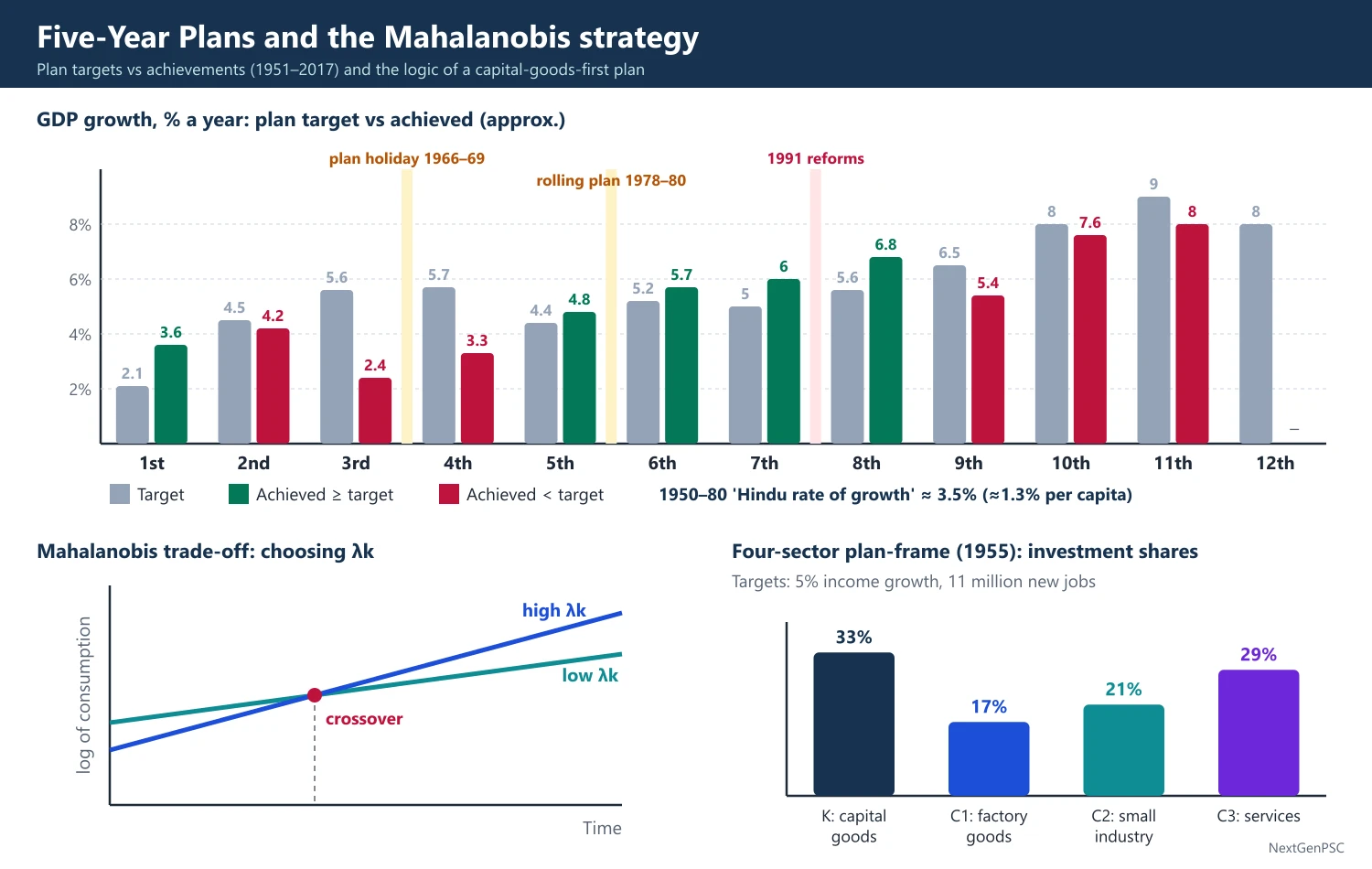
First Plan (1951–56): based on a Harrod-Domar framework, priority to agriculture, irrigation and power (Bhakra-Nangal, Damodar Valley), target growth 2.1% a year, achieved about 3.6% helped by good monsoons.
Prasanta Chandra Mahalanobis: founder of the Indian Statistical Institute (1931), honorary statistical adviser to the Cabinet; his plan-frame (1955) shaped the Second Plan.
2. The Mahalanobis Model Step by Step
Two-sector model (1953): output is produced in a capital-goods sector (K) and a consumer-goods sector (C); a fraction λk of investment goes to K and λc = 1 − λk to C; βk and βc are the output-capital ratios (productivity of capital) in each sector.
Growth equation (verbal form): investment grows as capital goods output grows; the long-run growth rate of income approaches λk βk; so in the long run, the larger the share of investment in capital goods, the faster the growth of income, though in the short run consumption grows more slowly.
Trade-off: a high λk sacrifices consumption today for higher income and consumption later; the crossover time depends on βk and βc.
Similarity to Feldman (1928): G. A. Feldman's model for the Soviet Gosplan reached the same conclusion on the priority of capital goods; Mahalanobis developed his model independently.
Closed-economy assumption: capital goods must be produced at home because export earnings were expected to grow slowly (export pessimism), so the economy could not import machines in exchange for consumer goods.
Four-sector model (1955): sectors: capital goods (K), factory consumer goods (C1), household and small-scale consumer goods (C2), and services including health and education (C3); the plan-frame proposed investment shares of about 33% to K, 17% to C1, 21% to C2 and 29% to C3, with targets of 5% income growth and 11 million new jobs.
Role of small industry: labour-intensive cottage and small industries were to meet consumer demand and create employment while scarce capital went to heavy industry; factory consumer goods were restricted to protect them.
3. Plans: Targets and Achievements
Second Plan (1956–61): target 4.5%, achieved about 4.2%; steel plants at Bhilai, Rourkela and Durgapur; foreign-exchange crisis of 1957–58 forced cuts.
Third Plan (1961–66): target 5.6%, achieved about 2.4%; wars of 1962 and 1965 and the droughts of 1965–66 derailed it; plan holiday of three annual plans (1966–69) and devaluation of the rupee in June 1966.
Fourth Plan (1969–74): target 5.7%, achieved about 3.3%; growth with stability; bank nationalisation (1969); Green Revolution spread.
Fifth Plan (1974–79): 'Garibi Hatao' and self-reliance, target 4.4%, achieved about 4.8%; ended a year early (1978) by the Janata government, which introduced a rolling plan (1978–80).
Sixth Plan (1980–85): target 5.2%, achieved about 5.7%; poverty programmes (IRDP); Seventh Plan (1985–90): target 5.0%, achieved about 6.0%; food, work and productivity.
After 1991: annual plans 1990–92; Eighth (1992–97) indicative planning, achieved about 6.8%; Ninth (1997–2002) about 5.4% against 6.5%; Tenth (2002–07) about 7.6% against 8%; Eleventh (2007–12) inclusive growth, about 8% against 9%; Twelfth (2012–17) 'faster, more inclusive and sustainable growth', target 8%; it was the last plan.
Hindu rate of growth: Raj Krishna's phrase for the roughly 3.5% annual GDP growth of 1950–80 (about 1.3% per capita), attributing it to policy rather than culture, despite the name.
4. Criticisms of the Mahalanobis Strategy
Neglect of agriculture and wage goods: Vakil and Brahmananda (1956) and later critics argued that food output constrained growth; the food crisis of 1965–67 and dependence on PL-480 imports confirmed it.
Export pessimism: Bhagwati and Desai, India: Planning for Industrialization (1970), argued that the closed-economy assumption was self-fulfilling; East Asian countries grew by exporting.
Capital intensity and employment: the heavy-industry focus created few jobs; employment targets were not met, and the small-scale reservation policy protected inefficiency.
Inefficiency and controls: the licence-permit system, high-cost public enterprises and the incremental capital-output ratio rising from about 3 to over 5 by the 1970s reduced returns on investment.
Defence of the strategy: Sukhamoy Chakravarty, Development Planning: The Indian Experience (1987), argued that the strategy built a diversified industrial base, technical manpower and self-reliance that later growth used; the balance of judgement is debated.
5. Diagrams to Draw
Mahalanobis trade-off: x-axis time, y-axis log of income or consumption; draw two paths: a low-λk path that starts higher and rises gently and a high-λk path that starts lower and rises more steeply; mark the crossover point after which the high-λk path gives more consumption.
Plan growth chart: bar chart of targets and achievements for Plans 1–12; mark the plan holiday (1966–69) and the rolling plan (1978–80).
Four-sector pie: 33% capital goods, 17% factory consumer goods, 21% small and household industries, 29% services.
6. Planning Techniques, Financing and Turning Points
Consistency models: plans used input-output analysis (Leontief) and later multi-sector consistency and optimisation models (for example the Sandee model for the Third Plan and work by Manne and Rudra) to check that sectoral targets were mutually consistent.
Financing: plans relied on budgetary resources, public enterprise surpluses, market borrowing, deficit financing (money creation) and foreign aid; the Second Plan's heavy use of deficit financing and foreign aid drew criticism.
Aid India Consortium (1958): organised by the World Bank to coordinate aid during the foreign-exchange crisis of the Second Plan.
PL-480: food imports from the United States under Public Law 480 (agreements from 1956) supplied large quantities of wheat until the Green Revolution reduced dependence in the late 1960s.
Devaluation of 1966: on 6 June 1966 the rupee was devalued from Rs 4.76 to Rs 7.50 per US dollar (about 36.5%), under pressure from aid donors, amid drought and the plan holiday.
Bank nationalisation: 14 major banks with deposits above Rs 50 crore were nationalised on 19 July 1969 and six more in 1980, to direct credit to plan priorities, agriculture and small industry.
Poverty focus: the Fifth Plan's Minimum Needs Programme and the Twenty Point Programme (1975) moved plans towards direct anti-poverty measures, continued by IRDP in the Sixth Plan.
Planning failures and lessons: repeated shortfalls in agriculture, exports and public enterprise surpluses taught that plan targets need realistic financing, agricultural growth and export earnings.
7. Using It in the Exam
10 marks: the two-sector model's main result (growth approaches λk βk) and its assumptions.
15 marks: four-sector model and the role of small industry, or targets versus achievements of selected plans.
20 marks: Mahalanobis strategy, its logic, results and critique (Vakil-Brahmananda, Bhagwati-Desai) and defence (Chakravarty), with plan data.
Keywords: λk, βk, capital goods first, export pessimism, closed economy, plan holiday, Hindu rate of growth, plan-frame.
Attributed idea: Nehru described the large dams and steel plants of this period as the 'temples of modern India' (said at Bhakra, 1954).
| Plan | Period | Target | Achieved (approx.) | Main focus |
|---|---|---|---|---|
| First | 1951–56 | 2.1 | 3.6 | Agriculture, irrigation, power |
| Second | 1956–61 | 4.5 | 4.2 | Heavy industry (Mahalanobis) |
| Third | 1961–66 | 5.6 | 2.4 | Self-sustaining growth; derailed by wars and drought |
| Sixth | 1980–85 | 5.2 | 5.7 | Poverty removal, IRDP |
| Eighth | 1992–97 | 5.6 | 6.8 | Indicative planning after reforms |
| Eleventh | 2007–12 | 9.0 | 8.0 | Faster and more inclusive growth |
Mains points
- Present the Mahalanobis model with its symbols (λk, βk) and the long-run result, then the assumptions (closed economy, export pessimism).
- Give the four-sector investment shares and the employment role of small industry.
- Use plan data (targets versus achievements) sparingly and accurately to support arguments.
- Balance the critique (food constraint, export pessimism, capital intensity) with Chakravarty's defence.
- Mention the Feldman model and Raj Krishna's 'Hindu rate of growth' to show depth.
- Common mistake: describing the Planning Commission as a constitutional body; it was set up by a Cabinet resolution.
Did you know?
- Mahalanobis is also known for the Mahalanobis distance (1936), a statistical measure still used in machine learning and data science.
From Central to Indicative Planning: Plans, Markets and NITI Aayog
After the 1991 crisis, India moved from central (directive) planning, in which the public sector and licensing directed investment, to indicative planning from the Eighth Plan (1992–97), where the plan sets priorities and markets allocate most resources. The Planning Commission was replaced by NITI Aayog on 1 January 2015, a policy think tank without fund-allocation powers, promoting cooperative and competitive federalism; transfers to states now flow mainly through the Finance Commission.
In simple words
In early decades the government decided what factories could be built and where; after 1991 it began only to point the way, leaving most decisions to businesses and markets. This is indicative planning.
It is like a coach who once picked every move for the players and now just sets the strategy.
In 2015 the Planning Commission was replaced by NITI Aayog, which advises rather than hands out money.
UPSC asks about this shift, the plan-market relationship and NITI Aayog's role.
1. Concepts and Definitions
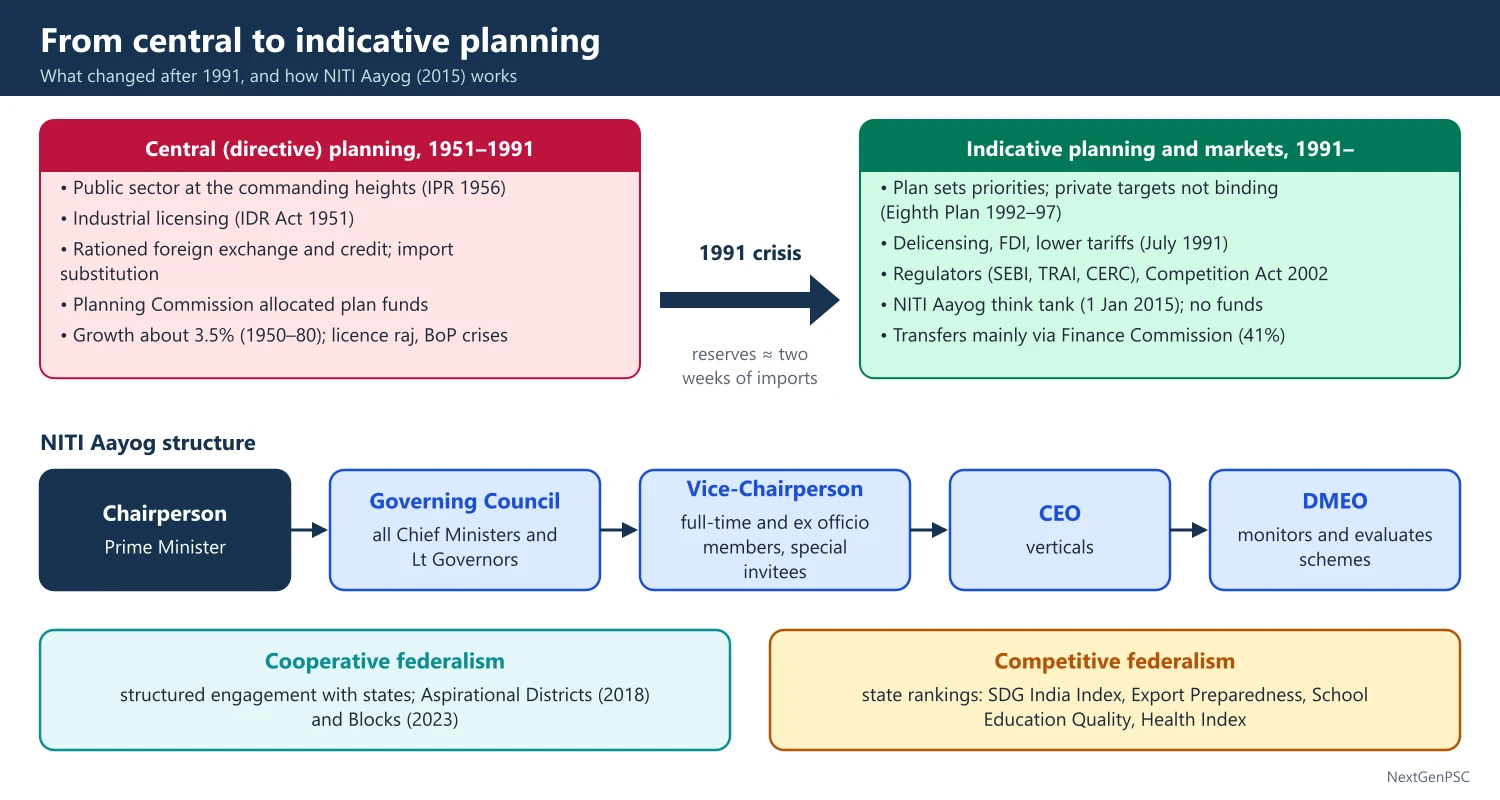
Central (directive) planning in India: the state set sectoral targets, owned the commanding heights through the public sector (Industrial Policy Resolution, 1956), controlled private investment through industrial licensing (Industries (Development and Regulation) Act, 1951), and rationed foreign exchange and credit.
Indicative planning: the plan identifies priorities, projects public investment and provides a framework for private decisions through incentives and information; targets for the private sector are indicative, not binding (France after 1946 is the model).
Planning and markets: planning corrects market failures (infrastructure, human capital, coordination, externalities) while markets provide efficiency and innovation; the debate is about the balance (see Chapter 12 on market versus planning).
2. Why the Shift Happened
Performance of central planning: slow growth (about 3.5% from 1950 to 1980), low productivity, the licence raj, rent seeking, loss-making public enterprises and repeated balance-of-payments crises.
Partial liberalisation in the 1980s: delicensing of some industries, broad-banding, and export incentives raised growth to about 5.5% in the 1980s, but with rising fiscal and external deficits.
1991 crisis: foreign-exchange reserves fell to about two weeks of imports in mid-1991; the New Economic Policy (July 1991) under P. V. Narasimha Rao and Manmohan Singh abolished most industrial licensing, opened FDI, cut tariffs and devalued the rupee.
Global context: collapse of the Soviet planned economy (1991) and the East Asian experience strengthened the case for market-oriented policies.
3. Indicative Planning in Practice (1992–2017)
Eighth Plan (1992–97): described itself as indicative; the role of the Planning Commission was to be one of setting priorities, focusing public investment on infrastructure and social sectors and creating a policy framework for private investment.
Ninth to Twelfth Plans: growth targets depended on private investment; plans emphasised infrastructure through PPP, social sectors (education, health) and inclusive growth (Eleventh Plan); the Twelfth Plan (2012–17) projected that about half of infrastructure investment would come from the private sector.
Reduced role of plan outlays: the share of public investment in GDP declined; markets, regulators (SEBI, TRAI, CERC) and competition law (Competition Act, 2002) took over allocation and oversight.
Plan and non-plan distinction: criticised (C. Rangarajan Committee, 2011) for neglecting maintenance; abolished in the Union Budget from 2017–18, replaced by capital and revenue classification.
4. NITI Aayog
Formation: National Institution for Transforming India, set up by a Cabinet resolution on 1 January 2015, replacing the Planning Commission; Prime Minister as Chairperson; a Governing Council of all Chief Ministers and Lieutenant Governors; a Vice-Chairperson, full-time and ex officio members and a CEO.
Leadership: Arvind Panagariya was its first Vice-Chairperson (2015–17), followed by Rajiv Kumar and Suman Bery (2022–26); the body was reconstituted in April 2026, with economist Ashok Kumar Lahiri appointed Vice-Chairperson (assumed office in May 2026).
Functions: think tank and knowledge hub; fosters cooperative federalism through structured engagement with states and competitive federalism through state rankings (SDG India Index, Export Preparedness Index, School Education Quality Index, Health Index); monitors schemes through its Development Monitoring and Evaluation Office (DMEO); runs the Aspirational Districts Programme (2018) and Aspirational Blocks Programme (2023) and the Atal Innovation Mission.
Planning documents: it replaced Five-Year Plans with a proposed 15-year vision, 7-year strategy and 3-year action agenda; it released a Three-Year Action Agenda (2017–18 to 2019–20) and Strategy for New India @75 (2018), and later work on the Viksit Bharat @2047 vision.
Planning Commission versus NITI Aayog: the Planning Commission allocated plan funds to ministries and states and followed a top-down approach; NITI Aayog has no fund-allocation power and follows a bottom-up, advisory approach.
Criticism: lack of financial clout limits its influence on ministries and states; some economists argue India lost a body for medium-term coordination of public investment; others see the change as appropriate for a market economy (debated).
5. Fiscal Federalism after Planning
Finance Commission: with plan transfers gone, the Finance Commission is the main channel; the Fourteenth (Y. V. Reddy) raised the states' share of the divisible pool to 42% (2015–20); the Fifteenth (N. K. Singh) set 41% (2021–26) after the reorganisation of Jammu and Kashmir.
Sixteenth Finance Commission: chaired by Arvind Panagariya, award period 2026–31; report submitted on 17 November 2025 and tabled on 1 February 2026; it retained the states' share at 41% and recommended grants of about ₹7.91 lakh crore to rural and urban local bodies over 2026–31.
Centrally sponsored schemes: rationalised following a sub-group of Chief Ministers convened by NITI Aayog (2015–16) into core of the core, core and optional schemes.
6. Charts to Draw
Shift chart: two columns: 1951–1991 (public sector commanding heights, licensing, import substitution, plan allocation by Planning Commission) and 1991 onward (indicative plans, delicensing, FDI, regulators, NITI Aayog, Finance Commission transfers).
NITI Aayog structure: Chairperson (PM) → Governing Council (CMs, LGs) → Vice-Chairperson → full-time members, ex officio ministers, special invitees → CEO → verticals and DMEO.
7. Planning and Markets for Growth
Complementarity: public investment in infrastructure tends to crowd in private investment by lowering costs, which is the logic of the capital-expenditure push since 2020–21; the size of the crowding-in effect is debated.
New industrial policy tools: Production Linked Incentive schemes (2020) in 14 sectors with an outlay of about ₹1.97 lakh crore use market signals (incremental sales) rather than licences to direct investment.
Infrastructure planning: the National Infrastructure Pipeline (2019) and PM Gati Shakti National Master Plan (October 2021) coordinate ministries' infrastructure plans on a common digital platform, a form of indicative planning.
Rules instead of plans: independent regulators, the Insolvency and Bankruptcy Code (2016), GST (2017) and inflation targeting (2016) shape markets through rules rather than allocation.
Limits of markets: regional imbalance, inequality, environmental damage and under-provision of public goods still need state planning and finance.
Self-discovery view: Hausmann and Rodrik ('Economic Development as Self-Discovery', 2003) argue that the state should help firms discover what a country can produce profitably, while disciplining failures, a modern middle path between planning and laissez-faire.
8. Growth after Central Planning
Growth record: GDP growth rose from about 3.5% (1950–80) to about 5.5% in the 1980s and about 6% in the 1990s, and averaged roughly 8–9% in 2003–08 before the global financial crisis.
Explaining the acceleration: Rodrik and Subramanian ('From Hindu Growth to Productivity Surge', 2004) argued that the 1980s acceleration followed a pro-business shift in government attitude, while the 1991 reforms sustained it; this is debated.
Recent years: the economy contracted in 2020–21 during the pandemic and recovered strongly; under the new national accounts series with base year 2022–23 (released by NSO on 27 February 2026), real GDP growth for 2025–26 was estimated at about 7.6%.
Investment rate: gross fixed capital formation has been around 30% of GDP in recent years, with public capital expenditure playing a larger role since 2020–21.
Long-term goal: the government's stated aim is to make India a developed country (Viksit Bharat) by 2047, the centenary of independence.
9. Using It in the Exam
10 marks: difference between directive and indicative planning, or Planning Commission versus NITI Aayog.
15 marks: reasons for the shift to indicative planning with the 1991 context.
20 marks: evolution of planning, relation between planning and markets for growth, NITI Aayog's role and limits, and the new fiscal federalism (Sixteenth Finance Commission).
Keywords: commanding heights, licence raj, indicative planning, cooperative federalism, competitive federalism, think tank, DMEO, divisible pool.
| Feature | Planning Commission (1950–2014) | NITI Aayog (2015–) |
|---|---|---|
| Basis | Cabinet resolution, 15 March 1950 | Cabinet resolution, 1 January 2015 |
| Fund allocation | Allocated plan funds to ministries and states | No fund-allocation power |
| Approach | Top-down, Five-Year Plans | Bottom-up, vision, strategy and action agenda |
| States' role | Through National Development Council | Governing Council of all Chief Ministers |
| Federalism | Centralised planning | Cooperative and competitive federalism |
Mains points
- Define directive and indicative planning precisely and give the Eighth Plan as the turning point.
- Explain the shift through performance (Hindu rate of growth, licence raj) and the 1991 crisis.
- Discuss planning and markets as complements: the state for infrastructure and human capital, markets for allocation.
- Present NITI Aayog's structure, functions, achievements (rankings, Aspirational Districts) and criticisms.
- Bring in the Finance Commission's enhanced role, citing the Sixteenth Finance Commission's 41% share and local body grants with years.
- Common mistake: saying planning ended in India; public investment planning continues through budgets, NITI Aayog's vision documents and sector plans such as PM Gati Shakti.
Did you know?
- 'NITI' means 'policy' in Sanskrit, so the acronym doubles as a description of the body's purpose.
Decentralised Planning: 73rd and 74th Constitutional Amendments
The 73rd and 74th Constitutional Amendments (1992, in force from 24 April and 1 June 1993) made panchayats and municipalities constitutional bodies, with regular elections, reservations, State Finance Commissions and District and Metropolitan Planning Committees, and listed 29 and 18 functions in the Eleventh and Twelfth Schedules. They aim at decentralised planning from below, but fiscal and functional devolution remains uneven across states.
In simple words
Decentralised planning means villages and towns plan their own roads, water, schools and health centres instead of waiting for Delhi or the state capital. The 73rd and 74th Amendments gave panchayats and municipalities a constitutional status.
It is like letting each household decide its own monthly budget within a family's overall plan.
It matters because local people know local needs best.
UPSC asks about the amendments' provisions, how well they have worked and how to strengthen local finances.
1. Concepts and Background
Decentralised planning: plans prepared at local levels (village, block, district, town) reflecting local needs and resources, integrated upward into state and national plans; the economic case is the decentralisation theorem (Wallace Oates, Fiscal Federalism, 1972): public goods whose benefits are local are best provided by the lowest level of government that covers the benefit area.
Constitutional roots: Article 40 (Directive Principles) asks the state to organise village panchayats as units of self-government.
Balwantrai Mehta Committee (1957): evaluated the Community Development Programme (1952) and recommended a three-tier panchayati raj (village, block, district) with democratic decentralisation; Rajasthan (Nagaur, 2 October 1959) was first, followed by Andhra Pradesh.
Ashok Mehta Committee (1977–78): recommended a two-tier system (zila parishad and mandal panchayat), participation of political parties and taxation powers.
Rao and Singhvi Committees (1985, 1986): the G. V. K. Rao Committee (1985) and the L. M. Singhvi Committee (1986) recommended making the district the basic unit of planning and giving panchayats constitutional recognition.
Earlier attempt: the 64th Amendment Bill (1989) passed the Lok Sabha but failed in the Rajya Sabha.
2. The 73rd Amendment (Panchayats)
Part IX (Articles 243 to 243-O) and the Eleventh Schedule listing 29 subjects (agriculture, land improvement, minor irrigation, animal husbandry, fisheries, drinking water, rural housing, roads, poverty alleviation, education, health and sanitation, women and child development, public distribution and others).
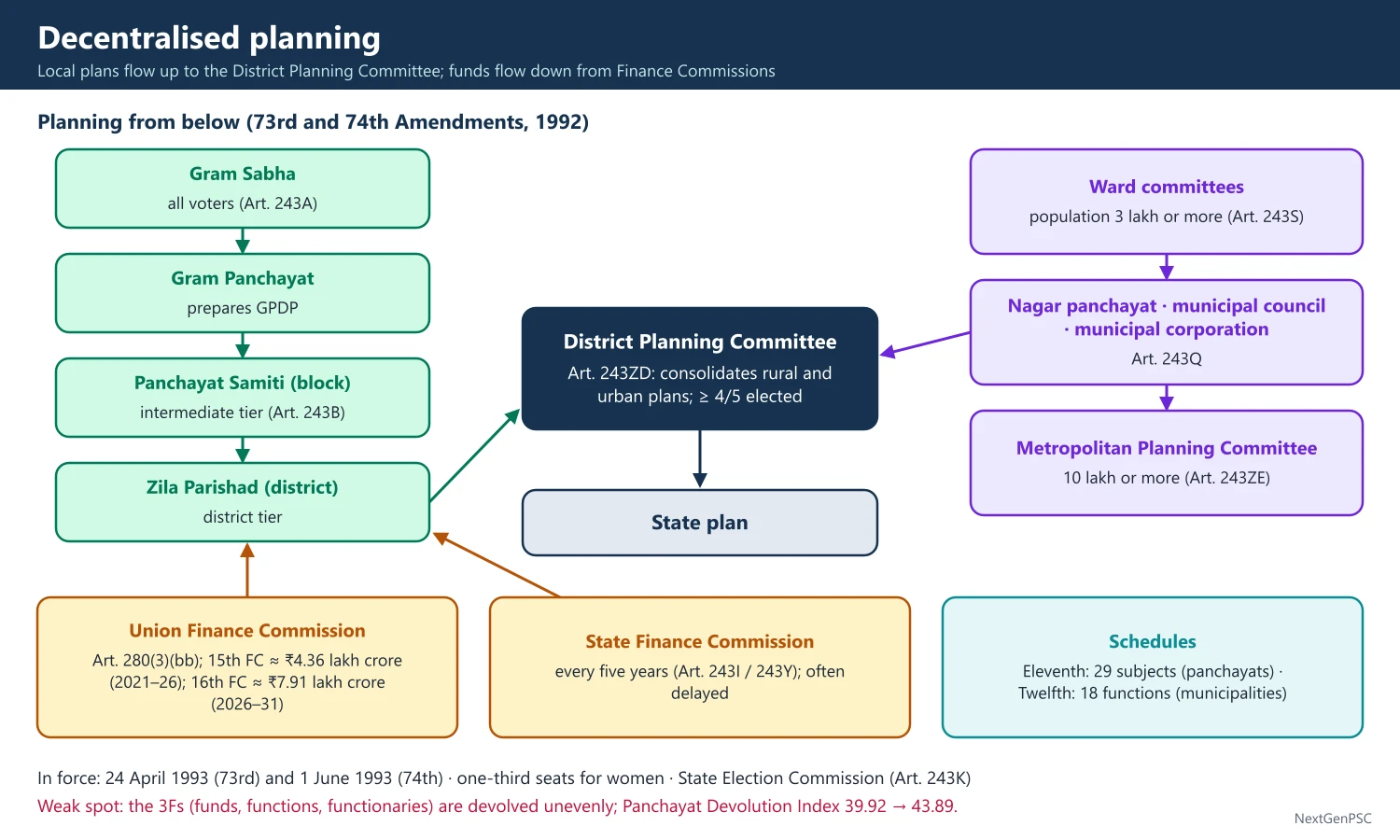
Gram Sabha: all registered voters of a village (Article 243A).
Three tiers: village, intermediate and district levels; states with population below 20 lakh may skip the intermediate tier (Article 243B).
Elections and term: five-year term, fresh elections within six months of dissolution (Article 243E); a State Election Commission conducts them (Article 243K).
Reservations: seats for Scheduled Castes and Scheduled Tribes in proportion to population and at least one-third for women, including chairpersons (Article 243D); over 20 states have raised women's reservation to 50%.
Powers and planning: Article 243G allows states to devolve powers and responsibilities for preparing and implementing plans for economic development and social justice, including Eleventh Schedule subjects; devolution is at the discretion of states.
Finance: Article 243H on taxes and grants; Article 243I on a State Finance Commission every five years to review panchayat finances; Article 280(3)(bb) asks the Union Finance Commission to recommend measures to augment state funds for panchayats.
PESA, 1996: the Panchayats (Extension to the Scheduled Areas) Act extends Part IX to Fifth Schedule areas with stronger powers for gram sabhas over minor forest produce, land alienation, minor minerals and local plans.
3. The 74th Amendment (Municipalities)
Part IXA (Articles 243P to 243ZG) and the Twelfth Schedule listing 18 functions (urban planning, regulation of land use, roads and bridges, water supply, public health and sanitation, slum improvement, urban poverty alleviation, fire services and others).
Types: nagar panchayat (transitional area), municipal council (smaller urban area) and municipal corporation (larger urban area) (Article 243Q).
Ward committees: for municipalities with a population of three lakh or more (Article 243S).
District Planning Committee (Article 243ZD): consolidates plans of panchayats and municipalities into a draft district development plan; at least four-fifths of members elected by and from elected members of the district's local bodies in proportion to rural and urban population.
Metropolitan Planning Committee (Article 243ZE): for metropolitan areas of ten lakh or more, to prepare a draft development plan for the whole metropolitan area.
4. Performance and Problems
Uneven devolution: the 3Fs (funds, functions, functionaries) are devolved fully in a few states and weakly in many; the Panchayat Devolution Index (Ministry of Panchayati Raj study led by the Indian Institute of Public Administration, released February 2025) found the national average index rising from 39.92 to 43.89 over about a decade, with Karnataka, Kerala and Tamil Nadu among the top states.
Weak own revenue: panchayats raise very little own-source revenue (property tax, fees); they depend on Union and state grants, mainly Finance Commission grants and scheme funds.
State Finance Commissions: often delayed, their reports not tabled or acted upon; the Fifteenth Finance Commission made SFC constitution and audited accounts a condition for local body grants.
Parallel bodies and capture: line departments and parallel bodies bypass panchayats; elite capture and proxy representation (the 'sarpanch pati' problem) weaken participation; the Ministry set up an advisory committee on proxy representation in 2023.
Urban governance: mayors have limited powers in most states, municipal finances are about 1% of GDP or less, and Metropolitan Planning Committees have been set up in few cities.
5. Examples and Recent Data
Kerala's People's Plan Campaign (1996): devolved about 35–40% of the state's plan outlay to local bodies and involved gram sabhas in preparing local plans, a model of participatory decentralised planning.
Gram Panchayat Development Plans (from 2015–16): panchayats prepare annual plans (now through the People's Plan Campaign 'Sabki Yojana Sabka Vikas', from 2018); about 2.5 lakh plans are uploaded each year on the eGramSwaraj portal (launched April 2020).
Scale: India has about 2.68 lakh gram panchayats and traditional local bodies (Ministry of Panchayati Raj, March 2025) and over 30 lakh elected representatives, about 46% of them women (ministry data).
Finance Commission grants: the Fifteenth Finance Commission recommended about ₹4.36 lakh crore for local bodies for 2021–26 (including health grants); the Sixteenth recommended about ₹7.91 lakh crore for rural and urban local bodies for 2026–31, with a larger urban share.
SVAMITVA (2020): drone-based mapping of rural inhabited land to give property cards, which can strengthen panchayat property-tax bases and access to credit.
6. Charts to Draw
Three-tier structure: Gram Sabha → Gram Panchayat → Panchayat Samiti (block) → Zila Parishad (district) → District Planning Committee (with urban local bodies) → State plan.
Planning flow: gram sabha needs assessment → GPDP → block and district plans → DPC consolidation → state plan; arrows showing funds from the Union Finance Commission and State Finance Commission.
Capacity building: panchayats lack technical staff; the Rashtriya Gram Swaraj Abhiyan (revamped in 2018 and continued for 2022–26) funds training and infrastructure for panchayats.
Localising the SDGs: the Ministry of Panchayati Raj adopted nine SDG themes for panchayat plans (2021); the Panchayat Advancement Index baseline for 2022–23 found no gram panchayat in the top 'Achiever' band and only about 0.3% as 'Front Runners'.
Urban parastatals: the Smart Cities Mission (2015) was criticised for routing projects through special purpose vehicles that bypassed elected municipal councils, weakening the 74th Amendment's intent.
Property tax: RBI's reports on municipal finances (from 2022) note that property tax collections are very low relative to GDP and recommend better valuation, digitisation and periodic revision.
7. Using It in the Exam
10 marks: features of the 73rd or 74th Amendment with article numbers.
15 marks: role of District Planning Committees and State Finance Commissions in decentralised planning.
20 marks: history (Mehta committees), provisions, performance (3Fs, devolution index, Kerala), fiscal issues and reforms (own revenue, SFCs, capacity, Finance Commission grants).
Keywords: democratic decentralisation, Gram Sabha, Eleventh and Twelfth Schedules, Article 243G, State Finance Commission, District Planning Committee, 3Fs, PESA, GPDP, decentralisation theorem.
| Feature | 73rd Amendment (Panchayats) | 74th Amendment (Municipalities) |
|---|---|---|
| In force | 24 April 1993 | 1 June 1993 |
| Constitutional part | Part IX, Articles 243–243-O | Part IXA, Articles 243P–243ZG |
| Schedule | Eleventh, 29 subjects | Twelfth, 18 functions |
| Structure | Three tiers (village, intermediate, district) | Nagar panchayat, municipal council, municipal corporation |
| Planning body | District Planning Committee (Article 243ZD) | Metropolitan Planning Committee (Article 243ZE) |
| Finance | State Finance Commission (Article 243I) | State Finance Commission (Article 243Y) |
Mains points
- Begin with the economic logic (Oates's decentralisation theorem, local information) before the legal provisions.
- Quote article numbers (243G, 243I, 243ZD, 243ZE) and the two schedules with the number of subjects.
- Assess performance with the 3Fs framework and the Panchayat Devolution Index (February 2025).
- Use Kerala's People's Plan Campaign as the leading example of decentralised planning.
- Bring in Finance Commission grants (Fifteenth and Sixteenth) and the weakness of own-source revenue and SFCs.
- Common mistake: stating that devolution of the 29 subjects is mandatory; Article 243G leaves it to state legislatures.
Did you know?
- National Panchayati Raj Day is celebrated on 24 April each year, the date the 73rd Amendment came into force in 1993.
UPSC Previous Year Questions: Planning in India
From 2014 to 2026 UPSC asked 32 question parts worth 430 marks from this chapter in Paper II. The most-asked topic is the contribution of Vakil, Gadgil and V.K.R.V. Rao (13 parts), followed by the move from central to indicative planning and NITI Aayog (8), decentralised planning under the 73rd and 74th Amendments (6) and the Mahalanobis strategy (5). Every question below has a model answer written to the UPSC word limit.
In simple words
Read the question and write your own answer in the time limit first: about 7 minutes for 10 marks and 11 minutes for 15 or 20 marks.
Then compare it with the model answer: did you name the economist, book or committee with its year, and state the model's assumptions and policy message?
Note what you missed, revise that topic in the notes above, and rewrite the answer after a few days.
1. Contributions of Vakil, Gadgil and V.K.R.V. Rao
Example 1 (UPSC 2026, 15 marks): Compare and contrast the economic thoughts of D. R. Gadgil and V. K. R. V. Rao regarding Indian economic planning and development strategies.
Paper and question: Paper II, Q2(c)
Approach: Present Gadgil's and Rao's thought (planning approach, institutions, agriculture, federalism, human capital), then compare and contrast them point by point and conclude.
D.R. Gadgil (1901–1971) and V.K.R.V. Rao (1908–1991) were leading economists who shaped India's planning, from different angles.
Gadgil: economic historian and founder-director of the Gokhale Institute, Pune; he saw cooperation as a middle path between capitalism and state control, guiding Maharashtra's cooperative sugar movement (Pravara, 1950); as Deputy Chairman of the Planning Commission (1967–71) he framed the Fourth Plan around 'growth with stability' and self-reliance, gave the Gadgil formula (1969) for plan assistance to states, and favoured district planning.
Rao: a pioneer of national income accounting (The National Income of British India, 1931–32, 1940); he argued (1952) that the Keynesian multiplier works weakly in an underdeveloped economy because supply, especially of food, is inelastic, so investment raises prices rather than output; he stressed employment, investment in education and human capital, and built institutions (Delhi School of Economics, 1949; Institute of Economic Growth, 1958; ISEC, Bangalore, 1972).
Similarities: both supported planning, a mixed economy and agricultural development, and both linked economics to Indian conditions and institutions.
Contrasts: Gadgil was decentralist, cooperative and federal in outlook, emphasising states, districts and rural institutions; Rao was more macro-Keynesian and centralist, focusing on national income, investment, the multiplier and the role of education. Gadgil worked through regional surveys and cooperatives; Rao through national accounts and policy institutions.
Together they shaped planning that combined national targets with attention to institutions and federal balance.
Example 2 (UPSC 2024, 10 marks): Examine the alternative model of planning given by C. N. Vakil.
Paper and question: Paper II, Q5(a)
Approach: Explain the Vakil-Brahmananda wage-goods model (assumptions, mechanism, policy) as an alternative to Mahalanobis, and examine its strengths and limits.
C.N. Vakil and P.R. Brahmananda, in Planning for an Expanding Economy (1956), offered the wage-goods model as an alternative to the Mahalanobis heavy-industry strategy of the Second Plan.
Assumptions: India has large disguised unemployment; labour is the abundant resource; the binding constraint on employing it is the supply of wage goods (food, cloth, other basic consumer goods) needed to pay and feed newly employed workers.
Mechanism and policy: raise the output of wage goods through agriculture, irrigation and small industries; use the surplus to employ the disguised unemployed in labour-intensive capital formation (roads, irrigation, housing); this expands employment and output without inflation. Heavy industry should follow, not lead.
Strengths: the food shortages and inflation of the 1960s supported its warning. Limits: it underplayed long-run capital goods and technology needs, and agricultural growth depends on inputs such as fertiliser and machinery. Its insights were partly adopted after 1966.
Example 3 (UPSC 2023, 10 marks): How did V. K. R. V. Rao improve upon the earlier national income estimates of India?
Paper and question: Paper II, Q1(b)
Approach: List the earlier estimates and their weaknesses briefly, then explain Rao's methodological improvements (coverage, mixed method, sectoral detail, rigour) and his legacy.
Earlier estimates: Dadabhai Naoroji (about Rs 20 per head for 1867–68), Baring and Barbour (Rs 27, 1882), Lord Curzon's government (Rs 30, 1897–98), William Digby, Findlay Shirras, and Shah and Khambata. They relied on rough guesses of output and prices, covered only parts of the economy.
Rao's improvements in An Essay on India's National Income, 1925–1929 (1939) and The National Income of British India, 1931–32 (1940): (i) a mixed method: the census of production (output) method for agriculture, mining and industry, and the income method for trade, transport, professions and government services; (ii) comprehensive coverage of all sectors of British India.
Data and detail: (iii) systematic use of official crop, price and census data, with care to avoid double counting; (iv) separate rural and urban estimates and sectoral distribution; (v) frank discussion of data limitations.
His estimate of about Rs 62 per head for 1931–32 became the benchmark, and he later served on the National Income Committee (1949), laying the base of India's official national accounts.
Example 4 (UPSC 2023, 20 marks): Discuss the role of D. R. Gadgil in economic planning and development in India.
Paper and question: Paper II, Q3(a)
Approach: Discuss Gadgil's roles as economic historian, institution builder, cooperator, planner (Fourth Plan, Gadgil formula) and rural credit reformer, with an assessment.
Dhananjay Ramchandra Gadgil (1901–1971) combined scholarship with public policy and left a lasting mark on Indian planning.
Economic historian: The Industrial Evolution of India in Recent Times (1924) explained the decline of handicrafts and the slow growth of modern industry under colonial rule, shaping the case for planned industrialisation.
Institution builder: as the first Director of the Gokhale Institute of Politics and Economics, Pune (founded 1930), he built a tradition of village and regional surveys that informed planning.
Cooperation: he saw cooperatives as a democratic middle path between capitalism and state control and guided Maharashtra's cooperative sugar factories, starting with Pravara (1950); he chaired many cooperative bodies.
Planner: as Deputy Chairman of the Planning Commission (1967–71), after the Plan holiday of 1966–69, he framed the Fourth Plan (1969–74) with the objectives of 'growth with stability' and 'progressive achievement of self-reliance', stressing agriculture, price stability and reduced dependence on aid.
Fiscal federalism: the Gadgil formula (1969) allocated Central plan assistance to states on objective criteria: 60% by population, 10% by per capita income below average, 10% by tax effort, 10% for ongoing irrigation and power projects and 10% for special problems, after setting aside a share for special category states.
Rural credit and decentralisation: he chaired the RBI study group (1969) whose area approach led to the Lead Bank Scheme, and he advocated district planning.
Assessment: Gadgil's emphasis on stability, agriculture, cooperatives and objective federal transfers proved durable; the Fourth Plan fell short of targets, but his formula (revised in 1980 and 1991) governed plan transfers until the Planning Commission was replaced in 2015.
Example 5 (UPSC 2022, 10 marks): Point out the contribution of C. N. Vakil to Indian Economic Planning.
Paper and question: Paper II, Q1(c)
Approach: Point out Vakil's contributions: wage-goods model, critique of Mahalanobis and deficit financing, institution building, and work on Partition and finance.
Chandulal Nagindas Vakil (1895–1979) was a leading economist of the Bombay school whose ideas offered an alternative path for Indian planning.
Wage-goods model: with P.R. Brahmananda, in Planning for an Expanding Economy (1956), he argued that India's disguised unemployed could be employed in capital formation if enough wage goods (food, cloth, basic consumer goods) were produced; hence priority should go to agriculture and small industry.
Critique of the Second Plan: he warned that the Mahalanobis heavy-industry bias would cause food shortages, inflation and low employment, a view the 1960s crises appeared to confirm.
Sound finance: he cautioned against excessive deficit financing.
Institution building: he led the University School of Economics and Sociology, Bombay (founded 1921), training economists such as Brahmananda.
Other work: studies of Indian public finance and Economic Consequences of Divided India (1950). His ideas influenced the later shift to agriculture.
Example 6 (UPSC 2021, 10 marks): Analyse the relevance of Gadgil formula in reducing horizontal imbalance of fiscal health.
Paper and question: Paper II, Q1(c)
Approach: Explain the Gadgil formula and its weights, then analyse how far it reduced horizontal imbalance (its equalising and non-equalising elements, later revisions), and its present relevance.
Horizontal imbalance is the gap in fiscal capacity and needs among states. The Gadgil formula (1969), adopted for the Fourth Plan, allocated normal Central plan assistance to states objectively instead of on a discretionary project basis.
Weights: after a share was set aside for special category states (initially Assam, Jammu and Kashmir and Nagaland), the rest was distributed 60% by population, 10% by per capita income below the national average, 10% by tax effort, 10% for ongoing major irrigation and power projects, and 10% for special problems.
Relevance to horizontal balance: it brought transparency and predictability and gave backward and special category states more per head. But only 10% depended on income, while tax effort and ongoing projects favoured better-off states, so its equalising power was limited. Revisions in 1980 and the Gadgil-Mukherjee formula (1991) raised the weight of per capita income.
Plan transfers ended with the Planning Commission in 2015; Finance Commission criteria such as income distance now play this equalising role.
Example 7 (UPSC 2020, 10 marks): Evaluate the contributions of V.K.R.V. Rao in the National Income Accounting of India.
Paper and question: Paper II, Q1(b)
Approach: Evaluate Rao's contributions: first comprehensive estimates, mixed method, later role on the National Income Committee and CSO tradition, with a brief limitation.
V.K.R.V. Rao is regarded as the father of scientific national income estimation in India.
Pioneering estimates: An Essay on India's National Income, 1925–1929 (1939) and The National Income of British India, 1931–32 (1940) gave the first comprehensive estimates, about Rs 62 per head for 1931–32, replacing the rough and partial estimates of Naoroji, Digby and official writers.
Method: he combined the census of production method for commodity sectors (agriculture, mining, manufacturing) with the income method for services, used official data systematically, avoided double counting, and gave sectoral and rural-urban breakdowns.
Institutional legacy: as a member of the National Income Committee (1949), with P.C. Mahalanobis and D.R. Gadgil, he helped lay down the methods the CSO (1951) adopted; he also trained national income statisticians at the Delhi School of Economics.
His estimates were limited by poor data on the unorganised sector, which he openly acknowledged, but his framework set the standard.
Example 8 (UPSC 2019, 10 marks): Highlight the main contributions of C. N. Vakil to Indian planning as opposed to that of the Mahalanobis Model at the time of the formulation of the Second Five Year Plan for India.
Paper and question: Paper II, Q1(c)
Approach: Contrast the two approaches at the time of the Second Plan: Mahalanobis (capital goods first) vs Vakil (wage goods first), with Vakil's specific contributions and how events judged them.
Mahalanobis model (1955): the Second Plan (1956–61) gave priority to heavy and capital-goods industries, arguing that a higher share of investment in the capital-goods sector raises long-run growth in a closed economy; consumer goods were to come from small and household industries.
Vakil's alternative: C.N. Vakil and P.R. Brahmananda (Planning for an Expanding Economy, 1956) argued that the real constraint was the supply of wage goods, food and basic consumer goods; with disguised unemployment, raising wage-goods output would let the state employ surplus labour in labour-intensive capital formation without inflation.
Specific contributions: priority to agriculture, irrigation and small industry; employment as the central aim; warnings against deficit financing and inflation; heavy industry to be phased in later.
Verdict of events: food shortages, inflation and dependence on PL-480 grain in the 1960s supported Vakil's warnings, and policy shifted to agriculture after 1966, though Mahalanobis's strategy built the industrial base.
Example 9 (UPSC 2018, 10 marks): How did V. K. R. V. Rao improve upon the earlier national income estimates of India?
Paper and question: Paper II, Q1(b)
Approach: State the weaknesses of earlier estimates, then Rao's improvements in method, coverage and data, and his long-term legacy.
Before V.K.R.V. Rao, national income estimates for India were made by Dadabhai Naoroji (1867–68), Baring and Barbour (1882), Lord Curzon's government (1897–98), William Digby (1899), Findlay Shirras, and Shah and Khambata (1920s). These were rough, often based on a few crops and price guesses and covered only parts of the economy.
Rao's improvements (An Essay on India's National Income, 1925–1929, 1939; The National Income of British India, 1931–32, 1940): (i) a combined method: output (census of production) for agriculture, mining and industry, and income for services, trade and professions; (ii) full coverage of British India's economy.
Data and detail: (iii) careful use of official statistics on crops, prices, wages and the census; (iv) avoidance of double counting and treatment of depreciation; (v) separate rural and urban and sectoral estimates; (vi) explicit statement of margins of error.
Legacy: his estimate of about Rs 62 per head (1931–32) became the standard; as a member of the National Income Committee (1949) he shaped the methods of the CSO, now the NSO.
Example 10 (UPSC 2016, 15 marks): Discuss the Wage-Goods model of development as given by C.N. Vakil and P.R. Bramhanand.
Paper and question: Paper II, Q2(c)
Approach: Discuss the wage-goods model: authors and context, assumptions, the wage-goods gap, the mechanism linking wage goods, employment and capital formation, policy implications, and an evaluation.
C.N. Vakil and P.R. Brahmananda presented the wage-goods model in Planning for an Expanding Economy (1956) as an alternative to the Mahalanobis strategy of the Second Plan.
Assumptions: (i) large disguised unemployment in agriculture, so labour is abundant; (ii) capital and foreign exchange are scarce; (iii) workers newly employed must be paid wages that are spent mainly on wage goods (food, cloth, basic necessities); (iv) the supply of wage goods is the binding constraint on employment and investment.
Wage-goods gap: the shortfall between the wage goods needed to employ the unemployed and the available supply; if investment raises employment without raising wage goods, prices rise and real wages fall.
Mechanism: raise the output of wage goods first, through agriculture, irrigation and small-scale industries; use the surplus as a 'wage fund' to employ the disguised unemployed in labour-intensive capital formation such as roads, irrigation and housing; output and saving rise without inflation, and the process expands the economy step by step. Capital goods and heavy industry should be developed as the wage-goods base permits.
Evaluation: the model correctly anticipated the food shortages and inflation of the 1960s, and its emphasis on agriculture and employment influenced policy after 1966 and later debates. Critics note that it neglected long-term capital goods and technology, and that raising farm output itself needs industrial inputs; the debate is still relevant to labour-intensive growth.
Example 11 (UPSC 2016, 15 marks): Explain the contribution of V.K.R.V. Rao in the estimation of National Income.
Paper and question: Paper II, Q7(b)
Approach: Explain Rao's contribution to national income estimation: earlier attempts, his methods and coverage, results, and institutional role (National Income Committee, CSO), with an assessment.
V.K.R.V. Rao (1908–1991) made the first scientific estimates of India's national income and is often called the father of Indian national income accounting.
Background: earlier estimates by Naoroji (Rs 20 per head, 1867–68), Curzon's government (Rs 30, 1897–98), Digby, Shirras and Shah and Khambata were partial, based on rough guesses, and served political arguments about poverty.
Rao's method: in An Essay on India's National Income, 1925–1929 (1939) and The National Income of British India, 1931–32 (1940) he used a mixed method: the census of production method for agriculture, forestry, mining and manufacturing, and the income method for trade, transport, professions, domestic service and government; he used official statistics on output, prices, wages and employment, avoided double counting, and separated rural and urban incomes.
Results: per capita income of about Rs 62 for 1931–32, with sectoral shares showing the dominance of agriculture; he also estimated the distribution between urban and rural areas.
Institutional role: he was a member of the National Income Committee (1949), chaired by P.C. Mahalanobis with D.R. Gadgil, whose reports (1951, 1954) set the methods for the CSO; he trained statisticians and economists at the Delhi School of Economics.
Assessment: data gaps in the unorganised sector limited accuracy, but his framework and rigour became the foundation of India's official estimates, continued today by the NSO.
Example 12 (UPSC 2015, 15 marks): Do you think that pursuit of wage-goods model could have been more appropriate for post-independence strategy of development? Give reasons.
Paper and question: Paper II, Q2(a)
Approach: Give a balanced answer: arguments that the wage-goods model would have been more appropriate (employment, food, inflation, capital scarcity) and arguments against (long-run capital goods, self-reliance, technology), concluding with a combined view.
The wage-goods model of C.N. Vakil and P.R. Brahmananda (1956) proposed giving priority to food and basic consumer goods so that the disguised unemployed could be employed in labour-intensive investment without inflation.
Why it could have been more appropriate: (i) India in the 1950s had abundant labour and scarce capital, so a labour-intensive strategy fitted its factor endowment; (ii) the Mahalanobis plan's neglect of agriculture led to the food crisis of 1965–67 and dependence on PL-480 imports; (iii) deficit-financed heavy investment caused inflation and balance of payments crises (1957–58, 1966); (iv) employment and poverty reduction would have been faster, as East Asian experience with labour-intensive growth suggests.
Why not entirely: (i) without a capital-goods base, India would have depended on imported machinery when export earnings were weak; (ii) heavy industry built steel, power and engineering capacity, technical manpower and self-reliance that later growth used (Sukhamoy Chakravarty, 1987); (iii) agricultural growth itself needed fertilisers, power and machinery from industry.
Hence a balanced strategy, the wage-goods priority for agriculture and employment combined with selective heavy industry, would have been most appropriate, which India partly adopted after 1966.
Example 13 (UPSC 2014, 15 marks): Do you think Gandhian vision of development is still relevant in India? Explain with reasons.
Paper and question: Paper II, Q2(b)
Approach: Outline the Gandhian vision (village self-reliance, swadeshi, trusteeship, decentralisation, sarvodaya, simple living), then argue its relevance today with examples, and note its limits.
Gandhi's vision of development, set out in Hind Swaraj (1909) and his writings, and formalised in S.N. Agarwal's Gandhian Plan (1944), rested on self-reliant villages, swadeshi, khadi and village industries, decentralisation, trusteeship of wealth, simple living, non-violence and sarvodaya (the welfare of all, starting with the last person, antyodaya).
Relevance today: (i) employment: labour-intensive village and small industries matter when growth is job-poor; khadi and MSME support and the rural job guarantee echo this; (ii) decentralisation: the 73rd and 74th Amendments (1992) and gram sabhas reflect gram swaraj; (iii) sustainability: Gandhi's warning that the earth provides for need, not greed (paraphrased), fits climate and resource concerns and India's LiFE mission; (iv) inequality: trusteeship anticipates corporate social responsibility, mandatory under the Companies Act, 2013; (v) self-reliance: swadeshi resonates in Atmanirbhar Bharat and 'vocal for local'; (vi) antyodaya informs targeting of the poorest.
Limits: rejection of large-scale industry and modern technology is unrealistic for a large economy that needs productivity growth, infrastructure and defence; trusteeship lacks enforcement.
Thus the Gandhian vision remains relevant as a corrective, emphasising employment, decentralisation and sustainability within a modern economy.
2. Five-Year Plans and the Mahalanobis Strategy
Example 14 (UPSC 2025, 15 marks): What were the thrust areas of economic planning during the pre-liberalisation era? Discuss.
Paper and question: Paper II, Q2(c)
Approach: Discuss the thrust areas Plan by Plan (First to Seventh), grouping them into growth and industrialisation, agriculture, self-reliance, equity and poverty, and employment, with a brief assessment.
Planning in India began with the Planning Commission (15 March 1950); before 1991 seven Five-Year Plans set the priorities of a mixed economy led by the state.
Agriculture and irrigation (First Plan, 1951–56): based on the Harrod-Domar model, it gave priority to agriculture, irrigation and power (Bhakra-Nangal, Damodar Valley), achieving about 3.6% growth.
Heavy industrialisation (Second and Third Plans, 1956–66): the Mahalanobis model gave priority to capital goods, steel, power and the public sector under the Industrial Policy Resolution of 1956; the Third Plan also aimed at self-sufficiency in foodgrains.
Growth with stability and self-reliance (Fourth Plan, 1969–74): after the Plan holiday, D.R. Gadgil's plan stressed price stability, the Green Revolution and reduced dependence on aid; banks were nationalised in 1969.
Poverty removal (Fifth Plan, 1974–79): 'Garibi Hatao', the Minimum Needs Programme and self-reliance.
Employment and productivity (Sixth and Seventh Plans, 1980–90): IRDP, NREP and RLEGP, with the Seventh Plan's focus on 'food, work and productivity' and modernisation.
Across all Plans the constant themes were self-reliance, a leading public sector, import substitution and social justice; growth stayed near 3.5% until 1980 and rose in the 1980s.
Example 15 (UPSC 2024, 15 marks): Why the Mahalanobis strategy of development was abandoned? What were its inadequacies?
Paper and question: Paper II, Q2(b)
Approach: Explain why the strategy was abandoned after the mid-1960s (crises of 1965–67, food, foreign exchange, wars), then list its inadequacies (agriculture, employment, export pessimism, ICOR, inflation, controls), with a note on its achievements.
The Mahalanobis strategy (two-sector model of 1953, four-sector plan-frame of 1955) gave priority to capital goods and heavy industry in the Second and Third Plans, assuming a closed economy.
Why it was abandoned: the Third Plan (1961–66) achieved only about 2.4% growth against a 5.6% target; the wars of 1962 and 1965, the droughts of 1965–67, dependence on PL-480 food imports, the foreign-exchange crisis and the devaluation of June 1966 forced a Plan holiday (1966–69). The Fourth Plan shifted priority to agriculture (Green Revolution), price stability and self-reliance in food.
Inadequacies: (i) neglect of agriculture and wage goods, as Vakil and Brahmananda (1956) had warned, causing food shortages and inflation; (ii) low employment: capital-intensive industry created few jobs for an abundant labour force; (iii) export pessimism: the closed-economy assumption led to a foreign-exchange bottleneck, as Bhagwati and Desai (1970) argued; (iv) rising ICOR: inefficient public enterprises and the licence raj raised the capital-output ratio from about 3 to over 5; (v) deficit financing and inflation; (vi) neglect of the consumer-goods sector, expected from household industry, which did not deliver.
Achievements: it built steel plants (Bhilai, Rourkela, Durgapur), power, heavy engineering and technical institutions that later growth relied on (Sukhamoy Chakravarty, 1987).
So the strategy was abandoned not because industrialisation was wrong, but because it ignored agriculture, employment and trade.
Example 16 (UPSC 2016, 10 marks): Discuss the basic features of the IInd five year plan in India.
Paper and question: Paper II, Q1(d)
Approach: List the basic features of the Second Plan: model, objectives, targets, investment pattern, industrial policy, financing and outcome.
The Second Five-Year Plan (1956–61) was based on P.C. Mahalanobis's plan-frame (1955), built on his two-sector (1953) and four-sector models.
Objectives: a 25% rise in national income over five years (about 4.5% a year), rapid industrialisation with emphasis on basic and heavy industries, expansion of employment, and reduction of inequality, within the goal of a 'socialistic pattern of society'.
Investment pattern: a large share of public outlay went to industry and minerals, transport and power; steel plants were set up at Bhilai, Rourkela and Durgapur with Soviet, West German and British help.
Industrial policy: the Industrial Policy Resolution of 1956 reserved basic industries for the public sector; small and cottage industries were to supply consumer goods.
Financing: heavy reliance on deficit financing and foreign aid.
Outcome: growth was about 4.2%; a foreign-exchange crisis in 1957–58 forced cuts, and inflation and food shortages appeared.
Example 17 (UPSC 2016, 15 marks): What were the major hurdles to development as experienced in India during first decade after independence? Discuss them and what steps were taken to remove them?
Paper and question: Paper II, Q4(c)
Approach: Discuss the hurdles of 1947–57 (Partition, food, capital and saving, infrastructure, human capital, BoP, institutions) and the steps taken to remove them (planning, land reforms, CDP, industrial policy, irrigation, aid).
At independence India inherited a stagnant, poor economy, and the first decade faced serious hurdles.
Hurdles: (i) Partition: refugees, loss of jute and cotton-growing areas and irrigated wheat land in West Punjab; (ii) food shortage and dependence on imports; (iii) low saving and investment, about 10% and 9% of GDP; (iv) weak infrastructure: limited power, irrigation and roads; (v) low human capital: literacy about 18% (1951) and life expectancy about 32 years; (vi) feudal land relations; (vii) a small industrial base with almost no capital goods; (viii) balance of payments pressure after the sterling balances were used.
Steps taken: (i) the Planning Commission (1950) and the First Plan (1951–56), stressing agriculture, irrigation and power (Bhakra-Nangal, Damodar Valley, Hirakud); (ii) zamindari abolition laws from 1950; (iii) the Community Development Programme (1952) and National Extension Service (1953); (iv) the Industrial Policy Resolutions of 1948 and 1956 and the Industries (Development and Regulation) Act, 1951; (v) the Imperial Bank's nationalisation as the State Bank of India (1955) and the RBI's nationalisation (1949) for credit; (vi) PL-480 food imports (from 1956) and foreign aid; (vii) expansion of education and health and the Second Plan's industrial push.
These steps raised growth to about 3.6% in the First Plan and laid the institutional base for development, though food and foreign-exchange problems persisted.
Example 18 (UPSC 2014, 10 marks): Why socialist model of development could not bring about equitable distribution of income in India and the country remained on a slow growth trajectory of 3 to 3.5 percent for a long time? Discuss.
Paper and question: Paper II, Q1(c)
Approach: Explain why the socialist, state-led model failed on both growth (controls, ICOR, agriculture, closed economy) and equity (land reforms, elite capture, jobless industry), linking to the 3–3.5% Hindu rate.
India's 'socialistic pattern of society' (1955) relied on planning, a dominant public sector, licensing and import substitution, yet growth stayed at about 3.5% a year (Raj Krishna's 'Hindu rate of growth') from 1950 to 1980, and inequality persisted.
Slow growth: (i) the licence-permit raj (Industries Act, 1951; MRTP Act, 1969) restricted competition and scale; (ii) public enterprises were inefficient, raising the ICOR to over 5; (iii) the closed economy and export pessimism created foreign-exchange shortages; (iv) agriculture was neglected until 1966; (v) shocks: wars, droughts and oil crises.
Inequitable distribution: (i) land reforms were weakly implemented, so asset inequality remained; (ii) capital-intensive industry created few jobs; (iii) benefits of subsidies, credit and licences were captured by large farmers and business houses (Hazari, 1967; Dutt Committee, 1969); (iv) the Green Revolution favoured irrigated regions.
Hence the model controlled the economy without making it productive or fair; growth and redistribution both needed reforms.
3. From Central to Indicative Planning: Plans, Markets and NITI Aayog
Example 19 (UPSC 2026, 15 marks): Elaborate on the indicative planning in India with its objectives. What role does the NITI Aayog play in this new framework?
Paper and question: Paper II, Q6(c)
Approach: Define indicative planning and its objectives, trace its adoption in India (Eighth Plan onward), then explain NITI Aayog's role in the new framework with examples.
Indicative planning, associated with post-war France (Jean Monnet's plan of 1946), sets national priorities and projects public investment, while guiding private decisions through information, incentives and coordination; targets for the private sector are indicative, not binding.
Objectives: reduce uncertainty for investors, coordinate public and private investment, focus state resources on infrastructure and social sectors, and correct market failures without controls.
In India: after the 1991 reforms, the Eighth Plan (1992–97) explicitly adopted indicative planning; later Plans (to the Twelfth, 2012–17) relied on private investment, public-private partnerships in infrastructure and inclusive growth targets, while licensing was abolished and regulators took over.
NITI Aayog's role: set up on 1 January 2015 to replace the Planning Commission, it acts as a policy think tank rather than an allocator of funds; it fosters cooperative federalism through its Governing Council of Chief Ministers and competitive federalism through state indices (SDG India Index, Export Preparedness Index); it prepared the Three-Year Action Agenda (2017–20) and Strategy for New India @75 (2018), works on the Viksit Bharat 2047 vision, runs the Aspirational Districts Programme (2018) and Atal Innovation Mission, and monitors schemes.
Resource transfers now pass through the Finance Commission and ministries, so NITI guides rather than directs, fitting a market-based indicative framework.
Example 20 (UPSC 2022, 10 marks): Do you think that Indian development planning is a transition from centralised planning to indicative planning and subsequently to market based development? Explain.
Paper and question: Paper II, Q5(a)
Approach: Agree: trace the three phases (centralised 1951–91, indicative 1992–2017, market-based with NITI after 2015) with features and reasons, and qualify that the state still plans selectively.
Yes, Indian development planning has moved through three broad phases.
Centralised planning (1951–1991): the Planning Commission (1950) set sectoral targets and allocated resources; the public sector held the commanding heights (1956 Resolution); industrial licensing, import controls and administered prices directed private activity.
Indicative planning (1992–2017): after the 1991 crisis and reforms, the Eighth Plan (1992–97) declared itself indicative: delicensing, trade and FDI liberalisation; plans focused public investment on infrastructure and social sectors and projected private investment.
Market-based development (after 2015): NITI Aayog replaced the Planning Commission (1 January 2015), Five-Year Plans ended in 2017, and markets, regulators and rules (GST 2017, IBC 2016) now allocate resources.
However, the state still plans selectively, through the National Infrastructure Pipeline (2019), PM Gati Shakti (2021) and PLI schemes (2020), so the transition is towards market-led growth guided by strategic state action.
Example 21 (UPSC 2021, 15 marks): Analyse the significance of planning in the context of market-based development in India.
Paper and question: Paper II, Q6(b)
Approach: Explain why planning remains significant in a market economy: market failures, public goods and infrastructure, coordination, long-term goals, equity and regional balance, with current Indian examples and limits.
Market-based development since 1991 has not made planning irrelevant; its form has changed from command to strategic and indicative planning.
Market failures and public goods: markets under-supply infrastructure, basic research, health and education, and ignore externalities such as pollution; long-term public investment plans are needed, as in the National Infrastructure Pipeline (2019) and PM Gati Shakti (2021).
Coordination failures: as Rosenstein-Rodan argued, complementary investments in power, transport and industry need coordination; industrial corridors and the PLI schemes (2020) direct investment to strategic sectors such as electronics and solar modules.
Long-term and strategic goals: energy transition (net zero by 2070), Viksit Bharat 2047, and supply-chain resilience require multi-decade planning that markets do not provide.
Equity and regional balance: markets concentrate growth in advanced regions; planning through the Aspirational Districts Programme (2018), Finance Commission transfers and social schemes corrects this.
Limits: the failures of central planning (licence raj, inefficiency) show planning must work with markets, using incentives, rules and information rather than controls. Thus planning remains significant as a guide and coordinator in market-based development.
Example 22 (UPSC 2019, 15 marks): Do you think that planning has a role in the context of market based development of India? Answer with arguments.
Paper and question: Paper II, Q7(c)
Approach: Argue yes, with reasons (market failures, infrastructure, coordination, equity, long-term goals) and Indian examples, then address counter-arguments (government failure) and conclude on the type of planning needed.
Yes. Even after the 1991 reforms, planning has a role, though as indicative and strategic planning rather than central allocation.
Arguments: (i) market failures: public goods, externalities (pollution, climate) and information gaps need state action; (ii) infrastructure: roads, railways, power and urban services require long-horizon public investment, coordinated through tools such as the National Infrastructure Pipeline (2019); (iii) coordination: the big-push logic of Rosenstein-Rodan applies to industrial clusters and corridors; (iv) equity: markets do not remove poverty, regional imbalance or social exclusion, so planned spending on health, education and backward regions is needed; (v) long-term goals: energy security, food security and demographic transition need a vision beyond market time horizons.
Counter-arguments: planning before 1991 led to the licence raj, rent-seeking and inefficiency; government failure can be as serious as market failure, as public choice theorists argue.
Conclusion: India needs planning that sets priorities, invests in public goods and uses market-friendly incentives, as NITI Aayog's vision documents and state-level SDG targeting attempt, rather than controls, combining the strengths of markets with public direction.
Example 23 (UPSC 2018, 15 marks): How the setting-up of NITI Aayog has changed the planning perspective in India? Explain.
Paper and question: Paper II, Q7(c)
Approach: Contrast the Planning Commission and NITI Aayog (structure, role, approach to states, funds, planning documents), and explain how the planning perspective has changed, with an assessment.
NITI Aayog (National Institution for Transforming India) was set up by a Cabinet resolution on 1 January 2015, replacing the Planning Commission (1950).
From allocator to think tank: the Planning Commission allocated plan funds to ministries and states and approved state plans; NITI has no power to allocate funds, which now flow through the Finance Commission and ministries. The plan and non-plan distinction in the Budget was abolished from 2017–18.
From top-down to cooperative federalism: NITI's Governing Council includes all Chief Ministers and Lieutenant Governors; regional councils address shared problems; sub-groups of Chief Ministers rationalised centrally sponsored schemes (2015–16).
Competitive federalism: state rankings such as the SDG India Index, Health Index and School Education Quality Index encourage states to compete on outcomes.
From Five-Year Plans to vision documents: the Twelfth Plan (2012–17) was the last; NITI proposed a 15-year vision, 7-year strategy and 3-year action agenda (2017–20), and published Strategy for New India @75 (2018).
Outcome focus: monitoring through the Development Monitoring and Evaluation Office, the Aspirational Districts Programme (2018) and the Atal Innovation Mission.
Assessment: the change suits a market economy and federal diversity, but critics note that NITI lacks financial leverage and that the vision documents have less binding force than Plans.
Example 24 (UPSC 2017, 15 marks): Give a brief account of the evolution of the concept of economic planning in India after Independence.
Paper and question: Paper II, Q7(b)
Approach: Give a brief chronological account: pre-independence plans, Planning Commission and Mahalanobis era, Plan holiday and shifts of the 1960s–80s, indicative planning after 1991, and NITI Aayog.
Origins: M. Visvesvaraya's Planned Economy for India (1934), the Congress National Planning Committee under Nehru (1938), the Bombay Plan (1944), the Gandhian Plan (1944) and the People's Plan (1945) prepared the ground for planning.
Planning Commission and early Plans: set up on 15 March 1950, chaired by the Prime Minister, with the National Development Council (1952) to involve states. The First Plan (1951–56) prioritised agriculture and irrigation; the Second (1956–61), based on the Mahalanobis model, prioritised heavy industry and the public sector under the 1956 Resolution.
Crisis and adjustment: the Third Plan's failure (wars, droughts) led to a Plan holiday (1966–69); the Fourth Plan stressed 'growth with stability' and the Green Revolution; the Fifth focused on 'Garibi Hatao'; a rolling plan (1978–80) was tried; the Sixth and Seventh Plans (1980–90) emphasised poverty programmes, employment and productivity, with partial liberalisation.
Indicative planning: after the 1991 crisis, the Eighth Plan (1992–97) became indicative, focusing public investment on infrastructure and social sectors and relying on private investment; the Eleventh Plan (2007–12) aimed at 'faster and more inclusive growth'.
NITI Aayog: on 1 January 2015 it replaced the Planning Commission; the Twelfth Plan (2012–17) was the last Five-Year Plan, succeeded by vision and strategy documents.
Planning in India thus evolved from directive, state-led allocation to indicative, cooperative and market-friendly guidance.
Example 25 (UPSC 2015, 20 marks): In the context of the information technology revolution, Digital India Programme, is a significant instrument of administrative reforms. Do you agree?
Paper and question: Paper II, Q6(c)
Approach: Explain Digital India (2015) and its pillars, then show how it serves administrative reform (transparency, efficiency, service delivery, DBT, accountability) with examples, and note limitations; agree with qualification.
The Digital India programme, launched on 1 July 2015, aims to transform India into a digitally empowered society and knowledge economy, with three vision areas: digital infrastructure as a utility to every citizen, governance and services on demand, and digital empowerment of citizens.
Nine pillars: broadband highways, universal mobile access, public internet access, e-governance (reforming government through technology), e-Kranti (electronic delivery of services), information for all, electronics manufacturing, IT for jobs, and early harvest programmes.
As administrative reform: (i) transparency and less corruption: online applications, tracking and digital payments reduce discretion and middlemen; land records digitisation and e-procurement (GeM, 2016) are examples; (ii) efficient service delivery: DigiLocker, UMANG and Common Service Centres bring services closer; (iii) direct benefit transfer: the JAM trinity (Jan Dhan, Aadhaar, mobile) allowed subsidies and scholarships to be paid straight into bank accounts, removing ghost and duplicate beneficiaries; (iv) accountability: online grievance redressal (CPGRAMS) and dashboards; (v) evidence-based policy from digital data.
Results: UPI (2016) made India a leader in real-time digital payments, and DBT in LPG (PAHAL) and food subsidies cut leakages, though savings estimates vary.
Limitations: the digital divide (rural, women, elderly), weak connectivity, Aadhaar authentication failures that excluded some beneficiaries, cyber-security and privacy concerns (the Supreme Court's Puttaswamy judgement, 2017, recognised privacy as a fundamental right), and the need for process re-engineering rather than mere digitisation.
Hence Digital India is a significant instrument of administrative reform, provided it is inclusive, secure and accompanied by institutional change.
Example 26 (UPSC 2014, 15 marks): How could e-governance tackle the issues of corruption and inefficiency in the government sector to lead to higher growth rate in the economy? Discuss.
Paper and question: Paper II, Q7(c)
Approach: Explain how e-governance reduces corruption (less discretion, transparency) and inefficiency (lower transaction costs, faster delivery), link this to growth, give Indian examples, and note preconditions.
E-governance is the use of information and communication technology to deliver government services, exchange information and conduct transactions between government, citizens and business.
Tackling corruption: it reduces face-to-face contact and official discretion, makes processes and records transparent, creates audit trails and enables online tracking; examples include Karnataka's Bhoomi land records, online passport services and e-procurement.
Tackling inefficiency: it cuts transaction time and costs, removes duplication and allows real-time monitoring; the National e-Governance Plan (2006) set up Mission Mode Projects and Common Service Centres; e-filing of income tax and MCA-21 for company filings speed compliance.
Link to growth: lower corruption and transaction costs improve the business climate and allocate resources more efficiently; better targeting frees fiscal resources for investment; faster approvals raise investment and productivity.
Preconditions: digital infrastructure, literacy, process re-engineering, data security and legal backing (Information Technology Act, 2000).
Recent examples: Direct Benefit Transfer through the JAM trinity has removed duplicate and ghost beneficiaries, the Government e-Marketplace (2016) has made public procurement more transparent and competitive, and faceless tax assessment (2020) has reduced personal contact between taxpayers and officials, so e-governance can raise both integrity and growth.
4. Decentralised Planning: 73rd and 74th Constitutional Amendments
Example 27 (UPSC 2026, 15 marks): Discuss how decentralized planning may lead to inclusive growth in India. In this context, explain the role of 73rd and 74th constitutional amendments.
Paper and question: Paper II, Q8(c)
Approach: Explain decentralised planning and how it can promote inclusive growth (local priorities, participation, targeting, women and SC/ST inclusion), then explain the role of the 73rd and 74th Amendments, with evidence and limits.
Decentralised planning means preparing plans at village, block, district and town levels based on local needs and resources and integrating them upward. Wallace Oates's decentralisation theorem (1972) holds that public goods are best supplied by the level of government closest to the people who benefit.
How it promotes inclusive growth: (i) local priorities such as drinking water, roads and schools are better identified; (ii) participation through gram sabhas improves targeting of beneficiaries and accountability; (iii) reserved seats give women, SCs and STs a voice in spending decisions; (iv) local monitoring reduces leakages.
Role of the 73rd and 74th Amendments (1992): they gave constitutional status to panchayats (Part IX) and municipalities (Part IXA), mandated regular elections through State Election Commissions, reserved seats for SCs and STs and at least one-third for women, provided State Finance Commissions, listed 29 subjects (Eleventh Schedule) and 18 subjects (Twelfth Schedule) for devolution, and created District Planning Committees (Article 243ZD) and Metropolitan Planning Committees.
Evidence: Chattopadhyay and Duflo (2004) found that women-led panchayats invested more in drinking water and roads that women prioritised; Kerala's People's Plan Campaign (1996) devolved a large share of plan funds; Gram Panchayat Development Plans are now prepared under 'Sabki Yojana Sabka Vikas'.
Limits: weak devolution of funds, functions and functionaries, elite capture and proxy representation, and limited own revenue.
With real devolution and capacity building, it can make growth more inclusive.
Example 28 (UPSC 2025, 15 marks): What are the guidelines of the Decentralized Planning process in India? Describe.
Paper and question: Paper II, Q4(c)
Approach: Describe the guidelines of decentralised planning: Planning Commission guidelines (2008) on integrated district planning, GPDP guidelines (2015, 2018), and their steps (visioning, participation, resource envelope, convergence, DPC consolidation), with current practice.
Decentralised planning in India rests on Articles 243G and 243W, which empower panchayats and municipalities to prepare plans for economic development and social justice, and Article 243ZD, which requires District Planning Committees (DPCs) to consolidate them.
Planning Commission guidelines (2008): following an expert group (2006), the Manual for Integrated District Planning laid down that each local body should (i) prepare a long-term vision with stakeholders; (ii) assess resources through a resource envelope of own revenue, Finance Commission grants and scheme funds; (iii) hold participatory planning in gram and ward sabhas; (iv) integrate sectoral schemes and avoid duplication; (v) have the DPC consolidate rural and urban plans into a district plan feeding the state plan.
Gram Panchayat Development Plan (GPDP) guidelines: issued by the Ministry of Panchayati Raj from 2015, after Fourteenth Finance Commission grants went directly to gram panchayats; since 2018 the People's Plan Campaign ('Sabki Yojana Sabka Vikas') runs each October to January, with a situation analysis, special gram sabhas including women's and children's sabhas, convergence of schemes, and uploading plans on the eGramSwaraj portal.
Recent guidelines link plans to localised SDG themes (nine themes, 2022). Weak capacity and limited untied funds remain constraints.
Example 29 (UPSC 2023, 20 marks): State the main provisions of the 73rd and 74th Constitutional Amendment Act, 1992. Do you agree that this Act has been successful in promoting the democratic decentralization in India? Justify your answer.
Paper and question: Paper II, Q8(a)
Approach: State the main provisions of both Acts, then judge their success in democratic decentralisation (achievements vs shortcomings, with evidence), concluding with a qualified view and reforms.
The 73rd and 74th Constitutional Amendment Acts, 1992, in force from April and June 1993, followed the recommendations of the Balwantrai Mehta (1957), Ashok Mehta (1978) and L.M. Singhvi (1986) committees.
73rd Amendment (Part IX, panchayats): gram sabha in every village; a three-tier system (village, intermediate, district) in states with population above 20 lakh; direct elections every five years; reservation for SCs and STs in proportion to population and at least one-third for women, including chairpersons; State Election Commission (Article 243K); State Finance Commission every five years (Article 243I); 29 subjects in the Eleventh Schedule.
74th Amendment (Part IXA, municipalities): nagar panchayats, municipal councils and municipal corporations; ward committees in cities above 3 lakh; similar reservation, election and finance commission provisions; District Planning Committees (Article 243ZD) and Metropolitan Planning Committees (Article 243ZE); 18 subjects in the Twelfth Schedule.
Successes: about 2.6 lakh gram panchayats and over 30 lakh elected representatives, around 46% of them women; regular elections; many states raised women's reservation to 50%; direct Finance Commission grants (Fourteenth and Fifteenth FCs) and Gram Panchayat Development Plans strengthened local planning; PESA (1996) extended self-rule to Scheduled Areas.
Shortcomings: the 3Fs (funds, functions, functionaries) are devolved fully in only a few states, such as Kerala and Karnataka; local bodies depend on grants and raise little own revenue; DPCs are weak; elite capture and proxy representation ('sarpanch pati') persist; urban local bodies have weak mayors and finances.
Verdict: the Acts succeeded in creating a democratic, representative third tier and empowering women and marginalised groups, but only partly in achieving real decentralisation of power and resources.
Reforms needed: activity mapping, timely State Finance Commissions, own-revenue powers such as property tax, and capacity building.
Example 30 (UPSC 2022, 10 marks): Describe the direct and indirect effects on women empowerment through 73rd and 74th Constitutional amendments.
Paper and question: Paper II, Q1(d)
Approach: Describe direct effects (one-third reservation, leadership, decision-making) and indirect effects (spending priorities, confidence, social norms, role models), with evidence and limits.
The 73rd and 74th Amendments (1992) reserved at least one-third of seats and chairperson posts in panchayats and municipalities for women.
Direct effects: over 14 lakh women, about 46% of elected representatives (Ministry of Panchayati Raj), now hold local office; more than 20 states have raised reservation to 50%; women take part in budgeting, planning and gram sabhas.
Indirect effects: (i) spending priorities: Chattopadhyay and Duflo (2004) found women-led panchayats in West Bengal and Rajasthan invested more in drinking water and roads; (ii) confidence and voice: participation built political skills, and some women moved to higher office; (iii) changing norms: Beaman and others (2009, 2012) found exposure to women leaders reduced bias against them and raised girls' aspirations; (iv) more attention to health, sanitation and violence against women.
Limits: proxy rule by male relatives ('sarpanch pati'), low literacy and capacity, and rotation of reserved seats. Training and support can deepen these gains.
Example 31 (UPSC 2020, 10 marks): Discuss the relevance of decentralised planning after the implementation of the 74th Constitutional Amendment Act, 1992.
Paper and question: Paper II, Q5(c)
Approach: Explain the 74th Amendment's provisions for urban planning (municipalities, Twelfth Schedule, ward committees, DPCs and MPCs), then discuss why decentralised urban planning remains relevant, with limits.
The 74th Constitutional Amendment Act, 1992 (in force from 1 June 1993) gave constitutional status to urban local bodies: nagar panchayats, municipal councils and municipal corporations.
Provisions for planning: the Twelfth Schedule lists 18 functions, including urban planning, regulation of land use, roads, water supply, sanitation, slum improvement and urban poverty alleviation; ward committees in cities above 3 lakh; District Planning Committees (Article 243ZD) to consolidate rural and urban plans; and Metropolitan Planning Committees (Article 243ZE) for areas above 10 lakh.
Relevance: about a third of Indians live in towns (Census 2011: 31.1%) and urban areas generate a large share of GDP; local problems such as water, waste, transport and housing need local planning; missions such as AMRUT (2015), the Smart Cities Mission (2015) and Swachh Bharat (Urban) work through local bodies; and ward-level participation improves accountability.
Limits: state governments and parastatals still control key functions; municipal own revenue is small; Metropolitan Planning Committees exist in few cities. Fuller devolution would make decentralised urban planning effective.
Example 32 (UPSC 2016, 10 marks): Explain the salient features of 73rd and 74th Constitutional Amendments in India and elaborate the impact of its implementation.
Paper and question: Paper II, Q1(a)
Approach: List the salient features of both Amendments concisely, then elaborate the impact of implementation, positive and negative.
Salient features (1992, in force 1993): constitutional status for panchayats (Part IX) and municipalities (Part IXA); gram sabhas; three-tier panchayats; five-year terms with elections by State Election Commissions; reservation for SCs and STs and at least one-third of seats and chair posts for women; State Finance Commissions every five years; 29 subjects (Eleventh Schedule) and 18 subjects (Twelfth Schedule); District and Metropolitan Planning Committees.
Positive impact: regular local elections and about 30 lakh elected representatives, nearly half of them women; greater participation of SCs, STs and women; local planning through gram sabhas; better provision of drinking water, roads and sanitation in many areas; PESA (1996) extended self-rule to tribal areas.
Negative aspects: limited devolution of funds, functions and functionaries in most states; dependence on grants; weak State Finance Commissions and District Planning Committees; elite capture and proxy representation.
Overall, the Amendments deepened democracy, but fiscal and administrative decentralisation remains incomplete.
Mains points
- V.K.R.V. Rao's improvement on earlier national income estimates has been asked repeatedly (2018, 2020, 2023); know the mixed method, the 1931–32 estimate and the National Income Committee (1949).
- The Vakil-Brahmananda wage-goods model is the standard contrast to Mahalanobis; give its assumptions, the wage-goods gap and how the 1960s food crisis bore it out.
- Gadgil questions reward the Fourth Plan's 'growth with stability', the Gadgil formula weights (60-10-10-10-10) and cooperative sugar factories.
- Planning questions now ask about markets and NITI Aayog: contrast allocator vs think tank, cooperative and competitive federalism, and tools such as Gati Shakti and PLI.
- For the 73rd and 74th Amendments, list provisions with Article numbers, then judge success using the 3Fs, women's representation and evidence such as Chattopadhyay and Duflo (2004).
Did you know?
- The Planning Commission was never a constitutional or statutory body: it was created by a Cabinet resolution on 15 March 1950, and NITI Aayog replaced it the same way on 1 January 2015.
Economics Optional: All chapters
- Exam Pattern, Syllabus and Strategy
- Price Determination and Theories of Distribution
- Market Structures
- Welfare Economics
- Theories of Employment, Income and Interest
- Money and Monetary Management
- Public Finance
- Theories of International Trade
- Trade Policy, Protection and the WTO
- Balance of Payments and Exchange Rates
- Theories of Growth
- Economic Development
- Indian Economy in the Pre-Independence Era
- Planning in India
- Agriculture before Liberalisation
- Industry before Liberalisation
- National Income, Poverty and Inequality
- Agriculture after Liberalisation
- Industry after Liberalisation
- External Sector after Liberalisation
- Public Finance and Fiscal Federalism in India
- Monetary System and the RBI
- Employment, Wages and Poverty Alleviation