
Sociology Optional · UPSC Notes
Exam Pattern, Syllabus and Strategy — UPSC Sociology Optional Notes
Free, exam-focused notes for UPSC Prelims and Mains, with Prelims tips and Mains points for every topic. 3 topics.
Open in the interactive reader: bookmarks, progress tracking and read-aloud.
Paper Pattern and Question Types
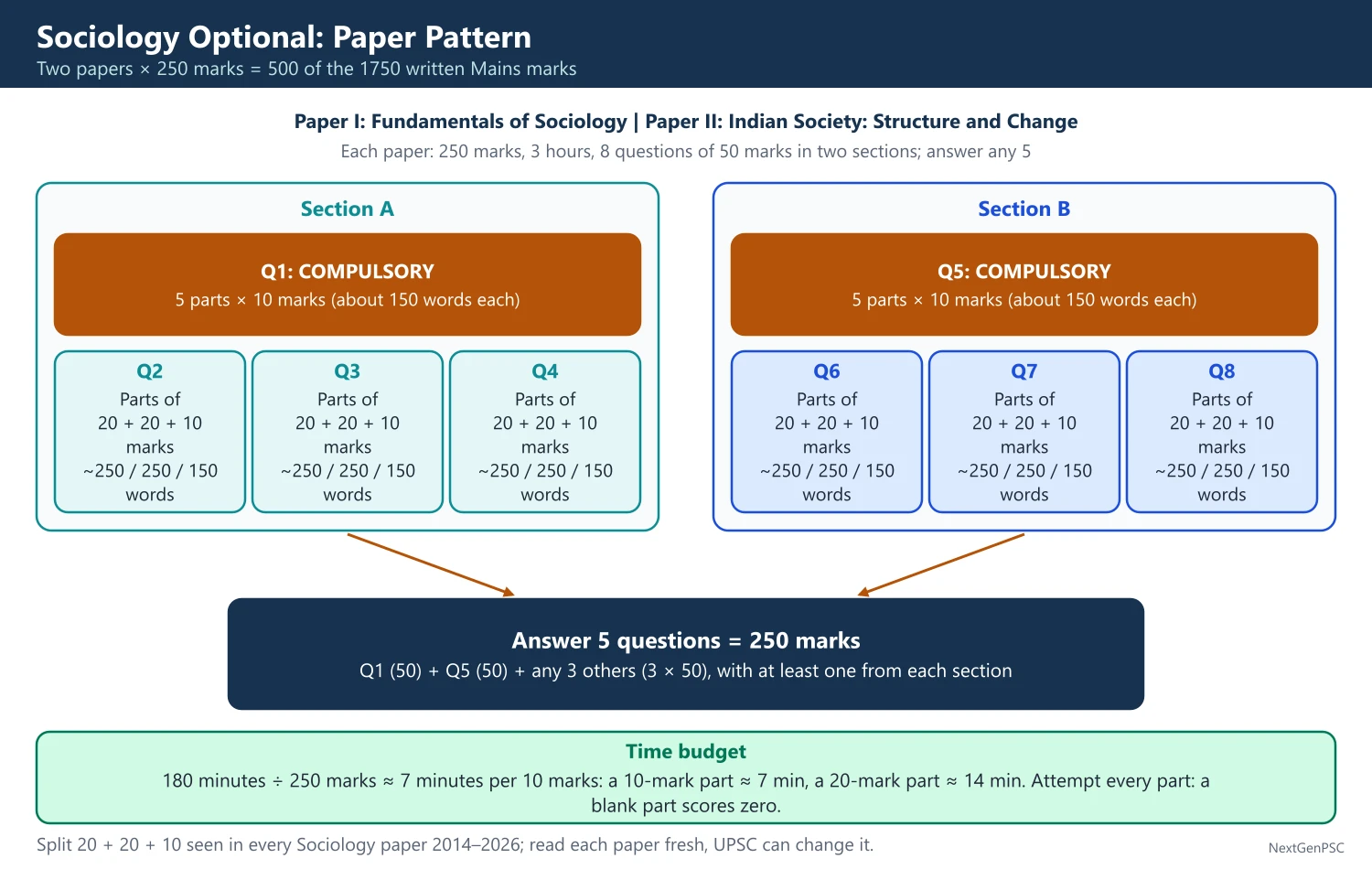
Sociology optional has two papers, Paper I (Fundamentals of Sociology) and Paper II (Indian Society: Structure and Change), each of 250 marks and three hours. Each paper has eight questions in two sections; a candidate answers five, with Q1 and Q5 compulsory and at least one question from each section. Paper I is theory but rewards Indian examples, while Paper II is about India but rewards theory.
In simple words
Sociology optional means two long written papers in UPSC Mains, each worth 250 marks and three hours long.
Think of each paper as a menu of eight dishes from which you must eat five, and two dishes (Q1 and Q5) are fixed for everyone.
Paper I asks about thinkers and concepts, and Paper II asks about Indian society: caste, tribes, village, family, movements and change.
Knowing the pattern lets you plan time, choose questions wisely and write the right length for 10, 15 and 20 mark parts.
1. Place of the Optional in Mains
Mains structure: UPSC Civil Services Mains has nine papers, of which seven are counted for merit: Essay, four General Studies papers and two optional papers (Paper VI and Paper VII).
Weight of the optional: the two Sociology papers carry 500 of the 1750 written marks, so the optional alone decides a large share of the final rank.
Overlap with General Studies: GS Paper I (Indian society, women, population, urbanisation, communalism, regionalism, secularism) and parts of GS II (welfare of vulnerable sections) and the Essay paper overlap heavily with Sociology Paper II.
Medium: the optional can be written in English or in any language of the Eighth Schedule the candidate has chosen for Mains; these notes give English and Hindi.
2. Structure of Each Paper
Two papers: Paper I is Fundamentals of Sociology and Paper II is Indian Society: Structure and Change; each carries 250 marks and lasts three hours.
Eight questions, two sections: Section A has Q1 to Q4 and Section B has Q5 to Q8; the candidate answers five questions in all.
Compulsory questions: Q1 and Q5 are compulsory, and of the remaining three at least one must come from each section, so a common choice is Q1, Q5 plus three others.
Marks per question: each question carries 50 marks, so five questions give 250.
Q1 and Q5: they usually have five parts of 10 marks each, to be answered in about 150 words each.
Q2 to Q4 and Q6 to Q8: in every Sociology paper from 2014 to 2026 they have three parts of 20, 20 and 10 marks (about 250, 250 and 150 words); still read each paper fresh, as UPSC can change the split.
Word limits: the question paper states a word limit for each part; writing far beyond it wastes time, and writing far below it usually loses content marks.
Time budget: 180 minutes for 250 marks is about 7 minutes per 10 marks, so a 10-mark answer gets 7 minutes and a 20-mark answer about 14 minutes.
3. How the Sections Usually Divide the Syllabus
Paper I Section A: in recent papers it has usually drawn on the discipline, sociology as science, research methods, the thinkers and often stratification (Chapters 2 to 8 of these notes).
Paper I Section B: it has usually drawn on work and economic life, politics, religion, kinship and social change (Chapters 9 to 13).
Paper II Section A: it has usually covered Introducing Indian Society and Social Structure: perspectives, colonial impact, village, caste, tribes, class, kinship and religion (Chapters 14 to 20).
Paper II Section B: it has usually covered Social Changes in India: planning, law, education, rural change, industry and urbanisation, politics, movements, population and challenges (Chapters 21 to 27).
Caution: this division is an observed pattern, not a printed rule; sometimes a unit appears in the other section.
4. Question Types and Directive Words
Thinker-based: explain or critically examine a thinker’s idea, for example Marx on alienation or Weber on bureaucracy.
Concept-based: define and illustrate a concept such as anomie, reference group, social mobility or secularisation.
Comparison: compare two thinkers or concepts, for example Durkheim and Weber on religion or mechanical and organic solidarity; a table often helps.
Application: apply a theory to a situation, for example Merton’s reference group to Sanskritisation or Marx’s class to agrarian India.
Quotation-based: a short quotation is given and the candidate is asked to comment; identify the thinker, explain, then evaluate.
Contemporary issue (mainly Paper II): questions on caste conflict, ageing, migration, gig work or violence against women expect current data with year and source.
Discuss: present different sides and reach a balanced view.
Critically examine or critically evaluate: explain the idea, then give strengths and named criticisms, and end with your judgement.
Elucidate or explain: make the idea clear with examples; criticism is useful but not central.
Comment: give your reasoned opinion supported by evidence.
Compare and contrast: bring out both similarities and differences, ideally on clear points of comparison.
5. Paper I and Paper II Help Each Other
Paper I with Indian examples: a Paper I answer on reference groups gains when it cites Sanskritisation (M.N. Srinivas), and one on bureaucracy gains when it cites the Indian Administrative Service.
Paper II with theory: a Paper II answer on caste gains when it cites Weber’s status group, Dumont’s purity and pollution or Béteille’s caste-class-power framework.
Shared thinkers: Marx links to A.R. Desai, Durkheim and Radcliffe-Brown to M.N. Srinivas, Weber to Louis Dumont and André Béteille, and Mead and Cooley to identity politics.
Data in both papers: current data (Census 2011, NFHS-5 2019–21, PLFS) belongs mainly in Paper II but also strengthens Paper I answers on family, gender and work.
6. Using it in the Exam
Before the exam: practise full three-hour papers so that five questions fit in 180 minutes.
In the exam hall: spend the first five minutes reading all eight questions and marking the three optional questions where you know thinkers, examples and data.
Order: many toppers start with a strong optional question to settle down and keep Q1 and Q5 for when they are fresh; either order works if time is tracked.
Diagram idea: draw a simple box: 250 marks = Q1 (5 × 10) + Q5 (5 × 10) + three questions of 20 + 20 + 10, with arrows from each section.
Rule to remember: attempt every part of every question you choose; a blank part gives zero, while a reasonable attempt gives some marks.
Common mistake: writing Paper I answers as pure Western theory and Paper II answers as journalism without thinkers; both lose marks.
Thinkers examiners look for: Marx, Durkheim, Weber, Merton, Parsons and Mead in Paper I; Ghurye, Srinivas, Dumont, Béteille and Desai in Paper II.
| Question | Status | Usual parts | Approx. words per part | Marks |
|---|---|---|---|---|
| Q1 (Section A) | Compulsory | 5 × 10 marks | 150 | 50 |
| Q2–Q4 (Section A) | Choose at least one | 20 + 20 + 10 (all papers 2014–2026) | 250 / 250 / 150 | 50 each |
| Q5 (Section B) | Compulsory | 5 × 10 marks | 150 | 50 |
| Q6–Q8 (Section B) | Choose at least one | 20 + 20 + 10 (all papers 2014–2026) | 250 / 250 / 150 | 50 each |
| Total | Five questions | 250 |
| Directive | What to do | Share of criticism |
|---|---|---|
| Discuss | Present several sides, then a balanced view | Moderate |
| Critically examine / evaluate | Explain, then strengths and named critics, then judgement | High (about one third) |
| Elucidate / Explain | Make clear with definitions and examples | Low |
| Comment | Reasoned opinion with evidence | Moderate |
| Compare and contrast | Similarities and differences on set points | As needed |
Mains points
- Learn the pattern well enough that you never spend more than about 7 minutes per 10 marks; unfinished papers are the biggest single cause of low optional scores.
- Read the directive word first: ‘critically examine’ needs named critics and a judgement, ‘elucidate’ needs clarity and examples.
- In Paper I, add at least one Indian example to every answer (village study, movement, law, scheme or data).
- In Paper II, add at least one thinker or concept to every answer (Srinivas, Dumont, Béteille, Desai, Merton, Weber).
- Attempt all parts of the chosen questions; partial attempts lose more marks than brief answers.
- Do not assume the section split is fixed; read all eight questions before choosing.
- Use the 10-mark parts of Q1 and Q5 to score quickly with a definition, two or three points, an example and a one-line conclusion.
Did you know?
- Memory trick for the paper: ‘1 and 5 stay alive’ — Q1 and Q5 are always compulsory.
- Time trick: ‘seven per ten’ — about seven minutes for every ten marks keeps you on schedule.
Syllabus Map, Study Order and Standard Books
Paper I has ten units, from Sociology: The Discipline to Social Change in Modern Society; Paper II has three blocks: Introducing Indian Society, Social Structure and Social Changes in India. Study the thinkers and core concepts of Paper I first, because Paper II uses them throughout. A small set of standard books, read repeatedly, works better than many books read once.
In simple words
The syllabus is the official list of what UPSC can ask, and a syllabus map links each line of it to a chapter you will study.
It is like a road map before a long journey: you see every town on the route and plan where to stop.
Starting with Paper I thinkers helps because Paper II topics like caste and village are explained using their ideas.
UPSC questions often copy the wording of the syllabus, so knowing it line by line saves marks.
1. Paper I Syllabus Map
Unit 1, Sociology – The Discipline: modernity and the emergence of sociology, scope and comparison with other social sciences, sociology and common sense → Chapter 2.
Unit 2, Sociology as Science: scientific method and critique, theoretical strands of research methodology, positivism, fact-value-objectivity, non-positivist methods → Chapter 3.
Unit 3, Research Methods and Analysis: qualitative and quantitative methods, techniques of data collection, variables, sampling, hypothesis, reliability and validity → Chapter 4.
Unit 4, Sociological Thinkers: Marx and Durkheim → Chapter 5; Weber → Chapter 6; Parsons, Merton and Mead → Chapter 7.
Unit 5, Stratification and Mobility: concepts, theories, dimensions and social mobility → Chapter 8.
Unit 6, Works and Economic Life: work in slave, feudal and industrial societies, formal and informal organisation, labour and society → Chapter 9.
Unit 7, Politics and Society: power, elites, bureaucracy, parties, nation, state, citizenship, civil society, movements and revolution → Chapter 10.
Unit 8, Religion and Society: theories, types of religious practice, religion in modern society → Chapter 11.
Unit 9, Systems of Kinship: family, household, marriage, lineage and descent, patriarchy, contemporary trends → Chapter 12.
Unit 10, Social Change in Modern Society: theories, development and dependency, agents, education, science and technology → Chapter 13.
2. Paper II Syllabus Map
) Introducing Indian Society: perspectives of Ghurye, Srinivas and Desai → Chapter 14; impact of colonial rule (nationalism, modernisation of tradition, protests, reforms) → Chapter 15.
) Social Structure, village and agrarian structure: village studies, land tenure and land reforms → Chapter 16.
) Social Structure, caste: perspectives of Ghurye, Srinivas, Dumont and Béteille, features, untouchability → Chapter 17.
) Social Structure, tribes: definitional problems, spread, colonial policies, integration and autonomy → Chapter 18.
) Social Structure, classes: agrarian, industrial and middle classes → Chapter 19.
) Social Structure, kinship and religion: lineage, kinship systems, family, household, patriarchy, religious communities and minorities → Chapter 20.
) Social Changes in India: visions of change (planning, law, education) → Chapter 21; rural and agrarian transformation → Chapter 22; industrialisation and urbanisation → Chapter 23.
) Social Changes in India, continued: politics and society → Chapter 24; social movements → Chapter 25; population dynamics → Chapter 26; challenges of social transformation → Chapter 27.
3. Suggested Study Order
Step 1, foundations (2–3 weeks): Chapters 2 to 4 (discipline, science, methods); these give the vocabulary used everywhere.
Step 2, thinkers (4–5 weeks): Chapters 5 to 7; learn each thinker’s works, key terms, criticism and one Indian example per concept.
Step 3, rest of Paper I (4–5 weeks): Chapters 8 to 13; stratification and religion are linked closely to caste and secularisation in Paper II.
Step 4, Paper II structure (4–5 weeks): Chapters 14 to 20; perspectives first, because Ghurye, Srinivas and Desai reappear in caste, village and class.
Step 5, Paper II change (4–5 weeks): Chapters 21 to 27; update data (Census, NFHS-5, PLFS, NCRB) and laws and schemes as you go.
Step 6, answer writing throughout: begin writing answers after Step 2, not after finishing the syllabus.
Previous year questions: after each chapter, read the past UPSC questions on it; they show the depth and angles expected.
4. Standard Books
Haralambos and Holborn, Sociology: Themes and Perspectives: the most used single book for Paper I concepts, methods, stratification, religion, family and power.
Anthony Giddens, Sociology: clear on modernity, globalisation, work, family and social change, with contemporary examples.
George Ritzer, Sociological Theory: detailed on Marx, Durkheim, Weber, Parsons, Merton, Mead and later theorists.
Raymond Aron, Main Currents in Sociological Thought: deep treatment of Montesquieu, Comte, Marx, Tocqueville, Durkheim, Pareto and Weber.
Francis Abraham and John Henry Morgan, Sociological Thought: compact chapters on the classical thinkers, good for revision.
Ram Ahuja, Indian Social System and Social Problems in India: wide coverage of Paper II structure and problems.
Yogendra Singh, Modernization of Indian Tradition: core for colonial impact, modernisation and theory of change in India.
Srinivas (M.N.), Social Change in Modern India and Caste in Modern India: Sanskritisation, westernisation, dominant caste and caste change.
NCERT Class XI and XII Sociology: the easiest entry point for beginners, especially Indian Society and Social Change and Development in India (Class XII).
IGNOU sociology material: the MA and BA course blocks are useful for thinkers, research methods and Indian society.
Data sources: Census 2011, NFHS-5 (2019–21), PLFS annual reports, NCRB reports, Economic Survey and NITI Aayog reports for Paper II figures.
5. Using it in the Exam
Syllabus words as anchors: when a question copies syllabus words (for example ‘fact, value and objectivity’), open the answer by placing the term in its unit and naming its key thinkers.
Revision plan: make one page per thinker and one page per Paper II topic with definitions, thinkers, studies and data; revise these pages at least three times.
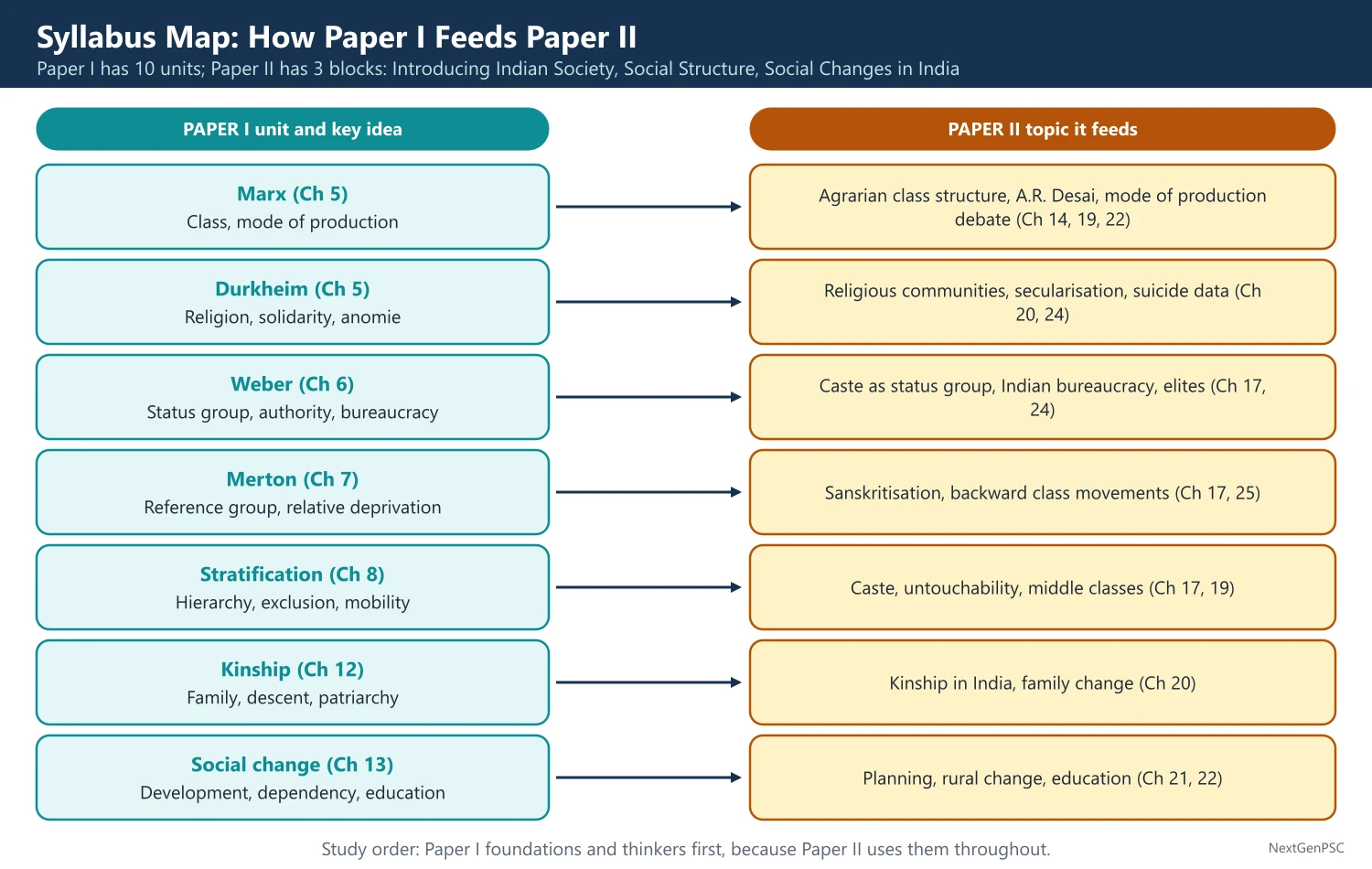
Diagram idea: a two-column map, Paper I units on the left and the Paper II topics they feed on the right, with arrows (Weber → caste as status group; Marx → agrarian class; Durkheim → religion and secularisation).
Thinkers examiners look for: for every unit keep four to six names ready, for example for stratification Davis and Moore, Tumin, Marx, Weber, Dumont and Béteille.
Common mistake: reading many books once; toppers usually stick to one main book per area and many revisions.
| Paper I unit (chapter) | Key Paper I idea | Paper II use (chapter) |
|---|---|---|
| Thinkers: Marx (5) | Class, mode of production | Agrarian class structure, A.R. Desai, mode of production debate (14, 19, 22) |
| Thinkers: Durkheim (5) | Religion, solidarity, anomie | Religious communities, secularisation, suicide data (20, 24) |
| Thinkers: Weber (6) | Status group, authority, bureaucracy | Caste as status group, Indian bureaucracy, elites (17, 24) |
| Thinkers: Merton (7) | Reference group, relative deprivation | Sanskritisation, backward class movements (17, 25) |
| Stratification (8) | Hierarchy, exclusion, mobility | Caste, untouchability, middle classes (17, 19) |
| Kinship (12) | Family, descent, patriarchy | Kinship in India, family change (20) |
| Social change (13) | Development, dependency, education | Planning, rural change, education (21, 22) |
Mains points
- Keep the official syllabus printed beside you; tick each line only when you can write a 150-word answer on it.
- Finish the thinkers early; nearly every other topic in both papers draws on them.
- Use one main book per area and these notes for revision rather than collecting many books.
- Prepare a list of Indian village studies, movements, laws and data with years; it is used in both papers.
- Read past UPSC questions on each unit before and after studying it to see the angles asked.
- Link units in answers: for example stratification theory with caste, and Weber’s bureaucracy with the Indian civil service.
Did you know?
- Memory trick for Paper II blocks: ‘I-S-C’ — Introducing Indian society, Structure, Change.
- Paper I has exactly ten units; if you can name all ten from memory, your syllabus map is ready.
Answer Writing for Sociology: Thinkers, Concepts and Indian Examples
A good Sociology answer has a short introduction (definition or thinker), a body that explains the concept with thinkers, studies and Indian examples, a critical section with named critics, and a conclusion that gives a balanced view or a way forward. Examiners reward sociological vocabulary, correct attribution and relevance to the exact demand of the question.
In simple words
Answer writing means turning what you know into a clear, short, well-ordered answer within the word limit.
It is like presenting a case in court: state your point, bring witnesses (thinkers and studies), show evidence (examples and data), face the other side and close firmly.
Two students may know the same facts, but the one who writes with thinkers, Indian examples and balance scores more.
UPSC tests this in every question, from 10-mark parts to 20-mark parts.
1. The Basic Structure
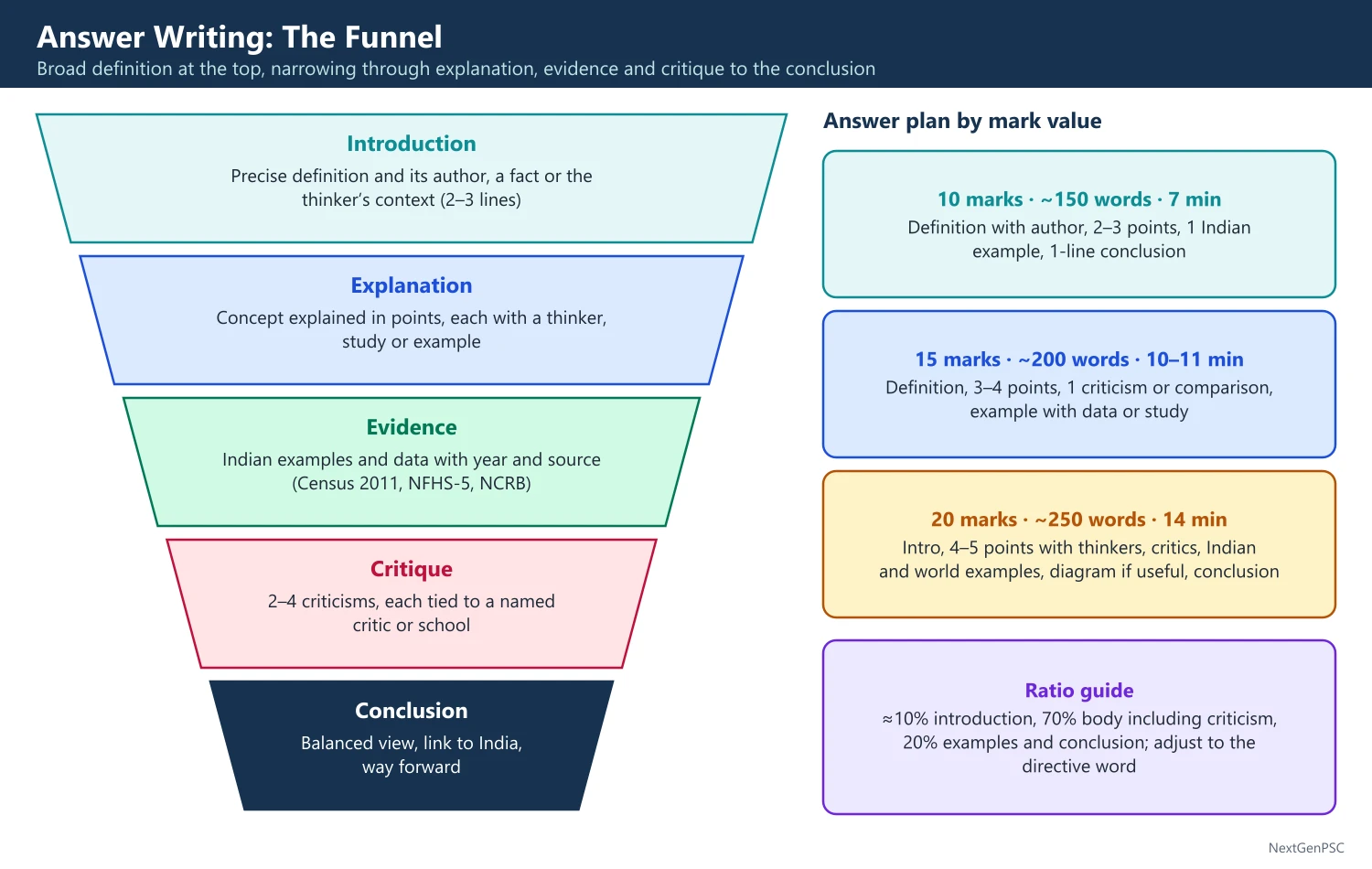
Introduction (2–3 lines): open with a precise definition and its author, a relevant fact, or the context of the thinker; avoid long histories.
Body (main part): explain the concept or argument in points or short paragraphs, each with a thinker, a study or an example.
Critical section: for ‘critically examine’ or ‘evaluate’, give two to four criticisms, each tied to a named critic or school.
Conclusion (2–3 lines): a balanced judgement, a link to contemporary India, or a way forward; do not introduce a new argument here.
Headings and points: short sub-headings and numbered points make an answer easy to mark; mix them with full sentences so the logic stays visible.
2. Writing to the Mark Value
10 marks (about 150 words, 7 minutes): definition with author, two or three explanatory points, one Indian example, one-line conclusion.
15 marks (about 200 words, 10–11 minutes): rare in recent Sociology papers (the split has been 20 + 20 + 10), but if asked: definition, three or four points, one criticism or comparison, an Indian example with data or a study, conclusion.
20 marks (about 250 words, 14 minutes): introduction, four or five points with thinkers, a short critical section, two examples (Indian and world), a diagram or table if useful, and a conclusion.
Ratio guide: roughly 10 percent introduction, 70 percent body including criticism, 20 percent examples and conclusion; adjust to the directive word.
3. Using Thinkers and Concepts Correctly
Attribution: always pair a concept with its thinker and, where you are sure, the work, for example anomie with Durkheim’s The Division of Labour in Society (1893) and Suicide (1897).
Thinker’s own terms: use Marx’s ‘relations of production’, Weber’s ‘ideal type’, Merton’s ‘latent function’ and Mead’s ‘generalised other’ rather than everyday paraphrases.
Classical plus modern: add a later thinker to show depth, for example Weber with Ritzer’s McDonaldization, or Marx with Braverman’s deskilling.
Quotations: quote only when you are sure of the words and the author; otherwise paraphrase and name whose view it is.
Avoid name-dropping: a name without the idea earns little; one line explaining what the thinker said is needed each time.
4. Indian Examples and Data
Village studies: Rampura (M.N. Srinivas), Shamirpet (S.C. Dube, Indian Village, 1955), Kishan Garhi (McKim Marriott), Sripuram (André Béteille, Caste, Class and Power, 1965).
Concepts from Indian sociology: Sanskritisation and dominant caste (Srinivas), purity and pollution (Dumont), little and great traditions (Redfield, used by Marriott and Singer), modernisation of tradition (Yogendra Singh).
Movements: Chipko, Narmada Bachao Andolan, the Dalit Panthers, the farmers’ protest of 2020–21 against the farm laws, and backward class movements.
Laws and schemes: SC/ST (Prevention of Atrocities) Act 1989, PESA 1996, Forest Rights Act 2006, Right to Education Act 2009, and the Bharatiya Nyaya Sanhita 2023.
Data with year and source: Census 2011, NFHS-5 (2019–21), PLFS, NCRB, NITI Aayog’s national multidimensional poverty index; always give the year.
Paper I use: for Durkheim’s suicide cite NCRB data (1,71,418 suicides in 2023, rate 12.3 per lakh, with daily wage earners the largest group); for Weber’s bureaucracy cite the IAS and Mission Karmayogi.
5. Making the Answer Stand Out
Diagrams and tables: a 2 × 2 table (Merton’s adaptations, Durkheim’s four suicide types), a flow chart (Marx’s base and superstructure) or a comparison table saves words and catches the examiner’s eye.
Comparisons: where natural, contrast two thinkers in one line, for example Durkheim sees religion as integrating, Marx as ideology.
Balance: sociology rewards ‘both-and’ answers; mark debated points as debated and give evidence on both sides.
Contemporary links: connect old theory to present India, such as alienation to gig workers or anomie to rapid urbanisation.
Language: short sentences, sociological terms, no slogans or moral sermons; the examiner wants analysis, not opinion alone.
Perspective lens: where useful, show how functionalist, Marxist, Weberian, interactionist and feminist views would read the same issue; this shows range in a few lines.
Micro and macro: pair a structural point (for example caste hierarchy) with an interactional one (for example everyday humiliation described in Dalit autobiographies) to show both levels.
6. Common Errors to Avoid
Wrong attribution: mixing up thinkers, for example giving ‘looking-glass self’ to Mead instead of Cooley, or ‘iron law of oligarchy’ to Weber instead of Michels, costs credibility.
Ignoring the demand: writing everything about Weber when the question asks only about ideal types; underline the exact demand before planning.
Undated or invented data: a wrong or made-up figure is worse than none; give only data you are sure of, with year and source.
One-sided answers: praising or condemning a theory without evidence; sociology answers should weigh both sides.
Overlong introductions: half a page of background in a 150-word answer leaves no room for content.
Neglecting presentation: crowded pages without spacing or headings are harder to mark; leave a line between points.
Skipping the conclusion: an answer that stops abruptly looks unfinished; even one line of conclusion helps.
7. Using it in the Exam
Planning: spend 30–60 seconds jotting four or five keywords (thinkers, study, example, data) before writing each answer.
Model frame for ‘Critically examine Durkheim’s theory of suicide’: intro on suicide as a social fact → integration and regulation → four types in a 2 × 2 table → evidence used → critics (Douglas, Atkinson) → Indian data from NCRB → conclusion on lasting value.
Diagram idea: the answer as a funnel: definition at the top, then explanation, then evidence, then critique, narrowing to the conclusion.
Quotation example: C. Wright Mills (The Sociological Imagination, 1959) asked sociologists to connect ‘personal troubles’ with ‘public issues’, a useful opener for many answers.
Practice routine: write at least two answers a day during preparation and get them reviewed; check each one against this structure.
| Marks | Words | Minutes | Must include |
|---|---|---|---|
| 10 | about 150 | 7 | Definition with author, 2–3 points, 1 Indian example, 1-line conclusion |
| 15 | about 200 | 10–11 | Definition, 3–4 points, 1 criticism or comparison, example with data or study |
| 20 | about 250 | 14 | Intro, 4–5 points with thinkers, critics, Indian and world examples, diagram if useful, conclusion |
| Paper I concept | Indian example |
|---|---|
| Reference group (Merton) | Sanskritisation by lower castes (Srinivas) |
| Collective effervescence (Durkheim) | Kumbh Mela, Pandharpur wari |
| Charismatic authority (Weber) | Gandhi’s leadership of the national movement |
| Alienation (Marx) | Gig and platform workers; assembly-line workers |
| Anomie (Durkheim, Merton) | Rapid urbanisation, exam paper leaks as ‘innovation’ |
| Pattern variables (Parsons) | Caste (ascription) versus competitive civil services (achievement) |
Mains points
- Open with a definition and its author; examiners form an impression in the first three lines.
- Every main point should carry a thinker, a study or an example; pure assertion scores poorly.
- For ‘critically examine’, keep about a third of the answer for criticism with named critics.
- Use Indian examples in Paper I and theory in Paper II; this cross-use is what separates high scorers.
- Give data with year and source; an undated figure looks unreliable.
- Use one diagram or table in most 15- and 20-mark answers where it fits naturally.
- End with a balanced conclusion linked to contemporary India rather than a moral appeal.
Did you know?
- Memory trick for an answer: ‘D-T-E-C-C’ — Definition, Thinkers, Examples, Criticism, Conclusion.
- C. Wright Mills called the link between private troubles and public issues the ‘sociological imagination’; it is one of the most quoted ideas in UPSC answers.
Sociology Optional: All chapters
- Exam Pattern, Syllabus and Strategy
- Sociology: The Discipline
- Sociology as Science
- Research Methods and Analysis
- Sociological Thinkers: Marx and Durkheim
- Sociological Thinkers: Max Weber
- Sociological Thinkers: Parsons, Merton and Mead
- Stratification and Mobility
- Works and Economic Life
- Politics and Society
- Religion and Society
- Systems of Kinship
- Social Change in Modern Society
- Perspectives on the Study of Indian Society
- Impact of Colonial Rule on Indian Society
- Rural and Agrarian Social Structure
- Caste System
- Tribal Communities in India
- Social Classes in India
- Kinship, Family and Religion in India
- Visions of Social Change in India
- Rural and Agrarian Transformation in India
- Industrialisation and Urbanisation in India
- Politics and Society in India
- Social Movements in Modern India
- Population Dynamics
- Challenges of Social Transformation