
Sociology Optional · UPSC Notes
Sociology as Science — UPSC Sociology Optional Notes
Free, exam-focused notes for UPSC Prelims and Mains, with Prelims tips and Mains points for every topic. 6 topics.
Open in the interactive reader: bookmarks, progress tracking and read-aloud.
Science, Scientific Method and Its Critique
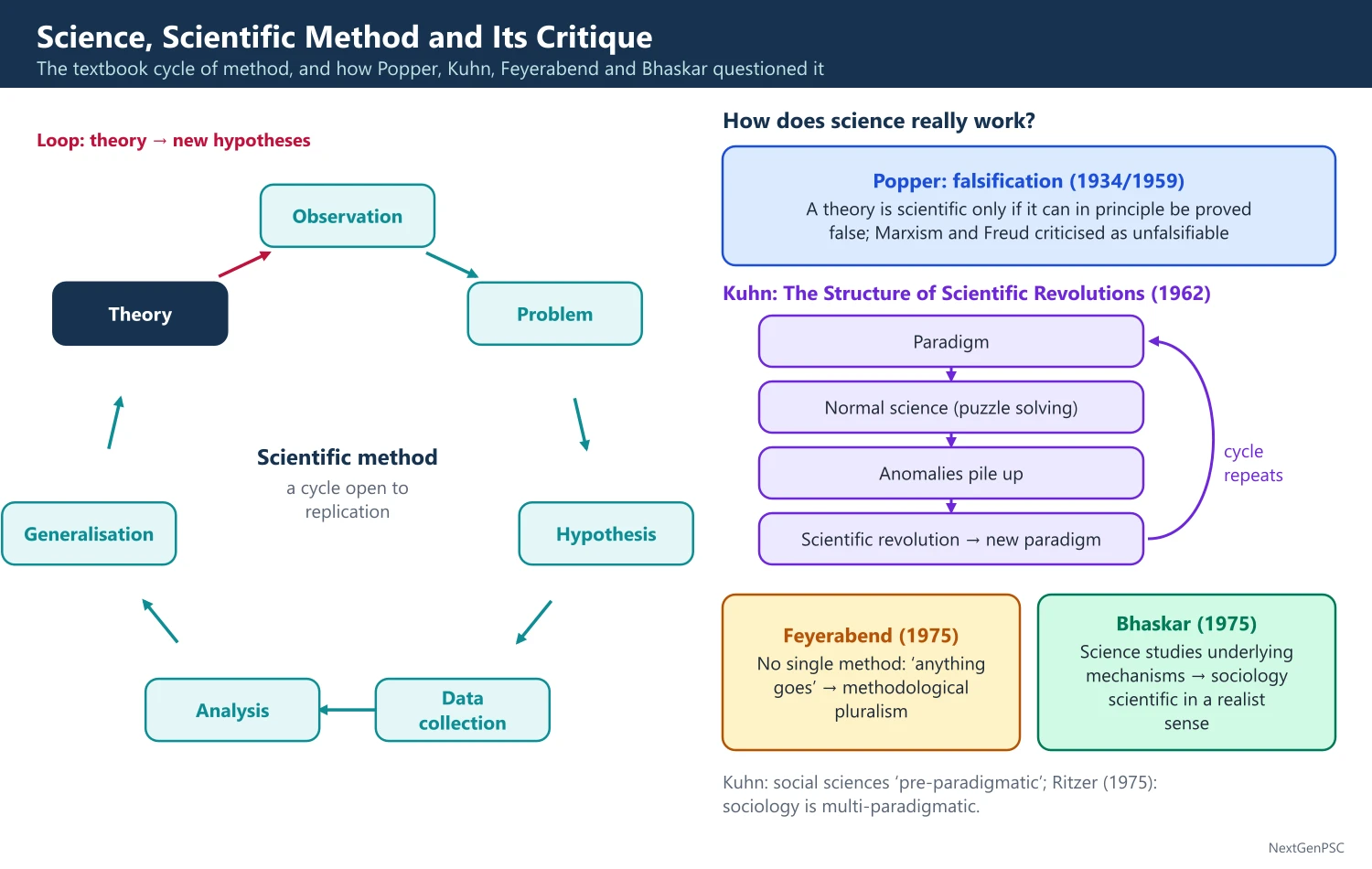
Science is systematic knowledge built through observation, hypothesis, testing and theory; the scientific method aims at objective, verifiable and general knowledge. Philosophers such as Karl Popper (falsification), Thomas Kuhn (paradigms) and Paul Feyerabend (‘anything goes’) have questioned how science really works, and this debate shapes whether and how sociology can be a science.
In simple words
Science is a careful way of knowing: observe, guess an explanation, test it, and keep only what survives testing.
It is like a detective who does not accept rumours but collects clues, tests each suspect’s story and changes her mind when new evidence appears.
Sociology wants this care, but people think, change and react to being studied, which makes it harder than studying stones.
UPSC asks what science is, whether sociology is one, and how thinkers like Popper and Kuhn criticised the idea of science.
1. Concepts and Definitions
Science: a body of systematic, empirically tested knowledge about the world, and the method used to produce it.
Scientific method: a cycle of observation, problem formulation, hypothesis, data collection, analysis, generalisation and theory, with results open to replication.
Empiricism: knowledge comes from sense experience and observation, not from authority or pure reason.
Induction: reasoning from particular observations to general laws (many white swans → all swans are white).
Deduction: reasoning from a general theory to particular predictions that can be tested.
Theory: a set of logically connected propositions that explains a class of phenomena.
Law: a statement of a regular, invariant relationship between phenomena; whether sociology can have laws is debated.
2. Features of Science
Objectivity: findings should not depend on the personal values of the researcher.
Verifiability and replicability: other researchers should be able to check and repeat the study.
Generality: science seeks general patterns, not one-off descriptions.
Predictability: good theories allow predictions about what will happen under given conditions.
Systematic and cumulative: knowledge builds on earlier work through organised methods.
Ethical neutrality: the scientist describes and explains rather than judges; Weber’s value freedom is the social science version.
Merton’s norms of science (1942): Robert K. Merton described the ethos of science as communism (shared findings), universalism (claims judged by impersonal criteria), disinterestedness and organised scepticism, often remembered as CUDOS.
3. The Critique of Science
Hume’s problem of induction: no number of observations can prove a universal law; the next swan may be black.
Karl Popper (The Logic of Scientific Discovery, 1934, English 1959): science advances by falsification, not verification; a theory is scientific only if it can in principle be proved false.
Popper on social theory: in The Poverty of Historicism (1957) and The Open Society and Its Enemies (1945) he argued that Marxism and Freudian theory explain everything after the fact and so are not falsifiable.
Thomas Kuhn (The Structure of Scientific Revolutions, 1962): science works within a paradigm, a shared framework of theory and method; ‘normal science’ solves puzzles until anomalies pile up and a ‘scientific revolution’ installs a new paradigm.
Kuhn on sociology: he suggested social sciences are ‘pre-paradigmatic’ because they lack a single agreed paradigm; others see sociology as multi-paradigmatic (George Ritzer, 1975).
Imre Lakatos: proposed ‘research programmes’ with a hard core protected by auxiliary hypotheses, judged as progressive or degenerating.
Paul Feyerabend (Against Method, 1975): argued that there is no single scientific method and that great discoveries broke rules, summed up as ‘anything goes’.
Feminist critique: Sandra Harding and Evelyn Fox Keller argued that science has carried male bias in its questions and methods.
Sociology of scientific knowledge: the Edinburgh ‘strong programme’ (David Bloor, 1976) and laboratory studies (Bruno Latour and Steve Woolgar, Laboratory Life, 1979) showed science as a social activity.
4. Is Sociology a Science?
Yes, positivists: Comte and Durkheim held that society can be studied like nature; Durkheim’s Suicide (1897) used statistics to find social causes of suicide rates.
Partly, Weber: sociology can be scientific through causal explanation, but must first understand meanings (verstehen); its objectivity is limited by value relevance.
No, interpretivists: Peter Winch (The Idea of a Social Science, 1958) argued that social action is rule-following and meaningful, so it must be understood, not causally explained like nature.
Difficulties: human beings have consciousness and free will; the Hawthorne effect shows people change when observed; experiments are often unethical; social life is complex and historical.
Self-fulfilling and self-defeating prophecies: Merton (1948) showed that predictions about society can change behaviour, so social prediction differs from natural prediction.
Realist answer: Roy Bhaskar (A Realist Theory of Science, 1975) and Andrew Sayer argue that both natural and social sciences study underlying structures and mechanisms that are not directly observable, so sociology can be scientific in a realist sense.
Russell Keat and John Urry (Social Theory as Science, 1975): argued that natural sciences also deal with unobservables and open systems, so the gap is smaller than positivists or interpretivists claim.
5. Indian Examples and Studies
Large-scale scientific data: India’s Census (first synchronous census 1881; latest completed Census 2011; next Census with reference date 1 March 2027) and National Sample Surveys (from 1950) show the survey tradition of social science.
NFHS: the National Family Health Survey uses probability samples; NFHS-5 (2019–21) covered about 6.37 lakh households, allowing district-level estimates.
Testing common claims: data showing the fall in multidimensional poverty (NITI Aayog: from 24.85 percent in 2015–16 to 14.96 percent in 2019–21) are used to test policy claims, an example of empirical checking.
Limits seen in India: the meaning of caste, purity or honour cannot be measured easily; village studies by Srinivas, Dube and Béteille used participant observation to grasp meanings that surveys miss.
Paradigm debate in India: Louis Dumont and David Pocock (Contributions to Indian Sociology, 1957) argued that a sociology of India must draw on Indology and the ideas of Indians themselves, a challenge to a single universal science.
Indigenisation debate: Yogendra Singh, Ramkrishna Mukherjee and others debated whether Indian sociology should develop its own concepts or use universal ones, which echoes Kuhn’s idea of competing frameworks.
6. Linking Thinkers
Comte and Popper: Comte’s positivism sought laws; Popper rejected both verificationism and historicist ‘laws of history’.
Kuhn and Marx: both see change as revolutionary rather than gradual; Kuhn’s paradigms resemble Marx’s view that ideas are tied to social groups (debated).
Merton’s norms and Indian science: Merton’s ethos of science can be used to discuss research ethics and academic plagiarism debates in India.
7. Using it in the Exam
10 marks: define science, list four features, and give one critique (Popper or Kuhn).
15 marks: scientific method steps, Merton’s norms, Popper and Kuhn, with an Indian survey example.
20 marks (‘Is sociology a science?’): features of science → positivist case (Comte, Durkheim) → difficulties and interpretivist case (Weber, Winch) → critique of natural science itself (Popper, Kuhn, Feyerabend) → realist middle path (Bhaskar, Keat and Urry) → Indian examples → conclusion: sociology is a science in method and rigour, not in producing invariant laws.
Flow chart idea: observation → problem → hypothesis → data → analysis → generalisation → theory, with a loop back from theory to new hypotheses.
Thinkers examiners look for: Comte, Durkheim, Weber, Popper, Kuhn, Merton, Winch, Bhaskar.
Useful definition: for Popper, the criterion of the scientific status of a theory is its falsifiability, or refutability, or testability (from Conjectures and Refutations, 1963).
| Thinker | Key work | Main idea | Implication for sociology |
|---|---|---|---|
| Comte | Course of Positive Philosophy (1830–42) | Positive knowledge through observation; laws of society | Sociology as a natural science of society |
| Popper | The Logic of Scientific Discovery (1934/1959) | Falsification, not verification | Marxism criticised as unfalsifiable |
| Kuhn | The Structure of Scientific Revolutions (1962) | Paradigms, normal science, revolutions | Sociology is multi-paradigmatic (Ritzer) |
| Feyerabend | Against Method (1975) | No single method; ‘anything goes’ | Methodological pluralism |
| Bhaskar | A Realist Theory of Science (1975) | Science studies underlying mechanisms | Sociology can be scientific in a realist sense |
Mains points
- Typical angle: ‘Can sociology be a science?’; answer with features of science, positivist and interpretivist positions, the critique of natural science, and a realist conclusion.
- Use Popper and Kuhn to show that even natural science is not as neat as positivists assumed, which narrows the gap with sociology.
- Give Merton’s CUDOS norms as the sociology of science answer to what makes science distinctive.
- Bring Indian examples: Census, NSS, NFHS as scientific surveys; village studies as interpretive work; Dumont and Pocock’s call for an Indian sociology.
- Avoid a yes/no answer; examiners reward ‘science in a qualified sense’ with reasons.
- Common mistake: confusing Popper’s falsification with Comte’s positivism; Popper criticised logical positivism.
Did you know?
- Kuhn first popularised ‘paradigm shift’, a phrase now used everywhere from business to cricket commentary.
- Memory trick for Merton’s norms: CUDOS — Communism, Universalism, Disinterestedness, Organised Scepticism.
Major Theoretical Strands of Research Methodology
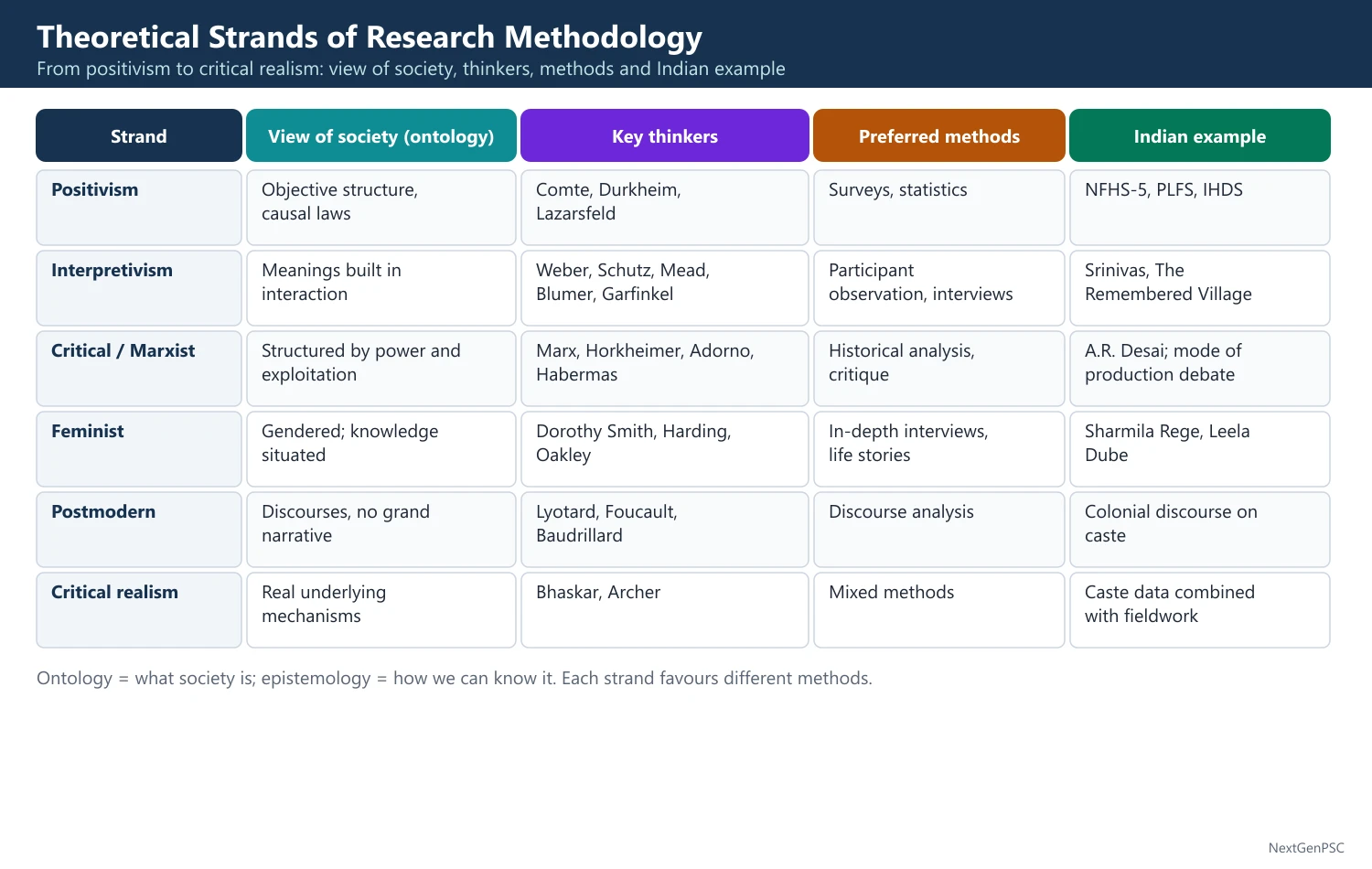
Research methodology rests on philosophical strands about what society is (ontology) and how we can know it (epistemology). The main strands are positivism (Comte, Durkheim), interpretivism (Weber, Schutz, symbolic interactionism, ethnomethodology), critical theory (Marx, Frankfurt School, Habermas), feminist and standpoint methodology, postmodernism, and critical realism; each favours different methods.
In simple words
Different sociologists have different ideas about what society is and how to study it; these ideas are called theoretical strands.
It is like studying a cricket match: one person counts runs and wickets, another asks players what the game means to them, and a third asks who profits from it.
Each strand leads to different methods, from statistics to interviews to critique of power.
UPSC asks you to compare these strands and link each to its thinkers and methods.
1. Concepts and Definitions
Methodology: the logic and philosophy behind research, distinct from methods, which are specific techniques such as surveys or interviews.
Ontology: assumptions about the nature of social reality, for example whether society exists as an objective structure or is built through interaction.
Epistemology: assumptions about how valid knowledge of society can be obtained, for example by measurement or by understanding meanings.
Paradigm: following Kuhn, a shared set of assumptions, concepts and methods; Ritzer (1975) called sociology a multiple-paradigm science with social fact, social definition and social behaviour paradigms.
2. Positivism
Assumptions: society is an objective reality external to individuals; it can be studied like nature; the aim is causal laws.
Thinkers: Auguste Comte, Emile Durkheim (The Rules of Sociological Method, 1895), later Paul Lazarsfeld and quantitative sociology.
Methods: surveys, structured questionnaires, official statistics, experiments, statistical analysis.
Strength and weakness: reliable and generalisable, but may miss meanings and treat categories such as ‘caste’ or ‘crime’ as unproblematic.
3. Interpretivism
Assumptions: social reality is made of meanings that actors give to their actions; it must be understood from the actor’s point of view.
Max Weber: verstehen, interpretive understanding of social action, combined with causal explanation.
Phenomenology: Alfred Schutz studied the taken-for-granted ‘life-world’ and typifications; Peter Berger and Thomas Luckmann (The Social Construction of Reality, 1966) showed how reality is socially built.
Symbolic interactionism: George Herbert Mead and Herbert Blumer (who coined the term in 1937) studied how meanings arise in interaction; methods include participant observation and life histories.
Ethnomethodology: Harold Garfinkel (1967) studied the methods people use to produce everyday order, using breaching experiments and conversation analysis.
Methods: participant observation, unstructured interviews, case studies, personal documents.
Strength and weakness: high validity and depth, but low reliability and generalisability, and risk of researcher subjectivity.
4. Critical Theory and Marxist Methodology
Assumptions: society is structured by power and exploitation; research should expose domination and serve emancipation.
Marx: historical and dialectical method; the analysis of the capitalist mode of production in Capital (1867).
Frankfurt School: Max Horkheimer (‘Traditional and Critical Theory’, 1937), Theodor Adorno, Herbert Marcuse criticised positivism as accepting the status quo.
Jürgen Habermas (Knowledge and Human Interests, 1968): distinguished three knowledge interests: technical (empirical-analytic sciences), practical (hermeneutic sciences) and emancipatory (critical sciences).
Positivist dispute: the 1961 German debate between Popper and Adorno (later Habermas and Hans Albert) over whether social science should be value-free.
5. Feminist and Standpoint Methodology
Assumptions: mainstream sociology was ‘malestream’; women’s experience was ignored; knowledge is situated.
Thinkers: Dorothy Smith (sociology from the standpoint of women), Sandra Harding (standpoint epistemology, ‘strong objectivity’), Ann Oakley (‘Interviewing Women: A Contradiction in Terms’, 1981).
Methods: in-depth, non-hierarchical interviews, life stories, participatory research.
Indian strand: Sharmila Rege (‘Dalit Women Talk Differently’, Economic and Political Weekly, 1998) argued for a Dalit feminist standpoint, criticising both upper-caste feminism and male Dalit politics.
6. Postmodernism and Critical Realism
Postmodernism: Lyotard (1979) rejected grand narratives; Michel Foucault linked knowledge and power (discourse, Discipline and Punish, 1975); Jean Baudrillard wrote of simulation; methods include discourse analysis and deconstruction.
Criticism of postmodernism: Habermas and others see it as relativist; if all knowledge is a narrative, it cannot criticise injustice.
Critical realism: Roy Bhaskar and Margaret Archer argue that social structures are real and causally powerful though not directly observable; research should uncover mechanisms using both quantitative and qualitative methods.
Structuration: Anthony Giddens (The Constitution of Society, 1984) tried to bridge structure and agency, which influences mixed research designs.
7. Indian Examples and Studies
Positivist: large surveys such as NFHS-5 (2019–21), PLFS and the India Human Development Survey (NCAER and University of Maryland, rounds in 2004–05 and 2011–12).
Interpretive: M.N. Srinivas’s The Remembered Village (1976) on Rampura and S.C. Dube’s Indian Village (1955) on Shamirpet, which sought the villagers’ own view.
Book view and field view: Srinivas contrasted the Indological ‘book view’ of caste (texts, varna) with the ‘field view’ (observed jati life), a methodological debate central to Indian sociology.
Marxist: A.R. Desai (Social Background of Indian Nationalism, 1948) and the mode of production debate in Indian agriculture in the late 1960s and 1970s (Utsa Patnaik, Ashok Rudra, Jairus Banaji, Amit Bhaduri).
Subaltern: the Subaltern Studies group led by Ranajit Guha (from 1982) wrote history ‘from below’, using peasant and tribal voices.
Feminist: Leela Dube’s work on gender and kinship and Sharmila Rege’s Dalit feminist standpoint.
8. Linking Thinkers
Durkheim versus Weber: the founding contrast between explaining social facts and understanding social action.
Marx and Habermas: both see knowledge as tied to interests; Habermas extends Marx with communicative action.
Mead to Goffman: interactionist strand runs from Mead and Blumer to Goffman’s dramaturgy and Becker’s labelling theory.
9. Using it in the Exam
10 marks: name three strands, each with one thinker and one method.
15 marks: compare positivism and interpretivism on ontology, epistemology, methods, strengths and weaknesses.
20 marks: define methodology → each strand with assumptions, thinkers, methods → Indian examples → triangulation and mixed methods (Denzin) as a modern answer → conclusion that methodology follows the research question.
Diagram idea: a table with strands as rows and ontology, epistemology, methods and Indian example as columns.
Useful definition: Weber defined sociology as a science concerning itself with the interpretive understanding of social action and thereby with a causal explanation of its course and consequences (Economy and Society, 1922).
| Strand | View of society | Key thinkers | Preferred methods | Indian example |
|---|---|---|---|---|
| Positivism | Objective structure, causal laws | Comte, Durkheim, Lazarsfeld | Surveys, statistics | NFHS-5, PLFS, IHDS |
| Interpretivism | Meanings built in interaction | Weber, Schutz, Mead, Blumer, Garfinkel | Participant observation, interviews | Srinivas, The Remembered Village |
| Critical / Marxist | Structured by power and exploitation | Marx, Horkheimer, Adorno, Habermas | Historical analysis, critique | A.R. Desai; mode of production debate |
| Feminist | Gendered, knowledge situated | Dorothy Smith, Harding, Oakley | In-depth interviews, life stories | Sharmila Rege, Leela Dube |
| Postmodern | Discourses, no grand narrative | Lyotard, Foucault, Baudrillard | Discourse analysis | Studies of colonial discourse on caste |
| Critical realism | Real underlying mechanisms | Bhaskar, Archer | Mixed methods | Studies combining caste data and fieldwork |
Mains points
- Typical angle: ‘Compare positivist and interpretive methodologies’ or ‘Discuss the major theoretical strands of research methodology’; organise by ontology, epistemology and method.
- Always attach thinkers and a method to each strand; a strand without a method is incomplete.
- Add critical theory and feminist methodology to show range beyond the usual two.
- Use Srinivas’s book view versus field view and Rege’s Dalit feminist standpoint as Indian methodological debates.
- Conclude with methodological pluralism and triangulation; most modern research mixes methods.
- Common mistake: confusing methodology (philosophy) with methods (techniques).
Did you know?
- Herbert Blumer coined ‘symbolic interactionism’ in 1937, years after Mead’s death in 1931; Mead himself never used the label.
- Memory trick: ‘P-I-C-F-P-R’ — Positivism, Interpretivism, Critical, Feminist, Postmodern, Realism.
Positivism and Its Critique
Positivism holds that society can be studied with the methods of natural science to discover causal laws based on observable facts. Auguste Comte founded it with the law of three stages, and Durkheim gave it a rigorous method in The Rules of Sociological Method (1895). It has been criticised by interpretivists, phenomenologists, Popper, the Frankfurt School and feminists for ignoring meaning, values and power.
In simple words
Positivism says: study society like a scientist studies nature, by counting, measuring and finding cause and effect.
It is like a doctor who trusts the thermometer and blood test more than what the patient says he feels.
This gives solid numbers, but critics say people are not objects, and numbers can hide what actions mean to people.
UPSC asks you to explain Comte and Durkheim’s positivism and to criticise it with named thinkers.
1. Concepts and Definitions
Positivism: the view that the only valid knowledge is that based on observable facts and their lawful relations, discovered by scientific method.
Naturalism: the assumption that social and natural sciences share one logic of inquiry.
Value neutrality: the researcher should keep personal values out of research.
Social fact: Durkheim’s term for ways of acting, thinking and feeling external to individuals and exercising constraint over them.
2. Comte’s Positivism
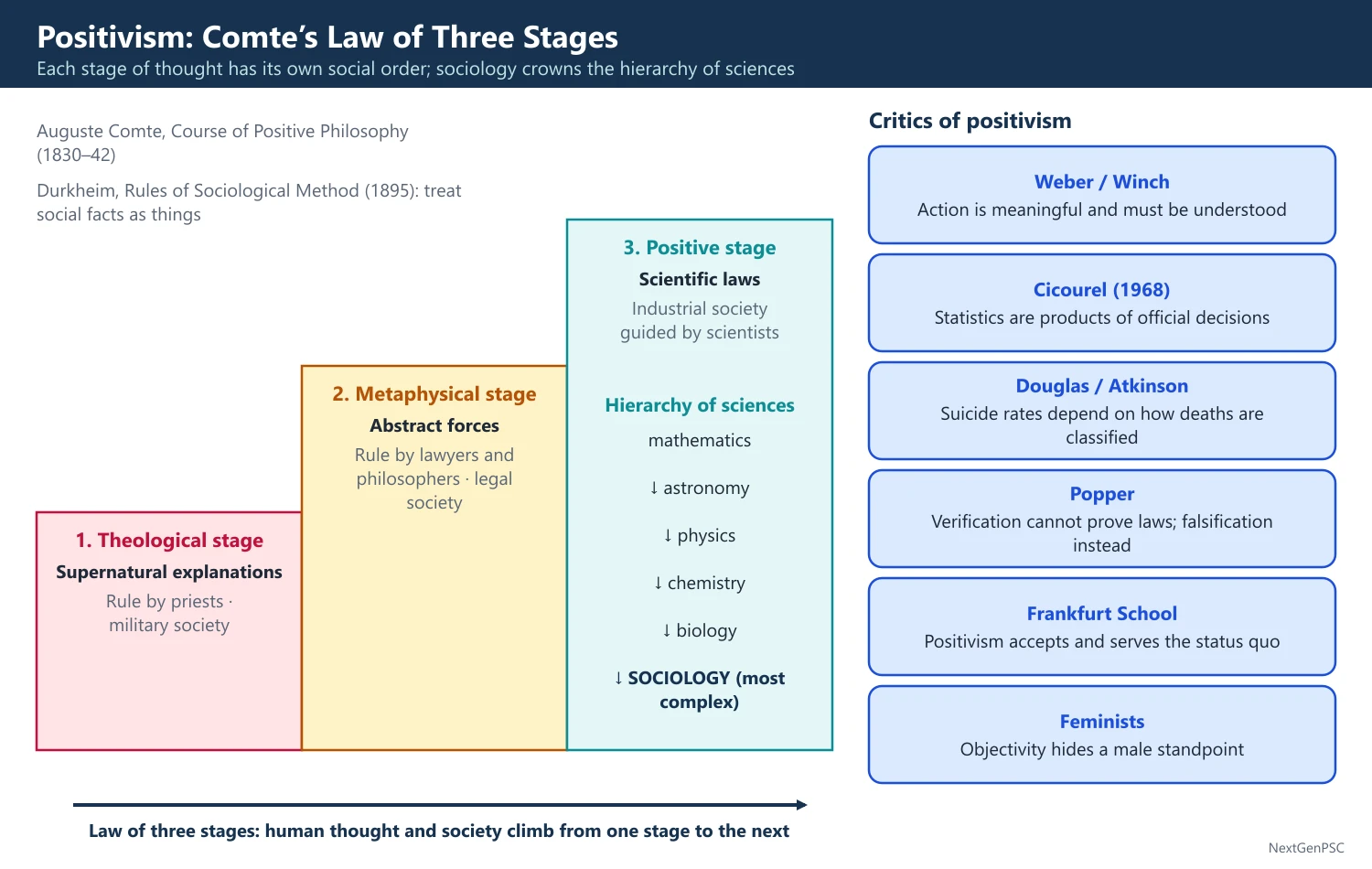
Law of three stages: human thought and society pass through the theological stage (supernatural explanations, rule by priests), the metaphysical stage (abstract forces, rule by lawyers and philosophers) and the positive stage (scientific laws, industrial society guided by scientists).
Hierarchy of sciences: mathematics, astronomy, physics, chemistry, biology and finally sociology, the most complex science.
Social statics and dynamics: statics studies order (the conditions of social existence); dynamics studies progress (the laws of change).
Methods: observation, experiment, comparison and the historical method.
Religion of Humanity: in later work (System of Positive Polity, 1851–54) Comte proposed a secular religion with sociologists as priests, which critics found contrary to his own science.
3. Durkheim’s Methodological Positivism
Treat social facts as things: study them from the outside, as observable realities, not through personal ideas.
Rules: discard prenotions; define the subject by external characteristics; distinguish normal from pathological (crime is normal because it is found in all societies and has functions).
Explanation: the cause of a social fact must be sought among antecedent social facts, not in individual consciousness; functional and causal explanations must be kept separate.
Comparative method: Durkheim called comparative sociology ‘sociology itself’ and used concomitant variation (correlation) as the main tool.
Application: Suicide (1897) used official statistics from several European countries to show that suicide rates vary with social integration and regulation.
4. Later Positivism
Logical positivism: the Vienna Circle (Moritz Schlick, Rudolf Carnap, Otto Neurath) in the 1920s and 1930s held that only empirically verifiable or logical statements are meaningful.
American quantitative sociology: George Lundberg argued for operational definitions; Paul Lazarsfeld developed survey analysis and variable-based explanation.
Neo-positivism today: large-scale surveys, randomised controlled trials and big data analysis continue the positivist ideal of measurement and causal inference.
5. Critique of Positivism
Interpretivist critique (Weber, Winch): human action is meaningful; meaning must be understood, not merely observed from outside.
Phenomenological critique (Schutz, Cicourel): social facts are constructed by actors; Aaron Cicourel (The Social Organization of Juvenile Justice, 1968) showed that delinquency statistics reflect police and court decisions.
Critique of suicide statistics: Jack Douglas (The Social Meanings of Suicide, 1967) argued that coroners’ verdicts shape official suicide rates; J. Maxwell Atkinson (Discovering Suicide, 1978) showed how coroners used common-sense theories to classify deaths.
Popper’s critique: verification can never prove a law; science advances by bold conjectures and falsification.
Kuhn’s critique: observation is theory-laden; scientists see through paradigms.
Frankfurt School critique: positivism treats existing society as given and so serves domination; Horkheimer, Adorno and Marcuse (One-Dimensional Man, 1964) called for critical reason.
Feminist critique: claimed objectivity often hid a male viewpoint; Dorothy Smith and Ann Oakley called for research from women’s standpoint.
Realist critique: Bhaskar argued that positivism confuses observed regularities with causes; real mechanisms may not produce regularities in open systems.
Defence: supporters reply that without measurement sociology cannot test claims, compare societies or guide policy; most critics also use numbers.
6. Indian Examples and Studies
Official statistics on crimes against women: NCRB records crimes reported to police, while NFHS-5 (2019–21) found that 29.3 percent of ever-married women aged 18–49 had experienced spousal violence, showing how official statistics undercount; a classic interpretivist point.
Caste enumeration: the Union Government decided on 30 April 2025 to include caste enumeration in the next Census; how to define and record caste categories shows that ‘facts’ are shaped by classification.
Bihar caste survey (2023): reported Extremely Backward Classes at about 36 percent and Other Backward Classes at about 27 percent of the state’s population, and became a political debate about categories and counting.
Colonial census: scholars such as Bernard Cohn and Nicholas Dirks argued that colonial census ranking of castes helped harden caste identities, a constructionist critique of positivist counting.
Poverty measurement: poverty estimates changed with the method (Tendulkar committee 21.9 percent for 2011–12; Rangarajan committee 29.5 percent for 2011–12), showing that social facts depend on definitions.
7. Linking Thinkers
Comte and Durkheim: Comte gave the programme, Durkheim the method; both sought social order through science.
Durkheim and Merton: Merton’s middle-range theory continues positivist testing on a smaller scale.
Positivism and Weber: Weber accepted causal explanation but added verstehen and value relevance, a bridge between positivism and interpretivism.
8. Using it in the Exam
10 marks: define positivism, give Comte’s three stages and Durkheim’s rule, and one criticism.
15 marks: Comte and Durkheim, then three critiques (interpretivist, Popper, feminist) with names.
20 marks: definition → Comte → Durkheim’s rules and Suicide → logical positivism → critiques (Weber, Schutz, Cicourel, Douglas, Atkinson, Popper, Kuhn, Frankfurt, feminist, realist) → Indian examples (NCRB versus NFHS, caste census, poverty lines) → conclusion: positivism remains useful when combined with interpretive insight.
Diagram idea: Comte’s three stages as a staircase: theological → metaphysical → positive, with the social type (military, legal, industrial) beside each step.
Useful rule: Durkheim’s first and most basic rule is to consider social facts as things (The Rules of Sociological Method, 1895).
| Critic or school | Key work | Criticism |
|---|---|---|
| Weber / Winch | Economy and Society (1922) / The Idea of a Social Science (1958) | Action is meaningful and must be understood |
| Cicourel | The Social Organization of Juvenile Justice (1968) | Statistics are products of official decisions |
| Douglas / Atkinson | The Social Meanings of Suicide (1967) / Discovering Suicide (1978) | Suicide rates depend on how deaths are classified |
| Popper | The Logic of Scientific Discovery (1934/1959) | Verification cannot prove laws; falsification instead |
| Frankfurt School | One-Dimensional Man (Marcuse, 1964) | Positivism accepts and serves the status quo |
| Feminists | Dorothy Smith, Ann Oakley (1981) | Objectivity hides a male standpoint |
Mains points
- Typical angle: ‘Critically examine positivism as a method’ or ‘Durkheim’s positivism in Suicide’; give Comte, Durkheim and at least four named critiques.
- Use the suicide statistics debate (Durkheim versus Douglas and Atkinson) as the classic case study.
- Bring Indian data debates: NCRB versus NFHS on violence, caste enumeration, poverty lines; they show that facts depend on definitions.
- Distinguish Comte’s positivism, logical positivism and Popper’s critical rationalism; examiners notice confusion.
- Conclude that positivism’s emphasis on evidence remains valuable but must be combined with meaning and reflexivity.
- Common mistake: dismissing positivism entirely; give its strengths too.
Did you know?
- Comte’s later ‘Religion of Humanity’ had its own calendar of secular saints and even inspired positivist churches, including one in Brazil, whose flag carries the positivist motto ‘Ordem e Progresso’ (Order and Progress).
- Memory trick for Comte’s stages: ‘T-M-P’ — Theological, Metaphysical, Positive — ‘Temple, Mind, Proof’.
Fact, Value, Objectivity and Non-positivist Methodologies
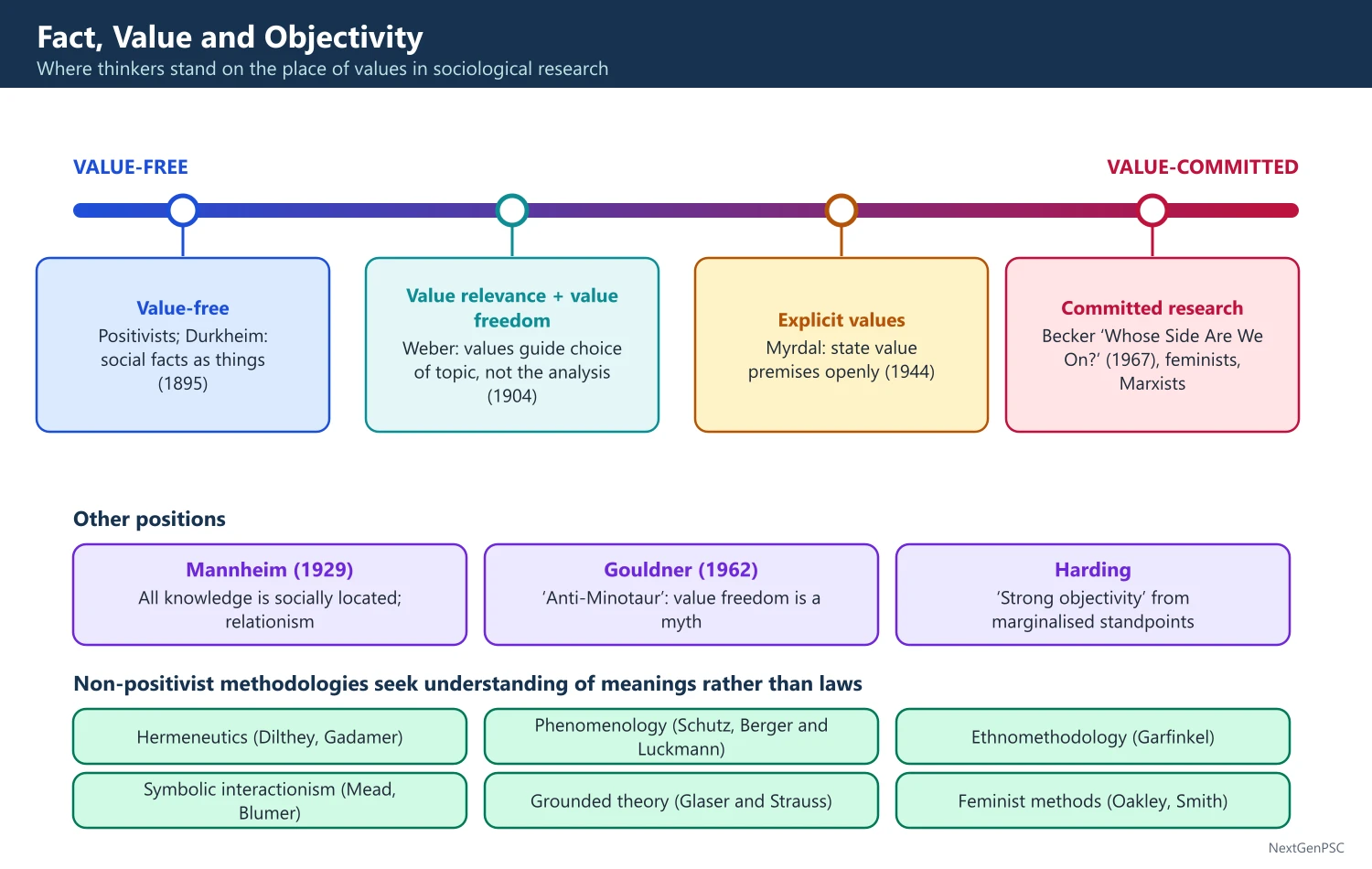
The fact-value debate asks whether sociology can separate what is from what ought to be. Weber argued for value neutrality in analysis but accepted value relevance in choosing topics; Myrdal, Gouldner, Becker and feminists argued that values are unavoidable and should be made explicit. Non-positivist methodologies such as phenomenology, ethnomethodology, symbolic interactionism, hermeneutics and feminist research seek understanding of meanings rather than laws.
In simple words
A fact is what is (for example, ‘the child sex ratio fell’) and a value is what we think ought to be (‘girls should be valued equally’).
A good umpire may love one team but must still give fair decisions; sociologists try to do the same with their own beliefs.
Some thinkers say complete neutrality is impossible, so it is better to state your values openly.
UPSC asks about Weber’s value neutrality, objectivity and methods that study meanings instead of numbers.
1. Concepts and Definitions
Fact: an empirically verifiable statement about what is.
Value: a judgement about what is good, desirable or ought to be.
Fact-value distinction: David Hume argued that one cannot logically derive an ‘ought’ from an ‘is’; positivists built on this.
Objectivity: knowledge free from the personal bias of the researcher and open to checking by others.
Subjectivity: the researcher’s own perspective, values and experience that may shape research.
2. Weber on Values and Objectivity
Value relevance (Wertbeziehung): following Heinrich Rickert, Weber held that the choice of research topic depends on what the researcher and culture consider significant.
Value freedom (Wertfreiheit): once a topic is chosen, analysis should follow scientific rules and not be guided by the researcher’s preferences; in the lecture hall a teacher should not preach (‘Science as a Vocation’, lecture of 1917, published 1919).
Objectivity essay (1904): in ‘The Objectivity of Knowledge in Social Science and Social Policy’ Weber argued that social science can say what means fit given ends and what costs they carry, but cannot tell people which ultimate values to choose.
Ideal type as a tool: ideal types help achieve objectivity by giving clear, stated concepts against which reality is compared.
Debated: scholars disagree on how strict Weber’s value freedom was; Gouldner thought it had become a myth, others see it as a careful middle path.
3. Other Positions on Fact and Value
Durkheim: held that sociology can be objective by treating social facts as things, yet also hoped science could tell normal from pathological and so guide morality.
Karl Mannheim (Ideology and Utopia, 1929): all knowledge is socially located; he proposed ‘relationism’ and hoped that a relatively ‘free-floating intelligentsia’ could synthesise perspectives.
Gunnar Myrdal (An American Dilemma, 1944; Objectivity in Social Research, 1969): values enter all research, so the researcher should state value premises explicitly.
Alvin Gouldner (‘Anti-Minotaur: The Myth of a Value-Free Sociology’, 1962): argued that value freedom often served careerism and avoidance of moral responsibility.
Howard Becker (‘Whose Side Are We On?’, 1967): sociologists inevitably take sides; studies of deviance usually side with either authorities or underdogs, and researchers should be open about it.
C. Wright Mills: criticised both ‘grand theory’ and ‘abstracted empiricism’ for avoiding public issues; sociology should serve reason and freedom.
Habermas: knowledge is guided by interests (technical, practical, emancipatory), so pure value neutrality is impossible.
Feminist standpoint: Sandra Harding argued for ‘strong objectivity’, starting research from the lives of marginalised groups to reveal what dominant views hide.
4. Non-positivist Methodologies
Hermeneutics: Wilhelm Dilthey distinguished natural sciences (explanation) from human sciences (understanding, Verstehen); Hans-Georg Gadamer stressed the ‘fusion of horizons’ between interpreter and text.
Phenomenology: Edmund Husserl’s philosophy, applied by Alfred Schutz, studies how people experience and typify the everyday world; Berger and Luckmann extend it to the social construction of reality.
Ethnomethodology: Harold Garfinkel (Studies in Ethnomethodology, 1967) examines how people produce a sense of order; key ideas are indexicality and reflexivity; method includes breaching experiments.
Symbolic interactionism: Herbert Blumer (Symbolic Interactionism, 1969) gave three premises: people act toward things on the basis of meanings; meanings arise from social interaction; meanings are handled and modified through interpretation.
Dramaturgy: Erving Goffman (The Presentation of Self in Everyday Life, 1956 Edinburgh edition; 1959 US edition) analysed interaction as performance with front stage and back stage.
Grounded theory: Barney Glaser and Anselm Strauss (The Discovery of Grounded Theory, 1967) build theory from data rather than testing prior hypotheses.
Feminist methods: Ann Oakley (1981) argued that interviewing women should be non-hierarchical and reciprocal; research should give voice to participants.
Participatory action research: associated with Paulo Freire and Orlando Fals-Borda, it treats people as co-researchers aiming at change.
Criticism of non-positivist methods: limited generalisability, low reliability, researcher bias, and neglect of structure and power (a common Marxist and functionalist critique).
5. Indian Examples and Studies
Insider and outsider: Indian sociologists studying their own society face the problem of values; André Béteille and T.N. Madan (eds.) Encounter and Experience: Personal Accounts of Fieldwork (1975) discussed such fieldwork experiences.
The Remembered Village (1976): Srinivas wrote it from memory after his field notes were destroyed in a fire at Stanford in 1970; it shows the role of the researcher’s perspective and memory.
Dalit critique of objectivity: Gopal Guru and Sundar Sarukkai (The Cracked Mirror, 2012) asked who has the authority to theorise experience, arguing that lived experience of humiliation must enter social theory.
Feminist work: Leela Dube, Vina Mazumdar and Sharmila Rege made women’s experience central; the report Towards Equality (1974) of the Committee on the Status of Women in India showed how research can combine facts with a value commitment to equality.
Phenomenological reading of caste: studies of everyday untouchability, such as the survey reported in Untouchability in Rural India (Shah, Mander, Thorat, Deshpande and Baviskar, 2006), combine counting with meaning.
6. Linking Thinkers
Weber and Mead: both focus on meaning; Weber’s verstehen and Mead’s self laid the base for interpretive sociology.
Weber and Myrdal: Myrdal’s explicit value premises can be seen as an extension of Weber’s value relevance.
Gouldner and Mills: both called for a reflexive and publicly engaged sociology, later echoed by Michael Burawoy’s ‘public sociology’ (2004).
7. Using it in the Exam
10 marks: define fact and value; Weber’s value relevance and value freedom; one critic (Gouldner or Myrdal).
15 marks: add Mannheim, Becker and feminist strong objectivity, with an Indian example.
20 marks: fact-value distinction → Weber → Durkheim, Mannheim → critics (Myrdal, Gouldner, Becker, Habermas, Harding) → non-positivist methods (hermeneutics, phenomenology, ethnomethodology, interactionism, grounded theory, feminist) → Indian examples (Srinivas, Guru, Towards Equality) → conclusion: objectivity as a process of transparency, peer checking and reflexivity rather than absence of values.
Diagram idea: a line from ‘value-free’ (positivists) through ‘value relevance with value freedom’ (Weber) and ‘explicit values’ (Myrdal) to ‘committed research’ (Becker, feminists, Marxists).
Useful quotation idea: Becker said that the question is not whether we should take sides, since we inevitably will, but whose side we are on (paraphrase of ‘Whose Side Are We On?’, 1967).
| Thinker | Work | Position |
|---|---|---|
| Durkheim | The Rules of Sociological Method (1895) | Objectivity by treating social facts as things |
| Weber | Objectivity essay (1904); ‘Science as a Vocation’ (1917/1919) | Value relevance in choosing topics, value freedom in analysis |
| Mannheim | Ideology and Utopia (1929) | All knowledge socially located; relationism |
| Myrdal | An American Dilemma (1944) | State value premises explicitly |
| Gouldner | ‘Anti-Minotaur’ (1962) | Value freedom is a myth |
| Becker | ‘Whose Side Are We On?’ (1967) | Researchers inevitably take sides |
| Harding | Standpoint theory | ‘Strong objectivity’ from marginalised standpoints |
| Methodology | Key thinkers | Core idea | Typical method |
|---|---|---|---|
| Hermeneutics | Dilthey, Gadamer | Understanding meaning in context | Interpretation of texts and actions |
| Phenomenology | Husserl, Schutz, Berger and Luckmann | Everyday life-world and typifications | In-depth description |
| Ethnomethodology | Garfinkel | How people make everyday order | Breaching experiments, conversation analysis |
| Symbolic interactionism | Mead, Blumer, Goffman | Meanings arise in interaction | Participant observation |
| Grounded theory | Glaser and Strauss | Theory built from data | Coding of qualitative data |
| Feminist methods | Oakley, Dorothy Smith | Research from women’s standpoint | Non-hierarchical interviews |
Mains points
- Typical angle: ‘Can sociology be value-free?’ or ‘Weber’s idea of objectivity’; distinguish value relevance from value freedom clearly.
- Present a range of positions from Durkheim to Weber, Myrdal, Gouldner, Becker and Harding, showing a gradual move from neutrality to reflexivity.
- For non-positivist methodologies, name each with its thinker, core idea and method.
- Use Indian examples: Srinivas’s The Remembered Village, Gopal Guru’s critique, Towards Equality (1974), Rege’s standpoint.
- Conclude that objectivity is best seen as a social process of transparency and criticism rather than absence of values.
- Common mistake: saying Weber wanted sociology to have no values at all; he accepted value relevance.
Did you know?
- Srinivas’s field notes on Rampura were burned in a fire at the Center for Advanced Study in the Behavioral Sciences, Stanford, in 1970; Sol Tax urged him to write from memory, and The Remembered Village (1976) was the result.
- Memory trick: Weber’s two R’s — Relevance in choosing, Restraint (value freedom) in analysing.
Feminist Methodology, Intersectionality and Grounded Theory
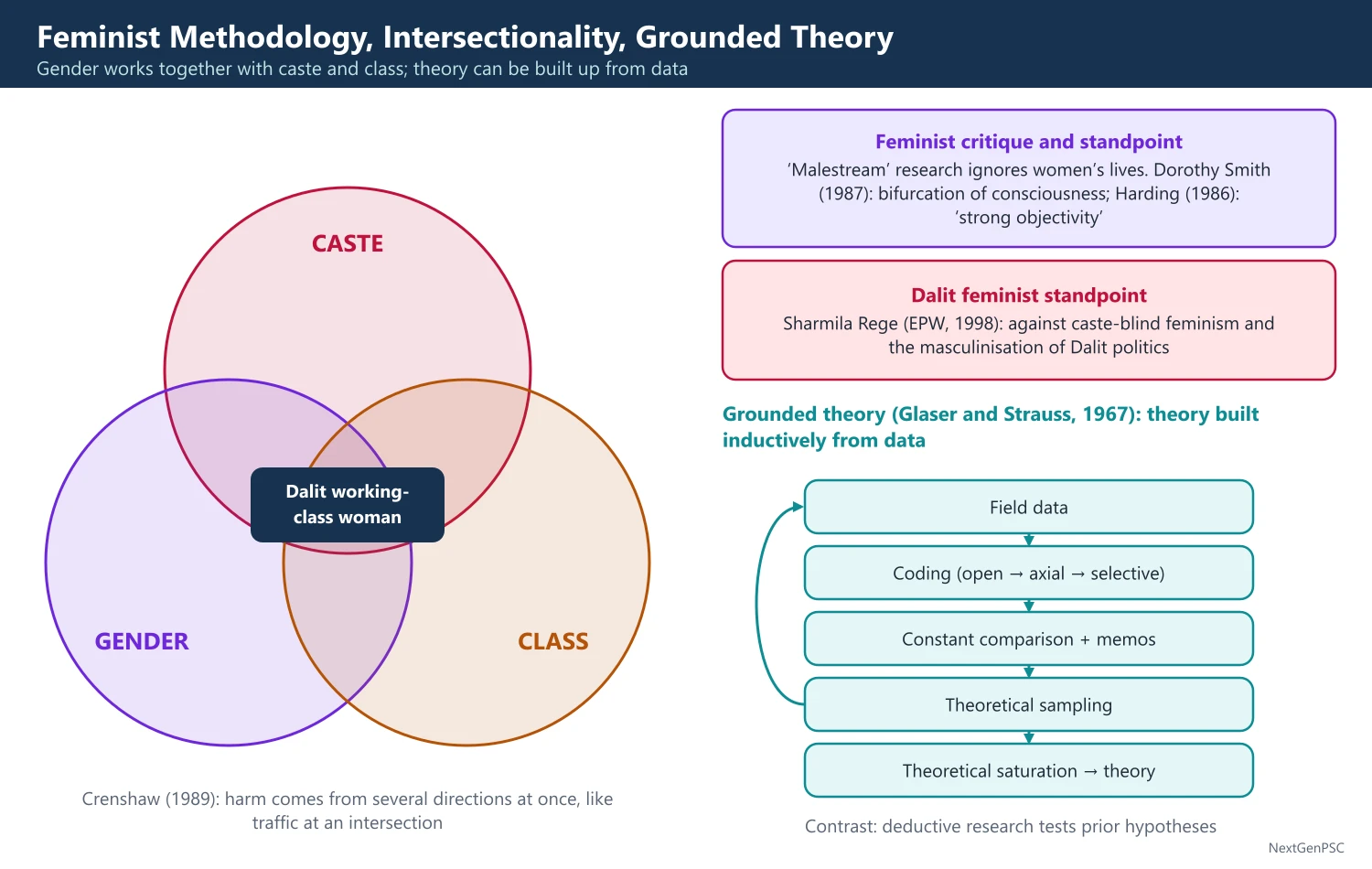
Feminist methodology criticises ‘malestream’ sociology for ignoring women’s lives and for hierarchical, supposedly neutral research; it stresses women’s experience, standpoint (Dorothy Smith, Sandra Harding) and reflexivity. Intersectionality (Kimberlé Crenshaw, 1989) shows that gender works together with race, caste and class, which Indian scholars such as Sharmila Rege developed into a Dalit feminist standpoint. Grounded theory (Glaser and Strauss, 1967) builds theory inductively from data rather than testing prior hypotheses.
In simple words
Feminist methodology asks: whose lives does research describe, and who gets to speak?
Imagine a village survey that asks only the male head of household about ‘work’; it misses the water-fetching, cooking and field labour of women.
Intersectionality adds that a Dalit woman faces caste and gender together, not one plus the other, while grounded theory lets ideas grow from what people actually say.
UPSC asks about feminist critiques of research, standpoint, intersectionality and inductive versus deductive research.
1. Concepts and Definitions
Malestream: a term used by feminist scholars (for example Mary O’Brien) for sociology that took men’s lives as the norm and treated women as invisible or as appendages of men.
Feminist methodology: not a single method but a set of principles: research on, by and for women; attention to power in the research relationship; reflexivity; and the aim of social change.
Standpoint: the view that knowledge is socially situated and that the lives of subordinate groups can reveal aspects of society that dominant groups do not see.
Reflexivity: the researcher’s critical awareness of how her own position (gender, caste, class, values) shapes the questions, data and interpretation.
Intersectionality: the idea that systems of inequality such as gender, race, caste and class interlock, producing distinct experiences that cannot be understood by looking at one axis alone.
Grounded theory: a qualitative approach in which concepts and theory are generated from systematically gathered data through constant comparison.
2. The Feminist Critique of Mainstream Research
Invisibility of women: classic studies of work, class and mobility (for example early social mobility studies) often measured a family’s class by the male head alone.
Housework as work: Ann Oakley (The Sociology of Housework, 1974) showed that housework is real, often monotonous labour, a topic sociology had ignored.
Hierarchical interviewing: Oakley (‘Interviewing Women: A Contradiction in Terms’, 1981) argued that textbook advice to stay detached and not answer respondents’ questions is exploitative; she favoured a reciprocal, non-hierarchical relationship.
False objectivity: feminists argued that claimed neutrality often hid a male point of view in the choice of topics, concepts and measures.
Maria Mies (1983): proposed ‘conscious partiality’ instead of value-free research, and research linked to women’s struggles.
Liz Stanley and Sue Wise (Breaking Out, 1983): stressed the researcher’s personal experience as a legitimate part of feminist research.
3. Standpoint Theory
Dorothy Smith (The Everyday World as Problematic, 1987): developed a sociology from the standpoint of women; she described a ‘bifurcation of consciousness’ between abstract, institutional knowledge and women’s concrete everyday work of caring and maintaining life.
Nancy Hartsock (1983): drew on Marx to argue for a feminist standpoint rooted in women’s material position in the sexual division of labour.
Sandra Harding (The Science Question in Feminism, 1986; Whose Science? Whose Knowledge?, 1991): proposed ‘strong objectivity’, meaning that starting research from marginalised lives makes knowledge more, not less, objective.
Patricia Hill Collins (Black Feminist Thought, 1990): described Black women as ‘outsiders within’ and introduced the ‘matrix of domination’.
Criticism: postmodern feminists and others warned that a single ‘women’s standpoint’ is essentialist; Martyn Hammersley (1992) questioned whether feminist methodology is distinct from good research generally.
Quantitative methods: Oakley herself later argued (1998) that feminists should not reject quantitative methods, since numbers can expose inequality; today most feminist research mixes methods.
4. Intersectionality
Kimberlé Crenshaw (‘Demarginalizing the Intersection of Race and Sex’, 1989; ‘Mapping the Margins’, 1991): showed through US legal cases such as DeGraffenreid v. General Motors (1976) that Black women’s discrimination fell between race claims and sex claims.
Earlier roots: Black feminists such as the Combahee River Collective (1977) and bell hooks (Ain’t I a Woman, 1981) had argued that race, class and gender must be analysed together.
Method implications: intersectional research avoids treating ‘women’ or ‘Dalits’ as uniform groups; it disaggregates data and asks how combined positions produce specific outcomes.
Criticism: some argue intersectionality can multiply categories endlessly or become descriptive rather than explanatory; supporters reply that it is a lens for structured power, not a list of identities.
5. Caste, Gender and Intersectionality in India
Gopal Guru (‘Dalit Women Talk Differently’, Economic and Political Weekly, 1995): argued that Dalit women face external domination by upper castes and internal patriarchy within Dalit communities, and that their separate organising was justified.
Sharmila Rege (Economic and Political Weekly, 1998): called for a Dalit feminist standpoint that criticises both the ‘caste-blindness’ of mainstream feminism and the ‘masculinisation’ of Dalit politics; in Writing Caste/Writing Gender (2006) she used Dalit women’s testimonios.
Uma Chakravarti (‘Conceptualising Brahmanical Patriarchy in Early India’, Economic and Political Weekly, 1993): showed how control of women’s sexuality maintained caste purity, linking caste and gender structurally.
Ambedkar’s earlier insight: in ‘Castes in India’ (1916) B.R. Ambedkar linked endogamy to practices controlling women, such as child marriage and enforced widowhood.
Dalit women’s organising: the National Federation of Dalit Women was founded in 1995; Dalit women’s autobiographies such as Bama’s Karukku (1992) and Urmila Pawar’s Aaydan (Marathi, 1988; English The Weave of My Life, 2008) are used as research sources.
Feminist fieldwork in India: Maria Mies (The Lace Makers of Narsapur, 1982) showed how home-based lace work by women in Andhra Pradesh was defined as ‘leisure’ while feeding the world market.
Policy research: the report Towards Equality (1974) used data to reveal declining sex ratios and women’s marginalisation, launching women’s studies in India.
Data example: NFHS-5 (2019–21) shows national averages (for example a sex ratio of 1,020 females per 1,000 males in the surveyed population), but intersectional analysis disaggregates such figures by caste, tribe, class and region to show unequal outcomes.
6. Grounded Theory
Origin: Barney Glaser and Anselm Strauss (The Discovery of Grounded Theory, 1967), based on their hospital study Awareness of Dying (1965), criticised the dominance of ‘grand theory’ and of testing borrowed hypotheses.
Key procedures: theoretical sampling (choosing cases to develop emerging concepts), constant comparison, coding (later systematised by Strauss and Juliet Corbin, 1990, as open, axial and selective coding), memo-writing and theoretical saturation.
Later split: Glaser criticised Strauss and Corbin for forcing data into preset procedures; Kathy Charmaz (Constructing Grounded Theory, 2006) developed a constructivist version that accepts the researcher’s role in shaping theory.
Inductive versus deductive research: deductive (theory-driven) research starts from theory, derives hypotheses and tests them, the classic positivist model; inductive research such as grounded theory starts from data and builds concepts upward.
Middle path: Merton’s middle-range theory and abductive reasoning combine both; in practice researchers move back and forth between theory and data.
Criticism: no researcher starts without prior ideas; grounded theory can produce descriptive rather than explanatory accounts and has limited generalisability.
Indian examples of inductive concept-building: M.N. Srinivas developed Sanskritisation from his Coorg study (Religion and Society among the Coorgs of South India, 1952) and dominant caste from Rampura fieldwork; these concepts grew from field data, much as grounded theory recommends, though not using its formal procedures.
7. Linking Thinkers
Marx and standpoint: Hartsock and Smith adapted Marx’s idea that the position of the oppressed class gives insight into the system.
Weber and Mead: grounded theory draws on interactionism; Strauss trained in the Chicago tradition of Mead and Blumer.
Ambedkar, Rege and Crenshaw: an exam-worthy link showing that intersectional thinking on caste and gender in India predates and parallels Western intersectionality.
8. Using it in the Exam
10 marks: define feminist methodology or intersectionality, name two thinkers, give one Indian example.
15 marks: feminist critique (Oakley, Smith, Harding) with criticism and the Dalit feminist standpoint.
20 marks: malestream critique → feminist principles and standpoint → intersectionality (Crenshaw, Collins) → Indian caste-gender work (Ambedkar, Chakravarti, Guru, Rege) → grounded theory versus deductive research → criticisms → conclusion on methodological pluralism.
Diagram idea: three overlapping circles labelled caste, gender and class, with the overlap marked ‘Dalit working-class woman’ to show intersectionality.
Useful quotation idea: Crenshaw compared discrimination to traffic at an intersection, where harm can come from several directions at once (paraphrase of her 1989 article).
| Point | Conventional (positivist, deductive) | Feminist methodology | Grounded theory |
|---|---|---|---|
| Starting point | Existing theory and hypotheses | Women’s and marginalised lives | Data from the field |
| Researcher role | Detached, neutral | Reflexive, reciprocal | Close to data, constant comparison |
| Key thinkers | Durkheim, Lazarsfeld | Oakley, Dorothy Smith, Harding, Rege | Glaser and Strauss, Charmaz |
| Main criticism | Misses meanings and power | Risk of essentialism | Descriptive, limited generalisation |
Mains points
- Typical angles: ‘feminist critique of sociological research’, ‘relevance of intersectionality for understanding Indian society’, ‘grounded theory versus hypothesis testing’.
- Name thinkers with works: Oakley (1974, 1981), Dorothy Smith (1987), Harding (1986, 1991), Crenshaw (1989), Collins (1990), Glaser and Strauss (1967).
- In Indian answers, bring Ambedkar (1916), Uma Chakravarti (1993), Gopal Guru (1995) and Sharmila Rege (1998) for caste and gender.
- Give criticisms: essentialism of standpoint, endless categories in intersectionality, limited generalisation of grounded theory.
- Show balance: feminist research today often mixes qualitative and quantitative methods.
- Common mistake: treating feminism as one view; distinguish liberal, Marxist, radical, Black and Dalit feminist positions where relevant.
Did you know?
- Crenshaw chose the image of a road intersection: an accident at a crossroads can be caused by cars from any direction, and so can discrimination.
- Memory trick for grounded theory steps: ‘S-C-C-S’ — Sample theoretically, Compare constantly, Code, reach Saturation.
UPSC Previous Year Questions: Sociology as Science
From 2014 to 2026 UPSC asked 35 question parts worth 520 marks from Sociology as Science (18 parts of 10 marks and 17 of 20 marks), all in Paper I. The most-asked area is fact, value, objectivity and non-positivist methods (17 parts), followed by science and scientific method (8) and positivism and its critique (6); feminist method, intersectionality and grounded theory appeared from 2023. Every question below has a model answer written to the UPSC word limit.
In simple words
Read the question and its approach line, then write your own answer in 7 minutes for 10 marks or 11 minutes for 20 marks before reading the model answer.
Compare your answer with the model: did you define the key term with its thinker, give both sides, name critics and add an Indian example?
Note the thinkers and studies you missed, revise them in the chapter notes, and rewrite the answer a week later.
1. Science, Scientific Method and Its Critique
Example 1 (UPSC 2026, 10 marks): 'Data without theory is blind and theory without data is empty.' Comment.
Paper and question: Paper I, Q2(c)
Approach: The statement asks for a comment on how theory and data depend on each other. Explain each half, link it to Mills, Popper and Merton, give Indian examples and end with the research cycle.
The statement adapts Immanuel Kant's remark that concepts without perceptions are empty and perceptions without concepts are blind. In sociology, theory tells us which facts matter, and empirical data test and refine theory.
Data without theory is blind because facts do not speak for themselves. C. Wright Mills called the piling up of survey findings without larger questions abstracted empiricism. Census tables on caste become meaningful only through concepts such as Srinivas's dominant caste.
Theory without data is empty because untested ideas cannot be judged true or false. Mills criticised Parsons's grand theory on this ground, and Karl Popper held that a theory is scientific only if evidence could falsify it.
Robert K. Merton's middle-range theory joined the two, and he showed that research also reshapes theory. Durkheim's Suicide tested a theory of integration against statistics, while Srinivas built Sanskritisation from Coorg and Rampura fieldwork.
Good research thus moves in a cycle from theory to data and back.
Example 2 (UPSC 2026, 10 marks): 'The methods of sociology are inadequate in understanding the complex social phenomena'. Discuss.
Paper and question: Paper I, Q4(c)
Approach: Discuss why sociological methods struggle with complex social life, then show how sociologists respond, using Indian examples, and conclude that the methods are limited rather than inadequate.
Social phenomena are complex because they involve conscious actors, meanings, history and many interacting causes. Critics argue that sociological methods cannot capture them as physics captures nature.
The argument has force. Weber and Schutz showed that action must be understood through its meaning, which surveys often miss; the Hawthorne effect shows people change when observed; and Merton's self-fulfilling prophecy shows that predictions alter behaviour. Jack Douglas and Aaron Cicourel showed that official statistics are themselves social constructions. In India, NCRB data record only reported crimes, while NFHS-5 (2019–21) found that 29.3 percent of ever-married women aged 18–49 had faced spousal violence.
Yet sociologists answer these limits. Norman Denzin's triangulation combines surveys, observation and documents; village studies by Srinivas and Dube grasped meanings of caste that numbers miss, while NFHS and the India Human Development Survey measure patterns across the country.
Hence the methods are imperfect and partial, but used together they give valid, if provisional, understanding of complex social reality.
Example 3 (UPSC 2025, 20 marks): What is science? Do you think that the methods used in natural sciences can be applied to sociology? Give reasons for your answer.
Paper and question: Paper I, Q6(a)
Approach: Define science and its features, then argue both sides on applying natural-science methods to sociology (Comte and Durkheim against Weber and Winch), add the critique of natural science itself, use Indian examples and give a reasoned conclusion.
Science is a body of systematic, empirically tested knowledge and the method that produces it. Its features are empiricism, objectivity, verifiability and replication, generality and prediction. Robert K. Merton (1942) added the norms of communism, universalism, disinterestedness and organised scepticism.
Flow chart: observation → problem → hypothesis → data collection → analysis → generalisation → theory → new hypotheses.
Natural-science methods can be applied to a large extent. Auguste Comte called for a positive science of society, and Durkheim asked us to treat social facts as things; his Suicide (1897) used statistics to link suicide rates to integration and regulation. Survey research by Paul Lazarsfeld follows the same logic. In India, the Census, the National Sample Survey and NFHS-5 (2019–21), which covered about 6.37 lakh households, give reliable and comparable data for testing social claims.
But there are limits. Weber held that sociology must first understand the meaning of action through verstehen, and Peter Winch argued that social action is rule-following, to be understood rather than causally explained. Human beings react to research (the Hawthorne effect), predictions change behaviour (Merton's self-fulfilling prophecy), experiments are often unethical, and values shape the choice of topic. The meaning of purity, caste or honour in an Indian village, as Srinivas found in Rampura, needs participant observation.
Moreover, natural science is not as simple as positivists assumed: Popper stressed falsification, Kuhn showed that science works within paradigms, and Russell Keat and John Urry noted that natural sciences also study unobservable mechanisms.
Therefore natural-science methods can be applied to sociology with modification. A realist and pluralist approach that joins measurement with interpretation makes sociology a science of its own kind.
Example 4 (UPSC 2023, 20 marks): What are the characteristics of scientific method? Do you think that scientific method in conducting sociological research is foolproof? Elaborate.
Paper and question: Paper I, Q3(a)
Approach: First list the characteristics of scientific method with its steps, then elaborate why it is not foolproof, both in general (Hume, Popper, Kuhn) and in sociological research (reactivity, values, constructed statistics), with Indian examples and safeguards.
The scientific method is a systematic way of producing knowledge through observation, hypothesis, testing and generalisation. Its main characteristics are that it is empirical, systematic, objective, verifiable and replicable, general, predictive and ethically neutral, and that its findings stay open to organised scepticism, one of Merton's norms of science.
Flow chart: observation → problem → hypothesis → data → analysis → generalisation → theory, looping back to new hypotheses.
The method is powerful but not foolproof. David Hume's problem of induction shows that no number of observations proves a universal law. Karl Popper therefore argued that theories can only be falsified, never finally verified. Thomas Kuhn showed that scientists work inside paradigms that shape what they see, and Paul Feyerabend held that great discoveries often broke the rules of method.
In sociological research the problems multiply. Respondents change behaviour when observed (the Hawthorne effect) and answer to please the interviewer. Jack Douglas and J. Maxwell Atkinson showed that suicide statistics depend on coroners' judgements, and Gunnar Myrdal argued that values enter every stage of research. In India, the poverty ratio for 2011–12 was 21.9 percent by the Tendulkar method but 29.5 percent by the Rangarajan method, which shows that results depend on definitions. Likewise NCRB counts of crimes against women capture only reported cases.
These weaknesses do not make the method useless. Replication, peer review, clear operational definitions, stating value premises and triangulation of methods reduce error, and large probability samples such as NFHS-5 (2019–21) are reliable.
Thus scientific method is the best available tool for reliable knowledge, but its results are provisional and must be read with awareness of their assumptions.
Example 5 (UPSC 2020, 10 marks): Methodology is a system of rules, principles and procedures, which forms scientific investigation. Comment.
Paper and question: Paper I, Q1(c)
Approach: Comment on the statement by separating methodology from methods, showing how rules guide inquiry (Durkheim, Weber, Popper), then qualifying it with Kuhn and Feyerabend and an Indian example.
Methodology is the logic of inquiry: the rules, principles and procedures that decide how valid knowledge is obtained. It differs from methods, which are specific techniques such as surveys or interviews.
The statement is largely true. Durkheim's The Rules of Sociological Method (1895) laid down rules such as treating social facts as things, discarding prenotions and explaining a social fact by another social fact. Weber gave rules of ideal types, value freedom and causal adequacy, and Popper made falsifiability the test of a scientific claim. Such rules make research checkable and cumulative.
Yet methodology is not a mechanical rulebook. Thomas Kuhn showed that rules belong to paradigms and change in scientific revolutions, and Paul Feyerabend argued that discovery often breaks rules. Sociology also has several strands, each with its own rules. In India, Srinivas's contrast between the book view and the field view of caste was a methodological choice that changed what was found.
Thus methodology is a system of rules, but a reflexive and evolving one.
Example 6 (UPSC 2018, 10 marks): Does scientific method make Sociology a science? Illustrate your answer with Durkheim's method.
Paper and question: Paper I, Q5(c)
Approach: Explain what Durkheim's method was and how it made sociology scientific, illustrate with Suicide and an Indian application, then note the critique that limits the claim.
A discipline becomes a science when it studies its subject through systematic, objective and testable procedures. Durkheim sought this status for sociology in The Rules of Sociological Method (1895).
He defined social facts as ways of acting, thinking and feeling that are external to individuals and constrain them. His rules were to treat social facts as things, discard prenotions, define the subject by external features, separate the normal from the pathological, and explain a social fact by preceding social facts. His tool was the comparative method of concomitant variation.
In Suicide (1897) he used official statistics to show that suicide rates vary with social integration and regulation, giving egoistic, altruistic, anomic and fatalistic types. Indian scholars use the same logic when they relate farmer suicides to debt and weakened social support.
However, Jack Douglas and J. Maxwell Atkinson showed that suicide statistics are built from coroners' interpretations, and Weber insisted on understanding meaning. So Durkheim's method makes sociology scientific in procedure, but not a science identical to physics.
Example 7 (UPSC 2016, 20 marks): Describe the basic postulates of scientific method. How far are these followed in sociological research?
Paper and question: Paper I, Q3(b)
Approach: Describe the basic postulates (assumptions) on which scientific method rests, then assess how far sociological research follows each, with Indian surveys and village studies, and conclude on partial adherence.
Scientific method rests on a few basic postulates, assumptions that are not themselves proved but make inquiry possible. Positivists from Comte to Durkheim held that these apply to society as much as to nature.
The postulates are: nature is orderly and regular; it can be known through the senses (empiricism); events have causes; claims must be verified by evidence; the researcher must be objective and ethically neutral; findings must be replicable; and all knowledge is provisional and open to scepticism, as in Merton's norm of organised scepticism.
Sociological research follows these postulates to a good extent. Durkheim's Suicide sought causal regularities in rates; Paul Lazarsfeld built survey analysis on measurement. In India, the Census, the National Sample Survey (from 1950) and NFHS-5 (2019–21) use probability sampling and standard questions, so results can be checked and repeated. Data showing the fall in multidimensional poverty from 24.85 percent in 2015–16 to 14.96 percent in 2019–21 (NITI Aayog) are used to test policy claims.
But adherence is only partial. Social regularities are probabilistic, not invariant, because actors interpret and choose. Weber held that research topics are chosen by value relevance, and Myrdal argued that values enter all research. Replication is hard: Srinivas's Rampura study rests on his long, personal fieldwork, and his notes were lost in a fire in 1970. Respondents react to being studied, and official statistics such as NCRB crime data reflect reporting practices.
Flow chart: order → empiricism → causation → verification → objectivity → replication → scepticism; strong in surveys, weak in ethnography.
Hence sociology follows the postulates in its logic but modifies them in practice, combining measurement with interpretation.
Example 8 (UPSC 2015, 10 marks): Is Sociology a Science? Give reasons for your answer.
Paper and question: Paper I, Q1(a)
Approach: Give reasons on both sides: the features of science that sociology meets (Comte, Durkheim, Indian surveys) and the difficulties (Weber, Winch, reactivity), and conclude that sociology is a science of a special kind.
A science produces systematic, empirical, objective and verifiable knowledge. Whether sociology qualifies has been debated since Comte named the discipline.
There are good reasons to call it a science. Comte and Durkheim held that society can be studied like nature; Durkheim's Suicide (1897) found regular links between suicide rates and integration. Sociology uses hypotheses, sampling, measurement and replication; in India, the Census and NFHS-5 (2019–21) give data that can be checked and compared.
There are also reasons for doubt. Weber argued that action must be understood through its meaning (verstehen), and Peter Winch held that social life is rule-following rather than law-governed. People react when studied (the Hawthorne effect), predictions can fulfil or defeat themselves, controlled experiments are rarely possible, and values affect research. The meaning of caste purity in Srinivas's Rampura could not be grasped by counting alone.
Since Popper and Kuhn showed that even natural science is provisional and paradigm-bound, sociology is best seen as a science of its own kind, combining explanation with understanding.
2. Major Theoretical Strands of Research Methodology
Example 9 (UPSC 2015, 10 marks): Discuss the relevance of historical method in the study of society.
Paper and question: Paper I, Q1(b)
Approach: Define the historical method, show its use by classical thinkers and in Indian sociology, state its relevance and limits, and conclude.
The historical method studies past events, institutions and documents to explain the origin and change of present social arrangements. C. Wright Mills held that the sociological imagination grasps the intersection of biography and history.
Classical sociology was historical. Comte used it to trace the law of three stages; Marx's historical materialism explained society through changing modes of production; Weber's comparative-historical studies of Protestantism and of the religions of China and India explained why rational capitalism arose in the West.
In India, G.S. Ghurye used Indological texts to trace caste, A.R. Desai's Social Background of Indian Nationalism (1948) used Marxist history, and Bernard Cohn and Nicholas Dirks showed how the colonial census hardened caste identities. The Subaltern Studies group wrote history from below.
Its relevance lies in revealing origins, long-term change and comparison, and in correcting the illusion that present arrangements are natural. Its limits are biased or elite sources, gaps in records and difficulty of testing. Used with fieldwork and surveys, it remains essential.
3. Positivism and Its Critique
Example 10 (UPSC 2026, 20 marks): Is 'interpretativism' more effective than 'positivism' in analysing social reality? Discuss.
Paper and question: Paper I, Q3(b)
Approach: Compare the two approaches on their assumptions, strengths and weaknesses with thinkers and Indian studies, then judge that effectiveness depends on the research question and that combining them works best.
Positivism, from Comte and Durkheim, treats society as an external reality to be studied like nature through observation, measurement and causal laws. Interpretivism, from Weber, Schutz, Mead and Blumer, holds that social reality is made of meanings, which must be understood from the actor's point of view.
Flow chart: positivism: social facts → measurement → correlation → causal law; interpretivism: actor's meaning → empathy and observation → thick understanding → ideal type.
Interpretivism is more effective where meaning is central. Weber's verstehen explains why Calvinists worked hard, Goffman showed how people manage impressions, and Garfinkel showed how everyday order is produced. Positivist statistics can mislead: Jack Douglas and J. Maxwell Atkinson showed that suicide rates depend on coroners' judgements. In India, Srinivas's field view of caste in Rampura revealed mobility and dominant caste that the book view of varna hid, and Leela Dube's work brought out women's experience of kinship.
But positivism is more effective for patterns, comparison and policy. Durkheim's Suicide found regularities that no single interview could show. NFHS-5 (2019–21) measures sex ratio, spousal violence and nutrition for every district, and the decision of 30 April 2025 to count caste in the next Census will give data that small studies cannot.
Interpretivism has its own limits: low reliability and generalisability, the risk of the researcher's bias, and neglect of structure and power, as Marxists and functionalists argue. Positivism, in turn, misses meaning and treats categories as unproblematic.
Hence neither is simply more effective. Weber himself joined interpretive understanding with causal explanation, and modern research uses Denzin's triangulation and mixed methods, as in Untouchability in Rural India (2006), which combined survey counts with the meaning of practices. The research question should decide the method.
Example 11 (UPSC 2025, 20 marks): What is positivism? Critically analyze the major arguments against it.
Paper and question: Paper I, Q2(a)
Approach: Define positivism through Comte and Durkheim, set out the main arguments against it by school and thinker, then critically evaluate those arguments with the positivist defence and Indian examples.
Positivism holds that valid knowledge rests on observable facts and their lawful relations, found by the methods of natural science. Auguste Comte gave the programme through his law of three stages, ending in the positive stage, and Durkheim gave the method: treat social facts as things and explain them by other social facts, as in Suicide (1897). Later, the Vienna Circle and American survey sociology (Lundberg, Lazarsfeld) carried it forward.
The arguments against it come from several directions. Interpretivists (Weber, Winch) say human action is meaningful and must be understood, not only observed. Phenomenologists and ethnomethodologists (Schutz, Garfinkel, Cicourel) show that social facts are constructed; Douglas and Atkinson found suicide statistics shaped by coroners. Popper argued that verification can never prove a law, and Kuhn that observation is theory-laden. The Frankfurt School (Horkheimer, Adorno, Marcuse) said positivism accepts the status quo, feminists such as Dorothy Smith found a male viewpoint behind neutrality, and Bhaskar's realism held that it confuses regularities with causes.
Indian cases support these criticisms. Poverty in 2011–12 was 21.9 percent by the Tendulkar method and 29.5 percent by Rangarajan's; Bernard Cohn and Nicholas Dirks argued that colonial census ranking hardened caste; and NCRB records far fewer cases of domestic violence than NFHS-5 (2019–21) reports.
Yet the critique has limits. Without measurement, sociology cannot test claims, compare societies or guide policy, and most critics also use numbers. Weber accepted causal explanation; Popper's falsification and Bhaskar's realism are reforms of science, not rejections of it. Interpretive work has its own problems of reliability and generalisation.
Flow chart: naive positivism → critiques of meaning, construction, values and power → post-positivism and mixed methods.
Thus the arguments refute naive positivism, not the scientific ideal. Today's post-positivist research keeps measurement while admitting meaning, values and the provisional nature of knowledge.
Example 12 (UPSC 2022, 20 marks): What are the shortfalls of positivist philosophy that gave rise to the non-positivist methods of studying social reality?
Paper and question: Paper I, Q3(a)
Approach: Identify each shortfall of positivist philosophy and link it to the non-positivist approach it gave rise to (verstehen, interactionism, phenomenology, ethnomethodology, critical and feminist research), with Indian illustrations and a balanced conclusion.
Positivism, from Comte and Durkheim, assumed that society is an external, objective reality that can be studied like nature, through measurement, value-free observation and causal laws. Its shortfalls led to non-positivist methods that study meanings, construction and power.
Flow chart: neglect of meaning → verstehen and interactionism; facts taken as given → phenomenology and ethnomethodology; false neutrality → critical and feminist research.
First, positivism ignored the meaning of action. Weber argued that sociology must interpret the subjective meaning actors attach to action, and Mead and Blumer built symbolic interactionism, with participant observation and life histories, on this basis.
Second, it treated social facts as given things. Alfred Schutz showed that everyday reality rests on typifications, Berger and Luckmann described the social construction of reality, and Garfinkel studied the methods people use to make order. Cicourel showed that delinquency statistics reflect police decisions, and Douglas and Atkinson did the same for suicide. In India, Bernard Cohn and Nicholas Dirks argued that the colonial census helped make caste rigid, so counted caste was partly a product of counting.
Third, its claim of value neutrality hid interests. The Frankfurt School argued that positivism supports the status quo, Gouldner called value freedom a myth, and feminists such as Ann Oakley and Dorothy Smith showed male bias in topics and interviewing; Sharmila Rege added a Dalit feminist standpoint.
Fourth, its view of science was naive: Popper rejected verification and Kuhn showed observation to be theory-laden. Srinivas's preference for the field view over the textual book view of caste was an Indian expression of this shift.
Non-positivist methods have their own weaknesses of reliability and generalisation, so the outcome is methodological pluralism rather than the end of measurement.
Example 13 (UPSC 2021, 20 marks): How far are sociologists justified in using positivist approach to understand social reality? Explain with suitable illustrations.
Paper and question: Paper I, Q2(b)
Approach: Judge 'how far' by showing where the positivist approach is justified (patterns, comparison, policy) and where it fails (meaning, constructed data, reactivity, values), with illustrations from Durkheim and Indian data, and conclude with a qualified answer.
The positivist approach studies society like nature: it seeks observable regularities and causal laws through measurement, surveys, official statistics and comparison, keeping the researcher's values out. Comte proposed it and Durkheim applied it.
Sociologists are justified in using it for several reasons. Many social realities are external and patterned, as Durkheim's Suicide (1897) showed when suicide rates varied with integration and regulation across Europe. Large samples allow generalisation and comparison. In India, NFHS-5 (2019–21) covered about 6.37 lakh households, giving district-level data on health and gender; NITI Aayog's index showed multidimensional poverty falling from 24.85 percent in 2015–16 to 14.96 percent in 2019–21; and the Bihar caste survey (2023) reported Extremely Backward Classes at about 36 percent. Such data guide policy on reservation, welfare and health, which interpretive studies alone cannot do.
But the approach is justified only up to a point. Weber held that action must be understood through its subjective meaning. Statistics are social products: Douglas and Atkinson showed this for suicide, and in India NCRB records far fewer crimes against women than NFHS-5 reveals, because many women never report. Categories are contested, as the debate over counting caste in the next Census shows. People react to observation (the Hawthorne effect), and the choice of topics reflects values, as Myrdal argued.
Indian sociology also shows the value of other methods: Srinivas's Rampura fieldwork found Sanskritisation and dominant caste through participant observation, not surveys.
Therefore sociologists are justified in using positivism to map patterns and test claims, but not in treating it as the only route. Combined with interpretive methods through triangulation, it gives a fuller picture of social reality.
Example 14 (UPSC 2017, 10 marks): Examine ethnomethodological and phenomenological perspectives as critique of positivism.
Paper and question: Paper I, Q1(b)
Approach: Examine how phenomenology (Schutz, Berger and Luckmann) and ethnomethodology (Garfinkel, Cicourel, Atkinson) each criticise positivist assumptions, add an Indian illustration and note their own limits.
Positivism treats social facts as external things that can be measured. Phenomenology and ethnomethodology reject this, holding that social reality is built in the consciousness and practices of actors.
Phenomenology: Alfred Schutz, drawing on Husserl, showed that people make sense of the world through typifications and a taken-for-granted life-world. Berger and Luckmann (1966) explained how human products become objective through externalisation, objectivation and internalisation. So social facts are not given; they are constructed.
Ethnomethodology: Harold Garfinkel (1967) studied the methods members use to produce order, stressing indexicality and reflexivity, and used breaching experiments. He criticised the view of actors as cultural dopes. Cicourel showed that delinquency rates reflect police and court decisions, and Atkinson that coroners classify deaths as suicide using common-sense theories.
In India, whether a death is recorded as dowry death or accident depends on such everyday judgements.
Both critiques expose positivism's neglect of meaning, but they are faulted for ignoring structure and power and for limited generalisation.
Example 15 (UPSC 2017, 20 marks): Examine the basic postulates of positivism and post-positivism.
Paper and question: Paper I, Q2(b)
Approach: Set out the postulates of positivism and then of post-positivism (Popper, Kuhn, Lakatos, critical realism), compare them, give Indian research illustrations, and conclude on where sociology stands today.
Positivism, founded by Comte and developed by Durkheim and the Vienna Circle, claims that only knowledge based on observation and logic is valid. Post-positivism keeps the goal of scientific knowledge but accepts that it is fallible, theory-laden and provisional.
The postulates of positivism are: the unity of science, so society can be studied like nature; only observable phenomena count; knowledge grows by induction and verification; social life follows causal laws; the researcher is objective and value-neutral; and quantification and prediction are the goals. Durkheim's rule to treat social facts as things and his use of statistics in Suicide (1897) illustrate them.
The postulates of post-positivism are: reality exists but is known only imperfectly (critical realism of Roy Bhaskar); theories can be falsified but never finally verified (Karl Popper); observation is shaped by paradigms (Thomas Kuhn) and research programmes (Imre Lakatos); objectivity is a regulative ideal achieved through criticism by the scientific community; and multiple methods are needed to approach truth (Denzin's triangulation).
Flow chart: positivism: observe → verify → law; post-positivism: conjecture → test → falsify or retain → revise, with many methods.
In India, NFHS and the National Sample Survey follow positivist survey logic. The poverty-line debate, in which the Tendulkar and Rangarajan methods gave 21.9 and 29.5 percent for 2011–12, shows the post-positivist point that results depend on definitions. Untouchability in Rural India (2006), combining survey data with qualitative accounts, shows mixed methods. The term post-positivism is also sometimes used broadly for interpretive and critical approaches that came after positivism.
Thus post-positivism refines rather than abandons positivism, and most present-day sociological research works within it.
4. Fact, Value, Objectivity and Non-positivist Methodologies
Example 16 (UPSC 2026, 10 marks): The major challenge for sociology researchers is to analyze social reality objectively. Critically analyze.
Paper and question: Paper I, Q5(a)
Approach: Critically analyse why objectivity is a major challenge (values, reactivity, constructed data, social position of the researcher), then show the ways sociologists pursue it, with Indian examples, and conclude.
Objectivity means knowledge free from the researcher's personal bias and open to checking by others. In sociology it is a major challenge because the researcher is part of the society studied.
Values shape the choice of topics and concepts, as Weber's idea of value relevance admits; Mannheim held that all knowledge is socially located, and Gouldner called value-free sociology a myth. Respondents react to being studied, and official data are constructed: NCRB counts only reported crimes against women. A researcher's caste and gender affect access and answers in an Indian village, a problem discussed in Béteille and Madan's Encounter and Experience (1975).
Yet the challenge is not fatal. Weber's value freedom in analysis, ideal types, Myrdal's advice to state value premises, peer review, triangulation and reflexivity all reduce bias. Sandra Harding's strong objectivity argues that starting from marginalised lives can make knowledge more complete.
Objectivity is therefore best treated as a goal approached through method and criticism, not a state ever fully reached.
Example 17 (UPSC 2025, 10 marks): How does Weber's Verstehen address the objectivity-subjectivity debate in sociology?
Paper and question: Paper I, Q5(d)
Approach: Explain the objectivity-subjectivity debate, then show how Weber's verstehen, with ideal types, value freedom and causal adequacy, bridges it; illustrate with an Indian case and note criticism.
The debate asks whether sociology should study society objectively from outside, as Durkheim urged, or through the subjective meanings of actors. Weber answered with verstehen, interpretive understanding of the meaning actors give to their action.
Verstehen takes subjectivity seriously: the sociologist grasps motives either directly or by placing an act in its context of meaning. But Weber made this understanding objective in three ways. Interpretations must be adequate at the level of meaning and also at the level of cause, tested by comparison and evidence. Ideal types give clear, stated concepts against which reality is measured. And while value relevance guides the choice of topic, value freedom governs analysis.
In India, understanding why a caste group adopts vegetarianism needs its members' meaning of status, which Srinivas called Sanskritisation, but the claim can then be checked across villages.
Critics such as Schutz said Weber did not explain how meanings are formed, and positivists doubt that empathy can be verified; still, verstehen remains a balanced middle path.
Example 18 (UPSC 2024, 20 marks): Do you think 'objectivity' is an over-hyped idea in sociological research? Discuss the merits and demerits of non-positivist methods.
Paper and question: Paper I, Q2(b)
Approach: Give a view on whether objectivity is over-hyped (positions of Weber, Gouldner, Myrdal, Becker, Harding), then discuss the merits and demerits of non-positivist methods with Indian studies, and conclude with a balanced judgement.
Objectivity means findings free from personal bias and open to checking by others. Positivists made it the hallmark of science, while critics say it has been over-hyped in a discipline where researchers study their own society.
There is a case that it is over-hyped. Mannheim showed that all knowledge is socially located; Gouldner called value-free sociology a myth that served careerism; Becker said sociologists inevitably take sides; and Habermas linked knowledge to interests. Feminists found that claimed neutrality hid a male viewpoint. Even official data are constructed, as the gap between NCRB records and NFHS-5 (2019–21) findings on violence against women shows.
Yet objectivity is not useless. Weber kept value relevance in choosing topics but demanded value freedom in analysis; Myrdal asked researchers to state value premises openly; and Sandra Harding's strong objectivity redefines rather than abandons it. Without some objectivity, research cannot be trusted or used for policy.
Non-positivist methods, such as verstehen, phenomenology, ethnomethodology, interactionism, grounded theory and feminist research, have clear merits. They capture meanings and lived experience, give high validity, and reveal hidden groups. Srinivas's Rampura fieldwork produced the concepts of dominant caste and Sanskritisation, and Gopal Guru and Sundar Sarukkai's The Cracked Mirror (2012) argued that the lived experience of humiliation must enter theory.
Their demerits are low reliability, small samples that limit generalisation, risk of the researcher's bias and difficulty of replication; Marxists and functionalists add that they neglect structure and power.
Thus objectivity is over-hyped only in its naive positivist form. As a goal pursued through reflexivity, transparency and triangulation, it remains essential, and non-positivist methods serve it best when combined with quantitative evidence.
Example 19 (UPSC 2022, 10 marks): How does a researcher achieve objectivity in interpretative research?
Paper and question: Paper I, Q1(b)
Approach: Explain why objectivity is hard in interpretative research and list the concrete strategies researchers use (Weber, reflexivity, triangulation, respondent validation, thick description, stated values), with an Indian example.
Interpretative research seeks the meanings actors give to their actions through participant observation, interviews and documents. Because the researcher is the main instrument, objectivity here means interpretations that are faithful to the actors and open to checking, not detachment.
Weber showed the way: understanding must be adequate at the level of meaning and of cause, guided by clear ideal types and value freedom in analysis. Researchers also practise reflexivity, recording how their own caste, gender and values shape access and interpretation. Triangulation of sources, respondent validation, long fieldwork, Clifford Geertz's thick description and a transparent record of data let others judge the work. Myrdal advised stating value premises openly.
In India, Srinivas's long residence in Rampura and Béteille and Madan's Encounter and Experience (1975), on fieldworkers' own experiences, show these strategies.
Interpretative objectivity is thus achieved not by removing the self but by making it visible and testing interpretations against evidence.
Example 20 (UPSC 2021, 10 marks): Do you think ethnomethodology helps us in getting reliable and valid data? Justify your answer.
Paper and question: Paper I, Q1(b)
Approach: Justify a qualified answer: explain ethnomethodology, then show where it gives valid and reliable data (naturally occurring talk, recordings) and where it falls short (indexicality, small scale, ethics), with an Indian illustration.
Ethnomethodology, founded by Harold Garfinkel (Studies in Ethnomethodology, 1967), studies the methods ordinary people use to make sense of and produce social order. Its tools are breaching experiments, close observation and conversation analysis.
It helps validity because it studies naturally occurring talk and action rather than answers to a researcher's categories. Atkinson's study of coroners and Cicourel's of juvenile justice showed how official data are produced, exposing hidden biases in statistics. Recorded and transcribed conversations can be re-examined by others, which gives a form of reliability.
In India, analysing how people seat guests, share food or address one another can show how caste is still practised in everyday life without being named.
But its limits are real. Indexicality means meanings depend on context, so findings are hard to generalise; studies are small and descriptive; breaching experiments raise ethical problems; and it neglects structure, power and history.
Ethnomethodology therefore yields valid data on everyday practices, but its reliability and scope are limited, so it works best alongside other methods.
Example 21 (UPSC 2020, 10 marks): Is sociology a value-free science? Discuss.
Paper and question: Paper I, Q1(b)
Approach: Discuss the positions: the positivist and Weberian case for value freedom, the critics who deny it (Gouldner, Myrdal, Becker, Habermas, feminists), an Indian example, and a balanced conclusion.
A value-free science is one in which the researcher's personal judgements of good and bad do not influence findings. Positivists such as Comte and Durkheim believed sociology could be value-free by studying social facts as things.
Weber gave the classic middle position. Values enter through value relevance, since the topic is chosen for its cultural significance, but once chosen the analysis must be value-free, and a teacher should not preach from the lecture platform. Social science can show which means fit given ends, not which ultimate values to choose.
Critics deny that this is possible. Gouldner called value-free sociology a myth, Myrdal held that values enter all research and should be stated, Becker asked whose side we are on, and Habermas linked knowledge to interests. In India, the report Towards Equality (1974) combined rigorous data with a commitment to women's equality.
Sociology is therefore not value-free, but it can be value-aware: values are declared and checked through method and criticism.
Example 22 (UPSC 2020, 20 marks): Phenomenological perspectives in sociology reject many of the assumptions of positivism. Comment.
Paper and question: Paper I, Q7(b)
Approach: Comment by listing the main assumptions of positivism and showing how phenomenology (Husserl, Schutz, Berger and Luckmann) and its offshoots reject each, with Indian illustrations, then assess the limits of the phenomenological critique.
Phenomenology, a philosophy of Edmund Husserl brought into sociology by Alfred Schutz (The Phenomenology of the Social World, 1932), studies how people experience and give meaning to the everyday world. The statement is correct: it rejects several core assumptions of positivism.
First, positivism assumes that society is an objective reality external to individuals, as in Durkheim's social facts. Phenomenology holds that reality is built through consciousness and shared typifications in the taken-for-granted life-world. Berger and Luckmann (1966) showed how human products are externalised, objectivated and then internalised, so that society appears as an objective thing.
Second, positivism assumes one method for natural and social sciences. Phenomenologists reply that atoms do not interpret their world but people do, so the sociologist must study first-order meanings of actors before building second-order concepts.
Third, positivism treats official statistics as facts. Phenomenologists and ethnomethodologists show that they are products of classification: Jack Douglas and J. Maxwell Atkinson for suicide, Cicourel for delinquency. In India, the meaning and counting of caste depend on how enumerators and people classify it, as the colonial census and the 2025 decision to enumerate caste show.
Fourth, positivism assumes a detached, value-free observer and causal laws. Phenomenology asks the researcher to bracket preconceptions and describe how meanings are formed, rather than to search for laws.
Flow chart: external facts → constructed reality; one method → meaning-first method; statistics as facts → statistics as products; causal laws → description of meaning-making.
The critique has limits: it neglects structure, power and inequality, can slide into relativism, and offers little for large-scale comparison. Giddens's structuration and Bourdieu's habitus try to join its insight on meaning with the reality of structure.
Example 23 (UPSC 2019, 20 marks): Discuss the importance of interpretative understanding of social phenomena and explain its limitations.
Paper and question: Paper I, Q3(a)
Approach: Explain interpretative understanding (Weber's verstehen and later strands), show its importance with classic and Indian studies, then explain its limitations with named critics, and conclude.
Interpretative understanding means grasping social phenomena through the meanings actors attach to their actions. Weber defined sociology as a science that interprets social action in order to explain its course and consequences causally, and called this method verstehen. Wilhelm Dilthey's contrast between explanation in natural sciences and understanding in human sciences lay behind it.
Its importance is great. Human beings act on meanings, so the same act, such as fasting, may be religious duty, protest or dieting; only interpretation tells them apart. Weber's The Protestant Ethic and the Spirit of Capitalism (1904–05) explained capitalism through the meaning of the calling. Later strands built on this: Schutz's phenomenology, Mead and Blumer's symbolic interactionism, Goffman's dramaturgy and Garfinkel's ethnomethodology.
In India, interpretation produced key concepts. Srinivas's fieldwork in Rampura revealed Sanskritisation and the dominant caste; S.C. Dube's Indian Village (1955) on Shamirpet sought the villagers' own view; and Sharmila Rege's Dalit feminist standpoint showed how Dalit women's experience differs from that of upper-caste women.
Its limitations are also clear. Findings are hard to verify or replicate, and samples are small, so generalisation is weak. The researcher's own values and position may colour interpretation. Schutz faulted Weber for not explaining how meanings are formed, while Marxists and functionalists argue that interpretive sociology ignores structure, power and unintended consequences that actors themselves do not see. Ethnographies may also give voice to some groups and silence others.
Flow chart: action → actor's meaning → interpretive understanding → causal explanation → test by comparison.
Hence interpretative understanding is indispensable for grasping meaning, but it must be checked by comparison, evidence and structural analysis, as Weber himself intended.
Example 24 (UPSC 2018, 10 marks): Distinguish between fact and value in Weber's Protestant Ethic and Spirit of Capitalism.
Paper and question: Paper I, Q1(b)
Approach: Distinguish fact and value as Weber handled them in the Protestant Ethic: value relevance in choosing the problem, values of actors treated as facts, and value freedom in analysis, noting the debate and an Indian link.
For Weber a fact is an empirically demonstrable statement about what is, while a value is a judgement of what ought to be. In The Protestant Ethic and the Spirit of Capitalism (1904–05) he kept the two apart.
Values entered first through value relevance: he chose modern rational capitalism because it was of supreme significance for his own culture. Second, the values of the actors, such as the Calvinist idea of the calling, predestination and worldly asceticism, were treated as facts to be understood, not judged. The facts included statistics, compiled by Martin Offenbacher, on Protestant predominance among business leaders in Baden, and Benjamin Franklin's maxims illustrating the spirit.
In analysis he stayed value-free: he did not praise or blame Protestantism, denied that the Reformation alone created capitalism, and said his closing remarks on the iron cage entered the sphere of value judgements.
His The Religion of India applied the same method to Hindu ethics, though Milton Singer's Madras study later questioned its conclusions.
Example 25 (UPSC 2018, 20 marks): Is non-positivistic methodology scientific? Illustrate.
Paper and question: Paper I, Q2(a)
Approach: Define what makes inquiry scientific in a broad sense, show with examples how non-positivist methods meet those criteria, give the positivist objections, use Indian illustrations and conclude that they are scientific in a different sense.
Non-positivistic methodology includes Weber's verstehen, phenomenology, symbolic interactionism, ethnomethodology, grounded theory and feminist research. Whether it is scientific depends on how science is defined: as measurement and causal laws, or more broadly as systematic, empirical, public and self-correcting inquiry.
By the narrow positivist test, it falls short. Its findings are often qualitative, not easily quantified, hard to replicate and not generalisable; Popper's falsifiability is difficult to apply to an interpretation; and the researcher's subjectivity enters the data.
By the broader test, it is scientific. It is empirical, resting on long observation and recorded evidence. It is systematic: Weber required interpretations to be adequate at the level of meaning and of cause, and used comparison and ideal types; Glaser and Strauss (1967) gave grounded theory explicit procedures of theoretical sampling, coding and constant comparison; conversation analysis works on transcripts that others can recheck. It is self-correcting through reflexivity, triangulation and peer criticism.
Moreover, Kuhn and Feyerabend showed that natural science itself is not a single fixed method, and Bhaskar's realism allows the study of meanings as real causes. Peter Winch argued that social science needs its own standards of understanding rather than borrowed ones.
Indian sociology illustrates this. Srinivas's Rampura fieldwork produced concepts of dominant caste and Sanskritisation that later scholars tested and refined in other regions, and Béteille's Caste, Class and Power (1965) on Sripuram combined observation with systematic analysis of land and power.
Thus non-positivistic methodology is scientific in the sense of disciplined, evidence-based and open inquiry, though not in the narrow sense of law-finding. It is strongest when combined with quantitative methods.
Example 26 (UPSC 2017, 10 marks): Elaborate the main tenets of interpretative perspective in sociology.
Paper and question: Paper I, Q2(c)
Approach: Elaborate the main tenets of the interpretative perspective one by one with their thinkers (Weber, Mead, Blumer, Schutz, Garfinkel, Goffman), add an Indian illustration and a line of criticism.
The interpretative perspective holds that society is made through the meanings people give to their actions, so sociology must understand those meanings. It runs from Weber through Mead, Blumer, Schutz, Garfinkel and Goffman.
Its main tenets are: social action is meaningful, and Weber's verstehen grasps its subjective meaning; meanings arise in interaction and are modified through interpretation, as Blumer's three premises of symbolic interactionism state; social reality is constructed through typifications in everyday life (Schutz, Berger and Luckmann); actors are active and skilled, not cultural dopes (Garfinkel); the self is formed and performed in interaction (Mead, Goffman); and research should study the actor's view through participant observation, interviews and life histories.
In India, Srinivas's field view of caste in Rampura and S.C. Dube's study of Shamirpet followed these tenets by seeking villagers' own meanings.
Critics say the perspective neglects structure and power and gives low reliability, yet it remains central to understanding social life.
Example 27 (UPSC 2016, 10 marks): What is 'value-free sociology'? Clarify.
Paper and question: Paper I, Q1(b)
Approach: Clarify the meaning of value-free sociology through Weber's distinction, note its positivist roots, give the main criticisms (Gouldner, Myrdal, Becker) and an Indian example, and conclude.
Value-free sociology is the ideal that sociologists should describe and explain social life without letting their own moral or political preferences shape their findings. Its roots lie in positivism and in the fact-value distinction traced to David Hume.
Max Weber gave it its precise sense. He accepted value relevance: a researcher chooses topics that matter to her culture. But in collecting and analysing data she must exercise value freedom (Wertfreiheit), and a teacher must not use the lecture hall to preach, as he argued in 'Science as a Vocation' (1917). Science can clarify means, costs and consequences, not decide ultimate values.
Critics questioned the ideal. Gouldner called it a myth that served careerism, Myrdal urged researchers to state their value premises, and Becker said sociologists inevitably take sides. In India, a study of manual scavenging may be chosen out of concern for dignity, yet its findings must still rest on verifiable evidence.
Value-free sociology is thus best understood as a discipline of method, not the absence of values.
Example 28 (UPSC 2016, 20 marks): Examine Max Weber's method of maintaining objectivity in social research.
Paper and question: Paper I, Q4(a)
Approach: Examine Weber's method step by step (value relevance and value freedom, ideal types, verstehen with causal adequacy, comparative method, means-ends analysis), then assess it with criticism and an Indian application.
Max Weber faced a dilemma: social science studies meaningful action and is shaped by cultural values, yet it must yield objective knowledge. In 'The Objectivity of Knowledge in Social Science and Social Policy' (1904) and 'Science as a Vocation' (1917) he developed a method to resolve it.
First, he separated value relevance from value freedom. Following Heinrich Rickert, he held that values decide which aspects of infinite reality we study, but once the topic is chosen, analysis must follow scientific rules and not the researcher's preferences. Social science can show which means suit given ends and at what cost, but cannot choose ultimate values.
Second, he used ideal types, one-sided accentuations of features of reality built into a consistent mental construct, such as bureaucracy or the spirit of capitalism. Because they are clearly stated, others can check how far reality deviates from them.
Third, interpretations from verstehen had to be adequate at the level of meaning and also causally adequate, tested through comparison. His comparative studies of the religions of China and India served as a test of the Protestant Ethic thesis.
Flow chart: value relevance (choice of topic) → ideal type → verstehen → causal adequacy through comparison → value-free conclusion.
The method has been criticised. Gouldner thought value freedom had become a myth; Mannheim and Marxists held that all knowledge is socially located; and Schutz said Weber left the formation of meaning unexplained. In India, critics note that The Religion of India relied heavily on texts, the book view, and Milton Singer's study of Madras industrialists found Hindu entrepreneurs combining tradition with modern business.
Still, Weber's method remains the most balanced route to objectivity: it admits values openly while disciplining them through clear concepts and comparison.
Example 29 (UPSC 2015, 20 marks): Examine the problems of maintaining objectivity and value neutrality in Social Science research.
Paper and question: Paper I, Q2(b)
Approach: Examine the problems at each stage of research (choice of topic, concepts, data collection, analysis, use), with thinkers who raised them and Indian examples, then the remedies, and conclude.
Objectivity means findings free from personal bias and open to checking by others; value neutrality means the researcher abstains from moral judgements in analysis. Both were ideals of positivism and, in a qualified form, of Weber, but they are hard to maintain in social science because the researcher belongs to the society studied.
The first problem lies in the choice of topic and concepts. Weber admitted that topics are chosen by value relevance, and concepts such as 'tribe', 'backward' or 'household head' carry value assumptions. Mannheim held that all knowledge is socially located, and feminists showed that mainstream research took men's lives as the norm.
The second lies in data collection. Respondents react to being observed (the Hawthorne effect), give socially desirable answers, and respond differently to researchers of different caste or gender. Official data are constructed: Douglas and Atkinson showed this for suicide, and in India NCRB records far fewer cases of domestic violence than NFHS-5 (2019–21) finds.
The third lies in analysis and use. Funding, political pressure and ideology influence interpretation; Gouldner called value freedom a myth, and Becker said sociologists inevitably take sides. The debate over the Bihar caste survey (2023) and over caste enumeration in the next Census shows how categories and findings become politically charged.
Remedies exist: Weber's ideal types and value freedom in analysis, Myrdal's explicit statement of value premises, reflexivity, triangulation, peer review, transparent methods and replication. Sandra Harding's strong objectivity suggests that including marginalised standpoints can make research more complete.
Thus complete value neutrality is impossible, but objectivity can be approached as a shared discipline of method, honesty about values and openness to criticism.
Example 30 (UPSC 2015, 20 marks): "Non-positivistic methodology is essential for understanding human behaviour." Discuss.
Paper and question: Paper I, Q4(a)
Approach: Discuss why understanding human behaviour needs non-positivist methods (meaning, construction, reflexivity), with thinkers and Indian studies, then weigh their limits and the continued role of positivist methods before concluding.
Non-positivistic methodology holds that human behaviour is meaningful action, so it must be understood from the actor's point of view rather than only measured from outside. It includes Weber's verstehen, phenomenology, symbolic interactionism, ethnomethodology, hermeneutics and feminist research.
It is essential for several reasons. Human beings, unlike atoms, interpret their world and act on meanings; Weber therefore made interpretive understanding the starting point of sociology. Blumer argued that people act toward things on the basis of meanings that arise in interaction. Schutz, and Berger and Luckmann, showed that social reality is constructed, and Garfinkel showed that everyday order is an accomplishment of skilled actors. Goffman's dramaturgy revealed impression management, which no questionnaire captures.
It also corrects positivist data. Douglas and Atkinson showed that suicide statistics rest on coroners' interpretations, and in India a death may be recorded as an accident rather than a dowry death depending on the judgement of police and family.
Indian sociology confirms its value. Srinivas's participant observation in Rampura produced the concepts of Sanskritisation and dominant caste; his contrast between the book view and the field view showed that texts miss lived caste; and Gopal Guru and Sundar Sarukkai's The Cracked Mirror (2012) argued that the experience of humiliation must enter theory.
Yet non-positivist methods are not sufficient alone. Their findings are hard to replicate and generalise, they risk the researcher's bias, and they may neglect structure and power. Large surveys such as NFHS-5 (2019–21) remain necessary to show patterns across a country.
Hence non-positivistic methodology is essential for understanding human behaviour, but it gives its best results when combined with quantitative evidence through triangulation, as Weber's own joining of understanding with causal explanation suggests.
Example 31 (UPSC 2014, 10 marks): How is objectivity different from value neutrality? Discuss with reference to Weber's views on methodology.
Paper and question: Paper I, Q1(a)
Approach: Define objectivity and value neutrality, then use Weber's value relevance, value freedom and ideal types to show how they differ and relate, with an Indian example.
Objectivity is a property of knowledge: findings are valid for anyone who accepts the method, whatever their personal values. Value neutrality is a stance of the researcher: abstaining from judgements of good and bad in analysis and teaching.
For Weber the two are related but not the same. He accepted that values enter research through value relevance, since a topic is chosen for its cultural significance. So objectivity cannot mean value-free knowledge from nowhere; it means that, within the chosen viewpoint, conclusions are reached by rules others can check, using clear ideal types and causal adequacy. Value neutrality (value freedom) is the discipline he demanded in analysis and in the lecture hall, as in 'Science as a Vocation' (1917).
Thus research can be objective without being free of values in its origin. A scholar may study manual scavenging in India because she values dignity, yet report verified, checkable findings.
Objectivity is the goal; value neutrality is one of the means.
Example 32 (UPSC 2014, 20 marks): In what way 'interpretative' method is different from 'positivist' approach in the study of social phenomena?
Paper and question: Paper I, Q4(b)
Approach: Compare the two approaches point by point (ontology, epistemology, aim, methods, data, role of researcher, strengths and weaknesses) with thinkers and Indian studies, and conclude with their complementarity.
The positivist approach, from Comte and Durkheim, models sociology on natural science, while the interpretative method, from Weber, Dilthey, Schutz, Mead and Blumer, holds that social life consists of meanings that must be understood. They differ on several counts.
Flow chart: a 2 × 2 view: positivism = external reality + explanation by laws; interpretivism = constructed reality + understanding of meaning.
On ontology, positivism treats society as an objective reality external to individuals, social facts as things; interpretivism sees it as built through actors' meanings and interaction. On epistemology, positivism trusts observation and measurement; interpretivism relies on verstehen, empathetic understanding of the actor's view.
On aims, positivism seeks causal laws and prediction, as in Durkheim's Suicide; interpretivism seeks understanding of meanings, as in Weber's account of the Protestant calling or Goffman's dramaturgy. On methods, positivism uses surveys, structured questionnaires, official statistics and experiments; interpretivism uses participant observation, unstructured interviews, life histories and documents.
On the researcher's role, positivism demands a detached, value-neutral observer; interpretivism accepts the researcher as part of the setting and stresses reflexivity. On strengths, positivism gives reliability and generalisation, interpretivism validity and depth; their weaknesses are the reverse.
In India, NFHS-5 (2019–21) and the National Sample Survey represent the positivist approach, while Srinivas's The Remembered Village (1976) on Rampura and S.C. Dube's study of Shamirpet represent the interpretative one. Srinivas's field view of caste versus the book view expresses the same divide.
Weber himself joined the two by combining interpretive understanding with causal explanation, and present-day research uses triangulation and mixed methods. The approaches are thus different but complementary.
5. Feminist Methodology, Intersectionality and Grounded Theory
Example 33 (UPSC 2026, 20 marks): Compare and critically assess 'the grounded theory' with 'theory-driven research method' in sociology.
Paper and question: Paper I, Q7(a)
Approach: Explain grounded theory (Glaser and Strauss, Strauss and Corbin, Charmaz) and theory-driven deductive research (Popper, Durkheim, Merton), compare them on logic, sampling, data and outcome, critically assess each with Indian examples, and conclude with abduction and mixed designs.
Grounded theory, set out by Barney Glaser and Anselm Strauss in The Discovery of Grounded Theory (1967), builds theory from systematically gathered data. Theory-driven research follows the hypothetico-deductive model: start from a theory, derive hypotheses and test them against data, as Popper's method of conjecture and refutation requires.
Flow chart: grounded theory: data → coding → categories → theory; theory-driven: theory → hypothesis → data → test → accept, revise or reject.
They differ in logic, inductive against deductive; in sampling, theoretical sampling until saturation against probability sampling for representativeness; in data, mostly qualitative interviews and observation against mostly quantitative measures; and in outcome, new substantive concepts against confirmation or falsification of existing theory. Glaser and Strauss developed their approach from their hospital study Awareness of Dying (1965), while Durkheim's Suicide (1897) is the classic test of a prior theory of integration and regulation.
Grounded theory's strengths are discovery, closeness to actors' meanings and freedom from borrowed grand theory. Its weaknesses are that no researcher starts with an empty mind, that it may produce description rather than explanation, and that its findings are hard to generalise; Glaser himself criticised Strauss and Corbin's coding rules as forcing the data, and Kathy Charmaz (2006) admitted the researcher's role in constructing theory.
Theory-driven research gives clear tests, cumulation and generalisation, but it can force reality into existing categories and miss what the theory does not anticipate. In India, Srinivas's concepts of Sanskritisation and dominant caste grew inductively from fieldwork in Coorg and Rampura, while A.R. Desai applied a prior Marxist framework to Indian nationalism.
In practice researchers move back and forth between theory and data. Merton's middle-range theory and abductive reasoning combine both, so the two methods are best seen as complementary stages of inquiry.
Example 34 (UPSC 2026, 10 marks): Discuss the significance and limitations of 'intersectionality' in social research.
Paper and question: Paper I, Q8(c)
Approach: Define intersectionality with its origin, discuss its significance for research with Indian caste-gender work and data, then its limitations, and conclude.
Intersectionality, a term introduced by Kimberlé Crenshaw (1989), holds that systems of inequality such as gender, race, caste and class interlock, producing experiences that cannot be understood along one axis alone. Earlier Black feminists such as the Combahee River Collective (1977) had argued similarly, and Patricia Hill Collins spoke of a matrix of domination.
Its significance in research is that it disaggregates groups such as 'women' or 'Dalits', reveals those hidden between categories, and improves policy targeting. In India, Ambedkar's 'Castes in India' (1916) linked endogamy to control of women, Uma Chakravarti described Brahmanical patriarchy, and Gopal Guru (1995) and Sharmila Rege (1998) showed that Dalit women face both caste domination and patriarchy. National averages from NFHS-5 (2019–21) become more meaningful when broken down by caste, tribe and class.
Its limitations are that categories can multiply endlessly, analysis may stay descriptive, and fine-grained data with large samples are often lacking.
Used with structural analysis, it remains a valuable lens for studying layered inequality.
Example 35 (UPSC 2023, 10 marks): What is the distinctiveness of the feminist method of social research? Comment.
Paper and question: Paper I, Q1(a)
Approach: Comment on what makes feminist research distinctive (critique of malestream research, standpoint, non-hierarchical methods, reflexivity, aim of change) with thinkers and Indian examples, and note the criticism that it is not unique.
Feminist methodology is not a single technique but a set of principles for research on, by and for women. It began as a critique of malestream sociology that took men's lives as the norm.
Its distinctiveness lies in several features. It starts from women's experience: Dorothy Smith built a sociology from the standpoint of women, and Sandra Harding argued that such starting points give strong objectivity. It rejects hierarchical interviewing: Ann Oakley (1981) favoured reciprocal, non-exploitative relationships. It values reflexivity and the researcher's own experience (Stanley and Wise), and Maria Mies proposed conscious partiality linked to women's struggles rather than detachment. Its aim is social change.
In India, Mies's The Lace Makers of Narsapur (1982) showed women's home-based work defined as leisure, the report Towards Equality (1974) combined data with commitment, and Sharmila Rege called for a Dalit feminist standpoint.
Martyn Hammersley (1992) questioned whether these principles are unique to feminism, but their emphasis on power and voice remains distinctive.
Mains points
- The same core debate returns almost every year in new words: is sociology a science, positivism versus interpretivism, and whether objectivity or value freedom is possible.
- Weber is the pivot of this chapter: value relevance versus value freedom, verstehen with causal explanation, and ideal types as tools of objectivity; examiners expect his terms used precisely.
- Strong answers set the positivist case (Comte, Durkheim, surveys) against the critiques (Weber, Schutz, Garfinkel, Douglas, Atkinson, Popper, Kuhn, Gouldner, Myrdal, feminists) and end with a middle path such as triangulation or critical realism.
- Indian examples score well even in this abstract chapter: NFHS-5 and NCRB under-reporting, poverty lines (Tendulkar and Rangarajan), caste enumeration, Srinivas's book view and field view, Rampura fieldwork and Dalit feminist standpoint.
- Recent papers (2023–2026) have added feminist method, intersectionality and grounded theory versus theory-driven research, so prepare Oakley, Smith, Harding, Crenshaw, Rege, Glaser and Strauss.
Did you know?
- Weber's verstehen and Durkheim's social facts as things were set out within ten years of each other (1895 and 1904), and almost every question in this chapter is still a replay of that founding contrast.
Sociology Optional: All chapters
- Exam Pattern, Syllabus and Strategy
- Sociology: The Discipline
- Sociology as Science
- Research Methods and Analysis
- Sociological Thinkers: Marx and Durkheim
- Sociological Thinkers: Max Weber
- Sociological Thinkers: Parsons, Merton and Mead
- Stratification and Mobility
- Works and Economic Life
- Politics and Society
- Religion and Society
- Systems of Kinship
- Social Change in Modern Society
- Perspectives on the Study of Indian Society
- Impact of Colonial Rule on Indian Society
- Rural and Agrarian Social Structure
- Caste System
- Tribal Communities in India
- Social Classes in India
- Kinship, Family and Religion in India
- Visions of Social Change in India
- Rural and Agrarian Transformation in India
- Industrialisation and Urbanisation in India
- Politics and Society in India
- Social Movements in Modern India
- Population Dynamics
- Challenges of Social Transformation