
Sociology Optional · UPSC Notes
Social Movements in Modern India — UPSC Sociology Optional Notes
Free, exam-focused notes for UPSC Prelims and Mains, with Prelims tips and Mains points for every topic. 6 topics.
Open in the interactive reader: bookmarks, progress tracking and read-aloud.
Peasant and Farmers' Movements
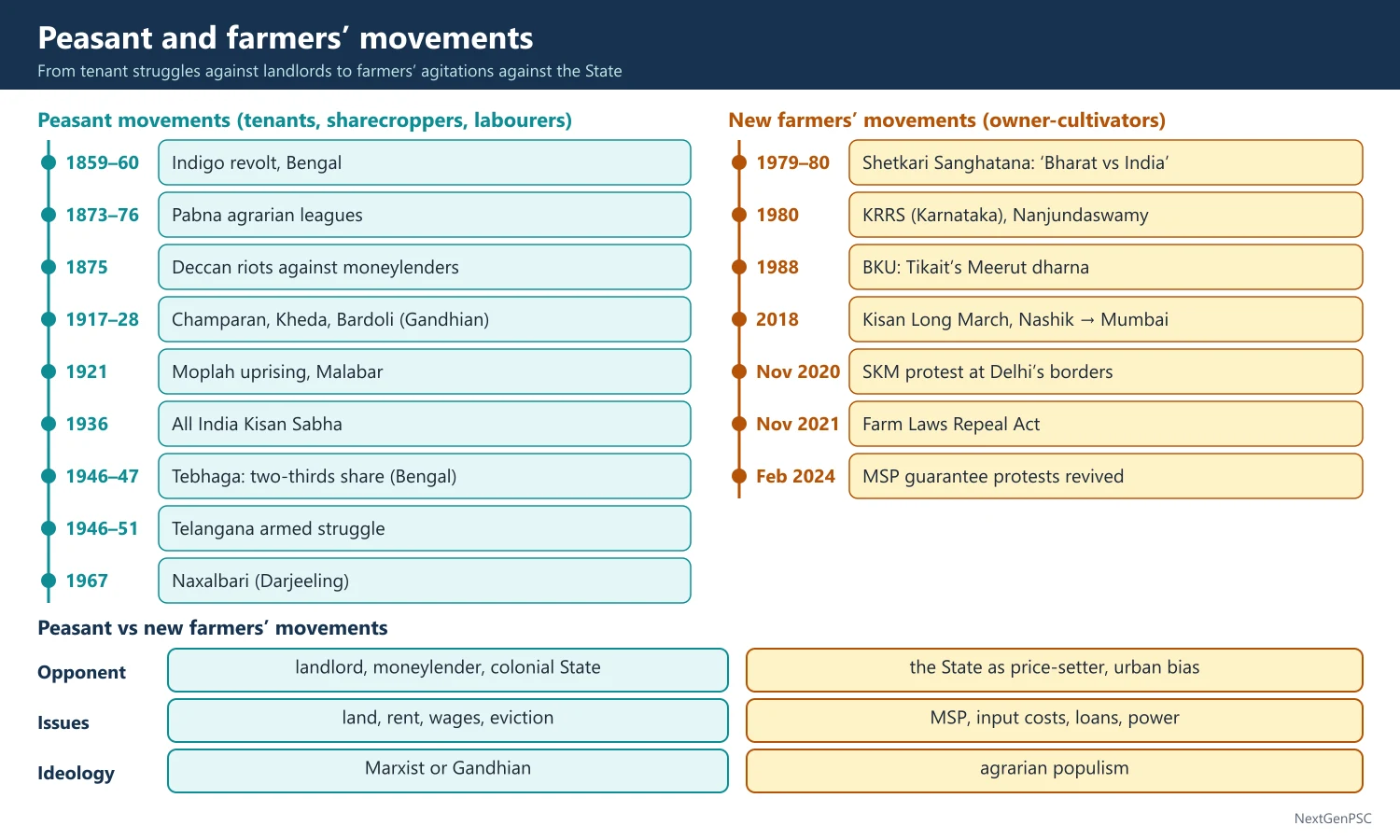
Peasant movements (colonial and early post-independence) were struggles of tenants, sharecroppers and labourers against landlords, moneylenders and the colonial State, such as Champaran (1917), Tebhaga (1946–47), Telangana (1946–51) and Naxalbari (1967). Farmers' movements from the late 1970s were led by market-oriented owner-cultivators demanding remunerative prices and subsidies (Sharad Joshi, Mahendra Singh Tikait). The 2020–21 protest that forced the repeal of three farm laws joined both traditions.
In simple words
A peasant movement is poor tillers protesting against landlords or unfair rent; a farmers' movement is landowning farmers protesting for better crop prices and subsidies.
The first is like tenants fighting the house owner over rent; the second is like shopkeepers demanding fair prices from the wholesaler, the government.
Both show how agrarian classes organise to change their position, which is why sociologists study them as class mobilisation.
UPSC asks you to compare the two and to analyse recent protests.
1. Concepts and definitions
Peasant: Eric Wolf (Peasants, 1966) defined peasants as rural cultivators whose surplus is transferred to a dominant group of rulers; Teodor Shanin stressed the family farm as the basic unit.
Peasant movement: collective action by tenants, small cultivators and labourers against landlords, moneylenders or the State over land, rent, wages and dignity.
Farmers' movement (new farmers' movement): a term used by Gail Omvedt and in Tom Brass (ed., New Farmers' Movements in India, 1995) for non-party mobilisation of commercial farmers since about 1980 over prices, input costs, loans and electricity.
Middle peasant thesis: Hamza Alavi ('Peasants and Revolution', 1965) and Eric Wolf (Peasant Wars of the Twentieth Century, 1969) argued that middle peasants, who have some independence from landlords, are the most likely to rebel.
Moral economy: James Scott (The Moral Economy of the Peasant, 1976) said peasants rebel when the subsistence ethic is violated; in Weapons of the Weak (1985) he described everyday resistance such as foot-dragging and pilfering.
Gough's typology: Kathleen Gough ('Indian Peasant Uprisings', EPW 1974) classified colonial peasant revolts into restorative, religious (millenarian), social banditry, terrorist vengeance and mass insurrection for general redress.
2. Peasant movements: colonial and post-independence
Nineteenth century: the Indigo revolt in Bengal (1859–60), the Pabna agrarian leagues (1873–76) and the Deccan riots against moneylenders (1875) were early tenant and debtor struggles.
Gandhian phase: Champaran (1917) against indigo planters, Kheda (1918) for revenue remission, and Bardoli (1928) under Vallabhbhai Patel linked peasants to the national movement.
Kisan Sabha: the All India Kisan Sabha (1936), with Swami Sahajanand Saraswati and N.G. Ranga, raised zamindari abolition and tenancy rights; the Moplah (Mappila) uprising of 1921 in Malabar mixed agrarian and religious grievances.
Tebhaga (Bengal, 1946–47): sharecroppers (bargadars) demanded two-thirds instead of half of the crop, led by the Kisan Sabha; it later shaped West Bengal's Operation Barga (1978).
Telangana (1946–51): an armed struggle against the Nizam's jagirdars and deshmukhs under Communist leadership redistributed land in thousands of villages before being suppressed.
Naxalbari (1967): a peasant uprising in Darjeeling district led by Charu Majumdar and Kanu Sanyal, the origin of the Naxalite movement; Maoist insurgency later spread to tribal central India.
Sociological studies: A.R. Desai (ed., Peasant Struggles in India, 1979; Agrarian Struggles in India after Independence, 1986) and D.N. Dhanagare (Peasant Movements in India 1920–1950, 1983) are the standard works; Dhanagare tested the middle-peasant thesis and found that poor peasants led in Telangana while middle peasants dominated elsewhere.
Subaltern view: Ranajit Guha (Elementary Aspects of Peasant Insurgency in Colonial India, 1983) argued that peasant revolts had their own consciousness and were not merely led by elites or the Congress.
3. New farmers' movements
Shetkari Sanghatana (Maharashtra, 1979–80): Sharad Joshi framed the conflict as 'Bharat versus India', rural producers versus the urban, industrial State that kept crop prices low; onion and sugarcane price agitations were its main campaigns.
Bharatiya Kisan Union (western UP): Mahendra Singh Tikait's Meerut dharna (1988) and Boat Club rally in Delhi drew on Jat khap networks; it shows how caste and kinship organise a class movement.
Karnataka Rajya Raitha Sangha (1980): led by M.D. Nanjundaswamy, it later campaigned against multinational seed companies and genetically modified crops, linking farmers to anti-globalisation politics.
Features: non-party (at first), led by rich and middle farmers of Green Revolution regions, issue-based (prices, power tariffs, loan waivers), using road and rail blockades (rasta roko, rail roko).
Debate: Marxist critics (Tom Brass, Utsa Patnaik) saw these as rich-peasant movements hiding class conflict with labourers behind a populist 'Bharat' identity; Omvedt and Varshney saw them as genuine sectoral mobilisation against urban bias (Ashutosh Varshney, Democracy, Development and the Countryside, 1995).
4. The 2020–21 protest and after
The laws: the three farm laws of September 2020 allowed private trade outside regulated mandis, contract farming and easier stock limits; farmers feared the end of assured procurement at minimum support prices (MSP).
The protest: from 26 November 2020, farmers mainly from Punjab, Haryana and western UP camped at Delhi's borders (Singhu, Tikri, Ghazipur) under the Samyukt Kisan Morcha, a coalition of over 40 unions.
Outcome: the Prime Minister announced repeal on 19 November 2021, Parliament passed the Farm Laws Repeal Act on 29 November 2021, and the morcha suspended the protest in December 2021; the demand for a legal MSP guarantee remains and was revived in the February 2024 protests at the Punjab–Haryana border.
Sociological features: langars, gurdwara networks and Sikh religious idiom; participation of women and of landless Dalit labour unions (though limited); support from diaspora; the protest newspaper Trolley Times and use of social media.
Class and caste tensions: Jat and Jat Sikh farmers led, while Dalit labourers in Punjab have their own disputes with landowners over wages and village common land (panchayat land struggles of the Zameen Prapti Sangharsh Committee), which shows class divisions inside the 'farmer' identity.
Distress and suicides: NCRB's ADSI 2022 recorded 11,290 suicides by farmers and farm labourers; movements in Maharashtra and Karnataka have framed debt relief and crop insurance as central demands.
Tribal and land movements: the Kisan Long March from Nashik to Mumbai (March 2018), led by the All India Kisan Sabha, brought Adivasi cultivators demanding forest-land titles under the Forest Rights Act, joining peasant and tribal issues.
5. Further studies and world comparisons
Barrington Moore (Social Origins of Dictatorship and Democracy, 1966) argued that the way landed classes and peasants were incorporated decided whether countries became democracies or dictatorships; he saw India's weak peasant revolution as linked to slow modernisation.
World examples: the Chinese revolution (1949) and the Mexican revolution (1910) were peasant-based, as Wolf showed; Brazil's Landless Workers' Movement (MST, 1984) is a modern land-occupation movement comparable to Indian land struggles.
Bhoodan: Vinoba Bhave's Bhoodan (land-gift) movement from 1951 in Telangana collected about 40 lakh acres in pledges, but much was unfit or never distributed; T.K. Oommen studied it as a charismatic movement.
Women in agrarian struggles: women fought in Tebhaga and Telangana, and in 2020–21 women farmers ran their own stages at the Delhi borders, though land titles for women remain rare.
Maoist insurgency: the CPI (Maoist), formed in 2004, drew on tribal land grievances in central India; the State's security response and development schemes have reduced the affected districts sharply, and the government set March 2026 as a target to end it, so its peasant base is now debated.
6. Linking thinkers
Link to Marx (peasants as a 'sack of potatoes' in The Eighteenth Brumaire, 1852, lacking class unity) and to Lenin's differentiation of the peasantry; Indian movements show peasants can organise as a class.
Link to the Green Revolution (Chapter 22), which created the farmer class that led the new movements, and to resource mobilisation theory (last topic of this chapter).
Link to Srinivas's dominant caste: the Jats, Marathas, Patidars and Vokkaligas who lead farmers' movements are dominant castes in their regions.
7. Using it in the exam
10 marks: distinguish peasant and farmers' movements on participants, issues, opponents and methods.
15–20 marks: historical phases, classifications (Gough, Desai), the new farmers' movements and the debate about their class character, the 2020–21 protest, and a conclusion on how agrarian change shapes movements.
Thinkers to cite: A.R. Desai, Kathleen Gough, D.N. Dhanagare, Ranajit Guha, Gail Omvedt, Eric Wolf.
Diagram idea: a timeline: Indigo (1859) → Champaran (1917) → Tebhaga and Telangana (1946) → Naxalbari (1967) → Shetkari Sanghatana and BKU (1980s) → Delhi borders (2020–21).
Quotation to use: Sharad Joshi's slogan 'Bharat versus India', meaning the rural producer against the urban State.
| Feature | Peasant movements | New farmers' movements |
|---|---|---|
| Period | Colonial to 1970s | From about 1980 |
| Participants | Tenants, sharecroppers, labourers | Owner-cultivators, rich and middle farmers |
| Opponent | Landlord, moneylender, colonial State | The State as price-setter, urban bias |
| Issues | Land, rent, wages, eviction | Prices (MSP), input costs, loans, power |
| Ideology | Marxist or Gandhian | Agrarian populism ('Bharat vs India') |
| Examples | Tebhaga, Telangana, Naxalbari | Shetkari Sanghatana, BKU, KRRS, SKM 2020–21 |
Mains points
- The standard question asks you to distinguish peasant movements from farmers' movements; use a table.
- Cite Indian authors (Desai, Dhanagare, Gough, Omvedt) rather than only Western theory.
- Use the 2020–21 protest with exact dates and its sociological features (caste, religion, gender, media).
- Bring out internal contradictions: farmer–labourer conflict and Dalit exclusion.
- Link to the Green Revolution and agrarian capitalism for causal explanation.
- Avoid calling all rural protests 'peasant movements'; be precise about the class base.
Did you know?
- Tebhaga literally means 'three shares': sharecroppers demanded two of the three parts of the harvest.
Women's Movement
The women's movement in India moved from 19th-century social reform led by men, through women's participation in the national movement and organisations such as the AIWC (1927), to the autonomous women's movement after the report Towards Equality (1974). Its campaigns on rape, dowry, sati, workplace harassment and political representation changed laws, while Dalit and Muslim women's voices challenged a mainly upper-caste, urban leadership.
In simple words
The women's movement is the long effort by women and their allies to win equal rights, safety and dignity.
Think of it as a relay race: reformers like the Phules passed the baton to freedom fighters, then to feminist groups and now to women using social media.
Each phase targeted a different form of patriarchy: child marriage, lack of votes, rape laws, dowry, workplace harassment.
UPSC asks about its phases, issues, achievements and internal debates.
1. Concepts and definitions
Patriarchy: Sylvia Walby (Theorizing Patriarchy, 1990) defined it as a system of social structures and practices in which men dominate, oppress and exploit women, operating through six structures: household production, paid work, the State, male violence, sexuality and culture.
Brahmanical patriarchy: Uma Chakravarti ('Conceptualising Brahmanical Patriarchy in Early India', EPW 1993) argued that control over women's sexuality is the basis of caste purity and endogamy.
Waves of feminism: liberal (equal rights), radical (patriarchy as root), Marxist and socialist (class and gender), and black and postcolonial feminism (intersection of race, caste, class).
Intersectionality: Kimberlé Crenshaw's term (1989) for the overlapping of oppressions; Sharmila Rege's 'Dalit feminist standpoint' (EPW, 1998) applied it to caste in India.
Autonomous women's movement: groups formed from the late 1970s independent of political parties, such as Stree Shakti Sanghatana (Hyderabad), Saheli (Delhi, 1981) and Forum Against Rape (Bombay, 1980), and the magazine Manushi (1978).
2. Phases of the women's movement
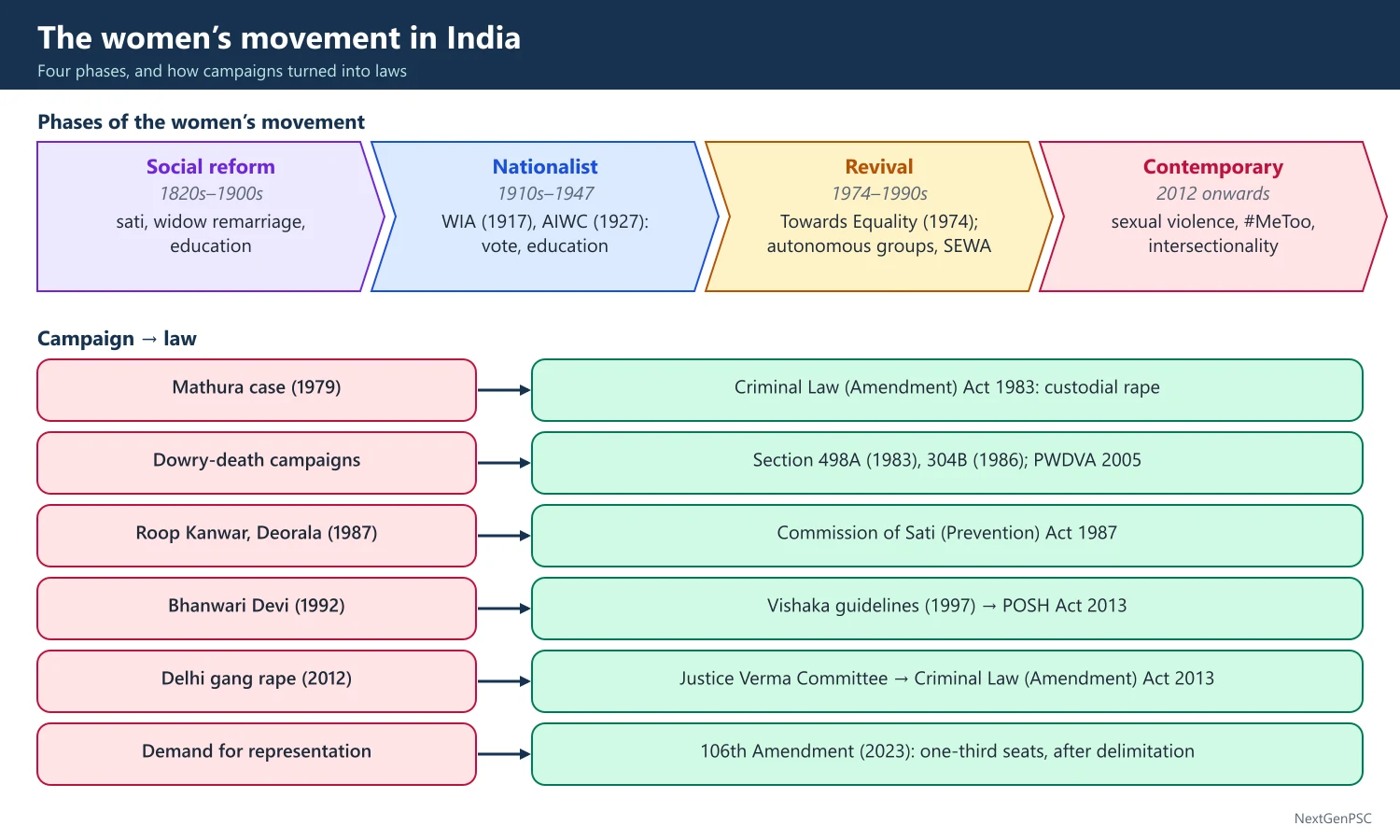
Social reform (19th century): Raja Rammohun Roy's campaign led to the abolition of sati (1829); Ishwar Chandra Vidyasagar's to the Hindu Widows' Remarriage Act (1856); the Age of Consent Act (1891) and Sarda Act (1929) restricted child marriage.
Women reformers: Savitribai Phule (first girls' school with Jyotirao, 1848), Pandita Ramabai (Sharada Sadan, 1889), Tarabai Shinde (Stri Purush Tulana, 1882) and Rokeya Sakhawat Hossain (Sultana's Dream, 1905) voiced women's own critique.
Nationalist phase: Women's Indian Association (1917), National Council of Women in India (1925) and All India Women's Conference (1927) demanded the vote and education; Gandhi drew women into satyagraha, though within a framework of feminine virtue.
Post-independence lull and revival: after constitutional equality, the movement was quiet until the CSWI report Towards Equality (1974), by a committee including Vina Mazumdar and Lotika Sarkar, showed declining sex ratios and women's marginalisation.
Autonomous phase (1975–1990s): the UN International Women's Year (1975), the Mathura rape case, anti-dowry campaigns and the anti-price rise movement in Bombay (Mrinal Gore, Ahilya Rangnekar, 1972–75) mobilised women across classes.
Grassroots and economic struggles: SEWA (1972) organised self-employed women; women in Chipko (1973–74) protected forests; the anti-arrack movement in Andhra Pradesh (1992) forced prohibition.
Recent phase (2012 onwards): mass protests after the December 2012 Delhi gang rape, the #MeToo wave (2018), women-led sit-ins at Shaheen Bagh (2019–20), and the 'Reclaim the Night' protests after the rape and murder of a doctor at RG Kar Medical College, Kolkata (August 2024).
3. Campaigns and legal outcomes
Rape law: after the Supreme Court acquitted policemen in the Mathura case (1979), an open letter by four law teachers (Upendra Baxi, Lotika Sarkar, Raghunath Kelkar, Vasudha Dhagamwar) led to the Criminal Law (Amendment) Act 1983 on custodial rape.
Dowry and domestic violence: campaigns on 'dowry deaths' led to Section 498A (1983), Section 304B (1986) and later the Protection of Women from Domestic Violence Act 2005; under the Bharatiya Nyaya Sanhita 2023 these are Sections 85 and 80.
Sati: the Roop Kanwar case in Deorala, Rajasthan (September 1987) led to the Commission of Sati (Prevention) Act 1987, which also bans glorification.
Workplace: the gang rape of Bhanwari Devi, a sathin in Rajasthan's Women's Development Programme (1992), led to the Vishaka guidelines (1997) and the Sexual Harassment of Women at Workplace Act 2013.
Justice Verma Committee (2013): after the 2012 Delhi case, it widened the definition of rape, criminalised stalking and voyeurism and recommended removing the marital rape exception; the last was not accepted, and the exception continues in the BNS 2023 and is under challenge.
Political representation: the 73rd and 74th Amendments (1992) and the Constitution (106th Amendment) Act 2023 reserving one-third of Lok Sabha and assembly seats for women, to take effect after the next census and delimitation.
Data: NCRB Crime in India 2024 (released May 2026) recorded about 4.41 lakh crimes against women, with cruelty by husband or relatives the largest category, and 5,737 dowry deaths.
4. Debates within the movement
Upper-caste bias: Dalit feminists (Sharmila Rege, Gopal Guru's 'Dalit women talk differently', EPW 1995) argued that the mainstream movement ignored caste violence and the labour of Dalit women; the National Federation of Dalit Women (1995) followed.
Uniform Civil Code and minority women: the Shah Bano judgment (1985) and the Muslim Women (Protection of Rights on Divorce) Act 1986 split feminists between gender justice through a uniform code and respect for community autonomy; Muslim women's groups such as the Bharatiya Muslim Mahila Andolan pushed for reform from within, leading to Shayara Bano (2017).
Women in right-wing movements: Tanika Sarkar and Urvashi Butalia (eds., Women and the Hindu Right, 1995) showed women's active participation in religious nationalist mobilisation, which complicates the idea that women's activism is always progressive.
Sex work, sexuality and queer politics: debates on sex workers' rights (Durbar Mahila Samanwaya Committee, Kolkata) and LGBTQ rights (Navtej Johar, 2018) widened the agenda beyond the heterosexual family.
NGO-isation: critics say funding-driven NGOs replaced mass mobilisation from the 1990s; Maitrayee Chaudhuri (ed., Feminism in India, 2004) and Nivedita Menon (Seeing Like a Feminist, 2012) discuss these shifts.
Digital feminism: #MeToo, 'Pinjra Tod' (2015, against hostel curfews) and online campaigns reached young urban women quickly, but critics note limited reach to rural and poor women.
5. Indian studies and world comparisons
Neera Desai (Woman in Modern India, 1957) wrote the first sociological history of Indian women's status and later founded women's studies at SNDT University (1974).
Leela Dube studied kinship and gender (Women and Kinship, 1997), showing how patrilineal kinship and the idea of the daughter as 'paraya dhan' shape women's lives in South Asia.
Partition and violence: Urvashi Butalia (The Other Side of Silence, 1998) and Ritu Menon and Kamla Bhasin (Borders and Boundaries, 1998) recovered women's experiences of abduction and 'honour' killings in 1947.
State feminism: the National Commission for Women (1992), gender budgeting (2005–06) and schemes such as Beti Bachao Beti Padhao (2015) show the State adopting feminist language, which critics say can depoliticise the movement.
Work and participation: the PLFS Annual Report 2025 put female labour force participation (15+) at 40.0%, up from low levels in 2017–18, though much of the rise is in self-employment and unpaid family work, a debated point.
World comparison: the suffrage movements in Britain and the USA and the 'second wave' after Betty Friedan's The Feminine Mystique (1963) influenced Indian feminists, but the Indian movement linked gender more closely to caste, class and community.
6. Linking thinkers
Link to Walby's structures of patriarchy, Ann Oakley's sex–gender distinction (1972) and Simone de Beauvoir ('one is not born, but rather becomes, a woman', The Second Sex, 1949).
Link to new social movements (identity, culture) and to resource mobilisation (NGOs, funding) in the theory topic.
Link to Chapter 27 (violence against women) and Chapter 21 (law and social change).
7. Using it in the exam
10 marks: phases of the movement in four lines with one landmark each, and one current issue.
15–20 marks: phases, issues and laws, achievements, internal debates (caste, religion, class), new forms, and a conclusion on intersectional feminism.
Thinkers to cite: Neera Desai, Vina Mazumdar, Uma Chakravarti, Sharmila Rege, Nivedita Menon, Walby.
Diagram idea: a flow from event to law: Mathura (1979) → 1983 amendment; Roop Kanwar (1987) → Sati Act 1987; Bhanwari Devi (1992) → Vishaka (1997) → POSH Act 2013; Delhi (2012) → 2013 amendment.
Quotation to use: the 1974 report's title itself, Towards Equality, marking the shift from reform to rights.
| Phase | Period | Key actors | Main issues |
|---|---|---|---|
| Social reform | 1820s–1900s | Rammohun Roy, Vidyasagar, Phules, Pandita Ramabai | Sati, widow remarriage, education |
| Nationalist | 1910s–1947 | WIA, AIWC, women satyagrahis | Vote, education, personal law reform |
| Revival | 1974–1990s | Autonomous groups, SEWA, Saheli | Rape, dowry, sati, work, health |
| Contemporary | 2012 onwards | Students, Dalit and Muslim women, online campaigns | Sexual violence, #MeToo, representation, intersectionality |
Mains points
- Questions ask about phases, achievements, or why the movement has been criticised as upper-caste and urban.
- Use the event-to-law chain to show the movement's impact concretely.
- Include Dalit feminist critique (Rege, Guru) and Muslim women's reform from within.
- Add current data (NCRB 2024) and recent events (Women's Reservation Act 2023, RG Kar protests 2024).
- Avoid treating the movement as a single body; present its diversity and debates.
- In Paper I answers on feminism or gender, bring these Indian campaigns as examples.
Did you know?
- Savitribai Phule, India's first woman teacher of a girls' school, was pelted with mud on her way to school and carried a spare sari to change into.
Backward Classes and Dalit Movements
Backward class movements (Satyashodhak Samaj, the Self-Respect Movement, SNDP, Justice Party) challenged Brahmin dominance in education, jobs and politics, and later produced OBC mobilisation around the Mandal Commission. Dalit movements, from Phule and Ambedkar to the Dalit Panthers, the BSP and today's Bhim Army, fought untouchability and demanded dignity, power and a share of resources. Sociologists study them as movements of reform, protest and transformation that both weakened and politicised caste.
In simple words
Backward classes are castes that were neither at the top nor treated as untouchable but were kept behind in education and jobs; Dalits are castes that suffered untouchability.
Think of a staircase where the lower floors were locked out of the library: these movements broke the lock and then demanded seats on the committee that runs the building.
They used education, temple entry, conversion, political parties and reservation.
UPSC asks about their phases, ideologies, leaders and impact on caste.
1. Concepts and definitions
Dalit: meaning 'broken' or 'oppressed', the term was used by Phule and popularised by the Dalit Panthers (1972) as a self-chosen identity, replacing 'Harijan' (Gandhi) and the administrative 'Scheduled Castes'.
Backward classes: 'socially and educationally backward classes' (Article 15(4), 340); the Kalelkar Commission (1955) and the Mandal Commission (report 1980) identified them, Mandal estimating OBCs at 52% of the population.
Rao's typology: in Social Movements and Social Transformation (1979), Rao classified backward class movements as reformist (Satyashodhak), transformative (SNDP) or revolutionary, based on relative deprivation.
Ghanshyam Shah's classification: in Social Movements in India (1990, revised 2004) Shah grouped Dalit movements into reformative (Bhakti, Sanskritising) and alternative (seeking a separate identity, conversion, political power).
Sanskritisation and de-Sanskritisation: some lower castes sought mobility by adopting upper-caste customs (Srinivas); others rejected Brahmanical values altogether (Periyar, Ambedkar), which Kancha Ilaiah (Why I Am Not a Hindu, 1996) later championed.
2. Non-Brahmin and backward class movements
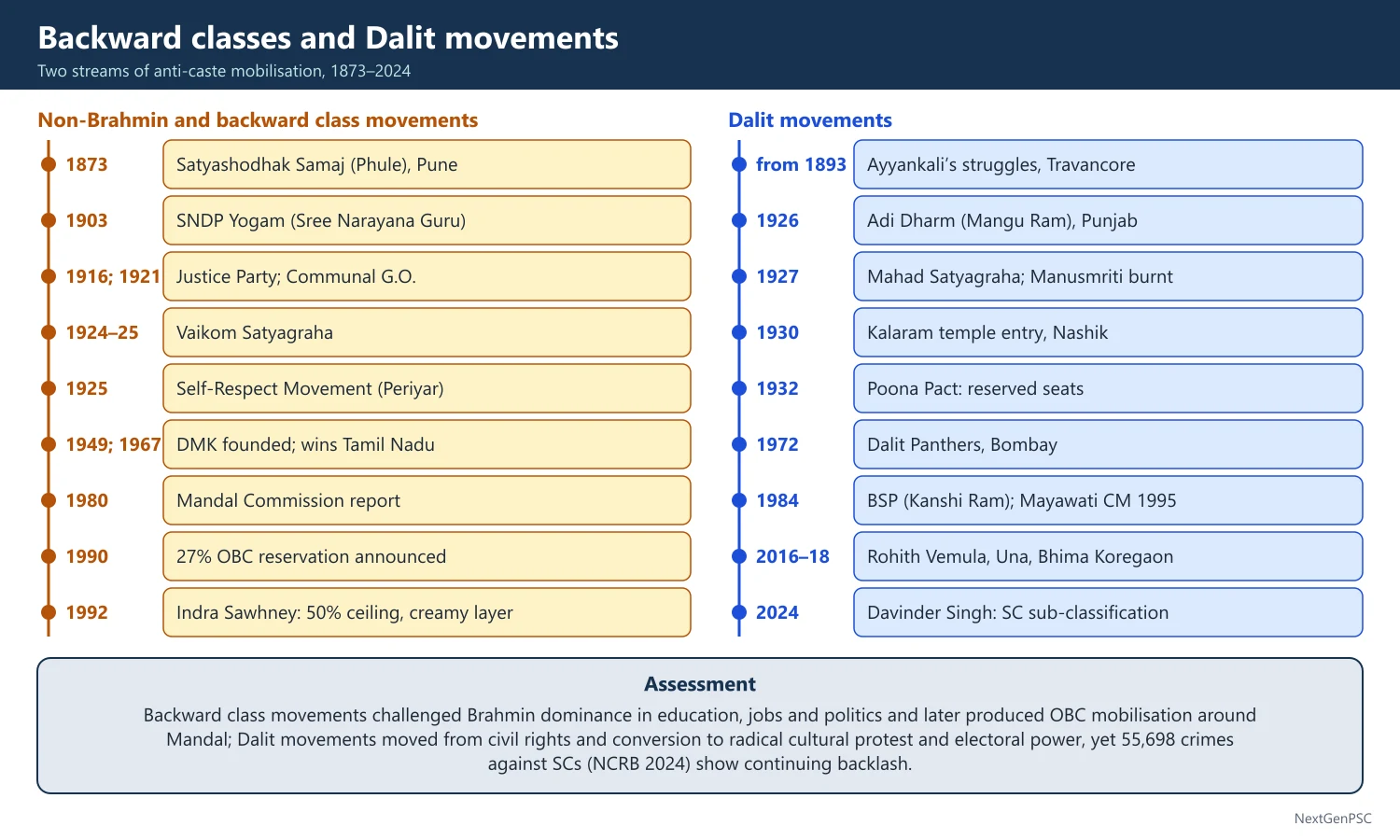
Satyashodhak Samaj (1873): founded by Jyotirao Phule in Pune; in Gulamgiri (1873) he described Brahmin domination as slavery and united Shudras and Ati-Shudras through education.
SNDP Yogam (Kerala, 1903): Sree Narayana Guru's movement among the Ezhavas, with the message 'one caste, one religion, one God for man', built temples, schools and organisations; the Vaikom Satyagraha (1924–25) fought for the right to use temple roads.
Justice Party and Self-Respect Movement: the South Indian Liberal Federation (Justice Party, 1916) won reservation in Madras Presidency (Communal G.O., 1921); E.V. Ramasamy 'Periyar' launched the Self-Respect Movement (1925), attacking Brahmanism, caste and Hindu rituals, and promoting self-respect marriages.
Dravidian politics: the DMK (1949) and its victory in 1967 institutionalised non-Brahmin power; Tamil Nadu's reservation now reaches 69% under a 1994 law placed in the Ninth Schedule.
North Indian OBC mobilisation: Ram Manohar Lohia's socialists ('pichhda pave sau mein saath', backward castes should get 60 of every hundred), Charan Singh's peasant politics and the Yadav-led parties built OBC power from the 1960s.
Mandal: the Mandal Commission (B.P. Mandal) reported on 31 December 1980; V.P. Singh's government announced 27% reservation for OBCs in central jobs in August 1990, triggering student protests; Indra Sawhney (16 November 1992) upheld it with a 50% ceiling and a creamy layer exclusion.
Recent developments: the 102nd Amendment (2018) gave constitutional status to the National Commission for Backward Classes; the 105th Amendment (2021) restored states' power to identify OBCs; the Rohini Commission (2017) on sub-categorisation of OBCs submitted its report in 2023; the Bihar caste survey (October 2023) found EBCs at 36% and OBCs at 27.13%; and Census 2027 will enumerate caste for the first time since 1931.
Dominant caste agitations: Jats (Haryana, 2016), Marathas (Maharashtra; the Supreme Court struck down their quota in May 2021) and Patidars (Gujarat, 2015) demanded backward status, showing agrarian distress among dominant castes and the politics of 'competitive backwardness'.
3. Dalit movements
Early assertion: the Adi Dharm movement in Punjab (1926, Mangu Ram), Adi Dravida and Adi Andhra movements, the Namasudra movement in Bengal and Ayyankali's struggles in Travancore (from 1893) claimed original-inhabitant identity and civic rights.
Ambedkar's movement: the Mahad Satyagraha for public water (1927) with the burning of the Manusmriti, the Kalaram temple entry campaign at Nashik (1930), the Poona Pact (1932) replacing separate electorates with reserved seats, the Independent Labour Party (1936), the Scheduled Castes Federation (1942) and mass conversion to Buddhism at Nagpur (14 October 1956).
Gandhi–Ambedkar debate: Gandhi treated untouchability as a sin within Hinduism to be removed by caste Hindus' change of heart (Harijan Sevak Sangh, 1932); Ambedkar (Annihilation of Caste, 1936) held that caste itself must be destroyed, which required rejecting the shastras.
Dalit Panthers (1972): founded in Bombay by Namdeo Dhasal, J.V. Pawar and Raja Dhale, inspired by the US Black Panthers; their manifesto and Dalit literature (Marathi) gave a radical, cultural voice to the movement.
Political power: Kanshi Ram founded BAMCEF (1978), DS-4 (1981) and the Bahujan Samaj Party (1984), uniting Dalits, OBCs and minorities as 'bahujan'; Mayawati became Chief Minister of Uttar Pradesh four times (first in 1995).
Contemporary assertion: the death of Rohith Vemula at the University of Hyderabad (January 2016), the Una flogging protests in Gujarat (July 2016), the Bhim Army (2015) in western UP, the Bhima Koregaon commemoration (1 January 2018) and the Bharat Bandh of 2 April 2018 against the dilution of the Atrocities Act show a new, educated and digitally connected Dalit youth.
Sub-classification: the Madiga Reservation Porata Samithi (Andhra, from 1994) demanded that benefits be shared among SC sub-castes; the Supreme Court allowed sub-classification of SCs and STs in State of Punjab v. Davinder Singh (1 August 2024, 6:1), dividing Dalit opinion.
Continuing violence: NCRB Crime in India 2024 recorded 55,698 crimes against SCs; scholars such as Anand Teltumbde (The Persistence of Caste, 2010, on Khairlanji) argue that assertion itself provokes backlash from dominant castes.
4. Sociological assessment
Achievements: legal abolition of untouchability, reservation and a Dalit middle class, Dalit and OBC political power, and a vibrant Dalit literature and counter-public.
Limits: benefits concentrated among a few sub-castes, fragmentation of Dalit parties, co-option by mainstream parties, and the conflict between OBC landowners and Dalit labourers in the countryside.
Debate on caste and class: Gail Omvedt (Dalits and the Democratic Revolution, 1994) saw anti-caste movements as democratic revolution; Marxists criticised identity politics for ignoring class; Gopal Guru argues that recognition and redistribution must go together.
5. Further studies and comparisons
Eleanor Zelliot (From Untouchable to Dalit, 1992) traced the Mahar movement's journey from Bhakti saints to Ambedkarite Buddhism.
Owen Lynch (The Politics of Untouchability, 1969) studied the Jatavs of Agra, who shifted from Sanskritisation to Ambedkarite Buddhism and political organisation.
Mark Juergensmeyer (Religion as Social Vision, 1982) studied the Ad Dharm movement of Punjab, showing how Dalits built a separate religious identity to claim equality.
Dalit capitalism: the Dalit Indian Chamber of Commerce and Industry (DICCI, 2005) promotes Dalit entrepreneurs, a strategy that differs from both reservation and radical protest.
Dalit literature and culture: autobiographies such as Omprakash Valmiki's Joothan (1997) and Bama's Karukku (1992) created a counter-narrative of caste experience.
Christian and Muslim Dalits: the demand to include Dalit Christians and Dalit Muslims in the SC list (the Constitution (Scheduled Castes) Order, 1950 limits SC status to Hindus, Sikhs and Buddhists) was referred in October 2022 to a commission headed by former Chief Justice K.G. Balakrishnan, and remains unresolved.
World comparison: the US civil rights movement and the Black Panthers inspired the Dalit Panthers, and Ambedkar himself compared untouchability to slavery and racial segregation, a comparison that the UN debates on descent-based discrimination continue.
6. Linking thinkers
Link to Srinivas (Sanskritisation and dominant caste), Dumont (purity and pollution), Weber (status groups and social closure) and Marx (caste as class in the debate).
Link to relative deprivation (M.S.A. Rao) and new social movements (identity and dignity) in the theory topic.
Link to caste conflicts (Chapter 27) and to law and social change (Chapter 21).
7. Using it in the exam
10 marks: compare Gandhi and Ambedkar on untouchability, or summarise Rao's typology with examples.
15–20 marks: phases (reform, Ambedkarite, Panthers, electoral, contemporary), ideologies (Sanskritisation vs rejection), achievements, limits, and a conclusion on caste as both weakened and politicised.
Thinkers to cite: M.S.A. Rao, Ghanshyam Shah, Gail Omvedt, Eleanor Zelliot, Christophe Jaffrelot, Gopal Guru.
Diagram idea: a two-column chart: 'within Hinduism' (Sanskritisation, temple entry, Gandhi) vs 'outside or against' (conversion, Self-Respect, Ambedkar, Panthers).
Quotation to use: Ambedkar's slogan 'Educate, Agitate, Organise'.
| Movement | Region and year | Leader | Strategy |
|---|---|---|---|
| Satyashodhak Samaj | Maharashtra, 1873 | Jyotirao Phule | Education, anti-Brahmin critique |
| SNDP Yogam | Kerala, 1903 | Sree Narayana Guru | Reform, own temples and schools |
| Self-Respect Movement | Tamil Nadu, 1925 | Periyar | Rationalism, rejection of Brahmanism |
| Ambedkarite movement | Maharashtra, 1920s–1956 | B.R. Ambedkar | Civil rights, politics, conversion |
| Dalit Panthers | Bombay, 1972 | Namdeo Dhasal, J.V. Pawar, Raja Dhale | Radical protest, literature |
| Bahujan politics | North India, 1984 | Kanshi Ram, Mayawati | Electoral power |
Mains points
- Questions often ask you to compare backward class and Dalit movements or to assess Ambedkar's legacy.
- Use Rao's and Shah's typologies; examiners reward Indian classificatory frameworks.
- Include recent events with dates: Una 2016, 2 April 2018 Bharat Bandh, sub-classification 2024, caste census in Census 2027.
- Show tension between OBCs and Dalits in rural areas; do not treat 'lower castes' as one bloc.
- Mention women in these movements (Savitribai Phule, Dalit women's federations).
- Conclude on the paradox that movements against caste have also strengthened caste identity in politics.
Did you know?
- The Mahad Satyagraha of 1927 was about drinking water from a public tank, the Chavdar Tale: Ambedkar turned a sip of water into a civil-rights movement.
Environmental, Ethnic and Identity Movements
Indian environmental movements such as Chipko (1973), Silent Valley, Appiko and the Narmada Bachao Andolan are mostly struggles of forest, river and farming communities over livelihood and control of resources, which Ramachandra Guha and Joan Martinez-Alier call the 'environmentalism of the poor'. Ethnic and identity movements, from Jharkhand and the Naga and Mizo struggles to the Assam movement, Bodoland, Gorkhaland and the Manipur conflict, seek autonomy, statehood or recognition and show the strains of a plural nation.
In simple words
An environmental movement in India is usually villagers protecting the forest, river or land they live on, as when Chipko women hugged trees to stop felling.
An ethnic or identity movement is a group with its own language, culture or tribe demanding recognition or self-rule, like a family asking for its own room in a shared house.
Both raise the question of who controls land, resources and political power.
UPSC asks about their causes, character and outcomes, with examples.
1. Concepts and definitions
Environmental movement: collective action to protect natural resources or the environment; in India it is tied to livelihood, rights and justice rather than only to conservation.
Environmentalism of the poor: Ramachandra Guha and Joan Martinez-Alier (Varieties of Environmentalism, 1997) contrast the 'full-stomach' environmentalism of the West with the 'empty-belly' environmentalism of the South, where the poor defend resources they depend on.
Ecological history: Madhav Gadgil and Ramachandra Guha (This Fissured Land, 1992; Ecology and Equity, 1995) argued that colonial forest laws (1865, 1878, 1927) turned community commons into State property, causing long conflict.
Ethnicity: a shared sense of common descent, culture, language or religion; Fredrik Barth (Ethnic Groups and Boundaries, 1969) argued that ethnicity is about maintaining boundaries, not the cultural content inside them.
Primordialism vs instrumentalism: Clifford Geertz (1963) saw ethnic ties as given 'primordial attachments'; instrumentalists such as Paul Brass (Ethnicity and Nationalism, 1991) argue that elites select and mobilise identities for political gain.
Identity movement: a movement that seeks recognition and dignity for a group's identity (ethnic, linguistic, religious, regional, sexual), linked to Charles Taylor's 'politics of recognition' (1992).
2. Environmental movements in India
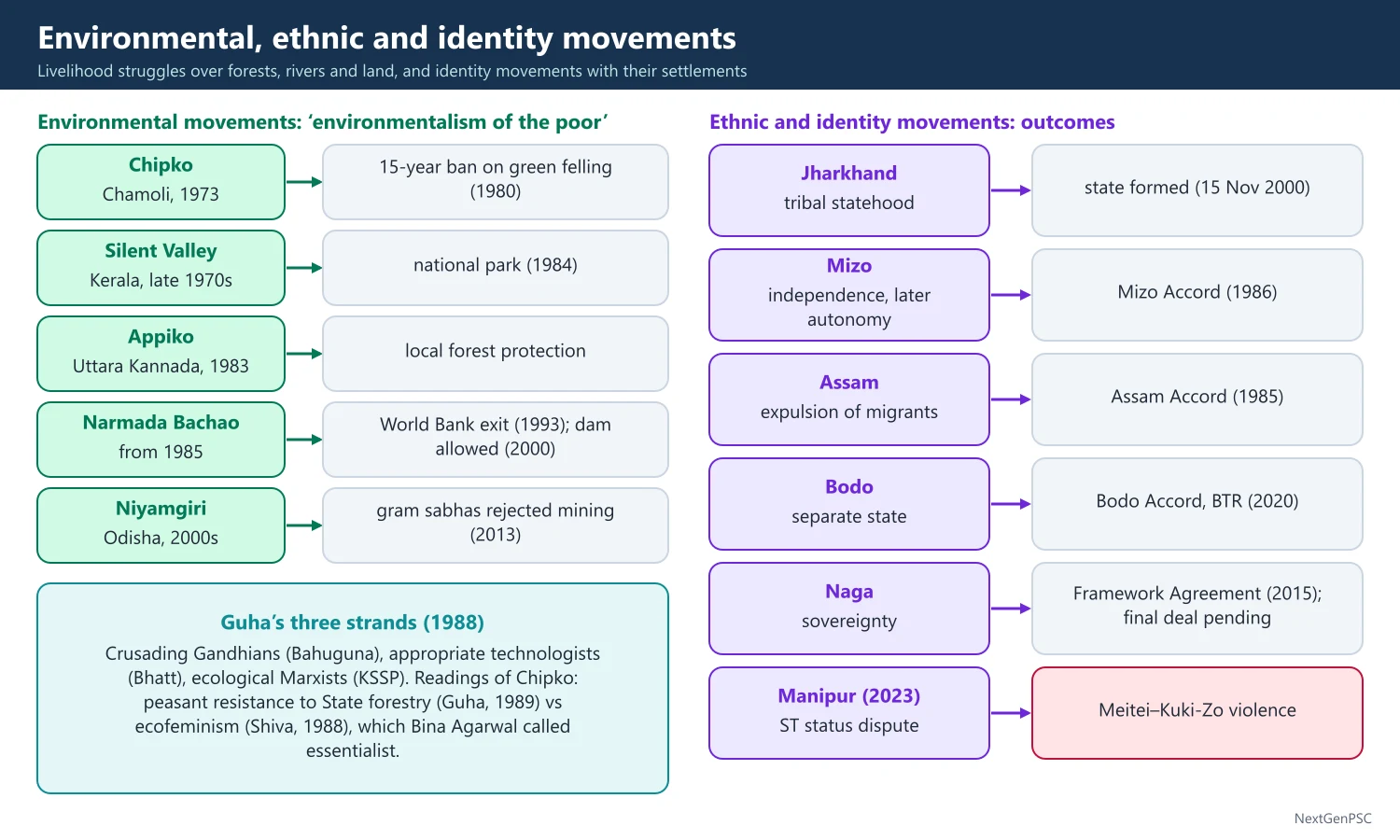
Chipko (Uttarakhand, 1973): began at Mandal village (Chamoli) against felling by a sports-goods company; on 26 March 1974 at Reni, women led by Gaura Devi stopped loggers; Chandi Prasad Bhatt (Dasholi Gram Swarajya Sangh) and Sunderlal Bahuguna led it; it led to a 15-year ban on green felling in the Himalayan forests of Uttar Pradesh (1980).
Guha's reading: in The Unquiet Woods (1989) Guha placed Chipko in a long history of peasant resistance to State forestry, not as a romantic tree-hugging movement.
Ecofeminist reading: Vandana Shiva (Staying Alive, 1988) presented Chipko as women's ecological knowledge against masculinist science; Bina Agarwal criticised this as essentialist, stressing women's material dependence on forests.
Silent Valley (Kerala): the Kerala Sastra Sahitya Parishad and scientists campaigned against a hydroelectric dam in a rainforest; the project was dropped and Silent Valley was declared a national park in 1984.
Appiko (Karnataka, 1983): led by Panduranga Hegde in the Western Ghats, inspired by Chipko, combining protection, replanting and rational use of forests.
Narmada Bachao Andolan (from 1985): led by Medha Patkar and joined by Baba Amte, it opposed the Sardar Sarovar dam over displacement of Adivasis and farmers; the World Bank withdrew in 1993 after the Morse Report (1992), but the Supreme Court allowed construction in October 2000; Amita Baviskar's In the Belly of the River (1995) is the classic ethnography.
Niyamgiri (Odisha): the Dongria Kondh opposed bauxite mining by Vedanta; in April 2013 the Supreme Court asked gram sabhas to decide under the Forest Rights Act, and all 12 chosen gram sabhas rejected the project.
Other struggles: Plachimada (Kerala) against Coca-Cola's groundwater extraction (from 2002), Kudankulam against a nuclear plant, Save Aarey forest (Mumbai, 2019), Hasdeo Arand against coal mining (Chhattisgarh), and climate movements of young people (Fridays for Future India).
Guha's three strands: in 'Ideological Trends in Indian Environmentalism' (EPW, 1988) Guha identified crusading Gandhians (Bahuguna), appropriate technologists (Bhatt) and ecological Marxists (KSSP).
Outcomes: the Forest (Conservation) Act 1980, environmental impact assessment (1994), the Forest Rights Act 2006, the National Green Tribunal (2010) and the land acquisition law of 2013 owe much to these movements; critics note the Forest (Conservation) Amendment Act 2023 narrowed protections.
3. Ethnic, tribal and identity movements
Jharkhand: from the Adivasi Mahasabha (1938) and Jaipal Singh's Jharkhand Party (1949) to the Jharkhand Mukti Morcha (1972), a movement of tribal and non-tribal groups against land loss and internal colonialism won statehood on 15 November 2000.
Naga movement: the Naga National Council (1946) under A.Z. Phizo declared independence in 1951; Nagaland became a state in 1963; the NSCN (IM) signed a Framework Agreement with the Centre on 3 August 2015, but a final settlement (flag and constitution issues) is pending.
Mizo movement: the 1959 famine (mautam) and neglect led to the Mizo National Front's uprising (1966); the Mizo Accord of 30 June 1986 made Mizoram a state (1987) and is often cited as a successful settlement.
Assam movement (1979–85): led by the All Assam Students' Union against 'foreigners' (migrants from Bangladesh); the Assam Accord (15 August 1985) set 24 March 1971 as the cut-off date, later the basis of the NRC (2019).
Bodoland: Bodo demands led to the Bodoland Territorial Council (2003) and the Bodo Peace Accord of 27 January 2020, creating the Bodoland Territorial Region under the Sixth Schedule.
Gorkhaland: Nepali-speaking Gorkhas of Darjeeling demanded a separate state (GNLF under Subhash Ghisingh, 1986); the Gorkhaland Territorial Administration was created in 2011, but the statehood demand recurs.
Manipur (from May 2023): violence between the Meitei and Kuki-Zo communities began on 3 May 2023 after protests over a proposed Scheduled Tribe status for Meiteis; it caused over 250 deaths and displaced around 60,000 people, and President's Rule was imposed in February 2025.
Ladakh: after becoming a Union Territory without a legislature (2019), groups in Leh and Kargil demanded statehood and Sixth Schedule protection, with hunger strikes led by Sonam Wangchuk; protests in Leh turned violent in September 2025.
Other identity movements: Khalistan (1980s Punjab), Dravidian linguistic nationalism, Koch-Rajbongshi and Ahom demands for ST status, and LGBTQ movements for recognition (Navtej Johar, 2018), which show identity politics beyond ethnicity.
4. Explaining these movements
Relative deprivation and internal colonialism: uneven development, land alienation by mining and dams, and in-migration of outsiders create grievances, as in Jharkhand and Assam (Michael Hechter's idea of internal colonialism, 1975).
Tribal policy debate: Verrier Elwin's isolation ('national park' approach), G.S. Ghurye's assimilation ('backward Hindus') and Nehru's integration (Panchsheel for tribal areas, 1958) shaped State responses; B.K. Roy Burman and K.S. Singh documented tribal movements.
Accommodation: India has mostly handled ethnic demands through federal accommodation (new states, Sixth Schedule councils, accords), which Alfred Stepan and others call 'holding-together federalism', though armed conflict persisted in some areas.
Forest Rights Act 2006 as a movement outcome: the Campaign for Survival and Dignity pushed for recognition of 'historical injustice' to forest dwellers; implementation remains uneven, with many claims rejected.
World examples: Chico Mendes and the rubber tappers in Brazil and the Ogoni struggle against oil companies in Nigeria are other cases of the environmentalism of the poor.
Debate: some critics argue that 'environmentalism of the poor' romanticises communities and ignores internal inequality (caste and gender within villages); Baviskar showed that NBA activists and Bhilala Adivasis had different goals.
5. Linking thinkers
Link environmental movements to Beck's risk society and to new social movement theory; link ethnic movements to Barth, Geertz and Brass.
Link to displacement and sustainability (Chapter 27) and to regionalism (Chapter 24).
Link to Oommen's distinction of nationality and ethnicity: territorial ethnic groups seek statehood; non-territorial ones seek recognition.
6. Using it in the exam
10 marks: explain 'environmentalism of the poor' with Chipko and Narmada.
15–20 marks: nature and types of movements, two detailed cases each, theoretical explanation (deprivation, internal colonialism, NSM), State responses, and a conclusion on development and democracy.
Thinkers to cite: Ramachandra Guha, Madhav Gadgil, Amita Baviskar, Vandana Shiva, Paul Brass, T.K. Oommen.
Diagram idea: a map-style list of movements by region: Himalaya (Chipko), Western Ghats (Appiko, Silent Valley), central India (Narmada, Niyamgiri, Hasdeo), North-East (Naga, Mizo, Bodo, Manipur).
Quotation to use: the Chipko slogan, in translation: 'What do the forests bear? Soil, water and pure air'.
| Movement | Place and year | Issue | Outcome |
|---|---|---|---|
| Chipko | Chamoli, Uttarakhand, 1973 | Commercial felling | 15-year ban on green felling (1980) |
| Silent Valley | Palakkad, Kerala, late 1970s | Hydroelectric dam in rainforest | National park (1984) |
| Appiko | Uttara Kannada, Karnataka, 1983 | Felling in Western Ghats | Local forest protection |
| Narmada Bachao Andolan | Gujarat–MP–Maharashtra, 1985 | Displacement by dams | World Bank exit (1993); dam allowed (2000) |
| Niyamgiri | Odisha, 2000s | Bauxite mining on sacred hill | Gram sabhas rejected mining (2013) |
| Movement | Main demand | Settlement (year) |
|---|---|---|
| Jharkhand | Tribal statehood | State formed (2000) |
| Mizo | Independence, later autonomy | Mizo Accord (1986) |
| Assam | Expulsion of migrants | Assam Accord (1985) |
| Bodo | Separate state | Bodo Accord, BTR (2020) |
| Naga | Sovereignty | Framework Agreement (2015), final deal pending |
Mains points
- Expect 'Indian environmental movements are essentially livelihood struggles. Discuss' and 'Analyse the causes of ethnic movements in North-East India'.
- Use Guha and Martinez-Alier's framework and Guha's three ideological strands.
- Give precise dates and outcomes for cases (Chipko 1973, Niyamgiri 2013, Bodo Accord 2020, Manipur 2023).
- Show the gender dimension (women in Chipko; ecofeminism debate).
- Present the Manipur conflict neutrally, with both communities' grievances.
- Conclude on federal accommodation as India's main response and its limits.
Did you know?
- 'Chipko' means 'to stick' or 'to hug' in Garhwali and Hindi: the women literally clung to trees to stop the axes.
Theories of Social Movements and Subaltern Perspectives
Sociologists explain social movements through grievance theories (relative deprivation, Smelser's structural strain), organisation theories (resource mobilisation, political opportunity structure, framing) and new social movement theory (Touraine, Melucci, Offe), which stresses identity and culture. Indian scholars (M.S.A. Rao, Ghanshyam Shah, T.K. Oommen, Partha Mukherji) built typologies for Indian movements, while subaltern studies (Ranajit Guha, Partha Chatterjee) recovered the autonomous politics of peasants and the poor. The media, from print to social media, shapes how movements form and are seen.
In simple words
A social movement is a group of people acting together over time to bring about or resist change, like the farmers at Delhi's borders or the Chipko women.
Theories ask three questions, like a detective: why are people angry, how do they organise, and what new identity do they create?
Anger alone is not enough; movements also need leaders, money, networks, a good story (frame) and the right political moment.
UPSC asks you to apply these theories to Indian movements and to compare old and new movements.
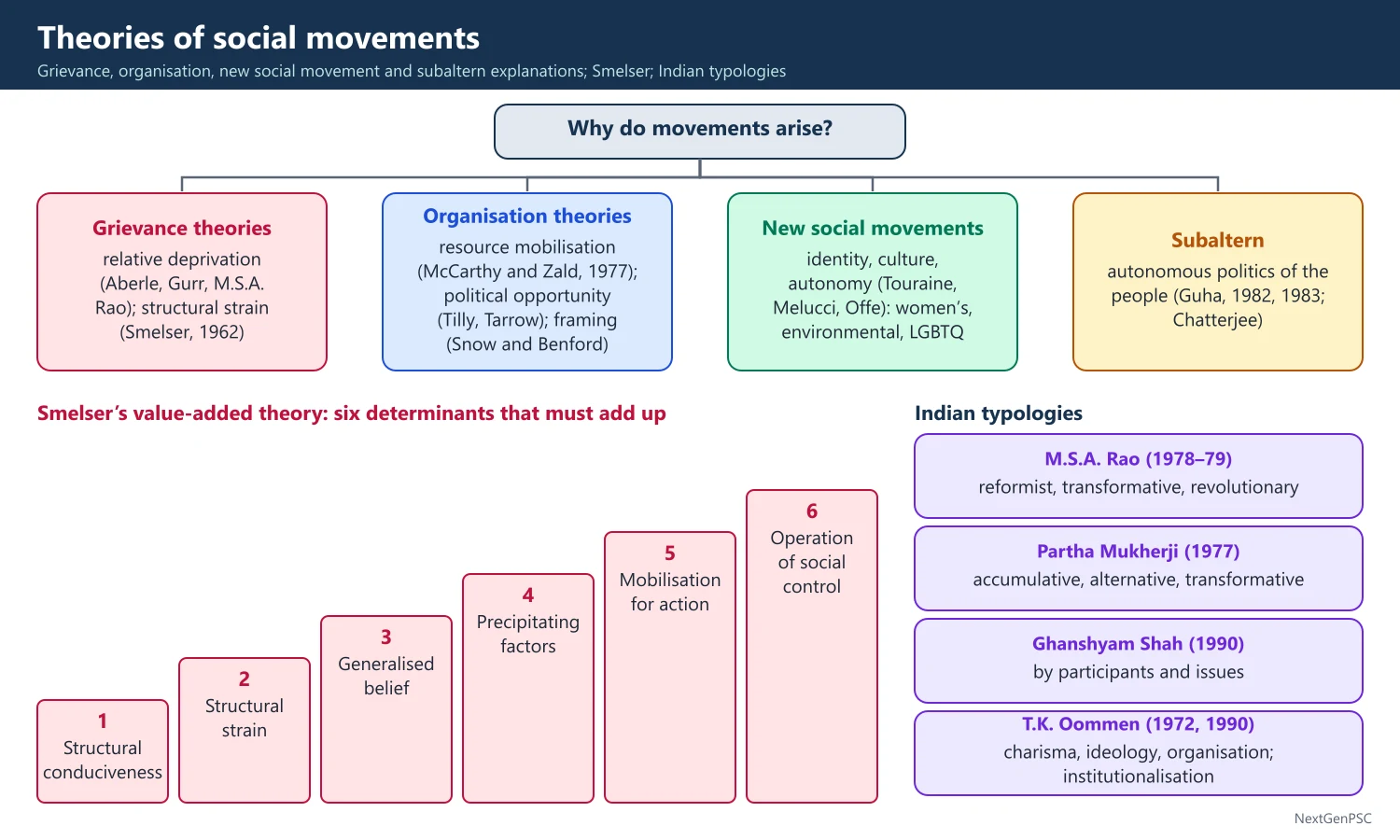
1. Concepts and definitions
Social movement: Paul Wilkinson (1971) defined it as a deliberate collective endeavour to promote change in any direction by any means; M.S.A. Rao defined it as an organised attempt by a section of society to bring about partial or total change through collective mobilisation based on an ideology.
Collective behaviour vs movement: crowds, riots and panics are short-lived and unorganised, while movements have continuity, organisation, leadership and ideology (Herbert Blumer distinguished general and specific movements).
Relative deprivation: the gap between what people expect (value expectations) and what they get (value capabilities); Ted Gurr (Why Men Rebel, 1970) used it to explain political violence, and David Aberle (1966) used it to classify movements.
Aberle's typology: based on whom the movement seeks to change (individuals or society) and how much (partial or total): alterative, redemptive, reformative and transformative movements.
Structural strain (value-added theory): Neil Smelser (Theory of Collective Behavior, 1962) listed six determinants that must add up: structural conduciveness, structural strain, growth of a generalised belief, precipitating factors, mobilisation for action, and the operation of social control.
2. Organisation and opportunity theories
Resource mobilisation: John McCarthy and Mayer Zald ('Resource Mobilization and Social Movements', American Journal of Sociology, 1977) argued that grievances are constant; what varies is access to resources (money, members, leaders, networks, media) and the work of social movement organisations.
Political process and opportunity: Charles Tilly (From Mobilization to Revolution, 1978), Doug McAdam (1982) and Sidney Tarrow (Power in Movement, 1994) argued that movements rise when political opportunities open: divided elites, new allies, reduced repression or elections.
Repertoires of contention: Tilly's term for the set of protest forms a society knows; India's repertoire includes dharna, hartal, bandh, gherao, rasta roko, padyatra and hunger strike, many from the Gandhian tradition.
Framing: David Snow and Robert Benford (1986, 1988), drawing on Goffman's Frame Analysis (1974), showed that movements must frame problems (diagnostic), solutions (prognostic) and reasons to act (motivational); 'Bharat vs India' and 'jal, jangal, zameen' are Indian master frames.
Indian application: the 2020–21 farmers' protest fits resource mobilisation (unions, gurdwaras, diaspora funds) and political opportunity (state elections in Punjab and UP in 2022), while its grievances (fear of losing MSP) fit relative deprivation.
3. New social movements
Alain Touraine (The Voice and the Eye, 1981) argued that in post-industrial 'programmed society' the central conflict is over control of 'historicity', the cultural direction of society, not over factory ownership.
Alberto Melucci (Nomads of the Present, 1989) stressed collective identity built in everyday networks, with movements as 'signs' that challenge dominant codes.
Claus Offe (1985) described new movements' values (autonomy, identity), forms (decentralised, informal) and base (new middle class); Habermas saw them as resistance to the 'colonisation of the lifeworld' by State and market.
Old vs new: old movements (labour, peasant) were class-based, material and party-linked; new movements (women's, environmental, peace, LGBTQ) are identity-based, cultural and autonomous.
Indian debate: Gail Omvedt (Reinventing Revolution, 1993) called Dalit, women's, farmers' and environmental movements India's new social movements; others (Rajendra Singh, Social Movements, Old and New, 2001) argue that in India these movements still fight over material survival, so the old–new divide fits poorly.
4. Indian typologies
Rao: M.S.A. Rao (ed., Social Movements in India, 2 volumes, 1978–79) made relative deprivation the core cause and classified movements by the change they seek: reformist (change parts of the system), transformative (structural change in some aspects) and revolutionary (total change of the system).
Partha Mukherji ('Social Movement and Social Change', Sociological Bulletin, 1977) distinguished movements by their relation to the system: accumulative (adding within the system), alternative (changing part of it) and transformative (changing the whole structure).
Oommen: T.K. Oommen (Charisma, Stability and Change, 1972, on the Bhoodan–Gramdan movement; Protest and Change, 1990) studied how charisma, ideology and organisation interact and how movements become institutionalised over time.
Ghanshyam Shah (Social Movements in India: A Review of the Literature, 1990, revised 2004) classified Indian movements by participants and issues: peasant, tribal, Dalit, backward caste, women's, student, middle class, working class, human rights and environmental.
Life cycle: movements pass through emergence, coalescence, bureaucratisation and decline (Blumer, later Mauss); Indian examples are the JP movement (1974–77) leading to the Janata government, and the India Against Corruption movement (2011) leading to the Aam Aadmi Party (2012).
5. Subaltern perspectives
Origin of the term: Antonio Gramsci (Prison Notebooks, written 1929–35) used 'subaltern' for groups outside the hegemonic order, whose history is fragmented and episodic.
Subaltern Studies (from 1982): Ranajit Guha's opening essay 'On Some Aspects of the Historiography of Colonial India' attacked both colonialist and nationalist elite history and argued for an autonomous 'politics of the people'.
Guha's peasant consciousness: in Elementary Aspects of Peasant Insurgency (1983) he read colonial records 'against the grain' to show that rebels' acts (negation, ambiguity, modality, solidarity, transmission, territoriality) expressed a conscious politics, not mere spontaneity.
Partha Chatterjee and Shahid Amin: Chatterjee's work on the community and political society, and Shahid Amin's 'Gandhi as Mahatma' (1984) showed how peasants in Gorakhpur reinterpreted Gandhi through their own beliefs.
Critiques: Gayatri Chakravorty Spivak ('Can the Subaltern Speak?', 1988) asked whether intellectuals can recover subaltern voices without speaking for them; Sumit Sarkar ('The Decline of the Subaltern in Subaltern Studies', 1997) criticised the later shift from material history to discourse and culture.
Dalit and Adivasi histories: scholars such as Gopal Guru and Badri Narayan (Women Heroes and Dalit Assertion in North India, 2006) extended subaltern recovery to Dalit memory and myth.
6. Role of media
Print and nation: Anderson's print capitalism and the vernacular press (Kesari, Ambedkar's Mooknayak, 1920) built nationalist and Dalit publics.
Television and spectacle: Todd Gitlin (The Whole World Is Watching, 1980) showed that mass media frame movements, often focusing on leaders and violence; the 2011 anti-corruption movement grew through 24-hour television coverage.
Social media and networked movements: Manuel Castells (Networks of Outrage and Hope, 2012) described leaderless, internet-based movements such as the Arab Spring; in India, #MeToo (2018), the Delhi farmers' protest and Dalit online publics used social media, while internet shutdowns and misinformation show its limits.
7. Linking thinkers
Link relative deprivation to Merton's reference group theory: deprivation is felt relative to a reference group, as when educated Dalit youth compare themselves with upper-caste peers.
Link Smelser to Parsons's functionalism (strain in the system) and resource mobilisation to rational choice; link new social movements to Habermas and Giddens on reflexive modernity.
Link Marx's class struggle and Weber's charisma (routinisation of charisma explains movements becoming parties, as Oommen showed).
8. Using it in the exam
10 marks: explain one theory (for example, resource mobilisation) and apply it to one Indian movement.
15–20 marks: compare grievance, organisation and NSM theories, give Indian typologies (Rao, Mukherji, Shah, Oommen), apply them to two movements, and add the subaltern critique and the role of media.
Thinkers to cite: Smelser, McCarthy and Zald, Tilly, Touraine, M.S.A. Rao, Ranajit Guha.
Diagram idea: Aberle's 2 × 2 table: rows 'individual / society', columns 'partial / total' change, with alterative, redemptive, reformative and transformative in the four cells.
Quotation to use: McCarthy and Zald's paraphrased point that there is always enough discontent in society; what matters is the mobilisation of resources.
| Theory | Thinkers (year) | Main cause | Indian example |
|---|---|---|---|
| Relative deprivation | Aberle (1966); Gurr (1970); M.S.A. Rao | Gap between expectation and achievement | Backward class movements |
| Structural strain | Smelser (1962) | Six value-added determinants | Communal riots, Assam movement |
| Resource mobilisation | McCarthy and Zald (1977) | Organisation and resources | Farmers' protest 2020–21, NBA |
| Political opportunity | Tilly (1978); Tarrow (1994) | Openings in the political system | Mandal politics, JP movement |
| New social movements | Touraine; Melucci; Offe | Identity, culture, autonomy | Women's, environmental, LGBTQ movements |
| Subaltern | Guha (1982, 1983); Chatterjee | Autonomous politics of the people | Peasant insurgencies, Gandhi in Gorakhpur |
| Scholar | Types |
|---|---|
| M.S.A. Rao (1978–79) | Reformist, transformative, revolutionary |
| Partha Mukherji (1977) | Accumulative, alternative, transformative |
| Ghanshyam Shah (1990) | By participants and issues: peasant, tribal, Dalit, women, students, environment and others |
| T.K. Oommen (1972, 1990) | Charisma, ideology, organisation; institutionalisation |
Mains points
- Paper II often asks you to 'critically examine' a theory (relative deprivation, resource mobilisation) with Indian movements; Paper I asks the theory itself.
- Always apply at least one theory to one named Indian movement; pure theory scores less.
- Cite Indian typologies by name and year (Rao, Mukherji, Shah, Oommen); examiners expect them.
- Criticise relative deprivation: deprivation is widespread but movements are rare, which resource mobilisation explains.
- Discuss whether the old–new movement distinction fits India, with Omvedt and Rajendra Singh.
- Add the media's role and the subaltern critique to show range.
Did you know?
- Memory trick for Smelser's six steps: 'Can Some Groups Pick Mighty Sticks?' — Conduciveness, Strain, Generalised belief, Precipitating factor, Mobilisation, Social control.
UPSC Previous Year Questions: Social Movements in Modern India
From 2014 to 2026 UPSC asked 32 question parts (470 marks) from this chapter, all in Paper II, making it one of the heaviest chapters of the paper. Backward classes and Dalit movements (8 parts) and environmental, ethnic and identity movements (7 parts) lead, followed by the women's movement (7 parts), peasant and farmers' movements (6 parts) and theories of movements, subaltern studies and digital mobilisation (4 parts). Every question below has a model answer written to the UPSC word limit.
In simple words
Before reading a model answer, write your own within the time limit: about 7 minutes for 10 marks and 11 minutes for 20 marks.
Then compare: did you name the movement's leaders, years and outcomes, and use a theory (relative deprivation, resource mobilisation, political opportunity, new social movements, subaltern)?
Note the gaps and revise the matching topic in this chapter's notes before the next question.
1. Peasant and Farmers' Movements
Example 1 (UPSC 2024, 10 marks): What is your assessment about the recent farmers' movement in India? Elaborate.
Paper and question: Paper II, Q5(e)
Approach: Give an assessment: describe the 2020–21 protest and its sequel, then evaluate its strengths, achievements and limits with theory.
The farmers' movement of 2020–21 opposed three farm laws of September 2020; from 26 November 2020 farmers, mainly from Punjab, Haryana and western Uttar Pradesh, camped at Delhi's borders under the Samyukt Kisan Morcha, and Parliament repealed the laws on 29 November 2021.
Strengths: it was largely non-violent, sustained for a year, cut across caste and religion (Jat–Sikh unity, Muslim support in western UP), drew women farmers onto its stages and used digital media and its own newspaper, Trolley Times. In resource-mobilisation terms, gurdwaras, unions and diaspora networks supplied resources; in political-opportunity terms, coalition and state elections raised its leverage.
Limits: its base was mainly larger, MSP-dependent farmers of the north-west, while landless Dalit labourers and rain-fed farmers were less central; the core demand of a legal MSP guarantee remains unmet, and the 2024 'Delhi Chalo' protests at the Punjab–Haryana borders were later cleared.
It showed the continuing political weight of the farmer class, but also the difficulty of uniting all rural classes.
Example 2 (UPSC 2021, 20 marks): Examine the factors responsible for the rural unrest in contemporary India.
Paper and question: Paper II, Q3(b)
Approach: Examine the factors behind rural unrest: economic (agrarian distress, prices, debt), land and displacement, caste and identity, ecological, political and generational, with examples and theory; conclude.
Rural unrest refers to collective discontent and protest in the countryside, from farmers' agitations to tribal resistance and caste conflict. A.R. Desai and Kathleen Gough traced its roots to agrarian structure; today its forms are more varied.
Agrarian distress: 86% of holdings are small and marginal (Agriculture Census 2015–16), costs are rising, prices volatile, and about half of farm households are indebted (NSS 77th round, 2019); NCRB recorded 11,290 suicides of farmers and farm labourers in 2022. These drive demands for a legal MSP and loan waivers, as in the 2020–21 protest and the 2018 Kisan Long March.
Land and displacement: acquisition for industry and infrastructure provoked Singur and Nandigram (2006–07) and tribal resistance at Niyamgiri and Hasdeo; Maoist insurgency drew on Adivasi land grievances.
Caste and identity: Dalit labourers' assertion meets violence from dominant castes, while dominant agrarian castes (Jats, Patidars, Marathas) demand reservation as farm incomes fall.
Ecology and climate: droughts, groundwater depletion and erratic rain. Generational and employment factors: educated rural youth without jobs, whom Craig Jeffrey describes, swell protests. Political factors: relative deprivation compared with urban India, Sharad Joshi's 'Bharat versus India', and the State's policy shifts after liberalisation.
Rural unrest is therefore the product of a structural agrarian crisis meeting rising aspirations; secure incomes, land rights, rural non-farm jobs and fair acquisition under the 2013 land law are needed.
Example 3 (UPSC 2020, 10 marks): Are the contemporary farmers' movements in India changing their course? Discuss.
Paper and question: Paper II, Q7(c)
Approach: Discuss whether farmers' movements are changing course: contrast the old and new farmers' movements with recent trends (issues, social base, methods, alliances), and conclude.
Yes, farmers' movements are changing course. Early peasant movements (Tebhaga, Telangana, Naxalbari) fought over land and rent; the new farmers' movements of the 1980s (Sharad Joshi's Shetkari Sanghatana, the BKU of Mahendra Singh Tikait, Karnataka Rajya Raitha Sangha) fought over prices, subsidies and loans, framed as 'Bharat versus India'.
Recent movements show new directions: issues have widened from prices to policy, corporate entry and a legal guarantee of MSP, as in 2020–21, and to forest rights and debt in the 2018 Kisan Long March; the social base includes tenants, women farmers and Adivasi cultivators; alliances link farmers' unions with trade unions and Left kisan sabhas under umbrella bodies such as the Samyukt Kisan Morcha; and methods combine long sit-ins with digital media and diaspora support.
Some continuity remains: the base is still dominated by landowning middle and rich farmers, and electoral ventures (such as in Punjab in 2022) have been weak.
The course is thus shifting from narrow price politics to a broader critique of the agrarian model.
Example 4 (UPSC 2019, 10 marks): Illustrate the contributions of the Tebhaga Movement to the peasants struggle in India.
Paper and question: Paper II, Q1(b)
Approach: Illustrate contributions: describe Tebhaga (1946–47) briefly, then its contributions to peasant struggle (sharecroppers' rights, organisation, women, later laws), with scholars.
The Tebhaga Movement (1946–47) was a struggle of sharecroppers (bargadars) in Bengal, led by the Bengal Provincial Kisan Sabha, demanding that their share of the crop be raised from half to two-thirds (tebhaga) and that harvests be stored in their own granaries.
Contributions: it was one of the largest sharecroppers' movements, mobilising Rajbanshi, Santhal and Muslim peasants in north Bengal across caste and religion; it put tenancy and share rights at the centre of agrarian politics, leading to the Bengal Bargadars Act (1950) and, much later, Operation Barga (1978) in West Bengal, which registered sharecroppers. Women played militant roles, forming Nari Bahini, as Peter Custers documented. A.R. Desai and Sunil Sen treated it as a classic case of class-based peasant mobilisation, and Kathleen Gough classed such movements as armed insurrection for land reform.
It was suppressed by police and overshadowed by Partition.
Its legacy was to show that tenants could organise against landlords, inspiring later Left peasant struggles.
Example 5 (UPSC 2018, 10 marks): Explain the dynamics of neo-farmers' movement in contemporary India.
Paper and question: Paper II, Q5(c)
Approach: Explain the dynamics of the new farmers' movements: context, leaders, issues, ideology, social base, methods, and the scholarly debate on their class character.
The neo-farmers' (new farmers') movements arose in the late 1970s and 1980s among commercialised farmers after the Green Revolution: the Shetkari Sanghatana of Sharad Joshi in Maharashtra, the Bharatiya Kisan Union of Mahendra Singh Tikait in western Uttar Pradesh, and the Karnataka Rajya Raitha Sangha of M.D. Nanjundaswamy.
Dynamics: their issues were remunerative prices, cheaper inputs and electricity, and loan waivers rather than land; Joshi's ideology of 'Bharat versus India' framed the rural sector as exploited by urban India through unfavourable terms of trade. They were non-party, mobilised through mass rallies, road blockades and refusal to pay dues, and drew on caste and clan networks (Jat khaps for the BKU). Later, the KRRS turned against multinational seeds and WTO policies.
Scholars debate their class character: D.N. Dhanagare and others saw rich-peasant interests, while Gail Omvedt saw a broad peasant movement against capitalist exploitation.
Their legacy lives on in the 2020–21 protest and the MSP demand.
Example 6 (UPSC 2015, 20 marks): Discuss the main features of farmers' movements in Independent India.
Paper and question: Paper II, Q7(b)
Approach: Discuss the main features of farmers' movements after 1947, by phases (Telangana and Bhoodan, Naxalbari, new farmers' movements, recent), then synthesise features (issues, base, ideology, methods, organisation), with scholars.
Farmers' and peasant movements in independent India have changed with the agrarian structure; A.R. Desai, Kathleen Gough, D.N. Dhanagare and Gail Omvedt are the main analysts.
Phases: (i) the Telangana armed struggle (1946–51) against the Nizam's landlords, and Vinoba Bhave's Bhoodan (from 1951), a Gandhian alternative; (ii) the Naxalbari uprising (1967) in West Bengal and later Maoist movements of landless and tribal peasants; (iii) the new farmers' movements of the 1980s: Sharad Joshi's Shetkari Sanghatana, Tikait's BKU and Nanjundaswamy's KRRS; (iv) recent movements such as the 2018 Kisan Long March and the 2020–21 protest against farm laws.
Main features: (a) Issues shifted from land, rent and tenancy to prices, subsidies, debt and policy. (b) Social base shifted from tenants and landless labourers to owner-cultivators and middle and rich peasants, often of dominant castes such as Jats and Marathas. (c) Ideology moved from Marxist class struggle to non-party 'Bharat versus India' populism, with Gandhian and environmental strands. (d) Methods include rasta roko, gheraos, long sit-ins and boycotts, generally non-violent except in Maoist zones. (e) Organisation moved from party-led kisan sabhas to autonomous unions and broad coalitions.
Limits: divisions between farmers and agricultural labourers, the marginal place of Dalits and women, and regional concentration in irrigated areas.
Farmers' movements thus reflect the transition from a semi-feudal to a commercial agrarian economy, as Dhanagare argued; their future lies in uniting small farmers, tenants and labourers around livelihood security.
2. Women's Movement
Example 7 (UPSC 2026, 10 marks): In the context of women's movements and laws do you think that matriarchy is the need of the hour? Discuss in detail.
Paper and question: Paper II, Q1(c)
Approach: Discuss in detail: define matriarchy and distinguish it from matriliny, show what women's movements and laws actually seek (equality), use Indian matrilineal examples, and conclude that equality, not matriarchy, is needed.
Matriarchy means a society ruled by women, with authority vested in mothers or women as a group; anthropologists find no clear historical case of it. It must be distinguished from matriliny, descent and inheritance through the female line, found among the Khasi and Garo of Meghalaya and formerly the Nairs of Kerala, where power often still lay with maternal uncles.
India's women's movements, from the anti-dowry and anti-rape campaigns to #MeToo, and laws such as the Domestic Violence Act 2005, the POSH Act 2013 and the Women's Reservation Act 2023, seek gender equality, the dismantling of patriarchy, not its reversal. Feminists such as Sylvia Walby define patriarchy as a system of structures through which men dominate women; replacing it with female domination would reproduce the same logic of hierarchy.
Even in Meghalaya, matrilineal women are under-represented in traditional councils, which shows that matriliny does not guarantee power.
What is needed is shared power, equal rights in property, work and care, and safety, not matriarchy.
Example 8 (UPSC 2026, 20 marks): How have the women's movements made the presence of women in every moment felt and more women participation in various fields? Discuss.
Paper and question: Paper II, Q8(b)
Approach: Discuss how women's movements increased women's visibility and participation in various fields: phases of the movement, then field by field (law, politics, work and economy, education, culture and public space), with data, and limits.
India's women's movement moved through phases: nineteenth-century reform (Phule, Pandita Ramabai), nationalist mobilisation (Gandhi's satyagraha drew women into public protest), the autonomous movement after the Towards Equality report (1974), and today's digital campaigns. Each phase made women more visible as actors rather than objects of reform.
Law and rights: campaigns after the Mathura case (1979) led to the 1983 amendment on custodial rape; Bhanwari Devi's case led to the Vishaka guidelines (1997) and the POSH Act 2013; the 2012 Delhi protests produced the 2013 criminal law amendment; and campaigns secured the Domestic Violence Act 2005 and equal coparcenary rights (2005).
Politics: the movement's demand produced one-third reservation in panchayats (1992), now about 14.5 lakh women representatives, and the Women's Reservation Act 2023; women's turnout now equals men's. Work and economy: SEWA (1972) made informal women workers visible; self-help groups under NRLM organise crores of rural women; female labour force participation rose to 40.0% (PLFS 2025).
Education and knowledge: women's studies (Indian Association for Women's Studies, 1982), feminist publishing (Kali for Women, 1984) and female GER above male GER in higher education (AISHE 2023–24). Public space and culture: Pinjra Tod, Shaheen Bagh's women-led sit-in (2019–20) and #MeToo (2018) asserted women's right to the city and voice in media.
Limits: rural, Dalit and Muslim women remain under-represented, as Dalit feminists such as Sharmila Rege point out, and much work remains unpaid.
Women's movements have thus made women's presence felt across law, politics, economy and culture, turning gender into a public issue; the task now is to make participation equal for all women.
Example 9 (UPSC 2018, 10 marks): Elaborate the 'Me Too' Movement and its impact in India.
Paper and question: Paper II, Q5(e)
Approach: Elaborate the movement (origin, Indian wave, cases) and its impact (institutional, legal, cultural) with critiques.
#MeToo, a phrase first used by the American activist Tarana Burke in 2006, became a global online movement in October 2017 when women shared experiences of sexual harassment. In India, a 2017 list of academics by Raya Sarkar was followed in October 2018 by a wave of accusations in media, film and politics.
Impact: a Union minister, M.J. Akbar, resigned in October 2018, and in 2021 a Delhi court acquitted journalist Priya Ramani of his defamation charge, recognising a woman's right to speak even after decades. Media houses and firms set up or revived Internal Committees under the POSH Act 2013, and the Hema Committee report (released in 2024) exposed harassment in the Malayalam film industry. Culturally, it broke the silence and shame around harassment, shifting stigma from victim to perpetrator.
Critiques: it reached mainly urban, English-speaking, upper-caste women; due process concerns arose; and informal workers, whom POSH covers through Local Committees, remained largely outside it.
#MeToo nonetheless marked a digital phase of Indian feminism that made workplace power visible.
Example 10 (UPSC 2017, 20 marks): Despite gains from the women's movement and state policy of women empowerment, gender equality is far from achieved. Identify two major challenges that prevent this goal from being reached.
Paper and question: Paper II, Q7(a)
Approach: Acknowledge gains briefly, then identify and analyse two major challenges in depth (for example, patriarchal family norms and son preference; women's economic dependence and unpaid care), each with theory, data and examples, and suggest ways forward.
The women's movement and State policy have brought real gains: laws against dowry, domestic violence and harassment, one-third and more reservation in panchayats, rising female education (female higher-education GER above male in AISHE 2023–24) and schemes such as Beti Bachao Beti Padhao (2015). Yet gender equality remains distant. Two major challenges stand out.
Challenge 1: patriarchal family and kinship norms. Patrilocal residence, patrilineal inheritance and dowry make daughters 'paraya dhan', which produces son preference; NFHS-5 (2019–21) recorded a sex ratio at birth of 929 girls per 1,000 boys, and NCRB recorded about 4.41 lakh crimes against women in 2024, with cruelty by husband or relatives the largest category. Leela Dube showed how socialisation in the natal family prepares girls for subordination, and Bina Agarwal found that daughters rarely claim land despite the 2005 amendment. Laws cannot easily reach the private sphere, which Sylvia Walby calls private patriarchy.
Challenge 2: economic dependence and the burden of unpaid care. Female labour force participation was only 40.0% in PLFS 2025, much of it unpaid family work, and the Time Use Survey 2024 found women spending far more time than men on unpaid domestic and care work. Occupational segregation, the wage gap, lack of safe transport and childcare, and the 'marriage penalty' keep women out of paid work. Without income, women's bargaining power within the household stays low, as Amartya Sen's model of 'cooperative conflict' explains.
Way forward: change norms through education and men's involvement, enforce equal inheritance, invest in childcare, safe transport and women-friendly jobs, and recognise and redistribute care work.
Gender equality therefore requires transforming family and economy together; law and policy are necessary but cannot by themselves remove deep-rooted patriarchy.
Example 11 (UPSC 2015, 20 marks): Discuss the impact of post-1970 feminist movement on Indian middle class.
Paper and question: Paper II, Q6(a)
Approach: Discuss the impact of the post-1970 movement on the middle class: context, then impacts on family and marriage, education and work, law and consciousness, and culture; add the critique that it was middle-class centred; conclude.
The post-1970 feminist movement began with the Towards Equality report (1974), which showed declining sex ratios and women's marginalisation, and grew through autonomous groups such as Saheli (1981), the journal Manushi (1979), Kali for Women (1984) and campaigns against dowry and rape after the Mathura case (1979). Much of its leadership came from the urban educated middle class, and its impact on that class was deep.
Family and marriage: it questioned dowry, 'bride burning' and domestic violence, leading to Section 498A (1983) and the Domestic Violence Act 2005; middle-class women gained the language of rights within marriage, acceptance of divorce grew, and age at marriage rose. Patricia Uberoi notes that companionate marriage became an ideal.
Education and work: middle-class women entered higher education, professions, media and the corporate world in large numbers, and the women's studies movement (IAWS, 1982) gave them a critical vocabulary. Workplace harassment law, from Vishaka (1997) to the POSH Act 2013, protects mainly this group.
Consciousness and culture: feminism changed media representations, advertising and literature, and later digital campaigns such as Pinjra Tod and #MeToo emerged from middle-class campuses and workplaces.
Critique: Dalit feminists such as Gopal Guru ('Dalit Women Talk Differently', 1995) and Sharmila Rege (1998) argued that the movement universalised the experience of upper-caste, middle-class women and ignored caste and labour, while the double burden of work and housework continues.
The movement thus transformed the middle-class family and women's aspirations, but its benefits have been uneven across class and caste.
Example 12 (UPSC 2015, 10 marks): To what extent the Muslim Personal Law Board is in agreement with Islamic feminist agenda?
Paper and question: Paper II, Q7(c)
Approach: Assess the extent of agreement: define Islamic feminism, describe AIMPLB's positions (triple talaq, maintenance, mosque entry), contrast with Muslim women's groups, and conclude 'limited'.
Islamic feminism seeks gender justice from within Islam by reinterpreting the Quran (Amina Wadud, Fatima Mernissi); in India, the Bharatiya Muslim Mahila Andolan (2007) campaigns for codified, gender-just personal law.
The All India Muslim Personal Law Board (1973) agrees with this agenda only to a limited extent. In 2017 it issued a code of conduct discouraging instant triple talaq. But it opposed judicial intervention in Shah Bano (1985), defended the validity of triple talaq before the Supreme Court in Shayara Bano (2017), opposed the 2019 law criminalising it, and resists codification and a Uniform Civil Code as threats to community autonomy.
Islamic feminists, by contrast, won women's entry to the inner sanctum of Haji Ali Dargah (Bombay High Court, 2016) and supported the triple talaq judgment; the All India Muslim Women's Personal Law Board (2005) emerged as a women's alternative.
Agreement is therefore partial: the Board speaks the language of Islamic rights but rejects reforms that reduce clerical authority.
Example 13 (UPSC 2014, 20 marks): What are the main features of the second wave of Women's movement in the Indian context?
Paper and question: Paper II, Q6(a)
Approach: Discuss the main features of the second wave in India: context and timing, then features (autonomy, issues of violence and the body, new forms of organisation, legal campaigns, diversity, links with other movements), with examples and scholars; conclude.
In India the second wave of the women's movement refers to the autonomous feminist movement from the mid-1970s, following the first wave of social reform and nationalist mobilisation. Its trigger was the Towards Equality report (1974) of the Committee on the Status of Women in India, which showed declining sex ratios, poor health and low political participation of women despite constitutional equality; the International Women's Year (1975) and the Emergency also shaped it. Radha Kumar's The History of Doing (1993) is its classic account.
Features: (i) Autonomy: new groups such as the Progressive Organisation of Women in Hyderabad (1974), Stree Mukti Sanghatana, Saheli (1981) and Manushi (1979) kept away from party control, unlike earlier women's wings of parties. (ii) Violence and the body: it made dowry deaths, rape, sati and domestic violence public issues; the Mathura custodial rape case (1979) led to the 1983 amendment, the Roop Kanwar sati (1987) to the Commission of Sati (Prevention) Act 1987, and dowry campaigns to Sections 498A and 304B.
(iii) New forms of action: street plays, consciousness-raising, women's centres, legal aid and publishing (Kali for Women, 1984), and the growth of women's studies. (iv) Links with other movements: women were prominent in Chipko, the Shahada movement in Maharashtra and SEWA's organisation of informal workers. (v) The personal is political: the family, sexuality and housework were treated as sites of power.
Debates: the Shah Bano case (1985) divided feminists over a Uniform Civil Code; Dalit feminists later criticised its upper-caste character; and from the 1990s, critics noted 'NGO-isation' of the movement.
The second wave thus redefined women's issues from welfare to rights and from reform to transformation of patriarchy, and laid the base for later laws and digital feminism.
3. Backward Classes and Dalit Movements
Example 14 (UPSC 2025, 10 marks): How Dalit movements in India have facilitated their Identity formation? Analyze.
Paper and question: Paper II, Q7(c)
Approach: Analyse how Dalit movements built identity: from stigma to self-chosen identity through naming, history, religion, literature and politics, with movements and scholars.
Identity formation is the process by which a group defines who it is; Dalit movements turned an imposed, stigmatised status ('untouchable') into an assertive, self-chosen identity.
Naming: the word 'Dalit' (broken, oppressed), popularised by the Dalit Panthers (1972), replaced 'Harijan', which Ambedkarites rejected as paternalistic. Alternative history: Phule's Satyashodhak Samaj (1873) and the Adi Dharm (Punjab, 1920s) and Adi Dravida movements claimed Dalits as the original inhabitants, an idea Mark Juergensmeyer studied for Ad Dharm. Religion: Ambedkar's conversion to Buddhism in 1956 gave a new religious identity outside Hinduism. Culture: Dalit literature (Namdeo Dhasal, Om Prakash Valmiki), Ambedkar Jayanti and the Bhima Koregaon commemoration created symbols and memory. Politics: Kanshi Ram's 'Bahujan' identity built a political community.
Gail Omvedt and Eleanor Zelliot show this as the shift from a caste to a class-like community of the oppressed.
Yet internal divisions of sub-caste, region and gender complicate a single Dalit identity.
Example 15 (UPSC 2024, 10 marks): Trace the social and historical origins of Dalit movements in modern India.
Paper and question: Paper II, Q7(c)
Approach: Trace social and historical origins: structural roots (untouchability, landlessness), colonial factors (education, census, army, missions), and early movements (Phule, Ayyankali, Ad Dharm, Ambedkar).
Dalit movements arose from the social structure of untouchability, in which Dalits were denied land, temples, wells and education and tied to stigmatised labour, as Ghurye and Ambedkar described.
Colonial conditions opened space for protest: missionary and government schools, army recruitment (the Mahars), new urban jobs and the rule of law gave some mobility; the census classification of castes from 1871 encouraged caste associations to claim status; and British reforms created separate representation debates.
Early movements: Jyotirao Phule's Satyashodhak Samaj (1873) attacked Brahmin dominance; Ayyankali led the Pulayas in Travancore for road access and schooling (from 1893); Sree Narayana Guru's SNDP (1903) uplifted the Ezhavas; the Ad Dharm (1926) in Punjab and the Adi Dravida movement claimed an original identity; and Ambedkar's Mahad satyagraha (1927), Kalaram temple entry (1930) and the Poona Pact (1932) made untouchability a national political question.
These origins combined structural oppression with new colonial opportunities, which Eleanor Zelliot and Gail Omvedt see as the birth of modern Dalit consciousness.
Example 16 (UPSC 2023, 20 marks): Do you think that the decades of Dalit political mobilizations and movements have helped in strengthening India's democracy? Substantiate your arguments with facts.
Paper and question: Paper II, Q7(a)
Approach: Take a reasoned position with facts: show how Dalit mobilisation deepened democracy (representation, participation, rights, legal change, agenda-setting), then note limits and backlash, and conclude that it strengthened democracy while exposing its gaps.
Yes. Decades of Dalit mobilisation, from Ambedkar's politics to the Republican Party (1957), the Dalit Panthers (1972), BAMCEF (1978) and the BSP (1984), have deepened Indian democracy by making it more representative and more responsive, the process Ambedkar called building social democracy beneath political democracy.
Representation and power: 84 Lok Sabha seats are reserved for SCs, and Dalit parties made Mayawati Chief Minister of Uttar Pradesh four times (first in 1995) and won a majority on its own in 2007; Christophe Jaffrelot called the rise of lower castes a 'silent revolution', and Yogendra Yadav's 'second democratic upsurge' showed higher turnout among Dalits than among upper castes in the 1990s.
Rights and law: mobilisation secured the SC/ST (Prevention of Atrocities) Act 1989; the nationwide protest of 2 April 2018 after the Supreme Court diluted it led Parliament to restore its provisions the same year. Campaigns by the National Campaign on Dalit Human Rights (1998) took caste discrimination to international forums. Literacy among SCs rose to 66.1% (Census 2011).
Agenda-setting and dignity: movements made untouchability, manual scavenging, campus discrimination (after Rohith Vemula's death in 2016) and private-sector diversity public issues, enlarging the democratic agenda.
Limits: NCRB recorded 55,698 crimes against SCs in 2024; assertion often meets backlash, as Anand Teltumbde argues of Khairlanji (2006); Dalit parties have fragmented and sometimes turned to patronage; and land and economic equality remain weak.
Dalit movements have therefore strengthened Indian democracy by including the excluded and widening its meaning, while also exposing how far social democracy still lags behind political democracy.
Example 17 (UPSC 2022, 20 marks): Bring out the various issues involved in Dalit movements in India.
Paper and question: Paper II, Q8(a)
Approach: Bring out the issues in Dalit movements, grouped (dignity and untouchability, land and economy, education and jobs, violence and justice, religion and culture, internal issues of sub-caste and gender, new issues), with examples.
Dalit movements have addressed a changing set of issues since Phule and Ambedkar, reflecting both persistent caste oppression and new aspirations.
Dignity and untouchability: access to temples, water and public spaces, from Mahad (1927) to recent protests against two-tumbler practices and bans on Dalit grooms riding horses. Land and livelihood: landlessness remains central; movements in Gujarat after the Una flogging (2016) raised the slogan of land in place of carcass work, and manual scavenging, banned in 2013, persists, as the Safai Karmachari Andolan shows.
Education, jobs and reservation: protection of reservation, filling of backlog vacancies, and demands for reservation in the private sector and judiciary; campus discrimination became an issue after Rohith Vemula's death (2016). Violence and justice: atrocities (55,698 crimes against SCs in 2024, NCRB), slow conviction and the struggle to keep the 1989 Act strong, as in the 2018 Bharat Bandh.
Religion and culture: conversion to Buddhism, critiques of Hinduism, food practices, and inclusion of Dalit Christians and Muslims in the SC list. Internal issues: sub-caste inequality led to the Madiga movement in Andhra Pradesh and to sub-classification after Davinder Singh (2024); Dalit women's issues of caste-based sexual violence gave rise to Dalit feminism (National Federation of Dalit Women, 1995).
New issues: Dalit capitalism and entrepreneurship (the Dalit Indian Chamber of Commerce and Industry, 2005), digital assertion and representation in media.
These issues show that Dalit movements combine recognition (dignity, identity) with redistribution (land, jobs), in Nancy Fraser's terms; their unity depends on balancing both.
Example 18 (UPSC 2021, 20 marks): What is identity politics? Discuss the main trends in Dalit movements in India.
Paper and question: Paper II, Q2(a)
Approach: Define identity politics (Taylor, Fraser), then discuss the main trends of Dalit movements as a sequence (reformist, Ambedkarite, radical, electoral, rights-based and cultural, contemporary), with examples; conclude.
Identity politics is political action based on the shared identity of a social group, such as caste, gender, ethnicity or religion, seeking recognition and redress of group-specific injustice. Charles Taylor's 'politics of recognition' (1992) explains the demand for respect for identities that society has demeaned, while Nancy Fraser distinguishes recognition from redistribution. Critics fear it can fragment class solidarity.
Main trends in Dalit movements: (i) Reformist and Sanskritising: some untouchable castes sought higher status by adopting upper-caste customs, as Srinivas noted, and Gandhi's Harijan Sevak Sangh (1932) worked within Hinduism. (ii) Anti-Brahmin and original-inhabitant movements: Phule's Satyashodhak Samaj, Ad Dharm and Adi Dravida claimed a separate identity. (iii) Ambedkarite: political rights, education and the conversion to Buddhism (1956) as an exit from Hinduism.
(iv) Radical: the Dalit Panthers (1972) in Maharashtra combined Ambedkar with Marx and Black Panther militancy, and Dalit literature expressed anger. (v) Electoral: Kanshi Ram's BAMCEF (1978), DS4 (1981) and BSP (1984) built a 'Bahujan' majority and captured power in Uttar Pradesh. (vi) Rights-based and transnational: NGOs and the National Campaign on Dalit Human Rights (1998) used law and international forums.
(vii) Contemporary: local, youth-led and digital assertion, such as the Bhim Army (2015), the Una protests (2016), campus movements after Rohith Vemula (2016), sub-caste movements such as the Madiga Reservation Porata Samithi, Dalit feminism and Dalit entrepreneurship.
Dalit movements show identity politics at its most democratic, turning stigma into dignity, though Gopal Guru and Anand Teltumbde warn that recognition must be joined to land, jobs and an anti-caste alliance to transform the structure.
Example 19 (UPSC 2018, 20 marks): Elaborate various forms of Dalit assertions in contemporary India. What are its implications on the Indian political system?
Paper and question: Paper II, Q7(b)
Approach: Two parts: elaborate the forms of contemporary Dalit assertion (electoral, legal, protest, cultural and religious, economic, educational, digital) with examples, then their implications for the political system (representation, party strategies, policy, polarisation and backlash); conclude.
Dalit assertion means the collective claim by Dalits to dignity, rights and power, rejecting the subordination assigned by caste. In contemporary India it takes many forms.
Forms: (i) Electoral: the BSP's rise, Dalit voting blocs and leaders across parties. (ii) Protest: the Una agitation in Gujarat (2016) after the flogging of Dalit youths, led by Jignesh Mevani, and the nationwide Bharat Bandh of 2 April 2018 against the dilution of the Atrocities Act. (iii) Cultural and religious: mass celebrations of Ambedkar Jayanti, the Bhima Koregaon commemoration (whose 2018 bicentenary saw clashes), Buddhist conversion, Dalit literature, music and cinema. (iv) Youth and local organisations: the Bhim Army (2015) in western Uttar Pradesh runs schools and resists dominant-caste violence. (v) Educational: Ambedkar Students' Associations on campuses after Rohith Vemula's death (2016). (vi) Economic: DICCI (2005) promotes Dalit entrepreneurs. (vii) Digital: social media publicise atrocities and build networks.
Implications for the political system: parties now compete for Dalit votes, appointing Dalit leaders and celebrating Ambedkar; Parliament restored the Atrocities Act within months in 2018, showing responsiveness; sub-caste assertion has led to sub-classification debates and the 2024 judgment; and new Dalit parties and independents fragment the vote. Assertion also provokes backlash from dominant castes, as Teltumbde argues, raising conflict and polarisation.
Overall, Dalit assertion has made the political system more inclusive and responsive, confirming Kothari's view that democracy and caste transform each other, while testing the State's ability to protect those who assert.
Example 20 (UPSC 2016, 10 marks): Different forms of Dalit assertion
Paper and question: Paper II, Q5(c)
Approach: List and briefly explain the different forms of Dalit assertion with one example each, and a closing line.
Dalit assertion is the collective claim of Dalits to dignity, rights and power against caste subordination; it takes several forms.
Political: electoral mobilisation through the BSP and reserved constituencies, and Kanshi Ram's 'Bahujan' coalition. Legal: use of the SC/ST (Prevention of Atrocities) Act 1989 and public interest litigation. Protest: rallies and bandhs, such as the 2016 Una agitation. Religious: conversion to Buddhism, following Ambedkar's 1956 diksha at Nagpur. Cultural: Dalit literature and autobiography (Om Prakash Valmiki's Joothan, 1997), Ambedkar statues and the Bhima Koregaon commemoration. Educational and economic: student associations on campuses and Dalit entrepreneurship through DICCI (2005). Everyday resistance: refusing traditional caste duties such as carcass removal or drum beating.
These forms show assertion moving from appeals for upliftment to claims of equal citizenship.
Each form, however, also meets resistance, so assertion and backlash often go together.
Example 21 (UPSC 2014, 10 marks): Dynamics of Contemporary Dalit movements
Paper and question: Paper II, Q5(c)
Approach: Explain the dynamics of contemporary Dalit movements: actors, issues, methods, internal differentiation and the State's response, with examples.
Contemporary Dalit movements are shaped by the coexistence of a growing educated Dalit middle class with continued rural poverty and violence.
Actors and organisation: beyond parties such as the BSP, there are NGOs (the National Campaign on Dalit Human Rights, 1998), student groups, Dalit feminist bodies and local youth organisations. Issues: atrocities (as at Khairlanji, 2006), land, reservation in promotions and the private sector, manual scavenging, and global recognition of caste discrimination, raised at the Durban conference (2001). Methods: legal activism, the Right to Information, media campaigns and cultural assertion alongside protest.
Internal differentiation: sub-caste rivalries (Madigas versus Malas in Andhra Pradesh), the gap between the Dalit middle class and the rural poor, and gender divisions, which Gopal Guru and Sharmila Rege highlight.
The State responds with protective law and reservation, but enforcement gaps keep the movements active and plural.
4. Environmental, Ethnic and Identity Movements
Example 22 (UPSC 2024, 20 marks): Analyse the trilogy between environmental movement, development and tribal identity.
Paper and question: Paper II, Q7(a)
Approach: Analyse the three-way relation: development (dams, mines, industry) displaces tribals; tribal identity frames resistance (jal, jangal, zameen); environmental movements link both. Use cases (Narmada, Niyamgiri, Hasdeo, Pathalgadi), theory (Guha and Gadgil, Martinez-Alier, Baviskar) and laws; conclude.
The trilogy links three forces: development as defined by the State and capital (dams, mines, industrial corridors), tribal identity rooted in land, forest and community, and environmental movements that defend ecosystems. In India they are bound together because most mineral, forest and river resources lie in Adivasi regions of the Fifth Schedule.
Development and displacement: Walter Fernandes estimated that tens of millions were displaced by development projects since 1947, a large share of them Adivasis, who are about 8.6% of the population (Census 2011). Madhav Gadgil and Ramachandra Guha (Ecology and Equity, 1995) describe a conflict between 'omnivores', who benefit from resource extraction, and 'ecosystem people', who depend on local nature.
Tribal identity as resistance: movements frame their struggle as defence of jal, jangal, zameen (water, forest, land) and of sacred landscapes. In Niyamgiri (Odisha), the Dongria Kondh opposed a bauxite mine on their sacred hill, and in 2013 all twelve chosen gram sabhas rejected it. The Pathalgadi movement in Jharkhand (2017–18) erected stone plaques asserting gram sabha authority under PESA; Hasdeo Arand villagers resist coal mining in Chhattisgarh.
Environmental movements as bridge: the Narmada Bachao Andolan (from the late 1980s, Medha Patkar) joined Adivasi displacement with ecological critique of big dams; Amita Baviskar (In the Belly of the River, 1995) showed how Bhil and Bhilala identity was mobilised. Joan Martinez-Alier calls this the 'environmentalism of the poor', unlike Northern post-material environmentalism.
Tensions: romantic images of 'ecological tribals' can freeze identity, Adivasis themselves seek roads, schools and jobs, and the State frames resistance as anti-development or Maoist.
The trilogy calls for a development model with free, prior and informed consent through gram sabhas, fair rehabilitation under the 2013 land law, and recognition of forest rights.
Example 23 (UPSC 2023, 20 marks): In the face of rising global climatic concerns, how do you contextualize the relevance of Chipko Movement and its Gandhian tone? Answer analytically.
Paper and question: Paper II, Q6(b)
Approach: Analyse Chipko and its Gandhian tone (non-violence, satyagraha, simple living, village self-reliance), then contextualise its relevance to climate concerns (community forest management, degrowth and LiFE, eco-feminism, environmental justice), with critiques; conclude.
The Chipko movement began in 1973 in Chamoli district of the then Uttar Pradesh Himalaya, when villagers organised by Chandi Prasad Bhatt's Dasholi Gram Swarajya Sangh hugged trees to stop commercial felling; in March 1974 Gaura Devi and the women of Reni drove away loggers. Its success led to a fifteen-year ban on green felling in the Uttar Pradesh Himalayas in 1980.
Gandhian tone: it used non-violent satyagraha, hugging rather than fighting; its leaders, including Sunderlal Bahuguna with his padyatras and fasts, drew on Gandhi's ideas of simple living, gram swaraj and limits to wants ('the earth provides enough for every man's need, but not for every man's greed', a saying attributed to Gandhi).
Relevance to climate concerns: (i) forests are carbon sinks, and Chipko anticipated today's emphasis on protecting them; (ii) it shows community and local control as climate solutions, echoed in Joint Forest Management (1990) and community forest rights under the Forest Rights Act 2006; (iii) its critique of consumption anticipates degrowth thinking and India's Mission LiFE (Lifestyle for Environment, 2021); (iv) its women-led action is central to eco-feminism (Vandana Shiva, Staying Alive, 1988) and to climate justice, since women in mountain regions bear the brunt of climate stress; (v) Himalayan disasters such as Joshimath subsidence (2023) vindicate its warnings.
Critiques: Ramachandra Guha (The Unquiet Woods, 1989) argued that Chipko was primarily a peasant struggle for subsistence rights, not a purely ecological movement, and Haripriya Rangan showed that later forest bans hurt local livelihoods.
Chipko therefore remains relevant less as a model to copy than as an ethic: climate action must be non-violent, community-based, just to the poor and grounded in limits to consumption.
Example 24 (UPSC 2022, 20 marks): Define ethnicity. Discuss the factors responsible for the growth of ethnic movements in India.
Paper and question: Paper II, Q6(b)
Approach: Define ethnicity (Weber, Barth; primordial vs instrumental), then discuss factors behind ethnic movements in India (historical, economic, demographic, political, cultural, global), each with examples; conclude.
Ethnicity is a sense of collective identity based on a belief in common descent, culture, language, religion or territory. Max Weber defined ethnic groups by a subjective belief in common descent; Fredrik Barth (1969) stressed the boundaries groups maintain rather than their cultural content. Primordialists such as Clifford Geertz see ethnic ties as given, while instrumentalists such as Paul Brass see elites mobilising them for power.
Factors behind ethnic movements in India: (i) Historical and colonial: separate administration of the hills under the British (Excluded Areas) and late integration of the North-East bred a sense of distinctness, as in the Naga movement from 1946. (ii) Uneven development and relative deprivation: neglect of regions and tribal areas fed the Jharkhand, Bodo and Gorkhaland movements. (iii) Migration and demographic fears: the Assam movement (1979–85) against 'foreigners' led to the Assam Accord (1985) and later the NRC; nativist 'sons of the soil' movements, studied by Myron Weiner, followed similar fears.
(iv) Language and culture: threats to language and customs, from the anti-Hindi agitation to tribal demands for Eighth Schedule recognition. (v) Land and resources: loss of land to outsiders and projects. (vi) Political factors: elite competition, State response through repression or accommodation (Mizo Accord, 1986; Bodo Accord, 2020), and the demonstration effect of new states. (vii) Competition over status and benefits: the Meitei demand for ST status contributed to the ethnic violence between Meiteis and Kukis in Manipur from May 2023. (viii) Global and media factors: diaspora networks and social media.
Flow chart: distinct identity + uneven development or migration → relative deprivation → elite mobilisation → ethnic movement → accommodation (autonomy, statehood) or conflict.
Ethnic movements in India are thus products of modern development and politics rather than ancient hatreds; federal accommodation, equitable development and dialogue have proved more effective than force.
Example 25 (UPSC 2016, 10 marks): Discuss the various forms of environmental movements waged in India.
Paper and question: Paper II, Q6(c)
Approach: Discuss the forms of environmental movements by issue (forest, dams, mining, water, coast and fisheries, urban and pollution, legal activism), with one example each, and a typology (Gadgil and Guha).
Environmental movements in India are mostly struggles over livelihood and resources, what Joan Martinez-Alier calls the 'environmentalism of the poor'.
Forest: Chipko (1973) in the Himalaya and Appiko (1983) in Karnataka against commercial felling. Dams: the Silent Valley campaign in Kerala, led by the Kerala Sastra Sahitya Parishad, which stopped a hydro project (1980s), the Narmada Bachao Andolan and the anti-Tehri dam campaign. Mining: Niyamgiri (Odisha) against bauxite mining and Hasdeo Arand against coal. Water: Plachimada (Kerala) against a Coca-Cola plant (from 2002). Coast and fisheries: the National Fishworkers' Forum against mechanised trawlers. Urban and pollution: Save Aarey (Mumbai, 2019) and the Bhopal gas victims' struggle (since 1984). Legal activism: M.C. Mehta's cases on the Ganga and the Taj.
Madhav Gadgil and Ramachandra Guha classify their ideological strands as crusading Gandhians, appropriate technologists and ecological Marxists.
These movements shaped laws such as the Forest Rights Act 2006 and the National Green Tribunal (2010).
Example 26 (UPSC 2016, 10 marks): What are the factors accounting for the resurgence of ethnic identity movements in India?
Paper and question: Paper II, Q7(c)
Approach: Account for the resurgence of ethnic identity movements: globalisation and development, migration, identity politics and recognition, State policies, competition for benefits, media; with examples.
Modernisation theory expected ethnic identities to fade, but India has seen their resurgence, which supports instrumentalist views such as Paul Brass's that elites mobilise identity under new conditions.
Factors: (i) Development and resource conflict: mining and dams in tribal regions sharpen Adivasi identity, as in Jharkhand and Niyamgiri. (ii) Migration: inflows into the North-East and cities provoke nativist fears, as in Assam and Meghalaya. (iii) Globalisation: cultural homogenisation provokes a defensive assertion of local identity, as Anthony Giddens and Manuel Castells argue, while global indigenous-rights discourse lends legitimacy. (iv) State policy: reservation and Sixth Schedule autonomy give identity material value, encouraging demands for ST status or new councils, such as Bodoland (accord 2020). (v) Relative deprivation and new states: the creation of Telangana (2014) revived Gorkhaland and Vidarbha demands. (vi) Media: social media spread identity narratives quickly.
These factors show that ethnic resurgence is a modern response to unequal development and political opportunity.
Recognition through federal autonomy and fair development has usually reduced its violence.
Example 27 (UPSC 2015, 20 marks): What are the major concerns of ethnic identity and religious identity in India?
Paper and question: Paper II, Q6(b)
Approach: Discuss the major concerns of ethnic identity and of religious identity separately (each with issues and examples), then their overlaps and the constitutional response; conclude.
Ethnic identity rests on shared descent, language, culture and territory, while religious identity rests on shared faith and its practices; in India both are sources of belonging and of conflict.
Concerns of ethnic identity: (i) autonomy and self-rule, as in Naga, Mizo and Bodo movements and the Sixth Schedule; (ii) land and resources, since tribal land alienation and displacement threaten survival; (iii) language and culture, including demands for Eighth Schedule status; (iv) demographic fears from migration, as in the Assam movement and the NRC (2019); (v) recognition and benefits, such as ST status demands, which contributed to the Meitei–Kuki conflict in Manipur from 2023; and (vi) security, as AFSPA and insurgency shaped life in the North-East.
Concerns of religious identity: (i) freedom of religion and practice, including conversion, under Article 25, with anti-conversion laws in several states; (ii) personal laws and debates over a Uniform Civil Code (Uttarakhand's code, 2025); (iii) minority educational and cultural rights (Articles 29–30) and the backwardness of Muslims documented by the Sachar Committee (2006); (iv) communal violence, from Delhi 1984 to Gujarat 2002 and Delhi 2020, and Kandhamal (2008) against Christians; (v) majoritarian assertion and minority insecurity, and disputes over places of worship.
Overlap: ethnicity and religion often merge, as in Punjab's Khalistan movement, the Naga identity linked to Christianity, and Kashmir. Both involve what Charles Taylor calls the politics of recognition.
The Constitution responds with secularism, minority rights, federal autonomy and equal citizenship; the challenge is to recognise identities without letting them become boundaries of exclusion or violence.
Example 28 (UPSC 2014, 20 marks): Discuss the 'Chipko movement' as an example of eco-feminism.
Paper and question: Paper II, Q6(b)
Approach: Define eco-feminism (d'Eaubonne, Shiva), present Chipko as its example (women's role, feminine principle, Reni), then the critiques (Guha, Bina Agarwal's feminist environmentalism, Rangan), and conclude.
Eco-feminism, a term coined by Françoise d'Eaubonne (1974), holds that the domination of women and the domination of nature are linked products of patriarchy and that women have a special relationship with nature. In India, Vandana Shiva (Staying Alive, 1988) argued that colonial and capitalist 'maldevelopment' destroyed the 'feminine principle' (prakriti) that sustains life.
Chipko as eco-feminism: the movement began in 1973 in Chamoli, and its most famous moment came in March 1974 at Reni, where Gaura Devi and other women hugged trees and stopped contractors while men were away. Women of the hills depended on forests for fuel, fodder and water, so deforestation meant longer walks and heavier work. In several villages women opposed men who wanted to sell trees for cash, showing a gendered view of the forest as sustenance rather than commodity. Shiva saw Chipko as women defending life against a masculine, commercial science of forestry.
Critiques: Ramachandra Guha (The Unquiet Woods, 1989) argued that Chipko was primarily a peasant movement for customary forest rights against the State, with men such as Chandi Prasad Bhatt and Sunderlal Bahuguna as leaders. Bina Agarwal proposed 'feminist environmentalism' (1992): women's closeness to nature arises from the gendered division of labour and property, not from an essential nature. Haripriya Rangan (Of Myths and Movements, 2000) argued that later portrayals romanticised the movement.
Chipko can thus be read as eco-feminist in its practice, since women's daily dependence on forests made them its backbone, but its explanation lies in material conditions rather than an innate bond.
The lesson for policy is to give women rights and voice in forest governance, as community forest rights under the Forest Rights Act 2006 allow.
5. Theories of Social Movements and Subaltern Perspectives
Example 29 (UPSC 2026, 10 marks): Examine the transiting social movements from physical movements to virtual movements in 21st century India.
Paper and question: Paper II, Q5(b)
Approach: Examine the transition from street to online movements: drivers, Indian examples, how online and offline interact (hybrid), and limits (digital divide, slacktivism, surveillance, shutdowns).
Social movements in twenty-first-century India increasingly begin or spread online; Manuel Castells (Networks of Outrage and Hope, 2012) calls these networked movements that move between the internet and urban space.
Examples: the India Against Corruption campaign (2011) used missed calls, SMS and Facebook alongside fasts at Ramlila Maidan; #MeToo (2018) was almost wholly online at first; Pinjra Tod (2015) organised women students through social media; and the farmers' protest (2020–21) and anti-CAA protests (2019–20) used Twitter, WhatsApp and live streams to counter mainstream media. Low data costs after 2016 widened access.
The shift is hybrid rather than complete: online outrage still needs bodies on the street to pressure the State, as Zeynep Tufekci argues in Twitter and Tear Gas (2017). Limits include the rural and gender digital divide, 'slacktivism', misinformation, trolling, surveillance and India's frequent internet shutdowns.
Virtual movements thus widen voice and speed but depend on organisation offline to produce lasting change.
Example 30 (UPSC 2023, 10 marks): Analyse the sociological interconnections between Social Media and Mass Mobilization in India.
Paper and question: Paper II, Q5(d)
Approach: Analyse interconnections: how social media enables mobilisation (framing, resources, networks, speed), with Indian examples, and its dark side (misinformation, polarisation, mob violence, surveillance).
Social media has changed the way people are mobilised in India, the country with one of the largest numbers of internet and smartphone users in the world.
Enabling mobilisation: in resource-mobilisation terms (McCarthy and Zald), it lowers the cost of organising; in framing terms (Snow and Benford), hashtags such as #MeToo or #NoCAA spread a shared interpretation quickly; it builds networks across distance, linking diaspora, students and farmers, as in 2020–21; and it bypasses traditional media gatekeepers, giving voice to Dalits and women, for example in the rapid spread of news of the Una flogging (2016). Habermas's public sphere is thus expanded and fragmented at once.
Dark side: misinformation on WhatsApp led to mob lynchings over child-lifting rumours in 2018; organised troll armies and party IT cells polarise opinion; algorithms create echo chambers; and the State uses surveillance and shutdowns to curb protest.
Social media is therefore a tool that amplifies both democratic and anti-democratic mobilisation.
Example 31 (UPSC 2019, 10 marks): Give an account of Ranajit Guha's approach in studying 'subaltern class'.
Paper and question: Paper II, Q3(c)
Approach: Give an account of Guha's approach: the Subaltern Studies project, his critique of elitist historiography, the autonomy and consciousness of peasant insurgency (Elementary Aspects), method, and critiques.
Ranajit Guha founded the Subaltern Studies project, whose first volume appeared in 1982; borrowing the term 'subaltern' from Antonio Gramsci, he used it for the general attribute of subordination in South Asian society, whether of class, caste, age, gender or office.
Approach: Guha criticised both colonialist and bourgeois-nationalist historiography as 'elitist', since they saw Indian nationalism as the work of elites and treated peasants as followers. He argued that there was an autonomous 'politics of the people' alongside elite politics. In Elementary Aspects of Peasant Insurgency in Colonial India (1983), he showed that rebellions such as the Santhal hul (1855) had their own consciousness, expressed in forms such as negation, ambiguity, solidarity and transmission, and were not 'spontaneous' or pre-political. Methodologically, he read colonial records 'against the grain' to recover rebels' voices.
Critiques: Gayatri Spivak's 'Can the Subaltern Speak?' (1988) questioned whether historians can recover subaltern voices; Sumit Sarkar later criticised the project's shift towards cultural studies.
Guha's approach nonetheless made peasants and the oppressed subjects of history, shaping the sociology of movements.
Example 32 (UPSC 2019, 10 marks): Do you agree that social movements are caused by opportunity structures that are generated by media? Why?
Paper and question: Paper II, Q7(c)
Approach: Give a reasoned partial agreement: explain political opportunity structure (Eisinger, Tarrow, McAdam) and media's role in creating opportunity, with Indian examples, then show other causes (grievance, resources, organisation, identity) and that media can also close opportunities.
I agree only partly. The political opportunity structure approach (Peter Eisinger, 1973; Sidney Tarrow; Doug McAdam) holds that movements arise when the political environment opens: elite divisions, access to institutions, allies and declining repression. Media can generate such 'discursive opportunities' by publicising grievances and legitimising claims.
Indian examples support this: round-the-clock television coverage magnified the India Against Corruption movement (2011); media outrage after the Delhi gang rape (2012) produced mass protest and the Justice Verma Committee; and social media spread #MeToo (2018) and the Una protests (2016).
But media rarely cause movements. Grievances and relative deprivation (Gurr), resources and organisation (McCarthy and Zald), collective identity (Melucci) and leadership matter more; Chipko, Narmada and Dalit movements grew long before media attention. Media can also close opportunities through biased framing, neglect of rural issues, or State-influenced narratives that label protesters as anti-national.
Media is therefore an amplifier and a part of the opportunity structure, not the root cause of movements.
Mains points
- Dalit movement questions are the most frequent: trace phases (Phule, Ambedkar, Dalit Panthers, BSP, contemporary assertion) and use Omvedt, Zelliot, Jaffrelot, Gopal Guru and Teltumbde with NCRB data.
- Women's movement answers should distinguish phases (reform, nationalist, post-1970 autonomous, digital), link events to laws (Mathura to 1983, Bhanwari Devi to Vishaka and POSH, Delhi 2012 to 2013), and add Dalit feminist critiques (Gopal Guru, Sharmila Rege).
- Farmers' movement answers should compare old peasant struggles (Tebhaga, Telangana, Naxalbari) with new farmers' movements (Sharad Joshi, Tikait, Nanjundaswamy) and the 2020–21 protest, with the class-character debate.
- Environmental and ethnic questions reward theory: Guha and Gadgil's 'environmentalism of the poor', Shiva's eco-feminism and its critics, Barth and Brass on ethnicity, and relative deprivation.
- Always close with a theory of movements and the outcome in law or policy; examiners reward named movements with years, not generic statements.
Did you know?
- Chipko's most famous moment came in March 1974 at Reni village, where Gaura Devi and other women hugged the trees while the men were away, stopping the loggers.
Sociology Optional: All chapters
- Exam Pattern, Syllabus and Strategy
- Sociology: The Discipline
- Sociology as Science
- Research Methods and Analysis
- Sociological Thinkers: Marx and Durkheim
- Sociological Thinkers: Max Weber
- Sociological Thinkers: Parsons, Merton and Mead
- Stratification and Mobility
- Works and Economic Life
- Politics and Society
- Religion and Society
- Systems of Kinship
- Social Change in Modern Society
- Perspectives on the Study of Indian Society
- Impact of Colonial Rule on Indian Society
- Rural and Agrarian Social Structure
- Caste System
- Tribal Communities in India
- Social Classes in India
- Kinship, Family and Religion in India
- Visions of Social Change in India
- Rural and Agrarian Transformation in India
- Industrialisation and Urbanisation in India
- Politics and Society in India
- Social Movements in Modern India
- Population Dynamics
- Challenges of Social Transformation