
Sociology Optional · UPSC Notes
Sociology: The Discipline — UPSC Sociology Optional Notes
Free, exam-focused notes for UPSC Prelims and Mains, with Prelims tips and Mains points for every topic. 4 topics.
Open in the interactive reader: bookmarks, progress tracking and read-aloud.
Modernity, Social Change in Europe and the Emergence of Sociology
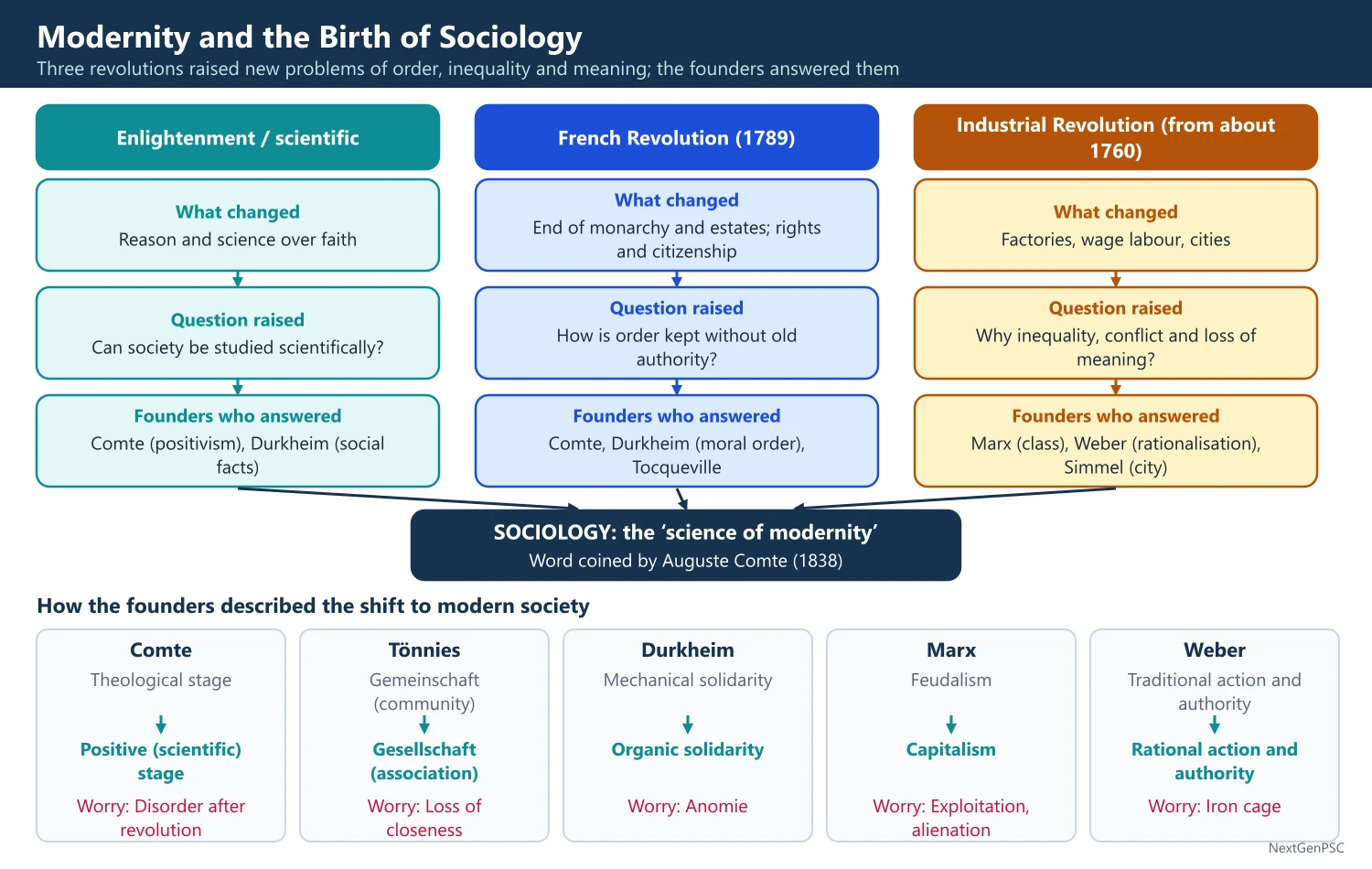
Sociology was born in nineteenth-century Europe as an attempt to understand the upheavals of modernity: the Enlightenment, the French Revolution (1789) and the Industrial Revolution. Auguste Comte coined the word ‘sociology’, and Marx, Durkheim and Weber each explained the new society through capitalism, the division of labour and rationalisation. In India, sociology grew in the colonial context and later asked whether modernity takes a single Western form.
In simple words
Modernity is the kind of society that came with factories, cities, science, democracy and the decline of rule by kings and priests.
Imagine a quiet village where everyone knows everyone, suddenly turned into a crowded factory town of strangers; people needed a new science to make sense of it.
Sociology was that new science, and its founders were all trying to explain this change.
UPSC asks why sociology arose when it did and how the three revolutions shaped its key questions.
1. Concepts and Definitions
Modernity: the social order that emerged in Europe from roughly the seventeenth and eighteenth centuries, marked by industrial capitalism, the nation-state, science, secular thought, urban life and individualism; Anthony Giddens (The Consequences of Modernity, 1990) describes it as institutions and modes of behaviour first established in post-feudal Europe.
Tradition: a social order based on custom, religion, kinship and inherited status, in which change is slow and authority is sacred.
Enlightenment: the eighteenth-century intellectual movement (Voltaire, Rousseau, Montesquieu, Diderot, Kant) that put reason, science and human progress above faith and custom.
Social change: alteration over time in social structure, institutions and patterns of relationship; modernity is the classic case that sociology was created to study.
Sociology (the word): coined by Auguste Comte; he used it in the fourth volume of his Course of Positive Philosophy (1838), having earlier called the field ‘social physics’.
2. The Three Revolutions and Their Questions
Intellectual revolution (Enlightenment and science): the success of natural science suggested that society too could be studied by observation and reason; this gave sociology its scientific ambition (Comte’s positivism).
Political revolution (French Revolution, 1789): the overthrow of monarchy, aristocracy and Church privilege raised questions of order, authority, rights and citizenship; conservatives such as Louis de Bonald and Joseph de Maistre feared disorder.
Economic revolution (Industrial Revolution, from about 1760 in Britain): factories, wage labour, urban slums, child labour and new classes raised questions of inequality, class conflict and the meaning of work.
Robert Nisbet (The Sociological Tradition, 1966): argued that sociology grew out of the ‘two revolutions’, industrial and democratic, and that its ‘unit ideas’ were community, authority, status, the sacred and alienation.
Irving Zeitlin (Ideology and the Development of Sociological Theory, 1968): argued that sociology was shaped by a debate with the Enlightenment, especially by the conservative reaction that stressed community, religion and hierarchy.
Urbanisation and new problems: rapid growth of cities such as Manchester produced poverty, crime and disease, which Friedrich Engels described in The Condition of the Working Class in England (1845).
Colonial expansion: contact with non-European societies supplied comparative material, but also produced evolutionary schemes that ranked societies with Europe at the top; this bias was later criticised.
3. How the Founders Explained Modernity
Auguste Comte: the law of three stages (theological, metaphysical, positive); modern society would be guided by positive science, and sociology would be the ‘queen’ of the sciences that restores order after revolution.
Herbert Spencer: society evolves like an organism from simple to complex and from militant to industrial types; he applied ‘survival of the fittest’ (his phrase, in Principles of Biology, 1864) to society, later criticised as social Darwinism.
Karl Marx: modernity is capitalism; the bourgeoisie revolutionised production, but at the cost of exploitation, alienation and class struggle that would end in socialism.
Emile Durkheim: modernity is the shift from mechanical to organic solidarity through the division of labour; its danger is anomie, a lack of moral regulation (The Division of Labour in Society, 1893).
Max Weber: modernity is rationalisation, the spread of calculation, bureaucracy and science, which brings efficiency but also ‘disenchantment of the world’ and the ‘iron cage’.
Ferdinand Tönnies (Gemeinschaft und Gesellschaft, 1887): community based on kinship and closeness gives way to association based on contract and self-interest.
Georg Simmel (The Metropolis and Mental Life, 1903): city life produces a blasé, calculating attitude and the money economy makes relations impersonal.
4. Later Debates on Modernity
Late or reflexive modernity: Giddens and Ulrich Beck (Risk Society, 1986) argue that modernity has become reflexive and produces manufactured risks such as climate change.
Postmodernity: Jean-François Lyotard (The Postmodern Condition, 1979) described ‘incredulity toward metanarratives’, doubting grand stories of progress; whether we live in postmodernity is debated.
Multiple modernities: S.N. Eisenstadt (2000) argued that modernity takes different cultural forms in different societies, rather than one Western model.
Critique of Eurocentrism: scholars such as Edward Said (Orientalism, 1978) showed how Western knowledge constructed the East as backward; sociology’s origin story is now told with this caution.
5. Indian Examples and Context
Colonial modernity: in India modern institutions (railways from 1853, English education after Macaulay’s Minute of 1835, courts, census from 1872 and the first synchronous census of 1881) came through colonial rule, so modernity arrived with domination.
Social reform: reformers such as Raja Ram Mohan Roy, Jyotirao Phule and Ishwar Chandra Vidyasagar used reason and rights, Enlightenment ideas, to oppose sati, caste and the ban on widow remarriage.
Birth of Indian sociology: the University of Bombay set up a department of sociology in 1919 under Patrick Geddes, with G.S. Ghurye as a leading figure from 1924; Lucknow (Radhakamal Mukerjee, D.P. Mukerji) followed in the 1920s.
Yogendra Singh (Modernization of Indian Tradition, 1973): showed that Indian tradition was modernised selectively, with old and new coexisting rather than tradition simply disappearing.
Milton Singer (When a Great Tradition Modernizes, 1972): found that Madras industrialists combined modern business with traditional ritual, through ‘compartmentalisation’.
D.P. Mukerji: urged that Indian sociologists first understand Indian tradition before applying Western concepts, an early call for an Indian sociology.
Today: India shows modernity alongside tradition, for example caste matrimonial websites, digital payments in temples, and gig work in cities with strong village ties.
6. Linking Thinkers
Comte to Durkheim: both sought order after revolution and treated society as a reality of its own; Durkheim made Comte’s programme empirical.
Marx and Weber on capitalism: Marx saw material forces as driving modernity, Weber added the role of ideas (Protestant ethic) and rationalisation.
Tönnies, Durkheim and Redfield: Tönnies’ Gemeinschaft and Gesellschaft, Durkheim’s mechanical and organic solidarity and Redfield’s folk-urban continuum all describe the move from small community to large society.
Modernity and India’s perspectives: Ghurye’s Indology, Srinivas’s westernisation and Desai’s Marxist view of nationalism are three answers to how modernity entered India.
7. Using it in the Exam
10 marks: define modernity, name the three revolutions in one line each, and link each to one founder.
15 marks: add Nisbet’s unit ideas or Zeitlin’s conservative reaction and an Indian point (colonial modernity).
20 marks: three revolutions → questions they raised → founders’ answers (Comte, Marx, Durkheim, Weber) → later debates (multiple modernities, postmodernity) → Indian context → conclusion that sociology is the ‘science of modernity’.
Flow chart idea: Enlightenment + French Revolution + Industrial Revolution → new problems (order, inequality, meaning) → founders (Comte, Marx, Durkheim, Weber) → sociology.
Thinkers examiners look for: Comte, Marx, Durkheim, Weber, Nisbet, Zeitlin, Giddens, and for India Yogendra Singh and Srinivas.
Useful definition: Giddens describes modernity as the modes of social life and organisation that emerged in Europe from about the seventeenth century and became worldwide in their influence (paraphrase).
| Revolution | What changed | Question for sociology | Founder who answered |
|---|---|---|---|
| Enlightenment / scientific | Reason and science over faith | Can society be studied scientifically? | Comte (positivism), Durkheim (social facts) |
| French Revolution (1789) | End of monarchy and estates; rights and citizenship | How is order kept without old authority? | Comte, Durkheim (moral order), Tocqueville |
| Industrial Revolution (from about 1760) | Factories, wage labour, cities | Why inequality, conflict and loss of meaning? | Marx (class), Weber (rationalisation), Simmel (city) |
| Thinker | From | To | Main worry |
|---|---|---|---|
| Comte | Theological stage | Positive (scientific) stage | Disorder after revolution |
| Tönnies | Gemeinschaft (community) | Gesellschaft (association) | Loss of closeness |
| Durkheim | Mechanical solidarity | Organic solidarity | Anomie |
| Marx | Feudalism | Capitalism | Exploitation and alienation |
| Weber | Traditional action and authority | Rational action and legal-rational authority | Iron cage, disenchantment |
Mains points
- Typical angle: ‘Sociology is a child of the Industrial and French Revolutions’ or ‘the Enlightenment shaped sociology’; cover all three revolutions and show which question each raised.
- Show how each founder (Comte, Marx, Durkheim, Weber) answered the crisis of modernity in his own terms.
- Bring in Nisbet’s unit ideas and Zeitlin’s conservative reaction thesis for depth.
- Add the Indian context: colonial modernity, social reform, and the start of sociology at Bombay (1919) and Lucknow.
- Mention later debates (multiple modernities, postmodernity, reflexive modernity) as debated, not settled.
- Common mistake: treating sociology’s rise as only intellectual history; link it to real social change such as urbanisation and factory labour.
Did you know?
- Comte first called the new science ‘social physics’ and switched to ‘sociology’ partly because the Belgian statistician Adolphe Quetelet had used ‘social physics’ for his own statistical work.
- Memory trick: ‘E-F-I’ — Enlightenment, French, Industrial — the three parents of sociology.
Scope of Sociology and Comparison with Other Social Sciences
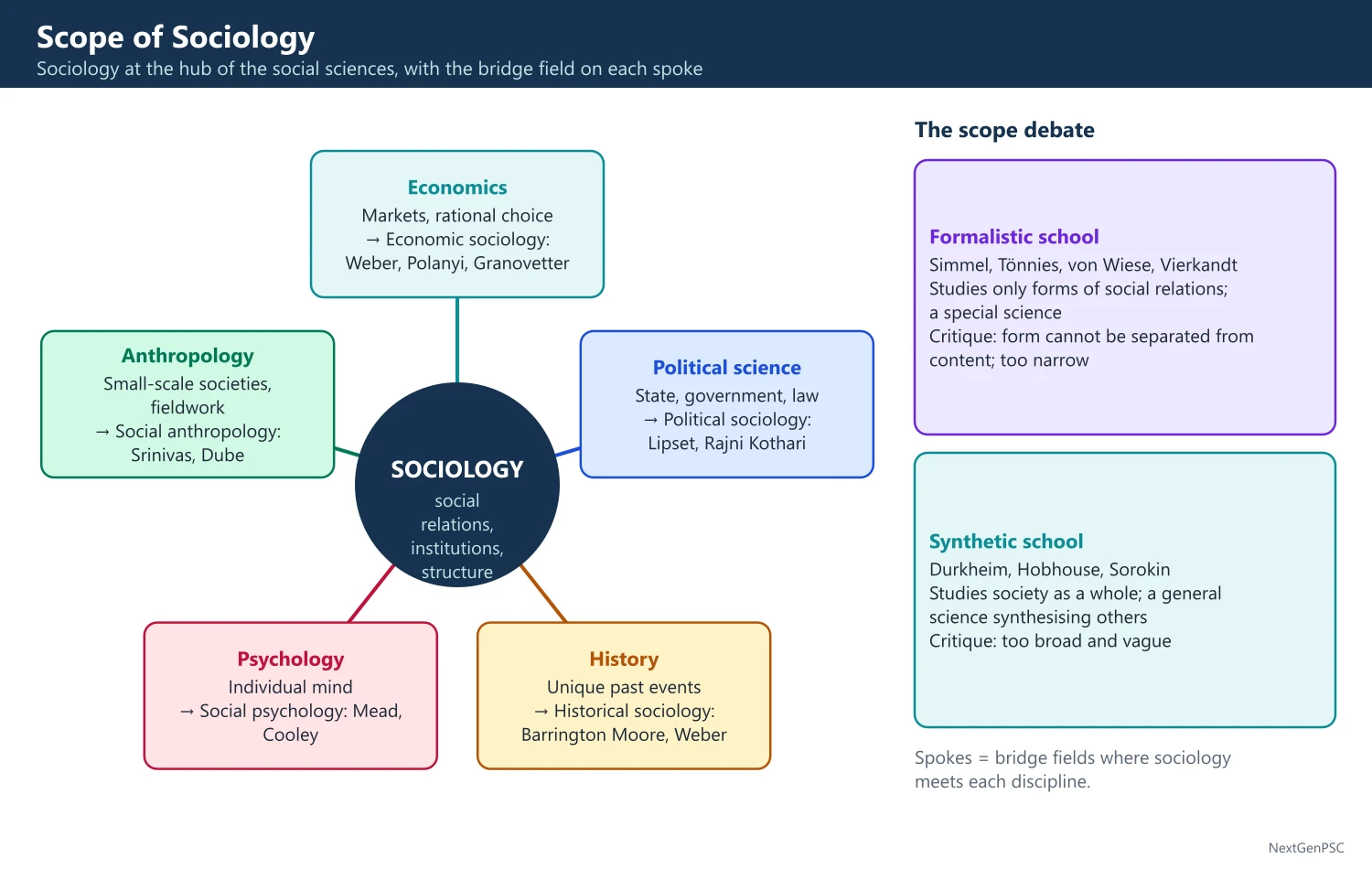
The scope debate asks what sociology studies: the formalistic school (Simmel, Tönnies, von Wiese, Vierkandt) limits it to forms of social relations, while the synthetic school (Durkheim, Hobhouse, Sorokin) treats it as the general science of society linking all social sciences. Sociology overlaps with economics, political science, history, psychology and anthropology but differs in its focus on social relations, institutions and structure as a whole.
In simple words
The scope of sociology means the range of things it studies, from family and caste to religion, politics and work.
Think of a city: the economist looks at its markets, the political scientist at its government, the historian at its past, and the sociologist at how all its people relate and why.
Knowing this boundary tells you what makes an answer ‘sociological’ rather than economic or political.
UPSC asks about the scope debate and how sociology compares with neighbouring subjects.
1. Concepts and Definitions
Sociology: the systematic study of social relations, groups, institutions and societies; Max Weber defined it as a science that seeks the interpretive understanding of social action in order to arrive at a causal explanation of its course and effects (Economy and Society, 1922, paraphrase).
Durkheim’s definition: sociology is the science of social facts, ways of acting, thinking and feeling external to the individual and exercising constraint (The Rules of Sociological Method, 1895).
Scope: the subject matter and boundaries of a discipline; for sociology the debate is whether it has a special field or is a general science of society.
Social sciences: disciplines that study human society, such as economics, political science, history, psychology, anthropology and geography; sociology is one of them.
2. The Formalistic (Specialistic) School
Main idea: sociology should study the forms of social relationships (cooperation, competition, conflict, superiority, subordination) apart from their content, so that it has a field of its own.
Georg Simmel: compared sociology to geometry, which studies the forms of objects rather than their material; forms such as the dyad and triad, or the stranger, appear in many contents.
Ferdinand Tönnies: distinguished forms of social life, Gemeinschaft and Gesellschaft.
Leopold von Wiese and Alfred Vierkandt: von Wiese classified forms of social processes (association and dissociation); Vierkandt studied the ultimate forms of mental relations that bind people.
Max Weber’s link: Weber limited sociology to the study of social action and its types, so he is sometimes placed close to this school, though his work was historical and wide-ranging.
Criticism: Pitirim Sorokin and others said forms cannot be separated from content; other sciences also study forms (law studies forms of relations); the field becomes too narrow and abstract.
3. The Synthetic School
Main idea: sociology is the general science of society that studies society as a whole and synthesises the findings of special social sciences.
Emile Durkheim: divided sociology into social morphology (size, density, distribution of population), social physiology (religion, law, economy, morals as separate branches) and general sociology (general laws).
L.T. Hobhouse: saw sociology as a synthesis whose field is the whole of social life, linked to all special social sciences.
Pitirim Sorokin: sociology studies the relations between different classes of social phenomena (for example economic and religious), the common characteristics of all of them and their relation to non-social phenomena.
Criticism: a ‘science of everything’ may become vague; it risks overlapping with every other discipline.
Present view: most sociologists accept both: sociology has its own perspective (social relations and structure) and also synthesises findings, so the debate is largely settled in a combined position.
4. Comparison with Other Social Sciences
Economics: studies production, distribution and consumption assuming rational individuals; sociology studies how economic action is embedded in social relations; Mark Granovetter (1985) on embeddedness and Karl Polanyi (The Great Transformation, 1944) on the market as embedded in society.
Economics, Indian example: caste networks shape business (Marwari and Gujarati trading communities), dowry affects household budgets, and jati-based labour markets limit occupational choice; these are sociological facts about the economy.
Political science: traditionally studies the state, government and constitutions; political sociology studies the social bases of power, parties, voting and movements, for example S.M. Lipset (Political Man, 1960).
Political science, Indian example: Rajni Kothari (Caste in Indian Politics, 1970) showed how caste is politicised and politics is ‘casteised’, a sociological reading of democracy.
History: studies particular past events in their uniqueness (idiographic); sociology seeks general patterns (nomothetic); historical sociology combines them, for example Barrington Moore (Social Origins of Dictatorship and Democracy, 1966) and Weber’s comparative studies.
Psychology: studies individual mind and behaviour; sociology studies group-level patterns; Durkheim’s Suicide (1897) argued that suicide rates are social facts not explained by individual psychology; social psychology (Mead, Cooley) bridges the two.
Anthropology: historically studied small, ‘simple’ or non-Western societies through fieldwork; sociology studied complex, modern societies through surveys; in India the two merged, since Srinivas, Dube and others used anthropological fieldwork on Indian villages.
Geography and demography: sociology uses spatial and population data (Census, NFHS) but asks how social structure shapes them, for example how son preference affects the child sex ratio (918 girls per 1,000 boys aged 0–6 in Census 2011).
5. Indian Examples
Scope in India: Indian sociology studies caste, tribe, village, family, religion and their change, and draws on history (Ghurye’s Indology), anthropology (village studies) and economics (agrarian structure, Daniel Thorner).
Interdisciplinary work: M.N. Srinivas’s dominant caste combined economic (land), political (numbers, power) and ritual (rank) dimensions; Béteille’s Sripuram study analysed caste, class and power together.
Public policy: sociologists contribute to welfare policy, for example on reservation, tribal displacement and gender; the Mandal Commission (1980) used social and educational indicators to identify backward classes.
Sociology and law: legal scholars study statutes, while sociologists study how laws work in practice; for example the gap between the Dowry Prohibition Act 1961 and the continued practice of dowry is a sociological question.
Sociology and psychology in India: student suicides in coaching hubs such as Kota are often explained by individual stress, but a sociological reading looks at family expectations, competition and the coaching economy.
Expanding scope today: new fields such as the sociology of digital media, environment, health, sport and caste in the diaspora show that sociology’s scope grows as society changes.
6. Specialisation versus Synthesis Today
Sub-fields: modern sociology has many special branches (sociology of religion, kinship, education, work, gender, urban and rural sociology), which reflects the formalistic wish for focus.
Integration: at the same time grand theorists such as Parsons (general theory of action) and Giddens (structuration theory) sought a unified view of society, which reflects the synthetic ideal.
7. Linking Thinkers
Simmel and Weber: both stressed micro-level interaction and meaning, unlike Durkheim’s structural view; this anticipates the later split between micro and macro sociology.
Durkheim and Comte: Comte made sociology the ‘queen of sciences’; Durkheim’s synthetic view continues this but demands a precise method.
Economic sociology: Weber’s Economy and Society and the Protestant ethic thesis show that sociology studies the economy as a social institution.
8. Using it in the Exam
10 marks: define scope; state formalistic versus synthetic schools with two names each; conclude with the combined view.
15 marks: compare sociology with one or two social sciences, each with a thinker and an Indian example.
20 marks: definitions → formalistic school (Simmel, Tönnies, von Wiese) with critique → synthetic school (Durkheim, Hobhouse, Sorokin) with critique → comparison table with other social sciences → Indian interdisciplinary examples → conclusion.
Diagram idea: sociology at the centre of a wheel with economics, political science, history, psychology and anthropology as spokes, each labelled with its bridging field (economic sociology, political sociology, historical sociology, social psychology, social anthropology).
Useful quotation idea: Simmel compared sociology to geometry, which studies forms abstracted from content (paraphrase).
| Point | Formalistic school | Synthetic school |
|---|---|---|
| Main thinkers | Simmel, Tönnies, von Wiese, Vierkandt | Durkheim, Hobhouse, Sorokin |
| Subject matter | Forms of social relations | Society as a whole |
| Status of sociology | A special science with its own field | A general science synthesising others |
| Main criticism | Form cannot be separated from content; too narrow | Too broad and vague |
| Discipline | Its focus | Sociology adds | Bridge field and example |
|---|---|---|---|
| Economics | Markets, rational choice | Social embedding of economic action | Economic sociology: Weber, Polanyi, Granovetter |
| Political science | State, government, law | Social bases of power | Political sociology: Lipset, Rajni Kothari |
| History | Unique past events | General patterns | Historical sociology: Barrington Moore, Weber |
| Psychology | Individual mind | Group patterns, social facts | Social psychology: Mead, Cooley |
| Anthropology | Small-scale societies, fieldwork | Complex societies, surveys | Social anthropology: Srinivas, Dube |
Mains points
- Typical angle: ‘Discuss the scope of sociology’ or ‘Is sociology a general or a special science?’; present both schools with critiques and conclude with the combined view.
- For comparison questions, pick clear points (subject matter, method, level of analysis) rather than vague statements.
- Use Durkheim’s Suicide to show sociology versus psychology, and Granovetter or Polanyi for sociology versus economics.
- In India, show the merger of sociology and social anthropology through village studies (Srinivas, Dube).
- Add an interdisciplinary Indian example such as dominant caste or Rajni Kothari’s caste and politics.
- Common mistake: listing differences only; examiners also want overlaps and bridging fields.
Did you know?
- Simmel compared sociology to geometry: a ball and a globe differ in material but share one form, just as conflict looks alike in a family and a nation.
- Memory trick: formalistic school = ‘S-T-V-V’ (Simmel, Tönnies, Vierkandt, von Wiese); synthetic school = ‘D-H-S’ (Durkheim, Hobhouse, Sorokin).
Sociology and Common Sense
Common sense is the taken-for-granted, everyday knowledge people use to make sense of the world; it is practical but often local, unexamined and contradictory. Sociology differs by being systematic, empirical, comparative and self-critical, yet it also starts from and studies common sense; thinkers from Durkheim and Mills to Berger, Bourdieu, Garfinkel and André Béteille have debated this relationship.
In simple words
Common sense is what ‘everybody knows’, such as ‘poor people are poor because they are lazy’ or ‘joint families have disappeared’.
It is like guessing the weather from a sore knee: sometimes right, but never tested.
Sociology checks such beliefs with evidence and often finds they are wrong or only partly true.
UPSC asks how sociology differs from common sense and whether it is just ‘common sense in big words’.
1. Concepts and Definitions
Common sense: everyday, practical knowledge that people take for granted, learned through socialisation and experience rather than systematic study.
Features of common sense: it is unreflective (not questioned), particular (based on one’s own group), often contradictory (‘birds of a feather flock together’ versus ‘opposites attract’), and tends to ‘naturalise’ social arrangements as if they could not be otherwise.
Sociological knowledge: knowledge produced by systematic methods, concepts and theory, open to testing, comparison and criticism.
Sociological imagination (C. Wright Mills, 1959): the quality of mind that connects personal troubles to public issues and biography to history; unemployment of one person is a trouble, mass unemployment is an issue.
Debunking (Peter Berger, Invitation to Sociology, 1963): sociology looks beyond official and everyday explanations; Berger wrote that the first wisdom of sociology is that things are not what they seem (paraphrase).
2. How Sociology Differs from Common Sense
Systematic method: sociology uses sampling, surveys, fieldwork and statistics; common sense relies on anecdotes and personal experience.
Conceptual vocabulary: terms such as status, role, anomie and stratification give precision that ordinary words lack.
Comparative view: sociology compares across societies and history, showing that what seems ‘natural’ in one place is social and variable.
Generality and theory: sociology seeks patterns and causes, not one-off impressions.
Self-criticism: findings are open to replication and challenge; common sense rarely questions itself.
Durkheim’s rule: in The Rules of Sociological Method (1895) he asked sociologists to discard ‘prenotions’ (everyday preconceptions) and treat social facts as things.
Bourdieu’s ‘epistemological break’: Pierre Bourdieu, with Chamboredon and Passeron (The Craft of Sociology, 1968), argued that sociology must break with spontaneous sociology and ordinary language before it can build scientific objects.
3. The Other Side: Sociology Builds on and Studies Common Sense
Common sense as a topic: Alfred Schutz (The Phenomenology of the Social World, 1932) showed that everyday life rests on ‘stocks of knowledge’ and typifications; sociology must understand these first-order meanings.
Ethnomethodology: Harold Garfinkel (Studies in Ethnomethodology, 1967) studied the methods people use to make everyday sense; his breaching experiments (for example students behaving like lodgers at home) revealed hidden rules.
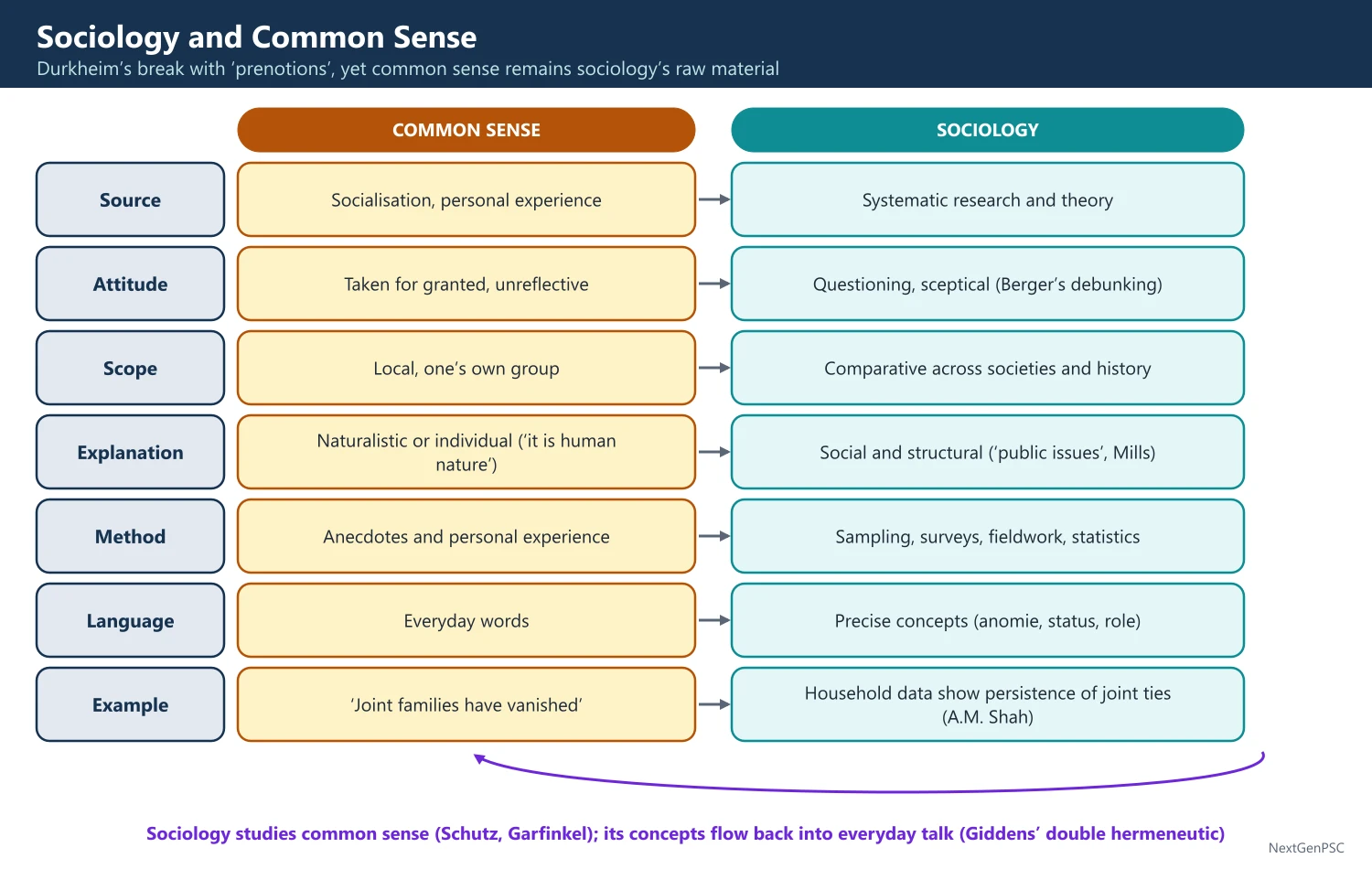
Double hermeneutic: Giddens (New Rules of Sociological Method, 1976) noted that sociological concepts enter everyday language and change the society they describe, so the line between expert and lay knowledge moves.
Gramsci: distinguished ‘common sense’, a fragmentary, inherited view shaped by ruling ideas, from ‘good sense’, its critical core; common sense can carry hegemony.
Not always wrong: some sociological findings confirm common sense; their value lies in showing how much, for whom and why.
Lazarsfeld’s lesson: Paul Lazarsfeld (1949), reviewing The American Soldier, listed ‘obvious’ findings, then revealed that the true findings were the opposite, showing that anything can look obvious after the fact.
4. Indian Examples and Studies
André Béteille (‘Sociology and Common Sense’, Economic and Political Weekly, 1996): argued that sociology differs from common sense through its comparative method and systematic use of evidence, and that common sense is often bound to one’s own community and its moral judgements.
Joint family myth: common sense holds that India once had mostly joint families that are now disappearing; A.M. Shah’s household studies showed that small households were always common and that joint family ties persist in new forms.
Caste and modernity: common sense expected caste to vanish with urbanisation; sociologists (Srinivas, Béteille, Dipankar Gupta) showed caste changing form, as in politics, matrimony and networks.
Poverty and laziness: common sense blames the poor; sociology points to structure, such as landlessness, caste exclusion and informal work (the Economic Survey 2018–19 estimated that about 93 percent of India’s workforce was informal).
Sex ratio: common sense might expect education and wealth to remove son preference; data show that some prosperous states had the lowest child sex ratios in Census 2011 (Haryana 834 and Punjab 846 girls per 1,000 boys aged 0–6).
NCERT Class XI: the textbook uses examples such as these to show how sociology questions ‘naturalistic’ and ‘individualistic’ explanations.
Dowry and ‘tradition’: common sense calls dowry an ancient custom; sociologists such as M.N. Srinivas argued that modern dowry spread with new forms of wealth and status competition, including among castes that earlier practised bride-price.
Gopal Guru’s challenge: Gopal Guru argued that Indian social science has a division between ‘theoretical Brahmins’ and ‘empirical Shudras’, showing that even expert knowledge can carry the common sense of dominant groups.
Rural-urban stereotypes: common sense treats villages as unchanging and cities as fully modern; village studies from Rampura to Kishan Garhi showed villages linked to markets, politics and wider civilisation.
5. Why the Distinction Matters
For policy: policies built on common-sense assumptions (for example that poverty is caused by ignorance) fail; evidence-based sociology helps design schemes.
For democracy: sociology can expose prejudice, such as stereotypes about tribes or Muslims, that common sense spreads; this is why it is sometimes resisted.
For the sociologist: Mills warned that sociology can itself become ‘grand theory’ or ‘abstracted empiricism’ and lose touch with real lives, so it too must be self-critical.
Limits of sociology: sociological findings are probabilistic, not laws; humility about this keeps sociology from becoming a new dogma replacing common sense.
Reflexivity: Alvin Gouldner (The Coming Crisis of Western Sociology, 1970) called for a ‘reflexive sociology’ that examines the sociologist’s own assumptions.
6. Linking Thinkers
Positivists versus interpretivists: Durkheim and Bourdieu stress a break with common sense; Schutz, Garfinkel and Weber’s verstehen stress understanding common-sense meanings.
Mills and Marx: the sociological imagination echoes Marx’s view that individual lives are shaped by historical structures.
Berger and Luckmann (The Social Construction of Reality, 1966): everyday reality is socially constructed and then experienced as objective; sociology reveals this process.
7. Using it in the Exam
10 marks: define common sense, give three differences with sociology, one Indian example, and note that sociology also studies common sense.
15 marks: add Mills, Berger and Béteille, plus the ethnomethodological view.
20 marks: definitions → differences (method, concepts, comparison, theory) → Durkheim’s prenotions and Bourdieu’s break → the other side (Schutz, Garfinkel, Giddens’ double hermeneutic) → Indian examples (joint family, caste, sex ratio) → conclusion: sociology is ‘organised common sense made critical’, neither identical to nor opposed to it.
Diagram idea: two columns, common sense (unreflective, local, anecdotal, naturalising) versus sociology (reflective, comparative, systematic, historical), with an arrow ‘sociology studies common sense’ looping back.
Useful quotation: Mills described the sociological imagination as enabling us to grasp history and biography and the relations between the two within society (paraphrase of The Sociological Imagination, 1959).
| Point | Common sense | Sociology |
|---|---|---|
| Source | Socialisation, personal experience | Systematic research and theory |
| Attitude | Taken for granted | Questioning, sceptical (Berger’s debunking) |
| Scope | Local, one’s own group | Comparative across societies and history |
| Explanation | Naturalistic or individual (‘it is human nature’) | Social and structural (‘public issues’, Mills) |
| Language | Everyday words | Precise concepts (anomie, status, role) |
| Example | ‘Joint families have vanished’ | Household data show persistence of joint ties (A.M. Shah) |
Mains points
- Typical angle: ‘Sociology is nothing but common sense’ — comment; present both the break thesis (Durkheim, Bourdieu) and the continuity thesis (Schutz, Garfinkel, Giddens).
- Use Mills’ personal troubles and public issues and Berger’s debunking as core concepts.
- Cite Béteille’s 1996 essay for an Indian sociologist’s view.
- Give Indian examples where data overturned common sense: joint family, caste and urbanisation, sex ratio and prosperity.
- Mention Lazarsfeld’s ‘obvious findings’ exercise to show hindsight bias.
- Conclude in a balanced way: sociology starts from common sense, tests it, and returns refined knowledge to society.
Did you know?
- Lazarsfeld told readers that better-educated soldiers adjusted worse to army life, which sounds obvious; the real finding was the opposite, and that sounded obvious too.
- Memory trick: ‘M-B-B’ — Mills (imagination), Berger (debunking), Bourdieu (break) — the three big names for this topic, plus Béteille for India.
UPSC Previous Year Questions: Sociology: The Discipline
From 2014 to 2026 UPSC asked 28 question parts (360 marks) from this chapter in Paper I: 20 of 10 marks and 8 of 20 marks. The most-asked topic is modernity and the emergence of sociology (12 parts, especially the Enlightenment and the historical antecedents), followed by the scope of sociology and its relation with other social sciences (10 parts) and sociology and common sense (6 parts). Every question below has a model answer written to the UPSC word limit.
In simple words
Read the question and its directive word, then write your own answer in 7 minutes for 10 marks or 11 minutes for 20 marks before looking below.
Compare your answer with the model answer: did you define the key term with its thinker, give the argument, a criticism and an Indian example, and end with a balanced conclusion?
Note what you missed in a notebook and revise the matching study topic in this chapter; repeat after a week.
1. Modernity, Social Change in Europe and the Emergence of Sociology
Example 1 (UPSC 2026, 20 marks): Discuss the intellectual origins of sociology and the historical antecedents of its evolution as a distinct field of study.
Paper and question: Paper I, Q6(a)
Approach: Separate the two demands: intellectual origins (ideas: scientific revolution, Enlightenment, conservative reaction, positivism) and historical antecedents (events: French and Industrial Revolutions, urbanisation, colonialism); use Nisbet and Zeitlin, then show the founders' responses and an Indian parallel.
Sociology emerged in nineteenth-century Europe as an attempt to understand the new social order of modernity. Auguste Comte coined the word in his Course of Positive Philosophy (1838), but its roots lie in a long chain of ideas and events. Robert Nisbet (The Sociological Tradition, 1966) traced it to the 'two revolutions', industrial and democratic.
Intellectual origins: the scientific revolution of Galileo and Newton showed that nature follows laws discoverable by observation. Enlightenment thinkers such as Montesquieu, Voltaire and Rousseau applied reason to law, government and inequality, and Comte's positivism turned this into a science of society. Irving Zeitlin (1968) added that the conservative reaction of de Bonald and de Maistre, with its stress on community, religion and authority, gave sociology its concern with order.
Historical antecedents: the French Revolution of 1789 destroyed the old regime and raised questions of authority and citizenship. The Industrial Revolution created factories, wage labour, slums and new classes, which Engels described in Manchester (1845). Urbanisation, the decline of Church authority and colonial contact supplied new problems and comparative material.
Flow chart: Scientific revolution → Enlightenment reason → French and Industrial Revolutions → crisis of order and new inequality → Comte, Marx, Durkheim, Weber → sociology as a discipline
The founders answered these changes differently: Marx saw capitalism and class struggle, Durkheim the division of labour and anomie, Weber rationalisation and the iron cage. Durkheim's journal L'Année sociologique (1898) gave the subject an institutional base.
In India, colonial modernity (railways, English education, the census) raised questions about caste and tradition, and sociology was institutionalised at Bombay in 1919, where G.S. Ghurye later led the department.
Thus sociology was born of ideas and events together; its European birth also gave it a Eurocentric bias that later critics have corrected.
Example 2 (UPSC 2024, 20 marks): Sociology is the product of European enlightenment and renaissance. Critically examine this statement.
Paper and question: Paper I, Q2(a)
Approach: Critically examine: accept the Enlightenment and Renaissance roots (reason, humanism, science), then qualify the claim with the Industrial and French Revolutions, the conservative reaction, and non-European and Indian critiques.
The statement holds that sociology grew out of two European intellectual movements: the Renaissance (fourteenth to sixteenth centuries), which revived humanism and placed human beings at the centre of enquiry, and the Enlightenment (eighteenth century), which put reason, science and progress above faith and custom.
Support for the statement: the Renaissance and the scientific revolution weakened the Church's monopoly over knowledge and encouraged observation. Enlightenment thinkers such as Montesquieu compared societies and their laws, and Condorcet believed in human progress through reason. Comte's positivism and his law of three stages, ending in the positive stage, carried these ideas into the study of society.
Limits of the statement: ideas alone did not create sociology. Robert Nisbet (1966) linked it to the industrial and democratic revolutions, which produced factory labour, urban poverty and a crisis of authority. Irving Zeitlin (1968) argued that sociology was shaped as much by the conservative reaction against the Enlightenment, by de Bonald and de Maistre, who stressed community, religion and hierarchy; Durkheim's concern with solidarity reflects this.
Other critiques: sociology's origin story is Eurocentric. Ibn Khaldun's fourteenth-century study of group solidarity (asabiyyah) anticipated sociological reasoning, and Edward Said (Orientalism, 1978) showed how Western knowledge cast the East as backward.
Indian context: Indian sociology owes as much to colonial rule and social reform as to the Enlightenment. Reformers such as Raja Ram Mohan Roy and Jyotirao Phule used reason and rights against sati and caste, while Ghurye drew on Indology and D.P. Mukerji insisted on understanding Indian tradition.
Hence the statement is partly true: the Enlightenment and Renaissance gave sociology its method and spirit, but the social upheavals of industrial capitalism and political revolution gave it its problems.
Example 3 (UPSC 2022, 20 marks): What aspects of 'Enlightenment' do you think paved way for the emergence of sociology? Elaborate.
Paper and question: Paper I, Q2(a)
Approach: Elaborate the specific Enlightenment ideas (reason, empiricism, progress, secularism, natural law, individual rights, critique of tradition) and show how each entered sociology through Comte, Durkheim, Marx and Weber, with the conservative counter-current and an Indian example.
The Enlightenment was the eighteenth-century movement of thinkers such as Voltaire, Montesquieu, Rousseau, Diderot and Kant, who held that human reason, not tradition or revelation, should guide knowledge and social life. Several of its ideas prepared the ground for sociology.
Reason and empiricism: the belief that the world can be understood by observation and reasoning encouraged the idea that society, like nature, follows laws. Comte's positivism and Durkheim's rule to treat social facts as things express this.
Society as human-made: Montesquieu's The Spirit of the Laws (1748) related laws to climate, religion and customs, and Rousseau's social contract treated institutions as products of human agreement. If society is made by people, it can be studied and changed.
Idea of progress: Condorcet and Turgot saw history as advancing through stages, which shaped Comte's law of three stages, Spencer's evolution and Marx's succession of modes of production.
Critique of tradition and religion: secular questioning of Church and monarchy made religion an object of study; Durkheim's and Weber's sociology of religion follow from this. Individual rights and equality raised the problem of inequality that Marx and later stratification theory took up.
Flow chart: Reason + empiricism + progress + secularism → society seen as law-governed and changeable → positivism (Comte) → scientific sociology
At the same time the conservative reaction against the Enlightenment, stressing community and order (Zeitlin, 1968), also shaped sociology. In India, Enlightenment ideas reached through colonial education and inspired reformers such as Raja Ram Mohan Roy and Ishwar Chandra Vidyasagar, whose reform debates later became subjects of Indian sociology.
Thus the Enlightenment gave sociology its scientific ambition, its secular outlook and its reforming purpose.
Example 4 (UPSC 2021, 10 marks): Europe was the first and the only place where modernity emerged. Comment.
Paper and question: Paper I, Q1(a)
Approach: Comment by first stating the Eurocentric view (Weber, Giddens), then challenging it with Eisenstadt's multiple modernities, Pomeranz, Goody and Indian scholars, ending with a balanced view.
Classical sociology treated modernity as a European invention. Weber asked why rational capitalism arose only in the West, and Giddens (The Consequences of Modernity, 1990) defines modernity as institutions first established in post-feudal Europe.
The claim has some basis: the scientific revolution, the Industrial Revolution, the nation-state and bureaucratic capitalism did first combine in Western Europe.
However, 'first and only' is contested. S.N. Eisenstadt (2000) argued for multiple modernities, as Japan, China and India combined modern institutions with their own cultures. Kenneth Pomeranz (The Great Divergence, 2000) showed that parts of China matched England economically until about 1800, and Jack Goody criticised Europe's 'theft' of others' achievements.
In India, Milton Singer found Madras industrialists running modern firms while keeping joint families and rituals, and Yogendra Singh (1973) showed selective modernisation of tradition. Colonial modernity also arrived with domination.
Hence Europe was an early site of modernity, but not the only one; modernity is plural.
Example 5 (UPSC 2020, 10 marks): How did the intellectual forces lead to the emergence of sociology? Discuss.
Paper and question: Paper I, Q1(a)
Approach: Discuss the intellectual forces only (scientific revolution, Enlightenment, conservative reaction, evolutionary and positivist thought) and show how each fed the founders, with one Indian link.
Sociology emerged from the meeting of several intellectual forces in eighteenth- and nineteenth-century Europe, alongside the industrial and political revolutions.
Scientific revolution: the success of Newtonian science suggested that society too obeys laws, inspiring Comte's 'social physics' and positivism.
Enlightenment: Montesquieu, Rousseau and Condorcet applied reason to society, compared institutions and believed in progress, making society an object of rational study.
Conservative reaction: de Bonald and de Maistre defended religion, family and hierarchy against revolutionary individualism; Irving Zeitlin argued that sociology's concern with order, community and the sacred came from them, as seen in Durkheim.
Evolutionary and economic thought: Spencer applied evolution to society, while political economy (Adam Smith, Ricardo) and German philosophy (Hegel) shaped Marx's historical materialism.
In India, the same Enlightenment ideas, spread through colonial education, encouraged reformers such as Raja Ram Mohan Roy to question caste and sati, preparing ground for Indian sociology.
Thus intellectual forces gave sociology its scientific method and its central questions.
Example 6 (UPSC 2019, 10 marks): Discuss the historical antecedents of the emergence of Sociology as a discipline.
Paper and question: Paper I, Q1(a)
Approach: Discuss the historical antecedents: the three revolutions (intellectual, political, economic), urbanisation and colonialism, with Nisbet, and close with the institutional birth of the discipline and its Indian parallel.
Sociology became a separate discipline in the nineteenth century as a response to the deep changes of European modernity. Robert Nisbet (1966) traced it to the 'two revolutions', industrial and democratic.
Intellectual revolution: the Renaissance, the scientific revolution and the Enlightenment replaced faith with reason and observation, giving Comte the idea of a positive science of society (1838).
Political revolution: the French Revolution of 1789 overthrew monarchy and Church privilege, raising questions of order, authority and citizenship.
Economic revolution: the Industrial Revolution produced factories, wage labour, urban slums and class conflict, which Marx and Engels analysed.
Urbanisation and colonialism: growing cities created anonymity and new social problems, while colonial contact supplied comparative material.
These changes led Durkheim, Weber and Marx to study solidarity, rationalisation and capitalism. In India, colonial rule and reform movements played a similar role, and sociology was set up at Bombay in 1919.
Thus sociology arose as society's attempt to understand its own transformation.
Example 7 (UPSC 2019, 10 marks): How well do you think Tonnies, Durkheim, Weber and Marx predicted the character of modern society? Critique.
Paper and question: Paper I, Q5(e)
Approach: Critique: state each thinker's prediction briefly (Tönnies, Durkheim, Weber, Marx), judge what came true and what did not, and use contemporary and Indian evidence.
The classical thinkers each described the direction of modern society, with mixed success.
Tönnies predicted a shift from Gemeinschaft to Gesellschaft. Impersonal, contract-based relations did spread, but community survives in caste associations, religious networks and online groups.
Durkheim expected organic solidarity based on the division of labour, with anomie as a passing pathology. Specialisation grew, but anomie persists in high suicide rates and the gig economy.
Weber predicted rationalisation and the 'iron cage' of bureaucracy, perhaps the most accurate forecast, as Ritzer's McDonaldization shows. Yet charisma and religion have revived.
Marx predicted class polarisation and proletarian revolution. Inequality and alienation remain, but revolution did not occur in advanced capitalism, and the middle class expanded.
India shows the limits of all four: Srinivas and Yogendra Singh found caste and religion adapting to modern institutions, as in caste-based politics.
Hence they captured the trends of modernity but underestimated its plural and reflexive character.
Example 8 (UPSC 2018, 20 marks): Does collapse of functionalism and bankruptcy of Marxism coincide with the rupture of modernity? Discuss.
Paper and question: Paper I, Q3(a)
Approach: Discuss whether the decline of the two grand theories (functionalism from the 1960s, Marxism after 1989) coincides with a break in modernity, using Lyotard, Giddens, Beck and Habermas; evaluate the premise that they 'collapsed' and add Indian reflections.
Functionalism (Parsons, Merton) and Marxism were the two grand theories of modern society. Both rested on modernity's faith in a single, scientific account of social order or of historical progress. The question asks whether their decline marks a 'rupture' of modernity itself.
Decline of functionalism: from the 1960s critics such as C. Wright Mills, Ralf Dahrendorf and Alvin Gouldner (The Coming Crisis of Western Sociology, 1970) argued that it ignored conflict, power and change. Crisis of Marxism: the collapse of the Soviet Union in 1989–91 weakened faith in its prediction of revolution and a planned economy.
The rupture argument: Jean-François Lyotard (1979) defined the postmodern condition as 'incredulity toward metanarratives', and both functionalism and Marxism are such metanarratives. Their decline, along with globalisation, consumerism and identity politics, thus appears to coincide with the end of modernity.
Counter-argument: Giddens and Ulrich Beck see not a rupture but late or reflexive modernity, a radicalisation of modern institutions. Habermas called modernity 'an unfinished project'. Neither theory has truly collapsed: Jeffrey Alexander developed neofunctionalism, and Marxist ideas survive in world-systems theory (Wallerstein) and critiques of neoliberal inequality.
Indian context: Indian sociology moved from structural-functional village studies (Srinivas, Dube) and Marxist analyses (A.R. Desai) towards subaltern, Dalit and feminist perspectives, yet caste, class and state remain central, suggesting continuity rather than rupture.
Hence the decline of grand theories coincides with a change in modernity, not its end; the decline is a loss of certainty, not bankruptcy, and sociology now combines these traditions with newer approaches.
Example 9 (UPSC 2017, 10 marks): Explain how sociology has emerged as a distinct discipline based on rationality and scientific temper.
Paper and question: Paper I, Q1(a)
Approach: Explain how sociology claimed scientific status: positivism (Comte), social facts and Suicide (Durkheim), value-neutrality and ideal types (Weber), and the methods that followed, with an Indian reference to scientific temper.
Sociology emerged when Enlightenment rationality, the belief that reason and evidence should replace custom and faith, was applied to society.
Comte proposed positivism: society should be studied by observation, experiment and comparison, like the natural sciences, in the 'positive' stage of knowledge.
Durkheim gave the discipline its own subject matter, social facts, to be treated as things (The Rules of Sociological Method, 1895). His Suicide (1897) used statistics to show that suicide rates vary with social integration and regulation.
Weber added rigour through ideal types and value-neutrality, though he stressed interpretive understanding (Verstehen) rather than pure positivism.
Later surveys, sampling and fieldwork made sociology empirical. In India, Nehru's call for scientific temper, now a fundamental duty under Article 51A(h), and the field-based village studies of Srinivas reflect this spirit.
Interpretive and critical sociologists warn that society cannot be studied exactly like nature, yet rational method remains sociology's foundation.
Example 10 (UPSC 2016, 10 marks): "Sociology is pre-eminently study of modern societies." Discuss.
Paper and question: Paper I, Q1(a)
Approach: Discuss: support the statement (origin in modernity, the founders' focus, Giddens' definition), then qualify it (anthropology's overlap, study of tradition, Indian sociology's study of caste and village) and conclude.
The statement reflects the view that sociology was born to explain modern society. Giddens defines sociology as the study of human social life, groups and societies, with its main focus on the modern world.
Support: the founders studied modernity: Marx capitalism, Durkheim the division of labour, Weber rationalisation, Tönnies the move to Gesellschaft. Early on, a division of labour arose in which anthropology studied 'simple' societies and sociology complex, industrial ones through surveys.
Qualifications: sociology also studies tradition, since modernity is understood only in contrast to it. Durkheim's Elementary Forms of Religious Life (1912) used Australian totemism.
Indian sociology studied caste, kinship, village and religion: Ghurye's Indology, Srinivas's Rampura and Dube's Shamirpet merged sociology with anthropology. Yogendra Singh showed tradition and modernity coexisting.
Thus sociology is pre-eminently, but not exclusively, a study of modern societies; it studies modernity in relation to tradition.
Example 11 (UPSC 2015, 10 marks): How had Enlightenment contributed to the emergence of Sociology?
Paper and question: Paper I, Q3(c)
Approach: Show the specific Enlightenment contributions (reason, science, progress, secularism, humanism) and how Comte, Durkheim and Marx used them; add the conservative reaction and an Indian example.
The Enlightenment of the eighteenth century, associated with Voltaire, Montesquieu, Rousseau and Kant, held that reason and science should guide human affairs. It contributed to sociology in several ways.
Scientific method: confidence in observation and reason led Comte to propose positivism, a science of society modelled on natural science.
Society as a human product: Montesquieu related laws to social conditions, and Rousseau saw institutions as created by people, so society could be studied comparatively and reformed.
Idea of progress: Condorcet's faith in progress shaped evolutionary schemes such as Comte's three stages and Marx's stages of history.
Secular critique: questioning religion and inherited status made both into objects of enquiry.
Its opponents also contributed: the conservative reaction stressed order and community, which Durkheim took up. In India, Enlightenment ideas reached reformers such as Raja Ram Mohan Roy through colonial education.
Thus the Enlightenment gave sociology its method and many of its questions.
Example 12 (UPSC 2014, 10 marks): How did the emergence of industrial society change the family life in Western Europe?
Paper and question: Paper I, Q1(b)
Approach: Explain the change in family life with the industrial society debate: Parsons' isolated nuclear family, its revision by Laslett and Anderson, Young and Willmott's stages, and changes in roles; add a brief Indian contrast.
Industrialisation separated work from home and changed the structure and functions of the Western European family.
Structure: Talcott Parsons argued that industry needs a geographically and socially mobile workforce, so the isolated nuclear family replaced extended kin. Peter Laslett, however, showed that small nuclear households were already common in pre-industrial England, and Michael Anderson's study of Preston (1971) found that early industrial workers relied on extended kin for housing and jobs.
Functions: production moved to factories; schools and the state took over education and welfare, leaving the family with socialisation and emotional support.
Roles: the male-breadwinner and female-homemaker model spread; Young and Willmott later traced a move towards the symmetrical family. Child labour gave way to childhood as a protected stage.
In India, Milton Singer found that Madras industrialists kept joint family ties, showing that industrialisation does not have one effect on family.
Thus industrial society reshaped the family, but less uniformly than Parsons claimed.
2. Scope of Sociology and Comparison with Other Social Sciences
Example 13 (UPSC 2026, 10 marks): Although sociology, as a subject of study, overarches all disciplines in social sciences yet it maintains its distinctiveness. Comment.
Paper and question: Paper I, Q1(d)
Approach: Comment on both halves: why sociology appears to overarch the social sciences (Comte, the synthetic school) and what keeps it distinct (its perspective on social relations, the formal school, Mills), with Indian examples.
Sociology studies social relations in every sphere of life, so it touches the subject matter of all social sciences. Comte even called it the 'queen' of the sciences, and the synthetic school (Durkheim, Hobhouse, Sorokin) saw it as a general science of society.
Overarching role: economic, political, legal and religious life are all social, which is why sub-fields such as economic, political and historical sociology exist. Srinivas's dominant caste, for instance, combined land, numbers and ritual rank.
Distinctiveness: sociology does not duplicate other disciplines; it brings its own perspective. Simmel's formal school argued that it studies the forms of interaction, and Durkheim gave it social facts as its subject. Mills' sociological imagination links personal troubles to public issues.
For example, economists may explain farmer distress by prices and credit, while sociologists show how caste, land ownership and kinship shape who suffers.
Thus sociology overlaps all social sciences but remains distinct through its focus on social structure, relations and meaning.
Example 14 (UPSC 2025, 10 marks): What is the relationship (similarities and differences) between sociology and history in terms of their area of study and methodology? Discuss.
Paper and question: Paper I, Q1(b)
Approach: Discuss similarities and differences in area of study (past vs present, unique vs general) and methodology (archives vs surveys and fieldwork), then convergence through historical sociology, with Indian examples.
History studies past events in their particular context; sociology studies social relations and institutions to find general patterns. The two are closely linked.
Similarities: both study human society and social change; both interpret meanings and causes. Weber's comparative studies of religion and capitalism and Marx's historical materialism are both historical and sociological.
Differences in area: history is mainly idiographic, focusing on unique events, persons and periods; sociology is nomothetic, seeking regularities, types and concepts, and focuses more on contemporary society.
Differences in method: historians rely on archives, inscriptions and documents; sociologists use surveys, interviews, participant observation and statistics, though they also use documents.
Convergence: historical sociology (Barrington Moore, 1966) and social history narrow the gap. In India, Ghurye's Indological approach used texts to study caste, Bernard Cohn combined anthropology with colonial archives, and Subaltern Studies wrote history from below.
Thus history supplies depth and sociology supplies generalisation; each needs the other.
Example 15 (UPSC 2025, 10 marks): In what way is the scope of sociology unique? Explain.
Paper and question: Paper I, Q5(a)
Approach: Explain what makes sociology's scope unique: the formalistic versus synthetic debate, its distinctive perspective, its breadth from micro to macro, and its Indian scope.
The scope of sociology means its subject matter and boundaries. Two schools debated it.
Formalistic school: Simmel, Tönnies and von Wiese held that sociology is unique because it studies the forms of social relations, such as cooperation, conflict and domination, which recur in many contents. Critics such as Sorokin said forms cannot be separated from content.
Synthetic school: Durkheim, Hobhouse and Sorokin saw sociology as a general science of society, studying the relations between different social phenomena and synthesising other sciences.
Its uniqueness today lies in combining both: a distinct perspective on social structure and meaning, and a range from micro interaction (Goffman) to macro systems (Parsons, Wallerstein). It also studies modern phenomena such as migration, digital life and the social bases of the economy.
In India, its scope covers caste, tribe, village, family and religion, from Srinivas's Rampura to studies of reservation and urban informal work.
Thus sociology is unique in studying all aspects of social life from the angle of social relations.
Example 16 (UPSC 2024, 10 marks): Discuss the nature of Sociology. Highlight its relationship with Social Anthropology.
Paper and question: Paper I, Q1(a)
Approach: Discuss the nature of sociology briefly (science of society, empirical, theoretical, value-neutral, generalising), then its relationship with social anthropology: similarities, historical differences, and convergence in India.
Nature of sociology: it is a social science that studies social relations, groups and institutions. It is empirical, theoretical and generalising, seeking patterns rather than unique events, and, following Weber, it aims at value-neutrality while interpreting meaning.
Relationship with social anthropology: both study social structure, culture, kinship and institutions. Radcliffe-Brown called social anthropology comparative sociology, and Durkheim's work shaped both.
Historical differences: social anthropology studied small, non-literate, 'simple' societies through long fieldwork and participant observation (Malinowski in the Trobriand Islands); sociology studied complex industrial societies through surveys and statistics.
Convergence: with the end of colonialism, anthropologists turned to complex societies and sociologists adopted fieldwork. In India the distinction almost disappeared: M.N. Srinivas, trained in social anthropology at Oxford, studied Rampura; S.C. Dube studied Shamirpet; and tribal studies by Elwin and village studies are taught as sociology.
Thus sociology and social anthropology are twin disciplines, differing more in history and method than in subject.
Example 17 (UPSC 2023, 10 marks): Discuss the relationship between sociology and political science.
Paper and question: Paper I, Q1(b)
Approach: Discuss similarities, differences and overlap (political sociology) between sociology and political science, using Weber, Michels, Lipset and Indian studies of caste and politics.
Political science studies the state, government, constitutions and power; sociology studies society as a whole, including the social bases of politics.
Differences: traditional political science focused on formal institutions and normative questions of how the state should be organised. Sociology studies informal groups, norms and structures, and explains political behaviour by caste, class, religion and gender.
Overlap: political sociology bridges the two. Weber's types of authority, Michels' iron law of oligarchy and Lipset's Political Man (1960) on the social conditions of democracy are claimed by both disciplines. The behavioural movement made political science more sociological.
Indian examples: Rajni Kothari (Caste in Indian Politics, 1970) showed the politicisation of caste; M.N. Srinivas used the term vote bank; Lokniti-CSDS election studies combine survey sociology with political science.
Thus political science studies the state, sociology the society around it, and the two are best understood together.
Example 18 (UPSC 2022, 10 marks): Delimit the scope of Sociology in relation to other social sciences.
Paper and question: Paper I, Q1(a)
Approach: Delimit the scope through the formalistic and synthetic schools, then mark sociology's boundary with economics, political science, history and psychology through its distinct perspective, with Indian examples.
Delimiting the scope of sociology means fixing what it studies that other social sciences do not.
Formalistic view: Simmel and von Wiese limited sociology to the forms of social relations, such as competition, conflict and subordination, to give it a separate field. This was criticised as too narrow.
Synthetic view: Durkheim and Sorokin saw sociology as a general science studying the relations among social phenomena and the common features of all of them.
Relation to others: economics studies production and markets, but sociology studies their social embeddedness (Granovetter); political science studies the state, sociology its social bases; history studies unique events, sociology general patterns; psychology the individual mind, sociology group behaviour, as Durkheim's Suicide shows.
In India, for example, economists study wages, while sociologists study how caste shapes occupations and marriage markets.
Thus sociology's scope is delimited not by a separate subject matter but by its focus on social relations and structure.
Example 19 (UPSC 2021, 20 marks): From the viewpoint of growing importance of multidisciplinarity, how do you relate sociology to other social sciences?
Paper and question: Paper I, Q2(a)
Approach: Relate sociology to other social sciences in a multidisciplinary frame: why multidisciplinarity has grown, the bridging sub-fields with economics, politics, history, psychology, anthropology and environment, Indian examples and policy (NEP 2020), and the risks.
Multidisciplinarity means studying a problem with the concepts and methods of several disciplines. It has grown because problems such as poverty, migration, climate change and pandemics do not respect disciplinary boundaries. Immanuel Wallerstein's Gulbenkian Commission report Open the Social Sciences (1996) argued that the nineteenth-century division of social sciences had become outdated.
Sociology and economics: economic sociology studies how markets are embedded in social relations (Polanyi, 1944; Granovetter, 1985). In India, caste and kin networks shape trading communities and labour markets.
Sociology and political science: political sociology studies power, parties and voting; Rajni Kothari's work on caste in politics and Lokniti-CSDS surveys combine both.
Sociology and history: historical sociology (Weber, Barrington Moore) and Subaltern Studies link structure with the past. Sociology and psychology: social psychology (Mead, Cooley) studies the social self.
Sociology and anthropology: in India they are nearly one, as Srinivas's and Dube's village studies show. Environment: Madhav Gadgil and Ramachandra Guha (This Fissured Land, 1992) joined ecology, history and sociology.
Flow chart: complex social problem → inputs from economics, politics, history, psychology, anthropology → sociology links them through social structure and meaning → integrated explanation and policy
Policy relevance: the National Education Policy 2020 promotes multidisciplinary education, and sociological inputs on caste, gender and tribe inform schemes and impact studies, such as the social impact assessment required by the Land Acquisition Act of 2013.
Caution: multidisciplinarity can dilute disciplinary rigour; sociology contributes best when it keeps its own concepts, such as structure, institution, norm and identity. Thus sociology is both a contributor to and an integrator of the social sciences.
Example 20 (UPSC 2020, 10 marks): In the context of globalisation, has the scope of sociology been changing in India? Comment.
Paper and question: Paper I, Q5(a)
Approach: Comment on how globalisation has widened the scope of Indian sociology: new themes (IT work, diaspora, consumerism, migration, digital life, gig work, identity), new theories and methods, with named Indian studies.
Globalisation, the growing interconnection of economies and cultures, especially after India's 1991 reforms, has widened the scope of Indian sociology.
New themes: earlier Indian sociology centred on caste, village, family and tribe. It now studies IT and call-centre work, as in Carol Upadhya's study of Bangalore's software workforce (Reengineering India, 2016), diaspora and remittances, consumer culture and the new middle class, migration, the gig economy and digital media.
Old themes reworked: caste appears in matrimonial websites and global labour markets; Yogendra Singh (Culture Change in India, 2000) examined identity amid globalisation.
New theories: Arjun Appadurai's 'scapes' (1996), Giddens' time-space distanciation and Beck's risk society are used to study Indian change.
New methods: multi-sited ethnography and digital data supplement village fieldwork.
Thus globalisation has expanded both the subject matter and the perspectives of sociology in India, while its core concerns of inequality and identity remain.
Example 21 (UPSC 2017, 20 marks): Discuss the changing equations of discipline of sociology with other social sciences.
Paper and question: Paper I, Q2(a)
Approach: Trace the changing equation in phases: classical claims of supremacy (Comte, Durkheim), the mid-twentieth-century division of labour and boundary-drawing (Parsons, specialisation), and the present blurring and borrowing (rational choice, historical turn, Gulbenkian report); include the Indian trajectory.
The relation between sociology and other social sciences has changed from claims of supremacy, to separation, to mutual borrowing.
Classical phase: Comte placed sociology at the top of a hierarchy of sciences as the 'queen' that would synthesise all knowledge. Durkheim gave it its own subject, social facts, and argued that psychology could not explain suicide rates, while his journal L'Année sociologique reviewed economics, law and religion from a sociological angle.
Phase of specialisation: in the twentieth century disciplines drew firm boundaries. Simmel's formal school sought a separate field. Parsons treated economy and polity as subsystems of the social system, and Parsons and Smelser's Economy and Society (1956) linked economics to sociology on functionalist terms. Anthropology kept 'simple' societies, sociology industrial ones.
Phase of convergence: since the 1970s boundaries have blurred. Economics influenced sociology through rational choice (James Coleman, 1990), sociology entered economics through embeddedness (Granovetter) and social capital, history through historical sociology, and politics through political sociology. Wallerstein's Gulbenkian report (1996) called for 'opening' the social sciences.
Indian trajectory: Indian sociology combined Indology (Ghurye) with social anthropology (Srinivas, Dube) from the start. Later Marxist (A.R. Desai), subaltern and Dalit perspectives brought it close to history and politics, and development studies joined it to economics.
Flow chart: supremacy (Comte) → separation (formal school, Parsons) → convergence (economic, political, historical sociology; Gulbenkian 1996) → multidisciplinary social science
Thus the equation has moved from hierarchy to partnership; sociology now keeps its identity through its perspective on social relations while sharing methods and problems with other disciplines.
Example 22 (UPSC 2014, 10 marks): How is sociological approach to human actions different from that of psychological approach?
Paper and question: Paper I, Q1(c)
Approach: Distinguish the two approaches by level of analysis, unit, explanatory variables and method, using Durkheim's Suicide as the classic case, Mead and social psychology as a bridge, and an Indian example.
Psychology explains human action by the individual's mind, personality, motives, emotions and perception. The sociological approach explains it by the social context: groups, norms, roles, institutions and structure.
Durkheim's case: in Suicide (1897) he argued that suicide rates are social facts that vary with social integration and regulation, giving egoistic, altruistic, anomic and fatalistic types. Individual psychology can explain why one person commits suicide, not why rates differ between groups.
Method: psychology often uses experiments and tests on individuals; sociology uses surveys, comparative and historical data and fieldwork on groups.
Bridge: Weber's interpretive sociology studies the meaning of action, and Mead's and Cooley's work on the social self forms social psychology.
Indian example: farmer suicides may be explained by a psychologist through depression, while sociologists point to debt, crop failure and changing agrarian relations.
Thus the two are complementary, but sociology explains action through social structure.
3. Sociology and Common Sense
Example 23 (UPSC 2025, 10 marks): What is common sense? How are common knowledge and sociology related to each other? Explain.
Paper and question: Paper I, Q1(a)
Approach: Define common sense and common knowledge, then explain their relationship with sociology: differences (method, generality, self-criticism), and continuities (sociology studies and builds on them), with Indian examples.
Common sense is the everyday, practical knowledge people take for granted, learnt through socialisation and experience rather than systematic study. It is unreflective, local and often contradictory, and it tends to treat social arrangements as natural.
Differences: sociology uses systematic method, precise concepts, comparison and theory, and its findings are open to testing. Durkheim asked sociologists to discard such 'prenotions'. André Béteille (1996) argued that sociology differs from common sense through comparative method and systematic evidence.
Relationship: sociology also studies common knowledge. Schutz showed that everyday life rests on stocks of knowledge, and Garfinkel's ethnomethodology studied how people make sense of daily life. Giddens' double hermeneutic shows sociological ideas entering common language.
Indian example: common sense says India's joint family is disappearing; A.M. Shah's household studies showed that small households were always common and joint ties persist.
Thus sociology begins from common knowledge but tests, corrects and explains it.
Example 24 (UPSC 2023, 20 marks): Do you think that common sense is the starting point of social research? What are its advantages and limitations? Explain.
Paper and question: Paper I, Q4(a)
Approach: Answer the opinion first (common sense can be a starting point, not the basis), then give advantages and limitations with Schutz, Garfinkel, Giddens, Durkheim, Bourdieu, Lazarsfeld and Béteille, plus Indian research examples.
Common sense is taken-for-granted everyday knowledge shared by members of a society. Social research often begins with it, since everyday puzzles, hunches and beliefs suggest questions and hypotheses; but it can only be a starting point, not the basis, of scientific knowledge.
Advantages: first, it supplies research questions; for instance, the belief that education removes son preference prompted studies of the child sex ratio. Second, Alfred Schutz showed that social scientists must first grasp actors' own 'first-order' meanings, and Garfinkel's ethnomethodology treats everyday reasoning as a topic. Third, insider familiarity helps rapport and interpretation, as in M.N. Srinivas's study of Rampura, where he contrasted the 'field view' with the 'book view' of Indian society.
Limitations: common sense is unreflective, local and often contradictory. Durkheim asked sociologists to discard 'prenotions', and Bourdieu demanded an 'epistemological break' from spontaneous sociology. Paul Lazarsfeld (1949) showed that 'obvious' findings about soldiers were in fact the opposite of the real results, so obviousness misleads. Common sense also carries the dominant group's views; Gramsci saw in it the hegemony of ruling ideas.
Indian examples: common sense expected caste to vanish with urbanisation, but Srinivas and Béteille showed caste changing form; it blamed the poor for poverty, while sociology points to landlessness and informal work.
Flow chart: common-sense belief → research question and hypothesis → systematic data and comparison → confirmation, correction or rejection → sociological knowledge
André Béteille (1996) argued that sociology must remain in dialogue with common sense while going beyond it through comparison. Hence common sense is a useful starting point when it is critically examined, but sociology must test it against evidence.
Example 25 (UPSC 2021, 10 marks): How is sociology related to common sense?
Paper and question: Paper I, Q2(c)
Approach: Explain the relationship in two parts: how sociology differs from common sense (method, concepts, comparison) and how it builds on and studies it (Schutz, Garfinkel, Giddens), with Béteille and an Indian example.
Common sense is unreflective everyday knowledge learnt through experience; sociology is systematic knowledge based on method and theory. Their relation is both of distance and of dependence.
Distance: Durkheim asked sociologists to set aside prenotions, and Bourdieu called for an epistemological break. Peter Berger (Invitation to Sociology, 1963) saw sociology as debunking, looking beyond official and everyday explanations. Common sense naturalises social arrangements; sociology shows them to be social and variable.
Dependence: Schutz showed that sociology must understand actors' everyday typifications; Garfinkel studied the methods of everyday reasoning; and Giddens' double hermeneutic shows sociological concepts flowing back into common sense.
Indian example: common sense calls dowry an ancient custom, but Srinivas argued that modern dowry spread with new wealth and status competition. André Béteille stressed that comparison distinguishes sociology from common sense.
Thus sociology starts from common sense, questions it and returns refined knowledge to it.
Example 26 (UPSC 2018, 10 marks): The focal point of Sociology rests on interaction. How do you distinguish it from common sense?
Paper and question: Paper I, Q1(a)
Approach: Explain why interaction is sociology's focal point (Weber's social action, Simmel's sociation, Mead and Blumer), then distinguish the sociological study of interaction from common-sense understanding, with an Indian example.
Sociology's focus on interaction comes from Weber's definition of social action as action oriented to others, Simmel's idea of sociation, and the symbolic interactionism of Mead and Blumer, for whom society is built through meaningful interaction.
Everyone interacts daily and holds common-sense ideas about it, so how does sociology differ?
Concepts: sociology uses precise tools such as status, role, norm and Goffman's dramaturgy of front and back stage, while common sense describes interaction loosely.
Method: sociology observes systematically and compares across groups; common sense generalises from personal experience. Garfinkel's breaching experiments exposed hidden rules that common sense takes for granted.
Structure: sociology links interaction to structure. In India, interaction between castes once followed rules of purity and pollution, as Dumont and Srinivas showed, though common sense treated these rules as natural.
Thus sociology studies the same interactions common sense knows, but makes their hidden patterns visible and explains them.
Example 27 (UPSC 2018, 20 marks): "The sociological imagination enables us to grasp history and biography and the relationship between the two in a society." — C.W. Mills. Explain.
Paper and question: Paper I, Q8(a)
Approach: Explain Mills' concept: the sociological imagination, history and biography, personal troubles and public issues, his critique of grand theory and abstracted empiricism; give Indian illustrations and a brief criticism.
C. Wright Mills, in The Sociological Imagination (1959), described the sociological imagination as a quality of mind that lets individuals understand their own experience by locating it in the larger history of their society. Individual lives (biography) are shaped by social structure and historical change, and in turn people's choices make history.
Personal troubles and public issues: Mills distinguished troubles, which arise within an individual's character and immediate relations, from issues, which concern the institutions of a society. When one person is unemployed, it is a trouble; when millions are, it is an issue rooted in the economy.
Three questions: Mills said this imagination asks what the structure of a society is, where it stands in history, and what kinds of people prevail in it.
Critique of sociology: Mills used the idea to criticise Parsons' 'grand theory' as too abstract and Lazarsfeld-style 'abstracted empiricism' as data without meaning; sociology should connect structure and individual lives.
Indian illustrations: a farmer's indebtedness looks like personal failure, but it reflects agrarian distress, market volatility and land fragmentation. A young person's unemployment reflects jobless growth and informality. A woman's withdrawal from paid work reflects patriarchal norms of household honour and care.
Flow chart: biography (personal trouble) ↔ social structure and history (public issue) → sociological imagination links the two
Assessment: the idea anticipates Giddens' structure-agency link and remains a key reason for studying sociology, though critics note that Mills gave little systematic method. Thus the sociological imagination turns private experiences into public understanding and makes sociology relevant to democratic life.
Example 28 (UPSC 2016, 10 marks): Is sociology common sense? Give reasons in support of your argument.
Paper and question: Paper I, Q2(c)
Approach: Argue that sociology is not common sense, giving reasons (method, concepts, comparison, theory, testability), while noting where it overlaps with and studies common sense; Indian examples.
Sociology is sometimes dismissed as common sense because it studies familiar things such as family, caste and work. But it is not common sense, for several reasons.
Systematic method: sociology uses sampling, surveys, fieldwork and statistics, while common sense relies on anecdotes. Durkheim asked sociologists to set aside prenotions.
Common sense can be wrong: it holds that prosperity removes son preference, yet Census 2011 recorded some of the lowest child sex ratios in prosperous Haryana (834) and Punjab (846). Lazarsfeld showed that even contrary findings can seem obvious after the event.
Comparison and theory: André Béteille (1996) argued that sociology's comparative method separates it from common sense, which is bound to one's own community. Mills' sociological imagination links personal troubles to public issues.
Overlap: sociology does take common sense seriously as data, as in Schutz's and Garfinkel's work, and some findings confirm it.
Thus sociology begins where common sense ends, testing and explaining what people take for granted.
Mains points
- The emergence of sociology is asked almost every year in a new form (Enlightenment, intellectual forces, historical antecedents, rationality); keep a ready frame of the three revolutions (intellectual, political, economic) with Nisbet and Zeitlin.
- Examiners reward answers that separate ideas from events, name the conservative reaction (de Bonald, de Maistre) and end with the critique of Eurocentrism and multiple modernities (Eisenstadt).
- For scope questions, use the formalistic versus synthetic debate (Simmel versus Durkheim and Sorokin), then compare sociology with the named discipline on subject matter and method, and show convergence through sub-fields such as political or historical sociology.
- For common sense, cite Durkheim's prenotions, Bourdieu's epistemological break, Berger's debunking, Schutz and Garfinkel on everyday knowledge, Giddens' double hermeneutic and André Béteille's 1996 essay.
- Every Paper I answer here gains from Indian examples: colonial modernity and social reform, the Bombay department of 1919, Srinivas and Dube's village studies, Rajni Kothari on caste and politics, A.M. Shah on the joint family and the Census 2011 child sex ratio.
Did you know?
- Comte first called the new science 'social physics' and switched to 'sociology', a mix of Latin socius and Greek logos, partly because the Belgian statistician Adolphe Quetelet had used 'social physics' for his own work.
Sociology Optional: All chapters
- Exam Pattern, Syllabus and Strategy
- Sociology: The Discipline
- Sociology as Science
- Research Methods and Analysis
- Sociological Thinkers: Marx and Durkheim
- Sociological Thinkers: Max Weber
- Sociological Thinkers: Parsons, Merton and Mead
- Stratification and Mobility
- Works and Economic Life
- Politics and Society
- Religion and Society
- Systems of Kinship
- Social Change in Modern Society
- Perspectives on the Study of Indian Society
- Impact of Colonial Rule on Indian Society
- Rural and Agrarian Social Structure
- Caste System
- Tribal Communities in India
- Social Classes in India
- Kinship, Family and Religion in India
- Visions of Social Change in India
- Rural and Agrarian Transformation in India
- Industrialisation and Urbanisation in India
- Politics and Society in India
- Social Movements in Modern India
- Population Dynamics
- Challenges of Social Transformation