
Sociology Optional · UPSC Notes
Perspectives on the Study of Indian Society — UPSC Sociology Optional Notes
Free, exam-focused notes for UPSC Prelims and Mains, with Prelims tips and Mains points for every topic. 4 topics.
Open in the interactive reader: bookmarks, progress tracking and read-aloud.
Indology: G. S. Ghurye
Indology studies Indian society through its classical texts, languages and civilisational history. G.S. Ghurye (1893–1983), the ‘father of Indian sociology’, used Sanskrit texts together with ethnography and census data to explain caste, tribes, religion, kinship and Indian culture as parts of one Hindu civilisation. Critics call this a book view that carries a Brahmanical and upper-caste bias.
In simple words
Indology means understanding Indian society by reading its old books, such as the Vedas, Dharmashastras and epics, and tracing how customs grew over centuries.
It is like learning about a family by reading its old letters and diaries, not by living with it today.
G.S. Ghurye used this method, and added census figures and field facts, to explain caste, tribes, sadhus and cities as parts of one long civilisation.
UPSC asks you to explain the Indological perspective, assess its strengths and limits, and compare it with Srinivas and Desai.
1. What Indology is
Indology: the study of Indian society and culture through classical texts (Vedas, Upanishads, Dharmashastras such as the Manusmriti, the epics and Puranas), languages such as Sanskrit and Pali, archaeology and history.
Colonial roots: it began with Orientalist scholars such as William Jones (Asiatic Society of Bengal, 1784), H.T. Colebrooke and Max Müller, who looked for the ‘essence’ of India in Sanskrit texts.
Sociological Indology: Indian sociologists later used texts to show the continuity of Indian civilisation; key names are G.S. Ghurye, K.M. Kapadia (Marriage and Family in India, 1955), P.H. Prabhu (Hindu Social Organization, 1940), Irawati Karve (Kinship Organisation in India, 1953) and, in a structuralist form, Louis Dumont.
Book view versus field view: M.N. Srinivas used these terms to contrast knowledge drawn from texts with knowledge drawn from fieldwork in living villages.
2. Ghurye: life and method
Govind Sadashiv Ghurye trained under W.H.R. Rivers at Cambridge and headed the Department of Sociology at Bombay University from 1924 to 1959.
He founded the Indian Sociological Society (1951) and its journal Sociological Bulletin (1952), and trained the first generation of Indian sociologists: M.N. Srinivas, A.R. Desai, Irawati Karve, I.P. Desai, K.M. Kapadia and Y.B. Damle.
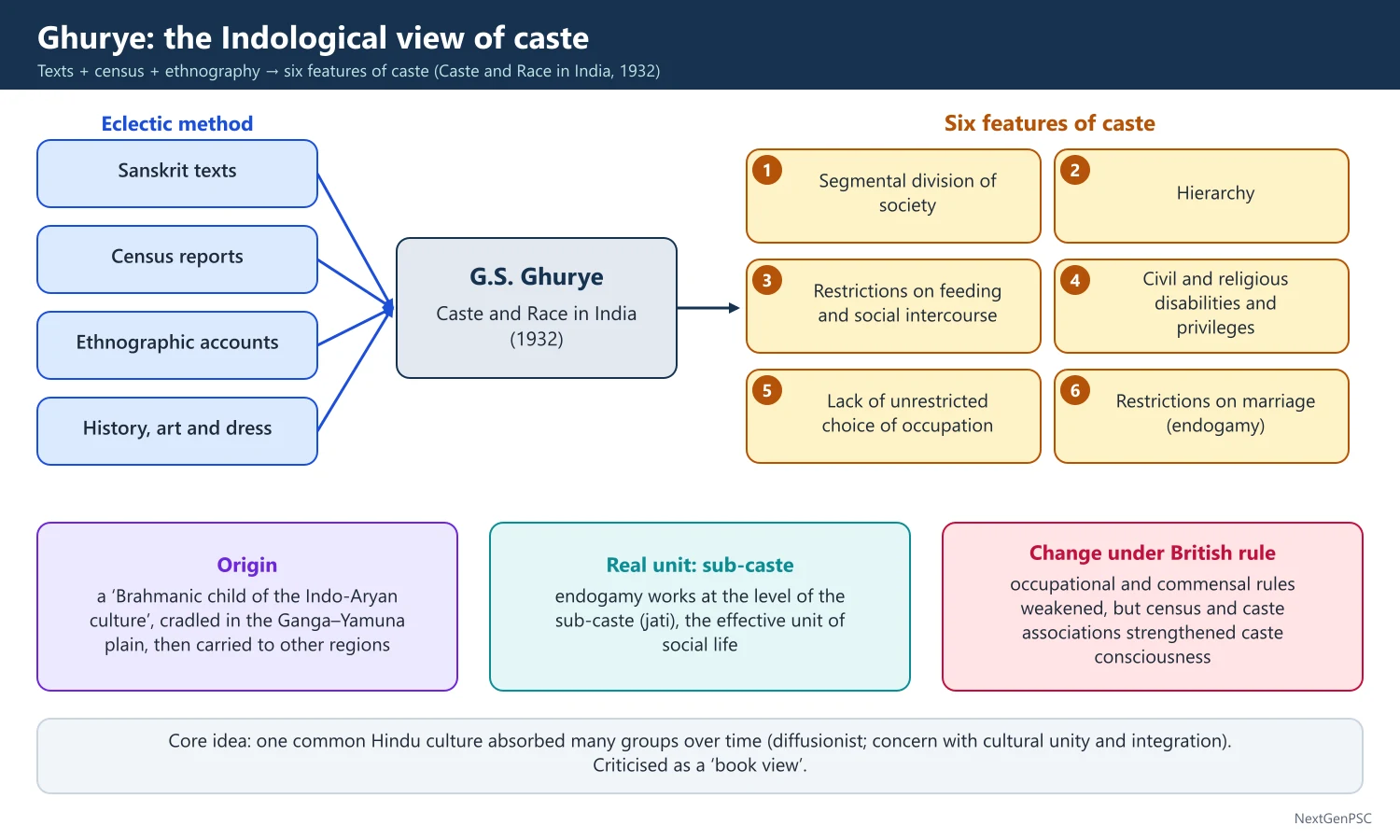
Method: eclectic, not purely textual: he combined Sanskrit sources with census reports, ethnographic accounts, historical records, art and even dress (Indian Costume, 1951).
Core idea: Indian society is held together by a common Hindu culture that absorbed many groups over time; he called himself a diffusionist and was concerned with cultural unity and integration.
3. Ghurye on caste
In Caste and Race in India (1932; later editions Caste and Class in India, 1950, and Caste, Class and Occupation, 1961) he gave six features of caste.
Six features: (1) segmental division of society, (2) hierarchy, (3) restrictions on feeding and social intercourse, (4) civil and religious disabilities and privileges of different sections, (5) lack of unrestricted choice of occupation, (6) restrictions on marriage (endogamy).
Origin: he argued that caste was a ‘Brahmanic child of the Indo-Aryan culture’, cradled in the Ganga-Yamuna plain and then carried to other regions; he drew partly on H.H. Risley’s racial data but did not accept a simple race theory.
Sub-caste as the real unit: he noted that endogamy operates at the level of the sub-caste (jati), which is the effective unit of social life.
Change: he observed that British rule weakened occupational and commensal rules but strengthened caste consciousness through the census and caste associations; this anticipated the later idea of the politicisation of caste.
4. Ghurye on tribes, religion and cities
Tribes: in The Aborigines – So-called – and Their Future (1943; later The Scheduled Tribes) he called tribes ‘backward Hindus’ who had long been in contact with Hindu society and should be integrated, not isolated.
This opposed Verrier Elwin’s early ‘isolation’ or ‘national park’ position; the Ghurye–Elwin debate shaped Nehru’s later middle path of integration with protection.
Religion and asceticism: Indian Sadhus (1953) showed how ascetic orders such as the Dashanami sannyasis, organised by Shankaracharya, carried a unifying culture across regions; Gods and Men (1962) traced the growth of deities.
Kinship: Family and Kin in Indo-European Culture (1955) compared Indian kinship with other Indo-European societies, using gotra and pravara rules.
Urbanisation: in Cities and Civilization (1962) and Anatomy of a Rururban Community (1962) he saw cities as centres of culture and spoke of the ‘rurban’ blend of village and town.
Social tensions: Social Tensions in India (1968) discussed caste, linguistic and communal tensions as threats to national unity.
5. Strengths of the Indological approach
It gives historical depth: institutions such as caste, joint family and gotra exogamy cannot be understood without their long history.
It treats India as a civilisation with its own categories (dharma, karma, varna, jati, purity and pollution) rather than forcing Western concepts on it; this links to the later call for ‘indigenisation’ of sociology.
Ghurye’s use of census and ethnography made his work more empirical than older Orientalism.
6. Criticism
Book view: Srinivas and other field sociologists argued that texts show what Brahmin authors thought society should be, not how villages actually worked.
Brahmanical and upper-caste bias: Dalit and non-Brahmin thinkers (Jotirao Phule, B.R. Ambedkar, later Gail Omvedt and Kancha Ilaiah) showed that the textual tradition hides the views of the lower castes, women and tribes.
Static and unifying picture: it stresses harmony and continuity and underplays conflict, regional diversity and change; A.R. Desai and Marxists saw it as ignoring material and class relations.
Orientalism: Edward Said’s Orientalism (1978) and later Bernard Cohn and Nicholas Dirks (Castes of Mind, 2001) argued that colonial textual knowledge itself made caste more rigid; this criticism is debated.
Hindu-centric: by treating Indian culture as Hindu culture, it gives little room to Muslims, Christians, Buddhists, Sikhs and tribal religions; Ghurye’s views on tribes and on Muslims are criticised on this ground.
Defence: supporters reply that Ghurye was not a narrow textualist; he used surveys and ethnography and was concerned with social reform and national unity.
7. Indian examples and relevance today
Gotra exogamy still shapes marriage rules in north India; khap panchayat disputes over same-gotra marriage show textual categories living in practice.
Pilgrimage circuits such as the Kumbh Mela and the four dhams continue the integrating role Ghurye gave to sadhus and sacred geography.
The caste census debate recalls Risley’s 1901 census ranking of castes, which Ghurye discussed; the Union Cabinet decided on 30 April 2025 to count caste in Census 2027, the first full caste count since 1931.
Debates over tribal identity (whether Adivasis are Hindus, the Sarna code demand in Jharkhand) continue the Ghurye–Elwin argument.
8. Linking thinkers
Dumont: Homo Hierarchicus (1966) also used texts but read them through structuralism (purity and impurity as the binary at the root of caste); he called for a meeting of Indology and sociology.
Srinivas: Ghurye’s student, who moved from the book view to the field view, yet used the textual concept of varna in Sanskritisation.
Mukerji (D.P.): stressed the study of Indian tradition (Diversities, 1958) and said a sociologist in India must first be an Indian, sharing the folkways and traditions of the people; this is close to Indology in spirit.
Weber: The Religion of India (1916) also used Hindu texts to study the link between religion and economic ethics, which Indologists cite.
9. Using it in the exam
10 marks (150 words): define Indology, give Ghurye’s main contributions (six features of caste, tribes as backward Hindus, sadhus), add two criticisms.
15 marks (200 words): add the book view versus field view contrast and one current example such as the caste census or gotra rules.
20 marks (250 words): compare Indology with structural-functionalism and Marxism, assess relevance, and end with a balanced view that texts and field data complement each other.
Names examiners look for: Ghurye, Dumont, Karve, Kapadia, Srinivas (book view), Said or Dirks (critique), Ambedkar (counter-view).
Diagram idea: a timeline from Orientalists (Jones, Müller) to sociological Indology (Ghurye, Karve, Kapadia) to structural Indology (Dumont) to critiques (Said, Dirks, Dalit scholars).
Useful line: Dumont held that a sociology of India lies at the point where sociology and Indology meet (paraphrase).
| Work (year) | Main idea |
|---|---|
| Caste and Race in India (1932) | Six features of caste; Brahmanic origin in the Gangetic plain |
| The Aborigines – So-called – and Their Future (1943) | Tribes as backward Hindus; integration, not isolation |
| Indian Sadhus (1953) | Ascetic orders as carriers of cultural unity |
| Family and Kin in Indo-European Culture (1955) | Gotra, pravara and comparative kinship |
| Cities and Civilization (1962) | Cities as centres of culture; rurban growth |
| Social Tensions in India (1968) | Caste, language and communal tensions threaten unity |
Mains points
- Define Indology precisely and show that Ghurye was an eclectic Indologist who used census and ethnography, not only texts; this avoids the common mistake of calling him a pure textualist.
- Quote the six features of caste correctly and in order; examiners often ask how far they still hold.
- For tribes, present the Ghurye–Elwin debate and link it to Nehru’s Panchsheel for tribes and to PESA 1996 and the Forest Rights Act 2006.
- Give balanced criticism: book view (Srinivas), Brahmanical bias (Ambedkar, Omvedt), static picture (Desai), colonial construction (Dirks), with a note that some of this is debated.
- Show relevance with current examples: caste enumeration in Census 2027, khap rulings on gotra, the Sarna code demand.
- In comparison questions, a three-column table of Indology, structural-functionalism and Marxism (method, unit of study, view of change, criticism) scores well.
Did you know?
- Ghurye guided dozens of doctoral students at Bombay over 35 years, which is one reason he is called the father of Indian sociology.
- Memory trick for Ghurye’s six features: ‘SHRCOM’ – Segmental, Hierarchy, Restrictions on food, Civil-religious disabilities, Occupation, Marriage.
Structural Functionalism: M. N. Srinivas
Structural functionalism treats society as a system of interrelated parts, each serving a function for the whole. M.N. Srinivas (1916–1999) brought this approach, learned from Radcliffe-Brown at Oxford, to India through intensive fieldwork in Coorg and Rampura, and gave the concepts of Sanskritisation, Westernisation, dominant caste and vote bank. Critics say it explains order better than conflict and change.
In simple words
Structural functionalism sees society like a human body: caste, family, religion and the village each do a job that keeps the whole working.
M.N. Srinivas lived in a Karnataka village for months, watched daily life and asked how castes depend on each other.
He found that lower castes copy the customs of higher castes to rise, which he called Sanskritisation.
UPSC asks about his field view, his key concepts and how well they explain caste change today.
1. The perspective
Structural functionalism: society is a system of parts (structures) such as family, caste and religion, each contributing to its stability (function); roots in Durkheim, developed by Radcliffe-Brown and Malinowski in anthropology and by Parsons and Merton in sociology.
Social structure (Radcliffe-Brown): the network of actually existing social relations between persons, observed in the field.
Field view: Srinivas’s term for knowledge gained from intensive participant observation in a small community, as against the book view of Indology.
Holism: the village or caste is studied as a whole, showing how economic, ritual, kinship and political relations are tied together.
2. Srinivas: life and works
Mysore Narasimhachar Srinivas studied under Ghurye at Bombay and then at Oxford under A.R. Radcliffe-Brown and E.E. Evans-Pritchard.
Religion and Society among the Coorgs of South India (1952): showed how ritual and caste are linked and introduced Sanskritisation (first called Brahminisation).
Rampura: a multi-caste village near Mysore studied from 1948; essays ‘The Social System of a Mysore Village’ (1955) and ‘The Dominant Caste in Rampura’ (1959).
The Remembered Village (1976): written from memory after his field notes were destroyed in a 1970 fire at Stanford; a classic of Indian ethnography.
Other works: India’s Villages (edited, 1955), Caste in Modern India and Other Essays (1962), Social Change in Modern India (1966), The Dominant Caste and Other Essays (1987).
He built the sociology departments at M.S. University of Baroda (1951) and the Delhi School of Economics (1959), and from 1972 worked at the Institute for Social and Economic Change, Bangalore.
3. Key concepts
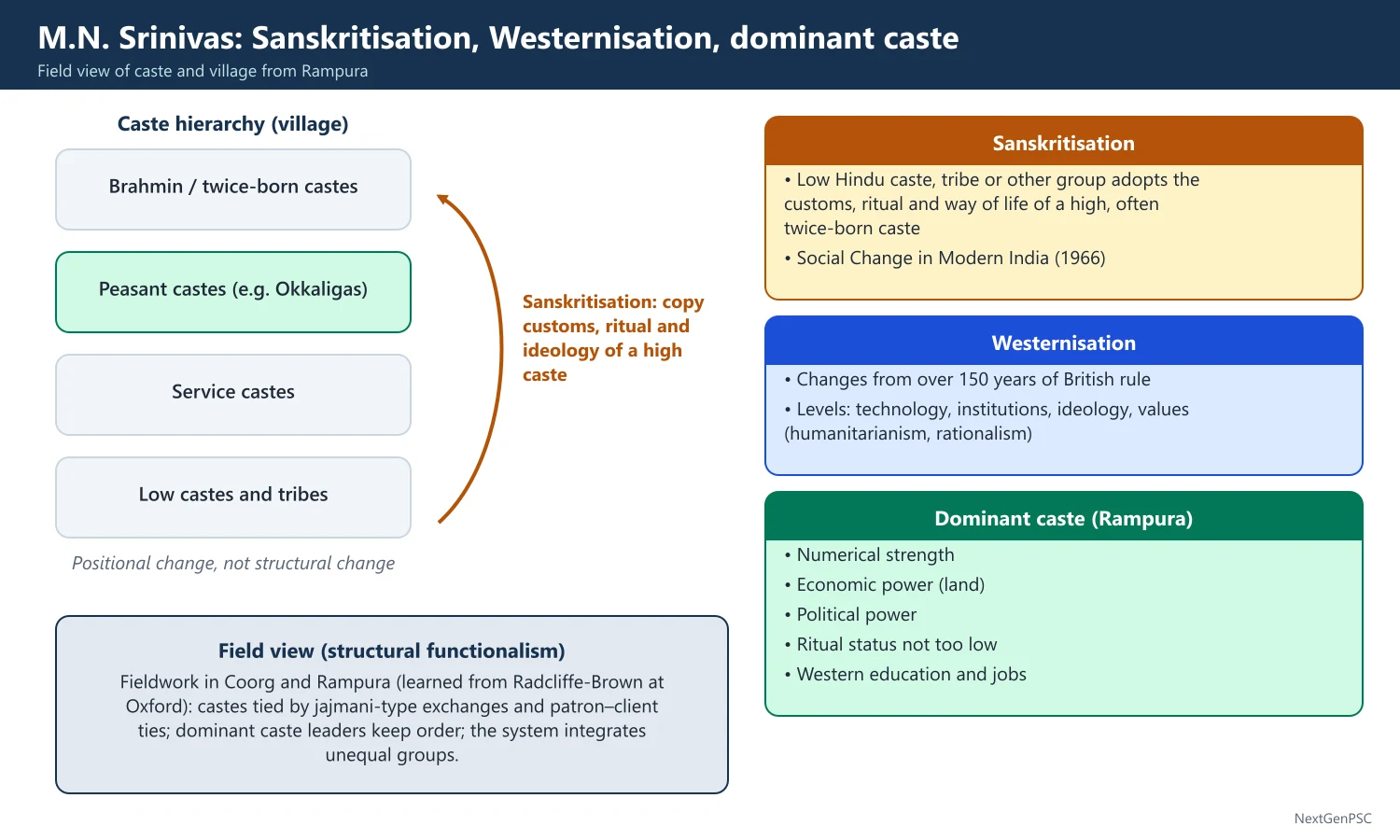
Sanskritisation: the process by which a low Hindu caste, tribe or other group changes its customs, ritual, ideology and way of life in the direction of a high, frequently twice-born caste (Social Change in Modern India, 1966); it brings positional change, not structural change.
Westernisation: changes in Indian society and culture resulting from over 150 years of British rule, at the levels of technology, institutions, ideology and values (humanitarianism, rationalism).
Dominant caste: a caste that is numerically preponderant and wields economic and political power in a village, especially through ownership of land; Western education, jobs and a not-too-low ritual rank add to dominance (Rampura’s Okkaligas).
Vote bank: a term Srinivas used in the 1950s for a bloc of votes that a caste or community leader can deliver.
Secularisation: in his sense, the decline of the religious and ritual view of life, especially the purity-pollution idea, among educated and urban groups.
Myth of the self-sufficient village: he argued that Indian villages were never isolated republics; they were tied to towns, markets, kingdoms and pilgrimage networks.
4. The functionalist reading of caste and village
Castes in Rampura were tied by jajmani-type exchanges of services and grain, by ritual roles at festivals and by patron–client ties; the system integrated unequal groups.
Conflict was handled through the dominant caste’s leaders and the caste panchayat, which kept order.
Mobility was possible inside the system: groups could rise in rank through Sanskritisation, especially after gaining wealth or political power, without overturning the hierarchy.
5. Other structural-functionalist studies
S.C. Dube, Indian Village (1955): Shamirpet near Hyderabad, a full description of village structure.
McKim Marriott, ‘Little Communities in an Indigenous Civilization’ (1955): Kishangarhi in Uttar Pradesh, the processes of universalisation and parochialisation.
André Béteille, Caste, Class and Power (1965): Sripuram in Tanjore, showing caste, class and power becoming separate.
Adrian Mayer, Caste and Kinship in Central India (1960, Ramkheri, Madhya Pradesh) and F.G. Bailey, Caste and the Economic Frontier (1957, Bisipara, Odisha).
6. Criticism
Status-quo bias: A.R. Desai and other Marxists argued that functionalism hides exploitation, presents inequality as harmony and neglects class conflict and land relations.
Sanskritisation criticised: it assumes lower castes accept upper-caste values; Dalit and non-Brahmin movements rejected them (Periyar’s Self-Respect Movement, Ambedkar’s conversion to Buddhism in 1956), and Yogendra Singh noted the concept mixes cultural and structural change.
Gender blind: feminist scholars such as Leela Dube showed that Sanskritisation often meant tighter control over women (purdah, ban on widow remarriage, dowry).
Village as a microcosm: critics asked whether one village can represent India; Louis Dumont and David Pocock argued that the village is not a sociological reality in itself and that caste ties cross villages.
Defence: Srinivas himself studied change (Westernisation, dominant caste in politics), so calling him a static functionalist is an oversimplification; his work is better seen as structural with a strong interest in process.
7. Indian examples today
Dominant castes in politics: Jats in Haryana and western Uttar Pradesh, Marathas in Maharashtra, Patidars in Gujarat, Vokkaligas and Lingayats in Karnataka, Reddys and Kammas in Andhra Pradesh.
Paradox: several of these dominant castes now demand backward-class reservation (Maratha, Jat and Patidar agitations of the 2010s), which Srinivas’s idea of ‘desire to be backward’ helps explain.
Sanskritisation continues in new forms: vegetarianism and temple building by upwardly mobile castes, and tribal groups adopting Hindu rituals in central India.
8. Linking thinkers
Merton: Sanskritisation is a case of anticipatory socialisation towards a reference group; dominant caste can be linked to Merton’s analysis of power in the community.
Durkheim: the village as a moral community resting on shared ritual reflects Durkheim’s collective conscience.
Redfield: Marriott and Milton Singer used Redfield’s great and little tradition to extend the field view to civilisation.
Yogendra Singh: Modernization of Indian Tradition (1973) built on Srinivas’s concepts in a wider framework of orthogenetic and heterogenetic change.
9. Using it in the exam
10 marks: define structural functionalism, show Srinivas’s field method and two concepts with Rampura examples.
15 marks: add other village studies (Dube, Marriott, Béteille) and two criticisms.
20 marks: evaluate with Marxist, feminist and Dalit critiques, add current examples of dominant-caste politics, and conclude on lasting value.
Diagram idea: a pyramid of castes with an arrow showing a jati moving up through Sanskritisation while the pyramid itself stays the same (positional versus structural change).
Useful line: Srinivas described Sanskritisation as resulting in mobility within the system rather than change of the system (paraphrase).
| Criterion | Rampura or later example |
|---|---|
| Numerical strength | Okkaligas were the largest caste in Rampura |
| Economic power (land) | Okkaligas owned most of the land |
| Political power | Village headman and panchayat leaders from the caste |
| Ritual status not too low | Peasant castes ranked above service castes |
| Western education and jobs | Later: Jats, Marathas, Patidars in state politics |
Mains points
- Explain the method first: intensive fieldwork, participant observation and the field view; then the concepts.
- Give Srinivas’s definitions of Sanskritisation, Westernisation and dominant caste with the works and years; a common mistake is to confuse Sanskritisation with Hinduisation or to forget it is positional change.
- Use named village studies: Rampura, Shamirpet, Kishangarhi, Sripuram, Ramkheri, Bisipara.
- Criticise from three sides: Marxist (Desai), feminist (Leela Dube) and Dalit or non-Brahmin (Ambedkar, Periyar, Kancha Ilaiah).
- Show relevance today: dominant castes in electoral politics, demands for OBC status by Marathas, Jats and Patidars, and vote-bank politics.
- Balance: note that Srinivas studied change as well as order, so a fair answer calls him a structural functionalist who was sensitive to process.
Did you know?
- When a fire at Stanford in 1970 burnt Srinivas’s Rampura field notes, he rewrote the village from memory as The Remembered Village (1976).
Marxist Sociology: A. R. Desai
The Marxist perspective studies Indian society through its material base: modes of production, property relations and class struggle. A.R. Desai (1915–1994) applied the dialectical-historical method to Indian nationalism, rural society, peasant struggles and the post-independence state, arguing that India followed a capitalist path that benefited propertied classes. Critics call it economic reductionism that underplays caste and culture.
In simple words
The Marxist view says that to understand a society, first look at who owns land, factories and money, and who works for them.
It is like judging a cricket team not by its uniform but by who controls the money and selection.
A.R. Desai used this to explain how British rule created new classes that built Indian nationalism, and why poor peasants gained little after independence.
UPSC asks you to explain and evaluate his approach and compare it with Ghurye and Srinivas.
1. The Marxist perspective
Historical materialism (Marx): the economic base (forces and relations of production) shapes the superstructure of law, politics, religion and ideas; history moves through contradictions between classes.
Dialectical method: every social formation contains contradictions that produce change; the sociologist must study society as a changing whole, not as a stable system.
Class: a group defined by its relation to the means of production; in India Marxists identify landlords, rich peasants, middle and poor peasants, agricultural labourers, the bourgeoisie, the working class and the petty bourgeoisie.
2. Desai: life and works
Akshay Ramanlal Desai studied under Ghurye at Bombay and later headed the department there; he was active in left (Trotskyist) politics and wrote as a committed Marxist.
Social Background of Indian Nationalism (1948): his doctoral work and best-known book.
Other works: Recent Trends in Indian Nationalism (1960), Rural Sociology in India (edited), State and Society in India: Essays in Dissent (1975), Peasant Struggles in India (edited, 1979), Agrarian Struggles in India after Independence (edited, 1986), Violation of Democratic Rights in India (edited, 1986).
3. Nationalism as a product of material change
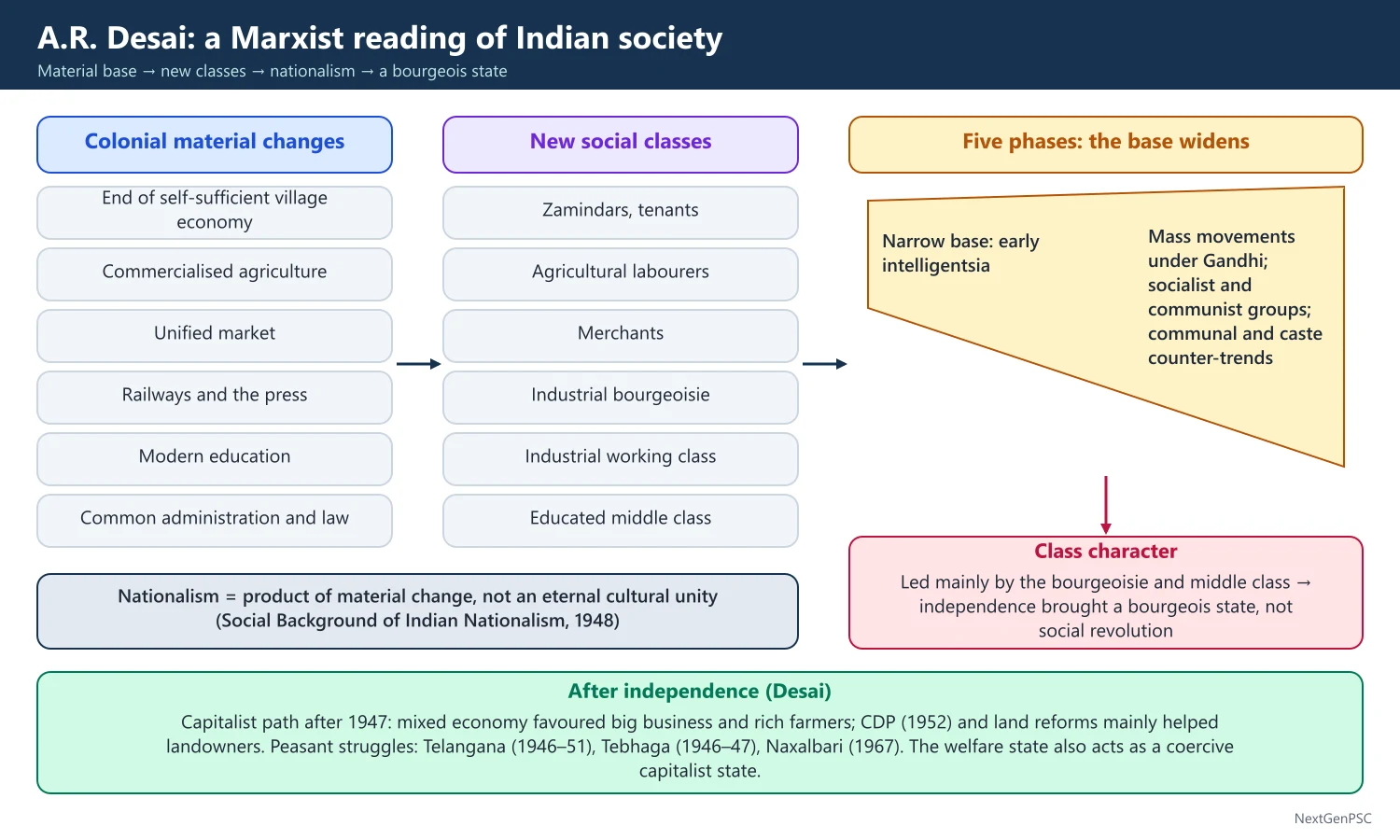
Desai argued that Indian nationalism was not an expression of an eternal cultural unity but a product of the material and social conditions created by British rule.
Causes: destruction of the self-sufficient village economy, commercialisation of agriculture, a unified market, railways and the press, modern education and a common administration and law.
New classes: zamindars, tenants, agricultural labourers, merchants, an industrial bourgeoisie, an industrial working class and an educated middle class; their interests drove different phases of the movement.
Phases: he traced five phases from the narrow base of the early intelligentsia to mass movements under Gandhi, the rise of socialist and communist groups, and the growth of communal and caste-based counter-trends.
Class character: the national movement was led mainly by the bourgeoisie and middle class, so independence brought a bourgeois state rather than social revolution.
4. Rural society, peasants and the state
Capitalist path of development: Desai argued that the post-1947 state, despite the language of socialism, built capitalism with a mixed economy that favoured big business and rich farmers.
Community Development (1952) and land reforms: in his view these mainly helped landowning and rich peasant groups, while tenants and labourers gained little; this links to Daniel Thorner’s finding of loopholes in ceiling laws.
Peasant struggles: his edited volumes documented movements such as Telangana (1946–51), Tebhaga in Bengal (1946–47), Naxalbari (1967) and later struggles of agricultural labourers.
Democratic rights: he documented state repression of workers, peasants, tribes and dissenters, arguing that the welfare state also acts as a coercive capitalist state.
Modernisation critique: in ‘Need for Revaluation of the Concept’ (1971, in his edited Essays on Modernization of Underdeveloped Societies) he criticised the modernisation approach for ignoring class and imperialism.
5. Other Marxist sociologists of India
Mukerji (D.P.): called himself a ‘Marxologist’ rather than a Marxist; he combined dialectics with Indian tradition, seeing a dialectic between tradition and modernity (Modern Indian Culture, 1942; Diversities, 1958).
Ramkrishna Mukherjee: The Rise and Fall of the East India Company (1955) and The Dynamics of a Rural Society (1957), a class analysis of Bengal villages.
Kathleen Gough: class and caste in Kumbapettai, Thanjavur, and studies of peasant uprisings; Gail Omvedt: caste, class and new social movements, joining Marx with Phule and Ambedkar.
Mode of production debate (1969 to the 1980s, mostly in the Economic and Political Weekly): Utsa Patnaik, Ashok Rudra, Paresh Chattopadhyay, Jairus Banaji, Hamza Alavi and Amit Bhaduri argued whether Indian agriculture was feudal, semi-feudal or capitalist; Bhaduri’s 1973 model of semi-feudalism stressed usury and bonded tenancy.
6. Strengths
It brings in conflict, power and exploitation, which Indology and functionalism tended to underplay.
It links Indian society to the world economy (colonialism, imperialism, later globalisation), anticipating dependency theory (Andre Gunder Frank) and world-systems theory (Wallerstein).
It gives a historical and dynamic account of change, and draws attention to peasants, workers and tribes as actors.
7. Criticism
Economic reductionism: Yogendra Singh and others argued that Desai reduced caste, religion and culture to class and ignored their independent force.
Caste neglected: Dalit scholars argued that orthodox Marxism failed to see caste as a system of exploitation in its own right; Ambedkar called Brahmanism and capitalism the two enemies of the workers (1938 speech).
Limited fieldwork: his work rests mainly on secondary historical sources rather than ethnography.
Underrates nationalism’s ideas: historians such as Bipan Chandra stressed the anti-colonial ideology and mass mobilisation of the national movement, not only its class base; Desai’s view of the national movement as bourgeois is debated.
Dumont’s view: Louis Dumont argued that in India hierarchy, not economic class, is the master value, so class categories cannot be applied directly.
8. Indian examples today
The 2020–21 farmers’ protest against the three farm laws, led mainly by landowning farmers of Punjab, Haryana and western Uttar Pradesh, can be read through Desai’s class lens (repeal in November 2021).
Informal work: about nine in ten Indian workers are in informal employment (various NSO and PLFS estimates), showing a large reserve army of labour in Marx’s sense.
The four labour codes, in force from 21 November 2025, and the replacement of MGNREGA by the VB-G RAM G Act from 1 July 2026 are cases where a Marxist would ask which class gains from state policy.
9. Linking thinkers and using it in the exam
Links: Marx’s class and alienation; Gramsci’s hegemony (how the bourgeoisie led the national movement); Barrington Moore’s Social Origins of Dictatorship and Democracy (1966) on India’s peasant-based path; Frank’s dependency theory.
10 marks: define the Marxist perspective, give Desai’s thesis on nationalism, add one criticism.
15 marks: add his critique of the post-colonial state and peasant struggles with examples.
20 marks: compare with Ghurye and Srinivas, discuss the mode of production debate and the caste–class question, and conclude that a synthesis (Béteille, Omvedt) is needed.
Diagram idea: base–superstructure arrows: colonial economy (base) → new classes → nationalist ideology and organisations (superstructure).
Useful line: Desai held that Indian nationalism was the outcome of the material conditions created by British rule (paraphrase of Social Background of Indian Nationalism).
| Point | Indology (Ghurye) | Structural functionalism (Srinivas) | Marxism (Desai) |
|---|---|---|---|
| Main source | Texts, census, history | Fieldwork in villages | Historical and economic data |
| Key unit | Civilisation, caste | Village, caste relations | Class, mode of production |
| View of society | Cultural unity and continuity | Integrated system with mobility | Conflict and exploitation |
| Key concepts | Six features of caste, backward Hindus | Sanskritisation, dominant caste | Capitalist path, class struggle |
| Main criticism | Book view, Brahmanical bias | Status-quo bias, gender blind | Economic reductionism, caste neglected |
Mains points
- Begin with historical materialism and the dialectical method, then show how Desai applied them to India; do not just list his books.
- Explain the social background of nationalism through new classes created by colonialism; this topic also links to Chapter 15.
- Use concrete Indian struggles: Telangana, Tebhaga, Naxalbari, the 2020–21 farmers’ protest.
- Show the caste–class debate: Desai versus Dumont, and synthesisers such as Béteille, Omvedt and Gough.
- Mention D.P. Mukerji and Ramkrishna Mukherjee to show breadth of Indian Marxist sociology.
- For comparison questions, use the three-perspective table and conclude that each captures part of the truth.
Did you know?
- Ghurye taught the leaders of the two rival perspectives: both Srinivas (functionalism) and Desai (Marxism) were his students at Bombay.
- Memory trick: Ghurye reads Books, Srinivas walks the Village, Desai counts the Classes – B, V, C.
UPSC Previous Year Questions: Perspectives on the Study of Indian Society
From 2014 to 2026 UPSC asked 19 question parts carrying 240 marks from this chapter in Paper II. The most-asked topics are Indology: G. S. Ghurye (7 parts) and Marxist Sociology: A. R. Desai (7 parts). Every question below has a model answer written to the UPSC word limit: about 150 words for 10 marks and 250 words for 20 marks.
In simple words
First read the question and write your own answer in the time UPSC gives (about 7 minutes for 10 marks and 11 minutes for 20 marks).
Then compare it with the model answer: check the approach, the thinkers and studies used, the Indian data and the conclusion.
Note what you missed and revise that topic in the notes before trying the next question.
1. Indology: G. S. Ghurye
Example 1 (UPSC 2026, 20 marks): Indological approach, advocated by G. S. Ghurye, focuses on the study of Indian society through Indian texts. How can Indological approach be useful in the study of other society? Comment in detail.
Paper and question: Paper II, Q2(a)
Approach: Briefly state Ghurye's Indological approach, then explain how its method (texts, history, cultural continuity) can be applied to other societies with examples, and note limits.
G.S. Ghurye's Indological approach studies Indian institutions such as caste, family and religion through Sanskrit texts and history, supported by census data and fieldwork. Its core idea is that a society's present institutions carry the values recorded in its classical traditions.
This method is not limited to India. Any literate civilisation with a long textual tradition can be studied the same way. Confucian classics help explain the importance of filial piety and family hierarchy in China and Korea. The Quran and Hadith shape law, family and gender norms in many Muslim societies. Max Weber himself used religious texts to study the Protestant ethic in Europe and Confucianism and Hinduism in Asia.
Three features of Ghurye's method travel well. The first is historical depth, tracing institutions over centuries. The second is attention to civilisational unity, as he showed through sadhus; a similar role was played by the Catholic Church in medieval Europe. The third is pluralism of sources, since Ghurye combined texts with census and ethnography, a model for studying any complex society.
Flow chart: Classical texts of a civilisation → core values (hierarchy, purity, filial piety, sharia) → present institutions (caste, family, law) → test against fieldwork and data.
There are limits. Societies without written traditions, such as many tribal or oral cultures, cannot be studied this way; there, ethnography is needed. Texts also speak for elites, as Srinivas's field-view and feminist critics have shown, and they may hide change and conflict.
Thus the Indological approach is useful for any literate civilisation when it is combined with fieldwork, as Ghurye himself did; used alone, it gives an idealised picture.
Example 2 (UPSC 2025, 10 marks): 'Textual perspective is important in understanding of Indian Social System.' Discuss.
Paper and question: Paper II, Q1(a)
Approach: Discuss the value of the textual (book-view) perspective with Ghurye and Dumont, then its limits and the need for the field-view.
The textual perspective studies Indian society through classical sources such as the Vedas, Dharmashastras, Puranas and epics. G.S. Ghurye and later Louis Dumont argued that these texts carry the values that organise Indian institutions.
Its importance lies in three things. It explains the ideology behind caste, such as purity and pollution, which Dumont made the basis of hierarchy in Homo Hierarchicus (1966). It shows continuity, for example the ashrama scheme and samskaras that still shape life-cycle rituals. And it reveals the civilisational unity of India, as in Ghurye's Indian Sadhus.
Its limits are equally clear. M.N. Srinivas showed through the field-view that real caste ranking depends on land, numbers and power. Texts were written by upper-caste men, ignore regional and folk traditions, and give an unchanging picture.
So the textual perspective is important but not sufficient. It is best used with fieldwork and data, which together explain both the ideals and the practice of Indian society.
Example 3 (UPSC 2025, 10 marks): How would you appropriate to characterise G. S. Ghurye as a practitioner of 'theoretical pluralism'?
Paper and question: Paper II, Q1(e)
Approach: Explain ‘theoretical pluralism’ (use of several methods and theories), show how Ghurye combined Indology, diffusionism, ethnography and statistics, and assess the label.
Theoretical pluralism means using several theories and methods together rather than one fixed framework. G.S. Ghurye is usually called an Indologist, but his work shows such pluralism, which is why scholars describe him as eclectic.
He drew on many sources. Texts gave him the history of caste and gotra. From his teacher W.H.R. Rivers he took diffusionism, explaining how caste spread from the Gangetic plain to other regions. He used census data in Caste and Race in India (1932), ethnographic surveys of tribes and sadhus, and even anthropometric data of H.H. Risley on race. His later books on cities, costume and Rajput architecture used history and art.
This mix allowed him to study caste, kinship, religion, tribes and urbanisation in one framework of cultural continuity. Critics note that the methods were not tightly integrated and that the textual view still dominated.
It is therefore apt to call Ghurye a theoretical pluralist in method, though an Indologist in his central concern with Hindu civilisation.
Example 4 (UPSC 2024, 20 marks): Differentiate between 'Western' and 'Indological' perspectives on the study of Indian society. Bring out the major aspects of G. S. Ghurye's contribution to 'Indological' approach.
Paper and question: Paper II, Q2(a)
Approach: Two parts: first contrast the Western and Indological perspectives (origin, sources, method, view of India), then list Ghurye's major contributions to Indology with his works.
Indian society has been studied through two broad lenses. The Western perspective applies general theories built in Europe and America, such as functionalism, Marxism and modernisation theory, to India. The Indological perspective holds that India must be understood through its own texts, concepts and history.
They differ on four points. Sources: Western approaches rely on fieldwork, surveys and comparative data; Indology on Sanskrit texts, epics and inscriptions. Method: the first seeks universal laws, the second the specific civilisational pattern of India. View of change: Western theories often see India as moving from tradition to modernity, while Indology stresses continuity. Critique: Western views risk ethnocentrism, Indology risks a Brahmanical and static picture.
Flow chart: Western: universal theory → fieldwork and data → India as a case of general change. Indological: classical texts → Indian concepts (varna, dharma, gotra) → India as a distinct civilisation.
G.S. Ghurye was the main builder of the Indological approach in sociology. In Caste and Race in India (1932) he used texts to trace caste origins and gave its six features. Indian Sadhus (1953) showed ascetic orders as agents of cultural integration. His studies of gotra, family and kinship, of tribes in The Aborigines So-Called and Their Future (1943), and of Indian costume and cities, all traced continuity from the classical past.
Ghurye also built institutions: the Indian Sociological Society (1951) and the Sociological Bulletin, and he trained Srinivas, Desai and Karve. Importantly, he mixed texts with census figures and fieldwork, so his Indology was empirical as well as textual.
Critics such as Srinivas and Desai note that Ghurye underplayed lived practice and class. Still, the debate shows that the two perspectives are complementary: theory and fieldwork explain how Indian society works, and texts explain the meanings that guide it.
Example 5 (UPSC 2022, 20 marks): Critically examine G.S. Ghurye's Indological approach to the understanding of Indian society.
Paper and question: Paper II, Q2(a)
Approach: ‘Critically examine’ needs both sides: explain the Indological approach and Ghurye's use of it with examples, then evaluate its strengths and weaknesses with named critics, and conclude.
Indology studies a society through its texts, languages, art and history. In India it began with Orientalists such as William Jones and Max Müller; G.S. Ghurye turned it into a sociological method, arguing that Indian institutions can only be understood through their long textual history.
Ghurye applied it widely. Caste and Race in India (1932) traced caste to the Indo-Aryans and gave its six features. Indian Sadhus (1953) and his work on Gotra and Charana studied religion and kinship through texts. The Aborigines So-Called and Their Future (1943) treated tribes as backward Hindus, and his writings on cities and costume traced cultural continuity.
Its strengths are real. It gave historical depth, explained the ideology behind caste and family, and showed the cultural unity of India at a time of nationalist awakening. Ghurye also used census data and diffusionism, so his work was more plural than a pure textual study.
The criticism is equally strong. M.N. Srinivas showed that the book-view of caste differs from the field-view, where dominant castes and Sanskritisation matter more than varna. A.R. Desai faulted its neglect of class and colonial economy. Verrier Elwin rejected the view of tribes as backward Hindus. Dalit and feminist scholars, from Ambedkar to Uma Chakravarti, saw the texts as voices of Brahmin men, not of the whole society.
Flow chart: Texts (Vedas, Dharmashastras) → ideals of caste, family, religion → Ghurye's synthesis with census and fieldwork → picture of cultural unity → criticised for static, upper-caste bias.
The approach also tends to be static, missing conflict and regional diversity. Yet Louis Dumont later revived it, saying Indian sociology stands at the meeting point of sociology and Indology. A balanced view is that Indology explains the ideas that legitimise institutions, while fieldwork and data show how people live them; combining the two gives the fullest picture.
Example 6 (UPSC 2018, 10 marks): Write a note on G. S. Ghurye's Indological perspective of understanding Indian society.
Paper and question: Paper II, Q1(a)
Approach: Define the Indological perspective, show how Ghurye applied it to caste, tribes and religion, and end with a balanced assessment.
The Indological perspective understands Indian society through its classical texts, languages and history. G.S. Ghurye (1893–1983), trained under W.H.R. Rivers at Cambridge, made it the founding approach of Indian sociology at Bombay.
On caste, Ghurye used the Vedas and Dharmashastras to show its Indo-Aryan origin and its six features, from segmental division to endogamy. On tribes, in The Aborigines So-Called and Their Future (1943) he called them ‘backward Hindus’ who had long been absorbed into Hindu society. On religion, Indian Sadhus (1953) showed ascetics as carriers of cultural unity.
His central theme was the cultural unity of India, carried by Sanskrit traditions across regions. He also used census data and fieldwork, so his Indology was not purely textual.
Critics point to a static, upper-caste and Hindu-centred picture: Srinivas preferred the field-view, Desai the material base, and Elwin rejected the tribal-as-Hindu thesis. Still, Ghurye's perspective gave Indian sociology historical depth, and it is best used today together with fieldwork and data.
Example 7 (UPSC 2014, 10 marks): G.S. Ghurye's Indological approach to understand society in India
Paper and question: Paper II, Q1(e)
Approach: A short note: define Indology, state Ghurye's method and his main works, then give its strengths and criticism.
Indology is the study of Indian society and culture through classical texts such as the Vedas, Dharmashastras and epics. G.S. Ghurye, who headed the Bombay department of sociology from 1924, used it to show the continuity of Indian civilisation.
In Caste and Race in India (1932) he traced caste to the Indo-Aryans and listed six features: segmental division, hierarchy, restrictions on feeding and social intercourse, civil and religious disabilities, lack of free choice of occupation and endogamy. In Indian Sadhus (1953) he showed how ascetic orders kept Hindu culture unified.
Ghurye did not rely on texts alone. He combined them with census data, ethnography and a diffusionist view of culture, which is why his approach is called eclectic.
Critics such as M.N. Srinivas argued that the book-view describes ideals, not practice; A.R. Desai said it ignored class and material conditions, and Dalit scholars saw a Brahmanical bias. Yet it gave Indian sociology its historical depth and remains useful for studying the textual roots of caste, religion and family.
2. Structural Functionalism: M. N. Srinivas
Example 8 (UPSC 2026, 10 marks): In what respect is M. N. Srinivas' study of Indian village society based on structural and functional perspective? Analyse.
Paper and question: Paper II, Q1(a)
Approach: Show the structural-functional features of Srinivas's village study (Rampura): village as a whole, interdependence, dominant caste, and then note limits.
M.N. Srinivas studied Rampura, a multi-caste village near Mysore, in 1948 and 1952. His analysis, presented in essays and in The Remembered Village (1976), follows structural-functionalism, which treats the village as a system of interdependent parts.
This shows in four respects. First, he saw the village as a social whole with its own identity, where castes were linked by the jajmani exchange of services and grain. Second, caste, kinship, religion and economy were treated as interlocking institutions that maintained order. Third, the Okkaliga peasants formed the dominant caste, whose elders settled disputes and kept unity. Fourth, conflict through factions was seen as contained within the system.
Critics such as Desai and Gough argued that this view hid exploitation of landless Dalits, and Srinivas himself later admitted the role of change and conflict.
Still, the Rampura study remains the model of a holistic functional village study.
Example 9 (UPSC 2026, 10 marks): Bring out the debates of 'insiders' and 'outsiders' approaches in understanding Indian society.
Paper and question: Paper II, Q5(e)
Approach: Define the insider and outsider approaches, give the main positions (Srinivas, Béteille, Madan, Dumont and Pocock, Western anthropologists), and conclude that both views are needed.
The insider–outsider debate asks whether Indian society is better studied by someone born into it or by a foreign observer. It grew as Indian sociologists began studying their own society after the 1950s.
Supporters of the insider view say a native knows the language, meanings and subtle rules, and can avoid colonial and Orientalist bias. M.N. Srinivas, who studied Rampura near his own region, argued that insiders gain access and understanding that outsiders lack.
Others warn that insiders may take their own caste, gender or regional position for granted. T.N. Madan, in his essay on living intimately with strangers, and André Béteille stressed that the sociologist must create distance from the familiar. Dumont and Pocock (1957) held that an outsider with Indological training can see the whole structure, such as hierarchy, more clearly.
Today most scholars see the divide as relative: even an Indian is an outsider to another caste or gender. Good sociology combines empathy with critical distance.
Example 10 (UPSC 2022, 10 marks): Elaborate on M.N. Srinivas's structural-functionalist approach to the study of Indian society.
Paper and question: Paper II, Q1(a)
Approach: Explain the structural-functional approach, Srinivas's field-view and his key concepts, then give a short criticism.
Structural-functionalism sees society as a system of interrelated parts, each contributing to order. M.N. Srinivas brought Radcliffe-Brown's version to India and insisted on the field-view: understanding Indian society through long, intensive fieldwork rather than texts.
In the Coorg study (1952) he linked ritual to caste and kinship. His Rampura fieldwork, later written up as The Remembered Village (1976), showed how caste, the jajmani system, factions and the village council worked together as a whole. From this he built the concepts of Sanskritisation, Westernisation and the dominant caste, defined by numbers, land, political power and ritual status.
The approach was criticised by A.R. Desai for neglecting class conflict and by others for generalising from single villages.
Yet it made fieldwork the core method of Indian sociology, and its concepts still explain caste mobility and power in rural India.
Example 11 (UPSC 2019, 10 marks): Elaborate Srinivas's views on religion and society among the Coorgs.
Paper and question: Paper II, Q1(a)
Approach: Describe Srinivas's 1952 Coorg study: its functional link between ritual and caste, purity–pollution, and the concept of Sanskritisation; end with its significance.
Religion and Society among the Coorgs of South India (1952) was M.N. Srinivas's Oxford thesis, written under Radcliffe-Brown's influence. It applied structural-functionalism to show how religion maintains the social structure of the Coorgs (Kodavas) of Karnataka.
Srinivas showed that ritual at the levels of the okka (patrilineal joint family), the village and the whole Coorg community expressed and reinforced social bonds. The idea of purity and pollution ordered relations between castes and governed birth, death and marriage rites.
The study also introduced Brahminisation, later renamed Sanskritisation: Coorgs and lower castes adopted Brahmin customs such as vegetarianism and teetotalism to raise their status. He also distinguished all-India Hinduism, peninsular Hinduism and local Hinduism, showing how religion spreads at different levels.
Critics say it understated conflict, but the study was a landmark: it brought the field-view into Indian sociology and gave a concept of caste mobility still used today.
Example 12 (UPSC 2017, 10 marks): Write a critique of the structural and functional perspective used by M.N. Srinivas in the understanding of Indian society.
Paper and question: Paper II, Q1(a)
Approach: Briefly state Srinivas's structural-functional perspective, then critique it with named critics, and end with its lasting value.
M.N. Srinivas, trained under A.R. Radcliffe-Brown at Oxford, studied Indian society through structural-functionalism: institutions such as caste, the jajmani system and the village are parts of a whole that maintain social order. His field-view, based on long fieldwork in Rampura, replaced the book-view.
The critique has several strands. A.R. Desai and other Marxists argued that it presents inequality as harmony and hides exploitation in land and labour relations. Kathleen Gough's Tanjore work showed caste conflict where functionalism saw integration. Its focus on single villages, says Béteille among others, made it hard to generalise to India as a whole.
Dalit scholars note that the view from the dominant caste's courtyard missed the voice of the untouchables, and Yogendra Singh observed that the approach explains stability better than change. Sanskritisation itself was faulted for treating upper-caste culture as the model.
Yet Srinivas was not a rigid functionalist: his concepts of Sanskritisation, Westernisation and dominant caste are about change. His legacy is the fieldwork tradition and empirically grounded concepts that Indian sociology still uses.
3. Marxist Sociology: A. R. Desai
Example 13 (UPSC 2026, 10 marks): How does A. R. Desai argue that Indian social classes must be studied through the colonial mode of production? Elucidate.
Paper and question: Paper II, Q2(c)
Approach: Explain how Desai linked class formation to the colonial economy, list the classes created, and note the later ‘mode of production’ debate and criticism.
For A.R. Desai, classes in India cannot be understood through caste or texts alone; they were formed by the colonial transformation of the Indian economy. His Marxist analysis in Social Background of Indian Nationalism (1948) treats colonialism as the force that subordinated India's economy to British capital.
He argued that the Permanent and Ryotwari settlements made land private property, commercialised farming and ruined handicrafts. This created new agrarian classes: zamindars, intermediaries, tenants, peasant proprietors and agricultural labourers. Railways, trade and limited industry created merchants, an industrial bourgeoisie, a working class and an English-educated professional middle class.
These classes had interests both tied to and opposed to colonial rule, which explains the class character of nationalism. Later scholars such as Hamza Alavi theorised a distinct colonial mode of production in the 1970s mode-of-production debate.
Critics note that Desai underrated caste, but his point remains that class analysis must begin with colonialism.
Example 14 (UPSC 2026, 10 marks): Compare G. S. Ghurye's and A. R. Desai's approaches used in understanding Indian society.
Paper and question: Paper II, Q4(c)
Approach: Compare Ghurye and Desai on method, sources, focus and view of change, then show how they complement each other.
G.S. Ghurye and his student A.R. Desai represent two contrasting perspectives on Indian society: Indology and Marxism.
They differ on four counts. On sources, Ghurye used Sanskrit texts, history and census data; Desai used economic history and class analysis. On focus, Ghurye studied caste, kinship, sadhus and tribes as parts of a Hindu civilisation; Desai studied nationalism, peasants, the state and classes. On unity and conflict, Ghurye stressed cultural unity and continuity; Desai stressed contradictions and struggle. On change, Ghurye saw slow, culturally guided change; Desai saw change driven by colonial capitalism and class conflict.
Flow chart: Ghurye: texts → cultural values → unity and continuity. Desai: economic base → classes → contradiction and change.
Each has weaknesses: Ghurye's picture is static and upper-caste, Desai's is economically reductionist.
Read together they are complementary, one explaining the ideology of Indian institutions and the other their material base, as Yogendra Singh suggested in calling for a plural approach.
Example 15 (UPSC 2023, 10 marks): Highlight the significant features of A.R. Desai's 'Dialectical Perspective' to study Indian Society.
Paper and question: Paper II, Q1(a)
Approach: Explain what ‘dialectical’ means in Desai's work (contradictions driving change), and highlight its features with examples from his studies.
A dialectical perspective, drawn from Marx, holds that society changes through the conflict of opposing forces: contradictions within the mode of production produce new social forms. A.R. Desai used it as the core of his study of Indian society.
Its significant features are these. It is historical, studying institutions as products of particular stages, as with nationalism arising from colonial capitalism. It focuses on contradictions: between the colonial state and Indian classes, landlords and tenants, and capital and labour.
It sees the state as a class instrument, not a neutral arbiter. It values struggle as the engine of change, documenting peasant and working-class movements. And it is committed to praxis, linking sociology to democratic rights.
Critics say it underplays caste, religion and ideas. Still, the dialectical perspective corrected the harmony bias of functionalism and remains useful for analysing agrarian distress and labour.
Example 16 (UPSC 2020, 10 marks): Elaborate A. R. Desai's perspective to the study of Indian society.
Paper and question: Paper II, Q1(a)
Approach: Elaborate Desai's Marxist perspective: its method, main themes and works, with one criticism.
A.R. Desai studied Indian society through dialectical-historical materialism. For him, the economic structure and the struggle between classes explain social institutions and change, and sociology must study contradictions rather than harmony.
He applied this in three areas. On nationalism, Social Background of Indian Nationalism (1948) showed it arose from colonial economic change and new classes. On rural society, he analysed the agrarian class structure and documented peasant struggles from colonial times to the Naxalbari era. On the state, he argued in State and Society in India (1975) that India followed a capitalist path serving the bourgeoisie and rich farmers.
He also rejected modernisation theory as hiding capitalist interests.
Critics, including Yogendra Singh, faulted him for economic reductionism that ignored caste and culture. Yet Desai brought conflict, history and political economy into Indian sociology.
Example 17 (UPSC 2018, 20 marks): Analyze A. R. Desai's views on India's path of development.
Paper and question: Paper II, Q2(a)
Approach: Explain Desai's thesis that India followed a capitalist path of development after 1947 (from State and Society in India and India's Path of Development), its effects on classes, then evaluate it.
A.R. Desai analysed independent India's development from a Marxist perspective, mainly in State and Society in India: Essays in Dissent (1975) and India's Path of Development: A Marxist Approach (1984). His central claim was that despite the language of socialism, the Indian state chose a capitalist path of development.
He argued that the mixed economy, planning and the public sector built infrastructure and protected markets for big Indian capital, as envisaged in the Bombay Plan of 1944. In agriculture, land reforms abolished zamindari but left ceilings weak, so a class of rich peasants and capitalist farmers emerged, strengthened later by the Green Revolution, while sharecroppers and landless labourers remained poor.
For Desai the state was not neutral: it served the propertied classes, and its welfare measures were limited concessions. Growing inequality, unemployment, peasant and tribal unrest and repression of dissent, which he documented in his studies of democratic rights and peasant struggles, were the result.
Flow chart: Bourgeois-led independence → mixed economy serving big capital → partial land reform and Green Revolution → rich farmers and corporate growth → inequality and mass struggles.
Later events lend partial support: the liberalisation of 1991 openly embraced the market, and the 2020–21 farmers' protest showed the power of the landowning peasantry. Critics, however, say Desai underrated the real gains of democracy, reservations, welfare schemes and poverty decline, and reduced caste and region to class. Yogendra Singh and Rudolph and Rudolph saw a more plural state.
Desai's analysis remains a valuable critical lens on who gains from development, even if it must be balanced with the democratic and welfare side of the Indian state.
Example 18 (UPSC 2016, 10 marks): Salient features of A.R. Desai's Marxist Sociology
Paper and question: Paper II, Q1(a)
Approach: List the salient features of Desai's Marxist sociology with his works, and add one line of criticism.
A.R. Desai, a student of Ghurye, was the leading Marxist sociologist of India. He used dialectical-historical materialism to study Indian society, treating the economic base and class relations as the key to social change.
Its salient features are as follows. First, a historical view: Social Background of Indian Nationalism (1948) traced nationalism to colonial economic change and new classes. Second, a focus on the agrarian structure and the peasantry, in Rural Sociology in India and Peasant Struggles in India (1979).
Third, a critique of the post-colonial state as following a capitalist path in State and Society in India (1975) and India's Path of Development (1984). Fourth, concern with civil liberties, as in Violation of Democratic Rights in India. Fifth, a rejection of modernisation theory as a disguise for capitalism.
Critics such as Yogendra Singh said he reduced caste and religion to class. Still, Desai brought conflict and political economy into Indian sociology.
Example 19 (UPSC 2015, 20 marks): Discuss Marxist approach to the analysis of Indian nationalism.
Paper and question: Paper II, Q4(a)
Approach: Explain Desai's Marxist thesis in Social Background of Indian Nationalism (1948): nationalism as a product of colonial material change and new classes, with its phases, then assess it with criticism.
The Marxist approach explains social phenomena through the economic base and class relations. A.R. Desai applied it to Indian nationalism in Social Background of Indian Nationalism (1948), arguing that nationalism was not the revival of an eternal cultural unity but a product of the material conditions created by British rule.
Colonial rule destroyed the self-sufficient village economy, commercialised agriculture, introduced private property in land, and built railways, a unified administration and English education. These changes created new social classes: zamindars, tenants and agricultural labourers in villages, and industrial capitalists, merchants, workers and a professional middle class in towns.
Desai traced the movement in phases. The educated middle class led the early, moderate phase from 1885; the industrial bourgeoisie gained influence later; and from the 1920s workers and peasants were drawn in under Gandhi, but within limits that protected propertied interests. Thus the Congress represented mainly the national bourgeoisie, and independence brought a capitalist path.
Flow chart: Colonial economy (land revenue, commercialisation, railways, English education) → new classes → contradictions with colonial rule → class-led phases of nationalism → bourgeois independence.
Other Marxists such as R.P. Dutt in India To-day (1940) similarly stressed economic exploitation. The approach has been criticised by historians such as Bipan Chandra, who saw the movement as a broad anti-colonial people's struggle rather than a bourgeois project, and by sociologists such as Yogendra Singh for neglecting religion, caste and cultural revival.
Still, the Marxist approach showed that nationalism had a social base and class contradictions, and it remains the best account of why the national movement took the shape it did.
Mains points
- The three perspectives (Indology, structural-functionalism, Marxism) are asked almost every year, often as a direct 10-mark note in Q1.
- Examiners reward the thinker's own works by name and year: Ghurye's Caste and Race in India (1932), Srinivas's Religion and Society among the Coorgs (1952), Desai's Social Background of Indian Nationalism (1948).
- Every perspective answer needs both strengths and criticism by named sociologists, and a closing line on why combining approaches gives a fuller picture.
- Comparison questions (Ghurye vs Desai, book-view vs field-view, insider vs outsider) are best answered with a short comparison table described in words.
- Link each perspective to a present-day Indian example (caste census, farmers' protest, village change) to show the approach is still useful.
Did you know?
- Ghurye, Srinivas's teacher at Bombay, sent him to study the Coorgs; Desai was also Ghurye's student, so all three perspectives grew from one Bombay department.
Sociology Optional: All chapters
- Exam Pattern, Syllabus and Strategy
- Sociology: The Discipline
- Sociology as Science
- Research Methods and Analysis
- Sociological Thinkers: Marx and Durkheim
- Sociological Thinkers: Max Weber
- Sociological Thinkers: Parsons, Merton and Mead
- Stratification and Mobility
- Works and Economic Life
- Politics and Society
- Religion and Society
- Systems of Kinship
- Social Change in Modern Society
- Perspectives on the Study of Indian Society
- Impact of Colonial Rule on Indian Society
- Rural and Agrarian Social Structure
- Caste System
- Tribal Communities in India
- Social Classes in India
- Kinship, Family and Religion in India
- Visions of Social Change in India
- Rural and Agrarian Transformation in India
- Industrialisation and Urbanisation in India
- Politics and Society in India
- Social Movements in Modern India
- Population Dynamics
- Challenges of Social Transformation