
Sociology Optional · UPSC Notes
Sociological Thinkers: Parsons, Merton and Mead — UPSC Sociology Optional Notes
Free, exam-focused notes for UPSC Prelims and Mains, with Prelims tips and Mains points for every topic. 5 topics.
Open in the interactive reader: bookmarks, progress tracking and read-aloud.
Talcott Parsons: Social System and Pattern Variables
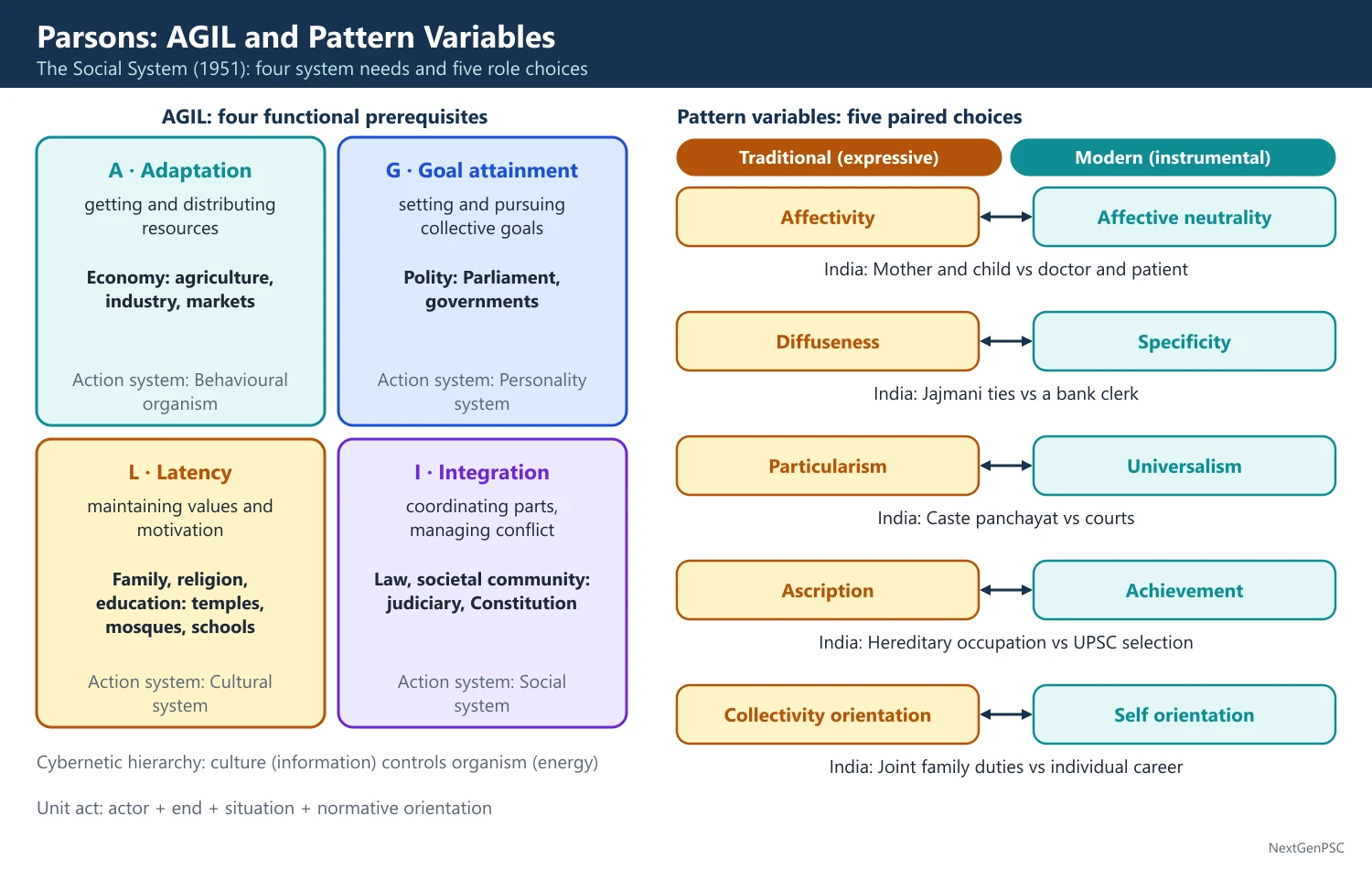
Talcott Parsons built a general theory of action: the unit act (actor, ends, situation, norms) is organised into four action systems, of which the social system (The Social System, 1951) is a system of interaction among actors governed by shared values. Every system must meet four functional prerequisites, AGIL: adaptation, goal attainment, integration and latency. The pattern variables are five paired choices (affectivity–affective neutrality, diffuseness–specificity, particularism–universalism, ascription–achievement, collectivity–self orientation) that distinguish traditional from modern roles.
In simple words
Parsons saw society as a system, like the human body, in which each part does a job that keeps the whole going.
Just as the body needs food, direction, coordination and rest, every society needs an economy, a government, law and families and schools.
His pattern variables show how roles differ: a mother loves her child whatever the child does, while an examiner marks every candidate by the same rules.
UPSC asks you to explain the social system, AGIL and the pattern variables, with criticism and Indian examples.
1. Concepts and Definitions
Voluntaristic theory of action (The Structure of Social Action, 1937): Parsons synthesised Alfred Marshall, Vilfredo Pareto, Emile Durkheim and Max Weber, arguing that action involves choice of ends and means within situational conditions and under normative constraints.
Unit act: the smallest unit of action, consisting of an actor, an end, a situation (means and conditions) and a normative orientation.
Hobbesian problem of order: how society avoids a war of all against all; Parsons’ answer is shared values internalised through socialisation and institutionalised in roles.
Social system: a plurality of individual actors interacting in a situation, motivated to optimise gratification, whose relations are defined and mediated by a system of culturally structured and shared symbols (paraphrase of The Social System, 1951).
Status-role: the basic unit of the social system; expectations attached to positions.
Institutionalisation and internalisation: values become built into roles (institutionalisation) and into personalities (internalisation through socialisation).
2. The Four Action Systems and AGIL
Four action systems: the behavioural organism, the personality system, the social system and the cultural system; the social system is distinct but interpenetrates the others.
AGIL scheme: developed in Working Papers in the Theory of Action (1953, with Robert Bales and Edward Shils) and Economy and Society (1956, with Neil Smelser).
Adaptation (A): securing resources from the environment and distributing them; in society, the economy.
Goal attainment (G): defining and mobilising resources for collective goals; in society, the polity.
Integration (I): coordinating parts and managing tension; in society, law and the ‘societal community’.
Latency or pattern maintenance (L): maintaining and renewing motivation and cultural patterns; in society, family, education and religion.
Across action systems: the behavioural organism performs adaptation, personality goal attainment, the social system integration and the cultural system latency.
Cybernetic hierarchy: systems high in information (culture) control those high in energy (organism), so values guide the rest.
3. Pattern Variables
Source: Toward a General Theory of Action (1951, with Edward Shils and others) and The Social System (1951); they refine Tönnies’ Gemeinschaft and Gesellschaft into analytical dilemmas every actor must resolve.
Affectivity versus affective neutrality: whether to seek emotional gratification in the relationship (parent and child) or keep emotion out (doctor and patient).
Diffuseness versus specificity: whether the relationship covers many aspects of life (friendship, kinship) or a narrow, defined area (shopkeeper and customer).
Particularism versus universalism: whether to treat others by their special relation to oneself (kin, caste fellow) or by general, impersonal standards (law, examinations).
Ascription versus achievement (quality versus performance): whether to judge people by who they are (birth, caste, sex) or what they do (performance).
Collectivity orientation versus self orientation: whether to put group interests or private interests first.
Traditional and modern profiles: traditional roles tend towards affectivity, diffuseness, particularism, ascription and collectivity orientation; modern occupational roles tend towards neutrality, specificity, universalism, achievement and, in the market, self orientation; Parsons treated these as analytical tendencies, not fixed boxes.
4. Change, Evolution and Applications
Equilibrium: social systems tend to maintain boundaries and balance through socialisation and social control; deviance is met by control mechanisms.
Evolutionary change (Societies, 1966; The System of Modern Societies, 1971): differentiation, adaptive upgrading, inclusion and value generalisation.
Evolutionary universals (1964): features such as bureaucracy, money and markets, universalistic law and democratic association that increase adaptive capacity.
The sick role (1951): illness as a socially defined role with rights (exemption from duties, not blamed) and duties (want to get well, seek competent help).
The family (with Bales, Family, Socialization and Interaction Process, 1955): the isolated nuclear family fits industrial society; its two irreducible functions are primary socialisation of children and stabilisation of adult personalities; husbands take instrumental and wives expressive roles.
Education: in ‘The School Class as a Social System’ (1959) Parsons argued that school bridges the particularistic family and the universalistic society.
5. Criticism
C. Wright Mills (The Sociological Imagination, 1959): mocked Parsons’ ‘grand theory’ as abstract and obscure, translating long passages into a few plain sentences.
Ralf Dahrendorf (‘Out of Utopia’, 1958): compared the Parsonian model to a utopia without conflict or change.
David Lockwood (1956): argued that Parsons neglected material interests and the conflict between social and system integration.
Dennis Wrong (‘The Oversocialized Conception of Man’, 1961): criticised the view of humans as passive internalisers of norms.
George Homans (‘Bringing Men Back In’, 1964): asked for explanations based on individual behaviour rather than system needs.
Alvin Gouldner (The Coming Crisis of Western Sociology, 1970): saw functionalism as a conservative ideology of the American welfare state.
Logical problems: teleology (explaining a part by the need it serves) and tautology; difficulty in explaining change and conflict.
Feminist critique: the instrumental and expressive role division naturalised women’s domestic role (Ann Oakley and others).
Neo-functionalism: Jeffrey Alexander (1980s) and Niklas Luhmann’s systems theory revised Parsons to include conflict, contingency and agency.
6. Indian Examples and Studies
Caste and pattern variables: traditional caste relations show ascription, particularism and diffuseness, while competitive examinations such as the civil services show achievement, universalism and specificity.
Constitutional values: equality before law (Article 14) and non-discrimination (Articles 15 and 16) institutionalise universalism; reservations add protective discrimination to achieve substantive equality, a debated mix of particularistic means and universalistic goals.
Indian family: the persistence of joint family ties and arranged marriage challenges Parsons’ prediction that industrialisation produces isolated nuclear families; studies of household change (A.M. Shah) show adaptation rather than disappearance.
Matrimonial advertisements: they combine ascriptive criteria (caste, gotra) with achieved ones (degree, salary), showing a mix of pattern variables (Patricia Uberoi has written on modern Indian marriage).
Modernisation theory in India: Bert Hoselitz (Sociological Aspects of Economic Growth, 1960) used pattern variables to describe development; Indian sociologists such as Yogendra Singh and S.C. Dube criticised the idea that modernity simply replaces tradition.
AGIL in Indian society: the economy and agriculture (A), Parliament and government (G), the judiciary and the Constitution (I), and family, religion and schools (L); the scheme helps organise answers on institutions.
Sick role in India: family and community care, faith healing and the cost of private treatment shape how illness roles work, qualifying Parsons’ model.
7. Linking Thinkers
Parsons and Durkheim: shared values, normative order and the problem of integration come from Durkheim.
Parsons and Weber: the voluntaristic action frame and the stress on values draw on Weber; Parsons translated The Protestant Ethic (1930).
Parsons and Merton: Merton, his student, replaced grand theory with middle-range theory and added dysfunctions and latent functions.
Parsons and Tönnies: pattern variables refine the community–society distinction into analytical choices.
8. Using it in the Exam
10 marks: list the five pattern variables with one Indian example each.
15 marks: social system and AGIL with examples, plus one criticism.
20 marks: voluntaristic action → social system → four action systems and AGIL → pattern variables → evolution → critics (Mills, Dahrendorf, Wrong, Gouldner, feminists) → Indian relevance (caste, family, Constitution) → conclusion on lasting value as a conceptual scheme.
Diagram idea: a 2 × 2 AGIL box: A (economy) top left, G (polity) top right, L (family, religion, education) bottom left, I (law, community) bottom right.
Useful definition: Parsons described the social system as actors interacting in a situation whose relations are mediated by culturally structured and shared symbols (paraphrase, 1951).
| Pattern variable | Traditional (expressive) pole | Modern (instrumental) pole | Indian example |
|---|---|---|---|
| Affectivity – affective neutrality | Emotional involvement | Emotional restraint | Mother and child versus doctor and patient |
| Diffuseness – specificity | Broad, many-sided ties | Narrow, defined ties | Jajmani ties versus a bank clerk |
| Particularism – universalism | Special relation (kin, caste) | General rules | Caste panchayat versus courts |
| Ascription – achievement | Birth, status | Performance | Hereditary occupation versus UPSC selection |
| Collectivity – self orientation | Group interest first | Private interest first | Joint family duties versus individual career |
| Function | Meaning | Subsystem in society | Indian institution |
|---|---|---|---|
| Adaptation | Getting and distributing resources | Economy | Agriculture, industry, markets |
| Goal attainment | Setting and pursuing collective goals | Polity | Parliament, Union and State governments |
| Integration | Coordinating parts, managing conflict | Law, societal community | Judiciary, Constitution, civil society |
| Latency | Maintaining values and motivation | Family, religion, education | Family, temples and mosques, schools |
Mains points
- Typical angles: ‘Parsons’ concept of social system’, ‘pattern variables and their relevance for understanding Indian society’, ‘AGIL’, ‘critique of grand theory’.
- List all five pattern variables correctly; many candidates give only four or confuse the poles.
- Use Indian examples: caste versus examinations, joint family, matrimonial ads, constitutional universalism with reservations.
- Give named critics: Mills, Dahrendorf, Lockwood, Wrong, Gouldner, feminists.
- Show that pattern variables are analytical choices that can mix in one role, not a strict tradition–modernity split.
- Link Parsons to Durkheim, Weber and Merton to show the development of functionalism.
Did you know?
- Parsons translated Weber’s Protestant Ethic into English in 1930, which introduced Weber to most English-speaking readers.
- Memory trick for pattern variables: ‘A-D-P-A-C’ — Affectivity, Diffuseness, Particularism, Ascription, Collectivity (traditional poles).
Robert K. Merton: Functions, Conformity and Deviance, Reference Groups
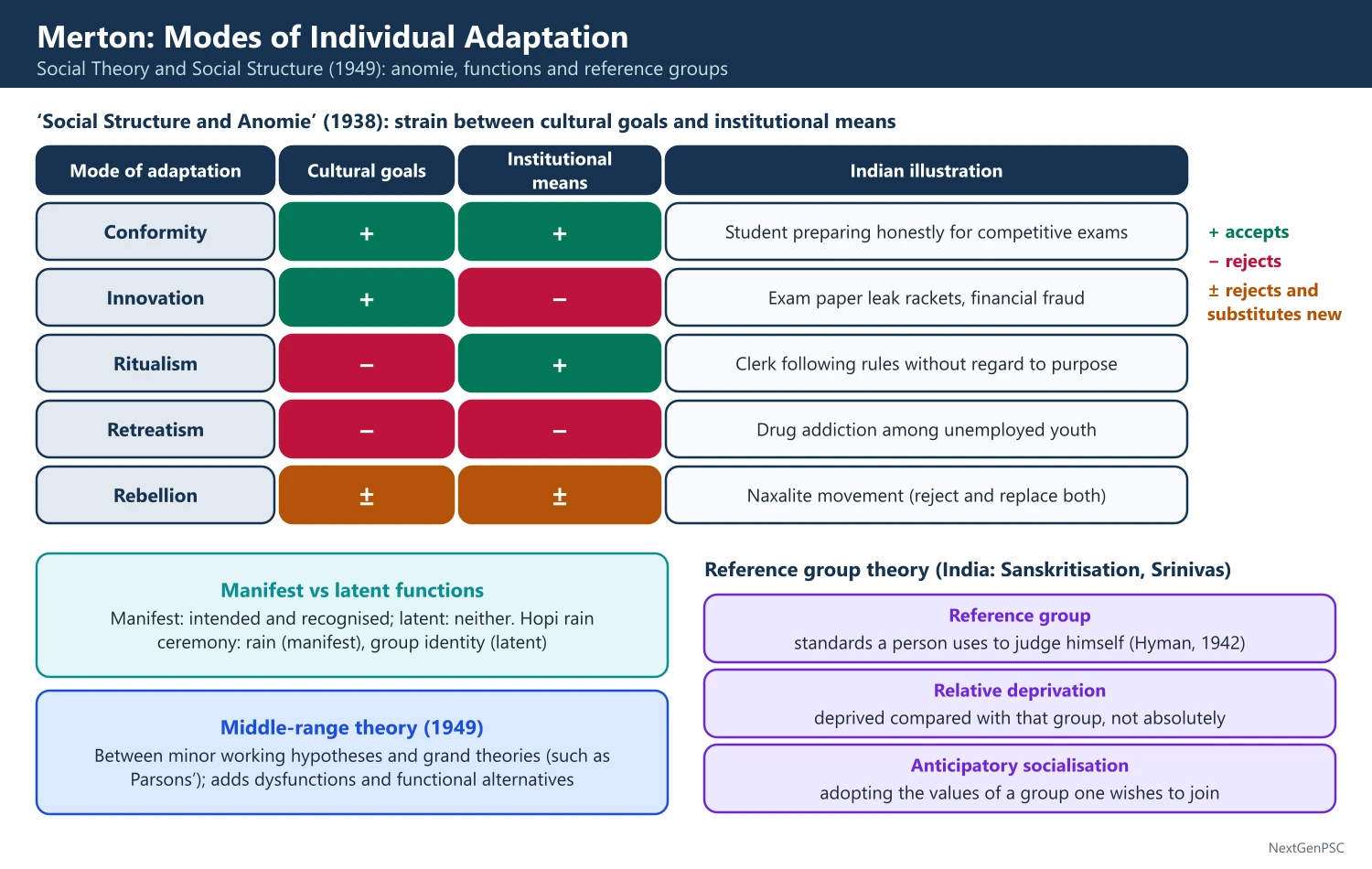
Robert K. Merton (Social Theory and Social Structure, 1949) reformed functionalism with theories of the middle range, distinguishing manifest functions (intended and recognised) from latent functions (unintended and unrecognised) and adding dysfunctions and functional alternatives. In ‘Social Structure and Anomie’ (1938) he explained deviance as a strain between cultural goals and institutional means, giving five modes of adaptation: conformity, innovation, ritualism, retreatism and rebellion. His reference group theory, with relative deprivation and anticipatory socialisation, explains how people judge themselves by groups they compare with or aspire to.
In simple words
Merton said social practices can have effects nobody planned: a festival meant for worship (manifest) also brings scattered families together (latent).
He also asked why people break rules, and answered: when society tells everyone to be rich but blocks fair routes, some cheat, some give up and some rebel.
People also judge their own position by comparing with others, so a group can feel deprived even when it is better off than before.
UPSC asks about latent functions, the five modes of adaptation, reference groups and their Indian examples such as Sanskritisation.
1. Concepts and Definitions
Middle-range theory: theories that lie between minor working hypotheses and all-inclusive grand theories (such as Parsons’), dealing with limited aspects of social life that can be tested, for example reference group theory.
Function: observed consequences that make for the adaptation or adjustment of a given system.
Manifest functions: objective consequences that contribute to adjustment and are intended and recognised by participants.
Latent functions: consequences that are neither intended nor recognised.
Dysfunction: consequences that lessen the adaptation or adjustment of the system; non-functions are consequences irrelevant to it.
Functional alternatives (equivalents): different items can fulfil the same function, so no item is indispensable.
Net balance: an item may be functional for some groups and dysfunctional for others, so the analyst must weigh the net balance.
2. Critique of Earlier Functionalism
Postulate of functional unity: the claim that every standardised activity is functional for the whole society; Merton said unity is an empirical question and varies.
Postulate of universal functionalism: the claim that all standardised items have positive functions; Merton added dysfunctions and non-functions.
Postulate of indispensability: the claim that certain items are necessary; Merton replaced it with functional alternatives.
Paradigm for functional analysis: Merton set out a codified checklist (items analysed, subjective dispositions, consequences, units served, mechanisms, structural context) to make functionalism empirical.
Classic examples: the Hopi rain ceremony has the manifest function of producing rain and the latent function of reinforcing group identity; Thorstein Veblen’s conspicuous consumption has the latent function of displaying status; the American political machine had latent functions of providing welfare and mobility to immigrants.
3. Social Structure and Anomie (1938)
Argument: deviance results from a strain between culturally defined goals (such as monetary success in the ‘American Dream’) and the institutionally approved means of achieving them, which are unequally available.
Anomie: for Merton, the breakdown of the relation between goals and means, extending Durkheim’s concept from deregulated desires to structural strain.
Conformity (+ goals, + means): accepting both; the most common mode in a stable society.
Innovation (+ goals, − means): accepting goals but using illegitimate means, such as fraud or theft; Merton expected it among those with blocked opportunities.
Ritualism (− goals, + means): abandoning lofty goals but rigidly following rules, typical of the lower-middle-class bureaucrat.
Retreatism (− goals, − means): rejecting both, as among some vagrants and addicts; ‘in the society but not of it’.
Rebellion (± goals, ± means): rejecting both and substituting new goals and means, as in revolutionary movements.
4. Reference Groups, Relative Deprivation and Related Concepts
Reference group: a group whose standards a person uses to evaluate himself or to guide behaviour; Herbert Hyman coined the term in 1942; Merton and Alice Kitt (‘Contributions to the Theory of Reference Group Behavior’, 1950) systematised it.
Source: they reanalysed The American Soldier (Samuel Stouffer and others, 1949), where military police with slow promotion were more satisfied than air corps men with fast promotion, because each compared with their own group.
Relative deprivation: feeling deprived in comparison with a reference group rather than in absolute terms.
Membership and non-membership groups: people may take as reference groups those to which they do not belong.
Positive and negative reference groups: groups whose norms one adopts, and groups one defines oneself against.
Anticipatory socialisation: adopting the values of a group one wishes to join; it is functional for the individual in an open society but may be dysfunctional in a closed one, where the person is rejected by both groups (the ‘marginal man’).
Role-set and status-set (1957): each status involves an array of role relationships, and each person has many statuses; this explains role conflict.
Self-fulfilling prophecy (1948): a false definition of a situation that evokes behaviour making it come true, built on the Thomas theorem; for example a rumour of a bank’s insolvency causing a run on the bank.
Bureaucratic personality (1940) and the Matthew effect (1968): Merton also analysed rule-bound officials and the tendency of famous scientists to get more credit.
5. Criticism
Albert Cohen (Delinquent Boys, 1955): argued that much delinquency is non-utilitarian and collective, arising from status frustration in subcultures, not individual adaptation.
Richard Cloward and Lloyd Ohlin (Delinquency and Opportunity, 1960): added illegitimate opportunity structures, producing criminal, conflict and retreatist subcultures.
Assumption of value consensus: critics say not everyone shares the success goal; the theory explains utilitarian crime better than violent or white-collar crime.
Marxist and new criminology (Ian Taylor, Paul Walton and Jock Young, The New Criminology, 1973): Merton ignores who makes the rules and the crimes of the powerful.
Labelling theory (Howard Becker, Outsiders, 1963): deviance is created by social reactions, not only by strain.
Later strain theories: Robert Agnew’s general strain theory (1992) and Messner and Rosenfeld’s institutional anomie theory (1994) extend Merton.
Latent function concept: critics say it is hard to prove what is unintended; functional analysis can still be conservative (Gouldner).
Reference group theory: criticised for not explaining how reference groups are chosen; still widely used.
6. Indian Examples and Studies
Sanskritisation as reference group behaviour: M.N. Srinivas showed lower castes adopting the customs of higher (often Brahmin) castes; sociologists read it as anticipatory socialisation towards a positive reference group, and caste rigidity can make it dysfunctional when the higher castes reject the claim.
Westernisation: the British and English-educated elites served as reference groups for the colonial middle class.
Relative deprivation in movements: agitations for OBC status by relatively prosperous landowning groups, such as the Patidars of Gujarat (2015), Jats (2016) and Marathas (whose 2018 state law was struck down by the Supreme Court in 2021), are often explained through relative deprivation.
Manifest and latent functions: MGNREGA (2005) had the manifest function of rural employment and latent effects such as raising rural wages and women’s earnings; dowry’s latent function has been read as status display and transfer of wealth, with severe dysfunctions.
Innovation: paper leaks and cheating rackets in competitive examinations; the Public Examinations (Prevention of Unfair Means) Act 2024 responded to such cases.
Ritualism: rule-bound file culture in offices, matching Merton’s bureaucratic ritualism.
Retreatism: drug abuse among unemployed youth, a concern in states such as Punjab.
Rebellion: the Naxalite movement since 1967 rejects both the goals and the means of the existing order.
7. Linking Thinkers
Merton and Durkheim: Merton turned Durkheim’s anomie into a structural theory of deviance.
Merton and Parsons: Merton kept functionalism but rejected grand theory and added dysfunctions.
Merton and Weber: his bureaucratic personality is a critique of Weber’s efficient bureaucracy.
Merton and Srinivas: reference group theory explains Sanskritisation and westernisation; Merton and W.I. Thomas link through the self-fulfilling prophecy.
8. Using it in the Exam
10 marks: define manifest and latent functions with Merton’s example and one Indian example.
15 marks: the five modes of adaptation in a table, with Indian illustrations and one critic.
20 marks: middle-range theory → critique of three postulates → manifest and latent functions, dysfunctions, alternatives → anomie and modes of adaptation → reference groups and relative deprivation → critics → Indian relevance (Sanskritisation, reservation agitations, exam leaks) → conclusion.
Diagram idea: a five-row table with columns ‘cultural goals’ and ‘institutional means’ marked + or −, and a third column of Indian examples.
Useful definition: Merton defined manifest functions as consequences intended and recognised by participants, and latent functions as those neither intended nor recognised (Social Theory and Social Structure, 1949).
| Mode | Cultural goals | Institutional means | Indian illustration |
|---|---|---|---|
| Conformity | + | + | Student preparing honestly for competitive exams |
| Innovation | + | − | Exam paper leak rackets, financial fraud |
| Ritualism | − | + | Clerk following rules without regard to purpose |
| Retreatism | − | − | Drug addiction among unemployed youth |
| Rebellion | ± | ± | Naxalite movement |
Mains points
- Typical angles: ‘manifest and latent functions’, ‘Merton’s paradigm of deviance’, ‘reference group and relative deprivation’, ‘relevance of reference group theory for Sanskritisation’.
- Give Merton’s own definitions and examples (Hopi rain dance, political machine, The American Soldier).
- Draw the five modes of adaptation as a table with + and − signs; it is expected.
- Use Indian examples: Sanskritisation, reservation agitations, exam leaks and the 2024 Act, MGNREGA’s latent effects, Naxalism.
- Give critics: Cohen, Cloward and Ohlin, the new criminology, labelling theory.
- Common mistake: confusing latent functions with dysfunctions; latent functions can be positive.
Did you know?
- Merton was born Meyer Robert Schkolnick in Philadelphia; he changed his name in his teens, partly from performing as an amateur magician.
- Memory trick for adaptations: ‘C-I-R-R-R’ — Conformity, Innovation, Ritualism, Retreatism, Rebellion (one C, one I, three R’s).
George Herbert Mead: Self and Identity
For George Herbert Mead (Mind, Self and Society, 1934, published after his death), the self is not inborn but arises in social interaction through significant symbols and the ability to take the role of others. The self has two phases, the spontaneous ‘I’ and the socially organised ‘Me’, and develops through the play and game stages towards the generalised other. His ideas founded symbolic interactionism and inform modern theories of identity (Erikson, Goffman, Giddens).
In simple words
Mead said a baby is not born with a ‘self’; it learns who it is by interacting with others and seeing itself through their eyes.
A child first plays at being a teacher or a mother, then in a game of cricket learns to keep every player’s role in mind at once.
Our self has a creative part (I) and a part made of others’ expectations (Me), and identity grows from their dialogue.
UPSC asks about Mead’s self, I and Me, the stages, the generalised other, and how identity is formed in Indian society.
1. Concepts and Definitions
Social behaviourism: Mead accepted that behaviour can be studied, but against John B. Watson he insisted that inner experience (mind, self) must be included and is social in origin.
Gesture: an early phase of an act that serves as a stimulus to another; in a ‘conversation of gestures’, as in a dog fight, each animal responds to the other’s movement without reflection.
Significant symbol: a gesture, especially a vocal one, that calls out in the person making it the same response it calls out in others; language is a system of significant symbols.
Mind: the internal conversation with oneself using significant symbols; mind arises from social process, not the reverse.
Self: the capacity to be an object to oneself, to see oneself as others see one; it is reflexive and develops only in social experience.
Taking the role of the other: imaginatively placing oneself in another’s position and viewing oneself from there; the core mechanism of self-formation.
2. Stages in the Development of the Self
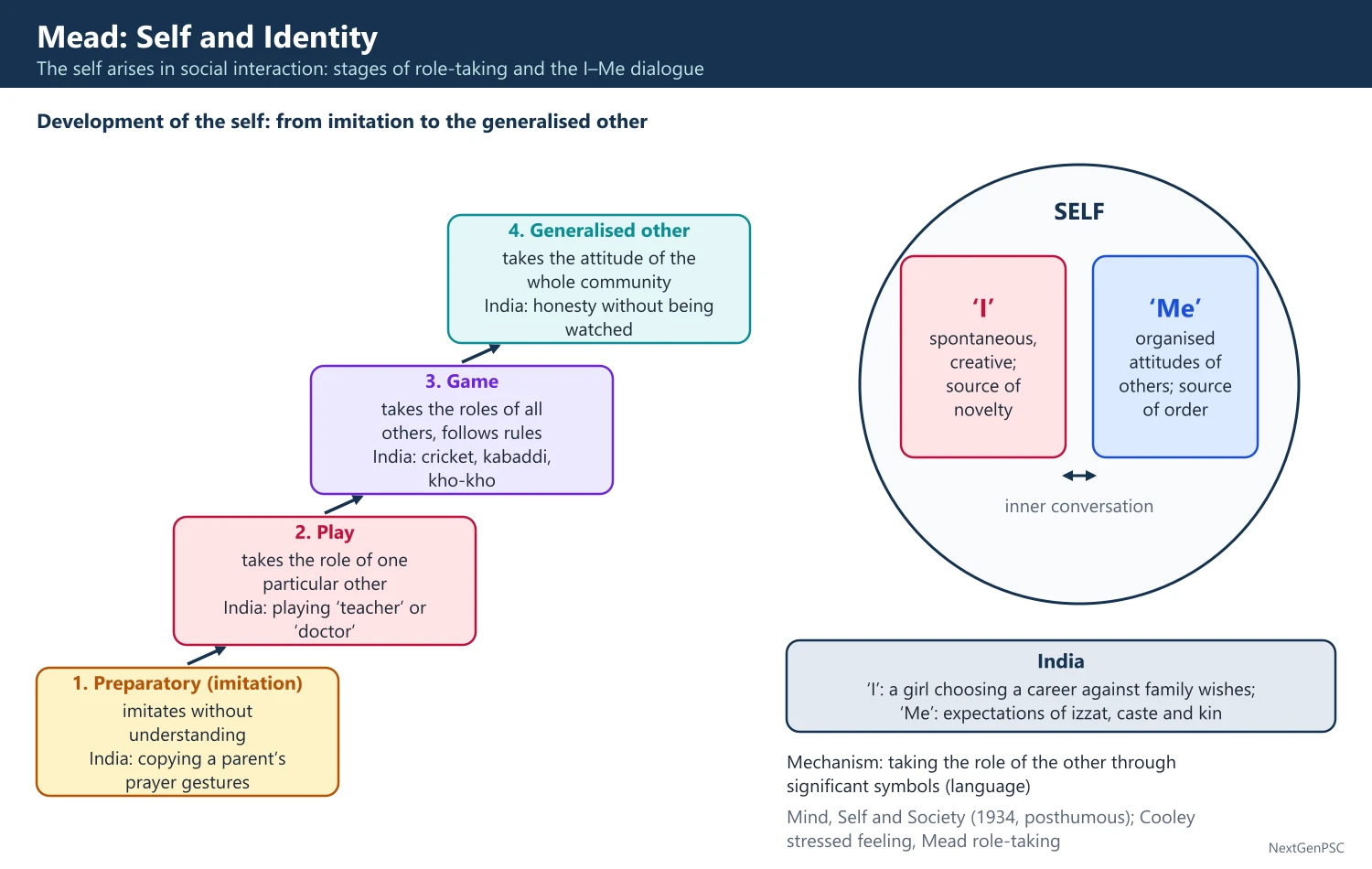
Preparatory or imitation stage: often added in textbooks for the infant who imitates without understanding; Mead himself stressed play and game.
Play stage: the child takes the role of particular others one at a time, playing at being mother, teacher or police officer, and addresses itself in that role.
Game stage: in organised games the child must take the roles of all the others at once and follow rules; Mead’s example is baseball, where each player must know what every other player will do.
Generalised other: the organised attitudes of the whole community or group, which the individual takes towards himself; through it society enters the individual’s thinking as a form of social control.
Significant others: the term was popularised by Harry Stack Sullivan, not Mead, but textbooks use it for the particular others (parents, teachers) important in the play stage.
3. The I and the Me
The ‘Me’: the organised set of attitudes of others that one assumes; the conventional, socialised self that represents society.
The ‘I’: the response of the individual to the attitudes of others; spontaneous, creative and unpredictable; it is known only after the act, in memory.
Dialogue: the self is a process, a continuing conversation between I and Me; the Me gives order and the I gives novelty, so individuals can change society as well as reflect it.
Contrast with Freud: unlike Freud’s id and superego, the I and Me are not in permanent conflict and are not biological drives; they are phases of a social process.
4. Identity: Later Theories
Charles Horton Cooley (Human Nature and the Social Order, 1902): the looking-glass self, built from imagining how we appear to others, imagining their judgement and feeling pride or shame.
Erik Erikson (Childhood and Society, 1950): identity develops through life stages; adolescence brings an ‘identity crisis’.
Erving Goffman (Stigma, 1963): ‘spoiled identity’ arises from stigma of the body, of character or ‘tribal’ stigma of race, nation or religion; people manage discredited and discreditable identities.
Sheldon Stryker (1980): structural symbolic interactionism; identities are arranged in a ‘salience hierarchy’ shaped by social structure.
Manford Kuhn and the Iowa school: measured the self with the Twenty Statements Test (1954), treating it as more stable than the Chicago school did.
Anthony Giddens (Modernity and Self-Identity, 1991): in late modernity the self becomes a ‘reflexive project’ that individuals continually construct.
Manuel Castells (The Power of Identity, 1997): distinguished legitimising, resistance and project identities in the network society.
5. Criticism
Vagueness: the I and Me and the generalised other are hard to define and test; Mead’s ideas come from students’ lecture notes.
Neglect of structure and power: Bernard Meltzer, James Petras and Larry Reynolds (1975) spoke of the ‘astructural bias’ of interactionism; it ignores class, caste and gender inequalities in who gets to define the self.
Neglect of emotion and the unconscious: Freudians and others argue that Mead’s self is too rational and cognitive.
Over-optimism: the model assumes a single generalised other; plural and conflicting communities produce fragmented identities.
Feminist critique: gendered socialisation and unequal power within families are under-theorised.
6. Indian Examples and Studies
Socialisation in the joint family: children in Indian joint families have many significant others (grandparents, uncles, aunts), and the generalised other often includes caste and kin norms of izzat (honour).
Game stage: games such as kabaddi, kho-kho and cricket teach children to take multiple roles and follow rules, exactly Mead’s game stage.
Caste and the self: Dalit autobiographies such as Omprakash Valmiki’s Joothan (1997) show how a humiliated self is formed through others’ responses, and how a new assertive identity emerges.
Reconstructing identity: B.R. Ambedkar’s conversion to Buddhism with lakhs of followers at Nagpur in 1956 was a collective rejection of a stigmatised identity; changing surnames and Sanskritisation are also identity strategies.
Colonialism and the self: Ashis Nandy (The Intimate Enemy, 1983) analysed the loss and recovery of self under colonialism.
Gender identity: the Supreme Court’s NALSA judgement (15 April 2014) recognised transgender persons as a ‘third gender’, followed by the Transgender Persons (Protection of Rights) Act 2019, showing law shaping the generalised other.
Digital self: social media profiles and ‘reels’ show presentation of self and the Me shaped by likes and comments, a contemporary looking-glass self.
7. Linking Thinkers
Mead and Cooley: Cooley stressed feeling and imagination; Mead explained the cognitive process of role-taking.
Mead and Blumer: Blumer systematised Mead into symbolic interactionism with three premises (1969).
Mead and Goffman: Goffman’s dramaturgy shows the self as performance in everyday encounters.
Mead and Durkheim or Parsons: the generalised other resembles internalised collective norms, but Mead keeps a creative ‘I’, avoiding Wrong’s ‘oversocialized’ person.
Mead and Weber: both start from meaningful action; Mead explains how meanings are formed in interaction.
8. Using it in the Exam
10 marks: define the self, explain I and Me, one example.
15 marks: stages of self (play, game, generalised other) with Indian examples, plus one criticism.
20 marks: social behaviourism → gestures and significant symbols → mind → self and role-taking → stages → I and Me → later identity theories (Cooley, Erikson, Goffman, Giddens) → critics → Indian examples (joint family, caste, Ambedkar, transgender rights) → conclusion.
Diagram idea: a ladder: imitation → play (particular others) → game (all roles) → generalised other, beside a circle showing I ⇄ Me as the self.
Useful definition: Mead held that the self is something which has a development; it is not initially there at birth but arises in the process of social experience and activity (paraphrase of Mind, Self and Society, 1934).
| Point | I | Me |
|---|---|---|
| Nature | Spontaneous, creative response | Organised attitudes of others |
| Role | Source of novelty and change | Source of order and conformity |
| When known | Only after the act, in memory | Present as social expectations |
| Indian illustration | A girl choosing a career against family wishes | Expectations of izzat, caste and kin |
| Stage | What the child does | Example |
|---|---|---|
| Preparatory (imitation) | Imitates without understanding | Copying a parent’s prayer gestures |
| Play | Takes the role of one particular other | Playing ‘teacher’ or ‘doctor’ |
| Game | Takes the roles of all others, follows rules | Cricket, kabaddi, kho-kho |
| Generalised other | Takes the attitude of the whole community | Following norms of honesty without being watched |
Mains points
- Typical angles: ‘Mead’s theory of self’, ‘I and Me’, ‘generalised other’, ‘self and identity in contemporary India’.
- Explain the mechanism (significant symbols, role-taking) before the stages; examiners look for it.
- Do not attribute ‘looking-glass self’ to Mead (it is Cooley’s) or ‘significant others’ to him (Sullivan).
- Bring Indian examples: joint family socialisation, children’s games, Dalit autobiographies, Ambedkar’s conversion, NALSA 2014 and the 2019 Act.
- Add later identity theorists (Erikson, Goffman, Giddens, Castells) for contemporary depth.
- Give critiques (astructural bias, vagueness, neglect of emotion and power).
Did you know?
- Mead published no book in his lifetime; Mind, Self and Society (1934) was compiled by Charles W. Morris from students’ notes of his University of Chicago lectures.
- Memory trick: ‘I am Impulsive, Me is Made by others’.
Symbolic Interactionism, Dramaturgy and Ethnomethodology
Symbolic interactionism studies how people create and act on meanings in interaction: Cooley’s looking-glass self, W.I. Thomas’s definition of the situation and Herbert Blumer’s three premises (1969). Erving Goffman’s dramaturgy (The Presentation of Self in Everyday Life, 1959) treats social life as performance with front stage and back stage, and his work on stigma and total institutions shows how selves are managed and damaged. Phenomenology (Alfred Schutz) and ethnomethodology (Harold Garfinkel) study the taken-for-granted methods by which people make everyday order.
In simple words
These approaches look at society from the ground up: how people read each other’s words, looks and gestures and act on what they think things mean.
A bride’s family at a wedding is like actors on a stage: on the front stage they are polite and perfect, while in the kitchen (back stage) they argue and relax.
Garfinkel showed hidden everyday rules by breaking them, for example by behaving like a polite guest in one’s own home.
UPSC asks about Blumer, the Thomas theorem, Goffman’s concepts, ethnomethodology and their critics, with Indian examples.
1. Roots and Key Concepts
Chicago school: symbolic interactionism grew at the University of Chicago from the 1920s, drawing on pragmatism (William James, John Dewey) and on Mead.
Looking-glass self (Charles Horton Cooley, Human Nature and the Social Order, 1902): three elements: the imagination of our appearance to the other person, the imagination of his judgement of that appearance, and a self-feeling such as pride or mortification.
Primary groups (Cooley, Social Organization, 1909): intimate face-to-face groups such as family and playgroup that form the social nature of individuals.
Definition of the situation (W.I. Thomas, The Unadjusted Girl, 1923): before acting, people examine and define the situation, and their definitions guide action.
Thomas theorem: ‘If men define situations as real, they are real in their consequences’ (W.I. Thomas and Dorothy Swaine Thomas, The Child in America, 1928); Merton named it and built the self-fulfilling prophecy on it.
2. Blumer’s Symbolic Interactionism
Name: Herbert Blumer coined ‘symbolic interactionism’ in 1937 and set it out in Symbolic Interactionism: Perspective and Method (1969).
Premise one: human beings act towards things on the basis of the meanings those things have for them.
Premise two: the meaning of things arises out of social interaction with others.
Premise three: these meanings are handled in, and modified through, an interpretative process used by the person dealing with the things encountered.
Society as process: social structures are frameworks within which joint action is constantly negotiated, not fixed systems that determine behaviour.
Method: naturalistic inquiry through ‘exploration’ and ‘inspection’, close observation and ‘sensitising concepts’ that guide rather than define (Blumer, 1954).
Iowa school: Manford Kuhn favoured measurable, more stable selves (Twenty Statements Test, 1954), unlike Blumer’s processual view.
Labelling theory: Edwin Lemert (primary and secondary deviance, 1951) and Howard Becker (Outsiders, 1963) applied interactionism to deviance: deviance is behaviour people so label.
3. Goffman’s Dramaturgy
Work: The Presentation of Self in Everyday Life (first published in Edinburgh in 1956, US edition 1959).
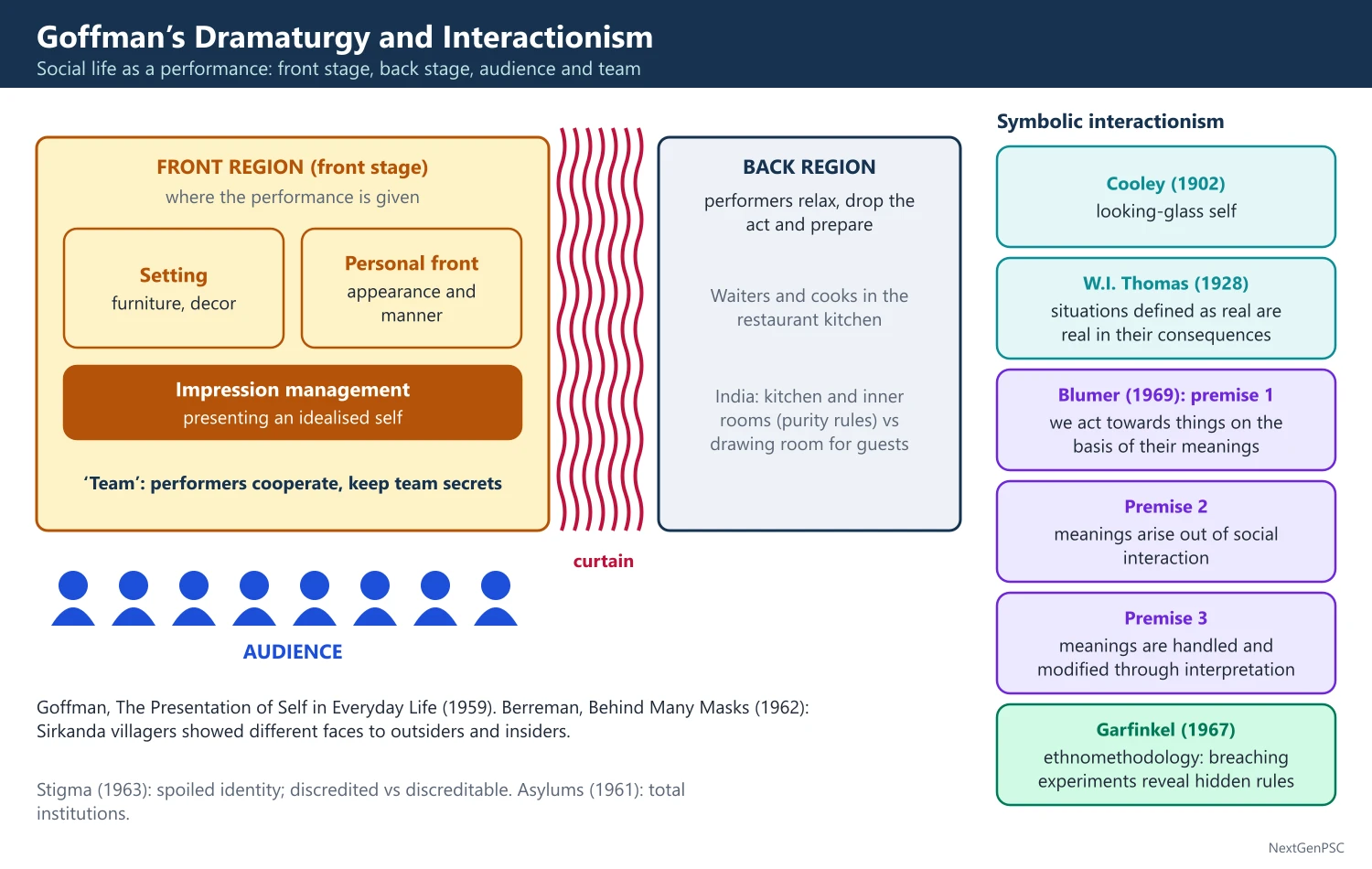
Performance and impression management: individuals try to control the impressions others form of them, presenting an idealised self suited to the situation.
Front: the expressive equipment of a performance: the setting (furniture, decor) and the personal front (appearance and manner).
Front stage and back stage: the front region is where the performance is given; the back region is where performers relax, drop the act and prepare.
Teams: groups cooperate to stage a performance, such as waiters and cooks in a restaurant, keeping team secrets.
Other concepts: role distance (Encounters, 1961), face-work (Interaction Ritual, 1967), civil inattention (Behavior in Public Places, 1963) and frame analysis (Frame Analysis, 1974).
4. Stigma and Total Institutions
Stigma (1963): an attribute that is deeply discrediting and reduces a person ‘from a whole and usual person to a tainted, discounted one’; types are abominations of the body, blemishes of individual character, and tribal stigma of race, nation and religion.
Discredited and discreditable: the discredited person’s stigma is visible, so he manages tension; the discreditable person’s is hidden, so he manages information (passing, covering).
Total institutions (Asylums, 1961): places of residence and work where many like-situated people are cut off from wider society and lead a formally administered life, such as mental hospitals, prisons, barracks, boarding schools and monasteries.
Mortification of self: admission procedures (stripping, uniforms, loss of name) break down the inmate’s former identity.
Secondary adjustments: inmates find unauthorised ways to keep some autonomy, showing agency even in total institutions.
5. Phenomenology and Ethnomethodology
Alfred Schutz (The Phenomenology of the Social World, 1932): applied Husserl’s phenomenology to Weber’s verstehen; key ideas are the life-world, the natural attitude, typifications, stocks of knowledge at hand and the reciprocity of perspectives.
Berger and Luckmann (The Social Construction of Reality, 1966): reality is socially constructed through externalisation, objectivation and internalisation.
Harold Garfinkel (Studies in Ethnomethodology, 1967): ethnomethodology studies the methods members use to produce and recognise social order in everyday life.
Indexicality: the meaning of words and acts depends on context; members fill in what is unsaid.
Reflexivity and accounts: descriptions of situations help constitute those situations; people give accounts to make actions sensible.
Documentary method of interpretation: people treat particular appearances as evidence of an underlying pattern and interpret new events in its light.
Breaching experiments: Garfinkel’s students behaved like boarders in their own homes, haggled over fixed prices or insisted on clarifying ordinary remarks; the anger and confusion showed the hidden rules that sustain order.
Agnes case: Garfinkel’s study of a transgender woman showed gender as something ‘accomplished’ in everyday practice.
Conversation analysis: Harvey Sacks, Emanuel Schegloff and Gail Jefferson (1974) analysed turn-taking in talk.
6. Criticism
Micro bias: these approaches neglect large structures of class, caste, state and economy; meanings are themselves shaped by power.
Gouldner on Goffman (1970): saw dramaturgy as reflecting a middle-class, market-oriented world where appearances are sold.
Lewis Coser (1975): in his American Sociological Association presidential address criticised ethnomethodology as trivial and lacking theoretical significance.
Cynicism and determinism: critics say Goffman’s actors seem calculating and lack inner commitment, while total institutions are presented as uniformly crushing.
Method problems: findings are hard to generalise and depend on the observer.
Bridging attempts: Giddens’ structuration theory (1984) and Bourdieu’s habitus link micro interaction with macro structure.
7. Indian Examples and Studies
Impression management in caste society: Gerald Berreman (Behind Many Masks, 1962) found villagers in Sirkanda showed different faces to outsiders and insiders, a direct use of Goffman’s front and back regions.
Front and back stage at home: the drawing room for guests and the kitchen and inner rooms governed by purity rules show front and back regions in Indian households.
Stigma: leprosy, HIV, mental illness, manual scavenging and caste identity (‘tribal stigma’) produce spoiled identities; people pass by changing surnames or hiding caste in cities.
Total institutions: prisons, psychiatric hospitals, residential schools and hostels; the Mental Healthcare Act 2017 sought to protect the rights of people in mental health establishments.
Thomas theorem in India: rumours of child-lifting or of communal provocation, defined as real, have led to real lynchings and riots; panic buying on rumours of shortages shows the same logic.
Labelling: the colonial Criminal Tribes Act 1871 labelled entire communities as criminal; even after its repeal in 1952 and the Habitual Offenders laws that followed, denotified tribes continue to face stigma.
Everyday life after violence: Veena Das (Life and Words: Violence and the Descent into the Ordinary, 2007) studied how survivors of Partition and the 1984 anti-Sikh violence remake everyday life, an approach close to phenomenology.
Ethnomethodological illustration: unwritten rules of queuing at railway counters, seat-sharing in crowded local trains or addressing elders with kinship terms become visible only when someone breaks them.
8. Linking Thinkers
Weber, Mead and Schutz: Weber’s verstehen, Mead’s self and Schutz’s life-world form the interpretive tradition.
Durkheim and Goffman: Goffman’s interaction rituals and face-work draw on Durkheim’s idea of the sacred individual.
Merton and Thomas: the self-fulfilling prophecy formalises the Thomas theorem.
Becker and Merton: labelling theory challenges Merton’s strain theory of deviance.
9. Using it in the Exam
10 marks: state Blumer’s three premises or Goffman’s front and back stage, with one Indian example.
15 marks: compare symbolic interactionism and ethnomethodology, or explain stigma and total institutions.
20 marks: roots (Cooley, Thomas, Mead) → Blumer’s premises and method → Goffman (dramaturgy, stigma, total institutions) → phenomenology and ethnomethodology (Schutz, Garfinkel, breaching) → criticism (micro bias, Gouldner, Coser) → Indian examples (Berreman, caste stigma, rumours and lynching, denotified tribes) → conclusion on micro–macro linkage.
Diagram idea: a theatre sketch: stage (front region: setting, appearance, manner), curtain, and back region, with ‘audience’ and ‘team’ labels.
Useful quotation: ‘If men define situations as real, they are real in their consequences’ (W.I. Thomas and Dorothy Swaine Thomas, 1928).
| Approach | Key thinkers and works | Core idea | Method | Indian illustration |
|---|---|---|---|---|
| Symbolic interactionism | Mead; Blumer (1969) | Meanings arise and change in interaction | Participant observation | Sanskritisation as negotiated meaning |
| Dramaturgy | Goffman (1956/1959, 1961, 1963) | Life as performance; impression management | Observation of encounters | Berreman’s ‘many masks’ in Sirkanda |
| Labelling | Lemert (1951); Becker (1963) | Deviance is a label applied by others | Case studies | Criminal Tribes Act 1871 and denotified tribes |
| Phenomenology | Schutz (1932); Berger and Luckmann (1966) | Life-world, typifications, social construction | In-depth description | Veena Das on everyday life after violence |
| Ethnomethodology | Garfinkel (1967) | Methods members use to make order | Breaching experiments, conversation analysis | Unwritten queue and train etiquette |
Mains points
- Typical angles: ‘Blumer’s premises of symbolic interactionism’, ‘Goffman’s dramaturgical approach’, ‘stigma and identity’, ‘ethnomethodology as a critique of mainstream sociology’, ‘Thomas theorem’.
- Quote Blumer’s three premises and the Thomas theorem accurately, with dates.
- Distinguish symbolic interactionism (meanings in interaction) from ethnomethodology (methods of making order) and phenomenology (life-world).
- Use Indian examples: Berreman’s fieldwork, caste stigma and passing, rumours and lynching, the Criminal Tribes Act 1871, total institutions.
- Give criticisms (micro bias, Gouldner, Coser) and bridging theories (Giddens, Bourdieu).
- Common mistake: attributing the looking-glass self to Mead or the term ‘symbolic interactionism’ to Mead; they belong to Cooley and Blumer.
Did you know?
- Goffman did fieldwork for his doctoral thesis on a crofting community in the Shetland Islands; observations there fed into The Presentation of Self.
- Memory trick for Blumer: ‘Meaning, Interaction, Interpretation’ — the three premises in order (M-I-I).
UPSC Previous Year Questions: Sociological Thinkers: Parsons, Merton and Mead
From 2014 to 2026 UPSC asked 27 question parts (370 marks) on Parsons, Merton, Mead and the interactionists in Paper I. Merton is the most asked (13 parts: anomie and deviance, manifest and latent functions, reference groups), followed by Parsons (6) and Mead (6). Every question below has a model answer written to the UPSC word limit (150 words for 10 marks, 250 for 20 marks).
In simple words
Read the question and the approach line, then write your own answer in the time limit (7 minutes for 10 marks, 11 minutes for 20 marks).
Compare it with the model answer: did you define the concept with the thinker and work, explain the argument, apply it to an Indian example and add criticism?
Copy the flow charts (AGIL, Merton's modes of adaptation, Mead's stages) into your notes and reuse them.
1. Talcott Parsons: Social System and Pattern Variables
Example 1 (UPSC 2022, 20 marks): Critically analyse Parsons views on society as a social system.
Paper and question: Paper I, Q7(a)
Approach: Explain Parsons's idea of society as a social system (action frame of reference, system levels, AGIL, integration through values), then critically assess it with named critics and Indian examples.
Talcott Parsons, in The Social System (1951), defined a social system as a plurality of individual actors interacting with each other in a situation and oriented to one another through shared, culturally structured symbols. Society is the most self-sufficient social system.
Parsons began from the voluntaristic theory of action in The Structure of Social Action (1937): actors choose ends and means, but within norms and situational conditions. Action is organised in four systems: the behavioural organism, personality, the social system and the cultural system. Values from the cultural system are institutionalised in the social system as norms and roles and internalised in the personality through socialisation.
Every system must meet four functional prerequisites (AGIL): adaptation (economy), goal attainment (polity), integration (law, community) and latency or pattern maintenance (family, education, religion). Order and equilibrium are maintained by shared values and by social control that corrects deviance.
Flow chart: cultural values → institutionalised as norms and roles → internalised by socialisation → conformity → equilibrium.
The model was criticised widely. C. Wright Mills called it 'grand theory', abstract and hard to relate to real problems. Ralf Dahrendorf and Lewis Coser argued that it neglects conflict, power and interests and treats society as a utopia of consensus. Dennis Wrong criticised the 'oversocialized conception of man', and interactionists said it ignores how actors create meaning.
In India, the model helps to see how caste, joint family and religion once integrated rural society and how planning and the Constitution adapted it to new goals. But conflicts over caste, land and identity show that order is often imposed, not agreed.
Thus Parsons offered a systematic map of society, revived later by Jeffrey Alexander's neofunctionalism, but it must be combined with conflict and interpretive views.
Example 2 (UPSC 2020, 10 marks): Analyse the relevance of 'Pattern variables' in the study of social change.
Paper and question: Paper I, Q1(e)
Approach: Define pattern variables, show how Parsons used them to contrast traditional and modern societies, apply to Indian social change, and note limitations.
Talcott Parsons (with Edward Shils, Toward a General Theory of Action, 1951) defined pattern variables as five pairs of dilemmas of choice every actor faces in a role: affectivity versus affective neutrality, diffuseness versus specificity, particularism versus universalism, ascription versus achievement, and collectivity orientation versus self orientation.
They are relevant to social change because Parsons treated one set as typical of traditional societies (affectivity, diffuseness, particularism, ascription) and the other as typical of modern industrial societies (neutrality, specificity, universalism, achievement). Change can thus be measured as a shift in the dominant choices.
In India, the move from caste-based occupation (ascription) to recruitment by competitive examination (achievement), from jajmani ties (diffuse, particularistic) to contracts (specific, universalistic) shows such change.
Limitations: the dichotomy is linear and Western-centric. Milton Singer and Lloyd and Susanne Rudolph showed that tradition adapts and coexists with modernity, as caste associations in politics show. So the pattern variables are a useful yardstick of change, not a law of evolution.
Example 3 (UPSC 2018, 20 marks): How can Parsons' AGIL framework be used to analyse key problems in a society? Discuss.
Paper and question: Paper I, Q7(a)
Approach: Explain AGIL and the subsystems that meet each need, then show how it can diagnose problems (functional failure, strain between subsystems) with Indian examples; end with limits.
Talcott Parsons argued that every social system must solve four functional problems to survive, summarised as AGIL (developed with Robert Bales and Neil Smelser in the 1950s).
Adaptation is securing resources from the environment and distributing them, done chiefly by the economy. Goal attainment is setting priorities and mobilising resources for collective goals, done by the polity. Integration is coordinating parts and managing conflict, done by law, courts and community. Latency (pattern maintenance and tension management) is transmitting values and motivation, done by family, education and religion.
Flow chart: problem in society → identify which function is failing (A, G, I or L) → locate the subsystem responsible → examine strain with other subsystems → suggest reform.
Used this way, AGIL becomes a diagnostic tool. Unemployment and agrarian distress in India are failures of adaptation; the gap between degrees and jobs shows strain between the latency (education) and adaptation (economy) subsystems. Policy paralysis or poor implementation of welfare schemes is a problem of goal attainment. Communal riots, caste atrocities and pending court cases signal weak integration. Rising family breakdown, drug abuse among youth in Punjab, or erosion of civic values point to problems of latency.
Parsons also saw subsystems exchanging inputs through media (money, power, influence, value commitment), so a problem in one spreads to others: farm distress (A) leads to agitations (I) and pressure on policy (G).
The framework has limits. Critics such as Dahrendorf note that it hides power and treats problems as malfunctions rather than as conflicts of interest; Mills found it too abstract. Marxists would see unemployment as built into capitalism, not a mere functional failure.
Still, AGIL gives a checklist for a systematic analysis of social problems, which can be combined with conflict theory for a full picture.
Example 4 (UPSC 2017, 10 marks): Critically analyse Talcott Parsons' conception of 'Pattern Variables'.
Paper and question: Paper I, Q1(d)
Approach: Define the five pattern variables, show their uses, then critically analyse them with named critics and Indian evidence.
Talcott Parsons and Edward Shils (1951) proposed pattern variables as five dichotomies that define the choices an actor makes in orienting to others: affectivity–affective neutrality, diffuseness–specificity, particularism–universalism, ascription–achievement, and collectivity–self orientation.
They link the action theory to the social system: the same choices, institutionalised, define roles (a doctor is expected to be neutral, specific, universalistic and achievement-based; a mother the opposite). They also allow societies to be compared as traditional or modern.
Critically, the scheme has several weaknesses. It is a rigid binary; real roles combine both sides, as an Indian family doctor is both universalistic and personally known. Its traditional–modern contrast is ethnocentric, treating the West as the end point, a criticism made by Andre Gunder Frank and others of modernisation theory. Studies of India by Milton Singer and the Rudolphs show tradition modernising itself, and caste persisting in elections and matrimonial ads.
Thus pattern variables are a neat analytical tool, but they simplify change and must be applied with care.
Example 5 (UPSC 2016, 20 marks): Describe the functional prerequisites of social system as given by Talcott Parsons. Examine in the context of a university as a social system.
Paper and question: Paper I, Q2(b)
Approach: Explain the four functional prerequisites (AGIL) and the other conditions Parsons gave, then apply each to a university as a social system with its subsystems and strains.
For Talcott Parsons, a social system is a system of interaction among actors oriented by shared norms and values. In The Social System (1951) he argued that it survives only if certain functional prerequisites are met: it must be compatible with the personality and cultural systems, secure enough motivation and conformity from actors, and control disruptive behaviour. Later, with Smelser and Bales, he summarised these needs as AGIL.
Adaptation: obtaining and allocating resources from the environment. Goal attainment: defining and pursuing collective goals. Integration: coordinating parts and regulating conflict. Latency: maintaining shared values and managing tension.
A university can be examined as a social system in these terms.
Adaptation is met by fees, government grants (for example through the UGC), research funds and infrastructure, and by placement links with the labour market. Goal attainment is met by the governing bodies, vice-chancellor and academic council, which set goals of teaching, research and outreach, today shaped by the National Education Policy 2020. Integration is achieved through statutes, ordinances, disciplinary committees, grievance cells, anti-ragging rules and student unions that channel conflict. Latency is maintained by academic values of free inquiry and merit, convocation rituals, alumni traditions, and counselling that manages student stress.
Flow chart: funds and staff (A) → academic goals (G) → rules and committees (I) → academic values and socialisation (L) → stable university.
Roles in a university follow modern pattern variables: teachers grade by universalistic, achievement-based and affectively neutral criteria. Failures show when one function breaks down: paper leaks or politicised appointments weaken integration and latency; underfunding hits adaptation.
But a Parsonian view hides conflicts over fees, reservations and campus politics, which conflict theorists would stress. So it is useful for describing the university's working, but incomplete.
Example 6 (UPSC 2015, 20 marks): How is social equilibrium maintained in Parsonian framework?
Paper and question: Paper I, Q4(b)
Approach: Explain how Parsons explains equilibrium (shared values, institutionalisation, socialisation, social control, adaptation through change), then assess criticisms with examples.
Talcott Parsons treated society as a system that tends towards equilibrium, a state in which its parts are integrated and actors largely conform to institutionalised expectations. For him the central question, following Hobbes, was how social order is possible.
First, equilibrium rests on a common value system. Values in the cultural system become norms and roles in the social system; this is institutionalisation.
Second, through socialisation in the family, school and peer group, these norms are internalised in the personality, so that actors want to do what they are expected to do. Conformity is thus motivated, not merely forced.
Third, social control handles the deviance that remains: rewards, sanctions, the law, and even the sick role, which allows temporary withdrawal under medical supervision and so returns people to normal roles.
Fourth, the four functional subsystems (AGIL) exchange inputs and outputs, so strain in one part is balanced by adjustment in another. Parsons's equilibrium is therefore a moving or dynamic one: in his later evolutionary work he described change through differentiation, adaptive upgrading, inclusion and value generalisation.
Flow chart: shared values → institutionalised roles → internalised through socialisation → conformity → deviance corrected by social control → equilibrium restored.
In India, the joint family and caste norms long regulated behaviour, and today the Constitution's values are taught in school to maintain civic order; caste panchayats once acted as agencies of social control.
Critics point out that equilibrium is assumed, not shown. Dahrendorf and Coser argued that conflict and coercion are equally basic; David Lockwood distinguished social integration from system integration; Dennis Wrong attacked the oversocialised view of man. Dalit, peasant and women's movements in India show that order often depends on power. Parsons's model explains stability well, but change and conflict less well.
2. Robert K. Merton: Functions, Conformity and Deviance, Reference Groups
Example 7 (UPSC 2025, 10 marks): Can Merton's reference group theory be relevant in understanding 'identity making' in digital world? Explain.
Paper and question: Paper I, Q1(d)
Approach: Define reference group and its key ideas (relative deprivation, anticipatory socialisation, membership and non-membership groups), apply them to online identity-making with examples, and note limits.
Robert K. Merton (with Alice Kitt, 1950; Social Theory and Social Structure, 1957), building on Herbert Hyman, defined a reference group as a group whose standards an individual uses to evaluate himself and shape his attitudes, whether or not he belongs to it. Its key ideas are relative deprivation and anticipatory socialisation.
The theory is highly relevant online. Social media multiply non-membership reference groups: influencers, celebrities and distant peers. Young Indians on Instagram or YouTube adopt the dress, speech and lifestyle of urban elites (anticipatory socialisation); comparison with curated images produces relative deprivation, anxiety and status competition.
Online communities of caste, religion, fandom or profession also serve as normative reference groups that define who 'we' are.
However, digital identity has new features: groups are fluid and algorithm-driven, identities are performed, as Goffman would say, and users can switch reference groups quickly. Merton's framework explains comparison and aspiration well, but must be supplemented by ideas of networked and performative identity.
Example 8 (UPSC 2023, 10 marks): Is reference group theory a universally applicable model? Elucidate.
Paper and question: Paper I, Q1(d)
Approach: Explain the theory briefly, argue for its general applicability (comparison is universal), then show its limits across contexts and cultures.
Merton's reference group theory holds that people evaluate their situation and shape attitudes by comparison with groups they belong to or aspire to. Its classic evidence was the American Soldier study (Stouffer and others, 1949), where military police with little chance of promotion were more satisfied than air corps men with frequent promotions, because each compared himself with his own group: relative deprivation.
In one sense the model is universal: comparison is found in all societies. Srinivas's Sanskritisation, in which lower castes adopt the customs of higher castes, is a form of anticipatory socialisation; aspiring middle classes in India take the urban rich as a reference group.
But it is not universally applicable in a mechanical way. In rigid hierarchies, aspiration may be blocked (Merton noted that anticipatory socialisation is functional only in open systems).
Identity movements, like the Dalit movement rejecting upper-caste models, show that groups may reject a reference group. So the theory is a general tool, but its working depends on social structure.
Example 9 (UPSC 2022, 20 marks): Critically examine how Durkheim and Merton explicate Anomie.
Paper and question: Paper I, Q3(b)
Approach: Explain Durkheim's anomie (division of labour and suicide) and Merton's anomie (means–goals gap and modes of adaptation), compare them, and critically assess both with examples.
Anomie means normlessness, a breakdown of the regulation society provides. Durkheim introduced it, and Merton reformulated it.
For Émile Durkheim, in The Division of Labour in Society (1893), anomie appears as an abnormal form of the division of labour when rapid industrial change outpaces regulation, causing industrial crises and class conflict. In Suicide (1897), anomic suicide rises when sudden economic booms or busts, or divorce, loosen the moral limits on human desires, which by nature are insatiable. Anomie is a deficit of moral regulation in a society in transition.
Robert K. Merton, in 'Social Structure and Anomie' (1938), located anomie in the structure itself: a disjunction between culturally prescribed goals (such as monetary success in the American dream) and the institutionalised means available unequally to different classes. Individuals adapt in five ways.
Flow chart: goals accepted/means accepted → conformity; goals +/means − → innovation; goals −/means + → ritualism; goals −/means − → retreatism; both replaced → rebellion.
Differences: Durkheim's desires are biological and unlimited, Merton's are culturally induced; Durkheim stresses moral deregulation in change, Merton a chronic strain in stable but unequal society; Durkheim explains suicide rates, Merton patterned deviance by class.
Criticism: Durkheim's view is said to be conservative and based on official statistics. Merton was criticised by Albert Cohen for ignoring group and non-utilitarian delinquency, by Cloward and Ohlin for neglecting illegitimate opportunity structures, and by interactionists for ignoring labelling. In India, competitive exam pressure, cheating in examinations and white-collar fraud show Merton's innovation, while farmer suicides after market shocks are often read in Durkheim's terms. Together they show that deviance is socially produced.
Example 10 (UPSC 2021, 10 marks): With suitable examples, explain how conformity and deviance coexist in a society as propounded by R.K. Merton.
Paper and question: Paper I, Q4(c)
Approach: Explain Merton's strain theory showing that the same structure produces conformity and deviance through the modes of adaptation, with Indian examples.
Robert K. Merton, in 'Social Structure and Anomie' (1938), argued that deviance is not caused by biological drives but by the social structure. When a culture stresses success goals but offers unequal legitimate means, a strain arises, and individuals adapt in different ways.
Conformity, accepting both goals and means, is the most common response and keeps society stable, for example a student who studies hard for the civil services.
Alongside it, the same pressure produces deviance: innovation (goals accepted, illegitimate means), such as exam paper leaks or financial fraud; ritualism, a clerk who follows rules mechanically; retreatism, drug abuse; and rebellion, as in movements seeking a new social order.
Thus conformity and deviance coexist because both are responses to one structure. Merton also noted that deviance can be functional, signalling the need for change. Critics such as Cohen and Cloward and Ohlin added subcultural and opportunity explanations, but Merton's point that deviance is socially patterned remains valuable.
Example 11 (UPSC 2020, 20 marks): What are the reactions of R.K. Merton to the functionalism of social anthropologists? Bring out the limitations of latent functions.
Paper and question: Paper I, Q2(a)
Approach: Set out Merton's criticism of the three postulates of anthropological functionalism and his paradigm (dysfunction, functional alternatives, manifest and latent functions), then show the limitations of latent functions.
Robert K. Merton, in Social Theory and Social Structure (1949, revised 1957), accepted functional analysis but rejected the sweeping assumptions of social anthropologists such as Malinowski and Radcliffe-Brown. He proposed a codified, empirically testable functionalism and theories of the middle range.
He questioned three postulates. The postulate of the functional unity of society (every item works for the whole system) holds at best for small, integrated societies, not complex ones. The postulate of universal functionalism (every standardised item has a positive function) ignores dysfunctions and non-functions. The postulate of indispensability (each item is necessary) ignores functional alternatives or equivalents.
In their place he offered: dysfunctions (consequences that reduce adaptation), net balance of consequences, the question 'functional for whom', functional alternatives, and the distinction between manifest functions (intended and recognised) and latent functions (neither intended nor recognised). His example was the Hopi rain dance, which does not produce rain but strengthens group solidarity.
Flow chart: social item → consequences → functional or dysfunctional → manifest (intended, recognised) or latent (unintended, unrecognised) → net balance.
Latent functions, however, have limitations. Whether a function is recognised depends on who is asked, so the line between manifest and latent is unclear. The concept risks explaining persistence by consequences discovered after the fact, a teleological or tautological argument, as critics such as Colin Campbell and Anthony Giddens noted. It also can justify harmful practices: caste or dowry may be said to have latent integrative functions, hiding their exploitation. Finally, the observer's judgement replaces actors' meanings, a criticism from interpretive sociology.
Still, Merton made functionalism more critical and realistic, and latent functions remain a key idea for seeing beyond appearances.
Example 12 (UPSC 2019, 10 marks): What, according to Merton, is the difference between 'unanticipated consequences' and 'latent functions'? Give examples to elaborate.
Paper and question: Paper I, Q3(c)
Approach: Distinguish Merton's latent functions from his 1936 concept of unanticipated consequences, with examples of each.
Merton developed both ideas but at different points. In 'The Unanticipated Consequences of Purposive Social Action' (1936) he showed that purposive actions often produce outcomes the actor did not intend, because of ignorance, error, immediate interest overriding long-term interest, basic values, or the self-defeating prophecy.
Unanticipated consequences is the broader idea: it includes all unintended outcomes, whether good, bad or irrelevant to the system. Example: a ban on liquor in an Indian state may lead to illicit brewing and hooch tragedies.
Latent functions, introduced in Social Theory and Social Structure, are a narrower category: unintended and unrecognised consequences that contribute to the adaptation or adjustment of a system. Example: the Hopi rain dance strengthens group solidarity; a village festival or a political rally creates a sense of community.
So every latent function is an unanticipated consequence, but not every unanticipated consequence is functional; harmful unintended outcomes are latent dysfunctions. Merton also noted that once recognised, a latent function may become manifest.
Example 13 (UPSC 2019, 20 marks): How, according to Merton, are deviant subcultures generated?
Paper and question: Paper I, Q8(b)
Approach: Explain Merton's means–goals strain and modes of adaptation, show how shared strain among those blocked from means generates deviant subcultures, add Cohen and Cloward–Ohlin, and give Indian examples.
Robert K. Merton, in 'Social Structure and Anomie' (1938), argued that some social structures exert a definite pressure on certain persons to engage in non-conforming rather than conforming conduct. Deviance is therefore normal in the sense of being socially produced.
The source is structural strain: American culture stresses monetary success as a goal for all, but legitimate means such as education and good jobs are unequally distributed by class and race. When goals are emphasised more than means, norms lose force and anomie results.
Merton gave five modes of adaptation: conformity, innovation, ritualism, retreatism and rebellion. Deviant subcultures grow out of the shared strain of those similarly placed. Innovation among lower-class youth produces criminal patterns such as theft or organised rackets; retreatism produces drug and vagrant subcultures; rebellion produces counter-cultures and movements with new goals and means.
Flow chart: success goal for all → blocked legitimate means for some → anomie and strain → shared adaptation → deviant subculture.
Merton explained individual adaptations; later scholars developed the subcultural side. Albert Cohen (Delinquent Boys, 1955) showed that lower-class boys who fail in middle-class schools form gangs with status reversal. Cloward and Ohlin (1960) added illegitimate opportunity structures, producing criminal, conflict and retreatist subcultures.
In India, organised cheating rackets in competitive exams, cyber-fraud hubs such as those reported in Jamtara, and drug use among unemployed youth illustrate innovation and retreatism among those whose aspirations outstrip opportunities.
Critics note that Merton's theory relies on official statistics that overstate lower-class crime, neglects white-collar crime and assumes a value consensus. Yet it remains a foundational explanation of how social structure generates deviance.
Example 14 (UPSC 2018, 10 marks): What is the difference between anomie in Merton and Durkheim? Explain.
Paper and question: Paper I, Q3(c)
Approach: Compare Durkheim's and Merton's anomie on cause, nature of desires, social context and outcome, ideally in a short table described in a line.
Both used anomie to explain deviance as a social, not individual, product, but they differ.
For Durkheim (The Division of Labour in Society, 1893; Suicide, 1897), anomie is normlessness: a failure of moral regulation during rapid change, booms or crises, when society cannot limit human desires, which he saw as naturally boundless. It is acute and temporary, and it explains rising suicide rates and industrial conflict.
For Merton ('Social Structure and Anomie', 1938), anomie is a structural strain produced by the gap between culturally induced success goals and unequal access to legitimate means. It is chronic, built into stable but unequal societies, and it explains class-patterned deviance through five modes of adaptation.
Flow chart: Durkheim: rapid change → deregulation → limitless desires → anomic suicide; Merton: goals > means → strain → innovation, ritualism, retreatism, rebellion.
In India, Durkheim's idea fits farm distress after market shocks; Merton's fits exam cheating and fraud among aspiring youth who lack legitimate means. Durkheim's view is moral and societal, concerned with the regulation of desire; Merton's is structural and differential, concerned with unequal opportunity.
Example 15 (UPSC 2016, 20 marks): Analyze the manifest and latent functions of 'security of the tenure of bureaucrats' in the light of Merton's theory.
Paper and question: Paper I, Q3(a)
Approach: Define manifest and latent functions and dysfunctions, then analyse security of tenure of civil servants under each, using Article 311 and Indian examples, and conclude with net balance.
Robert K. Merton distinguished manifest functions, the intended and recognised consequences of a social pattern, from latent functions, those neither intended nor recognised. He also stressed dysfunctions and asked for the net balance of consequences, and for whom an item is functional.
In India, civil servants enjoy security of tenure under Article 311 of the Constitution, which protects them from dismissal or reduction in rank without an inquiry and a reasonable opportunity to be heard, and by an authority not subordinate to the appointing one.
Manifest functions: to ensure that officials can give impartial advice and implement laws without fear of political retaliation; to attract talent to a stable career; to maintain continuity of administration across governments, in line with Weber's ideal of a career bureaucracy.
Latent functions: tenure builds an esprit de corps and a shared service identity, as Sardar Patel expected of the all-India services; it lends prestige to the state and the officer, which strengthens middle-class aspiration towards government jobs; and it gives continuity of institutional memory that no one consciously designs.
Latent dysfunctions: it can breed complacency, resistance to change and the bureaucratic personality Merton described, where rules become ends in themselves (goal displacement); it can shield corrupt or inefficient officers, since disciplinary processes are slow; and the rush for secure jobs contributes to the crowding of aspirants in competitive exams. Politicians also use frequent transfers as an indirect weapon because dismissal is hard.
Flow chart: security of tenure → manifest: neutrality, continuity → latent: esprit de corps, prestige → latent dysfunction: complacency, red tape, transfers as control.
The Second Administrative Reforms Commission suggested periodic performance review, and fixed tenure for key posts has been urged by the Supreme Court (T.S.R. Subramanian case, 2013). Merton's analysis shows that tenure has a positive net balance, provided accountability is added.
Example 16 (UPSC 2015, 10 marks): "Anomie is rooted in social structure." Explain with reference to R.K. Merton's contribution.
Paper and question: Paper I, Q4(c)
Approach: Explain the statement through Merton's view that anomie comes from the structure (goals versus means), the five adaptations and Indian examples.
Robert K. Merton, in 'Social Structure and Anomie' (1938), moved the explanation of deviance from individual pathology to the social structure. Unlike Durkheim, who saw anomie as deregulation of naturally limitless desires in times of rapid change, Merton held that society itself creates the desires and the strain.
Every society has a cultural structure (goals and norms) and a social structure (distribution of opportunities). In the USA, monetary success is a goal for all, yet legitimate means are unequally distributed by class.
This disjunction weakens the hold of norms, which is anomie, and produces conformity, innovation, ritualism, retreatism and rebellion.
Hence anomie is rooted in the structure, not in rapid change alone. In India, the pressure to secure a government job or an elite college seat, with limited seats, helps explain exam paper leaks, coaching-centre stress and fraud. Merton thus explained why deviance is higher in certain strata, though critics note he neglected white-collar crime and labelling.
Example 17 (UPSC 2014, 10 marks): How can we use reference group theory to understand fashion in society?
Paper and question: Paper I, Q1(e)
Approach: Explain reference group, relative deprivation and anticipatory socialisation, then apply them to how fashion spreads (trickle-down and trickle-across) in India.
Robert K. Merton defined a reference group as a group whose values and standards a person takes as a frame for evaluating himself, whether or not he is a member. Non-membership reference groups lead to anticipatory socialisation, adopting the values of a group one hopes to join.
Fashion is a clear case. People dress to resemble those they look up to: film stars, cricketers, social-media influencers or the urban upper middle class. Georg Simmel's analysis of fashion as imitation by lower strata and differentiation by elites fits with this. When a style spreads widely, elites drop it and move to a new one.
In India, small-town youth copying Bollywood looks, brides adopting North Indian lehengas in the South, and office workers taking up corporate attire show anticipatory socialisation. Relative deprivation also appears when people feel left behind for not affording branded goods.
So reference group theory explains why fashions spread, change and mark status, though today trends also move from the street and subcultures upward.
Example 18 (UPSC 2014, 10 marks): How could one use Merton's concept of deviance to understand the traffic problem in urban India?
Paper and question: Paper I, Q2(c)
Approach: Apply Merton's strain theory and modes of adaptation to urban traffic behaviour in India, with examples, and note what it misses.
Robert K. Merton explained deviance as a response to strain between culturally emphasised goals and the institutionalised means to reach them. When goals are stressed more than means, norms weaken (anomie).
In urban India, the goal is speed: reaching office, school or a delivery on time. The legitimate means, roads, signals and public transport, are inadequate and congested. Many drivers therefore choose innovation: jumping signals, driving on the wrong side, using footpaths or bribing traffic police.
Ritualism appears in drivers who stop at signals even when the system has broken down, or officials who issue challans mechanically without improving traffic. Retreatism appears in those who give up driving or commuting altogether; rebellion in citizen movements demanding cycle lanes and pedestrian rights.
Merton's approach shows that traffic indiscipline is structurally produced, not merely individual bad behaviour. But it misses weak enforcement, the labelling of some road users and cultural norms. The Motor Vehicles (Amendment) Act 2019 raised penalties, but better means are equally needed.
Example 19 (UPSC 2014, 10 marks): Using Merton's concepts of 'manifest' and 'latent' functions, explain the persistence of corruption in Indian society.
Paper and question: Paper I, Q3(c)
Approach: Define manifest and latent functions, show how corruption serves latent functions for different groups (following Merton's political machine), and conclude that reform needs functional alternatives.
Robert K. Merton distinguished manifest functions (intended and recognised) from latent functions (unintended and unrecognised). He used this to explain why socially disapproved structures persist: they meet needs that legitimate structures fail to meet. His example was the American political machine, which, despite corruption, gave the poor help and access, and gave business quick favours.
Corruption in India can be read the same way. Its manifest aims are private gain. Its latent functions, for different groups, include: speeding up slow bureaucratic procedures ('speed money'); giving poor citizens access to services through middlemen; giving business predictable deals and licences; and financing election campaigns.
Since corruption performs these functions, campaigns that only punish it fail. Merton's lesson is that persistence ends only when functional alternatives exist: online services and direct benefit transfers that cut out intermediaries, the Right to Information Act 2005, the Lokpal and Lokayuktas Act 2013, and transparent electoral funding.
Critics warn that such analysis may seem to justify corruption, but Merton's aim was to explain, not approve.
3. George Herbert Mead: Self and Identity
Example 20 (UPSC 2024, 10 marks): Explain G.H. Mead's idea of development of 'self' through the 'generalised other'.
Paper and question: Paper I, Q5(b)
Approach: Define self and generalised other, explain the stages (imitation, play, game) leading to the generalised other, and give an Indian example and a criticism.
For George Herbert Mead (Mind, Self and Society, 1934), the self is not present at birth; it arises in social experience through the ability to take the role of others and see oneself as an object.
The self develops in stages. In the preparatory stage the child imitates gestures without understanding. In the play stage the child takes the role of particular significant others, playing mother, teacher or shopkeeper. In the game stage the child must grasp the roles of all participants and the rules, as in cricket.
The organised attitude of the whole community that the individual takes towards himself is the generalised other. Through it, society's norms enter the self, enabling self-control. An Indian child learns what 'people will say' (log kya kahenge), family honour and caste expectations in this way.
Flow chart: imitation → play (significant others) → game (organised roles) → generalised other → mature self.
Critics say Mead neglected power and the unconscious, and that children face several, sometimes conflicting, generalised others.
Example 21 (UPSC 2022, 20 marks): According to Mead the idea of self develops when the individual becomes self-conscious. Explain.
Paper and question: Paper I, Q6(a)
Approach: Explain Mead's idea that self arises when one becomes an object to oneself through role-taking and language, the stages and the I–me dialectic, then evaluate with examples and critics.
George Herbert Mead, the founder of what Herbert Blumer later named symbolic interactionism, argued in Mind, Self and Society (1934) that the self is a social product. It is distinct from the body: the self exists only when the individual becomes an object to himself, that is, becomes self-conscious.
Self-consciousness arises through communication. Animals respond to gestures directly, but humans use significant symbols, above all language, which call out the same response in the speaker as in the listener. This allows a person to take the attitude of others towards himself, to look at himself from outside. Mind is this internal conversation with oneself.
The ability grows in stages. In imitation the infant copies without meaning. In play the child takes the role of one significant other at a time. In the game the child takes the roles of all others in an organised activity and their rules, and finally the attitude of the generalised other, the community as a whole.
Flow chart: gesture → significant symbol (language) → role-taking → seeing oneself as object → self-consciousness → self.
The self has two phases. The 'me' is the organised set of others' attitudes the person assumes; the 'I' is the spontaneous, creative response to them. Their dialogue makes the self both social and capable of change.
In India, a child in a joint family learns kinship terms, ritual duties and gender roles by taking others' roles; a first-generation college student acquires a new self by taking a new generalised other.
Critics such as Dennis Wrong say interactionism underplays social structure and power; Freudians point to the unconscious. Still, his view that self-consciousness is born in interaction underlies socialisation theory, Goffman's dramaturgy and identity studies.
Example 22 (UPSC 2019, 20 marks): According to Mead, "We play a key role in our own socialisation." Explain.
Paper and question: Paper I, Q2(a)
Approach: Explain how in Mead's theory the individual is active in socialisation (role-taking, the I, interpretation), contrast with Parsons and Durkheim, add examples and critics.
Classical functionalists like Durkheim and Parsons treated socialisation as society moulding the individual by internalising norms. George Herbert Mead, in Mind, Self and Society (1934), gave a more active picture: we play a key role in our own socialisation because the self is formed through our own interpretation and role-taking.
First, socialisation happens through role-taking. The child actively imagines being others, first particular significant others in play, then many roles together in organised games, finally the generalised other. This is something the child does, not something done to the child.
Second, the self has two phases. The 'me' is the internalised attitudes of others, the conventional, socialised part. The 'I' is the spontaneous and creative response of the individual to those attitudes. Because the 'I' is never fully predictable, people can reinterpret, resist and change norms; the self is a process, not a finished product.
Third, interaction involves interpretation of symbols. As Herbert Blumer later put it, people act towards things on the basis of meanings that arise in interaction and are modified through an interpretive process.
Flow chart: others' attitudes → 'me' → response of 'I' → new action → modified attitudes of others → changed self.
Examples: Indian girls who take educated women, not traditional elders, as models and negotiate marriage choices; Dalit youth who reject stigmatised identities through education and Ambedkarite associations; children who reinterpret religious rituals in their own way.
Critics note limits. Structural theorists say the active self works within class, caste and gender constraints; Mead ignored power and inequality in socialisation. Yet his view corrects the oversocialised picture of humans that Dennis Wrong criticised.
Example 23 (UPSC 2018, 10 marks): Do you think 'I' and 'Me' are central terms in Mead's work?
Paper and question: Paper I, Q1(c)
Approach: Explain 'I' and 'me', show why they are central (self as process, social control and creativity), and note other central concepts and criticism.
Yes, the 'I' and the 'me' are central to George Herbert Mead's theory of the self in Mind, Self and Society (1934), because they explain how the self is both social and creative.
The 'me' is the organised set of attitudes of others which one assumes: the community's norms within the person, the basis of social control. The 'I' is the response of the organism to these attitudes: spontaneous, unpredictable and the source of novelty. The self is the ongoing conversation between the two.
This makes the self a process, not a thing, and explains both conformity (the 'me') and individuality and social change (the 'I'). An Indian woman who accepts family duties (me) yet chooses a career (I) illustrates this.
Yet they rest on other central terms: significant symbol, role-taking, play and game stages and the generalised other. Still, the I–me dialectic is the core of Mead's answer to how society and individual are linked.
Example 24 (UPSC 2015, 10 marks): "Self and Society are twin-born." Examine the statement of Mead.
Paper and question: Paper I, Q2(c)
Approach: Explain what 'twin-born' means for Mead: self arises from society, while society is maintained by selves through interaction; add Cooley, an Indian example and a criticism.
The phrase, associated with Charles Horton Cooley and developed by George Herbert Mead, means that self and society arise together; neither comes first.
For Mead (Mind, Self and Society, 1934) the self emerges only in social interaction. Through significant symbols, especially language, the individual takes the role of others, then of the generalised other, and becomes an object to himself. A human isolated from society does not develop a normal self.
At the same time, society exists only through the interaction of selves. Because individuals can take others' roles and anticipate responses, they can coordinate action. Cooley's 'looking-glass self' expresses the same mutual dependence: we see ourselves as we imagine others see us.
In India, a person's sense of self is formed through family, caste and community expectations, while individuals' choices gradually alter those groups. Critics say this neglects structures of power that pre-exist individuals, but the statement captures the interactionist view that individual and society are two sides of one process.
Example 25 (UPSC 2014, 10 marks): Using Mead's theory of symbolic interactionism, discuss the stages in the formation of gender identity.
Paper and question: Paper I, Q4(c)
Approach: Apply Mead's stages of self (imitation, play, game, generalised other) to how gender identity is formed, with Indian examples, and add a feminist criticism.
George Herbert Mead held that the self develops through symbolic interaction and role-taking. Gender identity, the sense of being a boy, girl or other gender, can be seen as formed in the same stages.
In the preparatory stage the infant imitates gestures of parents without meaning. In the play stage the child takes the roles of significant others: girls play at cooking like their mother, boys at driving like their father, using gendered toys. In the game stage the child grasps the whole set of gender roles and rules in the family and school.
Finally, the child internalises the generalised other: society's gender norms, in India expressed in ideas of izzat, modesty for girls and breadwinner roles for boys. Leela Dube's work on the socialisation of girls in India shows how such norms are taught through daily practice.
Flow chart: imitation → play (mother/father roles) → game (gender rules) → generalised other (social gender norms) → gender identity.
Feminists such as Judith Butler add that gender is continuously performed; the 'I' allows resistance, as in changing roles among urban youth.
4. Symbolic Interactionism, Dramaturgy and Ethnomethodology
Example 26 (UPSC 2026, 10 marks): Explain the concept of 'definition of the situation' and its significance in sociology.
Paper and question: Paper I, Q5(b)
Approach: Define the concept with W.I. Thomas and the Thomas theorem, explain its significance (subjective meanings, self-fulfilling prophecy, interactionism, labelling), with Indian examples.
The definition of the situation was developed by W.I. Thomas. Before acting, people examine and interpret a situation; their action depends on this subjective definition, not only on objective facts. The Thomas theorem (W.I. Thomas and Dorothy Swaine Thomas, 1928) states that if men define situations as real, they are real in their consequences.
Its significance is wide. It made subjective meaning central to sociology and laid a foundation for symbolic interactionism (Mead, Blumer). Merton built on it for the self-fulfilling prophecy, as when rumours of a bank failure cause a run on the bank. It underlies labelling theory: those defined as deviant may come to act as deviant.
Indian examples: rumours of child-lifters on social media have led to mob lynchings; communal rumours turn a minor dispute into a riot; a school labelling a student as weak may lower his performance.
Thus social reality depends on shared definitions, though critics note that structures and power decide whose definitions prevail.
Example 27 (UPSC 2023, 10 marks): How does the dramaturgical perspective enable our understanding of everyday life?
Paper and question: Paper I, Q1(c)
Approach: Explain Goffman's dramaturgy (performance, front and back stage, impression management, roles) and how it illuminates everyday life, with Indian examples and a criticism.
Erving Goffman, in The Presentation of Self in Everyday Life (1956, 1959), used the metaphor of the theatre to study face-to-face interaction. This dramaturgical perspective sees social life as a series of performances in which actors try to control how others see them, through impression management.
Its key concepts are the front (setting, appearance and manner), the front stage where the performance is given, the back stage where actors relax and prepare, and teams that cooperate to sustain a performance.
It helps us understand everyday life in several ways. A doctor's white coat and manner, a waiter polite in the dining hall but casual in the kitchen, or a candidate in a UPSC interview all show front and back stage work. Online, Instagram profiles are curated front stages.
It reveals the fragile order of daily interaction and the work behind 'normal' appearances. Critics say it makes humans cynical manipulators and ignores structural power, but it remains a vivid lens on ordinary social life.
Mains points
- Merton dominates: anomie (often compared with Durkheim), modes of adaptation, manifest and latent functions applied to an Indian problem (corruption, traffic, bureaucratic tenure), and reference groups applied to fashion or digital identity.
- Application questions ('use Merton to explain…', 'examine a university as a social system') reward a clear definition first, then point-by-point application to Indian facts, then limitations.
- Parsons questions ask for the social system, AGIL, pattern variables and equilibrium; examiners expect criticism by Mills, Dahrendorf, Coser and Wrong and relevance to Indian social change.
- Mead questions turn on self, I and me, play–game–generalised other and the active role of the individual; a stage-wise flow chart and an Indian socialisation example score well.
- Newer questions on the definition of the situation and dramaturgy show that W.I. Thomas, Goffman, Blumer and Garfinkel must also be prepared.
Did you know?
- Mead never wrote Mind, Self and Society as a book: it was published in 1934, three years after his death, from his students' notes of his Chicago lectures.
Sociology Optional: All chapters
- Exam Pattern, Syllabus and Strategy
- Sociology: The Discipline
- Sociology as Science
- Research Methods and Analysis
- Sociological Thinkers: Marx and Durkheim
- Sociological Thinkers: Max Weber
- Sociological Thinkers: Parsons, Merton and Mead
- Stratification and Mobility
- Works and Economic Life
- Politics and Society
- Religion and Society
- Systems of Kinship
- Social Change in Modern Society
- Perspectives on the Study of Indian Society
- Impact of Colonial Rule on Indian Society
- Rural and Agrarian Social Structure
- Caste System
- Tribal Communities in India
- Social Classes in India
- Kinship, Family and Religion in India
- Visions of Social Change in India
- Rural and Agrarian Transformation in India
- Industrialisation and Urbanisation in India
- Politics and Society in India
- Social Movements in Modern India
- Population Dynamics
- Challenges of Social Transformation