
Sociology Optional · UPSC Notes
Social Change in Modern Society — UPSC Sociology Optional Notes
Free, exam-focused notes for UPSC Prelims and Mains, with Prelims tips and Mains points for every topic. 5 topics.
Open in the interactive reader: bookmarks, progress tracking and read-aloud.
Sociological Theories of Social Change
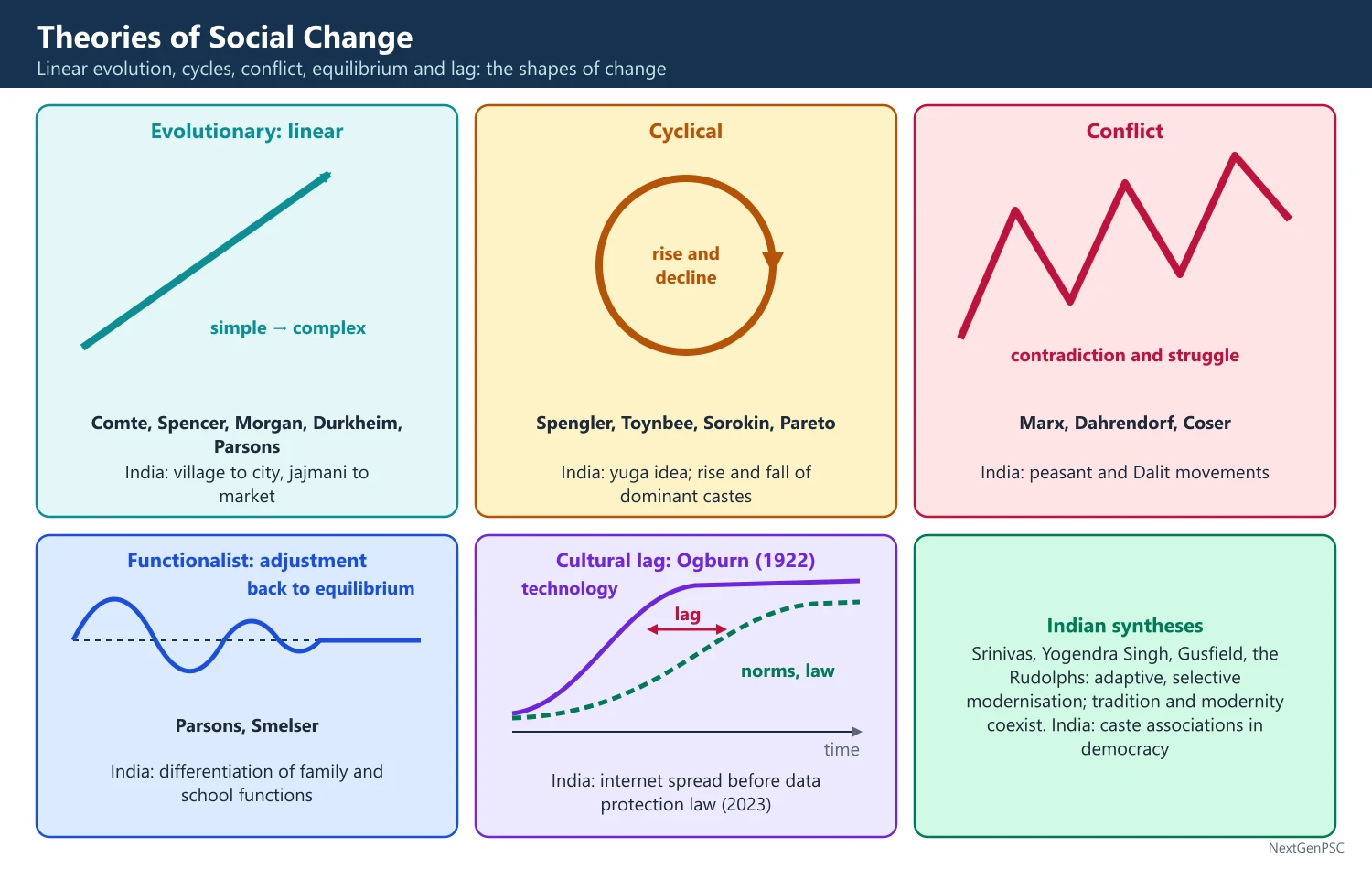
Social change is a significant alteration in social structure, relationships and culture over time. Evolutionary theories (Comte, Spencer, Morgan, Durkheim, Parsons's neo-evolution) see change as movement from simple to complex; cyclical theories (Spengler, Toynbee, Sorokin, Pareto) see rise and decline; functionalists see adjustment towards equilibrium; conflict theorists (Marx, Dahrendorf, Coser) see change arising from contradiction; Weber stresses ideas and charisma, and Ogburn the cultural lag after technological change. Indian sociologists (Srinivas, Yogendra Singh, Marriott, the Rudolphs, D.P. Mukerji, Desai) adapt these to explain change in a society where tradition and modernity coexist.
In simple words
Social change is how society becomes different over time, like joint families turning nuclear or village people moving to cities.
Some thinkers say societies grow like a child into an adult (evolution); others say they rise and fall like seasons (cycles); still others say change comes from fights between groups (conflict).
In India, old and new often live side by side: a software engineer may consult an astrologer before a wedding.
UPSC asks you to compare these theories and apply them to Indian change.
1. Concepts and Definitions
Social change: Kingsley Davis defined it as alterations that occur in social organisation, that is, the structure and functions of society; MacIver and Page saw it as change in social relationships.
Social vs cultural change: Davis distinguished change in social structure from change in culture (art, values, technology); the two overlap but are not identical.
Change, progress, evolution and development: change is neutral; progress implies change towards a desired goal (value-laden); evolution is gradual, directional change; development is planned change towards growth and welfare.
Wilbert Moore (Social Change, 1963): treated change as normal, not exceptional, and identified its sources as both internal (strain, innovation) and external (contact, conquest).
Patterns of change: linear (one direction), cyclical (repeating), fluctuating (oscillating, as in Sorokin) and curvilinear.
Change in and change of the system: functionalists distinguish adjustments within a system from transformation of the system itself, as in revolutions.
Cultural lag: William F. Ogburn (Social Change with Respect to Culture and Original Nature, 1922) argued that material culture (technology) changes faster than adaptive non-material culture (laws, norms), producing a lag and social problems.
Indian example of lag: mobile phones and the internet spread rapidly while laws on data privacy came only with the Digital Personal Data Protection Act, 2023.
2. Evolutionary Theories
Comte: the law of three stages: theological, metaphysical and positive (scientific), with matching social organisation.
Herbert Spencer (Principles of Sociology, 1876–96): societies evolve from simple, homogeneous, militant forms to complex, heterogeneous, industrial forms; he coined 'survival of the fittest' (1864).
L.H. Morgan (Ancient Society, 1877): stages of savagery, barbarism and civilisation, each with sub-stages defined by technology; Engels drew on Morgan.
Durkheim and Tönnies: Durkheim traced a move from mechanical to organic solidarity (1893); Ferdinand Tönnies (Gemeinschaft und Gesellschaft, 1887) from community based on kinship and feeling to association based on contract and interest.
Critique: classical evolutionism was unilinear, speculative and ethnocentric, placing Western Europe at the top; Franz Boas and his students rejected it in favour of historical particularism.
Neo-evolution: Talcott Parsons ('Evolutionary Universals in Society', 1964; Societies, 1966) described evolution through differentiation, adaptive upgrading, inclusion and value generalisation; Sahlins and Service (1960) separated general and specific evolution.
Lenski: an ecological-evolutionary theory in which subsistence technology (hunting, horticulture, agriculture, industry) shapes inequality and institutions.
3. Cyclical Theories
Oswald Spengler (The Decline of the West, 1918–22): civilisations are like organisms that are born, mature and die; he predicted the decline of Western civilisation.
Arnold Toynbee (A Study of History, 1934–61): civilisations grow by successfully responding to challenges, led by a creative minority, and decline when this minority becomes a dominant minority that no longer inspires.
Pitirim Sorokin (Social and Cultural Dynamics, 1937–41): cultures fluctuate between ideational (spiritual, faith-based), sensate (material, sense-based) and idealistic (mixed) types; he saw modern Western culture as late sensate and in crisis.
Pareto: the circulation of elites between 'lions' and 'foxes' produces cyclical political change.
Other cyclical ideas: Ibn Khaldun's theory of asabiyya (group solidarity) rising and decaying among dynasties; the Hindu idea of yugas as cosmic cycles.
4. Functionalist and Conflict Theories
Parsons: society tends towards equilibrium; change is an adjustment to strain, so societies are in a 'moving equilibrium'.
Smelser (Social Change in the Industrial Revolution, 1959): structural differentiation in the British cotton industry and the working-class family, where specialised institutions take over functions of older ones.
Critique of functionalism: Dahrendorf and others said it cannot explain sudden or conflict-driven change and is biased towards stability.
Marx: change arises from contradictions between forces and relations of production; class struggle is the motor of history and revolution transforms the mode of production.
Dahrendorf (1959): conflict over authority is universal and is the source of change; Lewis Coser (The Functions of Social Conflict, 1956): conflict can also integrate groups and spur adaptation.
Weber: rejected one-factor explanations; ideas (the Protestant ethic), charisma and rationalisation drive change, and charisma is the revolutionary force of traditional societies.
Giddens (The Constitution of Society, 1984): structuration theory treats structure as both medium and outcome of action, so change happens through the reflexive actions of agents.
Late modern theories: Ulrich Beck's risk society (1986) and reflexive modernisation; Daniel Bell's post-industrial society (1973); Manuel Castells's network society (1996).
5. Indian Theories of Change
M.N. Srinivas (Social Change in Modern India, 1966): Sanskritisation (cultural mobility within caste), Westernisation (changes from British rule in technology, institutions, ideology and values) and secularisation; criticised for being upper-caste centred and treating change as positional, not structural.
Yogendra Singh (Modernization of Indian Tradition, 1973): analysed change at cultural and structural levels and micro and macro levels, with orthogenetic (internal) and heterogenetic (external) sources; he argued that Indian modernisation is selective and adaptive.
McKim Marriott: in Kishangarhi (1955) he showed that universalisation and parochialisation work together, so little and great traditions interpenetrate.
Lloyd and Susanne Rudolph (The Modernity of Tradition, 1967): traditional institutions such as caste associations adapted to democracy, so tradition and modernity are not opposites.
Joseph Gusfield ('Tradition and Modernity: Misplaced Polarities in the Study of Social Change', 1967): used India to show that tradition is not static, modernity does not wipe out tradition, and the two can reinforce each other.
Milton Singer (When a Great Tradition Modernizes, 1972): Madras industrialists used compartmentalisation, keeping ritual at home and modern rules at work.
D.P. Mukerji: argued that Indian tradition has its own dialectic of shruti, smriti and anubhava (experience); modernisation must grow from tradition rather than be imported (Diversities, 1958).
A.R. Desai: a Marxist view that India followed a capitalist path that deepened class inequality (India's Path of Development, 1984).
S.C. Dube: studied planned change in Shamirpet (Indian Village, 1955) and the Community Development Programme (India's Changing Villages, 1958), showing how villagers selectively accept change.
6. Linking and Exam Use
Links: Durkheim's solidarity and Tönnies's community to rural–urban change in India; Marx to agrarian class change; Weber's charisma to Gandhi and Ambedkar; Ogburn's lag to technology and law.
10 marks: explain one theory (cultural lag or Sorokin's cycles) with its thinker and an Indian example.
20 marks: compare evolutionary, cyclical, functionalist and conflict theories in a table, then show which best explains Indian change, using Srinivas, Yogendra Singh and Gusfield.
Diagram idea: three shapes: an upward arrow (evolution), a circle (cycles) and a zigzag (conflict), each labelled with thinkers and one Indian example.
Quotation: Gusfield's idea, paraphrased: tradition and modernity are not mutually exclusive; the old can be the basis of the new.
| Theory | Key thinkers | Pattern of change | Indian application |
|---|---|---|---|
| Evolutionary | Comte, Spencer, Morgan, Durkheim, Parsons | Linear, simple to complex | Village to city, jajmani to market |
| Cyclical | Spengler, Toynbee, Sorokin, Pareto | Rise and decline, fluctuation | Yuga idea; rise and fall of dominant castes |
| Functionalist | Parsons, Smelser | Adjustment towards equilibrium | Differentiation of family and school functions |
| Conflict | Marx, Dahrendorf, Coser | Change through contradiction and struggle | Peasant and Dalit movements |
| Cultural lag | Ogburn (1922) | Technology first, norms later | Internet spread before data protection law (2023) |
| Indian syntheses | Srinivas, Yogendra Singh, Gusfield, Rudolphs | Adaptive, selective modernisation | Caste associations in democracy |
Mains points
- Define social change and distinguish it from progress, evolution and development at the start.
- Present theories in groups (evolutionary, cyclical, functionalist, conflict) with one criticism each, then a synthesis (Giddens, Weber's multi-causal view).
- Every answer should test Western theory on India using Srinivas, Yogendra Singh, Marriott, the Rudolphs, Gusfield and D.P. Mukerji.
- Use cultural lag with a fresh Indian example (digital technology and law, prenatal sex determination and the PCPNDT Act 1994).
- Avoid presenting tradition and modernity as opposites; examiners reward Gusfield's and the Rudolphs' argument.
- A comparison table with an Indian application column earns marks in 20-mark answers.
Did you know?
- It was Herbert Spencer, not Darwin, who coined the phrase 'survival of the fittest', in 1864.
- Memory trick for Sorokin: 'I-S-I' — Ideational, Sensate, Idealistic, the swing of culture between spirit and senses.
Development and Dependency
Development means improvement in people's lives, not only economic growth. Modernisation theory (Rostow, Parsons, Lerner, McClelland, Inkeles) held that poor countries would develop by adopting Western values and institutions. Dependency theory (Prebisch, Baran, Frank's 'development of underdevelopment', Amin, Cardoso) argued that underdevelopment results from exploitation by rich capitalist centres. World-systems theory (Wallerstein) places countries in a core, semi-periphery and periphery. Sen's capability approach, the HDI, post-development critics (Escobar, Ferguson, Shiva) and sustainable development widen the debate; India's colonial drain, planning, liberalisation and displacement illustrate it.
In simple words
Why are some countries rich and others poor? One answer says poor countries just need to copy the rich: build factories, schools and modern attitudes (modernisation).
Another answer says rich countries became rich partly by draining the poor, as Britain drained India (dependency).
A third view asks whether people are healthier, educated and free, not just richer.
UPSC asks you to compare these theories and judge them against India's experience.
1. Concepts and Definitions
Development: once equated with economic growth (rising GDP), now understood as multidimensional improvement in income, health, education, freedom and environment.
Modernisation: the process by which traditional societies acquire the institutions, technologies and values of industrial societies; in Indian sociology it also means a cultural process (Yogendra Singh).
Underdevelopment: for Andre Gunder Frank, not an original state (undevelopment) but a condition produced by a country's historical relationship with developed capitalist countries.
Human development: the UNDP's Human Development Report (from 1990), shaped by Mahbub ul Haq and Amartya Sen, defines development as enlarging people's choices.
Sustainable development: the Brundtland Commission (Our Common Future, 1987) defined it as development that meets the needs of the present without compromising the ability of future generations to meet their own needs.
Sustainable Development Goals: 17 goals adopted by the UN in 2015 for the period up to 2030.
Post-development: a critique that sees 'development' itself as a Western discourse that imposes one model on diverse societies.
2. Modernisation Theory
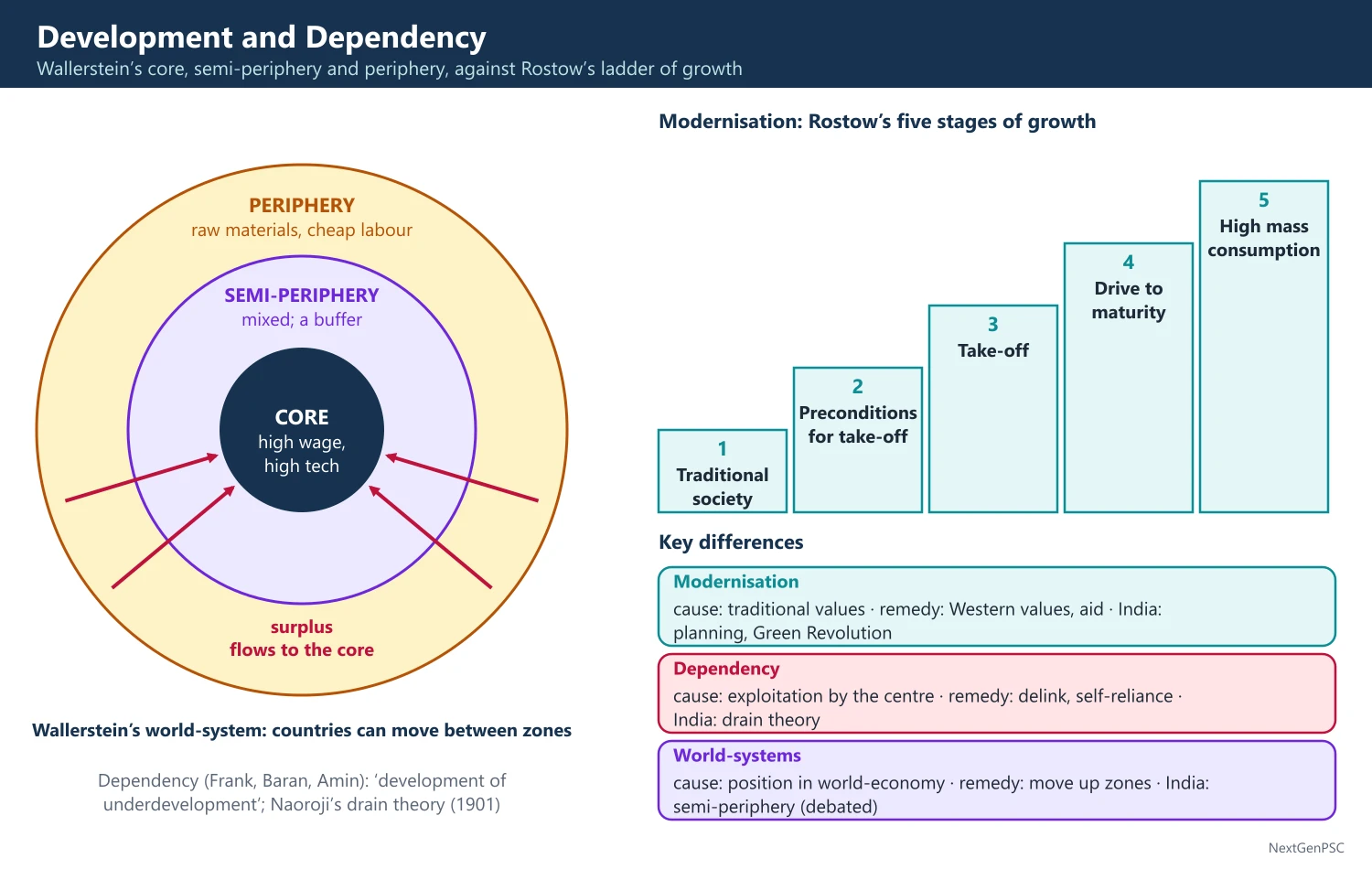
W.W. Rostow (The Stages of Economic Growth: A Non-Communist Manifesto, 1960): five stages: traditional society, preconditions for take-off, take-off, drive to maturity and age of high mass consumption; aid and investment help countries reach take-off.
Parsons: development means moving from particularistic, ascriptive, diffuse pattern variables to universalistic, achievement-based, specific ones.
Daniel Lerner (The Passing of Traditional Society, 1958): studying the Middle East, he stressed urbanisation, literacy, media and 'empathy' (the ability to imagine oneself in new roles).
David McClelland (The Achieving Society, 1961): argued that a high 'need for achievement' (n-Ach) in a society's culture drives entrepreneurship and growth.
Alex Inkeles and David Smith (Becoming Modern, 1974): surveyed men in six developing countries, including India, and found that factory work and schooling produced 'modern' attitudes such as openness to new experience and belief in planning.
Critique: modernisation theory was ethnocentric, treated tradition as an obstacle (Gusfield's 'misplaced polarities'), ignored colonialism and global power, and served Cold War aims, as Rostow's subtitle shows.
Indian application: Nehruvian planning, the Community Development Programme (1952) and the Green Revolution (from the mid-1960s) drew on modernisation ideas; S.C. Dube and Yogendra Singh examined their uneven results.
3. Dependency Theory
Roots: Raúl Prebisch and the UN Economic Commission for Latin America (ECLA, around 1950) argued that the terms of trade decline for exporters of primary goods (periphery) relative to industrial exporters (centre).
Paul Baran (The Political Economy of Growth, 1957): the economic surplus of poor countries is drained abroad or wasted by local elites, so capitalism blocks development in the periphery.
Andre Gunder Frank ('The Development of Underdevelopment', 1966; Capitalism and Underdevelopment in Latin America, 1967): a chain of metropolis–satellite relations extracts surplus from the periphery to the centre; satellites develop most when their ties to the metropolis are weakest, as in Latin America during the Depression and the World Wars.
Samir Amin (Unequal Development, 1976) and Walter Rodney (How Europe Underdeveloped Africa, 1972): extended dependency analysis to Africa, stressing unequal exchange and colonial extraction.
Cardoso and Faletto (Dependency and Development in Latin America, 1979): 'associated dependent development' is possible: some growth occurs within dependency, shaped by internal class alliances.
Indian precursors: Dadabhai Naoroji's drain theory (Poverty and Un-British Rule in India, 1901) and R.C. Dutt's Economic History of India (1901–03) argued that colonial rule drained India's wealth and deindustrialised it, anticipating dependency theory.
Critique: the rapid growth of the East Asian 'tigers' (South Korea, Taiwan) through integration into world markets contradicted strong dependency claims; Ernesto Laclau (1971) said Frank confused market relations with capitalist relations of production; Bill Warren (1980) argued imperialism also spread capitalism.
Debate on delinking: Frank and Amin favoured delinking or socialism; India's import-substitution model (1950s–1980) partly reflected this thinking.
Neo-dependency today: scholars point to dependence on foreign technology, digital platforms and global value chains as new forms of dependency; this is debated.
4. World-systems Theory
Immanuel Wallerstein (The Modern World-System, vol. 1, 1974): since the 16th century a single capitalist world-economy has existed, with an international division of labour.
Core, semi-periphery, periphery: the core has high-wage, high-technology production; the periphery supplies raw materials and cheap labour; the semi-periphery has mixed features and stabilises the system by acting as a buffer.
Mobility: unlike classical dependency, Wallerstein allows countries to move between zones (for example, East Asian states rising to the semi-periphery or core).
India: many scholars place contemporary India in the semi-periphery, combining IT services exports with large informal and agrarian sectors; this placement is debated.
Critique: Theda Skocpol (1977) criticised its economic reductionism and neglect of the state; others say it underplays culture and local agency.
5. Human Development, Capabilities and Alternatives
Amartya Sen (Development as Freedom, 1999): development is the expansion of substantive freedoms or capabilities, what people are able to do and be; famines, he showed, result from failures of entitlement, not just food shortage.
HDI: combines life expectancy, education and income; in the Human Development Report 2025, India ranked 130th of 193 countries with an HDI of 0.685 for 2023, and inequality reduced its HDI by about 30.7%.
Kerala model: Jean Drèze and Amartya Sen pointed to Kerala's high literacy and life expectancy at modest income, owing to public action and social movements.
Post-development: Arturo Escobar (Encountering Development, 1995) and Wolfgang Sachs (ed., The Development Dictionary, 1992) saw development as a discourse of Western power; James Ferguson (The Anti-Politics Machine, 1990) showed how a Lesotho project depoliticised poverty while expanding state control.
Ecofeminist critique: Vandana Shiva (Staying Alive, 1988) called Western development 'maldevelopment' that destroys nature and women's knowledge.
Gandhian alternative: Gandhi's Hind Swaraj (1909) rejected industrial civilisation in favour of village self-reliance (swadeshi), a vision later echoed by movements such as Narmada Bachao Andolan.
Neo-liberal view: after 1991, development was linked to markets, privatisation and globalisation; critics point to rising inequality.
6. Development and India
Planning and mixed economy: the Five-Year Plans (from 1951) and the public sector aimed at self-reliant industrialisation; NITI Aayog replaced the Planning Commission in 2015.
A.R. Desai (India's Path of Development, 1984): argued that India's capitalist path benefited the bourgeoisie and rich peasants while leaving the masses poor.
Displacement: Walter Fernandes estimated that tens of millions of people, a large share of them Adivasis, were displaced by dams, mines and industry after 1947; the Right to Fair Compensation and Transparency in Land Acquisition, Rehabilitation and Resettlement Act, 2013 sought to address this.
Poverty reduction: NITI Aayog estimated that multidimensional poverty fell from 29.17% in 2013–14 to 11.28% in 2022–23.
Uneven development: regional gaps between southern and western states and the Hindi heartland, and between urban and rural areas, persist.
7. Using It in the Exam
10 marks: explain Frank's 'development of underdevelopment' or Rostow's stages, with one criticism and an Indian link (drain theory, planning).
20 marks: compare modernisation, dependency and world-systems theories in a table, then evaluate them with East Asia and India, and end with Sen's capability approach and sustainability.
Thinkers examiners look for: Rostow, Lerner, McClelland, Inkeles, Prebisch, Baran, Frank, Amin, Cardoso, Wallerstein, Sen, Escobar, Naoroji, Desai.
Diagram idea: three concentric circles (core, semi-periphery, periphery) with arrows of surplus flowing from the outer ring to the centre.
Quotation: Frank's idea, paraphrased: underdevelopment is not an original condition but was generated by the same historical process that produced economic development in the metropolis.
| Point | Modernisation | Dependency | World-systems |
|---|---|---|---|
| Key thinkers | Rostow, Parsons, Lerner, McClelland, Inkeles | Prebisch, Baran, Frank, Amin, Cardoso | Wallerstein |
| Cause of poverty | Traditional values and institutions | Exploitation by the capitalist centre | Position in the world-economy |
| Unit of analysis | Nation-state | Centre–periphery relations | Whole world-system |
| Remedy | Adopt Western values, aid, investment | Delink, self-reliance, socialism | Move up through the zones; system change |
| Indian link | Planning, CDP 1952, Green Revolution | Naoroji's drain theory, import substitution | India as semi-periphery (debated) |
| Stage | Main feature |
|---|---|
| Traditional society | Subsistence agriculture, limited technology |
| Preconditions for take-off | Infrastructure, banks, an entrepreneurial elite |
| Take-off | Rapid growth in a few leading industries |
| Drive to maturity | Diversified industry and technology |
| High mass consumption | Consumer goods and welfare for most people |
Mains points
- Begin by defining development broadly (Sen, UNDP), not only as growth.
- Compare the three theories in a table and test them on East Asia and India; examiners expect evaluation, not just description.
- Bring Indian precursors of dependency (Naoroji, R.C. Dutt) and Indian critics (Desai, Shiva, Gandhi); they strengthen Paper I answers.
- Use current data with sources and years: HDR 2025 (India 130th, HDI 0.685 for 2023), NITI Aayog MPI 2024.
- Mention post-development and sustainability to show awareness of recent debates.
- Avoid one-sided conclusions; end with a balanced view that both internal factors and global relations shape development.
Did you know?
- Rostow subtitled his book 'A Non-Communist Manifesto', openly presenting modernisation as an answer to Marx during the Cold War.
- Memory trick for Rostow: 'T-P-T-D-H' — Traditional, Preconditions, Take-off, Drive, High consumption.
Agents of Social Change
Agents of social change are the individuals, groups and institutions that initiate or carry change. Marx saw classes as the agents of history; Weber stressed charismatic leaders and ideas; others point to the state and law, social movements, elites and the middle class, education, the market, media, technology, religion, migration and globalisation. India's experience shows reformers (Ram Mohan Roy, Phule, Ambedkar), the Constitution as a social document, laws and reservations, movements, the media and digital technology working together, though law often runs ahead of custom.
In simple words
Agents of change are the people and forces that push society to change, like a reformer, a new law, a protest, a television serial or the smartphone.
Think of how Ambedkar, the Constitution and reservations together changed the lives of Dalits.
Change usually needs several agents at once: a law without public support, like the ban on dowry, works only partly.
UPSC asks which agents matter most and how they interact in India.
1. Concepts
Agent vs factor: a factor is any condition that causes change (population, environment, technology); an agent is an actor, individual or collective, that consciously or unconsciously initiates or carries change.
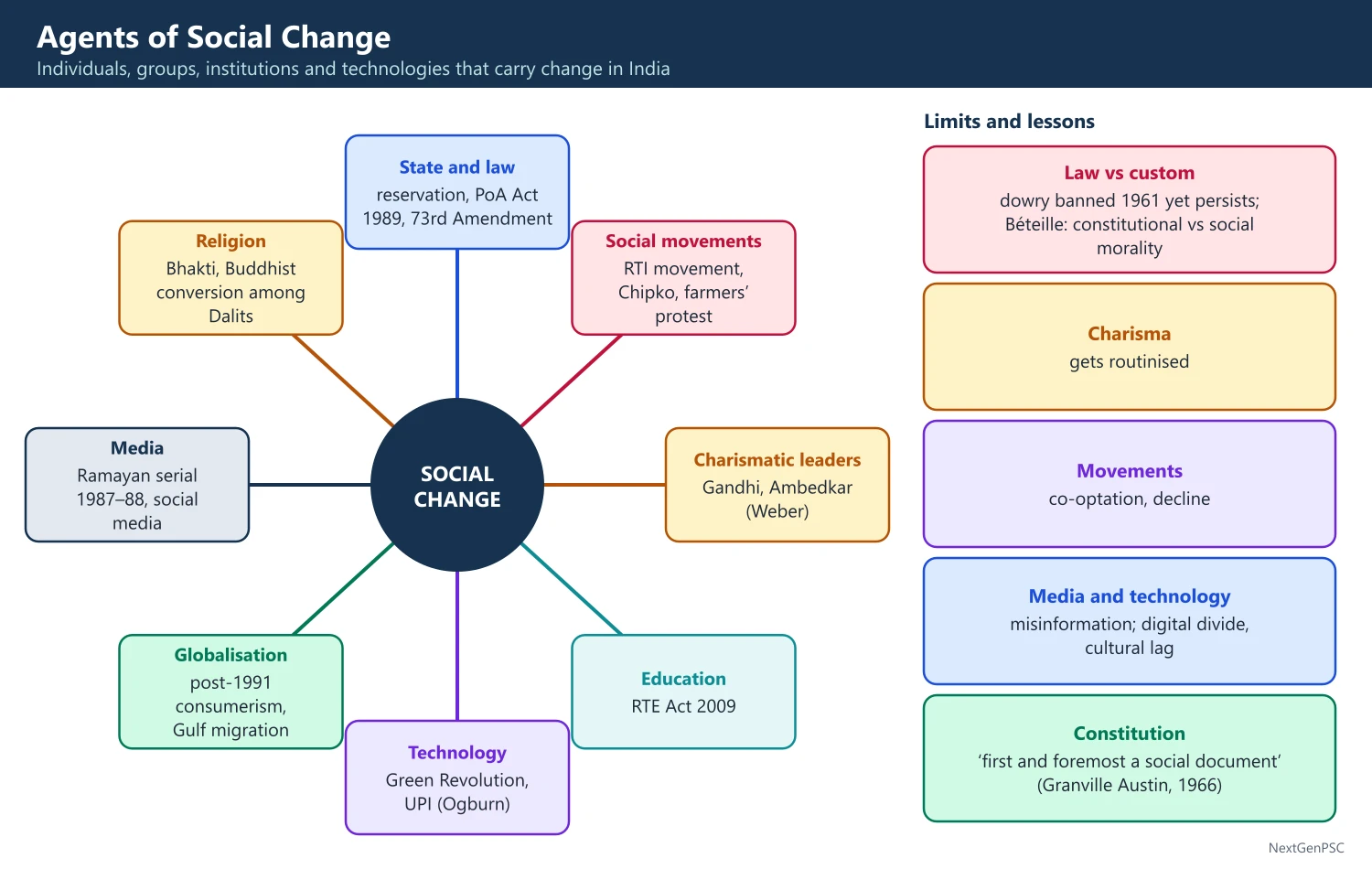
Types of agents: individuals (reformers, charismatic leaders, innovators), groups (classes, elites, middle class, movements), institutions (state, law, education, religion, market, media) and external forces (diffusion, colonialism, globalisation).
Internal and external sources: Wilbert Moore and Yogendra Singh distinguish endogenous (orthogenetic) sources such as reform movements from exogenous (heterogenetic) sources such as colonial rule and globalisation.
Agency and structure: Giddens's structuration theory holds that agents are shaped by structures but also reproduce and change them through action.
Planned and unplanned change: the state and NGOs plan change; markets, technology and migration often produce unplanned change.
Directed change in India: after 1947, India relied heavily on the state, law and planning as agents, unlike Western societies where industrial capitalism led change.
2. Classical Views on Agents
Marx: classes are the agents of history; the bourgeoisie revolutionised production and the proletariat would carry the next revolution.
Weber's switchmen: 'not ideas, but material and ideal interests directly govern men's conduct; yet very frequently the world images created by ideas have, like switchmen, determined the tracks along which action has been pushed by the dynamic of interest' ('The Social Psychology of the World Religions', 1915).
Charisma: for Weber the charismatic leader is the great revolutionary force in traditional societies; Gandhi and Ambedkar are often cited as Indian examples.
Durkheim: rising population (material) density increases moral (dynamic) density and leads to the division of labour.
Ogburn: invention, discovery and diffusion, especially technological, are the main sources of change.
Elites: Pareto and Mosca saw elites as the drivers of political change; in India, the Western-educated elite led reform and nationalism (B.B. Misra, The Indian Middle Classes, 1961).
Touraine: social movements are the central actors that contest the direction of 'historicity' in post-industrial society.
3. State, Law and Policy
Law as an agent: Roscoe Pound saw law as 'social engineering'; A.V. Dicey argued that law follows public opinion, while others note that law can lead opinion.
Constitution as a social document: Granville Austin (The Indian Constitution: Cornerstone of a Nation, 1966) described it as first and foremost a social document committed to social revolution.
Key laws: Hindu Code Acts (1955–56), the Untouchability (Offences) Act 1955 renamed the Protection of Civil Rights Act 1976, the SC/ST (Prevention of Atrocities) Act 1989, the Right to Education Act 2009 and the Constitution (106th Amendment) Act 2023 reserving seats for women.
Reservations: Marc Galanter (Competing Equalities, 1984) analysed India's compensatory discrimination as a large legal experiment in changing social hierarchy.
Decentralisation: the 73rd and 74th Amendments (1992) reserved one-third of seats in local bodies for women and seats for SCs and STs, producing new local leaders.
Limits of law: dowry (banned 1961) and child marriage persist, showing a gap between law and custom; Béteille calls this the tension between constitutional morality and social morality.
Welfare and rights: schemes and rights-based laws (food security, employment guarantee, Direct Benefit Transfer) reshape relations between citizens and the state.
4. Social Movements, Reformers, Elites and the Middle Class
Reformers: Raja Ram Mohan Roy's campaign helped the ban on sati (1829); Jyotirao Phule founded the Satyashodhak Samaj (1873); Periyar led the Self-Respect Movement (1925); Ambedkar led the Mahad satyagraha (1927) and drafted the Constitution.
Movements as agents: the women's, Dalit, peasant, environmental and RTI movements changed laws and attitudes (chapter 10).
Caste associations: the Rudolphs showed how caste associations became agents of political mobilisation and change.
Middle class: the colonial and post-1991 middle classes spread new values, consumer culture and civic activism, though critics note their self-interest (Leela Fernandes).
Women's collectives: self-help groups, such as Kerala's Kudumbashree mission launched in 1998, have become agents of economic and political change for poor women.
NGOs and civil society: SEWA, MKSS and others show how organised civil society drives change from below.
5. Media, Market, Technology, Religion and Globalisation
Media: Marshall McLuhan (Understanding Media, 1964) argued that 'the medium is the message' and spoke of a 'global village'; Arvind Rajagopal (Politics after Television, 2001) showed how the televised Ramayan (1987–88) shaped Hindu nationalist politics.
Digital media: smartphones and social media enable mobilisation (anti-corruption movement 2011, farmers' protest 2020–21) but also misinformation; rumours spread on messaging apps were linked to mob lynchings in 2018.
Market: liberalisation after 1991 spread consumerism, private employment and new aspirations, changing family, caste and gender relations.
Technology: the Green Revolution, mobile phones and digital payments changed agrarian classes, work and everyday life (next topic).
Religion: Weber's Protestant ethic, Bhakti movements, Christian missions in the Northeast and Buddhist conversion among Dalits show religion as an agent of change as well as continuity.
Globalisation and migration: Arjun Appadurai (Modernity at Large, 1996) described global flows (ethnoscapes, mediascapes, technoscapes, financescapes, ideoscapes); Gulf migration transformed Kerala's economy and gender roles.
Crises as agents: the COVID-19 pandemic (2020–21) accelerated digital payments, online education and work from home while exposing migrant workers' insecurity.
Demography: a young population (demographic dividend) and rapid ageing in southern states push changes in education, employment and care.
6. Using It in the Exam
10 marks: name and explain two agents with thinkers (Weber's charisma, Galanter on law) and Indian examples.
20 marks: 'Is law an effective agent of change in India?' Use Austin, Galanter and Béteille; examples of success (reservation, panchayats) and limits (dowry, manual scavenging); conclude that law works best with movements, education and economic change.
Thinkers examiners look for: Marx, Weber, Ogburn, Giddens, Touraine, Galanter, Austin, Srinivas, Yogendra Singh, the Rudolphs, Appadurai.
Diagram idea: a wheel with 'social change' at the hub and spokes labelled state and law, movements, education, technology, market, media and religion, each with an Indian example.
Quotation: Weber's 'switchmen' image: ideas, like switchmen, determine the tracks along which interests push action.
| Agent | Thinker or source | Indian example | Limitation |
|---|---|---|---|
| Charismatic leader | Weber | Gandhi, Ambedkar | Charisma gets routinised |
| State and law | Pound, Austin, Galanter | Reservation, PoA Act 1989, 73rd Amendment | Gap between law and custom (dowry) |
| Social movements | Touraine, Tilly, M.S.A. Rao | RTI movement, Chipko, farmers' protest | Co-optation, decline |
| Media | McLuhan, Rajagopal | Ramayan serial 1987–88, social media | Misinformation, polarisation |
| Market and globalisation | Appadurai | Post-1991 consumerism, Gulf migration | Inequality, insecurity |
| Technology | Ogburn | Green Revolution, UPI | Digital divide, cultural lag |
Mains points
- Distinguish agents from factors and classify agents (individual, collective, institutional, external) at the start.
- Bring classical views (Marx's classes, Weber's charisma and switchmen, Ogburn's technology) and Giddens's agency–structure synthesis.
- Use India as the main field: reformers, Constitution, laws with years, reservation, panchayats, movements, media, market and migration.
- For 'law as an agent' questions, show both its power and its limits, with examples like dowry and manual scavenging.
- Show interaction among agents; examiners reward the point that no single agent works alone.
- A wheel or table diagram of agents with Indian examples helps in 15–20 mark answers.
Did you know?
- When the Ramayan serial aired on Sunday mornings in 1987–88, streets across India were reported to empty as families gathered around television sets.
- Memory trick for agents: 'SLEMMT' — State, Law, Education, Movements, Media, Technology.
Education, Science, Technology and Social Change
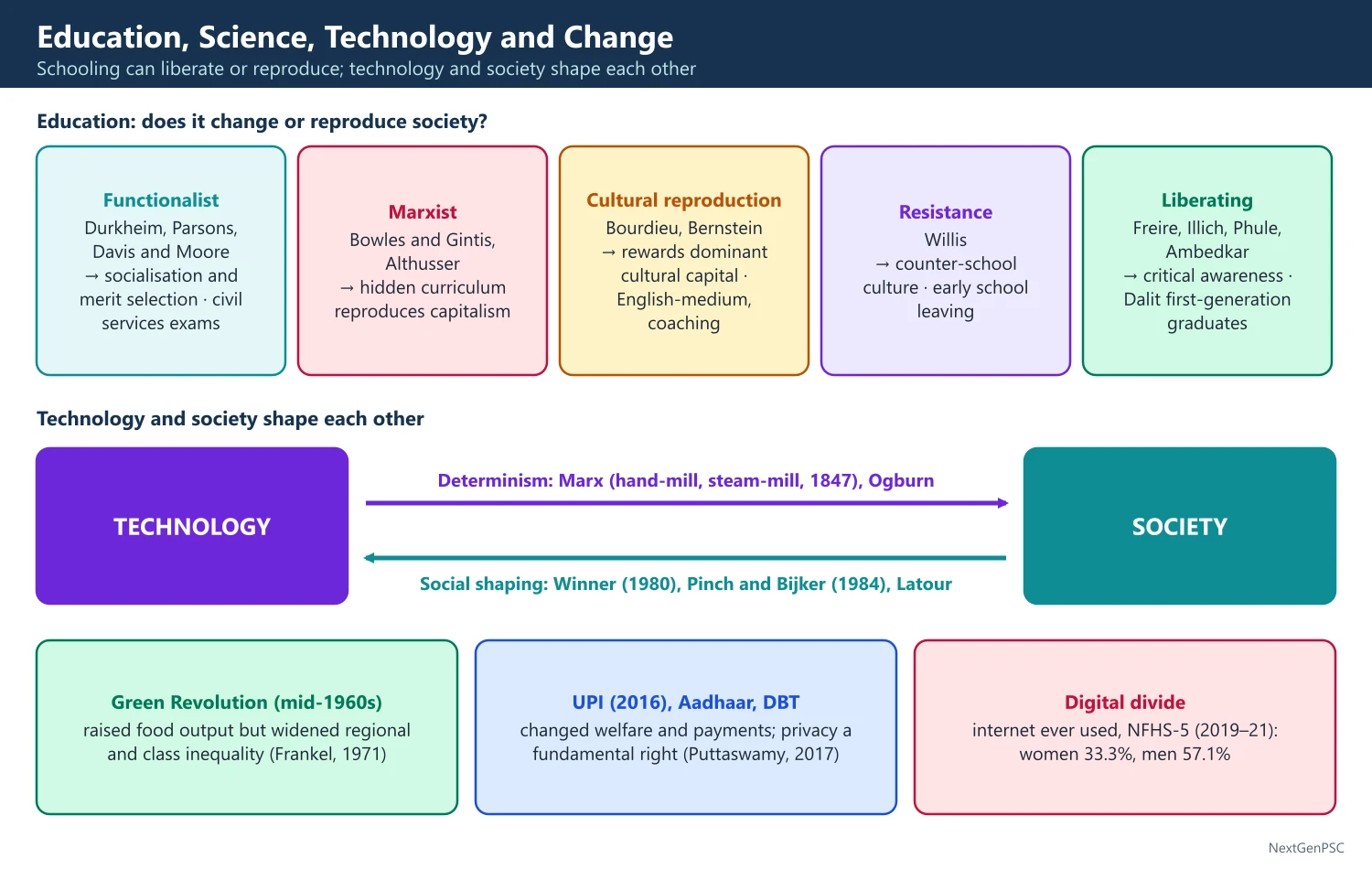
Education can both change and reproduce society. Functionalists (Durkheim, Parsons, Davis and Moore) see it as socialisation and meritocratic selection; conflict theorists (Bowles and Gintis, Bourdieu, Bernstein, Willis) show it reproduces class through the hidden curriculum and cultural capital; Freire and Illich call for liberating education. Science and technology drive change (Ogburn, Marx), but are also socially shaped (Merton, Kuhn, Winner, Castells, Beck). In India, Phule and Ambedkar saw education as liberation; RTE 2009 and NEP 2020, the Green Revolution, IT, Aadhaar and UPI show both progress and new divides.
In simple words
Education is the ladder many Indians use to climb out of poverty, like a Dalit girl becoming a teacher; but rich children start with better schools, tuition and English, so the ladder is uneven.
Technology changes life even faster: the tractor changed farming, the mobile phone changed how we bank, learn and protest.
Yet not everyone gets the same access, creating a digital divide.
UPSC asks whether education brings change or reproduces inequality, and how technology reshapes society.
1. Functionalist Theories of Education
Durkheim (Education and Sociology, 1922): education is the methodical socialisation of the young generation; it transmits shared values, creates social solidarity and teaches specialised skills for the division of labour.
Parsons ('The School Class as a Social System', 1959): the school is a bridge between the family's particularistic standards and society's universalistic, achievement-based standards; it socialises and allocates people to roles.
Davis and Moore: education sifts and sorts talent so that the most able reach the most important positions.
Human capital theory: economists such as Theodore Schultz (1961) treated education as investment that raises productivity.
Gandhi's Nai Talim: the Wardha scheme of basic education (1937) linked learning to productive craft and village life, an Indian alternative to colonial schooling.
Critique: functionalism assumes schools are meritocratic and ignores how class, caste and gender shape success.
2. Conflict and Critical Theories of Education
Bowles and Gintis (Schooling in Capitalist America, 1976): the correspondence principle: school relations mirror workplace relations; the hidden curriculum teaches obedience, punctuality and acceptance of hierarchy.
Althusser (1970): the school is the dominant ideological state apparatus in capitalist society.
Bourdieu and Passeron (Reproduction in Education, Society and Culture, 1970): schools reward the cultural capital and habitus of dominant classes, so inequality is reproduced while appearing as merit; this is symbolic violence.
Basil Bernstein (Class, Codes and Control, 1971): working-class children use restricted codes and middle-class children elaborated codes, which schools favour.
Paul Willis (Learning to Labour, 1977): working-class 'lads' formed a counter-school culture that rejected school and so prepared themselves for manual jobs.
Randall Collins (The Credential Society, 1979) and Ronald Dore (The Diploma Disease, 1976): rising demand for credentials leads to qualification inflation, especially in developing countries.
Ivan Illich (Deschooling Society, 1971): schools create dependence and confuse schooling with learning; he proposed learning webs.
Paulo Freire (Pedagogy of the Oppressed, 1968; English 1970): rejected the 'banking' model in which teachers deposit knowledge, and proposed dialogue and conscientisation (critical awareness) to liberate the oppressed.
Feminist views: schools reproduce gender roles through subject choice and expectations, though girls now outperform boys in many systems.
3. Education and Social Change in India
Reformers: Jyotirao and Savitribai Phule opened a school for girls in Pune in 1848; Ambedkar's call to 'educate, agitate, organise' made education central to Dalit liberation.
Kothari Commission (1964–66): opened its report with the line that the destiny of India is now being shaped in her classrooms, and recommended a common school system.
Right to Education Act, 2009: free and compulsory education for children aged 6–14 and 25% seats in private unaided schools for disadvantaged children.
National Education Policy 2020: a 5+3+3+4 structure, mother tongue instruction in early years where possible, and a target of 50% gross enrolment ratio in higher education by 2035.
Data: Census 2011 recorded literacy of 74.04% (men 82.14%, women 65.46%); AISHE 2021–22 reported a gross enrolment ratio in higher education of 28.4%.
Reproduction in India: English-medium private schools and coaching create cultural capital for the urban middle class; Satish Deshpande argues that upper-caste 'merit' is built on such inherited advantages.
Mobility: reservation in education has produced first-generation graduates among Dalits, Adivasis and OBCs, a clear case of education as an agent of change.
Curriculum and power: Krishna Kumar (What is Worth Teaching?, 1992) showed how textbooks and school knowledge reflect the views of dominant groups.
Digital divide in schooling: during COVID-19 school closures (2020–21), children without smartphones or internet, mostly poor and rural, lost much learning.
4. Science, Technology and Social Change
Technological determinism: Marx wrote that 'the hand-mill gives you society with the feudal lord; the steam-mill society with the industrial capitalist' (The Poverty of Philosophy, 1847); Ogburn saw technology as the main cause of change and cultural lag.
Sociology of science: Robert Merton described the norms of science (1942) as communism (common ownership), universalism, disinterestedness and organised scepticism (CUDOS), and traced English science to Puritan values (1938).
Thomas Kuhn (The Structure of Scientific Revolutions, 1962): science advances through paradigm shifts, not steady accumulation, and scientific communities are social groups.
Social shaping of technology: Langdon Winner ('Do Artifacts Have Politics?', 1980) argued that technologies embody power; Pinch and Bijker (1984) showed that social groups shape technological design; Bruno Latour's actor-network theory treats humans and objects as linked actors.
Determinism vs social shaping: most sociologists now hold that technology and society shape each other, rejecting simple determinism.
Network society: Manuel Castells (The Rise of the Network Society, 1996) argued that information technology reorganises economy, work and identity around networks.
Risk and surveillance: Ulrich Beck's risk society (1986) describes manufactured risks from technology (nuclear, chemical, climate); Shoshana Zuboff (The Age of Surveillance Capitalism, 2019) describes the extraction of personal data for profit.
Technology and work: automation and artificial intelligence raise fears of job loss and new inequalities, continuing the deskilling debate (Braverman).
5. Technology and Change in India
Green Revolution: high-yielding seeds, fertilisers and irrigation from the mid-1960s raised food output but widened inequality between regions and classes (Francine Frankel, India's Green Revolution, 1971).
Television: the Satellite Instructional Television Experiment (SITE, 1975–76) brought educational television to villages in six states.
Risk society in India: the Bhopal gas tragedy (December 1984) showed industrial risk falling hardest on the poor.
Digital public infrastructure: Aadhaar, UPI (launched 2016) and Direct Benefit Transfer changed welfare delivery and payments; the Supreme Court in Justice K.S. Puttaswamy v. Union of India (24 August 2017) recognised privacy as a fundamental right.
Digital divide: NFHS-5 (2019–21) found that 33.3% of women and 57.1% of men aged 15–49 had ever used the internet, a sharp gender gap.
Technology and gender: misuse of ultrasound for sex-selective abortion led to the PCPNDT Act, 1994, a case of law trying to catch up with technology (cultural lag).
Space and national identity: the Chandrayaan-3 landing near the Moon's south pole on 23 August 2023 became a moment of national pride, showing science as a source of collective identity.
Social media: enables Dalit, women's and farmers' voices to reach wide audiences but also spreads hate speech and misinformation.
6. Using It in the Exam
10 marks: explain one theory (correspondence principle, cultural capital, CUDOS, cultural lag) with its thinker and one Indian example.
20 marks: 'Does education bring social change or reproduce inequality?' Set Durkheim and Parsons against Bowles and Gintis and Bourdieu, add Freire, then Indian evidence (Phule, Ambedkar, RTE 2009, NEP 2020, reservation, coaching culture).
Thinkers examiners look for: Durkheim, Parsons, Bowles and Gintis, Bourdieu, Bernstein, Willis, Illich, Freire, Ogburn, Merton, Kuhn, Castells, Beck, Krishna Kumar.
Diagram idea: a two-way arrow between 'technology' and 'society' to show mutual shaping, with Green Revolution and UPI as Indian examples.
Quotation: Kothari Commission (1966), paraphrased: the destiny of India is being shaped in her classrooms.
| Perspective | Thinkers | Role of education | Indian example |
|---|---|---|---|
| Functionalist | Durkheim, Parsons, Davis and Moore | Socialisation and meritocratic selection | Competitive exams such as the civil services |
| Marxist | Bowles and Gintis, Althusser | Reproduces capitalist relations via hidden curriculum | Discipline-heavy schooling for factory and office jobs |
| Cultural reproduction | Bourdieu, Bernstein | Rewards dominant cultural capital | English-medium advantage, coaching culture |
| Resistance | Willis | Counter-school culture reproduces class | Early school leaving among poor boys |
| Liberating | Freire, Illich, Phule, Ambedkar | Critical awareness and emancipation | Dalit first-generation graduates |
Mains points
- Questions often ask whether education is an agent of change or of reproduction; present both and conclude that it is both, depending on access and content.
- Cite at least three critical theorists (Bowles and Gintis, Bourdieu, Bernstein, Willis, Freire) beside the functionalists.
- Use Indian laws, policies and data with years: RTE 2009, NEP 2020, Census 2011 literacy, AISHE 2021–22, NFHS-5 internet use.
- For science and technology, avoid simple determinism; bring Merton, Kuhn, Winner and Castells, and Indian examples (Green Revolution, Bhopal, UPI, Aadhaar).
- Mention the digital divide by gender, caste and region as a new form of inequality.
- Link to other chapters: Weber and Merton on science, Ogburn's cultural lag, Bourdieu's cultural capital in stratification.
Did you know?
- Savitribai Phule, India's first woman teacher in a girls' school, was reportedly pelted with mud and dung on her way to school, so she carried a spare sari.
- Memory trick for Merton's norms of science: 'CUDOS' — Communism, Universalism, Disinterestedness, Organised Scepticism.
UPSC Previous Year Questions: Social Change in Modern Society
From 2014 to 2026, UPSC asked 36 question parts worth 560 marks from this chapter, all in Paper I. The most-asked topic is education, science, technology and social change (13 parts), followed by development and dependency (10) and theories of social change (9); agents of social change gave 4 parts. Every question below has a model answer written to the UPSC word limit: about 150 words for 10 marks and 250 words for 20 marks.
In simple words
Read the question and write your own answer first, within the time and word limit (about 7 minutes for 10 marks, 11–12 minutes for 20 marks).
Then read the Approach line and the model answer, and check whether you defined the key term, named the right thinkers, gave Indian examples and ended with a balanced conclusion.
Note what you missed, revise that topic in the notes, and rewrite the answer a few days later.
1. Sociological Theories of Social Change
Example 1 (UPSC 2026, 20 marks): Critically evaluate the relevance of the cyclical theory of social change in understanding contemporary societies.
Paper and question: Paper I, Q8(b)
Approach: Explain cyclical theory through Spengler, Toynbee, Sorokin and Pareto, then test each against present-day societies and close with a balanced verdict on what cycles can and cannot explain.
Cyclical theories hold that societies and civilisations do not move in one upward line but rise, mature and decline, or swing between recurring states. They arose partly as a reaction against the optimism of nineteenth-century evolutionism.
Oswald Spengler (The Decline of the West, 1918–22) compared civilisations to organisms that are born, grow, age and die, and predicted the decline of the West. Arnold Toynbee (A Study of History) argued that civilisations grow by responding creatively to challenges under a creative minority and decline when it turns into a dominant minority. Pitirim Sorokin (Social and Cultural Dynamics, 1937–41) described a fluctuation between ideational, idealistic and sensate cultures, calling modern Western culture late sensate and in crisis. Pareto saw politics as a circulation of elites between 'lions' and 'foxes'.
Relevance today: Sorokin's sensate culture captures consumerism and the market logic of contemporary societies, while religious revivalism, from Hindutva in India to evangelical movements in the United States, looks like a swing back towards ideational values. Pareto's circulation of elites fits the replacement of the Congress-era elite by new regional and backward-caste leaders in India after the 1990s.
Limits: critics such as Popper rejected grand historical laws as unfalsifiable, and the organic analogy is metaphor rather than evidence. Cycles neglect cumulative change in science, technology and rights; the spread of literacy, democracy and digital technology does not reverse. They also ignore human agency, which Giddens's structuration theory places at the centre, and the global interconnection that world-systems theory stresses.
Flow chart: growth → maturity → breakdown → decline → new civilisation (Spengler, Toynbee); ideational ⇄ idealistic ⇄ sensate (Sorokin).
Cyclical theory is therefore best used as a heuristic for value shifts and elite turnover, combined with evolutionary and conflict perspectives that explain cumulative and contested change.
Example 2 (UPSC 2024, 20 marks): Discuss various theories of social change. Explain the limitations of unilinear theory of social change.
Paper and question: Paper I, Q8(b)
Approach: Classify the theories (evolutionary, cyclical, functionalist, conflict, Indian) with one thinker each, then devote the second half to the limitations of unilinear evolution with critics and Indian evidence.
Kingsley Davis defined social change as alterations in social organisation, that is, in the structure and functions of society. Sociologists explain its direction and causes through several families of theory.
Evolutionary: Comte's law of three stages, Spencer's movement from simple homogeneous to complex heterogeneous societies, Morgan's savagery–barbarism–civilisation and Durkheim's mechanical to organic solidarity. Cyclical: Spengler, Toynbee's challenge and response, Sorokin's ideational–sensate fluctuation and Pareto's circulation of elites. Functionalist: Parsons's moving equilibrium and structural differentiation, applied by Smelser to the British cotton industry. Conflict: Marx's contradiction between forces and relations of production, Dahrendorf's conflict over authority and Coser's functions of conflict. Indian: Srinivas's Sanskritisation and westernisation, and Yogendra Singh's orthogenetic and heterogenetic sources of modernisation.
Flow chart: unilinear model: savagery → barbarism → civilisation (Morgan) or theological → metaphysical → positive (Comte), every society on one ladder with Western Europe at the top.
Limitations of unilinear theory: first, it is ethnocentric, treating Victorian Europe as the end-point of history. Second, it is speculative 'conjectural history', as Radcliffe-Brown and Boas argued, built on travellers' accounts rather than fieldwork. Third, it ignores diffusion, borrowing and leapfrogging: Indian villages moved to mobile phones without landlines. Fourth, it cannot explain regression or collapse, which cyclical theorists stress. Fifth, it overlooks colonialism; Frank showed that the periphery was underdeveloped by the core, not simply 'behind'.
Indian experience confirms multilinearity: Gusfield and the Rudolphs showed that caste associations and tradition aided modernisation, and Yogendra Singh found modernisation selective and adaptive rather than a copy of the West.
Hence neo-evolutionists such as Parsons and Lenski, and Julian Steward's multilinear evolution, replaced the single ladder with multiple paths, a position that best fits societies like India.
Example 3 (UPSC 2022, 10 marks): How do little tradition and great tradition coexist in contemporary Indian society?
Paper and question: Paper I, Q6(c)
Approach: Define little and great tradition (Redfield; Marriott), show their coexistence through universalisation and parochialisation, and give contemporary Indian examples.
Robert Redfield distinguished the great tradition of the reflective few, cultivated in schools and temples and written in texts, from the little tradition of the unlettered many, carried in village life. Milton Singer and McKim Marriott applied the idea to India, where Sanskritic Hinduism and local folk cults form one civilisational continuum.
In Kishangarhi (1955) Marriott showed two-way traffic. Through universalisation, local elements rise into the great tradition, as a village goddess comes to be identified with Lakshmi or Durga. Through parochialisation, Sanskritic elements are reinterpreted in local idiom, as all-India festivals acquire village meanings.
Coexistence continues today. Television serials and pilgrim circuits spread a standardised great tradition, yet local rituals such as Theyyam in Kerala flourish, gaining wider audiences through media and tourism. Migrants carry village gods to cities; Chhath Puja is now celebrated in Delhi and Mumbai.
Critics find the dichotomy too neat and Brahmin-centred, but it explains why Indian tradition changes by layering rather than replacement.
Example 4 (UPSC 2021, 10 marks): Do you think Talcott Parsons gave an adequate theory of social change? Justify your answer.
Paper and question: Paper I, Q5(e)
Approach: Summarise Parsons's account of change (equilibrium, differentiation, evolutionary universals), then judge its adequacy with critics and an Indian illustration; conclude that it is partial.
Talcott Parsons was accused of offering a static theory, but in his later work he did propose an account of change. Society tends towards a moving equilibrium: strains are absorbed by adjustment through the AGIL functions.
In Societies (1966) and 'Evolutionary Universals in Society' (1964) he described a neo-evolutionary process: structural differentiation, adaptive upgrading, inclusion and value generalisation. Universals such as bureaucracy, money and markets, universalistic law and democratic association raise a society's adaptive capacity.
The theory is not fully adequate. Dahrendorf and C. Wright Mills argued it cannot explain sudden, conflict-driven or revolutionary change, since conflict appears only as strain. Its view of change as the gradual unfolding of shared values is consensual and treats the modern United States as the model, which Gunder Frank and other critics saw as ethnocentric. It also neglects power, colonialism and agency.
In India, differentiation explains the separation of work from family, but the Dalit movement reflects conflict. Parsons's theory is useful but partial.
Example 5 (UPSC 2018, 10 marks): Is the theory of cultural lag valid in present times? Discuss.
Paper and question: Paper I, Q5(a)
Approach: Define cultural lag (Ogburn, 1922), test its validity with present examples from technology and law, and note its criticism before giving a verdict.
William F. Ogburn (Social Change with Respect to Culture and Original Nature, 1922) argued that material culture (technology) changes faster than adaptive non-material culture (laws, norms, values). The resulting gap, the cultural lag, produces social problems until norms catch up.
The idea remains strongly valid. Artificial intelligence, deepfakes and social media spread faster than regulation; in India the Digital Personal Data Protection Act came only in 2023, years after smartphone and UPI use exploded. Platform gig work and cyber-fraud show labour protections and policing lagging behind technology, while patriarchal attitudes lag behind women's education.
Critics call the theory technologically determinist; scholars of the social shaping of technology show that values also drive invention. Lag is also hard to measure.
Even so, as an orienting idea it is highly relevant in a period of rapid digital change, provided it is used with a two-way view of technology and society.
Example 6 (UPSC 2017, 20 marks): Examine any two theories of social change in detail.
Paper and question: Paper I, Q8(a)
Approach: Choose two contrasting theories (Marxian conflict theory and Parsonian functionalist-evolutionary theory), explain each in detail with criticism and Indian application, and end with a comparative judgement.
Theories of social change differ on whether change is orderly adjustment or a product of contradiction. Two classic contrasting theories are Marx's conflict theory and Parsons's functionalist-evolutionary theory.
Marx's historical materialism: the economic base (forces and relations of production) shapes the superstructure of law, politics and ideas. As forces of production develop, they come into contradiction with existing relations of production; class struggle between owners and non-owners resolves the contradiction through revolution, moving society from primitive communism through slavery, feudalism and capitalism towards socialism. Change is thus dialectical, conflictual and rooted in material life. Critics such as Weber argued that ideas, like the Protestant ethic, also cause change, and Dahrendorf held that conflict is over authority, not only property. Predicted proletarian revolutions in advanced capitalism did not occur. In India, A.R. Desai used this lens to show how colonial and post-colonial capitalism created new classes, and agrarian struggles like Telangana (1946–51) reflect class conflict.
Parsons's functionalist theory: society is a system that tends to equilibrium; change is gradual adjustment to strain. In Societies (1966) he describes structural differentiation, adaptive upgrading, inclusion and value generalisation, with evolutionary universals such as bureaucracy, markets and democracy. Smelser applied it to the Industrial Revolution. Critics including Mills and Dahrendorf called it conservative, unable to explain revolutions, and ethnocentric. In India, it explains the differentiation of work and family and the rise of specialised institutions after independence.
Flow chart: Marx: contradiction → class struggle → revolution → new mode of production; Parsons: strain → differentiation → integration → new equilibrium.
The two are complementary: Parsons explains gradual institutional change, Marx explains structural transformation through conflict, and Indian change displays both.
Example 7 (UPSC 2016, 10 marks): "Social conflict is both a cause and a consequence of social change." Explain.
Paper and question: Paper I, Q5(e)
Approach: Show conflict as cause (Marx, Dahrendorf, Coser) and as consequence (change creating new strains and groups), with Indian examples, in a short two-way argument.
The statement reflects the conflict perspective, which sees social conflict and change as linked in a continuous dialectic rather than as exceptions to order.
Conflict as cause: for Marx, class struggle is the motor of history, transforming one mode of production into another. Dahrendorf (1959) located conflict in unequal authority in every 'imperatively coordinated association', making it a universal source of change. Lewis Coser (The Functions of Social Conflict, 1956) showed that conflict stimulates new norms and institutions. In India, the Dalit movement led to constitutional safeguards and the SC/ST (Prevention of Atrocities) Act, 1989, and peasant struggles helped push land reforms.
Conflict as consequence: change disturbs existing arrangements and creates new interests. The Green Revolution sharpened conflict between rich farmers and labourers; Mandal (1990) produced backlash and new caste mobilisations; displacement by dams generated the Narmada Bachao Andolan.
Flow chart: conflict → change → new inequalities and interests → fresh conflict.
Thus conflict and change form a spiral. Functionalists stress integration, but the Indian experience confirms Coser's point that conflict both produces and is produced by change.
Example 8 (UPSC 2015, 10 marks): Explain the relevance of the idea of 'cultural lag' in understanding social change.
Paper and question: Paper I, Q5(e)
Approach: Explain Ogburn's cultural lag, show its use in reading change through Indian examples (technology, law, gender), and note criticism briefly.
William F. Ogburn (1922) introduced cultural lag to describe the delay between change in material culture (inventions, technology) and change in adaptive non-material culture (laws, customs, values). Because invention, discovery and diffusion accumulate, material culture tends to move faster, and the gap creates maladjustment and social problems.
The idea is relevant because it locates the source of many problems of change. In India, industrialisation and urban jobs arrived faster than adjustment in family norms, so dual-earner urban couples still face expectations of a traditional joint household. Medical technology lowered death rates long before fertility norms adjusted, producing rapid population growth. Ultrasound led to sex-selective abortion and a falling child sex ratio before the PCPNDT Act, 1994; mobile internet spread faster than digital literacy, enabling fake news and cyber-fraud.
It also guides policy: law and education can deliberately reduce lag.
Critics call it technologically determinist and imprecise, yet it remains a simple tool for explaining uneven change.
Example 9 (UPSC 2015, 20 marks): Examine the dialectical relation between tradition and modernity in the study of social change.
Paper and question: Paper I, Q8(b)
Approach: Reject the modernisation dichotomy (Lerner, Parsons) using Gusfield, the Rudolphs, Singer, Yogendra Singh and Srinivas; show tradition and modernity reshaping each other with Indian examples; conclude on a dialectical synthesis.
Classical modernisation theory, drawing on Parsons's pattern variables and Lerner's The Passing of Traditional Society (1958), treated tradition and modernity as opposites: development required replacing ascription, particularism and religion with achievement, universalism and rationality. Studies of India challenged this zero-sum view and revealed a dialectical relation.
Joseph Gusfield (1967) called it a case of misplaced polarities: tradition is not static, modernity does not wipe it out, and the two can reinforce each other. Lloyd and Susanne Rudolph (The Modernity of Tradition, 1967) showed caste associations becoming vehicles of democratic participation and Gandhi using traditional symbols for a modern national movement. Milton Singer found that Madras industrialists used compartmentalisation, keeping ritual at home and modern rules at work.
In Indian terms, Yogendra Singh (Modernization of Indian Tradition, 1973) argued that modernisation is selective and adaptive, drawing on orthogenetic and heterogenetic sources. Srinivas showed that westernisation and Sanskritisation proceed together, and D.P. Mukerji held that Indian tradition has its own dialectic of shruti, smriti and anubhava, so that change must grow from within.
Contemporary examples confirm the dialectic: matrimonial websites organised by caste, horoscopes generated by software, temple rituals live-streamed, and caste-based political mobilisation through modern elections. Modern institutions also transform tradition: the Hindu Code Acts and education weakened hereditary restrictions, while tradition is reinvented as cultural identity.
Flow chart: tradition (thesis) ⇄ modernity (antithesis) → adaptive or hybrid modernity (synthesis).
Critics warn that celebrating 'modernity of tradition' can hide inequality, as caste persists in new forms. A dialectical approach that studies both continuity and transformation thus best captures Indian social change.
2. Development and Dependency
Example 10 (UPSC 2025, 20 marks): What do you understand by sustainable development? Discuss the elements of sustainable development as proposed in the UNDP's Sustainable Development Goals Report–2015.
Paper and question: Paper I, Q8(a)
Approach: Define sustainable development (Brundtland, 1987), then set out the elements of the 2015 SDG agenda (three dimensions, five Ps, 17 goals, 'leave no one behind') with Indian illustrations and a sociological critique.
The Brundtland Commission (Our Common Future, 1987) defined sustainable development as development that meets the needs of the present without compromising the ability of future generations to meet their own needs.
In September 2015 the UN adopted the 2030 Agenda, 'Transforming Our World', with 17 Sustainable Development Goals and 169 targets, replacing the Millennium Development Goals; UNDP is a lead agency in supporting countries to achieve them. Its elements are: first, three integrated dimensions, economic, social and environmental; second, the 'five Ps' of people (ending poverty and hunger, health, education, gender equality), planet (climate action, life on land and below water, clean energy), prosperity (decent work, reduced inequality, sustainable cities), peace (just and inclusive institutions) and partnership (finance, technology and global cooperation); third, the principle of leave no one behind; and fourth, universality, applying to rich and poor countries alike.
Sociologically, the agenda reflects Amartya Sen's capability approach, which treats development as expansion of freedoms. In India, NITI Aayog's SDG India Index (from 2018) tracks states, and programmes for sanitation, clean cooking fuel and renewable energy map onto specific goals. NITI Aayog estimated that multidimensional poverty fell from 29.17% in 2013–14 to 11.28% in 2022–23.
Flow chart: economic growth + social inclusion + environmental protection → sustainable development → intergenerational justice.
Critics note tensions. Vandana Shiva's ecofeminism and post-development thinkers such as Arturo Escobar see 'sustainable development' as a Western managerial discourse that keeps growth at its core. In India, displacement of Adivasis by mines and dams shows the conflict between growth and justice.
The SDGs thus offer a comprehensive framework, but their success depends on redistribution, community participation and real limits on ecological damage.
Example 11 (UPSC 2024, 10 marks): Critically examine the World-Systems theory of Immanuel Wallerstein in terms of development and dependency of various nations.
Paper and question: Paper I, Q8(c)
Approach: State Wallerstein's core, semi-periphery and periphery and how the world-economy shapes development and dependency, then give strengths, criticism and India's position.
Immanuel Wallerstein (The Modern World-System, vol. 1, 1974) argued that since the sixteenth century a single capitalist world-economy has existed, with one international division of labour. Nations must be understood as positions in this system, not as separate units developing on their own.
The core has high-wage, high-technology production; the periphery supplies raw materials and cheap labour; the semi-periphery combines both and stabilises the system politically. Unequal exchange transfers surplus from periphery to core. Unlike classical dependency, countries can move between zones: South Korea and Taiwan rose, while China is moving towards the core.
Its strength lies in explaining persistent global inequality and in a historical, global unit of analysis. Critics such as Theda Skocpol (1977) charged it with economic reductionism and neglect of the state; others say it underplays culture.
India is often placed in the semi-periphery: it exports IT services yet depends on imported semiconductors, energy and capital. The theory is useful but needs attention to state policy and agency.
Example 12 (UPSC 2023, 10 marks): Examine the relevance of corporate social responsibility in a world marked by increasing environmental crises.
Paper and question: Paper I, Q5(a)
Approach: Define CSR (Carroll; Friedman's opposite view), link it to environmental crisis and India's Companies Act, 2013, then weigh its promise against greenwashing.
Corporate social responsibility (CSR) is the idea that business owes duties to society beyond profit. Archie Carroll's pyramid (1991) lists economic, legal, ethical and philanthropic responsibilities, while Milton Friedman (1970) argued that the only social responsibility of business is to increase profits within the rules.
Environmental crises, climate change, pollution and biodiversity loss, raise CSR's relevance, because corporations are major emitters and resource users. John Elkington's triple bottom line of people, planet and profit asks firms to account for ecological costs. India made CSR mandatory through Section 135 of the Companies Act, 2013: qualifying companies must spend 2% of average net profits, and Schedule VII includes environmental sustainability.
Yet critics warn of greenwashing: firms may fund visible projects while their core operations damage forests and rivers, as protests against mining in Odisha's Niyamgiri hills showed. Beck's risk society suggests voluntary measures cannot control manufactured risks.
CSR is therefore relevant but insufficient; it must be backed by regulation, community consent and accountability.
Example 13 (UPSC 2023, 10 marks): Assess critically A. G. Frank's 'theory of development of underdevelopment'.
Paper and question: Paper I, Q7(c)
Approach: Explain Frank's metropolis–satellite chain and 'development of underdevelopment', then assess it critically with Cardoso, Warren and the East Asian evidence.
Andre Gunder Frank ('The Development of Underdevelopment', 1966) rejected modernisation theory's claim that poor countries are simply at an earlier stage. For him, underdevelopment is not an original condition but was generated by the same historical process that developed the West.
Through a metropolis–satellite chain running from world centres to national capitals, regional towns and villages, surplus is drained upward. Frank argued that Latin American regions developed most when ties with the metropolis weakened, as during the World Wars. His remedy was delinking or socialist revolution. Naoroji's drain theory offers an Indian parallel.
Critics point out that Frank treated capitalism as exchange rather than production relations, as Ernesto Laclau argued. Cardoso and Faletto showed that 'associated dependent development' is possible, and Bill Warren argued that capitalism was developing the Third World. The rise of East Asian economies and India after 1991 contradicts the prediction of stagnation.
Frank's thesis remains valuable for highlighting global power, but it is too deterministic.
Example 14 (UPSC 2022, 10 marks): Trace the trajectory of development perspectives on social change.
Paper and question: Paper I, Q5(e)
Approach: Trace the sequence of perspectives (modernisation, dependency and world-systems, human development, sustainable and post-development) with one thinker each and an Indian link.
Perspectives on development have shifted from growth-centred to people-centred and ecological views, each reflecting its historical context.
Modernisation theory (1950s–60s): Rostow's five stages of growth (1960), Parsons's pattern variables, Lerner and McClelland treated development as becoming like the West; India's Nehruvian planning and Community Development Programme (1952) shared this faith. Dependency and world-systems (1960s–70s): Prebisch, Frank and Wallerstein argued that underdevelopment results from unequal global relations, echoing Naoroji's drain theory.
Human development (from 1990): the UNDP's Human Development Report, shaped by Mahbub ul Haq and Amartya Sen, measured development by capabilities; Kerala became a celebrated example. Neo-liberal globalisation after 1991 linked development to markets, drawing critique for rising inequality.
Sustainable and post-development views: Brundtland (1987) and the SDGs (2015) added ecology, while Escobar and Vandana Shiva questioned development itself.
Flow chart: growth (Rostow) → dependency (Frank) → capability (Sen) → sustainability (SDGs) → post-development (Escobar).
The trajectory shows development becoming multidimensional and contested.
Example 15 (UPSC 2021, 20 marks): Critically examine the contribution of dependency theories in understanding the present global scenario.
Paper and question: Paper I, Q7(b)
Approach: Outline dependency theories (Prebisch, Baran, Frank, Amin, Cardoso) and then test their contribution against today's global scenario (China, digital and debt dependence, India), ending with a balanced assessment.
Dependency theory emerged in Latin America in the 1950s–60s as a critique of modernisation theory. It holds that the poverty of the 'periphery' results from its subordinate incorporation into a world capitalist system dominated by the 'core'.
Raúl Prebisch and ECLA showed that terms of trade for primary exports decline. Paul Baran (1957) argued that surplus is drained abroad. Andre Gunder Frank's 'development of underdevelopment' traced a metropolis–satellite chain of extraction. Samir Amin's unequal development and Walter Rodney's How Europe Underdeveloped Africa extended the idea, while Cardoso and Faletto (1979) allowed for associated dependent development. Wallerstein's world-systems theory later added a semi-periphery.
Contributions today: the theories highlight persistent North–South gaps, debt crises of countries such as Sri Lanka (2022), commodity dependence in Africa, and unequal access to vaccines during COVID-19. New forms of dependency appear in technology and data: scholars speak of digital or data colonialism, as platforms based in a few countries extract data from the global South. India's reliance on imported semiconductors, defence equipment and crude oil shows ongoing vulnerability.
Limits: the rise of East Asian tigers, China and India through integration into world markets contradicts the claim that dependency blocks development. Critics such as Bill Warren and Laclau found the theory deterministic and too focused on external factors, neglecting internal class structure, governance and state capacity. Remedies like delinking failed in practice.
Flow chart: peripheral export of raw materials → unequal exchange → surplus drain → underdevelopment; versus integration + state capacity → growth (East Asia).
Dependency theories therefore remain useful for analysing global inequality and new technological dependence, but must be combined with attention to the state, internal classes and agency.
Example 16 (UPSC 2020, 20 marks): Technology has accelerated the process of development and dependency. Discuss.
Paper and question: Paper I, Q7(a)
Approach: Show technology as an accelerator of development (Ogburn, Castells, India's digital public infrastructure) and of dependency (world-systems, platform and data dependence), then conclude that outcomes depend on control over technology.
Technology has long been seen as a motor of change: Ogburn treated invention and diffusion as the main sources of change, and modernisation theorists such as Rostow saw technology transfer as the route to take-off. Dependency theorists, however, see technology as a channel of unequal power.
Accelerating development: Manuel Castells's network society shows information technology reorganising economies around knowledge. In India, the Green Revolution raised food output from the mid-1960s; IT services created a new middle class; and digital public infrastructure, Aadhaar, UPI (launched 2016) and Direct Benefit Transfer, reduced leakages and expanded financial inclusion. Mobile phones and telemedicine reached villages, and online learning sustained education during COVID-19.
Accelerating dependency: in Wallerstein's terms, the core monopolises high-technology production while the periphery buys it. Most countries depend on a few firms and nations for semiconductors, operating systems, cloud services and patented medicines; India imports most of its chips. Scholars describe platform capitalism and data colonialism, where data from the global South flows to corporations in the core. The Green Revolution created dependence on hybrid seeds, fertilisers and agribusiness, which Vandana Shiva criticised.
Technology also deepens internal dependence: NFHS-5 (2019–21) found that only 33.3% of women aged 15–49 had ever used the internet, against 57.1% of men, so benefits flow unevenly and the digital divide reproduces inequality.
Flow chart: technology → productivity and connectivity → development; technology owned by core → royalties, data and profit outflow → dependency.
Thus technology accelerates both processes; whether it yields autonomy or dependency depends on indigenous capacity, as India's open digital public infrastructure and semiconductor push suggest, and on inclusive access.
Example 17 (UPSC 2019, 10 marks): Critique A.G. Frank's 'development of underdevelopment'.
Paper and question: Paper I, Q5(d)
Approach: State Frank's thesis briefly and devote most of the answer to critique: Laclau, Cardoso, Warren, East Asia and India.
Andre Gunder Frank (1966) argued that underdevelopment is not an original state but a product of capitalism's metropolis–satellite chain, which drains surplus from satellites to metropoles. Satellites develop only when ties weaken, so he advocated delinking.
Critique: first, Ernesto Laclau (1971) argued that Frank defined capitalism by market exchange rather than by relations of production, wrongly calling colonial Latin America capitalist. Second, Cardoso and Faletto showed that 'associated dependent development' occurs, with internal class alliances shaping outcomes. Third, Bill Warren (Imperialism: Pioneer of Capitalism, 1980) argued that capitalism was spreading industry in the Third World.
Fourth, the rise of South Korea, Taiwan and China through world-market integration contradicts the thesis. Fifth, it ignores internal factors such as land structure, caste and governance; India's growth after 1991 and the failure of autarkic models weaken the case for delinking.
Yet Frank rightly exposed historical exploitation, which Naoroji's drain theory had noted for India, and the persistence of global inequality.
Example 18 (UPSC 2016, 20 marks): "Social change can be brought about through development." Illustrate from the contemporary situation of India.
Paper and question: Paper I, Q6(b)
Approach: Define development as planned change (Sen's capability view), illustrate how development programmes have changed Indian society (poverty, gender, caste, rural life), then show the limits (displacement, inequality) and conclude.
Development is deliberate, planned change aimed at improving well-being. Amartya Sen (Development as Freedom, 1999) defined it as the expansion of substantive freedoms, so development changes not only incomes but social relations, values and institutions. S.C. Dube's study of planned change in Shamirpet and the Community Development Programme showed early on how state programmes reached the village.
Evidence from contemporary India: NITI Aayog estimated that multidimensional poverty fell from 29.17% in 2013–14 to 11.28% in 2022–23. Universal schooling under the RTE Act, 2009 and reservations have produced first-generation graduates among Dalits and Adivasis, loosening caste occupations. Self-help groups such as Kerala's Kudumbashree (1998) and 73rd Amendment reservation in panchayats have made women visible in public life. Rural employment guarantee and roads, electricity and mobile connectivity have increased mobility and wages, weakening patron–client ties. Digital payments and Direct Benefit Transfer have changed how citizens relate to the state.
Limits: development also produces new problems. Walter Fernandes estimated that tens of millions of people, many of them Adivasis, were displaced by dams, mines and industry after 1947. A.R. Desai argued that India's capitalist path benefited the propertied classes. Regional and gender gaps persist, and the Green Revolution deepened agrarian class differentiation.
Flow chart: development programmes → education, income, rights → mobility and empowerment → social change; but uneven benefits → inequality, displacement → protest and new demands.
Development has also changed aspirations: Yogendra Singh noted that modernisation in India is selective, so new consumption and education goals coexist with caste and kinship. Development is therefore a powerful agent of social change in India, but its direction depends on participation, distribution and attention to the most marginal.
Example 19 (UPSC 2014, 20 marks): Write a short essay on the Latin American perspective on 'dependency'.
Paper and question: Paper I, Q8(b)
Approach: Write a short essay: origins (ECLA, Prebisch), main thinkers (Baran, Frank, Dos Santos, Cardoso and Faletto), core propositions, criticism and relevance for India.
The Latin American perspective on dependency arose after the Second World War from the failure of the region's export-led growth to produce development. It rejected modernisation theory's view that poor nations were merely 'traditional' and would follow the West.
Its roots lie in Raúl Prebisch and the UN Economic Commission for Latin America (ECLA, around 1950), which argued that the terms of trade of primary-commodity exporters decline against industrial goods, so the 'periphery' transfers value to the 'centre'. ECLA proposed import-substituting industrialisation.
Radical thinkers went further. Paul Baran (1957) showed that surplus was drained by foreign capital and local elites. Andre Gunder Frank (1966) coined the development of underdevelopment, a metropolis–satellite chain extracting surplus from villages to world centres. Theotonio Dos Santos defined dependency as a situation in which one economy's development is conditioned by another's. Cardoso and Faletto (1979) offered a more nuanced associated dependent development, in which growth occurs within dependency through alliances between foreign capital, the state and local elites.
Core propositions: underdevelopment is relational and historical; the external link shapes internal class structure; and development requires breaking or renegotiating dependence.
Criticism: Laclau said Frank confused exchange with production; Bill Warren argued capitalism was industrialising the Third World; and the success of East Asian economies challenged the thesis. It also neglected culture and internal factors.
For India, the perspective echoed Dadabhai Naoroji's drain theory and influenced the import-substitution model of planning. It remains a key reminder that development is shaped by global power relations.
3. Agents of Social Change
Example 20 (UPSC 2026, 10 marks): Discuss the role of geographical factors in social change and development.
Paper and question: Paper I, Q1(c)
Approach: Explain geographical determinism and possibilism with thinkers, give Indian examples of geography shaping society and development, and conclude that geography conditions rather than determines change.
Geographical factors, climate, terrain, rivers, resources and natural hazards, form the physical setting of social life. Geographical determinism, from Montesquieu to Ellsworth Huntington's Civilization and Climate (1915), claimed that climate shapes temperament, institutions and progress. Karl Wittfogel linked large irrigation works to centralised 'hydraulic' states.
Most sociologists prefer possibilism: nature sets limits and opportunities, but technology and culture decide the response, as in Toynbee's challenge and response.
In India, the monsoon shaped agrarian rhythms and festivals; hills and forests helped preserve tribal autonomy, as Verrier Elwin noted; coasts fostered trade in Kerala and Gujarat; and fertile plains supported dense caste-based villages. Irrigation enabled the Green Revolution in Punjab, while drought-prone regions send seasonal migrants.
Today climate change, floods and cyclones displace people and reshape livelihoods. Yet Japan's prosperity despite few resources shows that institutions matter more; geography conditions but does not determine change.
Example 21 (UPSC 2025, 20 marks): How do 'Civil Society Organizations' such as 'NGOs' and 'Self-Help Groups' contribute to grassroot level social changes? Discuss.
Paper and question: Paper I, Q8(b)
Approach: Define civil society (Tocqueville, Gramsci) and its NGO and SHG forms, show their grassroots contributions with Indian cases (SEWA, MKSS, Kudumbashree, DAY-NRLM), then the critique of NGOisation and microcredit, and conclude.
Civil society is the sphere of voluntary association between the family, the market and the state. Tocqueville saw associations as schools of democracy, while Gramsci saw civil society as the terrain where hegemony is built and contested. NGOs and self-help groups are among its most visible forms in India.
NGOs act as agents of change by mobilising, educating and advocating. SEWA, founded by Ela Bhatt in 1972, organised informal women workers into a union and cooperatives. The Mazdoor Kisan Shakti Sangathan's public hearings in Rajasthan led the campaign that produced the Right to Information Act, 2005. Pratham's ASER surveys exposed learning gaps, and NGOs have pushed forest rights, child rights and disability rights.
Self-help groups pool savings, give small loans and build solidarity among poor women. NABARD's SHG–Bank Linkage Programme (1992), Kerala's Kudumbashree (1998) and the National Rural Livelihoods Mission (2011, now DAY-NRLM) have mobilised crores of women. Studies show gains in financial inclusion, mobility, confidence and participation in panchayats, linking to the 73rd Amendment's reservation for women.
Flow chart: savings and collective action → credit and skills → income and voice → participation in local governance → grassroots change.
Limits: critics speak of NGOisation: dependence on donor funds can depoliticise movements and make NGOs substitutes for the state. Microcredit can trap borrowers in debt, as the Andhra Pradesh microfinance crisis of 2010 showed, and SHGs may reproduce caste and class hierarchies within villages. Regulation such as tighter foreign-contribution rules has also constrained NGOs.
Civil society organisations are thus vital agents of bottom-up change, most effective when they combine service delivery with empowerment and accountability.
Example 22 (UPSC 2022, 20 marks): Are traditional social institutions getting weakened as agents of social change in the contemporary society? Substantiate.
Paper and question: Paper I, Q8(b)
Approach: Define traditional institutions (caste, family, religion, community panchayat) and test the 'weakening' claim institution by institution with Indian studies, concluding that they are being transformed and often act as agents of change themselves.
Traditional institutions such as caste, kinship and family, religion and community councils regulated status, marriage, occupation and morality in pre-modern societies. Modernisation theory expected them to wither as the state, market, school and media became the main agents of social change. Evidence from India suggests a more complex picture.
Signs of weakening: hereditary occupations and caste-based ritual restrictions have declined with urbanisation, education and the law; Srinivas noted the decline of pollution rules in public life. Joint households are shrinking in cities, women's education and work are changing family authority, and secular courts and panchayati raj institutions have reduced the authority of caste panchayats.
Signs of persistence and transformation: the Rudolphs showed caste associations turning caste into a vehicle of democratic mobilisation, and Srinivas spoke of a resurgence of caste in politics; Dipankar Gupta describes caste as competing identities rather than a single hierarchy. I.P. Desai's Mahuva study found that 'functional jointness' survives even in nuclear households, and Patricia Uberoi notes that arranged marriage persists through matrimonial websites. Religion has seen revival, with new gurus, pilgrimages and religious nationalism. Khap panchayats still assert control over marriage.
These institutions also act as agents of change: caste associations have built schools and hostels, religious reform movements such as the Satyashodhak Samaj and Sree Narayana Guru's movement promoted equality, and kin networks finance migration and education.
Flow chart: modern forces (state, market, education, media) → pressure on traditional institutions → decline of ritual functions + adaptation of political and economic functions → transformed institutions.
Hence traditional institutions are not simply weakening; as Yogendra Singh's idea of adaptive modernisation suggests, they are reshaped and continue to channel change in new forms.
Example 23 (UPSC 2017, 10 marks): Assess the role of mass media as an agent of social change.
Paper and question: Paper I, Q5(e)
Approach: Present media as an agent of change (McLuhan, Lerner, Habermas; Indian examples), then its limits (Herman and Chomsky, Rajagopal, misinformation), and give a balanced view.
Mass media, print, radio, television and now digital platforms, transmit information and images to large audiences. Marshall McLuhan (1964) argued that 'the medium is the message', and Daniel Lerner (1958) held that media create the empathy that modernisation requires.
In India, Robin Jeffrey's India's Newspaper Revolution (2000) showed regional-language newspapers drawing new readers into politics. The SITE experiment (1975–76) took educational television to villages; campaigns on immunisation, sanitation and girls' education used media widely; and social media amplified the 2012 anti-rape protests and Dalit voices.
However, Herman and Chomsky's propaganda model argues that media manufacture consent for elites. Arvind Rajagopal (Politics after Television, 2001) linked the televised Ramayana (1987–88) to Hindu nationalist mobilisation. Fake news, echo chambers and commercial ownership can reinforce prejudice.
Media are thus powerful but double-edged agents: they promote change when access is wide and ownership diverse.
4. Education, Science, Technology and Social Change
Example 24 (UPSC 2025, 10 marks): To what extent can education and skill development be an agent of social change? Critically analyze.
Paper and question: Paper I, Q5(e)
Approach: Show the change-promoting role of education and skills (Durkheim, human capital, Indian mobility) and then its limits (Bourdieu, Collins, Indian unemployment of the educated), ending with a balanced judgement.
Education and skill development are often seen as key agents of social change. Functionalists such as Durkheim and Parsons saw schooling as preparing individuals for a differentiated society, and Theodore Schultz's human capital theory (1961) treated education as investment that raises productivity.
In India, Phule's and Ambedkar's emphasis on education, reservations and the RTE Act, 2009 produced first-generation graduates among Dalits, Adivasis and women. Skill India and the PM Kaushal Vikas Yojana (2015) and NEP 2020's vocational integration aim to link learning with livelihoods and reduce caste-bound occupations.
The extent is limited. Bourdieu showed that schools reward the cultural capital of privileged groups; Randall Collins and Ronald Dore warned of credential inflation; and in India, educated youth face high unemployment while skill training often leads to low-paid informal work. Unequal school quality and the digital divide reproduce class and caste gaps.
Education and skills therefore enable change only alongside job creation, quality and equal access.
Example 25 (UPSC 2024, 10 marks): Critically examine the roles of science and technology in social change. What is your opinion on their increasing trend in 'online' education and teaching?
Paper and question: Paper I, Q5(e)
Approach: Part one: the roles of science and technology in change (Ogburn, Merton, Castells; Indian examples) with a critical note; part two: a reasoned opinion on online education weighing access, quality and the digital divide.
Ogburn saw invention as the main source of change; Weber linked science to the disenchantment of the world; and Castells's network society shows information technology reorganising economy and identity. In India, the Green Revolution, mobile phones and UPI transformed agrarian classes, work and welfare delivery.
Critically, technology is not neutral: Langdon Winner argued that artifacts have politics, and Beck's risk society stresses manufactured risks such as the Bhopal disaster (1984). Benefits are uneven and can create a digital divide.
On online education, platforms such as SWAYAM and DIKSHA widened access, offered flexible learning and kept classes going during COVID-19. Yet NFHS-5 (2019–21) found that only 33.3% of women had ever used the internet, against 57.1% of men, and ASER surveys reported learning losses among poor rural children.
My view is that online education should be blended with classroom teaching, backed by public infrastructure, teacher training and offline support, so that it widens rather than narrows opportunity.
Example 26 (UPSC 2023, 10 marks): Examine the role of science and technology in addressing age-old taboos and superstitions.
Paper and question: Paper I, Q8(c)
Approach: Link science to rationalisation (Weber, Comte), give Indian examples where science and technology challenged taboos and superstitions (menstruation, disease, witch-hunting, laws on black magic), then show limits and conclude.
Comte expected the positive (scientific) stage to replace theological thinking, and Weber described modernity as the disenchantment of the world, in which magic gives way to rational calculation. Science and technology thus challenge taboos and superstitions by offering testable explanations.
In India, germ theory and vaccination weakened beliefs that smallpox was a goddess's visitation; awareness campaigns and low-cost sanitary pads have challenged menstrual taboos; medical knowledge reduced stigma around leprosy and HIV. Article 51A(h) makes developing scientific temper a fundamental duty, and the Maharashtra anti-superstition and black magic law (2013), passed after Narendra Dabholkar's murder, and state laws against witch-hunting give it force. People's science movements such as the Kerala Sastra Sahitya Parishad spread rational thinking.
Yet technology also spreads superstition: astrology apps and viral misinformation, such as false COVID-19 cures, travel fast. Ultrasound was misused for sex selection. Belief persists where insecurity persists.
Science weakens taboos most when combined with education, law and social reform.
Example 27 (UPSC 2022, 20 marks): Sociologists argue for democratization of science and technology for inclusive development. Comment.
Paper and question: Paper I, Q8(a)
Approach: Explain what democratisation of science and technology means (STS, Feenberg, Harding, Nandy), why it is needed for inclusive development, Indian examples of people's science and participatory technology, and the challenges.
Democratisation of science and technology means widening who produces, controls and benefits from knowledge and tools, so that decisions about technology involve citizens and not only experts, corporations and states. Sociologists argue that this is essential for inclusive development.
The argument rests on the social shaping of technology. Langdon Winner showed that artifacts embody political choices; Andrew Feenberg called for 'democratic rationalisation', in which users reshape technologies; Sandra Harding's feminist standpoint epistemology argued that science gains objectivity by including marginalised perspectives. In India, Ashis Nandy (Science, Hegemony and Violence, 1988) and Shiv Visvanathan criticised state-led 'big science' for violence against communities displaced by dams and nuclear projects. Merton's norm of 'communism', science as common property, also supports open access.
Indian examples show the promise. The Kerala Sastra Sahitya Parishad (1962) carried science to villages and opposed the Silent Valley dam. Farmers' and Adivasis' traditional knowledge has been recognised through biodiversity registers and the Forest Rights Act, 2006. Open digital public infrastructure such as UPI, low-cost innovations, and the Honey Bee Network's grassroots inventions show technology designed for the many. Generic medicines after patent challenges widened access to treatment.
Flow chart: expert-led, profit-driven technology → exclusion and risk; participatory, open, locally rooted technology → wider access → inclusive development.
Challenges remain: the digital divide, corporate control of data and patents, low public research spending and the marginalisation of women and rural people in science careers. Beck's risk society reminds us that those excluded from decisions often bear the risks.
Democratising science is therefore not anti-science but a condition for development that is just, sustainable and accountable.
Example 28 (UPSC 2021, 20 marks): Describe the role of Science and Technology in enabling us to face the challenges triggered by the COVID-19 pandemic.
Paper and question: Paper I, Q8(b)
Approach: Describe how science and technology helped society face COVID-19 (vaccines, digital platforms, remote work and education, data) with Indian examples, then note limits (divide, surveillance, misinformation) through Beck and Castells, and conclude.
The COVID-19 pandemic was, in Ulrich Beck's terms, a global risk society event: a hazard spread by globalisation that only scientific knowledge and coordinated technology could manage. Science and technology became central to how societies coped.
Medical science: rapid genome sequencing, testing and new vaccine platforms produced vaccines within a year. India manufactured Covishield and the indigenous Covaxin, and administered over 220 crore doses through the CoWIN digital platform; it also supplied vaccines abroad under Vaccine Maitri. Genomic surveillance through INSACOG tracked variants.
Digital technology: in Castells's network society, work, education, commerce and social life moved online. Telemedicine through eSanjeevani, online classes via DIKSHA and SWAYAM, work-from-home in IT, and UPI and Direct Benefit Transfer, which delivered cash to Jan Dhan accounts, sustained livelihoods and welfare. Data dashboards and modelling guided lockdowns.
Limits: technology also deepened the digital divide. NFHS-5 (2019–21) found only 33.3% of women had ever used the internet, so poor, rural and female students lost learning. Contact-tracing apps such as Aarogya Setu raised privacy concerns after the Puttaswamy judgment (2017) recognised privacy as a fundamental right. Social media spread misinformation and communal rumours, and migrant workers' crisis showed that technology could not replace social protection.
Flow chart: pandemic risk → scientific research + digital platforms → vaccines, telemedicine, online work and cash transfers → resilience; unequal access → exclusion.
The experience also showed the value of public science: publicly funded institutions such as ICMR and the Pune-based National Institute of Virology isolated the virus early. Science and technology thus enabled society to face the pandemic, but their benefits depended on public health systems, trust and equitable access.
Example 29 (UPSC 2020, 20 marks): Is humanity at the mercy of Nature, Science and Technology? Comment in the light of pandemic situation.
Paper and question: Paper I, Q4(a)
Approach: Use the pandemic to discuss humanity's relationship with nature and technology: vulnerability (Beck's risk society, zoonoses, Anthropocene), human agency through science, and the social distribution of risk; argue that humanity is not helpless but faces risks of its own making.
The COVID-19 pandemic revived an old question: does humanity control nature through science, or is it at the mercy of both? Comte and the Enlightenment saw science as the means of mastering nature, while Ulrich Beck's risk society (1986) argued that modern societies face manufactured risks created by science and industry themselves.
Vulnerability to nature: the pandemic, likely zoonotic in origin, spread through global travel and dense cities. Habitat loss, intensive animal farming and climate change, the conditions of what scientists call the Anthropocene, raise such risks. Lockdowns showed how quickly social life could be halted.
Vulnerability to science and technology: Beck and Giddens describe manufactured uncertainty, in which experts disagree and citizens must trust abstract systems. Misinformation on social media, privacy concerns over tracing apps, and debates over vaccine safety showed that technology can create new anxieties.
Human agency: yet science also gave humanity tools to respond: vaccines were developed within a year, India administered over 220 crore doses through CoWIN, and digital platforms sustained work, education and cash transfers. Collective action, public health systems and community networks, such as Kerala's local self-government response, mattered as much as technology.
Social distribution of risk: the burden was unequal. Migrant workers walking home during the 2020 lockdown, informal workers and children without devices bore the greatest costs, confirming Beck's point that risk follows inequality.
Humanity is therefore not at the mercy of nature or science, but it faces risks of its own making; reflexive modernisation, sustainable development and equitable public systems are the way forward.
Example 30 (UPSC 2020, 20 marks): According to Durkheim, “The major function of education is the transmission of society's norms and values.” Discuss.
Paper and question: Paper I, Q4(b)
Approach: Explain Durkheim's view of education as methodical socialisation (moral education, secular morality, specialised skills), extend with Parsons, then criticise through Marxist, Bourdieu and interactionist views with Indian examples.
For Durkheim (Education and Sociology, 1922; Moral Education), education is the methodical socialisation of the young generation. Its main function is to transmit society's norms and values so that individuals share the collective conscience that makes social life possible.
Durkheim argued that each society creates the type of person it needs. Education instils discipline, attachment to social groups and autonomy, the three elements of morality. In modern societies with organic solidarity, schools must teach a secular morality in place of religion, and history teaching builds commitment to society. Schools also teach specialised skills required by the division of labour, and act as a 'society in miniature' where children learn to follow impersonal rules.
Talcott Parsons extended this: the school is a bridge between the particularistic family and universalistic society, socialising pupils into achievement values and selecting them for adult roles. In India, the Constitution's values, NCERT curricula, the national anthem and civic education aim to build national integration.
Critique: Marxists argue that schools transmit the values of the ruling class: Althusser called the school the dominant ideological state apparatus, and Bowles and Gintis's correspondence principle shows schools mirroring the hierarchy of work. Bourdieu showed that schools reward the cultural capital of dominant groups. In India, Krishna Kumar showed how textbooks reflect the outlook of dominant groups, and debates over curriculum show that whose norms are transmitted is contested.
Flow chart: society's collective conscience → school (discipline, attachment, autonomy) → socialised individuals → social solidarity.
Durkheim's view correctly highlights education's integrative role, but must be balanced by recognising conflict, power and the potential of education for change, as in Freire's critical pedagogy.
Example 31 (UPSC 2019, 10 marks): Discuss the issues of access and exclusion in higher education in India.
Paper and question: Paper I, Q5(b)
Approach: Set out access (GER, expansion, reservations) and exclusion (caste, class, gender, region, language, cost) in Indian higher education using Bourdieu and Indian data, and close with remedies.
Higher education is a key route to mobility, but access to it remains unequal. AISHE 2021–22 reported a gross enrolment ratio of 28.4%, and NEP 2020 targets 50% by 2035. Expansion, scholarships and reservation for SCs, STs and OBCs (extended to OBCs in central institutions in 2006) have brought many first-generation learners into colleges.
Yet exclusion persists. Enrolment among STs, SCs and Muslims remains below the national average; rural students, women from conservative regions and persons with disabilities face barriers of distance, cost and safety. Bourdieu's cultural capital explains why English-medium, urban upper-caste students dominate elite institutions, aided by costly coaching. Students from marginal groups report discrimination on campuses, highlighted after Rohith Vemula's death in 2016.
Privatisation has widened choice but also raised fees, creating a two-tier system.
Inclusive access requires public investment, mother-tongue support, hostels, scholarships and anti-discrimination mechanisms.
Example 32 (UPSC 2019, 20 marks): Feminist scholars argue that 'New media' is masculine and hence reinforces structural hierarchies rather than reconfiguring them. Comment.
Paper and question: Paper I, Q7(b)
Approach: Explain the feminist claim (Wajcman's technofeminism, Noble on algorithms) with evidence on access, design and online violence in India, then the counter-view (Haraway, #MeToo, digital activism), and conclude that new media both reproduce and contest hierarchy.
New media, the internet, smartphones, social platforms and algorithms, were once hailed as democratic spaces. Feminist scholars of technology argue instead that they are gendered: designed largely by men, shaped by male norms and therefore likely to reinforce existing structural hierarchies.
Judy Wajcman (Feminism Confronts Technology, 1991; TechnoFeminism, 2004) showed that technology and gender are mutually shaped and that women are under-represented in its design. Safiya Noble (Algorithms of Oppression, 2018) showed how search engines reproduce racist and sexist stereotypes. Online harassment, trolling and image-based abuse push women out of public debate, a digital version of the public–private divide.
Indian evidence supports this. NFHS-5 (2019–21) found that only 33.3% of women aged 15–49 had ever used the internet, against 57.1% of men; families often control girls' phone use in the name of honour, and women journalists and politicians face organised trolling. Caste and class compound the gap: Dalit and rural women are least connected, illustrating intersectionality.
The counter-view: Donna Haraway's 'Cyborg Manifesto' (1985) and cyberfeminists saw technology as a resource for transgressing gender boundaries. In India, #MeToo (2018) exposed powerful men, Dalit feminist collectives built online platforms, and women entrepreneurs use social media to sell products. SHG members use digital payments to gain financial autonomy.
Flow chart: male-dominated design + unequal access + online violence → reproduction of hierarchy; digital literacy + collective action → contestation and reconfiguration.
New media therefore reflect existing hierarchies but also open spaces to contest them; outcomes depend on access, digital literacy, safer platform governance and women's participation in technology design.
Example 33 (UPSC 2017, 20 marks): Critically analyse the role of science and technology in bringing about social change.
Paper and question: Paper I, Q8(b)
Approach: Contrast technological determinism (Marx's hand-mill, Ogburn, McLuhan) with the social shaping view (Winner, Merton, Kuhn), illustrate positive and negative changes in India, and conclude with mutual shaping.
Science is systematic knowledge of the natural and social world, and technology its practical application. Sociologists debate whether they drive social change or are themselves shaped by society.
Technological determinism: Marx wrote that the hand-mill gives you society with the feudal lord and the steam-mill society with the industrial capitalist. Ogburn saw invention as the main source of change and described cultural lag; McLuhan argued that media change perception itself. Castells's network society shows how information technology restructures economy and identity.
Social shaping: Robert Merton traced the growth of English science to Puritan values (1938) and described the norms of science; Thomas Kuhn showed that science advances through paradigm shifts influenced by scientific communities. Langdon Winner argued that artifacts have politics. Technology thus reflects interests and values.
Indian illustrations: the Green Revolution raised food output but widened gaps between rich and poor farmers and regions; the SITE experiment (1975–76) and television spread information; mobile phones and UPI (2016) transformed markets, welfare delivery and migrant remittances; ultrasound enabled sex-selective abortion, leading to the PCPNDT Act, 1994. Chandrayaan-3's landing (2023) became a source of national pride and scientific aspiration.
Negative effects: Beck's risk society points to manufactured risks, as in the Bhopal gas tragedy (1984); automation threatens jobs; and the digital divide reproduces inequality by gender, caste and region.
Flow chart: science and technology → new production, communication, values → social change → new needs and interests → new technology.
Most sociologists now hold that technology and society shape each other; science and technology are powerful agents of change whose direction depends on access, regulation and social choices.
Example 34 (UPSC 2015, 20 marks): "Education helps in perpetuating social and economic inequalities." Critically examine the statement.
Paper and question: Paper I, Q6(a)
Approach: Present the reproduction thesis (Bowles and Gintis, Bourdieu, Bernstein, Willis, Collins) with Indian evidence, then critically counter it with functionalist and Indian mobility evidence, and conclude on education's dual role.
Functionalists such as Durkheim, Parsons and Davis and Moore saw education as a meritocratic sorting mechanism. Conflict theorists argue the opposite: education helps perpetuate social and economic inequalities by legitimising privilege as merit.
The reproduction thesis: Bowles and Gintis (Schooling in Capitalist America, 1976) proposed the correspondence principle: school hierarchies mirror workplace hierarchies, training working-class pupils for obedience. Bourdieu and Passeron argued that schools reward the cultural capital of dominant classes, turning social advantage into academic credentials. Basil Bernstein showed that working-class children's restricted codes are disadvantaged in schools using elaborated codes. Paul Willis's 'lads' rejected school and thereby ended up in manual jobs. Randall Collins described credential inflation.
Indian evidence: a dual system of elite English-medium private schools and under-resourced government schools reproduces class and caste advantage; costly coaching shapes access to elite institutions; Krishna Kumar showed that curricula reflect the world of dominant groups; and girls, Dalits and Adivasis face higher dropout. The digital divide during COVID-19 widened gaps.
Critical counterpoint: education has also enabled mobility. Ambedkar's call to 'educate, agitate, organise', reservations and the RTE Act, 2009 have produced first-generation graduates among Dalits, OBCs and women, and Kerala's mass literacy contributed to social development. Freire's critical pedagogy shows education can raise consciousness. Reproduction theories are criticised as deterministic, neglecting agency.
Flow chart: unequal family background → unequal cultural capital and schools → unequal credentials → unequal jobs; versus public schooling + reservation → mobility.
Education thus both perpetuates and challenges inequality; its role depends on public investment, quality and equal access.
Example 35 (UPSC 2014, 20 marks): Education is often viewed as an agency of social change. However in reality it could also reinforce inequalities and conservatism. Discuss.
Paper and question: Paper I, Q7(b)
Approach: Give the view of education as an agent of change (Durkheim, modernisation, Indian reformers and data), then show how it reinforces inequality and conservatism (Bourdieu, Bowles and Gintis, Indian curricula and gender norms), and conclude on conditions for transformative education.
Education is widely viewed as an agency of social change: it spreads new knowledge, rational values and skills, and enables mobility. The Kothari Commission (1964–66) opened its report by saying that the destiny of India is being shaped in her classrooms.
Education as change: modernisation theorists such as Inkeles and Smith found that schooling produces 'modern' attitudes. In India, Jyotirao and Savitribai Phule opened a school for girls in Pune in 1848, and Ambedkar saw education as the key to Dalit liberation. Census 2011 recorded literacy of 74.04%; reservations and the RTE Act, 2009 have created first-generation graduates who challenge caste occupations; education has delayed marriage age and lowered fertility, as Kerala's experience shows.
Education as reproduction: Bourdieu argued that schools convert the cultural capital of dominant classes into credentials; Bowles and Gintis's correspondence principle shows schools preparing pupils for unequal positions; and Althusser called the school an ideological state apparatus. In India, English-medium private schooling and coaching favour urban upper castes and classes, while government schools serving the poor are under-resourced.
Education as conservatism: curricula and textbooks can carry patriarchal and caste-biased content, as Krishna Kumar argued. Girls are steered towards 'feminine' subjects, and educated families may still practise dowry and caste endogamy, showing that schooling does not automatically change values. Ivan Illich criticised schools for producing conformity rather than learning.
Flow chart: education → knowledge, skills, credentials → mobility and new values (change); unequal access + biased curricula → reproduction of hierarchy (conservatism).
Education transforms society when it is equitable, critical and linked to opportunity, as Freire's pedagogy and NEP 2020's emphasis on equity suggest; otherwise it reproduces the existing order.
Example 36 (UPSC 2014, 20 marks): How is the increasing use of technology changing the status of women in Indian society?
Paper and question: Paper I, Q8(a)
Approach: Use the mutual-shaping view of technology and gender (Wajcman, Cowan) to show how technologies (mobile phones, digital finance, household and reproductive technology, ICT jobs) change women's status in India, both empowering and constraining, and conclude.
The status of women refers to their position in terms of rights, resources, autonomy and respect. Feminist sociologists such as Judy Wajcman argue that technology and gender shape each other: technology can empower women, but it enters a patriarchal social structure that shapes who uses it and how.
Empowering effects: mobile phones and the internet give women information, mobility and networks; NFHS-5 (2019–21) found that 54% of women had a mobile phone they themselves used. Jan Dhan accounts, Direct Benefit Transfer and UPI give women direct control over money, and SHG members use digital finance. Clean cooking fuel under Ujjwala (2016) reduced drudgery and indoor smoke. IT and service jobs created new careers and independent incomes for urban educated women, raising their bargaining power within families and delaying marriage.
Constraining effects: ultrasound technology was used for sex-selective abortion, contributing to a skewed child sex ratio (918 girls per 1,000 boys in Census 2011) and leading to the PCPNDT Act, 1994. The digital divide persists: only 33.3% of women had ever used the internet against 57.1% of men (NFHS-5). Online harassment, cyberstalking and morphed images restrict women's online presence, and families often monitor girls' phones. Ruth Schwartz Cowan's More Work for Mother (1983) showed that household technology raised standards rather than freeing women's time, a pattern visible in Indian homes too. Mechanisation in agriculture has displaced many women labourers.
Flow chart: technology → access to information, money and work → autonomy and status; patriarchal control + digital divide + misuse → new forms of subordination.
Technology is therefore changing women's status in India, but its emancipatory potential depends on equal access, digital literacy, legal safeguards and change in gender norms.
Mains points
- Education and social change is asked almost every year: always set the functionalist view (Durkheim, Parsons) against reproduction theories (Bowles and Gintis, Bourdieu) and end with Indian evidence such as reservations, RTE 2009 and AISHE data.
- Dependency questions reward precise thinkers: Prebisch and ECLA, Baran, Frank's metropolis–satellite chain, Cardoso and Faletto, Wallerstein's core, semi-periphery and periphery, with critiques by Laclau, Warren and the East Asian evidence.
- Theory-of-change questions want named theories with their critics: cultural lag (Ogburn), cycles (Sorokin, Toynbee), Parsons's differentiation and Marx's contradiction, plus Indian theories such as Gusfield's misplaced polarities and Yogendra Singh.
- Science and technology questions after 2020 are tied to current events (COVID-19, online education, new media, superstition): use Beck's risk society, Castells, Winner and Wajcman, with NFHS-5 data on the digital gender gap.
- Examiners reward a short flow chart, Indian examples in every Paper I answer and a balanced conclusion that shows both change and continuity.
Did you know?
- Andre Gunder Frank's famous phrase 'the development of underdevelopment' comes from a 1966 article only a few pages long, yet it reshaped development studies for two decades.
Sociology Optional: All chapters
- Exam Pattern, Syllabus and Strategy
- Sociology: The Discipline
- Sociology as Science
- Research Methods and Analysis
- Sociological Thinkers: Marx and Durkheim
- Sociological Thinkers: Max Weber
- Sociological Thinkers: Parsons, Merton and Mead
- Stratification and Mobility
- Works and Economic Life
- Politics and Society
- Religion and Society
- Systems of Kinship
- Social Change in Modern Society
- Perspectives on the Study of Indian Society
- Impact of Colonial Rule on Indian Society
- Rural and Agrarian Social Structure
- Caste System
- Tribal Communities in India
- Social Classes in India
- Kinship, Family and Religion in India
- Visions of Social Change in India
- Rural and Agrarian Transformation in India
- Industrialisation and Urbanisation in India
- Politics and Society in India
- Social Movements in Modern India
- Population Dynamics
- Challenges of Social Transformation