
Sociology Optional · UPSC Notes
Impact of Colonial Rule on Indian Society — UPSC Sociology Optional Notes
Free, exam-focused notes for UPSC Prelims and Mains, with Prelims tips and Mains points for every topic. 5 topics.
Open in the interactive reader: bookmarks, progress tracking and read-aloud.
Social Background of Indian Nationalism
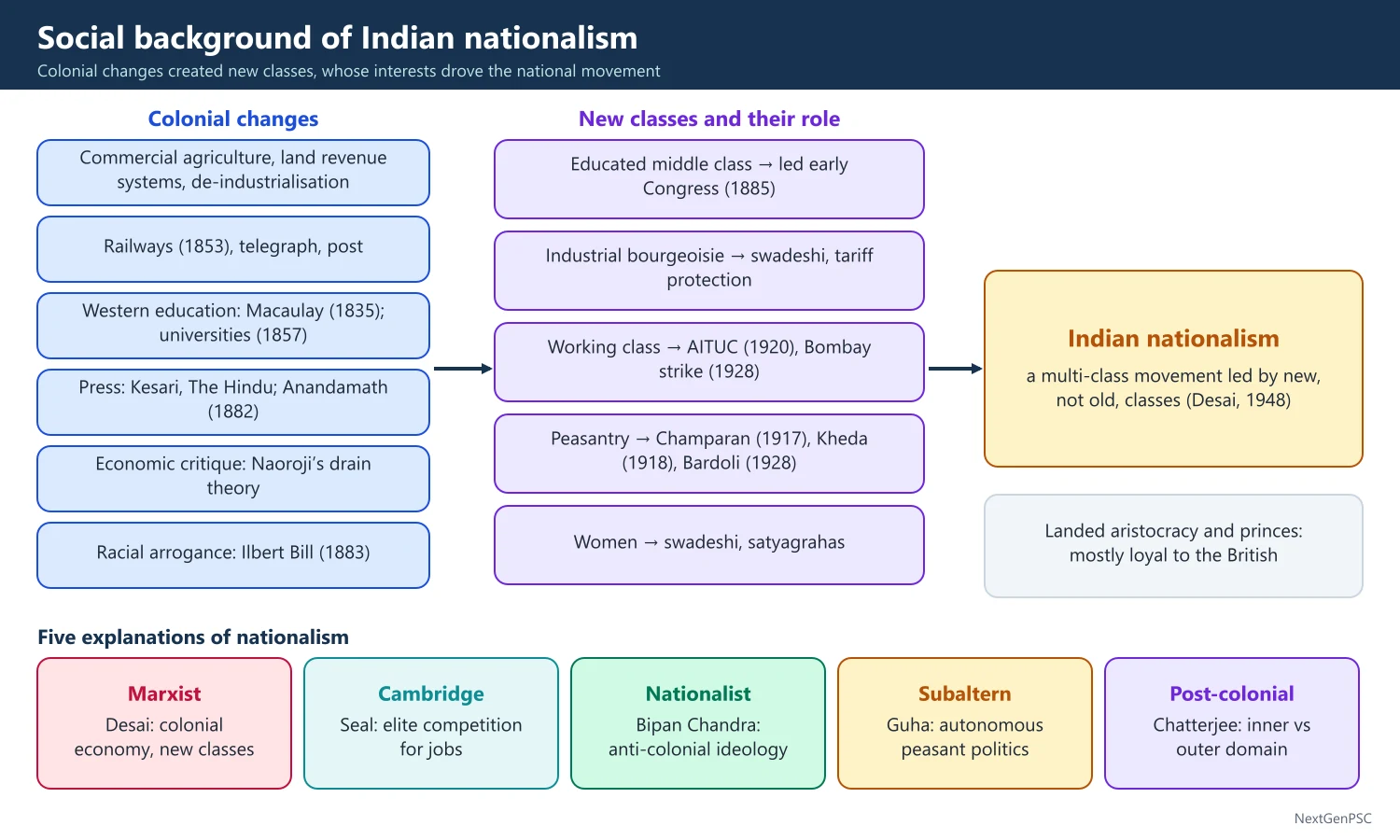
Indian nationalism grew out of the social changes that colonial rule set off: a unified market, Western education, the press and railways, and new classes such as the educated middle class, industrial bourgeoisie and working class. A.R. Desai gave the classic Marxist account; the Cambridge school, nationalist historians and the Subaltern Studies group offered competing explanations.
In simple words
Nationalism is the feeling that people of a land form one nation and should govern themselves.
In India this feeling grew when British rule tied the country together with railways, English schools, newspapers and one market, and also hurt peasants, artisans and traders.
It is like strangers on one crowded train who start talking about the same rude conductor and become a group.
UPSC asks which social groups and changes created nationalism and how different scholars explain it.
1. Key concepts
Nation: Benedict Anderson called it an ‘imagined community’ (Imagined Communities, 1983), imagined because members never meet most others, yet feel a deep comradeship; print capitalism made this imagining possible.
Ernest Gellner (Nations and Nationalism, 1983) linked nationalism to industrial society’s need for a common literate high culture spread by mass education.
Anti-colonial nationalism: nationalism in colonies arose against foreign rule and combined demands for self-rule with social reform and cultural revival.
2. Social and material bases (Desai’s account)
In Social Background of Indian Nationalism (1948) A.R. Desai argued that nationalism was a product of the material and social conditions created by British rule.
Economic transformation: commercialisation of agriculture, the new land revenue systems (Permanent Settlement 1793, ryotwari, mahalwari), decline of handicrafts (de-industrialisation) and the growth of a single market.
Communication: railways (first line 1853), the telegraph and the postal system linked regions and allowed leaders and ideas to move.
Western education: Macaulay’s Minute (1835) and the universities of Calcutta, Bombay and Madras (1857) produced an English-educated middle class that read about liberty, democracy and nationalism.
Press and literature: newspapers such as Amrita Bazar Patrika, The Hindu, Kesari and Bengalee spread criticism of colonial policy; Bankim Chandra’s Anandamath (1882) gave ‘Vande Mataram’.
Economic critique: Dadabhai Naoroji’s drain theory (Poverty and Un-British Rule in India, 1901), R.C. Dutt’s Economic History of India and M.G. Ranade gave nationalism an economic argument.
Racial arrogance and administrative unification: the Ilbert Bill controversy (1883) and exclusion of Indians from high posts made the educated feel common humiliation.
3. The new classes and their role
Educated middle class: lawyers, teachers, journalists and clerks led the early Congress (founded 1885) and its petitions for representation.
Industrial bourgeoisie: Indian mill owners and traders (Tatas, Birlas, Bajaj) wanted tariff protection and supported swadeshi and later Gandhi’s Congress.
Working class: textile and railway workers formed unions (All India Trade Union Congress, 1920) and joined strikes, such as the Bombay textile strike of 1928.
Peasantry: burdened by revenue, rent and debt, peasants joined Champaran (1917), Kheda (1918), Bardoli (1928) and the mass movements of 1920–22, 1930–34 and 1942.
Women: women entered public life through reform bodies, the Swadeshi movement and Gandhi’s satyagrahas (salt march, picketing).
Landed aristocracy and princes: most zamindars and princely rulers stayed loyal to the British, which Desai took as proof that nationalism was led by new, not old, classes.
4. Other explanations
Cambridge school: Anil Seal (The Emergence of Indian Nationalism, 1968) and others saw early nationalism as competition among small educated elites for colonial jobs and patronage; critics say this ignores ideology and mass support.
Nationalist historians: Bipan Chandra and others stressed a genuine anti-colonial ideology and the national movement as a broad, multi-class popular movement.
Subaltern Studies: Ranajit Guha (from 1982) argued that elite histories ignored the autonomous politics of peasants, tribals and workers; Elementary Aspects of Peasant Insurgency in Colonial India (1983).
Partha Chatterjee: in The Nation and Its Fragments (1993) he argued that nationalists divided life into an outer material domain (where the West was copied) and an inner spiritual domain of home, religion and women (kept sovereign).
Gandhian view: Gandhi’s Hind Swaraj (1909) saw the nation in moral and civilisational terms, rooted in villages, and rejected modern industrial civilisation.
5. Caste, religion and the limits of nationalism
Religious nationalism: revivalist ideas (Arya Samaj, Tilak’s Ganapati and Shivaji festivals from the 1890s) mobilised Hindus but alienated many Muslims; the Muslim League (1906) and separate electorates (1909) deepened the divide.
Caste critique: Phule and Ambedkar asked whether national freedom would mean freedom for the lower castes; the Poona Pact (1932) on depressed-class representation shows this tension.
Regional and linguistic identity: regional movements and the demand for linguistic provinces grew alongside all-India nationalism.
Women’s question: the Age of Consent Act (1891) split opinion, with Tilak opposing colonial interference in Hindu custom and reformers supporting the law, showing the tension between social reform and nationalism.
Tribes: tribal revolts (Santhal 1855–56, Munda 1899–1900) were anti-colonial but grew from their own grievances over land and forests, not from middle-class nationalism.
6. Linking thinkers
Marx: Marx’s articles on India (1853) saw British rule as both destructive and regenerative, laying the material base for a unified India; Desai develops this.
Gramsci: Indian nationalism can be read as a ‘passive revolution’ in which the bourgeoisie built hegemony through the Congress; Partha Chatterjee uses this idea.
Weber: charismatic authority helps explain Gandhi’s mass appeal, which turned an elite movement into a mass one.
Social movements theory: relative deprivation (the gap between Indian expectations and colonial reality) and resource mobilisation (press, Congress organisation) both apply.
7. Relevance today
Debates on civic versus cultural nationalism continue in India, for example over the Citizenship (Amendment) Act 2019 and the national song and anthem.
Social media now plays the role that print played in Anderson’s account, spreading national and sub-national identities quickly.
Regional and sub-national movements, such as the Telangana movement that produced a new state in 2014, show that national and regional identities coexist.
8. Using it in the exam
10 marks: list the colonial changes and new classes, cite Desai, and add one other view (Seal or Guha).
15 marks: show the role of each class with an example movement, then caste and religious limits.
20 marks: compare Marxist, Cambridge, nationalist and Subaltern explanations, and use Anderson or Chatterjee for depth.
Diagram idea: a flow chart: colonial economy → new classes → organisations and press → mass movement → independence, with side boxes for caste and communal counter-currents.
Useful line: Anderson described the nation as an imagined political community (Imagined Communities, 1983).
| School | Key scholar and work | Main argument |
|---|---|---|
| Marxist | A.R. Desai, Social Background of Indian Nationalism (1948) | Product of colonial economy and new classes; bourgeois-led |
| Cambridge | Anil Seal, The Emergence of Indian Nationalism (1968) | Elite competition for jobs and patronage |
| Nationalist | Bipan Chandra | Anti-colonial ideology; multi-class mass movement |
| Subaltern | Ranajit Guha (1982 onwards) | Autonomous politics of peasants and tribals ignored by elites |
| Post-colonial | Partha Chatterjee, The Nation and Its Fragments (1993) | Inner spiritual versus outer material domain |
Mains points
- Start with a definition of nationalism (Anderson or Gellner), then give the colonial social changes as causes; avoid writing a pure history answer.
- Make A.R. Desai the backbone of the answer and name his new classes.
- Add competing views (Cambridge, nationalist, Subaltern, Chatterjee) to show sociological depth.
- Discuss the limits: caste (Phule, Ambedkar), religion (communalism) and tribal autonomy.
- Link to Paper I theories: Marx on colonialism, Weber on charisma, social movement theories.
- Conclude with relevance: debates on civic and cultural nationalism today.
Did you know?
- The first Indian National Congress session in Bombay (December 1885) had 72 delegates; within 35 years Gandhi turned it into a mass organisation.
Modernisation of Indian Tradition
Modernisation means the spread of rationality, science, industry, democracy and universalistic values. Yogendra Singh’s Modernization of Indian Tradition (1973) showed that in India change came from orthogenetic (internal) and heterogenetic (external) sources at cultural and structural levels, and that tradition adapts rather than disappears, as Milton Singer and the Rudolphs also found.
In simple words
Modernisation is the shift towards science, machines, cities, schooling, elections and equal rights.
In India old ways did not simply vanish: a software engineer may still consult a horoscope before marriage, and caste groups now run websites and political campaigns.
Old and new mix, like a temple that now takes online donations.
UPSC asks how tradition and modernity interact in India, and asks you to explain Yogendra Singh’s framework.
1. Concepts
Modernisation: a process of change towards rationality, science and technology, industrialisation, urbanisation, mass education, democracy and universalistic, achievement-based values.
Modernisation theory: Talcott Parsons’ pattern variables (from particularism and ascription to universalism and achievement), Daniel Lerner’s The Passing of Traditional Society (1958) and W.W. Rostow’s Stages of Economic Growth (1960) saw tradition as an obstacle to be replaced.
Tradition: Yogendra Singh defined Indian tradition through four value themes: hierarchy (caste and status ranking), holism (the individual subordinate to the group), continuity (karma, rebirth) and transcendence (legitimacy from sacred values).
Westernisation (Srinivas): changes resulting from British rule in technology, institutions, ideology and values; it is narrower and more historically specific than modernisation.
2. Yogendra Singh’s framework
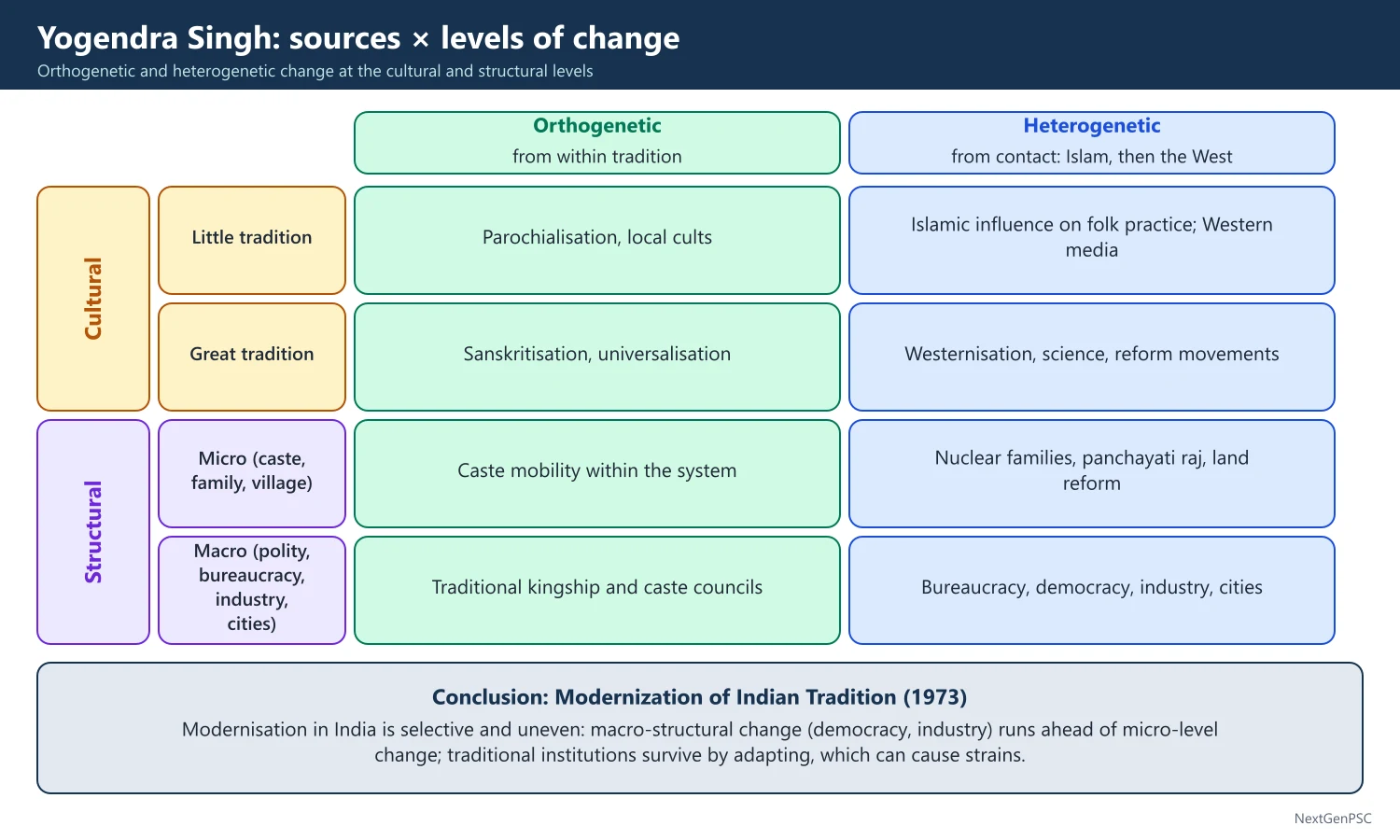
In Modernization of Indian Tradition: A Systemic Study of Social Change (1973) he combined the sources of change with the levels at which change happens.
Orthogenetic change: from within the tradition, such as Sanskritisation and the interaction of the great and little traditions.
Heterogenetic change: from contact with other civilisations, first Islam (Islamisation of some cultural practices) and then the West (Westernisation, modernisation).
Cultural level: changes in the little tradition (local folk culture) and the great tradition (textual, all-India culture).
Structural level: micro-structures (caste, family, village) and macro-structures (political system, bureaucracy, elites, industry, cities).
Conclusion: modernisation in India is ‘selective’ and uneven; structural change at the macro level (democracy, industry) runs ahead of micro-level change, and traditional institutions survive by adapting, which can cause strains.
3. Tradition adapts: key studies
Milton Singer (When a Great Tradition Modernizes, 1972), studying Madras industrial leaders, found adaptive strategies: compartmentalisation (modern at work, traditional at home), ritual neutralisation and vicarious ritualisation (paying priests to perform rites).
Lloyd and Susanne Rudolph (The Modernity of Tradition, 1967) showed that caste associations such as the Nadar Mahajana Sangam became vehicles of democratic participation; tradition and modernity are not opposites.
Rajni Kothari (Caste in Indian Politics, 1970): politics politicised caste, and caste in turn adapted to politics.
Caste as an interest group: Yogendra Singh and Kothari both note that caste moved from a closed ritual hierarchy towards a competing interest group, an example of structural adaptation.
McKim Marriott (Kishangarhi, 1955): universalisation (little to great tradition) and parochialisation (great to little tradition).
Mukerji (D.P.) saw a dialectic between tradition and modernity and warned that imitative Westernisation would uproot the middle class; he called for change rooted in Indian tradition.
4. Colonial modernisation in practice
Law: Bengal Sati Regulation (1829), Caste Disabilities Removal Act (1850), Hindu Widows’ Remarriage Act (1856), Indian Penal Code (1860), Age of Consent Act (1891), Child Marriage Restraint Act (1929).
Institutions: English education, universities, courts, bureaucracy, railways, the census (from 1871–72) and the press.
Contradictions: colonial rule both modernised and froze tradition; personal laws were codified on textual lines and the census fixed caste categories.
5. Post-independence modernisation
The Constitution (1950) set modern values: equality, abolition of untouchability (Article 17), universal adult franchise and secularism.
Planned industrialisation, land reforms, the Hindu Code Bills (1955–56), panchayati raj (73rd Amendment, 1992) and liberalisation (1991) carried modernisation further.
Today digital technology spreads modern institutions: by 2024 India had over 130 crore Aadhaar numbers and very wide mobile use, yet matrimonial sites still sort by caste and gotra.
Yogendra Singh’s later book Culture Change in India: Identity and Globalization (2000) argued that globalisation brings a new wave of heterogenetic change alongside a revival of local and community identities.
Modernisation is uneven by gender: female labour force participation (age 15 and above, usual status) rose from 23.3% in PLFS 2017–18 to 41.7% in PLFS 2023–24, but much of the rise is self-employment and unpaid family work.
6. Criticism of the modernisation approach
Ethnocentrism: it treats the Western path as universal; S.N. Eisenstadt’s ‘multiple modernities’ (2000) argued that societies modernise in different ways.
Marxist critique: A.R. Desai (1971) and dependency theorists (Andre Gunder Frank) argued that it hides class and imperialism.
Dipankar Gupta (Mistaken Modernity, 2000) argued that Indians often confuse Westernisation and consumer goods with modernity; true modernity means respect for universal norms and the dignity of others, which caste practices deny.
Post-colonial critique: Ashis Nandy and others questioned whether Western rationality should be the standard at all.
Gandhi’s critique: Hind Swaraj (1909) rejected modern industrial civilisation itself and offered an alternative based on village self-rule and moral restraint.
7. Linking thinkers
Weber: rationalisation and disenchantment; Weber’s claim in The Religion of India that Hindu ethics hindered capitalism is contested by Singer’s Madras industrialists.
Parsons: pattern variables give the yardstick; Indian evidence shows mixtures, such as achievement in jobs alongside ascription in marriage.
Redfield: great and little tradition, used by Marriott and Singer.
Durkheim: the move from mechanical to organic solidarity frames the shift from caste-based to occupation-based interdependence in Indian cities.
8. Using it in the exam
10 marks: define modernisation, give Yogendra Singh’s four processes and an example of each.
15 marks: add Singer’s adaptive strategies and the Rudolphs’ caste associations.
20 marks: evaluate with Desai, Dipankar Gupta and multiple modernities, and close with current examples.
Diagram idea: Yogendra Singh’s 2 × 2 table with orthogenetic and heterogenetic sources across cultural and structural levels.
Useful line: the Rudolphs argued that tradition and modernity are dialectically related, not opposed (paraphrase of The Modernity of Tradition).
| Level | Orthogenetic (internal) | Heterogenetic (external) |
|---|---|---|
| Cultural: little tradition | Parochialisation, local cults | Islamic influence on folk practice; Western media |
| Cultural: great tradition | Sanskritisation, universalisation | Westernisation, science, reform movements |
| Structural: micro | Caste mobility within the system | Nuclear families, panchayati raj, land reform |
| Structural: macro | Traditional kingship and caste councils | Bureaucracy, democracy, industry, cities |
Mains points
- Define both tradition and modernisation; many answers define only modernisation.
- Present Yogendra Singh’s 2 × 2 framework with Indian examples in each cell.
- Use the adaptive-tradition studies (Singer, Rudolphs, Kothari) to argue that tradition is not simply replaced.
- Distinguish Westernisation, modernisation and secularisation clearly.
- Give criticism: ethnocentrism, Marxist critique, Dipankar Gupta’s ‘mistaken modernity’.
- Bring current examples: caste matrimony online, digital religious services, caste associations in elections.
Did you know?
- Memory trick for Yogendra Singh’s four value themes of tradition: ‘HHCT’ – Hierarchy, Holism, Continuity, Transcendence.
Protests, Movements and Social Reforms in the Colonial Period
Colonial India saw peasant revolts against revenue and rent, tribal uprisings over land and forests, anti-caste movements led by Phule, Narayana Guru, Periyar and Ambedkar, and socio-religious reform movements from the Brahmo Samaj to the Aligarh movement. Sociologists classify them using M.S.A. Rao’s reformist, transformative and revolutionary types and Kathleen Gough’s typology of peasant uprisings.
In simple words
Under British rule many groups pushed back: peasants refused unfair rent, tribes fought loss of forests, and lower castes demanded dignity and temple entry.
At the same time reformers such as Raja Ram Mohan Roy fought customs like sati and child marriage.
Think of a house where some members demand repairs (reform) and others want to rebuild it (revolution).
UPSC asks you to classify these movements and explain their social roots and results.
1. Concepts and classifications
Social movement: a sustained collective effort to bring about or resist change, with an ideology, organisation and leadership.
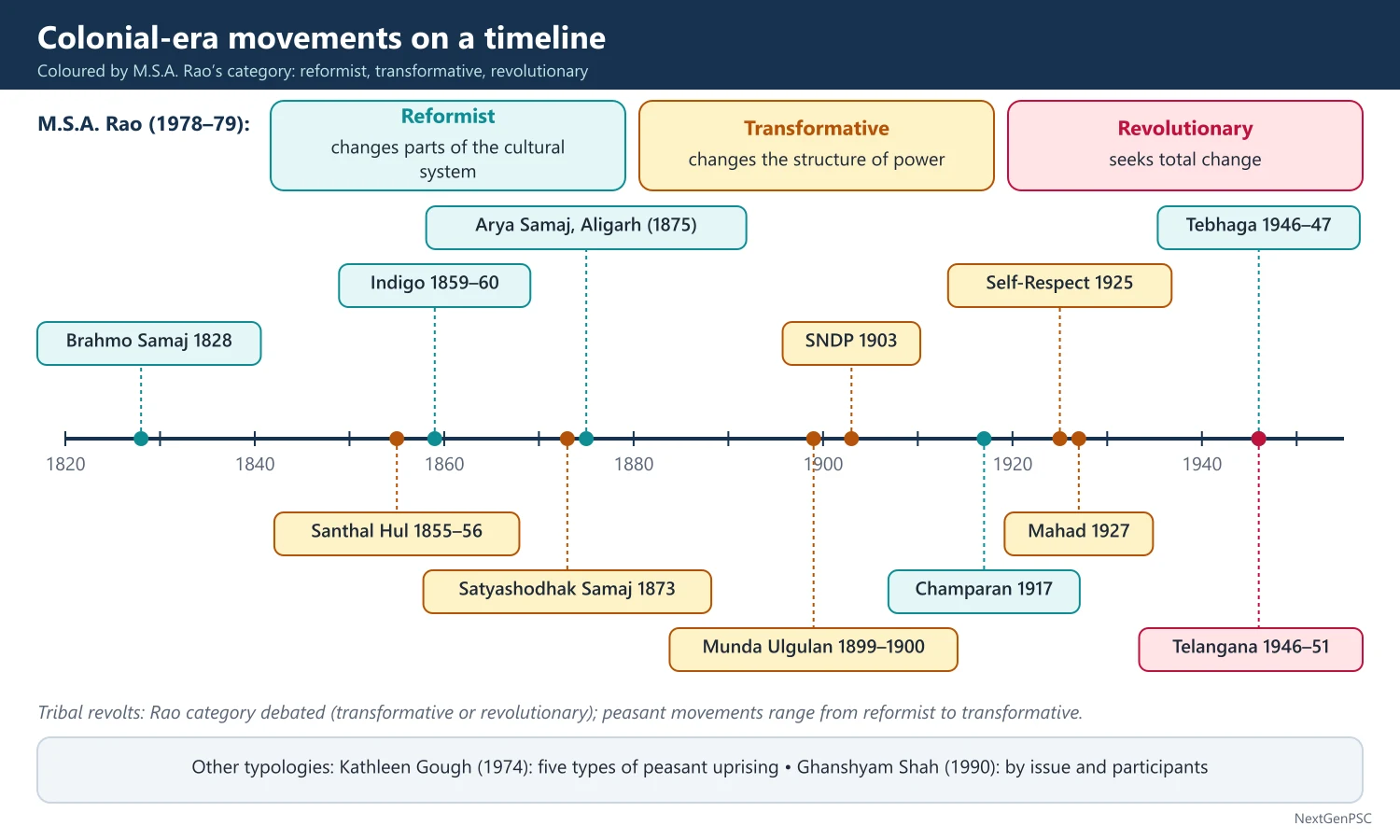
Rao (M.S.A.) (Social Movements in India, 1978–79): reformist movements change parts of the cultural system, transformative movements change the structure of power (backward-caste movements), revolutionary movements seek total change (Telangana).
Kathleen Gough (‘Indian Peasant Uprisings’, 1974) gave five types: restorative rebellions, religious movements, social banditry, terrorist vengeance and mass insurrections for general redress.
Ghanshyam Shah (Social Movements in India: A Review of Literature, 1990) classified movements by issue and participants: peasants, tribals, Dalits, backward castes, women, students, industrial workers and middle class.
2. Peasant movements
Causes: high revenue under the Permanent Settlement and ryotwari, rack-renting by zamindars, moneylenders’ land grabbing, forced cash crops.
Examples: Indigo revolt in Bengal (1859–60), Pabna agrarian league (1873), Deccan riots against moneylenders (1875), Champaran (1917), Kheda (1918), Moplah rebellion in Malabar (1921), Bardoli (1928), Tebhaga in Bengal (1946–47) and the Telangana armed struggle (1946–51).
Organisation: the All India Kisan Sabha (1936) under Swami Sahajanand Saraswati linked peasants with the left.
State response: the Deccan Agriculturists’ Relief Act (1879) and the Bengal Tenancy Act (1885) were colonial responses to peasant unrest.
Interpretations: A.R. Desai and Gough saw class struggle; Ranajit Guha saw autonomous peasant consciousness; nationalist historians saw peasants joining the national movement.
3. Tribal revolts
Causes: loss of land to outsiders (dikus), forest laws (Indian Forest Acts 1865, 1878, 1927), forced labour and missionary and Hindu influence on culture.
Examples: Kol rising (1831–32), Santhal Hul under Sidhu and Kanhu (1855–56), Munda Ulgulan under Birsa Munda (1899–1900), Tana Bhagat movement among Oraons (from 1914), Rampa rebellion under Alluri Sitarama Raju (1922–24).
Results: protective laws such as the Santhal Parganas Tenancy provisions and the Chotanagpur Tenancy Act (1908), forerunners of the Fifth Schedule.
4. Anti-caste and backward-caste movements
Jotirao Phule: founded the Satyashodhak Samaj (1873) and wrote Gulamgiri (1873), attacking Brahmanical domination and opening schools for girls and lower castes with Savitribai Phule (from 1848).
Sree Narayana Guru: SNDP Yogam (1903) for Ezhavas in Kerala; ‘one caste, one religion, one God for man’; consecration of a Shiva idol at Aruvippuram (1888).
Periyar: E.V. Ramasamy’s Self-Respect Movement (1925) in Tamil Nadu, rejecting Brahmanical rituals and promoting self-respect marriages; earlier the Justice Party (1916–17) represented non-Brahmins.
Temple entry and civil rights: Vaikom Satyagraha (1924–25), Guruvayur Satyagraha (1931–32), Ambedkar’s Mahad Satyagraha for water rights (1927) and Kalaram temple entry movement at Nashik (1930).
Ambedkar: Bahishkrit Hitakarini Sabha (1924), demand for separate electorates, Poona Pact with Gandhi (1932), Annihilation of Caste (1936).
Other movements: Ad Dharm in Punjab (Mangu Ram, 1926), Nadar mobilisation in Tamil Nadu, Matua movement among Namasudras in Bengal.
Results: these struggles led to reserved seats for Scheduled Castes under the Government of India Act 1935 and, after independence, to Article 17 and the Untouchability (Offences) Act 1955.
5. Socio-religious reform movements
Brahmo Samaj (Raja Ram Mohan Roy, 1828): monotheism, against sati and idolatry; Prarthana Samaj (1867, Bombay; M.G. Ranade); Arya Samaj (Dayananda Saraswati, 1875) with its call ‘back to the Vedas’ and shuddhi.
Ramakrishna Mission (Swami Vivekananda, 1897): service and spiritual nationalism; Theosophical Society (founded 1875, headquarters at Adyar from 1882; Annie Besant).
Young Bengal: the students of Henry Louis Vivian Derozio at Hindu College, Calcutta (late 1820s) challenged orthodoxy through radical rationalism.
Muslim reform: Sir Syed Ahmad Khan’s Aligarh movement (Muhammadan Anglo-Oriental College, 1875) for modern education; Deoband (1866) for religious revival.
Sikh and Parsi reform: Singh Sabha (1873) and the Gurdwara Reform (Akali) movement (1920–25); Rahnumai Mazdayasnan Sabha among Parsis (1851).
Women’s reform: Ishwar Chandra Vidyasagar (widow remarriage), Pandita Ramabai (Sharada Sadan, 1889), Tarabai Shinde (Stri Purush Tulana, 1882), All India Women’s Conference (1927).
Laws that followed: Bengal Sati Regulation (1829), Hindu Widows’ Remarriage Act (1856), Female Infanticide Prevention Act (1870), Age of Consent Act (1891), Child Marriage Restraint (Sarda) Act (1929).
6. Sociological assessment
Social base: reform movements were led mainly by the urban, upper-caste, English-educated middle class, while anti-caste and peasant movements came from below.
Reform versus revival: some movements reformed by appeal to reason (Brahmo Samaj), others by appeal to a purified past (Arya Samaj); both reshaped identities and sometimes sharpened communal boundaries (shuddhi and tabligh in the 1920s).
Gender: Partha Chatterjee and feminist historians argue that reform often aimed to make women better wives and mothers within a new patriarchy, not to free them.
Gail Omvedt (Cultural Revolt in a Colonial Society: The Non-Brahman Movement in Western India, 1873–1930, 1976) showed the anti-caste movement as a cultural and class revolt.
7. Linking thinkers and relevance today
Theories: relative deprivation (peasants after revenue hikes), Smelser’s value-added theory (structural strain plus a generalised belief, as in millenarian tribal movements), and Weber’s charisma (Birsa Munda as ‘Dharti Aba’).
Continuity: today’s Dalit movements, the Sabarimala debate (Supreme Court verdict of 2018, later referred to a larger bench), the Muslim Women (Protection of Rights on Marriage) Act 2019 on instant triple talaq, and tribal forest-rights struggles continue colonial-era questions.
Since 2021 the government has marked 15 November, Birsa Munda’s birth anniversary, as Janjatiya Gaurav Divas.
8. Using it in the exam
10 marks: classify movements (Rao or Shah) and give one example from each type with year.
15 marks: analyse causes, social base and outcomes of one category, such as anti-caste movements.
20 marks: compare reform from above with protest from below, use Gough, Guha and Omvedt, and link to present-day movements.
Diagram idea: a chart with three columns (reformist, transformative, revolutionary) and colonial examples under each.
Useful line: Ambedkar, in Annihilation of Caste (1936), argued that political reform cannot succeed without social reform (paraphrase).
| Type | Examples (year) | M.S.A. Rao category |
|---|---|---|
| Socio-religious reform | Brahmo Samaj (1828), Arya Samaj (1875), Aligarh (1875) | Reformist |
| Anti-caste | Satyashodhak Samaj (1873), SNDP (1903), Self-Respect (1925), Mahad (1927) | Transformative |
| Peasant | Indigo (1859–60), Champaran (1917), Tebhaga (1946–47) | Reformist to transformative |
| Revolutionary peasant | Telangana armed struggle (1946–51) | Revolutionary |
| Tribal | Santhal Hul (1855–56), Munda Ulgulan (1899–1900) | Transformative or revolutionary (debated) |
Mains points
- Use a sociological classification (M.S.A. Rao, Ghanshyam Shah, Gough), not just a chronological list.
- Show the social base of each movement: middle-class reformers versus peasant, tribal and Dalit protest from below.
- Give exact years and leaders; examiners notice errors in basic facts.
- Add the gender critique of reform (Chatterjee, Uma Chakravarti) for a balanced answer.
- Link theories from Paper I: relative deprivation, Smelser, resource mobilisation, charisma.
- End with continuity into present-day movements and laws.
Did you know?
- Birsa Munda died in Ranchi jail in 1900 aged about 25, yet the Ulgulan he led produced the Chotanagpur Tenancy Act of 1908, which still protects tribal land in Jharkhand.
Gandhi, Ambedkar and Other Thinkers on Indian Society
Gandhi criticised modern industrial civilisation and proposed swaraj, sarvodaya, trusteeship and village self-rule, and worked against untouchability and for communal harmony while defending a reformed varna idea for many years. Ambedkar explained caste as endogamy and graded inequality, called for its annihilation, built constitutional democracy and led a mass conversion to Buddhism in 1956. Phule and the Bhakti saints (Kabir, Basava, Ravidas) and Sree Narayana Guru challenged Brahmanical hierarchy from below.
In simple words
Gandhi wanted India to rule itself and also to rule its own desires; he trusted villages, spinning and non-violence more than factories and machines.
Ambedkar, born into an ‘untouchable’ caste, said caste divides labourers, not just labour, and must be destroyed through law, education and a new religion of equality.
It is like two doctors with one patient: one wants gentle healing from within, the other major surgery.
UPSC asks about their views on caste, village, religion and democracy, and how sociologists read them.
1. Gandhi: key ideas
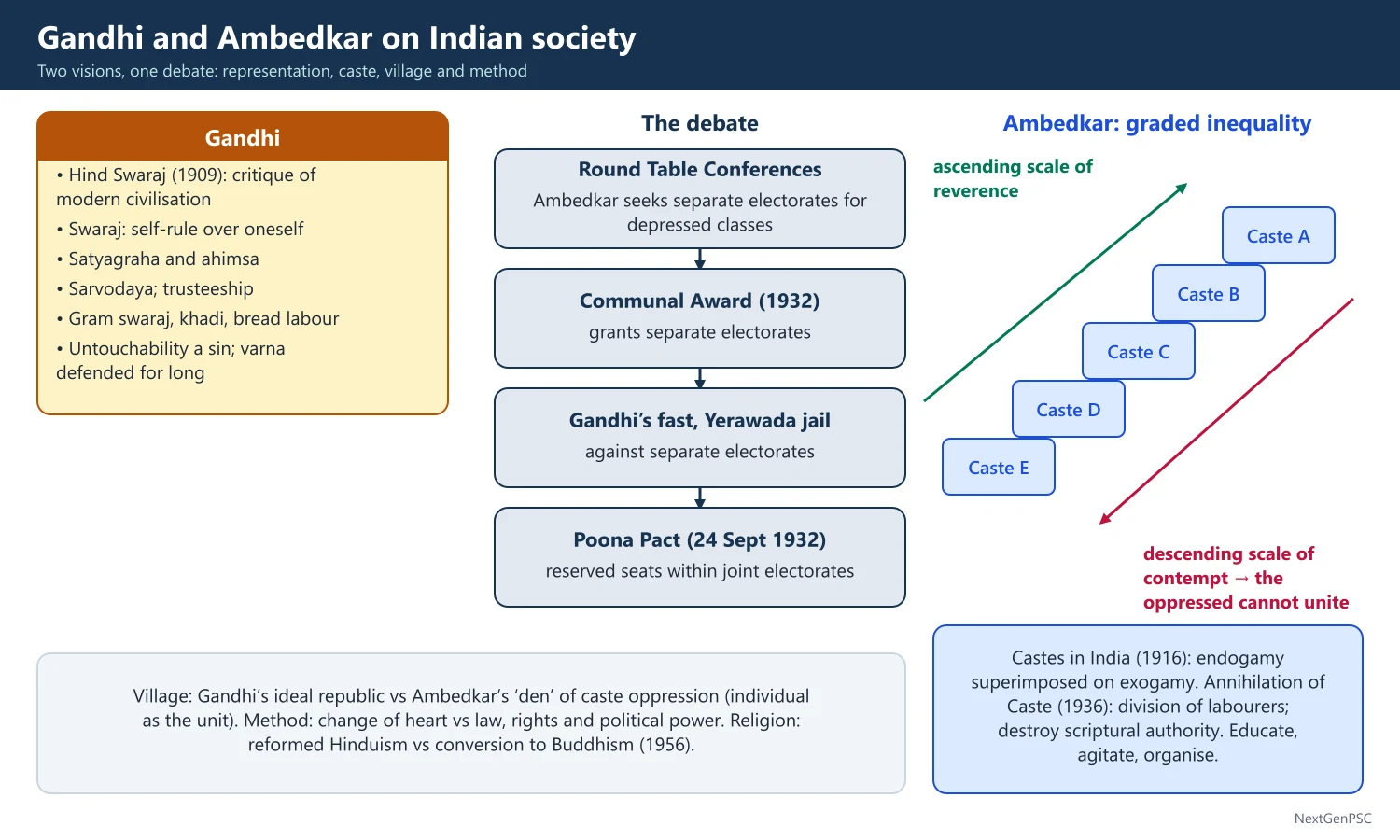
Hind Swaraj (1909): written in Gujarati on the voyage from London to South Africa; it attacked modern civilisation (machinery, railways, lawyers, doctors, parliamentary politics) as a disease that makes people slaves of their wants.
Swaraj: not only political independence but self-rule over oneself; real swaraj would come from self-reliant villages and moral discipline, not from replacing English rulers with Indian ones.
Satyagraha and ahimsa: truth-force and non-violence as methods of resisting injustice, first used in South Africa (1906) and then in Champaran (1917).
Sarvodaya: the welfare of all, taken from his 1908 Gujarati paraphrase of John Ruskin’s Unto This Last; later carried forward by Vinoba Bhave and Jayaprakash Narayan.
Trusteeship: the rich should hold their wealth as trustees for society, keeping only what they need; a non-violent alternative to both capitalism and class war.
Village and bread labour: gram swaraj, khadi and village industries, decentralisation and the dignity of manual work; the Constructive Programme (1941) listed communal unity, removal of untouchability, khadi, basic education and the uplift of women.
Caste and untouchability: he fought untouchability (Harijan Sevak Sangh, 1932; the weekly Harijan, 1933) but for long defended varna as a non-hierarchical division of duties; late in life he supported inter-caste marriages.
Communal harmony: he saw Hindu–Muslim unity as basic to swaraj; he walked through riot-hit Noakhali (1946–47) and fasted in Calcutta (September 1947) and Delhi (January 1948) to stop violence.
2. Sociological readings of Gandhi
Weber’s charisma: Gandhi’s authority rested on personal sanctity and sacrifice, which turned the Congress into a mass movement; the Rudolphs (Gandhi: The Traditional Roots of Charisma, 1983) showed how he used traditional symbols (fasting, the ascetic, the charkha) for modern politics.
Ashis Nandy (The Intimate Enemy, 1983) read Gandhi as rejecting the colonial idea of masculinity and offering an Indian, non-Western critique of modernity.
Partha Chatterjee called the Gandhian phase the ‘moment of manoeuvre’ in which peasants were mobilised but kept within the limits set by the elite leadership.
Marxist critique: A.R. Desai and E.M.S. Namboodiripad argued that trusteeship and non-violence protected the propertied classes.
3. Ambedkar on caste
Castes in India: Their Mechanism, Genesis and Development (1916): a paper read at Columbia University; he argued that the superimposition of endogamy on exogamy is the essence of caste, and that sati, enforced widowhood and girl marriage arose to keep the group endogamous by managing ‘surplus’ men and women.
He held that the Brahmins first enclosed themselves as an endogamous class and other groups followed by imitation, so caste spread through the whole society; this links caste directly to the control of women’s sexuality.
Annihilation of Caste (1936): an undelivered address for the Jat-Pat Todak Mandal of Lahore; caste is a division of labourers, not only of labour; it kills public spirit and fraternity; reform requires destroying the religious authority of the scriptures that sanction caste.
Graded inequality: castes are ranked in an ascending scale of reverence and descending scale of contempt, so each caste looks down on some other and the oppressed cannot unite.
Origins of untouchability: in The Untouchables (1948) he proposed that untouchables were ‘broken men’ who stayed Buddhist and ate beef when others gave it up; in Who Were the Shudras? (1946) he argued the Shudras were once Kshatriyas degraded by Brahmins. Historians debate both theses.
4. Ambedkar on democracy and religion
Constitutional democracy: as chairman of the Drafting Committee he built safeguards (Article 17 abolishing untouchability, reservation, fundamental rights, Directive Principles).
Social democracy: in his speech of 25 November 1949 he warned that India was entering a ‘life of contradictions’, with equality in politics and inequality in social and economic life, and that political democracy cannot last unless it rests on social democracy based on liberty, equality and fraternity.
In the same speech he called for constitutional methods and called civil disobedience and satyagraha the ‘grammar of anarchy’ once constitutional means exist; he also warned against hero-worship in politics.
Conversion: declaring in 1935 at Yeola that he would not die a Hindu, he embraced Buddhism with a very large number of followers at Nagpur on 14 October 1956, giving 22 vows; The Buddha and His Dhamma appeared in 1957. This gave rise to the Navayana or neo-Buddhist movement.
Organisation: journals Mook Nayak (1920) and Bahishkrit Bharat (1927), the Independent Labour Party (1936) and the Scheduled Castes Federation (1942); he called Brahmanism and capitalism the two enemies of workers (1938).
5. The Gandhi–Ambedkar debate
Representation: Ambedkar sought separate electorates for the depressed classes at the Round Table Conferences; the Communal Award (1932) granted them, Gandhi fasted in Yerawada jail, and the Poona Pact (24 September 1932) gave reserved seats within joint electorates instead.
Caste: Gandhi replied to Annihilation of Caste in Harijan (1936), defending varna while condemning untouchability; Ambedkar answered that varna and caste cannot be separated.
Village: Gandhi idealised the village republic; Ambedkar saw it as the site of caste oppression and wanted the individual as the unit of the Constitution.
Method: Gandhi sought a change of heart among caste Hindus; Ambedkar relied on law, rights, political power and education (his slogan: educate, agitate, organise).
6. Jyotirao Phule
Gulamgiri (Slavery, 1873): dedicated to the people of the United States who fought slavery; it read Indian history as the conquest of the original inhabitants by Aryan Brahmins, who used religion to keep Shudras and Ati-Shudras in mental slavery.
Satyashodhak Samaj (24 September 1873): the Society of Truth Seekers rejected priests and performed marriages without Brahmins; he used the figure of King Bali as a symbol of a just non-Brahmin past.
Education and gender: with Savitribai Phule he opened a girls’ school in Pune in 1848, a home to prevent infanticide by widows, and opened his well to untouchables; Shetkaryacha Asud (Cultivator’s Whipcord, 1881) described the exploitation of peasants by Brahmin officials and moneylenders.
Sociological reading: Gail Omvedt saw Phule as the founder of a non-Brahmin ‘cultural revolt’ that joined caste and class; Rosalind O’Hanlon (Caste, Conflict and Ideology, 1985) studied his ideology in detail.
7. Bhakti and reformist saints
Basava (12th century, Karnataka): founded the Lingayat (Virashaiva) movement, rejected caste, temple ritual and Brahmin priesthood; stressed kayaka (work as worship) and dasoha (sharing); the Anubhava Mantapa was a gathering of saints of all castes, including women.
Kabir (15th century, Varanasi): a weaver who mocked both Hindu and Muslim ritual and caste pride and preached devotion to a formless (nirguna) God; Ravidas, a leatherworker, imagined Begumpura, a city without sorrow, tax or caste.
Others: Namdev, Chokhamela and Tukaram in Maharashtra, Nanak in Punjab, the Alvars and Nayanars in Tamil Nadu and Mirabai in Rajasthan carried devotion across caste and gender lines.
Sree Narayana Guru (1856–1928): led Ezhavas in Kerala to build their own temples and schools; ‘one caste, one religion, one God for man’; his movement shows protest through counter-institutions.
Sociological reading: Bhakti offered equality before God but often did not change social hierarchy; many sects later became castes themselves (the Lingayats became an endogamous community, a ‘sect to caste’ process noted by sociologists), and Bhakti can also be read as Sanskritisation of lower groups. Its radical edge (Kabir, Ravidas) was revived by Dalit movements such as the Ad Dharm and the Ravidassia community.
Gail Omvedt’s Seeking Begumpura (2008) traced an anti-caste utopian tradition from the Buddha through the Bhakti radicals to Phule and Ambedkar.
8. Other thinkers in brief
Periyar: rationalism, atheism and self-respect; attacked caste and the subordination of women and inspired Dravidian politics in Tamil Nadu.
Rabindranath Tagore (Nationalism, 1917) warned against aggressive nationalism and held that India’s problem was social rather than political.
9. Relevance today
Ambedkar’s ideas shape Dalit politics, reservation debates (such as the Supreme Court’s 1 August 2024 ruling allowing sub-classification of Scheduled Castes) and the growth of neo-Buddhism; Census 2011 counted about 84 lakh Buddhists (0.7%), most of them in Maharashtra.
Gandhian ideas live on in sustainable development, decentralisation (73rd Amendment, 1992), khadi and non-violent protest; the 2017–18 Karnataka recommendation to recognise Lingayats as a separate religion shows Basava’s legacy in identity politics.
10. Using it in the exam
10 marks: state the thinker’s core idea with the work and year, give one sociological reading and one present-day link.
15 marks: compare Gandhi and Ambedkar on caste, village and method, using the Poona Pact and the 1936 exchange.
20 marks: trace the anti-caste tradition from Bhakti to Phule and Ambedkar, assess its impact with Omvedt, Zelliot and the ‘sect to caste’ critique, and link it to theories of social movements and Sanskritisation.
Useful line: Ambedkar held that caste is not merely a division of labour but a division of labourers (Annihilation of Caste, 1936).
| Issue | Gandhi | Ambedkar |
|---|---|---|
| Caste and varna | Untouchability a sin; varna defended for long as division of duties | Caste and varna inseparable; annihilate caste |
| Village | Ideal self-reliant republic (gram swaraj) | Den of ignorance and caste oppression |
| Method | Change of heart, satyagraha | Law, rights, political power, education |
| Modernity | Critique of modern civilisation (Hind Swaraj, 1909) | Embraced modern rights, science and industry |
| Religion | Reformed Hinduism, sarva dharma samabhava | Conversion to Buddhism (1956) |
Mains points
- Treat these thinkers sociologically: their theory of society, the social base of their ideas and how scholars (Rudolphs, Nandy, Omvedt, Zelliot) read them, not just biography.
- Quote Ambedkar’s 1916 thesis (endogamy) and 1936 thesis (division of labourers, graded inequality) accurately; they are frequent in caste answers.
- Present the Gandhi–Ambedkar debate in a balanced way with dates (Poona Pact 1932, Harijan exchange 1936).
- Show the Bhakti movement’s double effect: equality before God, but sects turning into castes.
- Link to Paper I: Weber’s charisma (Gandhi), social movements, Sanskritisation versus de-Sanskritisation, religion as protest.
- Use these thinkers as evidence across Paper II: caste, village, religion, women and tribal topics.
Did you know?
- Gandhi wrote all of Hind Swaraj in about ten days on board the ship Kildonan Castle in November 1909, switching to his left hand when his right got tired.
- Memory trick for Ambedkar’s slogan: ‘EAO’ – Educate, Agitate, Organise.
UPSC Previous Year Questions: Impact of Colonial Rule on Indian Society
From 2014 to 2026 UPSC asked 28 question parts carrying 450 marks from this chapter in Paper II. The most-asked topics are Modernisation of Indian Tradition (10 parts) and Protests, Movements and Social Reforms in the Colonial Period (9 parts). Every question below has a model answer written to the UPSC word limit: about 150 words for 10 marks and 250 words for 20 marks.
In simple words
First read the question and write your own answer in the time UPSC gives (about 7 minutes for 10 marks and 11 minutes for 20 marks).
Then compare it with the model answer: check the approach, the thinkers and studies used, the Indian data and the conclusion.
Note what you missed and revise that topic in the notes before trying the next question.
1. Social Background of Indian Nationalism
Example 1 (UPSC 2026, 20 marks): Examine how Indian Nationalism was a result of 'Akhand Bharat'/Indian Subcontinent's socio-cultural and political consciousness.
Paper and question: Paper II, Q2(b)
Approach: Examine both sides: the civilisational and cultural consciousness of the subcontinent (pilgrimage, Sanskrit, Bhakti, shared history) and the political consciousness created by colonial unification; use Ghurye, R.K. Mookerji, Anderson and Desai, and conclude.
The idea of an undivided Indian subcontinent, sometimes called Akhand Bharat, refers to a cultural and political consciousness of India as one land from the Himalayas to the seas. Scholars differ on whether Indian nationalism grew from this older civilisational consciousness or was a modern product of colonial rule.
The cultural argument has strong evidence. Radhakumud Mookerji's The Fundamental Unity of India (1914) and G.S. Ghurye's work pointed to the idea of Bharatavarsha in the Puranas, pilgrimage circuits such as the four dhams and Shankaracharya's mathas at the four corners, sacred rivers, Sanskrit as a shared language of learning, and Bhakti saints who travelled across regions. M.N. Srinivas called this the spread of all-India Hinduism. Indo-Islamic culture, Sufi shrines and shared art added to a composite culture.
Political consciousness of the whole subcontinent also had roots in empires such as the Mauryas and Mughals. But a modern national consciousness required what Benedict Anderson called an imagined community, created by print, schools, maps and a common administration. British rule unified the subcontinent politically, and railways, the press and English education let Indians from different regions meet, as in the Indian National Congress of 1885. A.R. Desai stressed these material roots.
Flow chart: Shared sacred geography and composite culture + colonial political unification → print, education, Congress → national consciousness → mass movement.
The idea also had limits. A Hindu-centred image of civilisational unity alienated many Muslims and contributed to the two-nation politics that led to Partition in 1947, while Dalit and Dravidian movements questioned Brahmanical unity. Partha Chatterjee showed that nationalists claimed an inner spiritual domain of culture while borrowing the outer political forms of the West.
Indian nationalism was therefore a fusion: an old socio-cultural sense of the subcontinent as one land gave it emotional depth, and colonial political unification gave it modern form.
Example 2 (UPSC 2025, 20 marks): Do you think that new economic reforms of British rule have disrupted the old economic system of India? Substantiate your answer with suitable examples.
Paper and question: Paper II, Q3(b)
Approach: Take a position (largely yes) and substantiate with examples of British land settlements, deindustrialisation, commercialisation, drain and famines, add the counter-view (new opportunities, revisionist historians) and conclude.
Pre-colonial India had a largely agrarian economy based on village production, the jajmani exchange of services, flourishing handicrafts such as Bengal textiles, and land rights shared between cultivators and revenue holders. British economic policy did disrupt this system, as A.R. Desai and the economic nationalists argued.
First, land settlements: the Permanent Settlement of 1793 in Bengal, and the Ryotwari and Mahalwari systems elsewhere, turned land into saleable private property with fixed cash revenue. Peasants fell into debt, lands passed to moneylenders, and tenancy and absentee landlordism grew, leading to revolts such as the Deccan riots of 1875.
Second, deindustrialisation: cheap Manchester cloth and one-sided tariffs ruined weavers of Dhaka and Murshidabad, pushing artisans back to agriculture. Third, commercialisation forced crops such as indigo, cotton and jute for export, as in the indigo system that sparked the 1859–60 revolt and Champaran in 1917. Fourth, the drain of wealth, described by Dadabhai Naoroji in Poverty and Un-British Rule in India (1901), and recurrent famines, from 1876–78 to Bengal in 1943, showed the collapse of subsistence security.
Flow chart: Cash revenue and private property in land → debt and land transfer → forced commercial crops → ruin of crafts → overcrowding of agriculture → famines and peasant revolts.
Some historians, such as Morris D. Morris and later Tirthankar Roy, argue that decline was uneven and that railways, a national market, modern industry in Bombay and Ahmedabad and new professions also emerged. Marx himself saw British rule as destructive but also regenerative.
On balance, the old economy was disrupted mainly to serve British interests; the new elements benefited a narrow class, which is why economic grievance became a core of Indian nationalism.
Example 3 (UPSC 2022, 20 marks): Examine the social background of growth of Indian nationalism.
Paper and question: Paper II, Q4(a)
Approach: Examine the social factors behind the growth of nationalism using Desai's framework (economy, classes, phases), add cultural and reform factors and other interpretations, then conclude.
Nationalism grew in India between the mid-19th century and 1947 from a small educated circle into a mass movement. Sociologically, its growth must be explained by the social groups that carried it and the conditions that united them.
A.R. Desai gave the classic Marxist account in 1948. British rule broke the village economy, introduced private property in land, commercial farming and modern transport, and created new classes. The educated middle class led the early Congress (1885) with petitions for reform; the industrial bourgeoisie later financed and shaped it; peasants and workers joined in the Gandhian phase from 1920.
Other social factors mattered too. Western education and the press created a shared public sphere. Reform movements such as the Brahmo Samaj, Arya Samaj and Aligarh movement built pride and organisation. Cultural revival, from Bankim Chandra's Anandamath to Tilak's Ganapati and Shivaji festivals, mobilised people through symbols. Economic critique by Naoroji's drain theory gave nationalism an argument.
Flow chart: Colonial exploitation + unification → new classes and intelligentsia → press, associations, reform → Congress (1885) → Swadeshi (1905) → Gandhian mass movements (1920–42).
The base was not uniform. Non-Brahmin and Dalit movements under Phule, Periyar and Ambedkar questioned an upper-caste nationalism, and religious revivalism also fed communal divisions that ended in Partition. Bipan Chandra saw a broad united front of classes, while subaltern historians found autonomous peasant and tribal politics.
Indian nationalism thus grew from colonial contradictions, new classes and new means of communication, but it carried caste, class and religious tensions that shaped the nation after 1947.
Example 4 (UPSC 2014, 20 marks): Discuss the social background of Indian nationalism.
Paper and question: Paper II, Q2(b)
Approach: Discuss the social conditions that produced nationalism: colonial economy and new classes (Desai), education, press and communication, reform movements and grievances; then add other views and conclude.
Indian nationalism was the sense of a shared political community that grew in the 19th century and challenged British rule. A.R. Desai's Social Background of Indian Nationalism (1948) argued that it was a product of the material and social changes brought by colonialism rather than of an ancient unity alone.
The economic base changed first. Land settlements made land a commodity, agriculture was commercialised, handicrafts declined and the drain of wealth, exposed by Dadabhai Naoroji and R.C. Dutt, impoverished peasants. This created new classes, zamindars, tenants, labourers, merchants, industrialists, workers and an educated middle class, whose interests clashed with colonial rule.
Unification and communication followed. A single administration, railways, the telegraph and the post linked regions. English education after 1835 and universities in 1857 produced a pan-Indian intelligentsia that read Mill and Mazzini, while the vernacular and English press spread political ideas.
Social and religious reform movements, from the Brahmo Samaj to the Arya Samaj and Satyashodhak Samaj, created self-respect and a critique of social evils. Racial discrimination, as in the Ilbert Bill controversy of 1883, and policies such as the Partition of Bengal in 1905 deepened resentment.
Flow chart: Colonial economy → new classes → education, press, railways → reform movements and grievances → middle-class nationalism (1885) → mass nationalism under Gandhi (1920s).
Desai traced phases from a narrow educated base after 1885 to mass participation under Gandhi, though within bourgeois limits. Bipan Chandra stressed a broad people's movement, and subaltern historians such as Ranajit Guha showed independent peasant politics. Thus nationalism had a complex social base of classes, castes and regions brought together by the colonial experience.
2. Modernisation of Indian Tradition
Example 5 (UPSC 2026, 20 marks): How has colonial rule transformed Indian society? If it (Indian society) had not undergone colonial rule, then what type of Indian society would have been there? Elaborate.
Paper and question: Paper II, Q8(a)
Approach: Two parts: first show how colonial rule transformed economy, polity, caste, religion, education and gender; then answer the counterfactual carefully, presenting plausible alternatives (indigenous reform, regional states, possible capitalism) with scholars' views and the limits of speculation.
Colonial rule from 1757 to 1947 transformed Indian society deeply. Marx, writing in 1853, saw it as having a double mission, destroying the old village society and laying the material basis of a new one.
The transformation was wide. Economically, land settlements, commercialisation and deindustrialisation created landlords, tenants and landless labourers and a drain of wealth. Politically, a unified bureaucratic state, law courts and the idea of rights emerged. Socially, the census and codified law hardened caste and religious categories, while English education, railways and the press created a new middle class, reform movements and nationalism. Laws against sati (1829) and for widow remarriage (1856) began legal reform of the family.
What India would have been without colonialism is a counterfactual question, and any answer is speculative. Three plausible lines can be drawn from evidence. First, regional states such as the Marathas, Mysore under Tipu Sultan and the Sikh kingdom were already modernising armies and revenue, suggesting a multi-state political order rather than one unified nation. Second, indigenous reform was underway, through Bhakti and Sant traditions and movements against caste, so social change would have come orthogenetically, though perhaps more slowly.
Third, historians such as Irfan Habib debated whether Mughal India's merchant capital and crafts could have grown into indigenous capitalism; most conclude the outcome is uncertain. Without the census and colonial law, caste might have stayed more fluid and regional, as Dirks and Bayly suggest, but hierarchy and patriarchy would not have vanished.
Flow chart: Pre-colonial society (regional states, Bhakti reform, merchant capital) → with colonialism: unified state, rigid categories, new classes, nationalism; without it (speculative): plural polities, slower orthogenetic reform, uncertain capitalism.
The sociological lesson is that colonialism both destroyed and created: it gave India unity and modern institutions at the cost of exploitation, and Indian society would likely have modernised through its own, different path.
Example 6 (UPSC 2025, 10 marks): Justify that the Indian traditions are modernizing. Also discuss its contributing factors.
Paper and question: Paper II, Q1(b)
Approach: Justify with examples that traditions are modernising (caste, family, religion, marriage), then list contributing factors (education, Constitution and law, urbanisation, market, media, migration).
Yogendra Singh argued that Indian traditions are not disappearing but modernising by adapting to new values of equality, rationality and individual choice.
Evidence is wide. Caste has moved from ritual hierarchy to political interest groups and associations. Joint families have become functionally joint networks, as I.P. Desai noted, even when members live apart. Arranged marriages now often involve the couple's consent and matrimonial apps. Religion uses television, online darshan and digital donations, and festivals blend devotion with consumer culture.
The contributing factors include modern education and literacy, the Constitution and laws such as the Hindu Succession (Amendment) Act 2005 and the Protection of Civil Rights Act 1955, urbanisation and industrial work, the market economy after 1991, mass and social media, and migration abroad.
Modernisation is uneven, as dowry and honour crimes show, but the overall trend is adaptation rather than rejection of tradition.
Example 7 (UPSC 2025, 20 marks): Do you think that in a society like India orthogenetic changes take place through differentiation? Do you observe continuities in the orthogenetic process? Elaborate your answer with suitable examples.
Paper and question: Paper II, Q2(a)
Approach: Explain orthogenetic change and differentiation (Redfield, Yogendra Singh), give Indian examples of change through differentiation, then show continuities within the process, and conclude.
Orthogenetic change, a term from Robert Redfield and Milton Singer, is change that grows out of a civilisation's own traditions rather than from outside contact. Yogendra Singh used it in Modernization of Indian Tradition (1973), contrasting it with heterogenetic change from Islam and the West. In Indian history, much orthogenetic change has taken place through differentiation: the splitting of a tradition into new sects, roles and institutions while the parent tradition survives.
Examples are many. Buddhism and Jainism differentiated from Vedic religion in the 6th century BCE as protests against ritualism and Brahmin dominance. The Bhakti movement produced sects such as the Virashaivas of Basava, the Varkaris of Maharashtra and the Kabirpanthis, which challenged caste. Sikhism grew from Bhakti and Sant traditions. Castes themselves split into sub-castes through occupational differentiation, and Sanskritisation allowed groups to claim new status within the same hierarchy.
Flow chart: Parent tradition (Vedic-Brahmanical) → internal protest or specialisation → new sect or sub-caste (Buddhism, Virashaivism, Sikhism) → coexistence and absorption → continuity of core themes.
Yet continuities run through the process. New sects kept core ideas such as karma, rebirth and moksha. Many anti-caste sects later developed caste-like divisions themselves; the Lingayats became an endogamous community. Hinduism absorbed rebels, treating the Buddha as an avatar of Vishnu. Srinivas showed that Sanskritisation changes a caste's position but not the hierarchy itself, which he called positional rather than structural change.
Thus orthogenetic change in India has largely meant differentiation within a framework of continuity. This supports Singh's view that Indian tradition changes by adaptation, though modern heterogenetic forces such as democracy and law now push for structural change.
Example 8 (UPSC 2023, 10 marks): Are Tradition and Modernity antithetical to each other? Comment.
Paper and question: Paper II, Q1(d)
Approach: Argue that they are not necessarily antithetical, using the Rudolphs, Milton Singer and Yogendra Singh with Indian examples, then acknowledge real conflicts and conclude.
Classical modernisation theory, from Daniel Lerner to Talcott Parsons' pattern variables, treated tradition and modernity as opposite poles, with societies moving from ascription to achievement. Indian experience suggests they are not necessarily antithetical.
Lloyd and Susanne Rudolph's The Modernity of Tradition (1967) showed caste associations becoming democratic interest groups and Gandhi using traditional symbols for modern mass politics. Milton Singer found Madras industrialists compartmentalising ritual life at home and rational work in the office. Yogendra Singh described India's modernisation as selective adaptation. Today, matrimonial websites serve caste endogamy and temples use digital payments.
Conflicts do exist. Honour killings, opposition to inter-caste marriage and resistance to women's rights show tradition clashing with constitutional values of equality and choice.
So tradition and modernity are best seen as a continuum that interacts and blends, with conflict arising where traditions deny equality.
Example 9 (UPSC 2022, 20 marks): Critically examine Yogendra Singh's thesis on 'Modernisation of Indian Tradition'.
Paper and question: Paper II, Q3(a)
Approach: Critically examine: outline the thesis briefly, show its strengths with examples, then give criticisms by Marxist, Dalit, feminist and post-colonial scholars, and conclude.
Yogendra Singh's Modernization of Indian Tradition (1973) argued that India's tradition, based on hierarchy, holism, continuity and transcendence, is modernising selectively through orthogenetic and heterogenetic sources of change, operating at the cultural level of little and great traditions and at the structural level of micro and macro institutions.
Its strengths are several. It combined culture and structure, unlike earlier one-sided approaches. It rejected the Western view that tradition must disappear, and fitted Indian facts such as caste associations in democracy (Rudolphs), industrialists who compartmentalise ritual and work (Milton Singer), and the persistence of joint families in business. It also built on Indian concepts such as Sanskritisation.
The criticisms are serious. A.R. Desai argued that modernisation theory is an ideology of capitalist development that hides exploitation and class conflict. Dalit scholars such as Kancha Ilaiah question the equation of Indian tradition with Brahmanical great tradition, ignoring the cultures of the oppressed. Feminists note silence on patriarchy. Post-colonial scholars point out that the very dichotomy of tradition and modernity is a Western construct.
The framework is also more descriptive than explanatory: it classifies changes but does not explain why some traditions adapt and others resist. And it did not foresee the strength of religious revivalism and identity politics after the 1980s, which used modern means to assert tradition.
Despite these limits, Singh's thesis remains the most comprehensive map of Indian social change and is best used together with class, caste and gender analysis.
Example 10 (UPSC 2021, 20 marks): Discuss in detail the major contribution of Prof. Yogendra Singh in theorizing India's modernization.
Paper and question: Paper II, Q3(a)
Approach: Discuss Singh's contributions in detail: critique of earlier approaches, value themes, the fourfold framework of change, his findings on Indian modernisation and later work on globalisation; end with assessment.
Professor Yogendra Singh (1932–2020), who founded the Centre for the Study of Social Systems at JNU, made the most systematic attempt to theorise India's modernisation in Modernization of Indian Tradition: A Systemic Study of Social Change (1973).
His first contribution was to review existing approaches, Indological, structural, Marxist and cultural, and to argue that each saw only part of change. He proposed a systemic approach combining culture and structure.
Second, he defined Indian tradition through four value themes: hierarchy, holism, continuity and transcendence. Modernisation meant a shift towards equality, individualism, historicity and rationality.
Third, he gave a framework of change by source and level. Orthogenetic changes, from within, include Sanskritisation and the Bhakti and reform movements; heterogenetic changes, from outside, include Islamisation and Westernisation. These operate in the little and great traditions and in micro structures such as caste, family and village and macro structures such as the bureaucracy, industry, elites and the political system.
Flow chart: Source (orthogenetic / heterogenetic) × level (cultural: little, great tradition; structural: micro, macro) → eight cells of change → selective modernisation with strains.
Fourth, he concluded that Indian modernisation is selective and adaptive, but warned of breakdowns where structural change outpaces cultural change, causing tension, corruption or identity conflict. Fifth, in Culture Change in India: Identity and Globalization (2000) he extended the analysis to globalisation, media and identity movements.
Critics such as A.R. Desai saw a liberal bias that underplays class; others found the categories descriptive. Yet Singh's synthesis remains the standard framework for theorising social change in India.
Example 11 (UPSC 2020, 20 marks): Colonial administrators helped to construct the very traditionalism which marked the Indian society as 'backward'. Comment critically.
Paper and question: Paper II, Q8(a)
Approach: Comment critically on the thesis that colonial knowledge constructed Indian ‘traditionalism’: explain Orientalism and the colonial construction of caste and religion (Cohn, Dirks, Risley, census, codified law), then give the counter-view and conclude.
The statement draws on the critique of Orientalism, a term made famous by Edward Said (1978), which showed how Western knowledge portrayed the East as static, religious and irrational in order to justify rule. In India, scholars such as Bernard Cohn, Nicholas Dirks and Ronald Inden argued that colonial administrators did not simply find Indian tradition but helped construct it.
Several mechanisms support this. The census, especially H.H. Risley's 1901 attempt to rank castes by social precedence, froze fluid identities and set off caste associations petitioning for higher rank. Warren Hastings' plan of 1772 had Hindu and Muslim law administered from texts interpreted by pandits and maulvis, making Brahmanical texts the law for all. The Criminal Tribes Act of 1871 and the idea of martial races fixed groups into types. Dirks' Castes of Mind (2001) argued that caste became the central symbol of India under colonial rule.
Flow chart: Orientalist knowledge → census classification and textual law → fixed caste and religious categories → image of a backward, traditional India → justification of the civilising mission.
This image of a backward India justified British rule as a civilising mission, as in James Mill's History of British India (1817). Ironically, it also shaped Indian nationalism and reform, which accepted many colonial categories.
The thesis can be overstated. Caste, hierarchy and untouchability existed long before the British, as texts, inscriptions and Bhakti protests show; historians such as Susan Bayly argue that colonial rule intensified rather than invented caste. Colonial rule also brought reforms against sati and child marriage, and Indians such as Phule and Ambedkar used colonial institutions to fight tradition.
The balanced view is that colonial knowledge rigidified and redefined Indian traditions to serve rule, producing a traditionalism that was partly old and partly a colonial construction.
Example 12 (UPSC 2017, 20 marks): Discuss Yogendra Singh's thesis on Modernisation of Indian Tradition, and evaluate its applicability in the present day context.
Paper and question: Paper II, Q2(b)
Approach: Two parts: explain Singh's thesis (value themes, sources and levels of change, selective modernisation), then evaluate its applicability today with examples of globalisation, digital change, identity politics and revivalism.
Yogendra Singh's Modernization of Indian Tradition (1973) argued that Indian tradition, built on the value themes of hierarchy, holism, continuity and transcendence, changes through modernisation, which brings values of equality, individualism, historicity and rationality.
He classified change as orthogenetic (internal, such as Sanskritisation) or heterogenetic (external, such as Islam and Westernisation), at the cultural level of the little and great traditions and at the structural level of micro and macro institutions. He concluded that India modernises selectively, with traditions adapting rather than breaking, and that strains appear where structural change is faster than cultural change.
The thesis applies well today. Matrimonial apps help families find matches within caste, showing endogamy using modern tools. Religious festivals and pilgrimages are organised through social media and online booking. Caste associations act as pressure groups for reservation, and joint families still run many business houses. Singh's own later book, Culture Change in India: Identity and Globalization (2000), extended the framework to globalisation.
Its applicability has limits. Globalisation is not simply heterogenetic: it produces hybrid forms and new identity movements. Religious revivalism and communal mobilisation show that tradition can be used against modern values. Dalit assertion and feminist movements challenge tradition rather than adapt it. And the market, digital media and migration create changes that the categories of little and great tradition capture only partly.
Flow chart: Tradition (hierarchy, holism) + modern forces (education, market, democracy, digital media) → adaptation (caste associations, matrimonial apps) or conflict (revivalism, assertion) → selective modernisation.
The thesis therefore remains a sound starting point, but today it must be combined with theories of globalisation, identity and power.
Example 13 (UPSC 2015, 20 marks): Discuss the paradigm of modernization of Indian tradition in analyzing social change in India.
Paper and question: Paper II, Q3(a)
Approach: Discuss the modernisation-of-tradition paradigm as a tool for analysing change: its background (Redfield, Marriott, Srinivas, Singer, Rudolphs), Yogendra Singh's framework with examples, its use and its limits.
The modernisation of tradition paradigm rejects the Western idea that tradition and modernity are opposites. It holds that Indian traditions adapt to and absorb modern forces. It grew from Robert Redfield's great and little traditions, McKim Marriott's study of Kishangarhi, Milton Singer's work on Madras, and the Rudolphs' The Modernity of Tradition (1967), and was given its fullest form by Yogendra Singh in 1973.
Singh analysed change along two axes. By source, change is orthogenetic (from within, such as Sanskritisation, Bhakti and reform movements) or heterogenetic (from outside, such as Islam and Westernisation). By level, it is cultural, in the little and great traditions, or structural, in micro structures (caste, family, village) and macro structures (bureaucracy, industry, elites, political system).
Flow chart: A 2 × 2 table: orthogenetic-cultural (Sanskritisation), heterogenetic-cultural (Westernisation, Islam), orthogenetic-structural (caste mobility, jajmani change), heterogenetic-structural (bureaucracy, industry, democracy).
The paradigm explains many Indian facts. The Rudolphs showed caste associations becoming democratic interest groups. Singer found Madras industrialists compartmentalising ritual at home and modern work in the office. Joint families support business houses, and astrology coexists with matrimonial websites.
Its limits are noted by critics. A.R. Desai said it repeats Western modernisation theory and hides class conflict. Dalit scholars note that it treats Brahmanical tradition as the Indian tradition. It also underplays conflict, revivalism and the communal use of tradition.
Even so, the paradigm remains useful because it captures the defining feature of Indian change: continuity through adaptation, with tradition and modernity coexisting.
Example 14 (UPSC 2014, 10 marks): Modernisation of Indian traditions
Paper and question: Paper II, Q1(b)
Approach: A short note on Yogendra Singh's thesis: define tradition and modernisation, give his orthogenetic–heterogenetic and cultural–structural scheme, and evaluate.
In Modernization of Indian Tradition (1973), Yogendra Singh defined tradition as the value themes of a society (hierarchy, holism, continuity and transcendence in India) and modernisation as a shift towards rational, universalistic values.
He classified change by its source and level. Orthogenetic change arises from within, such as Sanskritisation and the Bhakti movement; heterogenetic change comes from outside, such as Islam and Westernisation. Each operates in the little and great traditions at the cultural level, and in micro (caste, family, village) and macro (bureaucracy, industry, elites) structures.
His conclusion was that India modernises selectively: traditions adapt rather than disappear, as seen in caste associations in politics and joint families sustaining business.
Critics such as A.R. Desai saw it as a disguised version of Western modernisation theory that ignored class and power. Still, it remains the most complete framework for analysing social change in India.
3. Protests, Movements and Social Reforms in the Colonial Period
Example 15 (UPSC 2026, 10 marks): According to you, which social reform had long-lasting impact on a specific section of society? Support your answer with suitable example.
Paper and question: Paper II, Q1(b)
Approach: Choose one reform with a specific beneficiary group (Narayana Guru's SNDP movement and the Ezhavas of Kerala), show its methods and long-term impact with evidence, and conclude.
A reform with a long-lasting impact on a specific section is the movement of Sree Narayana Guru (1856–1928) among the Ezhavas of Kerala, a large caste treated as polluting and barred from temples, schools and public roads.
In 1888 the Guru consecrated a Shiva idol at Aruvippuram, breaking the Brahmin monopoly over temple rites. His message of ‘one caste, one religion, one God for man’ rejected hierarchy. The SNDP Yogam (1903) built schools, temples and cooperatives, encouraged education and trade, and discouraged costly rituals and liquor work.
The movement inspired the Vaikom satyagraha (1924–25) and helped bring the Travancore Temple Entry Proclamation of 1936. Over the long term, Ezhavas became one of Kerala's most educated and politically active communities, and the movement contributed to Kerala's high literacy and social development.
The reform also shows Sanskritisation and assertion together, since Ezhavas adopted temple worship while rejecting Brahmin control, and it remains a model of caste reform from below.
Example 16 (UPSC 2026, 20 marks): Differentiate between protests and movements. Discuss some of those movements which changed the fabric of Indian agrarian society during the colonial period.
Paper and question: Paper II, Q6(a)
Approach: Two parts: first differentiate protest and movement (duration, organisation, ideology, aims) with definitions; then discuss colonial agrarian movements that changed agrarian society (Indigo, Deccan, Pabna, Champaran, Bardoli, Tebhaga, Telangana) with outcomes.
A protest is a specific, often short-lived act of collective dissent against a grievance, such as a riot, a petition or a rent strike. A social movement, as M.S.A. Rao and Ghanshyam Shah define it, is sustained collective action with an ideology, organisation and leadership aimed at bringing about or resisting change. Protests may become movements when they gain organisation and a wider aim.
Flow chart: Grievance → protest (local, short, specific demand) → organisation, ideology, leadership → movement (sustained, wider change) → institutional outcome such as a law.
Several colonial movements changed agrarian society. The Indigo revolt of 1859–60 in Bengal, where ryots refused to grow indigo, led to the Indigo Commission and weakened forced cultivation. The Pabna agrarian leagues of 1873 resisted illegal rent increases and contributed to the Bengal Tenancy Act of 1885. The Deccan riots of 1875 against Marwari and Gujarati moneylenders led to the Deccan Agriculturists' Relief Act of 1879.
In the Gandhian phase, Champaran (1917) ended the tinkathia system through the Agrarian Act of 1918, and Bardoli (1928) under Vallabhbhai Patel forced a review of a revenue increase. The All India Kisan Sabha (1936) gave peasants an organisation and the demand for abolition of zamindari.
The most radical were the Tebhaga movement (1946–47) in Bengal, where sharecroppers demanded two-thirds of the crop, and the Telangana armed struggle (1946–51) against the Nizam's landlords, which redistributed land in many villages. Both shaped post-independence tenancy reform and land reform.
Ranajit Guha's Elementary Aspects of Peasant Insurgency (1983) showed that peasants acted with their own consciousness. Together these movements shifted agrarian relations from customary exploitation towards legal rights and land to the tiller.
Example 17 (UPSC 2025, 10 marks): According to you, which social reform movement has played the most effective role in uplifting the status of women? Explain.
Paper and question: Paper II, Q1(c)
Approach: Choose one movement (the 19th-century reform movement of Ram Mohan Roy and Vidyasagar) and justify the choice with its laws and outcomes, briefly compare with others, and conclude.
Many movements improved the status of women, but in my view the Bengal reform movement led by Raja Ram Mohan Roy and Ishwar Chandra Vidyasagar played the most effective role, because it turned ideas into lasting law and education.
Roy's Brahmo Samaj campaigned against sati, leading to the Regulation of 1829, and for women's property rights. Vidyasagar used the shastras to argue for widow remarriage, which became law in the Hindu Widows' Remarriage Act, 1856, and he opened dozens of girls' schools in Bengal. The movement also opposed polygamy and child marriage, preparing the ground for the Age of Consent Act (1891).
Other movements were also important: Phule and Savitribai educated girls of lower castes, Periyar's Self-Respect Movement attacked patriarchy within marriage, and the All India Women's Conference (1927) pressed for the Sarda Act. But they often built on the legal and moral base laid in Bengal.
Its limit was an upper-caste, male-led reach, yet it began the use of law and education for women's equality.
Example 18 (UPSC 2024, 20 marks): Highlight the major contributions of the reform movements in pre-independent India.
Paper and question: Paper II, Q8(a)
Approach: Highlight contributions of pre-independence reform movements area by area (women, caste, education, religion, nationalism, law) with named movements and laws, note limits and conclude.
Reform movements in pre-independent India, from the Brahmo Samaj (1828) to the anti-caste movements of the 1920s and 1930s, sought to change social institutions through reason, education and law. Their contributions can be seen in six areas.
First, women's status. Campaigns by Ram Mohan Roy, Ishwar Chandra Vidyasagar, Pandita Ramabai and D.K. Karve led to the Sati Regulation (1829), the Widow Remarriage Act (1856), the Age of Consent Act (1891) and the Child Marriage Restraint (Sarda) Act (1929), and to girls' schools, from Savitribai Phule's in Pune (1848) to Bethune School in Calcutta (1849).
Second, caste. Phule's Satyashodhak Samaj, Narayana Guru's SNDP Yogam, Periyar's Self-Respect Movement and Ambedkar's struggles, from Mahad (1927) to the Kalaram temple (1930), challenged untouchability, while the Vaikom satyagraha (1924–25) and Travancore's Temple Entry Proclamation (1936) opened temples. Third, education, through DAV schools, the Aligarh College of Sayyid Ahmad Khan (1875) and the Deccan Education Society.
Fourth, religious rationalism: Brahmo, Prarthana and Arya Samaj, the Ramakrishna Mission, the Aligarh movement and the Singh Sabhas reinterpreted religion against superstition. Fifth, nationalism: reform created self-respect and a public sphere that fed the national movement. Sixth, the idea of using law for social change, which shaped the Constitution's Articles 15, 17 and 25.
Flow chart: Western education and missionary critique → reform movements → laws on sati, widow remarriage, child marriage; schools; temple entry → self-respect and public sphere → nationalism and constitutional values.
The movements had limits: many were urban and upper-caste, some revivalist strands deepened communal divides, and laws such as the Sarda Act were weakly enforced. Still, they laid the social foundation of a modern, democratic India.
Example 19 (UPSC 2020, 10 marks): “Banning practice of 'Sati' is attributed to annihilation of a major social evil in colonial India.” Comment.
Paper and question: Paper II, Q1(b)
Approach: Comment: accept that the 1829 ban was a landmark reform (Ram Mohan Roy, Bentinck), but show that the evil was not fully annihilated (later cases, Roop Kanwar 1987, the 1987 Act) and add Lata Mani's critique.
Sati, the burning of a widow on her husband's pyre, was practised among certain upper castes in Bengal, Rajasthan and the Gangetic region. Lord William Bentinck banned it through the Bengal Sati Regulation of 1829, after a long campaign by Raja Ram Mohan Roy.
The ban was a landmark. Roy used the shastras to argue that sati was not mandatory, making the reform acceptable to many Hindus. It was the first major use of law for social reform and opened the way for the Widow Remarriage Act of 1856.
But it did not annihilate the evil. Isolated cases continued, and the burning of Roop Kanwar at Deorala in Rajasthan in 1987 led to the Commission of Sati (Prevention) Act, 1987, which also bans glorification. Lata Mani's Contentious Traditions (1998) argued that the colonial debate was about scripture and tradition, with women as its ground rather than its subjects.
So the ban ended sati as a practice but not the patriarchal values behind it, which persist in the low status of widows.
Example 20 (UPSC 2018, 20 marks): Examine sociological dynamics of Champaran Peasant Movement in colonial India.
Paper and question: Paper II, Q2(b)
Approach: Describe the Champaran movement of 1917 and examine its sociological dynamics: agrarian structure (planters, tinkathia), class composition of peasants, leadership and mobilisation, the method of satyagraha, outcomes and interpretations.
The Champaran movement of 1917 in north Bihar was Gandhi's first satyagraha in India. Peasants protested against European indigo planters who forced them under the tinkathia system to grow indigo on three kathas of every bigha (3/20 of their land) and imposed illegal dues.
The agrarian structure was the root. Planters held leases from zamindars such as the Bettiah Raj and acted as landlords. When synthetic dyes made indigo unprofitable after 1900, they demanded higher rents and compensation (sharahbeshi and tawan) to release peasants from indigo, intensifying exploitation.
The movement's social base was mixed. Studies by Jacques Pouchepadass and Stephen Henningham show that rich and middle peasants of castes such as Bhumihars, Rajputs and Kurmis led local resistance, with figures such as Raj Kumar Shukla inviting Gandhi, while poorer tenants joined. Local lawyers such as Rajendra Prasad and Braj Kishore Prasad recorded thousands of peasant statements.
Gandhi's method mattered. He defied an order to leave the district, used non-violent civil disobedience and careful documentation, and won a place on an official enquiry committee. The Champaran Agrarian Act of 1918 abolished tinkathia and refunded part of the illegal dues.
Flow chart: Indigo crisis → higher planter exactions → local peasant leaders → Gandhi's satyagraha and evidence-gathering → enquiry committee → Agrarian Act 1918 → planters leave; Gandhi emerges as a mass leader.
Sociologically, Champaran linked peasant grievance with nationalism and created a new rural leadership. Marxist scholars note that it targeted foreign planters rather than Indian zamindars, keeping the agrarian order intact, a pattern Desai saw in Gandhian mobilisation as a whole.
Example 21 (UPSC 2017, 20 marks): The main objectives of socio-religious movements during the colonial rule in India were reforming and synthesizing Hinduism. Write on any two such important movements.
Paper and question: Paper II, Q2(a)
Approach: Briefly state the reform-and-synthesis aim of colonial socio-religious movements, then write on two movements (Brahmo Samaj and Arya Samaj) with founders, ideas and impact, and end with an evaluation.
Nineteenth-century socio-religious movements arose from the encounter with Western rationalism, Christian missionary criticism and colonial rule. Their aim was to reform Hinduism by removing practices such as idolatry, sati and caste rigidity, and to synthesise it with reason and modern values while asserting its dignity. The Brahmo Samaj and Arya Samaj show two routes to this goal.
The Brahmo Samaj, founded by Raja Ram Mohan Roy in 1828 in Calcutta, preached monotheism based on the Upanishads, rejected idol worship and priestly ritual, and drew on Christian ethics and Islamic monotheism. Roy campaigned against sati, leading to the Regulation of 1829, and for women's property rights and English education. Under Debendranath Tagore and Keshab Chandra Sen it supported widow remarriage, inter-caste marriage and the Native Marriage Act of 1872.
The Arya Samaj, founded by Swami Dayanand Saraswati in Bombay in 1875 and strongest in Punjab, called for a return to the Vedas, which it saw as rational and monotheistic. In Satyarth Prakash (1875) Dayanand rejected idolatry, polytheism, child marriage and birth-based caste, accepting varna by merit. It spread education through DAV schools from 1886 and Gurukuls, and its shuddhi campaign reconverted people to Hinduism.
Flow chart: Western and missionary challenge → Brahmo Samaj: rational synthesis with Western and Upanishadic ideas; Arya Samaj: revivalist return to the Vedas → reform of women's status, caste, education → middle-class self-confidence and nationalism.
Both movements were largely urban, upper-caste and middle-class, and Charles Heimsath and others note their limited reach among the masses. The Arya Samaj's shuddhi campaign also sharpened communal boundaries. Yet together with movements such as the Ramakrishna Mission (1897), they reformed social practice, built schools and gave Indians the confidence that fed nationalism.
Example 22 (UPSC 2016, 10 marks): Anti-Brahmanical movements during the colonial period
Paper and question: Paper II, Q1(d)
Approach: Define anti-Brahmanical movements, describe the main ones (Satyashodhak Samaj, Justice Party, Self-Respect Movement, SNDP, Adi-Dharm) with dates, and give their sociological significance.
Anti-Brahmanical movements challenged the ritual, educational and administrative dominance of Brahmins and the caste ideology behind it. They grew under colonial rule as education, census classification and new jobs made caste inequality visible.
In Maharashtra, Jyotirao Phule's Satyashodhak Samaj (1873) rejected priests and taught that the shudras and atishudras were the original inhabitants. In Madras, the Justice Party (1916) demanded jobs for non-Brahmins, and E.V. Ramasamy Periyar's Self-Respect Movement (1925) attacked Brahmanism, promoted self-respect marriages without priests and supported women's rights.
In Kerala, Narayana Guru's SNDP Yogam (1903) consecrated temples for Ezhavas, and in Punjab, Mangoo Ram's Ad-Dharm movement (1926) asserted a separate Dalit identity. Ambedkar's movement gave this current a national form.
Sociologically, these movements show caste turning from ritual rank into political identity, as Omvedt argued. They laid the base for reservations and Dravidian and Dalit politics.
Example 23 (UPSC 2015, 10 marks): Jyotirao Phule as an agrarian radical
Paper and question: Paper II, Q1(b)
Approach: Explain why Phule is called an agrarian radical: his critique of Brahmin officials, moneylenders and the colonial state in Shetkaryacha Asud, linking caste and peasant exploitation; then assess.
Jyotirao Phule (1827–1890) of Pune, founder of the Satyashodhak Samaj (1873), is best known as an anti-caste reformer, but Gail Omvedt and Rosalind O'Hanlon also describe him as an agrarian radical who spoke for the shudra-atishudra peasantry.
In Shetkaryacha Asud (The Cultivator's Whipcord, 1883) he described how peasants were exploited by a chain of Brahmin village accountants (kulkarnis) and officials, moneylenders, and a colonial state that raised revenue and neglected irrigation. He linked caste and class, arguing that Brahmanical ideology kept cultivators ignorant and indebted.
His remedies were radical for the time: education for peasant children and girls, starting with the school he and Savitribai opened in 1848, technical training, irrigation, and freedom from priests in rituals.
Critics note that he looked to the British for relief and did not attack landlordism as a system. Yet by joining caste with agrarian exploitation, Phule anticipated later non-Brahmin and peasant movements.
4. Gandhi, Ambedkar and Other Thinkers on Indian Society
Example 24 (UPSC 2021, 10 marks): What does Dr. B. R. Ambedkar mean by the concept of “Annihilation of caste”?
Paper and question: Paper II, Q1(b)
Approach: Explain the context of Annihilation of Caste (1936), its main arguments (caste as division of labourers, shastric sanction, inter-caste marriage), the Gandhi debate, and its relevance.
Annihilation of Caste (1936) was the speech B.R. Ambedkar prepared for the Jat-Pat-Todak Mandal of Lahore. When the organisers objected to its attack on the Hindu scriptures, the conference was cancelled and Ambedkar published it himself.
By ‘annihilation’ Ambedkar meant destroying caste completely, not reforming it. He argued that caste is not a division of labour but a division of labourers, fixed by birth and graded in hierarchy. It kills public spirit, makes Hindus incapable of forming a society, and blocks social democracy.
Since caste rests on the religious authority of the shastras, he held that inter-dining was not enough; the real remedy was inter-caste marriage and destroying belief in the sanctity of the shastras. Gandhi replied in Harijan, defending varna while rejecting untouchability, and Ambedkar rejoined that varna was caste in another name.
The text remains relevant: inter-caste marriages are still a small share of all marriages, and the work inspires Dalit movements and the constitutional ideal of fraternity.
Example 25 (UPSC 2019, 10 marks): Do you think that the Indian saints have brought about social reform and awareness in Indian society? Explain.
Paper and question: Paper II, Q2(c)
Approach: Answer yes with qualification: show how saints (Bhakti and Sant tradition, Basava, Kabir, Ravidas, Nanak, Tukaram, Narayana Guru) spread awareness and reform, then their limits (sects becoming castes), and conclude.
Indian saints of the Bhakti and Sant traditions brought significant social reform and awareness, mainly by challenging ritualism and caste in the name of personal devotion.
Basava (12th century) founded the Virashaiva movement, rejecting caste and temple ritual. Kabir and Ravidas mocked caste pride and priestly authority, and Guru Nanak's langar made people of all castes eat together. Tukaram and Chokhamela of the Varkari tradition used Marathi rather than Sanskrit, making religion accessible to ordinary people. In modern times, Narayana Guru and Swami Vivekananda linked spirituality with education and service.
Their limits were real. As Srinivas noted, change was largely within the cultural sphere; many anti-caste sects such as the Lingayats themselves became endogamous castes, and the economic base of caste remained untouched.
So the saints created moral awareness and spaces of equality, which later reformers built upon, but deep structural change required modern movements and law.
Example 26 (UPSC 2015, 20 marks): Discuss B. R. Ambedkar as a wise democrat.
Paper and question: Paper II, Q7(a)
Approach: Explain why Ambedkar can be called a wise democrat: his idea of social democracy (liberty, equality, fraternity), constitutional morality and methods, his warnings of 1949, and his constitutional design; add critiques and conclude.
B.R. Ambedkar (1891–1956), Chairman of the Drafting Committee of the Constitution, saw democracy not only as a form of government but as a way of life. For him, democracy meant bringing about revolutionary change in social and economic life without bloodshed, which makes him a wise democrat rather than a revolutionary or a mere constitutionalist.
His central idea was social democracy, resting on liberty, equality and fraternity, which he drew from the Buddha rather than the French Revolution. In his speech to the Constituent Assembly on 25 November 1949 he warned that India was entering a life of contradictions: equality in politics, with one person, one vote, one value, but inequality in social and economic life. Political democracy cannot last unless social democracy is built beneath it.
His wisdom also lay in method. In the same speech he urged Indians to abandon the ‘grammar of anarchy’, meaning civil disobedience and satyagraha once constitutional methods are available, and warned against hero-worship in politics, which he saw as a road to dictatorship. He stressed constitutional morality, a respect for constitutional forms that must be cultivated.
He built these ideas into institutions: fundamental rights, Article 17 abolishing untouchability, reservations for Scheduled Castes and Tribes, universal adult franchise, and the Hindu Code Bill for women's rights, for which he resigned from the cabinet in 1951. He also founded parties, the Independent Labour Party (1936) and the Scheduled Castes Federation (1942), working through democratic politics.
Flow chart: Caste society → need for social democracy (liberty, equality, fraternity) → constitutional methods, rights and reservations → political democracy sustained by social democracy.
Critics on the left felt his trust in law and the state underrated mass struggle, while Gandhians opposed separate electorates. Yet the persistence of caste violence and inequality today shows how wise his warning was.
Example 27 (UPSC 2015, 20 marks): Analyze Gandhi as a moralist, ascetic and man of action through his Hind Swaraj.
Paper and question: Paper II, Q8(a)
Approach: Introduce Hind Swaraj (1909); analyse Gandhi as moralist (critique of modern civilisation, ends and means), ascetic (self-rule, simplicity, brahmacharya) and man of action (satyagraha as soul-force, later campaigns); then give critiques and conclude.
Hind Swaraj was written by Gandhi in Gujarati in 1909, on board the ship Kildonan Castle from London to South Africa, as a dialogue between an Editor and a Reader. Banned by the British in 1910, it is the clearest statement of his social thought and shows him as a moralist, an ascetic and a man of action.
As a moralist, Gandhi judged civilisation by its moral effects. He called modern Western civilisation a disease because it pursued bodily comfort and machinery, and criticised railways, lawyers and doctors for multiplying wants and dependence. True civilisation, he wrote, is the mode of conduct that points out the path of duty. He insisted that means and ends are inseparable: a swaraj won by violence would not be true swaraj.
As an ascetic, he defined swaraj as self-rule, the rule of a person over his own mind and desires, not merely the replacement of English rulers by Indian ones. He praised simple village life, limited wants and control of the senses, ideas he practised through his vow of brahmacharya (1906), voluntary poverty and his ashram life.
As a man of action, he offered passive resistance or soul-force, satyagraha, as the active weapon of the brave, superior to brute force. This was not withdrawal from the world but a method of mass struggle, later used in Champaran (1917), Non-Cooperation (1920), the Salt March (1930) and Quit India (1942).
Flow chart: Moralist: critique of modern civilisation, unity of means and ends → Ascetic: swaraj as self-rule over desires → Man of action: satyagraha as mass non-violent struggle.
Critics, including Nehru, found the rejection of machinery and modern medicine impractical, and Ambedkar saw Gandhi's idealised village as a den of caste. Still, Bhikhu Parekh and others read Hind Swaraj as a profound critique of modernity whose concerns about consumerism and ecology remain relevant.
Example 28 (UPSC 2014, 10 marks): Gandhi's efforts on communal harmony
Paper and question: Paper II, Q1(a)
Approach: A short note: Gandhi's view of communal harmony (sarva dharma sambhava) and his actions from Khilafat to his last fasts, with a brief assessment.
Gandhi saw Hindu–Muslim unity as essential to swaraj and grounded it in sarva dharma sambhava, equal respect for all religions. His prayer meetings included readings from the Gita, the Quran and the Bible.
In action, he supported the Khilafat movement (1919–24) to join Muslims with the Non-Cooperation Movement. After communal riots he fasted for 21 days in Delhi in 1924. In 1946–47 he walked through riot-hit Noakhali, and his fast in Calcutta in September 1947 helped stop the violence there. His last fast, in Delhi in January 1948, was for communal peace, shortly before his assassination on 30 January.
Critics say mixing religion and politics, as in Khilafat, deepened religious identities, and his efforts could not prevent Partition.
Yet his moral courage made him a symbol of composite nationalism and secular tolerance in India.
Mains points
- Yogendra Singh's Modernization of Indian Tradition (1973) is the most-asked single theme: know his fourfold scheme (orthogenetic/heterogenetic × cultural/structural, micro/macro) and its criticism.
- Nationalism questions reward A.R. Desai's class analysis balanced with Bipan Chandra's view of a mass anti-colonial movement and the role of reform movements, press and education.
- Reform-movement questions need names, years and laws: Brahmo Samaj (1828), Satyashodhak Samaj (1873), SNDP Yogam (1903), Sati Regulation (1829), Widow Remarriage Act (1856), Sarda Act (1929).
- The colonial construction of tradition (Cohn, Dirks, census and Risley) is a recurring critical angle; use it to show that ‘tradition’ was partly a colonial product.
- Gandhi and Ambedkar questions need their own texts (Hind Swaraj, Annihilation of Caste) and a balanced comparison rather than praise.
Did you know?
- Raja Ram Mohan Roy was called the ‘father of the Indian Renaissance’, and his campaign helped Lord Bentinck pass the Bengal Sati Regulation of 1829.
Sociology Optional: All chapters
- Exam Pattern, Syllabus and Strategy
- Sociology: The Discipline
- Sociology as Science
- Research Methods and Analysis
- Sociological Thinkers: Marx and Durkheim
- Sociological Thinkers: Max Weber
- Sociological Thinkers: Parsons, Merton and Mead
- Stratification and Mobility
- Works and Economic Life
- Politics and Society
- Religion and Society
- Systems of Kinship
- Social Change in Modern Society
- Perspectives on the Study of Indian Society
- Impact of Colonial Rule on Indian Society
- Rural and Agrarian Social Structure
- Caste System
- Tribal Communities in India
- Social Classes in India
- Kinship, Family and Religion in India
- Visions of Social Change in India
- Rural and Agrarian Transformation in India
- Industrialisation and Urbanisation in India
- Politics and Society in India
- Social Movements in Modern India
- Population Dynamics
- Challenges of Social Transformation