
Sociology Optional · UPSC Notes
Industrialisation and Urbanisation in India — UPSC Sociology Optional Notes
Free, exam-focused notes for UPSC Prelims and Mains, with Prelims tips and Mains points for every topic. 4 topics.
Open in the interactive reader: bookmarks, progress tracking and read-aloud.
Modern Industry and the Growth of Urban Settlements
Modern industry in India began with colonial cotton, jute and railways in the 1850s, grew under State-led planning after 1947 and was reshaped by liberalisation after 1991. Its social effects were not those predicted by Western theory: caste, kinship and region shaped recruitment, and most workers stayed informal. Urbanisation has been slow (31.1% in Census 2011) but is now rapid in census towns and peri-urban areas, producing new forms of urban life.
In simple words
Industrialisation means moving from farms and handicrafts to factories and machines; urbanisation means more people living in towns and cities.
Think of a village boy who joins a mill in Mumbai but still sends money home and marries within his caste: the factory changed his work, not all his life.
Sociologists study how industry and cities change family, caste, class and lifestyle, and how much tradition survives.
UPSC asks about the evolution of industry and the pattern of urban growth in India.
1. Concepts and definitions
Industrialisation: the shift of production from agriculture and household crafts to mechanised factory production using wage labour; for Marx it was the core of capitalism, for Durkheim it deepened the division of labour.
Urbanisation: the rise in the share of the population living in urban areas; Kingsley Davis distinguished it from urban growth (an absolute rise in urban numbers).
Urbanism: Louis Wirth ('Urbanism as a Way of Life', 1938) said that size, density and heterogeneity of cities produce impersonal, secondary, segmental relations and weaken kinship.
Folk–urban continuum: Robert Redfield saw folk and urban societies as two ends of a continuum; with Milton Singer (1954) he contrasted orthogenetic cities (which carry forward local tradition, such as Varanasi or Madurai) and heterogenetic cities (which create new orders, such as colonial Bombay or Calcutta).
Urban area (Census of India): statutory towns (with a municipality, corporation, cantonment or notified area) and census towns (population at least 5,000, at least 75% of male main workers outside agriculture, and density at least 400 per sq km).
Deindustrialisation: the decline of Indian handicrafts under colonial rule, argued by Dadabhai Naoroji and R.C. Dutt (The Economic History of India, 1902), which pushed artisans back to agriculture.
Subaltern urbanisation: a term by Eric Denis, Partha Mukhopadhyay and Marie-Hélène Zérah (EPW, 2012) for the growth of small towns driven by local economies rather than by big metropolitan cities.
2. Evolution of modern industry in India
Colonial phase: the first cotton mill in Bombay (1854, Cowasji Nanabhoy Davar), the first jute mill at Rishra near Calcutta (1855), railways from 1853, and Tata Iron and Steel at Jamshedpur (1907).
Colonial pattern: industry was concentrated in port cities, oriented to export of raw materials, and owned by British managing agencies and a few Indian communities (Parsis, Marwaris, Gujarati banias, Chettiars).
Community and capital: Thomas Timberg (The Marwaris, 1978) showed how caste and kin networks supplied trust and credit to Indian business, contradicting the idea that caste blocks capitalism.
Weber's thesis and India: Weber (The Religion of India, 1916) argued that caste and Hindu other-worldliness hindered rational capitalism; Milton Singer's study of Madras industrial leaders (When a Great Tradition Modernizes, 1972) found they adapted religion and the joint family to business through 'compartmentalisation'.
Planned industrialisation (1951–1991): public sector steel, heavy engineering, power and mining; industrial licensing (Industries Development and Regulation Act 1951); reservation of products for small-scale industry.
Liberalisation (1991 onwards): delicensing, disinvestment, foreign investment and the growth of services (IT in Bengaluru, Hyderabad, Pune); manufacturing's share of GDP stayed around 15–17%, which some economists call premature deindustrialisation (Dani Rodrik, 2016).
Recent policy: Make in India (2014), Production Linked Incentive schemes (2020) for electronics, pharma and others, and the four Labour Codes in force from 21 November 2025, aimed at investment and formalisation.
3. Social consequences of industrialisation
Caste in the factory: Morris D. Morris (The Emergence of an Industrial Labour Force in India, 1965) found Bombay mill workers were recruited through jobbers along caste and village lines, and Dalits were kept out of better-paid weaving departments.
Family: Milton Singer and later scholars found the joint family adapted to industry, providing capital and support; Wirth's prediction of kinship decline was only partly true in India.
New middle class: industry and the public sector created a salaried middle class of engineers and managers that became the carrier of modern values and later of consumerism (Pavan Varma, The Great Indian Middle Class, 1998).
Industrial townships: Jamshedpur, Bhilai, Rourkela and Bokaro were planned as modern, casteless spaces, but studies show caste and regional enclaves reappeared in housing and social life.
Displacement: industrial and mining projects displaced many tribal communities in Jharkhand, Odisha and Chhattisgarh, linking industrialisation to the crisis of development (Chapter 27).
Convergence debate: Clark Kerr and others (Industrialism and Industrial Man, 1960) predicted that all industrial societies would converge on similar institutions; Indian evidence of persistent caste and family supports critics of convergence.
4. Growth of urban settlements
Historical layers: ancient cities (Harappan, Pataliputra), medieval capitals and temple towns (Madurai, Varanasi), colonial port cities and hill stations, and post-1947 planned cities (Chandigarh, Bhubaneswar, Gandhinagar).
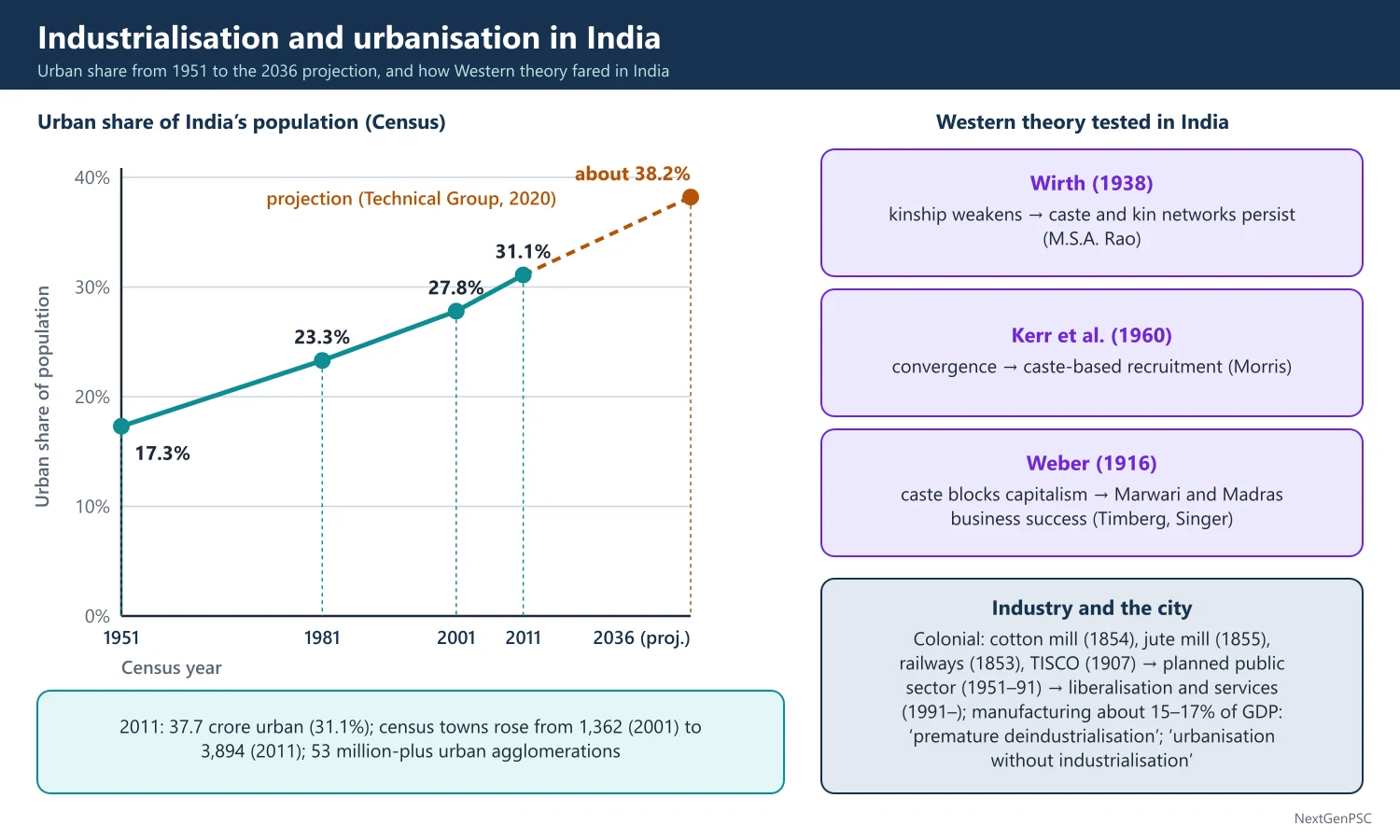
Census 2011: urban population 37.7 crore (31.1%); 7,935 towns, of which 4,041 statutory and 3,894 census towns (up from 1,362 census towns in 2001); 53 urban agglomerations had a million or more people.
Projection: the Technical Group on Population Projections (National Commission on Population, 2020) projected the urban share to rise to about 38.2% by 2036; Census 2027 (reference date 1 March 2027) will give the next count.
Under-counting debate: many large villages are urban in character but administratively rural; studies using satellite data and the World Bank's agglomeration index suggest India is more urban than the official figure, which is debated.
Components of urban growth: natural increase, net rural–urban migration and reclassification of villages into towns each contributed significantly to urban growth in 2001–2011.
Uneven pattern: Tamil Nadu, Kerala and Maharashtra are among the most urbanised large states, while Bihar and Himachal Pradesh are least urbanised (around 11% and 10% in 2011).
Urban policy: the 74th Amendment (1992) for urban local bodies, JNNURM (2005), Smart Cities Mission and AMRUT (2015), PMAY-Urban (2015) and PMAY-Urban 2.0 (2024) targeting 1 crore more urban houses.
5. Sociology of the Indian city
Ghurye and Rao: G.S. Ghurye studied cities as centres of culture; M.S.A. Rao (Urbanization and Social Change, 1970, on Yadavpur near Delhi) showed how villages absorbed into Delhi kept caste and kin ties while taking up urban jobs.
Urban involution and rurban: Indian cities show 'urbanisation without industrialisation' and 'over-urbanisation' in the sense that city growth outpaces formal jobs, leading to informal work and slums.
Caste in the city: housing discrimination against Dalits and Muslims (residential segregation in Ahmedabad and Mumbai) shows that caste and religion persist in urban space, contrary to Wirth.
Gated communities and new middle classes: post-1991 cities such as Gurugram show privatised enclaves, malls and global consumer culture alongside villages and slums, which Leela Fernandes (India's New Middle Class, 2006) linked to the politics of liberalisation.
World cities: Saskia Sassen's 'global city' (1991) and Manuel Castells's network society describe Bengaluru and Mumbai as nodes in global flows of capital and IT services.
6. Linking thinkers
Link to Durkheim (organic solidarity in cities), Tönnies (Gemeinschaft to Gesellschaft), Simmel ('The Metropolis and Mental Life', 1903, blasé attitude) and Wirth; test each against Indian evidence.
Link to Weber's Protestant ethic thesis and its Indian critics (Singer, Timberg) for the question 'Did caste block industrial capitalism?'.
Link to Chapter 22 (migration) and the next two topics (working class, slums) as consequences of the same process.
7. Using it in the exam
10 marks: trace three phases of industry (colonial, planned, liberalised) with one social feature each.
15–20 marks on urbanisation: definitions (Census), trends with Census 2011 data, causes, features (census towns, metropolitan concentration, informal growth), sociological theories tested on India, and challenges.
Thinkers and studies: Morris D. Morris, Milton Singer, M.S.A. Rao, Redfield and Singer, Louis Wirth, Weber.
Diagram idea: a bar chart of urban share 1951 (17.3%), 1981 (23.3%), 2001 (27.8%), 2011 (31.1%) from the Census, with the 2036 projection shown separately.
Quotation to use: Singer's finding, in paraphrase, that Madras industrialists 'compartmentalised' modern work and traditional ritual instead of abandoning tradition.
| Census year | Urban share of population | Note |
|---|---|---|
| 1951 | 17.3% | Post-Partition refugee settlement |
| 1981 | 23.3% | Fast growth of metropolitan cities |
| 2001 | 27.8% | 1,362 census towns |
| 2011 | 31.1% | 3,894 census towns; 53 million-plus agglomerations |
| 2036 (projection) | about 38.2% | Technical Group, 2020 |
| Theory | Prediction | Indian evidence |
|---|---|---|
| Wirth (1938) | Kinship weakens, impersonal ties | Caste and kin networks persist (M.S.A. Rao) |
| Kerr et al. (1960) | Convergence of industrial societies | Caste-based recruitment (Morris) |
| Weber (1916) | Caste blocks capitalism | Marwari and Madras business success (Timberg, Singer) |
Mains points
- Questions often ask whether industrialisation and urbanisation have weakened caste and family; answer with Indian studies, not only Wirth.
- Use Census 2011 numbers precisely (31.1%, 7,935 towns, 3,894 census towns) and say Census 2027 data are awaited.
- Mention the distinctive Indian pattern: urbanisation without matching formal industrial jobs.
- Bring census towns and subaltern urbanisation to show awareness of recent research.
- A common mistake is to present industry only in economic terms; stress caste, family and class effects.
- Conclude with the 'tradition and modernity coexist' argument (Singer, Yogendra Singh).
Did you know?
- The number of census towns nearly tripled between 2001 and 2011, from 1,362 to 3,894: India urbanised quietly through big villages turning into towns.
Working Class, Informal Sector and Child Labour
India's working class is divided between a small, protected organised sector and a vast informal sector that employs about nine in ten workers. Class mobilisation through trade unions began in the 1920s but weakened after the 1980s as work was casualised; new forms include gig and platform workers. Child labour, though falling, persists in agriculture, homes and small workshops, linked to poverty, caste and failures of schooling.
In simple words
The working class means people who earn by selling their labour for wages, from factory workers to delivery riders.
Imagine two workers in the same factory: one is permanent with a pension, the other is a contract worker who can be removed tomorrow; that gap is the formal–informal divide.
Most Indian workers are on the insecure side, and some are children who should be in school.
UPSC asks about the structure of the working class, informalisation and child labour.
1. Concepts and definitions
Working class: for Marx, the proletariat who own no means of production and sell labour power; a 'class in itself' becomes a 'class for itself' when it develops consciousness and organisation (The Poverty of Philosophy, 1847).
Informal sector: the term was introduced by anthropologist Keith Hart (1973) from his study of Accra, Ghana, and taken up by the ILO; it refers to small, unregistered enterprises and work without legal or social protection.
Informal employment: the NCEUS (National Commission for Enterprises in the Unorganised Sector, chaired by Arjun Sengupta) defined it as work without employment security, work security and social security, whether in the informal or formal sector.
Labour aristocracy: a privileged upper layer of workers (Lenin's term); in India, permanent public-sector employees are often described this way, as Jonathan Parry did for Bhilai.
Precariat: Guy Standing's term (The Precariat, 2011) for workers with insecure jobs and no occupational identity, now used for gig and contract workers.
Child labour: work that deprives children of childhood, schooling and health; in India the Child and Adolescent Labour (Prohibition and Regulation) Act (amended 2016) bans all work by children under 14 except in family enterprises after school hours, and hazardous work for adolescents aged 14–18.
2. Structure and growth of the Indian working class
Origins: Bombay cotton mills, Calcutta jute mills, plantations in Assam and railways created the first industrial workers, recruited through jobbers (sardars, mistris) from particular regions and castes.
Rajnarayan Chandavarkar (The Origins of Industrial Capitalism in India, 1994) showed that Bombay mill workers' neighbourhoods, caste and village ties shaped both their dependence and their militancy.
Dipesh Chakrabarty (Rethinking Working-Class History: Bengal 1890–1940, 1989) argued that jute workers' culture remained hierarchical and community-based, so Marxist class consciousness did not develop as expected.
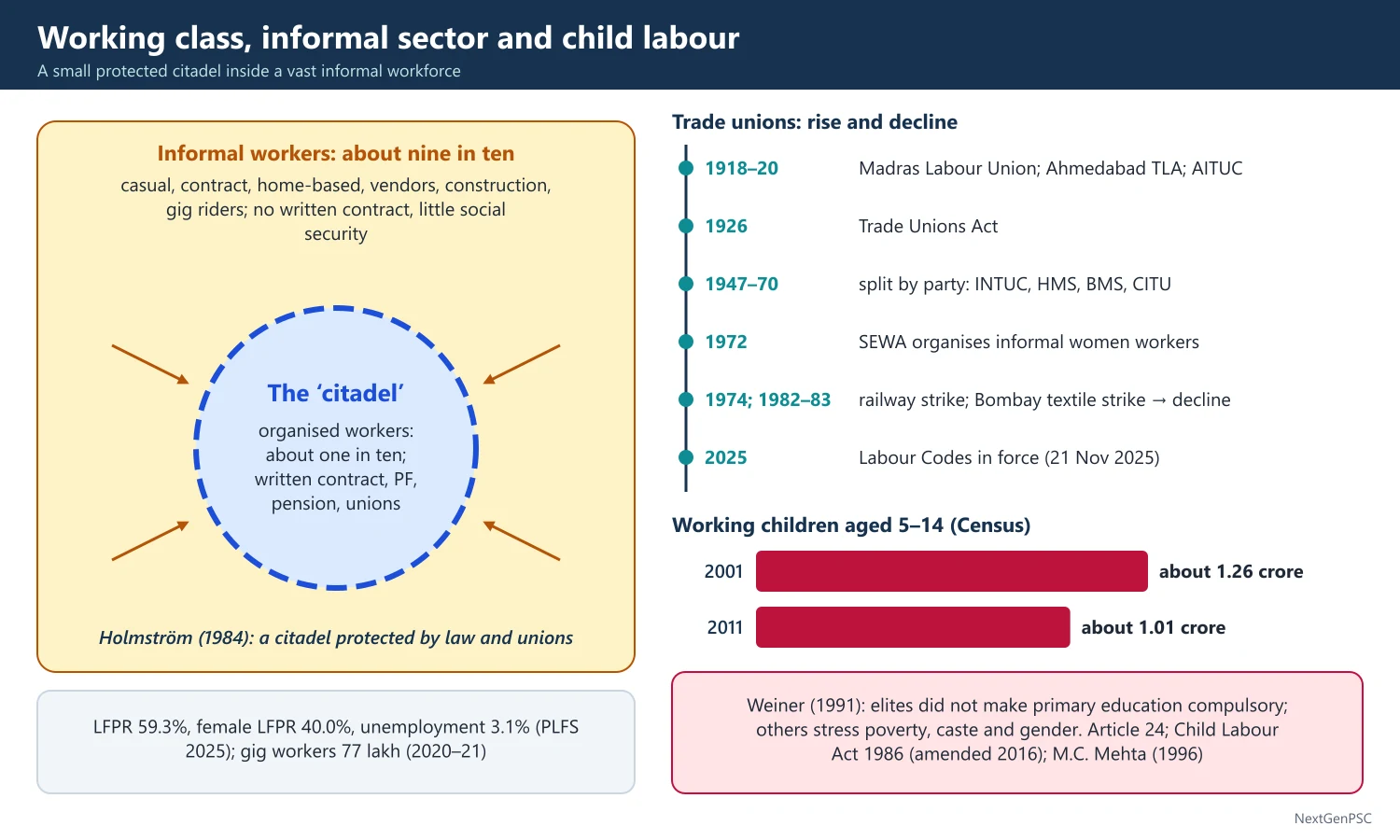
Citadel and outside: Mark Holmström (Industry and Inequality, 1984) described the organised sector as a 'citadel' protected by law and unions, surrounded by a much larger unorganised mass trying to get in.
Union and caste: E.A. Ramaswamy studied Coimbatore textile unions (The Worker and his Union, 1977), showing that workers combined union loyalty with caste and party ties.
Present structure: PLFS 2023–24 shows that self-employment accounts for over half of all workers, casual labour about one-fifth, and regular wage or salaried work about one-fifth; many regular workers lack a written contract or social security.
Labour force data: the PLFS Annual Report 2025 (January–December 2025, the first calendar-year report, released March 2026) put the labour force participation rate (15+) at 59.3%, female LFPR at 40.0% and the unemployment rate at 3.1%.
3. Class mobilisation and trade unions
Early unions: the Madras Labour Union (1918, B.P. Wadia), the Ahmedabad Textile Labour Association (1920, guided by Gandhi and Anasuya Sarabhai) and the All India Trade Union Congress (1920); the Trade Unions Act 1926 gave legal recognition.
Politicisation: after 1947 unions split along party lines: INTUC (1947, Congress), HMS (1948, socialists), BMS (1955, linked to the RSS), CITU (1970, CPI(M)); this fragmented class mobilisation.
Turning points: the railway strike of 1974 led by George Fernandes and the Bombay textile strike of 1982–83 led by Datta Samant, which ended in defeat and mill closures, marked the decline of the organised working class in old industries.
Lost worlds: Chitra Joshi (Lost Worlds: Indian Labour and its Forgotten Histories, 2003) studied Kanpur mill workers after closures, showing how a once-powerful working class lost its identity and community.
New mobilisation: SEWA (Self Employed Women's Association, 1972, Ela Bhatt) organised informal women workers; recent strikes by Maruti Suzuki workers at Manesar (2011–12) and by contract workers, and protests by gig delivery riders, show new forms of class action.
Labour Codes: the Code on Wages 2019, Industrial Relations Code 2020, Social Security Code 2020 and Occupational Safety, Health and Working Conditions Code 2020 replaced 29 central laws and came into force on 21 November 2025; unions criticised easier lay-offs (threshold raised to 300 workers) and strike restrictions, while the Social Security Code for the first time covers gig and platform workers.
4. The informal sector
Size: NCEUS (2007) estimated that about 92% of workers were informally employed and that 77% of the population lived on less than ₹20 a day in 2004–05; later estimates still place informal employment around nine-tenths of the workforce.
Composition: agricultural labourers, construction workers, street vendors, domestic workers, home-based workers (bidi, garments, embroidery), waste pickers and transport workers; women and Dalits are over-represented.
Informalisation within the formal sector: firms increasingly hire contract labour through agencies, so the share of contract workers in organised manufacturing has risen (Annual Survey of Industries data), blurring the formal–informal line.
Jan Breman's view: in Footloose Labour (1996) and later work, Breman argued that informality is not a transitional stage but a permanent strategy of capital to keep labour cheap and divided.
Barbara Harriss-White (India Working, 2003) showed that the informal economy is regulated not by the State but by social institutions such as caste, gender, religion and local business associations.
Gig and platform workers: NITI Aayog (India's Booming Gig and Platform Economy, June 2022) estimated 77 lakh gig workers in 2020–21, projected to reach 2.35 crore by 2029–30; Rajasthan passed a Platform-Based Gig Workers Act in 2023, and the Social Security Code 2020 provides for a welfare fund.
Protection: the e-Shram portal (August 2021) had about 31.89 crore registrations by August 2026 (PIB), the Street Vendors Act 2014 and PM SVANidhi (2020) support vendors, but coverage of actual benefits remains thin.
5. Child labour
Scale: Census 2011 counted about 1.01 crore working children aged 5–14 (main and marginal workers), down from about 1.26 crore in 2001; most work in agriculture and household enterprises.
Sectors: cotton seed farms, carpet weaving (Bhadohi–Mirzapur), fireworks and matches (Sivakasi), glass bangles (Firozabad), brick kilns, domestic work and roadside eateries.
Myron Weiner's thesis: in The Child and the State in India (1991), Weiner argued that child labour persists not mainly because of poverty but because Indian elites, influenced by hierarchical beliefs, did not make primary education compulsory, unlike Europe and East Asia.
Debate: economists point to household poverty and credit constraints; sociologists add caste (Dalit and tribal children over-represented), gender (girls in unpaid domestic work, often invisible in data) and school quality.
Law and courts: Article 24, the Child Labour Act 1986 (amended 2016), the RTE Act 2009, and M.C. Mehta v. State of Tamil Nadu (1996), in which the Supreme Court ordered a compensation fund and rehabilitation for Sivakasi child workers.
Criticism of the 2016 amendment: allowing children to help in family enterprises was criticised by child-rights groups for legitimising hidden child labour in home-based work.
Civil society: Bachpan Bachao Andolan (founded 1980 by Kailash Satyarthi, Nobel Peace Prize 2014) and the PENCIL portal (2017) for complaints and rescue.
6. Linking thinkers
Link to Marx (class in itself and for itself), Weber (class, status and party, since caste and party divide Indian workers) and Lenin (labour aristocracy).
Link to Braverman's deskilling thesis (Labor and Monopoly Capital, 1974) for assembly-line and platform work, and to Blauner's alienation by technology.
Link to rural bondage and migration (Chapter 22) and slums (next topic), which supply and house informal labour.
7. Using it in the exam
10 marks: define the informal sector (Hart, NCEUS), give its size and two features, and one new form (gig work with NITI 2022 data).
15–20 marks: structure and growth of the working class, mobilisation and its decline, informalisation, Labour Codes 2025, and a conclusion on new forms of organisation (SEWA, gig unions).
Thinkers and studies: Morris D. Morris, Chandavarkar, Holmström, Breman, Harriss-White, Myron Weiner.
Diagram idea: concentric circles: inner citadel (permanent public and private workers), middle ring (contract workers in formal firms), outer ring (self-employed, casual, home-based, gig, child workers).
Quotation to use: Holmström's image of the organised sector as a 'citadel' that most workers can never enter.
| Feature | Organised sector worker | Informal worker |
|---|---|---|
| Contract | Written, permanent | None or verbal |
| Social security | Provident fund, pension, health insurance | Mostly absent; e-Shram registration |
| Union coverage | Relatively high | Very low (except SEWA-type) |
| Typical example | Railway or steel plant employee | Construction worker, vendor, delivery rider |
| Share of workforce | About one in ten | About nine in ten |
| Indicator | Value | Period | Source |
|---|---|---|---|
| LFPR (15+) | 59.3% | Jan–Dec 2025 | PLFS Annual Report 2025 |
| Female LFPR (15+) | 40.0% | Jan–Dec 2025 | PLFS Annual Report 2025 |
| Unemployment rate (15+) | 3.1% | Jan–Dec 2025 | PLFS Annual Report 2025 |
| Working children 5–14 | about 1.01 crore | 2011 | Census of India |
| Gig workers | 77 lakh (projected 2.35 crore by 2029–30) | 2020–21 | NITI Aayog, 2022 |
Mains points
- Typical questions: 'Why has the Indian working class failed to become a class for itself?' and 'Discuss informalisation of labour in India'.
- Answer the class-consciousness question with caste, region, party divisions and informality, citing Chakrabarty and Chandavarkar.
- Use the latest data: PLFS Annual Report 2025, e-Shram registrations (2026), NITI gig estimates (2022) and Labour Codes in force from 21 November 2025.
- For child labour, go beyond poverty: cite Weiner's argument on elite beliefs and compulsory schooling.
- Show gender: women dominate home-based and domestic work and have low LFPR; SEWA is the key example.
- Avoid treating informality as only 'backwardness'; present Breman's view that it is a strategy of capital.
Did you know?
- The word 'informal sector' was born in Ghana, not India: Keith Hart coined it from fieldwork in Accra in the early 1970s.
Slums and Urban Deprivation
Slums are the visible face of urban deprivation in India: Census 2011 counted about 6.55 crore people in slums across 2,613 towns. They result from migration, informal work, land markets and weak planning. Sociologists debate whether slum dwellers form a culture of poverty (Oscar Lewis) or are active citizens who negotiate with the State through political society (Partha Chatterjee); evictions, redevelopment (Dharavi) and housing schemes shape their lives.
In simple words
A slum is a crowded settlement in a city with poor houses, little water, sanitation or legal security.
It is like a city's backstage: the workers who cook, clean, build and deliver for the city often live there.
Slums show urban deprivation, but they are also places of work, community and political action.
UPSC asks about the causes of slums, life in them and policy responses.
1. Concepts and definitions
Slum (Census of India 2011): three types: notified slums (declared under a state or local Act), recognised slums (identified by state or local authorities without notification) and identified slums (a compact area of at least 300 people or 60–70 households of poorly built, congested tenements with inadequate infrastructure, identified by census officials).
UN-Habitat definition: a household lacking one or more of durable housing, sufficient living space, improved water, improved sanitation and security of tenure.
Culture of poverty: Oscar Lewis (Five Families, 1959; La Vida, 1966) argued that the poor develop a self-perpetuating subculture of fatalism, present orientation and low participation, passed to children.
Urban deprivation: multiple, overlapping disadvantages in a city: low income, insecure work, poor housing, lack of services, exposure to pollution and disasters, and social stigma.
Right to the city: Henri Lefebvre's idea (1968), developed by David Harvey, that all inhabitants, not only property owners, have a right to shape and use urban space.
Political society: Partha Chatterjee (The Politics of the Governed, 2004) used this term for populations such as squatters who, lacking legal rights, negotiate with the State as targets of welfare and through political parties, unlike propertied 'civil society'.
2. Scale and causes of slums in India
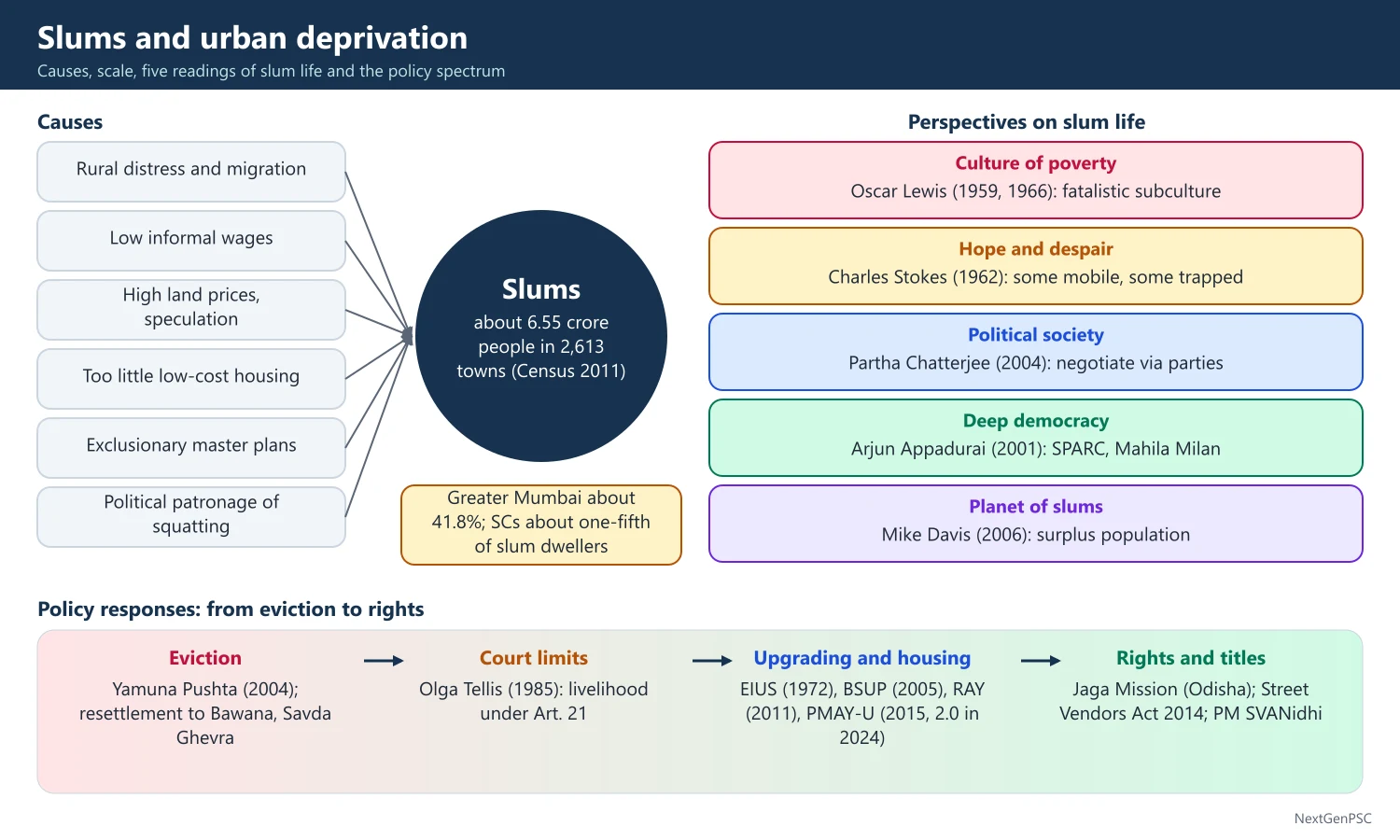
Census 2011: about 6.55 crore slum dwellers (17.4% of the urban population of towns reporting slums) in 2,613 towns; Maharashtra had the largest number, and Greater Mumbai about 41.8% of its population in slums.
Caste composition: Scheduled Castes formed about one-fifth of slum dwellers in 2011, above their share in the urban population, which links urban poverty to caste.
Causes: rural distress and migration, low informal wages, high land prices and speculative real estate, insufficient low-cost housing, exclusionary master plans and zoning, and political patronage that tolerates squatting.
Over-urbanisation: cities grow faster than formal jobs and services, so the poor build their own housing on marginal land: riverbanks, railway lines, hill slopes and dumping grounds.
Global view: Mike Davis (Planet of Slums, 2006) argued that neoliberal policies have produced a global 'surplus humanity' living in slums disconnected from formal industry.
3. Life in slums: debates
Culture of poverty critique: critics such as Charles Valentine (1968) argued that Lewis blamed the victims; Indian studies show slum dwellers work hard, save, invest in children's education and aspire to mobility.
Slums of hope: Charles Stokes (1962) distinguished 'slums of hope' (migrants on the way up) from 'slums of despair' (trapped poor); Dharavi, with leather, pottery, recycling and garment units, is often cited as a slum of enterprise.
Community and caste: slum neighbourhoods are often organised by region, caste and religion (for example, Tamil, Dalit and Muslim clusters in Dharavi), giving support networks but also enabling segregation.
Gender: women bear the burden of water collection, lack of toilets, insecurity and domestic violence; the Swachh Bharat Mission (2014) built community toilets, but maintenance remains a problem.
Health and environment: crowding, open drains and polluted water raise tuberculosis, diarrhoea and dengue; slums near rivers and hills face floods and landslides, as in Mumbai's monsoon disasters.
Deep democracy: Arjun Appadurai ('Deep Democracy', 2001) described Mumbai's slum federations (SPARC, National Slum Dwellers Federation, Mahila Milan) that enumerate their own settlements and negotiate housing, a form of grassroots governance.
Vote-bank politics: parties regularise slums before elections and supply services through brokers, which Chatterjee sees as political society and critics see as clientelism that keeps slum dwellers dependent.
4. Policy: eviction, upgrading and housing
Legal framework: the Slum Areas (Improvement and Clearance) Act 1956; in Olga Tellis v. Bombay Municipal Corporation (1985) the Supreme Court linked the right to livelihood with Article 21 but allowed eviction with notice and alternatives.
Evictions: large demolitions such as Delhi's Yamuna Pushta (2004) before the Commonwealth Games and resettlement to distant colonies like Bawana and Savda Ghevra cut residents off from jobs; Amita Baviskar and others criticised this 'bourgeois environmentalism'.
Upgrading and housing schemes: the Environmental Improvement of Urban Slums scheme (1972), BSUP under JNNURM (2005), Rajiv Awas Yojana (2011) for slum-free cities, and PMAY-Urban (2015) with in-situ slum redevelopment; PMAY-Urban 2.0 (2024) aims at 1 crore more houses.
Dharavi Redevelopment: the Maharashtra government awarded the Dharavi redevelopment project to an Adani Group company in 2022; residents and activists question eligibility cut-offs and the risk of displacing small industries, so the outcome is debated.
Land titles: Odisha's Jaga Mission (2017–18) gave land rights to slum households, an alternative to eviction influenced by Hernando de Soto's argument (The Mystery of Capital, 2000) that titles turn dead assets into capital.
Street vendors and livelihood: the Street Vendors (Protection of Livelihood and Regulation of Street Vending) Act 2014 and PM SVANidhi micro-loans (2020) recognise that urban poverty is about work as much as housing.
5. Further Indian studies and current issues
Lucknow and Delhi bastis: studies of resettlement colonies show long commutes, loss of women's work near employers' homes and higher school dropout after relocation.
Waste pickers: mostly Dalit and Muslim women and children in slums sort city waste; cooperatives such as KKPKP and SWaCH in Pune (2008) organised them and won recognition in solid waste rules (2016).
Manual scavenging: slum-based sanitation workers, mostly Dalits, still die cleaning sewers despite the Prohibition of Employment as Manual Scavengers Act 2013; the NAMASTE scheme (2023) aims at mechanised sanitation.
COVID-19 and slums: high density made distancing impossible in 2020; Dharavi's 'chase the virus' campaign of tracing and testing was praised, showing that slums can respond with community participation.
Rental housing: many migrants rent rooms in slums or urban villages (lal dora areas of Delhi); the Affordable Rental Housing Complexes scheme (2020) was launched for migrants after the lockdown.
Urban villages: villages absorbed into Delhi, Gurugram and Bengaluru, where landowning castes become landlords to migrant tenants, show a new rentier class, extending M.S.A. Rao's study of Yadavpur.
Urban poverty data: HCES 2023–24 shows average urban MPCE of about ₹6,996 but a long lower tail, and NITI Aayog's MPI shows urban multidimensional poverty much lower than rural, which hides intense deprivation in slums.
6. Linking thinkers
Link to the Chicago School (Park and Burgess's concentric zones, 1925) and its 'zone in transition', and contrast with Indian cities where slums are scattered next to rich areas.
Link to Marx's reserve army of labour and Engels's The Condition of the Working Class in England (1845), the first sociology of slums.
Link to Bourdieu's symbolic violence (stigma of 'slum dweller') and Wacquant's 'advanced marginality' and territorial stigmatisation.
7. Using it in the exam
10 marks: define slum (Census types), give 2011 data, three causes and one policy response.
15–20 marks: causes, life and deprivation (caste, gender, health), the culture of poverty debate (Lewis vs critics, Appadurai, Chatterjee), policies from eviction to in-situ upgrading, and a conclusion on the right to the city.
Thinkers and studies: Oscar Lewis, Partha Chatterjee, Arjun Appadurai, Mike Davis, Amita Baviskar, Lefebvre.
Diagram idea: a cause–effect chain: rural distress → migration → informal work → unaffordable housing → slum → deprivation and stigma → political negotiation.
Quotation to use: Lefebvre's 'right to the city', meaning the right of all residents to use and shape urban space.
| Perspective | Thinker and year | View of slum dwellers | Indian illustration |
|---|---|---|---|
| Culture of poverty | Oscar Lewis (1959, 1966) | Fatalistic subculture | Rarely supported by Indian studies |
| Slums of hope and despair | Charles Stokes (1962) | Some upwardly mobile, some trapped | Dharavi enterprises vs pavement dwellers |
| Political society | Partha Chatterjee (2004) | Negotiate with State via parties | Regularisation before elections in Kolkata, Delhi |
| Deep democracy | Arjun Appadurai (2001) | Self-organised citizens | SPARC, Mahila Milan in Mumbai |
| Planet of slums | Mike Davis (2006) | Surplus population of neoliberalism | Informal workers without factory jobs |
Mains points
- Expect 'Slums are not merely a housing problem but a social problem. Discuss' or 'Critically examine the culture of poverty thesis in the Indian context'.
- Use Census 2011 slum data precisely and note that Census 2027 will update it.
- Show slum dwellers as agents (Appadurai, Chatterjee), not only victims.
- Bring caste and gender into the analysis; slums concentrate Dalits, Muslims and migrant women.
- Evaluate policy honestly: evictions vs in-situ upgrading vs land titles, with Olga Tellis (1985) and Dharavi as cases.
- Conclude with the right to the city and inclusive urban planning.
Did you know?
- Mahila Milan women in Mumbai counted their own slums house by house, producing data more accurate than official surveys, which is why Appadurai called it 'deep democracy'.
UPSC Previous Year Questions: Industrialisation and Urbanisation in India
From 2014 to 2026 UPSC asked 30 question parts (400 marks) from this chapter, all in Paper II. The working class, informal sector and child labour is the most-asked topic (13 parts), followed by modern industry and urban growth (10 parts) and slums and urban deprivation (7 parts). Every question below has a model answer written to the UPSC word limit.
In simple words
Attempt each question yourself first within the time limit: about 7 minutes for 10 marks and 11 minutes for 20 marks.
Then compare with the model answer: check the urban theorists (Wirth, Simmel, Redfield), Indian studies (M.S.A. Rao, Breman, Holmström) and data (Census 2011, PLFS, NCEUS) you used.
Mark what you missed and revise it in this chapter's notes before the next question.
1. Modern Industry and the Growth of Urban Settlements
Example 1 (UPSC 2026, 20 marks): Urbanisation in Independent India has been characterized by over-urbanization and rural push. Explain with demographic and sociological dimensions.
Paper and question: Paper II, Q7(a)
Approach: Explain over-urbanisation and rural push, then give the demographic dimension (growth, components, distribution with Census data) and the sociological dimension (informality, slums, caste and kinship, culture), and conclude.
Over-urbanisation, a concept used by Kingsley Davis and Hilda Hertz Golden (1954), describes urban growth that outpaces industrial employment, so that cities fill with people who cannot find productive work. It is driven by rural push: landlessness, small holdings, drought and caste oppression push people out of villages more than urban jobs pull them in, the push side of Everett Lee's theory.
Demographic dimension: India's urban share rose from 17.3% in 1951 to 31.1% in 2011 (37.7 crore people). Urban growth in 2001–11 came from natural increase (a little under half), net migration and the reclassification of villages, as census towns rose from 1,362 to 3,894. Growth is concentrated in 53 million-plus agglomerations, while migration flows mainly from poorer states such as Bihar and Uttar Pradesh to Delhi, Mumbai, Surat and the south. Manufacturing has stayed at about 15–17% of GDP, which Dani Rodrik calls premature deindustrialisation, so urban jobs did not keep pace.
Sociological dimension: migrants enter the informal sector, about nine-tenths of the workforce (NCEUS, 2007), as construction workers, vendors and domestic workers; Census 2011 counted 6.55 crore slum dwellers, with Scheduled Castes over-represented. Jan Breman's 'footloose labour' shows circular migrants who never settle. Cities do not fully produce Wirth's urbanism: M.S.A. Rao and Sylvia Vatuk found caste and kinship networks reproduced in the city, and Partha Chatterjee shows the urban poor living as 'political society', negotiating services through parties. Women bear insecurity and lack of sanitation.
Flow chart: agrarian distress (rural push) → migration to cities → limited formal jobs → informal work and slums → poverty and exclusion in the city.
Critics note that India's urban share may be underestimated, and that small towns and 'subaltern urbanisation' (Denis, Mukhopadhyay and Zérah, 2012) show growth driven by local economies. Still, the overall pattern of push-driven, job-poor urbanisation calls for rural livelihoods, manufacturing jobs, affordable housing and portable welfare.
Example 2 (UPSC 2025, 10 marks): Bring out various factors responsible for declining of village Industries in India.
Paper and question: Paper II, Q5(b)
Approach: Bring out the factors in groups (historical, economic, technological, social, policy), with examples, and end with revival efforts.
Village industries, such as handloom weaving, pottery, leatherwork, oil-pressing and smithy, were once tied to the jajmani system that William Wiser described in Karimpur.
Historical: colonial policy and cheap machine goods caused deindustrialisation, as Dadabhai Naoroji and R.C. Dutt argued. Economic and technological: mass-produced plastic, aluminium and synthetic goods replaced pots, cloth and leather; artisans lack credit, design and marketing, so middlemen take most of the value. Social: the decline of jajmani, the low status attached to caste occupations, and the aspiration of educated youth for salaried jobs push artisans' children away, as Dipankar Gupta notes for the village in general.
Policy and markets: de-reservation of small-industry products after 1991, competition from imports and weak cooperatives hurt them further.
Khadi and Village Industries Commission (1956), One District One Product and PM Vishwakarma (2023) seek revival through credit, skills and e-commerce, but success depends on design, markets and dignity of craft.
Example 3 (UPSC 2025, 20 marks): Discuss the trend of urbanization in India. Do you think that Industrialization is the only precondition of urbanization? Give your arguments.
Paper and question: Paper II, Q6(b)
Approach: Two parts: describe the trend of urbanisation with Census data and features, then argue that industrialisation is an important but not the only precondition, giving other drivers with Indian examples; conclude.
Urbanisation is the rise in the share of population living in towns and the spread of urban ways of life. India's urban share grew slowly from 17.3% in 1951 to 31.1% in 2011, and is projected at about 38% by 2036 (Technical Group, 2020); Census 2027 will give the next count.
Trend and features: growth is concentrated in metropolitan regions (53 million-plus agglomerations in 2011) while small towns grow through reclassification, as census towns rose from 1,362 to 3,894 in 2001–11; it is regionally uneven, with Tamil Nadu, Kerala and Maharashtra highly urbanised and Bihar and Himachal Pradesh least; and it is marked by informal work, slums and peri-urban sprawl.
Is industrialisation the only precondition? In Western Europe, as Weber and Durkheim observed, factory industry drew labour into cities, and Indian cities such as Jamshedpur, Bhilai and Kanpur grew this way. But India shows other routes. Cities grew as administrative capitals (Chandigarh, Bhubaneswar), religious and pilgrimage centres (Varanasi, Madurai, which Redfield and Singer called orthogenetic cities), trade and port centres, and service hubs (Bengaluru, Hyderabad, Gurugram) based on IT rather than factories. Rural push from agrarian distress produces urbanisation without industrial jobs, the over-urbanisation of Davis and Golden. Kerala's continuous rural–urban settlement grew on remittances, and 'subaltern urbanisation' (Denis, Mukhopadhyay and Zérah, 2012) shows small towns growing from local trade and services.
Industrialisation is therefore an important driver but not the only precondition of urbanisation in India; the absence of large-scale manufacturing explains why Indian urbanisation is slow, informal and unequal, and why job-rich industry and planned small towns matter for its future.
Example 4 (UPSC 2024, 10 marks): Examine with suitable examples the recent trends in the growth of urban settlements in India.
Paper and question: Paper II, Q5(a)
Approach: Examine recent trends with examples: census towns and small towns, metropolitan regions and peri-urban growth, service-led cities, gated enclaves and informality, and policy-led growth.
India's urban settlements are growing in new ways; Census 2011 recorded 7,935 towns and an urban share of 31.1%.
Rise of census towns: large villages with non-farm work were reclassified as towns, rising from 1,362 to 3,894 in 2001–11, especially in Kerala, West Bengal and Tamil Nadu; this 'subaltern urbanisation' (Denis, Mukhopadhyay and Zérah, 2012) shows growth driven by local economies. Metropolitan regions and peri-urban sprawl: Delhi NCR, Mumbai–Pune and Bengaluru expand into surrounding villages, as M.S.A. Rao's study of Yadavpur near Delhi anticipated. Service-led and global cities: IT hubs such as Bengaluru, Hyderabad and Gurugram, which Saskia Sassen's idea of the global city helps explain.
Segregation: gated communities and malls beside slums and urban villages, a split Leela Fernandes links to the new middle class.
Policy-led: Smart Cities Mission and AMRUT (2015), PMAY-Urban 2.0 (2024) and new industrial corridors are shaping planned growth, though informality remains the dominant urban reality.
Example 5 (UPSC 2023, 10 marks): Discuss the phenomenon of rural-urban continuum with suitable examples.
Paper and question: Paper II, Q7(c)
Approach: Define the continuum (Redfield, Sorokin and Zimmerman), contrast it with the dichotomy, and give Indian examples of overlap in economy, culture and kinship.
The rural–urban continuum holds that rural and urban are not opposite types, as in Tönnies's Gemeinschaft and Gesellschaft, but two ends of a scale with many gradations; Robert Redfield's folk–urban continuum and Sorokin and Zimmerman (1929) developed this view.
India illustrates it well. Economically, villages near cities send daily commuters, and census towns (3,894 in 2011) are villages with mostly non-farm work. M.S.A. Rao's study of Yadavpur near Delhi showed villagers taking urban jobs while keeping caste and kin ties. Culturally, migrants carry festivals, caste associations and village deities into cities, while television, mobile phones and remittances bring urban consumption to villages. Kerala's settlement pattern is a near-continuous rural–urban spread, and urban villages such as those in Gurugram show both worlds in one place.
Kinship links persist across the divide: Sylvia Vatuk found migrants in Meerut maintaining wide kin networks.
The continuum therefore better describes Indian reality than a sharp rural–urban dichotomy.
Example 6 (UPSC 2021, 20 marks): Urban settlements in India tend to replicate its rural caste-kinship imprints. Discuss the main reasons.
Paper and question: Paper II, Q8(b)
Approach: Discuss the main reasons why Indian cities replicate caste and kinship: contrast with Wirth, then give reasons (migration networks, housing, marriage, associations and politics, informal labour markets, religion) with studies, and conclude with signs of change.
Louis Wirth ('Urbanism as a Way of Life', 1938) expected city size, density and heterogeneity to weaken kinship and ascribed ties. Indian cities, however, often reproduce caste and kinship patterns of the village.
Chain migration: people move through kin and caste networks, which find them jobs and housing; Morris D. Morris and Rajnarayan Chandavarkar showed Bombay mill workers recruited by jobbers along caste and village lines, and Jan Breman found the same among circular migrants. Residential clustering: landlords discriminate by caste and religion, and migrants choose neighbourhoods of their own community; Christophe Jaffrelot and Laurent Gayer (Muslims in Indian Cities, 2012) describe ghettoisation, as in Ahmedabad's Juhapura.
Marriage: endogamy persists in cities, now through matrimonial websites organised by caste. Kinship support: Sylvia Vatuk (Kinship and Urbanization, 1972) found migrants in Meerut maintaining wide kin networks, and M.S.A. Rao's Yadavpur villagers kept caste ties after urbanisation. Caste associations and politics: the Rudolphs showed caste associations becoming urban pressure groups, and electoral mobilisation keeps caste visible. Informal labour markets: Barbara Harriss-White argues that caste and kinship regulate the informal economy where most urban work lies.
Yet cities also loosen caste: Owen Lynch's study of Agra's Jatavs (1969) shows urban Dalits using education and politics to claim status, and inter-caste marriage, anonymous public spaces and professional work spread among the educated. M.N. Srinivas noted that caste in cities shifts from ritual hierarchy to an identity and interest group.
Indian cities thus show adaptation rather than replacement: caste and kinship survive because they provide security in an insecure urban economy, while their form changes.
Example 7 (UPSC 2020, 20 marks): Elaborate the causes, consequences and other concerns of growth of urban settlements in India.
Paper and question: Paper II, Q7(a)
Approach: Three parts: causes (demographic, economic, policy), consequences (positive and negative), and other concerns (governance, environment, exclusion, gender), with data and theory; conclude with policy.
India's urban population rose to 37.7 crore (31.1%) in Census 2011, living in 7,935 towns; the growth of urban settlements is now among the major social transformations of the country.
Causes: natural increase in towns; rural–urban migration driven by agrarian distress (rural push) and urban jobs and education (pull), in Everett Lee's terms; reclassification of large villages into census towns (1,362 to 3,894 in 2001–11); growth of services and IT after 1991; and State policy such as industrial corridors, Smart Cities and AMRUT (2015).
Consequences: positively, cities offer anonymity and escape from caste control, as Ambedkar hoped when he called the village a 'den of ignorance', and they create a new middle class, women's employment and political mobilisation. Negatively, they produce slums (6.55 crore people, Census 2011), informal work, congestion and segregation; Wirth's impersonal relations and Simmel's blasé attitude appear alongside persisting caste networks (M.S.A. Rao).
Other concerns: weak urban local bodies despite the 74th Amendment (1992); pollution, heat and floods (Chennai 2015, Bengaluru 2022); land conflicts and evictions on the urban fringe; insecurity of women in public spaces; and the 'right to the city' (Lefebvre, Harvey) for migrants who lack local entitlements.
Urban growth is therefore both an engine of mobility and a site of new inequality; empowered municipalities, affordable rental housing, in-situ slum upgrading, public transport and climate-resilient planning are needed so that cities include rather than exclude.
Example 8 (UPSC 2019, 10 marks): Elaborate urbanism as a way of life in India.
Paper and question: Paper II, Q5(c)
Approach: Explain Wirth's urbanism, then elaborate how far it describes Indian urban life, with Indian studies on both sides.
Louis Wirth ('Urbanism as a Way of Life', 1938) argued that the size, density and heterogeneity of cities produce a distinctive urbanism: secondary, impersonal and segmental relations, weakened kinship, formal social control and tolerance of difference.
In Indian metros such features are visible: nuclear households, anonymity in public transport, professional associations, apartment living, and the relative freedom of women and Dalits from village surveillance, which Ambedkar valued. Simmel's blasé attitude can be seen in commuters' indifference.
Yet Indian urbanism is distinctive: M.S.A. Rao and Sylvia Vatuk found caste and kin networks reproduced in cities, caste-based matrimonial sites and caste associations flourish, religious festivals such as Ganesh Chaturthi build neighbourhood solidarity, and Partha Chatterjee shows the urban poor relating to the State through community-based 'political society'.
Urbanism in India is therefore a blend, in which modern impersonal relations coexist with ascriptive ties.
Example 9 (UPSC 2018, 20 marks): How do you relate the growth of development of metropolis and its impact on the mental and social life of people in India?
Paper and question: Paper II, Q6(a)
Approach: Relate metropolitan growth to mental and social life: describe metropolitan growth with data, then use Simmel and Wirth for mental life and Indian evidence on stress, loneliness, family, gender, community and segregation; balance with positive effects and conclude.
India's metropolises have grown fast: Census 2011 counted 53 urban agglomerations with a million or more people, against 35 in 2001, with Mumbai, Delhi and Kolkata among the world's largest urban regions.
Mental life: Georg Simmel ('The Metropolis and Mental Life', 1903) argued that the constant stimulation of the big city produces an intellectual, calculating and blasé attitude as a protective shield, and a reserve towards strangers. In Indian metros, long commutes, crowding, noise and competition produce stress; the National Mental Health Survey (2015–16) found higher mental morbidity in urban metros than in rural areas. Loneliness among the elderly whose children have migrated, and student and job stress in coaching hubs such as Kota, are new urban issues.
Social life: Wirth predicted secondary, segmental relations; nuclear families, dual-earner couples and apartment living in Indian metros fit this, and neighbourhood ties weaken. Gated communities and slums create spatial segregation, which Leela Fernandes links to the new middle class. Women gain education and jobs but face harassment in public spaces.
Positive side: the metropolis also frees individuals from caste and village control, allows inter-caste marriage and new identities, and nurtures civil society, movements and cultural creativity. M.S.A. Rao and Sylvia Vatuk show that kinship and caste networks adapt rather than disappear, softening anomie.
Metropolitan growth thus reshapes both mind and society: it brings freedom and opportunity along with stress and isolation, so public mental-health services, community spaces, public transport and safe cities must accompany it.
Example 10 (UPSC 2017, 20 marks): Examine the impact of heritage tourism on urban socio-spatial patterns in India.
Paper and question: Paper II, Q6(b)
Approach: Examine the impact: define heritage tourism and socio-spatial patterns, then show effects on land use, displacement and gentrification, livelihoods, identity and segregation, with Indian cases and theory (Urry, Lefebvre), and conclude.
Heritage tourism is travel to experience historic monuments, old city cores and living cultural traditions; socio-spatial patterns are the way social groups, activities and power are arranged in urban space. India promotes heritage tourism through HRIDAY (2015) for 12 heritage cities, PRASAD for pilgrimage sites and Swadesh Darshan, and UNESCO has listed Ahmedabad (2017) and Jaipur (2019) as World Heritage Cities.
Land use and gentrification: heritage zones attract hotels, cafés and souvenir shops, and land values rise, so old residents and low-rent users are pushed out; the old city becomes a stage for visitors, which John Urry called the 'tourist gaze' (1990). The Kashi Vishwanath Corridor in Varanasi (2021) demolished hundreds of houses and small shrines around the temple, changing the lived lanes of the old city, and redevelopment in Ayodhya and around other temples shows similar effects.
Displacement and exclusion: at Hampi, houses and shops in the bazaar were cleared in 2011 to protect the World Heritage Site; street vendors, informal guides and boatmen face regulation and eviction in favour of formal businesses. Lefebvre's 'right to the city' raises the question of whose city heritage planning serves.
Livelihoods and identity: positively, tourism creates jobs for artisans, guides and homestays, revives crafts (Jaipur's block printing), and gives communities pride and resources to conserve old neighbourhoods, as in the pols of Ahmedabad. But it can freeze living culture into a commodity and favour a selective, often majoritarian, version of history.
Heritage tourism therefore reorganises urban space around consumption and image; inclusive conservation that keeps residents, protects informal livelihoods and involves communities is needed so that heritage remains a lived space, not only a spectacle.
2. Working Class, Informal Sector and Child Labour
Example 11 (UPSC 2026, 10 marks): Examine the process of formalisation of informal sector to safeguard the interests of marginalised sections of the society.
Paper and question: Paper II, Q7(c)
Approach: Examine the process: define formalisation, list its channels (legal codes, registration, digital payments, social security, gig-worker laws) and assess whether it actually protects marginalised workers.
Formalisation means bringing informal enterprises and workers into legal registration, written contracts and social protection; with about nine-tenths of workers informal (NCEUS, 2007), it is central to protecting Dalits, Adivasis, women and migrants who dominate informal work.
Channels: the four Labour Codes, in force from 21 November 2025, extend minimum wages to all workers and recognise gig and platform workers in the Social Security Code 2020; the e-Shram portal (2021) registered about 31.89 crore unorganised workers by August 2026; Udyam registration (2020) and GST bring small firms into records; PM-SYM pensions (2019), Ayushman Bharat and PM SVANidhi for street vendors extend benefits; and Rajasthan (2023) and Karnataka (2025) passed gig-worker welfare laws.
Assessment: registration is not protection; benefits linked to e-Shram remain thin, contracts are rare, and unions criticise easier lay-offs and fixed-term hiring under the codes. Breman and Harriss-White warn that informality is reproduced by capital and caste networks.
Formalisation safeguards the marginalised only when registration brings enforceable wages, portable social security and collective voice, as SEWA's experience shows.
Example 12 (UPSC 2025, 10 marks): What are the major problems faced by the labour migrants while working in informal sectors of Indian States? Discuss.
Paper and question: Paper II, Q5(d)
Approach: Discuss the major problems of migrant workers in informal work across Indian states under clear heads, with studies and examples, and a line on remedies.
Labour migrants from states such as Bihar, Uttar Pradesh, Odisha, Jharkhand and West Bengal form the backbone of informal work in construction, brick kilns, factories and services in Delhi, Gujarat, Maharashtra, Kerala and the south.
Problems: (i) Insecure work: no contracts, wage theft and dependence on contractors; Jan Breman called them 'footloose labour' and described neo-bondage through advances. (ii) Living conditions: worksite camps and slums without water, sanitation or safety. (iii) Exclusion from welfare: ration cards, voter lists and schooling are tied to the home state; One Nation One Ration Card (2019–2020) eased only part of this. (iv) Social hostility: nativist campaigns and attacks, as in Maharashtra in 2008 and Gujarat in 2018, and language barriers.
(v) Occupational hazards without insurance, and (vi) gendered vulnerability of women migrants to harassment and unpaid work. COVID-19 in 2020 exposed all of these at once.
Kerala's insurance and housing schemes for migrants, e-Shram registration and the OSH Code 2020 show the way, but enforcement and portable entitlements remain essential.
Example 13 (UPSC 2025, 10 marks): Do you think that law has been able to abolish child labour in India? Comment.
Paper and question: Paper II, Q5(e)
Approach: Comment with a judgement: list the legal framework, show what it achieved with data, explain why child labour persists (Weiner, poverty, loopholes), and conclude that law alone has not abolished it.
India's child labour law includes Article 24, the Child Labour (Prohibition and Regulation) Act 1986, amended in 2016 to ban all work by children under 14 except help in family enterprises after school, and hazardous work for adolescents of 14–18, together with the RTE Act 2009 and the Juvenile Justice Act 2015.
Law has helped: Census figures show working children aged 5–14 falling from about 1.26 crore (2001) to 1.01 crore (2011); the Supreme Court in M.C. Mehta (1996) ordered rehabilitation funds; and the PENCIL portal (2017) and rescues by Bachpan Bachao Andolan have freed many children.
But it has not abolished child labour. Poverty, debt and migration push children into work; the 2016 family-enterprise exception hides child labour in home-based work; enforcement is weak; and Myron Weiner (1991) argued that elites' hierarchical beliefs, not poverty alone, delayed compulsory schooling.
Law is necessary but insufficient; quality schooling, livelihood security and social norms against child work must accompany it.
Example 14 (UPSC 2024, 10 marks): Is there a connection between labour migration and informal sector? Justify your answer with reference to Indian context.
Paper and question: Paper II, Q5(b)
Approach: Justify the connection: show how migration feeds the informal sector and how informality shapes migration (circularity, contractors, networks), with Indian data and studies.
Yes, labour migration and the informal sector are closely connected in India; each sustains the other.
Migration feeds informality: rural push from small holdings and agrarian distress sends poorly educated youth to cities where formal jobs are scarce, so they enter construction, brick kilns, domestic work, vending and small factories; the Economic Survey 2016–17 estimated about 90 lakh inter-state migrants a year. Informality shapes migration: employers prefer cheap, flexible migrant labour without contracts; contractors recruit through kin and caste and give advances, producing circular migration and neo-bondage, which Jan Breman called 'footloose labour'. Keith Hart's original study of the informal sector (1973) was itself a study of migrants in Accra.
The COVID-19 lockdown of 2020, when over one crore migrants returned home, revealed how much of the urban informal economy rests on them.
Breaking the link requires portable welfare, registration under e-Shram and enforcement of the OSH Code 2020.
Example 15 (UPSC 2023, 10 marks): What actionable measures would you suggest to curb the recurrent child labour menace in India?
Paper and question: Paper II, Q6(c)
Approach: Suggest actionable measures under clear heads (education, livelihood, enforcement, supply chains, community), each specific and linked to Indian schemes.
Child labour recurs because poverty, weak schooling, debt and demand for cheap labour reinforce one another; Census 2011 still counted about 1.01 crore working children aged 5–14.
Education: make schools attractive and accountable through RTE norms, PM POSHAN meals, residential schools and bridge courses for rescued and migrant children, and track dropouts through UDISE+ and Aadhaar-linked records. Livelihood: link families of rescued children to rural employment, self-help groups and social security so that children's earnings are not needed. Enforcement: make district task forces active, use the PENCIL portal (2017), close the loophole of 'family enterprises' through inspection of home-based work, and prosecute employers under the 2016 amendment and the Bharatiya Nyaya Sanhita for trafficking.
Supply chains: require due diligence and certification in carpets, garments, cotton seed and brick kilns. Community: panchayat child-protection committees and campaigns that change norms, following Bachpan Bachao Andolan's 'child-friendly villages'.
As Myron Weiner argued, compulsory quality schooling is the most decisive single lever.
Example 16 (UPSC 2022, 10 marks): How do you view the growth of informal sector in India?
Paper and question: Paper II, Q5(c)
Approach: Give your view: define, show the size and causes of growth, then judge it as both a cushion and a trap, with theory and data.
The informal sector, a term coined by Keith Hart (1973), consists of unregistered enterprises and work without legal or social protection; NCEUS (2007) estimated that about 92% of Indian workers were informally employed, and later estimates still put informal employment around nine-tenths.
Its growth has several causes: jobless growth in manufacturing, rural push into cities, contractualisation of formal firms after 1991, and new gig and platform work, which NITI Aayog (2022) estimated at 77 lakh workers in 2020–21. PLFS 2023–24 shows over half of workers self-employed.
I view it in two ways. It is a cushion that absorbs migrants and gives livelihoods, as during recovery after COVID-19. But it is also a trap: Jan Breman sees informality as capital's permanent strategy to keep labour cheap, and Barbara Harriss-White shows caste and gender governing it.
Its growth therefore calls for formalisation with real social security, not only registration under e-Shram.
Example 17 (UPSC 2022, 10 marks): Discuss the changing nature of Industrial working class.
Paper and question: Paper II, Q8(c)
Approach: Discuss the changing nature: from the organised mill worker to contract, informal, service and gig workers, with studies, data and the Labour Codes, and its effect on class consciousness.
For Marx, the industrial working class is the proletariat concentrated in factories. In India it began in Bombay's cotton mills and Calcutta's jute mills, where Morris D. Morris and Chandavarkar found recruitment through jobbers, caste and village ties.
Its nature has changed: the organised 'citadel' that Mark Holmström described has shrunk after the Bombay textile strike of 1982–83 and mill closures, which Chitra Joshi traced in Kanpur's 'lost worlds'; factories now rely heavily on contract and fixed-term workers, close to two-fifths of factory workers in recent Annual Surveys of Industries; the workforce is more educated, younger and includes more women in electronics and garments; and new segments such as IT, call-centre and gig workers have emerged.
Class mobilisation has also changed: unions are fragmented by party, while new actions come from contract workers (Maruti, Manesar, 2012) and delivery riders. The Labour Codes (in force from November 2025) raise the lay-off threshold to 300 workers but recognise gig workers.
The working class is thus becoming more precarious, in Guy Standing's sense, and more diverse.
Example 18 (UPSC 2020, 10 marks): Point out the main causes of 'child labour' in India. How far the State policies have succeeded in its elimination?
Paper and question: Paper II, Q8(c)
Approach: Two parts: causes of child labour (economic, social, educational, demand-side), then how far State policies have succeeded, with data and a judgement.
Causes: household poverty and debt; migration and distress, which take children to brick kilns and sugarcane fields; caste and gender norms that treat Dalit, Adivasi and girl children's work as natural; poor-quality schools; and employers' demand for cheap, docile labour in carpets, bangles, fireworks and domestic work. Myron Weiner (1991) added that Indian elites' acceptance of hierarchy delayed compulsory schooling.
State policies: the Child Labour Act 1986 (amended 2016), the National Child Labour Project (1988) with special schools, the RTE Act 2009, mid-day meals, M.C. Mehta (1996) and the PENCIL portal (2017).
Success: partial. Working children aged 5–14 fell from about 1.26 crore in 2001 to 1.01 crore in 2011, and near-universal enrolment has reduced full-time child work. But the 2016 family-enterprise exception, weak enforcement and hidden home-based work mean that elimination remains distant.
Policy works best where schooling, livelihood support and enforcement act together, as in Kerala and Himachal Pradesh.
Example 19 (UPSC 2019, 20 marks): Do you think that 'demonetization' has accelerated the economic growth in India? How do you understand the informalization of labour, underemployment and gender discrimination in this context?
Paper and question: Paper II, Q7(a)
Approach: Two parts: first assess whether demonetisation accelerated growth (it did not, in the short run, with evidence); then explain its effects on informal labour, underemployment and gender with data and theory; conclude.
On 8 November 2016 the government withdrew ₹500 and ₹1,000 notes, about 86% of currency in circulation, to fight black money, counterfeiting and terror finance and to push a cashless economy. The RBI reported in 2018 that about 99.3% of the withdrawn value returned to banks, so little black money was extinguished.
Growth: it did not accelerate growth in the short run. GDP growth slowed in the quarters that followed, and cash-dependent sectors such as construction, small trade, agriculture markets and small manufacturing were hit hardest. Supporters point to long-term gains: wider tax base, digital payments (UPI grew rapidly) and formalisation. Sociologically, money is a social institution, as Simmel argued in The Philosophy of Money, and a sudden shock to it disrupts trust-based informal networks.
Informalisation of labour: the informal economy, about nine-tenths of workers, runs on cash; daily wagers, migrants and artisans lost work and wages, and many migrants returned home. Azim Premji University's State of Working India 2019 estimated that about 50 lakh men lost jobs between 2016 and 2018, a period that includes demonetisation. Paradoxically, formal firms pushed more work to contractors, deepening informality, as Breman's thesis predicts.
Underemployment: workers moved to lower-paid, part-time or self-employment, and disguised unemployment rose in agriculture.
Gender discrimination: women's cash savings, kept outside the husband's control, were exposed or lost; women in home-based work and domestic service lost income first; and women's lower access to bank accounts and phones made the shift to digital money harder, reinforcing patriarchal control over household finances.
Demonetisation thus imposed its heaviest costs on the informal, poor and female workforce; formalisation needs gradual, inclusive transition rather than a shock.
Example 20 (UPSC 2017, 10 marks): Do you agree that the issue of child labour raises questions about and beyond the informal sector? Give reasons.
Paper and question: Paper II, Q5(d)
Approach: Agree with reasons: show child labour's link to the informal sector, then why it goes beyond it (caste, gender, family, schooling, State, global chains).
Yes. Child labour is concentrated in the informal sector: agriculture, home-based work, small workshops, brick kilns, dhabas and domestic service, where there are no contracts, inspections or unions.
But it raises questions beyond the informal sector. It is a question of caste and class, since most working children are Dalit, Adivasi or from poor Muslim and OBC families; of gender, as girls do unpaid domestic and care work that statistics miss; of the family, which treats children's labour as a household resource; of schooling, since Myron Weiner (1991) argued that the State's failure to enforce compulsory education, rooted in elite beliefs about hierarchy, kept children at work; and of global supply chains, as carpets, garments and cotton seed for export have used child labour.
It also tests the welfare State's capacity, from the RTE Act 2009 to the 2016 amendment.
Hence ending child labour requires social, educational and political change, not just formalising work.
Example 21 (UPSC 2016, 20 marks): Discuss the changing nature of the problems of working class in the informal sector of the economy.
Paper and question: Paper II, Q7(b)
Approach: Discuss how the problems of informal workers have changed: define the sector, then trace old problems and new ones after liberalisation (contractualisation, globalised chains, gig work, migration, women, legal changes), with studies and data; conclude.
The informal sector covers unregistered enterprises and workers without legal or social protection; NCEUS (2007) found about 92% of Indian workers informally employed and 77% of the population living on less than ₹20 a day in 2004–05.
Old problems: low and irregular wages, long hours, no job security, dependence on moneylenders and contractors, unsafe conditions, and exclusion from labour laws designed for the organised 'citadel' that Mark Holmström described. Caste, kinship and gender regulate access to work, as Barbara Harriss-White showed.
Changing problems since liberalisation: (i) Informalisation of the formal sector: factories and even government departments hire contract and fixed-term workers, so informality now exists inside formal enterprises. (ii) Global value chains: home-based women workers stitching garments in Tiruppur or embroidering for export bear price pressure from distant buyers. (iii) Circular migration: Jan Breman's 'footloose labour' and neo-bondage through advances have grown. (iv) Platform and gig work: delivery and ride-hailing workers face algorithmic control, rating-based penalties and the absence of an employer, Guy Standing's precariat. (v) Urban exclusion: evictions of street vendors and slum dwellers in city beautification.
Responses: SEWA (1972) showed how informal women workers can organise; the Unorganised Workers' Social Security Act 2008, Street Vendors Act 2014, e-Shram (2021) and the Social Security Code 2020 extend partial protection, and the Labour Codes came into force in November 2025.
The informal worker's problem has thus shifted from neglect by the State to insecurity built into the very structure of modern capitalism; universal social security and collective bargaining for new forms of work are the way ahead.
Example 22 (UPSC 2015, 10 marks): Issues relating to the informal labour market in urban India
Paper and question: Paper II, Q5(d)
Approach: Write a note on the issues of the urban informal labour market: segmentation, wages and security, migrants, gender and caste, spatial exclusion, with studies.
The urban informal labour market includes casual construction workers, street vendors, domestic workers, waste pickers, home-based workers and small-workshop employees, who together form most of the urban workforce.
Issues: low, irregular wages and no contracts; daily labour chowks (naka) where workers wait to be hired; dependence on contractors and jobbers; absence of social security and occupational safety; and segmentation by caste, region and gender, which Barbara Harriss-White describes as the social regulation of the informal economy. Migrants face circularity, poor housing and exclusion from welfare (Jan Breman). Women are concentrated in domestic work and home-based piece-rate work with the lowest pay and frequent harassment.
Spatially, vendors and waste pickers face eviction and police harassment despite the Street Vendors Act 2014.
Organisations such as SEWA and waste-picker cooperatives (SWaCH, Pune) show that collective organisation can secure recognition and better terms.
Example 23 (UPSC 2014, 10 marks): Discuss the impact of globalisation on the workers in the Informal sector.
Paper and question: Paper II, Q6(c)
Approach: Discuss the impact of globalisation on informal workers, both opportunities and costs, with Indian examples and theory.
Globalisation, the integration of markets, production and culture across the world, accelerated in India after the 1991 reforms and reshaped the lives of informal workers.
Opportunities: export industries such as garments (Tiruppur), leather, gems and electronics created jobs, many for women and migrants; urban services, construction and later platform work expanded; and remittances flowed to villages. Costs: global buyers' pressure on price pushed firms to subcontract to home-based workers on piece rates, a process of informalisation within global value chains; competition from imports hurt artisans and small producers; formal firms replaced permanent workers with contract labour; and job insecurity grew without social security. Jan Breman argues that this flexibility is capital's strategy, and Guy Standing calls the result a global precariat.
Women home-based workers and migrants bear the greatest risk, as studies by SEWA show.
Globalisation therefore requires social protection floors, fair-trade standards and organisation of informal workers.
3. Slums and Urban Deprivation
Example 24 (UPSC 2024, 10 marks): Are slums the manifestations of industrialisation and urbanisation in India? Explain.
Paper and question: Paper II, Q5(c)
Approach: Explain with a qualified yes: slums arise from urbanisation and industry that do not provide housing, but also from land markets, policy and caste; give data and examples.
Largely yes: slums grew where industrialisation and urbanisation drew workers into cities without providing housing; Census 2011 counted 6.55 crore slum dwellers, 17.4% of the urban population of reporting towns.
Bombay's mill districts and Calcutta's jute belt produced chawls and bastis for migrant workers; today, construction, port and service economies in Mumbai, Delhi and Surat sustain settlements such as Dharavi, which is also a hub of leather, pottery and recycling industry. Over-urbanisation (Davis and Golden), where migration outpaces formal jobs, pushes migrants into informal work and informal housing.
But slums are also products of exclusionary land markets, weak planning and evictions, and of caste, since Scheduled Castes are over-represented among slum dwellers; Mike Davis links them to neoliberal policy.
Slums thus manifest the kind of urbanisation India has had: job-poor, unplanned and unequal.
Example 25 (UPSC 2022, 10 marks): Discuss different forms of deprivation associated with slums.
Paper and question: Paper II, Q7(c)
Approach: Discuss the different forms of deprivation in slums: material, health, educational, social, political and legal, each with an example or data.
Deprivation in slums is multidimensional, going beyond low income; Census 2011 counted 6.55 crore people living in slums.
Material: congested, poorly built housing, lack of piped water, toilets, drainage and electricity. Health: high exposure to infectious disease, malnutrition and pollution; COVID-19 spread rapidly in dense settlements such as Dharavi in 2020. Educational: overcrowded or distant schools and early dropout for work. Social: stigma attached to slum addresses, over-representation of Scheduled Castes and Muslims, and violence against women in unsafe public toilets and lanes. Legal and political: insecurity of tenure and constant threat of eviction, as in Delhi's Yamuna Pushta (2004); lack of documents excludes residents from welfare, so they depend on local brokers and parties, the 'political society' of Partha Chatterjee.
These deprivations reinforce each other, making slums sites of what Amartya Sen calls capability deprivation.
In-situ upgrading, secure tenure and basic services under PMAY-Urban are the necessary response.
Example 26 (UPSC 2021, 10 marks): Urban slums are sites of social exclusion – explain.
Paper and question: Paper II, Q5(c)
Approach: Explain social exclusion (Lenoir, Silver) and show how slums exclude residents from housing, services, work, citizenship and dignity, with a counterpoint on agency.
Social exclusion, a term popularised by René Lenoir in France (1974), refers to processes that keep groups from full participation in economic, social and political life; in India it overlaps with caste and religion.
Slums exclude in many ways. Residents of non-notified slums lack secure tenure and legal water and electricity connections; they are confined to informal work; Scheduled Castes are over-represented, and Muslims are often ghettoised, as in Mumbai's Govandi or Ahmedabad's Juhapura; a slum address brings stigma in jobs, schools and marriage; and evictions for 'world-class city' projects, such as the Yamuna Pushta demolitions in Delhi (2004), push residents to distant resettlement colonies like Bawana, cutting them off from work. Amita Baviskar called such drives 'bourgeois environmentalism'.
Yet slum dwellers are not passive: Arjun Appadurai's 'deep democracy' shows federations such as SPARC and Mahila Milan negotiating housing.
Slums are thus sites of exclusion and also of struggle for the 'right to the city'.
Example 27 (UPSC 2018, 10 marks): Write a note on Basic Services to Urban Poor (BSUP) and Integrated Housing and Slum Development (IHSD) programmes provided for the urban poor.
Paper and question: Paper II, Q6(c)
Approach: Write a note on both programmes: their origin under JNNURM, objectives, coverage and components, their outcomes and limits, and what replaced them.
Basic Services to the Urban Poor (BSUP) and the Integrated Housing and Slum Development Programme (IHSDP) were launched in December 2005 as the urban-poor components of the Jawaharlal Nehru National Urban Renewal Mission (JNNURM).
BSUP covered the 65 large mission cities and IHSDP the other towns. Both aimed at integrated development of slums: housing for slum dwellers, preferably in situ, with security of tenure at affordable prices; water supply, sanitation, drainage and street lighting; and convergence with health, education and social security. Reforms such as earmarking land and funds for the urban poor were linked to central assistance.
Outcomes were mixed: many houses were built, but studies found poor location, low occupancy of relocated flats, beneficiary contributions too high for the poorest, and resettlement far from work.
They were followed by Rajiv Awas Yojana (2011) and then PMAY-Urban (2015), which carried forward in-situ slum redevelopment.
Example 28 (UPSC 2017, 10 marks): Compare the pressing problems of a dalit poor family living in an urban slum with a similar type of family living in a rural setting.
Paper and question: Paper II, Q4(c)
Approach: Compare in parallel: for urban slum and rural Dalit poor families, compare livelihood, housing and services, caste discrimination, social support, and State access; note what is common.
A poor Dalit family faces deprivation in both settings, but the form of its problems differs.
Livelihood: in the village it depends on agricultural wage labour for landowners, often of the dominant caste, with seasonal unemployment; in the slum it works in informal jobs such as construction, sanitation and domestic work, with daily uncertainty. Housing and services: in the village, a hut in a segregated hamlet (the cheri or wada) with limited water; in the city, congested housing without tenure, toilets or drainage, and the constant threat of eviction. Caste: in the village, open untouchability, restrictions on wells and temples, and violence if the family asserts itself, as NCRB atrocity data show; in the city, caste is subtler, seen in rental discrimination and in sanitation work, though anonymity gives some freedom, as Ambedkar hoped.
Owen Lynch's Agra study shows urban Dalits turning to politics for mobility.
Both families share landlessness, insecure work and dependence on the State, so land, housing and dignity of labour are needed in both.
Example 29 (UPSC 2016, 20 marks): Write a detailed note on the effects of growing slums in urban areas.
Paper and question: Paper II, Q7(a)
Approach: Write a detailed note on effects: define and give data, then effects on residents (health, education, gender, crime and stigma), on the city (environment, governance, politics, economy), with theories (culture of poverty and its critique, slums of hope) and a policy conclusion.
A slum, in the Census 2011 definition, is a compact area of poorly built, congested tenements with inadequate sanitation and drinking water; Census 2011 counted 6.55 crore slum dwellers in 2,613 towns, with about 41.8% of Greater Mumbai's population living in slums.
Effects on residents: poor sanitation and crowding cause high rates of tuberculosis, diarrhoea and malnutrition; children's schooling suffers from noise, lack of space and early work; women bear the burden of water collection, lack of toilets and insecurity; and residents carry stigma that limits jobs and marriage. Oscar Lewis's 'culture of poverty' (1959) claimed slum life breeds fatalism, but critics such as Charles Valentine called this victim-blaming, and Indian studies show hard work, saving and aspiration.
Effects on the city: slums house the workers who keep the city running, such as domestic workers, drivers, vendors and construction labour; Dharavi is also a large industrial economy, a 'slum of hope' in Charles Stokes's sense. But unplanned growth strains drainage and increases flood risk, as in Mumbai's 2005 floods, and adds to pollution.
Governance and politics: because slums are often illegal, residents negotiate services through parties and local brokers, which Partha Chatterjee calls 'political society'; vote-bank politics both protects and traps them. Evictions for city beautification, such as Delhi's Yamuna Pushta (2004), displace thousands.
Social cohesion and conflict: slums nurture community networks and federations (Appadurai's deep democracy), but also see communal and caste tensions and segregation.
Growing slums are therefore a symptom of exclusionary urbanisation rather than a cause of urban problems; in-situ upgrading, secure tenure, affordable rental housing (PMAY-Urban 2.0, 2024) and participation of residents are the sociologically sound response.
Example 30 (UPSC 2014, 20 marks): Give a sociological analysis of the problems of migrant urban poor.
Paper and question: Paper II, Q3(a)
Approach: Give a sociological analysis: who the migrant urban poor are, then their problems analysed through theory (push–pull, footloose labour, culture of poverty and its critique, political society, right to the city) across work, housing, citizenship, caste, gender; conclude with policy.
The migrant urban poor are rural people who move to cities in search of work, mostly from poorer regions and from Dalit, Adivasi, OBC and Muslim communities. Everett Lee's push–pull theory explains their move: landlessness, drought and caste oppression push them, and urban wages pull them.
Work: they enter the informal sector as construction workers, vendors, rickshaw pullers and domestic workers, with no contracts or security; Jan Breman calls them 'footloose labour', circulating between village and city and often tied by advances to contractors. Keith Hart's concept of the informal sector itself came from studying migrants in Accra.
Housing: they live in slums, pavements and worksite camps (Census 2011 counted 6.55 crore slum dwellers), facing eviction; the Supreme Court in Olga Tellis (1985) linked shelter to the right to livelihood but allowed eviction with notice. Citizenship: lacking local documents, they are excluded from ration, schooling and voting, so they rely on brokers and parties, the 'political society' of Partha Chatterjee; Lefebvre's 'right to the city' captures this denial.
Caste and identity: they cluster with kin and caste, as M.S.A. Rao and Sylvia Vatuk found, which gives support but also segregation; nativist hostility, as against north Indian migrants in Mumbai, adds insecurity. Gender: migrant women face unpaid work, unsafe housing and harassment.
Oscar Lewis's 'culture of poverty' blamed their poverty on fatalistic values, but Indian evidence of hard work and aspiration supports structural explanations: the problem lies in the labour market, land and housing system and the State.
Hence the migrant poor need portable entitlements, affordable rental housing, registration and social security, and recognition as full urban citizens.
Mains points
- Informal sector questions are the most frequent: define it (Keith Hart 1973, NCEUS 2007), give its size (about nine-tenths of workers), and use Breman, Harriss-White and Holmström's 'citadel' with gig work and the Labour Codes (in force from 21 November 2025).
- Urbanisation answers must test Western theory (Wirth, Simmel, Redfield) against Indian evidence of caste and kinship in cities (M.S.A. Rao, Sylvia Vatuk, Owen Lynch) and use Census 2011 data (31.1% urban, 3,894 census towns).
- Child labour questions ask whether law works: combine Myron Weiner's thesis, the 2016 amendment, RTE 2009, M.C. Mehta (1996) and Census 2011 figures with civil-society action.
- Slum questions reward a balanced view: exclusion and deprivation (Census 2011: 6.55 crore slum dwellers) but also 'slums of hope', Appadurai's deep democracy and Partha Chatterjee's political society.
- End with policy that follows from the sociology: portable entitlements for migrants, in-situ upgrading rather than eviction, and social security for gig and informal workers.
Did you know?
- The term 'informal sector' was coined by anthropologist Keith Hart in 1973 from his study of street traders and migrants in Accra, Ghana.
Sociology Optional: All chapters
- Exam Pattern, Syllabus and Strategy
- Sociology: The Discipline
- Sociology as Science
- Research Methods and Analysis
- Sociological Thinkers: Marx and Durkheim
- Sociological Thinkers: Max Weber
- Sociological Thinkers: Parsons, Merton and Mead
- Stratification and Mobility
- Works and Economic Life
- Politics and Society
- Religion and Society
- Systems of Kinship
- Social Change in Modern Society
- Perspectives on the Study of Indian Society
- Impact of Colonial Rule on Indian Society
- Rural and Agrarian Social Structure
- Caste System
- Tribal Communities in India
- Social Classes in India
- Kinship, Family and Religion in India
- Visions of Social Change in India
- Rural and Agrarian Transformation in India
- Industrialisation and Urbanisation in India
- Politics and Society in India
- Social Movements in Modern India
- Population Dynamics
- Challenges of Social Transformation