
Sociology Optional · UPSC Notes
Systems of Kinship — UPSC Sociology Optional Notes
Free, exam-focused notes for UPSC Prelims and Mains, with Prelims tips and Mains points for every topic. 4 topics.
Open in the interactive reader: bookmarks, progress tracking and read-aloud.
Family, Household and Marriage: Types and Forms
The family is a group bound by marriage, descent or adoption that shares residence, economy and child-rearing (Murdock, 1949); the household is a co-residential, commensal unit that may not coincide with the family (A.M. Shah). Marriage is a socially approved union that makes children legitimate and creates rights (Notes and Queries; Gough; Leach). Families vary as nuclear, extended or joint; marriages as monogamous or polygamous, endogamous or exogamous. Functionalists (Murdock, Parsons), Marxists (Engels), feminists and post-modernists (Giddens, Beck) explain the family differently, and Indian scholars (Karve, Shah, Desai, Uberoi) show how the joint family persists and changes.
In simple words
A family is the people you are related to by blood, marriage or adoption; a household is the people who live and eat together under one roof.
Your grandparents in the village and you in a city flat may be one family but two households.
Marriage is the social rule that decides who can marry whom and makes children legitimate.
UPSC asks about types of family and marriage, whether the joint family is breaking down, and theories of the family.
1. Concepts and Definitions
Family (Murdock): George Peter Murdock (Social Structure, 1949), from a survey of 250 societies, defined the family as a social group characterised by common residence, economic cooperation and reproduction, including adults of both sexes, at least two of whom maintain a socially approved sexual relationship, and one or more children, own or adopted.
Universality claim: Murdock said the nuclear family is universal and performs four functions: sexual, reproductive, economic and educational.
Critiques of universality: Kathleen Gough's study of the Nayars of Kerala showed women living with their matrilineal kin, with visiting husbands and no co-residence; early Israeli kibbutzim raised children collectively; female-headed and same-sex households also challenge the definition.
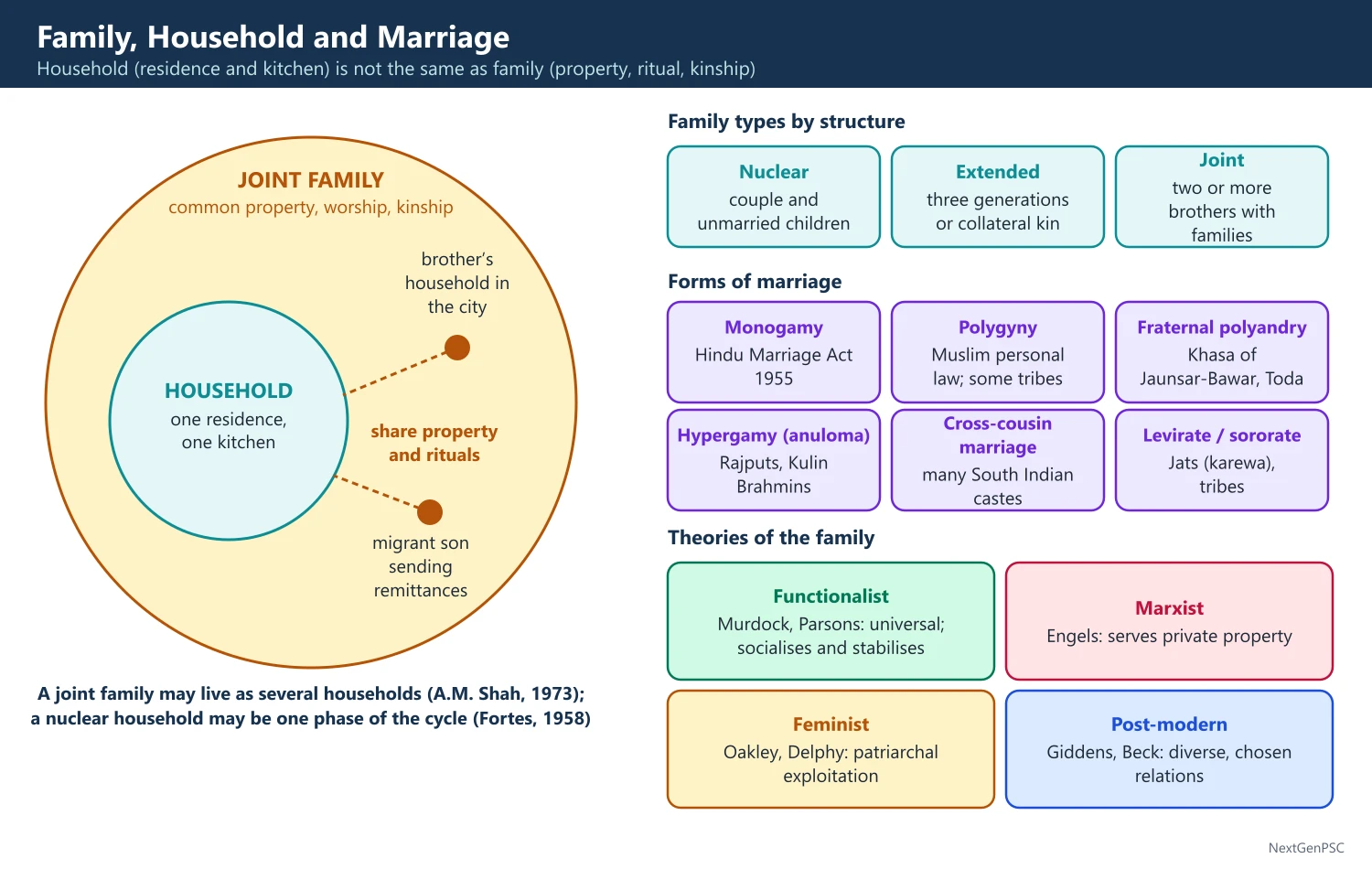
Household: a group that shares residence and a common kitchen; A.M. Shah (The Household Dimension of the Family in India, 1973) argued that household and family must be distinguished, because a joint family may live as several households.
Developmental cycle: Meyer Fortes ('The Developmental Cycle in Domestic Groups', 1958) showed that a household passes through phases of expansion, dispersion and replacement, so a nuclear household may be one stage of a joint family cycle.
Marriage (Notes and Queries on Anthropology, 1951): a union between a man and a woman such that children born to the woman are recognised as legitimate offspring of both partners.
Gough's revision (1959): to include the Nayar case, she defined marriage as a relationship established between a woman and one or more other persons that ensures a child born to the woman is accorded full birth-status rights.
Leach (1955): argued that marriage is a bundle of rights that varies across societies: legal fatherhood and motherhood, sexual rights, rights over labour and property, and relationships of affinity.
Kinship: socially recognised relationships based on descent (consanguinity) and marriage (affinity); fictive kinship (godparents, rakhi brothers) extends kin terms to non-relatives.
2. Types of Family
By structure: nuclear (couple and unmarried children), extended (three generations or collateral kin) and joint (two or more brothers with their families living together).
By residence: patrilocal (virilocal), matrilocal (uxorilocal), neolocal and avunculocal (with the mother's brother).
By descent and authority: patrilineal or matrilineal; patriarchal or matriarchal (no society is clearly matriarchal; matrilineal societies usually give authority to the mother's brother).
Family of orientation and procreation: W. Lloyd Warner's terms for the family one is born into and the family one creates by marriage.
Indian joint family (Karve): Irawati Karve (Kinship Organisation in India, 1953) defined it as a group of people who generally live under one roof, eat food cooked at one hearth, hold property in common, participate in common worship and are related to each other as some particular type of kindred.
Property systems: the Mitakshara school (most of India) gave sons a birthright in ancestral property as coparceners; the Dayabhaga school (Bengal) gave rights only after the father's death.
Degrees of jointness: I.P. Desai (Some Aspects of Family in Mahuva, 1964) showed that families living separately often remain functionally joint through mutual obligations and shared property.
Pauline Kolenda (1968): classified Indian family types into twelve categories, from nuclear to joint, and found regional variation in jointness.
3. Forms of Marriage
Monogamy: one spouse at a time; serial monogamy refers to successive marriages after divorce or death; the Hindu Marriage Act, 1955 made monogamy compulsory for Hindus.
Polygyny: one man with several wives; sororal polygyny means marrying sisters; permitted under Muslim personal law, and found among some tribes.
Polyandry: one woman with several husbands; fraternal polyandry among the Khasa of Jaunsar-Bawar (D.N. Majumdar, Himalayan Polyandry, 1962) and the Toda; non-fraternal forms among the Nayar.
Endogamy and exogamy: caste endogamy combined with gotra and village exogamy is the core North Indian rule; Ghurye listed endogamy as a key feature of caste.
Hypergamy and hypogamy: anuloma (woman marries a man of higher status) was accepted, pratiloma (woman marries lower) was condemned in classical texts; hypergamy among Rajputs and Kulin Brahmins of Bengal produced dowry inflation.
Preferential marriage: cross-cousin and uncle–niece marriage in South India; levirate (widow marries husband's brother) and sororate (widower marries wife's sister).
Ways of acquiring a spouse: bride price (common among tribes such as the Ho and Santhal), dowry, marriage by service, capture, elopement and exchange.
Laws: Special Marriage Act, 1954 for inter-religious and civil marriage; Dowry Prohibition Act, 1961; Prohibition of Child Marriage Act, 2006 (minimum age 18 for women and 21 for men).
4. Theories of the Family
Functionalism: Murdock's four functions; Talcott Parsons (Family, Socialization and Interaction Process, 1955) said the modern family has two 'basic and irreducible' functions: primary socialisation of children and stabilisation of adult personalities.
Isolated nuclear family: Parsons argued that the nuclear family fits industrial society because it is geographically and socially mobile; William Goode (World Revolution and Family Patterns, 1963) predicted worldwide convergence on the conjugal family.
Critics of the nuclearisation thesis: Peter Laslett (1972) found nuclear households common in pre-industrial England; Michael Anderson (1971) found extended families in industrial Preston; Young and Willmott (Family and Kinship in East London, 1957) found strong extended kin ties in Bethnal Green.
Symmetrical family: Young and Willmott (The Symmetrical Family, 1973) described a 'march of progress' towards joint conjugal roles; feminists such as Ann Oakley (1974) found that men's share of housework was small.
Marxist view: Friedrich Engels (The Origin of the Family, Private Property and the State, 1884) argued that monogamous marriage arose with private property to ensure legitimate heirs; later Marxists saw the family as reproducing labour power and as a 'haven in a heartless world' (Zaretsky, 1976).
Feminist views: Christine Delphy and Diana Leonard (Familiar Exploitation, 1992) saw the family as a patriarchal economic system where men exploit women's labour; radical feminists like Shulamith Firestone located oppression in biological reproduction.
Alliance view: Claude Lévi-Strauss (The Elementary Structures of Kinship, 1949) argued that the incest taboo forces groups to exchange women, so marriage creates alliances between groups.
Post-modern views: Anthony Giddens (The Transformation of Intimacy, 1992) described the 'pure relationship' entered for its own sake; Ulrich Beck and Elisabeth Beck-Gernsheim (The Normal Chaos of Love, 1995) described individualisation; Judith Stacey (Brave New Families, 1990) and David Morgan's 'family practices' (1996) stress diversity and doing family.
5. Indian Studies
Ghurye and Karve: Karve mapped four kinship zones (north, central, south and east) with different rules of marriage and terminology.
Is the joint family breaking up? A.M. Shah argued that the joint family was never universal and that nuclear households are often a phase of the family cycle; residential nuclearisation does not mean the end of joint obligations.
Patricia Uberoi (ed., Family, Kinship and Marriage in India, 1993): brought together studies showing diversity across region, caste and religion.
Urban families: studies of migrant workers and middle-class professionals show 'modified extended families' that keep strong ties through visits, remittances and phones.
Data: NFHS-5 (2019–21) found that 23.3% of women aged 20–24 had married before age 18, down from 26.8% in NFHS-4 (2015–16), and a total fertility rate of 2.0.
Inter-caste marriage: the India Human Development Survey (2011–12) found only about 5% of marriages to be inter-caste, showing how firmly endogamy persists.
6. Linking and Exam Use
Links: Parsons's family functions and pattern variables (chapter 7); Engels and Marx's property relations (chapter 5); Lévi-Strauss's alliance to lineage and descent (next topic); Walby's household production to patriarchy.
10 marks: define family or marriage (Murdock, Gough), give one critique and one Indian example.
20 marks: 'Is the family universal?' or 'Is the joint family disintegrating?' Use Murdock vs Gough, Parsons vs Laslett and Young and Willmott, and Shah, Desai and Kolenda for India.
Diagram idea: a circle for the household inside a larger circle for the family, with arrows showing members who live elsewhere but share property and rituals.
Quotation: Karve's definition of the joint family (above) is a safe, correctly attributed quote for Indian questions.
| Form | Meaning | Example |
|---|---|---|
| Monogamy | One spouse at a time | Required by Hindu Marriage Act 1955 |
| Polygyny | One husband, several wives | Permitted in Muslim personal law; some tribes |
| Fraternal polyandry | Brothers share one wife | Khasa of Jaunsar-Bawar, Toda |
| Hypergamy (anuloma) | Woman marries into higher status | Rajputs, Kulin Brahmins of Bengal |
| Cross-cousin marriage | Marriage with mother's brother's or father's sister's child | Many South Indian castes |
| Levirate / sororate | Widow marries husband's brother / widower marries wife's sister | Jats (karewa), several tribes |
| Perspective | Thinkers | View of the family |
|---|---|---|
| Functionalist | Murdock, Parsons, Goode | Universal; socialises children and stabilises adults |
| Marxist | Engels, Zaretsky | Serves private property and capitalism |
| Feminist | Oakley, Delphy and Leonard, Firestone | Site of patriarchal exploitation |
| Post-modern | Giddens, Beck, Stacey, Morgan | Diverse, chosen, negotiated relationships |
Mains points
- Distinguish family from household (A.M. Shah); examiners reward this precise point in Paper I and Paper II.
- For universality of the family, set Murdock against Gough's Nayar case and modern diversity.
- For the nuclearisation debate, use Parsons and Goode against Laslett, Anderson, Young and Willmott, and Indian evidence from Shah, Desai and Kolenda.
- Give definitions of marriage from Notes and Queries, Gough and Leach and show why they differ.
- Use Indian laws with years (HMA 1955, SMA 1954, Dowry Prohibition 1961, PCMA 2006) and NFHS-5 data.
- Cover functionalist, Marxist, feminist and post-modern theories in a table for long answers.
Did you know?
- Kathleen Gough rewrote the anthropological definition of marriage specifically so that it would fit the Nayars of Kerala.
- Memory trick for Murdock's functions: 'S-R-E-E' — Sexual, Reproductive, Economic, Educational.
Lineage and Descent
Descent is the socially recognised link between a person and his or her ancestors; a lineage is a unilineal descent group whose members can trace their links to a known common ancestor, while a clan claims a common ancestor without traceable links. Descent may be patrilineal, matrilineal, double or bilateral. British descent theory (Radcliffe-Brown, Fortes, Evans-Pritchard) stressed lineages as corporate groups, while Lévi-Strauss's alliance theory stressed marriage exchange; Dumont applied alliance to South India. In India, gotra, lineage and Karve's kinship zones organise marriage, property and politics.
In simple words
Descent answers the question 'whose line do I belong to?' In most of India it is the father's line, so you carry your father's surname and gotra.
A lineage is like a family tree you can actually draw back to a known great-great-grandfather; a clan is a bigger group that believes in a common ancestor it cannot trace.
Among the Khasi of Meghalaya, the line runs through the mother.
UPSC asks about types of descent, lineage functions and descent vs alliance theory.
1. Concepts and Definitions
Kinship: the network of socially recognised relationships based on descent (consanguinity) and marriage (affinity); Radcliffe-Brown called it a system of rights and duties among kin.
Descent: the socially recognised link between a person and a line of ancestors, which determines group membership, inheritance and succession.
Lineage: a unilineal descent group whose members trace descent from a known common ancestor through known genealogical links.
Clan (sib): a larger unilineal group whose members believe in a common ancestor, often mythical or totemic, but cannot trace the links; clans are usually exogamous.
Phratry and moiety: a phratry is a group of related clans; a moiety divides a whole society into two halves, as among some Australian and North-East Indian groups.
Gotra: in Brahmanical tradition, an exogamous patrilineal category tracing descent from a rishi; marriage within the same gotra is prohibited by custom.
Kindred: an ego-centred network of bilateral relatives, which differs for each person except siblings, unlike the ancestor-centred lineage.
Degrees of kinship (Murdock): primary kin (parents, siblings, spouse, children), secondary kin (primary kin's primary kin, such as father's father) and tertiary kin.
Kinship terminology: L.H. Morgan (Systems of Consanguinity and Affinity of the Human Family, 1871) separated classificatory systems (one term for several relatives, as when father's brother is also called 'father') from descriptive systems.
2. Types of Descent
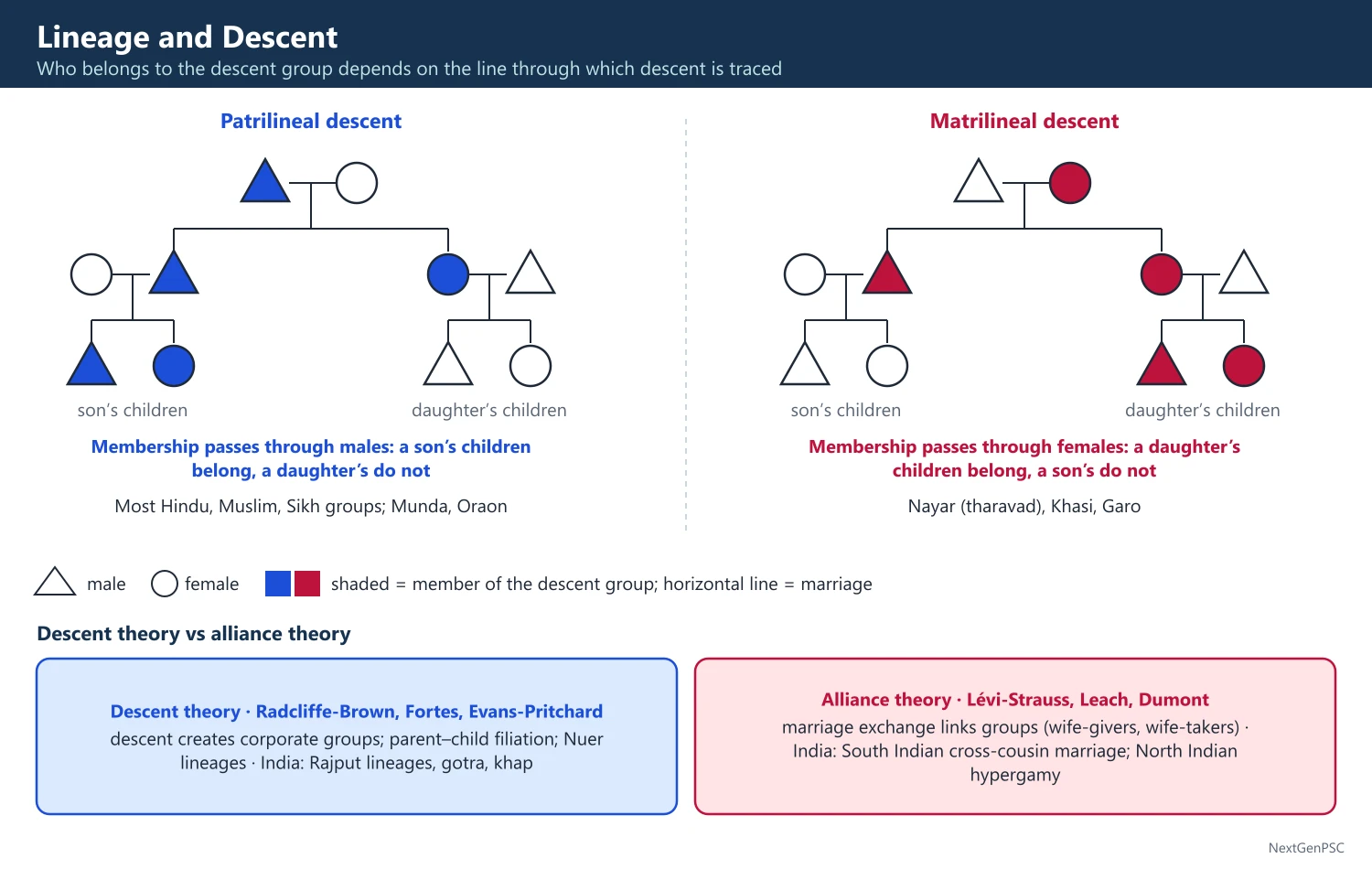
Patrilineal: descent traced through males; the most common type in India among most Hindu, Muslim and Sikh groups, and among many tribes such as the Munda and Oraon.
Matrilineal: descent traced through females; examples are the Nayar of Kerala (tharavad household headed by the karanavar, the senior male), the Khasi and Garo of Meghalaya, the Bunts of coastal Karnataka and the Muslims of Lakshadweep.
Khasi and Garo: among the Khasi, the youngest daughter (ka khadduh) inherits the ancestral house and acts as custodian; among the Garo, a selected daughter (nokna) inherits.
Matrilineal puzzle: Audrey Richards (1950) noted the tension in matrilineal societies between descent through women and authority held by men, especially the mother's brother.
Matriliny and Islam: Leela Dube (Matriliny and Islam, 1969) showed how Lakshadweep Muslims combine matrilineal kinship with Islamic law.
Decline of matriliny in Kerala: colonial and post-colonial laws, culminating in the Kerala Joint Hindu Family System (Abolition) Act, 1975, ended the tharavad as a legal joint property unit.
Double descent: both lines are used for different purposes, as among the Yakö of Nigeria (Daryll Forde), where land passes patrilineally and movable property matrilineally.
Bilateral (cognatic) descent: descent traced through both parents equally, as in most modern Western societies; ambilineal descent allows a choice of line.
3. Descent Theory and Alliance Theory
Descent theory: British structural-functionalists (Radcliffe-Brown; Meyer Fortes, 'The Structure of Unilineal Descent Groups', 1953) saw lineages as corporate groups that hold property, settle disputes and organise politics in stateless societies.
Segmentary lineage: E.E. Evans-Pritchard (The Nuer, 1940) showed how Nuer lineages split (fission) and combine (fusion) according to the level of conflict, producing 'ordered anarchy' without a state.
Alliance theory: Claude Lévi-Strauss (The Elementary Structures of Kinship, 1949) argued that the incest taboo forces men to give away sisters and daughters, so kinship is built on exchange between groups; marriage, not descent, is the key.
Restricted and generalised exchange: bilateral cross-cousin marriage creates direct exchange between two groups; matrilateral cross-cousin marriage creates generalised exchange in a circle of groups.
Dumont on South India: Louis Dumont ('Hierarchy and Marriage Alliance in South Indian Kinship', 1957) argued that Dravidian terminology expresses alliance as an enduring relation inherited across generations, so affines are a distinct category.
Leach on the Kachin: Edmund Leach (Political Systems of Highland Burma, 1954) showed that wife-giving lineages ranked above wife-taking lineages, linking alliance to political hierarchy, much like North Indian hypergamy.
Critique of kinship studies: David Schneider (A Critique of the Study of Kinship, 1984) argued that anthropologists projected a Euro-American, biology-based idea of kinship onto other cultures.
New kinship studies: Janet Carsten's idea of 'relatedness' (2000) includes ties made through feeding, living together and care; assisted reproduction and surrogacy raise new questions, regulated in India by the Surrogacy (Regulation) Act, 2021.
4. Functions of Lineage and Descent
Property and succession: descent decides who inherits land and office; in patrilineal India, sons traditionally inherited land and daughters received dowry.
Political organisation: lineages organise politics in stateless societies and in village factions; Richard Fox (Kin, Clan, Raja and Rule, 1971) showed how Rajput lineages formed local states in North India.
Ritual: ancestor rites such as shraddha and the sapinda relationship mark lineage membership; ritual pollution after a death (sutak) applies to lineage members.
Social control: lineage elders and caste or clan councils, such as khap panchayats among Jats, enforce marriage rules; the Supreme Court in Shakti Vahini v. Union of India (2018) issued guidelines to prevent honour killings ordered by such bodies.
Identity and mutual help: lineage gives a sense of belonging, support in crises and networks for migration and business.
5. Kinship Zones in India
Karve's zones (Kinship Organisation in India, 1953): the northern zone forbids marriage among close kin, practises village and gotra exogamy and hypergamy; the southern zone prefers cross-cousin and uncle–niece marriage within a close circle; the eastern zone has tribal (Austro-Asiatic) patterns; the central zone mixes northern and southern features.
North Indian rules: the four-gotra rule among many castes avoids marriage into the gotras of father, mother, father's mother and mother's mother; the bride's family is ritually inferior to the groom's.
South Indian rules: Dravidian kinship terminology separates parallel cousins (treated as siblings) from cross-cousins (potential spouses); Thomas Trautmann (Dravidian Kinship, 1981) analysed this system.
Legal rules: the Hindu Marriage Act, 1955 prohibits marriage between sapindas, defined as within three generations through the mother and five through the father, unless custom permits.
Muslim kinship: parallel-cousin marriage is permitted and common in some communities, unlike Hindu North India.
Tribal kinship: many tribes follow clan exogamy with totemic clans, such as the Oraon and Munda killi clans.
6. Contemporary Changes
Daughters as coparceners: the Hindu Succession (Amendment) Act, 2005 gave daughters equal coparcenary rights in joint family property; the Supreme Court in Vineeta Sharma v. Rakesh Sharma (2020) held that this right exists by birth whether or not the father was alive in 2005.
Shift to bilateral practice: urban families increasingly keep close ties with the wife's kin, and daughters care for ageing parents, making practice more bilateral than the formal rules.
Weakening of matriliny: in Kerala and Meghalaya, education, cash economy and law have moved families towards nuclear and patrilineal patterns, though Khasi inheritance through the youngest daughter persists.
Transnational kinship: migration links lineages across countries through remittances, marriage alliances and online matrimonial networks.
7. Using It in the Exam
10 marks: define lineage and clan, or patrilineal and matrilineal descent, with an Indian example of each.
20 marks: compare descent theory and alliance theory (Fortes and Evans-Pritchard vs Lévi-Strauss and Dumont) and apply both to North and South Indian kinship (Karve).
Thinkers examiners look for: Morgan, Radcliffe-Brown, Fortes, Evans-Pritchard, Lévi-Strauss, Leach, Dumont, Karve, Leela Dube, Schneider.
Diagram idea: a kinship chart with triangles for males and circles for females, showing a patrilineage shaded through males and a matrilineage shaded through females.
Quotation: Lévi-Strauss's idea, paraphrased: the incest taboo is the rule of reciprocity par excellence, forcing groups to exchange and thus founding society.
| Point | Descent theory | Alliance theory |
|---|---|---|
| Main thinkers | Radcliffe-Brown, Fortes, Evans-Pritchard | Lévi-Strauss, Leach, Dumont |
| Key principle | Descent creates corporate groups | Marriage exchange links groups |
| Central relation | Parent–child (filiation) | Affinity (wife-givers and wife-takers) |
| Classic case | Nuer segmentary lineages | Kachin; Dravidian South India |
| Indian application | Rajput lineages, gotra, khap | South Indian cross-cousin marriage; North Indian hypergamy |
| Zone | Marriage rules | Distinctive feature |
|---|---|---|
| Northern | Village and gotra exogamy, no close-kin marriage | Hypergamy; bride-givers rank below bride-takers |
| Southern | Cross-cousin and uncle–niece marriage preferred | Dravidian terminology; marriage within close kin |
| Eastern | Tribal clan exogamy | Austro-Asiatic patterns, bride price |
| Central | Mixed northern and southern rules | Transitional zone |
Mains points
- Define lineage, clan, gotra and kindred precisely; vague use of 'clan' and 'lineage' is a common error.
- Give Indian matrilineal examples correctly (Nayar, Khasi, Garo, Lakshadweep) and note that matriliny is not matriarchy.
- Contrast descent and alliance theories and apply both to India through Karve and Dumont.
- Mention legal change (HSA Amendment 2005, Vineeta Sharma 2020, Kerala 1975 Act, Surrogacy Act 2021) to show contemporary relevance.
- Use Schneider and Carsten to show how kinship studies themselves have changed.
- A kinship diagram earns credit in 15–20 mark answers if neatly labelled.
Did you know?
- Evans-Pritchard summed up Nuer politics with a proverb-like rule: 'I against my brother, my brother and I against our cousins, we and our cousins against the world' — the logic of segmentary lineages.
- Memory trick: Lineage = Links known; Clan = Claimed ancestor.
Patriarchy, Sexual Division of Labour and Contemporary Trends
Patriarchy is a system of social structures and practices in which men dominate, oppress and exploit women (Walby, 1990). The sexual division of labour assigns paid, public work to men and unpaid domestic and care work to women; functionalists (Murdock, Parsons) explain it by biology and function, while Mead, Oakley and Boserup show it is cultural. Contemporary trends include smaller families, later marriage, divorce, cohabitation, same-sex families and individualisation (Giddens, Beck). In India, dowry, son preference, honour crimes and women's low labour participation coexist with rising education, legal reforms and new family forms.
In simple words
Patriarchy means a society where men hold most power, at home and outside.
In many homes the father earns and decides, while the mother cooks, cleans and cares for children without pay; this split is the sexual division of labour.
Today families are changing: people marry later, have fewer children, and some live together without marriage.
UPSC asks how patriarchy works, whether the division of labour is natural, and what new family trends mean.
1. Patriarchy
Weber's usage: patriarchalism is a form of traditional authority in which the household head rules over family members and dependants by custom.
Feminist redefinition: Kate Millett (Sexual Politics, 1970) used patriarchy for the institutionalised power of men over women in all spheres, maintained through socialisation, ideology and force.
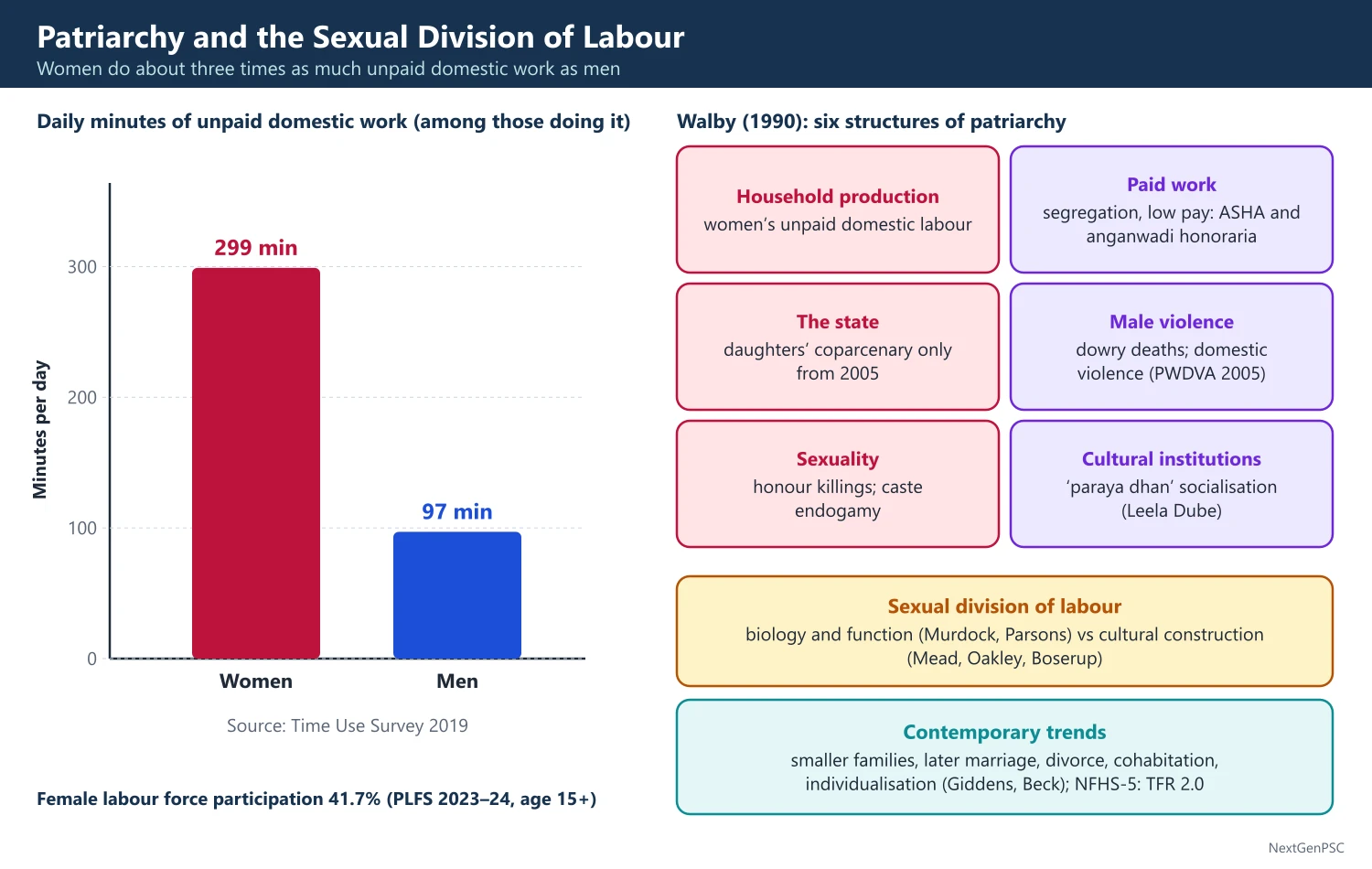
Sylvia Walby (Theorizing Patriarchy, 1990): defined patriarchy as a system of social structures and practices in which men dominate, oppress and exploit women; it operates through six structures: household production, paid work, the state, male violence, sexuality and culture.
Private to public patriarchy: Walby argued that in the 20th century women moved from being controlled mainly within the household to being subordinated in public spheres such as segregated, low-paid employment.
Origins: Engels linked patriarchy to private property; Gerda Lerner (The Creation of Patriarchy, 1986) traced its historical formation in ancient Mesopotamia; radical feminists see it as the oldest form of oppression.
Bargaining with patriarchy: Deniz Kandiyoti (1988) described 'classic patriarchy' in South and West Asia, where young brides are subordinated but older women gain power as mothers-in-law, so women may support the system.
Brahmanical patriarchy: Uma Chakravarti ('Conceptualising Brahmanical Patriarchy in Early India', EPW, 1993) argued that control over women's sexuality was essential to maintain caste purity and endogamy.
Socialisation: Leela Dube ('On the Construction of Gender', EPW, 1988) showed how Hindu girls in patrilineal India are raised as 'paraya dhan' (someone else's wealth), learning restraint and service.
Matriliny is not matriarchy: among the Khasi, property passes through women but political and clan authority rests largely with men, especially maternal uncles.
2. Sexual Division of Labour
Meaning: the allocation of tasks by sex, typically men in production and public life and women in reproduction, domestic work and care.
Functionalist explanation: Murdock (1937 cross-cultural study) linked it to men's greater strength and women's childbearing; Parsons (1955) argued that men take the instrumental role (breadwinner) and women the expressive role (emotional care), which suits the nuclear family.
Cultural variation: Margaret Mead (Sex and Temperament in Three Primitive Societies, 1935) found gentle men and women among the Arapesh, aggressive men and women among the Mundugumor, and dominant women among the Tchambuli, suggesting gender roles are cultural.
Oakley's critique: Ann Oakley (Housewife, 1974) argued that the housewife role is a modern social construction from industrialisation, not natural; her The Sociology of Housework (1974) treated housework as monotonous, unpaid work.
Ester Boserup (Woman's Role in Economic Development, 1970): distinguished female farming systems (shifting cultivation in Africa) from male farming systems (plough agriculture), showing that technology and economy shape women's work.
Marxist feminism: Heidi Hartmann ('The Unhappy Marriage of Marxism and Feminism', 1979) argued that capitalism and patriarchy together produce occupational segregation and women's double burden.
Housewifisation: Maria Mies (The Lace Makers of Narsapur, 1982) showed that women lace makers in Andhra Pradesh worked at home for export while being defined as housewives, so their labour was cheapened.
Second shift: Arlie Hochschild (The Second Shift, 1989) found that employed women in the USA did a second shift of housework and childcare.
Indian data: the Time Use Survey 2019 found that women who did unpaid domestic work spent about 299 minutes a day on it against 97 minutes for men; female labour force participation was 41.7% in 2023–24 (PLFS, age 15+).
Feminisation of agriculture: as men migrate to cities, women take on more farm work, often as unpaid family labour without land titles.
Care work as 'voluntary': lakhs of ASHA and anganwadi workers, almost all women, are paid honoraria rather than wages, showing how care work is undervalued.
3. Contemporary Trends Worldwide
Family diversity: Rhona and Robert Rapoport (1982) identified organisational, cultural, class, life-course and cohort diversity in British families.
Demographic trends: later marriage, falling fertility, rising divorce, cohabitation, single-person and lone-parent households, and reconstituted (step) families.
Beanpole family: Julia Brannen (2003) described families with many generations alive but few members in each, due to longer life and fewer children.
Individualisation: Beck and Beck-Gernsheim argued that people now choose and negotiate relationships rather than follow fixed roles; Giddens's 'pure relationship' and 'confluent love' last only as long as both partners find satisfaction.
Same-sex families: the Netherlands legalised same-sex marriage in 2001, the first country to do so; Jeffrey Weeks described 'families of choice'.
New reproductive technologies and surrogacy separate biological and social parenthood.
Critique: Carol Smart and others note that individualisation theorists exaggerate choice; class, gender and ethnicity still constrain family life.
Transnational families: migrants raise children across borders through remittances and digital contact (Parreñas, 2001, on Filipino families).
4. Contemporary Trends in India
Nuclearisation debate: residential nuclear households are increasing in cities, but A.M. Shah and others argue that joint family obligations, property and rituals continue.
Later marriage and fewer children: NFHS-5 (2019–21) recorded child marriage among women aged 20–24 at 23.3% (down from 26.8% in 2015–16) and a total fertility rate of 2.0, below replacement level.
Arranged marriage persists: most marriages are still arranged within caste, though 'self-arranged' and love marriages are growing among the educated; Patricia Uberoi (Freedom and Destiny, 2006) studied how popular culture reshapes ideals of love and family.
Dowry: banned since 1961, it persists and has spread to groups that once practised bride price; NCRB's Crime in India reports record over 6,000 dowry deaths a year in recent years.
Domestic violence: the Protection of Women from Domestic Violence Act, 2005 recognised physical, emotional, sexual and economic abuse in the home.
Live-in relationships: the Supreme Court has extended protection to women in long-term live-in relationships under the 2005 Act (D. Velusamy, 2010; Indra Sarma, 2013); Uttarakhand's Uniform Civil Code, in force from 27 January 2025, requires registration of live-in relationships.
Sexuality: Navtej Singh Johar v. Union of India (6 September 2018) decriminalised consensual same-sex relations; in Supriyo Chakraborty v. Union of India (17 October 2023) the Supreme Court declined to recognise same-sex marriage, leaving it to Parliament.
Ageing and care: longer life and migration of children raise elder-care problems; the Maintenance and Welfare of Parents and Senior Citizens Act, 2007 makes children legally responsible for parents' maintenance.
Migration: 'left-behind' wives of Gulf migrants in Kerala manage households and finances, changing gender roles within the family.
Property rights: the Hindu Succession (Amendment) Act, 2005 made daughters coparceners, though many still give up shares to brothers under social pressure.
5. Linking and Exam Use
Links: Walby's patriarchy to gender stratification (chapter 8); Parsons's roles to pattern variables (chapter 7); Hochschild's second shift to labour and society (chapter 9); Beck's individualisation to social change (chapter 13).
10 marks: define patriarchy (Walby) or sexual division of labour, give a critique and Indian data (Time Use Survey 2019, PLFS 2023–24).
20 marks: 'Is the sexual division of labour natural?' Set Murdock and Parsons against Mead, Oakley, Boserup and Mies, and end with Indian evidence and policy.
Diagram idea: two bars for women's and men's daily minutes of unpaid work (299 vs 97, Time Use Survey 2019).
Quotation: Walby (1990): patriarchy is 'a system of social structures and practices in which men dominate, oppress and exploit women'.
| Structure | Meaning | Indian example |
|---|---|---|
| Household production | Women's unpaid domestic labour | 299 vs 97 minutes of unpaid work (TUS 2019) |
| Paid work | Segregation and low pay | ASHA and anganwadi honoraria; gender pay gap |
| The state | Laws and policies biased towards men | Daughters' coparcenary only from 2005 |
| Male violence | Violence used to control women | Dowry deaths, domestic violence (PWDVA 2005) |
| Sexuality | Control of women's sexuality | Honour killings; caste endogamy |
| Cultural institutions | Media, religion and education shaping gender | 'Paraya dhan' socialisation (Leela Dube) |
Mains points
- Define patriarchy with Walby and show its Indian forms through Chakravarti, Leela Dube and Kandiyoti.
- For sexual division of labour, contrast biological-functionalist views (Murdock, Parsons) with cultural and feminist evidence (Mead, Oakley, Boserup, Mies, Hochschild).
- Use Indian data with years: Time Use Survey 2019, PLFS 2023–24, NFHS-5, NCRB dowry deaths.
- For contemporary trends, cover both global theories (Giddens, Beck, Stacey) and Indian legal and social change (2005 laws, 2018 and 2023 judgments, Uttarakhand UCC 2025).
- Avoid claiming the Indian joint family has collapsed; present it as changing in form.
- Matriliny is not matriarchy; examiners note this distinction.
Did you know?
- Margaret Mead's three tribes lived within about 100 miles of each other in New Guinea, yet showed completely different gender temperaments.
- Memory trick for Walby: 'House, Job, State, Violence, Sex, Culture' — six rooms of the patriarchal house.
UPSC Previous Year Questions: Systems of Kinship
From 2014 to 2026 UPSC asked 33 question parts worth 470 marks on Systems of Kinship in Paper I (14 of 20 marks and 19 of 10 marks). The most-asked topic by far is patriarchy, sexual division of labour and contemporary trends (20 parts: patriarchal bargain, live-in relationships, changing kinship, filiocentric families), followed by family, household and marriage (9) and lineage and descent (4). Every question below has a model answer written to the UPSC word limit.
In simple words
Read the question and spend five minutes writing your own outline: a definition with the thinker, two or three body points and one Indian example.
Then read the approach line and the model answer, and mark what you missed: a thinker, a study, a law or a piece of data.
Finally rewrite your answer within the word limit (150 words for 10 marks, 250 for 20 marks) and revise the notes topic it comes from.
1. Family, Household and Marriage: Types and Forms
Example 1 (UPSC 2025, 20 marks): Give an account of the recent trends of marriage in the Indian context. How are these different from traditional practices?
Paper and question: Paper I, Q4(a)
Approach: The question has two parts: describe recent trends in Indian marriage with data, and contrast each with the traditional pattern. Use Kapadia for the traditional sacramental ideal, Uberoi and Srinivas for change, and NFHS-5, IHDS and recent laws and judgments for evidence.
Traditionally, Hindu marriage was a sacrament (samskara): K.M. Kapadia (Marriage and Family in India, 1955) listed its aims as dharma, praja (progeny) and rati. It was arranged by elders within caste endogamy and gotra exogamy, often contracted in childhood, indissoluble and, among upper castes, tied to hypergamy and dowry.
Rising age at marriage: child marriage among women aged 20–24 fell from 26.8% (NFHS-4, 2015–16) to 23.3% (NFHS-5, 2019–21), and education and jobs now delay marriage among the urban middle class. Traditional marriage stressed early marriage to protect purity.
Choice within arrangement: Patricia Uberoi (Freedom and Destiny, 2006) shows the spread of 'love-cum-arranged' and self-arranged marriages, in which young people choose but seek parental approval. Matrimonial websites and apps have replaced the family priest and the go-between, though they still filter by caste, religion and income.
Endogamy persists: only about 5% of marriages were inter-caste (India Human Development Survey, 2011–12). Couples who cross caste or faith face khap pressure and honour crimes; the Supreme Court responded in Shakti Vahini v. Union of India (2018) and upheld an adult's choice of partner in Shafin Jahan v. Asokan (2018).
Commercialisation: M.N. Srinivas (1984) showed dowry spreading to castes that once paid bride price, and lavish weddings have become status displays, unlike the ritual focus of the past.
From indissoluble to dissoluble: the Hindu Marriage Act, 1955 introduced divorce, and in Shilpa Sailesh v. Varun Sreenivasan (2023) the Supreme Court allowed divorce on irretrievable breakdown. Live-in relationships have legal protection, and Uttarakhand's Uniform Civil Code (2025) requires their registration.
Flow chart: Sacrament (arranged, early, endogamous, indissoluble) → education, urbanisation, law, media → companionate, later, chosen-but-approved, dissoluble marriage.
Thus the way spouses are chosen has changed far more than the rules of whom one may marry: Indian marriage is adapting rather than disappearing.
Example 2 (UPSC 2024, 10 marks): Marriage as an institution has undergone a radical transformation from 'ritual' to 'commercial' in its outlook. Explain the factors behind this change.
Paper and question: Paper I, Q1(c)
Approach: Explain briefly what 'ritual' and 'commercial' outlooks mean and then list the economic, social and cultural factors behind the shift, ending with a caveat that ritual has not disappeared.
Classical Hindu marriage was a sacrament fulfilling dharma (K.M. Kapadia, 1955), and kanyadan was a ritual gift. Today marriage is shaped by market calculations: dowry bargaining, matching of incomes and the wedding as a costly consumer event.
Capitalism and commodification: Marx and Engels wrote in the Communist Manifesto that the bourgeoisie reduced the family relation to 'a mere money relation'. M.N. Srinivas (1984) showed dowry spreading as a groom price, even to castes that once paid bride price.
Consumer culture and status display: weddings have become sites of what Thorstein Veblen called conspicuous consumption, with destination weddings, event managers and social media display.
Marriage markets: matrimonial websites and apps sort partners by salary, education and looks, treating spouses almost as profiles in a market.
Individualisation: Giddens's 'pure relationship' and Beck's individualisation make marriage a negotiated contract, reflected in prenuptial discussions and rising divorce.
Yet rituals persist and are even elaborated (sangeet, haldi): ritual has been commercialised rather than replaced, while the Dowry Prohibition Act, 1961 tries to resist the market logic.
Example 3 (UPSC 2024, 10 marks): What are the 'basic and irreducible' functions of the family as proposed by Talcott Parsons? Explain.
Paper and question: Paper I, Q1(e)
Approach: State Parsons's two 'basic and irreducible' functions, explain each with his reasoning about the isolated nuclear family in industrial society, and end with criticism and an Indian illustration.
Talcott Parsons (with Robert Bales, Family, Socialization and Interaction Process, 1955) argued that industrialisation transferred many family functions to specialised institutions, leaving two 'basic and irreducible' functions.
Primary socialisation: in early childhood the family internalises society's culture in the child, so that values become part of the personality. Parsons saw families as 'factories' producing human personalities.
Stabilisation of adult personalities: marriage gives adults emotional security and relief from the tensions of work, with the husband in the instrumental role and the wife in the expressive role.
He linked these functions to the isolated nuclear family, which suits a mobile industrial economy.
Critics call this an idealised picture of the 1950s American middle-class family: David Morgan (1975) noted its neglect of conflict and power, Ann Oakley rejected the 'natural' expressive role, and Peter Laslett found nuclear households before industrialisation.
In India, the persistence of joint obligations (A.M. Shah) and the role of grandparents and crèches in socialisation show that these functions are shared beyond the nuclear unit.
Example 4 (UPSC 2023, 10 marks): Analyze critically David Morgan's views on family practices.
Paper and question: Paper I, Q5(d)
Approach: Explain Morgan's idea of 'family practices' (family as something people do), show its strengths with examples, then evaluate it critically using Carol Smart and structural critics, with Indian illustrations.
David Morgan (Family Connections, 1996) proposed studying the family not as a fixed structure but through family practices: everyday activities, such as feeding, caring and celebrating, through which people 'do' family.
Strengths: it captures diversity, since step-families, same-sex couples and transnational households all 'do family' without fitting Murdock's definition. Indian examples include migrants doing family through video calls and remittances, and fictive kin such as rakhi brothers.
Criticisms: Carol Smart (Personal Life, 2007) argued that the focus on 'family' is still too narrow and proposed 'personal life' to include friendships and memory.
Others say the approach is vague: almost any activity can count as a family practice.
It also underplays power and inequality, such as unequal domestic labour (Time Use Survey 2019) and the personal laws that decide who counts as family.
Morgan's concept is therefore a useful corrective to structural-functionalism, but it works best combined with structural analysis of patriarchy and the state.
Example 5 (UPSC 2022, 10 marks): Discuss various theoretical perspectives on the family.
Paper and question: Paper I, Q5(b)
Approach: Survey the main perspectives briefly, one short paragraph each: functionalist, Marxist, feminist, interactionist or postmodern, and alliance or Indian perspectives, with a key thinker and one critique each.
The family is studied from several perspectives that differ on whether it serves society as a whole, a class, men, or its individual members.
Functionalist: Murdock (1949) found the nuclear family universal with four functions; Parsons (1955) reduced them to primary socialisation and stabilisation of adult personalities. Kathleen Gough's Nayar study questioned universality.
Marxist: Engels (1884) linked monogamy to private property and inheritance; Zaretsky (1976) saw the family as a private refuge that props up capitalism. Critics say it neglects gender and culture.
Feminist: Delphy and Leonard (1992) treat the family as a patriarchal economic system; in India Leela Dube (1988) showed how girls are socialised as 'paraya dhan'.
Postmodern and interactionist: Giddens's 'pure relationship', Beck's individualisation, Stacey's 'brave new families' and Morgan's 'family practices' stress diversity and choice; critics say they exaggerate choice.
Indian views: Karve, I.P. Desai and A.M. Shah show that joint family obligations persist despite residential nuclearisation. A complete analysis combines these views rather than choosing one.
Example 6 (UPSC 2020, 10 marks): Does the institution of marriage continue to be sacred in Indian society? Comment.
Paper and question: Paper I, Q5(e)
Approach: Comment means giving a judgement: show the sacred elements that remain (ritual, indissolubility ideal, endogamy) and the forces of secularisation (law, divorce, choice, commercialisation), and conclude with a balanced view.
K.M. Kapadia (1955) described Hindu marriage as a sacrament: a religious duty for dharma and progeny, indissoluble and binding even beyond death. Christian marriage is also a sacrament, while Muslim nikah is a civil contract with religious sanction.
Sacredness continues: most marriages are still solemnised with saptapadi, nikah or church rites; arranged, caste-endogamous marriage remains the norm (only about 5% inter-caste, IHDS 2011–12); divorce stays rare and stigmatised; and rituals like Karva Chauth have grown popular through media.
Signs of secularisation: the Hindu Marriage Act, 1955 made marriage dissoluble; the Special Marriage Act, 1954 allows civil marriage; courts protect live-in relationships (D. Velusamy, 2010); dowry shows commercialisation (Srinivas, 1984); and companionate ideals (Uberoi, 2006) put happiness above duty.
Weber's idea of disenchantment helps here: the sacred is giving way to rational calculation, but slowly and unevenly.
Marriage in India therefore remains sacred in ritual form and social meaning, while its legal basis and personal meaning have become increasingly contractual, especially among the urban educated.
Example 7 (UPSC 2018, 20 marks): Distinguish between family and household with reference to the concept of development of the household.
Paper and question: Paper I, Q6(b)
Approach: Define family and household and distinguish them on residence, kitchen, kinship and function; then explain the developmental cycle of the household (Fortes, Goody) and apply it to India through A.M. Shah, I.P. Desai and Kolenda.
The family is a kinship group bound by marriage, descent or adoption, with mutual rights and duties (Murdock, 1949). The household is a residential and economic unit: the Census of India defines it as a group of persons who normally live together and take meals from a common kitchen.
Distinctions: (i) a household may include non-kin such as servants or lodgers, while a family may span several households; (ii) the household rests on co-residence and commensality, the family on kinship; (iii) the family is a legal and ritual unit, the household a unit of daily consumption; (iv) a person living alone forms a household, not a family.
A.M. Shah (The Household Dimension of the Family in India, 1973) argued that confusing the two led scholars to conclude wrongly that the Indian joint family was breaking up, when they had only counted nuclear households.
Developmental cycle: Meyer Fortes, introducing Jack Goody (ed.), The Developmental Cycle in Domestic Groups (1958), showed that domestic groups pass through phases of expansion, dispersion (fission) and replacement.
Applied to India, a joint household splits when brothers partition, and each new nuclear household later grows into a joint household when sons marry. So a census snapshot showing many nuclear households may only capture one stage of the cycle.
I.P. Desai (1964) in Mahuva found that households living separately often remained functionally joint through shared property and obligations, and Pauline Kolenda (1968) found jointness varying by region and caste.
Flow chart: Couple → expansion (children) → joint household (married sons) → fission (partition) → new nuclear households → expansion again.
Household composition thus changes over the life course while the family as a network of obligations persists; migration-created 'split households' (husband in the Gulf, wife in Kerala) confirm Shah's point.
Example 8 (UPSC 2016, 10 marks): Distinguish between family and household as sociological concepts.
Paper and question: Paper I, Q8(c)
Approach: Define both concepts with sources, give four or five clear points of difference, and illustrate with A.M. Shah's argument and an Indian example.
The family is a group related by marriage, blood or adoption with mutual rights and obligations; the household, in the Census of India's definition, is a group of persons who normally live together and take meals from a common kitchen.
Basis: the family rests on kinship; the household on co-residence and a shared kitchen.
Membership: a household can include non-kin (domestic workers, paying guests) and can be a single person; a family can stretch across several households and even countries, as with Gulf migrants from Kerala.
Function: the family regulates sex, inheritance, ritual and identity; the household organises daily consumption, budgeting and labour.
Change over time: households split and merge through the developmental cycle (Meyer Fortes, 1958), while the family as a kin group persists.
A.M. Shah (1973) argued that claims of joint family break-up rested on counting nuclear households, and I.P. Desai (1964) showed that separate households often remain functionally joint; the distinction is thus essential.
Example 9 (UPSC 2014, 20 marks): Critically examine the functionalist views on the institution of family. How do those help us in understanding family in the present times?
Paper and question: Paper I, Q6(b)
Approach: First set out the functionalist views (Murdock, Parsons, Goode), then critically examine them with named critics, and finally assess their usefulness for understanding families today, especially in India.
Functionalism sees the family as a universal institution that meets the functional prerequisites of society and of individuals.
Murdock (Social Structure, 1949), surveying 250 societies, found the nuclear family universal and performing four functions: sexual, reproductive, economic and educational. Parsons (1955) argued that in industrial society the family lost many functions to specialised institutions but kept two 'basic and irreducible' ones: primary socialisation of children and stabilisation of adult personalities. The isolated nuclear family, with an instrumental husband and expressive wife, fits a mobile industrial economy. William Goode (1963) predicted worldwide convergence towards the conjugal family.
Criticism: Kathleen Gough's Nayar study and the Israeli kibbutz questioned universality. Laslett (1972) found nuclear households in pre-industrial England and Anderson (1971) extended families in industrial Lancashire, undermining the 'fit' thesis. Leach (1967) saw the inward-looking nuclear family as a source of tension, and Marxists (Zaretsky) and feminists (Oakley, Delphy and Leonard) said it hides exploitation; its model is also ethnocentric.
Relevance today: functionalism still helps explain why the family persists: socialisation, emotional support and care of the elderly remain family tasks, which Indian laws such as the Maintenance and Welfare of Parents and Senior Citizens Act, 2007 reinforce.
However, it cannot explain diversity (lone-parent, live-in, same-sex and transnational families), rising divorce, domestic violence (addressed by the Protection of Women from Domestic Violence Act, 2005), or the Indian pattern of residentially nuclear but functionally joint families described by I.P. Desai and A.M. Shah.
Functionalism is therefore a useful starting point for the family's functions, but contemporary families are better understood by adding conflict, feminist and postmodern perspectives such as Morgan's 'family practices'.
2. Lineage and Descent
Example 10 (UPSC 2019, 10 marks): What, according to Irawati Karve, are the major differences between North Indian and South Indian Kinship systems?
Paper and question: Paper I, Q4(c)
Approach: Introduce Karve's Kinship Organisation in India (1953) and her zones, then contrast North and South on marriage rules, terminology, status of bride-givers and the bride's position, ending with a note on change.
Irawati Karve (Kinship Organisation in India, 1953) divided India into northern, central, southern and eastern kinship zones, broadly matching language families.
Marriage rules: the North forbids marriage between close kin and practises gotra and village exogamy (often the four-gotra rule); the South prefers cross-cousin and uncle–niece (elder sister's daughter) marriage within a close circle of kin.
Distance and the bride: in the North the bride joins a distant, unfamiliar family under close control; in the South she marries among known kin and keeps ties with her natal home.
Hierarchy: northern kinship is hypergamous, with wife-givers ritually inferior to wife-takers and gifts flowing one way; southern marriage repeatedly links the same families as equals.
Terminology: northern terms separate consanguines from affines; Dravidian terms separate parallel cousins (siblings) from cross-cousins (potential spouses), as Dumont (1957) later analysed.
Karve's map remains useful, though migration and education are reducing close-kin marriage in the South.
Example 11 (UPSC 2017, 20 marks): Discuss the regional variations of kinship system in Indian society.
Paper and question: Paper I, Q7(b)
Approach: Use Karve's four zones as the frame, add descent-based variation (patrilineal versus matrilineal Nayar, Khasi, Garo), religious and tribal variation, and theoretical readings (Dumont, Trautmann), and end with contemporary convergence.
Kinship in India varies by region, language, religion and descent rule. Irawati Karve (Kinship Organisation in India, 1953) mapped four kinship zones, which remain the standard frame.
Northern zone: patrilineal, with caste endogamy combined with gotra and village exogamy (the four-gotra rule among many castes), hypergamy that makes wife-givers inferior, and a bride married into a distant, unfamiliar family.
Southern zone: Dravidian kinship prefers cross-cousin and uncle–niece marriage, so marriage renews old ties. Louis Dumont (1957) argued that South Indian terminology expresses alliance as a relation inherited across generations, and Thomas Trautmann (Dravidian Kinship, 1981) analysed the system historically.
Central and eastern zones: the central zone (Maharashtra, Gujarat, Rajasthan) mixes features, for example cross-cousin marriage among Marathas; the eastern zone has Austro-Asiatic tribal patterns with totemic clan exogamy, as among the Munda and Oraon.
Descent variation: matrilineal systems existed among the Nayar of Kerala (tharavad under the karanavar), the Bunts of coastal Karnataka, the Muslims of Lakshadweep (Leela Dube, Matriliny and Islam, 1969), and the Khasi and Garo of Meghalaya, where the youngest daughter (Khasi) or a chosen daughter (Garo) inherits.
Religious variation: many Muslim communities permit parallel-cousin marriage, which Hindu North India forbids; Christian and Sikh kinship largely follow regional patterns.
Convergence: the Hindu Marriage Act, 1955 (sapinda rules), the Kerala Joint Hindu Family System (Abolition) Act, 1975, the Hindu Succession (Amendment) Act, 2005, migration and urban education are making practice more bilateral and nuclear across regions.
Regional diversity, therefore, is a key reason why there is no single 'Indian kinship system', as Patricia Uberoi's edited volume (1993) shows.
Example 12 (UPSC 2015, 10 marks): Is male authority absent in matrilineal society? Discuss.
Paper and question: Paper I, Q5(d)
Approach: Distinguish matriliny from matriarchy, explain Audrey Richards' 'matrilineal puzzle', and show with the Nayar, Khasi and Trobriand cases that male authority shifts to the mother's brother rather than disappearing, while women gain relative autonomy.
Matriliny means tracing descent and inheritance through women; it is not matriarchy, the rule of women, which no society is clearly known to have practised.
Audrey Richards (1950) called this the matrilineal puzzle: descent passes through women but authority is held by men, so a man controls his sister's children rather than his own; Schneider and Gough (1961) found this tension widely.
Indian evidence: in the Nayar tharavad, property belonged to the matrilineal group but the karanavar, the senior male, managed it. Among the Khasi, the youngest daughter inherits the ancestral house as custodian, yet the maternal uncle takes key decisions and traditional dorbars were male. Malinowski found a similar pattern in the Trobriand Islands.
However, women in matrilineal societies enjoy more security: they stay in their natal home, own property and face less dowry and widowhood stigma.
So male authority is not absent but displaced from husband to mother's brother; as matriliny declines after laws such as the Kerala Joint Hindu Family System (Abolition) Act, 1975, it shifts back to husbands.
Example 13 (UPSC 2015, 10 marks): How do the rules of descent and alliance in kinship differ from each other? Illustrate.
Paper and question: Paper I, Q6(c)
Approach: Define descent and alliance, contrast descent theory (Radcliffe-Brown, Fortes, Evans-Pritchard) with alliance theory (Lévi-Strauss, Dumont), and illustrate with Nuer lineages and North versus South Indian kinship.
Descent rules link a person to a line of ancestors and decide group membership, inheritance and succession; alliance rules govern marriage, that is, which groups exchange spouses.
Descent theory: British structural-functionalists such as Radcliffe-Brown and Meyer Fortes (1953) saw unilineal descent groups as corporate units holding property and organising politics. Evans-Pritchard (The Nuer, 1940) showed segmentary lineages uniting and dividing to keep order without a state. In India, patrilineal gotras and lineages govern inheritance and ancestor rites such as shraddha.
Alliance theory: Lévi-Strauss (The Elementary Structures of Kinship, 1949) argued that the incest taboo forces groups to exchange women, so marriage alliance, not descent, builds society. Louis Dumont (1957) showed that in South India cross-cousin marriage makes alliance a lasting relation between families across generations.
Illustration: North Indian kinship stresses descent and one-way hypergamous gifts to wife-takers, while Dravidian kinship stresses repeated alliance between the same families.
The two are complementary: descent defines groups, alliance links them, as Leach's Kachin study of ranked wife-givers and wife-takers showed.
3. Patriarchy, Sexual Division of Labour and Contemporary Trends
Example 14 (UPSC 2026, 10 marks): In what way the concept of 'patriarchal bargain' be applied to the institution of marriage? Comment.
Paper and question: Paper I, Q5(c)
Approach: Define Kandiyoti's 'patriarchal bargain', then apply it to marriage in India: the young bride's subordination, the mother-in-law's later power, dowry and son preference as strategies, and the limits of the concept.
Deniz Kandiyoti ('Bargaining with Patriarchy', 1988) used patriarchal bargain for the strategies women adopt within the constraints of a given patriarchal system to maximise their security, even if this reproduces that system.
In the 'classic patriarchy' of South and West Asia, marriage is the main site of the bargain. A young bride enters her husband's patrilocal joint family with little power, but accepts subordination, purdah and hard work because the cycle promises her authority as a mother-in-law once she has sons.
This explains why women themselves may enforce son preference, dowry and control over daughters-in-law, as Leela Dube (1988) showed in the socialisation of girls as 'paraya dhan'.
In contemporary India, educated women may accept a job plus housework, or an arranged marriage, in return for mobility and income.
Its strength is showing women as active agents rather than passive victims; its limit is that bargains vary by caste and class and collapse when nuclear households remove the promise of later authority.
Example 15 (UPSC 2025, 20 marks): What do you understand by gender-based domestic division of labour? Is it undergoing a change in the wake of increasing participation of women in formal employment? Clarify your answer with illustrations.
Paper and question: Paper I, Q6(b)
Approach: Define the gender-based domestic division of labour with functionalist and feminist views, then assess with Indian and global evidence whether women's formal employment has changed it (second shift, lagged adaptation, outsourcing), concluding that change is slow and class-specific.
The gender-based domestic division of labour is the allocation of housework, cooking, childcare and elder care mainly to women, and paid, public work mainly to men. Parsons (1955) justified it as the husband's instrumental and the wife's expressive role; Ann Oakley (Housewife, 1974) showed that the full-time housewife is a modern social construction, not a natural role.
Evidence of persistence: India's Time Use Survey 2019 found women who did unpaid domestic work spent about 299 minutes a day on it, against 97 minutes for men. Arlie Hochschild (The Second Shift, 1989) showed that employed women in the USA return home to a second shift, and Jonathan Gershuny called men's slow catching-up 'lagged adaptation'.
Signs of change: female labour force participation rose to 41.7% in 2023–24 (PLFS, age 15+), and Young and Willmott's 'symmetrical family' thesis expected more joint conjugal roles. Among urban dual-career couples, men now share shopping, school runs and some cooking, and work-from-home after 2020 made domestic work more visible.
Limits: much of the rise in women's work in India is self-employment or unpaid family work rather than formal jobs. Middle-class women often 'solve' the double burden by employing domestic workers, usually poorer women, as Raka Ray and Seemin Qayum (Cultures of Servitude, 2009) showed; this shifts the burden along class lines instead of to men.
Flow chart: Women enter paid work → second shift at home → negotiation, outsourcing or exit from work → slow change in men's share.
Hence formal employment has loosened but not dissolved the domestic division of labour. Policies such as the Maternity Benefit (Amendment) Act, 2017 (26 weeks' leave, crèche requirement) help, but paternity leave and public care services are needed for real symmetry.
Example 16 (UPSC 2025, 10 marks): In what way does queer kinship challenge the traditional kinship system? Substantiate by giving illustrations.
Paper and question: Paper I, Q8(c)
Approach: Define queer kinship ('families we choose'), show how it challenges the biology, heterosexual marriage and descent basis of traditional kinship, and illustrate with Western and Indian examples (hijra gharanas, Navtej Johar, Supriyo Chakraborty).
Queer kinship refers to relationships of care and belonging created by lesbian, gay, bisexual, transgender and other queer people outside heterosexual marriage and biological descent. Kath Weston (Families We Choose, 1991) and Jeffrey Weeks described such 'families of choice'.
Challenges: traditional kinship theory, from Murdock to Lévi-Strauss, assumed heterosexual marriage, reproduction and descent as its base. Queer kinship shows that kinship can rest on choice and care, supporting David Schneider's critique of biology-based kinship and Janet Carsten's idea of 'relatedness'.
Illustrations: same-sex marriage, legal in the Netherlands since 2001, and adoption or surrogacy by same-sex couples separate parenthood from heterosexual sex. In India, hijra communities form gharanas of guru and chela with kin terms such as mother and daughter (Serena Nanda, 1990; Gayatri Reddy, 2005).
Navtej Singh Johar (2018) decriminalised same-sex relations, but in Supriyo Chakraborty (2023) the Supreme Court declined to recognise same-sex marriage, leaving it to Parliament.
Queer kinship thus challenges the definition of family while still borrowing the language of kinship.
Example 17 (UPSC 2024, 20 marks): Modern families have not just become nuclear and neo-local, but also filiocentric. How do you explain this trend?
Paper and question: Paper I, Q8(a)
Approach: Define the three terms (nuclear, neo-local, filiocentric), explain the filiocentric trend with Ariès, Zelizer, Caldwell and Beck-Gernsheim, and apply it to Indian middle-class families with demographic and educational evidence, ending with its consequences.
A nuclear family consists of a couple and their unmarried children; neo-local residence means the couple sets up a new home away from both sets of parents; a filiocentric family is child-centred, organising its resources, time and emotions around the children's welfare and future.
Historical roots: Philippe Ariès (Centuries of Childhood, 1960) argued that childhood as a separate, protected stage emerged in modern Europe. Viviana Zelizer (Pricing the Priceless Child, 1985) showed that children became economically 'worthless' but emotionally 'priceless'. John Caldwell's wealth flows theory explained the reversal: in modern families wealth flows from parents to children, so couples have fewer children and invest more in each.
Individualisation: Ulrich Beck and Elisabeth Beck-Gernsheim argued that as marriage becomes fragile, the child becomes the most lasting bond, so emotional life centres on children.
India: NFHS-5 (2019–21) recorded a total fertility rate of 2.0, below replacement, and urban migration for jobs encourages neo-local nuclear households. Small families spend heavily on private schooling and coaching, as seen in Kota's coaching economy; parents treat the child's success as family mobility.
Causes: industrialisation and the shift to education-based mobility, the end of child labour (Right to Education Act, 2009), contraception, and a consumer culture that markets childhood.
Consequences: greater intimacy, but also pressure on children, rising exam stress and a weakening of elder care, as ageing parents of neo-local couples live alone.
The trend fits Parsons's view of the specialised family, but A.M. Shah's caution applies: in India, grandparents often care for children, so filiocentrism often coexists with joint obligations.
Example 18 (UPSC 2023, 20 marks): How do you assess the changing patterns in kinship relations in societies today?
Paper and question: Paper I, Q3(b)
Approach: Assess means weigh change against continuity: set out the changes in kinship (bilateral practice, individualisation, new reproductive and queer kinship, transnational ties) with theory and Indian evidence, then show what persists, and give a balanced judgement.
Kinship is the network of socially recognised relationships based on descent and marriage. Classical theory saw it as fixed by rules of descent (Fortes) or alliance (Lévi-Strauss); today scholars see kinship as increasingly chosen and negotiated.
From rules to choice: Giddens's 'pure relationship' and Beck and Beck-Gernsheim's individualisation describe ties kept only while they satisfy. Janet Carsten's 'relatedness' (2000) includes ties made through care and living together, and Kath Weston's 'families we choose' (1991) shows queer kinship.
Shrinking and stretching: lower fertility (TFR 2.0, NFHS-5, 2019–21) and longer lives produce Julia Brannen's 'beanpole' family, with many generations but few collaterals. Migration creates transnational kinship sustained through remittances and video calls.
Technology and law: surrogacy and IVF separate biological and social parenthood, regulated in India by the Surrogacy (Regulation) Act and the Assisted Reproductive Technology (Regulation) Act, both of 2021.
Bilateral turn in India: the Hindu Succession (Amendment) Act, 2005 made daughters coparceners, confirmed in Vineeta Sharma (2020), and urban couples keep close ties with the wife's kin, making practice more bilateral than the patrilineal rules.
Continuity: caste endogamy remains strong (about 5% inter-caste marriages, IHDS 2011–12); khap panchayats still police gotra rules (Shakti Vahini, 2018); and A.M. Shah shows joint obligations persist despite nuclear households. Matrimonial sites even reinforce caste and gotra filters.
Overall, kinship is changing from an ascribed structure to a more elective network, but in India the change is mainly in practice and sentiment, while the rules of whom one may marry change slowly.
Example 19 (UPSC 2023, 10 marks): Does women's education help to eradicate patriarchal discriminations? Reflect with illustrations.
Paper and question: Paper I, Q5(e)
Approach: Reflect means a reasoned personal judgement: show how education weakens patriarchal discrimination (Kabeer's empowerment, Indian data), then its limits (Kerala paradox, dowry, low work participation), concluding that education is necessary but not sufficient.
Patriarchy, in Sylvia Walby's definition (1990), is a system of social structures and practices through which men dominate, oppress and exploit women. Education is widely expected to erode it by raising women's resources and agency, the elements of empowerment in Naila Kabeer's framework (1999).
How education helps: educated women marry later, have fewer children and more say in household decisions; child marriage fell to 23.3% of women aged 20–24 in NFHS-5 (2019–21). Female gross enrolment in higher education has matched or exceeded male enrolment in recent AISHE reports, and women's movements and legal awareness grow with schooling.
Limits: Kerala, with the highest female literacy, still reports dowry and low female work participation. M.N. Srinivas (1984) noted that educated grooms command higher dowry, so education can raise the price of marriage. Female labour force participation remains modest (41.7%, PLFS 2023–24), and many educated women leave work after marriage.
Education therefore weakens patriarchy only when combined with jobs, property rights (Hindu Succession Amendment, 2005) and changes in men's attitudes.
Example 20 (UPSC 2022, 10 marks): How do you understand the relationship between patriarchy and social development?
Paper and question: Paper I, Q8(c)
Approach: Define patriarchy and social development, show how patriarchy hinders development (Sen's missing women, sex ratio, women's work and health), how development can erode patriarchy, and note that development can also reinvent it.
Patriarchy is a system in which men dominate women in the family, economy and polity (Walby, 1990). Social development, in Amartya Sen's capability approach, means expanding the real freedoms of all people, including health, education and voice.
Patriarchy as a barrier: Sen (1990) estimated about 100 million 'missing women' in Asia due to neglect and sex selection; India's sex ratio at birth was 929 girls per 1,000 boys in NFHS-5 (2019–21). Restricting women's mobility and work wastes half the labour force, and child marriage harms maternal and child health.
Development eroding patriarchy: Kerala's better female education and health, compared with Haryana, show how investment in women raises development; schemes such as Beti Bachao Beti Padhao (2015) and self-help groups expand women's agency.
Development reinventing patriarchy: prosperity and technology have also fed dowry inflation and sex-selective abortion, banned under the PCPNDT Act, 1994, so growth without gender justice can deepen patriarchy.
The relationship is therefore two-way: development requires dismantling patriarchy, not just economic growth.
Example 21 (UPSC 2021, 20 marks): Explain how the pattern of patriarchy is being altered in a family and at the workplace in the present context.
Paper and question: Paper I, Q7(a)
Approach: Define patriarchy (Walby's private and public forms), then explain how it is being altered in the family and at the workplace with theory, Indian laws and data, and show what persists, ending with a balanced view.
Sylvia Walby (Theorizing Patriarchy, 1990) defined patriarchy as a system of social structures and practices in which men dominate, oppress and exploit women, operating through six structures including household production and paid work. She argued that Western societies moved from private patriarchy, based on the household, to public patriarchy, based on segregation in employment and the state.
In the family: nuclear and dual-earner households, later marriage and fewer children give women more say in decisions. Daughters became coparceners under the Hindu Succession (Amendment) Act, 2005, and the Protection of Women from Domestic Violence Act, 2005 recognised economic and emotional abuse. Young and Willmott's 'symmetrical family' and Giddens's 'pure relationship' describe more equal partnerships.
Persistence in the family: the Time Use Survey 2019 recorded women spending about 299 minutes a day on unpaid domestic work against 97 for men; Hochschild's 'second shift' and Kandiyoti's 'patriarchal bargain' remain visible.
At the workplace: women are entering IT, banking, the armed forces (permanent commission upheld in Babita Puniya, 2020) and local government. The Sexual Harassment of Women at Workplace Act, 2013, the Maternity Benefit (Amendment) Act, 2017 and the Companies Act, 2013 requirement of a woman director challenge male norms.
Persistence at work: occupational segregation, the gender pay gap, the 'glass ceiling' and the concentration of women in informal and care work (ASHA and anganwadi workers paid honoraria) show public patriarchy in Walby's sense.
Patriarchy is thus being reshaped rather than abolished: control is shifting from the father and husband in the home to subtler forms in markets and organisations, while in India private patriarchy remains strong among many groups.
Example 22 (UPSC 2021, 20 marks): Discuss the changing nature of kinship relations in the contemporary world.
Paper and question: Paper I, Q8(a)
Approach: Discuss the changing nature of kinship worldwide with theory (individualisation, relatedness, families of choice, beanpole and transnational families, reproductive technologies), add Indian illustrations, and note continuities.
In classical anthropology, kinship was the organising principle of society: descent groups held property and power (Fortes, Evans-Pritchard), and marriage alliances linked groups (Lévi-Strauss). In modern societies its functions have shrunk, but its forms have multiplied.
Individualisation: Ulrich Beck and Elisabeth Beck-Gernsheim (The Normal Chaos of Love, 1995) and Giddens (The Transformation of Intimacy, 1992) argue that kin ties are now chosen and negotiated rather than prescribed; divorce, remarriage and cohabitation produce reconstituted families with complex step-kin.
New bases of kinship: Janet Carsten's 'relatedness' stresses care and shared living over blood; Kath Weston's 'families we choose' and same-sex marriage (first legalised in the Netherlands, 2001) create queer kinship; IVF and surrogacy separate genetic, gestational and social parenthood.
Demographic shape: low fertility and longer life give Julia Brannen's 'beanpole family' with many generations and few siblings or cousins; ageing makes grandparents and elder care central.
Transnational and digital kinship: migrants maintain families across borders through remittances and digital contact, as Rhacel Parreñas (2001) showed for Filipino families; WhatsApp family groups sustain wider kin networks.
India: kinship is becoming more bilateral in practice (daughters' coparcenary rights, 2005; close ties with the wife's natal family), cross-region marriages appear in sex-ratio-deficit states, and the Surrogacy (Regulation) Act, 2021 allows only altruistic surrogacy. Yet caste endogamy and gotra rules remain strong.
Kinship is thus changing from an ascribed, rule-bound structure to a flexible network of chosen ties, though Carol Smart warns that class, gender and culture still limit that choice.
Example 23 (UPSC 2020, 10 marks): Discuss the consequences of Across Region marriage on kinship system in modern Indian society.
Paper and question: Paper I, Q3(c)
Approach: Explain what across-region marriages are and why they arise (skewed sex ratio, poverty), citing Ravinder Kaur, then discuss their consequences for kinship rules, the bride's position and caste, both positive and negative.
Across-region marriages are marriages in which brides from poorer, distant regions such as West Bengal, Assam and Odisha marry men in Haryana, Punjab and western Uttar Pradesh. Ravinder Kaur (Economic and Political Weekly, 2004) linked them to the shortage of women caused by sex selection; Haryana's child sex ratio was 834 in Census 2011.
Consequences for kinship: they break Karve's northern rules of caste endogamy and known-family alliance, since brides often come from other castes, languages and religions. Bride price or brokerage replaces dowry, reversing the direction of payment.
Bride's position: cut off from her natal kin, the bride lacks the protection of her family, and some are stigmatised as 'bought' brides (molki or paro) or trafficked. Yet some women describe economic security and gradual acceptance.
Wider effects: new inter-regional kin networks may slowly weaken caste purity norms, though the children's caste and inheritance can be contested.
These marriages show how demographic imbalance forces kinship rules to adapt, but they are a symptom of patriarchy rather than its decline.
Example 24 (UPSC 2020, 20 marks): What is the impact of gender division of labour on the development of society?
Paper and question: Paper I, Q8(b)
Approach: Define the gender division of labour and its explanations, then analyse its impact on development (economic, human development, demographic, political) with Boserup, Mies, Sen and Indian data, and close with policy implications.
The gender division of labour allocates production and public roles mainly to men and reproduction, domestic work and care mainly to women. Functionalists (Murdock; Parsons's instrumental and expressive roles) saw it as natural and efficient, while Margaret Mead (1935) and Ann Oakley (1974) showed it to be cultural.
Economic impact: Ester Boserup (Woman's Role in Economic Development, 1970) showed that modernisation and plough agriculture marginalised women, as new technology and training went to men. India's female labour force participation was only 41.7% in 2023–24 (PLFS, age 15+), and much of women's work is unpaid, so a large part of human potential is under-used.
Invisible work: the Time Use Survey 2019 found women spending about 299 minutes a day on unpaid domestic work against 97 for men. Because GDP ignores this work, development planning undervalues it; Maria Mies (1982) showed how Narsapur lace makers were 'housewifised' to cheapen their labour for export.
Human development: confining women to the home limits their education, health and autonomy; Amartya Sen's capability approach treats such deprivation as a failure of development, and his 'missing women' (1990) point to the deadly side of devaluing women.
Demographic and social effects: where women work outside and earn, fertility and child marriage fall and children's schooling improves, as Kerala's experience suggests.
Political effects: women's limited time restricts public participation, though reservation in panchayats (73rd Amendment, 1992) and the Women's Reservation Act, 2023 aim to change this.
A rigid gender division of labour thus slows growth and narrows freedoms. Recognising, reducing and redistributing care work, through crèches, maternity and paternity benefits and support for self-help groups, is essential for inclusive development.
Example 25 (UPSC 2019, 20 marks): In the light of judicial intervention on 'Live-in relationships', discuss the future of marriage and family in India.
Paper and question: Paper I, Q8(a)
Approach: Summarise the judicial position on live-in relationships (Lata Singh, Khushboo, Velusamy, Indra Sarma and later cases), then discuss sociologically what it means for the future of marriage and family, weighing individualisation theories against Indian continuity.
A live-in relationship is cohabitation of an unmarried couple in a domestic relationship. Indian courts have gradually given it legal space.
Judicial intervention: in Lata Singh v. State of U.P. (2006) the Supreme Court said that adults living together commit no offence; in S. Khushboo v. Kanniammal (2010) it linked living together to the right to life under Article 21. D. Velusamy v. D. Patchaiammal (2010) set out when a live-in is a 'relationship in the nature of marriage' under the Protection of Women from Domestic Violence Act, 2005, and Indra Sarma v. V.K.V. Sarma (2013) gave guidelines. Courts have also presumed marriage after long cohabitation and treated children of such unions as legitimate for inheritance of their parents' property.
Sociological meaning: Giddens's 'pure relationship' and Beck and Beck-Gernsheim's individualisation suggest that partnerships are increasingly chosen and kept only while satisfying. Live-ins among urban professionals reflect education, migration, later marriage and the wish to test compatibility, as well as the cost and stigma of divorce.
Future of marriage: live-ins are unlikely to replace marriage soon. Patricia Uberoi (2006) shows the strength of arranged and 'love-cum-arranged' marriage, and caste endogamy remains strong (only about 5% inter-caste marriages, IHDS 2011–12). Many live-ins end in marriage, much as Western cohabitation often precedes it.
Future of family: legal protection may produce more diverse households and push the law towards recognising partners' rights, as Uttarakhand's Uniform Civil Code (2025) does by requiring registration of live-ins, though critics see registration as state surveillance of intimacy.
Judicial intervention thus widens choice without dismantling marriage; Indian family life is likely to become more plural rather than to abandon marriage.
Example 26 (UPSC 2018, 10 marks): What are the new forms of family in developed societies? Discuss.
Paper and question: Paper I, Q1(e)
Approach: List and briefly explain the new family forms in developed societies with the sociologists who described them, and add a line on the debate over whether diversity means decline.
Developed societies show what Rhona and Robert Rapoport (1982) called family diversity, as the 'cereal packet' nuclear family of a breadwinner husband and housewife declines.
Cohabiting couples live together without marriage, often before or instead of it. Lone-parent families, mostly mother-headed, have grown with divorce and births outside marriage. Reconstituted families are formed when divorced partners remarry and bring children from earlier unions.
Same-sex families have grown since the Netherlands legalised same-sex marriage in 2001; Jeffrey Weeks called such networks 'families of choice'. Living apart together couples keep separate homes, and single-person households have risen sharply.
Julia Brannen's beanpole family has many generations but few members in each, and migration creates transnational families.
Postmodernists such as Judith Stacey welcome this diversity, while the New Right sees it as decline. Giddens's 'pure relationship' explains the shift as a move towards choice-based intimacy.
Example 27 (UPSC 2018, 20 marks): Define patriarchy. How does patriarchy manifest in interpersonal relations?
Paper and question: Paper I, Q3(b)
Approach: Give a precise definition of patriarchy (Weber, Millett, Walby), then show its manifestation in interpersonal relations (husband–wife, parent–child, in-laws, sexuality, violence, everyday interaction) with Indian studies and data, and conclude with change and resistance.
For Weber, patriarchalism was a form of traditional authority of the household head. Feminists widened the term: Kate Millett (Sexual Politics, 1970) saw all relations between the sexes as power-structured, and Sylvia Walby (1990) defined patriarchy as a system of social structures and practices in which men dominate, oppress and exploit women.
Husband and wife: decision-making, control of money and mobility often rest with the husband. Kandiyoti's 'patriarchal bargain' shows wives accepting subordination for security, and the double burden of paid and domestic work falls on women (299 against 97 minutes of unpaid domestic work a day, Time Use Survey 2019).
Parents and children: son preference shapes care, feeding and schooling. Leela Dube (1988) showed that girls are raised as 'paraya dhan', trained in restraint and service, while sons are seen as permanent members of the lineage.
In-laws and generations: in the patrilocal joint family the new bride is subordinate to her mother-in-law, so patriarchy also works through older women.
Sexuality and honour: Uma Chakravarti's 'Brahmanical patriarchy' (1993) links control of women's sexuality to caste purity, visible in restrictions on choice of partner and honour crimes.
Violence: nearly three in ten ever-married women aged 18–49 reported spousal physical or sexual violence in NFHS-5 (2019–21), showing how coercion sustains everyday power.
Everyday interaction: R.W. Connell's 'hegemonic masculinity' explains how men are expected to be dominant and how men who deviate are mocked.
Interpersonal patriarchy is now contested through education, women's earnings and laws such as the Protection of Women from Domestic Violence Act, 2005, but it changes slowly because it is learnt in intimate relationships.
Example 28 (UPSC 2017, 10 marks): Examine 'patriarchal bargain' as gendered division of work in contemporary India.
Paper and question: Paper I, Q5(d)
Approach: Explain Kandiyoti's concept and apply it to the gendered division of work in India: women's acceptance of domestic work, purdah and withdrawal from paid work as status, the double burden, and change among working women.
Deniz Kandiyoti (1988) used patriarchal bargain for the strategies women adopt within patriarchal constraints to secure protection and future power, which often reproduce gender inequality.
Domestic work as the price of security: in classic patriarchy, young wives accept heavy domestic work and control by the mother-in-law, expecting authority later. Women still do most unpaid domestic work: about 299 minutes a day against 97 for men (Time Use Survey 2019).
Withdrawal from work as status: among upwardly mobile castes, keeping women out of field work and in seclusion became a mark of prestige, part of what Srinivas called Sanskritisation. Women may accept this for family honour.
Double burden: women entering paid work, including MGNREGA, where women have done more than half of the person-days, often accept a second shift at home rather than challenge men's role.
The concept shows women's agency within limits, but younger, educated women are renegotiating the bargain.
Example 29 (UPSC 2017, 20 marks): Examine the relationship between the contemporary trends in marriage and changing forms of family.
Paper and question: Paper I, Q7(a)
Approach: Examine the two-way link: describe contemporary trends in marriage (age, choice, divorce, cohabitation, same-sex unions, dowry, endogamy) and show how each reshapes family forms, with theory and Indian evidence.
Marriage and family are interdependent institutions: the rules of marriage decide who forms a family and how it is organised, so changes in marriage reshape family forms.
Later marriage and fewer children: child marriage among women aged 20–24 fell to 23.3% and the total fertility rate to 2.0 (NFHS-5, 2019–21). Smaller, child-centred nuclear families and Julia Brannen's 'beanpole' structure result. Fewer siblings also mean fewer collateral kin.
Choice and companionate marriage: Giddens's 'pure relationship' and Uberoi's study of 'love-cum-arranged' marriages show emotional intimacy gaining importance; this supports the conjugal bond over the parent–son bond, encouraging neo-local residence.
Divorce and remarriage: the Hindu Marriage Act, 1955 allowed divorce and Shilpa Sailesh (2023) recognised irretrievable breakdown; rising divorce produces lone-parent and reconstituted families.
Cohabitation and same-sex unions: protection of live-ins (D. Velusamy, 2010) and decriminalisation of same-sex relations (Navtej Singh Johar, 2018) make non-marital households more visible, though same-sex marriage was not recognised (Supriyo Chakraborty, 2023).
Dual-career marriages: educated wives in paid work push families towards Young and Willmott's 'symmetrical family', though Hochschild's second shift persists.
Continuities: caste endogamy (about 5% inter-caste marriages, IHDS 2011–12) and dowry keep the family a caste-bound unit, and A.M. Shah shows that nuclear households remain embedded in joint obligations.
Hence the family is becoming more conjugal, smaller and more diverse because marriage is becoming later, chosen and dissoluble, but in India these changes coexist with strong kinship control.
Example 30 (UPSC 2016, 10 marks): To what extent is patriarchy a cause for the problems of women? Discuss.
Paper and question: Paper I, Q5(d)
Approach: Answer 'to what extent' with a qualified judgement: show patriarchy as a major cause of women's problems, then add other causes (caste, class, religion, the state, capitalism) using intersectionality, and conclude.
Patriarchy, a system in which men dominate, oppress and exploit women (Walby, 1990), is central to many of women's problems in India.
As a cause: son preference leads to sex selection and neglect of girls; dowry, child marriage, domestic violence and restrictions on mobility follow from treating women as dependants and as bearers of family honour. NCRB's Crime in India 2022 recorded about 4.45 lakh cases of crimes against women, including over 6,000 dowry deaths.
Beyond patriarchy: Kimberlé Crenshaw's intersectionality shows that gender combines with other inequalities. Dalit women face caste-based sexual violence and poverty, a point made by Gopal Guru's 'Dalit women talk differently' (1995). Poor women's problems also arise from class and informal work, and Marxist feminists link women's exploitation to capitalism's need for cheap labour.
Women themselves may enforce patriarchal norms through Kandiyoti's patriarchal bargain.
Patriarchy is thus a major, but not the only, cause; effective solutions must address caste, class and state failures together.
Example 31 (UPSC 2016, 20 marks): Discuss the contemporary trends in family as a response to social change in modern society.
Paper and question: Paper I, Q7(b)
Approach: Link family trends to the forces of social change (industrialisation, urbanisation, education, law, individualisation, demography), describe each trend with theory and Indian evidence, and evaluate whether the family is declining or adapting.
The family adapts to wider social change. Parsons argued that industrialisation produced the isolated nuclear family suited to a mobile workforce, and William Goode (1963) predicted worldwide convergence on the conjugal family.
Nuclearisation and its limits: urbanisation and migration have increased nuclear households, but Laslett (1972) found nuclear households before industry, and in India A.M. Shah and I.P. Desai showed that separate households often remain functionally joint.
Individualisation: Giddens's 'pure relationship' and Beck and Beck-Gernsheim's individualisation explain later marriage, rising divorce, cohabitation and the growth of single-person households in modern societies. In India, these trends are visible mainly among the urban educated.
Diversity: the Rapoports (1982) identified organisational, cultural, class, life-course and cohort diversity; lone-parent, reconstituted and same-sex families have grown, and Judith Stacey called this the 'postmodern family'.
Demographic change: lower fertility (TFR 2.0, NFHS-5, 2019–21) and longer life produce beanpole families and an elder-care problem, addressed in India by the Maintenance and Welfare of Parents and Senior Citizens Act, 2007.
Gender and law: women's education and work, the Hindu Succession (Amendment) Act, 2005 and the Protection of Women from Domestic Violence Act, 2005 move families towards more equal roles, though the second shift persists. Dual-earner couples now negotiate housework and childcare more openly.
Flow chart: Industrialisation, urbanisation, education, law → smaller, conjugal, diverse, more equal families → new problems of care and stability.
The family is therefore not declining but adapting: its forms are more varied and its functions more specialised, while in India kinship obligations and caste endogamy temper the change.
Example 32 (UPSC 2014, 10 marks): What do you understand by institutionalization of 'live-in relationship'?
Paper and question: Paper I, Q6(c)
Approach: Explain what institutionalisation means (norms, legal recognition, social acceptance), show how live-in relationships in India have moved towards it through courts and law, and note its limits.
A live-in relationship is cohabitation by an unmarried couple. Institutionalisation means that a practice becomes patterned, normatively accepted and backed by rules, as Berger and Luckmann described, so that it is no longer deviant.
Legal recognition: the Supreme Court held in Lata Singh (2006) and S. Khushboo (2010) that adults living together commit no offence. The Protection of Women from Domestic Violence Act, 2005 covers a 'relationship in the nature of marriage', interpreted in D. Velusamy (2010) and Indra Sarma (2013), and courts have protected the inheritance rights of children of long cohabitation.
Social drivers: urban education, migration for work, later marriage and Giddens's 'pure relationship' make cohabitation acceptable among sections of the urban middle class.
Limits: social stigma, landlords' reluctance, family opposition and the absence of a full legal framework show that institutionalisation is partial. Uttarakhand's Uniform Civil Code (2025) later required registration, which formalises live-ins but raises privacy concerns.
Example 33 (UPSC 2014, 10 marks): According to Marx, capitalism transforms even the personal relationships between men and women. Critically examine with illustrations from the contemporary Indian context.
Paper and question: Paper I, Q7(c)
Approach: State Marx and Engels's argument that capitalism commodifies intimate relations, illustrate it with contemporary India (dowry, marriage markets, commercial surrogacy, sex selection, care chains), then critically examine it with Weberian, feminist and cultural objections.
In the Communist Manifesto (1848) Marx and Engels wrote that the bourgeoisie 'has torn away from the family its sentimental veil, and has reduced the family relation to a mere money relation'. Engels (1884) linked monogamy to private property and the need for legitimate heirs.
Indian illustrations: dowry has become a groom price set by the groom's salary, spreading to castes that once paid bride price (Srinivas, 1984). Matrimonial sites rank partners by income, and weddings are costly consumer events.
Commercial surrogacy grew until the Surrogacy (Regulation) Act, 2021 banned it, and sex selection, banned by the PCPNDT Act, 1994, treats daughters as economic liabilities.
Critique: Weberians stress that caste and religion, not only capital, govern marriage, since endogamy predates capitalism. Feminists such as Delphy and Leonard argue that patriarchy has its own logic of exploitation, and romantic, choice-based marriage (Uberoi, 2006) has also grown with capitalism.
Marx's insight is therefore partly valid: capitalism commercialises intimacy, but it works through patriarchy and caste rather than replacing them.
Mains points
- Patriarchy questions recur almost every year: define it with Walby (1990) and use Kandiyoti's 'patriarchal bargain', Leela Dube and Uma Chakravarti for India; examiners reward Time Use Survey 2019 and PLFS data.
- Family questions test theory: Murdock and Parsons against Gough, Laslett, Morgan and feminists, and A.M. Shah's family–household distinction with Fortes's developmental cycle for India.
- Contemporary trends (live-ins, queer kinship, filiocentric and beanpole families, across-region marriage) need both Western theory (Giddens, Beck, Weston, Carsten) and Indian judgments with years (Velusamy 2010, Navtej Johar 2018, Supriyo 2023).
- Kinship-zone questions are answered with Karve (1953), Dumont's alliance view and matrilineal cases (Nayar, Khasi), contrasting North and South rule by rule.
- High-scoring answers end with a balanced judgement, usually that Indian family and kinship are adapting rather than collapsing, with change in practice faster than change in caste and gotra rules.
Did you know?
- Kandiyoti's 'patriarchal bargain' has been asked twice (2017 and 2026), and live-in relationships twice (2014 and 2019), so recurring concepts in this chapter are worth a ready-made definition.
Sociology Optional: All chapters
- Exam Pattern, Syllabus and Strategy
- Sociology: The Discipline
- Sociology as Science
- Research Methods and Analysis
- Sociological Thinkers: Marx and Durkheim
- Sociological Thinkers: Max Weber
- Sociological Thinkers: Parsons, Merton and Mead
- Stratification and Mobility
- Works and Economic Life
- Politics and Society
- Religion and Society
- Systems of Kinship
- Social Change in Modern Society
- Perspectives on the Study of Indian Society
- Impact of Colonial Rule on Indian Society
- Rural and Agrarian Social Structure
- Caste System
- Tribal Communities in India
- Social Classes in India
- Kinship, Family and Religion in India
- Visions of Social Change in India
- Rural and Agrarian Transformation in India
- Industrialisation and Urbanisation in India
- Politics and Society in India
- Social Movements in Modern India
- Population Dynamics
- Challenges of Social Transformation